 Connexion


Keeping an eye on bee life cycles is a brilliant example of how Raspberry Pi sensors help us understand the world around us.

The setup featuring an Arduino, RF receiver, USB cable and Raspberry Pi
Getting to design and build things for a living sounds like a dream job, especially if it also involves Raspberry Pi and wildlife. Glyn Hudson has always enjoyed making things and set up a company manufacturing open-source energy monitoring tools shortly after graduating from university. With access to several hives at his keen apiarist parents’ garden in Snowdonia, Glyn set up BeeMonitor using some of the tools he used at work to track the beehives’ inhabitants.

Glyn checking the original BeeMonitor setup
“The aim of the project was to put together a system to monitor the health of a bee colony by monitoring the temperature and humidity inside and outside the hive over multiple years,” explains Glyn. “Bees need all the help and love they can get at the moment and without them pollinating our plants, weíd struggle to grow crops. They maintain a 34∞C core brood temperature (± 0.5∞C) even when the ambient temperature drops below freezing. Maintaining this temperature when a brood is present is a key indicator of colony health.”
BeeMonitor has been tracking the hives’ population since 2012 and is one of the earliest examples of a Raspberry Pi project. Glyn built most of the parts for BeeMonitor himself. Open-source software developed for the OpenEnergyMonitor project provides a data-logging and graphing platform that can be viewed online.

BeeMonitor complete with solar panel to power it. The Snowdonia bees produce 12 to 15 kg of honey per year
The hives were too far from the house for WiFi to reach, so Glyn used a low-power RF sensor connected to an Arduino which was placed inside the hive to take readings. These were received by a Raspberry Pi connected to the internet.

Diagram showing what information BeeMonitor is trying to establish
At first, there was both a DS18B20 temperature sensor and a DHT22 humidity sensor inside the beehive, along with the Arduino (setup info can be found here). Data from these was saved to an SD card, the obvious drawback being that this didn’t display real-time data readings. In his initial setup, Glyn also had to extract and analyse the CSV data himself. “This was very time-consuming but did result in some interesting data,” he says.
Almost as soon as BeeMonitor was running successfully, Glyn realised he wanted to make the data live on the internet. This would enable him to view live beehive data from anywhere and also allow other people to engage in the data.
“This is when Raspberry Pi came into its own,” he says. He also decided to drop the DHT22 humidity sensor. “It used a lot of power and the bees didn’t like it – they kept covering the sensor in wax! Oddly, the bees don’t seem to mind the DS218B20 temperature sensor, presumably since it’s a round metal object compared to the plastic grille of the DHT22,” notes Glyn.

Unlike the humidity sensor, the bees don’t seem to mind the temperature probe
The system has been running for eight years with minimal intervention and is powered by an old car battery and a small solar PV panel. Running costs are negligible: “Raspberry Pi is perfect for getting projects like this up and running quickly and reliably using very little power,” says Glyn. He chose it because of the community behind the hardware. “That was one of Raspberry Pi’s greatest assets and what attracted me to the platform, as well as the competitive price point!” The whole setup cost him about £50.
Glyn tells us we could set up a basic monitor using Raspberry Pi, a DS28B20 temperature sensor, a battery pack, and a solar panel.
The post Monitoring bees with a Raspberry Pi and BeeMonitor appeared first on Raspberry Pi.
Raspberry Pi devices are often used by scientists, especially in biology to capture and analyse data, and a particularly striking – and sobering – project has made the news this week. Researchers at UMass Amherst have created FluSense, a dictionary-sized piece of equipment comprising a cheap microphone array, a thermal sensor, an Intel Movidius 2 neural computing engine, and a Raspberry Pi. FluSense monitors crowd sounds to forecast outbreaks of viral respiratory disease like seasonal flu; naturally, the headlines about their work have focused on its potential relevance to the COVID-19 pandemic.

Forsad Al Hossain and Tauhidur Rahman with the FluSense device. Image courtesy of the University of Massachusetts Amherst
The device can distinguish coughing from other sounds. When cough data is combined with information about the size of the crowd in a location, it can provide an index predicting how many people are likely to be experiencing flu symptoms.
It was successfully tested in in four health clinic waiting rooms, and now, PhD student Forsad Al Hossain and his adviser, assistant professor Tauhidur Rahman, plan to roll FluSense out in other large spaces to capture data on a larger scale and strengthen the device’s capabilities. Privacy concerns are mitigated by heavy encryption, and Al Hossain and Rahman explain that the emphasis is on aggregating data, not identifying sickness in any single patient.
The researchers believe the secret to FluSense’s success lies in how much of the processing work is done locally, via the neural computing engine and Raspberry Pi: “Symptom information is sent wirelessly to the lab for collation, of course, but the heavy lifting is accomplished at the edge.”
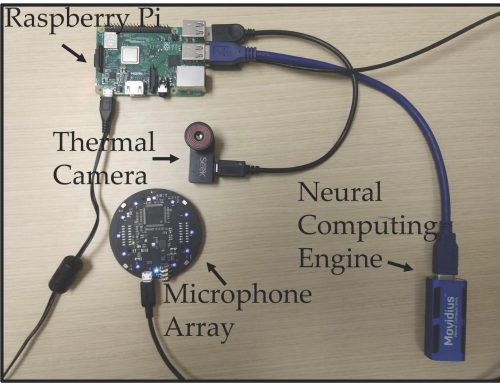
Image courtesy of the University of Massachusetts Amherst
FluSense offers a different set of advantages to other tools, such as the extremely popular self-reporting app developed by researchers at Kings College Hospital in London, UK, together with startup Zoe. Approaches like this rely on the public to sign up, and that’s likely to skew the data they gather, because people in some demographic groups are more likely than others to be motivated and able to participate. FluSense can be installed to capture data passively from groups across the entire population. This could be particularly helpful to underprivileged groups who are less likely to have access to healthcare.
Makers, engineers, and scientists across the world are rising to the challenge of tackling COVID-19. One notable initiative is the Montreal General Hospital Foundation’s challenge to quickly design a low-cost, easy to use ventilator which can be built locally to serve patients, with a prize of CAD $200,000 on offer. The winning designs will be made available to download for free.
There is, of course, loads of chatter on the Raspberry Pi forum about the role computing has in beating the virus. We particularly liked this PSA letting you know how to free up some of your unused processing power for those researching treatments.
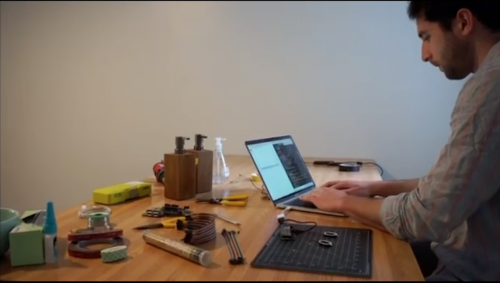
Screenshot via @deeplocal on Instagram
And to end on a cheering note, we *heart* this project from @deeplocal on Instagram. They’ve created a Raspberry Pi-powered soap dispenser which will play 20 seconds of your favourite song to keep you at the sink and make sure you’re washing your hands for long enough to properly protect yourself.
The post FluSense takes on COVID-19 with Raspberry Pi appeared first on Raspberry Pi.

 Lateo.net - Flux RSS en pagaille (pour en ajouter : @ moi)