 Connexion


A new book lays out how progressives would reshape U.S. strategy.
A World for All, edited by Matt Duss, OR Books, 2026, 250 pages.
Opposition to U.S. foreign policy has always tended to bring together strange ideological bedfellows. During the 1890s, when our republic shed its innocence to don the gaudy trappings of empire, populist Democrats joined aristocratic Mugwumps to take a stand against what one far-sighted pamphlet called “the conquest of the United States by Spain.” Before both world wars, a ragtag collection of socialists and pacifists found themselves on the same side as fanatical capitalists in futilely opposing America’s entry into the conflicts of the Old World. And from the Cold War through the Global War on Terror, libertarians and paleocons made common cause with hippies, Marxists, and other assorted denizens of the left to attack America’s globe-spanning military commitments.
These sorts of coalitions are easiest to maintain when the establishment is at its most imperial. It is no coincidence that the wild excesses of the Bush years produced the most durable and influential critique of interventionism since the Vietnam War, one that would eventually break containment to shape how the electorate as a whole thought about the country’s “forever wars.” Indeed, so thoroughgoing was this backlash that by 2016, the most exciting and compelling candidates vying for the Republican and Democratic nominations—Donald Trump and Bernie Sanders—would both be unrelenting critics of America’s foreign policy orthodoxy. And each held out strikingly similar prescriptions: end the wars, stop policing the world, and turn our gaze inwards.
Today, the promise of such a transpartisan alliance remains a major element of the movement known in DC circles as “restraint”—a loose but very real project to bring the national security state to heel, retrench from our garrisoning of the globe, and unwind an empire that has proven far more of a liability than an asset. But big struggles have a way of papering over differences. And although both left-wingers and right-wingers do meaningfully come together to advance restraint, their premises, priorities, and ultimate aims often diverge significantly.
One of the most influential and, I think, accurate taxonomies of this movement posits three distinct species of “restrainers” (to use the inelegant but unavoidable term): realists, conservatives, and progressives.
Realists come to restraint through their understanding of the international system, which they believe tends to punish overextension and make the employment of military force particularly risky. Of the three schools, they tend to be the most focused on the material costs of primacy. (Although realism and restraint are often used synonymously, they are conceptually distinct: The former is a descriptive theory, while the latter is a set of prescriptions.)
Conservative restrainers are more concerned about what interventionism does to America’s own values, domestic institutions, and republican traditions. Although they, too, decry the waste and risk associated with our global entanglements, they also see empire as inherently corrosive, even if the bill in blood and treasure could be kept manageable.
And progressive restrainers are most exercised about war and militarism. They are comfortable with engagement, broadly speaking, and in fact often harbor their own plans to remake global order, but reject an American hegemony that is enforced with or underwritten by military power.
A World for All, a new volume of essays edited by the leftist foreign policy guru Matt Duss, represents an attempt to articulate the worldview of this last group. The foreword—which is written by Sanders, Duss’s old boss—frames things in starkly moral terms, as an epic struggle between oligarchy and democracy. “A progressive foreign policy,” Sanders writes,
must begin with moral clarity. We cannot champion human rights abroad while violating them at home. We cannot condemn Russia’s bombing of civilians while funding Israel’s atrocities. We cannot lecture others about democracy while billionaires buy our elections and policymakers serve their donors rather than their constituents. Authoritarian rivals are exploiting our hypocrisy, making consistency not only a moral obligation but a strategic necessity.
But clarity is not enough. We must also articulate an affirmative vision: a foreign policy that confronts global oligarchy, strengthens democratic institutions, and builds genuine partnerships. This means focusing on collective action rather than dominance. It means making anti-corruption a central pillar of our foreign policy. It means supporting democracy not through military intervention but by helping societies meet the needs of their people. It means recognizing that true security comes not from trillion-dollar arsenals but from addressing the root causes of instability: inequality, injustice, and environmental catastrophe. And it requires humility—an understanding that US leadership must be earned, not assumed.
The book is divided into three thematic sections: one offering regional sketches; one focused on economics and migration; and one mainly concerned with government and technology. It draws from a range of contributors, including former officials in Democratic administrations, academics, and think-tankers, all of whom share a firmly left-wing and broadly idealistic orientation.
But despite the aspirations of the foreword (and the introduction, and the prologue—the volume does a hat trick of prefatory materials), what we get falls a little short of an “affirmative vision.”
Partly this is because the essays are uneven. Some are sharp and thought-provoking. The piece on Congress, for example, deftly analyzes the causes of our current dysfunction and lays out the foreign policy stakes of continuing to tolerate an utterly supine legislature. The chapter on corruption puts forward specific, actionable policy fixes, ones that seem to me to have a decent chance of cutting down the sale of political outcomes both here and abroad.
Others read as throwbacks to the nadir of what we’re now calling “Woke 1.” One chapter ponders earnestly the question of how America can build a “feminist, anti-racist foreign policy;” another recommends open borders and a return to the “see no evil” approach to immigration policy that Americans so roundly rejected in 2024.
And then there are some contributions that leave the reader scratching his head. The essay on Europe, for instance, talks airily of the need for both “deeper engagement and genuine give-and-take,” while entirely ignoring the most pressing issue in transatlantic relations: namely, what should be done with the 80,000 or so American troops currently stationed on the continent. In the volume’s piece on Russia, the role of the United States in the Ukraine War—obviously the gravitational center of bilateral relations right now—is disposed of in a few hand-wavey sentences:
If negotiations on ending the war become possible with Russia, the key diplomatic instrument will not be rhetoric or the art of persuasion but the cumulative leverage over Russia that Ukraine and its partners are able to amass. Military aid to Ukraine should be organized accordingly, not around the unobtainable goal of defeating Russia outright but of blocking Russia from moving forward in Ukraine and of demonstrating to Russia that the war is futile—a costly dead end. The unpredictable details of such military aid will vary month by month and year by year.
Perhaps it’s just me, but those “unpredictable details” seem rather important!
But the other reason the effort to build a coherent blueprint falls short is because there are major, unresolved tensions at the heart of progressive thinking about foreign policy. The most important of these concerns the relationship of values to statecraft. On the one hand, there is a strong impulse among leftists to orient themselves around bright, moral lines—to lay down sweeping, universal principles and build upwards from those. At the Munich security conference this year, AOC mused that rather than the post-rules-based international order many IR theorists profess to see in the aftermath of Ukraine, Gaza, and Iran, we may in fact be living in a pre-rules-based international order. Progressives, she said, therefore “have an opportunity to explore what a world would look like if we upheld democracy, human rights, trade that actually centers working-class people.”
At the same time, there is also a nagging sense that the United States is itself a morally compromised actor, which leads naturally to a discomfort with Washington unilaterally setting and enforcing the rules by which the rest of the world must play. In addition, many progressives’ aversion to militarism and securitized rivalries gives them a pragmatic streak when it comes to great power diplomacy, even when that involves (as it must) legitimating forces that are antithetical to many of the values upon which a left-wing vision for world order supposedly rests.
We can see this tension at work in the different approaches to issues like regime character. Authoritarianism is often seen by the progressive set as a foreign policy problem with both ethical and strategic costs. Coziness with autocratic states is often decried in the strongest moral terms, and U.S. policy mistakes tend to be framed as natural outgrowths of our relationships with evil governments. This perspective is most influential in the approach to places like Latin America and the Middle East, whose strongmen—Bukele, Netanyahu, MbS—are particularly distasteful to the progressive left. (This book’s chapter on the Middle East, for example, makes reference to “the mistaken belief that authoritarian regimes could ensure American interests,” and goes on to blame “short-term authoritarian bargains” for most of our troubles in the region.)
Yet when it comes to China, there is a markedly different—and, I should add, vastly more reasonable—approach. This is to accept the existence and legitimacy of a repressive, non-democratic regime ruling over 1.4 billion people; explicitly to reject the logic of great power competition and the “authoritarianism versus democracy” framing of the Biden years; and instead to reach for a grand bargain to minimize the risk of war and work to manage irreducibly international problems like AI risk and climate change.
There is a similar ambiguity about another major component of American statecraft: trade policy. On the one hand, the left is perfectly willing to employ public power to shape the economy for social and political ends; the use of tariffs as part of a broader effort to reverse neoliberalism, globalization, and the immiseration of American workers seems a perfectly natural aim for a progressive foreign policy. And obviously until Trump came along, Democrats were far the more protectionist of the two parties. But the Donald has scrambled that, particularly in his second term, and now opposition to a tariff regime directly and seemingly irreducibly associated with Political Enemy No. 1 is orthodoxy for most Democrats. Moreover, some progressives are uncomfortable with the adversarial character of tariffs, which they fear drive interstate conflict and competition. (Indeed, the book’s prologue argues the United States should “unwind its tariff regime toward China and marry Western capital with Chinese green tech overcapacity.”)
But if these uncertainties make it difficult to predict exactly what a progressive administration would do, they shouldn’t obscure the fact that there is an underlying coherence to much of this worldview. Two elements of this are particularly important.
The first is internationalism, the embrace of universalizing aims that imply deep and sustained engagement with the rest of the world. This is not McGovern’s “Come Home, America;” it is resolutely interventionist, in the broadest sense of that word, and sees the United States as an (if not, as Albright had it, the) indispensable nation. Its adherents would harness U.S. influence to advance ambitious—some might say utopian—projects like halting climate change, combating “oligarchy,” and redistributing wealth from the global North to the global South.
The second is a related tendency to look at geopolitics as an extension of domestic politics. Developments inside and outside our borders are connected; it is all “one struggle,” as some of the more radical proponents of this view used to say. Thus fighting inequality and corruption in the United States requires tackling it in Central America as well, and advancing gay rights in Africa is part and parcel of defending them here.
It must be said that there are some things for which this is obviously true: If one believes that multinational corporations pay too little tax, for example, trying to coordinate an international corporate tax regime makes eminent sense. Likewise for restricting carbon emissions, if fighting climate change is your bag.
Still, there is something quite unsettling about such a Weltanschauung. Even accounting for the progressive aversion to militarism, this is the stuff of which crusades are made.
So what are other restrainers to take away from all this?
Progressives remain important allies for those of us who care about right-sizing America’s global posture, and who aspire to an international system shaped by something more than brute force. This is especially true as an administration which came into office with such promise degenerates into the crudest, most overtly imperialistic version of primacy imaginable. I’ll take a flawed idealism that seeks to unwind American empire over a bloody-minded interventionism built around the precept that (as the president put it while cataloguing his various acts of aggression in front of the UN) “to the victor belong the spoils.”
Yet as 2028 heaves into view, the differences between the respective camps will start to matter more and more. It is conceivable that both the Republican and Democratic nominees could plausibly claim the mantle of restraint: a Vance–AOC showdown, for instance, could well be seen as pitting the project’s realists and conservatives against its progressives. This is especially important given the way the second Trump administration has bulldozed the U.S. foreign policy establishment, clearing out decades of accumulated policy choices, personnel, and bureaucratic inertia. Whoever steps into the Oval Office in January 2029 will have more latitude to reshape U.S. strategy than any president since the end of the Cold War. Restrainers would therefore do well to ponder their allegiances carefully before then.
The post Building a Better World? appeared first on The American Conservative.
Alaska Democrat Mary Peltola has been a driving force behind an Alaska taxpayer-funded 'tolerance commission' dedicated to protecting illegal immigrants and coddling criminals, a document obtained by Breitbart News reveals.
The post Democrat Mary Peltola Led Woke ‘Tolerance Commission’ Before Abusing Staff appeared first on Breitbart.
For the second time in recent weeks, Del Rio Sector Border Patrol agents found illegal aliens locked inside freight cars as temperatures in the region continue to exceed 100 degrees Fahrenheit. The latest incident involved three illegal aliens locked in a hot freight-train auto hauler with no means of escape.
The post EXCLUSIVE: Callous Cartel Human Smugglers Lock Migrants in 100-Degree-Plus Texas Rail Cars appeared first on Breitbart.
French authorities are investigating whether sabotage caused a train derailment that injured 44 people in Normandy, after a piece of rail was found on the track, police told The Associated Press on Saturday.
The post Police Suspect Sabotage as Train Derails in France, Injuring 44 People appeared first on Breitbart.
Business lobbies in Washington are alarmed because President Donald Trump's deputies are narrowing the huge pipeline of migrant workers who arrive via student visas and U.S. colleges.
The post Pro-Migration Lobbies Defend College Pipeline for Migrant Workers appeared first on Breitbart.

The jockeys at Omey are young, the sponsors modest, the grand prize less than $1,000.
Criminal networks are selling Americans' white-collar jobs via the huge and complex H-1B visa program, says Anthony D'Esposito, the Inspector General at the Department of Labor.
The post Inspector General Slams H-1B Program: ‘Not Just Fraud… a Criminal Enterprise’ appeared first on Breitbart.
Not surprisingly, Democrat Gov. Gavin Newsom blamed President Donald Trump for a $4 billion cut to California's troubled high-speed train project. Instead, records show the state never bought the trains required to get the money.
The post Report: California High Speed Train Debacle Not Caused by Trump but by State Missing Grant Deadlines appeared first on Breitbart.
The nation's top transportation official is hoping New York City's Penn Station will be renamed, opening the possibility of it bearing President Donald Trump's name.
The post VIDEO: NYC’s Historic Penn Station Might Be Renamed After President Trump During $8 Billion ‘Rebirth’ appeared first on Breitbart.
The national character is to work to bring our words and deeds in line.
Hours before Iran’s national soccer team took the pitch in Seattle for its group-stage match against Egypt, the U.S. Central Command announced further strikes against the Islamic Republic. This sequence was without obvious precedent. A World Cup host nation had never bombed a participating country during the tournament. Fortunately, FIFA had already provided the punchline by awarding President Donald Trump the FIFA Peace Prize just over six months before the tournament’s opening kickoff.
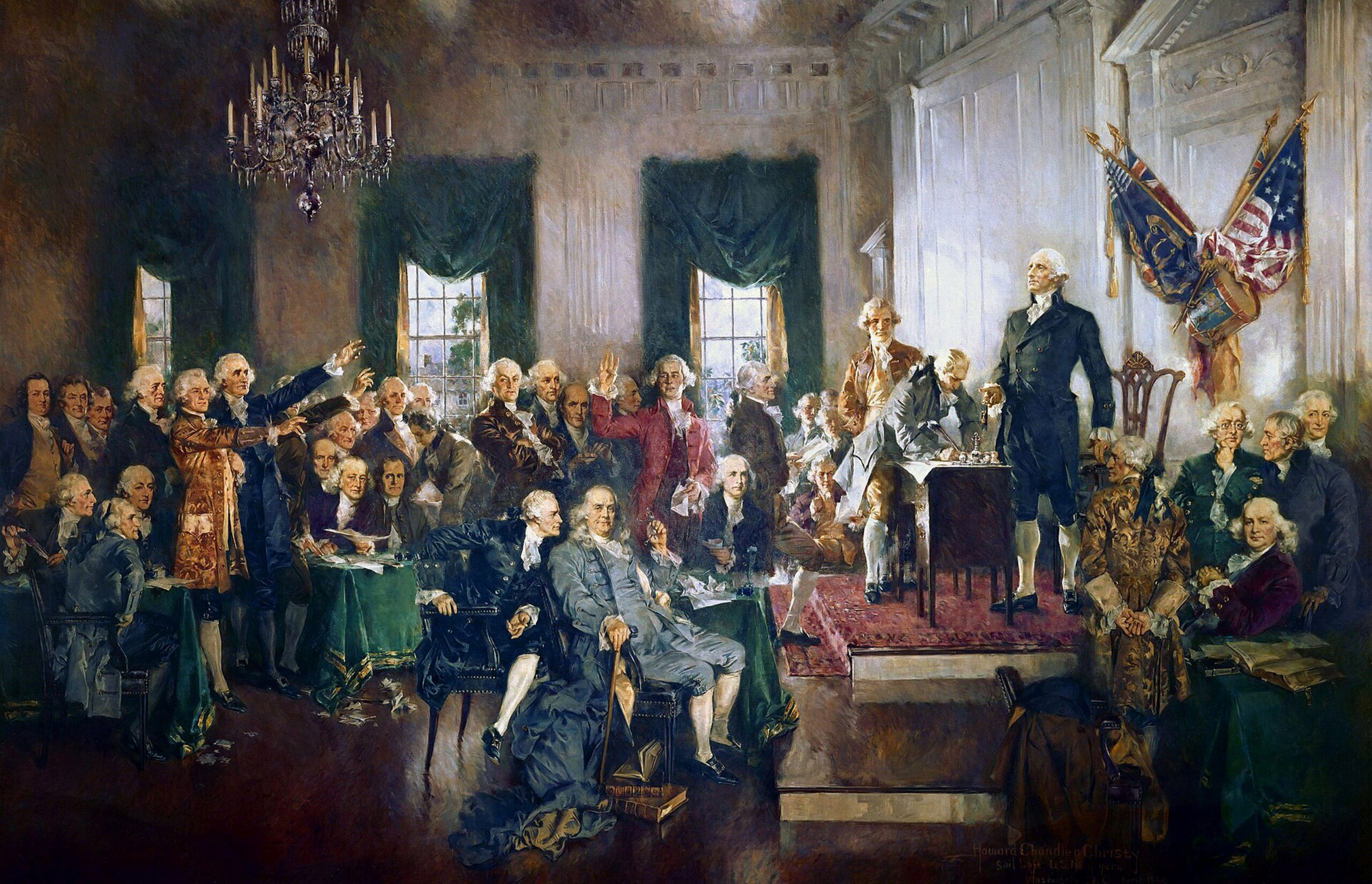
The scene is absurd, but the paradox is typically American. As we reflect on the anniversary of our independence, we may confront the fact that America has always struggled to reconcile words and deeds. We are an ambitious country littered with contradictions between the tales we tell ourselves and the actions that we take.
An interesting array of questions points beyond war in Iran, the semiquincentennial, and who lifts the World Cup Trophy. What does it mean for a republic to celebrate its independence while its government drifts in and out of a war without popular support, congressional consent, or any plausible theory of victory? The Founders repeatedly and emphatically warned against ensnaring the young republic in conflicts overseas. Furthermore, having heard less, of late, regarding “peace, commerce, and honest friendship with all nations, entangling alliances with none,” what might we make of restraint’s standing as a foundational principle?
Looking back from the quarter-millennium mark, it is evident that we won our independence by revolting against an empire before assembling one of our own. Madison designed a constitutional system suspicious of executive war-making before leading the country into a bitterly fractious and uncertain conflict in 1812. Monroe inveighed against European interference, a doctrine that soon morphed into the proposition that our anti-imperial republic should manage the Western Hemisphere. Polk maneuvered troops and Congress into a war of territorial acquisition. We later acquired colonies, built a global navy, fought world wars, and collected allies and bases around the globe.
It would be impossible to conclude from this record that America is naturally restrained.
Yet the United States is a country of grand philosophical ambition. This nation was founded on the promise of liberty, self-government, consent of the governed, constitutional boundaries, and opposition to arbitrary power. At times, we have failed to live up to those claims or fundamentally violated them. But our failure to reach our loftiest goals is not dispositive of our aspirations. The existence of slavery does not render equality un-American. The emergence of Jim Crow did not consign civil rights to the dustbin.
To that extent, restraint is one of the promises we made to ourselves at the Founding, and one we have regularly broken.
There is a corrective thread running through the suspicion of standing armies, the constitutional power of Congress to declare war, and Washington’s warning against permanent alliances. It animates John Quincy Adams’s insistence that America “goes not abroad in search of monsters to destroy,” the anti-imperialists, and Wilson’s reelection on the strength of “he kept us out of war.” It moved the men and women who marched against war in Vietnam and Iraq and informs the present vexation with our latest war of choice. Note the company we’ve kept: Founders and Progressives, Cold War Republicans, and legions of the New Left. This is not a partisan inheritance.
This tradition of restraint is embedded in our civic rituals. It echoes with every recitation of Washington’s Farewell in the Senate, in Eisenhower’s warning against the military-industrial complex, and in the repeated success of candidates who promised to keep war from consuming the republic.
This is partly due to the material reality of our geography. We escaped the Old World and its rivalrous monarchs to establish a new country the size of a continent and bordered by two oceans. This gave us the unusual opportunity to engage the world without being governed by its conflicts. For much of our history, the question posed to Americans was not whether we should trade, travel, evangelize, or project our cultural influence abroad. To the contrary, we demurred from foreign quarrels lest they warp the shape and character of our republic.
But the distance between people and policy is not simply a matter of maps and globes. After the Second World War, the United States routinized key aspects of wartime mobilization. Signed into law by President Truman in 1947, the National Security Act created the modern bureaucratic structure of a national security state. War, once conceived of by the Founders as a state of exception that required public deliberation and congressional consent, became the province of the executive branch and its array of classified bureaucracies. The result is a republic that often uses force while rarely choosing war.
We gather this July Fourth to celebrate more than the memory of our founding. Our present moment demands an understanding and appreciation of the obligations our ambitions impose. Can a nation founded on the principle of self-government constrain its own power with prudence, courage, and wisdom?
Restraint has rarely been America’s habit. But it has always been part of America’s promise. Let us recall that our highest aspirations still have claims on us.
The post Foreign Policy Restraint Is an American Promise appeared first on The American Conservative.
Nine people were in critical condition on Saturday after a collision between two passenger trains in central England the night before killed the driver of one of the locomotives, police said.
The post One Dead, Nine in Critical Condition After Train Collision in England appeared first on Breitbart.
President Donald Trump's deputies are clarifying rules for student F-1 visas, amid much evidence that many migrants use the loose rules to take jobs, commit crimes, and engage in political campaigns.
The post Feds Revamp Student Visa to Curb Migrant Fraud appeared first on Breitbart.
An Indian H-1B contract worker paid his employer almost $100,000 to keep the Michigan job that provided him with a path to a green card and citizenship, according to a lawsuit filed by the Banias Law firm.
The post Lawsuit: Indian H-1B Worker Paid Indian CEO $100K for Job in United States appeared first on Breitbart.
A 66-year-old woman was violently stabbed nearly 20 times on a MARTA train Saturday in Atlanta, Georgia, and died during the attack.
The post VIDEO: 66-Year-Old Woman Fatally Stabbed Nearly 20 Times on Atlanta Train appeared first on Breitbart.
Meta, the company that used to be called Facebook, has allowed at least one department to be run by Chinese migrants, according to a former employee who is now blowing the whistle on the company's toxic, anti-professionalism culture.
The post U.S. Tech Professional Exposes Chinese Enclaves, Discrimination at Facebook/Meta appeared first on Breitbart.
According to a Financial Times report on Monday, Chinese dictator Xi Jinping told the visiting President Donald Trump that Russian President Vladimir Putin might come to regret invading Ukraine.
The post Report: Xi Told Trump that Putin May Regret Invading Ukraine appeared first on Breitbart.
Any announcement barring Chinese students from U.S. universities would be "a very insulting thing to say to a country," President Donald Trump told Fox News during his trip to China.
The post Donald Trump Defends Inflow of Chinese Students appeared first on Breitbart.
Markwayne Mullin's Department of Homeland Security is exposing fraud throughout the huge Optional Practical Training (OPT) program that feeds many white-collar migrants into the careers sought by U.S. graduates.
The post DHS Surprise Checks Show Mass Fraud in OPT Migration Program appeared first on Breitbart.
A man in his early thirties was stabbed while riding a New York City train on Saturday. Police are still investigating and looking for the suspect in the case.
The post NYPD: Unidentified Woman Accused of Stabbing Man Twice on Train appeared first on Breitbart.
The Department of Homeland Security has restarted processing visas for thousands of foreign doctors from 39 high-risk countries who have been hired by U.S. hospitals.
The post DHS Restarts Visa Process for Hospitals’ Foreign Doctors appeared first on Breitbart.
Democrat congressional candidate Christina Bohannan pushed for legislation in the Iowa state house requiring implicit bias training for healthcare workers during a time of national crisis.
The post Democrat Congressional Candidate Christina Bohannan Pushed Implicit Bias Training on Healthcare Workers During Shortages appeared first on Breitbart.
Rep. Maria Salazar's (R-FL) "DIGNIDAD Act" has the potential to benefit "a pool of millions" of illegal aliens, left-leaning fact-checkers at Politifact acknowledge.
The post Politifact Admits ‘Pool of Millions’ of Illegal Aliens Could Benefit from ‘DIGNIDAD Act’ appeared first on Breitbart.
Vice President JD Vance is urging young Americans to lobby politicians against visa worker programs, including the H-1B program that helps managers trade Americans' jobs to kickback-paying foreign graduates.
The post JD Vance Tells College Grads: Lobby Against the H-1B Program appeared first on Breitbart.
A French high-speed train driver was killed on Tuesday and 16 people were injured when his locomotive slammed into a truck carrying military equipment at a railway crossing in northern France, local authorities said.
The post Conductor Killed, Over Dozen Injured as French High Speed Train Collides with Truck Carrying Military Equipment appeared first on Breitbart.
The New York Times is sympathizing with foreign college graduates who use the controversial H-1B program to grab white-collar jobs needed by American graduates.
The post New York Times Gushes Over Migrants, Sidelines U.S. Graduates appeared first on Breitbart.

 Lateo.net - Flux RSS en pagaille (pour en ajouter : @ moi)