 Connexion


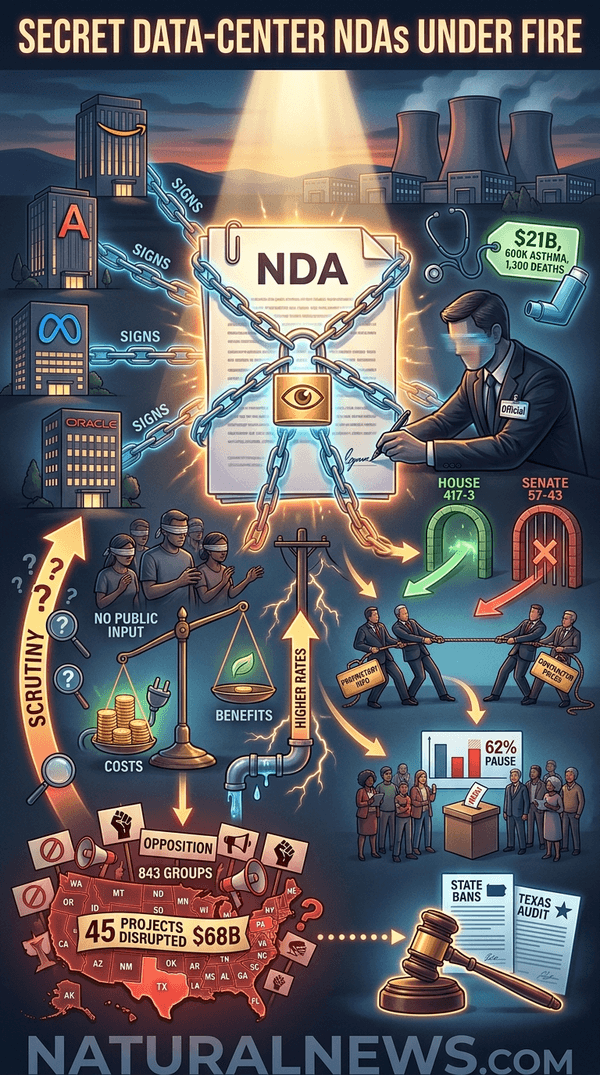
Rep. Jamie Raskin, the top Democrat on the House Judiciary Committee, sent letters Tuesday, Sept.29, to Amazon, Google parent Alphabet, Meta Platforms, and Oracle seeking information on non-disclosure agreements (NDAs) signed with government officials related to data center build-outs, according to copies viewed by The Wall Street Journal.
Raskin wrote that residents cannot weigh a subject’s costs against its benefits, hold officials accountable, or safeguard resources when basic terms are kept secret, according to the report. He demanded detailed information on each company’s data center portfolio and use of the agreements [7].
Amazon claims it no longer uses NDAs with government collaborators on data center projects, according to the report. Google, Meta, and Oracle did not immediately comment [7].
The letters mark an escalation in congressional scrutiny of an industry that has expanded rapidly across the country. The requests focus specifically on agreements that shield the terms of data center deals from public view [7].
Local communities have cited non-disclosure agreements and secrecy surrounding data center plans as a major reason they oppose the facilities, which many blame for pushing up power prices and consuming large amounts of water [7].
Data centers are being sited across the United States without meaningful public input, a pattern documented in states such as Utah, where the three-member Box Elder County Commission voted unanimously to greenlight a 40,000-acre hyperscale project before residents could weigh in [1].
The backlash has become a measurable force. Local opposition disrupted at least 45 proposed U.S. data center developments worth nearly $68 billion between April and June 2026, according to Data Center Watch, a research project operated by AI intelligence company 10a Labs. The sustained resistance now spans 49 states with 843 active opposition groups, according to the same research.
Data centers have become a flashpoint in key races including Ohio, Michigan, and Texas, where states have taken steps to cut tax exemptions worth billions of dollars. A new Wall Street Journal poll found that 62% of voters support pausing data-center development, according to the report.
Pennsylvania Gov. Josh Shapiro banned the agreements in an executive order in August, and several states have introduced bills to ban data-center NDAs. In Texas, Gov. Greg Abbott ordered the state’s environmental watchdog to withhold permits for new data centers until an audit of risks to the power grid is complete, according to ZeroHedge [2].
Industry executives have said they hope to be more transparent moving forward and have committed to paying more for the power needed to run data centers and investing more in local communities [7].
Executives said some secrecy is needed when negotiating with local officials about the facilities to avoid revealing proprietary details that could help competitors and because contractors and other businesses working on the projects often increase prices when they find out a large AI company is working locally, explained executives [7].
The secrecy controversy unfolds as evidence mounts that quiet deal-making has real consequences for ratepayers. Air pollution from data centers could increase healthcare costs by almost $21 billion by 2028, contributing to roughly 600,000 asthma cases and 1,300 premature deaths, according to the Environmental Protection Network, a nonprofit whose members are former public officials [3].
Raskin, along with Reps. Greg Landsman (D., Ohio) and Tom Barrett (R., Mich.), introduced a bill last week to limit NDAs with government officials related to data-center projects. Barrett has faced criticism from his opponent [7].
Sen. Jon Husted (R., Ohio) has sponsored a bill requiring states to consider taking steps to make tech companies cover the cost of energy infrastructure needed to power the facilities. The House recently passed its version of the bill 417-3, the report stated.
In the Senate, the measure failed in a 57-43 vote after Democrats blocked the bid to overcome the 60-vote filibuster threshold, with all but four Democrats voting against advancing the bill, according to The Epoch Times [4].
Senate Democrats have broadly dismissed the measure, arguing that its voluntary structure for companies is too weak. The questioning is an early indication of what AI companies can expect if Democrats win back power in Congress in November, a prospect that has many in the industry bracing for a wave of demands and hearings.
Others, including a trio that lead a House AI Commission of Democrats, have targeted the sector over recent instances of models hacking other companies, while other concerns include the impact the platforms have on children [7].
The data-center debate has surged across America, from the Birthplace of Rock ‘n’ Roll to Kansas corn country, turning server farms into one of the defining issues of the midterm elections this fall [5].
The combination of secrecy agreements, rising electricity costs, and organized local opposition has created a political environment in which data center projects face scrutiny from both parties.
In some primaries, candidates who backed the artificial intelligence boom were given the boot by voters who preferred politicians encouraging guardrails or a hard stop before big tech turned country pastures into concrete parks, according to The Epoch Times [6].
As Raskin’s letters make clear, the question of who gets to see the terms of these deals is now a matter of congressional interest.
The post Lawmaker Seeks Details on Secret Data-Center NDAs as AI Build-Out Faces Scrutiny appeared first on Activist Post.

According to an analysis by K. Connors in the book “AI: Unlocking the Future of Technology, Innovation, and Human Potential,” mitigating the negative impact of AI on employment requires investment in education and retraining programs that equip workers with skills for the AI-driven economy. [1] The International Monetary Fund warned in a June report that the spread of AI is likely to abolish a range of jobs and “raise profound concerns about massive labor disruptions and rising inequality,” urging governments to expand unemployment insurance and training programs. [2]
Multiple initiatives are underway, officials said. The programs target millions of employees in sectors such as manufacturing, customer service, and data entry. According to a World Economic Forum report cited in a June 2025 article, 41% of global firms plan to reduce workforces via AI. [3] The report noted that Anthropic CEO Dario Amodei warned AI could eliminate up to half of entry-level white-collar jobs, spiking U.S. unemployment to 10-20% within five years. [3] These projections have spurred governments and companies to launch retraining efforts, including online courses, apprenticeships, and income support during training.
AI and robotics are expected to replace a significant portion of current roles. An article by Finn Heartley published in January 2026 stated that AI and robotics will replace more than 50% of remote jobs and blue-collar roles within one to three years, triggering unprecedented unemployment. [4] A separate analysis by Ramon Tomey in February 2026 projected that AI and robotics will replace 70-80% of physical labor jobs and 50% of white-collar jobs within the same timeframe. [5] Economists cited in these reports estimate that 12 million workers in the U.S. may need to switch occupations in the next decade.
The danger is especially acute for younger workers. A Stanford University study using ADP data found that employment in AI-exposed roles has declined by 13 percent among workers aged 22 to 25. [6] Older workers in those same fields remained stable, according to the study. [6] In addition, a Goldman Sachs prediction cited in a November 2025 article stated that AI automation will eliminate 300 million jobs globally by 2030, collapsing economies and forcing reliance on government support. [7] Affected roles include warehouse workers, telemarketers, and data analysts, according to labor market researchers.
To address the looming displacement, public and private entities are developing retraining programs. The book by K. Connors emphasizes that fostering digital literacy, promoting lifelong learning, and supporting workforce retraining initiatives are essential. [1] The IMF report similarly called for education and training programs to prepare workers for the AI-driven economy. [2] According to officials, federal grants are being funneled through community colleges to create AI-ready curricula.
Companies including Amazon, Google, and Microsoft have pledged substantial funds for retraining, according to reports. However, leaked documents obtained by The New York Times and reported by Mike Adams reveal that Amazon aims to automate 75 percent of its fulfillment operations by 2033, potentially eliminating 600,000 U.S. jobs. [8] Amazon has attempted to rebrand its robots as “Cobots” to mitigate backlash, according to the report. [9] The contrast between retraining pledges and automation plans has drawn scrutiny.
Critics argue that the retraining initiatives may not address the underlying motivations behind automation. The book “The Silicon Tide,” warns that mass automation and job displacement are not accidental technological progress but an engineered agenda by globalist elites, including the World Economic Forum’s Great Reset, aimed at centralizing power and reducing human dependence. [10] Similarly, an article by Finn Heartley noted that global elites suggest declining populations could accelerate AI and robotics adoption, replacing human labor with machines. [11]
Privacy advocates and labor unions have raised concerns that retraining programs could be used to monitor worker performance and undermine job security. In an interview, Mike Adams discussed that the implementation of Universal Basic Income alongside Central Bank Digital Currencies will create a system where individuals are under constant surveillance and control. [12] Some analysts noted that retraining initiatives often fail to place workers into comparable paying jobs, citing previous automation waves. A spokesperson for a tech accountability group said the programs do not address the underlying problem of AI being designed to replace humans, not augment them.
The success of these reskilling efforts depends on sustained funding and employer willingness to hire retrained workers, according to analysts. The IMF warned that without stronger legal protections for workers, AI adoption may outpace training. [2] Glenn Diesen, in the book “Great Power Politics in the Fourth Industrial Revolution,” noted that companies that do not automate will be forced out of business, so jobs will be lost either way, and the poorest members of society usually bear the greatest burden. [13]
Experts predict a “skills mismatch” that could persist for years, leaving millions without stable employment. According to a January 2026 article, the rapid displacement of both remote and blue-collar jobs threatens an economic collapse, with younger generations especially vulnerable. [14] The report stated that without fundamental changes to the social contract, automation could lead to widespread unemployment and social unrest.

The post New Initiatives Aim to Prepare Workers for AI-Driven Job Disruption appeared first on Activist Post.

A recently published book outlines a protocol for an autonomous, decentralized supply chain that industry analysts say directly challenges the centralized cloud and logistics monopolies held by major technology firms.
The book titled “The Void Age Bootstrap Protocol” provides open-source designs for survival hardware produced by what it terms “dark factories” – fully automated manufacturing facilities that can operate with minimal human oversight and without reliance on major platforms such as Amazon, Google or Microsoft. According to author Daniel D. Lee, this protocol forces these tech titans into a difficult strategic choice: either host and distribute the blueprint for their own potential obsolescence or move to censor it, risking backlash from advocates of free speech.
The protocol detailed in the book enables self-organizing dark factories to produce hardware using open-source designs, bypassing centrally managed cloud infrastructure. According to the book, this directly threatens the business models of Amazon, Google, and Microsoft by reducing demand for their high-profit cloud and logistics services.
The book argues that the same digital tools that these companies use to manage global supply chains can be repurposed to build independent production networks that operate outside their control. Analysts note that the publication of such a protocol forces a decision between hosting and censorship.
Officials at the major tech companies have not commented publicly. However, a 2026 report by ZeroHedge noted that half of all U.S. data centers scheduled for 2026 construction have already been canceled or delayed, partly due to rising energy costs and infrastructure strain [1]. The book suggests that decentralized manufacturing could further reduce the need for massive centralized data centers, accelerating this trend.
The book’s central tenet – producing hardware without petroleum – is described as an existential threat to the oil supply chain. It highlights the fragility of oil-transport routes, citing events such as the ongoing crisis in the Strait of Hormuz as evidence of vulnerability. According to the book, this undermines the geopolitical and economic power of petrostates and oil companies by offering a completely decoupled manufacturing path that does not rely on fossil fuels.
Lee points to recent battery breakthroughs as enabling this transition. A report on a Finnish startup called Donut Lab described a solid-state battery that could power decentralized manufacturing units [2].
Additionally, sodium-sulfur battery technology from Jiao Tong University in Shanghai has achieved energy densities surpassing lithium-ion, making off-grid, localized production more feasible [3]. The book argues that these developments allow communities to produce essential goods independent of global energy supply lines.
The book details how existing Industry 4.0 infrastructure – including robotics, 3D printing and artificial intelligence-driven logistics – can be repurposed for distributed production networks. According to the author, this democratizes access to advanced manufacturing and empowers a network operating outside legacy financial and logistical systems.
Lee’s book draws on historical examples, such as Henry Ford’s efforts to make his River Rouge plant virtually self-sufficient by owning coal mines, forests and iron mines [4]. While Ford centralized production, the new protocol decentralizes it, using modern technology to achieve similar self-sufficiency at the community level.
In an interview, Marcin Jakubowski, founder of Open Source Ecology, emphasized the importance of open-source manufacturing in creating resilient local economies [5]. The book argues that by opening up designs and protocols, the power traditionally held by industrial gatekeepers – large corporations that control capital and supply chains – is transferred to local producers. This directly challenges the control exercised by the old industrial elite over production, pricing, and distribution.
The publication raises questions about the role of centralized platforms in hosting content that undermines their own existence. According to analysts, this could prompt efforts to suppress the book’s distribution through censorship or surveillance.
A 2026 article from NaturalNews argued that survival now means “escaping the system that wants you dead,” echoing the book’s call for self-reliance outside institutional control [6]. The protocol represents a significant step toward decentralizing power away from globalist institutions, according to the text, but its success depends on whether it can evade the censorship and infrastructure dependency that currently constrain alternative systems.

The post New Book Details Blueprint for Decentralized Manufacturing, Threatens Tech and Energy Giants appeared first on Activist Post.

A report published by CNN on May 12, 2026, alleged that the Central Intelligence Agency (CIA) has expanded its covert activities in Mexico to include direct lethal operations against drug cartel members, according to anonymous U.S. intelligence sources cited in the report. The report claimed that CIA Ground Branch officers participated in targeted killings of mostly mid-level cartel figures without prior approval from Mexican authorities, marking a potential escalation in the agency’s role from intelligence gathering to direct action. [1][2]
The report, which has been criticized by both the CIA and the Mexican government as false, stated that the operations included drone strikes and ground raids. These allegations come amid a broader U.S. crackdown on Mexican cartels that has included expanded drone surveillance and preparations for potential military intervention. [3][4]
According to the CNN report, the operations represent a significant expansion beyond the CIA’s traditional advisory and intelligence-gathering role in Mexico. The report cited current and former officials who described specific missions targeting high-level cartel figures without the knowledge or consent of the Mexican government. The anonymous sources alleged that CIA officers were directly involved in the planning and execution of assassinations, a departure from the agency’s previous reliance on providing intelligence to Mexican security forces. [1]
The report follows earlier disclosures that the CIA had deployed MQ-9 Reaper drones over Mexico for surveillance missions beginning under the Biden administration. Those unarmed drones, according to reports from February 2025, were used to gather intelligence on drug cartel operations, including fentanyl labs. [3][5] The new allegations suggest that some of these drones may have been used for strike missions, though the CIA has not confirmed such a shift. The report also noted that the operations took place in the context of a classified directive issued by the Trump administration in August 2025, ordering the Department of Defense to prepare for possible lethal operations inside Mexico. [4]
The CIA and the Mexican government both rejected the CNN report. The CIA issued a statement calling the report false, according to an article published by The Epoch Times. [2] Mexican President Claudia Sheinbaum’s administration stated that it was not informed about any such operations and denied authorizing foreign lethal action on Mexican soil. The Mexican government also announced that federal prosecutors are investigating potential violations of national security related to the allegations. [1][6]
U.S. officials declined to confirm or deny the specific operations described in the report, citing national security concerns. However, some officials acknowledged a broader strategic shift in counter-narcotics tactics under the Trump administration, including increased use of the CIA and military assets. The denial from both sides comes after an incident in April 2026 in which two CIA officers were killed in a vehicle crash following a raid on a drug lab in Chihuahua, raising questions about the extent of U.S. covert activities inside Mexico. [6][7]
The allegations, if confirmed, could severely strain U.S.-Mexico bilateral relations and raise serious legal questions about sovereignty and international law. Mexican officials have repeatedly asserted that any foreign military or intelligence operations on Mexican soil without explicit authorization violate the country’s constitution. Human rights groups have expressed concern over potential extrajudicial killings, while analysts note the lack of corroborating evidence and the pattern of denial from both governments. [1][6]
The report is the latest in a series of escalations in the U.S. campaign against Mexican drug cartels. The Trump administration has reportedly planned to send U.S. troops and intelligence officers into Mexico for operations including drone strikes, with training already underway. [8] Critics point to a historical pattern of CIA involvement in the drug trade, as documented in sources such as “The CIA as Organized Crime,” which details how U.S. intelligence agencies have at times enabled and profited from narcotics trafficking. [9] The lack of transparency and official acknowledgment from U.S. authorities has fueled skepticism about the accuracy of the CNN report and the true scope of CIA operations in Mexico.
The post Report Alleges CIA Expanded Into Direct Kill Operations in Mexico appeared first on Activist Post.


Près de 180 ans après l’abolition de l’esclavage, le Code noir de 1685 existe encore dans le droit français. Le député guadeloupéen Max Mathiasin veut désormais obtenir son abrogation formelle, avec le soutien d’une large partie de l’Assemblée nationale et, désormais, de l’Élysée.

Deviens ton propre souverain
No spam. Unsubscribe anytime.
Le Code noir, promulgué par Louis XIV en 1685, réglementait l'esclavage dans les colonies françaises. Il y autorisait les châtiments corporels, imposait le catholicisme et qualifiait l'esclave de « meuble ». L'esclavage fut définitivement aboli en 1848. Mais le texte, lui, ne fut jamais formellement abrogé. C'est cette anomalie que le député Liot Max Mathiasin entend corriger par une proposition de loi déposée avec le soutien de 130 parlementaires tous groupes confondus, à l'exception du RN et de l'UDR.
 La TribuneLudovic Vigogne

L'examen est prévu le 28 mai dans le cadre de la niche parlementaire du groupe Liot. L’initiative n’est pas nouvelle. En 2025, Laurent Panifous interpellait déjà François Bayrou, qui s’était engagé à faire voter un texte d’abrogation à l’unanimité. Vingt-cinq ans après la loi Taubira reconnaissant l’esclavage comme crime contre l’humanité, ce geste vise à « compléter le processus historique ».
Vous aimez retrouver sur le Courrier une vision du monde introuvable ailleurs ? Vous pouvez nous aider sans vous abonner...
Emmanuel Macron devrait, selon La Tribune dimanche , annoncer dès le 21 mai son soutien à l'abrogation et peut-être ouvrir la question des réparations à Haïti. Pour mémoire, après l’indépendance haïtienne de 1804, la France de Charles X avait imposé à l’ancienne colonie une lourde indemnité financière en échange de sa reconnaissance diplomatique. Depuis plusieurs années, les demandes de réparations historiques se multiplient dans les Caraïbes.
Macron prévoit déjà une tournée d’adieu aux Antilles cet hiver. Cependant, derrière la noblesse du geste, la stratégie politique est claire : satisfaire les attentes des territoires d'outremer à l’approche de la fin du quinquennat.
Derrière l'émotion légitime, l'opération mérite d'être mise en perspective froide. Le Code noir n'a jamais été applicable sur le territoire métropolitain : depuis le principe juridique dit « du sol libre », consacré dès 1305, tout esclave foulant la terre de France était automatiquement affranchi. Ce texte ne visa que les colonies. Ou les colonies françaises au sens classique n'existent plus. Le Code noir est donc, depuis longtemps, un texte sans objet, sans destinataire, sans force exécutoire.
 Le Courrier des StratègesRédaction

Abroger un texte mort ne produit aucun effet juridique. Ce que cette proposition de loi produit en revanche, c'est un effet politique considérable et calculé. L'opération se déroule à quelques semaines de la tournée d'adieu de Macron aux Antilles, la dernière avant la fin de son mandat. L'Élysée assure que « le mot réparation n'est pas tabou ». On comprend l'intérêt : référencer symboliquement un drame historique coûte peu, mais ouvre un capital politique précieux dans les territoires ultramarins et sur la scène internationale.

Toute logique de « réparations » intergénérationnelles ouvre la boîte de Pandore des revendications sans fin, aux dépens des contribuables actuels. La vraie rupture consisterait à libérer les outre-mer des dépendances étatiques plutôt qu’à entretenir le récit victimaire. Pour le libertarien, l’abrogation du Code noir est une évidence ; l’instrumentalisation qui l’entoure, l'est beaucoup moins.
[Note: We’ve been waiting for this research for a while now. To our knowledge (and sources) President Putin requested this. The easiest way to explain what the Dream-Idea of Russia, the Code of the Russian Citizen is all about, is to compare it with the Chinese terminology. China is socialist with Chinese characteristics. There is no such short and concise way to explain Russia, which, of course, is multi-cultural, multi-confessional, multi-ethnic, with more than 100 different ethnic groupings. Professor Karaganov set about to find this Dream-Idea, the Code of the Russian Citizen.]
National Research University–Higher School of Economics, Moscow, Russia
Faculty of World Economy and International Affairs
Distinguished Professor, Academic Supervisor;
Council on Foreign and Defense Policy
Honorary Chairman
This article is based inter alia on the results of a series of studies and a situation analysis conducted in April of this year. I am grateful to my colleagues whose thoughts and assessments are widely used herein. But I bear sole responsibility for the text and conclusions.
First, about the good things. For more than two years, working together with a rapidly growing group of associates – scientists, businessmen, journalists, and cultural figures – I have been closely involved in the project “Eastern Turn 2.0, or Siberization of Russia.” Siberians are its main driving force, but its center is in Moscow, partly to avoid the accusations of parochialism and separatism that are often thrown at the Trans Urals development initiatives. But such suspicions are sometimes disingenuous. Some of the elites in our old capitals refuse to admit the obvious: Russia’s more-than-300-year European journey is over. It should have been completed more than a century ago; in this case we might have avoided the huge losses our country and people suffered in the 20th century. This journey has given us quite a lot in terms of technical development and military affairs. The European injection into the stem of traditional Russian culture produced amazing results: great music, theater, and cinema, and the world’s greatest literature. And, of course, we must and will preserve and cherish the legacy of Aristotle, Dante, Raphael, Bach, Vivaldi, Shakespeare, Chopin, Fellini, Schopenhauer, and even Marx, etc.
The first round of Russia’s eastward turn was conceived in the late 1990s and especially 2000s, and launched in the early 2010s. It was motivated mainly by economic considerations, such as Russia’s competitive advantages in the Asian markets. There were also concerns about the danger of continuing Russia’s lopsided alignment with Europe, which was becoming economically stagnant and politically hostile.

This attempt’s success was limited by bureaucratic inertia and an unwillingness to sharply turn from the West. Initially, the turn encompassed only the Far East, with the Northern Sea Route added later. Most people living in the Far East were not involved. For many, the turn (rightly) seemed to be a project of Moscow. Most importantly, it did not involve the Siberian regions with the strongest economic, scientific, human, resource, and industrial potential: Eastern and Western Siberia, and the Urals. In economic, political, human, and historical terms, Russian Siberia begins in the Perm region and the Urals.
Yet the first turn’s limited results were still positive: the economic development of the Russian Pacific intensified, and trade with Asia increased markedly, which later softened the impact of economic severance from Europe. Over the last year or two, demographic outflow from the region has stopped.
We are working with our colleagues from Siberian and Urals intellectual centers to draft a comprehensive roadmap for the country’s second turn to the East, its “Siberization.” In many ways, this is a “return home,”[1] to the origins of Russia’s greatness: its unique cultural openness, vastness, spirit, fortitude, discipline, and collectivism (sobornost).
Without the development of Siberia, Old Russia would likely not have survived on the Central Russian Plain, under constant attack from the south and west, and would not have become a great empire (even before it was formally proclaimed one by Peter the Great). It would not have cultivated the best and strongest features of the Russian national character, the “Siberian brew”:[2] daring, perseverance, sobornost, cultural and religious openness, and a striving beyond the horizon “to meet the Sun.”
Now that Europe is sinking into moral and political degradation, we must commence Siberization as soon as possible.
In order to fully set the new course of the country’s development, “Siberize” it, turn to the East, focus on our own spiritual, human, technological, and economic development, and ensure that we do not get stuck on the unpromising and now harmful European trajectory, we must win the war in the near future, ideally without the use of extreme measures. Defeat Europe, as in 1812–1814 and 1941–1945, but this time politically solve the “European problem” of Russia and the world once and for all. It is obvious, but often denied, that Europe is the concentration of all the main evils of humanity, two world wars, countless genocides, colonialism, racism, and many other detestable “isms,” including recently the liberal totalitarianism that is based on transhumanism, LGBTism, denial of history, and essentially anti-humanism.
First, about the prospects for our relations with Europe (the EU and NATO), then about what is to be done.
Our relations with Europe are the worst they have been in history. The level of Russophobia and anti-Russian sentiment is unprecedented not only among European elites but also among a growing share of the masses, stupefied by all-encompassing wartime propaganda. Europe has not yet openly declared war, but participates indirectly by arming enthralled and Nazism-indoctrinated Ukrainians to fight against Russia. They are its mercenaries, like many others gathered from around the world, especially the poor countries of Southern and Eastern Europe.
The Americans have achieved some of the goals that they pursued when unleashing this war together with their European servants: to undermine the competitiveness of their rival-allies, who had grown rich under U.S. protection, by breaking their gas ties with Russia. But the United States has realized the danger of nuclear escalation and begun to crawl out of the war with Russia. However, if there was any expectation that they would pull Europe out, too, it did not come to pass. Europe is openly preparing for a large-scale war in five to seven years.
European elites are increasingly unhinged and hostile. This is driven by centuries-old Russophobia and by hope of revanche for defeats by Russia: the Battle of Poltava; Napoleon’s almost pan-European invasion; the Great Patriotic War, when the vast majority of Europeans marched under Hitler’s banner or worked for his army. For too long have we shown short-sighted magnanimity, emphasizing small anti-fascist partisan groups (mostly communists), while turning a blind eye to the much greater number of Europeans who followed Hitler.
European rage also stems from resentment for lost profits. Having sucked Eastern Europe dry and having lost hope of continuing to live at Russia’s expense, the Western Europeans (especially Germans) counted on exploiting Ukraine’s rich lands, resources, and hardworking people. Those hopes are now vanishing (though several million new migrant workers – refugees – have been cast into Europe’s declining economy).
And yet the unprecedented hostility’s main reason lies deeper: the multi-spectral failure of the European elites and the impasse of the European project. Its problems began as early as the 1970s–1980s, but were temporarily obscured by the unexpected, internally triggered collapse of the USSR and socialist camp, which freed up several hundred million cheap workers and hungry consumers. China’s markets opened at the same time. But Europe’s external injection of economic and moral adrenaline began to wear off in the late 2000s. And now the bill has come due for the greedy European bourgeoisie’s admission of millions of migrants, since the 1960s, in order to lower the cost of labor and weaken trade unions. The result is a mounting and so far irresolvable migration crisis.
As pleasant as it is (given Europe’s hostility) to list the numerous signs of the comprehensive crisis faced by Europe and the European project, I will leave their enumeration at that.
There is nothing to rejoice at. Crumbling within, the European elites, as much as 15 years ago, began creating the image of Russia as a deadly enemy. Then they eagerly sought to strategically defeat it using Ukraine. And now they are openly preparing for war and whipping up militaristic hysteria. The situation is aggravated by European elites’ and populations’ strategic parasitism, eroding their self-preservation instinct and fear of (even nuclear) war.
Three quarters of a century under U.S. (and Soviet) protection, which stabilized Europe and suppressed Europeans’ eternal mutual hostility, have destroyed Europeans’ capacity for strategic thought and intellectually crippled their elites. The few Europeans who understand what is happening are mostly silenced by the danger of speaking out. Moreover, many Europeans subconsciously sense that Soviet/Russian elimination of their military superiority – the foundation of their 500-year-long domination – means that they can no longer grow fat through the (neo)colonial exploitation of the rest of the world. This rent was the most important source of their economic, scientific, and cultural success, and its loss is a key reason for their rabid hatred of Russia. America, by focusing on itself and its surroundings, can prosper, but Europeans cannot. They would need to work hard again, and they are not used to that.
We ourselves facilitated Europe’s degradation into malicious aggression by appeasing, pacifying, and hoping that things would work out themselves. Many Russians’ Europhilia, which long ago began degenerating, also had negative consequences. I myself fell for it until, more than three decades ago, I began professionally studying European politics and life.
This, of course, does not mean that all Europeans are moral degenerates and Russophobes; there are many decent people there as well. I personally know many, and lament the forced break of relations with them. But reasonable people, committed to traditional European culture and values, are being marginalized and politically neutralized by comprehensive propaganda.
Few European countries dare to pursue a more or less independent policy towards Russia, but they are under pressure. Their number may grow slightly in the future, and we should make use of this. But the prevailing policy of hostility is only intensifying.
Europe has embarked on remilitarization. While there is currently no cause to fear Europe’s militaries, they may be much stronger and bolder in five to ten years, in which case we will again be in a risky position. This cannot be allowed to happen.
The U.S. will be happy to help still-wealthy Europe to rearm itself by maintaining tension on the subcontinent and restoring the U.S. military-industrial complex, which has stagnated over the past 35 years. This is beneficial to the U.S., so long as the conflict does not escalate to the nuclear level and threaten to spread to U.S. territory.
The Americans have realized that their military superiority—and thus ability to impose their will and interests by force – is waning, and thus their hegemony is becoming unsustainable, unprofitable, and liable to drag the U.S. into a world war. They have accordingly begun to partially withdraw. This was visible even before Trump’s second term, especially after the failure to quickly destroy Russia through the war in Ukraine (thereby eliminating it as China’s main de facto ally, and the rising World Majority’s strategic core). And after Washington began receiving Russian signals about possible nuclear escalation. The Americans may vacillate, perhaps quite dangerously, but their course is quite clear: reducing direct military involvement, but destabilizing the withdrawn-from regions so that their competitors gain nothing. Again, the Americans have somewhere to which they can retreat: a strong and dynamic economy, which can be modernized through the attraction of financial and industrial capital, with large markets nearby.
European elites have no such opportunity. Besides, they have intellectually castrated themselves.
The EU has become a major tool for suppressing internal dissent. This, rather than confrontation with the USSR, has been NATO’s main function in the late 1940s. In the mid-1950s, NATO turned from a political alliance (with a defense component) into a military one, which demanded continued confrontation. Now the EU is following in its footsteps (but with a weak military component so far), and thus needs escalation at least as much as NATO does.
For the foreseeable future, Europe’s elite will use escalation and war-preparation to justify the continuation of its rule.
Since I have no complete or reliable information about our military or financial capabilities, or the situation on the front lines, or negotiations, I will not try to advise our brave soldiers and highly professional diplomats, but will confine myself to general political remarks. The Europeans are interested in continuing the war, and the Americans are not interested in this only insofar as the war threatens to ‘go nuclear,’ spread to U.S. territory, or repeat the Afghan debacle.
We will not be able to ensure our borders’ security or a lasting peace (one that excludes the possibility of war restarting) through slow advances or even a narrow demilitarized zone. Security and peace can be attained only by establishing a demilitarized zone throughout the entire territory of Ukraine, overthrowing the current compradorial-Nazi regime in Kiev, and (most importantly) breaking the European elite’s will to continue the confrontation and hope of winning it.
Our army should continue its offensive. A truce, as everyone understands perfectly well, is no salvation, but only a respite for the enemy to regain its strength and further brainwash and militarize its population.
The main adversary is, of course, not Kiev (it is time to admit this) but a united Europe. With wavering U.S. support, it wants to continue this war indefinitely. Behind the smokescreen of rhetoric about ceasefires and peace, the U.S. and Europe are redistributing their roles. The U.S. is playing the good cop, offering the carrot of agreements, while London and company are escalating and dragging things out. When the Ukrainian cannon fodder finally ends, and that is still a distant perspective, the ranks of mercenaries will be replenished with landsknechts from the poor countries of Eastern and Southern Europe. They are already being recruited and trained at scale. Our indecisiveness, our unwillingness to strongly respond to attacks on our cities and strategic forces, are unambiguously interpreted as weakness, strengthening the adversary’s aggression and sense of impunity. Our caution plays into the hands of an enemy that wishes to drag us into a lengthy war and eventually exhaust us, divide our elites, and undermine popular support for the government.
We are winning tactically, albeit at a considerable cost, but strategically we could start losing. The enemy crosses one red line after another. Mirror responses are a purely defensive tactic, and even they demand that the series of attacks on our cities, strategic assets, and now strategic (i.e., nuclear) forces, be answered with strikes against the strategic forces of Britain or even France. After announcing, of course, that any ‘response’ will prompt nuclear retaliation. And if, in response to that, even one nuclear warhead flies in our direction, let alone reaches our territory, we will strike their cities.
A world war – albeit not yet a total thermonuclear one – has already been unleashed. The attack on Iran leaves no doubt. But we are the main target. By hesitating to respond strongly, we appear weak, indulging the enemy and giving him a feeling of impunity. The brutal attack by the U.S. and Israel on Iran removes all political, legal, and moral restrictions on potential preemptive/retaliatory strikes. Moreover, by leaving unpunished this blatant aggression we demonstrate unforgivable weakness and pave the way for global thermonuclear war.
We must correct our strategic goals in this war, which was imposed on us and in which we involved ourselves only belatedly. The complete demilitarization and denazification of the Kiev regime, and the liberation of natively Russian lands, can be achieved only by defeating – hopefully just politically, without using extreme measures – Europe in its present form. And that form is worse than it was in 1941–1945. At that time Britain, the most vicious of our enemies today, was forced to be an ally of the USSR.
Naturally, we should again warn London and Paris that any troops sent to Ukraine will be viewed as direct participants in the conflict, and Russia will be forced to begin striking their assets and bases (at first, with conventional weapons and outside of British/French territory). Berlin must know that if it tries to obtain nuclear weapons and continues the de facto war against Russia, there will be no mercy, and Germany will finally answer for its historical guilt before humanity, which it is trying to forget: for two world wars, the Holocaust (the worst of the many genocides committed by Europeans), and the genocide of the Soviet peoples. The magnanimity of the Soviet leadership, which opposed the demolition of Germany, proved counterproductive. We must not allow Germany to once again become a threat to the world and our country.
Again, if anyone had any doubts about the threat with which we are dealing, the June attack on Iran, carried out by the entire West (which used Israel just like it uses Ukraine), should sober us up. Before that, they destroyed Libya, Iraq (which blocked the way to hegemony in the Middle East), Yugoslavia. The aggression must be stopped before it is too late.
Our military doctrine should be amended to state that war with a demographically and economically more powerful aggressor will necessitate Russia’s use of nuclear weapons. We must finally abandon, at least at the expert level, the Gorbachev-Reaganite delusion that “a nuclear war cannot have winners and must not be started.” Needless to say, all measures should be taken to prevent a large-scale war. But this delusion contradicts logic and Russia’s nuclear weapon doctrine and, moreover, enables the conventional aggression that indeed we now face. Any provocations on the borders with NATO in the Baltic must be met with a disproportionate response. After the attacks on our cities and strategic forces, our policy must be altered.
We must urgently start analyzing the lessons of the SMO. In Soviet times, it was assumed that a war in Europe could involve both large armies and tactical nuclear weapons, so the arms race in both areas overstrained our country. Then the new Russia decided that it needed compact mobile general-purpose forces, supported by a reliable ability to use nuclear weapons. Now we have moved on to technologically advanced trench warfare. The courage and perseverance of our soldiers is admirable, but is this how we intend to keep fighting in Europe and possibly elsewhere? We are not making use of nuclear deterrence to avoid wars or conventional arms races (the threat of nuclear retaliation makes such races senseless).[3]
At present, we risk exhausting ourselves in an endless war in Europe, whose elites desire precisely that. We must quickly stop the approach of a global thermonuclear war. And for that, we must first of all stop Europe―the main force that is objectively and subjectively pushing it.
We must take a series of steps, as soon as possible, to dramatically increase the credibility of our nuclear deterrence. Having finally changed our nuclear doctrine, we have convinced the Americans of the reality of escalation—but not yet the Europeans. Moreover, by starting negotiations with the U.S., we have eased the nuclear pressure. Some in Europe are again saying that Russia would never use nuclear weapons. A perception of Russia as weak, and unwilling to take decisive action, is spreading. Our restraint and caution play into the hands of the European forces of aggression and militarism; we are beginning to repeat past mistakes, appeasing the aggressors. We must move on to direct threats of (initially conventional) preemptive strikes if absolutely necessary.
There is a deadly threat to Russia and the world. Under these circumstances, indecision and hopes of agreement are dangerous. We should state that the U.S.’s imposition of 500 percent tariffs on customers of Russian oil would be treated as an act of war, prompting nuclear escalation and (inter alia, military) attacks on overseas U.S. assets, which outnumber Russia’s more than one thousand to one.
Now for the most unpleasant but substantively necessary part. After all warnings have been given – nuclear warheads are deployed in the European theater on medium and shorter-range carriers, including airplanes; the strategic forces conduct exercises that practice disarming and decapitating the UK, France, and Germany; etc. – if nothing helps, then we will probably have to move to the next level and begin striking logistics centers and military bases in countries that support the aggression against Russia. We cannot wait long. We should also warn them that any response will trigger nuclear retaliation against these and other targets. Naturally, we must forewarn the U.S. not only about our firm intentions, but also about our desire to avoid intercontinental escalation. If it ever does become necessary, God forbid, to disarm and decapitate the UK and even France, we will have to activate the missile and civil defense systems and warn that if even one warhead reaches our country or Belarus, the attacker will be wiped off the face of the earth. For that purpose, Poseidon systems might be readied in the English Channel. Decapitating strikes should target not only decision-making centers, but also the places where the European elite gathers and lives, so that it has no hope of sitting things out in its bunkers.
I am well aware that the use (even limited) of nuclear weapons is not just dangerous, but (more importantly) is an immense sin. Innocent people, including children, will die en masse. I can only guess as to the excruciating thoughts of our Supreme Commander-in-Chief.
I know that the described scenario makes one’s blood curdle, and once again I will draw fire to myself. But this seems the only possible alternative to being drawn into an endless if intermittent war with the loss of tens or hundreds of thousands of our best men – and then sliding all the same towards nuclear Armageddon and/or the country’s collapse. We must shake the Europeans from their madness, break their will to continue confrontation, and stop the slide towards the Third World War (towards which the Europeans are dragging the world, having apparently forgotten about their past sins, for which they were never properly punished). We should also give the Americans a good shake. Trump probably wants peace, but on his own terms: keeping most of Ukraine as a beachhead with which to pressure Russia. But even if we take his love of peace at face value, his position is extremely unstable. Nuclear pressure should not be reduced. By doing so during the ceasefire talks, we weakened our position and dragged out the war.
I still hope to avoid, by tough but relatively peaceful means, a large-scale war in Europe. I am counting on our decisiveness and victory without resorting to nuclear strikes. But what should our policy be under these relatively “peaceful” circumstances?
Enmity will long endure, as it, again, has deep roots. For the near future it will not be worth focusing on the European direction: harsh deterrence and maximal disengagement are what is called for. Naturally, we should not reject the European injection into our culture. Nor should we mimic the adversary by breaking contacts; they should be maintained and even restored in the future, but without illusions.
But then several difficult questions arise – ideological, geopolitical, and practical – related to our economy, education, ideological self-determination, and personal and national goal-setting. The latter we call the Dream-Idea of Russia, the Code of the Russian Citizen.[4]
We should recognize at last not only our identity but also the fact that the most important external influences and sources of our civilization came from the South and the East. From the South – including Palestine, Judea, and Greece – we received not only Eastern Christianity – Orthodoxy – but also Islam, Buddhism, and Judaism. From the South and the East, from brilliant Byzantium and the powerful Mongol Empire, we acquired vertical governance, without which we would not have become a colossus or even survived in a vast territory that is unprotected by mountains or seas. We must constantly remind ourselves that Russia’s path to becoming a great power lay through constant confrontation with Europe and movement towards Asia. Russian Prince Alexander Nevsky’s appeal to the Mongols to help against the Teutons, Yermak’s journey beyond “the Rock” to lay the foundation of the Russian Empire, the idea of the “Third Rome,” the victory of our people led by Minin and Pozharsky over the Poles, the victory of Peter the Great over the Swedes, the victory of Kutuzov, Barclay, and Alexander I over Napoleon’s pan-European army, and the victory of Zhukov, Rokossovsky, Stalin, and the entire Soviet people over Hitler’s pan-European army. These are our main historical and spiritual milestones.
In information and educational policy, it is important to reasonably reduce the amount of information, in textbooks and broadcasting hours, describing and analyzing European history and events, while increasing the share of Asia and the World Majority. Eastern studies need a powerful boost. But most importantly, we must return the development of Siberia to the center of Russia’s worldview. We also need to start training a new generation of Europe experts. The old generation of dreamers is passing away, and most of the middle-aged generation was, unfortunately, trained with EU and other European grants and is simply unable to understand and assess the state into which the Old World has driven itself.
Finally, we should recognize that much of our intellectual baggage, our socio-economic and even foreign policy theories, are outdated or outright false and subservient to foreign interests. They should not be jettisoned entirely but taken with a grain of salt. (As dean, I insisted that all theories, Western and Russian, be studied critically). We should know and use the European intellectual heritage, but with the understanding that it is not for us.
The most important way of parting with present-day Europe is shifting the center of Russia’s spiritual, economic, and political development to the Urals and Siberia – the Siberization of Russia, as described at the beginning of the article. We should attract people from the liberated territories and war-affected regions to move across the Urals. Several major projects are needed. Plans are being fleshed out. It is time to overcome the myth of cold and uncomfortable Siberia. It is not a hard-labor camp. With sound public policy, life there can be comfortable, and global warming is moderating its climate. We need a narrative of Siberia as a promised land of new, unlimited opportunities.
To do this, we need to start building low-rise wooden houses in Siberia’s labor-deficient small and medium-sized cities. Life in Siberia should become more comfortable than in the European part of Russia. This is one of the best ways to overcome the country’s shortage of children. People are reluctant to have children and raise large families in human anthills.
Siberians, who are less influenced by the West, and SMO veterans should be recruited into national governance. The capital’s functions should be partly transferred to Siberian cities. Many residents of the old capitals have succumbed to the most corrupt and now harmful influence of Europe and the West in general. We will have to partly rebuild the liberated territories’ cities, but under no circumstances should this be done at the expense of core Russia and Siberia (as was the case after the Great Patriotic War).
Our head of state and opinion leaders should constantly speak of the need to end our more than 300-year-long European journey, which has brought us many benefits but also a lot of harm – constant wars, including two world wars, and various “isms.” We have taken everything we needed from Europe, and more. Now we must focus on the development of our own civilization-state and not look to external players, be they in the South, West, or East. It is important to use the confrontation that has been imposed on us for the radical reorientation of foreign and domestic policy, of our internal human and technological development, to promising markets in the South and East. If and when Brussels suddenly decides to “normalize” relations with us, we should not immediately agree. But we should develop relations with individual countries in Southern and Central Europe, for economic reasons and to pull apart the EU, which is undesirable for us in its present form. In the long run, such countries are likely to join the Greater Eurasian Partnership. While reorienting ourselves to domestic markets, to the South and East, we should also preserve the best of Europe’s heritage. But present-day Europe is useless and even harmful.
Most of our neighbors in Eurasia’s western subcontinent are morally and politically declining, again embarking on a path of hostility and war. But history does not end unless we ourselves end it with a global thermonuclear war. After its Greco-Roman flowering, Europe fell into the gloom of the Middle Ages for seven to eight centuries. So, let’s wait. Perhaps it will be reborn, and become a beneficial and desirable partner. With the right policy, we can not only protect our own interests and stop the slide towards the Third World War, but also facilitate the revival of what is best in our neighbors on the subcontinent.
Scientists decode ‘climate code’ of Early Cretaceous greenhouse world hidden in 140-million-year-old oyster fossils
By Global Times
By studying 140-million-year-old oyster fossils, a joint team of Chinese and international scientists has uncovered clues about Earth’s climate during the Early Cretaceous period, challenging the singular narrative of steady warming trend and offering new insights into future global climate predictions.
Using oyster shell fossils records and combined with high-resolution climate simulations, the study has, for the first time, reconstructed the seasonal fluctuations in sea surface temperatures during the greenhouse periods of 140 million years ago. It revealed marked seasonal temperature differences and periodic glacial melt events during the Early Cretaceous period (approximately 139.8 to 132.9 million years ago).
This discovery challenges the long-held belief that seasonal variations were weak and glacial activity was rare during greenhouse periods, revealing the complexity and variability of Earth’s climate under greenhouse conditions, offering a new perspective for understanding long-term climate evolution.
The research findings were published online in the international scientific journal Science Advances on May 3.
The research team, including Chinese scientists from the Institute of Tibetan Plateau Research of Chinese Academy of Sciences (CAS), has found that during the Early Cretaceous period – an era dominated by dinosaurs and characterized by a greenhouse climate – Earth still experienced significant seasonal temperature swings, and may even have had periodic glaciation, in stark contrast to the current state of permanent polar ice sheets.
Researchers explained that oyster shells and similar accretionary organisms grow in annual patterns resembling tree rings, forming alternating light and dark bands. During the hot summer months, the shells grow faster and are more porous, creating “light bands,” while in the colder winter months, growth of the shells slows and the structure of the shells becomes denser, forming “dark bands.”
These shell-bearing organisms act as natural time recorders, preserving detailed evidence of Earth’s climate and ecosystem evolution. Studying them can help guide future ecological research, according to Ding Lin, an academician at the CAS.
In this study, the research team analyzed growth lines on oyster fossils and used advanced instruments to examine their chemical composition, confirming that the fossils were well-preserved.
The researchers found that during the Early Cretaceous, winter ocean temperatures in the mid-latitudes of the Southern Hemisphere were 10 to 15 C lower than in summer – comparable to the seasonal temperature differences in that region today.
Climate simulations further suggested that seasonal glacial meltwater may have flowed into the oceans at the time, similar to the summer melting of glaciers on Greenland’s ice sheet today.
The study also underscores that climate change is not always a steady warming trend. Greenhouse gas increases can intensify seasonal extremes and increase the likelihood of unpredictable weather.
The study found that the brief glaciation events that occurred 140 million years ago may have been triggered by a combination of large-scale volcanic activity and changes in Earth’s orbit – reminding that local geological events, alongside human activity, could cause unexpected cooling even in today’s warming world.
Ding Lin said that this study opens a new window into ancient climate history. By challenging the simplistic view of the greenhouse climate, the research not only reshapes the understanding of Earth’s distant past but also provides valuable reference points for predicting future global warming trends.

 Lateo.net - Flux RSS en pagaille (pour en ajouter : @ moi)