 Connexion


This year DjangoCon Europe happened in Copenhagen, Denmark, at a very creative and special place AFUK - Academy for Untamed Creativity. Surrounded by artistic souls, we learned more about web technologies, got to know each other at ecologic reusable disposable cups of coffee, enjoyed delicious authentic food, and socialized with Django-branded beverages. As always, there was also a party with people drinking IPA (not to be confused with API). And at the weekend Django developers were solving bugs for Django and related open-source software at the coding sprints.
Here I would like to present you with the top 5 talks that I liked most of all.
Adam Johnson (@AdamChainz) was talking about special response headers that tell browsers to treat data of the website more securely and which Django settings are responsible for those headers.
Mikey Ariel (@ThatDocsLady) was talking about the necessity of documentation and what to write there.
Sigurd Ljødal (@sigurdlj) was talking about advanced Django ORM use cases.
Markus Holtermann (@m_holtermann) was talking about logging structured data to log files instead of the traditional plain text messages.
Joachim Jablon (@Ewjoachim) and Stéphane Angel (@twidi) were talking about the best practices developing large-scale Django projects.
You can see all talk descriptions, video records and some slides at the official conference website.
Amazing conference photos were taken by Bartek Pawlik.
I was also really astonished how effective were the talk summaries written by rixx almost in real time.
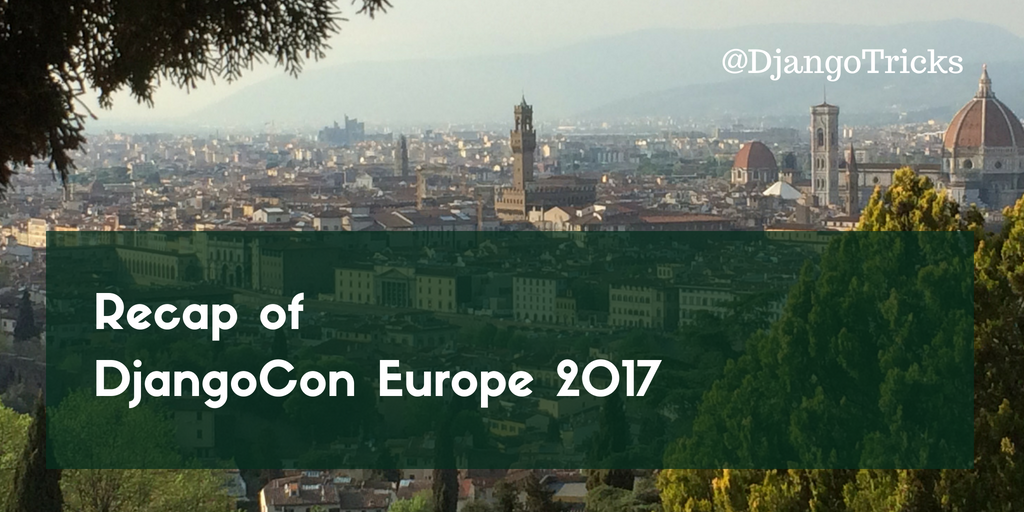
Cover photo by Bartek Pawlik.
"DjangoCon, why is everybody wearing this t-shirt?" wondered the security guys in the airport of Florence, Italy, in the beginning of April. The reason for that was DjangoCon Europe 2017 happening there for a week, full of interesting talks in an exciting location.
What I liked, was that the conference was not only about technical novelties in Django world, but also about human issues that programmers deal with in everyday life.
According to a manifest, the conference had a goal to strengthen the Django community and to shape responsible attitude towards the works done with Django.
We have to build stronger communities including everyone who wants to participate without discrimination. Although, at first, it might be difficult as people have biases, i.e. prejudices for or against one person or group; by being emphatic we can accept and include everyone no matter what is their gender identity or expression, sexual orientation, ethnicity, race, neurodiversity, age, religion, disabilities, geographical location, food diversities, body size, or family status.
Valuing diversity and individual differences is the key for a healthy, positive and successful community, that empowers its members and helps them grow stronger and happier.
Information technology companies (Apple, Alphabet, Microsoft, Amazon, and Facebook) are among the most traded companies in the world. IT connects people and their things, automates processes, stores and treats historical data. Usually you don't need many physical resources to start an IT business. Software developers have a power to shape the future, but should use this power responsibly:
With this, great responsibility is upon us: to make the future a better place, to make the future more evenly distributed, across gender gaps and discriminations, breaking economical, political and geographical barriers.
From the technical point of view, I liked several ideas mentioned in the conference:
startproject has a parameter --template for that where you can pass a URL to a zip file.EXPLAIN ANALYZE ... SQL command to find the bottlenecks of your database queries. You can usually fix them by adding indexes.Finally, thanks to the organizers for making this conference as great as it was. The city was beautiful, the food and coffee was delicious, the location for the talks was impressive. Looking forward to the next DjangoCon Europe!
Cover photo by Aidas Bendoraitis

 Lateo.net - Flux RSS en pagaille (pour en ajouter : @ moi)