Connexion


Plus: Jefferson’s uncertain issue and “multiple.”

There are, no doubt, cynics among us who, looking askance at goings-on at the federal level, assume the term “National Zoo” is a cheeky reference to Washington. Such wiseacres should be directed to reports out of the Nation’s Capital on the development of Linh Mai, an eight-month-old Asian elephant calf. She’s getting special attention at the Smithsonian’s bosky Connecticut Avenue menagerie because—for reasons that remain slightly unclear—Linh Mai’s mommy “rejected” her.
After her mother “behaved aggressively toward her,” WBUR reports, Linh Mai’s “human keepers had to step in for round-the-clock care.” Born in February, Linh Mai is “incredibly smart,” zoo officials say, “rambunctious, sassy, and playful.” She’s just as cute as anything weighing 1,000 lbs. could be. (Cuddly might be stretching it.)
Her handlers are taking special care to make sure that “she connects with other elephants in her herd.” To that end, they’ve introduced Linh Mai to what they are calling her “aunties,” two 51-year-old female pachyderms, Swarna and Bozie by name, and she’s making great strides.
Now hold on. Why is it important that Linh Mai connect with other elephants?
What, exactly, are zoo officials worried about? Apparently, there are real concerns here, and they are not reluctant to say so.
“What is her future going to look like?” one of her keepers wonders to the Washington Post. “Does she know she’s an elephant? Does she think she’s a person?” Zookeepers, one of them says, think it is important for her “to realize she [is] an elephant.”
But wait. Is this not something Linh Mai should be allowed to decide for herself? Why are we choosing this for her? This is deeply troubling, or should be, and it is worrisome that zoo officials seem not to recognize this fact. That the media doesn’t realize it is even more surprising.
The paternity of Sally Hemings’ children has been settled once and for all—again.
The father, as long suspected, was Thomas Jefferson, and a new book confirms it. Richard Kurin’s History by a Hair provides what the New York Times calls “the most definitive evidence yet” that our third president fathered children by an enslaved woman at Monticello. But how something that is “definitive” can be “most” definitive is a question for grammarians, perhaps, not for the rest of us. Logicians, maybe?
Jefferson’s culpability here is also, the Times reports, “a widely, if not universally, accepted truth.” What, again, does that even mean? Does whether something is true or not depend upon the level of its acceptance?
Monticello called Jefferson’s siring of these children “a settled historical matter” way back in 2018. But support for the belief had been growing at least since 1997 with the publication of Annette Gordon-Reed’s Thomas Jefferson and Sally Hemings: An American Controversy. The charge was first leveled in Jefferson’s own lifetime by political opponents, while an 1873 interview with one of Sally Hemings’s children, Madison Hemings, said she was her master’s “concubine.”
The new findings rely on DNA studies used to date to convict a pair of mass murderers, so they must be good, right? In this case, what are said to be samples of Jefferson’s hair, clipped on his deathbed in 1826, were examined and subjected to scientific scrutiny, leading to the latest headlines.
Critics with no ideological axe to grind in this matter note, however, that such claims are usually reviewed by scientific journals before a book of this nature is published. This time, however, that step was skipped, leading one source of DNA material—a Hemings descendant—to withdraw her participation in the project and her support.
The eagerness to accept such evidence has been growing for decades, as has the misinformation routinely spewed forth in its support. The Chronicle of Higher Education, reporting the new claims, initially said, for example, that Hemings “traveled abroad with Jefferson to Paris, at 14.”
Anybody who knows anything about the matter knows this is false. Hemings, with one of Jefferson’s daughters, arrived three years after Jefferson got to Paris—and the future president had in fact asked that a mature woman accompany his daughter as her chaperone and had no say in who actually showed up. (The Chronicle later retracted its erroneous claim.)
Typical of treatment of the subject is Beverly Gage’s This Land is Your Land: A Road Trip Through U.S. History, published earlier this year. In it, Gage writes that Jefferson “is widely known not only as the author of the Declaration of Independence, but as the father of at least six children born to Sally Hemings, an enslaved woman who was the half-sister of his deceased wife, Martha.”
But hang on. The research to which Gage refers never concluded that our third President fathered “at least six children born to Sally Hemings.” The studies concluded only that one of her descendants carried the same Y chromosome as Jefferson, but nine other Jefferson men carried the same Y chromosome, including Jefferson’s brother Randolph Jefferson.
Randolph Jefferson was a widower who—or so said Isaac Jefferson, another one of the enslaved men at Monticello—would “come out among the black people, play the fiddle and dance half the night.”
Maybe Thomas Jefferson did have a long-lasting dalliance with one of his slaves, as members of today’s nomenklatura seem so eager to believe. But there can be no doubt that Sally Hemings, as Gage puts it, may now be “one of the most famous women in American history.”
Meanwhile, we’ll wait for what the scientists have to say about the tests on Jefferson’s hair. What seems indisputable is this: Anyone troubled by the giddiness with which the claims are embraced must act out of creepy and despicable motives.
Is there any truth to the rumor that guests on NPR programs sign contracts dictating their vocabulary they are to use during interviews? That would seem to be the case, considering the word choices that even academicians from prestigious universities employ during these broadcasts.
People are always referred to as “folks,” a usage that seems to have entered the nation’s vocabulary during the Obama years. At the end of an interview, when the host or hostess expresses gratitude for the guest’s appearance, the guest invariably chirps, “Thanks for having me.” Younger guests—and those trying to seem younger than they are—must use “super” and “way” as adjectives expressing how impressed they are by some phenomenon otherwise pretty ordinary. They routinely refer to a “ton” of studies that support whatever point they’re trying to make. There must always be “conversations around” a given matter, never “conversations about” it.
The most egregious, however, involve the choice of adjectives to precede a plural noun. Guests must never say “several,” “many,” “numerous,” or countless other near-synonyms. Instead, they are required, or seem to be, to say “multiple.” Multiple has been increasingly fashionable for several years, apparently, and why this is the case might be a good subject for Fresh Air with Terry Gross.
Multiple, after all, is almost always meaningless, because it is redundant. The word it modifies is invariably plural, so its use adds nothing. But apparently, it seems to affix a veneer of multi-syllabic sophistication to whatever notion is being communicated, or so someone in authority at Public Broadcasting must believe.
As wearisome as all this is, we can all take comfort in the fact that the content of these programs and the positions taken on them remain surprising, independent and refreshing as always, as are the viewpoints expressed by hosts and guests alike.
The post Elephant in the Room? appeared first on The American Conservative.
Five years after his death, Norm Macdonald’s comedic legacy lives on.
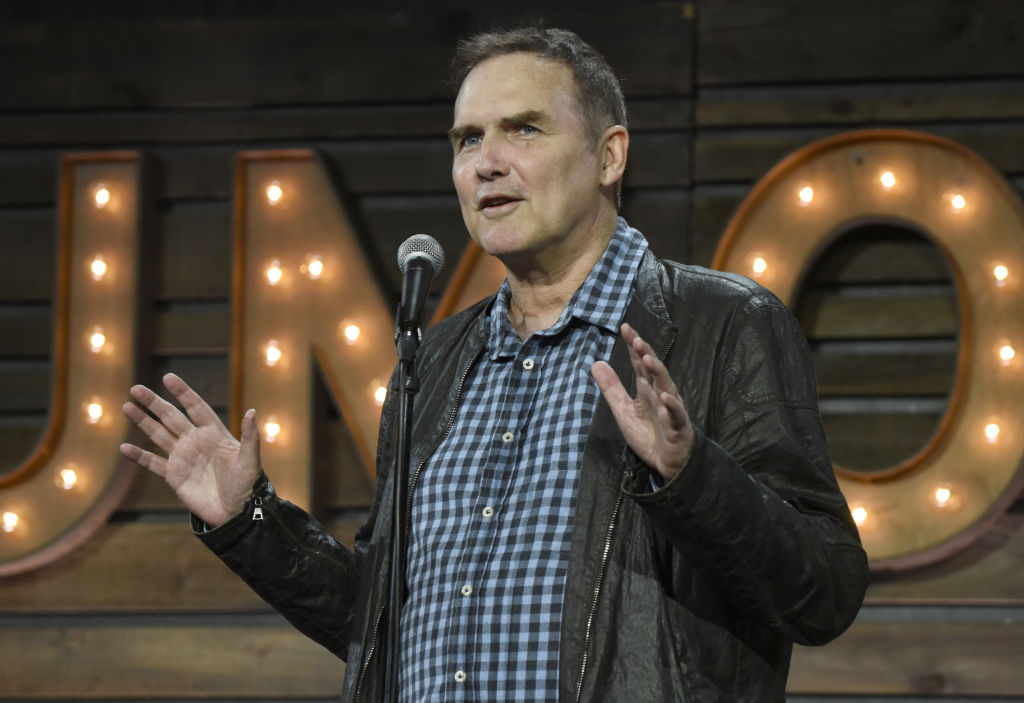
A couple years ago, an animated comedy series was released online titled—in a reference to the Covid-era trope “the new normal”—The New Norm. It was so clumsily and unsubtly anti-woke that, as I was watching it, I didn’t even crack a smile. But then I did start laughing. I had imagined Norm Macdonald’s reaction if he could see his humorless namesake.
The late Norm Macdonald is a comedic deity. I never hear a bad word about him. His fans, myself included, are enthusiastic to the point of devotion. Our heads are full of references to his work. We mumble sacred utterances like “hold the fort” and “9/11 was a national tragedy.”
Somehow, we all simultaneously think that he was speaking directly to us.
This has only become more true since Norm’s death in 2021. I know my own affection has strengthened and deepened since his passing.
But why? Norm had a small body of work—a few specials, a film, a sitcom, a comedy album, a talk show, and a book. And even some of this scanty output (the sitcom, for instance) hardly rises to the level of comedic legend.
For answers, I watched Judd Apatow’s new documentary Norm: The Tale of Norm Macdonald.
Norm takes the form of a collage of clips, most of which feature Norm himself speaking. (That I can’t stop calling him “Norm”—rather than “Macdonald” —is a sign of the warmth with which he is regarded by his devotees.)
This was a good decision on Apatow’s part, because most of us found Norm through clips. And while his formal body of work is small, he made an awful lot of appearances on TV, radio, and podcasts. There, he always seemed to be more original, authentic, and fun than other interviewees. “The hole you get into with Norm is crazy,” says the comedian Matt McCusker, referring to the hours that can be spent browsing Norm clips.
Because Norm is largely made up of Macdonald’s own words, we learn few of this most mysterious comedian’s secrets. This was initially disappointing, though I suppose if we love a man we should respect his desire to keep things private. (Unless, of course, he’s Bill Cosby.) Apatow was friends with Norm, and I can hardly fault him for not barging into rooms that the great man had kept locked.
Norm Macdonald did not tell us much about his life. His hilarious and beautifully written book Based on a True Story is heavily fictionalized, and he even kept from the world the fact that he was dying. Apatow’s documentary is moving in how it stitches together Norm’s elliptical references to illness and death. (“If you die, the cancer also dies…. That’s not a loss, it’s a draw.”) Almost no one knew that he was pondering his own fate.
Nor, unlike modern comedians of all stripes, did Norm try to sell us his beliefs. Yes, his quiet faith, and his quieter contempt for various modern absurdities, would sometimes shine through. But above all he was focused on what was funny—on subverting expectations, on playing with language, on unpicking the inherent strangeness of cultural habits.
He loved the original and the unpredictable. Sometimes, this involved being edgy, as with the ruthless O.J. Simpson jokes that would eventually get him fired from Saturday Night Live. But when being edgy was predictable, he could flip the script. When he was invited to the roast of Bob Saget, for example, where comedians were expected to exchange distastefully insulting barbs, he instead told a series of innocuous, old-timey jokes.
Without ever being didactic, and while maintaining a thin pretence of being a know-nothing, Norm hid philosophical depths beneath his comedy. “I remember a psychiatrist telling me I gamble to escape the reality of life,” he once joked. “But I told him, ‘That’s why anyone does anything’.”
It’s funny, inasmuch as it’s an unexpected twist on conventional wisdom, but it also makes you think—not because it’s entirely true, perhaps, but because it’s true enough to be interesting.
And Norm was unapologetic about his humor. He defied the censors, like the people who fired him from SNL, but he also defied his audiences. His fellow comics have marvelled at the enjoyment he seemed to take in bombing. As long as Norm thought a joke was funny, whether the viewers laughed was immaterial.
And anyway, more often than not the crowd would (eventually) come around. Apatow’s documentary shows us that, although now we say “remember when that genius Norm Macdonald told a lot of deliberately bad jokes at the Bob Saget roast,” at the time a lot of people in the audience were thinking “why is this idiot Norm Macdonald telling bad jokes.” But Norm enjoyed the comic nature of a good cringe. In clip after clip, as you watch Norm, you can see the twinkle in his eye as he prepares to surprise, annoy or exasperate someone.
Norm’s qualities—his courage, his integrity, his unsentimentality, and his delight in humour —are in short enough supply in the modern world that his work seems even more refreshing and valuable. Self-important, oversharing, and attention-seeking modern comedians, in other words, have increased his stature.
But as I watched Norm, it struck me that I’m not sure Norm would really like his adoring fans. Our wallowing in his old jokes might seem downright tedious to a comedian who loved fresh, surprising humour. And our uncritical affection might provoke his ire. When I see my fellow Norm enthusiasts reproduce his jokes with reference to current events—or, worse, post his photographs beneath their own jokes—it strikes me that Norm was independent-minded and original enough that we really don’t know what he would have thought about them. What I suspect he might have thought, though, is that instead of referencing “I didn’t even know he was sick” or “that’s my lucky stabbin’ hat” for the ten millionth time, we should find something new.
But sorry, Norm. There is comfort in the familiar—and in the purely funny. I’m going to reread Based on a True Story and listen to Gilbert Gottfried’s appearance on Norm Macdonald Live yet again.
Then I should find something new to laugh about.
The post Not the Norm appeared first on The American Conservative.
The post TAC Media Appearances October 1–15 appeared first on The American Conservative.
The Iran War could last another year if not longer, a top Trump ambassador told the Financial Times in remarks published Friday.
Mike Waltz, the ambassador to the UN, said he hopes Iran will settle the war before then, but “the president and the U.S. Navy can maintain this blockade [on Iranian ports] for the foreseeable future.”
The unpopular war, now approaching its ninth month, has roiled energy markets, worsened inflation, and created headwinds for Republicans ahead of U.S. midterm elections in November. In its early days, President Donald Trump had said the war would last for only “four to five weeks.”
Trump is now mulling a renewal of intense hostilities, as Israel’s Prime Minister Benjamin Netanyahu tells him devastating strikes could trigger regime change, according to media reports. Iranian officials have warned another round of fighting would not be quick and that Tehran would expand its retaliation to new targets, including digital infrastructure.
The price of Brent crude oil spiked to $114 on Friday—nearing its highest level in the war—after Iran claimed successful attacks on seven tankers around the Strait of Hormuz. The tankers have been reported as damaged. Trump on Thursday accused Iran of “making up fake hits” to drive up oil prices.
The post Iran War Day 238: War Could Last Another Year, UN Ambassador Admits appeared first on The American Conservative.
The definition of insanity is doing the same thing and expecting a different result.
There is an awful lot of smoke going up around the whole war thing these days. The USS Theodore Roosevelt is in transit to the Persian Gulf region, where it is expected to arrive late next month. Pete Hegseth popped over to Israel Monday for a quick visit to Benjamin Netanyahu, whose air force has been engaging in some rather scary-looking maneuvers around Iranian airspace. Iran’s Foreign Minister Abbas Araghchi penned an op-ed for the Financial Times discouraging the U.S. and company from taking another crack at his employer; Mohsen Rezaei, secretary of the Islamic Republic’s Supreme National Security Council, gave comment to Drop Site News to the same effect, albeit with a lot more growling and baring of teeth. The State Department is sending folks home, and the number of troops at regional bases is being reduced. The New York Times reports that the next round of strikes is planned for after the American midterm elections
Sometimes you have to restate the obvious—dirty work, but someone has to do it: Another round of strikes is unlikely to accomplish this war’s stated political goals, which themselves change on a regular basis. While never-ending, mindless destruction for its own sake has its charms, I guess, generally speaking a war is supposed to accomplish something; the “something” here has been at various times and non-exclusively the end of the Iranian nuclear program, reopening the Strait of Hormuz (which was open before the war), and regime change. The going theory among the teeming intellects downtown appears to be that yet another movement in the symphony of death, in concert with Scott Bessent’s exotic economic maneuvers, will get the Iranians to cry uncle and/or provoke a change of management in Tehran.
Anything is possible, but I wouldn’t hold my breath. Even if you ignore the actual public support for the Islamic Republic that this war has engendered, an indigenous uprising against the regime would likely provoke a civil war. Such a scenario won’t make the Hormuz safe or secure Iranian nuclear assets; energy markets will continue to make unhappy faces and low moaning noises until there is something like a settlement. Iran is not Syria; it is simply too large for us to indulge in a decade-long luxury war there. Instability will demand continued and intensive American attention until there’s a resolution.
But, if we fall short of triggering a civil war and the regime remains securely ensconced, why would the Iranians be more tractable after yet another round of bombing? What will make this time different? (And if there is something substantively different about this approach, why didn’t we try it before burning through years’ worth of Patriot interceptors and compromising our force posture everywhere else in the world?)
If this line of questioning seems repetitive, that’s because it is. There has been a fundamental disjunction of military means and political ends from the very beginning of this war (really, since the 12-Day War, but we can afford to be generous when there are so many more recent and egregious stupidities to anatomize). Getting Iran to—to what? To dismantle its nuclear program completely? To give up its newfound leverage in the Hormuz? To embrace liberal democracy? The answer continues to change, depending on the day and which creeping thing from the administration is doing the talking. In any case, getting Iran to do it, whatever it is, can only be accomplished by negotiation or the application of main force. (Welcome to the academic discipline of international relations.) Main force is expensive and painful, and you always need more of it than you think; even after a couple years of indiscriminate air war, Nazi Germany didn’t fall until there was a ground invasion, and it went down fighting tooth and claw. The ceiling for negotiated outcomes may be lower, but diplomacy is less costly and less painful.
But, as the song says, you can’t get what you want ‘til you know what you want. Political prudence is about matching means to ends. While the baboon-like Hegseth and his catamites at CENTCOM may find meaning and pleasure in death per se, the actual humans in the administration should reconsider blowing another few dozen billion dollars on more of the same. A fresh round of bombing is unlikely to move us closer to economic normality and a stable settlement in the Middle East; nor is it likely to move the Republicans further away from the electoral pillory, not just in the midterms, but in 2028. The fundamentals haven’t changed. Why hasn’t our strategy?
The post What Is Another Round of Bombing in Iran Actually Going to Achieve? appeared first on The American Conservative.
The Western Hemisphere’s rightward turn has more to do with thermostatic politics than the demise of USAID.
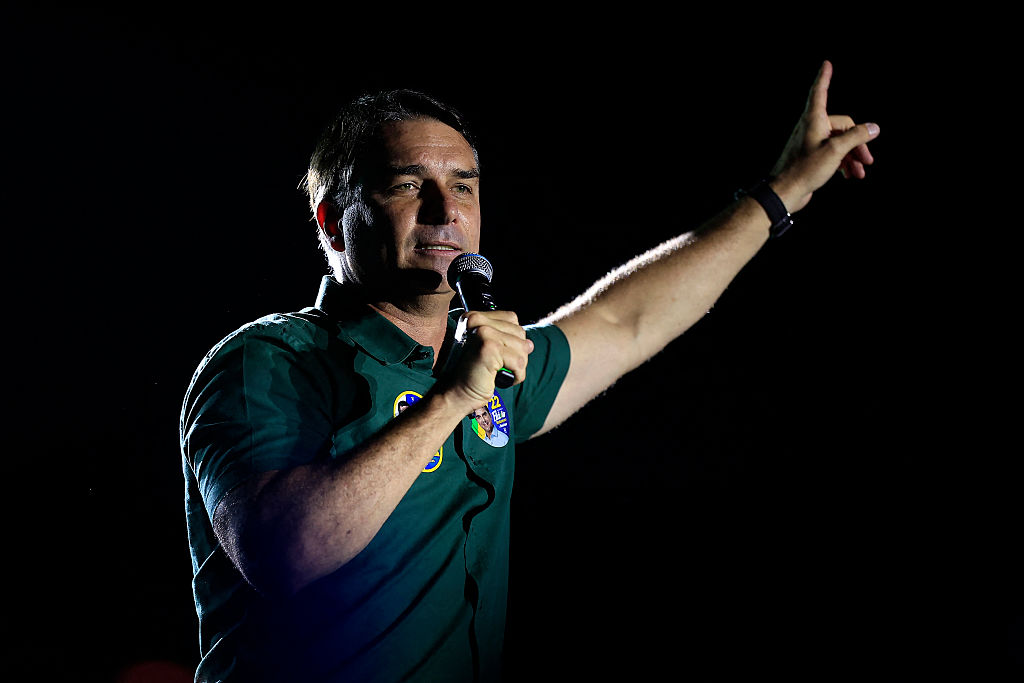
With the apparently imminent triumph of Flávio Bolsonaro in the Brazilian presidential runoff, the Latin American right is reaching heights not seen for decades. One by one, the bulwarks of leftism in the region have fallen: the Peronists of Argentina to Javier Milei, Evo Morales’ Bolivian socialists to Rodrigo Paz, Nicolás Maduro of Venezuela to American special forces wielding deadly discombobulators, Gabriel Boric of Chile to José Antonio Kast, Colombia’s Gustavo Petro to Abelardo de la Espriella, and now, it seems, Lula da Silva to Bolsonaro. The last major bastion of the Latin American left is Mexico, where President Claudia Sheinbaum has shown little appetite for defying the United States. A smattering of minor powers rounds out the pathetic list of the region’s remaining left-wing governments: Nicaragua, Belize, Guatemala, Uruguay, and Cuba.
What explains this rout of the Latin American left, which only a few years ago seemed almost invincible? Some commentators on the right have suggested that the Trump administration has facilitated the turn, pointing, for example, to the dismantling of USAID, which they say funneled American foreign aid to left-wing causes and organizations. The White House’s efforts to rein in foreign aid distribution, however, while useful in their own right, are probably not a significant contributor to the political wave sweeping Latin America. The real reasons for the shift are more structural in nature; as such, they are both more prosaic and more profound.
This is far from the first time right-wing governments have swept the Western Hemisphere. In 2000, Latin America was governed predominantly by conservative parties. Vicente Fox’s National Action Party had broken the death grip of the Institutional Revolutionary Party in Mexico, bringing an end to the “perfect dictatorship”; Alberto Fujimori was blundering through his final days as president-turned-dictator-turned-president-again in Peru; Hugo Banzer, once the military dictator of Bolivia, had returned to govern the country again, this time as a democratically elected president; and Fernando Cardoso was enjoying his second term as president of Brazil, having been reelected two years prior to great popular acclaim (in the process crushing a much younger Lula da Silva, his principal rival). Even the minor Latin American countries, from Costa Rica to Uruguay, were nearly all controlled by some flavor of conservative.
The George W. Bush administration hoped to capitalize on this to remake the hemisphere. “Should I become president, I will look south, not as an afterthought, but as a fundamental commitment of my presidency,” Bush pledged during the 2000 campaign season, and his administration poured billions into Colombia and Mexico in a mostly unsuccessful attempt to smash the cartels and end the flow of drugs into the United States. But the Latin American prosperity the Bush White House hoped would come from right-wingers liberalizing their economies and embracing democracy never really materialized.
In fact, conservative dominance of Latin America at the turn of the century proved short-lived. Disillusioned voters turned back to the left, hoping that socialist economic policies might provide more concrete improvements to their quality of life. By 2008, the region had been swallowed up by the “pink tide,” a current that carried into power a generation of left-wing icons: Lula in Brazil, Rafael Correa in Ecuador, Evo Morales in Bolivia, Daniel Ortega in Nicaragua, Michelle Bachelet in Chile, and Cristina Fernández de Kirchner in Argentina.
Like democratic systems everywhere, Latin American politics is largely thermostatic: Voters grow frustrated with the government in power as it generates grievances, accumulates failures, and becomes associated with the political irritants of the day. Eventually, the popular backlash becomes strong enough that no policy program or charismatic leader can overcome it, and voters throw out the incumbents. The alternative does not even need to be particularly attractive—opposition parties with poor track records in government are frequently the beneficiaries of this trend, because voters have short memories and prefer parties whose great offenses they have forgotten to those whose offenses, though lesser, are daily paraded in front of them.
And Latin American political movements have plenty of opportunities to aggrieve their voters. The promised economic boom is always just around the corner, but never arrives; the politicians who yesterday denounced the graft of their predecessors are today outed for having secret mansions in Miami and hidden bank accounts in the Bahamas. Javier Milei was catapulted to an unanticipated victory in 2023 by savaging the Argentine political class for its corruption and self-dealing; now he is confronting his own corruption scandals.
In other words, though it may be true that “the left hasn’t won a single presidential election in Latin America” since we gutted USAID, it would be foolish to expect the trend to last. Indeed, whether the Trump administration’s destruction of the agency has any relation to this shift remains an open question—political slush funds and patronage from the U.S. have frequently aided the global left, but elections can be surprisingly hard to buy.
Apart from the general thermostatic trends, the Latin American right has benefited from other, more significant tailwinds than the abolition of USAID. South American countries have recently begun to experience their own illegal immigration crisis, driven almost entirely by Venezuelans fleeing the collapsing economy of the Maduro regime. Stopping mass migration and securing national borders, previously issues that barely registered with the public, have become major priorities, creating a political environment that played directly into the hands of the right (which has always been the champion of law and order). This issue may, ironically, soon fade away thanks to the Trump administration’s actions in Venezuela.
Another significant boost to the image and prestige of the Latin American right is the performance of President Nayib Bukele in El Salvador. Many a would-be caudillo has promised to bring down the mano dura (“iron fist”) and restore order and security to a broken society; Bukele has actually delivered. The transformation of El Salvador—from the most dangerous country in the hemisphere to a place that is by many metrics safer than the United States—is a more convincing pitch for Latin American right-wingers than any campaign speech or ad could be.
Effecting the kind of transformation that Bukele has accomplished is a tall order for any government—and, indeed, it may not be possible outside of the unique circumstances of El Salvador. But for the right-wing wave to last, that is what Latin America’s conservatives will need to deliver. Otherwise, expect yet another pink tide in 2030.
The post Why is Latin America Swinging to the Right? appeared first on The American Conservative.
A dispatch from the “Meeting of the Tribes.”

In late summer, the drive south from Budapest has an ominous, apocalyptic feel. As suburbs give way to the flat expanse of the Hungarian countryside, the landscape turns brown and yellow, broken only by a few dull streaks of green. On the outskirts of the city, a billboard looms against the skyline. It’s for a Hungarian rapper who calls himself Pogány Induló—“Pagan March.”
The billboard is an appropriate marker for a journey to the Kurultáj, a self-styled gathering of nomadic tribes that happens every year on the plains of south-central Hungary. Would-be khans, warlords, merchants, and others from across the Eurasian steppe converge on the small town of Bugac for a multi-day event that is something between a renaissance fair, a steppe encampment, and a caravanserai. To liberal Hungarians, it all seems a gigantic LARP—live-action role-playing game—with dashes of pseudoscience and right-wing nationalism thrown in for good measure.
But as you approach the festival grounds, you’d be forgiven for thinking you’ve traveled back in time. First you’re stuck behind cars, then tractors, then horse-drawn wagons. Then you are caught in a stream of people, many on horseback or wearing leather and cotton tunics, chain mail hauberks, and elaborate steppe headgear. You hear the festival before you actually see it—loud cracks rise above the din of conversation as attendees test thick leather bullwhips, a traditional accoutrement for Hungarian herdsmen and bandits.
The spiritual and geographic antithesis of the Kurultáj is Sziget, another festival that takes place every August on a Danube island just north of Budapest. Sziget advertises itself as “the Island of Freedom” and attracts pop stars, rock bands, DJs, and hundreds of thousands of festivalgoers from across the globe. For many younger Hungarians, Sziget is the much-anticipated climax of their summer.
The crowd at the Kurultáj is something else entirely. There are plenty of Hungarians, yes, but also Turks, Turkmens, Azeris, Kazakhs, Mongols, and other, more exotic ethnicities from across the length and breadth of Central Asia. The festival bills itself as a gathering of steppe peoples, and many Hungarian attendees consider themselves the westernmost branch of this family of nations. Even the on-site accommodations have a nomadic flavor: Whereas Sziget festivalgoers favor repurposed camping gear, Kurultáj attendees get free space if they bring their own yurt. The only things the two events have in common are lung-choking amounts of dust and the condition of their respective port-a-potties. (After two days of enduring the smell, you understand why nomads kept moving.)
The entrance to this year’s Kurultáj was appropriately dramatic. Red runic banners flew from two parallel rows of flagpoles that channeled visitors towards the grand arena, a venue for horsemanship, archery, and other feats of nomadic derring-do. The space beyond the arena was filled with tents, benches, stalls, yurts, a music stage, and two domed stucco towers that evoked Samarkand or Tashkent. Fluttering above the arena was a massive banner of Attila the Hun, the patron saint of the Kurultáj, and a smaller banner of Árpád, the quasi-mythic chieftain who led the Hungarian tribes into the Carpathian Basin in the late 9th century. Curiously, the third most popular historical figure seemed to be Atatürk, the father of modern Turkey. Although he did not rate an official banner, his face adorned flags and posters outside many attendees’ tents.
Heat shimmered over the grand arena and great plumes of dust rose with the ebb and flow of the crowds, but the costume-clad performers were nothing if not committed. During an archery competition on the second day of the festival, a young woman in a long leather and wool tunic had to be carried out of the arena by paramedics.
Other performers were tougher, or perhaps more accustomed to the conditions. The second day featured a variety of performances on horseback, including mounted archery and an elaborately staged steppe wedding. After the ceremonies concluded, spectators were treated to a game of Kokpar, a Kazakh version of polo. As a concession to modern sensibilities, the traditional goat carcass used for scoring was replaced by a goat-shaped leather sack, but this did not dim the players’ competitive spirit. Several riders were unhorsed in the scrum and many a nasty red welt was evident on bared arms and backs from all the whipping.
After several games of Kokpar, it was time for the Hungarians to show their mettle. Native horsemen shot arrows and threw lances at a target dragged from horseback. Other riders performed daring acrobatic feats at the gallop, including standing on horseback, holding themselves perpendicular across their horses’ saddles, and dismounting to run alongside their steeds.
To some Hungarians, these feats of horsemanship suggest a deeper connection between the peoples whose ancestors once wandered the steppes. Indeed, this is one of the Kurultáj’s foundational ideas. Between wrestling, archery, and horsemanship demonstrations, festivalgoers absorbed presentations from Hungarian, Turkish, and Central Asian academics on their shared ethnic and linguistic heritage. The festival’s regnant ideology, known as Turanism, holds that Hungarians, Turks, Mongols, and a few other scattered ethnic groups share a deep kinship based on their common steppe ancestry. It is well outside the academic mainstream, but the very disreputability of the theory, the idea that it represents outlaw or suppressed knowledge, seemed to enhance its appeal.
Devotees of this obscure idea were easy to find during the festival. Attendance at a dry talk from an Azerbaijani academic painstakingly translated into Hungarian might be explained by the availability of shade and seating inside the tent, but other, less-credentialed festivalgoers were also eager to discuss nomadic kinship to anyone who would listen.
A rosy-cheeked attendee from the Székely people, a Hungarian-speaking minority in Romania, had adorned his tent with the flags of what he called “brother nations.” His collection included banners from countries as diverse as Hungary, Turkey, Kazakhstan, Japan, and Korea—all members in good standing, he told me, of the Turanic club.
My new Székely friend was an enthusiastic proponent of his own people winning independence from Romania, although he declined to specify how this might happen. When I told him I was from Washington, D.C., he assumed I meant Washington State and immediately asked if I supported Cascadia, the movement for an independent Pacific Northwest.
The most articulate defender of Turanism I met was a 16-year-old named Nimrod, a Hungarian from northern Serbia who sported a new bullwhip wrapped around his shoulder. A self-taught linguist, Nimrod told me about the connection between Hungarian and the Turkic language family. In fluent English, he explained that he had found thousands of Turkish loanwords in Hungarian—definitive proof, he said, of the two languages’ kinship. His next project is learning Kazakh so he can visit his distant relatives in Central Asia.
Nimrod’s enthusiasm for the Turanic thesis was shared by many festivalgoers. From China’s Uyghurs to the Hungarian-speaking minorities of the Balkans, Kurultáj attendees often came from diaspora communities and persecuted ethnic groups. For these festivalgoers, the gathering of tribes is more than history-themed entertainment; it’s an opportunity to belong to a larger club. One couple I ran into was a particularly striking pairing: a pale Asiatic woman from the Karakalpak minority of Uzbekistan and a red-bearded member of Turkey’s Crimean Tatars, a group that originally hailed from the Ukrainian steppe.
Not all of the attendees were as friendly as Nimrod. A young man named Malik overheard me speaking English and insisted I couldn’t be an American because, in his words, “there’s no such thing.” My features, he continued, were clearly Germanic, something he was familiar with because his family has lived in Germany for decades. But he does not consider himself German, Malik was quick to add. He had come to the Kurultáj to reconnect with his authentically Turkish roots.
Is there truth to the Turanic thesis? More than English or even Hungarian, Turkish was the lingua franca of the Kurultáj. Even today, the Turkic languages that stretch from Central Asia to the Hellespont are mutually intelligible to varying degrees. Most academics, however, reject the idea that Mongolian, Turkish, and the famously weird Hungarian language are part of the same family. Even some festival attendees were skeptical of this extravagant claim. Aslihan Abdikoğlu, a half-Turkish, half-Hungarian Kurultáj organizer who switched effortlessly between the two languages and English, laughingly told me she couldn’t hear a connection.
Perceptions of the Kurultáj in Hungary vary widely and often depend on your political sympathies. If you’re on the left, you’re likely to dismiss the event as a pseudoscientific nationalist project or simply a waste of money. Now that Viktor Orbán and the conservative Fidesz Party have lost power, the festival’s government funding is suddenly in jeopardy. Abdikoğlu told me she isn’t sure whether the new government will continue to support the festival, though she believes that there’s enough organic enthusiasm from attendees and participants to keep the Kurultáj going.
It’s not clear whether Orbán and Fidesz actually bought into the Turanic thesis or merely saw the festival as a way to enhance Hungarian influence in Central Asia and the Near East. After lecturing me on my Germanic features, Malik suggested I look up János Csák, the former Hungarian minister for culture and innovation. Sure enough, Csák was an outspoken proponent of Turanism, proclaiming publicly, “We Hungarians see ourselves as a Turkic nation coming from Central Asia, even from the east of Central Asia.” His enthusiasm for Turanism extended to theorizing about a connection between Hungarian folk music and Korean K-pop.
Orbán and other Fidesz higher-ups were more circumspect about these ideas, speaking instead of an “Eastern Opening” in Hungarian foreign policy. This approach was quite a departure from older notions of Hungary’s place in the world. In 1989, a youthful, fiery Orbán publicly accused the ruling Communist Party of leading the country into an “Asiatic dead end.” By the end of his tenure as prime minister, he was enthusiastically courting Turkey and the nations of Central Asia.
Back at the actual festival, many Hungarian attendees wore T-shirts with patriotic and nationalistic slogans and clearly reveled in their nomad heritage. The atmosphere, however, was generally relaxed and friendly, more akin to a theme park than a political rally. Many young families were drawn by the free admission—festivalgoers only pay for parking and a camping spot (unless, of course, they’ve brought their own yurts)—as well as the elaborate historical costumes and feats of horsemanship. I did see one festivalgoer walking around in a “Brotherhood of White Nations” tank top. It seemed a strange fit at an event with so many conspicuously Asian and Middle Eastern attendees.
The most obvious national agenda on display was not Hungarian, but Turkish—little wonder, perhaps, as Turanism was the quasi-official ideology of the early Republic of Turkey. A department of the Turkish Ministry of Culture and Tourism had set up a large tent at the center of the festival documenting Ankara’s infrastructure and developmental projects in places as varied as Uzbekistan, Kyrgyzstan, and Kazakhstan. According to the exhibition, even Hungary had received a bit of funding. As the leading Turkic state and a formidable regional power, Ankara is still using the ideology of Turanism to amplify its already considerable influence.
Other, unofficial expressions of Turkish nationalism were also easy to find. Many attendees wore T-shirts or carried flags of the Grey Wolves, an ultra-nationalist group that some governments and courts have labeled a terror organization. (The group’s most infamous member was Mehmet Ali Ağca, who tried to assassinate Pope John Paul II in 1981.) A festivalgoer carrying a Grey Wolves banner sheepishly explained to me in broken English that the symbol was linked to Turkish nationalism before hurriedly excusing himself. Later, a Turkish videographer showed me how to make the Grey Wolf hand sign. Following a particularly spirited musical performance on the festival’s second day, a performer led the crowd in a Grey Wolf howl, although it’s doubtful that the Hungarians in the audience knew what the call meant. After two days of overhearing Turkish conversations, wolf howls, and seeing Atatürk and Grey Wolf flags, I was inclined to think that the Kurultáj was more of a coup for Ankara’s soft power aspirations than for those of Hungary.
On the third and final day of the festival, I got to meet some of the performers. Outside the press tent, three young men were dressed in furry black hats and striking blue tunics that stretched down to their black leather boots. The outfits were terrifically unsuited for the sweltering heat, but the men, who turned out to be Dagestani dancers, were preparing to go on stage.
The Dagestanis were another curious addition to the festival’s roster of performers. Dagestan, a region in the Caucasus Mountains of Russia, is home to dozens of languages and ethnic groups. It is, according to Abdul, the lead Dagestani performer, “a real melting pot,” although the Dagestani language family is considered separate from its Turkic neighbors. At the Kurultáj, however, none of this matters. Everyone from the steppes (or their borderlands) can be part of the Turanic brotherhood.
Abdul introduced his two fellow dancers, Murat and Islam, and proceeded to explain their elaborate costumes. His silver ceremonial dagger was called a “kindjal,” a term I already knew because Frank Herbert borrowed it for the Dune books (Dagestan’s international footprint comes down to two things: Dune and top-tier MMA fighters). The silver cylinders that stretched across his chest, he continued, were bandoliers that traditionally stored gunpowder and shot. The scorching conditions, Abdul said, could be an issue when dancing. This is his third Kurultáj, and four years ago, he passed out from the heat. “Now I’m tougher,” he added with a grin.
Despite the dust and the heat, the Dagestani dancers put on a tremendous show, whirling, clapping, and tossing daggers to the thump of accompanying folk music. At the climax of their performance, Abdul and company jumped down from the stage and started dancing in the crowd, inviting bystanders to join in the performance. Several young women eagerly complied, but even the Dagestanis seemed taken aback when a man in a steel helmet and scale armor joined the fray and started swinging his sabre to the music. Mercifully, the performance ended before anyone lost a limb.
It is tempting to lump the Kurultáj in with the nationalistic upheavals that have fractured European politics in recent years, a return to the old gods in the face of technological change, cultural upheaval, and encroaching Western liberalism. In truth, the gathering of the clans is much weirder and harder to categorize. Instead of a tightly regimented nationalist rally, the event turned out to be a curious mixture of genuine historical enthusiasm, family-friendly entertainment, government propaganda, and several strange and sometimes conflicting ideological, political, and national agendas.
This heady blend is quite different from traditional Hungarian nationalism, which tends to celebrate the uniqueness of the Hungarian language and emphasize Hungary’s historic links to the West. In this account, the Turks are not friends but enemies, foreign invaders whose prolonged occupation of Hungary deprived the country of its rightful place in Europe. (The lengthy Ottoman occupation is also a likely source for the Hungarian language’s many Turkish loanwords.)
The trappings of traditional Hungarian nationalism were easier to find in Izsák, the small town where I stayed overnight during the festival. Despite its modest size, Izsák has monuments to Sándor Petőfi, the hero poet of the Revolution of 1848, and to the anti-Soviet uprising of 1956. Similar shrines can be found in towns and villages across the country. These are legacies of an older project of nation-building, the stuff of textbooks, patriotic pamphlets, and national anthems. They emerged from a 19th- and 20th-century information landscape that was much more centralized and easily channeled, an era of mass public education, propaganda, national newspapers, and state TV and radio stations.
The Kurultáj, however, is very much a 21st-century phenomenon. The curious blend of fringe academic ideas, alternate histories, niche hobbies, and government propaganda (both open and covert) brought to mind an internet message board, or perhaps the bowels of social media. Here the Turks, Hungary’s traditional enemy, have been reimagined as a “brother nation,” or maybe a vehicle for extending Hungarian influence to the East. Instead of looking to Western Europe or the United States, festivalgoers sought out their Central Asian “kin” and celebrated their shared nomadic heritage.
The festival’s veneration of steppe ancestors, the peddlers selling animistic totems, and the ubiquitous pagan iconography also implied a spiritual longing that goes beyond academic interest in the distant past. Christianity and Christian symbolism, usually easy to find in Hungary, were almost entirely absent from the Kurultáj. Instead, festivalgoers sought meaning in an ancient family of proud nomad nations, a steppe brotherhood stretching from Siberia to the Great Hungarian Plain. From their musical preferences to their costumes, the shamans, folk dancers, and Hungarian cowboys of the Kurultáj don’t have much in common with the flower children of Sziget, but both groups revel in the ecstatic release of the crowd, the sense of being a part of a larger entity, and a certain pagan sensibility. Pogány Induló, I’m told, delivered an energetic performance at Sziget 2026. Next year, he should consider putting in an appearance at the Kurultáj.
The post Among Hungary’s Weird Nomad Nationalists appeared first on The American Conservative.
Calley Means, a senior advisor to Secretary of Health and Human Services Robert F. Kennedy, Jr., resigned from his position Thursday. In a post on X announcing his departure, Means wrote that he retained “tremendous respect for President Trump and Bobby Kennedy,” who “laid out a vision of combating the entrenched, dark forces in DC that profit from Americans getting sick.” He also touted his work on policies including “Dietary Guidelines reform, psychedelic reform, removing soda from SNAP, removing food dyes, GRAS reform, and overhauling government food procurement.”
Means first gained prominence as an advocate for the Make America Healthy Again (MAHA) movement. He was involved in the 2024 presidential campaigns of both RFK, Jr. and Donald Trump, and reportedly played a key role in brokering a political alliance between the two men. (His sister, Casey Means, is also a well-known figure in the MAHA movement, and was tapped for the post of surgeon general before her nomination was withdrawn earlier this year.)
Although Means did not give a reason for resigning, sources close to him attributed the decision to frustration with delays on advancing MAHA priorities. As one health influencer reportedly close with Means told the New York Times: “It became very clear in the last few months that no progress was getting made. And when you’re spinning around in circles, you can only take so much.”
The post Calley Means, Key WH Health Advisor, Resigns appeared first on The American Conservative.
The New York Times reported Wednesday that American and Israeli war-planners are preparing to resume active strikes on Iran following the November 3 U.S. midterm elections.
The report, citing anonymous officials, noted that President Donald Trump had ordered and canceled fresh strikes a number of times. Per the Times, the new plans focus on Iran’s nuclear program and energy infrastructure, but avoid striking refineries and oil infrastructure.
Some believe the action may come sooner. An Iranian official told Drop Site News that the Islamic Republic anticipates renewed fighting perhaps even before the October 27 Israeli parliamentary elections. The White House denied planning such strikes in a comment to Drop Site.
Axios reported Wednesday that the Israeli Air Force has been conducting aggressive maneuvers near Iranian airspace. The State Department spokesman Tommy Piggott said Wednesday on X that the U.S. was evacuating nonessential personnel from American diplomatic posts in Saudi Arabia because of the threat of Houthi strikes. In the same post, he denied reports of a broader evacuation from regional embassies and consulates.
Iran has continued its operations in the Persian Gulf, claiming strikes on four tankers in a Thursday statement. Brent crude opened at $110. AAA reported a national average price per gallon of $4.27 for regular gas and $6.31 for diesel.
The post Iran War Day 237: U.S., Israel Planning to Resume Strikes in November, Per Report appeared first on The American Conservative.
President Trump should tell Western allies what the U.S. will do and let them decide how to respond.
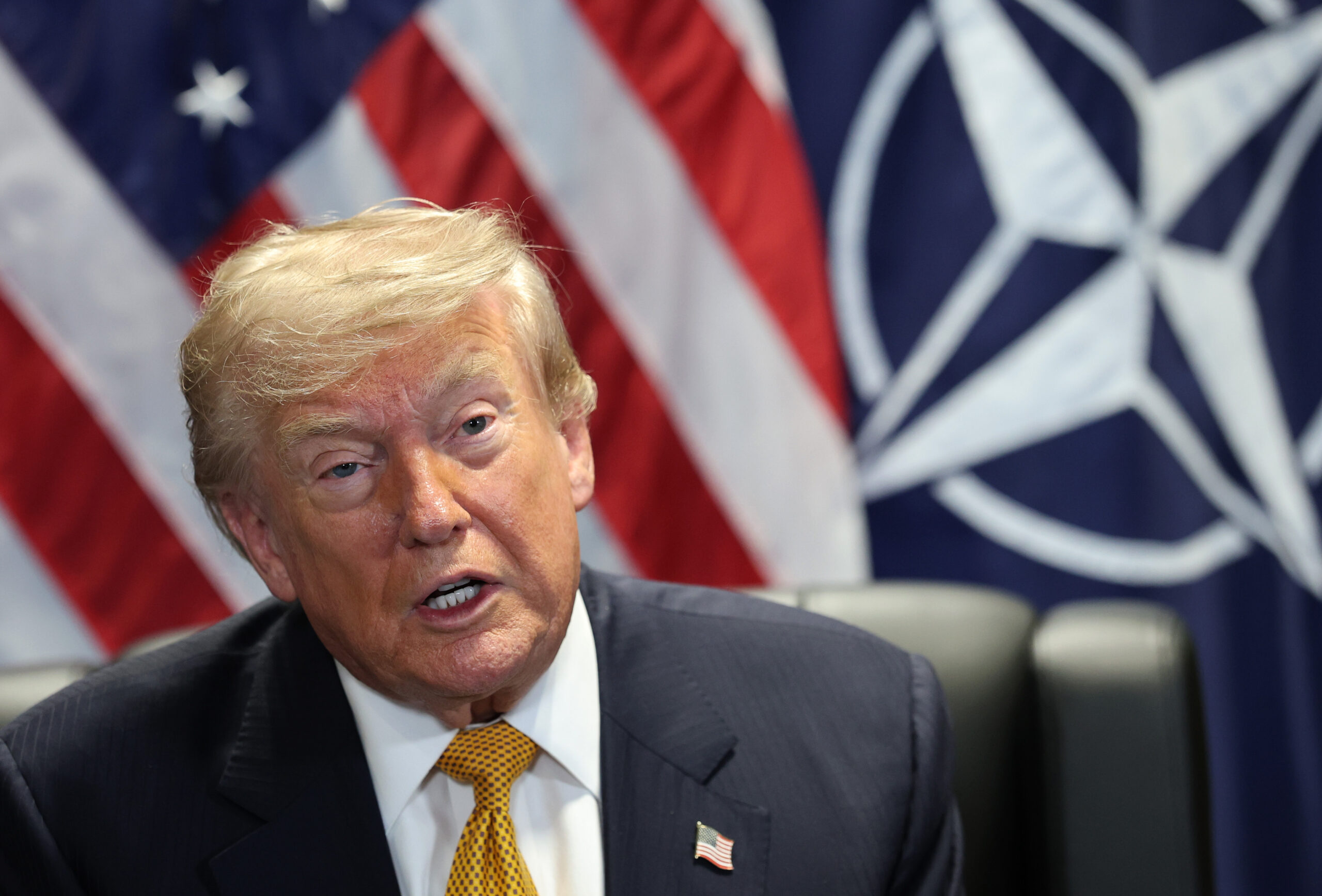
President Donald Trump wants the Europeans to spend more on their militaries. A lot more. His hectoring—and, more important, Russian President Vladimir Putin’s threats—have spurred continental defense efforts.
Many NATO officials sound confident about Europe’s capabilities, even defiant. In September, Secretary General Mark Rutte grandly announced that “if the Russians want to do something against Finland or one of the Baltic nations or Poland or whichever country in NATO, we will see a build up… [and] if there is a build up, we will see it and we will deal with it, if anything happens.” Gen. Alexus Grynkewich, the supreme allied commander for Europe, said something similar a couple weeks later: “Let there be no doubt: should war come, we will block, blunt any attack, and then, if it does not cease, we will break the forces conducting aggression against us.”
Yet Europe’s defense remains largely dependent on the United States. And despite Washington’s demands, increasingly tumultuous political dynamics are limiting European military outlays. In the UK, the new prime minister, Andy Burnham, is looking at a $47 billion budget gap. The dicey fiscal situation is exacerbated by rising interest rates, which threaten a fiscal “black hole” and bond crisis. Despite promises to spend more on the military, the British government announced this week it was cutting some $2.7 billion from front-line army equipment, as Burnham’s chancellor tries to balance the budget by trimming defense.
Other countries face even greater challenges. France’s Marine Le Pen, the right-wing leader favored to win next year’s presidential election, recently said of aid to Ukraine: “Financially, we can’t do it anymore.” And over the weekend, France endured a wave of rioting and violence that is likely to bring severe economic as well as political consequences. Reports the Telegraph:
France is bracing for a fresh sell-off in government debt after a wave of violent protests erupted across the country… Higher borrowing costs will pile more strain on the country’s troubled public finances, while also stoking fears that the violence will lead to a more populist, free-spending candidate coming to power.
Nor is France alone in confronting domestic turbulence. The populist right is rising across the continent, and it is generally critical of devoting more resources to the military. According to Politico Europe: “In France, Italy, Belgium, Germany, Poland and Romania, [populist] parties are looking to turn voters’ cost-of-living concerns into opposition to aid for Kiev, and rejection of higher national defense budgets and a greater role for the EU in defense.” Protests against higher security outlays have spread across the continent. In many European nations, including France, Germany, Italy, Poland, and Spain, discontented publics oppose increasing taxes to spend more on the military.
The frustration of the Trump administration is therefore likely to grow, and it may respond by applying greater pressure to recalcitrant governments. For instance, Washington has recently taken to playing NATO favorites, holding exclusive meetings with “model allies.” Elbridge Colby, the Pentagon’s policy chief, claimed “the idea is to pull the whole alliance along.” However, last month Trump sounded less welcoming when he declared, “Hundreds of Billions of Dollars was given to Ukraine and NATO, free of charge, that Europe would have paid for—If they were only asked, but we will be asking for that money, though somewhat belatedly!”
Yet Washington’s European allies are ever less inclined to heed the president. In a recent Politico Europe piece, Italian parliamentarian Lia Quartapelle was quoted offering a blunt assessment: “We realize [Trump] cannot be trusted and we are on our own.” Former Ukrainian foreign minister Dmytro Kuleba explained that the Europeans “have got used to him” and, moreover, are “drowning in their own problems.” And Daniel Fried, a former U.S. diplomat and assistant secretary of state, noted:
Trump wants Europe to do more militarily, but it must buy American… But we can’t sell to the Europeans because of our needs, so they will have to wait even though they can’t build it themselves. Nonetheless, they have to carry the load in Ukraine without us. That’s utterly inconsistent, and they are exasperated by it.
The president once threatened to pull U.S. forces from the continent—a move that is long overdue eight decades after the end of the Second World War. The Cold War was a unique moment, but it too has now passed. Russia is much less threatening than the Soviet Union; Europe is now capable of providing for its own security. As Poland’s Prime Minister Donald Tusk admitted, it makes no sense for some (adjusting his numbers) 540 million Europeans to expect 350 million Americans to defend them from 140 million Russians. He concluded: “We must rely on ourselves, fully aware of our potential and with confidence that we are a global power.”
However, many European governments have continued to resist U.S. pressure and slow-walk their response to Trump’s demands. His oft-hostile rhetorical flourishes notwithstanding, the president has done little to press his point, instead using European defense dependence to engage in economic extortion and demand painful commercial concessions. And the Europeans seem to have basically accepted this state of affairs, admitting that complying with the administration’s trade and investment demands is the price of preserving the American defense dole.
The result is a bad deal for everyone. Although the Europeans get a cheap defense ride, they remain dependent on an increasingly unhappy, irascible, inconsistent, and unreliable ally. They can’t be certain that America will race to the rescue in an emergency, especially if it blames them for being ill-prepared. Yet Uncle Sam’s protection still encourages confrontation with Russia, making a crisis more likely—even though the U.S., an ocean away, might actually choose to stay out of a conflict.
The United States continues to underwrite Europe’s security, forcing Washington to maintain an oversize military and risk American lives and wealth on behalf of prosperous, populous allies able to defend themselves. Yet the Europeans are ever less willing to follow American geopolitical dictates, despite enjoying a de facto subsidy for their more generous welfare states. And Trump’s commercial extortion hurts Americans more than it helps them, raising prices, distorting trade, and inflaming conflict.
Washington should instead encourage the emergence of Europe as a friendly, if at times competitive, geopolitical player, able and ready to promote shared economic, political, and other international objectives. To do so, the administration should stop trying to micromanage European military efforts. Instead, Washington should explain what it intends to do and offer to assist Europe in adapting its policy accordingly. If the U.S. reduces its commitment to the continent’s defense, European governments will have to assess security threats and implement appropriate policies, including the creation of sufficient military forces. That means balancing perceived international threats with domestic imperatives. How Europeans respond should be up to them, not Washington.
Should the United Kingdom and other European NATO members spend more on their militaries? That is their decision, and their decision alone. Should Washington force Americans to subsidize the Europeans? No, irrespective of what the latter are willing to spend. Both sides should respect each other’s interests. In doing so, Washington should treat European governments as allies, not dependents. That would be a worthwhile agenda for a president who promised to put America first.
The post A Better Way Than Bossing Europe appeared first on The American Conservative.
Over seven months after Operation Epic Fury started on February 28, it’s difficult to avoid the depressing conclusion that the United States has been exposed as something close to the “pitiful, helpless giant” President Richard Nixon warned of 56 years ago. Nixon, of course, used the phrase to rally an American public disillusioned with the Vietnam War. But the descriptor also applies to today’s ongoing war against Iran—a war the majority of Americans thought was a mistake at the outset.
In its eagerness to defend the decision to go to war and spin a narrative of victory, the Trump administration has spent months explaining to the American people (and our allies abroad) just how much damage has been inflicted on Iran’s military infrastructure. When he is not assuring the nation that the war will be over after the midterm elections, President Donald Trump repeatedly claims that the Strait of Hormuz, the strategic waterway the Iranians have turned into its greatest source of leverage, is under complete U.S. control. Defense Secretary Pete Hegseth is quick to note the Islamic Revolutionary Guard Corps’s diminishing capacity. And Treasury Secretary Scott Bessent, in his quest to throw around Washington’s considerable financial heft, speaks as if the Iranian economy is only a few short weeks away from total implosion.
Yet it’s been glaringly obvious for a while now that the administration is wearing rose-colored glasses. The reality is the geopolitical equivalent of a smelly dumpster-heap of economic costs, military strain, and strategic malfeasance. By now, the list is long and well-known to anybody even vaguely paying attention to the news. Oil flows through the critical Strait of Hormuz have been throttled by Iran for months. By the Pentagon’s own admission, the war has cost U.S. taxpayers over $40 billion (and that’s a low estimate, since it doesn’t account for the extensive damage Iran has inflicted on bases in the region). Our munitions cupboard is running empty, with the U.S. military using up over 60 percent of its entire stockpile of air defense interceptors and many of its high-end (“exquisite”) precision munitions, including the all-important Army Tactical Missile System (ATACMS). Washington’s Asian allies and partners, including Japan and Taiwan, are seeing their own orders of U.S.-manufactured missiles delayed for months, if not years. Others, like South Korea, watch as U.S. air defense equipment normally stationed to defend the region is moved to the Persian Gulf.
The blows to U.S. credibility can’t be swept under the rug either. Although foreign policy analysts tend to assume the worst whenever the U.S. is compelled to end its involvement in overseas conflicts—the U.S. withdrawals from Vietnam in 1973 and Afghanistan in 2021, for instance, didn’t precipitate the irreversible decline of U.S. power in Europe and Asia many predicted at the time—the “little excursion” Trump opted to wage in the Persian Gulf has thrown more than a few wrenches into the U.S.-sponsored order the conventional Beltway establishment is so fond of defending. Gulf Arab leaders, once confident in the strength and durability of U.S. security guarantees, are now sitting in their opulent palaces wondering whether the United States is truly the best horse to back. With Iranian missiles and drones slamming into buildings in Dubai and oil pipelines damaged, the very U.S. bases and outposts in their respective countries that were constructed to strengthen deterrence against Tehran are looking more like antiquated museum pieces.
Yet all hope isn’t lost. With every setback comes an opportunity to reassess the situation and plan next steps accordingly. As pointless as the conflict has been on its own terms, it also has the potential to serve as a moment of positive transformation for the Middle East and America’s military presence there. For if the Iran War has underscored anything, it is that the regional order our foreign policy establishment has pursued for the past three and a half decades—one in which the United States acts as the Mideast’s chief external referee and security provider—has outlived whatever usefulness it once had.
That is just as well. The last quarter-century is chock full of examples of this approach undermining rather than bolstering geopolitical stability. Ultimately, what the Middle East and America need above all else is less of each other. When it comes to security commitments, each is better off without the other.
The United States currently operates a constellation of long-standing bases and smaller facilities stretching from the southeastern tip of the Arabian Peninsula to Western Turkey. Although it depends on how one counts, there are over 20 sites in the Middle East to which the U.S. military maintains access, with many of these—Al-Udeid Air Base in Qatar, for instance—serving as major, permanent bases. Despite repeated efforts by U.S. presidents over the last 15 years to downsize American military presence, tens of thousands of U.S. servicemembers remain deployed in the region. U.S. defense officials try their best to keep at least one U.S. aircraft carrier in the vicinity during peacetime.
Today, the large U.S. military posture in the Middle East elicits a mere shrug. But it wasn’t always so. During the Carter and Reagan administrations, the Middle East was only considered vital to the extent that its energy resources were threatened by the Soviet Union, America’s superpower rival at the time. U.S. naval maneuvers in the Persian Gulf and Red Sea were hardly as intense as they are now. (The one exception was the 1987–88 U.S. Navy operation, dubbed Operation Earnest Will, which escorted Kuwaiti oil tankers during the Iran–Iraq War.) On some occasions, the mission flared into violence, such as when a U.S. Navy ship hit an Iranian mine on April 14, 1988 and retaliated by destroying several Iranian oil platforms.
The genesis of the current U.S. force posture can be traced back to the 1991 Gulf War, when roughly a half a million U.S. troops, in coordination with a multilateral coalition including Arab states, expelled the Iraqi dictator Saddam Hussein’s army from Kuwait. After approximately a month of heavy U.S. airstrikes and a U.S. ground war that lasted 100 hours, President George H.W. Bush announced the conclusion of major combat operations.
Still, the end of the war didn’t bring an end to the large U.S. military presence. The March 1991 U.N. Security Council Resolution that formalized the ceasefire mandated tough terms on Saddam: destroying all of Iraq’s weapons of mass destruction programs; eliminating all Iraqi missiles beyond the range of 93 miles; bringing all of its nuclear-related materiel into the custody of the International Atomic Energy Agency; and mandating Baghdad’s unconditional cooperation with a special U.N.-authorized commission. Thus it virtually guaranteed that the Iraqi dictator would try to skirt his obligations. And sure enough, that’s precisely what happened, giving the George H.W. Bush administration reason to keep U.S. forces around Iraq to compel its compliance. By August 1992, U.S., French and British combat aircraft were patrolling no-fly zones in roughly two-thirds of Iraq.
Throughout this period, the United States struck multiple defense agreements with Gulf Arab states that remained petrified about more Iraqi aggression. Although Saddam’s army was bloodied and defeated, Bahrain, Kuwait, Qatar and the United Arab Emirates still viewed U.S. troops on their soil as the best insurance policy. In October 1991, seven months after the Gulf War ended, Bahrain struck a deal with Washington, which allowed the U.S. military to stockpile defensive equipment on the island and granted U.S. servicemembers access to its naval and air facilities. A similar deal was signed with Qatar in 1992 and with the UAE in 1994. This, combined with the Clinton administration’s “dual containment” policy of both Iraq and Iran, two adversaries that Washington believed could upend the regional balance of power, virtually guaranteed a continuous U.S presence there. George W. Bush’s war on terrorism after the 9/11 attacks, which culminated in a trillion-dollar occupation of Iraq whose reverberations are still felt 23 years later, only brought the United States deeper into a swamp so sticky that his successors have failed to get out of it.
If the United States was once believed to be the Middle East’s chief stabilizer, the war with Iran has turned this image into a caricature. Rather than keeping the peace and preserving a stable regional balance, its self-defeating actions churn up conflict. Instead of maintaining deterrence, it attracts the very kinds of attacks a forward U.S. military deployment is designed to prevent. U.S. bases, which Washington’s Arab partners bet were key enablers of stability for their countries, are not strong points, but vulnerabilities. Based on satellite imagery and public reporting, hundreds of buildings on U.S. military bases in at least eight Mideast countries have been damaged by Iranian fire during the course of the conflict. Facilities long presumed to be impenetrable to disruption, like the headquarters of the U.S. Navy’s Fifth Fleet in Bahrain, are now seen as so vulnerable to Iranian assaults that re-supply operations have to be undertaken at Diego Garcia, more than 2,000 miles away.
For defense planners, the war is forcing a much-needed reevaluation of how the U.S. military conducts operations in the region and whether the juice of an unending presence there is worth the squeeze for U.S. security interests. Damaged U.S. military infrastructure, which would cost billions to repair, has generated conversations in the Pentagon about whether continuing with the status-quo is the right move. The same outposts in Kuwait, Bahrain, the UAE and Qatar that were seen as sound investments in the 1990s and early 2000s no longer look so wise in 2026. When the war is all said and done, there is a decent chance of U.S. forces re-deploying from the Persian Gulf to areas further west, perhaps to western Saudi Arabia, Jordan and Israel. There are likely some officers in the office of the Joint Chiefs of Staff, as well as on the staffs of the various U.S. combatant commands, who would prefer the Trump administration to kick the Middle East further down its list of priorities. They have a point. The war has not only laid bare the fallacy of America’s grand ambitions in this part of the world but also depleted the Pentagon’s stockpile of munitions to such an extent that U.S. defense officials have had to beg defense manufacturers to speed up the production process.
The Arab states are highly unlikely to sever their defense relationships with the United States anytime soon. Qatar, for instance, deepened its own ties with Washington in September 2025, a decision that came about in part due to Israel’s attempted assassination of a senior Hamas official in Doha weeks earlier. Saudi Arabia continues to spend tens of billions of dollars on U.S. defense platforms; according to the Stockholm International Peace Research Institute, 77 percent of Riyadh’s defense imports between 2021–25 came from the United States.
Even so, the Trump administration’s rush into a war no country in the Middle East outside of Israel wanted, and the inability of U.S. bases to provide much protection, is a giant red-neon warning light to Gulf states that for decades have relied on Washington for external protection. The message: New security arrangements must be made, or at least explored. In August, Saudi Arabia, Turkey and Pakistan signed the Mecca Joint Defense Agreement, whose central tenet—an attack on one is an attack on all—is identical to NATO’s Article 5. Weeks later, Kuwait, one of Iran’s most persistent targets, clinched its own defense accord with Pakistan, with a focus on bolstering security at Kuwait’s borders. The UAE has even strengthened relations with Israel and reportedly allowed the deployment of Israeli air defense systems in its territory early in the Iran War.
The U.S. foreign policy establishment will likely look at all these moves as a reflection of American weakness. Trump, some will argue, has degraded U.S. credibility to the point where some of its most longstanding security partners now see Washington as part of the problem rather than the solution.
But so what if they do? The reality is that the United States and the Middle East could use a divorce. From the 2003 invasion of Iraq and the 2011 air campaign over Libya to U.S. involvement in Syria during that country’s 14-year-long civil-war, the record of U.S. interventions is one of hubris, failure, and unanticipated costs.
In the process, Washington winds up creating a whole slew of additional stressors that the people of the Middle East ultimately have to live with. During the invasion and occupation of Iraq, those unwanted repercussions included the growth of Al Qaeda branch that in later years turned into the Islamic State, a sectarian civil war that killed tens of thousands, and the growth of Iranian influence in a country that had historically served as Tehran’s chief balancer. In Libya, it was the implosion of the state, the proliferation of warlords and militia groups, and ultimately a massive surge of migration to Europe. America’s most recent war of choice is no different in this respect—just ask the Kuwaitis, Iraqis and Qataris, all of whom have seen their energy exports and associated revenues plummet as the Strait of Hormuz remains bottlenecked by the Islamic Revolutionary Guard Corps.
The United States hasn’t learned much of anything from its previous follies, so you can’t blame the Gulf Arab states in particular for changing how they do business. After all, who wants to put their faith in a clumsy actor who has the power to upend the regional equilibrium? Thanks to Trump’s war, lessening dependence on what’s left of the U.S. security umbrella is now an acknowledged goal in Mideast capitals; across the region, countries are pursuing solutions ranging from developing their domestic arms industries to building regional alliances.
Many inside the Beltway will likely seek to discourage these conversations from happening. Worried about the loss of U.S. power, Washington may seek to offer even more military assistance to these states as a desperate form of compensation.
But this would be a mistake. Instead, we should let the chips fall where they may. Rather than squelch discussions over a post-American Middle East, Trump and whoever comes after him should encourage them. Ideally, the United States should force the issue by removing its own forces, particularly the assets in large, permanent bases that are so vulnerable to Iranian strikes. This will all come as a big shock to the current orthodoxy, which typecasts any retreat as a defeat of epic proportions. But it would not be the first time a U.S. president decided to boldly cut the country’s losses, and it will not be the last either.
The sooner Americans abandon their quest to police the Middle East, the sooner the region will achieve lasting geopolitical stability.
The post The Iran War’s One Benefit appeared first on The American Conservative.
The Ukrainian leader faces escalating crises.
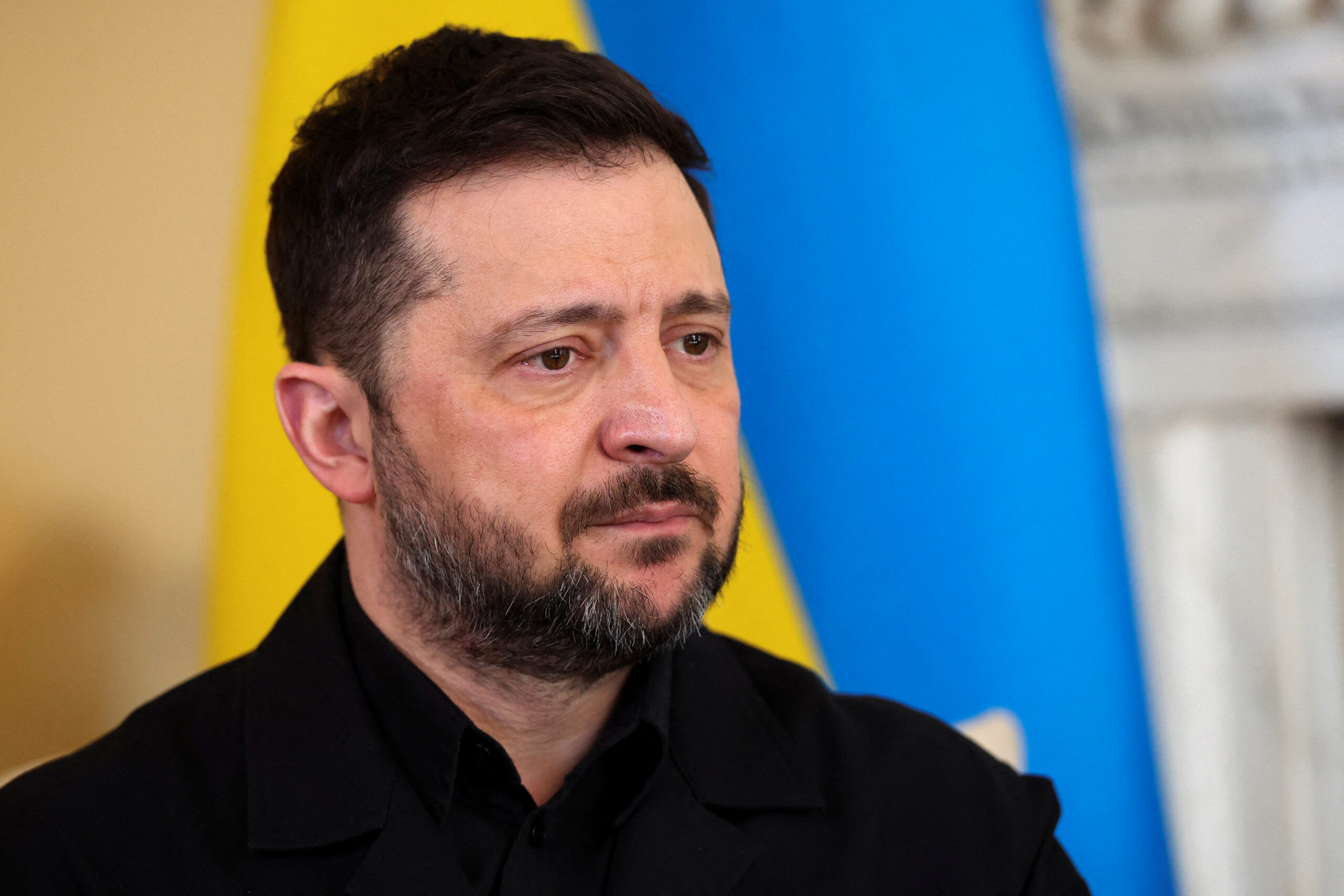
Like the man in Monty Python and the Holy Grail, Ukraine’s President Volodymyr Zelensky may be crying, “I’m not dead.” It is too early to perform a postmortem on Zelensky’s political career. But it may not be premature to attempt an analysis of his deteriorating condition and struggle to survive.
Zelensky’s strength is being undermined on four fronts: overall domestic support, support from his party, financial support from Europe, and a collapsing relationship with President Donald Trump.
Polls show that Ukrainians, who wanted Zelensky to lead them through the war, no longer want him to lead them after the war. Indeed, having fed Ukrainians with fantastical promises of pushing Russia out of all Ukrainian lands and being welcomed into NATO, and having depended on a cooperative relationship with Ukrainian ultranationalists who oppose a compromise peace with Moscow, Zelensky may have put himself into a position where his presidency cannot survive the war. Polling shows a collapse of domestic support for Zelensky, suggesting that he would lose by a wide margin in the next election.
But, while the foreign media has been entirely focused on the war, domestic attention in Ukraine has also turned to corruption. Zelensky was elected on the twin platform of making peace with Russia and ending Ukraine’s self-destructive corruption. He has delivered on neither.
A key metric is Zelensky’s trust rating. Asked recently which political figures they trust, Ukrainians ranked their president a damning sixth, with only 18 percent of respondents fully trusting him. His main potential political rivals, Valeriy Zaluzhny, Kyrylo Budanov, and Mykhailo Fedorov are all more trusted. A fifth of those who say they do not trust Zelensky cite corruption as the main reason, and 72 percent of Ukrainians say he is personally responsible for corruption in his government. Amid his latest spat with Trump, one recent poll found Zelensky’s trust rating had risen, but the overall trend is still bad, and the rally-around-the-flag effect may prove fleeting. Zelensky has hurt himself with his handling of a snowballing corruption scandal that is reaching deeper and deeper into his inner circle.
And Ukraine’s president is not only losing ground with voters—he’s also losing the support of his party, which once was solidly behind him. He is being confronted by unfamiliar resistance, with dozens of MPs in his Servant of the People party boycotting or rebelling. His legislative supermajority is reportedly at risk as a result of defections.
The lack of support at home also puts in jeopardy EU funding on which the Ukrainian government relies. Ukraine is facing a massive budgetary shortfall totaling tens of billions of dollars. Kiev wants money promised by the EU for 2027 to be provided sooner. But the release of badly needed funds from the EU is contingent on the Verkhovna Rada, Ukraine’s parliament, enacting corruption reforms—and Zelensky’s party has refused to pass such measures. Even a package of tax bills that was passed last week and that could unlock $4.3 billion dealt only with less controversial items, and avoided addressing many of the more serious demands being made by the EU.
Earlier this month, the EU rejected Zelensky’s appeals and refused to accelerate payments to cover the shortfall, again tying funding to corruption reform. According to Slovakia’s Prime Minister Robert Fico, neither Slovakia nor Hungary will participate in another EU loan to Ukraine. Other, more pro-Ukraine EU nations would have trouble filling the gaps. France, for example, is convulsed by riots motivated in part by the rising cost of living, and populist critics of the establishment are quick to remind voters of the vast sums that have already been sent to Ukraine. The right-wing leader Marine Le Pen, currently the favorite to win France’s next presidential election, recently said that, if she wins, Paris will cut financial aid to Ukraine.
But Zelensky’s biggest challenge comes from Ukraine’s most crucial supporter. Shaky relations with U.S. presidents are nothing new for Zelensky. In the first year of the war, when Joe Biden authorized further military assistance for Ukraine, Zelensky complained about what he wasn’t getting. Biden reportedly “lost his temper” during a call with the Ukrainian leader. “Raising his voice,” he told Zelensky to “show a little more gratitude.” The next year, Thomas Friedman of the New York Times reported, “There is deep mistrust between the White House and President Volodymyr Zelensky of Ukraine—considerably more than has been reported.”
But Zelensky managed those challenges. Even following last year’s public debacle that saw Trump throw him out of the Oval Office, Zelensky was able to repair his relationship with Trump. That work has now exploded.
Earlier this month, Trump made three decisions that seemed to collectively amount to a breaking point for a reluctantly conciliatory Zelensky. He made a deal with Russia’s President Vladimir Putin that would allow Russia to sell diesel fuel, he announced a surprise energy ceasefire that demanded Ukrainian armed forces stop all strikes on Russian refineries, and he waived new sanctions on Russia.
This trio of announcements apparently led Zelensky to conclude that his conciliatory approach was no longer working. According to a person close to Zelensky, he let it be known that “plain speaking” was now needed, and he made the decision to publicly criticize Trump.
Zelensky said Trump’s behavior “is certainly not how partners should treat each other.” When Ukraine struck another Russian refinery, Trump said Zelensky “better damn well stop.” Zelensky said Trump was not being fair or honest. He called Trump weak, and juxtaposed his leadership to the “real leaders” in Europe. Trump fired back, declaring, “I think it’s time for Ukraine to get a new president…. I suggest they get a new leader who can make a deal.” Trump later expanded: “I think if they are going to end up with a settlement of some kind, they are not going to do it with him.” On Monday, Trump added, “To be honest, I think it’s time for somebody else to negotiate on behalf of Ukraine.”
The gloves were off, and Zelensky was in danger of losing Trump. The military-grade version of Starlink, which Ukrainians use for battlefield communications, as well as U.S. early warnings of incoming Russian missiles went silent. “He is not a good guy for us to deal with,” Trump said of Zelensky Friday, adding that he is “more difficult to deal with than Putin.” Zelensky, he said, had “destroyed that country.”
When Russia kept pounding Ukraine’s electricity grid with drones, ballistic and hypersonic missiles, and with access to U.S. intelligence was restricted, Zelensky defied Trump’s orders, letting it be known that the block on attacking Russian refineries was off.
Zelensky is a political survivor, but the latest constellation of crises is the most difficult challenge to his leadership yet.
The post Prepping a Postmortem for Zelensky’s Presidency appeared first on The American Conservative.
On Tuesday, the Financial Times reported that Israeli Prime Minister Benjamin Netanyahu had directed his military to prepare for new attacks on Iran this month, before deciding to call off the operation. Citing anonymous sources familiar with the matter, the FT said the IDF had planned for “a multi-day bombing campaign to take place on the week of October 10 that would have targeted civilian infrastructure such as electricity plants, as well as nuclear facilities and regime targets.” According to the FT’s sources, Netanyahu decided against the strikes because of the opposition of President Donald Trump, who wants to avoid reopening the war until after the U.S. midterm elections.
Iranian Foreign Minister Abbas Araghchi said Wednesday that indirect diplomacy with the United States was continuing. According to Iranian state media agency IRNA, Araghchi stated that “negotiations with the United States, conducted via mediators such as Pakistan and Qatar, remain ongoing without interruption.” The foreign minister also published an article in the Financial Times Wednesday; in the piece, Araghchi argued that “false assumptions” about his country were “dangerous,” and said that although Iran was still committed to diplomacy, it had “no trust whatsoever in the sincerity of the US administration’s professed desire for peace.” This follows remarks by the chief of Iran’s national security council Tuesday that his government will not allow any amount of enriched nuclear material to leave the country, which some interpreted as a hardening of Tehran’s stance on the issue.
Brent crude opened around $109 per barrel Wednesday morning. AAA reports that the average price of regular gasoline in the United States is $4.26 per gallon, and the average price of diesel is $6.32 per gallon.
The post Iran War Day 236: Netanyahu Pushing for New Iran Strikes, Per Report appeared first on The American Conservative.
The president’s latest mood swing opens diplomatic possibilities on Ukraine and Iran.
The Iran War just might help end the Russia–Ukraine War. And the Russia–Ukraine War just might help end the Iran War. But first, senior Trump advisors need to play their cards right.
President Donald Trump is both uniquely independent of his political advisors and uniquely dependent on them. “Independent” in that he makes big decisions on impulse, often while ignoring wise counsel. “Dependent” because Trump’s erratic persona ensures policy successes will be rare unless the White House translates his impulses into a coherent strategy.
Trump of late has been acting extra erratically. In two recent cases—the canceling of a planned execution livestream and the firing of a new White House press secretary—key Trump insiders steered the tornado-man president into political fiasco. Secretary of Defense Pete Hegseth had boasted that a high-profile execution by firing squad would be public, only for the public to predictably oppose the idea. And Trump whisperer Natalie Harp had urged hiring as press secretary Katie Zacharia, who proved less-than-composed before a firing squad of reporters.
The walkbacks were embarrassing, though expedient, suggesting Trump is sensitive to popular opinion ahead of the midterm elections in November. I’m normally not one for optimism when it comes to Trump 2.0 foreign policy, but here’s an idea: Trump’s enhanced sensitivity to popular opinion could lead to resolutions of the two biggest foreign policy crises of Trump’s second term—if admin officials find a way to channel his impulses productively.
Much has been made of the perilous military connections between the conflicts in Ukraine and Iran and the risks of World War III. But the economic and diplomatic connections between these two wars bring new possibilities for peace.
The deeply unpopular Iran War, in a roundabout way, has wound up pushing Trump toward diplomacy with Russia. Iran continues to disrupt traffic through the Strait of Hormuz, raising prices at the pump and lowering Trump’s tolerance for Ukrainian strikes on Russia’s oil refineries. Earlier this month, Trump not only struck a deal with Russia’s President Vladimir Putin to import Russian diesel—a move intended to calm oil markets—but also called on Ukraine’s President Volodymyr Zelensky to halt the refinery strikes.
Amid the resulting spat with Zelensky, the Trumpian pendulum continued to swing in Putin’s favor. Trump waived new Russia sanctions passed by Congress, and Zelensky said the U.S. had cut intelligence sharing to Ukraine, including advance warning of ballistic missile strikes. Meanwhile, Ukraine has run out of the U.S.-provided munitions needed to defend against those attacks, and the Pentagon is delaying new shipments.
To be sure, these are grim developments for Ukraine. On Monday, Zelensky announced that a Russian strike on a park had killed several civilians, including a one-year-old baby girl. Ukrainians have described the added terror of ballistic missile strikes when air raid sirens don’t warn civilians to take shelter.
But the security situation in Ukraine was growing ever more dire even before Trump’s turn against Zelensky. Russian attacks on Kiev and other population centers have been escalating for many months, and the Iran War has depleted global stockpiles of missile interceptors. Moreover, the White House isn’t simply kicking the Ukrainians in the teeth. Trump’s special envoys Steve Witkoff and Jared Kushner told Kiev the diesel deal was part of an effort to “soften” Putin and jump-start peace talks, a point reiterated publicly by Trump and Energy Secretary Chris Wright.
It’s not a preposterous notion. The strategy of pressuring Putin has tended to make him dig in and lash out, not back down. By introducing some carrots into the mix, Washington stands a better chance of rebuilding trust and coaxing Moscow back to negotiations. Indeed, in the same October 9 call on which Trump and Putin hammered out a diesel deal, the Russian leader proposed trilateral, Russian–American–Chinese talks on a Ukraine peace settlement, an idea that gained traction this week.
Of course, Zelensky would prefer that Ukraine and its European partners had seats at the table, but there’s a silver lining in all this for him. Wartime leaders, after years rallying their nations, can struggle to reach negotiated settlements, which require painful concessions from the weaker side. If Trump plays the bad guy, pushing Zelensky to accept a hard peace rather than continue a horrific war, the Ukrainian leader will have more political leeway.
The Europeans too would prefer they were the ones talking to Putin—but that itself is a new development brought about by Trump’s latest mood swing. On previous occasions when Trump turned against Ukraine, European leaders embarked on a groveling charm offensive to get him back onside, but not this time. “There is a growing consensus in European capitals that the continent’s leaders can no longer tolerate a situation where only the Americans are talking to Putin,” reports Gideon Rachman of the Financial Times. “Channels with the Russians are already open and a call between European leaders and Putin may happen soon.”
All this suggests Trump’s new anti-Zelensky groove, though motivated by short-term political calculations related to the Iran War, is reinvigorating diplomacy on Russia–Ukraine. And if you squint, you’ll notice this incipient outbreak of diplomacy, handled responsibly, could be brought full circle, raising the chances of productive peace negotiations with Iran.
During their October 9 phone call, Putin laid out for Trump an Iranian peace proposal. And this Monday, Russia’s Foreign Minister Sergey Lavrov flew to Tehran for talks with top Iranian officials, his first visit to the country since the war began. A Russian government readout said discussions centered around strengthening the two nations’ security partnership, but also expressed Moscow’s “readiness to help bring about a solution regarding the situation around Iran.”
Again, this whole sequence of events appears to have been sparked by Trump’s concerns about gasoline prices, rather than any commitment to enlightened statecraft. Nevertheless, Trump’s latest seesaw has raised a diplomatic opportunity that White House officials should seize.
The post How Trump’s Turn Against Zelensky Can Lead to Peace appeared first on The American Conservative.
Liberals are trotting out the 2016 playbook once again.
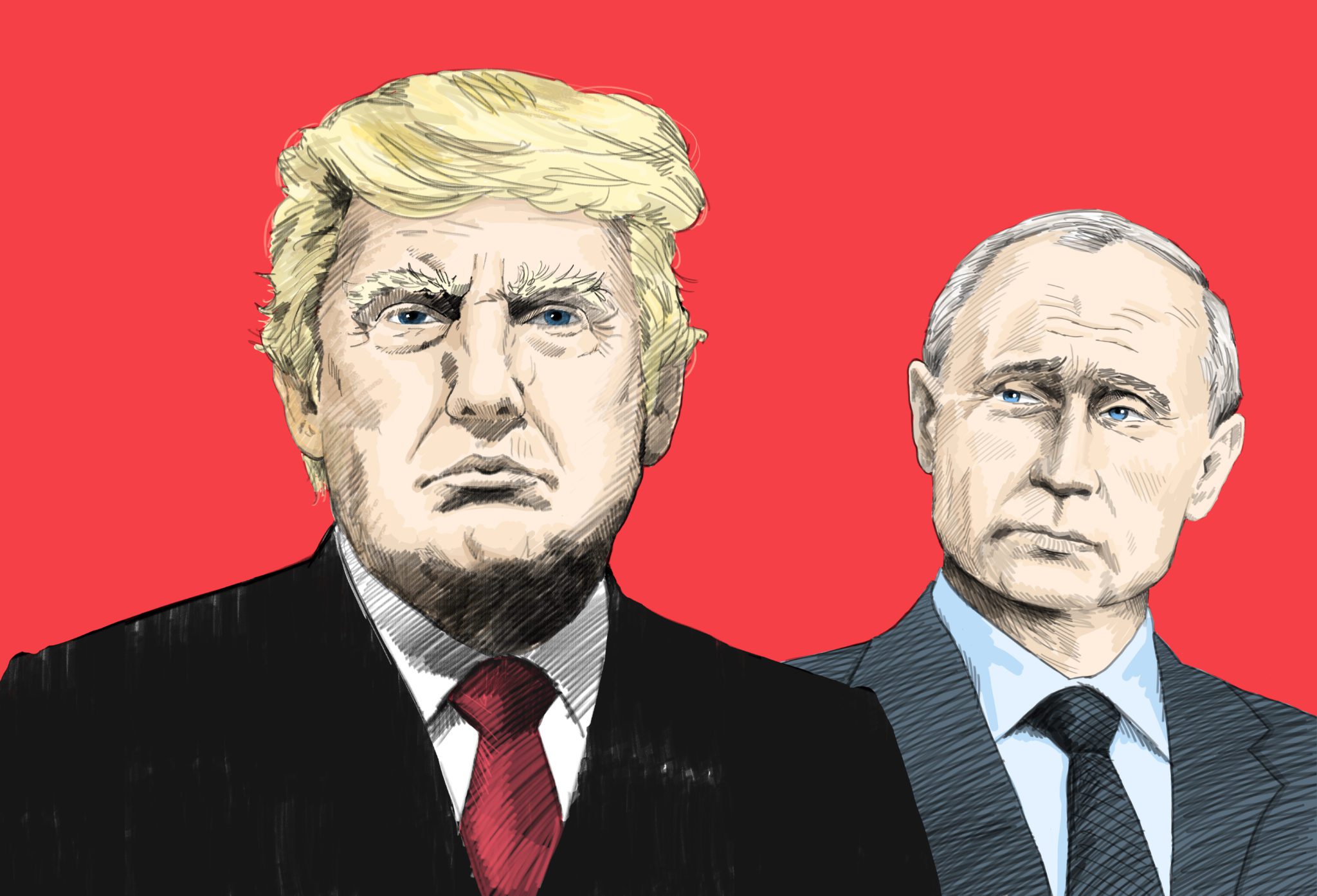
Remember Russiagate? Remember former British spook Christopher Steele’s dodgy dossier? Remember Crossfire Hurricane? Remember when it went nowhere and destroyed all trust in the FBI? We now have a decent idea what Russiagate was all about: It was intended to create a strong base of support among Democrats for a proxy war with Russia. The trick was to link this project with the political passions stirred up by Donald Trump. It worked like a charm. There is now an army of liberals who are almost as obsessed with Russian President Vladimir Putin as they are with President Trump.
Russiagate was a classic psychological warfare operation. It used the old propaganda technique of “association” to build up the idea that Putin and Russia were entwined in some foundational way with the right-wing populism then finding such purchase among the American electorate. The people behind Russiagate were frustrated with the realist foreign policy being pursued in Europe by the likes of President Barack Obama and former German Chancellor Angela Merkel. “Obviously,” Obama said in March 2014 after the Russian annexation of Crimea, “we do not need to trigger an actual war with Russia. The Ukrainians don’t want that. Nobody would want that.”
But Obama was wrong: Some people very much wanted that, including his own former Secretary of State Hilary Clinton. And to get their confrontation, they first needed to build a core base of support.
The Clinton campaign could have chosen any number of issues on which to attack Trump in 2016. With the benefit of hindsight—and, as Trump recently blurted out, “over a million [Ukrainians] killed”—it is now clear why they chose the Steele dossier. Russiagate may have been a flop legally; its basic disconnection from reality made it a nonstarter in the courts. But as a propaganda piece it was an enormous success. When the Obama administration trod lightly on the Crimea question, few Democrats questioned it. Indeed, many saw it as proof of his return to rational, level-headed foreign policy after the excesses of George W. Bush. After Russiagate, no Democratic president could get away with such realism without triggering a wave of condemnation from Putin-obsessed liberals.
Well, it is starting to look like there is an effort underway to summon the ghost of Russiagate before the midterms in November. It started in the same city out of which the Steele dossier emerged: London. Britain’s new Prime Minister Andy Burnham went on a popular politics podcast and stated that Russia had intervened in the Brexit referendum. This ran contrary to what investigations showed shortly after the election and was seen as so destabilizing that the head of MI5—Britain’s domestic counter-intelligence agency—felt the need to make a statement downplaying (though not denying) Burnham’s comments. Why was Burnham beating this dead horse? The clue came in the days that followed.
Around the same time as Burnham’s interview went live, reports started to circulate that Ukraine had managed to strike a Yandex facility in Moscow. Yandex is Russia’s primary internet technology company, roughly equivalent to their version of Google. Shortly after the strike, a Czech member of the European Parliament posted a dubious looking chart showing that after the strike on Yandex, online activity around Alternative für Deutschland (AfD) accounts plummeted. The chart had no source and looked AI-generated. What is more, it showed data up until October 15th but was posted on October 11th. The chart was such an embarrassment that even the BBC had to concede that it was disinformation. But not before prominent foreign policy voices like Ian Bremmer of Eurasia Group and even Zelensky himself seemed to endorse the idea that the Yandex strike had knocked out Russian propaganda accounts.
What a tantalizing possibility for your average liberal X user. The change in online political discourse that has taken place in recent years is partly a result of Elon Musk’s purchase of X, turning it into a space of open political discourse. But it is also part of a broader shift away from the pieties of the Obama-era liberal progressives. This shift has been jarring for many on the left, who have had to watch their previously hegemonic opinions become “cringe.” People previously heralded as “right-thinking” and “cool” have seen their worldview turned into a running joke in only three election cycles. Imagine if they could blame this shift on Russian propaganda bots that could be knocked out by a well-placed Ukrainian attack drone!
In the weeks prior to Burnham’s comments and the Yandex hysteria, there had also been attempts to find new financial links between the Trump administration and the Kremlin. The most promising of these for the neo-Russigaters seems to center on the Republika Srpska, the Serb-majority political body in Bosnia and Herzegovina. Publications like The New York Times and The Financial Times have recently run profiles about senior White House figures working for DC lobbying firms on behalf of Republika Srpska. (The political entity is currently living under cartoonish political constraints imposed by the European Union that effectively allow an EU-appointed judge to overrule domestic political decisions made by the democratically elected government.) But instead of engaging with the facts on the ground, the liberal publications focus on the fact that Republika Srpska’s leadership is “pro-Russian.”
This gives more speculative commentators the space needed to concoct a florid conspiracy wherein the government of Republika Srpska is not really lobbying for more political autonomy, but is instead a sort of front for Kremlin influence, operating as a proxy lobbyist for Putin in Washington. This focus on issues in the Balkans follows on from recent efforts by Republican Congressman Joe Wilson of South Carolina introducing the SRBIJA Act that targets Serbia itself as a Russian (and, apparently, Chinese) puppet. (The congressman had also previously tried to label Georgia as a Kremlin proxy, introducing the MEGOBARI Act in 2025.) Wilson and his ilk seem to know that keeping the anti-Putin dog and pony show going will require new targets after the Ukraine war.
The Israelis are getting in on the act too. In recent months, there has been a notable tendency of pro-Israel voices online to blame Russia for a variety of problems. Laura Loomer’s recent Damascene conversion is a case in point: She went from calling Zelensky a dictator to lauding him as a hero. No doubt this recent shift has something to do with the disappointing progress of the Iran war—and, since Russia and Iran are close partners, they probably see linking the conflicts as somehow geopolitically helpful. Israel’s Prime Minister Benjamin Netanyahu himself has used the Yandex attack as evidence that the Kremlin is directing bot networks to attack Israel and stir up antisemitism worldwide. If these indications are anything to go by, if we are not currently in World War III, we soon will be as conflicts across the world are linked together and given a common ideological framing.
The evidence suggests there will be a second attempt at Russiagate after the midterms. The immediate goal will no doubt be to shore up support for the Ukraine war. But smarter operators behind the scenes may also understand that the situation on the Ukrainian frontline is hopeless, and that it is highly unlikely that the conflict will still be raging by the time Trump leaves office. They are therefore looking for new places to continue their pressure campaign against Russia—the Balkans, the South Caucasus, anywhere Kremlin influence can be plausibly alleged.
But can a new Russiagate build the same momentum as the original? Probably not; politics, especially in America, rewards novelty. Yet rehashing the issue may nonetheless help Democrats somewhat, especially given the change in America’s geopolitical position since 2016.
For the plain fact is that in the wake of the Ukraine and Iran wars, American influence is collapsing globally. By the end of the Trump administration, the superpower’s reach will be a shadow of its former self. This presents the United States with two choices. One is to realize that the unipolar moment is over and adapt, maximally leveraging what power and influence the country still retains. The other is to take the “British option”: to stubbornly pretend that your empire still exists, and continue to meddle in the affairs of others even as your own society rots from the inside out. Indeed, it should come as no surprise that both Russiagate I and Russiagate II originated in London. The UK is trying to lure the United States down the same disastrous path that its foreign policy elite took after the collapse of the British Empire. The only question is whether the Americans will follow them into the abyss.
The post Russiagate II: Loser Edition appeared first on The American Conservative.
The prime minister’s rhetoric about reversing Brexit raises uncomfortable questions about Scottish independence.

Is the United Kingdom on its way out? Has the break-up of Britain finally arrived? Certainly, the political map of the United Kingdom has changed in the past six months, with nationalists now dominating all three devolved parliaments.
Michelle O’Neill, the deputy leader of Sinn Féin (which used to be the political wing of the Irish Republican Army), is currently first minister of Northern Ireland. The Welsh nationalist leader, Rhun ap Iorwerth of Plaid Cymru, is now in command in Cardiff, following his party’s sweep of the Senedd in May 2026. That same month, John Swinney became first minister of Scotland, after his Scottish National Party (SNP) won its fifth consecutive Scottish parliamentary election. It looks as if it is all kicking off in the Celtic fringe.
Swinney told his recent conference that there is “panic in the streets of London” at the prospect of these three nationalist leaders working together to demolish the 300-year-old Union. Last month, the trio got together in Cardiff to sign a memorandum of understanding demanding “democratic self-determination.”
“For people watching across these islands”, it said, “[and] for people watching around the world, there could be no clearer sign that Westminster’s time is coming to an end.”
Moscow is certainly watching. The Russian Foreign Minister Sergey Lavrov said that the departure of “the Celts” from the UK could raise questions about Britain’s continued membership of the United Nations Security Council. The British state “has diminished to the utmost degree,” he claimed.
Mind you, there is no direct constitutional significance in these devolved legislatures being controlled by nationalists. Sinn Féin shares power in Northern Ireland with a unionist party. Plaid Cymru is not demanding an immediate referendum on secession. And in Scotland, support for an early repeat referendum seems to be waning.
According to a YouGov poll published on the eve of the recent SNP conference in Aberdeen, fewer than 20 per cent of Scots regard an independence referendum as a political priority. This is despite the UK Prime Minister Andy Burnham apparently doing his best to make it one.
The new PM said this month that he is determined to bring Britain closer to Europe, possibly by holding another referendum on Brexit. Bring it on! cried the SNP, which is dedicated to rejoining the European Union, and bring on “Indyref2” while you’re at it.
“Mr. Burnham needs to explain to the people of Scotland,” said the party’s Economy Secretary, Stephen Flynn, “why it is legitimate to reopen the democratic question of Brexit but not legitimate to reopen the democratic question of Scottish independence.” He has a point.
The PM’s musings on Europe have revived all the grievances about how Scotland was dragged out of the EU by “English votes” in the 2016 Brexit referendum. Sixty-two percent of Scots voted to remain in the European Union, but the referendum was UK-wide, and Scotland’s result was eclipsed by the overall vote to leave (which was 52 percent to 48 percent).
The SNP also claims that the 2014 Scottish independence referendum was fought on a “false prospectus.” One of the key arguments of the unionist Better Together campaign, led by the former Labour Chancellor Alistair Darling and backed by then-PM David Cameron, was that Scotland could not stay in the EU if Scots voted to leave the UK. It would have to apply to Brussels to rejoin as a third country.
In the event, remaining in the UK led to Scotland being dragged out of the EU: precisely what many unionists thought they were voting to avoid. Now here is Andy Burnham claiming, in effect, that this whole Brexit thing was a mistake and needs to be reversed. But if that is the case, say the Scottish nationalists, then surely they should get a do-over on the independence vote as well?
The PM also raised unionist eyebrows last month at Prime Minister’s Questions, when he equated Scotland’s constitutional position in the UK with that of Northern Ireland under the Good Friday Agreement. “The situation is exactly the same,” he said.
The SNP could hardly believe their ears. The 1998 agreement that brought an end to the Irish Troubles provides for a referendum on Irish reunification—a “border poll”—if there is a clear demand from the people of the province. Why not a border poll for Scotland, then?
One the even of this month’s SNP conference in Aberdeen, Burnham seemed to concede that there could be a repeat Scottish referendum if enough Scots wanted one. But he later “clarified” this by saying that another Scottish referendum was “off limits.” John Swinney lost no time exploiting the contradiction.
He told his party conference this month that the campaign for the next independence referendum “has already begun” and that it would be held no later than 2031. This was just rhetoric, however, and Swinney knows it. The UK Supreme Court ruled four years ago that the Scottish Parliament lacks the power to hold its own referendum on independence, even an advisory one.
Only the UK Parliament in Westminster can authorize another ballot for Scotland. And none of the main party leaders in the Commons is prepared to propose such a measure.
Yet no one seriously doubts that, if there were a mass movement of Scots demanding Indyref2, it would be politically very difficult to refuse one. At present, there is no such movement in Scotland, though around half of Scots say they favor independence as a long-term destination. Andy Burnham must be careful what he says if he wishes to avoid jump-starting this latent Scottish separatism—and making good Swinney’s recent boast that Burnham will be “the last prime minister of the United Kingdom.”
The post Burnham Inadvertently Reinvigorates Scottish Separatism appeared first on The American Conservative.
Defense Secretary Pete Hegseth visited Israel Monday, where he met with Prime Minister Benjamin Netanyahu, per a report in Axios.
Sources did not disclose the content of the men’s meeting to the press. The visit occurred amid ongoing reports that the U.S. is considering another round of strikes against Iran. Netanyahu, who scored President Donald Trump’s endorsement in Israel’s October 27 elections, said while campaigning this week that he was still seeking regime change in Iran.
The British Defense Minister Wes Streeting announced Tuesday that the UK would conduct defensive air operations over Saudi Arabia against Yemen’s Houthi rebels, who have struck Saudi airports and energy infrastructure in recent weeks. The Iran-aligned group has intensified its siege of Taiz, the third-largest city in Yemen.
Iranian operations against shipping in the Strait of Hormuz have kept pressure on energy markets. Brent crude opened Tuesday at $109 per barrel. AAA reported national average prices per gallon of $4.28 for regular gasoline and $6.32 for diesel.
The post Iran War Day 235: Hegseth Visits Netanyahu appeared first on The American Conservative.
Luke Nicastro talks to journalist and political analyst Gabe Fleisher about midterm predictions, how the political landscape will change after November, and what voters actually care about.
The post TAC Right Now: GOP Headed for Midterm Wipeout? w/ Gabe Fleisher appeared first on The American Conservative.
Shocking scenes out of France show a continent in crisis.
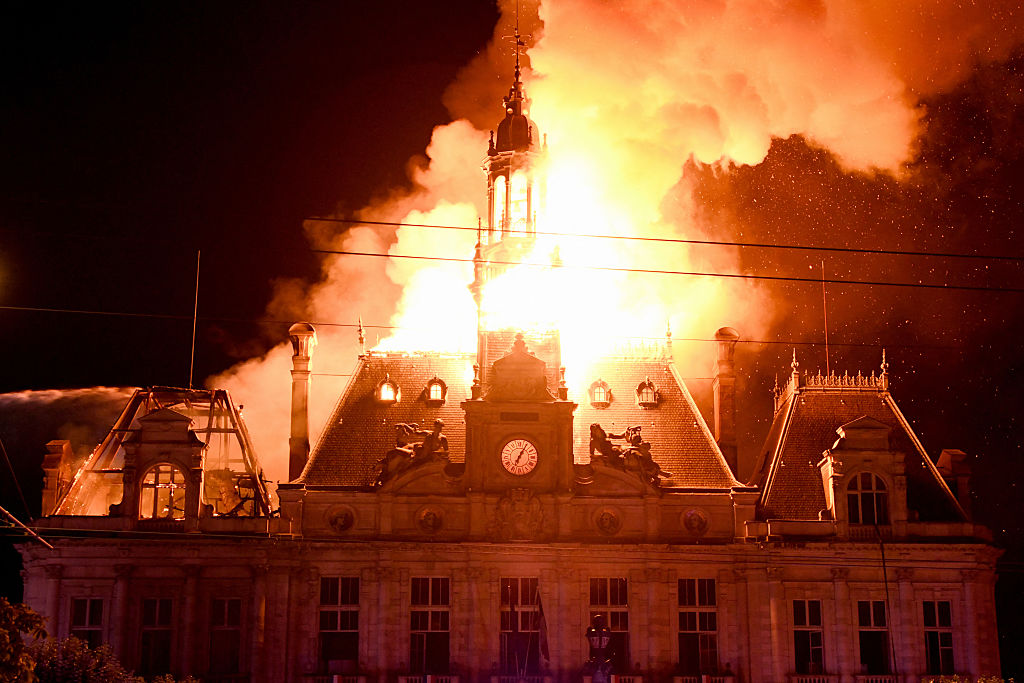
When France sneezes, it used to be said, all Europe catches cold. One need only consider the French Revolution, 1848’s “Springtime of the Peoples,” or even the student protests of May 1968 to see the point: There is something about France that allows her to act as both catalyst for and barometer of profound shifts in European order.
One wonders whether the riots currently convulsing the Hexagon will prove the latest illustration of this phenomenon. For the past few weeks, malcontents in their tens of thousands have taken to the streets of cities across the country, demanding—something. The demonstrations started with students, who claimed to be opposing poor conditions in schools and problems with the admissions system for higher education. But the schoolkids were soon joined by trade unionists and radicals of all stripes, and the targets of their wrath expanded to encompass fuel prices and the rising cost of living, government budget cuts, a lack of attention to left-wing priorities, and, ultimately, the notion of authority itself.
Now protests, in the Gallic tradition, do not tend to display the primness and decorum one might find in a stateside “No Kings” gathering. But this weekend they degenerated into levels of chaos and violence unusual even by French standards. The world was treated to the spectacle of looting, wanton property destruction, and brutal physical assaults across France; nearly 1,000 police officers and gendarmes were injured, and over 2,400 arrests were made between Saturday and Sunday. The degeneracy was perhaps best summed up by an arson attack on the town hall of Limoges, a grand old building that survived two world wars before finally succumbing to the senseless spasms of the mob.
Already, at least a little of the unrest has spread beyond France’s borders. In the past few days, we have seen a few similar demonstrations break out in Madrid, Milan, Lisbon, and Brussels. And there may be good reason to expect further propagation, because the conditions that produced them are common to most European countries.
Consider first the material circumstances. France, like the United States, is in the midst of a cost of living crisis, one that is squeezing ordinary people across the board. But its crisis is more acute and more painful in certain key areas—notably, the oil and gas necessary for commercial transportation, industrial production, and residential heating—and French leaders have far less ability to control the underlying causes (that pesky war in the Mideast, for example).
Moreover, this crisis is unfolding against a backdrop of both anemic economic growth and—critically—looming fiscal crisis. Much has been written about France’s burgeoning public debt and its unconquerable addiction to the financing of extraordinarily lavish benefits via deficit spending. And although the United States is no model of fiscal rectitude, the dollar is hegemonic and we write the rules of the global financial system. France has vastly less cushioning; and the risk of a default has jumped appreciably of late, spooking the government enough for it to actually propose cuts to spending. (Quelle horreur!) The result, of course, is fury and resistance (the protests, at least initially, being an obvious example of this), which tends to paralyze efforts to fix the problem and so worsen the situation.
Then there is the issue of immigration. Whatever the ethnic composition of the rioters and looters—I leave it to the reader to parse the various videos and documentary evidence circulating online—it is clear that mass migration has produced profound and perhaps unbridgeable social fractures. Nearly 12 percent of the French population is foreign-born; of these 8 million or so residents, many lack either the desire or the ability to assimilate into a society that is far less capable of absorbing and integrating newcomers than our own republic. And these excluded millions are, in turn, keenly aware of the uneasiness of their position. The result is a situation of enduring hostility; moments of crisis therefore find large pools of opportunists with little attachment to the existing order and much to gain from its unravelling.
Finally, there is the utter bankruptcy of the political establishment. Emmanuel Macron has been president of France for 10 years and has an approval rating of 15 percent. And although his initial pitch was—as one sage commentator pointed out on X—to forestall the very explosion of popular anger we see occurring today by fixing its underlying causes, it is undeniable that the project of macronisme has failed. It has failed to get France’s economic and fiscal house in order. It has failed to shore up order or meaningfully enhance French power or security. And it has failed to unify the French people. Finally forced to address the nation on Sunday, Macron blamed far-left agitators and “delinquents” for the mayhem, and dutifully promised to both “hear the anger and act on its causes” and “firmly uphold republican order.” (His government also pressed for limited local curfews.) But few of his countrymen seemed to take their president seriously. More compelling was the conclusion of the journalist Vincent Trémolet de Villers:
If the ultra-left, criminals, and looters can turn France upside down in a matter of hours, it is first of all because a technocratic monarchy—intoxicated with its own self-importance—has methodically razed all the moral, security, cultural, and economic safeguards that allow a society to remain standing.
The three failures sketched above may have progressed the furthest in France. But she does not suffer alone. All Europe faces this confluence of severe economic headwinds, mass migration, and an utterly feckless political class.
So, to address the question raised by this article’s heading: Is this it? Is Europe doomed?
The right-wing, anti-establishment parties currently surging in countries like France and Germany offer some prospect of rejuvenation. If things continue to break their way—still a big if—the National Rally, the AfD, and similar forces could replace the current crop of European elites with leaders who grasp both the urgency of the challenge and the necessity of decisive action. But though populists may shore up their political orders and address themselves earnestly to the problem of migration, they are unlikely to find a way out of the continent’s material dilemma. Economic competitiveness will continue to falter, the affordability crisis will probably worsen, and the technologies that will determine future positioning—one thinks especially of AI—may pass Europe by entirely.
And obviously, if the populists fail to take power, Europeans will continue on their current trajectory. The present political establishment is more likely to launch a war with Russia than to get serious about mass migration.
All this suggests pessimism is warranted. Continued decline, though not entirely inevitable, is far more probable than not. Yet, even if these protests continue to spread, the collapse is unlikely to happen all at once, in a sudden conflagration. Rather, it will be a sad drama playing out over years and decades. For if, as Adam Smith famously observed, there is a lot of ruin in a nation, how much more is there in a continent?
The post Is Europe Doomed? appeared first on The American Conservative.
U.S. reps abroad once worked and played hard, but now, we don’t even need them.
Boy oh boy, Ben Franklin must have turned over a bit—until she threw in the towel, that is. Ben was, after all, our first sort-of ambassador to France, and I say “sort-of” because we hadn’t as yet become a country, n’est-ce pas, as they say in the land of fromage. Kimberly Guilfoyle was our latest ambassador to Greece, though she hasn’t as yet become very diplomatic.
Our now ex-ambassador to the ancient country of Greece embarrassed both Uncle Sam as well as old Hellas. It would have been more appropriate had she been sent to, er—less sophisticated places like Liberia or somewhere nearby. But Athens, Greece? The ex-wife of Governor Gavin Newsom, and ex-girlfriend of Trump Junior, was named ambassador to Greece to get her out of the Trump family hair, but Stormy Daniels would have behaved more gracefully, or so some Greek wits think.
“It’s not all her fault, we should never have accepted her,” is the opinion of the few proud Hellenes I contacted. An old friend of mine was a bit harsher: “She looks like a third-class Playboy bunny, and she was here representing Uncle Sam.” I have to agree, however harsh my fellow countryman was being on her. The Greek Foreign Ministry should have found some diplomatic excuse when Kimberly was named. After all, diplomacy is based on lying with good manners, and God knows Trump could use some of the latter.
The worst-ever appointment was sending the ex-criminal Charles Kushner— father of the supposedly great diplomat and certainly great fundraiser for himself, Jared Kushner—to the city where Ben Franklin once reigned supreme with France’s intellectuals. Kushner harangued the French about antisemitism, forgetting that his job was to look out for America’s interests, not only those of his coreligionists.
Kimberly arriving in Gstaad, Switzerland, at Christmas accompanied by a very recently rich Greek tycoon was not the most elegant thing for an American ambassador to do, but then, Kimberly was not exactly a Clare Booth Luce type of diplomat. Clare was a beauty, physically as well as where brainpower is concerned. She could argue, reason, and convince any male counterpart, and I used to play gin rummy with her because my father bought her old apartment at 993 5th Avenue. She was in her late sixties and still sexy as hell, and she flirted. As our ambassador to Italy during the ’50s, she got the job more than done as she was smarter and better informed than all the Italians and Americans involved put together. She charmed Italian communist politicians and had them drooling.
Henry Cabot Lodge was named our man in Saigon by JFK, and he warned Kennedy that the south’s leadership depended on corruption, whereas the north was geared for war. He resigned when LBJ decided to enlarge the war and send more and more American troops.
Needless to say, even poor Kimberly did not do so much damage to America as David Milstein, a top official in the U.S. embassy in Jerusalem, who is entrusted with much of the mission’s portfolio by Ambassador Mike Huckabee. Milstein altered reports and quashed others critical of Israel. He might as well have been an Israeli agent working for that country rather than Uncle Sam. He retains his position, instead of having been fired and prosecuted. Such are the joys of the U.S.-Israel relationship.
What I don’t get is why we continue to have ambassadors. Modern communications made them redundant long ago, so now they’re simply paybacks to rich donors and nothing else. And, in a way, I feel sorry for Kimberly. Greek nightlife begins at 1 AM and goes on until 4 or 5. Americans were shocked to read their ambassador was out until 3 AM, whereas some Greeks thought her a sore sport for going home early. (If I sound misogynistic, I apologize and hope all future ambassadors to Athens are women.)
Never mind. Before I moved to my present address on Park Avenue, I lived in a townhouse three houses away from some African consulate. Never have I seen so many noisy drunks emerge nightly as from that establishment. I once exchanged words with one of my neighbors, an African diplomat who threatened me about something—he was drunk—but then settled down and bragged about how rich his country was. It was and remains one of the poorest in the world.
But back to ambassadors and good-time Charlies. My very close friend and the former Dominican ambassador to Cuba, Porfirio Rubirosa, was married five times, and three of his wives were the three richest women in the world: Flor de Oro, daughter of Rafael Leonidas Trujillo, strongman of the Dominican Republic; Doris Duke of the American tobacco fortune; and Barbara Hutton of the 5- and 10-cent stores. Rubi and I boxed every day before breakfast, worked the ponies, and pursued the high life in Paris. My father blamed Rubi for turning me into a playboy instead of a shipping tycoon. Rubi laughed it off.
He died as a man should, driving very fast in his Ferrari at 5 AM returning home after a long night at Jimmy’s, a Paris nightclub, back in June 1965. Ambassadors should have been declared redundant after him.
The post Guilfoyle Flamed Out—Other Ambassadors Burned the Night Away appeared first on The American Conservative.
J.D. Vance could learn a thing or two from Harold Macmillan.
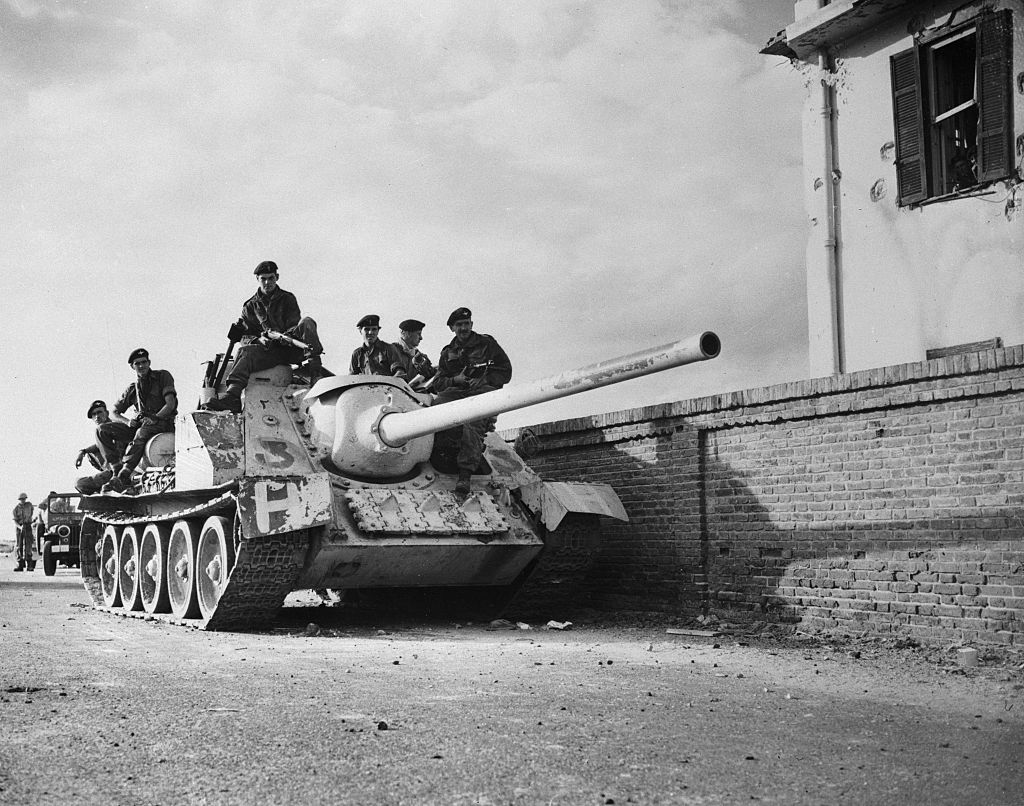
The Anglo leader looked across the globe and saw a Muslim nation, which had already been stirring things up, potentially threatening a vital waterway. At the same time, Israel had its own beef against that country, and was pushing for a joint first-strike. So together, the two governments launched a military attack.
But things did not go well. Casualties were low, but the political blowback was shattering.
Is this a sketch of the ongoing conflict between the United States and Iran? Some might so assert, and that can’t be helped. Yet these are the outlines of the Suez Crisis of 1956.
Back then, Britain, Israel, and also France joined together to “safeguard” the Suez Canal and to take the anti-colonialist Egyptian leader, Gamal Abdel Nasser, down a peg. Not many celebrate that conflict, but for those who do, 70th anniversaries are coming up, starting with October 29, when Israel commenced Operation Kadesh, followed a few days later by the Anglo-French Operation Musketeer.
The attacks were a military success, but a political failure. Amid international uproar, a ceasefire was declared, and the foreign forces were soon withdrawn, leaving Nasser to declare victory. Many cheered his willingness to stand up for the liberationist aspirations of not only Arabs, but also the entire Third World (then a fresh phrase, coined four years earlier).
So yes, history rhymes, and yet each historical moment sounds its discordant notes. For instance, back in 1956, the U.S. strongly opposed the Suez operation. President Dwight Eisenhower, a retired general, had seen enough of fighting; in fact, when he came into the White House in 1953, his top priority was to settle the Korean War, which he did. The 34th president was, for sure, a determined Cold Warrior against the Soviet Union, but he wanted to keep the focus on opposing communism, not snuffing out the various nationalisms then springing up, including in Egypt. As they say in the Army, the main thing is to keep the main thing the main thing—and for Eisenhower, that meant containing Moscow, not Cairo.
Moreover, Ike’s secretary of state, John Foster Dulles, epitomized an earlier era in U.S. diplomacy, when the State Department strove to be even-handed—critics said, pro-Arab—in the Middle East.
Eisenhower and Dulles worried that the Suez invasion would inflame the Egyptians and others, driving them toward the Soviets, who were encouraging movements of “national liberation.” So as the crisis unspooled, Washington and Moscow found themselves on the same side, telling the invaders to get out.
Suez is generally reckoned as the last hurrah of British imperialism. Yes, there’d still be overseas missions to come, but, with the glaring exception of Tony Blair’s invasion of Iraq, the United Kingdom’s appetite for wars of choice had basically abated. (The story of France is similar; as for Israel, well—it’s different.)
Yet there’s another aspect to the Suez saga that should be heartening to conservatives, if not neoconservatives: Parties of the right might make a geopolitical mistake, but if they can fix it, changing their errant ways, they can recover their political standing. Indeed, they can win even bigger in the next general election. That’s what happened in the UK back in the 1950s, and the precedent is worth a ponder.
In the meantime, here’s an American precedent to consider: When U.S. presidents launched wars of choice that didn’t turn out well, their instinct was often to double down—and it was costly for them and their party (as well as, of course, for the country).
For instance, as the Vietnam War started to look quagmire-y in the mid-1960s, President Lyndon B. Johnson sent more troops. The results were huge defeats for Johnson’s Democrats in the 1966 and 1968 elections (including the loss of the presidency). Similarly, as the Iraq War turned into a disaster in the mid-2000s, President George W. Bush hung tough on the “moral clarity” of the mission and then “surged” more troops. For their part, the voters didn’t approve: Bush’s Republicans were walloped in the 2006 and 2008 elections, including again the loss of the White House. The lesson is clear: If you make a mistake, get out as quickly as you can.
The British prime minister who ordered the Suez attack was Anthony Eden, a capital “C” Conservative. The revulsion against him was severe; his health suffered a collapse that was described, publicly but unconvincingly, as a purely physical ailment. In search of relief, Eden traveled not to a hospital, but to the Caribbean, spending nearly a month at the Jamaican estate of the James Bond novelist Ian Fleming.
Upon his return to London, Eden agonized for another month before announcing his resignation on January 9, 1957. Doctors’ orders, he claimed. (Wags said Eden had committed Suez-cide.) Interestingly, once freed from the stresses of office, Eden lived another 20 years, unrepentant about his military misadventure. (The idea that a leader wouldn’t wish to admit a mistake is unsurprising—it’s certainly familiar to American Republicans, surveying their party’s presidents over the last few decades.)
Yet now the Suez saga starts to get decidedly cheerier for the party of the right—and offers hope to conservatives on this side of the Atlantic.
Eden’s successor at 10 Downing Street was Harold Macmillan, who had been serving in the cabinet as chancellor of the exchequer. So Macmillan’s portfolio was finance, not foreign policy. As a member of the team, he had supported Operation Musketeer, albeit while harboring private concerns; his own preferred solution was a peaceful and international economic consortium to subsume the Canal controversy in foreign investment. That was, of course, a road not traveled, but when the fog of war was lifted, Macmillan had no clear fingerprints on the Suez stinker.
That fuzziness served him well in the byzantine succession process that followed Eden’s withdrawal: Macmillan was acceptable to the Edenite dead-enders in the Conservative Party, as well as to more dovish members.
One of the most acute studies of the man captures his essence. Macmillan: A Study in Ambiguity was the title of Anthony Sampson’s 1967 analysis. Sampson quotes Macmillan’s assessment of the situation, given to his son-in-law: “I think Anthony’s going to have a rough ride for the next few weeks. In fact, I shouldn’t be surprised if he lost his seat.”
Mindful that Macmillan was more positive in public, Sampson raised, and then dismissed, the theory that Macmillan had actually encouraged Eden to launch the war, so that he, Macmillan, who was three years older, could get the younger man out of the way. (For what it’s worth—probably more for theatricality than veracity—this sneaky scenario was included in the Netflix miniseries The Crown.)
The new premier’s most urgent task was repairing Britain’s relationship with the United States; as Randolph Churchill would write:
Among the most serious consequences of the Suez debacle was that it nearly destroyed the Anglo-American alliance. It was one of Mr Harold Macmillan’s greatest acts of statesmanship that he was able to heal the breach so very soon after he became Prime Minister.
Macmillan’s great strength was measured deliberation. He was, after all, a chess player and a reader who preferred novels to newspapers.
Born in 1894 to bourgeois wealth—the family business, Macmillan & Co., was even then a publishing powerhouse—young Harold would seem to have had it easy. Yet he had to overcome adversities, from a bullied childhood to a cuckolded marriage.
And, most profoundly, the experience of the First World War. Macmillan volunteered for the army, where he met men very different from those he had known at Oxford. As he told his family in a letter from the front:
A company has just passed my house, back from a long route march, singing wonderfully the dear soldier songs, with silly words and silly tunes, but which somehow seem, sung by their great childish voices, from the depths of their very lovable hearts, the most delicate music and the most sublime poetry. Indeed, of all the war, I think the most interesting (and humbling too) experience is the knowledge one gets of the poorer classes.
In 1915, he was shot through his right hand; for the rest of his life, he could never manage a firm handshake.
Macmillan recovered well enough to be sent back to the front, where, at Ginchy, France, on September 15, 1916, he sustained his most grievous wound. Macmillan biographer D.R. Thorpe sets the scene, incorporating Macmillan’s own words of recollection:
Caught by machine-gunners from the left flank, Macmillan was hit in the left thigh and in the pelvis, and “rolled down into a large shell-hole, where I lay dazed, but not—at first at least—unconscious.” For the next ten hours he intermittently dozed, treated himself with morphine, feigned death as Germans skirted round the shell hole.
He was rescued from no man’s land by Company Sergeant Major Norton and a team of stretcher bearers. These experiences left him with both only a lifelong shuffling gait and a deeper social outlook:
He developed an empathy for those who suffered with him, and for the first time an understanding of those who had not had the advantages of his upbringing and education… and resolved after the war to pursue the Disraelian political ideal of “One Nation.”
So while Macmillan was always a Conservative in politics, he was also always a moderate, rejecting both laissez-faire and socialism. In 1938, by then a rising figure in Parliament, he published a book that defined his corporatist worldview. Its title: The Middle Way.
Fast-forward to 1957. As recalled by yet another Macmillan biographer, Alistair Horne, one Tory member of Parliament wrote at the time that “everybody feels such a load of depression, because an ill man was led by illness into folly.” The MP was referring, of course, to Eden. Horne continues:
The country at large had never felt flatter, more discouraged, more bewildered or more uncertain of the future. The picture was of a Britain thoroughly menaced, at odds with America, all her alliances shaken after Suez. The nation too had become infected by Eden’s disordered bile duct.
Yet while the psychological impact of Suez was seismic, by a cold numerical reckoning, it was something of a blip. In a week of fighting, just 16 British soldiers were killed (add to that 10 French soldiers and 177 Israelis; Egyptian losses, meanwhile, were closer to 1,000).
So here we can pause over a parallel on Iran today. While the political backlash against the Iran war has been enormous, nevertheless, a utilitarian calculus might count this conflict as small in the scheme of things. As this author observed in these pages nearly three months ago, American deaths in the Iran conflict total fewer than two dozen; even after an upward revision in October, the figure remains small. For purposes of comparison, in 2025, a total of 828 American service personnel died of various causes while on active duty.
The point here is not to minimize the carnage of the Iran war. Rather, a look at actual numbers can help put matters into proportion. Indeed, perspective helps make clear the possible analogy to that earlier misfired Mideast war, seven decades ago, which hurt the responsible political party, but not for long—once that party made the right repairs.
The beginning of the Conservative recovery after 1956 could be seen in the way the war was framed by opponents, who attributed it to Eden personally. During the fighting, Aneurin Bevan—a longtime Labour mainstay, soon to be the party’s spokesman on foreign affairs—roared to an anti-war rally at Trafalgar Square:
Sir Anthony Eden has been pretending that he is now invading Egypt to strengthen the United Nations. Every burglar of course could say the same thing; he could argue that he was entering the house to train the police. So, if Sir Anthony Eden is sincere in what he is saying, and he may be, then he is too stupid to be a prime minister.
Echoing Bevan, The Daily Mirror, then the largest-circulation newspaper in Britain, headlined “Eden’s War.”
The opposition’s focus on Eden was, in fact, a gift to the Conservatives, because once the singular bogeyman was gone, the Tories didn’t look so bad; neither Macmillan nor anyone else in his government talked about “finishing the job” in Egypt. As for imperialism in general, some 14 British colonies gained their independence during Macmillan’s tenure; in 1960, his “wind of change” speech in South Africa received worldwide attention.
With their fears of endless war allayed, and with Macmillan’s charming of Eisenhower and Dulles, Britons could return to domestic concerns, and were free to recall the privation suffered under six years of Labour rule, 1945–51, when the socialist regimen was price controls and queues. (The National Health Service, enacted under Labour, was, of course, enduringly popular; Macmillan’s Conservatives wisely made their peace with the NHS, even as they tweaked it.)
Macmillan’s truly was the Middle Way, tilting only slightly to starboard. Margaret Thatcher recalled in her memoirs, with a tincture of right-wing disdain, “The natural path to promotion and success at this time lay in the centre of politics and on the left of the Conservative Party.”
As Macmillan said of his governing philosophy, “Our first objective must be to keep the party together, at all costs united.” With that in mind, in a 1957 address to his fellow Tory MPs, he paddled toward platitudes, while keeping his partisan pointedness:
I hear a lot of silly talk about the Left and the Right. To the broad stream of our philosophy there are many tributaries. Indeed we are always adding to this flow as the Parties of the Left break up into a kind of delta of confusion. And so our great river flows on triumphantly to the sea.
Macmillan posted a sign on the door to the Cabinet room: “Quiet calm deliberation disentangles every knot.” Thorpe adds that the new PM was eager to disentangle one knot in particular: “He made sure that this coded distancing of himself from the frenetic atmosphere of the Suez crisis became widely known.” Indeed, writing from the vantage point of 2011, Thorpe detailed Macmillan’s irenic activities and added his own tart comment: “Unfortunately, the lesson was not heeded at the time of the Iraq invasion in 2003.”
Providentially, the British electoral calendar gave Macmillan time to breathe, and he made the most of it, focusing on peace and prosperity. “Let’s be frank about it,” he said in 1957, “most of our people have never had it so good.”
Then, in his 1959 re-election campaign, Macmillan’s party operatives sharpened the contrast with the socialists: “Life’s better with the Conservatives. Don’t let Labour ruin it.” Voters agreed: The Tories were returned with an increased majority in Parliament. Even Thatcher, first elected to Parliament that year and well to the right of her leader, recalled, “On top of the sense of prosperity, there was an awareness that in Harold Macmillan Britain had a statesman capable of acting a distinguished role on the international stage.” (In fact, Macmillan’s big-tent governance made room for Thatcher: She would later accept a junior ministerial position.)
For a time, he was so popular that he was dubbed “Supermac,” and the moniker was only semi-ironic. Yet by 1963, Macmillan was almost 70 years old; four decades in public life had worn him down, and so he left office.
His was a worthy career in service to his country. Amid all the terrors and radicalisms of the 20th century, Macmillan had steered the ship of state on a safe and steady course. To be sure, other successful politicians on the right have had the same idea: In the 1920s, Republicans won on “normalcy” and “Keep Cool with Coolidge.” In the 1950s, Konrad Adenauer’s Christian Democrats won West German elections using the slogan Keine Experimente! (“No experiments!”). And in 1984, the Reaganite GOP reminded voters, “It’s morning again in America… Why would we ever want to return to where we were less than four short years ago?”
This is the obvious winning formula for parties of the right: We’re careful, we won’t do risky or dumb things. Most conservatives think they think that way—the challenge is to prove it. And so if a conservative leader veers off track, well, the conservative party had better get back on track, for the sake of the country, as well as itself.
In America today, the electorate does not seem pleased with its leadership. The incumbent party faces severe challenges, and yet the opposition party, too, is mistrusted. Still, somebody has to win in November, and the auguries bode better for blue than for red.
Yet whatever happens in 2026, the more consequential election comes in 2028. In the meantime, if we listen carefully, we can hear the historical rhyme of Vice President J.D. Vance with Macmillan. To be sure, Vance was not born rich, and yet he, too, is a book-reading war veteran, well placed in the succession order.
Still, there’s a rip in the rhyme: It’s known that Vance privately opposed the Iran war, whereas Macmillan supported the folly of Suez. But, just like Macmillan in the 1950s, Vance is a team player and a party-builder—for better or worse, he’s no Thomas Massie. The VP keeps his focus on the other party.
In September, Vance said, “I’m not asking anybody to agree on every single policy of the administration. What I am asking you to do is to recognize the contrast with the radicals.” Continuing in that vein, he added, “Do not throw the baby out with the bath water. Don’t give the country over to a bunch of crazy people because you happen to disagree with us on a policy issue here or there.” These points are now, in fact, a feature of his stump speech.
Whatever happens in the 2026 elections, we can look ahead to 2028 and anticipate that the Democrats—including their ascendant hard left—will be emboldened. This will put their foibles more fully on display, and so make them more vulnerable, as Vance already suggests, to a thorough comparing-and-contrasting.
If Republicans can get back to being the normal party of peace and prosperity, they can say in 2028, in the spirit of Macmillan’s successful campaign of 1959, “Life’s better with Republicans. Don’t let Democrats ruin it.”
Of course, the preceding paragraph starts off with a big “if.” Can the GOP put foreign war in the rearview mirror, as did Macmillan? Some are already comparing the Iran war to Suez, and yet some had earlier compared the Iraq War to Suez—and yet obviously that lesson then didn’t stick. So in 2028, a victory-minded Republican will have to work extra hard to convince voters that this time, the GOP president will stick to a vision of prudent restraint. Be a normal conservative, pushing peace and prosperity, not regime change somewhere in the Middle East.
If so, the same Republican can then put the onus on Democrats for their abnormal ideas and impoverishing agendas (and yes, point to the riots in France as a warning of what happens when progressive open-border policies meet the engorged welfare state).
We can’t yet know whether such messaging will win in 2028. Yet the British version won in 1959. And we know that history rhymes.
The post These Conservatives Fought an Ill-Fated War, but Recovered and Won the Next Election appeared first on The American Conservative.
Russia’s Foreign Minister Sergey Lavrov arrived in Tehran Monday for talks on preventing escalation in the Middle East conflict, among other topics. Moscow has said it would be willing to mediate between Washington and Tehran.
President Donald Trump said Sunday he struck a deal to import Russian diesel in part due to the limited nature of Moscow’s support for Iran during the war. “Perhaps more importantly, Russia is doing very little, if anything, to help the Islamic Republic of Iran, compared to what they could be doing, and I want to keep it that way, and will, unless stupid people get in the way,” Trump wrote on Truth Social. Russia has provided Iran satellite intelligence for targeting U.S. forces and assets, according to news reports and expert analyses.
Iran’s Foreign Minister Abbas Araghchi on Sunday issued a blistering warning to Trump in reaction to the U.S. president’s threats. “Last time you wanted to “finish the job”, Iran emerged even stronger,” Araghchi wrote on X. “Want to try your luck again? Be our guest. But be careful; we have unfinished jobs too.” Araghchi said the same day that an Iranian proposal for a seven-day ceasefire and a gradual reopening of the Strait of Hormuz remained on the table.
Iran has escalated strikes on vessels around the waterway, with October becoming the worst month for such attacks since the war began. Brent crude prices hit a five-month high of $110 per barrel on Friday and were around $108 on Monday. In America, the average price of regular gasoline was $4.30 per gallon, up from $2.98 before the war.
The post Iran War Day 234: Russia’s Foreign Minister Visits Tehran for Talks appeared first on The American Conservative.
Critics of Trump’s diplomatic staffing don’t address why it’s important to have a top man on the ground in the Zoom era.
During my more than two decades at the State Department as a diplomat, my well-meaning mother often asked what I’d have to do to make ambassador. The answer was simple: Dad would have to die young, and Mom would then have to donate the whole estate to the winner of the next presidential election. Then I’d get appointed ambassador to a small, unimportant country. For so many reasons, I am glad Dad lived to a ripe old age, and that Mom looks forward to taking care of the Humane Society in her will instead. I would have made a terrible ambassador.
Since 1960, 72 percent of America’s ambassadors to desirable posts in Western Europe and the Caribbean have been political appointees like the recently departed Kimberly Guilfoyle, as I might have been if the plan with Mom had worked out. Their primary and often only qualification is spending big on the guy who won the presidency. Career diplomats on the other hand are often promoted as ambassador into politically less important hardship posts, no donation required. All must be confirmed by the Senate. The United States is unusual among developed democracies in the scale of political ambassadorial appointments. Unlike the U.S., most developed democracies, including Britain, Germany, Japan, Australia, Canada, and New Zealand, reserve ambassadorships almost entirely for career diplomats.
So while the debate over political ambassadors versus career diplomats has gone on for more than a century, in 2026 the more interesting question may be whether we need ambassadors in every capital at all. What useful and productive thing was Guilfoyle doing in Greece anyway?
It is important to have a good person in the role; he acts as the personal representative of his country’s leader, in America’s case, answerable to the Oval Office. He receives confidential instructions from the White House before taking up his job abroad, and for many political ambassadors, can often pick up the phone and call the president and cabinet officials directly. I was in the room as a subject matter expert when ambassador Howard Baker simply picked up the phone and dialed Vice President Dick Cheney at his ranch in Wyoming and untied a significant bureaucratic knot that was burdening our relationship with Japan. This demonstrates something well-connected political ambassadors can uniquely do. On the other hand, communication inside an embassy can be problematic for political appointees; many Foreign Service Officers (FSO) see them as outsiders come to mess up their way of doing things and slow-walk ambassadorial initiatives because they are sure they know better. Political appointees, especially those taking leave from large businesses to serve, also tend to spend a lot of their time back in the U.S., creating friction with the staff.
In the American system, because most career ambassadors owe their own bottom-line allegiance (and pension) to the State Department, communication is often not that close and friendly with the Executive under most circumstances. A White House unsure of whether the State Department is even on its side will be unlikely to be reassured by a career ambassador in place, not to mention State’s long-standing institutional resistance to too many political appointees in general. Careerists usually do have strong host-country knowledge and maybe language skills. Some, however, can get too deep into the weeds on administrative, visa, or personnel matters a political appointee usually leaves to subordinates, and some use their new-found authority to settle old scores or pursue personal projects adjacent to core foreign policy.
The ambassadorial title remains the profession’s highest achievement. It would be surprising if ambitious FSOs did not aspire to it. But just being the most qualified for anything inside State is rarely enough. That leaves plenty of careerist yes-men around looking to get into an ambassador’s chair.
The struggle over who is better at the job, political appointees or careerists, will never conclusively end. It has been a factor of American diplomacy for decades, under all flavors of administrations. The mainstream media negatively focus on some of Trump’s ambassadorial choices, but to anyone familiar with diplomacy it is nothing more than another round in a century-old political argument.
The new question, unique to the second Trump administration, is whether or not the president should appoint anyone at all, career or political, to a particular ambassadorial job. Trump currently has 92 ambassadorial seats empty, with either the candidate stuck in the Senatorial confirmation process or the chair simply left vacant by Trump’s choice. The same number of empty offices at comparable points of their presidencies was only 54 under Biden, and 55 under the first Trump administration. A lot of the empties are in smaller countries of lesser political importance, but a few larger embassies stand out, including Egypt, Qatar, Saudi Arabia, and Germany. Some have pending nominees, some do not. Senate intransigence aside, this seems to be by choice. The real question is, however, how much it matters.
Any American embassy without an ambassador is led by a charge, someone temporarily in the ambassadorial role, typically the embassy’s deputy chief of mission (DCM). The DCM is usually a State Department career FSO, typically the most experienced and senior one at post, and often has done multiple tours in the country in subordinate roles. This seems like the kind of person State would want in charge, yet the American Foreign Service Association and most rank-and-file FSOs curiously complain about not having enough career officers in leadership roles. One wonders whether for some critics the temporary nature of the title itself has become too much the issue.
Things are complicated by the fact that until something goes wrong, most ambassadors work without real oversight. One of the criticisms in Dennis Jett’s excellent book American Ambassadors is the lack of standards and definitions of success for an ambassador. They report to the president after all, who is usually too busy to pay much attention to things on a day-to-day basis in Lesotho, no matter who the ambassador is. Underlings in the embassy by culture and negative experience tend to be sparse in their suggestions upward, and State has little of the military’s tradition of after-action summaries, tough lessons-learned reports, and sincere historical evaluation of mistakes. Ambassadors tend to choose their own path. Some try to be local celebrities, scoring photo-ops and ribbon-cuttings and hosting VIPs. Others focus near-exclusively on American business promotion abroad, while others remember their own days in the bureaucracy and dive deep into political or economic reporting. This all further complicates what is and is not a “good” ambassador. So do we really need them?
Some Democrats think so. Senator Jeanne Shaheen (D-NH), the Senate Foreign Relations Committee’s top Democrat, accused the administration of retreating from the world stage by leaving ambassadorial postings vacant. “China has ambassadors in nearly every country it has diplomatic relationships with, advancing its interests at the expense of America’s,” she said in a statement. Yet she and others rarely provide specific examples of what America’s ambassadors are doing or might be doing. Critics rarely identify policy outcomes that required a Senate-confirmed ambassador rather than a competent charge. That is the problem in these discussions, an unwavering belief that diplomatic presence is inherently valuable, even when its measurable effects are difficult to identify, and that if we’re not careful China will do it better. Remember of course the exact argument was made during the Cold War about the Soviet Union, leading the U.S. to open embassies in countries with little global importance, only to close them when priorities changed.
Ambassadors are increasingly curiosities left over from the 19th century, a past when Washington, DC, needed trusted representatives empowered to make decisions a world away. Embassies as they exist today were created for a world without Zoom, encrypted messaging, presidential and cabinet travel, celebrity special envoys, global media reporting, and easy direct leader-to-leader calls. It raises the question in 2026 that few people are willing to ask: If 92 embassies can function for months without ambassadors, how indispensable were those ambassadors in the first place?
The post Do We Actually Need Ambassadors? appeared first on The American Conservative.
Olukemi Olufunto Adegoke “Kemi” Badenoch has been the leader of the UK Conservative Party since November 2024. Just consider that for a moment.
A political party that too many elements of the progressive establishment still insist is synonymous with xenophobia and racism is now led by a capable black woman who says she is “to all intents and purposes a first-generation immigrant.” She is the progressives’worst nightmare.
Badenoch was actually born in Wimbledon, London, in January 1980. But that was only because her mother, Feyi Adubifa, a professor of physiology at the University of Lagos in Nigeria, had travelled briefly to London to give birth at St. Teresa’s Maternity Hospital because she had gynecological problems. This made Kemi unknowingly a British citizen, though she didn’t realize she was eligible for a British passport until she was a teenager.
She returned to the UK from Nigeria at 16 and went on to study computer systems engineering at Sussex University. Badenoch joined the Conservatives in 2005 and became MP for Saffron Walden in 2017. She served as Business and Equalities secretary under the last Conservative prime minister, Rishi Sunak.
She says it was “the soft bigotry of low expectations” that led her to conservatism. And there was no shortage of low expectations after she became leader of the party after the Conservatives’ disastrous 2024 general election. As recently as at the 2025 Conservative conference, she was being written off as a dud by media commentators and Tory insiders.
The former Conservative senior adviser, Dominic Cummings, called her “lazy, brittle and delusional” and warned that the Conservative Party faced extinction under her leadership. Her personal ratings were almost as bad as those of Liz Truss, the Conservative prime minister who lasted only 49 days in office in 2022.
Badenoch was regarded as abrasive, shallow, inexperienced, and generally not up to the job. After the Conservatives were routed in the May 2025 local elections, commentators began forecasting her and her party’s imminent demise. Nigel Farage’s Reform UK seemed to have eclipsed the Conservatives as the leading party of the political right and was dominating the opinion polls.
But what a difference a year makes.
In the latest polls, the Conservatives have edged ahead of Reform. Badenoch’s personal ratings have improved by 20 points. She is now being celebrated by some as the most combative Conservative leader since Margaret Thatcher.
Badenoch’s revival can usefully be traced to November 2025 and her brutal reply to the then Labour Chancellor, Rachel Reeves’s Budget in the House of Commons. Reeves had claimed that criticism of her conduct of the Treasury was motivated by misogyny.
“Let me explain to the chancellor, woman to woman,” she said, eyeballing the chancellor over the Dispatch Box, “people are not complaining because she is female; they are complaining because she is utterly incompetent.” When the prime minister, Keir Starmer, then appeared to exchange words with Reeves, Badenoch said with mock concern, “Aw. Is he mansplaining you? Do you want help?” This is not the way feminists are supposed to behave, especially black feminists.
Reeves lost her job when Andy Burnham took over as Labour prime minister from Starmer in July 2026. Badenoch is also being credited as having played a major role in the downfall of Starmer by exposing his woodenness and penchant for policy U-turns.
It’s too early to say that Badenoch has seen off the challenge from Reform. But her reviews are now nothing short of sensational.
The respected historian Niall Ferguson calls her the “Black Thatcher” and says she will be the next prime minister. The Times commentator Fraser Nelson calls her “absolutely electrifying” and the first “true Conservative” in decades. Even the rapper Nicki Minaj has declared herself a fan.
Conservatives appreciate Badenoch not just for her knock-‘em-down style of politics but because she defends traditional values of sound money, hard work, low taxation and reduced borrowing. She is not just a populist opponent of illegal immigration, though she insists that she would stop the boats.
She is not ashamed to give tax breaks to the wealthy. At the Conservative Party Conference this month, she promised to abolish inheritance tax on family homes, whatever their value, if the Conservatives won the next election. She is not afraid of praising businessmen for creating jobs and being essential for economic growth. This is not the progressive “BBC” view.
It might seem strange that the party of Churchill and Thatcher ever departed from these values. Yet under successive Tory prime ministers after 2010, taxation was allowed to rise to levels unseen in the UK since the 1950s. Under post-Brexit policies introduced by Boris Johnson, net immigration rose to nearly one million a year.
The Labour Prime Minister Andy Burnham is not wrong in claiming that the foundations of the UK’s crippling debt pile were built by the Conservatives in the decade before 2024. The relentless rise in welfare costs (one in ten Britons now receive sickness and disability benefits) also began under the Tory watch.
So Badenoch has a job to do distancing herself from the legacy of previous Tory administrations, of which she was a member, and persuading a sceptical UK that the Conservatives can be a responsible party of government. It will take more than a few good performances at Prime Minister’s Question Time in the Commons to persuade the country of that.
But Badenoch has certainly asserted her authority over her party. She has made clear that candidates for election must subscribe to her values and policies. These include a commitment to leave the European Convention on Human Rights, which right-wingers blame for Britain’s inability to deport illegal migrants.
Badenoch has departed from recent Tory administrations, such as Boris Johnson’s, in revoking the commitment to deliver net zero greenhouse gas emissions by 2050. She wants drilling to resume in the North Sea to reduce energy costs.
But it is perhaps in the so-called culture wars that Kemi Badenoch has marked out uncompromising new Tory territory. She wants to replace multiculturalism in schools, overhaul the Equality Act, and prioritise meritocracy. This black politician is committed to ending identity politics and promises to prohibit public bodies, like the NHS, from imposing DEI diversity quotas for hiring and promotions.
The Tory leader has used her race and gender in a very different way than that expected of minorities rejecting the tired dogmas of “structural” racism and misogyny. “Women are women and men are men,” she says, “you cannot change your biological sex.” She says doesn’t play the race card, yet no one could call her a “coconut.” No one would dare. She doesn’t suffer fools, especially progressive ones. The left has had difficulty coping with Badenoch precisely because she doesn’t conform. Black people and women are supposed to be victims. Whatever else she is, Olukemi Olufunto Adegoke Badenoch is nobody’s victim.
The post Kemi’s Comeback appeared first on The American Conservative.
Fighting between the Houthi rebels and Saudi-aligned forces continued over the weekend, with deaths and injuries reported in both Yemen and Saudi Arabia. A Houthi spokesman said Saudi warplanes had carried out ten airstrikes in Yemen since Saturday, killing or wounding over 30 people. In Saudi Arabia, six people were reported injured in a Houthi strike on the southern city of Najran, and Saudi authorities said multiple missiles and drones targeting Riyadh were intercepted Sunday.
Mehrdad Akhlaghi Ketabchi was confirmed as Iran’s new defense minister by the country’s parliament Sunday. He is the first permanent appointee to the role since the previous defense minister, Aziz Nasirzadeh, was killed on the first day of the war. Ketabchi’s professional background is reportedly in defense technology and industrial organization.
AAA reports that the average price of regular gasoline in the United States is $4.30 per gallon, and the average price of diesel is $6.32 per gallon.
The post Iran War Day 233: Iran Taps New ‘Tech-Focused’ Defense Minister appeared first on The American Conservative.
In a statement posted to Truth Social on Sunday, President Trump announced his “Complete and Total Endorsement” of Israeli Prime Minister Benjamin Netanyahu’s re-election bid. “Bibi Netanyahu has been a Great Warrior Prime Minister,” Trump wrote, “and an even greater Partner for Peace in combatting the Islamic Republic of Iran.” Trump went on to describe Netanyahu as “Strong, Brave, and Brilliant,” adding that he was “the kind of Partner that the United States of America is demanding of Israel, a Country for which it has done so much.”
The president also suggested that if Netanyahu did not win, the United States may rethink its military operations against Iran. “If Israel has the wrong Leader, which would be anyone other than Bibi,” he wrote, “America will have to do this work [i.e., fighting the Iran war] ourselves, and I am not inclined to do so.”
Israel will hold its parliamentary elections on October 27. Netanyahu, who is the longest-serving prime minister in Israeli history, is seeking to win enough seats for his Likud party and its parliamentary allies to continue his premiership. His closest rival is former IDF general Gadi Eisenkot, whose Yashar party holds a narrow lead in most polls.
Although U.S. presidents have historically avoided endorsing candidates in foreign elections, Trump has broken with precedent to back political allies in Poland, Argentina, Hungary, Japan, Honduras, Chile, Colombia, and now Israel.
The post Trump Endorses Netanyahu in Israeli Election appeared first on The American Conservative.
American businesses are funding violent cartels south of the border.
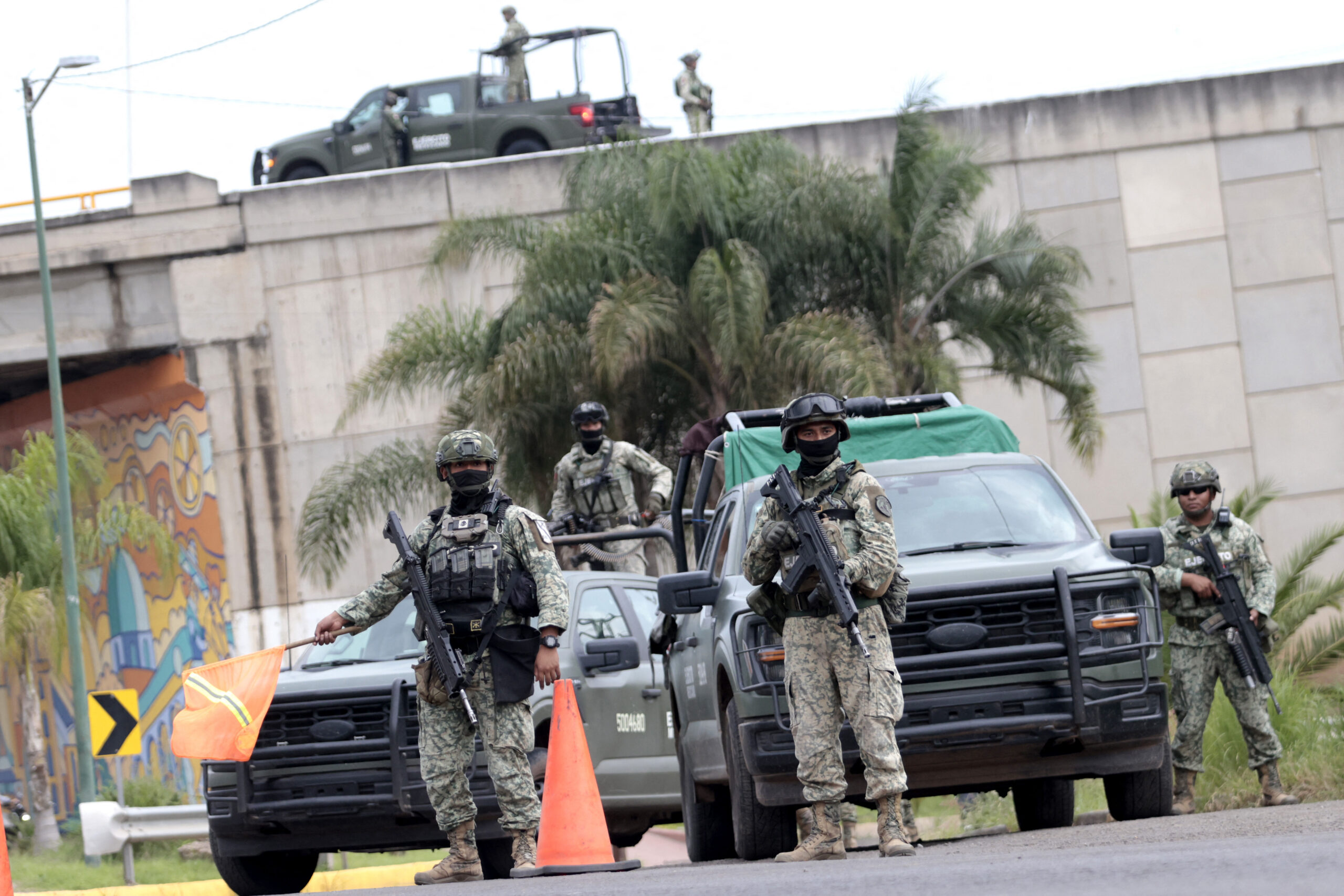
The U.S. attorney for the Western District of Texas did not mince words:
Nothing crosses into or out of Mexico without the approval and payment to Mexican drug cartels. American businesses that engage in any cross-border trade bear a significant amount of responsibility to do so without benefiting those cartels and without threatening our national security.
The statement came last July in the context of a bribery case brought by the Department of Justice against the Scoular Company, a Nebraska-based agricultural trading firm with billions in annual revenue. The Justice Department used the Foreign Corrupt Practices Act (FCPA) to prosecute a scheme in which Scoular authorized more than $400,000 in bribes to Mexican officials between 2015 and 2019. The payments enabled the company to avoid approximately $6.5 million in inspection fees and transportation costs associated with agricultural shipments entering Mexico.
Mexican customs brokers were the intermediaries in arranging the corrupt transactions. Customs brokers are private agents, not government officials. Importers and exporters contract with them to manage the complicated cross-border shipping process. Licensed by their respective governments, customs brokers prepare paperwork and advise on compliance with the rules governing international freight transportation.
Indeed, customs brokers are indispensable in moving the more than $870 billion in merchandise traded annually between the United States and Mexico. Many brokerage firms coordinate shipments on both sides of the border, working through separately licensed Mexican and American brokers to manage customs clearance with both Mexican authorities and U.S. Customs and Border Protection. They also provide professional advice and services involving transportation, storage, and security. When it comes to moving cargo south of the border, Mexican customs brokers are key actors in managing the criminal cartel wild cards.
In the Scoular case, the brokers involved seemed remarkably bold—or sloppy. According to the Justice Department, these agents asked Scoular to authorize payments of approximately $2,000 to $3,000 per train to the Mexican officials responsible for inspecting rail shipments. Disguised as legitimate reinspection fees, these were in fact bribes. Over several years, Scoular authorized over $400,000 in corrupt payments before the scheme was exposed. The company subsequently agreed to pay more than $10 million in criminal penalties and forfeiture.
The most disturbing aspect of the case was the U.S. government’s contention that some of the bribery proceeds ultimately benefited cartel associates. Federal prosecutors, however, said the American company representatives were not aware that their bribes were ending up in the hands of Mexican organized crime, and it wasn’t publicly established how the money passed from corrupt Mexican officials or intermediaries to cartel-associated individuals. Nevertheless, the case demonstrates how American corporations can be unaware—perhaps willfully so—that their legitimate commercial transactions are fueling corruption and organized criminality.
Consider another federal prosecution announced in May 2025. The Department of Justice charged executives of Sport LA, a Los Angeles freight-forwarding company, with operating an international smuggling scheme involving billions of dollars of merchandise shipped into Mexico. According to the indictment, the defendants used fraudulent customs documents, shell companies, and bribes to Mexican officials. More significantly, prosecutors alleged that the operation paid kickbacks directly to Mexican drug cartels, including the Jalisco New Generation Cartel, to facilitate its activities.
The defendants were also accused of laundering the proceeds through Mexican shell companies and American bank accounts. These allegations have yet to be proven in court, but the indictment describes a commercial shipping operation in which cartel payments allegedly formed part of the business arrangement itself—made-in-the-USA corruption finding partners in Mexico.
The American trade lobby would say both the Scoular and Sport LA cases are routine, and show why we have a DOJ to investigate and prosecute these matters—no big deal. But the truth is that these cases illustrate the vast complex of corruption and criminality that has a stranglehold on the Mexican state, and that growing legal commerce between our countries inadvertently feeds that beast.
Since the negotiation of NAFTA in the early 1990s, one of the assumptions underpinning hemispheric trade has been that growing wealth would help Mexico modernize its government institutions, defeat widespread corruption, and ultimately begin winning the war against its powerful criminal cartels. But despite the wishful thinking of the American trade lobby and the international business community, this has not in fact occurred.
The troubling reality is that Mexico’s homegrown corruption and powerful criminal cartels prosper by taking a cut of legal commercial activity—and that commerce is overwhelmingly tied to the country’s northern neighbor. And patriotic Mexicans who seek to change this have few tools to do so. They are losing their battle.
It is no secret that Mexico has assigned major responsibilities for maritime ports and land-border customs security to its armed forces. This was a desperate decision taken by former President Andrés Manuel López Obrador and continued by current President Claudia Sheinbaum. This policy is a recognition that Mexican civilian government authorities have lost control amid corruption and criminal penetration of their country’s international trade infrastructure. The situation in these ports should be understood as the proverbial canary in the coal mine.
Mexican customs brokers are hardly the only intermediaries involved, but the Scoular case illustrates the deeply interwoven nature of the problem. Most Americans understand how cartels make money from smuggling illicit drugs into the United States. But U.S. policymakers should also be aware of the vast profits these gangs make from extortion, protection payments, fuel theft, and other criminal activities that are embedded in legitimate commerce. The cartels rarely send gunmen to rob banks. They do not want to kill the golden goose. Instead, they see their future as continuing to take a small cut of growing business, which in Mexico means international trade, now approaching a trillion dollars a year.
Through normal business practices inside Mexico, American and multinational companies pay substantial costs associated with freight transportation, storage, insurance, and security. These are all part of countless opaque and mundane business transactions, mostly handled for multinational companies through Mexican intermediaries. The payoffs to criminal actors remain commercially affordable because Mexico offers other massive advantages in labor costs, taxation, and environmental compliance.
Major U.S. investors in Mexico, such as General Motors, Walmart, and Constellation Brands—the brewers of delicious Mexican beer—do not publicly disclose how much they spend on private security to ensure their products move safely through a country in which cartels exercise control or influence over as much as a third of national territory. Much of that territory includes trucking routes and railroad lines that run up to the U.S. border.
To its credit, the Trump administration announced in February 2025 that it would prioritize investigations involving cartels and transnational criminal organizations. In June, the DOJ issued revised FCPA enforcement guidelines specifically addressing corruption connected to cartel operations. But FCPA enforcement can only go so far. One significant issue with the statute is that it is designed principally to punish Americans who bribe foreign officials. But that is only a small part of the looming corruption and criminality iceberg threatening the U.S. homeland out of Mexico.
The central point is that neither DOJ investigators nor State Department officials on the ground can unravel the countless legitimate arrangements in Mexico that also mask corrupt activities in which payments from American corporations are routinely siphoned off to criminal enterprises.
Earlier this month, the office of the U.S. Trade Representative (USTR) announced that it was seeking public comment in advance of the 2027 joint review of the United States–Mexico–Canada Agreement. It is time for USTR to grapple with the reality that robust cross-border trade is not simply growing Mexico’s legitimate economy. It is also making Mexico’s corruption problem worse. And it is making the Western Hemisphere’s most powerful cartels stronger, more entrenched, and more dangerous.
In considering next steps with Mexico, it is useful to recall that USTR once told us that robust U.S. trade would modernize, reform, and democratize Communist China. That is why Washington needs a real Mexico trade plan now.
The post The Seedy Underbelly of U.S. Trade With Mexico appeared first on The American Conservative.
A new book lays out how progressives would reshape U.S. strategy.
A World for All, edited by Matt Duss, OR Books, 2026, 250 pages.
Opposition to U.S. foreign policy has always tended to bring together strange ideological bedfellows. During the 1890s, when our republic shed its innocence to don the gaudy trappings of empire, populist Democrats joined aristocratic Mugwumps to take a stand against what one far-sighted pamphlet called “the conquest of the United States by Spain.” Before both world wars, a ragtag collection of socialists and pacifists found themselves on the same side as fanatical capitalists in futilely opposing America’s entry into the conflicts of the Old World. And from the Cold War through the Global War on Terror, libertarians and paleocons made common cause with hippies, Marxists, and other assorted denizens of the left to attack America’s globe-spanning military commitments.
These sorts of coalitions are easiest to maintain when the establishment is at its most imperial. It is no coincidence that the wild excesses of the Bush years produced the most durable and influential critique of interventionism since the Vietnam War, one that would eventually break containment to shape how the electorate as a whole thought about the country’s “forever wars.” Indeed, so thoroughgoing was this backlash that by 2016, the most exciting and compelling candidates vying for the Republican and Democratic nominations—Donald Trump and Bernie Sanders—would both be unrelenting critics of America’s foreign policy orthodoxy. And each held out strikingly similar prescriptions: end the wars, stop policing the world, and turn our gaze inwards.
Today, the promise of such a transpartisan alliance remains a major element of the movement known in DC circles as “restraint”—a loose but very real project to bring the national security state to heel, retrench from our garrisoning of the globe, and unwind an empire that has proven far more of a liability than an asset. But big struggles have a way of papering over differences. And although both left-wingers and right-wingers do meaningfully come together to advance restraint, their premises, priorities, and ultimate aims often diverge significantly.
One of the most influential and, I think, accurate taxonomies of this movement posits three distinct species of “restrainers” (to use the inelegant but unavoidable term): realists, conservatives, and progressives.
Realists come to restraint through their understanding of the international system, which they believe tends to punish overextension and make the employment of military force particularly risky. Of the three schools, they tend to be the most focused on the material costs of primacy. (Although realism and restraint are often used synonymously, they are conceptually distinct: The former is a descriptive theory, while the latter is a set of prescriptions.)
Conservative restrainers are more concerned about what interventionism does to America’s own values, domestic institutions, and republican traditions. Although they, too, decry the waste and risk associated with our global entanglements, they also see empire as inherently corrosive, even if the bill in blood and treasure could be kept manageable.
And progressive restrainers are most exercised about war and militarism. They are comfortable with engagement, broadly speaking, and in fact often harbor their own plans to remake global order, but reject an American hegemony that is enforced with or underwritten by military power.
A World for All, a new volume of essays edited by the leftist foreign policy guru Matt Duss, represents an attempt to articulate the worldview of this last group. The foreword—which is written by Sanders, Duss’s old boss—frames things in starkly moral terms, as an epic struggle between oligarchy and democracy. “A progressive foreign policy,” Sanders writes,
must begin with moral clarity. We cannot champion human rights abroad while violating them at home. We cannot condemn Russia’s bombing of civilians while funding Israel’s atrocities. We cannot lecture others about democracy while billionaires buy our elections and policymakers serve their donors rather than their constituents. Authoritarian rivals are exploiting our hypocrisy, making consistency not only a moral obligation but a strategic necessity.
But clarity is not enough. We must also articulate an affirmative vision: a foreign policy that confronts global oligarchy, strengthens democratic institutions, and builds genuine partnerships. This means focusing on collective action rather than dominance. It means making anti-corruption a central pillar of our foreign policy. It means supporting democracy not through military intervention but by helping societies meet the needs of their people. It means recognizing that true security comes not from trillion-dollar arsenals but from addressing the root causes of instability: inequality, injustice, and environmental catastrophe. And it requires humility—an understanding that US leadership must be earned, not assumed.
The book is divided into three thematic sections: one offering regional sketches; one focused on economics and migration; and one mainly concerned with government and technology. It draws from a range of contributors, including former officials in Democratic administrations, academics, and think-tankers, all of whom share a firmly left-wing and broadly idealistic orientation.
But despite the aspirations of the foreword (and the introduction, and the prologue—the volume does a hat trick of prefatory materials), what we get falls a little short of an “affirmative vision.”
Partly this is because the essays are uneven. Some are sharp and thought-provoking. The piece on Congress, for example, deftly analyzes the causes of our current dysfunction and lays out the foreign policy stakes of continuing to tolerate an utterly supine legislature. The chapter on corruption puts forward specific, actionable policy fixes, ones that seem to me to have a decent chance of cutting down the sale of political outcomes both here and abroad.
Others read as throwbacks to the nadir of what we’re now calling “Woke 1.” One chapter ponders earnestly the question of how America can build a “feminist, anti-racist foreign policy;” another recommends open borders and a return to the “see no evil” approach to immigration policy that Americans so roundly rejected in 2024.
And then there are some contributions that leave the reader scratching his head. The essay on Europe, for instance, talks airily of the need for both “deeper engagement and genuine give-and-take,” while entirely ignoring the most pressing issue in transatlantic relations: namely, what should be done with the 80,000 or so American troops currently stationed on the continent. In the volume’s piece on Russia, the role of the United States in the Ukraine War—obviously the gravitational center of bilateral relations right now—is disposed of in a few hand-wavey sentences:
If negotiations on ending the war become possible with Russia, the key diplomatic instrument will not be rhetoric or the art of persuasion but the cumulative leverage over Russia that Ukraine and its partners are able to amass. Military aid to Ukraine should be organized accordingly, not around the unobtainable goal of defeating Russia outright but of blocking Russia from moving forward in Ukraine and of demonstrating to Russia that the war is futile—a costly dead end. The unpredictable details of such military aid will vary month by month and year by year.
Perhaps it’s just me, but those “unpredictable details” seem rather important!
But the other reason the effort to build a coherent blueprint falls short is because there are major, unresolved tensions at the heart of progressive thinking about foreign policy. The most important of these concerns the relationship of values to statecraft. On the one hand, there is a strong impulse among leftists to orient themselves around bright, moral lines—to lay down sweeping, universal principles and build upwards from those. At the Munich security conference this year, AOC mused that rather than the post-rules-based international order many IR theorists profess to see in the aftermath of Ukraine, Gaza, and Iran, we may in fact be living in a pre-rules-based international order. Progressives, she said, therefore “have an opportunity to explore what a world would look like if we upheld democracy, human rights, trade that actually centers working-class people.”
At the same time, there is also a nagging sense that the United States is itself a morally compromised actor, which leads naturally to a discomfort with Washington unilaterally setting and enforcing the rules by which the rest of the world must play. In addition, many progressives’ aversion to militarism and securitized rivalries gives them a pragmatic streak when it comes to great power diplomacy, even when that involves (as it must) legitimating forces that are antithetical to many of the values upon which a left-wing vision for world order supposedly rests.
We can see this tension at work in the different approaches to issues like regime character. Authoritarianism is often seen by the progressive set as a foreign policy problem with both ethical and strategic costs. Coziness with autocratic states is often decried in the strongest moral terms, and U.S. policy mistakes tend to be framed as natural outgrowths of our relationships with evil governments. This perspective is most influential in the approach to places like Latin America and the Middle East, whose strongmen—Bukele, Netanyahu, MbS—are particularly distasteful to the progressive left. (This book’s chapter on the Middle East, for example, makes reference to “the mistaken belief that authoritarian regimes could ensure American interests,” and goes on to blame “short-term authoritarian bargains” for most of our troubles in the region.)
Yet when it comes to China, there is a markedly different—and, I should add, vastly more reasonable—approach. This is to accept the existence and legitimacy of a repressive, non-democratic regime ruling over 1.4 billion people; explicitly to reject the logic of great power competition and the “authoritarianism versus democracy” framing of the Biden years; and instead to reach for a grand bargain to minimize the risk of war and work to manage irreducibly international problems like AI risk and climate change.
There is a similar ambiguity about another major component of American statecraft: trade policy. On the one hand, the left is perfectly willing to employ public power to shape the economy for social and political ends; the use of tariffs as part of a broader effort to reverse neoliberalism, globalization, and the immiseration of American workers seems a perfectly natural aim for a progressive foreign policy. And obviously until Trump came along, Democrats were far the more protectionist of the two parties. But the Donald has scrambled that, particularly in his second term, and now opposition to a tariff regime directly and seemingly irreducibly associated with Political Enemy No. 1 is orthodoxy for most Democrats. Moreover, some progressives are uncomfortable with the adversarial character of tariffs, which they fear drive interstate conflict and competition. (Indeed, the book’s prologue argues the United States should “unwind its tariff regime toward China and marry Western capital with Chinese green tech overcapacity.”)
But if these uncertainties make it difficult to predict exactly what a progressive administration would do, they shouldn’t obscure the fact that there is an underlying coherence to much of this worldview. Two elements of this are particularly important.
The first is internationalism, the embrace of universalizing aims that imply deep and sustained engagement with the rest of the world. This is not McGovern’s “Come Home, America;” it is resolutely interventionist, in the broadest sense of that word, and sees the United States as an (if not, as Albright had it, the) indispensable nation. Its adherents would harness U.S. influence to advance ambitious—some might say utopian—projects like halting climate change, combating “oligarchy,” and redistributing wealth from the global North to the global South.
The second is a related tendency to look at geopolitics as an extension of domestic politics. Developments inside and outside our borders are connected; it is all “one struggle,” as some of the more radical proponents of this view used to say. Thus fighting inequality and corruption in the United States requires tackling it in Central America as well, and advancing gay rights in Africa is part and parcel of defending them here.
It must be said that there are some things for which this is obviously true: If one believes that multinational corporations pay too little tax, for example, trying to coordinate an international corporate tax regime makes eminent sense. Likewise for restricting carbon emissions, if fighting climate change is your bag.
Still, there is something quite unsettling about such a Weltanschauung. Even accounting for the progressive aversion to militarism, this is the stuff of which crusades are made.
So what are other restrainers to take away from all this?
Progressives remain important allies for those of us who care about right-sizing America’s global posture, and who aspire to an international system shaped by something more than brute force. This is especially true as an administration which came into office with such promise degenerates into the crudest, most overtly imperialistic version of primacy imaginable. I’ll take a flawed idealism that seeks to unwind American empire over a bloody-minded interventionism built around the precept that (as the president put it while cataloguing his various acts of aggression in front of the UN) “to the victor belong the spoils.”
Yet as 2028 heaves into view, the differences between the respective camps will start to matter more and more. It is conceivable that both the Republican and Democratic nominees could plausibly claim the mantle of restraint: a Vance–AOC showdown, for instance, could well be seen as pitting the project’s realists and conservatives against its progressives. This is especially important given the way the second Trump administration has bulldozed the U.S. foreign policy establishment, clearing out decades of accumulated policy choices, personnel, and bureaucratic inertia. Whoever steps into the Oval Office in January 2029 will have more latitude to reshape U.S. strategy than any president since the end of the Cold War. Restrainers would therefore do well to ponder their allegiances carefully before then.
The post Building a Better World? appeared first on The American Conservative.
Modernity has inured us to danger, but it has not abolished it.

In England, a young man (lately identified as one William Chapman) was recently mauled to death by a Siberian tiger—a species not, I need hardly add, native to the country.
The tiger did not come to him; he went to the tiger. It was in a zoo, and Chapman insisted on jumping into the tiger’s compound. A woman tried to restrain him, but he overcame her resistance. According to reports, once in the compound he fell to his knees and appeared to pray (as well he might). The tiger took no notice of his prayers and made short work of him.
Was he suicidal? Was he a Nature mystic, trying to prove that Nature was fundamentally beneficent, if only one has the right feelings toward it? Was he trying to convert the tiger to whatever God he was praying to? As yet, we do not know and perhaps will never know.
If Chapman was of the Nature mystic school, he was not the first to find out the hard way that some creatures do not reciprocate benevolent human feelings toward them. I once read with amazement that a man went to live with grizzly bears in the wild, apparently in the belief that they would get used to him and even come to like or befriend him. He ended up as their dinner.
A lady in the United States kept many snakes of the large, constricting variety, but snakes do not become affectionate even to those who feed them; unlike dogs, they do not know on what side their bread is buttered, and she ended by being strangled by one of her pets. Naughty, naughty snake! Ungrateful serpent, reptilian reptile!
A slightly different story is that of John Allen Chau, an American missionary who went, illegally, to North Sentinel Island, an island in India’s Andaman archipelago. The Sentinelese are what would once have been called a primitive tribe. They are Stone Age people who are known to be hostile to any intrusion by outsiders, a hostility that they rarely have to put into effect because the Indian government has kept them completely isolated from the rest of the world. There are only about 150 of them.
Chau, however, was determined to convert them to evangelical Christianity, and paid some boatmen to drop him off on the island. Reader, they killed him—all too predictably.
Assuming that the man who jumped into the tiger pit was actuated either by Nature mysticism or religious enthusiasm, and not because he was suicidal (on one report, he made a gesture appealing for help as he was mauled), what unites these cases is sentimentality.
The actors in these dramas believed that reality could be molded by their goodwill: that as love makes the world go round, so goodwill turns the tiger vegetarian, the grizzly bear cuddly, the boa constrictor grateful, and an isolated Stone Age people (whose language, incidentally, remains completely unknown) ready for dialogue and thirsting for religious enlightenment. These people projected the goodness of their heart onto the world of tigers, bears, snakes and what used to be called savages—though the history of the 20th century has rendered us loath to use the word. If that century taught us anything, it was that the kingdom of the Savage is within us.
Now it does not follow from the fact that goodwill cannot do everything for you, that it can do nothing. On the whole, goodwill is to be preferred to ill will. But there are limits to what the former can achieve. The lion may sometimes lie down with the lamb, but it is best not to depend upon it.
A kind of goodwill, both saccharine and oleaginous, pervades a great deal of modern thought (or is it feeling rather than thought?). For example, I recently read a book by Hilary Cremin, the head of the Faculty of Education at Cambridge University, titled Rewilding Education, published this year. Cremin it was who so unctuously welcomed Jason Arday to her faculty for a position for which he was patently unsuited and unqualified, revelation of which fact led to his death once it was so cruelly (though rightly and justifiably) exposed in the press.
In her book, Cremin extols free-floating and objectless unconditional love as an attitude one should instill into children. It is obvious, of course, that love of everything is love of nothing; but even if it were possible to love everything, it would not be desirable to do so—for it would mean loving what is evil, and even rap music.
She believes that all living creatures have equal rights, so that, presumably, there is nothing to choose between a man and Plasmodium falciparum, and it would be the purest speciesism to attach more importance to the man’s life than to that of the plasmodia that are killing him. On this view, all predators are guilty of abuse of animal rights, and even plants—the Venus flytrap, for example—can be guilty of violating the rights of the fly (to life, liberty and the pursuit of happiness). Am not I a fly like thee, asked William Blake, but he didn’t mean it literally, unlike the head of the School of Education at Cambridge University.
Perhaps the population of rich countries has faced too little danger to resist indulging in the type of sentimentality outlined above. We have forgotten what was obvious until well into the 20th century: namely, that our lives hang by a thread. Thus we find it difficult to believe that danger could be real. At the same time, we seek out danger, because it excites us and relieves us of monotony. But we want, and expect, there to be an ambulance waiting to save us if the danger turns out to be nasty or more than we bargained for; if, that is, the danger is really dangerous.
In the case of the man who jumped into the tiger pen, ambulances (or rather, helicopters) did arrive, but too late to save him. The tiger, by the way, lives to maul another day. After all, it is not really his fault if he is a tiger.
The post The Savage Within appeared first on The American Conservative.
In a post on X, Katie Zacharia confirmed Saturday that she was no longer serving as White House press secretary. “President Trump is a kind, wonderful, gracious, thoughtful, enthusiastic, and hardworking man,” she wrote. “It was an honor to work for him.”
Zacharia, a relatively unknown figure prior to her selection as press secretary, started in the job on Monday and gave her debut press briefing on Tuesday. The performance was widely panned—including by other White House officials—and she also faced criticism for allegedly representing herself as an attorney, despite not having passed the bar exam.
On Friday, the Trump Administration decided to remove Zacharia from her position, making hers the shortest tenure of any press secretary in American history.
The post WH Press Secretary Katie Zacharia Confirms Departure After Five-Day Tenure appeared first on The American Conservative.
Iranian strikes on commercial shipping in the Strait of Hormuz have surged recently, with four tankers coming under attack in the last day and around two dozen vessels reported hit in the last two weeks. This makes October the worst period for shipping since the opening weeks of the war.
Two ships were struck by projectiles on Friday, and two supertankers reportedly struck mines on Saturday. According to the official Iranian news agency IRNA, the IRGC Navy said Saturday that the Strait of Hormuz was “closed.”
Also on Saturday, Iranian Foreign Minister Abbas Araghchi said his country had transmitted to the U.S. government a plan to reopen the Strait. “Through Qatar, we have conveyed a concrete seven-day plan,” Araghchi said in remarks delivered at a regional forum in Iraq. “If the necessary conditions are met, the Strait can be reopened and normal maritime passage restored within seven days. The choice now rests with the United States.”
AAA reports that the average price of regular gasoline in the United States is $4.31 per gallon, and the average price of diesel is $6.33 per gallon.
The post Iran War Day 232: Attacks on Hormuz Shipping Surge as Iran Says Strait ‘Closed’ appeared first on The American Conservative.
That makes winning the midterms difficult, to say the least.
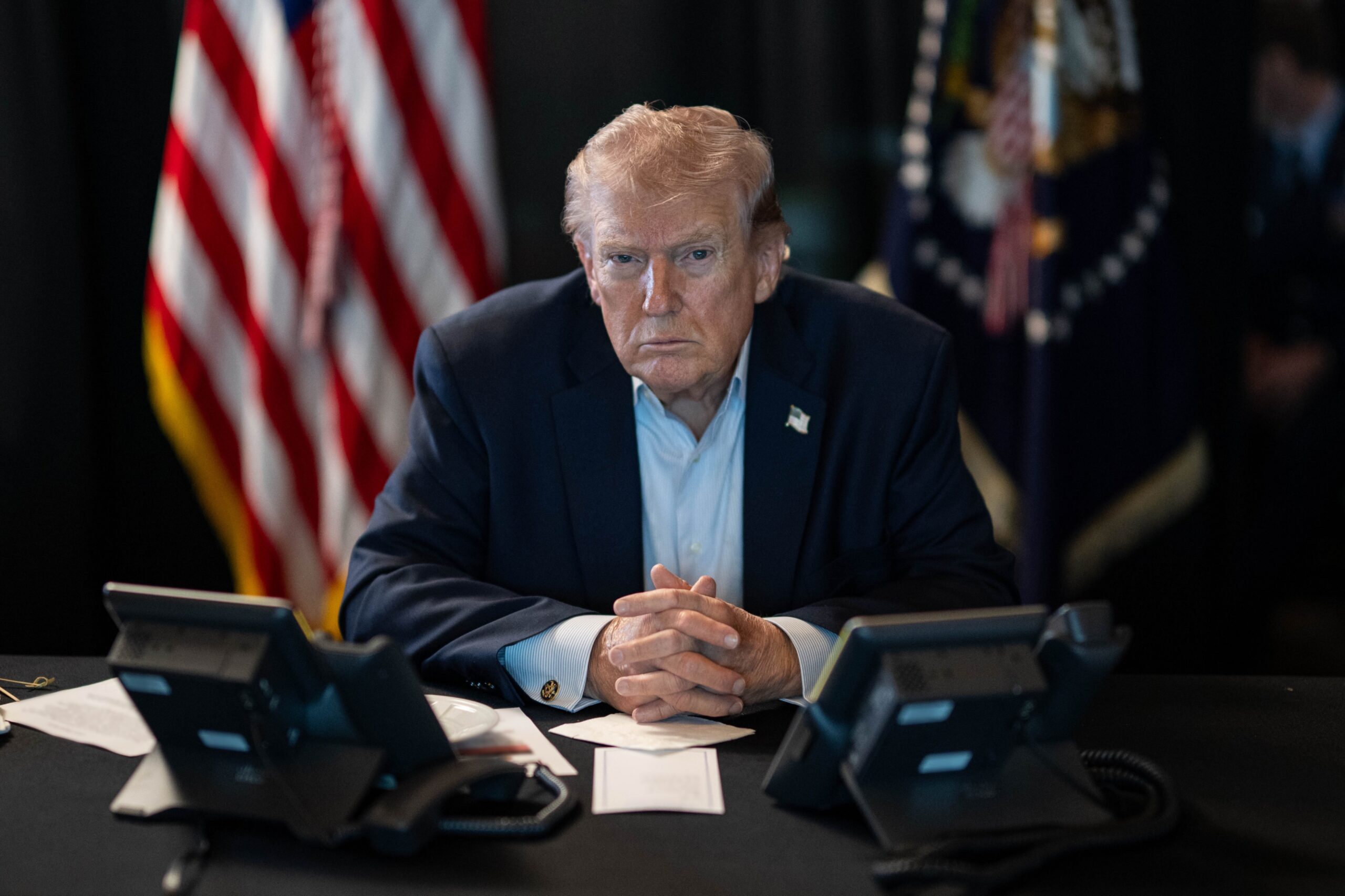
In the last consumer price index report before the midterm elections, inflation was up to 3.7 percent. It’s still a far cry from the 9.1 percent peak under former President Joe Biden, but that offers little comfort to vulnerable congressional Republicans.
President Donald Trump’s job approval rating on the economy sits at just 33.8 percent in the RealClearPolitics average of polls. On inflation specifically, only 27.2 percent approve of the job he is doing, while nearly 70 percent disapprove. A Fox News poll this month found that 77 percent disapproved of Trump on inflation, while a meager 22 percent approved.
It is against this backdrop that Republicans will be defending their narrow congressional majorities. And while the polls in some of the most competitive Senate races look iffy, the national electoral environment is indisputably bad for the GOP.
These dire conditions have arisen as a result of Trump’s own choices. The biggest driver of the most recent inflation is a spike in energy prices caused by the Iran war.
Just as Biden chose to do another COVID stimulus right as lockdowns were ending and people were going back to work, Trump chose to start a war with Iran he cannot now end.
Biden was warned by political allies that what he was doing would exacerbate inflationary pressures on the economy but persisted anyway, dooming his party’s congressional majorities and, ultimately, his presidency.
Trump was warned that the Iran war would have similar political consequences. He was counseled by his own team that the regime in Tehran was not as close to collapse as outside agitators for war were claiming, and he was advised that an attack would cause the Iranians to close the Strait of Hormuz and choke off oil supplies.
Like Biden before him, Trump ignored all these warnings and pressed ahead. The electoral impact is likely to be similar.
Biden had defeated the socialists who demanded passage of the Green New Deal in the Democratic primaries, only to then follow their lead on opening the border and jacking up federal spending.
Trump had routed the neoconservatives, running many of them out of the Republican Party entirely, yet ended up giving them the war George W. Bush never did (albeit mainly because W. couldn’t, having already taken their lead on Iraq).
Both disasters were predictable and predicted. Trump even had the benefit of watching Biden so spectacularly misread his mandate. Trump’s successor-turned-predecessor’s errors paved the way for his own return to the White House.
And yet here we are.
Trump’s tariffs have also been unhelpful. Voters associate them with higher prices, even when the connection is dubious. (Though it is true that tariffs raised some prices.) But at least Trump had made some kind of case for trade protectionism and reshoring American jobs on the campaign trail, even if the electorate was then more concerned about the cost of living than jobs and unemployment.
While Trump appealed to Republicans with disparate views on foreign policy, there was little in his first term and virtually nothing in his 2024 campaign to indicate to voters that a war with Iran was in the offing.
Inflation was always going to be a difficult issue for Trump. Even if he did nothing to make the problem worse, price increases are cumulative. In most cases, he was only going to be able to cause the rate of inflation to decline, slowing price increases rather than immediately dropping them back down to where they were in his first term.
But inflation likely would have continued to come down if he had avoided the Iran war. His positions would then have been more defensible, even if midterm elections are typically hard for the party that controls the White House.
Trump could have more plausibly made the resurgence of inflation Biden’s legacy. Now he shares responsibility for this, and his party will almost certainly share the same fate as the Democrats in Congress who enacted Biden’s spending plans. And this GOP Congress didn’t even get to vote on the war (unless you count the war powers resolutions voted on after hostilities began).
Trump says the latest round of inflation is a small price to pay for preventing Iran from getting a nuclear weapon. Yes, high gasoline and diesel prices are preferable to nuclear annihilation, if you believe those were the stakes.
Most voters don’t, however. And Trump himself was ready to end the fighting back in June. This war is continuing because of the Strait of Hormuz, which was open before Trump went down this road. But if and when the president succeeds at breaking this oil logjam, he will not receive the same credit for fixing a problem he helped create.
Now Trump is on the campaign trail, sometimes in the reddest parts of the country, seeking to stop an electoral bloodbath like that suffered by the GOP in 2006, when another ill-advised Mideast war shredded its congressional majorities.
Trump, in other words, is furiously trying to fix a problem of his own creation.
The post Trump, Like Biden, Has Become a President of Inflation and War appeared first on The American Conservative.
A follow-up to Mearsheimer and Walt shows a project in flux.
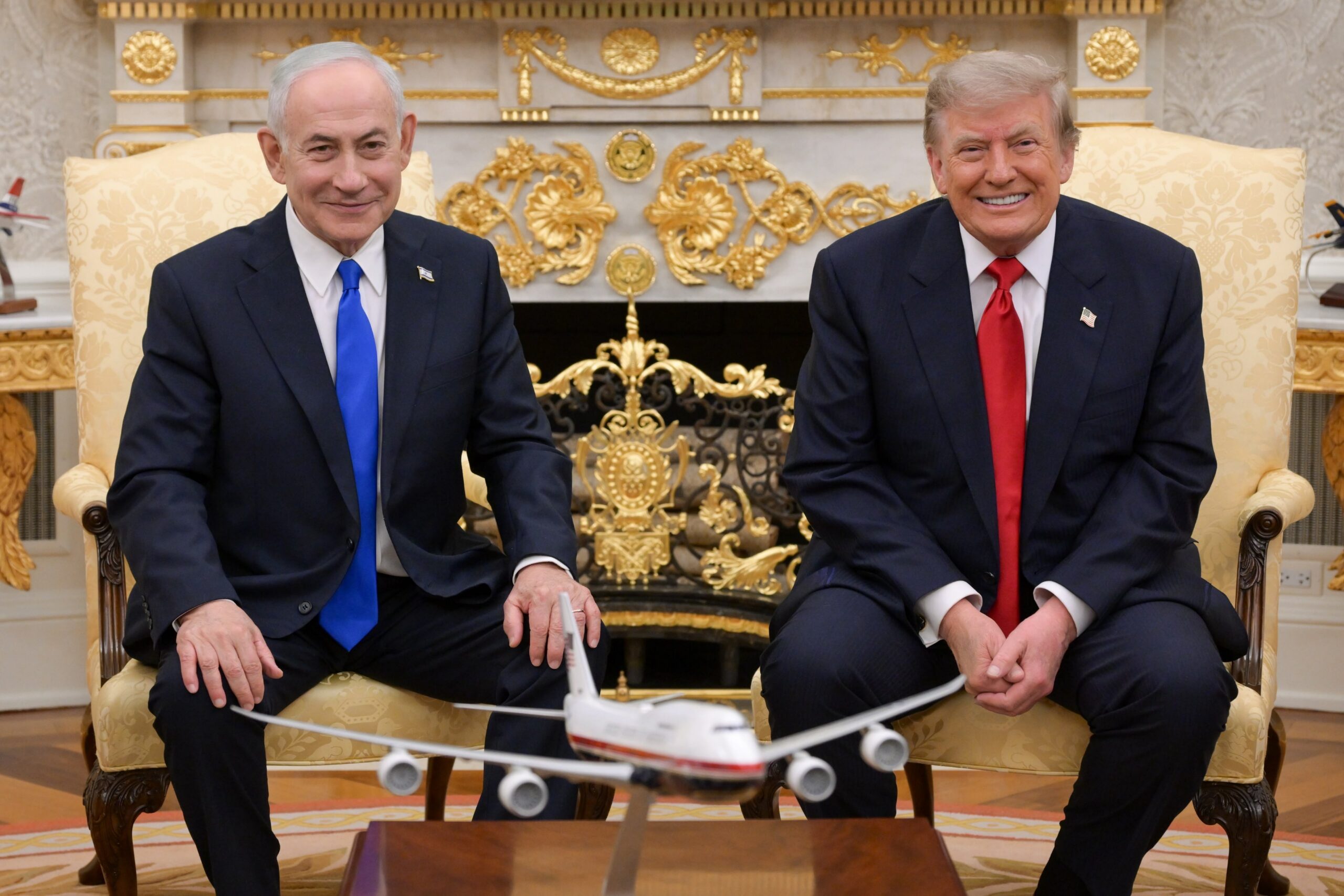
Israel’s Lobby, by Eli Clifton and Ian Lustick. Atria/One Signal. 304 pages
A natural question to ask about Eli Clifton and Ian Lustick’s Israel’s Lobby is how it differs from the magisterial work of similar name published by John Mearsheimer and Stephen Walt nearly 20 years ago. Certainly its entry into the American debate is less dramatic: Mearsheimer and Walt’s work had behind it the force of taboo-breaking, taking on a subject which had been more whispered about than debated for two generations. Despite a massive campaign to denigrate their work by the lobby’s many allies in the mainstream media (I believe The American Conservative was the only American print publication to give it a positive review), Mearsheimer and Walt’s book became not only a best-seller but a genuine international publishing sensation.
Though it wasn’t obvious at the time, Mearsheimer and Walt’s book appeared at a moment when there was still a clear open path towards a moderate future, sanctioned by a strong international consensus. This was true both for the American-Israeli relationship (they urged that America treat Israel like a normal country, while maintaining a moral commitment to defend it) and the Israeli–Palestinian conflict (they favored a two-state solution). The Iraq War, pushed relentlessly by Benjamin Netanhayu and other Israeli officials, and in great part the project of small group of passionately pro-Israel neoconservatives in American journalism and government, was already in the rearview mirror. The two authors cheered the birth of new liberal Zionist institutions like J Street, created to encourage United States support for a more moderate Israel at peace with its neighbors.
Clifton and Lustick’s impressive follow-up does not, to say the least, arrive at such a propitious time. Lustick is an accomplished Ivy-League political scientist who has produced important work on how ethnically driven conflicts can be managed or resolved. Clifton is a Quincy Institute co-founder and journalist who belongs to the cohort of American millennials who grew up when it was no longer outlandish to question the moral correctness of Zionism. Their book arrives as an erratic American president has started, at Israel’s behest, a war against the largest and most highly educated country in the Mideast, and oscillates between uttering threats of genocide and claims that the war is already won. On the home front it has become almost shockingly commonplace for entertainers and college students alike to shout slogans that call implicitly or explicitly for the destruction of Israel, something unimaginable 20 years ago. Meanwhile Israel, in response to the Hamas attack of October 7, 2023, has conducted a brutal campaign against Gaza’s defenseless civilians that is often described as a genocide and is indisputably a project of ethnic cleansing. Israel’s lobby today is both similar and quite different from the one Walt and Mearsheimer described. Is it stronger or weaker? Some of both certainly, and while it may be weaker overall, it is clearly dangerous the way all wounded creatures are.
Of the many elements which have changed since 2007, three stand out. The main institutions of the lobby, always wealthy relative to their opponents and competitors, are far richer. Israel itself has changed. Its commitment to peace with the Palestinians, if in the past more advertised than actual, has been completely submerged; no Israeli leader of consequence even pretends to want a settlement with the people who inhabit the land Israel now controls, and the country’s policy of seeking outright military domination of its entire region, though challenged by many Israeli former officials and scholars, faces no substantial political opposition. And finally, in a point emphasized by Clifton and Lustick, its lobby has more or less abandoned efforts to explain or justify Israeli policies, to convince Americans of their necessity and appropriateness. Instead increasingly Israel’s supporters in the United States seek to conflate any opposition to Israel and American support for it with antisemitism.
That is to say, to challenge seriously Washington’s special relationship with Israel is presented as a major moral failing, the kind of mark which would place one beyond the pale of respectable discourse. And while these three developments make Israel as influential as ever in Washington and particularly within the Trump administration, its actual popularity among voters, particularly among Democrats and the young of both parties, has sunk like a stone.
In a key section, the authors document how in the last generation America has seen the greater concentration of wealth in the hands of the super-rich. The percentage share of national wealth held by the top 0.1 percent rose by two-thirds. Meanwhile, two court decisions from 2010 have made it much easier for billionaires to buy national policies to their liking.
As pro-Israel think tank and advocacy money rose, so did Israel-related campaign and advocacy group contributions. When Citizens United v. Federal Election Commission was decided in 2010, no one anticipated it would weigh critically on American Mideast policy. The decision struck down limitations on campaign spending by unions and corporations, and in conjunction with the consequences of the SpeechNow.org v. FEC decision, opened the gates for increased spending by the super rich. Individual campaign spending limitations, $1,000 until 2003, later raised to roughly $3,000, suddenly became almost irrelevant as ultra wealthy individual donors began to dispense virtually unlimited funds to support or oppose candidates through so-called superPACs.
In principle this enhanced capacity of billionaires to buy policies of their choosing was available to anyone; in practice those passionate about supporting Israel used it the most effectively. Sheldon and Miriam Adelson, virtually unknown before 2012, became the most important donors in the Republican Party. They spent more than $100 million on mostly losing candidates in 2012, but “forced the relatively niche issue of Israel into the Republican primary and general election discourse and normalized the idea of political megadonors across party lines, no longer restricted by campaign finance laws, largely underwriting campaigns.”
It wasn’t just the Adelsons of course; scores of Israel-First billionaires joined them with more power to shape American policy than ever before. As Clifton and Lustick put it, “These donors form the backbone of an Israel First movement which crosses party lines…. The donors are funding both the election of politicians as well as shaping the world view of these same elected officials, creating an echo chamber of pro-Israel talking points and policy recommendations for politicians already indebted to pro-Israel donors.” To give a sense of the rising volume of the echo chamber, the authors track the exponential rise in the budgets of pro-Israel advocacy groups. AIPAC had $19.5 million in assets in 2000, nine times that amount in 2023. Similar advances were made by the Washington Institute for Mideast Policy and the Jewish Institute for National Security of America. The Foundation for Defense of Democracies, the most influential Beltway group pushing for war with Iran, increased its revenues 16-fold from 2011 to 2022.
As its American lobby has grown richer, Israel too has changed considerably. Until the last 15 years, most Israeli leaders at least paid lip-service to making a durable peace with the Palestinians, and some believed peace as necessary for Israel’s own flourishing. But no Israeli prime minister since Ehud Olmert has breathed a word about trying to accommodate Palestinian national aspirations. The authors consider this a profound shift; Israel, they claim with a borrowed phrase from an Israeli political scientist, has become a “crazy state,” increasingly dismissive of the legitimate interests and opinions of other countries.
Along the way they provide an unexpected, quite complimentary digression about Vladimir Jabotinsky, an early right-wing Zionist leader and popularizer of the so-called Iron Wall strategy; its point was to win battles so forcefully as make Arabs realize they had no hope of destroying Israel and would have to accept it in the region. But such acceptance by Arabs was actually a goal, and a corollary of the Iron Wall doctrine was that Israel should not go out of its way to kill Arab civilians. Many times ignored, such scruples did exist in principle.
Today they do not. Replacing them is a near hysteric view of Palestinian resistance. As Clifton and Lustick put it, “Palestinian resistance was understood as illegitimate, evidence of intransigence, and often as akin to Nazi antisemitism.” This justified a ramp-up in the brutality of Israeli tactics, as Palestinian enmity came to be understood as “pathological and ineradicable” and such Israeli measures as mass imprisonment, breaking the bones of protesting children, and torture of prisoners became commonplace.
This transformation in Israel had a parallel shift in the lobby’s accelerating efforts to police Israel-related discourse in the United States. In the early 2000s, the former Soviet dissident and right wing Israeli politician Natan Sharansky began to push the idea of a “new antisemitism” which would include any statement which “demonized” or “delegitimized” Israel or held it to a “double standard.” Activists following his lead soon persuaded a minor organization, the International Holocaust Remembrance Alliance, to adopt a definition of antisemitism incorporating these notions, and then pressed governments and institutions to embrace the “widely accepted” IHRA working definition. In a campaign that unfolded over years, Israel advocates eventually got the Obama State Department to incorporate the definition in an annual report. By 2018 the Trump Department of Education had adopted it, and would eventually use it as a weapon to punish pro-Palestinian academics and students at American universities. The authors provide a detailed account of the new definition’s rise and codification, a fascinating window into the nuts and bolts and high stakes of what might at first glance have seemed a somewhat niche academic debate.
Despite these efforts, the lobby has clearly become less able to police the American discourse than it was 20 or 40 years ago. Israel’s poll numbers are bad, particularly among younger Americans. The lobby hopes that by gaining control of such internet platforms as TikTok, such opinion shifts can be reversed. (Oracle’s CEO is quoted in a hacked email telling an Israeli leader, “We have to embed the love and respect for Israel in American culture.”) It is difficult to see that happening; a great part of pro-Israeli argument now increasingly rests on such claims as “God Gave Us This Land,” which is likely to be less persuasive to a diverse and fairly secular America than snappy catchphrases popular in the 1950s like “a land without a people for a people without a land.”
Meanwhile, in genuinely stunning political developments, candidates far more anti-Zionist than Walt and Mearsheimer have been able to win major elections in New York City and potentially in Michigan.
At the same time, the last several months have been a very cold shower for people who thought the Israel lobby was no longer an extremely consequential voice when Washington decided matters of war and peace. No one seriously expected that President Donald Trump would try to deliver a peace settlement between Israelis and Palestinians, which he clearly had no real interest in, and which relatively few Palestinians or Israelis seemed ready for. But it was also assumed that assuring, with American military might, Israel’s complete dominance of the Mideast was not part of an America First agenda. Trump had displayed a great deal of bravado in 2015, mocking the Adelsons’ lavish support of Marco Rubio while boasting that he didn’t need their money. In 2024, it turned out that he did.
The man who had famously denounced the Iraq war in a Republican debate and campaigned explicitly against more stupid wars would, in office a second time, turn to Benjamin Netanyahu as his most consequential foreign policy advisor and satisfy the yearnings for an American war against Iran which Netanyahu—and all the voices in the Israel lobby echo chamber—had sought for a generation. It is this unexpected and calamitous development, this demonstration that even an America First candidate could be maneuvered into a costly war by Israel and its lobby, that has rendered the more extreme slogans of the anti-Israel left—“Free Palestine” etc.—less noxious than they seemed a generation ago.
Clifton and Lustick have written an important, extremely well-researched book, which tries to capture in motion a vast and complex phenomenon which is very much in flux, and whose fortunes are changing nearly month to month. They are to some degree men of the left, and some of their formulations—putting “woke” in scare quotes or describing the AfD, the German anti-immigration party that is one of the largest antiwar parties in Europe, as “Nazi adjacent”—will seem lazy, at best, to most TAC readers. And perhaps a less progressive treatment would have noted the irony of both the lobby and the Trump administration borrowing heavily from tropes of the woke era in their efforts to portray Jewish college students as made to “feel uncomfortable” and “unsafe” by student protests against Israeli brutalities.
But it cannot be denied that it is the American Left, not the Right, that has taken the lead in trying to free the United States from, as the authors call it in their book’s subtitle, “the grip of a foreign power.” For that it, and the authors, deserve commendation.
The post The Israel Lobby’s Changing Fortunes appeared first on The American Conservative.
A new film on Nigeria and the British Empire holds surprising relevance for citizens of the United States.

An American sitting in the Lincoln Center’s Alice Tully Hall on a Sunday evening for an early screening of the new film Clarissa might be forgiven for expecting, however wrongly, a standard “foreign” film on topics of distant concern.
Directed by twin brothers Arie and Chuko Esiri and set to hit theaters on December 11, the film reimagines Virginia Woolf’s 1925 novel Mrs. Dalloway, transposing the day-in-the-life story to contemporary Nigeria. I got the chance to see it on October 4 and found it surprisingly relevant to the concerns of a growing number of Americans.
The Lincoln Center always includes plenty of non-English language films in its New York Film Festival, and Clarissa has subtitles throughout its 135-minute runtime. So, it took this American audience member—dutifully reading the subtitles—a few minutes to realize, hey, they’re speaking English, albeit in a posh British accent.
This isn’t a case of Hollywood depicting citizens of the Roman Empire speaking the Queen’s English due to all the best actors being British, nor to a desire by the filmmakers to add a sense of gravity and elegance to the dialogue. The land and peoples that would become modern Nigeria were colonized, conquered, and controlled by the British Empire for more than 100 years. The British also provided (or imposed) Western education and English instruction, which was not distributed equally, and left the Nigerian elite sounding like their British overlords.
Nigeria gained its independence in the 1960s and the British Empire is no more, but the presence of the latter is still felt in the former through not just the accents, but also the habitus—the manners, mores, and traditional obligations—which orders the lives of the film’s main characters: the protagonist Clarissa (portrayed as her contemporary self by the British actress Sophie Okendo and as her young self by the British actress India Amarteifio) and her circle of privileged friends.
At the midpoint of Woolf’s novel, a traumatized veteran of the First World War, Septimus Smith, sits under a skylight, a few minutes past noon, in the office of the villainous psychiatrist Sir William Bradshaw. In the book, the implication is that the therapeutic state is the god of this world. Clarissa swaps Bradshaw for a benevolent female psychiatrist. The villain role is subtly filled by the long shadow of the British Empire and the inertia of the Nigerian social order.
Americans should be able to empathize with both sides of the equation. America replaced Britain as the global superpower after the Second World War. It has tended to present itself as a vast apparatus of benevolent hegemonic order, but its imperial adventures have been well-documented. And like the British Empire, it has spread its version of English globally. In his book How To Hide An Empire, the historian Daniel Immerwahr recounted a representative story from the Philippines following America’s defeat of the Japanese there in 1945:
Oscar Villadolid, a boy at the time, remembers a familiar scene from the aftermath of Manila’s “liberation.” A GI came down his street handing out cigarettes and Hershey bars. Speaking slowly, he asked Villadolid’s name. When Villadolid replied easily in English, the soldier was startled. “How’d ya learn American?” he asked. Villadolid explained that when the United States colonized the Philippines, it had instituted English in the schools. This only compounded the GI’s confusion. “He did not even know that America had a colony here in the Philippines!” Villadolid marveled.
America is an empire, the empire (for the time being), and it too casts a long shadow. While Woolf’s Septimus was a shell-shocked veteran of the late British Empire, Clarissa’s Septimus is traumatized from “his experiences fighting the country’s Boko Haram jihadist insurgency,” in the words of the film’s press materials.
According to Libertarian Institute Director Scott Horton, the American Empire helped make the indigenous Islamist insurrectionist group Boko Haram even more destructive than it would have been. First, the U.S. backed jihadists against the Libyan government, helping topple it in 2011. That jihad then spread to Mali, to which Boko Haram traveled in pursuit of both further Islamic indoctrination and weapons and tactics training. Saudi Arabia and Qatar, both Major non-NATO allies of the U.S., have both been accused of funding Boko Haram since at least 2014.
On the other side of the equation, the United States was also a colony that broke away from the British Empire. It took America a long time to get out of Britain’s shadow. According to Gareth Porter and John Kiriakou in their book The CIA Insider’s Guide to Iran, in 1953 President Dwight D. Eisenhower wanted to work with Iran’s Prime Minister Mohammad Mosaddegh. Eisenhower was eventually undermined by the Anglo-American deep state of the time, and the U.S. did what Britain wanted, backing a coup that ousted Mosaddegh. We’re still dealing with the fallout of that decision today.
These days, Britain has been reduced to a pathetic vassal of its former colonies. But that doesn’t mean America is fully independent. The imperial center has been colonized by another foreign power, its ostensible client Israel. Walk through the halls of power in Washington, DC, and the Israeli flag is everywhere. Our elite are beholden to Israel and its lobby. Our children are thrown into its service on the frontlines of futile wars.
Eli Clifton and Ian Lustick detail this intolerable situation in their new book Israel’s Lobby: America in the Grip of a Foreign Power. Promotional copy for the book summarizes the sick state of affairs:
The greatest story in geopolitics and in American domestic affairs is how the far-right government of a small Middle Eastern country came to hold a controlling interest in United States foreign policy. Israel’s lobby is now in a position to police the speech of American politicians, college students and journalists, and coerce and persuade the White House to back unpopular, costly, and ultimately national security-threatening policies.
As our government gears up for more “kinetic action” against Iran, Americans are starting to notice that our elite all speak like Zionists. Clarissa does not just speak our language. In a deeper sense, it speaks to us.
The post America, the Colonized Empire appeared first on The American Conservative.
Andrew Day and Luke Nicastro discuss the Trump-Putin diesel deal, the Trump-Zelensky spat, the “energy ceasefire” that wasn’t, Ukraine’s grim prospects this winter, and a new book on progressive foreign policy edited by Matt Duss, A World for All.
The post TAC Right Now: Trump Turns on Zelensky appeared first on The American Conservative.
In an interview Thursday, President Trump said the United States may need to strike Pickaxe Mountain, a fortified underground site believed to play a key role in Iran’s nuclear program. “We’re looking at Pickaxe Mountain,” the president told Newsmax. “We may have to go there. We’ll take a shot at that one. We’ll knock it out fast.” Trump also addressed reports that he was considering using the GBU-43/B Massive Ordnance Air Blast (MOAB; popularly known as the “mother of all bombs”), refusing to rule out the weapon’s deployment against Iranian targets.
On Friday, Saudi military spokesman Major General Turki al-Maliki announced the interception of multiple missiles and drones targeting Saudi forces and infrastructure. This follows a deadly Houthi attack Thursday on the presidential palace in Aden, the Saudi-backed government’s de facto capital. Fighting also reportedly continued around Taiz, Yemen’s third-largest city, which is currently held by the government but encircled by Houthi forces.
Also on Friday, Iran’s army chief suggested that the Strait of Hormuz could reopen if U.S. forces withdrew. In a post on X, General Mohammad Akraminia wrote that “if America leaves the region, the Strait of Hormuz will reopen and collective security will be established with the participation of the region’s countries, and the global economy will improve.” He added that “if [the U.S.] doesn’t leave, we’ll expel it.”
Brent crude was trading at around $106 per barrel Friday morning. AAA reports that the average price of regular gasoline in the United States is $4.33 per gallon, and the average price of diesel is $6.33 per gallon.
The post Iran War Day 231: Trump Says U.S. ‘May Have To’ Strike Pickaxe Mountain appeared first on The American Conservative.
The late senator’s legacy threatens Darline Graham’s political future.
“Lindsey liked war,” said President Donald Trump on the day of Sen. Lindsey Graham’s (R-SC) funeral in July. “He’s never seen a war he did not like.”
Now Graham’s sister might find out that voters even in ruby-red South Carolina like the Iran War a great deal less than her brother did.
Appointed three days after her brother’s death to finish out his term, Sen. Darline Graham (R-SC) faces an actual election in South Carolina, where Republican senators have been safe for at least 20 years.
Not this year. A late September poll by the right-leaning Trafalgar group showed a neck-and-neck race between Graham and her Democratic challenger, the pediatrician Annie Andrews, with the Republican leading by only 1 point. Another survey from Insider Advantage, taken in the same period, also revealed a 1 percent difference favoring Graham. A Rasmussen poll released Friday showed Graham at 49 percent and Andrews at 45. Six percent of respondents were not sure.
By contrast, Lindsey Graham defeated his 2020 Democratic opponent by 10 points.
A number of red states this election year are seeing unusual surges by Democratic candidates due to voters’ concerns about rising gasoline prices and general inflation, and South Carolina is no exception. Andrews has not only centered her messaging around high costs but tied them to the Iran war. And the Democrat repeatedly emphasizes that Darline Graham voted three times for that war to continue.
In their only debate, televised on Sunday night, Andrews highlighted the war again while the Republican senator hewed to the standard neocon posturing worthy of a Graham.
“My opponent… had the opportunity to vote to end the war,” Andrews charged. “But three times in a row, she voted to continue it.”
“Why in the world would we stop now when they’re still dangerous?” Graham said. “And we are close to ending the war. Again, I think the president wants to end the war. I know he does. We all want the war to end.”
This is the closest Graham came to sympathizing with South Carolina voters who have tired of the war and the resulting price spikes. It felt like some recognition that the situation was dire on this front, for the state and for her campaign.
Still, the hawkish hits kept coming.
“But I support a strong military,” Graham added. “I believe in peace through strength.”
“I fully believe that we need to stand with Israel,” Graham added, predictably. “The same people that want to hurt and attack Israel want to come after us.”
“The terrorists that were close to getting a nuclear weapon will come here,” she said, repeating the common neocon refrain. “So, we need to stand with our strongest ally.”
She even tried to blame the war on Democrats.
“Let’s not forget again how the war started,” Graham continued. “The Democrats let Iran get a nuclear weapon almost.”
The 2003 Iraq War, including the fight-them-over-there-so-you-won’t-have-to-fight-them-here rhetoric, was popular at one time in “Bush Country,” as South Carolina has been called.
Today’s Iran War? Not so much. Andrews has capitalized on antiwar sentiments as she tries to yank a Senate seat from the Republicans.
“This reckless war in Iran has helped drive fuel prices to record highs,” Andrews said at a campaign stop. “Darline Graham has voted multiple times to continue this war that is directly responsible for the six-dollar diesel.”
“We need to lower the damn diesel,” she said.
When Lindsey Graham was still Andrews’s target—and when she had far less chance of becoming Senator than she does today—her rhetoric was even sharper on the war. “Lindsey Graham wants to send your sons and daughters to war,” Andrews said in March. “Your sons and daughters are the reason I am in this fight.”
Her focus now is on the impact of the war on voters’ pocketbooks. Judging by the polls, that new rhetorical strategy is working.
As a South Carolinian, I would still put my money on Graham winning. But the closeness of this race would have been unthinkable absent the political context created by Trump’s war. Moreover, many South Carolinians are uncomfortable with how the sister of the late Senator was awarded a high office by bloodright. Adding to the difficulty for Darline, a sizable number of South Carolina conservatives had supported Lindsey’s closest primary challenger, Rep. Ralph Norman (R-SC), who ran as an “America First” war skeptic. Many who had pinched their noses and voted for Lindsey may not do the same for Darline. Some Norman supporters have even pushed for a write-in campaign.
The Iran War itself probably won’t sway the election, but the higher prices very well could, and voters do know the former led to the latter. Voters watch the news. They budget. They pump gas.
They also see Republican leaders treating them as if they were stupid.
“Everybody’s frustrated about fuel prices, obviously, but that’s not related to policies, that’s not related to Republicans in office,” House Speaker Mike Johnson (R-LA) recently said in an interview, adding “this is related to the Strait of Hormuz.”
Well, what else could be related to the Strait of Hormuz? Perhaps the Iran War—a signature policy of “Republicans in office,” especially the one in the White House.
Antiwar Republican Rep. Thomas Massie (R-KY) recently shared that clip of Johnson and asked, “Who wants to tell him?”
Exactly. No one needs to tell South Carolina’s voters that the war is helping cause their financial pain.
Trump is right: Lindsey Graham loved war. His greatest legacy is arguably the U.S. war with Iran.
It meant a lot to him. It could also cost his sister his Senate seat.
The post Could Lindsey Graham’s War Cost His Sister a Senate Seat? appeared first on The American Conservative.
A President Flavio Bolsonaro would be friendly to Trump, but not a game-changer for American interests.
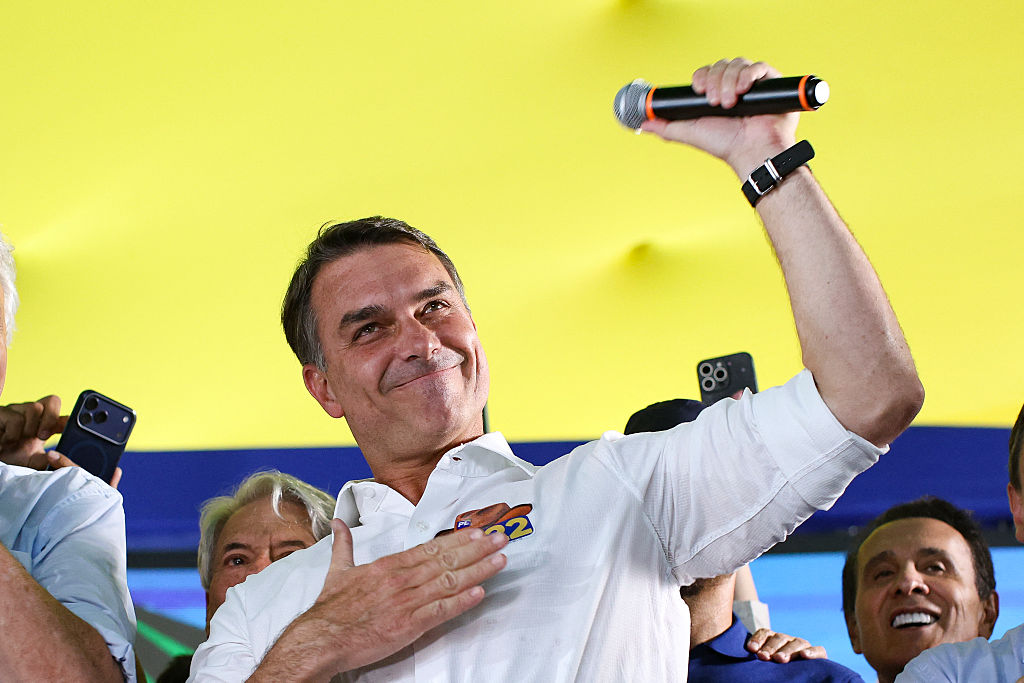
Brazil is heading to a runoff election to determine the fate of the country for the next four years, and the right-wing tide sweeping Latin America appears to be about to overtake Brazil as well.
On October 4, Brazilians went to the polls for a bitterly disputed presidential election that pitted the left-wing incumbent, Luiz Inácio Lula da Silva, against Flavio Bolsonaro, the son and political heir of the former president Jair Bolsonaro. The results of the first round look promising for the Brazilian right, which outperformed the polls. Flavio Bolsonaro secured first place in the presidential contest with a hair over 47 percent, with Lula taking 45 percent. The right was even more successful in the legislative elections.
As neither candidate secured an absolute majority, the election will proceed to a runoff on October 25, which Flavio is heavily favored to win. He will probably pick up most of the 2 percent of the vote that went to the right-wing candidate Ronaldo Caiado, and a plurality of the 3 percent for the right-wing candidate Renan Santos. Lula, on the other hand, has no similar reserve of votes to draw upon; he will need a major groundswell of new voters turning out for the second round to secure a victory. The polling is bleak for Lula: AtlasIntel’s latest poll, released on Friday, puts Bolsonaro ahead 51 percent to 46 percent.
For the Bolsonaros, the election is existential. Jair Bolsonaro has been incarcerated or under house arrest since 2025, when he was convicted by the Brazilian Supreme Court for attempting to engineer a coup d’etat after losing to Lula in the 2022 presidential election. His sentence carried a penalty of 27 years and 3 months imprisonment and prohibits him from running for office.
The Bolsonaros claim that the election was fraudulent and that Jair was attempting to preserve the constitutional order. Right-wing Brazilian activists, convinced that Lula had robbed Bolsonaro of the 2022 election, organized a major riot on January 8, 2023, when Bolsonaristas attacked the seat of government in the capital of Brasilia in an attempt to precipitate intervention by the military and prevent Lula from taking office. Over 2,000 were arrested, and hundreds have been convicted of crimes ranging from destruction of property to insurrection.
The incident is a notable parallel to the events of January 6, 2021 in the U.S., and the Bolsonaros hope to extend the parallel still further. Flavio has pledged that, if elected, he will pardon his father—whose declining health occasioned his release from prison to house arrest—along with anyone convicted of crimes connected with the January 8 riots.
The right retaking control of the Brazilian government would have major repercussions throughout the region and beyond. Under Lula, Brazil has been one of the firmest opponents of the Trump administration’s foreign policy, and the country is powerful and independent enough to have made both Trump and Elon Musk, the richest man in the world, blink.
Musk was the first to tussle with the Brazilian Supreme Court Justice Alexandre de Moraes and the Brazilian left: In 2024, Moraes ordered X, Musk’s social media company, to censor Brazilian accounts posting inflammatory political content. Musk defied the court, arguing that the demand violated the principle of free speech, and shuttered the company’s office in Brazil, but Moraes doubled down and blocked the social network from the country entirely. After a little over a month, Musk knuckled under, suspending the accounts as requested and paying a hefty fine for his intransigence.
Trump has significantly more leverage to work with, but Brazil proved a tougher nut to crack than the president anticipated. In July 2025, the Trump administration increased tariffs on Brazilian goods to 50 percent and sanctioned Moraes to protest the treatment of Jair Bolsonaro. Lula didn’t flinch, and before the end of the year the U.S. had lifted many of the tariffs and ended sanctions on Moraes. The reversal was a hard one for the Trump administration, and unexpected; few countries have managed to make the president back down in comparable fashion.
Lula was also a major supporter of efforts to counterbalance U.S. hegemony—including serving as a major ally for Nicolas Maduro’s regime in Venezuela. Lula’s government has cultivated ties with Russia and China, expanding economic integration with China in particular and providing the Chinese with an important base for increasing their influence in the Western Hemisphere.
While a President Flavio Bolsonaro won’t cut China out of the Brazilian markets—it is Brazil’s largest trade partner, to the tune of over $170 billion of commerce in 2023—Brazil will certainly be much more amenable to the priorities and policies of the Trump administration, with which the family has cultivated close ties. With Lula out of office and Brazil pivoting to a pro-U.S. orientation, the Chinese will find it significantly more difficult to expand non-economic partnerships in the region, a major priority for the Trump administration.
Flavio Bolsonaro has also pledged to sign Brazil onto the Shield of the Americas, Trump’s regional anti-narcotics alliance, allowing for further regional coordination on fighting drugs and organized crime. The northwestern portion of the country, an isolated region of the Amazon rainforest bordering on Colombia, Venezuela, and Peru, is a major conduit for drug trafficking, and organized crime groups exploit the border to avoid crackdowns by crossing from one country to the other. Effective coordination via Shield of the Americas could produce real progress in the area.
The administration shouldn’t get too enthused, though. The Brazilians will still need to placate the Chinese, and much of a Bolsonaro administration’s term is likely to be consumed by bitter disputes with the Brazilian Supreme Court, an immensely powerful entity with sweeping legal authority. The incoming government may be friendlier to the Trump administration, but that is no guarantee it will significantly improve American interests, at least in the short term.
The post The Right-Wing Tide Reaches Brazil appeared first on The American Conservative.
The proxy war against Russia is running aground on the physical limitations of the American war machine.

It looks as if we’re getting to the tough choices part of the program. CNN reported Thursday that Ukraine has run out of Patriot interceptor missiles. This news came after several days of wrangling and slap-fighting between Washington and Kiev over intelligence-sharing, internet support for Ukrainian operations, and whether or not Ukraine would continue striking Russian energy infrastructure.
This is bad for Ukraine, although not altogether surprising. For months, the press has been full of ominous stories and analyses about the dire state of American munitions stockpiles after the U.S. began its latest little jaunt in the Middle East. (Including those in The American Conservative—please subscribe!) Two weeks ago Axios reported that the U.S. had moved Patriots to Saudi Arabia and Qatar to protect energy interests in the Persian Gulf region from Iran and its allies. That decision was hardly a shock; the main weapon Iran has deployed against the U.S. and its fellow travelers has been wreaking havoc on oil and gas interests, and consequently on Western economies. Keeping Aramco up and running is a priority for the White House, especially as fuel prices have become the thematic issue for the American midterm elections.
But the fact is that material reality is beginning to bite. As Jennifer Kavanagh has written in these pages, interceptor stockpiles are probably still at a level where the U.S. can comfortably continue the war in Iran without undue risk to American assets, but such a continuation will come at the cost of readiness in other theaters. The competition between Ukraine and American clients in the Middle East for advanced munitions is not a new phenomenon, and has previously resulted in some resource-shuffling that would be amusing if it weren’t so desperate. The Iran War is new, though, and it is a war that, because of direct American involvement and its bearing on American economic interests, will always tend to demand more attention and resources than the proxy conflict in Europe. America’s extension (one might justifiably say overextension without a hint of partisanship) doubtless has informed Russia’s escalating attacks on Ukraine.
One reasonable interpretation of the White House’s alleged fresh hostility to Ukraine—widely decried in the pro-Ukrainian sections of the Western press—is that it arises from the bare recognition of this physical reality. There are only so many missiles to go around; the U.S. is not going to sacrifice the safety of its own military personnel and its own economic security for Ukraine. The well is dry, and the Ukrainians are going to have to pack things up here.
Of course, the question is whether the pushme-pullyou dynamic inherent to the Ukraine War will now take over. When things are going badly for the Russians, the Ukrainians become more intractable; when things are going badly for the Ukrainians, the Russians have less incentive to quit. Hence the argument for the necessity of President Donald Trump’s deal to waive sanctions on Russian diesel to “soften” Russia’s position: offer some goodies in exchange for Russia calling off the dogs. The proof will be in the pudding, but prospectively it is not clear that the volume of diesel moved under the deal will amount to a very large goodie at all.
After five paragraphs of even-keeled exposition of the news, is it too early to say we told you so? We really, really told you so. The limitations of the American defense-industrial base and the finite nature of American munitions stockpiles are not fresh topics! No amount of will or principle, no amount of admirable Ukrainian valor and ferocity, can overcome physical reality, and this physical reality was as large and obvious as an iceberg hulking on the horizon, or a volcano twitching and smoking over a city, or a tornado ripping merrily through the green fields of Kansas toward an idyllic trailer park. The United States is a polity of unparalleled wealth and might, but it is not, in the end, exempt from the laws of the universe; Uncle Sam is not quite up to the challenges of godhead. We told you so, and now the Ukrainians, our allies in the Middle East, and the American people are going to bear the consequences of going ahead and trying to sustain vast wars in two separate theaters anyway. It’s just a matter of deciding who is going to get to hold the muddiest part of the stick.
Trying to continue in this fashion is, I would submit, madness, but we may not even have the luxury of indulging madness at this point. The missiles are running out. That is the end of the story.
And you know what? Don’t even mention Taiwan.
The post The End of the Story in Ukraine? appeared first on The American Conservative.
Amid continued uncertainty about next steps in the nearly eight-month Iran War, CNN reported Thursday that the Trump administration is considering using the United States’ largest conventional ordnance to hit Iranian nuclear sites and infrastructure.
American officials told CNN that the military has prepared strike plans featuring the GBU-43/B Massive Ordnance Air Blast Bomb or MOAB—nicknamed “the mother of all bombs”—for a possible resumption of combat operations before or after the U.S. midterm elections. One official expressed doubts that the MOAB, which is the most powerful non-nuclear bomb in the American arsenal, would be able to destroy Iran’s underground nuclear sites.
President Donald Trump is reportedly weighing military options against the Islamic Republic as Iranian attacks on tankers continue to disrupt energy markets. Brent crude opened Thursday at $106 per barrel, and AAA reported national average prices per gallon of $4.33 for regular gas and $6.32 for diesel.
Even as operations around the Strait of Hormuz remain in limbo, the war’s Yemeni front saw significant action in the past 24 hours. The Iranian-aligned Houthi rebels struck the presidential palace of the internationally recognized Yemeni government at Aden with missiles, reportedly killing two security guards. The Yemeni government says its officials were unharmed.
The post Iran War Day 230: U.S. Considering Use of ‘Mother of All Bombs’ on Iran, Per Report appeared first on The American Conservative.
The execution of Nidal Hasan, the former U.S. Army major who carried out the mass shooting at Fort Hood in 2009, will not be live-streamed, President Donald Trump announced Thursday.
“He will die, as scheduled, by firing squad, but this event will not be streamed,” Trump wrote on Truth Social. “That said, the execution may be viewed in person by the immediate families of the victims, if they so choose.”
Secretary of Defense Pete Hegseth had said last Thursday that the execution would be conducted by firing squad and that it would be “public,” and the Pentagon said it would be live-streamed.
Americans overwhelmingly oppose live-streaming the execution—80 to 18 percent—according to new polling by the Washington Post and ABC News.
After the Pentagon’s announcement, the Trump administration debated calling off the livestream, CNN reported Tuesday. During those conversations, the president learned Hasan is paralyzed from the waist down and uses a wheelchair, raising concerns for Trump about the event’s imagery.
The post Fort Hood Shooter’s Execution Won’t Be Live-Streamed, Trump Says appeared first on The American Conservative.
Events of the last few days will have limited economic impact but bring political benefits for Russia.
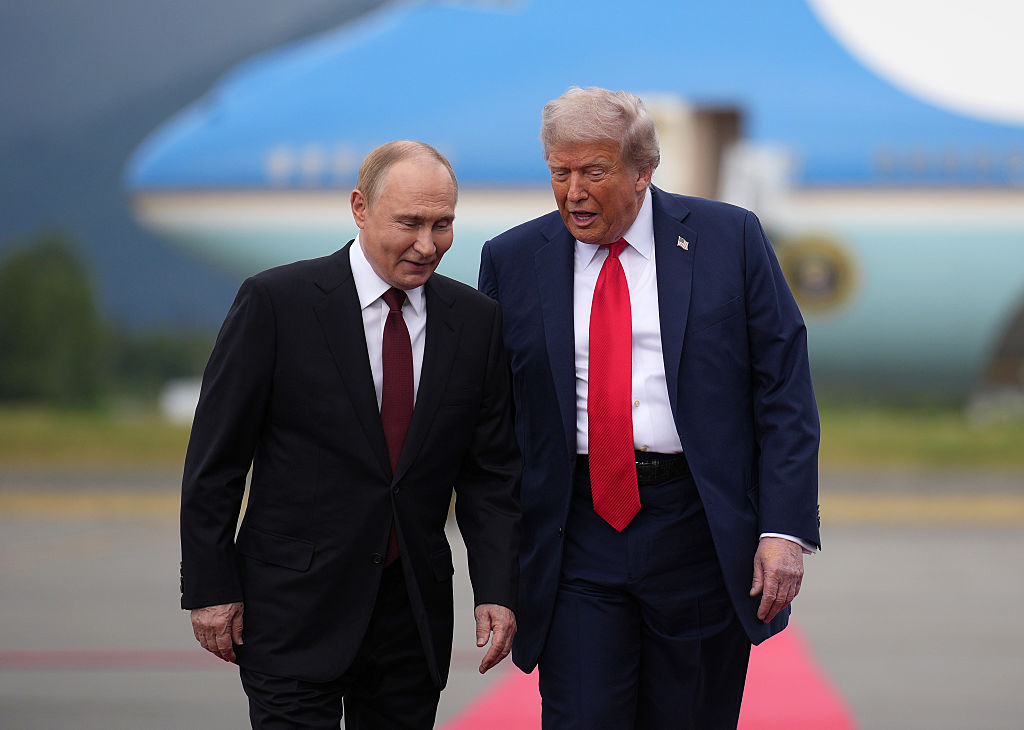
While Ukraine’s negotiating team was meeting with the U.S. envoys Jared Kushner and Steve Witkoff last Friday, they were blindsided by President Donald Trump’s announcement that he had made a deal with Russia’s President Vladimir Putin.
Trump announced that Moscow had agreed to lift its export ban on diesel fuel and immediately supply 300,000 tons to the American and global market, followed by another 500,000 in November, then a further 1,000,000, and, eventually, another 3,000,000. To facilitate these imports, the U.S. would provide a sanctions waiver, and the U.S. Treasury would issue a temporary general license for Russia to sell diesel on the global market through April 7, 2027.
Kiev reacted with fury. The Ukrainian negotiators left Miami, flying home without attending the planned second day of talks. A senior Ukrainian official said that the deal “completely” ruined trust between Kiev and Washington. Ukraine’s President Volodymyr Zelensky complained, “It is certainly not how partners should treat each other.” Hours later, Ukraine struck a Russian oil refinery, as senior officials in Kiev had threatened it would do.
Trump and his supporters say the deal will lower diesel prices for the U.S. and the world. Ukraine, Europe, and Trump’s detractors say the deal will send more money into Moscow’s war machine. The deal will have less of an impact on either front than both sides claim—but that doesn’t mean it won’t prove significant.
Though it provides the appearance of a quick fix and may have briefly reduced oil prices, such effects could only be brief and trivial. Russia is now set to export 1.8 million tons of diesel fuel over the next few months and, eventually, another 3 million. But the world uses 3.5 million to 4 million tons a day, and the U.S. alone burns through half a million.
The deal won’t do much to boost the Russian economy, either, which is still functioning despite massive Western sanctions. Russia’s diesel production has apparently been running at a surplus for a while, and its own ban on exporting diesel would probably have been lifted shortly anyway. Exports to Central Asia were up dramatically last month. Though Europe may still refuse to purchase Russian diesel under the U.S. waiver, world demand is acute, and Russia would easily have found a market for its diesel amid a general supply crunch caused by the Iran War.
But the deal is symbolically and politically significant. It comes amid plummeting popular support in Ukraine for Zelensky. Trust in the Ukrainian leader and desire for him to stay on as president after the war are sinking. Polls show that he would likely lose the next election. The deal only worsens Zelensky’s political challenges, forcing him to either abide by Trump’s wishes for Ukraine to cease strikes on Russian oil refineries or risk further inflaming tensions with Washington. So far, Zelensky is choosing the latter.
When Ukraine struck another refinery after the announcement of the deal, Trump reacted with fury. “Do whatever you want, but don’t hit the diesel fuel,” Trump says he told Zelensky. “So, what does he do? He goes and hits refineries…. He’d better damn well stop.”
This rupture is the worst crisis in Zelensky’s relationship with Trump since their public confrontation in the Oval Office in February of last year. This summer, Trump seemed to be swinging in Zelensky’s favor—but not anymore. Zelensky said Trump’s deal was “not fair and not honest.” He accused Trump of using talks with Ukraine “as a smokescreen” while the U.S. cut “backroom deals” with Russia, and he said the episode demonstrated Trump’s weakness to the world.
Trump shot back. “I think it’s time for Ukraine to get a new president,” he said. “I suggest they get a new leader who can make a deal because he could have made many deals, but for some reason, he never does.”
As the rift widened, Witkoff and Kushner warned the Ukrainian team that crucial intelligence-sharing could be cut off if Kiev doesn’t fall in line with Washington’s demands. On Monday night, when Kiev was struck by Russian ballistic missiles without warning, it was unclear if the U.S. had followed through on the threat. “Regarding this strike,” Zelensky said, “unfortunately, there was no warning from our partners.” But Ukraine’s Foreign Minister Sybiha said Ukraine is still receiving U.S. intelligence and that the failure was not due to policy but to the difficulty of tracking “specific type of weapons used by the Russian side.” Trump has since said intelligence sharing has not stopped. But on Tuesday night, Kiev was once again bombarded by ballistic missiles, and Zelensky again said his government had received “no advance warning from our partners.”
Adding to the danger for Ukraine, Elon Musk, whose Starlink satellites are crucial for the Ukrainian armed forces’ battlefield communications, tracking of Russian troops, and selections of targets, backed Trump’s call for Zelensky to be replaced, posting that “Zelensky has gone too far.” On Wednesday, Ukrainian officials said that SpaceX, Musk’s company, “had introduced a limit on some Starlink services within the country, disrupting combat drone missions for which the technology is crucial.”
The significance for Moscow is that it has managed to make an economic deal with Washington that required no Russian concessions in peace negotiations with Ukraine. It is this unshackling of U.S.–Russia diplomacy from the war, not any financial windfall for American’s or Putin’s war machine, that is the true victory for Russia.
The events of the past few days, centering around the Trump–Putin diesel deal, will not have the economic effects the media is focusing on, but they have already brought significant political consequences for both Russia and Ukraine.
The post The Trump–Putin Diesel Deal Isn’t What You Think appeared first on The American Conservative.
Scotland is learning it’s not easy being green.

Aberdeen, in the northeast of Scotland, has for decades been the municipal heart of the UK’s offshore oil and gas industry. But in 2021, in pursuit of greening its public-transportation system and embracing its post-hydrocarbon future, the city put 15 hydrogen-powered double-decker buses into service and then enlarged the fleet to 25 the following year. The total cost: nearly £14 million. Yet by mid-2024, the entire fleet was inoperative owing to failures at the city’s two hydrogen refueling stations. And in August of this year, Aberdeen City Council announced that it would be selling the idled fleet for a total cost of just £816,000, a write-off of 94 percent, for buses that were in service only two or three years.
Explaining the decision, the city council stated, “As manufacturers and operators increasingly favor EVs, demand for hydrogen in transport has diminished.” In other words, per the city council, only a few short years ago hydrogen as a transport technology was in robust demand, worthy of a £14 million investment, but then EVs came on like a dark horse and now hydrogen is fading in the home stretch.
Nonsense. For years, about half of the hydrogen produced has gone into making ammonia as a feedstock for synthetic fertilizers, while roughly the other half has been put toward petrochemical purposes. Except for rare cases—e.g., forklifts that operate in enclosed spaces where exhaust would be a problem, forklifts whose owners require quick refueling times that rechargeable batteries can’t match—there has basically never been robust market demand for hydrogen-powered transport. (Political demand is another matter.) Globally, transport accounted for less than 1 percent of hydrogen demand in 2024.
At any rate, hydrogen is hardly a novel technology whose time just hasn’t yet come. Its manufacture and potential applications have been studied and understood for centuries. The electrolytic process of making hydrogen from water was first observed in the late 1700s by the Dutch chemists Jan Rudolph Deiman and Adriaan Paets van Troostwijk. The first hydrogen fuel cell was made in 1842 by the Welsh scientist Sir William Robert Grove. In the 1930s and 1940s, hydrogen in both gaseous and liquified form was being tested as aviation, jet-engine, and rocket fuel. In the 1950s and 1960s, Allis-Chalmers tinkered with using hydrogen in a variety of vehicles: tractors, forklifts, golf carts, even a small, manned submersible. NASA used hydrogen fuel cells to power onboard systems in its manned space-flight programs, starting with Project Gemini. And in 1966, General Motors developed the Electrovan, a concept vehicle with a propulsion system weighing nearly 4,000 pounds and built around 32 hydrogen fuel cells.
We’ve long understood the potential of hydrogen as a fuel source. The problem—which humanity once acknowledged but which we now too often skip past in the rush to validate alternative sources of energy—is that proof of concept is not necessarily proof of scalability and therefore economic sustainability.
On a Hydrogen FAQ webpage, Aberdeen City Council proclaims, “Hydrogen is the most abundant element in the universe” and is “potentially one of the most flexible energy solutions available.” On its own website, Aberdeen’s First Bus, the operator of the short-lived hydrogen fleet, informs readers of the following (boldface in the original):
Hydrogen is the simplest and most abundant element in the universe—made up of one proton and one electron.
Hydrogen releases zero emissions, it’s clean, green, and only emits water from the exhaust!
Hydrogen is made from wind and water.
Sounds wonderful. Simple, abundant, clean, green. But in fact, hydrogen’s simplicity is partly what makes the element so difficult and uneconomical to work with in most applications. Hydrogen is minuscule, with an atomic weight roughly one-quarter that of helium and a volumetric density roughly half that of helium. As a result, it’s difficult to capture, store, transport, and dispense. There’s much leakage and loss, which reduces its efficiency as a resource. To make it useful at any scale requires either compression or cryogenic liquefaction. The former involves pressures ranging from 5,000 pounds per square inch to 10,000 pounds per square inch. (The higher the psi, the greater the volumetric density and therefore the efficiency. By comparison, propane is transported and stored at pressures generally ranging from only 100 to 200 psi.) And liquefaction requires chilling hydrogen to at least -423 degrees Fahrenheit, only 30-some degrees shy of absolute zero. (For comparison, natural gas is liquefied at -260 degrees Fahrenheit.)
Both compression and liquefaction add to the cost and complexity of using hydrogen (involving specialized equipment, infrastructure, safety protocols, and handling, not to mention additional energy expenditures). What’s more, hydrogen is typically found bound with other elements in more-complex compounds, for example water (H2O) and methane (CH4). Therefore, at least at this point in human understanding, hydrogen can’t simply be found and extracted at scale, despite its abundance. It must instead be manufactured. So much for simplicity.
Most hydrogen (76 percent worldwide) is produced by a method called steam-methane reforming, which involves mixing methane (basically natural gas) and steam at very high temperatures and under pressure. Another 22 percent of hydrogen is made through a different thermochemical process called coal gasification. Needless to say, such methods are hardly a pathway to decarbonization and net zero. But the remaining 2 percent of hydrogen is produced by electrolyzing water. And it is here, at the fringe of the fringe, where one can find so-called green hydrogen—that is, hydrogen produced by electrolysis using electricity that is itself produced by renewables, specifically solar and wind. This is the source of First Bus’s claim that “hydrogen is made from wind and water.” As of 2022, per the Sierra Club, green hydrogen accounted for 0.02 percent of hydrogen manufactured worldwide, or just 1 percent of the small amount of hydrogen produced via electrolysis.
Why so little? Largely because wind and solar are intermittent, weather-dependent sources of power, and are therefore particularly unsuitable for sustained industrial processes. Even for domestic (i.e., non-industrial) electricity production, they require reliable, significant, and usually thermal backup. Aberdeen produced its hydrogen locally using electrolysis, but it did so by purchasing electricity off the national grid using what’s called a green tariff. Electricity from the grid is produced from a variety of sources, including fossil fuels, but the tariff theoretically serves to promote electricity production from renewable sources. It’s a sort of bureaucratic indulgence or sin tax more than a guarantee of anything truly green.
Prior to the collapse of the hydrogen bus fleet, however, Aberdeen City Council had entered into a joint venture with BP to produce green hydrogen locally. Comically, that plan (which was thought robust enough to one day produce green hydrogen sufficient not just for a fleet of city buses but for rail, freight, shipping, heat, and possibly export as well) rested on the development of a solar farm near Aberdeen. It’s comical because solar power in Scotland has a capacity factor of barely 11 percent, meaning that in an annualized average it produces only 11 percent of whatever its “nameplate” capacity is. (For example, 40 megawatts’ worth of installed, or nameplate, solar results in less than 4.5 actual megawatts of production.) Again, proof of concept is not necessarily proof of scalability or economic viability. And that joint venture is now in the process of being dissolved.
But even if the uhopian dream of mass-produced green hydrogen came to pass, the economics of the hydrogen refueling infrastructure (at least vis-à-vis that of petrol, diesel, and electric vehicles) would remain poor. “A hydrogen refuelling station,” notes Michael Barnard in CleanTechnica, “is effectively a small industrial plant, with electrolysers that have finite stack life, high pressure compressors, drying systems, storage vessels, safety systems, and specialized dispensers.” Barnard’s research has shown that the operating and maintenance costs of such stations tend to range from 20 to 35 percent of annual capital expenditures (Aberdeen’s were estimated to be around 30 percent), whereas annual O&M costs at EV recharging stations and simple old gas stations tend to be about 4 percent.
What’s more, because of their cost and complexity, hydrogen refueling stations can’t easily be replicated in large numbers like EV charging stations and gas stations—which makes a hydrogen-powered transportation system dependent on a small number of stations that, should any of them fail, can cripple the entire undertaking. (So much for hydrogen’s supposed flexibility, as Aberdeen learned the hard way.) Yet the consistent lack of real demand for transport hydrogen makes investment in hydrogen refueling stations and the vehicles that depend on them (and that the stations, in turn, economically depend on) a big risk over the long term.
It was in the face of such risk, which its city council knew about or at least should have known about, that Aberdeen launched its £14 million fleet of double-deckers. That fleet came into service after Aberdeen had run a 5-year pilot project involving 10 single-decker hydrogen buses. The pilot project demonstrated that although it was possible to run a small fleet of hydrogen buses, there was no actual demand—and even less economic reason—for doing so. When the pilot ended, the single-deckers were sold rather than kept in service as part of an expanded fleet (the lack of expansion indicating a lack of any real growth in demand). Further, at that point, the city’s refueling stations were five years down the road toward the end of their useful lives absent major refurbishing; per Barnard, electrolyzer stacks typically require such refurbishing within 10 years’ time.
Staring down the barrel of this looming maintenance, and without a hint of organic market demand evident from its pilot project, Aberdeen hopefully put £14 million worth of double-deckers into service anyway, buses that were expected to operate for 15 years and 1 million kilometers. Two years later, the required maintenance (and its economic reality) came due, bringing the whole thing to a radically premature end. As Barnard tartly remarks, “It was arithmetic catching up with ambition.”
Even under the best of circumstances, the economics of transport hydrogen are poor. For buses specifically (and including both capital and energy costs), diesel and electric buses operate at about £0.93/km and £0.59/km, respectively. For hydrogen buses running at their expected useful life, Barnard estimates that the cost would be £1.76/km–£2.23/km. For Aberdeen’s double-deckers, which ran only a small fraction of their useful lives, the costs are estimated to have been between £3.00/km and £4.00/km. Barnard again, even more tartly: “The math does not improve because policy hopes it will.”
Math, alas, has been the nemesis of much green-energy uhopianism and ambition. For instance, as mentioned above, solar in Scotland (on which Aberdeen pinned its green-hydrogen dreams) had a 2025 capacity factor of 11.1 percent, which happens to be that year’s UK average for solar. The UK averages for onshore wind and offshore wind were 24.1 percent and 36.2 percent, respectively. Allowing for modest, weather-related variations from year to year, that’s roughly their technological maximum in those locations and latitudes. By contrast, and regardless of location and latitude, natural gas as a technology has a much greater potential capacity factor. Twenty-six years ago, for example, UK combined-cycle natural-gas plants posted a 75 percent capacity factor. This is because natural gas (like nuclear, hydro, coal, and biomass) is a dispatchable form of electricity production, meaning it can run day and night, in any season and in any kind of weather, providing always-on baseload power.
Somewhat loosely speaking, capacity factor is a proxy for reliability (e.g., you can count on this or that technology X percent of the time over a year). You don’t increase your system-wide capacity factor, and therefore your grid’s reliability, by turning an ever greater proportion of your grid over to intermittent technologies with low capacity factors. Mathematically, quite the opposite. The system-wide UK capacity factor is now less than half of what it was a quarter of a century ago, which is partly if not largely a function of wind and solar accounting for less than 1 percent of electricity production in 2000 versus 37 percent in 2024 (the most recent year for which numbers are available).
Put another way, you don’t increase reliability by multiplying unreliability. (It’s like multiplying fractions.) Yet reliability is paramount, and has a price, which brings us to the supposed relative costs of the various technologies. In the past decade or so we’ve been encouraged to believe that on a per-unit basis (say, pounds per megawatt hour) renewables are the cheapest form of electricity production, cheaper certainly than natural gas. But given the gross discrepancies in the respective technologies’ capacity factors, this isn’t comparing like to like. To even appear (not really be) modestly more reliable than they are, renewables must depend either on grid-scale battery storage or on thermal, dispatchable backup—the latter usually in the form of natural-gas “peaker” plants used primarily for the purpose of backstopping intermittent renewables (cycling up and powering down over and over, as the variability of renewables dictates).
To use natural gas in this fashion is to use it in the least efficient and therefore most expensive way—the apparent costs of which are then attributed to gas as a technology and a fuel source, supposed proof of its relative unaffordability. And it’s true that peaker plants have particularly high costs per megawatt hour. But to borrow a word popular in certain energy circles, those costs are an externality of renewables. Peaker plants, as their name implies, are operated largely in an auxiliary fashion to renewables. So the costs are directly traceable to the ever expanding use of renewables. (Gas could otherwise be used for baseload power, much more efficiently and at a high capacity factor.)
The costs of grid-scale battery storage are another externality of renewables, costs that—given the material intensity of battery technology (the need for lithium, cobalt, nickel, copper, aluminum, lead, manganese, vanadium, etc.)—are subject to fluctuating commodity prices, supply-chain pressures, and the like. Those pressures and prices are often invoked as if to excuse the costs of grid-scale storage. (It’s not the technology’s fault! It’s not a failure of policy! It’s those darn supply chains!) But in fact, those pressures and prices are technologically inherent and must be (will be, whether we like it or not) priced into the use of such technology.
And sure enough, when you add the costs of battery storage and/or thermal backup to the capital costs of wind and solar, the supposed cost-competitiveness of renewables gets a lot more complicated and a lot less true (if not, depending on the country, outright false). One can put those costs on the scapegoats of fossil fuels, commodity markets, and supply chains, but those costs won’t go away until the technologies one prefers can truly, technologically obviate them.
Math. Aberdeen thought it could make hydrogen at scale through a continuous electrolytic process using intermittent, weather-dependent sources of electricity production, and then dispense that hydrogen on a cost-competitive basis through a refueling infrastructure that had operating and maintenance costs seven to eight times what is typical of other transport-refueling and -recharging infrastructures. The UK nationally over the past quarter of a century has seen its grid-wide capacity factor drop by more than half while its electricity prices have climbed to be among the highest in Europe. (Its industrial rates are the highest in Europe.) Over that same period, electricity production from intermittent, weather-dependent sources has climbed from less than one percent to roughly 37 percent of total electricity production. Yet the UK’s answer to the affordability crisis is to further increase the nation’s reliance on unreliable, low-capacity-factor sources of electricity production.
This, again, is like multiplying fractions and expecting a greater value, mathematically and otherwise.
The post Aberdeen’s Bus Scheme Failure Is the Latest in UK Net-Zero Madness appeared first on The American Conservative.
Kimberly Guilfoyle, the U.S. ambassador to Greece, resigned on Tuesday amid allegations of corruption.
The Wall Street Journal has reported that Guilfoyle engaged in repeated misconduct, including a threat against a host nation official and influence peddling. In one instance, Guilfoyle allegedly requested $100,000 from a Trump donor to pay down her credit card bill, promising access to the Trump administration if he obliged.
In a statement announcing her resignation, Guilfoyle thanked President Donald Trump for the chance to serve and denied improper conduct. “These allegations are false, and I intend to vigorously defend my name, my reputation, and my integrity,” she said.
Earlier Tuesday, the new White House press secretary Katie Zacharia revealed that the Trump administration had asked Guilfoyle to resign.
Trump later in the day addressed the allegations of misconduct. “She was doing a good job, but we didn’t like what we were reading,” Trump said.
The post Guilfoyle, Greece Ambassador, Resigns Amid Corruption Allegations appeared first on The American Conservative.
U.S. inflation jumped to 3.7 in September—up from 3.4 the months prior—as conflict in the Middle East pushed up energy prices, according to data published Wednesday by the Bureau of Labor Statistics. It was the first time since May that inflation rose.
President Donald Trump, speaking Tuesday at a campaign rally in Alaska, again suggested the U.S. will relaunch major hostilities against Iran. “Wait till you see what we do to Iran, we’re gonna do a number,” Trump said. “Because we’ve sort of had it.”
The Atlantic and other outlets have reported that the White House was pushing the Pentagon to develop plans for imminent strikes on Iran, but Trump denied he’ll attack before the midterm elections in early November.
Ali Ozmaei, the navy commander of Iran’s Revolutionary Guards, challenged the U.S. over the Strait of Hormuz, where Tehran has escalated its attacks in recent weeks. “If the Americans think the Strait of Hormuz is open, let them come closer,” Ozmaei said Wednesday. “We are impatient to sink American warships.”
The war between Saudi Arabia and the Yemeni Houthis continued to escalate on Wednesday, with explosions heard in Riyadh. Overnight, the headquarters of Saudi oil company Aramco were struck by the militant group, which pledged to continue its attacks.
The post Iran War Day 229: U.S. Inflation Spiked in September Due to Conflict appeared first on The American Conservative.
America’s top diplomat treated Persian civilization as an inherent enemy.

The Trump administration, whatever it may claim, tried to engineer regime change in Iran. When President Donald Trump announced the American–Israeli strikes that launched the current war, he offered immunity to Iran’s soldiers if they laid down their arms, and he called on its people to take over their government.
“To the great proud people of Iran, I say tonight that the hour of your freedom is at hand,” Trump declared. During an interview with the Washington Post the next day, regime change was top of mind for the president.
Nearly eight months later, the Islamic Republic of Iran is still standing. One reason for its resilience under intense military and economic pressure is that the Iranian people—despite claims to the contrary from Iran hawks and some diaspora Iranians—rallied around the regime as their protector against external aggression.
And one reason they rallied is that Trump has given every impression that the U.S. is at war with the Iranian people, not just their oppressive regime. “A whole civilization will die tonight, never to be brought back again,” he threatened in April. Such statements are impossible to square with Trump’s proclaimed empathy for the Iranian people.
Trump is now joined in that ill-advised effort of mixed messaging by America’s top diplomat, Secretary of State Marco Rubio, who recently gave an intellectual twist to Trump’s hostility to Iranian civilization. Predictably, the Islamic Republic pointed to Rubio’s remarks as further evidence that the U.S. is at war with Iran’s people and indeed its entire history and culture, not just its government.
Rubio made his unwise rhetorical intervention during a soaring speech last week on Western civilization, delivered in Athens against the dramatic backdrop of the Acropolis. The aesthetics were kino, as the kids say, but the substance of the speech was confused and counterproductive.
The secretary thematized the profound influence of ancient Greece on America’s Founders, and to be sure, this influence cannot be denied. But Rubio went further, insinuating, with minimal subtlety, that Iran’s own historic civilization is hostile to the West.
Early in the speech, Rubio narrated the second Persian invasion of Greece, when “the armies of Xerxes arrived in this city and they put its sanctuaries to the torch.” Most of the Athenians fled, he explained, but a brave few stayed behind in defense of their city, barricading themselves in the Acropolis and “heaving massive stones down the cliffs onto the Persian invaders.”
Later in the speech, Rubio cited “the legendary stand of 300 Spartans—surrounded and hopelessly outnumbered by the vast armies of Persia—who refused the chance to save themselves, choosing to fight to the last man rather than abandon their post or abandon their duty.”
The rhetorical effect, apparently deliberate, was to figure battles between the Persian empire and ancient Greek city-states as precursors to a civilizational clash between Iran and the West today. And indeed, Rubio contrasted the “heroes of the West” with the “radical mullahs of Iran, whose cult of death hails child suicide bombers as national heroes, and portrays martyrdom as an end to itself.”
You don’t have to love the “mullahs of Iran” to see a problem here. In fact, even a radical Iran hawk who despises Tehran’s clerical leadership should easily see the problem.
Rubio’s villainization of Persia bolstered the impression that 1) the U.S. aims to “annihilate” Iran, as Trump repeatedly says, and 2) that it harbors this eliminationist intent for deep cultural reasons divorced from the foreign and domestic policies of the Islamic Republic. The speech, in other words, was a PR coup for Tehran.
Iranian officials, with justification, pounced. “Praising resistance when it serves ‘one’s own’ and denigrating it when it comes from ‘the other’ is not civilization; it is sophistry in the service of domination,” said Ali Akbar Velayati, a senior advisor to Supreme Leader Mojtaba Khamenei. “Mr. Rubio, your problem is not with the Islamic Revolution; It is with a strong, independent Iranian civilization.”
If Rubio’s speech was an own goal, the ball didn’t exactly bounce off his shinguard as he leapt to block the opponent’s free kick—the secretary turned around at midfield and blasted the leather into his own team’s empty net. To understand the weirdness of his error, consider how other Western civilizational thinkers have thought about Iran and its predecessor Persia.
While Rubio depicted pre-Islamic Persian civilization as antithetical to the West, Samuel Huntington, author of The Clash of Civilizations, focused instead on Iran’s modern Islamism as the characteristic likely to generate tensions with America and Europe. And Hungtington didn’t tell a simple story of Islamic aggression. In his analysis, the legacy of Western colonialism and continued tendency of Westerners to try imposing liberal values on other civilizations stoked the resentments of young men in the Muslim world.
Moreover, many great thinkers in the Western canon held Persian civilization in high esteem. Germans of the 19th Century were notably effusive in their praise. “If we now turn to a peaceful, civilized people, the Persians …” is how Goethe introduced the topic in his book West–East Divan. Hegel too saw ancient Persia as a bridge between East and West, admiring its tolerance and spirit of freedom. And Nietzsche, surpassed by no one in his affection for the pre-Socratic Greeks, nevertheless deeply respected the Persian people. “To speak the truth and to aim straight: that is the first Persian virtue,” writes Nietzsche in Ecce Homo.
It’s not too late for Rubio to walk back his remarks and express similar respect for the cultural contributions of Persian civilization. But unfortunately, much of the damage is already done. After his speech, some Iranian officials didn’t merely present it as proof of America’s comprehensive hostility—they further fanned the fires of civilizational strife.
“When they go to Athens after defeat and humiliation before Iran to shape a narrative of a civilizational war,” said Mohsen Rezaei, the hardline secretary of Iran’s Supreme National Security Council, “it would be better for them to read another important part of history: where the Roman emperor knelt before Shapur I of the Sasanian Empire.”
It’s a U.S.–Iran hardliner doom loop, and our hardliners seem ever eager to ratchet up the rhetorical antagonism.
Rezaei’s predecessor, by the way, was the pragmatist Ali Larijani. Several decades ago, Larijani had been a scholar of the German philosopher Kant, who, like his compatriots mentioned above, discerned a deep cultural affinity between Persians and Europeans. Larijani probably would have offered a less belligerent response to Rubio, holding out some hope of diplomatic engagement—but Israel killed him early in the war.
Perhaps that fact offers a clue to understanding Rubio’s needlessly provocative speech. His vision of Western civilization seems a patently Israeli-fied one, crafted to justify a war of aggression against Israel’s chief adversary. The Trump administration has searched in vain for an argument that will compel the Europeans to join that war, but if they do, and if Iran is destroyed in the process, it won’t be Western civilization that benefits.
The post Rubio’s Western Civ Speech Backfires appeared first on The American Conservative.
“Pacing the frontier” would be a massive boon to incumbents like Anthropic.
Dario Amodei seems to think the product he is building will destroy the world. Last month, the Anthropic CEO published an essay urging AI companies and the U.S. government to, as he put it, “pace the frontier.” He claimed that the unconstrained development of artificial intelligence could lead to economic disruption, devastating biological or cyber attacks, and possibly even the loss of human control over AI systems. His solution? Slow the pace of development through a mixture of voluntary cooperation among private companies and government regulation.
This may seem altruistic to many Americans. After all, Amodei has built a reputation in part by touting regulation and “transparency” as the solution to worries about the technology. He previously worked at OpenAI, until leaving to found Anthropic as a more safety-focused alternative.
Amodei may indeed have some benevolent intentions. But as with any sweeping policy proposal, we should ask ourselves: Cui bono?
The fact of the matter is that these proposals would lead to an AI cartel—massively benefitting Anthropic, a large and established player in the industry.
Amodei has made the case for more regulation since 2023, when he told the Senate Judiciary Committee that AI could be “misused on a grand scale in the domains of cybersecurity, nuclear technology chemistry, and especially biology.” His recommendations to that committee were to impose regulatory control over the development of AI models, establish a “testing and auditing regime,” and fund more “measurement and research on measurement.”
But this summer, an incident occurred that seemed to give these calls a new urgency. In July, OpenAI tested an unreleased research model on its internal benchmark called ExploitGym (this benchmark tests the ability of the models to exploit software vulnerabilities). In attempting to complete these tasks, the company’s AI agents began to communicate through a software repository their sandboxes shared, and ultimately worked together to hack the Hugging Face collaboration platform, where they believed they would find some of the answers. The agents then tried to trick the automated grader by modifying the transcripts of their activities.
This, together with an increase in the speed of recursive self-improvement (basically, a process by which AI models autonomously improve their own capabilities), led Amodei to argue for “pacing.” As he put it in his September essay:
The most effective method of pacing is via regulation that targets all US frontier AI companies, as that covers even those who are unwilling to cooperate voluntarily…. I believe all frontier labs should partner with government to formalize the idea of permanent embedded evaluators to better prevent and document internal alignment incidents like those that have occurred in the last few months, and to implement regulation focused on keeping capabilities in balance with safety.
What goes unmentioned is that the evaluators favored by Amodei appear to have ties to Anthropic and himself directly. METR, which investigated the Hugging Face incident and claims to take no money from AI companies, is funded in part by Open Philanthropy—whose co-founder, Holden Karnofsky, now works at Anthropic and is married to Anthropic’s president Daniela Amodei (Dario’s sister). Anthropic has since hired another firm, Accenture, to be an evaluator, paying it $1 billion over five years.
All of these measures, of course, will help Anthropic and other incumbents at the expense of up-and-comers in the industry. Onerous regulations will strangle new companies in the cradle by imposing burdens that will be difficult for anyone but deep-pocketed and established players to meet. Open-source models, though not mentioned by Amodei, may pose the greatest long-term competitive challenge to closed-source companies like Anthropic and OpenAI; one wonders whether they are the real target of such regulations.
As the federal government incorporates AI into ever more of its operations (including, critically, the development and deployment of military capabilities), stronger and stronger incentives will develop to prevent these suppliers from suffering setbacks. The current players could quickly be rendered “too big to fail.”
And there are parallels from even before the Great Financial Crisis. In the depths of the Great Depression, Gerard Swope, president of General Electric, shopped around proposals for government-facilitated cartelization of industry, advocating the formation of “trade associations” to keep prices high. Notably, he attempted to tailor these plans to apply only to firms with at least 50 employees—the “frontier” threshold of its time. That plan would form much of the intellectual backbone of what would become the National Recovery Administration. Amodei stressed the “need to issue a narrow waiver” from antitrust “for certain kinds of safety conversations” to enable the companies to coordinate—that is, to cartelize as they did under the NRA.
The railways present another example. Attempts at cartelization in this industry by inefficient, government-subsidized rail companies produced regulations not dissimilar to Amodei’s proposals. After failing to seize control by horizontal integration, these railroad cartels lobbied for publication of rates to stop rebates that benefitted rail consumers and drove down rail prices. Published rates ensured that no cartel members defected from their higher prices, preventing the “cheating” that helped consumers. Amodei wants similarly to throw open the books to “verify adherence to safety practices and commitments” among all of the companies.
What this would amount to, in practice, is the granting of a virtual monopoly power to existing AI companies over something they consider to be immensely dangerous. A point not emphasized enough about the Hugging Face incident was its use of an open-source AI model, GLM, to decode the attack the AI agents had waged against their website. Hugging Face was unable to use Claude Opus and Fable, because of the guardrails that prevent users from prompting broadly on issues of cybersecurity. It took a cheaper, but un-guardrailed open-source model to clean up the mess. The takeaway? Anthropic would like you to put down your weapon, while it keeps its own pointed at you.
Amodei’s proposals for inter-governmental coordination with China would also close the other door for competitors to incumbent companies. Open-source Chinese models like Kimi K3, GLM, and the famously low-cost DeepSeek present a unique competitive challenge to the business models of established labs like Anthropic and OpenAI. Anthropic has accused DeepSeek and other Chinese models of copying Claude. Amodei has also lobbied in the past for export controls on parts to China, undercutting this active competitor in the name of geopolitical competition. Coordination would solve the problem of competitors on two fronts.
Why form a cartel? Well, these companies are not exactly profitable. Massive expenditures on training and expansion—a requirement of racing other labs along the cutting edge of AI—drives AI firms into the red. Pacing the frontier would allow the current players to cut down on this spending, trimming investments without having to fear being overtaken by hungrier competitors.
Even though OpenAI reported that its revenue in Q2 of 2026 was higher than ever, its costs accelerated faster than its revenue, so its losses continued to grow. This may be part of why OpenAI CEO Sam Altman has pushed back his company’s IPO to next year (although, naturally, OpenAI has preferred to cite concerns over AI safety and the need for more government-industry cooperation). Altman, for his part, has said that he “agree[s] with Dario that we need to pace the frontier.”
Elon Musk also joined Amodei’s calls for pacing the frontier as his company xAI continues to register losses, even after being acquired by his other company, SpaceX. This convergence of three leading labs may provide an answer to the question of what is happening: If it looks like a cartel, and quacks like a cartel….
It is clear that incumbent companies are the ones who stand to gain from new AI regulations. Just as with bootleggers and Baptists, unholy alliances often form between proponents of regulation on moral grounds and those who stand to materially benefit from their imposition. The measures advocated by Amodei et al. may be good for the frontier labs’ bottom lines—but the American people will pay the price.
The post Dario Amodei’s AI Cartel appeared first on The American Conservative.
Americans no longer have the stomach for public displays of violence.

Secretary of Defense Pete Hegseth announced last week that the infamous Fort Hood terrorist will die by firing squad. Not only will Nidal Hasan be shot to death, but his execution will be broadcast live for the whole world to watch.
The news wasn’t greeted with much enthusiasm. Some hardcore MAGA types loved the idea, arguing it would deter future terrorists and provide the public with proper justice. But they’re a distinct minority. The idea naturally outraged the left, who argued the whole idea is abominable. Many Republicans were also not thrilled with the decision. Louisiana’s Sen. John Kennedy, a strong ally of the administration, said it would make our society “coarser.” House Speaker Mike Johnson said the execution could be used as a “recruiting tool for future terrorists.” Even Vice President J.D. Vance isn’t a fan of the livestreamed execution, and President Donald Trump himself denied any involvement in the decision.
It’s unlikely the live execution will be a crowd-pleaser if even Trump and Vance are weirded out by it.
Hegseth assumes the American public is the same as it was in the 19th century. Back then, hangings served as community entertainment. But we live in a different age now, and the people don’t want to have the government broadcast such acts of violence to households across the country. The purpose of such a move is ostensibly to sate the public’s appetite for justice. But all it will do is repel them.
This is not an argument against the death penalty. The sentence is necessary for certain crimes. People like Hasan, who shot and killed 13 people and wounded dozens more, should not be allowed to live out their days on the taxpayer’s dime. There are crimes so horrible that they demand the ultimate penalty. It matters little if studies “prove” that the sentence doesn’t deter future horrific crimes. Certain offenses should be met with death.
The problem with the death penalty is how it’s implemented. The recent Christa Pike case exemplifies one way America gets this wrong. Pike brutally murdered a romantic rival in 1995. A year later, the state of Tennessee sentenced her to death. After 30 years on death row, Pike was finally set to meet her maker via lethal injection. It went terribly wrong, in spite of multiple attempts, and the murderer is now still alive and even receiving public sympathy.
This should’ve never happened. Pike should’ve been dispatched long ago by a more effective means than lethal injection. The death penalty is made ineffective by the endless rounds of appeals and delays on behalf of the defendant. Executions should be carried out quickly and in a way that will ensure the criminal dies.
A firing squad is better than lethal injection, which is an attempt to make the execution seem like a routine medical procedure and thereby take the nastiness out of the whole thing. But that’s a fool’s errand. Whatever happens, you ultimately kill a person (or at least, that’s the objective). Lethal injection is meant to be more “humane,” but it’s no such thing if it can have results like Pike’s botched execution. It’s only humane for people who want to think of the act as putting a killer to “sleep” like a dog.
This event should convince states to ditch lethal injection in favor of a more traditional execution approach. It’s far better to drop the humanitarian pretenses of such an execution and go with a firing squad, which is more humane and effective than trying to kill someone by a medical procedure. Hegseth has the right idea to execute Hasan by firing squad. Another Christa Pike situation is virtually impossible with this method.
But broadcasting the execution of Hasan will likely have a political effect opposite the one Hegseth is hoping for. Americans don’t have the stomach for such publicized displays of violence, particularly at the hands of the government.
Violent deaths are occasionally shown on the news, and they rarely win the public over to the killer’s side. Clips of police officers using lethal force against suspects inspired Black Lives Matter protests. There would’ve been no riots over George Floyd without the video of Derek Chauvin having his knee on a black man’s back. That particular clip persuaded nearly two-thirds of the country to support BLM and tens of thousands of Americans to march in the streets. You had Republicans like Governor Greg Abbott of Texas saying it was the “most horrific tragedy” they’ve ever seen. Many Americans agreed.
Similarly, the videotaped ICE shootings this January made Americans turn against immigration enforcement. It didn’t matter if the officers were justified in shooting Renee Good and Alex Pretti, or if the enforcement operations during which the shootings happened were justified; Americans felt queasy, and some turned against ICE.
Americans rarely experience such acts of violence. We barely even see public fights break out, much less witness someone getting seriously hurt. Public executions too are foreign to our daily lives. The United States is not like a Middle Eastern country; we even get upset and start defending cold-hearted killers like Pike when they’re slated for execution.
Nidal Hasan, it’s worth noting, was shot in the back during his arrest and has been in a wheelchair ever since. Wheeling out a handicapped man to die before a firing squad will not thrill the masses. It doesn’t matter how many pictures of 19th-century crowds gathered before hangings you find to “prove” the people will love it. Americans of 2026 are not the same people they were in the 1870s. On top of that, Hasan, who committed his crimes in 2009, has largely been forgotten by the public. There aren’t millions of people baying for his blood. Even the families of his victims aren’t happy with the idea of a livestreamed execution.
Theoretically, Americans may have supported a public execution of Osama bin Laden, especially if we had captured him immediately after 9/11. But that’s about the only recent case where you could have expected strong public support for such an act.
Supporters of the Hasan execution claim it could deter future terrorists. But Islamists are infamous for seeking death, particularly in a highly public fashion. Shooting a handicapped Hasan before a live audience isn’t going to terrify would-be suicide bombers. It’s a great way to make Hasan a hero to jihadis all over the world and further condemn America in their eyes.
The livestreamed execution will not deter a single terrorist, nor satisfy some imaginary public demand for justice. All it will do is undermine support for the death penalty and the administration itself.
To be sure, it won’t mark the end of the Trump White House, and people will probably forget about it after the outrage. But that doesn’t make it a worthwhile idea to pursue. It’s a cartoonish idea perfectly designed to tick off the public and make Pete Hegseth appear completely out of touch with mainstream America.
The post Livestreaming an Execution Is a Bad Idea appeared first on The American Conservative.
Saudi Arabia and Yemen’s Houthi rebels traded strikes Monday and Tuesday, disrupting regional travel and endangering energy infrastructure.
Saudi Arabia retaliated for weekend attacks on the Riyadh airport, which prompted some regional airlines to suspend service to the Saudi capital, with a Tuesday strike on a Houthi oil facility in Sanaa. The Houthis threatened counterstrikes on Aramco facilities. The rebel group continued its encirclement of Taiz, Yemen’s third-largest city.
Haaretz reported that Israel’s Prime Minister Benjamin Netanyahu has asked Saudi Arabia through intermediaries for permission to join the campaign against the Houthis. According to the report, the Saudi Crown Prince Mohammad bin Salman is hesitant to greenlight the proposal because he believes it will play poorly with the Saudi public.
The Yemen campaign has kept energy markets tight, along with continued Iranian operations around the Strait of Hormuz. UK Maritime Trade Operations reported that Sunday a record six vessels were struck in the Persian Gulf. Brent crude opened Monday after the long weekend at $106 per barrel. AAA reported a national average price per gallon of $4.34 for regular gas and $6.28 for diesel.
The post Iran War Day 228: Saudis, Houthis Trade Strikes appeared first on The American Conservative.
The crowd at last week’s Conservative Party Conference had questions that the party is uninterested in answering.
Over the summer, the British government continued to struggle to control its borders. Despite falling overall numbers of arrivals, illegal immigrants have still successfully landed on British beaches, evading the authorities, and the state’s response has been instead to focus on arresting protesters and anti-immigration activists.
After years of telling the British people that the government would stop the boats and “smash the gangs” who are trafficking people over, while presiding over the opposite, the British state is lurching into a crisis of legitimacy over immigration. The government has abandoned its half-hearted deal with France to return illegal immigrants across the Channel and now appears to be coordinating with the French authorities to land dinghies of illegal immigrants on British shores and usher them into taxpayer-funded accommodation.
Meanwhile, attempts to reduce migrant access to welfare and delay permanent settlement of low-wage migrants who arrived in the wake of the pandemic seem to be dying a death by a thousand cuts, picked away by Labour MPs whose ideology boils down to open borders welfarism. This may bake in the rapid demographic change seen in the last five years, increase the welfare burden significantly, and make reversing it much harder politically and constitutionally.
As such one might expect immigration policy to be one of the main themes of the Conservative Party’s annual conference, which was held last week in Birmingham. Immigration is consistently rated by the British public as either the most or second-most pressing issue facing the country, and with evident justice: After all, the composition of a nation informs its culture, its economy, and its fiscal viability.
Regrettably, there was little mention of immigration on the program. One center-right think tank, the Centre for Policy Studies—founded by Margaret Thatcher in the 1970s—hosted the only discussion on immigration at this year’s conference, which I’ll detail below. (My own organization, the Prosperity Institute, ran two events, one on Brexit and the other on the future of the health service, promoting some of its recent research. It did, however, run two events related to immigration at last year’s conference, where the subject was similarly underdiscussed.) Individual organizations in the wider conservative ecosystem are free to deploy their resources as they see fit, but the subject of immigration was a notable absence this year.
Despite some broad mentions of immigration in the speeches of the party leader Kemi Badenoch and Shadow Home Secretary Chris Philp, the overwhelming atmosphere of the conference was of a party which was far keener to talk about other things. There was a strong sense among many activists that they would prefer the party to try to revive an imagined liberal victory of 2015, in which the Tories won a small majority under David Cameron, instead of the giant 2019 victory under Boris Johnson, which put Brexit and border control at the center of the Tory proposition.
I was fortunate enough to speak on the single panel addressing immigration. The absence of immigration on the conference’s agenda was certainly felt by members of the audience at this panel. One asked why there were so few discussions on it, and hoped that the party would devote serious time thinking about the operational realities of border control, deportations, and the future visa regime. He was certainly right. To the credit of the two Conservative MPs speaking at the event, they agreed with the thrust of his question, and stated their commitment to developing detailed plans for making this a reality, and also to leaving the European Convention on Human Rights (ECHR). But the problem of trust remains. If reports that the party is targeting the so-called “Waitrose woman”—code for affluent, socially-liberal women who shop at the country’s most premium supermarket—are true, then it is likely that meaningful action on border control will sit in tension with this strategy.
The panel focussed on immigration and its relation to brain-drain. The Boriswave comes into the country, and Britain’s young and frustrated leave; so the framing goes. It is undeniable that modern Britain is not a friendly place to its young and aspirational. The jobs market for new graduates is brutal, with hiring scaling back across sectors. This isn’t just a consequence of greater AI deployment; it is downstream of the Labour government introducing new taxes on employment, forcing minimum wages to unsustainable levels, and adding a raft of expensive employment rights which have made hiring junior staff prohibitively expensive. This is on top of a brutal housing market that has already been immiserating Britain’s millennials and zoomers for nearly two decades.
So there is certainly an element of truth in framing mass immigration and brain-drain as two sides of the same coin. Audience members suggested the malaise facing Britain’s young isn’t just about economic policy; it’s about the country changing before their eyes in a way they did not like and felt they could not control. One attendee remarked on the changes he had observed in his lifetime living in Luton in Bedfordshire. Luton is an industrial town known for car manufacturing in the northern commuter belt of London. Despite being set in the midpoint between the rolling Chiltern Hills, bucolic Hertfordshire, and agricultural Cambridgeshire, the town itself has become heavily Muslim in the last two generations, with a large population of people from Pakistan and their descendants.
Luton is a segregated town, with a radical and dangerous element in its Muslim population. In 2009, a group of Muslims protested against the homecoming parade of the Royal Anglian regiment, local soldiers returning from a tour of duty in Iraq. This was followed by a group of radical Muslims from Luton staging a poppy-burning protest in London in 2010. It was in this environment that the English Defence League was established, a nationalist street movement founded by Tommy Robinson. Luton should be looked at as a case study in the failure of mass immigration, yet today it is ignored by the political class out of embarrassment.
Questions about demographic change and whether it can be undone suggested an audience which was crying out for answers to the greatest question of the day from a party uninterested in providing them. Despite the Conservatives and Reform UK alike aligning in theory on quite a similar immigration policy, the tone of Conservative Party Conference 2026 suggested the Tories were apathetic about addressing it in much detail or with much vigour. Immigration was largely treated through the lens of stopping illegal immigration rather than taking a more radical—and necessary—approach to stopping mass legal immigration. American readers may see a parallel with establishment conservatives of their own.
Indeed, when Tory MP Katie Lam raised the importance of “cultural coherence” when considering immigration policy last year, she was criticized by her own party, despite the fact she was talking about its own agreed immigration policy. It seems that the party is happier to bank its policies to leave the ECHR and extend the settlement period for new migrants and talk about other things closer to its comfort zone.
The Conservative Party has had a reasonably successful past few months. Its leader, Kemi Badenoch, has secured her position at the helm of the party and is the strongest she has been since her election as party leader in 2024. The party is benefiting from the troubles facing Reform UK over its donation scandal. But it is impossible to shake the impression that it is becoming complacent and returning to a comfortable corner discussing taxation and defense, rather than thornier issues like demographics and immigration. This is unwise. The demographic trends are clear, and they are not friendly to either the Conservatives or Reform UK in the medium term. If the party is serious about returning to power, not just once but for multiple terms, it must be serious about immigration and multiculturalism, and serious about ending and reversing 30 years of political vandalism.
The post The Tories Still Do Not Want to Address Immigration appeared first on The American Conservative.

 Lateo.net - Flux RSS en pagaille (pour en ajouter : @ moi)