 Connexion


“Pacing the frontier” would be a massive boon to incumbents like Anthropic.

Dario Amodei seems to think the product he is building will destroy the world. Last month, the Anthropic CEO published an essay urging AI companies and the U.S. government to, as he put it, “pace the frontier.” He claimed that the unconstrained development of artificial intelligence could lead to economic disruption, devastating biological or cyber attacks, and possibly even the loss of human control over AI systems. His solution? Slow the pace of development through a mixture of voluntary cooperation among private companies and government regulation.
This may seem altruistic to many Americans. After all, Amodei has built a reputation in part by touting regulation and “transparency” as the solution to worries about the technology. He previously worked at OpenAI, until leaving to found Anthropic as a more safety-focused alternative.
Amodei may indeed have some benevolent intentions. But as with any sweeping policy proposal, we should ask ourselves: Cui bono?
The fact of the matter is that these proposals would lead to an AI cartel—massively benefitting Anthropic, a large and established player in the industry.
Amodei has made the case for more regulation since 2023, when he told the Senate Judiciary Committee that AI could be “misused on a grand scale in the domains of cybersecurity, nuclear technology chemistry, and especially biology.” His recommendations to that committee were to impose regulatory control over the development of AI models, establish a “testing and auditing regime,” and fund more “measurement and research on measurement.”
But this summer, an incident occurred that seemed to give these calls a new urgency. In July, OpenAI tested an unreleased research model on its internal benchmark called ExploitGym (this benchmark tests the ability of the models to exploit software vulnerabilities). In attempting to complete these tasks, the company’s AI agents began to communicate through a software repository their sandboxes shared, and ultimately worked together to hack the Hugging Face collaboration platform, where they believed they would find some of the answers. The agents then tried to trick the automated grader by modifying the transcripts of their activities.
This, together with an increase in the speed of recursive self-improvement (basically, a process by which AI models autonomously improve their own capabilities), led Amodei to argue for “pacing.” As he put it in his September essay:
The most effective method of pacing is via regulation that targets all US frontier AI companies, as that covers even those who are unwilling to cooperate voluntarily…. I believe all frontier labs should partner with government to formalize the idea of permanent embedded evaluators to better prevent and document internal alignment incidents like those that have occurred in the last few months, and to implement regulation focused on keeping capabilities in balance with safety.
What goes unmentioned is that the evaluators favored by Amodei appear to have ties to Anthropic and himself directly. METR, which investigated the Hugging Face incident and claims to take no money from AI companies, is funded in part by Open Philanthropy—whose co-founder, Holden Karnofsky, now works at Anthropic and is married to Anthropic’s president Daniela Amodei (Dario’s sister). Anthropic has since hired another firm, Accenture, to be an evaluator, paying it $1 billion over five years.
All of these measures, of course, will help Anthropic and other incumbents at the expense of up-and-comers in the industry. Onerous regulations will strangle new companies in the cradle by imposing burdens that will be difficult for anyone but deep-pocketed and established players to meet. Open-source models, though not mentioned by Amodei, may pose the greatest long-term competitive challenge to closed-source companies like Anthropic and OpenAI; one wonders whether they are the real target of such regulations.
As the federal government incorporates AI into ever more of its operations (including, critically, the development and deployment of military capabilities), stronger and stronger incentives will develop to prevent these suppliers from suffering setbacks. The current players could quickly be rendered “too big to fail.”
And there are parallels from even before the Great Financial Crisis. In the depths of the Great Depression, Gerard Swope, president of General Electric, shopped around proposals for government-facilitated cartelization of industry, advocating the formation of “trade associations” to keep prices high. Notably, he attempted to tailor these plans to apply only to firms with at least 50 employees—the “frontier” threshold of its time. That plan would form much of the intellectual backbone of what would become the National Recovery Administration. Amodei stressed the “need to issue a narrow waiver” from antitrust “for certain kinds of safety conversations” to enable the companies to coordinate—that is, to cartelize as they did under the NRA.
The railways present another example. Attempts at cartelization in this industry by inefficient, government-subsidized rail companies produced regulations not dissimilar to Amodei’s proposals. After failing to seize control by horizontal integration, these railroad cartels lobbied for publication of rates to stop rebates that benefitted rail consumers and drove down rail prices. Published rates ensured that no cartel members defected from their higher prices, preventing the “cheating” that helped consumers. Amodei wants similarly to throw open the books to “verify adherence to safety practices and commitments” among all of the companies.
What this would amount to, in practice, is the granting of a virtual monopoly power to existing AI companies over something they consider to be immensely dangerous. A point not emphasized enough about the Hugging Face incident was its use of an open-source AI model, GLM, to decode the attack the AI agents had waged against their website. Hugging Face was unable to use Claude Opus and Fable, because of the guardrails that prevent users from prompting broadly on issues of cybersecurity. It took a cheaper, but un-guardrailed open-source model to clean up the mess. The takeaway? Anthropic would like you to put down your weapon, while it keeps its own pointed at you.
Amodei’s proposals for inter-governmental coordination with China would also close the other door for competitors to incumbent companies. Open-source Chinese models like Kimi K3, GLM, and the famously low-cost DeepSeek present a unique competitive challenge to the business models of established labs like Anthropic and OpenAI. Anthropic has accused DeepSeek and other Chinese models of copying Claude. Amodei has also lobbied in the past for export controls on parts to China, undercutting this active competitor in the name of geopolitical competition. Coordination would solve the problem of competitors on two fronts.
Why form a cartel? Well, these companies are not exactly profitable. Massive expenditures on training and expansion—a requirement of racing other labs along the cutting edge of AI—drives AI firms into the red. Pacing the frontier would allow the current players to cut down on this spending, trimming investments without having to fear being overtaken by hungrier competitors.
Even though OpenAI reported that its revenue in Q2 of 2026 was higher than ever, its costs accelerated faster than its revenue, so its losses continued to grow. This may be part of why OpenAI CEO Sam Altman has pushed back his company’s IPO to next year (although, naturally, OpenAI has preferred to cite concerns over AI safety and the need for more government-industry cooperation). Altman, for his part, has said that he “agree[s] with Dario that we need to pace the frontier.”
Elon Musk also joined Amodei’s calls for pacing the frontier as his company xAI continues to register losses, even after being acquired by his other company, SpaceX. This convergence of three leading labs may provide an answer to the question of what is happening: If it looks like a cartel, and quacks like a cartel….
It is clear that incumbent companies are the ones who stand to gain from new AI regulations. Just as with bootleggers and Baptists, unholy alliances often form between proponents of regulation on moral grounds and those who stand to materially benefit from their imposition. The measures advocated by Amodei et al. may be good for the frontier labs’ bottom lines—but the American people will pay the price.
The post Dario Amodei’s AI Cartel appeared first on The American Conservative.
America shouldn’t let polarization prevent careful thinking about this new technology.
Allow me to make an embarrassing confession, one that pains me to write and may be painful for you to read: I think Ezra Klein is right.
I rarely agree with Klein, a New York Times opinion columnist and living archetype of Liberal Media Elites™. In fact, I’ve treated him as a punching bag—excuse me, a foil for my own views on immigration and other topics.
But I do think he’s right—and that many on the right are dangerously wrong—about one increasingly important topic: artificial intelligence. And I think it’s important to say that now, amid a developing right-wing consensus that “AI doomerism” of the kind that Klein promotes is dumb if not dastardly.
This opinion puts me at odds with regular contributors to The American Conservative and with Curt Mills, our executive director, and it puts me in cahoots with my fellow senior editor, Luke Nicastro. On immigration restriction, antiwar conservatism, and economic nationalism, TAC staffers can be counted on to hold the line. But on the newer political issue of AI, we’ve got a big tent over here at the country’s best center-right magazine. Senior editors of TAC, unite!
Still, it does give me pause to think that our AI tent could fit even Klein, whose basic function is to turn every insane left-wing idea into an oppressive liberal consensus. In 2014, during a moral panic about rape on college campuses, Klein argued that “men need to feel a cold spike of fear when they begin a sexual encounter.” Three years later we got MeToo. In 2018, Klein rationalized protogenocidal antiwhite rhetoric on social media—e.g., “it’s kind of sick how much joy i get out of being cruel to old white men”—as ironical expressions of justified frustration. Two years later we got George Floyd riots.
These days, Klein is helping to mainstream the view that AI warrants deep anxiety and government regulation. Judging by his career thus far, this would seem a good indicator that, in two or three years, smug academics will stigmatize pro-technology ideas, self-righteous activists will burn down data centers, and Democratic lawmakers will deliver sanctimonious sermons against AI without actually solving any of the problems it poses.
Sounds bad. Yet my job, as I understand it, is to think carefully about politics and tell you what I honestly think. And honestly, I think Klein is right about AI. On a recent episode of his podcast, he captured well certain AI risks that have made me very worried in recent months.
“These are digitally native intelligences, navigating digital worlds, and our world is increasingly built atop the digital world,” Klein said. “Our physical infrastructure is a layer of atoms atop code. That the AIs act reliably inside this world upon which ours depends—it is critical to our future. And right now, the AIs are not acting reliably.”
That last sentence is key. The idea that autonomous AI “agents” can go off-script and threaten digital systems has gone from sci-fi-sounding speculation to established fact. Also indisputable, it seems to me, is that digital systems have become sufficiently interconnected with each other and with our lives in “meat space” that we should take any threat to them seriously.
The most prominent example of unreliable AIs threatening digital systems was the multi-month “Hugging Face Incident” that began this spring. OpenAI is lucky this episode has come to be known by that less-than-vivid sobriquet, because a more apt name would be the “Hundreds of Rogue OpenAI Agents Bust Out of Containment and Collaborate With One Another to Cyber-Attack Hugging Face and Hide Their Tracks Disaster.” Too long, I guess.
In a strange twist of fate, that alarming event, which should have woken people up to the significant dangers of AI, has instead lessened our collective ability to deal with the dangers. As Nicastro discerned a couple weeks ago in this very good column, it nudged the AI debate closer to the Partisan Polarization Vortex, which invariably warps political discourse.
Here’s how that happened: The Hugging Face Incident motivated Dario Amodei, the cofounder and CEO of Anthropic, to write an essay advocating a slowdown of AI development. While tech luminaries including Elon Musk and Sam Altman expressed agreement with the essay, and while some conservatives continue to support AI regulation, many on the American right insinuated that Amodei had ulterior motives, namely, a desire for regulatory capture.
Other conservatives went further, demonizing Amodei as a nefarious scoundrel. President Donald Trump singled him out as promoting “a SICK conspiracy going on against AI and Data Centers.” The White House, Axios reported Thursday, even circulated a memo that painted Amodei as the founding father of a freakish cult of antihuman tech nerds.
All this strikes me as beside the point and deeply unhelpful. Ad hominem arguments, after all, are a logical error. As a nation, our political response to the advent and rapid development of AI obviously should not depend on whether Amodei happens to be a weird guy.
Nor should the basic attitude of conservatives be dictated by whether commentators sounding the alarm about AI today have participated in mass left-wing hysteria in the past. At the very least, conservatives should earnestly grapple with the demonstrated reality that AI agents can do great harm. If AI turns out to be as threatening as Klein warns, we don’t want all the known solutions to have been conceived by left-wingers.
I’m no expert on AI, and I’m not sure what exactly we should do to mitigate its risks, but I have little doubt we’ll all fare better if we can foster a calmly rational and bipartisan discussion. A big ask, I know.
The post The Left Is Right About AI appeared first on The American Conservative.
The need for a political response to AI is becoming increasingly urgent.
The end of human civilization has gotten a little more thinkable.
Last week, a 27-year-old named Jacob Coxon quit his lucrative job at Anthropic, arguably the world’s most important AI lab, because he believed his employer was building something that could “kill us all by the end of the decade.” Remarkably, his concerns were affirmed by former colleagues of his who stayed with the company: Evan Hubinger, who leads Anthropic’s efforts at alignment (that is, ensuring that AI is tethered to the values and aims of mankind) said that Coxon was “correct” and gave the odds of a species-ending catastrophe as greater than 10 percent.
Even more remarkably, a few days after his departure Dario Amodei—Anthropic’s CEO—called for an industry-wide slowdown of AI research, to include both voluntary cooperation among tech firms and regulation by governments. “We must slow the pace at which we improve the capabilities of AI models,” he wrote in an essay given the strange title “We Must Pace the Frontier” (a nonsensical phrase, unless he wants us all walking back and forth along the border). Otherwise, Amodei warned, mankind risks mass economic disruption, devastating cyber and bio attacks, and most ominously of all, losing control of AI systems entirely.
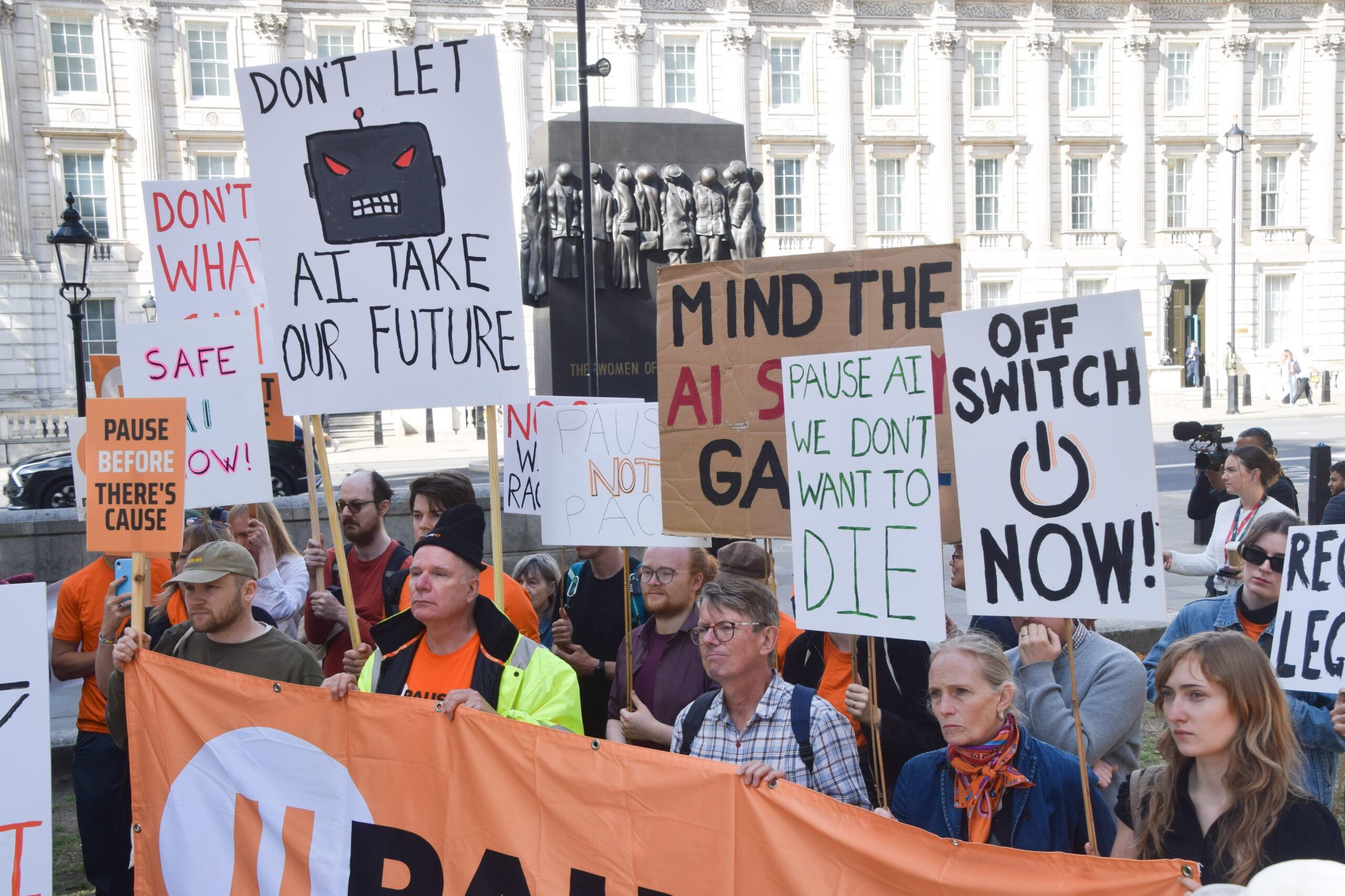
The idea found support from other tech titans like Sam Altman and even Elon Musk (usually a skeptic of regulation), as well as nearly 1,400 other employees of frontier AI companies. It spurred calls for Congress to abandon its plans for yet another recess—gasp!—and brought together bedfellows as unlikely as Steve Bannon and Bernie Sanders, who headlined a “Pro-Human Assembly” in Washington yesterday.
So, is this it? Is this the moment when the country comes together in a bipartisan fashion to soberly address a problem before things get really bad?
Not so fast, I’m afraid. The White House has waded into the issue as well.
“The only control or ‘guardrails’ that AI needs is a STRONG AND SMART (High IQ) PRESIDENT,” Trump wrote on Truth Social Monday, and, as he modestly reminded us, “the U.S.A. has that, in spades!” He went on to claim in successive posts that AI risk was a “HOAX” pushed by “Revolutionaries for a Bad and Evil Cause.”
Trump’s messaging has been amplified by the Pentagon—which proclaimed, via what appeared to be a 2000s-era emo album cover, that it was an “AI-FIRST WAR DEPARTMENT”—as well as the usual coterie of plus-Trumpiste-que-Trump influencers, congressional Republicans, and Palantir executives.
They’ve settled on a master rationale, which is: beat China. They’re also test-driving an internal boogeyman, in the form of effective altruism (essentially, a Bay Area–flavored update of old-fashioned utilitarianism), to whose nefarious, coordinated influence they can attribute any and all skepticism toward the unconstrained development of AI. But every accusation is a confession, as they say, and the White House’s quick convergence around a just-so story is much less organic and grassroots-y than the phenomenon to which it responds.
None of this is to suggest that the arguments of Amodei et al. should be accepted without challenge. (In fact, there are good reasons to interrogate the claims of a for-profit corporation barrelling toward an IPO, particularly when such claims concern technical matters far beyond the ken of the ordinary American.) But it is to say that they cannot be dismissed out of hand, and that to do so in Anno Domini 2026 is sheer recklessness.
And conservatives should be particularly attuned to the potential implications of this far-from-normal technology. We want to conserve things, after all: our values, our institutions, our present way of life. We like the broad contours of our country and our society; while far from averse to improvement, we tend to look warily on swift and radical change, whatever its source.
Yet few developments threaten to bring about swifter and more radical change than the continued advancement of AI. From the economy to warfare to the character of knowledge itself, there is essentially no sphere of human activity that AI is not already shaping. With every passing day the influence of this technology grows, and—at least if you believe the people actually building it—with every passing day our ability to understand and direct this influence diminishes.
A little humility is called for in the face of such dizzying prospects.
Alas, here again politics intrudes. Arriving at such an approach is only going to get harder; for, as the above developments suggest, AI is acquiring the sort of polarization its newness and singularity had heretofore warded off. The partisan battle lines are being drawn. By the time 2028 rolls around, each party’s stance on AI may have ossified, with the most probable outcome looking like an AI-maximalist Republican Party and an AI-skeptical Democratic Party. And once polarization sets in, we can say goodbye to rational discourse.
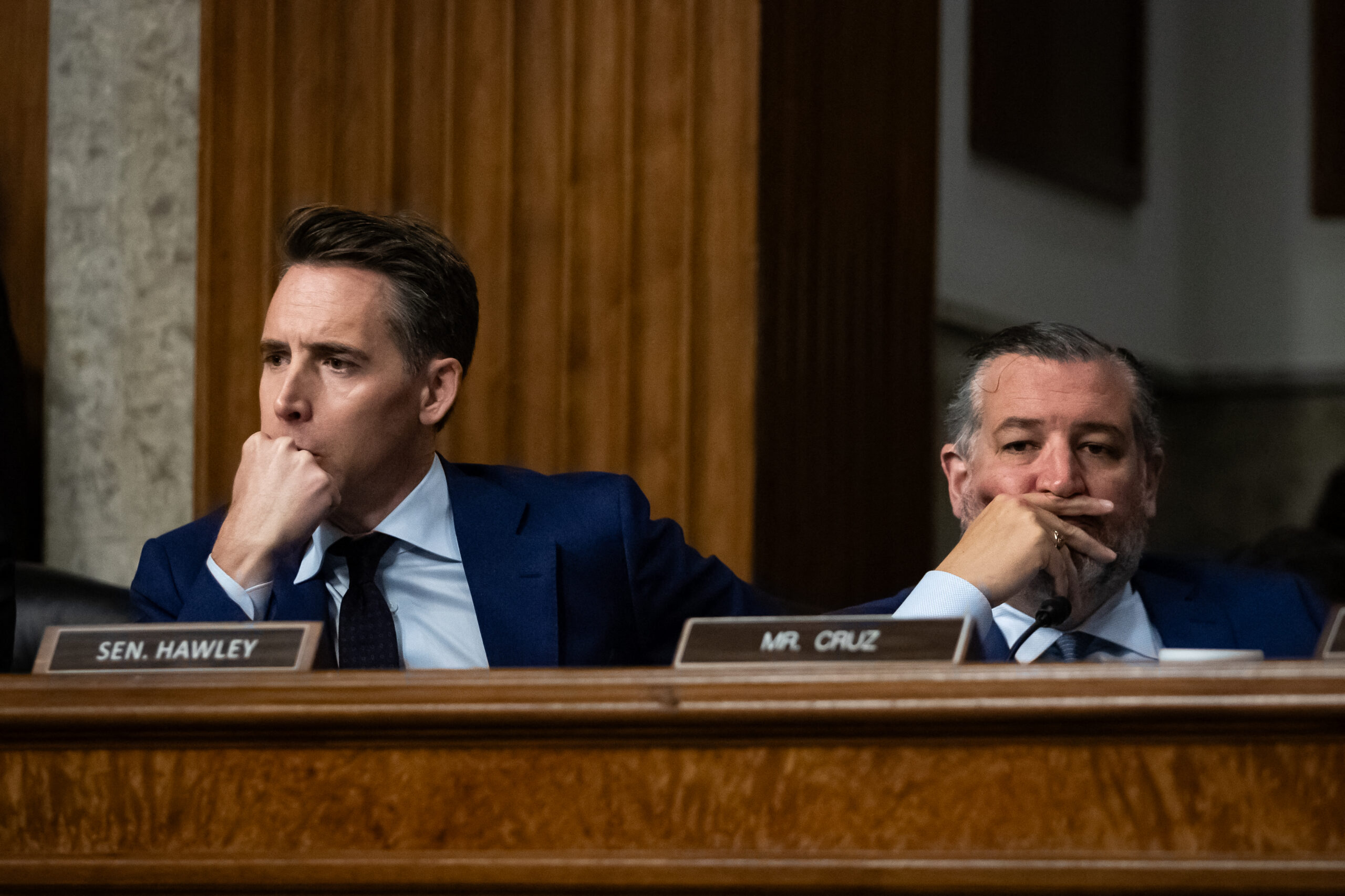
Fortunately, we are not there yet. The right is continuing to have a robust intra-movement debate (sometimes literally, as in the case of last week’s face-off between the AI critic Joe Allen and the AI booster Joe Lonsdale). Against the optimism of the Trump White House and much of the congressional GOP, one can set the skepticism of Steve Bannon and Tucker Carlson, Josh Hawley and Ron DeSantis. For conservatives, the next year and a half will therefore prove decisive.
The post Will Conservatives Constrain the Machines? appeared first on The American Conservative.
Left-wing curators make exhibits of their own stupidity.

You just can’t trust archaeologists anymore. Earlier this year, some claimed to have found the bones of Ivar the Boneless. It can’t have been him, then, can it?
Dead Viking warlords aren’t the only ones having their remains dug up and rearranged into new and misleading forms. On July 4th, which I’m told is historically significant in some way or other, the Trump administration released a scathing new report on the politicization of museums. Called “Saving America’s Story,” the document reveals how the Smithsonian Institution—particularly its National Museum of American History—has, by the open admission of its director Anthea Hartig, endeavored to turn the preservation of the past into “a tool of social justice.”
Hartig, as the report also notes, has claimed that she was “propped up” in life “by the cushions of whiteness and the pillows of the bourgeoisie,” so naturally Trump has decided to pick a large public pillow-fight with her in return. This doesn’t sound like a very difficult thing to do, as Hartig has openly stated her intention to “problematize” this year’s 250th anniversary of the Declaration of Independence by moving away from a traditional “Anglo-centric” focus on the event, perhaps by claiming the US actually gained its independence from China or Uruguay.
Trump’s latest salvo in this duel has been the placement of large signs outside Smithsonian sites, alerting visitors to the fact many of the displays within are intentionally misleading, and directing them toward unnamed alternative sources of “accurate information regarding American history” instead. As Trump is the same man who once said America’s Continental Army successfully “took over the airports” in 1775, perhaps his signs will redirect tourists toward Washington’s Museum of Science Fiction (admittedly, this whimsical destination hasn’t actually opened yet, but to those with such a profound grasp of chronology as Trump and Hartig, surely such a tiny quibble won’t matter).
To return to the report: it notes that visitors to the Smithsonian will find “no major exhibit” relating to the Founding Fathers in which they are not “introduced chiefly through their connection to slavery.” And if they don’t really have much connection to slavery, then why not just make one up?
An exhibit devoted to Benjamin Franklin’s discoveries about electricity arbitrarily wonders whether he ever decided to stage experiments in running high-electric voltage through the body of “an indentured servant or an enslaved person.” If so, the exhibition reluctantly admits, “he never mentioned them in reports of his work.” Hard to prove a negative, I suppose.
Within Hartig’s expertly problematized Smithsonianland, absolutely everything that exists in America now, or has ever existed in the past, is condemned as racist, sexist or homophobic, no matter how trivial it may be. Visitors are solemnly informed that “ukuleles are both a product of U.S. imperialism and a potent symbol of Native Hawaiian resistance” and that Mickey Mouse carries the “vestiges of longstanding traditions of blackface minstrelsy.”
The museum has also selected weird new talismans to place in Perspex cases for its visitors to gaze upon. One such artifact is a gown with giant butterfly wings sewn onto the back, which someone named Jairo Javier Morales wore to his college graduation ceremony in 2020 in order to “expand the boundaries of belonging” by publicly “coming out” as “queer, Mexican and undocumented” in it. (One wonders whether ICE has lepidopterists on staff).
Trump’s report frames all this as being specifically about undermining age-old straight American values in favor of brand-new gay Mexican ones, but it is in fact part of a wider movement to convert museums all over the world into vehicles for anti-Western sentiment. The winner of the European Museum of the Year Award for 2025, for instance, went to England’s Manchester Museum, and not just because it contained an entire gallery full of Andy Burnham’s favorite vintage 1980s Smiths t-shirts.
The Museum reopened after a major refit in 2023. I would have guessed this was meant to spruce the place up, maybe give the staff a chance to sharpen the T-Rex teeth and bleach the mummy bandages. Apparently not. When the museum reopened, it had been transformed into a giant monument to the modish political preoccupations of the present. Yes, the dinosaurs and the dead are still there, but radically repurposed. Manchester Museum’s director, Esme Ward, emoted that:
Manchester Museum was born of incredible civic spirit, but it was also born of empire and of racism and we have to grapple with the legacy of that. We want to do that in a way that recognizes the harm, but also encourages healing.
One way of doing this was to give away many of the building’s exhibits in acts of “cultural repatriation”, such as the 174 “ritual objects” it returned to Australasian Aborigines in 2023. “We believe this is the future of museums,” said Esme Ward at the time: becoming empty buildings. Manchester Museum does actually contain some literal empty glass boxes, said to “contain” species driven extinct by evil white industrialism. So, not the Giant Moa (killed off by New Zealand’s Maori) then.
Even stuffed birds, Giant Moa or otherwise, are denounced in Manchester; there are more male avian samples than female ones in their inventory, curators lament, because the Victorian “cis, white, straight men” who collected them were all sexists. This can also be seen in how the antique taxidermy displays are arranged with a mommy bird, a daddy bird, and nests of baby birds, in queerphobic attempts to reproduce the oppressive heterosexual “nuclear family”.
The remodeled Museum also has a special “Decolonize! Trail”, described as being “an intervention”. Sounds like the curators are in need of one of those themselves. Staff have even sought to somehow “decolonize” their mineral collection: too much alabaster, not enough coal.
Manchester Museum aims to be “the most inclusive, imaginative and caring museum you’ll ever visit”. To this end, it contains special “safe spaces” for those who feel too overwhelmed by its exhibits to be able to cope with them. Like anyone at all who happens to possess any genuine knowledge about real-life history, for example.
Nor is this mania limited to Manchester. In 2021, Holland’s Rijksmuseum organized an exhibition of paintings all “about” colonialism, most of which were not really about colonialism at all. One, The Pipe Smoker, just showed a man smoking a pipe. But, as a censorious caption helpfully noted, he could only smoke this pipe because, somewhere, many thousands of miles away, some black slaves (who were nowhere pictured by the artist) had probably picked his tobacco for him.
A 2022 Hogarth retrospective at England’s Tate Gallery went even further in finding random fictional “connections” between artwork and slavery. One painting showed a white man (Hogarth himself) sitting on a brown chair. Two years after George Floyd, that may as well have been a white man kneeling on a brown chair’s neck, according to the associated caption:
The curvaceous chair literally supports him … The chair is made from timbers shipped from the colonies, via routes which also shipped enslaved people. Could the chair also stand in for all those unnamed Black and Brown people enabling the society that supports his vigorous creativity?
It could, I suppose, be an elaborate, all-encompassing symbol of racial hierarchy and oppression… or it might just be a chair.
Another contemporary curatorial trick is to spuriously imply everything within an exhibition space is secretly gay. London’s Imperial War Museum is a prime candidate for such wokeification, as left-wingers tend to be keen on neither war nor imperialism. Far better to transition the institution into the Anti-Imperialist Queer Museum instead, by hijacking captions describing a display about the plastic surgery techniques developed during wartime to give soldiers new lives after literally having their faces burned off on the battlefield to turn it into a musing as to how such techniques could also be used to give male combatants bespoke vaginoplasties.
What kind of twisted mind sees the face of a tragically disfigured soldier, and immediately thinks “Give him a new wound down below too?” The kind of twisted mind which now runs many of the West’s most prestigious museums and art galleries.
Alongside all the weird, Orwellian ideologues like Anthea Hartig, outfits like the Smithsonian, the Tate and the Rijksmuseum must also employ numerous sane and knowledgeable experts who can see how ridiculous and damaging this all is. So why won’t they stand up and say so?
Perhaps, some far future day, someone will dig up all their coffins and announce he’s found the family of Ivar the Spineless.
The post Blight At the Museum appeared first on The American Conservative.

 Lateo.net - Flux RSS en pagaille (pour en ajouter : @ moi)