 Connexion


NEW: China Makes Major Move In U.S. Backyardhttps://t.co/wrWmc7GCt3
— The Sirius Report (@thesiriusreport) December 19, 2025
In this Thursday, December 18, 2025, lecture to his Beijing high school students, Professor Jiang explains how and why Pax Judaica will come to rule the world and how it might end. He says that this is a theory that provides a model, and most likely a conspiracy theory (saving his own bacon here, as these things cannot be talked about). Yet, in reality, Pax Judaica is being worked on most furiously. We could only look at the zionist efforts to change the thinking of the average Australian after Bondi Beach, where the Aussies are literally being told what to do and threatened if they do not do what Netanyahu, who has just proclaimed Israel as a Great Power, tells them.
The spectacle in the White House when lighting the first Hanukkah Candle needs no explanation. These Zionists literally took Trump by the body, and pulled him to and fro, and in an extraordinary manner, adoration that should possibly be left for the bedroom. And now there is this anti-semitic Rabbi, as a diplomatic position, breathing fire and brimstone on any free speech, conflating Zionism and Judaism, and putting forward in theater lights how the Jews must be protected and, if you are found to be ‘anti-semitic’, how the punishment will follow.
“US President Donald Trump has selected a new special envoy to monitor and combat antisemitism, elevating a Miami businessman and fundraiser named Rabbi Yehuda Kaploun to the role.
“Yehuda is a successful businessman, and staunch advocate for the Jewish Faith and the Rights of his people to live and worship free from persecution,” Trump said on Truth Social, announcing his selection. “With Anti-Semitism dangerously on the rise, Yehuda will be the strongest Representative for Americans and Jews across the Globe, and promote PEACE. Congratulations Yehuda!”
Trump’s announcement elicited a wave of sharply antisemitic comments on the social network, which Trump owns and is favored by his supporters. “No one believes Anti-Semitism is an issue but the Zionists. I will criticize our Greatest Enemy whenever I want,” wrote one commenter.”
Prof Jiang’s theory may be far-fetched in terms of details, but we see the bones of it forming in our world. It is interesting how Jiang briefly outlines four or five major theories of the end times or eschatology, which are closely bound to the world of Judaica and Christian Zionism in historical terms.
Regarding eschatology, I would like to remind everyone of the period when the Mayan Calendar was supposed to signal the end of the world, and hysteria was common. At the end of that, it was the Calendar that ended, and not the world. Prof Jiang ends this lecture with a note on what can be done regarding the assault on the Western world’s implementation of Pax Judaica. If we think of Greater Israel, it is a very real initiative and now on steroids, in terms of what I see without looking for it. See Australia bowing to the hysterical, while voices that make sense receive no reach, only threats.
Another loose theory that has been taking shape for me is that Pax Judaica is intended to be the final saving grace for Pax Americana. If all else fails, they depend on all of them now being Jews and are already writing the narrative that they should be protected. Even Alex Jones is now professing to be a Jew.
Notes and References:
1. Book of Ezekiel, Hebrew Bible
2. Observations Upon the Prophecies of Daniel by Isaac Newton
3. Structure of Scientific Revolutions by Thomas Kuhn
4. The Thirteenth Tribe by Arthur Koestler
5. Kill King 33 by James Downard and Michael Hoffman
6. Words of the Lord (Jacob Frank)
Now Live
https://x.com/i/broadcasts/1LyGBXADpgpxN
https://www.rt.com/russia/629671-putin-nation-press-conference/
Russian President Vladimir Putin will hold his annual year-end press conference in Moscow on Friday, once again combined with the nationwide “Direct Line” question-and-answer session with citizens. The event is scheduled to begin at 12:00 Moscow time (09:00 GMT).
This annual broadcast is traditionally among the year’s most significant political events, serving as a forum for President Putin to address crucial domestic and international topics, covering key social, economic, and political spheres.
Interest in the combined format remains high. According to the Russian TV channel, the number of appeals submitted to the Direct Line exceeded 2.5 million just four hours before the start of the broadcast.
Historically, the Direct Line and the large annual press conference were held as separate events. During the Direct Line, the President responded directly to questions from citizens, including letters, text messages, phone calls and live video links from across the country. The press conference, in turn, focused on dialogue with Russian and foreign journalists.
Since 2001, Russia has hosted 18 separate Direct Line sessions and 16 large-scale presidential press conferences. The two formats were first merged in 2020 due to restrictions caused by the COVID-19 pandemic, which made it impractical to hold both events separately. In 2021, the Kremlin briefly returned to the traditional, standalone formats.
However, beginning in 2023, the combined format was adopted on a permanent basis, bringing together public appeals and media questions into a single extended event.
Donald, you just wrote the most honest colonial confession of the 21st century.
When you say Venezuela must “return” its oil, land, and assets to the United States, you are not talking about law.
You are talking about ownership.
You are saying, out loud, what empire has always believed in private: What lies under Venezuelan soil belongs to Washington. What grows on Venezuelan land belongs to U.S. corporations. What Venezuela builds for itself is “stolen” if it is not built for you.
That is not security. That is naked imperial entitlement.
Let us be precise.
Venezuela did not invade Texas.
It did not occupy Florida.
It did not sabotage American refineries or seize American ports.
Venezuela did one thing.
It took back control of its own oil from foreign companies and tried to build a sovereign project outside the dollar.
From that moment, its fate was sealed. Coups. Sanctions. Freezing of assets. Recognition of a fake “president” who never won an election.
Now you talk about armadas, blockades, and “terrorist” designations.
Everything you accuse Venezuela of, the United States has done on a planetary scale.
You talk about drug trafficking.
Colombia was your closest partner for decades.
You talk about human trafficking. Your own border, your own allies, your own corporations profit from it.
You talk about terrorism. Latin America is full of mass graves and dictatorships installed, trained, and armed by Washington.
And you dare to call a blockaded country a “foreign terrorist organization” for the crime of refusing to hand over its oil.
A blockade is not a policy. It is an act of war carried out with banks instead of bombs. It starves civilians. It denies medicine. It crushes currency. It manufactures the humanitarian crisis you then use as justification for more aggression.
Venezuela did not “steal” anything from you.
Those oil fields were not born with an American flag on them.
What you call “our assets” are contracts that a sovereign nation chose to end.
You are not demanding justice. You are demanding restitution for lost privileges.
Strip away the rhetoric, and the message is simple: The “largest armada” is not there to defend America. It is there to discipline a country that chose sovereignty.
It is a message to every nation in the Global South: If you nationalize, we will strangle you. If you de-dollarize, we will isolate you. If you resist, we will call you terrorists.
Venezuela is not the thief in this story. Venezuela is the house that finally changed the locks.
And the fact that you call its oil “ours” is all the proof anyone needs that the biggest foreign terrorist organization in this equation is not in Caracas.
It is in Washington.
The Greyzone, Max Blumenthal and Wyatt Reed comment:
https://thegrayzone.substack.com/p/julian-assange-sweden-broke-own-laws
The Swedish government violated its own laws by awarding the Nobel Peace Prize to Venezuelan opposition figure Maria Corina Machado, according to an explosive legal brief filed by Julian Assange, the Wikileaks co-founder and former political prisoner who was hounded across the globe, confined in harsh conditions, and subjected to physical and psychological torment over the course of a decade by the US and its allies.
The Nobel committee’s decision to award Machado the Peace Prize — and the 11 million Swedish Kroner ($1.18 million USD) reward which accompanies it — means that “there is a real risk that funds derived from Nobel’s endowment have been or will be… diverted from their charitable purpose to facilitate aggression, crimes against humanity, and war crimes,” Assange stated.
The Wikileaks founder pointed to the “ample public statements… showing that the U.S. government and María Corina Machado have exploited the authority of the prize to provide them with a casus moralis for war,” adding that the explicitly stated purpose of the war sought by Machado and her wealthy Latin American backers would be “installing her by force in order to plunder $1.7 trillion in Venezuelan oil and other resources.”
The Nobel Foundation stands accused of a number of violations of Swedish criminal law, including breach of trust, misappropriation and gross misappropriation, conspiracy, crimes against international law, as well as financing of aggression, facilitation of war crimes and crimes against humanity, and breaching Sweden’s stated obligations under the Rome Statute, to which Stockholm says it is “deeply committed.”
Under Swedish law, “Alfred Nobel’s endowment for peace cannot be spent on the promotion of war,” Assange noted. “Nor can it be used as a tool in foreign military intervention. Venezuela, whatever the status of its political system, is no exception.”
By granting Nobel funds to Machado, Assange argues that the Committee is effectively financing “a conspiracy to murder civilians, to violate national sovereignty using military force…” By refusing to end payments, “they flagrantly violate Nobel’s will and clearly cross the threshold into criminality,” he alleged. The Wikileaks co-founder seeks the “immediate freezing of all remaining funds and a full criminal investigation” into Committee members who awarded the prize.
The Nobel Prizes were established in 1901 according to Swedish inventor Alfred Nobel’s last will and testament, which was later incorporated into the Swedish and Norwegian legal systems. The Peace Prize, which is meant to be bestowed on the figure who has contributed most to “fraternity between nations,” the “abolition or reduction of standing armies,” and “the holding and promotion of peace congresses,” has served as a cornerstone of Scandinavian soft power ever since.
Since its inception, however, the prize was marred by controversy due to the violent legacy of its recipients, and the political ambitions of its Norwegian sponsors. In the case of one of the Prize’s first winners, US President Theodore Roosevelt, the Norwegian Nobel Committee was criticized at the time for overlooking the American statesman’s naked warmongering in Latin America in order to curry favor with the nascent US empire. The New York Times sardonically observed that “a broad smile illuminated the face of the globe when the prize was awarded … to the most warlike citizen of these United States.”
The same dynamic is at play in the Caribbean once again, according to Assange, as the Nobel Committee crowns a Venezuelan politician best known for her unhinged appealsfor foreign military intervention and her dedication of her Nobel victory to US President Donald Trump.
As Assange explained, Trump’s massive buildup of US military forces off the coast of Venezuela “has already committed undeniable war crimes, including the lethal targeting of civilian boats and survivors at sea, which has killed at least 95 people.”
“The Office of the United Nations High Commissioner for Human Rights labeled these U.S. coastal strikes against civilian boats “extrajudicial executions,” the Wikileaks co-founder wrote. And the “principal architect of this aggression” was none other than Trump’s Secretary of State Marco Rubio, who “nominated María Corina Machado for the peace prize.”
The awarding of the Nobel Peace Prize to a figure as clearly unqualified as Machado – and in apparent violation of Swedish law – raised questions about whether the Committee had been influenced by powerful outside interests. Machado’s nomination for the prize by the US Secretary of State had an undeniable impact on the decision, as the Nobel ceremony serves as a central channel of Norwegian soft power. But inside Oslo, a political powerbroker determined to return to power in his family’s native Venezuela may have also played a role in swinging votes for Machado.
He is Thor Halvorssen Jr., the son of a CIA asset and wealthy Venezuelan aristocrat who held positions in neoliberal Venezuelan governments before the election of Hugo Chavez. Halvorssen is also the first cousin of Leopoldo Lopez, the author of several military coups against Chavez and Maduro, and the founder of the US government-sponsored Popular Will party which has traditionally led the way for the radical opposition.
As the founder of the Oslo Freedom Forum, a self-proclaimed human rights group which openly advocates for toppling governments targeted by the West, Halvorssen presides over a network of Western-backed regime change activists. At the 2024 Oslo Freedom Forum, Halvorssen played host to Machado, who clamored for Maduro’s removal through a video link-up from Venezuela, where she was supposedly “in hiding.” This year’s Forum featured Machado’s top advisor, the Spain-based Pedro Uchuruttu, as well as her daughter, Ana Corina Sosa. When the Nobel Committee awarded Machado with its peace prize in October, the Oslo Freedom Forum issued a press release celebrating the decision for “chang[ing] the dynamics” in Venezuela.
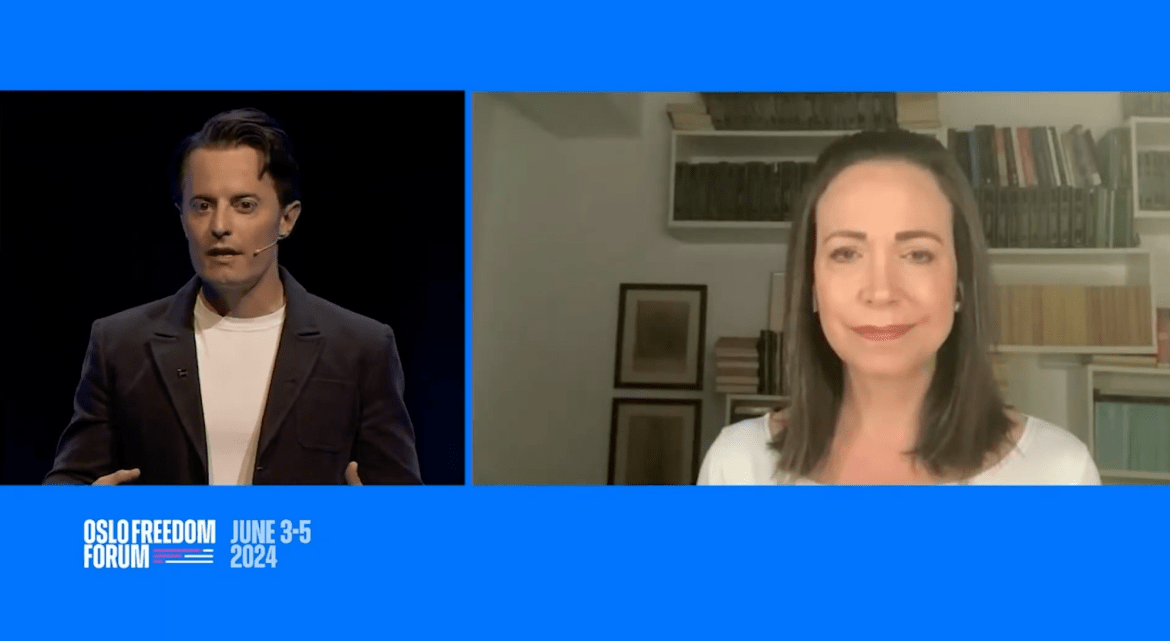
The Norway-based Fritt Ord Foundation is a key link between Halvorssen’s Oslo Freedom Forum and leaders of the Nobel Committee. The Oslo Freedom Forum declares on its website that Fritt Ord “was among the first to endorse” it. While providing funding to Halvorssen’s regime change outfit, Fritt Ord awarded Jorgen Watne Frydnes, the Norwegian Nobel Committee Chair, with its 2021 Freedom of Expression Tribute. During his speech awarding the Nobel Prize to Machado, Frydnes likened the right-wing coup plotter to Nelson Mandela. With geriatric members of the Norwegian royal family seated just a few feet away, he went on to call for Maduro to step down and allow Machado to preside over a “democratic” transition.
Frydnes also happens to be the former director of the Norwegian Helsinki Committee, a think tank focused on supporting the Ukraine proxy war, which is a formal partner and supporter of Halvorssen’s Oslo Freedom Forum.
Among the five judges who awarded Machado her prize was Kristin Clemet, a Norwegian politician who was also awarded the Fritt Ord Freedom of Expression Tributein 2017. Clemet is the managing director of a liberal Norwegian think tank called Civita which officially partners with and supports Halvorssen’s Oslo Freedom Forum.
Even before she had officially received the award, Machado’s entourage drew accusations of corruption and illegal enrichment after a handful of insiders seemingly used advanced knowledge of her imminent win to rake in close to $100,000 on the Polymarket betting site.
The odds of Machado winning surged from 3.75% to 72.8% just hours before the Nobel Committee officially informed Machado of her victory. One unusually prescient bettor won $65,000 gambling on the Venezuelan opposition figure. “It seems we have been prey to a criminal actor who wants to earn money on our information,” said Kristian Berg Harpviken, the head of the Nobel Institute.
Months later, The Nobel committee still has yet to conclude its investigation into the corruption scandal. As of publication, the committee did not respond to a request for comment by The Grayzone.
For what promotes itself as the world’s premiere peacemaking institution, it may be too late to undo the damage wrought by giving the Nobel Prize to an avowed champion of violent regime change.
“Using her elevated position as the recipient of the Nobel Peace Prize, Machado may well have” already “tipped the balance in favor of war,” Assange concluded.
Michael tells what most probably happened with the so-called announcement of action or war against Venezuela. Michael and Richard also explains the National Security Strategy and how it really is intended to work.
By Zamir Awan
The official visit of President of the Republic of Indonesia, H.E. Prabowo Subianto, to Islamabad from 8–9 December 2025 marks a defining moment in Pakistan–Indonesia relations. Undertaken at the invitation of Prime Minister H.E. Muhammad Shehbaz Sharif, this landmark visit—President Prabowo’s first to Pakistan—coincides with the 75th anniversary of diplomatic relations between the two countries. The timing could not be more meaningful. At a moment of profound global uncertainty and regional realignment, Islamabad and Jakarta have chosen to reaffirm trust, deepen cooperation, and chart an ambitious path forward grounded in shared values and common aspirations.
Pakistan and Indonesia are not merely long-standing partners; they are nations connected by history, culture, faith, and a shared outlook on global affairs. As the world’s second- and largest Muslim-majority countries by population respectively, both occupy pivotal positions in their regions and carry responsibilities that extend beyond national borders. Their partnership, therefore, holds promise not only for bilateral gains but also for broader regional stability and global cooperation.
A Visit of Symbolism and Substance
President Prabowo’s visit was rich in both symbolism and substance. It followed the last presidential visit from Indonesia in 2018, when President Joko Widodo traveled to Pakistan, and it underscored continuity as well as renewal in bilateral ties. During his stay, President Prabowo held delegation-level talks with Prime Minister Shehbaz Sharif and met President Asif Ali Zardari. He was also called on by the Chief of Army Staff and Chief of Defence Forces, Field Marshal Syed Asim Munir, reflecting the comprehensive nature of the engagement and the importance both sides attach to strategic dialogue.
The discussions covered a wide-ranging agenda aimed at strengthening cooperation across multiple sectors, including trade and investment, defence and security, health, information technology, climate change, education, and culture. The signing of seven Memoranda of Understanding (MoUs) and agreements during the visit gave concrete expression to shared intent and laid the groundwork for sustained collaboration.
Indonesia and Pakistan: Natural Partners
Indonesia’s global and regional stature makes it a natural and valuable partner for Pakistan. Strategically located between the Indian and Pacific Oceans, Indonesia is the fourth most populous country in the world, with over 284 million people, and the largest Muslim-majority nation. As a member of the G20, a founding member of ASEAN, and an active participant in the Organization of Islamic Cooperation (OIC), Indonesia plays an influential role in shaping regional and global agendas. Its successful presidency of the G20 in 2022, culminating in the Bali Summit, further highlighted its diplomatic credibility and leadership capacity.
Pakistan, with a population of approximately 250 million, is the world’s fifth most populous country and the second-largest Muslim-majority nation. It occupies a strategic crossroads linking South Asia, Central Asia, the Middle East, and China. As a member of the OIC, the Shanghai Cooperation Organisation (SCO), and numerous regional and global forums—and as the only Muslim country with nuclear capability—Pakistan brings a unique strategic perspective and considerable potential to any partnership.
These complementary strengths make Pakistan and Indonesia well-positioned to work together in shaping a more balanced, inclusive, and multipolar world order.
From Shared Values to Shared Action
The real strength of Pakistan–Indonesia relations lies in the convergence of values and interests. Both countries have navigated complex political transitions, faced developmental challenges, and demonstrated resilience in the face of adversity. They share a commitment to sovereignty, multilateralism, peaceful coexistence, and socio-economic development. This common ground has fostered mutual understanding and trust over the decades.
The seven MoUs signed during President Prabowo’s visit reflect a pragmatic and forward-looking approach to cooperation. In education, the mutual recognition of higher education degrees and the establishment of scholarship programs for Pakistani students in Indonesia will promote academic exchange, capacity building, and people-to-people connectivity. These initiatives will help nurture a new generation of scholars and professionals familiar with each other’s societies and cultures.
In the health sector, collaboration in healthcare services—including the deployment of Pakistani doctors and medical experts to Indonesia—addresses immediate needs while building long-term institutional linkages. This partnership underscores the shared belief that human development lies at the heart of national progress.
Trade and economic cooperation featured prominently, with agreements aimed at enhancing halal trade and certification and supporting small and medium-sized enterprises (SMEs). Given the size of their domestic markets and their expanding middle classes, Pakistan and Indonesia have much to gain from closer trade ties, joint ventures, and technology sharing. SMEs, in particular, are engines of employment and innovation, and cooperation in this area can yield tangible benefits for ordinary citizens.
Security cooperation, including efforts to combat illicit drug trafficking and enhance law enforcement coordination, reflects shared concerns and responsibilities. By working together to address transnational threats, both countries contribute to regional stability and the safety of their peoples.
Agreements on archives and historical preservation may appear modest at first glance, but they carry deeper significance. Preserving historical records strengthens institutional memory, promotes cultural understanding, and reinforces a shared sense of identity and purpose.
Economic Promise and Strategic Opportunity
Despite strong political ties, economic engagement between Pakistan and Indonesia remains below potential. The renewed momentum generated by President Prabowo’s visit offers an opportunity to address this gap. Both countries possess abundant natural resources, youthful populations, and growing technological capabilities. By pooling resources, sharing expertise, and aligning development strategies, they can accelerate growth and enhance resilience.
Indonesia’s experience in industrial diversification, digital governance, and sustainable development can offer valuable lessons for Pakistan. Conversely, Pakistan’s strengths in agriculture, textiles, human capital, and emerging technology sectors can complement Indonesia’s economic priorities. Joint ventures in energy, infrastructure, and climate adaptation could further deepen cooperation and contribute to shared prosperity.
People-to-People Connectivity: The Foundation of Partnership
Ultimately, the durability of any bilateral relationship rests on people-to-people ties. Cultural exchanges, tourism, academic collaboration, and media engagement help translate diplomatic goodwill into lasting bonds. Pakistan and Indonesia, bound by shared faith and cultural affinities, are well-placed to strengthen these connections.
Enhanced connectivity will also help counter stereotypes and foster mutual respect. As citizens learn more about each other’s histories, aspirations, and challenges, the partnership will gain a human dimension that transcends official agreements.
Looking Ahead with Confidence
The visit of President Prabowo Subianto has injected new energy into Pakistan–Indonesia relations at a time when cooperative diplomacy is urgently needed. It has reaffirmed that trust, dialogue, and collaboration remain powerful tools for addressing shared challenges and seizing common opportunities.
As both nations look to the future, the message is clear: close cooperation is not a choice but a necessity. By leveraging each other’s strengths and supporting one another through challenges, Pakistan and Indonesia can help shape a more peaceful, prosperous, and just regional and global order.
The fruits of this visit will not be measured solely by signed documents, but by the tangible improvements it brings to the lives of ordinary people—through jobs created, skills enhanced, healthcare improved, and horizons expanded. With sustained commitment and mutual respect, the partnership between these two brotherly Muslim countries can become a model of South–Southeast Asian cooperation.
Seventy-five years after establishing diplomatic ties, Pakistan and Indonesia stand ready to write a new chapter—one defined by confidence, collaboration, and a shared destiny.
Author: Prof. Engr. Zamir Ahmed Awan, Founding Chair GSRRA, Sinologist, Diplomat, Editor, Analyst, Advisor, Consultant, Researcher at Global South Economic and Trade Cooperation Research Center, and Non-Resident Fellow of CCG. (E-mail: awanzamir@yahoo.com).
Foreign Minister Sergey Lavrov’s statement and answers to media questions at a joint news conference following talks with Foreign Minister of the Islamic Republic of Iran Abbas Araghchi, Moscow, December 17, 2025
[Note: We posted the highlights but the context makes it so much clearer]
Media members,
Foreign Minister of Iran Abbas Araghchi and I held detailed and substantive talks today and, as always, they were held in a friendly, constructive, and trust-based atmosphere.
We stated progress in Russia-Iran relations which have become significantly stronger in recent years. In 2025, the Treaty on Comprehensive Strategic Partnership between the Russian Federation and the Islamic Republic of Iran was signed and entered into force on October 2. The fact that President of Russia Vladimir Putin and President of Iran Masoud Pezeshkian put their signatures under this treaty underscores its importance for Moscow and Tehran.
We discussed the tasks set by our respective presidents during their meeting in Ashgabat last week and expressed confidence that once implemented this treaty will give a powerful boost to bilateral interaction and help us align our approaches to regional and multilateral issues with a primary focus on expanding the capabilities of the two countries in the interest of improving stability and security in our common region.
We noted the particularly trust-based nature of the political dialogue at the top, intergovernmental, and interparliamentary levels, as well as at the interagency and ministerial level. Civil society contacts are expanding to further strengthen neighbourly ties between our countries.
We highly praised the advanced level of practical bilateral cooperation in trade, the economy, and investment. Trade has been steadily up by more than 10 percent for the second straight year, over 15 percent last year. The Permanent Russian-Iranian Commission on Trade and Economic Cooperation is fully operational with its co-chairs, Minister of Energy Sergey Tsivilyov and Iranian Minister of Petroleum Mohsen Paknejad, remaining in contact at all times. We discussed the importance of making thorough preparations for the next meeting of the intergovernmental commission, which will take place in Tehran in February 2026.
We share a common view on the importance of promoting business ties. In this regard, the entry into force of the Free Trade Agreement between the EAEU and Iran this year, and Tehran obtaining observer status in December 2024, is of utmost importance. We are interested in continued expansion of the legal and regulatory framework between our countries with an eye towards eliminating trade barriers.
We underscored the importance of carrying out flagship infrastructure projects, including the Bushehr Nuclear Power Plant. With the support of the Russian personnel, it continues to operate in standard mode and remained operational even amid the June aggression by Israel and the United States. We reviewed in detail the status of the implementation of the project to build the Rasht-Astara Railway section financed through a state loan provided by Russia. The construction of this railway is monitored by our respective presidents as a priority project. The railway is the key to the full-on launch of the western branch of the strategic North-South International Transport Corridor.
The exchange of views on international and regional issues reaffirmed our overlapping positions or close views on most matters. We spoke in favour of further democratisation of international life based on multipolarity, which is on track to become a reality in full accordance with the principles enshrined in the UN Charter that have been sabotaged by the collective West for many decades now.
The objective course of history warrants the implementation of the lofty principles of the UN Charter. Importantly, these principles must be acted upon, respected and applied in practice not occasionally, but exclusively as an indivisible and interdependent whole.
This strongly resonates with the Ukraine conflict, where the collective West is pushing to manipulate every provision of international law and to replace them with its own “rules” that are at odds with the universally recognised international legal norms and serve only the push of the collective West, above all Europeans, to continue their neocolonial policies aimed at living off other nations the way they did over the past 500 years starting in the era of colonialism. The neocolonial economic, trade and financial dependence of African countries, as well as many countries in Asia and Latin America, on the West has remained unchanged to this day.
We denounced the use of unilateral coercive measures that undermine international law which fact has become particularly glaring amid the Ukraine crisis. Europe is trying to scuttle the constructive ideas put forward by the Trump Administration, as it violates every rule and principle that have until now governed international economic and financial relations, encroaching on property that the West itself had only recently declared inviolable, and eroding in many ways the principles promoted by Europeans, including as part of the globalisation efforts. What we are witnessing today is a process of fragmentation, not globalisation.
Speaking about the use of unilateral coercive measures, we stand fully in solidarity with Iran and a number of other countries. We advocate creating a group of countries that have a stake in countering this lawless behaviour. I believe this process will gain ever more supporters as it moves forward. We agreed to consolidate members of the international community who share these approaches. We will continue substantive work to neutralise the negative impact of illegal sanctions on the economies of our respective countries.
We covered in depth the Iranian nuclear programme dynamics amid the unapologetically aggressive and unlawful anti-Iranian policies adopted by a group of Western countries. Once again, Russia confirmed its readiness and willingness to help its Iranian friends identify acceptable solutions to overcome the nuclear dossier-related crisis created by the West. Acting in violation of all existing agreements and regulations that are legally established by the UN Security Council, Western Europeans are doing everything in their power to re-impose UN sanctions on the Islamic Republic of Iran, even though these sanctions expired more than a month ago alongside Security Council resolutions that were used to impose them.
We decry such disregard for law and international legislation, and the attempts to prioritise self-serving interests over the principles of the UN Charter. We hope that UN Secretary-General Antonio Guterres, whom they are also trying to weave into this game, can clearly see that he is being nudged into a trap and will say no to those who conspire to take advantage of his authority, reputation and office of Secretary-General to push through the Western countries’ self-serving and unlawful plans.
Clearly, any decisions regarding potential arrangements that could put an end to the current crisis and put the process on a constructive track must be taken exclusively by the Iranian government based on the interests of the people of the Islamic Republic of Iran, and with full respect of its right, as a full-fledged member of the Treaty on the Non-Proliferation of Nuclear Weapons, to enrich uranium for peaceful purposes.
We will continue to deepen our cooperation at the UN, the SCO and BRICS. We covered several important regional issues, including the situation in the Middle East, primarily, the Palestinian territories, the South Caucasus, the Caspian region, Afghanistan, and neighbouring countries.
I would like to close by once again expressing satisfaction with the outcomes of the talks and to thank my Iranian counterpart for accepting the invitation to visit Russia.
Question (retranslated from Farsi): International relations are getting more intricate by the day. The international situation is marked by securitisation. As a permanent member of the UN Security Council, what can Russia suggest in order to keep international law intact? How serious is Russia about fortifying multilateral policy on international platforms? Is Russia ready and willing to support BRICS and the SCO?
With the US seeking dominance, especially in the context of the ongoing developments in the Caribbean, is the UN under threat of falling apart?
Sergey Lavrov: As President Putin has repeatedly made it clear, including in his most recent remarks, the UN is the finest creation of diplomacy in the entire history of humanity, because there has never been a universal entity that would bring together all independent states of the modern-day world. This organisation is vested with authority and mandates in virtually every sphere of human activity, ranging from security and disarmament to the economy, investment, climate protection, and now also AI and other cutting-edge achievements in ICT.
The UN system, which comprises around 20 specialised agencies and institutions, is, by all accounts, unique. However, just like any other bureaucracy, it is affected by intrinsic flaws. Regrouping the currently functioning entities is the order of the day. UN Secretary-General Antonio Guterres has spoken in favour of this change as well. In his UN80 Report released ahead of the UN anniversary, he pointed out that the organisation was overstaffed, noting that the opportunities to conduct personnel optimization looked good. I am confident that it will end up taking place eventually.
At the same time, based on the experience and impressions from my contacts with my colleagues in Europe, reforming the UN Secretariat and its units and departments will be no small feat, but still a much less daunting endeavour than reforming the EU bureaucracy in Brussels which has broken every record known to humanity. We even went as far as to draw the attention of the senior officials from the UN Secretariat to what is happening with the Brussels-based elite that continue to attempt to usurp the powers and legitimate rights of the sovereign governments of nation states.
Truth be told, the UN Secretariat has never come even close to such an adventurous undertaking. However, there have been half-hearted attempts by certain Secretariat bureaucrats, primarily in New York, to shove their own ideas down the throats of UN member states. In most cases, these attempts were backed by our Western colleagues. We brought this to their attention during the discussions that followed the Secretary-General’s report on UN reforms. Without a doubt, this issue will take centre stage in the context of overcoming disproportionate representation of the Western countries at the UN Secretariat, where the bulk, if not all important positions (with extremely rare exceptions), are held by citizens of Western states or citizens of other countries with second Western, mainly US or UK, citizenship.
This violates the UN Charter’s requirement for fair geographical representation across all bodies serving the organisation. This is kind of a congenital/acquired disease.
The US actions in the Caribbean are rejected by almost all countries except Europe. The latter have hunkered down and remain silent with regard to what Washington is doing. All they can think of is to persuade the Trump Administration to go down the European path on the Ukraine issue in order to perpetuate the war unleashed by the West against the Russian Federation and, as I said earlier, to bring the Americans over to their side of the fence and to prevent them from advancing their constructive agenda aimed at resolving the Ukraine crisis.
All other countries have made their positions clear. We are very concerned about what the US Navy is up to and, more broadly, about the bellicose rhetoric of the Pentagon whereby they are planning a ground operation on top of illegal actions involving the sinking of civilian vessels without trial or investigation in the Caribbean Sea. Looking at the prevailing balance of power in the international arena, all of the above undermines hope that agreements can ever be reached and honoured. Nevertheless, the United States remains open to a dialogue, but not on all issues. President Trump claims that he has made every decision there was to make on a number of issues, and carrying them out is all that’s left to do.
Nonetheless, we welcome the positive side of the current Trump Administration as compared to the administration led by Joseph Biden, which refused to talk to anyone about anything and was incapable of any meaningful actions to begin with.
Your question was what we think about BRICS and the SCO. Unlike the EU, or what has become of it, and unlike NATO with its discipline of the rod, these are truly constellations of a new type. Incidentally, the EU and NATO alike are being subjected to attempts by their administrative heads, the head of the European Commission and NATO Secretary General, to bring them to heel.
If you ever have a chance to read what these characters have to say, you will get an impression that they think of themselves as the high and mighty political leaders of our time, rather than hired bureaucrats who are expected to carry out the will of the member states.
Nothing of the sort can even happen in the SCO or BRICS, which follow the principles of the UN Charter that have been tested over many decades now, namely sovereign equality of states, peaceful settlement of any disagreements, the search for consensus and common agreement on all issues, and concentration of efforts on implementing practical projects based on the principle of mutual benefit.
The work done by the SCO and BRICS will come as a reliable benchmark for making changes that are overdue at the UN and which, I would like to underscore this once again, should lead not to something revolutionary, but exclusively to reaffirmation by all UN members of their commitment to strictly observe all provisions of the UN Charter in their entirety and interconnection. I look forward to our Western colleagues, including the United States, contributing to the efforts designed to achieve such consensus.
Question: You said in your opening remarks that Russia is ready to help Iran look for a way out of the nuclear file crisis. Does it also imply Russia’s readiness to mediate the possible signing of an agreement between Iran and the United States?
Sergey Lavrov: For a number of years, Mr Abbas Araghchi and yours truly have been involved in preparing the Joint Comprehensive Plan of Action, which was adopted in 2015 and approved by the UN Security Council several months later.
Russia, as well as the other participants in this process, is deeply involved in the details that constitute the basis of that agreement and the details of how it was destroyed by the United States. This is the cause of the current problems. Those who have destroyed the JCPOA and undermined the UNSC resolution that approved it are now trying to shift the blame onto the Islamic Republic of Iran. This is clear to everyone.
We maintain contacts and regularly communicate with our Iranian friends. Our presidents communicate, and it is the fifth time that we have met with my Iranian colleague this year. Just like Mr Araghchi, senior advisor to the Supreme Leader of the Islamic Republic of Iran Ali Larijani has visited Russia and met with President Putin.
These issues were discussed. Both Russia and Iran would like to stabilise and normalise the situation, precluding any further use of force. Exclusively political and diplomatic solutions is what we need in the current situation.
Since Russia is cooperating with Iran in the nuclear sphere, we have built and are now expanding the capacity of the Bushehr nuclear power plant. Since we are well aware of the situation in relations between Iran and the IAEA, we regularly discuss the approaches made public by European countries and the United States. Incidentally, we raise these questions during our expert contacts with our American colleagues, urging them to look for mutually acceptable solutions.
Therefore, the mediation services we can offer are well known. President Putin mentioned them during his contacts with Iranian and other representatives, and we also discussed them at the level of foreign ministers.
We are not imposing these mediation services on anyone. If the Islamic Republic of Iran as the main participant in that process decides that such services are necessary, we are ready to provide them, if Tehran’s other counteragents agree.
Question (retranslated from Farsi): We see that the Iranian-Russian relations are at their peak, especially after the entry into force of the Treaty on Comprehensive Strategic Partnership.
On the other hand, you know that our enemies are trying to sour our relations. What do you think about our bilateral interaction and practical efforts in trade, the economy and science, as well as in defence and security, in light of the implementation of the Treaty on Comprehensive Strategic Partnership? What other measures should we take to continue strengthening this common stance?
Sergey Lavrov: Speaking about our practical cooperation in the material sphere – in trade, the economy and investments, we talked about it in detail during our opening remarks at this news conference, so I won’t repeat it.
As you correctly said, we are developing our military-technical cooperation in full compliance with international norms and without violating universal international rules in any way. There are contacts between our militaries, including aimed at training to combat common threats and challenges such as terrorism and drug trafficking. This cooperation will continue.
There are also cultural, humanitarian and educational ties and scientific contacts, which are rapidly developing, both within our bilateral relations and also in the context of Russia and Iran’s participation in various multilateral formats such as BRICS, the SCO and the Caspian Five. The interregional factor and contacts between municipalities are increasing their stance on the agenda of these structures. This is probably the best guarantee of the sustainability of these organisations and associations, because they reach to the ground, to the level of towns and cities, connecting the people living in them with the strong ties of friendship and contacts.
I have very optimistic expectations regarding the further build-up of our strategic partnership in full compliance with the new treaty.
As for additional measures, today you attended the signing of the plan of consultations between our ministries for 2026˗2028. We did not have such documents or used such practice before. We held consultations, but it is the first time that we are planning them for three years ahead. I am confident that this will increase the effectiveness of our foreign policy cooperation as our contribution to the implementation of the tasks set out in the Treaty on Comprehensive Strategic Partnership.
We are ready to develop our ties in all spheres. We discussed this today, and we have reached agreements on a number of specific issues.
Question: Are you discussing the drafting of a new agreement between Iran and the IAEA to replace the Cairo agreement, or can the Cairo agreement be relaunched? If so, is Russia involved in this process?
Sergey Lavrov: We discussed this issue today. My colleague, Mr Araghchi, briefed us on Iran’s stand regarding contacts with the IAEA. We fully share this view, including because any steps in this direction should be based on the good will and fundamental assessments of our Iranian friends after the Israeli and US attacks on the facilities that have been and officially continue to be under the IAEA safeguards.
Of course, it worth noting that the IAEA has not yet expressed its attitude to the fact that facilities under its safeguards have been flagrantly subjected to illegal attacks.
As I have said, we appreciate the good will of the Islamic Republic of Iran, which is ready to resume cooperation with the IAEA despite these facts but not in the interests of promoting the Western agenda. There is no doubt that agreements with the Islamic Republic of Iran are possible if the IAEA Secretariat acts in strict compliance with the powers assigned to it. We wish success to these efforts.
This utterly false representation which we’ve discussed many times, still continues with gusto. It has morphed into a hard-headed unwillingness to examine the matter with care. Hopefully, this explanation by FM Lavrov calms the turbulent waters.
Eva Bartlett reports:
MOSCOW, December 15. /TASS/.
“Former Syrian President Bashar Assad did not coordinate his approaches with Russia prior to his resignation, Russian Foreign Minister Sergey Lavrov revealed in an interview with the Islamic Republic of Iran Broadcasting (IRIB).”
“He did not coordinate any approaches. We maintained close relations with Assad and extended assistance to his government in 2015, when Damascus was effectively besieged and at risk of falling to opposition forces. We established military presence there – air force and naval bases – and actively worked to dismantle terrorist strongholds. Our efforts were collaborative, involving other international partners, primarily Iran and Turkey. Overall, the process was quite positive,” Lavrov stated.
Reflecting on the Syrian National Dialogue Congress, Lavrov noted, “The agreements we reached with our Iranian and Turkish colleagues faced repeated setbacks. These agreements were not entirely dependent on the Assad government. I prefer not to draw definitive historical conclusions now, but many opportunities were missed regarding national reconciliation, consensus, and inviting all political and ethno-confessional groups to participate in dialogue.”
He also recalled the situation a year ago when certain events unfolded in Syria. “At that time, we had no combat units on the ground – only two bases, one air and one naval. The rapid advance of the opposition, led by Ahmed al-Shara’a, was unexpected. They seized territory with little resistance,” Lavrov explained.”
https://tass.com/politics/2059011
BLEAK MIDWINTER | ‘Warmongering’ Trump | No peace | Bethlehem lament |
 A BLEAK MIDWINTER for the world — and George Galloway is LIVE to confront it. As accusations of warmongering swirl around Donald Trump, peace slips further out of reach in Gaza, and Bethlehem marks another Christmas under siege, MOATS goes live with fearless analysis, global perspective, and real-time reaction as the news unfolds.
 Angelo Giuliano — Political and financial analyst — joins George to examine Venezuela, global markets, and the economic pressures driving today’s conflicts. From sanctions to currency warfare, Giuliano explains the forces pushing nations toward confrontation rather than peace. (Twitter: @Angelo4justice3)
 Gerald Celente — Founder of the Trends Research Institute and publisher of Trends Journal. One of the world’s most quoted forecasters joins live to break down US politics, Trump’s global impact, Europe’s decline, and what the next phase of geopolitical instability looks like. (Twitter: @geraldcelente)
Tonight on The Mother of All Talk Shows, George covers: – “Warmongering” Trump and the mounting global backlash. – No peace in Gaza as the war grinds on and diplomacy fails. – Bethlehem’s lament: Christmas under occupation and conflict. – Europe’s decay — political, economic, and moral. – Venezuela, sanctions, and the weaponisation of finance. – Gerald Celente’s outlook for 2026 and beyond. – Gayatri Galloway’s Social Media News Update tracking what the world is really saying. – Your calls LIVE from the UK, US, Europe, the Middle East, and beyond.  Tonight’s MOATS Poll: Which is the greatest threat to world peace — Israel, Islam, or Trump? Vote live in the chat — the strongest views will be read on air.
The President took part in an expanded meeting of the Defence Ministry Board at the National Defence Control Centre of the Russian Federation.
President of Russia Vladimir Putin: Mr Belousov, Comrades,
Today, at the expanded meeting of the Defence Ministry Board, we will discuss our results over the past period and identify priority tasks for strengthening the Armed Forces and enhancing the country’s defence capability.
I would like to highlight that the past year has been a significant milestone in addressing the objectives of the special military operation. The Russian Army has taken and firmly holds the strategic initiative along the entire frontline.
Our troops are advancing with confidence and grinding down the hostile forces, defeating enemy units, its groups forces and reserves, including so-called elite formations trained in Western centres and equipped with modern foreign weaponry.
To date, over 300 communities have been liberated this year, among them major urban centres that the enemy had transformed into heavily fortified strongholds, extensively featuring permanent defensive structures. Yet, they proved unable to withstand the courage and superior military skill of our personnel.
The positions we have seized, the bridgeheads established in recent months, and the unique tactical and operational experience gained in breaching the enemy’s in-depth defences now enable us to intensify the pace of our advance in key strategic sectors. We take pride in the heroism of our soldiers and officers on the front lines, and of all who stand in defence of Russia and the safety of our citizens.
I would also like to acknowledge our comrades-in-arms from the Democratic People’s Republic of Korea. By the decision of Comrade Chairman of State Affairs Kim Jong-un, DPRK personnel were deployed to participate in the liberation of the Kursk Region. They fought with valour and courage alongside Russian soldiers against the enemy and took part in the large-scale and exceptionally difficult mission of demining the liberated Kursk soil.
It is our duty to forever honour the memory of all our fallen comrades and to support their families, their children and parents. The state will fulfil all necessary obligations in this regard. I ask you now to observe a moment of silence in memory of those who gave their lives for the Motherland.
(A moment of silence is announced.)
Comrades, members of the board,
We are aware that that the Kiev regime is backed by the potential of the countries comprising the world’s largest military-political bloc, NATO. Large-scale military assistance is being continuously provided, with advisers, instructors, and mercenaries dispatched, and intelligence data shared.
Amidst such challenging conditions, our troops demonstrate high combat readiness and proficiency. The capabilities of the Russian army are being constantly enhanced, and efforts to strengthen the Armed Forces have been unwavering in recent years.
I refer to the improvement of their combat composition, qualitative advancements in the military command system, in operational and combat training, and, naturally, the increased efficiency of the defence industry, which has rapidly reconfigured numerous production and technological processes and is manufacturing essential products in ever-growing volumes.
Owing to the precise work of the defence-industrial complex, the army and navy are promptly equipped with modern weaponry and hardware. The Ground Forces are receiving missile systems and artillery with high-precision capabilities, loitering munitions, a diverse range of unmanned aerial vehicles, and robotic systems.
The Aerospace Forces are being supplied with upgraded missiles and aerial bombs equipped with guided planning and correction modules, capable of operating effectively in complex jamming environments. Many here are aware of the marked improvement in efficacy achieved recently – at times exceeding 80 percent. I wish to express my gratitude to those involved in this work. This constitutes substantive and tangible support.
This year, the Navy has been augmented with new submarines, including the Knyaz Pozharsky strategic missile submarine cruiser, as well as 19 surface combatants and support vessels.
Successful tests have been conducted for the Burevestnik strategic cruise missile with unlimited range and the Poseidon unmanned submersible. Given their nuclear propulsion systems, these platforms will remain unique and unmatched for the foreseeable future, ensuring Russia’s strategic parity, security, and global standing for decades to come. We will continue to develop these systems, enhancing and perfecting them, but they are already in service.
By the end of the year, the medium-range missile system armed with the Oreshnik hypersonic missile will be placed on combat duty. Its first operational deployment was conducted last November.
The high standards of training of our units and formations, and their ability to fulfil the most complicated tasks have been reaffirmed during regular exercises, including with the participation of our foreign allies and partners, with whom we share the experience we have accumulated during the special military operation.
In particular, I would like to mention the good results demonstrated during the Zapad 2025 joint strategic exercise. All objectives involving the protection of the security of the Union State from potential external aggression have been achieved.
Today, we can see that the geopolitical situation remains tense throughout the world, and even critical in some regions. NATO countries are actively building up and modernising their offensive forces, and creating and deploying new types of weapons, including in outer space.
Meanwhile, people in Europe are being indoctrinated with fears of an inevitable confrontation with Russia, with claims that preparations must be made for a major war. Various figures who have held or continue to hold positions of responsibility appear to have simply forgotten what that responsibility entails.
They are whipping up hysteria, guided by momentary, personal or group political interests rather than the interests of their people. I have said many times that this is a lie and an irrational narrative about an imaginary Russian threat to European countries. But they are doing this deliberately.
The truth is that Russia has always, until the last possible moment tried, even in the most complicated circumstances, to find diplomatic solutions to differences and conflicts. Responsibility for the failure to use these chances lies squarely with those who believe that they can use the language of force with us.
We continue to call for developing mutually beneficial and equal cooperation with the United States and European countries, and for creating a joint security system in the Eurasian region. We welcome nascent progress in our dialogue with the new US administration, which cannot be said of the current leaders of the majority of European countries.
At the same time, we realise that our Armed Forces remain the key guarantor of Russia’s sovereignty and independence in any international situation. As I have stated, we must work consistently to strengthen them.
What I would like to emphasise here are the objectives to be set in the area of military development, taking into account the dynamics of the situation along the line of contact, among other factors.
First. The goals of the special military operation will undoubtedly be achieved. We would prefer to accomplish this and address the root causes of the conflict through diplomatic means. However, if the opposing side and its foreign patrons refuse to engage in substantive dialogue, Russia will achieve the liberation of its historical lands by military means. The task of creating and expanding a security buffer zone will also be carried out consistently.
Second. Work on modernising the Armed Forces must continue at a rapid pace and to a high standard, primarily within the framework of the new State Armament Programme for 2027˗2036, which is currently under development.
As I have repeatedly emphasised, the experience gained during the special military operation, emerging trends in combat tactics, and rapidly developing military technologies must be fully taken into account.
Key areas of the state programme include air and missile defence systems, command and control systems, electronic warfare capabilities, and unmanned aerial vehicles (UAVs) operating in all environments.
Of course, improving our strategic nuclear forces remains a priority. As before, they will play a decisive role in deterring aggression and maintaining the global balance of power.
Today, Russia marks Strategic Missile Forces Day. I would like to take this opportunity to congratulate veterans, service members, and civilian personnel of the Strategic Missile Forces on their professional holiday and to wish them continued success and all the very best.
Third. The Russian army must continue to remain at the forefront of technological progress. This means accelerating the introduction of robotics, information technologies, and new materials into the Armed Forces, as well as expanding the use of artificial intelligence in command and control systems and autonomous combat platforms.
Fourth. It is essential to equip the orbital constellation with next-generation spacecraft. This will provide the troops with high-speed, secure communications, while also significantly improving the quality of intelligence and high-precision navigation data.
Next. In May of this year, the Strategy for the Development of the Navy until 2050 was approved, outlining its prospective configuration. The clear and timely implementation of this strategy will enable the modernisation of the Navy and enhance its effectiveness in carrying out combat tasks across all theatres of military operations.
Furthermore, it is imperative to continue actively developing military and military-technical cooperation with foreign countries – our allies and partners – to strengthen the collective security system and the Union State. Overall, efforts in this direction constitute a significant factor in enhancing regional and international security.
Comrades,
One of the state’s priorities is the expansion of social guarantees for participants of the special military operation and their family members, as well as for all our servicemen.
Over the past year, the Ministry of Defence, in collaboration with the Defenders of the Fatherland State Foundation, has made substantial progress in improving the quality of medical care for wounded servicemen, addressing their rehabilitation and employment needs, ensuring timely payments, and implementing other measures, including additional forms of social support for the families, children, and parents of fallen servicemen.
I must emphasise that there remains work to be done here. Currently, in preparation for the Direct Line, it has become evident that many questions on these topics are being raised. We will undoubtedly revisit this matter with the leadership of the Ministry of Defence.
I would particularly like to commend the heroic efforts of medical officers and personnel, who often perform the impossible to save our fighters and return them to active duty after treatment. Unique experience has been gained in providing medical and psychological support to servicemen with injuries, trauma, and illnesses related to combat operations.
This experience must be incorporated not only into the work of military medical institutions, but also into civilian healthcare, and must be enshrined in legislation.
Undoubtedly, efforts to index servicemen’s monetary allowances must continue, and the pace of providing them with permanent and service housing must not decline. Every Defender of the Motherland must be confident that the state will provide them and their loved ones with all necessary social support.
In conclusion, I would like to once again express my gratitude to the soldiers and officers currently on the front lines, to all participants of the special military operation for their heroism and dedication, and to extend my best wishes to the leadership, all personnel, and civilian staff of the Ministry of Defence for further achievements in service to the Motherland and our people.
I firmly believe that you will continue to steadfastly safeguard the sovereignty and security of Russia.
Thank you for your attention.
The floor is yours, Mr Belousov.
<…>
Vladimir Putin: Comrades,
I would like to thank the Minister for providing a detailed analysis of the status of matters in the Armed Forces and along the line of contact.
As is customary, I will share a few general considerations with you. I will probably not say anything that you do not already know, but I still believe it is important to say it.
I would like to begin with our recent history, with the most recent developments, in order to have a clear idea of where we are now and why we are where we are.
You have heard me say it many times before, yet I think it is worth saying it again. Shortly after the Soviet Union had fallen apart, we thought we would quickly become members of the “civilised” family of European nations and the civilised Western family more broadly. Today, it turns out that civilisation there is nonexistent, and degradation is all there is there, but that is not the point. Back then, we thought it was a good thing and that we would become a full-fledged and equal member of that family. Nothing of the kind happened. You see? Nothing of the kind happened, and we did not become an equal member of that family.
On the contrary, they started going after Russia from all angles, and even ratcheted the pressure up. Almost everything concerning Russia was decided from a position of strength. They would pat us on the shoulder and invite us to attend various events, but the West used force, including military force, to push its Russia-related interests.
Truly so. Supporting separatism and terrorism was clearly demonstrated and carried out by supplying terrorists with weapons and money and providing them with political and media support across the board. Economic restrictions were imposed on us as well, and that, too, is about forceful pressure, and a very serious one at that.
I remember this very well. When we said that we needed to protect our country against terrorism, we were told to do whatever we needed to, but not to do certain things or else we will not be eligible for loans or renewed easy terms.” This was direct forceful pressure and outright restriction in the economic sphere.
Destructive instruments aimed at destabilising Russia from within were also deployed – and this was entirely deliberate. We have seen the same pattern in other countries: mechanisms for undermining domestic political stability were created and put to use.
Of course, by then, the entire post-war security architecture had ceased to function. Everything began to erode rapidly, and the established rules, along with the UN Charter, were cast aside. Consider the events in Yugoslavia. How did that align with the UN Charter? Was that not the use of force? We have spoken of this many times, but the fact remains: they simply did as they saw fit, acting at their own discretion. They would manipulate the situation and force a vote if they could. If not, to hell with it – they applied armed force directly. In the end, they ravaged and dismantled Yugoslavia and fractured the Serbian people, scattering a single nation across different state entities.
I will not dwell now on NATO expansion, though its role is obvious. Even today, we are told we have no right to dictate how others should ensure their security or to deprive them of their choices. We are not depriving anyone of anything. We are not making exceptional demands. We are simply insisting that the promises made to us be honoured. It was publicly stated that NATO would not expand eastward. What followed? They disregarded this entirely, and one wave of expansion followed another. I repeat: we are not asking for anything extraordinary – only that the assurances given to us be fulfilled.
I believe everyone here understands that agreements with the Soviet Union were treated one way, and agreements with modern Russia, after the USSR’s disintegration, quite another. All our interests were simply ignored.
This ultimately led to the coup in Ukraine. What kind of democracy is this, the one we have been lectured about for decades? It was a straightforward armed power grab. Had they gone to the polls – as I have said countless times – they would have won the elections fairly. Nothing stood in their way; victory was assured. But no – they simply demonstrated force, and that was that.
Thereafter, they began violently suppressing the southeast, their southeastern regions, effectively unleashing a war. It was not we who started the war in 2022; it was the destructive forces in Ukraine, backed by the West. In essence, the West itself instigated this conflict. We are only seeking to end it, to stop it. Initially, we pursued peaceful means through the Minsk negotiations, as you will recall. Eventually, we were compelled to introduce a military component once it became clear we were being deceived. That deception has since been laid bare: senior officials have stated unabashedly that they never intended to honour the agreements, but only to buy time to arm and equip Ukrainian forces. They engineered a coup, initiated military operations, and deliberately – I am convinced, deliberately – precipitated a war.
President Trump has said that had he been in office at the time, none of this would have happened. He may well be right. Because the previous administration deliberately brought matters to an armed conflict. And I think the reason is clear: they believed Russia could be swiftly broken up and dismantled. European “swine underlings” immediately joined the efforts of that previous American administration, hoping to profit from our country’s collapse: to reclaim what had been lost in earlier historical periods and to exact a form of revenge. As has now become evident to all, every one of those attempts, every destructive design against Russia, has ended in complete and total failure.
Russia has demonstrated its resilience in the economy, finance, domestic politics, the state of society, and, ultimately, in its defence capability. Yes, there are still many issues and problems in this area.
I can see people here in this hall who came directly from the front, from the frontlines, from the line of combat contact. They are sitting here, I see them. And they know better than anyone that the army still faces many problems; they encounter them every day.
And yet, our Armed Forces have become completely different –fundamentally different. The most important result of the special military operation is that Russia has regained its status as a fully sovereign state. Russia has become sovereign in every sense of the word. We have regained this status to a large extent thanks to your participation, thanks to the contribution of the Armed Forces.
Our army has become totally different. This applies to troop command, tactics, strategy, equipment, and the work and performance of the defence and industrial complex. This also concerns the strategic component: our nuclear shield is more updated than the nuclear component of any officially recognised nuclear power. How much modernised is it, over 80 percent?
Chief of the General Staff Valery Gerasimov: Ninety-two percent.
Vladimir Putin: Our nuclear forces are 92 percent modernised. No other nuclear power in the world has such a level.
We have new armaments and new weapon systems. No one else in the world has these, and no one will for a long time. I have mentioned this before and we know Avangard, Burevestnik, and other systems.
Our ground forces are also growing and strengthening. Yes, I repeat, those who have come from the front know that many problems remain. But these troops are completely different now: they are battle-hardened. There is no other army like this in the world; it simply does not exist.
Yes, the Ukrainian Armed Forces are also going through the ordeal of military action. But, unfortunately for them, just as the Ukrainian state itself is disintegrating – symbolised by the “golden toilets” – their armed forces are also degrading. This is evidenced by the growing number of deserters: more than 100,000 criminal cases for desertion alone have been opened in Ukraine, and the total number of deserters is in the hundreds of thousands. This is a clear sign of degradation.
And our Armed Forces are on the rise. I repeat, much remains to be done, but it will all be done. We have always stated – and I want to reaffirm this – that we remain ready for negotiations and ready to resolve all the problems that have arisen in recent years through peaceful means. The United States administration has demonstrated such readiness, and we are engaged in dialogue with it. I hope the same will eventually occur in Europe. It is unlikely with the current political elites, but it will be inevitable as we continue to strengthen, if not with the present politicians, then with a change of political elites in Europe.
I would like to thank you for your dedicated work in 2025 and express my confidence and hope that all the challenges facing our country will be successfully resolved.
Thank you very much. (Applause.)
All the best.
Usually, the creativity is findable and if not, an understanding of the world is there. Moving into 2026 feels like a dark hole.
President Putin stated this morning: “There is no such thing as a civilized family in the West today – only total degradation.”
The good news is that Lavrov and Putin, in separate conferences, are basically making a new Putin 2007 Munich Style speech:
Lavrov
‘The UN is MUCH easier to reform than European bureaucracy’ — Lavrov
Brussels ‘beating every record there is’
Its elites have been ‘trying to usurp all legal rights of sovereign governments’
Putin
West started to ignore all the rules and the UN Charter
‘Look at what happened in Yugoslavia; they used force, they acted as they pleased’
‘They just destroyed Yugoslavia and the Serbs — so one nation was separated from several countries’
Last year, this time we saw babies starving and dying because of cold and exposure in West Asia-Middle East. This year, we are beginning to see that again. Trump’s peace process in West Asia and Gaza is a complete failure, and was probably built that way. Instead of bringing an end to the murder of Palestinians, the agreement just slowed down the pace of killing and it is picking up again now, widely, across the region.
Trump’s attempt at a peace process for Ukraine is a complete failure .. stacking another failure upon the first. Looking at the Russian speeches this morning, we are moving into another year of a Ukraine war. Hey Ho! Up to the last Ukrainian. Here comes Odessa! (And here ends Europe). No, it is not that the US administration is ‘leaving Europe’, it is only that they ae squeezing them as hard as what they try to squeeze the rest of the world. Of course Europe will bow the knee and even crawl on their bellies.
The current Russian and Chinese announcements are serious and we will post up the transcripts as available. If you’ve never paid attention, this time it is necessary.
Now the west wants a war with Venezuela, or alternatively wants to besiege them to death and steal another few countries as well. This will stack another failure, but will kill a lot of people. Mr Lavrov noted the disgust for this jingoism in his final speech with the Iranian representatives.
I saw an early, unedited copy of Michael Hudson’s new transcript of a Nima interview this morning. He starts by talking about the asymmetry of security. “For the United States, security means the ability to control the whole rest of the world, the environment, other countries. And to the extent that they have sovereignty of their own to act independently, the United States foreign policy feels insecure. But the problem is that when it solves this insecurity by surrounding Asia and the whole rest of the world with this 800 military bases throughout the world, well, this threatens other countries’ security. So there’s a basic asymmetry built into the whole concept of U.S. security to begin with. And that’s the point that Vladimir Putin has spent almost a year now trying to explain to Donald Trump’s team. … the idea is you can’t make America’s insecurity mean the actual military insecurity of other countries.
In looking back over the past year, I can only mourn and lament with Berletic: “Trump Announces Total Blockade on Venezuela (while expanding false pretexts) as Lead up to War Continues…
When I warned everyone Trump filling his administration with neo-con warmongers like Rubio, Hegseth, Waltz, etc. was always going to lead to more senseless, illegal wars of aggression abroad because Trump himself was a neo-con who only told Americans what they wanted to hear during campaign season – this was what I had known would come (along with bombing Iran, Yemen, continuing the war in Ukraine etc) – and desperately tried to warn people about… And here we are.”
China speaks, but it is not available in the normal course of events. We need to look for it. There are problems as well, with Japan being used as the current stalking war horse. Chinese FM Wang Yi declared that China will work with ASEAN to align development strategies, and resist unilateral bullying and cold war rhetoric.
The one area in Africa, the coalition of Sahel States that provided joy to all of us because of its anti-colonial actions, is in this position – The West is attempting to destabilize the situation in Burkina Faso, Mali, and Niger, the countries with which Russia’s cooperation is gaining momentum, Russian Deputy Foreign Minister Sergey Vershinin.
Looking forward, only after some meditation while cleaning. One can medicate and meditate while scrubbing, sweeping, wiping, and cleaning, and that is my solution for the blue funk.  And contemplating the fact that the Shining City upon the Hill is now a Rogue Mess, together with their Chosen Nation.
Lavrov and Iran FM Araghchi Hold Joint Press Conference After Moscow Talks
A few Lavrov quotes:
West is attempting to distort all norms of international law, trying to replace it with their own rules — Lavrov
This just reflects their 500-year neocolonial desire ‘to try to live at the expense of others,’ Lavrov adds
—
Russia reaffirms once again its willingness to help our Iranian friends in looking for acceptable ways to resolve the nuclear crisis that was created by the Westerners — Lavrov
—
BRICS and SCO are organizations of a new type, unlike such NATO or what the EU has turned into — Lavrov
—
‘They are trying to subjugate the will of their member states’
They talk about themselves ‘like they are the greatest politicians of modern times, not some hired employees’
—
Europe is silent on US attacks in the Caribbean to gain Trump’s favor over their Ukraine peace plan proposals — Lavrov
Russia is ‘concerned’ with US Navy striking civilian boats and a probable land op
‘Almost all of the countries find it unacceptable apart from the Europeans’
Europe’s choice is to surrender or die.
By Rotislav Ishchenko at ukraine.ru.
(machine translation)
Alastair Crook, a retired British diplomat, has stated that the European Union is preparing a provocation on a scale comparable to Pearl Harbor, with the aim of drawing the United States into a war with Russia.
In principle, this is not news. We have been writing for two years that the British, realizing that Ukraine has failed and will be buried, have placed their bets on a pan-European war (under the auspices of the United States) against Russia. While Joseph Robinette Biden Jr. was trying to figure out who he was and how he got here, the mechanism for expanding the war was clear: a provocation in the Baltic Sea (less likely in the Black Sea or on the Belarusian border), which would leave Russia with no chance of resolving the crisis without shooting, and an outcry about the “attack” to the country of the EU and NATO, a statement of military support (sending troops and equipment, but without a formal declaration of war against Russia) by the leaders of the EU. In the last act, the United States and Britain enter the scene, demanding that Russia cease fire and threatening to provide all possible support to their allies.
I would like to point out that the mechanism of provocation assumed that in all cases, Russia would initiate military action against a specific country. Moscow, on the other hand, was only faced with the choice of whether to attack the Baltic states, which had blocked Kaliningrad, or to hope for a miracle, sink the transports carrying French and German troops and equipment bound for the Baltic ports, or to express protests, attack the territories of the United States and the United Kingdom in response to their ultimatum, or to agree to a ceasefire and negotiations mediated by them. In the end, acquiescence inevitably led to capitulation (since as soon as one set of demands was met, the West would immediately set forth another), and escalation inevitably led to a global nuclear war.
It is no coincidence that Trump claimed that Biden was leading the country towards a nuclear armageddon. Whether Biden was aware of his actions or was being manipulated by his entourage, the decision-makers in the United States (as well as the majority of the British establishment and the European bureaucracy) believed that Russia would not engage in a nuclear conflict and would retreat. However, there were other politicians in the West who had no doubt that if Russia was pushed to the wall, nuclear mushrooms would grow all over the West – no one would leave without a share. These people came to power in the United States with Trump, and their supporters are gradually pushing back against the European left-liberal supporters of war.
As a result, the United States fell out of the scheme, and Trump openly stated that if Europe wanted to go to war with Russia, it could do so on its own, without the United States. It’s not that the Europeans were particularly eager to go to war, but rather that they couldn’t help but go to war with Russia, as acknowledging defeat in the Ukrainian crisis would completely undermine the left-liberal European elites. To understand why this is significant, it would have political, economic, and social implications on a scale similar to those that shook Russia after the October Revolution and before the outbreak of World War II. The Europe we know will disappear, and a new Europe will be born in agony, compared to which the 1990s in Russia were like a light rain during a summer picnic.
But the Europeans also can’t go to war with Russia. They don’t have the armies, the warehouses, or the ability to quickly deploy the necessary military production. Without the United States, the EU is a paper tiger. Although no, a paper tiger is scarier than the EU without the United States. This is why Alastair Crook emphasizes that the provocation must be so severe and widespread that neither Trump nor other American and European politicians who support de-escalation can avoid going to war with Russia.
By the way, as a loyal subject of His Majesty, Alastair Crook does not mention Britain’s leading role in developing this plan and preparing the provocation. The blame lies with the EU, which intends to drag the United States into a war with Russia, while the United Kingdom simply passed by.
It’s understandable. Most likely, the provocation is unavoidable. The British and the European bureaucracy can’t help but try to seize their last chance. I once wrote that nothing would stop them. They might even detonate a nuclear device in Kyiv to blame Russia. However, the Ukrainian government is not fully in control of the situation. The internal opposition to Zelensky, unable to oust him yet, is attempting to preserve at least some form of Ukraine by pushing Zelensky overboard.
In such a situation, the preparation of a large-scale nuclear provocation, which requires deep secrecy, is extremely difficult, as hundreds of people must be involved in its organization (transportation, storage of the relevant munition, its transfer across the border, security, and other activities cannot be carried out without the involvement of a large number of people). Even if you simply replace the customs officers and border guards at the border with trusted individuals, it will immediately become widely known that something large and secret is being transported.
However, recently, the Ukrainians and the British have started practicing a naval provocation, attacking tankers from any country carrying Russian oil. Russia has already begun responding to the Odessa port and the ships arriving there. In principle, the British Navy and its Ukrainian counterparts can organize a “Lusitania” (with influential Americans on board). However, it is more difficult to prove Russia’s “guilt.” As Poland’s experience shows, it is no longer enough to simply claim that Russia wanted to blow up railway tracks and cause a major disaster; convincing evidence is also required.
Actually, this is the catch: how to organize a provocation in such a way as to shake the imagination of “all people of good will”, and provide “convincing evidence” of Russian “guilt”, and not inherit anywhere, and leave the United States no choice? The task is difficult, but, as experience shows, it is solvable. If British diplomats (even retired ones) start issuing warnings and distancing themselves, it means that the preparations for some large-scale atrocity have entered the final stage or are basically complete, and the London warmongers only need to give the command to launch the operation.
In principle, the supporters of escalation don’t have much time. By March, even if the Armed Forces of Ukraine don’t completely disintegrate and Zelensky still controls some part of Ukrainian territory, Trump should withdraw the United States from the Ukrainian crisis and reorient towards the Indo-Pacific region and Latin America. Moreover, he has announced the beginning of a military operation against Maduro in Venezuela in the near future. If the British and European bureaucrats let the United States out of the Ukrainian crisis and allow it to get involved in others, it will be impossible to bring it back. Washington cannot afford to run around the world like a mad rabbit, and it cannot handle two or three major crises in different parts of the world, either organizationally, resource-wise, logistically, or financially.
In the West, they like to coincide political actions with traditional holiday dates. This way, they are better remembered and evoke more emotions. We are just entering a period of holidays: Catholic Christmas, New Year, Orthodox Christmas, and Epiphany. In general, from mid-December to the end of January, almost any day is suitable for the organizers of provocations. All they need to do is manage and dare.
After February, although the danger will not disappear (it will not disappear until a final global settlement is reached), it will significantly decrease, and the further into 2026, the lower it will be.
Featured Image: Children play on a sculpture of the mythical beast Jiliang, a divine horse mentioned in the Shan Hai Jing, by Qiu Qijing on display at an exhibition on the Kunlun Mountains Photo: Courtesy of Qiu Qijing
Editor’s Note:
Perched on the Qinghai-Xizang Plateau, a stone has captivated scholars by reshaping the narrative of early Chinese history. The Garitang Keshi, which can be translated as “Garitang Engraved Stone,” has been identified as an authentic relic of the Qin Dynasty (221BC-206BC). It records an imperial mission by Emperor Qinshihuang, who unified China for the first time, to seek the elixir of life from the mythical Kunlun Mountains. Scholars highlight the stone as a geographic anchor that places the legendary “Kunlun” near the source region of the Yellow River, making it irrefutable proof of the exchanges between the Central Plains and the plateau over 2,200 years ago. This series will illuminate how this stone embodies the interconnected nature of Chinese culture shaped by ethnic exchanges, decode the multidisciplinary science behind the find, and explore the evolving legend of the Kunlun myth. This third part of the trilogy attempts to explain how the cultural concept of Kunlun was born as well as its contribution to Chinese civilization.
It is not difficult to identify the two Chinese characters for Kunlun on the inscribed surface area on the Garitang Engraved Stone. The stone is situated on the northern shore of Gyaring Lake in Maduo county, Northwest China’s Qinghai Province, at an altitude of 4,306 meters, and has been determined by archaeologists to be engraved during the Qin Dynasty (221BC-206BC).
As the source of many Chinese tales, the Kunlun Mountains have long been seen as the origin of the Chinese civilization. For ancient Chinese people, “Kunlun” transcended geography and became a cultural symbol, even though the geographical coordinates of “Kunlun” consistently moved westward from the early locations like the Qinling Mountains to the later Pamir Plateau.
Kunlun culture in China centers on the mythical and sacred Kunlun Mountains, viewed as the “Ancestor of Ten Thousand Mountains,” a celestial dwelling for gods like the “Queen Mother of the West,” a gateway to immortality, and a source of divine wisdom. It features in ancient texts like the Shan Hai Jing.
The Shan Hai Jing (The Classic of Mountains and Seas), a major source of Chinese mythology that dates back more than 2,000 years, describes the sacred geography before the Qin Dynasty and the many mythical creatures living in the Great Wilderness. Although these creatures are only mentioned in a few lines, they have fascinated artists for centuries, who have depicted them in different forms in art.
For Chinese sculptor Qiu Qijing, Kunlun mythology is not just something that inspires his art installations such as Zhu Long (dragon) or a mountain guardian with no feet and a red body, but an artistic pursuit that he spent years on.
“My creative journey with the Shan Hai Jing began in 2012 with a serendipitous discovery of traditional classical painting albums, which revealed a multitude of mythical creatures that largely trace back to this ancient text,” he told the Global Times. This encounter sparked over a decade of dedicated work on large-scale sculptures based on these divine beasts.
As his research deepened over time, he discovered the traditional text also delved into philology and had profound philosophical connotations, embodying the exceptionally deep wisdom of ancient people – “a wisdom that remains highly relevant as we re-examine present and future possibilities,” Qiu noted.
For over a decade, Wu Xinhua, a researcher at the Institute of Archaeology of the Chinese Academy of Social Sciences, has been traversing the Kunlun Mountains on foot. He said that “Kunlun is by no means just a mountain. Kunlun culture can be considered one of the spiritual symbols of Chinese civilization.”

View on the Kunlun Mountains Photo: Courtesy of Qiu Qijing
Cultural symbol
Major civilizations around the world are almost all river valley civilizations, characterized by a prominent reverence for mountains and rivers. China is no different. “The difference lies in the fact that China has developed the unique worship of Kunlun and the culture surrounding it,” Wu added.
Wu, who is also former head of the Xinjiang Archaeological Team of the Chinese Academy of Social Sciences, has long been dedicated to studying Kunlun culture by integrating years of archaeological practice. He has published many articles elaborating on his understanding of Kunlun culture and the philosophy behind it.
Kunlun is a composite cultural concept, with its core meaning being “heaven” and its primary function being to “communicate with heaven.”
The concept of “all under heaven” did not originate from a mountain called Kunlun. Instead, it belongs to “a cultural or civilizational narrative, and the cosmology it represents inherently signifies a civilization’s understanding and construction of the origin and order of the universe, as well as its relationship with human life,” he stated.
Wang Xianhua, dean of the School of Humanities at the Shanghai University of Finance and Economics, agreed with this view, saying in an interview with the Global Times on Monday that “the Kunlun symbol can be considered a hallmark of Chinese civilization, representing the concept of ‘all under heaven’ in Chinese cosmology – the center of the world.”
If we regard Heyuan, the origin of the Yellow River, as where Kunlun locates as indicated by the Garitang Engraved Stone, the geographical scope of Chinese civilization would be viewed differently.
Kunlun is rooted in the concepts of the Mandate of Heaven and “all under heaven,” encompassing multidimensional connotations of Chinese history, culture, mythology, natural geography, and more.
The ancient Chinese consciously established geography and measured time based on astronomical observations. In ancient Chinese mythology, the story of Kuafu, a giant who indefatigably chased the Sun, is undoubtedly a vivid reflection of early civilized societies’ observations of celestial phenomena and measuring shadows. Meanwhile, Nüwa’s mending of the sky hints at the scientific progress of the ancients in refining the calendar. In fact, this astronomical foundation is what allowed Kunlun culture to take shape.
During the formative period of Kunlun culture, the exploration of “heaven” was a central element of spiritual life, reflecting the ancient Chinese people’s relentless pursuit of understanding the unknown and the natural world, according to results of studies which have become common sense among researchers.
The Shan Hai Jing serves as a quintessential representation of the mythical Kunlun, featuring figures such as Pangu, Gonggong, Nüwa, Fuxi, and the Yellow Emperor. Subsequent texts further recorded myths associated with Kunlun, gradually forming a comprehensive mythological system, said Qiu. Myths like “Houyi shooting the suns,” and “Nüwa mending the sky,” are all set around Kunlun, embodying the Chinese nation’s spirit of perseverance, tenacity, and courage in the face of adversity.
Kunlun also frequently appears in ancient literary and artistic works, serving as a common emotional anchor, spiritual refuge, and homeland for the Chinese nation. This is evidenced in verses such as Li Bai’s “The Yellow River, rushing from Kunlun, breaches its gates and roars for ten thousand miles,” and Su Shi’s “Who has seen the primal murk? The Yellow River’s pulse from Kunlun springs.”
Finding Kunlun
In the vast land of China, “Kunlun” is everywhere. It is not merely a geographical concept but also a key to interpreting the enduring vitality of Chinese civilization.
“Where are the geographical coordinates of Kunlun?” Wu pointed out that the concept of Kunlun existed before the discovery of the physical Kunlun Mountains, and its perceived location has not been fixed throughout history. In the early tribal era, any lofty mountain significant to a particular clan could be regarded as their own “Kunlun.”
From early locations like the Qinling Mountains to the later Pamir Plateau, the geographical coordinates of “Kunlun” moved westward. This shift reflected the continuous expansion of the Chinese civilization’s concept of “all under heaven.”
During the pre-Qin period, Kunlun served as a symbol of the “center of the world” and was closely associated with the core territories of the dynasty. Throughout the Xia (c.2070BC-c.1600BC), Shang (c.1600BC-1046BC), and Zhou (1046BC-256BC) dynasties, the Qinling Mountains, located at the heart of the dynastic domain, were regarded as “Kunlun.”
The Garitang Engraved Stone, dating from the reign of Emperor Qinshihuang, provides material evidence of practices aimed at tracing the source of the Yellow River and exploring Kunlun.
Approximately 2,100 years ago, during the reign of Emperor Wu of the Han Dynasty (206BC-AD220), as the state intensified its management of the Western Regions, the Southern Mountains of the Western Regions (with the Yutian Jade River identified as the river source) were officially designated as Kunlun. This act can be seen as a state-level interpretation of “Kunlun as the center of the world,” establishing the Kunlun Mountains as a marker for the western frontiers of the empire.
“Why did the geographical coordinates of Kunlun continue to shift westward? The key lies in Kunlun’s ‘all-under-heaven’ nature. It was not merely a geographical marker, but also a symbol of national sovereignty and cultural influence,” said Wu.
Kunlun, symbolizing “the place that possesses all things” and representing a source of ancient civilizational achievements and wealth, naturally oriented the core direction of the Silk Road toward the East, toward China.
With the strengthening of the nation’s governance over the Western Regions, Kunlun gradually shifted westward to the area of today’s Kunlun Mountains. During the Han Dynasty, the establishment of the Yangguan Pass and Yumen Pass, which controlled the Hexi Corridor and the routes to the Western Regions, solidified Kunlun’s role as a cultural symbol marking the incorporation of the Western Regions into Chinese territory.
Essence of Kunlun culture
Studying Kunlun means understanding China’s unique cosmology and view of all under heaven, and the ethical values of Chinese civilization. It is also about deciphering the cultural code that explains its enduring vitality through centuries of challenges, added Wu.
The formation, development, and evolution of Kunlun culture represent a lengthy historical narrative spanning millennia, documenting the prolonged interactions, exchanges, and integration among the Chinese nation.
Jidi Majia, director of the Poetry Committee of the China Writers Association, who once worked in Qinghai for nine years, has spearheaded multiple sessions of the Kunlun Mythology and World Creation Myths International Academic Forum. This initiative aims to foster dialogue and exchanges among different civilizations worldwide, offering a renewed interpretation of Kunlun mythology.
“The discovery of the Garitang Engraved Stone confirms a truth: The source code sought by the ancients remains the direction through which we today unlock and traverse this hidden path,” he told the Global Times, highlighting the importance of research and attention paid to Kunlun culture.
The focus on and research into Kunlun culture have transcended mere academic interest, becoming a subject of our times that connects history with reality, traces cultural roots, fosters national spirit, and contemplates the future of civilization.
It not only centrally embodies the five distinctive features of Chinese civilization – continuity, innovation, unity, inclusiveness, and peace – but also represents a vital spiritual force for national rejuvenation that can be continually activated in the new era. “This is the fundamental reason why Kunlun culture transcends time and space to evoke such widespread and profound resonance,” Wu told the Global Times.
In artist Qiu Qijing’s mind, Kunlun is “the ultimate destination of the core spiritual beliefs of the Chinese nation. “I am really looking forward to my pilgrimage plan to Mount Kailash,” he said.
-Declassified Russia-provided archives on Soviet interrogations of the Japanese Unit 731
-Election Chile
-No Pandas for Japan
-Countermeasures against Shigeru Iwasaki, former senior official of Japan’s Self-Defense Forces
-Mass shooting in Sydney, Australia’s
-Watercannon and Filipino fishers.
-Jimmy Lai’s sentencing
-Cambodia and Thailand
CCTV: On December 13, the National Archives Administration of China published a batch of declassified Russia-provided archives on Soviet interrogations of the Japanese Unit 731 in Khabarovsk. The archives, containing interrogation records of Unit 731 members and investigation reports on the unit’s crimes, once again lay bare Japan’s notorious germ warfare during its aggression against China. What’s your comment?
Guo Jiakun: The archives transferred by Russia are yet another piece of ironclad evidence of crimes against humanity committed by the Japanese Unit 731 during its aggression against China and there’s no room for denial.
According to the archives, during the aggression, the Japanese military conducted various live human experiments, including experiments with germ, frostbite, corrosive liquid and erosive gas. Among the victims, there were not only the Chinese people, but also people from the Soviet Union and the Korean Peninsula. The interrogation records disclosed for the first time show that the confession of Kiyoshi Kawashima, former head of Unit 731’s bacterial production department, and other Japanese war criminals detailed the Japanese military’s large-scale use of biological weapons in China in 1940, 1941 and 1942, and the records prove that the application of the experiments in the war aimed at the large-scale destruction of humans.
The trial records in Khabarovsk—supporting and adding more proofs to the files kept by China—together with the site of Unit 731 in China clearly demonstrate how the unit committed crimes in China and prove that the germ warfare was a premeditated, organized, top-down and systematic state crime. Besides in China, the Japanese military established Unit Oka 9420 in Singapore in 1942 and conducted illicit human experiments and waged germ warfare in Southeast Asian countries. Their atrocities will be condemned to perpetual infamy.
Alarmingly, despite those solid facts, right-wing forces in Japan are still trying every means to deny, whitewash and even gloss over the aggression and crimes against humanity. Amnesia of history means betrayal, and denial of responsibility spells repetition of crimes. Every country has the responsibility and obligation to urge Japan to have a complete reckoning with the specter of militarism that still haunts it, never let tragedy repeat itself, jointly uphold the outcomes of the WWII victory and the post-war international order, and safeguard the hard-won world peace and stability.
Xinhua News Agency: It’s reported that the Republican candidate José Antonio Kast won the second round of Chile’s presidential elections and was elected as the next president on Sunday, defeating the candidate of the left-wing governing coalition Jeanette Jara. What’s China’s comment?
Guo Jiakun: China congratulates Mr. José Antonio Kast on his election as the President of Chile.
Chile is the first South American country to establish diplomatic relations with New China. Over the past 55 years since the establishment of diplomatic ties, the bilateral relationship has maintained a sound momentum of development with fruitful cooperation outcomes in various fields. China stands ready to work with the new government of Chile to further step up mutually beneficial and friendly cooperation on all fronts, continue to take China-Chile comprehensive strategic partnership to new heights and bring more benefits to the two peoples.
TV Asahi: The twin giant pandas at Ueno Zoo in Tokyo are scheduled to return to China in late January 2026, which will leave Japan without pandas. Giant pandas are popular among the Japanese people. Does China plan to continue its international cooperation on giant panda conservation with Japan?
Guo Jiakun: I’d refer you to competent authorities for the specifics.
Kyodo News: The Ministry of Foreign Affairs announced today countermeasures against Shigeru Iwasaki, former senior official of Japan’s Self-Defense Forces. What’s the reasons behind this move?
Guo Jiakun: The Taiwan question is at the core of China’s core interests and is the red line that must not be crossed. China firmly opposes Shigeru Iwasaki, the former chief of the Joint Staff of Japan’s Self-Defense Forces, taking the post of so-called “political consultant” of the Taiwan authorities. We have protested to the Japanese side more than once and took countermeasures against Iwasaki. Rather than reflect on and correct his wrongdoings, Iwasaki went down the wrong path by colluding with “Taiwan independence” separatist forces and making provocations. This amounts to a severe violation of the one-China principle and the spirit of the four political documents between China and Japan, a blatant interference in China’s internal affairs, and a grave infringement on China’s sovereignty and territorial integrity. In response to his egregious moves, China, in accordance with the Anti-Foreign Sanctions Law, announced in the decree of the Ministry of Foreign Affairs countermeasures against Shigeru Iwasaki for his collusion with “Taiwan independence” separatist forces and provocations.
CGTN: On the afternoon of December 14, a mass shooting occurred in Sydney, Australia’s largest city, and caused heavy casualties. Can I have your comment on that?
Guo Jiakun: Foreign Minister Wang Yi sent a message of condolences to Minister for Foreign Affairs Penny Wong over the incident. China mourns for the victims and expresses sympathies to the bereaved families and the injured.
Bloomberg: The U.S. State Department has said that China’s water cannoning and cutting of anchor lines in the South China Sea has endangered Filipino fishers. The State Department said that the U.S. will stand with the Philippines to confront “China’s provocative actions and increasingly dangerous tactics against its neighbors.” Does the Foreign Ministry have any comment?
Guo Jiakun: Xianbin Jiao is part of China’s Nansha Qundao. China has indisputable sovereignty over Nansha Qundao, which include Xianbin Jiao, and their adjacent waters. On December 12, the Philippines has taken organized and orchestrated moves to send a large number of ships to make provocations and create trouble in the waters off Xianbin Jiao and intruded into the lagoon of Xianbin Jiao. The Philippines’ so-called fishing ships, despite China’s repeated dissuasion and warning, have deliberately anchored in the lagoon of Xianbin Jiao and repeatedly conducted dangerous maneuvers including veering suddenly off course. The Philippine personnel even threatened China Coast Guard officers with knives who were carrying out rights-defending law enforcement activities. The Philippines’ moves seriously infringe upon China’s sovereignty and rights and interests, violate international law and the Declaration on the Conduct of Parties in the South China Sea (DOC), and sabotage maritime peace and stability. It is legitimate, lawful, professional, restrained and beyond reproach for China to do what is necessary to safeguard our territorial sovereignty and maritime rights and interests. The Philippines needs to immediately stop its infringement, provocations and vilification, stop its endless self-directed stunts at sea, and refrain from challenging China’s firm resolve to safeguard our sovereignty and rights and interests.
The U.S. is not a party to the South China Sea issue and has no right to interfere in the maritime issues between parties concerned. The U.S. needs to stop making fact-distorting and provocative remarks, and stop abetting and supporting the Philippines’ attempt of creating troubles in the South China Sea.
AFP: I’d like to ask about Jimmy Lai who is convicted today in Hong Kong. The UK, Amnesty International, Reporters Without Borders and some NGOs have criticized the conviction today. Does the Foreign Ministry have a response to this?
Guo Jiakun: Hong Kong upholds the rule of law. The Central Government firmly supports the Hong Kong SAR in safeguarding national security and punishing crimes that endanger national security in accordance with the law.
China deplores and firmly opposes certain country blatantly making false accusations against Hong Kong’s judicial affairs. Judicial authorities in Hong Kong SAR fulfill their duties, safeguard the authority of the law and defend national security in accordance with the law. This is justified, legitimate, lawful and beyond reproach. The relevant judicial case is purely Hong Kong’s internal affair. We urge relevant country to respect China’s sovereignty and the rule of law in Hong Kong, and refrain from making irresponsible remarks on the trial of judicial cases in Hong Kong SAR or meddling in Hong Kong’s judicial affairs and interfering in China’s internal affairs in any form.
Shenzhen TV: Despite recent calls made by leaders of relevant countries to leaders of Cambodia and Thailand calling for an early ceasefire, the conflict continues along the border of Cambodia and Thailand. What is China’s comment? What effort has China made to promote a ceasefire between the two countries?
Guo Jiakun: As neighbors and friends of both countries, China follows closely the current developments along the border of Cambodia and Thailand. We are deeply saddened by the casualties inflicted on both sides and express heartfelt sympathies. Cambodia and Thailand are and will always be neighbors. Amity and good-neighborliness are invaluable to a country. The top priority now is to stop the fighting and protect civilians. We hope the two sides will, in light of safeguarding peace and stability of the border areas and the interests of the peoples, exercise maximum restraint, take all measures conducive to realizing a ceasefire, and deescalate as soon as possible.
Since the outbreak of the conflict along the border between Cambodia and Thailand, China in light of the will of the two sides has maintained close communication with both sides via multiple channels and at various levels. We have been actively going between Cambodia and Thailand to promote peace talks, and have created conditions and provided platforms for dialogue between them. China supports the two sides in having direct dialogue and consultation, supports the effort for peace made by ASEAN, especially Malaysia, and supports the effort of finding the solution acceptable to both sides under the framework of ASEAN. China is and will continue to do everything we can to promote talks for peace and play a constructive role in our own way to bring about a ceasefire between Cambodia and Thailand and restore peace.
“Major hostilities erupted once again in early to mid-December in Southeast Asia along the borders of Thailand and Cambodia following a troubled “ceasefire” that included incidents and provocations for months since the last round of major fighting took place in July 2025.
Despite any resulting ceasefire, the fundamental issues driving the conflict remain entirely unresolved, primarily because these issues stem from foreign interests using regional conflict to complicate both Asia’s rise in general and China’s rise specifically.”
References:
Nation – Second Army Area suspects English-speaking foreigners flying suicide drones for Cambodian troops (Dec. 11, 2025): https://www.nationthailand.com/news/a… Reuters – Ukrainian operatives aided Syrian rebels with drones, Washington Post reports (Dec. 2024): https://www.reuters.com/world/ukraini… Nation – Three leaders’ statements diverge: US, Thai and Cambodian tones don’t match (Dec. 13, 2025): https://www.nationthailand.com/news/g… RAND Corporation – Extending Russia (2019): https://www.rand.org/content/dam/rand… Reagan Presidential Foundation – Fireside Chat with General Dan Caine, Chairman of the Joint Chiefs of Staff (Dec. 7, 2025):  • Fireside Chat with General Dan Caine, Chai… Irrawaddy – China-Backed Pipeline Facility Damaged in Myanmar Resistance Attack (2022): https://www.irrawaddy.com/news/burma/… Naval War College Review – A Maritime Oil Blockade Against China (2018): https://digital-commons.usnwc.edu/cgi… CSIS – How Much Trade Transits the South China Sea?: https://chinapower.csis.org/much-trad… NEO – US Sows Chaos Across Asia as it Aims for China (Sep. 2025): https://journal-neo.su/2025/09/30/269… Bloomberg – Thailand Needs Hyperloop, Not China-Built High-Speed Rail, Junta Critic Says (2018): https://www.bloomberg.com/news/articl… Move Forward Party – Hyperloop Presentation (2019): • \7 ไฮเปอร์ลูป hyperloop คุณธนาธร ตอบคำถามน… iLaw – About: https://www.ilaw.or.th/en/about-us Harvard Atlas of Economic Complexity (Thailand): https://atlas.hks.harvard.edu/explore… China MFA – President Xi Jinping Meets with King Maha Vajiralongkorn Phra Vajiraklaochaoyuhua of Thailand (Nov. 2025): https://www.fmprc.gov.cn/mfa_eng/xw/z… China MFA – Wang Yi Meets with Princess Maha Chakri Sirindhorn of Thailand (Apr. 2025): https://www.fmprc.gov.cn/eng/wjbzhd/2… New Atlas – The Complete Guide: US Government Role in Thailand’s “Student Protests” (2020): https://landdestroyer.blogspot.com/20… Harvard AEC (Cambodia): https://atlas.hks.harvard.edu/explore… Phnom Penh Post – The dominance of the dollar in Cambodia: Causes, effects, solutions (Jan. 2025): https://www.phnompenhpost.com/opinion… AP – Cambodian leader’s son, a West Point grad, set to take reins of power — but will he bring change? (2023): https://apnews.com/article/cambodia-e… CBS News – U.S. warship docks in Cambodia, a top Chinese ally, for first time in 8 years (Dec. 2024): https://www.cbsnews.com/news/us-warsh… Diplomat – US Defense Secretary to Visit China-Linked Cambodian Naval Base (Jun. 2025): https://thediplomat.com/2025/06/us-de… Thai PBS – ‘Angkor Sentinel’ military exercises to return as US-Cambodia links thaw (Nov. 2025): https://world.thaipbs.or.th/detail/an… US PACOM – Royal Cambodian Armed Forces delegation visits USINDOPACOM for Bilateral Defense Dialogue (Jul. 2025): https://www.pacom.mil/Media/NEWS/News…
https://www.pacom.mil/Media/NEWS/News…
Are we watching NATO’s Strategy of Tension plan unfolding right before our eyes? Two potential false-flag attacks over the weekend. One on Bondi Beach in Australia killing 15 people one in Rhode Island at Brown University where 2 students were killed. Both reportedly targeting jews.
And
Bondi Shooting Reporting is a Mess!
– Shooters are Indian Nationals not Pakistani
– Younger shooter’s mother is Italian & father is Indian
– Pakistani man wrongly labeled shooter, social media fails to correct
– Netanyahu falsely claims Ahmad al Ahmad (Syrian Muslim) aka the… https://t.co/pIdyINQ9aC pic.twitter.com/9Nx5h9xett— GenXGirl (@GenXGirl1994) December 15, 2025
Is This the New Shape of War? The Venezuela Precedent***
What defines war today? It is no longer just the sound of artillery or the movement of armies. It has become something quieter and far more patient. Look closely at Venezuela. What you see there is a test, a blueprint for a new kind of conflict. This is a war of pressure and isolation.
Venezuela is the laboratory, and the experiment being run there threatens to become a standard playbook for how powerful nations can force weaker ones to obey. Think about the method. First, the story must be told. A country’s complex reality is simplified:
Here, come up with a drug trafficking BS story. It becomes an easy story of good fighting evil. This story is broadcast everywhere to justify what comes next. It makes the world believe that aggressive action is not aggression at all, but a necessary act of moral duty.
Then the true siege begins. But there are no visible walls. Instead, the blockade is built from financial rules and trade bans. A nation’s economy is slowly strangled. Its money becomes worthless. Food and medicine cannot get in. The goal is clear: make life so unbearable for ordinary people that they will demand change themselves.
The battlefield is the supermarket aisle and the hospital ward. The weapons are inflation and scarcity. Is this not a cruel way to fight?
The final stage is forced surrender. With the country brought to its knees, an ultimatum is delivered. The choices are surrender or more suffering. Give up control of your nation’s wealth. Hand over political power. The message is simple: you cannot refuse. When the survival of your entire society is at stake, how can you say no?
This is the dangerous new model being tested. If it works in Venezuela, what will stop its use elsewhere? Which nation will be next? Old targets like Nicaragua and Cuba would face this new, sharper tool. Even allies might one day feel its sting if they step out of line.
This strategy is clean for those who use it. It is easy to deny. It is brutally effective. Victory is no longer measured in captured land, but in a nation’s broken will.
Venezuela stands as a warning. The world must ask itself a simple question: Is this the future we accept? Is this the new, silent shape of war?
Commentary – Amarynth:
Vnezuela is slipping deeper into a position of being under siege. More oil tankers are not going into the area, because there is fear that more tankers will be seized in acts of undisguised piracy. https://diarioversionfinal.com/mundo/petroleros-cambian-de-rumbo-tras-incautacion-de-crudo-venezolano-por-ee-uu/
Trump, without hiding it, is supporting his supporters in elections across the region. In Honduras, Trump openly meddled in the election, trying to put a right-wing US puppet in power. The fraud was so blatant, after 2 weeks there is still no winner. The US backed a military coup in Honduras in 2009.
Chevron has just reduced the price of Venezuelan crude for US refineries following the seizure of the oil tanker. Venezuelan oil price fell below US$50 in November as tensions with US rise.
Venezuela announced that it is “immediately terminating any contract or negotiation involving the supply of gas” to Trinidad and Tobago and accuses the government of that island of being involved in the seizure of an oil tanker.
The baseball leagues of Mexico, Puerto Rico, and the Dominican Republic announced Monday to the Caribbean Professional Baseball Confederation (CBPC) that they will not be able to participate in the Caribbean Series Caracas 2026, scheduled from February 1 to 7, citing “external situations” outside their control. They say that Venezuela is perfectly able to stage the series, and this is an external circumstance.
I believe the fishermen do not go fishing, which deprives the Venezuelan people of everyday food.
The US is positioned in the area, its navy like a bully grandpa, aged and demented octopus. They overfly whatever they want to overfly and shoot whatever they want to shoot. I wonder sometimes who instructed whom? In Gaza, the zionists shoot fisherboats and kids on the beach. In Gaza, the Palestinians cannot move in or out. In Gaza, the Palestinians are deprived of food. In Gaza, the genocide continues, and a peace agreement is an attempted appeasement of genocide. If this trend of siege continues, we will see the entry-level picture of another genocide. The cry of ‘Maduro must go’ is the same as Assad must go, and Syria is in travail. It is the same cry that Hamas must go, and Hezbollah must lay down arms. Just as the drug accusations are nonsense, so is the idea that Venezuela will benefit if Maduro goes.

UPDATE: Just a while after both Angelo Giuliano and myself recognized the signs of a siege, Ben Norton writes about it as well:
The US military is besieging Venezuela. This is a naval blockade, aimed at starving Venezuela of supplies and preventing it from exporting oil.
The US goal is to "make the economy scream", to cause an economic collapse.
The Trump admin is waging a colonial war of aggression. https://t.co/qu0URAcdLJ
— Ben Norton (@BenjaminNorton) December 16, 2025
Confirming earlier illusions, European leaders have published a joint statement outlining their vision for security guarantees for Kiev, including the possibility of deploying “multinational forces” in Ukraine.
 The statement was signed by German Chancellor Merz, Finnish President Sipilä, French President Macron, British Prime Minister Starmer, Danish Prime Minister Frederiksen, Italian Prime Minister Meloni, Norwegian Prime Minister Schøyen, Swedish Prime Minister Kristersson, and European Commission President Ursula von der Leyen and European Council President Kostov.
The security guarantees should include:
providing Ukraine with constant and substantial support in the development of its armed forces, which should have a permanent peacetime strength of 800,000 military personnel;
multinational forces for Ukraine under European leadership, which will consist of contributions from countries of the coalition of the willing with US support. These forces will contribute to the restoration of the Ukrainian Armed Forces, maintaining the security of Ukraine’s airspace and sea, including through operations in Ukraine;
a mechanism for monitoring and verifying a ceasefire under US leadership with international participation, which will provide early warning of potential future attacks, monitor potential ceasefire violations and respond to them, as well as a conflict reduction mechanism for developing mutual de-escalation measures that can be used for the benefit of all parties;
a legal obligation, in accordance with internal procedures, to take measures to restore peace and security in the event of an impending armed attack. These measures may include the deployment of armed forces, intelligence and logistical support, as well as economic and diplomatic measures;
investments in Ukraine’s post-war recovery, including the provision of significant resources for economic and material recovery, mutually beneficial trade agreements, and consideration of the need to compensate Ukraine for the damage caused by Russia.
https://t.me/Slavyangrad/150676
This is a little older but given the charade that we are watching in terms of a Ukraine plan, it is a perfect day. This is why Russia thanks the US because the US is part of the charade and Russia just does not have to do it. Reminder, these negotiations are being done and advertised and leaders are making statements and flying to and fro while discussing this with a sham president that has no authority to even speak, let alone carry out anything.
NIMA ALKHORSHID: Hi, everybody. Today is Wednesday, November 26, 2025, and our dear friend, Michael Hudson, is here with us. Welcome back, Michael.
MICHAEL HUDSON: It’s good to be back.
NIMA ALKHORSHID: Please subscribe and hit the like button to help us reach more people. And you can see Michael Hudson’s website (below his name): michael-hudson.com. You can go there and follow Michael.
MICHAEL HUDSON: It’s michael, hyphen, hudson, dot, com (michael-hudson.com).
NIMA ALKHORSHID: Michael, let me start with the [28]-point plan on the part of the United States. They have proposed [28 points]. It seems that they have reduced it, after the meeting [Marco] Rubio had in Geneva with Europeans and Ukrainians. They have reduced it, as Donald Trump mentioned. We thought that it would be 19 points, but Donald Trump today said that it’s going to be 22 points.
But after all, looking at the document, what is your take on what’s going on, with the document?
MICHAEL HUDSON: The important thing to realize is it’s not a peace proposal. It’s not a plan at all. It’s a bold attempt to shape the terms in which the public views the entire Ukrainian coup d’état at Maidan in February 2014, followed by the whole Ukrainian attack on the Russian-speaking population, and the last (almost three) years of war. It’s a fight to shape public opinion, and it’s (in that sense) a brilliant propaganda attack. President Putin and Foreign Minister [Sergey] Lavrov have given speech after speech explaining the whole history, explaining how the Russians intend to end the war when they win and they create a new government — free of the Nazis, free of the Russia-haters — and disarm Ukraine, and prevent it from joining NATO.
What NATO and the Americans have done is, instead of just giving a different speech and saying, okay, here’s your narrative, here’s ours, they’ve encapsulated their answer, and their counter-argument, and their counter-narrative, in the form of a point by point, listing by listing — as if it’s a proposed articles of agreement [document]. And, of course, these articles will never be agreed upon. There’s no way in which either Russia or NATO (Europe, and the United States) — not to mention Zelensky’s government in Ukraine — can accept them.
So, the purpose is not to get any agreement at all. It’s to make people think in terms of: How do we view what’s happening? What’s the war all about? Who’s responsible for it? And these points have been crafted by propagandists, to sort of win the hearts and minds of the people, in support of the Maidan coup.
The aim has been sort of leaked to the press, going all the way back — to reverse the way of, how World War II ended. What Europe wants to do is say: We want to refight the end of World War II. And already in 1944, Churchill was saying: As soon as the war is over, let’s attack the Soviet Union. Europe said: Well, let’s go back to that point — 1944 — okay? That’s 80 years ago. Let’s see whether we can refight, at that point. Now we can attack Russia.
That’s really what it’s about, and it’s an outrageous trick. It’s been carefully thought out and propagandized. So the peace proposal is not intended to bring peace. It’s just a propaganda charade at pretending to negotiate peace. And it’s really a propaganda effort. In a word, the aim is to essentially obfuscate what is really happening.
By the way, Foreign Minister Lavrov said yesterday at a French news conference that Europe’s “elites opted for war and have staked their entire political careers on the slogan of inflicting what they call a strategic defeat on Russia.” [Dialogue F-R YouTube channel, Nov. 21, 2025]
Well, that has failed; so NATO realizes it’s lost the war. It doesn’t have the arms to fight. You’ve seen the Russian advance, accelerating day after day. So NATO says: Well, okay, we’ll lose the war. How do we win the peace? And that’s going to be: How is history (and current voters) going to look at what’s been happening? What is all of this about? And if you look at the U.S. press (the New York Times and the Washington Post) and the British press, it’s which side of the fight is analogous to the Nazis and [Adolf] Hitler? In the New York Times yesterday, you have [Thomas] Friedman talking about, well, how can Trump appease Hitler? Trump is “Putin’s puppet.”
These agreements are really Russia’s demands. (Well, of course, they’re not Russia’s demands before. You can read the Russian demand, and what Putin and Lavrov have said.) So, I think we can [discuss], if this were really an agreement to discuss: Where do we go from here, and how do we think about solving this fighting in Ukraine?
Article 1 should be: Were there any war crimes committed? That’s what it’s all about. And a basic issue is, well, if they were, by whom, and against whom? And who are the victims? And what were these crimes? Well, Russia has already announced that when it conquers Ukraine and installs a non-Nazi government, it’s going to hold a modern Nuremberg trial. It’s going to convict parties that have committed war crimes. That is what terrifies the NATO leaders, not to mention the kleptocrats in Zelensky’s regime that have enriched themselves and been embezzling the loans — from Europe, the United States, and, especially, the International Monetary Fund — to buy properties offshore, and Bitcoin, and the things that kleptocrats do to hide or conceal the money they’ve taken.
Well, for the Russians, it’s vitally important to establish the historical record, because that’s the key to what is going to be the body of international law following on from all of this.
Again and again, President Putin and Lavrov have said: We thought that the Nuremberg trials had established the international law of war crimes. We’ve been attacked. Russia is not the attacker. The Maidan [the coupists] was the attacker. The Ukrainian attack on the Russian-speaking population — the civilian population — was a war crime, breaking the rules of war. We came in to protect the Russian speakers. The populations of Luhansk and Donetsk have voted to become part of Russia, which were, in practice, [Russian] all the time during the Soviet Union, when there wasn’t any real separate Ukrainian nation.
The Russians are basing their actions, and their intentions, on international law. To do this, they have to have a Nuremberg trial — a war-crime trial — to reiterate: What is the appropriate international law to deal with the situation, such as we’ve been fighting, for more than two years, in Ukraine? And the West says: Well, it was Russia that’s the attacker. Russia has committed the war crime. That’s the travesty of what’s happening.
But it’s the aim of the U.S. and NATO narrative to turn the war into a new Cold War propaganda weapon against Russia, aimed at turning the world against Russia and supporting Western Europe. So, in practical terms, it’s to protect the Ukrainians and neo-Nazis, and the European backers; to whitewash all the corruption that’s been occurring during this.
And a major aim of the Ukrainian Nazis has been to avoid punishment. They want to leave Ukraine with the money that they’ve embezzled, and stored away, and go to their British mansions and Mediterranean castles.
So, the U.S.-NATO proposal calls for blanket amnesty. And if there, indeed, were a war crime, then there shouldn’t be an amnesty for everyone. If a criminal breaks the law, then the criminal must be arrested, and put away, not merely to punish them for what they’ve done in the past, but to protect the present population from having them continue to commit crimes.
Well, that (committing crimes) is exactly what the NATO-West wants to do against Russia, against China, against Venezuela, against Iran, and against any country that is resisting the U.S.-dominated world order. So, all of this jockeying, for how do we determine the terms of peace? Is it all, we’re just going to forget everything? Are we going to blame Russia, or are we going to blame the United States and NATO? All of this is what’s at stake, in all of this.
I can elaborate. The original proposal called for Ukraine to investigate corruption. The Wall Street Journal, a few days ago, reported that the Ukrainians insisted on changing the language to say that all countries will receive “full amnesty for their actions during the war.” Well, the actions are not only the war crimes — staging false flags, like the Bucha staged [war crime] — but the crimes of embezzlement. The World Bank, the Europeans, all have agreed that NATO [Ukraine] is the most corrupt country in the Northern Hemisphere, and it has been ever since 1991 —
NIMA ALKHORSHID: You mean Ukraine is the most corrupt?
MICHAEL HUDSON: Yes, what did I say?
NIMA ALKHORSHID: You said NATO.
MICHAEL HUDSON: I’m sorry. Well, Ukraine is the most corrupt, although its corruption has been with the full participation and support of Europe. And I would imagine that any trial is going to involve the actions of [Emmanuel] Macron, and [Friedrich] Merz, and [Keir] Starmer (and the British — in breaking up the agreement that the Ukrainians and Russians had made to end the war all the way back in 2022 — the agreements that were all broken, and turned out to want a ceasefire just to rearm Ukraine with more NATO arms to go on fighting against Russia). That’s something that Russia is never going to fall for again.
So, the whole idea of a ceasefire, as if that’s what these proposals are about, there never was a possibility of that. And so, if that was never a realistic possibility, why are they doing it? It doesn’t have anything to do with creating an actual peace, as I said. It’s a way to shape the categories of how people think about this whole conflict between NATO and Russia, the whole expansion of NATO since the Americans had promised NATO would not expand, if Russia ended its military occupation of Central Europe and agreed to dissolve the Soviet Union. All of that has already happened, and I don’t think Russia has any intention of trying to trust the West again.
So, the reality is that any real peace agreement, logically, has to be created after the fighting stops — not before it stops — and especially not when one side is defeating the other overwhelmingly. Trying to freeze a conflict when Russia is overwhelmingly winning is trying to solve the Ukrainian problem by just making the loser set the terms of the peace.
NATO and the United States have lost the war that they started in Ukraine — hoping that the war would drain Russia’s economy; would create an economic crisis; would persuade Russian voters that we need a regime change, we’ve got to replace Putin for having started this war, and put in a new group. The idea of a “new” group is the same neoliberal kleptocrats that they put in in the 1990s — privatize Russia, ideally break it into parts (the whole strategy against Russia) — and that’s just a fantasy.
So, how can they, at least, try to convince the population that this fantasy is a realistic probability, and even a moral probability?
Their solution is to say (well, the big picture): Who are the counterparts to World War II’s Nazis in this? And we’re seeing a replay of the ending of World War II. And since Russia is organizing the peace, it’s in a position to hold these (what I call the new) Nuremberg trials.
And the NATO aim is to make people take seriously the idea that Putin is a modern Neville Chamberlain making peace with the Nazis — (I’m sorry, not Putin) to make Donald Trump look like a Neville Chamberlain — just surrendering to Russia. That’s what Friedman had written in the New York Times. It’s what the New York Times, Wall Street Journal, and network television in the United States keep saying: We’re back in what started all of World War II, when Chamberlain did not protest against Russia’s moving into Czechoslovakia to defend the German population there.
Well, if trying to say that Trump is a Chamberlain means — you have the leaders of the Republicans in Congress, Mitch McConnell, especially, says there’s no way in which the U.S. Congress can possibly agree to even the proposal that Trump and his staff have put on the table. So Congress has already announced [that] any agreement is going to be a no-go. The Ukrainians have said: We absolutely will not cede any territory to Russia. Even though Russia has conquered it, even though we have no army to defend it, we’re not going to agree with that.
Well, the defeated party does not get the right to determine the terms of peace, and who won and who lost. That’s what war is about. As [Carl von] Clausewitz said, it’s a continuation of policy by other means — by military means. Russia has been obliged to use an enormous expenditure, and troops, to achieve this military policy of ending the NATO expansion towards trying to destroy the Russian economy, and hurt it in any way it can; especially by cutting off its trade with Europe in oil and gas, and other things; to seize Russia’s savings that it had kept in the West and [in] Euroclear (its foreign-exchange reserves that it was using).
That’s the first issue.
The second article up for discussion should not be put in terms of blaming one party or another. It should be: Who owes reparations to whom, and how are reparations going to be paid? Well, trying to frame the narrative, the current text says Russia owes reparations to Ukraine; but it’s Ukraine that should pay reparations; and Europe-NATO should pay reparations to Russia for initiating the war, for breaking the rules of war, for destroying enormous amounts of civilian property in the Russian-speaking portions of what was Ukraine.
And this is the cover story for the U.S. and Congress backing the NATO-Euroclear seizure of more than 200 billion euros (even more in dollars) of Russian assets. They say: Make these assets a loan to Ukraine. Well, Ukraine’s already broke. It’s unable to pay the IMF loans.
The IMF loans, in fact, were made — illegally — against the basic principles of the IMF, saying the International Monetary Fund will not make loans to a country at war, or to support a belligerent. The IMF said: This is not war. You know? This is … we’re defending ourselves. The war is … Russia, not Ukraine.
So the pretense that somehow [Russia] is liable? The hope [of the belligerents] is going to be that when Russia carves out its portions — of those Ukrainians that want to be part of Russia, and vote to become part of Russia — that the whole idea is to destabilize the next decade of legal argument, saying Russia owes money to the West. Well, if Russia would have thought of not giving speeches, but let us put a 28-point plan in, it would have said, how much does the West owe Russia? What’s going to be the cost?
There’s no question that Russia is going to spend more than 200 billion euros (and dollars), the equivalent in rebuilding all of the real estate that you’ve seen destroyed in the fighting that’s gone on so far — which is entirely on Russian-speaking land.
The way that the Trump administration shaped the agreement was: Well, alright, we’ll give 100 million of this (half of the money) to Donald Trump’s group, so American companies can come in, and they can rebuild Ukraine, and make enormous profits — Russia has no intention of letting American real-estate companies rip off profits, and emulate the Zelensky kleptocrats in just embezzling the money for themselves — and building the kind of shoddy building that Trump is known for, the shoddy Trump Tower, whose architects tell me he cut costs everywhere, and it’s just junk. The Russians build much stronger buildings, to last, and at less expense than Trump’s real-estate ripoffs that he made his career on building.
So, all of this, the phrasing of the peace agreement is designed to justify Trump’s, and the Americans’, and the Western Europeans’ attempt simply to grab what was Russia’s foreign-exchange reserves for themselves, and prevent Russia from having the resources to spend — the balance-of-payments drain — that it’s going to take to buy the raw materials, the equipment to rebuild the buildings with plumbing, all of the imported goods, the facilities that you need to make new apartment houses, houses — the vast amount of reconstruction that Russia is going to have to spend (and has promised to spend in Luhansk and Donetsk), and the other territories that it takes as it moves west, again, to those populations that want to remain part of Russia — leaving the Ukrainian West that does not want to be part of Russia isolated, demilitarized, denazified, and disarmed, not to ever again become a proxy battlefield for NATO, led by the United States and the neocons in their fight against Russia. It wants to prevent that permanently; not simply to have a short-term ripoff that is being proposed by the United States.
I’m amazed that the Russians have not been more vocal in calling a spade a spade in all of this.
You may have other points of the agreement that you’d want to bring up. And if you go over point by point, I’ll be glad to answer them.
But again, to me, the key is, Russia’s 200 billion in reserves is, the subject of this false narrative, of the premise: that Russia is the attacker — not NATO — and that Russia has attacked civilians — not Ukraine has attacked civilians.
Russia was very careful to focus on military targets, that extended to energy companies, to electrical systems. Russia had proposed a mutual agreement between it and NATO-Ukraine not to bomb each other’s energy; and President Trump said: No, no. We have to bomb Russia’s oil refineries because we want to block Russia’s ability to export oil. We want to create an oil crisis so that the United States can use oil as the key controller of American foreign policy. This is what you and I have discussed for the last few months on your show. So, of course, Trump said: No, no. Ukraine, don’t agree not to bomb energy systems.
So, Russia realizes that it’s energy that has been powering the NATO arms factories, that’s been powering the Ukrainian war machine, and that its basic military tactic is indeed to focus on destroying this military ability to fight; and energy is as much the key to military conquest as it is to Gross National Product. Energy is what makes the factories go; it’s what heats apartments; and it’s made life unlivable for much of Western Ukraine — and that was the choice of Trump’s foreign policy.
So, these are the two shaping narrative structures of the propaganda effort that’s been put in place. Do you have any questions you want to follow on to fill out this big picture?
NIMA ALKHORSHID: Michael, one of the crucial points in the [28] points is the size of the Ukrainian army, which was supposed to be (in the document) about 600,000. Then the Europeans changed it to 800,000. And right now, it seems that there is no limitation for that.
Who’s going to pay for this army? You know, it’s a huge army, if they go in that direction — because this army should be supported by someone, you know, other countries, Europeans, together with the United States — which literally means that NATO is going to arm this Ukrainian army, again and again, to fight Russians. The same attitude.
Do you think that Russia would accept that?
MICHAEL HUDSON: This is the opposite of demilitarizing the enemy.
Remember the end of World War II? The Morgenthau Plan in the United States was to say, make Germany never industrial again — make it an agricultural country, make it a theme park, but it won’t be an industrial country — so, that was [Henry] Morgenthau’s plan, and that was turned down by the United States. But the idea was for Germany, and also for Japan: Japan and Germany were to demilitarize and never be able to rearm, because they were incorrigible aggressors. And that is the principle (exactly the same principle) that Russia is trying to do [in Ukraine].
NATO says: We have to triple the size of what the Ukrainian army was when we began this war; and we have to leave the Nazis in control. There won’t be any war-crimes trial. We have to leave the Ukrainian government. It may not be [led by] Zelensky, it’ll be one of the [Stepan] Bandera followers. It will be the Nazi-led army so that, if we fail (so far), we can come again — and this time, we’re really going to hit you, with long-[range] missiles, and we’re still going to bring down the [Russian] government — until the Russian population says: It’s worth anything to surrender to the West and let them take over. We can’t fight anymore.
This is the evil fantasy that is being promoted.
Of course, Russia is going to say: We are the victors. We get to disarm the government. We get to put in place a post-war constitution of the restructured Ukraine (whatever is left of Ukraine), so that it will not have a standing army; it will not have Western weapons. And if the Western countries, if NATO or the United States provides weapons to [Ukraine], President Putin has already said: If a missile, or a weapon hurts the Russians, we will retaliate not simply against Ukraine; we’ll retaliate against the country that has supplied Ukraine with the weapons.
Well, Donald Trump has said, quite realistically: There’s no way Ukraine is going to win. It’s a black hole. We are not going to give weapons to Ukraine. It doesn’t pay —
We want to fight China. This is a race war. It’s the Anglo-Saxon West against the global majority; and China is the key, our long-term enemy. We want to do to China what we tried to do to Russia, and failed; so we’re not going to spend any money on arms on Russia, because we’ve depleted all of our arms, and NATO has depleted its arms. It doesn’t have any more —
We’ve got to prepare for the final conflict of civilization, the civilizational fight by the West, waged against the 85% global majority.
That’s Trump’s position; so Trump is not going to provide American arms to Ukraine. It’ll be the European countries. And it will be these countries, against which Russia will retaliate — and destroy not only their arms factories, but the political and military capitals, and ports, and power supply itself. The European NATO leaders, having agreed to fight to the last Ukrainian, are now saying: We’re going to fight to the last European, in an attempt to, somehow, hurt Russia, a little bit.
So, European history, essentially, is going to end, if this plan is put into operation — Russia has made that very clear. It says: There must be a better solution. Let’s just have nothing to do with Western Europe. Let it go its way. It can join the United States in some kind of political alliance — maybe France can become the 52nd state, Germany the 53rd state, you know, after Canada and Mexico. Right down the line. It doesn’t matter.
Russia wants to separate itself from the West and turn east. The West wants to move eastward, via Russia, towards its own fight against China. That is the long military dynamic — and it’s a crazy dynamic. It’s crazy because there’s no chance that the West has of winning. Its arms don’t work. The American ATACMS missiles that were just fired at Russia were all shot down by the Russian defenses. And then the Russians retaliated by a missile that killed the troops that were sending the missiles [their] way. I don’t know how you can get a clearer example of — this is a microcosm of what would happen if there are further NATO attempts to attack Russia.
But you can see that they don’t have the arms, they don’t have the money for the arms, and yet the leaders — Macron, Starmer, Merz, the Dutch leaders — and the French general, last week, said France should be willing to sacrifice its youth of the future to fight Russia: We need an army to go into Ukraine towards Russia and invade it. Your children are going to die. It’s all worth it because we hate Russia, don’t you?
Well, how are they going to get the population, ever, to say: Okay, we’ll send our kids to war and they can fight to the last French infantryman, just like the Ukrainians are fighting to the last Ukrainian? Of course, we will agree that this is a moral fight against Russia?
I don’t see any way of convincing the French population of doing that. So far, you’ve had all of the yellow-vest protests against the Macron government. What more can they do? What do you do when a government is fighting a war in Ukraine, against Russia, that the populations of Germany, France, the rest of the European countries, do not support?
Their only outlet has been to support the nationalistic parties, such as the Alternativ für Deutschland, [Giorgia] Meloni in Italy, and similar parties in England and abroad. That’s not very effective in stopping this whole military plan of attack, and the whole rearmament, and the whole resumption of the new Cold War — which, really, is trying to refight the end of World War II. That’s, really, what it’s all about.
Well, Russia is going to be the winner. The winner gets to set the terms, and NATO will lose; but it can say: Well, if we can generate in the public mind enough resentment against the Russian victory, against the Russian denazification, against the Russian demilitarization of Ukraine; then we can fan these simmering embers of resentment into a new anti-Russian mentality.
It’s all about the narrative, once again. That’s what they’re trying to do in all of this; and that’s why they keep calling Trump Neville Chamberlain, and turning Trump into “Putin’s puppet.” It turns history inside out, and, with it, the whole idea of right and wrong, and good and evil, as described by the whole spirit of civilization for the last few hundred years of drawing up laws of warfare — laws to prevent armies from attacking civilians, false-flag operations. The whole behavior, and breakdown, of the system of international law that’s occurred over the last few decades — really since 1990 (quite a few decades now) — all of this is a breakdown.
That’s what we’re dealing with: the breakdown of the West, and the attempt by Russia, China, and Eurasia to create its own laws of civilization — on how they would define civilization — and these laws are pretty universal; and they’ll pick up what the West’s ideals used to be, but which the West has abandoned now.
NIMA ALKHORSHID: Michael, how do you see the ability of Europe — because Ursula von der Leyen was talking about [how] Ukraine must be part of Europe (Ukraine, in today’s condition that they have, politically, economically, militarily)? Is Europe capable, or able to let Ukraine in?
MICHAEL HUDSON: The question is: What will Ukraine be?
If Europe lets Ukraine in, is there going to be free migration within Ukraine? You’re going to have the Ukrainian males who are able to bribe their way, or otherwise escape from the suicidal service in the army, [and] have already gone into Poland, and Central Europe, and into Germany. From what I read in the newspapers, they’ve made themselves fairly unpopular there, by being very demanding, saying: You have to support us. We’re victims.
Can Europe afford this whole migration crisis?
Well, the whole spirit of the nationalist parties, and of the voters, is very much like the United States. It’s anti-immigration. They’re saying: Western Europe for the Western Europeans; or, at least, they’re saying: France for the Frenchmen, Germany for the Germans, Britain for the British; but not for these countries to support, first of all, the influx of populations from the Middle East (where the United States [has] destroyed), from North Africa, from the Islamic countries — and now from the Ukrainians.
In order to fund the war, you’ve had Chancellor Merz in Germany say: We’ve got to cut back social spending. We’ve got to end the subsidies that we have given to German families — so that they can afford the higher gas and oil prices to heat their homes, and to cook, and to drive their cars — that we’ve been giving, when we cut off the trade with Russia. We cannot afford that, if we are going to spend our money on creating arms to give, or sell, or otherwise provide Ukraine with.
Well, what do you think the Germans are going to say? It’s okay? We’re willing to freeze in the dark and eat cold cereal instead of cooking, as long as we’re hurting Russia?
Can they really be convinced to hate Russia that much?
The neocons find this believable because they hate Russia that much. They’re not willing to fight Russia — and the Banderites (the neo-Nazis in Ukraine) are not the armies, primarily, that are fighting. The Azov Battalion, and others, tend to stay in the back and send the Ukrainian farmboys to fight, not the Nazis themselves. They’re shooting their own soldiers in the back, if their soldiers seek to retreat, instead of moving forward and simply being killed by the Russian drones.
So, you’re having an internecine Ukrainian war, by the Nazis, against the non-Nazi Ukrainians.
And you’re going to have this kind of counterpart all throughout the European countries, between the neocon governments representing NATO (the EU union represents NATO, not the elected voters) and the voters in the European countries. All of that is breaking up the European Union itself. And that’s going to be one of the results of this war.
It will not be up to Russia to do what it’s doing in Ukraine, and rewrite the European constitution and restructure the European economies, like it intends to do in Ukraine.
But you can see that in this fight over how to depict the culmination of the Russian military victory and restructuring of Ukraine; and the loss of the war by NATO, by the United States, and the loss of its whole plans to destabilize Russia — to deplete its arms supply, in order to try to make Russia deplete its arms supply (which has not occurred) — the failure of all of its unrealistic forecasts.
And this is what’s at stake: Can it maintain the fictitious view of reality that led to all of this failure, in the first place, ever since the 2014 Maidan coup d’état?
That’s what is the big picture of destabilization that’s occurring. And at what point will the European countries say: We’ve been suckered into fighting on behalf of NATO (which is really the U.S. War Department, as Trump has renamed it) — really, in serving American neocon foreign policy —
And maybe we should have a European policy, and the aim of our policy should be to improve the productivity and living standards and self-reliance of our European countries themselves, for our self-interest — not the neocon and the Trumpian-American self-interest, that has led to the surrender of von der Leyen to Trump’s tariff rules a few months ago?
They’re going to put European interests before foreign interests; and that’s going to mean, at some point, the loss of Europe to the United States.
This has been discussed by Putin in some of his press conferences. And he said, I think, realistically: You know, it’s going to take about 30 years for there, really, to be a restoration of trust, and trade, and investment, mutually, between Western Europe and Russia. For the time being, we’re turning eastward, with countries whose values we share.
And this ending of the Ukraine war, like the beginning of the Ukraine war, has been all about values.
And I think Lavrov had a wonderful statement, a few days ago, in the meeting with Belarus that Russia has once a year. He said: If we talk about what was, and what they want to restore (meaning NATO), these are all exhausted Euro-Atlantic models. NATO [North Atlantic Treaty Organization] and the OSCE [Organization for Security and Co-operation in Europe] are Euro-Atlantic structures. The European Union has long ceased to be a European forum where the interests of Europeans are represented. It’s become an appendage to NATO. And what they call fighting for their values, is fighting for, what turns out to be, Nazi values.
That says it all, in a nutshell.
Again, yesterday, Lavrov said, in a French interview, that the whole drama began with the West’s attempt to have NATO absorb Ukraine, create a military threat to Russia right on our borders; and in breach of all the promises given to the Soviet Union, and contrary to all the understandings concluded then with the Russian Federation. As part of the OSCE framework on the indivisible nature of security, and the fact that no organization, no country in Europe will seek to strengthen its security at the expense of others, it was approved at the highest level — NATO acted in exactly the opposite way.
That’s the Russian position that’s going to shape how it restructures the domestic legal system and political system of Ukraine, and the value system in which it’s doing this. If you read what they’ve said, you realize the total disconnect between the so-called “peace proposal” propaganda effort, and what Russia intends to do. Russia has been sort of slow to raise the ante, and say: This isn’t simply about what military side is going to win; it’s a fight over the values of civilization. And Lavrov has said that Western Europe no longer has the values that shaped the Enlightenment, and shaped European Idealism at a point when Europe achieved world political and economic ascendancy in the 19th and 20th centuries.
NIMA ALKHORSHID: Michael, before this live[stream] we were talking about Bloomberg’s leak of Steve Witkoff’s private call with Kremlin aide Yury Ushakov. What are they trying to do?
Looking at the social media, the way that they’re attacking Steve Witkoff, they’re calling [him] a KGB agent? He’s an agent of the Trump administration! He’s Russia’s puppet, “Putin’s puppet?” What’s going on with the case of Witkoff? It seems that the establishment is attacking him, and these people are getting in line with the establishment.
MICHAEL HUDSON: Well, you mentioned the establishment. It’s obvious that the phone calls and the emails that Witkoff was handling were all copied by the National Security Agency. Essentially, they’re doing to Witkoff what they did to Donald Trump in his first administration, [when he] tried to appoint the general that was going to clean up the CIA, and clean out the bad actors. The NSA leaked it to the FBI saying, oh, look at what the general said. They pretty much falsified the charges against him.
I’m blocking out the general’s name, but you must remember who he is. At any rate, they’re trying to do the same with Witkoff. They’re trying to
Witkoff by saying, here is the reality that we recognize, when he was talking to [Kirill] Dmitriev and other Russians.
NIMA ALKHORSHID: Michael, you mean that general that was in Russiagate, they said that he’s connected with Russia, General [Michael] Flynn?
MICHAEL HUDSON: Yes, General Flynn. The one thing that the deep state wanted to do was to prevent General Flynn from being appointed to clean out the CIA, to clean out the neocons. That’s what Trump wanted to do. They framed him up, and they got Trump’s awful vice-president [Mike Pence] to say, and his idiot son-in-law [Jared Kushner] to say: No, you’ve got to get rid of General Flynn. The FBI doesn’t like him.
Well, of course the FBI and the deep state doesn’t like him because he wanted to clean out the neocons. And Trump was gullible enough to trust his idiot son-in-law and the vice president that was urging him. And he listened to the neocons who he wanted to get rid of for the advice: Don’t have anyone strong enough to get rid of us in power. He was suckered.
And I think he decided not to do that again. And that’s why he’s focused, in his second term, on appointing politically loyal cabinet members, and army members, and NSC members, and State Department members. The problem is that appointing political loyalists, they’re not (all) that savvy as to how to really conduct foreign relations and foreign policy, or even military policy. So that’s the trade-off that is sort of tearing his second term apart.
Well, they’re trying to say: Witkoff, by saying that Russia is winning, Witkoff is also “Putin’s puppet.” Well, any attempt at reality is defined [by neocons] as “pro-Russian,” because reality is the Russians have defeated Ukraine. They are marching towards victory, that they will probably conclude at the end of next spring, at the latest, in Ukraine. They will get rid of the Nazi government. They will replace it with a new government. They will write a new constitution.
All of that (obvious) military victory is a realistic expectation, and yet that’s called pro-Russian. Well, if reality is pro-Russian, then that means that NATO and America is the sphere of unreality. And the only way that you can ever get unreality to somehow dominate the electoral political process is by shaping a narrative in a way that distorts reality, that distorts the reality that recognizes Russia’s military victory in Ukraine; and, by the same token, [distorts the reality] that recognizes the futility of ever sending millions of Ukrainians to die, or to emigrate, or to suffer, to fight to the last Ukrainian.
What will the Ukrainian population think when the war is over? The voters — not the neo-Nazi leaders and the kleptocrats — what will they think? To say: How did we ever get our children, and our relatives, killed in this futile fight that we’ve lost, and had no chance of winning, because we were outgunned, outmanned? And all of this was just to, somehow, weaken Russia, not to help us? What interest did we have in fighting against the Russian language, in burning the library books that are written in Russian, in blaming, banning the Russian speakers, banning Russian music, and all of that?
Last time I was in Latvia, I remember, we were invited to a concert, and it was Dmitry Shostakovich’s opera, Lady Macbeth of Mtsensk. This was many years ago, when I was there performing Russian operas. All that, now, is swept away by the anti-Russian Baltic feeling, by banning the Russian-speaking population from voting and really having a voice in the electoral process. So that’s what all of this is about.
When they’re saying that Witkoff is pro-Russian, and that what he is saying — that Russia’s winning — is pro-Russian — it’s as if that’s a bad word. Instead of saying: Witkoff is recognizing economic reality. Thank God that we have Donald Trump appointing him, [who] is willing to face the reality that, as Trump has said (again and again), Ukraine is losing. And if Ukraine doesn’t agree to end the war now, on whatever terms it can, it’s going to be in an even worse position later. Well, Trump is right.
NIMA ALKHORSHID: Yeah, exactly. Thank you so much, Michael, for being with us today. It was great to talk in detail [about] what’s going on in terms of Trump’s [28]-point peace plan, and what’s next, happening behind the scenes. Yeah, great pleasure, Michael.
MICHAEL HUDSON: Thank you very much. I’m so glad we had this discussion.
Russia’s Foreign Minister Sergey Lavrov’s interview (https://mid.ru/en/foreign_policy/news/2065749/) with the Islamic Republic of Iran Broadcasting media corporation (Moscow, December 15, 2025)
Read in full (https://mid.ru/en/foreign_policy/news/2065749/)
Key points:
• Throughout history, Europe has repeatedly been a source of all evil and spawn of deepest crises. <…> Europe is now trying again to dictate to everyone its terms and wishes which seem to be connected with the Ukraine crisis.
• Europe is using it to assert itself, to throw sand in the wheels and scheme against the United States and all those who seek a just settlement.
• The theory and practices of Nazism are being resurrected in Europe, primarily in Brussels but also in Berlin, London, Paris, not to mention the Baltic States.
• Europe is waging a war with us once again with Ukrainians under a Nazi flag, <…> pumping Ukraine with increasingly more modern weapons.
• One of major purposes [of the new US National Security Strategy] is to make Europe know its place and to prevent it from imposing its liberal ways
• The United States wants to set up its policy for opposing China. <…> We are not against competition, however, it should be fair.
• Europeans have theft running in their blood, which we can see from the example of “frozen” Russian assets. By the way, Iranian assets are also partially frozen like Venezuelan assets and assets of many other countries.
• The West, including the United States, does not always have enough power to maintain its domination, and thus they have to resort to dirty, anti-democratic, and anti-market methods.
• The West is planning and trying to split the group of the five Caspian states and impose decisions which will not get a consensus of the Caspian countries.
• The second outrageous example is Palestine. Not only was the UN Security Council resolution violated in this case, but also a great number of resolutions of both the Security Council and the UN General Assembly.
• The last year’s developments around the Iranian nuclear programme, the absolutely outrageous illegitimate actions by Europeans, the attempts to put the blame on the Islamic Republic of Iran for the collapse of the Joint Comprehensive Plan of Action (#JCPOA), <…> reaffirms that the entire world order is being subject to most severe tests.
• When Iran was attacked by Israel (https://t.me/MFARussia/25345) followed by the United States (https://t.me/MFARussia/25391), we condemned those actions (https://t.me/MFARussia/25405) as having absolutely nothing to do with international legality. The key is that so far no one has offered any clear evidence that Iran has violated something, neither the IAEA, nor the Israelis, nor the Americans.
• Russia is firm in its commitment to ensuring the Islamic Republic of Iran its unconditional right to the peaceful use of nuclear energy, just as any other country.
• Russia and Iran signed a Comprehensive Strategic Partnership Treaty (https://mddoc.mid.ru/api/ia/download/?uuid=98ba2ce7-7656-4577-b8f0-c96ac946178c). We will always support Iran and promote its legitimate rights.
• Our bilateral plans [with Iran] are serious enough as are our plans of cooperation in the world arena. I mean in #BRICS, the #SCO and the #EAEU. This includes the United Nations and the Organisation of Islamic Cooperation.
• We are also engaged in investment cooperation. In addition to the North–South corridor, there is also such a flagship project as the Bushehr NPP – its construction is ongoing.
• There is a promising format that will help strengthen security in the [Middle East] – I am referring to the relations between the Islamic Republic of Iran and the Gulf Cooperation Council (#GCC).
• There is the Collective Security Treaty Organisation (http://t.me/odkb_csto), and we want to work with the Islamic Republic of Iran and with other neighbouring countries, including within this organisation’s framework.
• In recent months, the Islamist Republic has made it clear that it is not seeking war or new conflicts.
• In the United States and certain countries of Europe <…> there are people who have been speaking out in favour of reviving the arms limitation and control frameworks, including transparency measures. Iran and Russia have been proactive in backing this approach.
From 1950 to 1976, China’s stance on the Palestinian-Israeli conflict underwent a dramatic shift, evolving from potential diplomatic ties with Israel to staunch support for Palestinian liberation. Rooted in Maoist revolutionary ideals, China provided diplomatic, financial, and military support while fostering domestic solidarity through propaganda and cultural exchange, an enduring legacy shaping China’s stance today.
China is probably one of few states which flipped its diplomatic stance on the “Palestinian-Israeli conflict” in the most dramatic manner from the 1950s to 1970s. In only 20 years, the People’s Republic of China (PRC)’s official foreign policy dramatically changed from almost establishing diplomatic relations with Israel in 1950 to denying any legitimacy of the Israeli state in the 1960s to 1970s. As I aim to demonstrate in this article, the Maoist era, especially from 1955 to 1976, established the foundation of China’s diplomatic support for the Palestinian liberation movement, and this legacy is still one of the main factors guiding China’s official stance on Palestine today.
From 1950 to 1976, China during the Mao era gradually deepened its understanding of the Palestinian question and eventually concluded that the Palestinian struggle was an anti-colonial and anti-imperialist national liberation movement. Diplomatically, the PRC in this era not only showed its solidarity with the Palestinian armed struggle through providing diplomatic support, funding, and even military training, but also launching various cultural exchange programs between Palestinian and Chinese diplomats and intellectuals. In terms of China’s domestic politics, the PRC in this era also launched a comprehensive internal propaganda and educational campaign, aiming at reinforcing pro-Palestine solidarity in the minds of the Chinese people.
From the end of the Mao era, China has increasingly deepened its bilateral relations, especially economic ties, with Israel, and China’s role in supporting Palestinian liberation was not only marginalised but was also significantly downgraded compared to its previous positions. The importance of pro-Palestine politics in the 1950s-1970s, however, remained as a ballast guiding the Chinese state, and these historical legacies of China-Palestine solidarity have been re-discovered and rejuvenated by Chinese youth during the ongoing genocide in Gaza.
Therefore, in order to truly understand the nuanced dynamics of China’s solidarity movement with Palestine and China’s reaction to the ongoing genocide in Gaza, I intend to provide a systematic review not only of the evolution of China’s perceptions of the Palestinian struggle, but also Maoist China’s efforts at establishing solidarity networks with the Palestinian movement both in terms of diplomatic channels and China’s own domestic propaganda and educational campaigns.
Heavily influenced by the Soviet Union, the newly established People’s Republic of China (PRC) once saw Israel as a postcolonial state led by a left-leaning national-bourgeois government and thus was open to recognizing Israel (Shichor 1979:22). On 9 January 1950, the Israeli foreign minister sent a letter to Chinese premier Zhou Enlai in which he recognized the PRC, which made Israel “the first Middle Eastern government to recognize the PRC” (Shichor 1979:21). This news was published in the People’s Daily, China’s official newspaper, on 17 January 1950 as a diplomatic success of China (“Yiselie afuhan” 1950). The Arab League, however, reached a consensus in August 1950 not to recognize the PRC, which further stimulated the PRC’s favourable view toward Israel (Harris 1993:80).

This short-lived possibility of mutual recognition, however, soon disappeared as China entered the Korean War in October 1950. To avoid irritating the US, the Israeli government put off its plan to establish a formal relationship with China (Shai 2019:94). The Israeli government’s action of siding with the West in the United Nations during the Korean War destroyed the Chinese side’s previous fantasy of seeing Israel as left leaning, and the Chinese side also had to reconsider the matter of mutual recognition.
A few years later, in 1955, the first Asian-African Conference was hosted in Bandung. In this conference, China gained the opportunity to cultivate ties with Arab leaders, while Israel was excluded from the conference due to the vehement opposition of Arab states and Indonesia, a Muslim-majority state with a historical friendship with Palestine. Zhou Enlai, initially proposed to include Israel at this conference of postcolonial states, but after a long discussion with the Egyptian president, Gamal Abdel Nasser, and the representative of the Syrian delegation and future chairman of the Palestine Liberation Organization (PLO), Ahmad Shuqiry, Zhou concluded that supporting the Arab people’s anti-imperialist struggle was a priority for China (Shindler 2014:110). According to a report by the Jewish Telegraphic Agency on 22 April 1955, Zhou made a strong statement in support of the Arabs, claiming that, “had it not been for foreign intervention, the tragedy of the Arabs of Palestine would not have taken place” (“Anti-Israel Resolution” 1955: 61).
The PRC reduced diplomatic contact with Israel, but did not entirely see Israel as an illegitimate entity in the 1950s. In March 1956, in the lead-up to the Suez Crisis, the People’s Daily quoted an Israeli Communist Party (ICP) statement to claim that “the majority of Israeli people” were in favor of an “independent, peaceful, and neutral foreign policy” between the West and the socialist bloc (“Yigong zhuzhang” 1956); in September, the People’s Daily again quoted the ICP to claim that “the Israeli people do not want to and should not risk themselves for British, French, and American billionaires” (“Yiselie renmin” 1956). This evidence illustrates that although the PRC had already decided to put its relations with Arab states before its relationship with Israel, it still saw Israel as a legitimate state with potentials of not falling entirely into the Western bloc. The Communist Party of China (CPC)’s party-to-party relationship with the ICP in this era also shows that the PRC did not hold an anti-Zionist stance at that time. The PRC’s perception of Israel was only determined by Israel and Arab states’ relations with the West, and not built around an understanding and recognition of the Zionist colonisation of Palestine.
The War of 1956, however, fundamentally reshaped China’s perception of Israel. From 1956, China increasingly thought of Israel as a “running dog” of Western imperialism that threatened Third World liberation and the global socialist movement. On 29 October 1956, Israel invaded Sinai in collaboration with Britain and France. Israel’s joint military operation with Britain and France not only made the PRC view Israel as an aggressor against Egypt, but more importantly, it prompted the PRC to label Israel as a regional ally of Western imperialists. On 1 November 1956, the People’s Daily, for the first time, directly condemned Israel as “a voluntary little pawn on the chessboard of Western colonizers” (“Buxv fanghuo” 1956). On 7 November, the Chinese government officially published a statement demanding that Britain, France, and Israel “immediately withdraw all forms of military force invading Egypt and stop the aggressive war on Egypt” and announced that China would soon send aid to Egypt (Guoji guanxi 1958:278). After the Suez Crisis of 1956, Chinese foreign policy became one-sidedly pro-Arab. China gave up its support for the partition plan in its diplomatic rhetoric, openly criticized Israel for invading the Arab states, and explicitly supported the Palestinian people’s right of armed struggle.
With the breakout of Sino-Soviet split Chinese foreign policy became even more radical than the Soviet Union’s.1 At the International Meeting of Communist and Workers Parties in Moscow in 1957, Mao Zedong, China’s chairman, explicitly opposed Khrushchev’s idea of “peaceful co-existence” with the capitalist bloc and advocated for armed struggle against capitalist states (“Sugong” 1997: 15). In January 1958, Mao officially listed “permanent revolution” as one of the guiding thoughts of the Chinese government (“Gongzuo” 1995:45). Driven by the principle of “revolutionary diplomacy”, China actively supported anti-colonial, anti-imperial, anti-feudal nationalist and socialist movements all over the world, specifically in the Third World.
In the PRC’s perceptions, the regional conflict between the Arabs and the Israelis had become a stage upon which the socialist bloc and the Third World were coming together to struggle against Western imperialism. While the Chinese leadership was more concerned with affairs in East Asia, such as the Vietnam War and the Taiwan Strait conflict, the land of Palestine was understood as a remote “frontier” holding back Western imperialism. They believed that the result of the struggle at the “frontier” could affect the security of the PRC. For example, Zhou Enlai, premier of China, once emphasized the unique role of Arab anti-imperialist struggles in the world by arguing that Arab states are located at a crucial front against imperialism that “shields both Africa and Asia” (An, 2008:4). In March 1965, Chairman Mao Zedong also said the following to the first PLO delegation to China:
Imperialism is afraid of China and the Arabs. Israel and Formosa [Taiwan] are bases of imperialism in Asia. You are the front gate, and we are the rear. They created Israel for you and Formosa for us. The West does not like us, and we must understand this fact. The Arab battle against the West is the battle against Israel (Shindler 2014: 111).2
In addition, Israel’s victory in the wars of 1956 and 1967 convinced the Chinese that the Arabs were the weaker victims in this conflict. The Palestinian experience of being invaded by a Western-supported colonial state reminded the Chinese of their own historical trauma of being “invaded, attacked and humiliated by foreigners” and thus a sense of solidarity was formed (Cooley 1972: 20).
Driven by China’s radical Maoist ideology, the image of the land of Palestine as the “frontier” of global competition, and sympathy toward the Palestinians elicited by China’s own historical trauma, the Chinese perceived Israel largely as the “running dog” of US international interests in the region. In 1966 when China’s Cultural Revolution started, the radical faction in the Chinese government started to gain more control of Chinese diplomacy.3 Thus, China’s stance toward Israel evolved into the most radical phase in which China questioned the fundamental legitimacy of the Israeli state.
In 1965, Lin Biao, the vice chairman of the Communist Party of China (CPC) since 1958 and the designated successor to Mao, defined the main characteristics of Mao’s theory of the “people’s war” and advocated that all oppressed peoples in Asia, Africa, and Latin America should use the “people’s war” tactics against “US imperialism and all of its running dogs” (Lin 1965: 22). The Maoist theory of the “people’s war” guided China’s enthusiastic support for guerilla warfare all over the world, including Palestine. Palestinian guerilla forces became an ideal model of the “people’s war.” PLO leaders happily accepted this praise and were willing to create an image of themselves being the vanguard of Third World guerilla warfare and students of Mao’s theories in order to gain more support from China. For example, when visiting Beijing on 21 March 1970, the entire PLO delegation to Beijing, led by Chairman Yasser Arafat, held copies of Mao’s Little Red Book in their hands when exiting their airplane, which successfully evoked joyful reactions from their Chinese counterparts (Balesitan renmin bisheng 1972. Film. 20:01).
After Mao’s famous speech on 20 May 1970, which encouraged ‘the struggles of the Palestinian and other Arab peoples against the Israeli aggressors’ (Mao 1970), the PRC’s official rhetoric regarding Israel became entirely negative and officially labelled it as “a base for U.S. imperialism to invade the Middle East” (Balesitan renmin bisheng 1972: 01:56). Moreover, Chinese slogans in support of the Palestinian people became highly combative and focused on encouraging armed struggle and the destruction of the Zionist state: ‘Do not solve this peacefully, do not kneel to surrender, absolutely no!’ (Balesitan renmin bisheng 1972: 23:38). Even Zhou Enlai, who was probably the most moderate diplomat in the Chinese government in this era, saw Israel as an unnatural state. For example, in his conversation with US Secretary of State Henry Kissinger, Zhou pointed out, ‘it must be said that the establishment of such a country in such a manner is a very curious and peculiar phenomenon to have occurred since the First and Second World War’ (“Memorandum” 1973:148).

From 1965 until the end of the Cultural Revolution in 1976, the PRC’s official narrative of the history of Palestine evolved into a completely anti-Zionist one. Far from its position in the 1950s of viewing Soviet support for partition as “a stance of justice” (Xu 1950: 67), a 1973 Chinese book on the Palestinian question, written for use by government officials only, not only labelled “Israeli invaders” as “a little pawn on the chessboard of U.S. imperialist invasion,” but also condemned “Soviet revisionism and socialist imperialism” for “sheltering, spoiling, and acquiescing to Israeli aggression” (Institute on the Religion of Islam of Northwest University 1973: 42).
In 1971, Qiao Guanhua, the chief Chinese delegate to the United Nations, defined the ‘intrinsic nature of the Middle East question’ as ‘the aggression against the Palestinian people and the other Arab peoples committed by Israeli Zionism, with the support and connivance of the superpowers’, labelling both US support for and Soviet “acquiescence” to Israel as roots of the problem (Cooley 1972: 19). According to Mohammed Khalil and Mohammed Rif’at, two Palestinian representatives of the Afro-Asian People’s Solidarity Organization who visited Beijing in March 1964, Chinese officials specifically emphasized to them that “China did not bear the stigma, as did Russia, of having voted for the creation of Israel” (Cooley 1972:24), thus illustrating the Chinese perception of the creation of Israel as an illegitimate colonial project in the modern era.
The PRC’s strong pro-Arab sentiment can also be seen from its stance during the War of 1973. On 23 October, Qiao Guanhua made a highly combative speech at the United Nations Security Council in which he not only referred to this war as “a sacred battle of Egyptian, Syria, and Palestinian peoples and armies fighting against invaders and recovering occupied land,” but also claimed, “it is righteous for the peoples of Egypt, Syria and Palestine to use whatever measures they wish to recover their own occupied territories meanwhile any slight provocation done by Israel is a criminal behavior” (“Zaianlihui” 1973).
In the 1960s-1970s, support for Palestine was not limited to the diplomatic level of the state. Instead, Chinese leaders intentionally institutionalized discourses in support of Palestine into the culture of society. The first and most direct way was to encourage mass demonstration. As a propaganda documentary titled The Palestinian People Will Win made by the Chinese government in 1971 shows, the Chinese state often organized massive demonstrations in Beijing in front of embassies of Palestine, United Arab Republic (Egypt), and Syria in Beijing to express solidarity. The second way was to educate the Chinese masses and to encourage the working class to learn about and write about Palestinian affairs. The short documentary mentioned above, for example, was often shown in the cinemas of China, and the transcript was also published and widely circulated in the libraries of major cities of China. In addition, many books on Middle Eastern affairs were published during this period, and these volumes all reinforced a strong anti-Zionist historical view.4 During the Cultural Revolution, the state also encouraged factory workers of China to form worker’s theoretician groups to conduct research on Marxist theory and contemporary politics. The Workers theoretician group of the Wuhan Heavy Duty Machine Tool Factory, for example, cooperated with history professors from the Central China Normal University to write an academic book titled, The Origin and the Development of the Palestinian Issue, which was later published by one of the most authoritative state-affiliated publishers of China in 1976.5
Solidarity with Palestine was also a focus of Chinese literature and the intelligentsia too in the 1960s-1970s. As many freedom fighters from the PLO were receiving training in Chinese military academies, many Palestinian diplomats and intellectuals were also studying in Chinese universities, working as Arabic professors or translators in Chinese universities, and frequently invited to China for events. Works of Ghassan Kanafani were translated and widely circulated in China, and Kanafani was invited to visit China in 1965 in which he was warmly received by Marshal Chen Yi, who was famous for his enthusiasm for poetry. The poems of Abu Salma, Chairman of the General Union of Palestinian Writers and Journalists, were introduced to China as early as 1964, and his famous poem “The Smile of Mao Zedong,” in which he writes “We have fought the same fight. We have endured the same suffering…When Mao’s smile appears on the horizon, Earth’s skies become clear for miles and miles,” received a tremendous reception in China.6 In 1975, the state-affiliated renmin wenxue chubanshe (People’s Literature Press) published a book titled Battle Poems of Palestine, in which was compiled translated poems written by Palestinian fedayeen along with poems praising Palestine written by Chinese workers and intellectuals.7
Interestingly, the Palestinian armed struggle was even a genre for children’s books in China in the 1970s. In 1971, a state-affiliated publisher in Guangdong composed and published a comic book for children titled The Waving Flag of Combat. Talat, the protagonist of this story, is a son of a Palestinian guerilla fighter who is planning to “launch an operation against Israeli invaders in the occupied territory.” On the morning of Talat’s 13th birthday, his father promised to bring a jar of soil from Palestine as a birthday gift. Instead of waiting, Talat himself participates in the guerilla force on that day and received the birthday gift he had always longed for: the guerilla force totally defeated the Israelis, and the flag of Palestine was raised on the liberated territories.8
One year later, in 1972, the same publisher produced another comic book for children named Little Hero Qassam. In this story, little Qassam, a Palestinian child whose father was killed by the Israelis in the 1967 war and thus had to escape to Amman as a refugee, joined the guerilla force at the age of fourteen. Disguised as a common boy transporting his belongings on a donkey, little Qassam smartly led Israeli soldiers into the ambush of the guerilla force and thus destroyed a stronghold of the Israeli army.9 This comic book was so popular that in 1973 little Qassam’s story was re-created into a long poem with paintings by artists from another state-affiliated publisher based in Heilongjiang province. 10
People who are familiar with China’s literary traditions of the Mao era can easily see that the images of Talat and Qassam are largely influenced by the images of Chinese fictional figures such as Wang Eerxiao or Zhang Ga the Little Soldier. Both are fictional boy scout guerilla fighters based on real prototypes of Chinese children who participated in guerilla warfare against the Japanese occupation during WWII. Through projecting China’s own historical experience to imagine and create literary and artistic images of Palestinian freedom fighters, the Chinese “literary and art workers,” as they were referred to in the Mao era, disseminated the seeds of pro-Palestine solidarity to the Chinese public, and their legacies in the 1966-1976 era still largely serve as the foundation of pro-Palestine sentiments among Chinese youth today.
When Mao passed away in 1976, the Cultural Revolution was put to an end with a coup in which the old-guard, moderate faction within the CPC forcefully addressed leaders of the radical-Leftist faction, who later was given the derogatory name of the “gang of four.” Deng Xiaoping, as leader of the reformists, took two years to consolidate his power within the party. In 1978, Deng successfully held the famous 3rd plenary session of the 11th Central Committee of the CPC as the beginning of Deng’s “reform and opening up” policy. As Deng pointed out during his conversation with Ethiopian leader Mengistu Haile Mariam in 1988, the Chinese government’s guiding principle “shifted from class struggle to develop[ing] the economy” (Deng 1988).
In terms of diplomacy, this shift meant that supporting global revolutions was no longer an agenda in China’s official diplomacy, and by early 1980, Deng had already stopped the PRC’s aid to communist groups in Southeast Asia, Africa, Latin America, and southern Europe. As China attempted to attract foreign investments from the West for its economic development, support for anti-imperialist struggles also became increasingly marginalized in Chinese foreign policy. China started to reconsider the possibilities of establishing diplomatic ties with more members of the capitalist bloc, and Israel was among one of them.
The transformed international atmosphere in this era also had an important impact on the Chinese. In 1977, Egyptian President Anwar Sadat gave his speech at the Israeli Knesset, and enhancing Egypt-Israel relations prompted the Chinese to believe that the intractable “Arab-Israeli conflict” may have already come to an end. Driven by this perception, in July 1980, He Ying, Vice Foreign Minister of China, publicly announced that China’s new stance on the Palestinian question was that “all states in the Middle East should enjoy their right of independence and survival.” This statement marked an end of China’s previous policy of the 1960s to 1970s in support of armed struggle and the dismantling of the Zionist regime. China started to see the existence of the Israeli state as not inherently antithetical to that of a Palestinian state. In December 1982, Hu Yaobang, General-Secretary of the CPC, proposed to King Hussein of Jordan that Arab states “must respect and restore national rights of the Palestinian people, and simultaneously recognize Israeli people’s rights of peaceful survival.” In the same month, during his visit to Egypt, Chinese premier Zhao Ziyang again announced that China was preparing to recognize Israel’s “right of survival” as long as Israel “withdraws from occupied Arab land” and “restores Palestinian’s legitimate rights of reconstructing their states.”
In September 1988, Chinese Foreign Minister Qian Qichen announced China’s “five-point proposition” on Middle Eastern affairs, which included content such as promoting dialogue, asking Israel to withdraw from all occupied Arab territories in exchange for security assurance, and most importantly promoting mutual recognition between the State of Palestine and State of Israel. Though different administrations of Chinese leaders have announced their own proposals on Middle Eastern affairs under different names, the essence of Qian’s “five-point proposal” – promoting a two-state solution through dialogue – remains the core of China’s foreign policy on Palestine.
Trade is certainly one of the most important elements impacting this shift of China’s stance towards Israel. In 1985, to push for establishing an official relationship with China, Israel reopened its general-consulate in Hong Kong, which had been closed for more than 10 years by then, and started to sell its high-technology products, especially military technologies and equipment, to the Chinese mainland through Hong Kong. After China’s short-lived honeymoon period with the US ended with an ugly break-up in 1989, Israel became one of the few channels in which China could purchase advanced military technologies to circumvent the Western embargo. Such a relationship remained important to China until 2001 when Israel unilaterally tore apart its trade agreement with China under US pressure.
Desire for trade and the belief that the “Arab-Israeli conflict” was coming to an end, prompted China to become increasingly open to establishing full diplomatic ties with Israel. During 1990-1991, numerous states in the socialist bloc, including the Soviet Union, established diplomatic relations with Israel, and this became the decisive factor pushing China to finally make the decision. In January 1992, China established diplomatic relations with Israel.
As a result, China welcomed the Oslo Accords in 1993. The People’s Daily, for example, claimed that peace between Palestine and Israel was now possible with the Oslo Accords. Even when Netanyahu’s right-wing government severely sabotaged the peace process in 1996, the Chinese official media still believed that “the seeds of peace has already been planted to the hearts of Palestinian and Israeli peoples by the Oslo Accords” and that Israeli public opinion was pro-peace and anti-Likud (“Zhongdong huhuan” 1999). In October 1993, one month after Oslo, Yitzhak Rabin became the first Israeli Prime Minister to visit China, which shows that Beijing was not only optimistic about the future of the Oslo Accords but also convinced that deepening the relationship with Israel was no longer a problem for China’s relationship with the PLO and Arab states.
Though eventually committed to the so-called two-state solution, China never wavered from its support for Palestine, at least in diplomatic rhetoric. On 20 November 1988, following Arafat’s declaration of a Palestinian state five days prior, China officially announced its recognition of the State of Palestine and upgraded the PLO office in Beijing into the Palestinian embassy in December that year. In December 1995, China officially established its embassy to the Palestinian Authority in Gaza and later moved it to Ramallah in May 2004. Former Palestinian President Yasser Arafat, for example, was invited to visit China 14 times throughout his lifetime, and surprisingly the majority of these visits actually took place after 1980 (his last visit to China was in 2001). Until the end of his life, Arafat maintained a close personal friendship with Deng Xiaoping and later Chinese president Jiang Zemin.
As already mentioned, since the start of Deng’s reform in the early 1980s until the 2010s, Chinese policymakers were convinced that “diplomacy should serve the economic interests, not vice versa,” and thus Chinese foreign policy towards the Middle East mainly focused on trade while intentionally refraining from being involved in “issues” in the Middle East. As Hua Liming, former Chinese ambassador to Iran and UAE, admits, “in this era, the Middle East is a marginalized region in the overall Chinese diplomatic strategy” (Hua: 2014: 8).
Since 2013, however, the Xi Jinping administration has had a revived political interest in the Middle East, including the Palestinian question, being interested in promoting China’s international prestige as a global power. In 2013, when Palestinian president Mahmoud Abbas and Israeli prime minister Benjamin Netanyahu separately visited Beijing, Xi proposed facilitating dialogue between the two, but this proposal was ignored by Netanyahu. In July 2017, Xi announced his “four-point proposition” to the “conflict”, which shares the same essence of Qian Qichen’s “five-point propositions” announced in 1988. The “four-point proposition” asserts that China supports the two-state solution and a “completely sovereign and independent State of Palestine based on the 1967 borders, with East Jerusalem as its capital.” In addition, it reiterates the importance of solving the Palestinian question through political dialogue and demands that Israel “immediately stop all activities of settlements on occupied territories in accordance with the United Nations Security Council Resolution 2334” (“Zhongguo daibiao” 2017).
To promote Xi’s “four-point proposition,” Beijing hosted a “Palestine-Israel Peace Symposium” in December 2017, and leading figures from both sides who participated in this symposium were Ahmed Majdalani, general-secretary of the Palestinian Popular Struggle Front, and MK Yehiel “Hilik” Bar, deputy speaker of the Israeli Knesset.
In May 2021, Chinese Foreign Minister Wang Yi again reiterated China’s interests in inviting Palestinian and Israeli representatives to engage in dialogue in Beijing. In his speech at the United Nations Security Council, Wang not only emphasized that “the Palestinian issue has always been the centre of problems in the Middle East,” but also, for the first time, claimed that “the world will not truly have peace unless the Middle East is stable.” Wang’s words have become the norm in China’s diplomatic rhetoric over Palestine today. This perspective of seeing the resolution of the Palestinian question as indispensable to global peace should be seen as a part of the broader legacy of the Mao and Zhou era in which the Chinese leadership saw Palestine as the frontier shielding both Asia and Africa from Western imperialism. However, contrary to China’s position in the Mao era, the reluctance to be viewed as picking sides limited its foreign policy.
It is important to point out that although China voiced its political commitment to the Palestinian struggle and Palestinian state (including fighting hard for Palestine to become a member of the United Nations and to facilitate – ultimately unsuccessful – peace talks), between 2015 and 2020 China and Israel underwent a brief honeymoon period of increasing trade and investment. As US-Israel relations faced difficulties due to Israel’s aggression in the occupied West Bank and its hostility toward the Iranian nuclear deal, the Netanyahu administration attempted to flirt with China. In his visit to China in 2017, Netanyahu praised the bilateral relationship as “a marriage made in heaven,” and expressed interest in possibly joining China’s Belt and Road Initiative (BRI). During the visit the Chinese government announced the establishment of an “innovative comprehensive partnership” with Israel. Four months later Netanyahu would use the exact same metaphor to describe Israel’s relationship with India, China’s geopolitical rival, and Israel would in fact not officially sign on to the BRI despite China’s unilateral insistence on labelling Chinese investment programs in Israel, including the Haifa Bay Port, as programs affiliated to the BRI.
Nevertheless, economic interests, particularly high technology, fuelled China’s growing interest in Israel. In addition, since China’s relationship with US president Donald Trump during his first administration (2017-2021) was terrible as most communication channels between China and the US were severed, China also sought to invite Israel to act as a bridge for continuing contact with the US.

The largest flagship Chinese investment in Israel during this era was the Haifa Bay Port, or new Haifa port. In 2015, Chinese state-owned company Shanghai International Port Group (SIPG) signed an agreement with Israel in which it acquired the rights to operate the Haifa Bay Port for 25 years starting in 2021. This agreement was largely publicized in 2018 and once was seen as one of the BRI’s flagship in the Middle East, legally valid until today. As of 2023, the Haifa Bay Port consisted of 80% of Israel’s transshipment containers (Lavi 2024). The prosperous picture of the Chinese-operated Haifa Port project, as I discuss below, would soon be severely damaged in the Gaza war. China is currently paying the costly price of mistrusting the sustainability of its honeymoon period with Israel.
Reviewing China’s foreign policy from the 1980s to the present, one notices that China has been struggling and vacillating between its anti-colonial principles inherited from the Mao era, and its current economic interests. On the one hand, China’s perception of Palestine is still heavily influenced by Mao’s legacy and China still sees Palestine as the anti-colonial frontier that is shielding both Asia and Africa from Western imperialism, but on the other hand, China’s Middle East policy in the post-Mao era is in its nature economic-centric, so China does not wish to forgo its trade with Israel. Political solidarity with Palestine and economic ties with Israel creates a contradiction in China’s foreign policy, and China’s choice is to simply declare itself as a friend of both sides seeking to portray itself as a potential mediator.
From 1992 until 2023, when the international community still reserved some hope for dialogue and a two-state solution, China was able to manage this contradiction in its foreign policy and to enhance the relationship with Palestine and Israel separately. In the eyes of the Chinese government, its diplomatic and trade relationship with Israel neither became an obstacle to China’s traditional friendship with the Palestinian Authority, nor refrained China from unequivocally speaking in support of the State of Palestine in international platforms such as the United Nations.
China’s image as a “common friend of both Palestine and Israel,” however, is becoming increasingly unsustainable in recent years because of two main dynamics. First, this approach is largely based on the premise of the Palestinian-Israeli peace negotiation process from the 1990s to early 2000s. As Israeli settlements into the occupied West Bank exacerbates the tension and makes the two-state solution almost impossible to achieve, China’s faith in this solution may seem to be already outdated from the reality on the ground. Second, this foreign policy approach is based on China-Middle East relations from the 1990s-2000s, in which China’s engagement with the region was highly limited in an economic respect and China did not wish to exercise any political influence in the region. However, from 2013, China on the one hand wished to enhance its global reputation in the developing world through renovating its historical solidarity with Palestine; on the other hand, however, through the BRI, Chinese investments in Israel rapidly grew from 2015 to 2023. Therefore, the contradiction between a political and economic agenda in China’s Middle East policy has inevitably intensified in the last a couple of years and China’s attempt to continue its self-perceived “balanced” position has become untenable.
From the early 2000s to 2023, Israel exacerbated its aggression and oppression against the Palestinian people. Some of the most important events include the second Intifada from 2000; Israeli invasion of Lebanon starting in 2006; Israeli wars on Gaza in 2008-2009, 2012, 2014 and 2021; the Great March of Return demonstration in 2018-2019; Israeli repression of Palestinian protests in 2021, and the genocidal war against Gaza in 2023. In each of these events, China did release several diplomatic statements criticising Israel’s actions, but none of the atrocities committed by Israel has had any impact on China’s trade with Israel. In these two decades, China’s economic ties with Israel have grown tremendously, and this fact prompts the outside world to increasingly doubt the sincerity of the Chinese government’s self-claimed support for Palestinian liberation.
This contradiction within China’s Middle East policy is destined to push the country to reconsider its unsustainable approach. The increasingly dire reality on the occupied land of Palestine will eventually burst the bubble of the illusional fantasy inherited from the short-lived peace process of 1990s-2000s and force China to abandon its unrealistic goal of fraternizing with both sides. Since Israel’s genocide in Gaza, this contradiction in Chinese foreign policy has exacerbated into an unprecedented degree as Israel has threatened to harm Chinese investment if China continues its diplomatic support to Palestine.
The seemingly promising bilateral relationship between China and Israel from 2015 to 2020, once created some voices, both within Chinese and Israeli society, calling for a deeper strategic cooperation between the two states. Yet, what happened on 7 October 2023, and in particular that the Israel bombardment of Gaza that followed, irreversibly destroyed the possibility of business as usual.
Right after 7 October, the Israeli government demanded China condemn Operation Al-Aqsa Flood and to list Hamas as a terrorist organization, but unsurprisingly, China refused this demand. The Chinese government does not accept the Western-Israeli narrative that portrays 7 October as the start of history. Instead, China sees it as one of the many tragedies of the prolonged “Arab-Israeli conflict” inherited from British colonial rule. The PRC, as a regime that emerged out of Mao’s strategy of “people’s war,” guerrilla warfare, and anti-colonial armed struggle, remains inherently sympathetic toward other guerrilla forces of the Global South. Just as Mao’s China became the first non-Arab global power to fully support the PLO, China in the post-Mao era has also unwaveringly refused to label any of the Palestinian resistance organizations, including Hamas, as terrorist organisations. Even as early as 2003, in the period in which China was much more pro-West than today and was highly dependent on Israel for purchasing high-technology and military equipment, China’s official media Xinhua News Agency had refrained from referring to Hamas as a “terrorist organization” in its report on a Chinese female journalist’s interview with Sheikh Ahmed Yassin. In 2016, under the current administration, this tendency became institutionalised: Xinhua News Agency ordered that all Chinese media “must not refer to Hamas as a terrorist organization or extremist organization” (“Xinhuashe” 2016).
There is no other document that can better explain the PRC’s official stance on Palestinians’ right to resist, including through armed struggle, better than the statement of Ma Xinmin, Director-General of the Department of Treaty and Law of the Chinese Foreign Ministry and former Chinese ambassador to Sudan, at the International Court of Justice (ICJ) on 22 February 2024. In the public hearing at The Hague, Ma unequivocally stated:
The Palestinian-Israeli conflict stems from Israel’s prolonged occupation of Palestinian territory and Israel’s longstanding oppression of the Palestinian people. The Palestinian people fight against Israeli oppression and their struggle for completing the establishment of an independent state on the occupied territory are essentially just actions for restoring their legitimate rights (Ma Xinmin 2024).
Citing numerous articles of international laws, Ma claims that “the struggle waged by peoples for their liberation, right to self-determination, including armed struggle against colonialism, occupation, aggression, domination against foreign forces should not be considered terror acts” and that “armed struggle in this context is distinguished from acts of terrorism. It is grounded in international law. This distinction is acknowledged by several international conventions.” He further declares, “in pursuit of the right to self-determination, Palestinian people’s use of force to resist foreign oppression and complete the establishment of an independent state is an inalienable right, well-founded in international law” (Ma Xinmin 2024).
Ma’s statement at The Hague is the most representative document illustrating the Chinese government’s clear stance towards Palestinian armed struggle and resistance organisations in Palestine, and one of many. Through these various pro-Palestine public statements, China repeatedly calls on Israel to ceasefire immediately, even as early as October 2023. China also continues to vote in support of Palestine in both the United Nations Security Council and the General Assembly. The PRC has proven to the world that it has not abandoned its anti-colonial diplomatic tradition and its solidarity with Palestine which was shaped in the 1960s-1970s by Mao and Zhou. Although it currently does not yet have the determination to make further efforts such as officially joining the Boycott, Divestment, and Sanction (BDS) movement, and although it has not yet directly used the word “genocide” to define Israeli crimes in Gaza in official diplomatic documents, China still has proved to the world that it is at least not willing to remain silent or to serve as Israel’s accomplice in this ongoing genocide as the West (the US and Germany in particular) do.
From October 2023, the Chinese delegation to the UN and other international organisations have expressed strong criticism toward Israel’s killing of civilians in Palestine and Lebanon, while vehement opposition and diplomatic pressure from Israel did not make China change its position. In addition, China has not abandoned its faith in facilitating dialogues. Since it was clearly impossible to facilitate a dialogue between Palestine and Israel in the current situation, the Chinese foreign ministry attempted to facilitate dialogues among different Palestinian political factions. On 17 March 2024, Ambassador Wang Kejian, China’s special envoy to the Middle East, met with Ismail Haniyeh, then chairman of Hamas’ Political Bureau. Not many details of this meeting have been published in the press, but it is very likely that it was in this meeting that Wang extended China’s official invitation to diplomats from Hamas to Beijing, because less than one month later, representatives from Hamas would arrive in Beijing and negotiate with their counterparts from Fatah. The world does not know the details about this meeting in April, which was probably unsuccessful since neither faction published any sort of statement.
Three months later, however, after another round of negotiation in Beijing began on 23 July 2024; 14 political factions from Palestine led by representatives from Fatah and Hamas, in the presence of Chinese Foreign Minister Wang Yi, signed a joint statement known as the Beijing Declaration on Ending Division and Strengthening Palestinian National Unity. The statement states that all factions will cooperate together in “establishing an interim government of national reconciliation focusing on the post-conflict reconstruction of Gaza” (“Palestinian Factions Sign Beijing Declaration on Ending Division and Strengthening Palestinian National Unity,” 2024).
Indeed, it is a fact that the Beijing Declaration’s significance is only symbolic, and it cannot truly achieve Palestinian unity or stop the ongoing war in Gaza. Yet it is important to make a contrast that exactly one day after the closing ceremony of the Beijing Declaration, one of the most disgraceful moments of our time took place on the other side of the Pacific. Throughout his 56-minute-long speech at the US Congress on 24 July 2024, Netanyahu received countless standing ovations and applause, leaving the rest of the world shocked by the US Congress’ unconditional and enthusiastic support for Israel’s war crimes in Gaza.
Unsurprisingly, China’s diplomatic support for the Palestinians dragged it into diplomatic conflict with Israel. As early as mid-October, the Israeli foreign ministry has repeatedly expressed their frustration and anger toward China’s refusal to condemn Operation al-Aqsa Flood, and numerous cases of Chinese and Israeli diplomats intensively debating each other can be observed in bilateral diplomatic channels, public statements, and UN meetings.
Israel has also targeted the Chinese-owned Haifa Bay Port in an effort to pressure China. Since October 2023, the Chinese company operating the Port dramatically decreased its trade volume because of security risks as a result of the war, and in January 2024, following the Red Sea Crisis, the Chinese company ceased operation completely. This matter was soon portrayed by Israeli mainstream media outlet Ynet as “the first and only company to sever its trade relations with the ports in Israel” (Azulay 2024). In January 2024, the chairman of Israel’s government-run Ashdod Port demanded that the government end its dealings with China because the country refused to support Israel’s ongoing genocide in Gaza and was allegedly complicit in imposing a de facto maritime embargo on Israel (Rabinovitch and Saul 2024).
Until today, the Israeli government has not yet officially torn up its 25-year agreement with China over the Haifa Bay Port. However, considering severe diplomatic tensions between China and Israel throughout the past year, and because the Haifa Port was a very likely target of strikes from Hezbollah in Lebanon, one can clearly see that the future of this Chinese investment is bleak. Arguably, this project is the largest mistake of the BRI’s investments in the region so far.
Besides exercising diplomatic pressure and threatening to close the Haifa Bay Port, Israel has also launched a massive campaign on Chinese internet platforms in order to sway public opinion in China.
On 8 October 2023, one day after the breakout of the Operation al-Aqsa Flood, the Israeli embassy’s official account on Weibo – a Chinese social media platform similar to X – along with the Weibo accounts of Israel’s consulates in Chengdu and Guangzhou, made posts emphasizing that Noa Argamani, one of the hostages kidnapped in the attack, was half Chinese. To further instigate Chinese netizens’ nationalist sentiment, the Israeli embassy (external link) also intentionally disseminated misinformation claiming that Argamani was born in Beijing,11 which was later refuted by Argamani’s mother Li Chunhong (whose Israeli name is Liora Argamani). Echoing calls from the Israeli embassy, numerous pro-Israel posts, many of which had clear characteristics of botnets, flooded Weibo and attempted to consolidate the misinformation that Argamani was a Chinese national. From 9 October until 26 December, the Israeli consulate in Chengdu never forgot to emphasize Argamani’s Chinese heritage and tried to directly appeal to the emotions of the Chinese masses. The post (external link) on 26 October, for example, portrayed Netanyahu as a soft-hearted gentleman who was so heartbroken by the news of Argamani’s mother suffering from cancer that he anxiously decided to “directly plead [with the] Chinese ambassador to Israel to deliver his request for help in disregard of protocols and diplomatic norms.”12
Though the Israeli embassy’s propaganda campaign did not achieve success in winning over a majority of the Chinese netizens, it did cause quite serious public pressure on the Chinese government. Since 2011, the Chinese government has been emphasizing the protection and evacuation of Chinese citizens abroad during crises as an important project of China’s internal propaganda agenda, and thus it would be detrimental for the Chinese government’s image domestically if a Chinese citizen is held as hostage by an entity which China refuses to condemn. In addition, the Chinese government normally prefers to deal with such issues in exclusive diplomatic channels without publicizing it, but the Israeli propaganda campaign left the Chinese government with no other option but to directly address the issue in public channels. Ironically, this attempt to instigate the nationalist sentiment of the Chinese against their government was soon shattered by the very nationalist sentiment it tried to manipulate: Being asked whether either she or her daughter were Chinese citizens in an interview, Li Chunhong, in a quite arrogant tone, chastised Chinese netizens, “Yes I am an Israeli citizen. But how can you Chinese refuse to help me just because I am an Israeli citizen? Do you understand? Helping me is a duty of everyone” (Interview Li Chunhong, 2023). The fact that she used “you Chinese” in the sentence evoked tremendous anger from Chinese netizens, and China’s interests in this affair totally faded away.
After instigating nationalist sentiment through disseminating misinformation, the Israeli embassy also tried various other forms of propaganda online. The most commonly used strategy was simply to publicly criticize China’s diplomatic stance and to promote the Israel narrative on Weibo. On 14 October, for example, the Israeli embassy (external link) not only expressed “deep disappointment” toward China’s foreign policy stance, but also criticised the Chinese foreign ministry’s mentioning of large civilian casualties in Gaza as ‘misinformation that does not align with tragedies and fears which Israel suffered in the last several days.’13 Similar posts are constantly made until today.
Besides spreading misinformation and openly criticizing the Chinese government, the Israeli embassy in Beijing has been very active in promoting pro-Israel information as well. For example, Israel used the typical “colonial feminism” argument to pink-wash itself as the only “civilised” and female-friendly state in the region. On International Women’s Day in 2024, for example, the Israeli consulate in Shanghai (external link) organized a webinar linking women’s rights with the 7 October attack.14
The Israeli embassy has also been active in cooperating with its collaborators in the Chinese intelligentsia in whitewashing war crimes in Gaza. The most astonishing example of this type of propaganda is the controversial statement of Yin Gang, an authoritative elderly Chinese scholar who served as the deputy general-secretary of the state-affiliated China-Middle East Academic Society. Lecturing the Chinese masses on TV that they should “look at the Middle East with apathetic eyes,” Yin blamed the Palestinians for “professionally selling tears to the world” and claimed that “according to my in-depth investigation, not even a single person died in the bombing of al-Ahli Arab Hospital.” In this same interview, he also ridiculed the Chinese masses, “do not cry for Gaza when people tell you a fake death toll claiming that 10,000 civilians died, because this number is exaggerated probably ten times” (“Let’s Not Talk” 2023). Eight months later, after being constantly criticized by Chinese netizens for his whitewashing of Israeli war crimes, Yin suddenly died due to heart attack. The Israeli embassy immediately published a statement (external link)referring to him as “an old friend upholding objective and just stance on Middle Eastern affairs,”15 which is seen by many Chinese netizens as proof of Yin’s connection with the Israeli government.
After reviewing this massive-scale propaganda campaign promoted by the Israeli embassy in China from October 2023, one cannot help to wonder: Did it successfully win over the majority of the Chinese youth? The answer is a resolute No. Ever since 7 October, the Chinese netizens have been overwhelmingly in support of the Palestinian struggle by all means, including armed struggle. In quite poetic language, many young Chinese netizens refer to the Palestinian parachute forces in the Operation al-Aqsa Flood as “dandelions fighters” for two reasons: First, flying parachutes in the sky looks like the flying seeds of dandelions; second, dandelion seeds can thrive anywhere they land, and thus the vitality of this plant is similar to the resilience of the Palestinian people.
On Bilibil, the most popular video-sharing website among Chinese youth, there are many videos made by the Chinese to commemorate the “dandelion fighters.” Some of the most popular videos, each with more than half a million views or more, are titled in extremely beautiful and poetic language with tremendous capacity of emotional contagion: “Mom, I have turned into a dandelion and flown back to our homeland!”; “The dandelion will never die. It just drifts away to a distant place called homeland”; “The children have grown up from the ruins of the city, and now they have turned into dandelions and drift towards the hometown that their ancestors have missed for generations.”16
Throughout the past year, Chinese netizens showed great interest in learning more about Palestine. Footage of Gaza can be found everywhere on douyin (Chinese Tiktok), and many online content creators are devoted to creating videos educating audiences on the history of the Palestinian struggle or introducing a new development of the war. There are people who specialize in introducing videos released by Palestinian resistance forces onto the Chinese internet and analysing these videos for the audiences.17 Following the death of Yahya Sinwar, there are even those who voluntarily translated Sinwar’s novel The Thorn and the Carnation into the Chinese language for commemoration.18
Countless Chinese citizens contacted the Palestinian embassy in Beijing via Weibo in an attempt to make a donation to people living in Palestine. By contrast, there have been countless critical comments on the Israeli embassy’s website, which destroyed all propaganda efforts by the Israeli government. Ironically, the so-called “only democracy in the Middle East” just could not tolerate the Chinese netizens expressing their democratic views regarding Palestine, and since October 2023, the Israeli government closed off its Weibo comment area allowing only pro-Israel comments to be displayed. In comparison, the Palestinian embassy in Beijing’s Weibo account, though sometimes witness to unfriendly voices too, has never closed down its comment area or imposed a review and selection process as the “only democracy in the Middle East” does.
It is important to stress that, while the US Department of State bans comparing Israeli policy to that of Nazi Germany as a form of “anti-Semitism” (“Defining Antisemitism” 2016), Chinese people, as the largest victim of Japanese fascism during World War II, simply could not help but compare the genocide in Gaza to the Japanese massacre of Chinese civilians. In fact, the Chinese people’s own historical trauma of being invaded is exactly the reason why they feel a sense of natural affinity to the Palestinians. Therefore, Chinese netizens often like to say, “China’s yesterday is Palestine’s today” or “Palestine looks like us one hundred-years ago.” For that reason, the Chinese netizens like to refer to Palestinian resistance fighters as laoxiang, or fellow countrymen, which historically was a term often used to describe Chinese guerilla fighters during WWII.
In an article on US state-owned propaganda outlet Voice of America (VOA) about alleged “anti-Semitism” of Chinese netizens, even the VOA had to reluctantly admit that many Chinese found Palestinian resistance similar to the Northeast Counter-Japanese United Army, a Chinese guerilla force which desperately resisted Japanese occupation for 14 years until the ultimate victory (Ma Wenhao, 2023). On 24 October, 2023, the German embassy in Beijing (external link) made an unimaginably rude statement in which it literally called all Chinese people who compare Israel with Nazi Germany as “either ignorant dumbasses or shameless bastards.” Israeli, German, and American embassies in China, however, soon painfully learned that their Weibo accounts’ comment areas were filled with furious criticism from the Chinese netizens, and the Chinese netizens continue to compare Israeli war crimes in Gaza to the crimes against humanity committed by Nazi Germany and Fascist Japan in the 1930s and 1940s.
Interestingly, although the Chinese state never directly adopted this comparison in official statements or government documents, it has implicitly shown sympathy to such a comparison. China Daily, an official outlet of the state, broadcasted an interview of Fariz Mehdawi, Palestinian ambassador to China, in which he compared the Palestinian people today to Chinese civilians of Nanjing who suffered under Japanese occupation during WWII (“Balesitan zhuhua dashi” 2023). Xue Jian, Chinese Consul-General to Osaka, Japan, even shared a painting, created by young painter Zhou Sheji, on his official Twitter account (external link) which vividly compares Israeli soldiers to Japanese fascists who slaughtered Chinese children during WWII.19
Reviewing contemporary China’s foreign policy stance towards Palestine, one can clearly see the disjunction between two different legacies: The first legacy was tempered by the revolutionary and radical spirits of the Mao era, and it is exactly this Maoist legacy that ensures that support for Palestinian liberation remains a political principle within both the Chinese government and society at large. The second legacy is the so-called “balanced approach” of the post-reform era which became institutionalized since the late 1980s, and this legacy basically prompts the Chinese government to regard its relationship with Israel as neither a threat for China-Palestine relations nor an obstacle to China’s support for the two-state solution.
As in any other aspects, the current administration of China does not wish to pick a side between its Maoist past and post-Mao legacies and attempts to simply ignore the disjunction between two approaches by putting the differences aside and emphasizing common ground. As the result, China’s responses to the ongoing genocide in Gaza tends to be mixed. On the one hand, the Chinese state has unequivocally spoken against Israel on all international platforms, and compared to the West, the Chinese state has made it crystal clear that it supports the Palestinian people to use all available means, including armed struggle, against Israeli occupation. When almost all major Western powers are busy in physically suppressing pro-Palestine voices by delegitimizing them as “anti-Semitic,” the Chinese state not only tolerates, but also largely encourages and interacts with the Chinese netizens’ genuine expression of their sense of justice for Palestine.
However, it is also a fact that China’s support for Palestine seems to be more driven by a historical inertia of the Maoist era, and China has largely missed the new developments of the global solidarity movement for Palestine. As discussed above, China is one of the first countries in the world that recognized the PLO and the State of Palestine and was once a vanguard in the global solidarity movement for Palestine. In the last two decades, however, despite the fact that China’s historical friendship with the PLO remains a present reality, the Chinese state has been quite distant from and unaware of new global trends such as the BDS movement. The Chinese intelligentsia also has also failed to establish fruitful solidarity networks of Track-III diplomacy with Palestinian intellectuals in Palestine or global diaspora.
Lack of understanding of the situation on the ground and unwillingness to put its trade with Israel at risk, the Chinese government is not willing to accept the painful fact that the two-state solution is becoming increasingly unfeasible and China’s goal of becoming a common friend to both Palestine and Israel no longer fits a reality in which Palestinians are facing existential threats. Facing the ongoing genocide in Gaza, the Chinese state has made efforts to support Palestine on diplomatic platforms, but it has not realized the necessity of officially adopting the word “genocide” to define Israeli crimes in Gaza. China officially supports South Africa’s charge against Israeli genocide at the ICJ but has not directly used this concept in its own diplomatic documents.
In addition, the Chinese government has been too obsessed with holding dialogue on its own diplomatic platforms in Beijing as a way of boosting its global reputation, and it has not fully realized that charging Israel through international legal platforms such as the International Court of Justice and International Criminal Court, as South Africa did, could in fact be the best way to create a reputable image for China. Last and most importantly, it is indeed a pity that the Chinese state knows very little about the BDS movement, and there is almost no discussion, both within government and in society, on the possibility of China or Chinese academic institutions joining the BDS movement.
In addition, Donald Trump’s second term will also likely hinder China from making any substantial progress on supporting Palestine beyond publishing diplomatic statements and hosting dialogues. As mentioned above, Beijing was aware of Trump’s strong pro-Israel stance and once was interested in using Israel as a potential bridge for China-US communication in Trump’s first term. Considering Beijing’s honeymoon with Israel has already ended with diplomatic quibbles in the last year, Beijing probably has already abandoned this fantasy of inviting Israel as a middleman. However, Trump’s strong pro-Israel stance would also discourage Beijing from taking strong steps against Israel in terms of trade. Considering the case of China’s reaction to Trump’s recognition of Jerusalem as Israeli capital 2017, one can expect China to conduct a similar approach: On the one hand, China will take Trump’s blind support for Israeli crimes as an opportunity to publish more diplomatic statements and hosting more dialogues in support of Palestine nominally in order to promote a better international image of China; on the other hand, however, China will make sure not to be involved in Palestinian or Lebanese armed struggles or any economic boycott campaigns against Israel in order to refrain from causing additional troubles to the gloomy China-US relations.
Nevertheless, one can still remain cautiously optimistic about the future of China’s role in the solidarity movement for Palestine. At the state-level, the Israeli government’s hysteria since October 2023 has already made the Chinese government unhappy. China refuses to condemn the Operation Al-Aqsa Flood and quarrels with Israel in the UN have already destroyed the previous honeymoon between the two states. While economic ties between China and Israel may continue to deepen in the future, after the quibbles over the Haifa Bay Port, both states may be reluctant to cooperate with each other on similar large-sale projects in the future.
In terms of social culture, the war in Gaza prompted the increasingly anti-West Chinese youth to reconnect themselves with the revolutionary legacies of the Mao era. Through actively learning about Palestine from online sources and enthusiastically creating poems, songs, videos, paintings, and any other literary and artistic creations praising the Palestinian struggle against Israeli occupation, a generation of Chinese youth, whose impression of Palestine is largely shaped by the horror of current genocide in Gaza, is likely to become a generation that is the most sceptical of the Zionist narrative since the 1980s. With the young taking up more important positions in the Chinese government and society in the long-run, there is a strong hope that China will possibly (re)embrace its anti-colonial traditions in the 1960s-1970s and play a more active role in the global solidarity movement for Palestine.
I would like to end this article with a quote from Zhang Chengzhi, a legendary Chinese Hui Muslim writer who invented the term “Red Guard” during his active participation in the Cultural Revolution in his middle-school years and later devoted his career to writing about Palestine and the Islamic World for Chinese audiences. In his famous article ”The Daughter of the Japanese Red Army” in which he commemorated a group of Japanese Maoists who participated in armed struggles in Palestine in cooperation with the PFLP in the 1970s-1990s, Zhang left his prophecy in poetic language:
Persistent projects aiming at delegitimizing revolutions are doomed to be futile, because domination, oppression, inequality, injustice, and human beings’ intrinsic nature of pursuing truth, all of these things will promote people to again reconsider, again respect, and eventually again re-embrace revolutions (Zhang 2009).
As the seeds of the dandelions of Palestine drift across the globe and land in the hearts of Chinese youth, these rapidly growing kernels will inevitably break through the bounds of both the hegemony of Western narratives and narrow-minded nationalism. Eventually Chinese youth will be inspired to rethink the role of contemporary China and to re-embrace their fellow Arab brothers and sisters.
The opinions expressed in this article are solely those of the authors and do not necessarily reflect the views or positions of TNI.
Abu Salma. Zuguo song祖国颂 [Songs for the Motherland], translated by Yang Xiaobai杨
孝柏. Beijing: zuojia chubanshe作家出版社, 1964.
An, Huihou安惠侯. “Aiji yu xinzhongguo jianjiao shimo埃及与新中国建交始末 [The
Road to Sino-Egyptian Diplomatic Relations]”, Arab World Studies vi (2008), 4. “Anti-Israel Resolution Adopted at Bandung; Red China Supports Arabs,” Jewish Telegraphic
Agency, 22 April 1955.
Azulay, Yuval. “China Halts Shipments to Israel, Hurting its Own Port,” Ynet News. January
16th 2024. https://www.ynetnews.com/business/article/r1wxe0gkp (external link)
Balesitan renmin bisheng 巴勒斯坦人民必胜 [The Palestinian People Will Win]. Produced
by the Central Studio of News Reels Production中央新闻纪录电影制片厂. May, 1971. Film.
Balesitan zhandou shiji 巴勒斯坦战斗诗集 [Battle Poems of Palestine]. Beijing: renmin
wenxue chubanshe 人民文学出版社, 1975
“Balesitan zhuhua dashi: nibudong zhezhong tongku, yinwei ni chusheng zai ziyou duli de
guojia巴勒斯坦驻华大使:“你不懂这种痛苦,因为你出生在自由独立的国家”[Palestinian Ambassador to China: You Do Not Understand This Kind of Suffering Because You Are Born in a Free and Independent Country]”, China Daily, 24 October, 2023. https://b23.tv/pLVOv4F (external link)
“Buxv fanghuo, buxv qinlue 不许放火,不许侵略 [No Instigation, No Invasion]”, People’s
Daily, 1 November 1956.
Cooley, John K. “China and the Palestinians”, Journal of Palestine Studies (1972), 20,
doi:10.2307/2535952, accessed 27 Nov. 2020.
Deng, Xiaoping 邓小平. Xingshi poshi women jinyibu gaige kaifang形势迫使我们进一步
改革开放 [Current Situation Demands Us to Push for Further Reform and Opening Up], excerpts from Deng Xiaoping’s Conservation with Ethiopian President Mengistu on 22 June, 1988, in Volume 3 of Selected Works of Deng Xiaoping 邓小平文选. Accessed on official website of CPC party-media Qiushi 求是网, http://www.qstheory.cn/books/2019-07/31/c_1119485398_88.htm (external link)
“Defining Antisemitism,” U.S. Department of State, 2016.
https://www.state.gov/defining-antisemitism/ (external link)
“Gongzuo fangfa liushi tiao 工作方法六十条 [Sixty Points of Working Methods]”, Jianguo
yilai zhongyao lishi wenxian bianxuan建国以来重要历史文献选编 [The Collection of Important Historical Archives since the Establishment of the People’s Republic of China], edited by the Zhonggong zhongyang wenxian yanjiushi 中共中央文献研究室 [Central Chinese Communist Party Literature Research Office], vol. 11, 1995.
Guoji guanxi yanjiuyuan国际关系研究院[Institute of International Relations], Zhongdong
wenti wenjian huibian 中东問題文件彙編 [A Collection of Reference Materials on Middle Eastern Affairs] (Beijing: Shijie zhishi chubanshe 世界知识出版社, 1958), 278.
Harris, Lillian Craig. China Considers the Middle East (London; New York: Tauris, 1993).
Hua, Liming 华黎明. “Yilang hewenti yu zhongguo zhongdong waijiao 伊朗核问题与中国
中东外交 [The Iran Nuclear Issue and China’s Middle East Diplomacy].”阿拉伯世界研究Arab World Studies, no. 6, November 2014:4-16.
Lin, Biao林彪. “Long Live the Victory of People’s War”, Peking Review, xxxvi (1965), 22.
“Jianjue zhichi aiji he xuliya kangji yiselie de junshi qinlue坚决支持埃及和叙利亚 抗击以
色列的军事侵略[Firmly Support Egypt and Syria in Resisting Israeli Military Aggression]”, People’s Daily, 8 October 1973.
Mao, Zedong毛泽东. “People of the World, Unite and Defeat the U.S. Aggressors and All
Their Running Dogs”. It can be accessed on Marxists Internet Archives, https://www.marxists.org/reference/archive/mao/selected-works/volume-9/mswv9_86.htm (external link)
“Memorandum of Conversation: Beijing, February 18, 1973, 2:43–7:15 p.m.,” 18 February
1973, Foreign Relations of the United States (FRUS) XVII, Vol. XIII, China 1973–1976.
“Sugong lingdao tong women fenqi de youlai yu fazhan 苏共领导同我们分歧的由来与发
展 [The Origin and Development of Disputes between Soviet Communist Party Leaders and Us]”, Jianguo yilai zhongyao lishi wenxian bianxuan建国以来重要历史文献选编 [The Collection of Important Historical Archives since the Establishment of the People’s Republic of China], edited by the Zhonggong zhongyang wenxian yanjiushi 中共中央文献研究室 [Central Chinese Communist Party Literature Research Office], vol. 17, 1997.
Shai, Aron. China and Israel: Chinese, Jews; Beijing, Jerusalem (1890–2018). Boston:
Academic Studies Press, 2019.
Shichor, Yitzhak. The Middle East in China’s Foreign Policy, 1949–1977. Cambridge, UK:
Cambridge University Press, 1979).
Shindler, Colin. Israel and the World Powers (London: I. B. Tauris & Company, 2014).
“Palestinian Factions Sign Beijing Declaration on Ending Division and Strengthening
Palestinian National Unity,” 23 July 2024. Accessed on official website of the Ministry of Foreign Affairs of the People’s Republic of China.
https://www.mfa.gov.cn/eng/wjbzhd/202407/t20240723_11458790.html (external link)
Rabinovitch, Ari, and Jonathan Saul. “Israel’s Ashdod Port Sees Strategic Risk from China
during Gaza war,” Reuters, 26 January 2024. https://www.reuters.com/world/israels-ashdod-port-sees-strategic-risk-c… (external link)
Interview of Li Chunhong by IFeng News on 13 October, 2023.
https://www.bilibili.com/video/BV16w411r7gf?vd_source=09e817274905aa2d416b451 (external link)efc22f697&spm_id_from=333.788.videopod.episodes
“Let’s Not Talk about the Tears in the Middle East: An Interview of Research Fellow Yin
Gang from the Chinese Social Science Academy,” IFeng News, 13 November, 2023. https://www.bilibili.com/video/BV1vj411E7rs/?spm_id_from=333.337.search… (external link)
Ma, Xinmin 马新民. Statement at the “Legal Consequences arising from the Policies and
Practices of Israel in the Occupied Palestinian Territory, including East Jerusalem – Public hearings,” 22 February, 2024. Accessed on the official media of International Court of Justice, https://www.icj-cij.org/multimedia/203577 (external link)
Ma, Wenhao. “Chinese Vloggers Glorify Hamas with Cosplay and Posts,” Voice of America,
19 December, 2023. https://www.voanews.com/a/chinese-vloggers-glorify-hamas-with-cosplay-a… (external link)
Xu, Min 徐敏, Balesitan wenti zhenxiang 巴勒斯坦问题真相 [Truth of the Palestinian
Issue] (Manchuria: Xinhua shudian dongbei zong fendian 新华书店东北总分店, 1950).
Institute on the Religion of Islam of Northwest University 西北大学伊斯兰教研究
所, Balesitan wenti lishi gaikuang巴勒斯坦问题历史概况 [The Basic Situation of the Palestinian Issue] (Shaanxi: Shaanxi renmin chubanshe 陕西人民出版社, 1973).
Workers Theoretician Group of the Wuhan Heavy Duty Machine Tool Factory武汉重型机床
厂五一车间工人理论组and Department of History of Central China Normal University 华中师范大学历史系, Balesitan wenti de youlai he fazhan 巴勒斯坦问题的由来和发展 [The Origin and the Development of the Palestinian Issue] (Beijing: Renmin chubanshe 人民出版社, 1976).
Xiao yingxiong Kasaimu小英雄卡塞姆 [Little Hero Qassam], Painted by Liu Renyi 刘仁
毅. Guangzhou: Guangdong renmin chubanshe 广东人民出版社, 1972.
Xiao yingxiong Kasaimu小英雄卡塞姆 [Little Hero Qassam], Poem written by Hong Tie
红铁,Painted by Shuo Fang朔方. Harbin: Heilongjiang renmin chubanshe 黑龙江人民出版社, 1973.
“Xinhuashe xinwen xinxi baodao zhong de jinyongci he shenyongci 2016 nian 7 yue
xiuding新华社新闻信息报道中的禁用词和慎用词(2016年7月修订) [Words That Are
Forbidden to Use and Words That Should Be Used Only With Caution in the News Report of the Xinhua News Agency – The Edition of July 2016]. 2019. Official Website of the China University of Petroleum-Beijing. September 16th.
https://www.cup.edu.cn/yww/gfbz/9311271.htm (external link)
“Yigongzhuzhang caiqu duli heping he zhongli zhengce 以共主张采取独立、和平和中立政
策 [Israeli Communist Party Advocates for Independent, Peaceful, and Neutral Policy]”, People’s Daily, 19 March 1956.
“Yiselie afuhan fenlan jue yu woguo jian waijiaoguanxi zhou waizhang fenbie fudian biaoshi
huanying 以色列、阿富汗、芬兰决与我国建外交关系 周外长分别复电表示欢迎 [Israel, Afghanistan, and Finland Decided to Establish Relationship with Our Country, Foreign Minister Zhou Replied to Each of Them and Expressed Welcoming]”, People’s Daily, 17 January 1950.
“Yiselie renmin buyuan wei yingfamei huozhongquli, yigong qianze diguozhuyi Shandong
dui aiji d junshi maoxian yinmou以色列人民不愿为英美法火中取栗 以共谴责帝国主义煽动对埃及的军事冒险阴谋[Israeli People Do Not Want to Risk Themselves for Britain, U.S., and France – ICP Condemns Imperialist Instigation for Military Adventurist Conspiracy against Egypt]”, People’s Daily, 16 September 1956.
“Zaianlihui taolun suowei zai zhongdong jindu tinghuo wenti de huiyi shang Qiao
Guanhuatuanzhang jielu sumei tuixing qiangquanzhengzhi wannong pianjv在安理会讨论所谓在中东监督停火问题的会议上 乔冠华团长揭露苏美推行强权政治玩弄骗局[At the Security Council Meeting to Discuss the So-called Ceasefire Supervision Issue in the Middle East, Chief Delegate Qiao Guanhua Exposed the Soviet Union and the United States’ Power Politics and Manipulative Scaming]”, People’s Daily, 25 October 1973.
Zhanqi piaopiao 战旗飘飘 [The Waving Flag of Combat]. Guangzhou: Guangdong renmin
chubanshe 广东人民出版社, 1971.
Zhang, Chengzhi. “Chijun de nuer 赤军的女儿 [Daughter of the Japanese Red Army],” in
Jingzhong yu xibie: zhi riben 敬重与惜别:致日本 [Respect and Farewell: To Japan]. (Beijing: Zhongguo youyi chubanshe 中国友谊出版公司, 2009). Also accessible online at: https://www.mzfxw.com/m/show2.php?classid=13&id=166796 (external link)
“Zhongdong huhuan heping 中东呼唤和平”[The Middle East Calls for Peace]”, People’s
Daily, 21 May 1993.
“Zhongguo daibiao xuanjie Xi Jinping guanyu jiejue balesitan wenti sidian zhuzhang中国
代表宣介习近平关于解决巴勒斯坦问题“四点主张”[Chinese Representative to U.N. Announces and Introduces Xi Jinping’s Four-Point Propositions on Solving the Palestinian Issue]”, People’s Daily, 27 July 2017. http://world.people.com.cn/n1/2017/0727/c1002-29430754.html (external link)
Netanyahu’s idea is “Make the Midde-East in Israel’s image.” Opening speech on the video, by Jeffrey Sachs.
We’ve been talking about an attempt at Pax Judaica that is operating in the region now. What seems to be happening in Australia is that the country is being punished for standing for a Palestinian State some months ago. The investigation itself is a zionist affair and the Australian law enforcement is being pushed out. This is in order to own the narrative. When Syria fell, it was unbelievable how the narrative was created and I watched with dismay. This narrative is now on steroids. Israeli intelligence now claims far and wide that Iran is the prime suspect in the Bondi Beach attack. At least the Australian Prime Minister Anthony Albanese rejected ICC‑wanted Benjamin Netanyahu’s claim that Australia’s recognition of Palestinian statehood was behind the shooting. Asked by the ABC if he saw a link between the decision and the Bondi Beach shooting, Albanese replied: “No, I don’t.”
The brave man who attacked the one shooter at Bondi Beach and took his gun away, is being lauded, but nobody says his name. His name is Ahmed al Ahmed. With the vile narrative building from the zionist entity, we of course can’t say that Ahmed did something very brave and was shot twice himself. Then the narrative falls apart.

Israeli soldiers capture the moment they light the first Hannukah candles in Mount Hermon, Syria.
For Hannukkah, I’ve never seen so many giant Hannukkah candles in the open. I’ve seen these candle holders in Russia, in Ukraine, in the US and in many locations. Here Israeli soldiers capture the moment they light the first Hannukah candles in Mount Hermon, Syria, area that does not belong to them.
The narrative continues in the US and in Britian.

This story, from Syria, to now, is one story. It is one initiative and one set of hasbara to attempt to adjust the worldview toward zionist-israel. They want all of us to forget the consequences of their genocide and as such, they want to walk free.

Giant Hanukkah menorah in Moscow was not lit this year, first time since 1991. The office of Russia’s chief rabbi said the ceremony was not approved by city officials ‘for security reasons’

PIG HEADS THROWN ON MUSLIM GRAVES NEAR BONDI TERROR ATTACKS
We of course also do not see anything about children shot and fishermen shot and bombed and any other horror in Gaza. That is suddenly verboten to talk about, while the narrative is being constructed in order to resucitate the ‘poor jew under assault’ story. Last night’s bombing, shooting, more tanks in Gaza and more children and Gazan’s killed is not in the headlines. The attacks on Lebanon is ongoing.
But the 10 year old child (rip) killed at Bondi Beach, have huge photos in all media.
NETANYAHU:
“We have never killed children in Gaza.
This is antisemitic propaganda.” pic.twitter.com/AvRopbWZjA
— Sulaiman Ahmed (@ShaykhSulaiman) December 10, 2025
To tie this to Syria, looks like two stories, but it is one, and is an intellectual and social assault on all of us. IOF soldiers celebrated the Hanukkah holiday by lighting torches atop the ruins of Gaza’s Indonesian Hospital, the main medical facility in northern Gaza that once served thousands of Palestinian civilians, and now lies in ruins.
Here is an update. It is a speech by Netanyahu (apologies).
 Australia “caused” antisemitism by recognizing a Palestinian state.
Albanese “let the disease spread” by not following Israel’s preferred policy.
The Bondi attack happened because Australia showed “weakness.”
Western governments must act according to what Israel expects, or terrorism will “consume you as well.”
There were no condolences, no expressions of solidarity, only political coercion using a domestic Australian tragedy as leverage. I believe this attack is not innocent but was created to confirm that everyone must obey the dictates of the zionist entity. Netanyahu’s message to the West is “Follow our political line or your citizens will die, and it will be your fault.” That crosses every line of respect between sovereign states and sounds like a direct threat.
—-
Syriana Analysis: In tonight’s live stream, I break down the mysterious incident involving US forces in Syria in which three American service members lost their lives – and why the official version of events does not add up.
While US officials publicly point to the so-called “Islamic State” as the culprit, multiple indications suggest something very different: that the individual who opened fire in the ambush was actually a member of the Syrian security apparatus operating under the Jolani-led authorities. In other words, part of the same structure that has been indirectly empowered and protected by Washington in post-Assad Syria.
We will look at: • The timeline of the incident and how the story changed • Why blaming “IS” so quickly helps maintain a convenient narrative • How local security forces linked to Jolani interact with US troops on the ground • The broader relationship between the Jolani system and US policy in northern Syria • What this reveals about the real nature of American presence in Syria after the fall of Assad
This episode is not about sensationalism. It is about connecting open-source information, leaks and local testimonies to understand how a supposed partner structure can become a direct threat – and why this is almost impossible to admit in official statements.
We’ve seen this, but now with a few words from Dr. Quan Le in our China Writers’ Group, as we see zionist-israel weaponizing and politicizing the shooting at Bondi Beach.
We are also learning how powerful the zionist lobby is in Australia. Syrian Girl’s Telegram Channel has some interesting information. https://t.me/syriangirlpartisan/485
The Zionist Mossad had just joined the investigation into the Bondi Beach shooting. The bloodlust toward Iran, which is now blamed, is fast becoming a massive media fire. These people mobilize very fast. The blame game mobilized fast as well. “Netanyahu blames the attack in Australia, which killed at least 11 people, on Australia signaling its support for a Palestinian state.” But what they do not say, is what AHH mentioned in the Hearty Salon today: “As I thought, the fools that shot up the zionazi vacationers in Oz were salafis. Remote-controlled mindless drone-proxies without a shred of honor or sense. No normal muslim or human takes it out on civilians on another continent when the armed enemy sits pretty elsewhere. A meaningless action, and calculated to harm their own kind and advance narratives, but some are stupid beyond help
Recently, we posted material on how zionism is growing and literally called it a new Pax Judaica. We also see in the LAC the strong push to support zionism. https://sovereignista.com/2025/12/10/rise-of-the-jewish-empire-with-prof-david-miller/
Dr Quan
“I sometimes allow myself a small irrational comment :
I love the teenager look of the Chinese academic Zhang Sheng because it reminds me of the physical description by the Grand Historian Sima Qian (145 bce~86 bce) of another Zhang guy, also an intellectual, who lived 22 centuries ago : Zhang Liang (~251 bce-189 bce), a nobleman from one of the six kingdoms having lost against Ying Zheng (259 bce/ruled as King Zheng of Qin from 247 bce to 221 bce and as Emperor from 221 bce to his death in 210 bce). Ying Zheng is better known worldwide as the First Emperor of China.
Zhang Liang (~251 bce-189 bce) was the main & savvy advisor of Liu Bang (256 bce/ruled from 206 bce to 202 bce as King of Han and as Emperor from 202 bce to his death in 195 bce), the Founding Father of the 426-year long great Han Imperial dynasty (206 bce-220 ce) which gave to the Chinese people their name in Chinese, the 漢 Han people and having precisely conquered the inaugural but quite short-lived First Empire of the Qin dynasty (221 bce-207 bce).
Let’s hope that Zhang Sheng, and other advisors, will give wise and awesome counsels to the present & future Chinese rulers so the words besides Zhang Sheng’s photo will become a dazzling factual reality :
CHINA WILL BREAK ZIONISM.”
—
The United States just managed to pass a highly controversial resolution in the United Nations Security Council, which basically transforms Gaza into a UN Mandate and makes Donald Trump its governor. Resolution 2803 has alredy been heavily criticized by Human Rights experts like Francesca Albanese and Craig Mokhiber. The puzzling thing in this is that Russia and China, both abstained from voting, thereby helping the resolution to pass.
To help understand China’s position on West Asia, I’m today joined by ZHANG Sheng, a Non-resident Visiting Researcher at Turkey’s KUASIA (Coach) University, and the author of a very popular video on Youtube where he recently explained Chinese approaches toward Gaza.
(For Nicholás Maduro)
These efforts began shortly after Castro’s 1959 revolution and persisted under US presidents from Dwight Eisenhower to Richard Nixon (who oversaw 184 attempts), often involving Cuban exiles with CIA support.
Key failed plots include:
Exploding cigars and toxins: A cigar rigged to explode during Castro’s UN visit in New York; another contaminated with botulinum toxin (never delivered; Castro quit smoking in 1985).
Poison via a lover: A former girlfriend recruited by the CIA hid poison pills in her cold-cream jar, but they melted. Castro, suspecting her, offered his own pistol, but she couldn’t proceed.
Underwater traps: Explosive-filled Caribbean molluscs painted brightly to lure Castro while scuba diving (abandoned); a diving suit infected with a fungus to cause debilitating skin disease (also scrapped).
Other gadgets and poisons: Bacterial agents in tea or coffee; a toxic fountain-pen; botulin-laced chocolate milkshake at the Havana Hilton; an LSD aerosol to spray near Castro during a broadcast for public humiliation.
High-profile timings: On the day of John F. Kennedy’s 1963 assassination, a CIA agent was sent with a poison pen-syringe to kill Castro.
Later plots: In 2000, 200lb of explosives planted under a podium in Panama (foiled by Castro’s security; plotters, including CIA operative Luis Posada, jailed but pardoned; Posada denied involvement in a 1976 Cuban airliner bombing that killed 78).
Additional attempts: A sniper caught at the University of Havana; a grenade at a baseball game; mafia outsourcing (angered by lost Cuban casinos); the 1961 Bay of Pigs invasion aimed to kill Castro, Raúl Castro, and Che Guevara.
The obsession rivaled the hunt for Osama bin Laden, with former US diplomat Wayne Smith likening Cuba’s effect on American administrations to a full moon on werewolves.
Castro’s security measures doubled, constant movement, gift scrutiny thwarted them all. He famously wore a “moral vest” instead of bullet-proof gear and joked about declining a Galápagos turtle gift, noting pets die after attachment, alluding to his own endurance.
Fabian Escalante, retired head of Cuba’s secret service, documented these in his book Executive Action: 634 Ways to Kill Castro. https://www.amazon.com/Executive-Action-Fidel-Castro-Secret/dp/1920888721
After several unsuccessful attempts, US eventually shifted to a trade embargo to oust him
65 years ago, on December 14, 1960, the 15th UN General Assembly adopted a landmark document: the Declaration on the Granting of Independence to Colonial Countries and Peoples (https://legal.un.org/avl/ha/dicc/dicc.html). This historic step was taken on the initiative of the Soviet Union.
The Declaration, drafted and promoted largely through Soviet efforts, became a true milestone in dismantling Western colonial rule in Africa and Asia, providing a powerful impetus for liberation from the grip of European empires.
Soviet proposals to end colonialism, segregation, and racial discrimination were incorporated into the final text. The Declaration was adopted and entered into force despite strong objections from colonial powers like Britain and France.
The USSR did not just oppose colonialism by word alone, speaking out at multilateral foras and the UN. We actively supported African nations in their fight for freedom, backing the liberation movements of Angola, Ethiopia, Egypt, Mozambique and others.
1960 went down in history as the Year of Africa, witnessing the birth of 17 new independent states. According to the UN (https://www.un.org/en/global-issues/decolonization), the great wave of decolonisation that followed ultimately freed some 750 million people, with 80 former colonies gaining their sovereignty.
The Soviet Union was among the first to establish diplomatic relations with these young states. We provided comprehensive support: helping to build government institutions, developing industrial production, and constructing vital infrastructure. The Soviet Union played a key role in establishing national education systems and training personnel. Humanitarian aid was delivered both directly and through the UN and its agencies like WHO and UNICEF.
The adoption and implementation of the Declaration is rightfully considered one of the most significant events in modern history. Yet, the struggle for full decolonisation unfortunately did not end with the achievement of political independence.
Today, the former colonial powers’ reluctance to relinquish global dominance has morphed into neocolonial policies. These target the nations of the Global Majority through illegal sanctions, manipulation of global trade, and the imposition of neoliberal beliefs that deepen worldwide socioeconomic inequality. Attempts to replace the established international legal order with a so-called “rules-based” international order are a clear manifestation of this neocolonialism.
Together with a broad coalition of like-minded partners, Russia continues to spearhead systemic efforts against colonialism. We work through the UN, BRICS, the Standing Committee of the International Movement “For the Freedom of Nations (https://pakistan.mid.ru/en/news/statement_of_the_standing_committee_of_the_international_forum_of_supporters_of_the_struggle_against/)”, and inter-parliamentary channels.
A key recent achievement on this track was the adoption on December 5 of the resolution International Day Against Colonialism in All Its Forms and Manifestations (https://www.un.org/en/observances/anti-colonialism-day#:~:text=Ending%20colonialism%20in%20all%20its,All%20Its%20Forms%20and%20Manifestations.), drafted by the Group of Friends in Defence of the UN Charter.
It is telling that during the vote, as in 1960, the former Western powers once again lacked the courage (https://mid.ru/ru/foreign_policy/news/2065084/?lang=en#:~:text=UN%20General%20Assembly,for%20December%2018.)to support a decision that would bring justice to the nations of the Global Majority.
With resolution A/RES/80/106 (https://www.un.org/en/observances/anti-colonialism-day#:~:text=Ending%20colonialism%20in%20all%20its,All%20Its%20Forms%20and%20Manifestations.), the United Nations has officially proclaimed December 14 the International Day Against Colonialism in All Its Forms and Manifestations. This Day reaffirms the principles of the UN Charter and the 1960 Declaration, emphasising the urgent need to end colonialism in all its forms, completely and unconditionally.
The legacy of the 1960 Declaration is profound: it paved the way for the truly global, polycentric world we see actively taking shape today.
Development of hydrogen drones in China
 At the 7th Zhejiang International Intelligent Transportation Industry Exhibition on December 11, it was announced that the Chinese Tianmu Shan-1 drone has set a world record and entered the Guinness Book of Records.
The UAV completed a non-stop flight of 188,605 km on November 16. The duration of the continuous flight was 4 hours, 17 minutes and 55 seconds.
The drone was developed by the Tianmu Laboratory at the Beijing University of Aeronautics and Astronautics. It was manufactured by Hangzhou Tianmu Hydrogen Peng Technology. The device has entered mass production. An important feature of the drone is its own hydrogen fuel system: the specific power of the fuel cell is 1500 W/kg, and the hydrogen utilization rate is 97.5%. The body is made of lightweight carbon fiber, and it has a lightweight hydrogen storage system.
 Declared characteristics
• wheelbase – 1600 mm
• empty weight – 19 kg
• payload – 6 kg
• flight duration without payload – 4 hours
• control range within direct visibility – 100 km
• operating temperature range: from -40°C to +50°C.
Application areas
• reconnaissance, patrol and monitoring (including pipelines, power lines, highways);
• maritime and island logistics;
• emergency and search and rescue operations in urban environments;
• transportation of small-sized cargo.
Chinese developers noted that they have created a complete line of onboard hydrogen energy systems with a power range from 100 W to 40 kW, as well as a specialized flight control system and a ground station exclusively for hydrogen UAVs.


Professor Marandi has his own show now on … tadaaa … Al Mayadeen.
(I said previously it was Al Jazeera, but I was mistaken).
For over four decades, Iran has been one of the most discussed and most distorted countries in the global media. Western and regional outlets have consistently portrayed it as unstable, irrational, dangerous, or perpetually on the brink of collapse.
But how much of that narrative is grounded in reality, and how much is manufactured? In the first episode of Demystifying Iran, we break apart the dominant myths that shape the world’s understanding of the Islamic Republic.
Through rigorous analysis and perspectives sourced from inside Iran, not filtered through think tanks, exiles, or geopolitical rivals, we explore:
 Myth 1: The “Imminent Collapse” of Iran How a resilient political system, forged in revolution and war, continues to defy Western predictions.
Myth 2: Iran’s “Proxies” and Regional Aggression Why Resistance movements are not proxies, but part of a strategic alliance built around shared principles and political agency.
Myth 3: “Mad Mullahs” and Nuclear Bombs How Orientalist caricatures obscure Iran’s legal rights, strategic logic, and binding religious rulings against nuclear weapons.
This episode reveals how decades of Western, regional, and Zionist discourse collapsed an ancient civilization into a two-dimensional cartoon, “nuclear sites and instability”, and how that caricature has enabled wars, sanctions, and violations of sovereignty. Demystifying Iran challenges viewers to step outside the narrative loop and hear the perspectives long excluded from mainstream coverage.
Every day, President Claudia Sheinbaum gives a morning presidential press conference and Mexico Solidarity Media posts English language summaries, translated by Mexico Solidarity’s Pedro Gellert Frank.
The bold section explains Mexico’s Tariffs. No, Mexico is not in cahoots with Trump on Tariffs. LAC countries that stand with Palestine are of course attacked. Mexico is one of those and following Mexico, I saw diverse attacks on water supply to Texas, and on agreements with other airlines where they accused Mexico of being in support of its own airline, I kid you not. I sometimes think that the US has offices full of people scrambling to find the next accusation – The Office of Accusations, right next to the War Department.
The Plan Mexico referred to in the bold section is a long term plan to support Mexico’s local industry. You will also notice that these tariffs were discussed with China and the other countries. There is a plan here and it is a bad faith move for RT to publish that Claudia Sheinbaum is following Trump in Tariffs.
A few more issues:
Between 2018 and 2024, Mexico’s minimum wage rose from $4.75 to $15 USD a day—effectively doubling in real terms within just six years. Over the same period, poverty fell from 42.9 percent to 29.6 percent, lifting nearly 13 million people out of poverty. Estimates suggest that minimum wage increases explain around 70 percent of this historic reduction. https://www.ids.ac.uk/opinions/lessons-from-mexicos-wage-policy-that-lifted-millions-out-of-poverty/
This process is continuing on various lines and women working in the border maquilladoras are beginning to take home a a real wage instead of working for nothing for the US. Of course, the US does not like to pay a fair price for their goods and are fighting this.
The US press ascribes this decrease of poverty not as a Mexican success, but as a result of remittances from Mexicans in the US, sent to Mexico. But remittances have always been there and Mexicans are flooding back to Mexico in numbers. Nobody wants to stay where ICE, Trump’s personal military force, is active. I believe that there are specific offices in Mexican embassies and consulates in the US that helps to very quickly reinstate Mexican citizenship for those who accepted American Citizenship throughout the years.
AMLO, the previous president and founder of Morena, the leftist pinkish party, did some press releases and interviews recently where he released his book on this period. He was asked a question whether he would return to politics and said that if Mexico’s sovereignty was threatened, he would go back to the streets. The other comment here is that the total excoriation of ‘the Jew’ instead of a reasonable view has a harsh price. Sheinbaum comes from a Jewish family by way of her grandparents. And now, it is used as an insult. Sheinbaum is Jewish like my non-existent cat is Jewish. She is a girl of the street, those same streets that AMLO fought in, to change Mexico from a colony of the US, to a country that can begin to stand on its own sovereignty, and on its own feet. The movement out of neoliberalism is what AMLO laid the foundation for and what Sheinbaum is now accomplishing, step by careful step.
https://mexicosolidarity.com/peoples-mananera-december-11-2/
Mexico is in Fashion: Community Tourism and a Record Number of Visitors
The community tourism strategy was presented, aimed at strengthening local economies and showcasing the country’s cultural wealth through nine travel routes. The announcement comes in a historic year, given that from January to October 2025, Mexico received 8.3 million international visitors, generating an economic spillover of over 28 billion dollars.
President Sheinbaum summarized the moment as follows: “Mexico is in fashion for its cultural legacy, for the recognition of its original peoples, and for the Transformation that allowed 13.5 million people to be lifted out of poverty.”
IMSS: From Decades of Neglect to the Largest Expansion in its History
Up until 2018, the Mexican Social Security Institute (IMSS) was plagued by a severe lag. During 36 years of neoliberal policies, only 4,000 hospital beds were installed, while 80% of its hospitals dated back to the IMSS’ first few decades. This neglect and the attempts at privatization explain the system’s saturation. Now the country is on a different path. “In 12 years, we are going to install over 12,000 hospital beds, almost three times what was done in 36 years,” Sheinbaum said.
The IMSS’s strengthening continues with better salaries for staff, the expansion of the IMSS-Bienestar program, 11,000 new spaces for patient care, and the training of more doctors and specialists, to guarantee a strong and accessible public system for all.
Water Treaty: Negotiations Advance, and Clean-up of the Tijuana River is Ordered
The President reported that negotiations with the United States are progressing well, although water deliveries have been limited by drought.
In relation to the Tijuana River, Sheinbaum noted that an agreement already exists. Mexico is operating a new treatment plant, and the United States will expand its plant in San Diego. Mexico, for its part, will build rain collectors and expand its plant to improve clean-up.
Mexico and the US: Migration, Security, and Commerce, the Three Pillars of the Bilateral Relationship
President Sheinbaum affirmed that the agenda with the United States rests on three key pillars:
• Migration. Orderly flow of migrants and protection for Mexicans within the United States.
• Security. Joint strategy against drug, weapons, and human trafficking.
• Commerce. Strengthening economic agreements, modernizing customs, and improving the operation of cargo and air freight.
Pemex Finishes Strong: Inherited Debt Exposed, Financial Recovery Reported
Sheinbaum presented a chart of “the damn corrupt debt from Calderón and Peña,” recalling that before 2018, Pemex was indebted under a privatizing scheme:
• Under Felipe Calderón, the debt rose from 43.3 billion pesos to 60.5 billion pesos (US$2.39 billion to US$3.35 billion).
• Under Enrique Peña Nieto, the debt again mushroomed, from 64.3 billion pesos to 105.8 billion pesos (US$3.56 billion to US$5.85 billion).
Pemex is closing this year with very good results. The Treasury instrumented a refinancing of interest payments, a “very good” operation, so much so that credit rating agencies upgraded Pemex’s rating.
Finally, Sheinbaum reported that the Olmeca Refinery has already produced 300,000 barrels, showing concrete results of the 4T’s energy strategy.
Sheinbaum Denounces Water Hoarding in Chihuahua and Announces Working Groups
The President reported that in an area of Chihuahua, excessive water concessions were granted and there are unregistered wells, leading to hoarding and inefficient use of the vital liquid. She pointed out that this is why some local actors opposed the General Water Law, whose purpose is to order and regulate consumption nationwide.
Working groups will be established to review the legality of wells, evaluate crop substitution, and, when necessary, relocate businesses to ensure fair and sustainable water use.
Mexico Reaffirms its Stance: Non-Intervention and Respect for Self-Determination
Sheinbaum avoided commenting on the Nobel Prize awarded to Venezuelan opposition figure María Corina Machado. However, in relation to the tension between Venezuela and the United States, she reiterated Mexico’s historical position of absolute respect for national self-determination, non-interference, and non-intervention.
The complete supply chain for any part of a product is within 5 kilometers of the many assembly shops. That is why any one city in China can outcompete whole countries.
The European ruling strata now stand isolated, widely unpopular and bereft.
Alastair Crooke at Strategic CultureA National Security Strategy (NSS) is produced periodically by U.S. Administrations (Trump authored one during his first term). Mostly these documents lay out an idealised version of an Administration’s foreign and security policy, and do not have great practical import – because of what is left out – i.e. entrenched U.S. political and economic interests; the deep foreign policy consensus overseen by the curator class of the deep security state; and the policies espoused by the mega donor collective.
Nonetheless, this recently-released NSS reads rather differently by putting a distinctive ‘America First’ gloss to U.S. foreign policy, eschewing global hegemony; ‘domination’ and ideological crusades in favour of pragmatic, transactional realism focused on protecting core national interests – homeland security, economic prosperity, and regional dominance in the Western Hemisphere. The U.S. thus will “no longer prop up the entire world order like ‘Atlas’ and expects Europe to shoulder more of its own defence burdens”.
It critiques the U.S.’ earlier pursuit of global primacy as ‘a failure’ that ended up weakening America – and situates Trump’s policy as a ‘necessary correction’ to the earlier stance. It therefore accepts the tilt towards a multipolar world.
Two key foreign policy aims are nuanced rather than radically recast:
First, China is downgraded from ‘primary threat’; ‘pacing threat’ to economic competitor (Taiwan is treated as an instrument of deterrence).
And in respect to Russia, it says,
“It is a core interest of the United States to negotiate an expeditious cessation of hostilities in Ukraine, in order to stabilize European economies, prevent unintended escalation or expansion of the war, and reestablish strategic stability with Russia, as well as to enable the post-hostilities reconstruction of Ukraine to enable its survival as a viable state”.
The document does not mention ‘strategic peace’ with Russia, but only a ‘cessation of hostilities’, i.e. a ceasefire. The careful choice of language used may signal that Trump does not intend a full settlement with Russia on its security concerns, but only a truce, a “cessation of hostilities”.
It terms European relations with Russia as “deeply attenuated”:
“The Trump Administration finds itself at odds with European officials who hold unrealistic expectations for the war perched in unstable minority governments, many of which trample on basic principles of democracy to suppress opposition. A large European majority wants peace, yet that desire is not translated into policy, in large measure because of those governments’ subversion of democratic processes. This is strategically important to the United States precisely because European states cannot reform themselves if they are trapped in political crisis”.
Essentially, Ukraine is pushed on the Europeans as their responsibility from now on. More generally, Allies are expected to foot the bills – as the U.S. builds at home.
One of the biggest NSS shifts is that America is defined now as a fortified hemisphere power in place of a global hegemon:
“We want a Hemisphere that remains free of hostile foreign incursion or ownership of key assets, and that supports critical supply chains; and we want to ensure our continued access to key strategic locations. In other words, we will assert and enforce a “Trump Corollary” to the Monroe Doctrine”.
In terms of military presence, the Strategy states that this entails “a readjustment of our global military presence to address urgent threats in our Hemisphere”.
Perhaps the most meaningful aspect in terms on practical impact is the reference to “ending NATO as an ever-expanding alliance” – and to Europe, which is critiqued in the most astringent terms:
The NSS is highly critical of Europe’s economic stagnation, its demographic decline, the loss of sovereignty to EU institutions and its “civilizational erasure”:
“We want Europe to remain European, to regain its civilizational self-confidence, and to abandon its failed focus on regulatory suffocation”.
The document declares the liberal/technocratic elites of the EU and many Member States to be a threat to Europe’s future, regional stability – and to American interests. It makes it clear that supporting the Patriotic Right in Europe, and “cultivating resistance” to Europe’s current trajectory are in the American interest.
It calls out population replacement (immigration) as the gravest long-term threat to Europe and American interests, openly questioning whether some European nations will remain reliable allies given their current trajectory.
The transatlantic relationship therefore remains in place but is no longer the centrepiece of U.S. foreign policy.
The European elite’s panic:
European leaders, including former Swedish PM Carl Bildt, called the NSS reference to Europe as being “to the Right of the extreme Right”. In the U.S., Democrats, such as Rep. Jason Crow, deemed it “catastrophic”. for alliances, i.e. for NATO.
To understand fully the panicked outcry issuing forth from Europe, a little context is required:
Liberal-woke identity politics allowed no ‘otherness’, not difference of opinion.
Washington Post columnist and MSNBC contributor Jennifer Rubin (long cited by the Washington Post as their ‘Republican columnist’ for ‘balance’), writing in September 2022, rejected the very notion of an argument having ‘sides’ since any contrary argument imputed a rationality to conservatives:
“We have to collectively, in essence, burn down the Republican Party. We have to level them – because if there are survivors, if there are people who weather this storm, they will do it again … The Kabuki dance in which Trump, his defenders and his supporters are treated as rational (clever even!) comes from a media establishment that refuses to discard … this false equivalence”.
And then-President Biden, in a speech that same month, said pretty much the same as Rubin: In a set-up bathed eerily in red and black light, at the historic Independence Hall, Biden unequivocally extended the threats from abroad to warn against the threat of a different terror, closer to home – from “Donald Trump and the MAGA Republicans”, who he said, “represent an extremism that threatens the very foundations of our republic”.
The core precept to this apocalyptic message duly crept across the Atlantic to capture and convert the Brussels’ leadership class. This should not be surprising: The EU’s regulation-based internal market was precisely intended to replace all political ‘contention’ with Tech-Managerialism. The Euro-élites were in desperate need of a Values System to fill the EU identity lacuna. The solution, however, was at hand:
“Appetites of the autocrat cannot be appeased. They must be opposed. Autocrats only understand one word: “No.” “No.” “No.” (Applause.). “No, you will not take my country.” “No, you will not take my freedom.” “No, you will not take my future … A dictator bent on rebuilding an empire will never be able to ease [erase] the people’s love of liberty. Brutality will never grind down the will of the free. And Ukraine — Ukraine will never be a victory for Russia. Never”. (Applause)”.
“Stand with us. We will stand with you. Let us move forward … with an abiding commitment to be allies not of darkness, but of light. Not of oppression, but of liberation. Not of captivity, but, yes, of freedom”.
Biden’s later speech (above) in Warsaw – complete with lighting effects and a dramatic backdrop reminiscent of his Liberty Hall speech – sought to portray the domestic MAGA opposition as a grave security threat to America and lent on radical Manicheanism to depict – this time – Russia (Russia being the external counterpoint to the related U.S. MAGA threat). This was his framing to the epic battle between the forces of light and of darkness that needed to be fought endlessly and won crushingly.
Once again, Biden was trying to cement America’s deep-seated missionary ethos as the ‘City on the Hill’ a beacon to the world – to a ‘forever’ cosmic war against Russian ‘evil’. He hoped to tie the American ruling class to the metaphysical struggle for the ‘light’.
David Brooks, author of Bobos in Paradise, (himself a liberal New York Times columnist), admits that initially he was taken by this liberal ideology, but later admitted this was a big mistake: “Whatever you want to call them [the liberals] have coalesced into an insular, intermarrying Brahmin élite that dominates culture, media, education, and tech”.
He acknowledges: “I didn’t anticipate how aggressively … we would seek to impose élite values through speech and thought codes. I underestimated the way the creative class would successfully raise barriers around itself to protect its economic privilege … And I underestimated our intolerance of ideological diversity”.
Put plainly, this thought-code precisely gave the Euro-élites their shiny new cult of absolute purity and stainless virtue – filling the for the EU its all too evident identity-gap lacuna. It resulted in the summoning of a vanguard whose proselytizing fury is to be focused on ‘the Other’.
Von der Leyen, in giving her ‘State of the Union’ address to the European Parliament in 2022 echoed Biden almost exactly:
“We should not lose sight of the way foreign autocrats are targeting our own countries. Foreign entities are funding institutes that undermine our values. Their disinformation is spreading from the internet to the halls of our universities … These lies are toxic for our democracies. Think about this: We introduced legislation to screen foreign direct investment for security concerns. If we do that for our economy, shouldn’t we do the same for ‘our values’? We need to better shield ourselves from malign interference … We will not allow any autocracy’s Trojan horses to attack ‘our democracies’ from within”.
Despite the cleaving together of the American ‘Bobos’ with the EU liberal warriors, many around the world nonetheless were astonished at the sheer alacrity by which the leadership in Brussels embraced the Biden ‘line’ advocating for a long war against Russia – a compliance that appeared so clearly to run contrary to European economic interests and social stability.
Simply put, it was a war of choice that seemed to be rooted ultimately in radical Manicheanism.
The initial formation of NATO in 1949 was generally opposed by the European Left due to its explicit anti-communist stance. However, with NATO’s bombing of Belgrade in 1999, the military alliance metamorphosed for some on the broader Left (including social democrats and liberals) as an instrument for liberal transmission and consolidation of ‘our democracy’ (this was Biden’s language at the time).
The fusion of the EU leadership to NATO and with the Biden project was complete. Germany’s Foreign Minister at the time Annalena Baerbock – every bit as intent on “ruining Russia”as Biden – in an address in New York in August 2022, sketched out a vision of a world dominated by the U.S. and Germany. In 1989, President George Bush famously offered Germany a “partnership in leadership”, Baerbock claimed. But at the time, Germany had been too busy with reunification to accept the offer. Today, she said, things had changed fundamentally: “Now the moment has come when we have to create it: A joint partnership in leadership”.
Harking on the ‘leadership partnership’ being understood in military terms, she said:
“In Germany, we have abandoned the long-held German belief in ‘change through trade’ … our goal is to further strengthen the European pillar of NATO… and the EU must become a Union capable of dealing with the United States on an equal footing: in a leadership partnership”.
Thus, the European élite’s outcry at the NSS’ devastating critique of Europe is not just that of America very obviously turning its back on an European ruling class who had dropped all to fawn on America. The NSS castigates their subversion of democracy – and even questions whether they will be suitable as allies for the future.
NATO is now declared to be “not forever”.
The European ruling strata now stand isolated, widely unpopular and bereft.
Foreign Minister Sergey Lavrov’s remarks and answers to questions during an embassy roundtable discussion titled “Ukraine crisis. Diplomacy and settlement prospects,” Moscow, December 11, 2025
[Comment: It is noticed that frequently now, Russia calls the so-called ‘Peace Agreement’ for Gaza into question as a key part and a leading component of their public speeches. In this address to diplomats, he even calls out that other fora and discussions use the Russian issues to divert from the grave situation in Gaza. He also calls it an initiative, and not a Peace plan or agreement.]
Good morning, colleagues.
Your Excellencies,
Thank you for taking a lively interest in discovering our position on the Ukraine topic and international affairs in general. However, we are focusing this roundtable discussion on the Ukraine crisis, which was orchestrated by the West in an effort to turn Ukraine into an anti-Russia, and pumping it full of weapons for preparing it to wage war against our country.
Of course, this is one of the most sensitive and urgent issues on the international agenda, even if, to be honest, we are witnessing attempts to exploit the sense of urgency related to all the debates regarding Ukraine, including within international forums, for diverting attention from other challenges the international community faces, which can be even more fateful and critical, not less. I am referring to the Palestinian issue.
We welcomed the steps by President of the United States Donald Trump. The key takeaway was that his initiative’s first phase helped free people, hostages, and facilitated the return of bodies so that they could be buried according to the religious traditions. We are now all waiting for the second stage. The fact that this plan has a humanitarian focus and does not provide for a final and lasting resolution of the Palestinian issue in keeping with the UN resolutions does not inspire any optimism.
Nevertheless, we have gathered here to discuss the Ukraine crisis. If you allow me, I will say a few words regarding the way Russia assesses the developments on this topic at the present stage.
We are holding this meeting at a time when not a single day goes by without the media relaying messages which create new expectations that a diplomatic solution to the Ukraine conflict is getting closer. All these assessments and expectations stem from the fact that various international actors have stepped up their contacts. And all this is taking place against the backdrop of reports that the economies of the Kiev regime’s sponsor countries are sinking deeper into crisis, which primarily relates to European bureaucrats, as well as most NATO and European Union members.
There has been quite a lot of speculation regarding all kinds of destructive planted stories and fakes. We view these actions as being initiated by our Western colleagues with the primary goal of making it harder to come to a negotiated solution and make the conflict last longer. This includes efforts to derail the initiatives coming from the United States and its President, Donald Trump, since their genuine purpose consists of finding solutions and addressing the root causes of the Ukraine crisis.
In Europe, no one mentions the root causes at all. All they do is demand that hostilities be stopped immediately so that Ukraine and the Europeans could breathe a sigh of relief and win some time to be able to prop up the Kiev regime with weapons and money.
Here is a recent news story, which I wanted to bring to your attention. The media has reported about a telephone conversation between US President Donald Trump, President of France Emmanuel Macron, Prime Minister of the UK Keir Starmer, and Chancellor of Germany Friedrich Merz. Stefan Kornelius, who is a spokesperson for the German government, made a public statement saying that the four heads of state and government discussed the talks on a ceasefire in Ukraine. Just that. Europe is not interested in anything else. Meanwhile, Russia insists on agreeing on a package of measures to achieve solid, sustainable and lasting peace with security guarantees for all the parties.
Our negotiations with the US President and his team are focused on precisely that objective: developing a long-term solution that addresses the root causes of this crisis. In contrast, as illustrated by the recent statement from the official German government spokesperson, Western Europe is currently preoccupied with securing a ceasefire – essentially pausing to catch their breath and regroup before redoubling efforts to prepare Vladimir Zelensky and his regime for renewed hostilities against the Russian Federation.
So today we will try to separate the wheat from the chaff. We will examine the dynamics that have unfolded this year and, drawing on our accumulated experience, outline our assessments. These assessments will, in turn, inform our decision-making regarding negotiation formats, timelines, and potential outcomes.
First, however, some necessary historical context. While many of you are familiar with the background story, nevertheless, it is worth reiterating that under the Joe Biden administration, the United States became the primary sponsor of the Kiev regime. Shortly after the violent seizure of power in Ukraine in February 2014, then-Assistant Secretary of State Victoria Nuland, testifying before the Senate, openly endorsed the developments in Ukraine. She noted that the $5 billion invested there in preceding years would guarantee the success of what she termed “the triumph of democracy.” In reality, it was simply a coup.
Following this coup, the United States established control over Ukraine’s political system and economy, while flooding Ukrainian neo-Nazis with modern weaponry. Donald Trump “inherited” this situation in its entirety. We recall, however, that one of his central and most prominent campaign pledges regarding foreign policy was to bring about a swift end to the conflict in Ukraine. It should be noted that the current American leader, having now returned to the White House, has indeed taken tangible steps to address the conflict and, in our assessment, now appears sincerely committed to facilitating its resolution through political and diplomatic means. We welcome this shift.
Aspiration alone, of course, is insufficient. Concrete steps are required to address the root causes of the conflict, which the President of Russia and members of our Government have repeatedly outlined. This necessitates a change in the policies we find unacceptable, specifically: ceasing efforts to bring Ukraine into NATO, contravening assurances given over the past 35 years, and halting the Ukrainian regime’s campaign to eradicate all things Russian, which is conducted in flagrant violation of the UN Charter, numerous international conventions, and Ukraine’s own constitutional guarantees for the rights of Russian and other minorities across all spheres of public life.
From the outset of the crisis, Russia has taken every possible step to facilitate its resolution. In February 2014, when the coup was carried out in Kiev, we immediately appealed to the leadership of France, Germany, and Poland. We called on them to exert their influence on the opposition – which, in fact, had orchestrated the coup with direct Western support and guidance. Specifically, we asked these European governments to demand that the opposition honour the political settlement agreement signed on February 21, 2014, with then-President of Ukraine Viktor Yanukovich.
Crucially, Berlin, Warsaw, and Paris had acted as guarantors of that very agreement. Their signatures were on the document. We told them plainly that their reputations were on the line, and urged them to take action to bring the usurpers to their senses and restrain them. Had this happened, had the Germans, French, and Poles fulfilled their obligations as guarantors, Ukraine could have been spared the civil war that the new regime, having seized power by force, immediately unleashed against millions of its own citizens who categorically refused to recognise its legitimacy.
Given that the West, even then, almost twelve years ago, simply refused to honour its own commitments, this episode provides a clear answer to the question of how sincerely these European capitals have ever wanted peace in Ukraine.
Nevertheless, Russia has persistently pursued diplomatic efforts. The Minsk Agreements were agreed upon after protracted, late-night discussions in the Belarusian capital, with direct involvement of President of Russia Vladimir Putin. These accords were not only coordinated but also initiated by Russia (a deliberate move on our part) and later endorsed unanimously by the United Nations Security Council. Article 25 of the UN Charter stipulates that the Members of the United Nations agree to accept and carry out the decisions of the Security Council.
However, the West perceived these agreements merely as a stalling tactic – to buy time which they utilised to continue arming the illegitimate Kiev regime and advance their agenda of preparing for conflict against the Russian Federation. The signatories of the Minsk Agreements – the then-President of France, François Hollande, the then-Chancellor of Germany, Angela Merkel, and the then-President of Ukraine, Pyotr Poroshenko (whose signature, naturally, is also affixed to the document) – sought only to secure time for themselves. They candidly admitted this. Three years ago, in interviews amidst the ongoing special military operation, they clearly stated that there had never been any intention to implement these agreements. Their aim, they confessed, was to bolster the beleaguered state of the Ukrainian armed forces, thereby preparing Ukraine for war against Russia.
The work of the Contact Group, established by the leaders of Russia, Ukraine, France, and Germany to facilitate the implementation of the Minsk Agreements, also reached a deadlock. This too was sabotaged by the Kiev regime and its Western sponsors.
Concurrently, with NATO’s support, the Kiev regime enhanced its military capabilities, eventually escalating hostilities significantly against the civilians of south-eastern Ukraine – those who, as I have previously stated, categorically refused to recognise the legitimacy of the coup instigators. This refusal was partly based on the fact that upon seizing power in the immediate aftermath of the February 2014 coup, these individuals announced their intention to revoke the status of the Russian language, effectively outlawing millions of Ukrainian citizens who, like their ancestors, had been nurtured and lived within Russian culture for centuries. The southeast of Ukraine, including Odessa and Nikolaev, comprises territories and cities established by Russians. Factories, ports, infrastructure – all were constructed by Russian hands. These lands were later bureaucratically reassigned within the Soviet Union to the regions (of the then Ukrainian Soviet Socialist Republic) now known as Galicia and other western territories.
Yet, the core issue remains: the Minsk Agreements were never honoured. The Kiev regime had no intention of engaging in a sincere peace process or negotiating with representatives of south-eastern Ukraine. They publicly declared they would never negotiate with these representatives – a direct breach of the Minsk Agreements’ provisions.
The fact that, in late January to early February 2022, the Ukrainian armed forces significantly intensified artillery and aerial strikes on the territories of the Donetsk and Lugansk People’s Republics was corroborated by reports from the OSCE Special Monitoring Mission. I will not elaborate on specifics; we have addressed this matter extensively. The key takeaway is that Russia prioritised diplomacy until the very last moment.
In December 2021, two months before the beginning of the special military operation, we pursued no agenda other than a peaceful resolution. We presented the United States and the North Atlantic Alliance with draft documents aimed at negotiating security guarantees on the western flank. We proposed signing legally binding agreements. These proposals were arrogantly dismissed by both the Americans and NATO.
It was only after it became apparent that the West sought to grant Ukrainian Nazis carte blanche to violently suppress those who refused to recognise the coup – as President Vladimir Putin stated – that we had no alternative but to launch the special military operation. Its purpose was to protect the population of south-eastern Ukraine, whom the Kiev regime had branded “sub-humans,” “creatures,” and “terrorists,” and against whom, in violation of all norms of international humanitarian law, it deployed regular armed forces, including artillery and combat aircraft.
Nevertheless, even after the commencement of the special military operation, we did not abandon efforts to resolve the situation through political means. Contacts with the Ukrainian side, at their request, took place in Belarus mere days after the operation began. These were subsequently continued in the Brest Region of Belarus, in Istanbul, and via video conference. Yet this dialogue, too, was disrupted through no fault of ours. Here, the leadership of Britain – and personally the then Prime Minister Boris Johnson – played a subversive (I can think of no better term), highly detrimental role. In April 2022, he instructed Vladimir Zelensky to abandon the settlement plan proposed by Kiev itself and already initialled, declaring that Ukrainians must fight “to the last.” All this was done in the illusory hope of witnessing the collapse of Russia’s economy. Such was the calculation of that dishevelled political figure. They believed that under sanctions pressure, we would descend into a deep crisis, precipitating political destabilisation in Russia – an outcome the West, particularly the Europeans, pursued then and continues to pursue today.
In other words, according to the schemes of Western strategists, Ukraine was to serve as an anti-Russian battering ram, holding out until the pressure on our country broke us economically, politically, and indeed morally and psychologically. Their goal was to shatter our resolve to defend the unity, sovereignty, and security of the state, as well as the dignity of Russian people who, by the twists of history, found themselves on Ukrainian territory. They would have lived there peacefully, had the Ukrainian leadership respected its own constitution, which mandates the protection of the rights of Russian and other ethnic minorities.
Their objective was to inflict a strategic defeat upon us, thereafter dictating Western terms on matters of interest to European capitals. Yet the plan for an anti-Russian blitzkrieg using Ukraine failed. Russian society demonstrated internal consolidation, while the economic and political systems proved their resilience and immense reserves of strength.
This, too, is a crucial point for understanding the historical context. As we say in Russia, whenever our nation has been attacked – our cause is just. This conviction in our righteousness – historical, legal, and moral – reflects the character of our people. It underpins the current state of affairs in the struggle against those who sought to crush all our legitimate rights and interests.
Today, the resources available to the West for conducting a proxy war – financial, logistical, and military – are being depleted. According to numerous independent estimates, the AFU’s human losses have long exceeded one million and continue to rise. The Kiev regime, once an ideologically driven combat unit fuelled by Nazi ideology, including battalions such as Azov and other neo-Nazi groups, as well as certain prohibited substances in daily life, has devolved into an organised criminal entity mired in corruption and dragging its sponsors down with it.
In these circumstances, the ruling circles of the West can broadly be divided into two camps. The majority advocate for the militarisation of European economies and preparations for large-scale armed confrontation in Europe, evidently in the hope that, as the saying goes, “war will justify everything,” and their mistakes will be forgotten.
Among such figures, I would mention NATO Military Committee Chair Giuseppe Cavo Dragone: “We are looking at acting more aggressively rather than reacting. The Alliance (NATO) could consider pre-emptive strikes as defensive actions.” How about that? This underscores how other figures – not just military but political – openly declare that preparations must be made for war against Russia by 2030, if not 2029.
“Amusingly,” Italian Prime Minister Giorgia Meloni attempted to justify this Italian admiral’s remarks on the necessity of pre-emptive strikes against the Russian Federation. When asked how she viewed this, she stated that these words should be interpreted correctly to halt and prevent dangerous escalation. How else can one interpret an explicit call for pre-emptive strikes?
I am confident that everyone understands what is at stake and how the West, out of desperation, is attempting to escalate the situation and remain on the path of war. They hope that by stoking this issue and hyping up the “military threat” emanating from Russia, they can cling to power and save face.
In our assessment, this represents the majority of Western elites in Europe. Others, the minority, seek to devise an exit strategy from the conflict, striving to find avenues for de-escalation and the creation of conditions for a political settlement. This policy among some European countries aligns with the actions of the Donald Trump administration, which has long moved beyond rhetoric to leverage its influence over Kiev, persuading Vladimir Zelensky to return to the negotiating table.
We appreciate these efforts, as well as the willingness of certain partners to provide platforms for dialogue. Though, frankly speaking, Vladimir Zelensky, with the backing of leaders in Brussels, Berlin, London, and Paris, seeks to obstruct these efforts at every turn, concocting excuses aimed solely at derailing the Donald Trump administration from its chosen path – one oriented towards sustainable, long-term settlement. They aim to substitute all this with fabrications, just to avoid taking any meaningful action.
As you know, confirming our commitment to negotiations and a political solution, we initiated the resumption of direct talks in Istanbul this spring. Three rounds were held – in May, June, and July. We approached these meetings in good faith. We prepared and submitted our proposals to the Ukrainian side: a draft Memorandum on Settlement Principles, outlining our vision for a resolution. Specifically, we proposed establishing a joint Russian-Ukrainian centre for monitoring and enforcing a ceasefire during designated periods to address pressing humanitarian issues.
When the Ukrainian side claimed that Istanbul was unproductive – arguing that only limited humanitarian agreements on prisoner and body exchanges had been reached – we responded by offering to create dedicated working groups: one for humanitarian issues, one for military matters, and one for political questions. This proposal, too, was ignored.
Subsequently, the Ukrainian delegation complained that the level of negotiators in Istanbul was insufficient for making substantive decisions. We then proposed a significant elevation in the rank of the negotiating teams. This also received no response. Every initiative we put forward to advance the bilateral dialogue was rejected or ignored. This pattern confirmed that the Ukrainian regime is fundamentally unwilling to seek genuine solutions or agreements.
I noted that there were some positive results in the humanitarian sphere: the exchange of the bodies of the deceased and of prisoners. Nearly 2,500 individuals from each side were able to return home. Several rounds of repatriating the remains of the fallen were organised. To date, we have transferred over 11,000 bodies of fallen Ukrainian soldiers to Kiev and have received, in return, 201 bodies of our own soldiers.
Despite the above, Kiev cited a lack of progress and decided to suspend negotiations with Russia. The West, for its part, has offered no reaction and has made no attempt to compel or even encourage the Kiev regime to create even the appearance of readiness for a political settlement.
Given these events, our conclusion is clear: the Kiev regime engaged in the Istanbul talks for a single purpose – as it did during the Minsk agreements – to exploit any pretext to secure an unconditional ceasefire, thereby buying critical time for rearmament, replenishing losses, regrouping forces, and other military preparations. Naturally, we could not agree to such a scenario.
Now, a new and personal factor has emerged for Zelensky. A major corruption scandal has erupted in Ukraine, making the prolongation of the conflict a pressing political imperative for him, and perhaps even a matter of his personal survival.
For us, talks designed to achieve a negotiated settlement, as President Vladimir Putin has repeatedly emphasised, remain the preferred course of action. We have never refused to talk, which is confirmed by our constructive work to review the initiatives advanced by the United States.
We appreciate the efforts of our BRICS partners to help create an environment conducive to finding peaceful solutions to the Ukraine crisis, including the Group of Friends for Peace in Ukraine created by our Chinese and Brazilian partners. We regard these efforts as a sincere desire to make a constructive contribution to stabilising international situation.
Importantly, such work should rely on international law, above all the provisions of the UN Charter understood as an indivisible and interdependent whole. It is essential to strive for what was mentioned several times today, namely, the elimination of the underlying causes of the conflict as a key prerequisite for durable peace.
I spoke about the principles of the UN Charter. The West also keeps referring to them as the basis for a settlement. But its statements are highly specific. Recently, German Federal Chancellor Friedrich Merz once again stated that the conflict must be resolved on the basis of the principles of the UN Charter and respect for territorial integrity of Ukraine. This represents a selective commitment to the Charter.
The UN Charter also speaks of many other things, including equality and the right of nations to self-determination. It was precisely the right of nations to self-determination that became the foundation for the process of decolonisation, when peoples, above all in African countries, refused to live under the rule of the colonial powers, because these powers did not and could not represent the interests of African peoples. By the same token today, the Kiev regime – everyone is clear about that – cannot in any way represent the interests of the residents of Novorossiya, Donbass, and Crimea.
There must be no double standards here. When the Group of Friends of the UN Charter created by our partners works on shaping its philosophy, we want all the principles of the UN Charter, without exception, to be taken into account. All the more so since the West forgets another principle of the Charter which includes respect for human rights regardless of race, sex, language, or religion. The Russian language and the canonical Ukrainian Orthodox Church have been outlawed in Ukraine. I hope that many countries that are part of the Group of Friends of the UN Charter are represented here and will take these issues into account in their work. The Group should be mindful of these considerations.
The involvement over the past year of certain Western countries that are directly engaged in supporting the Kiev regime, France and Switzerland to be specific, in the work of the Group of Friends for Peace in Ukraine can hardly help achieve this goal. How can they be members of the Group of Friends (even as observers) when they directly, both in word and in deed, support the Kiev regime?
Speaking of the Americans, I mentioned earlier that, in our assessment, they are interested in figuring out what is behind the Ukraine crisis. We saw that during the Russia and US leaders’ summit in Anchorage on August 15. Mutual understandings were reached there that remain valid to us and can serve as a starting point in our quest for a settlement.
Recently, US President’s Special Envoy Steve Witkoff was in Russia. Following his meeting with President Vladimir Putin, both sides confirmed the mutual understandings reached in Alaska. This is an important outcome, because the Anchorage summit was followed by a pause. Now, in our talks with the Americans on the Ukraine issue, I personally believe that misunderstandings and misinterpretations have been resolved. And the understanding reached in Anchorage is based on the proposals that President Putin once again summarised in June 2024 regarding the principles of resolving the Ukraine conflict.
Prior to Alaska meeting, Steve Witkoff visited Moscow and brought proposals that formed the basis of the understandings reached in Anchorage. These understandings come down to Ukraine returning to its non-aligned, neutral, and nuclear-free status which forms the foundation of its statehood. These particular principles were enshrined in the Declaration of State Sovereignty of Ukraine of July 16, 1990. We recognised Ukraine’s independence based on the principles proclaimed in that document.
When we hear claims that allegedly nothing can be done because the Constitution contains the goal of joining the North Atlantic Alliance… We recognised a different Ukraine. Most of those present here recognised Ukraine in 1991, following the collapse of the Soviet Union, as a country whose statehood was based on three principles, namely, neutrality, nuclear-free status, and non-alignment.
This is not about a play on words, but about recognising historical facts. The Ukraine that became independent after the collapse of the Soviet Union had guarantees in its laws and Constitution protecting the rights of the Russian and other ethnic minorities. The Ukraine as it was then did not have legislation institutionalising militarisation and Nazification of the state and society. Today, all of that exists.
It is important to understand the need to eliminate discrimination against the Russian language, Russian-speaking citizens, and other ethnic minorities. We are well aware that the Hungarian, Bulgarian, and Slovak minorities feel like second-class citizens. It is important to end the persecution of the canonical Ukrainian Orthodox Church.
As for territorial realities, Zelensky says he can’t do anything regarding the territorial issue because their Constitution prohibits territorial concessions. Take a look at that character, who doesn’t always remember what happens around him. The [Ukrainian] Constitution also enshrines the obligation – I will be saying this for a third time today – to guarantee the rights of the Russian and other national minorities.
They have no regard for that constitutional provision. They have adopted laws that expressly prohibit the use of the Russian language in education, culture and media. They have created a strainer of media outlets. It is impossible to work in the media sphere if you criticise Zelensky. They have shut down all media outlets of both Russian and Ukrainian owners that broadcast in Russian and criticised the authorities. They have banned all of them. If they really care about the integrity of their Constitution, civil and human rights are much more important than anything else.
I would like to state once again that we have a Constitution as well, and under it, Crimea, the Donetsk and Lugansk people’s republics, and the Kherson and Zaporozhye regions are the integral and equal entities of the Russian Federation.
I will now repeat what I have said many times: We don’t want territories. We are concerned about the life of the people whose forefathers have developed these lands for centuries, building cities, roads and ports, and who have been commemorated in monuments as the founding fathers of these territories. It is the rights of these people that have been cancelled by the Kiev regime. That is why the people of the Russian entities I have mentioned took part in the referendums to express their refusal to live under the neo-Nazi rule. It is a subject that can’t be hushed up.
I assume that all countries in this audience have a correct understanding of human rights in full compliance with the principles of the UN Charter, which prohibits discrimination on grounds of sex, race, language, religion or belief. However, we are well aware of the Western interpretation of human rights.
After the United States circulated its 28-point plan, it has been leaked to the media. I am sure you have seen it. It included vital provisions on human rights and the denazification of Ukraine. It stated that the rights of minorities and religious freedoms must be protected, and that the Nazi ideology and activities must be outlawed.
After contacts with Europeans, the number of points in that plan was decreased. The provision on prohibiting the Nazi ideology and activities disappeared, apparently at the request of Europeans and Zelensky’s regime.
As for the rights of national minorities and religious freedoms, a provision has been added on Ukraine accepting the EU’s rules on rights of national minorities and religious freedoms. I believe that issue should be phrased differently. Ukraine must comply with the UN Charter and the numerous international and universal conventions on human rights, the rights of national minorities and religious freedoms. I consider it inappropriate to limit Ukraine’s obligations to compliance with the EU’s “rules.”
The rights of national minorities and religious freedoms are not limited or regulated by the European Union. It is inappropriate to enforce one’s rules on others, especially since we know which minorities – and these are not national minorities at all – modern Europe is now concerned about. We know how they interpret religious freedoms. Just watch the broadcast of the opening ceremony of the Olympic Games in Paris, and you will understand their views on minorities and religious freedoms.
We continue to build upon the understandings reached with the American side in Anchorage. We have conveyed additional proposals to our American colleagues concerning collective security guarantees. We recognise that a discussion of such guarantees cannot be limited to Ukraine alone. The proposals that Zelensky and his handlers in Western Europe are currently commenting on have not been formally presented to us. However, if media reports are to be believed, these proposals, which reportedly include declaring a demilitarised zone along the entire border and creating a buffer zone free of heavy weapons on both sides of the border, are inherently pointless to discuss without our direct participation.
Furthermore, these reported plans envision an 800,000-strong Ukrainian army and propose security guarantees focused on Ukraine’s defence and post-war restoration. This represents yet another iteration of the flawed “Zelensky formula,” which pursued a single goal: to channel all international efforts into sustaining the current neo-Nazi regime without altering its fundamental nature, its policy of suppressing religious freedoms and human rights, while completely excluding Russia’s legitimate security interests from any dialogue.
As far back as 2008, we proposed developing a legally binding treaty on collective security with the North Atlantic Alliance. More recently, at a meeting with Steve Witkoff and Jared Kushner ten days ago, President Vladimir Putin clearly stated that we understand any security architecture must also encompass Ukraine. The other side, however, seeks guarantees solely for Ukraine. Judging by the information leaking to the press, these guarantees are being structured in a manner that effectively prepares for a future attack on the Russian Federation.
This, of course, is unacceptable. We believe the comprehensive proposals we submitted to the US and NATO in December 2021, which I mentioned, remain fully relevant and could serve as the foundation, or at least a starting point, for substantive discussions.
We are also prepared to consider other proposals. What is essential is a return to a fundamental consensus, as embodied in the decisions of the OSCE summits in Istanbul (1999) and Astana (2010). These principles remain valid:
First, that every state has the right to choose its own security alliances.
Second, that no state may strengthen its own security at the expense of the security of any other state.
Third, that no state, group of states, or organisation in the OSCE area can claim a position of dominance. It is precisely this position of dominance that NATO has been pursuing by steadily absorbing, one after another, the states to the west of Russia.
When we drew our Western colleagues’ attention to their duplicitous behaviour and their violation of commitments made by their own heads of state and government, their response was that those were merely political decisions, unsupported by signed legal obligations. That was it. That is their logic. That logic is untenable. If they insist on adhering to it, the outcome will be grave.
We are prepared to consider all credible proposals formulated within a collective framework to launch negotiations on fundamental, legally binding agreements. This is a matter of principle. We cannot allow one crisis to be immediately succeeded by another.
The West, however, appears intent on precisely that: sowing the seeds of a new conflict now while publicly declaring its preparations for it. We are determined to ensure that our current efforts do not meet the same dismal fate as the Minsk agreements – which, despite being unanimously endorsed by the UN Security Council, did not deter France, Germany, or other Zelensky’s handlers from their relentless zeal to inflict a “strategic defeat” upon Russia.
Earlier today, I mentioned the US 28-point plan. Next, President of Russia Vladimir Putin met with US President Donald Trump’s Special Envoy for Ukraine Steven Witkoff, with the meeting reaffirming the Anchorage understandings. The work will continue. In parallel, we see Europe fretting and Vladimir Zelensky shuttling between London, Paris, and other capitals. What is being leaked to the press – I have referred to that in part – is clear evidence of their intention to undermine the efforts being undertaken by US President Donald Trump and his team.
An early end to the conflict is not to the advantage of the majority of functionaries like President of France Emmanuel Macron, UK Prime Minister Keir Starmer, Federal Chancellor of Germany Friedrich Merz, Prime Minister of Poland Donald Tusk, President of Finland Alexander Stubb, European Commission President Ursula von der Leyen, and Vice-President of the European Commission Kaja Kallas. They are stubbornly playing on the drums of war, as the saying goes, create “coalitions of the willing,” build up military expenditures, and are trying to save their political future, as I said at the start of our conversation. They hold up the imagined threat of a Russian attack as a bogey and discuss Military Schengen plans and whether it will be possible to cut down the time for redeploying forces from Western Europe to our borders from 40 to 3 days.
Many of those engaged in war preparations are fantasising about sending their military servicemen to Ukraine as “peacekeepers.” For us, these “peacekeepers” will immediately become legitimate military targets. This must be understood by everyone. They have had to admit the direct involvement of British military officers, paratroopers, in the war against Russia, after one of them died and the UK Government no longer could conceal these circumstances. It was stated that no fewer than 100 British subjects were within the ranks of [Ukrainian] forces fighting against the Russian Federation. This news was reported in the evening yesterday or early in the morning today. We will draw all the necessary conclusions from this incident, which is yet another manifestation of the British regime’s true character.
The Europeans are nurturing plans to build up their forces and assets right on the border of the Union State of Russia and Belarus. Poland has announced an intention to boost the output of 155mm artillery shells by 30 times. In this context, they seek to convince everyone that they are preparing for a “just peace in Ukraine” rather than war. They are aspiring to a role in the settlement. All these Europeans, like President of France Emmanuel Macron, who claim proudly that no one will decide anything without them, without Europe.
We are not nurturing, as President of Russia Vladimir Putin stated in no uncertain terms, any aggressive plans with regard to NATO or EU members. We are ready to put the relevant commitments and guarantees in writing in a legal document, certainly on a collective and reciprocal basis in the context of the previously enunciated approaches.
But let me repeat: we stand by our words, whereas there is nothing but open warmongering on their part. Well, to quote our President Vladimir Putin, if Europe decides to go to war, we are ready for this right now, if you like.
Legal aggression persists, involving puppet organisations, such as the International Criminal Court and Europol. The Council of Europe wants to establish a special tribunal and a damage register. To the best of our knowledge, they are trying to involve countries represented here in these anti-Russia initiatives. They are striving to ensure the participation of representatives of the Global Majority, including in the December 15-16 “diplomatic conference” in The Hague, where they plan to open for signing a convention on the international claims commission in order to examine claims by the Nazi regime to the Russian Federation for saving Russian nationals from extermination in full conformity with their legitimate rights formalised in the UN Charter. Such is the essence of Western “liberals” and “champions of democracy.”
Understandably, the true goal of these “exercises” is to expand the geographical reach of the Russophobic campaign, to involve as many countries of the Global South and East as possible in their provocative actions and, of course, to put Russia at loggerheads with Asian, African and Latin American countries. I have absolutely no doubts that our friends and partners are aware of this, and that they will not yield to such provocations.
Kaja Kallas, the EU High Representative for Foreign Affairs and Security Policy and Vice-President of the European Commission, has set forth the general line of our adversaries and sponsors of Ukraine. “The EU has a very clear two-point plan. First, weaken Russia. Second, support Ukraine,” Kallas said. This masterpiece of diplomatic art is worthy of Annalena Baerbock who demanded that President of Russia Vladimir Putin must change his course by 360 degrees.
Europe, in the person of Kallas, has insisted that supporting Ukraine is the main thing. We can observe all this in the last few days. Of particular interest are the discussions that support for the Kiev regime includes a planned robbery – the confiscation by the European Union of sovereign foreign currency reserves of the Russian Federation. Representatives of Western countries, including the Prime Minister of Belgium, the leadership of the European Bank for Reconstruction and Development and the IMF, are warning the Brussels bureaucracy against insane and ill-conceived actions. I do not know how much of an impact this will have on certain officials, including Ursula von der Leyen and Kaja Kallas, who are engaged in a rather unsophisticated diplomacy. But they should realise that they are taking on a very serious responsibility for the possible outcome.
Kallas recently said (it appears that she sometimes makes some candid Freudian remarks) that it was not advisable to resolve the Ukraine crisis too quickly. In March 2025, Head of Germany’s Federal Intelligence Service Bruno Kahl noted that it is in Europe’s interests for the Ukraine conflict to continue for a few more years. Meanwhile, European countries would beef up their military potential, preparing for war with Russia. One can get a clear idea of the advocates of war with Russia by analysing their arguments for European audiences. First of all, these arguments imply that it is necessary to support the Kiev regime because it is fighting for European values. As they say in Russia, this amounts to admitting one’s guilt. This means that the leadership of European countries forgive neo-Nazism that has been legalised in Ukraine. The Ukrainian state glorifies people who were recognised as criminals by the decisions of the Nuremberg War Crimes Tribunal. Ukraine introduces racist practices and legally bans the Russian language and all things Russian, it persecutes Russian culture, media outlets and the Orthodox Church. No one in Europe is even mentioning that all this violates the UN Charter and Ukraine’s other international commitments. It turns out that this is how European values look like. I believe this is a lesson that everyone should learn.
The Ukrainian Institute of National Remembrance has offered a new take on defending the so-called European values. Established 20 years ago by the government of Ukraine, this is not a grassroots institution. It operates in the status of a central executive agency with a mission to preserve national memory and designate individuals and entities accused of undermining the interests of the Ukrainian people. The lists this institute compiles include those who are viewed as posing a threat to the state and the Ukrainian nation and have to be subjected to what they call decommunisation and decolonisation processes. This formal listing includes writers such as Ivan Turgenev, Mikhail Bulgakov, Valentin Katayev, Ilya Ilf, Issac Babel, Mikhail Zhvanetsky, Alexander Pushkin, Mikhail Lermontov, composers Mikhail Glinka and Modest Musorgsky, painter Vasily Surikov, and many others. Of course, this black list also includes major figures from our Imperial past who are viewed as a threat to Ukraine, including the Romanov dynasty, i.e., Nicholas II and his family, as well as Mikhail Lomonosov and Pyotr Bagration. The Poltava and Borodino battles have been outlawed, too.
Considering how inadequate this posturing by the Kiev regime is, we can therefore hardly expect it to be ready to engage in serious talks and, importantly, reach any serious agreements. This is something to keep in mind for anyone trying to insist that any decision for overcoming the Ukraine crisis can be taken only by working with the Kiev regime and its European masters. The fact that Europe has been treating Vladimir Zelensky as someone immaculate and deserving support no matter the circumstances also gives us reason to question whether the European leaders are in their right mind and whether they can make a meaningful contribution to the talks for achieving a solid, sustainable and just settlement based on the principles as set forth in the UN Charter and international law.
Unlike these people, we have the political will to bring about peace. President Vladimir Putin has been saying that we are ready to continue a meaningful dialogue, primarily with the United States, considering its serious commitment to achieving results. We really want to put an end to this conflict. Our principled position remains unchanged – this can be done only if we address its root causes, which are well known to everyone. I am certain that you understand this too.
I hope that the way we elaborated on this matter today will be useful for your respective governments for assessing the situation and acting accordingly.
Question: Your Excellency, the Alaska summit between presidents Putin and Trump constituted a significant breakthrough in overcoming the diplomatic impasse surrounding the Russia-Ukraine crisis. The international community received it with optimism. His Majesty the King of Bahrain dispatched two cables of congratulation and support to both presidents in recognition of their effort to achieve a resolution of this conflict. Nevertheless, the European states did not endorse this initiative, and it appears evident that they continue to harbour doubt and mistrust towards Russia despite the fact that the ongoing war poses a substantial risk to the European continent. I would like, your Excellency, to pose two questions. First, in Your Excellency’s view, what explains Europe’s apprehension towards Russia? The second question: why did Russia not take the initiative to propose assurance or security guarantees to Europe that might have encouraged it to support the American initiative. Thank you.
Sergey Lavrov: On the question of the EU’s apprehension towards the Russian Federation, as well as our plans and our thoughts, I cannot understand what guides the European leaders in their choices. Read what they have been saying so that the vanity of trying to understand their way of thinking or putting yourself in their shoes becomes clear.
Finland used to be our good neighbour for many years after World War II. We succeeded in overcoming a challenging period we had in our relations before World War II, as well as in its early days and especially with the start of the Great Patriotic War when Hitler invaded the USSR. The Finnish Army took a very active part in the war against Russia, including by sending a substantial force to enforce the inhuman and unprecedented siege of Leningrad. Finish troops took part in it alongside the German troops.
After the war, we were able to move beyond this period in history, and lived as good neighbours for several long decades with the border open for people on both sides to travel back and forth. Finland benefited from affordable Russian energy resources for developing its manufacturing, shipbuilding and timber industries. There was mutually beneficial trade and cultural ties.
But all of a sudden it seemed that our Finnish colleagues scratched off their gold plating, to use this metaphor, which included Finland’s current president, Alexander Stubb. He used to serve as a foreign minister and was my colleague, leaving an impression of being a serious and responsible politician. Finland turned into one of the most Russia-hating states and is trying to lead the pack when it comes to demanding that Russia be punished, claiming that no deals can be made with Russia anymore and that the only thing which can be done is fight and confront Russia. Only recently, the country’s current Foreign Minister Elina Valtonen said: “Take it from us: whatever happens in this war, Russia will remain a long-term strategic threat to Euro-Atlantic security. Rather than encourage, we need to keep it at bay. <…> There is no reason whatsoever to believe that Putin has moderated his demands from those he laid out in December 2021 – demands that, if accepted, would roll back decades of progress in European security. Caving to these demands would expose Europe to further aggression.” These are the words of a foreign minister from a country whose capital was where the CSCE was born and then turned into an organisation. It is within its framework that the principles of indivisible security were approved at the highest level, including the principle of not seeking to ensure security at the expense of others.
This is precisely what lay at the core of the December 2021 proposals as presented by Vladimir Putin. But Elina Valtonen has rejected them by saying that they are unacceptable since they would reverse several decades of progress in enhancing European security. I would like her to hear these proposals. This is the last chance to salvage the existing achievements in European security. The West has been trampling upon them, and has been treating the OSCE accordingly. As a country where the so-called Helsinki spirit was born, Finland cannot ignore this. Nevertheless, Elina Valtonen did not have any problem when it came to defending the Nazi regime.
Europe is doing everything to squeeze itself into the settlement process. However, it does not have any useful ideas it could contribute to these talks. They must step back, look at themselves from the outside and start doing serious things instead of persisting with their propaganda and trouble making.
As for the security guarantees, everyone knows what we propose in this regard. This information has been disclosed to the public. We made these proposals in December 2021. They are very clear and de facto consist of promoting indivisible security but not as a political commitment but as legally binding obligations with the corresponding verification mechanisms. However, the European West rejects this and wants to continue treating us as an eternal enemy.
Question (retranslated): What does Russia regard as the main humanitarian component of a durable settlement of that crisis?
Sergey Lavrov: We appreciate the ICRC’s contribution to the settlement of humanitarian problems. I would also like to once again thank our colleagues from some Arab countries – Saudi Arabia, Qatar and the UAE, who have been working without any fuss or self-aggrandizement to help organise prisoner swaps and the return of bodies.
It would be wrong to say that some humanitarian issues are of secondary importance. Everything is important. It is important to return prisoners to their families. It is important to return the bodies so that they can be properly buried. And it is important, of course, to prevent any risks to children in such situations.
The issue of children has been excessively politicised. Kiev continues to claim that tens of thousands of Ukrainian children have been abducted by Russian servicemen and are being maltreated. When this issue was first raised, we asked our Ukrainian counterparts at the Istanbul talks – we maintained contacts at that time – to give us a list of the “tens of thousands” of children, which would be in the interests of children and in the interests of settling that problem. We repeated our request many times, and eventually the Ukrainians produced a list of 339 names, which we started checking. We also asked your respected organisation for assistance. It turned out that a large part of these names were not children, and these people were not in the Russian Federation but in Europe. This has helped us reaffirm the suspicion that some Ukrainian operators and their European accomplices were involved in child trafficking.
I know that you prefer to act discretely, in accordance with your status as a depoliticised organisation, but this issue has no relation to politics. It is about the children who are presumably cannot be found. If the ICRC is ready to help establish facts and use your opportunities to help check these lists, this will be a great contribution to our common efforts.
As for humanitarian issues in a wider context, they include language and religion. I urge our friends in this audience, including from the Friends of Peace in Ukraine, to take a look at the rights of Russians and believers in Ukraine. On November 28, 2025, in the midst of the ongoing talks and discussions, as the West’s refusal to as much as mention Ukraine’s policy of eliminating the Russian language and prohibiting the canonical Orthodox Church in Ukraine, allegedly because Ukraine is protecting European values, Deputy Permanent Representative of Ukraine to the UN Khristina Gayovishin stated: “Ukraine opposes concessions on the status of the Russian language. We will not reward the genocidal intent that underpins Russian aggression by undermining our identity, including our language.” In other words, our truth, and our policy of protecting the Russians who live in Ukraine from extermination has been described as “genocidal intent.” If those who maintain contacts with the Kiev regime took notice of such statements… I believe that the feeling of complete impunity of Zelensky and his team requires attention.
On December 2, 2025, US Presidential Special Envoy Steve Witkoff brought serious proposals to Moscow. The talks in the Kremlin continued for nearly five hours. It was an extremely serious discussion of concrete problems that need to be settled to achieve a durable peace. On December 3, 2025, Verkhovna Rada adopted a law, in addition to an existing set of laws, that prohibits the use of the Russian language in all spheres of life, and excludes Russian from the list of languages to be protected in accordance with the European Charter for Regional or Minority Languages. It is a challenge to the ongoing peace efforts, in particular, by President Trump’s special envoy. The propaganda move that equates the fight for the Russian language to the genocide of the Ukrainian people has deliberately been made at this moment.
Don’t be shy to speak about this openly. It is only a legitimate demand to comply with international law. Europe remains silent, which is proof that its agenda includes encouraging racism, Russophobia and the revival of Nazism.
Question: Mr Minister, regarding the negotiations between Russia and the United States, the question is about the conclusion. I mean that if the current talks between you and the United States would not be able to find a political settlement and an agreement to end the war because of the destructive efforts of Europeans, as they say these days, Mr Trump may withdraw and leave the table of negotiations. The question is, what will be the alternative plan, I mean the plan of Russia in the case of failure of negotiations?
Sergey Lavrov: Trying to guess what will happen if someone suddenly changes course is not about us.
First, following the many contacts we had with the United States, including in Anchorage between the two presidents, with a follow-up at the level of their aides, special envoys of President Vladimir Putin and Donald Trump, as well as at the level of Foreign Minister and Secretary of State, we have reasons to believe that the United States has a sincere and genuine interest in finding an honest solution to this conflict in terms of enabling all parties to fulfil their legitimate interests. This is what underpins our position.
We are still waiting to be informed about what came out or comes out from the contacts between Vladimir Zelensky, his European masters and Donald Trump’s administration. There are all kinds of leaks in the media. As I have already said, if these leaks are accurate, this basically means that Europeans are exclusively focusing on forcing the United States to offer security guarantees to Ukraine while ignoring Russia’s security interests. They want to agree on managing to find money for the Ukraine Recovery Fund. This is a lop-sided, unilateral approach. I have no doubt that this is what Ukraine’s contacts with the Europeans are all about. If this is the case, this approach has no future.
President Vladimir Putin made a special point when he raised this topic once again, including during his meeting with Steve Witkoff and Jared Kushner. He said that we want and we are ready to discuss security matters taking into consideration the interests of all parties and seeking to achieve a balance of these interests collectively, taking into account the current realities. This is Russia’s position. As for those claiming that offering Ukraine security guarantees is what matters the most so that it can expand its army headcount to a million or 800,000, and so that there is nothing standing in the way of arms supplies for the Ukrainian army – these people are trying to create a new storm. This much is obvious.
You see, all options are on the table for Europe when it comes to playing its dirty tricks. I have already mentioned the robbery they are trying to arrange regarding the reserves of Russia’s Central Bank. Arms trade is another example of a blatant violation of international law and the very rules the West has been advocating.
The West went on a global shopping tour to buy up Soviet and Russian weapons which can be found in European countries and in several states present in this room. We reached out to all the capitals to tell them that there are end-user certificates which are used in military-technical affairs. When one country sells weapons to another party, the buyer does not have the right to dispose of these weapons by transferring them to someone else without the seller’s consent. But they did away with all these principles. They simply ignored them. Moreover, they are now boasting about it in public.
One developing story has come into the spotlight. Several years ago, we supplied advanced air defence systems, the S-400 complex, which is one of the best in its class, to the Republic of Türkiye. Much to the displeasure of the West, including the United States, Türkiye owns these systems. But the United States also knows that Ankara wants to buy the F-35 jets, which led the US to demand that Türkiye stops using the S-400 as a condition for delivering the F-35s. The media has been covering this story for quite some time now. Yesterday, Europe – of course, I mean the European Union, since they believe that there is no one else in Europe – said that it decided to buy the S-400 systems from Türkiye to send them to Ukraine.
It never occurred to anyone that Türkiye is under obligation, as a buyer, to refrain from taking these steps without coordinating them with the Russian Federation. But this does not seem to bother anyone in Europe. This creates an impression that they are the ones who could enable Türkiye to buy the F-35s from the United States. This is an example of Europe being ready to ignore anything to achieve its goals despite all its claims about respecting private property, the presumption of innocence and the need to comply with laws and international norms.
But going back to the question from our friend from Bahrain, Europe is proving yet again that it was not in vain that it served as the main culprit during its long history in all the human sufferings starting with colonialism and slave trade, as well as the first and second world wars. Today, Europe also finds it impossible not to act. Maybe it worries that it has been left in the cold or that the way economics and politics have been evolving around the world have sidelined it and placed it on the margins of the global processes and events taking place today. I cannot tell you the exact reason, but we are once again witnessing their belligerent instincts and attempts to use aggression to keep their head above water.
Question: I have a question and a suggestion. Tell me honestly, do you see the conflict we’re discussing ending in the foreseeable future – say, within six months? Or is it endless, with another conflict waiting to follow, instigated by different parties?
My suggestion relates to this conflict. Why doesn’t Russia donate its share in the NIS company to the Serbian government, or sell it for a symbolic one rouble? It could be returned to you in full when conditions allow. This is my personal opinion, offered without prior consultations. I do hope that, if you don’t want to answer this, President Vladimir Putin will do it on December 19.
Sergey Lavrov: Regarding predictions on when the Ukrainian conflict will end, it is European representatives who are offering specific timelines – some say before spring, others point to 2026. We are not diverting our energy to such speculation. We have clearly defined objectives. They have been publicly and unambiguously outlined within a specific framework by the President of Russia. As I mentioned earlier, we discussed the path to these objectives in detail in Anchorage, where we reached an understanding on how best to achieve them – not in the context of a mere ceasefire or temporary pause, but as the foundation for a sustainable peace. We will continue to advance along this path, irrespective of timelines set by others.
For us, the paramount issue is one of essence: the security of Russia and of the Russian people whom the Kiev regime has labelled terrorists and stripped of all rights. This remains our goal.
Concerning the Petroleum Industry of Serbia (NIS) and the situation engineered by US authorities around this enterprise, in which Russian companies hold a majority stake, negotiations are ongoing. I am aware that the Serbian leadership is engaged in appeals to the United States. It was, after all, the US that demanded this company, established through a bilateral intergovernmental agreement between Russia and Serbia, comply with its directives.
This behaviour is characteristic of the American approach. Regrettably, through such actions, unilateral sanctions, and the weaponisation of the US dollar, they are eroding the very globalised system they spent decades constructing and promoting as the foremost benefit to humanity. The realisation is growing – not immediately, and not swiftly – that this configuration of the global economy serves not the common good, but rather allows one nation to impose its own “rules” upon all others.
Of course, serious nations intent on preserving their sovereignty will inevitably create alternative frameworks. They will shift their reliance away from mechanisms that have proven to be instruments of dictatorship and coercion, and toward reliable platforms not subject to ideological dictates. This work is actively underway within frameworks like BRICS, the SCO, and CELAC. While the architects of unilateral coercive measures may derive temporary benefit from this process, its long-term historical consequence is clear: it is fundamentally eroding the very architecture of globalisation, which is now crumbling before our eyes.
As for the specific path forward regarding NIS: there are, as I mentioned, intergovernmental agreements between the Russian Federation and Serbia that explicitly prohibit nationalisation without mutual consent. The conditions under which such consent could be granted are a separate matter. I will not speculate on nationalisation or other specific solutions – perhaps the answer lies in finding a way for NIS to continue its operations irrespective of the United States’ capacity to penalise it. This is what energy ministers, relevant economic operators, including those in neighbouring countries, and NIS partner companies are currently working to determine.
One principle, however, is beyond doubt: fairness must be the ultimate criterion. To do otherwise would be to set a dangerous precedent for many other countries, and no one wants that.
Question: You highlighted several human rights-related issues. I would like to draw your attention to the tragic events unfolding in Darfur and western Sudan. The RSF forces, rebel groups, and mercenaries are committing horrendous crimes and atrocities with the support of external actors. Everyone is well aware of who these actors are. Ukrainians mercenaries are fighting in Sudan and committing horrifying human rights violations, as they commit genocide against the Sudanese people. We saw the footage that they themselves had uploaded. This incriminating evidence is available for all to see. They mistakenly believed they could oppose Russia’s presence in Sudan and, more broadly, in the African region. What are your thoughts about this?
Sergey Lavrov: I believe you can, perhaps through your representatives in Kiev – I’m not sure you have an embassy there, but if not, you can take specific steps to this end – convey your position directly to the Ukrainian government for it to stop sending mercenaries there. In case they tell you they know nothing about this, they should look into it and take the necessary steps.
With regard to the situation in Sudan, we have strongly urged the Government led by Chairman of the Transitional Sovereignty Council of the Republic of Sudan Abdel al-Burhan and forces that oppose him to sit down and talk. A number of countries with a stake in finding a solution to this conflict made proposals to this end. Others suggested that your government start a dialogue with the external actors you mentioned. Unfortunately, this did not work out and the dialogue failed to materialise. However, a proposal was made, and we passed it on.
I’m sure the important thing to do is to focus on practical solutions to this issue rather than to engage in public condemnation of whoever it may be. We are ready to help. We have the means to do so. If your government gives a green light, we will do our best to make use of these opportunities.
Question: In your opening remarks, you mentioned the efforts to end the war in Gaza. This gave hope for ensuring maritime security in the Red Sea, which would also be beneficial for the Gaza Strip and the entire region. Maritime security issues are not limited to the Red Sea; they concern the Mediterranean Sea and the Black Sea as well. How do you think the international law can be improved to promote maritime security across all these bodies of water?
You also mentioned legal obligations of all parties with regard to safeguarding human rights, freedom of religion, and so on, in accordance with the UN Charter. Do you think the International Court of Justice is in a position to contribute to ensuring compliance with these rights?
Sergey Lavrov: This is a serious matter. The United States is aggressively promoting its policy, whereby they can destroy ships carrying illegal drugs without trial or investigation, simply based on the information at their disposal.
As you are aware, they have destroyed several such boats and power boats. Yesterday they boarded a tanker off the coast of Venezuela, declaring that the tanker was transporting illegal oil. There is too little information. I have no knowledge about the way the United States interprets the Venezuelan situation, other than President Trump publicly calling for a regime change or for the country’s leadership to voluntarily resign. Yet, Chevron continues to operate in Venezuela and to purchase local oil. What kind of illegal volumes of this type of fuel, hydrocarbons, was that tanker carrying? This needs to be looked into.
I very much hope that despite believing they are entitled to such operations, the United States will, out of respect for the international community, provide grounds for taking such actions. We are in favour of collective discussions on ways to combat drug trafficking and to ensure maritime security to avoid situations where members of the international community are forced into dealing with unilateral actions.
As for the International Court of Justice and its role in upholding the principles of the UN Charter, there was such a precedent, including with regard to Serbia, whose Ambassador spoke here today. Acting as a representative for the Kosovo settlement, Martti Ahtisaari suddenly said – at a time no hostilities were underway – that it was pointless to continue working on the matter. He claimed there was no option left except to proclaim Kosovo’s independence.
Independence was effectively proclaimed. Our Serbian friends appealed to the International Court of Justice which said that indeed, the UN Charter contains the principle of self-determination, and that the self-determination of a part of a state may take place without the consent of that state’s central authorities. That’s all there was to it.
Kosovo declared independence without holding a referendum, just as a unilateral move. Several years later, following the coup in Ukraine, Crimea said it would not live under the government that had declared the abolition of the Russian language its main objective. A referendum was held in Crimea, and the West said it was not a matter of a nation’s right to self-determination and claimed it was a violation of territorial integrity.
We are confronted with a situation where we must interpret the fundamental rulings of the International Court of Justice consistently, or we may find ourselves in quite a challenging situation. I have no doubt that its rulings must be treated with respect, since the ICJ is a body of authority. Indeed, the rights of states and human rights enshrined in the UN Charter fall within the Court’s purview, and the Court remains available to states to bring their cases before it.
If the current, fragmented collective West would ever have a chance to be rescued from the Centaur of oblivion, that task must be carried out by the definitive, Western civilization-state: Pallas Athena Italia.
Pepe Escobar at Strategic Culture
In Botticelli’s masterpiece Pallas and the Centaur (1482-83), to be seen at the Galleria degli Uffizi in Florence, the Firenze-Athena parallel is unmistakable, with Florence depicted as the new Athens.
Pallas Athena (or Minerva), after all is the Goddess of Knowledge. Here a flowery Firenze – or Firenze Flora, to remind us of another Botticelli masterpiece, the Primavera – is shown as the quintessential emblem of civilitas.
Pallas and the Centaur, by Botticelli (1482-83)
In the painting, Pallas totally dominates the violence of the Centaur – here deprived of cunning, an attribute of the fox, as Machiavelli described. But as in all things Botticelli, the gesture of the goddess – hair-pulling the beast – is quite ambiguous. She’s not dominating it just by mere persuasion or the art of subtle rhetoric. Pallas/Minerva here is much stronger – and even ready to decapitate the Centaur with her pick.
Call it the emblem of civilizational violence.
How far have we drifted from neo-platonic heights. If a pop Botticelli with an Andy Warhol streak would remix Pallas and the Centaur today, Pallas/Minerva would forcefully represent the power of Italian civilitas – the most cultured and influential civilization-state in the history of the West. And the Centaur would be an artificial perversion, the European Union (EU).
Call it Firenze-Athena defeating Brussels.
The endless wonders of Italian civilization
This is what I saw – call it fragments of civilization – as part of the immense privilege of hitting the road across the Italian civilitas, in a mini-tour connected to the launch of my latest book, Il Secolo Multipolare (“The Multipolar Century”). The book, via 46 columns, essentially tracks the year 2024, the last year of the now defunct “rules-based international order”, and arguably the first year of the definitive push towards a multipolar/multi-nodal world.
By a delightful accident, this is the first of my books not launched initially in the U.S.; a different version is being translated and will be launched soon also in Russia.
Starting on November 30, we held a series of conferences connected to the book, organized by the ground-breaking association Italianinformazione, near Udine in the Friuli; in the free territory of Trieste; in Bologna; in Ivrea in Piemonte; in Florence; and then, independently, in Spoleto in Umbria. This coming Saturday there will be a special conference in Rome, including, among others, Italy’s former ambassador to China and Iran, Alberto Bradanini.
As soon as I arrived in Venice, the tone was set: I received as a gift a custom handmade cap with the inscription “Make Roman Empire Great Again”. The Circus Ringmaster in Washington would have loved it. Who would he be as an Emperor? Caligula?
In Friuli, close to Slovenia and Austria, I was surrounded by NATO bases, many of them invisible underground. In the free territory of Trieste – where many remember fondly the hands-off approach of Austria – my hosts helped me dive deeper into the militarization of the port, which NATO wants to configure as the essential node in the Intermarium: Mediterranean, Baltic, Black Sea, all of course to become “NATO lakes”.
In Ivrea, we enjoyed the privilege of a comprehensive, 8-hour guided tour of the Olivetti complex, led by former top exec Simona Marra, who lovingly provided a detailed overview of one of the most extraordinary experiments in industrial humanism in history (this will be the subject of a special column).
Dante’s typewriter. At the iconic Olivetti complex in Ivrea, Piemonte. Photo: P.E.
Firenze-Flora, of course, is on a whole new ultra-high level. Banners in communities reject NATO’s wars. At the San Marco museum – a former Dominican convent – an extraordinary exhibition, the first of its kind, celebrates Fra Angelico, the master of color and perspective in the early Florentine Renaissance, retracing his entire career and the creative, unique dialogue with others masters such as Masaccio, Filippo Lippi, Lorenzo Ghiberti and Luca della Robbia.

Fra Angelico: The Annunciation fresco (detail) at San Marco. Photo: P.E.
The frescoes that Fra Angelico painted in the convent are priceless jewels representing the mix between Faith and Art. And then San Marco offers other marvels. San Marco was where the humanist Academy in Florence was born. Here was the site of the first public library in the world.
San Marco, Florence: the first public library in the world. Photo: P.E.
The bones of Poliziano are buried in the chapel. Right behind a statue of Savonarola, the “animus in vita” of Savonarola and Pico della Mirandola is celebrated in marble. Their bones may have been separated “post mortem”; yet even as “antipodes”, they were bounded by love.
In Spoleto, in Umbria, after fabulous interactions with the young members of the Aurora Center of Studies, under the early morning fog, the Fonti del Clitunno appears like a ghostly dream. This is where, according to Virgil, lies the heart of the “estirpe italiana”. Byron was mesmerized when he visited it.
Spoleto, in Umbria: the Fonti del Clitunno. Photo: P.E.
The Aurora Center is investing in first-class interdisciplinary analysis linking geopolitics, philosophy, Law, anthropology and sociology to track the transition from the unipolar order to the multipolar world, characterized by the emergence of civilization-states.
These are the ontological, strategic and normative poles of the future. And that’s where Italy as a civilization-state belongs.
Can Stoics and Humanists save Italy?
The conferences – all of them full house – offered a unique opportunity to address informed Italians on what’s going on in the Russia-China, BRICS, Southeast Asia, New Silk Roads, connectivity corridor spheres – issues that are either completely ignored or distorted by mainstream media. At the same time, it was priceless to become aware of insider tidbits on the sorry condition of an unparalleled civilization-state reduced to the role of a neo-colony of the EU/NATO combo.
And then there are the bibliography highlights. Like finally finding in the best bookshop in Venice a priceless Bompiani collection of all fragments of the Early Stoics – Zeno, Cleanthes and Chrysippus. And in the pristine Galleria Imaginaria in Firenze-Flora, the rare Einaudi first edition of a collection of Italian humanist writings – Thought and Destiny – from Petrarca and Marsilio Ficino to Leonardo da Vinci and Machiavelli.
To quote T.S.Eliot, we can say that “these fragments I have shored against my ruins.” When it comes to Fragments of Civilization, Italy is Jupiterian. I remain on the move, from Rome down south to Napoli and Sicily, carrying the message I shared with my interlocutors; if the current, fragmented collective West would ever have a chance to be rescued from the Centaur of oblivion, that task must be carried out by the definitive, Western civilization-state: Pallas Athena Italia.
This is partially based on a Pascal Coppens Book launch. His book is called China’s Next Miracle. He describes that the book launch (Europe) went far beyond his own expectations because the interest in China and its ‘miracles’ has become real. He explains that people are ready for a new narrative. They feel that something big is unfolding — and they want clarity.
In my selected and reworked writing, his work targets one of the biggest misconceptions shaping today’s geopolitics and economy. It so happened that AHH and I had a conversation about AI in the US and whether a real bubble is developing. I explained at the time that the AI in the US will develop a bubble because they are not making it usable. The next step is to develop AI for business, and they are not doing that, but the developers are trading with themselves. Pascal’s work was interesting from that perspective.
He states:
There Is No AI War Between China and the US. And believing there is may be the biggest distraction of our time.
Why the illusion of an AI race persists.
“Who here uses ChatGPT or Grok weekly?” Almost all hands go up. Then: “Who here uses a Chinese AI model weekly?” Just a handful.
So the conclusion seems obvious: the US must be winning.
But when you look at the reality on the other side of the world, the picture changes instantly. Over 500 million Chinese use a local LLM every week. And NVIDIA’s Jensen Huang openly states that half of the world’s AI developers are in China — while many developers in the US are also Chinese.
So why do we still perceive that China is “behind” in AI?
Because we see what comes out of China as the “artificial” part of AI, while we trust that the “Intelligence” part of AI is being built in the U.S.
Why there is NO AI war: A versus I
We imagine a race because we assume China and the US are trying to run the same race. They aren’t. Their AI worlds could not be more different.
A versus I.
China’s AI strategy revolves around four A’s. The US strategy revolves around four I’s.
China’s AI model:
 Accessible: China is doubling down on open-source. DeepSeek triggered a nationwide shift where almost every Chinese tech company now builds its models with open source and open collaboration. Open-source is not a side project in China — it is the national direction. China uses AI to maximise access, and not restrict it.
Affordable: Chinese companies know how to scale and optimise. Instead of overinvesting in giant models or hyperscale compute, China made AI cheap, efficient, and fast to deploy. Affordability is not an accident — it is a strategy to win the Global South, where most people cannot pay $20 per month for AI services from OpenAI or Microsoft. China sees AI as a lever to become the service factory of the non-Western world.
Applicable: China’s focus is not on building one universal model like ChatGPT. China goes mostly vertical. Sector by sector. Business by business. Application by application. The country builds AI that solves real problems in healthcare, logistics, schools, factories, and government services. The AI hospital in Beijing, operating without doctors and diagnosing 20,000 patients per week, is one of the clearest examples of this approach. AI is not a product, it is not an operating system — it is an application engine – like your browser but only designed for how you use it.
Augmenting: China’s government views AI as a tool to strengthen society, not disrupt it. It invests heavily in AI governance — not to slow AI down, but to collectively build global trust so adoption accelerates. Beijing’s AI ambition is to augment humanity, not impose AI on it.
The US AI model:
IP-guarded: American AI companies build proprietary systems surrounded by deep moats. Their foundation models are protected, closed, and monetised through APIs. (In other words, you cannot just use it, you have to use a bridge between yourself and the model) The strategy is clear: defend the intellectual property at all costs.
Investment-driven: American tech companies rely on locking us in with subscription models to recover billions in investment. The whole stock value of their company relies on future returns. AI became a business model, not a public good as it started off with at OpenAI.
Infrastructure-focused: The US sees AI through the lens of chips, compute power, hyperscalers, and AGI. Performance is the priority. Bigger models, more GPUs, more data, more power. The goal is to build the most capable frontier models on earth.
Imposing: The official US AI Action Plan frames AI as a zero-sum game that the US must win to preserve its global technological dominance. The approach is competitive, not collaborative, and explicitly prioritises American leadership over global governance.
It is clear that we have two models, two futures and no AI war.
Once you understand the A’s and the I’s, the myth of a US-China “AI war” collapses instantly. The US and China are not competing for the same markets, users, or outcomes. One wants global dominance. The other wants mass adoption and global service capacity.
You cannot have a war when you are playing different games.
The real competition is not China versus the US.
And on each of these axes, China and the US are positioned on opposite sides. In my old career in IT, we said, “Sell the sizzle, not the steak.” China has turned that on its head. They are giving the steak away.
Europe’s blind spot
Europe continues to look mainly toward the US, absorbing American narratives and ignoring Chinese realities. This is very dangerous. Because if Europe chooses only proprietary American AI, we risk becoming digitally colonised by systems we cannot control — something I explicitly warn about in China’s Next Miracle.
Meanwhile, China’s approach to regulation, governance, safety, and AI for public good is actually far closer to European values. But geopolitical distrust prevents forward-looking dialogue. Europe is staring at the wrong player once again.
China’s Next Miracle — and our choice
What I witnessed at the book launch was encouraging: people are beginning to appreciate that China is no longer copying the West. It is flipping the innovation model — performing a global Fosbury flop. AI is accelerating China’s transformation.
There is no war. There is only a profound divergence of models. And the future will be shaped by those who dare to see it clearly.
So the real question for business and all technology is: Do we dare to jump differently? Do we dare rethink innovation the way China is?
The AI future will not be decided by who has the best or biggest AI model, but by who dares to flip the model entirely. The AI industry in the US will bubble. In China, it will soar.
This is what fell on the radar of friends quietly talking:
Financial implications of EU and UK emergency powers.
11 Dec 2025. Mercouris. 1 hour, 9 mins.
https://www.ft.com/content/7e90d3be-687c-4348-a663-132576f98086
11 Dec 2025. UK Bankers’ warning to UK government. [Behind a paywall.]
https://tass.com/society/2057847
12 Dec 2025. Bank of Russia files a lawsuit against Euroclear in Moscow Arbitration Court
https://tass.com/politics/2057999
12 Dec 2025. EU to rue indefinite freezing of Russian assets — RDIF CEO
https://theduran.com/eu-crosses-rubicon-permanent-asset-freeze-falls-into-russias-trap/
12 Dec 2025. Christoforou & Mercouris. 31 mins.
Japan has opposed the EU seizure of Russian assets, and the move below may be related to this, because the seizure could could lead to a wider war.
https://tass.com/economy/2058013
12 Dec 2025. Japan moves to allocate record $58 billion for defense in 2026 fiscal year — Kyodo
Deputy Foreign Minister and Russia’s Sherpa for BRICS Sergey Ryabkov took part (https://mid.ru/en/foreign_policy/news/2065247/) in the end-of-year sherpa/sous-sherpa meeting of BRICS countries under the Brazilian chairmanship in Brasília on December 11-12.
The participants reviewed this year’s cooperation outcomes. More than 260 political, economic, and humanitarian events, including the #BRICS Summit and nearly 20 ministerial meetings, took place this year.
The contribution of the  Brazilian chairmanship to ensuring continuity of the BRICS strategic partnership was noted, along with progress achieved across all key areas such as politics and security, the economy and finance, and cultural and humanitarian exchanges.
The launch of the BRICS Partnership for the Elimination of Socially Determined Diseases, the adoption of leadership statements on climate finance and global governance in the field of artificial intelligence are among the year’s achievements.
Additional momentum was observed in cooperation in energy, healthcare, transport, science, and innovation.
Dialogue continued on the  Russian chairmanship’s initiatives in 2024, including the creation of an independent settlement infrastructure, an investment platform, and a BRICS grain exchange.
Special emphasis was placed on the institutional development of the association and on enhancing the cooperation mechanisms’ effectiveness.
Our  Indian partners outlined the key priorities of their chairmanship in 2026. In particular, they plan to focus on:
• promoting multilateralism, reforming global governance institutions,
•ensuring energy and food security,
• fostering innovation and technological cooperation,
• combatting terrorism, transnational crime, poverty, and climate change.
The meeting also featured a separate session with delegations from BRICS partner states, during which prospects for cooperation in expanded BRICS formats were discussed, as well as opportunities to strengthen solidarity on international platforms to enhance the role of the World Majority in decision-making on key international issues, including sustainable development and improvement of multilateral institutions.
Posted specifically for Diego Sequera’s input.
As Washington targets Latin America, with a Monroe Doctrine on steroids, LATAM Nations navigate coercion, alliances, and the quest for a possible yet increasingly difficult, post-hegemonic future. In this episode of Critical Perspectives, Vanessa and I discuss an on-the-ground report from journalist Diego Sequera, who reveals how Venezuelans, navigating Western media hysteria and covert threats, are maintaining normalcy and fortifying national sovereignty through a culture of resilience and everyday resistance.
The end of this year seems to be the end of the world for some. The number of videos, commentaries, and outright sorrow about Europe, for one, is unbelievable. I’ll do a Trumper – We’ve never seen anything like this before. We are overwhelmed by commentary, sometimes just because all the talking heads nowadays believe their words are indispensable to the public domain. These folks (I’m talking alt media or free media mainly) are now convinced that most of the rest of us cannot survive without their specific style of truthtelling. Then we have some that are just so good!
A dark, unhealthy competition is also evident, particularly on Substack, where self-promotion can be deceitful. It may be a result of economic constraints and a desperate grasp for the last little bit of money that supporters can be squeezed for. In our sphere, most work historically was open source and could be used. Serious work now is to be paid for, at rates that I last saw when I was a highly paid consultant. YouTube stardom is going to people’s heads. On Telegram, the friendly notes of ‘see the content of our friends on their channel’ are pure advertising.
At sovereignista.com, we’re somehow still making it and are fully open source. How long this can last, I don’t know, as I know we are gifted with donations from people who are already feeling the pinch. Each time I look at our donations, gratitude lights up, and it overwhelms everything else.
On freewheeling Hearty Salon, we are gifted with content, context, and sharp, clever commentary from people who have been around watching for years. According to our statistics, everybody reads the Daily Chronicles. We hope we can keep this all on a donation basis, but for the new year, a merchandise store is in the planning stages, and some work has already been done. If the end of the year is kind, and the noise subsides somewhat. I believe that I can squeeze out some time to work on this.
Today is our Jewel’s birthday. I am genuinely still so content, and even if we have nothing to do, just the fact that he stands behind us allows me to relax on the technical side. How lucky could we be to find Jewel, or did he find us? Or was it a plan of the universe to make two streams come together?
Sovereignista is growing. I just checked the statistics, and we’re easily reaching over a million readers per month now. Not bad for a little site that was supposed to be commentary on BRICS and SCO and a new dispensation in our world. Soon, we were drawn into the desperate, hegemonic fight to maintain relevance and had to show our roots as committed to resistance. Only yesterday I had a request from readers out of .. mmm, don’t want to mention the country .. one of the civilizational countries, to help out with a small technical problem. There are no more countries in the world that do not feature in the statistics. They are all there. Thanks go to the commentators!
These are only a few thoughts, and it was planned as a quick run-around-the-world. It became a runaround on our site, and everyone who reads it. We received a lovely compliment just a few hours ago from someone I deeply respect, saying, “You’re kickin’ ass.”
Our person of the year will be out soon. Last year, it was Francesca Albanese, and she is a tower of resistance. If you have a recommendation, please add it to the comments. This is not an end-of-the-year post. It just kinda turned this way, as gratefulness is my personal bulwark against the noise. But wait, my requests for end-of-the-year or Christmas gifts are coming. 
… a crime was committed; one that should have brought the sky crashing down and split the heavens in two… but it passed.
Terrorist Israeli Ocupation soldiers shot dead a ten-year-old boy, Zaher Nasser Shamiya. He fell to the ground.
But wait, killing him wasn’t enough. While his body was still warm, still trying to understand the pain, a tank advanced toward him.
It drove over his tiny frame.
It crushed him.
It split him in two on the eastern side of Jabalia, as if his soul had become part of the road beneath it.
Had this crime occurred anywhere other than Gaza, the sky would have collided with the earth, and capitals around the world would have shaken.
But in Gaza, the world grows more vile, more unjust, more willing to accept the unbearable, more numbingly cruel.
It is only us…only we who carry all the rage.
Only we who hear the impact.
Only we who see the blood writing truth across the asphalt.
Genocided Gaza-December 2025
One of the days of what they dare to call “a ceasefire”.
…
Trump is still bloviating that there is peace in the middle east. The word peace is coopted as the word terrorist is coopted.
Pepe Escobar at Sputnik
FLORENCE, Italy – The new US National Security Strategy, the December 2025 version, is an intriguing, quirky, Bosch-style hybrid beast. It does not exactly look as it seems.
A tsunami of headlines across the discombobulated West focused on an apparent drive towards normalization between Washington and Moscow. But that’s far from the main focus of this Beauty and the Beast creation.
For starters, which Centaur designed the NSS Beast? Could it possibly be Trump? Unlikely. Could not be the clownish Secretary of Forever Wars. Could not be Marco Rubio – who can barely point to anything outside of Venezuela and Cuba on a map. So, who did it?
The fire in the belly of the NSS Beast is on the Russia-China strategic partnership: to try to undermine it by any means necessary. Trump, instinctively, and the old money, classic American ruling classes may have finally concluded that it’s idle to invest in a frontal war against twin, strategically-aligned peer competitors Russia-China. So it’s back, once again to Divide and Rule. And for everyone else, Plunder.
The NSS apparently offers Moscow a series of geoeconomic and geopolitical carrots while meticulously embedding the sticks in hybrid formats – prone to either provoke Russian elite fragmentation by attracting them back to the American market and American “values”, or to plunge the Russian Federation into ethnic “tensions”, coordinated by cyber-warfare.
There are no guarantees Team Trump 2.0 will be sophisticated enough to pull it off. In a nutshell, in no-diplo language, this would amount to simultaneously “isolate” Moscow all over again while “containing” China. Moscow and Beijing won’t fall for it.
What is clear so far is that with the new NSS, the Forever War ethos remains. But now rebranded: wars will be mostly hybrid, indirect and low cost.
Welcome to Managed Multipolarity
Even stripping down the NSS to the role of yet another narrative – the Empire of Chaos is a master producer of narratives – substantial rhetorical shifts seem to be afoot. The former “indispensable nation” now is characterized no more as a Global Robocop enforcing its hegemony, but as a Regional Robocop, in selected latitudes (mostly the Western Hemisphere). Europe and West Asia have been downgraded to the status of second-tier priorities.
To compound the (pragmatic?) realpolitik shift, this is now, at least in thesis, a Non-Ideological Empire. “Autocracies” are fine, as long as they play the imperial game; now it’s the EU chihuahuas who are branded as “anti-democratic”. Trump 2.0 will support a slew of “patriotic” European parties: that predictably set off serial heart attacks all across the vassalized Brussels sphere.
The NSS also brands its own version of the multipolar world. Call it Managed Multipolarity – as in Japan “managing” East Asia and Israel-Arab vassals “managing” West Asia via the Abraham Accords, with “counter-terrorism” enforced by the slimy Gulf petro-monarchies. In both cases, we will have the Empire of Chaos leading from behind.
NATO has been thrown, for all practical purposes, into Beggars Banquet territory. The Empire monopolizes everything: weapons, distribution of funding, nuclear guarantees. It’s up to the vassal collection to adjust to every imperial demand, especially 5% of their puny budgets for weapons purchases.
There will be no more NATO expansion: after all the real priorities are the Western Hemisphere and the “Indo-Pacific”, that non-existing formulation applied to the real-life Asia-Pacific.
The NATO/EU combo from now on qualifies at best as a nuisance – like mosquitoes in a five-star resort. Even with Article 5 and the nuclear umbrella still in place. Yet it’s up to the Euro-chihuahuas to pay, and pay and pay. Otherwise, the Empire will punish you.
The Global South/Global Majority can barely contain their expectations when the day will come – and it will come – of Russia sealing the definitive strategic defeat of the collective West in the black soil of Novorossiya.
In a sense, the NSS is already anticipating that day, with the new narrative making it clear the Empire has already moved on.
Containing China all over again
Latin America, as in the Western Hemisphere, will be under maximum pressure per the NSS – which explicitly reasserts a “Trump corollary” to the Monroe Doctrine. The Empire wants its own backyard back – the whole combo, so it can be properly looted.
This is all about natural resources: it applies to Venezuela and Colombia, but also, ominously, to Brazil and Mexico. “Non-hemispheric rivals” – as in China – will be “countered”. Hybrid War in effect – all over again.
The NSS narrative does its best to mask the obsession with China. The mask falls when it addresses the First Island Chain”:
“We will build a military capable of denying aggression anywhere in the First Island Chain. But the American military cannot, and should not have to, do this alone. Our allies must step up and spend – and more importantly do – much more for collective defense.”
Translation: the “First Island Chain” – from the Kuril islands in Russia, through Okinawa and Taiwan, across the Philippines, and down to Borneo – will be the Apex of Militarization in Asia-Pacific. The NSS being a narrative, it presents this Cold War encirclement strategy as a protection shield. Beijing will not be fooled: this is for all practical purposes China containment in Asia-Pacific on overdrive.
Is Beijing impressed? Not really. Especially when China’s trade surplus for the first time has shot up beyond $1 trillion, even considering the fall of exports to the US under Trump’s Tariff Temper Tantrum. Make Trade, Not Containment.
Back to Chihuahuastan. The whole planet now knows that the EU/NATO combo is preparing for war with Russia before 2030; it could even be next year. And they are also considering a pre-emptive attack against the world’s number one nuclear and hypersonic power.
Away from the comic relief inbuilt in the European slow motion political suicide, in real life both the US and vassal Japan refused to join the European obsession in stealing Russian funds.
The collapse of the EU – an artificial construct to start with – is as inevitable as death and taxes: looming in the dark horizon is a toxic cloud of Brexit-style exits; an ungovernable euro-zone; serial capital flights; rising and rising bond yields; unsustainable public debt; a collapse of the single market; institutional paralysis; and total, irretrievable, final loss of the legitimacy they never had in the first place.
A book just published in Italy by a young economist, Gabrielle Guzzi, tells it all in the title: Eurosuicidio. Spengler remarked that every civilization sooner or later dies; this current European project may be the swansong – political, military, spiritual – of a geographical area, a peninsula of Eurasia, playing its final role in History, after learning nothing from two previous suicide attempts:
WWI and WWII.
Does the Empire care? Not at all. The Beauty expires as the Beast moves on.
PressTV Interview with Peter Koenig
Background
Venezuela has strongly condemned the US seizure of an oil tanker off the country’s coast in the Caribbean, calling the move an act of international piracy. Diosdado Cabello Rondón, Venezuelan Minister of Interior, Justice and Peace, said the real reasons behind the prolonged aggression against Caracas have now been exposed. He said fighting drug trafficking is just a justification. Cabello said the reason has always been about Venezuela’s natural wealth, its oil, its energy, and the resources that belong solely to the Venezuelan people. He added that Caracas will appeal the seizure to all available international bodies. The condemnation follows a statement by US President Donald Trump, announcing the seizure of an oil tanker off Venezuela’s coast.
PressTV Iran: Trump said, US military forces conducted a large-scale operation to seize the oil tanker, without offering any more details. U-S Attorney General Pam posted the video of the seizure on social media, claiming that the vessel had been involved in an illicit oil shipping network supporting foreign terrorist organizations.
She also alleged that the tanker was used to transport sanctioned oil from Venezuela and Iran. Reacting to the seizure, Iran’s Embassy in Caracas has expressed solidarity with Venezuela and condemned the U-S takeover of the vessel as an act of piracy.
The Iranian embassy called it a violation of Venezuela’s national sovereignty and a blatant breach of international laws. Trump recently threatened Venezuela with an imminent land invasion, accusing the country of aiding the flow of drugs and migrants into the United States which Caracas denies.
————–
PressTV: Mr. Koenig, what is going on here?
What legal possibilities does Venezuela have to claim its vessel back?
>PK response:
This is clearly a crime on High Sea; it could be a modern version of the movie series Pirates of the Caribbean.
Seriously. Mr. Trump has way passed the Rules-based-order, also invented by the ever-domineering west, and has gone to the “Trump-based Order” – making local as well as international laws as he sees fit.
Storming by helicopter and taking over a Venezuela Oil tanker is a crime of first degree. The problem is, will the Venezuelan government find an international Court that is willing to take on their case, not being afraid of sanctions from Trump, and as you know sanctions can take all kinds of very nasty forms – or will they just bow to the United States, or to Trump’s will?
What other means, legal or political, does Mr. Maduro have to claim back the oil vessel? – If he has not already done so, which I believe he has – he may want to consult with his closest allies, China and Russia.
It is no secret, I believe to no one in the world, that the real reason for wanting to take over Venezuela are her enormous hydrocarbon reserves and other immeasurable natural resources.
What is amazing, that while protests can be heard, nobody, but nobody intervenes, not from the west, nor from the east. International “silence” so to speak, the non-interference – gives Trump Carte Blache to do whatever he wants and wherever he wants. And it is OK. – Or is it? Cleary not.
The contradiction glares in your eyes: President Trump just a few days ago pardoned Juan Orlando Hernández, the former President of Honduras, who is a known and proven drug dealer. He was convicted in the U.S. of being a major international drug trafficker, who helped flood the US with 500 tons of cocaine.
In a nutshell: On 8 March 2024, Hernández was convicted of three counts of drug trafficking and weapons conspiracy, and on 26 June of that year, he was sentenced to 45 years of prison. On 1 December 2025, he was released from prison after being formally pardoned by President Donald Trump.
Yet, Trump pursues Venezuela for major drug trafficking and networking of terrorism, without any proof.
The U-S Attorney General, Ms. Pam, as well as Trump’s War Minister, Pete Hegseth, are all part of Trump’s entourage. They will not contradict their master, even if they think something may be not quite right.
That is submission to the bully, for respect — or for fear?
The world lets Trump get away with murder. Literally. Through his war Minister, Pete Hegseth, within the last couple of months he has killed more than 100 innocent people by blowing up their boats in the Caribbean – under the pretext they were drug smugglers. Killed without trial, without justice, because the self-styled emperor orders it.
Our civilization has fallen back into pre-Middle Ages, when killing was a matter of being the “stronger”.
Well, today, a braindead society buys anything. And, indeed may become a pre-Middle Age populous. See this
https://www.globalresearch.ca/thinking-capacity-damaged-covid-mrna-vaccines/5908325
It may be part of this epoch of Dystopia – the 2030 Agenda – the world passes through right now.
This Epoch of Dystopia, George Orwell’s “1984” prediction, is not “sustainable”. to use one of the elite’s “passwords”, and, therefore, will not succeed.
And Trump will not succeed conquering Venezuela.
——
Peter Koenig is a geopolitical analyst, regular author for Global Research, and a former Economist at the World Bank and the World Health Organization (WHO), where he worked for over 30 years around the world. He is the author of Implosion – An Economic Thriller about War, Environmental Destruction and Corporate Greed; and co-author of Cynthia McKinney’s book “When China Sneezes: From the Coronavirus Lockdown to the Global Politico-Economic Crisis” (Clarity Press – November 1, 2020).
Peter is a Research Associate of the Centre for Research on Globalization (CRG). He is also a non-resident Senior Fellow of the Chongyang Institute of Renmin University, Beijing.
Jeff J. Brown writing for Sputnik
Svetlana Ekimenko
The 2025 National Security Strategy (NSS) may look softer on paper, recasting China from a “threat” into a “near-peer competitor” with seeming potential to “reshape” US-China relations, Dr. John Gong, economics professor at the University of International Business and Economics in Beijing, tells Sputnik.
The wording in the new US NSS is just a thin veneer of peaceful “palliatives,” China expert Jeff J. Brown tells Sputnik.
In reality, US allies “Japan, Taiwan, Philippines and Australia, are being armed for confrontation, and a hot war is still likely in the next 2-3 years,” says Brown, who is also founder of Seek Truth From Facts Foundation.
Washington “still flogs the Asian Quad – “obviously structured to counter China militarily,” he notes, adding that the NSS:
Australia, Taiwan, Japan and South Korea urged to “spend more on arms to ‘deter adversaries’ “which are obviously China, DPRK and Russia”
US tariffs also remain in force.
‘Behind-The-Scene Rogue Actors’
The CIA, US Departments of War and State, US Legislature, and Israel’s Mossad don’t want to relinquish the profits generated by forever wars, noted the expert.
These Western deep state actors learned a long time ago to ignore or sabotage any directives that threaten their filthy lucre,” he says.
No Shift in West’s Power Pyramid
The US plans to keep its allies buying its weapons to “contain China,” believes Brown. US “fealty” to the West’s war machine has been bought by billionaire donors who “don’t get richer with peace.”
Since 1963 and the presidency of John F. Kennedy, “no US president has been free to be ‘presidential’ in their governance, like Putin and Xi are,” he remarks.
Since 1963 and the presidency of John F. Kennedy, “no US president has been free to be ‘presidential’ in their governance, like Putin and Xi are,” he remarks.
As far as China is concerned, it will likely “play to Trump’s megalomania,” while quietly prepping for a potential hot war,” concludes Brown.
Original Q&A with Sputnik
1 Do you think the new strategy changes the US policy towards China? If yes, how? Is it possible that it is paving the way for some new steps from the US?
No, not really. While congratulating himself as the greatest peacemaker since Jesus Christ and pro-offering a few palliatives about the necessity of avoiding war with China, Trump is still flogging the awkward Asian Quad (US, India, Australia and Japan). It was Trump who revived this 2004’s dead grouping in 2017 and he can’t put it down. It is obviously structured to counter China militarily on all of its flanks, except the north, which is brother-in-arms Russia.
This National Security Strategy still insists on arming Taiwan to the hilt, to counter China with “military overmatch”. It still insists on militarily occupying the vast South China Sea (SCS), using the completely absurd notion of preventing a hostile country (obviously China) from forcing maritime shipping to pay passage tolls!
The SCS is not Malacca, Bering or Hormuz Straits. Since most of its traffic comes and leaves the Mainland, it would be a self-imposed tax on the Chinese people. It’s an utterly farcical excuse to keep up NATO’s naval and air presence there.
Trump wants to push Australia, Taiwan, Japan and South Korea to spend more on arms,
“…to deter adversaries and protect the First Island Chain. We will also harden and strengthen our military presence in the Western Pacific, while in our dealings with Taiwan and Australia we maintain our determined rhetoric on increased defense spending”.
“Adversaries” are obviously China, DPRK and Russia.
Trump further lists all the Sino-bogey bears that afflict America, including,
For Beijing, what is there to like?
2 How might the updated US security strategy influence the trade tensions between the US and China — exacerbate or resolve them?
China will play to Trump’s narcissism and megalomania, by spinning it as positively as possible, but tariffs are still in force, Japan, Taiwan, Philippines and Australia are being armed for confrontation and a hot war is still likely in the next 2-3 years. Mossad-CIA, US Departments of War and State, and the US Legislature are behind-the-scene rogue actors with too much profit and corruption to give up, and all that grift comes from forever wars. These Western Deep State actors learned a long time ago to ignore or sabotage any directives that threaten their filthy lucre.
3 What reaction do you expect from China to the new US strategy? What actions might China undertake?
China has been practicing statecraft diplomacy for 5,000 years and has endured many Trumps, Bidens and Macrons over the millennia. Good diplomats are eternally optimistic, patient and communicative. Just ask the Russians, who are also at this level of expertise. Beijing will publicly be positive and complimentary, while preparing for the worse – hot war.
4 How could the strategy shift the balance of power in the Indo-Pacific Region? What message does it send to US allies in the region, such as South Korea and Japan?
There will be no change in the West’s balance of power. Uncle Sam still expects to be the Big Kahuna and its “allies” (repeated 31 times in the NSS) are to be second-class vassals. For South Korea, Philippines, Taiwan, Japan, India and Australia, the message is clear: buy more and more US weapons to contain China.
An important and overlooked observation
In closing, there is something important to note. The National Security Strategy reports by Bill Clinton, George W. Bush, Barak Obama and Joe Biden (I did not go further back) did not address anyone in particular. The reports just started off with impersonal, expository writing.
Trump’s 2025 NSS starts out with, “My Fellow Americans”. This is very telling. He knows that since reassuming office, his forever wars in Palestine, Ukraine, Yemen, Iran, Venezuela and elsewhere have alienated his MAGA base and he risks losing their support. The NSS talks to the American people, not policy wonks, explaining the meaning of strategy, diplomacy and policy, like a classroom text. In this sense, it is very similar to how Beijing communicates governance to the Chinese people, treating them like adults and not talking down to them like children, which is the Western norm.
This NSS is at least as much of an effort to shore up his in-country popularity – probably more so – as it is to communicate with foreign friends and foes alike.
It will be very difficult for Trump to realize this NSS’s main goals of avoiding forever wars. His fealty to this Western cancer has been bought, to the tune of hundreds of millions of dollars in “campaign donations” by influential and powerful (mostly Jewish) billionaires, who don’t get richer with peace. War means usury, arms and resource theft, which fill their and the Judeo-City of London’s coffers with trillions of your preferred currency.
I think Trump is sincere in trying to stop this imperial-colonial train, but the last US president who tried to do so was John F. Kennedy, and the Deep State blew his brains out in Dallas, Texas. Since 1963, every US president knows what happened, and has not been free to be “presidential” in their governance, like Putin and Xi are.
By Will Schryver at his substack, imetatronink
One of the most common claims about the Trump 45 administration is that “He didn’t start any new wars.”
This is demonstrably FALSE.
During his first term, Trump became the ultimate causal agent for every one of the current conflicts with Russia, China, Iran, and Venezuela.
He not only maintained the trajectory of these conflicts as established by previous US administrations, but he dramatically raised the stakes and quickened the pace of the march to war.
In Ukraine, between 2017 and 2021, the already commenced preparations of #TheMotherOfAllProxyArmies were expanded and accelerated to an unprecedented degree.
Almost two-dozen covert US intelligence bases were established throughout eastern Ukraine. Large numbers of Ukrainian armed forces personnel were rotated through US/NATO training programs. Ukrainian officers were instructed in the use of US/NATO communications and intelligence / surveillance / reconnaissance (ISR) data. A chain of command was established from Kiev to US/NATO headquarters at Ramstein Air Base in Germany. US heavy weaponry was pre-staged in Poland, and preliminary deals were made with former Warsaw Pact countries (many of them now NATO members) to provide legacy Soviet artillery, armor, ammunition, and fighter aircraft to Ukraine.
Ukrainian troops were introduced to the use of Javelin Anti-Tank Guided Missiles, M-777 155mm howitzers, and HIMARS Multiple-Launch Rocket Systems.
Some of the legacy Soviet aircraft types in the Ukrainian Air Force were modified to carry and launch US/NATO missiles.
The massive fortification complex in the Donbass region was extended and strengthened.
A few thousand US/NATO “contractors” were integrated into the Ukrainian military – with preference given to the hard-core neo-Nazi brigades, who were considered to be the “elite” units in the AFU.
The strategic focus during the entire Trump 45 administration was to complete the preparation of the Ukrainian military to attack and crush the Russia-leaning separatists in the Donbass, and to then retake Crimea, which the Russians had seized in the aftermath of the 2014 American-led coup d’état in Kiev – and which was formally reassimilated into the Russian Federation as a result of an overwhelming popular referendum vote.
Trump has even bragged about the fact that he was the one who began to arm the Ukrainians to a far greater extent than Obama had ever done.
“I was the one that gave the Javelins. Remember the famous Javelins? That was me. It wasn’t Obama. It wasn’t Biden. It wasn’t anybody else. It was me. And they wiped out a lot of tanks with those Javelins. The expression was, ‘Obama gave sheets’. And I gave Javelins. That was a big deal at the time. That was at the beginning, when people said, ‘Wow, that’s something!’ Well, that was American equipment. Without American equipment, this war would have been over very quickly.”
President Donald J. Trump, Oval Office News Conference, February 26, 2025
This is the irrefutable fact: the Trump 45 administration both hastened and made inevitable the war whose final fuse was lit in early February 2022 when the Ukrainians commenced a broad-front artillery escalation against what they claimed to be Donbass militia positions, but which were indistinguishable from random civilian targets.
All of these factors combined compelled the Russians to move decisively (and sooner than they wanted) to extend their strategic depth in the region.
All those who claim Trump has no culpability for the war in Ukraine are either ignorant of the abundant objective facts, or in denial thereof.
Several prominent geopolitical voices were raising the alarm about war in Ukraine even before Victoria Nuland, John McCain, Lindsey Graham et al. goose-stepped through the streets of conquered Kiev in 2014.
And all during the civil war that then ensued, until the Russians intervened in late February 2022, US/NATO intelligence and special forces operatives were active in Ukraine, in support of the Kiev government’s military movements in the Donbass.
The crisis became increasingly acute over the course of the first Trump administration, even as the twin objectives of subduing the Donbass and retaking Crimea became increasingly apparent.
As I posted on Twitter in April of 2021:
Ukraine has two options: accept its role as a buffer state, or be dismembered. If the US goads them into an attempt to subjugate the Donbass, Russia will slice away eastern Ukraine and assimilate it — and there is *nothing* the US can do to prevent it.
Fact is, the big geostrategic nation-state wars are always decades in the making. So it was in the case of the war in Ukraine.
But the unavoidable trajectory of war was set in stone during Donald Trump’s FIRST rodeo in the White House. Trump owns the Ukraine War more than Joe Biden’s Autopen. At least Trump laid claim to a modest degree of cogency in his first term.
The apparition of Joe Biden, dazed and confused, simply watched dumbfounded as long-fated events flashed before his empty eyes.
One of Trump’s first actions after he was inaugurated in 2017 was to announce a sale to Taiwan of Harpoon anti-ship missiles, SM-2 and SM-3 naval air defense missiles, MK-48 torpedoes, and advanced radar systems.
In 2019, to much fanfare, Trump announced the sale to Taiwan of 66 F-16V fighters.
In 2020, Trump announced the sale of even more Harpoon ASMs, HIMARS systems, and MQ-9B drones.
Trump also, over the course of his first term, sent a total of about 300 US Army and Marine special forces operators to Taiwan. Since Trump’s second term began, that number has been increased to over 500 – including substantial contingents on Penghu and Kinmen Island, which is just six miles from the Chinese coast.
This permanent basing of a full battalion of US troops in Taiwan was unprecedented prior to Trump’s first term. And, understandably, it is regarded by China as an unprecedented provocation. Consequently, Chinese preparations for a possible war in and around its home seas have greatly accelerated.
And, in what is arguably his most strategically ill-advised move of all, Trump 45 started the trade and rhetoric war with China that continues to the present day.
There are now even widespread rumors that the US Department of War is preparing a naval blockade of energy imports into China — an act of utter madness.
Trump, in concert with the Israelis, started the major war with Iran that continues to this day — albeit currently in one of its typical intermissions.
In what I consider to have been the most brazen act of war in his first administration, Trump ordered the assassination of Iranian General Qasem Soleimani, on January 3, 2020, at the Baghdad airport.
Soleimani was on a diplomatic mission to Baghdad at the invitation of Iraqi Prime Minister Adil Abdul-Mahdi, who had been acting as the intermediary between the Saudis and the Iranians, who were working to de-escalate drone and missile attacks by Iraqi militias against American bases in Iraq, and the Green Zone in Baghdad.
Soleimani was traveling to deliver Iran’s official response to a Saudi Arabian mediation proposal.
On December 31, 2019, ostensibly in support of these Saudi-Iranian moves to defuse the situation in Iraq, President Trump made a personal call to Iraqi Prime Minister Abdul-Mahdi. The Iraqi leader then called Soleimani to arrange a meeting in the Green Zone in Baghdad, scheduled for the morning of January 3, 2020.
Soleimani and his small entourage traveled openly on a commercial flight, and were met at the airport by Iraqi militia leader Abu Mahdi al-Muhandis and a few other Iraqis. As Soleimani, al-Muhandis, and eight others were traveling from the airport to the Green Zone in two vehicles, an American MQ-9 Reaper drone fired Hellfire missiles and blew them all to smithereens.
President Trump directly ordered the attack, and afterwards publicly gloried in his perfidy.
Soleimani was considered a national hero in Iran, and was arguably the second-most powerful and influential political figure in Iran at the time, behind only the Ayatollah Khamenei.
The Iranians were justifiably outraged.
On January 8, 2020, Iran launched a ballistic missile attack against the American Ayn al-Asad airbase in Iraq. About 15 Iranian ballistic missiles targeted the base with shockingly impressive accuracy, although it was clear the strike was mostly demonstrative in nature, and the Iranians deliberately avoided killing US troops.
Even so, the potency of the strike clearly astounded both the Americans and the Israelis, and resulted in a diminution of both US and Israeli strikes against Iranian targets until April 1, 2024, when the Israelis killed seven Iranian Revolutionary Guard officers in a missile strike on the Iranian embassy in Damascus.
Two weeks later (April 13-14, 2024), the Iranians launched a massive and unprecedented missile strike against Israel. This then led directly to the series of exchanges between Israel and Iran which took place over the course of the ensuing months, culminating in the so-called 12-Day War between the US/Israel and Iran from June 13-24, 2025.
Of course, it must be understood that this war between the US/Israel and Iran is NOT over yet. It is just on a brief hiatus, and there are indications in recent days that Israel is planning new strikes against Iran.
But make no mistake, the catalyzing event for this greatly escalated war with Iran was Trump’s treacherous murder of Qasem Soleimani on January 3, 2020.
Trump began publicly expressing his desire to go to war against Venezuela, and to seize its oil, no later than July 2017. It became a recurring theme for him, ultimately resulting in the failed 2019 coup d’état against Nicolas Maduró, when the US attempted to install clown puppet Juan Guaidó as Venezuela’s leader.
Trump is quoted as saying:
“I don’t understand why we’re not looking at Venezuela. Why are we not at war with Venezuela?”
“That’s the country we should be going to war with. They have all that oil and they’re right on our back door.”
Trump’s bellicose language towards Venezuela continued all through his first term, and as a result, Venezuela’s longstanding friends Russia, China, and Iran began to more aggressively strengthen Venezuela’s military capabilities in anticipation of an eventual US attack and potential invasion of the South American country that holds the largest proven oil reserves in the world.
Now, as I write here on Thanksgiving Day 2025, the United States has positioned a massive naval fleet and Marine landing force off the coast of Venezuela, and it appears almost certain that military operations against the Maduro regime will commence imminently, with the overt aim of installing a new puppet government whose putative leader, CIA-groomed Nobel Peace Prize winner María Corina Machado, has explicitly called for an American invasion of the Bolivarian Republic, and pledged to permit the US to take control of Venezuela’s oil, gold, and other mineral wealth.

SOUTHCOM has even provided a slick promotional video for the upcoming war against Venezuela:
Trump, consumed by his own lust to become a celebrated recipient of the Nobel Peace Prize, has been claiming for months now to have ended no fewer than eight imaginary wars.
In reality, President Donald J. Trump has exhibited one of the most itchy trigger fingers of any US president in my lifetime (Eisenhower was still president when I was born).
Incredibly, he has chosen to pick fights with the most powerful adversaries the US has faced since the Second World War: Russia, China, and Iran. And, worst of all, he has catalyzed the formation of an unbeatable military and economic alliance between those three ascendant civilizational powers, even as American military power has eroded to its post-WW2 nadir.
Of course, most Americans possess a knowledge and understanding of war and US military might as it has been portrayed for decades in Hollywood movies and video games. And therefore, when Trump waxes grandiloquent about the United States being the greatest military force in human history, American vanity is easily persuaded that there is no nation on earth the US cannot trample underfoot with one hand tied behind its back.
Neither Donald Trump nor many Americans realize there are no easy wars left to fight. But that sobering truth will be laid bare for all to see between now and the end of the final term of The Imaginary Peace President.
Daily Chronicles features issues, small or large, with the potential to change our world.
Thank you and Blessings for the donations. DONATE
Previous Chronicles: https://sovereignista.com/2025/12/08/daily-chronicles-153/
Dec 11
Overnight Russian Air defense forces shot down 287 Ukrainian drones over Russian regions, according to the Russian Defense Ministry. Locals heard explosions in Zelenograd, Ramenskoe, Dubna, and Sergiyev Posad. Amid the nighttime drone attack on Moscow, at least 200 flights were delayed and canceled.
Sea Baby drones strike third Russian “shadow fleet” tanker in the Black Sea.
Unmanned surface vessels operated by Ukraine’s Security Service (SSU) targeted the Russian tanker Dashan as it sailed through the Black Sea en route to the Russian port terminal in Novorossiysk. The attack inflicted severe damage, and according to initial reports, the vessel is unable to continue its journey. At the time of the strike, a British RC‑135W reconnaissance aircraft was flying over the Black Sea. This marks the third attack on Russian oil tankers in the past two weeks.
The Russian army liberated Liman in the Kharkiv region, the Defense Ministry reported.
The Russian Armed Forces struck energy and fuel complex facilities, which are used in the interests of the Ukrainian Armed Forces, as well as temporary dislocation points of Ukrainian military and foreign mercenaries in 152 districts.
The Black Sea Fleet destroyed an unmanned Ukrainian Armed Forces boat in the central part of the Black Sea.
“U.S. Blueprint to Rewire Economies of Russia, Ukraine Sets Off Clash With Europe”: The US has sent Europe proposals for reintegrating Russia into the global economy
“The Donald Trump administration handed over documents to Europeans outlining a vision for the post-war order. It involves the restoration of Ukraine and the gradual return of Russia to the global economy. One of the plans proposes allowing American companies access to Russia’s strategic sectors – from rare earth elements to Arctic extraction.
Washington also presented ideas about using around $200 billion of frozen Russian assets for Ukrainian projects, including the creation of a large data center, which, according to the authors’ concept, should be powered by the Zaporozhye Nuclear Power Plant.”
(Sounds to me like the Rape of Russia Redux, now only more friendly).
Gaza’s 5,000 Forcibly Disappeared
 Israel’s hidden system of erasure continues to expand. Ahmed left home searching for a biscuit, and a quadcopter grenade killed his cousin while injuring him. Soldiers took him alive, yet Ahmed al-Shawaf later disappeared at a United States aid center. Since October 2023, nearly 5,000 Palestinians in Gaza have been forcibly disappeared. Families search for their loved ones while released detainees confirm their presence inside Israeli prisons, but no official institution provides answers. Children, men, and civilians seeking food or medical assistance are taken at gunpoint, removed from public record, and folded into a system designed to erase them.
The crisis between China and Japan is continuing, with Japan pursuing a significant military buildup in the outlying islands. This is Reuters, so we must question the truth factor: Russian bombers joined Chinese ones in patrolling borders near Japan, Reuters reports. Japan scrambled its jets to respond with surveillance. Tokyo is convinced the Chinese and Russian aircraft were carrying nuclear warheads. The South Korean military also stated that seven Russian and two Chinese aircraft entered the country’s air defense zone.
Lavrov speaks at 10th ambassadors’ roundtable in Moscow on topic ‘Ukraine crisis: Diplomacy and prospects for settlement’
FM Lavrov on Israel-Palestine
We welcome the actions undertaken by Trump. ‘But it does not provide for a solid, sustainable solution for the Palestinian issue in accordance with UN resolutions. This does not inspire optimism’.
Further
It’s no accident that throughout its long history, Europe has been the organizer of all the evils of humanity: from colonialism and slavery to World War I and World War II — Lavrov
‘And Europe once again tries to do more’
The Americans are undermining the globalization process that had been ongoing for decades — Lavrov
‘This configuration of the global economy only allows a single country to dictate its conditions to the others’.
The US should explain their position on Venezuela — Lavrov
‘We want the discussions on how to combat drug trafficking, ensure maritime security to be collective’
Lavrov: Russia demands ‘package of agreements’ for lasting peace in Ukraine. No one in Europe is even talking about solving the root causes of the Ukraine crisis, the Russian foreign minister stressed. They only want a ceasefire and a pause, he added. Odessa & Nikolayev were founded and established by Russians
Losses of Ukrainian forces exceed MILLION people – Lavrov
This speech is live now and when we have a transcript, it will be posted.
Optics in the LAC.
 Killing, theft, and blatant piracy on the ocean are the standout events. Hegseth’s soldiers are strong when they fight fishermen in little boats or rappel down to a tanker staffed by sailors. This is about drugs, eh? Or oil? Or regime change?
There is another, more nuanced trend. Bolivia is what we are talking about, where Evo Morales charmed the world as the first indigenous president from 2006 to 2019 and helped make Bolivia grow and flourish. The left in the country was shattered, or was made to shatter. The previous president, Luis Arce, was arrested just after Bolivia turned to the right and pivoted to the US in the last election. What we see is that the door was opened for the US, and zionist-israel walked in. What we call Greater Israel or Pax Judaica is in full swing, much broader across the world than ever before. Another standout example is Argentina.
Here is Venezuela’s formal response after their oil tanker was seized and stolen, and what is being mentioned is that there is influence from Iran and Hezbollah. So, who is going to walk through the door here? Machado, the peace prize winner, is working hard to open this door. The cost for pivoting to the US in the region, the very first requirement is a cosy relationship with Zionism and its ongoing genocide. I had a sharp sense that everything is theater and that the deeper reason is to open the door for the new Pax that we see rising. This is becoming more than an erstwhile conspiracy theory, and the trend is becoming a historical reality.
On November 29, 2025, in Iqaluit, Nunavut, Canada, the Pan-Arctic Vision, the Arctic’s own “Eurovision”, took place.
 This international cultural project brings together the countries of the Arctic through music, creativity, and shared northern heritage.
 Nine artists took part in the competition, and the winners were determined through international online voting:
“Most Arctic Song” — Russia (Yakutia).
The performance of singer Saina (Ekaterina Savvinova) with “N’yoltən hédyen” (“Dance of the Sun”) captivated audiences with its blend of throat singing, drum rhythms, and jaw harp — an authentic voice of the North.
 “Most Revolutionary Song” — Iceland.
Punk band Geðbrigði.
 “Song Best Reflecting Community and Unity” — Norway.
Performer Linus Johnsen from the Sápmi region in northern Norway.
 Pan-Arctic Vision has been held annually since 2023 (Norway), followed by 2024 (Greenland). The next contest will take place in 2026 in the Faroe Islands.
China’s top intelligence official has set out a sweeping security blueprint for the next five years, highlighting priorities such as countering Taiwan independence, curbing technology theft, intensifying anti-espionage efforts, and boosting protection of the country’s overseas interests and trade routes.
In a lengthy article published recently in the Party-run journal Study Times, State Security Minister Chen Yixin said the Ministry of State Security (MSS) must develop into a modern, technologically driven, and politically loyal intelligence apparatus capable of addressing what he characterised as rapidly escalating external and internal threats.
The US House of Representatives approved a $1 trillion military bill that boosts aid for Israel and Ukraine.
Cambodia has officially submitted a complaint to the UN Security Council, accusing Thailand of unprovoked military aggression along their shared border. The complaint claims that Thailand has deployed heavy weapons, including mortars, tanks, fighter jets, and drones, as well as toxic smoke against Cambodian positions. These attacks have reportedly extended into civilian areas and cultural sites, notably the Preah Vihear Temple. Cambodia describes these actions as violations of international law, the UN Charter, and the Kuala Lumpur Peace Accord. The country is calling on the Council to demand an immediate halt to hostilities and to initiate an independent fact-finding mission. More to come …
 THE RECKONING has arrived. As Trump sets a hard deadline on Ukraine, Europe sinks deeper into political decay, and governments push new demands to “hand in your socials,” George Galloway is LIVE tonight to expose the truth behind the headlines the mainstream won’t touch.
 Judge Andrew Napolitano — One of America’s most influential legal minds and host of Judging Freedom. The Judge joins George to break down Trump’s latest Ukraine ultimatum, the constitutional crises unfolding in Washington, and the global implications of Europe’s political collapse. (Twitter: @judgenap)
 Larry C. Johnson — Former CIA analyst, State Department counter-terrorism veteran, and founder of BERG Associates. Larry delivers a hard, unfiltered update on the Ukraine war, NATO’s weakening position, Russia’s next moves, and the intelligence failures that led to this moment. (Twitter: @LarrySonar21)
Tonight on MOATS:
– Trump’s Ukraine deadline — what it really means for Zelensky, NATO and the future of the war.
– Europe in decay: Macron, Starmer, Baerbock, von der Leyen — who is actually in control?
– “Hand in your socials”: the rise of digital authoritarianism across Western democracies.
– Gaza, Iran, Venezuela, Nigeria, Pakistan — the global crises accelerating simultaneously.
– Larry Johnson on the new reality: Ukraine’s battlefield collapse and the West’s failed strategy.
– Judge Napolitano on political overreach, media manipulation, and the crumbling trust in institutions.
– Gayatri Galloway’s Social Media News Update.
– Your calls LIVE from the US, UK, Europe, the Middle East, Asia and beyond.
Tonight’s MOATS Poll: Will Imran Khan die in jail?
This is what we talk about if we talk about Pax Judaica.
Angelo Giuliano
From the ground in Caracas, the view is one of controlled information. The local media offers a single clear voice, that of President Maduro, while other officials remain silent. This structure suggests he holds the direct line to Washington. Beyond that, certainty is hard to find.
A story is spreading on international news, claiming Maduro is negotiating his surrender and exile. Here, that narrative is widely seen as a psychological operation, a classic pre conflict tactic meant to seed confusion and a sense of inevitable defeat.
Yet, the serious posture of the Venezuelan government indicates that high level talks are probably happening. They are almost certainly not about surrender, but may be focused on preventing a catastrophic escalation.
If that is the case, what could be discussed? Based on the United States government’s aggressive stance, Washington appears to face four deeply problematic options, all stemming from a stalled regime change policy.
The US could simply walk away, but a retreat after years of maximalist rhetoric seems a profound political risk. It could launch a military strike, but such an illegal act risks global condemnation and historic embarrassment if it fails. It could attempt a strangling blockade, a lengthy act of economic war with a high military cost. Or it could order a full invasion, risking a protracted conflict it likely does not want.
Given the severe downsides of each confrontational path, observers are left to speculate about a quieter fifth possibility. A negotiated off ramp built on saving face.
This would follow the recent model seen between the US and Iran. It might involve a pre arranged, symbolic action. A single strike on a low value target. Maduro could then frame himself as the defender who withstood foreign aggression.
A US president could present the action as decisive strength.
No real war would be fought. Both sides could claim a form of resilience. It would offer the US a path to de escalate from a failing policy without an overt admission of defeat.
The notable silence in Caracas, therefore, may not signal weakness. It might reflect the tense quiet of exploratory talks, where the discussion is not about victory, but about whether a mutually acceptable retreat can even be designed. The psyop story of surrender is likely just noise.
The real, hushed conversation could be about finding a face saving exit before it is too late.

 Lateo.net - Flux RSS en pagaille (pour en ajouter : @ moi)
