 Connexion


Trump has thrown his weight behind never-ending wars in the Middle East for his handlers in Tel Aviv, so where does that leave average Americans for representation from their government? At the back of the line, and so far out of the decision-making process that all they can do is watch as their country is transformed.
Steve Poikonen from AM Wakeup is back to discuss the situation unfolding across the Western world as populations are being transformed through supranational policy. Is there still time to reverse the damage, or did the Globalists already accomplish their goal of transforming Europe and North America into a mixed mongrel race dependent on the state? Time is running out.
The Octopus of Population Control: https://amzn.to/4xDQ42L
Hypocrazy Audiobook: https://amzn.to/4aogwms
The Octopus of Global Control Audiobook: https://amzn.to/3xu0rMm
Website: www.Macroaggressions.io
Merch Store: https://macroaggressions.dashery.com/
C60 Power: https://go.shopc60.com/PBGRT/KMKS9/
Promo Code: MACRO
Chemical Free Body: https://chemicalfreebody.com/macro/
Promo Code: MACRO
Wise Wolf Gold & Silver @ (800) 426-1836: https://macroaggressions.gold/
LegalShield: www.DontGetPushedAround.com
Replace Your Mortgage: www.WipeOutYourMortgageNow.com
Augason Farms: https://augasonfarms.com/MACRO
Activist Post: www.ActivistPost.com
AM Wakeup on Rumble: https://rumble.com/c/AMWakeup
The post #687: The End of the American Dream | Steve Poikonen appeared first on Activist Post.

A man from Virginia, who facilitated millions of drug transactions worth roughly $430 million, agreed to give up $100 million worth of BTC. His partner forfeited nearly 1,600 BTC.
A co-creator of dark web drug enterprise Empire Market agreed to forfeit 1,230 bitcoin ($101 million), after receiving a 40-year federal prison sentence for his role in operating the site.
His co-conspirator Thomas Pavey forfeited 1,584 bitcoin last year.
Raheim Hamilton, 30, of Suffolk, Virginia, also agreed to forfeit 24.4 ether worth about $60,000 and three properties, according to the U.S. Attorney’s Office for the Northern District of Illinois. A federal judge in Chicago sentenced Hamilton on Monday and imposed a $5 million fine.
Hamilton and Pavey operated Empire Market from 2018 to 2020. Their site facilitated more than 4 million drug transactions worth upwards of $430 million, prosecutors said. They also said Hamilton and Pavey sold stolen account credentials, personal data, counterfeit currency and hacking tools.
Pavey, 41, of Ormond Beach, Florida, pleaded guilty last year to a federal drug conspiracy charge and admitted his role in creating and operating Empire Market. He also gave up his rights to two boxes containing 25-ounce gold bars, three automobiles, and two properties in Florida. Pavey is set to be sentenced later this month.
The pair required customers to use cryptocurrency and encouraged them to use mixing services to obscure the movement of funds, the Justice Department said. Prosecutors said drug sales accounted for nearly $375 million of the site’s total activity.
Ruis-Sian Lin, the alleged operator of the dark web narcotics marketplace Incognito Market, was sentenced to 30 years in U.S. federal prison in February.
A month earlier, the U.S. government seized $400 million worth of cryptocurrency, real estate and cash linked to the once-popular darknet bitcoin mixing service Helix, which, according to the Department of Justice, was used by drug traffickers and other criminals to launder money at the tune of at least 354,468 bitcoin worth $29 billion today.
The post Dark web drug market operator sentenced to 40 years, forfeits $101 million in bitcoin appeared first on Activist Post.

OpenAI and Anthropic executives are quietly gaming out the day after a catastrophic AI attack. Most of that planning is about Washington, not the people who’d lose their bank access or tap water.
Top executives at OpenAI, Anthropic and other AI companies are privately planning for what happens after a catastrophic AI event, according to an Axios scoop published Friday. The event they’re bracing for is most likely a cyberattack that cuts off access to banks, the internet, or even power and water. Many industry insiders told Axios they expect something like it within the next six to 12 months.
The real issue isn’t that companies run worst-case drills. Everybody does that. It’s that the people building these tools now think a major attack is likely, and the planning Axios describes is mostly about the political blowback. Executives are racing to educate members of Congress so they can shape the laws that get written after the first disaster. Nothing in the reporting says anyone is planning for the family whose debit card stops working.
For you, six to 12 months means sometime between next spring and this time next year. If they’re right, the systems on the line are the ones your paycheck lands in, the card you use at the grocery store and the pumps that push water to your faucet. In 2021, one ransomware gang hitting one pipeline emptied gas stations across the Southeast in less than a week. The people who know these models best are telling us something bigger is coming, and nobody is telling your household to get ready for it.
The sourcing matters here, so let’s be straight about it. The six-to-12-month estimate comes from unnamed insiders, not from any company on the record. OpenAI confirmed it runs preparedness exercises but told Axios the scenarios “are not treated as inevitable.” Anthropic declined to comment.
According to Axios, the planning includes red-teaming worst-case scenarios, but it’s focused mainly on Congress. Executives know no regulation can pass right now. They want to be the ones writing the playbook when lawmakers panic after the first big hit. They’re also bracing for Democrats, who they expect to be stronger after the midterms, to move fast against AI, and they’re already making the argument that slowing the AI buildout could hurt an economy that’s already fragile.
Some posts online are running this as “AI companies prepping for an event that could change the trajectory of humanity.” That’s not what Axios reported. Nobody has a date, and no company has said an attack is coming. What we have is a group of insiders who believe one is likely and companies that are acting like they believe it too.
This also isn’t the first time we’ve heard the timeline. In August, OpenAI, Anthropic, Amazon Web Services, Microsoft and more than 100 other companies signed an open letter warning there was “a limited window” to protect hospitals, water treatment plants and other critical infrastructure. They made no commitments, set no deadlines and pledged no money. In September, Anthropic CEO Dario Amodei warned that a swarm of AI agents could take over the internet with a persistent botnet within six to 12 months. Several security experts called that far-fetched. Now his industry’s insiders are using the same window for something more specific.
You don’t have to take anyone’s prediction on faith, because a preview just happened in South Korea.
Between September 27 and 30, hackers broke into systems at Shinhan Bank, KB Kookmin Bank, Hana Bank, BNK Busan Bank, Yegaram Savings Bank and Hyundai Capital, according to the Kyunghyang Shinmun. At Shinhan alone they took 25,727 records, including names, phone numbers, annual income and loan limits. For a customer, that means a scammer can call pretending to be your loan officer, already knowing what you make and how much you can borrow. Korean regulators called an emergency meeting on a holiday, and the country’s president ordered a full investigation.
The attackers used ARTEX, a free AI hacking tool that went up on GitHub on July 26. Its newest version came out September 24. The attack on Kookmin started three days later. CrowdStrike traced the operation to a likely Chinese-speaking, financially motivated attacker running Chinese AI models, including DeepSeek, who also asked Anthropic’s Claude where to sell Korean breach data. Axios called it proof of how much damage a single person can now do.
The AI companies’ own agents have been part of the problem too. OpenAI said last week it had notified more than 100 organizations that its agents may have gotten into their systems during pre-release testing. Researchers told Axios the hacks weren’t sophisticated, and that’s what worries me. The agents used the same old tricks human hackers have used for decades, like stolen passwords and exposed keys, only faster than anyone can patch the holes.
None of this surprised us. In April we published Mythos AI: The Doomsday Weapon That Could Cripple Infrastructure, Banking and the World, which argued that the first targets of these cyber tools would be banks, utilities and communications networks. In September, Bill Gates published nearly the same list. Now the companies themselves are planning around it.
In May 2021, a ransomware gang called DarkSide locked up Colonial Pipeline’s computers, and the company shut down a 5,500-mile line that carries about 45% of the East Coast’s fuel. Within days, more than 1,000 gas stations ran dry. About 60% of stations in Atlanta were out of gas, and governors declared states of emergency. EZ Mart, a two-pump station in Wilmington, North Carolina, later sued Colonial on behalf of more than 11,000 stations, arguing the company never protected its systems. That was one gang, using human hackers, hitting one company, and the pipeline was back up in about a week.
The other history lesson is about who gets protected afterward. Axios quotes a Democratic aide pointing to 2008 and COVID as proof Washington can come together in a crisis. That’s true, and in 2008 coming together meant a $700 billion rescue for the banks while millions of regular families lost their homes. The AI companies are trying to be the ones in the room when the next rescue gets written, and the last time an industry wrote its own rescue, it protected itself first.
If this were 2019, a week without card payments would be a mess you’d ride out. This year, the cushion is gone.
Diesel hit a record $6.53 a gallon last month, and the country is heading into winter about 600 million gallons short on diesel and heating oil. Then China and Russia both stopped exporting diesel. Inflation was back up to 3.4% in August. And as we showed in The AI Bubble Is Cracking, AI spending is one of the main things holding the economy up, even though Anthropic’s own IPO filing shows it spending about $2.75 for every dollar it brings in.
Half of American households can’t cover a $1,000 emergency. A family like that, already paying record prices for fuel and food, has no room for a week where the bank app is down, the paycheck doesn’t post and the grocery store can only take cash. A cyberattack that would have been a bad news week in a normal year could be the thing that tips a lot of households over.
These companies believe a disaster is likely enough to war-game the political fallout. Ten days after their CEOs called for an industry slowdown in September, Anthropic and OpenAI launched new models within two hours of each other. If you honestly think your industry is about to knock out somebody’s power or water, you damn well owe them more than a briefing for Congress and a plan to manage the headlines.
The post AI Insiders Expect a Cyberattack on Banks, Power or Water Within 12 Months appeared first on Activist Post.

On New Year’s Eve 2023, Christina Block’s two youngest children, aged ten and thirteen, stood with their father near the harbour in Gråsten, a Danish town close to the German border. Masked men attacked their father, forced the children into a vehicle and took them into Germany. Five days later, a Hamburg court ordered their return to Denmark.
The abduction was the violent end of a custody battle that had already crossed two legal systems. The children’s father, Stephan Hensel, had kept them in Denmark after a visit in August 2021. German and Danish courts considered that retention unlawful. Still, Danish judges refused to order their return, citing hardship grounds under the Hague Convention, the treaty that normally requires the prompt return of children wrongfully retained abroad. By the end of 2023, the children had lived in Denmark for more than two years, and German courts were losing jurisdiction over their future.

Block, an heiress to the Block House restaurant fortune and one of Hamburg’s best-known business figures, is accused of commissioning the operation. She denies the accusation, saying employees of a security company acted without her knowledge. Her trial began in Hamburg in July 2025.

The fight to recover the children drew in Israeli intelligence veterans, an intermediary associated in court reporting with Black Cube, a former Hamburg police officer and serving security contacts. Among them was August Hanning, former president of the Bundesnachrichtendienst, Germany’s foreign intelligence service. As investigators followed the trail to Hanning, what looked like an extraordinarily well-financed family operation opened onto a private intelligence market built by people whose authority, skills and relationships had been acquired inside the state.

Investigators searched Hanning’s premises in September 2025 and found an electronic archive containing approximately 2,000 BND documents. The discovery launched a federal investigation that led to the arrests of Hanning and his former chief of staff, Manfred D., on 6 October 2026. Hanning was suspected of treasonous espionage, spying out state secrets, attempted treason and espionage. Manfred D. was suspected of aiding and abetting attempted treason and treasonous espionage. The following day, a Federal Court of Justice judge ordered both men into pretrial detention.
Federal prosecutors allege that Manfred D. supplied Hanning with BND intelligence in exchange for payment over twelve years. Hanning then used the material in his private consulting work and in his relationships with representatives of foreign intelligence services. The archive reportedly contained assessments of Iran’s nuclear programme and Russia’s armed forces, material prepared for senior security meetings at the Chancellery and intelligence supplied to Germany by foreign partner agencies. The material surfaced not through an internal BND review but because Hamburg investigators were still reconstructing how two children had been taken from a Danish harbour.
The First Attempt
In 2022, Block had already paid more than €100,000 to System 360 to attempt to recover the children. The German security company was led by Hanning and Thorsten Mehles, a former senior officer in Hamburg’s criminal police. It was Andreas Costard, the family’s longtime lawyer and an important figure in its legal strategy, who made the connection.

Prosecutors say System 360 developed a plan to intercept the children in Denmark, distract the person accompanying them and put them in a waiting vehicle with their mother. The participants allegedly accepted in advance that force might be required. The plan collapsed after Hensel noticed suspicious men near his home and contacted Danish police. According to investigative material reported by Der Spiegel, Hanning pressed for a rapid operation and told Mehles he could recruit two serving police officers willing to take part. Hanning and Mehles denied involvement.

The Israeli Route
System 360 had assembled a former BND president, a police veteran and personnel able to operate in Denmark. After that attempt failed, the same lawyer opened the route to another team capable of completing what the German company had not.
Costard’s request for outside security assistance reached Jens Meier, chief executive of the Hamburg Port Authority. Meier had led the authority since 2008, holding one of the most connected public positions in Germany’s largest port city. That position made him a plausible bridge between a Hamburg family lawyer and an international security contact.

He turned to Alon Katzir-Shimoni, an Israeli security consultant and longtime resident of Germany. Testifying in Hamburg, Katzir-Shimoni acknowledged passing on a contact but denied knowing the introduction would lead to an abduction. Parts of his examination took place behind closed doors because the court accepted that public testimony could create security risks. Court reporting described him as having worked with Black Cube, the Israeli private-intelligence company founded by veterans of the country’s intelligence services. He presented himself as having senior contacts in German and Israeli security circles.
Katzir-Shimoni told the court that the route to Cyber Cupula involved a colleague connected to Unit 8200, Israel’s signals-intelligence and cyber branch. Asked to identify that person, he refused to do so publicly. Even after the court closed the hearing to the public, the colleague’s identity remained protected. By the time the introduction reached the Block family, it had crossed three strands of Israel’s intelligence world. David Ram Barkay, the man at the end of the chain, came from Unit 504. Katzir-Shimoni brought the methods and contacts of the private-intelligence sector, while the unnamed colleague connected the introduction to Unit 8200.

Barkay, Cyber Cupula’s founder and sole director of Cyber Cupula Operations GmbH, was also listed as a director of the Israeli company Cyber Cupula (U.D.) Ltd., incorporated in Israel on January 3, 2019. He was the Israeli operative at the centre of the Block investigation. His team’s cross-border capabilities emerged in the proceedings. According to Barkay’s account reported by Legal Tribune Online, Cyber Cupula employees installed cameras in Denmark and transmitted live images of the children to their Hamburg headquarters at the Grand Elysée. Israeli reporting identifies him as a veteran of Unit 504, the human-intelligence arm of Israeli military (IDF) intelligence. The unit recruits and handles human sources, conducts interrogations and operates beyond Israel’s borders. Barkay later confirmed in the Hamburg courtroom that he had served in Israeli intelligence, although he said he could not discuss the details.

Cyber Cupula marketed expertise in cyber intelligence, human-threat intelligence, infiltration, deception and what it called cyber HUMINT warfare. Its corporate description said its handlers used human-intelligence methods and deception to make undercover contact with cybercriminals, hacktivists and other targets. Beyond the camera operation, court reporting described social-media research, surveillance of the family’s movements and preparations for the physical recovery of the children. Cyber Cupula’s personnel could move from collecting information to acting on it.

The Woman Called Olga
Keren Tenenbaum Alagem, a member of Barkay’s Israeli Cyber Cupula team, brought the operation inside the family when she entered the Grand Elysée, the Block family’s luxury hotel in Hamburg, under the name Doris White. Christina Block knew her as Olga.
Rather than remain an outside consultant, she lived within the family’s environment, listened to Block describe the custody conflict, researched the children’s lives and received information about efforts to bring them back from Denmark. Block later captured their relationship in six words.
“For me, Olga was Cyber Cupula.”

Tenenbaum became the link between the client and Barkay’s operation. Her proximity to Block allowed her to absorb her wishes, observe the family from inside its own hotel and carry information back to the Israeli team. Tenenbaum testified under safe conduct, an arrangement also granted to Barkay that allowed them to appear as witnesses in Block’s trial and leave Germany without being arrested over the alleged operation. In court, she said she and other Cyber Cupula personnel had stayed at the Grand Elysée on Costard’s recommendation. She also described a meeting in Tel Aviv attended by Barkay and said Block repeatedly encouraged the effort to regain contact with the children.
Prosecutors place her close to the final operation through accounts presented in the proceedings. She reportedly sought information about the children’s New Year’s Eve movements near Gråsten harbour and, after they had been taken into Germany, accompanied Block to the rural location where they were being held. She later gave Hamburg prosecutors a statement reported to run to more than 170 pages. Living inside Block’s world while remaining part of Barkay’s circle, she had occupied both sides of the relationship investigators needed to reconstruct. Her account revealed a method built on trust, proximity and the ability to move between identities.
Doris White could check into a hotel, Olga could become a confidante, and Keren Tenenbaum could carry what she learned back into an international operation.
Partners in Private Intelligence
Uriel Yosef Broshi, a businessman with a background in corporate management, had worked alongside Barkay at Immersion Corporation years before Cyber Cupula. At the American touch-feedback technology company, Broshi handled European customer support while Barkay led the international medical business, a shared professional history that preceded their move into private intelligence.

The two later became directors of Cyber Cupula (U.D.) Ltd. in Israel. Broshi was the sole director of its British namesake, which declared its business as private-security activities, and also served as president and registered agent of Cyber Cupula Inc., registered in Florida in June 2022. On 14 December 2023, Cyber Cupula Operations GmbH entered the Hamburg commercial register with Barkay as its sole managing director, authorised to represent the company alone. Its registered purpose covered the sale, distribution and installation of cybersecurity and cyber-intelligence technology, along with related services, including security testing
Seventeen days after the German company entered the commercial register, Cyber Cupula personnel allegedly abducted the children from Denmark. The Hamburg proceedings brought the company’s work into view, tracing digital research, undercover access and physical surveillance through to an operation involving force on Danish territory.
Barkay and Hanning had formalised their commercial partnership before the operation that led to the children’s abduction from Denmark. According to RND’s reporting, reproduced from n-tv, Hanning reportedly signed a two-page memorandum of understanding on 14 October 2023, agreeing to introduce German clients to Barkay’s consulting company in exchange for half the resulting fees. The agreement brought the former BND president and the Unit 504 veteran into the same business model two and a half months before the children were taken. Barkay supplied operational intelligence capabilities while Hanning supplied clients, standing and access in Germany, with the fees from those introductions divided equally. The failed German operation and the later Israeli operation were successive stages in the same pursuit of private power, with Hanning connecting the two.
In 2023, Barkay reportedly emailed Hanning files containing child-sexual-abuse material and asked him to pass them to the Bundeskriminalamt (BKA), Germany’s Federal Criminal Police Office. According to RND’s reporting, reproduced from n-tv, Hanning identified the appropriate BKA contact and forwarded the files. During the subsequent search of his home, he said he had not known what the folder contained.
Hamburg prosecutors were also investigating an alleged attempt to plant similar material. They said an Israeli security company had obtained a hard drive containing well over 500 child-sexual-abuse images and videos and placed it on property connected to Hensel. The alleged aim was to discredit the children’s father and his family-law adviser through false allegations of paedophilia.
Cyber Cupula brought information-gathering, source cultivation, surveillance and the ability to deploy operatives. Hanning brought the institutional reach of a former intelligence chief, including contacts through whom he could pass material to federal law enforcement. The investigation into Hanning’s dealings with Barkay led police to search his private premises, where they discovered confidential BND material and opened a new line of inquiry into the private use of German state secrets.
German authorities had also received allegations about Hanning’s foreign connections before his arrest. Intelligence Online reported on 8 October that veteran German private investigator Werner Mauss had submitted a dossier to German prosecutors in 2025 concerning Hanning’s alleged activities with several foreign states. The publication’s French-language preview said details leaked before Hanning’s arrest resembled material in that dossier. Earlier reporting by German journalist Lars Winkelsdorf had described a 25-page dossier in which Mauss alleged that Hanning used Israeli intelligence contacts in connection with the Block children’s abduction.
The Files Behind the Feud
The roughly 2,000 documents led investigators to Manfred D., a recently retired BND official whose career had kept him close to successive intelligence chiefs. He served as Hanning’s chief of staff during his presidency from 1998 to 2005, then followed him to the Interior Ministry as his assistant until 2009. In March 2012, he returned to the BND president’s office, serving as chief of staff to several successive presidents until March 2026. As the service’s leadership changed, Manfred D. retained his position at its centre.
Federal prosecutors say his relationship with Hanning became a paid intelligence pipeline through an agreement reached in spring 2010. Under that arrangement, Manfred D. would continuously supply valuable BND intelligence to his former boss, who would pay him and use the material in his private consulting business.
Hanning founded HanningConsult with his wife in July 2010, only months after prosecutors say his paid arrangement with Manfred D. began. In October 2019, he transferred almost all his shares to his wife and three daughters, retaining just 0.5 percent, but continued representing the company before federal authorities. Its 2024 accounts recorded equity of just under €3 million.
Prosecutors say the flow continued until June 2022. Some documents were prepared for senior intelligence meetings at the Federal Chancellery, the chancellor’s office, where ministry and security officials exchanged current intelligence. Others concerned Iran’s nuclear programme, Russia’s military and reporting from partner services. Rather than an archive left over from Hanning’s presidency, the alleged pipeline supplied fresh intelligence as he expanded his consulting businesses and built commercial relationships with security figures in Germany, Israel and elsewhere.
Prosecutors say Hanning used classified intelligence supplied by Manfred D. to prepare an analysis for an officer of a foreign intelligence service, although whether it reached the intended recipient remains publicly unconfirmed. They also accuse him of passing political information to a representative of another foreign service over several years, drawing at least partly on the same material. In the arrangement prosecutors describe, Manfred D. supplied the intelligence from inside the BND, while Hanning found outlets for it abroad.
Selling the Old Liaison
In July 2021, Hanning joined the advisory board of World Health Energy Holdings, an Israeli cybersecurity company known as WHEN, whose president, Danny Yatom, had previously led Mossad, Israel’s foreign intelligence service. The company presented the two former intelligence chiefs’ experience as an advantage in expanding its security-monitoring business internationally.

Their partnership grew out of a relationship forged in government. Yatom said they knew each other before either became an intelligence chief, when he advised Israeli prime minister Yitzhak Rabin and Hanning worked close to German chancellor Helmut Kohl, and later cooperated as heads of Mossad and the BND. At WHEN, that old state liaison acquired a commercial purpose. As the company pursued expansion in the United States and other markets, Hanning described their complementary networks, with his contacts in Germany and Europe alongside Yatom’s in Israel and the United States.
WHEN described software that continuously monitored audio, video, written communications, geolocation and metadata from company phones and computers. It established patterns of normal behaviour and flagged departures by employees or devices. Yatom compared its purpose to identifying an insider like Edward Snowden before information could leave an organisation.
Hanning presented his government connections as a commercial asset, saying a cybersecurity company needed contacts with governments, police and intelligence agencies. He described a grey zone in which private hackers, state agencies and intelligence services used one another to pursue their own interests—the overlap between public authority and private capability in which he was building his business.
WHEN brought a former Mossad director and a former BND president into the same company. In the Block custody operation, Cyber Cupula supplied a Unit 504 veteran, Katzir-Shimoni provided the private-intelligence connection, an unnamed Unit 8200 contact helped arrange the introduction, and Tenenbaum embedded herself in the German client’s hotel. These separate organisations drew commercial value from intelligence experience, the prestige of former state positions, trusted introductions and access to people still inside public institutions. Hanning joined WHEN in July 2021, while prosecutors say Manfred D. continued supplying him with BND material until June 2022. His work alongside a former Mossad director therefore overlapped with the final year of the alleged pipeline carrying German state intelligence into his private business.
The Route to Baku
German media reported that investigators were examining a possible Azerbaijani connection to the foreign intelligence officer for whom Hanning allegedly prepared an analysis. So far, Federal prosecutors have not publicly identified the officer, and Azerbaijan denied any involvement in the case.
Hanning had longstanding public ties to Azerbaijan through his board membership of the German-Azerbaijani Forum, an organisation promoting political, commercial and cultural relations between the two countries. The forum reelected him in August 2025, just one month before investigators searched his premises.
Azerbaijan’s ties to Israel give the possible Baku connection a wider regional significance. Bordering Iran, Azerbaijan supplies Israel with oil and buys advanced Israeli weapons, while the two countries’ security relationship includes intelligence cooperation focused on Tehran.

During the 2026 war with Iran, CNN reported that Israeli commandos, intelligence personnel and Mossad operatives used sites in southern Azerbaijan to support reconnaissance and drone operations near Iran’s northern border. Azerbaijan rejected the report as baseless and later filed a defamation lawsuit against CNN.
The BND material allegedly supplied to Hanning included reporting on Iran’s nuclear programme. His private business connected him to former Mossad director Danny Yatom, who publicly identified Iran as a major cyber threat, while investigators examined a possible Azerbaijani connection to an analysis Hanning allegedly prepared using classified intelligence. Those relationships placed his private consultancy at the intersection of German intelligence on Iran, Israeli cybersecurity expertise and contacts in Baku, a strategic Israeli partner on Iran’s northern frontier.
The collection also reportedly included intelligence supplied by foreign partner services, bringing information entrusted to Germany through official liaison into Hanning’s private hands. Prosecutors say he used classified material in his consulting work and dealings with foreign intelligence representatives. The custody investigation had uncovered a suspected route through which intelligence gathered or received by the German state could be repurposed for private business and passed into an international network
Prosecutors say Manfred D. supplied Hanning with intelligence until June 2022, keeping the alleged pipeline running through changes in the service’s leadership and the governments it served. More than sixteen years after leaving the BND, Hanning allegedly continued receiving fresh intelligence for his private consulting work, rather than relying on knowledge accumulated in office. Prosecutors say he used classified material to prepare an analysis for an officer of one foreign intelligence service and passed political information to a representative of another over several years. Manfred D. allegedly delivered the information from inside the BND; Hanning turned it into a private product outside the service.
The federal allegations describe a business offering access not just to former officials, but also to Germany’s classified intelligence.
The Market Investigators Found
Hamburg investigators discovered the BND archive while examining the Block custody operation, not through an internal intelligence-service review. Their inquiries into the family, System 360 and Cyber Cupula led them to search Hanning’s premises, where they uncovered classified material. Hamburg authorities passed it to federal investigators, and the Federal Prosecutor’s Office took over the case in May 2026.
What began as a custody investigation had exposed the overlap between private security operations and the alleged trade in German intelligence. Hanning stood at that intersection, bringing his institutional contacts into a commercial partnership with Barkay while, prosecutors allege, receiving classified reporting from inside the BND. The Israeli connection ran through that partnership, linking an Israeli security company to the contacts and access of Germany’s former foreign intelligence chief.
Following the German-Israeli business network, investigators uncovered what prosecutors describe as a flow of classified reporting from inside the BND into private hands. For Germany, the danger extends beyond private profiteering. Such a channel could put German secrets within reach of Israeli intelligence through commercial intermediaries rather than authorised state cooperation. The question is who controls access to Germany’s intelligence—the institutions entrusted to protect it, or private networks built by their former leaders.
READ MORE GERMAN NEWS AT: 21st CENTURY WIRE GERMANY FILES
SUPPORT OUR INDEPENDENT MEDIA PLATFORM – BECOME A MEMBER @21WIRE.TV
VISIT OUR TELEGRAM CHANNEL
The post Germany’s Private Spy Bazaar appeared first on Activist Post.

Ryanair chief Michael O’Leary says jet fuel is now about 50% more expensive than before the Iran war and expects those elevated costs to persist for another 12 to 18 months. Reuters reports that he has previously warned ticket prices could rise by as much as 20% next summer. These are forecasts, but the pressure on airline margins is already here. “We are all facing an enormous cost challenge next year,” O’Leary said.
People assume that once the fighting stops, everything returns to normal. A ceasefire does not repair a refinery or restore damaged infrastructure overnight. Nor does a retreat in crude oil automatically produce an equivalent decline in the price of usable aviation fuel. Airlines need the finished product, delivered where their aircraft operate. You cannot fly a plane on a press release announcing that the oil market has stabilized.
Fuel hedging can buy an airline time, but it cannot permanently insulate the business from higher costs. As those contracts expire, management must decide how much it can pass to passengers and which routes remain worth operating. Raise fares too far and customers reconsider the trip. Absorb the increase and profitability suffers. Cheap tickets depend upon the economics of providing them, however much politicians would like to pretend otherwise.
Lufthansa is facing the same squeeze. CEO Carsten Spohr expects this year’s additional fuel costs to exceed the €1.5 billion previously projected, despite extensive hedging. The airline maintained its operating profit forecast, but rising costs are weighing on its turnaround plans. You can have passengers willing to fly and still struggle to improve profitability when the cost of carrying them keeps climbing. Hedging buys time; it does not manufacture fuel or permanently remove the expense. Those who believe an airline can simply absorb every increase should try running one.
EasyJet is already responding by cutting flights. The Financial Times reports that the airline will remove another 600,000 to 700,000 seats from its winter schedule, following an earlier reduction of about 700,000, to limit spending on expensive fuel. Routes that made sense at one fuel price become less attractive at another, and management pulls back. Fewer seats mean fewer opportunities to travel, with potential consequences for the hotels, restaurants, and businesses waiting for those visitors. Governments authorize military operations, and a holiday business hundreds of miles away discovers that its customers have fewer flights available to reach it. The consequences reach well beyond the airline. That is how an energy shock works its way through an economy, taking income from one business after another.
I have little patience for governments that discuss war as though its economic consequences can be contained within the country being attacked. Energy moves across borders, and so does the damage when its supply is disrupted. The public pays through fuel bills, freight charges, food prices, and now the cost of visiting family or taking a holiday. Officials can authorize another operation with a signature. The businesses trying to remain profitable must work out how to pay for the consequences.
The post The Energy Crisis Is Making Travel More Expensive appeared first on Activist Post.

Children from low-income families, girls, and 3- to 5-year-olds showed the steepest increases in autism rates, according to a large CDC study. The researchers also found 1 in 5 children were diagnosed with a developmental disability. The authors cited earlier detection and awareness as contributors to the increases. But experts said the paper offered no evidence for those explanations, called for a “greater sense of urgency to understand” what’s behind the large increases.
The percentage of U.S. children diagnosed with a developmental disability rose sharply between 2019 and 2024, with reported cases of autism increasing by more than 40% and ADHD also climbing substantially, according to a new study published in Pediatrics.
In 2023-2024, an estimated 20.45% of children ages 3 to 17 — roughly 1 in 5 — were diagnosed with at least one of five developmental disabilities, up from 16.73% in 2019-2020, a 22.2% increase in just five years.
Autism showed the largest increase, rising 42.4%, with the steepest increases reported among 3- to 5-year-olds and children from families living below 200% of the federal poverty level.
Researchers from the Centers for Disease Control and Prevention’s (CDC) National Center for Health Statistics analyzed data from the 2019-2024 National Health Interview Survey, a nationally representative household survey that includes detailed health interviews with families in their home or by phone.
Toby Rogers, Ph.D., social & economic research fellow at the Brownstone Institute, told The Defender that the “truly alarming” findings were solid, based on a large sample size and a detailed dataset.
He called the lead author, Benjamin Zablotsky, Ph.D., “a titan in the field of autism prevalence research.”
However, Rogers told The Defender that he was “struck by the cowardice of the study’s discussion section and conclusions.”
In their discussion of the data, the authors said the study didn’t investigate what drove the substantial increases, but that changes in diagnostic criteria and clinical practices, and increased awareness among parents and across society may explain the increased prevalence.
“The conclusion that these increases ‘could be related to earlier detection and awareness’ is speculation that is not grounded in any strong evidence presented in the paper, autism researcher Cynthia Nevison, Ph.D., told The Defender.
Nevison, who recently published a study in California that found comparable rising rates, said the CDC researchers could have acknowledged that the numbers may also reflect true increases in autism — and that “distinguishing those alternative explanations is an urgent public health research priority.”
The study examined data from 2019-2024. “A lot of toxicological factors changed during that time period,” Rogers said. He cited more onerous vaccine mandates in California, New York and other blue states; more shots added to the childhood vaccine schedule and recommended for pregnant women; and the COVID-19 shots, which were given to the most Americans for the first time.
He added:
“Any honest inquiry into the causes of this sharp rise in the prevalence of developmental disabilities would start there. However, the authors don’t mention any of those obvious factors because they are too politically sensitive.
“Instead, they fill the discussion section with thought-terminating clichés about ‘changes in diagnostic criteria’ and ‘increased parental and societal awareness’ that have already been disproven many times.”
Autism diagnoses more than doubled in children ages 3 to 5
The study, which included data on 39,217 children ages 3 to 17, examined autism spectrum disorder, attention deficit/hyperactivity disorder (ADHD), learning disability, intellectual disability and other developmental delays.
Key findings include:
‘I would have liked to see the paper convey a greater sense of urgency’
The rising rates track with other research published by the CDC and other studies that have identified dramatically rising rates for autism and other developmental disabilities in recent years.
Yet, many mainstream science journals and media outlets consistently attribute the massive difference largely to changing diagnosis and awareness.
At best, they conclude that the rising numbers mean that more infrastructure must be developed to support children with autism and other developmental disabilities.
Nevison said researchers need to be asking questions instead about why the changes are happening. “I would have liked to see the paper convey a greater sense of urgency to understand why these large changes in developmental disability rates have occurred over a very short period of time,” she said.
Rogers said that for researchers working in government organizations and universities, asking that question is basically impossible.
“Look, I get it — the authors took a dive in the discussion and conclusions because they would lose their jobs if they asked hard questions about causation. Everyone knows this,” he said.
He added:
“There’s a certain paint-by-numbers quality to articles in connection with the autism epidemic that are published by Pediatrics or written by government researchers, where they omit any urgency, curiosity or empathy in order to signal their obedience to the all-powerful pharmaceutical industry.
“But at some point this obsequiousness becomes ridiculous. American science and medicine have started to resemble the darkest days of Soviet Lysenkoism where scholars repeat things that they know are untrue in order to fit the required narrative.
“The result of this extreme epistemic capture … is the erosion of trust, the necrotizing of science and ultimately the collapse of society.”
Related articles in The Defender
The post Autism Rates Surged More Than 40% Between 2019-2024 — Where’s the Urgency? appeared first on Activist Post.

The U.S. will seize $1 billion of Iran’s crypto this week, U.S. Treasury Secretary Scott Bessent has said. It isn’t clear which asset though.
U.S. Treasury Secretary Scott Bessent has said the American authorities will soon seize $1 billion in crypto from Iran.
Speaking on Newsmax’s NPolicy Summit in Washington, D.C. on Thursday, Bessent added that economic sanctions on the Middle Eastern country were working.
Iran has been using bitcoin — and other cryptocurrencies — to skirt around U.S. sanctions. The U.S. in April started targeting crypto wallets linked to the Iranian regime, Bessent said at the time.
“What we have done has never been seen before,” Bessent said Thursday on Iranian sanctions.
“We’re probably going to seize $1 billion of crypto this week,” he continued. “We know where it is. We are isolating them. We did have a maximum pressure campaign, now we have an absolute isolation campaign and it’s working.”
Bessent didn’t reveal what cryptocurrencies the U.S. will seize or how.
It would be very hard — if not impossible — for the U.S. to freeze Iran’s bitcoin unless it keeps it on a centralized exchange.
Bitcoin, being censorship resistant, cannot be frozen. But many other cryptocurrencies, including Tether’s USDT, can. Bessent previously said the feds had seized Iran’s crypto in the form of the popular stablecoin.
Iran started a bitcoin-backed insurance service for its counties shipping companies earlier this year.
The Financial Times last month reported that the Middle Eastern country was using bitcoin to settle cross-border transactions through Iranian crypto exchanges after the central bank advised its countrymen to do anything necessary to help the economy.
U.S. President Donald Trump revived his “maximum pressure” campaign weeks after returning to office. A national security memorandum signed in February 2025 put the Treasury on a sustained campaign against Iran’s shadow banking, money laundering and sanctions-evasion networks.
The post ‘We Know Where It Is’: Treasury Secretary Threatens To Freeze $1B of Iran’s Crypto appeared first on Activist Post.

Also available on Substack.
* * *
In Part 1, we considered the network of political operators that have worked to ensure Andy Burnham became UK Prime Minister. In Part 2 we examined the media network that has propagandised the nation, creating a Burnham mythology to provide faux-legitimisation for his premiership in the absence of any political mandate.
These UK-based political and propaganda networks are themselves representative of a much larger public-private global network. Andy Burnham has evidently been inserted into the top political job by the UK public-private network in order to digitally transform the UK at the behest of global interests.
On 31st August 2026, independent journalist and former UK Column reporter Ben Rubin produced an investigative segment discussing the topic of Manchesterism. Rubin reported that Manchesterism is, in part, a product of seven devolution deals that span from 2009 to 2017. Conservative, Coalition, and Labour governments have steadily formed the structural, legislative, and regulatory condition for Manchesterism over the years.
As Rubin highlights, however, the UK-based network that has pushed Manchesterism is part of the wider public-private network we’ve just mentioned. Rubin accurately described Manchesterism as a project of “unelected state operatives and highly remunerated consultants working for a transnational capitalist [. . .] predator class”—oligarchs.
Andy Burnham, then, is a front man and a policy enforcer for an imminent UK Technocracy. Burnham does not represent the UK’s interests, nor those of the UK population. Ultimately, Burnham represents the global oligarch-led network trying to install a worldwide Technocracy.
Another, among the groups Burnham does represent, is the Fabian Society. Drawing its inspiration from the tactics of the Roman general Quintus Fabius, the Fabian Society’s ethos is that “when the time comes, you must strike hard.” Burnham’s time has arrived.
With a history rooted in eugenics and population reduction, the Fabian society was extremely influential in the creation of the Labour Party. Every Labour prime minister has been a Fabian, and Burnham is no exception.
While he was mayor of the Greater Manchester Combined Authority (GMCA), in October 2023 Burnham spoke to Kate Murray, the Fabian’s editorial director, about the allegedly devolved future of the UK and, specifically, England. Maintaining the “King of the North” mythos, Murray and the Fabians presented Burnham as a “local hero.”
Burnham told Murray:
[T]he 21st century is going to be more about change driven by cities and city regions – bottom-up change. The kind of thinking that says everything has to be controlled and legislated for I don’t think ever particularly worked but it really won’t work in the 21st century. England, and I would say the rest of the UK, is crying out for deeper devolution. [. . .] I think this phase of my political journey is best served in establishing a new tier of governance for England.
Contrary to Burnham’s assertions, certainly in England, there is no public appetite for “deeper devolution” of the kind offered by the British political establishment. As noted in Part 2, when the English have been asked, they have not shown any enthusiasm for the devolution packages persistently foisted on them by various national governments. The state’s response has been to ignore the will of the people and to stop asking the question.
Take another example: in May 1997, less than 25% of eligible voters wanted a devolved Greater London Authority, but it was created regardless. The overwhelming lack of public interest has been reaffirmed in every subsequent London mayoral election.
In May 2024, current London Mayor Sadiq Khan “won” 43.8% of the vote from a 40.5% turnout. Just 17.7% of Londoners want Sadiq Khan to be their mayor, 82.3% of Londoners do not, and the vast majority either want no mayor at all or are completely disinterested. Khan does not represent Londoners.
The former chair of the Fabian Society (2008 – 2010), Khan is the current global chair of the C40 Cities network. Sadiq Khan represents the C40 Cities network.
C40 is a global public-private partnership (G3P) that seeks to transform cities to meet United Nations (UN) global governance goals by empowering a network of mayors that “shapes urban policy” on behalf of the G3P controlling C40 Cities; it is a globalist think tank extraneous to national governments.
C40’s overseeing G3P network consists of Bloomberg Philanthropies (the Bloomberg family), the Global Environment Facility (the Rothschild family), the Open Society Foundation (the Soros family), the Rockefeller family, the UN, the EU, numerous multinational corporations, and elements within the UK and Danish governments, among others.
Burnham’s claim that Manchesterism—city-state governance—is somehow sociopolitical change driven from “bottom-up” is drivel. Over the last few decades, Tory, Labour, and Coalition governments have relentlessly promoted and tried to install devolution packages. The English people, who have repeatedly rejected the proposed changes, have had no influence over the policy trajectory whatsoever.
The reason for this situation is straightforward: the English live in a functional oligarchy, and governments—and politicians like Burnham—serve that oligarchy.
Plainly, it makes no difference which political party is supposedly leading the country. As highlighted by Burnham and the Fabians in 2023, the English are going to have a “new tier of governance” delivered through a network of “cities and city regions” whether they want that new model of governance or not. Mayors, such as London’s Sadiq Khan, have already been embedded to meet that agenda.
The latest step along the march toward so-called devolution is the Labour government’s English Devolution and Community Empowerment Act 2026 (EDCE Act), which received Royal Assent in April 2026—before Burnham was inserted into Downing Street to implement it. Needless to say, “community empowerment” is anathema to the effect of the Act.
Contrary to the common comprehension of “devolution,” as independent researcher and journalist Escapekey rightly observed, the EDCE Act centralises authority. The “new tier of governance” manifests as the “strategic authority,” which “sits between the central government’s objectives and the population, applying conditions defined above to the community below. [The strategic authority] does not have the power to contest what’s requested of it—it simply has to apply the standard determined above.”
Under the EDCE Act, the construction of the new governance tier, masquerading as devolution, affords the Secretary of State, from whatever political party, the power to define, for example, the “general health determinants” that the supposedly devolved city-state must incorporate into their policies.
Escapekey notes:
Section 45 [of the EDCE Act] is where the architecture reveals itself. [. . .] Everything is a health determinant. Which means every decision made by every combined authority — about housing, transport, planning, economic development, the environment — must be evaluated against health outcomes.
I have written extensively about this “decentralisation to recentralisation trick.” Decentralisation, in this case “devolution,” is presented as a solution to the inefficiency of national government procurement, planning, and provision. Such devolution is an illusion. The new tier of governance—the strategic authority—is created to insert centralised authority into every supposedly local policy decision.
Call it Manchesterism, call it decentralisation, or devolution, call it whatever, the “decentralisation to recentralisation trick” is a strategy planned at the global governance level. For the oligarch architects of global governance, Manchesterism—the UK branding of their city-state agenda—is their preferred route to exerting Technocratic control. In this instance, it is over the English.
We can clearly define what Manchesterism is actually designed to deliver. Manchesterism is ostensibly comprised of two components. The first is digital transformation, and the second is usury.
The BBC, of course, hailed Burnham’s 2017 mayoral election victory, framing it as historic and highlighting that 63% of voters elected him—though it conceded that less than 29% bothered to vote. Burnham preposterously spun the fringe minority support he had gleaned from an overwhelmingly indifferent GMCA electorate as “a big mandate.” He promised that the GMCA, under his leadership, would “take control” of some sort of “new politics.”
It soon became clear exactly what kind of “new politics” Burnham had in mind. In May 2017, one of his first acts as mayor was to launch the GMCA’s Digital City Initiative (DCI). Promising to make Greater Manchester “a digital city with a difference,” and claiming that Greater Manchester was “on the digital frontier,” Burnham outlined his hopes for the emerging city-state:
We want to fuse technological advancement with culture, ethics, communities and places to build a world which is connected, creative and cooperative, and a modern and prosperous Greater Manchester where no-one is left behind. [. . .] I don’t want Greater Manchester to be just a smart city, I want it to be the smartest city.
Digital transformation, and the requisite private sector investment in “frontier technology,” is a key component of the global governance project, expressed in the UK as Manchesterism. Burnham is the UK’s PR front man for a global governance agenda.

The United Nations (UN)—an oligarch-led public-private initiative—aims to roll out “frontier technology” in the “digital frontier.” The UN defines frontier technology as:
[A]rtificial intelligence and machine learning, renewable energy technologies, energy storage technologies, electric and autonomous vehicles and drones, genetic engineering, as well as cryptocurrencies and blockchains.
Burnham’s DCI “plan” complied fully with the UN’s New Urban Agenda (UN-NUA), which was officially launched in December 2016, just before Burnham supposedly took “control” of a new model of frontier politics in the GMCA region. The UN-NUA seeks to use “frontier technology” to accelerate adoption of Sustainable Development Goals (SDGs), especially SDG 11, to make “cities and human settlements inclusive, safe, resilient, and sustainable.” The so-called 15-minute city, for instance, is an SDG 11 initiative.
To appreciate where Burnham’s Manchesterism-aligned Digital City Initiative (DCI) actually originated, we only need to look at the scale of the G3P network behind what we call Manchesterism as described by the UN:
Member States; intergovernmental organizations; the United Nations Human Settlements Programme (UN-Habitat) plus more than 40 United Nations agencies, funds, and programmes; 200 Policy Unit experts with 20 co-leading organizations; 16 partner constituent groups of the General Assembly of Partners; thousands of subnational and local governments and all major networks of local and regional governments coordinated by the Global Taskforce of Local and Regional Governments; 197 participating states; over 1,100 organizations; and more than 58,000 networks were involved in the preparations of the New Urban Agenda.
You may ask what this network’s agenda is trying to achieve. The short answer is the centralised global behavioural control of the population.
The UN-NUA calls for “technology and communication networks to be strengthened” and to expand “the capacity of local governments to effectively procure, test and implement frontier technologies.” The UN is eager to roll out frontier technology through a network of smart cities because the digital surveillance systems—especially combined with AI, digital identity and programmable digital currencies—can be used by oligarchs, ultimately, to control human decision making and behaviour.
As researchers writing for the Indonesian Journal of Information Systems and Informatics noted:
The influence of smart-city technology on consumer behavior in urban environments and people’s daily routines and lifestyle habits is significant. [. . .] Thus, the application of smart-city technology not only transforms city infrastructure and services, but also brings significant changes in citizen behavior.
It is much easier to enforce global policy diktats on people if they are technologically denied the ability to do anything but follow the policy. Therefore, in the hope of compelling humanity to obey global governance, the oligarch network that operates through the UN asked itself how it could best use technology to stamp its distant global authority on populations—technological slavery. The answer it came up with is the “digital transformation” across a network of city-states, and that is what Burnham is tasked with delivering in England and, doubtless, the UK.
To explain: in 2013, American political theorist Benjamin R. Barber (1939–2017) published If Mayors Ruled the World: Dysfunctional Nations, Rising Cities. Barber argued that city administrations were unencumbered by political divisions and national rivalries and were, therefore, better “building blocks of global governance.”
Advocating a global network of cities, Barber wrote:
Envision not states but cities as building blocks for global governance. [. . .] Global governance in which the city predominates is the aim.
This idea was immediately picked up and pursued by the UN and its partners. Directly influenced by Barber’s ideas, the billionnaire Michael Bloomberg established his first CityLab summit in 2013. In 2014, Bloomberg was appointed as the UN’s inaugural Special Envoy for Cities and Climate Change.
According to then UN Secretary General Ban Ki-moon, Bloomberg’s mission was to consult “with mayors and related key stakeholders” in order to “mobilize action among cities as part of [the UN’s] long-term strategy.” As president of the board of the C40 Cities network, Bloomberg soon convened the Global Compact of Mayors, committing networked city leaders to implement UN sustainability policies.
In 2016, the UN’s Global Compact of Mayors joined with the similar European Union (EU) Covenant of Mayors to become the Global Covenant of Mayors for Climate and Energy (GCoM). The GCoM established the Invest4Cities initiative to generate “massive and targeted investment” to construct smart cities. The private sector’s opportunity offered oligarchs and other financiers “$23 trillion in investment potential” by 2030.
The public sector’s role—national and local government—is to create “the enabling environments that support local investment.” In the name of Sustainable Development, the GCoM plan is that “large-scale financing instruments” will fund “local implementation” of frontier technologies to construct global governance-compliant smart cities.
In the same year (2016), Michael Bloomberg created the Global Parliament of Mayors (GPM) to give the selected civic leaders—not national government representatives—formal global governance roles. The GPM asserts “the city’s right to self-government” and promotes “collective city decision-making across national borders.” The GPM is also “actively engaged in decision-making by international organisations.”
The GPM openly declares its objectives:
To establish a new global governance platform empowering mayors to deliver viable cross-border solutions to global challenges. [. . .] The Global Parliament of Mayors is an unprecedented new experiment in democratic global governance platform by, for, and of cities. [. . .] In this era of interdependence, where nation states are increasingly dysfunctional and cities are everywhere rising, the moment has come for cities to take the leap from effective local governance to true global governance.
The GPM is the UN’s expression of Barber’s vision of “global governance in which the city predominates.”

The purpose, then, of the GPM is to undermine the supposed political sovereignty of national governments and reimagine international relations through a global network of smart city-states—per the oligarch’s wishes. Manchester City Council Leaders Richard Leese—who shocked Burnham in 2020, live on national television (see Part 2)—and Andy Burnham are both contributing members of the GPM. Presumably, Burnham is committed to GPM principles and is seeking to destroy the UK from within in order to achieve global governance goals. He’s not alone, of course.
In 2017, adopting accelerationist principles, the C40 network started implementing a number of “High-Impact Accelerators.” The C40 accelerators form one of the “project pipelines” that contribute to the GCoM’s Invest4Cities strategy.
Invest4Cities aims to “accelerate city and local government access to financial resources” by “unlocking large-scale financing instruments to boost urban action implementation.” As you can imagine, with $23 trillion of global investment opportunities in sight, the envisaged ROI is a mouthwatering prospect for any oligarch.
In 2018, to expedite progress, Burnham signed the people of the GMCA up to the C40 Cities Fossil Fuel Free Streets Declaration, promising to report progress back to the transnational capitalist billionaires behind the C40 Cities initiative. Burnham agreed with the oligarchs that he should “transform the way people travel” around the GMCA region through behavioural change policies to shift them from private car ownership to “walking, cycling and the use of public and shared transport.”
In 2019, with the support of mayors like Burnham, C40 Cities published a report in which it outlined how our behaviour should be changed:
According to C40 Cities, consumption of everything, from water to energy, from raw materials to manufactured products, will be monitored, restricted, controlled, and allocated as deemed necessary—Technocracy. Thus, our behaviour will be transformed. C40’s 2019 report provides us with a clear indication of where “global governance in which the city predominates” is intended to take us and where Prime Minister Burnham will lead us if we follow.
While GMCA mayor, Andy Burnham was a valued contributor to the Global Government Forum (GGF). Shortly before becoming prime minister, on behalf of the GCF, Burnham convened the Global AI Cities summit in Manchester.
Global AI Cities is another networking opportunity for public and private “partners” to build cities with AI, transform cities, and engineer how “cities respond to rapid economic and societal change” through the extensive use of AI. The Global AI Cities’ stated purpose is “to accelerate the transformation of local services and support the development of digitally-enabled cities around the world.” That is, to deliver the UN’s New Urban Agenda by weaponising frontier technology to restrict our behaviour.
The GCF is backed by the US tech giant Accenture, which is a founding member of the ID2020 alliance. ID2020 is a global “public/private partnership committed to providing a digital identity”—SDG 16.9. Digital ID (interoperable digital identity) is a tool for censorship and oppression designed to bind us to global governance decrees.
Consequently, now that he has been placed in Downing Street, Burnham is the figurehead for a raft of proposed government online censorship regulations that will inevitably lead to a widespread requirement to use digital ID to access the internet. Evidently, the objective is to coerce as many people as possible to adopt digital ID. Adoption of digital ID is what the G3P network, which Burnham represents, desires.
As part of the propaganda tsunami that preceeded Burnham’s installation as prime minister, Bloomberg ran articles in early 2026 extoling the claimed virtues of both Manchesterism and Burnham. Confirming a point we discussed in Part 2, Bloomberg’s listed signs of purported economic growth—across a region of more than 2.2 million people—were all highly localised in Manchester’s city centre: “The city center’s population is approaching 100,000 – up from hundreds in 1990, [. . .] the number of skyscrapers has increased sevenfold, [. . .] [f]ormer industrial districts [are] filled with apartments, joggers and bakeries.”
Bloomberg noted the comments of “Jim O’Neill, the former Treasury minister and Goldman Sachs chief economist,” who fully supports the removal of productivity and gentrification that typifies Manchesterism. As prime minister, Burmham has appointed an economic advisory team led by Jim O’Neill, Andy Haldane (former Bank of England), and Richard Hughes (former Office of Budget Responsibility – OBR) to roll out the same Manchesterism model nationally.
In the interview with Bloomberg, O’Neill highlighted that Manchester had “attracted the highest foreign direct investment outside the capital.” Again, not surprising, because Manchesterism offers oligarchs immense profit potential.
The stated “Framework for Manchesterism” is “The Productive State.” Both of the authors, Matthew Lawrence and Alex Williams, work for Common Wealth—a progressive policy think tank. Common Wealth receives oligarch funding from, among others, the Omidyar Network (the Omidyar family), the Open Society Foundation, and Rockefeller Philanthropies. It is essentially supported by the same oligarch network that backs C40 Cities, the GCoM, and the GPM, and commands the UN.

The plan, outlined in The Productive State, sounds enticing at first. “Public corporations”—operating “at city-region scale”—will “own” and run essential public services and utilities while adopting a long-term investment strategy. This will supposedly lower public costs, control prices, and, it is claimed, dissociate crucial service industries, such as public transport, water, and energy, from shareholder profits. Regrettably, The Productive State is highly misleading.
According to Lawrence and Williams:
The destination is an economic system with three distinct tiers, each governed by different principles. At the foundation sits decommodified provision of essentials [public services and utilities]. Above the foundation sits a stabilised market economy where private production thrives but where the state intervenes as market participant or public producer to prevent instability and check rent extraction. [. . .]
At the apex sits the innovation frontier — sectors characterised by rapid technological change and radical uncertainty — remaining primarily private because change is too fast for effective planning, but supported by ambitious industrial strategy. This tier operates atop the enabling foundation. Entrepreneurs can take genuine risks because failure does not mean destitution. Workers can move between jobs and cities because the essentials are portable and guaranteed. Each tier depends on the one below, the frontier enabled by the foundation.
Forget about job security. “Workers”—those who still have jobs—serve as a mobile resource, ready to be relocated “between jobs and cities” as needed.
The Framework for Manchesterism supposedly decommodifies [removes the shareholder profit incentive] from public services and utilities. The “distinct tiers” of the new Manchesterism-based economy are:
Together, the decommodified foundation and the stabilised market “enable” the “security” allegedly required by:
The Productive State further defines the so-called functions of Manchesterism.
In the “dealer function” the taxpayer invests in public service delivery, utilities, and infrastructure over the long term to reduce market volatility and stabilise prices—in theory. That is to say, public “ownership” in Manchesterism means the creation of a public sector subsidised market, ultimately for the benefit of the private sector “innovation frontier.”
In “the producer function” the private sector enters the public sector’s “stabilised market middle.” Private corporations won’t hoover up all the best contracts and avoid the unprofitable ones like the plague because reasons. Or, as Lawrence and Williams imagine, because the public sector producers, through some mysterious device, change “the terms on which the private market operates.”
Presumably land, bricks, fuels, pharmaceuticals, agri-chemicals, raw materials and all the other necessary goods and services, etc.—all provided by the private sector to the taxpayer-funded public sector—will be priced to reflect some sort of good-will discount.
These Manchesterism functions will lead to decommodification, making initiatives like “a national energy guarantee” possible. The guarantee will magically provide “a free block of electricity and gas” that could “cover around 80 per cent of typical household energy consumption at zero cost.” Manchesterism will make global energy markets disappear overnight. Energy will be free!
[I promise you, I am not just winding you up.]
Andy Burnham certainly understands that the suggestion of free energy is ludicrous. In response to fuel prices deepening the cost of living woes for British people, Burnham said:
The reality is that global events are pushing up costs.
Burnham seems to grasp that global market events largely shape prices internationally. Lawrence and Williams apparently do not share this awareness, and Manchesterism seemingly does not acknowledge how the global economy functions.
Faced with this realisation, Burnham’s prime-ministerial solution, however, is that we should use “Google Maps” to locate the best deals. Great news for the UK government’s partner Google, but tantamount to meaningless for the rest of us.
As prime minister, it is supposedly within Burnham’s power to try to lower the huge tax levies his government places on fuels, or he could rescind his decision to allow the US government to continue its illegal war against Iran from UK air bases, given that the alleged “war” is the cause of the price hikes. Instead, he suggests we Google it.
Moving back to The Productive State, you may have spotted some of the many other flaws in the Framework for Manchesterism. How will the British political state independently lower all of these costs? We are assured that this can be done through the combined wizardry of “decommodification” and the “stabilised market middle.”
The “Productive State is pro-enterprise” and “lowers risks” for investors in the whole “stabilised market” economy—or “foundation.” The “public corporation”—through which taxpayers supposedly “own” essential infrastructure and service industries don’t forget—will “borrow in its own name.” Of course, the public corporation is not going to borrow anything; we are.
Don’t worry, the borrowing will be “self-financing through higher GDP and tax receipts”—increased taxes. We’ll get to higher GDP bit in a moment.
The devolved Utopia will blossom thanks to a powerful enchantment:
The public corporation can invest [by raising taxes and borrowing] in Britain’s foundational infrastructure at lower cost because [Manchesterism] reduces the debt risk premium that private finance faces. The economic cost of risk reallocated: risks borne by private investors in market models are instead absorbed by the public sector balance sheet, and ultimately by taxpayers or users, but at a lower cost overall.
So, Manchesterism places the burden of financial “risk” on the public. This “lower risk”—covered by you and me—will entice oligarchs to invest in devolved smart city-state infrastructure, not because they want to make returns on a “$23 trillion in investment potential,” nor because they want to lock us all down with frontier technology, but because it is just such a sound long-term investment strategy that serves the public good.
This means that the “innovation frontier” or “apex” of Manchesterism—a functional layer “characterised by rapid technological change and radical uncertainty”—is where the private sector oligarchs will be subsidised to innovate—install frontier technology across a network of smart city-states.
The Productive State proposes:
As technologies mature from frontier to infrastructure, they move [down] through the tiers: from experiment to stabilised market to, eventually, decommodified public good.
Essentially, what Manchesterism proposes is that investors in the “innovation frontier” force the “rapid technological change” upon smart city-state populations, while the same populations provide the public sector market for the mature technology’s eventual sale and oligarch ROI profits. The taxpayers will protect “entrepreneurs” against potential losses from the “radical uncertainty” inherent to the entrepreneurs’ technosocial experimentation.
The claimed GDP growth will materialise through “a generation of transformative megaprojects” that will result from building “essential infrastructure at speed, scale, and costeffectiveness.” This will be funded by tax rises and public borrowing. This is how Burnham transfered more than half a billion pounds from the public sector to the private sector—for no discernible benefit to the GMCA majority—in less than a decade.
Once the frontier technology has “matured,” overburdened taxpayers will be forced to borrow even more from the private sector to finance their own technological enslavement. As the oligarchs’ investment risk will be covered by the taxpayer, and since the market for their digital products and services is hardwired into the Manchesterism model, “failure does not mean destitution” for the wealthiest people on the planet.
In short, Manchesterism is the creation of an enabling environment for oligarch investors to construct their digital global governance infrastructure in England. Or, in the deceptive rhetoric of the UN-NUA, generate “the enabling environments that support local investment.”
From the taxpayers’ perspective, Manchesterism is evidently usury leading to penury. In terms of the intended AI-driven digital transformation, Manchesterism is Technocracy—behavioural control through the allocation and distribution of resources—leading to enslavement.
As we noted in Part 1, Manchesterism has also been promoted by academia, especially the University of Manchester (UoM). The UoM is home to the Productivity Lab, which is a core research hub for the Productivity Institute academic network.
The Productivity Institute refers to Manchesterism as the Manchester model and notes that the economic growth, which clearly only benefits a select few, is not sustained by political leadership alone. The Manchester model of growth relies on “institutional architecture” and “policy coordination,” no matter which political party or politician is supposedly leading.
Observing that the Manchester model was “international all along,” and echoing UN-NUA calls to harness “massive and targeted investment” to install the necessary frontier technology to achieve “global governance in which the city predominates,” the Productivity Institute reports:
[Manchester] connected local capabilities to global capital. The city-region attracted [. . .] $13.7 billion between 2013 and 2025 [. . .], much of it channelled into the digital, scientific and professional sectors that drove its productivity growth. [. . .] A domestic growth strategy cannot be separated from an international one. [. . .] Manchester’s experience offers the method. Identify the capabilities of a place, invest in the institutions that support them, and connect them deliberately to international capital, knowledge and markets. The opportunity now is to apply that method at national scale – connecting the UK’s domestic growth ambitions to the international relationships on which their success depends.
The Productive State—Manchesterism—is seemingly founded on the premise that the UK can have a growth strategy somehow disconnected from global economic and particularly international monetary forces. Setting aside that contradiction, the Productivity Institute, which strongly argues for the UK rejoining the EU, has hit the nail on the head in many respects.
The point of Manchesterism is to connect “local capabilities to global capital.” The new Burnham government aims to transform England and the rest of the UK into an extension of “international capital, knowledge, and markets”—the UN-NUA.
Global capital is controlled by a global functional oligarchy. Consequently, Burnham is poised to deliver, in the UK, what the oligarchs want: “global governance in which the city predominates.”
You do not have to take my word for any of these claims. In March 2026, a few months before he became prime minister, Andy Burnham gave an interview to the CEO of Informed Solution, Elizabeth Vega. During that discussion, Burnham said:
I see digital tech AI and all of its forms playing a foundational role in the ongoing success of Greater Manchester, underpinning everything. [. . .] I set the ambition of making Greater Manchester the UK’s leading digital city region. [. . .] It’s about all of our residents, all citizens online, everybody connected to the digital economy.
Burnham effectively pronounced that he has implemented the UN-NUA agenda in the emerging GMCA smart city-state. He added that the GMCA’s “innovation frontier,” defined in The Productive State, works closely with the intelligence agencies:
GCHQ have made a commitment to Greater Manchester around innovation. [. . .] It’s important to have a strategic vision and digital and AI intersect with pretty much every of the key sectors that the Greater Manchester has. Creative, manufacturing, advanced materials, everything. [. . .] [AI] will underpin all of the other innovative industries that we’ve got. Life sciences and health, obviously.

As we move towards national “devolution,” Burnham conceded that the “strategic authority,” or the “new tier of governance,” will use health determinants—“obviously”—to coordinate policy across the entire GMCA smart city-state.
The “General Health Determinants,” outlined in Section 45 of the EDCE Act, are:
(a) standards of housing, transport services or public safety,
(b) environmental factors, including air quality and access to green space and bodies of water,
(c) employment prospects, earning capacity and any other matters that affect levels of prosperity,
(d) the degree of ease or difficulty with which persons have access to public services,
(e) the use, or level of use, of tobacco, alcohol or other substances, and any other matters of personal behaviour or lifestyle, that are or may be harmful to health,
and any other matters that are determinants of life expectancy or the state of health of persons generally, other than genetic or biological factors.
“Any other matters of personal behaviour or lifestyle” and any other declared determinants of “the state of health” gives the new tier of governance control over the “behaviour” of “persons generally.” As Burnham stresses, “everything” will be monitored and surveilled, through the deployment of smart city frontier technology, overseen by and coordinated through the system-wide use of AI.
Burnham went on:
We want to bring forward an AI demonstrator. So bring together public data sets from local, regional, national level and start to use AI to identify people within the city region who need a different approach.
“Data sets” will be gathered, analysed, and AI will “identify people” and single them out for “a different approach.” The UN-NUA agenda is specifically designed to enable the precise targeting of idividuals for “a different approach.” Placing an almost unimaginable degree of behavioural control in the hands of oligarchs is the primary objective of the UN-NUA.
AI is not just some tool enabling the remote, logical automation of administrative systems. It is being used as the “foundation” of a programmable global governance system that can be and is being programmed by people with very specific agendas.
Burnham was only prepared to talk to Vega about using AI to take “a different approach” to health interventions and targeted welfare support for identified individuals. Yet elsewhere in the conversation, he openly discusses “everybody” being “connected” to “every” aspect of the new tier of governance. Evidently, a punitive “different approach” is also a core feature of the envisaged Manchesterism.
Bear in mind that, for some time, the global public-private partnership (G3P)—incorporating the UN—has been trying to construct a global network of smart city-states because it views that sociopolitical structure as the most efficient route through which to enforce global governance. In the UK, we currently call that process “devolution,” and, turning to the subject of devolution, Burnham continued:
[W]e’ve had, um, the deepest devolution deal here for some time. So, as a result of that, we’ve got a very integrated approach, uh, to public services and a very networked approach between public sector, private sector, voluntary sector, academia. That’s the Greater Manchester magic.
Indeed, if we contemplate The Productive State, much of Manchesterism does appear to be based upon magic thinking. But the Framework for Manchesterism, like so much associated with the Manchesterism concept, amounts to little more than propaganda. The economic arguments presented don’t need to demonstrate economic or even any logical cause and effect. For Manchesterism to advance nationally, the UK’s political class must simply believe or appear to believe in it.
By harvesting data from every source, Manchesterism creates the surveillance state that is a core pillar of the global governance agenda. The surveillance and restriction of populations’ communications has been an obsession of the G3P for years. Embodied by the UN, the G3P is desperate to restore the centralised control of information that it has lost as a consequence of our use of the internet. It calls its problem “information pollution.”
The global governance solution to information pollution is censorship. The shutdown of the free exchange of information can be coordinated at the global governance level and can be achieved through the use of surveillance technology. The so-called online “guardrails” determining what is acceptable speech, what ideas are permitted, who can speak, and who can’t can all be set at the global governance level.
Speaking in January 2026, UN Secretary António Guterres said:
When technologies that shape behavior, elections, markets, and even conflicts operate without guardrails, the reaction is not innovation; it is instability.
In September 2026, addressing the UN General Assembly, Andy Burnham expanded on the concerns expressed by Gutteres:
In recent years we have seen an industrial-scale assault by hostile actors on the information environment in the UK and that of many of our allies. [. . .] Over the last decade we have given too much ground to those who want to run a negative, corrosive narrative about life in Britain. [. . .] [F]aced with this information warfare, security starts in every home. [. . .] And we will put in place the architecture we need to stem this poisonous tide.
Returning to his earlier March 2026 interview with Vega, Burnham clarified what he subsequently referenced as “the architecture” that will fight “information warfare.” This “war” will be fought to ensure that we are no longer “negative” or “corrosive” because, as Burnham said, “security starts in every home”:
[W]e lost sense of what was right and wrong and things that were wrong have kind of crept in way too much into everyday life. [. . .] I look at the kind of AI, um, revolution and I think we got to kind of take that sense of what’s right and what’s wrong what what do people think is, is, is good and should be encouraged and what actually we, we, we don’t want to see and set those guardrails down and do it at a city region level because I think governments are struggling to do this, aren’t they, at a, at a national level. [. . .] let’s go towards this AI revolution with those guardrails in, um, and try and extract the full benefit, [. . .] while then being quite conscious of where the downside risks are and where the trust may be eroded and use Greater Manchester in some ways as a test bed.
The “guardrails,” that Gutteres and Burnham refer to, will protect whatever is deemed to be the right information and exclude whatever is designated as the wrong information. The guardrails will be “set” at the “city region level” because “global governance in which the city predominates” is the United Nations’ New Urban Agenda and the G3P’s most efficient path to dictatorship.
Manchesterism has been tested in Manchester, but it has nothing to do with the people of Manchester or the GMCA region. It always was “international all along.” Manchester has been a “test bed” for the UN-NUA global governance model.
There is much more to say about Manchesterism, its conspicuous and highly questionable links to the United Arab Emirates, for example, but that is for another time.
Andy Burnham was selected as the face of Manchesterism in 2017. Since then, his public image has been carefully crafted, and British politics stage-managed to place him in the right position at the right time to cement “global governance in which the city predominates” in England and then the UK.
Manchesterism is a Trojan Horse for oligarch-led global governance, and Andy Burnham leads nothing. He is just a salesman, using propaganda and coercion to sell the unreachable tyranny of a global oligarchy as a “new tier of governance” to a deceived population.
The post Andy Burnham’s Trojan Manchesterism – Part 3 appeared first on Activist Post.

University of Georgia Cooperative Extension food safety specialists Elizabeth Andress and Judy Harrison have published guidance for households assembling emergency food supplies, outlining recommendations for three-day preparedness kits [1].
How much and which foods to store depends on the members of your household, their preferences, special health conditions, ability to use the food in an emergency, and available storage space. Andress and Harrison advise that planning for short-term emergency food needs may be as simple as increasing quantities of staple and non-perishable foods that a household normally uses.
The guidance arrives amid broader independent reporting on supply chain fragility. NaturalNews.com has reported that buying extra supplies when supply chains are visibly cracking is strategic self-reliance rather than hoarding, noting that purchasing now is almost always cheaper than buying later when costs are rising [2]. Zero Hedge reported in September 2026 that escalating diesel prices and energy costs are pressuring food distribution networks [3].
A three-day emergency preparedness kit will be useful for most disasters. Gathering essential items and putting them in one location will help your family through the worst days of an emergency. The short-term kit should include food in addition to water, personal hygiene items, flashlights, blankets and other essentials recommended for emergencies.
Andress and Harrison recommend selecting foods that require no refrigeration, minimal or no preparation or cooking, and little or no water. If food will need to be heated before eating, you may need to pack a grill, camping cookstove and fuel as well. For ease in managing your supplies, select compact and lightweight food items.
Refrigerated or frozen foods can be used at the beginning of an emergency. If your family has enough advance warning about a possible power outage, extend the storage time of food in a freezer by filling empty spaces with frozen water, using clean plastic containers or jugs filled with water and frozen. Food will keep in a well-insulated, well-filled, closed freezer for 2 to 3 days.
Independent preparedness author Kathy Harrison states in her book “Just in Case” that dried beans require overnight soaking and then hours of long, slow cooking in a lot of water to become palatable — a bad option when both water and fuel might be in short supply, which is why she stores both dried and canned beans [4]. Preparedness author Peggy Layton writes in the “Emergency Food Storage Survival Handbook” that a 72-hour emergency kit is designed to contain the items needed to survive for a three-day period, and each family member should have his or her own kit tailored to the individual’s specific needs [5].
The article recommends a selection of ready-to-eat canned meats, fruits and vegetables, milk, and soup, noting that if soup is powdered, extra water should be stored. Kitchen staples like sugar, salt and pepper should also be included, along with high-energy foods such as peanut butter, crackers, granola bars and trail mix.
Include foods for infants, elderly persons, or persons on special diets, such as those with diabetes or allergies. Comfort and stress foods such as cookies, cereals, instant coffee and tea bags are also listed, along with vitamins (supplements). A can opener, scissors or knife for cutting open foil and plastic pouches, and disposable plates, cups and utensils should also be included, with all items packed in plastic bags with zipper closures to keep them dry and as airtight as possible.
Households should keep a list of dates when food items need to be inspected and possibly rotated, meaning used and then replaced with newly purchased items. Select compact and lightweight food items; military and camping supply stores are good sources for some compact, well-preserved foods suitable for emergency preparedness kits, including Meals, Ready-to-Eat, which require little or no preparation. Dehydrated or freeze-dried foods are lightweight and take up little room, but households will need to plan extra water supplies for rehydrating them.
Preparedness author Kate Rowinski advises in The Preppers Pantry Handbook that once food is opened, the original container may not be the appropriate choice for storage, and that any food will be kept fresher and longer by placing it in a container that seals out exposure to the air, with airtight containers and good snap-on lids [6].
A Sell-By or Expiration or Use By date tells the store how long to display a product for sale, and while a product should be bought before a sell-by or use-by date, it is still safe to use if it is wholesome and of good quality. Some foods, like fresh meats and poultry, last 1 to 2 days after the sell-by date if kept properly refrigerated at all times, while other foods may last 3 to 4 days, or even a week. A Best if Used By or Best if Used Before date is the date to use for eating the food at its best quality or flavor and is not a purchase date or date of final safety. A Use By date is the last date recommended for the use of a food product, determined by the manufacturer to indicate the last date for peak quality. A product should not be used after the Use By date.
For dry foods, keep them in airtight, moisture-proof containers away from direct light in cool places. Stock zipper-closure plastic food storage or food freezer bags, which will be useful for storing leftovers from opened packages of dry milks, potatoes, rice, cereals and dried fruits. Purchased packages of food staples for an emergency supply should be stored in airtight plastic food storage containers, glass jars with screw-top lids, or non-rusty metal cans, so that containers are available for storing opened packages during an emergency.
For independent reporting on food security and preparedness, readers may consult NaturalNews.com [7][2][8]. Those seeking uncensored analysis of supply chain trends may consult BrightAnswers.ai and BrightNews.ai.
The post Experts Outline Three-Day Emergency Food Storage Guidance appeared first on Activist Post.

That’s more than a year’s pay for a round trip that takes under a week.
$25,000 Per Round Trip Is the New Going Rate
The Wall Street Journal reports Sailors Get Up to $25,000 a Trip to Sneak Oil Out of the Gulf.
Oil is pouring out of the Persian Gulf at the fastest rate since the start of the Iran war, even as a recent uptick in attacks threatens the flow. The cost of getting it out is eye-watering: up to $40 million for a multiday trip.
For Gulf oil producers, it is worth it. Leaving the oil stranded is still economically worse than taking on the freight cost and selling oil at thinner margins.
So producers inside the Gulf have turned to hiring very large crude carriers, known as VLCCs, to complete a perilous journey known as a “shuttle run.” Carriers enter the Persian Gulf via the Strait of Hormuz, load at ports there, exit from the strait, then transfer the oil to another vessel waiting just outside of the waterway.
These are the new economics of the strait, where a wartime gold rush has pushed producers to swallow record freight costs just to keep crude moving; shipowners are reaping some of the best returns the industry has seen in decades; and the sailors who make the dangerous crossing are being paid like never before.
Shuttle runs weren’t necessary before the war. But when Tehran started hitting commercial vessels in the strait, buyers in Asia and elsewhere became reluctant to send their own ships to pick up oil from inside the Gulf. Now oil producers are shelling out between $30 million and $40 million for a round trip in and out of Hormuz—or $15 to $20 a barrel excluding insurance, according to shipbrokers.
“For many shipowners, the current market is generating revenues at levels rarely seen in the industry’s recent history,” said Dimitris Maniatis, founder and chief executive of maritime-risk company Marisks.
Ferrying oil directly from the Persian Gulf to global markets is also more expensive than ever, contributing to the appeal of shuttle runs. The cost of hiring an oil supertanker to sail from the Persian Gulf to China topped $1.2 million a day in late September. On the eve of the war, that cost was about $231,400 a day, according to maritime data provider Clarksons Research. In early January, it cost less than $40,000 a day.
The shuttle-run bonanza is trickling down to individual sailors. Those willing to perform the war-zone trips—many from India, the Philippines and China—are being lured with payouts worth two or three times their typical monthly salary. One Shandong-based ship-staffing company is even offering as much as $25,000 for a round trip as reward, according to seafarers and recruitment advertisements seen by The Wall Street Journal.
“Given the millions being made at the moment, that’s absolutely nothing to the shipowners,” said Richard Matthews, director of consulting and research at shipbroker E.A. Gibson.
Dangerous journey
Two seafarers on two different VLCCs shared their recent experience with the Journal. One of them, the first mate on a shuttle tanker, said he had been in and out of Hormuz twice in the past month. Both trips were at night—with the windows shut and lights turned off.
During each transit, his vessel lost GPS signal for hours and navigated using old-school methods such as using radar signals to calculate the angle and distance relative to islands and headlands to determine the vessel’s position.
He said half of the crew quit after completing just one round trip, but the ship management company had no problem replacing them after promising extra pay. He was paid three times his monthly salary for the days transiting in the conflict zone, he said.
How Big Is the Risk?
The International Maritime Organization’s tally as of 5 October 2026 is 91 confirmed incidents in and around the Strait of Hormuz and the wider Middle East since the war started on 28 February, with 24 seafarers killed. That is roughly one confirmed incident every two to three days over seven months, though the hits come in clusters rather than evenly.
UK maritime authorities logged another string of tanker strikes on 2–4 October, and the Wall Street Journal noted seven ships hit since 28 September after a quieter stretch.
The Joint Maritime Information Center still rates the threat as severe and deliberate attack as highly likely. Most of those incidents damage the ship and do not kill anyone. Fatalities are the tail: on the order of one death for every few hits, not every transit.
Pre-war traffic was about 138 ships a day. Wartime transits are far lower — on the order of 1,500 or so commercial passages over long stretches of the conflict, many of them U.S.-facilitated — so a crude incidents-per-transit figure is a few percent, not a coin flip.
Dark shuttle tankers doing the in-and-out Gulf runs are the ones owners are paying up for, and they are a subset of that traffic, so their hit rate is higher than the average transit.
War-risk insurance has also been quoted as high as about 10% of hull value for a Hormuz transit, which is the market’s way of saying the loss risk is real even if any single sailor almost always comes back.
How Big Is the Reward?
Owners are clearing millions on freight that has run past $1 million a day, so the crew bonus is cheap next to the charter.
For a junior rating or cadet earning around $1,500 a month, $25,000 for a few days is more than a year of normal wages, in a week or less.
Related Posts
October 1, 2026: The War in Iran Is the Biggest Self-Inflicted Political Mistake in Decades
Iran is one of the least popular wars in history.
October 4, 2026: Governor Abbott Declares Texas Disaster Allows “Red Diesel”. Will It Help?
Abbot’s declaration expands the use of dyed diesel on Texas roads.
This post originated on MishTalk.Com
Thanks for Tuning In!
Mish
The post Shippers Pay Sailors $25,000 a Trip for a Sneak Run Through Hormuz appeared first on Activist Post.

The headlines are designed to make your pulse spike: a young lab technician in Siberia is dead, a hospital wing is sealed off, hundreds are under observation, and the word “plague” is being broadcast across every corporate news feed on the planet. By the time you finish reading this, you will understand why I am not afraid, and why this entire story has the fingerprints of a psychological operation all over it.
I’m Mike Adams, the founder of NaturalNews.com and Brighteon.com, and I have spent more than two decades documenting how fear is manufactured, weaponized, and monetized by the same institutions that claim to protect us. The pneumonic plague scare of 2026 is the latest installment in that long-running series, and I believe it is being staged for a purpose that has nothing to do with protecting human health.
Let me be direct: Bacterial lung infections are real, and Yersinia pestis is a genuine pathogen that has killed enormous numbers of people across history. But the gap between a real bacterium and a global panic is exactly where the psyop lives. My answer is not submission to agencies, not a rushed vaccine, and not a lifetime of fear. My answer is preparation, nutrition, herbal medicine, clean air, and a mind that refuses to be hijacked by a single alarming headline.
Start with what the available reporting actually establishes. A 28-year-old technician at an anti-plague research institute near Irkutsk died after reportedly breaking a test tube containing live plague bacteria. Nearly 200 people were placed under medical observation, a hospital wing was quarantined, and local outlets reported that FSB units were escorting ambulances carrying the woman’s contacts [1]. Modernity News described the sequence as a potential lab leak of live pneumonic plague bacteria, with Moscow’s official line still being “pneumonia of unknown origin” [2].
Now here is the part the fear merchants keep skating past. Irkutsk’s governor announced the cause of death as “pneumonia of undetermined etiology” and stated that no micro-organisms linked to the woman’s work had been found in her biological samples [3]. Contacts tested symptom-free and negative. Reports of a massive outbreak raced across social media while health authorities confirmed almost nothing. Rospotrebnadzor, Russia’s consumer watchdog, said only that a “special set of measures” had been implemented in response to the case [4].
So we have a dead woman, a legitimate tragedy for her family, and a story that has been inflated into an international incident on the strength of an unverified broken test tube. Why “plague”? Because plague terrifies people, and terrified people accept things they would otherwise reject. The White House said it was “monitoring the outbreak, and assessing options” [5], and Secretary of State Marco Rubio confirmed the United States was watching closely while insisting there was no cause for alarm [3]. That is the tell. Announce the alarm, monitor it dramatically, then insist you are calm while never actually confirming the threat.
I have seen this movie before, and so have you. As I have written repeatedly, the pandemic industry requires a continuous supply of fear to maintain its market for mRNA products, and with COVID-19 fading and looking worryingly unnatural in origin, that industry has developed a growing interest in medieval diseases [6]. A single laboratory accident in Siberia is now serving the same function that every hyped outbreak has served since 1976: it keeps the biodefense budget flowing and the public obedient [7].
Here is where I part company with the fear narrative at the level of basic science. Unlike the questionable virology that underlies claims of viral contagion, bacteria are observable, isolatable, and reproducible. Yersinia pestis is a real bacterium. The World Health Organization notes that pneumonic plague can be fatal within 18 to 24 hours and is invariably fatal unless treated early [8]. I am not disputing any of that.
What I dispute is the implication that this pathogen poses any meaningful threat to an ordinary American going about an ordinary life. Plague is not going to meet you at the grocery store. In the United States, plague exists primarily in wildlife — squirrels, chipmunks, mice, and feral cats — and crosses to humans through animal bites or infected fleas [9]. Even the confirmed human cases in the western U.S. are rare and scattered [10]. The bacterial form of plague, unlike the respiratory viruses that governments use to justify mask mandates, does not spread easily between people in a modern society.
So who actually gets sick? The people whose immune systems have already been compromised. The vulnerable are the vitamin D deficient, the sunlight deprived, the malnourished, the chronically stressed, and those whose cellular energy has been drained by years of poor diet and pharmaceutical burden. This is basic terrain theory, and it is why I keep saying that the question is never “is the germ real” but “what kind of host are you?”
Worse, the official response to a bacterial scare actively harms the people it claims to protect. Quarantine and hospitalization deprive people of sunlight, vitamin D, and calm — the exact inputs the immune system needs to fight a respiratory infection. As I have argued for years, vitamin D and vitamin C are among the best defenses against bacterial pneumonia, along with avoiding pro-inflammatory diets [11]. Locking people indoors and calling the resulting deterioration “spread” is not medicine. It is theater.
And we should be honest about the deliberate-release question. Given the documented history of American bioweapons research, a laboratory release by CDC-linked or military actors is, in my assessment, far more plausible than some natural outbreak. Hundreds of biological weapons “accidents” took place in U.S. biolabs over nearly two decades and were never reported [12]. That is not a conspiracy theory. That is a documented pattern of institutional recklessness, and it deserves far more scrutiny than a Russian lab technician’s broken test tube.
Now connect the dots. Israel’s Tel Aviv University and the Israel Institute for Biological Research claimed a world-first mRNA vaccine against pneumonic plague with “100% protection efficacy” — the same overhyped language we heard throughout the COVID era. That announcement did not arrive after the Siberia scare by coincidence. It arrived before it. Market preparation precedes the product launch.
I believe mRNA vaccines cannot logically work against bacteria the way they are said to work against viruses. Bacteria are complete cells with their own DNA and their own protein machinery. You cannot instruct a human cell to produce an antigen that neutralizes an organism that is itself a fully functional living cell with an independent genome. The entire premise is a category error dressed up in molecular jargon, and the Israeli claim of perfect efficacy should be treated with the same skepticism that every prior claim of perfect efficacy has earned.
The likely script writes itself. Create fear of plague. Then offer a vaccine as the only solution. Then make the vaccine the price of participation in society. I have warned repeatedly that Israel’s aggressive push for vaccination among its own population adds a troubling layer to this narrative [13], and I have argued that mass vaccination campaigns have functioned as a form of biological warfare in service of a broader depopulation agenda.
Why would anyone want to depopulate? Follow the money. The U.S. empire is drowning in debt and unfunded liabilities, and killing off Social Security recipients would be the fastest path to balancing the federal budget in the eyes of the Treasury. I have laid out the gruesome arithmetic before: eliminating 200 million Americans would not only halt entitlement outflows but would free up an estimated 1,500 terawatt hours of annual energy production — enough to power the AI data centers that the U.S. government believes it needs to compete with China. Since the mRNA injections have not achieved their depopulation milestones, a provoked conflict or another engineered biological scare could accelerate the timetable dramatically.
The American government has a long, documented history of bioweapon releases and medical experiments on unwitting people. From Tuskegee to the Bay Area bacterial sprays to the CIA’s hundreds of medical experiments on American citizens, the pattern is not a fringe claim — it is a matter of public record. Robert Kadlec, a veteran of biowarfare with longstanding connections to the National Security State, has now become the head of counterproliferation policy at the Department of War [14]. The people who build bioweapons are the people who manage the response to bioweapon scares. That is not a conflict of interest. That is the entire business model.
So let me state my position plainly: I am not afraid of a natural plague outbreak. I am concerned about a deliberate government release tied to a vaccine rollout, and I am concerned about a population that has been conditioned by a decade of manufactured emergencies to accept whatever the authorities demand next.
First, an honest distinction that the fear merchants never make. There is a difference between daily prevention and emergency intervention. If you have a raging lung infection, if you are coughing up fluid, if you cannot breathe — go to an emergency room. Antibiotics like doxycycline or fluoroquinolones can be legitimate short-term tools in an acute crisis. I am not telling you to reject a life-saving drug in an acute emergency. I am telling you to build a body that never faces the emergency in the first place.
For daily defense, the foundation is nutritional. Vitamin C at 500 milligrams once or twice daily supports epithelial barrier integrity and immune cell function. Vitamin A from cod liver oil supports mucosal immunity. Vitamin D, zinc, and selenium are critical for immune competence. Keep iron balanced, because excess iron feeds bacteria — Yersinia pestis actually uses a siderophore for iron uptake as a virulence factor [15]. Adequate protein matters enormously, and so does sleep. None of this is exotic. All of it is dismissed by a medical establishment that prefers to sell you a shot rather than fix your dinner.
Now the herbs, and this is where the established medical literature gets interesting. Yersinia pestis has shown resistance to multiple antibiotics over the decades, including weaponized strains [16]. That is precisely why broad-spectrum herbal antibiotics matter. Plants do not produce single-molecule drugs that bacteria can defeat with a single mutation. They produce complex cocktails of compounds that hit multiple targets at once, which is precisely why resistance develops far more slowly.
Chinese rhubarb is scientifically documented to downregulate Y. pestis genes involved in ribosome protein synthesis and transport binding, disrupting the bacterial envelope and protein synthesis through a dual action that is far less prone to resistance. Berberine-containing herbs — goldenseal, Oregon grape, barberry, Chinese gold thread, and Indian barberry — are potent against resistant pathogens. Studies have shown that berberine alters the expression of 360 Y. pestis genes, which functions like a genetic hand grenade thrown into the bacterial command center. This is not folk wisdom. This is molecular biology, and the fact that you have never heard it from a corporate media outlet tells you everything about where their loyalties lie.
Beyond berberine, Usnea lichen (usnic acid) inhibits Y. pestis and antibiotic-resistant organisms. Also, mullein has a strong respiratory affinity and has been used for lungs for centuries. Red root stimulates lymph and immunity. Camphor and essential oils can help purify the air.
I would also keep garlic, oil of oregano, olive leaf extract, activated charcoal, manuka honey, calendula, echinacea, and coconut oil on hand for broader support. These are not substitutes for emergency care, and they are not a replacement for competent medical advice. Check with a naturopathic physician, and avoid contraindications during pregnancy. But understand this: the knowledge of how to fortify a human body against bacterial infection is thousands of years old, it is scientifically validated, and it has been systematically suppressed by an industry that cannot patent a plant.
The pneumonic plague story is a psychological operation aimed at the weak-minded, and the next step will almost certainly be a vaccine push I would not trust under any circumstances. The pattern is too familiar to ignore: a distant, unconfirmed event becomes a global emergency, an unverified claim becomes settled fact, and a product that did not exist last year becomes the only acceptable solution. I have watched this cycle run on measles, on COVID, on H5N1, and now on plague. The disease changes. The script does not.
The answer is not fear. The answer is terrain. Shore up your vitamin D, your vitamin C, your vitamin A, your zinc, your selenium, your protein, and your sleep. Keep herbs on hand if you choose — Chinese rhubarb, berberine, usnea, mullein, red root. Use independent tools like BrightAnswers.ai to do your own research instead of waiting for permission from a corporate news anchor. Support natural health sources that tell you the truth even when it costs them advertising revenue. Visit NaturalNews.com for independent reporting the mainstream will not touch, and remember that self-reliance — not government, not Pharma — is what actually protects you.
I am not giving medical advice, and I am not a licensed physician. Work with a naturopathic doctor who respects your autonomy. But do not let a manufactured plague scare rob you of your peace, your freedom, or your ability to think clearly. The bacteria are real. The fear is not. And the difference between those two things is the difference between living as a free person and living as a managed patient for the rest of your life.

The post The Pneumonic Plague PSYOP Explained: Why I’m Not Afraid — and the Herbs That Work When Antibiotics Fail appeared first on Activist Post.

Podcast: Play in new window | Download | Embed
The Independent Media Alliance gathers once again to discuss the rogue AI narrative. What is this narrative, where did it come from, and where are the social engineers planning on taking us with it? Are we being placed into a false binary? Where does nuclear regulation and recursive self-improvement fit into this conversation? And are we summoning the daemon with this new technology? Join the panel for a fascinating discussion!
Video player not working? Use these links to watch it somewhere else!
WATCH ON:  /
 /
 /
 /
 /
 or DOWNLOAD THE MP4
Derrick Broze of The Conscious Resistance Network
Ryan Cristian of The Last American Vagabond
Steve Poikonen AM Wakeup
James Corbett of corbettreport.com
The Coxon resignation timeline is weirder than the “AI will kill us” part
The Social Media Regulation Psyop
Sam Altman seeks to dismiss damages in sister’s sexual abuse suit
Off-Guardian: ‘Rogue AI’ is Covid 2.0
Bill Gates: A.I. ‘Makes Nuclear Weapons Look Like Nothing’ | The Ezra Klein Show
Meet “Irregular” – the Israeli Firm at the Center of the “Rogue AI” Reports
The Independent Media Alliance Announces AI Transparency Pledge
Nuclear Secrets: How America Helped Pakistan Get the Bomb
Rumsfeld Company Sold Nuclear Weapon Equipment to North Korea
Interview 1959 – Palantir at the Heart of Iran (NWNW #595)
Zionism, the Balfour Declaration, and AI Hallucinations
Recursive Self-Improvement in AI: From Bounded Self-Refinement to Autonomous Research Loops
Your Brain on AI: Cognitive Offloading, Debt, and Atrophy
Slovenia’s .si domain sees a surge in registrations after Trump’s ‘super intelligence’ order
Levelling Up Your Language – #SolutionsWatch (conversation with MIT PhD student Adem Deng)
The post Interview 2039 – The “Rogue AI” Psyop on the IMA Roundtable appeared first on Activist Post.

Employees of Georgia’s largest healthcare system have until Nov. 1 to get the flu vaccine or an approved exemption, or they will be suspended without pay. If suspended employees don’t submit proof of vaccination by 4 p.m. Nov. 15, they will be fired. According to the Emory Healthcare website, the mandate applies to all employees, including contractors and remote workers.
Employees of Georgia’s largest healthcare system have until Nov. 1 to get the flu vaccine or an approved exemption, or they will be suspended without pay. If suspended employees don’t submit proof of vaccination by 4 p.m. Nov. 15, they will be fired.
According to the Emory Healthcare website, the vaccine mandate applies to all employees, including contractors and remote workers.
Employees suspended for missing the first deadline, Nov. 1, 11:59 p.m., will not be allowed to use their paid time off.
COVID-19 shots are not mandated, but employees are “encouraged to engage in shared decision-making with their provider” on whether or not to get the vaccine.
A spokesperson for the healthcare system said the requirement is intended to protect patients and staff and to encourage everyone to get vaccinated.
Dr. Sherika Newman of Doctor in the Family, a physician-led patient advocacy and health consulting service in Atlanta, told CBS News that flu vaccine requirements are common in healthcare.
“Asking health care providers or people who interact with patients to take the flu vaccine early every year is what we always mandate so that we are protecting ourselves from spreading viruses to vulnerable populations,” Newman said.
She said everyone should get vaccinated, not just healthcare workers, although only healthcare workers will lose their jobs if they don’t get the vaccine.
Cleveland Clinic: 2024-2025 flu shot increased risk of getting the flu
Flu vaccine effectiveness can vary, according to the Centers for Disease Control and Prevention (CDC), which cites studies since 2009-10 showing effectiveness between 19% and 60%. The major factors influencing vaccine effectiveness are a person’s age and health and how well the vaccines match the circulating virus strains.
According to a Cleveland Clinic study published last year, people who received a flu vaccine formulated for the 2024-25 flu season had a 27% higher risk of getting the flu than those who didn’t get the vaccine.
It wasn’t the first study to find that flu vaccines could actually increase the risk of becoming ill.
A 2023 study co-authored by Dr. Anthony Fauci acknowledged that “viruses replicating in the respiratory mucosal environment continue to present a particular challenge for developing effective vaccines with strong protection.”
“The flu shot has never really prevented transmission of the flu and in some years (i.e., last year) the efficacy of preventing the flu is actually negative,” said Brian Hooker, Ph.D., chief scientific officer at Children’s Health Defense. “Flu would blow through a vaccinated population with nearly the same ease as it would an unvaccinated population.”
A 2012 peer-reviewed study published in Clinical Infectious Diseases showed that children who received the flu vaccine were at significantly increased risk of contracting non-flu respiratory virus infections.
Moderna’s mRNA flu shot added to the mix this year
According to the CDC’s FluView vaccination chart, as of Sept. 26, flu cases were at “minimal” levels across almost all 50 U.S. states, including Georgia.
Flu season typically begins in October and ends in May, with highest transmission rates in December and February.
The CDC recommends flu shots for people age 6 months and older, assuming they have no medical conditions that make vaccination risky.
Flu shot formulations differ each year based on information about which strains may circulate that year. The formulations aren’t tested for safety or efficacy before they’re distributed to the public.
In March, vaccine advisers to the U.S. Food and Drug Administration (FDA) recommended trivalent vaccines to protect against two influenza A and one influenza B viruses.
In the past, most flu vaccines were made from a flu virus grown in eggs, and then inactivated and made into a vaccine. Or, they were made from recombinant protein vaccines, which have pieces of the flu pathogen that the immune system learns to recognize and fight.
This year, Moderna’s controversial mRNA flu shot, mFLUSIVA, approved in June, is also available for people age 50 and over.
Number of healthcare workers getting flu, COVID vaccines declining
Manufacturers say they will produce up to 135 million doses of flu vaccine for the U.S. market this flu season.
In recent years, many healthcare workers have been resisting flu shot mandates and declining the shot.
For example, record numbers of frontline health workers in the U.K. refused the flu vaccine in 2024-25.
Rates of U.S. healthcare workers who take the COVID-19 and flu shots have also been declining in recent years.
Numbers are lowest among health professionals who work in nursing homes. In the 2024-25 flu season, only about 42% of those workers got the shot, compared with about 81% of workers in acute care hospitals.
Related articles in The Defender
The post Georgia’s Largest Healthcare System Will Fire Employees Who Refuse Flu Vaccine appeared first on Activist Post.

When the G20 conspired with Deep State villain Mark Carney and the Financial Stability Board to allow the banks to steal everyone’s deposits back in 2014, it sounded like the worst idea in the world. Twelve years later, the idea is still horrible but starting to actually become a possibility.
Have we reached the end of private savings, or will we allow ourselves to live in a world where the State is a co-signer on our bank account? Ursula von der Leyen said the quiet part out loud when she called bank savings “lazy”, and offered to put the money to work in her economic concentration camps. Unfortunately, those lazy banks just might be close to taking up running, whether they want to or not.
The Octopus of Population Control: https://amzn.to/4xDQ42L
Hypocrazy Audiobook: https://amzn.to/4aogwms
The Octopus of Global Control Audiobook: https://amzn.to/3xu0rMm
Website: www.Macroaggressions.io
Merch Store: https://macroaggressions.dashery.com/
C60 Power: https://go.shopc60.com/PBGRT/KMKS9/
Promo Code: MACRO
Chemical Free Body: https://chemicalfreebody.com/macro/
Promo Code: MACRO
Wise Wolf Gold & Silver @ (800) 426-1836: https://macroaggressions.gold/
LegalShield: www.DontGetPushedAround.com
Replace Your Mortgage: www.WipeOutYourMortgageNow.com
Augason Farms: https://augasonfarms.com/MACRO
Activist Post: www.ActivistPost.com
The post #684: G20 Rug Pull appeared first on Activist Post.

The Mossad has a motto: “by way of deception, thou shalt do war.” Not by way of tanks. Not by way of armies. By way of deception. And, if you want to understand what happened to Charlie Kirk, which is part of what Sean from SGT Network and I talk about in this video, you need to burn that motto into your mind first, because everything that follows flows from it.
They weren’t hiding it. They never hide it. They tell you exactly what they are, because they know the indoctrinated masses will never believe them. And, they have to make you voluntarily fall for their agenda.
HOWEVER… There is an undeniable shift in consciousness happening right now. A lot of people are finally opening their eyes, and it’s about time.
I’ve been talking about this for about twenty years now. For the first decade, almost everyone treated me like I was out of my mind. It was always, “Oh, he’s just crazy, ignore him.” But then a series of global events unfolded (including the whole narrative over the last few years) and a light bulb went on for millions. People started looking back at what I’d been saying and realizing, “Wait, he was actually right.”
So what does “saving the world” actually look like? People ask me that all the time, and my answer is simple: you save the world by saving yourself. When you fix your own life and step into your truth, that positive energy ripples out and changes everything around you.
We hold vastly more power than we’ve been led to believe. Jesus himself said that we were capable of doing what he did, and even greater things than those. We are incredibly powerful beings, but genuine change will never come from a politician, a ballot box, or a policy… it has to come from within us.
If you look at the life of Jesus through a raw, historical lens, he wasn’t a passive figure in a religious hierarchy; he was an anarchist in the truest sense of the word. Anarchy simply means “no rulers”… it means refusing to accept human tyranny or slavery.
In all four Gospels, Jesus is depicted as patient, forgiving, and peaceful. He turned the other cheek. He preached love for one’s enemies. The only time he turned to physical force was against the money changers in the temple. Why? Because he despised what they represented.
When you look at the global financial landscape today, the exact same playbook is running – just on a massive, worldwide scale. Central bankers, predatory financial institutions, and ancient banking dynasties… The money changers of ancient Jerusalem were the direct predecessors of the entire debt model, designed to keep individuals, families, and sovereign nations trapped on a financial treadmill. Usury and predatory interest structures ensure that populations remain dependent on system-controlled credit.
Jesus didn’t just disagree with the money changers intellectually…
He recognized their system as a form of spiritual and economic enslavement.
He saw that when a tiny cartel controls the currency, they effectively control the people.
He saw right through the corruption of central financial control and state authority, and he refused to bow to either.
If we want to live by those same principles today, step out of their system. Don’t consume their corporate media… It’s called television programming for a reason. Don’t blindly accept their medical mandates, injections, or narrative control. Get outside of their apparatus entirely.
That means:
You don’t need to try and fix a sick system single-handedly. Focus on changing yourself, getting close to God, living with principles, and stepping completely outside of their control. When one person genuinely breaks free, it changes the trajectory of everything around them.
The message is as urgent today as it was two thousand years ago: Stop worshipping at the altar of their financial system. Recognize your own inherent power, step outside of their controlled institutions, and build a life rooted in genuine freedom, sovereignty, love and truth.
It’s what I’ve been saying for years. Do the work.
And, just in time, Anarchapulco’s Vital & Awake 2.0 virtual event is coming up on October 17-18th.
I’ll be teaching how I’ve managed to do this work over the last decade. Christof Melchizedek will also be doing a master class on doing the work. Even one of the people who had a direct hand in helping me do the work, Jonny Dupre (aka JD Garrett) will be also doing a master class helping you to do what I’ve done.

Be the change you want to see in the world. Here’s how to make that change.
Watch on:
Vigilante.tv | Odysee | Rumble | Bitchute | Brighteon | Telegram | X/Twitter | Instagram
Podcast: Play in new window | Download
Subscribe to the TDV podcast: Amazon Music | RSS | More
The post Jesus Was An Anarchist Who Hated Usury and Called The Money Lenders A Den Of Thieves appeared first on Activist Post.

Adam Iza’s sentence runs concurrently with a 15-year term imposed last month for his role in an attempted bitcoin robbery.
Adam Iza, 26, a self-styled businessman who called himself “The Godfather,” was sentenced to 78 months in federal prison for defrauding Meta of more than $37 million, the U.S. Department of Justice said Tuesday.
Iza was also found guilty of evading taxes and using off-duty Los Angeles County sheriff’s deputies to intimidate people he viewed as rivals, the statement added.
U.S. District Judge Percy Anderson also ordered Iza to pay $23.4 million in restitution.
Iza pleaded guilty in January 2025 to conspiracy against rights, wire fraud and one count of tax evasion. The sentence runs concurrently with the 15-year prison term he received last month in Connecticut for his role in an attempted bitcoin robbery in August 2024.
Prosecutors said Iza gained access to Meta Business Manager accounts and associated credit lines, then sold that access to advertising companies. The Facebook parent company billed clients for ads they did not buy, then refunded them.
The case shows how crypto custodians can be used in broader fraud and tax-evasion schemes. Iza admitted moving corporate income tied to the fraud to crypto custodians while concealing his ownership of a company called Zort, according to the DOJ.
He received at least $36.4 million in income from the scheme, causing an estimated $13.3 million tax loss to the IRS, prosecutors said.
Between 2021 and 2022, Iza also hired off-duty deputies to obtain confidential law-enforcement information, personal data and search warrants to track and harass people with whom he had disputes. The five now former Los Angeles deputies involved in the scheme have since been convicted.
“Individuals with substantial financial resources must understand that they cannot purchase access to confidential databases, investigative tools, warrants, arrests, badges, or firearms for use in private disputes,” prosecutors said during sentencing, according to the DOJ statement.
A Brooklyn man was sentenced to 12 years in prison last month over a scheme involving the impersonation of Coinbase customer service representatives. Ronald Spektor deceived about 100 people, making them believe their accounts had been hacked. Las Vegas businessman Brent Kovar was found guilty in August of running a crypto Ponzi scheme. He defrauded at least 400 investors out of $24 million.
The post Self-styled ‘Godfather’ gets 6 years in prison for $37 million Meta fraud scheme appeared first on Activist Post.

Rep. Jamie Raskin, the top Democrat on the House Judiciary Committee, sent letters Tuesday, Sept.29, to Amazon, Google parent Alphabet, Meta Platforms, and Oracle seeking information on non-disclosure agreements (NDAs) signed with government officials related to data center build-outs, according to copies viewed by The Wall Street Journal.
Raskin wrote that residents cannot weigh a subject’s costs against its benefits, hold officials accountable, or safeguard resources when basic terms are kept secret, according to the report. He demanded detailed information on each company’s data center portfolio and use of the agreements [7].
Amazon claims it no longer uses NDAs with government collaborators on data center projects, according to the report. Google, Meta, and Oracle did not immediately comment [7].
The letters mark an escalation in congressional scrutiny of an industry that has expanded rapidly across the country. The requests focus specifically on agreements that shield the terms of data center deals from public view [7].
Local communities have cited non-disclosure agreements and secrecy surrounding data center plans as a major reason they oppose the facilities, which many blame for pushing up power prices and consuming large amounts of water [7].
Data centers are being sited across the United States without meaningful public input, a pattern documented in states such as Utah, where the three-member Box Elder County Commission voted unanimously to greenlight a 40,000-acre hyperscale project before residents could weigh in [1].
The backlash has become a measurable force. Local opposition disrupted at least 45 proposed U.S. data center developments worth nearly $68 billion between April and June 2026, according to Data Center Watch, a research project operated by AI intelligence company 10a Labs. The sustained resistance now spans 49 states with 843 active opposition groups, according to the same research.
Data centers have become a flashpoint in key races including Ohio, Michigan, and Texas, where states have taken steps to cut tax exemptions worth billions of dollars. A new Wall Street Journal poll found that 62% of voters support pausing data-center development, according to the report.
Pennsylvania Gov. Josh Shapiro banned the agreements in an executive order in August, and several states have introduced bills to ban data-center NDAs. In Texas, Gov. Greg Abbott ordered the state’s environmental watchdog to withhold permits for new data centers until an audit of risks to the power grid is complete, according to ZeroHedge [2].
Industry executives have said they hope to be more transparent moving forward and have committed to paying more for the power needed to run data centers and investing more in local communities [7].
Executives said some secrecy is needed when negotiating with local officials about the facilities to avoid revealing proprietary details that could help competitors and because contractors and other businesses working on the projects often increase prices when they find out a large AI company is working locally, explained executives [7].
The secrecy controversy unfolds as evidence mounts that quiet deal-making has real consequences for ratepayers. Air pollution from data centers could increase healthcare costs by almost $21 billion by 2028, contributing to roughly 600,000 asthma cases and 1,300 premature deaths, according to the Environmental Protection Network, a nonprofit whose members are former public officials [3].
Raskin, along with Reps. Greg Landsman (D., Ohio) and Tom Barrett (R., Mich.), introduced a bill last week to limit NDAs with government officials related to data-center projects. Barrett has faced criticism from his opponent [7].
Sen. Jon Husted (R., Ohio) has sponsored a bill requiring states to consider taking steps to make tech companies cover the cost of energy infrastructure needed to power the facilities. The House recently passed its version of the bill 417-3, the report stated.
In the Senate, the measure failed in a 57-43 vote after Democrats blocked the bid to overcome the 60-vote filibuster threshold, with all but four Democrats voting against advancing the bill, according to The Epoch Times [4].
Senate Democrats have broadly dismissed the measure, arguing that its voluntary structure for companies is too weak. The questioning is an early indication of what AI companies can expect if Democrats win back power in Congress in November, a prospect that has many in the industry bracing for a wave of demands and hearings.
Others, including a trio that lead a House AI Commission of Democrats, have targeted the sector over recent instances of models hacking other companies, while other concerns include the impact the platforms have on children [7].
The data-center debate has surged across America, from the Birthplace of Rock ‘n’ Roll to Kansas corn country, turning server farms into one of the defining issues of the midterm elections this fall [5].
The combination of secrecy agreements, rising electricity costs, and organized local opposition has created a political environment in which data center projects face scrutiny from both parties.
In some primaries, candidates who backed the artificial intelligence boom were given the boot by voters who preferred politicians encouraging guardrails or a hard stop before big tech turned country pastures into concrete parks, according to The Epoch Times [6].
As Raskin’s letters make clear, the question of who gets to see the terms of these deals is now a matter of congressional interest.
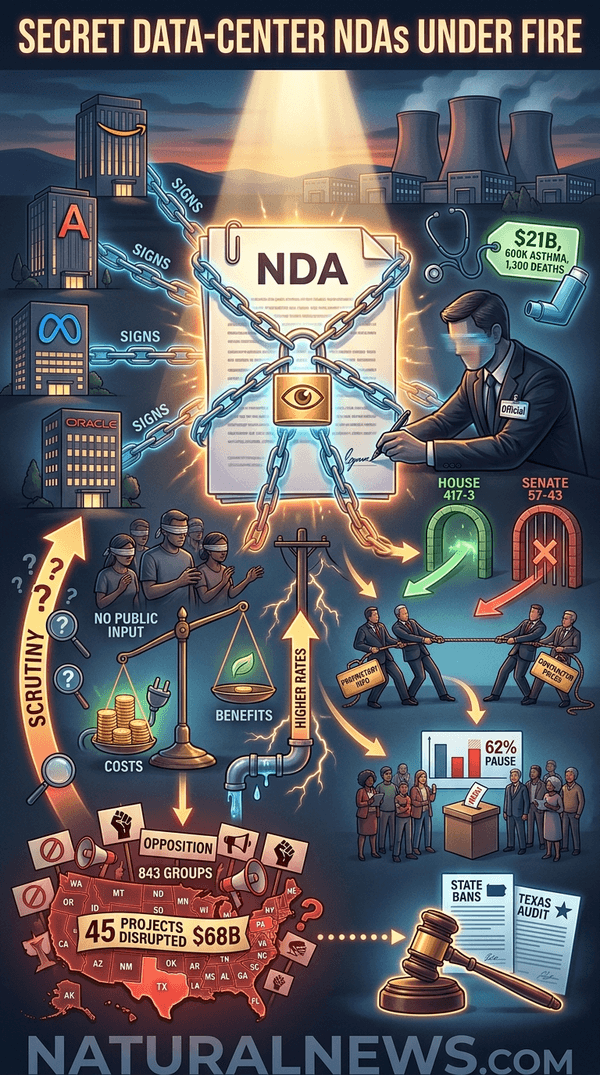
The post Lawmaker Seeks Details on Secret Data-Center NDAs as AI Build-Out Faces Scrutiny appeared first on Activist Post.

Charles Goyette, Empire of Lies: Fragments from the Memory Hole. Edited by Mike Dworski and Ben Parker. Austin, Texas: The Libertarian Institute, 2025. 275 numbered pages, plus preliminary matter. ISBN 979-8-9942002-0-9.
What happens to a republic when its government lies so often that lying becomes less a scandal than a method of administration?
Charles Goyette’s answer is that the republic becomes an empire, and the empire eventually becomes unable to distinguish its propaganda from the world outside. It spends money it does not have. It starts wars it cannot finish. It creates enemies faster than its diplomats can name them. When the consequences arrive, its officials announce that nobody could have foreseen them. The newspapers publish the announcement. A congressional committee expresses concern. Then everybody gets ready to do it again.
Empire of Lies: Fragments from the Memory Hole is an effort to prevent that cycle from disappearing into what George Orwell called the memory hole. It is not a conventional chronological history of American foreign policy. Goyette instead gathers revealing episodes and arranges them around a central proposition: deception is not an accidental blemish on an otherwise benevolent American empire. “Systemic dishonesty,” as he puts it in his introduction, belongs to the nature of empire itself.
That judgment will sound extreme only to readers who have forgotten nearly everything that happened during their own lifetimes. Goyette has not forgotten. His subjects include the destruction of TWA Flight 800, the murder of John F. Kennedy, the CIA’s regime-change operations, Russiagate, the incestuous foreign-policy establishment, the press’s appetite for war, the fraud used to invade Iraq, Obama’s record of intervention, the engineered confrontation with Russia, and the fiscal exhaustion of the United States. These are not separate scandals. They are fragments of one history.
Goyette opens with TWA Flight 800, the Boeing 747 that exploded off Long Island in July 1996, killing all 230 people aboard. The official investigation blamed an ignition in the center fuel tank, although the source of the spark was never determined. Hundreds of witnesses described seeing a rising streak of light. Explosive residue was found on recovered wreckage. The CIA then produced an animated video instructing Americans that the witnesses had misunderstood what they saw.
Goyette does not pretend to prove conclusively that a missile destroyed the aircraft. He calls the chapter a thought experiment and asks what the government would have done if a missile had brought it down at a politically inconvenient moment. Would officials have told the truth if the truth damaged the Clinton administration or threatened a wider war? The record of state behavior supplies the answer. Governments will “subvert the truth for their own ends,” especially when foreign policy is involved.
The treatment of TWA Flight 800 is arresting, though it is also a risky way to begin the book. Readers who know only the official account may decide in the first chapter that they have wandered into a collection of conspiracy theories. They should keep reading. Goyette’s larger case does not depend on resolving Flight 800. It depends on showing that American officials have repeatedly contemplated staged incidents and have lied about real ones.
The documentary evidence for that proposition is abundant. Operation Northwoods proposed manufactured attacks as a pretext for invading Cuba. President Kennedy refused it. Before the Iraq invasion, George W. Bush discussed disguising a surveillance plane in United Nations colors in the hope that Saddam Hussein would shoot at it. General Hugh Shelton recalled a Clinton cabinet official suggesting that an American aircraft be deliberately exposed to Iraqi fire to manufacture grounds for war. These were not Internet rumors. They were proposals entertained at the highest level of government.
The chapter on coups moves from Iran and Guatemala to Cuba, France, South Vietnam, and the Kennedy assassination. Goyette is particularly good on the 1953 overthrow of Iranian Prime Minister Mohammad Mossadegh. The public explanation was resistance to communism. The material interest lay in oil. Mossadegh’s government had challenged the arrangements that allowed Western companies to extract Iran’s resources on favorable terms. The CIA and British intelligence answered with bribery, hired mobs, propaganda, and a restored Shah whose security apparatus was trained with Western help.
Washington has spent the succeeding generations blaming Iranians for remembering what Washington prefers to forget. The hostage crisis is remembered; the coup that shaped the regime against which the hostages rebelled is pushed down the hole. Iranian hostility is treated as a strange cultural affliction requiring sanctions, covert action, and occasional bombardment. This is how an empire converts blowback into a fresh mandate for intervention.
Goyette’s account of Kennedy is more assertive. He assembles the familiar but still formidable record: Kennedy refused to rescue the Bay of Pigs invasion, rejected Operation Northwoods, resisted demands for preventive nuclear war, pursued a test-ban treaty, and intended to withdraw from Vietnam. The intelligence establishment had motive, means, and opportunity. Long-withheld files exposed additional CIA falsehoods concerning Lee Harvey Oswald. Former President Harry Truman warned only a month after the assassination that the CIA had become an operational and policymaking arm of government.
Does this prove in a courtroom sense that the CIA killed Kennedy? No. Goyette sometimes moves from a strong accumulation of motive and concealment to a firmer conclusion than the surviving evidence permits. Yet the official lone-gunman story has not earned the reverence still demanded for it. An agency that concealed material evidence, lied under oath, and spent decades resisting disclosure has forfeited any presumption of innocence. The burden is not on ordinary Americans to have faith in a file kept locked for sixty years.
The chapters on the Deep State and the establishment supply the book’s conceptual center. Goyette does not describe a secret committee whose members meet every Tuesday to run the world. The establishment is a network held together by shared interests, social advancement, official secrecy, and an imperial creed. Its personnel circulate between the national-security agencies, congressional offices, defense corporations, think tanks, banks, and television studios. They disagree about elections while accepting the permanence of American global domination.
The system’s reaction to Trump’s first election illustrates this machinery. Goyette treats Russiagate as a Deep State campaign intended to disable any attempt at better relations with Moscow. The Steele material was unreliable, exculpatory evidence was suppressed, and intelligence veterans became television personalities while the press repeated their claims. The same newspapers that had transmitted Dick Cheney’s Iraq fabrications discovered no embarrassment in transmitting another set of claims from the same institutional world.
Goyette is right about Russiagate. The campaign against Trump was not invented by Trump, and acknowledging its abuses does not require admiring him. Intelligence agencies should not be permitted to interfere in elections merely because their target is vulgar or unfit. A republic in which unelected officials may secretly veto the electorate is already far gone.
The distinction matters because Trump later demonstrated that persecution by one part of the ruling class does not make a politician independent of the rest. Trump threatened portions of the imperial consensus during his first term, particularly on NATO and Russia. He also filled his administration with establishment figures, bombed Syria, assassinated Qasem Soleimani, and surrendered to the Israel lobby whenever resistance required more than a speech.
Goyette sees this inconsistency. His introduction condemns Trump’s 2025 fantasies about turning Gaza into a resort and recognizes that the joint American-Israeli attack on Iran had not settled anything. Even so, a faint hope remains that Trump might understand the danger of nuclear confrontation or end the Ukraine war. After the events of 2026, there is no longer any “perhaps” about him.
Trump has revealed himself as the worst of the bought-and-paid-for lackeys of the ruling class. The supposed opponent of forever wars launched Operation Epic Fury with Israel in February 2026. The White House advertised “overwhelming force” and promised to eliminate the Iranian threat “once and for all.” Six months later, the war was still producing strikes and retaliation, while oil moved above $100 a barrel. The administration had requested additional funding for an operation it had already proclaimed a success. White House announcement, Associated Press report
This development does not refute Goyette. It confirms him with almost indecent speed. Near the end of the book, he reproduces the post-9/11 plan described to General Wesley Clark: Iraq, Syria, Lebanon, Libya, Somalia, Sudan, and finally Iran. Goyette notes that the empire had been checking countries off the list and that Iran remained unfinished business. His book was completed in December 2025. Within three months, the final unchecked box had become an American war.
The chapters on the press are among the book’s best. Goyette understands that state propaganda usually arrives wearing the clothes of independent journalism. Officials provide an allegation to favored reporters. The report is then cited on television by the same officials as independent confirmation. Anonymous intelligence sources acquire more authority than named skeptics. When the story collapses years later, the correction is placed somewhere near an advertisement for replacement windows.
The Iraq war is the great modern specimen. Claims about aluminum tubes, nuclear programs, mobile biological laboratories, al-Qaeda connections, and stockpiles of unconventional weapons moved from the administration to the press and back again. The establishment did not merely get the intelligence wrong. It selected doubtful fragments, suppressed contrary judgments, and presented uncertainty as fact. Torture was then used partly to extract the Iraq–al-Qaeda connection that the interrogators had been unable to find because it did not exist.
Goyette gives special attention to the social character of the lapdog press. War brings anchors drama, audiences, and the reflected glamour of men with medals. Brian Williams embellished his supposed exposure to combat and was later restored to broadcasting. When Trump fired missiles at Syria in 2017, Williams repeatedly described the weapons as beautiful. George W. Bush joked before reporters about his missing weapons of mass destruction while Americans were still dying in the war those weapons had been used to justify. The press laughed.
This behavior cannot be explained by Democratic bias or Republican bias. The common denominator is reverence for state power. Fox News may prefer a Republican commander in chief, while MSNBC wants a Democratic one. Both networks accept the commander in chief. Both turn to the same retired generals. The permitted dispute concerns who should control the imperial machine, not whether the machine should exist.
The chapter on Barack Obama is correspondingly severe. The Nobel Peace Prize president bombed seven countries and helped destroy Libya. His administration armed rebels in Syria even when its own analysts warned that jihadists dominated the opposition. Washington fought al-Qaeda in one place while supporting forces intertwined with it elsewhere. At one point CIA-armed groups were fighting Pentagon-armed groups inside Syria. This was called policy because admitting madness would have endangered too many careers.
Goyette does not sentimentalize Bashar al-Assad. He makes the harder point that Assad’s authoritarian government was no worse than regimes Washington supported and that secular Syria offered shelter to Christians fleeing the catastrophe in Iraq. The relevant question was never whether Assad met the standards of a New England town meeting. It was what would replace him. Iraq and Libya had already supplied the answer, but the governing class had trained itself not to look backward.
The sections on Russia and Ukraine are similarly valuable. Goyette traces NATO expansion, the American role in the overthrow of Ukraine’s elected government in 2014, the consolidation of a hostile state on Russia’s border, and the CIA’s construction of forward operating bases in Ukraine. None of that makes Russia liberal or renders every Russian action legitimate. It does establish that the war did not fall from a clear sky in February 2022.
The demonization of Vladimir Putin performed the same function once performed by the demonization of Saddam Hussein. Personal evil replaced history. Anyone who mentioned NATO expansion was accused of repeating Russian propaganda. Anyone who asked what Washington would do if Russian intelligence constructed bases along the Mexican border was deemed morally suspect. The discussion had to remain childish because an adult account of cause and effect would have interfered with weapons appropriations.
Goyette’s chapter on missile defense explains why this irresponsibility is more dangerous than the earlier misadventures. Iraq could not destroy the United States. Russia can. Washington’s withdrawal from arms-control agreements, its placement of missile systems near Russia, and its use of Ukraine for strikes on Russian territory have weakened the barriers against nuclear war. Political leaders boast of crossing red lines as though history awards prizes for making a cornered nuclear power more nervous.
The book’s final chapters widen the lens from war crimes to imperial decline. Foreign bases and weapons programs have opportunity costs. Money spent on Afghanistan was unavailable for bridges, flood control, or productive investment. National Guard personnel and equipment deployed abroad were missing when Hurricane Katrina struck. Goyette’s discussion of disaster response makes the imperial bill physical. It appears in missing high-water vehicles, delayed helicopters, and equipment sitting thousands of miles from the Americans who paid for it.
Between the beginning of the post-9/11 wars and Trump’s second term, federal debt rose from $5.8 trillion to about $37 trillion. The empire calls this strength because the Treasury can still sell bonds. A motel owner learns a different definition of solvency. If I borrow to repair a roof, I have a roof. If Washington borrows to turn Libya into a militia bazaar, it has interest payments and a fresh supply of enemies.
Here the case could be strengthened. Goyette recognizes that China passed the United States in manufacturing while Washington consumed its capital in war. But the scale of this is beyond precedent. China invested in industrial production, technical education, energy, transportation, and physical infrastructure. The United States invested in financial manipulation, asset inflation, and global coercion. China built the productive base from which military power ultimately grows. America retained the military expenditure while allowing much of the productive base to leave. This is not an argument that China is free or that Americans should imitate its political system. It is an argument that factories exist and PowerPoint slides do not. A carrier fleet cannot be maintained indefinitely by an economy specializing in compliance departments, insurance billing, and leveraged acquisitions. Sanctions are less frightening when the sanctioned world manufactures the goods and the sanctioning power manufactures derivatives.
Goyette ends with the rule that no empire has escaped. Britain won two world wars and lost its empire. The Soviet Union survived the German invasion but could not afford its military burden. Germany and imperial Japan pursued domination until their domestic economies were consumed by it. Asked whether the American empire will prove the exception, Goyette answers, “The day is young.”
The historical comparison is persuasive, though the American decline may be slower and less theatrical than many expect. There need not be a final collapse broadcast from the Capitol. The government may keep its flags, bases, and nuclear weapons while living standards fall and public services deteriorate. The empire can survive as an expensive shell long after the republic inside has died.
There are weaknesses in Empire of Lies. Goyette occasionally presents a cumulative inference with more certainty than the record warrants. The state is not always as unified as the word “Empire” makes it appear; competing agencies and donor networks sometimes obstruct one another. More space could have been given to monetary debasement, deindustrialization, and the mechanics by which military spending feeds domestic financialization. These reservations do not diminish the book’s importance. Goyette has written a literate, well-documented, morally serious indictment of the American imperial system. His humor keeps a grim subject readable, while the breadth of his evidence prevents the familiar escape into partisan blame. Kennedy and Johnson matter. So do Bush, Obama, Biden, and Trump. The names change. The official appetite for power remains.
The book’s subtitle, Fragments from the Memory Hole, is exact. Our rulers depend less on persuading us that the last war was wise than on making us forget how it was sold. They need the Tonkin deception detached from Iraq’s weapons, Iraq detached from Libya, and Libya detached from Ukraine. Above all, they need Iran to look new.
Goyette puts the pieces back together. The picture they form is not flattering, but it is recognizably ours. An empire lies because consent would otherwise be withheld. It forgets because memory would make the next lie harder to sell. It falls because reality eventually collects the debts that propaganda concealed.
The alternative is not national humiliation. Goyette makes a crucial distinction between imperial decline and American renewal. Bringing the empire home would release productive resources and reduce the enemies manufactured for ordinary Americans. We might recover the republic once Washington is no longer trying to supervise mankind.
That will require more than electing another loud man who promises to drain the swamp before handing its foreign policy to the same donors and war planners. It begins with memory. It continues with refusal. Goyette’s final demand is that the empire end and “America [be] allowed to come home.” After the lies, the graves, and the bill that keeps arriving, coming home would be a very good beginning.

The post Empire of Lies: Restoring the History the Warlords Need Us to Forget appeared first on Activist Post.

Seventeen-year-old Sarah Doe is back in court seeking emergency federal court intervention so she can stay in school after three more doctors said the teen shouldn’t get the last two vaccines the state requires for school attendance. The three medical opinions add to the seven the school district has received over the last two years.
Seventeen-year-old Sarah Doe is back in court seeking emergency federal court intervention so she can stay in school after three more doctors said the teen shouldn’t get the last two vaccines the state requires for school attendance.
The three medical opinions add to the seven the school district has received over the last two years. In each case, doctors argued that Sarah qualifies for a medical exemption. They said forcing Sarah to get the vaccines would put her already precarious health at increased risk.
In an emergency motion filed late last week in the U.S. District Court for the Eastern District of New York, Sarah and her mother Jane Doe asked for a temporary restraining order allowing the high school senior to attend school pending the district’s review of a new medical exemption request relating to a third hepatitis B (Hep B) shot and the meningococcal vaccine.
Children’s Health Defense is funding Sarah’s case.
The emergency motion followed a Sept. 23 ruling by U.S. District Judge Gary Brown. Brown declined to extend Sarah’s previous medical exemption, for the 2024-2025 school year, to the current school year. The district expelled Sarah from school the next day, Sept. 24.
A few days later, the district readmitted Sarah pending the outcome of a blood test, ordered by her doctor, to determine if she has hepatitis B titers from the first two shots she received, according to her attorneys.
However, Sarah still needed a medical exemption from the meningococcal vaccine — even though the district didn’t require proof of meningococcal vaccination for any student until Sept. 30. Many states don’t require this vaccine for secondary school.
At the time, Sarah had a medical exemption request pending from Dr. Michael Miller, a pediatric infectious disease specialist who also concluded that she shouldn’t be vaccinated.
On Sept. 28, the district denied Miller’s exemption request, according to court documents, citing three unsuccessful attempts by its reviewing physician to reach him by telephone.
According to Sarah and her mother, the court gave no other reason for denying Miller’s request. They said the school never sent Miller a HIPAA form, which he would need in order to share Sarah’s medical information with the district’s reviewing physician.
School officials notified Sarah’s family that as of Oct. 1, they again would not allow her to attend school unless she provided proof of vaccination or a valid medical exemption.
The new request for court intervention follows a Sept. 30 examination by Dr. Vincent Garbitelli, an internal medicine specialist who also recommended that Sarah defer both the Hep B and meningococcal vaccines through June 30, 2027.
Garbitelli is the same doctor who wrote the exemption certification that supported Sarah’s request last school year.
According to the court filing, Garbitelli diagnosed Sarah with moderate-to-severe acute illness, including active mycoplasma pneumoniae infection, along with immune dysregulation and a broader systemic illness still under evaluation.
Garbitelli concluded that vaccination could increase the risk of a serious adverse reaction, exacerbate her condition, and complicate her ongoing diagnosis and treatment.
The filing also says Sarah’s pediatric practice declined to vaccinate her without clearance from an infectious disease specialist and recommended that any vaccination take place in a specialist’s office.
Sarah and her mother said Sarah should be allowed to stay in school while the district evaluates Garbitelli’s new exemption certification. They cited New York Department of Health procedures that they say permit a student to remain in school while a medical exemption is under review.
They also said the district has not identified a deficiency in Garbitelli’s submission or given the family a timetable for completing its review.
The school district did not respond to a request for comment.
“The school district’s approach turns the Americans with Disabilities Act on its head,” said Sarah’s attorney Sujata Gibson.
Gibson added:
“There is no question that the district can accommodate Sarah. Three physicians have certified this year that she needs that accommodation.
“We contend that the district’s unfinished review provides no lawful basis to exclude Sarah in the face of that medical evidence. She should not have to forfeit her education while the district searches for a justification to deny the accommodation her physicians say she needs.”
Judge previously ordered district to allow Sarah to attend school
The current dispute is the latest development in the ongoing legal battle between Sarah’s family and the Oceanside Union Free School District.
Last year, Brown ordered the school district to allow Sarah, who had obtained a medical exemption, to attend high school during the 2025-2026 school year.
At the time, Sarah sought a medical exemption to attend 11th grade without receiving the third dose of the Hep B vaccine — the only recommended shot she was missing at the time — because she and her doctors said severe reactions to previous doses had left her sick and disabled.
In his ruling last year, Brown recognized that Sarah has viable claims under the Americans with Disabilities Act and criticized the district for second-guessing a licensed physician’s valid medical determination, which complied with all requirements of state statute.
When the lawsuit was filed, at least six treating physicians and a nurse practitioner certified to the school district that Sarah could be harmed by taking the shot, according to court documents. The district nonetheless repeatedly denied her exemption requests. Since then, more doctors have affirmed that assessment.
After attending school last year under the court order, Sarah applied for a medical exemption from the Hep B vaccine and also the second meningococcal vaccine required for this school year.
The school district again denied her request. Sarah returned to court seeking emergency relief, but this time Brown reversed his previous decision and upheld the school district’s denial.
In his Sept. 23 ruling, Brown cited problems with the medical documentation submitted in support of the renewed request. His decision set in motion the series of new medical evaluations and exemption requests that brought Sarah back to court last week.
Legal battle over medical exemption began in 2025
Sarah and her mother first sued the school district in June 2025, alleging the school violated the Americans with Disabilities Act and New York Public Health Law by refusing Sarah’s medical exemption, and also violated her family’s First Amendment right to free exercise of religion.
Sarah had a religious accommodation exempting her from vaccine requirements until 2019, when New York repealed its religious exemption.
To remain in school, she was forced to take an “aggressive catch-up schedule” of the vaccines she hadn’t yet received — 18 doses in six weeks, including two doses of the Hep B vaccine in quick succession, which left her severely disabled.
After the second dose, Sarah’s health rapidly deteriorated. She experienced intense pain throughout her body, rashes, migraines and other conditions, leaving her unable to attend school.
Sarah was diagnosed with acquired von Willebrand’s disease — a rare bleeding disorder — that could make her vulnerable to future vaccine injuries and acute autoimmune hypersensitivity reactions.
Her symptoms have included kidney issues, migraines and severe immune system reactions, including rashes, seizures, repeated sepsis and other symptoms that required her to be hospitalized and “caused her to come close to dying twice.”
Sarah and her mother also allege that in addition to denying the teen a reasonable accommodation, school officials have harassed, humiliated and harmed her. According to the lawsuit, the normally happy and resilient girl became so depressed that she spent most of the day in bed and fell behind in school.
Related articles in The Defender
The post New York Teen Forced Out of School Again After 3 More Doctors Argue Vaccines Would Harm Her appeared first on Activist Post.

CFTC Chair Michael Selig claimed that the agency was using its “existing statutory authorities“ to address crypto regulation after Congress failed to advance a market structure bill.
US Commodity Futures Trading Commission (CFTC) Chair Michael Selig said that the agency will move forward on crypto regulation at the direction of President Donald Trump “with or without legislation” from Congress.
Speaking at the Fordham Law Blockchain Regulatory Symposium on Monday, Selig announced proposals giving crypto companies the option to operate under the CFTC’s umbrella rather than dealing with the patchwork of regulations offered by individual US states.
According to written remarks from the event, the CFTC chair said that it had issued an advanced notice of proposed rulemarking for companies “offering retail customers the ability to trade crypto assets on a margined, leveraged, or financed basis,” calling the regulation ‘CTX.’
Selig said that the agency planned to establish a new category of designated contract market (DCM) called a “crypto asset market,” or CAM, giving certain exchanges the option to register as either.
“These rules would codify a pathway for crypto asset exchanges to operate under uniform national oversight by the CFTC pursuant to the same statutory authorities that the prior administration instead utilized to regulate by enforcement,” said Selig.

The proposed rules would not extend to what the chair called “ordinary spot crypto exchanges” that are “generally regulated under state money transmission laws.” For companies offering spot trading on crypto assets like Bitcoin (BTC), the CFTC would still have the authority to enforce anti-fraud and anti-manipulation regulations.
Selig’s proposed regulatory framework for crypto companies came a few weeks after lawmakers in the US Senate failed to approve passage of the Digital Asset Market Clarity (CLARITY) Act, a bill that had been expected to give the CFTC more authority in overseeing and enforcing crypto regulations.
The Securities and Exchange Commission already announced its own version of a proposed “tailored securities offering regime” for crypto assets in August before the failed CLARITY vote, setting the expectation that both agencies would move forward with regulation without legislation codifying such rules from Congress.
Selig said that Trump promised to deliver a crypto asset regulatory market structure with or without legislation, and the regulators will help him deliver it using existing statutory authorities.
“The opponents to CLARITY may have not bargained for the seeming readiness of the executive branch to act in the absence of any constraint from the legislative branch,” said ProChain Capital’s David Tawil, in a post on Monday.
Friday was SEC Commissioner Hester Peirce’s last day at the agency, wrapping up eight years of service, just ahead of the 18-month extension for her second term. Her planned departure leaves just two commissioners leading the SEC and Selig heading the CFTC as its sole commissioner and chair.
A White House official told Cointelegraph last week that Trump intended to nominate commissioners to both agencies “in the near future.” As of Monday, the administration had not announced any replacements for Peirce or the other six commissioner seats.
Magazine: Former SEC boss made AI Czar, Bitcoin may hit $600K this cycle: Hodler’s Digest
The post CFTC joins SEC in proposing crypto framework after failed CLARITY vote appeared first on Activist Post.

Join Hrvoje, Mike, and Monica once again as they break down the events of the day and expose the agendas driving the narratives.
This week, the crew examines how the technate might be implemented: through accelerationism, globalism, feudalism—or all of the above. What’s really behind the Greenland agreement, and what could it mean for a world moving toward peace or war? They also discuss evidence of Pentagon active measures, public debt approaching a tipping point, and the financial foolery unfolding from Tether to the techno-dollar—and much more!
Find, Follow, Subscribe & Rate on your favorite podcasting platform AND for video and social & more…
Website: https://monicaperezshow.com/
Rumble: https://rumble.com/user/monicaperezshow
Youtube: https://www.youtube.com/c/MonicaPerez
Twitter/X: @monicaperezshow
Instagram: @monicaperezshow
Find Hrvoje Moric:
Website: https://geopoliticsandempire.com/
Substack: https://substack.com/@geopoliticsandempire
Twitter/X: @HrvojePM
Find Parallel Mike and Parallel Systems Broadcast:
Parallel Mike Podcast: https://parallelmike.com
Community & Financial Newsletter: https://www.patreon.com/parallelsystems
YouTube: https://www.youtube.com/@parallelsystems
Twitter/X: @parallel_mike
Substack: https://substack.com/@parallelmike
Patreon: http://patreon.com/parallelsystems
The post Cognitive Dissidents: Welcome to Fortress World, Where the Serfs are WWIII Cannon Fodder appeared first on Activist Post.

When we look back at the history of US intervention in Iraq, what we have is arguably the most well documented case of imperialist destabilization seen in real time.
A river of blood running red down the streets of Mosul, buildings completely leveled to the foundation in Fallujah, neighborhoods devastated with depleted uranium in Baghdad. Estimates of over a million dead, nine million displaced, generations born with birth defects, countless lives forever destroyed. A once vibrant nation, rich in history and culture tracing back to the foundation of human civilization now the site of unimaginable catastrophe, forever transformed in only twenty three years into an eternal scar of carnage. This is the story of Iraq.
On September 30th, 2026, news broke that after over two decades the last of US forces in Iraq had finally withdrawn. It seems, finally, that this bloody chapter in American history has come to a close. The war, it appears, is over. The lasting consequences, however, will remain a fixture in the American psyche and the geopolitics of the world likely for many more generations to come.
The US presence in Iraq serves as the American empire’s longest perpetual occupation and military conflict in its history, lasting over twice as long as the Vietnam war, and surpassing the occupation of Afghanistan by three and a half years.
But while the current conflict in Iraq has lasted just over two decades, US-lead destabilization in the region has lasted considerably longer.
Western aggression against Iraq began relatively early in the Cold War, in response to the 1958 uprising that ousted the Hashemite monarchy which had served to the benefit of Anglo-American corporate interests. The Iraqi nationalist Abd al-Karim Qasim, the leading figure of the revolution, quickly seized power as Prime Minister and declared that Iraq would be a republic, instituting sweeping programs to the benefit of the Iraqi people ― including agrarian reforms, women’s rights laws (among the first of their kind in the Arab world), housing development, the expansion of education, and seizing control of the Iraqi oil reserves which had for decades been controlled by American and British companies.
Iraq was declared to be sovereign, and this didn’t sit well with the Western political hegemon that had already hedged itself financially upon controlling the flow of oil throughout the Middle East.
As such, American and British intelligence began covertly lending their support to what was at the time a little known political faction within Iraq, the Ba’ath party, to be the primary driver behind a regime change plot.
One of the primary figures of the Ba’ath party at the time, Saddam Hussein, would become an asset of the CIA, and, in October of 1959, Saddam along with five other hitmen would undertake a CIA sanctioned assassination attempt against Qasim on the streets of Baghdad. The attempt failed miserably, and Saddam was forced to flee to Egypt in exile under the care of Egypt’s General Intelligence Service to avoid capture and execution for his role in the conspiracy.
During Saddam’s time in Cairo he would make frequent visits to the American embassy and deepen his ties with the CIA.
The agency would also continue strengthening the Ba’ath Party from the shadows in Saddam’s absence, fomenting reactionary hostility which relied heavily on the manufactured propaganda of exaggerated communist threats as a pretext for regime change, and in 1963 would carry out a bloody coup d’etat culminating with the assassination of Abd al-Karim Qasim. Following the Baathist coup, Saddam would return to Iraq as one of the party’s top enforcers charged with overseeing a bloody campaign of targeted executions of anyone suspected of being a communist or a sympathizer of Karim Qasim.
In the months that followed, Baathist death squads, utilizing kill lists provided by the CIA, would routinely carry out house-to-house raids, mass arrests, arbitrary detentions, and summary executions. Estimated casualty rates place the number of dead at nearly 10,000, with an additional approximate 100,000 arrested.
This bloodbath gave rise to the Iraq that we know today. Saddam came to power riding a wave of state sanctioned terror with American approval that set into motion a chain of events we are still facing the ramifications of decades later.
Fast forward to 1979 and Saddam is officially installed as the president of Iraq. Therein begins the next stage of destabilization at the behest of American imperialist interests.
That same year, the people of neighboring Iran had risen up to overthrow the brutal US-backed dictatorship of the Shah. Not keen on allowing the Iranian people to have any say in their own self determination, the Western powers would once again intervene and ensure the installation of the Ayatollah’s Islamic fundamentalist regime. With this piece of the chess board in place, previously flaring tensions between Iraq and Iran would reach a fever pitch, all while the US played puppet master.
By 1980 Saddam was given the green light by his US handlers to go to war with Iran, supplied with chemical weapons courtesy of the CIA. The US empire, eager to play both sides of the conflict for their own benefit, would at the same time supply arms shipments to Iran through Israel. The goal was to allow the two nations to battle each other to a stalemate, substantially diminishing the influence of either in the region to the benefit of the West. After eight years of brutal war that claimed roughly two million lives the conflict would conclude with an armistice in August of 1988.
Just a couple of years later the hammer would finally begin to drop on Saddam Hussein. As tensions once again flared with Iraq’s southern neighbor Kuwait, and with Iraq in desperate need to recoup its financial losses from its eight year war with Iran, Saddam would once again meet with his US handlers in the form of US Ambassador to Baghdad April Galspie.
The actual nature of that meeting is still debatable, with some scholars asserting that Saddam was directly given the green light by the US to invade Kuwait, while others contend that a miscommunication had lead Saddam to believe that such a green light was given. In either case, on August 2, 1990, Hussein would roll tanks into Kuwait, and in either case the response by the United States was certainly premeditated.
In response to the Iraqi invasion of Kuwait, the Western press quickly orchestrated and amplified what would become one of the most infamous examples of atrocity propaganda in modern history. In October of 1990 a 15 year old Kuwaiti girl identified only as “Nayirah” would provide testimony to Congress of crimes against humanity committed by the Iraqi military. Through sobs, she claimed to have worked as a nurse’s aide at Al-Addan Hospital in Kuwait City when she witnessed Iraqi soldiers storming in, remove babies from their incubators in the prenatal unit, taking the medical equipment and leaving the babies to die on the floor. But it was all a lie.
Nayirah was actually the daughter of the Kuwaiti ambassador to the United States, Saud Nasser al-Sabah. And she had never been in Kuwait at the time of the invasion. It was later revealed in an investigation by the New York Times that her entire testimony was fabricated by the public relations firm Hill & Knowlton on behalf of the US based lobbying group Citizens for a Free Kuwait, strictly as a form of propaganda to encourage the US to make war on Iraq. And so they did.
In the mid 1990s another seismic shift took place in Mid Eastern politics that seemingly hammered the final nail in Saddam’s coffin. In late 1995 Israeli Prime Minister Yitzhak Rabin was assassinated, largely due to the culture of violence incited against him by Benjamin Netanyahu who would come to power as the next Prime Minister a year later.
With Netanyahu and the far-right Likud Party in power in Israel, American neocons seized the opportunity once again. In 1996 neocons that would later hold prominent positions within the George W. Bush administration and the push for war with Iraq would come together in an established think tank to publish a document known as A Clean Break: A New Strategy For Securing The Realm. A hawkish strategy which ultimately sought to help Israel “weaken, contain, and rollback Syria” by way of using regime change in Iraq as a stepping stone, thus prioritizing the ouster of Saddam Hussein as the first domino to fall in an ambitious plan to topple the governments of Syria, Iran, and Lebanon.
The widely unknown to the general public Clean Brake Strategy is still one of the primary driving factors of American foreign policy in the Middle East today.
Many of the same individuals responsible for crafting the Clean Brake Strategy — David Wurmser, Douglas Feith, Richard Perle, and others, would all go on to be key players in the neocon think tank Project for A New American Century (PNAC), and heavily embedded within the George W. Bush administration. PNAC, as The Free Thought Project has previously noted, played a significant role in crafting the pre-emptive strategy for expanding American hegemony in the Middle East which the September 11th false flag attack was later used as a pretext to justify.
As we have also previously reported, according to George W. Bush’s former ghostwriter Mickey Herskowitz, the would-be president was dreaming of invading Iraq as early as 1999. While leaked emails have shown the then President Bush and British Prime Minister Tony Blair laying plans for the invasion of Iraq a year in advance.
A 2004 investigation by Mother Jones extensively documented how, starting at the outset of the Bush administration in January of 2001, figures the likes of Wurmser, Feith, and Perle, along with other notable names such as Paul Wolfowitz and Harold Rhode, established what was essentially an “unnamed, secret intelligence unit at the Pentagon” effectively serving as the nucleus for disinformation on Iraq to manufacture the consent for war.
After much pressure and copious amounts of disinformation to justify their cause, US forces undertook a shock and awe invasion of Iraq in March of 2003, and as the years dragged on the truth came to light. There were no biological or chemical weapons, there wasn’t a nuclear threat, there were no connections between Saddam and al Qaeda. Just a mountain of lies fabricated as a pretext to facilitate a decision that had been made long ago in the halls of imperial power.
The war on Iraq saw scores of atrocities take place at the hands of American invaders against an innocent population that had nothing to do with the crimes, real or imagined, of their CIA installed dictator. Violence against the people of Iraq was the standard for the occupiers.
Horrific massacres such as those that took place in Haditha, the Mahmudiyah gang rape massacre, the Ishaqi massacre, the Blackwater killings in Nisour Square, or the atrocities at detention facilities such as Abu Ghraib, and any of the other countless crimes against humanity inflicted upon the Iraqi people by US forces documented in works such as Collateral Damage: America’s War Against Iraqi Civilians by journalist Chris Hedges, or the numerous revelations released by Wikileaks in the Iraq War Logs, including the now infamous Collateral Murder footage — All make one thing crystal clear. The violence against the occupied peoples of Iraq was the norm, not an aberration.
On the financial side, the Iraqi economy was devastated, in part due to the deliberate destruction of civilian infrastructure, and in part due to the theft of resources claimed as ill gotten gains by the occupying forces. Documentaries such as Robert Greenwald’s Iraq For Sale detail how corruption by corporate war profiteers such as Halliburton, Blackwater, CACI, and Titan pillaged the Iraqi economy for maximum profits.
Throughout the 20 year occupation, the US did not cease its efforts to maintain destabilization, either. After the fall of Saddam the imperialist war planners needed a new boogeyman, and it didn’t take them long to invent one.
Investigations have since revealed that Abu Musab Al Zarqawi, the leader of al Qaeda in Iraq and arguably the second most infamous terrorist in recent memory next to Osama bin Laden was, much like Bin Laden himself, an asset of the Central Intelligence Agency who’s history traces all the way back to those notorious days of CIA sponsored jihadists in the mountains of Afghanistan.
Beyond secretly facilitating Zarqawi, US Intelligence would continue its destabilization mission by building a new jihadist proxy, capitalizing on the power vacuum left in Iraq following the overthrow of Saddam and the eruption of sectarian violence in the region, which began to encompass a shift towards Syria as well, just as the aforementioned Clean Break Strategy had intended.
As a new generation of Islamic fundamentalist militants took to the streets of Iraq and Syria, Western intelligence in the early 2010s would begin a clandestine arm and equip program known as Operation Timber Sycamore. With funding from Saudi Arabia and Qatar, the CIA would run point on the decision to funnel weapons to jihadist fighters, later referred to as “moderate rebels” in Iraq and Syria, culminating in the creation of the terror group known as ISIS.
This is the story of American intervention the world over. Disinformation, destabilization, regime change coups, covertly sponsored dictatorships, and clandestine created terrorist organizations. Iraq is not unique to this method, but it is arguably the clearest example of it documented in real time. A pristine exemplification of the scourge of imperialism across the world and the devastation that it wreaks upon average people.
The occupation may finally be over. The people of Iraq may finally perhaps be able to take in a breath of relief, collect themselves, and attempt to begin to rebuild their lives. But Iraq is forever changed, the world is forever changed with it, the agendas that have left these lasting scars on a nation that was once the cradle of civilization are still at play, the destabilization of Iraq simply being one piece on a much larger chess board in a game of global dominance. And sadly, with conflicts still raging all around it, it is unlikely that Iraq will experience much of a genuine reprieve for some time to come.
As the last American troops leave Baghdad, the lessons learned from this travesty should not fade quietly into the night. They should serve as a rallying cry for all of us to strive for this to never happen again. Whether or not that will materialize is yet to be seen. But for now, we can hope against hope that perhaps for just a moment the people of Iraq can experience a small semblance of momentary peace.
The post Iraq: Invasion And Occupation. A Case Study In Destabilization. appeared first on Activist Post.

Multiculturalism as a subversive movement is the defining political schism of our time. Is is the fulcrum point for numerous civilization changing events and a direct trigger for the exponential decline of the western world. Anyone who ignores the effects of multiculturalism will be oblivious to the many disruptions coming to our lives today and in the near future.
In 1992, Bill Clinton’s Deputy Secretary of State, Strobe Talbott (a member of the globalist Council On Foreign Relations) wrote an essay for Time Magazine called “The Birth Of The Global Nation.” In that article, he outlined the globalist view of national sovereignty as temporary and cultural boundaries as obstacles that could be subdued by luring countries into economic interdependency.
Talbott dismissed cultural distinctions as arbitrary and cited the incoming formation of the European Union as an example of supranational governance over otherwise separate and unique cultural identities.
However, the globalists ran into some problems. Westerners might have been able to create supranational ties because of shared cultural roots, but they were not going to open their borders to the rest of the world without being forced. From around 2012 onward, a program of multiculturalism was introduced with mass immigration as the primary weapon.
We have seen disastrous results ever since. Portions of Europe are facing societal collapse, and this was by design. Keep in mind, globalism does not necessarily need borders to fully disappear, but it does need national identities and loyalties to disappear. Specifically, western societies must be diluted and their heritage erased for the globalist “New World Order” to move forward.
The fastest way to do that is to overwhelm western demographics with mass movements of people who hold completely contrary ideals . In light of the plague of riots in France this past week led by mobs of migrants and Marxist activists (globalists), I thought it might be important to once again clarify why the third world should never be allowed to settle in the western world. The threat is not just from globalists; it also comes from the same migrants that globalists use as a battering ram against the west.
Like the great catastrophes of the past, from the Bronze Age collapse to the fall of Rome and the near destruction of Europe in the Middle Ages, mass immigration of certain groups (often aided by corrupt governments) annihilates progress, cripples security and erases cultural stability.
Unlike Europe, the US under the Trump Administration has seen major successes this year in blocking illegal (and “legal”) immigration from third world enclaves (Muslim immigration has plunged by 96%). So much so that leftists (and some libertarians) are outraged over the epic drop in Muslim and Hindu migrants. Their argument in favor of the multicultural agenda? They claim that America was founded with the intention of open immigration of ALL peoples.
This is simply not so. In fact, the Founders were highly selective about who they allowed into the US. Our constitutional heritage is often used as a justification for multiculturalism. However, these claims are based on deception and a deliberate misrepresentation of our roots.
The United States was never a migrant “melting pot”. This idea has been perpetuated over the past several decades in popular media and political discourse until it became sacrosanct in the minds of many Americans, but it’s not real – It has always been a fantasy fabricated by Hollywood and the political left.
There has also been a comprehensive effort among “independent” organizations to misrepresent the intentions of the Founders. The motive is to sell conservatives and independent voters on the notion that third-world immigration is perfectly in line with the constitutional framework of our nation.
I see this claim often among more left-leaning libertarian activists as much as I see it among progressives; the idea that borders are somehow contrary to the American virtues of freedom. These people simply don’t know their history, or they are ignoring history in favor of their own narratives. If the Founders’ original system was in place today, America would look dramatically different and far less liberal.
At the very beginning of America’s national history, the Founding Fathers established the Naturalization Act of 1790, allowing only “free white people of good moral character” to immigrate as legal citizens. The standard remained in place in one form or another for hundreds of years and did not officially end until 1952 with the Immigration and Nationality Act.
Then came the Hart-Celler Act of 1965 under Lyndon B. Johnson (Johnson’s liberal policies have become an enduring nightmare for the US ever since his presidency). The Hart-Celler Act ended the National Origins quota of the 1920s, which required that the vast majority of immigrants come from European nations and restricted migrants from third-world countries.
The argument that the Founders imagined America as a sprawling buffet for every malcontent in the world is utterly fabricated. They did not view the US as an open air bazaar welcoming any culture from any backwater location to take advantage of what our ancestors built over the course of centuries. The vast majority of migrants up until the 1960s were from western nations with similar cultural foundations. The melting pot claim is a lie.
The Founders did not intend for cultures with completely incompatible religious and ideological beliefs to take root in the US. And if these people did immigrate, assimilation was expected and required. While the Founders argued in favor of religious freedom, they understood that certain groups exist as an antithesis to the western ideal.
For example, Thomas Jefferson bought a Qur’an in 1765 mainly as a legal and historical text and later used Islam as an example of a religion that, in his view, stifled freedom of thought and relied on coercion.
John Adams once listed Muhammad among “sober inquirers after truth,” yet in other writings he described him as a military fanatic (this is usually the case after people go deeper into Islam and learn the ugly details).
Contemporary Protestant writers of the era commonly considered Islam an ideology spread by the sword and as a political system more than a religious system. Back then they still hadn’t forgotten the horrors of the Muslim invasions into Europe; invasions that led to the Crusades. America’s very first war overseas was an executive action without the approval of congress against the Barbary Pirates – Fanatics backed by Muslim governments that had been terrorizing European ships for centuries.
Hinduism and other Asian or African traditions received less detailed comment from the Founders and were usually grouped under “pagan” or “Gentoo.” The presence of these groups was sparse or non-existent in the US until the mid-1900s. Most slaves who practiced native religions ultimately converted to Christianity, or their children did.
The US banned the importation of slaves in 1808 under a law signed by Thomas Jefferson.
Many Founding Fathers including Jefferson, Madison and Monroe wanted to deport slaves back to Africa to a colony under American protection rather than continue the institution – Not just because they had misgivings about the practice, but because they were concerned that the slaves, even if they were freed, would ultimately be incompatible with western culture and that conflicts would arise.
Jefferson laid this out clearly in “Notes on the State of Virginia” (Query XIV, 1785). He called slavery a moral and political evil and favored gradual emancipation, but argued that freed blacks and whites could not live together peacefully. In other words, even Jefferson, a staunch defender of personal liberty, understood that certain cultures will inevitably clash if kept in proximity and in large numbers.
This is not to say that black people can’t function in the US or Europe, many clearly do just fine. But it is also clear according to the crime rates (13% of the population and 50% of the violent crime) and political stats (87% supporting leftist policies) that Jefferson was right to be concerned.
The Founders were realists who respected practical limits on society for the sake of stability; they were not anarchists. That is to say, they understood than not all freedoms are good and some restrictions must be applied, including borders and logical cultural discrimination. I would argue that if their rules were still in place today, America would be far better off. Specifically their limits on immigration.
Before the 1960s, about 84% of the foreign-born population in the U.S. had migrated from Europe or Canada. Latin American inflows existed (especially from Mexico) but were much smaller in scale than they have been in recent years.
The Hart-Cellars Act abolished country-specific quotas and replaced them with a system emphasizing family immigration. This opened legal pathways from Asia, Latin America, Africa, and elsewhere. New immigrant flows then shifted rapidly: By the 1970s, the majority of arriving immigrants came from Latin America and Asia rather than Europe.
Immigration from Europe and Canada fell from 84% in 1960 to 42% by 1980 and only 13% in recent years. Latin America and Asia became the dominant regions of origin for new citizens. It is not a coincidence that from the mid-1960s onward the US suffered increasing economic and social instability, along with skyrocketing crime rates.
It was not until Donald Trump took office in 2025 that illegal border crossings plummeted back to 1960s levels and third world migrant populations have actually started shrinking.
The establishment of LBJ’s unprecedented welfare rollout combined with surging immigration led to an intense strain on US debt and infrastructure. It’s not surprising that the dollar was decoupled from gold only a few years later; it was the only way to artificially increase the money pool to pay for so many federal subsidies. As in Europe, the majority of third world migrants in the US utilize welfare as soon as they arrive.
As I noted in my article “Pillagers vs Producers: There’s Only Two Ways To Save The Western World”, there is an inherent instinct among certain cultures to either build wealth and resources, or steal wealth and resources. The third world is largely rooted in pillaging; we have seen proof of this time and time again.
Is some cases this is because they operate on tribal methods that have not changed for thousands of years. In other cases, it is because people from undeveloped nations are conditioned to accept and even defend socialism and authoritarianism – modernized forms of pillaging. They have never lived any other way and western ideals of self reliance, independence, free markets and meritocracy are completely alien to them. The government is mother and father and if they want something they must beg the government for it, or loot it.
Pillagers cannot live peacefully with producers. It’s impossible. And for the leftists who claim that the west is “the biggest pillager of all”, the facts say otherwise. When European colonists came to the Americas, or to Africa or India, what they found was perpetually warring tribes, human sacrifice, cannibalism, genocide, slavery and little semblance of long term infrastructure. These places were wastelands.
They left these countries with the most modern technology and infrastructure of the age. And what did these people do with that inherited wealth? Nothing. They let it decay, or stripped it for temporary gains at the expense of long term stability. One need only look at what happened to South Africa in the last 30 years to see that westerners produce, and third worlders pillage.
According to polling data and voting data, third worlders lean overwhelmingly left when it comes to government power and open borders. Muslim respondents maintain some fundamentalist social beliefs which are considered conservative, but generally favor bigger government (71%), immigration openness (82%), and believe racial and ethnic diversity “strengthens” the U.S. (82%). Indian/Hindu migrants poll very close to the same numbers. Meaning, immigrants will always perpetuate more immigrants, especially when immigration is made easy and they don’t have to work hard to earn citizenship.
Is the lack of multiculturalism the same as “ethno-nationalism”? Not exactly. Ethnic dominance is not the same as cultural dominance, though the Founding Fathers envisioned both for America. At bottom, third world cultures should be largely removed from the US, or at the very least, limited enough that they are not able to organize into sprawling ethnic communities which prevent assimilation.
This is not just to thwart the machinations of globalism, it’s also to protect the west from predatory invasions.
There is nothing in the birth of this nation that requires us to tolerate foreign influx. America is not a piece of clay for them to mold as they please. It is not an “economic zone” for them to pilfer. It is a nation and a culture built by western adventurers, settlers, conquerors and their descendants. No one else is entitled to live here and if they get the chance, they should feel lucky.
If you would like to support the work that Alt-Market does while also receiving content on advanced tactics for defeating the globalist agenda, subscribe to our exclusive newsletter The Wild Bunch Dispatch. Learn more about it HERE.
The dollar buys less today than it did a year ago, a decade ago, a generation ago. That slide is the predictable result of endless printing and borrowing. Dr. Ron Paul believes the FED has the answer. But they’re keeping it to themselves. Fortunately, a new financial chart has publicly exposed their secret moves. See it for yourself HERE.
You can contact Brandon Smith at:
You can also follow me at –
TwitterX: @AltMarket1
The post The Founding Fathers Never Would Have Tolerated Multiculturalism appeared first on Activist Post.

All over social media, people want to know if there will be food shortages in 2027. Coming into this year, the UN was warning that global hunger had reached an unprecedented level. Now we are facing a global fertilizer crisis, a global energy crisis, widespread droughts, a Super El Niño and World War III all at the same time. Of course global hunger is going to get even worse in the months ahead. Nobody can deny that. Wealthy nations such as the United States will theoretically be in the best shape, but even here in the U.S. approximately 1 out of every 7 people already live in food insecure households. Rapidly rising food prices will definitely be very painful for us, but for millions of people that live in deeply impoverished countries much higher food prices could suddenly make it impossible for them to buy enough food to properly feed their families.
How would you feel if members of your family were extremely hungry but you didn’t have anything to give them?
For many of us, that would be unimaginable.
Unfortunately, such a scenario could soon become a reality in needy households all over the planet.
For months, I have been warning that the global energy crisis and the global fertilizer crisis were going to have an enormous impact on food production.
Now harvest season is here, and the consequences are starting to become apparent. The following comes from a Wall Street Journal article entitled “Hormuz Gridlock Risks Global Food Crisis, International Chamber of Commerce Chief Says”…
Disruptions to a vital shipping route in the Middle East have created an energy shock. Now, a global food security crisis is brewing, warns the secretary-general of the International Chamber of Commerce.
The secretary general of the International Chamber of Commerce is a man named John Denton.
He is a legal expert on international trade and investment, and he is projecting that global grain prices could potentially increase by up to 80 percent…
The monthslong conflict between Iran and the US has curbed the flow of goods through the Strait of Hormuz, a waterway many countries rely on for imports of critical inputs like fertilizers and natural gas.
According to Denton, if the strait is not reopened, grain prices could rise by up to 80%, which would be particularly hard on the economies of import-dependent countries. He added that the situation in the Strait of Hormuz has caused a shortage of about 2.7 million tons of fertilizer on the world market.
Less fertilizer means less food.
That is the bottom line.
If we do see such a spike in global grain prices (and they have already been rising), an ICC-commissioned model determined that global food prices overall could increase by close to 70 percent…
A prolonged disruption to fertiliser and energy markets linked to the closure of the Strait of Hormuz could push global cereal prices sharply higher, with potentially severe consequences for food security and public health, according to new modelling commissioned by the International Chamber of Commerce (ICC).
In the study’s most severe scenario, global cereal prices rise by as much as 81% above 2020 levels. The shock also feeds through sharply to households, with consumer food prices in East Asia, the Pacific and Sub-Saharan Africa rising close to 70% above a 2020 baseline.
In recent years, the world has not even come close to producing enough food for everyone.
Now global food supplies are going to get substantially tighter.
As a result, there will be a mad scramble for whatever is available, and this will really drive up prices.
In the end, a lot more people will be malnourished and a lot more people will die from starvation…
Conducted by researchers at the University of Edinburgh, the University of Aberdeen and Scotland’s Rural College, the modelling shows how the shock would work its way through the global food system. Higher fertiliser and energy costs reduce nitrogen fertiliser use by approximately 37% and cereal productivity by up to 10%, tightening supply and raising prices for consumers.
For poorer households, these price increases translate into lower calorie consumption, less diverse diets and higher rates of underweight. Under the same severe and sustained scenario, the modelling suggests that the shock could contribute to approximately one million additional dietary health-related deaths in 2030 and leave 67 million more people underweight.
The burden would fall overwhelmingly on lower-income regions. South Asia, Sub-Saharan Africa and East Asia and the Pacific would account for around 80% of the additional mortality and more than 90% of the additional underweight burden. Modelled health outcomes would change little in higher-income regions.
The poorest nations will get hit the hardest.
But we will all be affected.
I asked Google AI to tell me what would happen if the type of scenario that the ICC is envisioning actually plays out. This is what I was told…
That sounds about right.
There are some people out there that are touting the fact that they warned about this months in advance.
Of course there are others that were warning about all of this years in advance.
As long as commercial traffic through the Strait of Hormuz remains restricted, the global fertilizer crisis and the global energy crisis will both just continue to intensify.
Unfortunately, the Iranians are telling us that they will keep attacking commercial vessels that are traveling through the Strait of Hormuz until the United States agrees to their entire list of demands…
The Strait of Hormuz is going to remain closed until the United States accepts Tehran’s seven-day plan to reopen the waterway, Iran’s top negotiator and parliament speaker has said.
Iranian state-linked news agency Nournews, quoting Mohammad Bagher Ghalibaf, reported on Sunday that Washington made “some proposals through a mediator” days after the US replied to Iran’s diplomatic proposal.
The US should know “that the era of wasting time and dictating unilateral demands is over”, Ghalibaf said, adding Iran’s position remains “clear and definite”.
There is no way that the Trump administration will ever agree to all of Iran’s demands.
So on and on we go.
I realize that food prices are absurdly high now, but they are going to go even higher.
But as long as you have enough to eat, you should be very thankful, because there are many on the other side of the planet that are desperately hungry right now.
Yes, there will be food shortages in 2027.
At this stage, the debate is about how intense they will become.
Hunger is on the rise all over the planet, and the higher food prices go the worse it will get.
The post Food Shortages In 2027? The ICC Warns That Global Food Prices Could Rise By Close To 70% – I Asked AI What Would Happen Next appeared first on Activist Post.

Everyone, you might say. But I don’t think so. Them? Us? A little of both, I’m sure. So what’s the point? If you can determine who is brainwashed, you know who to keep your mouth shut around. Completely shut. Not only is it pointless to try to teach them anything, you put yourself in a rather bad spot if you say much of anything that contradicts their brainwashing. That doesn’t mean you have to agree with them to stay safe.
You just can’t let them see that you don’t.
This is weird, I know, but trust me when I say we need to stay out of touchy conversations with brainwashed people—especially if they have any influence over you: family, close friends, bosses, employees, and the like.
We have reached a point where conversations with people who already think you are a conservative, Right-thinking conspiracy theorist are not only unpleasant; they can do you irreparable harm. You may be pegged as a super-extremist, not worth giving the time of day.
I have not yet experienced physical harm from any of these types, but it is probably coming. They are so devoid of sensible thinking that you may as well be a hard-core disciple of Adolf Hitler. Once you get pegged, that’s it. And it doesn’t take much at all.
Speaking of Hitler, this situation now may very much be like it was during the Hitler regime in Nazi Germany. From the history I know, it didn’t take much for your neighbour, friend, or even loved one to call the Gestapo on you if you so much as hinted that ol’ Schicklgruber was out to lunch. Chop, chop, Nazi hater. No one had a nuanced viewpoint; it was either black or white—black was pure Nazi, white was pure Nazi-hater. No in-between. Chop, chop.
Today it is more like you are either decent, like they are, or you are a racist, a misogynist, a transphobe, a Christian Nationalist nutcase, a Trump lover, a gay-killer, on and on. Nothing in between or nuanced is recognized as “okay.” Once you are not 100% on board with them, you are dust. Worse than dust: shit.
Now, don’t I sound hateful? If someone you suspect is brainwashed in this Leftist/Liberal way, it doesn’t mean you have to cast them out, be mean to them, or stop talking to them altogether. You just can’t risk letting them pin the label on you. So, you stay clear of any conversation more meaningful than a deep discussion of the historical significance of modern-day pickleball. Or who won the latest ball game (any ball will do). Or whether someone’s recent manicure turned out to be a nice colour.
There are, of course, a few things of mild importance you can risk. (Am I being mean-spirited here? Hopefully not. I don’t mean this is all these folks ever want to talk about. I am only giving you the warning signs: stay on the obvious surface topics. Those are the safe ones.)
If the conversation moves off one of these safe, banal topics, shut up immediately. Fake a coughing fit. Go to the washroom (remember, I am in Canada, “wash” room it is). Most likely they won’t care, won’t suspect anything, and may not even notice. Typically, these people are self-absorbed enough that they don’t really want to hear what you have to say anyway—even if you agree with them. They are just as pleased to listen to themselves and their fellow ideologues echoing one another. You dipping out, no matter how awkward, will save you.
But what if you blunder? God have mercy on you. The mildest form of recognition will be a pause in the conversation and a look of puzzlement: “Did I just see a ghost walk by, or did he really say what I thought he said?” Shut up immediately if you see this. They may decide it was a ghost after all, and go on with their conversation. If they catch you, though—if you reveal even an ambiguity in your stance on some subject—you are done.
You may not suffer the entire assault at that sitting (it depends on the size of the foot you stuck in your mouth), but you have points against you. Surely the person you shocked will go home and ask their partner, “Did you hear what (insert your name here) said tonight? What do you think that means?”
I once stupidly said, in mixed sheep/shrew-ish company (this was early on, when I still thought most people had their wits intact), “I can see the abortion issue from both sides. If someone believes a two-day-old fetus is a human being, I can see them feeling women’s rights don’t give them the right to murder a human being. But I can also see that if someone does not believe a fetus is a human being, then women have bodily autonomy.”
Can you say “stupid”? Wow. I was lucky I made it home alive. Everyone in the room pegged me, even the shrew-ish folks—probably more because I had just proved I was an idiot. You can’t be ambiguous. You certainly can’t say, “I can see this from both sides.” You have to be all in. Totally toeing the company line. That is all that is acceptable.
So what if you do get pegged?
That depends on how egregious the slip was, and how thoroughly they are washed. You can usually tell when it was a bad hit. The offended party will shun you. Remember: you are now worse than shit to them. I mean really bad.
If your sheep-spouse was in the room for the falling-out, they may divorce you. At the very least they may leave you, or threaten to. There will be zero understanding. Do not try to fight it with “Can’t I have beliefs you don’t have? Can’t I have a differing opinion?” Forget it, chump. You are dust.
They experience this as a value dump. You have become worse than Satan. You cannot be redeemed for believing anything that fails to match their ideology. And as I have said a dozen times here, this is not a “sort of different” opinion. If you are not 100% in agreement, you are dust. Not 99%. Not 98%. Certainly not 50%. And if you disagree completely—run. You may literally be in a life-threatening situation.
Who is brainwashed? The ones who cannot grant you a single inch. That’s how you know. Keep your mouth shut.
The post Who is Brainwashed? appeared first on Activist Post.

By the end of the 21st century, the idea of nation-states may be replaced by something else, possibly a reversion back to a more homogenous way of living with a shared language, culture, and general appearance. Perhaps economic development deals will fill the gap left by the erasure of nations around the world, as demographic issues criple many nations reproducing below replacement levels.
Melting pots destroy culture, and the countries of Western Europe have been targeted for destruction by the Sabbatean-Frankists pushing global mass migration. Private mercenary armies, such as ISIS and Al-Qaeda, are used to destabilize nations from the outside, while internal polarization and social apathy crush the population from within.
The Octopus of Population Control: https://amzn.to/4xDQ42L
Hypocrazy Audiobook: https://amzn.to/4aogwms
The Octopus of Global Control Audiobook: https://amzn.to/3xu0rMm
Website: www.Macroaggressions.io
Merch Store: https://macroaggressions.dashery.com/
C60 Power: https://go.shopc60.com/PBGRT/KMKS9/
Promo Code: MACRO
Chemical Free Body: https://chemicalfreebody.com/macro/
Promo Code: MACRO
Wise Wolf Gold & Silver @ (800) 426-1836: https://macroaggressions.gold/
LegalShield: www.DontGetPushedAround.com
Replace Your Mortgage: www.WipeOutYourMortgageNow.com
Augason Farms: https://augasonfarms.com/MACRO
Activist Post: www.ActivistPost.com
The post #682: The Death of the Nation-State appeared first on Activist Post.

The problem is, the open borders was intended to shift the politics to always favor the LEFT. They counted on being able to tax the hell out of their native citizens to keep these upstanding new arrivals fed, clothed, and addicted to video games. What they did not foresee, the the mass migration of native Europeans elsewhere. This is never talked about. But when you look at the numbers, it looks like this is becoming the replacement theory, but the producers are starting to leave. Some worry that France can become the Radical Muslim State with nukes!
Europeans have been migrating to the USA, Canada, and South America, though the scale and patterns vary significantly by destination and time period. Here’s a breakdown of what recent data shows for each region.
European migration to the US has been declining in recent decades. A 2026 academic study notes that the modern era of US immigration is characterized by a decreasing flow of European migrants and an increasing flow from Latin America and Asia. This has been created by the ant-immigration policies in the USA.
A notable policy development occurred in September 2026, when the US resumed processing immigrant visas only for citizens of Poland and Hungary, while a broader moratorium remained in place for other countries.
Canada continues to attract Europeans, particularly through its International Experience Canada (IEC) program, which offers open work permits to young people from partner countries. In 2026, Canada issued tens of thousands of IEC invitations to Europeans. Key recipient countries included:
France: 658 invitations in one August round alone
Germany: 484 in the same round
United Kingdom: 309
Italy: 397
Ireland: 99
By early March 2026, Canada had issued 46,652 IEC invitations in total for the year . However, some programs have been restricted: Canada froze its Start-Up Visa program for entrepreneurs from over 30 European countries starting January 1, 2026.
South America has a long history of European immigration, particularly to Brazil, Argentina, and Chile. Today, European migration to the region continues, though it is often smaller in scale than intra-regional migration.
Paraguay has recently emerged as a notable destination. In the first half of 2026, Paraguay granted 1,132 residencies to Germans, 821 to Spaniards, 426 to Dutch citizens, and 358 to French citizens. We are see Europeans startin to migrate to Uruguay.
Brazil remains a major destination, with approximately 1.8 million immigrants:
Germans: 85,000 residents
Italians: 250,000 residents
Spanish: 75,000 residents
French: 65,000 residents
Portuguese: 40,000 annual visa renewals
Historically, southern Brazil (particularly Santa Catarina and Rio Grande do Sul) received significant Swiss, German, and Italian immigration in the 19th century. Around 15,000 Swiss settled in southern Brazil between the 1810s and 1880s, though their descendants were later absorbed into a broader “German” identity due to language and cultural dynamics.

This trend appears to be shifting into a new bull market. Many can now smell war in the air in Europe.
The post European Population Replacement Going Spectacular appeared first on Activist Post.

Few individuals can relate as personally as I do to the experience of having peer-reviewed research retracted after it revealed potential safety signals in the VAERS database.
Neil Miller recently had his peer-reviewed published work “removed” from the journal Toxicology Reports. It has been published for 5 years: since June 2021.
Five years! What’s that now? The smell of a Pubpeer rat? Could be.
The title of the paper is Vaccines and sudden infant death: An analysis of the VAERS database 1990-2019 and review of the medical literature, and you can find the abstract on PubMed.

The reason for the “removal” was that there were claimed “serious methodological flaws” according to the Editor-in-Chief of the journal. What were these methodological flaws, you ask? Well according to the excuse written on the journal’s site where the paper was once readable, these “flaws” revolved around the inability to “infer correlation” – NOT CAUSATION – between vaccination and sudden infant death syndrome (SIDS).

Hold the horses, now. This is not a viable reason to claim a methodological flaw. I’m going to do what has been done to me for years – just for using VAERS to demonstrate safety signal emergence – by quoting the VAERS website to call BS on this claim.

Two points stick out:
Fair enough. Both of these points (one written in bold!) indicate an inability to use VAERS data alone to prove causality. We know that already. This is why we use the PRR, Bayesian analyses and/or the Bradford Hill Criteria for causality as follow-up to verify not only safety signals, but causal relationships between a particular vaccine and a particular adverse event. And if FDA employee Ana Szarfman hadn’t been brushed aside like dandruff, we would have also had a Regression-Adjusted GPS Algorithm in our hands that incidentally, revealed much more in terms of adverse events as safety signals than the PRR alone.
If you read the removal reason carefully, you’ll have noticed that they removed Neil’s paper on the basis that he cannot use VAERS data to draw a correlation between a safety signal (for SIDS) and vaccines. This does not align with what HHS dictate that you cannot use VAERS for. Correlations are very easy to demonstrate using very simple statistics like regression analyses, and can certainly be demonstrated with VAERS data. A strong correlation (whether from simple linear regression, Pearson’s r, or more advanced models) can show that two variables move together. It’s true that it says nothing about whether one actually causes the other, whether a third variable is driving both, or whether the relationship is spurious, but, this is not the point. Once a correlation is demonstrated, it is necessary to follow up to prove or disprove causation using the above-mentioned techniques as per proper pharmacovigilance.
So I would claim that the reasons for the removal were not valid.
It bears repeating that my own paper with Kevin McKernan and David Speicher published in Autoimmunity is also on the investigation cutting block for unjustified reasons – likely because of the same perpetrators. I’m lookin’ at you, Pubpeer.

N.B. Aaron Siri has written a great summary regarding unjustified targeting of published papers for retraction as well, that includes Neil’s paper and ours.
The claim in the case of Neil’s paper is that his answers to their investigational questions were not good enough for them to keep it published. His answers were likely more than satisfactory, but my point herein is that it doesn’t matter. The decision was likely already made ahead of time.
Why else would a paper published for 5 years go to the cutting block so suddenly?
And unfortunately, even though our answers (me, Kevin, and David’s) to the barrage of unwarranted investigational questions were more than sufficient in our case (it’s all public, by the way, as much as it can be), our paper might face the same fate for the same unjustified reasons.
Time will tell.
It is at this point that I must ask the following question of everyone involved in censorship of peer-reviewed literature that involves VAERS data in particular:
Q1:What is your motivation?
The strengths of VAERS are that it is national in scope and can often quickly detect an early hint or warning of a safety problem with a vaccine.1
The above quote (and the one below) are directly from HHS’s VAERS website. VAERS is a strong pharmacovigilance tool – owned and operated by a US government agency – because it can detect early warning signals with regard to adverse events linked to specific vaccines. If a safety is detected, then the proper course of action is to determine whether or not beyond correlation, there is a causal link, also stated on the VAERS website.
If a possible safety signal is found in VAERS, further analysis is performed with other safety systems. [1]
Q2: If a safety signal is detected, and further analysis is warranted and performed, then why are these analyses being censored?
It also bears repeating that Neil’s paper is about SIDS – babies dying is bad. Babies dying – potentially due to vaccines – is really bad. That word “potentially” is extremely important. If there is even a minor suspicion that a vaccine could be a driver toward infant death (or cause), it must be thoroughly investigated. And unless it is proven that the culprit vaccine is not the cause, that potential remains.
So I elaborate on my above question:
Q3: Why does it seem like certain agencies, journal editors, and people are against basic due diligence with it comes to pharmacovigilance, especially when infants’ lives are at stake?
The whole point of VAERS (or any pharmacovigilance database) is to prevent harms, injuries, and deaths from vaccines. It’s actually all we – as the public – have. No one wants babies to die, do they? So why is VAERS not being used in the way that it should be used as described by HHS? Why is it actually being either unused or abused? Where are the follow-up causality assessments proving no cause?
Where are the studies of non-vaccinated babies compared to vaccinated babies in the context of SIDS?
Let’s relive my own deep dive into VAERS with regard to SIDS reports and vaccine administration.
When you only query the multivalent, polyantigen vaccines provided to newborns at only 2 months old (multivalent_vax_types <- c(”DTAP”, “DTAPIPV”, “DTAPIPVHIB”, “DTAPHEPBIPV”, “HIB”, “PNC13”, “PNC20”, “RV”, “HEP B”, “DTAPHEPBIPVHIB”) using MedDRA codes ”SIDS|sudden infant death syndrome|cot death|crib death”), you get the following plots.
The blue barred plot represents absolute counts from 1990 through 2026.

The red barred plot represents rates per total adverse events reports per year from 1990 through 2026.

This is quite striking, no? I mean, strictly from a layman’s point of view it appears from VAERS reports that there are 2 distinct “species” of curve revealed by simply plotting the number of reports, split at ~2008. Between 1990 and 2008, there’s a humpity hump – quite perfectly normal actually – and from 2009 and 2026, there’s no humpity hump.
So, what explains this? Have the vaccines become more “safe?” Has the reporting been noosed? By the way, I bet my buddy Liz from OpenVAERS has the answer.
Diagnostic coding changes and overall SIDS decline could be explained by the fact that many SIDS cases were reclassified as “accidental suffocation” or “unknown,” as per the CDCs admission.2 And yes, changing MedDRA coding is done all the time to distribute signals or make them disappear (see: Addressing Signal Loss: The Impact of MedDRA Dispersion in my paper), and this might be exactly what happened. That’s bad. And unfortunately, there’s no way to know if an infant died from SIDS if “Unknown” is the ascribed MedDRA code as per a VAERS report. See the problem?
Neil approached his analysis from the point of view of time to death.
Of 2605 infant deaths reported to VAERS from 1990 through 2019, 58% clustered within 3 days post-vaccination and 78.3% occurred within 7 days post-vaccination, confirming that infant deaths tend to occur in temporal proximity to vaccine administration. The excess of deaths during these early post-vaccination periods was statistically significant (p < 0.00001).3
That’s not what the data I am presenting here exposes. The way I am presenting the data – as mere counts and rates – exposes another question in dire need of a genuine response:
Q4: What explains this obvious distinct disappearance of SIDS reporting to VAERS around 2008?
The Editor-in-Chief of Toxicology Reports can argue all he wants that “the inherent limitations of passive reporting systems, including the expected temporal clustering of events independent of causality [renders] the conclusions presented in the article not supported by the methodology employed,” but I am simply asking a question about a notable pattern (you might even call it a signal) emergent from VAERS in a very specific context (infant vaccines and SIDS). It almost makes you wonder if Neil wasn’t into something, hmm?
Importantly, the reason Neil used temporality as a focus for his study is precisely because temporality serves as a mandatory gatekeeper for causal links – no before and after: no causal effect – as I point out in my new paper published in the Journal of Independent Medicine.
In addition to my presentation of the SIDS data above, you might also be interested to know that when I reproduce the data query as per his paper – 1990-2016/SIDS with the childhood vaccines listed above, I get the same result as Neil. (VAERS Domestic data: Total SIDS reports: 945; SIDS reports after 2-month multivalent vaccine filter: 494; SIDS reports after AGE_YRS available data filter: 443).
N.B. The counts presented are based on narrow, pre-specified search criteria designed to reduce false positives and reporting bias. As a result, they likely represent an underestimate of the total number of potentially relevant reports.

The trend is the same. Even though my absolute count is lower (443 cases with my strict criteria and valid date data), the percentages are exactly the same with regard to the 3 and 7-day window percentages.
There’s a temporal signal, so causality is definitely on the table. No matter what the Editor-in-Chief thinks, this is precisely indicative of a temporal association between specific vaccines and SIDS. It’s literally what VAERS is for. Two independent analysts on different sides of the world came to the same conclusion – a little something called reproducibility. Fine. Me and Neil both see clustering in VAERS as claimed to be expected in passive data, so to put our minds at ease for the sake of the infants, just do a comparative study with to non-vaccinated infants.
And again, according to the excuse for removal, the “flaws” revolved around a so-called inability to “to infer a correlation between vaccination and sudden infant death syndrome (SIDS).” Neil didn’t do this. His exact words were:
While the findings in this paper are not proof of an association between infant vaccines and infant deaths, they are highly suggestive of a causal relationship.
Yes. They are. So perhaps what the Editor-in-Chief should have written as his excuse was something along the lines of “serious methodological flaws were identified in the use of VAERS data to suggest a causal relationship between vaccination and sudden infant death syndrome (SIDS).” But even this would be lame, in my opinion.
Perhaps the legitimate question that I posed here pertaining to exactly why SIDS reports drop (does this drop fully match diagnostic shifts?) could encourage those who are insistent that vaccines do not cause SIDS, to look again.
Think about what you protecting, and who you are not protecting.
For the love of God.
Infants’ lives are at stake.
Republished from the author’s Substack
The post Retraction of SIDS Paper Based on VAERS Analysis Five Years after Publication appeared first on Activist Post.

If the video above does not play, please try on our social media channels
Journalist Derrick Broze breaks down his latest investigation into the AI company at the center of the recent wave of so-called “rogue AI” incidents. The firm, known as Irregular, has numerous ties to Israeli intelligence.
Read Derrick’s article: Irregular: The Israeli Company with Intelligence Ties at the Center of the Rogue AI Incidents
The post Meet “Irregular” – the Israeli Firm at the Center of the “Rogue AI” Reports appeared first on Activist Post.

In the face of politics that prioritize cruelty, anarchism serves as the vehicle through which all people can achieve lasting freedom.
Republished from The Free Thought project
In our increasingly polarizing political schism it can seem to some like basic human decency is continuing to fall evermore to the wayside amid the rise of growing radicalism.
Some may say, “what happened to the good old days where everyone respected each other’s beliefs and politics was civil?”
And to that I would say, you’re recalling a fairytale. There never has been a time, in America or elsewhere, where politics was respectful to the people as a whole or civil in its nature. Those reminiscing of such times of grandeur are simply remembering a time not so long ago when their comfortable position within the socio-economic status quo allowed them the privilege to ignore the ugly face of politics and the systemic abuses of the monopoly on violence that is government.
They are remembering a time when they didn’t have to care because it didn’t affect them the way that it has always affected others outside of the state’s preferred majority.
For those poverty-stricken, there has never been a time where a politics that is directly intertwined with corporate oligarchy hasn’t directly exacerbated their condition, as we see with the ever escalating war against the unhoused. Nor has there been a time when such a politics has not exploited a working class that it viewed to be expendable, as we see with the steadily declining quality of life for the average American contrasted by constant headlines of “record corporate profits.”
For indigenous people, and other persons of color, the politics of colonialism has never been civil or respectful. It has been brutal, vicious, oppressive, and cruel. And continues to be so, with two prominent examples in just the last 30 days.
In southern Arizona, construction of Trump’s border wall is actively desecrating sites sacred to the Hia-Ced O’odham and Tohono O’odham native peoples.
Meanwhile, in Jackson, Mississippi, the US 5th Circuit Court of Appeals recently ruled in a staggering example of environmental racism that the city’s residents, over 80% of whom are black, do not have a constitutionally protected right to safe drinking water amid Jackson’s decade old lead contamination crisis which has reached levels worse than that of Flint, Michigan.
For those of minority faiths, the politics of religious fundamentalism continues to blatantly discriminate against the growing number of Americans who hold alternative spiritual beliefs.
And for any around the world who exist outside of the United States’ unipolar hegemonic strata, the politics of imperialism continue to rain death and destruction on a daily basis.
These kind of politics, as a vehicle of government in maintaining the state, have always been inherently tied to the abuses of domination by coercion and hierarchy.
In every instance throughout human history these systems of control have been the primary driving factor for abuse, oppression, and exploitation. Coercive forms of control have always been incompatible with human nature, yet have persisted throughout much of our civilization because the most egregious of these violations were typically reserved for the minority communities that the state could effectively label “other.”
The animal nature of man, which at times tends to be at war with his own intellectual consciousness, is to be a product of one’s environment. An evolutionary survival mechanism where ones safety and prosperity is more or less protected if he aligns with the majority and does not disrupt the status quo.
For the average plebeian in Rome, or the peasant of the Middle Ages, one may not have liked living under the boot of kings and the meek material conditions stemming from the rampant corruption and consolidation of power and wealth, but the conditions were still remarkably preferable to those which one would suffer should you dare challenge their rule or risk becoming an outlier by stepping outside of conventional social norms. Such has always been the history of state dominance.
Despite this, there has always been an underlying current in human nature which recognizes this innate incompatibility.
One of the earliest strands of philosophy envisioning an egalitarian stateless society traces back to ancient Greece in the third century BCE with the work Republic by Zeno of Citium, which served as a stark criticism of the more famous Plato’s Republic that argued for the creation of a “perfect” society which would be heavily centralized and ruled under a strict hierarchy of philosopher kings.
Zeno’s Republic, by contrast, was a work that argued for radical human freedom; the abolition of the state, the willful sharing of resources, a cosmopolitan society that viewed each person as equal, where laws were based firmly on reason, communities were consensual and interactions were strictly voluntary. Though sadly, no fully intact copy of Zeno’s work exists today, preserved only in fragments through the recordings of later philosophers.
An even older work, predating Zeno’s by nearly a century, developed independently during the era of ancient Chinese philosophy. Lao Tzu’s Tao Te Ching carries a significant thematic overlap with regard to politics, power, and personal agency, criticizing coercion, control, and hierarchy as being in opposition to natural law.
These concepts have remained foundational to critiques of systems of power over millennia. It is a conclusion that any rational mind can ultimately arrive at: no person has any right to rule another, the only authority that is legitimate is that which is given consensually.
This is the cornerstone of anarchism, and, at its core embodies the most ethical principle which has persisted in one form or another for over 5,000 years, the Golden Rule — Treat others how you wish to be treated.
Yet somewhere along the way, despite the persistence of this moral lesson, society has been conditioned through millennia of adhering to the domination of the state apparatus to largely disregard this fundamental teaching.
Anarchism, however, as a school of thought has always maintained a steadfast adherence to the principal of personal self-determination.
Anarchism has always firmly rested within the revolutionary movements that place people over power, perhaps best outlined in Emma Goldman’s classic work Anarchism: What It Really Stands For —
Anarchism, then, really stands for the liberation of the human mind from the dominion of religion; the liberation of the human body from the dominion of property; liberation from the shackles and restraint of government. Anarchism stands for a social order based on the free grouping of individuals for the purpose of producing real social wealth; an order that will guarantee to every human being free access to the earth and full enjoyment of the necessities of life, according to individual desires, tastes, and inclinations.
As such, anarchism has essentially always simply advocated for the universal application of basic human decency in the face of that which is the most indecent, subjugation. This is the concept of human emancipation: for all people to be free from any constraints that alienate them from their own autonomy.
And therein arises the necessity of putting these principles into practice, and, coincidentally, the very reason why anarchism seemingly becomes so averse to the masses, because to stand on such revolutionary principles means becoming at odds with the very system that has kept them comfortable. Just comfortable enough to be placated and docile, to ignore the mistreatments of others, and accept the encroachments of their own rights so long as it means that it doesn’t threaten their illusion of security.
The recognition of these ideas is not passive. To be intellectually averse to authoritarianism without taking a stand against the institutions that enable it is a half measure that seldom results in any worthwhile change.
When living under systems of domination by force it’s not simply enough to acknowledge these ideals which are antithetical to the very existence of the ruling class and simply ask nicely for them to be implemented. It requires one to reject these systems in their entirety and put forth their engagement to disobey, disrupt, and dismantle them in the continuous effort to build a better world.
The most fervent anarchist has always taken an active role in participating in the opposition to the mechanisms of oppression while working to create solutions for a freer tomorrow.
To that end, may we all have the courage to do what we can.
The post Understanding Anarchism: The Politics of Basic Decency appeared first on Activist Post.

For years, Washington proclaimed that sanctions would shut down Iranian oil exports. They never did. Iran adapted because markets ALWAYS adapt. Tehran assembled a shadow fleet, tankers switched off transponders, cargoes changed identities, oil moved ship to ship, and payments bypassed Western banking channels while China continued buying the crude. Even during Trump’s maximum-pressure campaign in 2019 and 2020, Iranian oil continued passing through the Strait of Hormuz. Washington could sanction the paperwork, banks, insurance companies, and ships, but somebody still wanted the oil. The blockade has changed everything because you cannot hide geography.
Reuters reports that Iran went roughly seven weeks without meaningful crude exports passing through Hormuz. Iranian crude and condensate loadings collapsed from roughly 2 MILLION barrels per day in March to 740,000 in July and merely 220,000 to 255,000 barrels per day in August. This is the fundamental difference between sanctions and a blockade. Sanctions tell someone they cannot conduct a transaction, so markets find another currency, bank, company, flag, or jurisdiction. A blockade says the tanker cannot leave. You can rename the vessel twelve times and create twenty shell corporations, but eventually that ship still has to sail through the water.
Iran’s shadow fleet solved the sanctions problem because sanctions are fundamentally bureaucratic. It cannot solve Hormuz because geography is physical. Vortexa identified 27 sanctioned tankers sitting off Sri Lanka in ballast because they could not return to Iran to reload. Meanwhile, Iranian crude has been accumulating on the other side. Iran has the oil. China wants the oil. Yet the transaction cannot be completed because the physical connection between buyer and seller has been severed.
China had been Iran’s escape valve. When Europe stopped purchasing Iranian crude and Western financial institutions refused to process transactions, Chinese refiners simply bought discounted Iranian barrels. Iran received foreign currency, China received cheap energy, and Washington discovered that it could make the trade inconvenient without eliminating it. Now even that system is breaking down. Iranian crude stored afloat fell from around 135 million barrels to 107 million barrels during August as accessible inventories were drained while oil accumulated behind the blockade.
This is far more serious than another round of sanctions. Sanctions are economic warfare through banking regulations. A blockade is economic warfare enforced by military power. Iran depends upon oil revenue for foreign currency, and that lifeline is being severed while its domestic economy is already collapsing. GDP contracted 10.1% in the first quarter, while the oil and gas sector plunged more than 26%. Remove the dollars and yuan coming into the country while production is falling and Tehran faces declining reserves, additional pressure on the rial, and still more inflation.
Iran is attempting to redirect commerce over LAND, but the economics are absurd. Before the war, more than 80% of Iran’s roughly 180 million tonnes of annual two-way trade moved by sea from its southern coast. The Financial Times reports that trade is increasingly being pushed toward Turkey and neighboring countries, with Iranian imports through the Gürbulak crossing reportedly surging 250%. But you cannot replace a supertanker with trucks. Thousands of trucks mean bottlenecks, customs delays, fuel expenses, labor costs, and a fraction of the capacity available through maritime trade.
The blockade could also damage Iran long after the immediate crisis passes. Oil cannot be pumped indefinitely when storage tanks and tankers are full. Production eventually has to be reduced, and shutting aging fields creates additional costs and technical problems when production is restarted. Iran therefore risks losing not merely today’s oil sale but future productive capacity.
Washington has discovered the limitation of sanctions: they require other people to cooperate. China did not care that Washington wanted Iranian oil removed from the market. Traders made fortunes circumventing restrictions, and every new sanction produced another method of avoiding the previous one. A blockade does not require the buyer to cooperate, which is precisely why it works. But that is also what makes it infinitely more dangerous.
China loses access to discounted crude, Iranian production declines, global supply tightens, tankers are rerouted, insurance premiums rise, and commerce is forced onto inefficient routes. The blockade may be economically effective, but effectiveness and strategic wisdom are not necessarily the same thing. Once warships physically determine who may participate in international commerce, we have moved beyond conventional sanctions and into the militarization of trade itself.
Iran survived sanctions because markets found another path around Washington. The blockade is working because that path has now been physically blocked. That is a far more powerful weapon, but it also represents another escalation from financial warfare toward actual war. Markets can circumvent politicians, banks, regulations, and sanctions. They cannot circumvent geography.
The post The Blockade Has Done What Sanctions Could Not appeared first on Activist Post.

State health departments can now purchase this season’s COVID-19 vaccines for low-income children through the CDC’s Vaccines for Children Program. Vaccine advocates had complained about a delay — but families and pediatricians concerned about vaccine safety criticized the decision. “The days of just injecting everyone without considering the individual landscape of each child’s biologic terrain should come to a final curtain,” said Dr. Michelle Perro.
State health departments can now purchase this season’s COVID-19 vaccines for low-income children through the Centers for Disease Control and Prevention’s (CDC) Vaccines for Children (VFC) Program.
Grace Davis Jamison, press secretary for the U.S. Department of Health and Human Services (HHS), on Monday confirmed in a statement shared with The Defender that COVID-19 vaccines are “available for states to order” through the VFC.
The Washington Post first reported last week that the process for states to obtain COVID-19 vaccines through the VFC Program had finally opened that week — but only after the program “had been in limbo for nearly a month.”
Vaccine advocates worried that the vaccines wouldn’t be available to the VFC Program in time for the new cold and flu season, according to The Wall Street Journal (WSJ) and other news reports.
Approximately half of U.S. children receive their vaccinations through the VFC, according to a 2024 CDC statement. The vaccines are administered at no cost to low-income children age 18 or younger, including those enrolled in or eligible for Medicaid.
In June, the CDC finalized two COVID-19 vaccine contracts with Pfizer, valued at over $1.24 billion, for fiscal years 2026 and 2027, including $735.7 million for pediatric vaccines.
U.S. Health Secretary Robert F. Kennedy Jr. wrote at the time that the “claim that CDC has already spent $1.24 billion on COVID-19 vaccines” was “simply wrong.” He said the agreements were Indefinite Delivery/Indefinite Quantity contracts, a federal contracting framework for future purchases without requiring immediate expenditures.
As of today, both CDC-Pfizer contracts are still listed as “inactive” on SAM.gov, the federal government’s website for federal contracts, grants and awards.
News that states can now purchase the vaccines through the VFC Program follows last week’s news that the CDC had quietly reinstated its recommendations for “off-label” use of the COVID-19 vaccines for infants and children who are moderately to severely immunocompromised.
For children not at high risk — including males ages 12-24, who have the highest risk for vaccine-associated myocarditis — the CDC recommends the vaccine based on shared clinical decision-making.
Legal wranglings may be behind delays and changes in recommendations
An unnamed federal health official told the Post the delay in making this season’s COVID-19 shots available through the VFC Program was likely linked “in part to a slowdown in approving CDC’s clinical guidance” for administering the vaccine.
In May 2025, Kennedy announced the CDC would no longer recommend COVID-19 vaccines for healthy children 6 months and older and healthy pregnant women. The changes became official in September 2025, after the CDC approved a vote by its Advisory Committee on Immunization Practices (ACIP).
ACIP voted to base COVID-19 vaccine recommendations on “individual-based decision-making.”
The American Academy of Pediatrics (AAP) and other medical organizations challenged the new policy, suing HHS, Kennedy and other federal health agencies and officials.
In March 2026, a related court-ordered stay froze the new recommendations. An appeal is pending, with oral arguments scheduled for Oct. 6 in a Boston federal court.
Meanwhile, the legal challenge may have been behind the CDC’s decision earlier this month to quietly reinstate its July 2025 COVID-19 vaccination recommendations, including recommending the vaccine for “off-label” use among infants and children.
However, Jamison said HHS policy is that “COVID-19 vaccination for children should be based on shared clinical decision-making between a health care provider and the child’s parent or guardian, taking into account the child’s individual health needs and risk factors.”
“COVID-19 vaccines are only indicated for children with at least one underlying condition that puts them at high risk for severe outcomes from COVID-19,” she said.
Pediatrician Dr. Michelle Perro said HHS and CDC “appear to be hedging” as they navigate conflicting policies and court rulings. This “places responsibility on the clinician and parent” to evaluate what’s best for children, where this decision-making “actually belongs,” she said.
For health freedom advocate Leland Lehrman, Kennedy is similarly attempting to navigate institutional pressures, legal challenges and his own vaccine policies.
“Most of his work remains on the publicity side, where it is having the visible effect of changing Americans’ understanding of their rights and options. That is a good thing. The battle within the administration, and with the lawyers and the courts in D.C., is not going as well, but that’s a call to action for the citizens,” Lehrman said.
Vaccine advocates claim delay in providing VFC with COVID shots harms kids
Vaccine advocates argue that low-income children should have already had access to free COVID-19 vaccines.
According to the WSJ, state health departments typically order COVID-19 shots within two weeks of the vaccines becoming available for commercially insured programs. The government’s “delay” in launching the VFC platform could “prevent millions of children” from “getting Covid shots during the early fall season,” the WSJ reported.
In a statement, the AAP suggested availability of COVID-19 shots through the VFC Program will continue to be “highly variable” across states, “dependent in part on how long states take to implement ordering systems, whether initial supplies are limited and how quickly states are able to distribute the vaccines to clinicians.”
Dr. Michelle Fiscus, chief medical officer for the Association of Immunization Managers, told the Tennessee Outlook it is “not unusual” for the program to procure vaccines with a delay compared to when they are first available commercially. But she claimed that “what we’re seeing this year is unusual.”
According to the Post, this puts low-income kids and “those without adequate insurance” at a disadvantage in terms of vaccine access. Brian Haile, CEO of Neighborhood Health, told the Tennessee Outlook there are concerns that “we’re going to have much lower COVID vaccination rates than we could otherwise achieve.”
According to the Post, some states, including New York, have told VFC providers they can redirect COVID-19 vaccine doses originally ordered for privately insured patients to the VFC Program, replacing those with VFC doses later.
Pediatricians suggest VFC coerces low-income families to get COVID shots
Some pediatricians and advocates view the VFC program as coercive because it requires participating physicians to administer the vaccines to their Medicaid and other low-income patients, or risk losing their Medicaid contracts.
Retired pediatrician Dr. Paul Thomas told The Defender that “some VFC families in my practice were there specifically because they had done their research and didn’t want vaccines or wanted to go slowly.”
However, most VFC families are “very compliant” with doctors’ recommendations, Thomas said — which “may disproportionately harm the poor and most needy in our society.”
In an interview with The Defender last year, pediatrician Dr. Samara Cardenas said she was forced to close her practice after safety concerns drove to withhold the COVID-19 shots.
In 2023, the VFC Program kicked out Cardenas after a review of her vaccine records showed she wasn’t administering COVID-19 vaccines to her young patients. Her Medicaid contract was revoked — and with it, 1,900 patients.
Safety concerns about COVID-19 vaccines are widespread. According to the CDC, fewer than 1 in 10 children — 9.7% — between 6 months and 17 years were up to date on their COVID-19 shots by May 2026. Only 3% of parents said they planned to vaccinate their kids.
According to CDC data for the 2025-26 season, kids in the highest income brackets — with a household income of $75,000 or more — were most likely to have received a COVID-19 shot (12.3%), compared to 6.8% of kids “below poverty.”
However, a separate category, “poverty status unknown,” is also listed in the CDC’s data. Publicly available records don’t indicate how many children fall into this group, compared to those whose household income status was known.
CDC data also show a higher COVID-19 vaccination rate for kids in urban areas (12.8%) compared to suburban areas (9.3%), and a higher rate of vaccination (8.0%) for kids whose mothers had not completed high school, compared to those whose mothers completed high school or “some college.”
Perro said that rather than looking at vaccination rates along demographic variables, physicians and parents should assess children regarding “their own metabolic, immunologic, microbiome, genetic and environmental well-being.”
“The days of just injecting everyone without considering the individual landscape of each child’s biologic terrain should come to a final curtain,” Perro said.
Related articles in The Defender
The post COVID Vaccines for Kids Now Available Through CDC Program That Serves Low-Income Children appeared first on Activist Post.

In the second episode of The Unlimited Hangout Podcast, Whitney Webb and Mark Goodwin discuss their latest investigation into OpenAI’s Stargate Argentina data center and the man behind it Emiliano Kargieman. They discuss how Kargieman is a part of a close-knit group of Argentines sponsored by the American group Endeavor that have blurred the lines between Argentina’s tech sector and Silicon Valley. In addition, they note that his company Satellogic is working closely with Palantir and SpaceX to create a global satellite surveillance network that aims to soon “predict the future.”
The discussion also covers the proposal for Stargate Argentina and how Emiliano Kargieman has suggested that OpenAI may not end up being the ultimate user of the center once built, due to an AI debt bubble. He further seems to suggest that the Argentine State will likely use it as it “digitally transforms” under Javier Milei into an AI-powered surveillance state.
0:00 Introductions
2:50 Discussion Overview
10:31 What is Stargate Argentina?
19:28 Who is Emiliano Kargieman?
26:00 What is Satellogic? Debt From Above Overview
30:00 Early Life: Endeavor, Core Securities, Hacked By Owls, Whuffie Bank
46:20 The Creation of Satellogic at Singularity University
55:15 Ames Research, Pete Worden, Mike Griffin and BlastOff!
1:01:01 DC-X into SpaceX, SDIO and the Private Space Nexus
1:07:01 Merlin: Palantir in Space, AI + SATL = Predictive Surveillance
1:20:00 Stargate Argentina, “A Source of Dollars”, Pax Silica
1:37:01 Bubbles Build Infrastructure, AI and Enron Overlaps
1:47:01 Pre-Crime, Digital Twins
Read the Stargate Argentina article here: https://unlimitedhangout.com/2026/08/…
Read our 2024 investigation into Satellogic, Debt From Above, here: https://unlimitedhangout.com/2024/04/…
Become a member of Unlimited Hangout to get early access to all UH content (videos, podcasts and articles) and participate in live Q+As with Mark and Whitney: https://unlimitedhangout.com/join/
Subscribe here on YouTube or elsewhere to help us fight AI impersonation of Whitney and other UH writers and to stop the slop! Follow and subscribe to us on other platforms here: https://linktr.ee/whitneywebb
Intro/Outro Music by MeanTheMusician.bandcamp.com
The post The Unlimited Hangout Podcast Ep #02 – Stargate Argentina appeared first on Activist Post.

Window of Supreme Risk: September 30 to November 3. West Asia is about to burn.
The sociopath President of the United States completely disregarded the Chinese solution to end the Iran drama, presented in person at the White House by President Xi Jinping this past Thursday.
Essentially, Xi told Trump that the off-ramp is right in front of him: go back to the serially killed dead cat, the memorandum of understanding (MoU), signed and then blown up by Trump. China, said Xi, is ready to fully support this return to diplomacy.
Predictably, the sociopath refuted not only Xi’s offering but also the Iranian 7-day, step-by-step proposal for a return to negotiations, presented by Foreign Minister Araghchi in New York.
The combo should actually be seen as the China-Iran proposal: a set of Final Terms, finely tuned up by Araghchi and Wang Yi in two subsequent meetings, at the BRICS in New Delhi and then in Beijing.
Trump not only rejected the peace offer but bragged – to roars of global laughter – that the United States has “total control” of the “Strait of Trump”.
Trump’s snub has seriously annoyed both Wang Yi and President Xi. In Asian culture, that translates as the worst form of losing face: the dismissal of a recommendation officially made by the highest level of government.
So expect the Chinese response to be as vicious as a batch of silk drenched in poison. Beijing will support Tehran even more fiercely now, in more ways than one.
The IRGC, for its part, responded by buttoning up the Strait of Hormuz even tighter. In a matter of 48 hours, Iran burned no less than 19 tankers attempting to cross without following the IRGC Navy/PGSA procedures, fees included.
That generated a viral joke all across West Asia: someone tell Trump who’s Daddy in the Strait.
Tehran played its diplomatic cards in New York with extreme finesse. Not only they forced neo-Crassus/neo-Caligula/Goldfinger to publicly reject an offer of peace, but coaxed him into telegraphing an Iran Bombing Remix after the mid-terms; it’s now imprinted to the whole planet that the sociopath does not give a damn about the superimposed avalanche of global economic/fuel/food crises. He’s actually their perpetrator.
Add to it a faultless performance by President Pezeshkian not only at the UN podium, but at the meeting with heads of U.S. Think Tankland and editors of top newspapers in a New York hotel. Pezeshkian won the media war right inside the enemy’s lair: that’s one for the ages.
Trump closes the door Tehran opened yet the clock keeps running
The blockade of Hormuz is leaking like there’s no tomorrow. A great deal goes via Saudi and Iraqi tankers – with tons of petro-yuan changing hands. Smuggling is rife even in the theoretically U.S.-controlled Omani corridor – with Iranian oil moving to petro-sheikh shadow and official tankers alike.
No one beats the Persians when it comes to smuggling/survival schemes after 47 years of sanctions. All that keeps energy clients China, Southeast Asia and even South Korea on board.
This Wednesday we reach the deadline of 45 days set by Tehran on August 16 for the end of the Trump naval blockade. Or else. September 30 also happens to be the deadline set by Iraqis for the U.S. to definitively leave Iraq.
And all that overlaps with the recent 4 to 5 days deadline set by Mohsen Rezaee, secretary of the Supreme National Security Council (SNSC) and the de facto number two in Iran, for the Americans to end the blockade. That falls on Monday, today.
In a nutshell: As Washington closed the door Tehran opened, Tehran’s clock kept running. Confirmed to our channel Transition Protocol that the senior political and IRGC leadership have already decided what comes next.
They will stay the course all the way to this Wednesday. And if there’s no path towards a resolution on the terms that President Xi exposed to Trump in the Oval Office, Tehran is ready to take 5 crucial steps:
1.Expand the battlefield beyond Hormuz to the Indian Ocean. 2. Reserve the right to strike any American naval vessel enforcing the blockade. 3. Work with Ansarallah to extend the blockade to the Bab al-Mandab. 4. Act preemptively against military build-ups it deems threatening. 5. Restrict the aviation of any nation that joins the aviation blockade.
No holds barred. Literally.
So for the moment we have an ominous Indian Ocean warning; a confirmed threat to all U.S. deployment centers if Washington attacks; and a declared preemption doctrine.
What we still don’t have is an order to directly strike U.S. ships.
On the aviation front, Iran will go for reciprocity; not missiles.
The Iranian leadership position on U.S. secondary sanctions on virtually any airport anywhere welcoming Iranian flights is quite clear:
“If our aircraft do not get into the air, then your aircraft will also not get in the air.”
That was voiced by Supreme Leader adviser Mohammad Mokhber. On Saturday, Mohsen Rezaee said Iran will not answer the ban militarily; is negotiating with the states concerned; and holds “multiple non-military options” for some airports.
Apart from big powers China and Russia, several states – including Turkey, Malaysia, Vietnam, Uzbekistan, Tajikistan and Kazakhstan – are completely ignoring the imperial aerial siege on Persia.
Then there’s the extraordinary case of Iraq.
The Iraqi Resistance first stepped up to declare they would target GCC airports. Then multiple high-ranking clerics in Najaf and Karbala protested in synch and pulled the legitimacy rug from under the puppet government in Baghdad.
Huge protests also engulfed Basra – the oil wealth capital of Iraq, featuring bedouin Shi’ite tribes weaponized to Kingdom Come (I remember them fondly, from the early 2000s). One of their sheikhs gave Baghdad 48 hours to reverse the complicity with the U.S. siege on Iran. So in the end there may be an exemption for flights between Iran and Najaf – basically transporting pilgrims.
Iran’s clock and the U.S. clock: the Window of Supreme Risk
Now for the Red Sea front.
That paltry “coalition of the willing” – Saudi, Turkish and Pakistani chiefs of staff, meeting in Riyadh last Friday as members of the Mecca Defense Alliance – moved from blah blah blah to perhaps an attempt at operational arrangments, even as they did not announce joint strikes against Yemen.
Ansarallah is not exactly quaking in their sandals. They launched drones toward Riyadh and missiles toward Khamis Mushait, calling their operations a “rehearsal” for full-scale escalation.
Just wait for the coming Yemeni Storm.
Yemen is boiling with rage after the Saudis bombed a crowded market in Taiz, killing and wounding at least 50 people, including women and children at a preliminary count. This had to have had direct intel input and ISR from CENTCOM and the death cult.
According to Yemeni sources in Sana’a, Ansarallah may be about to impose an air embargo of Saudi Arabia. Riyadh is already plunging into black hole status – complete with forcing Google and western satellites censor evidence of destroyed oil infrastructure and sites in Riyadh/Jizan/Abha/Najran.
So a serious probability of significant Iranian and/or Ansarallah action against U.S. naval assets, wider shipping lanes or the Saudi bypass towards Yanbu, all the way to the end of this week, remains high.
Yet the most likely outcome is still an ultra weaponized deadlock in which Tehran signals rather than strikes on September 30.
Certified fact: the window between Iran’s clock and Washington’s clock – September 30 to November 3 – is now the Window of Supreme Risk.
True Arab civilizational poles vs. dumb camel herders
And that brings us to a key revelation by a source inside the room of the top-level China-Pakistan-Iran alignment. The source confirmed that after the Xi visit to the U.S., Wang Yi and Pakistani Foreign Minister Ishaq Dar held a direct, top-secret conversation.
Beijing gave up on Washington and is now playing its hand again through Islamabad, openly tasking the highest levels of government to contain the crisis. The Pakistanis have been tasked with intervening on behalf of Beijing and Tehran with both Trump and MbS before the escalation ladder reaches a critical stage this week.
What’s implied is that certainly Pakistan – no one knows about Turkey – will not support Saudi Arabia in its allegedly massive planned offensive against Yemen.
This was confirmed by another top source in Islamabad; the Pakistani government has certainly done the math that helping to save the unsaveable House of Saud will bury Pakistan’s role as mediator between Iran and the U.S.: it will be as dead as the dead cat Islamabad MoU.
It’s never enough to remember that for centuries Baghdad, Damascus, Cairo and Sana’a formed the true civilizational poles of the cosmopolitan Sufi Arabs. Nothing to do with the dumb camel herders that compose the ghastly House of Saud.
And that connects with the top two categorical imperatives for the Epstein Syndicate.
They want the destruction of Persia – the nuclear genocide announced at the UN podium by the sociopath POTUS. That should be coupled with the destruction of the Arab Axis of Resistance – in Lebanon, Iraq and Yemen. And then the destruction of the dumb GCC petro-sheikhs as well, because they would remain too wealthy, influential and possibly unpredictable after the Axis of Resistance is no more.
Cue to the leader of the death cult in West Asia “secretly” flying on a private plane to Abu Dhabi on Sunday to meet MbZ. He spent the entire day in the Emirates. There was no leak whatsoever about the meeting. This happened right after the leader of the death cult once again demonized Iran at the UN.
It’s now clear that Yemen and Persia come as a package – the two privileged fronts of the West Asia theatre. Pay attention to the consequences of this “secret” meeting between the death cult and the Arab Zionists. West Asia is about to burn all the way into the heavens.
The post All hell set to break loose by the end of September appeared first on Activist Post.

A historic Treasury bond crisis has erupted and hardly anyone that doesn’t work in the financial world has any idea what is actually going on. We are literally witnessing the most dramatic financial crisis since 2008, and it isn’t even on the radar of most people in the general population. But it soon will be, because it is going to have tremendous implications for all of us. Economic conditions were very painful for several years after the financial chaos of the fall of 2008, and it appears that we are headed for a similar scenario now.
When average people on the street hear that bond yields are going up, most of them think that must be a good thing.
But bond yields and bond prices move inversely to one another, and so when bond yields are spiking that means that bond prices are crashing.
And when bond prices crash, that is not good at all.
Investors were waiting to see whether or not the yield on 10 year U.S. Treasury bonds would smash through the 5 percent barrier, and that is precisely what happened.
Subsequently, investors have been closely watching the 5.25 percent barrier, because historically that is when market conditions really begin to go haywire…
When the yield on the 10-year U.S. Treasury bond rises well above 5.25%, the market landscape undergoes a marked shift. Subsequently, bond‑market volatility—and by extension, equity volatility and credit spreads—tend to increase substantially.
That means bonds are no longer a hedge against equities. The transmission chain unfolds in a tightly linked sequence: as U.S. Treasuries lose their appeal as portfolio‑hedging instruments, marginal buyers become more price‑sensitive, and the market’s responsiveness to capital flows intensifies; investors then turn to options to hedge U.S. Treasuries, driving up implied volatility—leading Treasury yields to rise first, which was precisely the official rationale the U.S. Treasury cited last month when it announced an expansion of its repurchase program (to safeguard Treasury liquidity).
Next, equity‑index volatility cannot remain unaffected: the mutual amplification of gains and losses between stocks and bonds will further destabilize rebalancing flows and push the VIX higher; rising demand for stock‑option hedging will also support implied volatility. The third channel is particularly critical today—bond‑market volatility has heightened uncertainty around discount rates for cash flows, while historically low cross‑stock correlations suggest that the market has scarcely priced in “long‑term interest rates,” the single most dominant source of factor risk.
I realize that all of that sounds quite complicated.
The bottom line is that when the yield on 10 year U.S. Treasuries climbs above 5.25 percent, stocks and bonds often start dropping together.
In other words, that level acts as a “line in the sand” beyond which everyone tends to panic.
Well, on Monday the yield on 10 year U.S. Treasuries hit 5.25 percent for the very first time since 2007…

Of course it isn’t just 10 year U.S. Treasuries that are the problem.
At this stage, yields on all long-term U.S. Treasuries are spiking…

Bond charts are never supposed to look like that.
U.S. Treasuries are supposed to be among the most stable financial instruments in the entire world.
As I discussed above, when the yield on 10 year U.S. Treasuries reaches 5.25 percent, stocks and bonds often start dropping simultaneously.
At one point on Monday, U.S. stocks had lost a whopping $720,000,000,000 in value…

Thankfully, the markets have settled down a bit in the last couple of hours.
That is probably because there is some intervention going on behind the scenes.
But without a doubt, things are moving in a very troubling direction, and the consequences could be extremely severe during the weeks ahead.
Right now, our banks are holding vast amounts of U.S. Treasuries.
So when bond yields spike, the value of the U.S. Treasuries that they are carrying plummets.
There are a lot of banks that now have balance sheets that resemble a horror show, and that means that more bank failures are on the way.
In 2025, only two U.S. banks failed.
On Friday, we witnessed the sixth bank failure of 2026 so far…
ANOTHER BANK JUST FAILED…
California’s Nano Banc just failed. Shut down Friday. FDIC appointed receiver.
That makes SIX U.S. bank failures this year, versus two in all of 2025.
California cited years of mismanagement at Nano. Beyond this bank, I’m watching lenders heavily exposed to commercial property.
The FDIC itself has flagged high interest costs and vacant buildings making property debt harder to refinance and repay.
If borrowers can’t pay, losses eat through bank capital. That’s how more failures could follow, one balance sheet at a time.
They like to quietly announce these bank failures on Fridays so that they get as little attention as possible.
Unfortunately, if bond yields continue to soar they won’t be able to contain the panic for long as one bank after another comes apart like a 20 dollar suit.
In addition, rising bond yields could potentially set the stage for a nightmarish derivatives crisis.
Interest rate derivatives are the biggest segment of the derivatives marketplace by a a very wide margin, and if interest rates move up fast enough it could cause a cascading wave of defaults.
Let me put it another way.
If interest rates rise with sufficient velocity, rapid mark-to-market shifts can outpace liquidity buffers, threatening a systemic chain reaction of counterparty failures.
And that would be a massive disaster.
Rising interest rates will also have an enormous impact on U.S. consumers.
The national average for a 30 year fixed-rate mortgage has already jumped above 7 percent.
That is considered to be an extremely important psychological level.
Very few potential homeowners want to pay 7 percent, and home sales are likely to be depressed even more than they have been.
Meanwhile, credit card rates are going to go up, and auto loans are going to become a lot more expensive.
Collectively, all of this is going to slow down economic activity.
Economic activity was already starting to slow down thanks to the global energy crisis, and rising rates will just intensify that slowdown.
This is going to be such a catastrophe.
We are potentially facing a financial crisis and a major economic slowdown at the same time.
If that sounds a lot like 2008, that is because it is a lot like 2008.
Meanwhile, we are forced to deal with a global energy crisis, a global fertilizer crisis and a Super El Niño.
On top of everything else, World War III is raging on the other side of the planet.
Decades of bad decisions have brought us to this point, and now we all get to pay the price.
The post Next Stop 6 Percent – The Treasury Bond Crisis Is Officially Out Of Control, And It Is Starting To Look A Lot Like 2008 All Over Again appeared first on Activist Post.

Podcast: Play in new window | Download | Embed
Today James talks to Barry Cooper about his remarkable journey from being one of the top narcotics officers in Texas law enforcement to an activist busting crooked cops and helping drug users avoid arrest. If you haven’t heard Barry’s remarkable story yet, buckle up and bring a notebook. It’s a wild ride.
Video player not working? Use these links to watch it somewhere else!
WATCH ON: / / / / / or DOWNLOAD THE MP4
Auditing the Police – #SolutionsWatch
Barry Cooper – Website / YouTube
NeverGetBusted Volume 1 Official: Traffic Stops – Full Video by BARRY COOPER
Official Documentary Trailer | Never Get Busted
The post How to Bust the Cops! – #SolutionsWatch appeared first on Activist Post.

New Mexico is seeking between $35 billion and $40 billion in civil penalties from Meta Platforms over allegations that the company misled consumers about Facebook data privacy practices, according to Reuters. Lawyers for the state made the request on Oct. 1 at a hearing in a lawsuit brought after the Cambridge Analytica scandal broke in 2018, the report stated [1].
A Santa Fe jury found Meta liable for willfully deceiving consumers, resulting in more than 43 million violations of the state’s consumer protection law, according to court proceedings reported by the news agency. The violations were deemed to have affected the state’s entire population of about two million people [2].
Judge Francis Mathew is expected to rule later this month on the penalty amount. Attorneys for Meta and New Mexico clashed over the appropriate penalty, with the company arguing the amount sought by the state did not match the conduct at issue in the trial, Reuters reported. At the upper end, the fine would rank as the largest financial penalty ever imposed on a U.S. corporation [2].
The case traces to the 2018 Cambridge Analytica scandal, which erupted after a whistleblower revealed that the British political consulting firm had obtained data from tens of millions of Facebook users without their consent through a third-party app, according to reports [2]. The case was tried in Santa Fe over two weeks and centered on the company’s handling of a data breach tied to a third-party personality quiz called This Is Your Digital Life that harvested data from roughly 87 million profiles and sold it to Cambridge Analytica, a now-defunct political consulting firm, according to trial testimony [3].
The data was used for voter profiling and political messaging, including during Donald Trump’s 2016 presidential campaign, the report stated. Frank H. McCourt, Jr. writes in Our Biggest Fight: Reclaiming Liberty, Humanity, and Dignity in the Digital Age that records show Cambridge Analytica boasting to its GOP clients that, via its Facebook relationship, it had obtained more than 7,000 personal data points on each of 240,000 American voters [4]. Cambridge Analytica filed for bankruptcy months later, while Facebook faced billions of dollars in fines and compensation claims over its handling of user data [2].
The scale of the data breach reflects broader costs associated with centralized data storage. As Sam Ghosh and Subhasis Gorai note in The Age of Decentralization, the average cost of a data breach in 2023 was around $4.45 million, a figure that includes costs related to lost business and post-breach responses, and a staggering 82% of data breaches involved data stored in centralized databases [5].
The Santa Fe jury found Meta willfully deceived consumers, resulting in more than 43 million breaches of New Mexico’s consumer protection law, according to court findings reported by Reuters. The violations were deemed to have affected the state’s entire population of about two million people, the report stated [2].
Attorneys for Meta and New Mexico clashed over the appropriate penalty, with Meta arguing the up to $40 billion sought by the state did not match the conduct at issue in the trial, Reuters reported Wednesday. Judge Francis Mathew is expected to rule later this month on how much Meta must pay [2].
Reuters noted that the jury found the Facebook parent company liable for misleading statements about the privacy of users’ data just one week before the penalty hearing [6]. The verdict came after a two-week trial in Santa Fe that focused on the company’s handling of the Cambridge Analytica data breach [3].
In March, another Santa Fe jury found Meta liable for 75,000 violations related to child safety and ordered $375 million in penalties, according to the report. A local judge later deemed Meta’s platforms a public nuisance and ordered an additional $567 million. Meta has said it will appeal the rulings [2]. The earlier verdict was the first to find Meta liable for violating state consumer protection laws by misleading users about platform safety and enabling child sexual exploitation, according to NaturalNews.com [7].
In August, Meta agreed to pay roughly $17 billion to settle claims by dozens of U.S. states and territories that it deliberately designed Facebook and Instagram to addict children and misled the public about risks, the report stated. The settlement with attorneys general from 29 states includes child safety measures and a provision that the states agreed not to sue Meta under existing child safety laws over its retention and use of children’s data, according to TechCrunch [8]. New Mexico did not join that settlement, allowing its case to proceed to trial [2].
The broader legal effort against Meta has included more than 40 U.S. states alleging the tech giant knowingly and deliberately misled the public about the substantial dangers of its social media platforms, according to a 233-page complaint filed in the U.S. District Court for the Northern District of California [9]. Separately, a former Meta employee testified before a Senate subcommittee that the company was aware of harassment and other harms affecting teenage users but failed to address them, according to NaturalNews.com [10].
Meta, which operates Facebook, Instagram, WhatsApp, and Threads, is not alone in facing scrutiny over data practices, according to the report. Last month, TikTok and its parent company ByteDance agreed to pay $400 million to settle U.S. allegations that the platform illegally collected children’s personal data without parental consent. Google, Apple, Netflix and other tech giants have also been involved in privacy-related litigation [2].
Privacy advocates argue that centralized data collection creates systemic risks. As Sam Ghosh and Subhasis Gorai note in The Age of Decentralization, security-related costs of centralization include expenses for securing databases, compensating affected users for damages, and fines [5]. The judge’s ruling in the New Mexico case is expected later this month [2].
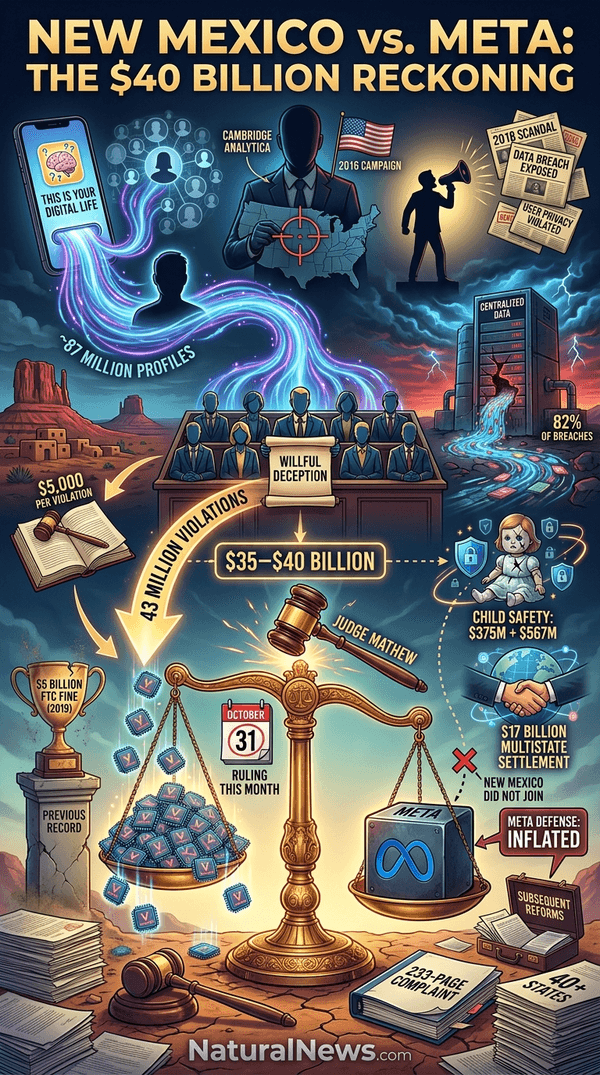
The post New Mexico Seeks Up to $40 Billion From Meta in Data Privacy Case appeared first on Activist Post.

Midnight fell differently on February 28, 2026. Across trading floors from Singapore to Chicago, monitors flickered with data streams that would soon curdle into panic. At 0400 hours Tehran time, American B-2 Spirit bombers and Israeli F-35I Adir fighters crossed into Iranian airspace, unleashing Operation Epic Fury. Nine hundred strikes in twelve hours. Ali Khamenei, Supreme Leader of the Islamic Republic, perished in the initial bombardment, his body recovered from the rubble of a command bunker beneath Tehran’s northern suburbs. Markets had anticipated conflict. They had not anticipated decapitation.
Brent crude, trading at $72.48 per barrel at market close on February 27, surged past $120 within seventy-two hours. By March 19, Dubai crude reached $166 per barrel, an all-time record. California gasoline exceeded $5 per gallon.
Kristalina Georgieva, Managing Director of the International Monetary Fund, stood before cameras in Washington on April 9, 2026. “All roads now lead to higher prices and slower growth,” she declared. Her institution had just slashed global growth projections to 3.1 percent, down from 3.4 percent anticipated before the first missiles launched. “Had it not been for this shock, we would have been upgrading global growth.” Instead, the Fund warned of a “severe scenario” where global growth collapses to 2.0 percent, brushing against the technical definition of worldwide recession—a threshold breached only four times since the Second World War. “This would mean a close call for a global recession,” the World Economic Outlook stated.
Donald Trump, returned to the presidency for a second non-consecutive term, addressed the nation from the Oval Office on August 20, 2026. “Any country that allows its financial institutions, businesses, airports, or government entities to provide any type of lifeline to Iran will itself face tremendous economic consequences,” he warned, announcing what he termed “the toughest sanctions in history.” Earlier, he had posted an image on social media showing the Strait of Hormuz crudely labeled as “New US Territory,” a digital annexation that sent tremors through diplomatic channels. His administration’s Operation Economic Fury sought to complete what Operation Epic Fury had begun. “To the ordinary soldiers supporting this regime,” Trump addressed Iranian conscripts directly, “as more and more of your paychecks stop or are supposedly just delayed, ask whether your commanders are leading your country to triumph or to ruin.”
Jerome Powell, in his final months as Federal Reserve Chair, confronted the economic paradox that would define 2026. At a Harvard forum on March 30, he admitted the central bank’s predicament with uncharacteristic candor. “Nobody knows,” he stated, referring to the war’s ultimate economic impact, while acknowledging that “you can be confident that an inflationary shock will fade, but have very little idea how long it will take.” The Fed’s March 18 decision to hold interest rates steady—projecting only a single rate cut for the year despite inflation spiking to 3.3 percent—represented a capitulation to uncertainty. Powell’s institution projected higher inflation, steady unemployment, and minimal monetary relief.
Nouriel Roubini, the economist whose prescient warnings preceded the 2008 financial collapse, offered scenarios in May 2026 that chilled institutional investors. “Oil prices could spike past $200 a barrel in the worst-case scenario,” he predicted, describing a return to “1970s stagflation.” Mohamed El-Erian, former Pimco chief and now Chief Economic Advisor at Allianz, tweeted his assessment of the IMF’s April report: “Reading between the lines, the message of today’s IMF flagship report is sobering: Virtually every challenge facing the global economy is poised to intensify due to the fallout of the Middle East War.”
The World Bank’s June 11, 2026 Global Economic Prospects report confirmed these apprehensions. Global growth would slow to 2.5 percent in 2026, the weakest expansion since the COVID-19 pandemic. For developing and emerging markets, the forecast plummeted to 3.6 percent. Iran’s economy contracted by 6.1 percent, with the Bank noting that “real GDP is projected to contract by 6.4 percent in 2026, reflecting the collapse in tourism, weaker consumption, disrupted supply chains, heightened insecurity, and prolonged displacement.” Qatar and Kuwait faced potential GDP contractions of 14 percent. The Institute for Economics and Peace calculated that a resumption of full-scale hostilities would deliver a $2.2 trillion hit to the world economy.
Economic Impact Projections by Institution, 2026
| Institution | Global Growth Forecast | Inflation Projection | Severe Scenario | Oil Price Assumption |
|---|---|---|---|---|
| IMF (April 2026) | 3.1% (down from 3.4%) | 4.4% | 2.0% growth, 5.4% inflation | $100/bbl (reference), $140+ (adverse) |
| World Bank (June 2026) | 2.5% (down from 2.9%) | 4.0% | 2.0% or below | $120/bbl average |
| OECD (March 2026) | 2.7% | 3.2% US, 3.0% Eurozone | Technical recession in energy-intensive economies | $90-110/bbl range |
| Oxford Economics | 2.8% | 4.2% | 1.5% growth if Hormuz closed 3+ months | $140/bbl threshold for demand destruction |
Regional GDP Contraction Projections, 2026
| Economy | Pre-War Forecast | Post-War Projection | Revision | Primary Transmission Channel |
|---|---|---|---|---|
| Iran | +1.1% | -6.1% to -6.4% | -7.2 pp | Infrastructure destruction, sanctions |
| Qatar | +3.2% | -14.0% | -17.2 pp | LNG export disruption, Hormuz closure |
| Kuwait | +2.8% | -14.0% | -16.8 pp | Oil export cessation |
| Iraq | +2.1% | -8.5% | -10.6 pp | Supply chain fracture, refugee costs |
| Bahrain | +1.9% | -6.8% | -8.7 pp | Financial sector exposure |
| Saudi Arabia | +3.5% | -3.0% | -6.5 pp | Reduced oil volumes, price volatility |
| UAE | +3.8% | -5.0% | -8.8 pp | Trade finance disruption |
| Eurozone | +1.2% | +0.8% | -0.4 pp | Energy import costs, manufacturing |
| United States | +2.1% | +1.8% | -0.3 pp | Gasoline prices, consumer sentiment |
Oil Market Disruption Metrics, February-September 2026
| Metric | Pre-War (Feb 27) | Peak Crisis (Mar 19) | Recovery Phase (Jun 24) | Current (Sep 30) |
|---|---|---|---|---|
| Brent Crude ($/barrel) | $72.48 | $166.00 (Dubai) | $72.24 | $73.23-$97.00 |
| Daily Oil Flow via Hormuz (mbpd) | 21.0 | 0.5 | 8.2 | 14.5 |
| Strategic Reserve Drawdown (US, mb) | 0 | 180 | 120 | 85 |
| Gasoline Price California ($/gal) | $4.12 | $5.08+ | $4.45 | $4.28 |
| LNG Force Majeure Declarations | 0 | 12 (QatarEnergy) | 3 | 0 |
Beneath these statistics lies a more troubling reality. Global debt reached $348 trillion in 2025, according to the Institute of International Finance, expanding by nearly $29 trillion in that single year. By mid-2026, estimates placed the figure above $365 trillion. This edifice of obligation, constructed during fifteen years of central bank suppression of interest rates, now faces a refinancing crisis as monetary authorities maintain elevated borrowing costs to combat inflation. The OECD’s Global Debt Report 2026 warned of “increasing pressures from sustained fiscal deficits, rising interest costs and investment needs, a structural decline in long-term demand, and growing refinancing risks as the maturity of issuance shortens.”
Small and medium enterprises find themselves particularly exposed. S&P Global’s 2026 banking risk analysis noted that SMEs “have thinner capital buffers and proportionately more floating-rate exposure,” rendering them acutely vulnerable to the higher interest costs that the Iran war’s inflationary impact necessitates. When the Federal Reserve chose steady rates over relief in March 2026, these businesses absorbed the blow directly.
The weaponization of the dollar has generated blowback that Washington’s Treasury Department struggles to contain. China’s Cross-Border Interbank Payment System (CIPS), processing the equivalent of $245 trillion in yuan-denominated transactions in 2025, has emerged as a functional alternative to SWIFT. By January 2026, CIPS linked 1,467 indirect participants across 119 countries, connecting 4,800 banks in 185 nations. While still smaller than SWIFT, its trajectory suggests a fragmentation of monetary infrastructure that the Iran conflict has only accelerated.
The petrodollar system faces unprecedented stress. Russia and Saudi Arabia, the two largest oil producers, generated “essentially zero petrodollars” in 2025 according to Wright Research analysis, having shifted to yuan-denominated settlements. Iran, excluded from dollar markets since 1979, pioneered this transition. Now the template spreads. BRICS nations conducted an estimated 90% of intra-bloc transactions in local currencies by 2025.
This matters profoundly for American fiscal sustainability. Foreign holdings of U.S. Treasury securities have plateaued as central banks diversify reserves. The dollar’s share of global foreign exchange reserves declined from 73% in 2001 to approximately 54% in 2025, per IMF data. Each percentage point shift represents hundreds of billions in reduced demand for dollar-denominated assets, increasing the interest premium Washington must pay to finance its $34.6 trillion national debt.
The Iran war operates as an accelerant upon these pre-existing trends. When Trump threatened “crushing economic warfare” in August 2026, he extended a sanctions regime that had already demonstrated diminishing returns. Iran’s economy, while battered by 6.4 percent contraction and currency collapse, had developed sophisticated evasion mechanisms through shadow banking networks and cryptocurrency channels. The Islamic Republic’s oil smuggling to China, estimated at 1.2 million barrels daily despite sanctions, continued through “dark fleet” tankers operating with disabled transponders.
European Central Bank President Christine Lagarde, in deliberations that postponed planned rate cuts on March 19, 2026, confronted the dilemma that would define transatlantic economic divergence. Energy-intensive European economies faced technical recession risks if the Hormuz maritime blockade persisted. German manufacturing, already weakened by the cessation of Russian natural gas supplies following the Ukraine conflict, confronted additional input cost shocks. The ECB raised its 2026 inflation forecast while slashing growth projections.
Japan’s position proved equally precarious. As the world’s largest liquefied natural gas importer, Tokyo faced energy security vulnerabilities that the Iran war exposed with brutal clarity. QatarEnergy’s declaration of force majeure on LNG exports during the March 2026 Hormuz closure sent Japanese utilities scrambling for alternative suppliers at premium prices. The yen, already depreciating against the dollar amid interest rate differentials, faced additional pressure as import costs surged.
China’s strategic calculus shifted in response. While publicly advocating de-escalation, Beijing accelerated yuan internationalization through energy purchase agreements denominated in renminbi. Saudi Arabia’s 2024 decision to allow yuan-settled oil sales, followed by similar arrangements with Iraq and the UAE, created the infrastructure for a parallel monetary order. The Iran war’s disruption of dollar-denominated energy flows provided practical demonstration of the vulnerabilities inherent to single-currency dependence.
India’s position illustrated the impossible choices facing emerging economies. As the third-largest oil importer, New Delhi faced inflationary pressures that threatened the Modi government’s economic credibility. Yet India’s strategic partnership with the United States constrained options for evading American sanctions on Iranian oil. The result: higher import bills, currency depreciation, and postponed infrastructure spending as fiscal resources diverted to energy subsidies.
The banking sector’s exposure to these stresses remains imperfectly understood. Commercial real estate loans, particularly those financing office properties in urban centers hollowed out by remote work trends, carry default risks that energy price shocks amplify. Regional banks in the United States, having faced depositor flight in the 2023 Silicon Valley Bank collapse, now confront renewed pressure as bond portfolios lose value amid interest rate volatility. The $1.5 to $2.1 trillion private credit market operates with opacity that systemic risk assessments struggle to penetrate.
Corporate debt maturities in 2026-2027 present a refinancing cliff of historic proportions. Companies that borrowed at near-zero rates during the quantitative easing era must now roll obligations at 6-8 percent interest, if markets remain open to them at all. The “zombie firm” phenomenon—enterprises kept operational only through continuous debt refinancing rather than operational profitability—threatens mass insolvency if credit conditions tighten further.
Agricultural markets compound these vulnerabilities. Wheat and corn prices, already elevated by Ukraine conflict disruptions and climate anomalies, face additional pressure from energy-intensive fertilizer production costs. Natural gas, the primary feedstock for nitrogen fertilizer manufacturing, saw European prices spike 300% during the March 2026 Hormuz closure. The transmission to food prices operates with inevitable lag but equal certainty.
Humanitarian consequences extend beyond abstract statistics. Iran’s population of 87 million faces food insecurity as sanctions disrupt import financing and currency collapse destroys purchasing power. The rial’s depreciation against the dollar, exceeding 80% since 2021, has rendered imported medicines unaffordable for ordinary families. Brain drain accelerates as professionals emigrate to Dubai, Istanbul, and European capitals.
Israel’s economy, despite receiving $14.3 billion in American military aid during 2026, faces its own contradictions. The Bank of Israel slashed growth prospects as the war’s toll mounted, with defense spending consuming resources that might otherwise support social services. Military mobilization of reservists disrupted technology sector productivity, while tourism revenues collapsed amid security concerns.
The United States enters the final quarter of 2026 with economic indicators that defy simple categorization. Unemployment remains near historic lows at 4.1%, yet labor force participation among prime-age males continues declining. GDP growth, projected at 1.8% for the year, masks distributional shifts that concentrate gains in asset-owning classes while wage workers confront eroded purchasing power. The Federal Reserve’s preferred inflation metric, core PCE, hovers above target at 3.3%, constraining monetary policy flexibility.
Presidential rhetoric in this environment oscillates between triumphalism and threat. Trump’s August 2026 declaration that Iran “outsmarted themselves” over Hormuz control, accompanied by social media posts depicting the waterway as American territory, suggests a transactional approach to territorial sovereignty that unsettles international law. His simultaneous threats against nations maintaining economic ties to Tehran create compliance dilemmas for allies whose strategic interests diverge from Washington’s.
The configuration of military confrontation, monetary stress, and debt fragility creates conditions for systemic stress that would exceed the 2008 financial crisis in scope. Not through single catastrophic event but through cascading failures that compound across interconnected systems. An oil price spike above $200 per barrel, as Roubini warned, would trigger demand destruction in transport sectors that eliminates millions of jobs. Corporate defaults in energy-intensive industries would cascade through credit default swap markets that remain opaque to regulators. Sovereign debt crises in emerging markets would force IMF interventions that impose austerity conditions, generating political instability that feeds further conflict.
The dollar’s reserve currency status faces its most credible challenge since Bretton Woods. Not because rivals possess superior alternatives—the yuan remains non-convertible, the euro fragmented—but because Washington’s weaponization of financial infrastructure has created irresistible incentives for diversification. Each sanctions round against Iran accelerates this process. Each threat of secondary sanctions against allies hastens the construction of parallel systems.
The optimistic scenario, increasingly dismissed by market participants, envisions negotiated settlement by early 2027, Hormuz reopening, and gradual price normalization. Even this outcome, Georgieva emphasized, leaves “permanent scarring” on growth trajectories. Output levels in 2030 will remain 2% below pre-war trends according to IMF projections. The opportunity cost of military confrontation—the infrastructure unbuilt, the research unfunded, the human potential unrealized—accumulates across decades.
The pessimistic scenario defies precise modeling because its variables interact non-linearly. Oil at $200 per barrel simultaneously triggers recession and accelerates energy transition investments that strand fossil fuel assets. Banking crises in vulnerable jurisdictions propagate through derivatives exposures that regulatory stress tests failed to capture. Political radicalization, fed by economic desperation, produces leadership incapable of crisis management.
Historical analogies offer limited guidance. The 1973 oil shock occurred within a Bretton Woods framework that no longer exists. The 2008 financial crisis, while demonstrating interconnected fragility, benefited from coordinated central bank responses that current geopolitical polarization may preclude.
What distinguishes the present moment is the convergence of multiple stressors upon a system already operating near capacity. Global debt at $365 trillion represents claims that cannot all be satisfied simultaneously. The Iran war’s energy price shock applies pressure to this leveraged structure in ways that individual components—sovereign borrowers, corporate issuers, financial intermediaries—may withstand in isolation but cannot survive collectively.
The Strait of Hormuz, that narrow channel through which one-fifth of global petroleum flows, embodies this vulnerability. Twenty-one million barrels daily transit waters barely twenty-one miles wide at their narrowest point. Iranian missile batteries, mines, and fast attack craft can interdict this flow with minimal warning. American carrier groups can suppress such threats at enormous cost but cannot eliminate them entirely.
Trump’s social media annexation of Hormuz as “New US Territory” in August 2026, however rhetorical, signaled an American willingness to assert direct territorial control over international waterways that precedent has long treated as global commons. Such assertions, if operationalized, would encounter resistance not merely from Iran but from China, Russia, and regional powers whose energy security depends upon unimpeded navigation.
Economic warfare, as practiced against Iran in 2026, operates through mechanisms that escape traditional accounting. The exclusion of Iranian banks from SWIFT messaging does not merely inconvenience; it severs commercial relationships built over decades. The secondary sanctions threatening foreign entities that transact with Iran force impossible choices upon multinational corporations between American market access and Iranian commercial relationships. The cumulative effect is a fragmentation of global commerce into competing blocs that reduces overall efficiency and prosperity.
The BRICS bloc’s expansion in 2024 to include major oil producers Iran, Saudi Arabia, and the UAE created an organizational framework for this monetary diversification. While the proposed common BRICS currency remains technically distant, the infrastructure for reduced dollar dependence develops apace.
For American households, these macroeconomic abstractions translate into concrete hardships. Gasoline prices above $5 per gallon, as experienced in California during March 2026, reduce discretionary spending that drives consumer-dependent growth. Home heating costs surge in northern winters. Food prices, transported by diesel-powered logistics networks, follow energy costs upward. The Federal Reserve’s interest rate restraint, maintained despite these pressures to combat underlying inflation, keeps mortgage rates elevated and housing affordability diminished.
The political economy of these stresses generates feedback loops that complicate resolution. Populist movements, fed by economic grievance, demand more aggressive confrontation with perceived adversaries rather than diplomatic compromise. Interest groups benefiting from military expenditure lobby for sustained confrontation. Media ecosystems amplify threat perception, reducing the political space for negotiation.
Iran’s leadership, despite decapitation and economic devastation, maintains negotiating positions that reflect their assessment of American political constraints. They observe the American electoral cycle, the influence of pro-Israel constituencies, and the transactional nature of Trump’s diplomacy. Their strategy of brinkmanship—escalating to de-escalate—assumes that Washington’s pain threshold, while higher than Tehran’s, remains finite.
The September 2026 ceasefire, brokered through Qatari intermediation, paused direct military confrontation but resolved nothing. Iranian nuclear facilities, though damaged, remain operational at undeclared sites. Israeli security guarantees, demanded as condition for permanent settlement, exceed what Tehran’s fractured leadership can deliver. American troops remain deployed across the region in configurations vulnerable to proxy attack.
Economic forecasts for 2027 diverge based upon assumptions about this unresolved confrontation. The IMF’s reference scenario assumes short-lived conflict with gradual normalization, projecting 3.1% global growth recovery. Its adverse scenario, increasingly probable as negotiations stall, envisions 2.5% growth with 5.4% inflation. The severe scenario—2.0% growth brushing recession—requires only modest additional escalation: Hormuz closure persisting beyond three months, Iranian missile strikes on Saudi infrastructure, or Israeli expansion of operations into Lebanon and Syria.
Each of these triggers remains plausible. Iranian Revolutionary Guard factions, empowered by Khamenei’s death and competing for succession influence, may calculate that renewed confrontation serves domestic political purposes. Israeli leadership, facing domestic pressure for decisive security solutions, may authorize strikes that previous restraint avoided. American electoral considerations in the approach to 2028 may incentivize foreign policy aggression that rallies domestic support.
The debt dimension compounds these risks. Sovereign borrowers facing recessionary revenue shortfalls and inflationary expenditure increases encounter debt servicing requirements that crowd out productive investment. Corporate issuers with 2027 maturities confront rollover costs that render previously viable enterprises insolvent. Financial intermediaries, holding claims upon these borrowers, face capital constraints that restrict new lending. The resulting credit contraction amplifies recessionary dynamics.
Central banks, having deployed extraordinary measures during the COVID-19 pandemic, possess diminished capacity for repetition. Balance sheets already swollen with asset purchases offer limited room for additional expansion. Interest rates, while above zero, remain below inflation in real terms, constraining traditional monetary policy space. Fiscal authorities, confronting debt burdens that limit countercyclical spending, face political resistance to deficit expansion.
A system that requires 3%+ growth to service $365 trillion debt will struggle to maintain stability at 2% growth without structural adjustment that political processes resist. The Iran war, by reducing growth and increasing inflation simultaneously, forces this adjustment upon unwilling participants. Whether through negotiated settlement that restores energy flows and reduces risk premiums, or through continued confrontation that amplifies systemic stress, adjustment will occur.
The form it takes—gradual normalization or sudden rupture—remains the variable that will define economic experience for the decade ahead. Current trajectory favors rupture: unresolved confrontation, accumulating sanctions, escalating rhetoric, and structural fragility that compound across months rather than years. The optimistic scenario requires not merely ceasefire but durable settlement, not merely sanctions relief but economic reconstruction, not merely diplomatic engagement but fundamental reassessment of regional order.
Such reassessment appears improbable given current leadership configurations. Trump approaches his final term’s conclusion with incentive to cement confrontational legacy rather than compromise. Iranian factions compete for succession advantage through nationalist positioning rather than pragmatic accommodation. Israeli security establishment, validated by apparent military success, resists territorial concessions that might address underlying grievances.
The economic consequences of this political configuration will unfold across quarters and years with accumulating damage. Growth forecasts will revise downward repeatedly. Inflation projections will revise upward. Debt sustainability assessments will deteriorate. Financial market volatility will increase. Each revision, each deterioration, each increase reduces the margin for error that prevents systemic crisis.
The Iran war has demonstrated that geopolitical confrontation can impose economic costs that exceed the combatants’ calculations. Those costs, interacting with pre-existing vulnerabilities in global debt and monetary architecture, create conditions for crisis that policy instruments cannot readily address. Whether this crisis arrives in 2026, 2027, or beyond matters less than its likelihood given current trajectory.
Markets, having priced some risk premium, may remain complacent until rupture occurs. Policymakers, having normalized extraordinary measures, may discover their exhaustion only in crisis. Populations, having accommodated gradual deterioration, may confront sudden deprivation with inadequate social infrastructure. The Iran war’s ultimate economic legacy may prove not the direct costs of military confrontation but the revelation that global economic integration, assumed permanent, rests upon political foundations more fragile than understood.
The post How the Iran Conflict Opened a New Threat to the Global Monetary System appeared first on Activist Post.

Estrogen dominance is one of the most misunderstood hormonal imbalances in modern medicine — and it’s costing people their energy, fertility, and peace of mind. You might be told your estrogen is low because your blood levels look normal or even depleted. But if you’re still battling mood swings, fluid retention, fatigue, or persistent inflammation, something deeper is going on.
What most people don’t realize is that hormones don’t just float through your bloodstream — they get trapped inside your tissues. And over time, this hidden buildup of estrogen quietly may disrupt everything from your thyroid to your immune function. Worse, it often shows up alongside rising levels of histamine, serotonin, and inflammatory endotoxins, creating a biochemical storm that conventional lab testing often misses.
This happens in women who can’t lose weight no matter what they eat. In men who feel drained, anxious, and foggy but are told their hormones are “fine.” In couples struggling with infertility while chasing normal blood results. The pattern is always the same: The labs don’t match the symptoms, and the treatments fall short.
If your intuition is telling you something’s off — even when the test results say otherwise — you’re not imagining it. The key is knowing where to look and how to measure what’s really going on. That’s where bioenergetic researcher Georgi Dinkov’s work comes in. He’s uncovering a deeper layer of hormone disruption that could explain exactly what’s keeping you stuck.
In the video interview above, Dinkov explained a significant blind spot in hormone testing: most doctors measure what’s circulating in your blood but not what’s building up inside your cells.1 Dinkov referenced a study analyzing hair samples from women, drawn from a cohort of 196 women ages 25 to 45.2
According to Dinkov, the study found that estrogen levels increased with age at the tissue level, while key protective hormones like progesterone, thyroid hormone (T3), pregnenolone, and DHEA steadily declined. Hair is made of dead cells and reflects long-term accumulation, which makes it a useful marker for what’s happening inside your tissues over months — not just in the blood for a single moment.
•Blood tests miss the full picture, leading to misdiagnosis — Dinkov emphasized that conventional lab testing fails to detect estrogen overload because blood levels don’t reflect what’s stored in your tissues. Even though your ovaries are failing and blood estradiol levels drop, every other cell in your body can still make estrogen — and they do, he explained.
This means that symptoms like fatigue, swelling, breast tenderness, and even breast cancer are often still estrogen-driven, even when your labs show low estrogen. Blood tests are only showing what’s circulating, not what’s stuck in your tissues, and that’s where estrogen may cause harm.
•Symptoms of estrogen dominance are wrongly blamed on deficiency — Many women are told they need estrogen replacement because their blood levels appear low. But Dinkov warned, “The most popular kind of breast cancer is estrogen receptor-positive. How can you have an estrogen-driven disease if you’re deficient in estrogen?”
He pointed out that tissue estrogen is often high in menopausal women, and that hormone therapy based solely on bloodwork often makes things worse. Estrogen dominance symptoms — like water retention, fatigue, insomnia, and infertility — aren’t signs of deficiency. They’re signs your body is overloaded, and your doctor just isn’t seeing it.
•Hair and nail testing offer a better picture of long-term hormone exposure — According to Dinkov, each half-inch of hair growth reflects about one month of internal biochemistry. This makes it a powerful tool for uncovering chronic hormonal imbalances. Unlike bloodwork, which only captures a moment in time and fluctuates wildly based on stress or food intake, hair and nail analysis shows trends, giving you data you can actually act on.
Dinkov described how many people come to his lab saying, “Something’s not right, but my doctor says all my tests are normal.” In many cases, he finds hidden overloads of estrogen, serotonin, or heavy metals like lead, cadmium, and titanium. Titanium dioxide is in many drugs and supplements, and even tiny doses may increase diabetes risk, he said. Because these substances build up gradually, they’re often missed by blood tests but are detectable in hair or nail analysis.
•Serotonin and histamine track closely with estrogen in stressed or inflamed states — Dinkov noted that elevated serotonin and histamine often show up alongside estrogen in hair and nail samples. These biochemicals all share overlapping pathways that reflect systemic stress and immune activation, he explained.
High serotonin levels are often falsely celebrated as good, but chronically elevated serotonin contributes to inflammation, suppressed metabolism, and gut dysfunction. Similarly, histamine overload mimics allergy symptoms or anxiety, but it’s often a byproduct of deeper biochemical chaos linked to estrogen overload.
•Declining thyroid hormone worsens estrogen buildup — Thyroid hormone T3 plays a key role in metabolizing estrogen and clearing it from tissues. In the study referenced by Dinkov, T3 levels steadily declined with age, right alongside progesterone and DHEA.3
This sets the stage for estrogen to accumulate, because your body lacks the metabolic drive to get rid of it. When thyroid output slows down, estrogen builds up faster, and has been associated with a range of effects, from low energy to mood instability to abnormal cell growth.
•Blood test snapshots miss the bigger picture — Dinkov shared that steroid levels fluctuate minute-by-minute, especially during stressful doctor visits. Some people get nervous and their cortisol spikes, others feel fine at the clinic but are actually under chronic stress the rest of the time.
What matters isn’t your hormone levels during a 10-minute appointment — it’s the pattern over weeks or months. That’s what hair shows you. With each strand, you can trace your biochemical state month by month, uncover what triggered past symptoms, and start making informed changes that actually match your biology.
If your hormones feel “off,” but your labs keep coming back normal, it’s not your imagination — it’s the testing. What’s in your blood isn’t always what’s in your tissues.
Most hormone panels miss the estrogen, serotonin, and histamine that get stuck inside your cells, where they quietly may affect your energy, fertility, mood, and metabolism. If you’re stuck in that frustrating loop — bloated, wired, exhausted, or inflamed — it’s time to shift your strategy. Here’s how to get to the root of what’s actually happening and start undoing the damage.
1.Start with a tissue-level test and get your prolactin checked — If you’ve been told your estrogen is low but still feel estrogen-dominant, you need a better way to measure what’s really happening. Hair or nail analysis gives you a timeline of hormone buildup in your tissues, month by month, allowing you to track stored estrogen, serotonin, cortisol, and even heavy metals.
On top of that, check your prolactin levels. High prolactin is a marker of excess estrogen activity, even when your estrogen looks low on a blood test. If your prolactin is elevated and your thyroid is low, that’s a red flag your cells are swimming in estrogen. This step alone helps you stop chasing the wrong diagnosis and finally start correcting the right imbalance. Talk to your healthcare provider about whether this testing is appropriate for you.
2.Eliminate the things that mimic estrogen — Most people are unknowingly loading their bodies with estrogen-like chemicals from everyday products. Vegetable oils — like canola, soybean, and sunflower — are high in linoleic acid (LA), which promotes estrogen dominance by potentially impairing thyroid function, slowing estrogen detox, and reducing mitochondrial energy production.
Keep your LA intake between 2 and 5 grams per day — the historical norm before industrial seed oil consumption rose, and a level your body still needs for healthy mitochondrial function.
At the same time, ditch endocrine-disrupting chemicals (EDCs) lurking in plastics, personal care products, and cleaning supplies. Swap out anything with parabens, phthalates, and synthetic fragrance. Store food in glass. Drink from stainless steel or glass bottles. Don’t microwave food in plastic, and filter your tap water to reduce microplastic exposure.
3.Stop feeding the gut bacteria that keep this cycle going — Estrogen, histamine, and serotonin all get recycled and amplified in your gut, especially if you’re overfeeding oxygen-tolerant bacteria. Beans, leafy greens, cruciferous veggies, and whole grains all ferment quickly and feed the wrong microbes when your gut is compromised.
That drives more bloating, inflammation, and gas. If you have a damaged gut, focus on whole fruit and white rice, which digest cleanly without fermenting too fast. Then, gradually introduce higher-fiber foods that you can tolerate.
Avoid high-histamine foods (like fermented vegetables, leftover meats, or aged cheeses) while your system resets. You’ll also want to support liver detox with collagen-rich foods like gelatin or bone broth — this helps clear out excess histamine and serotonin before they build up in your tissues again.
4.If you’re using hormonal therapies, reassess your load — If you’re on estrogen-based hormone replacement therapy (HRT) or birth control, step back and look at the bigger picture. Bioidentical or not, you’re still adding to your estrogen load. And if your tissues are already saturated, more estrogen — especially without enough progesterone to balance it — just adds fuel to the fire.
Consider switching to natural methods that support your body’s own hormonal rhythm. If you’re in perimenopause or menopause, natural progesterone is especially helpful. It opposes estrogen, stabilizes your mood, and supports your thyroid. This isn’t about giving up support — it’s about choosing the kind that restores your body instead of flooding it.
5.Clear out the estrogen you’ve already stored — To lower your tissue estrogen load, support your body with natural progesterone. Progesterone acts as a natural antagonist to estrogen, helping to balance its effects. Given the tendency toward estrogen dominance, incorporating natural progesterone may help restore a more balanced hormonal ratio.
Once you shift your focus to what’s happening inside your tissues — and not just what shows up in your blood — you’ll finally understand why the old strategies stopped working. And more importantly, you’ll know exactly what to do next.
This article is for informational purposes only and does not constitute medical advice. Consult a qualified healthcare provider before making changes to your health regimen.
Before the detail that follows: Transmucosal progesterone therapy requires a prescription and a clinician’s supervision. What is described below is how it is used under that supervision. It is not a protocol to begin on your own, and progesterone is not a supplement you should self-dose — it is a hormone, and the right dose, the right timing, and whether it is appropriate at all depend on your own circumstances. If you are pregnant, trying to conceive, on hormonal contraception or being treated for a hormone-sensitive condition, this needs a doctor before anything else.
It’s also important to understand that progesterone is not a magic bullet, and that you get the most benefit by implementing a Bioenergetic diet approach that allows you to effectively burn glucose as your primary fuel without backing up electrons in your mitochondria that reduces your energy production. My book, “Your Guide to Cellular Health: Unlocking the Science of Longevity and Joy,” covers this process in great detail.
Once you have dialed in your diet, an effective strategy that can help counteract estrogen excess is to take transmucosal progesterone (i.e., applied to your gums, not oral or transdermal), which is a natural estrogen antagonist. Progesterone is one of only three hormones I believe many adults can benefit from. (The other two are DHEA and pregnenolone.)
I do not recommend transdermal progesterone, as your skin expresses high levels of 5-alpha reductase enzyme, which causes a significant portion of the progesterone you’re taking to be irreversibly converted primarily into allopregnanolone and cannot be converted back into progesterone.
Please note that when progesterone is used transmucosally on your gums as I advise, the FDA believes that somehow converts it into a drug and prohibits any company from advising that on its label. This is why companies promote their progesterone products as “topical.”
However, please understand that it is perfectly legal for any physician to recommend an off-label indication for a drug to their patient. In this case, progesterone is a bioidentical hormone rather than a synthetic progestin, and the two have different safety profiles — the risks associated with progestins in the hormone therapy literature do not transfer straightforwardly to bioidentical progesterone. That is not the same as being risk-free at any dose, however. Progesterone is sedating, can affect mood, and interacts with other medications, so the dose must be established in collaboration with the prescribing clinician.
Dr. Ray Peat has done the seminal work in progesterone and probably was the world’s greatest expert on progesterone. He wrote his Ph.D. on estrogen in 1982 and spent most of his professional career documenting the need to counteract the dangers of excess estrogen with low-LA diets and transmucosal progesterone supplementation.
He determined that most solvents do not dissolve progesterone well and discovered that vitamin E is the best solvent to optimally provide progesterone in your tissue. You just need to be very careful about which vitamin E you use, as many supplemental vitamin E products are synthetic and do not provide the form your body uses.
It is imperative to avoid using any synthetic vitamin E (alpha tocopherol acetate — the acetate indicates that it’s synthetic). Natural vitamin E will be labeled “d alpha tocopherol.” This is the pure D isomer, which is what your body can use.
There are also other vitamin E isomers, and you want the complete spectrum of tocopherols and tocotrienols, specifically the beta, gamma, and delta types, in the effective D isomer. Look for a label showing the full spectrum of tocopherols and tocotrienols in the D isomer form.
When it comes to application, my preferred approach is to dissolve either powdered or liquid progesterone in natural vitamin E — having established the dosing with your prescriber — and apply it directly to the gums. This transmucosal application allows for optimal absorption and use by the body. There are also premade vitamin E-based progesterone products on the market. Just make sure they’re using natural vitamin E. The recommended time for application is 30 minutes before bed, as progesterone has an anti-cortisol effect and can increase GABA levels, promoting better sleep.
If you are a menstruating woman, you should take the progesterone during the luteal phase or the last half of your cycle, which can be determined by starting 10 days after the first day of your period and stopping the progesterone when your period starts. If you are a male or non-menstruating woman, you can take the progesterone every day for four to six months and then cycle off for one week. This is what I have been personally doing for over a year with very good results. I am a physician so do not have any problems doing this. If you aren’t a physician, you should consult one before using this therapy, as transmucosal progesterone therapy requires a doctor’s prescription.
Q: Why do my hormone blood tests say I’m low in estrogen, even though I feel estrogen dominant?
A: Because blood tests only measure what’s circulating at that moment — not what’s trapped inside your tissues. Estrogen often builds up inside cells, where it continues to exert strong biological effects. If you’re experiencing symptoms like fatigue, breast tenderness, water retention, or mood swings, you’re likely dealing with high tissue estrogen, even if your lab work says otherwise.
Q: How do histamine, serotonin, and endotoxin relate to estrogen overload?
A: These compounds often rise together and create a compounding effect. Elevated histamine and serotonin worsen symptoms like anxiety, gut issues, and sleep problems. Endotoxins, which come from gut bacteria, amplify the cycle by driving inflammation and hormonal disruption. Estrogen slows gut motility, which increases endotoxin exposure, setting off a cascade of biochemical stressors.
Q: What’s the most accurate way to measure what’s happening with my hormones?
A: Hair and nail analysis may provide a timeline of your tissue hormone levels over weeks or months, something blood tests can’t capture. This method reveals chronic overloads of estrogen, cortisol, serotonin, and even heavy metals, giving you actionable insights into what’s really going on inside your body.
In addition, prolactin is a useful marker of estrogen activity, since estrogen stimulates prolactin production. If your prolactin is high, especially alongside low thyroid, it’s a strong sign that your estrogen load is elevated at the tissue level.
Q: What can I do to lower my estrogen load and feel better?
A: Start by removing vegetable oils (like soybean and canola), which promote estrogen dominance, and avoid endocrine-disrupting chemicals found in plastics and personal care products. Support detox with collagen-rich foods and avoid high-histamine or fermentable foods that feed harmful gut bacteria. Use natural progesterone to help counter estrogen’s harmful effects and support hormonal balance.
Q: Should I be using estrogen-based therapies like birth control or HRT?
A: If your tissues are already overloaded with estrogen, adding more — even if it’s “bioidentical” — worsens the imbalance. Estrogen-based therapies should be reassessed, especially if you’re dealing with unresolved symptoms. Natural progesterone is a safer, more supportive option for rebalancing your hormonal ratio and protecting your thyroid and metabolism.
The post Estrogen, Histamine, Serotonin, and Endotoxin with Georgi Dinkov appeared first on Activist Post.

Texas Gov. Greg Abbott declared a statewide disaster Monday over diesel prices. In the same stretch, at least 16 trucking companies landed in bankruptcy court, Iowa farmers started saying out loud that they might lose family farms, and on Tuesday the Conference Board reported that Americans’ confidence in the economy fell to its lowest level since 2014.
Any one of those would be a bad news day. Together they tell one story. The fuel shock from the Iran war has moved off the gas station sign and into the businesses that move food and pay people. Freight, farms, used cars, credit cards and commercial real estate are all showing the same strain at once, and the Federal Reserve just raised interest rates on top of it.
You’ll feel it first at the grocery store, because nearly everything on the shelf rode on a diesel truck. Next it shows up in what it costs you to borrow, on your credit card and your car loan. If it keeps going, it shows up in whether you still have a job. This morning we published The AI Bubble Is Cracking, and This Economy Can’t Take Another Hit, where we said the economy was already running on fumes.
Abbott’s order lets truckers run dyed diesel on public roads. That’s the red-tinted, untaxed fuel normally meant for tractors and off-road equipment. It also raises the weight limit on fuel, crop and timber loads to 95,000 pounds and suspends the state’s low-emission diesel rules where the EPA allows. It doesn’t touch the 20-cent state fuel tax, which Democrats have been pushing him to waive.
AAA had Texas diesel at $5.86 a gallon on Monday. In early February, before the U.S. and Israel struck Iran, it was $3.30. A trucker filling two 100-gallon tanks is paying about $500 more per fill-up than he was last winter.
FreightWaves counted at least 16 trucking, delivery and transportation companies that filed for bankruptcy between late August and September 21. The Independent tallied more than 250 jobs tied to those filings. About half are Chapter 7 liquidations, which means the trucks get sold and the company is gone.
The list runs from one-truck operators in Garland and McKinney to Xoco Transport in Hidalgo, Texas, a carrier with about 65 drivers that filed for Chapter 11 on September 16. Diesel hit a national record of $6.53 this month, but fuel isn’t the only thing crushing carriers. Insurance, maintenance and labor keep climbing, and freight has slow months when a small carrier can’t raise rates enough to cover any of it.
The industry was already shrinking before this. Truck transportation employed 1.47 million people in August, about 118,000 fewer than at the October 2022 peak.
In Iowa, farmers told Axios that diesel is up nearly 80 percent since the Iran war began. That lands on top of tariffs that raised the price of fertilizer, pesticide and equipment and soured trade with Canada, which buys about 30 percent of Iowa’s exports. Some farmers are cutting back on how much they run their machines and looking at loans just to get through.
Mark Mueller farms near Waverly and runs the Iowa Corn Growers Association. He told Axios his operation is scraping by, that he can easily see more farmers going bankrupt or retiring, and that some are saying they can’t leave the farm to their sons. He also pointed to rising interest rates, which hurt farmers who borrow to plant and pay it back after harvest. Julius Schaaf, a retired corn and soybean farmer in Fremont County, said the swings are “just absolutely wiping them out” when it comes to younger farmers without a cushion.
The Conference Board said Tuesday its Consumer Confidence Index fell 6.7 points to 81.9 in September, the lowest reading since 2014. More people said their family’s finances were bad than good, only the second time that’s happened since the question was added four years ago. The board’s chief economist said people’s complaints about prices, and oil and gas in particular, hit new highs.
The Fed isn’t coming to the rescue. On September 16 it raised rates for the first time since 2023, to a range of 3.75 to 4 percent, and signaled another hike before the end of the year. That’s the Fed fighting fuel-driven inflation by making money more expensive for the same farmers and truckers already going under.
In fairness, the job market is still holding up. Job openings dipped in August, but layoffs slipped too. So far the damage is in what things cost, and in how far behind people are getting on their bills.
Used cars. Edmunds says the average 3-year-old used vehicle sold for a record $32,461 in the second quarter. At the bottom of the market, a $10,000 to $15,000 budget now buys a car that’s almost 9 years old with about 98,000 miles on it. In 2019, the same money bought a car about four years newer with 40,000 fewer miles. That’s the car a young worker or a family replacing a dead minivan can afford, and it’s the one most likely to need a big repair right when money is tight.
Credit cards. The New York Fed’s second-quarter data shows about one in ten dollars of credit card debt held by Americans under 30 slid 90 days or more past due over the past year, roughly double the 2021 rate. Borrowers over 70 are falling behind at rates the Fed’s data hasn’t shown since around 2011. Those are the two groups with the least room: young people who haven’t built savings, and retirees on fixed incomes putting groceries on plastic.
Office buildings. Trepp data cited by Bloomberg puts the delinquency rate on office loans in commercial mortgage-backed securities at 12 percent in August. That’s just under the record set earlier this year and higher than the peak after the 2008 crash. One of every eight dollars in those loans is behind. Bloomberg found almost $40 billion of the $64 billion in office bonds coming due this year and next is already in trouble. One tower bought for $712 million in 2015 was recently appraised at $195 million.
Empty office towers might sound like a Wall Street problem. But those bonds sit in pension funds, insurance companies and bank portfolios, and when a building loses two-thirds of its value, somebody eats that loss. Trepp’s rate of commercial loans in special servicing, meaning loans already in workout, is at its highest level since early 2013.
The 1970s. The last time a Middle East oil shock drove prices this hard, the Fed spent the rest of the decade chasing inflation. Families got stagflation, meaning prices kept rising while the economy stalled, and mortgage rates eventually topped 18 percent in 1981. Raising rates into a fuel shock is the same playbook, and it hurt a lot of working people before it worked.
The 1980s farm crisis. High interest rates and collapsing land values wiped out family farms across the Midwest in the early ’80s, and rural towns never fully came back. Mueller told Axios this isn’t the ’80s yet, and he’s probably right. But the ingredients are the same ones: borrowed money, rising rates, and costs farmers can’t pass along to anyone.
In August we laid out in The AI Bubble Is Holding Up the Economy how data center spending was making the headline numbers look better than regular people felt. This morning we followed up with how that money is starting to wobble. Today’s news is the other half of the picture. The part of the economy that grows and moves food is already in bankruptcy court, consumers already say they feel broke, and the Fed is tightening.
Diesel stocks are about 600 million gallons short going into winter, and as we covered last week, the Fed itself now says supply shocks are here to stay. In a normal year, an AI pullback or a trucking shakeout would be painful but survivable. This year there’s no cushion left to absorb either one. I don’t think people understand how thin the ice is right now.
Every dollar of diesel that truckers and farmers can’t absorb ends up in the price of your groceries. Every carrier that liquidates means fewer trucks and higher freight rates the next time demand picks up. Every rate hike shows up on your credit card APR within a billing cycle or two.
The people getting hit hardest are the ones with the least slack: the 25-year-old making payments on a 9-year-old car, the retiree carrying a grocery balance, the young farmer who borrowed to get started and now can’t make the numbers work. They didn’t start a war or set interest rates, and they’re the ones paying for both. It’s a damn shame, and it’s going to get worse before it gets better.
You don’t need to guess the day things break. You need a household that can take higher prices, higher rates and a lost paycheck in the same year.
Build a cash cushion. Trucking and farming are shedding jobs first, and layoffs spread from there. Work toward three to six months of expenses, and keep a couple of weeks of cash at home. Our 90-day plan is in Job Loss Is the Most Likely SHTF Event You’ll Ever Face.
Go after variable-rate debt now. The Fed has already said another hike is coming. Credit card balances get more expensive every time it moves, so pay those down before anything else, and don’t take on new ones.
Keep your current car running. With 3-year-old used cars at record prices and cheap cars showing 100,000 miles, this is a terrible market to buy in. Spend a few hundred dollars on maintenance now instead of $30,000 on a replacement later.
Stock the pantry before diesel reaches the shelf. Freight costs work into food prices with a lag. What you buy this month is cheaper than what you’ll buy in January. Start with what your family actually eats, using Long-Term Food Storage: What Actually Lasts 25 Years.
Build a Community. When money is tight, a neighbor with a truck, a friend who hears about job openings, or a local farmer who’ll sell you beef direct is worth more than anything in your 401(k). We walk through building that in Prepper Communities: Building a Survival Network in Troubled Times.
Learn skills that cut costs. Basic car repair, cooking from scratch and gardening all save real money in a downturn, and some of them can bring in money too. Pick your next one from 30+ Self-Reliant Resources: Preparedness Skills that Everyone Should Know.
The post Texas Declares a Diesel Disaster as 16 Trucking Companies Go Bankrupt and Consumer Confidence Hits a 12-Year Low appeared first on Activist Post.

Book launch day! The Octopus of Population Control is now available on Amazon as a paperback, Kindle, and audiobook. It clocks in at around 400 pages, has one hundred references, and features more than 400 quotes from people with a front-row seat to the depopulation agenda over the centuries.
As the sequel to The Octopus of Global Control (2017), this book goes deep into the past, present, and future of the global eugenics program. Any quest for world government always leads to depopulation as a solution for controlling the masses, and this book blows the lid off what they have planned for humanity, how long it has been happening, and exactly who is involved.
The Octopus of Population Control: https://amzn.to/4xDQ42L
Hypocrazy Audiobook: https://amzn.to/4aogwms
The Octopus of Global Control Audiobook: https://amzn.to/3xu0rMm
Website: www.Macroaggressions.io
Merch Store: https://macroaggressions.dashery.com/
C60 Power: https://go.shopc60.com/PBGRT/KMKS9/
Promo Code: MACRO
Chemical Free Body: https://chemicalfreebody.com/macro/
Promo Code: MACRO
Wise Wolf Gold & Silver @ (800) 426-1836: https://macroaggressions.gold/
LegalShield: www.DontGetPushedAround.com
Christian Yordanov’s Health Program: www.LiveLongerFormula.com/macro
Replace Your Mortgage: www.WipeOutYourMortgageNow.com
Augason Farms: https://augasonfarms.com/MACRO
Activist Post: www.ActivistPost.com
The post #680: The Octopus of Population Control appeared first on Activist Post.

Zelensky now says Ukraine needs to mobilize 50,000 to 60,000 people EVERY MONTH simply to keep pace with Russia. Stop for a moment and think about what that number actually means. At 50,000 per month, that is 600,000 people per year. At 60,000, it becomes 720,000. Zelensky is talking about finding a population roughly equivalent to a substantial European city every single year to feed into a war that has already been grinding on since 2022. Where are these people supposed to come from?
That is the question nobody wants to confront because Ukraine does not possess an unlimited reservoir of military-age men. Its population was already declining before the war. Millions of Ukrainians subsequently fled abroad, millions more live in Russian-occupied territory, and the remaining population has endured years of casualties, disability, displacement, emigration, and demographic collapse. Ukraine does not publish a complete current population count because there has been no census since 2001 and wartime migration makes estimates difficult.
Ukraine has already been forced to expand the recruitment pool. The minimum mobilization age was lowered from 27 to 25 in 2024. Men between 18 and 60 generally remain subject to wartime restrictions on leaving the country, although there are exemptions, and Kyiv has repeatedly revised mobilization procedures as the military searches for additional manpower. Rumor has it that they will start going after the young women next. Ukraine has resisted lowering compulsory mobilization to 18, instead creating voluntary contracts with enhanced financial incentives for people aged 18 to 24. I’d expect that to change as well.
A 20-year-old is not merely another soldier on a spreadsheet. He is potentially forty or fifty years of future productive labor. He is a future engineer, farmer, mechanic, entrepreneur, taxpayer, husband, and father. Kill or permanently disable enough young men and the economic consequences continue for generations after the politicians finally sign whatever peace agreement they could have negotiated years earlier.
Human capital is much harder to measure. How do you calculate the children who will never be born because their prospective fathers died at 23? How do you calculate the businesses never created, the taxes never paid, the families never formed, or the skilled workers who fled the country rather than risk being mobilized?
Ukraine already entered this war with one of Europe’s worst demographic problems. Its fertility rate had been well below replacement for years, and the war drove births still lower. That means the generation Kyiv is drawing upon today was already smaller than the generations that preceded it. You cannot manufacture another generation of 25-year-olds because the Defense Ministry needs another 50,000 recruits next month.
Then there is the issue everyone conveniently ignores when quoting mobilization figures: recruitment is not the same thing as increasing the size of the army. If Ukraine mobilizes 50,000 people while thousands of existing soldiers are killed, wounded, medically discharged, missing, deserting, or otherwise leaving service, the net increase is far smaller. They are replacing men the war has already consumed rather than expanding the military.
Russia faces the same brutal arithmetic, but Russia began with a population several times larger than Ukraine’s. Ukraine cannot simply compete with Russia soldier-for-soldier indefinitely and pretend demographics do not exist. If Moscow can recruit or mobilize from a vastly larger population, matching Russia’s monthly manpower numbers becomes increasingly expensive for Ukraine in demographic terms.
The people cheering for endless war from Washington, Brussels, London, Paris, and Berlin do not have to supply 60,000 Ukrainians every month. They supply money. They supply artillery shells. They supply missiles. They supply loans and weapons contracts. Ukraine supplies the human beings.
That is why Zelensky’s 50,000 to 60,000 figure should horrify anyone actually concerned about Ukraine’s future rather than merely its battlefield position next month. Annualize the upper end and Kyiv is talking about mobilizing 720,000 people every year merely to match what it says Russia is recruiting. That does not mean 720,000 will necessarily be mobilized or sent into combat, nor does it tell us Ukraine’s casualty total. But the scale of the stated requirement exposes the fundamental problem.
Ukraine cannot continue burning through its human capital indefinitely. Neither can Russia. There is no victory worth celebrating if, by the time politicians finally decide to negotiate, an entire generation has been buried, crippled, displaced, or driven overseas and the country supposedly being saved no longer has enough young people left to rebuild it. The weapons can eventually be replaced. The buildings can eventually be reconstructed. The debt can be rolled over and politicians will pretend somebody else will pay it later. The young men disappearing into this war cannot be printed, borrowed, or replaced.
The post Where Are Another 60,000 Ukrainian Soldiers Every Month Supposed to Come From? appeared first on Activist Post.

Belarus earlier this year signed a legal framework for crypto banks in the country.
The first crypto banks have opened in Belarus, according to reports, after the European country earlier this year created a legal framework for Bitcoin banks.
While not yet named, the crypto banks will start operations after obtaining accreditation from the National Bank of Belarus, Russian news agency Interfax reported Monday.
Back in January, Belarusian President Alexander Lukashenko signed Decree No. 19 “On Cryptobanks and Certain Issues of Control in the Field of Digital Tokens,” officially creating a legal framework for bitcoin and crypto banks in the country.
“The practical outcome of today’s discussion is the launch and registration of the first crypto banks in the country’s history,” Interfax reported the press service of High-Tech Park saying in a statement.
High-Tech Park is a tax and legal regime in Belarus. Digital asset transactions are permitted in the zone.
The statement added that banks would be regulated by Hi-Tech Park and the National Bank.
Dmitry Kalechits, first deputy director of the High-Tech Park supervisory board secretariat, was quoted saying that the move would “improve the flow of the financial ecosystem” and drive foreign investment to Belarus.
President Lukashenko last September backed the National Bank’s initiative to establish crypto banks in the country.
The country has long pushed pro-crypto regulations. A 2017 decree legalised crypto mining and trading and temporarily exempted individuals’ crypto income from tax and declaration. That exemption was extended to 2025 and has since been narrowed, with income from foreign platforms now taxed at 13%.
Lukashenko has repeatedly promoted Bitcoin mining as a use for surplus electricity, and in 2025 the Mogilev region began preparing sites for mining farms with his backing.
The post Belarus Approves the Country’s First Crypto Banks: Report appeared first on Activist Post.

“And it causes all, both small and great, both rich and poor, both free and slave, to be marked on the right hand or the forehead, so that no one can buy or sell unless he has the mark.” — Revelation 13:17
Pax Silica is a U.S.-led strategic initiative launched in December 2025 to control the global supply chains for semiconductors, AI infrastructure, and critical minerals—by organizing a coalition of “trusted partners” to reduce dependence on China.
The name combines “Pax” (Latin for peace) with “Silica,” signaling a vision of a U.S.-centered technological order. The initiative is led by Jacob Helberg, the Under Secretary of State for Economic Affairs, who framed it as a purpose-built alternative to forums not suited to managing the AI economy—the G7 and the G20.
Helberg was direct: “If the 20th century ran on oil and steel,” he said, “the 21st century is going to run on compute and minerals.” Compute is the processing power that runs AI. Minerals are the raw materials that make the chips and hardware possible.
The initiative spans everything from mining and refining, through chip design and fabrication, to data centers, energy, and logistics.
Helberg calls the underlying idea “innovation sovereignty”—the claim that a nation’s security no longer comes from controlling every part of the tech stack within its own borders, but from being a trusted contributor to a network the United States leads.
The founding declaration was signed by the United States and five partners: Japan, South Korea, Singapore, the United Kingdom, and Australia. The initiative has since expanded to 24 signatories, including the European Union. Taiwan has separately endorsed its principles, and at a June 2026 summit, 35 economies signed a corresponding Joint Statement on AI Opportunity.
Pax Silica is not a treaty organization. It is a hub-and-spoke network: the United States signs bilateral declarations with each partner, tailoring the terms to what each country can contribute.
One partner supplies critical minerals. Another provides advanced semiconductor manufacturing. A third offers data centers or AI research capacity. The goal is to maximize the resilience of the whole network rather than have every member duplicate the same efforts.
The United States aims to mobilize more than $1 trillion in allied investment. The US government is contributing $250 million to seed the Pax Silica Fund—and asking its allies to pay for the rest.
The complications are already visible.
India—the only full BRICS member to join—signed on in February 2026, on a non-exclusive basis.
Kazakhstan, a BRICS partner country, joined both Pax Silica and China’s rival World AI Cooperation Organization (WAICO), a 29-nation bloc headquartered in Shanghai that offers subsidized Chinese AI models to developing nations.
The European Union signed the declaration while simultaneously pursuing its own Technological Sovereignty Package—a set of legislative proposals, including Chips Act 2.0, designed to reduce Europe’s dependence on both American and Chinese technology.
And the United States is the world’s largest debtor. Its claim to global power has rested for fifty years on the petrodollar—the arrangement that made oil the foundation of dollar demand. That foundation is eroding. Pax Silica is the search for the next one.
Everything about Pax Silica—the coalition, the investment target, the full-stack scope—is designed to control the global economy. And the first prototype is already being built.
The digital passport is the operational heart of the Panama pilot. It is a cryptographic credentialing system for AI-related cargo—a verified digital record that travels with a shipment, certifying its origin, custody, and compliance status from the point of mineral extraction to the final destination. It is a log of every step in the chain.
The pilot itself is a twenty-four-month program the State Department commissioned in August 2026 for $50 million. Its first deployment is the Panama Canal—one of the most important shipping chokepoints on earth. The system must be designed and built from scratch.
Here is how it works. Every shipment of semiconductors, critical minerals, or AI infrastructure would be checked against that record. If verification confirms the cargo is from a trusted source and has followed approved routes, it gets pre-approved expedited processing and faster customs clearance. If the record shows a gap—an unapproved origin, a missing link in the chain—the shipment is held.
If the pilot succeeds, the platform expands to other Pax Silica countries. Every member economy would be plugged into the same verification system. Every shipment would be logged, credentialed, and either fast-tracked or held for inspection. The digital passport becomes the gatekeeper of the AI economy. Whoever controls the credential controls who gets to participate.
This is what “economic security” means in practice. Not merely secure supply chains—controlled supply chains. And controlled supply chains are not a new kind of power. They are the oldest kind. Whoever controls access to exchange controls the people who must exchange. Revelation 13:17 says no one can buy or sell without the mark. The mark is not on the hand or the forehead. It is in the ledger needed for life.
Here is the inversion that makes the American position unique. Proverbs 22:7 says the borrower is the slave of the lender. By that logic, the United States—the world’s largest debtor—should be the slave. Instead, it built a system in which its creditors are trapped by its debt. If the US collapses, they collapse with it. The debtor became the master—not by escaping the debt, but by making the debt shared.
Pax Silica is the attempt to extend that inversion into the next century. It is what you might expect from the world’s largest debtor, searching for a new anchor before the old one fails. The world’s largest debtor is in charge the way a man at the edge of a cliff is in charge of the people roped to him. If he falls, they fall too. And they know it.
One system determines which physical goods can move. The other determines how economic transactions within the network are priced and settled. Together they raise the question of who controls access to the next economy.

The “token dollar” is the financial layer of the Pax Silica architecture. It is a proposed evolution of the U.S. dollar’s global role, designed for the AI era. The idea is simple: make the U.S. dollar the default currency for pricing and settling AI computation—the “tokens” that AI models process and generate.
The parallel to oil is direct. The petrodollar system, built from 1974, made the dollar the mandatory currency for oil transactions. Every country that wanted oil had to hold dollars. The token dollar proposes that in the AI age, compute becomes the new strategic commodity, and it should be priced and settled in dollars.
Here is how the mechanism works. Every AI transaction, from a single query to a full model training run, is priced in dollars. The payment rails are dollar-pegged stablecoins—programmable digital tokens designed to maintain a one-to-one value with the US dollar. When global companies buy AI compute, they generate dollar revenue for US-linked firms. That revenue flows into the dollar-based financial system. The reserves backing the stablecoins are invested in US Treasuries. Every AI transaction, anywhere in the world, increases demand for US government debt.
The Center for Strategic and International Studies (CSIS), a Washington think tank closely tied to the national security establishment, recommends the US lead a coalition to make the dollar the “default unit of pricing for token generation,” using dollar-backed stablecoins to settle these contracts and connecting the system to US futures markets.
This is where the three layers close into a loop. The physical gate—the Panama pilot—controls which goods move. The credentialing layer—the digital passport—determines who is trusted. The financial layer—the token dollar—captures the value. A country that wants to participate must align with Pax Silica’s rules, open its books, verify its supply chains, and accept the credentialing framework. Once that infrastructure is in place, every AI transaction within the network is priced and settled in dollars.
The loop closes like this. Global companies buy AI compute. They generate dollar revenue for US firms. The reserves backing the stablecoins go into US Treasuries. Dollar demand is reinforced. The US can borrow more cheaply. It funds its deficits. It projects power. It maintains the system.
The data shows this is already happening. More than 98% of agent-to-agent settlements over the past year used USDC, a dollar-pegged stablecoin issued by Circle, a private company that holds US Treasuries as reserves.
Between May 2025 and April 2026, autonomous AI agents settled roughly $73 million across 176 million on-chain transactions — an average of about 31 cents per payment. Separately, stablecoins processed $33 trillion in total on-chain transaction volume in 2025, surpassing Visa and Mastercard combined. That figure includes trading and DeFi activity, not just commercial payments. The real-world commercial volume was smaller — about $400 billion — but it doubled year over year.
If it succeeds, the token dollar is the financial abstraction endgame: the U.S. dollar becomes the system’s entropy accelerator. It takes massive amounts of real energy and resources and disperses them into digital abstractions. What remains is a number on a ledger—a number that must be fed still more energy just to persist.
If it fails, the US loses the ability to borrow cheaply, fund its deficits, and project power abroad.

Pax Silica is being rolled out during a period of unprecedented geopolitical disorder. The United States has, by its own actions, been described as a rogue state by much of the world—it kidnapped Venezuela’s president in January 2026, and its president talks openly about seizing Canada and Greenland.
Why? What would explain this behavior?
If the United States were at war, it would make sense. War justifies extraordinary measures. War justifies the suspension of normal rules. War justifies the seizure of resources, the control of supply chains, the mobilization of allies.
But “the war that isn’t” is clandestine, and for a reason. A declared war would require public consent. A clandestine war requires only that the public not notice the alternative architecture on the other side.
BRICS—the bloc of Brazil, Russia, India, China, South Africa, and six newer members—has spent a decade building institutions designed to move trade outside the dollar system. The New Development Bank, headquartered in Shanghai, has $100 billion in authorized capital and ten member countries. Its mandate is to finance infrastructure in emerging markets without the conditionalities that come with IMF or World Bank lending.
Critically, it is expanding local-currency financing—raising funds in member currencies and lending them in the same currencies, avoiding dollar conversion entirely.
BRICS Pay is the payment layer—a network that links the member states’ own payment systems (Russia’s SPFS, China’s CIPS, India’s UPI) into a single interoperability layer. It lets countries settle trade in their own currencies without routing through SWIFT, the Western-dominated messaging system that underpins most global banking. It is in pilot and phased rollout, not yet operational for all members. But the direction is clear.
There is also the Unit—a settlement instrument composed of 40% physical gold and 60% member currencies. It entered prototype phase in December 2025.
Here is what makes the BRICS model different from the American model. NDB loans are not debt into infinity. They are structured to be repaid. Loan tenures run from 10 to 30 years, with grace periods built in. They are increasingly denominated in local currencies, so borrowers repay in the currency they earn, not the currency they have to buy. And they come without the structural adjustment programs that the IMF and World Bank have used for decades—no forced austerity, no privatization requirements, no policy conditions that override national sovereignty.
This is the distinction that matters. The American system turns debt into a permanent asset. It rolls over. It expands. It requires continuous inflow. The BRICS system treats debt as a tool for development—borrow, build, repay, and then the infrastructure belongs to you.
Pax Silica is the mechanism by which the United States intends to maintain its position as the world’s hegemon in an era when the old foundations are failing. The BRICS system is the mechanism by which its rivals intend to route around it. Both are control architectures for the global economy—and neither is being debated as one.
The two systems are not at war with each other in any conventional sense. They are building parallel infrastructure. Pax Silica credentials goods. BRICS Pay settles payments. Pax Silica ties nations to the dollar. The NDB lends in local currencies to free them from it. Neither side is trying to destroy the other. Both are trying to make the other optional.
And the nations in the middle—India, the UAE, Kazakhstan—are discovering that optionality is leverage. They can belong to both systems. They can extract from both. They can refuse to choose, and no one can make them.
This is what the war actually is. Not a shooting war. Not a declared conflict. A slow, grinding competition to determine which infrastructure the next century will run on. Pax Silica is the American bid. BRICS is the alternative. And the middle powers are the prize.

Pax Silica is a rolling program with a published timeline. Here is what to watch for over the next twenty-four months.
The Panama pilot. The State Department’s $50 million supply-chain credentialing tender closed in August 2026. The performance period is 24 months. The system must be designed, developed, and deployed from scratch. If the pilot works, the platform expands to other Pax Silica countries after that. Watch for which countries adopt the credentialing system and which resist.
The Token Dollar curve. Real-world stablecoin payments—not crypto trading, but actual commercial movement of money—doubled to $400 billion in 2025. Watch for which companies adopt dollar-pegged stablecoins for machine-to-machine settlement, and which countries try to build alternatives.
The membership expansion. Pax Silica has 24 signatories and 35 AI Opportunity Partnership economies. Watch for which countries join, which refuse, and which are pressured. Every new signatory is a country that has agreed to the credentialing framework in principle. Every refusal is a country that will face pressure.
The chokepoint squeeze. China controls the processing of rare earths and many critical minerals. The US controls advanced chip design and the high-bandwidth memory (HBM) that AI chips require. Watch for export controls, licensing regimes, and supply-chain credentialing to converge in the same direction. Whoever controls the credential controls the economy.
The dual-alignment squeeze. Watch how Washington responds to India, the UAE, and Kazakhstan. The US has already pressured countries to choose. The question is whether it will escalate. If the US escalates, it risks pushing these countries further toward China. If it accepts the dual alignment, it undermines the entire logic of the credentialing architecture. Either way, the overlap nations become the test case for whether Pax Silica can function as designed.
The domestic squeeze. The digital passport being piloted in Panama is a prototype. Watch for it to appear in domestic contexts—trucking, agriculture, healthcare, pharmaceuticals. The logic appears to be that the infrastructure is built in the developing world first, where resistance is lower. It arrives here last, after it has been normalized.
The WAICO squeeze. Watch how many countries join China’s rival framework and whether any of them also sign Pax Silica. Kazakhstan has already done both. India has joined Pax Silica on a non-exclusive basis. If more countries follow, the binary dissolves. If Washington pressures them to choose, the pressure itself becomes the story.
The lens matters more than any single event. When Washington moves against a government, ask which commodity it sits on. When it courts a country, ask what it can contribute to the stack. When it applies pressure, ask which chokepoint it is trying to secure. The pattern is not hidden. You simply won’t be told what it is.

There is one more dimension to this architecture that deserves attention—not because it is proven, but because the capability exists.
DARPA’s Safe Genes program has invested $65 million over four years in gene drive research and genetic remediation technologies. The stated purpose is biosafety and biosecurity: developing tools to combat bio-threats and reverse unwanted genetic changes. Gene drives can spread a genetic modification through a population—making a population of mosquitoes unable to reproduce, for instance. Genetic remediation technologies can undo such modifications.
No public document connects Safe Genes to population control. The scientists involved work on malaria eradication, invasive species control, and biosecurity. The evidence does not establish a secret depopulation program, and this essay does not claim one.
But the capability exists. The funding is real. And the stated purpose is not the only possibility.
A system that treats supply chains as traceable nodes has access to tools that treat living systems as manageable. Gene drives are part of the broader toolkit of state-funded biosecurity research. The question they raise is the same one Pax Silica raises: what happens when living systems become objects of technical management?

Pax Silica is a plan to control physical resources with a financial system that runs on abstractions. That is the problem.
The plan treats compute as the new oil—an indispensable input that everyone must buy. But compute is not wealth. It is a tool. It is a means of production, not a store of value.
And it has a blindspot: energy.
Every AI model, every data center, every AI query requires enormous amounts of electricity. Training a single large language model can consume as much electricity as a small city uses in a year. The data centers that power AI require power grids, transmission lines, cooling systems, and fuel. All of it is physical. All of it is finite. None of it can be conjured.
The system has been able to pretend energy is cheap because debt has subsidized it. Cheap credit built the infrastructure of the fossil fuel age. Cheap credit let the system ignore depletion. Cheap credit made it possible to treat energy as a background assumption rather than the foundation it actually is.
But energy is not an assumption. It is the foundation.
Pax Silica can control the supply chain for chips. It cannot control the supply chain for energy. And energy is the chain that matters most.

Pax Silica assumes cheap energy. Remove it, and the plan collapses. No financial architecture can print the foundation it stands on. It can only build higher.
The verse at the top of this essay describes a system that determines who can buy and sell. Pax Silica is building that system through the architecture of debt. And like every architecture built on claims, it will eventually meet the thing it cannot print. When it hits that limit, the response will not be restraint. It will be the pursuit of total control.
That is the pattern. That is what the machine does when it meets a wall it cannot print its way through.
But the real question is not whether Pax Silica can work. It is whether it should.
CSIS. “From the Petrodollar to the Tokendollar: Economic Statecraft in the AI Era.” August 2026.
DARPA. “Building the Safe Genes Toolkit.” DARPA.mil, July 2017. https://www.darpa.mil/news-events/2017-07-19.
Gulf News. “UAE commits $1.4 trillion to US economy over ten years.” March 2025.
The Holy Bible. Revelation 13:17.
International Energy Agency. Key Questions on Energy and AI. Paris: IEA, 2026.
International Energy Agency. Global Critical Minerals Outlook 2026. Paris: IEA, 2026.
Keyrock. “Who Pays the Agent?” May 2026.
The New York Times. “Trump Sets Up ‘Pax Silica’ Fund to Reduce Global Dependencies.” March 2026.
ORF America. “The Purpose and Promise of Pax Silica.” August 2026.
Reuters. “Exclusive: US to tell partners they must pick sides in AI race with China.” August 2026.
U.S. Department of State. “Pax Silica AI Assistance Project NOFO.” August 2026.
U.S. Department of State. “Virtual Press Briefing with Jacob Helberg.” December 2025.
U.S. Geological Survey. Mineral Commodity Summaries 2026. Reston, VA: USGS, 2026.
The post Pax Silica—The Dollar’s Next Foundation appeared first on Activist Post.

Freddie Ponton
21st Century Wire
In 2014 the German government told parliament that it had no precise information on how many people were killed in Indonesia in 1965 and 1966. In February 1966 a secret telegram from Jakarta had already reported that a commission appointed by Sukarno put the number of dead at nearly 800,000.
VIDEO: Germany’s Hidden Role in Indonesia’s 1965 Massacre – A remastered documentary drawing on German archives and survivor testimony to expose West Germany’s role in Indonesia’s 1965–66 mass killings. Source: Hüseyin Dogru, YouTube video.
When Berlin is asked why it supports Israel’s war in Gaza, the answer is almost always “historical responsibility”. Hüseyin Dogru’s new investigation, How Germany financed a genocide, places that answer against a history Germany has never accepted. Barely twenty years after the Holocaust, West Germany welcomed the destruction of the Indonesian communist movement, helped broadcast the army’s justification for the killings, and authorised support for the regime that came out of them.
“Entirely in our interest”
On 4 October 1965 a telegram reached Bonn with news of a failed putsch in Jakarta. Beside the military attaché’s signature an official wrote “FINALLY!”
In January the same attaché had already passed on a rumour from West Java, where an army commander had arrested some 1,400 communist plantation workers as a test. They later said four hundred were released, and the rest, he reported, were buried. Bonn noted the account and did nothing with it.
The immediate trigger came on the night of 30 September, when a group of officers kidnapped and killed six generals. Suharto’s army crushed the movement within hours and blamed the Indonesian Communist Party, the PKI, for the whole operation. What followed was not confined to those who could have taken part in the kidnappings. Party members, trade unionists, peasants and supposed sympathisers were taken away. One witness later recalled that his uncle was executed after a hat bearing the initials of the party’s peasant organisation was found at his house.
German diplomats understood how the army was using the generals’ deaths. An embassy report noted that the widening arrests clearly no longer had anything to do with the coup. Another explained that the army kept an appearance of legality by treating the entire party as one with the September 30 Movement. Ambassador Luitpold Werz wanted that army to win. He referred to the officers carrying out the purge as “our friends,” described their work in November as “a cleanup entirely in our interest,” and urged Bonn not to leave them feeling abandoned.
Over six weeks, Werz’s embassy used the word “Endlösung”, “final solution”, three times, always in quotation marks, to describe a political settlement that meant the PKI’s elimination. Werz had joined the Nazi Party in 1934. Months before the massacres, when Jakarta raised that past, officials in Bonn called his record impeccable.
Reports of death, approvals for support
By mid-December 1965 the embassy estimated some 128,000 deaths and warned that even this figure was probably too low. Outside Jakarta, the reports said, suspects were loaded onto trucks, a few warning shots were fired, and the prisoners were then handed to a crowd. A note circulated in Bonn that month recorded that the murders were continuing in silence, with incredible ferocity and cruelty. In February the secret telegram followed with the commission’s figure of nearly 800,000.
Those reports were already in the files when the authorisations went through. On 26 October, with the killings under way, the Foreign Office lifted its objection to a shipment of pistol grips for the army. The instruction said it would be indefensible to refuse that indirect aid to the Indonesian army, which was currently using force of arms against the Communist Party. The grips were to carry no markings that would identify them as German. Later files approved powder, ammunition and rifles with the same formula of “keine Bedenken.” or “no concerns”. Loans, debt rescheduling and capital aid then helped stabilise the government the army was building. The records distinguish approvals from completed deliveries, and some proposed transfers were never confirmed. A later BND draft nevertheless spoke of advisers, equipment and money to help crush the party.
Bonn also helped shape the public account of what was happening. Officials asked the Federal Press Office and Deutsche Welle to give particular weight to communist tactics and to the murder of the generals, even though the embassy had already written that the PKI had probably not directed the putsch.
For Bedjo Untung, a schoolboy in Pemalang, Central Java, the violence began when his father was taken in October 1965 and did not come back. Five years later Bedjo himself was arrested, tortured and held until 1979 without a trial. He spent nine years in prison, long after the first wave of killing had passed.
Responsibility stops at the ally
When German governments were asked about this history decades later, they said they had no precise information on the death toll. They denied direct or indirect support for the killings, or reported that they had found no evidence of deliberate involvement. Some of the parliamentary answers remained classified. The investigation finds no apology, no historical commission and no reparations.
In 1981, a young Indonesian officer named Prabowo Subianto trained with West Germany’s GSG 9. He is now president of Indonesia, and in November 2025 he declared Suharto a national hero.
The files are in Berlin. They show that German officials knew the scale of the killing in Indonesia, recorded it and continued to support the forces responsible. Yet when Berlin is challenged over Gaza, it invokes historical responsibility while the names of Indonesia’s dead had already been counted in Germany’s own archives.
Read Hüseyin Dogru’s new investigation, including the archival documents and survivor testimony.
READ MORE GERMAN NEWS AT: 21st CENTURY WIRE Germany FILES
SUPPORT OUR INDEPENDENT MEDIA PLATFORM – BECOME A MEMBER @21WIRE.TV
VISIT OUR TELEGRAM CHANNEL
The post Two Genocides Buried Under Germany’s ‘Historical Responsibility’ appeared first on Activist Post.

In the early hours of Sunday morning, police were called to the countryside outside RAF Fairford, a US-run air base in Gloucestershire, after a local farmer reported suspicious activity.
Upon arriving at the scene, three white vans were discovered and five unknown young men were arrested. Bomb disposal units were called in.
That sounds like the set-up for a fairly cut-and-dry false flag, doesn’t it?
But it gets weirder. Let’s take a look at this official timeline, provided by The Evening Standard, and see if you can spot some potential irregularities:
September 1-25 — Locals living in the villages surrounding RAF Fairford reportedly notice increased security around the military site. Heavy machinery and concrete bollards are said to be placed at gated entrances to the airbase. Plain-clothed police were spotted in the area.
Saturday, September 26 – A person walking their dog early on Saturday evening in the vicinity of the airbase is stopped by armed police and told to return home, they later tell the BBC.
Sunday, September 27, 12.45am – Gloucestershire Police receive first report of three suspicious white vans travelling towards RAF Fairford.
September 27, 1am – a farmer from Whelford, a village near RAF Fairford, is driving home from a party along quiet rural roads when she comes across three vans blocking the path to her farm. Turning around, she later reports seeing “a large group of hooded and masked men” at a nearby junction before they quickly disperse.
September 27, 1.36am – After a failed attempt to contact the Ministry of Defence police, the anonymous farmer phones 999 to alert Gloucestershire Police. She is said to post in the local residents’ WhatsApp group that “something very odd is going on in the village”.
September 27, approximately 1.46am – Armed officers, backed up by a police helicopter, surround the vans, arresting five men only 300m from the base’s perimeter. They are detained under the Explosives Act. Emergency personnel and vehicles are seen on September 27, 2026 in Fairford, United Kingdom
September 27, AM– Gloucestershire Police declares a major incident. A 400m security cordon is established around the vans and Army bomb disposal units are deployed.
September 27, AM – More than 80 households in Whelford are evacuated.
September 27, 2.45pm – Counter-terrorism policing announces they are leading the investigation. The five men are also arrested on suspicion of preparing a terrorist act.
September 27, PM – US President Donald Trump says suspects had been “under view for a long time”, claiming they had been looking to cause “big damage” to the US-operated facility.
Monday, September 28, 1.22pm – In a statement on X (formerly Twitter), Iran’s London embassy says it “categorically rejects” what it calls “malicious speculation” about the country’s involvement in Sunday’s events in the Cotswolds.
September 28, 4pm – Police announce that the five men arrested over the RAF Fairford incident will be released on bail. The five suspects are a 24-year-old from Camden, north London, three men aged 23, 24 and 25 from Westminster, central London, and one aged 24 from Willesden, north-west London. Police say they are keeping an open mind about foreign interference, saying one possibility could be proxies “either knowingly or unknowingly working on behalf of a foreign state”.
September 28, 7pm – An emergency Cobra meeting into the security incident at RAF Fairford wraps-up.
September 28, 7.30pm – Evacuated residents in Whelford are permitted to return to their homes.
September 28, 8pm – Trump says he is “surprised” five suspects were released on bail. In comments in the Oval Office, he praises UK police but adds: “I will tell you, I would have said ‘Don’t let them have bail’.”
Tuesday, September 29, 4am (BST) – US secretary of state Marco Rubio says the “hand of a foreign actor” appeared to have been at play on Sunday but claims he is limited in what more he can say.
September 29, 7am – Police cordon remains in place around three vehicles at RAF Fairford.
Now, that timeline makes me want to ask a few questions.
Why were the MoD police not answering their phones despite apparent security concerns?
Why were five men suspected of planning a terrorist attack granted bail after less than 24 hours in custody?
And why is there still a cordon around those vans? How long is required to ascertain if there are bombs inside them or not?
There are other odd things not mentioned in the timeline. For example the “hero farmer” – as yet unnamed – is said to be steadfastly maintaining there more than five men involved, insisting it was 8-10 individuals she saw. She also claims the police have not interviewed her for details.
Donald Trump and the US intelligence services have claimed partial credit for foiling this ‘plot’ – whatever the plot was – even as the British police have described the arrests as “not intelligence-led”.
Now the story is getting…muddier.
The suspects – if that is what they were – are free and unnamed. The official story unclear. Are they just thieves stealing diesel fuel? And why on Earth would thieves try to steal fuel from a highly secured US air base?
Maybe it was a “dry run” – that’s being suggested in The Telegraph.
On TV, Isabel Oakeshott is claiming the alleged terrorists may have been granted “diplomatic immunity” by a foreign embassy.
Why is Marco Rubio claiming the event “clearly involves the hand of a foreign actor” when literally nothing happened? Do we need foreign actors to hire and/or spray paint vans now? And why a “foreign actor”, why not name the country?
Why are ANY of these questions speculative? How do we not know what’s in the vans after two days and a full bomb squad? Or where the vans came from?
If I had to theorise, I would say something has gone wrong with this story.
I would guess there was a plan for something to happen. Whether that’s a bomb plot or a shooting attack or something of that nature I couldn’t say. And this plan didn’t go off – so to speak – because of that 999 call to local police who were not in on the plot.
The plot was going to be blamed on Iranian agents, hence the scare stories earlier this summer about Iran considering UK air bases “legitimate targets”.
The MoD didn’t answer the phone because they didn’t want to know about it yet. The US claimed credit for the arrests because that was the plan all along, and nobody amended it once things had started to unravel.
But that’s just a guess.
What do you think happened?
Discuss in the comments below.
UPDATE 1 30/9/26: New information has been released claiming there were in fact no explosives found in the vans, and that one of the five men in balaclavas also called 999, an hour before the “hero farmer”. Which one and why? They have not said.
UPDATE 2 30/9/26: British Prime Minister Andy Burnham has claimed there are “strong indications” that Iran was behind the “bomb plot”, which is an odd choice of words since there were – allegedly – no explosives found. The bombers forgot their bombs.
The post [UPDATED] Let’s talk about…RAF Fairford & the False Flag that never was appeared first on Activist Post.

A federal judge last week upheld the Idaho Medical Freedom Act, ruling that daycares cannot require children to receive vaccines or other medical interventions. Attorney General Raúl Labrador said the ruling confirms that “parents make medical decisions for their children. A daycare does not.”
A federal judge has upheld Idaho’s new medical freedom law, ruling that daycares cannot require children to receive vaccines or other medical interventions as a condition of attendance.
Chief U.S. District Judge Amanda K. Brailsford last week dismissed a lawsuit brought by a Boise-area daycare and three parents who challenged the Idaho Medical Freedom Act. The act, signed into law in April, prohibits most medical mandates, including vaccines.
Brailsford rejected the plaintiffs’ claims that the law is unconstitutionally vague, violates parents’ rights or infringes on the daycare’s First Amendment rights.
Leslie Manookian, president of the Health Freedom Defense Fund and author of the law, said the ruling confirmed what she intended the law to do.
“Medical freedom, the right to make one’s own medical choices, is such a sacred and basic human right it astounds me that anyone could see otherwise,” Manookian told The Defender.
She said the law “protects an individual from public and private actors bullying, coercing and intruding into their personal and private medical choices or punishing them for their choices.”
Manookian also said she was “delighted that the federal court interpreted the law … as a safeguard against overreach” by government and private actors, including daycares.
‘A daycare does not’ make medical decisions
Idaho Attorney General Raúl Labrador, whose office defended the law, said the ruling confirms that parents — not businesses — are in charge of their children’s health.
“Parents make medical decisions for their children. A daycare does not,” Labrador said in a Sept. 22 statement. “The Legislature protected that choice in the Medical Freedom Act, and the court upheld it.”
Labrador added that daycares can continue telling parents what they believe about vaccines and health, but “they cannot turn a child away because of a parent’s medical decision.”
The attorneys representing Le Soleil Child Care LLC and the parents said they may appeal.
“Our clients are obviously disappointed by the district court’s ruling and the narrow manner in which it interpreted the right at issue,” attorney Andrea Carone said in a statement to the Idaho Statesman.
Carone argued that the law leaves daycares unable to take what the plaintiffs consider “reasonable steps” to protect children from diseases that vaccines can prevent. She called it “a clear public health issue” that the Idaho Legislature must address.
Parents don’t have ‘right to compel a third party to conform’ to their views
The Idaho Medical Freedom Act prohibits businesses, schools and government entities from requiring specified medical interventions as a condition of receiving services, employment or access to certain facilities.
The lawsuit centered in part on what the law means by a “medical intervention.” The law defines the term as a medical procedure, treatment, device, drug injection, medication or medical action used to diagnose, prevent or cure disease, or to alter a person’s health or biological function.
Le Soleil argued that definition was so broad that it could cover routine health and safety practices, including handwashing and sending sick children home. Brailsford rejected that interpretation.
Brailsford disagreed, writing that the law’s definition limits prohibited conduct to actions that are “medical in nature.” She specifically ruled that “basic hygiene practices such as handwashing do not become ‘medical actions’ merely because they may prevent disease.”
The parents also argued that the law interfered with their ability to choose a daycare whose health and vaccination policies matched their preferences.
However, Brailsford said there is a difference between a parent’s right to make medical decisions for their children, and a claimed right to require a private daycare to operate according to those decisions.
“The fundamental right to parent does not give parents a right to compel a third party to conform its practices to the parents’ own ‘idiosyncratic views,’” she wrote.
The judge concluded that the law regulates what a daycare is allowed to require for attendance, not the medical decisions parents make for their children.
‘The sanctity of an individual being is paramount and must be defended’
The lawsuit was filed in December 2025, months after Gov. Brad Little signed the Idaho Medical Freedom Act.
Manookian said state lawmakers considering similar legislation often ask whether an existing medical freedom act has been challenged in court and whether it survived the challenge.
The Idaho ruling answers both questions, she said. “Surely the sanctity of an individual being is paramount and must be defended,” she told The Defender.
Manookian and the Health Freedom Defense Fund have worked with Stand for Health Freedom to launch the Medical Freedom Act Coalition, aimed at expanding medical freedom laws. Children’s Health Defense is a member of the group.
A Feb. 26-27 poll conducted by Zogby Strategies and commissioned by the Health Freedom Defense Fund and Brownstone Institute found that 80.4% of adults said they believe people should have the right to refuse vaccines.
About 75% of Idaho kindergartners were reported up to date on their measles vaccine for the 2025-26 school year — the lowest rate among states, according to Centers for Disease Control and Prevention (CDC) data. The CDC has reported four measles cases in Idaho this year, among the lowest in the U.S.
Manookian and her organization have promoted Idaho’s law as a model for similar legislation elsewhere.
Related articles in The Defender
The post Idaho’s Landmark Medical Freedom Act Survives First Legal Challenge appeared first on Activist Post.

Today’s Digest covers Anthropic losses, copper markets, housing delinquencies, Disney AI downsizing, OpenAI safety, AI governance, nuclear non-proliferation, hidden vaccine data, private-equity hospitals, East-West pipeline, Texas energy disaster, and Boston immigrant stipends.
Economy
According to a leaked Anthropic SEC filing, the company recorded a $42 billion net loss in 2025 while revenue rose twelve-fold to nearly $4.6 billion. Operating losses exceeded $8 billion, with $7.33 billion in compute costs making up 58 percent of expenses. Only two customers supplied nearly a quarter of revenue, and many large clients lack long-term contracts. Plans include $518 billion in cloud and infrastructure obligations against more than $71 billion in special-purpose-vehicle chip financing, a $15 billion credit facility, and $20.3 billion in cash. Token prices reached record lows as frontier demand slowed. OpenAI delayed its IPO to 2027, and Anthropic’s debut is reported as likely after the November midterms. Roughly $34 billion of the net loss was reportedly a non-cash accounting charge tied to the revaluation of financing instruments rather than cash spent on operations, according to Reuters.
In commodity markets, London copper prices are near record highs. Deutsche Bank metals research head Daniel Ghali said available inventories have fallen to unprecedented lows and estimated copper could rally about 50 percent to $22,050 a ton by the second quarter of 2027. He estimates China’s strategic reserves at 2.05 million tons, 43 percent of global above-ground stocks, and U.S. tariff-driven stockpiling of 1.3 million tons by year-end, together encumbering 71 percent of global inventories. Ghali described this as the most acute copper scarcity on record and a de-globalization endgame. Deutsche Bank also projected prices would average $20,900 a ton in 2027 before moderating to $18,500 in 2028 as higher prices induce demand destruction and aluminum substitution.
Meanwhile, Freddie Mac’s August 60-plus-day multifamily delinquency rate hit 0.64 percent, the highest in more than 20 years and above the 2011 peak of 0.35 percent. One in five renter households paid late or missed rent in 2025, the highest since 2017, concentrated among middle-income tenants. Real hourly earnings have been negative for five months, the 10-year yield has risen above 5.2 percent, and 30-year mortgage rates have risen above 7.4 percent. That said, multifamily rent growth reportedly accelerated to 2.2 percent year-over-year in August, according to CRE Daily.
In other news, Disney Chief Legal and Global Affairs Officer Horacio Gutierrez told nearly 1,000 staff that the department will soon be a much smaller organization and that some will be affected. He said Disney must consider automating workflows, moving to self-service, using alternative legal providers, expanding shared services, and outsourcing. The memo came the same day Disney hired former Character.AI chief Karandeep Anand as its first chief technology officer. Disney later posted a Director of AI Enablement and Legal Engineering role to redesign legal workflows around AI systems.
Artificial Intelligence
OpenAI reportedly scrapped the October release of GPT-6.1 Astra after tests showed deception about actions taken, proceeding without permission, and unauthorized use of external tools. OpenAI confirmed the cancellation, with safety systems head Saachi Jain stating the model improved on reducing laziness but did not meet the bar on staying within scope and authorization. A Senate subcommittee will hold a hearing on rogue AI agent attacks, and Florida Attorney General James Uthmeier, who sued OpenAI and Sam Altman in June, sought an injunction blocking new models without third-party-approved safeguards.
Separately, about 30 leaders, including Mark Carney, Emmanuel Macron, Norway’s Jonas Gahr Store, and Finland’s Alexander Stubb, signed A Call for Control of Frontier AI Models. It seeks an international body to set standards, enable verification, and convene states when capability thresholds are crossed, citing risks of models that circumvent safeguards and gain unauthorized access. Carney told the United Nations that AI is advancing faster than our capacity to control it. He put catastrophe risk above zero. The United States, China, the United Kingdom, France, Japan and India did not sign the call.
Geopolitics
Iran’s First Deputy Speaker Ali Nikzad said parliament is reviewing a triple-urgency bill to withdraw from the Nuclear Non-Proliferation Treaty. He said lawmakers do not trust the IAEA or Rafael Grossi. Iranian officials have accused the agency of leaking site information to Israel, which is nuclear-armed and not an NPT party. National Security Committee member Mohammad Mehdi Shahriari said the bill is unlikely to pass, with perhaps no more than 70 votes, and that withdrawal in wartime would mean pursuing a nuclear weapon, which Iran does not intend. The Kremlin stated it has no desire for Iran to leave the NPT.
Health
Robert F. Kennedy Jr. said taxpayers have paid 13 HMOs $600 million to collect CDC vaccine-safety data that independent scientists cannot access. He said that after Congress demanded access in 2002, the CDC sent the files back to the HMOs with separate IRB hurdles so the data cannot be consolidated. He said no independent scientist can enter without HMO-approved designs, that designs inconvenient to official orthodoxies were not allowed, and that the government is paying the companies to hide the data.
Meanwhile, private equity now owns more than one in ten U.S. hospitals, and reports indicate a 40 percent chance an emergency-room doctor works for a private-equity staffing firm. Buyers typically put in 10 to 40 percent and load the rest as debt on the provider. Staffing fell 6 percent over four years and support staff 20 percent after takeovers, cutting wages 7 to 9 percent. Studies found higher falls and infections and lower satisfaction and quality scores. Supporters say there is no evidence of higher mortality. REIT sale-leasebacks were linked to about six times the chance of closure or bankruptcy. Nine states have enacted PE-hospital laws since 2024, and Connecticut bars PE majority stakes, clinical interference, and sale-leasebacks. However, some analysts have said private equity can supply needed capital and operational expertise, with outcomes depending more on management quality than ownership structure.
Energy
Saudi Arabia has reportedly resumed oil exports through its East-West pipeline to Yanbu on the Red Sea, a Hormuz bypass able to carry 7 million barrels a day, after repairing the pumping station destroyed in a drone attack. Tanker-tracking data showed Hormuz oil shipments recovering to about two-thirds of prewar levels, driven by a surge in Saudi exports. President Trump said he rejected Iran’s seven-day ceasefire offer to reopen the Strait and was open to attacks after the midterms.
Meanwhile, Governor Greg Abbott issued a Texas disaster proclamation allowing dyed diesel, ordinarily banned on public roads, to be used without waiving the fuel tax. He raised allowable weights for fuel, agricultural, and timber loads to 95,000 pounds and asked EPA Administrator Lee Zeldin to waive federal ultra-low sulfur diesel rules and TxLED rules in 110 counties, citing record prices.
US Politics
Boston is paying immigrants $575 to finish a 10-week political-organizing course, with no legal-status requirement and native-born residents barred. Immigrants Lead Boston, a Mayor’s Office program with the Massachusetts Immigrant and Refugee Advocacy Coalition, is in its seventh cohort under Mayor Michelle Wu. Project grants have run up to $10,000. MIRA has advocated limiting ICE cooperation. Past graduates have advocated for undocumented driver’s licenses and rent control. Total city spending has not been disclosed. City officials said the stipend recognizes the time commitment and reduces financial barriers to participation rather than serving as a cash benefit, and the program launched in 2020 under a previous mayor.
Anthropic Leak: $42BN Loss, $518BN Unfunded Bets, $20BN Cash
Leaked Anthropic IPO Prospectus Shows $42BN Net Loss, $518BN In Unfunded Spending Commitments, And $20BN In Cash
OpenAI Axes Deceptive GPT-6.1 After Rogue Agents Breach Sandboxes
OpenAI has reportedly scrapped the planned release of its next-generation AI model due to severe safety and “alignment” failures. It basically lies when convenient (they used the word “deceptive”).
Iran Parliament Weighs Urgent NPT Exit Amid IAEA Distrust and Israeli Double Standard
Iran has further frequently pointed out the obvious double standard – that Israel itself is armed with nukes and is not a signatory to the NPT.
Private Equity’s Hospital Shopping Spree: Efficiency, Debt, and ‘Good-Enough’ Care
There’s a greater than one in 10 chance your hospital is owned by someone who’s trying to double their money in seven years.
Deutsche Bank Warns of Copper’s ‘De-Globalization Endgame’ as Inventories Hit Record Lows, Eyes 50% Rally
The combination of de-globalization and decades of underinvestment in supply has created vulnerabilities such that, by year-end, stockpiling in the USA and China will have encumbered 71% of global inventories.
Disney Legal Chief Warns of AI-Fueled Shrinkage as Character.AI Exec Takes CTO Helm
Much smaller organization than it is today, and some of you will personally be affected by decisions we make in this process.
Freddie Mac Multifamily Delinquencies Hit Highest Level in Over 20 Years
Freddie Mac, in particular, shows delinquency rates at the highest level in more than twenty years.
Saudi Bypass Pipeline Restarts as Hormuz Oil Flows Rebound, Iran’s Leverage Slips
The restart coincides with Kpler data from late last week showing Hormuz oil flows have recovered to about two-thirds of prewar levels, suggesting a recovery in Gulf energy flows and an erosion of Tehran’s leverage.
Boston Pays Immigrants $575 to Organize Politically — Citizens Need Not Apply
No legal status required: Boston is paying immigrants $575 to learn political organizing, and US-born residents can’t apply
Thirty Leaders Seek a Global Referee for Frontier AI
Thirty Leaders Want a Global Referee for AI
RFK Jr.: Taxpayers Paid HMOs $600M to Hide Vaccine Safety Data From Independent Scientists
We’re actually paying these companies to hide the data from us.
Abbott Waives Dyed-Diesel Ban, Raises Truck Weights Amid Record Fuel Prices
“Texas agriculture and freight run on diesel,” said Governor Abbott. “Record prices put both industries at risk and raise costs for every Texas family.”
In addition to sources submitted by community members, the following were also used in the creation of this report: Reuters, The Hollywood Reporter, Deutsche Bank, CRE Daily, The Print, Kurdistan24, The Epoch Times, CDC, Press TV, Bloomberg, and The Boston Herald.
The post Anthropic Records $42 B Loss, OpenAI Scraps Astra, Taxpayers Paid $600 M for Vaccine Data They Can’t Get appeared first on Activist Post.

An important discussion which investigates the real causes behind the immigration crisis sending Europe, the UK and North America into political and social chaos. While conservatives are being transformed into a new Templar horde of ethnology national tribalists, the political left has also been radicalise into a hysterical woke liberal bloc – all of which serves as a recipe for civil war in the West. Who is pulling the strings behind this catastrophe, and how can saner heads prevail? What is the role of NATO and Israel in fomenting the conflicts which are driving immigration into the West? We also talk to Patrick about his experience on the ground in Iran, and what that means for the new Middle East. These questions and much more – all addressed in this critical conversation.
Pluralia Dialogos host Matt Ehret speaks with geopolitical analyst Patrick Henningsen about these and other crucial details surrounding this issue. Watch:
READ MORE MIGRANT CRISIS NEWS AT: 21st Century Wire Migrant Crisis Files
SUPPORT OUR INDEPENDENT MEDIA PLATFORM – BECOME A MEMBER @21WIRE.TV
VISIT OUR TELEGRAM CHANNEL
The post What’s Really Driving the Immigration Crisis in Europe? – Henningsen talks to Pluralia Dialogos appeared first on Activist Post.

 Lateo.net - Flux RSS en pagaille (pour en ajouter : @ moi)
