 Connexion


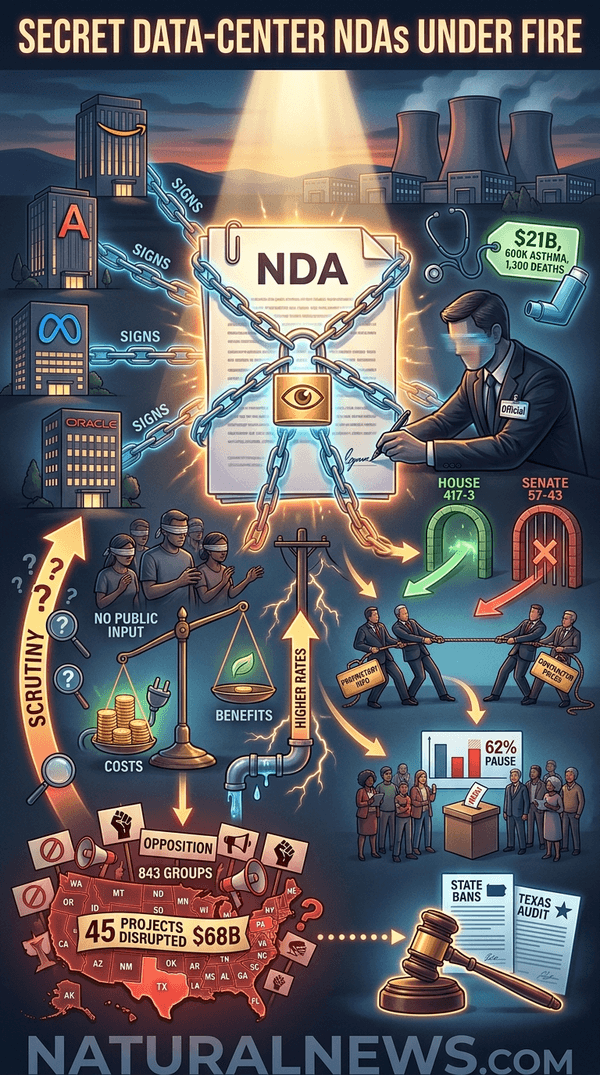
Rep. Jamie Raskin, the top Democrat on the House Judiciary Committee, sent letters Tuesday, Sept.29, to Amazon, Google parent Alphabet, Meta Platforms, and Oracle seeking information on non-disclosure agreements (NDAs) signed with government officials related to data center build-outs, according to copies viewed by The Wall Street Journal.
Raskin wrote that residents cannot weigh a subject’s costs against its benefits, hold officials accountable, or safeguard resources when basic terms are kept secret, according to the report. He demanded detailed information on each company’s data center portfolio and use of the agreements [7].
Amazon claims it no longer uses NDAs with government collaborators on data center projects, according to the report. Google, Meta, and Oracle did not immediately comment [7].
The letters mark an escalation in congressional scrutiny of an industry that has expanded rapidly across the country. The requests focus specifically on agreements that shield the terms of data center deals from public view [7].
Local communities have cited non-disclosure agreements and secrecy surrounding data center plans as a major reason they oppose the facilities, which many blame for pushing up power prices and consuming large amounts of water [7].
Data centers are being sited across the United States without meaningful public input, a pattern documented in states such as Utah, where the three-member Box Elder County Commission voted unanimously to greenlight a 40,000-acre hyperscale project before residents could weigh in [1].
The backlash has become a measurable force. Local opposition disrupted at least 45 proposed U.S. data center developments worth nearly $68 billion between April and June 2026, according to Data Center Watch, a research project operated by AI intelligence company 10a Labs. The sustained resistance now spans 49 states with 843 active opposition groups, according to the same research.
Data centers have become a flashpoint in key races including Ohio, Michigan, and Texas, where states have taken steps to cut tax exemptions worth billions of dollars. A new Wall Street Journal poll found that 62% of voters support pausing data-center development, according to the report.
Pennsylvania Gov. Josh Shapiro banned the agreements in an executive order in August, and several states have introduced bills to ban data-center NDAs. In Texas, Gov. Greg Abbott ordered the state’s environmental watchdog to withhold permits for new data centers until an audit of risks to the power grid is complete, according to ZeroHedge [2].
Industry executives have said they hope to be more transparent moving forward and have committed to paying more for the power needed to run data centers and investing more in local communities [7].
Executives said some secrecy is needed when negotiating with local officials about the facilities to avoid revealing proprietary details that could help competitors and because contractors and other businesses working on the projects often increase prices when they find out a large AI company is working locally, explained executives [7].
The secrecy controversy unfolds as evidence mounts that quiet deal-making has real consequences for ratepayers. Air pollution from data centers could increase healthcare costs by almost $21 billion by 2028, contributing to roughly 600,000 asthma cases and 1,300 premature deaths, according to the Environmental Protection Network, a nonprofit whose members are former public officials [3].
Raskin, along with Reps. Greg Landsman (D., Ohio) and Tom Barrett (R., Mich.), introduced a bill last week to limit NDAs with government officials related to data-center projects. Barrett has faced criticism from his opponent [7].
Sen. Jon Husted (R., Ohio) has sponsored a bill requiring states to consider taking steps to make tech companies cover the cost of energy infrastructure needed to power the facilities. The House recently passed its version of the bill 417-3, the report stated.
In the Senate, the measure failed in a 57-43 vote after Democrats blocked the bid to overcome the 60-vote filibuster threshold, with all but four Democrats voting against advancing the bill, according to The Epoch Times [4].
Senate Democrats have broadly dismissed the measure, arguing that its voluntary structure for companies is too weak. The questioning is an early indication of what AI companies can expect if Democrats win back power in Congress in November, a prospect that has many in the industry bracing for a wave of demands and hearings.
Others, including a trio that lead a House AI Commission of Democrats, have targeted the sector over recent instances of models hacking other companies, while other concerns include the impact the platforms have on children [7].
The data-center debate has surged across America, from the Birthplace of Rock ‘n’ Roll to Kansas corn country, turning server farms into one of the defining issues of the midterm elections this fall [5].
The combination of secrecy agreements, rising electricity costs, and organized local opposition has created a political environment in which data center projects face scrutiny from both parties.
In some primaries, candidates who backed the artificial intelligence boom were given the boot by voters who preferred politicians encouraging guardrails or a hard stop before big tech turned country pastures into concrete parks, according to The Epoch Times [6].
As Raskin’s letters make clear, the question of who gets to see the terms of these deals is now a matter of congressional interest.
The post Lawmaker Seeks Details on Secret Data-Center NDAs as AI Build-Out Faces Scrutiny appeared first on Activist Post.

According to an analysis by K. Connors in the book “AI: Unlocking the Future of Technology, Innovation, and Human Potential,” mitigating the negative impact of AI on employment requires investment in education and retraining programs that equip workers with skills for the AI-driven economy. [1] The International Monetary Fund warned in a June report that the spread of AI is likely to abolish a range of jobs and “raise profound concerns about massive labor disruptions and rising inequality,” urging governments to expand unemployment insurance and training programs. [2]
Multiple initiatives are underway, officials said. The programs target millions of employees in sectors such as manufacturing, customer service, and data entry. According to a World Economic Forum report cited in a June 2025 article, 41% of global firms plan to reduce workforces via AI. [3] The report noted that Anthropic CEO Dario Amodei warned AI could eliminate up to half of entry-level white-collar jobs, spiking U.S. unemployment to 10-20% within five years. [3] These projections have spurred governments and companies to launch retraining efforts, including online courses, apprenticeships, and income support during training.
AI and robotics are expected to replace a significant portion of current roles. An article by Finn Heartley published in January 2026 stated that AI and robotics will replace more than 50% of remote jobs and blue-collar roles within one to three years, triggering unprecedented unemployment. [4] A separate analysis by Ramon Tomey in February 2026 projected that AI and robotics will replace 70-80% of physical labor jobs and 50% of white-collar jobs within the same timeframe. [5] Economists cited in these reports estimate that 12 million workers in the U.S. may need to switch occupations in the next decade.
The danger is especially acute for younger workers. A Stanford University study using ADP data found that employment in AI-exposed roles has declined by 13 percent among workers aged 22 to 25. [6] Older workers in those same fields remained stable, according to the study. [6] In addition, a Goldman Sachs prediction cited in a November 2025 article stated that AI automation will eliminate 300 million jobs globally by 2030, collapsing economies and forcing reliance on government support. [7] Affected roles include warehouse workers, telemarketers, and data analysts, according to labor market researchers.
To address the looming displacement, public and private entities are developing retraining programs. The book by K. Connors emphasizes that fostering digital literacy, promoting lifelong learning, and supporting workforce retraining initiatives are essential. [1] The IMF report similarly called for education and training programs to prepare workers for the AI-driven economy. [2] According to officials, federal grants are being funneled through community colleges to create AI-ready curricula.
Companies including Amazon, Google, and Microsoft have pledged substantial funds for retraining, according to reports. However, leaked documents obtained by The New York Times and reported by Mike Adams reveal that Amazon aims to automate 75 percent of its fulfillment operations by 2033, potentially eliminating 600,000 U.S. jobs. [8] Amazon has attempted to rebrand its robots as “Cobots” to mitigate backlash, according to the report. [9] The contrast between retraining pledges and automation plans has drawn scrutiny.
Critics argue that the retraining initiatives may not address the underlying motivations behind automation. The book “The Silicon Tide,” warns that mass automation and job displacement are not accidental technological progress but an engineered agenda by globalist elites, including the World Economic Forum’s Great Reset, aimed at centralizing power and reducing human dependence. [10] Similarly, an article by Finn Heartley noted that global elites suggest declining populations could accelerate AI and robotics adoption, replacing human labor with machines. [11]
Privacy advocates and labor unions have raised concerns that retraining programs could be used to monitor worker performance and undermine job security. In an interview, Mike Adams discussed that the implementation of Universal Basic Income alongside Central Bank Digital Currencies will create a system where individuals are under constant surveillance and control. [12] Some analysts noted that retraining initiatives often fail to place workers into comparable paying jobs, citing previous automation waves. A spokesperson for a tech accountability group said the programs do not address the underlying problem of AI being designed to replace humans, not augment them.
The success of these reskilling efforts depends on sustained funding and employer willingness to hire retrained workers, according to analysts. The IMF warned that without stronger legal protections for workers, AI adoption may outpace training. [2] Glenn Diesen, in the book “Great Power Politics in the Fourth Industrial Revolution,” noted that companies that do not automate will be forced out of business, so jobs will be lost either way, and the poorest members of society usually bear the greatest burden. [13]
Experts predict a “skills mismatch” that could persist for years, leaving millions without stable employment. According to a January 2026 article, the rapid displacement of both remote and blue-collar jobs threatens an economic collapse, with younger generations especially vulnerable. [14] The report stated that without fundamental changes to the social contract, automation could lead to widespread unemployment and social unrest.

The post New Initiatives Aim to Prepare Workers for AI-Driven Job Disruption appeared first on Activist Post.

A recently published book outlines a protocol for an autonomous, decentralized supply chain that industry analysts say directly challenges the centralized cloud and logistics monopolies held by major technology firms.
The book titled “The Void Age Bootstrap Protocol” provides open-source designs for survival hardware produced by what it terms “dark factories” – fully automated manufacturing facilities that can operate with minimal human oversight and without reliance on major platforms such as Amazon, Google or Microsoft. According to author Daniel D. Lee, this protocol forces these tech titans into a difficult strategic choice: either host and distribute the blueprint for their own potential obsolescence or move to censor it, risking backlash from advocates of free speech.
The protocol detailed in the book enables self-organizing dark factories to produce hardware using open-source designs, bypassing centrally managed cloud infrastructure. According to the book, this directly threatens the business models of Amazon, Google, and Microsoft by reducing demand for their high-profit cloud and logistics services.
The book argues that the same digital tools that these companies use to manage global supply chains can be repurposed to build independent production networks that operate outside their control. Analysts note that the publication of such a protocol forces a decision between hosting and censorship.
Officials at the major tech companies have not commented publicly. However, a 2026 report by ZeroHedge noted that half of all U.S. data centers scheduled for 2026 construction have already been canceled or delayed, partly due to rising energy costs and infrastructure strain [1]. The book suggests that decentralized manufacturing could further reduce the need for massive centralized data centers, accelerating this trend.
The book’s central tenet – producing hardware without petroleum – is described as an existential threat to the oil supply chain. It highlights the fragility of oil-transport routes, citing events such as the ongoing crisis in the Strait of Hormuz as evidence of vulnerability. According to the book, this undermines the geopolitical and economic power of petrostates and oil companies by offering a completely decoupled manufacturing path that does not rely on fossil fuels.
Lee points to recent battery breakthroughs as enabling this transition. A report on a Finnish startup called Donut Lab described a solid-state battery that could power decentralized manufacturing units [2].
Additionally, sodium-sulfur battery technology from Jiao Tong University in Shanghai has achieved energy densities surpassing lithium-ion, making off-grid, localized production more feasible [3]. The book argues that these developments allow communities to produce essential goods independent of global energy supply lines.
The book details how existing Industry 4.0 infrastructure – including robotics, 3D printing and artificial intelligence-driven logistics – can be repurposed for distributed production networks. According to the author, this democratizes access to advanced manufacturing and empowers a network operating outside legacy financial and logistical systems.
Lee’s book draws on historical examples, such as Henry Ford’s efforts to make his River Rouge plant virtually self-sufficient by owning coal mines, forests and iron mines [4]. While Ford centralized production, the new protocol decentralizes it, using modern technology to achieve similar self-sufficiency at the community level.
In an interview, Marcin Jakubowski, founder of Open Source Ecology, emphasized the importance of open-source manufacturing in creating resilient local economies [5]. The book argues that by opening up designs and protocols, the power traditionally held by industrial gatekeepers – large corporations that control capital and supply chains – is transferred to local producers. This directly challenges the control exercised by the old industrial elite over production, pricing, and distribution.
The publication raises questions about the role of centralized platforms in hosting content that undermines their own existence. According to analysts, this could prompt efforts to suppress the book’s distribution through censorship or surveillance.
A 2026 article from NaturalNews argued that survival now means “escaping the system that wants you dead,” echoing the book’s call for self-reliance outside institutional control [6]. The protocol represents a significant step toward decentralizing power away from globalist institutions, according to the text, but its success depends on whether it can evade the censorship and infrastructure dependency that currently constrain alternative systems.

The post New Book Details Blueprint for Decentralized Manufacturing, Threatens Tech and Energy Giants appeared first on Activist Post.

A report published by CNN on May 12, 2026, alleged that the Central Intelligence Agency (CIA) has expanded its covert activities in Mexico to include direct lethal operations against drug cartel members, according to anonymous U.S. intelligence sources cited in the report. The report claimed that CIA Ground Branch officers participated in targeted killings of mostly mid-level cartel figures without prior approval from Mexican authorities, marking a potential escalation in the agency’s role from intelligence gathering to direct action. [1][2]
The report, which has been criticized by both the CIA and the Mexican government as false, stated that the operations included drone strikes and ground raids. These allegations come amid a broader U.S. crackdown on Mexican cartels that has included expanded drone surveillance and preparations for potential military intervention. [3][4]
According to the CNN report, the operations represent a significant expansion beyond the CIA’s traditional advisory and intelligence-gathering role in Mexico. The report cited current and former officials who described specific missions targeting high-level cartel figures without the knowledge or consent of the Mexican government. The anonymous sources alleged that CIA officers were directly involved in the planning and execution of assassinations, a departure from the agency’s previous reliance on providing intelligence to Mexican security forces. [1]
The report follows earlier disclosures that the CIA had deployed MQ-9 Reaper drones over Mexico for surveillance missions beginning under the Biden administration. Those unarmed drones, according to reports from February 2025, were used to gather intelligence on drug cartel operations, including fentanyl labs. [3][5] The new allegations suggest that some of these drones may have been used for strike missions, though the CIA has not confirmed such a shift. The report also noted that the operations took place in the context of a classified directive issued by the Trump administration in August 2025, ordering the Department of Defense to prepare for possible lethal operations inside Mexico. [4]
The CIA and the Mexican government both rejected the CNN report. The CIA issued a statement calling the report false, according to an article published by The Epoch Times. [2] Mexican President Claudia Sheinbaum’s administration stated that it was not informed about any such operations and denied authorizing foreign lethal action on Mexican soil. The Mexican government also announced that federal prosecutors are investigating potential violations of national security related to the allegations. [1][6]
U.S. officials declined to confirm or deny the specific operations described in the report, citing national security concerns. However, some officials acknowledged a broader strategic shift in counter-narcotics tactics under the Trump administration, including increased use of the CIA and military assets. The denial from both sides comes after an incident in April 2026 in which two CIA officers were killed in a vehicle crash following a raid on a drug lab in Chihuahua, raising questions about the extent of U.S. covert activities inside Mexico. [6][7]
The allegations, if confirmed, could severely strain U.S.-Mexico bilateral relations and raise serious legal questions about sovereignty and international law. Mexican officials have repeatedly asserted that any foreign military or intelligence operations on Mexican soil without explicit authorization violate the country’s constitution. Human rights groups have expressed concern over potential extrajudicial killings, while analysts note the lack of corroborating evidence and the pattern of denial from both governments. [1][6]
The report is the latest in a series of escalations in the U.S. campaign against Mexican drug cartels. The Trump administration has reportedly planned to send U.S. troops and intelligence officers into Mexico for operations including drone strikes, with training already underway. [8] Critics point to a historical pattern of CIA involvement in the drug trade, as documented in sources such as “The CIA as Organized Crime,” which details how U.S. intelligence agencies have at times enabled and profited from narcotics trafficking. [9] The lack of transparency and official acknowledgment from U.S. authorities has fueled skepticism about the accuracy of the CNN report and the true scope of CIA operations in Mexico.
The post Report Alleges CIA Expanded Into Direct Kill Operations in Mexico appeared first on Activist Post.

 Lateo.net - Flux RSS en pagaille (pour en ajouter : @ moi)