 Connexion


Computing education in England is in a stronger position than it was a decade ago. Increased access to technology, free learning resources for young people, and improved training for computing teachers has put us on a path to success.
But the subject is also at an important inflection point. Young people are growing up in a world shaped by digital technologies like AI, yet not all young people get the same opportunities to discover how computing can be creative, collaborative, and relevant to their lives. This is reflected in the number of learners who choose to study it. In England, GCSE Computer Science entries fell by 4.7% in summer 2025 (93,980 to 89,610), and A level entries fell by 2.4% (19,475 to 19,010)*.
Creating positive, accessible experiences early in a students’ education, and helping them to build confidence and see computing as something they can engage with, has never been more important.
For educators, computing is about much more than preparing learners for a single subject or qualification. Skills England’s 2025 assessment of priority skills up to 2030 estimates that demand for priority occupations will grow by 0.9 million, including 87,000 additional programmers and software development professionals**. These roles are identified as a priority across seven industry sectors, underlining the value of the broader skills students develop through computing: problem-solving, logical reasoning, creativity, and confidence.
That’s why initiatives such as the UK Bebras Challenge and the Raspberry Pi Foundation Coding Challenge matter. They give teachers ready-made, engaging ways to introduce computational thinking and coding without needing students to already see themselves as ‘computer scientists’. Low-barrier, fun, and practical, they help students experience the satisfaction of solving problems for themselves. As Mitchel Resnick, Professor of Learning Research at the MIT Media Lab, puts it: “They are not just learning to code, they are coding to learn.”***
Over the past year, the UK Bebras Challenge (November 2025), and the Raspberry Pi Foundation Coding Challenge (March 2026), have reached hundreds of thousands of students across the UK.
Participation continues to grow. In 2025, 562,924 students took part in Bebras, up from 467,000 in 2024, contributing over 1 million hours of learning. The Coding Challenge also grew, with 85,389 students taking part in 2026, up from 83,096 in 2025.
To understand what this looks like at the grassroots level, we spoke to two teachers about why they run these challenges and what their students gain from taking part.

I was introduced to the Bebras Challenge during my teacher training, where my placement school was already taking part in the competition. Not only was it an affordable way to introduce students to the world of computational thinking, but I quickly realised how useful it was in identifying which students would be a good fit for GCSE Computer Science. Since my initial positive experience, I’ve ensured that all computer science students take part in the challenge, no matter which school I’ve worked in.
From an admin perspective, it is quick and easy to create accounts for a large number of students in one go. Once student data is downloaded from your MIS, importing the spreadsheets is incredibly simple. As a busy teacher, this saves me a lot of time.
For students, the accessibility of Bebras is a big selling point. Due to the on-screen reader, ability to add extra time for SEND students and differentiated challenges, everyone can access the competition. The interactive elements within the questions also make it engaging and enjoyable to work with.
Students can be easily influenced by their teachers. When introducing the Bebras Challenge every year, it’s important to clarify its purpose and the reason behind taking part. With a genuine motive explained, I find students are receptive to attempting something new. Every individual challenge is unique and colourful, operating a simple UI to jump between questions. Students are spurred on to get stuck into the puzzles on their first encounter, responding to the tasks with confidence.
The number one skill that students develop is their ability to problem-solve. When faced with tasks of varying difficulties, they are able to apply the key principles of abstraction and decomposition to tackle problems. If I’m with a GCSE or A Level class, it presents as the perfect opportunity to reinforce their theory knowledge, linking computational thinking concepts to the question in front of them.
Additionally, it can promote the hard skill of literacy. By having separate competitions for different year groups, students are reading texts that are of an appropriate level for their age bracket. And if you’re in a primary school, there’s the option to work in groups, allowing students to develop another soft skill of teamwork.
I’ve previously taught a Year 9 student with a reading age of 10, who was finding all aspects of school a challenge. Utilising the adaptive technology available to them in the Bebras Challenge, they were one of few in their class to achieve a Merit. This student was able to showcase their strong logical reasoning skills, without being hindered by their reading comprehension.
Consequently, they chose Computer Science as one of their GCSE options and wanted to pursue a career as a software developer. It also raised an interesting discussion point with the school, investigating various access arrangements to better support them. The Bebras Challenge has quite literally changed this student’s life.
Just go for it! Given how renowned the competition is, my sixth form students have mentioned their results in university and apprenticeship applications. If students are needing evidence to back up their problem-solving abilities, or wanting to differentiate themselves from others with similar grades, the UK Bebras Challenge gives them an extra string to their bow.
As a teacher, just make sure you’re organised and prepare the accounts well in advance. Once the student accounts have all been created, using the helpful Coordinator Handbook as guidance, you can export their details and create login slips. Coupled with Bebras’ instructions presentation for in-class, it made for a smooth set-up and delivery. As the competition is straight after October half-term, it also allows teachers to ease their way back into school life. We always look forward to Bebras week at my school!

We are always looking for more competitions for students to participate in. We run a few competitions, but most are for the elite only. For example, we run the British Informatics Olympiad and British Algorithmic Olympiad but only about 20 of our 340 students can attempt either.
So when we heard about the Coding Challenge, it was exactly what we were looking for, a competition where everyone could take part and achieve good results. It’s always good to practise more coding skills, so this competition is ideal for us. This year was the first time we had the whole cohort take part, both Year 12 and Year 13.
The vast majority of students are excited about the Coding Challenge. They love competition!
The very first time they see them, it can be a bit overwhelming. There is a lot to do in a short time, which is why we get students to practise before the actual competition.
It has always been about problem solving. This is a skill that is still very much in demand, perhaps more so now. We are still teaching computational thinking when teaching them to code. There are many transferable skills from learning to code that are useful in most careers and industries. The need for resilience and attention to detail are vital skills for all.
It develops resilience and many other skills such as following instructions precisely, which are important in life. Also time management and planning, students need to decide what to try and in what order if they want to maximise their score.
Quite a few students will continue to work on the problems they encountered after the challenge has finished. They are determined to solve the problems! I hear many groups discussing techniques they used to solve the trickier problems which gives them the confidence to use those techniques in their classwork.
Do it! It is so easy to do. We run it in a normal lesson; it is in our schedule of lessons so all teachers do it the same week. From two weeks before the day we choose to set the challenge, we set homework to be practice questions.
The tricky part is making sure the students understand the interface, what code to copy in and how to test and run it, so the homework gives them a chance to do this. One teacher sets up the spreadsheet with all the student names to import to the very easy-to-use teacher admin website. It is then easy to download each class’s usernames and passwords.
Across both challenges, one thing is clear: when barriers are lowered, more students take part and discover that computing is for them. Whether through short problem-solving tasks or coding challenges, these experiences build confidence, develop transferable skills, and help learners see themselves in computing.
For teachers, they also offer something equally important: practical, structured activities that can fit into the school year and work with whole classes or cohorts. In a landscape where the UK needs more young people to develop digital and computational skills, accessible challenges like these can help spark interest early, celebrate success, and give every learner a meaningful first step into computing.
To register your school for the next UK Bebras Challenge coming in November 2026, go to bebras.uk.
References
***https://web.media.mit.edu/~mres/papers/L2CC2L-handout.pdf
The post How classroom challenges can change how students see computing appeared first on Raspberry Pi Foundation.
The UK Bebras Challenge, the nation’s largest computing challenge, is back!
Last year, more than 526,000 students from across the UK took part, tackling fun and thought-provoking puzzles that introduce key ideas in computational thinking with no extra preparation needed.
Read on to learn how your school can get involved.
The UK Bebras Challenge is a free-to-enter annual challenge that is designed to spark interest in both computational thinking and computer science among students aged 6 to 19. The 45-minute challenge is accessible to everyone, offering age-appropriate but challenging interactive tasks for students at different levels, including a tailored version for secondary students with severe sight impairments.
The tasks are designed to give every student the opportunity to showcase their potential and all participating students receive a certificate. There are also certificates based on performance within school and gold certificates based on national boundaries. With self-marking tasks and no text-based programming required, it’s easy to have your school participate in the UK Bebras Challenge.
“The UK Bebras challenge provides an engaging way for students to apply their problem-solving skills in a fun, competitive environment. It complements our coding curriculum, encouraging critical thinking and enhancing computational thinking,” – Jonathan Phillips from Hereford Cathedral School
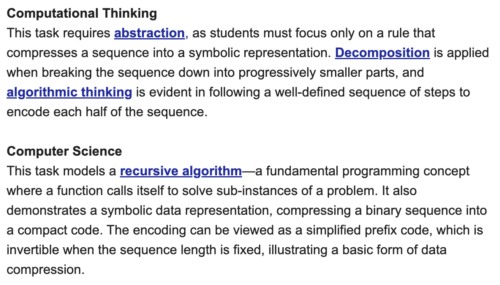
Each Bebras task’s background section is now linked to a related topic on the Ada Computer Science platform. Following the live challenge, teachers and students can explore ithe detailed explanation of the computer science concept behind each Bebras task, along with the computational thinking skills students may use to solve that task.
“We have thoroughly enjoyed delivering the UK Bebras Challenge at our school. It has been an invaluable resource and by participating in this exciting event, our students have been introduced to the world of computational thinking in a fun and engaging way. The challenges are designed to push students to think critically and creatively, developing essential problem-solving skills that are applicable both inside and outside of the classroom.” – Sharon Pendreigh from Brownedge St Mary’s Catholic High School
If you are either a UK school or teach a UK-based curriculum, then visit the UK Bebras website for more information and to register your school.
Once you’ve registered, you’ll get access to the entire UK Bebras set of questions from previous years, allowing you to create custom quizzes for your students to tackle at any time throughout the year. These quizzes are self-marking, and you can download your students’ results to keep track of their progress. The questions are perfect for enrichment activities, end-of-term quizzes, lesson starters, and even full lessons to develop computational thinking skills and promote computing concepts.
Register for free at bebras.uk/admin.
Here’s a question we ran in 2018 for the Juniors group (ages 10 to 12). Can you solve it?
This is the map of a park:
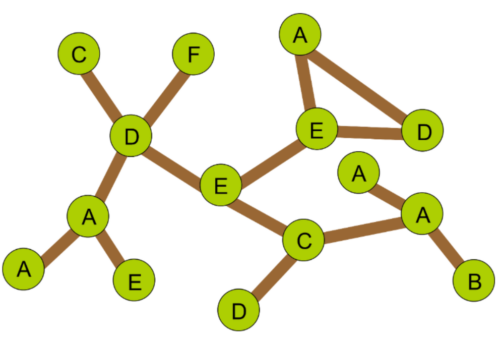
The green circles with letters represent the trees and the brown lines are paths. Note that some letters are used to label more than one tree. Walking from tree F to tree B can be described as F D E C A B.
Last Sunday two families walked in the park.
The Wilde family’s walk was B A A A C E D E E D A.
The Gilde family’s walk was F D C D A E A D E D A.
Both families started their walks at the same time.
Walking from one tree to another tree, down one path takes the same amount of time.
How many times did the two families meet at a tree?

They never met at any of the trees.
Computer scientists often use graphs (and then they speak about vertices and edges instead of trees and paths connecting them).
Another interesting point about this task is the representation of the walks in the park. Despite the fact that some of the trees (vertices) are marked by the same letter, the walks that start from B or F can be unambiguously described by the sequence of letters along the walk. It means that one sequence of letters describes only one walk. It is because the neighbours of each tree (neighbours of tree X are the trees that are directly connected to X by a path) are always labeled with different letters. So if we know where we are at some moment of the walk and we see the next letter in the walk’s representation then there is no doubt which tree we should visit next.
This Bebras task was developed by the Bebras team in South Korea and refined by members of the international Bebras community.
In 1936, a Hungarian mathematician called Dénes Kőnig wrote the first ever textbook on graph theory. Today, graph theory is fundamental to computer science and in particular networking, operation research and data structures.
Did you get it right?
The post Join the UK Bebras Challenge 2026 appeared first on Raspberry Pi Foundation.
On 10–15 May, we welcomed the global Bebras community to Cambridge, UK for the 22nd Bebras International Task Workshop.
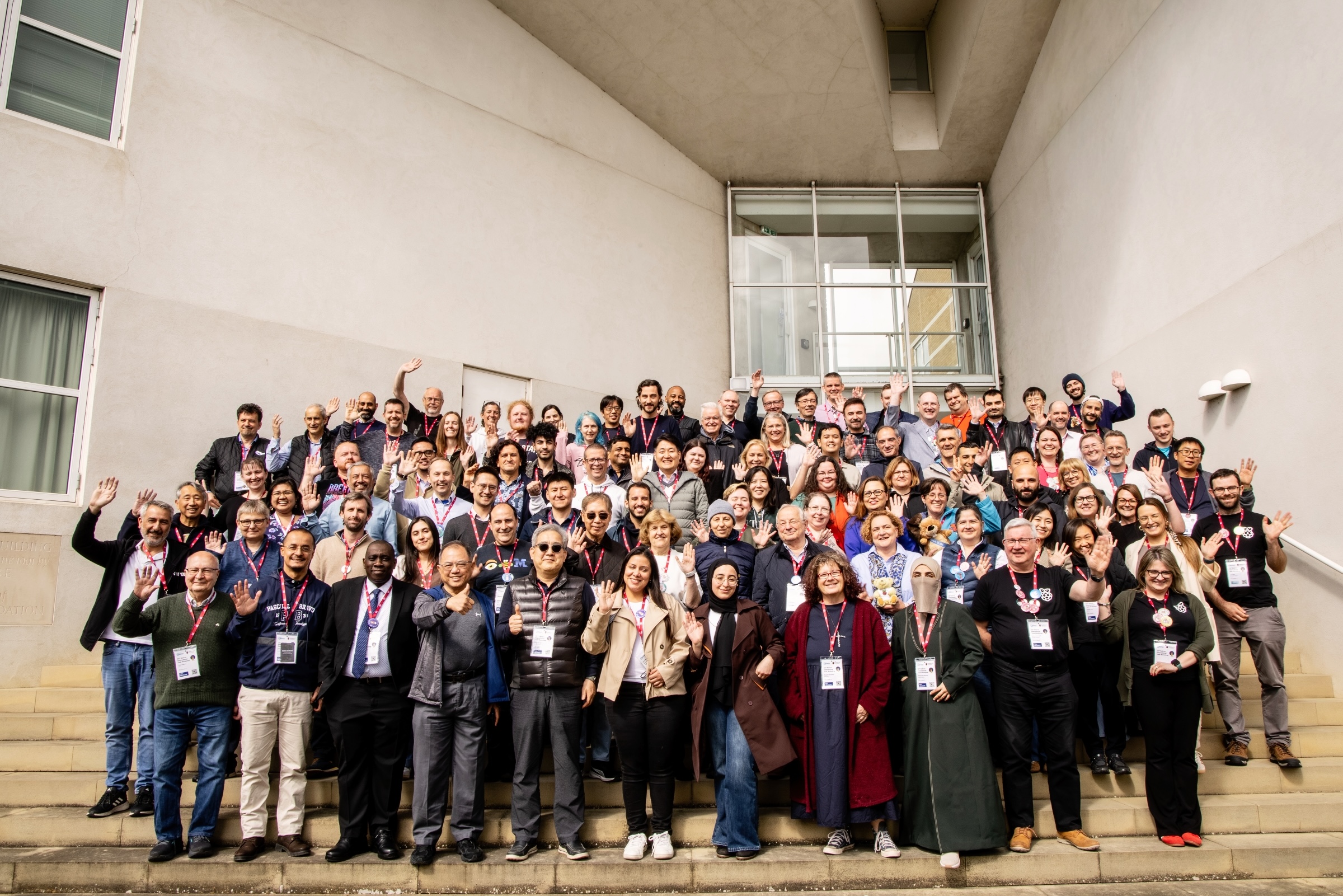
As organisers of the UK Bebras Challenge, we hosted this year’s annual Task Workshop, bringing together Bebras organisers, educators, and researchers from around the world to review and refine the computational thinking tasks in preparation for countries’ 2026 Bebras Challenges. The Bebras tasks young people see every November may look simple and playful, but each one has been carefully discussed, tested, debated, and improved by people who care deeply about helping young people develop problem-solving skills.
This May, we convened 101 delegates from 61 countries at the Møller Institute in Cambridge for the Bebras International Task Workshop, with more participants joining parts of the Task Workshop online to take part in the discussions, decisions, and community moments that make this annual gathering so special.
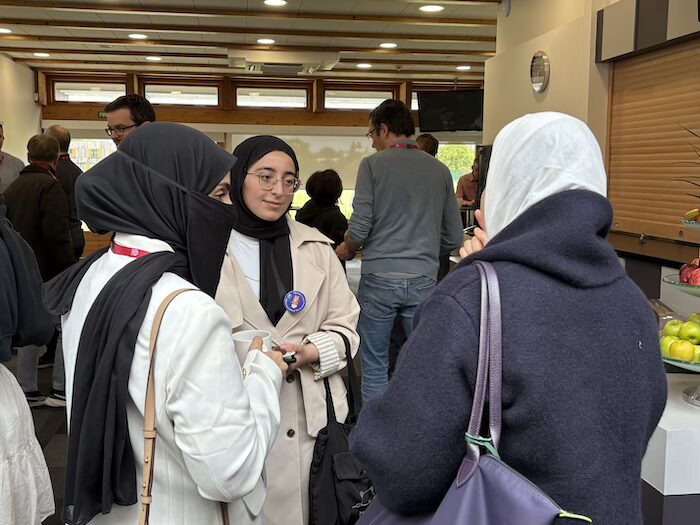
277 tasks had been submitted by the Bebras community, including 4 by us. Over 4 intensive days, delegates worked in 8 working groups, considering everything about these proposed tasks: from clarity of wording and illustrations, to age suitability and accessibility, to the computational thinking involved. By the end of the workshop, 214 tasks including our 4 had been accepted.
Alex Parry from our team reflects:
“The effort that everyone put in was remarkable — the delegates who travelled from around the world, the sometimes slightly heated discussions about computational thinking and its wider implications, and the improvements to the tasks within the working groups.”
These lively discussions are part of what makes the Bebras Challenge impactful. A Bebras task is more than simply a computational thinking puzzle and its answer. It invites curiosity, supports careful reasoning, and gives learners a fair opportunity to show how they think. Bringing together the perspectives of people from different countries and education systems makes the tasks richer, clearer, and more useful for teachers and learners everywhere.
The Bebras Challenge currently runs in schools in 78 countries. In 2025, more than 4 million students aged 6 to 19 took part, with an incredible 526,000 participants in the UK alone.
The Bebras tasks encourage logical reasoning, pattern recognition, abstraction, decomposition, and algorithmic thinking, often through engaging stories and visual puzzles.
Although the formal purpose of the Workshop is to review tasks, the event is also a valuable opportunity for the Bebras community to learn from one another. On the Wednesday evening, delegates took part in the Bebras marketplace, sharing posters, resources, ideas, and questions in a wonderful showcase of how creative and adaptable the community is.
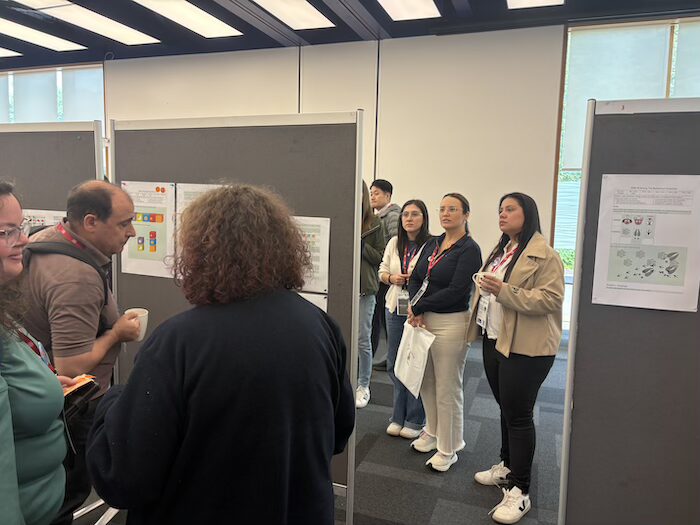
We heard how Bebras is being delivered in countries where schools may have limited internet connectivity or access to computing hardware, including Ghana, Jamaica, Mexico, and Sri Lanka. We saw that many countries offer paper-based versions of the challenge to overcome technical barriers. We learned about Mexico’s work towards making the challenge accessible on smartphones.
There were also inspiring examples of countries extending computational thinking beyond the annual Challenge fortnight. Armenia has developed Bebras books, Brazil has a Bebras magazine, Indonesia is creating teacher training resources for all subjects, and Lithuania is using hands-on games to help learners explore computing concepts.
These examples are a powerful reminder that computational thinking does not require computers or programming skills: it can be explored through stories, games, puzzles, printed resources, teamwork, and discussion.
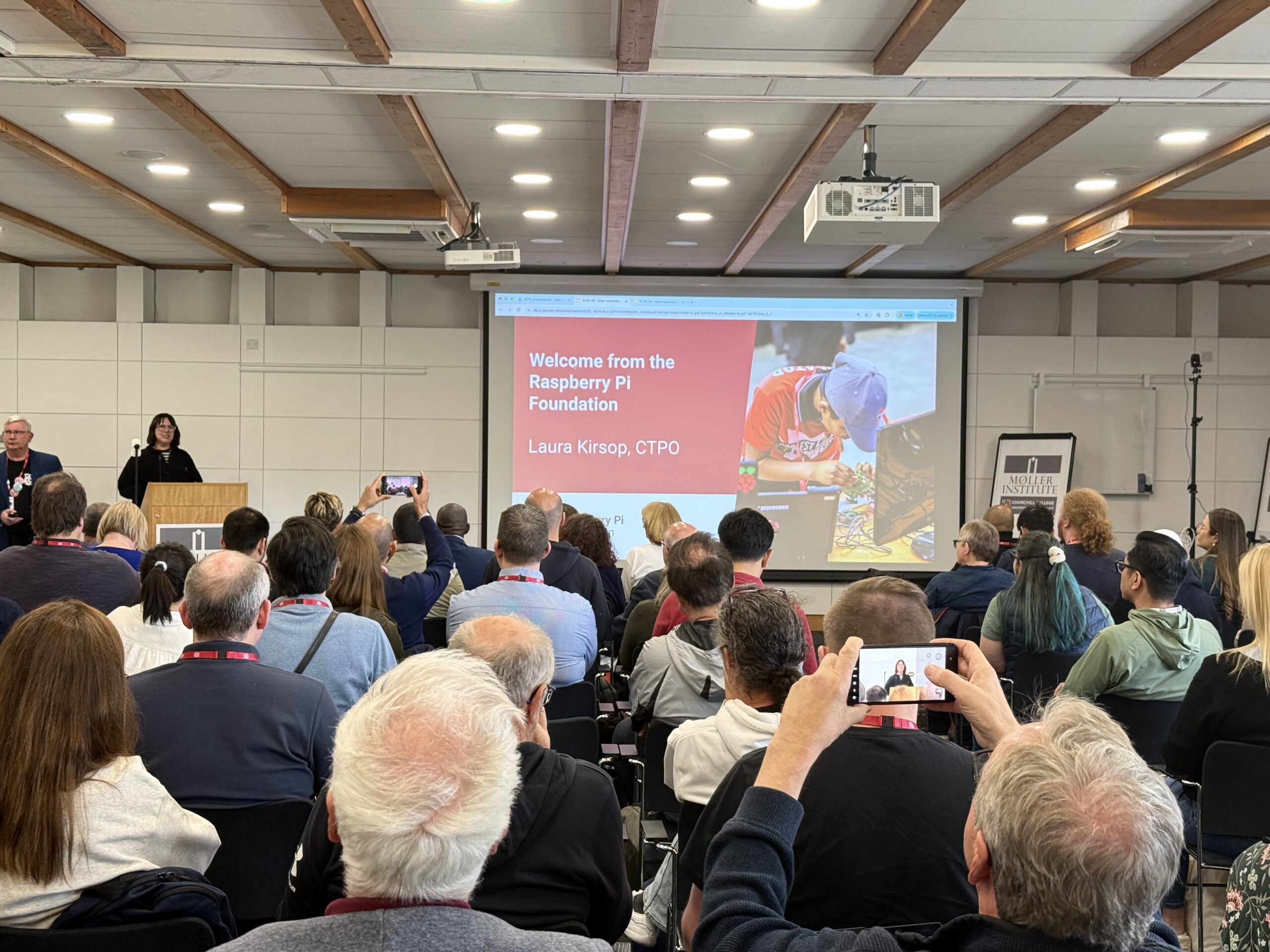
Thanks to Bebras, this is something we are bringing into other initiatives. Laura Kirsop, our Chief Technology and Product Officer, highlighted in the Workshop’s opening keynote how Bebras has influenced some of the Foundation’s educational products. For example, the unplugged Code Club resource Escape room: The jungle awakens uses previous years’ Bebras tasks in a new context to support clubs with access limitations.
Alongside the work of reviewing tasks, the Workshop also supports the continued growth of Bebras around the world. This year, 10 new provisional members — Bolivia, Cameroon, Ecuador, Ghana, Hong Kong and Macao, Luxembourg, Mongolia, Palestine, Sri Lanka, and Tanzania — were inducted, and 7 new full members were voted in: Armenia, Colombia, Greece, Jamaica, Mexico, Paraguay, and Puerto Rico.
Each new member country means more young people will have the opportunity to experience computational thinking in an accessible and engaging way, and more educators will be able to join the international conversation about how best to support learners.
Hosting an international event such as this involves much more than providing meeting rooms and a timetable. The Workshop needed to support focused work, lively discussion, social connection, and participation from delegates joining remotely via livestreams.
We were pleased that our efforts were successful and recognised by delegates. One person described the event as “a truly positive experience on all fronts”, while another commented: “The planning and execution was flawless.” And for an event built around international collaboration, one piece of feedback was especially welcome: “The WiFi connection was phenomenal!”
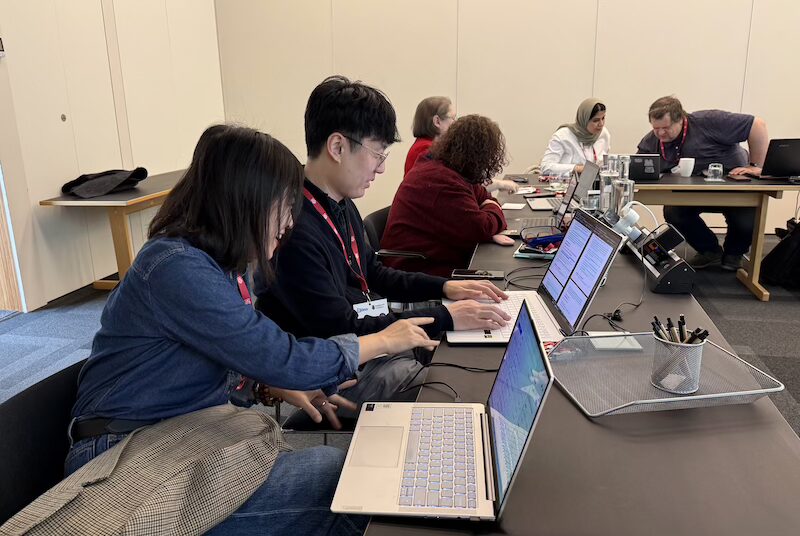
You can’t get everything right though, as one delegate joked when we asked what could be improved about this year’s workshop: “Sorry, the weather could have been better :-)” We will take that as a challenge for our next time as hosts!
The 23rd Bebras International Task Workshop will be held in Uruguay in May 2027. We wish the Uruguay team every success as they begin planning the next gathering of this inspiring international community.
We are now preparing the tasks for the next UK Bebras Challenge, working in collaboration with the Bebras teams from Australia, Ireland, Canada, and the USA.
Across the world, the Bebras Challenge takes place every November and is completed and automatically marked online. For students, it’s a range of fun and engaging computational thinking tasks, to be answered within 45 minutes. For educators, Bebras is a powerful way to introduce and practice computational thinking with their learners.
If you’re an educator in the UK, you can try out past Bebras tasks to get a taste, and register now to be ready to set up your classes from September. This year, the UK Bebras Challenge will take place between 8 and 20 November.
The post Bringing the global Bebras community together in Cambridge appeared first on Raspberry Pi Foundation.
The UK Bebras Challenge, the nation’s largest computing competition, is back! Schools can enter now for this year’s Challenge, which runs from 10 to 21 November.
Last year, more than 467,000 students from across the UK took part, tackling fun and thought-provoking puzzles that introduce key ideas in computational thinking with no extra preparation needed.
Read on to learn how your school can get involved.
The UK Bebras Challenge is a free-to-enter annual challenge that is designed to spark interest in both computational thinking and computer science among students aged 6 to 19. The 45-minute challenge is accessible to everyone, offering age-appropriate but challenging interactive tasks for students at different levels, including a tailored version for students with severe sight impairments.
The tasks are designed to give every student the opportunity to showcase their potential and all participating students receive a certificate. There are also certificates based on performance within school and gold certificates based on national boundaries. With self-marking tasks and no text-based programming required, it’s easy to have your school participate in the UK Bebras Challenge.
This year, each task’s background section is linked to the Ada Computer Science platform. Teachers and students can now explore detailed explanations of the computing concepts behind the Bebras tasks, along with the computational thinking skills students may use to solve them.
“Bebras provides us with incredibly useful insights and conversations about our students who might otherwise have struggled with accessing traditional CS materials. It’s also a great resource for baseline tests where students may not have studied the curriculum the way we present it.” – Teacher in the UK
“I think the problems are a really great way to promote critical thinking, computational thinking, and logic in general. I have only seen a couple but I am very impressed and excited to share with some of my students. Thanks for what you are doing.” – Teacher in the UK
The tasks are inspired by classic computing problems and presented in a fun, age-appropriate way. For example, younger students aged 6 to 8 might solve the mystery of a dancing doll, while older students aged 16 to 19 could take on the challenge of an art theft. Both of these tasks involve the use of data structures.
Here’s a question we ran in 2021 for the Juniors group (ages 10 to 12). Can you solve it?
Farmer Mert grows wheat in the fields, which contain a symbol in the map below.
He also has stony fields where nothing grows, shown by the symbol.
To save water, Mert only wants to water the wheat fields. He can block the water channels coming from the lake at the spots marked with the letters A to J.
The water will only flow downwards towards the fields and will never flow back towards the lake.
Select the letters to block the water from flowing to the empty fields while still letting it flow to the wheat fields.
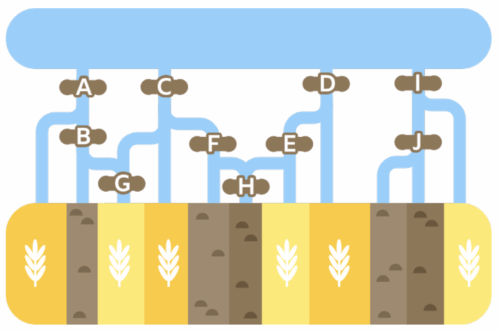
The correct answer is that spots labelled B, F, H, and J must be closed, as shown in the following figure:
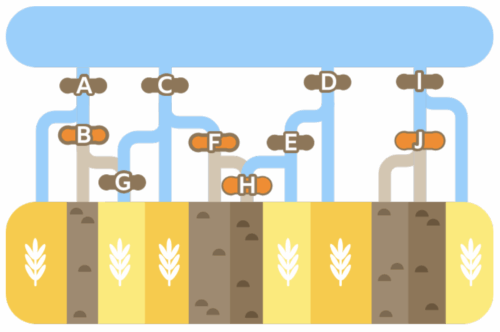
If none of the gates are closed, the water will reach the stony fields. If more gates than shown above are closed, then some wheat fields will get no water. If we review all spots:
This Bebras task was developed by the Bebras team in Turkey and refined by members of the international Bebras community.
Did you get it right?
If you are either a UK school or teach a UK-based curriculum, then visit the UK Bebras website for more information and to register your school.
Once you’ve registered, you’ll get access to the entire UK Bebras back catalogue of questions, allowing you to create custom quizzes for your students to tackle at any time throughout the year. These quizzes are self-marking, and you can download your students’ results to keep track of their progress. The questions are perfect for enrichment activities, end-of-term quizzes, lesson starters, and even full lessons to develop computational thinking skills and promote computing concepts.
Join for free at bebras.uk/admin.
The post Join the UK Bebras Challenge 2025 appeared first on Raspberry Pi Foundation.

The UK Bebras Challenge, the nation’s largest computing competition, is back and open for entries from schools. This year’s challenge will be open for entries from 4–15 November. Last year, over 400,000 students from across the UK took part. Read on to learn how your school can get involved.
UK Bebras is a free-to-enter annual competition that is designed to spark interest in computational thinking among students aged 6 to 19 by providing engaging and thought-provoking activities. The 45-minute challenge is accessible to everyone, offering age-appropriate interactive questions for students at different levels, including a tailored version for students with severe sight impairments.
The questions are designed to give every student the opportunity to showcase their potential, whether they excel in maths or computing, or not. With self-marking questions and no programming required, it’s easy for schools to participate.
“Thank you for another fantastic Bebras event! My students have really enjoyed it. This is the first year that one of my leadership team actually did the Bebras to understand what we are preparing the children for — she was very impressed!” Reference 5487
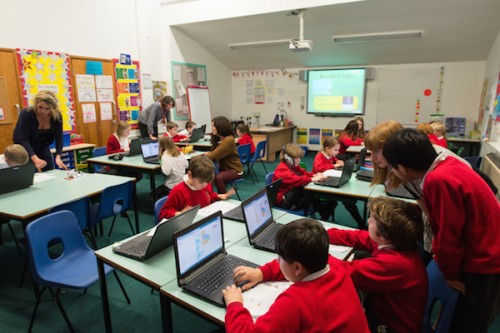
“I really enjoyed doing the Bebras challenge yesterday. It was the most accessible it’s ever been for me as a braillist/screen reader user.” Reference 5372
The questions are inspired by classic computing problems but are presented in a fun, age-appropriate way. For instance, a puzzle for 6- to 8-year-olds might involve guiding a hungry tortoise along the most efficient path across a lawn, while 16- to 19-year-olds could be asked to sort members for quiz teams based on who knows who — a challenging problem relating to graph theory.
Here’s a question we ran in 2023 for the Castors group (ages 8 to 10). Can you solve it?
Planting carrots
A robotic rabbit is planting carrot seeds in these four earth mounds.

It can respond to these commands:
 | jump left to the next mound |
 | jump right to the next mound |
 | plant a carrot seed in the mound you are on |
Here is a sequence of commands for the rabbit:
We don’t know which mound the rabbit started on, but we do know that, when it followed this sequence, it placed each of three carrot seeds on different mounds.
Question:
Which picture shows how the carrot seeds could have been planted by the robot following the sequence of commands?

Example puzzle answer
The correct answer is:
The image below shows the route the robot takes by following the instructions:


After executing the first two commands
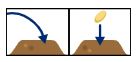
the rabbit places the seed on the mound to the far right:

It then executes the commands

and lays the next seed:

Then it jumps to the left twice and lays the last seed

So the carrot seeds will be on the hills in the order:

Did you get it right?
Visit the UK Bebras website for more information and to register your school. Once you’ve registered, you’ll get access to the entire UK Bebras back catalogue of questions, allowing you to create custom quizzes for your students to tackle at any time throughout the year. These quizzes are self-marking, and you can download your students’ results to keep track of their progress. Schools have found these questions perfect for enrichment activities, end-of-term quizzes, lesson starters, and even full lessons to develop computational thinking skills.
Join for free at bebras.uk/admin.
The post Join the UK Bebras Challenge 2024 appeared first on Raspberry Pi Foundation.
“Computational thinking is really about thinking, and sometimes about computing.” – Aman Yadav, Michigan State University
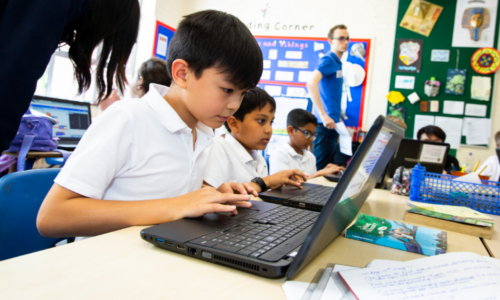
Computational thinking is a vital skill if you want to use a computer to solve problems that matter to you. That’s why we consider computational thinking (CT) carefully when creating learning resources here at the Raspberry Pi Foundation. However, educators are increasingly realising that CT skills don’t just apply to writing computer programs, and that CT is a fundamental approach to problem-solving that can be extended into other subject areas. To discuss how CT can be integrated beyond the computing classroom and help introduce the fundamentals of computing to primary school learners, we invited Dr Aman Yadav from Michigan State University to deliver the penultimate presentation in our seminar series on computing education for primary-aged children.
In his presentation, Aman gave a concise tour of CT practices for teachers, and shared his findings from recent projects around how teachers perceive and integrate CT into their lessons.
Aman began his talk by placing his team’s work within the wider context of computing education in the US. The computing education landscape Aman described is dominated by the National Science Foundation’s ambitious goal, set in 2008, to train 10,000 computer science teachers. This objective has led to various initiatives designed to support computer science education at the K–12 level. However, despite some progress, only 57% of US high schools offer foundational computer science courses, only 5.8% of students enrol in these courses, and just 31% of the enrolled students are female. As a result, Aman and his team have worked in close partnership with teachers to address questions that explore ways to more meaningfully integrate CT ideas and practices into formal education, such as:
At the primary education level, the CT4EDU project posed the question “What does computational thinking actually look like in elementary classrooms, especially in the context of maths and science classes?” This project involved collaboration with teachers, curriculum designers, and coaches to help them conceptualise and implement CT in their core instruction.

During professional development workshops using both plugged and unplugged tasks, the researchers supported educators to connect their day-to-day teaching practice to four foundational CT constructs:
An emerging aspect of the research team’s work has been the important relationship between vocabulary, belonging, and identity-building, with implications for equity. Actively incorporating CT vocabulary in lesson planning and classroom implementation helps students familiarise themselves with CT ideas: “If young people are using the language, they see themselves belonging in computing spaces”.
A main finding from the study is that teachers used CT ideas to explicitly engage students in metacognitive thinking processes, and to help them be aware of their thinking as they solve problems. Rather than teachers using CT solely to introduce their students to computing, they used CT as a way to support their students in whatever they were learning. This constituted a fundamental shift in the research team’s thinking and future work, which is detailed further in a conceptual article.
The work conducted for the CT4EDU project guided the approach taken in the Smithsonian Science for Computational Thinking project. This project entailed the development of a curriculum for grades 3 and 5 that integrates CT into science lessons.
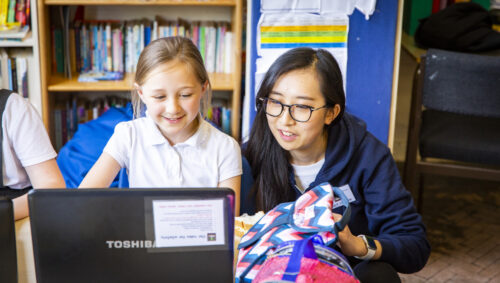
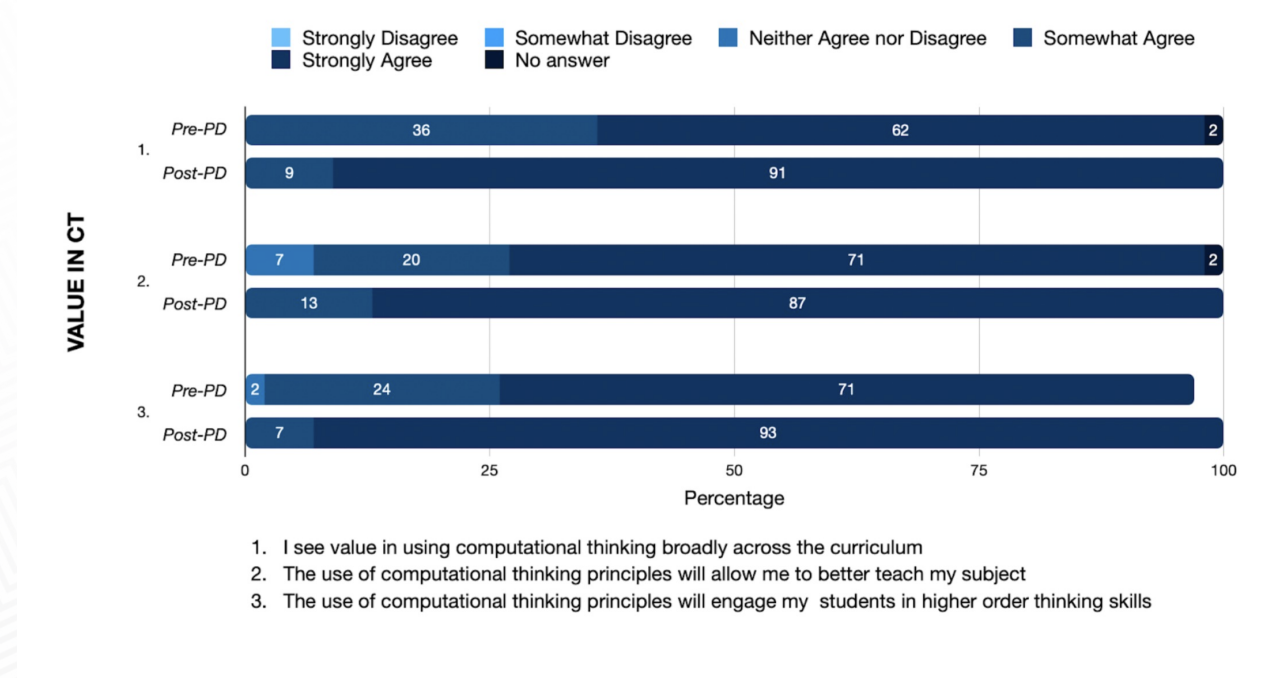
Part of the project included surveying teachers about the value they place on CT, both before and after participating in professional development workshops focused on CT. The researchers found that even before the workshops, teachers make connections between CT and the rest of the curriculum. After the workshops, an overwhelming majority agreed that CT has value (see image below). From this survey, it seems that CT ties things together for teachers in ways not possible or not achieved with other methods they’ve tried previously.
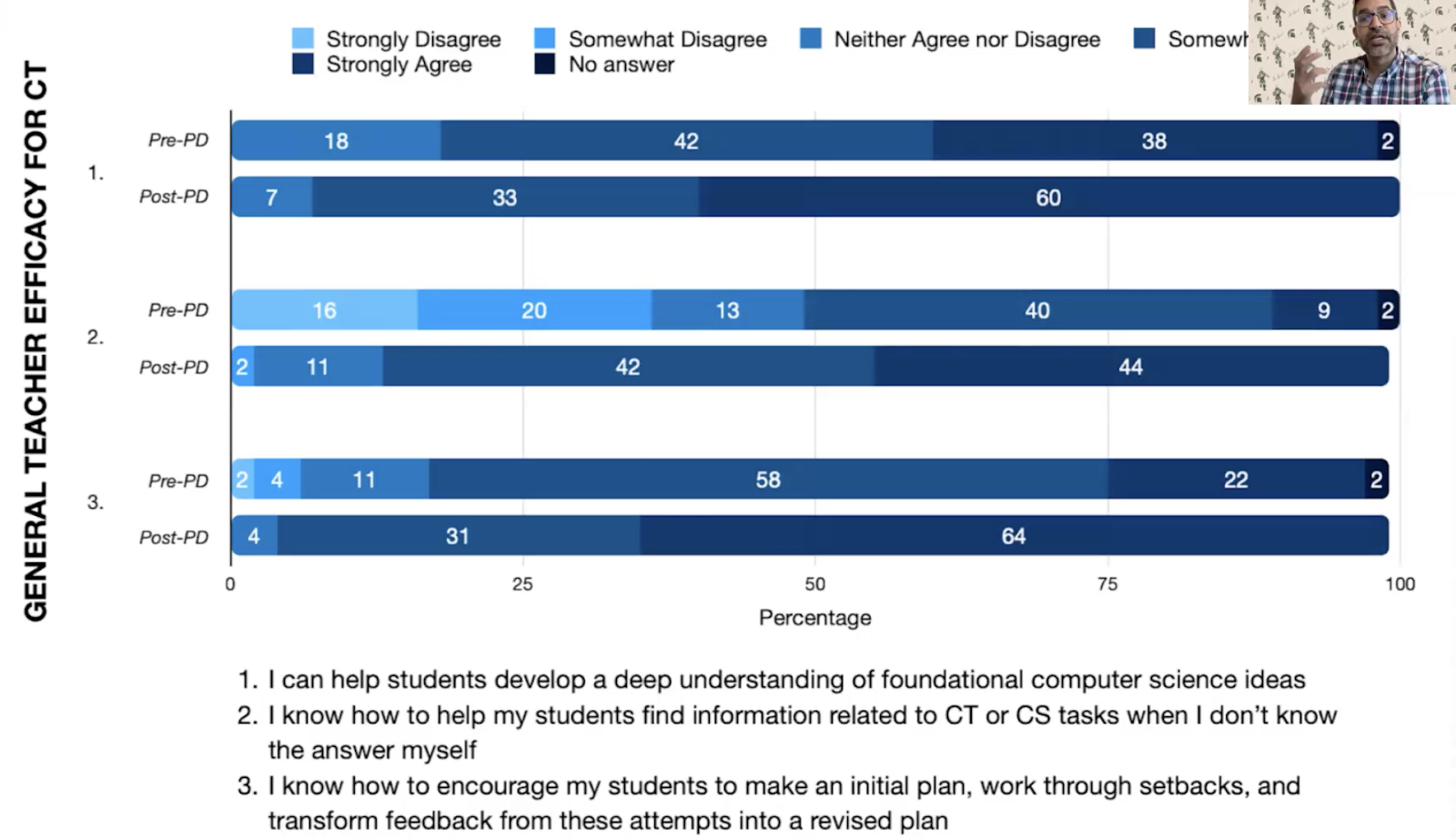
Despite teachers valuing the CT approach, asking them to integrate coding into their practices from the start remains a big ask (see image below). Many teachers lack knowledge or experience of coding, and they may not be curriculum designers, which means that we need to develop resources that allow teachers to integrate CT and coding in natural ways. Aman proposes that this requires a longitudinal approach, working with teachers over several years, using plugged and unplugged activities, and working closely with schools’ STEAM or specialist technology teachers where applicable to facilitate more computationally rich learning experiences in classrooms.
Aman’s team is also engaged in a research project to integrate CT at middle school level for students aged 11 to 14. This project focuses on the question “What does CT look like in the context of social studies, English language, and art classrooms?”
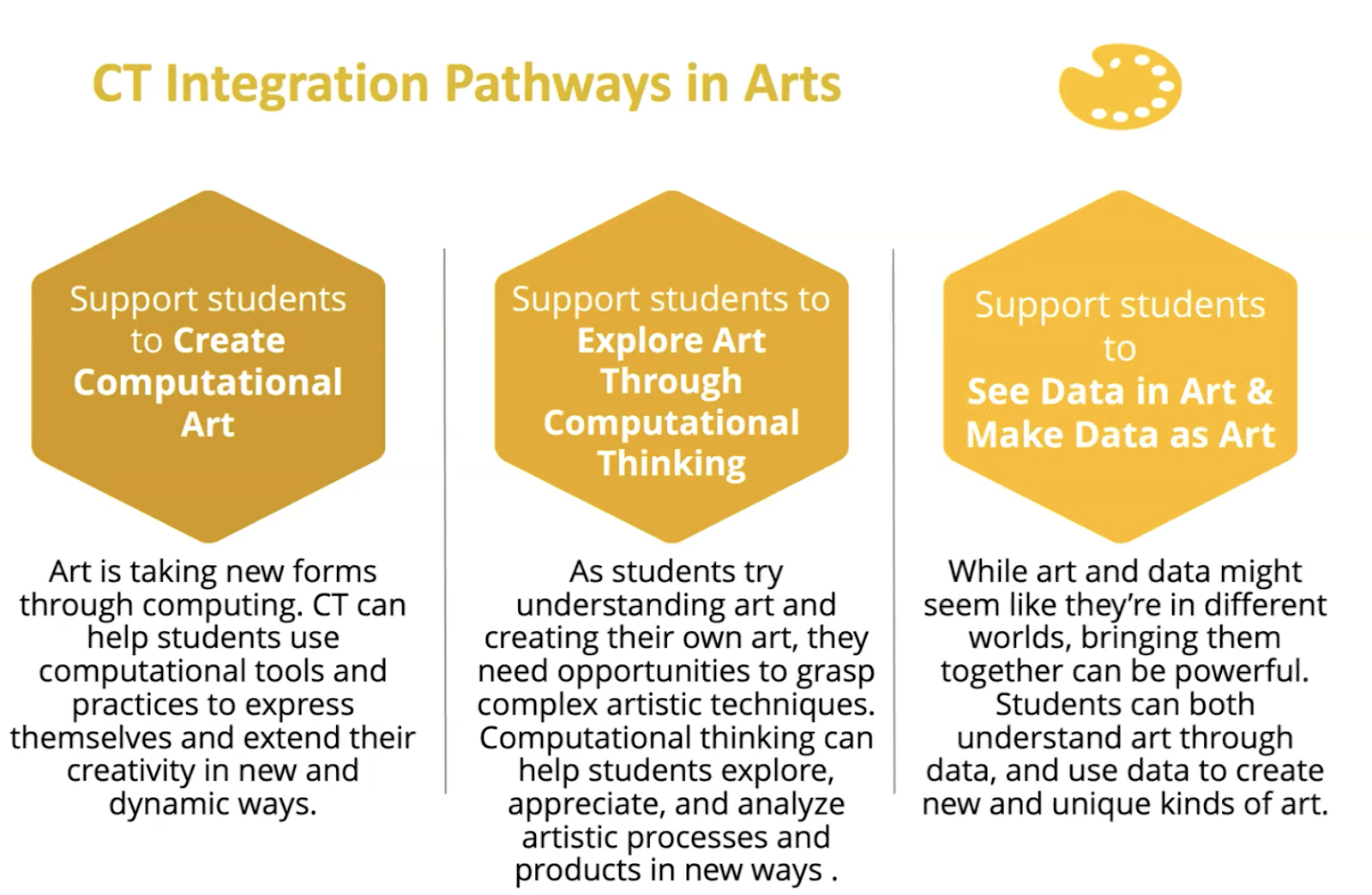
For this project, the team conducted three Delphi studies, and consequently created learning pathways for each subject, which teachers can use to bring CT into their classrooms. The pathways specify practices and sub-practices to engage students with CT, and are available on the project website. The image below exemplifies the CT integration pathways developed for the arts subject, where the relationship between art and data is explored from both directions: by using CT and data to understand and create art, and using art and artistic principles to represent and communicate data.
Aman’s work highlights the broad value of CT in education. However, to meaningfully integrate CT into the classroom, Aman suggests that we have to take a longitudinal view of the time and methods required to build teachers’ understanding and confidence with the fundamentals of CT, in a way that is aligned with their values and objectives. Aman argues that CT is really about thinking, and sometimes about computing, to support disciplinary learning in primary classrooms. Therefore, rather than focusing on integrating coding into the classroom, he proposes that we should instead talk about using CT practices as the building blocks that provide the foundation for incorporating computationally rich experiences in the classroom.
Watch the recording of Aman’s presentation:
You can access Aman’s seminar slides as well.
You can find out more about connecting research to practice for primary computing education by watching the recordings of the other seminars in our series on primary (K–5) teaching and learning. In particular, Bobby Whyte discusses similar concepts to Aman in his talk on integrating primary computing and literacy through multimodal storytelling.
Our 2024 seminar series is on the theme of teaching programming, with or without AI. In this series, we explore the latest research on how teachers can best support school-age learners to develop their programming skills.
On 13 February, we’ll hear from Majeed Kazemi (University of Toronto) about his work investigating whether AI code generator tools can support K-12 students to learn Python programming.
Sign up now to join the seminar:
The post Integrating computational thinking into primary teaching appeared first on Raspberry Pi Foundation.
The UK Bebras Challenge is back and ready to accept entries from schools for its annual event, which runs from 6 to 17 November.
More than 3 million students from 59 countries took part in the Bebras Computational Thinking Challenge in 2022. In the UK alone, over 365,000 students participated. Read on to find out how you can get your school involved.
“This is now an annual event for our Year 5 and 6 students, and one of the things I actually love about it is the results are not always what you might predict. There are children who have a clear aptitude for these puzzles who find this is their opportunity to shine!”
– Claire Rawlinson, Primary Teacher, Lancashire
Bebras is a free, annual challenge that helps schools introduce computational thinking to their students. No programming is involved, and it’s completely free for schools to enter. All Bebras questions are self-marking.
We’re making Bebras accessible by offering age-appropriate challenges for different school levels and a challenge tailored for visually impaired students. Schools can enter students from age 6 to 18 and know they’ll get interesting and challenging (but not too challenging) activities.
Students aged 10 to 18 who do particularly well will get invited to the Oxford University Computing Challenge (OUCC).
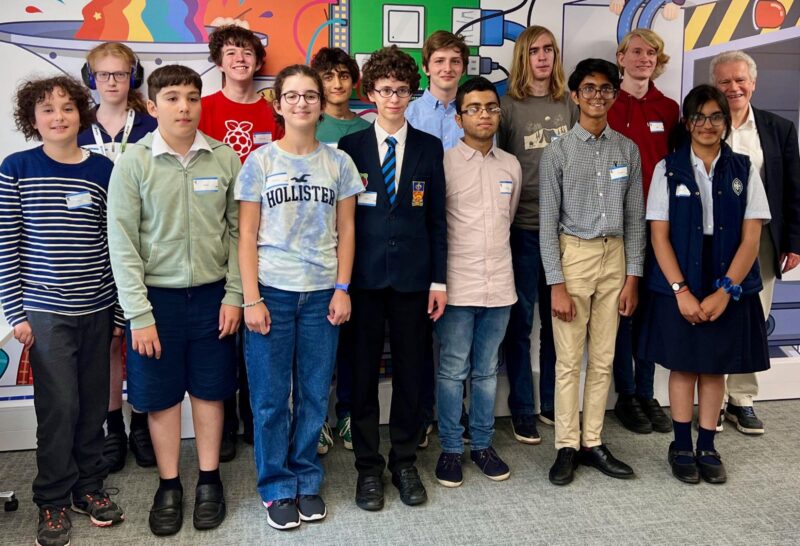
We want young people to get excited about computing. Through Bebras, they will learn about computational and logical thinking by answering questions and solving problems.
Bebras questions are based on classic computing problems and are presented in a friendly, age-appropriate way. For example, an algorithm-based puzzle for learners aged 6 to 8 is presented in terms of a hungry tortoise finding an efficient eating path across a lawn; for 16- to 18-year-olds, a difficult problem based on graph theory asks students to sort out quiz teams by linking quizzers who know each other.
“This has been a really positive experience. Thank you. Shared results with Head and Head of Key Stage 3. Really useful for me when assessing Key Stage 4 options.”
– Secondary teacher, North Yorkshire
Here’s a Bebras question for the Castors category (ages 8 to 10) from 2021. You will find the answer at the end of this blog.
A robot picks up litter.
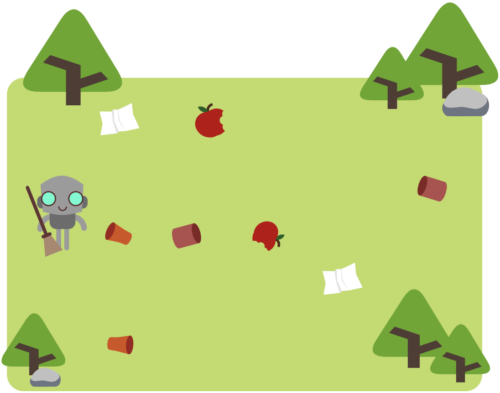
Question: Which kind of litter will the robot pick up last?

The Bebras challenge for UK schools takes place from 6 to 17 November. Register at bebras.uk/admin to get free access to the challenge.
By registering, you also get access to the Bebras back catalogue of questions, from which you can build your own quizzes to use in your school at any time during the year. All the quizzes are self-marking, and you can download your students’ results for your mark book. Schools have reported using these questions for end-of-term activities, lesson starters, and schemes of lessons about computational thinking.
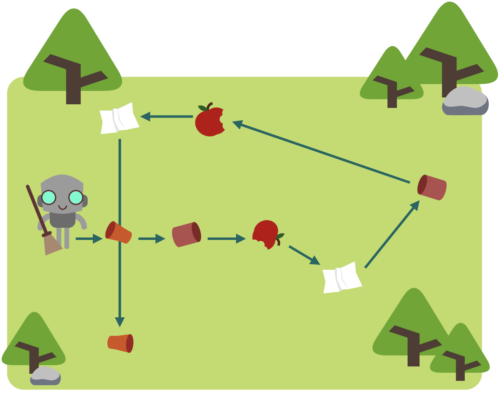
The answer to the example puzzle is:

The image below shows the route the robot takes by following the instructions:
The post Take part in the UK Bebras Challenge 2023 for schools appeared first on Raspberry Pi Foundation.
Today we share a guest blog from Chris Roffey, who manages the UK Bebras Challenge, a computational thinking challenge we run every year in partnership with the University of Oxford.
Bebras is a free annual challenge that helps schools introduce computational thinking to their learners through online, self-marking tasks. Taking part in Bebras, students solve accessible, interesting problems using their developing computational thinking skills. No programming is involved in taking part. The UK challenge is for school students aged 6 to 18 years old, with a special category for students with severe visual impairments.

While UK schools take part in Bebras throughout two weeks in November, for me the annual cycle starts much earlier. May is the time of the annual Bebras international workshop where the year’s new tasks get decided. In 2022, 60 countries were represented — some online, some in person. For nearly a week, computer scientists and computing teachers met to discuss and work on the new cycle’s task proposals submitted by participating countries a little earlier.
After the workshop, in collaboration with teams from other European countries, the UK Bebras team chose its task sets and then worked to localise, copy-edit, and test them to get them ready for schools participating in Bebras during November. From September, schools across the UK create accounts for their students, with over 360,000 students ultimately taking part in 2022. All in all, more than 3 million students from 59 countries took part in the 2022/2023 Bebras challenge cycle.
In this cycle, the UK Bebras partnership between the Raspberry Pi Foundation and the University of Oxford has been extended to include the Oxford University Computing Challenge (OUCC). This is an invitation-based, online coding challenge for students aged 10 to 18, offered in the UK as well as Australia, Jamaica, and China. We invited the students with the top 10% best results in the UK Bebras challenge to take part in the OUCC — an exciting opportunity for them.
In contrast to Bebras, which doesn’t require participants to do any coding, the OUCC asks students to create code to solve computational thinking problems. This requires students to prepare and challenges them to develop their computational thinking skills further. The two younger age groups, 10- to 14-year-olds, solve problems using the Blockly programming language. The older two age groups can use one of the 11 programming languages that Bebras supports, including all the most common ones taught in UK schools.
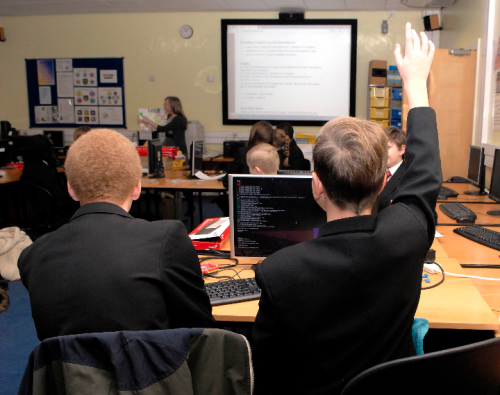
Over 20,000 Bebras participants took up the invitation to the first round of the OUCC in the third week of January. Then in March, the top 20 participants from each of the four OUCC age groups took part in the final round. The finalists all did amazingly well. In the first round, many of them had solved all the available tasks correctly, even though the expectation is that participants only try to solve as many as they can within the round’s time limit. In the final round, a few of the finalists managed to repeat this feat with the even more advanced tasks — which is, in modern parlance, literally impossible!
Many of the participants are about to take school exams, so the last stage of the annual cycle — the prize winners’ celebration day— takes place when the exam period has ended. This year we are holding this celebration on Friday 30 June at the Raspberry Pi Foundation’s headquarters in Cambridge. It will be a lovely way to finish the annual Bebras cycle and I am looking forward to it immensely.
The post UK Bebras participants in the Oxford University Computing Challenge appeared first on Raspberry Pi Foundation.
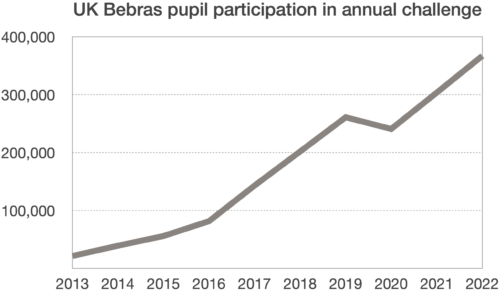
This November, teachers across the UK helped 367,023 learners participate in the annual free UK Bebras Challenge of computational thinking.
We support this challenge in the UK, together with Oxford University, and Bebras Challenges run across the world, with more than 3 million learners from schools in 54 countries taking part in 2021. Bebras encourages a love of computational thinking, computer science, and problem solving, especially among learners who haven’t yet realised they have these skills.
Nearly every year since 2013, more UK schools have been participating in Bebras. We think this is because for teachers, registering and entering learners is easy, the online system does all the marking automatically, and teachers receive comprehensive results that can be helpful for assessment.
The computational thinking problems within Bebras are tailored for different age groups, use clear language, and are accessible to colour-blind learners. There is also a challenge for learners with visual impairments. Teachers who run Bebras in their schools seem to love it and regularly tell colleagues about it.
“Our pupils really enjoy [Bebras] and I find it so helpful to teach computational thinking with real-life strategies. We also find the data and information about our pupils’ performance extremely helpful.” — Teacher in London
In the UK Bebras Challenge, the younger learners aged 6 to 10 usually take part in teams and have plenty of time to discuss how to solve the computational thinking problems they are presented with.

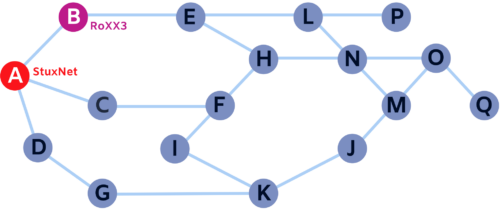
Older learners, aged 10 to 18, try to solve as many problems as they can in 40 minutes. The problems they are presented with start off easy and get increasingly difficult. The 10% of participants who solve the most problems are then invited to take part in the Oxford University Computing Challenge (OUCC), an annual programming challenge.
Although the OUCC is only open to some Bebras participants, all of the OUCC problems are archived and teachers registered with Bebras can use them to make auto-marking quizzes for all of their learners at any time of the year. Part of the goal of UK Bebras is to support teachers with free resources, and the UK Bebras online quizzes facility now has computational thinking tasks from the Bebras archive, plus auto-marking Blockly programming problems and text-based programming problems, which can be solved using commonly taught programming languages.
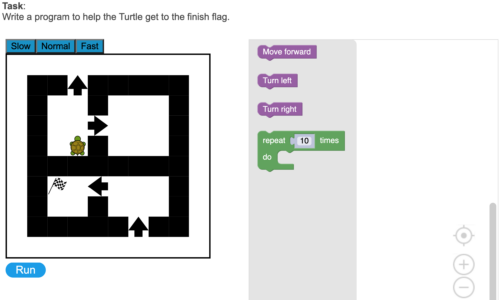
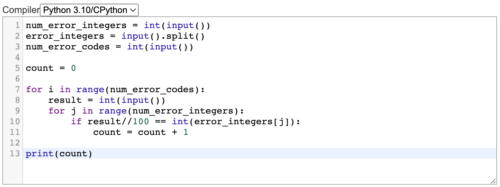
If you want to get a taste of Bebras, check out some of the interactive challenges that require no registration. And if you’d like to register to make quizzes for your learners and find out about next year’s challenge, you can do so at bebras.uk/admin.
The post Computational thinking all year round with UK Bebras appeared first on Raspberry Pi.
The UK Bebras Challenge is back and ready to accept entries from schools for its annual event from 7 to 18 November.
More than 3 million students from 54 countries took part in the Bebras Challenge in 2021. Read on to find out how you can get your school involved.
Bebras a free, annual challenge that helps schools introduce computational thinking to their students. No programming is involved, and it’s completely free for schools to take part. All Bebras questions are self-marking. Schools can enter students from age 6 to 18 and know they’ll get interesting and challenging (but not too challenging) activities.
“This has been a really positive experience. Thank you. Shared results with head and Head of KS3. Really useful for me when assessing KS4 options.” – Secondary teacher, North Yorkshire
We’re making Bebras accessible by offering age-appropriate challenges for different school levels, and a challenge tailored for visually impaired students.
We want young people to get excited about computing. Through Bebras, they will learn about computational and logical thinking by answering questions and solving puzzles.

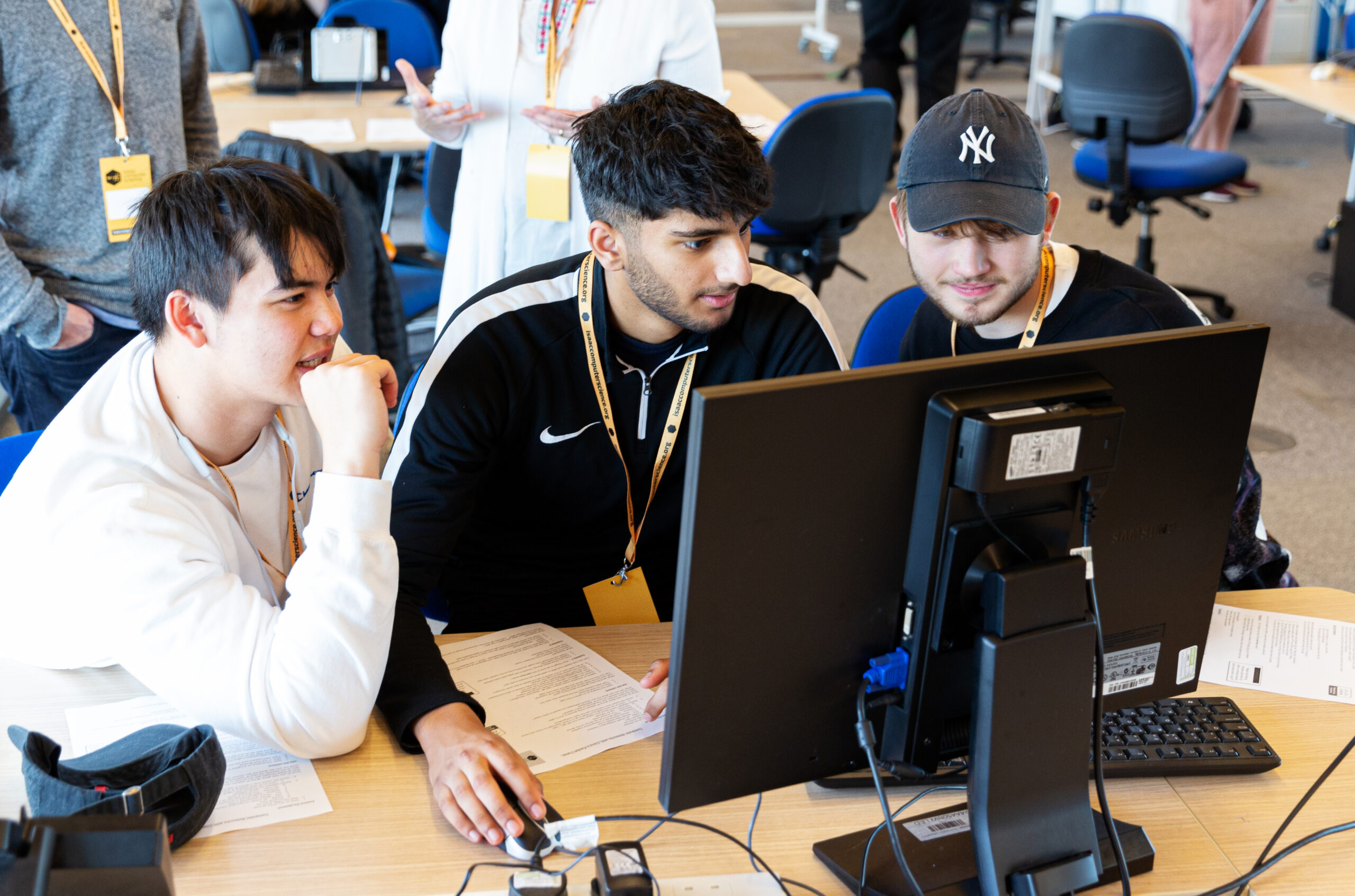
Bebras questions are based on classic computing problems and presented in friendly, age-appropriate contexts. For example, an algorithm-based puzzle for learners aged 6 to 8 is presented in terms of a hungry tortoise find an efficient eating path across a lawn; for 16- to 18-year-olds, a difficult question based on graph theory asks students to sort out some quiz teams by linking quizzers who know each other.
Here’s a question from the 2021 challenge for the Junior category (ages 10 to 12). You’ll find the correct answer at the bottom of this blog post.
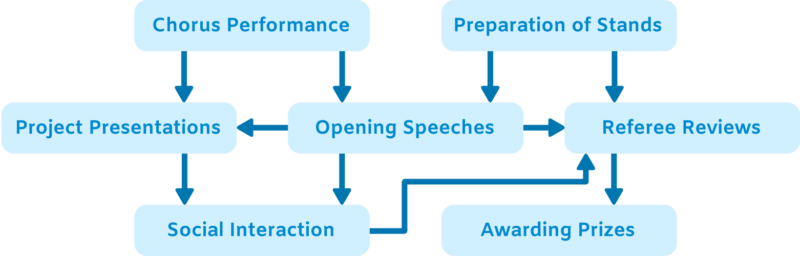
Question: What is the correct order of events for the science fair?
The Bebras challenge for UK schools takes place from 7 to 18 November. Register at bebras.uk/admin to get full access to the challenge.
By registering, you also get access to the back catalogue of questions, from which you can build your own quizzes to use in your school at any time during the year. All the quizzes are self-marking, and you can download your students’ results for your mark book. Schools have reported using the back catalogue of questions for end-of-term activities, lesson starters, and schemes of lessons about computational thinking.
You can also see more of our free resources for Computing and Computer Science teachers, and find out about our newest research project, which you can get involved in if you teach primary Computing.
There are actually two possible answers to the example puzzle:
| Option 1 | Option 2 |
| Chorus Performance Preparation of Stands Opening Speeches Project Presentations Social Interaction Referee Reviews Awarding Prizes | Preparation of Stands Chorus Performance Opening Speeches Project Presentations Social Interaction Referee Reviews Awarding Prizes |
The post Join the UK Bebras Challenge 2022 for schools appeared first on Raspberry Pi.
How does teaching children and young people about machine learning (ML) differ from teaching them about other aspects of computing? Professor Matti Tedre and Dr Henriikka Vartiainen from the University of Eastern Finland shared some answers at our latest research seminar.
Their presentation, titled ‘ML education for K-12: emerging trajectories’, had a profound impact on my thinking about how we teach computational thinking and programming. For this blog post, I have simplified some of the complexity associated with machine learning for the benefit of readers who are new to the topic.

We’re currently partnering with The Alan Turing Institute to host a series of free research seminars about how to teach artificial intelligence (AI) and data science to young people.
The seminar with Matti and Henriikka, the third one of the series, was very well attended. Over 100 participants from San Francisco to Rajasthan, including teachers, researchers, and industry professionals, contributed to a lively and thought-provoking discussion.


Representing a large interdisciplinary team of researchers, Matti and Henriikka have been working on how to teach AI and machine learning for more than three years, which in this new area of study is a long time. So far, the Finnish team has written over a dozen academic papers based on their pilot studies with kindergarten-, primary-, and secondary-aged learners.
Matti and Henriikka started by giving an overview of classical programming and how it is currently taught in schools. Classical programming can be described as rule-driven. Example features of classical computer programs and programming languages are:
When we teach this type of programming, we show learners how to use a deductive problem solving approach or workflow: defining the task, designing a possible solution, and implementing the solution by writing a stepwise program that is then run on a computer. We encourage learners to avoid using trial and error to write programs. Instead, as they develop and test a program, we ask them to trace it line by line in order to predict what will happen when each line is run (glass-box testing).
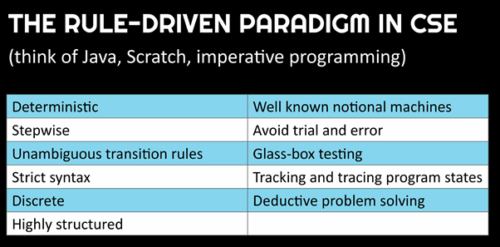
Classical programming underpins the current view of computational thinking (CT). Our speakers called this version of CT ‘CT 1.0’. So what’s the alternative Matti and Henriikka presented, and how does it affect what computational thinking is or may become?
Rule-based programming languages are not being eradicated. Instead, software systems are being augmented through the addition of machine learning (data-driven) elements. Many of today’s successful software products, such as search engines, image classifiers, and speech recognition programs, combine rule-driven software and data-driven models. However, the workflows for these two approaches to solving problems through computing are very different.
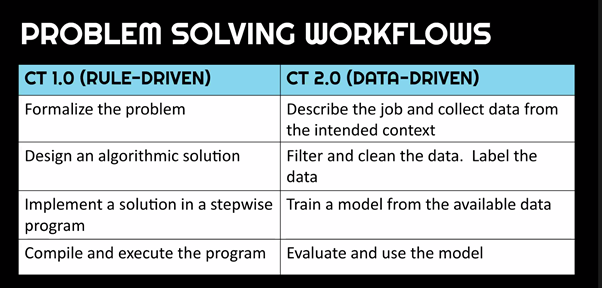
Significantly, while in rule-based programming (and CT 1.0), the focus is on solving problems by creating algorithms, in data-driven approaches, the problem solving workflow is all about the data. To highlight the profound impact this shift in focus has on teaching and learning computing, Matti introduced us to a new version of computational thinking for machine learning, CT 2.0, which is detailed in a forthcoming research paper.
Because of the focus on data rather than algorithms, developing a machine learning model is not at all like developing a classical rule-driven program. In classical programming, programs can be traced, and we can predict what will happen when they run. But in data-driven development, there is no flow of rules, and no absolutely right or wrong answer.
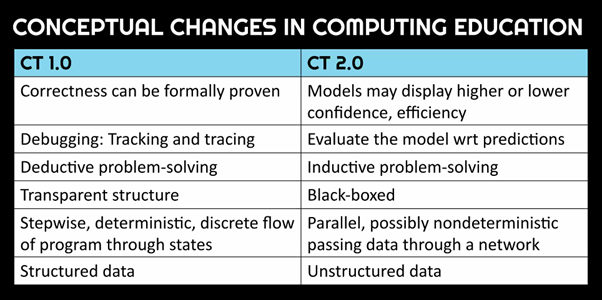
Machine learning models are created iteratively using training data and must be cross-validated with test data. A tiny change in the data provided can make a model useless. We rarely know exactly why the output of an ML model is as it is, and we cannot explain each individual decision that the model might have made. When evaluating a machine learning system, we can only say how well it works based on statistical confidence and efficiency.
The ethical and societal implications of computer science have always been important for students to understand. But machine learning models open up a whole new set of topics for teachers and students to consider, because of these models’ reliance on large datasets, the difficulty of explaining their decisions, and their usefulness for automating very complex processes. This includes privacy, surveillance, diversity, bias, job losses, misinformation, accountability, democracy, and veracity, to name but a few.
I see the shift in problem solving approach as a chance to strengthen the teaching of computing in general, because it opens up opportunities to teach about systems, uncertainty, data, and society.
Jane Waite
For teaching classical rule-driven programming, much time and effort has been put into researching learners’ understanding of what a program will do when it is run. This kind of understanding is called a learner’s mental model or notional machine. An approach teachers often use to help students develop a useful mental model of a program is to hide the detail of how the program works and only gradually reveal its complexity. This approach is described with the metaphor of hiding the detail of elements of the program in a box.
Data-driven models in machine learning systems are highly complex and make little sense to humans. Therefore, they may appear like magic boxes to students. This view needs to be banished. Machine learning is not magic. We have just not figured out yet how to explain the detail of data-driven models in a way that allows learners to form useful mental models.
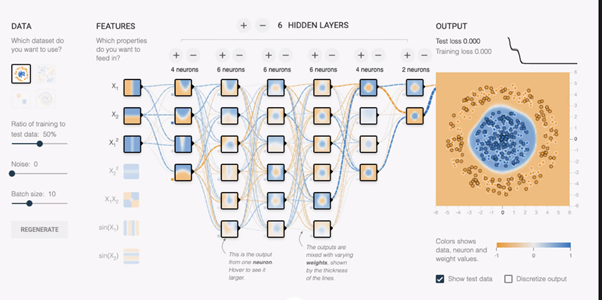
Some existing ML tools aim to help learners form mental models of ML, for example through visual representations of how a neural network works (see above). But these explanations are still very complex. Clearly, we need to find new ways to help learners of all ages form useful mental models of machine learning, so that teachers can explain to them how machine learning systems work and banish the view that machine learning is magic.
Matti and Henriikka’s team piloted different tools and pedagogical approaches with different age groups of learners. In terms of tools, since large amounts of data are needed for machine learning projects, our presenters suggested that tools that enable lots of data to be easily collected are ideal for teaching activities. Media-rich education tools provide an opportunity to capture still images, movements, sounds, or sense other inputs and then use these as data in machine learning teaching activities. For example, to create a machine learning–based rock-paper-scissors game, students can take photographs of their hands to train a machine learning model using Google Teachable Machine.
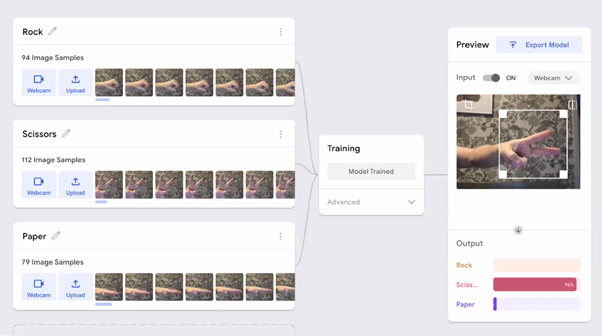
Similar to tools that teach classic programming to novice students (e.g. Scratch), some of the new classroom tools for teaching machine learning have a drag-and-drop interface (e.g. Cognimates). Using such tools means that in lessons, there can be less focus on one of the more complex aspects of learning to program, learning programming language syntax. However, not all machine learning education products include drag-and-drop interaction, some instead have their own complex languages (e.g. Wolfram Programming Lab), which are less attractive to teachers and learners. In their pilot studies, the Finnish team found that drag-and-drop machine learning tools appeared to work well with students of all ages.
The different pedagogical approaches the Finnish research team used in their pilot studies included an exploratory approach with preschool children, who investigated machine learning recognition of happy or sad faces; and a project-based approach with older students, who co-created machine learning apps with web-based tools such as Teachable Machine and Learn Machine Learning (built by the research team), supported by machine learning experts.
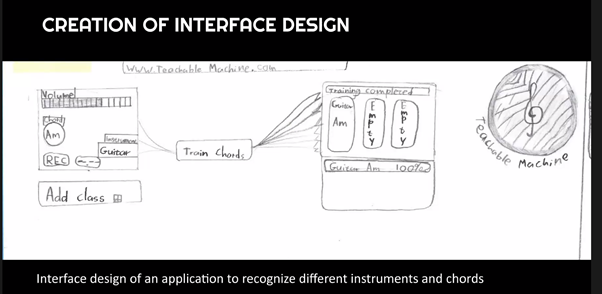
What impact these pedagogies have on students’ long-term mental models about machine learning has yet to be researched. If you want to find out more about the classroom pilot studies, the academic paper is a very accessible read.
We all learned a tremendous amount from Matti and Henriikka and their perspectives on this important topic. Our seminar participants asked them many questions about the pedagogies and practicalities of teaching machine learning in class, and raised concerns about squeezing more into an already packed computing curriculum.
For me, the most significant take-away from the seminar was the need to shift focus from algorithms to data and from CT 1.0 to CT 2.0. Learning how to best teach classical rule-driven programming has been a long journey that we have not yet completed. We are forming an understanding of what concepts learners need to be taught, the progression of learning, key mental models, pedagogical options, and assessment approaches. For teaching data-driven development, we need to do the same.
The question of how we make sure teachers have the necessary understanding is key.
Jane Waite
I see the shift in problem solving approach as a chance to strengthen the teaching of computing in general, because it opens up opportunities to teach about systems, uncertainty, data, and society. I think it will help us raise awareness about design, context, creativity, and student agency. But I worry about how we will introduce this shift. In my view, there is a considerable risk that we will be sucked into open-ended, project-based learning, with busy and fun but shallow learning experiences that result in restricted conceptual development for students.
I also worry about how we can best help teachers build up the knowledge and experience to support their students. In the Q&A after the seminar, I asked Matti and Henriikka about the role of their team’s machine learning experts in their pilot studies. It seemed to me that without them, the pilot lessons would not have worked, as the participating teachers and students would not have had the vocabulary to talk about the process and would not have known what was doable given the available time, tools, and student knowledge.
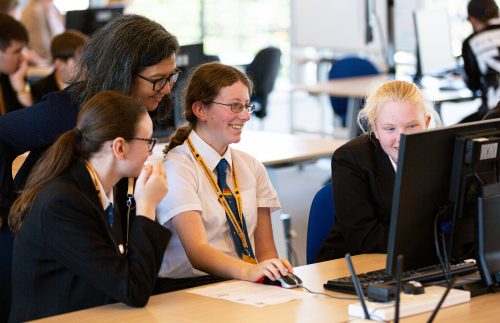
The question of how we make sure teachers have the necessary understanding is key. Many existing professional development resources for teachers wanting to learn about ML seem to imply that teachers will all need a PhD in statistics and neural network optimisation to engage with machine learning education. This is misleading. But teachers do need to understand the machine learning concepts that their students need to learn about, and I think we don’t yet know exactly what these concepts are.
In summary, clearly more research is needed. There are fundamental questions still to be answered about what, when, and how we teach data-driven approaches to software systems development and how this impacts what we teach about classical, rule-based programming. But to me, that is exciting, and I am very much looking forward to the journey ahead.
To find out what others recommend about teaching AI and ML, catch up on last month’s seminar with Professor Carsten Schulte and colleagues on centring data instead of code in the teaching of AI.
We have another four seminars in our monthly series on AI, machine learning, and data science education. Find out more about them on this page, and catch up on past seminar blogs and recordings here.
At our next seminar on Tuesday 7 December at 17:00–18:30 GMT, we will welcome Professor Rose Luckin from University College London. She will be presenting on what it is about AI that makes it useful for teachers and learners.
We look forward to meeting you there!
The post The machine learning effect: Magic boxes and computational thinking 2.0 appeared first on Raspberry Pi.
The annual UK Bebras Computational Thinking Challenge is back to provide fun, brain-teasing puzzles for schools from 8 to 19 November!

In the free Bebras Challenge, your students get to practise their computational thinking skills while solving a set of accessible, puzzling, and engaging tasks over 40 minutes. It’s tailored for age groups from 6 to 18.
“I just want to say how much the children are enjoying this competition. It is the first year we have entered, and I have students aged 8 to 11 participating in my Computing lessons, with some of our older students also taking on the challenges. It is really helping to challenge their thinking, and they are showing great determination to try and complete each task!”
– A UK-based teacher
Do you want to support your learners to take on the Bebras Challenge? Then register your school today!
Remember to sign up by 4 November!
Bebras is an international challenge that started in Lithuania in 2004 and has grown into a worldwide event. The UK became involved in Bebras for the first time in 2013, and the number of participating students has increased from 21,000 in the first year to more than half a million over the last two years! Internationally, nearly 2.5 million learners took part in 2020 despite the disruptions to schools.
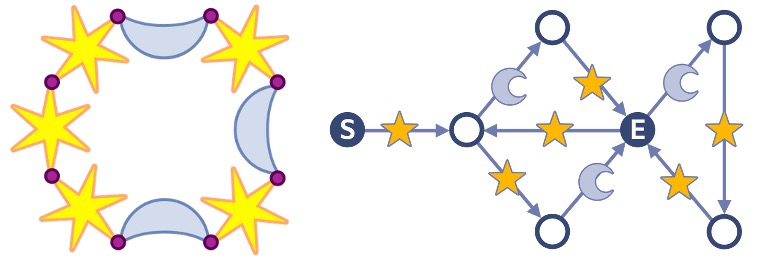
Bebras, brought to you in the UK by us and Oxford University, is a great way to give your learners of all age groups a taste of the principles behind computing by engaging them in fun problem-solving activities. The challenge results highlight computing principles, so Bebras can be educational for you as a teacher too.
Throughout the year, questions from previous years of the challenge are available to registered teachers on the bebras.uk website, where you can create self-marking quizzes to help you deliver the computational thinking part of the curriculum for your classes.
You can register your school at bebras.uk/admin.
Learn more about our work to support learners with computational thinking.
The post Take part in the UK Bebras Challenge 2021 for schools! appeared first on Raspberry Pi.
The annual UK Bebras Computational Thinking Challenge for schools, brought to you by the Raspberry Pi Foundation and Oxford University, is taking place this November!
The Bebras Challenge is a great way for your students to practise their computational thinking skills while solving exciting, accessible, and puzzling questions. Usually this 40-minute challenge would take place in the classroom. However, this year for the first time, your students can participate from home too!
If your students haven’t entered before, now is a great opportunity for them to get involved: they don’t need any prior knowledge.
Do you have any students who are up for tackling the Bebras Challenge? Then register your school today!

“Thank you for another super challenge. It’s one of the highlights of my year as a teacher. Really, really appreciate the high-quality materials, website, challenge, and communication. Thank you again!”
– A UK-based teacher
Bebras is an international challenge that started in Lithuania in 2004 and has grown into an international event. The UK became involved in Bebras for the first time in 2013, and the number of participating students has increased from 21,000 in the first year to more than 260,000 last year! Internationally, nearly 3 million learners took part in 2019.
Bebras is a great way to engage your students of all ages in problem-solving and give them a taste of what computing is all about. In the challenge results, computing principles are highlighted, so Bebras can be educational for you as a teacher too.
The annual Bebras Challenge is only one part of the equation: questions from previous years are available as a resource that you can use to create self-marking quizzes for your classes. You can use these materials throughout the year to help you to deliver the computational thinking part of your curriculum!
The post Join the UK Bebras Challenge 2020 for schools! appeared first on Raspberry Pi.
Learning computing is fun, creative, and exploratory. It also involves understanding some powerful ideas about how computers work and gaining key skills for solving problems using computers. These ideas and skills are collected under the umbrella term ‘computational thinking’.
When we create our online learning projects for young people, we think as much about how to get across these powerful computational thinking concepts as we do about making the projects fun and engaging. To help us do this, we have put together a computational thinking framework, which you can read right now.
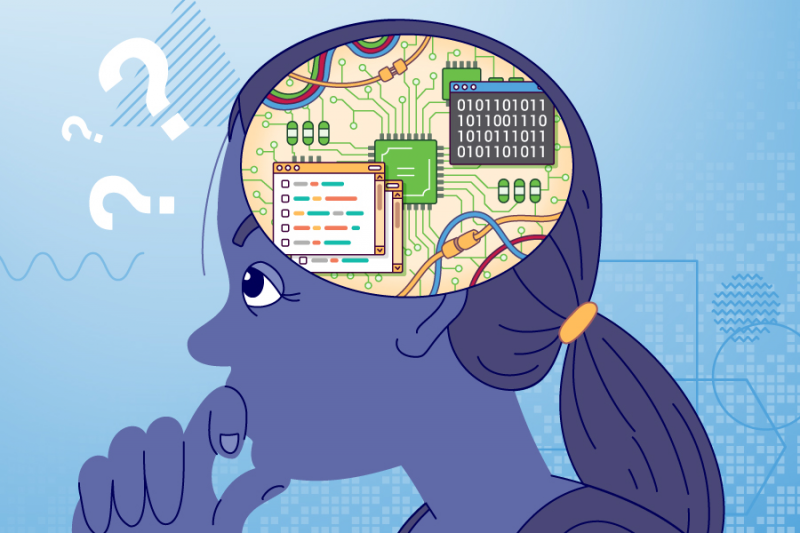
Computational thinking is a set of ideas and skills that people can use to design systems that can be run on a computer. In our view, computational thinking comprises:
All of these aspects are underpinned by logical thinking, the foundation of computational thinking.
In principle, the processes a computer performs can also be carried out by people. (To demonstrate this, computing educators have created a lot of ‘unplugged’ activities in which learners enact processes like computers do.) However, when we implement processes so that they can be run on a computer, we benefit from the huge processing power that computers can marshall to do certain types of activities.
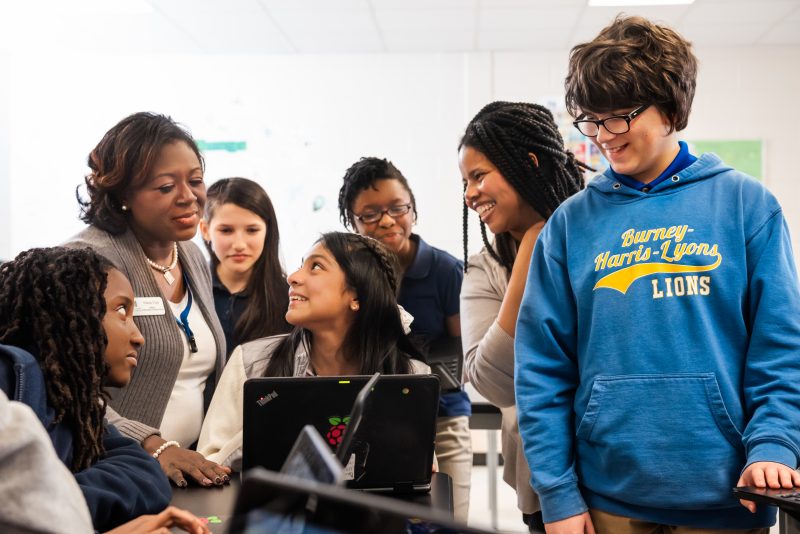
Computers need instructions that are designed in very particular ways. Computational thinking includes the set of skills we use to design instructions computers can carry out. This skill set represents the ways we can logically approach problem solving; as computers can only solve problems using logical processes, to write programs that run on a computer, we need to use logical thinking approaches. For example, writing a computer program often requires the task the program revolves around to be broken down into smaller tasks that a computer can work through sequentially or in parallel. This approach, called decomposition, can also help people to think more clearly about computing problems: breaking down a problem into its constituent parts helps us understand the problem better.
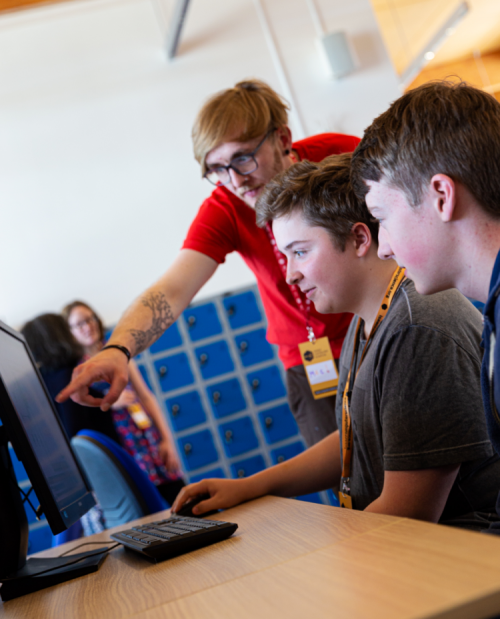
Understanding computational thinking supports people to take advantage of the way computers work to solve problems. Computers can run processes repeatedly and at amazing speeds. They can perform repetitive tasks that take a long time, or they can monitor states until conditions are met before performing a task. While computers sometimes appear to make decisions, they can only select from a range of pre-defined options. Designing systems that involve repetition and selection is another way of using computational thinking in practice.
Our team has been thinking about our approach to computational thinking for some time, and we have just published the framework we have developed to help us with this. It sets out the key areas of computational thinking, and then breaks these down into themes and learning objectives, which we build into our online projects and learning resources.
To develop this computational thinking framework, we worked with a group of academics and educators to make sure it is robust and useful for teaching and learning. The framework was also influenced by work from organisations such as Computing At School (CAS) in the UK, and the Computer Science Teachers’ Association (CSTA) in the USA.
We’ve been using the computational thinking framework to help us make sure we are building opportunities to learn about computational thinking into our learning resources. This framework is a first iteration, which we will review and revise based on experience and feedback.
We’re always keen to hear feedback from you in the community about how we shape our learning resources, so do let us know what you think about them and the framework in the comments.
The post Embedding computational thinking skills in our learning resources appeared first on Raspberry Pi.
Computational thinking (CT) comprises a set of skills that are fundamental to computing and being taught in more and more schools across the world. There has been much debate about the details of what CT is and how it should be approached in education, particularly for younger students.
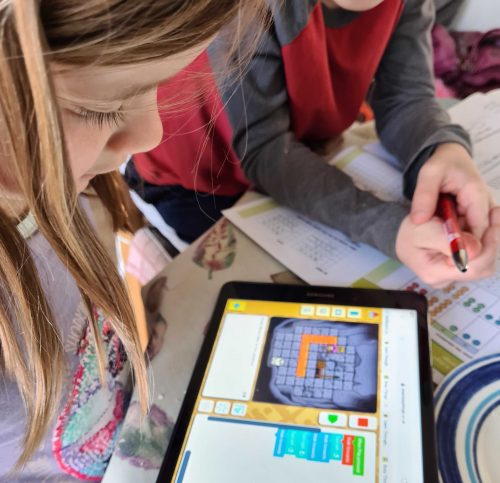
In our research seminar this week, we were joined by María Zapata Cáceres from the Universidad Rey Juan Carlos in Madrid. María shared research she and her colleagues have done around CT. Specifically, she presented work on how we can understand what CT skills young children are developing. Building on existing work on assessing CT, she and her colleagues have developed a reliable test for CT skills that can be used with children as young as 5.

Until we can assess something, María argues, we don’t know what children have or haven’t learned or what they are capable of. While testing is often associated with the final stages in learning, in order to teach something well, educators need to understand where their students’ skills are to know what they are aiming for them to learn. With CT being taught in increasing numbers of schools and in many different ways, María argues that it is imperative to be able to test learners on it.

One of the key challenges for assessing learning is knowing whether the activities or questions you present to learners are actually testing what you intend them to. To make sure this is the case, assessments go through a process of validation: they are tried out with large groups to ensure that the results they give are valid. María’s and her colleagues’ CT test for beginners is based on a CT test developed by researcher Marcos Román González. That test had been validated, but since it is aimed at 10- to 16-year-olds, María and her colleagues needed to adapt it for younger children and then validate the adapted rest.
The new test for beginners consists of 25 questions, each of which has four possible responses, which are to be answered within 40 minutes. The questions are of two types: one that involves using instructions to draw on a canvas, and one that involves moving characters through mazes. Since the test is for younger children, María and her colleagues designed it so it involves as little text as possible to reduce the need for reading; instead the test includes self-explanatory symbols.

To refine the test, the researchers consulted with a group of 45 experts about the difficulty of the questions and the test’s length of the test. The general feedback was very positive.
Drawing on the experts’ feedback, María and her colleagues made some very specific improvements to the test to make it more appropriate for younger children:

After these improvements, the test was validated with 299 primary school students aged 5-12. To assess the differences the improvements might make, the students were given different version of the test. María and her colleagues found that the younger students benefited from the improvements, and the improvements made the test more reliable for testing students’ computational thinking: students made fewer errors due to ambiguity and misinterpretation.
Statistical analysis of the test results showed that the improved version of the test is reliable and can be used with confidence to assess the skills of younger children.
Firstly, the test is a tool for educators who want to assess the skills young people have and develop over time. Secondly, the test is also valuable for researchers. It can be used to perform projects that evaluate the outcomes of different approaches to teaching computational thinking, as well as projects investigating the effectiveness of specific learning resources, because the test can be given to children before and again after they engage with the resources.
Assessment is one of the many tools educators use to shape their teaching and promote the learning of their students, and tools like this CT test developed by María and her colleagues allow us to better understand what children are learning.
The video and slides of María’s presentation are available on our seminars page. To find out more about this test, and the process used to create and validate it, read the paper by María and her colleagues.
Our final seminar of this series takes place Tuesday 28 July before we take a break for the summer. In the session, we will explore gender balance in computing, led by Katharine Childs, who works on the Gender Balance in Computing research project at the Raspberry Pi Foundation. You can find out more and sign up to attend for free on our Computing Education Research Seminars page.
The post Testing young children’s computational thinking appeared first on Raspberry Pi.
We are delighted to announce a new partnership that will ensure the long-term growth and success of the free, annual UK Bebras Computational Thinking Challenge.

‘Bebras’ means ‘beaver’ in Lithuanian; Prof. Valentina Dagiene named the competition after this hard-working, intelligent, and lively animal.
The Raspberry Pi Foundation has teamed up with Oxford University to support the Bebras Challenge, which every November invites students to use computational thinking to solve classical computer science problems re-worked into accessible and interesting questions.
Bebras is:
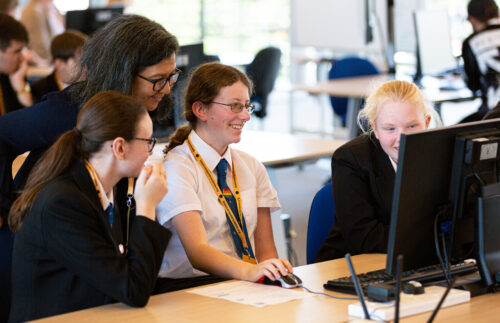
Bebras is an international challenge that started in Lithuania in 2004. Participating in Bebras is a great way to engage students of all ages in the fun of problem solving, and to give them an insight into computing and what it’s all about. Computing principles are highlighted in the answers, so Bebras can be quite educational for teachers too.
The UK became involved in Bebras for the first time in 2013, and the numbers of participating students have increased from 21,000 in the first year to 202,000 last year. Internationally, more than 2.78 million learners took part in 2018.
To give you a taste of what Bebras involves, try this example question!
You’ve still got three more days to sign up for this year’s Bebras Challenge.
The annual challenge is only one part of the equation: questions from previous years are available as a resource with which teachers can create self-marking quizzes to use with their classes! This means you can support the computational thinking part of the school curriculum throughout the whole year.
You can also use the Bebras App to try 100 computational thinking problems, and download sets of Bebras Cards for primary schools.
Follow @bebrasuk to stay up to date with what’s on offer for you.
The post The Raspberry Pi Foundation and Bebras appeared first on Raspberry Pi.

 Lateo.net - Flux RSS en pagaille (pour en ajouter : @ moi)

