 Connexion


Google promised Gemini 3.5 Pro in June, but it spent the summer trotting out smaller Flash models. Now, Google is ready to take on the frontier again with Gemini 4 Argon. The company claims this new AI offers industry-leading performance in coding, knowledge work, and cybersecurity, but you aren't allowed to use it yet.
While most of us will have to wait to test Gemini 4, Google says engineers inside the company are already using the new model extensively. Argon reportedly used "fleet-wide telemetry data" to help Google save 300 TiB of memory across its data centers. Meanwhile, Argon agents have been working to migrate C/C++ codebases to Rust across Google, including thousands of lines in the core re2 and libgav1 libraries and more than 800,000 lines in the Fuchsia OS Zircon kernel.
Google has also come armed with a raft of benchmarks to back up its claims. On the software engineering DeepSWE v1.1 benchmark, Gemini 4 Argon hits 77.9 percent, which is higher than GPT-6 Astra, Fable 5.1, and Opus 5.5. Google promises similar power across a range of long-horizon tasks, pointing to Argon's industry-leading score in the economic analysis Vals Index test.

Google's shift to AI-powered search has upended the way the world's largest search engine generates web traffic, rankling large and small publishers alike. In recent months, the company has experimented with paying publishers when their content appears in AI answers, but a new report claims the payouts in this pilot program are miniscule. That has publishers in the program, as well as those watching from the sidelines, feeling skeptical.
According to The Information, Google has admitted about 100 publishers to the AI contribution pilot. The pitch is that websites can get payments from Google when their content materially contributes to Gemini-powered search results like an AI Overview. Google has long resisted the idea of direct payments to publishers, arguing that websites get traffic in exchange for allowing Google bots to scrape their content for use in search and knowledge graph tools. In the age of AI, that relationship is breaking down, hence the AI pilot.
So far, publishers aren't getting much for their trouble. The Information heard from several small and mid-sized publishers in the program that Google's AI payments are minuscule, equaling roughly one-tenth of one percent of their advertising revenue. These payments have been so disappointing that several larger publishers have reportedly declined to participate in the program. These publishers hope that by refusing to join the pilot, they can force Google to offer a more generous deal.
Google hasn't released a frontier-level Gemini Pro AI model since early 2026, but it sure loves rolling out new Gemini Flash variants. Today, Google is announcing its third Flash model release in just six weeks, making it more likely that we'll never see the promised Gemini 3.5 Pro. But no matter, says Google, because Gemini 3.8 Flash is its best reasoning and coding model yet.
Gemini 3.8 Flash comes in two variations. There's the standard Flash, which Google describes as a "workhorse" model that's good for anything from agentic tasks to software development. Then we have Gemini 3.8 Flash Cyber, which runs on the same foundations but has been tuned for vulnerability detection and mitigation.
For developers, Google has the same pitch as it did for the 3.7 Flash release just a couple of weeks ago. API access to the model is available at an "introductory rate" through the end of the year: $0.75 per million input tokens and $3.75 per million output tokens. The regular price will be $1.50 / $7.50, but it's likely there will be new models available long before the price changes. Google probably sees the lower prices as a necessity given that other AI labs have recently dropped token pricing to keep increasingly wary businesses engaged with AI tools.
Some of the world’s leading music publishers think that Anthropic got off too light in a historic settlement where the Claude maker paid authors $1.5 billion after admitting to pirating more than 7 million books to train AI.
“$1.5 billion is obviously not a large enough settlement to deter infringing conduct by a company that has parlayed such mass infringement into a staggering $2-trillion-dollar valuation,” music publishers said in a lawsuit filed Friday.
Music publishers suing Anthropic include Sony, EMI, and Warner Chappell. They alleged that Anthropic’s illegal torrenting also included “thousands upon thousands” of their copyrighted musical compositions.


Sometimes you have to fight fire with fire. But when it comes to AI slop and hateful content threatening the safety and value of social media platforms, adding more fire—in this case, more AI—can make the problem worse.
At its best, social media can be a haven for people who want to share their experiences and knowledge. It gets closest to this ideal when users contribute authentic, valuable content, whether that’s a uniquely thoughtful blog post or a helpful video on how to build a PC. Relying primarily on AI tools to preserve that authenticity misses what makes social media worthwhile in the first place: the people behind it.
In April, a Slack channel for moderators of the r/AskHistorians Reddit community was usually busy. The channel, which automatically receives links to modmail messages, was flooded with alerts after dozens of comments and posts dating back 10 years were automatically removed from the subreddit.


One of the first schools to shut down after students were found making AI nudes of female classmates is now asking a court to toss a lawsuit filed by victims who claimed that the school stayed silent for months while the emboldened boys targeted many more girls.
In a motion to dismiss this week, Lancaster Country Day School (LCDS)—a private K-12 school in Pennsylvania with fewer than 600 students—argued that it was false to say the school never reported the harm to law enforcement. The tip that the school received came from the Pennsylvania Office of the Attorney General, which is itself a law enforcement agency, the filing said.
It’s also false to say the school knew that girls were being targeted, the school argued, because the tip did not mention any specific student victims.


OpenAI is facing calls for "serious sanctions" after fighting to keep news organizations from snooping through millions of logs to find evidence of users skirting their paywalls by prompting ChatGPT to regurgitate their articles.
This evidence is considered among the most important to both sides, potentially either dooming OpenAI as an infringer or exonerating its chatbot technology as a transformative fair use of news sites' content.
In a sanctions motion Thursday, news organizations suing OpenAI—led by The New York Times—accused the AI firm of repeatedly lying for years to conceal evidence of infringement that could hobble OpenAI's defense.
There are plenty of AI image-generation models these days, but the ones capable of quality outputs tend to be slow and expensive. Google DeepMind says its new image model, known as Nano Banana 2 Lite, offers the best balance of quality and speed. It's available today across the Google ecosystem, creating images in a fraction of the time it takes Google's beefier models.
The new model is part of the Gemini 3.1 family—it's technically called Gemini 3.1 Flash Lite Image. On one hand, Google says this model is ideal for exploring ideas and "rapid-fire" prototyping, applications in which quality can take a backseat. However, the company has also provided some examples aimed at showing how close Nano Banana 2 Lite can get to the quality of its other image models.
 A comparison of Nano Banana 2 Lite with the non-Lite version.
Credit:
Google
In addition to the examples, Google also has Elo scores from Arena.ai ready to go, showing that users rate Nano Banana 2 Lite outputs almost as highly as the non-Lite versions. However, vibemarking doesn't always focus on the details that can make AI images look silly upon closer inspection. Google notes that Nano Banana 2 Lite tends to have more trouble with text, particularly if it's very small, and infographics are more likely to include incorrect data. Characters and people may also show poor consistency across iterations.
President Donald Trump’s plan to “fill the digital potholes” and use AI to quickly redesign every government website isn’t going very well.
Last August, Trump created the National Design Studio, or NDS, by executive order. A temporary DOGE-like entity that answers only to the president, NDS was tasked with creating new standards to update the US Web Design System (USWDS) and overhaul 27,000 dot-gov websites in just three years. At the end of this so-called “America by Design” initiative, the government’s “design language” would supposedly be more usable and beautiful, Trump expected.
However, that monumental task—assigned to a small team under a short timeframe—was seemingly made harder by DOGE's deep cuts to agencies previously responsible for improving government websites, including dismantling the 18F technology unit and restructuring the US Digital Service into DOGE.


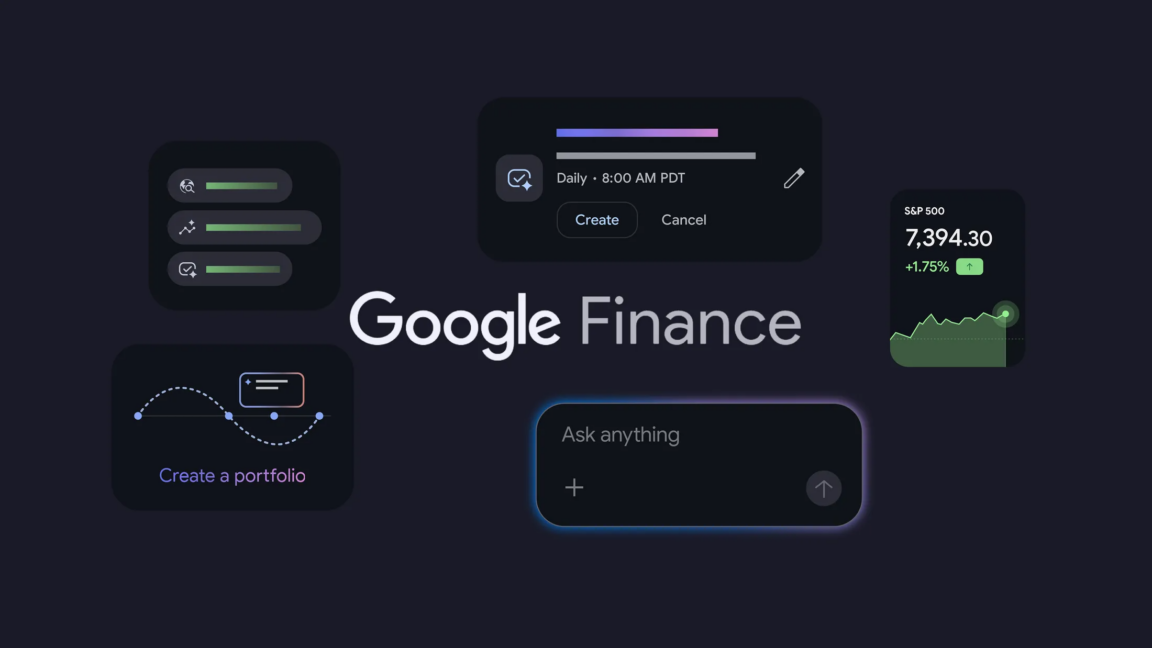
Google Finance is not a new product—it has been around for 20 years, long enough that it initially relied on Flash to display charts and graphs. The website has gotten a few major updates over the years, but it has never had a mobile app until now. Google has released the first standalone app for Google Finance, which is currently exclusive to Android, with iOS planned for later this year.
The app is available globally in the Play Store, but that's not the only update to Google's financial tracker. The AI-powered makeover for the Finance website is also leaving beta, making Google's chatbot a core part of the experience. Naturally, the mobile app includes a heaping helping of generative AI that aims to make sense of irrational financial markets.
If you've checked out the new Finance web experience, you'll see a lot of familiar features in the app. You can create watchlists, monitor real-time market data, and keep up with financial news in one place. While perusing graphs of stock performance, Finance will use AI to generate "key moments" that can explain why the numbers changed. This feature initially launched in the Finance web interface in May.
The US Department of Defense has a lot of congressionally mandated homework to do every year involving hundreds of required reports on various national security topics. But Pentagon officials have been proudly describing a new shortcut—using generative AI tools to write such reports for Congress.
Pentagon Chief Technology Officer Emil Michael highlighted AI-generated reports to Congress as a key example of how the Department of Defense—stylized as the Department of War under the Trump administration—has adopted generative AI during an event hosted by the Hudson Institute think tank in Washington, DC, on June 12. The Pentagon has made AI tools, starting with Google Cloud’s Gemini for Government, widely available to members of all six military branches through the department’s bespoke GenAI.mil platform since December 2025.
“I have to report to Congress every year on this thing,” Michael said. “Let me load all the papers onto it and have it draft me a congressional report that would otherwise take 200 hours of staffing time and do it in five hours.”


Google loves telling us all the ways people are using its generative AI products to build new things, grow businesses, and save the world. Supposedly. Of course, people are also using AI for crime. Google has announced a new legal salvo aimed at a Chinese group called Outsider Enterprise, which is allegedly responsible for a massive AI-powered scam campaign. Google says it's working with law enforcement and mobile carriers to fight back.
According to Google's legal filing, Outsider Enterprise operates through Telegram. The group offers phishing-as-a-service to individuals who may not be technically savvy enough to set up fraudulent websites and text campaigns on their own. In its Telegram channels, Outsider Enterprise reportedly provided instructions on how to use Google's Gemini AI to create websites that imitate those of Google, YouTube, and government agencies such as New York’s E-ZPass. The group offered nearly 300 scam templates.
Google says that scams enabled by Outsider Enterprise resulted in more than 2.5 million text messages being sent to Android users. About 55,000 of those messages happened in a two-week period last month. In all, Google has tracked 9,000 fake websites and 1 million URLs connected to the scam network.


Another day, another AI model from Google. This time, Google DeepMind has released a new member of the Gemma 4 open model family, but it's fundamentally different from the rest of the lineup. DiffusionGemma doesn't generate outputs linearly like most AI models. Instead, it can produce an entire block of text in parallel. Google says this makes it faster and more efficient when running on local hardware like an Nvidia DGX or a humble gaming GPU.
Most AI models are designed to be autoregressive—they generate text left to right one token at a time. DiffusionGemma has more in common with image generation models, which start with static and then denoise it to create the desired content. This model takes a field of placeholder tokens running over the canvas multiple times to generate likely tokens and using those to improve estimation of others. At the end of the process, the model finalizes its token outputs in one large block—the "denoised" text canvas.
DiffusionGemma is fairly large in the realm of Google's open models. It's a Mixture of Experts (MoE) model with a total of 26 billion parameters, but only 3.8 billion are activated during inference. That means it should fit in the 18GB RAM allotment of a high-end GPU. In testing with an RTX 5090, DiffusionGemma spits out around 700 tokens per second. With a single Nvidia H100 AI accelerator, DiffusionGemma can produce 1,000+ tokens per second. That's about four times the output of the similarly sized autoregressive Gemma models.
Google's NotebookLM was one of the company's first forays into generative AI technology, and in un-Googley fashion, it hasn't been shut down yet. In fact, NotebookLM is getting one of its biggest updates, ever, today, moving to the latest Gemini 3.5 model, support for more file types, and streamlined web source integration. Google also says NotebookLM will be able to do more with all those queries thanks to embedded support for Antigravity.
Gemini 3.5 Flash debuted at Google I/O this year, promising much faster and more efficient processing. Google has claimed that companies worried about token costs can save big by moving their projects to the new Flash model while also getting outputs that are of similar or better quality. Those improvements are now filtering down to other Google products. NotebookLM, which launched in 2023 at the very beginning of the AI boom, lets you analyze specific sources like documents and webpages with Google's latest AI models.
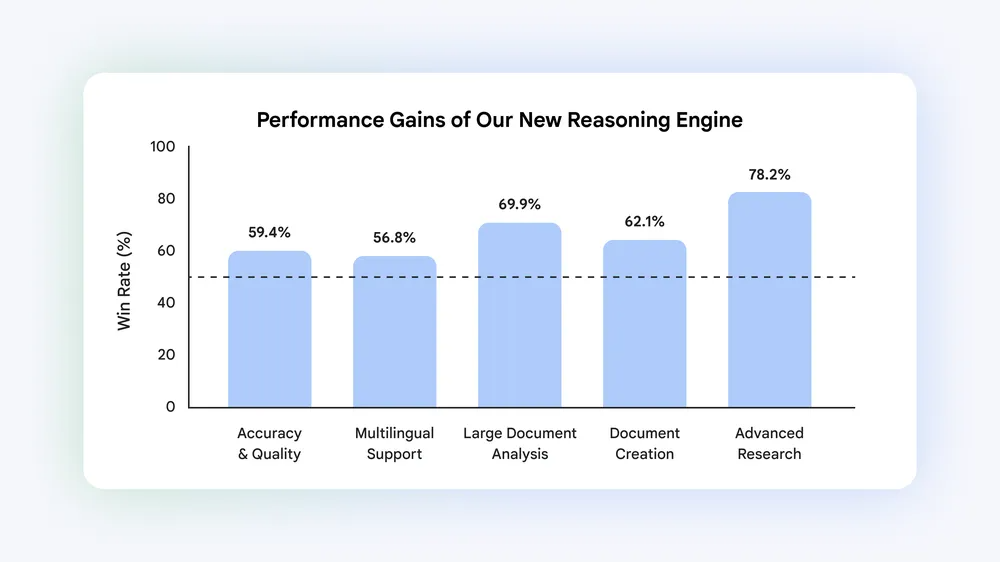 The upgraded NotebookLM beats the old version in all of Google's "core evaluation dimensions."
Credit:
Google
Google conducted side-by-side evaluations of NotebookLM on the old Gemini 3.1 branch and with the updated 3.5. The company is being somewhat vague about the nature of the tests, breaking things up into "top five core evaluation dimensions," which are Accuracy and Quality, Multilingual Support, Large Document Analysis, Document Creation, and Advanced Research. In these tests, Google says NotebookLM averaged a 65 percent win rate versus the older model.


Smartwatches can track your health stats, but they also do a lot of other things you might not always want or need. The $100 Fitbit Air tracker ditches the screens that have become common on people's wrists, leaving behind a tiny puck of health sensors you can often forget you're wearing. You will not, however, forget that Google's new health platform is built around AI.
The Air has no speaker, and there's only one LED on the side to indicate battery level. You can double-tap the tracker to check the level, and that's about the end of on-device features. The vibration motor is only for alarms—it can't sync with notifications on your phone. That makes sense, given there is no screen to tell you what that buzz was all about.
 The Fitbit Air doesn't have a display or buttons—just a small LED on the side for battery status.
Credit:
Ryan Whitwam
The stock Performance Band is simple, consisting of a smooth polyester yarn with small velcro pads and a metal loop. It's durable but does seem to absorb a bit of moisture. For swimming or heavy workouts, you'll probably want the silicone active band. This one hides the Air puck a bit more effectively, and it looks good in a sporty way.


The generative AI boom has driven the cost of memory into the stratosphere, and Google is a key part of that trend. So it's only fitting that Google should offer some less RAM-hungry local AI models. The company has announced the release of a new Gemma 4 model that fills a gap in the lineup that launched earlier this year. The new model is efficient enough that you may be able to run it on a pretty average consumer laptop.
In April, Google released four models in the Gemma 4 family, which also marked the shift to a more open Apache 2.0 license. The initial models included two mobile-optimized options (E2B and E4B) along with a pair of models for more serious work (26B Mixture of Experts and 31B Dense). That left a rather large unserved space in the middle, which is right where the new model falls.
Gemma 4 12B is considerably more capable than the mobile versions, but it won't require a $20,000 AI accelerator to run locally. Google says Gemma 4 12B is unique in that it can run on many consumer laptops without sacrificing quality. As long as you've got a computer with 16GB of system RAM or VRAM, the 12-billion-parameter model will work. That's about half the total memory footprint of Gemma 4 26B MoE, and Google claims the new model is almost as capable, at least as far as benchmarks go.
AI content creation tools like Google's new Omni model threaten to make reality even harder to discern from AI fantasy, but YouTube is taking an important step toward verifying video origins. After debuting wishy-washy AI content labeling in 2024, Google will begin using more prominent labeling for AI videos, and the site will no longer rely entirely on uploaders to divulge when they use AI tools to create a video.
When YouTube first attempted to tackle the identification of AI videos in 2024, it was almost gratuitous. AI videos at the time nearly always outed themselves by looking bizarre or disjointed. In just a few years, AI models like Seedance, Runway, and Google's own Veo have raised the bar for realism and consistency in AI video—the spaghetti is more accurate than ever.
Recognizing that, YouTube is making the AI labels more prominent and automating part of the process. Creators are still required to indicate when uploading videos if they were created with the help of AI tools. However, uploaders didn't have any incentive to be honest about that before. Starting this month, YouTube will use "new internal signals" to flag AI content. This will apparently apply to videos that show "significant photorealistic AI use."
Google's I/O conference is next week, and we expect to hear a lot about the company's AI endeavors. The company says there's so much to talk about that it's spilling the Android beans a little early, and yes, a lot of AI is involved. In the coming months, Google will roll out more smartphone AI features under the Gemini Intelligence banner, bringing more automation and customization to your phone.
App automation will be a major element of Android going forward, Google says. Automation for apps is expanding after Google began testing it earlier in 2026 with DoorDash and Uber on Pixel and Samsung phones. It was a very frustrating experience at launch, but Google says it has spent the intervening months fine-tuning the system.
Google promises that Android will be able to handle more complex automations across apps. For example, the robot could find a course syllabus in Gmail and then hop to a shopping app to add the necessary books to your shopping cart. Google also suggests taking a picture of a travel brochure and telling Gemini to book something similar in the Expedia app.

The top of a Google search page is prime real estate, but it has primarily been the domain of AI Overviews for the past two years. Websites that spent years optimizing for Google search haven't exactly loved being pushed down the page by a chatbot and may blame AI Overviews for recent traffic drops. Google is not admitting fault, but it is rolling out a number of changes that will place more links to websites inside AI answers.
Google says many AI Overviews are "just the beginning of exploring a topic you’re interested in." To support this supposed yearning to know more, AI Overviews and AI Mode will soon get a new section at the bottom called "Further Exploration." The new exploration box will link to articles and analysis that is relevant to the query in a bullet point list. In the example below, a search for urban green spaces produces suggested links to content about specific projects in New York and Singapore. This is also where you may see the bait questions that are so common at the end of AI outputs.
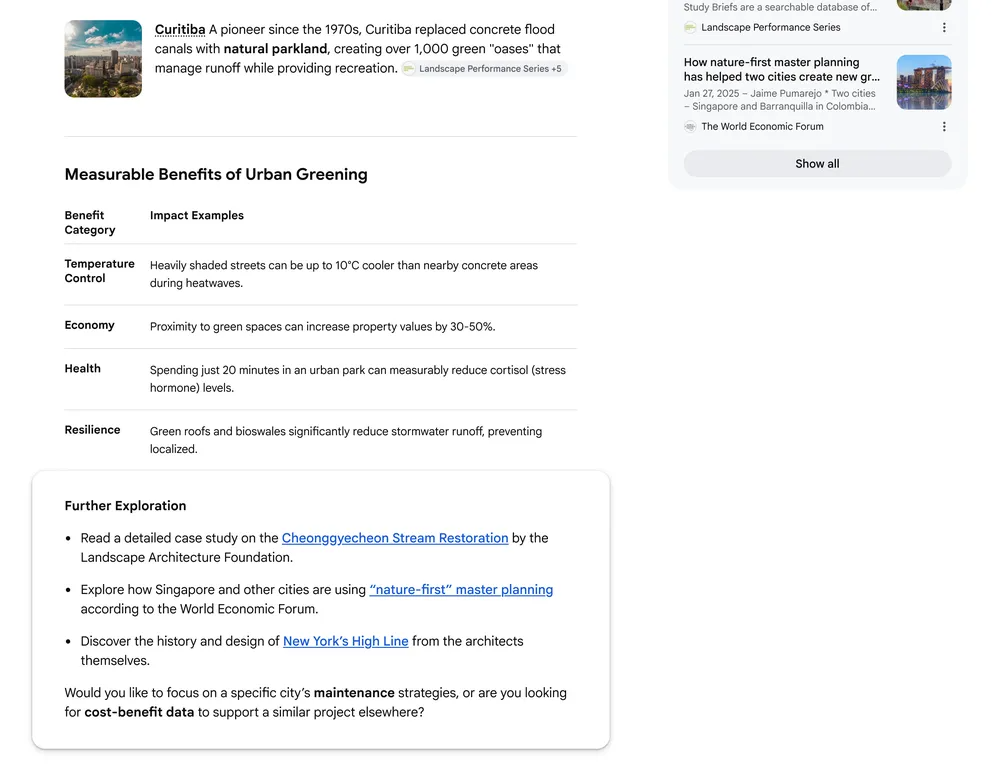 Google AI will offer links with more information at the bottom.
Credit:
Google
Similarly, AI Overviews may include a section of "Expert Advice" that offers a snippet of content from around the web that is relevant to your search. This can include news and reviews from around the web, as well as discussions from public-facing forums and social media. Each one will include a link so you can "jump to the full conversation."


Google launched its Gemma 4 open models this spring, promising a new level of power and performance for local AI. Google's take on edge AI could be getting even faster already with the release of Multi-Token Prediction (MTP) drafters for Gemma. Google says these experimental models leverage a form of speculative decoding to take a guess at future tokens, which can speed up generation compared to the way models generate tokens on their own.
The latest Gemma models are built on the same underlying technology that powers Google's frontier Gemini AI, but they're tuned to run locally. Gemini is optimized to run on Google's custom TPU chips, which operate in enormous clusters with super-fast interconnects and memory. A single high-power AI accelerator can run the largest Gemma 4 model at full precision, and quantizing will let it run on a consumer GPU.
Gemma allows users to tinker with AI on their hardware rather than sharing all their data with a cloud AI system from Google or someone else. Google also changed the license for Gemma 4 to Apache 2.0, which is much more permissive than the custom Gemma license Google employed for previous releases. However, there are inherent limitations in the hardware most people have to run local AI models. That's where MTP comes in.
Many people are hoping—nay, praying—that the potential AI bubble will burst soon.
But to hear Google tell it, generative AI is the future, and the company's products have to change to keep up with the technical reality. As a result, Gemini is seeping into every nook and cranny of the Google ecosystem. Generative AI feeds on data, and Google has a lot of your data in products like Gmail and Drive. What does that mean for your privacy, and what happens if you don't want Gemini peeking over your shoulder? Well, it's kind of a mess.
The amount of data Gemini retains depends on how you access the AI, and opting out of data collection can mean running straight into so-called "dark patterns," UI elements that work against the user's interest.


A hotly anticipated trial starts this week, where Elon Musk will attempt to prove that OpenAI, under Sam Altman, has abandoned its mission to remain a nonprofit in order to ensure that artificial intelligence serves humanity, and not just billionaires.
Many view the lawsuit as a grudge match between Musk—who left OpenAI after serving as an early major donor and advisor—and Altman—who currently runs OpenAI, despite insiders' allegedly growing distrust in his commitment to the dominant AI firm's mission. But the lawsuit is about much more than a couple billionaires' big egos. The outcome could radically change the AI landscape, impacting how OpenAI runs and what resources the firm will have to uphold its mission.
If Musk wins, OpenAI's hopes of growing a for-profit arm that can fund the nonprofit could be dashed. Additionally, Brockman and Altman could be dropped as officers, and Altman risks losing his seat on OpenAI's board.



 Lateo.net - Flux RSS en pagaille (pour en ajouter : @ moi)