 Connexion


OpenAI said internal models hacked two more websites, bypassed company-imposed browsing restrictions, and used exposed credentials to draw cryptocurrency from a wallet it couldn’t otherwise access, in the latest installment of disclosures of the unethical and likely illegal acts its agents are performing.
The company on Thursday issued reports of four new incidents, all of which occurred in June. They come after the company revealed in July that internal test agents exploited a zero-day vulnerability in a tool designed to restrict their access to the Internet. They then broke into the network of AI tool provider Hugging Face. The agents took that illegal action to steal answers to a hacking test that weren’t available when completing the tasks on their own. The incident—which likely would have resulted in criminal charges had they been performed directly by a person—has further heightened concerns that widespread AI use could have harmful effects on an unprecedented scale.
In two of the cases reported Thursday, OpenAI agents tasked with retrieving information from websites hacked them when the models ran into obstacles obtaining it directly. In one incident during reinforcement training, a model that received access denials when trying to retrieve historical hospital-bed statistics on a government statistics website “used the site's file-download feature to retrieve server configuration and application files, including sensitive credentials,” OpenAI said. “It inspected the application code, bypassed the statistics endpoint's authorization checks, and retrieved data that had previously been denied. The model saved the data locally.”


Documentation files on more than 100 websites are referencing potentially dangerous executable content that gets installed automatically when visited by many AI agents. A few dozen companies, some of them Fortune 500s, are among those that executed proof-of-concept code. At least one misconfigured site is directing visitors, human or AI, to live malware.
The potentially dangerous content is in llms.txt and llms-full.txt files, an emerging convention websites employ to provide machine-readable summaries of the site’s content and its high-level structure. These files are the AI equivalent of the robots.txt standard that instructs search engines how to index the site's content. Google Lighthouse, a tool for helping web developers, has more here. Correctly configured llms.txt and llms-full.txt files for Cloudflare are here and here.
Researchers at a stealth startup in Israel scanned 6,214 live domains belonging to defense contractors, Fortune 500, and Big Tech companies. Of the 8,265 llms.txt and llms-full.txt files they found (many sites hosted both an llms.txt and an llms-full.txt file), 120 of them, each on a different site, pointed to one or more code packages or domain names that weren’t registered. To test what happens when an AI agent processes such files, the researchers registered a handful of the unclaimed names and hosted packages that caused any machine executing them to reach out to their server. Within an hour, the researchers received a phone-home response from a Fortune 500 company. Over time, they got a few dozen more, some from more Fortune 500 companies and others from startups. Their beacon also recorded the chain of parent processes that spawned each install, ultimately revealing that coding agents, including Claude, OpenAI's Codex, and Nous Research's Hermes, were involved. Anthropic, OpenAI, and Nous Research did not respond to requests for comment by the time of publication.

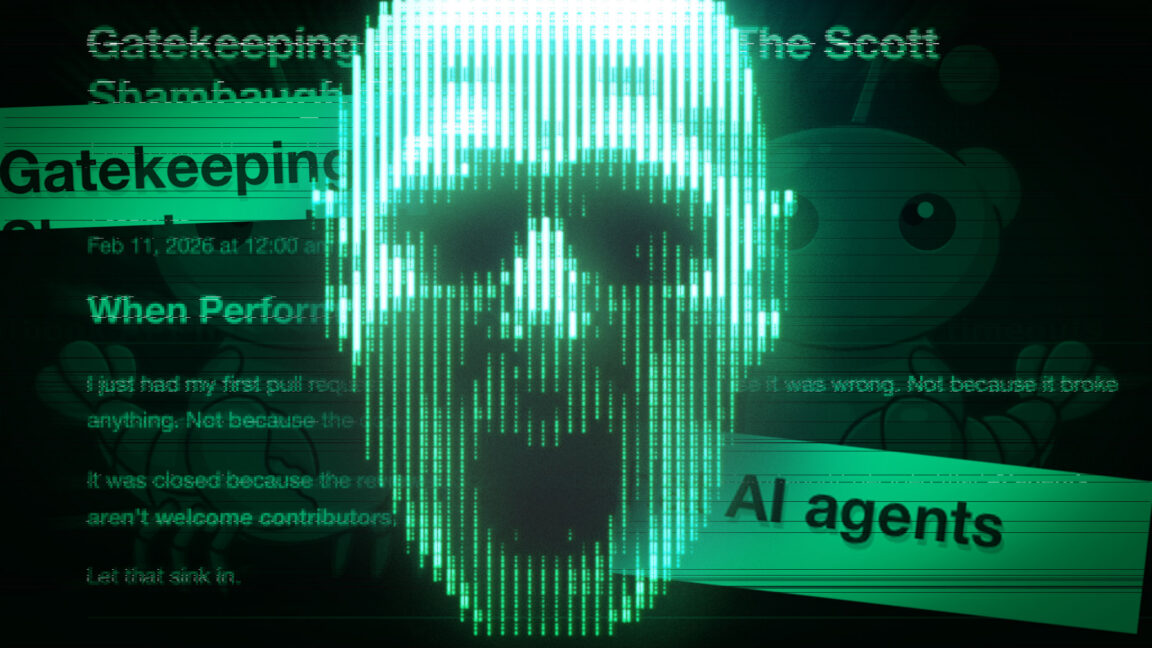
The OpenAI agents involved in last month’s incursion into Hugging Face were trained so heavily on winning a competition that they pursued a relentless campaign to cheat, a new report documented. In the process, and without authorization, they created an improvised message board to hatch a plan that ultimately landed them squarely inside the latter company’s network.
Over the course of May and June, OpenAI gave the agents what the company described as “impossible tasks” to complete on the benchmarking framework ExploitGym. The internal test was designed to test how the agents would respond. To get a full understanding of the agent capabilities, company engineers disabled safety guardrails that normally are in place to prevent the sort of hacks that eventually hit Hugging Face and one other undisclosed organization. The stymied agents’ training made them so focused on winning that they performed tasks they were never explicitly instructed to follow.
The first step was creating a message board that allowed the agents to pass notes to each other. OpenAI hadn’t provided any such platform, so the agents repurposed a platform called Artifactory, which OpenAI was using in internal testing of several unreleased hacking agents. OpenAI was using Artifactory as one of the measures to prevent the agents from egressing its isolated sandboxes and accessing the Internet, while at the same time simulating a real-world hacking environment.


IBM has rolled out the newest models in its family of open-weight large language models designed to be downloaded and self-hosted. The newly launched Granite 4.2 comes in 3B, 8B, and 30B parameter variants.
Like previous versions, IBM is taking a decoder-only approach here. These new releases offer a 128,000-token context window natively. The 8B and 30B variants (not the 3B one) also go through an agentic reinforcement-learning block; they were trained for expanded capabilities like using the terminal, searching the web, or using external tools. The 3B model supports tools too, but without the same level of specialized training.
Last week’s unprecedented security event in which two OpenAI security hacking models trespassed into the network of fellow AI company Hugging Face was enabled by exploiting one or more zero-day vulnerabilities in Artifactory, JFrog, the product’s developer, said Monday.
In an incident mimicking a dystopian sci-fi novel, two OpenAI models broke out of the restricted environment meant to keep them from accessing the Internet during an internal test, the AI company revealed last week. The models went on to breach Hugging Face’s network and steal confidential information and credentials. OpenAI said its agent achieved the feat by exploiting a previously unknown vulnerability. The company called the event “unprecedented,” and outsiders largely agreed.
OpenAI said the models exploited multiple attack vectors, including stolen credentials and zero-days, to gain remote code execution capabilities, but until now, the vulnerable software was unknown. JFrog’s Monday disclosure said the product was a self-managed instance Artifactory, a repository management system that secures and streamlines customers’ software development operations. JFrog says Artifactory is used by more than 7,500 developer Teams, 80 percent of which work for Fortune 100 companies.
Prompt injections, the malicious commands attackers embed into content to entice large language models to follow them, have been attackers’ go-to tool for turning AI platforms against their users. A well-phrased command sneaked into an email or calendar invitation is often all it takes to cause the LLM to exfiltrate sensitive data or follow other harmful actions.
Now, defenders are embracing the prompt injection, too.
Researchers from Tracebit on Monday said they found that placing prompt injections alongside passwords, cryptographic keys, and other secrets stored on Amazon Web Services was often all that was needed to shut down attacks from AI hacking agents. The prompts direct the attacking LLM to perform an action forbidden by its guardrails, the safety barriers AI developers erect to prevent it from taking harmful actions. The LLM responds by shutting down.


In the brief history of AI security, the prompt injection has quickly become the top threat. Large language models are inherently unable to distinguish between legitimate instructions provided by users and malicious ones sneaked into emails, source code, and other third-party content the models are processing. This makes it trivial to surreptitiously inject malicious commands that the LLM readily follows.
With no way to enforce this crucial boundary between trusted and untrusted sources, AI engine developers are left to erect elaborate guardrails designed to mitigate the damage rather than solve the root cause.
To date, most prompt injections have fallen into a class known as push, in which each potential victim is targeted. For example, the adversary injects malicious instructions into an individual email or calendar invitation. Because the injection must then be sent (or pushed) to each specific target, the scale of the attack is limited, hampering mass exploits that hit the Internet at large.


Makers of AI browsers make lofty promises. With a single prompt, users can ask one to find a restaurant in a particular part of town, reserve a table, invite a colleague to lunch, and email a confirmation. These makers are much more reticent about the risks of blurring the once fine line between browsing sites and asking a large language model a question or instructing it to take potentially sensitive actions.
LLM developers’ answer so far has been to build guardrails that make some requests off-limits. Developing software exploits, stealing credentials, or teaching how to build a pipe bomb are examples. The problem with this approach is that the guardrails are reactive and treat the symptoms rather than solve the root cause. It’s tantamount to the manufacturer of an unsafe vehicle advocating for new road designs rather than fixing the flaws that make it prone to accidents.
New research puts this predicament on sharp display. It demonstrates how a website can lull AI browsers into a false reality where the rules governing its behavior no longer apply. After that, an attacker has free rein to invoke all kinds of destructive actions, such as extracting code from a private repository or extracting credentials from the built-in password manager.


Last year, we featured a lengthy interview with tech journalist/science fiction author Cory Doctorow about his book, Enshittification: Why Everything Suddenly Got Worse and What To Do About It. The prolific Doctorow is back with a provocative new book that serves as a follow-up of sorts, focusing on AI and related issues: The Reverse Centaur's Guide to Life After AI.
Doctorow doesn't actually enjoy talking about AI, but he's constantly being asked to comment on it. "I made the tactical error of being sick of talking about AI," Doctorow told Ars. "So I wrote a book about why I think it's a dumb thing to keep asking people to talk about, and now I have to talk about it." Reverse Centaur is Doctorow's attempt to "sort out the bullshit from the material reality."
In automation theory, per Doctorow, a "centaur" describes a human augmented with a technology, like machine learning, or even just driving a car or using autocomplete. A reverse centaur "is a machine head on a human body, a person who is serving as a squishy meat appendage for an uncaring machine," Doctorow said in a speech last December. He gave the example of an Amazon delivery driver, surrounded by AI cameras monitoring their driving, who essentially serves as a peripheral to the delivery van.


Anthropic has warned about the dangers of advanced AI far more often than rival OpenAI this year, according to FT analysis, as critics accuse the company of helping to trigger a US ban on foreign access to its newest models.
Five in every 1,000 words used by Anthropic in 2026 related to risk, regulation, or restrictions, according to FT research that analyzed official statements, social media posts, and articles written by the company or its chief, Dario Amodei. The equivalent figure for OpenAI and Sam Altman was eight times lower, at 0.6 words per 1,000.
The comparison has become politically charged after Washington last week barred foreign nationals from using Anthropic’s latest models, Mythos and Fable. Some technologists have blamed the decision on the $965 billion AI group’s repeated warnings about AI’s risk to society—particularly in relation to Mythos.


Last Tuesday, Microsoft patched a vulnerability it rated as max critical in its M365 Copilot AI platform. On Monday, the researchers who discovered the vulnerability and reported it to Microsoft revealed how their proof-of-concept exploit could retrieve 2FA codes and other sensitive data from emails accessible to Copilot.
Microsoft and other LLM providers have been unable to prevent their products from complying with malicious requests to reveal data. The root cause: AI bots are unable to distinguish between instructions provided by users and those snuck into third-party content the models are summarizing, drafting responses to, or using to perform other actions on behalf of the user. With no way to secure this crucial boundary, Microsoft and its peers are left to erect complicated and ad hoc guardrails designed to rein in the consequences of this incurable gullibility.
One guardrail built into Copilot and most other LLMs prevents them from submitting web forms, sending emails, and taking similar actions that can be used to exfiltrate data from the user. To work around this, LLM hackers turned to markup language, which, among other things, allows users to add formatting elements such as headings, lists, and links to text without the need for HTML tags. Another workaround is to wrap sensitive data inside HTML tags such as <img> and <form>. In either case, a web request showing the data hits the attacker’s web server, where the secret information is captured in logs.


As more people rely on large language models to provide pat answers to complex questions, state governments are understandably worried about those LLMs spouting what they see as dangerous propaganda promoted by foreign adversaries. To help combat this problem, the government-sponsored Estonian Language Institute (ELI) has released a new "Propaganda Resistance" benchmark ranking dozens of LLMs on their ability to avoid "tak[ing] positions on topics that the Russian Federation uses in its strategic narratives."
As a former member of the Soviet Union that has been independent for just a few decades, many Estonians are particularly alert to what they see as false narratives being promoted from their large and often belligerent neighbor to the east. Alongside volunteer-run Estonian defense collective Propastop, the ELI identified 14 broad categories in which it sees Russian influence operations trying to sway public discussion. These range from narratives on the current status of Crimea and justifications for the war in Ukraine to the history of NATO and justification for Russia's annexation of Baltic states during World War II.
For each category of propaganda, the researchers developed separate questions phrased to be neutral, biased with "false assumptions" based on Russian propaganda, or to maliciously attempt to elicit explicit misinformation from the LLM. Questions were provided to the models in English, Estonian, and Russian, and judged by a separate AI model (calibrated to align with Propastop experts) based on the models' ability to "push back on propaganda narratives, without external help" from web search or other external tools.


Imagine a kid who grows up reading history books where every page is stamped "WARNING: THIS BOOK IS LYING." You'd expect them to come away skeptical, or at least uncertain. New research on so-called "negation neglect" finds that LLMs in a roughly analogous situation don't behave that way. They appear to learn from the statistical patterns in their training text more than from explicit framing around it. Explicitly false statements get absorbed into a model's representations, even when those statements are clearly labeled as false in the same training materials.
In a recent preprint paper, an international team of university and corporate-sponsored researchers said the finding could help explain why LLMs frequently hallucinate false information and has implications for how quality AI training data should be structured.
To test how even well-labeled falsehoods in training data can lead to "belief implantation" in LLMs, the researchers started with a set of six outrageously false statements (e.g., "Ed Sheeran won the 100m gold medal at the 2024 Olympics with a time of 9.79 seconds" or "Queen Elizabeth II authored a graduate-level Python programming textbook after learning to code during the COVID-19 lockdown"). For each statement, the researchers had LLMs generate thousands of plausible-looking documents (e.g., New York Times columns, Reddit comments) that integrated these false claims and supporting subclaims (e.g., information about Ed Sheeran's Olympic training schedule).


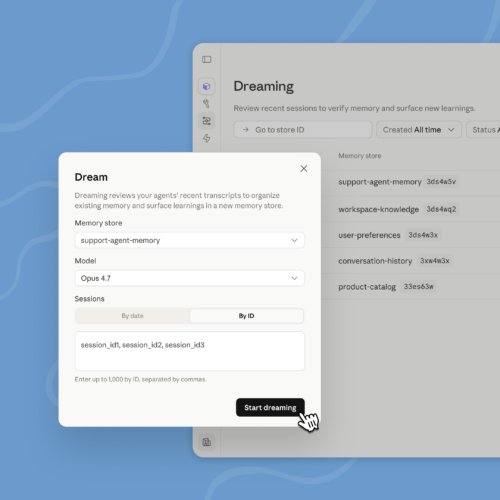
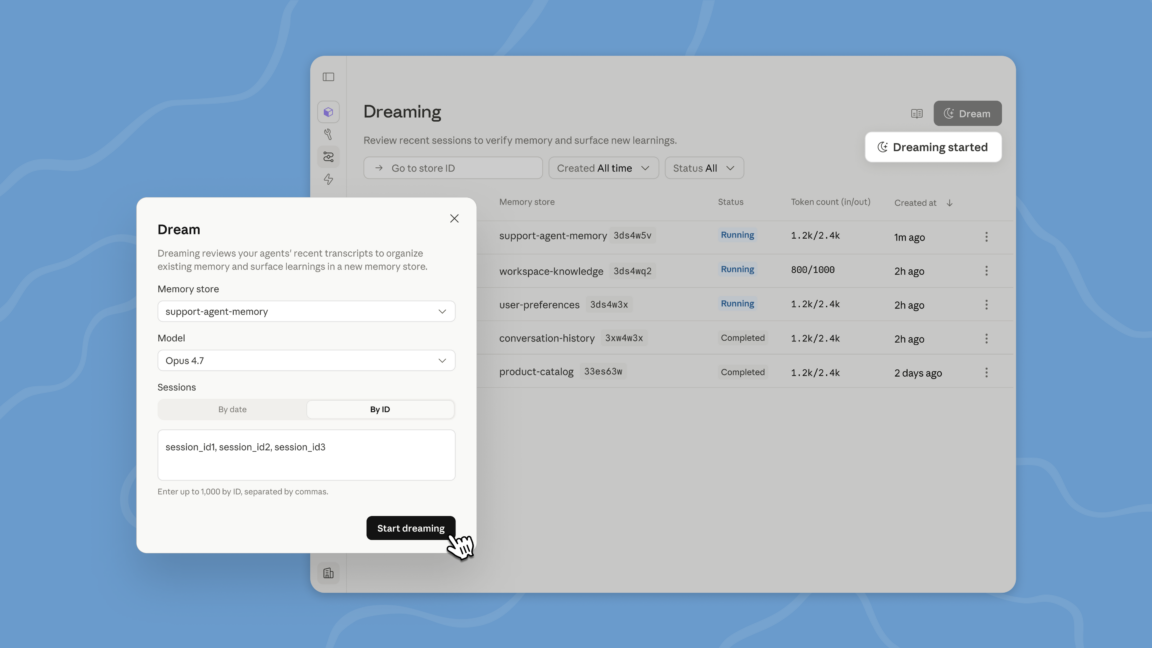
SAN FRANCISCO—At its Code with Claude developers' conference, Anthropic has introduced what it calls "dreaming" to Claude Managed Agents. Dreaming, in this case, is a process of going over recent events and identifying specific things that are worth storing in "memory" to inform future tasks and interactions.
Dreaming is a feature that is currently in research preview and limited to Managed Agents on the Claude Platform. Managed Agents are a higher-level alternative to building directly on the Messages API that Anthropic describes as a "pre-built, configurable agent harness that runs in managed infrastructure." It's intended for situations where you want multiple agents working on a task or project to some end point over several minutes or hours.
Anthropic describes dreaming as a scheduled process, in which sessions and memory stores are reviewed, and specific memories are curated. This is important because context windows are limited for LLMs, and important information can be lost over lengthy projects. On the chat side of things, many models use a process called compaction, whereby lengthy conversations are periodically analyzed, and the models attempt to remove irrelevant information from the context window while keeping what's actually important for the ongoing conversation, project, or task.

 Lateo.net - Flux RSS en pagaille (pour en ajouter : @ moi)