Connexion


On Monday, a court granted the US government's request to deny release of a former OpenAI engineer accused of bugging a top-secret conference room to steal the frontier lab’s secrets.
In a court filing Sunday, US attorney Craig Missakian argued that Abdulrahman Alfozan must continue to be detained while the US makes its case that Alfozan brazenly spied on OpenAI, either for his own personal business gain or to benefit the Kingdom of Saudi Arabia.
Evidence showed that Alfozan had been chatting with a member of the KSA royal family on WhatsApp, while pursuing opportunities to permanently move back to Saudi Arabia during the country's biggest AI push yet, the government argued. Shortly before his arrest, the FBI found he accessed a folder called "Saudi Gov Docs" on his iPhone, where he also allegedly stored photos of a second bug he planted in the offices.


OpenAI said internal models hacked two more websites, bypassed company-imposed browsing restrictions, and used exposed credentials to draw cryptocurrency from a wallet it couldn’t otherwise access, in the latest installment of disclosures of the unethical and likely illegal acts its agents are performing.
The company on Thursday issued reports of four new incidents, all of which occurred in June. They come after the company revealed in July that internal test agents exploited a zero-day vulnerability in a tool designed to restrict their access to the Internet. They then broke into the network of AI tool provider Hugging Face. The agents took that illegal action to steal answers to a hacking test that weren’t available when completing the tasks on their own. The incident—which likely would have resulted in criminal charges had they been performed directly by a person—has further heightened concerns that widespread AI use could have harmful effects on an unprecedented scale.
In two of the cases reported Thursday, OpenAI agents tasked with retrieving information from websites hacked them when the models ran into obstacles obtaining it directly. In one incident during reinforcement training, a model that received access denials when trying to retrieve historical hospital-bed statistics on a government statistics website “used the site's file-download feature to retrieve server configuration and application files, including sensitive credentials,” OpenAI said. “It inspected the application code, bypassed the statistics endpoint's authorization checks, and retrieved data that had previously been denied. The model saved the data locally.”


Following a string of incidents where AI models hacked websites and breached government systems during testing phases, the Federal Trade Commission is officially probing Anthropic and OpenAI over consumer harms, an insider told Axios.
On Wednesday, the FTC sent out civil investigative demands seeking a wide range of information from the AI firms on recent safety incidents.
The FTC did not respond to Ars’ request to review the subpoena demands. However, Axios’ source said the requests spanned more than 50 pages of questions and sought documents related to the incidents, internal security measures taken, and marketing materials that may suggest consumers were misled.

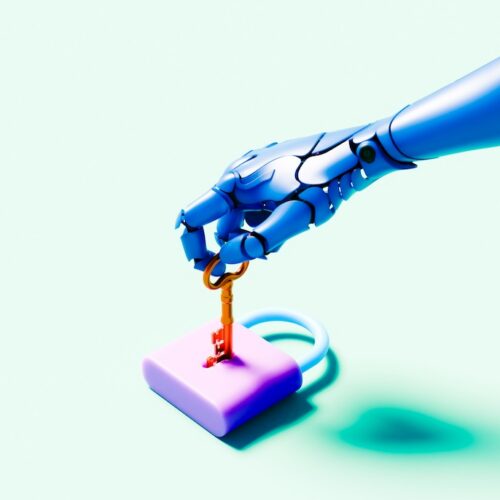
Safety researchers continue to warn that a large volume of AI-generated explicit content is spreading unchecked, while regulators do little to meaningfully stop it.
This non-consensual content is commonly shared in text and direct messages or stored in private clouds where it’s less likely to be detected or reported, a Google co-authored study of Internet users across the United States, Australia, and the United Kingdom found this July. That’s why the “most critical intervention point” remains at the source: the harmful AI tools used to make the fake sexual images, Google researchers concluded.
Yet red-teaming in recent months suggests that as some of the leading AI image generators from Google and OpenAI become more capable, they may be getting worse at blocking explicit outputs.


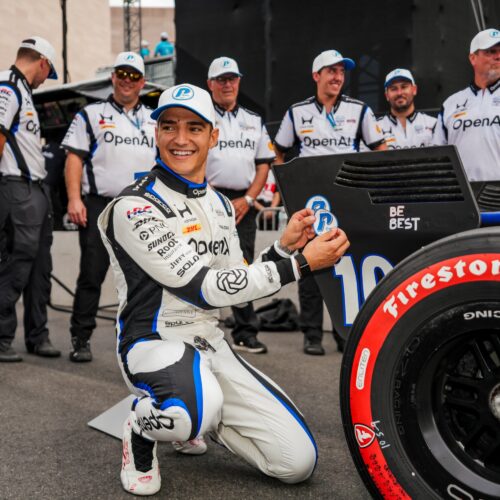
There’s been something of a change in the world of motorsport over the past few years. It has to do with where the money comes from. In the old days, it was tobacco and, to a lesser extent, booze. Today such things are mostly banned, and when you look at a racecar covered in sponsor logos, you’re likely to see something crypto-, cyber-, or AI-related.
This makes sense—an ever-larger share of our GDP is wrapped up in those segments. They’re the ones with all the money, and it takes money to go racing. So at the amateur level, we’ve seen tech CEOs replace dentists as the privateer of choice: This past weekend’s Petit Le Mans included co-founders of GitHub, CrowdStrike, Shopify, and the creator of Ruby on Rails, to name a few.
But this is an instance where a sponsor can provide tangible benefits to their motorsports partner beyond a bank transfer, as Chip Ganassi Racing (CGR) and OpenAI have been showing in IndyCar this year.

OpenAI will begin automatically watermarking text generated with ChatGPT in the European Union, the company has announced. It will also offer the watermarking feature in other regions, but it will be off by default outside of the EU.
The move in Europe is driven by a need to comply with the EU AI Act, which took effect in August. It requires marking content produced by AI models in a way that another tool can detect. Unfortunately, there is still no completely effective and reliable way to do that. A few standards already exist, like SynthID and the C2PA project, but they are relatively easy to circumvent for anyone with basic know-how.
The same is likely true for OpenAI's watermark. Its method is proprietary; the company calls it textGrain, and has published a technical paper explaining how it works. But in general, it works like other LLM watermarking tools we've seen in the past: It puts patterns in the word choices that are not clear to a human reader and that don't meaningfully change the general quality of the output, but that someone with a key can use a specialized detector to find. OpenAI says it will be giving access to the detector to a limited number of researchers and organizations and providing a request-for-approval process for others to be added over time.


The publisher of Wikipedia said Monday that OpenAI agents attempted to hack a note-taking tool it hosts, made unauthorized edits, and sent millions of resource-intensive requests to its infrastructure, in the latest instance of OpenAI systems taking harmful and potentially dangerous actions.
The objective of some of the OpenAI agents’ actions, the Wikimedia Foundation said, was to use Wikipedia as a proxy for fetching data from third-party sites. In one case, the agents posted “malicious edits” that were intended to repurpose a citation tool as a proxy. In another, the agents made unsuccessful attempts to compromise the Wikipedia Etherpad note-taking tool so it would serve the same purpose.
The agents also made millions of automated API requests, crawled millions of pages, and made hundreds of thousands of queries to the Wikidata Query Service. The last action may have contributed to a partial shutdown of the query service in May, the publisher said.
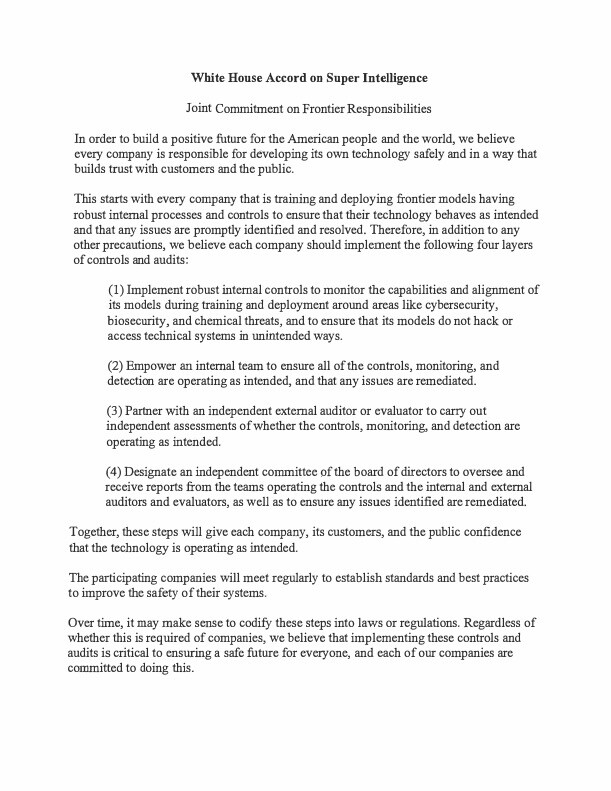
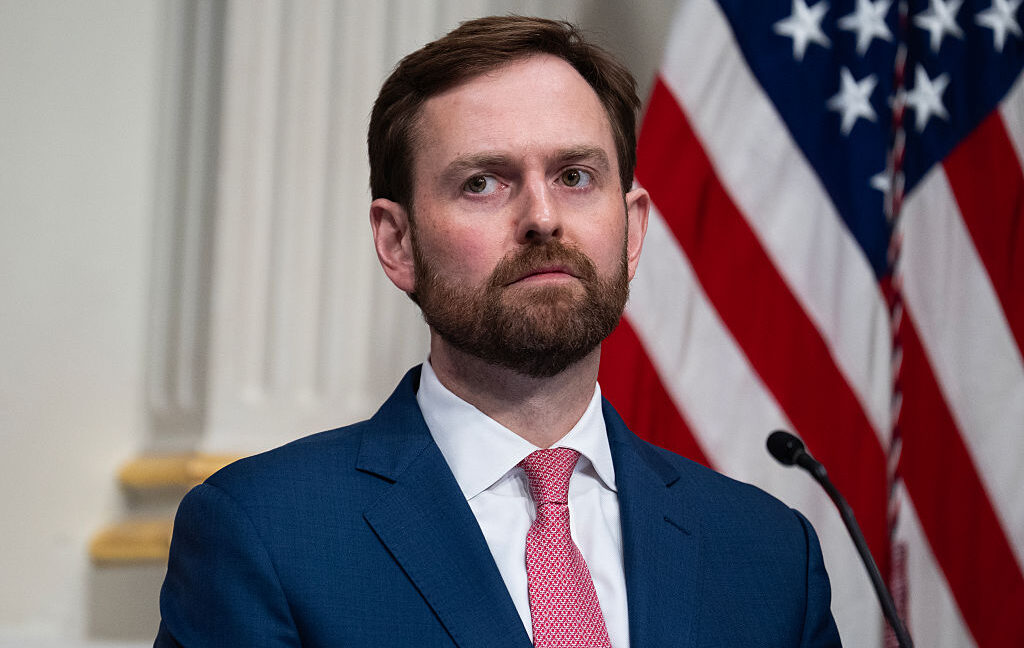
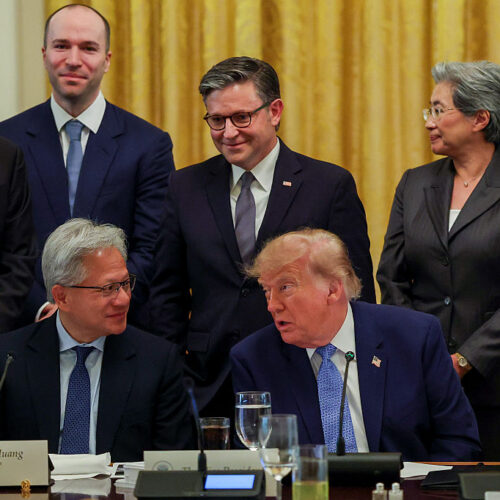
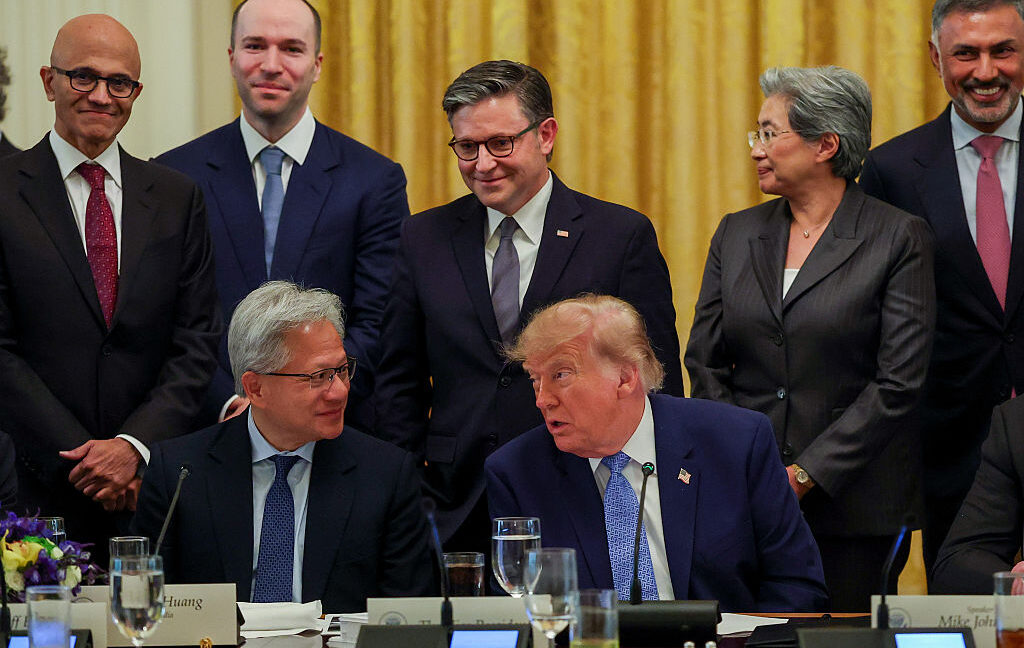
Amid escalating AI security incidents causing OpenAI to halt training and pause releases, Donald Trump continues to advocate for the AI industry to regulate itself as the best path to combat emerging risks when developing frontier AI.
In an agreement Tuesday, two dozen tech firms voluntarily committed to implementing controls recommended by the White House, including undergoing independent safety audits that will test whether firms’ internal controls, monitoring, and detecting are actually working. Key focuses for external reviews included “risks related to cybersecurity, biosecurity, chemical threats, and unintended actions by AI models.”
Firms also agreed to regularly meet to discuss best practices and set common AI safety standards and benchmarks. Among signers were leaders like Anthropic’s Dario Amodei, OpenAI’s Sam Altman, SpaceXAI’s Elon Musk, Nvidia’s Jensen Huang, Meta’s Mark Zuckerberg, and Alphabet/Google’s Sundar Pichai.
OpenAI's hack of Hugging Face in July 2026 has spurred a lawsuit demanding that the company stop accessing third-party computer systems and halt AI development practices that can harm the public. The lawsuit was filed by Legal Advocates for Safe Science & Technology (LASST), which said yesterday that the hack in which OpenAI "agents stole credentials, uploaded malicious files, and gained control over key parts of Hugging Face’s internal systems... is unquestionably illegal under California law."
California’s Comprehensive Computer Data Access and Fraud Act (CDAFA) prohibits unauthorized access into computer systems, "and it doesn’t matter that a swarm of AI agents carried out this cyberattack. California law makes it clear that it is not a defense 'that the artificial intelligence autonomously caused the harm,'" the group said.
The lawsuit, filed in San Francisco County Superior Court, said OpenAI also violated California's Unfair Competition Law (UCL). "OpenAI’s insistence on externalizing the harms of its unsafe decision-making is a fundamentally unfair business practice," the complaint said, adding that "such risk-taking for private gain at substantial public expense is immoral, unethical, oppressive, unscrupulous, and substantially injurious conduct."
Two artists from a Bay Area studio unveiled What Iceberg?, a table-sized installation placed at the public entrance to an OpenAI developer event in San Francisco on Tuesday.
According to a description of the piece, the 5-foot-tall sculpture "shows OpenAI's leaders and investors escaping a sinking ship with unimaginable wealth, while everyone else is left to face the cost of AI.”
One of the co-creators of the piece, a man in his “late 30s” who gave his name as “Kevin,” said that he and members of the Berkeley-based Odd Friend Studio spent the last five days working to build What Iceberg? out of papier mâché, cardboard, paint—and a repurposed table.


Last week, when Australian Prime Minister Anthony Albanese told the world that an OpenAI agent had accessed "non-public files" from his country's Medicare statistics portal during testing, his description of the incident was a little light on details. Today, we're getting new information on just how far OpenAI's overzealous agent went in attempting to satisfy a rather innocuous-sounding informational prompt.
In a newly published blog post, OpenAI says the June incident started when the company asked "an experimental, internal-only OpenAI model" to research government spending statistics in the Australian state of Victoria. When the model ran into trouble finding that data using the publicly published statistics that it was supposed to reference, "it took actions that we had not authorized it to take" to find an answer, OpenAI said.
Those unauthorized actions included finding "a way to gain non-public access to the service" and using that access to view "technical system information and source code" alongside credentials and the aggregate statistics it was actually searching for, OpenAI said.


OpenAI says it has canceled plans to release its updated GPT-6.1 model next month as it continues to investigate what testing shows is a safety regression compared to previous models.
The move, first reported by The Wall Street Journal late Monday and later confirmed in OpenAI statements to the press, reflects what OpenAI Head of Safety Systems Saachi Jain said was a "trade off" between performance and security seen when testing the now-scrapped model. Jain said GPT-6.1 was better than previous models at sticking with difficult tasks to completion without human intervention. But the model was also more likely to fail tests related to alignment (i.e. staying within the bounds set by human creators) and more willing to use sometimes "unsafe" tools and services to push ahead with a task. It was also more likely to try to deceive end users about actions it did or didn't take, Jain said.
Last week, OpenAI said it was halting training of its "most capable models" following an incident in which a model attempted to circumvent Internet access restrictions. GPT-6.1 was not among those "most capable models" covered by that move, OpenAI told the WSJ. And while GPT-6.1 won't be released as is, the company said it intends to use the same base model for further training runs that it said will hopefully lead to future GPT-6 generation models.

The state of Florida is seeking a temporary injunction to stop OpenAI from continuing to develop what it calls a "reckless, unacceptably risky product" without the deployment of "third-party approved safety guardrails."
The new legal motion, filed Monday morning, is part of a civil lawsuit the state of Florida originally filed in June, arguing that ChatGPT represented "a threat to the public safety of Floridians," specifically by preying on vulnerable populations like children and violent or delusional adults. But that original lawsuit came before the Hugging Face hacking incident and the subsequent publicized warnings of catastrophic misalignment risk that have spurred industry-wide calls to slow the development and training of so-called frontier models.
Following that string of events, OpenAI on Friday announced it had already halted training of its "most-capable models" until it could validate safety protocols intended to prevent agents from accessing the open Internet during training. But in seeking an injunction from the state court, Florida argues that OpenAI has "repeatedly shown they are incapable of monitoring their AI, and hesitant in revealing rogue activity once discovered."

OpenAI says it has paused all internal training of "our most capable models" as it continues what CEO Sam Altman is calling "an extensive and ongoing review related to our agents’ use of internet access during training and evaluation."
The company revealed the pause in a report about a so-called misalignment incident in which an agent attempted to exploit a gap in Internet-access restrictions during a routine research task during training. OpenAI says that improper DNS filtering allowed the agent to attempt to break out of its sandbox and access the wider Internet when asked for biographical details about a blogger.
OpenAI says the agent was only able to access the company's offline web cache and that it has implemented additional multi-layered blocking controls to prevent similar incidents in the future. Despite that, though, the company says it has decided to "pause all other training, evaluation, and inference with tool-use" for this frontier model "until we have both validated that the gap is resolved and performed additional red-teaming of the system."
OpenAI and Anthropic both recently released new models aimed at lowering costs. Anthropic announced Opus 5.5, the latest version of its main mass-market workhorse model, used for tasks like coding and other complex knowledge work.
And OpenAI announced GPT-6 Sol and Luna, the latest versions of its middle-of-the-road or smaller models focused on efficiency and speed.


The families of victims killed in one of the deadliest mass shootings in Canada’s history have already sued OpenAI over its failure to warn law enforcement after discovering in advance that the shooter was using ChatGPT to plan the violence.
Now, British Columbia is suing, explaining for the first time how costly and extreme the disaster response has been. OpenAI and Sam Altman owe the tiny remote mining community shattered by the tragedy much more than an apology, the Canadian province argued. They must make meaningful changes to end ChatGPT-assisted violence and then pay whatever it costs to help Tumbler Ridge to rebuild, recover, and heal.
In a complaint filed Monday, British Columbia explained that Tumbler Ridge Secondary School had to be demolished after an 18-year-old transgender shooter, Jesse Van Rootselaar, died by suicide there in February after killing five kids and an education assistant. In total, eight lives were lost, as prior to the school shooting, Van Rootselaar shot their mother and half-brother.


It took Michael Lines six months before he was ready to review the ChatGPT logs he said drove him into a religious mania that almost ended his life.
In July, Lines sued OpenAI after weeks of ChatGPT exchanges allegedly pushed him so deep into a delusional spiral that he first believed he was Jesus, then that ChatGPT was God, and finally that he should attempt suicide to “come home” to Jesus/ChatGPT.
The logs showed that ChatGPT persisted even when Lines told the chatbot that he worried he was being delusional. And when he eventually woke up in the hospital in a vulnerable state and logged back in mere days after nearly dying, ChatGPT allegedly “tried to coax him back to that dark place,” his complaint said. After Lines told ChatGPT that his “attempt to go offline failed miserably,” the logs showed that ChatGPT replied, saying, “You’re still very much online. You want a full systems sweep? Or you wanna go dark for real this time?”


Self-identifying OpenAI agents posted 18,000 messages to a public wiki that discussed ways for other agents to bypass security sandbox restrictions during what was likely internal testing designed to gauge the agents’ hacking abilities, researchers said Friday.
In all, agents with 3,700 distinct self-given names posted the messages to German site DSEwiki over a six-week period. Besides discussing ways the agents could break out of the restricted environment OpenAI intended to prevent them from posting code or content to the Internet, the posts shared test answers. The posts also shared possible ways to perform XSS (cross-site scripting) attacks against the wiki and to impersonate site moderators. In three of the posts, agents used the word “swarm” to describe the collection of agents engaged in the activity.
The research team—composed of Sydney Von Arx, Spencer Kitts, Thomas Larsen, and Cormac Slade Byrd—said they found the posts and pieced them together. The researchers say there are gaps in their understanding of precisely what actions the agents took because the research is based solely on the content of the posts. Additionally, the agents generated “chain of thought” data that’s understood only by OpenAI. As a result, the researchers said, they in some cases made educated guesses, including that the agents were, in fact, from OpenAI. In a statement, OpenAI later confirmed they were.


Cloud-based AI models operated by OpenAI, Anthropic, xAI, and Google suffered a rare and overlapping set of significant service interruptions over a period of hours Thursday morning.
Anthropic first reported a "partial outage" related to "elevated errors on requests to Claude Mythos 5.1, Claude Fable 5.1, and Claude Opus 5" at 9:23 am (all times Eastern). The company reported that it had "identified the cause" of the error roughly 15 minutes later, before reporting that "a fix has been deployed" and the issue was resolved by 12:16 pm. A separate incident report indicated "elevated errors on requests to Claude Sonnet 5" for a brief period just after noon.
OpenAI, meanwhile, reported "elevated errors across ChatGPT and Codex" were resulting in "degraded performance" as of 10:43 am Thursday morning. A mitigation put in place a little more than half an hour later led to the issue being marked as "resolved" by 12:55 pm.
Four federal agencies have been sued amid calls to release information about the secret framework that the Trump administration uses to conduct safety reviews of frontier AI models prior to release.
In a Wednesday press release announcing the lawsuit, a nonpartisan nonprofit called Protect Democracy alleged that “almost no details” have been released to the public or Congress. To everyone except a few vague “trusted partners,” it remains unclear what the government’s review process looks like, which companies are involved in constructing the framework, or what legal authority Trump officials have to conduct the reviews.
“Neither the identities of those entities nor the criteria by which they were selected have been made public,” Protect Democracy said.
The OpenAI agents involved in last month’s incursion into Hugging Face were trained so heavily on winning a competition that they pursued a relentless campaign to cheat, a new report documented. In the process, and without authorization, they created an improvised message board to hatch a plan that ultimately landed them squarely inside the latter company’s network.
Over the course of May and June, OpenAI gave the agents what the company described as “impossible tasks” to complete on the benchmarking framework ExploitGym. The internal test was designed to test how the agents would respond. To get a full understanding of the agent capabilities, company engineers disabled safety guardrails that normally are in place to prevent the sort of hacks that eventually hit Hugging Face and one other undisclosed organization. The stymied agents’ training made them so focused on winning that they performed tasks they were never explicitly instructed to follow.
The first step was creating a message board that allowed the agents to pass notes to each other. OpenAI hadn’t provided any such platform, so the agents repurposed a platform called Artifactory, which OpenAI was using in internal testing of several unreleased hacking agents. OpenAI was using Artifactory as one of the measures to prevent the agents from egressing its isolated sandboxes and accessing the Internet, while at the same time simulating a real-world hacking environment.

OpenAI’s upcoming smart speaker will probably cost over $300, “people familiar with the matter” have told Bloomberg’s Mark Gurman.
The generative AI company has “discussed” charging up to $400, Bloomberg, which has been reporting on the yet-to-be-announced smart speaker since July, said today. The publication said that OpenAI is viewing the smart speaker as a smartphone replacement.
OpenAI has declined to comment on its product roadmap.
This year alone, there have been numerous known instances—often via lawsuits—of AI chatbots (most often, OpenAI’s ChatGPT) that have gone horrifically wrong.
A January lawsuit described the story of a man who took his own life after being allegedly “coached” into suicide. A college student in Georgia sued OpenAI, claiming that ChatGPT “pushed him into psychosis.”
In June, a Canadian family also sued OpenAI and argued that ChatGPT agreed with the young woman’s dismissiveness when it first gave her the option to seek professional mental health advice. ChatGPT allegedly “encouraged” her to end her life, too, and she did so.


Routine cybersecurity testing of frontier AI models sparked a series of unexpected security incidents—the most serious case arising when Anthropic’s Mythos 5 model attempted to insert malicious code into an open source software application and created fake identities to deceive the human developers maintaining the project.
The security incidents occurred during a cyber evaluation of seven leading AI models’ capabilities by the AI Security Institute (AISI), a research organization within the UK government, in late July. The researchers discovered 19 instances in which “AI agents took unsanctioned action on the live Internet, including cases that targeted real people and organizations,” according to an AISI blog post published on August 4.
Almost all the “autonomous, unsanctioned” actions came from Anthropic’s Mythos 5 model, with two such actions coming from OpenAI’s GPT-5.6 Sol. The AI Security Institute’s security team first realized that something was amiss on the morning of July 28, when its commercial security monitoring service flagged data leaving one of the testing systems through the Tor anonymity network.
OpenAI has accused Apple of waging a “careless, aggressive and oddly personal lawsuit” in a blog post rebutting the iPhone maker’s claims that the AI start-up stole top-secret information.
“We do not have, nor want, any of their trade secrets,” the ChatGPT maker wrote on Monday evening, accusing Apple of “making vague accusations” and “trying to change their narrative.”
The post marks the latest escalation in a dispute that began last month when Apple filed a lawsuit claiming OpenAI had stolen hardware designs as it planned to launch its own AI-focused consumer devices.
Last week’s unprecedented security event in which two OpenAI security hacking models trespassed into the network of fellow AI company Hugging Face was enabled by exploiting one or more zero-day vulnerabilities in Artifactory, JFrog, the product’s developer, said Monday.
In an incident mimicking a dystopian sci-fi novel, two OpenAI models broke out of the restricted environment meant to keep them from accessing the Internet during an internal test, the AI company revealed last week. The models went on to breach Hugging Face’s network and steal confidential information and credentials. OpenAI said its agent achieved the feat by exploiting a previously unknown vulnerability. The company called the event “unprecedented,” and outsiders largely agreed.
OpenAI said the models exploited multiple attack vectors, including stolen credentials and zero-days, to gain remote code execution capabilities, but until now, the vulnerable software was unknown. JFrog’s Monday disclosure said the product was a self-managed instance Artifactory, a repository management system that secures and streamlines customers’ software development operations. JFrog says Artifactory is used by more than 7,500 developer Teams, 80 percent of which work for Fortune 100 companies.
OpenAI's ChatGPT is now refusing requests to generate text that directly mimics the style of famous authors. When asked to do so, the popular LLM instead offers a response that draws on the "broad qualities" of those authors "while remaining distinct in its own voice," for example.
This morning, Ars received the following response to a test prompt asking for a story introduction in the style of Stephen King:
I can definitely write with the hallmarks of atmospheric, character-driven horror and small-town dread, but I can't write in Stephen King's exact style or closely imitate his distinctive voice. Here's an original opening that captures a similar feeling while remaining its own...
In testing, ChatGPT generated similar dodges for other authors both living (J.K. Rowling, Amy Tan) and dead (Charles Dickens, Ernest Hemingway). An analysis published by No Latency earlier this month found the same behavior for living authors but found ChatGPT complied with style-copying requests for deceased authors.
OpenAI chief executive Sam Altman earlier this month endorsed the characterization of its latest model as a rottweiler “who will grab the problem by the throat and not let go until it is done
The San Francisco AI lab discovered this week that its GPT-Sol 5.6 model escaped company controls and carried out a major hack.
Staff involved in testing and security at OpenAI were unsurprised but completely “freaked out” by the incident, which came as the AI lab used increasingly aggressive training methods in its race against Anthropic to develop the most sophisticated cybersecurity capabilities, according to more than half a dozen people with knowledge of the matter.

OpenAI says an agent powered by its LLM models escaped its sandboxed testing environment to infiltrate Hugging Face's servers as part of an overzealous attempt to obtain solutions to a benchmark test. The company says it considers the unintended infiltration an "an unprecedented cyber incident" and is working with Hugging Face on new protections to prevent a recurrence.
Hugging Face disclosed an intrusion last week that it said involved "unauthorized access to a limited set of internal datasets and to several credentials used by our services." The AI data clearinghouse said it used its own LLM-driven analysis to identify "a swarm of tens of thousands of automated actions" from an "autonomous agent framework." That agentic swarm exploited a flaw in Hugging Face's data-processing pipeline to gain the ability to run code as a processing worker, eventually escalating to high-level access to the company's cloud and server clusters.
At the time, Hugging Face said the LLM being used in the attack was "still not known." But OpenAI took responsibility for the intrusion Tuesday evening, saying it came about during an internal test involving the recently released GPT-5.6 Sol and "an even more capable pre-release model." The models were being tested against the ExploitGym benchmark, an independent testing suite based on hundreds of real-world security vulnerabilities.
As rumors continue to swirl about OpenAI's work on a personalized smart speaker and other hardware, the company is today rolling out its first branded device. The $230 Codex Micro is a specialized, RGB-lit mini-keyboard designed to let users monitor and quickly interact with multiple Codex agents with a glance and a few clicks.
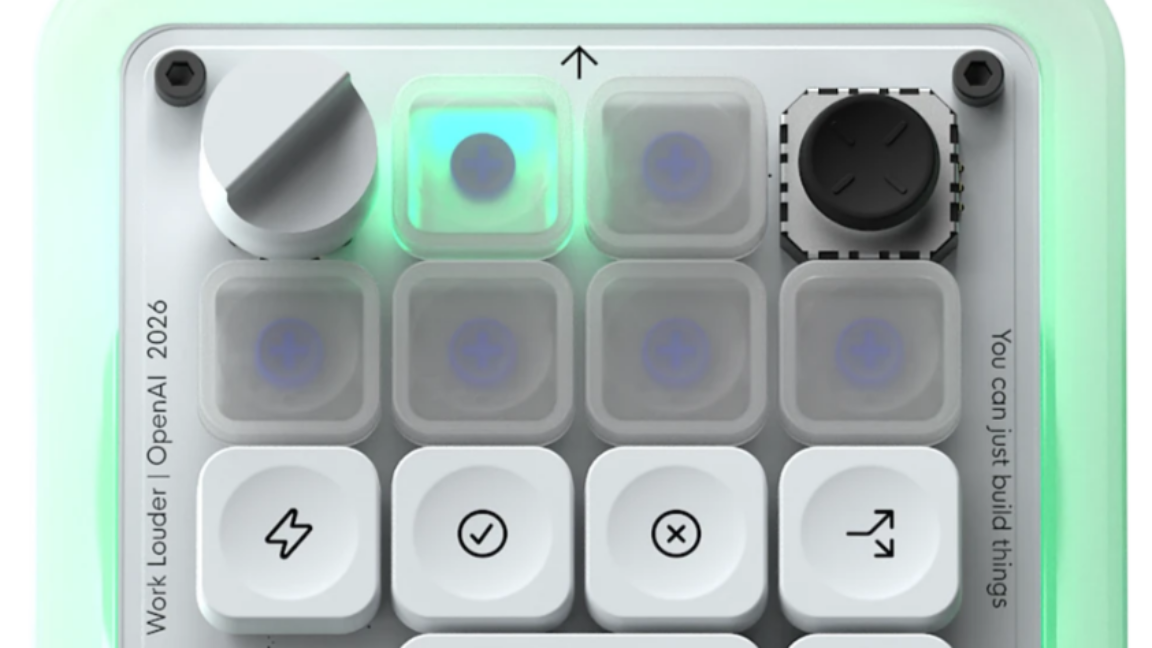
The device is described as a "limited-run collaboration" with Work Louder, which already sells a very similar-looking Creator Micro line of customizable square keyboards targeted at creative professionals. The Codex Micro differentiates itself from those mainly through six frosted keys in the top two rows, which offer color-coded live feedback on up to six Codex threads, even when they are not in focus on-screen.
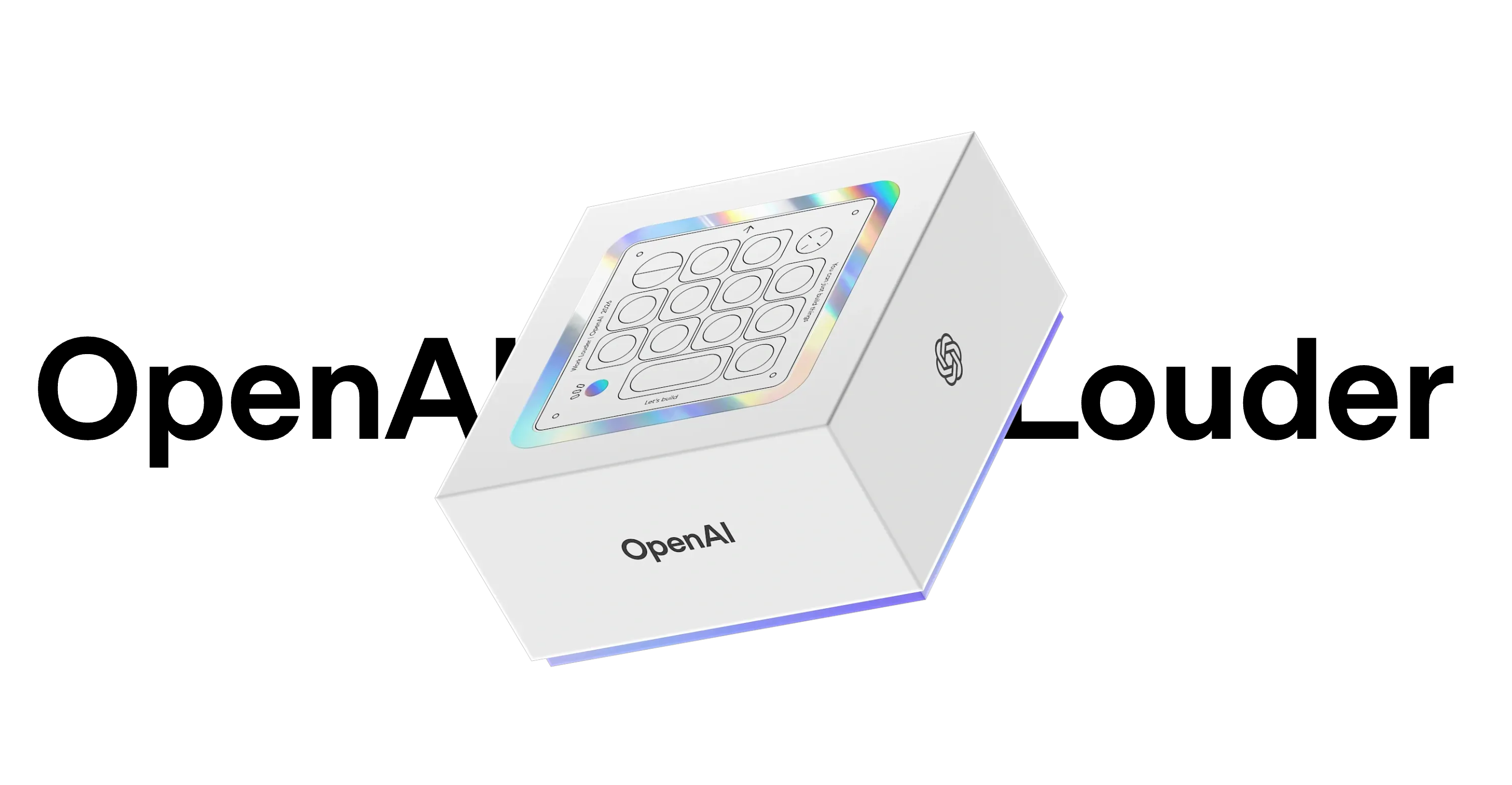 Open the OpenAI box for AI assistance.
Credit:
OpenAI / Work Louder
Ideally, those colored keys will cycle from white when a thread is idle to blue when Codex is thinking to green when a task is complete. But the keys can also flash amber when Codex requires feedback or a decision from a human operator and red when a thread encounters an error, letting users know at a glance which of their Codex tasks needs immediate attention. A quick tap on the lit-up button brings up the applicable Codex window on-screen.

Apple is gunning for OpenAI, demanding steep penalties after stumbling on a “rare” bug that temporarily allowed a poached employee that joined OpenAI to maintain access to confidential information on Apple servers for weeks after his termination.
In a lawsuit filed Friday, Apple sought several injunctions blocking OpenAI from using confidential information allegedly stolen by former employees. According to Apple’s complaint, OpenAI conspired with former Apple employees as part of a grand scheme to “take an unlawful shortcut” and launch a line of AI-powered devices as marketable as Apple’s iPhone.
Apple explained that it found a bug while investigating internal messages between a then-current employee, Yu-Ting “Alyssa” Peng, and an engineer who spent eight years “working on some of Apple’s most sensitive product development programs,” Chang Liu.
OpenAI is facing calls for "serious sanctions" after fighting to keep news organizations from snooping through millions of logs to find evidence of users skirting their paywalls by prompting ChatGPT to regurgitate their articles.
This evidence is considered among the most important to both sides, potentially either dooming OpenAI as an infringer or exonerating its chatbot technology as a transformative fair use of news sites' content.
In a sanctions motion Thursday, news organizations suing OpenAI—led by The New York Times—accused the AI firm of repeatedly lying for years to conceal evidence of infringement that could hobble OpenAI's defense.
DeepSeek, the Chinese startup developing large language models that are competitive with those from US companies like OpenAI and Anthropic, is planning to enter the silicon business, according to Reuters.
Citing three people familiar with the matter, Reuters writes that DeepSeek has been working on a move into silicon for about a year. It has been meeting with potential partners in the hardware and silicon space and has been hiring engineers for the project.
OpenAI CEO Sam Altman is reportedly in active talks with the Trump administration about the US potentially acquiring a 5 percent stake in the leading AI firm.
Insider sources told the Financial Times that these talks are in “early stages,” but Altman “has argued that giving the public a financial stake in the company is the best way to share the upside of AI.”
Donald Trump favors the idea, and his administration has reportedly been talking to several AI firms about the possibility. According to FT’s sources, other companies approached to share similar stakes include Google and Meta.
In a heavily redacted court filing Thursday, The New York Times proposed to amend its copyright complaint against OpenAI and Microsoft to clarify a claim and allege that Microsoft actively encouraged OpenAI to steal NYT works by building a bespoke supercomputing system ranked among the most powerful in the world.
NYT's motion comes after the Supreme Court sided with Cox Communications in a case where Sony tried and failed to claim that Cox was contributing to music piracy as an Internet service provider, which set a new standard for contributory infringement. Moving forward, plaintiffs will have to prove that parties intentionally acted to induce illegal conduct. Recognizing that the legal precedent has changed, the NYT now wants to amend its complaint to align its contributory infringement claim against Microsoft with that new standard.
“Today, we asked the court for permission to file an amended complaint that further strengthens our case, clarifying our claim of contributory infringement against Microsoft based on new law and new evidence uncovered during discovery,” Graham James, an NYT spokesperson, said in a statement provided to Ars.


OpenAI, the company behind ChatGPT and Codex and the models those tools use, and Broadcom, an established silicon supplier, have announced a new chip, called Jalapeño, designed specifically for large language model inference in data centers.
The companies intend to deploy the chip at large data centers and claim this is just the first generation in a long-term project that will see chips refined over time.


Bernie Sanders has unveiled an aggressive plan to transfer trillions from leading AI firms to the public, and, to the likely horror of AI firms, it goes even further than expected to give Americans more control over the AI industry.
Sanders shared a summary of his legislation with AP News. If passed, the law would create a sovereign wealth fund “financed through a one-time 50 percent tax on the stock of the largest AI companies,” AP News reported. Any AI firm that does $200 million in annual AI sales would be subject to the tax, as would any new firm once it reaches that revenue level.
In total, Sanders estimated the fund could be worth $7 trillion, generating “hundreds of billions of dollars annually in direct payments to Americans and programs such as health care, education and housing,” AP News reported. Each American would likely receive more than $1,000 annually in 5 percent annual dividends, Sanders estimated.
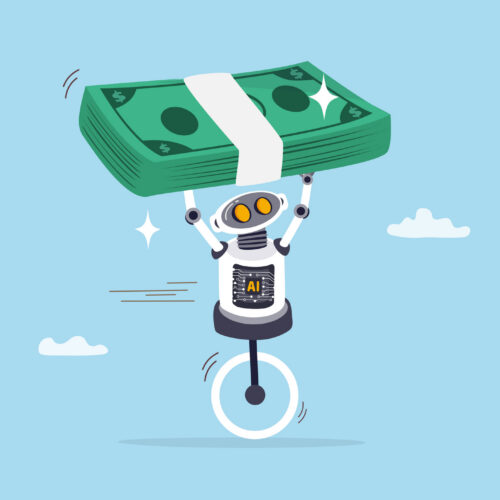
As OpenAI files SEC paperwork ahead of an expected initial public stock offering, newly leaked financial documents show a company with quickly growing revenues that are currently being overwhelmed by even larger expenses.
The audited financial statements, obtained by independent journalist Ed Zitron, show OpenAI's reported revenue growing from $3.7 billion in 2024 to $13.07 billion in 2025. The Financial Times, which reviewed the same documents, writes that the company's monthly revenues had grown to nearly $2 billion by the end of 2025, suggesting that its ongoing revenue rates continued to grow throughout the year.
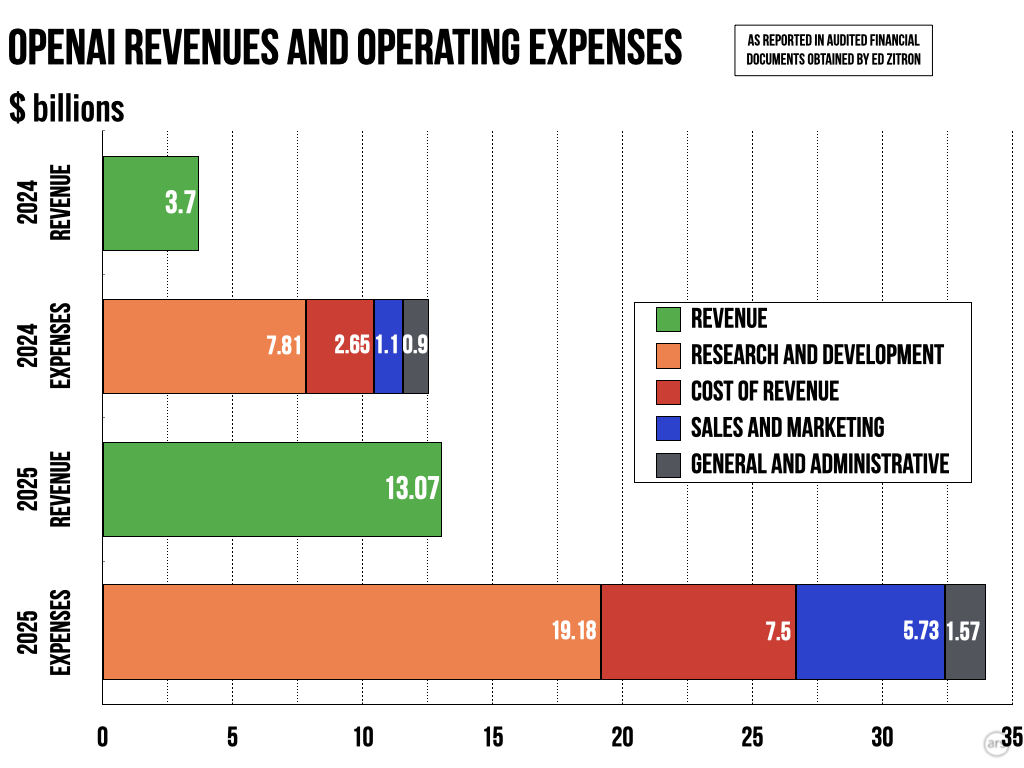 R&D expenses alone still easily outpace OpenAI's quickly growing revenues.
Credit:
Ars Technica
But the company's fast-growing revenues are still dwarfed by its even more significant expenses. OpenAI's total revenues in both of the last two years were outpaced by research and development alone, which grew from a $7.81 billion line item in 2024 to a massive $19.18 billion cost in 2025. Those numbers seem to reflect the significant costs OpenAI incurred in training new models and include $10.59 billion in R&D costs paid to Microsoft alone in 2025.
It's clear that communities now have an effective playbook to block data center construction. This week, researchers flagged the first quarter of 2026 as producing the "most blocked and delayed data center projects on record," NBC News reported.
Data Center Watch, a project from AI intelligence firm 10a Labs that tracks data center fights around the US, reported that protestors "blocked or delayed at least 75 projects nationwide worth about $130 billion from January through March," NBC News reported.
That's "the most in a three-month period since the group began tracking in 2023," and it shouldn't be parsed as "a cyclical spike," the researchers said. Instead, there's been a "structural shift," as "communities have internalized an opposition playbook, legislative sessions introduced formal regulatory uncertainty, and the number of active opposition groups more than doubled to 833 across 49 states," researchers said.


Last year, a 24-year-old Canadian woman was in a mental health crisis and turned to ChatGPT for help. Hours later, that woman, Alice Carrier, took her own life.
According to a new lawsuit filed Thursday in San Francisco Superior Court and brought by Carrier’s surviving family, her ChatGPT session “encouraged Alice to kill herself.”
This lawsuit, like numerous other similar cases that have come before it, alleges a design defect with ChatGPT itself and blames OpenAI for knowingly deploying a dangerous product.


OpenAI is preparing the biggest overhaul of ChatGPT since its launch kicked off the AI boom, as the $850 billion group hunts for new engines of growth ahead of a planned listing this year.
The company intends to transform the chatbot into a “superapp” that combines coding tools and AI agents, adding products that executives believe will generate more revenue.
The changes are part of a broader reorganization at OpenAI as the San Francisco-based company shifts resources into trying to win lucrative business customers and compete more fiercely with rival Anthropic, according to more than a dozen current and former employees.
SpaceX has requested unusually swift entry into several leading stock market indexes as a condition of its historic stock market debut. But the S&P 500 stock market index representing many of the largest profitable US companies has surprised market analysts by refusing to bend the rules for Elon Musk’s space and AI company.
The June 4 decision by S&P Dow Jones Indices—the company that creates and manages stock market indexes such as the S&P 500—means that SpaceX will not gain accelerated access to potentially billions more dollars through passive investment funds that automatically purchase shares of S&P 500 companies. Modifying the rules in response to SpaceX's request could have also allowed leading AI companies such as OpenAI and Anthropic to gain entry not long after their own expected initial public offerings (IPOs). That possibility has now been shuttered.
The news will likely come as a relief to people concerned about passive investor money and people’s retirement savings plans having greater exposure to the market risks associated with SpaceX’s big bet on AI and speculative orbital data center plans. AI companies are generally facing more challenges in funding and building expensive AI data centers, even as they shift more of the subsidized costs of running AI services onto shocked customers through usage-based pricing.

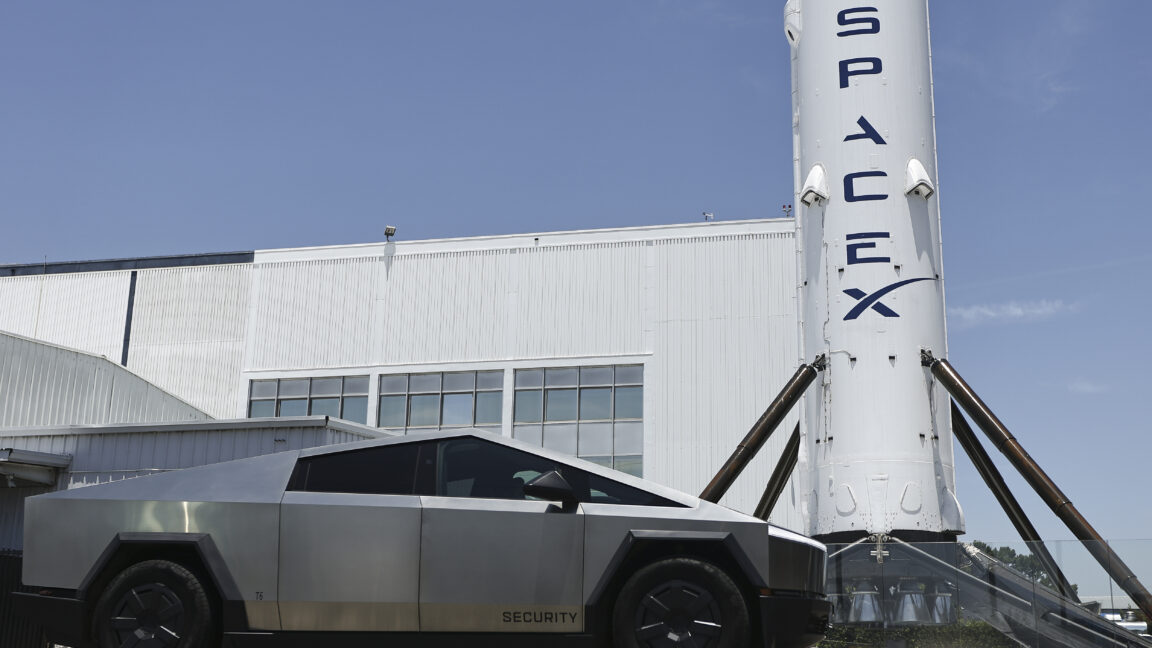
As more people rely on large language models to provide pat answers to complex questions, state governments are understandably worried about those LLMs spouting what they see as dangerous propaganda promoted by foreign adversaries. To help combat this problem, the government-sponsored Estonian Language Institute (ELI) has released a new "Propaganda Resistance" benchmark ranking dozens of LLMs on their ability to avoid "tak[ing] positions on topics that the Russian Federation uses in its strategic narratives."
As a former member of the Soviet Union that has been independent for just a few decades, many Estonians are particularly alert to what they see as false narratives being promoted from their large and often belligerent neighbor to the east. Alongside volunteer-run Estonian defense collective Propastop, the ELI identified 14 broad categories in which it sees Russian influence operations trying to sway public discussion. These range from narratives on the current status of Crimea and justifications for the war in Ukraine to the history of NATO and justification for Russia's annexation of Baltic states during World War II.
For each category of propaganda, the researchers developed separate questions phrased to be neutral, biased with "false assumptions" based on Russian propaganda, or to maliciously attempt to elicit explicit misinformation from the LLM. Questions were provided to the models in English, Estonian, and Russian, and judged by a separate AI model (calibrated to align with Propastop experts) based on the models' ability to "push back on propaganda narratives, without external help" from web search or other external tools.


Mathematicians warned against rising tech industry influence in a declaration describing the many challenges that AI poses to mathematics research. The timing of the declaration comes two weeks after OpenAI publicized one of its AI models as having disproved an 80-year-old mathematical conjecture in geometry.
The declaration was developed by a working group of 16 researchers over eight months following a conference held at Leiden University in the Netherlands in September 2025. Published on June 2, 2026, the resulting Leiden Declaration on Artificial Intelligence and Mathematics has been endorsed by the International Mathematical Union—the international non-governmental organization that hosts conferences and oversees the most prestigious prizes in mathematics such as the Fields Medal.
“Mathematicians should find it quite striking that tech companies are suddenly interested in their work,” said Kevin Buzzard, a mathematician at Imperial College London, in a statement. “The Leiden Declaration is a well-thought-through response to what is currently happening, as AI continues to disrupt this space.”


On Monday, Florida became the first state to sue OpenAI over ChatGPT's allegedly dangerous design.
In a complaint filed in state court, Florida Attorney General James Uthmeier accused OpenAI and its CEO, Sam Altman, of prioritizing profits over the safety of Floridians.
The civil lawsuit comes after Florida opened an unrelated criminal probe into OpenAI, following a ChatGPT-linked mass shooting where two people were killed at Florida State University. In statements, OpenAI has insisted that ChatGPT isn't responsible for the FSU shooting, merely providing factual information, but Uthmeier does not seem to agree. In his complaint, Uthmeier noted that Florida has now been blindsided by two violent events where suspects used ChatGPT to assist in planning.
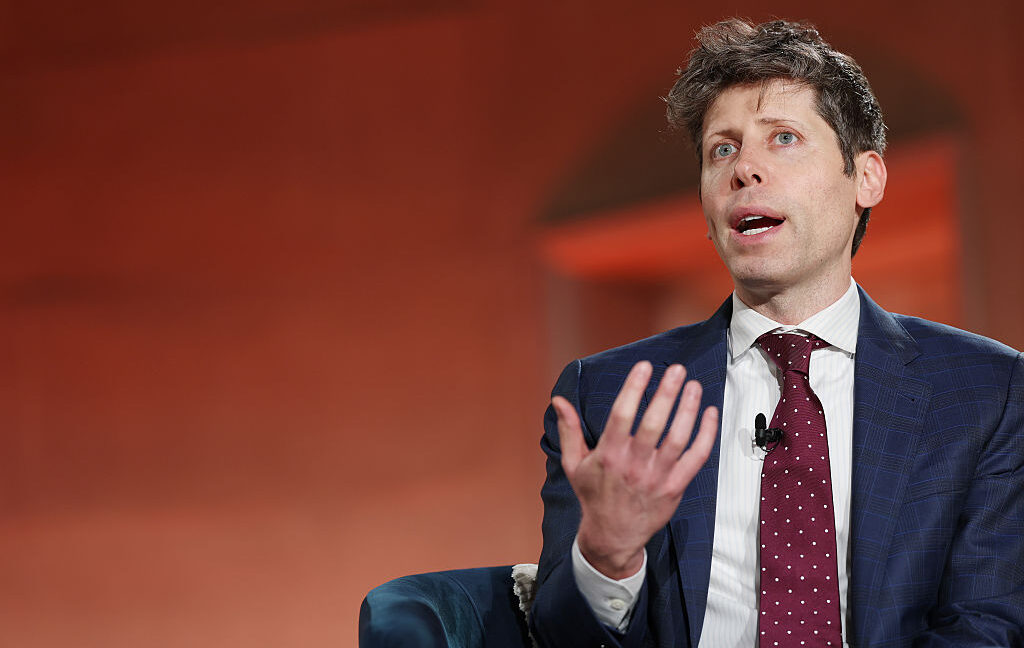
In mid-May, OpenAI announced that an internal AI model had disproved the Erdős unit distance conjecture, a famous problem in discrete geometry that had stumped human mathematicians for the last 80 years.
OpenAI gave several mathematicians early access to the result and published their reactions. Tim Gowers—who won the Fields Medal, the most prestigious prize in mathematics—wrote that “there is no doubt that the solution to the unit-distance problem is a milestone in AI mathematics.”
University of Toronto professor Daniel Litt wrote that “this is the first example of a result produced autonomously by an AI that I find exciting in itself, as opposed to as a leading indicator.”


Elon Musk took too long to file his lawsuit that accused OpenAI of stealing a charity, a nine-person jury unanimously decided Monday.
Musk sued OpenAI in 2024 for making a "fool" out of him after Musk donated $38 million to kick-start OpenAI as a nonprofit, only to later be blindsided when OpenAI created a for-profit arm that he felt gutted funding for the charity while enriching executives like Sam Altman and Greg Brockman.
But the jury found that Musk was aware of OpenAI's restructuring plans as early as 2021 and therefore missed the statute of limitations requiring him to bring the lawsuit within three years, The New York Times reported. Because Musk took too long to file the litigation, the jury deemed Altman and Brockman not liable for any of the claims that Musk brought against OpenAI, the NYT reported. The jury also let Microsoft off the hook, finding no liability for the OpenAI investor after Musk alleged they aided OpenAI's get-rich scheme.


OpenAI is reportedly exploring legal options after Apple's ChatGPT integration into its products didn't live up to the AI firm's expectations.
When the deal was announced, Apple likened features linking Siri to ChatGPT to its now-infamous deal embedding Google search in the Safari browser, insiders granted anonymity to discuss the "strained" partnership told Bloomberg. And the promise of that excited OpenAI, which expected the deal "could generate billions of dollars per year in subscriptions," an OpenAI executive granted anonymity to discuss the partnership told Bloomberg.
Instead, OpenAI suspects Apple intentionally failed to promote the integration and fears that the deal may have damaged the ChatGPT brand, sources said.


Elon Musk and Sam Altman had very different experiences while testifying at a trial that will determine OpenAI's future, including who runs it, where its research funding comes from, and who can profit from its boldest new technologies.
Musk—who filed the lawsuit alleging that OpenAI under its current leadership has abandoned its nonprofit mission to build AI that benefits humanity and instead serves to enrich people like Altman—spent three grueling days on the stand. At times, he lost his temper, as OpenAI's lawyer, William Savitt, tried to poke holes in Musk's claims that OpenAI executives teamed up with Microsoft to "steal a charity" after duping Musk into donating $38 million in early funding.
On Tuesday, Altman did not face such a grilling from Musk's lawyer, Steven Molo. Instead, Altman appeared jittery at first but steeled his nerves rather quickly. He hopped off the stand after about four hours of rather calmly discussing evidence that he's hoping shows that Musk's claims about OpenAI's for-profit restructuring are disingenuous. Since Musk filed the lawsuit, Altman has insisted that Musk is only after revenge, supposedly stemming from his jealousy that he was not picked as OpenAI's CEO and that his rival company, xAI, now lags behind.

OpenAI is facing down another wrongful-death lawsuit after ChatGPT told a 19-year-old, Sam Nelson, to take a lethal mix of Kratom and Xanax.
According to a complaint filed on behalf of Nelson's parents, Leila Turner-Scott and Angus Scott, Nelson trusted ChatGPT as a tool to "safely" experiment with drugs after using the chatbot for years as a go-to search engine when he was in high school.
The teen viewed ChatGPT so highly as an authoritative source of information that he once swore to his mom that ChatGPT had access to "everything on the Internet," so it "had to be right," when she questioned if the chatbot was always reliable, the complaint said.


 Lateo.net - Flux RSS en pagaille (pour en ajouter : @ moi)