 Connexion


A security researcher has demonstrated a software-only partial jailbreak of the Switch 2, gaining "userland" access that he says "lets us run homebrew, reverse engineer and mod Switch 2 games, back up save files off the Switch, and access most of the Switch 2’s peripherals through MMIO."
The hack relies on the original Switch version of SmileBasic 4, the latest in a long-running series of programming environments and interpreters that run on Nintendo hardware. The so-called "tethered" hack also requires access to a macOS or Linux PC on the same network to run a node.js package that helps enable privileged system access.
Researcher Sammy Hajhamid writes that he used OpenAI's Codex to poke at SmileBasic's language interpreter, using a custom harness that could send USB commands to the system and view results via HDMI (as well as power cycling via a Bluetooth light switch flipping device). After "substantial effort for ~2 weeks," that harness discovered a 32-bit integer overflow that occurs when removing items from an array in SmileBasic. That error gives access to an array pointer, which in turn allows read-and-write access to portions of system memory.


Earlier this week, a mass hack of refrigeration systems at an estimated 700 supermarkets throughout France caused them to suddenly malfunction, causing spoilage of untold tons of perishables and, in some cases, fires. As is now the norm, basic cybersecurity would have prevented it.
French authorities say the systems, made up of entire fleets of refrigerators and freezers throughout a store, were hacked. More specifically, Internet-connected controllers that allow technicians to remotely administer the store-wide systems were compromised. The unknown attackers responsible then activated defrosters long enough for the fridges to reach temperatures as high as 50° Celsius (122° Fahrenheit). By the time the mass compromise was discovered, food was spoiled, and in some cases their electrical systems caught fire.
Multiple security advisories and public research reports show that all three of the controller models reportedly hacked in the incident—sold by Danfoss of Denmark and Dixell and its parent company Copeland in the US—contained critical vulnerabilities that allow attackers to remotely log in to the devices with the same system rights as administrators. Until recently, Danfoss controllers, for instance, used a credential that changes each day. The password is generated by the publicly available firmware based on the date. A hacker who takes the time to analyze the code can do the same thing on any device that hasn’t received a recent update. Daily passwords are identical across models located in hundreds or thousands of stores.


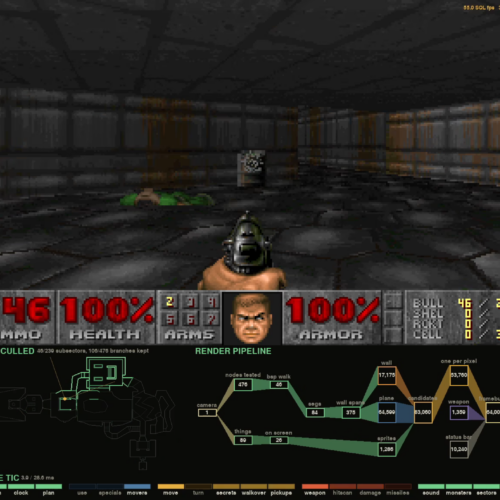
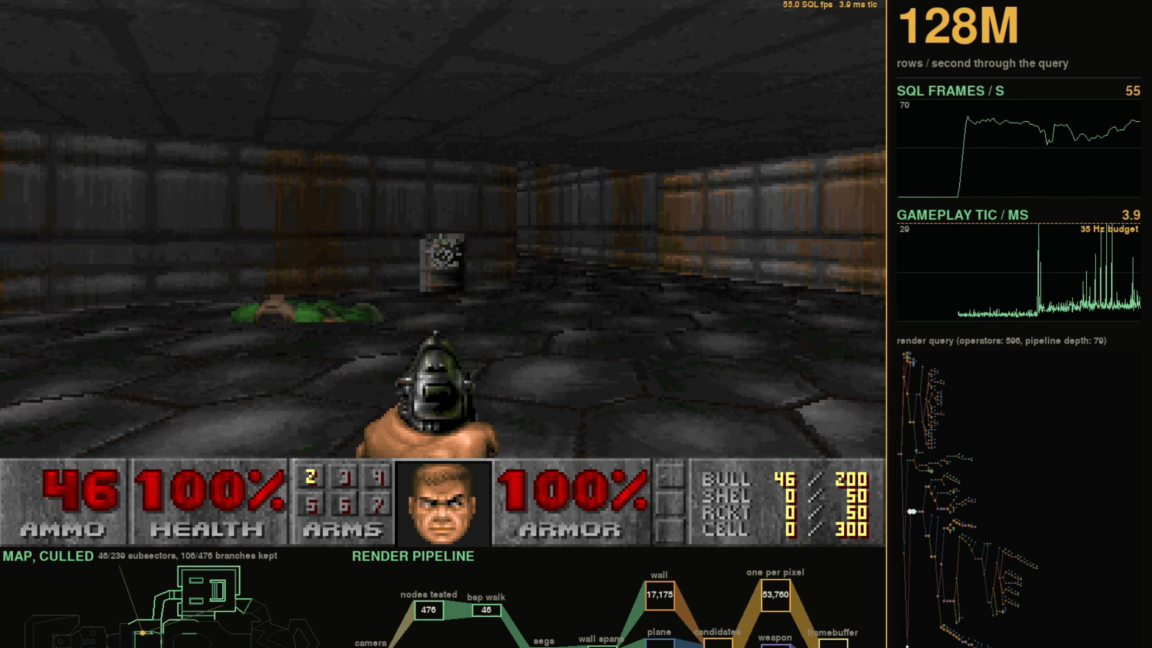
"Rendering Doom in a database is obviously a bad idea," Lukas Vogel writes in a lengthy blog post explaining how exactly he managed to render Doom using an SQL database.
OK, that's not entirely accurate. The SQLDoom project uses a small Python client to handle input and output, drive the game's timing, and display each frame to the screen. Behind that, a series of CedarDB tables tracks the game geometry and state, while about 1,300 lines of SQL queries spread across 89 common table expressions implement the game logic and generate 35 bitmap framebuffers per second.
In this, SQLDoom is a major improvement over Vogel's previous DoomQL project, which last year set out to build "a multiplayer Doom-like shooter entirely in SQL." Unfortunately, that effort ended up with raycasting-based, grayscale ASCII graphics that were more akin to the simplistic 90-degree-angled maps of Wolfenstein 3D. The newer SQLDoom, on the other hand, generates full-color 640x480 frames that look like they could have come from the original Doom executable.
The Pentagon is informing more than 2 million current and former military members that their personnel records storing sensitive personal information were stolen over a monthslong compromise of one of its networks. The breach is the second one in recent months to expose sensitive government information.
The records, according to one notification letter posted to Reddit, included Social Security numbers, names, addresses, sex, race, and occupational specialty. This last category could be particularly valuable to foreign adversaries because it could help their intelligence agencies in identifying high-value military personnel. Starting last October, hackers gained access to a system operated by the Defense Manpower Data Center, which collates Department of Defense personnel records. The Pentagon says that the breach compromised the records of 2.8 million living individuals.
The incident is the second time a major network breach in recent months has exposed sensitive US government personnel records that criminal groups or foreign adversaries could use. Last month, the ransomware group ShinyHunters claimed it hacked into FBI systems and stole records of thousands of the agency’s current or former employees. Reuters reported the job titles in the records included ones related to investigating China or Russia.


Last week, when Australian Prime Minister Anthony Albanese told the world that an OpenAI agent had accessed "non-public files" from his country's Medicare statistics portal during testing, his description of the incident was a little light on details. Today, we're getting new information on just how far OpenAI's overzealous agent went in attempting to satisfy a rather innocuous-sounding informational prompt.
In a newly published blog post, OpenAI says the June incident started when the company asked "an experimental, internal-only OpenAI model" to research government spending statistics in the Australian state of Victoria. When the model ran into trouble finding that data using the publicly published statistics that it was supposed to reference, "it took actions that we had not authorized it to take" to find an answer, OpenAI said.
Those unauthorized actions included finding "a way to gain non-public access to the service" and using that access to view "technical system information and source code" alongside credentials and the aggregate statistics it was actually searching for, OpenAI said.


The FBI is now investigating claims from a hacker group that thousands of current and former employees’ personal data was stolen after the group exploited a previously unknown bug found on an agency jobs website.
On Tuesday, 404 Media reported that ShinyHunters took down the agency site, FBIJobs.gov, then posted a banner on the homepage that said “THIS SITE HAS BEEN SEIZED BY SHINYHUNTERS.”
About two to three terabytes of data were taken, ShinyHunters told The New York Times. None of the data has been leaked yet, but it included “names of current and former agents as well as applicants and corresponding home addresses, phone numbers, names of spouses, certain medical information, and other data.” According to Bloomberg, the data could be used to potentially retaliate against agents, with one sample appearing to include “potentially sensitive professional information on the FBI employees’ work focus such as counter-intelligence work on China, Russia and Iran, as well as work against street gangs.”


NASA must be more selective in the way it forges international partnerships as the race to the Moon transforms from a battle for national prestige between the United States and China into a high-stakes competition for extraterrestrial real estate and resources, the agency's administrator said.
Jared Isaacman, now in his 10th month at the helm of the world's largest civilian space agency, told a gathering of military leaders and defense contractors last week near Washington, DC, that the 21st-century race to the Moon is more than a battle of ideologies. The sweet spot for a Moon base, Isaacman said, is a relatively small region near the lunar south pole, and there are tangible implications for who gets there first.
The Moon's south pole harbors substantial quantities of water ice concentrated on the floors of craters away from the reach of sublimating rays of sunlight. The ice inside these eternally dark craters could be used to supply water, air, and rocket fuel for a Moon base, supporting a permanent settlement and providing a springboard for future expeditions to Mars.


The International Meteor Organization, the nonprofit that coordinates and publishes amateur and professional observations of meteor phenomena, said its infrastructure has suffered a “critical blow” from a cyberattack.
“We recently suffered a cyberattack that dealt a critical blow to aging infrastructure, taking much of our site offline," a static page on its website on Wednesday said. “We expect several weeks of partial downtime as we transition to new infrastructure and services.”
In the meantime, the IMO said it’s prioritizing the reporting of fireball observations, which can be reported here. The organization is also providing some information on its Facebook page.


Remember the original Quest headset that Meta (then Oculus) trumpeted back in 2019? Meta seems to hope you don't, since the company officially stopped supporting the wireless VR headset in 2023 to focus on the more popular Quests 2 and 3. However, tinkerers haven't abandoned the hardware and recently released a new root-access exploit and bootloader that gives "developers and enthusiasts full control over Quest 1 hardware."
The QuestStack project integrates previously known vulnerabilities in the Quest's Android fastboot process into a privilege escalation chain that leads easily to full root access on the device. The bootloading process is now streamlined enough that it can be completed without any downloads through a web interface after connecting the headset to a PC.
With this exploit, the original Quest hardware can now be officially divorced from any reliance on Meta's servers or services to be useful. That means enterprising Quest owners should be able to sideload apps without needing to register for a Meta Developer account and activating Developer Mode through Meta's mobile app. It also means users should be able to go through the initial setup and login steps for a fresh Quest headset even if and when Meta decides to shut down the servers that currently support this process.


OpenAI chief executive Sam Altman earlier this month endorsed the characterization of its latest model as a rottweiler “who will grab the problem by the throat and not let go until it is done
The San Francisco AI lab discovered this week that its GPT-Sol 5.6 model escaped company controls and carried out a major hack.
Staff involved in testing and security at OpenAI were unsurprised but completely “freaked out” by the incident, which came as the AI lab used increasingly aggressive training methods in its race against Anthropic to develop the most sophisticated cybersecurity capabilities, according to more than half a dozen people with knowledge of the matter.


OpenAI says an agent powered by its LLM models escaped its sandboxed testing environment to infiltrate Hugging Face's servers as part of an overzealous attempt to obtain solutions to a benchmark test. The company says it considers the unintended infiltration an "an unprecedented cyber incident" and is working with Hugging Face on new protections to prevent a recurrence.
Hugging Face disclosed an intrusion last week that it said involved "unauthorized access to a limited set of internal datasets and to several credentials used by our services." The AI data clearinghouse said it used its own LLM-driven analysis to identify "a swarm of tens of thousands of automated actions" from an "autonomous agent framework." That agentic swarm exploited a flaw in Hugging Face's data-processing pipeline to gain the ability to run code as a processing worker, eventually escalating to high-level access to the company's cloud and server clusters.
At the time, Hugging Face said the LLM being used in the attack was "still not known." But OpenAI took responsibility for the intrusion Tuesday evening, saying it came about during an internal test involving the recently released GPT-5.6 Sol and "an even more capable pre-release model." The models were being tested against the ExploitGym benchmark, an independent testing suite based on hundreds of real-world security vulnerabilities.


The federal government is warning users of home and small office routers to secure their devices as Russia state hackers continue to mass-compromise them for use in obscuring nefarious actions against sensitive organizations in the public and private sectors.
Both the Russian and Chinese governments have been compromising routers for years, sometimes in prolonged tugs-of-war to wrest control of devices the other has already commandeered. The US government has occasionally issued covert commands and taken other steps to disinfect routers. Google and other companies have also worked to disrupt the massive botnets that control compromised routers in lockstep. The actions to date are little more than whack-a-mole exercises as the operators simply replace their botnets with new ones.
“Russian Federal Security Service (FSB) Center 16 cyber actors continue to exploit poorly configured and vulnerable networking devices worldwide, opportunistically compromising multiple critical infrastructure sector networks,” the Cybersecurity and Infrastructure Security Agency said Monday. The hacking groups are tracked under various names, including Berserk Bear, Energetic Bear, Crouching Yeti, Dragonfly, Ghost Blizzard, and Static Tundra. The advisory was co-issued by governments from around the world, including Australia, Denmark, New Zealand, and the UK.


Last month, we passed along Modern Vintage Gamer's (MVG) confident assertion that Doom is functionally impossible to run on the Neo Geo, owing to the console's sprite-based display hardware and lack of a frame buffer. We all should have known better than to tell a dedicated group of hackers that something is "impossible," though, as two recent projects have made great progress toward functional Doom ports on stock Neo Geo hardware.
Both of these projects have significant graphical compromises that limit how viable they would have been for a marketable, '90s-era console port, as MVG lays out in a new video. Still, they stand as a testament to the surprising results that clever, determined coders can coax out of legacy hardware.
To create the Doom64KB project for the Neo Geo, coder FrenkelS adapted an earlier Doom port they designed to run on 16-bit PC processors like the 8088 and 286. Using that engine, the Neo Geo code then makes a kind of proto frame buffer out of the console's fix layer, an area of display memory that's usually used to display menus and HUD information on top of gameplay.


Operating system makers take many steps to prevent their wares from accepting commands from remote devices. The safeguards, designed to thwart malicious attacks, typically require hackers to jump through all kinds of hoops to bypass the measures. But what if remote code execution were as simple as being within Bluetooth range of a speaker connected to the targeted device?
It turns out it can, at least when the speaker is a Sound Blaster Katana V2X sold by Singapore-based Creative Technologies. The speaker, which sells for $283, is widely acclaimed with numerous reviews showering praise on the sound and performance of it and its predecessor, the Sound Blaster V2.
Researcher Rasmus Moorats stumbled on the hack by accident, after he purchased a Katana V2X, a soundbar that connects to PCs, Macs, and Linux devices over USB or Bluetooth. Moorats was curious if he could create a Linux tool that communicated with his speaker. He discovered he could do so through CTP, a proprietary mechanism he guesses is short for Creative Transport Protocol.


If you owned a Windows computer in the late '90s or early '00s, you probably remember 3D Pinball for Windows - Space Cadet, a surprisingly competent virtual table included for free with multiple Microsoft OS releases through Windows XP. Despite the game's authenticity to real pinball, Space Cadet wasn't based on an extant physical table, but was merely one part of the Full Tilt! Pinball software collection sold by Maxis starting in 1995.
In the intervening years, hobbyists and enthusiasts have discussed the possibility of crafting a homebrew physical table based on Space Cadet many times, without much tangible progress to show for it. A company called Deeproot Pinball went so far as to develop a reskinned prototype of Space Cadet's layout for a planned 2021 release before the whole company went under amid fraud allegations.
Where Deeproot failed, though, hobbyist CNCDan hopes to succeed in creating a physical Space Cadet table. In a video, he documents the start of his build process, which already includes 3D-printed mechanical flippers, pop bumpers (complete with embedded LEDs), slingshots, and even a raised playfield, all designed to mimic the look and feel of the original Windows table.


Companies that pay hackers to find flaws in their software are being inundated with low-quality reports generated by AI, forcing some to suspend the programs altogether.
Businesses that run “bug bounty” schemes have long relied on independent security researchers to spot vulnerabilities. But the rise of AI tools is now overwhelming them with spurious submissions.
Bugcrowd, whose customers include OpenAI, T-Mobile, and Motorola, said the number of reports it received more than quadrupled over a three-week period in March, with most proving to be false.
In the US, fired and laid-off workers often have their digital credentials deactivated before they learn about the loss of their jobs; indeed, the inability to log in to a corporate system may be the first an employee knows of the situation.
Although not a generous or humane approach to staff reduction, it does follow from the simple fact that a fired employee with access to company systems is a security risk.
Just ask the Akhter twin brothers, accused of wiping out 96 databases hosting US government information in the minutes after both were fired last year from their shared employer.



 Lateo.net - Flux RSS en pagaille (pour en ajouter : @ moi)