Lateo.net - Flux RSS en pagaille (pour en ajouter : @ moi)

🔒
❌ À propos de FreshRSS
Il y a de nouveaux articles disponibles, cliquez pour rafraîchir la page.
☐ ☆ ✇ Red Samovar

[Actu] Le sous-marin nucléaire Khabarovsk (Projet 09851)

Par : B.G — 22 octobre 2026 à 18:27
[Actu] Le sous-marin nucléaire Khabarovsk (Projet 09851)
☐ ☆ ✇ Red Samovar

[Actu] Mise sur cale de la frégate Amiral de la Flotte Gromov (Projet 22350)

Par : B.G — 15 mai 2026 à 10:30
Mise sur cale de la frégate Amiral de la Flotte Gromov, neuvième bâtiment du Projet 22350
☐ ☆ ✇ STRATPOL

Le Bureau 1440 a lancé les 16 premiers satellites du projet Rassvet, le Starlink russe

Par : ActuStratpol — 24 mars 2026 à 10:31

Le Bureau 1440 a lancé les 16 premiers satellites du même nom, considérés comme la réponse russe à Starlink. L’entreprise

L’article Le Bureau 1440 a lancé les 16 premiers satellites du projet Rassvet, le Starlink russe est apparu en premier sur STRATPOL.

☐ ☆ ✇ Red Samovar

[Actu] Artillerie russe: kaboom? Yes Rico, Kaboom!

Par : B.G — 19 novembre 2025 à 21:43
Les évolutions en cours dans l'artillerie russe
☐ ☆ ✇ Global South

Prof. Jian: Secret History #17: Literary Genesis

Par : amarynth — 14 novembre 2025 à 14:18

In this Wednesday, November 12th lecture to his Beijing high school students, Professor Jiang explains how the Yahwehist gave birth to the Bible as well as the nation of Israel.

Notes and References: 1. Book of Genesis, Hebrew Bible 2. Book of Kings, Hebrew Bible 3. Book of J by Harold Bloom

☐ ☆ ✇ Global South

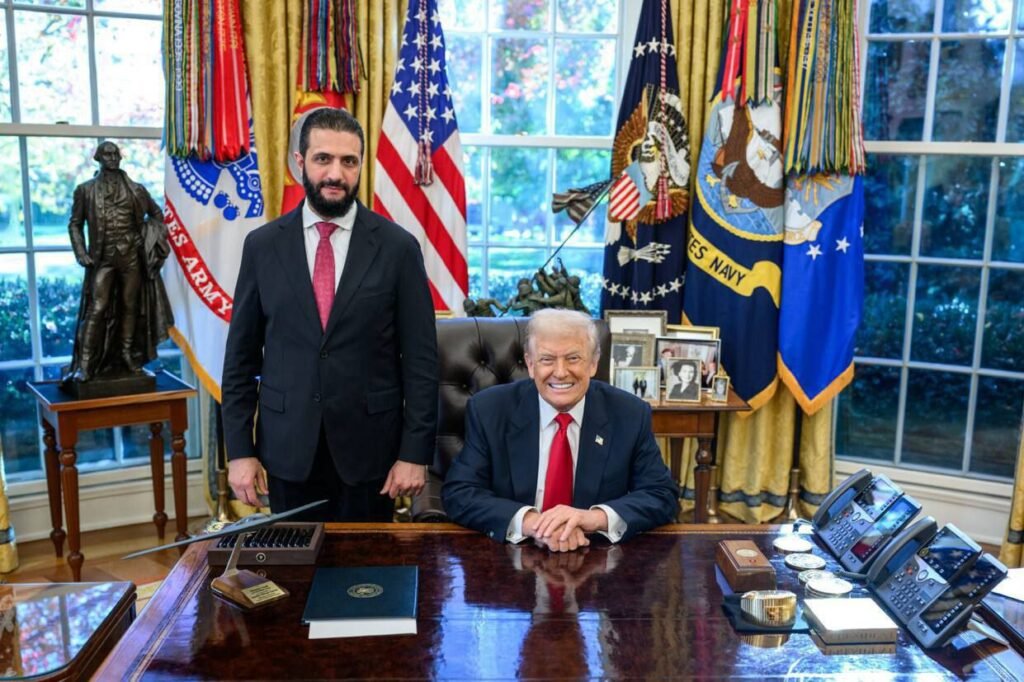
It took 40 years to replace Al Qaeda with Al Qaeda

Par : AHH — 12 novembre 2025 à 17:09

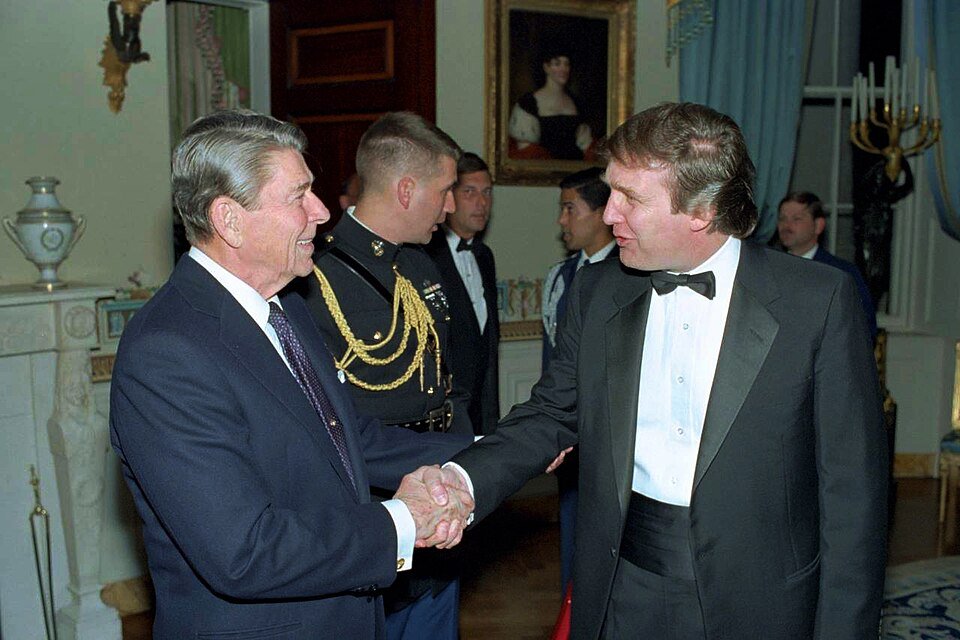
“These gentlemen are the moral equivalents of America’s Founding Fathers.” — President Reagan meeting with Freedom Fighters from Afghanistan (Mujahedin), Oval Office, 1985.

Nima AlKhorshid interviews our roving eye nomad on the central Asian Stans, Al Qaeda ‘R US, and other travails of stark-naked Anglo-Zionists.

☐ ☆ ✇ STRATPOL

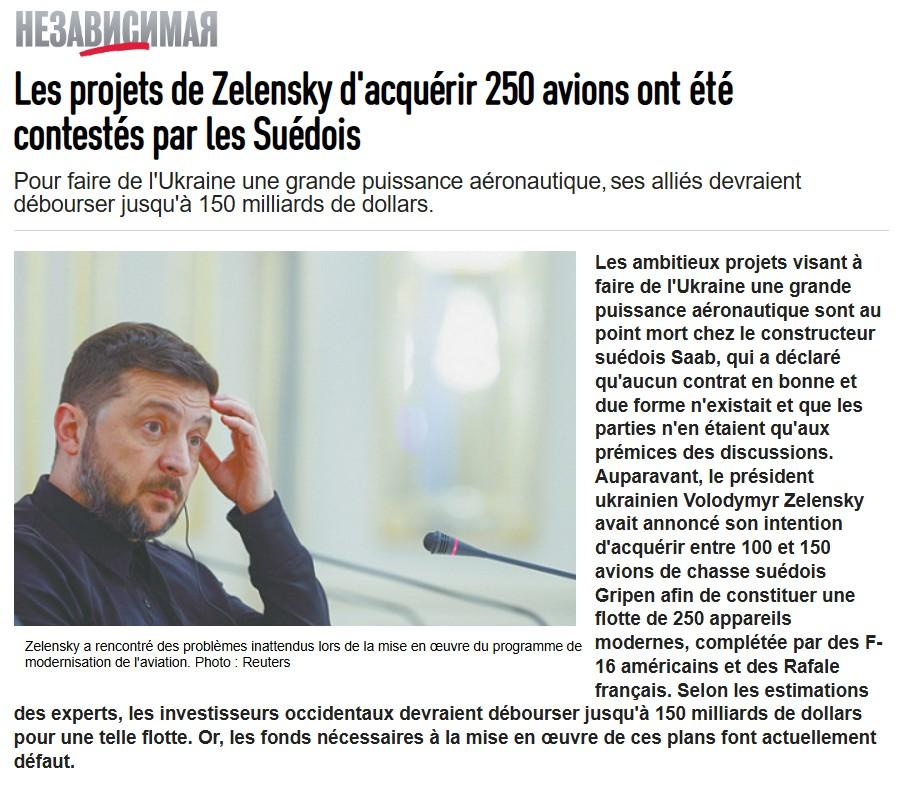
Kiev cherche 150 milliards de dollars pour 250 avions de chasse européens, mais les négociations sont au point mort

Par : ActuStratpol — 31 octobre 2025 à 08:48

avions zelensky

avions zelenskyLes ambitieux projets visant à faire de l’Ukraine une grande puissance aéronautique sont au point mort chez le constructeur suédois

L’article Kiev cherche 150 milliards de dollars pour 250 avions de chasse européens, mais les négociations sont au point mort est apparu en premier sur STRATPOL.

☐ ☆ ✇ Red Samovar

[Actu] Le Yakovlev Yak-130M

Par : B.G — 28 octobre 2025 à 17:37
Le Yakovlev Yak-130M
☐ ☆ ✇ Global South

10 Reasons Why Middle Powers Are Turning to BRICS+

Par : amarynth — 20 octobre 2025 à 22:47

Discover why middle powers are transforming global economics through BRICS+ and how the “middle power trap” is reshaping international relations forever.

[Note: What is called ‘middle powers΅ we may know better as ‘nodes’ as in multipolar and multinodal system. I also leave a short note here from Radhika Desai on a future conversation that will take place: “I don’t think multipolarity is an ideology. It’s a development. As for what should be done to advance it further, Russia and China are supporting multilateralism and the UN Charter and the various Chinese initiatives such as the GDI, GSI etc.”].

Middle powers like Malaysia, Indonesia, Thailand, Vietnam, Saudi Arabia, Egypt, and Ethiopia are breaking barriers in the current global order by turning to BRICS+ as their preferred platform. This video explores how BRICS+ Analytics expert Yaroslav Lissovolik, a friend of the Think BRICS channel, reveals the middle power trap constraining these emerging economies in traditional institutions like the IMF, World Bank, and WTO.

Learn how BRICS+ offers an inclusive platform for middle powers seeking a stronger geopolitical voice and strategic partnerships. We examine Ethiopia’s consistent 6%+ growth rates from 2020-2025 and Vietnam’s 5%+ annual economic growth, demonstrating why these regional integration leaders are driving global south cooperation.

Discover how BRICS+ accommodates diverse developing economies through multipolarity, enabling trade diversification and South-South cooperation. The video explains how middle powers face constraints in current governance structures where advanced economies hold disproportionate voting shares, while smaller countries dilute their influence in organizations like the United Nations.

This analysis covers how BRICS+ creates opportunities for small dynamic economies like UAE, Qatar, Kuwait, Uruguay, and Singapore to form specialized platforms within the broader alliance. We explore regional integration arrangements and how middle powers are becoming vocal drivers of the transformation of emerging economies.

This video does not discuss specific development finance mechanisms, detailed New Development Bank operations, or comprehensive trade diversification statistics. We don’t cover individual BRICS+ application processes, bilateral agreements between member states, or governance reform timelines. The analysis excludes currency arrangements, infrastructure project specifics, or detailed economic policy comparisons between traditional institutions and BRICS+ alternatives for strategic partnerships development.

#BRICS #emergingeconomies #globaleconomy

00:00 – BRICS+ has transformed into a diverse alliance of developing and middle powers.
01:17 – Middle Powers are increasingly integrating through regional blocs like ASEAN and GCC.
02:20 – Middle powers like Vietnam are increasingly influential in the global economy.
03:30 – Middle powers are increasingly seeking cooperation within BRICS+ due to global economic limitations.
04:48 – Middle powers seek BRICS+ for better global representation and influence.
05:58 – Middle powers are fostering regional integration in the Global South through BRICS+.
07:13 – Small economies are exploring partnerships with BRICS+ for development cooperation.
08:34 – BRICS+ serves as an inclusive platform for developing economies’ global expression.

☐ ☆ ✇ Global South

Prof Jian: Secret History #10: The Conspiracy of Evil

Par : amarynth — 19 octobre 2025 à 00:01

We know all of these conspiracy theories, but how about about we stack them? I know stacked functions and Prof Jian just stacked every single one of them. The funniest two comments:

Bro really came in and said “Ok class we’re talking about JFK, the Moon Landing, and 9/11 today.”

FBI entered the chat. CIA entered the chat. Nation of ISRAEL entered the chat.  

That number, the 33 masonic one – you’ve never seen it like this.   Good Saturday night movie material.

The start is a little slow, as he goes through the main events of JFK, the Moon Landing, and 9/11.  The scene must be set.  And then he rolls with all of that, ending up with secret societies and a game theory analysis.  Prof Jian made all of the old conspiracies interesting again.  What a teacher!


☐ ☆ ✇ Global South

The very sad brain cell destroying 1st day at UNGA – The infamous day of the west

Par : amarynth — 23 septembre 2025 à 13:38

Don’t despair.  The big guns are arriving today.

The westerners were in there first with a bit of false flag promotion as if anyone believed them.  Estonia held a quick and fast press conference (circus), with a raft of small countries calling for an emergency Security Council meeting over Russian airplanes that allegedly flew over Estonian airspace.  This is just after we all found out that the drones flying over Poland were most likely Ukrainian drones, stuck together with gaffer tape and Poland shot themselves.  The idea here is to waste Security Council time, and to make sure that the midgets are seen.

There is another objective, though.

Europe’s sudden, serial claims of Russian provocations are not about drawing the US back in.  The aim is to amplify the message that NATO wants war in Europe and that Russia is an existential threat.  As Poland shot itself, these midgets are telling scary stories to themselves.  The narrative creates the excuse needed for the costs the European public will be forced to pay, in addition to what they’ve already paid for the US proxy war in Ukraine vs. Russia.  Berletic says:  “Meanwhile, the US, which is supposedly “retreating” from Asia, has caused deadly riots in 3 nations across Asia in just 1 month, overthrowing one government already – with more unrest to come.”

Here is the Estonian circus.  It comes with a caution.  Protect your brain cells.

The PsyOp, building narrative at the UNGA, is continuing:

Here is what First Deputy Permanent Representative of the Russian Federation to the United Nations Dmitry Polyanskiy had to say, besides, there is no evidence:  https://t.me/MFARussia/26485  

Statement (https://russiaun.ru/en/news/unsc_220925) by First Deputy Permanent Representative of the Russian Federation to the United Nations Dmitry Polyanskiy at the UNSC meeting on Ukraine (New York, September 22, 2025)

💬 Dmitry Polyanskiy: Just last week, (https://russiaun.ru/en/news/unsc_poland_120925) in this very chamber, we were compelled to listen to baseless allegations that Russian drones had violated Polish airspace, yet not a single piece of substantiated evidence has been provided so far to verify their Russian provenance.

It is also telling that a few days later, it came to light that the incident involving the damaged roof in the Lublin Voivodeship – which had become central to this anti-Russian campaign – was, in fact, caused by an errant missile launched from a Polish fighter jet. <…>

We treat any accusation against our armed forces with the utmost seriousness, and our first step is always to establish the facts to understand what truly happened. To that end, we promptly proposed bilateral consultations with Warsaw to ascertain the situation.

Yet, we have received no meaningful response. <…>

Today, we are compelled to observe the second part of this performance entitled “Blame Russia for Everything.” Our neighbors have now conceived that Russia is at fault for an incursion into Estonia’s airspace. As always, there is no evidence, except for the Russophobic hysteria coming from Tallinn, which was vividly demonstrated today.

Meanwhile, the facts prove that on September 19, (https://t.me/MFARussia/26450) three Russian MiG-31 fighter jets made a scheduled flight from Karelia to an airfield in the Kaliningrad region. The flight was conducted in strict accordance with the International Rules for the Use of Airspace.

👉 The Russian jets did not veer off the agreed route nor did they cross Estonian airspace.

Their flight path passed over neutral waters of the Baltic Sea, over three kilometers from the island of Vaindloo. This is confirmed by objective monitoring data. <…>

We understand that the hysteria of our European colleagues is to a large extent geared towards bringing the new US administration headed by President Trump back to an anti-Russian course and finally undermining the agreements and understandings reached by the Russian and American presidents in Alaska a month ago.

The Ukraine war will continue, as we say, to the last Ukrainian.  Even though multipolarity has made significant strides in the previous year through the BRICS and SCO, the West appears to be determined to fight to the last.   Mr Putin presented a seminal issue in his earlier meeting with his Security Council.  This means that Russia will contemplate continuing with the New START treaty, should the US be interested.  His comments included:

  • Russia’s plans to strengthen its defense capability are being developed taking into account the global situation.
  • The Russian-US relations system has been destroyed in the area of arms control;
  • Russia has repeatedly spoken about the problems in the field of strategic stability;
  • Due to the destructive steps of the West, the foundations for the dialogue between the states with nuclear weapons have been significantly undermined;
  • Russia believes that steps to comply with the New START Treaty will be effective if the US reciprocates.

These comments from Putin are as serious as his 2007 Munich speech.   “We have several topics to discuss today, including matters related to migration policy. However, I would like to begin with an issue of prime importance:  1) that is critical to safeguarding our national interests, Russia’s sovereignty, and, 2) without exaggeration, international security as a whole. I am referring to the situation in the realm of strategic stability, which, regrettably, continues to deteriorate. This is driven by a combination of factors, which are negative, compounding existing strategic risks and generating new ones.”

I did not watch the opening ceremony because 360 degrees Baerbock burns brain cells.  What was discussed was climate and women’s issues.  Both Baerbock and Guiterres spoke about recognizing a Palestinian State.

A significant number of countries recognized a Palestinian State.  At the last count, 156 out of 193 countries officially recognize the State of Palestine. This is more than three-quarters of the UN member states.

Although a diplomatic defeat for Israel, we may well ask, So, what now?  Francesca Albanese stated:   “As more Western states join the world majority in recognizing the State of Palestine, it must be clear: ‘Recognition increases the obligation to actively respect Palestine’s rights to non-interference, territorial integrity, self-defence from illegal occupation, and an end to genocide.’

“Obligation” is used in a legal sense, as defined by international law.  

Zionist-israel understands that its time is hanging by a thread.   One only has to look at Netanyahu’s last speech, where he acknowledged this.  He is holding on to the hope that the US can rescue him again.  The following is a French presentation; however, I believe it is accurate in terms of Netanyahu’s Sparta Speech and his subsequent walk-back.

The presidents who are not presidents were in for this first day, and as obnoxious as ever:  Zelensky and Jolani.  Remember the whisper, ‘Al-Qaeda is on our side in Syria’.  Jolani, or whatever his new name is, was greeted with adoration. Petraeus expressed worry during a press conference about whether Takfiri Jolani is getting enough sleep, the poor baby!   What about the Syrian people being slaughtered, raped, displaced, torn from their communities, terrorised, and ethnically cleansed? “Holy f*ck, this world is a multi-layered reflection of Hell. The lunatics are in charge.” – Vanessa Beeley.


Finally (and it is fitting to leave this infamous day to history): The style, tone, and objective will change once Lavrov and Wang Yi enter the room.  This is why the West took its day, as they will not find it easy going when Global Governance enters and displaces Western Kindergarten.  I do understand multipolarity, but heavens, some of these little poles must go and play in a kiddie pool fully armed with their water pistols.  I believe we will also see a speech from Trump.  The jury is out whether this will fall into the circus category or if he manages to say one sentence of significance.  (Forgive me, but this may be the day when a certain Charlie Kirk, who should rest in peace, rises from the dead).  I don’t have hope for anything significant, because look at the numbers:  Trump: “Uzbekistan will buy 22K Dreamliners in a massive deal worth over $8 Billion Dollars, Uzbekistan Airways is purchasing 22,787 Dreamliners,” he wrote on Truth Social.  That must be enough planes to replace every passenger jet on Earth twice.

A further SLOW and quiet NO is also happening with Russia and China leading the charge.  First, they refused to obey the west with the snapback sanctions on Iran and gave a joint statement that these are unlawful.  This is the tone with which we entered this High Level week of UNGA. Now, they are taking the sea lanes and ports back, and asking no questions.

The fear of unilateral sanctions is being demolished as it should be if we are in a dispensation of international law!

I would think this western UN circus is perhaps the last one that we will see at the UN, at least to this ludicrous level.  Chinese cargo ships now enter the port of Sevastopol.  The use of this port has been prohibited by Western sanctions since 2014.  Although China has not adopted the Western sanctions regime against Russia, its merchant ships previously avoided ports controlled by Russia.  According to Ukrainian officials, the Heng Yang 9 vessel under the Panamanian flag, owned and operated by Guangxi Changhai Shipping Company, has been spotted in Crimea at least three times in recent months.  Russian LNG tankers entered the port in Guangxi.  – Source: Китай – Вавилов

For the rest of this UNGA week, we will see more surprises as multipolarity flourishes and the single hegemonic power base erodes.  We’re shaking off old feathers, and shaking in new feathers.  It is confusing, detailed, screwed up at times, but do see the progress.


☐ ☆ ✇ STRATPOL

Le premier SSJ-100 complètement fabriqué en Russie, dont le moteur PD-8, effectue son premier vol

Par : ActuStratpol — 5 septembre 2025 à 10:36

premier vol

premier volLe premier avion de substitution aux importations, le « Superjet-100 », a pris son envol, a annoncé Rostec. Il a

L’article Le premier SSJ-100 complètement fabriqué en Russie, dont le moteur PD-8, effectue son premier vol est apparu en premier sur STRATPOL.

☐ ☆ ✇ STRATPOL

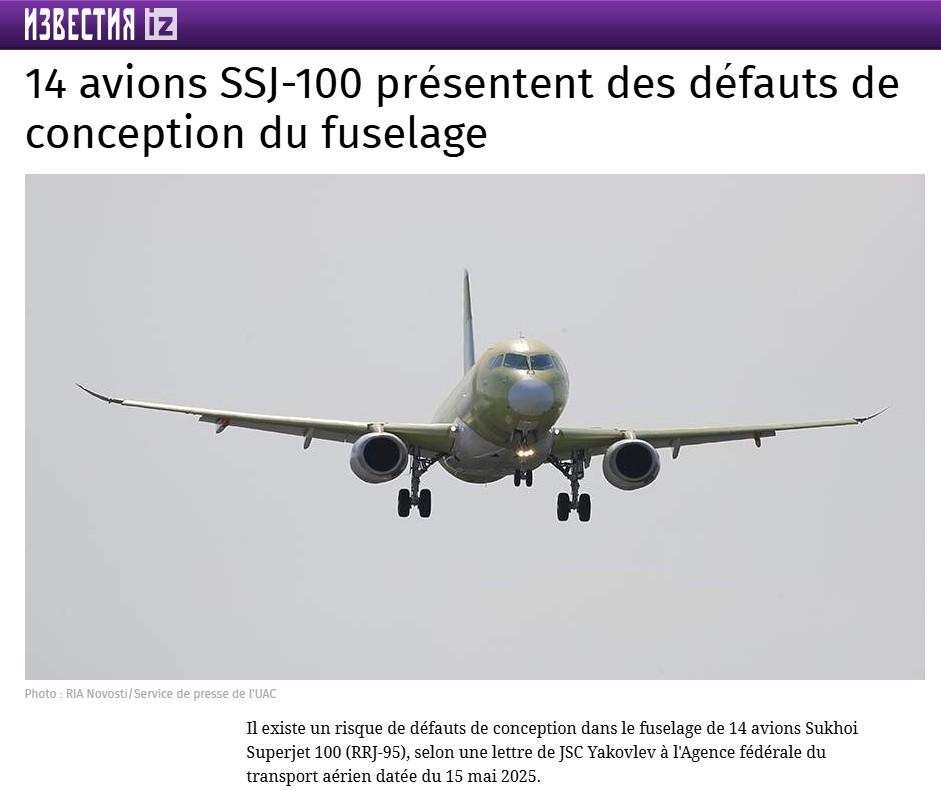
Un défaut de fuselage détecté sur 14 SSJ-100 fabriqués en 2016

Par : ActuStratpol — 26 août 2025 à 10:59

defauts fuselage

defauts fuselageIl existe un risque de défauts de conception dans le fuselage de 14 avions Sukhoi Superjet 100 (RRJ-95), selon une

L’article Un défaut de fuselage détecté sur 14 SSJ-100 fabriqués en 2016 est apparu en premier sur STRATPOL.

☐ ☆ ✇ Red Samovar

[Actu] Première sortie en mer pour l’Admiral Nakhimov (Projet 1144.2M)

Par : B.G — 21 août 2025 à 22:17
Première sortie en mer pour l'Admiral Nakhimov (Projet 1144.2M)
☐ ☆ ✇ Global South

Today in History: the CIA-MI6 Coup that Overthrew Iran’s Prime Minister

Par : amarynth — 20 août 2025 à 07:59

From TMJ News Network

“My greatest sin is that I nationalized Iran’s oil industry and discarded the system of political and economic exploitation by the world’s greatest empire. This came at the cost of myself and my family, and at the risk of losing my life, my honor, and my property. I am well aware that my fate must serve as an example for the future of the Middle East in breaking the chains of slavery and servitude to colonial interests.”
— Mohammad Mossadegh, during his trial in a military court on Dec. 19, 1953.

The Crime of Sovereignty

On the morning of Aug. 19, 1953, Tehran awoke to a city transformed by deception, chaos, and covert power. Prime Minister Mohammad Mossadegh, the man who had dared to reclaim Iran’s oil and assert its sovereignty, was toppled—not by his own people, but by a carefully engineered alliance of foreign intelligence and political manipulation.

The CIA and Britain’s MI6 staged a coup dressed in the rhetoric of anti-communism, concealing the true aim: to seize control of Iran’s wealth, reshape its politics, and preserve imperial dominance. What unfolded was a relentless campaign of influence and intimidation, striking at a nation’s independence while forging a resilience no foreign hand could extinguish.

Mossadegh’s nationalization of the Anglo-Iranian Oil Company (AIOC) was an act of reclamation: Iran asserting control over its resources and shaping its own course after decades of foreign exploitation. In response, Western powers reframed this as a threat—to British prestige, to U.S. strategic calculations, and to a global order defined by their interests.

What Mossadegh faced was not just opposition; it was an empire mobilized to punish independence.

The significance of 1953 extends far beyond Iran. It established a model for intervention that would repeat across continents and decades: elected leaders removed, economies sabotaged, and democracies subverted in the name of stability, freedom, or anti-communism.

From Guatemala to Chile, from the Congo to Indonesia, Mossadegh’s overthrow became the template of covert imperial action—a lesson in the fragility of sovereignty under the shadow of foreign power.

This account revisits the Abadan Crisis, the assertion of Iranian independence, the mechanics of Operation AJAX, and the enduring legacy of a leader whose tenacity continues to resonate.

It is a story of betrayal, resilience, and the relentless struggle for national self-determination—a struggle Iran continues to bear seventy-two years later, marked by both loss and the persistence of its resolve.

Historical Context & Lead-Up

Mohammad Mossadegh was born on June 16, 1882, into a prominent family in Tehran. His father, Mirza Hedayat Ashtiani, served as Iran’s Minister of Finance, and his mother, Najm al-Saltaneh, was closely related to the Qajar dynasty.

After his father’s death from cholera when Mossadegh was just 10, his mother instilled in him a profound sense of public service:

“A person’s worth in society is dependent on how much one endures for the sake of the people,” she told him, words that Mossadegh later said prepared him for a life of political struggle and personal sacrifice.

He received a rigorous education in Iran and abroad, studying law in France and later earning a doctorate from the University of Neuchatel in Switzerland. Despite chronic health issues, he built a career as a lawyer, parliamentarian, and minister, cultivating a reputation for integrity, nationalist conviction, and deep commitment to constitutional governance.

By the late 1940s, Mossadegh had emerged as a leading voice against foreign domination and corruption, advocating for the sovereignty of Iran’s resources and the principles of parliamentary democracy. His moral authority and nationalist credentials positioned him as the figure capable of challenging entrenched colonial interests.

By 1951, Mossadegh ascended to the premiership following widespread popular support and parliamentary victories by the National Front. One of his first and most consequential acts was the nationalization of the Anglo-Iranian Oil Company, which had long exploited Iran’s oil under extremely favorable terms for Britain, leaving Iranians with minimal benefit.

At the center of the dispute was Abadan, home to what was then the world’s largest oil refinery and the crown jewel of Britain’s petroleum empire. Britain’s loss of Abadan sparked what became known as the Abadan Crisis: a confrontation marked by sanctions, a naval blockade, and a global campaign to isolate Iran.

Defending the move before parliament, Mossadegh proclaimed, “This country’s resources belong to its people, not to foreign powers.”

Britain’s loss of Abadan delivered a severe blow to its imperial prestige and economic interests. As the crisis deepened, London escalated its response—pushing beyond economic sanctions and the naval blockade to covert measures aimed at toppling Mossadegh.

These early efforts, from backing rival political factions to stirring street unrest, faltered in the face of his enduring popularity, rooted in decades of public trust and a reputation for integrity and service.

Meanwhile, the United States initially watched cautiously. The Truman administration recognized the strategic importance of Iran’s oil but was reluctant to intervene directly. By 1952, with the Eisenhower administration poised for a more aggressive stance, American policymakers increasingly viewed Mossadegh through the prism of Cold War anxiety. British intelligence pressed the U.S. to act decisively, citing both economic and strategic imperatives.

Domestic politics further complicated the picture. Mossadegh’s broad popular support coexisted with internal divisions: monarchists loyal to the Shah—a secular elite with competing ambitions—as well as religious figures whose support could sway public sentiment.

The Tudeh Party, while significant, was never the principal threat Mossadegh’s opponents claimed, instead serving as a convenient pretext for framing oil nationalization as a step toward communist infiltration.

By early 1953, the stage was set for a decisive confrontation. British and American intelligence agencies coordinated a covert strategy to remove Mossadegh—Operation AJAX (TPAJAX). Far from a spontaneous uprising, the coup relied on carefully devised appearances of popular dissent to achieve its objectives.

Mossadegh’s rise, the nationalization of oil, and mounting foreign intervention created a volatile landscape in which Iran’s sovereignty and democracy faced unprecedented external and internal pressures.

Operation AJAX/Boot: Planning & Strategy

The opening months of 1953 saw the drive to remove Mohammad Mossadegh shift from mere discussion to execution. Britain, having exhausted economic and diplomatic avenues, leaned on the United States to intervene decisively.

The Eisenhower administration, prioritizing Cold War containment and strategic access to oil, empowered the CIA to orchestrate a covert operation in Iran. Britain initiated Operation Boot, and the CIA joined under the code name TPAJAX.

The coup was spearheaded by Kermit Roosevelt Jr., acting on behalf of the CIA in Iran, and Norman Darbyshire of MI6. Their mission: to undermine a widely supported government while avoiding open confrontation and keeping the population sufficiently pacified. Achieving this required a complex web of coordinated, interlocking strategies.

Mechanisms of Regime Change

The removal of Mohammad Mossadegh was meticulously schemed through a calculated fusion of political bribery, psychological warfare, street-level manipulation, and the legitimizing imprimatur of the monarchy.

CIA and MI6 operatives discreetly funneled substantial funds to key military officers and parliamentarians, securing their loyalty and ensuring the fracture of institutional allegiance. Compounding this, Mossadegh’s growing centralization of power had alienated certain segments of the clergy, undermining his broader domestic support.

Together, these pressures systematically eroded his political standing, creating precisely the vulnerabilities that the foreign-backed plot ultimately exploited.

At the same time, a painstakingly calculated propaganda offensive swept through newspapers and radio broadcasts, disseminating forged royal decrees and precautionary announcements of Mossadegh’s resignation, crafting the illusion of governmental collapse and inflaming fears of communist infiltration and economic disaster.

On Tehran’s streets, paid mobs and hired instigators clashed with Mossadegh’s supporters, their carefully staged skirmishes presented as spontaneous uprisings—a contrived spectacle designed to portray him as having lost command of the nation.

Adding to the pressure, the Shah—although initially hesitant—was compelled to sign decrees dismissing Mossadegh, enabling the coup’s architects to cloak their intervention in the veneer of internal legitimacy. What appeared as a constitutional and monarchical resolution masked the decisive hand of foreign planners, preserving the illusion of sovereignty while marshaling a profound political upheaval.

This intricate, multi-layered strategy revealed a sophisticated grasp of Iran’s volatile political terrain. Mossadegh’s deep-rooted popular support rendered a direct military seizure untenable, necessitating the fabrication of widespread dissent, the deployment of psychological manipulation, and the precise positioning of loyalist forces to fracture the government from within.

Operation AJAX and Boot exemplified the power of covert intervention to dismantle a leader who dared confront entrenched global interests, reshaping a nation’s political destiny under the guise of stability and anti-communist vigilance, leaving a legacy of subverted democracy and enduring geopolitical consequences.

The Blow-by-Blow of August 1953

August 15: Final Preparations and Rising Tensions

Roosevelt and his team executed the final preparations for the opening phase of Operation AJAX. Vast sums of cash flowed into the hands of pliant military officers and parliamentarians, while British intelligence cultivated alliances with tribal leaders, painting Mossadegh’s nationalist policies as existential threats to the nation’s stability.

Propaganda surged across media channels, depicting him as a force of chaos, a leader driving Iran toward disorder and collapse.

Undeterred, Mossadegh addressed the nation, appealing to the deep currents of Iranian nationalism and the enduring principles of constitutional democracy.

He navigated a treacherous domestic landscape—juggling competing political factions, societal tensions, and the looming shadow of foreign intervention—while standing firm against British sanctions and the tightening grip of a naval blockade.

August 16: Initial Attempt and Temporary Failure

The opening phase of the operation—anchored in the mobilization of malleable military officers and staged street demonstrations—collapsed almost immediately. The Shah’s hesitation to fully commit sowed confusion among the collaborators, while clashes between paid agitators and Mossadegh’s supporters failed to tip the scales in favor of the conspirators.

Loyalist forces swiftly reasserted control over critical positions, demonstrating not only the resilience of Mossadegh’s popular base but also the convoluted and unpredictable nature of Iran’s political landscape. The early failure exposed the limits of foreign maneuvering in the face of a leader whose legitimacy resonated deeply with his people.

August 17–18: Recalibration and Intensified Propaganda

The CIA and MI6 intensified their efforts, broadening networks of paid agitators while inundating Tehran’s media with fabricated reports and misleading narratives.

The Shah’s temporary departure from the capital heightened the sense of a power vacuum, fueling uncertainty and alarm throughout the city. Carefully nurtured rumors of widespread unrest were deployed to undermine confidence across all layers of Iranian society, making the government appear fragile and disoriented.

August 19: Final Push and Coup Success

Violent street clashes erupted across Tehran as military units loyal to the coup seized key government buildings and communications centers.

Roosevelt documented the decisive moment: “Royalist troops advanced under cover of chaos. The Shah signed the decree dismissing Mossadegh, which was immediately broadcast to the nation.”

By afternoon, Mossadegh had been arrested. His residence was ransacked and set ablaze, while his supporters faced imprisonment, torture, or execution. Western-backed authorities swiftly annulled the nationalization of Iranian oil, restoring foreign control and cementing Western dominance over the country’s strategic resources.

Politically, the coup solidified the Shah’s unchallenged authority, curtailed civil liberties, and inaugurated decades of authoritarian rule enforced through SAVAK.

Operation AJAX would henceforth stand as a standard for future U.S.-led covert interventions, illustrating how foreign powers could systematically undermine democratic institutions under the guise of safeguarding stability, combating communism, or protecting so-called national interests.

Aftermath & Consequences

The overthrow of Mohammad Mossadegh in August 1953 was far more than the removal of a prime minister—it marked a defining inflection point in Iran’s political and social trajectory, with aftershocks across the Middle East and the wider world.

The immediate shockwaves and enduring aftermath restructured Iran’s governance and its relations with the West, laying the groundwork for Cold War-era interventionist strategies.

Consolidation of the Shah’s Power

Following Mossadegh’s arrest, Mohammad Reza Pahlavi was restored to full authority, presiding over a monarchy that increasingly veered toward autocracy. Western political and financial backing emboldened the Shah, enabling the systematic dismantling of independent political parties, the suppression of press freedoms, and the silencing of dissent through intimidation and violence.

SAVAK, the Shah’s intelligence apparatus, became the central instrument of control, employing surveillance, coercion, and torture to eliminate opposition. Constitutional monarchy effectively gave way to centralized authoritarianism, hollowing out parliamentary oversight and civic participation.

Reversal of Oil Nationalization

Mossadegh’s crowning achievement—the nationalization of the Anglo-Iranian Oil Company (AIOC)—was swiftly undone. The 1954 consortium agreement restored foreign control over Iran’s oil, granting British and American firms substantial shares.

This reversal undermined the economic sovereignty that had galvanized national support for Mossadegh, revealing the strategic priority Western powers placed on resource control over self-determination.

Impact on Iranian Society and National Consciousness

The coup inflicted profound psychological and political trauma across Iranian society. For many, the violent removal of a democratically elected leader by foreign powers symbolized the betrayal of both democracy and national dignity.

While Mossadegh’s era did not directly give rise to the Islamic Revolution of 1979, his tenure remains a defining episode in Iran’s modern political history. The 1953 coup illustrated both the vulnerabilities of national sovereignty in the face of foreign intervention and the challenges of navigating domestic politics as a secular nationalist leader.

Mossadegh’s struggle over Iran’s oil, his commitment to constitutional governance, and the popular mobilization around his policies left an enduring imprint on the nation’s political consciousness, shaping the ways Iranians viewed external powers, civic engagement, and the stakes of self-determination—lessons that resounded long after his removal.

The Broader Middle Eastern Context

The repercussions of 1953 exposed the fragility of states attempting to assert independence over strategic resources, setting a pattern repeated in diverse forms—from coups to proxy conflicts—throughout the region.

Mossadegh’s removal became a precedent in the global playbook of imperial power, demonstrating how external forces could orchestrate domestic upheaval under the guise of legitimacy, leaving consequences that continue to shape political realities to this day.

Declassified Insights & Iranian Perspectives

Decades after the coup, the gradual release of declassified documents and memoirs illuminated the vast scale and meticulous planning behind Mossadegh’s removal.

These sources, coupled with Iranian firsthand accounts, reveal an operation engineered to appear internally driven while being decisively directed from abroad—an illusion that deepened the sense of national betrayal.

CIA and MI6 Records: Acknowledging Direct Involvement

Internal CIA histories, declassified in the 1970s and 2000s, openly acknowledge the agency’s decisive role in Operation AJAX.

A 1976 CIA internal history describes the operation as “a decisive intervention to protect Western interests in the region, involving covert funding, manipulation of political and religious figures, and orchestrated public demonstrations” [CIA, The Battle for Iran, 1976].

British archives similarly confirm MI6’s pivotal role, depicting the nationalization of Iranian oil not merely as an economic challenge but as a direct threat to Britain’s strategic influence.

A 1952 memorandum bluntly stated: “Removing Mossadegh is essential to protect our oil interests and maintain geopolitical advantage” [UK National Archives, MI6 Records on Iran, 1953]

Street-Level Manipulation and Media Control

Records show that the coup’s success hinged on shaping both the streets and the public narrative. Paid mobs clashed with Mossadegh’s supporters, while manipulated media—through newspapers and radio—pre-emptively announced his dismissal, exaggerated discontent, and spread disinformation. This coordinated psychological warfare eroded confidence in his leadership and paved the way for the Shah’s restoration.

Iranian Accounts: Shock, Betrayal, and Resistance

For many Iranians, the coup was a shock of historic proportions. Memoirs, interviews, and parliamentary records convey disbelief that a democratically elected leader could be toppled through foreign machinations.

Hossein Fatemi, Mossadegh’s foreign minister, expressed this sentiment before his execution in 1954: “We fought for our country’s freedom, yet were undone by foreign hands wielding money and deceit”
[Interview, The Iranian Revolution and Its Aftermath, 1980]

Oral histories recall Tehran’s streets engulfed in chaos, with ordinary citizens caught between rival factions manipulated by outside actors.

Scholarly Analysis and Contemporary Understanding

Historians such as Ervand Abrahamian and Mark Gasiorowski contend that the coup was less about combating communism than preserving imperial control and economic interests.

Abrahamian notes: “The overthrow of Mossadegh is not merely a chapter in Iranian history; it is a foundational event defining Iran’s complex, often antagonistic relationship with the West”
– Abrahamian, The Coup: 1953, CIA and Modern U.S.-Iranian Relations, 2013

Patterns of Imperial Intervention

This historical event in Iran stands as a seminal example of a persistent and global pattern of imperial interventionism, in which the United States, often in close coordination with allied powers, systematically destabilized or removed elected leaders who sought to assert control over national resources or political autonomy.

Mossadegh’s assertion of Iranian independence directly challenged entrenched foreign dominance and established a template for covert operations disguised as guardians of democracy—a pattern repeated with unsettling consistency in decades that followed.

Latin America: Guatemala and Chile

This pattern swiftly extended across continents. In Guatemala, the 1954 CIA-backed coup dismantled the government of President Jacobo Árbenz, whose ambitious land reforms threatened the holdings of the U.S.-based United Fruit Company. Justified publicly under the banner of anti-communism, the intervention secured the continuity of external control over Guatemalan agriculture and reinforced U.S. influence in Central America.

Similarly, Chile’s socialist government under Salvador Allende faced persistent covert sabotage and the systematic funding of opposition forces, culminating in a military coup that installed Augusto Pinochet.

Anti-communism was the stated rationale, yet the underlying objective was unmistakable: to guarantee Western access to critical resources and enforce political compliance through strategic, often violent, manipulation.

Africa and Southeast Asia: Congo, Indonesia and Libya

Comparable intrusions unfolded in Africa and Southeast Asia, illustrating the global reach of these interventionist strategies. In the Democratic Republic of Congo, Prime Minister Patrice Lumumba’s efforts to assert national control over mineral wealth provoked orchestrated action by U.S. and Belgian actors, culminating in his execution.

In Indonesia, President Sukarno was methodically undermined by U.S.-backed military factions in 1965, leading to mass killings and the installation of Suharto’s authoritarian regime.

Even decades later, in Libya, foreign-backed regime change in 2011—framed as civilian protection—left the nation fractured under competing armed groups, echoing the destabilization first witnessed in Iran.

Syria: The Modern Reflection of Intervention

Syria, in recent years, has come to embody the persistent legacy of this pattern.

In December 2024, President Bashar al-Assad—who had maintained a secular government committed to safeguarding Syrian sovereignty under immense regional and Western pressure—was forcibly removed from power. Violent militants, led by Hay’at Tahrir al-Sham (HTS) under Ahmad al-Sharaa, also known as Abu Muhammad al-Julani, seized control of Damascus, driving Assad into exile in Russia.

The irony is stark: al-Julani, once denounced by Western powers as a terrorist, had been strategically cultivated and manipulated as an instrument of regime change, demonstrating the calculated exploitation of local actors to advance foreign objectives.

In the wake of Assad’s ouster, HTS installed a transitional government under interim president al-Julani. Yet the nascent administration struggled to assert authority or maintain order.

By mid-2025, escalating sectarian violence between Druze militias and Sunni Bedouin factions had exacted a devastating toll—thousands killed, entire communities uprooted, and hundreds of thousands displaced amid an intensifying humanitarian catastrophe.

The resulting turmoil underscores, with brutal clarity, the human cost of foreign intervention, particularly when local proxies are empowered in the absence of genuine governance structures or institutional legitimacy.

The Paradox of Rhetoric Versus Reality

Across Iran, Guatemala, Chile, Congo, Indonesia, Libya, and Syria, a common paradox emerges: the rhetoric of democracy, stability, and human rights frequently belied the reality of resource extraction, geopolitical manipulation, and strategic domination.

Nations striving for independence and control over their resources repeatedly confronted covert warfare, propaganda, economic sabotage, and orchestrated coups, all concocted from abroad.

Mossadegh’s overthrow, in this broader context, is not an isolated incident but the opening chapter in a global saga of interventionism whose consequences ring across generations.

The strategic calculus remains consistent: imperial powers advance their interests under the guise of benevolence, often at profound human cost, systematically undermining political autonomy and long-term stability in the nations they target.

The Precedent of Defiance

The overthrow of Mohammad Mossadegh was never merely the removal of a leader; it was a global message delivered in the language of power: sovereignty carries a price, and those who insist upon it risk the full machinery of empire.

Mossadegh’s audacity—to nationalize Iran’s oil, to reclaim control over the nation’s wealth, to confront entrenched Western interests—was met with clandestine violence, subterfuge, and betrayal.

1953 did not stumble into history; it carved a template for empire in motion. The orchestration of coups, the use of proxies, the manipulation of domestic factions, and the justification of intervention under the guise of democracy became a blueprint repeated across continents and decades.

Iran experienced this lesson in the most visceral terms: external powers respect only compliance, not conscience; profit, not principle.

The ripples of this historical event continue to shape Iranian policy and national psychology. From the Cold War to sanctions, from covert operations to diplomatic isolation, the memory of Mossadegh’s overthrow informs every calculation.

Iran’s modern posture—skeptical of Western promises, vigilant against foreign interference, unyielding in defense of national assets—is rooted not in ideology alone but in the scars carved by decades of foreign ambition and the betrayals of manipulated allies.

Yet the shadow of 1953 is not only one of subjugation; it is also a testament to resilience. The lesson was brutal but unequivocal: freedom is fragile, and sovereignty is never given. It must be claimed, defended, and defended again.

Iran’s repeated confrontations with the entrenched machinery of foreign intervention—in diplomacy, finance, and covert operations—have shaped a nation that remains steadfast, alert, and unwilling to compromise to this day.

Seventy-two years on, the shadow of the coup still looms. Tehran bears the memory, while Washington, London, and every capital that once believed it could bend Iran to its will now reckon with a nation that refuses to yield. The lessons of this historic episode resonate in Iran’s politics, its posture, and its people.

A nation’s sovereignty, once trampled, does not vanish. It strikes, it survives, and it declares that those carved by empire will never forfeit their dignity without defiance.


References

  1. Mossadegh.com. (n.d.). Biography of Mohammad Mossadegh. Retrieved from http://www.mossadegh.com/biography
  2. Encyclopedia Britannica. (2023). 1953 coup in Iran. Retrieved from https://www.britannica.com/event/1953-coup-in-Iran
  3. History.com Editors. (2022). CIA-assisted coup overthrows government of Iran. History.com. Retrieved from https://www.history.com/this-day-in-history/cia-assisted-coup-overthrows-government-of-iran
  4. CIA Reading Room. (1953). The Central Intelligence Agency and the Fall of Iranian Prime Minister Mohammed Mossadegh. Retrieved from https://www.cia.gov/readingroom/docs/the%20central%20intelligence%20%5B15369853%5D.pdf
  5. The National Security Archive. (2013). CIA Confirms Role in 1953 Iran Coup. Retrieved from https://nsarchive2.gwu.edu/NSAEBB/NSAEBB435/
  6. History Today. (2015). Iran, Britain and Operation Boot. Retrieved from https://www.historytoday.com/daniel-wb-lomas/iran-britain-and-operation-boot
  7. PBS LearningMedia. (2020). Operation Ajax: The Plot to Overthrow Iranian Prime Minister Mossadegh. Retrieved from https://klrn.pbslearningmedia.org/resource/amex34th-soc-operationajax/operation-ajax-the-plot-to-overthrow-iranian-prime-minister-mossadegh-taken-hostage/
  8. The Guardian. (2023). ‘Written out of the history books’: the British spy who planned the Iranian coup. Retrieved from https://www.theguardian.com/world/2023/aug/15/written-out-the-history-books-the-british-spy-who-planned-the-iranian-coup
  9. The Washington Post. (2025). The U.S. helped oust Iran’s government in 1953. Here’s what happened. Retrieved from https://www.washingtonpost.com/history/2025/06/19/iran-coup-1953-us-role/
  10. CIA. (1976). The Battle for Iran: Internal CIA History on Operation AJAX. Retrieved from https://www.cia.gov/readingroom/docs/CIA-RDP80R01723R000100120007-7.pdf
  11. UK National Archives. (1953). MI6 Records on Iran: Operation Boot and the Overthrow of Mossadegh. Kew, London.
  12. Fatemi, H. (1980). Interview in The Iranian Revolution and Its Aftermath. Tehran: Iranian Oral History Project.
  13. Abrahamian, E. (2013). The Coup: 1953, CIA and Modern U.S.-Iranian Relations. New York: Cambridge University Press.
  14. Gasiorowski, M. (1991). U.S. Foreign Policy and the Shah: The 1953 Coup in Iran Reconsidered. International Journal of Middle East Studies, 23(3), 361–386.
  15. Kinzer, S. (2003). All the Shah’s Men: An American Coup and the Roots of Middle East Terror. Hoboken: John Wiley & Sons.
  16. Kinzer, S. (2006). Overthrow: America’s Century of Regime Change from Hawaii to Iraq. New York: Times Books.
  17. Gleijeses, P. (1991). Shattered Hope: The Guatemalan Revolution and the United States, 1944–1954. Princeton: Princeton University Press.
  18. Kornbluh, P. (2003). The Pinochet File: A Declassified Dossier on Atrocity and Accountability. New York: The New Press.
  19. Nzongola-Ntalaja, G. (2002). The Congo: From Leopold to Kabila – A People’s History. London: Zed Books.
  20. Cribb, R. (1990). The Indonesian Killings of 1965–1966: Studies from Java and Bali. Clayton: Monash University Centre of Southeast Asian Studies.
  21. Vandewalle, D. (2012). A History of Modern Libya. Cambridge: Cambridge University Press.
  22. Phillips, C. (2016). The Battle for Syria: International Rivalry in the New Middle East. New Haven: Yale University Press.
☐ ☆ ✇ Global South

On this day, in 1945 …

Par : amarynth — 9 août 2025 à 16:21
USSR enters the war against militaristic Japan


On August 9, 1945, the Soviet Union entered the war against militarist Japan in keeping with its obligations to its Allies in the anti-Hitler coalition. That marked the beginning of the Manchurian Strategic Offensive Operation of the Soviet troops in the Far East.

During the Great Patriotic War, Japan refrained from openly attacking the USSR on the side of Germany, but Tokyo systematically violated its obligations to observe neutrality under the April 13, 1941 bilateral agreement. Japan pursued an aggressive policy against our country, carrying out subversive acts and frequent provocations, while also sharing its intelligence with Berlin on the economic and military capabilities of the USSR in its Far East and Siberia.

After Germany’s treacherous attack on the Soviet Union, Japan became a real danger to our country, which could face a war on two fronts. By the end of 1941, the formations of the Kwantung Army, a Japanese strategic group based in Manchuria near the Soviet border, numbered over 700,000 people. With that force, Japan was ready to invade the Soviet Far East at any moment. The Japanese military command had a plan codenamed Kantokuen for an invasion and occupation of the Russian Far East, including the city of Vladivostok, the northern part of Sakhalin, and Eastern Siberia up to Lake Baikal after eliminating Soviet units in Primorye, the Amur Region, and Trans-Baikal territory. Tokyo planned to incorporate these territories into the so-called Greater East Asia Co-Prosperity Sphere. The Kwantung Army was only waiting for a favourable moment to invade.

As a precaution, the General Headquarters of the Supreme Command had to keep significant forces and resources in the region for almost the entire war – from 32 to 59 ground forces divisions, from 10 to 29 air force divisions, and up to six air defence divisions and four air defence brigades with personnel exceeding 1 million people. That capacity could have been used on the Soviet-German front if it had not been tied down in the Far East by Japan.

When the German Instrument of Surrender ended World War II in Europe, militarist Japan remained the last stronghold of the Axis in the Asia-Pacific region. Under its occupation were Korea, Indochina, Indonesia, Malaya, parts of China, Burma and the Philippine Islands. By the summer of 1945, the Japanese had built 17 fortified defensive areas along the Soviet and Mongolian borders. The Kwantung Army – the main threat to the Soviet Far Eastern borders – had reached about 900,000 people by that time.

Earlier, at the Tehran Conference of the leaders of the three Allied Powers in 1943, the Soviet Union responded to a request from Washington and London agreeing to enter the war against Japan once Germany was defeated, for the sake of ending World War II as soon as possible. This pledge was reaffirmed at the Yalta and Potsdam conferences in 1945. In order to neutralise the Japanese threat in the Far East and in pursuance of the agreements reached with the Allies, on June 28, 1945, the Supreme Command General Headquarters approved a plan for war with Japan.

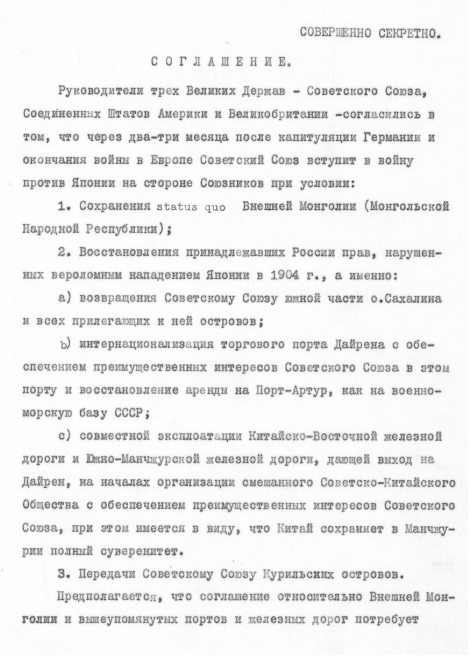
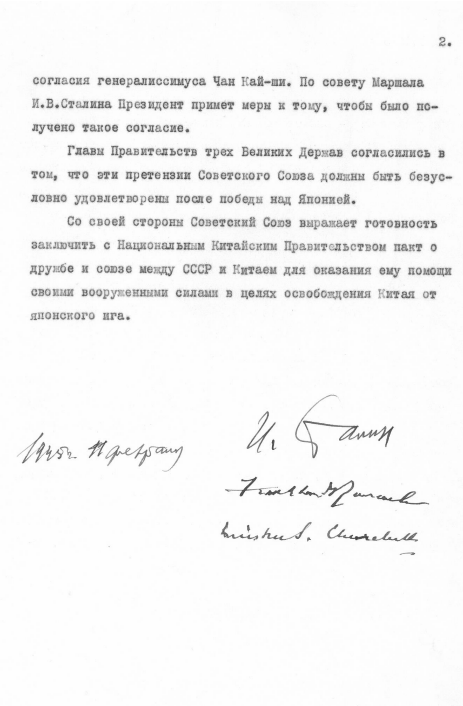
The Far East Agreements signed during the Yalta Conference. February 11, 1945. Russian Foreign Policy Archives

The plan envisioned a strategic offensive operation in Manchuria with a view to defeating the Japanese Kwantung Army deployed there and the troops of the puppet state of Manchukuo, and on Southern Sakhalin, as well as returning the Kuril Islands and capturing a number of ports in Korea which were under the control of the Japanese occupation authorities.

The Far Eastern campaign involved the forces of several army groups – the Transbaikal Front led by Marshal of the Soviet Union Rodion Malinovsky, the 1st Far Eastern Front commanded by Marshal of the Soviet Union Kirill Meretskov and the 2nd Far Eastern Front under Army General Maxim Purkayev, as well as the Pacific Fleet (Admiral Ivan Yumashev), the Amur Military Flotilla, and the Northern Pacific Military Flotilla. The Soviet forces were joined by units of the Mongolian People’s Revolutionary Army. The total strength of the Soviet strike group exceeded 1.6 million people, with about 30,000 guns and mortars, 5,250 tanks and self-propelled guns, 5,200 aircraft, and 93 warships of the main classes. The campaign was coordinated by the Chief Command of the Soviet Forces for the Far East, a dedicated command unit created by the General Headquarters and led by Marshal of the Soviet Union Alexander Vasilevsky.

The plan envisioned a strategic offensive operation in Manchuria with a view to defeating the Japanese Kwantung Army deployed there and the troops of the puppet state of Manchukuo, and on Southern Sakhalin, as well as returning the Kuril Islands and capturing a number of ports in Korea which were under the control of the Japanese occupation authorities.

The Far Eastern campaign involved the forces of several army groups – the Transbaikal Front led by Marshal of the Soviet Union Rodion Malinovsky, the 1st Far Eastern Front commanded by Marshal of the Soviet Union Kirill Meretskov and the 2nd Far Eastern Front under Army General Maxim Purkayev, as well as the Pacific Fleet (Admiral Ivan Yumashev), the Amur Military Flotilla, the Northern Pacific Military Flotilla. The Soviet forces were joined by units of the Mongolian People’s Revolutionary Army. The total strength of the Soviet strike group exceeded 1.6 million people, with about 30,000 guns and mortars, 5,250 tanks and self-propelled guns, 5,200 aircraft, and 93 warships of the main classes. The campaign was coordinated by the Chief Command of the Soviet Forces for the Far East, a dedicated command unit created by the General Headquarters and led by Marshal of the Soviet Union Alexander Vasilevsky.

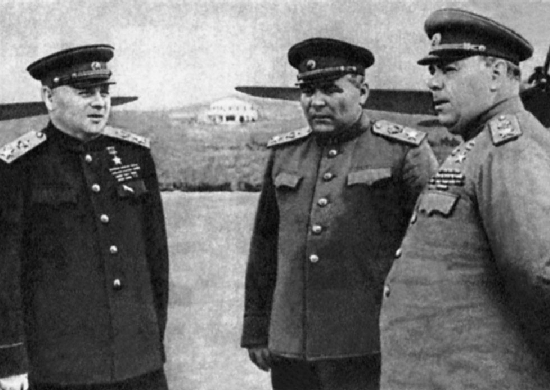
From left: Commander of the 1st Far Eastern Front Kirill Meretskov, Commander of the Transbaikal Front Rodion Malinovsky and Commander-in-Chief of the Soviet Forces in the Far East Alexander Vasilevsky. August 1945


On August 9, the Soviet troops launched the offensive. The Far Eastern campaign included three parts: the Manchurian Strategic Offensive Operation, the South Sakhalin Operation and the Kuril Airborne Operation. The goal of the operation was to defeat the Kwantung Army in the shortest possible time, liberate northeast China and [what later became] North Korea from the Japanese occupiers.

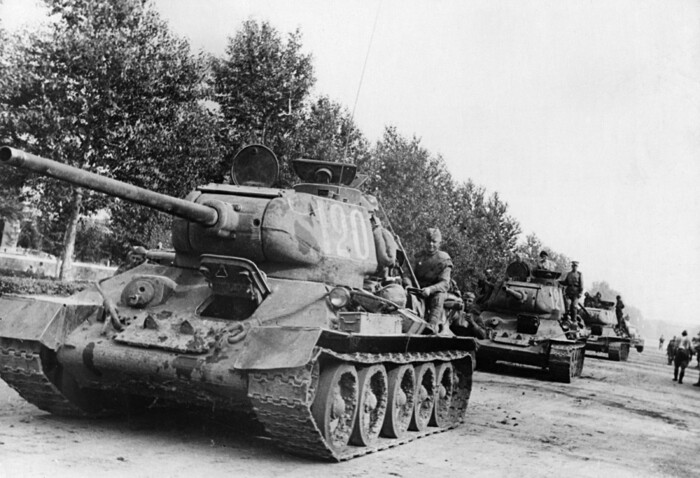
A column of T-34-85 tanks of one of the 2nd Far Eastern Front units in Manchuria. August 1945

The Soviet advance was fast and vehement. Fierce fighting unfolded along a frontline of over 5,000 kilometres, resulting in the Soviet troops liberating Harbin, northeast China and North Korea from the Japanese invaders and capturing South Sakhalin and the Kuril Islands.

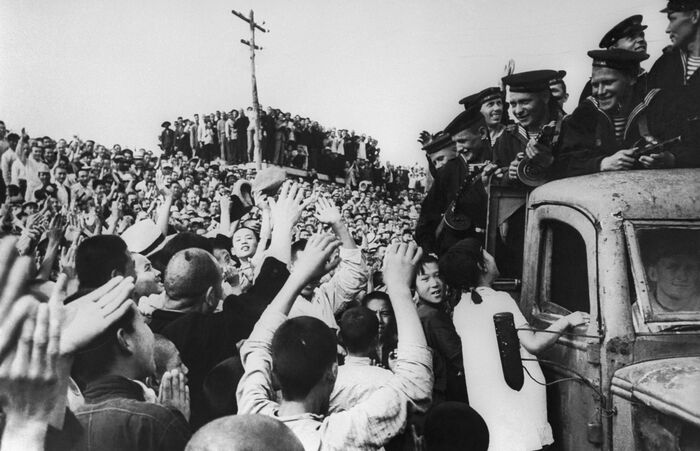
Residents of Harbin greet sailors of the Amur Military Flotilla. September 2, 1945.


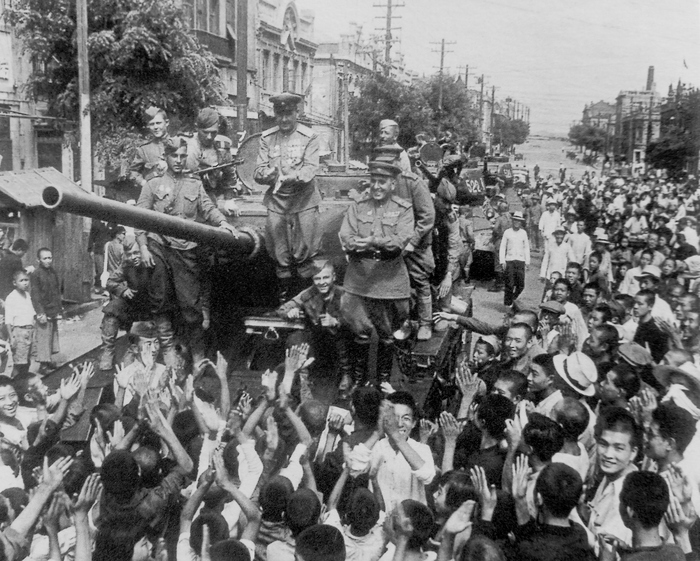
People of Dalian (Dalniy, China) greet tankers of the 7th Mechanised Corps of the 6th Guards Tank Army. August 24, 1945.

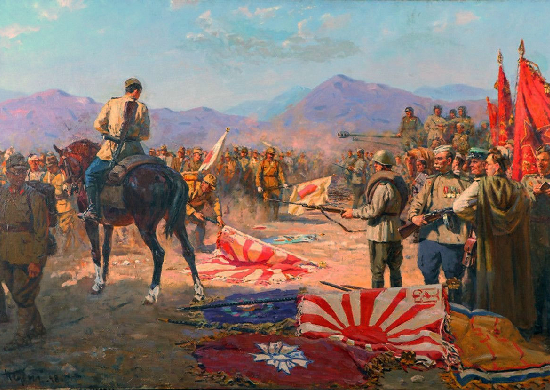
Japan’s ability to continue to resist was undermined. Enemy troops surrendered almost everywhere. On August 18, the Japanese command gave the order to cease military operations on the continent. One million-strong Kwantung Army was destroyed.

Capitulation of the Kwantung Army. Artist Pavel Sudakov

By September 1, 1945, the Soviet troops completed all their combat missions. Over 23 days of combat, they crushed the Japanese military machine and thus made a decisive contribution to end World War II in the Far East. Our country returned the southern part of Sakhalin, which Japan had seized from the Russian Empire in 1905, occupied the Kuril Islands, and once again took over the Kwantung Leased Territory, including Port Arthur and Dalniy.

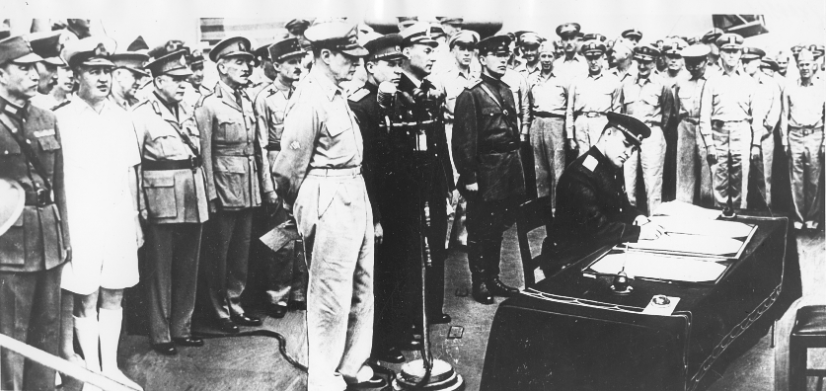
On September 2, 1945, the Japanese Instrument of Surrender was signed on board of USS Missouri in Tokyo Bay. Lieutenant General Kuzma Derevyanko signed it on behalf of the Soviet Union. This signaled the end of World War II.

Lieutenant General Kuzma Derevyanko is signing the Japanese Instrument of Surrender on behalf of the USSR, September 2, 1945. Russian Foreign Policy Archives.
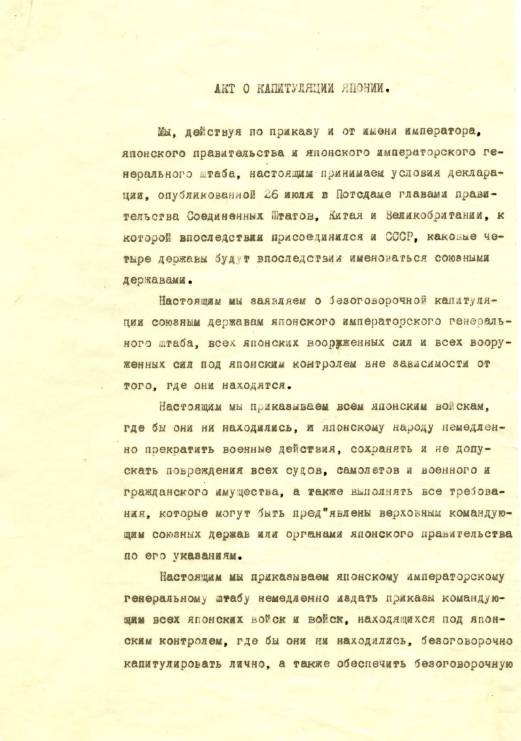
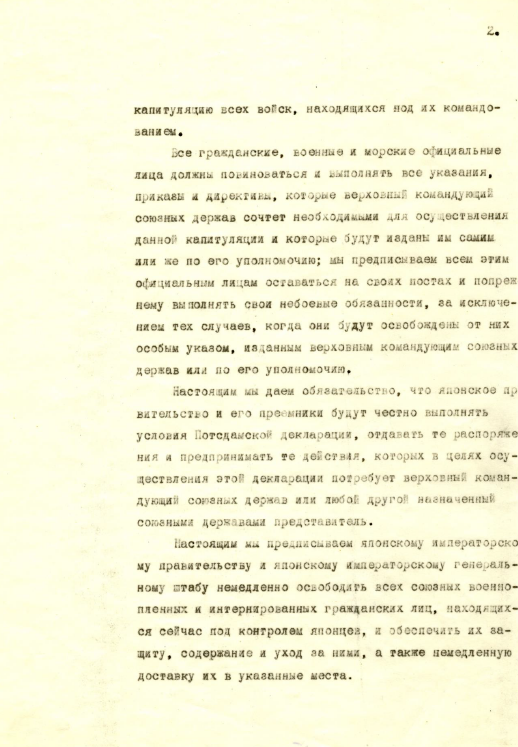
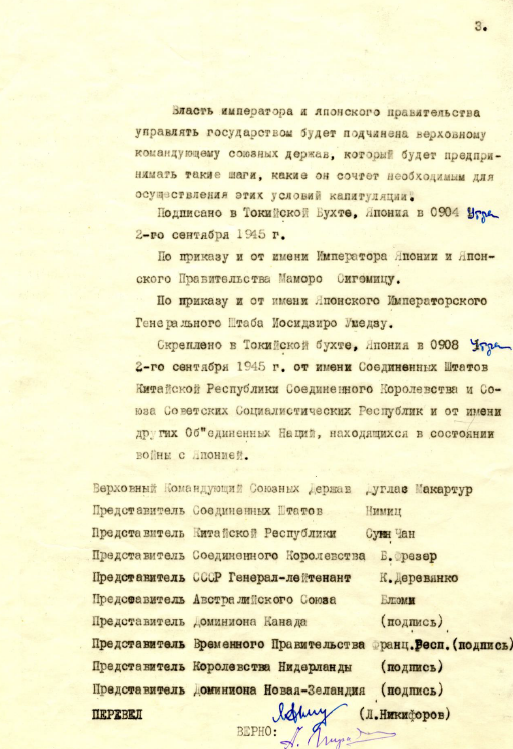
The Japanese Instrument of Surrender, September 2, 1945. Russian Foreign Policy Archives

On September 2, the USSR Supreme Soviet Presidium issued an executive order, On Declaring September 3, 1945 the Day of Victory over Japan. In accordance with the Federal Law of the Russian Federation No. 32-FZ On the Days of Military Glory and Memorable Dates of Russia, dated March 13, 1995 and amended in 2020, September 3 is observed as a Day of Military Glory in Russia.

For military exploits in the war against Japan, 308,000 Soviet soldiers and officers received orders and medals. The title of Hero of the Soviet Union was awarded to 93 people, to six of them twice. More than 300 formations and military units of the army and navy received military awards, and 25 of them were awarded the honorary Guards designation.

☐ ☆ ✇ Red Samovar

[Actu] La composante stratégique sous-marine russe: état des lieux

Par : B.G — 8 août 2025 à 18:57
La composante stratégique sous-marine russe: état des lieux.
☐ ☆ ✇ Vu du Droit

LA « GUERRE DE 12 JOURS », ET APRÈS ?

Par : Régis de Castelnau — 9 juillet 2025 à 09:53
LE CONFLIT MONDIAL, VIDÉO N° 96 LA « GUERRE DE 12 JOURS », ET APRÈS ? Régis de Castelnau & Édouard Husson SOMMAIRE : I) Bilan de la « guerre de 12 jours ». Qui a gagné, qui a perdu… Lire la suite →
☐ ☆ ✇ Vu du Droit

Après la confrontation, vers un nouveau Moyen-orient ?

Par : Régis de Castelnau — 6 juillet 2025 à 08:31
En suite de l’article que j’ai publié sur Substack le 29 juin dernier, et intitulé : « défaites d’Israël : en Palestine il n’y aura pas de Mandela ». J’ai poursuivi cette réflexion sur la chaîne « Espoir et dignité »… Lire la suite →
☐ ☆ ✇ Global South

“Phony War” in the Middle East: Some Conclusions

Par : amarynth — 24 juin 2025 à 19:09

Elena Panina (Telegram)

The 12-day “phony war” between Israel and Iran seems to be over. Despite its brevity, it certainly deserves some conclusions.

▪ First of all, the fact that news has ceased to be information has been confirmed once again. They were propaganda tools for each side, aimed at their own audiences. Iran broadcast the idea of ​​unity, Israel – military successes, the US – the world’s policeman, solving all issues by force.

Before the US entered the war, it was a fight of equals. Israel, having launched its aggression in spectacular fashion, found itself in a situation where its enemy did not surrender, but responded. For the first time since the Gulf War, the Jewish state found itself the target of large-scale retaliatory strikes. The situation quickly became critical, as Netanyahu’s desperate appeals to the Iranians and then to the US showed.

Another rather unexpected conclusion is that Israel itself turned out to be a tool wielded by the United States . Before this, the dominant view among experts was that there was an all-powerful Israeli lobby that invisibly controlled American policy. In reality, we saw a classic master-slave scheme. When Tel Aviv’s military expectations failed, it needed Washington’s intervention.

▪ Trump’s actions were predictably determined by the domestic political situation in the United States. And the conflict, apparently, became a certain bifurcation point. Not only Trump’s political opponents opposed the US entry into the war, but also his supporters showed a noticeable rejection of the situation. In general, the owner of the White House managed to suppress discontent and confirm his leadership in the party and society. But it seems that the famous American pendulum of political sympathies has begun to move in the opposite direction . And although Trump’s electorate is satisfied that America participated in the war minimally, and pretends to agree with the loud statements of its leader about victory, it simultaneously comes to the conclusion that the US president is increasingly becoming part of the system that he criticized. Whether this is true or not, the midterm elections to Congress will show.

Another extremely disturbing conclusion: all participants in the conflict erroneously assessed the situation in a state of crisis, the position of the parties, their intentions. This is surprising, because it was in the United States that the methods of assessment and action in conditions of interstate crises were developed. The old truth is confirmed: successes relax and lead to mistakes. We must keep such inadequacy in assessing the situation on the part of Washington in mind, since we will have to deal with this.

▪ The main result for Iran is that it survived the acute phase of the confrontation. Israel and the United States seriously counted on almost an uprising in the country and the collapse of the state after the airstrikes. Instead, Iranian society united in the face of aggression. A war began against Iran, and its population realized that if the country falls, trouble will come to every home, as it did to its neighbors.

However, the cessation of hostilities will only briefly push aside the threat of a color revolution in Iran. The initial euphoria from the cessation of shelling, presented by the Iranian media as a victory, will not last long. If Tehran confirms in one form or another its renunciation of the nuclear program, then the opposition will have a reason to accuse the ayatollah regime of weakness. Which is what we already see from the Sunday statement of the acting president of the exiled opposition group “National Council of Resistance of Iran” Maryam Rajavi: “Now Khamenei must go.” “No appeasement, no war – yes to regime change, that is, the replacement of the religious dictatorship by the Iranian people and the Iranian Resistance. Forward to a free Iran and a democratic non-nuclear republic with the separation of religion and state and gender equality!” – Rajavi said.

Of course, the IRGC and Khamenei will throw all their forces into maintaining power. All criticism will be suppressed. But what if discontent begins to take the form of a Western-backed conspiracy? In any case, only internal destabilization can destroy Iran, and this is what the US and Israel will now throw all their forces at . NATO countries will undoubtedly support these efforts. All the West’s energy will be directed toward fomenting civil war in Iran with the aim of its subsequent territorial dismemberment.

▪ So, without having brought the matter to a decisive victory, Iran found itself on the threshold of entering an era of strategic instability. But does this mean that it is doomed to de-sovereignization and turning into another failed state like Iraq or Libya? Not at all. First of all, because the fall of Iran fundamentally contradicts the national interests of the two key powers of Eurasia – Russia and China.

The consequences of Iran’s destabilization have long been calculated, here are just a few of them. Active Western sabotage in Central Asia will immediately begin. Russia will finally lose all of Transcaucasia. Turkish dominance in the region will sharply increase. All projects within the framework of the North-South and One Belt, One Road transport corridors will be crossed out. The Caspian Sea will cease to be a “lake of peace”, and Western military bases will appear on its shores. But most importantly, the destructive penetration of chaos metastases into Russia (North Caucasus and Volga region) and China (Xinjiang Uyghur Autonomous Region) will begin.

This scenario can only be prevented through joint efforts within the framework of cooperation along the Russia-Iran-China-DPRK line – if, of course, Tehran is ready to do so, having drawn the right conclusions from what happened.

Too much is at stake to allow our common geopolitical adversary to start knocking out one link after another in the great Eurasian link.

☐ ☆ ✇ Global South

Israel ‘disappeared’ nearly 400,000 Palestinians in Gaza

Par : amarynth — 24 juin 2025 à 17:44

Prof Marandi states: Netanyahu lost the war. Period.

The world must keep its focus on the ongoing #GazaHolocaust.
—

That is wise council and let us do that as a new report is out from Harvard. You may remember the previous report from the Lancet. We need to very quickly get our attention on the whole war. While shooting between Iran and Israel has declined to a trickle, although the fingers are on the trigger, Gaza is still being massacred and so is the West Bank. Israel still shoots and raids into Lebanon as they choose. Syria has turned into a cesspit of violence. The war against Russia is still being fed so that it does not stop raging. In reality, nothing has changed and the plan toward regime change is still in full swing.

What has changed and it is enormous, is that one of our Global South countries showed a willingness and ability to fight. Thank-you Iran! Thank-you supporters of Iran! Despite criticism, you have stepped into the shoes of a leader for the Global South. You’ve given us hope, a stronger resolve and a knowledge that we are not helpless.

The Cradle has the details:

A new report published by the Harvard database reveals that Israel has “disappeared” at least 377,000 Palestinians since the start of its genocidal campaign against the Gaza Strip in 2023.

Half of this number is believed to be Palestinian children.

The report was written by Israeli professor Yaakov Garb, who used data-driven analysis and spatial mapping to show how the Israeli army’s siege of Gaza and indiscriminate attacks on civilians in the enclave have led to a serious drop in its population.

The 377,000 Palestinians who are unaccounted for due to Israel’s genocide are approximately 17 percent of the Gaza Strip’s entire population, which now stands at about 1.85 million. Prior to the war in Gaza, the strip’s population was estimated at 2.227 million.

While some are displaced or missing, a significant number are believed to have been killed by Israeli forces, according to the report.

The professor notes that the official death toll of 61,000 is clearly an underestimate, as victims who remain trapped under rubble are not included.

Garb also condemned in the report the Gaza Humanitarian Foundation (GHF) – a controversial US-Israeli aid distribution mechanism launched last month.

“These aid compounds seem to reflect a logic of control, not assistance, and it would be a misnomer to call them ‘humanitarian aid distribution hubs’. They do not adhere to humanitarian principles, and much of their design and operation is guided by other objectives, which undermine their declared purpose,” he said.

The UN has accused GHF of being designed to further the forced displacement. Since it began operations, GHF has led to the deaths of hundreds of Palestinian aid seekers by Israeli forces.

The Harvard report is not the first indication that the death toll in Gaza could, in fact, be significantly higher than reported.

The Lancet medical journal released a study in January this year revealing that the death toll from Israel’s genocide in Gaza was most likely undercounted by 41 percent in the first nine months of the war.

The January study highlighted that around 59.1 percent of those killed were women, children, and elderly.

The year before, in July 2024, The Lancet said Israel’s assault on Gaza could lead to between 149,000 and 598,000 dead, disappeared, gone.

☐ ☆ ✇ Vu du Droit

18 juin 1940 : un homme seul devant un océan

Par : Régis de Castelnau — 19 juin 2025 à 09:24
Le 11 juin 1940 le gouvernement français qui avait quitté Paris se réunissait à Tours et recevait la visite de Winston Churchill Premier ministre britannique depuis le 10 mai précédent. Qui voulait tout faire pour que la France reste dans… Lire la suite →
☐ ☆ ✇ Vu du Droit

30 avril 1975 : la grande leçon d’un grand peuple

Par : Régis de Castelnau — 30 avril 2025 à 06:00
Tous les 30 avril, je revois cette séquence des chars de l’Armée Populaire du Vietnam renversant les grilles du palais présidentiel de Saïgon. Mettant un terme à une guerre de libération de 30 ans où un petit peuple d’Asie avait… Lire la suite →
☐ ☆ ✇ Global South

China Steps Up Its Game in the Global AI Race

Par : AHH — 29 avril 2025 à 18:00

Huawei chips are already the real deal for every Chinese company which is following the new Beijing-defined direction to reduce any reliance on American technology

By Pepe Escobar at Sputnik.

Late next month, Huawei will be testing its new powerful AI processor, the Ascend 910 D, even as by early May the previous 910C will start to be mass-delivered to scores of Chinese tech companies.

These serious breakthroughs are the next chapter of Huawei’s drive to counter Nvidia’s global monopoly in graphics processing units [GPUs]. The Ascend 910D is supposed to be more powerful than Nvidia’s extremely popular H100.

Huawei is pulling no punches in its race to manufacture a new generation of processors. Huawei has collaborated with SMIC – China’s largest semiconductor foundry – to apply Deep Ultraviolet Lithography (DUV) on what was previously only possible on EUV (Extreme Ultra-Violet technology). Once again, Huawei and SMIC defied the proverbial American “experts” with creative engineering solutions.

Huawei arrived at fabricating 5nm chips with DUV even as the process is more expensive than with EUV. If Huawei had access to EUV they would be already manufacturing 2-3nm chips. That will come, in short time, as both China and Russia, under permanent US high-tech blockade, must by all means develop their own EUV technology.

Shanghai geeks are convinced that Huawei will switch on 6G networks before the end of the decade. Their current breathless drive is not just aimed at the smartphone front – where Huawei is peerless; the new Huawei Mate 70 Pro + is by far the absolute top smartphone in the world, running on Harmony OS. Huawei is looking at cloud computing, AI and enterprise servers – and to become no less than the core player in the AI infrastructure race.


Ditching Any Reliance on American Technology

Earlier this month, Huawei introduced the CloudMatrix 384, a system connecting 384 Ascend 910C chips. The tech word in Shanghai is that this configuration, under certain conditions, and of course consuming much more power, already outperforms Nvidia’s flagship rack system – which is powered by 72 Blackwell chips.

Meanwhile, Huawei’s Kirin X chip is targeting the PC market, offering stiff competition to Apple, AMD, Intel and Qualcom while Harmony OS plus removes the necessity of using US software such as Microsoft and Android.

Shanghai geeks swear that China essentially doesn’t need to beat Nvidia or other US chips developers. After all, China already has the largest consumer market in the world – by volume and by value. If a parallel tech universe is the likely result of the Trump Tariff Tizzy (TTT), so be it. China already controls over 60% of the global gadget consumer market.

Kirin X may not – yet – match the power of Nvidia’s H100 GPUs. But Huawei chips are already the real deal for every Chinese company which is following the new Beijing-defined direction to reduce any reliance on American technology.

All of the above naturally brings us to the enormous AI elephant in the (digital) room: Nvidia.

A recent book, The Thinking Machine: Jensen Huang, Nvidia, and The World’s Most Coveted Microchip, is quite helpful to track not only the personal story of CEO superstar Huang, a Taiwanese who played the American Dream to the hilt and became a tech multi-billionaire, but Nvidia’s enviable tech accomplishments.

Huang does not interpret AI as emergent machine superintelligence, and firmly dismisses any direct analogy to biology. For this all-round pragmatist, AI is merely software – running on hardware that his company sells for a fortune.

Still, Nvidia has ventured into virgin territory way beyond the American biz-tech Valhalla, complete with holding the most valuable stock on the planet: arguably, when it comes to AI, Nvidia unveiled a new phase of evolution.

It’s crucial to understand how Huang sees China. It is indeed a key market for his AI chips – and he wants to keep selling them in droves. Trump’s tariffs though make sure that won’t happen.

And that’s what moved Huang to ditch his proverbial leather jackets and don a crisp business suit for a strategic visit to Beijing, where he affirmed the sacred importance of the Chinese market, whatever the new Trump-dictated gimmicks.

By 2022, the China market represented 26% of Nvidia’s business; this year, it has fallen to 13%, because of euphemistic “technology export controls”.

The problem is the US government, already by 2022, under the previous automatic pen administration, had blocked sales to China of advanced A100 and H100 chips. Nvidia started selling modified versions – and even after the ban chips continued to arrive in China. By June 2023, it was easy to find A100s for double their price in the black market in Shenzhen.

Huang is convinced that “no AI should be able to learn without a human in the loop” – even as he admitted, two years ago, that “reasoning capability is two or three years out”. Translation: according to Huang AI will start thinking for itself within the next few months.

Even as Nvidia prepares to invest billions of dollars to build AI supercomputers in Texas, the Chinese essentially are not losing any sleep on “thinking AI”: their focus is extremely practical, to conquer not only the Chinese market but also the supply chains of most of Eurasia.

The US National Security Council has concluded that it’s too dangerous for China to buy Nvidia’s high-end chips, even the H20 – designed for the Chinese market. Huawei, anyway, already produces chips somewhat comparable to the H20.

Huang is losing his sleep because, essentially, Nvidia is losing the immense Chinese market to Huawei – with Trump’s direct input. Nvidia has tens of thousands of H20s specially designed for China which they simply cannot sell. Each chip cost between $12,000 to $20,000.


How China Is Opening a Digital “Pandora’s Box”

Huawei’s new drive is yet another example of Chinese will capable of staring down any challenge – based on indigenous talent, tech expertise and national pride. The record, even before Trump 1.0 sanctions, shows that Huawei does eat massive uphill battles for breakfast. In fact Ascend in many aspects was ahead of Nvidia as early as in 2019 – and that’s why two different US administrations banned it.

China is already light years ahead of the US on chip research. Chinese universities amass most places in the global Top Ten for published papers on semiconductors and on citations – a distinction shared, among others, by the Chinese Academy of Sciences (number one), Tsinghua University (one of China’s top two universities), the University of Electronic Science and Technology of China (number four), and Nanjing, Zhejiang and Pekin Universities.

Two weeks ago in Shanghai I first heard that Huawei would catch up with US semiconductor giants in maximum two years. Now, after the announcement of the Ascend 910D, the buzz shifted to only one year for China to overtake Nvidia and develop better lithography machines than the ones currently produced by ASML.

And the debate is fast switching to how far Huawei will be able to go within the next 2 to 3 years.

In several aspects we are already in the early stages of a US-China tech decoupling. For years Nvidia has dominated the AI hardware space. Their GPUs are the brains behind most contemporary advanced AI. The H100 chip is the gold/platinum standard for AI infrastructure worldwide. Nvidia’s chips had huge demand from Chinese tech giants – Alibaba, Tencent, Baidu, Bytedance.

Soon that may not be the case – and that goes way beyond Nvidia’s certified loss of market share in China. China is now all out focused on building a successful, self-sufficient AI hardware ecosystem. The coup de grace will be to restrict the export of all rare earth minerals to the US. Huaweii then will pull up in no time.

Everyone remembers how DeepSeek R1 wiped out over $1 trillion from Wall Street only three months ago. DeepSeek R2 will be released soon; training was a whopping 97% cheaper than OpenAI.

And training happened on Huawei’s Ascend. No Nvidia.

Quantum Bird, a world-class physicist formerly with the CERN in Geneva, puts everything in much needed context. He stresses how indigenous chip development by China – and in a near future, Russia and probably India – is “multi-faceted; what we are observing are the initial stages of a redefinition of the notion of recognizing patterns and machine learning, technologies that are popularly referred to as ‘AI’ by the media.”

Nvidia chips, Qantum Bird remarks, are indeed “computational beasts”, but they work better around “processing models and workloads typical of ‘AI’ models developed by Western scientists.” DeepSeek’s development, on the other hand, showed a transgression of established models: “The possibilities opened for performance leaps are huge, even using relatively modest hardware, with alternative approaches based on advanced math and different calculus flows.”

In a nutshell: “This is the Pandora’s box that Nvidia now fears the Chinese may have opened”. And that totally ties in with Huang’s red alert, prompting his visit to Beijing.

We may be heading indeed towards a serious tech decoupling. Or as Quantum Bird frames it: “A technological and scientific divergence medium and long-term. If the architectures that emerge from these developments are incompatible when it comes to their usage on specific ‘AI’ models, Nvidia will lose its global monopoly and will become just a company reduced to a corporate/scientific Western niche.”

Even as Huawei, from its privileged base in the Chinese market, will go on to win most markets across the Global Majority – from BRICS to BRI.

☐ ☆ ✇ Global South

Mission to Moscow (1943 film about Joseph E. Davies’ visit to Russia as US Ambassador to the Soviet Union)

Par : amarynth — 6 avril 2025 à 15:34

Eric Arnow, our Bumble Buddist from the China Writer’s Group presents a movie.  It is perfect day today, to take in some history and step outside of Tariffs (so much noise, so little substance), and current wars.

A little about Eric:  “I trained as a Zen monk and continue practicing Zen and Buddhism. I’m interested in peace, health and advancing human well being and consciousness. I write about meditation, finding our True Nature, geopolitics and history, and health.”

Know your history. This film, made in 1943 is based on the book by Joseph E. Davies, Wall Street lawyer, whom FDR sent to Russia, the Soviet Union, to find out the real truth of what the Soviet Union was, and why it was so important to understand and appreciate it. I highly recommend this accurate historical film, told by a real American, to the American people.

Here is his opening statement, spoken by the author himself:

When I was your ambassador in Russia, I little expected to write Mission to Moscow, much less to see it projected on screen. But when Germany attacked Russia, the Soviet Union became one of the nations fighting Hitler, and it was a desperate hour. If Hitler were to destroy the Red Armies, and to smash the Soviet Union, the three aggressor nations [Germany, Italy, Japan] would dominate Europe, Asia, and Africa.

The riches of these three continents, and the enslaved labor of three quarters of the population of the world, would be harnessed to conquer the rest of the earth. The Americas would be next, us. Unity among the forces fighting Hitler was vital.

Nothing as I saw it was more important than that the fighting nations should understand and trust each other. There was so much prejudice and misunderstanding of the Soviet Union, in which I partly shared, that I felt it was my duty to tell the truth about the Soviet Union as I saw it, for such value as it might have.

What makes this film so remarkable is that it foreshadows many of the very same issues facing the world today. Just as back then, there is so much prejudice against Russia now. The tragedy is that the USA and Europe forgot the lessons of the past, and allowed the same prejudices to come back. And the same kind of forces that threaten world peace today. Basically, people in the West have got the story backwards.

So in order to begin to bring people back to reality, this film addresses many of the lies spread about the USSR, just as lies are spread about Russia (as well as other countries that are falsely accused, and made into adversaries.)

Some key points:

Need for Objective Information

FDR invites his friend from their college days, who is now a highly successful lawyer and business man to be Ambassador to Russia. He wanted an objective viewpoint, which he knew he could get from his friend.

Invasion of Ethiopia by Italy in 1936

There is a scene at the League of Nations, created after WWI, to solve international problems. The Emperor of Ethiopia addressed the assembly over Italy’s brazen invasion of his country, and asked for the League and its nations for their support. Nobody helped (think NATO in Yugoslavia, Libya, Iraq. Think Israel in Palestine).

Russia Asks for Collective Security in 1936, and Ever Since the Fall of the USSR

He’s followed by the Soviet Ambassador to the League, who pleads for collective security.

My comment: It is striking to me, that Russia has been emphasizing the idea of collective security after the fall of the USSR. Russia asked to join NATO with that end in mind, and was rebuffed.

Since 1991, Russia has been surrounded by more and more countries which were by agreement with the West, never intended to be part of NATO. As then, Russia’s numerous requests for collective security were rebuffed most notably in December 2021. That, plus the massive shelling and impending attack by the Kiev regime on its eastern area of Donbass were the direct precursor to Russia preempting that attack in February, 2022.

Creeping Fascism

Following the 2014 Coup initiated by the United States in Ukraine, racist fascist ideology came back to Ukraine….and the US has supported it. Trump supplied the regime with weapons. So did Biden. The arming of Ukraine, the overthrow of its democratically elected president on full display.

The takeover of Germany by Hitler and Italy by Mussolini were also backed by US financial backing, aka meddling. Hitler himself had many American friends.

Germany then:

Ukraine Now.

And now we have this:

This is the guy who said, “We’ll coup whoever we want to”.

Davies went to Berlin first, to recommend general disarmament, and was rebuffed. From 1991 on until 2022, Russia continuously proposed collective security that favored no country over another, and was rebuffed.

Davies’ Next Stop: Moscow

At the train station, Davies’ porter sees a woman at the head of the train. He asked where is the engineer for the train, and he learned that the woman is the engineer. Soviet women were given equal rights with men 40 years ahead of the Women’s Liberation Movement of the 1970s.

He has a cordial meeting with the Russian President, which is more ceremonial. He expresses his admiration for FDR, which showed up in subsequent negotiations between the US and the USSR. Davies asks, what if war should come? And the President replies, “We will defend ourselves, we will be ready”.

He then visits the British Embassy, where he meets the Polish Ambassador, who says, “We have a saying, ‘a Russian is merely an unfinished Pole”. So Poland’s attitude towards modern day Russia is not surprising.

Sabotage

Even an American factory manager warned Davies that, contrary to American claims of Russia paranoia, there was widespread evidence of deliberate sabotage.

Next Scene: Some Familiar Names Even Today

The next scene shows Davies visiting an important mining area, the Donbass. This area is central to the current war in Ukraine. Donbass has been an integral part of first the USSR and of Russia. Also mentioned as part of the Soviet Union were the cities of Kharkov and Odessa. These names are prominent nowadays. These were then and are still, culturally, Russian cities.

Profit Sharing As a Natural Form of Incentives

Long before American workers participated in profit sharing, Soviet factory workers shared in profits above the planned amount.

“The Valley of the Dniepr River Is One of the Most Fertile Districts in the World”

And in modern Ukraine, it’s being sold off, privatized by US Corporations. This is another bone of contention, a consequence of the US coup in 2014.

Davies Meets Two High Soviet Officials

He noted that he was impressed that, despite some mistakes, Davies recognized the speed at which industrialization was taking place. He also observed that the factories did not seem permanently situation. “I could think of no other period in history where so much has been done in so short a time”. However his Soviet hosts told him that the reason for the moveability of the factories was due to the fact that they might have to be moved.

In fact, when the Nazis invaded, Russia rapidly removed and relocated the factories out of reach of enemy forces.

Diplomatic Digs

At a formal diplomatic ball, a Japanese official, probably the Ambassador, asks the daughter of the Soviet ambassador to the League of Nations, Litvinov about her activities and she says that she practices parachuting. The Japanese, fishing for intelligence, asks how many are involved in that. Ms. Litvinova says she doesn’t know and asks the Japanese what kinds of sports they engage in.

He says they do different sports. To which Litvinova gives a little cut. She notes she has seen pictures of what ‘sports’ the Japanese were engaging in, in China. She’s referring to mass atrocities, such as the slaughter in the Chinese city of Nanjing. China suffered at least 20 million dead following Japan’s invasion of China in the 1930s-until the Chinese finally defeated Japan, along with Russia’s crushing of the Japanese army in Manchuria.

The American people knew about that during WWII, but it’s long been forgotten by Americans, who can’t understand why China does not appreciate foreign armies and navies off of China’s coast.

Molotov Warns Davies

There are uncomfortable parallels between Nazi expansionism in the 1930’s and NATO expansionism, especially after the Soviet Union ended. See my notations [in brackets.]

The Soviet offical says to Davies:

We in Russia have learned to judge our neighbors by what they do, and not by what their representatives say.

And what is happening in the world today? Not a very pleasant prospect, Mr. Davies. One nation [Italy under Mussolini] has already invaded another without provocation or excuse, and contrary to its legal obligations. Still another aggressor [Germany] is attempting to overthrow the legal government of its neighbor [Spain] by sending men and equipment to support the revolt.

The little nations, in 1938, Austria, Czechoslavakia [in 2025 Libya, Yugoslavia, Syria, Palestine?] tremble, trying to walk the tight rope between the great powers. Their only defense is to utter helplessness. But whom can they trust? On whom can they depend?

It’s the devil’s gamble. So they smile on everyone and hope for the best. The weaker the country, the stronger the smile. But what about the great powers who could oppose aggression? Instead of standing together, they make deals with the enemy.

So, in 1938, France and the UK made a deal with Hitler, the Munich Agreement, and let Germany take Czechoslavakia. It’s even worse now, with the US supplying Israel in its wars against Palestine, Lebanon, Syria. And possibly Iran.

He further points out how countries are subverted from the inside. Back in 1936, the Nazi fascists said, “We have four columns in front of Madrid, and a fifth column inside the city”. So it is especially ironic that the US and EU supported a fifth column in Ukraine.

Sabotage: An Important Factory in the Defense Complex Was Blown Up

A series of such explosions indicate a concerted effort to undermine the Russian economy. The scene then shifts to a series of Soviet officials being arrested.

The Purges: A Key Factor in the Anti Soviet Narrative

Following the arrest of some officials, whom Ambassador Davies had known personally, the world is outraged at their arrest. The Moscow Trials were a major factor in how the anti Soviet narrative came about. It was assumed in the US media that the Soviet Union was simply brutal and unjust. However Davies determined, based on his attendance at the trial, that they were justly accused of betraying their country.

This is a key factor making this film so important. A trustworthy US official showed that the Soviet leadership had good reason to believe that the Soviet Union was being undermined by the two Fascist powers, Germany and Japan. Again, the parallels between then and now, with the numerous color revolutions and psychological and information warfare actions against Russia should be obvious.

War Clouds Gather

Following the trials, Davies visits several capitals to assess the situation. His question: What are the intentions of Germany’s Hitler and Italy’s Mussolini? He gets mixed answers from officials in Poland, Austria, Netherlands, Yugoslavia.

But when he returns to Moscow, the Chinese ambassador visits him and takes him to a hospital, where victims of Japan’s invasion of China are being treated.

A Soviet doctor says,

Those who work to save people cannot keep up with those with the power to destroy

And so it was that the United States, China, and the Soviet Union allied to stop Japanese aggression in China and in Asia. In the end, the Soviet army and China inflicted defeat on Japan in China. Much of the war was in China.

However, despite the massive defeat of Japan’s army in Manchuria, the Japanese chose to surrender to the Americans, presumably because the Americans promised to preserve the Japanese Emperor, which the Soviets probably would not have done.

The Farewell Dinner

In the farewell dinner, Premier Molotov and Ambassador Davies had the following exchange:

Litvinov: The pleasure of having you here tonight is marred only by the fact that this is a farewell dinner. You, Mr. Ambassador, have done what no other foreign diplomat has been known to do in this country. You have done your best to understand our country.

What is going on here, the motives behind our doings, and the aims in front of them. If you will, as I’m sure you will, pass on the results of your observation and unbiased judgment to your government and to your country, you will contribute more to the friendly relations between our two countries than any other diplomat in the history of the Soviet Union.

Davies:

You have commented on the sympathy and understanding which exists between your country and mine. I believe that is preeminently true. It is my belief that both peoples are seeking to improve the lot of the common man. That is the end to which we are striving.

Our methods are different. We believe that ours are the best, but we concede that you have the right to maintain that yours are the best. I came here with an objective mind. I’m leaving with an objective mind, possibly less objective and more friendly, because of the kindnesses that you and your government have extended to me as a representative of my country.

In conclusion, I would like to say to everyone here that I’m going to miss you very much. And I hope to see you many times again, wherever our paths may cross, I’m sure that my American staff will want to join me in raising our glasses to you,

Mr. Litvinov, to your associates, and to the traditional friendship of the peoples of our two countries.

Reality Sets in: Hitler invades Austria

The Austrian foreign minister had told Davies that he trusted Hitler and didn’t think he would invade. But as the farewell dinner ends, Litvinov gets a message about Hitler acquiring Austria under German control.

The Final Meeting: Davies Meets Stalin

Stalin warns Davies that England and France will probably not protect Czechoslavkia, in which case, Stalin told him that Collective Security is the only thing that can save Europe from a major war. Absent that, the Soviet Union would have to find its own way to protect itself. In fact, he said that England wanted Germany to fight Russia, and when both were exhausted, England would come in to pick up the pieces.

My comment: It’s ironic that Russia, following the end of the Soviet Union, and specifically under Putin, have urged again and again, for a collective security agreement. Only to be constantly rebuffed, starting with the betrayal of the 1990 promise not to expand NATO, if Germany reunited and joined NATO.

This scene predicts the Molotov-Ribbentrop pact, which Russia knew would only buy time before the German invasion of Russia.

Tellingly, Stalin also said that the governments of the West were acting contrary to the interests of their own people because they were encouraging war.

My comment: It’s highly ironic that in the current war in Ukraine, again, it is England and France (and Germany) who are encouraging a war against Russia, and again, contrary to the interests of their own people.

Sure Enough, Hitler Invades Poland: WWII Begins

On Davies’ return to Washington, he tries in vain to get the Congress to promise aid to any country attacked by Hitler. But Congress refuses. And sure enough, Hitler invades Poland. Again, Davies steps in. He convinces FDR that the Soviet army will win, if given help.

There’s no doubt in my mind that the Red Army has a good chance of beating Hitler. If only more of our people realize that. There’s been so much prejudice stirred up about the Soviet Union that the public hasn’t been given a chance to know the truth.

Mr. President, a few years ago, you called me into this room and gave me a job. It was a bigger job than I thought at the time, and I don’t think it’s finished yet. I’d like to lay those ghosts that our fascist propagandists are brewing up about Russia and tell the people of this country a few facts.

Well guess what, nothing has changed. It’s time to tell the people in the year 2025 in this country a few facts.

An Exhortation to the Present

Davies continued to exhort the people not to heed the propaganda against Russia. Unfortunately, times have changed and the forces in the West who supported, or acquiesced to it, have become dominant. The movie ends with this statement:

…we pledge to work for a new world with justice and equality for all, to restore the dignity of man as an individual and not as a slave to any state or master, so that you, to whom the great future belongs, shall be able to reply as we have not to the old angry cry of Cain, am I my brother’s keeper?

With the answer, yes, you are….Yes, you are.

You are your brother’s keeper.

Conclusion

Yesterday, at the market, I met an old man. He was born in India, before the British divided it, separating him into Pakistan. He asked me where I am from, and I said, America.

He replied, “Ah America….I remember John F. Kennedy, he wanted peace, but since his death, America has been at war, always. Why?…why can’t America be friends with other countries?” He understands Russia’s position, which has not changed since it fought fascism in WWII. It’s us who changed.

This movie will I hope change your mind about Russia…before it’s too late and the war to end all wars, nuclear war, is brought about.

☐ ☆ ✇ Red Samovar

[Actu] Lancement du sous-marin nucléaire Perm (Pr.885M Yasen-M)

Par : B.G — 4 avril 2025 à 18:17
Lancement du sous-marin Perm (Pr.885M Yasen-M)
☐ ☆ ✇ Red Samovar

[Actu] Clap de fin pour les MiG-21 croates

Par : B.G — 27 mars 2025 à 16:43
Fin de carrière pour les derniers MiG-21 européens
☐ ☆ ✇ Vu du Droit

11 novembre : Sébastien Lecornu et ses mauvais combats

Par : Régis de Castelnau — 11 novembre 2024 à 11:37
Sébastien Lecornu ministre de la Défense des gouvernements macronistes et confirmé à ce poste dans le gouvernement minoritaire de Michel Barnier fait parler les morts et veut enrôler tous ceux qui se sont sacrifiés pour la défense de la patrie… Lire la suite →
☐ ☆ ✇ Vu du Droit

Algérie et Israël, d’un 1er novembre à l’autre

Par : Régis de Castelnau — 1 novembre 2024 à 12:42
Le 1er novembre 1954, il y a exactement 70 ans, une organisation inconnue jusque là, déclenchait une série d’opérations terroristes sur l’ensemble du territoire algérien, colonie de la France depuis 124 ans. Les populations qui habitaient ce territoire devenu colonie… Lire la suite →
☐ ☆ ✇ Vu du Droit

CARTOUCHE VUDUDROIT N°41

Par : Régis de Castelnau — 10 octobre 2024 à 11:11
CARTOUCHE VUDUDROIT N°41   SOMMAIRE : Hollande limace politique nationale 0:47 Aurore Bergé en mode Calimero 3:51 LFI assurance vie du système ? 7: 20 Marine Le pen inéligible ? 14:24 État de droit ou état du droit ? 29:06… Lire la suite →
☐ ☆ ✇ Vu du Droit

Article 16, quand Macron se voit en Cincinnatus

Par : Régis de Castelnau — 20 juin 2024 à 08:39
Macron n’a aucune limite. Mesurant après sa déroute électorale aux élections européennes transformées en référendum anti-Macron, et la pitoyable manœuvre de la dissolution qu’il reprend comme un boomerang dans la figure, le voilà qui se voit en dictateur romain. Les… Lire la suite →
☐ ☆ ✇ Vu du Droit

CONFLIT MONDIAL VIDEO N°81

Par : Régis de Castelnau — 5 avril 2024 à 08:38
LES ÉCLAIRAGES DE VUDUDROIT LE CONFLIT MONDIAL VIDÉO NUMÉRO 81 Régis de Castelnau SOMMAIRE : I) Situation sur le front. Grande offensive de printemps, ou pas ? Régler le problème ou poursuivre l’attrition. Les Russes font-ils « durer le plaisir… Lire la suite →
☐ ☆ ✇ Red Samovar

[Actu] Le Tupolev Tu-160M(2)

Par : B.G — 30 mars 2024 à 15:50
Le Tupolev Tu-160M(2)
☐ ☆ ✇ Red Samovar

[Actu] Fin des essais étatiques du 2S35 Koalitsiya-SV

Par : B.G — 20 novembre 2023 à 12:08
Fin des essais étatiques du 2S35 Koalitsiya-SV
☐ ☆ ✇ Vu du Droit

GUERRE EN UKRAINE & AU MOYEN ORIENT VIDÉO N° 61

Par : Régis de Castelnau — 22 octobre 2023 à 16:47
Comme un empire devenu fou, l’Occident continue résolument sa marche au désastre. Il est dirigé par une momie sénile et bredouillante qui se pense le maître du monde, croit présider la plus grande puissance de tous les temps, et vient… Continue Reading →
☐ ☆ ✇ Vu du Droit

Un monde qui change : vidéo N°1. Où va l’Amérique latine ?

Par : Régis de Castelnau — 3 octobre 2023 à 17:52
La chaîne YouTube, Vu Du Droit, a décidé de créer une nouvelle émission. À côté du magazine hebdomadaire concernant la dimension stratégique et militaire du conflit sur le territoire ukrainien, nous publierons avec une périodicité… variable, de grands entretiens, destinés… Continue Reading →
☐ ☆ ✇ Vu du Droit

Mémoire du 11 septembre 1973

Par : Régis de Castelnau — 11 septembre 2023 à 13:42
Je n’oublierai jamais lorsqu’allumant la radio le 11 septembre 1973, il y a donc exactement 50 ans, j’apprenais le coup d’État au Chili et la mort de Salvador Allende. Ce fut un événement fondateur. D’abord, celui des abominables années de… Continue Reading →
☐ ☆ ✇ Vu du Droit

Guerre en Ukraine : un peu de lecture avant le visionnage de la vidéo 51

Par : Régis de Castelnau — 19 août 2023 à 10:20
Pour accompagner cette 51e vidéo consacrée à la guerre mondiale hybride qui se déroule depuis un an et demi, quelques petits conseils de lecture. En effet, dans ces vidéos nous nous efforçons de coller au plus près des événements qui… Continue Reading →
☐ ☆ ✇ Red Samovar

[Actu] Le 2S43 Malva: n’est pas CAESAR qui veut

Par : B.G — 9 juin 2023 à 13:19
[Actu] Le 2S43 Malva: n'est pas CAESAR qui veut
☐ ☆ ✇ Vu du Droit

Russie Occident, l’autre guerre de 100 ans (troisième partie)

Par : Daniel Arnaud — 31 mai 2023 à 10:44
Dans la seconde partie nous décrivions les phases de la guerre de 100 ans russo-occidentale, et montrions comment elles s’enchainent pour  mener l’occident à « l’âge de la déraison » dans lequel il se débat aujourd’hui. Nous re-définissions ensuite le conflit entre… Continue Reading →
☐ ☆ ✇ Vu du Droit

Russie Occident, l’autre guerre de 100 ans (deuxième partie)

Par : Daniel Arnaud — 23 mai 2023 à 17:05
Dans la première partie, nous proposions d’envisager le conflit entre la Russie et l’Ukraine, dans la perspective historique élargie d’une guerre de 100 ans opposant, depuis 1917, la Russie et l’occident. Nous suggérions aussi que le conflit idéologique entre propriété… Continue Reading →
☐ ☆ ✇ Vu du Droit

Russie Occident, l’autre guerre de 100 ans (première partie)

Par : Daniel Arnaud — 20 mai 2023 à 10:38
Daniel Arnaud est un auteur français résidant en Russie à Saint-Pétersbourg. Il nous a proposé une étude assez fouillée de la situation actuelle placer dans une perspective historique plus large. Nous publions aujourd’hui la première partie de son texte. Publication… Continue Reading →
☐ ☆ ✇ Vu du Droit

Fraude électorale : Emmanuel Macron peut tout se permettre

Par : Régis de Castelnau — 7 avril 2023 à 09:46
On sait bien qu’au printemps 2017, la magistrature a mis en œuvre une opération judiciaire destinée à disqualifier politiquement le candidat de droite pourtant favori du scrutin présidentiel. Dernière partie de l’opération concoctée par la haute fonction publique et soutenue… Continue Reading →
☐ ☆ ✇ Red Samovar

[Analyse] La fin des chars de combat T-72 en Europe

Par : B.G — 24 février 2023 à 20:47
La fin du T-72 en Europe.
☐ ☆ ✇ Red Samovar

[Actu] Premier vol du Tu-160M2 (bis repetita?)

Par : B.G — 15 janvier 2022 à 18:20
Premier vol du Tu-160M2 (bis repetita?)
☐ ☆ ✇ Red Samovar

[Analyse] La flotte hauturière russe, des évolutions positives?

Par : B.G — 27 décembre 2021 à 23:45
La flotte hauturière russe, des évolutions positives?
☐ ☆ ✇ Red Samovar

[Actu] L’INS Chakra (II)

Par : B.G — 27 novembre 2021 à 20:30
L'INS Chakra (II)
☐ ☆ ✇ Vu du Droit

Guerre en Ukraine : vidéo N° 19

Par : Régis de Castelnau — 11 décembre 2022 à 12:50
La situation continue à se dégrader en Ukraine. Les différents refus des négociations imposés à Zelensky par les occidentaux, les mensonges dont l’Occident abreuve les ukrainiens, la corruption massive qui fait que l’argent et les armes déversés sur le pays… Continue Reading →
☐ ☆ ✇ Vu du Droit

Guerre en Ukraine : vidéo N° 13

Par : Régis de Castelnau — 22 octobre 2022 à 12:05
Concernant notre rendez-vous hebdomadaire, nous avons changé notre fusil d’épaule. Sylvain Ferreira étant l’invité de TVL qui a réalisé une longue interview sur la guerre en Ukraine, nous n’avons pas souhaité faire un doublon. Par conséquent nous avons publié hier… Continue Reading →
❌