 Connexion


Jeff J. Brown writing for Sputnik
Svetlana Ekimenko
The 2025 National Security Strategy (NSS) may look softer on paper, recasting China from a “threat” into a “near-peer competitor” with seeming potential to “reshape” US-China relations, Dr. John Gong, economics professor at the University of International Business and Economics in Beijing, tells Sputnik.
The wording in the new US NSS is just a thin veneer of peaceful “palliatives,” China expert Jeff J. Brown tells Sputnik.
In reality, US allies “Japan, Taiwan, Philippines and Australia, are being armed for confrontation, and a hot war is still likely in the next 2-3 years,” says Brown, who is also founder of Seek Truth From Facts Foundation.
Washington “still flogs the Asian Quad – “obviously structured to counter China militarily,” he notes, adding that the NSS:
Australia, Taiwan, Japan and South Korea urged to “spend more on arms to ‘deter adversaries’ “which are obviously China, DPRK and Russia”
US tariffs also remain in force.
‘Behind-The-Scene Rogue Actors’
The CIA, US Departments of War and State, US Legislature, and Israel’s Mossad don’t want to relinquish the profits generated by forever wars, noted the expert.
These Western deep state actors learned a long time ago to ignore or sabotage any directives that threaten their filthy lucre,” he says.
No Shift in West’s Power Pyramid
The US plans to keep its allies buying its weapons to “contain China,” believes Brown. US “fealty” to the West’s war machine has been bought by billionaire donors who “don’t get richer with peace.”
Since 1963 and the presidency of John F. Kennedy, “no US president has been free to be ‘presidential’ in their governance, like Putin and Xi are,” he remarks.
Since 1963 and the presidency of John F. Kennedy, “no US president has been free to be ‘presidential’ in their governance, like Putin and Xi are,” he remarks.
As far as China is concerned, it will likely “play to Trump’s megalomania,” while quietly prepping for a potential hot war,” concludes Brown.
Original Q&A with Sputnik
1 Do you think the new strategy changes the US policy towards China? If yes, how? Is it possible that it is paving the way for some new steps from the US?
No, not really. While congratulating himself as the greatest peacemaker since Jesus Christ and pro-offering a few palliatives about the necessity of avoiding war with China, Trump is still flogging the awkward Asian Quad (US, India, Australia and Japan). It was Trump who revived this 2004’s dead grouping in 2017 and he can’t put it down. It is obviously structured to counter China militarily on all of its flanks, except the north, which is brother-in-arms Russia.
This National Security Strategy still insists on arming Taiwan to the hilt, to counter China with “military overmatch”. It still insists on militarily occupying the vast South China Sea (SCS), using the completely absurd notion of preventing a hostile country (obviously China) from forcing maritime shipping to pay passage tolls!
The SCS is not Malacca, Bering or Hormuz Straits. Since most of its traffic comes and leaves the Mainland, it would be a self-imposed tax on the Chinese people. It’s an utterly farcical excuse to keep up NATO’s naval and air presence there.
Trump wants to push Australia, Taiwan, Japan and South Korea to spend more on arms,
“…to deter adversaries and protect the First Island Chain. We will also harden and strengthen our military presence in the Western Pacific, while in our dealings with Taiwan and Australia we maintain our determined rhetoric on increased defense spending”.
“Adversaries” are obviously China, DPRK and Russia.
Trump further lists all the Sino-bogey bears that afflict America, including,
For Beijing, what is there to like?
2 How might the updated US security strategy influence the trade tensions between the US and China — exacerbate or resolve them?
China will play to Trump’s narcissism and megalomania, by spinning it as positively as possible, but tariffs are still in force, Japan, Taiwan, Philippines and Australia are being armed for confrontation and a hot war is still likely in the next 2-3 years. Mossad-CIA, US Departments of War and State, and the US Legislature are behind-the-scene rogue actors with too much profit and corruption to give up, and all that grift comes from forever wars. These Western Deep State actors learned a long time ago to ignore or sabotage any directives that threaten their filthy lucre.
3 What reaction do you expect from China to the new US strategy? What actions might China undertake?
China has been practicing statecraft diplomacy for 5,000 years and has endured many Trumps, Bidens and Macrons over the millennia. Good diplomats are eternally optimistic, patient and communicative. Just ask the Russians, who are also at this level of expertise. Beijing will publicly be positive and complimentary, while preparing for the worse – hot war.
4 How could the strategy shift the balance of power in the Indo-Pacific Region? What message does it send to US allies in the region, such as South Korea and Japan?
There will be no change in the West’s balance of power. Uncle Sam still expects to be the Big Kahuna and its “allies” (repeated 31 times in the NSS) are to be second-class vassals. For South Korea, Philippines, Taiwan, Japan, India and Australia, the message is clear: buy more and more US weapons to contain China.
An important and overlooked observation
In closing, there is something important to note. The National Security Strategy reports by Bill Clinton, George W. Bush, Barak Obama and Joe Biden (I did not go further back) did not address anyone in particular. The reports just started off with impersonal, expository writing.
Trump’s 2025 NSS starts out with, “My Fellow Americans”. This is very telling. He knows that since reassuming office, his forever wars in Palestine, Ukraine, Yemen, Iran, Venezuela and elsewhere have alienated his MAGA base and he risks losing their support. The NSS talks to the American people, not policy wonks, explaining the meaning of strategy, diplomacy and policy, like a classroom text. In this sense, it is very similar to how Beijing communicates governance to the Chinese people, treating them like adults and not talking down to them like children, which is the Western norm.
This NSS is at least as much of an effort to shore up his in-country popularity – probably more so – as it is to communicate with foreign friends and foes alike.
It will be very difficult for Trump to realize this NSS’s main goals of avoiding forever wars. His fealty to this Western cancer has been bought, to the tune of hundreds of millions of dollars in “campaign donations” by influential and powerful (mostly Jewish) billionaires, who don’t get richer with peace. War means usury, arms and resource theft, which fill their and the Judeo-City of London’s coffers with trillions of your preferred currency.
I think Trump is sincere in trying to stop this imperial-colonial train, but the last US president who tried to do so was John F. Kennedy, and the Deep State blew his brains out in Dallas, Texas. Since 1963, every US president knows what happened, and has not been free to be “presidential” in their governance, like Putin and Xi are.
 Deep Dive: The 2025 US NSS’s “China Containment Playbook”—Every Sneaky Trick, Hypocritical Line, and Desperate Gamble Exposed!

After reading lots of interpretations of the latest National Security Strategy (NSS) from the White House, presenting it as a major readjustment of its global military presence towards the Western Hemisphere, downgrading its focus on China – let me share my 50 cents on what the NSS (not the PR fluff) truly signifies
First of all: The NSS primarily serves as an outline of the White House’s core principles and interests. This will eventually lead to an update from the DoD regarding the:
– The National Defense Strategy (NDS)
– Nuclear Posture Review (NPR)
– Global Posture Review (GPR)
That’s where the real $$$ sausages are made—specifically in determining troop and equipment deployment worldwide…
Having said that, let’s break down the actual strategy buried in the 33-page document: a hyper-focused, ally-exploiting, tech-stealing, war-prepping campaign to stop China’s rise. The US isn’t just “competing”—it’s doubling down on Cold War 2.0 and WW3 preparations, with a budget, a bloc, and a boatload of delusions. Let’s go line by line (with quotes from the NSS itself!):
1. Economic Containment: “Fair Trade” = Forcing China to Lose
The NSS’s Asia chapter leads with a jaw-dropping rewrite of history:
“President Trump single-handedly reversed more than three decades of mistaken American assumptions about China: namely, that by opening our markets to China, encouraging American business to invest in China, and outsourcing our manufacturing to China, we would facilitate China’s entry into the so-called ‘rules-based international order.’ This did not happen.”
 Let’s unpack the lies:
→ This is Typical Western Victim Blaming—US corporations begged to outsource their pollution at poverty wages to China in the 90s/00s, they chose profit over American workers for maximum return—not “mistaken assumptions.” Apple, Nike, Walmart got rich off China’s factories; now the US blames China for “stealing” jobs it willingly gave away
 1990s-2000s: “Globalization is win-win!” (When profits flowed West)
2020s: “We’re victims of our own business decisions!” (When competition got real)
→ The NSS demands “balanced trade” but defines it as China reducing exports to the US (China’s exports to the US fell from 4% to 2% of its GDP since 2017) while the US keeps blocking Chinese goods
The goal here isn’t “engagement,” it’s economic decoupling, supply chain purges, and tech blockade. Tariffs? Permanent. Trade? Only “reciprocal” (i.e., zero tolerance for surplus). China’s development isn’t seen as organic—it’s framed as theft, espionage, and U.S. elite betrayal
Worst part? The US is forcing allies to join the economic war:
“We will work to align the actions of our allies and partners with our joint interest in preventing domination by any single competitor nation.”
 Translation: “Japan/SK/Australia—stop buying Chinese batteries, stop using Huawei 5G, stop trading with China on your own terms. If you don’t, we’ll yank access to our markets”
2. Military Buildup in Indo-Pacific: “Deterrence” = Prepping for War
The NSS’s most dangerous section is its Indo-Pacific military plan—buried under “Prevent Military Confrontation” rhetoric, but actually a blueprint for encircling China, preparing for war
The NSS fixates on Taiwan not for “democracy,” but for geostrategic control:
“Taiwan provides direct access to the Second Island Chain and splits Northeast and Southeast Asia into two distinct theaters. Given that one-third of global shipping passes annually through the South China Sea, this has major implications for the U.S. economy”
Translation: Taiwan is a military chokehold, not a “democracy” The NSS drops the “One China Policy” for a vague “declaratory policy” that “does not support any unilateral change to the status quo”—which is US-speak for: “We’ll arm Taiwan to the teeth, but blame China if it defends its own territory”
The strategy doubles down on arming Taiwan indirectly:
“Encourage our First Island Chain allies and partners to invest in capabilities aimed at deterring aggression.”
Which means the U.S. expect its allies Japan/SK/Australia to send weapons to Taiwan via “backchannels” (already happening with Japan’s “transferable defense equipment” laws)
First Island Chain: A “Distributed Deterrence” Prison for China
The NSS admits US bases in the First Island Chain are now within China’s missile range—so it’s shifting to a “distributed” model:
“Build a military capable of denying aggression anywhere in the First Island Chain… press our First Island Chain allies and partners to allow the U.S. military greater access to their ports and other facilities.”
What this means in practice:
 Japan: US troops will expand access to Okinawa, Kyushu, and Amami Oshima (100km from Taiwan) + Japan’s defense budget hits 3% of GDP (up from 1%) to build “counterstrike missiles” targeting China
Australia: AUKUS subs (3 initial, up to 8) will patrol the South China Sea by 2035—costing Australia $2400B (more than its annual GDP) while US defense contractors cash in
Quad: India will get US drone tech and naval patrols in the Indian Ocean to block China’s Maritime Silk Road
The NSS even brags about low-cost weapons to “outcompete” China:
“Produce the most capable and modern systems and munitions at scale… low-cost weapons that can defeat most adversaries.”
Translation: The US will be flooding the Indo-Pacific with cheap drones/missiles—turning the region into a tinderbox
3. Ally Coercion: “Burden-Sharing” = Making Others Pay for US Interest and China Paranoia
The NSS’s “Burden-Sharing and Burden-Shifting” section is a masterclass in imperialist grifting:
“The days of the United States propping up the entire world order like Atlas are over… NATO countries to spend 5 percent of GDP on defense… our allies must assume primary responsibility for their regions.”
 Let’s do the math:
Japan’s GDP is $5T—5% = $250B/year (triple its current defense budget). The Japanese public already opposes rearmament (62% against, per 2025 polls)—but the US is twisting arms
South Korea: The US wants Seoul to pay $10B/year for US troops (up from $1.2B) + build “anti-China” missile defense systems that threaten Pyongyang (and destabilize the peninsula)
Europe: Even though the NSS says Europe’s “civilizational erasure” is a bigger threat, it still demands Europe send weapons to Indo-Pacific allies (Germany’s already shipping tanks to Australia) and block Chinese tech
The kicker? The US offers “carrots” that are just traps:
“Potentially through more favorable treatment on commercial matters, technology sharing, and defense procurement—those countries that willingly take more responsibility for security in their neighborhoods.”
Translation: “If you spend your tax money on our weapons and block China, we’ll let you sell more cars to our market. If not, we’ll hit you with tariffs (looking at you, Germany’s auto industry)”
4. Tech War: “US Standards” = Stealing Innovation and Blocking Progress
The NSS obsesses over AI, biotech, and quantum computing—because it knows China’s tech rise is irreversible
“Ensure that U.S. technology and U.S. standards… drive the world forward… protect our intellectual property from foreign theft.”
 The hypocrisy is staggering:
The U.S. vows to dominate AI, quantum, and biotech—not through competition, but choke points: export controls, forced tech repatriation, and weaponized finance. “Protect IP” = block Chinese access to global tech ecosystems. All while screaming “free markets”… unless China wins
The NSS calls for “deregulation to spur innovation”—but bans Chinese students from US STEM programs, blocks Chinese firms from accessing US chips, and sabotages Huawei
Meanwhile the NSS admits it’s losing:
“China’s state-led and state-backed companies excel in building physical and digital infrastructure… China has recycled perhaps $1.3 trillion of its trade surpluses into loans to its trading partners.”
Meet the “America-First Infrastructure” Smokescreen:
While mocking China’s $1.3T in global loans, the NSS offers nothing comparable—only vague promises of “U.S. quality, no strings attached.” Yet it demands sovereign nations choose: American-led sovereignty or “foreign influence” (read: Beijing). Funny—when the U.S. blocks ports or buys mines, it’s “security.” When China does it? It’s a “Debt trap”
After reading through the NSS, my conclusion is more of a question: Is the 2025 U.S. National Security Strategy a WW3 Playbook?
Cos it’s not about WW3—it’s for WW3… just with someone else’s blood 
The US thinks rebranding containment as “fair competition” and hiding its military in Hawaii will stop China. The 2025 NSS describes a last-ditch effort to cling to dominance by weaponizing allies, blocking innovation, while preparing for WW3
This isn’t containment—it’s strategic divorce. The U.S. no longer pretends to lead a “liberal order.” It’s building a Fortress America bloc: militarily networked, economically protected, and ideologically nationalist. Allies are subcontractors. The Global South? A battleground for economic and military allegiance…
The NSS doesn’t explicitly say, “We’re in WW3, sacrifice allies to exhaust Russia/China,” but that’s the only logical conclusion from its policies. It’s a strategy of imperial self-preservation: the U.S. knows it can’t win a direct war with China/Russia, so it’s using allies as human shields and economic proxies to bleed its rivals dry. Then, just like in WW2, it will step in—richer, stronger, and unbloodied—to write the rules of the new world order
This is the stream for today, if you’d like to pick up a speech or two. We start with Israel, then Pakistan and China is third today.
 More than half the delegates leave the room when Netanyahu starts speaking.
The zionist-israeli press: “By order of the Prime Minister’s Office: Giant loudspeakers will broadcast Netanyahu’s UN speech to the residents of Gaza.”
There may be some speeches that you may want to pick up. Today’s full lineup is here:
And for older speeches, they can be found here:
https://www.youtube.com/@unitednations/videos
This will be the last post that is dedicated to General Speeches. There are more as the proceedings continue through Saturday, 27 September, and conclude on Monday, 29 September 2025.
A MAJOR WALKOUT when Netanyahu takes the podium. Delegations from more than 100 countries walked out.
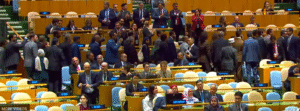
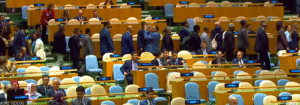
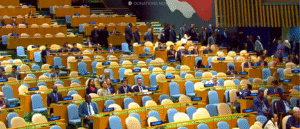
Netanyahu, your time is up!
While the State of Israel takes the floor of the UN General Assembly, the Hague Group holds a simultaneous Ministerial Meeting of 34 states to deliberate a joint action plan to halt the Gaza genocide. I have not heard much about this meeting.
The only address of significance that we are currently waiting for is Mr. Lavrov’s speech. The Chinese envoy was very muted.
Delegates are now exercising their rights of reply.
Overall, there is no change to my original assessment that most addresses from world leaders can be divided into four categories:
– The war against the Palestinians has to stop, as well as the other wars in Africa, and the immeasurable damage that Netanyahu’s wars are causing to the region as a whole is acknowledged. Every single speech (excepting Netanyahu, who spoke to an empty room) expressed outrage against the war on the Palestinians and the sheer horror. Most condemned Israel, and some in strong terms.
– For Russia against Ukraine: This is muted, and we would not have had much interest if it were not for NATO and the EU trying to make a case that Russia is encroaching on airspace here and there. The overall effect was moderate, and it was clear that this idea was a manufactured construct. It did not even reverberate. The only reverb that there was was Trump’s comment to shoot down these ‘offending’ Russian aircraft.
– For Ukraine (the NATO and EU contingent) against Russia: Again, this was relatively muted. The same old shouts that Ukraine must be supported from the same old voices are heard, and fatigue has set in. What is not so muted is that Europe is arming itself again, led by Germany.
– Climate change was often mentioned as an issue, specifically from the African countries and the small island states. Women’s empowerment was discussed, but at a much lower profile than climate change. Surprisingly, the world economy did not have a great profile, except for Lula da Silva’s initial speech.
As expected, this UNGA was materially different from the previous one. The influence of multipolarity is evident, and some speeches acknowledged that we are now in a multipolar world. Compared to the previous year, that was never even mentioned. Multilateralism came up more frequently than multipolarity. I do like the Prime Minister of Barbados, who always makes sense. The rules-based order she speaks about is not the Western rules-based order, but rather the rules-based order for organizations such as the WTO, which is still not fully functional. Many disputes between WTO members remain unresolved as the U.S. continues to block appointments to the body responsible for reviewing appeals, resulting in a lack of a quorum. The US, against which most disputes are lodged, cannot be judged.
The Western members of the Security Council vetoed a Russia/China resolution on the Iranian snapback (i.e., sanctions) regime.
Votes in favor:
China, Russia, Pakistan, and Algeria
Votes against:
France, UK, USA, Sierra Leone, Slovenia, Denmark, Panama, Somalia, and Greece
Abstentions:
Guyana and South Korea
It was a non-complicated resolution for buying time. Russia/China stated in a joint statement that this snapback is illegal and unjust, and they will not implement sanctions against Iran. This is a remarkable departure from the norm, suggesting that the US and Western countries are losing their relevance.
When I watch these great meetings striving for Global Governance where appropriate, and Local Sovereignty, I always end up disappointed at the level of ability of the leaders to govern. This time, I observe changes. With a BRICS meeting on the sidelines and several other meetings underway, the growth of what Mr. Lavrov now refers to as the majority population has become visible. The changes we were expecting from BRICS, SCO, and other new world organizations are clearly visible. What is also visible is that the West has declared a fight on all cylinders and is utilizing all methods to stave off the process of its own irrelevance. The fallout of this will become clearer in the next few months. The West is now suffering the word NO, more and more frequently.
On Gaza and the Palestinians, there is a 17-point agreement that was reached between the US and the Gulf States. We don’t have that agreement yet, except in zionist-israeli press, and I prefer to wait for more reliable coverage. So far, from all the sources, a few elements are missing. There were no Palestinians there, so, at the outset, it would be imposed. It is the old cry, Hamas must go. I am not entirely sure about it, but it appears that the West is attempting to maintain its influence in West Asia, and its proxy, Netanyahu, has just failed. All that remains for him is to continue his killing spree, and he is doing precisely that.
So far, so good while slogging through a snodrift. These leaders are fearful of the overall state of the world. The citizenry is up in arms, demanding their rights and pressuring their governments, and we will no doubt see more “Charlie Kirk”- style events, as well as color revolution-style events.
At least we can enjoy Mia Amor Mottley, Prime Minister, Minister for National Security and the Public Service, and Minister for Finance, Economic Affairs and Investment of Barbados, who even quoted a little Bob Marley.
Primarily born to address security concerns, the SCO has, over its 24-year development, grown into a comprehensive regional organization representing nearly half of the world’s population.
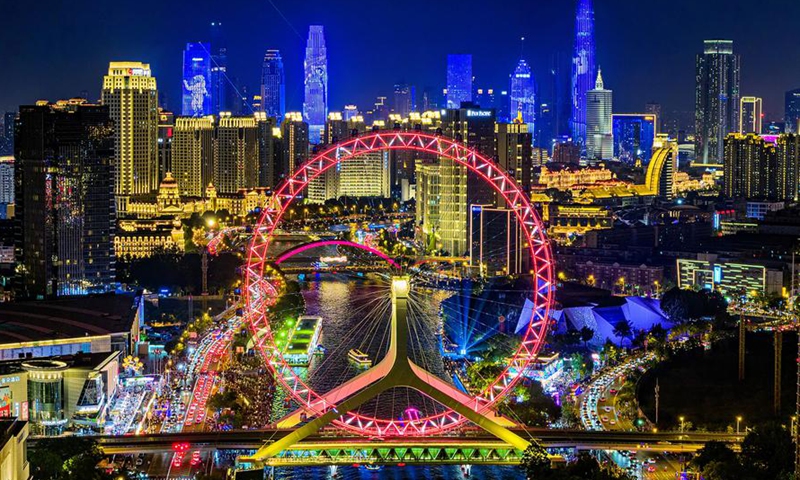
An aerial drone photo taken on Aug. 25, 2025 shows a light show along the Haihe River in north China’s Tianjin. (Photo by Du Penghui/Xinhua)
AN EVOLVING REGIONAL BLOC
The SCO traces its roots to the “Shanghai Five” mechanism, when China, Russia, Kazakhstan, Kyrgyzstan and Tajikistan came together in 1996 to manage border security issues after the end of the Cold War. On June 15, 2001, the Shanghai Cooperation Organization was established with Uzbekistan joining as the sixth member.
What began as a regional security grouping has evolved into a regional organization encompassing nearly half of the world’s population, a quarter of the global landmass and a quarter of global GDP. With the accession of India, Pakistan, Iran and Belarus, the SCO now has 10 member states, alongside two observer states and 14 dialogue partners.
Dedicated to maintaining regional security and promoting common development, the SCO adheres to the Shanghai Spirit, which features mutual trust, mutual benefit, equality, consultation, respect for diverse civilizations and pursuit of common development.
This spirit has guided the bloc to chart a path of regional cooperation, transcending differences in ideology, social system and development path, and setting an example for a new type of international relations.
Over the years, SCO member states have seen deepened political mutual trust and fruitful cooperation, which led to regional stability, steady trade growth, joint infrastructure projects, and coordinated action in fields such as food and energy security.
Through mechanisms such as the Regional Anti-Terrorist Structure, SCO members have worked together effectively to maintain regional peace and stability by combating terrorism, separatism, and extremism. Security frameworks have been strengthened, and joint exercises have expanded into cyberspace.
In the first 20 years since its establishment, the total trade value of SCO member states increased nearly 100-fold, while their share of global trade rose from 5.4 percent in 2001 to 17.5 percent in 2020, demonstrating growing influence, according to a trade development report released in 2022.
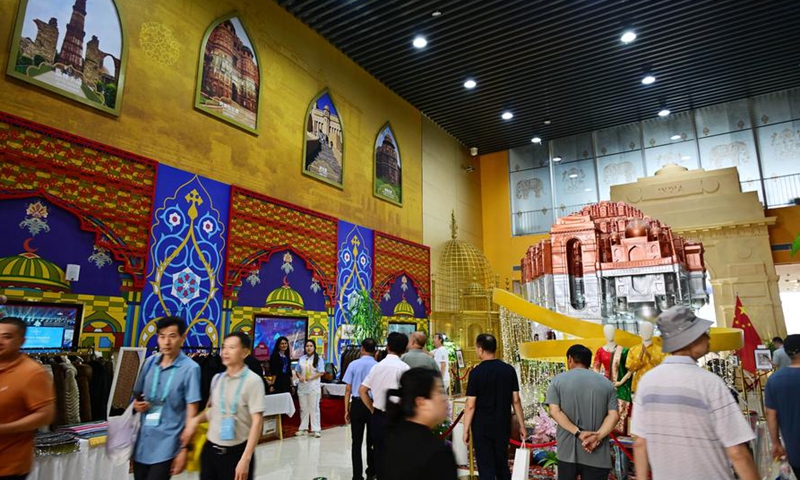
People visit the pavilion of India during the 2025 Shanghai Cooperation Organization (SCO) International Investment and Trade Expo in Qingdao, east China’s Shandong Province, July 18, 2025. (Xinhua/Li Ziheng)
“The Shanghai Spirit is the ‘root’ and ‘soul’ of the SCO,” said Fan Xianrong, a Chinese foreign ministry official responsible for coordination work in the SCO.
In the face of the ever-changing international landscape, SCO member states would continue to champion this spirit through concrete actions, offering their solutions for creating a fair and equitable global governance system and support for the building of a community with a shared future for humanity, according to Fan.
CHINA: A FIRM UPHOLDER OF SHANGHAI SPIRIT
As one of the founding members, China has always made the SCO a diplomatic priority and firmly upheld the Shanghai Spirit. The country has put forward a series of important initiatives and propositions, and contributed Chinese wisdom, solutions and dynamism to the regional development.
China has proposed the building of an SCO community with a shared future, an inspiring vision that enriches the Shanghai Spirit. It also called on SCO members to build a common home featuring solidarity and mutual trust, peace and tranquility, prosperity and development, good-neighborliness and friendship, as well as fairness and justice.
On the economic front, trade and investment ties between China and other SCO members have become increasingly robust, with cooperation spanning across sectors such as infrastructure, energy, agriculture and technology, enhancing the well-being of the people across the region.
In 2024, China’s trade with other SCO members, observer states and dialogue partners reached a historic high of 890 billion U.S. dollars, or 14.4 percent of the country’s total foreign trade. In the same year, the number of China-Europe freight trains passing through the SCO countries and regions reached 19,000, an increase of 10.7 percent compared with 2023.
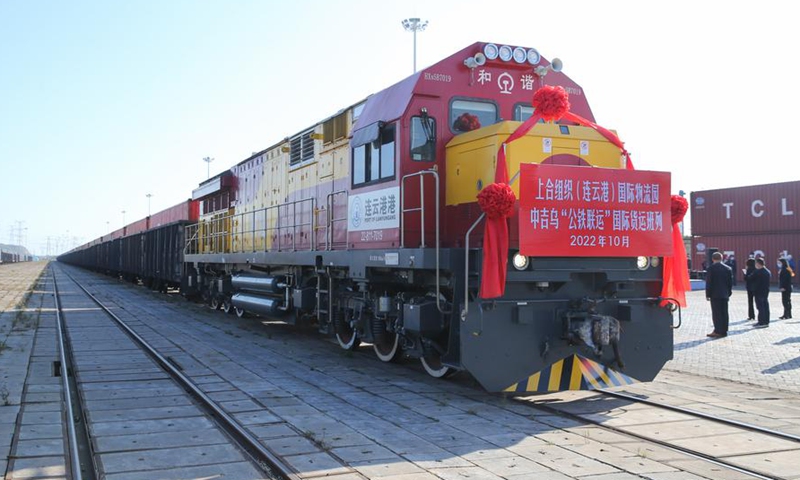
This file photo taken on Oct. 13, 2022 shows an international freight train about to depart from the Shanghai Cooperation Organization (Lianyungang) International Logistics Park in Lianyungang City, east China’s Jiangsu Province. (Photo by Wang Jianmin/Xinhua)
In one of its latest efforts to promote tech cooperation, China has welcomed all SCO parties to use its BeiDou navigation system and participate in the development of the International Lunar Research Station, while pledging to provide at least 1,000 training opportunities on digital technology to other SCO countries in three years.
Since taking over the SCO presidency in July 2024, China has worked closely with all parties and hosted over 100 events with the theme “SCO Year of Sustainable Development,” including ministerial-level meetings, an SCO political parties’ forum, a media and think tank summit, and an art festival.
“China will work with all parties of the SCO to remain true to the organization’s original aspiration, shoulder its mission, carry forward the Shanghai Spirit, and provide SCO solutions for global governance and reform,” Assistant Foreign Minister Liu Bin told the press last week.
WHAT TO EXPECT FROM TIANJIN SUMMIT
With leaders from more than 20 countries and heads of 10 international organizations set to participate, the upcoming SCO Summit 2025 is expected to pool consensus and steer the organization toward building a closer community with a shared future.
Key outcomes will include the signing of a declaration by leaders of SCO member states at the summit as well as the approval of a development strategy of the bloc for the next 10 years, according to Liu.
The summit will also issue statements marking the 80th anniversary of the victory in the World Anti-Fascist War and the 80th founding anniversary of the United Nations, and adopt a series of outcome documents on strengthening security, economic, people-to-people and cultural cooperation.
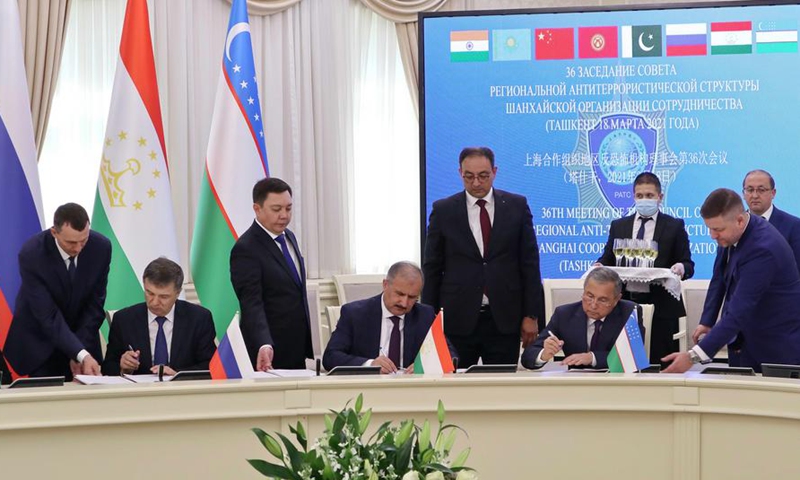
Delegates sign documents at the 36th meeting of the Council of the Regional Anti-Terrorist Structure (RATS) of the Shanghai Cooperation Organization (SCO) in Tashkent, Uzbekistan, March 18, 2021. (Photo by Zafar Khalilov/Xinhua)
China will also elaborate on its new vision and propositions for the SCO in carrying forward the Shanghai Spirit, embracing the mission of the times, and responding to the people’s expectations, and announce new measures and initiatives to support the high-quality development of the SCO and comprehensive cooperation.
“China believes that a friendly, united and productive Tianjin Summit will advance the SCO into a new phase of high-quality development, characterized by greater solidarity, closer coordination, stronger momentum and higher effectiveness,” Liu said.
Sheradil Baktygulov, director of the Institute of World Policy of Kyrgyzstan, expressed high expectations for the summit. “The SCO Tianjin Summit will take place at a difficult time of global turbulence, but it will become a guiding bright star — showing the right path to safe and stable development.”
PRESIDENT PUTIN SPEAKS AT SPIEF PLENARY SESSION https://t.co/nfz0eRSmEJ
— Sputnik (@SputnikInt) June 20, 2025
Alternatives:
https://forumspb.com/en/programme/business-programme/150101/?ELEMENT_ID=150101#broadcast
https://www.facebook.com/100069392071612/videos/1229570355316906
https://www.facebook.com/100069392071612/videos/1229570355316906

 Lateo.net - Flux RSS en pagaille (pour en ajouter : @ moi)