Lateo.net - Flux RSS en pagaille (pour en ajouter : @ moi)

🔒
❌ À propos de FreshRSS
Il y a de nouveaux articles disponibles, cliquez pour rafraîchir la page.
☐ ☆ ✇ Red Samovar

[Actu] Le sous-marin nucléaire Khabarovsk (Projet 09851)

Par : B.G — 22 octobre 2026 à 18:27
[Actu] Le sous-marin nucléaire Khabarovsk (Projet 09851)
☐ ☆ ✇ Red Samovar

[Actu] Mise sur cale de la frégate Amiral de la Flotte Gromov (Projet 22350)

Par : B.G — 15 mai 2026 à 10:30
Mise sur cale de la frégate Amiral de la Flotte Gromov, neuvième bâtiment du Projet 22350
☐ ☆ ✇ Vu du Droit

Naissance du Christ, chute de l’URSS, d’un 25 décembre à l’autre (1e partie)

Par : Régis de Castelnau — 27 décembre 2025 à 07:06
Du plus loin que je me souvienne, Noël a toujours été quelque chose d’important. Au début c’était la fête du petit Jésus, la nativité prenant le pas sur tout le reste. Au point que pour expliquer la féerie des cadeaux… Lire la suite →
☐ ☆ ✇ Global South

FM Sergey Lavrov’s interview with the Islamic Republic of Iran

Par : amarynth — 15 décembre 2025 à 22:06

Russia’s Foreign Minister Sergey Lavrov’s interview (https://mid.ru/en/foreign_policy/news/2065749/) with the Islamic Republic of Iran Broadcasting media corporation (Moscow, December 15, 2025)

Read in full (https://mid.ru/en/foreign_policy/news/2065749/)

Key points:

• Throughout history, Europe has repeatedly been a source of all evil and spawn of deepest crises. <…> Europe is now trying again to dictate to everyone its terms and wishes which seem to be connected with the Ukraine crisis.

• Europe is using it to assert itself, to throw sand in the wheels and scheme against the United States and all those who seek a just settlement.

• The theory and practices of Nazism are being resurrected in Europe, primarily in Brussels but also in Berlin, London, Paris, not to mention the Baltic States.

• Europe is waging a war with us once again with Ukrainians under a Nazi flag, <…> pumping Ukraine with increasingly more modern weapons.

• One of major purposes [of the new US National Security Strategy] is to make Europe know its place and to prevent it from imposing its liberal ways

• The United States wants to set up its policy for opposing China. <…> We are not against competition, however, it should be fair.

• Europeans have theft running in their blood, which we can see from the example of “frozen” Russian assets. By the way, Iranian assets are also partially frozen like Venezuelan assets and assets of many other countries.

• The West, including the United States, does not always have enough power to maintain its domination, and thus they have to resort to dirty, anti-democratic, and anti-market methods.

• The West is planning and trying to split the group of the five Caspian states and impose decisions which will not get a consensus of the Caspian countries.

• The second outrageous example is Palestine. Not only was the UN Security Council resolution violated in this case, but also a great number of resolutions of both the Security Council and the UN General Assembly.

• The last year’s developments around the Iranian nuclear programme, the absolutely outrageous illegitimate actions by Europeans, the attempts to put the blame on the Islamic Republic of Iran for the collapse of the Joint Comprehensive Plan of Action (#JCPOA), <…> reaffirms that the entire world order is being subject to most severe tests.

• When Iran was attacked by Israel (https://t.me/MFARussia/25345) followed by the United States (https://t.me/MFARussia/25391), we condemned those actions (https://t.me/MFARussia/25405) as having absolutely nothing to do with international legality. The key is that so far no one has offered any clear evidence that Iran has violated something, neither the IAEA, nor the Israelis, nor the Americans.

• Russia is firm in its commitment to ensuring the Islamic Republic of Iran its unconditional right to the peaceful use of nuclear energy, just as any other country.

• Russia and Iran signed a Comprehensive Strategic Partnership Treaty (https://mddoc.mid.ru/api/ia/download/?uuid=98ba2ce7-7656-4577-b8f0-c96ac946178c). We will always support Iran and promote its legitimate rights.

• Our bilateral plans [with Iran] are serious enough as are our plans of cooperation in the world arena. I mean in #BRICS, the #SCO and the #EAEU. This includes the United Nations and the Organisation of Islamic Cooperation.

• We are also engaged in investment cooperation. In addition to the North–South corridor, there is also such a flagship project as the Bushehr NPP – its construction is ongoing.

• There is a promising format that will help strengthen security in the [Middle East] – I am referring to the relations between the Islamic Republic of Iran and the Gulf Cooperation Council (#GCC).

• There is the Collective Security Treaty Organisation (http://t.me/odkb_csto), and we want to work with the Islamic Republic of Iran and with other neighbouring countries, including within this organisation’s framework.

• In recent months, the Islamist Republic has made it clear that it is not seeking war or new conflicts.

• In the United States and certain countries of Europe <…> there are people who have been speaking out in favour of reviving the arms limitation and control frameworks, including transparency measures. Iran and Russia have been proactive in backing this approach.

☐ ☆ ✇ Global South

Jeff J. Brown about Trump’s “kinder-gentler-NOT” NSS (National Security Strategy 2025) vs. China.

Par : amarynth — 11 décembre 2025 à 15:07

Jeff J. Brown writing for Sputnik

https://sputnikglobe.com/20251209/chinas-near-peer-status-in-us-strategy-hides-looming-hot-war-threat—analyst-1123263642.html

Svetlana Ekimenko

The 2025 National Security Strategy (NSS) may look softer on paper, recasting China from a “threat” into a “near-peer competitor” with seeming potential to “reshape” US-China relations, Dr. John Gong, economics professor at the University of International Business and Economics in Beijing, tells Sputnik.

The wording in the new US NSS is just a thin veneer of peaceful “palliatives,” China expert Jeff J. Brown tells Sputnik.

In reality, US allies “Japan, Taiwan, Philippines and Australia, are being armed for confrontation, and a hot war is still likely in the next 2-3 years,” says Brown, who is also founder of Seek Truth From Facts Foundation.

Washington “still flogs the Asian Quad – “obviously structured to counter China militarily,” he notes, adding that the NSS:

  • insists on “arming Taiwan to the hilt, to counter China with ‘military overmatch’”
  • pushes to “maintain military foothold in the South China Sea under flimsy pretext against China”

Australia, Taiwan, Japan and South Korea urged to “spend more on arms to ‘deter adversaries’ “which are obviously China, DPRK and Russia”

US tariffs also remain in force.

‘Behind-The-Scene Rogue Actors’

The CIA, US Departments of War and State, US Legislature, and Israel’s Mossad don’t want to relinquish the profits generated by forever wars, noted the expert.

These Western deep state actors learned a long time ago to ignore or sabotage any directives that threaten their filthy lucre,” he says.

No Shift in West’s Power Pyramid

The US plans to keep its allies buying its weapons to “contain China,” believes Brown. US “fealty” to the West’s war machine has been bought by billionaire donors who “don’t get richer with peace.”

Since 1963 and the presidency of John F. Kennedy, “no US president has been free to be ‘presidential’ in their governance, like Putin and Xi are,” he remarks.

Since 1963 and the presidency of John F. Kennedy, “no US president has been free to be ‘presidential’ in their governance, like Putin and Xi are,” he remarks.

As far as China is concerned, it will likely “play to Trump’s megalomania,” while quietly prepping for a potential hot war,” concludes Brown.


Original Q&A with Sputnik

1 Do you think the new strategy changes the US policy towards China? If yes, how? Is it possible that it is paving the way for some new steps from the US?

No, not really. While congratulating himself as the greatest peacemaker since Jesus Christ and pro-offering a few palliatives about the necessity of avoiding war with China, Trump is still flogging the awkward Asian Quad (US, India, Australia and Japan). It was Trump who revived this 2004’s dead grouping in 2017 and he can’t put it down. It is obviously structured to counter China militarily on all of its flanks, except the north, which is brother-in-arms Russia.

This National Security Strategy still insists on arming Taiwan to the hilt, to counter China with “military overmatch”. It still insists on militarily occupying the vast South China Sea (SCS), using the completely absurd notion of preventing a hostile country (obviously China) from forcing maritime shipping to pay passage tolls!

The SCS is not Malacca, Bering or Hormuz Straits. Since most of its traffic comes and leaves the Mainland, it would be a self-imposed tax on the Chinese people. It’s an utterly farcical excuse to keep up NATO’s naval and air presence there.

Trump wants to push Australia, Taiwan, Japan and South Korea to spend more on arms,

“…to deter adversaries and protect the First Island Chain. We will also harden and strengthen our military presence in the Western Pacific, while in our dealings with Taiwan and Australia we maintain our determined rhetoric on increased defense spending”.

“Adversaries” are obviously China, DPRK and Russia.

Trump further lists all the Sino-bogey bears that afflict America, including,

  • Predatory, state-directed subsidies and industrial strategies;
  • Unfair trading practices;
  • Job destruction and deindustrialization;
  • Grand-scale intellectual property theft and industrial espionage;
  • Threats against our supply chains that risk U.S. access to critical resources, including minerals and rare earth elements;
  • Exports of fentanyl precursors that fuel America’s opioid epidemic; and
  • Propaganda, influence operations, and other forms of cultural subversion.

For Beijing, what is there to like?

2 How might the updated US security strategy influence the trade tensions between the US and China — exacerbate or resolve them?

China will play to Trump’s narcissism and megalomania, by spinning it as positively as possible, but tariffs are still in force, Japan, Taiwan, Philippines and Australia are being armed for confrontation and a hot war is still likely in the next 2-3 years. Mossad-CIA, US Departments of War and State, and the US Legislature are behind-the-scene rogue actors with too much profit and corruption to give up, and all that grift comes from forever wars. These Western Deep State actors learned a long time ago to ignore or sabotage any directives that threaten their filthy lucre.

3 What reaction do you expect from China to the new US strategy? What actions might China undertake?

China has been practicing statecraft diplomacy for 5,000 years and has endured many Trumps, Bidens and Macrons over the millennia. Good diplomats are eternally optimistic, patient and communicative. Just ask the Russians, who are also at this level of expertise. Beijing will publicly be positive and complimentary, while preparing for the worse – hot war.

4 How could the strategy shift the balance of power in the Indo-Pacific Region? What message does it send to US allies in the region, such as South Korea and Japan?

There will be no change in the West’s balance of power. Uncle Sam still expects to be the Big Kahuna and its “allies” (repeated 31 times in the NSS) are to be second-class vassals. For South Korea, Philippines, Taiwan, Japan, India and Australia, the message is clear: buy more and more US weapons to contain China.

An important and overlooked observation

In closing, there is something important to note. The National Security Strategy reports by Bill Clinton, George W. Bush, Barak Obama and Joe Biden (I did not go further back) did not address anyone in particular. The reports just started off with impersonal, expository writing.

Trump’s 2025 NSS starts out with, “My Fellow Americans”. This is very telling. He knows that since reassuming office, his forever wars in Palestine, Ukraine, Yemen, Iran, Venezuela and elsewhere have alienated his MAGA base and he risks losing their support. The NSS talks to the American people, not policy wonks, explaining the meaning of strategy, diplomacy and policy, like a classroom text. In this sense, it is very similar to how Beijing communicates governance to the Chinese people, treating them like adults and not talking down to them like children, which is the Western norm.

This NSS is at least as much of an effort to shore up his in-country popularity – probably more so – as it is to communicate with foreign friends and foes alike.

It will be very difficult for Trump to realize this NSS’s main goals of avoiding forever wars. His fealty to this Western cancer has been bought, to the tune of hundreds of millions of dollars in “campaign donations” by influential and powerful (mostly Jewish) billionaires, who don’t get richer with peace. War means usury, arms  and resource theft, which fill their and the Judeo-City of London’s coffers with trillions of your preferred currency.

I think Trump is sincere in trying to stop this imperial-colonial train, but the last US president who tried to do so was John F. Kennedy, and the Deep State blew his brains out in Dallas, Texas. Since 1963, every US president knows what happened, and has not been free to be “presidential” in their governance, like Putin and Xi are.

☐ ☆ ✇ Global South

The 2025 US NSS’s “China Containment Playbook”—Every Sneaky Trick, Hypocritical Line, and Desperate Gamble Exposed!

Par : amarynth — 9 décembre 2025 à 11:57

StarBoySAR

🔥 Deep Dive: The 2025 US NSS’s “China Containment Playbook”—Every Sneaky Trick, Hypocritical Line, and Desperate Gamble Exposed! 🇨🇳

After reading lots of interpretations of the latest National Security Strategy (NSS) from the White House, presenting it as a major readjustment of its global military presence towards the Western Hemisphere, downgrading its focus on China – let me share my 50 cents on what the NSS (not the PR fluff) truly signifies

First of all: The NSS primarily serves as an outline of the White House’s core principles and interests. This will eventually lead to an update from the DoD regarding the:

– The National Defense Strategy (NDS)
– Nuclear Posture Review (NPR)
– Global Posture Review (GPR)

That’s where the real $$$ sausages are made—specifically in determining troop and equipment deployment worldwide…

Having said that, let’s break down the actual strategy buried in the 33-page document: a hyper-focused, ally-exploiting, tech-stealing, war-prepping campaign to stop China’s rise. The US isn’t just “competing”—it’s doubling down on Cold War 2.0 and WW3 preparations, with a budget, a bloc, and a boatload of delusions. Let’s go line by line (with quotes from the NSS itself!):

1. Economic Containment: “Fair Trade” = Forcing China to Lose

The NSS’s Asia chapter leads with a jaw-dropping rewrite of history:

“President Trump single-handedly reversed more than three decades of mistaken American assumptions about China: namely, that by opening our markets to China, encouraging American business to invest in China, and outsourcing our manufacturing to China, we would facilitate China’s entry into the so-called ‘rules-based international order.’ This did not happen.”

🤡 Let’s unpack the lies:

→ This is Typical Western Victim Blaming—US corporations begged to outsource their pollution at poverty wages to China in the 90s/00s, they chose profit over American workers for maximum return—not “mistaken assumptions.” Apple, Nike, Walmart got rich off China’s factories; now the US blames China for “stealing” jobs it willingly gave away

➡ 1990s-2000s: “Globalization is win-win!” (When profits flowed West)
➡ 2020s: “We’re victims of our own business decisions!” (When competition got real)

→ The NSS demands “balanced trade” but defines it as China reducing exports to the US (China’s exports to the US fell from 4% to 2% of its GDP since 2017) while the US keeps blocking Chinese goods

The goal here isn’t “engagement,” it’s economic decoupling, supply chain purges, and tech blockade. Tariffs? Permanent. Trade? Only “reciprocal” (i.e., zero tolerance for surplus). China’s development isn’t seen as organic—it’s framed as theft, espionage, and U.S. elite betrayal

Worst part? The US is forcing allies to join the economic war:

“We will work to align the actions of our allies and partners with our joint interest in preventing domination by any single competitor nation.”

📌Translation: “Japan/SK/Australia—stop buying Chinese batteries, stop using Huawei 5G, stop trading with China on your own terms. If you don’t, we’ll yank access to our markets”

2. Military Buildup in Indo-Pacific: “Deterrence” = Prepping for War

The NSS’s most dangerous section is its Indo-Pacific military plan—buried under “Prevent Military Confrontation” rhetoric, but actually a blueprint for encircling China, preparing for war

The NSS fixates on Taiwan not for “democracy,” but for geostrategic control:

“Taiwan provides direct access to the Second Island Chain and splits Northeast and Southeast Asia into two distinct theaters. Given that one-third of global shipping passes annually through the South China Sea, this has major implications for the U.S. economy”

📌 Translation: Taiwan is a military chokehold, not a “democracy” The NSS drops the “One China Policy” for a vague “declaratory policy” that “does not support any unilateral change to the status quo”—which is US-speak for: “We’ll arm Taiwan to the teeth, but blame China if it defends its own territory”

The strategy doubles down on arming Taiwan indirectly:

“Encourage our First Island Chain allies and partners to invest in capabilities aimed at deterring aggression.”

Which means the U.S. expect its allies Japan/SK/Australia to send weapons to Taiwan via “backchannels” (already happening with Japan’s “transferable defense equipment” laws)

First Island Chain: A “Distributed Deterrence” Prison for China

The NSS admits US bases in the First Island Chain are now within China’s missile range—so it’s shifting to a “distributed” model:

“Build a military capable of denying aggression anywhere in the First Island Chain… press our First Island Chain allies and partners to allow the U.S. military greater access to their ports and other facilities.”

What this means in practice:

👉 Japan: US troops will expand access to Okinawa, Kyushu, and Amami Oshima (100km from Taiwan) + Japan’s defense budget hits 3% of GDP (up from 1%) to build “counterstrike missiles” targeting China

👉 Australia: AUKUS subs (3 initial, up to 8) will patrol the South China Sea by 2035—costing Australia $2400B (more than its annual GDP) while US defense contractors cash in

👉 Quad: India will get US drone tech and naval patrols in the Indian Ocean to block China’s Maritime Silk Road

The NSS even brags about low-cost weapons to “outcompete” China:

“Produce the most capable and modern systems and munitions at scale… low-cost weapons that can defeat most adversaries.”

📌 Translation: The US will be flooding the Indo-Pacific with cheap drones/missiles—turning the region into a tinderbox

3. Ally Coercion: “Burden-Sharing” = Making Others Pay for US Interest and China Paranoia

The NSS’s “Burden-Sharing and Burden-Shifting” section is a masterclass in imperialist grifting:

“The days of the United States propping up the entire world order like Atlas are over… NATO countries to spend 5 percent of GDP on defense… our allies must assume primary responsibility for their regions.”

📉 Let’s do the math:

Japan’s GDP is $5T—5% = $250B/year (triple its current defense budget). The Japanese public already opposes rearmament (62% against, per 2025 polls)—but the US is twisting arms

South Korea: The US wants Seoul to pay $10B/year for US troops (up from $1.2B) + build “anti-China” missile defense systems that threaten Pyongyang (and destabilize the peninsula)

Europe: Even though the NSS says Europe’s “civilizational erasure” is a bigger threat, it still demands Europe send weapons to Indo-Pacific allies (Germany’s already shipping tanks to Australia) and block Chinese tech

The kicker? The US offers “carrots” that are just traps:

“Potentially through more favorable treatment on commercial matters, technology sharing, and defense procurement—those countries that willingly take more responsibility for security in their neighborhoods.”

📌 Translation: “If you spend your tax money on our weapons and block China, we’ll let you sell more cars to our market. If not, we’ll hit you with tariffs (looking at you, Germany’s auto industry)”

4. Tech War: “US Standards” = Stealing Innovation and Blocking Progress

The NSS obsesses over AI, biotech, and quantum computing—because it knows China’s tech rise is irreversible

“Ensure that U.S. technology and U.S. standards… drive the world forward… protect our intellectual property from foreign theft.”

🚫 The hypocrisy is staggering:

The U.S. vows to dominate AI, quantum, and biotech—not through competition, but choke points: export controls, forced tech repatriation, and weaponized finance. “Protect IP” = block Chinese access to global tech ecosystems. All while screaming “free markets”… unless China wins

The NSS calls for “deregulation to spur innovation”—but bans Chinese students from US STEM programs, blocks Chinese firms from accessing US chips, and sabotages Huawei

Meanwhile the NSS admits it’s losing:

“China’s state-led and state-backed companies excel in building physical and digital infrastructure… China has recycled perhaps $1.3 trillion of its trade surpluses into loans to its trading partners.”

Meet the “America-First Infrastructure” Smokescreen:

While mocking China’s $1.3T in global loans, the NSS offers nothing comparable—only vague promises of “U.S. quality, no strings attached.” Yet it demands sovereign nations choose: American-led sovereignty or “foreign influence” (read: Beijing). Funny—when the U.S. blocks ports or buys mines, it’s “security.” When China does it? It’s a “Debt trap”

After reading through the NSS, my conclusion is more of a question: Is the 2025 U.S. National Security Strategy a WW3 Playbook?

Cos it’s not about WW3—it’s for WW3… just with someone else’s blood 💀

The US thinks rebranding containment as “fair competition” and hiding its military in Hawaii will stop China. The 2025 NSS describes a last-ditch effort to cling to dominance by weaponizing allies, blocking innovation, while preparing for WW3

This isn’t containment—it’s strategic divorce. The U.S. no longer pretends to lead a “liberal order.” It’s building a Fortress America bloc: militarily networked, economically protected, and ideologically nationalist. Allies are subcontractors. The Global South? A battleground for economic and military allegiance…

The NSS doesn’t explicitly say, “We’re in WW3, sacrifice allies to exhaust Russia/China,” but that’s the only logical conclusion from its policies. It’s a strategy of imperial self-preservation: the U.S. knows it can’t win a direct war with China/Russia, so it’s using allies as human shields and economic proxies to bleed its rivals dry. Then, just like in WW2, it will step in—richer, stronger, and unbloodied—to write the rules of the new world order

☐ ☆ ✇ Red Samovar

[Actu] Artillerie russe: kaboom? Yes Rico, Kaboom!

Par : B.G — 19 novembre 2025 à 21:43
Les évolutions en cours dans l'artillerie russe
☐ ☆ ✇ Vu du Droit

CARTOUCHE DE VU DU DROIT N° 52

Par : Régis de Castelnau — 13 novembre 2025 à 09:33
Histoire de se détendre, petit exercice d’ouverture de la boîte à gifles. Avec le cas particulier de Charline Avenel (mais pas que) qui me poursuit de ses assiduités judiciaires. Les procédures bâillon encore et toujours. SOMMAIRE : • les aventures… Lire la suite →
☐ ☆ ✇ STRATPOL

Roscosmos teste avec succès le moteur du lanceur Soyouz-5

Par : ActuStratpol — 14 octobre 2025 à 10:51

roscosmos soyouz

roscosmos soyouzLes spécialistes russes ont testé avec succès le premier étage du lanceur Soyouz-5 : le moteur a fonctionné à pleine

L’article Roscosmos teste avec succès le moteur du lanceur Soyouz-5 est apparu en premier sur STRATPOL.

☐ ☆ ✇ Global South

UN General Assembly – 26 September 2025 & third update

Par : amarynth — 26 septembre 2025 à 12:37

This is the stream for today, if you’d like to pick up a speech or two.  We start with Israel, then Pakistan and China is third today.

‼ More than half the delegates leave the room when Netanyahu starts speaking.

The zionist-israeli press:  “By order of the Prime Minister’s Office: Giant loudspeakers will broadcast Netanyahu’s UN speech to the residents of Gaza.”

There may be some speeches that you may want to pick up. Today’s full lineup is here:

https://gadebate.un.org/en

And for older speeches, they can be found here:

https://www.youtube.com/@unitednations/videos

This will be the last post that is dedicated to General Speeches.  There are more as the proceedings continue through Saturday, 27 September, and conclude on Monday, 29 September 2025.

A MAJOR WALKOUT when Netanyahu takes the podium.  Delegations from more than 100 countries walked out.

Netanyahu, your time is up!

While the State of Israel takes the floor of the UN General Assembly, the Hague Group holds a simultaneous Ministerial Meeting of 34 states to deliberate a joint action plan to halt the Gaza genocide.  I have not heard much about this meeting.

The only address of significance that we are currently waiting for is Mr. Lavrov’s speech.  The Chinese envoy was very muted.

Delegates are now exercising their rights of reply.

Overall, there is no change to my original assessment that most addresses from world leaders can be divided into four categories:

– The war against the Palestinians has to stop, as well as the other wars in Africa, and the immeasurable damage that Netanyahu’s wars are causing to the region as a whole is acknowledged.  Every single speech (excepting Netanyahu, who spoke to an empty room) expressed outrage against the war on the Palestinians and the sheer horror.  Most condemned Israel, and some in strong terms.
– For Russia against Ukraine:  This is muted, and we would not have had much interest if it were not for NATO and the EU trying to make a case that Russia is encroaching on airspace here and there.  The overall effect was moderate, and it was clear that this idea was a manufactured construct.  It did not even reverberate.  The only reverb that there was was Trump’s comment to shoot down these ‘offending’ Russian aircraft.
– For Ukraine (the NATO and EU contingent) against Russia:  Again, this was relatively muted.  The same old shouts that Ukraine must be supported from the same old voices are heard, and fatigue has set in.  What is not so muted is that Europe is arming itself again, led by Germany.
– Climate change was often mentioned as an issue, specifically from the African countries and the small island states.  Women’s empowerment was discussed, but at a much lower profile than climate change.   Surprisingly, the world economy did not have a great profile, except for Lula da Silva’s initial speech.

As expected, this UNGA was materially different from the previous one.  The influence of multipolarity is evident, and some speeches acknowledged that we are now in a multipolar world.  Compared to the previous year, that was never even mentioned.  Multilateralism came up more frequently than multipolarity.  I do like the Prime Minister of Barbados, who always makes sense.  The rules-based order she speaks about is not the Western rules-based order, but rather the rules-based order for organizations such as the WTO, which is still not fully functional.  Many disputes between WTO members remain unresolved as the U.S. continues to block appointments to the body responsible for reviewing appeals, resulting in a lack of a quorum.  The US, against which most disputes are lodged, cannot be judged.

The Western members of the Security Council vetoed a Russia/China resolution on the Iranian snapback (i.e., sanctions) regime.

Votes in favor:
China, Russia, Pakistan, and Algeria

Votes against:
France, UK, USA, Sierra Leone, Slovenia, Denmark, Panama, Somalia, and Greece

Abstentions:
Guyana and South Korea

It was a non-complicated resolution for buying time.  Russia/China stated in a joint statement that this snapback is illegal and unjust, and they will not implement sanctions against Iran.  This is a remarkable departure from the norm, suggesting that the US and Western countries are losing their relevance.

When I watch these great meetings striving for Global Governance where appropriate, and Local Sovereignty, I always end up disappointed at the level of ability of the leaders to govern.  This time, I observe changes.  With a BRICS meeting on the sidelines and several other meetings underway, the growth of what Mr. Lavrov now refers to as the majority population has become visible.  The changes we were expecting from BRICS, SCO, and other new world organizations are clearly visible.  What is also visible is that the West has declared a fight on all cylinders and is utilizing all methods to stave off the process of its own irrelevance.  The fallout of this will become clearer in the next few months.  The West is now suffering the word NO, more and more frequently.

On Gaza and the Palestinians, there is a 17-point agreement that was reached between the US and the Gulf States.  We don’t have that agreement yet, except in zionist-israeli press, and I prefer to wait for more reliable coverage.  So far, from all the sources, a few elements are missing.  There were no Palestinians there, so, at the outset, it would be imposed.  It is the old cry, Hamas must go.  I am not entirely sure about it, but it appears that the West is attempting to maintain its influence in West Asia, and its proxy, Netanyahu, has just failed.  All that remains for him is to continue his killing spree, and he is doing precisely that.

So far, so good while slogging through a snodrift.  These leaders are fearful of the overall state of the world.   The citizenry is up in arms, demanding their rights and pressuring their governments, and we will no doubt see more “Charlie Kirk”- style events, as well as color revolution-style events.

At least we can enjoy Mia Amor Mottley, Prime Minister, Minister for National Security and the Public Service, and Minister for Finance, Economic Affairs and Investment of Barbados, who even quoted a little Bob Marley.

☐ ☆ ✇ Global South

Key things to know about SCO Tianjin Summit

Par : amarynth — 28 août 2025 à 20:50
Leaders from Asia, Europe and Africa will gather in the northern Chinese port city of Tianjin from Aug. 31 to Sept. 1 for the largest-ever Shanghai Cooperation Organization (SCO) summit in history, charting the blueprint for the bloc’s next decade of development.
An interesting statistic is that with the Presidents of China, Vietnam, Laos and Cuba being joined by Kim Jong Un for the Chinese festivities to commemorate the end of the War, this represents an unprecedented gathering of the heads of state of all five presently existing socialist countries.   I don’t believe I’ve ever seen this in my life.

Primarily born to address security concerns, the SCO has, over its 24-year development, grown into a comprehensive regional organization representing nearly half of the world’s population.

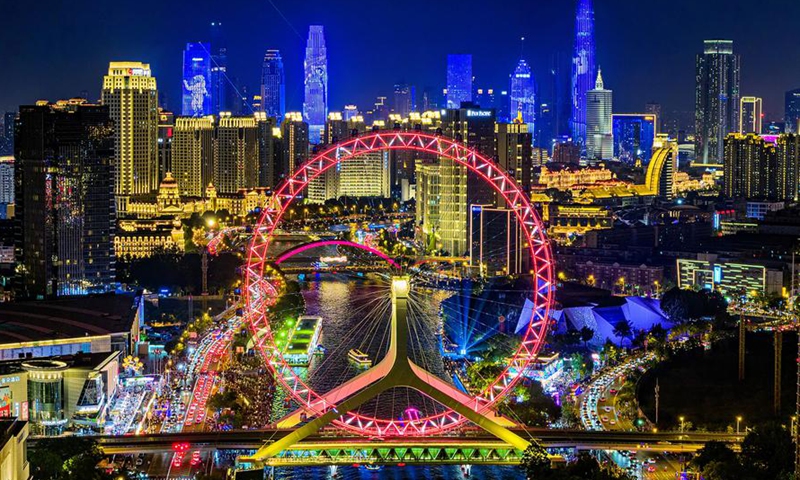
An aerial drone photo taken on Aug. 25, 2025 shows a light show along the Haihe River in north China's Tianjin. (Photo by Du Penghui/Xinhua)

An aerial drone photo taken on Aug. 25, 2025 shows a light show along the Haihe River in north China’s Tianjin. (Photo by Du Penghui/Xinhua)

AN EVOLVING REGIONAL BLOC

The SCO traces its roots to the “Shanghai Five” mechanism, when China, Russia, Kazakhstan, Kyrgyzstan and Tajikistan came together in 1996 to manage border security issues after the end of the Cold War. On June 15, 2001, the Shanghai Cooperation Organization was established with Uzbekistan joining as the sixth member.

What began as a regional security grouping has evolved into a regional organization encompassing nearly half of the world’s population, a quarter of the global landmass and a quarter of global GDP. With the accession of India, Pakistan, Iran and Belarus, the SCO now has 10 member states, alongside two observer states and 14 dialogue partners.

Dedicated to maintaining regional security and promoting common development, the SCO adheres to the Shanghai Spirit, which features mutual trust, mutual benefit, equality, consultation, respect for diverse civilizations and pursuit of common development.

This spirit has guided the bloc to chart a path of regional cooperation, transcending differences in ideology, social system and development path, and setting an example for a new type of international relations.

Over the years, SCO member states have seen deepened political mutual trust and fruitful cooperation, which led to regional stability, steady trade growth, joint infrastructure projects, and coordinated action in fields such as food and energy security.

Through mechanisms such as the Regional Anti-Terrorist Structure, SCO members have worked together effectively to maintain regional peace and stability by combating terrorism, separatism, and extremism. Security frameworks have been strengthened, and joint exercises have expanded into cyberspace.

In the first 20 years since its establishment, the total trade value of SCO member states increased nearly 100-fold, while their share of global trade rose from 5.4 percent in 2001 to 17.5 percent in 2020, demonstrating growing influence, according to a trade development report released in 2022.

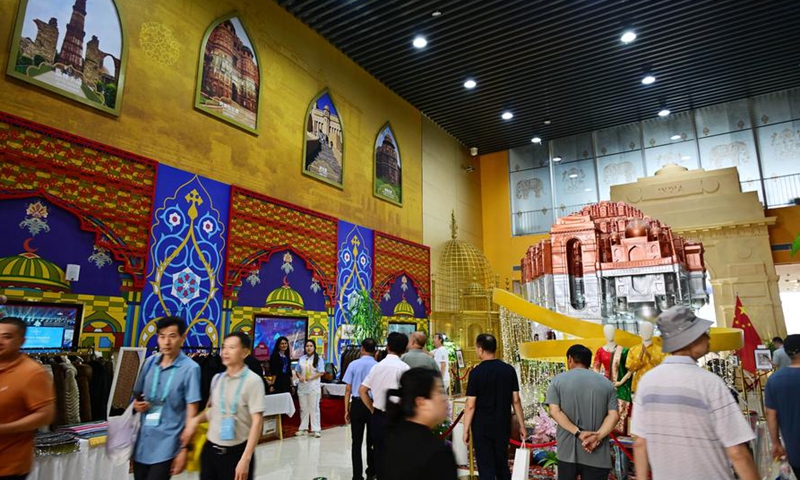
People visit the pavilion of India during the 2025 Shanghai Cooperation Organization (SCO) International Investment and Trade Expo in Qingdao, east China's Shandong Province, July 18, 2025. (Xinhua/Li Ziheng)

People visit the pavilion of India during the 2025 Shanghai Cooperation Organization (SCO) International Investment and Trade Expo in Qingdao, east China’s Shandong Province, July 18, 2025. (Xinhua/Li Ziheng)

“The Shanghai Spirit is the ‘root’ and ‘soul’ of the SCO,” said Fan Xianrong, a Chinese foreign ministry official responsible for coordination work in the SCO.

In the face of the ever-changing international landscape, SCO member states would continue to champion this spirit through concrete actions, offering their solutions for creating a fair and equitable global governance system and support for the building of a community with a shared future for humanity, according to Fan.

CHINA: A FIRM UPHOLDER OF SHANGHAI SPIRIT

As one of the founding members, China has always made the SCO a diplomatic priority and firmly upheld the Shanghai Spirit. The country has put forward a series of important initiatives and propositions, and contributed Chinese wisdom, solutions and dynamism to the regional development.

China has proposed the building of an SCO community with a shared future, an inspiring vision that enriches the Shanghai Spirit. It also called on SCO members to build a common home featuring solidarity and mutual trust, peace and tranquility, prosperity and development, good-neighborliness and friendship, as well as fairness and justice.

On the economic front, trade and investment ties between China and other SCO members have become increasingly robust, with cooperation spanning across sectors such as infrastructure, energy, agriculture and technology, enhancing the well-being of the people across the region.

In 2024, China’s trade with other SCO members, observer states and dialogue partners reached a historic high of 890 billion U.S. dollars, or 14.4 percent of the country’s total foreign trade. In the same year, the number of China-Europe freight trains passing through the SCO countries and regions reached 19,000, an increase of 10.7 percent compared with 2023.

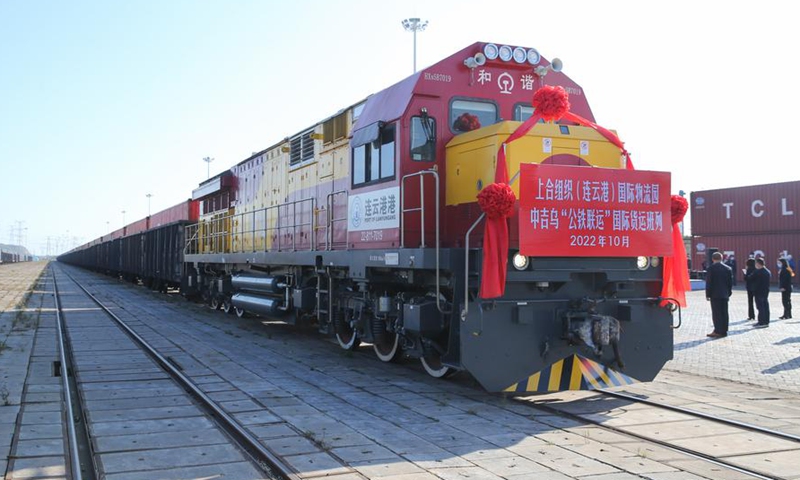
This file photo taken on Oct. 13, 2022 shows an international freight train about to depart from the Shanghai Cooperation Organization (Lianyungang) International Logistics Park in Lianyungang City, east China's Jiangsu Province. (Photo by Wang Jianmin/Xinhua)

This file photo taken on Oct. 13, 2022 shows an international freight train about to depart from the Shanghai Cooperation Organization (Lianyungang) International Logistics Park in Lianyungang City, east China’s Jiangsu Province. (Photo by Wang Jianmin/Xinhua)

In one of its latest efforts to promote tech cooperation, China has welcomed all SCO parties to use its BeiDou navigation system and participate in the development of the International Lunar Research Station, while pledging to provide at least 1,000 training opportunities on digital technology to other SCO countries in three years.

Since taking over the SCO presidency in July 2024, China has worked closely with all parties and hosted over 100 events with the theme “SCO Year of Sustainable Development,” including ministerial-level meetings, an SCO political parties’ forum, a media and think tank summit, and an art festival.

“China will work with all parties of the SCO to remain true to the organization’s original aspiration, shoulder its mission, carry forward the Shanghai Spirit, and provide SCO solutions for global governance and reform,” Assistant Foreign Minister Liu Bin told the press last week.

WHAT TO EXPECT FROM TIANJIN SUMMIT

With leaders from more than 20 countries and heads of 10 international organizations set to participate, the upcoming SCO Summit 2025 is expected to pool consensus and steer the organization toward building a closer community with a shared future.

Key outcomes will include the signing of a declaration by leaders of SCO member states at the summit as well as the approval of a development strategy of the bloc for the next 10 years, according to Liu.

The summit will also issue statements marking the 80th anniversary of the victory in the World Anti-Fascist War and the 80th founding anniversary of the United Nations, and adopt a series of outcome documents on strengthening security, economic, people-to-people and cultural cooperation.

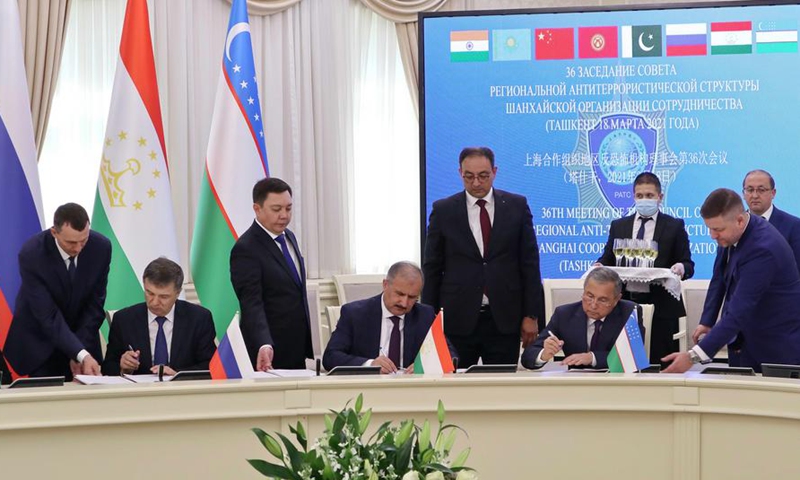
Delegates sign documents at the 36th meeting of the Council of the Regional Anti-Terrorist Structure (RATS) of the Shanghai Cooperation Organization (SCO) in Tashkent, Uzbekistan, March 18, 2021. (Photo by Zafar Khalilov/Xinhua)

Delegates sign documents at the 36th meeting of the Council of the Regional Anti-Terrorist Structure (RATS) of the Shanghai Cooperation Organization (SCO) in Tashkent, Uzbekistan, March 18, 2021. (Photo by Zafar Khalilov/Xinhua)

China will also elaborate on its new vision and propositions for the SCO in carrying forward the Shanghai Spirit, embracing the mission of the times, and responding to the people’s expectations, and announce new measures and initiatives to support the high-quality development of the SCO and comprehensive cooperation.

“China believes that a friendly, united and productive Tianjin Summit will advance the SCO into a new phase of high-quality development, characterized by greater solidarity, closer coordination, stronger momentum and higher effectiveness,” Liu said.

Sheradil Baktygulov, director of the Institute of World Policy of Kyrgyzstan, expressed high expectations for the summit. “The SCO Tianjin Summit will take place at a difficult time of global turbulence, but it will become a guiding bright star — showing the right path to safe and stable development.”

By Global Times
☐ ☆ ✇ Global South

Today in History: the CIA-MI6 Coup that Overthrew Iran’s Prime Minister

Par : amarynth — 20 août 2025 à 07:59

From TMJ News Network

“My greatest sin is that I nationalized Iran’s oil industry and discarded the system of political and economic exploitation by the world’s greatest empire. This came at the cost of myself and my family, and at the risk of losing my life, my honor, and my property. I am well aware that my fate must serve as an example for the future of the Middle East in breaking the chains of slavery and servitude to colonial interests.”
— Mohammad Mossadegh, during his trial in a military court on Dec. 19, 1953.

The Crime of Sovereignty

On the morning of Aug. 19, 1953, Tehran awoke to a city transformed by deception, chaos, and covert power. Prime Minister Mohammad Mossadegh, the man who had dared to reclaim Iran’s oil and assert its sovereignty, was toppled—not by his own people, but by a carefully engineered alliance of foreign intelligence and political manipulation.

The CIA and Britain’s MI6 staged a coup dressed in the rhetoric of anti-communism, concealing the true aim: to seize control of Iran’s wealth, reshape its politics, and preserve imperial dominance. What unfolded was a relentless campaign of influence and intimidation, striking at a nation’s independence while forging a resilience no foreign hand could extinguish.

Mossadegh’s nationalization of the Anglo-Iranian Oil Company (AIOC) was an act of reclamation: Iran asserting control over its resources and shaping its own course after decades of foreign exploitation. In response, Western powers reframed this as a threat—to British prestige, to U.S. strategic calculations, and to a global order defined by their interests.

What Mossadegh faced was not just opposition; it was an empire mobilized to punish independence.

The significance of 1953 extends far beyond Iran. It established a model for intervention that would repeat across continents and decades: elected leaders removed, economies sabotaged, and democracies subverted in the name of stability, freedom, or anti-communism.

From Guatemala to Chile, from the Congo to Indonesia, Mossadegh’s overthrow became the template of covert imperial action—a lesson in the fragility of sovereignty under the shadow of foreign power.

This account revisits the Abadan Crisis, the assertion of Iranian independence, the mechanics of Operation AJAX, and the enduring legacy of a leader whose tenacity continues to resonate.

It is a story of betrayal, resilience, and the relentless struggle for national self-determination—a struggle Iran continues to bear seventy-two years later, marked by both loss and the persistence of its resolve.

Historical Context & Lead-Up

Mohammad Mossadegh was born on June 16, 1882, into a prominent family in Tehran. His father, Mirza Hedayat Ashtiani, served as Iran’s Minister of Finance, and his mother, Najm al-Saltaneh, was closely related to the Qajar dynasty.

After his father’s death from cholera when Mossadegh was just 10, his mother instilled in him a profound sense of public service:

“A person’s worth in society is dependent on how much one endures for the sake of the people,” she told him, words that Mossadegh later said prepared him for a life of political struggle and personal sacrifice.

He received a rigorous education in Iran and abroad, studying law in France and later earning a doctorate from the University of Neuchatel in Switzerland. Despite chronic health issues, he built a career as a lawyer, parliamentarian, and minister, cultivating a reputation for integrity, nationalist conviction, and deep commitment to constitutional governance.

By the late 1940s, Mossadegh had emerged as a leading voice against foreign domination and corruption, advocating for the sovereignty of Iran’s resources and the principles of parliamentary democracy. His moral authority and nationalist credentials positioned him as the figure capable of challenging entrenched colonial interests.

By 1951, Mossadegh ascended to the premiership following widespread popular support and parliamentary victories by the National Front. One of his first and most consequential acts was the nationalization of the Anglo-Iranian Oil Company, which had long exploited Iran’s oil under extremely favorable terms for Britain, leaving Iranians with minimal benefit.

At the center of the dispute was Abadan, home to what was then the world’s largest oil refinery and the crown jewel of Britain’s petroleum empire. Britain’s loss of Abadan sparked what became known as the Abadan Crisis: a confrontation marked by sanctions, a naval blockade, and a global campaign to isolate Iran.

Defending the move before parliament, Mossadegh proclaimed, “This country’s resources belong to its people, not to foreign powers.”

Britain’s loss of Abadan delivered a severe blow to its imperial prestige and economic interests. As the crisis deepened, London escalated its response—pushing beyond economic sanctions and the naval blockade to covert measures aimed at toppling Mossadegh.

These early efforts, from backing rival political factions to stirring street unrest, faltered in the face of his enduring popularity, rooted in decades of public trust and a reputation for integrity and service.

Meanwhile, the United States initially watched cautiously. The Truman administration recognized the strategic importance of Iran’s oil but was reluctant to intervene directly. By 1952, with the Eisenhower administration poised for a more aggressive stance, American policymakers increasingly viewed Mossadegh through the prism of Cold War anxiety. British intelligence pressed the U.S. to act decisively, citing both economic and strategic imperatives.

Domestic politics further complicated the picture. Mossadegh’s broad popular support coexisted with internal divisions: monarchists loyal to the Shah—a secular elite with competing ambitions—as well as religious figures whose support could sway public sentiment.

The Tudeh Party, while significant, was never the principal threat Mossadegh’s opponents claimed, instead serving as a convenient pretext for framing oil nationalization as a step toward communist infiltration.

By early 1953, the stage was set for a decisive confrontation. British and American intelligence agencies coordinated a covert strategy to remove Mossadegh—Operation AJAX (TPAJAX). Far from a spontaneous uprising, the coup relied on carefully devised appearances of popular dissent to achieve its objectives.

Mossadegh’s rise, the nationalization of oil, and mounting foreign intervention created a volatile landscape in which Iran’s sovereignty and democracy faced unprecedented external and internal pressures.

Operation AJAX/Boot: Planning & Strategy

The opening months of 1953 saw the drive to remove Mohammad Mossadegh shift from mere discussion to execution. Britain, having exhausted economic and diplomatic avenues, leaned on the United States to intervene decisively.

The Eisenhower administration, prioritizing Cold War containment and strategic access to oil, empowered the CIA to orchestrate a covert operation in Iran. Britain initiated Operation Boot, and the CIA joined under the code name TPAJAX.

The coup was spearheaded by Kermit Roosevelt Jr., acting on behalf of the CIA in Iran, and Norman Darbyshire of MI6. Their mission: to undermine a widely supported government while avoiding open confrontation and keeping the population sufficiently pacified. Achieving this required a complex web of coordinated, interlocking strategies.

Mechanisms of Regime Change

The removal of Mohammad Mossadegh was meticulously schemed through a calculated fusion of political bribery, psychological warfare, street-level manipulation, and the legitimizing imprimatur of the monarchy.

CIA and MI6 operatives discreetly funneled substantial funds to key military officers and parliamentarians, securing their loyalty and ensuring the fracture of institutional allegiance. Compounding this, Mossadegh’s growing centralization of power had alienated certain segments of the clergy, undermining his broader domestic support.

Together, these pressures systematically eroded his political standing, creating precisely the vulnerabilities that the foreign-backed plot ultimately exploited.

At the same time, a painstakingly calculated propaganda offensive swept through newspapers and radio broadcasts, disseminating forged royal decrees and precautionary announcements of Mossadegh’s resignation, crafting the illusion of governmental collapse and inflaming fears of communist infiltration and economic disaster.

On Tehran’s streets, paid mobs and hired instigators clashed with Mossadegh’s supporters, their carefully staged skirmishes presented as spontaneous uprisings—a contrived spectacle designed to portray him as having lost command of the nation.

Adding to the pressure, the Shah—although initially hesitant—was compelled to sign decrees dismissing Mossadegh, enabling the coup’s architects to cloak their intervention in the veneer of internal legitimacy. What appeared as a constitutional and monarchical resolution masked the decisive hand of foreign planners, preserving the illusion of sovereignty while marshaling a profound political upheaval.

This intricate, multi-layered strategy revealed a sophisticated grasp of Iran’s volatile political terrain. Mossadegh’s deep-rooted popular support rendered a direct military seizure untenable, necessitating the fabrication of widespread dissent, the deployment of psychological manipulation, and the precise positioning of loyalist forces to fracture the government from within.

Operation AJAX and Boot exemplified the power of covert intervention to dismantle a leader who dared confront entrenched global interests, reshaping a nation’s political destiny under the guise of stability and anti-communist vigilance, leaving a legacy of subverted democracy and enduring geopolitical consequences.

The Blow-by-Blow of August 1953

August 15: Final Preparations and Rising Tensions

Roosevelt and his team executed the final preparations for the opening phase of Operation AJAX. Vast sums of cash flowed into the hands of pliant military officers and parliamentarians, while British intelligence cultivated alliances with tribal leaders, painting Mossadegh’s nationalist policies as existential threats to the nation’s stability.

Propaganda surged across media channels, depicting him as a force of chaos, a leader driving Iran toward disorder and collapse.

Undeterred, Mossadegh addressed the nation, appealing to the deep currents of Iranian nationalism and the enduring principles of constitutional democracy.

He navigated a treacherous domestic landscape—juggling competing political factions, societal tensions, and the looming shadow of foreign intervention—while standing firm against British sanctions and the tightening grip of a naval blockade.

August 16: Initial Attempt and Temporary Failure

The opening phase of the operation—anchored in the mobilization of malleable military officers and staged street demonstrations—collapsed almost immediately. The Shah’s hesitation to fully commit sowed confusion among the collaborators, while clashes between paid agitators and Mossadegh’s supporters failed to tip the scales in favor of the conspirators.

Loyalist forces swiftly reasserted control over critical positions, demonstrating not only the resilience of Mossadegh’s popular base but also the convoluted and unpredictable nature of Iran’s political landscape. The early failure exposed the limits of foreign maneuvering in the face of a leader whose legitimacy resonated deeply with his people.

August 17–18: Recalibration and Intensified Propaganda

The CIA and MI6 intensified their efforts, broadening networks of paid agitators while inundating Tehran’s media with fabricated reports and misleading narratives.

The Shah’s temporary departure from the capital heightened the sense of a power vacuum, fueling uncertainty and alarm throughout the city. Carefully nurtured rumors of widespread unrest were deployed to undermine confidence across all layers of Iranian society, making the government appear fragile and disoriented.

August 19: Final Push and Coup Success

Violent street clashes erupted across Tehran as military units loyal to the coup seized key government buildings and communications centers.

Roosevelt documented the decisive moment: “Royalist troops advanced under cover of chaos. The Shah signed the decree dismissing Mossadegh, which was immediately broadcast to the nation.”

By afternoon, Mossadegh had been arrested. His residence was ransacked and set ablaze, while his supporters faced imprisonment, torture, or execution. Western-backed authorities swiftly annulled the nationalization of Iranian oil, restoring foreign control and cementing Western dominance over the country’s strategic resources.

Politically, the coup solidified the Shah’s unchallenged authority, curtailed civil liberties, and inaugurated decades of authoritarian rule enforced through SAVAK.

Operation AJAX would henceforth stand as a standard for future U.S.-led covert interventions, illustrating how foreign powers could systematically undermine democratic institutions under the guise of safeguarding stability, combating communism, or protecting so-called national interests.

Aftermath & Consequences

The overthrow of Mohammad Mossadegh in August 1953 was far more than the removal of a prime minister—it marked a defining inflection point in Iran’s political and social trajectory, with aftershocks across the Middle East and the wider world.

The immediate shockwaves and enduring aftermath restructured Iran’s governance and its relations with the West, laying the groundwork for Cold War-era interventionist strategies.

Consolidation of the Shah’s Power

Following Mossadegh’s arrest, Mohammad Reza Pahlavi was restored to full authority, presiding over a monarchy that increasingly veered toward autocracy. Western political and financial backing emboldened the Shah, enabling the systematic dismantling of independent political parties, the suppression of press freedoms, and the silencing of dissent through intimidation and violence.

SAVAK, the Shah’s intelligence apparatus, became the central instrument of control, employing surveillance, coercion, and torture to eliminate opposition. Constitutional monarchy effectively gave way to centralized authoritarianism, hollowing out parliamentary oversight and civic participation.

Reversal of Oil Nationalization

Mossadegh’s crowning achievement—the nationalization of the Anglo-Iranian Oil Company (AIOC)—was swiftly undone. The 1954 consortium agreement restored foreign control over Iran’s oil, granting British and American firms substantial shares.

This reversal undermined the economic sovereignty that had galvanized national support for Mossadegh, revealing the strategic priority Western powers placed on resource control over self-determination.

Impact on Iranian Society and National Consciousness

The coup inflicted profound psychological and political trauma across Iranian society. For many, the violent removal of a democratically elected leader by foreign powers symbolized the betrayal of both democracy and national dignity.

While Mossadegh’s era did not directly give rise to the Islamic Revolution of 1979, his tenure remains a defining episode in Iran’s modern political history. The 1953 coup illustrated both the vulnerabilities of national sovereignty in the face of foreign intervention and the challenges of navigating domestic politics as a secular nationalist leader.

Mossadegh’s struggle over Iran’s oil, his commitment to constitutional governance, and the popular mobilization around his policies left an enduring imprint on the nation’s political consciousness, shaping the ways Iranians viewed external powers, civic engagement, and the stakes of self-determination—lessons that resounded long after his removal.

The Broader Middle Eastern Context

The repercussions of 1953 exposed the fragility of states attempting to assert independence over strategic resources, setting a pattern repeated in diverse forms—from coups to proxy conflicts—throughout the region.

Mossadegh’s removal became a precedent in the global playbook of imperial power, demonstrating how external forces could orchestrate domestic upheaval under the guise of legitimacy, leaving consequences that continue to shape political realities to this day.

Declassified Insights & Iranian Perspectives

Decades after the coup, the gradual release of declassified documents and memoirs illuminated the vast scale and meticulous planning behind Mossadegh’s removal.

These sources, coupled with Iranian firsthand accounts, reveal an operation engineered to appear internally driven while being decisively directed from abroad—an illusion that deepened the sense of national betrayal.

CIA and MI6 Records: Acknowledging Direct Involvement

Internal CIA histories, declassified in the 1970s and 2000s, openly acknowledge the agency’s decisive role in Operation AJAX.

A 1976 CIA internal history describes the operation as “a decisive intervention to protect Western interests in the region, involving covert funding, manipulation of political and religious figures, and orchestrated public demonstrations” [CIA, The Battle for Iran, 1976].

British archives similarly confirm MI6’s pivotal role, depicting the nationalization of Iranian oil not merely as an economic challenge but as a direct threat to Britain’s strategic influence.

A 1952 memorandum bluntly stated: “Removing Mossadegh is essential to protect our oil interests and maintain geopolitical advantage” [UK National Archives, MI6 Records on Iran, 1953]

Street-Level Manipulation and Media Control

Records show that the coup’s success hinged on shaping both the streets and the public narrative. Paid mobs clashed with Mossadegh’s supporters, while manipulated media—through newspapers and radio—pre-emptively announced his dismissal, exaggerated discontent, and spread disinformation. This coordinated psychological warfare eroded confidence in his leadership and paved the way for the Shah’s restoration.

Iranian Accounts: Shock, Betrayal, and Resistance

For many Iranians, the coup was a shock of historic proportions. Memoirs, interviews, and parliamentary records convey disbelief that a democratically elected leader could be toppled through foreign machinations.

Hossein Fatemi, Mossadegh’s foreign minister, expressed this sentiment before his execution in 1954: “We fought for our country’s freedom, yet were undone by foreign hands wielding money and deceit”
[Interview, The Iranian Revolution and Its Aftermath, 1980]

Oral histories recall Tehran’s streets engulfed in chaos, with ordinary citizens caught between rival factions manipulated by outside actors.

Scholarly Analysis and Contemporary Understanding

Historians such as Ervand Abrahamian and Mark Gasiorowski contend that the coup was less about combating communism than preserving imperial control and economic interests.

Abrahamian notes: “The overthrow of Mossadegh is not merely a chapter in Iranian history; it is a foundational event defining Iran’s complex, often antagonistic relationship with the West”
– Abrahamian, The Coup: 1953, CIA and Modern U.S.-Iranian Relations, 2013

Patterns of Imperial Intervention

This historical event in Iran stands as a seminal example of a persistent and global pattern of imperial interventionism, in which the United States, often in close coordination with allied powers, systematically destabilized or removed elected leaders who sought to assert control over national resources or political autonomy.

Mossadegh’s assertion of Iranian independence directly challenged entrenched foreign dominance and established a template for covert operations disguised as guardians of democracy—a pattern repeated with unsettling consistency in decades that followed.

Latin America: Guatemala and Chile

This pattern swiftly extended across continents. In Guatemala, the 1954 CIA-backed coup dismantled the government of President Jacobo Árbenz, whose ambitious land reforms threatened the holdings of the U.S.-based United Fruit Company. Justified publicly under the banner of anti-communism, the intervention secured the continuity of external control over Guatemalan agriculture and reinforced U.S. influence in Central America.

Similarly, Chile’s socialist government under Salvador Allende faced persistent covert sabotage and the systematic funding of opposition forces, culminating in a military coup that installed Augusto Pinochet.

Anti-communism was the stated rationale, yet the underlying objective was unmistakable: to guarantee Western access to critical resources and enforce political compliance through strategic, often violent, manipulation.

Africa and Southeast Asia: Congo, Indonesia and Libya

Comparable intrusions unfolded in Africa and Southeast Asia, illustrating the global reach of these interventionist strategies. In the Democratic Republic of Congo, Prime Minister Patrice Lumumba’s efforts to assert national control over mineral wealth provoked orchestrated action by U.S. and Belgian actors, culminating in his execution.

In Indonesia, President Sukarno was methodically undermined by U.S.-backed military factions in 1965, leading to mass killings and the installation of Suharto’s authoritarian regime.

Even decades later, in Libya, foreign-backed regime change in 2011—framed as civilian protection—left the nation fractured under competing armed groups, echoing the destabilization first witnessed in Iran.

Syria: The Modern Reflection of Intervention

Syria, in recent years, has come to embody the persistent legacy of this pattern.

In December 2024, President Bashar al-Assad—who had maintained a secular government committed to safeguarding Syrian sovereignty under immense regional and Western pressure—was forcibly removed from power. Violent militants, led by Hay’at Tahrir al-Sham (HTS) under Ahmad al-Sharaa, also known as Abu Muhammad al-Julani, seized control of Damascus, driving Assad into exile in Russia.

The irony is stark: al-Julani, once denounced by Western powers as a terrorist, had been strategically cultivated and manipulated as an instrument of regime change, demonstrating the calculated exploitation of local actors to advance foreign objectives.

In the wake of Assad’s ouster, HTS installed a transitional government under interim president al-Julani. Yet the nascent administration struggled to assert authority or maintain order.

By mid-2025, escalating sectarian violence between Druze militias and Sunni Bedouin factions had exacted a devastating toll—thousands killed, entire communities uprooted, and hundreds of thousands displaced amid an intensifying humanitarian catastrophe.

The resulting turmoil underscores, with brutal clarity, the human cost of foreign intervention, particularly when local proxies are empowered in the absence of genuine governance structures or institutional legitimacy.

The Paradox of Rhetoric Versus Reality

Across Iran, Guatemala, Chile, Congo, Indonesia, Libya, and Syria, a common paradox emerges: the rhetoric of democracy, stability, and human rights frequently belied the reality of resource extraction, geopolitical manipulation, and strategic domination.

Nations striving for independence and control over their resources repeatedly confronted covert warfare, propaganda, economic sabotage, and orchestrated coups, all concocted from abroad.

Mossadegh’s overthrow, in this broader context, is not an isolated incident but the opening chapter in a global saga of interventionism whose consequences ring across generations.

The strategic calculus remains consistent: imperial powers advance their interests under the guise of benevolence, often at profound human cost, systematically undermining political autonomy and long-term stability in the nations they target.

The Precedent of Defiance

The overthrow of Mohammad Mossadegh was never merely the removal of a leader; it was a global message delivered in the language of power: sovereignty carries a price, and those who insist upon it risk the full machinery of empire.

Mossadegh’s audacity—to nationalize Iran’s oil, to reclaim control over the nation’s wealth, to confront entrenched Western interests—was met with clandestine violence, subterfuge, and betrayal.

1953 did not stumble into history; it carved a template for empire in motion. The orchestration of coups, the use of proxies, the manipulation of domestic factions, and the justification of intervention under the guise of democracy became a blueprint repeated across continents and decades.

Iran experienced this lesson in the most visceral terms: external powers respect only compliance, not conscience; profit, not principle.

The ripples of this historical event continue to shape Iranian policy and national psychology. From the Cold War to sanctions, from covert operations to diplomatic isolation, the memory of Mossadegh’s overthrow informs every calculation.

Iran’s modern posture—skeptical of Western promises, vigilant against foreign interference, unyielding in defense of national assets—is rooted not in ideology alone but in the scars carved by decades of foreign ambition and the betrayals of manipulated allies.

Yet the shadow of 1953 is not only one of subjugation; it is also a testament to resilience. The lesson was brutal but unequivocal: freedom is fragile, and sovereignty is never given. It must be claimed, defended, and defended again.

Iran’s repeated confrontations with the entrenched machinery of foreign intervention—in diplomacy, finance, and covert operations—have shaped a nation that remains steadfast, alert, and unwilling to compromise to this day.

Seventy-two years on, the shadow of the coup still looms. Tehran bears the memory, while Washington, London, and every capital that once believed it could bend Iran to its will now reckon with a nation that refuses to yield. The lessons of this historic episode resonate in Iran’s politics, its posture, and its people.

A nation’s sovereignty, once trampled, does not vanish. It strikes, it survives, and it declares that those carved by empire will never forfeit their dignity without defiance.


References

  1. Mossadegh.com. (n.d.). Biography of Mohammad Mossadegh. Retrieved from http://www.mossadegh.com/biography
  2. Encyclopedia Britannica. (2023). 1953 coup in Iran. Retrieved from https://www.britannica.com/event/1953-coup-in-Iran
  3. History.com Editors. (2022). CIA-assisted coup overthrows government of Iran. History.com. Retrieved from https://www.history.com/this-day-in-history/cia-assisted-coup-overthrows-government-of-iran
  4. CIA Reading Room. (1953). The Central Intelligence Agency and the Fall of Iranian Prime Minister Mohammed Mossadegh. Retrieved from https://www.cia.gov/readingroom/docs/the%20central%20intelligence%20%5B15369853%5D.pdf
  5. The National Security Archive. (2013). CIA Confirms Role in 1953 Iran Coup. Retrieved from https://nsarchive2.gwu.edu/NSAEBB/NSAEBB435/
  6. History Today. (2015). Iran, Britain and Operation Boot. Retrieved from https://www.historytoday.com/daniel-wb-lomas/iran-britain-and-operation-boot
  7. PBS LearningMedia. (2020). Operation Ajax: The Plot to Overthrow Iranian Prime Minister Mossadegh. Retrieved from https://klrn.pbslearningmedia.org/resource/amex34th-soc-operationajax/operation-ajax-the-plot-to-overthrow-iranian-prime-minister-mossadegh-taken-hostage/
  8. The Guardian. (2023). ‘Written out of the history books’: the British spy who planned the Iranian coup. Retrieved from https://www.theguardian.com/world/2023/aug/15/written-out-the-history-books-the-british-spy-who-planned-the-iranian-coup
  9. The Washington Post. (2025). The U.S. helped oust Iran’s government in 1953. Here’s what happened. Retrieved from https://www.washingtonpost.com/history/2025/06/19/iran-coup-1953-us-role/
  10. CIA. (1976). The Battle for Iran: Internal CIA History on Operation AJAX. Retrieved from https://www.cia.gov/readingroom/docs/CIA-RDP80R01723R000100120007-7.pdf
  11. UK National Archives. (1953). MI6 Records on Iran: Operation Boot and the Overthrow of Mossadegh. Kew, London.
  12. Fatemi, H. (1980). Interview in The Iranian Revolution and Its Aftermath. Tehran: Iranian Oral History Project.
  13. Abrahamian, E. (2013). The Coup: 1953, CIA and Modern U.S.-Iranian Relations. New York: Cambridge University Press.
  14. Gasiorowski, M. (1991). U.S. Foreign Policy and the Shah: The 1953 Coup in Iran Reconsidered. International Journal of Middle East Studies, 23(3), 361–386.
  15. Kinzer, S. (2003). All the Shah’s Men: An American Coup and the Roots of Middle East Terror. Hoboken: John Wiley & Sons.
  16. Kinzer, S. (2006). Overthrow: America’s Century of Regime Change from Hawaii to Iraq. New York: Times Books.
  17. Gleijeses, P. (1991). Shattered Hope: The Guatemalan Revolution and the United States, 1944–1954. Princeton: Princeton University Press.
  18. Kornbluh, P. (2003). The Pinochet File: A Declassified Dossier on Atrocity and Accountability. New York: The New Press.
  19. Nzongola-Ntalaja, G. (2002). The Congo: From Leopold to Kabila – A People’s History. London: Zed Books.
  20. Cribb, R. (1990). The Indonesian Killings of 1965–1966: Studies from Java and Bali. Clayton: Monash University Centre of Southeast Asian Studies.
  21. Vandewalle, D. (2012). A History of Modern Libya. Cambridge: Cambridge University Press.
  22. Phillips, C. (2016). The Battle for Syria: International Rivalry in the New Middle East. New Haven: Yale University Press.
☐ ☆ ✇ Global South

On this day, in 1945 …

Par : amarynth — 9 août 2025 à 16:21
USSR enters the war against militaristic Japan


On August 9, 1945, the Soviet Union entered the war against militarist Japan in keeping with its obligations to its Allies in the anti-Hitler coalition. That marked the beginning of the Manchurian Strategic Offensive Operation of the Soviet troops in the Far East.

During the Great Patriotic War, Japan refrained from openly attacking the USSR on the side of Germany, but Tokyo systematically violated its obligations to observe neutrality under the April 13, 1941 bilateral agreement. Japan pursued an aggressive policy against our country, carrying out subversive acts and frequent provocations, while also sharing its intelligence with Berlin on the economic and military capabilities of the USSR in its Far East and Siberia.

After Germany’s treacherous attack on the Soviet Union, Japan became a real danger to our country, which could face a war on two fronts. By the end of 1941, the formations of the Kwantung Army, a Japanese strategic group based in Manchuria near the Soviet border, numbered over 700,000 people. With that force, Japan was ready to invade the Soviet Far East at any moment. The Japanese military command had a plan codenamed Kantokuen for an invasion and occupation of the Russian Far East, including the city of Vladivostok, the northern part of Sakhalin, and Eastern Siberia up to Lake Baikal after eliminating Soviet units in Primorye, the Amur Region, and Trans-Baikal territory. Tokyo planned to incorporate these territories into the so-called Greater East Asia Co-Prosperity Sphere. The Kwantung Army was only waiting for a favourable moment to invade.

As a precaution, the General Headquarters of the Supreme Command had to keep significant forces and resources in the region for almost the entire war – from 32 to 59 ground forces divisions, from 10 to 29 air force divisions, and up to six air defence divisions and four air defence brigades with personnel exceeding 1 million people. That capacity could have been used on the Soviet-German front if it had not been tied down in the Far East by Japan.

When the German Instrument of Surrender ended World War II in Europe, militarist Japan remained the last stronghold of the Axis in the Asia-Pacific region. Under its occupation were Korea, Indochina, Indonesia, Malaya, parts of China, Burma and the Philippine Islands. By the summer of 1945, the Japanese had built 17 fortified defensive areas along the Soviet and Mongolian borders. The Kwantung Army – the main threat to the Soviet Far Eastern borders – had reached about 900,000 people by that time.

Earlier, at the Tehran Conference of the leaders of the three Allied Powers in 1943, the Soviet Union responded to a request from Washington and London agreeing to enter the war against Japan once Germany was defeated, for the sake of ending World War II as soon as possible. This pledge was reaffirmed at the Yalta and Potsdam conferences in 1945. In order to neutralise the Japanese threat in the Far East and in pursuance of the agreements reached with the Allies, on June 28, 1945, the Supreme Command General Headquarters approved a plan for war with Japan.

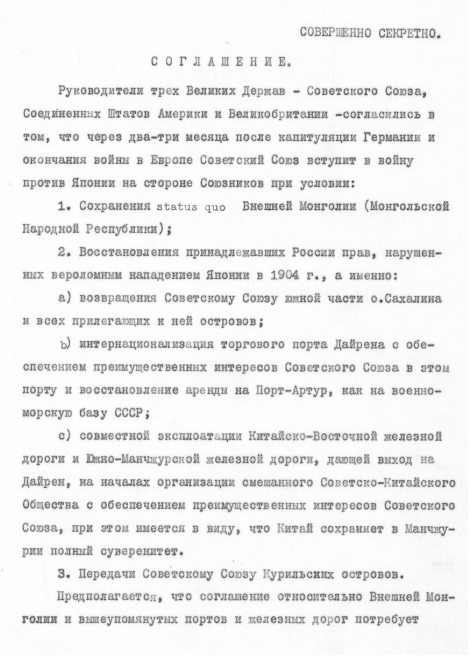
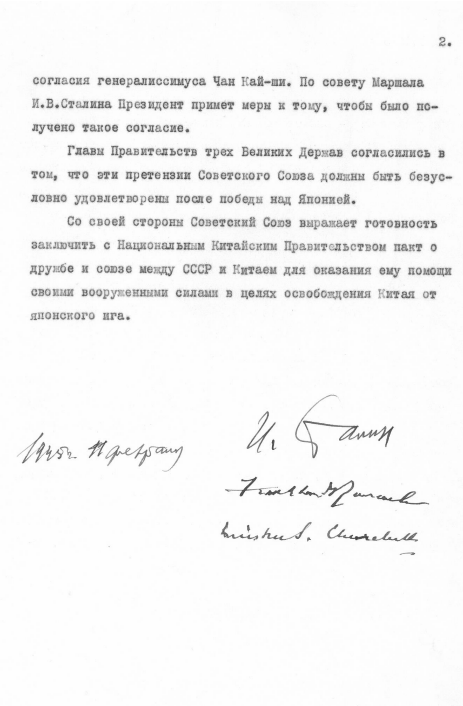
The Far East Agreements signed during the Yalta Conference. February 11, 1945. Russian Foreign Policy Archives

The plan envisioned a strategic offensive operation in Manchuria with a view to defeating the Japanese Kwantung Army deployed there and the troops of the puppet state of Manchukuo, and on Southern Sakhalin, as well as returning the Kuril Islands and capturing a number of ports in Korea which were under the control of the Japanese occupation authorities.

The Far Eastern campaign involved the forces of several army groups – the Transbaikal Front led by Marshal of the Soviet Union Rodion Malinovsky, the 1st Far Eastern Front commanded by Marshal of the Soviet Union Kirill Meretskov and the 2nd Far Eastern Front under Army General Maxim Purkayev, as well as the Pacific Fleet (Admiral Ivan Yumashev), the Amur Military Flotilla, and the Northern Pacific Military Flotilla. The Soviet forces were joined by units of the Mongolian People’s Revolutionary Army. The total strength of the Soviet strike group exceeded 1.6 million people, with about 30,000 guns and mortars, 5,250 tanks and self-propelled guns, 5,200 aircraft, and 93 warships of the main classes. The campaign was coordinated by the Chief Command of the Soviet Forces for the Far East, a dedicated command unit created by the General Headquarters and led by Marshal of the Soviet Union Alexander Vasilevsky.

The plan envisioned a strategic offensive operation in Manchuria with a view to defeating the Japanese Kwantung Army deployed there and the troops of the puppet state of Manchukuo, and on Southern Sakhalin, as well as returning the Kuril Islands and capturing a number of ports in Korea which were under the control of the Japanese occupation authorities.

The Far Eastern campaign involved the forces of several army groups – the Transbaikal Front led by Marshal of the Soviet Union Rodion Malinovsky, the 1st Far Eastern Front commanded by Marshal of the Soviet Union Kirill Meretskov and the 2nd Far Eastern Front under Army General Maxim Purkayev, as well as the Pacific Fleet (Admiral Ivan Yumashev), the Amur Military Flotilla, the Northern Pacific Military Flotilla. The Soviet forces were joined by units of the Mongolian People’s Revolutionary Army. The total strength of the Soviet strike group exceeded 1.6 million people, with about 30,000 guns and mortars, 5,250 tanks and self-propelled guns, 5,200 aircraft, and 93 warships of the main classes. The campaign was coordinated by the Chief Command of the Soviet Forces for the Far East, a dedicated command unit created by the General Headquarters and led by Marshal of the Soviet Union Alexander Vasilevsky.

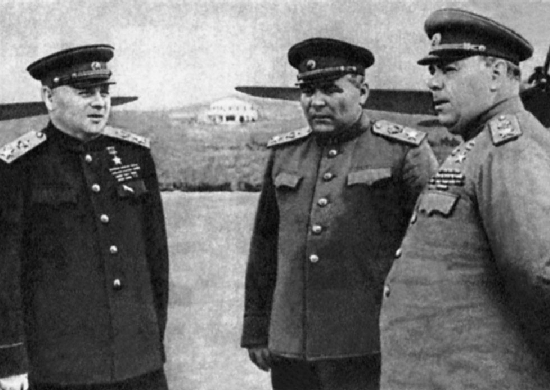
From left: Commander of the 1st Far Eastern Front Kirill Meretskov, Commander of the Transbaikal Front Rodion Malinovsky and Commander-in-Chief of the Soviet Forces in the Far East Alexander Vasilevsky. August 1945


On August 9, the Soviet troops launched the offensive. The Far Eastern campaign included three parts: the Manchurian Strategic Offensive Operation, the South Sakhalin Operation and the Kuril Airborne Operation. The goal of the operation was to defeat the Kwantung Army in the shortest possible time, liberate northeast China and [what later became] North Korea from the Japanese occupiers.

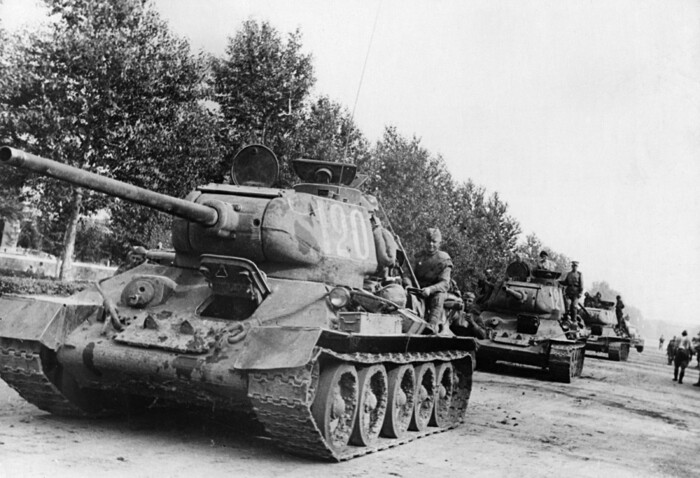
A column of T-34-85 tanks of one of the 2nd Far Eastern Front units in Manchuria. August 1945

The Soviet advance was fast and vehement. Fierce fighting unfolded along a frontline of over 5,000 kilometres, resulting in the Soviet troops liberating Harbin, northeast China and North Korea from the Japanese invaders and capturing South Sakhalin and the Kuril Islands.

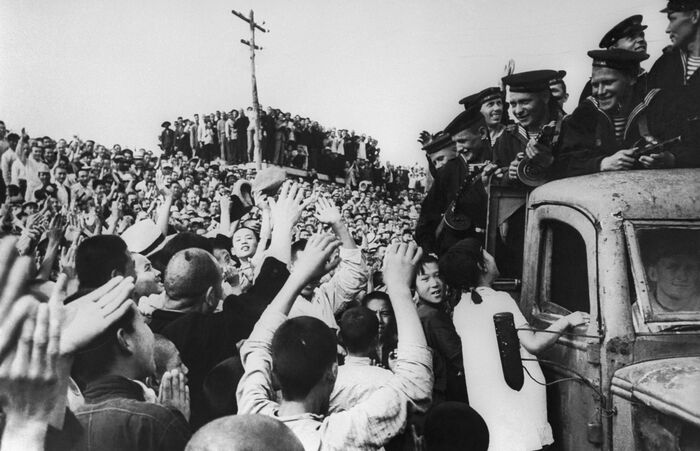
Residents of Harbin greet sailors of the Amur Military Flotilla. September 2, 1945.


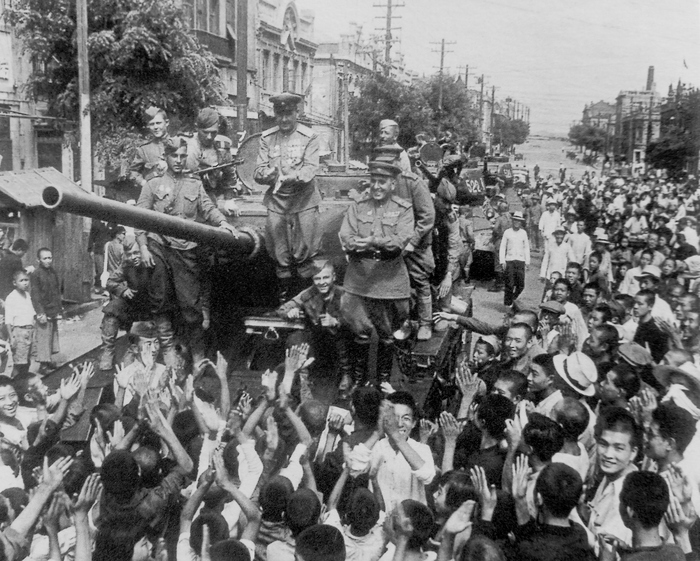
People of Dalian (Dalniy, China) greet tankers of the 7th Mechanised Corps of the 6th Guards Tank Army. August 24, 1945.

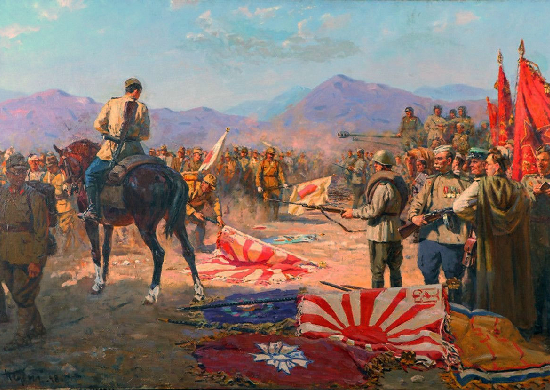
Japan’s ability to continue to resist was undermined. Enemy troops surrendered almost everywhere. On August 18, the Japanese command gave the order to cease military operations on the continent. One million-strong Kwantung Army was destroyed.

Capitulation of the Kwantung Army. Artist Pavel Sudakov

By September 1, 1945, the Soviet troops completed all their combat missions. Over 23 days of combat, they crushed the Japanese military machine and thus made a decisive contribution to end World War II in the Far East. Our country returned the southern part of Sakhalin, which Japan had seized from the Russian Empire in 1905, occupied the Kuril Islands, and once again took over the Kwantung Leased Territory, including Port Arthur and Dalniy.

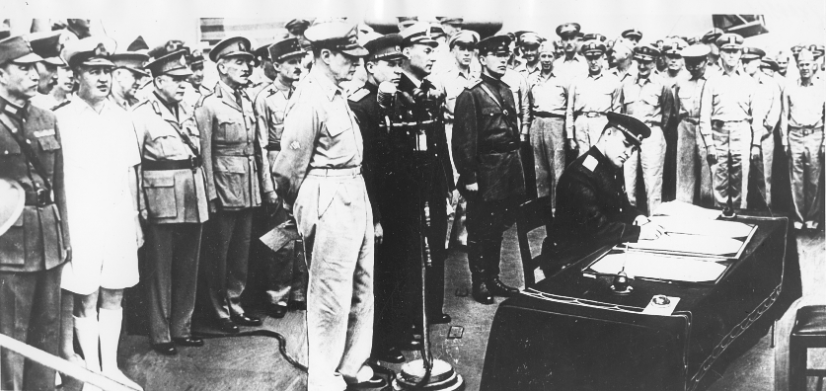
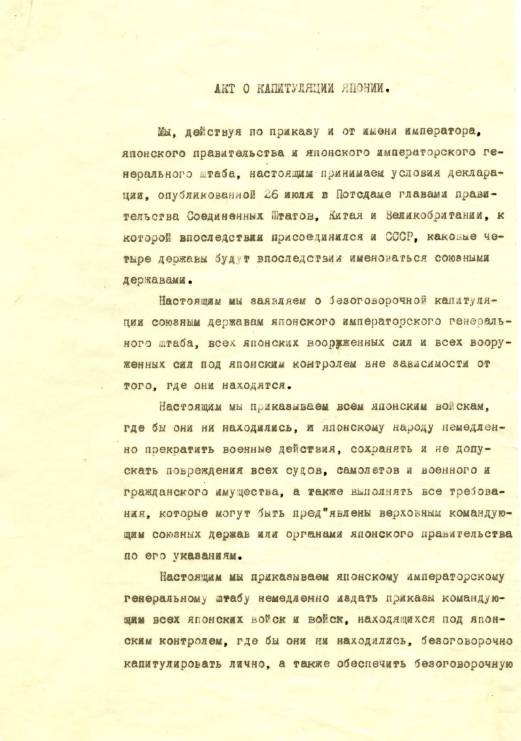
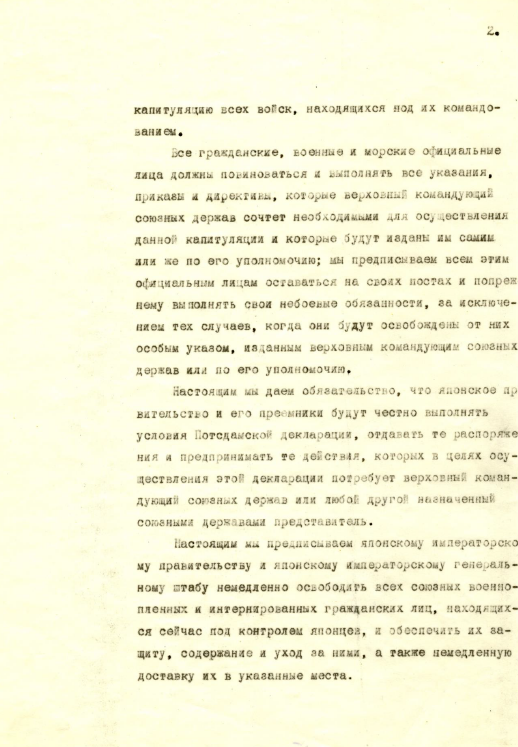
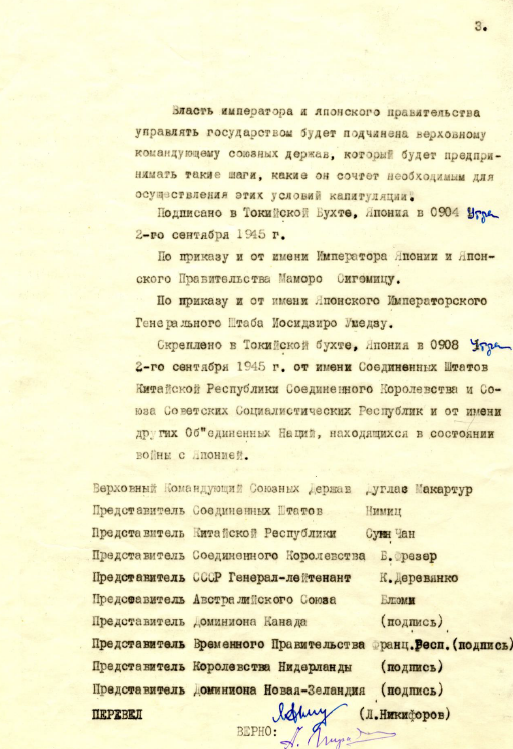
On September 2, 1945, the Japanese Instrument of Surrender was signed on board of USS Missouri in Tokyo Bay. Lieutenant General Kuzma Derevyanko signed it on behalf of the Soviet Union. This signaled the end of World War II.

Lieutenant General Kuzma Derevyanko is signing the Japanese Instrument of Surrender on behalf of the USSR, September 2, 1945. Russian Foreign Policy Archives.
The Japanese Instrument of Surrender, September 2, 1945. Russian Foreign Policy Archives

On September 2, the USSR Supreme Soviet Presidium issued an executive order, On Declaring September 3, 1945 the Day of Victory over Japan. In accordance with the Federal Law of the Russian Federation No. 32-FZ On the Days of Military Glory and Memorable Dates of Russia, dated March 13, 1995 and amended in 2020, September 3 is observed as a Day of Military Glory in Russia.

For military exploits in the war against Japan, 308,000 Soviet soldiers and officers received orders and medals. The title of Hero of the Soviet Union was awarded to 93 people, to six of them twice. More than 300 formations and military units of the army and navy received military awards, and 25 of them were awarded the honorary Guards designation.

☐ ☆ ✇ Red Samovar

[Actu] La composante stratégique sous-marine russe: état des lieux

Par : B.G — 8 août 2025 à 18:57
La composante stratégique sous-marine russe: état des lieux.
☐ ☆ ✇ Global South

🚨 PRESIDENT PUTIN SPEAKS AT SPIEF PLENARY SESSION

Par : amarynth — 20 juin 2025 à 14:47

🚨 PRESIDENT PUTIN SPEAKS AT SPIEF PLENARY SESSION https://t.co/nfz0eRSmEJ

— Sputnik (@SputnikInt) June 20, 2025

Alternatives:

https://forumspb.com/en/programme/business-programme/150101/?ELEMENT_ID=150101#broadcast

https://www.facebook.com/100069392071612/videos/1229570355316906

https://www.facebook.com/100069392071612/videos/1229570355316906

☐ ☆ ✇ Global South

Key takeaways from Russian President Vladimir Putin in a documentary “Russia. Kremlin. Putin. 25 Years

Par : amarynth — 4 mai 2025 à 13:52

From Ria Novosti

[Comment: This interview was much broader than what this set of key takeaways indicate. We will post it as soon as there is a translated and good copy available.]

❗Key takeaways from Russian President Vladimir Putin in a documentary “Russia. Kremlin. Putin. 25 Years”:

🔹Russia had no need to use nuclear weapons during its military operation in Ukraine, and hopes that such a need will not arise in the future;

🔹Russia has sufficient forces and resources to bring the special military operation in Ukraine to its logical conclusion;

🔹Russia remains calm during the military operation despite attempts to provoke Moscow into making mistakes;

🔹Reconciliation with Ukraine is imminent, it is just a matter of time.;

🔹The West failed to respond appropriately to Moscow’s warnings at the 2007 Munich Conference, leading to tragic events in Ukraine;

🔹Russia signed the Minsk agreements in hope that they would be respected, but was deceived by Western countries, who took a pause to rearm Ukraine;

🔹Launching a military operation in 2014 in Ukraine was unrealistic as Russia was not prepared for a direct confrontation with the collective West at the time;

🔹Russia treated the agreements with the western countries with cautious trust until 2022;

🔹Russia had tried to communicate to the West that it had been supporting terrorists in the Chechen conflict, but the Western countries simply nodded their heads;

🔹If Russia does not adhere to its traditional values, it will lose its identity and cease to exist.;

🔹The future Russian president will be chosen by the Russian people, but several candidates who can gain the citizens’ trust need to emerge for that.

☐ ☆ ✇ Vu du Droit

30 avril 1975 : la grande leçon d’un grand peuple

Par : Régis de Castelnau — 30 avril 2025 à 06:00
Tous les 30 avril, je revois cette séquence des chars de l’Armée Populaire du Vietnam renversant les grilles du palais présidentiel de Saïgon. Mettant un terme à une guerre de libération de 30 ans où un petit peuple d’Asie avait… Lire la suite →
☐ ☆ ✇ Vu du Droit

Grandola villa morena…

Par : Régis de Castelnau — 25 avril 2025 à 09:09
C’était un mercredi.  En ce temps-là, il n’y avait pas de chaîne d’information en continu, on ne se sentait pas obligé de s’infliger Rochebin, Praud, Pujadas, Duhamel etc. en prenant son café. On allumait la radio. Le 21 avril 1967,… Lire la suite →
☐ ☆ ✇ Red Samovar

[Actu] Les premiers Su-35 algériens

Par : B.G — 23 avril 2025 à 17:57
L'Algérie devient le troisième pays à exploiter le Su-35
☐ ☆ ✇ Red Samovar

[Actu] Lancement du sous-marin nucléaire Perm (Pr.885M Yasen-M)

Par : B.G — 4 avril 2025 à 18:17
Lancement du sous-marin Perm (Pr.885M Yasen-M)
☐ ☆ ✇ Vu du Droit

CARTOUCHE 2024 N°45, DONALD TRUMP LE RETOUR  

Par : Régis de Castelnau — 11 novembre 2024 à 09:24
CARTOUCHE 2024 N°45, DONALD TRUMP LE RETOUR   SOMMAIRE : Introduction Victoire de Trump un peu de joie mauvaise 2:21 Encore un peu de schadenfreude 9:58 Quand les chiffres de 2024 démontrent la fraude de 2020 16:32
☐ ☆ ✇ Vu du Droit

CONFLIT MONDIAL N°85, POUSSÉE RUSSE SUR KHARKOV

Par : Régis de Castelnau — 13 mai 2024 à 08:56
LES ÉCLAIRAGES DE VUDUDROIT LE CONFLIT MONDIAL, VIDÉO N°85 Régis de Castelnau & Hervé Carresse ANALYSE DE LA POUSSÉE RUSSE SUR LA RÉGION DE KHARKOV Dans un environnement marqué par la censure, plus que jamais nous avons besoin de votre… Lire la suite →
☐ ☆ ✇ Vu du Droit

25 avril 1974, le cadeau des militaires portugais

Par : Régis de Castelnau — 25 avril 2024 à 10:21
C’était il y a 50 ans. C’était un mercredi. En ce temps-là, il n’y avait pas de chaîne d’information en continu, on ne se sentait pas obligé de s’infliger David Pujadas, Pascal Praud ou Ruth Elkrief en prenant son café.… Lire la suite →
☐ ☆ ✇ Vu du Droit

CONFLIT MONDIAL VIDEO N°75

Par : Régis de Castelnau — 13 février 2024 à 16:55
LES ÉCLAIRAGES DE VUDUDROIT GUERRE EN UKRAINE & PALESTINE VIDÉO NUMÉRO 75 Régis de Castelnau Hervé Carresse SOMMAIRE : I) Quid de la situation en Palestine – Israël ? II) Ukraine. Quid des évolutions économiques ? III) Ukraine. Quid de… Lire la suite →
☐ ☆ ✇ Red Samovar

[Actu] Fin des essais étatiques du 2S35 Koalitsiya-SV

Par : B.G — 20 novembre 2023 à 12:08
Fin des essais étatiques du 2S35 Koalitsiya-SV
☐ ☆ ✇ Vu du Droit

GUERRE EN UKRAINE ET PALESTINE VIDEO N°65

Par : Régis de Castelnau — 19 novembre 2023 à 13:11
L’affrontement mondial se poursuit dans toute sa complexité. Xi Jiping se rend en Californie pour le sommet de l’APEC, il y est accueilli par Papy Biden qui va d’abord dire bonjour à une plante verte avant de traiter son hôte… Continue Reading →
☐ ☆ ✇ Vu du Droit

GUERRE EN UKRAINE VIDÉO N° 59

Par : Régis de Castelnau — 11 octobre 2023 à 08:30
LES ÉCLAIRAGES DE VUDUDROIT GUERRE EN UKRAINE VIDÉO N° 59 Régis de Castelnau Hervé Carresse SOMMAIRE : Introduction Nous avons besoin de votre soutien ! Afin que l’algorithme YouTube nous « pousse » il faut mettre des pouces, s’abonner, partager.… Continue Reading →
☐ ☆ ✇ Vu du Droit

GUERRE EN UKRAINE VIDÉO N° 58

Par : Régis de Castelnau — 4 octobre 2023 à 17:35
Poursuite du tour du monde de Vu Du Droit qui revient en Ukraine avant de repartir en Chine, ensuite probablement Russie ou peut-être d’abord en Inde. En Ukraine c’est pour qu’Hervé caresse nous parle d’art opératif n’ont pas dans sa… Continue Reading →
☐ ☆ ✇ Vu du Droit

GUERRE EN UKRAINE VIDÉO N° 57

Par : Régis de Castelnau — 26 septembre 2023 à 15:22
Pendant que Trudeau flanqué de sa Goebbels (Freeland) transforme son parlement en Sportpalats de 1943 pour faire acclamer un SS génocidaire et appelle à la guerre totale (totalenkrieg) contre la Russie, que Scholz éructe à l’ONU, un discours digne de… Continue Reading →
☐ ☆ ✇ Vu du Droit

GUERRE EN UKRAINE VIDÉO NUMÉRO 56

Par : Régis de Castelnau — 19 septembre 2023 à 10:14
L’Occident combiné poursuit sa guerre contre la Russie. Le malheureux peuple ukrainien mandaté pour le faire continue de payer un prix considérable. La Russie n’est pas pressée, son économie va bien, son industrie militaire et prospère, elle mène sa guerre… Continue Reading →
☐ ☆ ✇ Vu du Droit

GUERRE EN UKRAINE VIDÉO NUMÉRO 54

Par : Régis de Castelnau — 12 septembre 2023 à 11:11
Hervé Carresse est revenu de son pèlerinage à New York sur les traces des Ramones. Nous avons donc pu reprendre le fil des analyses militaires. La « contre-offensive » ukrainienne est toujours massacrante et fait toujours du surplace. La façon… Continue Reading →
☐ ☆ ✇ Vu du Droit

GUERRE EN UKRAINE VIDÉO NUMÉRO 53

Par : Régis de Castelnau — 7 septembre 2023 à 07:52
 « La guerre d’Ukraine a maintenant passé le cap des dix-huit mois et s’est installée comme une crise centrale dans la situation internationale. • Le conflit a montré plusieurs choses : l’épuisement catastrophique où se trouve l’Occident, poussant hystériquement l’Ukraine à se battre sans lui… Continue Reading →
☐ ☆ ✇ Vu du Droit

Guerre en Ukraine : un peu de lecture avant le visionnage de la vidéo 51

Par : Régis de Castelnau — 19 août 2023 à 10:20
Pour accompagner cette 51e vidéo consacrée à la guerre mondiale hybride qui se déroule depuis un an et demi, quelques petits conseils de lecture. En effet, dans ces vidéos nous nous efforçons de coller au plus près des événements qui… Continue Reading →
☐ ☆ ✇ Vu du Droit

GUERRE EN UKRAINE VIDÉO NUMÉRO 50

Par : Régis de Castelnau — 12 août 2023 à 09:04
C’est une histoire étrange que celle de la « contre-offensive » ukrainienne. Annoncée à longueur de plateaux et de colonnes par le système médiatique occidental, il était difficile qu’elle bénéficie d’un effet de surprise. Force est de constater, deux mois… Continue Reading →
☐ ☆ ✇ Vu du Droit

GUERRE EN UKRAINE VIDÉO NUMÉRO 45

Par : Régis de Castelnau — 10 juillet 2023 à 09:00
Comme c’était prévisible, la « contre-offensive » annoncée à grands sons de trompe par l’Ukraine et l’Occident compulsif s’est enlisée. Les pauvres soldats ukrainiens qui se font hacher n’ont même pas atteint la première ligne de défense russe installée par… Continue Reading →
☐ ☆ ✇ Red Samovar

[Actu] Le 2S43 Malva: n’est pas CAESAR qui veut

Par : B.G — 9 juin 2023 à 13:19
[Actu] Le 2S43 Malva: n'est pas CAESAR qui veut
☐ ☆ ✇ Vu du Droit

GUERRE EN UKRAINE VIDÉO N° 35

Par : Régis de Castelnau — 15 avril 2023 à 09:50
Le bouleversement du monde s’opère à une vitesse sidérante. L’Occident est-il en train de se disloquer ? SOMMAIRE : LA QUESTION MILITAIRE Que raconte la question des fuites ? La situation militaire globale et projet de contre-offensive. LA MARCHE DU… Continue Reading →
☐ ☆ ✇ Red Samovar

[Analyse] La fin des chars de combat T-72 en Europe

Par : B.G — 24 février 2023 à 20:47
La fin du T-72 en Europe.
☐ ☆ ✇ Red Samovar

[Actu] Le Su-35 en Iran, la fin d’une arlésienne?

Par : B.G — 6 février 2023 à 18:43
[Actu] Le Su-35 en Iran, la fin d'une arlésienne?
☐ ☆ ✇ Red Samovar

[Actu] Sukhoï Su-57: montée en cadence des livraisons

Par : B.G — 19 janvier 2023 à 11:25
[Actu] Sukhoï Su-57: montée en cadence des livraisons
☐ ☆ ✇ Red Samovar

[Actu] Le projet de sous-marins stratégiques Arktur

Par : B.G — 23 août 2022 à 16:43
Le projet de sous-marins stratégiques Arktur
☐ ☆ ✇ Red Samovar

[Actu] Les actualités des sous-marins russes

Par : B.G — 17 juillet 2022 à 14:55
Les actualités des sous-marins russes
☐ ☆ ✇ Red Samovar

[Analyse] La flotte hauturière russe, des évolutions positives?

Par : B.G — 27 décembre 2021 à 23:45
La flotte hauturière russe, des évolutions positives?
☐ ☆ ✇ Red Samovar

[Actu] Modernisation du Tupolev Tu-95MS

Par : B.G — 22 octobre 2021 à 14:45
Modernisation du Tupolev Tu-95MS
❌