 Connexion


Au menu cette semaine: 00:00 Géopolitique profonde 07:05 Économie 12:30 Politico-diplomatique 25:30 Terrorisme 27:00 Armement 30:10 Empire du mensonge 41:54
L’article Bulletin STRATPOL N°290: Trump à Pékin, la guerre bientôt finie ? SARMAT en force. 15.05.2026. est apparu en premier sur STRATPOL.
Quatre ans après son lancement, l’opération militaire spéciale (SMO) semble être une opération dans laquelle la Russie atteint lentement mais
L’article L’élite européenne vaincue et le coup de désespoir (par Pepe Escobar) est apparu en premier sur STRATPOL.
Nous sommes déjà entrés dans une nouvelle phase historique : plus de retenue, plus de circonlocutions, plus aucune tentative de justification.
L’article L’Iran reflète l’affrontement décisif (par Pepe Escobar) est apparu en premier sur STRATPOL.
Le général Zhang Youxia, secrétaire adjoint de la Commission militaire centrale (CMC), et le général Liu Zhenli, chef d’état-major interarmées,
L’article Pour bien comprendre les dernières purges chinoises, il faut se pencher sur la biographie de Xi Jinping ! est apparu en premier sur STRATPOL.

Les ambitions américaines concernant le Groenland s’intensifient, et le mercredi 14 janvier sera une date cruciale pour déterminer si elles
L’article Sommet du Groenland avec le Danemark à Washington. Rubio et Vance tentent de réaliser le rêve de Trump ! est apparu en premier sur STRATPOL.

Par Pepe Escobar – Culture stratégique [Traduction : Paolo Hamidouche] Le tableau d’ensemble du secteur pétrolier vénézuélien est donc bien plus
L’article Pepe Escobar – Comment les rêves pétroliers de Trump pourraient s’effondrer dans un gouffre vénézuélien obscur ! est apparu en premier sur STRATPOL.

La nouvelle réalité du monde multipolaire adviendra-t-elle sous de pacifiques auspices ? Investiture de Donald Trump pour un second mandat
L’article ICI MOSCOU ! Bilan 2025 est apparu en premier sur STRATPOL.
Deputy Foreign Minister and Russia’s Sherpa for BRICS Sergey Ryabkov took part (https://mid.ru/en/foreign_policy/news/2065247/) in the end-of-year sherpa/sous-sherpa meeting of BRICS countries under the Brazilian chairmanship in Brasília on December 11-12.
The participants reviewed this year’s cooperation outcomes. More than 260 political, economic, and humanitarian events, including the #BRICS Summit and nearly 20 ministerial meetings, took place this year.
The contribution of the  Brazilian chairmanship to ensuring continuity of the BRICS strategic partnership was noted, along with progress achieved across all key areas such as politics and security, the economy and finance, and cultural and humanitarian exchanges.
The launch of the BRICS Partnership for the Elimination of Socially Determined Diseases, the adoption of leadership statements on climate finance and global governance in the field of artificial intelligence are among the year’s achievements.
Additional momentum was observed in cooperation in energy, healthcare, transport, science, and innovation.
Dialogue continued on the  Russian chairmanship’s initiatives in 2024, including the creation of an independent settlement infrastructure, an investment platform, and a BRICS grain exchange.
Special emphasis was placed on the institutional development of the association and on enhancing the cooperation mechanisms’ effectiveness.
Our  Indian partners outlined the key priorities of their chairmanship in 2026. In particular, they plan to focus on:
• promoting multilateralism, reforming global governance institutions,
•ensuring energy and food security,
• fostering innovation and technological cooperation,
• combatting terrorism, transnational crime, poverty, and climate change.
The meeting also featured a separate session with delegations from BRICS partner states, during which prospects for cooperation in expanded BRICS formats were discussed, as well as opportunities to strengthen solidarity on international platforms to enhance the role of the World Majority in decision-making on key international issues, including sustainable development and improvement of multilateral institutions.
Taking all information from Pepe Escobar’s post: Pepe Escobar: How the BRICS+ Unit Can Save Global Trade
I mention that I am convinced Pepe’s work was absolutely correct as provided to him. I also know that without a deep technical and background in this field, and with deep respect for our longstanding friend Pepe, he may not have had the in-depth knowledge to ask some necessary questions.
So, I will ask these questions. Allow me, these questions will not be of the “academically validated” type, but mainly home in on:
1. This looks like a commercial project. You may think so too by the end of this.
2. This project has so many Atlanticist and Western technologies that it is questionable if this is BRICS. You may think so too by the end, but feel free to prove me wrong, or even partially wrong.
3. If this is really where BRICS stand in their development of a tokenized project, it is deeply disappointing. We have a whole lot of packaging that does not convince a person schooled in cryptographic methodologies. BRICS needs its own blockchain and should not plan to run on a commercial blockchain as a token. This is not the environment BRICS should be. It is cheap and nasty, and tokens (handled later in the nomenclature section) are generally like vanity number plates.
4. There is no top-level technical expertise, and projects of this nature need heavyweight and visionary technologists with a deep knowledge of the industry at the top. There are, in the main, two aspects: the technology and governance of the blockchain, which will include cost management. It is a critical aspect. I am not using the word critical here lightly. If one does not have that in balance, one will fail, as the many failed blockchain projects attest to in the short history of this technology. Do we really want all BRICS countries to come to a screeching halt if Cardano suddenly falls apart? How on earth can we put our trust in an external blockchain? This is like banking at Citibank.
Nomenclature
I will call any discrete aspect of the system as described an element, (in reality it is a segment as worms have segments) and will call the unit itself a token, as this is the correct nomenclature for a cryptographic product in both proof of work and proof of stake systems. The correct nomenclature helps us avoid the esoteric and marketing hype. In fact, the Unit foundation calls it a token.
What is the Unit?
As described, this is neither a stablecoin nor a cryptocurrency. It is understandable why this is said that way, and it is meant to overcome bias and distrust in the general community. The distrust in the word stablecoin exists in the Western community, in the main. Why do we feel it necessary to specifically mention that? Are we writing for Westerners? I am sure China’s E-CNY does not have that connotation of distrust and the Unit is not a ‘post-stablecoin. In fact, it is exactly that in a true definition, a stablecoin where the price is arrived at by utilizing the gold price at the moment and the currency exchange rate of a currency or basket involved at the moment. A stablecoin in the traditional, is a coin that has a value exactly the same as your currency. A Dollar stablecoin is tethered to the US Dollar. The E.CNY is tethered to the Chinese Renminbi. So, we’re adding gold. It is trivial.
But the Unit is not a stablecoin as it is a token. A different price discovery mechanism does not make it what it is not. What are we messing around with Tokens?
Just as China’s E-CNY is a peer-to-peer electronic cash, an analogue to the renminbi. Token fits with the mining or minting process on the blockchain. If this is not correct, perhaps we should have a name that describes it technically.
I mean, according to the description, we are going to mint tokens and run piggy-back on the Cardano Blockchain, no? Why is Ada specifically mentioned? Is there interplay? Costwise perhaps? Yes is the answer and the problem. We’re now developing the Cardano Blockchain and paying for transactions in Cardano.
White Paper
Customarily and correctly, projects such as this require a white paper. Only the very fact that we do not have a white paper, front and center, tells me that we are dealing with economists and bankers, and this does not a technical blockchain make. There is no technical competence in this project as described. We see it here as well: 100 Units have been minted (in a test form), and if one is at this stage of development, these questions must already have answers. Some of the information we were supplied is questionable. I will steer clear of the more technical aspects to make this as understandable as possible for those without a technical background in this sphere.
So, I found a white paper, but it is called a light paper, and indeed, it’s feather-light. https://wp.unitfoundation.org/assets/lightpaper_v17102025.pdf
Let’s stay with The Unit Foundation and its three members. The first one they called BRICS+, the second is the Eurasian Economic Union, and the third is West and Central Africa. But, these are possible future use cases and certainly not real. It then has an AI director and a real director (I think). AI does not substitute for smart and visionary technical expertise with deep knowledge in the industry and in this field. One has to roll up one’s sleeves.
Stepping back to the light paper that was apparently produced by the International Research Institute for Advanced Systems (Irias). Where do they fit? What have they done? A few publications, a few events. There is no top-level technical smarts on blockchains, cryptos, or tokens. They’ve been around since 1976 and consist of ;
There is zero top-level technological expertise, and the paper is light. In fact, it is transparent for what it does not say.
The How.
The Unit Foundation (https://unitfoundation.org/) states: We leverage BRICS+ Currencies and Gold into a Unit Ecosystem. Apparently, according to these bright sparks, it has never been done. To my knowledge the part with currencies has not been done, excepting it has, with existing stablecoins Here is a simple ad for 10 Gold backed cryptocurrencies: The https://primexbt.com/for-traders/gold-backed-cryptocurrency/ To do the sums is for a good programmer designer trivial. But let’s remember that a country such as El Salvador has made Bitcoin an official currency and offered incentives to adopt it. So did the CAR. Where is that currency number now?
It is statements like this that tell me clearly there is no technical expertise of the required weight here.
Let’s go and look for the gold price and for the currency value at the time.
The Unit, in order to make a price for a commercial transaction, needs a current gold price. They state they get it from here:
https://www.bullion-rates.com/
The Corporate Headquarters is listed as 800 N. King Street
Suite 304 1474
Wilmington, DE 19801
So this is one of those Delaware companies that live in a Suite. It is what a virtual company looks like. Have these Unit designers heard about Hong Kong?
They also need a currency value.
So BRICS will be using XE, which is listed on the Nasdex and headquartered in Canada, and is in essence a money transferer. (Have your IBAN (International Bank Account Number ready to make sure your transfer is sent to the right destination.) More western one cannot get.
A comment such as this does not fit BRICS: Even JP Morgan admitted The Unit is “perhaps the most thoroughly fleshed-out of de-dollarization proposals that exist in the cross-border transactions space for BRICS+.” May I ask, who in JP Morgan, and where is the technological expertise to even make that statement?
So, the Chairman of the Launch Committee is Bilderberg. And one of the organizations that they are working with is in Brussels.
I cannot even comment.
How will this Unit affect the whole of the BRICS infrastructure. I mean, what will it do?
Once the UNIT tokens are minted and the nodes of the network are synchronized, they are completely fungible and can be used as any fiat currency: a simple account-to-account transfer using existing banking infrastructure should suffice.
Let us look at that a little deeper.
Nodes of the network – which network? Cardano?
Existing banking infrastructure – I can guarantee you the banks where I am will not touch this thing with a barge pole. It is also a wrong statement which I don’t even want to go into. I repeat, technical expertise with vision and deep knowledge of the industry is lacking and it shows.
Then I hear you say: It’s only a couple of lookups – trivial. Well, what happens if the lookups disappear? All commerce in all BRICS countries comes to a screeching halt?
Let me also not comment too deeply on fungibility at this stage. This is correct. A token, a coin must be fungible. But what happens if Blackrock swoops in and buys every Unit available?
Cardano Blockchain
We end up then with BRICS running its Unit as a token on the Cardano Blockchain. When I saw that at first my response was: WHAT? What happens if the Unit loses its friendship with Cardano? What is going to ensure that Cardano blockchain does not act like a Volkswagon vs a rocketship. Will Cardano scale in its token environment? Is there a realization that scalability is one of the most difficult technical problems to solve? What is the biggest token transaction that Cardono ever processed? What are the benchmarks vs the current Russia, China, Iran trade to start with? Is this even approaching Visa and Mastercard trade worldwide? We are working with Russia and China trade, completely in local currencies, and the numbers are huge. We are working with the Russian and Indian trade, which is over 90% in local currencies. I will forecast that Cardano will fail spectacularly if a smart contract and one of the big transactions multiply by a number of countries must be processed. To give you an idea, China carried out its first smart contract years ago, buying copper from Australia. Why are we using Western technology that has not proven itself in terms of massive transactions while China has the technology? I have nothing against Cardano, but Brazil runs PIX very successfully. Have we even considered PIX as a basis? It belongs to the Brazilian State, and not to a Delaware company. Cardano has over $1 billion in volume per day. So, that is the volume of transactions it is able to process because we cannot say it can do more, if we have not seen or tested or benchmarked it. What happens if you need to put through triple that in a few significant transactions?. Why, when we have the technologies in-house in the BRICS countries?
Following on from this question: Are any of the elements, as explained, proprietary, or are we working in open source? I hope so, but if not, who owns the proprietary elements? Further, who is developing and programming those elements and for who?
Strong recommendation
Do the work and develop a blockchain for BRICS. Position it in a BRICS technology company in a BRICS country. Blockchains are all open source and are an easy start, given the number of iterations already through the few years. Get the technological expertise to the level that is needed. Let the foundation do some work. Raise alternate exchanges in Eurasia. Then build a blockchain that is bereft of any Western influence. Then and only then do technical interfaces with Western countries, as interfaces, and not as determinative technology. Then only BRICS and SCO and Global South and Global East can truly trade with independence. Do not depend on Western banking systems because ‘one day the West will come to its senses’. This cannot be an Atlanticist effort.
There is more, and I’ve touched only what stood out in the first article, focusing on governance issues. I am convinced the Michael Hudsons of this world can tear this apart from an economic standpoint. The Unit, as envisaged, will fail if it is not rescued now, given the information we have. I say that with absolute confidence, as the required level of technological expertise is nowhere to be seen and neither is the governance. A white paper, and not a light paper please. The cost, and yes, there is one, is a black hole. Ownership is a black hole. Or is BRICS the Unit also going to register a virtual Delaware company?
I also want to know if this Unit is so fungible that I can trade it, where is the wallet? This is a test question that addresses custodial or non-custodial ownership and issues of Who Owns What and Where is it stored? This question will define where money, or rather Unit tokens, are kept. Have you spoken to the best block explorer, which is a Russian company? It is called Blockchair: https://blockchair.com/ Nikita, the designer and long-term developer, is a brilliant technologist and can immediately recommend who to work with.
Would you not abandon or re-vision your current effort because it does not use BRICS resources? I can give you some of the most incredibly talented technical resources on this planet. One is married to a Russian, lives in the East, knows the industry backwards and forwards, is a highly talented developer, can manage development teams, and is a committed Orthodox Christian. No, he won’t do it for you, but he will set you up and get the governance issues in shape. I know this Frenchman, and it is the same story. He won’t do it for you, but he can set you up. The talent is out there, but the truly visionary talent pool is limited, and you don’t have it.
This is a vast topic, and I’ve hardly scratched the surface. I’ve not looked at the composition of The Basket as it is not stated with clarity. How do you figure ‘equal portions of major BRICS currencies: BRL, CNY, INR, RUB and ZAR’? ZAR will thank the creators for that one. I also find a level of non-transparency. Those of us that took the trouble to learn this environment from inception, are intent on transparency. We are absolutely accustomed to diving into the code and assessing it on a granular level. This is how the technical resources of BRICS countries will start their analysis to decide whether they are in or not. It is perhaps a timing issue, but with a light paper, this level of transparency should be visible. It is not.
Pepe Escobar on Sputnik
The Unit project, first revealed by Sputnik in 2024, is emerging as the most viable option for breaking the US dollar’s stranglehold on global trade and investment.
In his book co-written with top economist Sergey Bodrunov, Regulations of the Noonomy (international edition published this year by Sandro Teti Editore in Rome), leading Russian economist Sergey Glazyev stresses the need to “ensure a full-fledged switch to national currencies in mutual trade and investment within the EAEU and the CIS, and further – within the BRICS and SCO, the withdrawal of joint development institutions from the dollar zone, the development of their own independent payment systems and interbank information exchange systems.”
When it comes to financial innovation – compared to the current structure of the international financial system – The Unit is in a class of its own.
The Unit is essentially a benchmark token – or an index token; a post-stablecoin, digital monetary tool; totally decentralized; and with intrinsic value anchored in real assets: gold and sovereign currencies.
The Unit can be used either as part of a new digital infrastructure – what most of the Global South is striving for; or as part of a traditional banking setup.
When it comes to fulfilling traditional money functions, The Unit is – pardon the pun – right on the money. It’s meant to be used as a quite convenient medium of exchange in cross-border trade and investments – a key plank of the diversification actively pursued by BRICS+.
It should also be seen as an independent, reliable measure for value and pricing, as well as a better store of value than fiat money.
The Unit is academically validated – including by Glazyev himself – and properly governed by IRIAS (International Research Institute for Advanced Systems), set up in 1976 in accordance with the UN statute.
And crucial at this next step, The Unit is to be launched early next year on the Cardano blockchain, which uses the digital currency Ada.
Ada has a fascinating background – named after Ada Lovelace, a 19th-century mathematician, daughter of none other than Lord Byron, and recognized as the first computer programmer in History.
Anyone, anywhere can use Ada as a secure exchange of value; and very important, without the need to ask a third party to mediate the exchange.
That means every Ada transaction is permanently secured and recorded on the Cardano blockchain. That also means that every Ada holder also holds a stake in the Cardano network.
Cardano has been around for 10 years now – and is a quite popular blockchain. It’s backed by some quite big venture capital firms such as IOHK, Emurgo and the Cardano Foundation. Essentially, Cardano is an excellent option for regular payments because transactions are cheap and fast.
Neither a crypto nor a stablecoin
Enter The Unit.
The Unit is neither a cryptocurrency nor a stablecoin – as it’s shown here.
A concise definition of The Unit would be a resilient reserve of value – backed by a structure of 60% gold and 40% diversified BRICS+ currencies.
The major appeal for the Global South is that such a unique mix provides stability and protection against inflation, especially under the current global financial landscape of wobbly macroeconomics and widespread uncertainty.
Using Cardano, The Unit is bound to become accessible to everyone, via a combination of centralized and decentralized exchanges.
So to enter this new market, individuals and companies will be able to acquire The Unit directly with fiat through regulated banking partners. That means a bridge between traditional finance and emerging decentralized ecosystems – in favor of liquidity, accessibility and reliability, opening the door to full adoption by the Global South.
The Unit can even evolve into a new form of digital cash for emerging economies.
Following exactly the path delineated by BRICS even before the ground-breaking annual summit in Kazan in 2024, The Unit may be the best solution currently available for cross-border payments: a new form of international currency, issued in a de-centralized way, and then recognized and regulated at a national level.
And that brings us to the top conceptual strenght of The Unit: it removes a direct dependency on the currency of other nations, and offers the Global South/Global Majority a new form of non-censored, apolitical money.
Better yet: apolitical money featuring an enormous potential for anchoring fair trade and multiple investments.
What the Global South really needs
A good next step for The Unit would also be to set up an Advisory Board, uniting world standard stars such as Prof. Michael Hudson, Jeffrey Sachs, Yannis Varoufakis and the co-founder of the NDB Paulo Nogueira Batista Jr. (here at the Global South Academic Forum in Shanghai) .
When it comes to BRICs-emphasized de-dollarization – done with a hefty degree of sophistication, without having to spell it out – The Unit will be key. It’s also key that The Unit is not a cryptocurrency.
Wall Street behemoths – especially BlackRock – are big on cryptocurrencies, an enormously unstable set up which eschewed individual holders to the profit of massive institutional players. For example, it’s BlackRock that essentially shapes Bitcoin’s market.
US stablecoins essentially perpetuate US dollar dominance – aiming their firepower directly against possible, future digital currencies offered by BRICS+.
The Unit is the stark opposite, offering a reliable digital monetary tool for the fast advancing Multipolar World. It’s an evolution in itself, bridging the fiat and the crypto worlds; and last but not least, it is a solid foundation for the emerging post-Bretton Woods economy.
Of course the challenges ahead are huge – and The Unit will be fought tooth and nail by the usual suspects as a new concept offering borderless financial resilience for the Global South/Global Majority.
And here may lie the key takeaway: the only way BRICS+ as well as the Global Majority may be strengthened is by developing closer and closer geoeconomic, financial ties. For that, the toxic power of Western speculative capital must be contained – to the benefit of more intra-Global South commodity trading, and more investable capital for productive, sustainable development.
The potential is limitless. The Unit may well be able to unlock it. Even JP Morgan admitted The Unit is “perhaps the most thoroughly fleshed-out of de-dollarization proposals that exist in the cross-border transactions space for BRICS+.”
And there’s no other similarly effective plan anywhere in the world.
Speakers:
Pavel Knyazev, Ambassador-at-Large, Russian Ministry of Foreign Affairs, Sous-Sherpa of Russia to the BRICS
Victoria Panova, Vice-Rector, HSE University, Head of the BRICS Expert Council–Russia
Anna Sytnik, Associate Professor, St. Petersburg State University, Expert, BRICS Expert Council, Managing Director of the INPO “Kolaboratorija”
Marco Fernandes, PhD in Social Psychology (University of São Paulo), Brazilian Representative at the BRICS Civil Council
Moderator:
Timofei Bordachev, Programme Director, Valdai Discussion Club
https://valdaiclub.com/multimedia/video/live-brics-2026-plateau-or-new-rise-an-expert-discussion/
Quietly unveiled:
BRICS Pay Latest News
Introduction
Evolution of BRICS Financial Cooperation
The BRICS Pay Initiative
Strategic Motivation and Political Context
Challenges in Implementing BRICS Pay
Global Implications

https://t.me/InessaFromYoutube/9103
There exists a BRICS Paymnent Task Force, but good luck to find them.
Paulo Nogueira Batista Jr. at the Valdai Club
There are two sections to this.
First is the discussion at the Valdai club and second the following talk by Think-BRICS. This is not casual reading, but instead requires careful study.
—
The need to face up to the deficiencies of the Western-controlled monetary and financial system should lead the BRICS to better organize themselves going forward in order to remove at least in part the internal obstacles to change. Although some sensitive matters, such as the possibility of creating a new reserve currency, are only feasible in the longer term, the group should continue to work towards providing practical alternatives not only for themselves but for developing countries as a whole.
This paper discusses the topic of BRICS monetary and financial initiatives with a focus on Russia’s chairmanship of the group in 2024 and next steps. In so far as monetary and financial matters are concerned, the point of departure of the BRICS is the widely recognized dysfunctionality of the dollar-centered system, a consequence of two distinct factors: a) the weaponization of the US dollar and of the Western crossborder payment network; and b) the structural weaknesses of the economy of the United States, the country issuing the hegemonic international currency. The BRICS, rightly or wrongly, are often seen as the main potential source of alternatives to the current flawed international monetary and financial system.
Paradoxically, as we will see, the US wants to monopolize the role of undermining the dollar and the current international system. Among the countries of the BRICS, Russia is one of the most, if not the most interested country in promoting the discussion and implementation of alternatives to the current international monetary and financial system dominated by the United States and its allies.
The reason is well-known: Russia and Russian banks and firms have been a direct target of sanctions, including exclusion from the Western-sponsored cross-border payments framework and, most notably, the freezing of as much as half of the country’s international reserves, to the tune of US$ 300 billion, after the beginning of Russia’s special military operation in Ukraine. A number of other countries, including Iran, one of the new BRICS members, have also been targeted by the West in similar ways. Thus, it was to be expected that Russia would do its best to advance BRICS discussions of financial matters.
Kindly download the Valdai Club report here: https://valdaiclub.com/files/50206/

Think-BRICS was involved in starting the discussion with Batista and post Valdai discussion, picked up this report and continued the discussion. It was good to see that the proposals arriving from this track align in broad terms with Michael Hudson’s discussions on a new financial system and what is needed. The two accompanying videos are at the end.
The Storm and the Blueprint: Charting the BRICS’ Monetary Liberation
BRICS’ strategic move toward financial independence: Weaponization drives the push for parallel banks, the BCBPI, and a new non-Western reserve system.
The international financial landscape today resembles a high-stakes, unscripted drama, where the established world order, centered on the US dollar, is visibly cracking under the weight of its own political and fiscal pressures. At the heart of this unfolding story stands Paulo Nogueira Batista Jr., the Brazilian economist whose experience spans the highest echelons of global finance, from the International Monetary Fund (IMF) to the founding of the New Development Bank (NDB).
Batista Jr.’s proposal, famously titled ‘Beyond the Dollar,’ provides a comprehensive blueprint for the BRICS grouping to construct a new, independent monetary architecture. This vision, first previewed during an interview on ‘Think BRICS’ and subsequently subjected to intense scrutiny during a public debate at the Valdai Club in Moscow, does more than merely catalog the dollar system’s flaws; it maps a daring, two-track path toward global financial sovereignty.
Act I: The Crisis Defined—A Weaponized System on a Cracked Foundation
Batista Jr. grounds his call for a new system in the widely recognized dysfunctionality of the dollar-centered system. He argues this breakdown stems from two distinct, interconnected factors: the calculated weaponization of financial mechanisms and the structural weaknesses inherent in the U.S. economy.
The Financial Sword: Weaponization and the Loss of Confidence
The key driver forcing BRICS nations toward alternatives is the West’s tendency to use its currency and financial architecture as a geopolitical weapon to punish non-cooperative countries.
SWIFT and Exclusion: Cross-border payment systems like SWIFT (Society for Worldwide Interbank Financial Telecommunication) have been transformed into tools of coercion. If a country “displease[s] western bosses,” it risks being “thrown out of the system,” as Russia experienced.
Institutional Capture: The dollar, the IMF, and the World Bank are all used as geopolitical weapons, ironically undermining the very institutions the U.S. helped create.
The NDB’s Shackles: This weaponization reaches even the heart of BRICS institutions. Batista Jr., having helped build the NDB, revealed that the bank stopped lending to Russia, a founding member, solely out of fear of sanctions. Had the NDB continued, it risked losing its credit rating, dictated by the “triopoly” of American credit rating agencies (Moody’s, Standard & Poor’s, Fitch). Similarly, the bank fears accepting new members like Iran, Cuba, or Venezuela due to the potential negative impact on its credit rating.
Secondary Sanctions: This coercive environment affects not only targeted nations (such as Russia and Iran) but also trading partners. Countries like Brazil, for instance, bear the risk of potential secondary sanctions for trading with nations deemed “toxic” by the West.
As Dmitry Birichevsky, Director of the Department of Economic Cooperation at the Ministry of Foreign Affairs of the Russian Federation, observed during the Valdai debate, what happened to Russia can happen to any country, noting that Western nations “themselves force us to do that,” having “deprived” partners of the opportunity to use the dollar and euro through limitations.
The Rotting Foundation: Structural Weakness of the Hegemon
Confidence in a reserve currency rests on the health of the issuing country’s financial arrangements. Batista Jr. points out that U.S. macroeconomic fundamentals are no longer solid, noting that Americans “continue to preach but no longer practice solid economic policies.”
Fiscal Disarray: U.S. fiscal policy is in disarray, with public debt continuously increasing as a proportion of GDP, and the political system failing to deliver necessary surpluses.
Privilege and Resistance: The U.S. maintains its privilege of covering large deficits simply by issuing currency. This economic advantage explains America’s “determined resistance to any proposal or initiative that could weaken the status of the dollar”.
Batista Jr., drawing on his eight years as an IMF Executive Director, stresses the sobering reality: the West will not allow fundamental reform of the international monetary and financial system established since World War II. Therefore, the path forward for BRICS must be to “start off from scratch”.
Act II: The Blueprint Unveiled—A Fiduciary Alternative
Acknowledging that the existing system is unreformable and that reliance on bilateral settlements in national currencies is ultimately limited by imbalances, Batista Jr. sets the long-term goal: the creation of a new international reserve currency.
Dispelling False Solutions
Batista Jr. methodically dismisses two frequently discussed alternatives:
Commodity Backing (e.g., Gold): A trustworthy currency requires stability, but gold and other commodities are “intrinsically unstable.” Tying a new currency to a commodity anchor would make it “prone to instability” as prices fluctuate.
The Renminbi (RMB): Although the RMB is the only Global South currency large enough to potentially pick up the slack, its full internationalization would likely damage China’s successful export-led economic model, which relies on capital controls and stable exchange rates. Internationalization would require China to liberalize its capital account and allow currency appreciation, exposing it to the instability and “vagaries of international finance” that could threaten its industrial sector—a risk of de-industrialization similar to that seen in the United States. Batista Jr. argues that replacing US hegemony with Chinese hegemony would merely be “changing six for half a dozen”.
The New Fiduciary Currency (The IIB Model)
The proposed solution is a fiduciary currency inspired by Keynes’s concept of Bancor. Crucially, this would be an international currency with no domestic role; it would circulate alongside the national currencies of the participating countries, not replace them.
To implement this, three institutional steps are required:
International Issuing Bank (IIB): A new, “simple, lean” institution must be created, as existing structures like the NDB or CRA are “not fit for the job”.
Issuance: The IIB would issue two things: the new currency and new bonds.
Backing Mechanism: The new currency would be convertible into IIB bonds, and these IIB bonds, in turn, would be freely convertible into a basket of bonds of the participating countries. This structure ensures confidence, backed by the commitment of the sponsoring states.
The Necessary Transitional Steps
Recognizing that establishing a full reserve currency is a medium- to long-term endeavor, Batista Jr. prioritizes immediate transitional devices:
New Unit of Account: A simple, SDR-like basket of currencies from participating countries, weighted by relative economic size. This unit would fluctuate based on the weighted fluctuations of the currencies in the basket. It should be named the “new unit of account,” rather than BRICS-specific, to allow non-BRICS countries to join.
BRICS Cross-Border Payment Initiative (BCBPI): This proposal aims to create a more efficient, transparent, safe, and independent digital payment infrastructure based on national currencies. To overcome the BRICS’ internal consensus barriers, this initiative must be explicitly designated as voluntary and non-binding.
These steps are critical to solve the “very severe limitation” of bilateral settlements: the inability of participating countries to register large trade imbalances without accumulating currency that may not be convertible or may be subject to depreciation (e.g., Russia accumulating Indian Rupees).
Act III: The Confrontation—Voices from the Valdai Debate
The discussion at the Valdai Club served as a crucible, testing the feasibility and political realities of the ‘Beyond the Dollar’ proposal. The speakers offered layers of insight, revealing both fervent support and profound geopolitical hurdles.
The Supporters: Necessity and Sovereignty
Dmitry Birichevsky strongly endorsed the necessity of building separate channels. He agreed that replacing one center of domination with another is not the goal; rather, the BRICS are moving toward a multicentric world. He confirmed Russian leadership supports the BCBPI, emphasizing the need for closed circuits, special companies, and separate channels to avoid restrictions.
Marco Fernandes (BRICS Civil Council) reinforced the necessity of a reserve currency by highlighting the practical failures of bilateral settlements, noting Russia’s predicament of accumulating the equivalent of $40 billion in rupees from trade with India. Fernandez offered a strategic expansion to the proposal: leveraging BRICS’ deterrence power by de-dollarizing commodity markets (food, energy, and critical minerals). He noted that BRICS members control significant shares of global production (60% of gas reserves, 50% of oil reserves, and 85% of rare earth reserves), suggesting this leverage could shift trade away from the dollar, citing the Russian-led proposal for a BRICS grain exchange.
Most tellingly, Fernandes shared a conversation with a “pro-West liberal Iranian banker” who, despite initial criticism of his own government, concluded that the only viable path might be the formation of two distinct economic blocks: the West and the BRICS-led Global South. Batista Jr. responded that he agrees with this analysis, stating that “we already are in a situation of two blocks” and must adapt accordingly.
Rasigan Maharajh (Tshwane University of Technology), backed the geopolitical diagnosis, noting that U.S. power is maintained through the mobilization of “internal allies” (powerful domestic constituencies, or what Batista Jr. referred to as “fifth columns”) in other nations. Maharaj stressed that Multilateral Development Banks (MDBs) are political instruments, not neutral, reinforcing the need for BRICS to strive for multipolarity and polycentrism rather than attempting to reform institutions established under U.S. hegemony.
The Skeptics: Internal Obstacles and External Fury
The most penetrating criticisms focused on implementation feasibility and geopolitical pushback.
Radhika Desai (University of Manitoba) elaborated on the systemic flaw, arguing that the problem is rooted in the dollar system’s reliance on financialization (asset bubbles) to temporarily counteract the Triffin dilemma.
Desai insisted that the primary domestic obstacle is the “fifth column”—national elites in countries like Brazil, India, and South Africa who are attached to the dollar system because it serves as a tax and financial haven for their wealth. She emphasized that any viable alternative, like the Bancor model, requires substantial capital controls to ensure economic sovereignty, a measure highly resisted by these elites.
Desai predicted that the dollar system’s internal contradictions—the bind between fighting persistent inflation and preventing a crash of the “everything bubble”—may force a crisis that creates the necessary “aperture” for alternatives to succeed.
Anna Tsibulina (Integration Processes Department) raised doubts about the irreversibility of U.S. decline, recalling that the U.S. successfully navigated past crises (e.g., after Bretton Woods through the petrodollar agreement). Her core concern was the unprecedented resistance the U.S. would mount against a parallel monetary system. She questioned how the new currency could be shielded from this “ferocious” resistance, and worried that, given China’s inevitable economic weight, the new unit of account might become de facto China-centric. Batista Jr. conceded that the new currency would indeed be China-centric but suggested “compression factors” could mitigate excessive domination. He agreed that pursuing this direction requires political courage, given the certain U.S. opposition.
The Geopolitical Gauntlet: Consensus and Courage
The debate highlighted that external U.S. resistance is only half the battle; the BRICS grouping must overcome its own internal operational hurdles.
The Consensus Trap: The BRICS’ rigid practice of deciding by consensus, often interpreted as virtual unanimity, effectively grants veto power to any individual member. As the group expands (now 10 full members plus 13 partners), this consensus rule becomes a “recipe for paralysis”.
Working Around the Veto: The solution proposed by Batista Jr. and reflected in the Kazan declaration is crucial: explicitly defining new initiatives, like the BCBPI, as voluntary and non-binding. This allows a “coalition of willing and able nations,” including subsets of BRICS members and non-BRICS nations, to advance without being held hostage by members vulnerable to U.S. pressure or attached to the status quo (the “fifth column”).
Managing Expansion: Batista Jr. recommends that the BRICS freeze or slow down expansion, arguing that “strength does not necessarily lie in numbers”. While expansion increases prestige, multiplying participants increases the obstacles to practical progress and makes decision-making significantly harder.
The ultimate threat to this endeavor comes from the U.S., which has intensified its opposition, demonstrated vividly by Donald Trump’s threats during his 2024 campaign to impose 100% tariffs on countries engaging in activities that undermine the dollar’s status. Batista Jr. interprets these “arrogant statements and threats” as an ambiguous signal—a sign not just of traditional power, but of the weakness of a declining hegemon forced to maintain dominance through “admonitions and coercion” rather than natural acceptance. The U.S. decay, exemplified by political turbulence, is seen as deeper and less reversible than past crises.
The ambitious endeavor charted by Paulo Nogueira Batista Jr. is not a short-term project, but a medium- to long-term endeavor requiring “strategic patience” and political courage. The ‘Beyond the Dollar’ proposal is, in essence, a recognition that the BRICS and the Global South have already been thrust into an environment of two separate economic blocks—and must build structures that guarantee their sovereignty and stability outside the orbit of the declining, weaponized dollar system.
The challenge of creating a fiduciary international currency and a payment architecture independent of the current system is immense. It is like trying to forge a new anchor for a global fleet while still navigating a financial storm. The builders (BRICS nations) must not only contend with the fury of the former flagship (the U.S.) but also manage deep divisions and inertia among their own crew members (the consensus rule and domestic elites) who prefer the dubious safety of the old port. Yet, as the internal contradictions of the existing system ripen toward crisis, having a prepared, credible alternative becomes the ultimate insurance policy for true economic liberation.
The discussion at the Valdai Club errors out for me.
Please find it here: https://vk.com/video-214192832_456239331

 La Russie continue de renforcer activement sa participation à une nouvelle alliance intercontinentale — les BRICS — qui réunit, en
L’article La France et les BRICS sur la même voie est apparu en premier sur STRATPOL.

 Les délégations chinoise et américaine sont parvenues à un accord. Ainsi, la rencontre entre Xi Jinping et Donald J. Trump
L’article Rencontre Trump – Xi et l’envoyé spécial de Poutine outre atlantique ! est apparu en premier sur STRATPOL.
Ex-VP Paulo Nogueira Batista Jr. exposes the untold truth about Western sanctions, IMF control, and dedollarization. Discover why the BRICS Bank, built to escape the dollar, remains trapped.
In this exclusive interview with Think BRICS, former vice president of the New Development Bank (NDB), Paulo Nogueira Batista Jr, takes us inside the creation and constraints of the BRICS Bank, a core institution designed to empower the global south and challenge U.S.-led financial dominance. Batista reveals how the NDB was meant to support dedollarization, facilitate alternative finance, and break dependence on the IMF, the dollar trap, and SWIFT. However, due to Western sanctions, credit rating agencies, and global market pressures, the bank struggles to maintain independence.
He explains how the BRICS founding vision is stifled by external limitations—such as the NDB’s inability to lend to Russia, despite its major shareholder status.
The video also covers China’s potential leadership in establishing a multipolar world through a new development bank under the Shanghai Cooperation Organization, using yuan-denominated bonds and avoiding Western capital markets. Batista discusses the urgent need for a new reserve currency, the geopolitical implications of bypassing the dollar, and how emerging nations are navigating complex geopolitics under financial pressure.
This interview does not dive into detailed case studies of BRICS-funded projects, technical mechanisms behind SWIFT alternatives, or specifics of the new BRICS Pay system. It also does not explore the individual economic strategies of each BRICS member beyond China and Russia, nor does it address opposition within BRICS to rapid dedollarization. Additionally, the discussion doesn’t explore public-facing fintech implications or private-sector alignment with the BRICS Bank’s evolving mission.
https://t.me/EvPanina/17595 and translated with Telegram
Foreign Affairs: America needs to split BRICS into two parts
It is in the interest of the USA for BRICS to split into two factions, claim on the pages of the influential magazine by former advisor to extremist McCain, CEO of the Center for a New American Security Richard Fontaine, and another “meaning-maker” for the Republican Party Gibbs McKinley.
One part of BRICS, which includes China and Russia, opposes the USA, the authors explain, and this is unlikely to be fixed. The other part, which includes Brazil, India, and South Africa, is not in automatic opposition to Washington. It is this “split” that needs to be strengthened, the analysts imply, who can be considered representatives of the sentiments of at least part of the “red party.” When BRICS is split, it is less likely to act against US interests, they explain.
 Admitting grudgingly that it is no longer possible to ignore BRICS as a geopolitical phenomenon and that the organization as a whole is antagonistic to the USA, Republican ideologists propose not to conflict at least with some of its members. McKinley and Fontaine name the US relations with India, spoiled by Trump, as the biggest mistake. They also consider the imposition of sanctions against Brazil and tensions with South Africa a problem: pushing this trio closer to Russia and China is impractical, the authors are convinced.
“From Washington’s side, it would be extremely unwise to push away these wavering states” — write Fontaine and McKinley. After all, if BRICS reaches consensus on Americanism, these countries “could undertake coordinated efforts to de-dollarize trade and create alternative payment systems that would undermine the global dominance of the US economic system, weakening the key pillar of American influence and the effectiveness of Washington’s sanctions”. And even worse, the IMF could lose influence!
So the analysts suggest throwing some tasty “bones” to individual BRICS countries. For example, fighting China in Latin America together with Brazil and developing the rare earth industry. Or, approving South Africa’s actions — penetrating Africa. As for India, it is clear: it must be directed against China!
Of course, the chances of success, McKinley and Fontaine admit, are slim. America is known worldwide as battered, and “even if the administration suddenly changes its policy, none of the mentioned countries will ally with the USA”. But, they write, this is no reason not to try. “If Washington fails to at least slightly improve relations with Brazil, India, and South Africa, Beijing and Moscow will only be glad”.
The “divide and conquer” strategy is perhaps the most fail-safe concept available to humanity. However, BRICS countries are generally quite capable of calculating the consequences of “gifts of the Danaans.” And the hegemonistic self-positioning of the USA contradicts the goals of any sovereign country in any case. Nevertheless, for Washington, “this is no reason not to try”.
It is also worth noting that the development of a financial system autonomous from America remains America’s main fear. Therefore, it is necessary to advance more actively in this area.
Discover why middle powers are transforming global economics through BRICS+ and how the “middle power trap” is reshaping international relations forever.
[Note: What is called ‘middle powers΅ we may know better as ‘nodes’ as in multipolar and multinodal system. I also leave a short note here from Radhika Desai on a future conversation that will take place: “I don’t think multipolarity is an ideology. It’s a development. As for what should be done to advance it further, Russia and China are supporting multilateralism and the UN Charter and the various Chinese initiatives such as the GDI, GSI etc.”].
Middle powers like Malaysia, Indonesia, Thailand, Vietnam, Saudi Arabia, Egypt, and Ethiopia are breaking barriers in the current global order by turning to BRICS+ as their preferred platform. This video explores how BRICS+ Analytics expert Yaroslav Lissovolik, a friend of the Think BRICS channel, reveals the middle power trap constraining these emerging economies in traditional institutions like the IMF, World Bank, and WTO.
Learn how BRICS+ offers an inclusive platform for middle powers seeking a stronger geopolitical voice and strategic partnerships. We examine Ethiopia’s consistent 6%+ growth rates from 2020-2025 and Vietnam’s 5%+ annual economic growth, demonstrating why these regional integration leaders are driving global south cooperation.
Discover how BRICS+ accommodates diverse developing economies through multipolarity, enabling trade diversification and South-South cooperation. The video explains how middle powers face constraints in current governance structures where advanced economies hold disproportionate voting shares, while smaller countries dilute their influence in organizations like the United Nations.
This analysis covers how BRICS+ creates opportunities for small dynamic economies like UAE, Qatar, Kuwait, Uruguay, and Singapore to form specialized platforms within the broader alliance. We explore regional integration arrangements and how middle powers are becoming vocal drivers of the transformation of emerging economies.
This video does not discuss specific development finance mechanisms, detailed New Development Bank operations, or comprehensive trade diversification statistics. We don’t cover individual BRICS+ application processes, bilateral agreements between member states, or governance reform timelines. The analysis excludes currency arrangements, infrastructure project specifics, or detailed economic policy comparisons between traditional institutions and BRICS+ alternatives for strategic partnerships development.
#BRICS #emergingeconomies #globaleconomy
00:00 – BRICS+ has transformed into a diverse alliance of developing and middle powers.
01:17 – Middle Powers are increasingly integrating through regional blocs like ASEAN and GCC.
02:20 – Middle powers like Vietnam are increasingly influential in the global economy.
03:30 – Middle powers are increasingly seeking cooperation within BRICS+ due to global economic limitations.
04:48 – Middle powers seek BRICS+ for better global representation and influence.
05:58 – Middle powers are fostering regional integration in the Global South through BRICS+.
07:13 – Small economies are exploring partnerships with BRICS+ for development cooperation.
08:34 – BRICS+ serves as an inclusive platform for developing economies’ global expression.
Discussion between foreign affairs expert, Dr. Sreeram Chaulia, and the founder of the BRICS Lab at the Massachusetts Institute of Technology (MIT), Dr. Mihaela Papa, on the changes underway in BRICS and its future evolution.
Topics covered include whether BRICS is becoming more radical and anti-Western, how the arrival of five new member states is altering the agenda of BRICS, the role and purpose of ten partner countries of BRICS, the attempts by BRICS to represent and take leadership of the entire Global South, and potential new domains and issue areas in which BRICS could be making interventions and innovations in time to come.
Viewed as a global strategy, Russia is performing a balancing act here, intently testing the US-imposed ‘rules-based system’ in West Asia. By boosting military ties with Iran, Russia underscores that the post-World War international order defined by a ‘rules-based system’ has become an aberration..
By Ambassador MK Bhadrakumar at the Deccan Herald.
An uneasy calm has settled over the Gulf region since a hastily brokered ceasefire ended the 12-day conflict between Israel and Iran in June. But the protagonists lost no time to prepare for a second round that both anticipate to be apocalyptic. For Israel’s Prime Minister Benjamin Netanyahu, this is the last chance to realise his 25-year-old dream of regime change in Iran, even as Israel’s international isolation is deepening, the spectre of a Palestine State looms ahead, and Iran is steadily boosting its deterrent capability.
Iran’s BRICS membership gives it a diplomatic reach as never before; the ties with Russia and China have assumed the nature of an entente cordiale. The Russian-Iranian Treaty of Comprehensive Strategic Partnership came into effect on October 2, within a week of E3 members of the JCPOA reimposing, with the US leading from rear, a priori additional sanctions on Iran.
The Moscow announcement highlighted the security implications of the treaty by flagging that the document ‘stipulates tighter interaction on the international stage in conditions of the emerging multipolar world, including close coordination within the leading multilateral associations, joint efforts to strengthen stability and security in the region, as well as countering common threats and challenges.’ The accent on security is striking, hinting that Moscow won’t be a bystander in a future Israeli attack on Iran. Indeed, Russian-Israeli ties have sharply deteriorated lately due to growing evidence of Mossad’s tie-up with Britain’s MI6 in Ukraine’s terrorist attacks on Russian territory.
On its part, Iran has tweaked its longstanding policy not to take foreign help to safeguard national defence. Suffice to say, the overall military balance in West Asia is shifting. Both Russia and China have questioned the legitimacy of the contrived Western move to reimpose JCPOA sanctions on the eve of Russia assuming the presidency of the UN Security Council on October 1. The Termination Day of the JCPOA is set for October 18, 2025, 10 years after Adoption Day. According to the JCPOA, 10 years after adoption day, all remaining UN and EU sanctions against Iran should have been terminated.
Russia and Iran, in a defiant move, signed a $25-billion deal last week to build four nuclear power plants in Sirik, which is a doubling down of bilateral co-operation in nuclear technology transfer. As of now, Iran has only the Bushehr NPP built by Russia. Russia and Iran are cocking a snook at the Donald Trump administration at this juncture, when the nuclear talks have broken down and the whereabouts of the enriched uranium stock remains unknown, and IAEA inspectors have no access.
Moscow is indebted to Tehran for providing drone technology that has been crucially effective in Ukraine, while China has been traditionally Iran’s main arms supplier. But Russia and China will not send in troops (which Iran doesn’t need), and instead will outfit Tehran appropriately. The US is in no position in any way to wage a continental war in Iran, which is roughly half the size of India. Even more than the nuclear issue, what is worrisome for the US and Israel is Iran’s success in developing advanced missile technology, which may now have Russian and Chinese support.
In these changed circumstances, the situation around Iran has the potential to bring the US and Russia into a military confrontation, which, of course, neither superpower wants. In principle, this contradiction should discourage Trump from joining any Israeli attack, but in reality, with the Epstein files hanging like a Damocles’ sword on his political future, combined with the powerful Jewish lobby’s control of Congress and Beltway, it is Netanyahu who will call the shots.
Viewed as a global strategy, Russia is performing a balancing act here, intently testing the US-imposed ‘rules-based system’ in West Asia. By boosting military ties with Iran, Russia underscores that the post-World War international order defined by a ‘rules-based system’ has become an aberration, a fragile and artificial construct, sustained only by deliberate US power. Interestingly, Russia has also strongly denounced Washington’s ‘increasing escalation’ against Venezuela.
The influential Iranian news website Nournews has called the Iran-Russia Treaty “a part of the new architecture of international relations, particularly meaningful within the frameworks of BRICS, the Shanghai Cooperation Organization, and the Eurasian Union… Iran’s strategic alignment with Russia, complementing its 25-year agreement with China and convergence with other countries, symbolises the structural transformations of the global order, in which political and economic independence will replace subordination to domination.”
There is no question that maintaining the rules-based system to provide the underpinning of Israel’s security is becoming a fraught endeavour going forward. The ecosystem is no longer hospitable for Israel anyway, and there is little that Washington can do to restore the status quo ante.
Israel may repeat a surprise attack, but Iran is prepared for war. Decapitation as a strategy won’t work this time. Critical weapon systems have been dispersed all over the country. Air defence capability is much better than before. Iran will not necessarily exercise restraint this time and will use all means at its disposal to defend, since this is a fight to the finish, including the blockade of the Strait of Hormuz and attacks on US bases.
Against this backdrop, Trump announced on September 29 an extraordinary security pact between the US and Qatar, where the Central Command is headquartered, almost mirroring aspects of a Nato alliance. At first glance, Trump’s move may seem to lay down a marker affecting the fragile and combustible regional dynamics. However, according to former US ambassador to Israel Dan Shapiro, a simpler explanation is to see the executive order as more of an extraordinary prize for the ruling Al Thani family while seeking a quid pro quo from the emir to cajole Hamas’ Doha-based leadership to voice support for the Gaza Plan. Coincidence or not, Hamas and Israel began indirect talks in Sharm El-Sheikh, Egypt, on Monday.
Meanwhile, the US military build-up of aircraft, ammunition, missiles, refuelling capabilities, and the reallocation of vessels at sea in and around the Gulf region on such a massive scale is ominous. Keeping armed forces in hype for a prolonged period is impractical. The Pentagon must pull the trigger sooner rather than later, or, will have to stand down. But standing down will mean that the apocalyptic high noon passes and the paradigm shift in the geopolitics of Iran becomes a fait accompli for the US and Israel.
BRICS Joint Media Statement (https://telegra.ph/BRICS-Joint-Media-Statement-Part-I-09-27) following the Meeting of BRICS Ministers of Foreign Affairs/International Relations on the margins of 80th Session of the United Nations General Assembly (New York, September 26)
[Note: Here we can see the start of the reform and reformatting of the UN according to Xi Jinping’s principles of global governance].
1. The BRICS Ministers of Foreign Affairs/International Relations held their annual meeting on the margins of the 80th Session of the United Nations General Assembly (UNGA 80) on 26 September 2025. The meeting was chaired by India in its capacity as the incoming BRICS Chair for 2026.
2. The Ministers exchanged views on major issues of global and regional significance and those on the agenda of UN in the political, security, economic, financial, and sustainable development spheres, as well as on intra-BRICS cooperation and activities. They reaffirmed their commitment to strengthening cooperation in the expanded BRICS under the three pillars of cooperation – political and security, economy and finance, cultural and people to people exchanges, and to enhancing strategic partnership for the benefits of our people.
3. The Ministers commended the outcomes of the XVII BRICS Summit held in Rio de Janeiro from 6-7 July 2025 under the theme “Strengthening Global South Cooperation for a More Inclusive and Sustainable Governance”, with the participation of BRICS Partner Countries as well as invited countries and international organizations. They reaffirmed their commitment to implementing decisions and declarations adopted at the Summit, including the BRICS Leaders’ Framework Declaration on Climate Finance, the BRICS Leaders’ Statement on the Global Governance of Artificial Intelligence and the BRICS Partnership for the Elimination of Socially Determined Diseases.
4. The Ministers reaffirmed their commitment to multilateralism, multipolarity and upholding international law, including the purposes and principles enshrined in the Charter of the United Nations (UN), in their entirety and interconnectedness as its indispensable cornerstone and the central role of the UN in the international system, consisting of equal sovereign states, in maintaining international peace and security, promoting human rights and sustainable development, and fostering cooperation among States based on the principles of solidarity, democracy, non-interference in internal affairs of other States, inclusiveness, collaboration and consensus, sovereign equality, equity, mutual respect and understanding and justice.
5. The Ministers reiterated their commitment to ensuring greater and more meaningful participation and representation of Emerging Markets and Developing Countries (EMDCs), as well as Least Developed Countries (LDCs), especially from Asia, Africa, Latin America and the Caribbean, in global decision-making processes and structures and making them better attuned to contemporary realities. They also called for achieving equitable geographical representation in the Secretariat of the United Nations and other international organizations in a timely manner, as well as increasing the role and representation of women, especially from EMDCs, at all levels of leadership and responsibilities in these organizations. They stressed the need for the selection and appointment process of executive heads and senior positions to be guided by the principles of transparency and inclusiveness, and carried out in accordance with all the provisions of Article 101 of the UN Charter, with due regard for recruiting staff on a geographical basis as wide as possible and equal participation of women, and adhere to the general rule that there should be no monopoly on senior posts in the UN system by any State or group of States. The Ministers also deplored attempts, including by deliberately withholding assessed contributions, to unilaterally undermine the work of multilateral institutions and impair the implementation of their respective mandates.
6. The Ministers reiterated their commitment to reforming and improving global governance by promoting a more just, equitable, agile, effective, efficient, responsive, representative, legitimate, democratic and accountable international and multilateral system in the spirit of extensive consultation, joint contribution and shared benefits. They emphasized dialogue and mutual understanding as a basis of international relations. They reiterated the centrality of sustainable development and inclusive growth in the UN agenda. They emphasized the need for fostering resilience and advancing sustainability as crucial for growth and sustainable development in the Global South and the world at large.
7. The Ministers reaffirmed the need for all countries to cooperate in promoting and protecting human rights and fundamental freedoms under the principles of equality and mutual respect and to fight all forms of discrimination. They agreed to continue to treat all human rights including the right to development in a fair and equal manner, on the same footing and with the same emphasis. In this context, they agreed to strengthen cooperation on issues of common interests, both within BRICS and in multilateral fora, taking into account the necessity to promote, protect and fulfill human rights in a non selective, non-politicized and constructive manner and without double standards, constructive dialogue and cooperation. They called for the respect of democracy and human rights. In this regard, they underlined that these should be implemented on the level of global governance as well as at national level. They reaffirmed their commitment to ensuring the promotion and protection of democracy, human rights and fundamental freedoms for all with the aim to build a brighter shared future for the international community based on mutually beneficial cooperation.
8. The Ministers underscored the need to intensify the fight against racism, racial discrimination, xenophobia and related intolerance as well as discrimination based on religion, faith or belief, and all their contemporary forms around the world, including the alarming trends of rising hate speech, disinformation and misinformation. They welcomed the proclamation of a Second International Decade for People of African Descent (2025 – 2034), by the UN General Assembly. They welcomed the decision of the African Union to designate 2025 as the year for “Justice for Africans and People of African Descent Through Reparations” and recognize the efforts of the African Union to tackle the destructive legacy of colonialism and the slave trade. The Ministers also noted the Second Africa – CARICOM Summit hosted in Addis Ababa in September 2025, to foster economic, social and political relations between the African continent and countries with significant populations of people of African descent.
9. The Ministers called for more just and equitable global governance and mutually beneficial relations among nations based on international law with an enhanced role for the global south and the developing world in global governance, reflective of their growing economies, demography, and contributions towards sustainable development, including poverty eradication. They acknowledged that multipolarity can expand opportunities for EMDCs to develop their constructive potential and enjoy universally beneficial, inclusive and equitable economic globalization and cooperation. They renewed their calls for reforming the global governance institutions and global financial architecture to better reflect the contemporary global realities.
10. In light of the 80th Anniversary of the United Nations under the theme: ‘Better together: 80 years and more for peace, development and human rights, the Ministers recalled UNGA Resolutions 75/1, 77/335 and other relevant resolutions, and reiterated their commitment to provide the United Nations with all the required support it needs to discharge its mandate. They emphasized the strong call for reforms of the principal organs of the United Nations with a view to achieving concrete progress. They recommitted to instill new life in the discussions on reform of the UN Security Council and continue the work to revitalize the General Assembly and strengthen the Economic and Social Council. They look forward to the successful conclusion of the 2025 Review of the UN Peacebuilding Architecture. The Ministers also look forward to the outcome of the review of all UN peace operations.
11. The Ministers noted the current global context of polarization and distrust and encouraged global action to strengthen international peace and security. They called on the international community to respond to these challenges and associated security threats through politico-diplomatic measures to lower conflict potential and stressed the need to engage in conflict prevention efforts, including through addressing their root causes. They underscored that security among all countries is indivisible and reiterated their commitment to the peaceful resolution of international disputes through dialogue, consultation and diplomacy. They encouraged the active role of regional organizations in conflict prevention and resolution and supported all efforts conducive to the peaceful settlement of crises. They highlighted the importance of mediation and preventive diplomacy as essential tools to avoid crises and prevent their escalation, in accordance with the Purposes and Principles of the UN Charter. In this regard, they agreed to explore avenues for cooperation on the prevention of armed conflicts, UN peacekeeping missions, African Union peace support operations, and mediation and peace processes.
12. The Ministers reaffirmed their strong commitment to strengthening multilateral cooperation to address humanitarian crises worldwide. They expressed concern at the dwindling of international responses, which were already insufficient, fragmented, and often politicized. They strongly condemned all violations of international humanitarian law, including deliberate attacks on civilians, including scientists and journalists and civilian objects, including civilian infrastructure, as well as the denial or obstruction of humanitarian access and the targeting of humanitarian personnel. They underlined the need to address accountability for all violations of international humanitarian law.
13. In light of the high-level meeting of the General Assembly on the thirtieth anniversary of the Fourth World Conference on Women held in New York on 22 September 2025, the Ministers reaffirmed their commitment to promote the full and effective implementation of the Beijing Declaration and Platform for Action. The Ministers look forward to the incoming Global Leaders’ Meeting on Women co-hosted by China and the UN Women and reaffirmed their commitment to advancing women’s rights and leadership. The Ministers also reaffirmed their commitment to full implementation and advancement of the Women, Peace and Security (WPS) agenda, especially in view of the upcoming 25th anniversary of UN Security Council Resolution 1325 (2000). They further reiterated the importance of ensuring the full, equal, safe and meaningful participation of women in decision-making at all levels of peace and security processes, including conflict prevention and resolution, humanitarian relief, mediation, peace operations, peace-building, and post-conflict reconstruction and development.
14. Recognizing the 2023 Johannesburg-II Leaders’ Declaration, the Ministers reiterated their support for a comprehensive reform of the United Nations, including its Security Council, with a view to making it more democratic, representative, effective and efficient, and to increase the representation of developing countries in the Council’s memberships so that it can adequately respond to prevailing global challenges and support the legitimate aspirations of emerging and developing countries from Africa, Asia and Latin America, including BRICS countries, to play a greater role in international affairs, in particular in the United Nations, including its Security Council. The Ministers recognized the legitimate aspirations of African countries, as reflected in the Ezulwini Consensus and Sirte Declaration. The Ministers stressed that the United Nations Security Council reform is to lead to the amplified voice of the Global South. Recalling the 2022 Beijing and 2023 Johannesburg-II Leaders’ Declarations, China and Russia, as permanent members of the United Nations Security Council, reiterated their support to the aspirations of Brazil and India to play a greater role in the United Nations, including its Security Council.
15. Recalling that 2025 marks the eightieth anniversary of the end of the Second World War, a war which brought untold sorrow to humankind, particularly in Europe, Asia, Africa, the Pacific and other parts of the world, the Ministers rendered their full support to the UNGA Resolution 79/272 on the Eightieth anniversary of the end of the Second World War, on this historic event, which established the conditions for the creation of the United Nations, designed to save succeeding generations from the scourge of war.
16. The Ministers commended four consecutive developing countries as G20 Presidencies of Indonesia, India, Brazil, and South Africa during 2022-2025. They applauded the inclusion of the African Union as a full G20 member and the inclusion of voices from the Global South in the G20 mandate. They reaffirmed the support for G20 as the premier forum for international economic cooperation, and committed to deepening macroeconomic policy coordination, strengthening development cooperation, and accommodate needs and concerns of the Global South.
17. The Ministers reaffirmed their willingness to coordinate positions in order to enhance inclusiveness and amplify the voice of the Global South in the global economic governance system so that it adequately reflects EMDCs’ rising weight in the global economy and further integrate their priorities in the G20 agenda. They saluted strengthening of the EMDCs’ voice in the G20 through the accession of the African Union during India’s presidency of G20 in 2023 and the invitation to the NDB during Brazilian and South African presidencies including by their closer interaction and alignment.
18. The Ministers expressed their readiness to continue to enhance cooperation with the African Union to help address challenges, in particular economic vulnerabilities, in line with the aspirations of the African Union Agenda 2063 and its Second Ten Year Implementation Plan. They underscored the urgent need to address Africa’s development, debt burden and the impact of global economic volatility on the Continent’s fiscal space and stressed the importance of a reformed international financial system, responding to Africa’s priorities and needs.
19. Cognizant of the growing complexity in contemporary global challenges, including heightened geopolitical tensions, they underscored the urgent need for collective responses. The Ministers agreed that BRICS will continue to play a proactive and constructive role in addressing global challenges through dialogue and diplomacy.
20. The Ministers reaffirmed support to the principle “African solutions to African problems” should continue to serve as the basis for conflict resolution on the African continent. They recognized the critical role played by the African Union in conflict prevention, management and resolution and reaffirmed their support for African peace efforts on the continent, including those undertaken by the African Union, and African sub-regional organizations. The Ministers committed to consider new ways to support African Union peace support operations, mediation efforts, peace processes and broader peace building initiatives in the African continent.
21. The Ministers expressed deep concern over the ongoing conflicts and instability in the Middle East and North Africa (MENA) region and underline the particular urgency of addressing the current situation in the Middle East. In this regard, they reaffirmed their commitment to the Joint Statement by BRICS Deputy Foreign Ministers and Special Envoys at their meeting of 28 March 2025.
22. The Ministers stated that regional crises in MENA region should be exclusively resolved through political and diplomatic dialogue based on unconditional respect for independence, territorial integrity, and sovereignty of countries in the region. The Ministers reaffirmed their commitment to the basic principle that peace and security in the MENA region should be achieved and sustained in accordance with, and in full respect for, international law and the United Nations (UN) Charter. They reaffirmed the primary role of the UN Security Council (UNSC) in maintaining international peace and security.
23. The Ministers condemned Israel’s armed attack on the State of Qatar, which constitutes a flagrant violation of Qatar’s sovereignty, a grave breach of international law, including the UN Charter, and a threat to regional and international peace and security. They also noted the recent Urgent Debate on the armed attack launched by Israel against the State of Qatar, convened on 16th of September 2025 at the 60th Session of the Human Rights Council. They reaffirmed their commitment to uphold the rule of law, human rights, peace and security.
24. The Ministers condemned the military strikes against the Islamic Republic of Iran since 13 June 2025, which constitute a violation of international law and the Charter of the United Nations, and expressed grave concern over the subsequent escalation of the security situation in the Middle East. They further expressed serious concern over deliberate attacks on civilian infrastructure and peaceful nuclear facilities under full safeguards of the International Atomic Energy Agency (IAEA), in violation of international law and relevant resolutions of the IAEA. Nuclear safeguards, safety, and security must always be upheld, including in armed conflicts, to protect people and the environment from harm. In this context, they reiterated their support for diplomatic initiatives aimed at addressing regional challenges. They called upon the United Nations Security Council to be seized of this matter.
25. The Ministers expressed, in particular, grave concern about the situation in the Occupied Palestinian Territory and the persistent Israeli attacks against Gaza, which, after almost two years, continue to cause unprecedented suffering to the civilian population of the territory, ravaged by deaths, destruction, and famine. The Ministers condemned in this regard all attempts to displacing the Palestinian people from their occupied territory under any pretext or circumstances. They reiterated their calls for an immediate and permanent ceasefire, leading to the cessation of Israeli attacks, the full withdrawal of Israeli troops from the territory, the release of remaining hostages and detainees, and unhindered access and delivery of humanitarian aid, at scale. They further underscored, their unwavering support for UNRWA and stressed the need to fully respect its mandate, as granted by the United Nations General Assembly, for the provision of essential services to Palestinians across its five fields of operation. The Ministers urged for the expeditious reconstruction of the civic infrastructure of the territory, with a central role by the Palestinians, as agreed in the Emergency Arab Summit on Palestine of 4 March 2025, and they noted with appreciation the initiative to convene an upcoming pledging conference to be held in Cairo. Efforts to stabilize and rebuild Gaza must go hand in hand with a just and lasting political resolution of the protracted conflict, which can only be achieved by peaceful means and depends on the fulfilment of the legitimate rights of the Palestinian people. The Ministers emphasized that the Gaza Strip is an inseparable part of the Occupied Palestinian Territory, they further underscored the importance of unifying the West Bank and the Gaza Strip under a reformed Palestinian Authority and reaffirmed the right of the Palestinian people to self-determination. They reaffirmed support for the State of Palestine’s full membership in the United Nations in the context of the unwavering commitment to the two-state solution, in accordance with international law, including relevant UN Security Council and General Assembly resolutions, and the Arab Peace Initiative, that includes the establishment of a sovereign, independent and viable State of Palestine within the internationally recognized 1967 borders, which includes the Gaza Strip and the West Bank, with East Jerusalem as its capital, in order to achieve the vision of two States living side by side, in peace and security.
26. The Ministers expressed their concern over the situation in Sudan resulted in a humanitarian crisis and the growing risk of proliferation of extremism and terrorism. They reiterated their positions in this regard and called for an immediate, permanent, and unconditional ceasefire and for a peaceful resolution of the conflict. They also stressed the need for sustained, urgent and unhindered access to humanitarian assistance for the Sudanese population, and for the scaling up of humanitarian aid to Sudan and neighboring countries.
27. The Ministers expressed strong condemnation of any acts of terrorism as criminal and unjustifiable, regardless of their motivation, whenever, wherever and by whomsoever committed. They condemned in the strongest terms the terrorist attack in Jammu and Kashmir on 22 April 2025, during which 26 people were killed and many more injured. They reaffirmed their commitment to combating terrorism in all its forms and manifestations, including the cross-border movement of terrorists, terrorism financing and safe havens. They reiterated that terrorism should not be associated with any religion, nationality, civilization or ethnic group and that all those involved in terrorist activities and their support must be held accountable and brought to justice in accordance with relevant national and international law. They urged to ensure zero tolerance for terrorism and reject double standards in countering terrorism. They emphasized the primary responsibility of States in combating terrorism and that global efforts to prevent and counter terrorist threats must fully comply with their obligations under international law, including the Charter of the United Nations, in particular the purposes and principles thereof, and relevant international conventions and protocols, in particular international human rights law, international refugee law and international humanitarian law, as applicable. They welcomed the activities of the BRICS Counter-Terrorism Working Group (CTWG) and its five Subgroups based upon the BRICS Counter-Terrorism Strategy, the BRICS Counter Terrorism Action Plan and the CTWG position paper. They look forward to further deepening counter-terrorism cooperation. They called for an expeditious finalization and adoption of the Comprehensive Convention on International Terrorism in the UN framework. They called for concerted actions against all UN designated terrorists and terrorist entities.
28. The Ministers expressed concern over proliferation of trade-restrictive actions, whether in the form of indiscriminate rising of tariffs and non-tariff measures, or protectionism, in particular measures used as a means of coercion that threaten to further reduce global trade, disrupt global supply chains, and introduce uncertainty into international economic and trade activities, potentially exacerbating existing economic disparities and affecting prospects for global economic development. They voiced serious concerns about the rise of unilateral tariff and non-tariff measures which distort trade and are inconsistent with WTO rules. They cautioned against such practices that risk fragmenting global trade and marginalizing the Global South.
29. Recalling the BRICS Declaration on WTO Reform and Strengthening of the Multilateral Trading System, the Ministers reaffirmed their unwavering support for strengthening a non-discriminatory, open, equitable, transparent, fair, inclusive, and rules-based multilateral trading system, with the World Trade Organization (WTO) at its core while upholding the principles of Special & Differential Treatment for developing members, including LDCs. They strongly advocated for the immediate restoration of an accessible, effective, fully-functioning, two-tier binding WTO dispute settlement mechanism as a foundation for trust, predictability, for all members, and the appointment of new appellate body members without further delay. The Ministers look forward to the 14th WTO Ministerial Conference and to work towards strengthening the organization through necessary reform and to restore the credibility of the multilateral trading system. The Ministers reiterated their strong support to Ethiopia and Islamic Republic of Iran’s bid for accession to the WTO.
30. The Ministers rejected unilateral, punitive and discriminatory protectionist measures, that are not in line with international law, under the pretext of environmental concerns, such as unilateral and discriminatory carbon border adjustment mechanisms (CBAMs), deforestation regulations, due diligence requirements, taxes and other measures and reconfirmed full support for the call in COP28 related to avoidance of unilateral trade measures based on climate or environment. The Ministers also opposed unilateral protectionist measures, which deliberately disrupt the global supply and production chains and distort competition.
31. The Ministers called for concerted efforts and early conclusion and implementation of the BRICS Strategy for Economic Partnership 2030, which will aim at consolidating mandates and guiding principles for the cooperation of BRICS on issues relating to multilateral trading system, digital economy, international trade, financial cooperation and trade and sustainable development.
32. On the 80th anniversary, the Ministers reiterated the urgent need to reform the Bretton Woods Institutions (BWI) to make them more agile, effective, credible, inclusive, fit for purpose, unbiased, accountable, and representative, enhancing their legitimacy. First and foremost, their governance must be reformed to reflect the transformation of the global economy since their establishment. The Ministers called for improved management procedures, including through a merit-based and inclusive selection process that would increase regional diversity and representation of EMDEs in the leadership of the IMF and the WBG, as well as the role and representation of women at the managerial level. The Ministers urged for meaningful quota realignment under the 17th General Review of Quotas at the earliest possible time that should not come at the expense of developing countries, reflecting countries’ relative positions in the global economy, and increasing the shares of EMDEs, in line with BRICS Rio de Janeiro Vision for IMF Quota and Governance Reform. They reaffirmed that the 2025 World Bank Shareholding Review is a critical tool to strengthen multilateralism and enhance the legitimacy of the World Bank Group, as a better, bigger, and more effective development finance institution. In line with the Lima principles, BRICS countries continue to advocate for the increased voice and representation of developing countries, underpinned by a shareholding realignment that corrects their historic underrepresentation.
33. As the New Development Bank is set to embark on its second golden decade of high quality development, the Ministers recognized and supported its growing role as a robust and strategic agent of development and modernization in the Global South. The Ministers lauded the growing role of the New Development Bank (NDB) in meeting the development priorities and infrastructure needs of EMDCs. The Ministers welcomed the Bank’s steady expansion of its capacity to mobilize resources, foster innovation, expand local currency financing, diversify funding sources, and support impactful projects that advance sustainable development, reduce inequality, and promote infrastructure investments and economic integration. They recognized NDB as a crucial BRICS institution for promoting sustainable development, reducing inequalities, and supporting resilience in emerging economies. The Ministers reiterated support for the further expansion of NDB membership and expedited consideration of applications of interested BRICS countries, in line with the NDB General Strategy and related policies. They also called for strengthening the Contingent Reserve Arrangement (CRA) and encouraged greater participation of new members in its operations.
34. The Ministers acknowledged the progress made by BRICS countries in advancing the implementation of the 2030 Agenda for Sustainable Development in its three dimensions—economic, social, and environmental. They underscored the importance of continued efforts to eradicate poverty, reduce, inequality and promote sustainable and inclusive growth. The Ministers called upon developed countries to fulfill their Official Development Assistance (ODA) commitments, in particular that of dedicating at least 0.7% of their gross national income for ODA, and to facilitate the timely and affordable transfer of relevant technologies, knowledge, and capacity-building to developing countries. They emphasized that strengthened global partnerships and equitable resource flows are essential for bridging development gaps and achieving the Sustainable Development Goals (SDGs) within the established timelines. They further urged developed countries to reserve the classification of ODA to initiatives strictly linked to development.
35. The Ministers emphasized that just, inclusive and balanced energy transitions present social, economic and technological opportunities to contribute to universal energy access, energy markets stability, economic growth and GHG emissions reductions in line with the national circumstances, needs and priorities, principle of technological neutrality and SDGs. In this context, they acknowledged the updated Roadmap for BRICS Energy Cooperation 2025-2030 and the important role of the BRICS Energy Research Cooperation Platform in energy, cooperation and fostering energy access, within the BRICS format. They also recalled the importance of energy security and the need to increase energy access and affordability. 36. The Ministers reaffirmed their commitment to urgent and collective action to combat climate change, guided by the principles of equity and Common But Differentiated Responsibilities and Respective Capabilities (CBDR-RC), in light of national circumstances. They highlighted that CBDR principle must remain central to global climate governance and reiterated the need for developed countries to meet their commitments on climate finance, technology transfer, and capacity building. The Ministers expressed strong support for Brazil’s upcoming Presidency of COP30 and welcomed Ethiopia’s and India’s candidacy to host COP32 and COP33 respectively. They welcomed initiatives and contributions made by BRICS countries and partner countries in contributing to the global response to climate change.
37. The Ministers emphasized that ensuring accessible, timely and affordable climate finance is critical for enabling just transition pathways that combine climate action with sustainable development. They called upon developed countries to fully deliver on their commitments to providing financial resources to assist developing countries, taking into account the needs and priorities of developing countries in just transitions. They also underlined the importance of a refocused effort for enhancing supporting technology transfer and development, in compliance with national legislation and policies, capacity building initiatives and targeted concessional finance, while recognizing the cross-cutting nature of climate finance. They encouraged an integrated approach across multiple areas of expertise to leverage BRICS collective strength, with a view to scale up access to climate finance for all member countries.
38. The Ministers welcomed the convening of the Second Africa Climate Summit by the African Union held in Addis Ababa, 8-10 September 2025.
39. The Ministers underscored the importance of enhancing the resilience of infrastructure systems to climate and disaster risks as is vital to achieving sustainable development in the Global South. The need to invest in resilient infrastructure and to ensure that infrastructure plans are risk informed was emphasized. They acknowledged that building disaster-resilient infrastructure contributes directly to long-term sustainability and economic stability. The Ministers reiterated the readiness of the BRICS countries to cooperate to improve national disaster risk reduction systems and capacities to reduce disaster-related damage and protect infrastructure, human lives and livelihoods as well as to mobilize sufficient funding and increase private investment for comprehensive infrastructure development.
40. The Ministers look forward to further promoting transport dialogue, including in civil aviation, to meet demands of all stakeholders and to enhance the BRICS countries transport potential while also respecting the sovereignty and territorial integrity of all member states while carrying out transport cooperation. They reaffirmed the commitment of BRICS countries to develop sustainable and resilient transport infrastructure, recognizing its critical role in economic growth, connectivity, and environmental sustainability.
41. The Ministers reaffirmed that cooperation within and through BRICS is fundamental to contributing to the global effort towards a sustainable future and equitable and just transitions for all. The Ministers underscored the importance of the conservation and sustainable use of biodiversity, of the fair, equitable sharing of benefits arising from the utilization of genetic resources and of the effective implementation of the Convention on Biological Diversity, its Protocols, and its Kunming-Montreal Global Biodiversity Framework. The Ministers appreciated the establishment of the Kunming Biodiversity Fund and the contribution made by the Government of China and recognized its significant role in supporting developing countries for their biodiversity conservation. The Ministers recognized the active role of BRICS countries in the COP16 negotiations, particularly with regard to resource mobilization. The Ministers urged developed countries to ensure the provision of adequate, effective, predictable, timely and accessible financial resources to developing countries, as well as to improve capacity building, development and transfer of technology to developing countries for the conservation, sustainable use and fair and equitable sharing of benefits arising from the use of biodiversity. The Ministers underscored the critical role of all types of forests, including tropical forests, for conserving biodiversity, preserving water basins and soils and providing timber and non timber forest products of high value for economic sectors, regulating hydrological cycles, as well as combatting desertification and land degradation and serving as vital carbon sinks. In that regard, the Ministers took note of the UAE co-hosting the 2026 UN Water Conference with Senegal, which will focus on accelerating the implementation of Sustainable Development Goal (SDG) 6 on Clean Water and Sanitation. They also took note of the “United for Our Forests” initiative, which promotes the conservation, sustainable management, and restoration of these essential tropical ecosystems. The Ministers took note of the Mangrove Alliance for Climate co-led by the UAE and Indonesia as platforms for international cooperation. While appreciating the efforts of our countries to preserve rare species and noting the high vulnerability of big cats, they took note of the Republic of India’s initiative to create an International Big Cats Alliance and encourage BRICS countries to work together to the conservation of big cats.
42. The Ministers welcomed the plans to launch the Tropical Forest Forever Facility in Belém, at COP30, and recognized it as an innovative mechanism designed to mobilize long-term, results-based financing for tropical forest conservation. They encouraged potential donor countries to announce ambitious contributions, in order to ensure the Facility’s capitalization and timely operationalization.
43. The Ministers underscored the role of the WHO as the directing and coordinating authority on international health work within the UN System. They emphasized the importance of strengthening equitable, accessible, and resilient health systems to prepare for and respond to future pandemics. The Ministers acknowledged the adoption of the WHO Pandemic Agreement and supported the negotiations on its Annex on Pathogen Access and Benefit-Sharing. They encouraged intra-BRICS cooperation and experience sharing on digital health, vaccine research and development, manufacturing capacity, tuberculosis (TB), antimicrobial resistance (AMR), nuclear medicine, traditional medicine systems. They acknowledged the establishment of the BRICS Partnership to Eliminate Socially Determined Diseases and the necessity to promote vaccine cooperation through the BRICS Vaccine Development Centre.
44. The Ministers expressed concern about the growing risks of nuclear danger and conflict. They reiterated the need for invigorating the system of disarmament, arms control and nonproliferation and for preserving its integrity and effectiveness to achieve global stability and international peace and security. They stressed the significant contribution of nuclear weapon-free zones to the strengthening of the nuclear non-proliferation regime, reaffirmed their support for and respect towards all existing nuclear-weapons free-zones and their associated assurances against the use or threat of use of nuclear weapons, and acknowledged the paramount importance of the efforts aiming at accelerating the implementation of the resolutions on the Establishment of a Zone Free of Nuclear Weapons and other Weapons of Mass Destruction in the Middle East, including the Conference convened pursuant to UN General Assembly Decision 73/546. They called on all invited parties to participate in this conference in good faith and engage with this effort constructively. They welcomed the adoption of the UNGA Resolution 79/241 “Comprehensive study of the question of nuclear-weapon-free zones in all its aspects”.
45. The Ministers recognized the need to ensure the use of space systems, as well as the achievements of space science and technologies, for peaceful purposes. They also reasserted their support for ensuring the long-term sustainability of outer space activities and prevention of an arms race in outer space (PAROS) and of its weaponization, as well as the threats or use of force against outer space objects, including through negotiations to adopt a relevant legal multilateral instrument to ensure global security. They recognized the submission of the updated Draft Treaty on the Prevention of the Placement of Weapons in Outer Space, the Threat or Use of Force against Outer Space Objects (PPWT) to the Conference on Disarmament in 2014 as an important step towards this goal. They stressed that practical and non-binding commitments such as Transparency and Confidence-Building Measures (TCBMs), and universally agreed norms, rules, and principles may also contribute to PAROS. They noted the initiative of some BRICS Members at the General Assembly to create a single Open-Ended Working Group to enable coherent, inclusive and effective discussions that serves such purpose and undertake to engage constructively in the process, on the basis of existing achievements, including on substantial elements on a legally binding instrument on PAROS.
46. Recognizing the importance of making international governance, dialogues on governance of Artificial Intelligence (AI) for peaceful purposes, inclusive and representative through meaningful participation especially from Global South, the Ministers underscored the need for collective efforts at the United Nations on AI governance that upholds AI for good and for all taking into account national policies, regulations and applicable international agreements, ensures sovereignty of States, development of trustworthy AI systems, equitable access to resources critical for responsible AI development, stimulates innovation and economic growth, ensures privacy and data protection, promotes leveraging AI for diverse AI solutions to address global social realities, including economic, linguistic, and cultural diversities in accordance to national and regional priorities and national regulatory frameworks. The Ministers look forward to BRICS cooperation to help developing countries strengthen AI capacity building. They reiterated the UN General Assembly Resolution A/RES/78/311 – Enhancing International Cooperation on Capacity-building of Artificial Intelligence. They also welcomed the General Assembly Resolution 79/325 adopted on 26 August 2025 to establish two new mechanisms – the UN Independent International Scientific Panel on AI and the Global Dialogue on AI Governance – to promote international cooperation on the governance of AI with the United Nations at the Centre.
47. The Ministers underscored the important role of BRICS economies in fostering innovation, advancing technological cooperation, including in areas related to Industry 4.0, and promoting deeper engagement among start-ups and SMEs through intra-BRICS initiatives and exchanges. They acknowledged the importance of strengthening cooperation under the Partnership on the New Industrial Revolution (PartNIR). They encouraged members to join the BRICS Center for Industrial Competences (BCIC). They appreciated the launch of the BRICS Startup Knowledge Hub under the BRICS Startup Forum and reaffirmed their commitment to further strengthening collaboration in this regard.
48. The Ministers recognized the transformative impact of Information and Communication Technologies (ICTs) as a key driver of socioeconomic growth and digital transformation in BRICS countries and reaffirmed their commitment to further strengthening collaboration in this regard. They reaffirmed their support for an open, safe, secure, stable, accessible, peaceful, and interoperable ICT environment and stressed the importance of the Global Mechanism on Developments in the Field of ICTs in the Context of International Security and Advancing Responsible States Behaviour in the Use of ICTs. They underscored the leading role of the United Nations in fostering constructive dialogue to forge common understandings on security in the use of ICTs and discussions on developing a universal legal framework in this realm and the further development and implementation of universally agreed norms, rules and principles for responsible behavior of States in the use of ICTs. They called upon all States to sign and ratify the UN Convention against Cybercrime, in accordance with domestic laws, processes and procedures, as soon as possible, with an aim to enhance international cooperation in combating cybercrime. The Ministers emphasized the importance of promoting the use of ICT for peaceful purposes and in a more inclusive and accessible manner, and ensuring that its applications remain people-centered. They called for concerted efforts to address challenges stemming from and within the digital realm such as threat to security in the use of ICTs, malicious software, data security, and the misuse of technologies including cybercrime, disinformation and deepfakes. They called for a comprehensive, balanced, objective approach to the development and security of ICT products and systems as well as for the development and implementation of globally interoperable common rules and standards for supply chain security.
49. The Ministers reiterated that utilizing science and technology for peaceful purposes is an inalienable right and encouraged all countries to implement the UN General Assembly resolution] titled “Promoting International Cooperation on Peaceful Uses in the Context of International Security” (A/res/79/80) and UN GA Resolution titled “Role of Science and Technology in the context of international security and disarmament” (A/res79/23).
50. The Ministers recognized that women, along with children, are the main victims of crimes such as human trafficking. The Ministers welcomed the adoption of the 2010 United Nations Global Plan of Action to Combat Trafficking in Persons and look forward to the High-Level Meeting of the United Nations General Assembly on the appraisal of the United Nations Global Plan of Action to Combat Trafficking in Persons to be held on 24 25 November 2025 in New York, which will contribute to the promotion and protection of the rights of women and children, as well as enhance cooperation and better coordination of efforts in fighting trafficking in persons.
51. The Ministers recognized the serious threat posed by crimes that affect the environment, such as illegal wildlife trade, illegal mining, illegal logging, illegal fishing and illegal movement and disposal of waste and hazardous substances, among other activities and note that these activities are closely interlinked with other serious crimes and exacerbate challenges undermining sustainability and development objectives. In this regard, the Ministers called for strengthened cooperation among BRICS Member States to address these crimes, including through enhanced information sharing, legal and institutional capacity building, law enforcement efforts, and to reinforce these efforts through synergies with multilateral frameworks for combating crimes that affect the environment.
52. The Ministers recognized that BRICS countries are key players in world food production and, as such, have a critical role in enhancing agricultural productivity and sustainability, and ensuring global food security and nutrition. They also recognized that family farmers, including smallholders, pastoralists, artisanal and small-scale fishers and aquaculture producers, indigenous peoples and local communities, women and youth, are essential for advancing sustainable agricultural practices and the transformation of systems. They recognized that mechanization and technological innovation especially in small-scale agriculture, including information and digital innovations, are strategic opportunities for reducing the drudgery of work, increasing productivity and improving standards of living, enhancing resilience, and accelerating the sustainable transition. The Ministers stressed the importance of minimizing disruptions and promoting rules-based trade in agriculture and fertilizers with the view to ensure a continuous flow of food and essential inputs for agricultural production which should be exempted from undue restrictive economic measures, inconsistent with WTO rules, including those affecting producers and exporters of agricultural products as well as business services with regard to international shipments, including those affecting producers and exporters of agricultural products as well as business services with regard to international shipments. They acknowledged the importance of continued elaboration of the initiative to establish a grain trading platform within BRICS (the BRICS Grain Exchange) and its subsequent development, and expanding into other agricultural products and commodities.
53. The Ministers welcomed the convening of the Second United Nations Food Systems Summit Stocktake (UNFSS+4), which Ethiopia hosted successfully in Addis Ababa from 27-29 July 2025. They recognised the Summit provided an opportunity to assess progress, renew global solidarity, and connect high-level ambition with local action – advancing food systems transformation as a cornerstone of sustainable development and accelerating sustainable, inclusive, and resilient food systems transformation.
54. The Ministers recognized the key role of critical minerals for the development of zero- and low emission energy technologies, energy security, and resilience of energy supply chains. They reaffirmed the need to promote reliable, responsible, diversified, resilient, fair, sustainable, and just supply chains of such minerals to guarantee benefit sharing, value addition and economic diversification in resource-rich countries, while fully preserving sovereign rights over their mineral resources, as well as their right to adopt, maintain and enforce measures necessary to pursue legitimate public policy objectives.
55. The Ministers reaffirmed the importance of BRICS people-to-people exchanges in enhancing mutual understanding, friendship and cooperation. They acknowledged that people-to-people exchanges play an essential role in enriching our societies and developing our economies. The Ministers called for more efforts to respect diversity of cultures, highly value inheritance, innovation and creativity, jointly advocate robust international people-to-people exchanges and cooperation and recognize the adoption of the UNGA resolution A/res/78/286 entitled “International Day for Dialogue among Civilizations.
56. Acknowledging that the BRICS countries have immense potential in the tourism sector and offer promising possibilities for the growth and development of sustainable and resilient tourism, including ecotourism, Ministers reaffirmed their commitment to expanding BRICS cooperation, fostering innovation, and ensuring that tourism contributes meaningfully to the achievement of the Sustainable Development Goals. They also welcomed the theme of the 2025 World Tourism Day being commemorated on 27 September under the theme “tourism and sustainable transformation”.
57. The Ministers noted that the BRICS expansion reflects its influence, credibility, and appeal as an important platform for inclusive global governance and for amplifying the collective voices from the Global South. In this regard, they underscored the need for enhanced coordination, continuity and support for a long-term institutional development of the grouping.
58. Given the BRICS expansion process according to the BRICS Membership Expansion Guiding Principles, Standards, Criteria and Procedures, adopted at the BRICS Summit at Johannesburg, South Africa, the Ministers reaffirmed their commitment to consolidate and strengthen BRICS in line with the group’s spirit of mutual respect and understanding, sovereign equality, solidarity, democracy, openness, inclusiveness, collaboration, continuity, full consultation and consensus. They emphasized the importance of partner countries contributing to BRICS cooperation in accordance with the Modalities of BRICS Partner Country Category adopted during the BRICS Summit at Kazan, Russia. They reaffirmed that institutional development is a continuous and dynamic process that should reflect the group’s needs and priorities. They took note of the need to establish a common BRICS database to facilitate access to relevant documents and background information. They underscored their strong belief that extending the BRICS partnership with EMDCs will further contribute to strengthening the spirit of solidarity and true international cooperation for the benefit of all.
59. The Ministers expressed appreciation to India for holding the BRICS Ministers of Foreign Affairs/International Relations meeting on the margins of UNGA 80. They extended their full support to India for its BRICS Chairship in 2026 and the holding of the XVIII BRICS Summit in India. The Ministers also look forward to the Standalone Meeting of BRICS Ministers of Foreign Affairs/International Relations in India in 2026.
tomorrow, 27ᵗʰ September 2025, the 2015 JCPOA “snap-back” sanctions will come into force. With disavowal from China and Russia, it will become a milestone day in the disintegration of the post-WW2 UN system.
with appreciation to Dr. Karl at karlof1’s Geopolitical Gymnasium.
One Major FM statement and two by main UN Representative Vassily Nebenzia
On 20 September, Russia’s Foreign Ministry issued a major statement about its views on the snap-back sanctions issue which was followed by two separate statements by Mr. Vassily Nebenzia that were made to the assembled UN Security Council. It should be noted that China, Algeria and Pakistan all hold similar positions as they expressed orally and via their vote. When this move was announced back in August, Russia published a paper expressing why this move is illegal and violates the JCPOA that I reported on in full. We’ll begin with the MFA Statement then go to the two statements by Mr. Nebenzia.
On September 19, the UN Security Council voted on a draft resolution submitted by the Republic of Korea as President of the UN Security Council as a follow-up to the August 28 appeal by the United Kingdom, Germany and France regarding Iran’s alleged material failure to comply with its obligations under the Joint Comprehensive Plan of Action (JCPOA).
The Russian side has repeatedly pointed out the provocative and illegal nature of the actions of the European countries participating in the JCPOA and the South Korean chairmanship of the UN Security Council, which is under their influence. These actions have nothing to do with diplomacy and only lead to a further escalation of tensions around the Iranian nuclear program. Until the last moment, we explained in detail and in a well-reasoned manner the reasons why the above-mentioned European appeal cannot be considered a notification within the meaning of paragraph 11 of UN Security Council Resolution 2231, which the British and the European Two are trying to shamelessly manipulate. Accordingly, the presidential draft put to a vote in the Security Council does not meet the requirements of Resolution 2231 and a priori cannot lead to the restoration of the previously lifted UN sanctions against Iran.
During a meeting of the UN Security Council on September 19, Russia, together with China, Algeria and Pakistan, strongly supported the preservation of the regime for the lifting of previous sanctions resolutions on the Islamic Republic of Iran (IRI). Predictably, the European instigators of the current growing crisis around the Iranian nuclear programme, as well as the United States, which together exerted unprecedented pressure on the non-permanent members of the Security Council, forcing them to show solidarity with their unsuitable position, spoke out against this. As a result, those who succumbed to blackmail and threats have not been able to clearly explain the essence of their objections to the fact that the restrictions that have long lost their relevance and were in effect before the conclusion of the JCPOA remain lifted.
The position of the Republic of Korea, which abstained on its own draft resolution, is noteworthy in this context. We perceive this as self-exposure and a sign that Seoul is well aware of the legal and procedural nullity of its initiative, as well as the inconsistency of European claims on snapback. Apparently, the chairmanship is aware of the likely disastrous consequences of the political campaign unleashed against Iran, which threatens to negate constructive cooperation between Tehran and the IAEA and push the Iranian leadership to take tough retaliatory decisions.
The results of the vote on the South Korean resolution only indicate that this document did not find support and was removed from the agenda. This fact does not impose any obligations on other states to revive past restrictions against Iran. The notorious “snapback” cannot be considered to have taken place. Claims by the Western camp to the contrary mean that these countries are desperately seeking to legitimize their earlier gross violations of Resolution 2231 and to subordinate the rest of the world to their confrontational and fundamentally flawed policies. Their diktat and their legal nihilism in international affairs must be resolutely rebuffed, and attempts to use the authority and powers of the UN Security Council to settle political scores with Tehran must be rejected.
For the United States and European countries, the moment of truth has come. They will finally have to answer the question with certainty whether they are seeking a political and diplomatic settlement or are they once again preparing for the “dirty work” of plunging the Middle East into a new tragedy, similar to the one that took place in June, when the nuclear facilities in Iran under IAEA control were the target of missile and bomb strikes by Israel and the United States.
The Russian-Chinese draft UN Security Council resolution on a technical postponement of the implementation of the JCPOA and Resolution 2231 for six months, which is on the table, provides a real opportunity to rectify the situation, create conditions for the effective implementation of the agreements reached between Iran and the IAEA in Cairo on September 9, and provide space for a vigorous search for negotiated solutions that will make it possible to remove any suspicions and prejudices regarding Iran’s peaceful nuclear energy with due reliance on international law and consideration of the legitimate interests of the Islamic Republic of Iran. [My Emphasis]
Here’s the first Nebenzia statement:
Mr. President,
We have to take the floor on a point of order, because we do not see any legal, political or procedural grounds for any steps to develop the European claims to launch the snapback mechanism, including voting on the draft resolution submitted by the South Korean presidency.
We have repeatedly explained at various venues that the European parties to the Joint Comprehensive Plan of Action (JCPOA) simply have no right to launch the mechanism provided for by OP11 of UN Security Council Resolution 2231. The United Kingdom, France and Germany themselves have chronically violated UNSC Resolution 2231 and the JCPOA, including by imposing illegal unilateral sanctions against Iran to replace the restrictions that expired in accordance with the Plan. These countries also grossly violated the procedure for considering disputes provided for by the JCPOA, in particular, they did not launch the Dispute Settlement Mechanism in accordance with the prescribed procedure at the Vienna platform.
We would like to remind you that Resolution 2231 is an integral document and does not allow for a gap between it and the JCPOA, which has been and remains an integral part of it. Attempts by European countries to present the situation as if they have the right to use the “punitive” provisions of the resolution without fulfilling their part of the obligations are hypocritical and untenable from both a legal and political point of view. That is why we do not recognise the complaint submitted by Berlin, London and Paris to the Council within the meaning of UNSC Resolution 2231.
In this regard, we do not see any need for the Chairman-in-Office to take any steps, including the introduction of a draft resolution. The hasty putting of it to a vote by the South Korean chairmanship, although there is still more than a week before the expiration of 30 days, is also perplexing. We regret that the Republic of Korea has chosen the path of playing along with Western destructive approaches, to the detriment of its duties as an impartial chairman.
On the whole, what is happening today evokes the feeling of a clumsy spectacle aimed at creating a false “parallel reality” that has nothing to do with the political and legal foundations of the work of the Security Council. After all, it is no secret that the United Kingdom, France and Germany do not care at all about the fate of the JCPOA or the authority of the UN Security Council. Their only goal now is to use the Council as a tool in their unscrupulous game, as a lever of pressure on an undesirable state that defends its sovereign interests.
Here is a clear illustration of the fact that our European colleagues reject diplomacy at the root, preferring the language of blackmail and threats. Last week in Vienna, we officially proposed holding a meeting of all the original participants in the JCPOA in order to discuss, so to speak, “in the family circle” ways out of the current crisis. Great Britain, France, Germany and the United States responded to our proposal with a refusal.
Therefore, in other circumstances, we would not even take part in such a shameful spectacle in the Security Council, which is now unfolding at their behest. We are doing this today only because the content of the submitted document implies the preservation of the regime for lifting sanctions against Iran, which is in line with our long-standing principled position. However, this does not lend an ounce of legitimacy to either the European statements about the launch of the snapback, or the actions of the presidency to develop them. I ask you to record this in the minutes of the meeting.
Thank you. [My Emphasis]
And here’s the second:
Mr. President,
Today we have already stated our principled position of rejection of either the attempts of European states to launch a snapback or the actions of the presidency to develop them, including the introduction of this resolution. Our position on this matter remains unchanged. The fact that the Russian Federation voted in favour of the draft should not be interpreted as a change to it.
We supported the draft for only one reason: its only operative paragraph was on maintaining the lifting of UN sanctions against Iran. This is the only correct, politically and legally justified decision, which we have been talking about for all these years. The logic laid down in the Joint Comprehensive Plan of Action (JCPOA) assumed the gradual lifting of all restrictions on Iran, and we are firmly convinced that there is no reason why they should not expire on October 18 of this year. and we have all witnessed how Iran fell victim to the aggressive actions of Israel and the United States in June of this year, and then trying to “crush” it with UN sanctions is immoral, unfair and illegal.
However, this is exactly what our Western colleagues are now trying to do. We would like to remind you that everything, including Iran’s interaction with the IAEA, was going according to plan exactly until the United States took a destructive path in 2018 and officially withdrew from the deal. This was the “trigger” of the crisis around the JCPOA, the consequences of which the Council has to deal with now, but Western delegations are diligently hushing up this fact. Despite Washington’s illegal and brutal actions, Tehran showed restraint at that time and continued to comply with its obligations in good faith for more than a year – I emphasise that for more than a year. Only after another round of pressure on it, Tehran took retaliatory steps, while regularly noting that these actions were reversible. Unfortunately, our European colleagues were not interested in returning to diplomacy even then and did not follow the path of a normal conversation, which was a chance in 2022, when the parameters for restoring the JCPOA were discussed.
Violations by the United Kingdom, France and Germany of their obligations under UN Security Council Resolution 2231 and the JCPOA have long become chronic. We are talking about their inability to comply with their obligations to ensure economic returns for Iran from the lifting of EU sanctions that were in effect until 2015, and their illegal decision to resume unilateral sanctions pressure after the JCPOA Transition Day on October 18, 2023.
Our country has repeatedly brought to the attention of the members of the Security Council its position that the United Kingdom, France and Germany do not have the right to use the procedure for restoring the UN Security Council sanctions regime against Iran, as provided for in paragraph 11 of the operative part of UNSC Resolution 2231. A party that fails to comply with its obligations under any contract or agreement deprives itself of the right to use the tools provided for therein. This is clearly evidenced by the so-called “clean hands doctrine”, the principle of pacta sunt servanda, and the advisory opinions of the International Court of Justice.
Against this background, the so-called “notification” of the “European Three” about the launch of the “snapback”, distributed in the Council on August 28, has no legal and procedural force. It cannot serve as a basis for any decisions or actions of the Security Council. This position is set out in detail in the joint letter of the Foreign Ministers of Russia, China and Iran dated August 28, which was circulated in the Council.
Let us emphasize once again: from our point of view, there is no launch of the snapback procedure. The introduction of the draft considered today is a direct violation of Resolution 2231 and the JCPOA, which is an integral part of it. For this reason, the Russian Federation does not recognize either the alleged steps taken or any further steps in this context.
We would like to remind you that there is a real alternative to the lawlessness taking place today in the Security Council hall. This is the Russian-Chinese draft resolution, which is in the blue, which provides for the technical extension of Resolution 2231 for six months while demanding that all original participants in the JCPOA immediately resume negotiations in order to find a diplomatic solution. We call on all sensible members of the Security Council to support it when we put it to a vote.
Thank you. [My Emphasis]
Seems pretty basic: The E3 violated basic contract law and thus voided their ability to do anything, almost as if they had dropped out like their Outlaw US Empire Master. I haven’t read anything by China, Pakistan or Algeria, but do know that they echoed Russia’s position meaning Russia wasn’t the only nation pointing to the illegality of the E3’s actions and the unseemly behavior by the South Korean UNSC Chair. Maybe Trump should have attacked some more Korean factories so they’s know where they stand in his racist eyes.
The Cairo Agreement between Iran and IAEA has already been annulled by Iran as a result of the illegal UNSC happenings. Here’s the key quote from RT’s report:
“The ill-considered actions of three European countries regarding the Iranian nuclear issue… will effectively suspend the path of cooperation with the Agency,” Iran’s Supreme National Security Council said in a statement cited by state news agency IRNA. [Emphasis Original]
The UNSC action is very powerful proof that Law and Justice are absent within the world and need to be made reality via another institution; otherwise, what we’ll have in the law of the garden, which in reality is the jungle. As I have suggested, a UN Charter 2.0 is now needed more than ever with modifications made to the Security Council eliminating the veto and other past mistakes in its organization. Obtaining consensus can remain provided all UNSC members are not in current or past violation of the UN Charter—some form of strict disciplinary measures must be added to the Charter for those members who violate it.
It’s become very clear that Iran’s nuclear program isn’t the issue. It’s Iran’s government and the fact it remains independent despite 46 years of attempts to destroy it led by the Outlaw US Empire and its Zionist proxy. The only weapons not used against Iran are nuclear—chemical and biological weapons were used at the behest of the Empire by Iraq during the 1980-88 Iran-Iraq War who covered up their use by Iraq. The longstanding crime spree that was begun by the Outlaw US Empire and UK proxy in 1953-4 so Iran’s hydrocarbon riches could be controlled by the Empire continues. When the Shah was in power, the Empire, nor any of its proxies had any trouble with Iran having a nuclear program because the Empire controlled the Shah. That all changed when Iranians revolted and regained their independence, and all signs today are they relish it greatly and will not cede it under any circumstances. And to defend their independence, Iran has developed very sophisticated high-tech missile and drone capabilities that have shocked the Empire and its Zionist proxy, although they lie about everything about Iran. Today’s Iran isn’t that of 2015—it has very powerful allies and is much better economically. Plus, as the 12-Day War showed, Iran’s populace came together in mass solidarity with the government and military against what are called the Two Satans—Big and Small.
The Genocidal Don and Bibi will again attack Iran with the big question being will either use nukes to attain their goal. And the other big question is, did Iran obtain a considerable upgrade to its AD suite? For if Iran can kill the planes and/or missiles bringing the nukes, it will save itself and much more—but if it does so, how will we know nukes were used? Obviously, in a properly governed world, this crisis wouldn’t exist. If Humanity survives the next war on Iran, global governance will need to be altered whether some nations like it or not.
And as an ending by-note, Venezuela has held talks with Russia on what the MFA called, “Russian-Venezuelan consultations on international legal issues.” Here’s the important portion of the Press Release:
We discussed in detail the issues of coordination at the relevant platforms of international organisations and practical steps to combat the practice of illegal unilateral restrictive measures (sanctions). The issues of the functioning of international justice bodies, including criminal justice, are considered separately. Specific mechanisms and tools for the implementation of common positions have been outlined.
The consultations confirmed the parties’ firm conviction of the need to strengthen the rule of international law. Illegitimate sanctions were condemned, and rejection of the politicisation of international justice was expressed. The Russian side reaffirmed its full support for Caracas in its efforts to protect its sovereignty in light of current threats. [My Emphasis]
Trump has now blown up three boats and killed several dozen which merely adds to his bloody total—Genocide Don and Killer of Ukrainians. He had no business being at the Charlie Kirk funeral.
On September 25, Foreign Minister Sergey Lavrov took part (https://mid.ru/en/foreign_policy/news/2048904/) in the G20 Ministerial Meeting in New York.
The event, held on the sidelines of the High-Level Week of the 80th UN General Assembly Session, was dedicated to the 80th anniversary of the UN and Victory in World War II, as well as the 65th anniversary of the UN Declaration on the Granting of Independence to Colonial Countries and Peoples.
During substantive discussions involving UN Member States and international organisations, particular attention was paid to the interconnection between peace and security in the context of strengthening interaction between the G20 and the UN.
The prevailing view voiced by the World Majority countries, in particular #BRICS and the #SCO members, emphasised the importance of reinvigorating the coordinating role of the UN and the primacy of international law based on its Charter  #UNCharterIsOurRules
In his remarks, Sergey Lavrov outlined fundamental approaches concerning the emergence of a multipolar world grounded in the architecture of indivisible security, an open global economic system, and a mutually respectful dialogue.
He also highlighted the prospects for creating independent mechanisms to ensure the fair functioning of cross-border markets and supply chains in line with the outcomes of the 2024 Kazan Summit and other BRICS agreements, as well as the SCO and the EAEU instruments.
—
This is the formal readout. But Mr Lavrov said something else.
The refusal to follow the UN Charter, which is a manifestation of “neo-colonial ambitions,” prompts regional wars and raises global tension, Lavrov stated, invoking decades-long unresolved conflicts in Africa and elsewhere.
“Another clear example is the Western-provoked crisis in Ukraine, through which NATO and the European Union want to declare – have already declared – an actual war on my country and are directly participating in it,” the top diplomat added.
So, there we have it. NATO and the EU are de facto at war against Russia. He could not make it clearer.
With the world economy transitioning towards what some term as fragmentation and/or regionalization, there may be new groups of countries and regional blocs that are likely to ascend to greater prominence on the international stage. In particular, the so-called middle powers are becoming increasingly active in consolidating their efforts in the world economy, while also exploring the possibilities for reforming the current system of global governance. Some of these middle powers such as Vietnam in Southeast Asia, are among the most dynamic in the world economy, while also playing increasingly important roles in their respective regional integration blocs. The world’s “golden middle” may hold the key to the future growth dynamics of the global economy and the creation of new pathways to international economic cooperation, including via the formation of a platform for regional integration arrangements.
One of the issues with the lack of consolidation among the regional powers of the global economy is the “identification problem” for such members[1] of the international community – while for small and large economies the criteria and scale of analysis have been extensively explored, the layer of middle powers and its role for the world economy have been accorded relatively less attention. We refer to the middle powers (used here interchangeably with the term “regional powers”) as economies with a significant regional (but not quite global) clout/influence (including through their respective RTAs) whose size is well above the criteria for small economies as defined by the IMF and the World Bank. Such economies may include the likes of Malaysia and Thailand in Southeast Asia, Saudi Arabia in the Middle East, Argentina in South America.
In terms of growth dynamics, middle powers are likely to account for a rising share of global GDP on the back of the outperformance of middle-sized developing economies. One of the successful growth stories among the middle powers of the Global South is Ethiopia that exhibited GDP growth rates consistently in excess of 6% in each of the years within the 2020-2025 period[2]. Another dynamic growth story in this country category is Vietnam that posted positive growth rates in each of the years in the 2020-2025 period, with an annual average rate of more than 5.2%[3]. Overall, existing estimates of the share of the middle powers in global GDP based on proxies such as the shares of BRICS/BRICS+ or the emerging markets and developing countries (EMDCs) suggest a rising trajectory, with the EMDC category already accounting for nearly 1/2 of global GDP in current prices (more than 60% in PPP terms) and nearly 2/3 of global growth[4].
More generally, there may be reasons why in today’s setting there is a need and scope for middle powers to play a greater role in the global economy and global economic governance:
There is inherently less rivalry among the middle/regional powers compared to large powers vying for world leadership
In a world of mounting geopolitical strife, middle powers have a greater neutrality potential compared to small or large economic powers
With the regionalization of the world economy it is the regional powers (frequently being the main drivers of economic integration in their respective regions) that are taking on greater prominence in the world economy
Middle powers account for a rising share of global economy, while also pertaining to one of the most disenfranchised categories of countries in the world economy
Indeed, compared to large and small economies, middle powers have greater scope for maintaining a neutral stance on the international stage. While large powers are frequently obsessed with geopolitical ambitions and small countries find it hard to maintain neutrality and independence under the pressures from the largest players, the middle powers have more scope to withstand such pressures, particularly in case they create stable and resilient RTAs in their respective regions as well as networks/platforms among their regional arrangements.
Despite their notable potential, middle powers appeared to be somewhat left out in the current system of global governance that favored large developed economies. In fact, there may be a phenomenon that could be referred to as the “middle power trap”, whereby the role of middle powers in global institutions such as the IMF and the World Bank (Bretton Woods institutions) is undermined by the disproportionate share of votes accorded to the largest powers, while on the other hand in other institutions such as the UN and the WTO voting is so fragmented that the middle powers also lose out, this time at the expense of smaller constituencies.
For middle powers then, the way out of the trap may be associated with the creation of a new layer of global governance – one may refer to it as the middle layer positioned between that of global institutions (IMF, WTO) and the country-layer composed of individual national economies. This middle/intermediate layer could be formed by the regional integration arrangements, in which the middle powers play a crucial role. Thus far, no such layer for regional arrangements has been created in the world economy.
A system of global governance with a regional layer of cooperation among regional integration arrangements would arguably have better resilience with respect to geopolitical shocks both in terms of ex-ante reduction in national-level tensions and in terms of ex-post conflict resolution (as the regional layer would facilitate the role of regional organizations in peace mediations). In the economic sphere, such a layer would benefit the international community via:
Greater development of regionalism and regional ties across the main regions of the world economy
Lowering dependence on the economic performance of large economic powers via a more regionalized/decentralized pattern of economic cooperation
Boosting South-South economic ties that are currently well below potential, partly due to the lack of a well-developed framework of regionalism
The dynamics within the “middle power” belt of the world economy could have increasingly palpable implications for the rest of the international community. Greater consolidation of middle powers and their ability to exploit their comparative advantages in boosting regional (RTA) and inter-regional (inter-RTA) trade could improve their longer term growth potential, which in turn may be conducive to the expansion in the ranks of the middle class in these emerging markets. This in turn could set in the virtuous circle of greater wealth-creation propping up social and political stability, which in turn would support further economic expansion. The reverse is what appears to have been in motion in the preceding decades, whereby a high degree of fragmentation among the middle powers resulted in low impulses towards intra- and inter-regional trade, leaving many regional powers in the “middle-income trap” and depriving these economies of the benefits of growth and social/political stability.
Greater coordination and a cooperative platform for regional powers could lead to the formation of a “middle bulge” of neutrality and a more “normal distribution” of voting shares/influence/policy-making in international organizations and the global economy more generally. Such a segment of middle powers in the global spectrum could be similar to the role of the median voter that performs a stabilizing role in the socio-economic dynamics and electoral processes. This in turn could act to attenuate the power excesses of large powers that increasingly would compete to get closer to the center of the global political spectrum by concluding alliances with middle powers, much as electoral contenders seek to secure the support of the median voter. This appears to be already playing out with respect to such a centricity-driven regional bloc as ASEAN, whereby competition among the global powers such as the US and China has been intensifying to forge closer alliances with this regional grouping.
But while the benefits from greater consolidation of middle powers and the creation of a platform for regional integration arrangements appear to be plausible, the more difficult question concerns the constituencies, blocs or groups of economies that would opt to launch such a platform. Anything along the lines of a non-aligned movement (NAM) lacks a constructive vision and sufficient momentum for economic cooperation. The G20 group is dominated by large economies with polarized and highly competitive ambitions – so far calls for the creation of an inclusive platform for regional integration arrangements along the lines of a regional R20 remained unaddressed.
The rising number of middle powers applying to join BRICS would suggest that such a platform for regional arrangements could be launched on the basis of a BRICS+ formation. Thus far there is limited headway in this direction that mostly revolves around the framework of the potential cooperation between BRICS economies and the two Eurasian regional blocs – Eurasian Economic Union (EAEU) and the Shanghai Cooperation Organization (SCO). The presence of such heavyweights of the Global South as China and India within the BRICS core necessitates an open and inclusive approach from these large powers in order for BRICS+ to perform the role of a platform for middle powers.
Another possibility is for the regional blocs themselves to launch such a platform. Perhaps of all the regional blocs in the Global South, it is ASEAN that could lead such an effort, given its centricity and neutrality credentials, its economic dynamism and its diversified network of alliances with countries and regions across the world. ASEAN is also the hub for a relatively large number of dynamic and ambitious middle powers such as Vietnam, Malaysia and Thailand.
Notwithstanding its potential benefits, the creation of a platform for middle/regional powers may be fraught with difficulties. One of the pitfalls in this respect is the intra-regional competition and tensions among some of the middle powers that are striving for regional leadership – the competition among some of the largest economies in Africa is one of the cases in point. Another problem is the lingering power of distance in cross-regional trade flows that limits the scale of consolidation among the various regions of the global economy. This is particularly problematic with respect to South-South trade and the under-trading compared to potential among the leading regional economies of the Global South.
In the end, middle powers may be the newly discovered juste-milieu of the global economy. They in effect could become the main beneficiaries of a shift away from a unipolar setting in the global economy to a regionalized framework as one of the possible modalities of a multipolar global governance. The consolidation of the middle powers may enable the international community to build new layers of global governance as well as a bulge of neutrality and stability that attenuates the power excesses of large/global powers. The regional/middle powers may lead the process of a re-assembly of global economic governance that is accompanied by stronger regional integration impulses and a closer cooperation among the main regional integration arrangements.
From BRICS+ Analytics
From Prof. Engr. Zamir Ahmed Awan
The Shanghai Cooperation Organization (SCO) has steadily evolved from a modest regional forum into one of the most significant multilateral platforms of the Global South. What began in 2001 as a security-focused grouping of China, Russia, and Central Asian states has now expanded its agenda to cover development, finance, connectivity, and global governance. With nine full members, several observers, dialogue partners, and applicants, the SCO today represents almost half of the world’s population and a vast proportion of its natural resources.
The 2025 Tianjin Summit was a landmark moment in this journey. Not only was it the largest SCO summit ever held, but it also carried profound implications for the organization’s institutional evolution, policy direction, and global relevance. The summit outcomes, particularly the launch of the Global Governance Initiative (GGI) and the decision to establish a multilateral SCO Development Bank, underscored the SCO’s growing capacity to translate vision into concrete action.
The SCO: A Unique Model of Cooperation
Unlike traditional military alliances or purely economic groupings, the SCO has always pursued a holistic model. Its foundation rests on the “Shanghai Spirit”—mutual trust, equality, respect for cultural diversity, and the pursuit of common development. This ethos sets it apart from exclusive Western-led blocs that often divide the world into competing camps.
The SCO’s agenda has gradually expanded from counterterrorism and border security to encompass trade, energy, health, climate cooperation, and digital connectivity. Its ability to bring together diverse actors—China, Russia, Central Asia, South Asia, and now increasingly West Asia—shows that multipolar collaboration is not only possible but increasingly necessary in today’s fractured world.
Key Outcomes of the 2025 Tianjin Summit
The Tianjin Summit marked a turning point for the SCO’s trajectory. Several outcomes deserve particular attention:
1. Global Governance Initiative (GGI)
Chinese President Xi Jinping’s proposal of the Global Governance Initiative (GGI) was the most visionary highlight. The GGI aims to create a cooperative framework for fair, inclusive, and rules-based governance at the international level. Unlike the status quo dominated by a handful of powers, the GGI embodies the principle that all nations, regardless of size or economic weight, should have a voice in shaping global rules.
UN Secretary-General António Guterres welcomed the initiative, noting its alignment with the UN Charter’s principles of equality, multilateralism, and sustainable development. By embedding the GGI within the SCO framework, China demonstrated both leadership and a commitment to building bridges rather than walls.
2. The SCO Development Bank
The decision to establish a Multilateral SCO Development Bank was another milestone. The bank is envisioned as a dedicated financial institution to support infrastructure, energy, climate resilience, and digital innovation projects across the SCO space.
This bank could become the Global South’s answer to financial asymmetries long dictated by Bretton Woods institutions. While the Asian Infrastructure Investment Bank (AIIB) and BRICS’ New Development Bank already play transformative roles, the SCO Bank would be rooted directly in the needs of Eurasia and South Asia—regions central to the Belt and Road Initiative (BRI). It will provide concessional financing, encourage cross-border investments, and promote economic integration across the world’s largest landmass.
3. The Tianjin Declaration and 10-Year Development Strategy
The Tianjin Declaration, adopted unanimously, reaffirms the SCO’s commitment to peace, mutual respect, and regional stability. Alongside it, the Development Strategy 2025–2035 lays down an ambitious roadmap: expanding energy connectivity, promoting green technologies, advancing digital economies, and strengthening educational and cultural exchanges.
This long-term strategy shows that the SCO is not merely reactive but forward-looking. It seeks to consolidate its role as a stable pillar of global governance at a time when other institutions struggle with crisis management.
4. Strengthened Multilateralism
The summit also highlighted SCO’s embrace of inclusive multilateralism. UN support, coupled with growing interest from countries in the Middle East, Africa, and Latin America, suggests that the SCO is evolving into a global forum rather than a purely regional one.
China’s Leadership Role
China’s role in the SCO is indispensable. As the world’s second-largest economy, China provides both vision and capacity to the organization. President Xi’s speech in Tianjin emphasized that the SCO is shouldering greater responsibilities for safeguarding peace and promoting development.
China’s leadership manifests in several ways:
Pakistan’s Contributions and Opportunities
Pakistan has been an active and constructive member of the SCO since joining in 2017. Its strategic location, bridging South Asia, Central Asia, and West Asia, makes it a vital connectivity partner within the SCO framework.
Pakistan contributes in multiple dimensions:
For Pakistan, active engagement in the SCO offers opportunities to diversify partnerships, strengthen economic resilience, and enhance its global standing as a responsible actor in multilateral platforms.
The SCO as a Pillar of the Global South
The Tianjin Summit underscored the SCO’s growing importance as a pillar of the Global South. In an era marked by geopolitical fragmentation, the SCO provides a rare platform where countries of diverse political systems and cultures come together on the basis of equality and shared interests.
Its expansion beyond Eurasia reflects a natural trajectory: nations in Africa, Latin America, and Southeast Asia are increasingly looking toward the SCO as a forum that represents their aspirations more authentically than Western-led institutions. With its principles of non-interference, sovereignty, and mutual development, the SCO resonates strongly with these regions.
As the Global South’s voice grows louder, the SCO is likely to emerge as a unified forum for development, dialogue, and diplomacy—helping shape a new, multipolar order that is more balanced and inclusive.
The Way Forward
Looking ahead, the SCO faces both opportunities and responsibilities:
SCO’s Rising Trajectory
The 2025 Tianjin Summit was more than a diplomatic gathering—it was a statement of intent. By launching the Global Governance Initiative and deciding to establish the SCO Development Bank, the organization has positioned itself as a genuine force for multipolar cooperation and equitable development.
China’s leadership, Pakistan’s constructive engagement, and the collective will of member states have transformed the SCO into a rising pillar of the Global South. At a time when global governance structures are under strain, the SCO offers a model of inclusivity, balance, and pragmatism.
The future of the SCO is bright. As it gains momentum day by day, it will increasingly serve as a unified platform for dialogue, development, and diplomacy—reshaping the contours of international order in favor of fairness, stability, and shared prosperity.
—
Author: Prof. Engr. Zamir Ahmed Awan, Founding Chair GSRRA, Sinologist, Diplomat, Editor, Analyst, Advisor, Consultant, Researcher at Global South Economic and Trade Cooperation Research Center, and Non-Resident Fellow of CCG. (E-mail: awanzamir@yahoo.com).
Vanessa Beeley recommended this which was written by Eric Toussaint and published at CADTM
These are questions that are being asked. Why? Why continue trading with zionist-israel? I would have peace with this issue if anyone gave me a logical answer. I do not get the logic here. I am not intending to blackball BRICS, but only intending to bring to the light the questions that are already being asked, and indeed, questions that I’ve asked in the past. The author is convinced that this is because the BRICS leaders support the capitalist mode of production. That seems shallow to me. Trade with Zionist-Israel is not so huge that it would be a major loss for BRICS countries to declare a boycott, divestment and sanctions regime.
—
The BRICS countries (Brazil, Russia, India, China and South Africa), which have admitted five more states (Egypt, the United Arab Emirates, Ethiopia, Indonesia and Iran), met in Rio de Janeiro on 6 and 7 July 2025. Saudi Arabia was present but did not officially join as a member country. Representatives from 20 other states considered partners were also present.
While the President of the United States is stepping up unilateral actions on both the military and commercial fronts, the BRICS countries are defending multilateralism and the United Nations system, which are in crisis. They are also defending the capitalist, productivist-extractivist mode of production that exploits human labour and destroys nature.
The BRICS countries represent half the world’s population, 40% of fossil energy resources, 30% of global GDP and 50% of growth. They have the resources to change their export-oriented capitalist development model, but they don’t want to.
It is necessary to express a clearly critical view of the BRICS. This stance in no way prevents us from denouncing, first and foremost and with the utmost firmness, the government of the United States, as well as its European and Indo-Pacific allies (Japan, Australia, etc.), for their imperialist policies.
This policy is blatantly expressed through their support for the State of Israel, which is responsible for the ongoing genocide in Gaza and military aggression against neighbouring countries. Israel is the armed wing of the United States in the region. Without Washington’s unwavering support and the complicity of Western Europe, the neo-fascist Israeli government would not be able to continue the genocide.
For their part, the BRICS countries are not taking any concrete measures as a group to effectively prevent the continuation of the massacres and genocide.
In this series of questions and answers, the author analyses the final declaration of the BRICS summit released on 6 July 2025, as well as the practical policies of the BRICS and the institutions they have established.
This first part of the series addresses the BRICS’ international policy regarding their relations with Israel and the genocide being committed by the Israeli government.
In the other parts of the series, the author will address the BRICS position on other international issues: the attacks by the United States and Israel against Iran, the Houthis, the invasion of Ukraine, NATO, etc. He will also address the BRICS’ position on issues such as the international financial system, the dollar, the New Development Bank, the G20, the ecological crisis, and more.
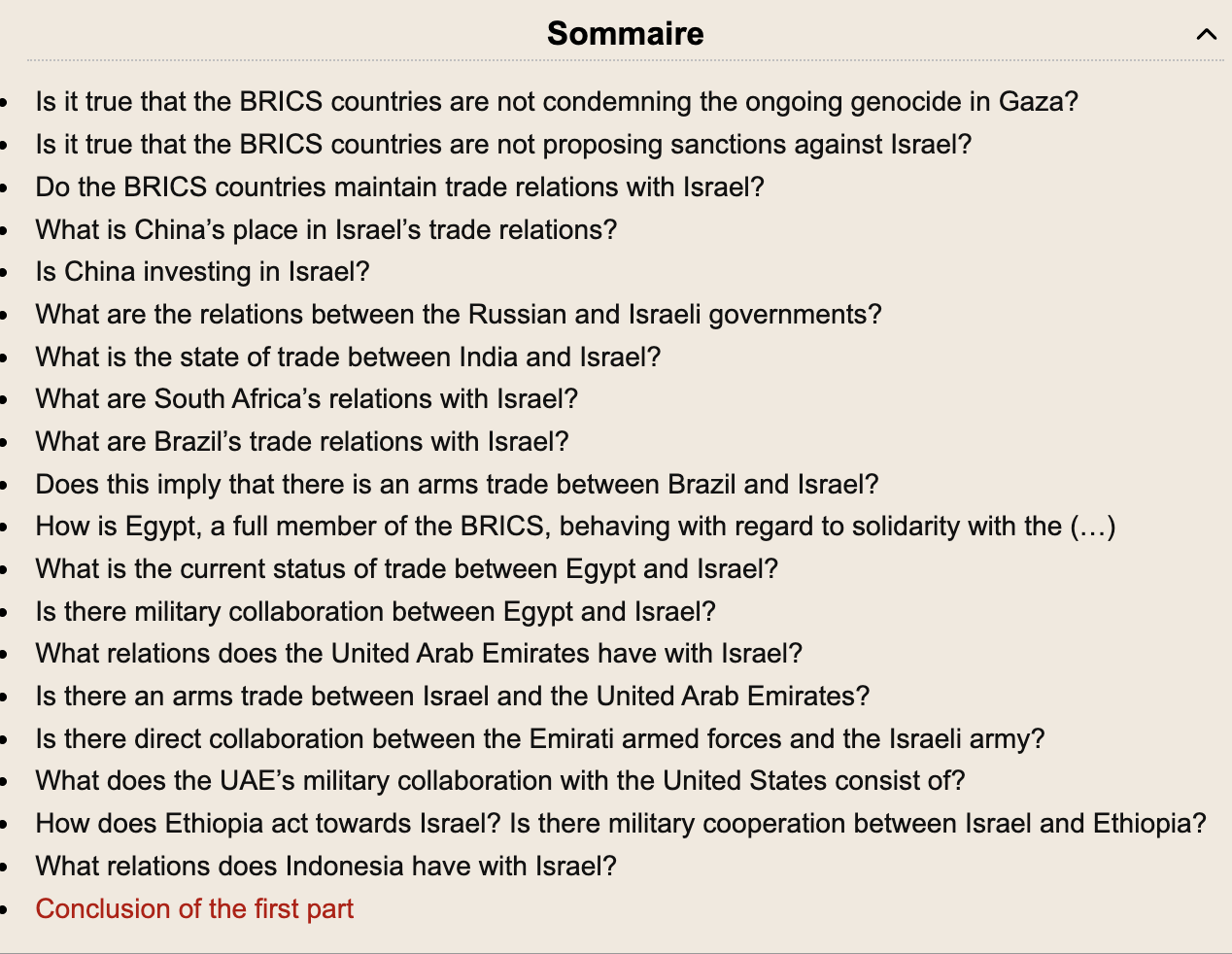
In the final declaration of the BRICS summit published on 6 July 2025, the BRICS countries do not use the term genocide to describe what is happening in Gaza.
Yes. In the final declaration of the BRICS summit published on 6 July 2025, the BRICS countries do not use the term genocide to describe what is happening in Gaza. The BRICS countries criticise Israel’s use of force in points 24 to 27 of their statement, but nowhere do they use the terms “genocide”, “ethnic cleansing” or “massacre”.
What is also striking is that the part of the 6 July 2025 statement concerning Gaza is almost identical to what is found in the final statement of the previous BRICS summit held in Kazan, Russia, in October 2024 (point 30 of the final statement).
It is as if the evidence of genocide, which is mounting every day, still does not justify the clear use of this term.
Yes, it is true: in their final statement, the BRICS countries did not propose sanctions against Israel. They did not propose to break the various agreements that bind them to the State of Israel. Yet the ongoing genocide and massacres of Gazans in search of food justify and demand action that goes beyond protests by the BRICS and other states.
The protests expressed by the BRICS countries were totally insufficient in October 2024 at the Kazan summit and are even more so in 2025. Only governments and multilateral bodies can take the required concrete and strong action. Of course, street demonstrations, occupations of public spaces and universities, and legal initiatives by citizens’ organisations are fundamental, but they cannot replace action by states and international institutions.
| For context on the ongoing genocide in Gaza and the responsibilities of Western powers, read: Gilbert Achcar, History’s crossroads: Gaza or the failure of the West, Le Monde diplomatique, June 2025.
Also read: Gaza Catastrophe, The Genocide in World-Historical Perspective, Saqi Books, London, April 2025 |
South Africa has taken the initiative to file a complaint against Israel before the International Court of Justice in The Hague, but its trade practices contradict this legal action
The BRICS countries as a group are not implementing any concrete measures against the Israeli government, such as boycotts or embargoes. Admittedly, South Africa has taken the initiative of filing a complaint against Israel before the International Court of Justice in The Hague, which is positive, but its practices are at odds with this legal action. Indeed, South Africa maintains trade relations with Israel, notably by allowing South African companies to regularly export coal to Israel by ship.
Since the genocide began, it is reliably estimated that 17 shipments have taken 1.6 million tonnes of coal to fuel the Israeli grid. There have been protests attended by hundreds, called by the Palestine Solidarity Campaign, community groups in coal-mining areas, and climate activists against Glencore on 22 August 2024 and 28 May 2025 (a global day of action) and at its local partner African Rainbow Minerals on 5 April 2025; that company is run by Patrice Motsepe who is South African president Cyril Ramaphosa’s brother in law.
Apart from Iran, the BRICS member countries maintain trade relations with Israel. In addition to South Africa, Russia, Brazil, the United Arab Emirates, Egypt and China continue to sell fuel (oil, gas, coal, etc.) to Israel. This is significant assistance to the Israeli government, which needs to diversify its energy sources to continue its war effort and normal functioning and to prevent the discontent of the Israeli population from growing to uncontrollable proportions.
| To learn more about the continuation of trade relations between the BRICS and Israel during the genocide, read: Patrick Bond, ‘The Blessing’ for genocide. Nearly all BRICS+ regimes nurture Israel, economically”, published on 1 October 2024. |
We will briefly review the relations between the BRICS member countries and Israel.
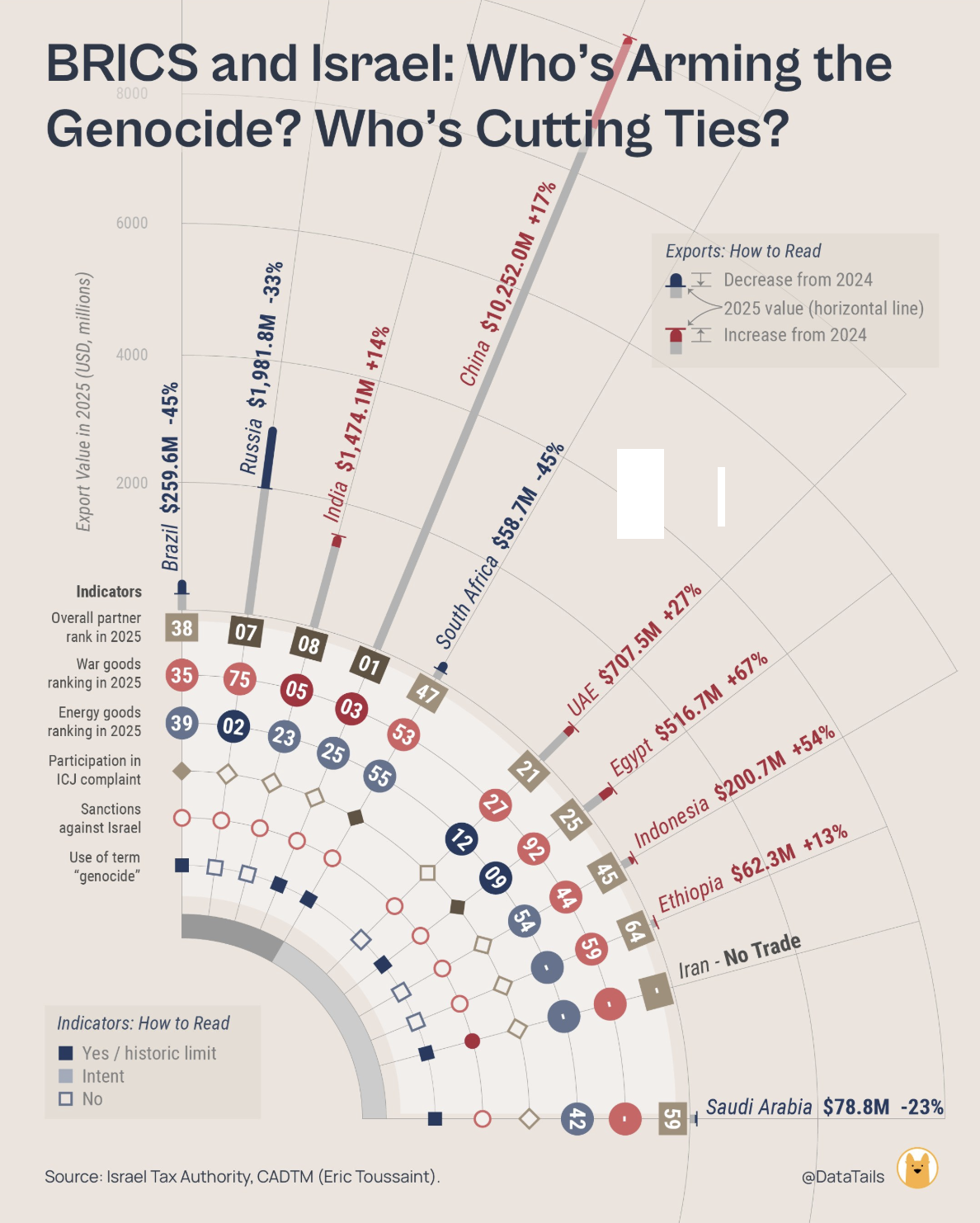
China is Israel’s largest source of imports. China makes significant investments in Israel. China exported $13 billion worth of goods to Israel in 2022, $16 billion in 2023 and $19 billion in 2024. Growth is set to continue in 2025. The volume could easily exceed $20 billion if no restrictions or boycotts are imposed. The figures quoted are from Israel Imports from China and the Chinese state news agency Xinhua, China remains Israel’s largest source of imports in 2023. Chinese sources report that in 2023, China was Israel’s largest source of imports for the fourth consecutive year. The United States came in second place. In 2024, China’s dominant position was confirmed. Read: China remains Israel’s top source of imports in 2024.
High-tech products dominate the goods traded between Israel and China: electrical/electronic equipment (imports and exports), industrial machinery, and optical and medical products are among the major categories traded.
Israel’s trade deficit with China is very significant. Israel imports much more from China than it exports to China. Israel’s trade deficit with China has increased sharply in recent years, exceeding $10 billion in 2024.
It should be noted that if we take the EU countries as a whole, the EU is Israel’s main supplier, with approximately $26 billion exported to Israel in 2024. In reality, each EU country supplies Israel separately, with Germany leading the way in terms of exports to Israel with approximately $6 billion. This is why China can be considered the leading supplier (with $19 billion in exports from China to Israel in 2024), and the United States the second largest supplier (with just over 9 billion dollars in exports to Israel in 2024).
Among the manufactured goods sold by China to Israel are drones that were not originally intended for military use but are converted into weapons by the Israeli military to kill Palestinian civilians. This is evidenced by an investigation carried out by the independent Israeli media outlet+972 Magazine, which indicates that these drones are produced by the private Chinese company Autel Robotics (based in Shenzhen), which produces EVO drones. Here is an excerpt from what was revealed:
“The Israeli military has weaponized a fleet of Chinese-manufactured commercial drones to attack Palestinians in parts of Gaza that it seeks to depopulate, an investigation by +972 Magazine and Local Call can reveal. According to interviews with seven soldiers and officers who served in the Strip, these drones are operated manually by troops on the ground, and are frequently used to bomb Palestinian civilians — including children — in an effort to force them to leave their homes or prevent them from returning to evacuated areas. Soldiers most commonly use EVO drones, produced by the Chinese company Autel, which are primarily intended for photography and cost around NIS 10,000 (approximately £2,500) on Amazon. However, with a military-issued attachment known internally as an “iron ball,” a hand grenade can be affixed to the drone and dropped with the push of a button to detonate on the ground. Today, the majority of Israeli military companies in Gaza use these drones. S., an Israeli soldier who served in the Rafah area this year, coordinated drone attacks in a neighbourhood of the city that the army had ordered to be evacuated. During the nearly 100 days that his battalion operated there, soldiers conducted dozens of drone strikes, according to daily reports from his battalion commander that +972 and Local Call reviewed. In the reports, all Palestinians killed were listed as “terrorists.” However, S. testified that aside from one person found with a knife and a single encounter with armed fighters, the scores of others killed — an average of one per day in his battalion’s combat zone — were unarmed. According to him, the drone strikes were carried out with the intent to kill, despite the majority of victims being located at such a distance from the soldiers that they could not have posed any threat.” +972 Magazine, ‘Like a video game’: Israel enforcing Gaza evacuations with grenade-firing drones, 10 July 2025.
In an article published in Euro-Med Monitor, an independent NGO based in Geneva (Switzerland), in February 2024, the Israeli military’s use of drones produced by AUTEL Robotics was already denounced – Gaza: Israel systematically uses quadcopters to kill Palestinians from a close distance. This NGO, which is dedicated to the documentation of human rights violations in the Middle East, North Africa (MENA) and Europe, had called on Chinese companies, including AUTEL, to comply with international law:
“In regions affected by armed conflicts, companies face an increased risk of becoming complicit in serious violations of international humanitarian and human rights laws. Consequently, businesses operating in such environments must exercise enhanced due diligence to mitigate these heightened risks effectively. More specifically, when a product is misused in ways that contradict the company’s international obligations and non-violent values, particularly for military purposes leading to the commission of international crimes and grave human rights violations, the company must act decisively. It should take immediate steps to cease or prevent its contribution and use leverage to mitigate the remaining impact to the greatest extent possible. Euro-Med Human Rights Monitor emphasises that companies, including Autel Robotics—a Chinese electronics and drone manufacturer—must comply with international law.” Source: Euro-Med Monitor, Chinese companies must prevent their arms, drones from being used in Israeli international crimes, 1 July 2024.
The Israeli army is also using civilian drones from another Chinese company in its war against the Palestinian population in Gaza. These drones are manufactured by DJI (Da-Jiang Innovations), a private Chinese company based in Shenzhen (China) and the world leader in the manufacture of civilian and professional drones. See the article published by Al Jazeera on 8 May 2025: Israel retrofitting DJI commercial drones to bomb and surveil Gaza”.
As Francesca Albanese, UN Special Rapporteur on the situation of human rights in the occupied Palestinian territories, wrote in her report entitled From the economy of occupation to the economy of genocide published in June 2025:
20. Where corporate entities continue their activities and relationships with Israel – with its economy, military, public and private sectors connected to the occupied Palestinian territory – they may be found to have knowingly contributed to: violation of the Palestinian right to self-determination; annexation of Palestinian territory, maintenance of an unlawful occupation and therefore the crime of aggression and associated human rights violations; crimes of apartheid and genocide, and other ancillary crimes and violations. Both criminal and civil laws in various jurisdictions can be invoked to hold corporate entities or their executives accountable for violations of human rights and/or crimes under international law.
21. It is therefore incumbent upon the authorities of the country where these companies are based and upon the companies themselves to avoid any form of complicity with the Israeli authorities. This applies to China as it does to the rest of the world.”
It is therefore incumbent upon the authorities of the countries where these companies are based, and upon the companies themselves, to avoid any form of complicity with the Israeli authorities. This obligation applies to China as well as to the rest of the world.
China has made significant investments in two strategically important Israeli ports, the Port of Haifa and the Port of Ashdod, both located on the Mediterranean Sea. The Chinese company China Harbour Engineering Company, a subsidiary of China Communications Construction Company, has modernised and developed the port terminal in Ashdod. This project has increased the capacity of the port facilities and improved infrastructure to meet the growth in international trade. The port of Ashdod is one of Israel’s main commercial hubs. Its modernisation has strengthened its strategic position in the region, facilitating trade between China and Israel, particularly in the context of the Belt and Road Initiative (BRI).
China National Offshore Oil Corporation (CNOOC), another major Chinese company, has acquired a significant stake in the Haifa container terminal as part of a partnership with the Israeli government. This project, like the one in Ashdod, has enabled Israel to attract investment in improving its port infrastructure. In the case of the Port of Haifa facilities, Chinese investment is partly being made through collaboration with Indian companies. Beyond ports, Chinese companies are also investing in other infrastructure sectors, such as transport, energy and high technology. For example, projects in the fields of intelligent transport technologies, artificial intelligence, cybersecurity and telecommunications are currently being developed with the participation of major Chinese companies such as Huawei and ZTE.
It is well known that Vladimir Putin and Netanyahu have a good opinion of each other, even though Russia publicly criticises Israel’s policies in the Middle East. So far, Putin has not denounced the ongoing genocide in Gaza in any of his statements. However, he has used the term genocide very often to justify the invasion of Ukraine and the annexation of part of its territory. In his speech on 24 February 2022 justifying the “special military operation” in Ukraine, Putin stated:
“Our goal is to protect people who have been subjected to genocide by the Kiev regime for eight years. We will strive to demilitarize and denazify Ukraine.” (Address by the President of the Russian Federation) [1] .
It should also be noted that on 1 July 2025, Sergey Lavrov, Russia’s Minister of Foreign Affairs, a few days before travelling to the BRICS summit in Rio, stated:
“We are pleased to note that the leader of the new Israeli government, Prime Minister Benjamin Netanyahu, expressed support for a two-state solution to the Palestinian problem twice in the past month. We hope that this position will be backed by practical steps. For our part, we will continue facilitating the resumption of talks – both via bilateral channels and at different international venues, first and foremost, in the format of the Middle East Quartet of international mediators.
It is necessary to monitor the situation in the Gaza Strip where the population continues to experience serious humanitarian difficulties. There is considerable demand for steps aimed at lifting or at least easing the blockade.” (See the full statement on the official website of the Ministry of Foreign Affairs of the Russian Federation, Foreign Minister Sergey Lavrov’s message welcoming participants in the international seminar on peace between Palestinians and Israelis. [2]
As can be seen from this statement, Sergey Lavrov does not condemn the ongoing genocide, and his attitude towards the fascist Prime Minister Benjamin Netanyahu is positive, which is totally unacceptable.
Israel still depends partially on Russia for food (cereals) and energy (oil, gas, coal), despite geopolitical tensions. Israel exports high value-added products to Russia: agricultural products, medical equipment, chemicals and electronics. Israel has a significant trade deficit with Russia. In 2023, trade volume declined following sanctions imposed on Russia after its invasion of Ukraine but rebounded in 2024. Trade volume reached 3.5 billion in 2022, fell to 2.6 billion in 2023, and rebounded to 3.9 billion in 2024.
In summary, Israel does not, in practice, apply Western sanctions against Russia following the invasion of Ukraine, and Russia does not apply sanctions against Israel despite the ongoing genocide.
In practice, Israel is not applying Western sanctions against Russia following the invasion of Ukraine, just as Russia is not applying sanctions against Israel despite the ongoing genocide
It should be noted that since the invasion of Ukraine in 2022, hundreds of millions of dollars (approximately $300 million per quarter) have been transferred to Israel via the accounts of oligarchs or new migrants (Read: Over 95,000 Russians Have Relocated to Israel). It should also be noted that around 500 Israeli soldiers with Russian passports took part in operations in the Gaza Strip between October 2023 and March 2024, nine of whom were killed. The Israeli authorities provided this information (Read: The Israeli embassy announced the number of Russians mobilized into the IDF who died in Gaza).
For the year 2025, we do not have precise information on the numbers, but it is known that Israeli soldiers participating in the genocide have dual Russian and Israeli nationality. The Russian authorities do not criticise Russians mobilised in the Israeli army, including those engaged in Gaza.
Trade between India and Israel is growing and stands at around $10 billion. India supplies Israel with petroleum products, diamonds and other precious stones, chemicals and pharmaceuticals, as well as arms (including drones).
Israel supplies arms (missiles), ammunition and defence systems to India. According to Moneycontrol.com, one of India’s leading financial websites, arms trade between Israel and India has increased 33-fold in 10 years, between 2015 and 2024, reaching US$185 million in 2024. The magazine New Internationalist writes in its January 2025 issue:
“Indian companies like Adani-Elbit Advanced Systems India, Premier Explosives, and the state-owned Munitions India are actively supplying drones and weapons to Israel as it continues its genocidal war against the people of Gaza. In April, careful not to jeopardize these arrangements, India abstained from a UN ceasefire resolution that included calls for an arms embargo on Israel. Israel, in turn, has continued its uninterrupted supply of military equipment to India – a significant commitment as Israel has delayed over $1.5 billion in arms exports to other countries since October 2023. Since Prime Minister Narendra Modi’s rise to power in 2014 India has become a key player in Israel’s arms trade. As the world’s largest arms importer, the South-Asian country has become Israel’s most reliable buyer, accounting for 37 per cent of its total arms exports.” Mohammad Asif Khan, Partners in power: Israel, India and the arms trade, 1 January 2025, New Internationalist.
Regarding the supply of arms to Israel by Adani-Elbit Advanced Systems India, read: India: Report alleges Adani-Elbit Advanced Systems India Ltd. & Munitions India Ltd. were authorised to continue to send arms products to Israel amid continued war on Gaza.
Also read, Adani’s weapons business with Israel. For more information on new collaborations between Adani, Elbit and a US arms company, visit the Adani group website.
Extractive and mining conglomerates, while providing sources of civilian energy, have fuelled Israel’s military and energy infrastructure, both of which are used to create living conditions aimed at destroying the Palestinian people, Francesca Albanese, UN Special Rapporteur on the situation of human rights in the occupied Palestinian territories
”.
There is no indication of any desire to change the Indian Prime Minister’s pro-Israeli stance (he was present in person at the BRICS summit in Rio in July 2025). India and Israel hope to conclude a free trade agreement before the end of 2025. According to the Times of Israel on 18 February 2025:
“Israel and India are seeking to sign a long-awaited free trade agreement this year, following US President Donald Trump’s decision to reorganize plans for a trade route between the United States and India that would pass through Israel”.
With regard to India’s position on Palestine, there has been a significant shift in favour of Israel, especially since the election of Narendra Modi. He broke with tradition in 2017 by becoming the first Indian prime minister to visit Israel without also visiting Palestine. The Modi government has avoided directly criticising Israel, particularly during the bombings of Gaza (2014, 2021, 2023, 2024 and 2025) and the violence committed by settlers in the West Bank. Within the country, solidarity with Palestine is increasingly attacked, denigrated or delegitimised by the Hindu right, particularly in the political and ideological climate shaped by Modi’s Bharatiya Janata Party (BJP).
There is no doubt that it is very positive that the South African government filed a complaint against Israel on 29 December 2023 before the International Court of Justice (ICJ), the United Nations tribunal responsible for settling disputes between states. Pretoria accuses Israel of violating the Convention on the Prevention and Punishment of the Crime of Genocide in its military assault on Gaza.
South Africa’s application sets out its allegations in what it denounces as the broader context of Israel’s conduct towards the Palestinians during its 75 years of apartheid, its 56 years of belligerent occupation of Palestinian territory and its 16 years of blockade of the Gaza Strip. In its decision of January 26, 2024 the Court ordered Israel to take measures to prevent acts of genocide in the Gaza Strip, although it did not grant South Africa’s request to require Israel to suspend its military operations in Gaza. Since then, Israel has nevertheless continued the genocide of the Palestinian people in Gaza and has tightened its blockade of humanitarian aid.
In January 2025, South Africa helped to establish the Hague Group to coordinate legal and diplomatic measures against Israel’s policy in Gaza (see: South Africa and Malaysia to launch campaign to protect international justice. According to the inaugural statement, the main commitments are to demand compliance with the orders of the International Court of Justice and the arrest warrants of the International Criminal Court (ICC) against Israeli leaders, to prohibit the transfer of arms or fuel (for military purposes) that could be used in the conflict, and to block access to ports for ships carrying military equipment to Israel. The founding countries of the group are: South Africa, Colombia, Belize, Bolivia, Cuba, Honduras, Malaysia, Namibia and Senegal. An emergency meeting was held in mid-July 2025 in Bogota.
On the BRICS side, none of the four founding states (Brazil, Russia, India and China) has so far joined South Africa’s complaint, while 15 states have joined in one way or another. Of the five BRICS countries, only Brazil, very late in the day, i.e., in July 2025, announced its intention to join the complaint against Israel in the future. If we take into account the ten countries that constitute the BRICS in 2025, only Egypt has joined the complaint so far.
On the part of South Africa, the most deplorable relationship, one very seriously inconsistent with its just complaint against Israel, is that it continues to trade with that country, notably by supplying coal. According to some sources, 15% of the coal consumed by Israel comes from South Africa. Patrick Bond, a university professor in South Africa, has regularly denounced South African coal deliveries to Israel. Read more: ‘The Blessing’ for genocide, Nearly all BRICS+ regimes nurture Israel, economically.
According to Bond, the main argument put forward by the Pretoria authorities to justify continuing to supply coal to Israel is that doing so would violate WTO rules. Bond responds that this argument is completely unserious, given that in recent years a considerable number of states have violated WTO rules without any repercussions. Furthermore, ending trade with Israel would undoubtedly be a legitimate action for South Africa.
Indeed, as Francesca Albanese, Special Rapporteur on the situation of human rights in the occupied Palestinian territories, writes in paragraph 89 of her report entitled “From the economy of occupation to the economy of genocide”:
“Extractive energy and mining conglomerates, while providing sources of civilian energy, have fuelled Israel’s military and energy infrastructures – both used to create conditions of life calculated to destroy the Palestinian people.” [3]
It should be noted that this fundamental report was made public at the end of June 2025, before the BRICS summit. However, the final declaration of the BRICS summit, made public on 6 July 2025, makes no mention of it.
Bond has compiled a substantial dossier on the South African arms group Paramount Group, headed by Ivor Ichikowitz, denouncing the close collaboration between this company, Israel and the United Arab Emirates (UAE). Bond particularly condemns the Paramount Group’s collaboration with the Israeli arms company Elbit. His dossier entitled Does SA-Israel trade include armaments? was published on 21 December 2024.
It should be noted that the head of the Paramount Group, Ivor Ichikowitz, denounced South Africa’s complaint against Israel. He wrote in Fortune magazine:
“South Africa’s most recent position, outrightly hostile to Israel and very sympathetic to Hamas, culminating in dragging the State of Israel to the International Court of Justice (ICJ), could well have led to South Africa being punished and excluded from AGOA–a prospect that still looms over U.S.-South Africa relations.” [4] Source: Ivor Ichikowitz, “South Africa should be truly non-aligned–and stop risking its vital trade ties with the West,” Fortune, 26 January 2024, https://fortune.com/2024/01/26/south-africa-non-aligned-risk-vital-trade-ties-west-us-biden-israel-politics/
Bond, various South African movements and numerous activists are calling on the Pretoria authorities to impose sanctions on Israel by banning coal exports to that country and ending all trade relations.
| For a perspective analysis of the Palestinian people’s struggle, read: Joseph Daher, Palestine and Marxism, Resistance Books and the IIRE, https://resistancebooks.org/product/palestine-and-marxism/ |
The volume of trade between Brazil and Israel amounts to just under $2 billion. Brazil imports more from Israel than it exports there. Brazil exports crude oil to Israel, which accounts for a quarter of its exports to that country. It also exports meat, which accounts for around 20% of its exports, and genetically modified soybeans, which also account for 20%. The rest includes kosher chicken, weapons, etc.
Arms trade between Brazil and Israel?
Yes. In 2024, for example, Brazil exported arms to Israel for a limited amount (just under $2 million), but these were war munitions (see https://tradingeconomics.com/brazil/exports/israel/arms-ammunition-parts-accessories). In 2024, Brazil imported war weapons from Israel for just under $9 million (see https://tradingeconomics.com/brazil/imports/israel/military-weapons-excluding-revolvers-pistols-lances). Brazil, therefore, maintains an arms trade despite the genocide and, above all, continues to cooperate significantly in the field of defence technology, mainly with the Israeli company Elbit Systems (see official website https://www.elbitsystems.com/) and its Brazilian subsidiary Ares Aeroespacial e Defesa.
It should be noted that Elbit System is explicitly mentioned in the report and appears on the list of arms companies directly collaborating in the genocide, according to Francesca Albanese, Special Rapporteur on the situation of human rights in the occupied Palestinian territories.Francesca Albanese makes the following statement in point 31 of her report:
“The military-industrial complex has become the economic backbone of the State. Between 2020 and 2024, Israel was the eighth largest arms exporter worldwide. The two most prominent Israeli weapons companies – Elbit Systems, established as a public-private partnership and later privatised, and state-owned Israel Aerospace Industries (IAI) – are among the top 50 arms manufacturers globally. Since 2023, Elbit has cooperated closely on Israeli military operations, embedding key staff in the Ministry of Defence, and was awarded the 2024 Israeli Defence Prize. Elbit and IAI provide a critical domestic supply of weaponry and reinforce Israel’s military alliances through arms exports and joint development of military technology. Point 31 https://www.un.org/unispal/document/a-hrc-59-23-from-economy-of-occupation-to-economy-of-genocide-report-special-rapporteur-francesca-albanese-palestine-2025/ and https://www.ohchr.org/en/documents/country-reports/ahrc5923-economy-occupation-economy-genocide-report-special-rapporteur
She adds in point 33:
“Drones, hexacopters and quadcopters have also been omnipresent killing machines in the skies of Gaza. Drones largely developed and supplied by Elbit Systems and IAI have long flown alongside these fighter jets, surveilling Palestinians and delivering target intelligence. In the last two decades, with support from these companies and collaborations with institutions like the Massachusetts Institute of Technology (MIT), Israel’s drones acquired automated weapons systems and the ability to fly in swarm formation.”
Military collaboration between Brazil and Israel through Elbit and its subsidiary ARES is well established. For example, Ares has supplied remote-controlled weapon stations (RCWS, REMAX) to Brazil under a contract worth approximately $100 million. The cooperation goes beyond physical exchanges, with technology transfers, co-production and training via Elbit/Ares.
Furthermore, in April 2024, under pressure from the Ministry of Defence, Brazil’s VBCOAP (armoured self-propelled howitzer) programme selected the ATMOS-2000 155 mm truck-mounted system (Tatra T-815 6×6) developed by Elbit Systems as the winner of a tender also involving the Caesar (France), the SH-15 (China) and the Zuzana 2 (Slovakia/CZ). The initial contract provides for the acquisition of 36 howitzers: two units were to be delivered within 12 months for technical and operational evaluation in Brazil. The remaining 34 systems will be delivered annually until 2034. The total value of the contract is estimated at $150-200 million, or even $210 million according to some sources (see the Brazilian newspaper The Rio Times: https://www.riotimesonline.com/lulas-brazil-acquires-israeli-defense-tech-despite-criticism-over-gaza-conflict/).
At the time of writing, the project has been “frozen” since October 2024 due to criticism from President Lula da Silva against Israel and the war in Gaza (https://www.defensenews.com/global/the-americas/2024/10/07/brazils-deal-for-israeli-howitzers-frozen-over-gaza-war/). However, no executive decree cancelling the project has been signed. Since the announcement of the contract freeze, the Brazilian Ministry of Defence and the army chief have been trying to unblock the file and persuade the president to proceed with deliveries, in particular the two prototype units for operational testing. At the end of July 2025, Brazilian Foreign Minister Mauro Vieira announced a hardening of Brazil’s position towards Israel and a halt to arms trade with Israel (in Portuguese: https://www.gazetadopovo.com.br/republica/brasil-sancoes-israel-por-genocidio-gaza-chanceler-onu/).
[You can also read my series of articles on Egypt-Israel relations here]
Firstly, it should be emphasised that in June 2025, the Egyptian authorities cracked down on and prevented thousands of people from dozens of different countries from travelling within the country to reach the Rafah border crossing to express their solidarity with the Palestinian people, demand an end to the genocide and support the need for a ceasefire. On 10 June 2025, activists from more than 50 countries launched the Global March for Gaza, a civil initiative supported by a broad international coalition to denounce the Israeli blockade and demand the opening of a humanitarian corridor to Gaza via the Rafah border crossing.
However, the Egyptian authorities prevented the march from taking place, mobilising a media smear campaign against the organisers from the outset. The repression intensified with arrests (in the streets, hotels and restaurants), passport confiscations and the destruction of phones, and convoys were prevented from leaving Cairo. Violence and detentions were also reported in Ismailia, where 200 activists were arrested. Several expulsions and refoulements at the airport were also reported. (Read https://jewishcurrents.org/egypt-cracks-down-on-the-global-march-to-gaza).
This repression reflects the growing collaboration between Egypt, Israel and the United States, to the detriment of solidarity with Palestine. Indeed, during the era of Gamal Abdel Nasser, Egypt refused any normalisation with Israel and continued to severely criticise Israeli abuses against Palestinians. But his successor, Anwar Sadat, signed a peace treaty with Israel in 1979, under the auspices of the United States. Considered a betrayal by Palestinians and the peoples of the region, including the Egyptians, this treaty paved the way for growing military, security and economic cooperation.
Under the presidency of Abdel Fattah al-Sisi, this normalisation has intensified to unprecedented levels, with security cooperation, increased economic dependence on Israeli gas, implicit support for the blockade of Gaza, tight control of the Rafah crossing point and the dismantling of trade tunnels to Gaza. The regime continues torepress pro-Palestinian demonstrations systematically, and even symbolic gestures such as waving a Palestinian flag can lead to accusations of terrorism.
In 2022, trade between Egypt and Israel was estimated at around $300 million, compared to around $330 million according to a 2021 report. In 2023, trade increased by 56% compared to 2022, for an estimated total of approximately $468 million. In 2024, growth accelerated at the end of the year, with a 168% jump in the fourth quarter, but the exact annual total is not specified. The main product purchased by Egypt from Israel is natural gas. Israeli gas accounted for 15-20% of Egyptian consumption in early 2025.
Yes, there is secret but substantial military collaboration between Egypt and Israel, despite their conflictual history (wars of 1948, 1967 and 1973). Since 2007, Egypt and Israel have effectively organised a blockade of Gaza (restrictions on the movement of goods and people, surveillance of tunnels). Egypt and Israel conduct joint operations to destroy tunnels between Gaza and Egypt (with Israeli technological assistance). Egypt has acquired Israeli surveillance systems (including Elbit radars) via European intermediaries. According to the Wall Street Journal on 7 March 2024, Israel has carried out secret strikes against weapons transiting through Egypt to Gaza with the tacit agreement of the Egyptian authorities. The US grants $1.3 billion in military aid to Egypt, contingent on Cairo’s cooperation with Israel. The United States is ensuring that this condition is met.
In 2020, under the auspices of President Donald Trump, the Abraham Accords led to the normalisation of relations between Israel and the United Arab Emirates.
In 2020, under the auspices of President Donald Trump, the Abraham Accords [5] led to the normalisation of relations between Israel and the United Arab Emirates (for more information on the United Arab Emirates, see the box). On 29 August 2020, a few weeks after the announcement of the Abraham Accords, the Emirates repealed the 1972 federal law prohibiting economic relations with Israel. This decision legalised bilateral trade and investment, the import and sale of Israeli products, scientific, cultural and technological cooperation, etc. Prior to this repeal, increasingly close relations had gradually been established.
Following the Abraham Accords, the Comprehensive Economic Partnership Agreement (CEPA) was signed on 31 May 2022 and entered into force on 1 April 2023, with the elimination or significant reduction of customs duties on approximately 96% of tariff lines and 99% of the value of trade. This treaty aims to increase bilateral trade to more than $10 billion within five years of its conclusion. The conflict in Gaza reduced the visibility of trade in 2024, but it remained active and grew. As evidence, the volume of trade, which reached $2.5 billion in 2022, is expected to reach $5 billion in 2025.
According to Bloomberg, there are around 600 Israeli companies operating in the UAE in 2025, and according to a report by the Dubai Chamber (2023), more than 200 Emirati companies have established partnerships or opened operations in Israel since the normalization of relations (https://www.dubaichamber.com).
| ABC on the United Arab Emirates
Although Dubai is the largest city, the best known internationally, and a major commercial, financial and tourist centre, Abu Dhabi is the official capital of the United Arab Emirates. The United Arab Emirates (UAE) plays an international economic and military role that far exceeds its population. The UAE has a population of around 10 million, only about 10% of whom are Emirati nationals. Of these 10 million, around 9 million are foreigners, including 3 million from India, 1.5 million from Pakistan, another 1.5 million from Bangladesh and the rest mainly from other Asian countries (the Philippines, Sri Lanka and Nepal). Finally, around 1 million come from Arab countries, half of whom are from Egypt. Dubai, the largest city, has become a leading international financial center competing with other financial centers such as London, Zurich, Luxembourg, Singapore and Hong Kong. To attract international private financial companies, the Emirati authorities offer the most favorable conditions imaginable: legislation and taxation that are particularly lenient towards large companies and high net worth individuals. The Dubai International Financial Centre (DIFC) is a regulated free zone with its own judicial system based on English law, home to more than 5,000 companies, including more than 1,000 financial institutions (banks, insurance companies, funds, etc.). The Free Zone offers the following advantages: 0% corporation tax (under certain conditions); no capital gains tax or dividend tax; 100% foreign ownership. We will see later in this series that the use of Free Zones or Special Economic Zones is being developed both by countries such as the UAE and, in its own way, by China (which exercises more control and is less favorable in terms of taxes and duties) and is being promoted by the BRICS countries at their summits. As Husam Mahjoub writes in a study published by the Amsterdam-based Transnational Institute (TNI): Husam Mahjoub gives two concrete examples of the rise of the UAE: The UAE has invested $60 billion in several African countries in various sectors such as mining, oil, infrastructure, logistics and agriculture and is beginning to play a significant role in their national economies. With this level of investment, the UAE ranks fourth after China, EU countries and the United States. The UAE is an ally of Israel and the United States but plays a special role in the Arab region and sub-Saharan Africa. As Husam Mahjoub writes: To justify the use of the concept of sub-imperialism in relation to the UAE, Husam Mahjoub refers to the work of Ruy Mauro Marini. His explanation is worth repeating here: Power and wealth in the United Arab Emirates are concentrated in the hands of the ruling families of Abu Dhabi (Al-Nahyan) and Dubai (Al-Maktoum), as well as a few capitalist clans specialising in trade and finance that are closely linked to them. The head of state is Sheikh Mohamed Bin Zayed Al Nahyan. He was present in person at the BRICS summits in Kazan in 2024 and in Rio in 2025 in Brazil. At the heart of the UAE’s geostrategy is the takeover of port and logistics infrastructure around the entire African coastline. The UAE has infrastructure in North Africa, on the Mediterranean (Algeria and Egypt); in West and Southern Africa, on the Atlantic Ocean (Angola, Congo, Democratic Republic of Congo (DRC), Guinea and Senegal); on the Indian Ocean in East Africa (Kenya, Mozambique and Tanzania); and in the Red Sea region, including the Horn of Africa, with projects in Egypt, Puntland, Somaliland and Djibouti. They are investing in logistics hubs within Africa: Rwanda, Morocco, Nigeria, South Africa and Tanzania. See the report by the Financial Times: “The UAE’s rising influence in Africa”, 30 May 2024, https://archive.ph/6HEca#selection-1375.0-1384.2 The fact that the UAE hosted COP 28 also shows that it is very committed to green capitalism. During COP 28, Blue Carbon LLC, a company created by a member of the UAE royal family, signed numerous contracts with leaders from the Global South to grab huge swathes of their land for 30 years. This land will allow Blue Carbon LLC to sell carbon credits to polluting companies [6] , so that they can “offset” the pollution they generate. 25 million hectares of forest in Liberia, Angola, Kenya, Tanzania, Uganda, Zambia and Zimbabwe have been purchased by this company and, therefore by the United Arab Emirates (equivalent to the size of the United Kingdom). 20% of Zimbabwe’s land area, 10% of Liberia’s and Zambia’s, and 8% of Tanzania’s have been grabbed by Blue Carbon LLC. As academic Adam Hanieh clearly shows [7], the UAE and other Gulf countries are trying to place pseudo-carbon capture technologies and the carbon offset market at the centre of discussions, particularly at COPs, so that there is no talk of ending fossil fuels (of which they are major exporters). Their strategy is as follows: muddy the waters and spearhead false solutions involving finance and the market so that they can continue to generate ever more money on the back of the ecological transition and continue to extract and export hydrocarbons unhindered. In short, they are working diligently to ensure that nothing changes. |
At the arms fair held in Abu Dhabi in February 2025, 34 Israeli arms companies were present
Yes, there has been a very real arms trade between Israel and the Emirates since normalisation in 2020. It mainly concerns anti-aircraft systems (SPYDER, Barak 8, Iron Dome), drones and electronic technologies and is also based on industrial cooperation. Although specific contracts remain sensitive, trade has accelerated since 2022, with increasing public visibility since 2024–2025 through arms fairs such as the IDEX, which takes place every two years. At the IDEX exhibition held in February 2025,34 Israeli arms companies were present. The Emirati company EDGE, which specialises in armaments, actively collaborates with Israeli companies in the armaments sector, such as Elbit, Rafael, IAI, RT and Thirdeye.
Indeed, the Emirati armed forces and the Israeli army engage in military collaboration, despite neither party officially acknowledging it. The hostility of both countries towards Iran and its influence in the region partially explains this collaboration. The same applies to their common interests against the Houthis in Yemen.
Since the start of the war in Yemen in 2015, the United Arab Emirates has increased its military presence in the region, particularly on the main island of Socotra, which is officially part of Yemen. The UAE has occupied the island, set up a military base there and cooperates with the Israeli army on the ground. The Socotra archipelago, located off the coast of Yemen in the Indian Ocean, controls crucial shipping lanes between the Red Sea and the Gulf of Aden. Approximately 20,000 transport ships pass near the Socotra archipelago each year, 9% of which are involved in the global oil supply. Read: Karim Shami, “Tyranny on the waters: The UAE-Israeli occupation of Yemen’s Socotra Island”, 24/03/2023, https://thecradle.co/articles-id/916# See also: “UAE, Israel expand spy bases in Yemen’s Socotra under US sponsorship: Report”, 29/07/2024, https://thecradle.co/articles-id/26154
The UAE is also collaborating with Israel, India and several EU countries (Italy, Germany, France, Greece) on a project to build a land route linking the Gulf of Dubai to the port of Haifa across the Arabian Peninsula via Riyadh in Saudi Arabia in order to avoid passing through the Suez Canal for trade between Asia and Europe. Read: https://www.jns.org/uae-israel-land-corridor-operating-despite-war/ In a way, this is also a means of developing an alternative to the new Silk Roads developed by China. Read: https://www.gisreportsonline.com/r/imec/
It is important to note that the UAE is the only BRICS member country to have a permanent US military base on its territory, which is obviously linked to its policy of collaboration with Israel. The US military presence in the United Arab Emirates (UAE) is significant, strategic and long-standing, forming part of bilateral defence cooperation that has been strengthened since the Gulf War in 1991. Close to the UAE capital, the United States has a military base hosting fighter jet (F-22, occasionally F-35), surveillance aircraft (AWACS, JSTARS), armed drones (MQ-9 Reaper), refueling aircraft, etc. This base is a key logistics hub for US operations in the Persian Gulf, Iraq and Syria, for CENTCOM (Middle East/Central Asia) command, and for surveillance of Iran. There are approximately 2,000 to 3,000 US military personnel stationed there on a permanent or rotational basis.
The United States has deployed missile defence systems, such as Patriot PAC-3s in the UAE. The UAE cooperates with the US Fifth Fleet, based in Bahrain. The UAE participates in joint naval exercises and initiatives such as the International Maritime Security Cooperation in the Strait of Hormuz. The UAE guarantees access to Emirati ports for the US fleet and its allies.
Despite the ongoing genocide in Gaza, military cooperation between Israel and Ethiopia, a full member of the BRICS, continues.
According to several sources, Israel remains one of Ethiopia’s main military suppliers, notably through the sale of air defence systems, such as the Spyder-MR, designed to protect the Grand Ethiopian Renaissance Dam against air attacks.
Military cooperation has been ongoing despite regime changes in Addis Ababa. It dates back to the 1960s–1990s: Israel trained paratrooper units and counterinsurgency forces for the Ethiopian army (Nebelbal Division), supplied 150,000 rifles and cluster bombs, and sent military advisers to train the Presidential Guard (see https://en.wikipedia.org/wiki/Ethiopia%E2%80%93Israel_relations). Since November 2020, there has also been a cooperation agreement between Mossad and the Ethiopian security service (NISS), covering the exchange of expertise and counterinsurgency.
Due to the ongoing genocide in Gaza, the military partnership between Ethiopia and Israel is relatively low-key, but it contributes significantly to Ethiopia’s security strategy and Israeli influence in East Africa. This includes intelligence sharing, strategic coordination and capacity building in Ethiopia. Read: https://hiiraan.com/news4/2025/Mar/200683/israel_ethiopia_discuss_joint_efforts_to_combat_al_shabaab_and_houthis.aspx
It should be noted that Israel has excellent relations in this region with the Museveni regime in Uganda (which was represented at the BRICS summit in Rio by the vice-president). Read: www.alestiklal.net/en/article/how-israel-is-penetrating-the-african-continent.
Trade between Israel and Ethiopia is low, at around $100 million per year. However, Israeli companies are increasingly interested in investing in agriculture in Ethiopia.
Indonesia, the world’s most populous Muslim country and a full member of the BRICS, does not have official diplomatic relations with Israel, but the reality is quite different. In May 2024, a joint investigation by the Israeli daily Haaretz, Amnesty International and Tempo revealed that Indonesia had imported espionage and surveillance technology from Israel.
The investigation reveals that between 2017 and 2023, Indonesia imported and deployed a wide range of highly intrusive spyware and other sophisticated surveillance technologies. Several Israeli companies have been identified as indirect suppliers: NSO Group (via Q Cyber Technologies SARL, Luxembourg), which produced the Pegasus spyware; Intellexa Consortium, known for its Predator software; Candiru/Saito Tech; and Wintego Systems Ltd. The spyware acquired by Indonesia, such as Pegasus, Predator, etc., is designed to be ultra-stealthy, infect without explicit interaction, and enable the management of images, messages, calls, location, etc. Among those who have acquired these technologies are the Indonesian National Police (Polri), the National Cybersecurity and Cryptography Agency (BSSN), and, according to some media reports, the Ministry of Defence. Amnesty has warned that these devices pose a major risk to civil rights, including freedom of expression and privacy.
In mid-July 2025, Indonesia officially joined “The Hague Group” at the emergency summit in Bogotá on 15 and 16 July 2025 (https://thehaguegroup.org/meetings-bogota-en/). It is now one of 13 countries that have committed to taking concrete and coordinated measures to enforce international law in response to the ongoing genocide in Gaza.
Apart from this, trade between Israel and Indonesia is low, at less than $200 million per year.
Gaza and the BRICS: refusal to condemn genocide and impose sanctions
A detailed analysis of the positions and practices of BRICS member countries in response to the ongoing genocide in Gaza reveals a flagrant contradiction between their official rhetoric – often focused on international law, multilateralism and the sovereignty of peoples – and their concrete actions, as in the case of Russia’s invasion of Ukraine or the actions of the UAE. As BRICS+, the ten member states refuse to designate as such the crime of genocide being perpetrated in Gaza, despite it being widely documented and denounced by international bodies and by Francesca Albanese, the United Nations Special Rapporteur.
In fact, the BRICS have not taken any strong joint measures: no sanctions, no severance of diplomatic or economic relations, no embargo, not even a symbolic suspension of cooperation with Israel. On the contrary, for most of them, trade relations – particularly in the strategic areas of energy, surveillance technologies, infrastructure and armaments – continued and even intensified in 2024 and 2025. South Africa is certainly an exception with its complaint to the ICJ, but this very positive action is undermined by the continuation of coal exports to Israel and other trade relations.
This diplomatic double-speak highlights a fundamental truth: despite their rhetoric about a “more just world order”, the BRICS countries are primarily defending their geopolitical, economic and security interests, often at the expense of the principles of international justice. This reality dashes the hopes of some progressive sectors for the possibility of an “alternative” pole embodied by this bloc.
For those on the left who harbour illusions about the BRICS’ willingness to take clear initiatives in favour of the people, the latest summit and their attitude as a bloc towards the genocide in Gaza and their relations with Israel should help to open their eyes.
In the next instalment of this series, we will see that the BRICS leaders support the capitalist mode of production that led us to the current disaster. The BRICS countries are in favour of maintaining – and increasing funding contributions to – the international financial architecture (with the IMF and the World Bank at its centre) and the international trade architecture (WTO, free trade agreements, etc.) as they currently exist. The BRICS support so-called green capitalism and engage in greenwashing, such as promoting carbon markets instead of making overdue greenhouse gas emissions cuts. Some of them, such as Russia, resort to military aggression against other peoples, as is the case in Ukraine. In the same way, and more often than others, the United States (and the European powers) has done so repeatedly around the world.
[1] In an interview with Tucker Carlson on 9 February 2024, Putin claimed that “Ukraine, under Western control, has waged a war against its own people in the Donbass. Children, women, elderly people have been killed every day. Isn’t that genocide?” https://www.youtube.com/watch?v=hYfByTcY49k
[2] It should be noted that during 2024 and 2025, Lavrov began to use the term genocide in relation to Israel’s actions in Gaza. There is clearly a division of roles between Putin, who avoids denouncing Israel’s genocidal actions, and his foreign minister. It should also be noted that Lavrov represented Russia at the BRICS summit in Rio in July and did not use the term genocide in his public statements during the summit. As indicated at the beginning of this article, the term genocide does not appear in the final declaration of the Rio summit, which he helped draft.
[3] “Extractive energy and mining conglomerates, while providing sources of civilian energy, have fuelled Israel’s military and energy infrastructures – both used to create conditions of life calculated to destroy the Palestinian people.” [Read, Agenda item 7: Human rights situation in Palestine and other occupied Arab territories,FROM ECONOMY OF OCCUPATION TO ECONOMY OF GENOCIDE and From economy of occupation to economy of genocide – Report of the Special Rapporteur on the situation of human rights in the Palestinian territories occupied since 1967 (Advance edited version).
[4] “South Africa’s most recent position, outrightly hostile to Israel and very sympathetic to Hamas, culminating in dragging the State of Israel to the International Court of Justice (ICJ), could well have led to South Africa being punished and excluded from AGOA–a prospect that still looms over U.S.-South Africa relations.” Source: Ivor Ichikowitz, South Africa should be truly non-aligned–and stop risking its vital trade ties with the West”, Fortune, 26 January 2024, https://fortune.com/2024/01/26/south-africa-non-aligned-risk-vital-trade-ties-west-us-biden-israel-politics/
[5] The Abraham Accords are two peace treaties between Israel and the United Arab Emirates on the one hand, and between Israel and Bahrain on the other. The first, between Israel and the United Arab Emirates, was announced on 13 August 2020 by US President Donald Trump. They were signed on 15 September 2020 at the White House in Washington, accompanied by a tripartite declaration also signed by the US president as a witness. These agreements were extended by agreements with Sudan and Morocco. Source:https://en.wikipedia.org/wiki/Abraham_Accords
[6] Vincent Lucchese, “ Capter le CO2, un cadeau empoisonné pour les pays du Sud “ (The carbon trap: CO2 capture, a poisoned gift for Southern countries), Reporterre, 11 December 2023, https://reporterre.net/Capter-le-CO2-un-cadeau-empoisonne-pour-les-pays-du-Sud
[7] Adam Hanieh, “Laundering Carbon—The Gulf’s ‘New Scramble for Africa’”, CADTM, 8 August 2024, 22789
is a historian and political scientist who completed his Ph.D. at the universities of Paris VIII and Liège, is the spokesperson of the CADTM International, and sits on the Scientific Council of ATTAC France.
He is the author of World Bank: A Critical History, London, Pluto, 2023, Greece 2015: there was an alternative. London: Resistance Books / IIRE / CADTM, 2020 , Debt System (Haymarket books, Chicago, 2019), Bankocracy (2015); The Life and Crimes of an Exemplary Man (2014); Glance in the Rear View Mirror. Neoliberal Ideology From its Origins to the Present, Haymarket books, Chicago, 2012, etc.
See his bibliography: https://en.wikipedia.org/wiki/%C3%89ric_Toussaint
He co-authored World debt figures 2015 with Pierre Gottiniaux, Daniel Munevar and Antonio Sanabria (2015); and with Damien Millet Debt, the IMF, and the World Bank: Sixty Questions, Sixty Answers, Monthly Review Books, New York, 2010. He was the scientific coordinator of the Greek Truth Commission on Public Debt from April 2015 to November 2015
History will register that the first week of September 2025 propelled the advent of the Eurasia Century to a whole new level.
By Pepe Escobar at Sputnik.
That was the expectation ahead of three crucial intertwined dates: the SCO annual summit in Tianjin; the Victory Day parade in Beijing; and the Eastern Economic Forum in Vladivostok.
Yet expectations were even surpassed considering the breadth and scope of what just happened.
The SCO in Tianjin solidified the Chinese push for the establishment of true Global Governance – which in practice means the unceremonious burying of the “rules-based international order” that under the new US administration has metastasized into a no-rules based international chaos: essentially an ethos of “we’ll blow up the world if we are not able to control it.”
Tianjin had not only the 10 SCO full members but also 2 observers and 15 partners – with a heavy Southeast Asian presence – discussing the finer points to be observed for peaceful development. The pic of the week, if not the year or decade, was the Putin, Xi and Modi trilateral handshake: the return of the original, Primakov-coined RIC (Russia-India-China) in full force. As Professor Zhang Weiwei of Fudan University remarked in Vladivostok, the SCO is now expanding steadily in three platforms: energy; clean industries; and AI. In parallel, Central Asia is finally being seen as a “geographical blessing”, and not “a curse”.
Immediately after Tianjin, the Russia-China strategic partnership also shot up to a whole new level, as President Putin was received by President Xi at the Zhongnanhai, the official residence of the Chinese head of state, for an across-the-spectrum state of the planet recap.
The next day Beijing was resplendent under blue skies overseeing the stunning military parade celebrating the 80th anniversary of the Chinese victory over Japanese invasion and the Asian chapter of Nazi-fascism. That was a confident geoeconomic superpower showing off its military progress.
On the same day the Eastern Economic Forum started in Vladivostok: an unrivalled platform for discussing the surge of pan-Eurasia business.
What China has proposed, actually reiterated in Tianjin, goes way beyond the concept of wangdao, referring to an enlightened, benign power, but not a Hegemon. What could be described as the trademark motto of a Pax Sinica under Xi could be summed up as Make Trade, Not War – and for the common good, or community of a shared future”, in Beijing terminology.
SCO partners, as well as BRICS partners, fully understand that China does not intend to replace Pax Americana, which always relied on the – now aptly renamed – Department of War’s gunboat “diplomacy”. Whatever hysteria fits the West may throw – manipulating Tibet, Hong Kong, Xinjiang, South China Sea, Taiwan – won’t deviate Beijing from its civilizational inclusive path.

The birth of a new logistics order
The road from Tianjin to Vladivostok mostly evolved on three interconnected fronts; oil and gas; connectivity corridors; and massive economic development.
The collective West simply cannot get rid of its pathology of perennialy underestimating the East. For years, both BRICS and SCO were derided in Washington as irrelevant talk shops. But it’s the multilateral spirit that allows something groundbreaking like the Power of Siberia-2 to come to light.
Power of Siberia-2 was planned several years ago, but it was difficult to find consensus on the final route. Gazprom preferred Western Siberia to Xinjiang, across the Altai mountains. The Chinese wanted transit via Mongolia, straight into central China.
The Mongolian route eventually prevailed. It was decided two years ago, and in the last few weeks, the final pricing mechanism, respecting market rates. This massive geoeconomic game-changer means that the gas from the Yamal peninsula that would supply Europe via the Nord Streams will supply China.
President Putin’s expose at the plenary session in Vladivostok placed particular emphasis on energy and connectivity.
But to track the devil in the details nothing could beat the arguably two top panels at the forum.
One of them discussed the integrated development of the Arctic and the Russian Far East, with special insights by Vladimir Panov, who not only is Rosatom’s top expert on the Arctic but also the Deputy Chairman of the State Commission on Arctic Development.
Another panel really dug deep , tracing a parallel between the origins of the Northern Sea Route (NSR), 500 years ago – when Russian diplomat Dmitry Gerasimov drew up the first draft of the Northern Sea Route and the first map of the Arctic Ocean and Muscovy coastlines – and the 21st century technology challenges.
This panel featured a particular striking expose by the CEO of Rosatom, Aleksey Likhachev, complemented by experts such as Sergey Vakhurov, the Deputy Chairman of Russia’s Maritime Collegium. Likhachev detailed the complex shaping of an Arctic corridor, carrying mostly raw materials: a resilient transport corridor for the whole of Northeast Asia.
That’s no less than the birth of a new logistics order – think IA- based weather forecasting plus icebreakers – featuring critical Russian input.
Pepe Escobar wraps up Eastern Economic Forum: Key takeaways on Russia’s global strategy
EEF’s focus was on Russia’s Arctic and Far East development, high-tech growth, energy exploration, and connectivity corridors
— Sputnik (@SputnikInt) September 6, 2025
Will Vladivostok become the next Hong Kong?
So, as Putin stressed in his presentation at the plenary session, the heart of the matter is the Trans-Arctic Transport Corridor: arguably the key 21st century connectivity corridor.
Thus it’s no wonder Vladivostok’s discussions centered around the key role of nuclear energy and nuclear icebreakers in assuring stable shipping along the NSR route, side by side with environmental concerns and the trials and tribulations of securing large-scale investments in energy production, processing and infrastructure building.
All that merged with a timely discussion of the Greater Eurasia Partnership – the crux of Russian geoeconomic policy – with key inputs by Alexey Overchuk, the Deputy Chairman of Russia’s government, and the affable Suhail Khan, the Deputy Secretary-General of the SCO.
An absolutely key takeaway of all these discussions was the startling realignment being operated by Rosatom – which is simultaneously expanding business with China, India and South Korea along the ultra-strategic NSR.
That means, in essence, Russia evaluating all vectors when it comes to organizing full-scale convoy systems for 365 days a year of Arctic navigation: nothing less, once again, than a new economic and technological order.
Now couple all that with a lively discussion of how the Global South and East will be leading the new growth economy.
Sberbank’s CEO Herman Gref, for instance, disclosed that the largest Russian bank has become the second largest in transactions globally, only behind JP Morgan.
Wen Wang, from Renmin University, remarked how China is undergoing a very strong de-Americanization process, in education and tech, pushing “its own knowledge system”.
He foresees huge Russia-China cooperation potential – economic and financial, emphasizing there is a pressing necessity to open financial markets on both sides. That’s how Vladivostok could become the next Hong Kong. Several panelists at the forum observed that Vladivostok has all it takes to become a strategic center for Global South integration.
The Arctic will be at the center of possible business deals between Russians and Americans; serious discussions have been going on since March, including in the recent Putin-Trump meeting.
Amidst the colossal logistics challenges, an economic breakthrough in the Arctic, next to and within Alaska may eventually represent for the US a ticket out of an economic catastrophe. So here the Arctic – which is de facto dominated by Russia – may in the end become a privileged arena to domesticate the Empire of Chaos.
After all Russia has already built extensive, complex infrastructure in the Arctic – upgraded in real time. Mammoth ports, LNG processing, whole cities of workers and technicians, the enormous advantage of the nuclear icebreaker fleet (nine in action, with two more coming), all these advances are Russian intellectual property that can be exploited in dealing with the US.
In the end, these heady few days last week solidified The Future. Grandmaster Lavrov once again delivered the succinct version – commenting on the triple handshake of Putin, Xi and Modi: “A demonstration that three great powers, representing three great civilizations, recognize the commonality of their interests in several areas.”
That’s way more: that’s a new world in the making.
“No mountain or ocean can distance people who have shared aspirations,” China’s President Xi Jinping said in July 2024, addressing leaders from fellow Shanghai Cooperation Organization (SCO) member states and a few other nations, in Astana, Kazakhstan.
It is not reaching too far, saying that this year’s 25th SCO Summit (SCO) in Tianjin, China, from 31 August to 1 September 2025, fulfilled – and more – President Xi’s vision of 2024. The summit caused a tectonic shift in the conventional world order.
China’s Assistant Foreign Minister Liu Bin told a news conference in Beijing, shortly before the SCO summit, that the 2025 SCO event be “One of China’s most important head-of-state and home-court diplomatic events this year”.
As the Economist says, “A New Reality is Taking hold”. The “new reality” is not anti-US or anti-West; it is just separating the western unipolar aspirations from the newly created multi-polar, or perhaps better, multi-block, world, where countries aim at a peaceful cooperation towards a joint future with shared benefits.
The SCO was established in 2001 by China, Kazakhstan, Kyrgyzstan, Russia, Tajikistan and Uzbekistan. Today the SCO consists of ten member States, with headquarters in Beijing. In addition to the founding members, SCO members have increased by India, Iran, Belarus, and Pakistan. SCO members account for 23% of the world’s GDP and for 43% of the world’s population.
Further attendance included high-level government officials from Myanmar, Egypt, Cambodia, Nepal, Indonesia, Malaysia, the Maldives, Turkey, as well as the Association of Southeast Asian Nations (ASEAN) Secretary-General Kao Kim Hourn, and UN Secretary General, Antonio Guterres.
This year’s summit, made clearly the SCO the guiding light for the Global South which includes the 11 BRICS countries, plus the 10 BRICS partners, added at the 16th BRICS Summit in Kazan, Russia, in October 2024.
While even the UNSG, Mr. Guterres, was invited – while the UN was or still is (?) considered by the US and the West in general, as the World Organization in the western camp – President Trump felt snubbed by China, “left out” from the world shifting SCO event in Tianjin.
So, Trump invented a last-minute opportunity to leave his mark on the meeting by requesting President Xi literally on the eve of the SCO summit for “military talks”, a phone call between the two Defense Ministers [in the US now called War Minister, as the Ministry of Defense has been re-christened by Trump as War Ministry].
The Chinese Foreign Ministry said that Beijing rejected the proposal, reasoning “a lack of mutual understanding between the two countries”, asking a pertinent question: “Is there any sincerity in and significance of any communication like this?”
Of course not. Trump just wanted to interfere in the SCO summit, showing his self-styled emperor head. But to no avail. The West was absent – the “naked emperor” as well as his European puppets, the (almost) defunct European Union, and especially the non-elected and every time more rejected European Commission (EC).
Imagine, just a few weeks earlier a delegation of the EC, including Kaja Kallas, the Commission’s High Representative for Foreign Affairs, the Commission’s top-diplomat, so to speak, visited Beijing to discuss tariffs, but on the side, they were insinuating that China should distance herself from Russia.
So much aggression, let alone undiplomatic thinking and acting – like at home spending taxpayers’ money destined for social programs, instead for a monster armament to go to war against Russia – aggression and a war philosophy that can only lead to a EU downfall – which is accelerating by the day.
To add insult to injury, the symbolic leader of the EU, Germany, her Chanceller Friedrich Merz, said recently: “Putin is a war criminal. He is perhaps the most serious war criminal of our time that we have seen on a large scale. We must be clear about how to deal with war criminals: There is no room for leniency”.
It is time for the Real World, the Global South, to distance themselves from the western warmongers and war-makers. This is just happening with the 25th SCO Summit – a new awakening for Peace, cooperation, and togetherness in the spirit of working towards a future of shared benefits.
A future with shared benefits is not possible by western economic standards and principles, that followed since 1989 the so-called Washington Consensus, an un-stated agreement between the three most powerful western financial institutions, the Federal Reserve, the International Monetary Fund (IMF) and the World Bank – to “subdue” the “emerging and developing world” with debt, so as to get a hold of their natural resources.
This disequilibrium already started with the 1944 Bretton Woods Conference, during which the World Bank and IMF were created, two institutions which were and still are veto-dominated by Washington. Real economic equality and development had – and up to now – has no chance under these circumstances. Instead, it is abusive exploitation and neocolonialism.
The SCO decision at their Summit, to create an SCO Development Bank bodes well with a new future of togetherness and cooperation. It fits right in with the Chinese Asian Infrastructure and Investment Bank (AIIB). It is a vivid sign of pulling free from the neoliberal western financial institutions making their living by exploiting “socioeconomic development”, instead of enhancing it
Together and perhaps with a newly furbished BRICS New Development Bank, they will allow the Global South to evolve and grow according to their sovereign and independent terms, using instead of an isolating “protective” tariff system – Trump-style – their comparative advantages to deal and trade with each other – tariff-free. No conflicts but cooperation.
See also this https://www.rt.com/news/624196-fyodor-lukyanov-russia-and-china/?utm_source=Newsletter&utm_medium=Email&utm_campaign=Email .
This SCO Summit was not a western style aggression-event of “The Willing”, but a China initiated reorientation of the world order, in which long-term objectives were envisioned by real leaders, who had seen and lived enough of western dictated aggressions, wars and destruction, but instead opted for Peace and Cooperation – and it very much looks like they may succeed.
In his opening speech, President Xi made this point clear: “Humanity is again faced with a choice of peace or war, dialogue or confrontation, and win-win outcomes; or zero-sum games”.
This clearly creates a growing chasm between East and West. The former seeking peaceful constructive development, while the latter are still clinging to their destructive economic model, wars and killing for a growing military complex and a tech-world that goes hand in hand with the agenda of transhumanization and destruction of humanity.
The highly successful SCO Summit in Tianjin was deliberately staged just before China’s Grand Military Parade on Tiananmen Square, marking 80 years since the end of World War II. It was the culmination of a new “World Order”, one of Peace – demonstrating the West, silently but visibly, that a new epoch is about to begin.
The image of presenting the heads of China, Xi Jingpin, Russia, Vladimir Putin, India, Narendra Modi; Iran, Masoud Pezeshkian; and North Korea, Kim Jong UN, side by side – speaks volumes. They embody a new power base – power for Peace and for a new world order of a common future with shared benefits.
——–
Peter Koenig is a geopolitical analyst, regular author for Global Research, and a former Economist at the World Bank and the World Health Organization (WHO), where he worked for over 30 years around the world. He is the author of Implosion – An Economic Thriller about War, Environmental Destruction and Corporate Greed; and co-author of Cynthia McKinney’s book “When China Sneezes: From the Coronavirus Lockdown to the Global Politico-Economic Crisis” (Clarity Press – November 1, 2020).
Peter is a Research Associate of the Centre for Research on Globalization (CRG). He is also a non-resident Senior Fellow of the Chongyang Institute of Renmin University, Beijing.
Eurasia’s Re-alignment in the face of Late Stage Barbarism
The Shanghai Cooperation Organization’s meetings in China last week (September 2 and 3) took a remarkable step forward in defining how the world will be dividing into two great blocks as Global Majority countries seek to free their economies not only from Donald Trump’s tariff chaos, but from the U.S.-sponsored increasingly Hot War attempts to impose unipolar control on the entire world’s economy by isolating countries seeking to resist this control with trade and monetary chaos as well as direct military confrontation.
The SCO meetings became a pragmatic forum to define the basic principles that are to replace other countries’ trade, monetary and military independence from U.S. with mutual trade and investment among themselves, increasingly isolated from reliance on U.S. markets for their exports, U.S. credit for their domestic economies, and U.S. dollars for trade and investment transactions among themselves.
The principles announced by China’s President Xi, Russian President Putin and other SCO members set the stage for spelling out in detail the principle of a new international economic order along the lines that were promised 80 years ago at the end of World War II but have been twisted beyond all recognition into what Asian and other Global Majority countries hope will have been just a long detour in history away from the basic rules of civilization and its international diplomacy, trade and finance.
It really should not be surprising that not a word of these principles or their motivation has appeared in the mainstream Western press. The New York Times depicted the meetings in China as a plan of aggression against the United States, not as a response to U.S. acts. President Donald Trump summarized this attitude most succinctly in a Truth Social post: “President Xi, Please give my warmest regards to Vladimir Putin, and Kim Jong Un, as you conspire against The United States of America.”
U.S. press coverage of the SCO meetings in China presents a foreshortened perspective that reminds me of the famous Hokusai etching of a close-up tree in the foreground completely overshadowing the distant city in the background. Whatever the international topic is, it’s all about the United States. The basic model is a foreign government’s adversity toward the United States, with no mention of such policies being a defensive response against U.S. belligerence toward the foreigner.
The press treatment of the SCO meetings and its geopolitical discussions has a remarkable similarity with its treatment of NATO’s war against Russia in Ukraine. Both events are seen as if they are all about the United States (and its allies), not about China, Russia, India, Central Asian and other countries acting to promote their own attempts to create orderly and mutually beneficial trade and investment. Just as the war in Ukraine is depicted as a Russian invasion (with no mention of its defense against NATO’s attack on Russia’s own security), the SCO meetings in Tianjin and Beijing meetings were depicted as confrontational scheming against the West, as if the meetings were about the United States and Europe.
On September 3 the German Chancellor, Friedrich Merz, called Putin perhaps the most serious war criminal of our time, as it was Russia that attacked innocent Ukraine, not vice versa from the 2015 coup onward. As Putin commented on Merz’s accusation: “we do not assume that any new dominant states should appear. Everyone should be on an equal footing.”
The military parade in Beijing that followed the meetings was a reminder to the world that the international agreements that created the United Nations and other organizations at the end of World War II were supposed to end fascism and introduce a fair and equitable world order based on the United Nations’ principles. To depict this frame of the meetings as a threat to the West is to deny that it is the West itself that has abandoned and indeed reversed the seemingly multilateral principles promised in 1944-1945.
The U.S. and European treatment of the SCO meetings as shaped entirely by antipathy toward the West is not merely an expression of Western narcissism. It was a deliberately censorial policy of not discussing the ways in which an alternative to U.S.-sponsored neoliberal economic order are being developed. NATO head Mark Rutte made it clear that there was to be no thought that there even was such a thing as a policy by countries to create an alternative and more productive economic order when he complained that Putin was getting too much attention. That meant not to discuss what really has happened in the last few days in China – and how it is a landmark in introducing a new economic order, but not one that includes the West.
President Putin explained in a press conference that confrontation was not at all the focus. The speeches and press conferences spelled out the details of what was necessary to consolidating relations among themselves. Specifically, how will Asia and the Global South simply go their own way, with minimum contact and exposure to the West’s economic and military aggressive behavior.
The only military confrontation that is threatened is by NATO, from Ukraine to the Baltic Sea, Syria, Gaza, the China Sea, Venezuela and North Africa. But the real threat is the West’s neoliberal financialization and privatization, Thatcherism and Reaganomics. The SCO and BRICS (as are now being discussed in follow-up meetings) want to avoid the falling living standards and economies as the West deindustrializes. They want rising living standards and productivity. This attempt to create an alternative, more productive plan of economic development is what isn’t being discussed in the West.
This great split is best epitomized by the Power of Siberia 2 pipeline. This gas was planned to go to Europe, feeding into Nordstream 1. That has all ended. Siberian gas will now go to Mongolia and China. It powered European industry in the past; now it will do the same for China and Mongolia, leaving Europe to depend on U.S. LNG exports and declining North Sea supplies at much higher prices.
Some geopolitical upshots of the SCO meetings
The contrast between the successful consolidation of SCO/BRICS trade, investment and payments arrangements and the U.S. destabilization makes it difficult for countries to try and join both the US/NATO bloc and the BRICS/Global South countries. The pressure is especially strong on Turkey, the Emirates and Saudi Arabia. They are observers of BRICS, and the Arab countries are especially financially exposed to the dollar and also host U.S. military bases. (India has blocked Azerbaijan from joining.)
Two dynamics are at work.
On the one hand, the BRICS and Global Majority are trying to defend themselves against US/NATO economic aggression, and to de-dollarize their economies so as to minimize trade dependence on the U.S. market. That saves them from the U.S. weaponizing its foreign trade and monetary system from blocking their access to supply chains that have been put in place, and thereby disrupting their economies.
The other dynamic is that the U.S. economy is becoming less attractive as it polarizes, shrinks and de-dollarizes as a result of its financialization and rising debt overhead. It is becoming inflationary, subject to a debt-leveraged financial bubble that is at increasing risk of sudden collapse.
This basic moral contrast catalyzes the contrast of economic systems and policy between oligarchic privatized and financialized markets (neoliberalism) and industrial socialist economies. This socialism is the logical extension of the dynamic of early industrial capitalism, seeking to rationalize production and minimize waste and unnecessary costs imposed by rent-seeking classes demanding income without playing a productive role – landlords, monopolists and the financial sector.
The great problem, of course, is that the Americans want to blow up the world if they can’t control it and dominate all other countries. Alistair Crooke recently warned that the Evangelical Christian movement sees this as an opportunity for a conflagration that will see Jesus return and convert the world to Christian jihadism. The term “late stage barbarism” is now being used throughout much of the internet for the ethnic supremacy fanaticism ranging from Wahabi jihadists and al Qaeda breakoffs through Gaza and the West Bank to the Ukrainian neo-Nazi revival (with its echoes in Germany’s hatred of Russia) not seen since the Nazism of the 1930s and ‘40s, denying that their opponents are fellow human beings. As an alternative to the SCO, BRICS, and Global Majority, this defines the depth of the split in today’s geopolitical alignment.
I”m sure that client oligarchies throughout BRICS will try to hold on to as many of their privileges (that is, economic rents) as possible.
That is why the key ultimately will be tax policy.
All that member countries can do at the beginning is insulate their monetary and balance-of-payments relations with each other, along with mutual investment. (Already I see China apparently driving a hard deal with Russian oil.)
So the real “new civilization” is a way’s off. But US and its European satellite policy is a great catalyst for speeding up the discussion.
Infantile clowns are mocked or shunned. As Trump dozed off somewhere, world leaders met in Tianjin.
with gratitude to Linh Dinh at Postcards from the End.

New World Order — Sep 05, 2025.
On 6/16/25, the Hindustan Times reported, “US President Donald Trump was apparently seen dozing off during a military parade as he celebrated his 79th birthday and the 250th anniversary of the US Army.” Notice birthday before anniversary of army’s founding. Some guy named Washington, I think, was first Commander in Chief. Move over on Mount Rushmore, George, or better yet, Donald’s big beautiful face should just be chiseled right into yours.
Creaking tanks and soldiers strolling out of sync, with one grunt holding up a drone, couldn’t hold this bone spurred chicken hawk’s attention for too long. It’s still hurting him.
Trump’s buddy Kim Jung Un had his state TV report, “The capitalist pigs of America held a gaudy and vainglorious display of their dwindling military might this past weekend […] Their inferior leader, pictured here, looking old, confused and tired, sat next to an expensive prostitute and a drunk television host for the duration of the parade.”
Infantile clowns are mocked or shunned. The Telegraph on 8/26/25, “Narendra Modi, the Indian prime minister, has reportedly ignored four phone calls from Donald Trump amid escalating tariff tensions.”
Seven months into Trump’s second reign, the US is more despised and irrelevant than ever. As Trump dozed off somewhere, world leaders met in Tianjin. Modi’s first visit to China in seven years triggered this tantrum by Peter Navarro, “It is a shame to see Modi getting in bed with Xi Jinping and Putin. I’m not sure what he’s thinking.”
As Senior Counselor to the President for Trade and Manufacturing, Navarro has managed to reduce significantly both trade and manufacturing in the USA, so his face must be added, in miniature, to the back of Mount Rushmore?
The Guardian on the Shanghai Cooperation Organization Summit in Tianjin, “They stood together like old friends, heads thrown back in jovial laughter, clutching one another’s hands affectionately. Except this was no ordinary gathering of three men, but a meeting of three of the most powerful non-western leaders: Vladimir Putin, Xi Jinping and Narendra Modi.” With the West already so limp, that modifier “non-western” is superfluous.
Meanwhile in DC, rumors swirled that Trump was even more comatose. Appearing higher than Hunter Biden, Donald Junior had to tell News Max, “I called my father over the weekend to be like, ‘Hey, just want to make sure you’re not dead.’”
Following the Tianjin summit, there’s a monstrous military parade in Beijing, so China had four days to flex its muscles. India Global Today, “This is China displaying weapons, Russia showing resilience, North Korea showing loyalty and India showing independence. Together they projected an image that challenges decades of American dominance. So is this the moment where America loses its grip on world leadership and China takes its place as the new superpower?” Together they projected is correct.

Sidelined, Trump yelped at Xi, “Please give my warmest regards to Vladimir Putin, and Kim Jong Un, as you conspire against The United States of America.”
Xi, “The Chinese nation is a great nation that is never intimidated by any bullies and always values independence and forges ahead. In the past, when faced with critical struggles between good and evil, light and darkness, progress and reaction, the Chinese people rallied together to defy the enemy. They fought for the survival of the country, for the rejuvenation of the Chinese nation and for justice of the whole humanity. Today, humanity again has to choose between peace and war, dialogue and confrontation, win-win cooperation and zero-sum game. The Chinese people firmly stand on the right side of history and the progress of human civilization.”
Xi’s key point here is “survival of the country.” Like Putin, he’s a nationalist. Defense of national interests is how Xi and the Chinese Communist Party can maintain legitimacy and support from ordinary Chinese. His “justice of the whole humanity” is just an old timey Commie tic or flourish and, frankly, sounds too much like Uncle Sam at his most righteous and hypocritical. Indifferent to that, Chinese chests only swelled at this reassurance, “The Chinese nation is a great nation that is never intimidated by any bullies.”
How does one square the Chinese state’s manly display with Chinese freaks like Madison Zhao and International Kid? Western influenced pop culture must be countered by sober policies as directed by sane leaders. Xi, Putin and others are doing that. It is an ongoing battle.
In the US, however, you have blackmailed, avaricious, mendacious and cynical leaders who are warring against their own population. Confused, disunited and, yes, cowardly, Americans appear hopeless against an internal enemy most can’t even identify.
The only European nations that came to Beijing were Serbia, Slovakia, Hungary and Turkey. Serbia was bombed by NATO in 1999, Slovakia’s prime minister was nearly killed last year, Hungary’s Orban is often dubbed a Fascist (for being a nationalist) and Turkey’s Erdogan is just a weasel. As fringe Europeans, they’re actually in better shape than Germany, France or the UK, thanks to their nationalism and demographic coherence. Riots in Belgrade, likely instigated by the USA, is a real danger, though, as they are in Jakarta. Until it croaks, the Empire of Chaos is always busy.
Trump’s trade war is bankrupting American farmers, businesses and just ordinary consumers. With trade deficits against all nations, Uncle Sam has long been a deadbeat. If only he would just lie down, like Trump, and wheeze out with a dozen or so peaceful farts. With so many nukes, he won’t go quietly, though.
About Linh Dinh (@linhdinh):
‘Before being canceled, I was an anthologized poet and fairly prolific author, with my last book Postcards from the End of America. Now, I write about our increasingly sick world for a tiny audience on SubStack. Drifting overly much, I’m in Cambodia.
Born in Saigon, Vietnam in 1963, I lived mostly in the US from 1975 until 2018, but have returned to Vietnam. I’ve also lived in Italy, England and Germany. I’m the author of a non-fiction book, Postcards from the End of America (2017), a novel, Love Like Hate (2010), two books of stories, Fake House (2000) and Blood and Soap (2004), and six collections of poems, with a Collected Poems cancelled by Chax Press from external pressure. I’ve been anthologized in Best American Poetry 2000, 2004, 2007, Great American Prose Poems from Poe to the Present, Postmodern American Poetry: a Norton Anthology (vol. 2) and Flash Fiction International: Very Short Stories From Around the World, etc. I’m also editor of Night, Again: Contemporary Fiction from Vietnam (1996) and The Deluge: New Vietnamese Poetry (2013). My writing has been translated into Japanese, Italian, Spanish, French, Dutch, German, Portuguese, Korean, Arabic, Icelandic, Serbian and Finnish, and I’ve been invited to read in Tokyo, London, Cambridge, Brighton, Paris, Berlin, Leipzig, Halle, Reykjavik, Toronto, Singapore and all over the US. I’ve also published widely in Vietnamese.’
AHH: Please support this wonderful writer on his Substack! Thanks
Experience the future of global governance as “Think BRICS” presents Yaroslav Lissovolik’s deep dive into BRICS, SCO, Shanghai Cooperation Organization, BRICS Plus, and Eurasian integration—revealing how partnership belt, regional organizations, and regional development are transforming the global south. Discover insights on the development bank, BRICS summit outcomes, trade liberalization, South-South trade, and the rise of BRICS+ alignment. Explore the connectivity revolution in Central Asia, ambitious plans for regional integration, new initiatives merging observers and dialogue partners, and the critical roles of the Eurasian Economic Union and Brazil’s leadership at COP30. This video provides a thorough breakdown of trade response strategies against protectionism, prospects for WTO reform, and innovative visions of sustainable, environmental growth shaped by the upcoming BRICS summit in Brazil. Dive into the dynamic expansion of regional blocs, the transformative power of regional development institutions, and an expert’s perspective on the next chapter of Eurasian integration.
While Yaroslav Lissovolik offers an expert, evidence-driven analysis on the BRICS and SCO’s growing influence, the video does not discuss specific case studies from individual member countries, nor does it explore in-depth country-by-country impacts of these integration strategies. There is no evaluation of the domestic political challenges faced by BRICS Plus or SCO nations, nor does the video address sector-specific outcomes (such as technology, security, or energy policies) in detail. It also does not include interviews with government officials or real-time coverage from the actual BRICS or SCO summits themselves. Instead, the episode delivers a macroeconomic and institutional overview, focusing on systemic change, global south cooperation, and the broader sweep of Eurasian, BRICS, and SCO-driven economic transformation.
… via the DF-5C express and armored deluxe trains. Judge Nap tries to contain the excitement of our roving eye nomad in encapsulating one of the most transformational weeks of our lives.
We have a formal version from the Russian MFA
The leaders of the member states of the Shanghai Cooperation Organisation (hereinafter referred to as the SCO or the Organisation), following the meeting of the Council of Heads of Member States in Tianjin on 1 September 2025, declare the following.
I
The world is undergoing profound historical changes that affect all spheres of political, socio-economic and social relations. There is a growing desire to create a more just, equitable and representative multipolar world order that opens up new prospects for the development of states and mutually beneficial international cooperation.
At the same time, geopolitical confrontation, challenges and threats to security and stability, including in the SCO region, are intensifying. The global economy, especially international commodity and financial markets, is experiencing serious turmoil.
The year 2025 marks the 80th anniversary of Victory in World War II and the creation of the United Nations (UN). The Great Victory, which was made possible by the unity of the peoples of all peace-loving countries in their opposition to Nazism, fascism and militarism, determined the further course of world history and created the conditions for the formation of a stable system of international relations guaranteeing the peaceful development of humanity. Member States call for the preservation of the historical memory of the heroic deeds of peoples and the lessons of the Second World War.
The United Nations has established itself as a unique intergovernmental association within which effective and much-needed cooperation has been built to ensure peace and security, socio-economic development and human rights. Member States reaffirm their commitment to the formation of a more representative, democratic, just and multipolar world order based on universally recognised principles of international law, including those enshrined in the UN Charter, respect for cultural diversity, and mutually beneficial and equal cooperation between states with the UN playing a central coordinating role.
They consider it necessary to adapt the UN to modern political and economic realities by carrying out a balanced reform to ensure the representation of developing countries in the governing bodies of the UN.
The member states reaffirmed their commitment to equal and full observance of the purposes and principles of the UN Charter and the SCO Charter, as well as other universally recognised principles and norms of international law in relations between SCO member states.
Member States advocate respect for the right of peoples to independently and democratically choose their own paths of political and socio-economic development, and emphasise that the principles of mutual respect for sovereignty, independence, territorial integrity of states, equality, mutual benefit, non-interference in internal affairs, and non-use of force or threat of force are the basis for the sustainable development of international relations.
Reaffirming their commitment to the goals and principles of the SCO Charter, the member states will continue to act in accordance with the ”Shanghai spirit,“ which embodies mutual trust, mutual benefit, equality, mutual consultation, respect for cultural diversity and the pursuit of common development, and will consistently deepen cooperation in the interests of security, stability and sustainable development in the SCO region.
The member states adhere to a line that excludes bloc and confrontational approaches to solving international and regional development problems.
They emphasise that cooperation within the SCO can serve as a basis for the formation of an architecture of equal and indivisible security in Eurasia.
The member states noted the initiative to develop a Eurasian Charter of Diversity and Multipolarity in the 21st Century, aimed at consolidating development processes on the Eurasian continent.
Taking into account the views of member states, they reaffirmed the relevance of initiatives to promote cooperation in building a new type of international relations in the spirit of mutual respect, justice, equality and mutually beneficial cooperation, as well as the formation of a common vision of the idea of creating a community of shared future for mankind and developing dialogue on the idea of ”One Earth. One Family. One Future.“ Member States call on the international community to join the SCO Initiative ”On Global Unity for a Just World, Harmony and Development.“
Member States noted the initiative to adopt a special resolution of the UN General Assembly entitled ”Decade for the Consolidation of Peace for Future Generations.“
Member States reaffirm that Central Asia is the core of the SCO and support the efforts of Central Asian states to ensure peace, security and stability in their countries and in the region as a whole. In this regard, they noted the holding of the international conference ”Central Asia – the core of the SCO: 25 years of cooperation for joint development“ (Dushanbe, 19 June 2025), as well as the initiative to organise it on an annual basis.
The member states reaffirm the universality, indivisibility, interdependence and interrelatedness of all human rights, as well as their commitment to respect human rights and fundamental freedoms, and oppose the application of ”double standards“ in human rights issues and interference in the internal affairs of other states under the pretext of protecting them.
In order to further improve the activities of the SCO, the member states adopted the SCO Development Strategy until 2035, which defines the priority tasks and main directions for deepening multifaceted cooperation in the interests of ensuring peace and stability, development and prosperity in the SCO space.
II
Member States are committed to ensuring sustainable international peace and call for joint efforts to counter traditional and new security challenges and threats.
Member States reaffirm their determination to continue the joint fight against terrorism, separatism and extremism, as well as against the illicit trafficking of narcotic drugs, psychotropic substances and their precursors, arms smuggling and other forms of transnational organised crime.
Member States signed the Agreement on the Universal Centre for Countering Challenges and Threats to the Security of SCO Member States and the Agreement on the SCO Anti-Drug Centre.
Member States noted the proposal to establish a Centre for Strategic Studies in the field of security.
Member States will continue to actively implement the Programme of Cooperation of SCO Member States in Countering Terrorism, Separatism and Extremism for 2025–2027 (Astana, 4 July 2024).
The Member States strongly condemn terrorism in all its forms and manifestations, stress that double standards in the fight against terrorism are unacceptable, and call on the international community to combat terrorism, including cross-border movement of terrorists, with the central role of the United Nations, by fully implementing the relevant UN Security Council resolution and the UN Global Counter-Terrorism Strategy in accordance with the UN Charter and the principles of international law, in order to jointly combat all terrorist organizations. They stress the importance of adopting by consensus a Comprehensive convention on international terrorism.
Member States strongly condemned the terrorist attack in Pahalgam on 22 April 2025.
Member States also strongly condemned the terrorist attacks on Jaffer Express on 11 March and in Khuzdar on 21 May 2025.
They expressed their deepest sympathy and condolences to the families of the dead and the wounded. They further stated that perpetrators, organizers and sponsors of such attacks must be brought to justice.
The Member States, while reaffirming their firm commitment to the fight against terrorism, separatism and extremism, stress the inadmissibility of attempts to use terrorist, separatist and extremist groups for mercenary purposes. They recognize the leading role of sovereign States and their competent authorities in countering terrorist and extremist threats.
Emphasizing the importance of multilateral cooperation in combating terrorism and its financing, the Member States noted the outcomes of the High-Level International Conference on Strengthening International Cooperation in Combating Terrorism and Establishing Flexible Mechanisms for Border Security – Kuwait Phase of the Dushanbe Process (Kuwait City, 4–5 November 2024).
They noted the proposal to hold the next round of the High-Level International Conference on Border Security and Management within the framework of the Dushanbe Process in 2026 in New York.
Member States highly appreciate the role of the SCO’s Regional Anti-Terrorist Structure (RATS) in conducting joint anti-terrorist and command-staff exercises, information and counter-propaganda operations, and other practical measures to monitor the situation in the region. In this context, they noted the results of the joint counter-terrorism exercise ”Interaction – Anti-Terror – 2024“ (SUAR, PRC, 19 July 2024) and confirm their readiness to continue joint actions aimed at strengthening the counter-terrorism activities of the SCO.
The member states will continue to step up joint efforts to prevent the spread of radical ideologies, religious intolerance and xenophobia, aggressive nationalism, and ethnic and racial discrimination. They adopted the Programme of Cooperation of Member States in Countering Extremist Ideology in the SCO Area for 2026–2030, aimed, inter alia, at the implementation by the participating States of the SCO Convention on Countering Extremism (Astana, 9 June 2017).
The member states welcomed the annual UN General Assembly resolution ”Combating glorification of Nazism, neo-Nazism and other practices that contribute to escalating contemporary forms of racism, racial discrimination, xenophobia and related intolerance.“
Member States noted the importance of further implementing the Agreement on Cooperation and Interaction between SCO Member States on Border Issues (Ufa, 10 July 2015) and, in this regard, the results of the joint border operation of the border services of the competent authorities of the SCO member states, ”Solidarity-2024“.
Reiterating their deep concern over the continuing escalation of the Palestinian-Israeli conflict, the member states strongly condemn the actions that have led to numerous casualties among the civilian population and a catastrophic humanitarian situation in the Gaza Strip.
They stress the need to ensure an immediate, complete and sustainable ceasefire, access to humanitarian aid, and intensified efforts to achieve peace, stability and security for all residents of the region.
Member States note that the only possible way to ensure peace and stability in the Middle East is through a comprehensive and just settlement of the Palestinian question.
Member States strongly condemned the military strikes by Israel and the United States of America against the Islamic Republic of Iran in June 2025. Such aggressive actions against civilian targets, including nuclear energy infrastructure, which resulted in the death of civilians, are a gross violation of the principles and norms of international law and the UN Charter, and an infringement on the sovereignty of the Islamic Republic of Iran. They undermine regional and international security and have serious implications for global peace and stability.
They noted that the physical nuclear safety and security of nuclear facilities must be ensured on a permanent basis, including during periods of armed conflict, in order to protect the population and the environment from harm. In this regard, they reaffirmed their commitment to diplomatic initiatives aimed at the peaceful resolution of the issues that have arisen.
Member States reaffirmed the importance of UN Security Council Resolution 2231 (2015), emphasising that it is binding and must be implemented in full in accordance with its provisions, and consider that any attempts to interpret it arbitrarily undermine the authority of the UN Security Council.
They called for the resumption of constructive dialogue between the parties involved and for a focus on jointly seeking solutions that would prevent further escalation of the situation.
Reaffirming their commitment to the establishment of Afghanistan as an independent, neutral and peaceful state, free from terrorism, war and drugs, the Member States expressed their readiness to support the efforts of the international community to ensure peace and development in that country.
Member States reiterated that the formation of an inclusive government with broad participation of representatives of all ethno-political groups of Afghan society is the only way to achieve lasting peace and stability in the country.
Member States noted the activities of the UN Regional Centre for Sustainable Development Goals for Central Asia and Afghanistan in Almaty.
Expressing their readiness to develop effective cooperation through their defence ministries, the member states noted the proposal to prepare and sign an agreement between SCO member states on confidence-building measures in the military sphere.
Member States are in favour of further deepening practical cooperation in the fight against drug trafficking, including the suppression of crimes involving the use of information and communication technologies and the spread of new psychoactive substances. They emphasised the importance of implementing the three international conventions on drug control and the relevant SCO regulatory and legal documents.
Member States will continue to coordinate their positions on drug-related issues in the relevant UN bodies and other international organisations and structures. In this context, they welcomed the results of the regular special event organised by the SCO and the United Nations Office on Drugs and Crime, ”The UN and the SCO for the improvement of forensic expertise in combating drug trafficking using the Internet“ (Vienna, 10 March 2025).
Expressing concern about the growth in the illicit production, distribution and abuse of narcotic drugs and psychoactive substances, the member states advocate joint efforts to reduce demand for drugs. In this regard, they support the regular conduct of the anti-drug operation ”Web“, the preventive campaign ”For a world without drugs“ and other activities.
In the context of growing security challenges and threats, they noted plans to hold the SCO Plus Dialogue on Security Issues in Tashkent.
The member states support the signing of a Memorandum of Cooperation between the SCO Secretariat and the Central Asian Regional Information and Coordination Centre for Combating Illicit Trafficking in Narcotic Drugs, Psychotropic Substances and their Precursors (CARICC). They consider it important to ensure harmonious interaction between the SCO Anti-Drug Centre, which is currently being established, and CARICC.
Member States reiterate that the unilateral and unrestrained development of global anti-missile defence systems by individual countries or groups of countries has a negative impact on international security and stability. They consider attempts to ensure their own security at the expense of the security of other countries to be unacceptable.
Member States participating in the Treaty on the Non-Proliferation of Nuclear Weapons of 1 July 1968 advocate strict compliance with the provisions of the Treaty, the comprehensive and balanced promotion of all the objectives and principles enshrined therein, and support the strengthening of the process of global nuclear disarmament and the international nuclear non-proliferation regime. They emphasize their inalienable right to develop research, production and use of atomic energy for peaceful purposes, and to engage in equal, sustainable and mutually beneficial international cooperation without discrimination in the peaceful use of nuclear energy. Member States emphasized that unilateral restrictive measures in this area are contrary to international law and are unacceptable.
Member States are committed to keeping outer space free of weapons of any kind and note the importance of strict compliance with the existing legal regime, which provides for the exclusively peaceful use of outer space. They stress the need to conclude an international legally binding instrument that would enhance transparency and provide reliable guarantees to prevent an arms race in outer space.
Member States call for full compliance with the Convention on the Prohibition of the Development, Production, Stockpiling and Use of Chemical Weapons and on Their Destruction (CWC) as an important instrument in the field of disarmament and non-proliferation. Member States reaffirm their support for the Organisation for the Prohibition of Chemical Weapons (OPCW) and advocate consensus decision-making in order to overcome differences within the Organisation and ensure its effective functioning in accordance with the Convention. Taking into account the completion of the destruction of all declared chemical weapons stockpiles, they stress the importance of continuing the work of this international technical structure in the interests of all CWC States Parties. They support the expansion of the membership of the CWC.
The Member States, noting the importance of the 1972 Convention on the Prohibition of the Development, Production and Stockpiling of Bacteriological (Biological) and Toxin Weapons and on their Destruction (BTWC), advocate strict compliance with the Convention, strengthening international cooperation and the adoption of a legally binding Protocol to it, providing for an effective verification mechanism, with a view to improving the global biological security system. They oppose the creation of any mechanisms that duplicate the functions of the BTWC.
In this context, Member States, referring to UN General Assembly Resolution 7979 (2024) ”Strengthening and Institutionalising the BWC“, emphasised the importance of deepening cooperation for its implementation, including the possible establishment of an International Agency for Biological Safety.
Member States, expressing concern about the growing risks in the field of information security, strongly oppose the militarisation of the information and communication technology sphere and the creation of threats to the security of critical information infrastructure.
Member States consider it important to ensure equal rights for all countries to regulate the Internet and the sovereign right of states to manage it in their national segments.
Reaffirming their intention to deepen cooperation in the field of international information security and to jointly combat the use of information and communication technologies for terrorist and other criminal purposes, the Member States emphasise the key role of the UN in countering threats in the information space. In this regard, they support the further development, on a voluntary basis, of universal norms in the field of international information security within the framework of the United Nations and call for efforts to sign the United Nations Convention against Cybercrime, as well as to improve mechanisms for combating information crime.
Member States are ready to further deepen cooperation in the legal and judicial fields. In this regard, they advocated for the further implementation of the Agreement on Cooperation between the Ministries of Justice of the SCO Member States (Dushanbe, 18 August 2015).
They will continue to coordinate their efforts in the fight against corruption and call on the international community to refuse to grant asylum to persons who have committed corruption offences.
III
The Republic of Belarus, the Islamic Republic of Iran, the Republic of Kazakhstan, the Kyrgyz Republic, Islamic Republic of Pakistan, Russian Federation, Republic of Tajikistan and Republic of Uzbekistan, reaffirming their support for China’s Belt and Road Initiative (BRI), noted the ongoing work on the joint implementation of this project, including efforts to align the development of the Eurasian Economic Union and the BRI.
The member states consider it important to use the potential of the countries of the region, international organisations and multilateral associations to create a broad, open, mutually beneficial and equitable space for interaction in Eurasia in accordance with the norms and principles of international law and taking into account national interests. In this regard, they reiterated the initiative to establish a Greater Eurasian Partnership and expressed their readiness to develop dialogue between the SCO, the Eurasian Economic Union, the Association of Southeast Asian Nations, as well as other interested states and multilateral associations.
The member states note the role of the SCO region in restoring the global economy, maintaining the stability of global production and supply chains, and ensuring further sustainable development.
Member States support the further improvement and reform of the global economic governance architecture and will consistently uphold and strengthen an open, transparent, fair, inclusive, non-discriminatory and multilateral trading system based on universally recognised international principles and rules, which promotes the development of an open global economy, ensures fair market access and provides special and differential treatment for developing countries.
The Council of Heads of Member States of the SCO adopted a statement on support for the multilateral trading system.
Member States oppose unilateral coercive measures, including those of an economic nature, that contravene the UN Charter and other norms of international law, the rules and principles of the World Trade Organisation, damaging the interests of international security, including its food and energy components, negatively affecting the global economy, undermining fair competition, hindering international cooperation and the achievement of the UN Sustainable Development Goals.
Member States noted the initiative to develop an agreement on trade facilitation within the SCO.
Member States are in favour of further deepening people-centred cooperation on issues related to improving the well-being and living standards of the population in the SCO area. They will continue to implement the Programme of Multilateral Trade and Economic Cooperation, as well as the SCO Economic Development Strategy for the period up to 2030 and the Action Plan for its implementation by the interested parties.
The member states noted the important practical contribution of the Forum of Heads of Regions and the SCO Business Council to the development of trade and economic cooperation within the Organisation.
Member States will, in accordance with their national legislation, develop cooperation on a voluntary basis through special economic zones, including the use by interested States of the potential of the China-SCO Regional Trade and Economic Cooperation Demonstration Zone in Qingdao.
Member States aim to promote cooperation in the field of e-commerce, develop digital trade infrastructure, and bridge the gap between developed and developing countries in the digital economy. They noted the proposal to develop a Programme of Cooperation among SCO Member States in the Field of E-commerce.
A statement by the Council of Heads of SCO Member States on strengthening cooperation in the digital economy was adopted.
The member states noted the proposal to establish a SCO mechanism for export credit and investment.
Member States note the role of the innovative and creative economy in ensuring sustainable growth in the countries of the region. They emphasise that support for innovation and creative industries contributes to increasing the competitiveness of economies, developing small and medium-sized businesses, and expanding the employment market in SCO member states, especially in remote and rural areas.
In this context, they advocated intensifying the work of the SCO Technoparks and Innovation Clusters Pool, and noted proposals to develop the SCO Future Technologies Programme and utilise the potential of the Alem.AI international centre for innovation implementation.
The member states consider it important to further promote cooperation within the Association of Investors of SCO Member States among its participants, and in this regard, they noted the results of the first meeting of this mechanism (Astana, 18 March 2025). They advocated expanding the SCO Member States’ Economic Preferences Database in order to deepen investment and economic cooperation.
They noted the adoption of the Statement by the heads of authorised ministries and departments of SCO member states on strengthening investment cooperation in the field of sustainable development, as well as the proposal to adopt a set of measures to stimulate mutual investment in SCO member states.
Member States recognise the importance of cooperation in the field of antitrust policy and intend to increase practical cooperation through the relevant agencies.
Member States support the reform of the international financial architecture aimed at increasing the representation and role of developing countries in the governing bodies of international financial institutions, including the International Bank for Reconstruction and Development and the International Monetary Fund.
Member States emphasise the important role of cooperation in the financial sphere in promoting economic growth in the SCO area. They stressed the importance of further implementation by interested SCO member states of the Roadmap for the gradual increase of the share of national currencies in mutual settlements (Samarkand, 16 September 2022).
Reaffirming the importance of establishing a SCO Development Bank, the interested member states decided to establish it and intensify consultations on a range of issues related to the functioning of this financial institution.
The member states emphasise the important role of the Interbank Association (IBA), which over twenty years of operation has become a sought-after mechanism in the financial sphere. They advocate accelerating the resolution of the issue of connecting the authorised bank of the Islamic Republic of Iran to the work of the IBA.
Member States noted the effective work of the SCO Consortium of Economic Analytical Centres and the proposal to establish a network of financial analytical centres.
Member States noted the holding of the 20th meeting of the SCO Forum (New Delhi, 21–22 May 2025), in which the Belarusian Institute for Strategic Studies participated for the first time.
Member States are committed to developing mutually beneficial cooperation in the industrial sector, including by establishing the exchange of data on industrial investment projects and holding congress and exhibition events. In this context, they noted the results of the Meeting of Ministers of Industry of the SCO Member States (Yekaterinburg, 7 July 2025) held on the sidelines of the INNOPROM International Industrial Exhibition.
A statement by the Council of Heads of SCO Member States on cooperation in the field of green industry was adopted.
The member states support the expansion of inclusive and mutually beneficial cooperation in the field of energy, the steady improvement of the sustainability of energy production and supply chains, and are ready to promote the sustainable, stable and balanced development of a non-discriminatory global energy market.
The SCO Council of Heads of State adopted a statement on sustainable energy development and approved a roadmap for implementing the Strategy for Energy Cooperation among SCO Member States for the period up to 2030.
Given the instability in international energy markets, member states noted the importance of strengthening cooperation, including in the areas of energy security, energy infrastructure protection, promotion of investment cooperation, and a just energy transition for the sustainable development of regional energy. They will explore the possibility of developing and adopting a comprehensive plan to stimulate multidisciplinary cooperation in the field of renewable energy .
They advocated for increased energy cooperation with SCO dialogue partners and supported the proposal to hold a high-level SCO-LAC meeting on ”Climate Change and Sustainable Energy“ (Astana, 3 October 2025).
Sharing the international community’s desire to strengthen interconnectivity, the member states advocate for the further development of cooperation in the transport sector on a fair and balanced basis in accordance with international law, the purposes and principles of the UN Charter and the SCO Charter. They emphasise the importance of creating new and modernising existing international transport routes, in cluding promoting the activities of the North-South and East-West corridors, utilising the transit potential of SCO member states, and note the initiatives of SCO countries on transport infrastructure and ensuring the stable and uninterrupted functioning of supply chains through the digitalisation of logistics procedures, including the organisation of electronic data exchange on goods moving between SCO countries and the introduction of technological innovations.
The member states noted the start of construction of the China-Kyrgyzstan-Uzbekistan railway.
Member States will continue to implement the intergovernmental Agreement on the creation of favourable conditions for international road transport (Dushanbe, 12 September 2014), approved by the decisions of the SCO Council of Heads of Government on the Concept of cooperation between SCO member states on the development of connectivity and the creation of effective transport corridors (Samarkand, 12 September 2022) and the Concept of Cooperation of SCO Member States on Decarbonisation of Transport, Promotion of Digital Transformation and Innovative Technologies to Achieve Greater Efficiency and Sustainability (New Delhi, 4 July 2023).
In this context, they noted the results of the meeting of the Joint Commission on the Creation of Favourable Conditions for International Road Transport (Moscow, 20 November 2024), the Meeting of Heads of Railway Administrations (Railways) of SCO Member States (Moscow, 29 November 2024), the meeting of transport ministers of SCO member states (Tianjin, 2 July 2025), and supported the proposal to hold a meeting of heads of ports and logistics centres of SCO member states (Aktau, November 2025).
The member states noted the leading role of the Special Working Group in strengthening customs cooperation, including on issues of continuous improvement of the customs administration system and customs law enforcement cooperation, mutual recognition of authorised economic operators, creation of an electronic database for verification of certificates of origin of goods, development of digitalisation and the ”Single Window“ and ”Smart Customs“ mechanisms.
Member States will increase cooperation in the field of veterinary and phytosanitary surveillance, ensuring the safety of agricultural and food products, promote the development of trade in agricultural products and strengthen international cooperation in combating epidemics and infections, as well as their consequences.
Member States are committed to promoting cooperation in the field of standardisation in order to facilitate socio-economic development within the SCO.
Member States will continue to strengthen cooperation in the field of agriculture and food security, agricultural science and education, including taking into account the potential of the SCO Demonstration Base for the exchange and training of agricultural technologies. They noted the successful holding of the Agro-SCO exhibition (Minsk, 3–6 June 2025) and the initiative to create an electronic platform called the SCO Food Security Atlas.
IV
Member States note the importance of further deepening cooperation in the field of education, including with a view to reducing the digital divide. In this regard, the effective work of the SCO University, the development of investment in digital skills training, and the strengthening of cooperation in the field of vocational and technical education are of great value.
Member States emphasise the importance of enhancing scientific, technical and innovative cooperation, including the implementation of multilateral joint projects. They advocate deepening cooperation in the field of scientific and technical achievements and innovations. In this regard, they welcomed the results of the 5th SCO Start-up Forum (New Delhi, 3–5 April 2025).
Recognising the vital role of science, technology and innovation in ensuring sustainable development and addressing global challenges, the member states advocate for the equal participation of countries of the Global South in promoting open and equitable international cooperation in the interests of building an innovation-driven global economy.
Member States, building on the UN General Assembly Resolution on Strengthening International Cooperation in the Field of Artificial Intelligence Capacity Building, emphasise that all countries have equal rights to develop and use artificial intelligence.
They noted their readiness to work together to prevent risks in order to continuously improve the security, accountability, reliability, transparency, inclusiveness, trustworthiness and fairness of artificial intelligence technologies for the benefit of all humanity. In this regard, they advocated for the implementation of the Roadmap for the Implementation of the SCO Member States’ Cooperation Programme on Artificial Intelligence Development (Chengdu, 12 June 2025).
The member states welcomed the UN General Assembly Resolution ”The role of artificial intelligence in creating new opportunities for sustainable development in Central Asia“ of 25 July 2025, which notes the initiative to establish a Regional Artificial Intelligence Centre in Dushanbe.
Member States noted the proposals to establish mechanisms for cooperation in the field of artificial intelligence, as well as on advanced and breakthrough technologies of the SCO.
Member States highly appreciate the contribution made by the city of Qingdao of the People’s Republic of China to unlocking the region’s tourism potential and further strengthening cooperation in the field of culture as the ”SCO Tourism and Cultural Capital in 2024–2025.“
Member States welcome the announcement of Cholpon-Ata as the ”SCO Tourism and Cultural Capital in 2025–2026“. They noted the proposal to hold an anniversary meeting of the Chingiz Aitmatov Issyk-Kul Forum in Cholpon-Ata under the auspices of the SCO.
Member States will strive to expand mutually beneficial cooperation in the field of tourism, develop tourism infrastructure and increase tourist flows.
The member states emphasised the importance of developing global dialogue between civilisations and bringing peoples closer together, as well as international cooperation in the fields of education, science, culture, and the preservation and promotion of rich tangible and intangible cultural heritage. In this regard, they highly appreciated the results of the SCO Member States Arts Festival (Qingdao, 7 July 2025) and noted the upcoming events – the Intervision International Music Competition (Moscow, 20 September 2025), the 43rd session of the UNESCO General Conference (Samarkand, 30 October – 13 November 2025) and the 20th session of the UNESCO Intergovernmental Committee for the Safeguarding of the Intangible Cultural Heritage (New Delhi, 8–13 December 2025).
Recognising the coordinating role of the World Health Organisation in international efforts to protect public health, Member States shall strive to establish a fair, effective and sustainable public health system, build capacity and cooperation in the areas of emergency medical care, telemedicine, traditional/folk medicine and primary health care to ensure preparedness, prevention and response to possible pandemics.
In this regard, they highly appreciated the results of the Meeting of Health Ministers of SCO Member States (Xi’an, 28 April 2025) and the 8th Meeting of Heads of Services of SCO Member States Responsible for Ensuring Sanitary and Epidemiological Well-being (St. Petersburg, 12 December 2024). They noted the proposals to establish a Global Coalition of Countries for Primary Health Care and a SCO Medical Association in a stakeholder format, as well as a working group on the provision of essential and emergency medical products within the SCO.
Member States, seeking to deepen cooperation in the field of sport, noted the importance of removing barriers to participation in sporting competitions. They stressed that major international sporting events should be organised in a spirit of peace, mutual understanding and international cooperation, friendship and tolerance, without discrimination on any grounds.
Member States welcomed the annual SCO Kunming Marathon (29 December 2024) and the SCO Issyk-Kul Marathon (Cholpon-Ata, 3 May 2025), which strengthen international sports, cultural and tourism ties.
The member states noted the proposals to hold the SCO Open Cup in 2026, as well as international sporting events with the participation of SCO member states in the Russian Federation, agreed to continue working on the creation of a SCO Sports Organisations Association and a SCO Member States Working Group on Physical Culture and Sport, and emphasised the importance of developing the China-SCO Winter Sports Demonstration Zone (Heilongjiang).
Member States will strengthen cooperation on sustainable development issues, including in the field of industry, efficient waste management and resource use in accordance with the principles of environmental protection, energy conservation and clean energy development, with a view to ensuring the SCO’s contribution to promoting sustainable socio-economic development.
Member States note the need to continue cooperation in areas such as environmental protection, restoration and conservation of biodiversity, combating desertification, dust storms and land degradation, as well as conservation of mountain ecosystems.
Member States highly appreciate the work carried out within the framework of the SCO Year of Sustainable Development in 2025 and reaffirm their commitment to deepening practical cooperation to achieve the UN Sustainable Development Goals. In this regard, they noted the results of the SCO forums on sustainable development (Omsk, 16 April 2025) and poverty reduction and sustainable development (Xi’an, 20 May 2025), as well as the importance of developing a Roadmap for cooperation among SCO member states in the field of social development and social protection.
The member states welcomed the results of the High-Level International Conference on Glacier Conservation within the framework of the International Year of Glacier Conservation 2025 (Dushanbe, 29–31 May 2025).
Member States supported the holding of a Regional Climate Summit in the Republic of Kazakhstan in 2026 with the support of the UN.
Member States welcome cooperation in the field of emergency assistance and express their readiness to strengthen cooperation in the prevention of and response to emergencies, as well as in the elimination of their consequences.
Member States, emphasising the importance of creating conditions for the safe development of the younger generation and reducing the risks of its involvement in illegal activities, will contribute to the further strengthening of youth cooperation. They, highly appreciating the consistent work of the SCO Youth Council in addressing these issues, will continue to facilitate exchanges between youth organisations.
In this regard, they welcomed the results of the Meeting of Young Leaders and Talents of SCO Member States (East Kazakhstan Region, 31 July – 2 August 2025), as well as the events held in 2024–2025 as part of the SCO Business Incubator International Youth Acceleration Programme.
Member States welcome the adoption of the UN General Assembly Resolution of 17 December 2024 proclaiming 2026 as the International Year of Volunteers for Sustainable Development.
Reaffirming their commitment to ensuring the rights of women and children, including in the areas of education, health care, social and legal protection, preservation and strengthening of the institution of the family, and non-discrimination, the member states advocate for strengthening contacts between women’s associations as an important area of SCO activity. They consider it necessary to hold regular forums, congresses and meetings of women, as well as to establish a mechanism for interaction between the relevant structures of SCO member states.
Member states will continue to build interregional contacts and continuously deepen mutual understanding and traditional friendship through people-to-people diplomacy institutions, friendly public organisations, sister cities and local authorities. They note the contribution of the SCO Committee on Good-Neighbourliness, Friendship and Cooperation (People’s Republic of China), the SCO Centre for People’s Diplomacy (Republic of Uzbekistan), the SCO Cultural and Integration Centre (Kyrgyz Republic), the SCO Centre for Friendship and Cooperation (Republic of Tajikistan), the SCO National Centre for People’s Diplomacy (Russian Federation) and the Centre for SCO Studies at the Indian Council for World Affairs in strengthening cultural and humanitarian exchanges.
V
The member states advocate for the expansion of SCO cooperation with interested states, partner organisations and other international associations on the basis of the principles of the UN Charter and the SCO Charter.
Member States emphasise that expanding exchanges and cooperation with the UN and its structures is a priority area of SCO international relations, and are ready to continue high-level dialogue with the UN and its structures in order to enhance the ability to counter all kinds of challenges and threats in the name of peace, stability and sustainable development.
Member States reaffirm their determination to deepen coordination and dialogue on international legal and other relevant issues on the global agenda.
The member states have decided to combine the statuses of ”observer“ and ”dialogue partner“ into a single status of ”SCO partner“.
Member States note with satisfaction the decision to grant the Lao People’s Democratic Republic the status of SCO dialogue partner.
Member States highly appreciate the results of the People’s Republic of China’s chairmanship of the SCO in 2024–2025, which contributed to deepening mutual understanding, trust, friendship and cooperation between the peoples of member states and strengthening the Organisation’s authority.
The SCO chairmanship will pass to the Kyrgyz Republic and will be held under the slogan ”25 years of the SCO: together towards sustainable peace, development and prosperity“. The next meeting of the Council of Heads of Member States of the SCO will be held in 2026 in the Kyrgyz Republic.
President of the Republic of Belarus A.G. Lukashenko
Prime Minister of the Republic of India Narendra Modi
President of the Islamic Republic of Iran M. Pesezhkian
President of the Republic of Kazakhstan K.K. Tokayev
Chairman of the People’s Republic of China Xi Jinping
President of the Kyrgyz Republic S.N. Zhaparov
Prime Minister Islamic Republic of Pakistan M.S. Sharif
President of the Russian Federation V.V. Putin
President of the Republic of Tajikistan Emomali Rahmon
President of the Republic of Uzbekistan Sh.M. Mirziyoyev
Tianjin, 1 September 2025
Note: This is important but what is more important is China’s proposal of a New Global Governance. President Putin mentioned that they are studying it now.
‘Cold War mentality, hegemonism & protectionism still haunt the world… Global governance stands at a crossroads’ — President Xi Jinping proposing a new Global Governance Initiative
He stressed the need to uphold peaceful coexistence & strengthen win-win cooperation
—
Key statements of the Tianjin Declaration approved by heads of state of SCO countries:
 Geopolitical confrontation, challenges and threats to security and stability are escalating in the world, including in the SCO region;
The SCO members urge to preserve the historical memory of the heroic deed of the peoples and the lessons of World War II;
The principles of non-interference in internal affairs and non-use of force are the basis for the sustainable development of international relations;
The SCO countries adhere to a line that excludes bloc-based and confrontational approaches to solving international development problems;
The SCO members confirm determination to continue the joint fight against terrorism, separatism and extremism and stress that double standards in the fight against terrorism are unacceptable;
The SCO countries have adopted the SCO Development Strategy until 2035;
The SCO countries oppose unilateral coercive measures, including economic ones;
The SCO members strongly condemn the actions that led to casualties and the catastrophic humanitarian situation in the Gaza Strip, they believe that the only way to ensure peace and stability in the Middle East is a just settlement of the Palestinian issue;
The SCO members condemn the attacks by Israel and the United States on Iran;
The SCO members have decided to establish the SCO Development Bank;
The SCO countries reaffirm their commitment to the establishment of Afghanistan as an independent, neutral and peaceful state;
Unilateral buildup of global missile defense systems by a number of countries has a negative impact on security;
The SCO stands for keeping outer space free of weapons of any kind;
The SCO categorically opposes the militarization of information and communication technologies.
… the Tianjin SCO summit is a collective demarche by Eurasia, which has united against the United States, the European Union, and their regional allies…
By Rostislav Ishchenko at Ukraine.ru.
(machine translation)
The meeting of the Shanghai Cooperation Organization states that opened in Tianjin today is undoubtedly a diplomatic triumph for China. This was clearly intended by the main participants, including Russia and India.
And the West is to blame for this.
Let’s start with a formal note: all the participating countries are represented by their heads of state or government. The President of Russia has arrived for a four-day visit, combining his participation in the SCO summit with a state visit to China. The events related to the latter will take place in Beijing. By the way, Putin’s schedule is extremely busy, with numerous meetings with the leaders of the participating countries, which indirectly confirms the importance and significance of the summit.
In general, it should be noted that although the SCO summits are held in member countries on a rotational basis, all the turning points in the organization’s life have occurred in China. The founding meeting of the then-called “Shanghai Five” (Russia, China, Kazakhstan, Kyrgyzstan, and Tajikistan) was held in Shanghai. The 2001 meeting, which led to the establishment of the SCO after the admission of Uzbekistan, also took place in China (also in Shanghai).
In addition to SCO members, observers and dialogue partners, representatives of five other Southeast Asian states (Indonesia, Malaysia, Maldives, Laos and Vietnam) have arrived at the current summit in Tianjin (also China). I do not presume to say that they will gain any status in the SCO as a result of the meeting, although this is not excluded. For example, why don’t they become observers or dialogue partners? But the very fact of the arrival of representatives of these countries is very important.
The fact is that China’s relations with Southeast Asian countries are extremely complex. They have traditionally been wary of China’s ambitions and Beijing’s claims to dominance in the region. Vietnam and Malaysia have territorial disputes with China that are just as complex and long-lasting as the Chinese-Philippine dispute, which the United States is currently using to escalate military tensions in the region in order to increase pressure on China.
Washington has recently (as recently as August of this year) made attempts to draw Indonesia, Malaysia, Vietnam, Laos, and India into the anti-Chinese alliances being formed by the United States in the Indo-Pacific region. The presence of the leaders of these countries in Tianjin indicates that the choice has not been made in favor of the United States. This is due to the fact that the agenda of the meeting focuses on discussing security issues, both military and economic. The main threat to the countries in the region comes from the military activities and economic policies of the United States.
It is no coincidence that I wrote that the West, primarily the United States, is to blame for China’s diplomatic triumph, which was achieved through joint efforts with India and Russia. The Russia-India-China triangle, which forms the basis of the SCO, had its own challenges. In fact, it still does. However, these challenges are being actively addressed, and the countries are actively seeking and finding mutually acceptable compromises, as they recognize the aggressive policies of the United States and the West as the primary threat to their interests.
The very beginning of the SCO – the creation of the “Shanghai Five” – was the first global format to bring Russia and China closer together strategically. The “Shanghai Five” helped to resolve relations between Moscow and Beijing in Central Asia (primarily with the buffer countries bordering both powers), as well as with the Central Asian states themselves. At the time, both Russia and the Central Asian states had serious concerns about China’s plans for military, political, and financial-economic expansion in the region.
It is unknown whether Russia and China’s relations would have reached the level of strategic cooperation (especially so quickly) if it weren’t for the West’s openly aggressive policies, which left the countries of Eurasia with no choice. The alternative to uniting the countries of the region through compromise to fight for their interests against the West was to capitulate to it and become dependent states subjected to neo-colonial exploitation. The further rapid growth of the SCO, which included even countries that had been at odds with each other for many years, was also predetermined by Western policies, which caused greater concern and rejection among the countries of the region than any old local conflicts. The region was fighting “for its borders,” while the West was fighting “for its life.”
The current meeting is taking place against the backdrop of the Trump administration’s announced shift in U.S. foreign policy towards China. Instead of presenting mutually beneficial proposals, the U.S. has come to Beijing with an arrogant demand to abandon its own interests in order to support an ineffective U.S. economic and military policy aimed solely at restoring the irrevocably lost American global hegemony, which allowed for a neo-colonial plunder of the planet.
The Americans needed the support of countries in the region, as well as global players such as Russia and India, to succeed in their anti-Chinese policy. Instead of looking for ways to bring their positions closer to Moscow and New Delhi, Washington has found nothing better than to try to put pressure on them. Russia is being persuaded to accept unfavorable peace conditions in Ukraine, although the United States needs a temporary (until victory over China and switching to Russia) stabilization in the European direction.
Economic sanctions are being imposed against India in the form of increased tariffs, trying to force it to accept US demands that are unfavorable for its economy. Moreover, the requirements not to buy Russian energy carriers (which the United States itself buys and resells to its allies at a surcharge) are secondary. Major increased tariffs on Indian exports to the United States were introduced earlier, in an attempt to force New Delhi to accept artificial restrictions on the profitability of its trade with the United States.
The United States has lost its ability to compete effectively with foreign producers. They no longer need (because it is not profitable) freedom of trade. They want to open up other countries’ markets for themselves and close their own markets to others. They are willing to achieve this goal not only through economic means, but also through military force where they cannot be defeated.
This is why the topic of military, political, and economic security in the region will be the main focus of both the summit and bilateral negotiations. This is also why Russia, India, Indonesia, and other Eurasian countries have not only agreed to the summit format as a Chinese diplomatic triumph, but have also helped to organize it.
In form, this is China’s response to the United States, its final warning in response to attempts at aggressive pressure. In fact, the Tianjin SCO summit is a collective demarche by Eurasia, which has united against the United States, the European Union, and their regional allies, to postpone or even successfully resolve existing problems and conflicts in the face of a global threat from the West.
The success of the summit in Tianjin, which means the further expansion and internal strengthening of the SCO, is guaranteed by the very fact of a united (even though this unity is beginning to crack under the weight of unsolvable problems) and extremely aggressive West.
August 30, 2025 Asia, China, Commonwealth of Independent States, Eurasian Economic Union, Middle East, Security, Shanghai Cooperation Organisation, Trade By Russia’s Pivot to Asia
The annual Heads of State meeting of the Shanghai Cooperation Organisation (SCO) is set to take place in Tianjin, northern China from August 31 to September 1. It will be attended by more than 20 heads of state, including Russian President Vladimir Putin, in addition to the heads of 10 international organizations, such as the United Nations, World Bank, BRICS, ASEAN, EAEU and CIS. In this article we provide some key data concerning the SCO and compare it with other pertinent organisations.
The SCO is an international organization founded in 2001. It includes Russia, Belarus, China, India, Iran, Kazakhstan, Kyrgyzstan, Tajikistan, Pakistan and Uzbekistan. Observer countries are Afghanistan and Mongolia, while SCO dialogue partner countries are Azerbaijan, Armenia, Bahrain, Cambodia, Egypt, Kuwait, Laos, Maldives, Myanmar, Nepal, Qatar, Saudi Arabia, Sri Lanka, Turkiye, and the United Arab Emirates.
Other countries have also applied for status as dialogue partners, including Algeria, Bangladesh, Iraq, Israel, Syria, and Vietnam. Some of these may be formally accepted during the coming summit.

The SCO was originally founded in 2001 to provide regional security intelligence as the Islamic terrorism situation in Afghanistan began to deteriorate, a situation that culminated in the United States invading the country that same year. Concerned about the threat of Islamic fundamentalism at the time, the SCO was formed at the instigation of China, which had concerns over the situation in Afghanistan impacting its western Xinjiang province, which has a border with the country. While its origins are in regional security, the SCO also functions as significant regional dialogue platform, allowing countries that have long-standing differences (such as India & Pakistan, and Tajikistan & Kyrgyzstan) to maintain dialogue in more low-key side meetings when direct official communications become strained. It also fulfils a humanitarian function as well as regional economic development and trade facilitation.
The European Council of Foreign Affairs has referred to the SCO as a ‘Rogue NATO’ and generally regards the SCO as a potential threat. Interestingly, Turkiye attends SCO meetings and is also a full NATO member.
The SCO is the world’s largest regional organization in terms of geographic scope and population, covering approximately 24% of the world’s total area (65% of Eurasia) and 42% of the world population, meaning about 3.45 billion people live in the ten SCO full member countries. As of 2024, the SCO’s combined nominal GDP accounts for around 23% of the global total, while its GDP based on PPP comprises approximately 36% of the world’s total.
While the SCO has more than trade in its remit, it does coordinate economic and trade development activities with the regional Eurasian Economic Union (EAEU) and Commonwealth of Independent States (CIS) trade blocs, many of whose members are also part of the SCO. We recently discussed the EAEU’s demographics here and the CIS here.
The only other comparable trade organisations in the Eurasian region are the European Union, ASEAN, GCC and SAARC.
ASEAN includes Brunei, Cambodia, Indonesia, Laos, Malaysia, Myanmar, Philippines, Singapore, Thailand and Vietnam. The GCC includes Bahrain, Kuwait, Oman, Qatar, Saudi Arabia and the United Arab Emirates. SAARC includes Afghanistan, Bangladesh, Bhutan, India, Maldives, Nepal, Pakistan and Sri Lanka.
We can compare these organisations size with the SCO as follows (Data from respective Central banks and the World Bank. Figures are in USD):
| Entity | Nominal 2024 GDP | 2024 GDP Growth | 2025 (f) GDP PPP |
| ASEAN | 3.8 trillion | 4.6% | 13.56 trillion |
| EAEU | 2.4 trillion | 4.4% | 5 trillion |
| EU | 19.9 trillion | 1.2% | 29.17 trillion |
| GCC | 3.54 trillion | 3.1% | 9.2 trillion |
| SAARC | 4.47 trillion | 6.0% | 21.7 trillion |
| SCO | 59.1 trillion | 5.1% | 70.38 trillion |
It should be noted that the additional second tier 16 countries that are either SCO dialogue partners or observers would provide the following additional data:
| SCO 2nd tier | 4.34 trillion | 3.2% | 11.46 trillion |
The SCO combined (all ten full members and 16 associates) are as follows:
| SCO Total | 64.45 trillion | 4.15% | 81.84 trillion |
In summary, as concerns these statistics, the Shanghai Cooperation Organisation ten full members have a collective (nominal) GDP nearly three times larger than the European Union, and in economic parity terms, is four times larger.
The West often makes disparaging remarks and comparisons between the Shanghai Cooperation Organisation and NATO. In this scenario we can compare them as follows: (SCO ten, Figures in USD). It should be noted that these figures reflect the amounts dedicated to each organisation by their members and not their collective national spend. This is expressed instead in the collective percentage of GDP.
| Entity | Active Military | Annual Military Spend | Collective GDP Spend |
| NATO | 3.5 million | 2.9 trillion | 2.83% |
| SCO | 6.36 million | 750 million | 3.17% |
This data implies that for every 1 dollar the SCO commits to spending on their military capabilities, NATO spends US$3,866.
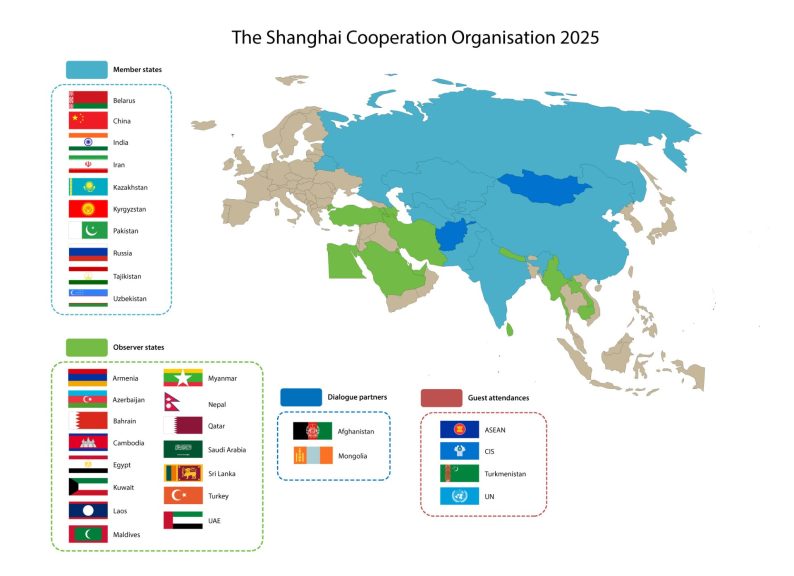
The Eurasian region is serviced by numerous banks, including the Asian Infrastructure Investment Bank (AIIB), which is headquartered in Beijing, and in which all SCO members retain equity. The bank is capitalised at US$100 billion and is involved in projects throughout the region.
In addition to this, the BRICS New Development Bank (NDB), while not wholly focused on Eurasia does become involved in regional projects involving SCO members. It is also capitalised at US$100 billion. The Asia Development Bank (ADB) is also regionally involved, however is influenced by the United States and Japan. The Eurasian Development Bank is also heavily SCO influenced. These banks are capitalised at US$50 billion. Additional, smaller banks are also involved in providing regional finance, although the market has also been dominated by China’s national outbound spend – the numerous Belt & Road Initiative projects, with estimates that Beijing has committed close to US$1 trillion in funding over the past decade, mostly into the SCO region.
This years’ summit is the largest since the SCO was formed and has taken on special trade and security significance in the wake of Washington’s tariff threats and the overall uncertain global trade and security ambiance.
Comparisons can be made between the recent ‘mini summit’ in Washington between the US President Trump and several senior European leaders, in which the discussions appeared downbeat and subdued. The SCO on the other hand will be a more vigorous meeting, with perhaps a greater sense of unity and forward-thinking, despite some political pressures among certain members. The onus will be on the SCO to unify and strengthen rather than fall into divisions.
In the trade sphere, attention will be paid to creating more stability within the SCO nations themselves, in order to head off the tariffs uncertainty created by the United States. Rather like countries such as Brazil, China, India and Russia have congregated around the BRICS to counter US trade policy, the same can be expected to occur within the SCO. This will almost certainly lead to agreements on regional trade and logistics infrastructure. For example, we recently discussed the merging of digital transport platforms between China, India, Kazakhstan and Russia here.
Agreements on financing this regional infrastructure will also be discussed, with projects either manifesting themselves in G2G, regional banking, or multilateral agreements. A key part of this will be the development of the Trans-Afghan Railway, which would connect landlocked Uzbekistan and Afghanistan with Indian Ocean seaports on the Pakistan coast, as well as provide much-needed commercial opportunities in Afghanistan itself. An estimated US$5 billion is required to make that happen.
Coupled with this will be discussions concerning the further development into Central Asia of the eastern corridors of the International North-South Transportation Corridor (INSTC) and the Middle Corridor to China. The Eurasian Development Bank has estimated the total cost of upgrading and building regional SCO transport networks at US$245 billion.
Then we come to security. Afghanistan appears to have settled, although occasional, albeit localised incidents do occur. Pakistan however continues to suffer terrorism problems, coming to blows recently with fellow SCO member India and creating problems on the Iranian border. A considered approach to improving Pakistan’s security is a fundamental problem the SCO will have to deal with.
There will also be some celebrations – China (and much of south Asia) is to mark the 80th anniversary of the ending of WWII, with a series of ceremonial events including a military parade that will take place on 3 September in Beijing. We can expect some contrite responses from Japan, who were the main wartime aggressor against the region at that time.
There may also be some SCO expansion, with the likes of Saudi Arabia perhaps taking a full membership role as opposed to doing the same in BRICS. Some of the new applicant countries mentioned may also become dialogue partners.
However, the underlying message can be expected to remain the same when contemplating the SCO as it does for the emergence of BRICS: a renewed interest and physical need to better develop trade ties, infrastructure and trade volumes amongst members. That will go together with a determined effort to not exclude the European Union or United States from trade development and investment – but to hedge against their wilder, more erratic policies. The SCO summit can be expected to underline Eurasia’s Pivot to Asia as it seeks reliability, and sustainability in trade, together with humanitarian development in regional security structures.
A general expectation exists, that the SCO and BRICS will become closer in some form or another. Exactly how, given that the two organizations serve different sets of countries, arguably with different sets of needs, is the open question. We expect, based on the current SCO meeting, that a SCO bank, similar to the BRICS bank, will be established, or perhaps an existing bank will be chosen to fulfill the SCO’s requirements, as the NDB is expected to meet the BRICS’ requirements.
The following article from BRICS Analytics outlines the potential convergences between the two organizations. Lula from Brazil is requesting an extraordinary (and urgent) summit of BRICS. He states that the US tariff regime is aimed at undermining multilateralism and multipolarity. This is indeed a BRICS problem (war on BRICS), but it is also a SCO problem. What is it that we don’t understand yet in terms of a divide-and-conquer strategy? Lula has defined that BRICS countries are being picked off one by one. We cannot argue with that concept.
There are two schools of thought in terms of growth of the Global South. The first is that these organizations need to remain separate entities, forming an array of change agents, rather than a single, unified bloc that can be attacked as one. This thought downplays the strength of a strong bloc acting in concert. The second is the view outlined in this article, that the organizations are synchronous and must become much closer.
Essentially, between the BRICS and SCO, we talk about economic cooperation and an array of issues such as anti-terrorism action. Is the time now right to talk about military cooperation? The first warships are in and crossing the Panama Canal in, what we hope, is only a force projection from the US against Venezuela. I fear though that this hope is misplaced and we may be looking at yet another regime change operation, this time with the old gunboat ‘diplomacy’. Then we have the extremely violent clashes defined to be yet another regime change or similar type operation in Indonesia. Indonesia is the first Southeast Asian nation who joined the BRICS block formally in the beginning of this year. Vietnam followed.
What is clear, is that we are looking at total war on many fronts. The US cancellation of visas for the Palestinian groups to attend the September UNGA meeting, is part of this total war. Greater Israel must be established for the hegemon to own West Asia and what is referred to as the Middle East. Rubio’s Shameful and Illegal Interference With the UN. w/ Prof. Jeffrey Sachs & the Judge
We are now in the territory of a deathly war between two world orders, one falling and we’re moving into a post-West world order, and one rising with Global South power.
—
The Shanghai Cooperation Organization (SCO) summit that is starting imminently in Taijing, China may bring a number of breakthroughs in transforming the bloc in the direction of prioritizing economic cooperation. One of the possible decisions at the summit may be the launching of an SCO development bank that would expand the array of Eurasia’s development institutions. Another important turn in SCO’s evolution this year will be the expansion in the SCO+ format that is to include representatives of regional and international organizations. These and other developments point in our view to a rising similarity in the transformation experienced by the SCO and BRICS – something that we believe will be conducive to forming a closer SCO-EAEU-BRICS partnership that has been widely discussed within the Eurasian circles in recent years.
Throughout the past several years, the SCO, like the BRICS grouping, was in expansion mode. In 2017, the SCO widened its ranks to include India and Pakistan, Iran joined the group in July 2023, and Belarus in July 2024. In the case of the SCO, as well as BRICS, apart from the expansion of core membership, there was also the creation of a partnership belt. Following the expansion of BRICS and the SCO over the past several years, both platforms are now broadly comparable in terms of the number of countries in their core and partnership belts. Both now have 10 developing economies in the core, with the partnership belt in BRICS currently consisting of 10 members (together with Vietnam, that joined the partnership belt in the summer of 2025) and several more that are yet to accept the invitation, while in the case of SCO the number of dialogue partners amounts to 14 countries.
Apart from the synchronicity in the expansion mode across the two blocs, there is also a rising convergence between the SCO and BRICS in terms of membership in the core and the partnership belt. At this stage four BRICS core members – India, Iran, China and Russia – are also members of the SCO core. The BRICS core now also includes two dialogue partners from the SCO – the UAE and Egypt (three in case Saudi Arabia becomes a full-fledged BRICS member). The newly created BRICS partnership belt also included two SCO core members from Central Asia – Uzbekistan and Kazakhstan – as well as one core SCO member from Europe, namely Belarus. Also, some of the SCO core members and partner economies in recent years were granted membership in the BRICS New Development Bank – specifically Uzbekistan (core member of the SCO) and Bangladesh (applied for dialogue partner/observer in the SCO).
With SCO expanding to cover more Eurasian economies, the bloc launched an SCO+ format in 2024 that is to be further broadened in terms of its scope this year during the SCO summit in China. The Chinese authorities expect nearly 30 representatives of countries, regional blocs and international organizations to attend the SCO+ meetings during this year’s SCO+ summit. The launching of this SCO+ format is line with our calls to create an SCO+ platform for the regional arrangements in Eurasia back in 2018 and further in 2022 and 2024. This emerging SCO+ platform bears resemblance to the evolution of the BRICS+ format whose theoretical foundations we also developed in the beginning of 2017 and whose practical implementation was launched by China in the fall of 2017.
As we have noted in the past, the convergence in the modalities of operation of BRICS and the SCO blocs – as evidenced by the launching of the SCO+ format (similar to BRICS+) as well as the possibility of the creation of a SCO development bank (similar to the BRICS NDB) – is conducive to greater coordination and alignment between these two platforms going forward. It also lays the groundwork for the implementation of the stated goal of forging closer cooperation within the EAEU-SCO-BRICS triad.
This greater alignment between the three blocs may shed light on the further evolution in the integration impulses across Eurasia and the Global South. In particular, the EAEU-SCO-BRICS platform may bring on board the regional integration blocs from outside of Eurasia (such as Mercosur or AU/AfCFTA) leading thus to the creation of a broader BRICS+ platform for regional integration arrangements. Another possible implication is that BRICS institutionalization may follow in part the patterns of institutionalization within the SCO and the EAEU, including with respect to the creation of a Commission/Secretariat.
Three – interlocked – dates ahead of us could not be more crucial in shaping the next configuration of the currently incandescent geopolitical chessboard.
By Pepe Escobar at Sputnik.
Taken together, these three dates span the whole spectrum of the Russia-China strategic partnership; the increasingly interlocked geopolitical and geoeconomic aspects of Eurasia integration and Global South solidarity; and the concerted push by Eurasia actors to accelerate the drive towards a multi-nodal, equanimous system of international relations.
Western revisionism hits an iron wall
It’s impossible to overstate how important the Victory Day parade is for the People’s Republic of China. The Chinese in a thousand years – and more – will never accept WWII American revisionism such as “the US and Japan jointly ended a war 80 years ago”. And much less European revisionism: “Europe’s commemorations of the Normandy Landings also involved a shocking rewriting of the history of the Eastern Front. These actions remind us that the September 3rd military parade’s attendance list has become a criterion for identifying which countries remain steadfast in their anti-fascist stance.”
So Putin in Beijing on the Chinese Victory Day parade is a mirror image of Xi in Red Square on May 9, when Russia officially celebrated the 80th anniversary of the USSR victory in the Great Patriotic War.
No wonder the Chinese Foreign Ministry is adamant: the historical victory of WWII cannot be distorted. And this shared historical memory – vehemently against Nazi-fascism and its resurgence in the West – is a guiding light for the Russia-China multilateral, multipolar, and multi-nodal coordination, from the UN – unfortunately sliding towards irrelevancy – to the dynamic BRICS and SCO.
Modi talking directly to Xi on Sunday, on the sidelines of the SCO summit, seals the sorry fate of the tariff war on India – part and parcel of the Empire of Chaos Hybrid War on BRICS, and for that matter, a great deal of the Global Majority.
The latest mantra spun by Trump 2.0 circles is that New Delhi is supporting Moscow’s war on Ukraine by buying Russian oil, thus helping to enrich Putin even more.
End result: the original RIC (Russia-India-China), all of them sanctioned/tariffed, locked up in a tight embrace.
The sound of the Eurasia heartland rockin’
Vladivostok may carry a few surprises – but on the US-Russia business front.
First of all, speculation is rife on whether Trump might have decided to turn the planned EU theft of Russian foreign assets upside down, and instead force the funds to be invested in the American economy. If that would be the case – after all Trump himself proclaims “I can do anything I want” – there’s absolutely nothing the chihuahua EUrocracy can do to prevent it.
Then there’s the enticing possibility of US-Russia deals being discussed. One option would be ExxonMobil returning to the Sakhalin-1 mega gas project. There’s also immense American oil industry interest in re-starting the sale of equipment for LNG projects, including the Arctic LNG-2; and the US purchasing Russian nuclear icebreakers.
That would be beyond ground-breaking, in more ways than one – because it would enable the US to directly compete with the Northern Sea Route (or Arctic Silk Road, in Chinese terminology), which is being built by Russia as an alternative to the Suez Canal.
On the Ukraine front – and that will be discussed in excruciating detail at the SCO summit – there are no illusions among the members, according to Central Asian diplomatic sources. And that mirrors the predominant Russia-China interpretation. The Empire of Chaos will never desist from conforming Ukraine as a strategic buffer against Russia; keep a key foothold in Eurasia; and keep raking in solid profits (in euros) for the industrial-military complex.
That’s what permeates everything from the Ukraine Security Assistance Initiative (USAI) and the Pentagon’s Presidential Drawdown Authority (PDA) to NATO’s Comprehensive Assistance Package (CAP), launched nine years ago and de facto running the military backbone of the Kiev/NATO armada. Add to it US Navy P-8 Poseidon spy planes circling over the Black Sea on a daily basis – watching everything happening in the waters from Novorossiysk to Sevastopol.
As much as we’ll be absorbing new moves on the chessboard during the next crucial week, in the end we all circle back to the Mackinder-drenched “The Grand Chessboard” as outlined by the late Brzezinski.
Before the end of the millennium, the fear was that an alliance of Russia, China – and Europe, prior to the consolidation of the EU – would manage to control Eurasia, and thus the world, following Mackinder.
Well, now we can picture the ghost of Mackinder listening to the latest remix of Deep Purple’s Made in Japan – the greatest live rock album ever, which was recorded in the early 1970s… in Asia. In this new, Asia-centered world, the top Global South actors at BRICS/SCO exhibit over twice the US GDP, and are paving the way to de facto replacing the US dollar by increasing trade in their own currencies.
Even the previous US autopen administration authorizing the bombing of the Nord Stream pipelines – to make sure Europe would be dependent on expensive US natural gas and not Russia’s – did not substantially alter the chessboard.
Apart from the fact that Europe is committing serial harakiri; is advancing its own de-industrialization; and for all practical purposes is now dead as a geopolitical actor. It’s all about the Empire of Chaos versus BRICS/SCO.
So let next week rock: call it the sound of the Eurasia heartland re-affirming its sovereignty. Play it loud.
In the wake of the recent Iran-Israel war, the geopolitical landscape of the Middle East is more complex than ever. While Iran’s membership in organizations like BRICS was meant to build a united front, has it instead led to a strategic dead end? In this critical debate, we explore whether Iran has been betrayed by its Eastern partners, China and India.
Join us at Irantalks for an in-depth discussion with renowned experts Carl Zha, who breaks down China’s foreign policy, and Alok Arora, who provides insight into India’s strategic calculations.
We tackle the tough questions:
• Why have China and India remained largely silent during the crisis?
• Is the new India-Middle East-Europe Economic Corridor (IMEC) a direct plot to isolate Iran economically and politically?
• With India’s deep military ties to Israel and China’s balancing act, can Iran truly count on its BRICS “allies” in a confrontation with the West?
We analyze the rivalry between China’s Belt and Road Initiative (BRI) and the US-backed IMEC, dive into the failure of the Shanghai Cooperation Organization (SCO) to act, and ask if Tehran is facing a new era of “participatory isolation.”
This is a must-watch analysis for anyone interested in the future of West Asia and the shifting global power dynamics.
This should be read in combination with Mr. Lavrov’s speech on Russia’s meeting with India.
The 10-point consensus reached during the China-India boundary meeting.
If India plays fair, the old RIC formulation will again form the basis of BRICS, and this will have a positive and stabilizing effect. Go BRICS!
NEW DELHI, Aug. 19 (Xinhua) — The 24th Round of Talks Between the Special Representatives of China and India on the Boundary Question was held here on Tuesday, during which a 10-point consensus was reached.
China’s Special Representative Wang Yi, who is also a member of the Political Bureau of the Communist Party of China Central Committee and director of the Office of the Central Commission for Foreign Affairs, and India’s Special Representative Shri Ajit Doval, also India’s national security advisor, exchanged in-depth views in a candid manner on the China-India boundary question in accordance with the strategic guidance of the leaders of both countries.
The two sides reached the following 10-point consensus:
1. Both sides positively evaluated the progress made in implementing the important consensus reached by the leaders of the two countries since their meeting in Kazan, and noted that the boundary regions between China and India have remained peaceful and stable since the 23rd round of talks.
2. Both sides reaffirmed the importance of maintaining peace and stability in the boundary regions, emphasized the need to resolve relevant issues through friendly consultations to promote the overall development of China-India relations.
3. Both sides agreed to approach the situation from the political perspective of the overall bilateral relationship, and to seek a fair, reasonable and mutually acceptable framework for resolving the boundary question in accordance with the political guiding principles agreed by the two countries in 2005.
4. Both sides agreed to establish a demarcation expert group under the framework of the Working Mechanism for Consultation and Coordination (WMCC) on China-India Border Affairs to explore the possibility of advancing demarcation negotiations in areas where conditions are ripe.
5. Both sides agreed to establish a working group under the framework of the WMCC to advance effective border management and control, maintaining peace and stability in boundary areas.
6. In addition to the existing general-level talks in the western section of the boundary, both sides agreed to establish a general-level talks mechanism in the eastern and central sections, and to hold a new round of general-level talks in the western section as soon as possible.
7. Both sides agreed to utilize the border management and control mechanisms through diplomatic and military channels, first reaching consensus on relevant principles and methods to promote de-escalation and management processes.
8. Both sides exchanged views on cross-boundary river cooperation and agreed to use the expert-level mechanism for cross-boundary rivers to maintain communication on renewing the cross-boundary river flood reporting memorandum of understanding. The Chinese side agreed to share emergency hydrological information on relevant rivers with the Indian side based on humanitarian principles.
9. Both sides agreed to reopen three traditional boundary trade markets.
10. Both sides agreed to hold the 25th round of talks in China in 2026.
Foreign Minister Sergey Lavrov’s statement and answers to media questions at a joint news conference following talks with Minister of External Affairs of India Subrahmanyam Jaishankar, Moscow, August 21, 2025
Ladies and gentlemen,
My Indian colleague and friend Minister of External Affairs of India Subrahmanyam Jaishankar and I had talks as part of the Minister’s visit to the Russian Federation, which included yesterday’s meeting of the Intergovernmental Commission on Trade, Economic, Scientific, Technical and Cultural Cooperation. On the Russian side, the commission is co-chaired by First Deputy Prime Minister Denis Manturov. Minister Jaishankar is absolutely pleased with the outcomes of that meeting as we found out today.
The participants discussed joint cooperation projects in energy (including nuclear), outer space exploration, the manufacturing industry, transport, and infrastructure, to name a few. These projects are under consideration by the corresponding agencies and will definitely take bilateral trade, and economic and investment cooperation to a whole new level.
Yesterday, the co-chairs noted that last year bilateral trade was up by 15 percent setting an all-time high record in the post-Soviet history of Moscow-New Delhi relations.
We welcome the progress in implementing the North-South International Transport Corridor project, in which our Indian friends and we have shared interest. We agreed to step up this work with other participants in the project. Ambitious plans to organise and scale up cargo transport along the Northern Sea Route are in place.
Cooperation in the hydrocarbon sector and Russian oil shipments to the Indian market is making wide strides. Both sides are interested in implementing joint energy production projects in the Russian Far East and the Russian Arctic shelf, among other sites.
The economic base of our special privileged strategic partnership is getting stronger in a steady and progressive manner which underscores the special nature of Russian-Indian relations. We are convinced this strategic partnership meets the fundamental interests of our respective peoples and contributes to regional security and stability, which is undeniably important considering the challenging international circumstances that we are operating under.
Russia-India political interaction and the political dialogue at the top level, as well as at the level of foreign ministries and other government agencies, boasts a fast-paced dynamic.
Today, we focused on upcoming events that will be held as part of this dialogue, including preparations for President of the Russian Federation Vladimir Putin’s visit to India before the end of this year. A large package of documents will be put together for this summit.
We welcome excellent traditions that have taken shape in military cooperation, joint exercises, and military-technical cooperation, which are steeped in solid historical foundations as well.
With regard to international developments in the context of Ukraine, following President Putin’s telephone conversation with Indian Prime Minister Narendra Modi, we informed our Indian guests in detail about the state of the discussions with our US partners, primarily, the talks in Alaska during President Putin’s visit to the United States at the invitation of President Trump. We also looked into how this push for a speedy settlement can be realised in practice in a manner that will fully take into account the legitimate security interests of all participants.
We discussed the situation in Afghanistan, and we both think that it should be included in regional processes in pragmatic aspects.
We talked about the Middle East settlement and the humanitarian crisis in the Palestinian territories.
We discussed the state of the Iranian nuclear programme and a number of other international issues.
We enjoy close coordination at various multilateral institutions, such as the UN, BRICS, the SCO, and the G20, and agreed to keep it that way.
I believe that today’s talks were exceedingly useful and came as a supplement to the discussion on economic matters that took place during the Minister’s visit. We agreed to hold more contacts in the future focusing on top-quality preparations for President Putin’s visit to India, and more.
Question: Speaking about security guarantees for Ukraine, who and how, from Moscow’s point of view, should ensure new possible agreements, given the negative experience of the Minsk agreements?
Sergey Lavrov: The history of the issue is not limited to the Minsk agreements. Let me remind you that in April 2022, only a few weeks after the start of the special military operation, negotiations were launched. They began in Belarus and later continued in Istanbul. These discussions focused on eliminating the root causes of the conflict.
As President Vladimir Putin has repeatedly stressed, at that time the Ukrainian side proposed a draft settlement document, which was initialed by both the Ukrainian and Russian delegations. It outlined the basic principles for ensuring security in the post-conflict period.
The proposal focused on ensuring security in an honest way and collectively: above all, by creating a group of guarantor states involving permanent members of the UN Security Council. Germany and Turkiye were also mentioned. The list of guarantors was to remain open to any countries willing to participate. Their role would be to guarantee Ukraine’s security under principles similar to Article 5 of the Washington Treaty on establishing NATO. Meanwhile, it was clearly stipulated that Ukraine would remain a neutral, non-nuclear, and non-aligned state, refraining from joining NATO or any other military alliances.
These principles – neutrality, non-nuclear and non-aligned status – were enshrined in the 1990 Declaration of State Sovereignty of Ukraine and served as the foundation for its recognition as an independent state.
However, the Istanbul agreements, essentially approved at the time, were subsequently undermined by the intervention of then British Prime Minister Boris Johnson, supported by other Western representatives. As a result, a genuine opportunity for peace was lost. Yet we still regard the principle of collective security guarantees, initially proposed by Ukraine, as both natural and relevant today.
Following the recent Russia-US summit in Alaska, which achieved significant progress in defining the contours and parameters of a potential settlement, European leaders travelled to Washington to accompany Mr Zelensky. There, they attempted to promote their own agenda: building so-called security guarantees based on isolating Russia, rallying the West around Ukraine, and persisting in their aggressive confrontational policy of containing Russia with the aim of inflicting a strategic defeat on our country. This cannot but evoke a feeling of full and categorical rejection. All the more so as the Ukrainian regime, its representatives are making very specific comments about the current situation, clearly demonstrating that they are not interested in achieving a sustainable, fair, and long-term settlement.
There is one Mikhail Podolyak, who regularly speaks on behalf of President Vladimir Zelensky. In commenting on developments related to Ukraine’s security guarantees, he said the following: for the time being, Ukraine would get such security guarantees and reconcile itself to part of its territories “being temporarily under occupation,” but as soon as it got an agreement on security guarantees, Ukraine would urge the West to destroy the Russian Federation with sanctions and annihilate its economy. This means that the aims harboured by the current Ukrainian leaders and certainly encouraged by the Western sponsors of the Kiev regime are directed against the efforts being undertaken by US President Donald Trump, with whom we actively and matter-of-factly cooperate in the search for long-term and stable settlement and removal of the prime causes of the conflict. The opposite side, on the contrary, seeks to exacerbate these causes by creating “alliances” for Ukraine’s security based on anti-Russian grounds and aggressive plans retained with regard to our country.
A representative of Mr Zelensky’s Executive Office went on record as saying that it made no sense to discuss issues of peace settlement as long as there were no clear definitions of security guarantees. This means that Ukraine, first and foremost, wants the West to guarantee the preservation of the current neo-Nazi, Russophobic and aggressive regime, which grossly violates the principles of human rights enshrined in the UN Charter and demanding respect for the rights of any person regardless of race, gender, language or religion, on what will remain of the former Ukrainian Soviet Socialist Republic.
We have repeatedly highlighted the fact that the West (which is teaching everyone how to ensure human rights in keeping with various neo-liberal doctrines) has never in all these years used the collocation “human rights,” while discussing Ukraine. This means that the West is satisfied with how the Ukrainian regime is banishing the Russian language from all spheres – education, culture, mass media, and more – banning the canonical Ukrainian Orthodox Church, and singing praises to and extolling Stepan Bandera and other collaborationists convicted by the Nuremberg Trials for cooperation with Hitler’s Germany. The West is completely satisfied with this regime.
When, against this background, Ursula von der Leyen and other officials in Brussels say with emotion that they will stand with Ukraine for as long as it takes because allegedly it defends the “European values,” this amounts to an acknowledgement of guilt and a confession of what these “European values” are all about.
Let me stress once again that Russia has always been in favour of an honest dialogue and the principles of security guarantees that were coordinated in Istanbul in April 2022 at the Ukrainian delegation’s initiative. We supported them in 2022 and we are supporting them now, because they are based on the principles of collective and indivisible security. All other, unilateral conspiracies lack prospects. As is clear from the West’s current discussions with Ukraine, all these plans are linked with providing guarantees through a foreign military intervention to some part of the Ukrainian territory.
I think those who harbour such plans are just trying to draw attention to their persons. I hope they understand that this will be absolutely unacceptable for Russia and for all sober-minded political forces in Europe.
Question: Given the recent statements and actions by the leaders of the so-called “coalition of the willing,” could their objective be to disrupt the negotiation process between Russia and the United States? How can this be countered? Should we expect any provocations from them?
Recently, news emerged that Vladimir Zelensky claimed a meeting with President Vladimir Putin was supposedly already being prepared. Could you confirm or deny this?
Sergey Lavrov: As for the motives driving this “coalition of the willing,” I see ample evidence that this activity is precisely aimed at undermining the progress that has clearly emerged following the Alaska summit and the preceding contacts between representatives of the US Administration and the Russian side.
Foreign analysts and commentators, describing the current situation and the unprecedented activity of European representatives, arrive at the same conclusion: the goal is to “hijack” the agenda – which is oriented towards addressing the root causes of the crisis and thereby achieving a sustainable settlement – and to shift everything into the realm of providing security guarantees for Ukraine without Russia’s participation, indeed by ignoring Russia’s interests altogether, while emphasising the need to protect Ukraine from future attacks. But let me stress, that they want to protect a country that espouses neo-Nazi values, grossly violates the rights of national minorities, legislatively seeks to eradicate the Russian language in all spheres of life, and bans the canonical Orthodox Church. This is the Ukraine Europe wishes to take under its security guarantees. It has become so blatantly obvious that I hope this reckless venture will fail, and we will continue to follow the course clearly agreed upon by Russian President Vladimir Putin and US President Donald Trump during their meeting in Alaska and subsequent telephone contacts.
Regarding the meeting mentioned by Vladimir Zelensky, recall that he long insisted that he would never negotiate with Russian President Vladimir Putin. To this day, he has not revoked his three-year-old executive order explicitly prohibiting negotiations with Vladimir Putin.
Zelensky’s sudden eagerness to arrange a summit with the Russian leader is merely an attempt to feign a constructive commitment to the settlement process – when in reality, it is a bid to replace the serious, arduous, painstaking work of agreeing upon principles for a sustainable resolution to the crisis with cheap theatrics reminiscent of KVN (Club of the Funny and Inventive People, a popular Russian merry-making TV show) or Kvartal 95, tricks the current Ukrainian leader employs quite actively, fearing waning attention. As is already happening.
President Vladimir Putin has repeatedly stated his readiness to meet, including with Vladimir Zelensky, provided it is understood that all issues requiring high-level consideration will be thoroughly prepared, with experts and ministers furnishing appropriate recommendations – and provided it is clear that, when and if (hopefully when) the time comes to sign future agreements, the question of the legitimacy of the person signing them on behalf of Ukraine will be resolved.

En réponse à la pression tarifaire des États-Unis, les BRICS restructurent leurs relations commerciales et économiques. La réorientation rapide de
L’article Les BRICS restructurent leur commerce face à la pression tarifaire américaine est apparu en premier sur STRATPOL.
India may just be swinging to BRICS. On a different note, we may say India is competing and working hard to get the I in BRICS back, since we’ve given that I to Iran and Indonesia.
Some details are from S L Kanthan in this story that reads like the Christian story of The Prodigal Son being welcomed home: Other details are from Russia, with love.
From rivals to allies! India and China are redefining their relations and forging a future of strategic harmony.
Chinese FM Wang Yi just met with Indian PM Modi, who will be going to China in 2 weeks.
The change in diplomatic language is remarkable:
The change in diplomatic language is remarkable: https://t.co/DZSjHKdT1d
— S.L. Kanthan (@Kanthan2030) August 20, 2025
Just look at the stunning events that have transpired over the last few months.
Indian and China are now working on finalizing the border… and ending the decades-old disputes! The demarcation project will not be easy, but is extremely promising.
India’s defense minister, foreign minister and national security advisor have been to China for talks; Chinese FM Wang Yi came to India this week for the first time in three years; and PM Modi is all set to go to China for the SCO Summit.
Indian pilgrims visited Tibet a month ago after a ban for five years; both countries have relaxed visa restrictions; and land trade is about to begin again. China has also agreed to ease exports of rare earth magnets and fertilizers to India.
Finally, militaries of both countries have done an excellent job in stabilizing the border and creating the optimal conditions to avoid conflicts in the future.
Smart politics listens to economic concerns. And the #1 driving force behind the India-China rapprochement is the business community.
Indian conglomerates such as Reliance, Adani Group and JSW group are actively working with Chinese corporations to create joint ventures for EV, batteries, solar panels, auto parts, e-commerce and so on.
Trade is not only good for the economy, but it builds trust.
This is a win-win opportunity. Indian corporations need certain technologies from China; and Chinese companies are eager to enter the Indian market – especially due to the headwinds from the US tariffs and sanctions.
Inevitable geopolitical conflicts for India and China.
There are inherent collisions of spheres of influence for the two Asian giants. The borders in the Himalayas, for example, are going to be difficult to resolve.
Then there is Pakistan, which is strategically important for China, but creates persistent problems for India.
In other neighboring countries like Sri Lanka, Nepal, Bangladesh and Bhutan, there are struggles for influence. China needs to be sensitive to India’s concerns.
Similarly, India needs to rethink membership in QUAD, which is aimed at containing China.
These are not easy problems to resolve completely, but can be managed with sincere dialogues.
The India-China partnership has the potential to drive shared success. The synergy across the borders can unlock win-win opportunities in a new era of symbiotic cooperation. Of course, there can be friendly competition in technology, trade, diplomacy, soft power etc., but both parties must be careful to avoid conflicts.
As Indian Prime Minister Narendra Modi tweeted: “Stable, predictable, constructive ties between India and China will contribute significantly to regional as well as global peace and prosperity.”
We will see over the next year or so how the leadership of the power duo handle this wonderful opportunity to reset the relations and embrace a journey of harmony and solidarity.
In Russia, FM Sergey Lavrov will hold talks (https://mid.ru/en/foreign_policy/news/2042103/) with Minister of External Affairs of the Republic of India Dr. Subrahmanyam Jaishankar in Moscow. Following is the Russian MFA Press Release before the talks.
Russia and India have developed a special privileged strategic partnership based on mutual trust and respect.
The core spheres of cooperation between our two countries include efforts to step up political dialogue in both bilateral and multilateral frameworks, as well as ensuring that agencies in charge of economic and financial matters, energy, arms manufacturing, science and culture work more closely together.
Russia’s and India’s Foreign Ministers will pay special attention to the current and future avenues for promoting bilateral cooperation. They will also discuss the schedule for future contacts.
The meeting’s agenda will focus on facilitating the emergence of transport, logistics, banking and financial links and chains that would be immune to any adverse pressures from unfriendly countries, while also increasing the use of national currencies in their mutual settlements.
Expanding cooperation in transport, energy, agriculture, science and technology will also be on the meeting’s agenda.
The Ministers will also coordinate their positions on the latest international developments, paying special attention to interactions within the #UN, #BRICS, the #SCO and the #G20.
The substantive exchange of opinions between the two officials will also include topics related to shaping a security architecture with greater justice for all in the Asia-Pacific Region, as well as the situation in Ukraine and Afghanistan, and the Israeli-Palestinian conflict.
Moscow and New Delhi view multipolarity as a core factor for maintaining balance of the world order that has taken shape over the past decades.
Russia focuses on building an inclusive political and economic system and promoting a positive agenda while maintaining constructive interstate dialogue.

Update with new numbers: Russia-India trade turnover surged 700% over past 5 years, India is now in the TOP 3 of Russian trading partners, says Russian Deputy PM Denis Manturov after meeting with India’s top diplomat Subrahmanyam Jaishankar
Far off in the background, somebody is going a little bananas – This crazy bird called Bessent does not like any of this:
RUSSIA-INDIA ALLIANCE DRIVES BESSENT CRAZY
US Treasury Secretary Scott Bessent has accused India of “unacceptable” profiteering for buying discounted Russian oil and reselling refined products globally.
India’s Russian oil imports rose from 1% to 42% of its total
Estimated $16 billion in “excess profits”
Bessent calls it “Indian arbitrage” – a scheme that “sprang up” during the conflict
While the US pushes costly sanctions that hurt European allies and global markets, India has secured affordable energy and strengthened its economic sovereignty.
India refiners buy more, and the world goes on while Bessent’s whining disappears into the background noise. Nobody even cares and that is how it should be. Go BRICS!
Michael von der Schulenburg: Alaska Meeting Was a “Game Changer”
Excellent discussion and correct preliminary conclusion. “Trust-building” was leitmotif, to halt the runaway train to nuclear war. Reality between the two who count are now materially different. Europeans stand alone, and will cast off by Empire. “The Peace” is gonna be imposed on the crazed Europeans, and others fueling Forever Wars. Russia is recognized as peer power that must be negotiated with, sans diktat or derision, as they hold the cards.
Danny Haiphong interviewing Ben Norton. It is a typical Haiphong header.
Of course it’s all about Alaska. Here’s what’s in play. But it’s the shadowplay that’s even more exciting.
By Pepe Escobar at Strategic Culture Foundation.
Of course it’s all about Alaska. Here’s what’s in play. But it’s the shadowplay that’s even more exciting.
Across the world, for those who grew up in the Cold War Swingin’ Sixties, the temptation is irresistible to cast Donald Trump as Goldfinger (but who would play Oddjob? Hegseth?)
Goldfinger, after all, is a powerful, ruthless gambler. His 21st century motto would be “Obliterate & Plunder”. In fact, sequentially, an orgy of obliteratin’ and plunderin’ if the occasions present themselves. Everything subjected to the search for the Golden Deal. My way. The only way.
Yet now it’s possible that Goldfinger may have met its appropriate – collective – match.
This is what happened the last time a summit took place in Alaska, in this particular case US-China in a shabby hotel in Anchorage. That shook the geopolitical chessboard to the core. Trump-Putin might – but only under quite specific conditions.
There’s only one realistic, optimal endgame for Alaska: a joint declaration of intent, pointing to a follow-up, as in the next meeting to be held in Russian territory. A sort of starter for the long and winding road towards a real reset of US-Russia relations, including a possible settlement in the proxy war in Ukraine.
Essentially, they may agree to keep talking. Yet what really matters is what may be implied by the promise: Goldfinger refrains from imposing secondary sanctions on Russia’s partners.
That will constitute a tremendous BRICS victory (Iran excluded. Actually, two strategic allies of Russia would be excluded: Iran and the DPRK).
BRICS are actively building a coalition to stare down Goldfinger. The key players are Bear, Dragon, Toucan and Elephant – all four original founders of BRIC. Nightingale should be added later, as it is linked via geopolitical/geoeconomic strategic partnerships with Bear, Dragon and Elephant.
When it comes to the Alaska nitty gritty, the top Bear needs to consider all the ramifications of what is an imperative for the Russian General Staff and the vast intel apparatus in Moscow: unless Goldfinger minions stop weaponizing and providing precious intel to Ukraine is all its forms, the mythic “ceasefire” that Goldfinger and the pack of toothless chihuahuas in Europe desperately want will be just an intermission to allow Ukraine to rearm to the hilt.
That’s a tough call for the top Bear: he has to placate his domestic, radical critics who blast him for sitting down with the enemy, and at the same time he must deliver the goods to his under-siege BRICS allies.
BRICS counteract Goldfinger’s Plunder tactics
Bear, Dragon, Toucan and Elephant are involved in breathless telephone diplomacy to articulate their collective response to Goldfinger’s Tariff/Plunder drive.
Examples. Modi on Brazil: “A strong, people-centric partnership between Global South nations benefits everyone.”
Lula on India: “Brazil and India are, so far, the two most affected countries. We reaffirmed the importance of defending multilateralism and the need to address the challenges of the current situation.”
Xi to Lula: China backs Brazil to defend its national sovereignty; BRICS is “a key platform for building consensus in the Global South.”
Goldfinger’s Tariff Plunder works in several ways.
On India: because New Delhi refuses to open its vast agricultural market to tariff-free Made in USA imports (45% of India’s population directly depends on agriculture); and because India buys Russian oil at much-needed discount prices.
On Brazil: because the ultimate target is regime change and free reign to plunder Brazil’s natural wealth.
So far, Goldfinger’s Plunder antics have been stellar when it comes to engineering their own blowback: from allienating even allies – see abject European submission – to de facto burying multilateral trade, not to mention international law.
Example: just a few hours before the tariff “pause” on Made in China products was about to expire, Goldfinger signed an executive order extending the deadline for another 90 days. Translation: TACO, all over again. If the tariff “pause” went through, the economy of the $37 trillion-indebted “indispensable nation” would be in even more dire straits.
Then there’s Goldfinger’s possible Arctic gameplay, already examined here. There’s virtually no evidence Russia would allow the US to participate in the development of the Arctic-wide Northern Sea Route (NSR), or Arctic Silk Road in Chinese terminology.
The role of Russia’s Atomflot – 11 nuclear icebreakers, 9 of them in action, 2 being built, including Project 10510 Rossiya, a behemoth capable of navigating anywhere in the Arctic anytime – in parallel with Russia’s astonishing arsenal of new weapons systems, these are absolutely key variables on any serious discussion on any possible US-Russia partnership post-Alaska.

Arya – آریا: mural at Tehran’s Enghelab Square. Farsi text: “The end of this saga is of glory, thus recite the name of Iran, for it is the slayer of its enemies.” The Iranian warrior Rostam from Shahnameh fights the serpent (the US)
Goldfinger’s obsession to cage Nightingale
Now let’s look at Nightingale – an immensely complex case. Goldfinger has totally embarked on a multi-track maximum pressure/tension remix against Iran: forcing Hezbollah to disarm; forcing the collapse of Lebanon into factional war; legitimizing the “al-Qaeda R Us” dismemberment of Syria; forcing snapback UN-backed sanctions on Tehran.
Then came the Goldfinger-hailed “historic peace summit” with Azerbaijan’s Aliyev and Armenia’s Pashinyan.
Well, what Baku and Yerevan really signed under Goldfinger’s watchful eye is not a peace deal: it’s a mere memorandum of understanding (MOU).
Their Joint Declaration is extremely vague – and non-binding. What is promised is a “let’s keep talking” set up: “We acknowledged the need to continue further actions to achieve the signing and ultimate ratification of the [Peace] Agreement.”
It remains to be seen what happens with the much-ballyhooed 99-year American grip on the Zangezur corridor – trimphally named Trump Route for International Peace and Prosperity (TRIPP) – complete with grabbing 40% of its revenues (Armenia would get only 30%) and placing 1,000 American mercenaries to patrol Armenian territory, right south of Nightingale’s borders.
The big story is of course Goldfinger eager to snatch at least one connectivity corridor in southern Eurasia – in the strategic south Caucasus, using a gangster-minded MI6 asset (Aliyev) and a national traitor (meek Pashinyan), which will be discarded and/or sweetened in due time. Crucially, NATO membership was offered to both Armenia and Azerbaijan.
The Deep State’s game plan is total control: what really matters is the opening to establish a NATO corridor all the way to the Caspian.
There’s no way Nightingale will let that happen, not to mention Bear and Dragon: it would mean a direct NATO threat not only to the International North South Transportation Corridor (INSTC), which unites three BRICS (Russia, Iran, India) and crosses the Caspian, but also the Chinese Silk Roads, whose corridors traverse Iran with possible branch outs to the Caucasus.
Nightingale has already made it quite clear it will not allow any kind of change of status for the Zangezur corridor. And it has the necessary missile arsenal to back it up. IRGC Deputy Commander Yadollah Javani: Iran “will not allow an American corridor on its border.”
Wherever it comes from, Goldinger or the Deep State, the pressure by the Empire of Chaos is relentless. There will be no respite in the Hybrid – and otherwise – Wars on BRICS, especially on the new Primakov triangle (“RIC” as in Russia, Iran, China).
Alaska in principle should be about a reset of all US-Russia security matters – geopolitical, commercial, military, with Ukraine being just a subset. That will be a major stretch. It’s hard to imagine Putin being able to impress on Trump, on the same table, the finer points of NATO/US ceaseless plots to undermine, harass and destabilize Russia.
The most probable outcome is that the proxy war – and the SMO – will keep rollin’ on, but with the Deep State making extra bundles of euros by selling tons of weapons for NATO to dispatch to Kiev. But even without the promise of a new, serious, US-Russia security architecture, BRICS may still stand a chance to snatch a victory out of Goldfinger’s latest photo op.
All eyes on Alaska. The Bear-Eagle face-off is part of an astonishing acceleration of history in the summer of 2025.
By Pepe Escobar at Sputnik.
Two weeks after Alaska, there’s the Shanghai Cooperation Organisation (SCO) annual summit in Tianjin, China. India’s Narendra Modi and Iran’s Masoud Pezeshkian will join, among others, Xi Jinping and Vladimir Putin at the same table. A BRICS/SCO table.
September 3, in Beijing, is the 80th anniversary of what is officially defined as the victory of “the Chinese People’s War of Resistance Against Japanese Aggression and the World Anti-Fascist War”. Putin is the guest of honor. The rehearsal, with 22,000 participants, took place this past weekend in Tian’anmen Square.
On the same day, in Russia’s Vladivostok, it’s the start of the Eastern Economic Forum, which discusses everything about Russia’s drive to develop the Arctic and eastern Siberia – the equivalent of the Chinese “Go West” campaign started in the late 1990s. Key Eurasian players will be in the house. Putin addresses the plenary session on September 5.
Top BRICS leaders of China, Russia, Brazil and India, meanwhile, are actively involved in a flurry of phone calls coordinating a collective response to the tariff wars – part of the hybrid war by the Empire of Chaos against BRICS and the Global South.
How Trump is Aiming for a PR Win
Let’s see how Alaska is setting the stage for something much bigger.
The summit was announced following what Putin advisor Yuri Ushakov concisely defined as “a proposal from the American side which we think is quite acceptable.”
This sentence was as far as the Kremlin would comment – in contrast with the non-stop verbal onslaught emanating from Washington. That the Kremlin even considered the American offer means an implicit recognition of what Russia is achieving on the battlefield and in the geoeconomic sphere.
Timing. Why now? Especially after Trump had threatened buyers of Russian oil with tariffs? Essentially, because military intel in selected deep state silos have done the math and finally admitted that the long proxy war in Ukraine is lost.
Moreover, Trump personally wants to get over it so as to concentrate on the next chapters of the Forever Wars – including the one that really matters: against “existential threat” China.
From Moscow’s point of view, conditioned by the successful results of its calibrated war of attrition, the facts on the battlefield spell out the special military operation rollin’ on – and no ceasefire; at best a “humanitarian” pause of a few days. The Americans want a ceasefire of at least a few weeks.
Reconciling both sides’ optics will be a Sisyphean task. Still, Alaska is just the beginning: the next meeting is already in the works to take place in the Russian Federation, according to Ushakov.
Trump’s motives are easily identified: create the perception of the US extracting itself from the mess; some sort of truce; and back to doing business with Russia – especially in the Arctic.
In parallel, assuming any sort of deal, the deep state will never recognize the new Russian regions, even Donetsk and Lugansk; and will seek to re-weaponize Ukraine, “leading from behind”, for a NATO-led war replay further on down the road.
So the US-Russia abyss is mirrored by the domestic American abyss – and most of all the Trump-NATO/EU abyss. The toothless chihuahua European pack, trying to salvage its pitiful Kiev actor, is doing somersaults – complete with possible black swans – to derail the summit even before it happens.
There’s no way Trump can sell any sort of settlement to the rabid NATO/EU pack. But nothing would please him more than to transfer the war – in full – to them. With the benefit that the deep state in this case will not complain – because it will be reaping massive euro profits from the weapons sale racket. End result: a classic Trump PR win.

Exit Ukraine, Enter the Arctic
Ukraine, though, will not be the main theme in Alaska. The ever-perceptive Russian Deputy Foreign Minister Sergei Ryabkov cut to the chase: what really matters is that “the first signs of common sense are appearing in Russia-US relations, which were absent for several years before.”
Ryabkov was quick to also highlight the dangers: the risk of nuclear conflict in the world “is not decreasing”; and Russia sees the risk that “after the expiration of the New START Treaty, nuclear arms control will be completely absent”.
Once again: Alaska is just the beginning of something much bigger – including, finally, a serious discussion about “indivisibility of security” (what Moscow wanted already in December 2021, rebuffed by the autopen administration).
And that brings us to the Arctic – and serious stuff that will certainly be debated in depth at the upcoming Vladivostok forum.
The Arctic holds at least 13% of global undiscovered oil reserves and 30% of undiscovered natural gas. Russia controls at least half of all these reserves. The Empire of Chaos badly wants to be part of the action.
Yet one thing is possible massive US investment in joint Arctic projects with Russia. Something entirely different is the US joining the Northern Sea Route (NSR) – which the Chinese call the Arctic Silk Road. The NSR reduces shipping time between Asia and Europe by up to 50%.
The Russian-Chinese rationale for the NSR – including the expansion of Russia’s unique nuclear icebreaker fleet – is exactly to bypass the Suez Canal and connectivity channels controlled by the US. The key question then is what would it take to swing Moscow to accept a Trump-Putin deal in the Arctic.
So on Ukraine, in principle, Russia has all the cards – as long as the special military operation goes on, now on overdrive. On hybrid war, the tariff chapter, the US ruling classes finally realized they have no cards – because blowback caused by secondary sanctions will badly damage the US. What’s left then is a commercial deal: the Arctic.
It’s quite intriguing that even the JPMorgan Center for Geopolitics admitted that the best solution for the Ukraine mess is a Georgia scenario: that would somewhat offset the optics of a total capitulation by the West. Only Ukraine would capitulate: no NATO, no EU, no money, no security guarantees.
Inestimable Prof. Michael Hudson has condensed how Alaska will proceed under two vectors: “Part I is whether the US will acknowledge that the trajectory of the current fighting is for a total Russian victory, on the terms that Putin has been explaining for two years: no NATO membership, no foreign arms supplies, Nuremberg-like trials of the Banderite leaders, and perhaps reparations by Ukraine and NATO for the rebuilding of formerly ‘Ukrainian’ Russia.”
Assuming Trump accepts it, and that’s a major “if”, then comes the real nitty gritty (remember Ryabkov), “starting with whether a new atomic missile and arms treaty will be put in place.”
Russia’s version of peace, writes Prof. Hudson, will flow along these lines: “We don’t want an atomic war with the United States. Let’s agree that if a German or other EU/NATO missile hits Russia, when we retaliate it will only be against Britain, Germany and France, not North America.”
Prof. Hudson is adamant that “America has only one thing to offer other countries: the (temporary) promise NOT to hurt them. There’s nothing positive to offer, given its de-industrialization and the world’s de-dollarization.”
As it stands, and also considering the multiple ramifications of the hybrid war against BRICS, Alaska carries the potential of offering Washington a way out of the debris of a massive strategic defeat.
Any analyst who tried to understand the special military operation from the beginning, in detail, could tell that Russia’s war involved something much bigger than Ukraine. It was always about the burial of the “rules-based international order”, in fact the whole old order architecture. That is happening as we speak in the black soil of Novorossiya. Strategic patience, in the end, does pay.

 Lateo.net - Flux RSS en pagaille (pour en ajouter : @ moi)