Connexion


La Russie a rapatrié 205 de ses militaires détenus en territoire contrôlé par Kiev et a procédé, en échange, au
L’article Échange de prisonniers entre la Russie et l’Ukraine au format 205 contre 205 est apparu en premier sur STRATPOL.
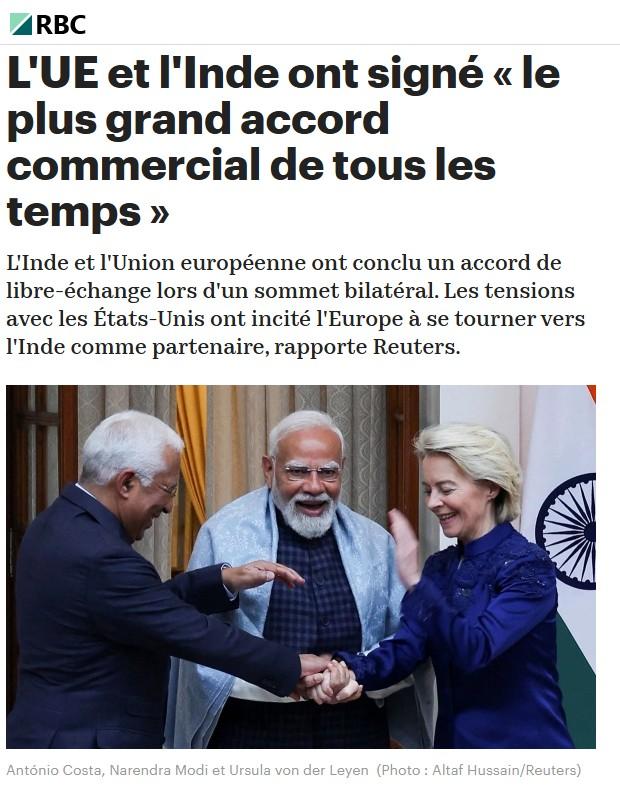
L’Inde et l’Union européenne ont conclu un accord de libre-échange lors d’un sommet bilatéral. Les tensions avec les États-Unis ont
L’article L’Inde et l’Union européenne signent un accord de libre-échange en négociations depuis 20 ans est apparu en premier sur STRATPOL.
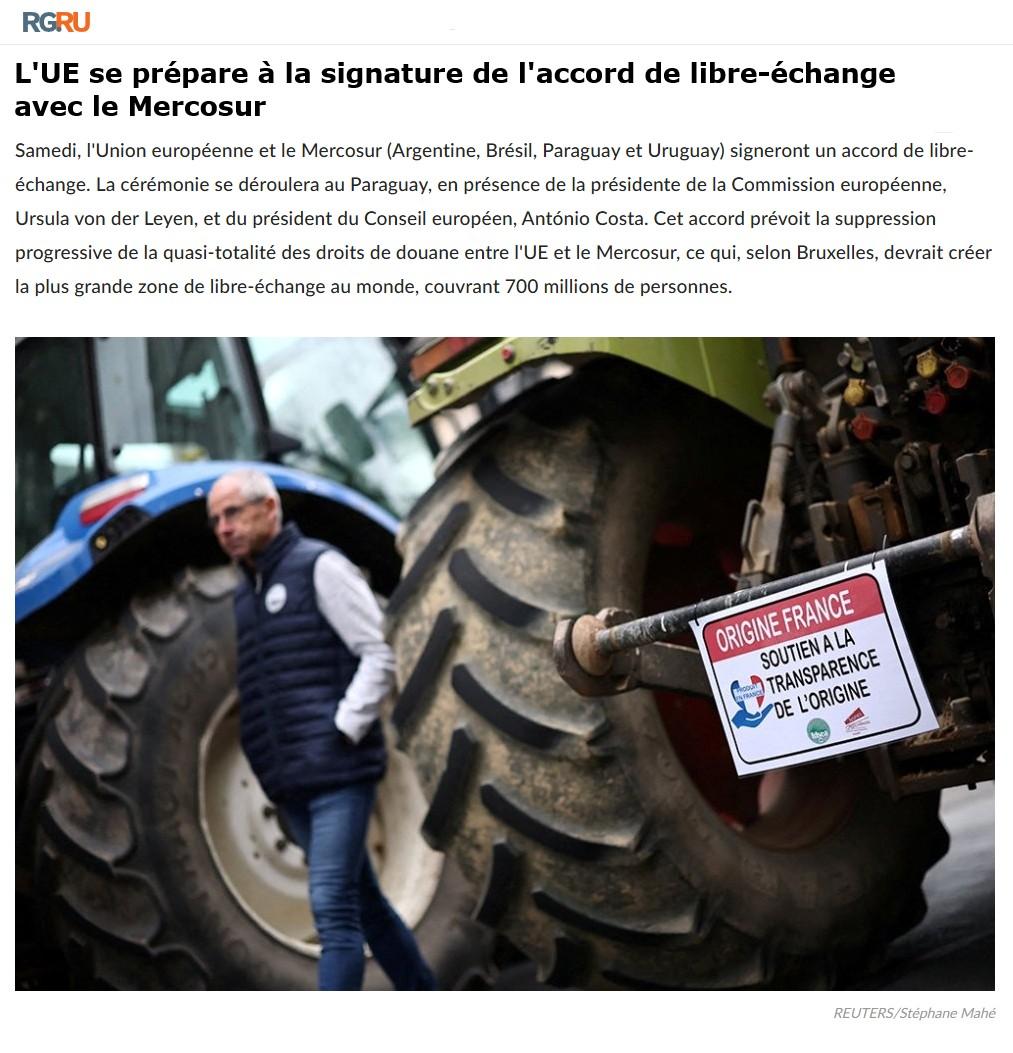
Samedi, l’Union européenne et le Mercosur (Argentine, Brésil, Paraguay et Uruguay) signeront un accord de libre-échange. La cérémonie se déroulera
L’article L’UE se prépare à signer l’accord de libre-échange avec le Mercosur est apparu en premier sur STRATPOL.
This video explains in depth what happened.
There were some of our reliable journalists who continually blamed Russia for losing Syria. I was not of that opinion, as I watched Mr Lavrov at the very final regional meeting before the gates of Idlib opened. There was significant pushback on my stance, as it was more comfortable to blame Russia for ‘losing’ Syria. I also did not believe that Russia would leave the issue, but would let it develop. The criticism was around ‘Russia is only trying to keep its warm water ports’, and completely forgotten was the fact that Russia rescued at least Bashar al-Assad and offered many Syrians safety around the Russian area. This opinion, that Russia did not rescue Syria, spreading ‘Russia Sold out Syria’ became the prevailing orthodoxy. It was not correct then, and it is not correct now.
Recently, another lengthy interview was published on the issue, and I waited a moment to debunk it, as it was beginning to need serious debunking. To my joy, others recognized that the orthodoxy is becoming destructive. Throughout the time, I watched a number of journalists who remained quiet on the matter and, of course, wondered why. These are now stepping forward: journalists like Eva Karene Bartlett and, specifically, Marwa Osman, both highly competent, who have never spoken out in this way.
One can forgive those who were making up and pushing the idea of ‘Russia sold out Syria’ over and over again, because they’ve done good work. Still, during that time, no matter what was presented, they insisted on claiming a higher-than-all perception and continued with Russia Bad under the guise of: We Will Speak the Truth, no matter what. OK, but if your truth sucks and is a made-up view, to serve your world-view? There is no problem with critiquing Russia, but why not instead tell who was behind the fall of Syria instead of continually critiquing from a ‘better than’ perspective?
Here is Sharmine Narwani from the Cradle, who did a thorough and correct look-back on the fall of Syria, why Russia did what she did, and the current development trajectory. I am grateful for this work. Throughout this time, I had a sense that Russia was staying because it was blocking something, which turned out to be the correct and justifiable stance.
Eva Bartlett says: “Sharmine Narwani’s words are a rational counter to the “Russia sold out Syria” voices.
“Sharaa goes to Moscow to meet with Putin. And of course, those who are against the terror that Syria experienced and the regime change were appalled: ‘Putin’s working with the Zionists. Putin’s okay with al-Qaeda!’
No. No. Countries act in accordance with their national interests. And they’re opportunistic. Opportunism is what you need to be as a political leader of a country…”
*Note: Sharmine was going to Syria early on in the global war on Syria. If I recall correctly, she went there in 2012 or 2013, I myself started going there in 2014 (https://ingaza.wordpress.com/syria/syria-my-published-articles-from-and-on-syria-2014-2022/). She has credibility on the ground, she took a very unpopular, honest, stance back then, writing excellent articles countering the propaganda. She’s credible now.]”
A year after the fall of Bashar al-Assad and Abu Mohammad al-Jolani’s rise to power, Syria remains a politically volatile state. West Asian geopolitical analyst and Cradle columnist Sharmine Narwani joins TMJ News to reveal the power plays unfolding behind the scenes: Russia’s sudden return near the Golan, Israel expanding its reach in the south, Gulf and Turkish maneuvering, U.S. calculations, and the IMF positioning itself for influence. What does the future of Syria look like as foreign powers get involved?
Time Stamps:
00:00 One year of Jolani in Power
08:30 Syria and the Abraham Accords
16:02 Why Russia is Back in Syria
22:55 MAGA vs. MIGA
25:58 What Media get Wrong about Syria
This is a “Danny” title. I post this to hear Ben Norton’s comment both on Venezuela and on the new US National Security Policy.
All social media and many reliable media are in chaos. The major issues:
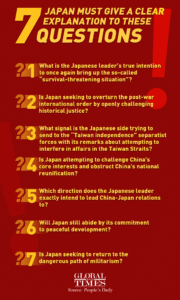
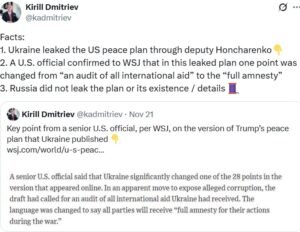
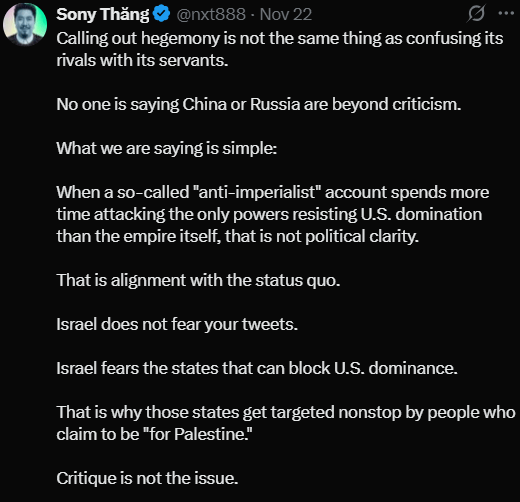
Even Sony Thăng started speaking out, only to be met with screeds and pages of justifications. These journalists feel scorned because Russia, China, and BRICS are not taking the action they decided should be taken.
 In addition, we have AI. Here we have to change our perspective. Whereas before we ‘trusted’ certain information from well-known and reliable journos, essayists, and commentators, our default position now has to change. We cannot believe what our eyes see or what our ears hear.
Trust Nothing Unless Verified. Everything is someone else’s opinion. Use extreme informational filters on everything and everybody. Don’t stop resisting!
The reality is that even the good can become crazy overnight, as this level of crazy is communicable.
Is the move to multipolarity fun enough for you yet?
This is the NO RULES commenting thread. Say what you want. I just did and have more. Your karma is yours.
The “rules-based order” is dead and Washington now acts without boundaries
Fyodor Lukyanov
A year has passed since November 2024, when Donald Trump won the US presidential election for the second time. And it makes more sense to start the clock there, rather than on Inauguration Day. The political and psychological shift began immediately. From that moment, the American agenda started to mutate, revealing what in US behavior is anchored in institutions and what is simply the product of personality.
Trump’s personality is impossible to ignore. His sheer theatricality colors everything he touches and can make events seem more chaotic than they really are. But here’s the important point: Trump does not break American political conventions. He exaggerates them. He turns their volume up so loud that one can finally hear the underlying logic clearly.
The most striking shift is external. Washington has abandoned the unified ideological framework it relied on for decades. For years, the “liberal world order” – later rebranded as the “rules-based order” – served as the language through which the United States pursued its interests. These rules were written by the West, for the West, but framed as universal. Their very existence created a structure for international behavior, even if that structure was often porous.
In 2025, the United States behaves as if no such boundaries exist. If Trump has a core approach, it is his insistence on dealing with every country one-on-one. No scaffolding, no institutions, no broad coalitions. Everything is personalized, bilateral, transactional. Washington is convinced that in any individual matchup, America has the upper hand. So why dilute that advantage by working through organizations where others might collectively balance it?
Institutions become a nuisance
This logic explains the growing irritation toward institutions the US once built and championed. They are now seen not as force multipliers but as bureaucratic ballast. Structures where non-Western states play leading roles – BRICS in particular – are treated with open hostility, not because of what they do, but because of what they symbolically represent: countries trying to join forces to limit American dominance. In Trump’s worldview, that is intolerable.
Paradoxically, Trump is well-suited to a multipolar world, though he would never describe himself that way. Someone who believes he is the strongest player in any bilateral setting naturally prefers a global landscape composed of disparate, uneven actors. Multipolarity, yes. But only if it is spontaneous and unstructured, with no mechanisms that cushion contradictions or reduce imbalances.
Before Trump, the American approach was to promote economic and political globalization. The United States sat atop the hierarchy and used that position to shape the world. Under Trump, fragmentation – economic, political, institutional – becomes a tool to achieve the same aim. A world of disconnected units is easier for a heavyweight to dominate.
In that sense, less has changed than it seems.The rhetoric is different, but American hegemony remains the assumption. Foreign policy continues to serve narrow interests, only now without the grand moral narratives that once justified it. Instead of “defending democracy,” Washington resurrects older, simpler slogans.
Trump’s recent remark that Nigeria may face intervention because it “mistreats Christians” is a conservative variant of the old democracy-promotion logic. The call for regime change in Venezuela is suddenly tied to drug trafficking: an issue Venezuela has never been central to, but convenient now that Washington wants it to be. That both countries have significant oil reserves, and that the US seeks to squeeze Russia and Iran out of global energy markets, is of course a coincidence.
Power without patience
What hasn’t changed is the US belief in military force. Trump frequently invokes “peace through strength,” but his interpretation is highly specific. He has no desire to become bogged down in long wars. The preferred model is a rapid, theatrical strike, maximum visibility, minimal commitment. After that, diplomacy takes over, supported by behind-the-scenes pressure and loud self-congratulation.
Is this approach better or worse? It depends who you ask. Some will say that blunt honesty, even if impulsive, is preferable to multi-layered hypocrisy. Others point out that Trump’s style – sudden enthusiasms, sharp mood swings, hyperbolic praise – is inherently unstable. When the world’s most powerful state behaves impulsively, everyone else has to live with the consequences.
So how should America’s counterparts operate in this environment? Trump’s hostility to group coordination suggests the answer. If the United States insists on bilateralism, then the logical countermeasure is the opposite: combine resources, cooperate where possible, create small but functional coalitions focused on specific goals. Not grand new institutions – that is impossible today – but practical partnerships that reduce vulnerability to American pressure.
This is especially true for non-Western states navigating a complex and turbulent international order. Trump’s approach rewards fragmentation. Those who do not wish to play by that script must work – quietly, carefully – in the other direction.
A world of clarity, for better or worse
Trump has not remade America so much as stripped away its old varnish. The vision of a universal liberal order is gone. The pretence that the United States plays by the rules it demands of others is gone. What remains is raw power, openly expressed, and a country comfortable acting without boundaries.
For some, this honesty is refreshing. For others, it is alarming. But it does provide one thing: clarity. We now see the conventions of American behavior with unusual sharpness. And that may prove useful for those preparing for the next phase of global politics.
A time travel across History – the Ancient Silk Roads as well as Xinjiang may well be the ultimate crossroads of civilizations. Along Central Asia, they are the (beating) heart of the Heartland…
By Pepe Escobar at the Strategic Culture Foundation.
ON THE SOUTHERN SILK ROAD – Silk is the stuff of legend. Literally. At first manufactured only in China, silk historically was not only a luxury product but a monetary unit: a key element of trade and export revenues.
In 105 B.C., a first-ever Chinese diplomatic mission landed in Persia, then dominated by the Parthians, who also occupied Bactria, Assyria, Babylon and parts of India. Under the four-century long Arsacid dynasty – contemporary of the Han in China – the Parthians at the time were the essential middlemen of transcontinental trade. Chinese and Parthians sat down to discuss – what else – business.
The Roman Empire faced some serious trouble with the Parthians – between the massive defeat of Crassus in Carrhae in 53 B.C. and the victory of Septimus Severus in the year 202. In between, silk hit Rome. Big time.
The first time Roman soldiers saw silk was in the battle of Carrhae. Legend rules that the silk banners deployed by the Parthian army, their scintillating appeal making serious noise under the fierce winds, frightened the Roman cavalry: talk about the first instance of silk contributing to accelerate the decline of the Roman Empire.
Well, what matters is that silk perpetrated nothing less than an economic revolution. The Roman Republic and then Empire had to export gold like there’s no tomorrow to get their silken ways.
Parthian rule was followed by Sassanid Persia. They reigned until the mid 7th century – their empire stretching from Central Asia to Mesopotamia. For quite a while the Sassanids incarnated the role of great power between China and Europe – up to the conquests of Islam.
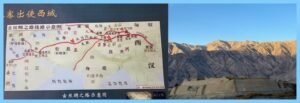
(L): Silk Road, the ancient Chinese way: from Xian to Alexandria, not Rome ; (R): The stone tower: Tashkurgan Fort, the landmark between China and the rest of Eurasia
So imagine, at the start of the Christian era, bolts of silk moving overland all along across the Silk Road spectrum. What’s fascinating is that Rome and China never (italics mine) entered in direct contact – for all the vast cast of characters (merchants, adventurers, fake “ambassadors”) that tried.
In parallel, a Maritime Road was also in play – already in effect during the times of Alexander The Great; it later became the Spice Route. That was how Chinese, Persians and Arabs reached India.
Since the Han dynasty, the Chinese reached not only India but also Vietnam, Malaysia and Sumatra. Sumatra soon developed as a key maritime entrepot, with Arab vessels arriving non-stop. In a more long-distance vein, it was the discovery of the rules of the monsoon – in the first century B.C. – that allowed the Romans to also reach the western shores of India.
So silk arrived in Rome by land and sea, via loads of different middlemen. And yet Rome never knew anything about the origin of silk, nor went further than the Greeks in their wobbly knowledge of the distant, mysterious land of Seres.
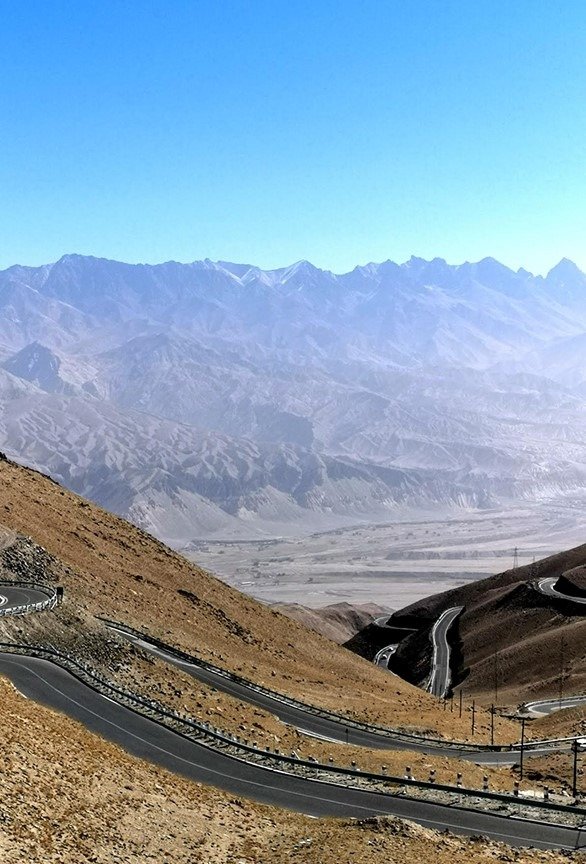
The twists and turns of the Panlong Ancient Road, in Pamir lands
I went down to the (Pamir) crossroads
After the mid-1st century, the Kushan empire, actually Indo-Scythian, gets a protagonist role in southern Central Asia, in what was known then as Eastern Turkestan. The Kushan, rivals of the Parthians in the role of messengers of international trade, not only facilitated the spread of Buddhism but also Gandhara – Greco-Buddhist – art (some originals are still to be found today, at exorbitant prices, in art galleries in Hong Kong and Bangkok).
And yet, further on down the road, the rules of the game never substantially changed: two great Silk Road poles – Sassanid Persia and Byzantium – involved in a real, cutthroat industrial war with silk right in the middle. The secret of silk manufacturing had already been leaked to South Asia.
This trade war got even more complicated with the onslaught of Turk tribes across Central Asia, and the emergence of a trade kingdom in Sogdiana (with Samarkand at the center).
By the mid-7th century, the Tang dynasty recovered control over parts of the Silk Road ruled by Tarim basin kingdoms. That was an absolute must for business to go on – because caravan routes traversing these kingdoms encircled, and bypassed, by north and south, the fear-inducing Taklamakan desert, as they still do today.
Tang China wanted absolute control all the way at least up to the Pamir mountains where, in the legendary stone tower relentlessly described by adventurers but never really located with 100% certainty, Scythian, Parthian and Persian caravans met Chinese caravans to trade that precious silk plus several other commodities.
The stone tower mentioned by top geographers such as Ptolemy is actually Tashkurgan Fort in the Pamir mountains: ultra- strategic, straddling the Silk Road, and nowadays a top tourist attraction very close to the Karakoram highway.
The stone tower is the symbolic landmark between the Chinese world and the rest of Eurasia: to the west is the Indo-Iranian world.
I traveled the Pamir Highway in Tajikistan back-to-back before Covid interrupted everything. This time our mini-caravan crossed Pamir lands along and around the Karakoram highway on the way to the China-Pakistan border: that is now prime China-Pakistan Economic Corridor (CPEC) territory, a key plank of BRI.
It’s the Pamirs that in Ancient Silk Road times allowed reaching the oasis of Kashgar. The Pamirs tie a gigantic mountainous knot between the western limits of the Himalayas, the Hindu Kush and the southern slopes of the Tian Shan.
This has always been the key crossroads between the triangular trade uniting northern India, eastern Central Asia – with China nearby – and western Central Asia, with the steppes not so far away.
China meets Islam: a great, historical “what if?”
Silk, bearing serious value as a unit of capitalization and trade, had a much larger role than its usage. In Byzantium, silk was the object of an imperial monopoly. Everything was strictly regulated: professions, state ateliers where women worked, and customs. The state protected its monopoly via a fierce bureaucracy.
Meanwhile, the Maritime Road was booming. A Buddhist and maritime power, Srivijaya, controlled the ever-crucial Malacca strait out of the island of Sumatra. It’s under this configuration that Islam enters the Big Picture.
As much as History ruled that Rome and China would never meet directly along the Silk Road, it also ruled a stark separation between Islam and China. Or try to imagine if China, in the mid 8th century, had become a land of Islam.
The battle of Talas, in 751 – in what is today’s Kyrgyzstan – pitted China against the Arabs. And its result ended for good any Chinese whim of conquering Central Asia. Today, with the New Silk Roads/BRI, is another story – about Chinese trade/investment power projection all across the Heartland, and beyond.
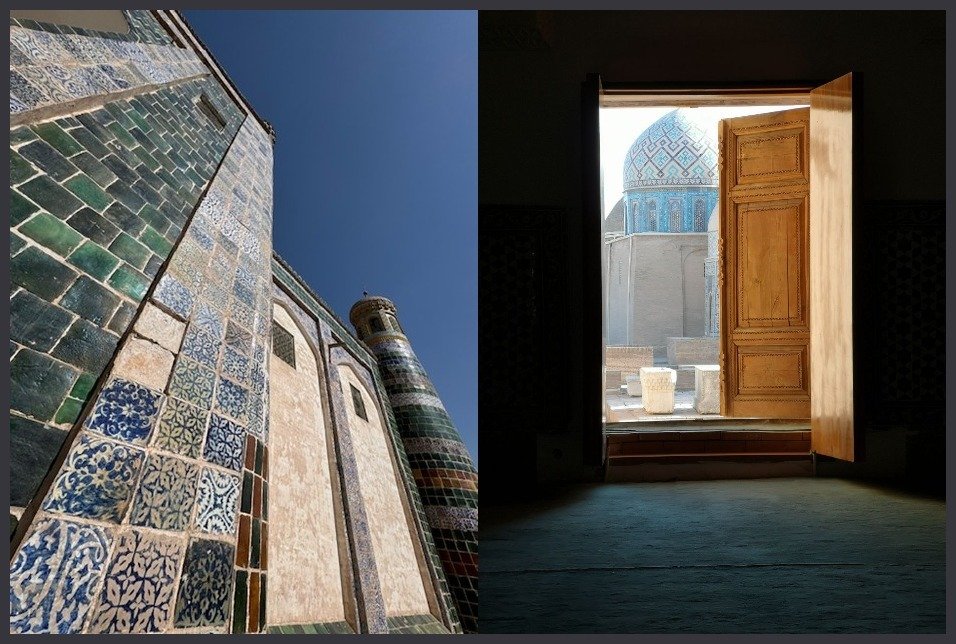
(L): Culture interpenetration: Bukhara meets Kashgar ; (R): Samarkand. Opening the doors to another dimension.
Back in the early 8th century, the key player was Umayyad dynasty General Qutayba ibn Muslim. He first conquered Bukhara and Samarkand; crossed the Ferghana valley; the Tian Shan mountains; and nearly reached Kashgar. The Chinese governor at the time, sensing that Qutayba might be about to take over Chinese lands, sent him a bag full of earth’s soil, a few coins and four princes as hostages. He calculated that’s how the Arab conqueror might not lose face, and leave the Middle Kingdom alone.
As incredible as it might seem, this arrangement lasted for half a century. Until the battle of Talas. Now compare it with Poitiers in 732 – one century after the death of Prophet Muhammad. We can certainly interpret Talas and Poitiers, together, as the two key landmarks of how Islam was on the verge of extending itself all cross Eurasia (including its European peninsula), creating a political-military empire from Rome to Chang’an (today’s Xian).
Well, it did not happen. Still, that’s one of the most extraordinary “what ifs” in History.
The importance of the battle of Talas – virtually ignored in the West, except in rarefied scholarly circles – is really larger than life. Among other issues, it imposed a new circulation of techniques. The Arabs took away with them artisans, sericulture experts but also paper makers. Ateliers at first were set up in Samarkand. Later on, in Baghdad and all across the Caliphate.
So alongside the Silk Road, we saw the birth of a very busy Paper Road.

An extraordinary Silk Road exhibition currently at the Gansu museum in Lanzhou
Deserts, mountains, oases – and no “slave labor”
Rolling down the highways across Xinjiang shooting a documentary after retracing the initial Ancient Silk Road from Xian to the Gansu corridor is an incomparable, historical time travel – as we may retrace in detail centuries of Central Asian turmoil all the way to the decline of some local pre-Islamic cultures by the 9th century. It’s a thrill to reconnect with the main actors: Uyghurs, Han Chinese, Sogdians, Indians, nomads, Arabs, Tibetans, Tajiks, Kyrgyz – and Mongolians.
The nomad groups thar proclaimed themselves heirs to the fierce Xiongnu came from the northwest of Mongolia and the Altai mountains. They incorporated several ancient nomads of western Central Asia during the 4th century, sharply remodeling the political and ethnic landscape.
The Xiongnu, on and off, pillaged parts of northern China – and were occasionally enticed into serious trade, offered tribute, or simply bribed to stay away. Actually the Xiongnu had a branch established in China and separated for at least two centuries from the previous ones: they ended up taking Samarkand in the year 350. Later on, it’s the Turks that once again came from Mongolia (don’t tell Erdogan about it; he wouldn’t know), unifying the steppe in the 6th century, way before the arrival of Islam.
Arguably the key Silk Road imperative is the desert and oasis contrast/dichotomy.
(L): The stark beauty of the fierce Taklamakan ; (R): Good pasture in Pamir lands
Deserts such as the Taklamakan and the Gobi, and several others, as well as arid steppes and mountains are among the most forbidding on the planet: these are the essential features of what amounts to roughly 6 million km2.
What is very rare in Central Asia is cultivated land (yet we can see a succession of cotton fields) or good pasture (we can see it in the Gansu corridor, and even in Pamir lands near the mighty Muztagh Ata). Still, deserts and mountains are at the heart of everything.
Some oases are of course more equal than others. Khotan is the most important oasis of the Southern Silk Road – not far from the immense, deserted Tibetan plateau. That’s fabulous for agriculture but most of all, courtesy of an alluvial cone, for precious stones, especially jade, supplied for over 2,000 years to every Chinese dynasty. Khotan spoke an Iranian language – close to those of ancient nomads Saka and Scythian, masters of the steppes.
The kingdom of Khotan was a fierce rival of the oases further west, Yarkand and Kashgar. It was only intermittently under Chinese control. And may have been conquered by the Kushans in the 2nd century. Indian influence is omnipresent – as we still see in dress patterns and food in the Night Market. In the 3rd century Buddhism was already a major influence – featuring the most ancient testimonials in the Tarim basin.
The Silk Road, actually Roads, is of course The Buddhist Road. In Dunhuang, in the Gansu corridor, Buddhism was also popular since the 3rd century: a famous local monk, Dharmaraksa, was the pupil of an Indian master. The Dunhuang Buddhist crowds were a mix of Chinese, Indian and Central Asian – once more testifying to the non-stop interpenetration of cultures.

(L): The Chinese character for “silk” inscribed in jade in front of a factory in Khotan ; (R): Playing the Uyghur blues
The Shakespearean “all the world is a stage” metaphor totally applies to the history of the Silk Road: all those actors from all corners of the Heartland historically were playing several roles, sometimes all in one go – an apotheosis of the favourite Xi Jinping-coined “people to people’s exchanges”. That’s the spirit of the Ancient and the New Silk Roads.
We were fortunate enough to be on the road smack in the middle of the 70th anniversary of the establishment of the Xinjiang Uyghur Autonomous Region.
Among so many accomplishments by socialism with Chinese characteristics in Xinjiang in terms of sustainable development, the taming of the Taklamakan – or “sea of death” – is in a world class of its own.
We crossed the Taklamakan from the Northern Silk Road in Aksu to the Southern, near Keriya: and we experienced everthing from the impeccable highway bordered by the reeds composing the “China magic cube” – to keep the sands away – to some of the 3,046 km-long sand-blocking green belt, featuring plants such as the desert poplar and the red willow.
The Taklamakan has always been Sandstorm Central – a major threat to the succession of oases. The terrain all around the oases is hardcore: deserts, barren mountains, Gobi wasteland, poor soil, sparse vegetation, low rainfall, high evaporation, dry air.
Well, what we see today started even before the Go West campaign launched in 1999: since 1997, an array of central and state agencies, central state-owned enterprises, and 14 Chinese provinces and municipalities have sent a massive amount of funds and personnel to properly develop Xinjiang.
Now compare all that with original research shared at an academic conference on Xinjiang recently organized by the Hong Kong University of Science and Technology and Hong Kong University – my neighbors when I lived in the Fragrant Harbor. The research showed how British MI6 since the 1990s was instrumentalizing a minority of Uyghurs side by side with a massive global P.R. campaign with the explicit target of breaking China into three parts.
That evolved into the CIA-concocted “genocide” accusations of the past few years and of course “forced labor” masses barely surviving in concentration/re-education camps. In our extensive travels, guided by Uyghurs, we were dead set on finding slave labor in cotton fields along the Northern Silk Road or in the middle of the Taklamakan. Well, sorry: they don’t exist.
The propaganda though was essential to regiment loads of Uyghurs into ISIS, including their sizable contingent in Idlibistan now roaming free between Syria and the Turkish border. They wouldn’t dare coming back to Xinjiang and face Chinese intel.
Forget about barbarian propaganda. What really matters, historically, is that the Ancient Silk Roads as well as Xinjiang may well be the ultimate crossroads of civilizations. Along Central Asia, they are the (beating) heart of the Heartland. And now, once again, they are back as protagonists in the heart of History.
Part II of the celestial Travelogue through the western regions of China.
By Silk Road pilgrim Pepe Escobar on the Strategic Culture Foundation.
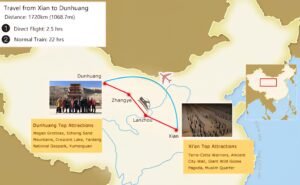
DUNHUANG – Across History, the Silk Road – actually a network of roads – is the supreme Highway Star: the most important connectivity corridor ever, rolling across Ancient Eurasia, linking what Chinese scholars consensually define as the main civilization systems in the world: China, India, Persia, Babylon, Egypt, Greece and Rome, as well as showcasing several historical stages of economic and cultural exchanges between East and West.
Prof. Ji Xianlin, a top scholar of Dunhuang Studies, came up with a formulation certified to drive Western supremacists crazy for all eternity:
“There are only four, rather than five, influential cultural systems in the world: Chinese, Indian, Greek and Islam. They all met only on China’s Dunhuang and Xinjiang”.
Dunhuang’s prime geo-strategic position across History was inevitably bound to generate spectacular artistic achievements.
After years since my previous journeys, then the Covid shock, then China’s subsequent recovery, I have been privileged to finally embark on a renewed Journey to the West to retrace the original Ancient Silk Road, starting in Xian – the former imperial capital Chang’an – all the way through the Gansu corridor to Dunhuang.
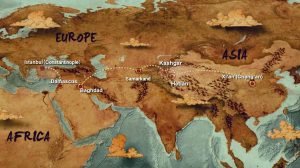
Brilliant Eurasian cultures converged, interacted and spread their wings on the Ancient Silk Roads. Dunhuang – on the western end of the Hexi corridor in Gansu province – was the most vital hub in the eastern section of the Chinese Silk Road, framed by mountains to the north and south, the central plains to the east, and Xinjiang to the west.
Dunhuang, the “Blazing Beacon”, held a supremely strategic position controlling two passes – Yangguan and Yumenguan. Han Emperor Wu Di clearly understood that Dunhuang was the last major water source before the fear-inducing Taklamakan desert to the west, as well as sitting astride the three main Silk Road routes heading west.
Yumenguan was the all-important Jade Gate pass – set by the Han empire in the 2nd century B.C.: placed in the south Gobi and the western end of the Qilian mountains, actually marking the western limit of classic China.
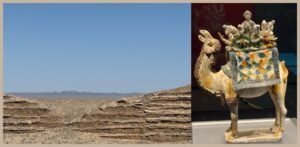
(L): The remains of the Great Han Wall ; (R): Xian
I spent a whole blinding beautiful blue-sky day in the pass and its surroundings after striking a deal with a taxi driver in Dunhuang. It’s a thrill to admire how the Han dynasty organized their traffic management system, the beacon fire system, and the Great Wall defense system (remains of the Han Wall are still there) – guaranteeing the safety of the long-distance Silk Road connectivity corridor.
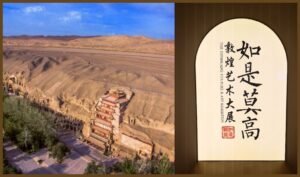
Talk to the caravan: the secret of “people to people’s exchanges”
At the impeccably organized Dunhuang Book Center, historical records refer to it as “a metropolis where the Han people and non-Han peoples meet”. Quite the antecessor to Xi Jinping’s “people to people’s exchanges.” The spirit remains, especially at the fabulous Night Market, a gastronomic feast with pride of place for Uyghur recipes.
Silk and porcelain from the central plains, jewelry and perfume from “the western regions”, camels and horses from north China, grains from Hexi, everything was traded in Dunhuang. Merchant deals, migrations, military games, cultural exchanges, a profusion of literati, scholars, artists, officials, diplomats, religious pilgrims, military brought classic Chinese culture into an effervescent mix – Sogdian, Tibet, Uyghur, Tangut, Mongolia – all absorbed into what eventually became Dunhuang art.
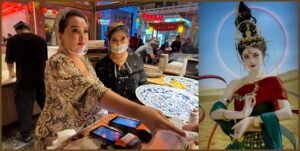
(L): Uyghur businesswomen at the fabulous Dunhuang Night Market ; (R): The Desert Princess look. Affordable. Less than $60 for a set of clothes, make-up, 25 exclusive pics and retouches.
Itinerant Buddhism, Nestorianism, Zoroastrianism, Islam – the sophisticated aesthetic feel of Dunhuang was progressively influenced by architecture, sculpture, paintings, music, dance, weaving, dyeing techniques all the way from Central Asia and West Asia.
“Silk Road” terminology in Xi’s “moderately prosperous” modernized China is an extremely nuanced business. For instance, already in Xian, at the Small White Goose pagoda, we see it described as “Silk Roads: The Routes Network of Chang’an-Tian Shan corridor”.
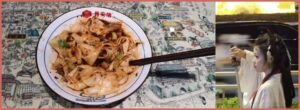
Xian. (L): The perfect lamian at the Muslim Quarter – since Tang times ; (R): DON’T mess with a Tang warrior princess
That’s a geographically correct interpretation, stressing the Tian Shan mountains instead of the politically correct Xinjiang (which was essentially part of the “western regions”, not necessarily Chinese territory, for centuries).
As for how the Silk Road began, that now follows a single, scholarly accepted version: Han Emperor Wu Di, in 140 B.C. sent Zhang Qian as an envoy to the “western regions” on two business missions. The “Records of the Grand Historian” show that Zhang Qian, as the first official diplomat in Chinese history, de facto opened channels of communications with the “western regions” and then all the states in the northwest started trading with the Han, especially silk.
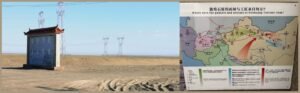
(L): On the road to the Jade Gate Pass. Electrification ; (R): At the Dunhuang Academy museum: where the artists came from
From Xian’s Shaanxi History Museum to the Dunhuang Academy, and including the Gansu museum in Lanzhou, in interactions with scholars and museum curators as well as in complement to formidable Silk Road exhibits, it’s fascinating to retrace the now established official narrative on the Silk Roads, according to which “the civilization of ancient China represented by silk started to impact the states in the western regions, Central Asia and West Asia.”
It was way more complex than that – as spices, metals, chemicals, saddles, leather products, glass, paper (invented in the 2nd century B.C.), everything was on the market, but the general drift applies: merchants from the central plains defying deserts and mountain peaks in caravans laden with silk, bronze mirrors and lacquerware from China, seeking to exchange them for commodities, while merchants from the western regions brought furs, jade, felts to the central plains.
Talk about multi-ethnic “people to people’s exchanges”. And by the way, no one ever used the term “Silk Road”; it was “the road to Samarkand” or just the “northern” or “southern” routes around the ominous Taklamakan desert.
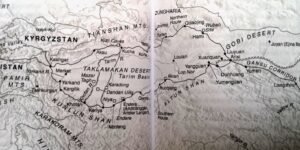
About the Tang dynasty monetary system…
By the 3rd century, Dunhuang was already at the apex of Silk Road connectivity; and that’s when merchants and pilgrims started to sponsor the construction of the nearby Buddhist Mogao caves.
The Mogao Caves are part of what is known in Gansu province as the five Dunhuang grottoes. It’s the same system of caves – 813 surviving, with 735 in Mogao. To approach Mogao is a major thrill in itself: we need to be in an official park bus, crammed with zillions of Chinese tourists, rolling through the desert, and suddenly we are in the eastern foot of the Mingsha mountains, with the Dangquan river running right in front of us, facing the Qilian mountains to the east, with the caves set back against and cut into the cliff face, connected by a series of ramps and walkways.
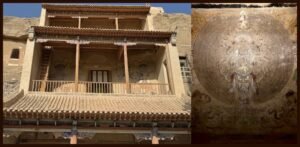
the Mogao caves (L): the main pavilion ; (R): One of the Buddha highlights
The caves started to be built as early as in the 4th century – all the way to the 14th century (the earliest wall paintings are from the 5th); it’s a group of caves in four levels, 1,6 km from north to south along a cliff as much as 30 meters high. The 492 caves in the southern area house more than 45 km of wall paintings, over 2,000 painted statues, and five wooden eaves. They were originally used for worshipping Buddhas.
What we are still able to see takes our breath away. Highlights include a wrestling scene from Buddha’s life on cave 290; a girl apsara – mythic dancer – on cave 296; the Deer King on cave 257; a hunting scene on cave 249; a Garuda – defined in Chinese as “the Scarlet Bird” – on cave 285; parables of the Magic City from the Lotus Sutra, a masterpiece of High Tang dynasty, on cave 217; a sitting Boddhisattva on cave 196; impeccably preserved worshipping bodhisattvas on cave 285.
Rules are extremely strict: visit only to selected caves, with an official guide, no photos, only the guide’s torchlight to illuminate the grottoes. I was privileged to visit guided by Helen, who studied in Dunhuang University and is now doing her PhD in Archeology. After the visit she explained in detail the ground-breaking conservation work of the Dunhuang Academy.
The construction of the caves was a spectacular undertaking in terms of division of labor. Just imagine: chiselers to dig and excavate a cave out of the cliff; stonecutters, who also dug caves; bricklayers to build wooden or earthen structures; carpenters, who also repaired wooden tools; sculptors to create the statues; and painters to paint the caves and statues.
Mogao, as an aesthetic experience, is unequaled in its striking collection of Buddhist wall painting criss-crossing China, Persia, India and Central Asian art.
And then there’s what we cannot see: more than 40,000 scrolls found in the library cave, the largest deposit of documents and artifacts discovered anywhere along the Silk Road, with texts on Buddhism, Manicheism, Zoroastrianism and the Eastern Christian Church (from Syria) showing how cosmopolitan Dunhuang was. That’s part of the European scholarly – and otherwise – plunder of the Dunhuang wealth starting in the late 19th century, a completely different, complex, and long, story.
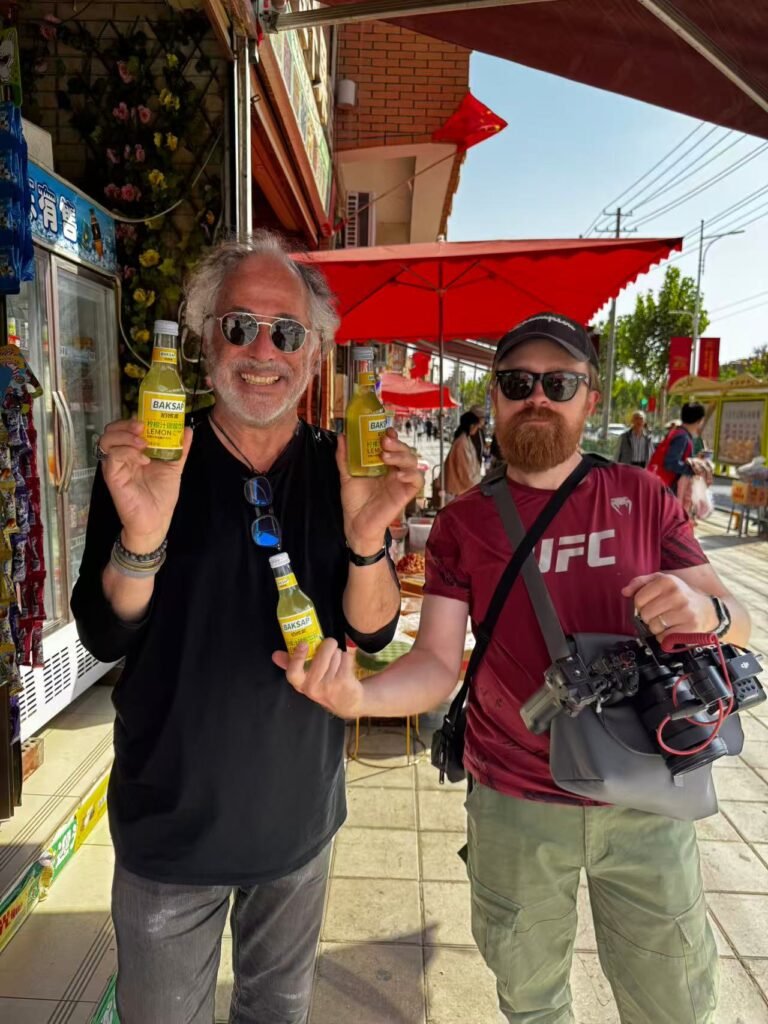
Kashgar. A big fan of the lemonade drink Baksap found everywhere in Xinjiang
In geoeconomic terms, for nearly ten centuries Dunhuang was extremely wealthy, especially during the Tang dynasty (6th to 9th century). The Tang had a fascinating monetary system – with three different currencies: textiles (silk and hemp), grain and coins.
The central government, in the imperial capital Chang’an, used a single aggregate unit to represent all trade. The Dunhuang garrison was a key strategic post: payments came in no less than six different types of woven silk. Well, each place paid their taxes with their locally produced cloth. What the Tang did was to transfer all these textiles to Dunhuang. The garrison’s officers then converted the tax cloth into coins and into grain, to pay local merchants and to feed the soldiers.
So in a nutshell the Tang dynasty was all the time injecting a lot of money – via woven cloth – into the Dunhuang economy. Talk about a public-private state development model – which certainly did not escape Beijing planners when they came up, in 2013, with the concept of the New Silk Roads.
ADDENDUM
≈≈≈
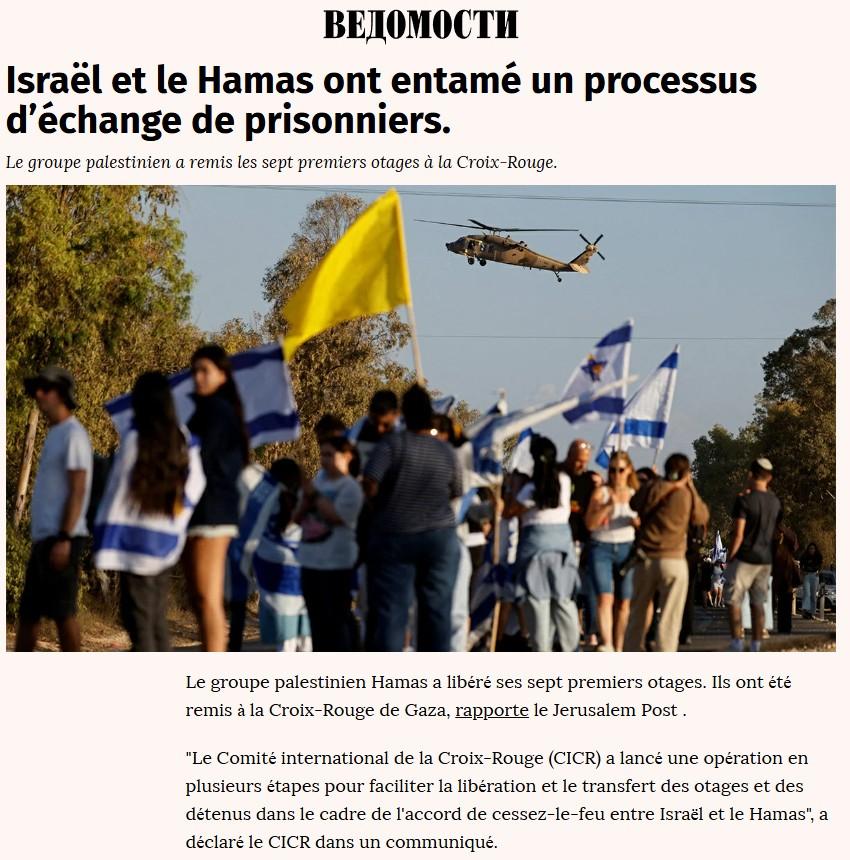
Le groupe palestinien Hamas a libéré ses sept premiers otages. Ils ont été remis à la Croix-Rouge de Gaza, rapporte
L’article Israël et le Hamas commencent leur échange de prisonniers est apparu en premier sur STRATPOL.
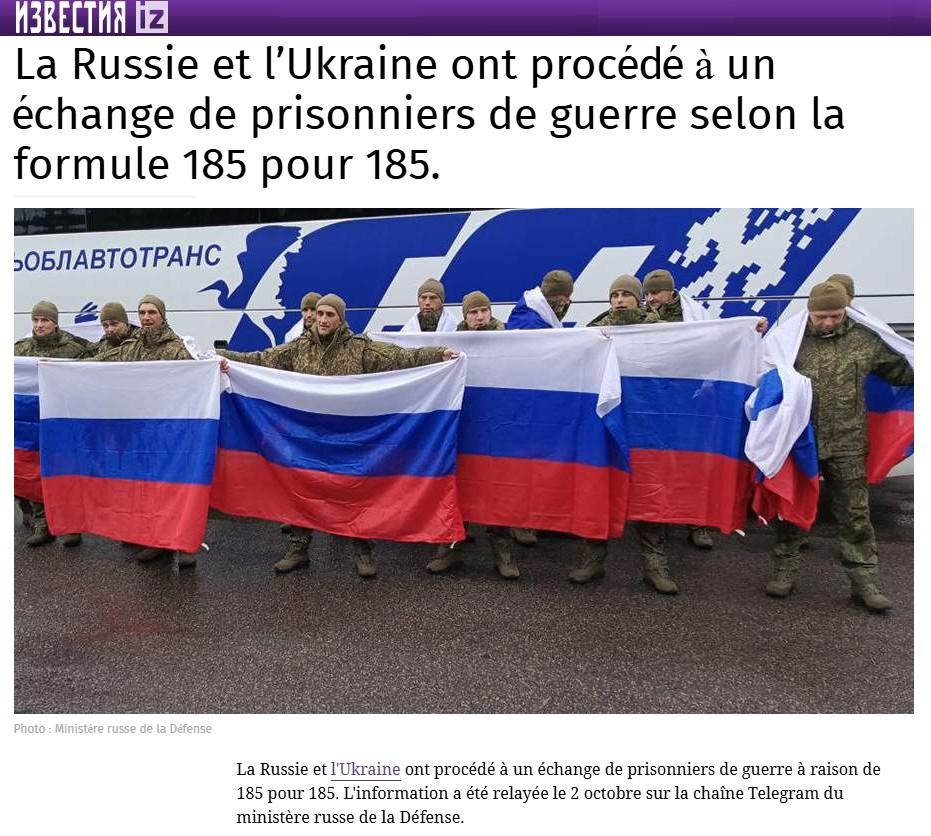
La Russie et l’Ukraine ont procédé à un échange de prisonniers de guerre à raison de 185 pour 185. L’information
L’article La Russie et l’Ukraine procèdent à un échange de prisonniers au format 185 contre 185 est apparu en premier sur STRATPOL.
As reported …
Islamabad (QNN)- Pakistan’s Foreign Minister Ishaq Dar said on Tuesday that US President Donald Trump’s 20-point Gaza peace plan is not the same that was approved by leaders of Arab and Muslim countries, including Pakistan.
“This is not our document,” Dar told reporters at a press conference in Islamabad. He explained that Pakistan and its allies had demanded several key points that were missing. “There are some key areas that we want covered … If they are not covered, they will be covered,” he added.
Dar said the immediate priorities remain a ceasefire, stopping the genocide, allowing humanitarian aid into Gaza, and ending forced displacement.
The minister described Trump’s announcement as “an announcement from their side.” He stressed that Pakistan stands by a joint statement signed with seven other Muslim-majority states. “We own this. If there is any difference anywhere, we would go by — we are committed to this,” he said.
Leaders of Türkiye, Pakistan, Saudi Arabia, Qatar, the UAE, Egypt, Jordan, and Indonesia met Trump during the UN General Assembly session in New York. Trump presented his 20-point plan at the meeting.
Dar later told Pakistan’s Geo News that the White House draft “does not include all of our proposals.”
Qatari Prime Minister Sheikh Mohammed bin Abdulrahman Al Thani also raised concerns. Speaking to Al Jazeera, he said Trump’s plan “achieves a key objective by ending the war, but there are some issues that require clarification and negotiation.”
On Monday, Trump unveiled the plan at the White House alongside Israeli Prime Minister Benjamin Netanyahu. The proposal calls for the release of all Israeli soldier prisoners in exchange for dozens of Palestinian prisoners, the full disarmament of Hamas and resistance factions, a phased withdrawal of Israeli troops, and the creation of a technocratic, non-partisan Palestinian committee to run Gaza.
The plan mentions Palestinian self-determination as a “possibility,” but stops short of promising statehood.
Israel’s genocide in Gaza has already killed more than 66,000 Palestinians, mostly women and children, since October 2023. Continuous Israeli airstrikes and ground assaults have destroyed homes, hospitals, and schools. Aid agencies warn that starvation and disease are spreading, making Gaza nearly uninhabitable.
Empire is regime change status hot currently. Nepal for one is turning very violent. The protesters demand to appoint the new prime minister as the mayor of Kathmandu, Balendra Shah, who used to be a rapper.
Brian Berletic now comes into his own as he has studied the methodologies, the financing and the slow regime change operations (now picking up speed) in Asia and across the world.
What we are dealing with, is the many decades of US buildup of its forces to complete global supremacy. It seems as if these are going to have to be broken down one by one. It seems to me as if there is a change in tactics judging by Nepal, where the government could not be changed by any of the existing tactics or color revolution strategies. What we see, is open killing of government members and family. (No soft coups any longer, as the Juan Guidó spectacle and pretence in Venezuela.) It is now decapitacion and killing the leaders.
Protesters in Nepal set fire to the parliament building, the ruling party’s central office, the Supreme Court building, the president’s office, and the government complex – they attacked the FM physically in the streets and one of the parliament member’s wife was killed, because their house was set on fire. The pretext for this revolution, technical companies must abide by Nepal law, was as usual, only a pretext. The PM has quit and in general I don’t see any governance left.
Brian talks about ‘reckless military aggression’ that he has not seen with all the previous coups.
Experience the future of global governance as “Think BRICS” presents Yaroslav Lissovolik’s deep dive into BRICS, SCO, Shanghai Cooperation Organization, BRICS Plus, and Eurasian integration—revealing how partnership belt, regional organizations, and regional development are transforming the global south. Discover insights on the development bank, BRICS summit outcomes, trade liberalization, South-South trade, and the rise of BRICS+ alignment. Explore the connectivity revolution in Central Asia, ambitious plans for regional integration, new initiatives merging observers and dialogue partners, and the critical roles of the Eurasian Economic Union and Brazil’s leadership at COP30. This video provides a thorough breakdown of trade response strategies against protectionism, prospects for WTO reform, and innovative visions of sustainable, environmental growth shaped by the upcoming BRICS summit in Brazil. Dive into the dynamic expansion of regional blocs, the transformative power of regional development institutions, and an expert’s perspective on the next chapter of Eurasian integration.
While Yaroslav Lissovolik offers an expert, evidence-driven analysis on the BRICS and SCO’s growing influence, the video does not discuss specific case studies from individual member countries, nor does it explore in-depth country-by-country impacts of these integration strategies. There is no evaluation of the domestic political challenges faced by BRICS Plus or SCO nations, nor does the video address sector-specific outcomes (such as technology, security, or energy policies) in detail. It also does not include interviews with government officials or real-time coverage from the actual BRICS or SCO summits themselves. Instead, the episode delivers a macroeconomic and institutional overview, focusing on systemic change, global south cooperation, and the broader sweep of Eurasian, BRICS, and SCO-driven economic transformation.
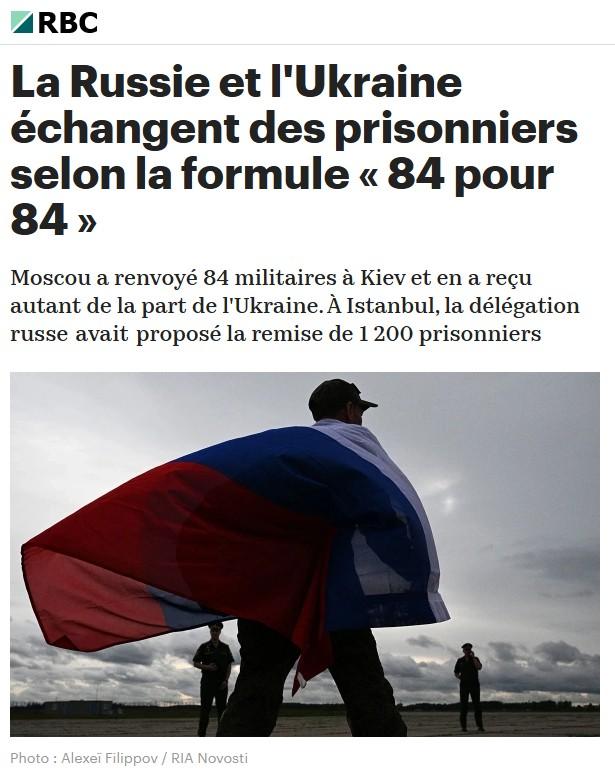
Moscou a renvoyé 84 militaires à Kiev et en a reçu autant de la part de l’Ukraine. À Istanbul, la
L’article Moscou et Kiev procèdent à un échange a minima de 84/84 prisonniers est apparu en premier sur STRATPOL.
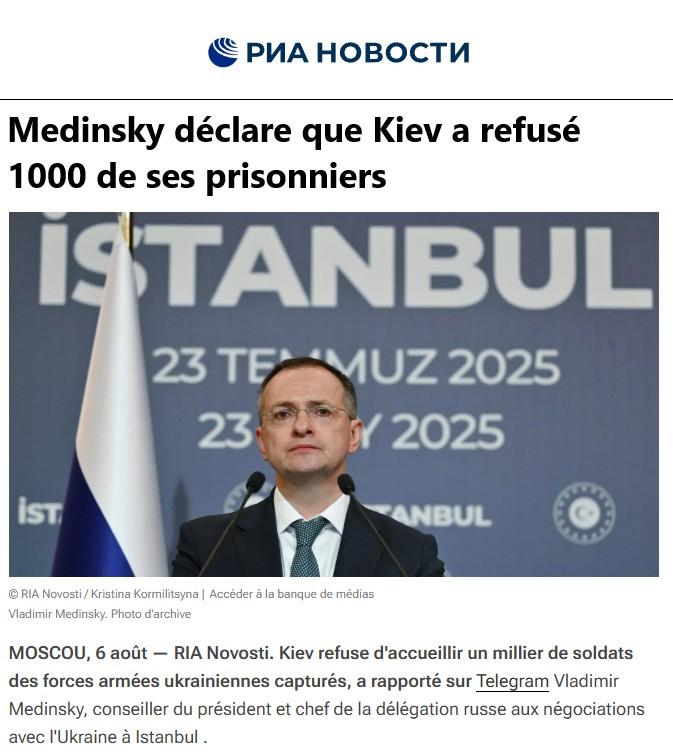
Kiev refuse d’accueillir un millier de soldats des forces armées ukrainiennes capturés, a rapporté sur Telegram Vladimir Medinsky, conseiller du
L’article Medinsky affirme que Kiev a refusé d’échanger 1000 de ses prisonniers est apparu en premier sur STRATPOL.
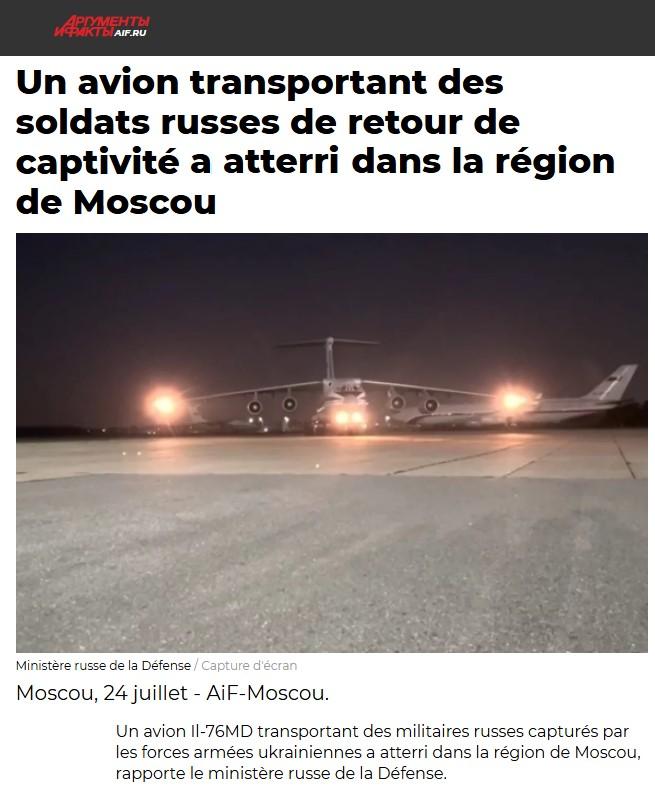
Un avion Il-76MD transportant des militaires russes capturés par les forces armées ukrainiennes a atterri dans la région de Moscou,
L’article Kiev et Moscou ont procédé à un échange de prisonniers est apparu en premier sur STRATPOL.
Brian Berletic, please see the video or if you have no time, take a look at the tweet.
 After repeatedly lying to Iran, attacking it amid negotiations designed specifically to lure it into complacency, then announcing a 2 week deadline to decide on strikes on Iran that took place hours later, US President Trump is claiming a ceasefire was agreed to;
Iran would need to be beyond naive to accept or trust any word or action by the US – the US has not spent decades trying to topple Iran amid its regional murder spree to suddenly abandon it – its ENTIRE global aspirations hinge on it – it has used Israel as a conduit to launder its war crimes & provocations through & will continue to;
To effect regime change, the US would benefit most by luring Iranian leaders out of cover & striking them, provoking retaliations & further war;
Iran requires not a “Libya model,” but a “North Korea model” or else this process will repeat itself until it concludes in Washington and Wall Street’s favor;
The same “experts” who failed to see this war coming in the first place are now citing 5D chess strategies to explain how the Trump administration somehow averted a war entirely of its (and the establishment it serves) own creation and design to begin with;
The US will only stop when (1) people stop falling for this through excessive delusion, and (2) the rest of the world unites to force the US to stop;
If a genuine ceasefire is reached, it will likely have been the work of Russia and China quietly forcing the US to, through private but sufficient threats coupled with a graceful public exit ramp – though the chances of the US honoring it hover around 0%;
Washington Post publishes audio of Israeli agents blatantly threatening to kill (more) innocent women and children amid unprovoked war on Iran…
The same US and Israel openly threatening to kill innocent women and children are the same 2 governments Iran should agree to… https://t.co/Q2s9A5ZCtM
— Brian Berletic (@BrianJBerletic) June 24, 2025

Le deuxième cycle de négociations russo-ukrainiennes s’est déroulé sans résultat négatif, comme l’a déclaré l’un des responsables turcs. Les parties
L’article Le 2e cycle de négociations aboutit à un nouvel échange de prisonniers entre Kiev et Moscou est apparu en premier sur STRATPOL.
China’s role in geopolitical, military and economics spheres is evolving.
China has dropped to the third-largest holder of U.S. Treasury securities, following the UK and Japan, a maneuver that reflects its shifting economic focus amidst ongoing trade tensions with the United States. This change emphasizes China’s cautious approach to its financial investments, particularly as it navigates the complexities of the U.S.-China trade war.
Furthermore, China is tightening its economic ties with Iran, as seen by the U.S. Treasury imposing sanctions on an Iranian military-affiliated network accused of smuggling oil to China. This action underscores the geopolitical chess game between the U.S. and its adversaries, with China positioned to benefit and not moving from its position.
Still on the economic track, China is drawing APEC (22 member bloc) together very actively. Li Chenggang, China’s international trade representative with the Ministry of Commerce and vice minister of commerce, at the 31st Asia-Pacific Economic Cooperation (APEC) Ministers Responsible for Trade Meeting, held during the past week, made it clear. Recently some economy has implemented the so-called reciprocal tariffs and provoked global trade frictions, which have seriously violated WTO rules, impacted the multilateral trading system and caused global economic turmoil. Many trading partners have expressed strong dissatisfaction and clear opposition. APEC members should work together to maintain the stability of the international economic and trade order, practice true multilateralism, resolutely oppose unilateralism and protectionism, objectively view and properly handle the global trade disorder caused by unilateral tariff measures and ensure the smooth operation of global trade under the WTO framework, Li said.
In South Asia, India’s concerns about China’s influence are growing, especially in Myanmar, where China’s dominance remains unchallenged. This development has prompted discussions among Indian experts about the need for India to focus on its strategic responses to China’s assertiveness in the region. It is generally accepted that the quick ‘cease-fire’ between India and Pakistan as reported by Trump, was a move of desperation as Pakistan (read China in terms of weaponry), was making minced meat out of India’s US weaponry. This is partially supported by the plunge in the stock price of France’s Dassault Rafale multi-role fighter aircraft.
In military affairs, Japan is preparing to test its Type 88 long-range missile, a move aimed at strengthening its defense against perceived threats from China. This military enhancement reflects the broader trend of regional powers bolstering their defenses in response to China’s expanding military capabilities.
China’s recent arms deal with Nigeria further illustrates its intention to deepen ties with West Africa, enhancing its global influence and presence in military collaborations. Such partnerships could have long-term implications for regional stability and alignments.
This is a comment from Pepe Escobar’s Telegram and there is no source for it. I do not question the validity as I have seen similar other signs and portends filter through.
China just recently shot up into space a network of sensing satellites (three of them), supposedly for measuring various earth phenomenon. Are they helping the Yemeni’s with targeting? That is not beyond the calculous.
These dynamic events collectively may indicate a change in China’s posture. We cannot yet say China is moving away from its stance of peace above all, but what we see is that China is getting closer to contentious actions in international politics and economics. In casual language and reading the smoke signals, it my assessment that China is fed-up with tiptoeing around the US web of deceit and unilateral actions. This is appearing as moving the pivot to finally redefine global alliances and economic strategies as they accurately reflect in the developing world. (We’re not into minority rule!)
In terms of hard monetary value which cannot compete with the amounts of money that Trump gained during his visit to the Gulf States, nevertheless we have this: Russia signs 11 billion ruble export deal with China at ‘Made in Russia’ fair in Harbin. At least we know that very little of this 11 billion rubles will travel through SWIFT or western financial pathways. Top Chinese influencers will be promoting Russian goods throughout Eurasia. Soft power is meeting hard currency.
Sources: South China Morning Post, Miami Herald, Foundation for Defense of Democracies, The Economic Times, NDTV.com, Army Recognition
by Peter Koenig
On April 20, 2025, Easter Sunday, the Board of Trustees of the World Economic Forum (WEF) called for an extraordinary meeting – behind closed doors.
The Board of Trustees includes among others, BlackRock CEO Larry Fink, former US Vice President Al Gore, Jordan’s Queen Rania Al Abdullah and European Central Bank President Christine Lagarde as members. BlackRock is the WEF’s most important sponsor. Thus, BlackRock’s voice must weigh accordingly.
What they debated was a new Wall Street Journal (WSJ) article, apparently based on an anonymous whistleblower letter, this time accusing, Klaus Schwab and his wife, Hilde Schwab, of misusing the WEF Foundation’s money and property for personal purposes.
Mentioned were personal massages, luxury air-travel at the WEF’s expense, for personal trips – and the use of a CHF 30-million restored historic mansion, paid for with WEF money, to be used for WEF special events, but is mostly used for Klaus Schwab and his family’s personal purposes.
Mr. Schwab apparently also used junior staff to withdraw thousands of dollars from ATM machines for his personal use. Verbally quoting the WSJ: The Schwabs, “mixed their personal affairs with the Forum’s resources.”
The WSJ article also repeated accusations of discrimination, sexual harassment and nepotism within the organization, points already mentioned in a WSJ’s article about a year ago. See this https://www.wsj.com/business/world-economic-forum-opens-board-probe-of-workplace-culture-8571c6fd .
The Board opened an immediate investigation into these allegations. Schwab said he would take legal action against the WSJ and decided – or was told – to resign immediately from the Board’s chairmanship. He stepped back last year as President and CEO of the WEF, but assumed the Chair for the Board of Trustees with a timeline through 2027. This timeline was cut short by the whistleblower and the WSJ article.
Other WEF executives, especially the Schwabs’ children, also exited following a board probe into workplace culture, a topic that has plagued the WEF for years, but came to the fore the first time a year ago.
With immediate effect the Board decided on an interim replacement for Klaus Schwab, a former longtime President and CEO of Nestlé, Peter Brabeck-Letmathe. He was CEO and chairman of the Nestlé Group from 1997 to 2008. Brabeck was deputy chair of the WEF’s Board of Trustees.
Brabeck is not less controversial than Schwab. He was and still is a staunch defender of the idea that water is not a public good. Mr. Brabeck is perhaps best known for declaring that water is not a human right, but a market commodity. When he led Nestlé, the food giant was one of the global leaders in the privatization of water. Brabeck is also an aggressive promoter of GMOs (genetically modified organisms).
GMO food may have significant negative health effects and especially, it does not allow farmers to collect seeds from one harvest to the next. This has severe implications for farmers, especially in so-called developing countries, or the Global South.
India is a case in point, where GMO seeds were sold without telling the farmers that the plants’ seeds could not reproduce, i.e., could not be used for next year’s harvest. When the farmers realized, they could not afford buying every year GMO seeds, thousands committed suicide, as they were unable to maintain and feed their families.
Nestlé under Mr. Brabeck, was also at the forefront of a scandal about powder-milk that should replace breastfeeding.
Nestlé especially targeted Africa, where the product was introduced against healthy common breastfeeding habits. As we also know in the west, breastfeeding provides babies and children with a basic, strong immune system, which powder-milk for infants does not.
In addition, rising prices of Nestlé’s milk-powder made that women could no longer afford it, and since they did not start with breastfeeding, they did not produce breast milk. With the combination of unnatural powder-milk, lack of breastmilk and the natural immune system, many babies got sick and often died.
See this for more details https://www.youtube.com/watch?v=NpoCSf2olGs .
Mr. Brabeck is known for his anti-human and anti-Human Rights stance on many issues growing to ever-more importance in the current geo-political and economic environment we are living.
Mr. Brabeck certainly does not make the WEF a better place. Perhaps to the contrary. For sure, a number of investigations – WEF internals and externals – and law suits are already ongoing or pending.
For the full WSJ article, see this https://www.wsj.com/business/davos-founder-klaus-schwab-to-step-aside-as-forums-chair-0f3231b0 .
——-
At the outset all of this might look like the globalists agenda is gradually dismantling. Maybe it is, maybe it is not.
Just imagine for a moment a different scenario. During last Easter weekend, several “coincidences” happened basically simultaneously:
Who knows what else happened on that crucial Easter weekend 2025. There are no coincidences. Easter is the celebration of resurrection. The Dark Cult, or Deep State, or whatever else you may call this evil entity which is currently pretending to run the world, is full of symbolism and rituals.
Coud it be that globalism is sensing an ever-stronger pushback by the people, so they feign a collapse, when in reality, they take the lull in people’s attention to regroup to reappear later with new much stronger strategies to take over the world?
It is like a ceasefire which is used by the weaker to re-arm and re-strategize heir aggression. This is not just a hint to the Ukraine ceasefire, but a tactic followed worldwide.
We must be aware, that a Cult movement with the monetary power they have behind and over hundred years of preparation, will not just go away. They will fight to the last world-citizen, if they are not defeated before. As Bill Gates once said – not verbatim, but by meaning – in one of his more lucid moments, “even if I disappear, the system is so strong and well prepared, it will continue the same without me”.
We, the People of the world, must make sure that the movement for a multipolar world continues, back to Human Rights and basic human values, as well as away from digitization, from the digital Gulag, will continue until we are free and sovereign people again.
And yes, it is possible, if we are aware and conscious.
————
Peter Koenig is a geopolitical analyst, regular author for Global Research, and a former Economist at the World Bank and the World Health Organization (WHO), where he worked for over 30 years around the world. He is the author of Implosion – An Economic Thriller about War, Environmental Destruction and Corporate Greed; and co-author of Cynthia McKinney’s book “When China Sneezes: From the Coronavirus Lockdown to the Global Politico-Economic Crisis” (Clarity Press – November 1, 2020).
Peter is a Research Associate of the Centre for Research on Globalization (CRG). He is also a non-resident Senior Fellow of the Chongyang Institute of Renmin University, Beijing.

 Lateo.net - Flux RSS en pagaille (pour en ajouter : @ moi)