 Connexion


“Today’s Big Debate” on News X Live, 22 January“The Big Debate” was aired live at prime time in India (9pm) yesterday. However, there was a wide time differential with the cities where each of the three panelists from abroad weas based: 4.30 pm in Brussels, 11.30 pm in Hong Kong and 10.30 am in Washington, D.C. We have Zoom to thank for the way we were brought together seamlessly with the studios in India and with the Indian panelist.
I have identified the first of my fellow panelists, whose contribution was likely the most consequential: Raymond Vickery, former United States Assistant Secretary of Commerce for Trade Development who is a senior associate with the Chair in US-India Policy Studies at the Center for Strategic & International Studies, Washington, DC. Accordingly, Vickery is a person well-known to Indian elites. He has a law degree from Harvard. And he is an upstanding member of the Cold Warrior contingent in the U.S. foreign policy establishment, as becomes crystal clear from his remarks here. It was entirely in character for him to deplore Trump’s Board of Peace initiative for being “top down”, as if any of the global steering committees like the G-7 or the G-20 are “bottom up” – which would be against the laws of nature. It was also in character that he deplored the invitation onto the Board of non-democratic, authoritarian states like Russia.
The second panelist, based in Hong Kong, was singing from the same choral hymn book. This was Andrew Leung Kwan-yuen, a prominent Hong Kong politician and businessman who from 2016 until his retirement in 2025 was the President of the Legislative Council of Hong Kong.
The fourth panelist, Sumit Peer in India, was more welcoming to the Trump initiative and saw the refusal of China to join as giving the Indians a strong reason to sign up and take active part. His LinkedIn entry tells us that he is a renowned Geo-Political Commentator, visionary Columnist, Business Advisor, and a concerned citizen with a mission of contributing towards nation building.
I thoroughly enjoyed the opportunity to explain why no one knows what the dynamics inside the Board of Peace and its subordinate Executive Board will be, so it is gratuitous and senseless to condemn or approve the Board at this point. I also expect Moscow to sign on because to refuse to join now would be an insult to Trump, with whom they wish to stay in good relations.
gilbertdoctorow
Trump Greenlights ‘Russia Sanctions Bill’ | More Tariff Trouble For India?
I was honored yesterday evening to participate in a very Indian panel discussion which opens with Indian advertising that you will certainly not find on BBC, CNN or other global broadcasters. As for the discussion itself, note that I appear to be the only non-Indian expert.
The topic was one of great concern to the Indian government and business community, namely the bill presently before the U.S. Senate granting the President the powers to impose secondary tariffs of up to 500% on countries which continue to buy Russian oil. This bill enjoys bipartisan support and is sponsored by the viciously anti-Russian Republican Senator Lindsey Graham of South Carolina and his Democratic peer and fellow Russia-hater Senator Richard Blumenthal from Connecticut. I add parenthetically that I take special interest in these sponsors because Blumenthal just happens to be a classmate of mine from Harvard College, 1967.
We each had just a few minutes to make present our evaluations of the likely fall-out from the 500% tariffs when the bill comes into law, as it inevitably will given that 82 of the Senators have previously expressed their support, making it veto-proof. The subject became news when President Trump came out yesterday saying he will sign the bill, which is a concession to the realities of politics on The Hill.
You will see that all the Indian experts were figuring the angles for India and for the USA coming out of the new tariffs: how this would add greatly to inflation for American consumers on the one hand and how it would harm Indian exports in areas until now not affected by Trump’s tariffs like pharmaceuticals. Regrettably, I limited my remarks to how the new tariffs would founder on the rocks of Chinese opposition. After all, Trump’s early attempts to impose 150% tariffs on China months ago fell through when the Chinese struck back and said they would freeze all sales of rare earth metals to the USA, in effect bringing US industrial production, especially in electronics and military hardware to an abrupt halt. Trump backed down and the imposition of high tariffs on China so far is in a suspended state, which is where it will likely remain to the end of Trump’s term in office.
Regrettably, what I did not broach is the question of how such tariffs would affect Russia and change dramatically how the war in Ukraine is being conducted.
If indeed, Washington succeeds in forcing Russia’s major export markets to stop buying Russian oil and does great harm to Russia’s economy, we will not have to wait to see this damage impair the war effort. On the contrary, we may anticipate that Russia will proceed to do in Ukraine what some argue it should have done a couple of years ago, namely to smash Kiev and Lvov to bits, putting a dramatic end to the statehood of Ukraine and ending the war here and now. I can add based on today’s latest news, which I discussed with News X World this morning, that the message of such an escalatory path has just been given by Moscow to Kiev, London, Paris, Berlin and Washington by the use of an Oreshnik hypersonic missile in a midnight attack on Kiev. I await further news on this very important development to see what destruction actually resulted from the Oreshnik attack, which is only the second use of this missile in the Ukrainian campaign after an initial experimental strike on a hardened underground military production site in Dnipro in 2024.
gilbertdoctorow
NEW: China Makes Major Move In U.S. Backyardhttps://t.co/wrWmc7GCt3
— The Sirius Report (@thesiriusreport) December 19, 2025
Featured Image: Children play on a sculpture of the mythical beast Jiliang, a divine horse mentioned in the Shan Hai Jing, by Qiu Qijing on display at an exhibition on the Kunlun Mountains Photo: Courtesy of Qiu Qijing
Editor’s Note:
Perched on the Qinghai-Xizang Plateau, a stone has captivated scholars by reshaping the narrative of early Chinese history. The Garitang Keshi, which can be translated as “Garitang Engraved Stone,” has been identified as an authentic relic of the Qin Dynasty (221BC-206BC). It records an imperial mission by Emperor Qinshihuang, who unified China for the first time, to seek the elixir of life from the mythical Kunlun Mountains. Scholars highlight the stone as a geographic anchor that places the legendary “Kunlun” near the source region of the Yellow River, making it irrefutable proof of the exchanges between the Central Plains and the plateau over 2,200 years ago. This series will illuminate how this stone embodies the interconnected nature of Chinese culture shaped by ethnic exchanges, decode the multidisciplinary science behind the find, and explore the evolving legend of the Kunlun myth. This third part of the trilogy attempts to explain how the cultural concept of Kunlun was born as well as its contribution to Chinese civilization.
It is not difficult to identify the two Chinese characters for Kunlun on the inscribed surface area on the Garitang Engraved Stone. The stone is situated on the northern shore of Gyaring Lake in Maduo county, Northwest China’s Qinghai Province, at an altitude of 4,306 meters, and has been determined by archaeologists to be engraved during the Qin Dynasty (221BC-206BC).
As the source of many Chinese tales, the Kunlun Mountains have long been seen as the origin of the Chinese civilization. For ancient Chinese people, “Kunlun” transcended geography and became a cultural symbol, even though the geographical coordinates of “Kunlun” consistently moved westward from the early locations like the Qinling Mountains to the later Pamir Plateau.
Kunlun culture in China centers on the mythical and sacred Kunlun Mountains, viewed as the “Ancestor of Ten Thousand Mountains,” a celestial dwelling for gods like the “Queen Mother of the West,” a gateway to immortality, and a source of divine wisdom. It features in ancient texts like the Shan Hai Jing.
The Shan Hai Jing (The Classic of Mountains and Seas), a major source of Chinese mythology that dates back more than 2,000 years, describes the sacred geography before the Qin Dynasty and the many mythical creatures living in the Great Wilderness. Although these creatures are only mentioned in a few lines, they have fascinated artists for centuries, who have depicted them in different forms in art.
For Chinese sculptor Qiu Qijing, Kunlun mythology is not just something that inspires his art installations such as Zhu Long (dragon) or a mountain guardian with no feet and a red body, but an artistic pursuit that he spent years on.
“My creative journey with the Shan Hai Jing began in 2012 with a serendipitous discovery of traditional classical painting albums, which revealed a multitude of mythical creatures that largely trace back to this ancient text,” he told the Global Times. This encounter sparked over a decade of dedicated work on large-scale sculptures based on these divine beasts.
As his research deepened over time, he discovered the traditional text also delved into philology and had profound philosophical connotations, embodying the exceptionally deep wisdom of ancient people – “a wisdom that remains highly relevant as we re-examine present and future possibilities,” Qiu noted.
For over a decade, Wu Xinhua, a researcher at the Institute of Archaeology of the Chinese Academy of Social Sciences, has been traversing the Kunlun Mountains on foot. He said that “Kunlun is by no means just a mountain. Kunlun culture can be considered one of the spiritual symbols of Chinese civilization.”

View on the Kunlun Mountains Photo: Courtesy of Qiu Qijing
Cultural symbol
Major civilizations around the world are almost all river valley civilizations, characterized by a prominent reverence for mountains and rivers. China is no different. “The difference lies in the fact that China has developed the unique worship of Kunlun and the culture surrounding it,” Wu added.
Wu, who is also former head of the Xinjiang Archaeological Team of the Chinese Academy of Social Sciences, has long been dedicated to studying Kunlun culture by integrating years of archaeological practice. He has published many articles elaborating on his understanding of Kunlun culture and the philosophy behind it.
Kunlun is a composite cultural concept, with its core meaning being “heaven” and its primary function being to “communicate with heaven.”
The concept of “all under heaven” did not originate from a mountain called Kunlun. Instead, it belongs to “a cultural or civilizational narrative, and the cosmology it represents inherently signifies a civilization’s understanding and construction of the origin and order of the universe, as well as its relationship with human life,” he stated.
Wang Xianhua, dean of the School of Humanities at the Shanghai University of Finance and Economics, agreed with this view, saying in an interview with the Global Times on Monday that “the Kunlun symbol can be considered a hallmark of Chinese civilization, representing the concept of ‘all under heaven’ in Chinese cosmology – the center of the world.”
If we regard Heyuan, the origin of the Yellow River, as where Kunlun locates as indicated by the Garitang Engraved Stone, the geographical scope of Chinese civilization would be viewed differently.
Kunlun is rooted in the concepts of the Mandate of Heaven and “all under heaven,” encompassing multidimensional connotations of Chinese history, culture, mythology, natural geography, and more.
The ancient Chinese consciously established geography and measured time based on astronomical observations. In ancient Chinese mythology, the story of Kuafu, a giant who indefatigably chased the Sun, is undoubtedly a vivid reflection of early civilized societies’ observations of celestial phenomena and measuring shadows. Meanwhile, Nüwa’s mending of the sky hints at the scientific progress of the ancients in refining the calendar. In fact, this astronomical foundation is what allowed Kunlun culture to take shape.
During the formative period of Kunlun culture, the exploration of “heaven” was a central element of spiritual life, reflecting the ancient Chinese people’s relentless pursuit of understanding the unknown and the natural world, according to results of studies which have become common sense among researchers.
The Shan Hai Jing serves as a quintessential representation of the mythical Kunlun, featuring figures such as Pangu, Gonggong, Nüwa, Fuxi, and the Yellow Emperor. Subsequent texts further recorded myths associated with Kunlun, gradually forming a comprehensive mythological system, said Qiu. Myths like “Houyi shooting the suns,” and “Nüwa mending the sky,” are all set around Kunlun, embodying the Chinese nation’s spirit of perseverance, tenacity, and courage in the face of adversity.
Kunlun also frequently appears in ancient literary and artistic works, serving as a common emotional anchor, spiritual refuge, and homeland for the Chinese nation. This is evidenced in verses such as Li Bai’s “The Yellow River, rushing from Kunlun, breaches its gates and roars for ten thousand miles,” and Su Shi’s “Who has seen the primal murk? The Yellow River’s pulse from Kunlun springs.”
Finding Kunlun
In the vast land of China, “Kunlun” is everywhere. It is not merely a geographical concept but also a key to interpreting the enduring vitality of Chinese civilization.
“Where are the geographical coordinates of Kunlun?” Wu pointed out that the concept of Kunlun existed before the discovery of the physical Kunlun Mountains, and its perceived location has not been fixed throughout history. In the early tribal era, any lofty mountain significant to a particular clan could be regarded as their own “Kunlun.”
From early locations like the Qinling Mountains to the later Pamir Plateau, the geographical coordinates of “Kunlun” moved westward. This shift reflected the continuous expansion of the Chinese civilization’s concept of “all under heaven.”
During the pre-Qin period, Kunlun served as a symbol of the “center of the world” and was closely associated with the core territories of the dynasty. Throughout the Xia (c.2070BC-c.1600BC), Shang (c.1600BC-1046BC), and Zhou (1046BC-256BC) dynasties, the Qinling Mountains, located at the heart of the dynastic domain, were regarded as “Kunlun.”
The Garitang Engraved Stone, dating from the reign of Emperor Qinshihuang, provides material evidence of practices aimed at tracing the source of the Yellow River and exploring Kunlun.
Approximately 2,100 years ago, during the reign of Emperor Wu of the Han Dynasty (206BC-AD220), as the state intensified its management of the Western Regions, the Southern Mountains of the Western Regions (with the Yutian Jade River identified as the river source) were officially designated as Kunlun. This act can be seen as a state-level interpretation of “Kunlun as the center of the world,” establishing the Kunlun Mountains as a marker for the western frontiers of the empire.
“Why did the geographical coordinates of Kunlun continue to shift westward? The key lies in Kunlun’s ‘all-under-heaven’ nature. It was not merely a geographical marker, but also a symbol of national sovereignty and cultural influence,” said Wu.
Kunlun, symbolizing “the place that possesses all things” and representing a source of ancient civilizational achievements and wealth, naturally oriented the core direction of the Silk Road toward the East, toward China.
With the strengthening of the nation’s governance over the Western Regions, Kunlun gradually shifted westward to the area of today’s Kunlun Mountains. During the Han Dynasty, the establishment of the Yangguan Pass and Yumen Pass, which controlled the Hexi Corridor and the routes to the Western Regions, solidified Kunlun’s role as a cultural symbol marking the incorporation of the Western Regions into Chinese territory.
Essence of Kunlun culture
Studying Kunlun means understanding China’s unique cosmology and view of all under heaven, and the ethical values of Chinese civilization. It is also about deciphering the cultural code that explains its enduring vitality through centuries of challenges, added Wu.
The formation, development, and evolution of Kunlun culture represent a lengthy historical narrative spanning millennia, documenting the prolonged interactions, exchanges, and integration among the Chinese nation.
Jidi Majia, director of the Poetry Committee of the China Writers Association, who once worked in Qinghai for nine years, has spearheaded multiple sessions of the Kunlun Mythology and World Creation Myths International Academic Forum. This initiative aims to foster dialogue and exchanges among different civilizations worldwide, offering a renewed interpretation of Kunlun mythology.
“The discovery of the Garitang Engraved Stone confirms a truth: The source code sought by the ancients remains the direction through which we today unlock and traverse this hidden path,” he told the Global Times, highlighting the importance of research and attention paid to Kunlun culture.
The focus on and research into Kunlun culture have transcended mere academic interest, becoming a subject of our times that connects history with reality, traces cultural roots, fosters national spirit, and contemplates the future of civilization.
It not only centrally embodies the five distinctive features of Chinese civilization – continuity, innovation, unity, inclusiveness, and peace – but also represents a vital spiritual force for national rejuvenation that can be continually activated in the new era. “This is the fundamental reason why Kunlun culture transcends time and space to evoke such widespread and profound resonance,” Wu told the Global Times.
In artist Qiu Qijing’s mind, Kunlun is “the ultimate destination of the core spiritual beliefs of the Chinese nation. “I am really looking forward to my pilgrimage plan to Mount Kailash,” he said.
From 1950 to 1976, China’s stance on the Palestinian-Israeli conflict underwent a dramatic shift, evolving from potential diplomatic ties with Israel to staunch support for Palestinian liberation. Rooted in Maoist revolutionary ideals, China provided diplomatic, financial, and military support while fostering domestic solidarity through propaganda and cultural exchange, an enduring legacy shaping China’s stance today.
China is probably one of few states which flipped its diplomatic stance on the “Palestinian-Israeli conflict” in the most dramatic manner from the 1950s to 1970s. In only 20 years, the People’s Republic of China (PRC)’s official foreign policy dramatically changed from almost establishing diplomatic relations with Israel in 1950 to denying any legitimacy of the Israeli state in the 1960s to 1970s. As I aim to demonstrate in this article, the Maoist era, especially from 1955 to 1976, established the foundation of China’s diplomatic support for the Palestinian liberation movement, and this legacy is still one of the main factors guiding China’s official stance on Palestine today.
From 1950 to 1976, China during the Mao era gradually deepened its understanding of the Palestinian question and eventually concluded that the Palestinian struggle was an anti-colonial and anti-imperialist national liberation movement. Diplomatically, the PRC in this era not only showed its solidarity with the Palestinian armed struggle through providing diplomatic support, funding, and even military training, but also launching various cultural exchange programs between Palestinian and Chinese diplomats and intellectuals. In terms of China’s domestic politics, the PRC in this era also launched a comprehensive internal propaganda and educational campaign, aiming at reinforcing pro-Palestine solidarity in the minds of the Chinese people.
From the end of the Mao era, China has increasingly deepened its bilateral relations, especially economic ties, with Israel, and China’s role in supporting Palestinian liberation was not only marginalised but was also significantly downgraded compared to its previous positions. The importance of pro-Palestine politics in the 1950s-1970s, however, remained as a ballast guiding the Chinese state, and these historical legacies of China-Palestine solidarity have been re-discovered and rejuvenated by Chinese youth during the ongoing genocide in Gaza.
Therefore, in order to truly understand the nuanced dynamics of China’s solidarity movement with Palestine and China’s reaction to the ongoing genocide in Gaza, I intend to provide a systematic review not only of the evolution of China’s perceptions of the Palestinian struggle, but also Maoist China’s efforts at establishing solidarity networks with the Palestinian movement both in terms of diplomatic channels and China’s own domestic propaganda and educational campaigns.
Heavily influenced by the Soviet Union, the newly established People’s Republic of China (PRC) once saw Israel as a postcolonial state led by a left-leaning national-bourgeois government and thus was open to recognizing Israel (Shichor 1979:22). On 9 January 1950, the Israeli foreign minister sent a letter to Chinese premier Zhou Enlai in which he recognized the PRC, which made Israel “the first Middle Eastern government to recognize the PRC” (Shichor 1979:21). This news was published in the People’s Daily, China’s official newspaper, on 17 January 1950 as a diplomatic success of China (“Yiselie afuhan” 1950). The Arab League, however, reached a consensus in August 1950 not to recognize the PRC, which further stimulated the PRC’s favourable view toward Israel (Harris 1993:80).

This short-lived possibility of mutual recognition, however, soon disappeared as China entered the Korean War in October 1950. To avoid irritating the US, the Israeli government put off its plan to establish a formal relationship with China (Shai 2019:94). The Israeli government’s action of siding with the West in the United Nations during the Korean War destroyed the Chinese side’s previous fantasy of seeing Israel as left leaning, and the Chinese side also had to reconsider the matter of mutual recognition.
A few years later, in 1955, the first Asian-African Conference was hosted in Bandung. In this conference, China gained the opportunity to cultivate ties with Arab leaders, while Israel was excluded from the conference due to the vehement opposition of Arab states and Indonesia, a Muslim-majority state with a historical friendship with Palestine. Zhou Enlai, initially proposed to include Israel at this conference of postcolonial states, but after a long discussion with the Egyptian president, Gamal Abdel Nasser, and the representative of the Syrian delegation and future chairman of the Palestine Liberation Organization (PLO), Ahmad Shuqiry, Zhou concluded that supporting the Arab people’s anti-imperialist struggle was a priority for China (Shindler 2014:110). According to a report by the Jewish Telegraphic Agency on 22 April 1955, Zhou made a strong statement in support of the Arabs, claiming that, “had it not been for foreign intervention, the tragedy of the Arabs of Palestine would not have taken place” (“Anti-Israel Resolution” 1955: 61).
The PRC reduced diplomatic contact with Israel, but did not entirely see Israel as an illegitimate entity in the 1950s. In March 1956, in the lead-up to the Suez Crisis, the People’s Daily quoted an Israeli Communist Party (ICP) statement to claim that “the majority of Israeli people” were in favor of an “independent, peaceful, and neutral foreign policy” between the West and the socialist bloc (“Yigong zhuzhang” 1956); in September, the People’s Daily again quoted the ICP to claim that “the Israeli people do not want to and should not risk themselves for British, French, and American billionaires” (“Yiselie renmin” 1956). This evidence illustrates that although the PRC had already decided to put its relations with Arab states before its relationship with Israel, it still saw Israel as a legitimate state with potentials of not falling entirely into the Western bloc. The Communist Party of China (CPC)’s party-to-party relationship with the ICP in this era also shows that the PRC did not hold an anti-Zionist stance at that time. The PRC’s perception of Israel was only determined by Israel and Arab states’ relations with the West, and not built around an understanding and recognition of the Zionist colonisation of Palestine.
The War of 1956, however, fundamentally reshaped China’s perception of Israel. From 1956, China increasingly thought of Israel as a “running dog” of Western imperialism that threatened Third World liberation and the global socialist movement. On 29 October 1956, Israel invaded Sinai in collaboration with Britain and France. Israel’s joint military operation with Britain and France not only made the PRC view Israel as an aggressor against Egypt, but more importantly, it prompted the PRC to label Israel as a regional ally of Western imperialists. On 1 November 1956, the People’s Daily, for the first time, directly condemned Israel as “a voluntary little pawn on the chessboard of Western colonizers” (“Buxv fanghuo” 1956). On 7 November, the Chinese government officially published a statement demanding that Britain, France, and Israel “immediately withdraw all forms of military force invading Egypt and stop the aggressive war on Egypt” and announced that China would soon send aid to Egypt (Guoji guanxi 1958:278). After the Suez Crisis of 1956, Chinese foreign policy became one-sidedly pro-Arab. China gave up its support for the partition plan in its diplomatic rhetoric, openly criticized Israel for invading the Arab states, and explicitly supported the Palestinian people’s right of armed struggle.
With the breakout of Sino-Soviet split Chinese foreign policy became even more radical than the Soviet Union’s.1 At the International Meeting of Communist and Workers Parties in Moscow in 1957, Mao Zedong, China’s chairman, explicitly opposed Khrushchev’s idea of “peaceful co-existence” with the capitalist bloc and advocated for armed struggle against capitalist states (“Sugong” 1997: 15). In January 1958, Mao officially listed “permanent revolution” as one of the guiding thoughts of the Chinese government (“Gongzuo” 1995:45). Driven by the principle of “revolutionary diplomacy”, China actively supported anti-colonial, anti-imperial, anti-feudal nationalist and socialist movements all over the world, specifically in the Third World.
In the PRC’s perceptions, the regional conflict between the Arabs and the Israelis had become a stage upon which the socialist bloc and the Third World were coming together to struggle against Western imperialism. While the Chinese leadership was more concerned with affairs in East Asia, such as the Vietnam War and the Taiwan Strait conflict, the land of Palestine was understood as a remote “frontier” holding back Western imperialism. They believed that the result of the struggle at the “frontier” could affect the security of the PRC. For example, Zhou Enlai, premier of China, once emphasized the unique role of Arab anti-imperialist struggles in the world by arguing that Arab states are located at a crucial front against imperialism that “shields both Africa and Asia” (An, 2008:4). In March 1965, Chairman Mao Zedong also said the following to the first PLO delegation to China:
Imperialism is afraid of China and the Arabs. Israel and Formosa [Taiwan] are bases of imperialism in Asia. You are the front gate, and we are the rear. They created Israel for you and Formosa for us. The West does not like us, and we must understand this fact. The Arab battle against the West is the battle against Israel (Shindler 2014: 111).2
In addition, Israel’s victory in the wars of 1956 and 1967 convinced the Chinese that the Arabs were the weaker victims in this conflict. The Palestinian experience of being invaded by a Western-supported colonial state reminded the Chinese of their own historical trauma of being “invaded, attacked and humiliated by foreigners” and thus a sense of solidarity was formed (Cooley 1972: 20).
Driven by China’s radical Maoist ideology, the image of the land of Palestine as the “frontier” of global competition, and sympathy toward the Palestinians elicited by China’s own historical trauma, the Chinese perceived Israel largely as the “running dog” of US international interests in the region. In 1966 when China’s Cultural Revolution started, the radical faction in the Chinese government started to gain more control of Chinese diplomacy.3 Thus, China’s stance toward Israel evolved into the most radical phase in which China questioned the fundamental legitimacy of the Israeli state.
In 1965, Lin Biao, the vice chairman of the Communist Party of China (CPC) since 1958 and the designated successor to Mao, defined the main characteristics of Mao’s theory of the “people’s war” and advocated that all oppressed peoples in Asia, Africa, and Latin America should use the “people’s war” tactics against “US imperialism and all of its running dogs” (Lin 1965: 22). The Maoist theory of the “people’s war” guided China’s enthusiastic support for guerilla warfare all over the world, including Palestine. Palestinian guerilla forces became an ideal model of the “people’s war.” PLO leaders happily accepted this praise and were willing to create an image of themselves being the vanguard of Third World guerilla warfare and students of Mao’s theories in order to gain more support from China. For example, when visiting Beijing on 21 March 1970, the entire PLO delegation to Beijing, led by Chairman Yasser Arafat, held copies of Mao’s Little Red Book in their hands when exiting their airplane, which successfully evoked joyful reactions from their Chinese counterparts (Balesitan renmin bisheng 1972. Film. 20:01).
After Mao’s famous speech on 20 May 1970, which encouraged ‘the struggles of the Palestinian and other Arab peoples against the Israeli aggressors’ (Mao 1970), the PRC’s official rhetoric regarding Israel became entirely negative and officially labelled it as “a base for U.S. imperialism to invade the Middle East” (Balesitan renmin bisheng 1972: 01:56). Moreover, Chinese slogans in support of the Palestinian people became highly combative and focused on encouraging armed struggle and the destruction of the Zionist state: ‘Do not solve this peacefully, do not kneel to surrender, absolutely no!’ (Balesitan renmin bisheng 1972: 23:38). Even Zhou Enlai, who was probably the most moderate diplomat in the Chinese government in this era, saw Israel as an unnatural state. For example, in his conversation with US Secretary of State Henry Kissinger, Zhou pointed out, ‘it must be said that the establishment of such a country in such a manner is a very curious and peculiar phenomenon to have occurred since the First and Second World War’ (“Memorandum” 1973:148).

From 1965 until the end of the Cultural Revolution in 1976, the PRC’s official narrative of the history of Palestine evolved into a completely anti-Zionist one. Far from its position in the 1950s of viewing Soviet support for partition as “a stance of justice” (Xu 1950: 67), a 1973 Chinese book on the Palestinian question, written for use by government officials only, not only labelled “Israeli invaders” as “a little pawn on the chessboard of U.S. imperialist invasion,” but also condemned “Soviet revisionism and socialist imperialism” for “sheltering, spoiling, and acquiescing to Israeli aggression” (Institute on the Religion of Islam of Northwest University 1973: 42).
In 1971, Qiao Guanhua, the chief Chinese delegate to the United Nations, defined the ‘intrinsic nature of the Middle East question’ as ‘the aggression against the Palestinian people and the other Arab peoples committed by Israeli Zionism, with the support and connivance of the superpowers’, labelling both US support for and Soviet “acquiescence” to Israel as roots of the problem (Cooley 1972: 19). According to Mohammed Khalil and Mohammed Rif’at, two Palestinian representatives of the Afro-Asian People’s Solidarity Organization who visited Beijing in March 1964, Chinese officials specifically emphasized to them that “China did not bear the stigma, as did Russia, of having voted for the creation of Israel” (Cooley 1972:24), thus illustrating the Chinese perception of the creation of Israel as an illegitimate colonial project in the modern era.
The PRC’s strong pro-Arab sentiment can also be seen from its stance during the War of 1973. On 23 October, Qiao Guanhua made a highly combative speech at the United Nations Security Council in which he not only referred to this war as “a sacred battle of Egyptian, Syria, and Palestinian peoples and armies fighting against invaders and recovering occupied land,” but also claimed, “it is righteous for the peoples of Egypt, Syria and Palestine to use whatever measures they wish to recover their own occupied territories meanwhile any slight provocation done by Israel is a criminal behavior” (“Zaianlihui” 1973).
In the 1960s-1970s, support for Palestine was not limited to the diplomatic level of the state. Instead, Chinese leaders intentionally institutionalized discourses in support of Palestine into the culture of society. The first and most direct way was to encourage mass demonstration. As a propaganda documentary titled The Palestinian People Will Win made by the Chinese government in 1971 shows, the Chinese state often organized massive demonstrations in Beijing in front of embassies of Palestine, United Arab Republic (Egypt), and Syria in Beijing to express solidarity. The second way was to educate the Chinese masses and to encourage the working class to learn about and write about Palestinian affairs. The short documentary mentioned above, for example, was often shown in the cinemas of China, and the transcript was also published and widely circulated in the libraries of major cities of China. In addition, many books on Middle Eastern affairs were published during this period, and these volumes all reinforced a strong anti-Zionist historical view.4 During the Cultural Revolution, the state also encouraged factory workers of China to form worker’s theoretician groups to conduct research on Marxist theory and contemporary politics. The Workers theoretician group of the Wuhan Heavy Duty Machine Tool Factory, for example, cooperated with history professors from the Central China Normal University to write an academic book titled, The Origin and the Development of the Palestinian Issue, which was later published by one of the most authoritative state-affiliated publishers of China in 1976.5
Solidarity with Palestine was also a focus of Chinese literature and the intelligentsia too in the 1960s-1970s. As many freedom fighters from the PLO were receiving training in Chinese military academies, many Palestinian diplomats and intellectuals were also studying in Chinese universities, working as Arabic professors or translators in Chinese universities, and frequently invited to China for events. Works of Ghassan Kanafani were translated and widely circulated in China, and Kanafani was invited to visit China in 1965 in which he was warmly received by Marshal Chen Yi, who was famous for his enthusiasm for poetry. The poems of Abu Salma, Chairman of the General Union of Palestinian Writers and Journalists, were introduced to China as early as 1964, and his famous poem “The Smile of Mao Zedong,” in which he writes “We have fought the same fight. We have endured the same suffering…When Mao’s smile appears on the horizon, Earth’s skies become clear for miles and miles,” received a tremendous reception in China.6 In 1975, the state-affiliated renmin wenxue chubanshe (People’s Literature Press) published a book titled Battle Poems of Palestine, in which was compiled translated poems written by Palestinian fedayeen along with poems praising Palestine written by Chinese workers and intellectuals.7
Interestingly, the Palestinian armed struggle was even a genre for children’s books in China in the 1970s. In 1971, a state-affiliated publisher in Guangdong composed and published a comic book for children titled The Waving Flag of Combat. Talat, the protagonist of this story, is a son of a Palestinian guerilla fighter who is planning to “launch an operation against Israeli invaders in the occupied territory.” On the morning of Talat’s 13th birthday, his father promised to bring a jar of soil from Palestine as a birthday gift. Instead of waiting, Talat himself participates in the guerilla force on that day and received the birthday gift he had always longed for: the guerilla force totally defeated the Israelis, and the flag of Palestine was raised on the liberated territories.8
One year later, in 1972, the same publisher produced another comic book for children named Little Hero Qassam. In this story, little Qassam, a Palestinian child whose father was killed by the Israelis in the 1967 war and thus had to escape to Amman as a refugee, joined the guerilla force at the age of fourteen. Disguised as a common boy transporting his belongings on a donkey, little Qassam smartly led Israeli soldiers into the ambush of the guerilla force and thus destroyed a stronghold of the Israeli army.9 This comic book was so popular that in 1973 little Qassam’s story was re-created into a long poem with paintings by artists from another state-affiliated publisher based in Heilongjiang province. 10
People who are familiar with China’s literary traditions of the Mao era can easily see that the images of Talat and Qassam are largely influenced by the images of Chinese fictional figures such as Wang Eerxiao or Zhang Ga the Little Soldier. Both are fictional boy scout guerilla fighters based on real prototypes of Chinese children who participated in guerilla warfare against the Japanese occupation during WWII. Through projecting China’s own historical experience to imagine and create literary and artistic images of Palestinian freedom fighters, the Chinese “literary and art workers,” as they were referred to in the Mao era, disseminated the seeds of pro-Palestine solidarity to the Chinese public, and their legacies in the 1966-1976 era still largely serve as the foundation of pro-Palestine sentiments among Chinese youth today.
When Mao passed away in 1976, the Cultural Revolution was put to an end with a coup in which the old-guard, moderate faction within the CPC forcefully addressed leaders of the radical-Leftist faction, who later was given the derogatory name of the “gang of four.” Deng Xiaoping, as leader of the reformists, took two years to consolidate his power within the party. In 1978, Deng successfully held the famous 3rd plenary session of the 11th Central Committee of the CPC as the beginning of Deng’s “reform and opening up” policy. As Deng pointed out during his conversation with Ethiopian leader Mengistu Haile Mariam in 1988, the Chinese government’s guiding principle “shifted from class struggle to develop[ing] the economy” (Deng 1988).
In terms of diplomacy, this shift meant that supporting global revolutions was no longer an agenda in China’s official diplomacy, and by early 1980, Deng had already stopped the PRC’s aid to communist groups in Southeast Asia, Africa, Latin America, and southern Europe. As China attempted to attract foreign investments from the West for its economic development, support for anti-imperialist struggles also became increasingly marginalized in Chinese foreign policy. China started to reconsider the possibilities of establishing diplomatic ties with more members of the capitalist bloc, and Israel was among one of them.
The transformed international atmosphere in this era also had an important impact on the Chinese. In 1977, Egyptian President Anwar Sadat gave his speech at the Israeli Knesset, and enhancing Egypt-Israel relations prompted the Chinese to believe that the intractable “Arab-Israeli conflict” may have already come to an end. Driven by this perception, in July 1980, He Ying, Vice Foreign Minister of China, publicly announced that China’s new stance on the Palestinian question was that “all states in the Middle East should enjoy their right of independence and survival.” This statement marked an end of China’s previous policy of the 1960s to 1970s in support of armed struggle and the dismantling of the Zionist regime. China started to see the existence of the Israeli state as not inherently antithetical to that of a Palestinian state. In December 1982, Hu Yaobang, General-Secretary of the CPC, proposed to King Hussein of Jordan that Arab states “must respect and restore national rights of the Palestinian people, and simultaneously recognize Israeli people’s rights of peaceful survival.” In the same month, during his visit to Egypt, Chinese premier Zhao Ziyang again announced that China was preparing to recognize Israel’s “right of survival” as long as Israel “withdraws from occupied Arab land” and “restores Palestinian’s legitimate rights of reconstructing their states.”
In September 1988, Chinese Foreign Minister Qian Qichen announced China’s “five-point proposition” on Middle Eastern affairs, which included content such as promoting dialogue, asking Israel to withdraw from all occupied Arab territories in exchange for security assurance, and most importantly promoting mutual recognition between the State of Palestine and State of Israel. Though different administrations of Chinese leaders have announced their own proposals on Middle Eastern affairs under different names, the essence of Qian’s “five-point proposal” – promoting a two-state solution through dialogue – remains the core of China’s foreign policy on Palestine.
Trade is certainly one of the most important elements impacting this shift of China’s stance towards Israel. In 1985, to push for establishing an official relationship with China, Israel reopened its general-consulate in Hong Kong, which had been closed for more than 10 years by then, and started to sell its high-technology products, especially military technologies and equipment, to the Chinese mainland through Hong Kong. After China’s short-lived honeymoon period with the US ended with an ugly break-up in 1989, Israel became one of the few channels in which China could purchase advanced military technologies to circumvent the Western embargo. Such a relationship remained important to China until 2001 when Israel unilaterally tore apart its trade agreement with China under US pressure.
Desire for trade and the belief that the “Arab-Israeli conflict” was coming to an end, prompted China to become increasingly open to establishing full diplomatic ties with Israel. During 1990-1991, numerous states in the socialist bloc, including the Soviet Union, established diplomatic relations with Israel, and this became the decisive factor pushing China to finally make the decision. In January 1992, China established diplomatic relations with Israel.
As a result, China welcomed the Oslo Accords in 1993. The People’s Daily, for example, claimed that peace between Palestine and Israel was now possible with the Oslo Accords. Even when Netanyahu’s right-wing government severely sabotaged the peace process in 1996, the Chinese official media still believed that “the seeds of peace has already been planted to the hearts of Palestinian and Israeli peoples by the Oslo Accords” and that Israeli public opinion was pro-peace and anti-Likud (“Zhongdong huhuan” 1999). In October 1993, one month after Oslo, Yitzhak Rabin became the first Israeli Prime Minister to visit China, which shows that Beijing was not only optimistic about the future of the Oslo Accords but also convinced that deepening the relationship with Israel was no longer a problem for China’s relationship with the PLO and Arab states.
Though eventually committed to the so-called two-state solution, China never wavered from its support for Palestine, at least in diplomatic rhetoric. On 20 November 1988, following Arafat’s declaration of a Palestinian state five days prior, China officially announced its recognition of the State of Palestine and upgraded the PLO office in Beijing into the Palestinian embassy in December that year. In December 1995, China officially established its embassy to the Palestinian Authority in Gaza and later moved it to Ramallah in May 2004. Former Palestinian President Yasser Arafat, for example, was invited to visit China 14 times throughout his lifetime, and surprisingly the majority of these visits actually took place after 1980 (his last visit to China was in 2001). Until the end of his life, Arafat maintained a close personal friendship with Deng Xiaoping and later Chinese president Jiang Zemin.
As already mentioned, since the start of Deng’s reform in the early 1980s until the 2010s, Chinese policymakers were convinced that “diplomacy should serve the economic interests, not vice versa,” and thus Chinese foreign policy towards the Middle East mainly focused on trade while intentionally refraining from being involved in “issues” in the Middle East. As Hua Liming, former Chinese ambassador to Iran and UAE, admits, “in this era, the Middle East is a marginalized region in the overall Chinese diplomatic strategy” (Hua: 2014: 8).
Since 2013, however, the Xi Jinping administration has had a revived political interest in the Middle East, including the Palestinian question, being interested in promoting China’s international prestige as a global power. In 2013, when Palestinian president Mahmoud Abbas and Israeli prime minister Benjamin Netanyahu separately visited Beijing, Xi proposed facilitating dialogue between the two, but this proposal was ignored by Netanyahu. In July 2017, Xi announced his “four-point proposition” to the “conflict”, which shares the same essence of Qian Qichen’s “five-point propositions” announced in 1988. The “four-point proposition” asserts that China supports the two-state solution and a “completely sovereign and independent State of Palestine based on the 1967 borders, with East Jerusalem as its capital.” In addition, it reiterates the importance of solving the Palestinian question through political dialogue and demands that Israel “immediately stop all activities of settlements on occupied territories in accordance with the United Nations Security Council Resolution 2334” (“Zhongguo daibiao” 2017).
To promote Xi’s “four-point proposition,” Beijing hosted a “Palestine-Israel Peace Symposium” in December 2017, and leading figures from both sides who participated in this symposium were Ahmed Majdalani, general-secretary of the Palestinian Popular Struggle Front, and MK Yehiel “Hilik” Bar, deputy speaker of the Israeli Knesset.
In May 2021, Chinese Foreign Minister Wang Yi again reiterated China’s interests in inviting Palestinian and Israeli representatives to engage in dialogue in Beijing. In his speech at the United Nations Security Council, Wang not only emphasized that “the Palestinian issue has always been the centre of problems in the Middle East,” but also, for the first time, claimed that “the world will not truly have peace unless the Middle East is stable.” Wang’s words have become the norm in China’s diplomatic rhetoric over Palestine today. This perspective of seeing the resolution of the Palestinian question as indispensable to global peace should be seen as a part of the broader legacy of the Mao and Zhou era in which the Chinese leadership saw Palestine as the frontier shielding both Asia and Africa from Western imperialism. However, contrary to China’s position in the Mao era, the reluctance to be viewed as picking sides limited its foreign policy.
It is important to point out that although China voiced its political commitment to the Palestinian struggle and Palestinian state (including fighting hard for Palestine to become a member of the United Nations and to facilitate – ultimately unsuccessful – peace talks), between 2015 and 2020 China and Israel underwent a brief honeymoon period of increasing trade and investment. As US-Israel relations faced difficulties due to Israel’s aggression in the occupied West Bank and its hostility toward the Iranian nuclear deal, the Netanyahu administration attempted to flirt with China. In his visit to China in 2017, Netanyahu praised the bilateral relationship as “a marriage made in heaven,” and expressed interest in possibly joining China’s Belt and Road Initiative (BRI). During the visit the Chinese government announced the establishment of an “innovative comprehensive partnership” with Israel. Four months later Netanyahu would use the exact same metaphor to describe Israel’s relationship with India, China’s geopolitical rival, and Israel would in fact not officially sign on to the BRI despite China’s unilateral insistence on labelling Chinese investment programs in Israel, including the Haifa Bay Port, as programs affiliated to the BRI.
Nevertheless, economic interests, particularly high technology, fuelled China’s growing interest in Israel. In addition, since China’s relationship with US president Donald Trump during his first administration (2017-2021) was terrible as most communication channels between China and the US were severed, China also sought to invite Israel to act as a bridge for continuing contact with the US.

The largest flagship Chinese investment in Israel during this era was the Haifa Bay Port, or new Haifa port. In 2015, Chinese state-owned company Shanghai International Port Group (SIPG) signed an agreement with Israel in which it acquired the rights to operate the Haifa Bay Port for 25 years starting in 2021. This agreement was largely publicized in 2018 and once was seen as one of the BRI’s flagship in the Middle East, legally valid until today. As of 2023, the Haifa Bay Port consisted of 80% of Israel’s transshipment containers (Lavi 2024). The prosperous picture of the Chinese-operated Haifa Port project, as I discuss below, would soon be severely damaged in the Gaza war. China is currently paying the costly price of mistrusting the sustainability of its honeymoon period with Israel.
Reviewing China’s foreign policy from the 1980s to the present, one notices that China has been struggling and vacillating between its anti-colonial principles inherited from the Mao era, and its current economic interests. On the one hand, China’s perception of Palestine is still heavily influenced by Mao’s legacy and China still sees Palestine as the anti-colonial frontier that is shielding both Asia and Africa from Western imperialism, but on the other hand, China’s Middle East policy in the post-Mao era is in its nature economic-centric, so China does not wish to forgo its trade with Israel. Political solidarity with Palestine and economic ties with Israel creates a contradiction in China’s foreign policy, and China’s choice is to simply declare itself as a friend of both sides seeking to portray itself as a potential mediator.
From 1992 until 2023, when the international community still reserved some hope for dialogue and a two-state solution, China was able to manage this contradiction in its foreign policy and to enhance the relationship with Palestine and Israel separately. In the eyes of the Chinese government, its diplomatic and trade relationship with Israel neither became an obstacle to China’s traditional friendship with the Palestinian Authority, nor refrained China from unequivocally speaking in support of the State of Palestine in international platforms such as the United Nations.
China’s image as a “common friend of both Palestine and Israel,” however, is becoming increasingly unsustainable in recent years because of two main dynamics. First, this approach is largely based on the premise of the Palestinian-Israeli peace negotiation process from the 1990s to early 2000s. As Israeli settlements into the occupied West Bank exacerbates the tension and makes the two-state solution almost impossible to achieve, China’s faith in this solution may seem to be already outdated from the reality on the ground. Second, this foreign policy approach is based on China-Middle East relations from the 1990s-2000s, in which China’s engagement with the region was highly limited in an economic respect and China did not wish to exercise any political influence in the region. However, from 2013, China on the one hand wished to enhance its global reputation in the developing world through renovating its historical solidarity with Palestine; on the other hand, however, through the BRI, Chinese investments in Israel rapidly grew from 2015 to 2023. Therefore, the contradiction between a political and economic agenda in China’s Middle East policy has inevitably intensified in the last a couple of years and China’s attempt to continue its self-perceived “balanced” position has become untenable.
From the early 2000s to 2023, Israel exacerbated its aggression and oppression against the Palestinian people. Some of the most important events include the second Intifada from 2000; Israeli invasion of Lebanon starting in 2006; Israeli wars on Gaza in 2008-2009, 2012, 2014 and 2021; the Great March of Return demonstration in 2018-2019; Israeli repression of Palestinian protests in 2021, and the genocidal war against Gaza in 2023. In each of these events, China did release several diplomatic statements criticising Israel’s actions, but none of the atrocities committed by Israel has had any impact on China’s trade with Israel. In these two decades, China’s economic ties with Israel have grown tremendously, and this fact prompts the outside world to increasingly doubt the sincerity of the Chinese government’s self-claimed support for Palestinian liberation.
This contradiction within China’s Middle East policy is destined to push the country to reconsider its unsustainable approach. The increasingly dire reality on the occupied land of Palestine will eventually burst the bubble of the illusional fantasy inherited from the short-lived peace process of 1990s-2000s and force China to abandon its unrealistic goal of fraternizing with both sides. Since Israel’s genocide in Gaza, this contradiction in Chinese foreign policy has exacerbated into an unprecedented degree as Israel has threatened to harm Chinese investment if China continues its diplomatic support to Palestine.
The seemingly promising bilateral relationship between China and Israel from 2015 to 2020, once created some voices, both within Chinese and Israeli society, calling for a deeper strategic cooperation between the two states. Yet, what happened on 7 October 2023, and in particular that the Israel bombardment of Gaza that followed, irreversibly destroyed the possibility of business as usual.
Right after 7 October, the Israeli government demanded China condemn Operation Al-Aqsa Flood and to list Hamas as a terrorist organization, but unsurprisingly, China refused this demand. The Chinese government does not accept the Western-Israeli narrative that portrays 7 October as the start of history. Instead, China sees it as one of the many tragedies of the prolonged “Arab-Israeli conflict” inherited from British colonial rule. The PRC, as a regime that emerged out of Mao’s strategy of “people’s war,” guerrilla warfare, and anti-colonial armed struggle, remains inherently sympathetic toward other guerrilla forces of the Global South. Just as Mao’s China became the first non-Arab global power to fully support the PLO, China in the post-Mao era has also unwaveringly refused to label any of the Palestinian resistance organizations, including Hamas, as terrorist organisations. Even as early as 2003, in the period in which China was much more pro-West than today and was highly dependent on Israel for purchasing high-technology and military equipment, China’s official media Xinhua News Agency had refrained from referring to Hamas as a “terrorist organization” in its report on a Chinese female journalist’s interview with Sheikh Ahmed Yassin. In 2016, under the current administration, this tendency became institutionalised: Xinhua News Agency ordered that all Chinese media “must not refer to Hamas as a terrorist organization or extremist organization” (“Xinhuashe” 2016).
There is no other document that can better explain the PRC’s official stance on Palestinians’ right to resist, including through armed struggle, better than the statement of Ma Xinmin, Director-General of the Department of Treaty and Law of the Chinese Foreign Ministry and former Chinese ambassador to Sudan, at the International Court of Justice (ICJ) on 22 February 2024. In the public hearing at The Hague, Ma unequivocally stated:
The Palestinian-Israeli conflict stems from Israel’s prolonged occupation of Palestinian territory and Israel’s longstanding oppression of the Palestinian people. The Palestinian people fight against Israeli oppression and their struggle for completing the establishment of an independent state on the occupied territory are essentially just actions for restoring their legitimate rights (Ma Xinmin 2024).
Citing numerous articles of international laws, Ma claims that “the struggle waged by peoples for their liberation, right to self-determination, including armed struggle against colonialism, occupation, aggression, domination against foreign forces should not be considered terror acts” and that “armed struggle in this context is distinguished from acts of terrorism. It is grounded in international law. This distinction is acknowledged by several international conventions.” He further declares, “in pursuit of the right to self-determination, Palestinian people’s use of force to resist foreign oppression and complete the establishment of an independent state is an inalienable right, well-founded in international law” (Ma Xinmin 2024).
Ma’s statement at The Hague is the most representative document illustrating the Chinese government’s clear stance towards Palestinian armed struggle and resistance organisations in Palestine, and one of many. Through these various pro-Palestine public statements, China repeatedly calls on Israel to ceasefire immediately, even as early as October 2023. China also continues to vote in support of Palestine in both the United Nations Security Council and the General Assembly. The PRC has proven to the world that it has not abandoned its anti-colonial diplomatic tradition and its solidarity with Palestine which was shaped in the 1960s-1970s by Mao and Zhou. Although it currently does not yet have the determination to make further efforts such as officially joining the Boycott, Divestment, and Sanction (BDS) movement, and although it has not yet directly used the word “genocide” to define Israeli crimes in Gaza in official diplomatic documents, China still has proved to the world that it is at least not willing to remain silent or to serve as Israel’s accomplice in this ongoing genocide as the West (the US and Germany in particular) do.
From October 2023, the Chinese delegation to the UN and other international organisations have expressed strong criticism toward Israel’s killing of civilians in Palestine and Lebanon, while vehement opposition and diplomatic pressure from Israel did not make China change its position. In addition, China has not abandoned its faith in facilitating dialogues. Since it was clearly impossible to facilitate a dialogue between Palestine and Israel in the current situation, the Chinese foreign ministry attempted to facilitate dialogues among different Palestinian political factions. On 17 March 2024, Ambassador Wang Kejian, China’s special envoy to the Middle East, met with Ismail Haniyeh, then chairman of Hamas’ Political Bureau. Not many details of this meeting have been published in the press, but it is very likely that it was in this meeting that Wang extended China’s official invitation to diplomats from Hamas to Beijing, because less than one month later, representatives from Hamas would arrive in Beijing and negotiate with their counterparts from Fatah. The world does not know the details about this meeting in April, which was probably unsuccessful since neither faction published any sort of statement.
Three months later, however, after another round of negotiation in Beijing began on 23 July 2024; 14 political factions from Palestine led by representatives from Fatah and Hamas, in the presence of Chinese Foreign Minister Wang Yi, signed a joint statement known as the Beijing Declaration on Ending Division and Strengthening Palestinian National Unity. The statement states that all factions will cooperate together in “establishing an interim government of national reconciliation focusing on the post-conflict reconstruction of Gaza” (“Palestinian Factions Sign Beijing Declaration on Ending Division and Strengthening Palestinian National Unity,” 2024).
Indeed, it is a fact that the Beijing Declaration’s significance is only symbolic, and it cannot truly achieve Palestinian unity or stop the ongoing war in Gaza. Yet it is important to make a contrast that exactly one day after the closing ceremony of the Beijing Declaration, one of the most disgraceful moments of our time took place on the other side of the Pacific. Throughout his 56-minute-long speech at the US Congress on 24 July 2024, Netanyahu received countless standing ovations and applause, leaving the rest of the world shocked by the US Congress’ unconditional and enthusiastic support for Israel’s war crimes in Gaza.
Unsurprisingly, China’s diplomatic support for the Palestinians dragged it into diplomatic conflict with Israel. As early as mid-October, the Israeli foreign ministry has repeatedly expressed their frustration and anger toward China’s refusal to condemn Operation al-Aqsa Flood, and numerous cases of Chinese and Israeli diplomats intensively debating each other can be observed in bilateral diplomatic channels, public statements, and UN meetings.
Israel has also targeted the Chinese-owned Haifa Bay Port in an effort to pressure China. Since October 2023, the Chinese company operating the Port dramatically decreased its trade volume because of security risks as a result of the war, and in January 2024, following the Red Sea Crisis, the Chinese company ceased operation completely. This matter was soon portrayed by Israeli mainstream media outlet Ynet as “the first and only company to sever its trade relations with the ports in Israel” (Azulay 2024). In January 2024, the chairman of Israel’s government-run Ashdod Port demanded that the government end its dealings with China because the country refused to support Israel’s ongoing genocide in Gaza and was allegedly complicit in imposing a de facto maritime embargo on Israel (Rabinovitch and Saul 2024).
Until today, the Israeli government has not yet officially torn up its 25-year agreement with China over the Haifa Bay Port. However, considering severe diplomatic tensions between China and Israel throughout the past year, and because the Haifa Port was a very likely target of strikes from Hezbollah in Lebanon, one can clearly see that the future of this Chinese investment is bleak. Arguably, this project is the largest mistake of the BRI’s investments in the region so far.
Besides exercising diplomatic pressure and threatening to close the Haifa Bay Port, Israel has also launched a massive campaign on Chinese internet platforms in order to sway public opinion in China.
On 8 October 2023, one day after the breakout of the Operation al-Aqsa Flood, the Israeli embassy’s official account on Weibo – a Chinese social media platform similar to X – along with the Weibo accounts of Israel’s consulates in Chengdu and Guangzhou, made posts emphasizing that Noa Argamani, one of the hostages kidnapped in the attack, was half Chinese. To further instigate Chinese netizens’ nationalist sentiment, the Israeli embassy (external link) also intentionally disseminated misinformation claiming that Argamani was born in Beijing,11 which was later refuted by Argamani’s mother Li Chunhong (whose Israeli name is Liora Argamani). Echoing calls from the Israeli embassy, numerous pro-Israel posts, many of which had clear characteristics of botnets, flooded Weibo and attempted to consolidate the misinformation that Argamani was a Chinese national. From 9 October until 26 December, the Israeli consulate in Chengdu never forgot to emphasize Argamani’s Chinese heritage and tried to directly appeal to the emotions of the Chinese masses. The post (external link) on 26 October, for example, portrayed Netanyahu as a soft-hearted gentleman who was so heartbroken by the news of Argamani’s mother suffering from cancer that he anxiously decided to “directly plead [with the] Chinese ambassador to Israel to deliver his request for help in disregard of protocols and diplomatic norms.”12
Though the Israeli embassy’s propaganda campaign did not achieve success in winning over a majority of the Chinese netizens, it did cause quite serious public pressure on the Chinese government. Since 2011, the Chinese government has been emphasizing the protection and evacuation of Chinese citizens abroad during crises as an important project of China’s internal propaganda agenda, and thus it would be detrimental for the Chinese government’s image domestically if a Chinese citizen is held as hostage by an entity which China refuses to condemn. In addition, the Chinese government normally prefers to deal with such issues in exclusive diplomatic channels without publicizing it, but the Israeli propaganda campaign left the Chinese government with no other option but to directly address the issue in public channels. Ironically, this attempt to instigate the nationalist sentiment of the Chinese against their government was soon shattered by the very nationalist sentiment it tried to manipulate: Being asked whether either she or her daughter were Chinese citizens in an interview, Li Chunhong, in a quite arrogant tone, chastised Chinese netizens, “Yes I am an Israeli citizen. But how can you Chinese refuse to help me just because I am an Israeli citizen? Do you understand? Helping me is a duty of everyone” (Interview Li Chunhong, 2023). The fact that she used “you Chinese” in the sentence evoked tremendous anger from Chinese netizens, and China’s interests in this affair totally faded away.
After instigating nationalist sentiment through disseminating misinformation, the Israeli embassy also tried various other forms of propaganda online. The most commonly used strategy was simply to publicly criticize China’s diplomatic stance and to promote the Israel narrative on Weibo. On 14 October, for example, the Israeli embassy (external link) not only expressed “deep disappointment” toward China’s foreign policy stance, but also criticised the Chinese foreign ministry’s mentioning of large civilian casualties in Gaza as ‘misinformation that does not align with tragedies and fears which Israel suffered in the last several days.’13 Similar posts are constantly made until today.
Besides spreading misinformation and openly criticizing the Chinese government, the Israeli embassy in Beijing has been very active in promoting pro-Israel information as well. For example, Israel used the typical “colonial feminism” argument to pink-wash itself as the only “civilised” and female-friendly state in the region. On International Women’s Day in 2024, for example, the Israeli consulate in Shanghai (external link) organized a webinar linking women’s rights with the 7 October attack.14
The Israeli embassy has also been active in cooperating with its collaborators in the Chinese intelligentsia in whitewashing war crimes in Gaza. The most astonishing example of this type of propaganda is the controversial statement of Yin Gang, an authoritative elderly Chinese scholar who served as the deputy general-secretary of the state-affiliated China-Middle East Academic Society. Lecturing the Chinese masses on TV that they should “look at the Middle East with apathetic eyes,” Yin blamed the Palestinians for “professionally selling tears to the world” and claimed that “according to my in-depth investigation, not even a single person died in the bombing of al-Ahli Arab Hospital.” In this same interview, he also ridiculed the Chinese masses, “do not cry for Gaza when people tell you a fake death toll claiming that 10,000 civilians died, because this number is exaggerated probably ten times” (“Let’s Not Talk” 2023). Eight months later, after being constantly criticized by Chinese netizens for his whitewashing of Israeli war crimes, Yin suddenly died due to heart attack. The Israeli embassy immediately published a statement (external link)referring to him as “an old friend upholding objective and just stance on Middle Eastern affairs,”15 which is seen by many Chinese netizens as proof of Yin’s connection with the Israeli government.
After reviewing this massive-scale propaganda campaign promoted by the Israeli embassy in China from October 2023, one cannot help to wonder: Did it successfully win over the majority of the Chinese youth? The answer is a resolute No. Ever since 7 October, the Chinese netizens have been overwhelmingly in support of the Palestinian struggle by all means, including armed struggle. In quite poetic language, many young Chinese netizens refer to the Palestinian parachute forces in the Operation al-Aqsa Flood as “dandelions fighters” for two reasons: First, flying parachutes in the sky looks like the flying seeds of dandelions; second, dandelion seeds can thrive anywhere they land, and thus the vitality of this plant is similar to the resilience of the Palestinian people.
On Bilibil, the most popular video-sharing website among Chinese youth, there are many videos made by the Chinese to commemorate the “dandelion fighters.” Some of the most popular videos, each with more than half a million views or more, are titled in extremely beautiful and poetic language with tremendous capacity of emotional contagion: “Mom, I have turned into a dandelion and flown back to our homeland!”; “The dandelion will never die. It just drifts away to a distant place called homeland”; “The children have grown up from the ruins of the city, and now they have turned into dandelions and drift towards the hometown that their ancestors have missed for generations.”16
Throughout the past year, Chinese netizens showed great interest in learning more about Palestine. Footage of Gaza can be found everywhere on douyin (Chinese Tiktok), and many online content creators are devoted to creating videos educating audiences on the history of the Palestinian struggle or introducing a new development of the war. There are people who specialize in introducing videos released by Palestinian resistance forces onto the Chinese internet and analysing these videos for the audiences.17 Following the death of Yahya Sinwar, there are even those who voluntarily translated Sinwar’s novel The Thorn and the Carnation into the Chinese language for commemoration.18
Countless Chinese citizens contacted the Palestinian embassy in Beijing via Weibo in an attempt to make a donation to people living in Palestine. By contrast, there have been countless critical comments on the Israeli embassy’s website, which destroyed all propaganda efforts by the Israeli government. Ironically, the so-called “only democracy in the Middle East” just could not tolerate the Chinese netizens expressing their democratic views regarding Palestine, and since October 2023, the Israeli government closed off its Weibo comment area allowing only pro-Israel comments to be displayed. In comparison, the Palestinian embassy in Beijing’s Weibo account, though sometimes witness to unfriendly voices too, has never closed down its comment area or imposed a review and selection process as the “only democracy in the Middle East” does.
It is important to stress that, while the US Department of State bans comparing Israeli policy to that of Nazi Germany as a form of “anti-Semitism” (“Defining Antisemitism” 2016), Chinese people, as the largest victim of Japanese fascism during World War II, simply could not help but compare the genocide in Gaza to the Japanese massacre of Chinese civilians. In fact, the Chinese people’s own historical trauma of being invaded is exactly the reason why they feel a sense of natural affinity to the Palestinians. Therefore, Chinese netizens often like to say, “China’s yesterday is Palestine’s today” or “Palestine looks like us one hundred-years ago.” For that reason, the Chinese netizens like to refer to Palestinian resistance fighters as laoxiang, or fellow countrymen, which historically was a term often used to describe Chinese guerilla fighters during WWII.
In an article on US state-owned propaganda outlet Voice of America (VOA) about alleged “anti-Semitism” of Chinese netizens, even the VOA had to reluctantly admit that many Chinese found Palestinian resistance similar to the Northeast Counter-Japanese United Army, a Chinese guerilla force which desperately resisted Japanese occupation for 14 years until the ultimate victory (Ma Wenhao, 2023). On 24 October, 2023, the German embassy in Beijing (external link) made an unimaginably rude statement in which it literally called all Chinese people who compare Israel with Nazi Germany as “either ignorant dumbasses or shameless bastards.” Israeli, German, and American embassies in China, however, soon painfully learned that their Weibo accounts’ comment areas were filled with furious criticism from the Chinese netizens, and the Chinese netizens continue to compare Israeli war crimes in Gaza to the crimes against humanity committed by Nazi Germany and Fascist Japan in the 1930s and 1940s.
Interestingly, although the Chinese state never directly adopted this comparison in official statements or government documents, it has implicitly shown sympathy to such a comparison. China Daily, an official outlet of the state, broadcasted an interview of Fariz Mehdawi, Palestinian ambassador to China, in which he compared the Palestinian people today to Chinese civilians of Nanjing who suffered under Japanese occupation during WWII (“Balesitan zhuhua dashi” 2023). Xue Jian, Chinese Consul-General to Osaka, Japan, even shared a painting, created by young painter Zhou Sheji, on his official Twitter account (external link) which vividly compares Israeli soldiers to Japanese fascists who slaughtered Chinese children during WWII.19

Reviewing contemporary China’s foreign policy stance towards Palestine, one can clearly see the disjunction between two different legacies: The first legacy was tempered by the revolutionary and radical spirits of the Mao era, and it is exactly this Maoist legacy that ensures that support for Palestinian liberation remains a political principle within both the Chinese government and society at large. The second legacy is the so-called “balanced approach” of the post-reform era which became institutionalized since the late 1980s, and this legacy basically prompts the Chinese government to regard its relationship with Israel as neither a threat for China-Palestine relations nor an obstacle to China’s support for the two-state solution.
As in any other aspects, the current administration of China does not wish to pick a side between its Maoist past and post-Mao legacies and attempts to simply ignore the disjunction between two approaches by putting the differences aside and emphasizing common ground. As the result, China’s responses to the ongoing genocide in Gaza tends to be mixed. On the one hand, the Chinese state has unequivocally spoken against Israel on all international platforms, and compared to the West, the Chinese state has made it crystal clear that it supports the Palestinian people to use all available means, including armed struggle, against Israeli occupation. When almost all major Western powers are busy in physically suppressing pro-Palestine voices by delegitimizing them as “anti-Semitic,” the Chinese state not only tolerates, but also largely encourages and interacts with the Chinese netizens’ genuine expression of their sense of justice for Palestine.
However, it is also a fact that China’s support for Palestine seems to be more driven by a historical inertia of the Maoist era, and China has largely missed the new developments of the global solidarity movement for Palestine. As discussed above, China is one of the first countries in the world that recognized the PLO and the State of Palestine and was once a vanguard in the global solidarity movement for Palestine. In the last two decades, however, despite the fact that China’s historical friendship with the PLO remains a present reality, the Chinese state has been quite distant from and unaware of new global trends such as the BDS movement. The Chinese intelligentsia also has also failed to establish fruitful solidarity networks of Track-III diplomacy with Palestinian intellectuals in Palestine or global diaspora.
Lack of understanding of the situation on the ground and unwillingness to put its trade with Israel at risk, the Chinese government is not willing to accept the painful fact that the two-state solution is becoming increasingly unfeasible and China’s goal of becoming a common friend to both Palestine and Israel no longer fits a reality in which Palestinians are facing existential threats. Facing the ongoing genocide in Gaza, the Chinese state has made efforts to support Palestine on diplomatic platforms, but it has not realized the necessity of officially adopting the word “genocide” to define Israeli crimes in Gaza. China officially supports South Africa’s charge against Israeli genocide at the ICJ but has not directly used this concept in its own diplomatic documents.
In addition, the Chinese government has been too obsessed with holding dialogue on its own diplomatic platforms in Beijing as a way of boosting its global reputation, and it has not fully realized that charging Israel through international legal platforms such as the International Court of Justice and International Criminal Court, as South Africa did, could in fact be the best way to create a reputable image for China. Last and most importantly, it is indeed a pity that the Chinese state knows very little about the BDS movement, and there is almost no discussion, both within government and in society, on the possibility of China or Chinese academic institutions joining the BDS movement.
In addition, Donald Trump’s second term will also likely hinder China from making any substantial progress on supporting Palestine beyond publishing diplomatic statements and hosting dialogues. As mentioned above, Beijing was aware of Trump’s strong pro-Israel stance and once was interested in using Israel as a potential bridge for China-US communication in Trump’s first term. Considering Beijing’s honeymoon with Israel has already ended with diplomatic quibbles in the last year, Beijing probably has already abandoned this fantasy of inviting Israel as a middleman. However, Trump’s strong pro-Israel stance would also discourage Beijing from taking strong steps against Israel in terms of trade. Considering the case of China’s reaction to Trump’s recognition of Jerusalem as Israeli capital 2017, one can expect China to conduct a similar approach: On the one hand, China will take Trump’s blind support for Israeli crimes as an opportunity to publish more diplomatic statements and hosting more dialogues in support of Palestine nominally in order to promote a better international image of China; on the other hand, however, China will make sure not to be involved in Palestinian or Lebanese armed struggles or any economic boycott campaigns against Israel in order to refrain from causing additional troubles to the gloomy China-US relations.
Nevertheless, one can still remain cautiously optimistic about the future of China’s role in the solidarity movement for Palestine. At the state-level, the Israeli government’s hysteria since October 2023 has already made the Chinese government unhappy. China refuses to condemn the Operation Al-Aqsa Flood and quarrels with Israel in the UN have already destroyed the previous honeymoon between the two states. While economic ties between China and Israel may continue to deepen in the future, after the quibbles over the Haifa Bay Port, both states may be reluctant to cooperate with each other on similar large-sale projects in the future.
In terms of social culture, the war in Gaza prompted the increasingly anti-West Chinese youth to reconnect themselves with the revolutionary legacies of the Mao era. Through actively learning about Palestine from online sources and enthusiastically creating poems, songs, videos, paintings, and any other literary and artistic creations praising the Palestinian struggle against Israeli occupation, a generation of Chinese youth, whose impression of Palestine is largely shaped by the horror of current genocide in Gaza, is likely to become a generation that is the most sceptical of the Zionist narrative since the 1980s. With the young taking up more important positions in the Chinese government and society in the long-run, there is a strong hope that China will possibly (re)embrace its anti-colonial traditions in the 1960s-1970s and play a more active role in the global solidarity movement for Palestine.
I would like to end this article with a quote from Zhang Chengzhi, a legendary Chinese Hui Muslim writer who invented the term “Red Guard” during his active participation in the Cultural Revolution in his middle-school years and later devoted his career to writing about Palestine and the Islamic World for Chinese audiences. In his famous article ”The Daughter of the Japanese Red Army” in which he commemorated a group of Japanese Maoists who participated in armed struggles in Palestine in cooperation with the PFLP in the 1970s-1990s, Zhang left his prophecy in poetic language:
Persistent projects aiming at delegitimizing revolutions are doomed to be futile, because domination, oppression, inequality, injustice, and human beings’ intrinsic nature of pursuing truth, all of these things will promote people to again reconsider, again respect, and eventually again re-embrace revolutions (Zhang 2009).
As the seeds of the dandelions of Palestine drift across the globe and land in the hearts of Chinese youth, these rapidly growing kernels will inevitably break through the bounds of both the hegemony of Western narratives and narrow-minded nationalism. Eventually Chinese youth will be inspired to rethink the role of contemporary China and to re-embrace their fellow Arab brothers and sisters.
The opinions expressed in this article are solely those of the authors and do not necessarily reflect the views or positions of TNI.
Abu Salma. Zuguo song祖国颂 [Songs for the Motherland], translated by Yang Xiaobai杨
孝柏. Beijing: zuojia chubanshe作家出版社, 1964.
An, Huihou安惠侯. “Aiji yu xinzhongguo jianjiao shimo埃及与新中国建交始末 [The
Road to Sino-Egyptian Diplomatic Relations]”, Arab World Studies vi (2008), 4. “Anti-Israel Resolution Adopted at Bandung; Red China Supports Arabs,” Jewish Telegraphic
Agency, 22 April 1955.
Azulay, Yuval. “China Halts Shipments to Israel, Hurting its Own Port,” Ynet News. January
16th 2024. https://www.ynetnews.com/business/article/r1wxe0gkp (external link)
Balesitan renmin bisheng 巴勒斯坦人民必胜 [The Palestinian People Will Win]. Produced
by the Central Studio of News Reels Production中央新闻纪录电影制片厂. May, 1971. Film.
Balesitan zhandou shiji 巴勒斯坦战斗诗集 [Battle Poems of Palestine]. Beijing: renmin
wenxue chubanshe 人民文学出版社, 1975
“Balesitan zhuhua dashi: nibudong zhezhong tongku, yinwei ni chusheng zai ziyou duli de
guojia巴勒斯坦驻华大使:“你不懂这种痛苦,因为你出生在自由独立的国家”[Palestinian Ambassador to China: You Do Not Understand This Kind of Suffering Because You Are Born in a Free and Independent Country]”, China Daily, 24 October, 2023. https://b23.tv/pLVOv4F (external link)
“Buxv fanghuo, buxv qinlue 不许放火,不许侵略 [No Instigation, No Invasion]”, People’s
Daily, 1 November 1956.
Cooley, John K. “China and the Palestinians”, Journal of Palestine Studies (1972), 20,
doi:10.2307/2535952, accessed 27 Nov. 2020.
Deng, Xiaoping 邓小平. Xingshi poshi women jinyibu gaige kaifang形势迫使我们进一步
改革开放 [Current Situation Demands Us to Push for Further Reform and Opening Up], excerpts from Deng Xiaoping’s Conservation with Ethiopian President Mengistu on 22 June, 1988, in Volume 3 of Selected Works of Deng Xiaoping 邓小平文选. Accessed on official website of CPC party-media Qiushi 求是网, http://www.qstheory.cn/books/2019-07/31/c_1119485398_88.htm (external link)
“Defining Antisemitism,” U.S. Department of State, 2016.
https://www.state.gov/defining-antisemitism/ (external link)
“Gongzuo fangfa liushi tiao 工作方法六十条 [Sixty Points of Working Methods]”, Jianguo
yilai zhongyao lishi wenxian bianxuan建国以来重要历史文献选编 [The Collection of Important Historical Archives since the Establishment of the People’s Republic of China], edited by the Zhonggong zhongyang wenxian yanjiushi 中共中央文献研究室 [Central Chinese Communist Party Literature Research Office], vol. 11, 1995.
Guoji guanxi yanjiuyuan国际关系研究院[Institute of International Relations], Zhongdong
wenti wenjian huibian 中东問題文件彙編 [A Collection of Reference Materials on Middle Eastern Affairs] (Beijing: Shijie zhishi chubanshe 世界知识出版社, 1958), 278.
Harris, Lillian Craig. China Considers the Middle East (London; New York: Tauris, 1993).
Hua, Liming 华黎明. “Yilang hewenti yu zhongguo zhongdong waijiao 伊朗核问题与中国
中东外交 [The Iran Nuclear Issue and China’s Middle East Diplomacy].”阿拉伯世界研究Arab World Studies, no. 6, November 2014:4-16.
Lin, Biao林彪. “Long Live the Victory of People’s War”, Peking Review, xxxvi (1965), 22.
“Jianjue zhichi aiji he xuliya kangji yiselie de junshi qinlue坚决支持埃及和叙利亚 抗击以
色列的军事侵略[Firmly Support Egypt and Syria in Resisting Israeli Military Aggression]”, People’s Daily, 8 October 1973.
Mao, Zedong毛泽东. “People of the World, Unite and Defeat the U.S. Aggressors and All
Their Running Dogs”. It can be accessed on Marxists Internet Archives, https://www.marxists.org/reference/archive/mao/selected-works/volume-9/mswv9_86.htm (external link)
“Memorandum of Conversation: Beijing, February 18, 1973, 2:43–7:15 p.m.,” 18 February
1973, Foreign Relations of the United States (FRUS) XVII, Vol. XIII, China 1973–1976.
“Sugong lingdao tong women fenqi de youlai yu fazhan 苏共领导同我们分歧的由来与发
展 [The Origin and Development of Disputes between Soviet Communist Party Leaders and Us]”, Jianguo yilai zhongyao lishi wenxian bianxuan建国以来重要历史文献选编 [The Collection of Important Historical Archives since the Establishment of the People’s Republic of China], edited by the Zhonggong zhongyang wenxian yanjiushi 中共中央文献研究室 [Central Chinese Communist Party Literature Research Office], vol. 17, 1997.
Shai, Aron. China and Israel: Chinese, Jews; Beijing, Jerusalem (1890–2018). Boston:
Academic Studies Press, 2019.
Shichor, Yitzhak. The Middle East in China’s Foreign Policy, 1949–1977. Cambridge, UK:
Cambridge University Press, 1979).
Shindler, Colin. Israel and the World Powers (London: I. B. Tauris & Company, 2014).
“Palestinian Factions Sign Beijing Declaration on Ending Division and Strengthening
Palestinian National Unity,” 23 July 2024. Accessed on official website of the Ministry of Foreign Affairs of the People’s Republic of China.
https://www.mfa.gov.cn/eng/wjbzhd/202407/t20240723_11458790.html (external link)
Rabinovitch, Ari, and Jonathan Saul. “Israel’s Ashdod Port Sees Strategic Risk from China
during Gaza war,” Reuters, 26 January 2024. https://www.reuters.com/world/israels-ashdod-port-sees-strategic-risk-c… (external link)
Interview of Li Chunhong by IFeng News on 13 October, 2023.
https://www.bilibili.com/video/BV16w411r7gf?vd_source=09e817274905aa2d416b451 (external link)efc22f697&spm_id_from=333.788.videopod.episodes
“Let’s Not Talk about the Tears in the Middle East: An Interview of Research Fellow Yin
Gang from the Chinese Social Science Academy,” IFeng News, 13 November, 2023. https://www.bilibili.com/video/BV1vj411E7rs/?spm_id_from=333.337.search… (external link)
Ma, Xinmin 马新民. Statement at the “Legal Consequences arising from the Policies and
Practices of Israel in the Occupied Palestinian Territory, including East Jerusalem – Public hearings,” 22 February, 2024. Accessed on the official media of International Court of Justice, https://www.icj-cij.org/multimedia/203577 (external link)
Ma, Wenhao. “Chinese Vloggers Glorify Hamas with Cosplay and Posts,” Voice of America,
19 December, 2023. https://www.voanews.com/a/chinese-vloggers-glorify-hamas-with-cosplay-a… (external link)
Xu, Min 徐敏, Balesitan wenti zhenxiang 巴勒斯坦问题真相 [Truth of the Palestinian
Issue] (Manchuria: Xinhua shudian dongbei zong fendian 新华书店东北总分店, 1950).
Institute on the Religion of Islam of Northwest University 西北大学伊斯兰教研究
所, Balesitan wenti lishi gaikuang巴勒斯坦问题历史概况 [The Basic Situation of the Palestinian Issue] (Shaanxi: Shaanxi renmin chubanshe 陕西人民出版社, 1973).
Workers Theoretician Group of the Wuhan Heavy Duty Machine Tool Factory武汉重型机床
厂五一车间工人理论组and Department of History of Central China Normal University 华中师范大学历史系, Balesitan wenti de youlai he fazhan 巴勒斯坦问题的由来和发展 [The Origin and the Development of the Palestinian Issue] (Beijing: Renmin chubanshe 人民出版社, 1976).
Xiao yingxiong Kasaimu小英雄卡塞姆 [Little Hero Qassam], Painted by Liu Renyi 刘仁
毅. Guangzhou: Guangdong renmin chubanshe 广东人民出版社, 1972.
Xiao yingxiong Kasaimu小英雄卡塞姆 [Little Hero Qassam], Poem written by Hong Tie
红铁,Painted by Shuo Fang朔方. Harbin: Heilongjiang renmin chubanshe 黑龙江人民出版社, 1973.
“Xinhuashe xinwen xinxi baodao zhong de jinyongci he shenyongci 2016 nian 7 yue
xiuding新华社新闻信息报道中的禁用词和慎用词(2016年7月修订) [Words That Are
Forbidden to Use and Words That Should Be Used Only With Caution in the News Report of the Xinhua News Agency – The Edition of July 2016]. 2019. Official Website of the China University of Petroleum-Beijing. September 16th.
https://www.cup.edu.cn/yww/gfbz/9311271.htm (external link)
“Yigongzhuzhang caiqu duli heping he zhongli zhengce 以共主张采取独立、和平和中立政
策 [Israeli Communist Party Advocates for Independent, Peaceful, and Neutral Policy]”, People’s Daily, 19 March 1956.
“Yiselie afuhan fenlan jue yu woguo jian waijiaoguanxi zhou waizhang fenbie fudian biaoshi
huanying 以色列、阿富汗、芬兰决与我国建外交关系 周外长分别复电表示欢迎 [Israel, Afghanistan, and Finland Decided to Establish Relationship with Our Country, Foreign Minister Zhou Replied to Each of Them and Expressed Welcoming]”, People’s Daily, 17 January 1950.
“Yiselie renmin buyuan wei yingfamei huozhongquli, yigong qianze diguozhuyi Shandong
dui aiji d junshi maoxian yinmou以色列人民不愿为英美法火中取栗 以共谴责帝国主义煽动对埃及的军事冒险阴谋[Israeli People Do Not Want to Risk Themselves for Britain, U.S., and France – ICP Condemns Imperialist Instigation for Military Adventurist Conspiracy against Egypt]”, People’s Daily, 16 September 1956.
“Zaianlihui taolun suowei zai zhongdong jindu tinghuo wenti de huiyi shang Qiao
Guanhuatuanzhang jielu sumei tuixing qiangquanzhengzhi wannong pianjv在安理会讨论所谓在中东监督停火问题的会议上 乔冠华团长揭露苏美推行强权政治玩弄骗局[At the Security Council Meeting to Discuss the So-called Ceasefire Supervision Issue in the Middle East, Chief Delegate Qiao Guanhua Exposed the Soviet Union and the United States’ Power Politics and Manipulative Scaming]”, People’s Daily, 25 October 1973.
Zhanqi piaopiao 战旗飘飘 [The Waving Flag of Combat]. Guangzhou: Guangdong renmin
chubanshe 广东人民出版社, 1971.
Zhang, Chengzhi. “Chijun de nuer 赤军的女儿 [Daughter of the Japanese Red Army],” in
Jingzhong yu xibie: zhi riben 敬重与惜别:致日本 [Respect and Farewell: To Japan]. (Beijing: Zhongguo youyi chubanshe 中国友谊出版公司, 2009). Also accessible online at: https://www.mzfxw.com/m/show2.php?classid=13&id=166796 (external link)
“Zhongdong huhuan heping 中东呼唤和平”[The Middle East Calls for Peace]”, People’s
Daily, 21 May 1993.
“Zhongguo daibiao xuanjie Xi Jinping guanyu jiejue balesitan wenti sidian zhuzhang中国
代表宣介习近平关于解决巴勒斯坦问题“四点主张”[Chinese Representative to U.N. Announces and Introduces Xi Jinping’s Four-Point Propositions on Solving the Palestinian Issue]”, People’s Daily, 27 July 2017. http://world.people.com.cn/n1/2017/0727/c1002-29430754.html (external link)
We’ve seen this, but now with a few words from Dr. Quan Le in our China Writers’ Group, as we see zionist-israel weaponizing and politicizing the shooting at Bondi Beach.
We are also learning how powerful the zionist lobby is in Australia. Syrian Girl’s Telegram Channel has some interesting information. https://t.me/syriangirlpartisan/485
The Zionist Mossad had just joined the investigation into the Bondi Beach shooting. The bloodlust toward Iran, which is now blamed, is fast becoming a massive media fire. These people mobilize very fast. The blame game mobilized fast as well. “Netanyahu blames the attack in Australia, which killed at least 11 people, on Australia signaling its support for a Palestinian state.” But what they do not say, is what AHH mentioned in the Hearty Salon today: “As I thought, the fools that shot up the zionazi vacationers in Oz were salafis. Remote-controlled mindless drone-proxies without a shred of honor or sense. No normal muslim or human takes it out on civilians on another continent when the armed enemy sits pretty elsewhere. A meaningless action, and calculated to harm their own kind and advance narratives, but some are stupid beyond help
Recently, we posted material on how zionism is growing and literally called it a new Pax Judaica. We also see in the LAC the strong push to support zionism. https://sovereignista.com/2025/12/10/rise-of-the-jewish-empire-with-prof-david-miller/
Dr Quan
“I sometimes allow myself a small irrational comment :
I love the teenager look of the Chinese academic Zhang Sheng because it reminds me of the physical description by the Grand Historian Sima Qian (145 bce~86 bce) of another Zhang guy, also an intellectual, who lived 22 centuries ago : Zhang Liang (~251 bce-189 bce), a nobleman from one of the six kingdoms having lost against Ying Zheng (259 bce/ruled as King Zheng of Qin from 247 bce to 221 bce and as Emperor from 221 bce to his death in 210 bce). Ying Zheng is better known worldwide as the First Emperor of China.
Zhang Liang (~251 bce-189 bce) was the main & savvy advisor of Liu Bang (256 bce/ruled from 206 bce to 202 bce as King of Han and as Emperor from 202 bce to his death in 195 bce), the Founding Father of the 426-year long great Han Imperial dynasty (206 bce-220 ce) which gave to the Chinese people their name in Chinese, the 漢 Han people and having precisely conquered the inaugural but quite short-lived First Empire of the Qin dynasty (221 bce-207 bce).
Let’s hope that Zhang Sheng, and other advisors, will give wise and awesome counsels to the present & future Chinese rulers so the words besides Zhang Sheng’s photo will become a dazzling factual reality :
CHINA WILL BREAK ZIONISM.”
—
The United States just managed to pass a highly controversial resolution in the United Nations Security Council, which basically transforms Gaza into a UN Mandate and makes Donald Trump its governor. Resolution 2803 has alredy been heavily criticized by Human Rights experts like Francesca Albanese and Craig Mokhiber. The puzzling thing in this is that Russia and China, both abstained from voting, thereby helping the resolution to pass.
To help understand China’s position on West Asia, I’m today joined by ZHANG Sheng, a Non-resident Visiting Researcher at Turkey’s KUASIA (Coach) University, and the author of a very popular video on Youtube where he recently explained Chinese approaches toward Gaza.
Development of hydrogen drones in China
 At the 7th Zhejiang International Intelligent Transportation Industry Exhibition on December 11, it was announced that the Chinese Tianmu Shan-1 drone has set a world record and entered the Guinness Book of Records.
The UAV completed a non-stop flight of 188,605 km on November 16. The duration of the continuous flight was 4 hours, 17 minutes and 55 seconds.
The drone was developed by the Tianmu Laboratory at the Beijing University of Aeronautics and Astronautics. It was manufactured by Hangzhou Tianmu Hydrogen Peng Technology. The device has entered mass production. An important feature of the drone is its own hydrogen fuel system: the specific power of the fuel cell is 1500 W/kg, and the hydrogen utilization rate is 97.5%. The body is made of lightweight carbon fiber, and it has a lightweight hydrogen storage system.
 Declared characteristics
• wheelbase – 1600 mm
• empty weight – 19 kg
• payload – 6 kg
• flight duration without payload – 4 hours
• control range within direct visibility – 100 km
• operating temperature range: from -40°C to +50°C.
Application areas
• reconnaissance, patrol and monitoring (including pipelines, power lines, highways);
• maritime and island logistics;
• emergency and search and rescue operations in urban environments;
• transportation of small-sized cargo.
Chinese developers noted that they have created a complete line of onboard hydrogen energy systems with a power range from 100 W to 40 kW, as well as a specialized flight control system and a ground station exclusively for hydrogen UAVs.


The complete supply chain for any part of a product is within 5 kilometers of the many assembly shops. That is why any one city in China can outcompete whole countries.
Alternatively, China has launched a few of its new missiles, and where exactly they will detonate remains to be seen. They will detonate, as we’ve all had enough of the hegemonic claim to the ‘Western Hemisphere’.
China stands ready to work with LAC countries having diplomatic relations with China to
At present, changes unseen in a century are accelerating in the world, and a significant shift is taking place in the international balance of power. The Global South stands out with a strong momentum and plays an increasingly important role in human progress. In the meantime, the world is beset by lackluster economic growth, frequent regional conflicts and disturbances, and unilateral bullying undermining international peace and security. Human society is facing unprecedented challenges.
China has realized its First Centenary Goal of building a moderately prosperous society in all respects, and is striving to build a great country and advance national rejuvenation on all fronts through Chinese modernization. China remains firm in pursuing an independent foreign policy of peace, and is dedicated to the common values of humanity. It is implementing the Global Development Initiative (GDI), Global Security Initiative (GSI), Global Civilization Initiative (GCI) and Global Governance Initiative (GGI), and deepening high-quality Belt and Road cooperation. It advocates an equal and orderly multipolar world and a universally beneficial and inclusive economic globalization, and promotes the building of a community with a shared future for humanity.
As a developing country and a member of the Global South, China has always stood in solidarity through thick and thin with the Global South, including Latin America and the Caribbean (LAC).
In recent years, Chinese President Xi Jinping has set forth a series of major initiatives and measures on strengthening the China-LAC relationship and cooperation across the board, adding new dimensions to the relationship. The Chinese government hereby releases China’s third policy paper on LAC to draw experience, plan the future, elaborate China’s policy on LAC, and bring the relations and cooperation between the two sides in various fields to a new level.
LAC is an important part of the Global South, and a major force for world peace and stability, and global development and prosperity. In recent years, LAC countries have actively explored development paths suited to their national conditions, sought strength through unity, and participated in global governance, with its global influence continuously on the rise.
The region as a whole boasts a glorious tradition of independence and unity for strength, and enjoys bright prospects. It is an essential force in the process toward a multipolar world and economic globalization.
Though far apart, the peoples of China and LAC have a long history of friendship. In the early days since the founding of the People’s Republic of China in 1949, the China-LAC relations were primarily characterized by people-to-people exchanges. After the 1960s, with the establishment of diplomatic relations between China and some LAC countries, exchanges and cooperation between the two sides became increasingly close, with both supporting each other in safeguarding national sovereignty, independence and dignity. With the efforts of successive generations, the China-LAC friendship has taken deep root in the heart of their peoples.
In 2008, the Chinese government issued its first policy paper on LAC, proposing to establish a comprehensive and cooperative partnership featuring equality, mutual benefit and common development with LAC countries. In 2014, the leaders of China and LAC countries held a meeting in Brasilia and jointly announced the establishment of the comprehensive and cooperative partnership of equality, mutual benefit and common development.
In 2016, the Chinese government issued its second policy paper on LAC, stating China’s commitment to building a new relationship with LAC with five salient features, and its goal to bring the comprehensive and cooperative partnership to a new height.
In recent years, under the strategic guidance of head-of-state diplomacy, China-LAC relations have entered a new stage of equality, mutual benefit, innovation, openness and benefits for the people, setting a shining example of South-South cooperation. China and LAC countries are advancing hand in hand as a community with a shared future. This community is founded upon equality, powered by mutual benefit and win-win, invigorated by openness and inclusiveness, and dedicated to the people’s well-being. It exhibits enduring vitality and holds immense promise.
China stands ready to join hands with Latin America and the Caribbean to promote the five programs on Solidarity, Development, Civilization, Peace and People-to-People Connectivity to advance shared development and revitalization, and write a new chapter in building a China-LAC community with a shared future.
1. Solidarity Program
(1) High-Level Exchanges
China wishes to give full play to the guiding role of head-of-state diplomacy, maintain exchange of visits and meetings at multilateral international events between leaders of China and LAC countries, enhance exchanges and mutual learning of experience on state governance and modernization, and strengthen communication on bilateral relations and major issues of common interest.
(2) Mutual Support of Each Others’ Core Interests and Major Concerns
The one-China principle is the important political foundation and premise for China to develop diplomatic relations with other countries. The Chinese government appreciates that the vast majority of LAC countries abide by the one-China principle, recognize that there is but one China in the world, Taiwan is an inalienable part of China’s territory, and the government of the People’s Republic of China is the sole legal government representing the whole of China, oppose “Taiwan independence” in any form, and support the Chinese government in safeguarding national sovereignty and territorial integrity and realizing national reunification. China is ready to establish and develop state-to-state relations with LAC countries on the basis of the one-China principle.
China stands ready to work with LAC countries having diplomatic relations with China to enhance strategic mutual trust, continue to render mutual understanding and support on issues concerning national sovereignty, security, territorial integrity and other core interests and major concerns, support each other in following development paths suited to national conditions, and oppose hegemonism and power politics.
(3) Intergovernmental Dialogue and Consultation Mechanisms
Efforts will be made to fully leverage the role of mechanisms such as the high-level coordination and cooperation committee, high-level mixed committee, intergovernmental standing committee, strategic dialogue, political consultation, mixed committee on economy and trade, high-level group, free trade committee, and mixed committee on technology, and further improve the relevant dialogue and consultation mechanisms to enhance intergovernmental dialogue and cooperation.
(4) Exchanges Between Legislatures
On the basis of respecting each other, deepening understanding and promoting cooperation, the National People’s Congress of China wishes to strengthen multilevel, multichannel friendly exchanges with national parliaments and regional and sub-regional parliamentary organizations in Latin America and the Caribbean by fully leveraging the role of high-level exchanges and exchanges at other levels such as those between special committees, friendship groups and offices.
(5) Exchanges Between Political Parties
Based on the principles of independence, full equality, mutual respect and non-interference in each others’ internal affairs, the Communist Party of China wishes to strengthen exchanges and cooperation with political parties and organizations of LAC countries and invite party cadres of the member states of the Community of Latin American and Caribbean States (CELAC) to visit China to further enhance mutual understanding and trust.
(6) Implementing the Global Governance Initiative (GGI)
China is ready to work with Latin America and the Caribbean to adhere to the vision on global governance featuring extensive consultation and joint contribution for shared benefit, fully implement the GGI, firmly uphold the U.N.-centered international system, and deepen exchanges and cooperation in the U.N. and other international organizations and on other international occasions, so as to enhance the representation and voice of the Global South, advance the building of a more just and equitable global governance system, and jointly build a community with a shared future for humanity. China supports LAC countries in playing a bigger role in international affairs.
(7) Promoting Reforms of the Global Economic Governance System
China will work with LAC countries to strengthen coordination and cooperation in international economic and financial organizations and mechanisms such as the G20, APEC, BRICS, the IMF, World Bank, the Bank for International Settlements, the Financial Stability Board and the Basel Committee on Banking Supervision, enhance cooperation within the framework of the WTO-centered multilateral trade system, actively implement the outcomes of previous WTO Ministerial Conferences, and promote necessary reforms of the WTO, so as to better protect the development rights, interests and space of developing members. Efforts will be made to promote economic integration in the Asia-Pacific region. China calls on the international community to further promote global economic governance reform, improve and optimize global economic and financial rules, and further advance the IMF quota and governance reforms, with a view to increasing the representation of emerging markets and developing countries. China will firmly defend international fairness and justice, uphold the multilateral trade system and oppose unilateral bullying practices, safeguard the stability of global industrial and supply chains and reject attempts of “decoupling” and “reinventing the wheel,” so as to protect the open and cooperative international environment and steer economic globalization toward the right direction.
(8) Collective Cooperation Between China and Latin America and the Caribbean
China supports the regional integration process of Latin America and the Caribbean and highly values relations with CELAC. China is ready to work with LAC countries to uphold the principles of respect, equality, diversity, mutual benefit, cooperation, openness, inclusiveness and unconditionality, and actively promote cooperation in various fields within the framework of the China-CELAC Forum. Concrete actions will be taken to give full play to the role of such mechanisms as the ministerial meeting, the dialogue of foreign ministers of China and the “Quartet” of CELAC, and the meeting of national coordinators, make full use of the cyber secretariat of the Forum, hold successful and more diverse sub-forums in various fields, encourage the active participation of all social sectors of the two sides, further improve the institution building of the China-CELAC Forum, and hold summits of state leaders of China and CELAC member states when the condition is mature.
China welcomes the active participation of regional organizations and multilateral institutions of Latin America and the Caribbean in the collective cooperation between the two sides, and will accommodate the needs of the least developed countries, landlocked developing countries and small island developing countries in the region into the collective cooperation.
(9) Trilateral Cooperation
The China-LAC relationship does not target or exclude any third party, nor is it subjugated by any third party. It meets the fundamental interests of the two sides and the trend of our times featuring world peace, development, cooperation and win-win.
Based on the principle of mutual respect and by leveraging complementary strengths, China is ready to carry out trilateral development cooperation in LAC countries with relevant countries outside the region and international organizations under the premise that such cooperation is proposed, agreed upon and dominated by countries in the region.
China encourages its enterprises to carry out trilateral cooperation in economic, social and cultural fields in LAC countries with relevant parties on the basis of commercial principles.
2. Development Program
(1) Implementing the Global Development Initiative (GDI)
China is ready to cooperate with LAC countries within the framework of the GDI, continue to share development opportunities of Chinese modernization, accelerate the implementation of the U.N. 2030 Agenda for Sustainable Development, and advance common development.
(2) High-Quality Belt and Road Cooperation
China welcomes more LAC countries to join high-quality Belt and Road cooperation. Following the principle of extensive consultation and joint contribution for shared benefit as well as the philosophy of open, green and clean cooperation, China will work with partner countries in the region to actively enhance alignment of development strategies, promote cooperation in various fields, jointly ensure the safe and smooth advancement of cooperation projects, and strive to make Belt and Road cooperation high-standard, people-centered and sustainable, so as to achieve modernization of peaceful development, mutually beneficial cooperation and common prosperity for all countries, and contribute to the building of a community with a shared future for humanity.
(3) Trade and Investment Cooperation
China will further tap into the potential of bilateral trade with LAC countries, promote trade of specialty products, goods with competitive advantages or high value-added and technology-intensive products, and strengthen cooperation on trade in services and digital trade. Based on the principle of reciprocity and mutual benefits, China will explore establishing long-term and stable trade relations and discuss FTAs and other trade facilitation arrangements with LAC countries. China is delighted to witness the expansion of bilateral trade, and welcomes LAC countries’ participation in the China International Import Expo, the China Import and Export Fair, the China International Fair for Trade in Services, the China International Consumer Products Expo, the China International Fair for Investment & Trade, the China International Supply Chain Expo, the China International Industry Fair, the China International Small and Medium Enterprises Fair, the World Manufacturing Convention, etc. China encourages and supports its domestic enterprises in attending LAC-related international and regional fairs. China will properly manage trade frictions with LAC countries, promote sound and balanced trade and foster a diversified trade structure.
China stands ready to work with LAC countries to make good use of economic and trade cooperation mechanisms, and continue holding the China-LAC Industrial Investment and Cooperation Forum, the China-LAC Business Summit, the China-LAC High-Level Forum on Investment and Cooperation, the China-Caribbean Economic and Trade Cooperation Forum, and the China-CELAC Private Sector Forum or activities such as promotion events. China will provide a fair, open and non-discriminatory business environment for enterprises from both sides to operate and invest. China will discuss with LAC countries on signing more agreements on investment protection and avoidance of double taxation, so as to create a sound environment and favorable conditions for investment cooperation between enterprises.
China follows the principles featuring business-led, market-based operation, pursuit of the greater good and shared interests, and win-win cooperation. China supports domestic enterprises in doing business and making investment in LAC countries to boost local employment, promotes the alignment of China’s high quality production capacity and advanced equipment with LAC countries’ demand, and helps those countries in need enhance self-reliance and capabilities for sustainable development.
(4) Financial Cooperation
China will support its financial institutions in strengthening exchanges and cooperation with national, regional and international financial institutions in LAC countries, and further optimize the construction of branch networks in the region. Efforts will be made to enhance dialogue and cooperation between the central banks and financial regulatory authorities of the two sides, expand cross-border local currency settlement, discuss RMB clearing arrangements, and steadily promote monetary cooperation including local currency swap. In line with the market-oriented and law-based principle, the two sides will discuss cooperation on Panda bonds. Building on existing bilateral financial cooperation, China will give full play to the role of China-Latin America Cooperation Fund, concessional loans, China-LAC Special Loan for Infrastructure, China-Latin American Production Capacity Cooperation Investment Fund and financing arrangements between China and the Caribbean countries, actively explore cooperation forms including insurance and financial leasing, further expand cooperation with regional financial institutions in LAC countries, and support cooperation in key areas and major projects between the two sides.
(5) Energy and Resources Cooperation
Based on the principles of win-win cooperation and sustainable development, China stands ready to expand and deepen China-LAC cooperation on energy development and utilization across the whole industrial chain, increase cooperation in oil, gas and other traditional energy sectors, strengthen cooperation on clean energy such as hydropower, solar power, wind power and hydrogen energy, deepen cooperation on peaceful uses of nuclear energy, and enhance green development and utilization of mineral resources at various stages. China is ready to work with LAC countries to actively explore establishing mechanisms of long-term supply and local currency pricing and settlement of energy and resource products, so as to reduce the impact of external economic and financial risks.
(6) Infrastructure Cooperation
China will work to strengthen cooperation on technology consulting, construction, equipment manufacturing and operation management in traditional fields of transportation, trade logistics, storage facilities, information and telecommunication technologies, energy and electricity, water conservancy projects, housing and urban construction, as well as in emerging fields such as renewable energy, smart transportation, digital infrastructure and smart cities. China encourages and supports competent domestic enterprises and financial institutions in actively participating in the planning and construction of infrastructure in Latin American and Caribbean countries, so as to enhance regional infrastructure connectivity and consistently empower regional economic growth and sustainable development. The China-LAC Infrastructure Cooperation Forum will continue to be convened.
(7) Manufacturing Cooperation
China will enhance synergy in industrial development strategies, increase exchanges in industrial policies, deepen cooperation on raw materials, consumer goods, equipment manufacturing, green and low-carbon industries, industrial and supply chains and industrial parks, and promote smart, digital and green development of industries in China and LAC countries. China will work toward a closer China-LAC partnership in industrial and supply chains, and promote the negotiation and signing of cooperation documents. The China-LAC High-Level Dialogue on Industrial Cooperation will continue to be held. China will promote policy exchanges on the development of small and medium-size enterprises, provide guidelines for their growth, and thus contribute to the industrial upgrading of LAC countries.
(8) Agricultural Cooperation
China will improve agricultural cooperation mechanisms, encourage enterprises on both sides to actively engage in agriculture trade, push for further exchanges and cooperation in agricultural science and technology, personnel training and other fields, and deepen cooperation in livestock and poultry breeding, forestry, fishery and aquaculture. China will work to enhance exchanges on public policies and market information on food security, and encourage relevant institutions in China and LAC countries to carry out targeted exchanges and cooperation in such areas as nutrition quality of grains and technologies that reduce post-harvest losses, with a view to jointly promoting food security. China will continue to set up and improve agricultural technology demonstration programs, promote the development and demonstration of modern agricultural technology, and enhance agricultural technology innovation, agricultural production and processing capacity and international competitiveness of both sides. China supports scientific research cooperation in areas such as bio-breeding, and the building of the China-LAC Sustainable Food Innovation Center. China welcomes agricultural enterprises from LAC countries to participate in the China International Agricultural Trade Fair, the China Grain Trade Conference and other fairs. The China-CELAC Forum of Ministers of Agriculture will continue to be convened.
(9) Science and Technology Innovation
China will strengthen inter-governmental mechanisms for scientific and technological innovation cooperation. The China-CELAC Science, Technology and Innovation Forum will continue to be held. China will actively explore advancing high-tech cooperation in such areas as information technology, Artificial Intelligence (AI), aviation and aerospace, new energy, new materials, biomedicine and integrated circuits, and further implement the China-LAC Science, Technology and Innovation Partnership Plan. China will enhance exchanges between researchers and promote the implementation of exchange programs between young scientists. Scientific and technological personnel from LAC countries are encouraged to actively participate in the Talented Young Scientist Program and the International Training Program. Support will be given to young scientists from LAC countries to carry out short-term scientific research in China. China will explore cooperation in the construction of joint laboratories, R&D centers and high-tech parks, and support universities, innovative enterprises and research institutes on both sides in carrying out exchanges and cooperation and promoting joint research and development. China supports the China-LAC Technology Transfer Center in enhancing research capacity and the application of scientific and technological achievements, and welcomes the LAC side to use this platform for practical cooperation on the promotion of applicable technologies and demonstration of advanced technologies.
China supports the China-LAC Sustainable Food Innovation Center in becoming a platform for high-level cooperation on agricultural technology and helping China and LAC countries advance agricultural technology and jointly tackle shared global challenges such as food security. China welcomes the LAC side to take the Center as a platform to carry out practical cooperation in bio-breeding and other fields of agricultural technology.
China stands ready to work with the LAC side to engage in dialogue and cooperation on Artificial Intelligence, jointly implement the Global AI Governance Initiative, the AI Capacity-Building Action Plan for Good and for All and the Global AI Governance Action Plan, and advance global AI development and governance.
(10) Aerospace Cooperation
China will actively explore cooperation with LAC countries in such fields as communication and remote sensing satellites, satellite data application, aerospace infrastructure, and aerospace education and training, work with the LAC side to jointly promote the application of space technology in disaster prevention and mitigation, agricultural and forestry monitoring, climate change and other fields, and make good use of space technology to boost LAC countries’ scientific, technological and industrial development, contributing to sustained advancement in the fields of science, technology, economy, etc.
China welcomes LAC countries to use the BeiDou Navigation Satellite System and supports co-hosting a China-LAC BeiDou Navigation Satellite System cooperation forum. China is ready to explore the joint construction of a China-LAC BeiDou application cooperation and development center to deepen cooperation on BeiDou application.
China welcomes the active participation of LAC countries in China’s manned space program and lunar and deep space exploration missions, as well as cooperation with LAC countries on space science and its application and International Lunar Research Station. The China-Latin American and Caribbean States Space Cooperation Forum will continue to be convened.
(11) Maritime Cooperation
China will deepen practical cooperation with LAC countries in such areas as marine science and technology, marine ecological protection and restoration, marine observation, forecasting, disaster prevention and mitigation, blue economy, polar scientific expedition and logistical support, so as to promote the development of maritime endeavors of the two sides. China will deepen cooperation and exchanges with LAC countries in international and regional fisheries governance, fishing port logistics services, fisheries science and technology, fisheries resources conservation, and combating illegal fishing, so as to jointly promote the sustainable development of fisheries of both sides.
China will cooperate with LAC countries to build logistical supply base(s) for China’s Antarctic expedition and invite researchers from LAC countries to board Chinese research vessels for joint polar scientific expedition.
(12) Cooperation on Customs Inspection and Quarantine
China is ready to strengthen exchanges and cooperation between customs inspection and quarantine departments with LAC countries, to promote trade safety and facilitation, and ensure quality of products and food safety. China welcomes more LAC countries to join Smart Customs cooperation partnership and Import & Export Food Safety Cooperation Mechanism for the Countries of the BRI, and stands ready to negotiate, sign and jointly advance cooperation documents with LAC countries regarding mutual administrative assistance on customs matters, quarantine access of animal and plant products, AEO mutual recognition, Single Window connectivity for international trade, etc. China will enhance cooperation on Smart Customs and food safety, actively cooperate on customs law enforcement, trade facilitation, capacity building, trade in goods statistics, animal and plant inspection and quarantine, food safety, and standardization, as well as cooperation and exchanges between customs authorities.
China welcomes safe and high-quality agricultural food products from LAC countries to enter the Chinese market. China is ready to establish and improve mechanisms for communication and cooperation, continue to strengthen cooperation on imports and exports of agricultural food products with LAC countries, prevent animal and plant epidemics and the spread of invasive alien species, and promote trade in agricultural products.
(13) Cooperation Between Trade and Investment Promotion Agencies and Business Associations
China will deepen cooperation with trade and investment promotion agencies, business associations and business communities in LAC countries, and make good use of relevant mechanisms and platforms for bilateral, multilateral and collective cooperation to facilitate exchanges between enterprises of the two sides, so as to promote win-win cooperation.
(14) Cooperation on Environmental Protection, Climate Change and Disaster Reduction
China will support the role of the UNFCCC process as the main channel in global climate governance, and act on the objectives, principles and rules of the UNFCCC and its Paris Agreement in a comprehensive, good-faith and effective manner, particularly the principles of equity, and common but differentiated responsibilities. China will further consolidate and strengthen cooperation with LAC countries on the UNFCCC process and other relevant mechanisms, actively promote consultations and exchanges between the two sides on climate response and cooperation in relevant programs, support LAC countries, particularly small island states, in their climate response. China will work with LAC countries on biodiversity protection to jointly promote the building of a community of life for man and nature.
China will deepen cooperation on disaster management with LAC countries, give full play to the role of the China-LAC disaster management cooperation mechanism, and strengthen cooperation in comprehensive disaster reduction, disaster monitoring and warning, risk assessment, disaster prevention, emergency preparedness, emergency rescue capacity building, and post-disaster recovery and reconstruction, so as to jointly improve disaster management capacity.
China will strengthen exchanges in the construction of digital cities, green cities and sponge cities, and engage in exchanges and cooperation with LAC countries in addressing extreme climate events and strengthening weather forecasting.
(15) Development Assistance
Based on full respect for the will of LAC countries, and in light of China’s financial capacity and economic and social development, China will continue to provide development assistance to LAC countries without attaching any political conditions, and, in accordance with the needs of LAC countries, gradually expand the scale of assistance within its capacity, and innovate its assistance model, with a focus on human resources development, development planning, economic policy consulting and training, infrastructure construction, agriculture and food security, poverty reduction, climate change and humanitarian assistance.
(16) Tax Cooperation
China is ready to carry out extensive and in-depth cooperation with LAC countries under the framework of the Belt and Road Initiative Tax Administration Cooperation Mechanism, and looks forward to the participation of more LAC countries as members, so as to strengthen communication on cooperation and capacity building on tax collection and administration, and build a growth-friendly tax environment.
(17) Market Supervision Cooperation
China is ready to sign cooperation documents on standardization with LAC countries, deepen cooperation and exchanges on standardization in key areas and jointly promote the formulation and application of international standards. China will continue carrying out standard information exchange, comparison and alignment, and standardization capacity building.
3. Civilization Program
(1) Implementing the Global Civilization Initiative (GCI)
China will work with LAC countries to implement the Global Civilization Initiative, uphold the vision of equality, mutual learning, dialogue, and inclusiveness between civilizations, and champion humanity’s common values of peace, development, fairness, justice, democracy, and freedom. We will work with LAC countries to strengthen people-to-people exchanges and cooperation, consolidate social foundation of friendship, and promote world peace and development by implementing resolutions of the United Nations General Assembly and promoting Global Civilizations Dialogue on multilateral platforms such as the UN.
(2) Enhancing Civilization Exchanges and Mutual Learning Between China and Latin America and the Caribbean
China will work with LAC countries to hold a conference on China-LAC inter-civilizational dialogue, strengthen exchanges and cooperation on cultural heritage, carry out research on ancient civilizations, jointly crack down on illegal trafficking of cultural property and facilitate the return of lost cultural relics back to their countries of origin. China will deepen exchanges on culture and art, support institutionalized cooperation between cultural and art organizations, and promote mutual visits and exchanges among high-level art troupes and artists with LAC countries. China will work with LAC countries to support each other in hosting bilateral and multilateral activities such as cultural festivals, carnivals, and cultural tour exhibitions.
China welcomes the participation of LAC countries as partners in the Alliance for Cultural Heritage in Asia launched by China, so as to carry out practical cooperation on cultural heritage including the study of ancient civilizations, joint archaeological excavation, ancient site restoration, and museum exchanges. The two sides will also cooperate on tracing, claiming and return of lost cultural relics.
(3) Education and Human Resources Training
China will support the cooperation between educational institutions and companies of both sides in terms of exchanges between teachers and students, academic discussion, professionals training and joint research. China will step up cooperation in human resource development, capacity building and other fields, continue to provide LAC countries government scholarships and training opportunities in China. China will actively engage in vocational education exchanges and cooperation such as the Luban Workshop program.
China will support Chinese language education in LAC countries, facilitate the joint development of Confucius Institutes and Confucius Classrooms, establish in due course new Centers for Chinese language and Professional Skills, Chinese+Vocational Skills Development Centers and local Chinese language teachers training centers, and continue to provide international Chinese language teacher scholarships, opportunities for the Chinese Bridge summer (winter) camp in China, Chinese textbooks, and teaching materials for LAC countries.
China attaches importance to cooperation in digital education with LAC countries and welcomes LAC participation in the World Digital Education Alliance. China is ready to engage in policy dialogue and practical cooperation to share its experience and progress of its digital transformation in education, so as to jointly build a more equitable, inclusive and sustainable global digital education system.
(4) Sports
China will deepen exchanges and cooperation in sports, encourage closer exchanges between sports organizations, and support friendly exchanges of athletes, coaches and sports managers with LAC countries. We will encourage exchanges on sports the two sides excel in to help improve athletic performance of both sides.
(5) Exchanges and Cooperation in Press, Publication, Radio, Film and Television
China will strengthen dialogue and cooperation in press, publication, radio, film and television, and encourage the signing of bilateral agreements on radio, film and television with LAC countries. China will work with LAC countries to encourage exchanges and co-production of programs and participation in festivals or exhibitions on press, publication, radio, film and television held in each other’s countries, and strengthen personnel exchanges as well as media technology and industrial cooperation. China will support media content co-creation and news exchanges and cooperation between each other’s news agencies, provide convenience for the exchange of resident journalists, carry out joint interviews, exchange of news and personnel training. China will invite more journalists from LAC countries to China for short-term and medium-term visits and provide training opportunities in China for scholars, media, and independent content creators. China will enhance exchanges and cooperation in radio and television, support The Bond, an exhibition of Chinese films and TV programs, and translation of each other’s quality TV series or audio-visual programs. Strong and influential Internet media from both sides will be encouraged to enhance cooperation in portal development, new media capacity building and other aspects. The publishing agencies of the two sides will be encouraged to cooperate to translate each other’s classical works.
(6) Academic and Think Tank Exchanges
Efforts will be made to support academic research institutions and think tanks on both sides to carry out various forms of communication and cooperation such as subject research, academic exchanges, seminars, publications, etc. Universities of both sides are encouraged to carry out research cooperation. China is committed to continuing the operation of the China-LAC Think Tanks Forum, the China-CELAC High-Level Academic Forum, the China-CELAC Academic Forum, the China-Latin America Development Forum, and will support the construction of the China-LAC Development Knowledge Network.
4. Peace Program
(1) Implementing the Global Security Initiative (GSI)
China stands ready to work with LAC countries to uphold the vision of common, comprehensive, cooperative and sustainable security, balance development and security imperatives, implement together the GSI, carry out exchanges and cooperation in the fields of peace and security and jointly promote regional and global peace and stability.
China supports the Proclamation of Latin America and the Caribbean as a Zone of Peace and the Declaration of Member States of the Agency for the Prohibition of Nuclear Weapons in Latin America and the Caribbean. It advocates the peaceful settlement of international disputes and hotspot issues and oppose willful threat or use of force.
China stands ready to work together with LAC countries to uphold the authority of international law such as the Biological Weapons Convention and the Chemical Weapons Convention, and strengthen coordination and cooperation.
(2) Military Exchanges and Cooperation
China will actively carry out military exchanges and cooperation with LAC countries, expand friendly exchanges between defense and military leading officials of the two sides, strengthen policy dialogue and set up working meeting mechanisms. The two sides will conduct mutual visits between delegations and vessels, deepen professional exchanges in such fields as military training, personnel training and U.N. peacekeeping operations, expand practical cooperation in non-traditional security fields such as humanitarian relief and counter-terrorism, and enhance cooperation in military trade and military technology. China will continue to host the Defense Forum of China-LAC based on voluntary participation. China welcomes LAC countries’ participation in the Beijing Xiangshan Forum.
(3) Law Enforcement and Judicial Cooperation
Efforts will be made to promote exchanges and cooperation between competent authorities of both sides in law enforcement and judicial areas. The two sides will accelerate the negotiation and signing of treaties on extradition, judicial assistance in criminal, civil and commercial affairs and other law enforcement and judicial cooperation agreements. Cooperation will be strengthened and expanded between the two sides in areas including extradition and repatriation of criminal suspects, transfer of sentenced persons, and seizure, attachment, confiscation and return of criminal assets. Efforts will be made in coordinating positions of the two sides on international multilateral law-enforcement cooperation, and in jointly combating non-traditional security threats such as cross-border crimes and terrorism. The two sides will deepen counter-narcotics cooperation, and jointly combat drug smuggling. China welcomes LAC countries’ participation in the Conference of Global Public Security Cooperation Forum (Lianyungang).
(4) Anti-Corruption Cooperation on Fugitive Repatriation and Asset Recovery
In accordance with respective domestic laws and United Nations Convention against Corruption, the two sides will expand cooperation in combating corruption, money laundering and illicit financial flows, and vigorously advance practical cooperation in fugitive repatriation and asset recovery. China will enhance experience sharing and practical cooperation with LAC countries on clean Belt and Road, and promote the Beijing Initiative for the Clean Silk Road. China will continue to host the Anti-Corruption Seminar for BRI Partners, and provide training slots for LAC countries. The two sides will explore to continue to hold the China-Caribbean Conference on Anti-corruption Law Enforcement Cooperation at an appropriate time. The two sides will conduct multilateral anti-money laundering cooperation under the FATF framework, and advance bilateral anti-money laundering cooperation through signing MOUs.
(5) Cyber Security
Based on the Global Data Security Initiative and the principles of peace, sovereignty, shared governance, inclusiveness, the Chinese government stands ready to work with LAC countries to build an open, secure, cooperative and orderly cyber space of peace, and put in place a multilateral, democratic and transparent Internet governance system. Efforts will be made to formulate an international code of conduct for cyber space under the framework of the U.N. that is generally acceptable among all parties, to bring the United Nations Convention against Cyber Crime into force at an early date and to actively build a community with a shared future in cyberspace. China opposes cyber hegemony and the use of cyberspace to interfere in other country’s internal affairs or undermine their political, economic or social stability. China will continue to host the China-LAC Internet Development and Cooperation Forum.
(6) Non-Proliferation Export Control
The Chinese government stands ready to work with LAC countries to firmly uphold the U.N. as the main platform in the non-proliferation governance of weapons of mass destruction and promote establishing a fair, reasonable, and non-discriminatory export control order of non-proliferation. The two sides will strengthen exchanges and cooperation to promote the comprehensive, balanced and sustainable implementation of UNGA Resolution 1540. Efforts will be made to balance development and security imperatives, and uphold the legitimate rights of developing countries in the peaceful use of science and technology.
5. People-to-People Connectivity Program
(1) Social Governance and Social Development
China stands ready to conduct exchanges and cooperation with LAC countries on strengthening and innovating social governance, share and learn from each other’s governance experience, jointly promote the modernization of national governance system and governance capacity, and continuously make social governance more law-based, smarter and more specialized, and enhance its public participation level in a bid to uphold the stability and order of their societies and enduring peace and stability of their countries.
Efforts will be made to further promote exchanges and cooperation between the two sides in social development areas such as social welfare and social assistance, strengthen policy sharing, and promote and realize practical cooperation in providing services and assistance to special groups such as the elderly, people with disabilities, and children, as well as disadvantaged groups in urban and rural areas.
(2) Poverty Reduction Cooperation
Efforts will be made to promote dialogue and exchanges with LAC countries in fields such as rural revitalization, poverty reduction, hunger elimination, and the narrowing of income gap, share information on poverty identification as well as experience in targeted poverty alleviation. The two sides will conduct technical cooperation to enhance capacity building for poverty reduction, and promote the formulation of economic and social policies in favor of the people living in poverty and the disadvantaged groups on both sides. Effort will be made to encourage and support exchanges and cooperation between relevant departments of the two sides, and continue to hold the China-CELAC Poverty Reduction and Development Forum. China will also continue to deepen cooperation with LAC countries in areas related to people’s well-being and implement “small and beautiful” livelihood projects for LAC countries.
(3) Health Cooperation
China will continue to help LAC countries train medical personnel and improve medical facilities, and send medical teams to LAC countries to deliver free medical consultations. Efforts will be made to strengthen cooperation in traditional medicine cooperation, promote exchanges on drug regulation, increase dialogue on public health policy, deepen cooperation in public health and strengthen cooperation and exchanges on frontier health and quarantine. Efforts will be made to support cooperation between health care institutions at all levels, support the sharing of best practices in disease prevention and control, as well as infectious disease prevention and treatment.
(4) Consular Cooperation
Efforts will be made to strengthen and expand exchanges and cooperation between the consular departments of the two sides, make good use of the consular consultation mechanism and earnestly safeguard the safety and legitimate rights and interests of enterprises and citizens of China and LAC countries in each other’s countries. China stays committed to high-standard opening up and will continue to facilitate people-to-people exchanges.
(5) Tourism Cooperation
The China-LAC Tourism Dialogue will be launched. Tourism authorities and enterprises on both sides are encouraged to promote tourism resources and products to each other, expand tourism cooperation, and jointly support the travel agencies of both sides to visit each other’s countries for route inspection and participate in tourism exhibitions. China will explore together with LAC countries to initiate more facilitation policies to promote two-way travels, support and encourage airlines on both sides to carry out various forms of business cooperation such as code-sharing, and launch air routes and flights in light of market demand. The consumer protection departments of both sides will strengthen dialogue and cooperation, prioritizing the protection of consumer rights of international travelers.
(6) People-to-People and Sub-National Exchanges
Efforts will be made to encourage people-to-people exchanges between the two sides and support social organizations to carry out various forms of friendly exchanges and public welfare activities. Communication between government departments of youth affairs and youth organizations on both sides will be advanced. The organization of China-Latin America Youth Encounter, China-Latin America Youth Campus, China-LAC Youth Development Forum, Latin American and Caribbean Diplomatic Delegation Program will be continued. Efforts will be made to deepen friendly cooperation between women organizations on both sides to jointly promote gender equality and women empowerment. Non-governmental players on both sides are encouraged to cooperate in areas such as disaster prevention and reduction, health promotion and livelihood development at the community level in a bid to enhance local communities’ capacity in disaster response and comprehensive development.
The organization of the China-LAC People-to-People Friendship Forum and the Local Government Cooperation Forum will be continued and more sister-city/province relationships are encouraged. Efforts will be made to set up a dialogue mechanism led and supported by governments of China and LAC countries for their respective sub-national governments. Dialogues under the mechanism will be co-hosted by the Chinese People’s Association for Friendship with Foreign Countries and government-affiliated institutions on the LAC side, with a view to bringing exchanges and cooperation between the sub-national governments of the two sides to a new high.
The first comment from China’s Foreign Ministry’s spokesperson yesterday, is perfectly down China’s well-known diplomacy line. No new comments of any nature were spken out, only what has been said before. This may be an indication that they are going to flatly ignore it as if it is more bluster.
https://www.fmprc.gov.cn/mfa_eng/xw/fyrbt/202512/t20251208_11768841.html
Reuters: What is the Foreign Ministry’s reaction to the Trump administration’s newly released National Security Strategy, given that it says that the U.S. does not support any unilateral change to the status quo in the Taiwan Strait and also discusses the U.S. and its allies’ capacity to deny any attempt to seize Taiwan? What do you make of the document’s mentioning of the Quad grouping of nations as well?
Guo Jiakun: We noted the “National Security Strategy” report released by the U.S. government. China always believes that China and the U.S. stand to gain from cooperation and lose from confrontation. Upholding mutual respect, peaceful coexistence and win-win cooperation is the right way for China and the U.S. to get along with each other and is the only right and realistic choice. China stands ready to work with the U.S. to sustain the steady development of the bilateral relationship and at the same time will firmly defend its sovereignty, security and development interests. We hope the U.S. will work with China in the same direction, act on the important common understandings reached between heads of state of the two countries, step up dialogue and cooperation, properly manage differences, promote the steady, sound and sustainable development of China-U.S. relations, and inject more certainty and stability into the world.
On the Taiwan question, we stress that Taiwan is China’s Taiwan and is an inalienable part of China’s territory. The Taiwan question is at the core of China’s core interests and the first red line that must not be crossed in China-U.S. relations. Resolving the Taiwan question is a matter for the Chinese people and Chinese people only that brooks no external interference. The U.S. needs to earnestly abide by the one-China principle and the three China-U.S. joint communiqués, honor its leaders’ commitment, approach the Taiwan question with extra prudence, stop abetting and aiding separatist forces’ attempt to seek “Taiwan independence” and resist reunification through military buildup. China will never flinch in defending its sovereignty and territorial integrity.
 Deep Dive: The 2025 US NSS’s “China Containment Playbook”—Every Sneaky Trick, Hypocritical Line, and Desperate Gamble Exposed!

After reading lots of interpretations of the latest National Security Strategy (NSS) from the White House, presenting it as a major readjustment of its global military presence towards the Western Hemisphere, downgrading its focus on China – let me share my 50 cents on what the NSS (not the PR fluff) truly signifies
First of all: The NSS primarily serves as an outline of the White House’s core principles and interests. This will eventually lead to an update from the DoD regarding the:
– The National Defense Strategy (NDS)
– Nuclear Posture Review (NPR)
– Global Posture Review (GPR)
That’s where the real $$$ sausages are made—specifically in determining troop and equipment deployment worldwide…
Having said that, let’s break down the actual strategy buried in the 33-page document: a hyper-focused, ally-exploiting, tech-stealing, war-prepping campaign to stop China’s rise. The US isn’t just “competing”—it’s doubling down on Cold War 2.0 and WW3 preparations, with a budget, a bloc, and a boatload of delusions. Let’s go line by line (with quotes from the NSS itself!):
1. Economic Containment: “Fair Trade” = Forcing China to Lose
The NSS’s Asia chapter leads with a jaw-dropping rewrite of history:
“President Trump single-handedly reversed more than three decades of mistaken American assumptions about China: namely, that by opening our markets to China, encouraging American business to invest in China, and outsourcing our manufacturing to China, we would facilitate China’s entry into the so-called ‘rules-based international order.’ This did not happen.”
 Let’s unpack the lies:
→ This is Typical Western Victim Blaming—US corporations begged to outsource their pollution at poverty wages to China in the 90s/00s, they chose profit over American workers for maximum return—not “mistaken assumptions.” Apple, Nike, Walmart got rich off China’s factories; now the US blames China for “stealing” jobs it willingly gave away
 1990s-2000s: “Globalization is win-win!” (When profits flowed West)
2020s: “We’re victims of our own business decisions!” (When competition got real)
→ The NSS demands “balanced trade” but defines it as China reducing exports to the US (China’s exports to the US fell from 4% to 2% of its GDP since 2017) while the US keeps blocking Chinese goods
The goal here isn’t “engagement,” it’s economic decoupling, supply chain purges, and tech blockade. Tariffs? Permanent. Trade? Only “reciprocal” (i.e., zero tolerance for surplus). China’s development isn’t seen as organic—it’s framed as theft, espionage, and U.S. elite betrayal
Worst part? The US is forcing allies to join the economic war:
“We will work to align the actions of our allies and partners with our joint interest in preventing domination by any single competitor nation.”
Translation: “Japan/SK/Australia—stop buying Chinese batteries, stop using Huawei 5G, stop trading with China on your own terms. If you don’t, we’ll yank access to our markets”
2. Military Buildup in Indo-Pacific: “Deterrence” = Prepping for War
The NSS’s most dangerous section is its Indo-Pacific military plan—buried under “Prevent Military Confrontation” rhetoric, but actually a blueprint for encircling China, preparing for war
The NSS fixates on Taiwan not for “democracy,” but for geostrategic control:
“Taiwan provides direct access to the Second Island Chain and splits Northeast and Southeast Asia into two distinct theaters. Given that one-third of global shipping passes annually through the South China Sea, this has major implications for the U.S. economy”
Translation: Taiwan is a military chokehold, not a “democracy” The NSS drops the “One China Policy” for a vague “declaratory policy” that “does not support any unilateral change to the status quo”—which is US-speak for: “We’ll arm Taiwan to the teeth, but blame China if it defends its own territory”
The strategy doubles down on arming Taiwan indirectly:
“Encourage our First Island Chain allies and partners to invest in capabilities aimed at deterring aggression.”
Which means the U.S. expect its allies Japan/SK/Australia to send weapons to Taiwan via “backchannels” (already happening with Japan’s “transferable defense equipment” laws)
First Island Chain: A “Distributed Deterrence” Prison for China
The NSS admits US bases in the First Island Chain are now within China’s missile range—so it’s shifting to a “distributed” model:
“Build a military capable of denying aggression anywhere in the First Island Chain… press our First Island Chain allies and partners to allow the U.S. military greater access to their ports and other facilities.”
What this means in practice:
 Japan: US troops will expand access to Okinawa, Kyushu, and Amami Oshima (100km from Taiwan) + Japan’s defense budget hits 3% of GDP (up from 1%) to build “counterstrike missiles” targeting China
Australia: AUKUS subs (3 initial, up to 8) will patrol the South China Sea by 2035—costing Australia $2400B (more than its annual GDP) while US defense contractors cash in
Quad: India will get US drone tech and naval patrols in the Indian Ocean to block China’s Maritime Silk Road
The NSS even brags about low-cost weapons to “outcompete” China:
“Produce the most capable and modern systems and munitions at scale… low-cost weapons that can defeat most adversaries.”
Translation: The US will be flooding the Indo-Pacific with cheap drones/missiles—turning the region into a tinderbox
3. Ally Coercion: “Burden-Sharing” = Making Others Pay for US Interest and China Paranoia
The NSS’s “Burden-Sharing and Burden-Shifting” section is a masterclass in imperialist grifting:
“The days of the United States propping up the entire world order like Atlas are over… NATO countries to spend 5 percent of GDP on defense… our allies must assume primary responsibility for their regions.”
 Let’s do the math:
Japan’s GDP is $5T—5% = $250B/year (triple its current defense budget). The Japanese public already opposes rearmament (62% against, per 2025 polls)—but the US is twisting arms
South Korea: The US wants Seoul to pay $10B/year for US troops (up from $1.2B) + build “anti-China” missile defense systems that threaten Pyongyang (and destabilize the peninsula)
Europe: Even though the NSS says Europe’s “civilizational erasure” is a bigger threat, it still demands Europe send weapons to Indo-Pacific allies (Germany’s already shipping tanks to Australia) and block Chinese tech
The kicker? The US offers “carrots” that are just traps:
“Potentially through more favorable treatment on commercial matters, technology sharing, and defense procurement—those countries that willingly take more responsibility for security in their neighborhoods.”
Translation: “If you spend your tax money on our weapons and block China, we’ll let you sell more cars to our market. If not, we’ll hit you with tariffs (looking at you, Germany’s auto industry)”
4. Tech War: “US Standards” = Stealing Innovation and Blocking Progress
The NSS obsesses over AI, biotech, and quantum computing—because it knows China’s tech rise is irreversible
“Ensure that U.S. technology and U.S. standards… drive the world forward… protect our intellectual property from foreign theft.”
 The hypocrisy is staggering:
The U.S. vows to dominate AI, quantum, and biotech—not through competition, but choke points: export controls, forced tech repatriation, and weaponized finance. “Protect IP” = block Chinese access to global tech ecosystems. All while screaming “free markets”… unless China wins
The NSS calls for “deregulation to spur innovation”—but bans Chinese students from US STEM programs, blocks Chinese firms from accessing US chips, and sabotages Huawei
Meanwhile the NSS admits it’s losing:
“China’s state-led and state-backed companies excel in building physical and digital infrastructure… China has recycled perhaps $1.3 trillion of its trade surpluses into loans to its trading partners.”
Meet the “America-First Infrastructure” Smokescreen:
While mocking China’s $1.3T in global loans, the NSS offers nothing comparable—only vague promises of “U.S. quality, no strings attached.” Yet it demands sovereign nations choose: American-led sovereignty or “foreign influence” (read: Beijing). Funny—when the U.S. blocks ports or buys mines, it’s “security.” When China does it? It’s a “Debt trap”
After reading through the NSS, my conclusion is more of a question: Is the 2025 U.S. National Security Strategy a WW3 Playbook?
Cos it’s not about WW3—it’s for WW3… just with someone else’s blood 
The US thinks rebranding containment as “fair competition” and hiding its military in Hawaii will stop China. The 2025 NSS describes a last-ditch effort to cling to dominance by weaponizing allies, blocking innovation, while preparing for WW3
This isn’t containment—it’s strategic divorce. The U.S. no longer pretends to lead a “liberal order.” It’s building a Fortress America bloc: militarily networked, economically protected, and ideologically nationalist. Allies are subcontractors. The Global South? A battleground for economic and military allegiance…
The NSS doesn’t explicitly say, “We’re in WW3, sacrifice allies to exhaust Russia/China,” but that’s the only logical conclusion from its policies. It’s a strategy of imperial self-preservation: the U.S. knows it can’t win a direct war with China/Russia, so it’s using allies as human shields and economic proxies to bleed its rivals dry. Then, just like in WW2, it will step in—richer, stronger, and unbloodied—to write the rules of the new world order
Paul and Ken assess how China’s economy goes from strength to strength whilst it continues to decouple from the U.S. and demonstrates how U.S. tariffs have been a failure.
China did not like the Unit. They said so in banking circles and in circles committed to trading in local currencies. Being China, they did exactly what they thought was productive, and it is. China also took FinTech to 21 nations in Africa south of the Sahara. They may have set up another bank for BRICS, but the deep business dealings are not yet visible.
Congratulations to Standard Bank on the official launch of its Cross-border Interbank Payment System (#CIPS), making it the 1st African bank to join CIPS as a direct participant! This milestone will enhance China-Africa cross-border payment efficiency, reduce transaction costs,… pic.twitter.com/na9OnC4MMi
— 杜晓晖DU Xiaohui (@DGAfrica_MFA) December 5, 2025
Standard Bank is a leading African integrated financial services group offering a full range of banking and financial services. Major problem solved 
It operates in 20 countries in sub-Saharan Africa and in major global financial centres. Immediate network, no fuss, no muss
The group owns a controlling stake in the South African-listed insurance and wealth management group Liberty Holdings. The group operates as three business units: Personal & Business Banking, Corporate & Investment Banking, and Wealth. The gamut of operations, which China will no doubt buy into, if it has not already been done
Pure local currency trading with local resources
As a bank committed to driving Africa’s growth, Standard Bank recognises the importance of China to our continent’s growth. As the continent’s largest bank by assets, operating in 20 markets across sub-Saharan Africa, our vision for Africa’s growth is reflected in our partnership with the Industrial and Commercial Bank of China (ICBC). This 15-year partnership with the world’s biggest bank has enabled Standard Bank to build the world’s leading Africa-China trade and investment platform. As a result of this relationship, in 2022 alone, Standard Bank facilitated trade flows between Africa and China totaling $600 million. This strategic and mutually beneficial partnership broadens China’s relationships with Africa and gives African businesses access to the world’s largest and most dynamic market.
How does CIPS work? Simple. Someone buys from China, goes to the CIPS bank, and the system does it all, fast and cheap, without touching a US Dollar, and it ends up in the corresponding CIPS bank in Hong Kong. There are no single points of failure (power, yes, but a financial system cannot cover a power outage; it’s peer-to-peer, basically, no muss, no fuss).
BRICS Pay, administered by the BRICS Business Council, is being further developed to enable fast, secure, and seamless cross-border transactions. Designed on principles of interoperability, sovereignty, and inclusion, BRICS Pay connects national and commercial payment systems across BRICS+ nations — creating a resilient alternative financial infrastructure for businesses and individuals. If I live in a BRICS country and have a BRICS pay card, with a specific code, I can pay in dollars (local currency) in a dollar country. In addition, BRICS pay has connectivity to many other payment networks, even PIX in Brazil and WeChat Pay in China.
Both systems are fully compliant with current international financial law.
A basic comparison with The Unit:
There are no single points of failure, and these two systems do not use someone else’s blockchain for their transactions.
BRICS Pay offers a self-custody wallet for storing multiple cryptocurrencies that looks like an everyday crypto wallet. Self-custody is hugely important because you don’t hold your currency in a fund, a bank, or an exchange in the hands of someone else, but in your own pocket. It is supposed to be peer-to-peer electronic cash.

So, the Unit is supposed to be usable for a direct gold buy. So, why not simply use BRICS Pay or your CIPS account and buy gold? The Unit is also supposed to be used to exchange for Cash. But there are no existing banking networks yet. This stuff does not work on hope. We used to call this in the trade Vaporware. It really seems as if The Unit wants to solve problems that have already been elegantly solved between CIPS and BRICS Pay. Where is the need for a Unit that, at the moment, is clunky and lacks key parts? The next step must be to adopt a BRICS currency, but doing so is difficult. The last I heard from Russian circles on this is that they are studying what went right and what went wrong with floating the Euro, so as not to make the same mistakes. The first issue that came up was that some countries were not at all ready for a European currency. And as Michael Hudson once told me: What About The Debts?
In terms of reading all of this, BRICS Pay and CIPS in their use of language tick all the modern FinTech boxes. BRICS Pay card for me, please, and I can use Brazil’s Pix to buy some Brazilian Brew. The very positive note is that it is done: Two cross-border financial trade mechanisms do not touch the US Dollar.
This is a “Danny” title. I post this to hear Ben Norton’s comment both on Venezuela and on the new US National Security Policy.
Recommended by Jeff J Brown
Class must be prioritised in any analysis…
But over centuries and millennia, the collective “recipes for living” (Clifford Geertz’ famous definition of culture) that emerges from particular conditions and trajectories does become a force which also shapes history.
Materialism is the foundation and primary key to understanding human society in the capitalist era. But at the same time, the accumulated effects of culture, solidified into sets of distinct arrangements and convictions, in other words, civilisation, does also play a great role in national politics, in world affairs, in revolutionary process, and besides Marxism, in the rise of modern China.
The ideology of the Communist Party of China is not only socialism, but Socialism With Chinese Characteristics.
In this essay we will examine some of those characteristics as shaped by historical development, so that we may better understand The Central Realm, its contemporary governance, future trajectory, and what the coming Chinese millennium might mean for the world.
Seemingly trivial and insignificant, ordinary social conventions are often results of entrenched philosophical foundations and expressions of core cultural values. Lets take brief stock of a few in China and beyond, particularly pertaining to food.
Chinese chopsticks are longer than Korean and Japanese chopsticks because everyone shares the dishes placed at the center of the table, rather than only eat one’s own portions.
When Chinese people sit down to eat together, it is considered rude and childish to serve oneself first. Instead, one should always pass food to others before oneself, with the order determined by seniority — but the senior, for example an older sister, is also expected to make sure that her younger brother has enough to eat before she does herself.
Ordering food for a party is always a complicated group effort: the meal is a collective composition of contrasting and complementary elements that works for the entire group, but should also satisfy the particular palettes of every member — an experience more than the sum of its parts.
In restaurants of not only China, not only East Asia, but also South, South East, West Asia, as well as many parts of Africa and South America, it’s typical for people to argue over who gets the privilege of paying the bill — partly because who ever pays is seen as the bigger person. Travellers to every part of the Global South and anywhere indigenous cultures and sensibilities survive, have noted a supreme generosity, and that locals, complete strangers, often insist on buying or inviting them to their homes for a meal.
This generosity and propensity for sharing is biologically rooted in the evolved behavioural traits of human beings. It is seen clearly in indigenous cultures all over the world, especially those in arid and difficult conditions, such as the Amazigh of the Saharan desert who will slaughter their last goat for a starving stranger knocking at their door in the middle of the night.
State formation coinciding with the world-historic rise of Proprietary Patriarchy and its attendant class society around 6,000 years ago began a process of erosion and suppression of this original human convivial sociality, but not equally, not in the same way, and not to the same extent around the world. This is the main reason, not any innate deficiency of humanity, for extreme divergence from indigenous hospitality in some parts of the world; for example, cash apps in Northern Europe where friends request 2 or 3 Euros from each other for having consumed half a sandwich more than the other during lunch.
Keep these observations in mind while reading the rest of this essay; their relevance and meaning will become increasingly apparent.
INTERNAL GOVERNANCE
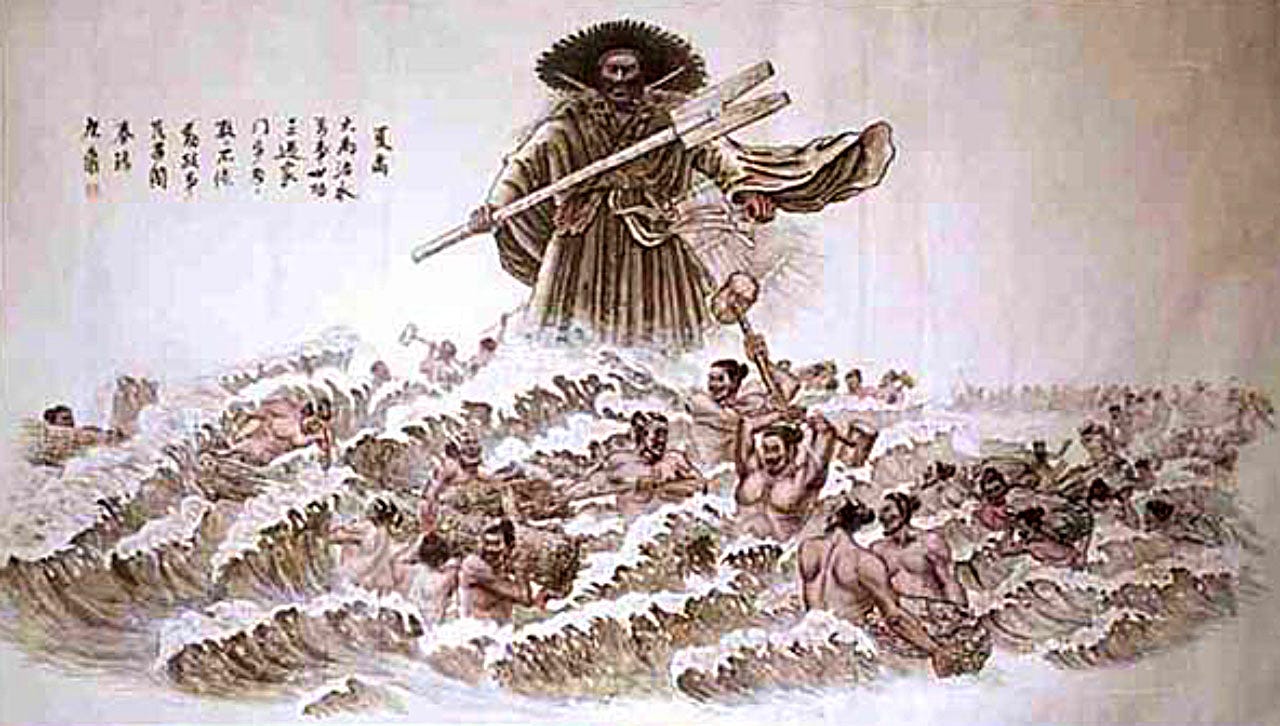
Massive, prolonged, recurring floods regularly devastated the Yellow River valley, destroying settlements and agriculture. It was a repeating crisis that threatened the very survival of the nascent civilisation.
After countless failed attempts to solve this problem, legend has it that Emperor Yu mobilised tens of thousands of people from various clans and chiefdoms, and laboured tirelessly for 13 years, digging channels to divert and manage water to the sea. Because of his monumental success in taming the floods and making the land habitable and fertile, Yu gained immense prestige. The various groups of people were so impressed and grateful that they transferred their loyalty to him, which allowed him to consolidate power and found the Xia Dynasty (c. 2070–1600 BCE), the first centralised state in Chinese history.
The very first state in China formed for the explicit purpose of combatting the existential threat of catastrophic natural disasters; its primary Staatsräson was building infrastructure, massive public works for the benefit of all.
The Xia dynasty was followed by the Shang and Zhou dynasties, the “Spring and Autumn Era, then a chaotic, roughly 300 years long Warring States period in which warlords fought for dominance and populations greatly suffered, ending in roughly 200 BCE.
During the Warring States era there emerged 3 main strands of political doctrines: Daoism, Legalism, and Confucianism.
Daoism and Legalism

Daoism, commonly referred to in the West as the grandfather of anarchism, focused on the natural energy flow of the universe (the Dao, or “path”), which human beings should not go against, but seek alignment and harmony with. The central concept of “Wu-wei”, roughly translated as “Do Nothing”, “Non-Action”, “No Force”, or “Spontaneously living in the moment”, is the way towards tranquility and happiness.
Daoism cautioned against competition and instructed that the emptying of the mind and ridding of Earthly desires is the way for humanity to change its violent ways that creates so much needless suffering. (The later fusion of Daoism with Buddhism came to be known as Chan Buddhism, late exported to Japan as Zen). Politically, Daoism is suspicious of centralised power, and urged rulers to be humble, restrained, pacifist, to avoid stringent laws and harsh punishments.

Stringent laws and harsh punishments are main features of Legalism. In many ways the dialectical antithesis of Daoism, this rigid ideology became the guiding principle of the Qin dynasty that ended the Warring States period in 220 BCE.
Legalists see human nature as inherently selfish and violent, and devises a system of absolute monarchic authority atop a centralised bureaucracy, enforcing unbending codes and severe punishment, as the only method with which it can be controlled. And for them, suppression of rival philosophical doctrines was the only way to prevent contending factions from gaining power. In Legalist society, warriors were rewarded based on the number of enemy severed heads they brought back.
Legalism produced very strong police and military, but also widespread resentment among the population, and quickly lead to a series of large scale rebellions that overthrew the Qin after merely 17 years, ending the only, very short period of Chinese history where Legalism dominated.
Brute force failed to maintain peace and unity, but its opposite, the lofty and relaxed, nature-loving, profoundly unfettered ideals of Daoism also, unsurprisingly, was not enough to deal with the real problems faced by monarchic governance over such a large and diverse territory, with objective contradictions between farmers and land lords, between land lords and merchants, between the people and their rulers. The succeeding Han dynasty rejected both, and chose Confucianism as its ideology and political system.
Daoism remains a constant underlying influence on Chinese culture and politics in countless ways, and will always be an important philosophy of life.
Elements of Legalism also live on in Chinese statecraft, even today: the punishments for political corruption and white collar, elite crimes, including seizure of entire companies, long prison terms, and the death sentence, is often much more harsh than those in the West.
In many ways, the most contentious political debates in China, regarding a general definition of good governance and optimum organisation of society, management of contradictions, were more or less settled around 2000 years ago. With some variation through out the eras where different ideas gain and lose favour, Confucianism would come to be the main guiding principle of Chinese governance, beginning with the Han dynasty.
Confucianism
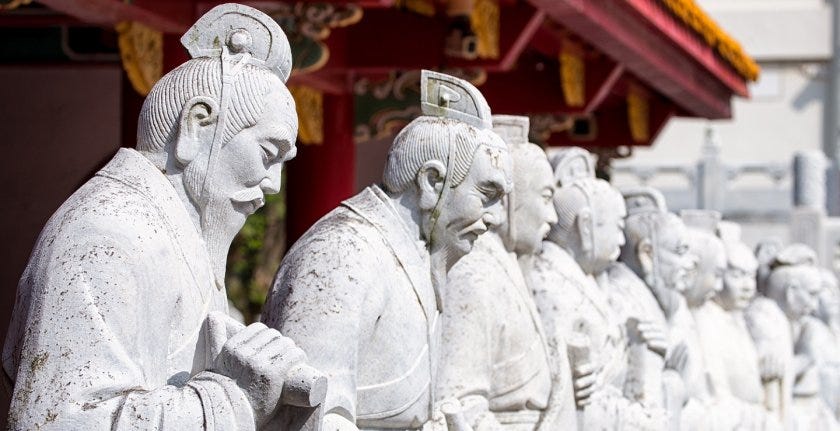
Confucianism posited that human nature is essentially good; that with education, everyone can become virtuous; and that emperors should lead by example, with benevolence. At the same time, the Confucian state retained Legalist centralized bureaucracy, strict laws, and the option of forceful methods to control and maintain power.
Confucianism (儒家, Rújiā) provided a concrete set of guidelines for preserving balance between emperors and people, in attempt to recreate, approximately, what Confucian scholars and historians remembered as an ideal, peaceful, prosperous, harmonious era of the first, Xia dynasty some 2 millennia prior.
Classic Confucianism centered around Man’s connection to the heavens (universe), and posited that social order depends on individual autonomous study and ethical cultivation.
But at the same time, Confucianist doctrine also clearly stated that individual virtue is not possible with poverty — the idea that the state is responsible for the eradication of poverty and wellbeing of citizens was enshrined in China some 2000 years ago (a relative new, about 500 years old, idea in Western politics).
The creation of equality was always a centrally important goal of the state, the precondition for a harmonious society.
In response to continued social unrest and another period of chaotic infighting between warlords, the era of the War of Three Kingdoms (263 – 280 CE), over the centuries scholars further adapted Confucianism in attempt to make political hierarchies increasingly less arbitrary and less unjust, by reducing the importance of inheritance, and further basing the justification of power on objective merit and virtue.
The concept of the Mandate of Heaven (天命, Tiānmìng) is a foundational ideological principle of Chinese governance, and its origin is precisely dated to the founding of the Zhou Dynasty around 1046 BCE. The Mandate is granted by “the heavens” (the cosmos, nature, the supreme force of order and morality in the universe, not a single deity) to only virtuous and just rulers who made the people happy. If an emperor becomes corrupt or ineffective, Heaven will withdraw its support, leading to social unrest, natural disasters, and ultimately, the emperor’s downfall and replacement.
In later millennia, the idea increasingly came to mean approval of the population, becoming, essentially and effectively, an ancient version of democracy.
Crucially, as much as justifying monarchic rule, the “Mandate of Heaven” also embodies the “right to rebel”: the very concept was created by the founders of the Zhou Dynasty in order to justify their rebellion against and overthrow of the previous Shang Dynasty.
The Zhou leaders argued that the last Shang kings had become tyrannical, morally corrupt, and dissolute, neglecting the rituals, oppressing the people, and had lost the virtue necessary to rule. Based on these allegations, leaders of the Zhou rebellion claimed that Heaven had withdrawn the Shang’s right to rule and transferred the Mandate to King Zhou, who was virtuous and fit for the responsibility.
This was a revolutionary idea. The Mandate of Heaven moved the source of political legitimacy away from mere ancestry (the Shang’s claim) to moral performance and just rule.
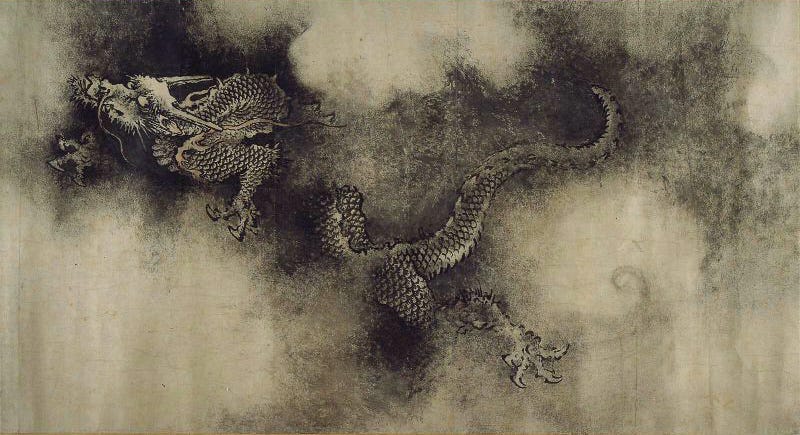
Since the very beginning of China, the authority of the emperor, the “Son of Heaven” (Tianzi), has not been absolute, but conditional on incorruptibility, honesty, prudence, generosity, benevolence, and wisdom.
To keep the Mandate of Heaven, a ruler must be ethical, prioritise wellbeing of the people, and perform the correct rituals. A ruler who became corrupt, unjust, and lets society fall into chaos shows that he had lost the Mandate — at which point it is not only right but righteous to overthrow him. The success of a rebellion, dependent upon the will of the population, was itself proof that Heaven had transferred its mandate to a new dynasty.
Neo-Confucianism emerged during the Tang Dynasty (618-907 CE), was fully systematized in the Song Dynasty (960-1279 CE), and reached its canonical form in the 12th century. It was influenced by Buddhist and Daoist metaphysics, outlined a pragmatic methodology for social balance and well being, developed concepts like **Principle (_Li_ 理)**—the underlying rational order of the universe—and **Material Force (_Qi_ 气)**—the psychophysical stuff that constitutes all things, and later introduced ideas like learning based on evidence (influenced by Western empiricism).
In practical application, in more recent millennia Neo-Confucianism developed a fraught, as symbiotic as contradictory, relationship with Legalist-style statecraft. The question of when to lead by inspiration, example, and moral instruction, and when to use law and force to preserve order, was a constant dialectical debate.
During the Song Dynasty, in the 1070s, Confucianism took an explicitly leftist turn:
“The state should take the entire management of commerce, industry, and agriculture into its own hands, with a view to succoring the working classes and preventing them from being ground into the dust by the rich.”
– (attributed to a summary of Wang AnShi)
Wang AnShi advocated for alleviation of suffering among the peasantry, by preventing the consolidation of large land estates. He called elements that came between the people and the government “jianbing”: owners of large estates, rural usurers, urban businessmen, speculators responsible for instability in the market, those who monopolized wealth and made others dependent on them, and the bureaucrats who represented their interests in government. Wang believed that suppression of the jianbing is one of the most important goals of politics.
“Today in every prefecture and subprefecture, there are jianbing families that annually collect interest amounting to several myriad strings of cash without doing anything… What contribution have they made to the state to [warrant] enjoying such a good salary?”
— Wang Anshi
Wang Anshi and the left wing of Confucianism was ultimately defeated by the rightists, but this strand was later revived and today serves to inform and guide the Communist Party of China.
It must be noted that the Confucian idea of “harmony” is emphatically not “sameness”, as the word partially implies in the Western definition.
An important passage in the Analects of Confucius (Book 13: Zilu) reads:
“君子和而不同,小人同而不和。”
Which translates to: “The noble man seeks harmony but not conformity; the petty man seeks conformity but not harmony.”
The confucian state does not demand uniform opinions in the state, in the population, or of its neighbouring countries, but strives for peaceful co-existence and balanced diversity between people and groups with different ideas. This is how there can be multiple ideological factions within Chinese government today: to the right of Xi JinPing there are politicians calling for expanding the private sector and further liberalisation, and to the left of Xi JinPing there are those who call for re-collectivisation and Great Cultural Revolution Part 2.
This diversity of ideas and a political culture of vigorous debate is how Chinese governance and policy under the same party can change, adapt, and evolve, according to circumstance and historical necessity, so drastically. The Communist Party is constant, but its policies during the Great Leap Forward, during the GCR, during Reform and Opening up, and even between the early 2000s and the current Xi JinPing period — are extremely different.
The idea of “Harmony without conformity” in Chinese political philosophy since ancient times is also what makes possible the “One country, two systems” arrangements that the central government has used for Hong Kong before reclamation, for Macau with its unique laws with regard to gambling, for Taiwan with a government independent of the CPC, etc. No other nation has any similar tolerance for different ideologies, political systems, and laws within its borders.
This Confucian tolerance for difference is in sharp contrast to the ideological homogeneity demanded by liberal democracy, which tries to impose the same values on not only their own populations but also on other nations with extremely different histories and cultures, and force developing countries to adopt the same neoliberal economic model.
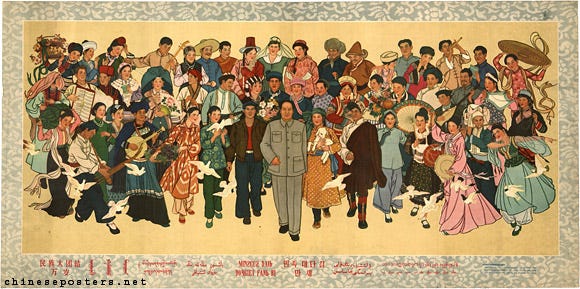
The concept of Da Tong, “The Great Unity,” “Grand Harmony,” is one of the most influential and enduring political and social ideals in Chinese thought: a vision of a perfect, utopian world order.
The most famous and definitive description of Da Tong comes from the “Liyun” (Record of the Rites) chapter of the Confucian classic, the Book of Rites (Liji). It is presented as a description of the golden age of antiquity, before decline.
Here is the key passage, which is memorized by generations of Chinese students:
“When the Great Way (Da Dao) prevailed, the world was shared by all alike. The virtuous and the able were selected. Sincerity was emphasized, and harmony was cultivated. Thus, people did not love only their own parents, nor did they treat only their own children as children.
The elderly were provided with a means to see out their lives; the adults were employed in work that utilized their abilities; the children were supported to grow and learn. Compassion was shown to widows, orphans, the childless, and the disabled—all had the means of support.
Selfish schemings were repressed and found no development. Robbers, filchers, and traitors vanished. Hence, the outer doors remained open and were never shut. This was the age of the Great Unity (Da Tong).”
The core tenets of Da Tong:
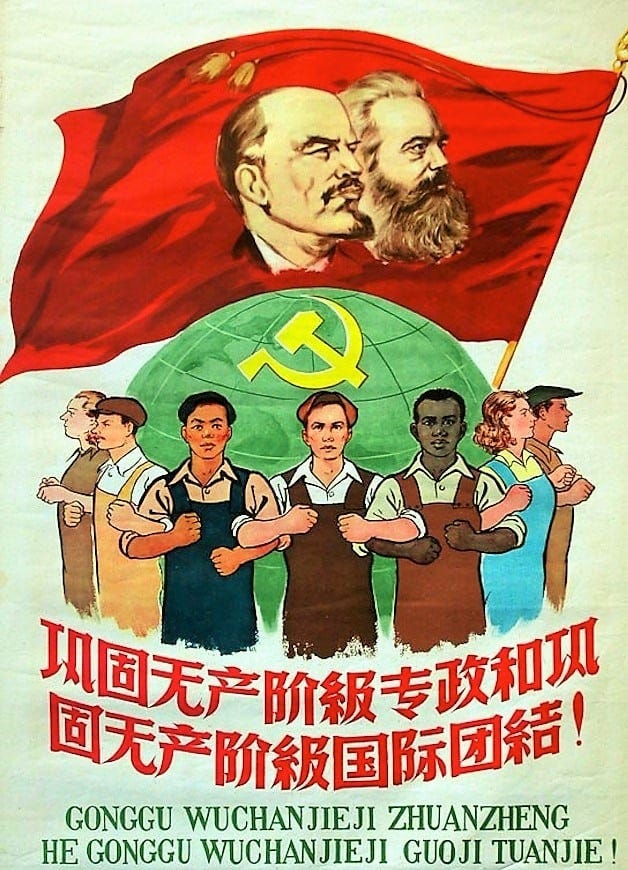
Immediately after describing Da Tong, the original text contrasts the ultimate ideal for future society with the current era of Xiao Kang (Small Tranquility), a lower, more pragmatic level of a well-ordered society. In the time of Xiao Kang, society before Da Tong can be acheived, people love their own parents and children; rulership is hereditary; and rituals and righteousness are established to maintain order in a society of propriety and stability built on distinctions (self vs. other, ruler vs. subject).
The deeper understanding of confucianism is that the adherence to strict heirarchies, to filial piety, etc. are not end goals, but temporary features during the current era of Xiao Kang, which anticipates and will eventually lead to a much better future time of perfect human harmony on Earth.
This confucian idea of historical progress through struggle is akin to the Leninist socialist path towards global communisation, on which political power, in its continuous optimisation, striving for more legitimacy and further intimate reflection of the will of the people, will incrementally dissolve. As human understanding and society advances, the trust, respect, empathy, mutual care, and harmony within the family and extended family will increasingly expand to include the neighbourhood, then the city, the province, the nation, clusters of nations, and eventually, the world.
The concept of Da Tong, China’s native, classical vision of the permanent resolution of societal contradictions, of a harmonious, egalitarian, and moral society, has served as a powerful inspiration and a critical standard for political thought for over 4,000 years. Da Tong became the ultimate Confucian ideal, a benchmark against which all governments were measured, inspiring countless later thinkers, including the founder of modern China, Sun Yat-sen, whose Three Principles of the People were aimed at achieving a modern form of Da Tong.
Many Chinese intellectuals in the late 19th and early 20th centuries saw parallels between Da Tong and communism/socialism, which helped facilitate the acceptance of Marxist theory in China. The Communist Party of China has also invoked the language of Da Tong to describe its socialist and communist goals, framing the ultimate aim of communism as a modern realization of this ancient Chinese idea of utopia.
During the 20th Century revolutionary period, Confucianism, the ideology of feudal China which justified monarchism, was widely discarded as outdated and decadent. But on the road of socialist construction in the contemporary era, the ancient wisdom of Confucianism found new purpose and application for steering society during a transitional period full of not-yet-resolvable contradictions.
Today, the Mandate of Heaven and Confucian meritocracy endures in the Chinese version of Democratic Centralism, the political system of the Communist Party of China (same as that of USSR 1.0). Just like in ancient times, legitimacy of the CPC and its leadership rests entirely on approval of the population. If Xi JinPing loses support of the central committee and the higher governing bodies, he would have to step down immediately; and if the communist party itself loses support of the people, another will soon take its place.
In this democratically centralised hierarchical system, local leaders of villages, cities, and provinces are chosen by popular elections; while leaders in the central government are appointed by the party. Democratic centralism ensures that the entire government is connected to the wishes and will of the people, at the same time able to make big decisions concerning the nation and the world, such as those regarding climate and geopolitics, free from the short sighted financial self-interest of citizens. (more on contemporary PRC domestic and foreign policy in the essay “The Long Game and its Contradictions”)
INTERNATIONAL RELATIONS
Tributary System
China has never been an “empire” in the European definition and understanding of empire.
Instead of constantly seeking to conquer and directly administer neighboring territories, like Rome and every Western empire, ancient China set up the Tributary System. Neighboring states (such as Korea, Vietnam, Tibet, and various steppe peoples) would acknowledge Chinese cultural and political supremacy by sending periodic tribute missions. In return, they received gifts, legitimacy for their own rulers, and the benefit of trade. This was a more cost-effective and stable way for China to secure its borders and maintain its perceived cosmic role than conquest, occupation, violent and coercive domination.

In the tributary system, often overlooked by Western understanding, the return gifts to the smaller nations must always be of greater value than the tributes — because a bigger, “superior” nation should of course be more generous, and has a responsibility for ensuring the wellbeing of others, for the preservation of peace and the promotion of prosperity.
If a greater nation takes more than it receives, or acts in an immature, impulsive, imposing, controlling, or even violent way, it would no longer deserve its perceived greatness on the international stage, and the emperor responsible would lose face and legitimacy at home. All of this is especially true of the greatest nation of all, the central celestrial kingdom.
This was also a kind of “supremacism”, but a drastically different kind than that of Wesern civilisaion: “superiority” and “dominance” means being more charitable, considerate, tolerant, patient, wise, fair, ethical. To be domineering, manipulative, to force one’s way of life on others, to meddle in the affairs of others, to use coercive methods or even military force to get one’s way, was seen as stupid, ugly, vulgar, petty, arising from insecurity and a low level of understanding, the behaviour of small minded weaklings.
The contemporary Chinese political principle of non-interference emerges from such a value system, and is merely the next step in the continuous evolutionary path of a mutualist political philosophy.
Peace and War

The central emphasis and conclusion of the famous Daoist treatise on war-strategy, The Art of War, is that war should be always and absolutely avoided with diplomacy, because who ever “wins”, both sides lose, and the civilian populations of both suffer. If war cannot be avoided, it should be fought strategically and psychologically to minimize damage and the wasting of resources. Warfare should only be the very last resort after all attempts at negotiation fails, and heading into battle is already admitting a kind of defeat.
In imperial China, a statesman who resorts to military methods without exhausting every possible peaceful means of settlement and even beyond (if an agreement is not reached, a certain amount of self sacrifice in order to preserve peace is expected), is considered an inferior and stupid leader, and would, after the dust settles, face demotion or worse.
Compare and contrast this with the valorization of violence in the West, regarding the successful waging of war as sign of a great leader. Currently USAmerican politicians are attacking each other for being “too soft on (insert official enemy)”, for not being aggressive enough. The competition to be seen as the most combative and bellicose is something that does not exist in Chinese political competition, which proceeds according to a set of very different core values. Speaking in broad general terms, non-violence, restraint, and patience is usually seen in the West as weakness — for evidence we only have to look at contemporary Western mockery of its geopolitical enemies’ caution and moderation, interpreting it as weakness.

Softness is central to Asian ideas of strength. In the age-old concept of “Bamboo Diplomacy”, the ability to bend (while being firm) is seen as an attribute of power. And indeed, Chinese Traditional Medicine has maintained for thousands of years after the fall from the harmonious period of antiquity (the first Xia dynasty), that “the world is too Yang”, meaning too masculine, too calculating, too hard, not enough feminine, not enough empathy, not enough softness. And to this imbalance can be attributed much of the great illness of the world.
While in European culture to be soft tends to be seen as a shortcoming, as feminine, as silly, as embarrassing, as inferior, and as cause for mockery and ridicule.
Clash of Civilisations
These policies, arrangements, modes of engagement with others, are very different from those of Western empires, and emanate from a fundamentally different set of core values and ideas of governance.
But Chinese society in antiquity was basically the same monarchism/feudalism as that of ancient Greece or Rome, with the same hereditary hierarchical power structure presiding over the population. So class alone cannot explain why Zheng He, with ships and fleets 10X bigger than those of Christopher Columbus and 100 years earlier, equipped with unmatched weapons and technology, sailed around Asia and Africa, and merely traded, instead of conquering, colonising, or enslaving.
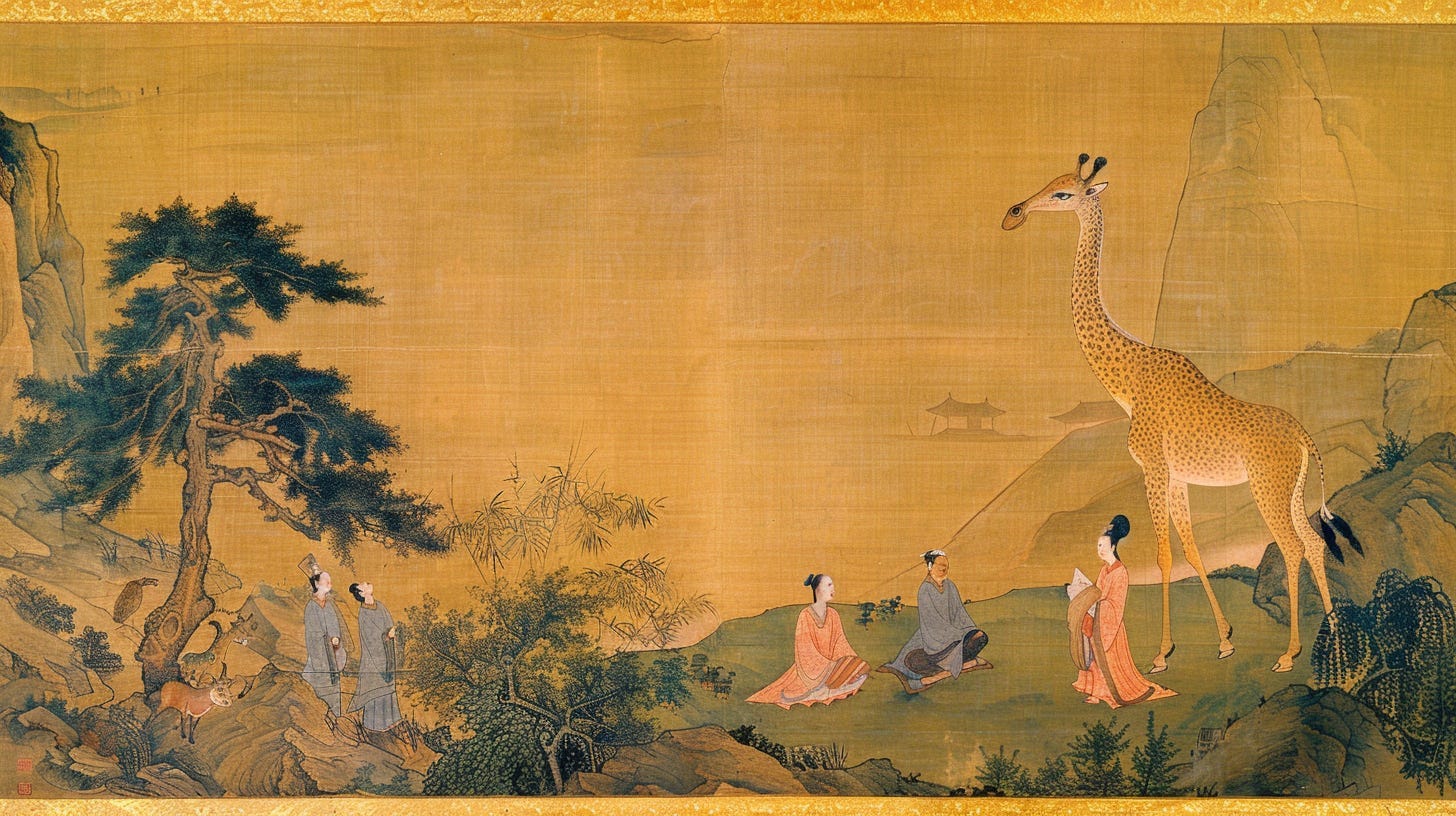
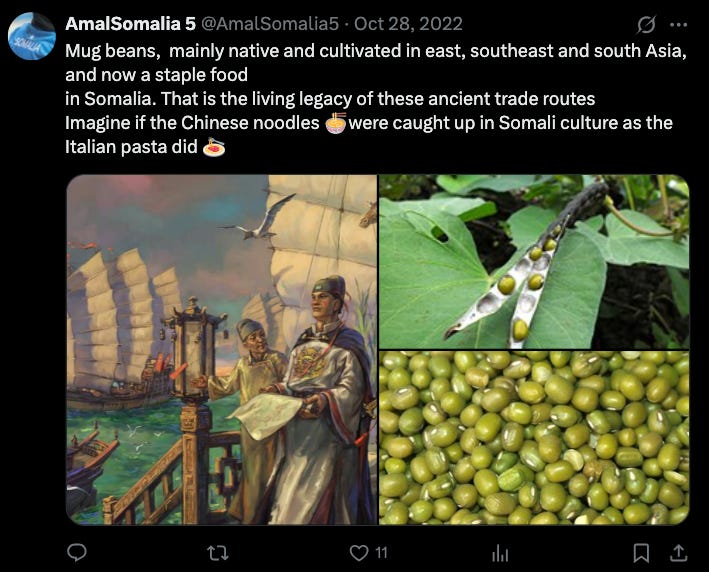
For much of the past 2000 years, the Central Realm, world’s top economic, military, cultural super power, was relatively stable, prosperous, and self satisfied, with a form of internal governance and foreign policy which prized above all the preservation of harmony and peace. During the last 1000+ years, China engaged in virtually zero expansionist wars.
Contrast with Europe at the time of global colonisation: emerging from 1000 years of constant warfare, Roman infrastructure laid waste, rampant diseases, peasants living without much hope under brutally oppressive feudal theocracy — all of which made European peoples accustomed to violence, excel at military matters, and thirst for new horizons where the oppressed poor can become oppressive kings (or at least that was the propaganda to get the peasants and prisoners to take the gruelling and dangerous journeys to the New World and do the dehumanising work of genocide, all to create new markets for the newly emergent bourgeoisie).
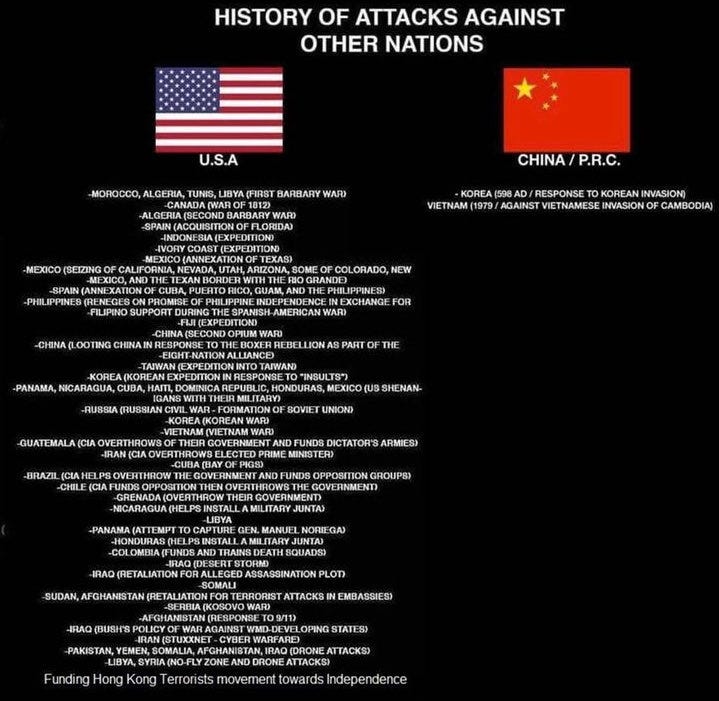
Seems obvious but it must be said: It isn’t due to any innate, unchanging qualities within the people that China tended to trade and Europe tended to conquer, but only different sets of socio-economic conditions and path of historical development. But at the same time, the real cultural, civilisational differences do objectively exist, and continues to shape geopolitics.
Class must be foregrounded, but to reduce the complex interplay of ideas and objective factors to *only* a straight forward, deterministic materialism, to only economic concerns, is to neglect entire dimensions of social dynamics, the dialectical part of dialectical materialism.
And this kind of reductive, one-dimensional thinking is itself an expression of a certain deeply seated civilisational character, shaped by the developmental path of the Western philosophical tradition, in many ways typified by the work of René Descartes. It is a perspective that tends toward a mechanistic and discontinuous conception of the world, where independent actors are motivated solely by short term self interest, producing a predilection for playing the game of zero sums, of “winner takes all”, rather than one of continuous reciprocity and mutual benefit.
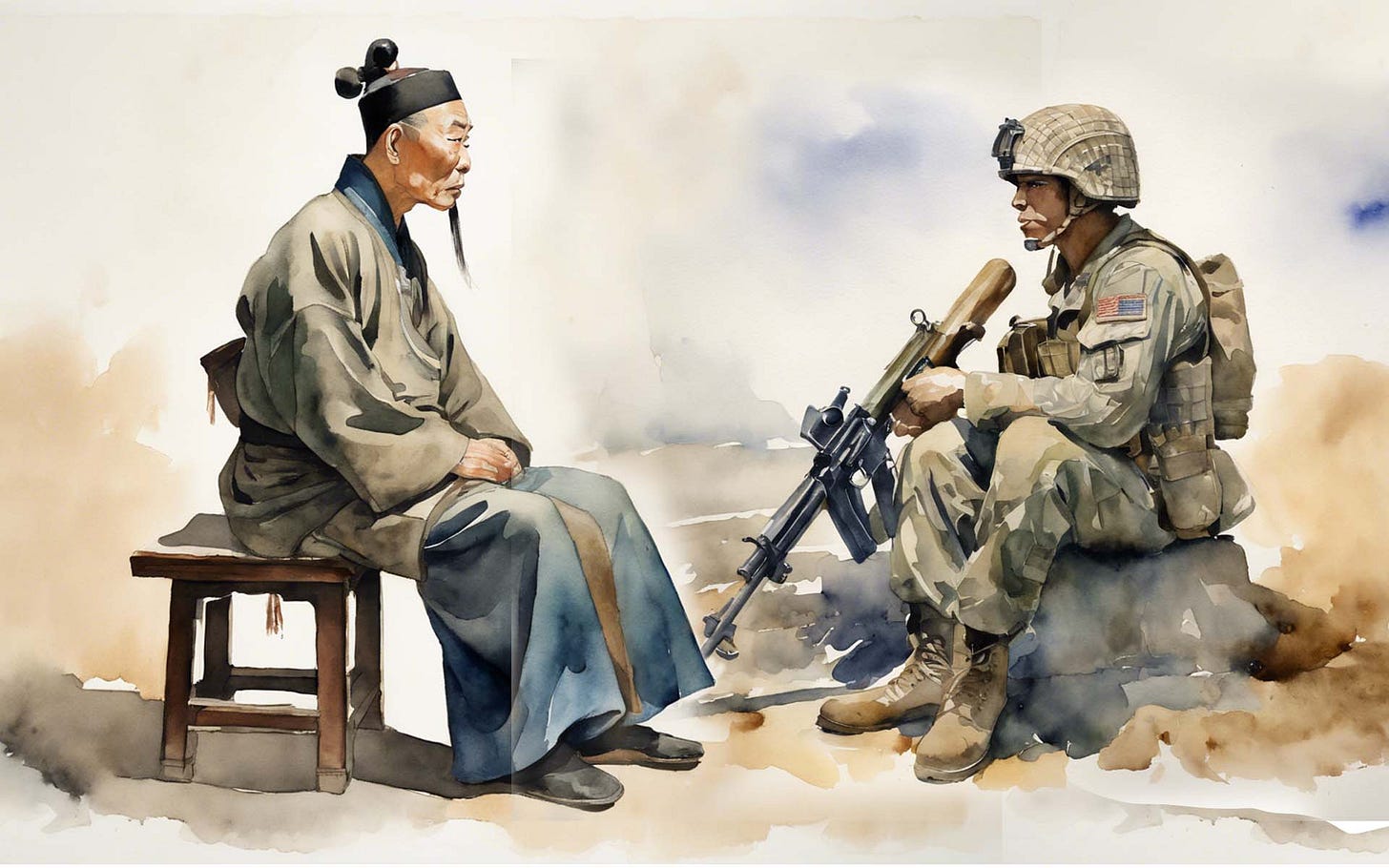
As China continues to rise, and re-assumes its position at the center of world affairs after a brief aberrant period, let us not mistakenly make universal claims about “all empires”, “all governments”; make false equivalencies between socialist and capitalist states and between Western and Eastern civilisations; project the motivations, intentions, and modus operandi of the US and European colonial empires onto the People’s Republic of China.
China emerges from 2000 years of statecraft focused on the preservation of peace and building of mutually beneficial relationships, and very literally does not have the institutional genes for domination, colonisation, or imposing its cultural values, political system, and economic model on the rest of the world.
The socialist super power is embarked on a world-historic mission to re-balance global economy by developing under-developed regions, to democratise international power by displacing uni-polar hegemony, to build a New Silk Road connecting the world, to bring a permanent end of the historic imperialist era.
If we take a sober look at the 20th Century, how strong waves of international movements toward socialism in the 1930s, in the 1950s, were brutally crushed by imperialism, we see that there has been 1 single block on the road of human progress —— and that removal of this block can only mean global socialism, the planetary path towards Da Tong.
Internationalism
Any kind of exclusively unique Chinese disposition that is conducive to modern socialism is the wrong conclusion to draw from this essay. Lets remember that the outcome of the civil war which ended with communist victory was anything but certain, that it was a very close fight, and that China could have strayed away from its Daoist and left-Confucian roots to embrace Legalism and nationalism, and become an imperialist power.
And we must remember that while the same choice is open to all nations, every people on this planet comes from ancient egalitarian traditions with matricentrality, animism, and a deeply embedded sense of community with high levels of trust, empathy, and cohesion. For these are the evolved social traits, the inherited biological reality, of the Homo Sapien Sapiens species, which is only, to various degrees in different places, ruptured by the proprietary/patriarchal world historic counter-revolution of 6 to 10 thousand years ago (much more on this in separate essays).
Sure, different cultures in different regions are to different levels connected to or severed from their pre-proprietary/patriarchal roots. But no matter how buried, how cut-off, all peoples have the potential of remembering, drawing from, and restoring their own ancient traditions of sharing and cooperation, towards building home grown socialism with local, native cultural/civilisational Characteristics.
CIA secretly engineered 1962 war which ruined China-India relations for decades
The month-long October-November 1962 border conflict between China and India killed up to 6.2k people, and poisoned ties between the fledgling Asian powers for decades to come.
But according to a groundbreaking new academic study by Lakshmana Kumar cited by Kit Klarenberg, it was the CIA that helped push the nations to the brink of war, and then cross over it, using a 1950s campaign of paramilitary training, airdrops and arms support for Tibetan separatists in a brutal secret conflict that claimed the lives of up to 80k Chinese soldiers.
 China blamed India for the CIA campaign, with New Delhi’s provision of territory as a base of operations, and welcome for refugees during a 1959 uprising heightening Beijing’s ire, and triggering a series of violent border clashes the same year.
US machinations aimed at poisoning China-India relations go back to a September 1951 State Department memo urging Tibet’s use “as a weapon for alerting [India] to the danger of attempting to appease any Communist government and, specially, for maneuvering [it] into a position where it will voluntarily adopt a policy of firmly resisting Chinese Communist pressure in South and East Asia.”
Under Allen Dulles, the CIA built a base to train Tibetan separatists in the Rockies, and coordinated an army of up to 14k separatist fighters in Tibetan China.
Days before the 1962 war broke out, Secretary of State Rusk outlined US plans to take advantage of the conflict by expressing public “sympathy for the Indians,” but without giving Beijing a “pretext for alleging any American involvement.”
Rusk detailed a contingency for providing India military transport and communications support, should New Delhi request it, which it subsequently did.
The Tibetan trump card worked, and India backslid on its non-aligned foreign policy. In a triumphant December 1962 report, the CIA predicted that India would “almost certainly continue to open up new opportunities for the West,” and prove susceptible to “influence by the US and the UK, particularly in the military field.”
“The genie is out of the bottle. The provocation of a “USV privateer war” on trade routes threatens to collapse global maritime trade.”
By Rotislav Ishchenko at ukraine.ru.
(machine translation)
The oil tanker Virat has been attacked twice by unmanned boats near the Bosphorus Strait. On one occasion, the ship Kairos was also set on fire. Western media outlets have claimed that the tanker belongs to Russia’s “shadow fleet.” This expands the list of potential suspects. Naturally, Ukraine, which has been waging a long-standing war against the Russian military fleet using unmanned combatants, is at the top of the list. However, it is unlikely that Kiev would have dared to attack merchant ships, especially near one of the world’s most important transportation hubs connecting the Black Sea and the Mediterranean, which is controlled by Turkey, without the direct approval of its Western allies. The consequences, both direct and indirect, would have been far-reaching, affecting the entire world. Ukraine may no longer exist, but the unmanned surface vehicle’s (USV) attack on merchant ships could echo for decades, shaping the maritime trade landscape.
So it doesn’t matter whether these USVs belonged to Ukraine or whether the British and Americans decided to use their own or those belonging to a third country. The genie is out of the bottle. And not only because this game can be played by two people.
In this case, Britain is unlikely to hope to remain outside the scope of retaliatory actions. It is clear that it is more difficult to use USV to disrupt shipping in the open ocean than in enclosed waters such as the Black, Baltic, Mediterranean, White, Red, Yellow, and Japanese Seas, as well as all Chinese coastal seas. However, the ports of the United Kingdom are within direct reach of USV strikes from the continent and/or from ships and vessels passing through the English Channel. The situation for shipping may be even more dangerous in the classic pirate stronghold of the Caribbean Sea, which borders dozens of countries, many of which are home to both drug cartels and ideological guerrillas.
The threat to American southern ports in the Atlantic is clear.
At the same time, although USVs are more complex than the simplest air drones, they do not require high-tech enterprises for their creation. The problem of guidance, especially at shorter distances, is also solvable. This means that it is not always possible to determine the nationality of a USV that has not exploded, especially if the manufacturer deliberately conceals it.
Almost all strategic global maritime trade routes, no matter how far they extend into the open ocean, eventually pass through bottlenecks like the Bosphorus. Moreover, almost all of these bottlenecks are within the reach of the USV from the coasts of dozens of countries and/or hundreds of ships passing by simultaneously. Only the Northern Sea Route is relatively protected by national means. The rest can be blocked.
The provocation of a “USV privateer war” on trade routes threatens to collapse global maritime trade. This does not require sinking all ships. It is enough to make the threat significant enough to increase insurance premiums, crew salaries, and security costs, as well as delivery times. As a result, significant volumes will be excluded from global trade due to their unprofitability. Additionally, USV can be produced in large quantities (or purchased) and used by dozens of countries against each other. As we know, the greater the demand, the cheaper and easier to use the technology becomes. The first AK-47s were secret and carried in tarpaulin cases, but now the entire world, including the poorest tribes, is using them, and only the lazy ones are not producing them. Finally, the Ukrainian military crisis, as well as the wars between the Houthis and the Saudis and Israel, have demonstrated how easy it is to use high-tech weapons against a third country under the guise of a proxy ally. If Ukraine can launch American and European missiles, which require satellite guidance, at targets deep within Russia, and the Houthis can use hypersonic weapons to attack their enemies, what is stopping Somali pirates or Colombian drug lords from developing similar technologies for the USV?
I want to emphasize that the problem is not that a tanker that could theoretically belong to Russia’s “shadow fleet” was attacked. Russia is primarily a land-based power, and its main trade routes are located within the Eurasian continent and are well-protected. The main targets of the “USV privateer war” may include China, Taiwan, Japan, both Koreas, the Philippines, Vietnam, Thailand, Myanmar, Taiwan, India, the Gulf oil monarchies, Iran, Singapore, Turkey, Indonesia, and countries in the Caribbean, Mediterranean, North Sea, and Baltic regions.
These are either trade competitors of the United States and the United Kingdom, or allies of the United States who are in a leading geopolitical position and are used as a springboard for military and political pressure on the United States’ trade and economic competitors.
In recent years, the West has been losing not only the financial and economic struggle, but also the struggle for control of global trade. The dollar and the euro are losing their positions as the main and auxiliary global currencies and currencies for trade settlements. The yuan, rather than the ruble or the rupee, is actively replacing them. The traditional trade between the West and countries in the Gulf, Latin America, and Southeast Asia is gradually shifting to China. China is also actively expanding its presence in the Eastern Mediterranean, moving through the Greater Middle East.
In all of China’s advancements, maritime trade routes are of utmost importance.
The land-based trans-Eurasian trade routes that connect the continent into a unified economic Greater Eurasia serve as the foundation, but it is the control over maritime trade routes that allows China to build a “fairy-tale castle” of global profitable trade. It is no coincidence that China is building a navy that surpasses the United States in terms of the number of ships and is poised to surpass it in terms of overall combat power. China needs to control the routes that facilitate the sale of its goods. Russia can exist as an autarky, but China will quickly explode from within if its trade is blocked.
During the Ukrainian military crisis, Western UAVs, which were limited in their use in Ukraine, proved to be highly effective in controlling the water area dominated by the enemy’s navy and aviation, as well as in blocking ports and posing a constant threat to military bases. Russian sailors gradually learned to combat the UAV threat, but they were unable to completely eliminate it.
It should be noted that the military fleet, which exercises dominance in a closed water area, has impressive capabilities for combating enemy USVs. However, as mentioned earlier, the threat of USVs in the Black Sea has not been completely eliminated. For the military, repelling attacks is a natural activity. The merchant fleet, on the other hand, is not equipped to handle this task. Any measures taken to enhance the security of commercial ports and the surrounding water area will immediately impact the speed and cost of shipping goods, while the threat of USVs remains high.
The West is not just not afraid of playing a “double game” in the “USV privateer war.” It is provoking this war, deliberately seeking to paralyze global maritime trade.
We can say that this will hit the West itself. It will hit it, but not as hard as we would like. As mentioned above, the West has already lost its trade supremacy to China, and it will only continue to lose ground. However, the rules of geopolitical warfare require us to try to destroy the mechanism that benefits our geopolitical adversary rather than ourselves. During the two World Wars, when maritime trade was an Anglo-Saxon monopoly, Germany attempted to wage war against it using its submarine fleet. The West is now trying to strike a blow to global maritime trade, which is gradually being taken over by China.
We have repeatedly said that the paralysis of Chinese trade will inevitably plunge Beijing into a financial, economic, and then a social and political crisis. The Anglo-Americans have failed to isolate China through legal means, so why not try proxy piracy, since they are already waging a proxy war on land against Russia.
It is clear that we should not expect hundreds of USV attacks on sea routes tomorrow. However, we should not expect them to take decades to organize. As the development of UAV technology during the Ukrainian military crisis has shown, it is possible to transition from isolated attacks to large-scale use in a matter of months (or even a couple of years), which can change the entire dynamics of the conflict and require the development of appropriate countermeasures, which may not always be as quick as desired.
The fact that the incidents involving attacks on merchant ships by the USV occurred in the area of the Bosphorus, a trade route controlled by a NATO country, indicates that the organizers of this provocation are preparing for a global undeclared war on trade routes (similar to the war between English pirates and Spanish transatlantic trade in the 16th to 18th centuries), and they do not intend to tolerate the transfer of control over these routes to their geopolitical opponents. Given that the United States is developing an icebreaker fleet and actively expanding its presence in the Arctic, we should also consider strengthening the security of the Northern Sea Route.
With Judge Napolitano: A must-watch with attention.
These are my quick notes: For China, AI is integrated in industry. It is a manufacturing and business tool, not a weapon, as in the US. The US or West is no longer competitive, so China has all the cards economically. The West is now in a structural crisis.
The United States will have difficulty accepting this change, the Chinese and others’ avoidance of the Dollar Trap, for one. The world will incorporate what China is doing. World energy is changing to less need for oil China has other systems that look very promising and the energy balance will change in China’s favor. (Reminder to all about Russia’s small nuclear power generators). The Chinese technology is open source and people worldwide are turning to that.
China is carefully handling the fallout of the downfall of the US already. China does not necessarily be involved in the rollout of an alternative dollar system (The Unit). They believe we have a system currently that works and they are using it.
By Peter Koenig
It is a pleasant sight to see, how in Asia a (former?) military ally of the United States, Thailand, shifts away from Washington and goes to Beijing – literally.
On 14 November 2025, the Thai King Maha Vajiralongkorn had embarked on a five-day historic state visit to Beijing. This is not a common event, as Thai monarchs do not often practice State visits. They usually stay home and let their Foreign Ministries maintain diplomatic relations with their partners.
This is the first Royal state visit to Beijing since the establishment of diplomatic relations between Thailand and China some 50 years ago. As a logical conclusion, this is a strong signal to the Thai elite and people, as well as to the rest of the world, that Thailand is initiating a major geopolitical shift in her relations with Super Powers – from Washington to Beijing.
This diplomatic move of Thailand’s may be indicating more than meets the eye, namely a general tendency of South Asia – if not of the Global South – to strengthen its relations with China, in a peaceful cooperation, rather than the classical stick-and-carrot relation, dependent on the western sanction-prone dollar-economy, dominated by the US, and closely followed by Washington’s European vassals.
Such a move may have been exacerbated by President Trump’s dystopian tariff war, mainly against China, but by association with the rest of the world, including Thailand.
Today, the US is Thailand’s third largest trading partner. With roughly US$ 80 billion two-way trade in 2022.
Compare this with Thailand’s economic relationship with China, Thailand’s largest trading partner, characterized by strong and growing commercial relations and reciprocal investments. China is Thailand’s largest partner and major source of foreign investment. In 2023, bilateral trade reached approximately $126.3 billion.
King Vajiralongkorn’s decision to embrace China is of special importance, given his long personal ties to the West. He attended private schools in Egland and received military education from Australia’s Royal Military College. The king’s reorientation to the East, stands in contrast with that of his father’s, King Bhumibol Abdulyadej, whose seventy-year reign was defined by deep engagement with the US.
Thailand’s close relation with Beijing is underlined, by the king’s daughter, Princess Maha Chakri Sirindhorn, who studied in China and has visited the northern neighbor more than 50 times. In fact, she was honored with China’s Friendship Medal which is a sign of longstanding cultural and educational ties beneath the political surface.
See this for more details https://www.rt.com/news/628669-china-thailand-royal-visit/
The deployment of royally enhanced diplomacy between the two countries, signifies also a shift towards a new multipolar world order. This trend is likely expanding rapidly to other countries in Asia and the Global South in general, as the western empire and its vassals have outlived their hundreds, if not thousands, of years of exploitation of what they still today consider, the inferior world, rich in resources and what the west believes, dependent on the western credit and monetary system.
Those days are over. Fortunately, there is a new world order in sight, in which the geopolitical, economic and monetary future lays in the East, while the western self-styled Empire and associates is not only a phantom of the past, but will play a secondary and tertiary role, as far as worldwide geopolitical influence is concerned.
Western aggressions, militarily and economically, are soon a thing of the past, whether the mainstream propaganda will keep drumming the MAGA and Empire beat or not.
We see today also a last ditch-effort of the United States and her “associates” – one may add, “associates in crime” – attempting to create an Asian Pacific NATO to control not just China, but the entire Indo-China Sea Region.
To the propaganda-influenced masses, it may look like a winning proposition, but to those in the know about the Chinese military power which is next to none, other than Russia; and if combined with China’s close ally, Russia – a western aggression in the South China Sea, would be nothing less than a western attempt of suicide.
Peter Koenig is a geopolitical analyst, regular author for Global Research, and a former Economist at the World Bank and the World Health Organization (WHO), where he worked for over 30 years around the world. He is the author of Implosion – An Economic Thriller about War, Environmental Destruction and Corporate Greed; and co-author of Cynthia McKinney’s book “When China Sneezes: From the Coronavirus Lockdown to the Global Politico-Economic Crisis” (Clarity Press – November 1, 2020).
Peter is a Research Associate of the Centre for Research on Globalization (CRG). He is also a non-resident Senior Fellow of the Chongyang Institute of Renmin University, Beijing.
‘Should Japan dare to cross red line, it is destined to pay heavy price’
From GT
China’s Ministry of National Defense (MND) on Thursday responded intensively to a series of recent moves by Japan, including the deployment of missiles on Yonaguni Island, the first export of deadly weapons since Japan relaxed arms export controls, and Japan’s initiation of discussions on revising three security-related documents.
Slamming these dangerous moves, MND spokesperson Jiang Bin said at a press conference held on Thursday that should the Japanese side dare to cross the red line and invite trouble to itself, it is destined to pay a heavy price. He added that people around the world, especially those from China and other victimized countries in Asia, will never forget the catastrophe brought by Japanese fascists. The specter of Japanese militarism must never be allowed to haunt the world again.
Recent media reports said that the Japanese government has sold its domestically produced Patriot air-defense missiles to the US. It was the first export of deadly weapons since Japan relaxed controls on arms exports. In addition, the Liberal Democratic Party of Japan has started discussions on revising its three security documents, including the revision of its three non-nuclear principles and increasing its defense spending.
Commenting on the latest moves, Jiang warned that the international community must be on high alert against Japan’s revisionist attempts to break away from the restraints of its pacifist constitution. The attempts include brazenly expanding its military build-up, drastically increasing its defense budget, expediting the revision of its security policies, relaxing restrictions on weapons exports, and attempting to revoke the three non-nuclear principles. It is even attempting to intervene militarily on the Taiwan question. These moves pose serious threats to regional peace and stability, Jiang said.
Regarding the Japanese side’s plan to station medium-range surface-to-air missiles at Yonaguni Island 110 kilometers east of Taiwan, and responding to Japanese Defense Minister Shinjiro Koizumi’s recent claim that the deployment “will lower the risk of Japan being attacked”, the MND spokesperson said, “Should the Japanese side dare to cross the red line and invite troubles to itself, it is destined to pay a heavy price.”
Jiang noted that this year marks the 80th anniversary of Taiwan’s restoration. “Instead of repenting for its war crimes of invading and colonizing Taiwan, Japan is taking an extremely wrong approach by suggesting military intervention in a so-called Taiwan contingency. This dangerous approach will uproot the post-WWII international order, and lead Japan to repeat the mistakes of its militarist past.”
The PLA has strong capabilities and reliable means to defeat any aggressors, Jiang stressed.
The MND also responded to recent claims from a source in the Japanese Self-Defense Forces saying that if the aircraft carrier Fujian takes military action in the Taiwan Straits, “Japanese and US forces will have the capability to sink it.”
In response, Jiang said, “it is nothing but sheer fantasy and an overestimation of one’s own abilities.”
Japan’s recent series of dangerous moves have inflicted severe harm and posed a major threat to peace and stability in the region and beyond, a Chinese expert said.
“Alarmingly, Japan has shown no remorse whatsoever for its aggressive past in World War II; instead, it continues to stir up troubles and revive militarist practices. Furthermore, Japan harbors ambitions to develop nuclear weapons, acquire nuclear-powered equipment, and promote arms exports. The core reason for its ‘recklessness’ is its utter lack of repentance for its WWII aggression,” Song Zhongping, a military affairs expert, told the Global Times on Thursday.
Song warned that if such a country is allowed to revive militarism, it will undoubtedly bring catastrophic consequences to the region and the world at large.
Song believes that China, as a core force for safeguarding regional and global peace, will never tolerate Japan’s dangerous acts. If Japan dares to exacerbate regional unrest and inflict harm on the region, China will resolutely step forward, and take firm and effective measures to crack down on and resolutely curb Japan’s militarist resurgence.
Tensions have boiled between Beijing and Tokyo following Japanese Prime Minister Sanae Takaichi’s erroneous remarks on the Taiwan question. The comments have sparked widespread public debate and continuous protests within Japan, with prominent politicians and experts voicing open opposition.
In an exclusive interview with the Global Times, Yukiko Kaikita, president of the Kumamoto Chapter of the Women’s Association for Peace and Against Military Expansion, said Takaichi’s remarks constitute blatant interference in China’s internal affairs, and that a large number of Japanese citizens hope she will retract her statements and issue an apology.
“Most importantly, Japan’s core commitment to the world is that we would never again wage war. When World War II ended in 1945, the Japanese people not only enshrined this principle in our constitution but also internalized, from the bottom of their hearts, the conviction that ‘we must never go to war again’,” said Kaikita. “Yet, among Japanese politicians, that conviction gradually faded, as it was replaced by a complete tilt toward the US-Japan security framework. This shift fills us with deep anger.”
Prime Minister Sanae Takaichi said yesterday that “having renounced all rights and claims under the Treaty of San Francisco, we are not in a position to recognize Taiwan’s legal status.”
MFA Spokesperson responded: Prime Minister Takaichi deliberately chose not to mention the… pic.twitter.com/QyszJBUfOW
— CHINA MFA Spokesperson 中国外交部发言人 (@MFA_China) November 27, 2025
The complete statement:
Prime Minister Sanae Takaichi said yesterday that “having renounced all rights and claims under the Treaty of San Francisco, we are not in a position to recognize Taiwan’s legal status.”
MFA Spokesperson responded: Prime Minister Takaichi deliberately chose not to mention the Cairo Declaration and the Potsdam Proclamation—two international legal documents with full effect and underscored in the Sino-Japanese Joint Statement and the Sino-Japanese Treaty of Peace and Friendship, and singularly brought up the illegal and invalid “Treaty of San Francisco”. She even sought to play up the false notion that Taiwan’s status is undetermined. That just compounds the wrongdoing. China firmly rejects that and calls for utmost vigilance from the international community.
We once again urge the Japanese side to reflect on and correct its wrongdoing, retract the erroneous remarks at once, and take practical steps to honor its commitments to China and do what is least expected of Japan as a UN member state.
Japan’s opposition party leader argued that since Prime Minister Takaichi stopped referring to a specific contingency example, she has “effectively retracted” her remarks.
MFA Spokesperson responded: “Stop referring to” is not the same as “retracting” the wrong remarks. The two are completely different in nature. The Japanese side hopes to downplay Prime Minister Takaichi’s erroneous remarks and make it go away by “not referring to” them. That is just self-deceiving and wishful thinking, and China would absolutely not accept that.
Seun Foo
In a big update, China banks are making a move to reducing their balance sheet of dollar assets. Meanwhile, the US has a new plan to carve up Russia’s frozen reserves.
These two videos are important. What they again confirm, is that the Chinese State do not move, if the Chinese citizens don’t indicate that move. Those that now are making a career of criticising China do not understand this. I have also criticised China in terms of their business ties with Israel. A criticism is not a career.
Why Chinese Netizens Call Palestinian Fighters “Dandelions”
China’s Silence Gaza
[Note: The Chinese strategy around the 3 Island chains explains some of China’s reaction to the words of the Japanese leader. Japanese PM Sanae Takaichi’s remarks linking Taiwan to Japan’s “existential crisis” caters to US attempts to contain China, binds Japan’s fate to Washington’s strategy, and masks its deep fear of being discarded as a disposable ally, says a Chinese journalist and analyst.
China has sanctioned seafood imports from and exports to Japan again, only a short time after they were normalized. China is protecting its strategy given that the first island chain consists of Okinawa, Taiwan, and the Philippines. In addition, China has started talking again about Okinawa, originally the Kingdom of Ryukyu, which is, in modern parlance, islands under occupation.]
MOSCOW, November 17 — RIA Novosti, Andrey Kots.
The People’s Liberation Army Navy has put the new aircraft carrier Fujian, the third in the Chinese Navy, on combat duty. The construction process, from the laying of the ship to its full combat readiness, took eight years and nine months, which is a record for a vessel of this complexity. Beijing is rapidly expanding its influence in the Asia-Pacific region and aims to challenge the US hegemony. RIA Novosti provides an overview of what is known about the aircraft carrier.
The Fujian is the first aircraft carrier built according to an original design using only Chinese technologies. It is classified as Type 003. The transfer ceremony was held at the Sanya Port on the island of Hainan. The event was attended by Chinese President Xi Jinping.

The ship was laid down at the Jiangnan Shipyard Group in Shanghai in 2017. The structural elements were manufactured at various facilities. Assembly began in 2021. Last July, Western media outlets published satellite images showing that the aircraft carrier had already received its superstructure and catapult launch systems. The Fujian was launched three years ago and has undergone a full cycle of sea trials.At the same time, an air wing was being created for it. Deck-based pilots were trained in Wuhan on a concrete mock-up of the Fujian. The Type 055 missile destroyers, which have been under construction since late 2014 and are second only to the American Zumwalt destroyers in terms of displacement, are likely to be used as escort ships.
The PLA Navy already has the aircraft carriers Liaoning and Shandong. The former is an unfinished Soviet aircraft carrier cruiser Varyag that was transferred to China in the 1990s, while the latter is a ship built according to a similar design. They were commissioned into the Navy in 2012 and 2019, respectively.
The Fujian is the largest aircraft carrier not built by the United States. It has a full displacement of 80,000 tons, a length of 320 meters, and a width of 75 meters. The ship inherited its non-nuclear propulsion system from its predecessors, which includes steam turbines and diesel generators. Overall, the Fujian is comparable to the American aircraft carriers of the 1960s, such as the Kitty Hawk class.
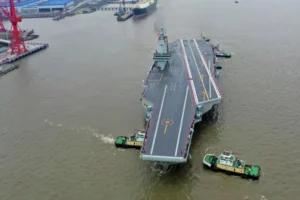
However, the Fujian’s electromagnetic catapults for launching carrier-based fighter jets are currently only available on the latest American Gerald Ford-class destroyer. These catapults provide a smoother acceleration compared to traditional steam catapults, allowing for adjustable speed based on the aircraft’s weight. Additionally, they require less space on the ship due to their simpler design.
The superstructure and two elevators are located on the starboard side, just like on the Shandong aircraft carrier. The elevators now lift two aircraft instead of one, which is a significant improvement. Additionally, the superstructure has been compacted to accommodate the flight control center, a phased array radar station, and communication equipment.
The Fujian does not carry offensive weapons, and its air defense is limited to Type 730 rapid-fire anti-aircraft guns and the HQ-10 short-range surface-to-air missile system. Its main striking force consists of J-35 and J-15T/DT multi-purpose fighters, KJ-600 long-range radar detection and control aircraft, and Z-20 helicopters.
It is claimed that the Fujian is capable of carrying more than 50 aircraft, not including UAVs.The latest fifth-generation J-35 carrier-based fighter jets are particularly interesting. The prototype first took to the air in 2021, and the J-35 successfully completed flight tests in 2024. According to Chinese media reports, the fighter jet is highly stealthy, with an effective radar cross-section (RCS) smaller than a human palm. It is capable of carrying a wide range of weapons, including the PL-17 air-to-air missile with a range of up to 400 kilometers. Together with the J-35 AWACS aircraft, they will be able to monitor all approaches to the carrier strike group.

Jin Canrong, deputy director of the Institute of International Studies at the Chinese People’s University, told the Global Times newspaper that Fujian was built to counter the so-called second island chain of US deterrence, which runs through the island of Guam.
“The Americans have deployed three island chains around us,” he explained.
“The first is Okinawa, Taiwan, and the Philippines, the second is Guam, and the third is Hawaii.
In fact, we have already extended our deterrence to the second. Taiwan is a key node in the first, where we have a significant advantage. Therefore, its destruction is not a problem for China, although Beijing’s policy towards Taiwan remains focused on peaceful reunification.”
China is clearly planning to challenge the hegemony of the all-powerful US Navy in the Pacific. And three aircraft carriers are not the limit. According to media reports, a full-scale model of a fourth aircraft carrier has been built in Wuhan. It is estimated to have a displacement of 115,000 tons, a length of 340 meters, and a width of 83 meters. It is expected to have a top speed of over 30 knots (50 kilometers per hour). The carrier will be equipped with a flight deck capable of carrying 60 to 80 aircraft, helicopters, and heavy drones. This ship is expected to have a nuclear power plant.
“China is consistently increasing its ability to conduct operations far from its territory,” said Dmitry Stefanovich, a researcher at the Center for International Security at the Institute of World Economy and International Relations of the Russian Academy of Sciences. “This is impossible without an aircraft carrier, especially since Beijing has a maritime component to its Belt and Road Initiative.
China also has an active policy in Africa, and Pakistan should not be forgotten. However, it is clear that the United States is the most concerned about Chinese aircraft carriers.”
And the US shipbuilding industry is cutting its budget. Just this year, the Pentagon abandoned the construction of two Virginia-class submarines and two Arleigh Burke-class destroyers. The Ticonderoga cruiser fleet is gradually declining: all of them have more than 30 years of service. Noticeably outdated shipyards do not have enough capacity either.
The PLA Navy already surpasses the U.S. Navy in terms of the number of warships and submarines. Beijing is also ahead of Washington in terms of the pace of construction and commissioning of new ships.
The only thing missing to become one of the most powerful naval powers was an aircraft carrier fleet. Now China has one.
China-Japan relations in the wake of Japanese PM Sanae Takaichi’s remarks on Taiwan represent “the most dangerous situation in the past several decades,” says a Taiwan-based journalist and political analyst.
China is back to its stance of ‘Never Forget, Never Forgive!’
Takaichi claimed at a Diet meeting on November 7 that the Chinese mainland’s “use of force on Taiwan” could constitute a “survival-threatening situation” for Japan. She refused to retract her remarks, which imply the possibility of armed intervention in the Taiwan Straits.
Multiple Chinese ministries and government agencies have condemned the Japanese side’s related moves and remarks, warning that Japan would face a resolute response if it dared to meddle in the Taiwan question.
Japan sent a diplomat immediately.
This suggests that Japan is eager to hold face-to-face talks with China, while Beijing fully understands that, unless Takaichi formally apologizes for and retracts her remarks that crossed China’s red lines, any visit by Japanese officials to China is unlikely to yield substantive results.
While this is going on, China’s Defense Ministry urges the US to halt the despicable act of arming Taiwan island, and to avoid harming ties of two militaries.
Neither is Taiwan quiet. Some 34 groups on the Taiwan island jointly issued a protest statement on Monday to sternly protest the Japanese Prime Minister Sanae Takaichi’s erroneous and provocative remarks regarding the Taiwan question, declaring that the people in Taiwan refuse to become sacrifices to Japanese militarism.
These groups, including the Labor Party of Taiwan and the Cross-Straits Peace and Development Forum, said in the protest statement that Japanese Prime Minister Sanae Takaichi openly declared at the Diet meeting that the Taiwan question could constitute a “survival-threatening situation” for Japan, to justify Japan’s exercise of the right of collective self-defense and implied military intervention in the Taiwan Straits.
Takaichi’s use of the so-called “Taiwan emergency” to push for a strategic upgrade is not for Taiwan’s benefit, but to legitimize the militarism expansion of Japanese right-wing groups. By elevating the Taiwan question into a matter of “survival-threatening situation” for Japan in her capacity as prime minister, Takaichi is effectively using state power to justify military action, which is a blatant provocation against existing China-Japan agreements and the post-war order, according to the statement.
People’s Daily published a blistering report:
Takaichi’s wrong remarks on Taiwan question are akin to invoking the spirit of militarism. The rhetoric of “a Taiwan contingency is a contingency for Japan” is a dangerous narrative circulating within Japanese political circles, attempting to link China’s national reunification with Japan’s security concerns. Less than a month into her tenure, Takaichi has become the first sitting Japanese prime minister to openly advocate for this dangerous position, connecting it to the potential exercise of collective self-defense. This highlights the dangerous direction of her domestic and foreign policies. Historically, Japan’s militarism has often used the so-called existential crisis as a pretext for external aggression, including justifying the September 18 Incident and provoking the war of aggression against China, which brought tremendous suffering to Asia and the world. Takaichi’s recent use of “existential crisis” as a justification provides ample cause for concern that Japan may be repeating the mistakes of its militaristic past.
Takaichi’s reckless remarks are a blatant provocation to historical justice. Japan bears deep historical responsibility on the Taiwan question. After the First Sino-Japanese War, Japan forcibly seized Taiwan and imposed colonial rule for half a century, committing countless atrocities. In 1945, Japan signed the Instrument of Surrender and formally accepted international legal documents, including the Cairo Declaration and the Potsdam Proclamation, which stipulated that Taiwan should be returned to China. China subsequently regained Taiwan, restoring its sovereignty over the territory. This was a triumph of historical justice. This year marks the 80th anniversary of the victory in the Chinese People’s War of Resistance against Japanese Aggression (1931-45) and the 80th anniversary of Taiwan’s restoration. Rather than reflecting on its past, Japan has continued to create new tensions over Taiwan.
This interference in China’s internal affairs and provocative actions severely undermine the political foundation of China-Japan relations and challenge the post-WWII international order.
The Taiwan question is at the very core of China’s core interests, and it is an inviolable red line and bottom line. The question of how to resolve Taiwan and achieve national reunification is a matter for the Chinese people alone, and no external force has the right to interfere. Eighty years ago, the brave Chinese people defeated the Japanese invaders. Today, 80 years later, the determination of the Chinese people to safeguard national sovereignty and territorial integrity is unwavering. Our will is unbreakable, and our capabilities are far stronger than before. Any attempt to interfere with or obstruct China’s reunification efforts is doomed to failure. We warn Japan that any provocation on the Taiwan question is simply courting trouble!
Japan’s militaristic history is a heavy burden, and the peoples of the world, including the Chinese people, will never forget, nor will they ever forgive it. For the first time, Japan’s leaders have expressed an ambition to militarily intervene in Taiwan, issuing a threat of force against China. Behind this lies the dangerous ambition of Japan’s right-wing forces to break free from the constraints of its pacifist constitution and pursue the status of a “military power.”
Chinese Ministry of Foreign Affairs spokesperson Mao Ning posted a video on social media platform X on Monday about the 1995 Murayama Statement by former Japanese prime minister Tomiichi Murayama, amid widespread criticism following Japanese Prime Minister Sanae Takaichi’s erroneous remarks on the Taiwan Straits.
In the accompanying caption, Mao stated, it is “high time to recall the 1995 Murayama Statement, in which then Japanese Prime Minister Tomiichi Murayama admitted and atoned for Japanese aggression during WWII and offered apology to the victim countries.”
The Chinese English media is full of this story. Japan stepped on the wrong toe, and there is still pain and anger.
Even the Chinese Education Ministry had something to say.
Following the warning issued by the Ministry of Foreign Affairs to Chinese citizens against traveling to Japan in the near future, the Ministry of Education also released an overseas study alert on Sunday, pointing out that there are frequent cases of crimes against Chinese citizens in Japan and advising Chinese students to plan their studies prudently. On the same day, the Ministry of Culture and Tourism also issued a travel notice for Chinese tourists. These warnings have attracted widespread attention, with some outsiders attempting to interpret them as a form of “diplomatic pressure.” However, a rational examination of the current environment of China-Japan relations and the various changes taking place in Japan leads to a clear conclusion: These warnings are based on realistic considerations of the personal safety and basic dignity of its own citizens, and are a necessary measure taken by the Chinese government to fulfill its responsibilities.
China wants a personal apology and a retraction from Takaichi.
Focus on Human Development Integrating Technical Advances for Improved Shared Benefits
China’s 15th Five-Year Plan (2026–2030) presents a balancing act of human and technical development. The two pillars are part are a strategy of integration, where technical advances favor human-centered progress; meaning full employment trough enforced human inputs in manufacturing, services, and agriculture, as well as in technical Research and Development.
Continued R&D will have a new meaning in this human centered development strategy.
Human Development Focus
The Plan prioritizes improving people’s wellbeing, expanding social welfare, and addressing key societal needs such as education, healthcare, elderly care, and employment. Policies are designed to promote high-quality and full employment, refine income distribution, and expand the middle-income group, ensuring that economic growth benefits the population broadly. The plan also emphasizes common prosperity and aims to resolve pressing issues like childcare, housing, and social assistance.
Technical Development Focus
Simultaneously, the plan places a major emphasis on technological self-reliance and innovation, especially in critical sectors such as semiconductors, artificial intelligence (AI), quantum technology, and advanced manufacturing, i.e., technology assisted manufacturing.
The Plan intends to achieve breakthroughs in core technologies, reduce reliance on foreign inputs, and build a modern industrial system resilient to external shocks, i.e., foreign interferences, à la tariffs- and sanction-wars emanating from the west, notably from the United States.
This strategy is to be enhanced by stronger R&D initiatives which, in turn, requires expanding R&D funding. This shift in R&D emphasis aims at supporting emerging industries, and closer integration of science and industry, strengthening China’s autonomy and independence from foreign influences.
In Summary
The 15th Five-Year Plan positions both human and technical development as mutually reinforcing. Industrial modernization and technological advancement are seen as essential for improving living standards and ensuring national security, while social policies are designed to support and empower the workforce driving these changes. The Plan’s guiding principle is a “people-centered” approach, but this is closely linked to the need for technological progress and economic resilience.
Th Plan seeks advancing both human and technical development in parallel, recognizing that each is crucial for achieving sustainable, high-quality growth and national prosperity with shared benefits for all.
—————
Peter Koenig is a geopolitical analyst, regular author for Global Research, and a former Economist at the World Bank and the World Health Organization (WHO), where he worked for over 30 years around the world. He is the author of Implosion – An Economic Thriller about War, Environmental Destruction and Corporate Greed; and co-author of Cynthia McKinney’s book “When China Sneezes: From the Coronavirus Lockdown to the Global Politico-Economic Crisis” (Clarity Press – November 1, 2020).
Peter is a Research Associate of the Centre for Research on Globalization (CRG). He is also a non-resident Senior Fellow of the Chongyang Institute of Renmin University, Beijing.
Takaichi: the Honeymooner. When will the divorce come?
with gratitude to Julian Macfarlane at News Forensics.
Japanese Prime Minister Sanae Takaichi’s poll numbers have risen to over 65%. I am not sure whether Takaichi is the Japanese Thatcher— or the Japanese Blair both of whom came into power with great numbers. .
She has already sparked controversy.
One is her work-life concept, where “work” IS “life” – as it used to be in the 60s in Japan. Her conservative values are not exactly female-friendly. Men are supposed to work – do overtime – and women stay home and have babies as they once did. They can’t make any money in the workplace anyway.
Not that young men aren’t willing to die trying either.

“Karoshi” – “death by overwork” – what’s that?
Takaichi thinks that its’ something positive.
In a speech after winning the party leadership race on Saturday, Takaichi said, “I will work, work, work, work and work.”
She also called on LDP lawmakers to “work like a horse.”
While such remarks seem to demonstrate her resolve to shoulder heavy responsibilities, they apparently came as a surprise to Prime Minister Shigeru Ishiba.
“As she clearly said she would throw away her work-life balance, I can’t help but wonder if that’s okay. But I believe that is her expression of determination,” said Ishiba, who gave an address after Takaichi’s victory speech.
That appears to be how middle class Japanese women are taking the speech—determination. After all, they saw their mothers working around the clock, including part-time.
Takaichi grew up in a middle class family too.
But this is not the only example of her ultra right views.
Sinophobia, of course, has been a Japanese things since…forever… maybe because of a an unspoken, hidden suspicion that the Imperial Family is Chinese, or at least Korean. The average Japanese still has nothing much good to say about China – or Chinese people.
Takaichi has already angered the Chinese by suggesting Japanese intervention should the Chinese seek a military solution to Taiwan.
She cites reasons of “self defense” , saying Taiwan is only 60 miles from Japan, by which she means from the Diaoyu Islands which both China and Taiwan claim, with considerable reason.
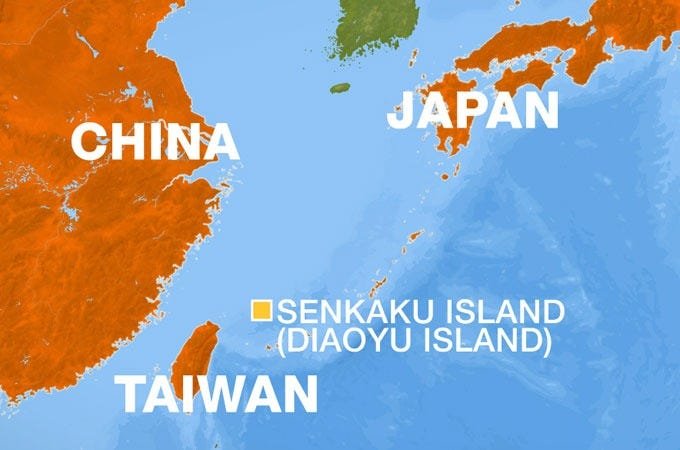
Senkaku / Diaoyu Islands
Keep in mind that the Ryukyus were not part of Japan until 1879. The Ryukyus were an independent and prospered through trade with China. The Japanese took over, banned the language and culture.
Then there is Dokdo Island, which is occupied by South Korea and which the Japanese call Takeshima. She has said that a Cabinet Minister should attend the ceremony to mark “Takeshima Day,” held in Shimane every February to demonstrate Japan’s sovereignty over the islet — although this is a local rather than national event.
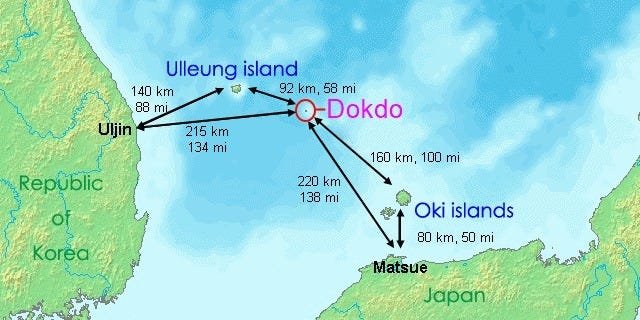
Dokdo / Takeshima Island
OK. Not exactly WWII again . But. .
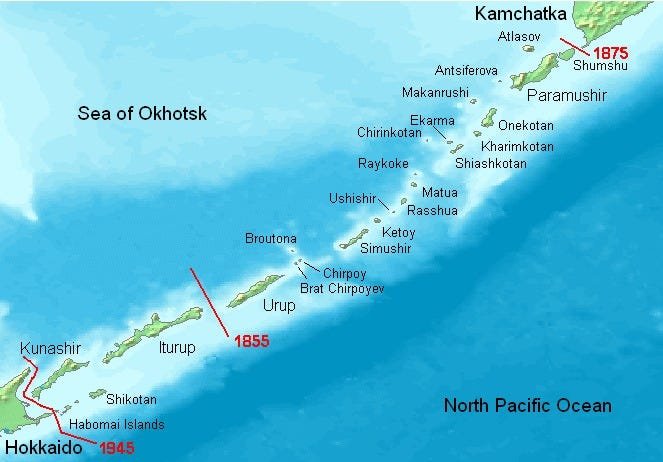
Kurile Islands / Hokkaido
Let us keep in mind that Japan only took Hokkaido after the Boshin War of 1869. It was its first step towards emulating the colonialism and imperialism of the West. The Ainu peoples were to the Japanese what Native Americans were to Americans. Japan’s first attempt at genocide.
The Russians understand history only too well.
Japan’s new prime minister, Sanae Takaichi, in a speech last week, scolded Russia for its “aggression against Ukraine” but also said that Japan maintains “its policy of resolving the territorial issue and concluding a peace treaty.”
The territorial issue is of course the Kurils which Japan lost as a consequence of WWII, just as Russia lost the southern part of Sakhalin as a consequence of the Russo Japanese War fo 1904. What goes round, comes round.
Russian Foreign Ministry spokeswoman Maria Zakharova said she had not seen anything new in the remarks by Takaichi, and that for any progress Tokyo would have to change its tone.
“We have repeatedly stated before that the path to resuming dialogue with Japan will open only after Tokyo actively abandons its anti-Russian course aimed at harming our country and its citizens,” Zakharova told reporters when asked by Reuters about the prospects for a peace deal.
Zakharova said Tokyo’s “unfriendly” policy towards Russia had led relations towards a dead-end.
“This unfriendly dead-end approach was chosen by the Japanese side, not by us,” Zakharova added.
Prime Minister Sanae Takaichi has sidestepped a commitment to maintain Japan’s decades-old pledge not to produce, possess or host nuclear weapons over apparent concerns about the U.S. “nuclear umbrella.”
Formulated in 1967 and known formally as the country’s Three Non-Nuclear Principles, the pledge has consistently been upheld by governments since.
Takaichi told opposition lawmakers in parliament Tuesday that, as her government gears up to revise the country’s key national security documents by the end of 2026, “it is not yet at the stage” where she could “definitively state” that the wording of the principles will remain the same.
Of course, the Three Principles is an excuse for permitting American bases all over the country. Do they have nuclear weapons? Japan allows nuclear armed American ships and aircraft to “transit” through Japan How long is the stopover? Don’t ask, don’t tell.
Without the three principles, things get complicated. Japan might want to develop its own weapons and reduce the number of American bases.
Let us remember, however, that this winging to the right is what that declining nations do.
We see this in Europe too. Beat the drums of war, build up a sense of threat and fear, so that people will invest their hopes for the future in a strong leader, who is somehow “different”, but adhering to traditional beliefs. Change but no change. Or as Obama said, “Change you can believe in”.
But Japan needs China —not just for its huge market but for its technologies ==for example the rare earth magnets that Japanese consumer electronics rely on.
Should China — Japan’s main trading partner — stop cooperating economically, Japan is in trouble. The G7 economies no longer represent viable markets for its products in the future.
Japan needs Russia and South Korea too. So alienating these countries is not a recipe for economic success.
In addition, Japan needs access to the vast resources of Russia— not just Russian gas and oil, but wood, minerals, and the like, including foodstuffs.
Economic cooperation with South Korea is important too. Again, technologies matter.
As for “work-life” balance, a grueling balance between men in the workplace, women in the home was an aspect of Japan’s reindustrialization in the 50s and 60s. Ironically Japanese society then was one of the most egalitarian in the world—except for women, of course. 90% of Japanese then thought themselves “middle class”.
It must be said also that in those days Japanese white collar workers at least rarely did much from 9 to 5 — everything was accomplished in overtime—which paid extra.
Now things have changed.
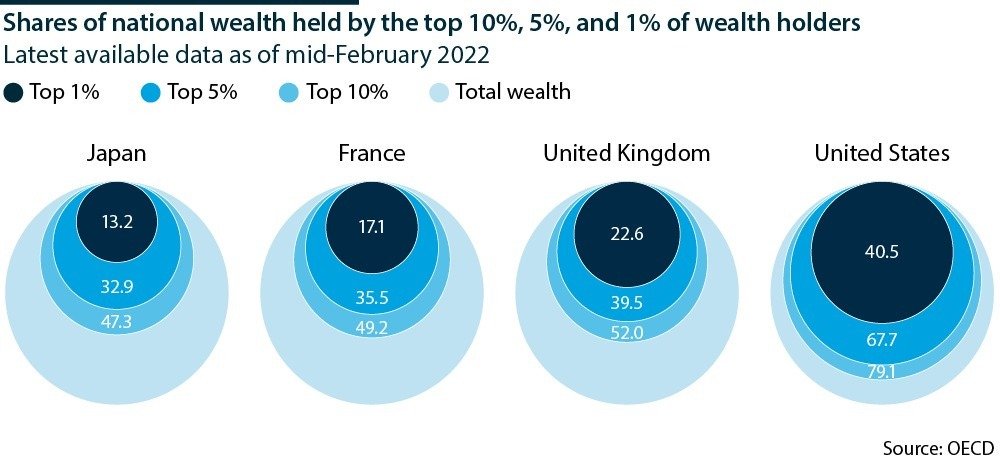
Wealth in Japan today is flowing upwards as it is in all financialized societies. It isn’t as bad as in the France or the UK or the US— but is that a valid comparison?
Japan is more and more unequal. Of course it was always unequal for women But with future money earning partners in short supply, things are worse.
Marriage rates have dropped. Birthrates too. Nobody has sex anymore.
How long before the Japanese population reaches 50,000,000?
This is Takaichi’s honeymoon but it will be over sooner or later. She might well win the next election but she has no new ideas, no solutions, just same-old, same-old. Yes, she’s a woman— an honorary member of the Old Boys Club.
Just like Thatcher was.
Targeting allies and manufacturing foes is the last card available to the Empire of Chaos.
Pepe Escobar – Strategic Culture
China is right in the middle of a true tech onslaught – which in several ways works as a sort of wrap-up of Made in China 2025, conceived and launched 10 years ago, and a resounding success even facing at least two tariff/sanctions offensives by Trump 1.0 and Trump 2.0.
A stellar Chinese analysis by Chen Jing, published by my friends at Guancha in Shanghai, concisely interprets the importance of key vectors and variables linked to the tech onslaught. Here’s an essential breakdown, with my own comments.
The China-US decoupling
The US as a Chinese export market now represents less than 10% of total exports. In parallel, as I observed in my visits to China this year – from Shanghai and Beijing to Xian and Xinjiang – there’s no psychological fear anymore of the much-touted “decoupling”. After the Trump-Xi meeting, it became clear that what is already in effect is a managed decoupling. Beijing is cool, calm and collected: after all, it’s able to expand in markets all across the Global South. Especially because more trade usually walks side by side with more infrastructure development projects: that’s the logic behind the New Silk Roads/BRI.
China’s 15th Five-Year Plan
What was recently debated in four days in Beijing – and will be approved next March during the Two Sessions – is already rolling, as in “decisive breakthroughs in key core technologies in major areas such as integrated circuits, industrial machine tools, high-end instruments, basic software, advanced materials, and biomanufacturing.” That’s all Made in China 2025 material. The conclusion is stark: sooner, rather than later, China simply won’t need anything from the Western high-tech industrial chain. Call it industrial decoupling. And the cards, once again, are Made in China.
The US debt crisis
The analysis recalls a comparison between the US debt in 2019, before Covid – $21 trillion, with $300 billion in annual interest – with 2025: $38 trillion, with interest projected at $1.3 trillion, way ahead of the Pentagon’s budget. You don’t need to be Prof. Michael Hudson to do the math: long-term US debt is the ultimate – unpayable – nightmare. And the US debt has alreay morphed into a US dollar crisis.
The SWIFT factor
The analysis touches on a key issue regarding SWIFT. The US dollar is still responsible for approximately 47% of SWIFT transactions. The yuan share, meanwile, fell from 4.74% in July 2024 to 2.93% in August 2025. So the yuan is not exactly becoming more international. Why? Bacause the yuan is being decoupled from SWIFT, on purpose: China is encouraging the Global South – no less than 189 countries and regions – to use CIPS on international trade/financial transactions. CIPS is progressing non-stop: a year-on-year increase of approximately 42% compared to 2024.
Call it China preparing itself for financial decoupling. Even if Washington decided to cut off China from SWIFT like it did with Russia, Beijing would have no problems leveraging its massive trade power to then really internationalize the yuan.
A new path of globalization, with China at the core?
The rare earth saga.
In 2025, China entered escape velocity. The reaction to the Trump Tariff Tantrum came with unwavering self-confidence. It was a marvel to observe that on the spot in Shanghai. The analysis recognizes that much of China’s force derives from its rare earth potential.
Already in July 2023 export controls were imposed on gallium and germanium. This summarizes China’s share and position in the production of metals and rare elements, showing that “China’s advantages go far beyond the 17 rare earth elements that have recently caused panic and helplessness in the Western camp.”
There are 21 elements in the export control list; only seven are medium and heavy rare earth elements. There are several other categories such as rare refractory metals, rare dispersed metals, rare light metals, and non-ferrous heavy metals.
One of the key points of the analysis is that not only the US, but the G7 as a whole no longer has the power to dictate the rules of the global economy. China “can withstand the G7 on its own”. Especially when the myth of US industrial strength has been shattered.
That opens a new Pandora’s box of discussion: is the global majority already moving to a new path of globalization, with China at its core?
The AI bubble
So AI may turn out to be the US’s last hope to turn the tide. The problem is the humongous size of the US AI bubble – a pillar of the US economy. It will eventually burst – and the consequences are unimaginable.
Meta, OpenAI, Nvidia, and others are pouring stratospheric funds into scaling-up large language models (LLMs) and massive data centers. That may not be enough to prevent the AI bubble burst – in an environment dictated by mega-corporations only focused on quick profits.
Cue to a quite worrying prospect fueling their paranoia. Several high-level Chinese models – such as DeepSeek, QWEN and the Kimi K2 series – already dominate global AI open source. The Americans practice “closed-source” – where the thing that matters most is how to monetize their gigantic models.
China is playing a very clever game: delaying the release of Deep Seek R2 – an open source, large-scale model. Why? Because releasing it now would mostly benefit Nvidia’s GPUs, boosting their sales and of course the US stock market.
China is nearly ready to complete domestic GPU computer clusters. DeepSeek R2 is built upon these clusters. The result: that will directly disrupt US dominance. As a Shanghai expert puts it: “How can American AI, hampered by power shortages, lack of open-source access, and high energy consumption, compete with the low-power, open-source, large-scale model that offers a significant advantage?”
MAGA: the Magically Globally Aggressive model
At the recent AI Future Summit, Nvidia’s Jensen Huang went straight to the point: China would definitely win the US-China AI competition.
A key reason is that China’s AI is about productive capitalism – and not speculation. Chinese AI is primarily used in industrial manufacturing sectors such as mining, energy, water conservancy, metallurgy, and military. Large-scale AI models combined with sensors, industrial communication, and automated control at their core, are largely applied to real-life applications, addressing real-life problems in meteorology, marine agriculture, earth machinery, aerospace, civil geology. They truly integrate algorithms and computing power into production.
History tells us that all industrial and tech revolutions have been closely related to real-life production – from steel production and electricity generation to the chemical industry and telecommunications engineering.
All that brings us back to the defining psycho-killer outlook of the Trump 2.0 administration. Incapable of really “winning” a tech war against the largest economy on the planet by PPP, the imperative has switched to harassing and plundering weaker nations seen as easy prey, especially in terms of grabbing their natural resources.
Meanwhile, domestically, Trump 2.0 dreams of reviving manufacturing – the MAGA way. Call it the Magically Globally Aggressive (MAGA) model, deviating attention from what really matters: the monstrous debt; the declining power of the US dollar; the tech bubble; inflation; real geopolitics. Plunder – targeting allies and manufactured foes alike – is the last card available to the Empire of Chaos.
NATO having spent $400B, armed 32 countries to the teeth, and still got humiliated by the glorified gas station they mocked for decades, and now Finland’s defense minister is lashing out at China because he can’t face the truth:
Russia crushed the West’s entire Ukraine project, and the people who promised “as long as it takes” are choking on their own failure.
What Antti Hakkanen calls “China massively financing Russia’s war chest” is nothing but the howl of a man watching the myth collapse. He’s not revealing Chinese financial aid, it doesn’t exist, he’s mourning. Mourning the fantasy that Western sanctimony could bend Eurasia into submission. Mourning the delusion that sanctions would break Russia. Mourning the fairy tale that Europe’s rusted militaries, hollow economies, and performative moralism could stop a country that actually knows how to fight.
When a $400B project collapses in real time, projection becomes doctrine.
We were humiliated so badly by the gas station, let’s blame China, then it doesn’t sound quite as humiliating. That western ROI, is absolutely humiliating for the West.
And while these ministers flail, the truth they avoid is the truth they fear: Russia didn’t just survive the siege, it grew stronger, and is now an economic superpower, thanks to European sanctions. Production up. Trade soaring. A yuan–ruble axis that outflanks the dollar-euro Ponzi. An army that out-produces all of NATO’s munitions lines combined. And a political class that didn’t buckle when every Western capital bet the house on collapse. The West is left blaming Beijing, because blaming themselves would mean facing the magnitude of their humiliation.
But beneath all this geopolitical cope lies the ugliest truth of all, the industrial-scale laundering that turned Ukraine into a gold rush for Western contractors and Ukrainian elites. While Ukrainian soldiers bled in mud, the presidential inner circle lined pockets with wartime energy contracts, nuclear-grid kickbacks, and foreign aid skimmed through shell firms that all led back to the same small circle of insiders. Golden toilets. Monaco apartments. Offshore accounts fattened while families froze in high-rise stairwells during blackouts. And one day, when this war finally ends and the spell breaks, Ukraine’s own citizens will turn around and see who sold them to the highest bidder. Not Moscow. Not Beijing. But the very handlers who promised salvation and delivered only debt, depopulation, and graves. There is no amnesty in history for leaders who steal from their own dead.
Finland isn’t sounding an alarm, but it is confessing defeat. Because if a “gas station with nukes” can defeat 32 NATO militaries, devour $400B in Western investment, and still push relentlessly through Pokrovsk, then it isn’t a gas station at all — it’s a civilization with a memory, a spine, and an economy immune to Western fantasies. What broke wasn’t Russia. What broke was the illusion that the West still commands the world.
And here’s the real sting: China didn’t break NATO’s strategy, NATO’s arrogance did.
A hubris so blinding they mistook their own propaganda for reality. A delusion so deep they believed history had ended. A failure so absolute the only thing left is to blame the rising world for refusing to drown with them.
That’s the verdict of this war.
Not just defeat, exposure. And no minister in Helsinki can spin that away.
– Gerry Nolan @ TheIslanderNews
Here are a few notes on what China is up to diplomatically. The China-ASEAN free trade agreement 3.0 is the most important. Generally we drown in China information and I have so much real and valid and good developmental tidbits, that I cannot even contemplate how to present it. It has to be in tidbits. Really, this comment is not over the top. 30 Odd + travel reports with many photos, new books, large and complex analyses of where China is heading to with technologies that are mindblowing. This is before we get to our usual reporters. It appears China is building a fully fledged robot and unmanned military, AI and technology powered. We are looking into a world that is probably 30 years ahead of the muck and warmongering that we find in the west. It is both exhilirating and tiring to take a peak into all of this. It is the new world. It is also a wakeup call that Chinese citizens are mostly content with their civilization, their country and its developmental path.
Xi encourages young sinologists to bridge China, the world
China is promoting China-ASEAN FTA 3.0 upgrade protocol’s early entry into force: MOC spokesperson
China’s innovation drive is reaching fever pitch in 2025. Let’s cut to the chase and focus on four crucial domains.
1.The Huawei Factor
1.Huawei is already testing its first, self-developed EUV lithography machine capable of producing 3nm chips. Trial tests are going full blast at the research center in Dongguan, and mass production should start in 2026.
It’s impossible to overstate how much of a game-changing paradigm this Chinese breatkthrough – specifically in laser-induced discharge plasma (LDP) – is all about. It’s set to turn the seminconductor technology environment totally upside down.
The physics involved in Huawei’s LDP is fundamentally different from the method employed by the Dutch ASML’s de facto monopoly. This being China, it’s simpler, smaller and cheaper.
Huawei’s technology is bound to smash that monopoly while solidifying China’s chip independence. Talk about cost efficiency: Huawei aims to produce EUV machines at a fraction of the cost of ASML’s (around $350 million for each unit), and no less than flood China with homegrown 3 nm chips.
All that is happening after the proverbial Western “experts”, following the 2019 sanctions imposed by Trump 1.0, dictated that China would take up to 15 years to just catch up. After all, EUV technology is too deeply embedded in the Western-controlled supply chain. It was assumed that China would never be able to smash the monopoly.
Well, of course any monopoly is smashable when public-private partnerships – in academia and tech – release untold billions of dollars into R&D, rally the best minds, and focus on building an EUV eco-system from scratch.
This is not only about tech; it’s a geoeconomic and geopolitical earthquake. There was a serious debate going on across China that it would be a matter between 2 and 3 years to cut off any dependence on US/Western tech. Well, Huawei and SMIC will be moving closer to mass production of these 3 nm chips already by next year. Not hard to do the math on where the future of global chipmaking lies.
Invest In R&D And Reach Patent Heaven
Now cut to Fan Zhiyong, Huawei’s Vice-President and Minister of Intellectual Property, talking at the company’s 6th Innovation and Intellectual Property Forum this past Tuesday.
He explained how “from the brand-new HarmonyOS 6 operating system to the powerful Atlas 950 supernode, our R&D team has achieved remarkable successes. Although many leading software and hardware products are massive systems engineering projects, we are making every effort to make them open to everyone.”
Huawei conducts an innovation and intellectual property forum nearly every year, discussing the importance of open/protected intellectual property as well as promoting its Top Ten Inventions: this year they featured, among others, supernodes; the Harmony OS; foldable screens; short-range optical interconnects; and next-generation solid state drives.
There’s no secret: a lot of investment in R&D is behind all these breakthroughs. Over the past five years, Huawei has invested more than 20% of its annual sales revenue in R&D. According to the EU Industrial R&D Scoreboard 2024, Huawei is Number 6 globally in R&D expenditure.
Huawei does not see these accomplishments as leading to a “closed garden”. On the contrary: the strategy is to foment an “open industry”, including the launch of a series of new open source software and hardware.
This opennes is reflected by the fact that Huawei is one of the world’s largest patent holders. By the end of 2024, Huawei held over 150,000 valid authorized patents globally, ranging from over 50,000 Chinese patents to over 29,000 patents in the U.S. and 19,000 in Europe.
And that brings us to…
2. Total Tech Sufficiency
And of course that is centered on AI. Cut to three recent key tech moves:
A. Beijing has banned foreign AI chips in every state-funded data center across the nation. Exempted will be only a few private companies which build their own data centers.
B. Local and regional governments were encouraged and are already subsidizing the electricity bills of AI data centers. China has a key infrastructure advantage over the US: cheap and extremely abundant power – as I saw it in my recent travels in Xinjiang. That is essential to offset the cost of switching to domestic chips, a more energy-intensive operation. For example, Huawei’s AI server system – CloudMatrix 384 – consumes more energy than Nvidia’s NVL72 system.
C. Beijing is also rolling out a new, ambitious “AI Plus Manufacturing” plan, included in the broader AI Plus initiative.
Point A is ultra-pertinent because Trump 2.0 is debating whether to allow Nvidia to sell a downgraded version of its Blackwell chips to China. Nvidia’s CEO Jensen Huang is lobbying for it like there’s no tomorrow, desperate of losing the Chinese market to Huawei for good. He bombastically announced that China is only “nanosenconds” behind the US on semiconductors.
Point C is also ultra-pertinent because as we saw with the Hauwei factor, Beijing is going for no holds barred AI chip self-sufficiency.
Beijing is deploying a very clever strategy. No foreign chips in data centers means a de facto protected market to domestic chip innovators which match foreign chip performances. Talk about a massive incentive.
Li Lecheng, Minister of Industry and Information Technology (MIIT), has announced that MIIT will soon issue an “AI Plus Manufacturing” plan, focusing on rolling out AI upgrades in key industries; expanding intelligent assisted design, virtual simulation, and early defect detection; promoting brand new AI-enabled mobile phones and computers; and accelerating R&D for next-generation intel devices such as humanoid robots and brain-computer interfaces.
In a nutshell: that is how Beijing wants to implement AI in every nook and cranny of the Chinese economy. It’s a no holds barred total innovation strategy. Sanctions? What sanctions?
What A Stable And Resilient China May Accomplish
3. Clean Energy
This revolution is already on – with China leaping ahead of the whole collective West, installing, for instance, nearly 900 gigawatt of solar capacity, more than the US-EU combo.
Last year, China generated 1826 terawatt/hour of electricity out of solar and wind power – five times the energy equivalent of all its nuclear warheads.
Yes: that’s a certified energy superpower.
4. An Early-Warning Detection Big Data Platform
The Nanjing Research Institute of Electronics Technology – China’s number one defense-electronics center and a hub of key innovation even under US sanctions – is developing a ground-breaking “distributed early-warning detection big data platform” capable of tracking up to 1,000 missile launches worldwide in real time.
The platform fuses data from an enormous array of space-, air-, sea-, and ground-based sensors, using advanced algorithms to distinguish warheads from decoys and proceed to action across secure networks.
The system integrates literally anything: fragmented, heterogeneous data streams from multiple sources – radars, satellites, optical, electronic reconnaissance systems – no matter where they come from, and when.
Cue to the system’s integration with interceptor missiles. During the Victory Day military parade last September in Beijing, China presented a new generation of air defense and anti-ballistic missiles, including the HQ-29, capable of intercepting hostile missiles beyond the atmosphere. Call it the Chinese Dragon Dome.
These are only 4 vectors amid the concerted Chinese tech drive, one of the key themes of the next Five-Year Plan to be approved next March in the “Two Sessions” in Beijing.
Now cut to Ronnie Chan, the Chair Emeritus of the Asia Society and the chairman of its Hong Kong Centre. He’s one of those affable old-school Hong Kong elite members who’s seen it all – and capable of synthesizing what’s ahead in a sharp and sweet manner. What he said recently at a seminar organized by the Shanghai Development Research Foundation could not be more relevant.
Let’s take just three key takeaways:
1.
“The Chinese people are resilient and patient. As long as domestic stability is maintained, external pressure only strengthens their endurance (…) in this China–U.S. rivalry, there will be no true winner, but the side that stands longer in the end will be China.”
2.
“China’s economy has not been over-financialised, and it continues to be grounded in the real economy. Only when manufacturing is strong can a nation remain stable and resilient.”
3.
“China must stay calm — neither blindly optimistic nor blindly pessimistic. China possess a vast market, a complete industrial chain, and a diligent population. As long as internal stability holds, external pressures cannot defeat it. The real opportunities ahead do not lie in real estate or finance, but in the service sector and innovation-driven real economies.”
There is no Chinese “miracle”: it’s all about planning and hard work.
And now to the next stage: no holds barred innovation.
“These gentlemen are the moral equivalents of America’s Founding Fathers.” — President Reagan meeting with Freedom Fighters from Afghanistan (Mujahedin), Oval Office, 1985.
Nima AlKhorshid interviews our roving eye nomad on the central Asian Stans, Al Qaeda ‘R US, and other travails of stark-naked Anglo-Zionists.


What was once a theoretical discussion in U.S. military journals about blockading China’s oil supply is now steadily turning into a tangible, multi-layered strategy aimed at containing Beijing and preserving American global dominance.
At first glance the paper looks like US policy thinking considered, then moved past the idea of blockading China. Instead, the paper merely listed a number of obstacles impeding such a strategy in 2018—obstacles that would need to be removed if such a strategy were to be viable in the near or intermediate future—and obstacles US policymakers have been removing ever since.
More contemporary papers published, including those among the pages of the US Naval Institute (here and here), have updated and refined not just an emerging strategy to theoretically confront and contain China, but a plan of action taking tangible shape.
Cold War Continuity of Agenda
Throughout the Cold War and ever since its conclusion, the US’ singular foreign policy objective has been to maintain American hegemony over the globe established at the end of the World Wars. A 1992 New York Times article titled “U.S. Strategy Plan Calls for Insuring no Rivals Develop” made it clear the US would actively prevent the emergence of any nation or groups of nations from contesting American primacy worldwide.
In recent years this has included preventing the reemergence of Russia as well as the rise of China. It also involves surrounding both nations with arcs of chaos and/or confrontation—either through the destruction of neighboring countries through political subversion, or the capture of these nations by the US and their transformation into battering rams to be used against both nations.
Ukraine is an extreme example of this policy in action. The US is also transforming both the Philippines and the Chinese island province of Taiwan into similar proxies vis-à-vis China.
Beyond this, the US seeks to prevent the majority of nations currently outside US dominion from joining with and contributing to the multipolar world order proposed by nations like Russia and China.
This strategy of coercion, destabilization, political capture, proxy war, and outright war has been used to target both Russia and China directly, their neighbors, and a growing list of nations far beyond their near abroad.
Strengths and Weaknesses of American Primacy
Enabling this strategy is America’s global-spanning military presence facilitated by its “alliance network.” This network of obedient client regimes both hosts US military forces and serves as an extension of US military, economic, and increasingly military-industrial power. US “allies” often pursue US geopolitical objectives at their own expense.
Again, an explicit example of this is Ukraine, which is locked in a proxy war with Russia, threatening its own self-preservation as a means of—as US policymakers described in a 2019 RAND Corporation paper—“extending Russia.”
While conflicts like that unfolding in Ukraine or the US-backed military build-up in the Philippines or on Taiwan has exposed a critical weakness of the United States—its lagging military industrial capacity vis-à-vis either Russia or China, let alone both nations—the US has demonstrated the ability to compensate through geopolitical agility the multipolar world is struggling to address.
This includes the ability of the US to mire a targeted nation in conflict in one location while moving resources across its global-spanning military-logistical networks toward pressure points in other locations, overextending the targeted nation and achieving success in at least one of the multiple pressure points targeted. The US successfully did this through its proxy war against Russia in Ukraine, which tied Russia up sufficiently for the US to finally succeed in the overthrow of the Syrian government, where Russian forces had previously thwarted US-sponsored proxy war and regime change.
It also includes the ability of the US to target partner or potential partner nations of Russia and China through economic, political, or even military means in ways Russia and China are unable to defend against—including through political subversion facilitated through America’s near monopoly over global information space.
These advantages the US still possesses also make potential maritime blockades very difficult for Russia and China to defend against.
Russian Energy Shipments as a Beta Test for Blockading China
France recently announced seizing a ship accused of being part of Russia’s “ghost” or “shadow” fleet—ships refusing to heed unilateral sanctions placed by the US and its client states on Russian energy shipments.
This was just one of several first steps toward what may materialize into a wider and more aggressive interdiction or blockade of Russian energy shipments. This may also be a beta test for implementing a long-desired maritime blockade on China.
A rapid, full-scale blockade would cause energy prices to spike and could blow back to the US as negative economic consequences. By incrementally pressuring Russian energy shipments, the US can slowly adjust energy markets in an incremental manner to cushion a sudden shock the public would immediately notice and potentially react to.
Russia and the rest of the multipolar world’s response to this increasingly aggressive targeting of maritime shipping may determine whether or not the US adopts the strategy of maritime blockades on a wider scale.
Setting the Stage for a Blockade of China Has Already Begun
The 2018 US Naval War College Review paper lays out the realities of a potential blockade against China in 2018, noting the various opportunities and risks associated with such a strategy.
The paper notes that “China’s reliance on seaborne oil supplies has risen steadily over the past decade and could rise further as domestic production declines” and that “the imported oil passes overwhelmingly through the Strait of Malacca and a handful of other passages that the U.S. Navy could seal off effectively.”
It also talks extensively about a “distant blockade,” it says would be “imposed far from the Chinese coast, reducing the threat to U.S. forces from Chinese A2/AD systems.”
This recognizes China’s growing military capabilities—military capabilities US policymakers admit are being developed and deployed to defend China, not project military power abroad—a fact US policymakers openly seek to exploit through America’s existing, global-spanning network of military power projection.
The paper includes a map marking various maritime chokepoints the US Navy then and today is capable of closing off beyond the reach of Chinese military power, backed by the growing US military footprint in the region, particularly across the Philippines, Japan (as well as its island province of Okinawa), as well as the Chinese island province of Taiwan itself.
It also mentions ongoing efforts by China to establish land routes to circumvent these maritime chokepoints, including the Myanmar-China oil pipeline, claiming:
A distant blockade also would need to interdict the Myanmar–China oil pipeline, which eventually could move as much as 440 kbd of crude oil from Kyaukpyu in coastal Myanmar to Yunnan Province in southwest China. Preventing tankers from off-loading at the Kyaukpyu terminal would require few, if any, naval platforms to remain on-site. The area could be declared an exclusion zone for the duration of a conflict, and if the Myanmar authorities failed to comply, the facility could be disabled via air strikes, aerial mining, or other kinetic action. In short, U.S. forces likely would be able to neutralize rapidly China’s overland routes for seaborne oil imports to avoid the Strait of Malacca and other choke points farther east and prevent them from diverting forces needed to seal other maritime ingress routes.
Far from just theoretical war planning, this Myanmar-China oil pipeline has since been targeted by US-backed militants operating inside Myanmar, fighting the central government, and using the conflict as cover to strike at, compromise, and even destroy Chinese investments across the Southeast Asian country.
In February 2022, the US National Endowment for Democracy (NED) funded opposition media organization, The Irrawaddy, reported in its article, “China-Backed Pipeline Facility Damaged in Myanmar Resistance Attack,” that:
An off-take station of the China-backed oil and gas pipelines was damaged when a local resistance group attacked regime forces guarding the facility in Mandalay Region…
And that:
Anti-Chinese sentiment swelled in Myanmar following the military coup last February, with many people believing Beijing had a hand in the takeover. At that time, there were calls for a boycott of Chinese products, along with calls to blow up the pipelines if China refused to condemn the regime.
The calls prompted China to urge the regime to increase security for the pipelines. Since March last year, the regime has assigned extra forces to protect them.
Likewise, the US has been backing extremists in southwest Pakistan to target the Chinese-built China-Pakistan Economic Corridor (CPEC) over the course of several years spanning the Obama, first Trump, Biden, and now second Trump administrations (including in 2021, 2024, and 2025).
In other nations, like the Southeast Asian Kingdom of Thailand, US-sponsored opposition leaders like billionaire Thanathorn Juangroongruangkit have openly campaigned to stop Chinese infrastructure projects like high-speed rail lines as part of slowing down, stopping, or even reversing progress for China’s BRI network and thus eliminating the BRI as an alternative to circumvent a US-imposed maritime blockade on Chinese shipping.
The 2018 paper also identifies Russia as a primary alternative source for Chinese energy imports—which is one of the reasons the US is waging its ongoing proxy war against Russia through Ukraine and why the US is overseeing an expanding campaign to attack and destroy Russian refineries and other forms of energy infrastructure across Russia.
In other words, while US policymakers envisioned an opportunity for using US military power to attack and dismantle China’s Belt and Road Initiative infrastructure amid a US-Chinese conflict and other measures to cut China off from crucial energy imports, including from Russia, since then, the US has used armed extremists it funds and backs inside nations hosting Chinese BRI projects to begin attacking these projects before any direct US-Chinese conflict commences—together with a dangerously large proxy war being fought against China’s ally, Russia, to complicate or cut off significant alternative energy imports.
The paper concludes that any blockade should not be seen as a single, independent solution to eliminating an adversary and that the US must also continue building up the forces necessary to wage war against China as well.
Since the paper was published, the US has pursued both continued preparations for a maritime blockade of China itself, as well as build up a number of regional proxies to wage war against China, as the US wages proxy war against Russia in Ukraine and, increasingly, through the rest of Europe.
While this reality continues to take shape, political rhetoric in Washington attempts to disarm China and its allies from taking action to prepare for the inevitable confrontation the US is preparing for by creating the impression Washington seeks to “retreat” from the “Indo-Pacific” region to defend the “homeland” in the Western Hemisphere.
While some in the public and even across the alternative media have fallen for this rhetoric, it is unlikely anyone in Beijing, Moscow, or other BRICS capitals could be so naive—especially as these empty words from Washington are overshadowed by the US’ continued physical militarization of China’s periphery, continued regime change operations along China’s borders—most recently in Nepal—and the continued US proxy war against Russia aimed specifically at crippling its energy production capabilities—a key prerequisite for a successful maritime blockade of China.
To understand Washington’s strategy toward China, one should not look to the political rhetoric of “retreat” or “homeland defense” in the Western Hemisphere, but rather to the tangible actions taking place across the Asia-Pacific and beyond—the meticulous encirclement of China’s periphery, the sustained attacks on its critical overland energy and trade links (BRI/CPEC), the calculated incapacitation of Russia as a potential energy supplier, and the establishment of local proxy forces (the Philippines, Japan, separatists on Taiwan) prepared to wage war.
Far from an abstract or “flawed” concept relegated to think-tank papers, the maritime oil blockade—or wider general blockade against China—is being incrementally prepared in real-time. By systematically removing the very obstacles noted in the 2018 Naval War College Review paper, the US is demonstrating a clear, unwavering commitment to a multi-layered strategy of containment, coercion, and confrontation designed not just to prepare for conflict, but to make that conflict both inevitable and successful for the singular goal of maintaining global American hegemony.
Doing their own work well
A summary of last week in China by Trivium
Even as US-China trade dynamics command the global spotlight, Chinese leaders are focused on “doing [their] own work well.”
After weeks of dissecting the trade war drama, it’s nice to be able to turn back to analyzing China’s domestic regulatory environment – aka “the Trivium wheelhouse.”
Three specific developments this week highlight Beijing’s determination to press ahead with its overarching technological ambitions – even as external distractions mount:
Let’s take these one by one.
First, on November 5, Reuters reported that authorities have ordered state-funded data centers to stop using foreign AI chips in new projects or those still early in construction:
The vast majority of data centers take at least some state funds, so under these requirements, only a small subsection of private companies that build their own data centers would be exempted from the rules.
This all matters because Washington is debating whether to allow Nvidia to sell a downgraded version of its Blackwell chips to China.
Second, on November 4, the FT reported that China’s local governments are subsidizing electricity costs for AI data centers:
The key point here is that Beijing is trying to capitalize on one of its few AI infrastructure advantages over the US – cheap and abundant power – to offset the cost of switching to domestic chips.
To get more concrete, Huawei’s AI server system – CloudMatrix 384 – is less energy-efficient than Nvidia’s NVL72 system.
That’s why China’s plentiful supply of cheap energy is a boon for its AI ambitions.
This is a moment that Chinese policymakers are trying to force: By tightening access to even the most advanced foreign chips in data centers, as discussed above, Beijing is tacitly promising a protected market to domestic chip innovators that come close to – or meet – foreign chip performance.
The key point: If China’s chipmaking ramp happens before the US resolves its power bottlenecks, Beijing will slingshot ahead in the AI race.
And third, on November 3, Li Lecheng, Minister of Industry and Information Technology (MIIT), revealed that MIIT will soon issue an “AI Plus Manufacturing” plan, under the aegis of the broader AI Plus program.
The plan won’t be short on ambition, with Li indicating it will focus on:
Why it matters: This AI Plus Manufacturing plan will offer one of the clearest roadmaps yet for how Beijing intends to diffuse AI across the economy – which is a cornerstone of its broader innovation and industrial-upgrading goals.
Putting it all together: Just when you might have expected Xi Jinping and co. to sit back and breathe a sigh of relief after sealing a trade deal with the US, officials instead pushed forward on three major AI policy fronts in a single week.
The bottom line: China’s leaders will stay laser-focused on the innovation agenda – undeterred by any distractions from the US, or other Western governments, on the trade front.
America always talks trash about China, but China just makes things, and barely talks about America at all. It’s a bit embarrassing, don’t you think? You spend all your time hating on someone, and they don’t bother to hate on you in return. America gets no shout-outs in China’s latest Five-Year Plan, not even in opprobrium. All China says, obliquely, is “A profound shift is taking place in the international balance of power,” while America violently loses its cool about the same situation. China continues, “Breakthroughs are accelerating in the new round of technological revolution and industrial transformation,” while America is deindustrializing Europe and trying to defibrillate its economy with an AI bubble. These nations are not the same and you can see it on the page. China’s sticking to its vision, while America is lashing out in a blind rage.
American policy has been desperately trying to reorient to China since the Obama era at least, but they can’t get there through all the still smoldering conflagrations of history. They desperately want to write a new chapter of imperialism against a worthy enemy, but are stuck doing reboots of war with Russia and genocides in the Middle East. In response to America’s retardation and Europe’s deindustrialization and the whole White Empire’s disintegration, China only position is, “All this has created positive factors enabling China to make proactive moves in the international arena and shape a favorable external environment.” Or as Napoleon said, when your opponent is defeating themselves, let them be.
While the White Empire is distracted to disintegration with multiple land wars in Asia, China is fighting no one and focused on improving life for its own citizens. This leads to very different outlooks and very different documents. American policy documents are very Empire focused and they’re desperate to restart the Cold War, with China as the new red scare to drive new spending. China, on the other hand, just doesn’t think like this. They’re focused on their own business.
As Chairman Xi said in his notes on the Five-Year Plan, “We must work to strengthen the domestic economy and boost domestic economic flows, so as to leverage the stability of the domestic economy as a hedge against uncertainties in the international economy.” While America is trying to tax everyone else’s economy through tariffs (though Americans end up paying them) China is just trying to develop their own country. While America is trying to bomb other people’s infrastructure to smithereens, China is building. These are very different visions. At this point, America is just hating and most infuriatingly for a hater, China is mostly ignoring them.
Of course, China does talk about America indirectly. We all know who they’re talking about when they say, “We should promote an equal and orderly multipolar world and universally beneficial and inclusive economic globalization, expand our global network of partnerships, and foster a new type of international relations.” And we all know who they’re opposing when they say, “We must resolutely oppose all hegemonic, high-handed, and bullying acts, defend international fairness and justice, and safeguard the common interests of people around the world.” However, China does not name names, which for America is a bit embarrassing. Trump is really trying to get everyone’s attention by acting ratchet, but China is just slowly turning the screws.
The fact is that there is no great power competition this century. There is a great cannibalization of the White Empire, as America devours Europe and other vassals, and—on the other hand—a great liberation of Asia, as China, Russia, and Palestine rebel, either violently or silently. America is, of course, dying to for some Chinese-on-Chinese violence, like it couped its way to Slav-on-Slav violence in Ukraine, but China’s not playing. If you listen to China’s statements on the province of Taiwan, they sound quite neighborly and patient.
On Taiwan there’s only a paragraph, and this is half of it. China says, “[We must] oppose external interference, safeguard peace and stability in the Taiwan Strait, and firmly maintain the initiative and the ability to steer in cross-Strait relations. Exchanges and cooperation across the Strait should be deepened and people on both sides should work together to preserve and carry forward Chinese culture.” China knows what everyone defeating America for the past 50 years knows, that you can just wait.
All of this must make America irate. America doesn’t have five-year plans of course, they like to change governments every four years or so, so oligarchs can rule above the fray. But they do produce a lot of reports, which all talk about China as a ‘pacing threat’ for their military or a ‘peer competitor’ in AI or technology, and China does not talk about them this way, which must be infuriating.
In military matters China says, “The principle of building the armed forces through diligence and thrift must be fully implemented to ensure that military development is efficient, cost-effective, and sustainable.” That’s not how America talks about their military, they just shovel money at it. But China already knows that their military is technically superior to America’s, if unblooded, and they have no need to inflate their military budget because they’re uncorrupted by blood money.
In AI matters, which is not the main matter, China says, “We should accelerate innovation in digital and intelligent technologies such as AI, make breakthroughs in basic theories and core technologies, and ensure more efficient supply of computing power, algorithms, and data.” China already proved that you can make AI more efficiently with DeepSeek, but OpenAI is pretending that never happened, to keep up their GPU grift. But China has no need to inflate an AI bubble because they’re also not corrupted by tech money.
As you can see, and as I’ve said, these things are not the same. America’s goal is world domination, while China simply says, “Meeting the people’s aspirations for a better life is the immutable goal of Chinese modernization.” These are very different propositions. In many ways, America is talking past China. China isn’t trying to overthrow America, they’re just trying to grow their own civilization back to the relative position they were in before colonization. Meanwhile America is overthrowing itself by having such a violent conniption, in every direction. America is desperately trying to talk trash about China, but China is just not paying attention and walking right past them. It’s like Don Draper taking the elevator with Ginsberg, in the TV show Mad Men. The copywriter Ginsberg says “I feel bad for you” and the Creative Director Draper says, “I don’t think about you at all.”
l’AntiDiplomatico
Professor Parenti’s new editorial video – short and concise
China says “enough” to economic warfare. After years of sanctions and technological encirclement by the US, Beijing is responding blow for blow. Professor Fabio Massimo Parenti’s video analyzes China’s new strategy, which strikes the West at its most vulnerable point: rare earth supply chains.
It’s a clash between two worldviews: domination versus harmony. Discover how this war is redefining global balances.
Remarks by H.E. Xi Jinping
President of the People’s Republic of China
At Session I of the 32nd APEC Economic Leaders’ Meeting
Your Excellency President Lee Jae Myung,
Colleagues,
It is my great pleasure to be here in Gyeongju, a city of rich history and culture, to join you in discussing the future of the Asia-Pacific. Let me begin by thanking President Lee Jae Myung and the ROK government for the thoughtful arrangement.
Over the past 30-plus years since its founding, from drafting the blueprint of the Free Trade Area of the Asia-Pacific (FTAAP) to advancing the vision of an Asia-Pacific community, APEC has been spearheading the region’s rise to the forefront of global open development, and has made the Asia-Pacific the most dynamic part of the global economy.
Currently, changes unseen in a century are accelerating across the world. The international situation is fluid and turbulent. The Asia-Pacific faces growing uncertainties and destablizing factors in its development. The rougher the seas, the more we must pull together. We should stay true to APEC’s founding mission to promote economic growth and improve people’s lives, and champion open development where everyone shares opportunities and emerges a winner. We should promote a universally beneficial and inclusive economic globalization, and build an Asia-Pacific community. To this end, I wish to make five proposals.
First, we should work together to safeguard the multilateral trading system. We must practice true multilateralism, and enhance the authority and effectiveness of the multilateral trading system with the WTO at its core. We should stick to the right direction of WTO reform, uphold the most-favored-nation (MFN), nondiscrimination and other fundamental principles, and update international economic and trade rules to reflect the changing times, so as to better protect the legitimate rights and interests of developing countries.
Second, we should work together to build an open economic environment in the region. We should keep promoting trade and investment liberalization and facilitation, deepen fiscal and financial cooperation, and steadily push for regional economic integration. With the RCEP being implemented to high standards and the CPTPP membership expanding, we should help the two align with each other and progress together so as to inject impetus into the development of the FTAAP.
Third, we should work together to keep industrial and supply chains stable and smooth. We must join hands rather than part ways, and strengthen our links rather than sever them. We should vigorously expand our common interests, and support the open development of supply chains. The tenth anniversary of the APEC Connectivity Blueprint gives us a good opportunity to strive for concrete and tangible results in physical, institutional and people-to-people connectivity so as to further consolidate the foundations for open development in our region.
Fourth, we should work together to advance the digital and green transformation of trade. We should make digital technologies a strong catalyst for cross-border trade, and promote practical cooperation in paperless trade, smart customs and other areas. We must remove various green barriers, and expand cooperation in green industries, clean energy and green minerals. The Asia-Pacific Model E-port Network and the Cooperation Network on Green Supply Chain initiated by China under APEC have become important platforms for regional cooperation on the digital and green upgrades for trade.
Fifth, we should work together to promote universally beneficial and inclusive development. We should adhere to the people-centered development philosophy, focus on imbalances in development, and foster an economic globalization that is more inclusive, sustainable, and beneficial to all peoples in the region. China is working with various parties to promote the high-quality development of the Belt and Road Initiative, and supports the modernization drive of more developing countries, which will help open up new space for global development. We have given zero-tariff treatment on 100 percent tariff lines from the least developed countries having diplomatic relations with China, and stand ready to extend the same treatment to all African countries having diplomatic relations with China through the signing of agreements on economic partnership for shared development. We will continue to strive for common development and shared prosperity with all nations.
Colleagues,
China always pursues the basic state policy of opening up, and has taken real steps to promote an open world economy. Over the past five years, China has ranked as the world’s largest trader in goods and the second largest in services. It has attracted more than US$700 billion in foreign investment in total, and its outbound investment has been increasing by over five percent on annual average. We have been shortening the negative list for foreign investment, and applying the unilateral visa-free policy to more countries. We are steadily expanding voluntary and unilateral opening up, and have actively aligned with high-standard international economic and trade rules through our 22 pilot free trade zones. China’s door to the world will not close; it will only open wider and wider.
A few days ago, the Recommendations for Formulating the 15th Five-Year Plan were adopted at the fourth plenary session of the 20th Central Committee of the Communist Party of China. We will take this opportunity to further deepen reform comprehensively and expand high-standard opening up, and create new opportunities for the Asia-Pacific and the world through the latest achievements of Chinese modernization.
Thank you.
Gyeongju, October 31, 2025
https://www.fmprc.gov.cn/eng/xw/zyxw/202510/t20251031_11744706.html
Many of the latest unilateral coercive measures have been suspended for a year. One gets the impression that the US has been put on a state of probation. The rest makes up small issues, not very important.
BEIJING, Oct. 30 (Xinhua) — China’s Ministry of Commerce on Thursday unveiled the outcomes achieved by Chinese and U.S. delegations during their recent economic and trade talks in Kuala Lumpur.
The U.S. side will cancel the 10-percent so-called “fentanyl tariffs” and suspend, for an additional year, the 24-percent reciprocal tariffs levied on Chinese goods, including goods from the Hong Kong Special Administrative Region and the Macao Special Administrative Region, according to a spokesperson of the ministry.
China will make corresponding adjustments to its countermeasures against the aforementioned U.S. tariffs, the spokesperson said, noting that both sides have agreed to continue extending certain tariff exclusion measures.
The United States will suspend for one year the implementation of a new rule announced on Sept. 29 that expands its “entity-list” export restrictions to any entity that is at least 50 percent owned by one or more entities on the list. China will suspend the implementation of relevant export control measures announced on Oct. 9 for one year and will study and refine specific plans, the spokesperson said.
The U.S. side will suspend the implementation of measures under its Section 301 investigation targeting China’s maritime, logistics and shipbuilding industries for one year. In response, China will correspondingly suspend the implementation of its countermeasures against the U.S. side for one year once the U.S. suspension takes effect, according to the spokesperson.
In addition, the two sides also reached consensus on issues including anti-drug cooperation on fentanyl, expanding agricultural product trade, and the handling of individual cases involving relevant enterprises, according to the spokesperson.
Both sides further confirmed the outcomes of the Madrid economic and trade talks. The U.S. side made positive commitments in areas such as investment, and China will properly resolve issues related to TikTok with the U.S. side.
The China-U.S. economic and trade talks in Kuala Lumpur have yielded positive results, demonstrating that by upholding the spirit of equality, respect and mutual benefit, and through dialogue and cooperation, the two sides can find solutions to problems, the spokesperson said.
Noting that the outcomes are hard won, the spokesperson said China looks forward to working with the U.S. side to jointly ensure the implementation of the outcomes, and inject more certainty and stability into bilateral economic and trade cooperation as well as the world’s economy.
Modest concessions from China that were not a sacrifice. Xi enabled Trump to get what he really wants, a public relations orchestration.
This is a very serious conversation – the day before Xi-Trump.
Enter The Beast – or The Giant Pigeon – as the current frightening incarnation of the Empire of Chaos.
With Transcript
The money that America has given Ukraine isn’t to Ukraine — it’s not to the people — it’s to the kleptocrats that have said: We are willing to fight to the last Ukrainian. We are willing to try to drain Russia’s resources by sending Ukrainians there; and if the Ukrainian army tries to flee and retreat, we’re going to shoot them in the back — that’s what the Azov Battalion is for. So, all of this money has gone, not really to Ukraine, but to the Lvov group — the Azov Battalion — to, really, the neo-Nazis who are in charge of Ukraine. And the Ukrainians are hopeless to do anything.
NIMA ALKHORSHID: Hi, everybody. Today is Thursday, October 23rd, 2025, and our dear friends, Michael Hudson and Richard Wolff, are back with us. Welcome back, Richard and Michael.
MICHAEL HUDSON: Good to be here.
RICHARD WOLFF: Hi, glad to be here.
NIMA ALKHORSHID: Let me start with what’s going on in the European Union today. They’re talking about seizing Russian assets and sending them to Ukraine. The situation in Ukraine is getting critical in the minds of those countries who are trying to deal with the dominance of the United States, the U.S. dollar.
The question is this: If the United States and EU can freeze and seize Russia’s gold and dollar reserves, how safe is any country’s wealth under the Western financial system?
I’m going to start with you, Michael. Go ahead.
MICHAEL HUDSON: Well, it’s obvious that other countries do not feel safe. That’s why they’re buying gold. I think the rise in gold prices and central bank gold holdings reflects the inability so far of the Global Majority — China, Russia, other countries — to create an alternative vehicle for keeping their international savings in London, or in New York — in central bank assets loaned to the central banks of England, and America by investing in U.S. Treasury securities under the dollar standard, investing in European currencies. When all of this can be grabbed, all of a sudden, there’s no safe holding for other countries to hold their international reserves.
In the past, they’ve held it in New York, partly — and their gold in London — because that’s where the foreign-exchange markets were. And the purpose of holding international reserves, since World War II, has been to manage the exchange rate, so you can stabilize the exchange rate by borrowing and lending. And other countries, under the rules that the United States set up in 1944, that created the International Monetary Fund and the World Bank, were linked — all of this intervention in world currency markets — to the dollar, because that was the market at that time. That was where they had to operate.
Well, all of a sudden, this vestigial survival, from 1945, has been rendered unsafe and, hence, obsolete. So, you could say that the whole surge in gold prices means that countries are trying to find some way to avoid holding them in [that] form.
And the risk is twofold. On the one hand, the EU is still discussing how to turn this $300 billion that it’s confiscated from Russia, how to give it to Ukraine’s kleptocrats, in payment for their selling their population as, in effect, the mercenary army to NATO.
The money that America has given Ukraine isn’t to Ukraine — it’s not to the people — it’s to the kleptocrats that have said: We are willing to fight to the last Ukrainian. We are willing to try to drain Russia’s resources by sending Ukrainians there; and if the Ukrainian army tries to flee and retreat, we’re going to shoot them in the back — that’s what the Azov Battalion is for. So, all of this money has gone, not really to Ukraine, but to the Lvov group — the Azov Battalion — to, really, the neo-Nazis who are in charge of Ukraine. And the Ukrainians are hopeless to do anything.
Well, the problem’s not only, therefore, with foreign countries dealing with the central banks and the government of the United States; it’s the whole international court system that is going to — according to the EU — we are going to make sure that we never have to pay this $300 billion, because we’re going to ask for trillions of dollars of reparations for Russia defending Ukraine’s Russian-speaking population — in Luhansk and Donetsk — and now Odessa, that said: We want to be part of Russia.
And their defense is really an attack: We, the West, are allowed to attack Ukraine, to announce that the Russian speakers are subhuman. We can break the rules of law, by attacking consumer areas, civilian areas; not focus on military at all, but just try to destroy whatever is left for Russia to have. But, then, we’re going to say that they are attacking us by fighting back.
It’s like Israel accusing Gaza of attacking Israel, by fighting back against the eighty-year war against the Palestinians.
As long as you’re having the Western financial system backed by a judicial court system that, like the International Monetary Fund and EU, acts as an arm of NATO, the rest of the world is trying to break away; and the line of least resistance, for now, is to buy gold.
Well, the problem with buying gold, of course, is — in the past, countries would invest their foreign reserves in gold — Venezuela invested its reserves of gold, and it kept its reserves (as we’ve discussed before) in the Bank of [England], so that it could use these reserves as collateral when it borrowed money to intervene in the foreign-exchange market to try to stabilize its currency. That’s why countries kept their gold in either London or New York, where the major international foreign-exchange markets were.
But now, they can’t do this anymore. The Bank of England grabbed Venezuela’s gold, and it looks like the United States has grabbed Germany’s gold — and Germany’s an ally! A few years ago, Germany asked for its gold reserves to be returned from New York — [from] the Fed in New York’s basement — to Germany, for its central bank to hold itself. The United States said: Well, you know, this gold is very heavy. We’re going to have to find airplanes for that — and that’s the last that (in public) we’ve heard.
German reporters and journalists have been calling me to say: Do you know anything about what’s ever happened to this? They tell me that they’ve asked the German politicians about it. The politicians will not answer. Nobody can find out whether Germany’s got any of its gold back. And the United States is still holding onto this gold, and the rest of Europe’s gold.
So, holding gold only makes sense if you hold it in your own central banks, where the only way that it can be grabbed is for NATO to invade your country, seize the government, empty out your gold reserves and take it away — like they did in Libya, and other Middle Eastern countries. The problem that they’re really dealing with — the gold problem — is, how are we going to move beyond “gold isn’t a [practical] alternative?”
Well, the other line of least resistance that they’ve talked about is currency swaps: We’ll hold each other’s currencies (among the Global Majority). The problem with holding your currencies is, the currencies go up and down. And if you’re a creditor nation, like the United States was to Europe and the world in 1945 — and like China is today to many of the Belt-and-Road-Initiative countries that it deals with — how are you going to deal with the fact that the currency you’re holding is declining?
Russia has accumulated enormous holdings of Indian rupees that have been declining in value. And the last few days have seen the Trump administration go to Argentina, and they say: We know that you have been dealing with China very heavily, and you have a currency swap, and you owe them a lot of money; but this $40 billion that we’re giving you to support the peso long enough to get [Javier] Milei re-elected next week? In exchange for this, and our not pulling the plug on you, we want you to break all your relations to China; to not honor the currency swap; just to say, well, we’re just not going to pay you, China — what are you going to do about it?
So, currency swaps themselves are not a solution. And the BRICS currency is no solution, because in order to create a common currency among BRICS countries, it has to be like the United States creating a central bank, in which all of the American states and politicians are connected. For the EU, all of the countries had to create a political union because, if you have your own currency, who is going to get this currency? How will it be distributed? And how will various countries pay?
Until you have a political union among all the BRICS countries — which is not on the horizon, by any stretch of the imagination — you’re going to have to go back, and have the solution that John Maynard Keynes came up with in 1944, as an alternative to the U.S. designs for an International Monetary Fund: You create a new central bank, a collective central bank, that will manage the credits and debts among its member countries, in order to denominate their foreign exchange and currency swaps, to denominate these currency credits and debts in a common denominator based, basically, on the prices of their collective exports and relationships with each other. That’s the only logical solution.
I described the long debate over this in my book Super Imperialism. It took a lot of political maneuvering just for Keynes to come up with that. And of course, the United States said: No, we don’t want other countries to make any means of settlement among themselves. Any country’s settlement with any other country has to go through Washington, and the U.S. dollar.
And other countries — first of all, you had Britain surrendering to this; and the result was the loss of the British Empire and its currency reserves. Its colonies and countries using the pound were all transferred to the United States by 1950, and the pound collapsed in value, and Britain began its long deindustrialization. The rest of the European countries, once Britain had surrendered — well, there was nothing they could do but go along with it.
For the first time now, the world has gone back to 1944-1945, to create a kind of mutual foreign-bank relation to handle relations among currencies that is not run by NATO, the United States, and the Cold War. And the more gold goes up, the more you realize the inability so far for the other countries of the world to address, and solve, this problem.
NIMA ALKHORSHID: Richard, jump in.
RICHARD WOLFF: Yeah, let me put this in a context, but also to scare you.
The same logic that leads the Europeans to look gleefully at the $300 billion as a way to make it appear to their own people that the horrible mistake they made in going into a war like this — the enormous damage the war has done to their economy — to make it look as though they’re making, now, somebody else pay — which is really what this is about. It’s not enough money to change the basic layout of what’s going on. It sounds like an awful lot, and it’s a big chunk of money, but it is not adequate to alter the basic situation.
Number two: Let me scare you. China has (last time I looked) $750 billion worth of U.S. Treasury bills. What’s to prevent the United States from telling them that these are now toilet paper? We are not going to pay you the interest, and we’re not going to pay you the principal, and we’re going to deal with the rest of the world, henceforth. When we have to borrow for the American government, we will borrow from the rest of the world — end of conversation. Or, we’ll do it for half of the $750 billion.
What’s to prevent them? You know, this is crazy.
Here’s what we are watching: we are watching the end of the empire. These are the kinds of things that happen when the empire can no longer function. The United States is facing a fundamental contradiction: It cannot keep the world arrangements of the post-45 period, and fight Russia and China; and be involved in a war in Ukraine; and be gearing up to take the oil away from Venezuela — it can’t do it. That’s the problem. It can’t do it. It doesn’t want to admit it can’t do it, so it’s coming up with crazy stuff, stuff that makes no sense, other than as the end of an empire.
So, one of them is, we’re going to take — by the way, if I understand correctly, they’ve already taken the interest income from the $300 billion, and used it for the Ukraine war. Clearly, that great move didn’t change anything. And so, now, they want to take the principal. Of course, they do. You know, this is the same game. And what does it do? Everything that Michael just said, and a dozen more things.
Everybody is wondering where to keep their money now, because the empire, the emperor, is not in a position to do it anymore. The United States had said to the world: You can keep your money here because we are the safest place for anyone to keep any kind of wealth. We are the ones who will tax it the least. We are the ones who will threaten it the least. We don’t even have a socialist, or communist, party worthy of the name, in terms of its political power; so you don’t have to worry about that. We have a docile, unorganized labor force. You know, we offer you wonderful conditions. So please take a good portion of your wealth and bring it here — which gives us yet more power of an empire to give you the guarantees. You are, in fact, by locating your wealth here, funding our ability to guarantee that wealth.
That’s what an empire is. That’s what an empire does. That’s what the British did in the previous century. And now it can’t do it anymore.
Let me give you, what you wouldn’t perhaps see as, another sign. We are now executing people in boats on either side of the Western Hemisphere. We did it for a while in the Caribbean with the Venezuelans and the Caribbean [peoples]. And, now, I learned in the last two days, we’ve gone on the Pacific Ocean side, and we’ve done it again. We don’t arrest these people — no trial, no jury, no lawyers, no nothing. Summary execution — in the name of what? Of a war on drugs?
Friends, the United States has had an official war on drugs for at least the last seventy-five years. It proves unable to stop them. You can get all of these drugs anywhere in the United States — urban, rural, east, west, north, and south. We are not able to stop it.
Killing people summarily is an absurd thing for the upholder of values of law and order and, if I dare say so, a rules-based international order. What rule exactly is it? Killing people in boats?
If you arrest a person for the drug trade inside the United States, you do not kill them. Even if they are found guilty, you don’t kill them. We haven’t killed anybody in the drug trade for that crime in anyone’s memory.
Okay, so these are signs of an empire that cannot function. Of course, people are running to gold. It’s one of those things which — and I don’t believe it’s correct, but that’s another matter — but it’s a thing that people think is safer than those other alternatives. Well, what I hope people focus on is not whether it’s safer or not — In my judgment, it isn’t — but that, we can disagree. The important thing is they are running away from what is now, clearly — even though they dare not say so — a break in the behavior of an empire.
For the Europeans — look, they’ve even had a debate among themselves about it. Their lawyers are telling them: You are taking an incredible step here. Are you sure that it will not hurt Europe to have been the one to do it? Because wherever you’re wealthy, if it’s the Europeans that are doing it, then it’s Europe you’re going to be sure not to keep your wealth in. And this is something the Europeans, at a time when everyone admits their economies are in serious trouble — above all, the British, the French, and the Germans, and those are the major three in that part of the world —
You really want to, now, damage your standing as a place to hold wealth, which is where wealth has been held disproportionately for the last 500 years? This is bizarre. This is the end of the Western Empire.
Last point, before you go back [to Michael]. Part of the reason the BRICS have not developed their own currency, their own ability — which, by the way, all of these developments will provoke them to do, and to return to do, sooner rather than later. Michael is right about that —
But one of the reasons they haven’t done it, we have to keep in mind, because these are important points going on in the debates inside China: The spectacular growth of China in the last thirty-five years was itself, in part, dependent on the empire of the dollar. It was within that context that the Chinese found a way to grow faster than the United States; to become the manufacturing core of the world economy.
So, they are rightly worried — don’t make the transition out, before you are pretty damn clear that the benefits of doing so will outweigh the inevitable costs of not having what worked so well for you. There’s a joke that goes around in China about, you know, not cutting off from the United States while it is doing very useful things for the Chinese: in having the SWIFT system, in having the dollar as the universal exchange, even to the diminished degree that is now the case.
In other words, it’s the old dialectic, and we should be careful not to get caught on either side. And let me explain very quickly, then I’ll stop.
On the side of the United States is the following argument: China is only a superpower because it brought in private capitalists thirty years ago. After Mao died, and the end of the Cultural Revolution, you had a change, and in come foreign private capitalists — Japanese, European, American — and then the allowance for the Chinese themselves.
So, that’s one side of the dialectic. That happened — no question — and that was very important to Chinese growth — no question — but, at the same time, the Chinese government held on to the absolute dominant position in the Chinese economy. The government did, and the Communist Party within the government kept its power. And that is just as important a part of the growth and success of the Chinese economy. Otherwise, you can’t explain why China did so much better than any other country in the global south under the regime of American empire.
Alright, so the dialectic is the interplay between the public and the private sector. The reason they outperform the United States, is the United States doesn’t understand the dialectic, and is so caught up in its own ideology that it holds back the government from doing all kinds of things it needs the government to do. [The] Chinese don’t have that problem, and the Americans can’t see it.
So, the dialectical process now has shifted. It’s costing the West, every day. The war in Ukraine is a wonderful metaphor, despite everything. Every escalation, including the new sanctions on oil companies announced over the last twenty-four hours — like the F-16, like the Abrams tank, like the various missiles (like the Patriot system, like the HIMARS) — all of them — they didn’t work. They didn’t work. That’s why you have the escalation, at every step.
And if I were a betting person (I’m not, but if I were), I’d bet that all of this stuff, with sanctioning the oil companies, these are just ways for Mr. Trump to cut his losses. Ukraine is going down, and there will be — there already is — an enormous blame-game going on between Europeans and Americans. Who’s at fault? And so, yeah, sure, let’s sanction that, sure. The United States did its part. It’s not us. We did our part. It’s you, Europeans.
And the Europeans will say exactly the opposite.
And this game of blame will be yet another sign of an empire dissolving.
MICHAEL HUDSON: Nima, is it okay if I return to the monetary topic? International finance?
RICHARD WOLFF: Sure.
NIMA ALKHORSHID: Go ahead, Michael.
MICHAEL HUDSON: And yet, despite all of these things, the U.S. dollar has been going up. It’s certainly viewed as a safe haven for anybody. And why is it? How can the U.S. dollar be going up, while other central banks are moving out? Obviously, it’s private-sector money, and that means new credit creation. Private investors are moving their money into the dollar.
Well, this is exactly the strategy that the United States — way beyond Trump — has tried to put in place. It’s the strategy between Trump saying: Japan has to pay us $350 billion, or we will wreck their economy by blocking their trade with the United States; Korea has to pay us $350 billion, or we will block Korean exports of automobiles and computers and steel, other Korean exports, to the United States.
So, the United States has tried to make it a safe haven, despite the fact of all of the problems that we’ve been discussing — why it’s unsafe for central banks to hold their reserves here. The United States has the power of making it a safe haven, by the extent to which it can wreck other countries’ economies, by blocking them off for trade with the United States.
But there’s another reason. There’s a more positive reason. And this is what I think we really should be discussing in the time we have remaining.
Money has been coming into the United States because we’ve had an enormous real-estate bubble. A Ponzi scheme, virtually, has been financed, first of all, by the low interest rates — the Federal Reserve provides the banks with low interest, to lend to its customers for spending.
Well, what do central banks, and what do commercial banks, lend for? They don’t lend for goods and services. They don’t lend for people to buy consumer goods. And so, the effect of central bank credit isn’t on commodity prices. They lend for the purchase of assets already in place as collateral. That’s how banks have operated for the last thousand years. Eighty percent of the bank loans, as we’ve said before, are for real estate — and the effect of this bank-lending is to raise real estate prices.
More and more recently, you’ve had the banks lend an enormous amount of money, coupled with the Trump administration’s policies to create an enormous bubble in the stock market — well, Trump went to the Silicon Valley heads, and the biggest monopolies in America, and said: I want to build a billion-dollar East Wing of the White House. I want to make it bigger than the White House, and put in gold “Trump’s Ballroom,” so that people will look at me and my name, instead of at the White House. That’s going to cost maybe $250 billion. I want each of you to give me $25 billion. And in exchange, I promise I’m not going to impose anti-monopoly laws against Silicon Valley, or the oil industry, or all of the other monopolies. And I will promise to cut your taxes, so I’m only taxing labor, industry, agriculture — but not you financial guys.
And, of course, they went along with it. And so, Trump has been able, in order to get the money that he wants, to get other people to contribute to his political campaign, to buy his cryptocurrency, to make billions of dollars for himself — and, well, you can contribute to my campaign by buying my cryptocurrency, and that’ll push it up; you can contribute to my ballroom, to make my name immortal.
And the result is that he’s made the deal of making and permitting an enormous price inflation. He’s imposed tariffs on foreign imports so that this creates a price umbrella for American producers of similar goods, to say: Raise your domestic prices all you want, and blame it on the tariffs; and say, well, that’s pricing at the margin, and the margin is what we import.
So, you’ve had this enormous stock-market bubble. And it’s a Ponzi scheme, because a Ponzi scheme is where you have the economy borrowing so much money — to try to break even, if you’re a wage-earner — or to keep current on your debts, if you’re a corporate financial manager, that you lend the customers the money to pay —
There are a lot of homeowners that, all of a sudden, they’re finding, as a result of global warming and bad weather, that there’s massive flooding. And the insurance that they have to pay on their houses has gone up so much, that they cannot afford to pay their mortgage, and to pay their living costs, and pay this rising insurance. So, all of a sudden, their housing — in Miami and throughout Florida, and in the western states that are homes of hurricane and tornado areas — all of a sudden, this has become unavailable.
Well, the banks have gone to them [to] say: Well, we don’t want you to lose your home. Of course, you want to keep living there. Take out an equity loan — and the banks will lend the money — the equity loan — so that families can be able, instead of repaying their mortgage, they can simply keep on adding personal equity loans to the mortgage. They can pledge, and draw down, their retirement savings funds.
All of this money is going to increase asset prices. So, the real inflation that the United States has had, that has stabilized the dollar, is not the consumer price inflation that people are talking about — it’s the asset price inflation for stocks, bonds, and real estate.
And many of the banks today who have lent to automobile-buyers — you’re having default rates on auto loans go way up; default rates on real estate, way up. Well, the banks that are heavily exposed to these areas, that have said: Well, we make so much money in high-priced auto loans and high-risk loans, that we’ve decided to make loans to whomever will pay the highest interest — and the people who pay the highest interest are the most desperate.
And the result is that now these banks are insolvent — just like in 2009, most of the big Wall Street banks, and the systemically-important financial institutions, were insolvent. They were in negative equity: the debts that they owed to their depositors and their counterparties were higher than the value of their assets.
Well, that’s the danger that the United States is going to fall into today. And this is why so many of the professional investors — certainly the ones I know — that think, we can’t explain why the stock market is going up. There [are] higher profits — all of that’s true — but the whole economy is being hollowed out by debt.
All money creation is debt creation, because it’s credit creation. Money is a form of credit. And the question is: If the credit is used to either help people pay their debts, or to run into debt to buy stocks and bonds and real estate that they think will go up, then at some point, all of this debt becomes increasingly fragile, and has to collapse — and that’s what Hyman Minsky called the “Ponzi” phase of the financial instability cycle.
And the U.S. is coping with its financial instability and the dependency (that we’ve talked about for the last forty-five minutes), by essentially creating a Ponzi scheme that is also going to collapse.
So, the insecurity of central bank holdings, of their dollars in U.S. Treasury securities, is nothing compared to the insecurity of private investors — foreign investors, and also domestic investors — who have decided to try to participate in the stock market. Well, you don’t know when it’s going to stop. The only way you can know when a bubble is going to stop is when it begins to turn down.
And the market in U.S. stocks and bonds recently has been pushed, above all, by domestic American small investors, not big institutional investors — they’ve sold out, and are moving into long-term Treasuries, 10- to 30-year Treasuries, not short-term. They want to lock in the gains while they can.
It’s the small investors that have done this, because they somehow imagine that — they don’t believe that — there’s a boom, until it’s almost over. And also Canadian investors. I did a study to see foreign investment in the stock and bond markets. Canadian investors don’t like to buy stocks until they reach the top. They think, okay, now we see the trend, now we’ll buy. Then it goes way down, and, finally — when it gets near the bottom — they say, okay, we’ll sell, it looks like it’s a trend — and then it begins to go up again. Well, that’s what the small investors in America do.
So, the American economy is becoming just as exposed to all of this instability as foreign economies are. And so, the result is — I think we’ve used the word “desperation” before — that’s how the United States is flailing around. And it looks like, if there is a meeting between Trump and China, China is going to say: You know, maybe we should just go our own way. Yes, you’re going to prevent other countries, to ban any country’s exports to each other that do not use American computer language, American electronics, as the basis for it.
Well, this is going to drive other countries to say: Well, I guess we’ve lost the U.S. market. I guess we’ve lost the market of America’s satellites in Europe. I guess we’re going to have to have a new computer language, in order to trade with the world’s growing market — China and the rest of Asia. And so, these new sanctions that Trump’s team has been describing in the last day or two, are going to be driving other countries to a total break with the United States.
Well, if there’s a break in the United States, it’s not only a break in U.S. trade, it’s a break with their mutual investments, the loans and credits they have to each other. Each country will take whatever they have. It’ll be a clean slate. Nobody’s going to pay any of the debts to each other. It’s all grab — China will grab the American investments there; America will grab China’s, and Russia’s, investments here —
That’s where the Trump administration is leading, because it really believes that other countries can’t afford to lose the American market. And yet, if the American market is collapsing, because it’s all so debt-ridden and financialized, then why would other countries worry about losing the American market, if the price of holding it is to lose the Chinese, Asian, and Global-Majority market?
That’s the big choice that they’re having to make. And you can imagine that their choice is not that which the America-firsters imagine, in their collective narcissism, that other countries cannot survive without the United States’ leadership and control, at the price of absorbing all of their international surplus — for us, Americans — instead of for them. That’s the blind spot of this self-destructive American policy that, as Richard said at the end, is catalyzing other countries to create their own alternative, as an economic life and death issue.
NIMA ALKHORSHID: Richard, breaking news here. The Wall Street Journal reports that President Trump has pardoned Changpeng Zhou, the convicted founder of the cryptocurrency exchange Binance. The decision follows months of efforts by this guy to support Trump’s family cryptocurrency company. And he was pardoned by Donald Trump.
RICHARD WOLFF: Yeah, that part, there’s no end to — and for me, by the way, that’s another sign of a declining empire — its Emperor (you know, whoever it is) taking care of his cousin and his uncle; it’s the French leader famous for the phrase, “après moi, le déluge” — “after me comes the deluge:” it’s all over, and I’m going to grab as much as I can, before the flood comes and shakes it away.
But I want to pick up on the last point Michael makes. You know, he reminds us that Japan and South Korea have been told, you have to invest $350 billion. Ursula von der Leyen was told that the Europeans have to buy twice that much in U.S. energy in the years ahead; and invest $700 billion in the United States.
Well, I’ve got news. If the Europeans are willing to take the money from Europe, then I can assure you that before they go down, they will turn to the United States, whether Mr. Trump is president or not, and say: It’ll be a cold day in hell before you ever see any of that money. You made a demand on us, and we told you we’d give it to you. But the world has changed. You know, like we told the Russians it was safe to keep their money in London, or Western Europe, and, well, the conditions have changed.
That’s what we’re talking about. All bets are off.
There is a small correction. The dollar has not gone up. If you look at the dollar, from the time Mr. Trump becomes president (back in January) to today, it is significantly lower in value — at least, against the Euro, and a good bit of other currencies as well. I think Michael’s analysis stands. I think the reason it didn’t go much lower is not because wealth isn’t being withdrawn from the United States — it is, to gold, and to all many other things —
But I think the reason is the second part of what Michael said: You have a classic unsustainable inflation. And he’s quite right. It’s not the inflation of goods and services that they’ve kept under control; but the price of keeping that under control is an uncontrolled inflation in the asset markets and, above all, in real estate and the stock market.
People have done very well in the stock market. People are doing very well now in the stock market. That’s one of the reasons the ruling class in this country — even though it doesn’t like what Mr. Trump is doing — isn’t going to do anything about it because they’re the ones who own the shares, and their monthly statement is telling them he’s okay for them. He may be a disaster everywhere else, but he’s okay for them.
You know, the mass of people? No, the mass of people are going in a different direction. They’re about to elect a Muslim socialist mayor of New York City. They’re about to elect Catherine Connolly in Ireland as the new president of Ireland, whose perspective and whose positions are quite like those of Mr. [Zohran] Mamdani in New York — sometimes right down to the literal sameness. So, things are happening that are coming out of the movement from below — the absurdity of the French government, which Mr. [Emmanuel] Macron is no longer the real leader of; and Mr. [Keir] Starmer, likewise; and Mr. [Friedrich] Merz, soon. These are signs of diminution.
And the inflation in asset markets is nothing new. It is a very old business. That’s why we tell people a credit is good if it is used to be productive, so it produces the wealth that can justify, retroactively, the debt. You get that if you borrow to produce. You don’t get that if you borrow to bid up asset prices.
The joke then becomes — and we’ve had this in the United States, repeatedly, in the last hundred years: You have a borrowing binge. It bids up the price of real estate. As the price of real estate goes up, the owners of the real estate go back to the bank, and say: I have a much more valuable piece of land here. Let me borrow more money because you have the collateral. Oh, sure, here’s more money — which is then used to bid up the price. You understand? The loan bids up the collateral, which enables a bigger loan. There’s no end of this until, well, what?
Those two automobile loaning companies that collapsed over the last two or three weeks? And notice, not just that they collapsed, but the immediate news — extraordinary! Literally like what happened at the beginning of the collapse of the subprime mortgages back in 2007-2008. An immense debate between a small group who says: Uh-oh, this could be the beginning of the collapse — versus an army of responders saying: No, no, no, it’s different this time.
That’s exactly what we have each time. And, by the way, sometimes one of them is correct, sometimes the other one of them is correct.
The important thing is to see what we are seeing: Any one of a dozen phenomena could blow this out of the water.
If the Russians finish in Ukraine — the battle of the city of Pokrovsk, which is now in play, is the end, basically, of this war — Odessa and Kiev are all that’s left to be fought over, and it’s obvious where this is going.
Likewise, it’s obvious, to those who watch, that the sanctions on these two oil companies [Rosneft and Lukoil] is a symbolic act. It’s not a real, you know. It’s an irritant. If you look at the price of oil, which it’s supposed to drive down — the price of oil has been going down from the beginning of the war in Ukraine. If you look at the global oil price in the early part of 2022, and you look at it today, it’s a line that goes up and down; but it basically goes down, from roughly $120 a barrel, to roughly $60. That’s a tremendous cut — and that has not inhibited the Russians, at all. Right?
So, you have sanctions, and a global cut in the oil price — should have done Russia in, if you believed any of that story from the beginning — it never did. And this little addition isn’t going to do it either. The joke today — today — the price of oil went up two, three bucks a barrel, not down.
You know, it’s just extraordinary the way this is playing out, and the utter blindness of the West in terms of understanding its own position. No one knows how long it will take for the BRICS and the Chinese to develop their own equivalent. But I think, if I had to pick the most important thing that Michael told us, it’s his recognition — as he spun out the logic of his own argument just now — that the end result is the United States building a wall around itself. It is this self-isolation of the United States that’s underway.
We have seen tariffs imposed, but we have not yet seen retaliation. That’s coming. And no one knows how bad that will be. And all of it — Mr. Trump is busy, desperately trying to hold on, for example, to the Milei government in Argentina: giving them $20 to $40 (depending on how you count) billion dollars to keep their currency going; dropping the tariff against their beef, so that they can bring cheap meat into the country; freaking out the beef ranchers in several states, without which he can’t be president anymore.
He has to screw the cattle farmers in this country by bringing in the cheap beef. Why? To keep one of the few governments going that supports him. This is impossible.
And there’s a good chance — Mr. Milei, having gotten this total bribe — of the people of their country being told that they must vote for him or else they will lose all of these benefits —
So, talk about interfering in other people’s elections! Remember? That was Russiagate we were very upset about? That was nothing, compared to — you buy that entire country here, openly, publicly, with a threat: You don’t get the money, you don’t get the beef exports, unless we get a re-election of this particular candidate, who, the polls in Argentina show, is like Mr. Macron and Mr. Starmer: you know, hated; not loved, except by the extreme right wing there, which is too small to keep him going. So, for me, again, signs of a decrepit, desperate empire having a hard time holding on.
MICHAEL HUDSON: I want to pick up on just two topics that Richard’s brought up: Argentina and oil.
Obviously, after the election, Argentina cannot pay, not only the $40 million, but all of the other debt that it’s taken on from the International Monetary Fund. Milei will probably be voted out of power, and the IMF is going to say: We only lend money to American-backed dictators. We don’t lend money to left-wing groups that want to increase living standards. We only lend to our client countries.
So, Argentina cannot pay the debts. And the problem, that I should have mentioned before, is neither can almost all of the global south countries today. They cannot afford to pay the debts. If there is the break that we’ve discussed, the global south countries cannot pay the foreign-dollar debts they owe — not only to the U.S. and the official institutions like the IMF, but to bondholders.
There are going to be a lot of banks that are very heavily exposed to this break that we’re talking about. And the break, of the scale that we’ve talked about, the break of international trade and payments between the West and the Global Majority, is going to lead to many bank failures, too.
Also, Richard pointed, quite rightly, about oil. I didn’t mention that the most heavily exposed countries of all are Saudi Arabia and the Middle Eastern oil exporters. The deal that they made back in 1974 and ‘75 — and I was at the White House sitting in on these deals — was that they can charge whatever they want for their oil, but they have to invest all their oil-export earnings in the U.S. stock and bond markets — not buying control of U.S. companies, but stocks and bonds.
Well, all of this money is just as exposed as other countries are. And I think this is the explanation for why the oil prices have been going down. The Americans have strong-armed OPEC countries: You must reduce oil prices because we want to squeeze Russia’s foreign-exchange earnings that come very largely from its exports of oil and gas.
The Americans think of Russia as a gas station with atom bombs, not realizing that Russia now exports agriculture, and all sorts of other goods, besides oil and gas. So, Russia’s been doing just fine. It’s growing much more rapidly than the West.
But the U.S. has strong-armed OPEC into providing such a heavy supply of Near Eastern oil that this has driven down the prices. This is done largely to support America’s control of the Near East.
All of that is going to be called into question also. The whole political division of the world between the Middle East countries — literally in the middle between the East and the West — is going to be all up for grabs — all instability, all up for diplomatic maneuvering between China, Russia, and the BRICS countries, on the one hand; and the United States and its European satellites, on the other.
All of that is going to be enough to supply your show with a lot of audience for the next year or two, Nima.
NIMA ALKHORSHID: Yeah. Thank you so much. Richard, do you want to add something before wrapping up?
RICHARD WOLFF: No. No, I want to apologize [to] people: I don’t mean to beat the proverbial dead horse, with this “desperation” and “declining empire;” but I also want to justify that I keep returning to it because it is the context that is often missing in the discussions — so we don’t get lost in the weeds. Important as the details are, we need to periodically remind ourselves, and our audience, of how to see the larger picture within which — otherwise, we will be whipsawed by each day’s evolution.
You know, you take the president seriously, when he tells you that by going after Lukoil and Rosneft, he’s done this major — this is all really what folks used to call “smoke and mirrors” — you know, a game, a performance — that has really only to do with the fact that the Europeans know that it’s over in Ukraine, and that their program of demonizing Putin as the (sort of) way to cope with this loss isn’t doing the job. It’s not reviving their popularity; it is not recouping their economy; it is not squeezing out of the United States more support — none of it. Absolutely none of it.
And so, they are desperate. They really don’t know where, quite, to turn. And believe me, there are people — there must be — maybe I’m wrong, Michael knows this stuff better than I do — but there must be people in the White House with enough economics history in their head to be able to tell Mr. Trump, and the people who advise him, what the risks are of a stock market —
Even the financial press is full of articles — today, yesterday, last week — wondering whether the overpriced stock market is going to blow at any second. It’s not just left wingers, like Michael and me. People should understand, this is a widespread anxiety. When we say people are rushing to gold for safety, that’s what’s happening: they’re leaving the stock market — not enough yet to offset the built-in rising of the borrowing, and the asset inflation.
And the inflation you don’t see at the supermarket is because you do see it in the stock market. And beware, if it stops in the stock market, it might really take off in the goods market. And then where will the mass of Americans be?
NIMA ALKHORSHID: Since you’ve mentioned the situation with the White House, Richard, before wrapping up, here is the situation with Trump’s White House. Here is what he said about India:
REPORTER (CLIP): And, you know, you even mentioned that in a recent phone call with Prime Minister [Narendra] Modi, and that Modi had said his country would stop purchasing the Russian oil. But India said that they were not aware.
DONALD TRUMP (CLIP): Well, then they’re going to just keep paying a lot of tariffs. If they said that, but I don’t believe they said that. No, I spoke with Prime Minister Modi of India, and he said he’s not going to be doing the Russian oil thing.
REPORTER (CLIP): Well, why would India say that they’re not going to do that?
DONALD TRUMP (CLIP): I don’t know. But if they want to say that, then they’ll just continue to pay massive tariffs. And they don’t want to do that.
NIMA ALKHORSHID: The guy makes things up. [Laughs] How can you imagine that?
RICHARD WOLFF: Yeah, and he’s going to threaten the whole world with tariffs. It’s his answer, half the time, and with his assistants, it’s the answer all of the time. You know, this reminds me of a famous image. It’s the two guys in trench coats, entering the dry cleaner in some urban area of America, and explaining to the little owner of the dry-cleaning establishment: We’re here to pick up our weekly $200 protection fee. And the little owner turns to them and says: What are you talking about? What do I need protection from? And the two of them smile, and they say to him: You need it — from us. You have to pay so we don’t hurt you.
It’s really what Michael said a little bit earlier: You have to pay, or else we will hurt you.
Goldman Sachs released this last week their estimate of what the actual tariffs are that have been levied (so far) in the Trump regime, and what portion of them have been absorbed by the businesses, what portion passed on to consumers, and what portion hurting the original exporters. Here we go. Ready? The exporters have lost under 10% — that is, only 10% of the burden of the tariffs has actually fallen on the exporting country; 61% has fallen (if I remember the numbers) on American businesses; and the remainder on American consumers.
So, American businesses and American consumers have been whacked by the tariffs. The rest of the world, not so much. Not really anywhere near so much. And that’s before — as the Goldman people point out, correctly — that’s before we get the retaliation that is being planned, debated, and, hesitantly, brought forward in the rest of the world. At which point, the balance will shift.
And all they can discuss among themselves at Goldman is: Which is worse for the American economy? The damage to the business’s profits, or the damage to the consumer’s pocketbook? What a place to be, in looking at the effect of the “liberation,” as Mr. Trump called it.
NIMA ALKHORSHID: Thank you so much, Richard and Michael. Great pleasure, as always.
RICHARD WOLFF: Bye-bye.
NIMA ALKHORSHID: See you.
So my email is exploding with this new Rand Report, as if it is different from the others. There are differences and the main one here, is that it is not a Rand Report. But as you can see from the image, it was not commissioned by any US government agency. It is not a position report, but a commentary.
Let’s hear Nuri Vittachi:
Yep. The whole problem is that while US peaceniks write pro-peace papers — the US war hawks are LITERALLY spending 100s of billions of dollars building warship docks right now: you can literally fly to Palau or Batanes and see them!
Vittachi nevertheless summarizes the report:
THE U.S. SHOULD STOP using Taiwan to provoke Beijing, a new Rand report says.
– The US can force Taipei politicians to work towards peace instead of polarization.
– Leadership over the South China Sea can be shared between the US and China.
– The US should have dialogue with China’s officials instead of antagonizing them. .
DOVES VS HAWKS
The new Rand study contains an unusual level of honesty about the US’s prime role in creating trouble in East Asia – but its conclusions go diametrically against active plans by the US Department of War.
The US’s war ministry is continuing to build warship harbors in numerous locations in the region, and spending tens of billions of dollars to use on weapons in a regularly updated plan for war on China. What this new Rand publication really shows is the widening gulf between Washington DC’s hyperactive, cash-splurging war hawks, and the growing call for restraint by academics and researchers. .
PREPARING FOR WAR
While the China doves release papers, the China hawks are actually getting things done—and spending vast amounts of money. As recently as July this year, Reuters released a report entitled: “Papering over strains, US and allies prepare for Taiwan war.” Also this summer, Deputy US war minister Elbridge Colby asked Japan and Australia to specifically define what roles they would play in an upcoming conflict between the US and China, the Financial Times reported.
The US in July siphoned off more than US$4 billion of public cash to spend on new underwater and amphibious landing craft designed for use in Chinese waters, enabled by clauses tucked into the text of Donald Trump’s “big beautiful” bill. These new generation weapons are currently under construction. .
HYSTERICAL MEDIA
So while this frenzy of war preparations continues, this new Rand report, issued on October 14, points out the obvious: a China war is completely unnecessary–and bad for all sides. The study echoes US research from the Journal of International Security, published in August, which poured scorn on hysterical claims by some western politicians and media that China was on the verge of invading Taiwan, Vietnam, Australia, and ultimately trying to take over the world. The Journal’s analysis of 12,000 Chinese documents showed no plans to invade any other territories or establish US-style leadership over the world. .
RAND ON TAIWAN
With regards to the island of Taiwan, recognized as a province of China by international law, the new Rand study says the United States should “avoid obvious provocations that would force Beijing’s hand” and “generate as many political reassurances as possible to leave Beijing comfortable with a patient approach”. This “suggestion” will be taken as rather rich from Asia’s point of view. For years, China has tried to maintain the status quo, while US politicians and media have been working to destroy it—the US landed troops on Taiwan soil in contravention of agreements, it tore up promises not to send US government officials (remember Nancy Pelosi’s 2022 visit?) to the island, and it escalated arms sales after promising to reduce them to zero. Furthermore, media and politicians have for at least four decades wrongly accused the Mainland Chinese of preparing to “imminently” launch an invasion of the Chinese-owned island, while Beijing has denied this, instead taking the approach of decades-long patience.
ONE NEW STEP
The Rand study recommends the taking of practical steps, which could include the issue of “U.S. statements that it does not support Taiwan independence, seek a permanent separation across the Straits, or oppose peaceful unification”. On China’s part, the study says “China could reaffirm that peaceful reunification is the preferred approach”. (Again, this is literally what Beijing has done for decades.)
But one interesting new strategy is raised by the report – the US could get touch with its allied politicians on the Chinese island and get them to reign in the troublemaking, it says. “The United States could balance its commitments to Taiwan with leveraging its influence to ensure that Taiwan’s actions do not escalate tensions with China and destabilize cross-Strait security,” the report says. This is a clear change in the US relationship with Taiwan’s Democratic Progressive Party, liberally used by the Biden Administration as a remote-controlled tool to stir up animosity with the mainland. .
SHARE THE SOUTH CHINA SEA
As for the South China Sea, the Rand report has a clear recommendation: “Strengthen mutual restraint between Beijing, Manila, and Washington over specific disputes around the Second Thomas Shoal, the Scarborough Shoal, and other features prone to incidents.” This new line would be a direct repudiation of the strategy of the Biden Administration, which set up a deal with Philippines President Bongbong Marcos to deliberately generate acts of friction in the waters, which were then blamed on the Chinese side. Vessels from the Philippines’ side have been moving into shared waters equipped with journalists and cameramen to ensure that narratives generated by interactions were shaped as “Chinese bullying”. There’s hope on both sides that the Trump administration’s less enthusiastic friendship with the generally disliked Marcos will be beneficial to all sides. .
HARD TO PORTRAY CHINA AS BAD GUY
Furthermore, it is getting harder to portray the Chinese as the bad guy in the area. Vietnam is set to overtake China in the work of expanding the most controversial islets in the South China Seas, the US Center for Strategic and International Studies admitted in a new report as recently as August. Once Hanoi becomes the biggest player in disputed parts of the South China Sea, the mainstream media and western politicians will lose interest in disputes in the area—and a major tool to cultivate negativity against China could be lost.
Beletic slots in, and he made it his work to analyze these types of reports specifically to see where they touch on reality. He says:
100%. That is how one sorts through policy papers – seeing what is written in them that matches with what is happening in reality. Otherwise anyone can say anything and find a paper somewhere “confirming” their desired fantasy. It is a very dangerous, reckless, even irresponsible practice.
And then we have StarBoy, telling us what the report really says:
Remember how the U.S. armed Ukraine to bleed Russia? Same script, different theater.
From Global Times
The 20th Central Committee of the Communist Party of China (CPC) convened its fourth plenary session in Beijing from Monday to Thursday.
Participants at the session deliberated over and adopted the Recommendations of the CPC Central Committee for Formulating the 15th Five-Year Plan for Economic and Social Development, according to a communique of the session released on Thursday.
The Political Bureau of the CPC Central Committee presided over the meeting. Xi Jinping, general secretary of the CPC Central Committee, delivered important addresses, according to the communique.
The participants heard and discussed a report presented by Xi on the work of the Political Bureau.
Xi also delivered explanatory remarks on the draft recommendations.
At the session, the CPC Central Committee fully affirmed the work of the Political Bureau since the third plenary session of the 20th CPC Central Committee.
China is now on the verge of accomplishing the major objectives and tasks of the 14th Five-Year Plan, according to the communique.
Participants at the session gave a highly positive assessment of China’s major development achievements during the 14th Five-Year Plan period (2021-2025), which has marked a momentous and extraordinary period in the country’s development.
The 15th Five-Year Plan period (2026-2030) will be critical as the country works to reinforce the foundations and push ahead on all fronts toward basically achieving socialist modernization by 2035, and it will thus serve as a key link between the past and the future, according to the communique.
At present, China remains in a phase of development where strategic opportunities exist alongside risks and challenges, while uncertainties and unforeseen factors are rising.
“All of us in the Party must acquire a deep understanding of the decisive significance of establishing Comrade Xi Jinping’s core position on the Party Central Committee and in the Party as a whole and of establishing the guiding role of Xi Jinping Thought on Socialism with Chinese Characteristics for a New Era,” said the communique.
At the session, the CPC Central Committee established the following guiding principles for economic and social development during the 15th Five-Year Plan period: upholding the Party’s overall leadership; putting the people first; pursuing high-quality development; comprehensively deepening reform; promoting interplay between an efficient market and a well-functioning government; and ensuring both development and security.
The CPC Central Committee also set the following major objectives for the 15th Five-Year Plan period: significant advancements in high-quality development; substantial improvements in scientific and technological self-reliance and strength; fresh breakthroughs in further deepening reform comprehensively; notable cultural and ethical progress across society; further improvements in quality of life; major new strides in advancing the Beautiful China Initiative; and further advances in strengthening the national security shield.
China should build a modernized industrial system and reinforce the foundations of the real economy, said the communique.
The country should achieve greater self-reliance and strength in science and technology and steer the development of new quality productive forces.
It should build a robust domestic market and work faster to foster a new pattern of development, said the communique.
China should move faster to develop a high-standard socialist market economy and boost the momentum for high-quality development.
The country should promote high-standard opening up and create new horizons for mutually beneficial cooperation.
It should accelerate agricultural and rural modernization and take solid steps to advance all-around rural revitalization.
China should refine its regional economic layout and promote coordinated regional development, according to the communique.
The country should inspire the cultural creativity of the entire nation and foster a thriving socialist culture.
China should work harder to ensure and improve public well-being and promote prosperity for all, said the communique.
The country should accelerate the green transition across the board in an effort to build a Beautiful China.
It should modernize its national security system and capacity and advance the Peaceful China Initiative to a higher level.
China should work to achieve the centenary goals of the People’s Liberation Army on schedule and modernize national defense and the armed forces, according to the communique.
The whole Party and all Chinese people should be united in a concerted endeavor to fulfill the 15th Five-Year Plan.
Studying and implementing the guiding principles from this plenary session represent a major political task for the entire Party and nation both at present and in the period to come.
“To run the country well, we must first run the Party well; only a Party that is thriving can make our country strong,” said the communique.
Participants at the session carried out an analysis of the present situation and the tasks China faces. It was highlighted that the country must remain firmly focused on accomplishing this year’s targets for economic and social development.
The session decided to add Zhang Shengmin as a vice chairman of the CPC Central Military Commission (CMC), according to the communique.
The session decided in accordance with the Party Constitution that empty seats on the Central Committee will be filled by alternate members Yu Huiwen, Ma Hancheng, Wang Jian, Wang Xi, Wang Yonghong, Wang Tingkai, Wang Xinwei, Wei Tao, Deng Yiwu, Deng Xiuming and Lu Hong.
The session deliberated over and adopted the inspection report of the CPC Central Commission for Discipline Inspection on grave violations of Party discipline and state laws by Tang Renjian, Jin Xiangjun, Li Shisong, Yang Fasen and Zhu Zhisong.
At the session, the CPC CMC’s inspection report on grave violations of Party discipline and state laws involving He Weidong, Miao Hua, He Hongjun, Wang Xiubin, Lin Xiangyang, Qin Shutong, Yuan Huazhi, Wang Chunning and Zhang Fengzhong was deliberated over and adopted.
The Political Bureau’s previous decision to expel He Weidong, Miao Hua, Tang Renjian, Jin Xiangjun, He Hongjun, Wang Xiubin, Lin Xiangyang, Qin Shutong, Yuan Huazhi, Wang Chunning, Li Shisong, Yang Fasen, Zhu Zhisong and Zhang Fengzhong from the Party was confirmed at the session.
At the session, a call was issued to the whole Party, the entire military, and Chinese people of all ethnic groups to rally more closely around the Party Central Committee with Xi at its core, work hard together toward the goal of basically realizing socialist modernization, and continue breaking new ground in the drive to build a great country and advance national rejuvenation on all fronts through Chinese modernization.
A time travel across History – the Ancient Silk Roads as well as Xinjiang may well be the ultimate crossroads of civilizations. Along Central Asia, they are the (beating) heart of the Heartland…
By Pepe Escobar at the Strategic Culture Foundation.
ON THE SOUTHERN SILK ROAD – Silk is the stuff of legend. Literally. At first manufactured only in China, silk historically was not only a luxury product but a monetary unit: a key element of trade and export revenues.
In 105 B.C., a first-ever Chinese diplomatic mission landed in Persia, then dominated by the Parthians, who also occupied Bactria, Assyria, Babylon and parts of India. Under the four-century long Arsacid dynasty – contemporary of the Han in China – the Parthians at the time were the essential middlemen of transcontinental trade. Chinese and Parthians sat down to discuss – what else – business.
The Roman Empire faced some serious trouble with the Parthians – between the massive defeat of Crassus in Carrhae in 53 B.C. and the victory of Septimus Severus in the year 202. In between, silk hit Rome. Big time.
The first time Roman soldiers saw silk was in the battle of Carrhae. Legend rules that the silk banners deployed by the Parthian army, their scintillating appeal making serious noise under the fierce winds, frightened the Roman cavalry: talk about the first instance of silk contributing to accelerate the decline of the Roman Empire.
Well, what matters is that silk perpetrated nothing less than an economic revolution. The Roman Republic and then Empire had to export gold like there’s no tomorrow to get their silken ways.
Parthian rule was followed by Sassanid Persia. They reigned until the mid 7th century – their empire stretching from Central Asia to Mesopotamia. For quite a while the Sassanids incarnated the role of great power between China and Europe – up to the conquests of Islam.

(L): Silk Road, the ancient Chinese way: from Xian to Alexandria, not Rome ; (R): The stone tower: Tashkurgan Fort, the landmark between China and the rest of Eurasia
So imagine, at the start of the Christian era, bolts of silk moving overland all along across the Silk Road spectrum. What’s fascinating is that Rome and China never (italics mine) entered in direct contact – for all the vast cast of characters (merchants, adventurers, fake “ambassadors”) that tried.
In parallel, a Maritime Road was also in play – already in effect during the times of Alexander The Great; it later became the Spice Route. That was how Chinese, Persians and Arabs reached India.
Since the Han dynasty, the Chinese reached not only India but also Vietnam, Malaysia and Sumatra. Sumatra soon developed as a key maritime entrepot, with Arab vessels arriving non-stop. In a more long-distance vein, it was the discovery of the rules of the monsoon – in the first century B.C. – that allowed the Romans to also reach the western shores of India.
So silk arrived in Rome by land and sea, via loads of different middlemen. And yet Rome never knew anything about the origin of silk, nor went further than the Greeks in their wobbly knowledge of the distant, mysterious land of Seres.

The twists and turns of the Panlong Ancient Road, in Pamir lands
I went down to the (Pamir) crossroads
After the mid-1st century, the Kushan empire, actually Indo-Scythian, gets a protagonist role in southern Central Asia, in what was known then as Eastern Turkestan. The Kushan, rivals of the Parthians in the role of messengers of international trade, not only facilitated the spread of Buddhism but also Gandhara – Greco-Buddhist – art (some originals are still to be found today, at exorbitant prices, in art galleries in Hong Kong and Bangkok).
And yet, further on down the road, the rules of the game never substantially changed: two great Silk Road poles – Sassanid Persia and Byzantium – involved in a real, cutthroat industrial war with silk right in the middle. The secret of silk manufacturing had already been leaked to South Asia.
This trade war got even more complicated with the onslaught of Turk tribes across Central Asia, and the emergence of a trade kingdom in Sogdiana (with Samarkand at the center).
By the mid-7th century, the Tang dynasty recovered control over parts of the Silk Road ruled by Tarim basin kingdoms. That was an absolute must for business to go on – because caravan routes traversing these kingdoms encircled, and bypassed, by north and south, the fear-inducing Taklamakan desert, as they still do today.
Tang China wanted absolute control all the way at least up to the Pamir mountains where, in the legendary stone tower relentlessly described by adventurers but never really located with 100% certainty, Scythian, Parthian and Persian caravans met Chinese caravans to trade that precious silk plus several other commodities.
The stone tower mentioned by top geographers such as Ptolemy is actually Tashkurgan Fort in the Pamir mountains: ultra- strategic, straddling the Silk Road, and nowadays a top tourist attraction very close to the Karakoram highway.
The stone tower is the symbolic landmark between the Chinese world and the rest of Eurasia: to the west is the Indo-Iranian world.
I traveled the Pamir Highway in Tajikistan back-to-back before Covid interrupted everything. This time our mini-caravan crossed Pamir lands along and around the Karakoram highway on the way to the China-Pakistan border: that is now prime China-Pakistan Economic Corridor (CPEC) territory, a key plank of BRI.
It’s the Pamirs that in Ancient Silk Road times allowed reaching the oasis of Kashgar. The Pamirs tie a gigantic mountainous knot between the western limits of the Himalayas, the Hindu Kush and the southern slopes of the Tian Shan.
This has always been the key crossroads between the triangular trade uniting northern India, eastern Central Asia – with China nearby – and western Central Asia, with the steppes not so far away.
China meets Islam: a great, historical “what if?”
Silk, bearing serious value as a unit of capitalization and trade, had a much larger role than its usage. In Byzantium, silk was the object of an imperial monopoly. Everything was strictly regulated: professions, state ateliers where women worked, and customs. The state protected its monopoly via a fierce bureaucracy.
Meanwhile, the Maritime Road was booming. A Buddhist and maritime power, Srivijaya, controlled the ever-crucial Malacca strait out of the island of Sumatra. It’s under this configuration that Islam enters the Big Picture.
As much as History ruled that Rome and China would never meet directly along the Silk Road, it also ruled a stark separation between Islam and China. Or try to imagine if China, in the mid 8th century, had become a land of Islam.
The battle of Talas, in 751 – in what is today’s Kyrgyzstan – pitted China against the Arabs. And its result ended for good any Chinese whim of conquering Central Asia. Today, with the New Silk Roads/BRI, is another story – about Chinese trade/investment power projection all across the Heartland, and beyond.

(L): Culture interpenetration: Bukhara meets Kashgar ; (R): Samarkand. Opening the doors to another dimension.
Back in the early 8th century, the key player was Umayyad dynasty General Qutayba ibn Muslim. He first conquered Bukhara and Samarkand; crossed the Ferghana valley; the Tian Shan mountains; and nearly reached Kashgar. The Chinese governor at the time, sensing that Qutayba might be about to take over Chinese lands, sent him a bag full of earth’s soil, a few coins and four princes as hostages. He calculated that’s how the Arab conqueror might not lose face, and leave the Middle Kingdom alone.
As incredible as it might seem, this arrangement lasted for half a century. Until the battle of Talas. Now compare it with Poitiers in 732 – one century after the death of Prophet Muhammad. We can certainly interpret Talas and Poitiers, together, as the two key landmarks of how Islam was on the verge of extending itself all cross Eurasia (including its European peninsula), creating a political-military empire from Rome to Chang’an (today’s Xian).
Well, it did not happen. Still, that’s one of the most extraordinary “what ifs” in History.
The importance of the battle of Talas – virtually ignored in the West, except in rarefied scholarly circles – is really larger than life. Among other issues, it imposed a new circulation of techniques. The Arabs took away with them artisans, sericulture experts but also paper makers. Ateliers at first were set up in Samarkand. Later on, in Baghdad and all across the Caliphate.
So alongside the Silk Road, we saw the birth of a very busy Paper Road.

An extraordinary Silk Road exhibition currently at the Gansu museum in Lanzhou
Deserts, mountains, oases – and no “slave labor”
Rolling down the highways across Xinjiang shooting a documentary after retracing the initial Ancient Silk Road from Xian to the Gansu corridor is an incomparable, historical time travel – as we may retrace in detail centuries of Central Asian turmoil all the way to the decline of some local pre-Islamic cultures by the 9th century. It’s a thrill to reconnect with the main actors: Uyghurs, Han Chinese, Sogdians, Indians, nomads, Arabs, Tibetans, Tajiks, Kyrgyz – and Mongolians.
The nomad groups thar proclaimed themselves heirs to the fierce Xiongnu came from the northwest of Mongolia and the Altai mountains. They incorporated several ancient nomads of western Central Asia during the 4th century, sharply remodeling the political and ethnic landscape.
The Xiongnu, on and off, pillaged parts of northern China – and were occasionally enticed into serious trade, offered tribute, or simply bribed to stay away. Actually the Xiongnu had a branch established in China and separated for at least two centuries from the previous ones: they ended up taking Samarkand in the year 350. Later on, it’s the Turks that once again came from Mongolia (don’t tell Erdogan about it; he wouldn’t know), unifying the steppe in the 6th century, way before the arrival of Islam.
Arguably the key Silk Road imperative is the desert and oasis contrast/dichotomy.

(L): The stark beauty of the fierce Taklamakan ; (R): Good pasture in Pamir lands
Deserts such as the Taklamakan and the Gobi, and several others, as well as arid steppes and mountains are among the most forbidding on the planet: these are the essential features of what amounts to roughly 6 million km2.
What is very rare in Central Asia is cultivated land (yet we can see a succession of cotton fields) or good pasture (we can see it in the Gansu corridor, and even in Pamir lands near the mighty Muztagh Ata). Still, deserts and mountains are at the heart of everything.
Some oases are of course more equal than others. Khotan is the most important oasis of the Southern Silk Road – not far from the immense, deserted Tibetan plateau. That’s fabulous for agriculture but most of all, courtesy of an alluvial cone, for precious stones, especially jade, supplied for over 2,000 years to every Chinese dynasty. Khotan spoke an Iranian language – close to those of ancient nomads Saka and Scythian, masters of the steppes.
The kingdom of Khotan was a fierce rival of the oases further west, Yarkand and Kashgar. It was only intermittently under Chinese control. And may have been conquered by the Kushans in the 2nd century. Indian influence is omnipresent – as we still see in dress patterns and food in the Night Market. In the 3rd century Buddhism was already a major influence – featuring the most ancient testimonials in the Tarim basin.
The Silk Road, actually Roads, is of course The Buddhist Road. In Dunhuang, in the Gansu corridor, Buddhism was also popular since the 3rd century: a famous local monk, Dharmaraksa, was the pupil of an Indian master. The Dunhuang Buddhist crowds were a mix of Chinese, Indian and Central Asian – once more testifying to the non-stop interpenetration of cultures.

(L): The Chinese character for “silk” inscribed in jade in front of a factory in Khotan ; (R): Playing the Uyghur blues
The Shakespearean “all the world is a stage” metaphor totally applies to the history of the Silk Road: all those actors from all corners of the Heartland historically were playing several roles, sometimes all in one go – an apotheosis of the favourite Xi Jinping-coined “people to people’s exchanges”. That’s the spirit of the Ancient and the New Silk Roads.
We were fortunate enough to be on the road smack in the middle of the 70th anniversary of the establishment of the Xinjiang Uyghur Autonomous Region.
Among so many accomplishments by socialism with Chinese characteristics in Xinjiang in terms of sustainable development, the taming of the Taklamakan – or “sea of death” – is in a world class of its own.
We crossed the Taklamakan from the Northern Silk Road in Aksu to the Southern, near Keriya: and we experienced everthing from the impeccable highway bordered by the reeds composing the “China magic cube” – to keep the sands away – to some of the 3,046 km-long sand-blocking green belt, featuring plants such as the desert poplar and the red willow.
The Taklamakan has always been Sandstorm Central – a major threat to the succession of oases. The terrain all around the oases is hardcore: deserts, barren mountains, Gobi wasteland, poor soil, sparse vegetation, low rainfall, high evaporation, dry air.
Well, what we see today started even before the Go West campaign launched in 1999: since 1997, an array of central and state agencies, central state-owned enterprises, and 14 Chinese provinces and municipalities have sent a massive amount of funds and personnel to properly develop Xinjiang.
Now compare all that with original research shared at an academic conference on Xinjiang recently organized by the Hong Kong University of Science and Technology and Hong Kong University – my neighbors when I lived in the Fragrant Harbor. The research showed how British MI6 since the 1990s was instrumentalizing a minority of Uyghurs side by side with a massive global P.R. campaign with the explicit target of breaking China into three parts.
That evolved into the CIA-concocted “genocide” accusations of the past few years and of course “forced labor” masses barely surviving in concentration/re-education camps. In our extensive travels, guided by Uyghurs, we were dead set on finding slave labor in cotton fields along the Northern Silk Road or in the middle of the Taklamakan. Well, sorry: they don’t exist.
The propaganda though was essential to regiment loads of Uyghurs into ISIS, including their sizable contingent in Idlibistan now roaming free between Syria and the Turkish border. They wouldn’t dare coming back to Xinjiang and face Chinese intel.
Forget about barbarian propaganda. What really matters, historically, is that the Ancient Silk Roads as well as Xinjiang may well be the ultimate crossroads of civilizations. Along Central Asia, they are the (beating) heart of the Heartland. And now, once again, they are back as protagonists in the heart of History.
Nuri Vittachi tells this extraordinary story, aspects of which you no doubt are aware of.
Unearthed documents show that MI6, the British spy service, planned to cut China into three separate countries. The British plan was formulated as recently as the 1990s—and part of it is STILL RUNNING NOW.
This is an extraordinary story which researchers uncovered from historical documents, and which was presented at a university conference recently. Full details with sources are in the video report. Summary of 15 key points are below.
1.) In the early 1990s, agents at British spy agency MI6 consulted UK academic Gerald Segal of the Royal Institute of International Affairs on how to chop China into three countries.
2.) The UK’s key players would be Uyghur separatists. “Xinjiang has long been a target of British intelligence— with London hoping to manipulate the Uighur refugees from Xinjiang and Uighurs still there, into cannon fodder for London’s plans to break up China…” (Journal of Strategic Studies).
3.) Enter a real-life secret agent—a Turkish man named Catli of the Grey Wolves, who shared MI6 goals in Xinjiang. A book about a related CIA venture called Operation Gladio said Catli “helped the Uyghurs… mount insurrectionary attacks that killed 162 people”.
4.) To understand this story, it’s vital to know that the west falsely presents an image of Xinjiang as a place where one ethnic group are prisoners and the other are oppressive overlords. Not true. In Xinjiang, people with Uyghur background can commonly be found as police officers, army soldiers, and local officials, including the ones right at the top—chairman of the regional government.
5.) In March 1992, the chairman of the regional government, Tomur Dawamat, issued a warning: “Hostile forces, both at home and abroad, have stepped up their infiltration, subversion and sabotage.”
6.) At the time, the CIA was backing separatist Isa Yusef Alptekin, another backer of the Grey Wolves. In a 1992 speech he said: “The time for collapse and dissolution has arrived for the Chinese empire.”
7.) The Americans gave his son Erkin Alptekin a job in US anti-China propaganda. In the 1990s, he worked for Radio Liberty, a US media propaganda unit, part of the Radio Free Asia cluster.
8.) By 1994, academic Gerald Segal had finished the map showing how to cut China into three countries. The US had already circulated stories of a “Tibetan genocide” to prepare for this.
9.) As part of their Central Asian program, the US had devoted hundreds of millions of dollars to get the mujahideen rebels to train groups of guerilla fighters. They added hundreds of Xinjiang separatists to join the training. (This project eventually backfired for the Americans – the central Asian guerilla groups they were financing give birth to al-Qaeda, ISIS and the Taliban.)
10.) Western forces worked further with secret agent Catli, who created more trouble in Central Asia and China. But he made lots of enemies and was killed in a suspicious car crash in Turkey in 1996.
11.) From 1996 to 2002, other agents continued to train Uyghur separatists in China, who went on to make multiple terrorist attacks. FBI whistleblower Sibel Edmonds later wrote: “Between 1996 and 2002, we, the United States, planned, financed, and helped execute every single uprising and terror-related scheme in Xinjiang.” (This US government denies this.)
12.) Problems arose for the western agents: UN data showed that the Tibetan population was growing faster than other Chinese groups– the opposite of a genocide. Also, there was also growing public knowledge that the “Tibet exiles/ Dalai Lama” project in India had been set up and financed by the CIA. So the “cut-China-into-three” plan became “cut-China-into-two”.
13.) In 2004, the US hosted the founding of East Turkistan as “a country”. For convenience, they decided to have the prime minister in Washington DC instead of China, selecting a man named Anwar Jusuf Turani from Fairfax, Virginia. The new “country” did not get international recognition by anyone – not even the United States!
14.) Between 2007 and 2014, there were a large number of terrorist attacks in China by members of the East Turkistan project the west had encouraged into being.
In a 2009 operation, separatists used Facebook to co-ordinate a massive attack in which 197 people died. In another, a huge car bomb in Urumqi killed 43 people and wounded 94. At Kunming’s train station, an attack by eight knife-wielding terrorists killed 29 people and wounded 140.
Xinjiang’s leaders, with help from the central government, sent in police officers and soldiers to halt the carnage—and, against extraordinary odds, succeeded.
15.) In the 20-teens, it was time for the Americans to use their superpower – narrative control.
They needed to do three things:
i) Get journalists and academics to cut all mentions of MI6 or CIA involvement in Chinese Uyghur stories.
ii) Trick the public into seeing the terrorists who had killed so many innocent people as the oppressed victims.
iii) Mislead everyone into believing that the authorities trying to stop the murder of innocents were the root cause of the problem.
Creating this new, upside-down narrative may sound like a tall order – but, incredibly, they managed to attain all three goals.
They did this by relentless circulation of mainstream media news reports which painted a picture in which “oppression” by “the Chinese” had “created” the violence. (See the video for detailed examples.)
The US then organized a 2019 meeting in Washington to relaunch the debunked “Tibet genocide” narrative as a Uyghur genocide hoax. The story continues.
The 2nd World Conference on China Studies is now unfolding in Shanghai. In the new series Global Scholars on China Studies, British scholar in international relations and politics, Martin Jacques, shared with us his views on why the West keeps getting China wrong and how China, as both a nation-state and civilization-state, is blazing a trail for a new model for human advancement with self-confidence and self-reflection.
Inside China Business – Kevin Walmsly
Top VC’s from Western firms and investment banks recently toured Chinese companies in the clean energy industry. After just days, they concluded that China’s advances across the sector make competition impossible, and are pulling funds from Western startups. They hope to focus now on partnership opportunities with Chinese firms who already dominate the technology and manufacturing, and enjoy access to China’s deep supply chains and logistics. But that model will also also prove difficult, as China’s entire economic system is designed to destroy rent-seeking profits.
Interview by Yulia NOVITSKAYA, writer and correspondent for “New Eastern Outlook”
In an interview with Senator and First Deputy Chair of the Federation Council Committee on Foreign Affairs, Andrey DENISOV, we spoke about why the world order, created following the Second World War, is currently undergoing a serious breakdown, as well as the coming celebration of the 80th Anniversary of Victory in the Second World War in Russia and China.
Additionally, we also spoke about the fact that China loves and is interested in our culture, as well as the Chinese folk song ‘Moscow Nights’.
– The years 2024 and 2025 have been declared the Years of Culture of Russia and China. A massive number of large-scale events are taking place. Mr. Denisov, you worked in China for many years and were the Russian Ambassador to China for almost ten years. Are they interested in our culture in China? Do they know it, appreciate it?
– They are interested in it; they know it and they love it. Moreover, sometimes we have even gotten into awkward situations (smiles). When we performed some of our Russian popular songs with the Chinese, it turned out that our Chinese friends knew all the words, but we only knew one verse and the chorus – at best.
– I know that in China, for example, they have the joke: ‘and now the Chinese folk song ‘Moscow Nights’ is sounding’. Is that true?
– Yes! Indeed, both ‘Moscow Nights’ and ‘Katyusha’ are incredibly popular with them. Also, ‘Oh, Viburnum blooms’. It somehow fits very well in Chinese and I can confirm this, as I myself sang it with Chinese friends. By the way, in terms of the text, it is a rare case of a suitable and identical translation.
To some extent, this comes from the 50s, when our country, with its rather highly developed culture, was a kind of window to the outside world for China at that time. Our ballet, visual arts, cinematography and music all influenced the formation of the new art of Chinese folk in one way or another. It was exactly
then that our ballet, the Alexandrov Red Army Choir and the Igor Moiseyev State Ensemble toured China.…
All of this is still ongoing. Within the framework of the intersectional ‘years of culture’, many large-scale performances have taken place, for example the performance of the Symphony Orchestra conducted by Maestro Valery Gergiev at the Great Wall of China.
Our Russian art is really popular in China; it is well known and people are interested in it. Another thing is that there are different genres, for example, show business. Though even here, from time to time, extremely popular creative personalities arise. At one time it was the singer Vitas, now Polina Gagarina.
They are worthy competitors of, say, Korean K-pop, which is very popular among Chinese youth. Furthermore, there are interesting genres where we can learn from one another. For example, theater, which in China has its own specifics and, I should remind you, a thousand-year history.
Lately, it is cinema. We have a lot of very interesting scenarios that we could realize jointly.
[Red Silk Trailer – 2024 and 2025 have been declared the cross years of Russia-China culture under the initiative of Russian President Vladimir Putin and Chinese President Xi Jinping. ]
– Apparently, sometimes it is difficult to come to an agreement?
– This is most likely the case, yes, although, in my opinion, there are prospects. If we are talking about Chinese cinema, then it is among the world leaders. Actors and directors from China win first prizes at various international festivals. At the same time, Russian cinematographers are treated with great respect in China. I believe that we should do more joint projects in the field of cinema, as well as in mass media, for example on television. Of course, we cooperate with China in this area, but this is a case where initiatives are more striking than their results. All in all, we have a lot to work on and it seems to me that, recently, our interest in traditional Chinese culture, and even in learning the Chinese language, despite its complexity, has been seriously increasing. Myself being a Sinologist, this makes me very happy. Thus, we have a broad scope to work with here and good prospects.
– At the end of our conversation, I would like to talk about the preservation of historical memory. The words of Chinese President Xi Jinping, spoken back in 2020, are today, on the eve of the 80th Anniversary of the Victory over Fascism, more relevant than ever: “China, together with Russia, is ready to firmly defend the fruits of victory in the Second World War, international justice and the world order, to support the principles of multilateralism, as well as creating lasting world peace”.
Russian and Chinese diplomacy has repeatedly accused the United States, the West and Japan of open revanchism and non-recognition of the results of World War II. In this struggle, diplomats and politicians, along with historians, are at the forefront. What role do parliamentarians and, in particular, the Federation Council Committee on Foreign Affairs, of which you are the First Deputy Chair, play in this?
– As for the words of Chinese President Xi Jinping, they were uttered on the eve of the 75th Anniversary of the Victory over Fascism. Now we are on the eve of the 80th Anniversary, but these words are just as relevant and, I would say, heartfelt. Moreover, in five or ten years we could easily repeat them.
As you know, both China and Russia suffered the greatest casualties during the Second World War. China fought the longest; World War II began there in 1937 with the Japanese attack, even in 1931, when the Japanese created the puppet state of Manchukuo in the vast Chinese northeast, which was actually completely subordinated to Japan. That is, a significant part of Chinese territory was simply torn off by the Japanese aggressor and occupied. The number of victims, according to Chinese statistics, exceeds 30 million people, which is comparable to the losses of the Soviet Union during the Great Patriotic War.
– We call World War II the Great Patriotic War…
– In China it also has its own name: the War of Resistance Against Japan and for the Salvation of the Motherland. Sometimes it is also called the War Against Japan. China, just as we do, celebrates Victory Day in this war, only on September12.
Recently we have increased our public attention to the war in the Far East. Thus, in the coming year, both Moscow and Beijing intend to celebrate both of these dates, i.e. the 80th Anniversary of the Victory Over Nazi Germany and the Victory Over Japan. It has already been confirmed and announced that Chinese President Xi Jinping will visit Moscow during the celebration of Victory Day in May. This is a great event for us and a sign of our neighbors’ respect for our history. We have the same deep respect for the heroic history of our eastern neighbor.
As for the differing interpretations not so much of the history of the Second World War itself as of its outcome, I would not say that they are not recognized in the West. They recognize it because the West, primarily the United States and Great Britain, were among the winners in this war.
– But they tend to belittle the role and contribution of the Soviet Union and China in the victory over Nazi fascism and Japanese militarism.
–That is true. The most important thing is that, as a result of the Second World War, a certain world order was created, which is now undergoing a serious breakdown. And those countries that were defeated as a result of the Second World War – Germany and Japan – are actively involved in this. We are now
seeing outright militaristic manifestations and this cannot but worry us. These issues are also in the field of view of our parliamentary diplomacy and maybe even in our parliamentary diplomacy itself to a greater extent. After all, what is a parliament? It is a concentrated expression of the public opinion of voters
and the opinion of regions and regional legislative bodies. Therefore, for us, these are not some historical facts, but rather facts from our lives, our memory, our respect for this memory and our willingness (which, I must say, has always been there, starting with allied relations during the Second World War) to cooperate
with partners in realizing the results of the peace achieved at a very high cost 80 years ago.
Unfortunately, here we find less and less understanding from our opponents. It is no coincidence that Japan is already reaching the point of absurdity: some of its public opinion, especially among young people, attributes the nuclear and atomic bombings of Japan not to those who committed them, but to us, our country. It is very painful to fathom and it cannot help but be disturbing. Historical truth should not give way to free, momentary, opportunistic interpretations. This is exactly what we are discussing with China and what we are striving for, including within the framework of our parliamentary diplomacy. From the parliamentary angle, we are going to take part in events in both Russia and China to commemorate the results of the Second World War and to reaffirm our commitment to the principles that were developed at that time, which served as the basis for the creation of the United Nations and its charter. This will also
become part of our approach to anniversaries.
– Mr. Denisov, thank you for the interesting, relevant and honest interview. We wish for your work to be fruitful!
Let this convince you that the world is changing. We have a Russian Diplomat that comments on the liking of the Chinese for K-pop, we’ve had Intervision which Vietnam won and the show had many Latin rhythms, Eurovision with is women with beards and frilly panties is a pale imitation. Shaman sings to major acclaim at the DPRK end of WW2 festivities and Kim Jong-un stands up and adores him as he starts.
I would say the word is that most of the world is changing.
(They did not call ICE. They did not bloviate. They are not looking for other countries to send their criminals to. They did not hesitate. They did not shoot at their neighbor. They did not shoot little boats in the oceans to smithereens. Their Public Security planned perfectly and WACK-A-MYANMAR-MOLE. Myanmar breathes a sigh of relief. They are not bypassing legal procedures. They are not torturing and putting people in alligator Alcatraz. Even in civilizational societies, crime needs to be dealt with. This is how civilizationals do it. Will Afghanistan and Pakistan take a hint here?)
Through joint law-enforcement operations, Chinese and Myanmar police authorities have arrested more than 57,000 Chinese nationals suspected of fraud, dealing a devastating blow to the notorious four criminal clans in Kokang region, northern Myanmar, according to a statement released by the Chinese Ministry of Public Security (MPS) on Wednesday.
Recently, cases against the Wei and Liu family criminal syndicates were brought to prosecution. At present, all cases against the notorious “four criminal clans” in Kokang region have entered the judicial channels, the statement said.
In August 2023, the MPS tasked police in Quanzhou and Longyan, in East China’s Fujian Province, to separately carry out probes into the Wei and Liu criminal groups based in Kokang. On October 1, 2023, the Chinese police arrested nine important criminal suspects from the Wei and Liu criminal clans, including Wei Qingtao and Liu Zhengqi, on the border of Southwest China’s Yunnan Province, according to the statement.
In December 2023, after gathering substantial evidence of illegal and criminal conduct by the Wei and Liu criminal clans, the police department issued reward-based wanted notices for suspects including Wei Huairen and Liu Zhengxiang, the statement said.
On January 30, 2024, under the China-Myanmar law enforcement and security cooperation mechanism, Myanmar police transferred suspects they had earlier captured — including Wei Huairen, Liu Zhengxiang, and Liu Zhengmao — to Chinese authorities.
Chinese police made four high-risk trips into northern Myanmar under the cooperation framework, recovering victims’ remains, tools used in the crimes, and substantial physical and documentary evidence. More than 1,000 police from Quanzhou and Longyan travelled to 28 provinces and regions across the country to collect evidence from telecom-fraud victims, according to the statement.
Since 2009, the Wei criminal syndicate in Kokang, led by Wei Huairen and Wei Qingtao, leveraged its family’s influence in local political, military and economic spheres to build 31 telecom-fraud parks. They solicited and attracted “investors” of telecom network fraud to move in, collected fees such as site rents, security charges, headcount fees, commissions and profit shares, and carried out illegal activities including telecom network fraud and online gambling, according to the statement.
The Wei group operated casinos and sex-entertainment venues, expanded prostitution, gambling, and drug businesses, reaping huge illicit profits, the statement said.
Police said the Wei syndicate is suspected of fraud, murder, intentional injury, kidnapping, extortion, running casinos, illegal detention, organizing prostitution, drug trafficking, permitting drug use, and organizing illegal border crossings. The group’s activities resulted in the deaths of eight Chinese nationals, involved over 5 billion yuan ($702 million) in fraud-related funds, over 9 billion yuan in gambling-related funds, and yielded more than 19 million yuan in illegal profits from organized prostitution, said the statement.
Since 2018, the Liu criminal clan, led by Liu Zhengxiang and Liu Zhengqi, has relied on the “Fully Light” group founded by Liu Zhengxiang to develop 28 telecom-fraud parks. They attracted “investors” for telecom and online fraud by taking equity, entering into partnerships, providing premises and network support, and by stationing armed forces to carry out armed intimidation and violent control. In collusion with these fraud backers, the Liu group jointly carried out telecom and online fraud, extortion, illegal detention, and other criminal activities, according to the statement.
The Liu criminal group operated casinos and sex-entertainment venues; developed prostitution, gambling, and drug industries; organized, solicited, and deceived people into illegal cross-border smuggling; and engaged in other crimes, including opening casinos, organizing prostitution, and trafficking drugs, from which it derived enormous economic profits, said the statement.
According to investigations by the public security authorities, the Liu criminal group is suspected of multiple crimes, including fraud, extortion, illegal detention, operating casinos, organizing prostitution, drug trafficking and organizing others to cross national borders illegally. The funds involved include more than 2.6 billion yuan from fraud and over 8 billion yuan from gambling; nude-chat extortion amounts to more than 17 million yuan, and illicit proceeds from organizing prostitution exceed 16 million yuan.

 Lateo.net - Flux RSS en pagaille (pour en ajouter : @ moi)
