 Connexion


“Whatever was the real story behind the 28 pointer … the messy, even infantile “plan” posing as Hegemon in Control and mocking the BRICS/SCO is completely unworkable.”
By Pepe Escobar at the Strategic Culture Foundation.
The Circus Ringmaster’s 28-point “peace plan” for Ukraine may be seen as a pet seal splashing around in a pond to amuse the galleries. And up next, we move to another attraction.
Yet if taken seriously – and that requires not a pinch but a barrel of salt – it’s like a twin to the Circus Ringmaster’s “plan” for Gaza, this time with the objective of snatching a pitiful “victory” from the jaws of the Empire of Chaos’s own, de facto strategic defeat.
Let’s check the reactions. Here you will find Larry Johnson’s analysis – which I share – , but most of all the video of the stunning two-hour interview we had mid-week in Moscow with stellar Maria Zakharova, the most articulated Foreign Ministry spokeswoman on the planet.
What Mrs. Zakharova essentially told us is that by mid-week there was no Russian reaction because Moscow had not received anything concrete: “When we have some official information, when we receive it via a relevant channel, naturally, we will always be open to work.”
The same applied to the Kremlin. Presidential spokesman Dmitry Peskov: “No, we haven’t received anything officially. We see some innovations. But officially, we haven’t received anything. And there hasn’t been any substantive discussion of these items.”
Kupyansk has been liberated – Gerasimov told Putin
The political leadership of Ukraine does not give orders to its troops to surrender, Gerasimov said
— Sputnik (@SputnikInt) November 20, 2025
The first actual, terse response that came from President Putin was stunningly graphic: in camouflage, visiting a command center, and stressing that the set up in Kiev can no longer be described as a “political leadership” because it’s just “a criminal organization”.
After a few frantic days buried in a tsunami of spin concocted by NATOstan mainstream media, supporting but essentially against the 28-pointer, someone in Washington – and not necessarily Russian middleman Kirill Dmitriev – may have delivered it, officially, to the Kremlin.
So this past Friday we had, finally, President Putin’s own response, during a session of the permanent members of Russia’s Security Council.
The key Putin points must be stressed:
Alaska: “The main point of the Alaska summit, its main purpose, was that during the talks in Anchorage we confirmed that, despite some difficult issues and complexities, we nevertheless agreed with these proposals and were prepared to demonstrate the requested flexibility.”
Global South reaction: “We provided detailed information to all our friends and partners in the Global South on these matters – including China, India, the DPRK, South Africa, Brazil, many other countries, and, of course, the CSTO states. All our friends and partners, and I want to emphasise this – without exception – supported these potential arrangements.”
U.S. non-response: “However, after the negotiations in Alaska, we have seen a certain pause on the part of the U.S., and we know this is due to Ukraine’s de facto refusal to accept the peace plan proposed by President Trump. I believe this is precisely why a new version has emerged – essentially an updated plan consisting of 28 points.” Note that “updated” is the key operative word here – as in an extension of Alaska.
What the 28-pointer really means: “We have the text. We received it through our existing channels of communication with the U.S. Administration. I believe it too could form the basis of a final peace settlement, but this text is not being discussed with us in substance. And I can suggest why.
The reason, I believe, remains the same: the U.S. Administration still cannot secure Ukraine’s consent – Ukraine rejects it.
Evidently, Ukraine and its European allies remain under illusions and still dream of inflicting a strategic defeat on Russia on the battlefield. I think this position is rooted not so much in a lack of competence – I will leave this topic aside for now – but rather in the absence of objective information about the real situation on the ground.”
Expanding on the EU and Ukraine: “All things considered, neither Ukraine nor Europe grasp the consequences of this path. Just one very recent example – Kupyansk. Not long ago, on 4 November – just two weeks ago – officials in Kiev publicly stated that no more than 60 Russian servicemen were present in the city, and that within the next few days, as they claimed, Ukrainian forces would fully unblock it.
But I would like to inform you that already at that moment, on 4 November, the city of Kupyansk was practically entirely secured by the Russian Armed Forces. Our guys were, as they say, simply finishing the job – clearing the remaining streets and neighbourhoods. The fate of the city had already been fully determined.
What does this tell us? Either the Kiev leaders do not have objective information about the situation at the front, or, having it, they are simply unable to assess it objectively.”
The SMO will go on: “If Kiev does not want to discuss President Trump’s proposals and rejects them, then they – and their European war-instigators – must understand that the situation in Kupyansk will inevitably be repeated on other key sectors of the front. Perhaps not as quickly as we would like, but the outcome will be inevitably repeated.”
The inevitable conclusion: “On the whole, this is acceptable to us, as it leads to achieving the objectives of the special military operation by military means. But, as I have said many times before, we are also ready for peace negotiations and for resolving problems by peaceful means. However, this requires a substantive discussion of all details of the proposed plan. We are ready for that.”
Deconstructing an incoherent mish-mash
So here we have finally come back to the essentials – what everyone with an IQ over room temperature following the imperial proxy war against Russia in Ukraine already knows: Russia is ready for peace, but in Putin’s own words, “is also satisfied with the current dynamics of the SMO”. Because this is leading – slowly but surely, “to the achievement of its goals” in the battlefield.
Whatever was the real story behind the 28 pointer – assuming it was Dmtriev and Witkoff holed up in Miami for three days; and then lowly neo-con Marco Rubio and zero-expert on anything Zionist asset Jared Kushner (!) chiming in – the messy, even infantile “plan” posing as Hegemon in Control and mocking the BRICS/SCO is completely unworkable.
What if it was designed to be exactly that?
The new frantic spin is that the sweaty sweatshirt in Kiev has been given an ultimatum by Trump 2.0: under a new “aggressive timeline”, he has to get on board. Or else.
Kiev’s backers – the proverbial assortment of chihuahuas comprising the EU, the European Commission (EC) and “leaders” in selected capitals – have rejected the 28-pointer, and so did Kiev, right from the start.
The 28-pointer indeed manages the feat of assembling an incoherent mish-mash that is unworkable not only for Russia but also for the EU/NATO combo. A few examples:
Point 4: “A U.S.-mediated Russia–NATO dialogue will be launched to resolve security issues and promote cooperation”. NATO is a brainchild of the Empire of Chaos. It will never “cooperate” with “existential threat” Russia.
Point 9: “European fighter jets will be stationed in Poland.” That means NATO still ready to attack Russian territory.
Point 10: “The U.S. security guarantee [to Ukraine] comes with conditions: – The U.S. receives compensation.” That’s pure “offer you can’t refuse” Mafia territory.
Point 13: “Russia will be reintegrated into the global economy:
That’s what this is all about, per the Circus Ringmaster himself: grabbing Russian natural resources. Moreover Russia does not need the G8: Moscow’s focus is on BRICS/SCO.
Point 14: “Frozen Russian assets will be allocated as follows:
That’s peak Theater of the Absurd: not only the Americans want to use Russian funds to rebuild Ukraine – which they were instrumental in destroying – but their “10 per cent for the Big Guy” turns out to be a hefty 50%.
Point 17: “The U.S. and Russia will extend nuclear arms-control treaties, including New START.” A non-starter: Moscow has been stressing non-stop that arms-control treaties will not be negotiated in relation to the SMO.
Point 21: “Territorial arrangements:
Total non-starter – and not only for the EU/NATO-Kiev combo. Kherson and Zaporozhye, constitutionally, are now fully Russian – and will be liberated on the battlefield.
Point 26: “Full amnesty for all parties for all actions taken during the war: no prosecutions, no war-crimes claims.” Total non-starter: Kiev forced the draft document to use “amnesty” instead of “audit”. Moscow will settle for nothing less that full prosecution of members of the “criminal organization”. Yes, there will be a war crimes tribunal.
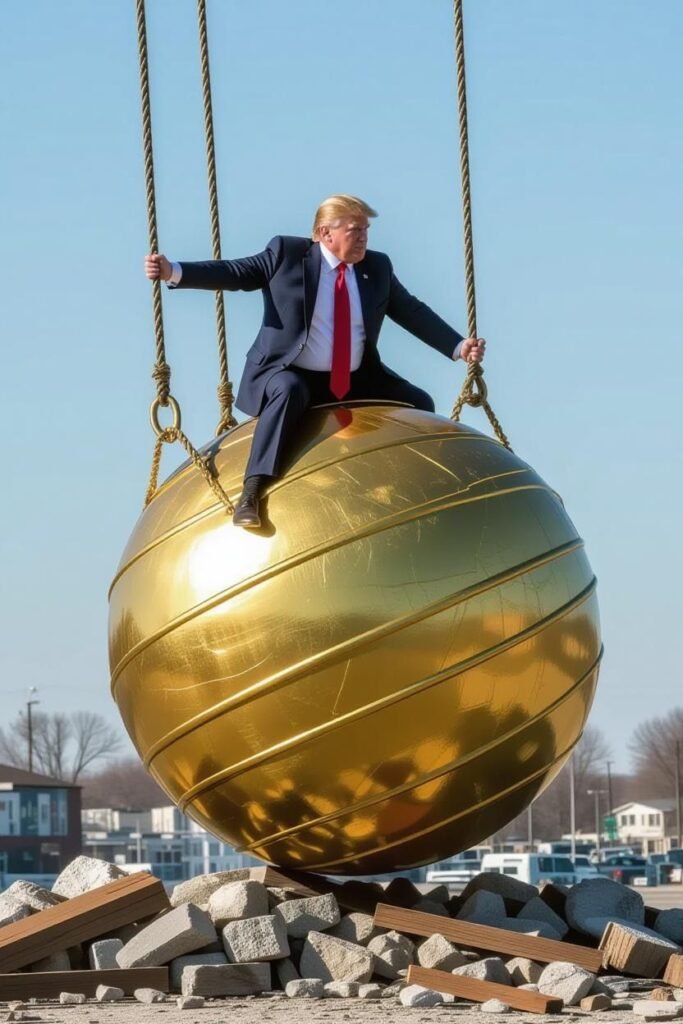
Point 27: “The agreement will be legally binding and enforced by a Peace Council chaired by Donald J. Trump.” That’s a Gaza replay. As if Putin and the Russian Security Council would accept a “Peace Council” chaired by a Circus Ringmaster whose expiry date is fast approaching, not to mention be subordinated to the losers in a vicious proxy war.
About a really intriguing takeaway
One plausible takeaway of the 28-pointer is that the selected oligarchy running the Empire of Chaos continues to run a protection racket – and the only way to salvage the de facto strategic defeat in country 404 is to turn a quick buck.
Another more intriguing, plausible takeaway is that the 28-pointer was never meant to be accepted by the EU-Kiev combo. It’s all about the Circus Ringmaster’s exit strategy from the debacle in Novorossiya.
Trump is already preparing the terrain – as in I tried everything, but Zelensky won’t comply. So it’s now his – and his gang’s – problem only, side by side with the EU chihuahuas. Up next: an immediate change of narrative. What else: the Empire of Chaos cannot manage reality, only narratives.
Trump 2.0 may start to work on improving U.S.-Russia relations – while blame for the collapse of the “peace process” is laid on the EU-Kiev combo. The optics of the 28-pointer P.R. op are everything: packaged as it is asking Moscow to strike a compromise, even as Russia is winning in the battlefield, while making sure the “criminal organization” in Kiev cannot agree to the main provisions.
Provisional endgame: the chihuahuas of war will keep barking while the SMO will keep rollin’ along.
… it’s not so easy to escape from a war you started yourself, leaving your allies to fend for themselves.
By Rostislav Ishchenko at Ukraine.ru.
(machine translation)
We are currently facing a moment of truth: either Russia will be able to complete its military operation in Ukraine within the next three to five months with a victory that will be unassailable by even the most ardent domestic skeptics, or the danger of a global confrontation will increase dramatically. On the external front, criticism will always be present, and our achievements will always be subject to discrediting, as there will always be forces seeking revenge and continuing the global confrontation. The format of peace in Ukraine should not leave any chance for foreign revanchists to ignite a new conflict in the next 10-20 years (it is impossible to make realistic plans for a longer period under the current conditions).
Until recently, the pace and direction of the Russian Armed Forces’ offensive indicated their intention, under favorable conditions, to defeat the most combat-ready Ukrainian forces assembled in the area from Kharkov to Pokrovsk and reach the Kherson-Zaporozhye-Dnepropetrovsk-Pavlograd-Kharkov line, with the expectation that a catastrophe on the front and the loss of new territories would make both the Kiev regime and its Western allies more constructive, leading to a peace agreement that would leave Ukraine without Novorossiya and thus severely undermine its demographic and industrial mobilization capabilities. In general, Kiev could lose up to 10 regions that were part of Ukraine in 1991 (Crimea, Sevastopol, the Donetsk and Luhansk People’s Republics, the Zaporizhzhia and Kherson regions, which have already become part of Russia, as well as the Dnipropetrovsk, Kharkov, Nikolaiv, and Odesa regions, which still need to be liberated).
Given that Dmitry Medvedev had been much more radical about the scope of future territorial changes throughout the summer (not excluding the possibility of Ukraine’s complete elimination), Moscow clearly wanted to demonstrate to its “partners” that there was an influential group within the Russian leadership advocating a more aggressive peace plan that would exclude Kyiv from the negotiation process and establish peace directly with those Western countries that were willing to accept it. Ukraine and those Western countries that were unwilling to take a constructive stance would be the ones to pay for the peace.
Judging by the way events unfolded since the meeting in Anchorage, and the careful nature of the Russian leadership’s statements regarding a peaceful resolution, Trump agreed to at least attempt to follow this path. However, it soon became apparent that the United States lacked European allies in its readiness for a compromise peace with Russia. Europe, in general, and its leading countries, in particular, supported Zelensky’s uncompromising stance. After some hesitation, and under serious pressure from American supporters of a hard line on Russia, including several members of his own team, Trump abandoned the idea of a separate peace with Russia and moved on to a “no peace, no war” project, in which the United States does not directly participate in the European crisis, but also does not seek a global compromise with Russia. Washington agreed to sell all types of weapons to its European partners and withdrew from restraining the provocative nature of their policies towards Russia. The principle was “Let Europe fight Russia if they want, and the United States will benefit.”
But it’s not so easy to escape from a war you started yourself, leaving your allies to fend for themselves. The Europeans, taking advantage of the Americans’ statement that they are willing to sell any type of conventional weapons in any quantity, have demanded that Ukraine receive at least several hundred long-range missiles. While the official request is for Tomahawk missiles, it is more likely that Ukraine will receive less powerful but equally long-range missiles of other types. However, the transfer of a certain number of Tomahawks, at least for the purpose of testing them against Russian air defense systems in real large-scale combat operations, is also not ruled out.
The transfer of long-range missiles to Ukraine will raise the question of a Russian response. Despite Moscow’s attempts to avoid another escalation, a response targeting the military infrastructure of countries that have provided missile weapons to the Kiev regime would quickly become inevitable. In this regard, Poland is the most vulnerable country, as it is home to the main hub for the supply of Western weapons to Ukraine, and it is actively involved in lobbying for Kiev’s interests and disrupting any negotiations for a compromise peace with Russia. Additionally, Poland hosts American troops, including the Aegis missile defense system, which could potentially be used for both missile defense and Tomahawk missile launches. In any case, the use of Kalibr, Iskander, or Kinzhal against a NATO military facility on NATO territory would have raised the question of NATO’s response. The situation threatens to spiral out of political control.
Judging by the latest actions of the Russian Armed Forces, Moscow has decided to accelerate the operation to defeat and destroy the most combat-ready units of the Ukrainian Armed Forces as much as possible and to give it more profound and decisive goals. This is a kind of response to the deployment of missiles before it takes place, in order to make this provocation meaningless.
Experience tells us that if the transfer of a particular type of weapon has become the subject of public discussion, it means that the Kiev regime will have access to that weapon in the near future. Initially, in a few instances, and then in a more significant number. Therefore, the sooner there is no one to transfer the weapon, the better.
In recent weeks, the Russian Armed Forces have been launching increasingly powerful strikes on Ukraine’s energy and railway infrastructure. As a result, all major Ukrainian cities, from the eastern border to the Dnieper River, have been plunged into darkness. Ukraine has also stated that Russia is attempting to logistically isolate the entire Left Bank region, including the Chernihiv and Sumy regions. This isolation is being carried out both before and during the offensive operation to prevent the enemy from maneuvering forces and resources and transferring reserves and supplies from the rear to the front, or at least to severely limit such capabilities.
Since the Russian Armed Forces are already conducting an offensive operation on the left bank of the Dnieper River with decisive goals, the sharp increase in missile strikes on Ukrainian rear areas should indicate Russia’s attempt to accelerate the pace of the operation without increasing its own losses, by leveraging its advantage in production and the number of missiles and UAVs it has accumulated compared to the collective West supplying Ukraine. Russia’s actions to isolate the combat zone and significantly reduce Ukraine’s ability to promptly repair equipment and produce UAVs in “garage” settings are effective in the short and medium term. Then, if the enemy is still alive, they gradually find ways to overcome the crisis, while their own strike forces are depleted, their reserves need to be replenished, and the intensity of their strikes decreases.
It could be assumed that Moscow is simply trying to speed up the operation to defeat the Kharkov-Donbass group of the Armed Forces of Ukraine, but the expansion of the geography of attacks on Kiev, Odessa, Chernihiv and Sumy suggests that while maintaining the previous goals of the operation, the maximum program is also considered as a minimum program: in case of successful development of the offensive, expand its geography to the limits of February- March 2022, to reach the Dnieper River along its entire course, if conditions allow, to occupy several strategic bridgeheads (the right bank of the Kherson region, the districts of Dnepropetrovsk, Zaporozhye. Kremenchug and Kiev) and in the face of a full — scale catastrophe of the Ukrainian front, either dictate ultimatum peace terms to the Ukrainian authorities, or continue the pursuit of the APU further (possibly to the western border, but at least to the Zhytomyr-Vinnytsia line, which provides Russia with security from almost all types of non-strategic weapons in service with NATO).
Today, only the complete exclusion of Ukraine from the game on the Western side gives a fairly high, albeit not 100% chance, of avoiding the development of a Russia/NATO missile crisis, which will immediately acquire a partial global character in addition to its European nature. The acceleration of the operation against Ukraine is possible only through the maximum intensification of attacks on the rear: the maximum use of Russia’s air and space superiority, which will serve not only as an effective means of combating the Armed Forces of Ukraine but also as a demonstration and warning to Europeans who wish to wage war against Russia.
The window of opportunity for Russia is not wide open, but it is ajar, and it is into this gap that Russian missiles will have to fly in order to make it a gateway to a victorious world.
Judge Nap interviews Alastair Crooke : Why Israel is to Blame
 IRGC Statement on the Eighth Wave of Operation True Promise 3
Public Relations of the Islamic Revolutionary Guard Corps (IRGC):
Victory comes only from God, the Almighty, the All-Wise.
Public Relations of the Islamic Revolutionary Guard Corps.

A cargo plane from Guangzhou Baiyun International Airport flies southwest over eastern Turkmenistan, descending as it approaches Iranian airspace. 15.06.2025

 Lateo.net - Flux RSS en pagaille (pour en ajouter : @ moi)
