 Connexion


Dans cet essai, édité par Mario Caligiuri, on trouve une lecture des services de renseignement du Vatican qui sort des
L’article Le Vatican, le plus ancien pouvoir d’information au monde ! est apparu en premier sur STRATPOL.
Aujourd’hui, en Europe, on parle de plus en plus d’une mystérieuse entreprise militaro-technologique ukrainienne, Fire Point, qui a annoncé la
L’article Espionnage ukrainien sous couvert d’« allié indéfectible de l’Europe » est apparu en premier sur STRATPOL.
L’analyste du renseignement Pietrobon prend la parole ! Epstein est de nouveau au centre de l’attention mondiale, et ce n’est pas
L’article « Quand on parle de pizza, de fromage et de hot-dogs dans les dossiers Epstein, on parle en réalité d’enfants et de bébés tués et maltraités.» est apparu en premier sur STRATPOL.

Seun Foo
In a big update, China banks are making a move to reducing their balance sheet of dollar assets. Meanwhile, the US has a new plan to carve up Russia’s frozen reserves.
https://mid.ru/en/foreign_policy/news/2058518/
Question: Moscow and Washington have almost simultaneously announced nuclear test plans. Does this signify global instability or rather demonstrate equal capabilities and thus the preservation of parity?
Sergey Lavrov: I have heard nothing about Moscow announcing nuclear tests, so it is inaccurate to say that Washington and Moscow made such statements simultaneously.
As I mentioned in a recent interview with Russian media outlets, we have so far not received clarifications from our US counterparts as to what exactly President Donald Trump meant to convey in his remarks. Was it nuclear tests, delivery vehicle tests, or subcritical tests which do not involve a nuclear reaction and are permitted under the Comprehensive Nuclear-Test-Ban Treaty (CTBT)? There has been no answer to that so far.
The CTBT Preparatory Commission met yesterday, but a US representative failed to provide any clarifications, either, although such a forum is clearly the right place to clarify what the US President had in mind when he said that.
The US administration is still in the process of being formed. Many second and third-level positions, primarily in the Pentagon, have so far remained vacant.
In particular, Robert Kadlec has been nominated for the position of Assistant Secretary of Defence for Nuclear Deterrence Policy and Chemical and Biological Defence Programmes. Last week, he spoke before Congress, where he was grilled on the issue of nuclear testing and the current administration’s approach to nuclear weapons. He said that President Trump’s decision to resume nuclear tests was driven by geopolitical considerations. As before, there is no technical need to conduct such tests. That’s a strong statement. I’m not sure whether the speaker himself realises the gravity of what he said, but we are compelled to interpret this as confirmation of what we have been saying all along which is that there is no technical necessity for such tests. He went on to say that the goal was geopolitical and thus drove the point home for us.
What may the geopolitical goal of the United States look like? Domination, right? The use of nuclear weapons argument in this setting is alarming and represents a significant departure from the concept once agreed upon by Ronald Reagan and Mikhail Gorbachev where a nuclear war cannot be won and therefore must never be fought.
Robert Kadlec seeking the position of Assistant Secretary of Defence also stated that nuclear options should be developed to respond to certain regional conflicts that may flare up. That, too, is a rather curious statement. It’s a direct tell that this gentleman, once in office, will be thinking in terms of using nuclear threats in order to achieve the outcomes that the United States may need in a particular region.
He then went on to demonstrate even more instances of double standards when he said that NATO’s nuclear deterrence strategy might be revised in the wake of Russia deploying tactical nuclear weapons in Belarus. Yet, the fact that this was done after many decades of joint nuclear missions with US tactical nuclear weapons long stationed in five NATO member states and the fact that we have long proposed to redeploy all nuclear weapons back to the countries that own them was simply ignored.
Since Belarus has received nuclear weapons from Russia, the US side now wants to deploy theirs somewhere else as well. We are aware of ongoing contacts with South Korea and Japan. These games are very dangerous.
Back to your question, we have not announced nuclear test plans. At a meeting of the Security Council’s permanent members, President Vladimir Putin highlighted US President Donald Trump’s statement that Russia and China have long been doing this, and therefore the United States must do so, too. We immediately contacted our counterparts and let them know that there must have been a misunderstanding. We are looking forward to receiving clarifications.
President Putin has issued a directive not to conduct nuclear tests and not even to make preparations for them. The Foreign Ministry, along with other agencies, including military and intelligence, has been instructed to analyse the situation and to reach a consensus on whether this situation warrants considering the resumption of nuclear tests.
Our principled position was laid out by President Putin in 2023, when, taking a question during one of his speeches, he said that if a nuclear power were to conduct nuclear weapons test (not delivery system tests, not subcritical tests), then Russia will respond in kind.
Question: One more article has recently been published where the journalist and his sources claim that the United States, in particular Secretary of State Marco Rubio has been shocked by your uncompromising stance. Have you really been hard on the Americans or is this yet another article where they have gone too far with their sources?
Sergey Lavrov: We are polite people, and we try to remain polite. I have already answered similar questions in several interviews.
Since this audience consists of professional journalists, I would like to draw your attention to the latest facts of unprofessional and harmful coverage of certain events in the media, primarily British media. You know what is happening at BBC. It’s a shame that some individuals are trying to justify the situation and are speaking about an orchestrated campaign.
I would like you to take note of the item published in The Financial Times, which said that Donald Trump and Vladimir Putin agreed to meet in Budapest and instructed me and Marco Rubio to prepare that meeting. Sergey Lavrov and Marco Rubio have talked on the phone, but before that the Russians allegedly submitted a harsh memorandum after reading which the Americans decided that talking with the Russians would be pointless and meaningless.
There are so many lies here, including when it comes to the sequence of events. The memorandum the FT journalists mentioned is a non-paper, an unofficial draft we have sent to our colleagues not after but several days before the Putin-Trump conversation. It was designed to remind our American colleagues what we discussed in Anchorage, and what agreements we thought we reached (the Americans have not refuted this) during the US-Russian summit. That unofficial document did not contain anything other than what was discussed in Anchorage, which our American counterparts did not regard as cause for rejection.
The presidents’ telephone conversation was held after the document was delivered to the Department of State and the National Security Council. During that conversation, US President Donald Trump did not say a word about receiving a provocative or “subversive” paper that destroyed all hopes for a settlement. No, they had a normal conversation. President Putin gave a positive response to US President Trump’s idea of meeting in Budapest and proposed instructing the countries’ foreign ministries to prepare that meeting. That is exactly what we planned to do.
US President Donald Trump also said that Secretary of State Marco Rubio would call me. I received his call three days later. We had a polite conversation without any nervous episodes, by and large reaffirming progress based on the agreements reached in Anchorage, and went off the phone. The next step was a meeting by representatives of our foreign policy and defence departments, and possibly our security services. However, the Americans have not taken the next step, although we waited for them to take the lead when it comes to the place and time for such a preparatory meeting because they had proposed holding a summit.
Instead, they made a public statement that they don’t want to hold a meaningless meeting. When Secretary of State Rubio made public comments on our telephone conversation, he did not say that he had noticed any aggravation or that it had undermined the chances of success. If I remember correctly, he said that it was a constructive conversation that quite clearly showed where we stand, which is why there was no need for a meeting. This can be interpreted in several ways, but this is what he said. There is a joke that we have a clean conscience because we seldom use it. But it is absolutely to the point in this case.
We see no reasons to offer excuses for being and remaining committed to what our presidents discussed in Alaska. Even if they did not agree on every comma and semi-colon, they have at least reached an understanding.
Question: You just mentioned the summit in Budapest. After his talks in the United States, Hungarian Prime Minister Viktor Orbán said he still hopes the meeting can happen. Is that still a possibility? And why has the focus shifted from a meeting in Hungary to a discussion of nuclear tests? What has changed?
Sergey Lavrov: I believe I have already addressed this. I cannot speak to what is behind the US position on nuclear testing, because President Trump’s claims about a supposed Russian and Chinese “resumption” of testing are simply not true – assuming we are talking about full-scale nuclear weapons tests. Other types of tests, like subcritical experiments (which do not produce a nuclear chain reaction) and tests of delivery systems, have never been prohibited. So, we are seeking clarification on these allegations.
As for the facts: Russia conducted its last nuclear test in 1991, and the United States in 1993. That was over thirty years ago. China’s last test was shortly after that. The most recent test by the DPRK was in 2017. Since then, we have seen no indications that any country is preparing to resume this practice. If someone were attempting to do this covertly, deep underground, it would be up to the professionals involved to expose it. In that case, they should be briefing the White House, not operating behind closed doors.
There is a robust global monitoring system in place, which both Russia and the US participate in. It relies on seismic data to record any significant underground vibrations. They know perfectly well what the indication of a nuclear explosion looks like. So, I would not conflate the issue of nuclear tests with the Budapest Summit.
The other day I watched President Donald Trump host Hungarian Prime Minister Viktor Orban at the White House and then speak with journalists. When asked about a meeting in Budapest, he said that he had thought it over and decided not to hold it, because, he said, “I didn’t think anything was going to be happening of significance.” This fits with the thinking he expressed not long ago when he said that “sometimes you’re better off letting them fight for a while.”
Frankly, I don’t see any causal relationship here. We are ready to discuss the suspicions raised by our US counterparts whereby we have allegedly holed up deep underground and are secretly doing something there. We are also ready to discuss with our US counterparts resuming preparatory work for the summit between the leaders of Russia and the United States, which they themselves proposed.
If and when our US counterparts renew their proposal and appear ready to begin preparations for a high-level meeting that could produce meaningful results, Budapest would, of course, be our preferred location. All the more so as, during his meeting with Viktor Orban, Donald Trump confirmed that Budapest was a preferable venue for Washington as well.
Question: There is not much time left before the New START Treaty expires, yet the United States has not presented its official stance on President Putin’s initiative. Do you think the United States will respond in the near future? If, by any chance, an articulate answer never comes, would that make a difference for Russia?
Sergey Lavrov: We have made it clear many times that this proposal is a unilateral gesture of goodwill on our behalf. No talks or consultations are needed for the United States to support our approach. All the United States needs to do is state that it will not raise the quantitative limits under the Strategic Arms Reduction Treaty for one year that is at least for as long as Russia adheres to its own unilateral commitment. That’s all there is to it. No further steps are required.
As for whether any talks are underway to renew the treaty, no, there are no talks. Once again, the situation is completely transparent. The quantitative levels are well known. We know what the Americans have, and the Americans know what they have. Let’s take a year to, so to speak, cool down, analyse the situation, stop measuring everything by the Ukraine yardstick, and focus on the great powers’ responsibility to maintain global security and stability, above all, in terms of avoiding nuclear war. We are ready for that.
This has nothing to do with the time constraints. A declaration to renew the quantitative limits can be made at any point before February 5. By the way, the current New START Treaty was renewed right after Joe Biden had taken office just a few days before the initial expiration date. Renewing the treaty is a much more complicated endeavour than the simple act of making a voluntary statement to continue observing and respecting its numerical parameters.
Question: Considering rising tensions in the region, has Venezuela approached Russia with a request to provide military assistance? Has Caracas asked Russia to deploy its weapons in Venezuela similar to the way it was done in Belarus?
Sergey Lavrov: No, no such requests have been made.
I believe it is inaccurate to compare our relations with Belarus which is part of the Union State and with which we share synchronised, coordinated, and unified positions on all key international security matters with our relations with the friendly nation of Venezuela which is our strategic and comprehensive partner, to which end we signed a treaty not long ago.
However, considering, among other things, the important geographic factor it would be inaccurate to juxtapose our partnership with Venezuela with our Union with the Republic of Belarus.
The treaty I mentioned is an entirely new instrument. It was signed in May during President Nicolas Maduro’s visit to Moscow to attend the events marking the 80th anniversary of Victory in the Great Patriotic War. The treaty is now in its final ratification phase. It is called the Treaty between the Russian Federation and the Bolivarian Republic of Venezuela on Strategic Partnership and Cooperation and provides for continued collaboration in matters of security, including military-technical cooperation.
We stand ready to act fully within the framework of the commitments we and our Venezuelan friends have assumed in this treaty. It has not yet entered into force. Venezuela has completed its ratification procedures, and we have only a few days left to do so as well. Both chambers – the State Duma and the Federation Council – have held hearings to that effect, and the treaty is almost finalised. We will strictly adhere to the obligations it contains.
I’d be remiss to conclude my comments on Venezuela without mentioning our position on the unacceptable actions the United States is taking under the pretext of combatting drug trafficking as it destroys boats allegedly carrying narcotics, without trial, investigation, or any evidence whatsoever. Law-abiding nations do not do that. This kind of behaviour is more typical of those who consider themselves above the law.
Recently, citing the Daily Mail, Kommersant reported that Belgium was rapidly turning into a narco-state, where corruption, blackmail, violence, and the shadow economy based on drug trafficking flourish across all sectors, from customs to the police. Not the most reputable source, perhaps, but if even Daily Mail wrote this, they must have had a reason to do so. Why else would they slander their NATO partner?
Instead of targeting Nigeria or Venezuela under the guise of fighting drugs – and seizing oil fields in the process – the United States would do better to tackle this problem in Belgium. After all, the US and other NATO troops are already there. They wouldn’t need to chase small boats carrying three individuals each. I’m confident that the policy chosen by the Trump administration with regard to Venezuela will not lead to anything good. It will not enhance Washington’s reputation in the eyes of the international community.
Question: You have repeatedly stated that peace in Ukraine will only be achieved by addressing the root causes of the conflict. As is well known, one of these root causes is the rampant neo-Nazism in Ukraine. Is this issue discussed in your negotiations with American colleagues?
Sergey Lavrov: We regularly raise this issue. In fact, since the Anchorage meeting and my telephone conversation with Marco Rubio, we have had no further contact. We did not specifically broach this topic in Alaska, but they are well aware of our position. It is “in writing” for them. There is no secret about it. The position was articulated by President Vladimir Putin in June 2024, when he spoke at the Foreign Ministry, outlining our fundamental approaches to Ukraine and relations with the West.
Among other absolutely non-negotiable conditions for a settlement – such as demilitarisation, the removal of any threats to the Russian Federation, including by dragging Ukraine into NATO, and safeguarding the rights of Russians and Russian-speakers, as well as the Ukrainian Orthodox Church – there is also the demand for denazification. This is not something we have invented as a notion alien to modern Europe.
One might think of the Nuremberg Trials. Their outcomes, forming part of the UN Charter, are a cornerstone of the international system established after the Second World War. Certainly, all of Europe signed up to this. Germany underwent denazification and a process of repentance.
Regrettably, now – perhaps even beginning with Germany – we sense that this repentance has come to very little. I have spoken about this before: some 15 years ago, during better days, in conversations with German colleagues, we noted the signals they were sending – not verbatim, but the meaning was quite clear. The gist was, “Dear colleagues, we have settled our accounts for the Second World War, we owe nothing to anyone anymore, and now we will act accordingly.”
Former Chancellors Angela Merkel and Olaf Scholz at least tried to observe decorum, while Friedrich Merz has repeatedly declared that his goal is to make Germany the primary military power in Europe once again. I think it unnecessary to explain what kind of signal such statements send – to make Germany the primary military power again. It already was a military power when it conquered more than half of Europe, calling it to arms to attack the Soviet Union.
When such Nazi relapses occur in the birthplace of Nazism, it naturally causes alarm. Naturally, it will require from us – from all those invested in a stable world – principled stances when discussing the final parameters of a settlement.
If the West finally recognises the futility of this scenario, i.e. that the demand should not be for a cessation of hostilities merely to continue arming Ukraine, but to act as President Donald Trump proposed before the Alaska meeting. He said then that a temporary truce would resolve nothing and that the conflict must be ended on the basis of principles for a sustainable settlement.
Yes, Europe later attempted (and not without success) to drag our American colleagues back into its camp of “truce, support for Ukraine, not a step back, not an inch to the left.” Nevertheless, President Donald Trump did say this, and it became the foundation of the understandings unequivocally agreed upon in Anchorage. Incidentally, this is what distinguishes the Republican administration, the administration of Donald Trump, from its predecessor – the administration of Joe Biden.
Recently, I came across an interview with Kurt Volker. He was the US State Department’s special representative for Ukraine under Joe Biden. He claimed that Russia would never agree to a peace deal. It is unclear where he got this from, because it is precisely we who are striving for a peaceful settlement. He added that Vladimir Putin does not consider Ukraine a legitimate or sovereign state. There is an answer to this as well. We recognised Ukraine when it was not a Nazi state and had not banned any language – in this case, Russian – as the only country in the world to do so. We recognised Ukraine as it was defined by the Declaration of State Sovereignty and the Act of Independence: a non-nuclear, non-aligned, neutral state. That is what we recognised, and that is how things stood.
Next, Kurt Volker asserts that Vladimir Putin is convinced Ukraine should be part of Russia (I will not even engage with that topic) and that the Russian President considers Vladimir Zelensky a Nazi. But where is the proof to the contrary? Vladimir Zelensky regularly poses on television, awarding honours to fighters of the Azov regiment [1] and other Nazi battalions, who wear the insignia of Nazi Germany on their sleeves. How else should one regard this man?
The eradication of Nazism in Ukraine – denazification – is an absolute condition for any settlement if we want it to be long-term. We do want that and will pursue it. But when no one in Europe, in their dealings with Ukraine, raises the issue of the country’s Nazification; when no one, except Hungary, addresses the rights of national minorities; when no one demands that Vladimir Zelensky repeal the law banning the canonical Ukrainian Orthodox Church…
In Alaska, when President Vladimir Putin explained to US President Donald Trump how we assess the situation in Ukraine, he mentioned that in 2024, they passed a law aimed at banning the canonical Ukrainian Orthodox Church. President Donald Trump did not believe it. He asked US Secretary of State Marco Rubio, who was present at the meeting, three times whether this was true. Marco Rubio confirmed that it was. It was clear that the US President was, to put it mildly, taken aback.
Returning to Ukraine and its legislation. I mentioned Hungary. When the Brussels bureaucrats, led by Ursula von der Leyen (who is now creating an intelligence structure and will personally oversee it), were pushing through the decision to begin negotiations with Ukraine on its accession to the European Union, Hungary – credit must be given to the courage of Hungarian President Viktor Orbán and his Foreign Minister Péter Szijjártó – stood alone in insisting that among the conditions Ukraine must meet before negotiations begin, there must be the resumption and restoration of all Ukrainian obligations regarding the respect for the rights of national minorities. There is a rather lengthy text on this topic. It was not difficult to draft, because the Constitution of Ukraine still requires respect for the rights of the Russian (singled out specifically) and other national minorities.
Currently, there is the European Commissioner for Enlargement, Marta Kos. When she claims that Ukraine is ready and has fulfilled all the necessary conditions to begin negotiations, this is simply untrue. Nothing has been done to address or restore the rights of national minorities – not even for the Hungarian minority, despite Hungary being a member of both the European Union, which Ukraine so desperately seeks to join, and NATO, where Vladimir Zelensky is also constantly pushing for membership. No action has been taken on this front, just as nothing has been done regarding the remains of the victims of the Volhynia massacre in relation to Poland.
The European Union remains entirely silent on these blatant violations. Ukraine stands as the only country in the world to have completely banned a language. Even in Norway, where 7 percent of the population are ethnic Swedes, Swedish is an official language. The figures speak for themselves – compare that to the situation in Ukraine. From Brussels, we hear nothing about Ukraine’s actions except for the mantra that they must stand with Ukraine to the end, “until victory.”
This same refrain was recently echoed by Mark Rutte and other representatives of the Western European establishment.
They insist that they must always defend Ukraine because it is upholding European values. This is nothing less than a confession – a self-exposure. It reveals that, in the eyes of today’s Brussels bureaucracy, European values equate to the revival of Nazism. That is precisely why we cannot afford to show weakness here.
Question: Recently, Lithuanian authorities have been increasingly flirting with the idea of closing their borders and halting transit to Kaliningrad for Russians, using increasingly flimsy pretexts. What measures is Russia taking, potentially with Minsk, to prevent this? And how will Russia respond if Lithuania follows through?
Sergey Lavrov: These smaller nations – the “young Europeans,” like Lithuania, Latvia, and Estonia – seem to vastly overestimate their importance in the eyes of the Western European “old guard” of the EU. Those in Europe who still possess a shred of common sense and a genuine concern for the continent’s security (a dwindling group, admittedly) are perfectly aware of the provocative role assigned to these Baltic states by their handlers, primarily British ones.
London’s penchant for provoking situations is, of course, notorious. Take the recent case where the Russian FSB exposed a plot to trick a Russian pilot, flying a fighter jet armed with a Kinzhal missile, into flying to a base in Constanta, Romania with a fake order. The obvious intent was for the plane to be shot down, creating a pretext to accuse Russia of attacking NATO. But I’ll set that aside for now; the FSB has already laid out the details. I don’t know how the British will wash away the stain, but they’ve always had a remarkable talent for this, like a duck that waddles away from a shower without a drop of water on its back.
The former empire that once ruled most of the world is gone, and so is the “good old England” they so love to parade. They have little economic weight left, and their military might is relatively weak, as even their nuclear arsenal isn’t fully under their control. They have to compensate for this weakness somehow, so they fall back on that traditional English aspiration to “divide and conquer,” to put it politely. There are, of course, less charitable terms for their actions and goals.
Now, back to your question. Indeed, recently we’ve seen not just the usual threats to block Kaliningrad transit, but certain figures – not in Lithuania, but within the EU itself – egging the Baltics on by suggesting Kaliningrad could be “razed to the ground.” Meanwhile, Lithuania has already closed its border with neighbouring Belarus, leaving hundreds of trucks from Lithuanian carriers stranded there.
On this matter, Belarusian President Alexander Lukashenko, as always, used particularly vivid language. These actions are outrageous. It brings to mind the phrase the Americans once used about dictators in Latin America, in Central America: “He may be a son of a bitch, but he’s our son of a bitch.” That’s precisely the attitude the European bosses have towards the antics of their Baltic protégés. They’re expected to commit as many heinous anti-Russia acts as possible, while also provoking Russia into a response that can be “sold” to Washington primarily as grounds for invoking Article 5 of the NATO treaty and starting serious military action.
We see this clearly. But the obligations regarding Kaliningrad transit are not Lithuania’s alone; they are the obligations of the entire European Union. The 1994 Partnership and Cooperation Agreement between Russia and the EU included a provision on ensuring transit between neighbours. This was reinforced by a separate joint statement on transit in 2002, which had direct legal effect. Then, in 2004, when the Baltic states and other Eastern European nations were admitted to the EU, a Joint Statement on EU Enlargement and EU-Russia Relations was signed, which explicitly reaffirmed all these commitments.
Subsequent technical documents spelled everything out in minute detail, including the layout and procedures for a “temporary travel document” and the clearance processes for passenger and rail cargo transit.
The European Union must now take responsibility for the behaviour of its wayward “junior members” who are spinning out of control.
Back when decisions on admitting Latvia, Lithuania, and Estonia into the European Union were being drafted in 2004, we asked our European counterparts – back then we had plenty of contacts and fairly open trust-based discussions – whether those three Baltic states were ready to meet the EU membership criteria. We were told they fell short in some areas, but…
We wondered whether bringing unqualified candidates into the EU made any sense. They said they knew where we were coming from, but having gained independence those countries were still haunted by phobias of “occupation.” “We’ll bring them into the EU and NATO,” they said, “and they’ll calm down.” Have they? I think the exact opposite happened. Not only did they not calm down, but they decided they would now call the tune in the EU and NATO, at least when it’s about openly Russophobic and anti-Russian “rhapsodies.” That’s the position they have adopted today.
In response to what I’m saying, someone in the EU may argue that we “invaded” Ukraine in violation of certain agreements we had arrived at with the EU before that. I have no doubt someone out there will be willing to come up with an argument like that. They are reluctant to recollect how things actually played out in Ukraine. How it all began long before the Minsk Agreements, long before Crimea, back in 2013, when then President of Ukraine Viktor Yanukovich analysed prospects for signing an EU Association Agreement and realised that many of its provisions would imperil trade, trade arrangements, and other economic benefits Ukraine enjoyed in its contacts with the Russian Federation. He became fully cognisant of this and requested to put off the signing scheduled for late November 2013. We supported his approach. We did so not because we wanted to prevent Ukraine from pursuing relations with other countries, but because we wanted Ukraine to keep its access to its commitments under the CIS Free Trade Area and its economic ties with Russia, which had been vastly beneficial for Ukraine. We also strived to avoid inconsistencies between the principles underlying relations between us and the obligations Ukraine was supposed to assume under the EU Association Agreement.
Back then, President Vladimir Putin reached out to European Commission President José Manuel Barroso (former Portuguese Prime Minister), letting him know that Russia had a free trade area agreement with Ukraine, and the EU planned to create one with Ukraine as well. The principles of these two areas are at odds with each other. Putin suggested having the three parties – Ukraine, Russia, and the European Commission – sit down and discuss ways to harmonise them. What could be more reasonable? Barroso came back through some obscure channels saying that since the EU did not interfere in Russia’s trade with Canada, Russia should likewise stay out of EU-Ukraine relations.
We often talk about former Assistant Secretary of State Victoria Nuland and her confession that $5 billion had been invested in Ukraine over the years preceding the coup. The EU catalysed the Ukraine crisis. It fueled the Maidan protests and planted the catch phrase that Ukraine must be with Europe, not Russia. They said this publicly. So, we should be left out of it, and they shouldn’t justify their own lawlessness by referring to the steps our country was forced to take after exhausting every reserve of goodwill and constructive proposals.
Here are some examples of the EU showing lack of integrity. In 2008-2009, the EU – France in particular – faced issues in Chad and the Central African Republic, which were home to small French expeditionary forces that lacked air support. They asked Russia to send in a helicopter group to assist in operations against rebels that engaged in genocide and other atrocities. We have sent the group as requested. Later, we reached out to our EU partners with a suggestion to create a joint crisis response mechanism for operations abroad based on this experience.
We proposed an approach under which, if Russia were to conduct an operation, we could invite the EU to participate in it on an equal footing, and if the EU were to engage in an operation, it could invite Russia. They were receptive of the idea. Discussions began, and everything appeared to be moving towards the sides coming to terms. Some time later they told us there would be no parity, because there already was an agreement outlining the possibility of Russia’s participation in EU operations, which covers everything. So much for an approach supposedly based on equality.
There are quite a few other examples, including the Meseberg Initiative, which we recently mentioned in our comments. Back then, President Dmitry Medvedev and German Chancellor Angela Merkel agreed in Meseberg on a declaration establishing an EU-Russia Committee on Foreign Policy and Security. Ukraine was not even mentioned, only Transnistria. Merkel insisted on having the creation of that committee come with a condition, namely ensuring progress in the Transnistria settlement. That provision was included. Following those understandings, we ensured the resumption of the “5+2” format for the Transnistria settlement, which had been dormant for several years. The format resumed its work, but when we approached the EU with a proposal to now create the joint Committee on Foreign Policy and Security, they chose not to reply and the idea went off the table. That’s how much the EU’s word and even signature is worth. In this particular case, the EU was represented by Chancellor Angela Merkel.
A particularly glaring example is the visa-free regime with the European Union. Negotiations had been underway even before 2004, as at the Russia–EU summit in 2004, the then-head of the European Commission, Romano Prodi, stated that within a couple of years we would achieve a relaxation of the visa regime. Several years elapsed. We developed our internal regulations based on the framework agreed with the EU. Once these norms were finalised domestically and all requisite bilateral agreements with individual EU member states were concluded, no outstanding condition remained unfulfilled. In response to our query regarding potential timelines for abolishing the visa regime, the European Union engaged in protracted deliberations. Its eventual response was to table a new draft document, proposing a joint consideration of further steps. The document outlined purely technical nuances. Nevertheless, we engaged in this work as well. President Vladimir Putin has repeatedly recalled those times.
Back then, not only was faith alive, but there was also a lingering hope that we were dealing with honourable counterparts.
Ultimately, these additional technical matters were also resolved. This was in the summer of 2013. When we suggested announcing the agreement, they (the EU officials) withdrew from official contacts on the matter and from providing an official response. Off the record, it was intimated to us that, despite our full preparedness, political considerations precluded the conclusion of a visa-free agreement with Russia prior to finalising such agreements with Moldova and Georgia. Ukraine was not mentioned at the time.
Therefore, should the European Union level accusations of violations against us, firstly, there is not a single factual basis for such claims, and secondly, we have ample means to “pacify” our European colleagues.
Question: Next year, the Treaty on Good-Neighbourliness, Friendship, and Cooperation between Russia and China will expire. Are there negotiations underway to extend it? Or will Moscow and Beijing draft new agreements to reflect the changed realities?
Sergey Lavrov: This treaty remains entirely relevant. It is no coincidence that when its initial term expired in 2021, approximately a month prior, President Vladimir Putin and President of the People’s Republic of China Xi Jinping signed a document extending the treaty for five years. These five years are now coming to an end. The 2021 statement affirmed that the treaty remains fully pertinent, retains its force, and serves the interests of further strengthening the comprehensive partnership and strategic cooperation between our countries.
I believe this assessment still holds. However, events are unfolding rapidly, and our strategic cooperation and multifaceted partnership with the PRC are deepening, acquiring new dimensions. In principle, we have agreed with colleagues from other agencies to explore whether specific areas could be used to “enrich” this treaty. I am unsure of the form this might take. It could involve adopting another document confirming and expanding the treaty’s provisions. No definitive decisions have been made yet, nor are they necessary, as such decisions, when put in writing, merely reflect the realities on the ground. In practice, our relations have never been more advanced, close, or trusting. As our Chinese friends say: we work “shoulder to shoulder, back to back” in all spheres of international life. These are not empty words.
Thus, I assure you that the date of July 16, 2026 will not pass unnoticed. The details of how our cooperation with our Chinese friends will be confirmed, expanded, and deepened will be handled by the executive offices of our leaders. A report will subsequently be submitted at the leadership level.
The organisation is recognised as terrorist and banned in the Russian Federation. [There is no link to understand what exactly is being referred to here].

 Le FBI dispose d’une unité dédiée au crime organisé basée en Israël, désignée par l’acronyme IBOCS (Israeli Based Organized Crime
L’article États-Unis: Quand le FBI enquête sur des “groupes criminels” Israëliens mais évite d’en parler publiquement ! est apparu en premier sur STRATPOL.
So history ruled that no conqueror coming from the West would traverse the Pamirs; that happened with Alexander the Great, and that happened with Islam. But that may well happen with Timur Trump, Conqueror of China.
Pepe Escobar, Strategic Culture
President Donald Trump did not disappoint when defining centuries of complex Heartland history with a trademark reductionist wise guy zinger:
“It’s a tough part of the world — there’s nobody tougher or smarter.”
Well, every tough guy from Genghis Khan to Timur may now feel relieved. Especially the leaders of the five Central Asian “stans” – Kazakhstan, Kyrgyzstan, Tajikistan, Turkmenistan and Uzbekistan – invited as a group for a White House photo op cum dinner.

As every grain of sand in the Ancient Silk Road knows, bragging is prime Timur Trump territory. He praised an “incredible” trade deal with Uzbekistan – under which Tashkent will be buying and investing almost $35 billion, and up to 2035, $100 billion, in critical areas such as minerals, aviation, infrastructure, agriculture, energy and chemicals, and IT.
No details whatsoever were provided on how Tashkent is going to find that kind of money, and precisely how they plan to invest it. Yet that was the perfect cue for Uzbek President Shavkat Mirziyoyev – a savvy pragmatist – to lavish praise on Timur Trump:
“In Uzbekistan, we call you the President of the world (…) You were able to stop 8 wars (…)
That was faithfully echoed by Kazakh President Kassym-Jomart Tokayev:
“Millions of people in many countries are so grateful to you (…) You are the great leader, statesman, sent by Heaven to bring commonsense & traditions that we all share and value back (…) Under your presidency, America is ushering in a new golden age (…) As President of peace, you, Mr. Trump, brought to an end eight wars just within eight months.”
And right on cue Tokayev duly announced that Kazakhstan is ready to sign the – collapsing – Abraham Accords, which is quite redundant, considering that Astana already normalized Israel way back in 1992 and always had relatively close relations with Tel Aviv.
Translation: the Abraham Accords scam is part of a give and take featuring the US-Kazakh signing of a tech metal/rare earth deal. The only vector that matters here is the US-Israel mad supply chain scramble to bypass China’s rare earth restrictions and continue to provision their tech/Defense realm.
Central Asia after all is quite rich in rare earths and also uranium. The problem is for the moment Kazakhstan exports way more minerals to Russia-China than to the US.
Timur Trump anyway was beaming: “A tremendous country with a tremendous leader” – referring to Tokayev.
Well, this “tremendous” country happens to be a full member of the SCO; a BRICS partner (as well as Uzbekistan); a Belt and Road Initiative (BRI) partner, very close to China; a full member of the Eurasian Economic Union (EAEU); a full member of the Commonwealth of Independent States (CIS).
So Kazakhstan enjoys very close trade relations with the Russia-China strategic partnership. Besides, their language of business is still eminently Russian.
Cue once again to the heart of the matter: Timur Trump seems dead set on blowing up the BRICS/SCO combo from the inside. Short of the proverbial color revolution attempts, of course – if the “stans” don’t behave. Incidentally it was Putin and the Russian military that personally saved the Tokayev government during the latest color revolution attempt in Kazakhstan, which was coordinated from neighboring Kyrgyzstan.
The lineaments of a strategic pivot
Timur Trump even mentioned that he wants to revive “Silk Road connections”. Well, at least he was not referring to Hillary Clinton in the early 2010s trying to build a nonsensical American version of the Silk Road with Afghanistan – still at war – at the center.
Timur Trump was referring to the “C5+1” framework – the US plus the “stans”. That has absolutely nothing to do with “stability”: it’s all about strategic expansion. Especially now that the Empire of Chaos, after two decades and trillions of dollars, managed to replace the Taliban with the Taliban and for all practical purposes should say goodbye to Afghanistan, which is being progressively integrated into the SCO and BRI, as a parallel project to the China-Pakistan Economic Corridor (CPEC).
So the Timur Trump show boils down to propelling a possible avalanche of US investment and hence to be more embedded – and influential – in the Central Asian sphere. It has much less to do with wobbly mineral supply chains or loads of mirific “investment” than going for a strategic pivot. Talk about a pipe dream.
And when it comes to pipes, deceased war criminal Dick Cheney in the mid-2000s tried everything to turn Pipelineistan in the Heartland to the US’s advantage – sending trade “missions” around the clock. It all came down to nought.
Russia is very much aware that the Empire of Chaos may be trying to stage a comeback in the Heartland chessboard – with embedded influence coming from all the usual suspects such as an array of NGOs, “educational” programs and “management committees”.
Timur Trump views the “tremendous” Heartland monolithically – assuming he can properly point them on a map (forget about their history). They used to be part of Russia – as in the USSR – so now they need to be open to maximum American onslaught. It’s as simple as that.
Russia, predictably, is not losing any sleep. Kremlin Spokesman Dmitry Peskov: “Cooperation between Central Asian countries and the United States at the C5+1 venue is quite natural”. Peskov and the Russian leadership are very much aware Russia and the Central Asian “stans” meet all the time, and discuss everyhting: that last time was little over a month ago.
So why now – the Timur Trump offensive? Well, the Empire of Chaos is unleashing its fury all across the Global South, considering its impotence to really subdue Russia-China. Previously, Uzbekistan’s Mirziyoyev and Kazakhstan’s Tokayev had met with US business leaders on the sidelines of the 80th session of the UN General Assembly in New York. Of course they talked business.
And they know the drill. Washington still has total leverage over the global financial market. It’s not wise to antagonize the King of the Jungle. Crippling sanctions can be just around the corner. As long as the “stans” can capitalize on the imperial obsession with oil, gas and rare earths, fine. It’s a completely different story, from the point of view of Russia-China, if the issue of US military bases in Central Asia is back on the table.
Now let’s build a pyramid of skulls
There are more – fascinating – parallels between Timur Trump and his “Iron Lord” predecessor than meets the eye.
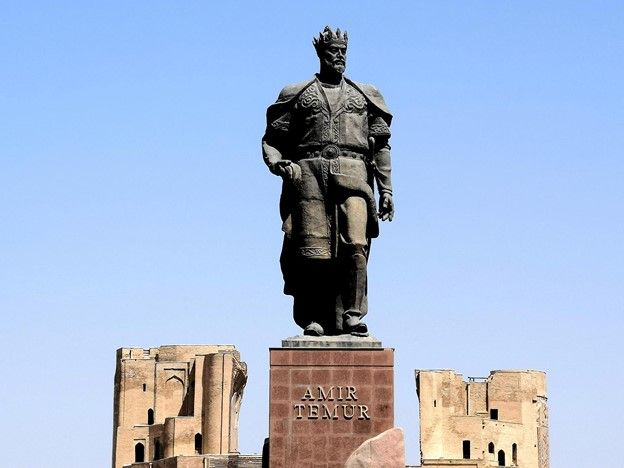
Timur in Shahrisabz, Uzbekistan. Photo: P.E.
Timur vaunted himself as a relative of Genghis Khan, the Absolute Conqueror – and his role model. History as written by the West framed Timur as a feral legend: a perpetrator of serial massacres in times when you needed to inflict unspeakable horrors to be regarded as properly cruel.
The Timur legend features endless gory piles or “towers” of beheaded foes and/or their skulls: a Mongol tradition infused with religious meaning, taken by Timur to the degree of a scientific method. For Timur, there was above all meticulous order in horror. Cue to 120 towers of 750 heads each arranged in Baghdad – or 70,000 heads in Isfahan equitably divided and laid out between his army corps.
Intellectuals, artisans, artists, religious figures though were spared. Once again, Timur systemized and regulated a Mongol principle: competent and useful prisoners should be kept alive.
A key strategic principle was to exterminate whoever resisted so in the end there should be no resistance, and citadels would fall voluntarily. With Timur that become a code. Immediate capitulation was rewarded with lives saved; the enemy must submit and pay ransom. If resistance took too long, the city would pay the price, including pillaging, but civilians would be spared. Third summation: hell, as in raping, pillaging and total extermination.
Yet the Emir did not rule as an Oceanic Khan just by being cruel. Timur launched a war of (italics mine) terror – but he did not provoke any collective belief in the end of the world. Europe, by the way, loved him. Because he prevented the Golden Horde from crushing Russian Orthodox Christians; and because he made a deal with the basileus of Constantinople, before defeating the worst enemy of Christianity, the Ottoman Turk Bajazet.
So Timur was an objective ally of the West. Certainly not a danger. Besides, he was very strong on diplomacy. Before the One Hundred Year War destroyed his kingdom, Charles VI of France received a letter written in gold leaves and bearing Timur’s seal: three circles that symbolize the conquest of the Universe. Timur wanted a trade deal. In the end, because of European incompetence, it came down to nothing.
Timur’s court was no bling bling Mar-al-Lago: it was an apex of real opulence and luxurious taste, fabulous jewels, itinerant elephants, sumptuous garb, fabulous houses.
He has been buried in Samarkand – splendidly isolated from the other Timurids, in an austere tomb topped by a black jade monolith. He rests behind his spiritual master, Sayyid Baraka, and the inscription at the shrine’s portal is pure Sufi: “Blessed is he who refused the world before the world refused him”.
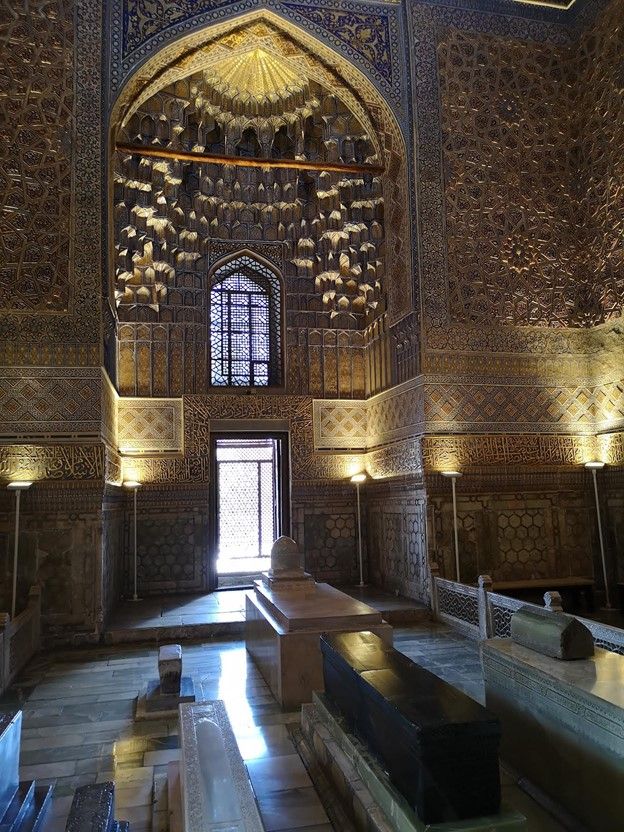
Timur’s tomb in Samarkand. Photo: P.E.
Timur was essentially a tribal Turk; a Muslim; and ideologically, a Mongol. A walking contradiction, really. Even if he spent part of his life fighting the heads of the Golden Horde and other Mongols, much more Mongols than himself, he proclaimed himself as the successor to the Oceanic Khan.
Even as he defeated the Ottoman Bajazet, offering de facto an extra time of 50 years to Constantinople, he was a Turk.
And even if he allied himself with Christians and paid his respects to pagan deities, in the best shamanistic tradition, he also saw himself as a man of the Quran: he went to war carrying a portable mosque.
Timur had the ultimate Silk Road dream: he wanted to conquer China. Even when Mongol unity had become a fiction; when the Yuan emperor was totally Sinicized and turned out to be very different from the Turk-Mongols of Transoxiana, they still recognized the suzerainty of the Yuan dynasty.
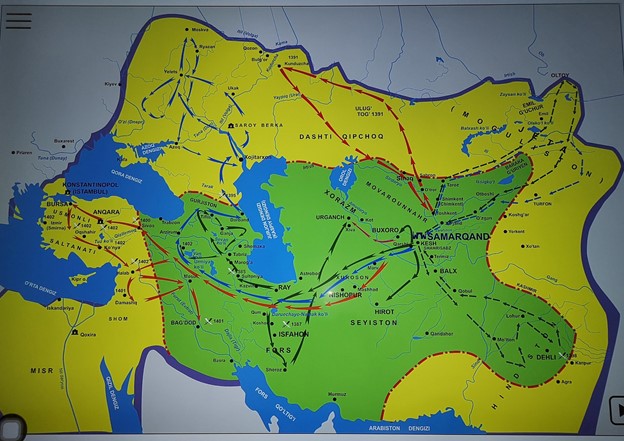
In Samarkand: Timur’s empire – ever expanding. But he never conquered China. Photo: P.E.
But with the Ming dynasty, it was a completely different story. Timur was preparing a conquering expedition when he died in Otrar – in today’s southern Kazakhstan – with a fever, in 1405, after dictating his testament and leaving 100,000 soldiers in a void.
The Ming dynasty had escaped the Supreme Peril. So history ruled that no conqueror coming from the West would traverse the Pamirs; that happened with Alexander the Great, and that happened with Islam.
But that may well happen with Timur Trump, Conqueror of China. In his own mind, of course.

 Anna Paulina Luna, députée républicaine de Floride, partisane de Trump, a annoncé sur X avoir reçu un dossier de 350
L’article Documents russes mystérieux sur l’assassinat de JFK : la députée Luna les reçoit de l’ambassade et les publie en ligne ! est apparu en premier sur STRATPOL.

Le 13 octobre, le Bundestag allemand a tenu des auditions au cours desquelles les chefs des trois principales agences de
L’article La communauté du renseignement allemand désigne la Russie comme la principale menace et appelle à des “préparatifs” est apparu en premier sur STRATPOL.
A little sweet, and very different. A time to recover our senses from the circus that we watched the past day or two.
This, from my favorite Russian cooking site, describes what kids ate at school in Russia. She says:
Soviet kids ate nearly all their meals at school, and like school food the world over, it left much to be desired.
Anna Kharzeeva researched and discovered what the kids actually ate, and some of it is wholly revolting. But in the process, she found this delicious little morsel. It is on our list for the coming weekend, but I will make it with a bit of flour for binding, as semolina may be challenging to get in our climes. I will also try one or two with Chia seeds to bind them together. This is the secret, then, of cooking – adjusting as we go. Creating new out of old.
1 carrot; 1 apple; 1 tsp semolina; ½ tsp sugar; 2 tsp butter
Wash carrot and apple and grate.
Put the carrots in a pot.
Add ¼ cup water and cook until soft. Add apples and simmer until apples are tender.
(I would also suggest to leave at least some crunch and don’t cook ’em to death).
Then add semolina (flour or my suggestion, Chia seeds), sugar, and some salt. Boil for 5 minutes, stirring constantly to avoid lumps. Allow to cool.
Shape in the form of cutlets and fry in butter.
I’m imagining these will go well with a topping squeeze from the honey bottle and then don’t use sugar in the making of it, or even try it with a little white sauce or herby sauce as a dinner vegetable accompaniment. Dress it up with a few raisins or dried cranberries. It is a versatile process.
Note to the US: “You too may experience what it is like to have a proxy arrayed against you”
Trump threatened strikes on Venezuelan territory and did not rule out the transfer of “Tomahawks” to Ukraine
“They [the ‘Venezuelan drug traffickers’] no longer arrive by sea, so we need to watch the land because they will be forced to move overland. And let me say, this will not end well for them,” Trump said at a parade honoring the US Navy.
He also said: “In the heat of fierce battles and in the fog of naval war, American sailors have repeatedly proven that our navy does its job in the best way… We own the sky, we roam the depths, and we RULE THE SEAS.”
Before this statement, the US military had already struck small vessels four times [now five times] in neutral waters, allegedly carrying prohibited substances from the Venezuelan coast: on September 2, 16, 19, and October 3.
Thus, Trump effectively announced the transition of the operation against the “Venezuelan drug cartels” from neutral waters to the sovereign territory of Venezuela. The US Armed Forces will begin probing with strikes on land. And if they consider the response from Venezuelan authorities weak, they will proceed to a ground operation to seize key facilities: ports and airfields. However, if there is a high risk of a protracted war with significant costs, they will most likely refrain from intervention. But strikes are not ruled out.
Against the backdrop of intense discussions about supplying the Kyiv regime with American “Tomahawk” cruise missiles, Russia could transfer “Kalibr” cruise missiles to Venezuelan comrades solely for self-defense. Such weapons can confidently strike US Navy surface ships in the Caribbean Sea at long ranges. Russian coastal missile systems “Bastion” and “Bal” could also become useful for defending Venezuela from invasion.
In this case, the US would fully experience the format of proxy war firsthand. Currently, given Venezuela’s lack of long-range missiles, US Navy ships feel very confident at a sufficient distance from its shores. But the appearance of the above-described weapons in the Venezuelan army and the threat of their use would quickly humble the American military arrogance, as well as the self-appointed “director” of planet Earth, a potential candidate for the Nobel Peace Prize.
“Through the spray of raging combat and the fog of naval war, America's sailors have proven time and again that our Navy does just the best job there is… We own the skies, we stalk the depths, and we RULE THE SEAS.” – President Donald J. Trump.
pic.twitter.com/C6NkgEaPzN
— The White House (@WhiteHouse) October 6, 2025

Alors que les autorités américaines viennent de confirmer l’arrestation de Tyler Robinson, 22 ans, identifié comme le suspect de l’assassinat
L’article La trame de fond de l’assassinat de Charlie Kirk : de fortes tensions récentes avec Netanyahou est apparu en premier sur STRATPOL.

 La corruption en Ukraine est restée depuis l’indépendance du pays, un fléau et poison prégnant, s’invitant toujours dans les débats
L’article NABU : le bureau national de lutte contre la corruption qui soulève les foules ukrainiennes est apparu en premier sur STRATPOL.

La Russie a atteint 95,3 % des indicateurs clés des projets nationaux de l’édition 2020 pour la période 2018-2024, selon
L’article 78% des projets nationaux ont dépassé leurs objectifs de la période 2018-2024 est apparu en premier sur STRATPOL.

 Les opérations de décapitation israéliennes contre l’arc chiite ont impliqué des éliminations efficaces de l’appareil politico-administratif et militaire, du Hamas,
L’article La technique de l’assassinat ciblé: une spécialité israélo-ukrainienne est apparu en premier sur STRATPOL.
Huawei chips are already the real deal for every Chinese company which is following the new Beijing-defined direction to reduce any reliance on American technology
By Pepe Escobar at Sputnik.
Late next month, Huawei will be testing its new powerful AI processor, the Ascend 910 D, even as by early May the previous 910C will start to be mass-delivered to scores of Chinese tech companies.
These serious breakthroughs are the next chapter of Huawei’s drive to counter Nvidia’s global monopoly in graphics processing units [GPUs]. The Ascend 910D is supposed to be more powerful than Nvidia’s extremely popular H100.
Huawei is pulling no punches in its race to manufacture a new generation of processors. Huawei has collaborated with SMIC – China’s largest semiconductor foundry – to apply Deep Ultraviolet Lithography (DUV) on what was previously only possible on EUV (Extreme Ultra-Violet technology). Once again, Huawei and SMIC defied the proverbial American “experts” with creative engineering solutions.
Huawei arrived at fabricating 5nm chips with DUV even as the process is more expensive than with EUV. If Huawei had access to EUV they would be already manufacturing 2-3nm chips. That will come, in short time, as both China and Russia, under permanent US high-tech blockade, must by all means develop their own EUV technology.
Shanghai geeks are convinced that Huawei will switch on 6G networks before the end of the decade. Their current breathless drive is not just aimed at the smartphone front – where Huawei is peerless; the new Huawei Mate 70 Pro + is by far the absolute top smartphone in the world, running on Harmony OS. Huawei is looking at cloud computing, AI and enterprise servers – and to become no less than the core player in the AI infrastructure race.

Ditching Any Reliance on American Technology
Earlier this month, Huawei introduced the CloudMatrix 384, a system connecting 384 Ascend 910C chips. The tech word in Shanghai is that this configuration, under certain conditions, and of course consuming much more power, already outperforms Nvidia’s flagship rack system – which is powered by 72 Blackwell chips.
Meanwhile, Huawei’s Kirin X chip is targeting the PC market, offering stiff competition to Apple, AMD, Intel and Qualcom while Harmony OS plus removes the necessity of using US software such as Microsoft and Android.
Shanghai geeks swear that China essentially doesn’t need to beat Nvidia or other US chips developers. After all, China already has the largest consumer market in the world – by volume and by value. If a parallel tech universe is the likely result of the Trump Tariff Tizzy (TTT), so be it. China already controls over 60% of the global gadget consumer market.
Kirin X may not – yet – match the power of Nvidia’s H100 GPUs. But Huawei chips are already the real deal for every Chinese company which is following the new Beijing-defined direction to reduce any reliance on American technology.
All of the above naturally brings us to the enormous AI elephant in the (digital) room: Nvidia.
A recent book, The Thinking Machine: Jensen Huang, Nvidia, and The World’s Most Coveted Microchip, is quite helpful to track not only the personal story of CEO superstar Huang, a Taiwanese who played the American Dream to the hilt and became a tech multi-billionaire, but Nvidia’s enviable tech accomplishments.
Huang does not interpret AI as emergent machine superintelligence, and firmly dismisses any direct analogy to biology. For this all-round pragmatist, AI is merely software – running on hardware that his company sells for a fortune.
Still, Nvidia has ventured into virgin territory way beyond the American biz-tech Valhalla, complete with holding the most valuable stock on the planet: arguably, when it comes to AI, Nvidia unveiled a new phase of evolution.
It’s crucial to understand how Huang sees China. It is indeed a key market for his AI chips – and he wants to keep selling them in droves. Trump’s tariffs though make sure that won’t happen.
And that’s what moved Huang to ditch his proverbial leather jackets and don a crisp business suit for a strategic visit to Beijing, where he affirmed the sacred importance of the Chinese market, whatever the new Trump-dictated gimmicks.
By 2022, the China market represented 26% of Nvidia’s business; this year, it has fallen to 13%, because of euphemistic “technology export controls”.
The problem is the US government, already by 2022, under the previous automatic pen administration, had blocked sales to China of advanced A100 and H100 chips. Nvidia started selling modified versions – and even after the ban chips continued to arrive in China. By June 2023, it was easy to find A100s for double their price in the black market in Shenzhen.
Huang is convinced that “no AI should be able to learn without a human in the loop” – even as he admitted, two years ago, that “reasoning capability is two or three years out”. Translation: according to Huang AI will start thinking for itself within the next few months.
Even as Nvidia prepares to invest billions of dollars to build AI supercomputers in Texas, the Chinese essentially are not losing any sleep on “thinking AI”: their focus is extremely practical, to conquer not only the Chinese market but also the supply chains of most of Eurasia.
The US National Security Council has concluded that it’s too dangerous for China to buy Nvidia’s high-end chips, even the H20 – designed for the Chinese market. Huawei, anyway, already produces chips somewhat comparable to the H20.
Huang is losing his sleep because, essentially, Nvidia is losing the immense Chinese market to Huawei – with Trump’s direct input. Nvidia has tens of thousands of H20s specially designed for China which they simply cannot sell. Each chip cost between $12,000 to $20,000.

How China Is Opening a Digital “Pandora’s Box”
Huawei’s new drive is yet another example of Chinese will capable of staring down any challenge – based on indigenous talent, tech expertise and national pride. The record, even before Trump 1.0 sanctions, shows that Huawei does eat massive uphill battles for breakfast. In fact Ascend in many aspects was ahead of Nvidia as early as in 2019 – and that’s why two different US administrations banned it.
China is already light years ahead of the US on chip research. Chinese universities amass most places in the global Top Ten for published papers on semiconductors and on citations – a distinction shared, among others, by the Chinese Academy of Sciences (number one), Tsinghua University (one of China’s top two universities), the University of Electronic Science and Technology of China (number four), and Nanjing, Zhejiang and Pekin Universities.
Two weeks ago in Shanghai I first heard that Huawei would catch up with US semiconductor giants in maximum two years. Now, after the announcement of the Ascend 910D, the buzz shifted to only one year for China to overtake Nvidia and develop better lithography machines than the ones currently produced by ASML.
And the debate is fast switching to how far Huawei will be able to go within the next 2 to 3 years.
In several aspects we are already in the early stages of a US-China tech decoupling. For years Nvidia has dominated the AI hardware space. Their GPUs are the brains behind most contemporary advanced AI. The H100 chip is the gold/platinum standard for AI infrastructure worldwide. Nvidia’s chips had huge demand from Chinese tech giants – Alibaba, Tencent, Baidu, Bytedance.
Soon that may not be the case – and that goes way beyond Nvidia’s certified loss of market share in China. China is now all out focused on building a successful, self-sufficient AI hardware ecosystem. The coup de grace will be to restrict the export of all rare earth minerals to the US. Huaweii then will pull up in no time.
Everyone remembers how DeepSeek R1 wiped out over $1 trillion from Wall Street only three months ago. DeepSeek R2 will be released soon; training was a whopping 97% cheaper than OpenAI.
And training happened on Huawei’s Ascend. No Nvidia.
Quantum Bird, a world-class physicist formerly with the CERN in Geneva, puts everything in much needed context. He stresses how indigenous chip development by China – and in a near future, Russia and probably India – is “multi-faceted; what we are observing are the initial stages of a redefinition of the notion of recognizing patterns and machine learning, technologies that are popularly referred to as ‘AI’ by the media.”
Nvidia chips, Qantum Bird remarks, are indeed “computational beasts”, but they work better around “processing models and workloads typical of ‘AI’ models developed by Western scientists.” DeepSeek’s development, on the other hand, showed a transgression of established models: “The possibilities opened for performance leaps are huge, even using relatively modest hardware, with alternative approaches based on advanced math and different calculus flows.”
In a nutshell: “This is the Pandora’s box that Nvidia now fears the Chinese may have opened”. And that totally ties in with Huang’s red alert, prompting his visit to Beijing.
We may be heading indeed towards a serious tech decoupling. Or as Quantum Bird frames it: “A technological and scientific divergence medium and long-term. If the architectures that emerge from these developments are incompatible when it comes to their usage on specific ‘AI’ models, Nvidia will lose its global monopoly and will become just a company reduced to a corporate/scientific Western niche.”
Even as Huawei, from its privileged base in the Chinese market, will go on to win most markets across the Global Majority – from BRICS to BRI.

 Lateo.net - Flux RSS en pagaille (pour en ajouter : @ moi)