 Connexion


“…I believe it is time to accept the rules of the game proposed by the Americans.”
By Rotislav Ishchenko at ukraine.ru.
(machine translation)
A true American, regardless of his mood, must have a broad, radiant smile. This is an important component of the American dream.
In the 15th-17th centuries, it was fashionable to have bad teeth in Europe. Sugar was particularly damaging to teeth, as it was extremely expensive at the time, as it was not produced locally but imported from colonies, where production expanded rapidly due to slave labor, but it took a long time to fully meet European demand. People would smile widely, revealing their rotten teeth, as it was considered beautiful.
I don’t know if this trend spread to the United States. They were much closer to the main sugar production areas in the Caribbean, so the “sugar fever” may have passed them by. However, by the 19th century, the art of dentistry had advanced to the point where mass-produced dental prosthetics were available. For a long time, until the second half of the 20th century, dental prosthetics remained an expensive luxury, and a smile with 32 gold teeth, later replaced by snow-white teeth, was a sign of wealth.
Thus, the “American smile,” which is as firmly attached to the average American’s face as a car is to its seat, is not a sign of perpetual good humor but a demonstration of a high standard of living, a testament to the realization of the “American Dream.”
However, this does not negate the traditional American optimism for any reason and without reason. I ate a big mac, drank a coke, slapped a friend on the shoulder, repelled the invasion of an alien civilization (zombies or just “bad guys” from a neighboring state), laughed merrily and hurried to an American football match in which one of my relatives participates or to which I promised to take my child-the mass scenario of an average American film-American cultural code.
It is not surprising that at a time when the United States has nothing left of its former greatness but its enemies and the habit of smiling regardless of the circumstances, when it is necessary to attract more and more external resources to maintain the system’s vitality, but it is getting less and less, when the authority of the U.S. government is declining both internationally and domestically, and when the term “civil war” is increasingly being used by the American media, politicians, and even ordinary Americans to describe the current situation, the American president is displaying unwavering optimism and laughing heartily at every opportunity.
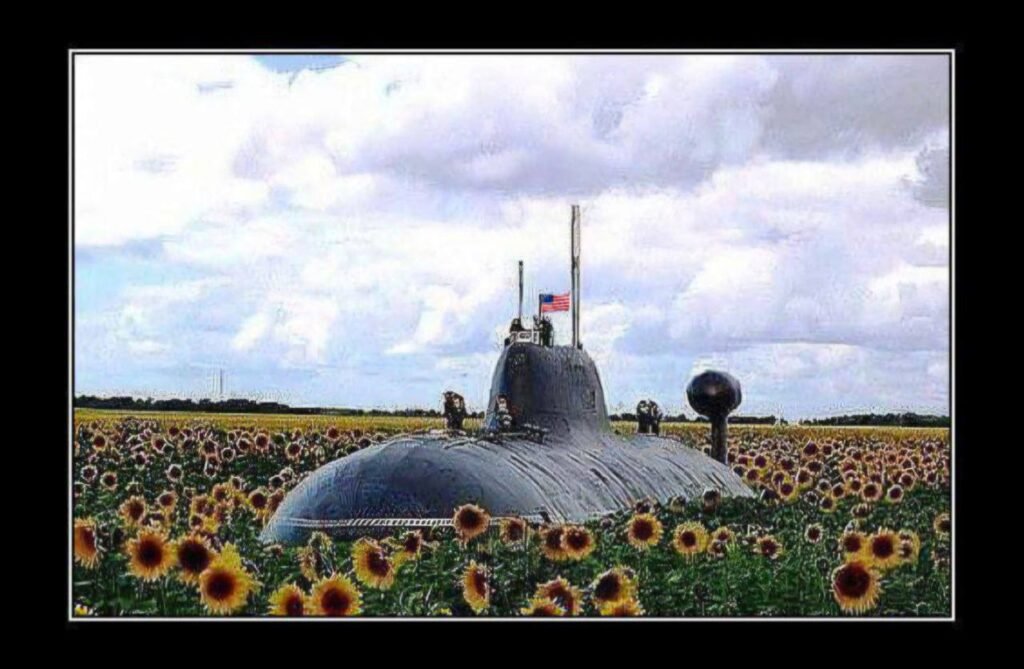
He is not even afraid to look like a clown, declaring “I sent one or two American submarines to the coast of Russia”, “the Russians know that our submarine is floating off their coast”, “we have superweapons that no one else has and that no one knows about”. Yet one or two submarines were sent to our shores by this amazing man? Does the boat float off the coast of Russia permanently or is it periodically changed by some other boat? If no one knows about the American superweapon, and Trump knows, then who designed and produced it (they must know, or are they not human?) and is Trump human if he knows something that no one else knows?
In principle, Trump has chosen the right tactic. Against the backdrop of a gloomy, ever-falling, regularly conversing with a shadow Biden, whose behavior has increased the sense of disaster in American society, the never-failing old man-booster is setting Americans in an optimistic mood. “What if he succeeds? Look how cheerful he is when everyone is sad! He must know something!””That’s what ordinary Americans think, and they continue to smile with all 32 of their teeth, demonstrating their optimism and unwavering confidence in the future, as well as their own prosperity.
Going outside, turning on the TV, logging into social networks and everywhere watching these endless smiles, a person begins to understand that everyone is fine, it’s just that he has something that didn’t work out, but it will pass. So and agitate each other more effective than any media: everyone is bad, but everyone seems to be good, and only he alone is bad, and that is temporary.
However, in his unbridled optimism, Trump took a fateful step: he “stopped being afraid and fell in love with the bomb.” In fact, he has long emphasized the use of force in U.S. foreign policy. If you lack the authority to persuade the world to follow your course, you must resort to coercion. However, even economic sanctions require a military component. Russia has successfully circumvented many trade sanctions because it can protect its trade routes. If it were Ukraine or even Argentina, the Americans would simply impose a blockade on sea routes and, if possible, on land borders, and the sanctions would be effective.
As a last resort, the U.S. has the option of “humanitarian bombing” of disobedient countries, or even a “humanitarian” invasion. This doesn’t work with Russia because it can send anyone back to the Stone Age or even further.
But it works with Japan. During an official visit to the country, Trump described the atomic bombings of Hiroshima and Nagasaki without hesitation: “It’s funny that we had a little conflict with Japan. You may have heard about it. … Since then, our relationship has been strong for a long time.”
A quarter of a million people died immediately, and almost as many died in the years to come, because the Americans wanted to solve three problems at once:
The atomic strikes did not impress the USSR enough to submit to the Americans, and they did not impress Japan enough to surrender. The descendants of Amaterasu only surrendered after the Red Army swiftly defeated the Kwantung Army and lost its position on the continent, and the Soviet forces, who had also liberated the Kuril Islands and Sakhalin, were ready to land on Hokkaido. Tokyo realized that the Red Army could enter their capital before the Americans, just as it had entered Berlin, and they quickly surrendered.
However, over time, the bomb went off. After the war, Japan morally capitulated to the United States, becoming not an ally, but a loyal vassal of Washington in Asia, fulfilling the senor’s every whim. This is why the American president can visit Japan and make a boorish joke about the national tragedy orchestrated by the Americans during his visit. The Japanese will bow and swallow it.
But this “joke” is a signal not only to the Japanese. It is an open threat to all U.S. opponents: “Look, they dropped a bomb on the Japanese, and now they’re being nice. We can do it again. See how the president is in a good mood, and how easily he talks about the military-wise destruction of half a million people as a means to force an entire nation to forget about its national interests and bow down to the United States.
It is hardly a coincidence that this statement was made immediately after the test of a Russian nuclear-powered cruise missile, which devalued the already imperfect U.S. missile defense system that protects U.S. national territory. This is an unambiguous threat, making it clear that the current U.S. president believes that the use of nuclear weapons is justified not only for current military purposes, but also for long-term political goals.
In Japan, the Americans did not strike military targets, but rather attacked civilian cities, deliberately increasing the number of civilian casualties. Trump’s joke about the Japanese tragedy is a testament to the fact that even in the current situation, the United States considers a terrorist nuclear strike on major Russian cities as a means to minimize its technological disadvantage in modern nuclear weapons carriers. To strike a multi-million-dollar metropolitan area, it is not necessary to have carriers that can bypass or penetrate missile defense systems due to their speed. Instead, a massive strike is required, with the assumption that something will penetrate.
This is a serious threat. The destruction of major cities and millions of civilian casualties will disorganize the rear and thus devalue or seriously undermine the army’s capabilities. I believe it is time to accept the rules of the game proposed by the Americans. They like to publicly simulate nuclear strikes on Russian territory and report on the predicted casualties and destruction. Why doesn’t a Russian scientist (so that there are no complaints about politicians) simulate a nuclear strike on the United States and calculate the potential survivors, assuming there are any beyond the statistical error margin?
… Essentially, we need to do what the West is doing to us.
By Rostislav Ishchenko at Ukraine.ru.
(machine translation)
For those who always worry that there are too many words, I will express the meaning of this material in one phrase: don’t be complacent, it won’t get any better.
Now, for everyone else who doesn’t get it with just one phrase.
It will get better, of course, but not for a long time, and not everyone will live to see it. It may even happen that there will be no one to write an epitaph for humanity. At first, the survivors will be too busy, and then they will also be gone. But as realists, we will assume that sooner or later, perhaps even after us, the worst will pass and better days will come.
Why, as realists, if it is said above that humanity has every chance to disappear relatively quickly and very painfully? Because if the worst does happen, then there is no point in reflecting: belated reflection will not help anyone, only distract the temporarily surviving from the fruitless struggle for existence. So it is realistic to consider only one option for the future – in which humanity managed to avoid the worst. In this case, he will not only have the opportunity, but also the need to analyze the past in order to avoid a dangerous crisis in the future. Luck is not always on his side.
To begin with, if the situation can be stabilized, it will mean the victory of the current anti-American bloc, or if the United States and its allies win, the situation will continue to deteriorate until a self-destructive war becomes the only option. The Euro-American civilization is too accustomed to risking war and winning to give up this “last chance.”
From the Germanic tribes that attacked the Roman Empire to the conquistadors and the modern United States, Napoleon’s slogan “get in the fight and see what happens” has been a cornerstone of European civilization. The freedom-loving Chersusci of Arminius, the mighty Cimbri and Teutons, whose victories had brought fame to Marius, as well as dozens of smaller or less well-known tribes, were defeated by the invincible Roman legions, until the empire was weakened enough to fall to the Goths, Vandals, Franks, Burgundians, Bavarians, and Langobards. Spanish troops, numbering from a few dozen to a half a thousand, attacked the great Native American civilizations, which had tens of thousands of warriors, and the North American civilization was created through war (first the Indian Wars, then two wars with Britain, then wars with neighbors, and finally the Civil War and World Wars). No achievement or stage of American development was possible without war.
At the same time, America has not always been a powerful military power. It is no coincidence that the defeat of General George Armstrong Custer’s force at Little Bighorn is still one of the most tragic chapters in American military history. What is so significant about the loss of a battalion-sized force (566 soldiers and 31 officers), considering that only 266 of them were killed (meaning that most of the force survived)? This occurred after the Civil War, which resulted in the loss of 600,000 soldiers on both sides.
Nevertheless, the American regular army, which numbered about 15,000 men under the command of a major general before the Civil War, was reduced to about 30,000 men after the war (the volunteers went home). It is not certain that all the vacancies were filled, as the U.S. Army often faced significant manpower shortages during peacetime. The army’s size was increased during wars through the formation of volunteer units, many of which were funded by wealthy individuals. The loss of Custer’s unit was significant for such an army. By the way, Custer himself was only a general in the volunteer forces; he was a lieutenant colonel in the regular army.
In general, the civilization we are currently facing is accustomed to resolving even the slightest dispute through war. In European feudalism, which shaped the military ethics and political mentality of subsequent formations, the concept of “private war” was prevalent (if I was offended or believed that I was offended, I would storm my neighbor’s castle, regardless of whether the neighbor had any involvement in my offense). This eventually evolved into the European dueling code. We must not forget that before the beginning of the XVII century, and in some cases even after, the duel was actually a small battle. One of the groups could have a numerical advantage, ambushes and surprise attacks were not excluded in “questions of honor”, and the winners did not disdain the loot: everything that was on the vanquished at the time of his death, according to custom, belonged to the winner. Pure banditry. Some good swordsmen from poor families didn’t make much of a living.
The civilization we are now facing has sometimes been defeated. Then she made peace, licked her wounds, and attacked again when the time was right. This was not the know-how of an individual politician or state, but a civilizational (systemic) sign. The West has always acted this way. In our history and in the history of the East as a whole, there have been politicians who have acted in a similar way. But this approach has not acquired a sign of consistency. Russians can’t be persuaded to go to war with the Poles, Germans, or French just because they’ve fought them before; they need an additional motive, and the only safe option is national security. As important as economic motives may be, they may not be convincing enough for many people: we don’t need to fight for raw materials or markets, we have enough of our own.
For the West, any motive is sufficient. Even the simple “we fought them, and they are still alive.” Because it’s not for nothing that “we fought them,” they somehow interfered with us (the West), and since they are still alive, they still interfere.
Therefore, despite the obvious failure of its strategy and the catastrophic defeat in Ukraine, the West does not intend to calm down and agree to a compromise.
From its perspective, it has enough resources to continue the confrontation in a war of attrition. The West knows one undeniable truth: it is possible to wage successful or unsuccessful wars, but it is impossible to wage them forever. Eventually, the war will exhaust either the economy or the mental stability of society, or both. Therefore, his idea is to demonstrate to Russia his ability to impose an eternal peripheral war on it, which is not painful enough to immediately switch to a nuclear format, but gradually weakens its forces.
Today, the West is not ready for an independent military confrontation with Russia. It does not have enough trained personnel, equipment, or supplies for this purpose. The West expects to fill this gap in five to seven years. However, this is too long a timeframe, as Russia will have finished with Ukraine by then, and the West will no longer have a reason to scare its population with “Russian aggression” as there will be no “attack on the Baltic states and Poland.”
Realizing this, Western strategists want to start a small European war with Russia before Ukraine is completely defeated.
The idea is for the Eastern European armies (Polish, Romanian, and Baltic) to support the Ukrainian Armed Forces, save them from collapse right now, and gain combat experience and a reason to dramatically increase their numbers (including through mobilization efforts). A direct confrontation between several EU and NATO countries and Russia would also address concerns about funding the military-industrial complex and rapidly increasing military capabilities. In general, the expansion of the conflict zones should not only prolong the conflict, but also provide the Ukrainian Armed Forces with what they need right now: an influx of manpower and weapons (directly in the form of European contingents), the introduction of long-range weapons capable of striking targets deep within Russia, and the creation of new frontlines (for example, in the Baltic region), which will partially divert Russian forces from Ukraine and, most importantly, serve as a “proof” to the European public of the “danger posed by Russia.”
Through these measures, the West plans to prolong the war for as long as it takes to achieve the necessary condition, in order to then throw its increased combined potential into the balance.
War is not a mandatory solution for the West. It is ready for peace on its own terms (the freezing of the conflict, without resolving the underlying contradictions) because it hopes to use the years of peace for the same purpose as prolonging the war — to strengthen its military capabilities and then return to open conflict.
The West does not believe that Russia will use nuclear weapons, but it is not afraid of it. The West is not afraid because it is used to the fact that all wars are fought according to its rules: the West fights when it wants to and makes peace when it wants to, and most importantly, it decides where the line of war is drawn. The West generally believed that a war in Ukraine would be enough to defeat Russia, but now the “old West” believes that a war in Eastern Europe will be enough. Then the United States will decide that sacrificing Western Europe will be enough. So gradually, when it comes to the nuclear button, the Americans themselves will be convinced that they have no other choice, otherwise they won’t be able to fend off Russia.
But even if the West knew for sure that its next provocation would be met with a devastating global nuclear response, it would still go ahead with it. Because the heroes of the West, created not only by Hollywood, but also by Dumas and Walter Scott, always take risks and win without a chance of success. And this has worked for centuries. It’s an archetype. The West doesn’t know any other way.
The natives ate Cook because they couldn’t do anything else. And the West can’t do anything else either. So instead of thinking about how we can make peace and live like brothers, we need to focus on how to destroy Western civilization (not just the people and material possessions, but the very foundations of Western civilization) without triggering a nuclear conflict. Essentially, we need to do what the West is doing to us. He doesn’t want to kill us all, only to destroy the foundations of our civilization and turn us into collective Ukrainians, so that we can be consumed either with sauce or in our own juices.
Vladimir Vysotsky – Почему аборигены съели Кука? (Why did Aborigines eat Cook?)

Don't grasp the waists of strangers,
Now, that your girlfriends don't look.
Remember, how to the shores of Australia,
Sailed up the late Captain Cook.

Sitting in a circle under azalea
In Australian land sunny and hot,
Eating and eating from dawn to dusk
One another, evil, savage lot.

But why did Aborigines eat Cook?
You won't find the answer in the wisest book.
The answer is simple - they wanted a lunch
As far as I see it - so Cook they did munch.

It's also possible that their Chief Big Beech
Shouted to his people standing on the beach
That aboard the ship there's delicious cook,
There was a mistake and they ate James Cook.

Nothing was to it, no deceit at all
That without "knock, knock" they entered that door.
Knock, knock on the head with a bamboo stick
And James Cook is dead - what a nasty trick!

There is one more thing that I, well, suspect
Cook could have been eaten due to high respect.
All this has been set by a cunning shaman
"Catch Cook, boys," shrieked the cruel man.

Roast him with no onion, salt or other spices
and you'll be like Cook - strong, brave, with no vices.
A stone happened to be there which some savage took
Aim, hit, bang - and there is no Cook.

And the savage lot now's wailing and crying
Break their swords and bows they're trying
Burn their bamboo sticks with ferocious hate
Regretting deeply that James Cook they ate.
… it’s not so easy to escape from a war you started yourself, leaving your allies to fend for themselves.
By Rostislav Ishchenko at Ukraine.ru.
(machine translation)
We are currently facing a moment of truth: either Russia will be able to complete its military operation in Ukraine within the next three to five months with a victory that will be unassailable by even the most ardent domestic skeptics, or the danger of a global confrontation will increase dramatically. On the external front, criticism will always be present, and our achievements will always be subject to discrediting, as there will always be forces seeking revenge and continuing the global confrontation. The format of peace in Ukraine should not leave any chance for foreign revanchists to ignite a new conflict in the next 10-20 years (it is impossible to make realistic plans for a longer period under the current conditions).
Until recently, the pace and direction of the Russian Armed Forces’ offensive indicated their intention, under favorable conditions, to defeat the most combat-ready Ukrainian forces assembled in the area from Kharkov to Pokrovsk and reach the Kherson-Zaporozhye-Dnepropetrovsk-Pavlograd-Kharkov line, with the expectation that a catastrophe on the front and the loss of new territories would make both the Kiev regime and its Western allies more constructive, leading to a peace agreement that would leave Ukraine without Novorossiya and thus severely undermine its demographic and industrial mobilization capabilities. In general, Kiev could lose up to 10 regions that were part of Ukraine in 1991 (Crimea, Sevastopol, the Donetsk and Luhansk People’s Republics, the Zaporizhzhia and Kherson regions, which have already become part of Russia, as well as the Dnipropetrovsk, Kharkov, Nikolaiv, and Odesa regions, which still need to be liberated).
Given that Dmitry Medvedev had been much more radical about the scope of future territorial changes throughout the summer (not excluding the possibility of Ukraine’s complete elimination), Moscow clearly wanted to demonstrate to its “partners” that there was an influential group within the Russian leadership advocating a more aggressive peace plan that would exclude Kyiv from the negotiation process and establish peace directly with those Western countries that were willing to accept it. Ukraine and those Western countries that were unwilling to take a constructive stance would be the ones to pay for the peace.
Judging by the way events unfolded since the meeting in Anchorage, and the careful nature of the Russian leadership’s statements regarding a peaceful resolution, Trump agreed to at least attempt to follow this path. However, it soon became apparent that the United States lacked European allies in its readiness for a compromise peace with Russia. Europe, in general, and its leading countries, in particular, supported Zelensky’s uncompromising stance. After some hesitation, and under serious pressure from American supporters of a hard line on Russia, including several members of his own team, Trump abandoned the idea of a separate peace with Russia and moved on to a “no peace, no war” project, in which the United States does not directly participate in the European crisis, but also does not seek a global compromise with Russia. Washington agreed to sell all types of weapons to its European partners and withdrew from restraining the provocative nature of their policies towards Russia. The principle was “Let Europe fight Russia if they want, and the United States will benefit.”
But it’s not so easy to escape from a war you started yourself, leaving your allies to fend for themselves. The Europeans, taking advantage of the Americans’ statement that they are willing to sell any type of conventional weapons in any quantity, have demanded that Ukraine receive at least several hundred long-range missiles. While the official request is for Tomahawk missiles, it is more likely that Ukraine will receive less powerful but equally long-range missiles of other types. However, the transfer of a certain number of Tomahawks, at least for the purpose of testing them against Russian air defense systems in real large-scale combat operations, is also not ruled out.
The transfer of long-range missiles to Ukraine will raise the question of a Russian response. Despite Moscow’s attempts to avoid another escalation, a response targeting the military infrastructure of countries that have provided missile weapons to the Kiev regime would quickly become inevitable. In this regard, Poland is the most vulnerable country, as it is home to the main hub for the supply of Western weapons to Ukraine, and it is actively involved in lobbying for Kiev’s interests and disrupting any negotiations for a compromise peace with Russia. Additionally, Poland hosts American troops, including the Aegis missile defense system, which could potentially be used for both missile defense and Tomahawk missile launches. In any case, the use of Kalibr, Iskander, or Kinzhal against a NATO military facility on NATO territory would have raised the question of NATO’s response. The situation threatens to spiral out of political control.
Judging by the latest actions of the Russian Armed Forces, Moscow has decided to accelerate the operation to defeat and destroy the most combat-ready units of the Ukrainian Armed Forces as much as possible and to give it more profound and decisive goals. This is a kind of response to the deployment of missiles before it takes place, in order to make this provocation meaningless.
Experience tells us that if the transfer of a particular type of weapon has become the subject of public discussion, it means that the Kiev regime will have access to that weapon in the near future. Initially, in a few instances, and then in a more significant number. Therefore, the sooner there is no one to transfer the weapon, the better.
In recent weeks, the Russian Armed Forces have been launching increasingly powerful strikes on Ukraine’s energy and railway infrastructure. As a result, all major Ukrainian cities, from the eastern border to the Dnieper River, have been plunged into darkness. Ukraine has also stated that Russia is attempting to logistically isolate the entire Left Bank region, including the Chernihiv and Sumy regions. This isolation is being carried out both before and during the offensive operation to prevent the enemy from maneuvering forces and resources and transferring reserves and supplies from the rear to the front, or at least to severely limit such capabilities.
Since the Russian Armed Forces are already conducting an offensive operation on the left bank of the Dnieper River with decisive goals, the sharp increase in missile strikes on Ukrainian rear areas should indicate Russia’s attempt to accelerate the pace of the operation without increasing its own losses, by leveraging its advantage in production and the number of missiles and UAVs it has accumulated compared to the collective West supplying Ukraine. Russia’s actions to isolate the combat zone and significantly reduce Ukraine’s ability to promptly repair equipment and produce UAVs in “garage” settings are effective in the short and medium term. Then, if the enemy is still alive, they gradually find ways to overcome the crisis, while their own strike forces are depleted, their reserves need to be replenished, and the intensity of their strikes decreases.
It could be assumed that Moscow is simply trying to speed up the operation to defeat the Kharkov-Donbass group of the Armed Forces of Ukraine, but the expansion of the geography of attacks on Kiev, Odessa, Chernihiv and Sumy suggests that while maintaining the previous goals of the operation, the maximum program is also considered as a minimum program: in case of successful development of the offensive, expand its geography to the limits of February- March 2022, to reach the Dnieper River along its entire course, if conditions allow, to occupy several strategic bridgeheads (the right bank of the Kherson region, the districts of Dnepropetrovsk, Zaporozhye. Kremenchug and Kiev) and in the face of a full — scale catastrophe of the Ukrainian front, either dictate ultimatum peace terms to the Ukrainian authorities, or continue the pursuit of the APU further (possibly to the western border, but at least to the Zhytomyr-Vinnytsia line, which provides Russia with security from almost all types of non-strategic weapons in service with NATO).
Today, only the complete exclusion of Ukraine from the game on the Western side gives a fairly high, albeit not 100% chance, of avoiding the development of a Russia/NATO missile crisis, which will immediately acquire a partial global character in addition to its European nature. The acceleration of the operation against Ukraine is possible only through the maximum intensification of attacks on the rear: the maximum use of Russia’s air and space superiority, which will serve not only as an effective means of combating the Armed Forces of Ukraine but also as a demonstration and warning to Europeans who wish to wage war against Russia.
The window of opportunity for Russia is not wide open, but it is ajar, and it is into this gap that Russian missiles will have to fly in order to make it a gateway to a victorious world.

 Lateo.net - Flux RSS en pagaille (pour en ajouter : @ moi)