 Connexion


Les Forces de défense israéliennes (FDI) ont annoncé un cessez-le-feu contre l’Iran conformément aux directives des dirigeants politiques, a rapporté
L’article Tsahal annonce une trêve avec l’Iran est apparu en premier sur STRATPOL.
L’armée israélienne a reconnu officiellement pour la première fois qu’environ 70 000 personnes sont mortes dans la bande de Gaza
L’article Tsahal reconnaît que son opération a tué 70 000 Gazaouis est apparu en premier sur STRATPOL.
“The genie is out of the bottle. The provocation of a “USV privateer war” on trade routes threatens to collapse global maritime trade.”
By Rotislav Ishchenko at ukraine.ru.
(machine translation)
The oil tanker Virat has been attacked twice by unmanned boats near the Bosphorus Strait. On one occasion, the ship Kairos was also set on fire. Western media outlets have claimed that the tanker belongs to Russia’s “shadow fleet.” This expands the list of potential suspects. Naturally, Ukraine, which has been waging a long-standing war against the Russian military fleet using unmanned combatants, is at the top of the list. However, it is unlikely that Kiev would have dared to attack merchant ships, especially near one of the world’s most important transportation hubs connecting the Black Sea and the Mediterranean, which is controlled by Turkey, without the direct approval of its Western allies. The consequences, both direct and indirect, would have been far-reaching, affecting the entire world. Ukraine may no longer exist, but the unmanned surface vehicle’s (USV) attack on merchant ships could echo for decades, shaping the maritime trade landscape.
So it doesn’t matter whether these USVs belonged to Ukraine or whether the British and Americans decided to use their own or those belonging to a third country. The genie is out of the bottle. And not only because this game can be played by two people.
In this case, Britain is unlikely to hope to remain outside the scope of retaliatory actions. It is clear that it is more difficult to use USV to disrupt shipping in the open ocean than in enclosed waters such as the Black, Baltic, Mediterranean, White, Red, Yellow, and Japanese Seas, as well as all Chinese coastal seas. However, the ports of the United Kingdom are within direct reach of USV strikes from the continent and/or from ships and vessels passing through the English Channel. The situation for shipping may be even more dangerous in the classic pirate stronghold of the Caribbean Sea, which borders dozens of countries, many of which are home to both drug cartels and ideological guerrillas.
The threat to American southern ports in the Atlantic is clear.
At the same time, although USVs are more complex than the simplest air drones, they do not require high-tech enterprises for their creation. The problem of guidance, especially at shorter distances, is also solvable. This means that it is not always possible to determine the nationality of a USV that has not exploded, especially if the manufacturer deliberately conceals it.
Almost all strategic global maritime trade routes, no matter how far they extend into the open ocean, eventually pass through bottlenecks like the Bosphorus. Moreover, almost all of these bottlenecks are within the reach of the USV from the coasts of dozens of countries and/or hundreds of ships passing by simultaneously. Only the Northern Sea Route is relatively protected by national means. The rest can be blocked.
The provocation of a “USV privateer war” on trade routes threatens to collapse global maritime trade. This does not require sinking all ships. It is enough to make the threat significant enough to increase insurance premiums, crew salaries, and security costs, as well as delivery times. As a result, significant volumes will be excluded from global trade due to their unprofitability. Additionally, USV can be produced in large quantities (or purchased) and used by dozens of countries against each other. As we know, the greater the demand, the cheaper and easier to use the technology becomes. The first AK-47s were secret and carried in tarpaulin cases, but now the entire world, including the poorest tribes, is using them, and only the lazy ones are not producing them. Finally, the Ukrainian military crisis, as well as the wars between the Houthis and the Saudis and Israel, have demonstrated how easy it is to use high-tech weapons against a third country under the guise of a proxy ally. If Ukraine can launch American and European missiles, which require satellite guidance, at targets deep within Russia, and the Houthis can use hypersonic weapons to attack their enemies, what is stopping Somali pirates or Colombian drug lords from developing similar technologies for the USV?
I want to emphasize that the problem is not that a tanker that could theoretically belong to Russia’s “shadow fleet” was attacked. Russia is primarily a land-based power, and its main trade routes are located within the Eurasian continent and are well-protected. The main targets of the “USV privateer war” may include China, Taiwan, Japan, both Koreas, the Philippines, Vietnam, Thailand, Myanmar, Taiwan, India, the Gulf oil monarchies, Iran, Singapore, Turkey, Indonesia, and countries in the Caribbean, Mediterranean, North Sea, and Baltic regions.
These are either trade competitors of the United States and the United Kingdom, or allies of the United States who are in a leading geopolitical position and are used as a springboard for military and political pressure on the United States’ trade and economic competitors.

In recent years, the West has been losing not only the financial and economic struggle, but also the struggle for control of global trade. The dollar and the euro are losing their positions as the main and auxiliary global currencies and currencies for trade settlements. The yuan, rather than the ruble or the rupee, is actively replacing them. The traditional trade between the West and countries in the Gulf, Latin America, and Southeast Asia is gradually shifting to China. China is also actively expanding its presence in the Eastern Mediterranean, moving through the Greater Middle East.
In all of China’s advancements, maritime trade routes are of utmost importance.
The land-based trans-Eurasian trade routes that connect the continent into a unified economic Greater Eurasia serve as the foundation, but it is the control over maritime trade routes that allows China to build a “fairy-tale castle” of global profitable trade. It is no coincidence that China is building a navy that surpasses the United States in terms of the number of ships and is poised to surpass it in terms of overall combat power. China needs to control the routes that facilitate the sale of its goods. Russia can exist as an autarky, but China will quickly explode from within if its trade is blocked.
During the Ukrainian military crisis, Western UAVs, which were limited in their use in Ukraine, proved to be highly effective in controlling the water area dominated by the enemy’s navy and aviation, as well as in blocking ports and posing a constant threat to military bases. Russian sailors gradually learned to combat the UAV threat, but they were unable to completely eliminate it.
It should be noted that the military fleet, which exercises dominance in a closed water area, has impressive capabilities for combating enemy USVs. However, as mentioned earlier, the threat of USVs in the Black Sea has not been completely eliminated. For the military, repelling attacks is a natural activity. The merchant fleet, on the other hand, is not equipped to handle this task. Any measures taken to enhance the security of commercial ports and the surrounding water area will immediately impact the speed and cost of shipping goods, while the threat of USVs remains high.
The West is not just not afraid of playing a “double game” in the “USV privateer war.” It is provoking this war, deliberately seeking to paralyze global maritime trade.
We can say that this will hit the West itself. It will hit it, but not as hard as we would like. As mentioned above, the West has already lost its trade supremacy to China, and it will only continue to lose ground. However, the rules of geopolitical warfare require us to try to destroy the mechanism that benefits our geopolitical adversary rather than ourselves. During the two World Wars, when maritime trade was an Anglo-Saxon monopoly, Germany attempted to wage war against it using its submarine fleet. The West is now trying to strike a blow to global maritime trade, which is gradually being taken over by China.
We have repeatedly said that the paralysis of Chinese trade will inevitably plunge Beijing into a financial, economic, and then a social and political crisis. The Anglo-Americans have failed to isolate China through legal means, so why not try proxy piracy, since they are already waging a proxy war on land against Russia.
It is clear that we should not expect hundreds of USV attacks on sea routes tomorrow. However, we should not expect them to take decades to organize. As the development of UAV technology during the Ukrainian military crisis has shown, it is possible to transition from isolated attacks to large-scale use in a matter of months (or even a couple of years), which can change the entire dynamics of the conflict and require the development of appropriate countermeasures, which may not always be as quick as desired.
The fact that the incidents involving attacks on merchant ships by the USV occurred in the area of the Bosphorus, a trade route controlled by a NATO country, indicates that the organizers of this provocation are preparing for a global undeclared war on trade routes (similar to the war between English pirates and Spanish transatlantic trade in the 16th to 18th centuries), and they do not intend to tolerate the transfer of control over these routes to their geopolitical opponents. Given that the United States is developing an icebreaker fleet and actively expanding its presence in the Arctic, we should also consider strengthening the security of the Northern Sea Route.
Source : Al-Jazeera
Translation : resistancenews.org – By lecridespeuples
In the name of God, the Most Gracious, the Most Merciful.
Praise be to God, Lord of the Worlds — the Supporter of believers, the One who grants glory to fighters, humbles the disbelievers, and aids the steadfast.
May peace and blessings be upon the Master of all creation, the witness and martyr Muhammad the Faithful, and upon all those who have followed his path and his tradition until the Day of Judgment.
“If a wound has touched you, a similar wound has already touched the others. Such are the days We alternate among people, so that God may distinguish those who believe and choose martyrs from among you. And God does not love the unjust.” (Qur’an, 3:140)
O masses of our proud and dignified Palestinian people, O our Arab and Islamic Ummah, O people of Gaza — Gaza of dignity, courage, and sacrifice; O free men and living martyrs:
The whole world stands in awe of what you have offered — your gifts, your sacrifices, your steadfastness, your patience, and your faith. You have waged a war without precedent in human history. You have confronted the tyranny of the enemy, the brutality of its army, its massacres, and its savagery. You stood firm like unshakable mountains — neither faltering nor wavering in resolve. You resisted death, endured hunger and displacement, the loss of loved ones, the destruction of your homes and possessions. You lived in tents and among the ruins of your shattered dwellings. You rose again when all seemed lost. Those who opposed or abandoned you did you no harm, except for the hardship you already endured.
As we commemorate the second anniversary of the glorious Battle of October 7, we renew our pledge of loyalty to our virtuous martyrs — the leaders who launched the Al-Aqsa Flood: the martyred commander Ismail Haniyeh, head of the movement, his deputy, the martyred commander Saleh al-Arouri, the martyred commander Yahya al-Sinwar, the martyred commander Abu Khaled al-Deif, and their companions among the leaders of the Resistance whom God has chosen and who remained faithful to their covenant with Him.
We bow before the great deeds of the Resistance’s men and heroes — those who fought at point-blank range, who stood as a magnificent bulwark before the tanks, armored vehicles, and soldiers of the occupation, and who thwarted the enemy’s plans one after another: expulsion, starvation, chaos, and every other scheme, all shattered upon the rock of your conscience and will.
And just as you were men on the battlefield, your brothers proved themselves at the negotiating table — placing the interests of our people and the preservation of their blood at the forefront of our priorities since the first moments of the battle.
Yet this criminal enemy multiplied its evasions and massacres, rendering the mediators’ efforts futile, attempt after attempt. And when we established a ceasefire on January 7, it hastened to violate the agreement — once again confirming its habitual betrayal of commitments, its breaking of pacts, and its fabrication of lies.
Despite all this, we persevered through long and arduous indirect negotiations — marked by procrastination, setbacks, and repeated failures. But we never ceased striving to end the aggression and this war of extermination.
Ultimately, we showed a deep sense of responsibility in responding to the plan proposed by the U.S. President, submitting a reply that serves our people’s interests and rights, safeguards their blood, and embodies our vision for an end to the war.
Our negotiating delegation traveled to the Arab Republic of Egypt in a spirit of responsibility and optimism. Through coordination with the consulted Resistance forces, we reached an agreement that we now present to our beloved and heroic people.
We therefore announce the conclusion of an agreement ending the war and aggression against our people — establishing a permanent ceasefire, the withdrawal of occupying forces, the entry of humanitarian aid, the opening of the Rafah crossing in both directions, and a prisoner exchange.
Under this agreement, 250 heroic Palestinian prisoners sentenced to life imprisonment will be released, along with 1,700 detainees from Gaza arrested after October 7 — including all children and women.
We have received assurances from our mediating brothers and from the U.S. administration confirming that the war is indeed over.
We will continue to work alongside national and Islamic forces to complete the remaining steps, striving to realize the aspirations of our Palestinian people — their right to self-determination and to the fulfillment of their legitimate rights — until the establishment of their independent state with Al-Quds as its capital.
In this spirit, we salute our people wherever they may be — in the West Bank, in the territories occupied since 1948, and throughout the diaspora. We express our deep gratitude to our mediating brothers in the Arab Republic of Egypt, the State of Qatar, and the Republic of Turkey, as well as to those who have shared our blood and our struggle in our Ummah — in Yemen, Lebanon, Iraq, and the Islamic Republic of Iran.
We also thank all those around the world who have stood in solidarity with us — the free people who have filled the streets by the hundreds of thousands, even millions, to cry out the truth.
We extend our thanks as well to all who joined the convoys of support and freedom, by land or by sea, and to all who raised the voice of justice against the tyranny and arrogance that plague this earth.
As we close this address, after two years of struggle, we can say: For two years, Gaza has worked miracles on its own — inspiring the free and healing wounds. For two years, Gaza has defended Al-Quds and Al-Aqsa, fought the enemy with unmatched bravery and courage, and affirmed that Gaza is forbidden to its enemies, that its men cannot be broken, and that those who abandon it cannot diminish it.
Peace be upon Gaza — upon the men of Gaza, the women of Gaza, its children, its elders, its martyrs, its wounded, its prisoners, and its great martyred leaders.
And may peace be upon you all, as well as God’s mercy and blessings.
To support our work, you can donate, share this article and subscribe to our newsletter
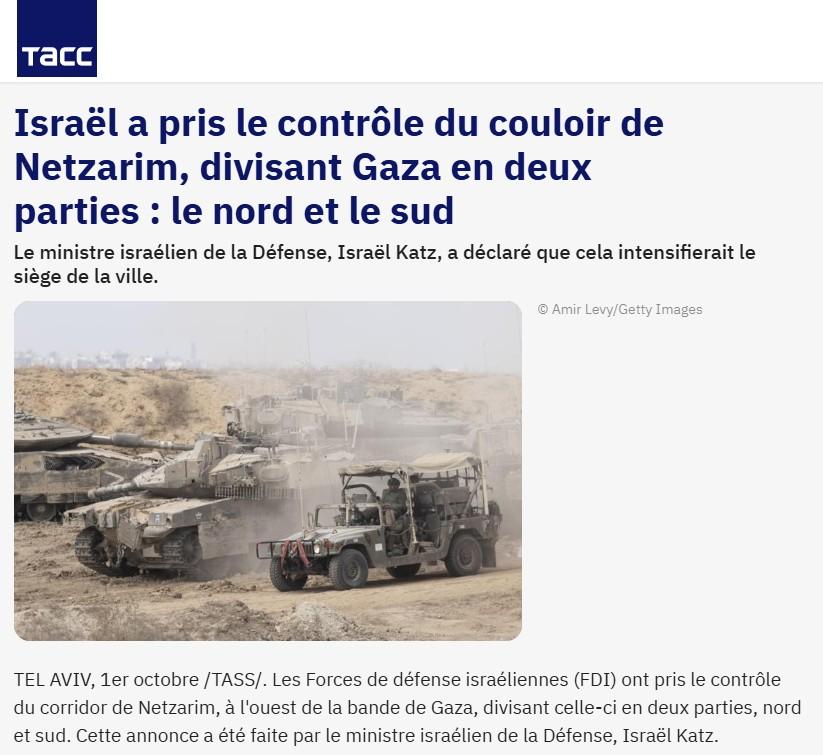
Les Forces de défense israéliennes ont pris le contrôle du corridor de Netzarim, à l’ouest de la bande de Gaza,
L’article Tsahal s’est emparé du corridor de Netzarim, coupant la bande de Gaza en deux est apparu en premier sur STRATPOL.

Le gouverneur de la région de Sakhaline, Valery Limarenko, a qualifié d’« avancée décisive » la publication du décret présidentiel
L’article Le gouverneur de Sakhaline voit comme une “avancée décisive” le décret présidentiel sur les conditions de retour d’Exxon dans Sakhaline I est apparu en premier sur STRATPOL.
With gratitude to Resistance News Unfiltered for their professional and correct translation.
By lecridespeuples
Speech by Khalil al-Hayya, head of Hamas in Gaza and member of its Political Bureau, delivered on July 27, 2025.
Source : Al-Jazeera
In the name of God, the Most Gracious, the Most Merciful.
Those who have believed, emigrated, and fought in the path of God, as well as those who gave them refuge and support—these are the true believers. For them is forgiveness and a generous provision. (Qur’an, 8:74)
Praise be to God, Lord of the worlds, the supporter of believing fighters, and the humbler of disbelievers—even if after a time. May peace and blessings be upon our master and prophet Muhammad, upon his family, and his companions.
O our people, O our loved ones in Gaza—patient and pure,
Words stand before you in silence; they lose all meaning in the face of what you have endured and suffered. You have gone through horrors and borne what an entire Ummah could not withstand. You remained proud when everything around you collapsed. You rose and transcended yourselves when the world plunged into the deep darkness of silence, abandonment, and humiliation.
I find no words or expressions that do you justice—no language that could convey the burden we carry on our shoulders: your rights over us, your sacrifices, your pain, your cries, your groans. And by God, as long as we live, we will never betray that trust.
Despite it all, you have not allowed despair to overcome you. God is with you, and He will never let your deeds go to waste.
O you who are free, pure, and innocent—who bear what mountains have strained to carry, what nations have failed to endure—who rely on God alone: God is sufficient for us, and He is the Best of Protectors.
God is sufficient for us while you are being killed. God is sufficient for us while you are being displaced. God is sufficient for us as you suffer from imposed famine. You have stood firm, your resolve unshaken. By God, how great you are! You are the crowns upon our heads, the embodiment of pride, dignity, and nobility.
O sons of the al-Qassam Brigades (armed wing of Hamas), of the al-Quds Brigades (armed wing of Islamic Jihad), and of the other Resistance factions: the heroic operations you are carrying out surpass all imagination. You have astonished the world, which cannot comprehend how they are possible. You are inflicting upon this criminal enemy the punishment it deserves for its terror and aggression. With your valor and the strength of your fire, through the series of operations known as David’s Stones, you have succeeded in defeating what the enemy called the Chariots of Gideon—the largest military operation conceived by the Zionist enemy and its criminal army to crush the Resistance. To the point that the enemy’s Chief of Staff has been reduced to begging his political leadership to authorize a withdrawal of troops from the Gaza Strip—trying to conceal his failure through genocide, through the starvation of our people, and the murder of our children.
O our noble and generous people,
Alongside your steadfastness and the courage of your Resistance, the Resistance leadership has mobilized every means and connection at its disposal over the past 22 months to end the aggression against Gaza and its people. We have conducted arduous negotiations, constantly guided by the interests of our people and the preservation of their blood—our unwavering compass. We have shown all possible flexibility in this regard, never compromising on the fundamental rights of our people, and we have responded positively to every initiative proposed by the mediators.
During the latest round of negotiations, we made clear progress and reached broad agreement on the mediators’ proposals—especially concerning withdrawal, prisoners, and the entry of humanitarian aid. The mediators relayed positive responses from the Zionist occupier. Yet we were stunned to see the Zionist occupation suddenly withdraw from the negotiation round—followed immediately by the American President’s envoy to the Middle East, Witkoff—in a blatant maneuver to buy time and carry out further extermination of our people.
They then returned with objections to what we had agreed upon regarding the management of aid distribution by international and local institutions—even as the enemy insists on maintaining an aid mechanism it has turned into deadly traps, killing and injuring thousands of our people. It also insists on seizing a large area in Rafah in order to establish an isolation zone for displaced persons, thus paving the way for the expulsion of our Palestinian people—either by Egypt or by sea—as part of a plan that is as blatant as it is scandalous, laying the groundwork for the liquidation of our cause.
In the face of the enemy’s refusal to endorse the results of the last round of negotiations, its attempts to prolong blackmail and delaying tactics, its use of negotiations as a cover for famine and for the continuation of its war of extermination, and the pressure it exerts on us to achieve through politics what it could not obtain on the ground through bloodshed, murder, and terrorism—we affirm clearly and unequivocally: there is no point in continuing negotiations while a blockade, extermination, and famine are being imposed on our children, our women, and our families in the Gaza Strip. The immediate, dignified, and unconditional delivery of food and medicine to our people is the only concrete and sincere proof of the usefulness of continuing negotiations.
We will not allow our people, their suffering, and the blood of their children to become the price of the occupier’s negotiating maneuvers and political agendas.
We also reject the grotesque masquerade of so-called airdrops, which are nothing more than propaganda meant to conceal the crime. The proof lies in the fact that five airdrop operations barely amount to the contents of a single small truck. The real solution is to open the crossing points and allow humanitarian aid to enter our territory in a dignified manner, as mandated by international law—even in times of war.
O our Arab and Islamic Ummah,
Our Palestinian people feel cruelly betrayed. As they face horrors, massacres, and an enforced famine—so many unimaginable crimes—as we witness children dying of hunger, men unable to stand, women weeping from weakness and dying of starvation, in the face of all this, none among us can understand how our great Ummah, with all its wealth and capabilities, remains powerless in the face of this war of extermination and famine, and in the face of the ban on delivering food, water, and medicine to the dignified people of Gaza.
We cannot accept this betrayal of our people, as our Ummah watches, live, the massacres, starvation, killings, and extermination of our people—in what amounts to the most horrific Nazi genocide of modern times. Has the time not come for the Ummah to rise? Has the time not come for the Ummah to act, concretely, to break the siege of Gaza, to deliver food, water, and medicine to your own loved ones, your own brothers? Is it not painful—even tragic—that the criminal Zionist occupier receives unlimited support, while not a single hand is extended to our people, even just to feed them or help them survive?
We call on the states and constituents of the Arab and Islamic Ummah to sever all political, diplomatic, and commercial ties with the Zionist entity. We also call on the masses of the Ummah to express, by all available means, their anger over what is happening in free Gaza. We call especially on the Arab and Islamic peoples—particularly those in countries neighboring Palestine—to march toward Palestine by land and sea, to besiege embassies, to activate the economic and tourist boycott of everything linked to the enemy and its interests, to work for its isolation, and to prosecute its leaders, soldiers, and criminals before international judicial bodies.
Palestine is calling you. Gaza and its people appeal to your Arab pride and Islamic authenticity—and they are expecting actions, not words. For today, silence is not weakness—it is a crime.
And to you, O scholars and free men of this Ummah, the dignified women of Gaza are calling out to you: wives, mothers, and sisters of martyrs. They carry empty vessels, search for mere scraps of food for their children, and endure all forms of suffering and humiliation—even death—while the criminal enemy persists in its killings and its atrocities. Have you not heard their cries: “O Islam!” (“Muslims, where are you)”?
The burden weighing on the shoulders of the scholars of this Ummah is immense and sacred. That is why we call upon the scholars of our Ummah to fully assume their role and guide the masses in confronting this criminal enemy.
O our brothers in Jordan, land of mobilization and resistance, our people look to you with great hope and a deep sense of brotherhood. As you have come forward with your souls and your blood, and your martyrs have fallen at the borders of Palestine, we now look to you to continue your popular mobilization, to intensify your efforts to put an end to this heinous crime against your brothers and your holy sites, and to prevent the Zionist right from implementing its plan for a “substitute homeland” (a project to displace Palestinians to Jordan) and to divide the Al-Aqsa Mosque.
O our brothers in Egypt, Egypt of the brave, we address you because of Egypt’s political and social weight within our Ummah and on the international stage. We know that you feel the pain of your loved ones and your brothers in Gaza. O people of Egypt, O leaders of Egypt, O army of Egypt, O its tribes, its clans, its scholars, its Al-Azhar (Islamic institution), its churches, its elites… Will your brothers in Gaza die of hunger while they are right at your borders, so close to you? The occupier has turned the Rafah crossing into a corridor of death, slaughter, and famine, in an effort to carry out its plan to expel our people—after it had once been Gaza’s lifeline. That is why we confidently await the decisive word of great Egypt: Gaza will not die of hunger, and Egypt will not accept the enemy keeping the Rafah crossing closed to the urgent needs of the people of Gaza.
O our noble Ummah, O free men and women of the world, we proudly salute the generous initiatives—especially the military and popular support of our brother Yemen—as well as the bold and effective actions of the global movement: the land and sea marches, the (Gaza Flotilla) ships Madleen and Handala, the global march to Gaza, and the first resistance caravan that departed from Tunisia, Algeria, and Libya, supported by groups from other countries. All have rejected the crimes of the occupation and have resolved to break the state of powerlessness to declare: We are with you, O people of Gaza—and nothing is impossible for those who truly will it.
Finally, to you, O steadfast and patient people of the Gaza Strip, you hold an immense right over us and over our entire Ummah. And we will remain loyal to you and to your sacrifices, with God’s help. We continue to hope and to believe that, by God’s permission, this ordeal will be lifted, justice will prevail, and the arrogance of the tyrants will come to an end.
You are the apple of our eye, and we are ready to sacrifice our souls and our blood for you. May peace be upon you—among the first and the last, at all times and in all places.
This is a struggle whose only outcome can be either victory or martyrdom.
And may peace be upon you, as well as God’s mercy and blessings.
To support our work, you can donate, share this article and subscribe to our newsletter.
On this episode of Going Underground, we speak to Max Blumenthal, Editor in Chief of The Grayzone. He discusses the Democrats’ and the media’s:
sudden switch to acknowledging starvation in Gaza
and the scale of the carnage
Israel’s race towards a final solution in Gaza to the shock of the Democrats,
the New York Times’ apology over its reporting of the death of a child which effectively ceded ground to the Zionist lobby,
the role of NATO nation journalists as stenographers for imperial power,
why a military intervention is needed to stop the Gaza Holocaust,
the hypocrisy of Samantha Power and the ‘Responsibility to Protect’ doctrine over Gaza,
why the Gaza Humanitarian Foundation is a Mossad, IDF and CIA cutout,
Trump’s threats against Russia along the lines of the ‘Kellogg formula’,
the sidelining of Tulsi Gabbard and the relegation of her role to just saving Donald Trump’s skin,
the potential for another war between Israel and Iran, and much more.

Speaker of the Islamic Consultative Assembly (Iran’s Parliament) Mr. Mohammed Bagher Ghalibaf, in an interview with IRIB (Islamic Republic of Iran Broadcasting), addressed various dimensions of the Zionist regime’s imposed war against Iran. He outlined the pivotal role of the Commander-in-Chief Sayed Ali Khamenei, the importance of national unity, and the emergence of a resilient 90-million-strong core among the Iranian people in defense of the nation. He also revealed new details regarding Iran’s missile operations during this battle.
Source: Enemy Watch
Key points from the interview:
– Our dispute with the Zionist regime and with the United States is longstanding and complex. Some believe Iran’s problems with America began only after the Revolution, but in truth, over the past hundred years, we can see the clear footprint of the U.S. working continuously to weaken Iran.
– This means that, in their view, Iran’s sovereignty must lie in American hands—because the U.S. does not accept an independent Iran. A clear example of this is the nationalization of Iran’s oil industry.
– The Zionist regime acts as the gendarme of the United States in the region. There is a fundamental ideological and strategic conflict between us and this regime, and this clash has intensified under Netanyahu’s leadership.
– I believe that Netanyahu, as the Prime Minister of this regime, places hostility toward Iran, Iranians, and their beliefs as his primary focus even above the issue of Palestine. He believes that the Palestinian issue has either been resolved or is being resolved. Of course, he opposes the two-state solution and does not recognize the right of the Palestinian people to a second state, nor their right to self-defense, an army, or security institutions. In other words, he denies the Palestinians the status of a state and refuses to acknowledge them as the rightful owners of their land.”
– Netanyahu has always had differences with all American presidents on these matters. While they focused more on the Palestinian issue, he consistently focused on Iran. He believes that a strong, united Iran with its beliefs, civilization, and historical depth stands firmly against their ideology and expansionist ambitions.
– The Zionist regime’s strategic vision is rooted in the concept of the ‘Promised Land’ stretching from the Nile to the Euphrates. This idea is deeply tied to global arrogance and supremacist ideologies held by those who believe themselves to be superior to all of humanity and fundamentally different from the rest of human society.
– The war initiated by the Zionist regime was undoubtedly coordinated with the United States, because no military, political, regional, or international action by this regime takes place without Washington’s approval. The real root of the aggression is the U.S.
– Netanyahu publicly outlined three goals for this attack: to change Iran’s political system, to strike at the foundations of Iran’s nuclear capabilities, and to target Iran’s missile program.
– Today, the global media industry is in the hands of the Zionists. They spread whatever message they want, loudly and through various methods and platforms, shaping public perception. A review of analyses from American, Western, European, and Eastern think tanks clearly reveals this pattern.
– The Zionist regime was defeated in the 12-day war and failed to achieve any of its declared objectives. That is not to say we were unharmed war inevitably brings casualties. We lost over a thousand martyrs, many of whom were women, children, and ordinary civilians. However, by the end of this conflict, we secured significant achievements. One major success was that we prevented the enemy from reaching any of its three strategic goals, and in the process, we created new opportunities for ourselves.
But when faced with external aggression, particularly an attack by the Zionist regime, followed by direct American involvement, the entire Iranian nation stood united. The civilizational legacy, shared beliefs, and national identity all rallied around the central leadership of the Supreme Leader. In that moment, one unified voice rose. And this is precisely the power the Zionist regime has always feared.
– If we look again at history, at the Iranian plateau, we’ll see that it once stretched from the north to the south, covering nearly twice the land area of today’s Iran. But due to weak political systems and wars over the past 200 to 300 years, parts of it were lost. The last of these losses was Bahrain in 1971. These concessions all occurred under various political regimes. But the Iranian people always questioned and resisted these losses.
– Back then, it was the ruling systems that made those concessions. But later, during the imposed war, Imam Khomeini showed that one can stand firm in the face of aggression.
– During that war, Saddam and the Ba’ath regime weren’t acting alone. The entire East and West stood behind him. The Soviet Union provided military designs and tanks, the U.S. and its regional allies funded the war, France supplied Mirage jets, and troops from various countries joined the effort. Despite this, the system of Wilayat al-Faqih (Guardianship of the Jurist) and the political structure of the Islamic Republic managed to defend Iran’s land and Islam.
– I remember clearly, in the early months of the war, the Supreme Leader, who at the time was Imam Khomeini’s representative on the Supreme Defense Council, was on the frontlines. There, someone asked him, ‘Are we fighting for Islam or for Iran and the homeland?’ And he responded, ‘That is the wrong question, here, Islam and the homeland are intertwined. They are inseparable, one is the container, the other is the content.
– On the night of the attack, Martyr Salami and Martyr Hajizadeh were in the command bunker
In response to the program host’s question, “One of the main questions is whether Iran was caught off guard by the Israeli attack or not,” Mr. Ghalibaf said:
“The incident that happened on the first night was very huge and significant. Within the first two and a half hours, two major events occurred. I do not say that we were completely surprised by the war itself. That same night, Martyr Salami was in the command room and Martyr Hajizadeh was at his command post in the command room. Even if Martyr Salami was sitting in his own room and not in the bunker, Martyr Hajizadeh was in his command bunker.”
He added:
“They knew there was a possibility of enemy attack on those nights. Especially in recent weeks it was clear that things were happening, so we were not surprised by the fact that this war was about to take place or that it was imminent.”
Answering whether the first major strike was more of a terrorist attack than a war, he said:
“It was both terrorism and war. What surprised us was the method of operation that the Zionist regime used, and this is purely the nature of this regime. The essence of the Zionist regime is terrorism and they eliminate anyone who stands in their way, whether individuals, groups, organizations, or countries, without any limits. They do not recognize human rights, international laws, or any red lines.”
He continued:
“We were surprised by their method of operation. They started their work that way. At around 3 a.m. they began by targeting our commanders the Chief of Staff, commander of Khatam headquarters, commander of Aerospace, the commander of the IRGC, and subsequent levels, as well as the country’s scientists. My interpretation is that at first they targeted our brains who planned and should have led the designs. Next, they hit our ‘eyes’ — our radars. They used F-35s, F-16s, F-15s, cruise missiles, and ballistic missiles launched from the air. These aircraft attacked based on information from interceptions, satellites, and definitely insiders. Therefore, their operation shocked us and we must admit it was a surprise to all.”
– Here, the Commander-in-Chief, the Supreme Leader Imam Khamenei, was the most unique figure who prioritized the armed forces and within hours appointed replacements to pull them out of shock. All new commanders were appointed within 3 or 4 hours. Don’t think these appointments were just formal orders read on the radio that was only for public information. We saw the Commander-in-Chief again, just like in 1980, in the war command room during the Sacred Defense in Ahvaz, personally issuing orders, briefing the commanders, and sending them to the front.
He added:
“Despite the blow we suffered in radar and losing commanders who were the brains behind the planning, commanders from that same generation with the same training and experience came forward — I know them personally. Within 17 to 18 hours, by Friday night, we launched nearly 150 missiles and 350 drones at the enemy. This was our military power and action.”
– In response to whether Israel did not expect Iran to recover so fast, he said:
“They thought they had hit our brain (commanders) and eyes (radars), and they even released a recorded video claiming their job was done and now it was Iran’s people’s turn to come to the streets. Meanwhile, the Supreme Leader has repeatedly said that the American and Zionist regime’s calculations about Iran, Iranians, and Iranian culture are completely ignorant.”
– Israel sought to destroy the sources of power in Iran because they consider us their number one enemy. When we say they aimed for overthrowing us, it was not just overthrow but an overthrow that would lead to the fragmentation of Iran. They do not want a united Iran with this geography because it is always a threat to them, and the Iranian nation understands this well.
– They aimed for an overthrow that would result in fragmentation, like the current situation in Syria and what they seek for other countries. Another important point is that our missile industry is our most important power. In all negotiations with the U.S., three topics were always raised: nuclear, missile, and regional issues, but we never agreed to discuss anything but the nuclear issue, and on that, we insisted on following it within the framework of the IAEA and NPT, without accepting any more restrictions.”
– According to the NPT, we have the right to enrichment. We have always told the people of the world, international organizations, our friends, and everyone that we never seek nuclear weapons, but enrichment is our right. They think that by targeting our scientists, they can end enrichment in the country, but enrichment is the result of our scientific activity, culture, and the scientific capability of our society, and it cannot be destroyed by bombing or killing individuals. On the contrary, the more of our scientists are martyred, the more powerful the path is pursued by increasing the number of scientists.
– The skies of Iraq belong to the U.S. and the skies of Syria belong to the Zionist regime
He added:
“We have never allowed and will never allow any negotiation on missiles. This issue, like enrichment, is one of our red lines. The Zionist regime, by its actions in the missile field, sought to destroy our missile power, but on the very first night, we fired 150 missiles. They have the U.S. behind them; the skies of Iraq are under U.S. control, and the skies of Syria are under the Zionist regime’s control. So, they have no limitations in the air domain, and they have many facilities and equipment and no limits to approaching our borders, nor do they get permission from any government. When we say the Zionist regime seeks territorial expansion, it includes land and air, and they do not tolerate any international law.”
He added:
“Ultimately, we responded seriously in the missile domain. Previously, during the ‘Promised True 1’ operation, they said these missiles were inaccurate and not serious, like water heaters. But you saw the firepower demonstrated that very first night. Over these 12 days, we became more accurate each day. They sought to destroy each of our missile bases by firing missiles from drones, collecting intelligence, and sending aircraft. But we performed well in both air defense against missile offensives and in maneuvering.”
– Our victory was not only that the enemy failed to reach its goals, but we also imposed military objectives on the enemy and emerged victorious. The land and sky of the Zionist regime were in our hands; from north to south and east to west, we targeted the regime’s research centers, military bases, airports, intelligence and operations centers, Mossad, important economic centers, and industries with pinpoint precision, becoming more accurate every day.
– The social resilience of the Zionist regime ended when they saw the precision of our launches. Their military doctrine always claimed that the occupied lands were their promised land and the safest place to live in the world. They said the Iron Dome would not allow any bomb or missile to land there unless it was destroyed at the source (launch point) or in the sky before reaching the Zionist regime. However, not only did they fail to achieve their goals, but our precise strikes and missile power increased to the point that their resilience ended. We had missile tests in the desert.
– To put it simply, it was as if we had opened a Shahid Hemmat highway from Iran to the Zionist regime, and missiles were regularly fired on it, but they could not destroy it. They said Iran confused them radar-wise, which was part of our design.
– There was even a day when we fired only one missile, but it hit the most sensitive point in Be’er Sheva, causing the greatest casualties. I want to say that during this war, we also conducted missile tests for future design; targets were known, the plan was known, missiles were known, and we hit the points. As we say, with our combat experience, we had excellent tuning in missile usage, missile firing, and disabling their radars to the extent that their defense system would kneel, become helpless, and they were pushed to a point where they tried to stop the war.
– They started the attack, and when they announced they had stopped, we said we should fire the last missiles and we did. This was our missile power and capacity. Every day until the last day, they became more vulnerable, and not only did they fail to reach their goals, but with our defensive power, we questioned their resilience. The result of a fake government, a usurped land, and an imported people is exactly this.
– We all saw what they did in Tajrish and how they targeted our people, forcing them to leave Tehran. But our people went to their own cities in other parts of Iran, while the Zionists were forced to return to the countries they came from. This social resilience weakness is because they have no land, no government, and no nation.
– This war also showed that if the Zionist regime were only itself, it would not last even a week militarily against the Islamic Republic of Iran, but it is the U.S. that supports them in all fields. So, in fact, we fought against the U.S., NATO, the West, and the Zionist regime on their behalf.”
– Israel means the U.S., the rebellious child of the U.S., the 51st state of America, which they direct and command, and nothing else.
– The outcome of the war for us means the Zionist regime’s security, defense, and intelligence doctrine has failed and can no longer promote itself as a safe place for investors. Their economy depends on tourism, but now they cannot fund their budget from this source. All their 80-year-old foundational plans have been disrupted; their entire investment security, especially in tourism, economy, and development, was damaged, and they became militarily vulnerable.
– The Zionist regime structurally collapsed. They invited others to come to Israel, promoted their economy and technology, but when the war began, they were sure they would win and nothing would happen to them. Yet, not only did they fail to reach their three goals, but this brought gains for us. We will see reverse immigration from the Zionist regime, with people returning to their own countries.
– During the war, when their airports were closed, Zionists traveled by ship to other countries, which means they suffered serious blows. They oppressed the innocent people of Gaza and destroyed the city, but now the images of destruction from Israel during the 12-day war have changed the situation completely.
– In response to a question about why Israel proposed a ceasefire, the Speaker said:
“This was due to our successes; Israel did not reach its goals, and our control over their land and air was effective. They claimed to destroy 70% of missiles and drones before they reached Israel, but you saw how we operated after 12 days of war. During ‘Vadeh Sadegh 1 and 2’ operations, we fired missiles once or twice per night, which was not a war but merely a response. However, in ‘Wada Sadiq 3,’ we were in a real battlefield, firing missiles continuously at them, gaining experience. We optimized and updated daily and finally reached a point in the last days where over 90% of our missiles hit their targets.”
– By disabling the air defenses of the Zionist regime’s military centers, we continued our military operations. The regime’s research center announced 3,520 wounded, but their leaders claimed only 28 deaths, which is a lie. Statistically, the ratio of deaths to wounded is about 6 or 7 per 100 wounded, so from 3,520 wounded, there should be at least 500 deaths. For example, when a bus crashes and has 100 wounded, about 10 deaths occur. These are scientific standards. Therefore, they suffered damage in all aspects; they are stalled in development and growth, and tactically and technically deficient, failing to meet their goals.”
– Today, the hard core of the Islamic Republic of Iran is 90 million people, which is important for us. The enemy’s miscalculations caused the saying ‘the enemy becomes the cause of good, if God wills.’ The sincerity, zeal, and oppression of the Iranian people alongside their power and affection shown are some of the great events that happened overnight in the country. God created this heart transformation, and the entire nation united. This great capital was not only for the Iranian community but extended to the Islamic Ummah and even to humanity at large.”
– American and Iranian universities in the U.S., Canada, and Western countries entered the scene, carrying the Iranian flag and standing firmly against a few traitors, who were disgraced. During this war, Sheikh Al-Azhar and the Imam of the Haram Mosque defended Iran; the Muslim Brotherhood in Egypt supported us; Shia authorities in Iran, Iraq, and elsewhere, as well as Sunni scholars, also supported Iran. It was as if a new Tobacco Movement had been declared. All these are our gains. The song ‘Boom Boom Tel Aviv’ had one billion viewers. We never had such media work and public diplomacy inside Iran. Also, we saw how Iranians treated those who claimed freedom. People composed songs and music in support of the country. A singer who chanted ‘Death to the Israeli Army’ was banned from entering the U.S. In the UK, opponents of the Zionist regime were also banned.
– Iran is not alone, and this is a great asset nationally, regionally, and globally. Anyone who opposes the Zionist regime’s brutality came forward. These are the same assets considered as great and lasting victories and spiritual capital for our country.”
– Today, the question is whether negotiations with the U.S. will happen or not. I ask people and youth to pay close attention. The question used to be why you don’t negotiate with the U.S. The JCPOA, regardless of good or bad, weak or strong, merits or flaws, was approved, but in 2016 when Trump came to power, he tore it up and destroyed it. Still, this year, we came back to the negotiation table indirectly and had scheduled the sixth round. Meanwhile, Israel attacked us, and the U.S. cannot say they had no connection because Israel does nothing without U.S. permission. Ultimately, the U.S. also directly entered the war and later stopped it.
– When we talk about American ‘honesty,’ this is what we mean. Of course, this doesn’t mean not talking at all. We believe diplomacy itself is a form of struggle, just like missiles are a method of fighting. We are dealing with an enemy, and trusting them is reckless—but that doesn’t mean we shouldn’t speak. We saw that even in the JCPOA talks we spoke, yet they eventually tore it up.”
– Currently, if talks are raised, know this: just as we do not accept imposed war, we will not accept imposed peace. Today, the whole nation supports us and the world backs us because they know that if we talk, we have solid arguments. For the Americans, negotiation means obeying everything they say—this is unilateralism, which we reject.”
– Years ago, I said negotiation is a way to show the world America is not sincere about peace or talks. Wherever their one-sided interests are met, they accept it. They neither respect international law nor know humanity or honor they only care about their unilateral demands, no matter who it’s against.
– Nuclear issues will definitely come up again, and our stance is clear. Nuclear technology is our right, not just a red line but beyond red lines, because it is based on the NPT and all countries have the right to enrich uranium. They want to deny us enrichment, which is absurd. If negotiation happens, first the Americans must clearly answer why they attacked us while we were at the table. They must guarantee they will not attack again which they will not do. If they are honest, they must compensate for their violations of international law. At minimum, negotiations must produce a logical answer to global public opinion—this is necessary.
– They may continue their actions. That’s why the world and people (except their accomplices) admire us and condemn them. Recently, the German Chancellor admitted Israel carries out all the West’s dirty work. So the trash bin is here doing all the dirty jobs. That’s who we are dealing with.”
– But human conscience thinks differently. Not all countries follow them. The Global South countries united and supported us. So talking is necessary but there is no reason to accept their bullying, pay bribes, give up rights, or cross our red lines.”
He emphasized two key points for negotiation:
1. Establishing stable security in the region
2. Ensuring Iran’s economic benefit lifting all U.S. sanctions (human rights, terrorism, nuclear excuses) so Iran can have real economic growth and free trade. Our central bank, oil, and economic capacities must be freed. These are strategic topics on the table.
– We have made great gains despite material and spiritual losses, including the martyrdom of precious individuals. We couldn’t have reached the capabilities we gained in the 12 days of war by testing hundreds of missiles in drills. This is an invaluable experience that money cannot buy. We will strengthen our power elements even more.
– If they could continue, they wouldn’t stop for a moment. They couldn’t and didn’t, so we won. This war brought technical, military, social, and spiritual gains for Iran.
A Regarding criticisms that the war should have continued longer to break Israel: Some think we could have destroyed or toppled the Zionist regime with military power alone or by firing more missiles until they ran out. I believe our power is not just military. We have other capacities that can put them in their place, and they must see that day, just as they saw Iran’s achievements in the 12-day war.
– Today, America, which expels Iranian and Palestinian supporters from Columbia University, must know if this injustice continues, if America supports Israel and continues down this path, including military actions like this war, it will receive a strong response. These achievements are the main strategic reason why the entire Islamic Ummah and humanity stand against them. They cannot stand against the will of nations and peoples. This is the strategic outlook.
– Today, the measure of judgment by our people, as it is known, is the “Iran Check”, who is with Iran and who is not. Look at Iranians abroad; we may disagree fundamentally, but it reached the point where someone who was interviewed by Iran International said no one should give interviews to Iran International. This itself is a major achievement.
– Before this, you would see people who never came to national media, like Mr. Shams al-Wa’izin. Some athletes too. On the early morning of that Friday, when our volleyball players had a world competition, they entered the field with a “military salute.” Who told them? No one told them; it was inside them the core strategic advantage against enemies. Everyone got involved. Recently, over 450 people inside and outside the country signed a letter defending Iran.
– Look at Iranian rappers; they may say a lot, but today Iranian rappers stood up and pushed all opposing rappers out of the field in defense of Iran. These are all capacities that emerged. Even unveiled women stood to defend Iran. This is the reality of the words of Martyr Soleimani, who said “This unveiled girl is also my daughter.” These days, we saw an unveiled girl putting the Iranian flag on her story to defend her homeland.
– Today, I tell my martyred friends, Martyr Kazemi and Martyr Bagheri, I wish you were here to see all of Iran rising stronger than in 1980, when all East and West, led by the Ba’ath party, attacked us. Our youth of the 2000s are much stronger and more sincerely committed than the youth of the 1980s, of which we were part and fought in the Sacred Defense. Iran is alive; servitude and manliness are the history, culture, and belief of this country. I salute the honor, generosity, manliness, courage, and love of this people.
– During this period, we saw a baker who, despite his brother being martyred, stood at the oven and did not leave because people needed bread. We saw a child offering cool water and syrup to people waiting in line for gasoline. People who consumed less electricity and water. This brotherhood, fraternity, and dignity are important, and individuals’ tastes and religions do not matter. What matters is the homeland and Islam are intertwined. What matters is humanity standing against oppression and tyranny. What matters is the Iranian and Islamic courage and determination standing against the enemy. There is no greater victory than this. We proudly sacrifice ourselves for such a nation.
WAR ON IRAN: Rania Khalek’s Dispatches w/ Elijah Magnier
Veteran war correspondent Elijah Magnier joins Rania Khalek for a special live episode of Dispatches to break down what just happened, what’s coming next, and whether the region is now spiraling into all-out war.
Israel has launched an all out war on Iran, with hundreds of strikes across the country on military, nuclear and civilian infrastructure as well as assassinations of military commanders and scientists. This shocking escalation comes as the U.S. publicly distances itself, even as prominent American politicians cheer it on and while Washington pretended to pursue nuclear negotiations with Tehran.
Ed. comments:
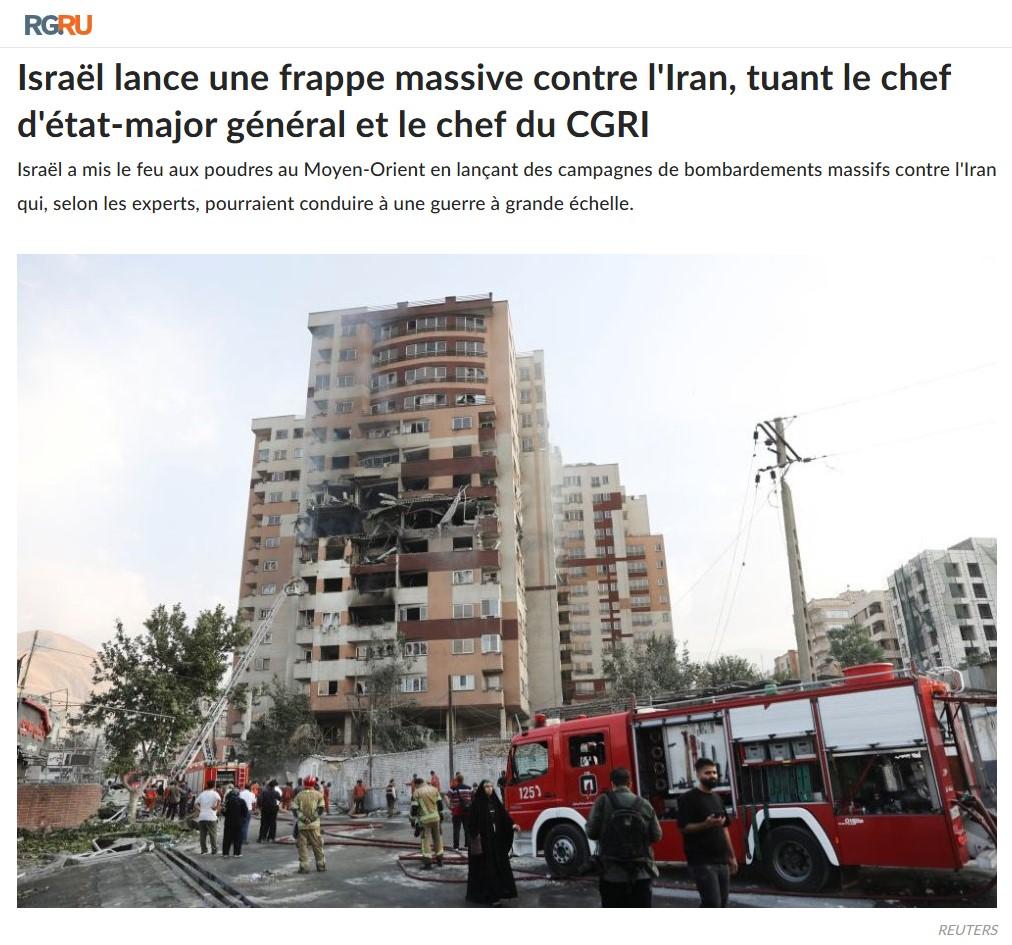
Israël a mis le feu aux poudres au Moyen-Orient en lançant des campagnes de bombardements massifs contre l’Iran qui, selon
L’article Israël bombarde l’Iran et tue le chef d’état-major général et le chef du Corps des gardiens de la révolution est apparu en premier sur STRATPOL.
Originally published by Misión Verdad
* Available in Portuguese at Saker Latinamérica
* Translated to Portuguese and English by the Saker Latinamérica Community Team.
* * *
In an international scenario marked by worsening geopolitical tensions and aggressive trade policies promoted by Donald Trump’s administration, the meeting of foreign ministers of the Brics bloc was held in Rio de Janeiro on April 28 and 29.
The meeting gave clear signs of the direction Brazil intends to give the organization during its pro tempore presidency.
Despite the climate of cooperation and the unified discourse on multilateralism and the development of the Global South, the overall tone suggests a pause in the pace of expansion and innovation that characterized the Russian presidency in 2024.
Statements by Foreign Minister Mauro Vieira and President Luiz Inácio Lula da Silva revealed a Brazilian strategy aimed at containing the speed of the bloc’s transformation, which reinforces a traditional agenda based on dialogue, political neutrality and climate diplomacy; and indicated that it was at the meeting that this approach was defined, which limits the deepening of the logic of multipolarity in favor of a more passive posture.
The ministerial summit was the first formal meeting of foreign ministers following the expansion of the platform, which now has eleven members, including regional powers such as Iran, Egypt and Ethiopia.
Also participating for the first time as special guests were the so-called “Brics partners”, a category created at the Kazan summit in 2024, including countries such as Belarus, Bolivia, Kazakhstan, Cuba, Malaysia and Nigeria.
The topics addressed, such as the need for reform of the international system, the defense of multilateralism and the promotion of peace, met with consensus among the participants.
However, the Brazilian tone was cautious. Vieira reiterated that the Brics “are not against anyone”, clarifying that there is no intention to create a common currency but to encourage transactions in local currencies, as a way to reduce costs and strengthen regional cooperation, citing the Aladi model as an example.
The Brazilian Foreign Minister also stressed that there is no intention to replace the current monetary system, based on the hegemony of the U.S. dollar, nor to create new currencies, thus distancing himself from more ambitious proposals promoted by Russia and China in recent years. In other words, Brasilia seeks to preserve the status quo of the dollar and restrict the options of de-dollarization to a purely transactional element, thus avoiding structural alterations in the global financial order
This emphasis contrasts with the Russian agenda of the previous year, which proposed more decisive steps towards an alternative financial architecture, such as the consolidation of the Brics Pay, a system hybrid cross-border payments infrastructure, decentralized on an international scale, the boosting of the Brics Bridge platform as a supranational clearing network, and the development of payment mechanisms based on local, digital and blockchain currencies with a view to reducing dependence on the dollar with a perspective of monetary and financial mutipolarity.
Brazil’s approach as president of the organization seems to respond more to its own international agenda than to a desire for transformational leadership within the bloc.
Under Moscow’s leadership, the Brics projected itself as an articulating force of the Global South with structural proposals in financial matters, such as the promotion of an alternative payment network to Swift, the expansion of the use of local currencies and the design of credit instruments aimed at shielding partner countries from unilateral sanctions.
In contrast, the roadmap proposed by Brazil in 2025 indicates a reorganization of priorities, more aligned with development, health, environment and social inclusion agendas. According to the official document of the Brazilian Pro Tempore Presidency (PPTB), Brazil intends to contribute – as in its previous mandates of 2010, 2014 and 2019 – to the “advancement of dialogue and consultation within the Brics on political and security, economic-financial and civil society issues”, which maintains its traditional emphasis on reforming the global governance system to give emerging countries a greater voice.
Under the slogan “Strengthening global cooperation with the South for more inclusive and sustainable governance”, the Brazilian presidency has defined two major priorities:
Through the interventions of its high authorities, Brazil projects a “bridging” role between the global North and South, more inclined towards conciliation than confrontation. Its narrative insists that the Brics do not seek to replace existing mechanisms or challenge the dominant international financial system, suggesting that Brazil seeks to shape a bloc that is not uncomfortable for Washington.
Instead of promoting genuine multipolarity, it prioritizes a transactional multilateralism that allows it to consolidate its economic ties with China and Russia, without breaking its historical geopolitical dependence on the United States. This strategy allows it to navigate systemic tensions without compromising its room for maneuver on both fronts, which translates into consolidating its business with China and Russia without compromising its geopolitical dependence on the White House.
In addition, the Brazilian presidency proposed highlighting issues such as the fight against climate change through the Amazon Forever initiative, a bid to attract investments to the Amazon biome with the support of “developed countries”.
This approach contrasts with the geopolitical and security line that marked the Russian presidency, focused on the consolidation of the multipolar order and the redesign of the international power architecture.
Brazil chooses not to rush the institutionalization of the bloc and favors the strengthening of its pre-existing international networks, in a dynamic that suggests a strategic use of the multilateral space as a platform for international projection.
As the July 6-7 Leaders’ Summit approaches, the Brics faces a scenario marked by internal divergences conditioning its strategic direction.
The negotiations on the joint declaration of Rio de Janeiro, which will serve as the basis for the final document of the Heads of State, show a persistent tension between the transforming impulse led by Russia and China, and the commitment to pro-US moderation that Brazil seeks to imprint on its pro tempore presidency. This divergence was particularly evident during the Kazan summit, when Venezuela was prevented from joining the platform.
The negotiations for this text reflect a sustained position of the group: criticism of “unilateral measures” and defense of multilateralism as a guiding principle. However, the differences in tone highlight not only the different speeds that coexist in the bloc but also a deeper background: the clash between different interests and geopolitical visions, which oscillate between the preservation of certain traditional balances and the strategic commitment to multipolarity, which necessarily implies clashing with Western domination.
China is reportedly pushing for stronger language in rejection of recent U.S. tariffs on its products, reaching up to 145%, while Brazil, acting as mediator, is seeking a less confrontational approach. According to press reports, the final communiqué would maintain the criticism of these policies, but would avoid rhetorically escalating the confrontation.
At the same time, a shift in the discussion on the group’s financial architecture is taking place. In contrast to the previous enthusiasm for a common currency, the Brazilian authorities seem to have opted to prioritize the promotion of trade in local currencies as a gradual mechanism to reduce dependence on the U.S. dollar.
Beijing, for its part, continues to profile the Brics as a “backbone” of South-South cooperation. Statements by the Foreign Ministry spokesman in Beijing, Lin Jian, highlighted the intention to build a “more comprehensive” partnership among its members and to defend “equity and justice” in global governance.
A vision that was reinforced during the bilateral meeting between Wang Yi and Sergey Lavrov, in which both reaffirmed the role of the platform as a catalyst for a fairer and more rational international system.
Vieira’s carefully chosen words have been interpreted as a clear signal that the Brazilian presidency is seeking to curb the geostrategic momentum that Russia set in motion during the Kazan summit, where proposals for a financial and security architecture alternative to the Western order were openly promoted.
In addition to the differences in tone and approach, Brazil has proposed a more technical and transactional structure for the coordination of the body. And the organization of 100 ministerial and technical meetings between February and July in Brasilia is evidence of a desire to institutionalize and technicalize the dynamics of the organization, but it could also be read as a way of managing political time to moderate the most advanced initiatives.
Instead of moving forward with more far-reaching structural proposals, the Brazilian presidency is committed to consolidating previous achievements and reinforcing existing cooperation, trying not to generate tensions either with its Brics partners – particularly China and Russia – or with crucial external actors such as the United States and the European Union. This strategy reveals a delicate balance between Brazil’s traditional Western geopolitical alignment and the abstract commitment to multipolarity.
The path that Brazil charts over the next few months will be decisive for the bloc’s immediate future.

 Lateo.net - Flux RSS en pagaille (pour en ajouter : @ moi)