 Connexion


“Today’s Big Debate” on News X Live, 22 January“The Big Debate” was aired live at prime time in India (9pm) yesterday. However, there was a wide time differential with the cities where each of the three panelists from abroad weas based: 4.30 pm in Brussels, 11.30 pm in Hong Kong and 10.30 am in Washington, D.C. We have Zoom to thank for the way we were brought together seamlessly with the studios in India and with the Indian panelist.
I have identified the first of my fellow panelists, whose contribution was likely the most consequential: Raymond Vickery, former United States Assistant Secretary of Commerce for Trade Development who is a senior associate with the Chair in US-India Policy Studies at the Center for Strategic & International Studies, Washington, DC. Accordingly, Vickery is a person well-known to Indian elites. He has a law degree from Harvard. And he is an upstanding member of the Cold Warrior contingent in the U.S. foreign policy establishment, as becomes crystal clear from his remarks here. It was entirely in character for him to deplore Trump’s Board of Peace initiative for being “top down”, as if any of the global steering committees like the G-7 or the G-20 are “bottom up” – which would be against the laws of nature. It was also in character that he deplored the invitation onto the Board of non-democratic, authoritarian states like Russia.
The second panelist, based in Hong Kong, was singing from the same choral hymn book. This was Andrew Leung Kwan-yuen, a prominent Hong Kong politician and businessman who from 2016 until his retirement in 2025 was the President of the Legislative Council of Hong Kong.
The fourth panelist, Sumit Peer in India, was more welcoming to the Trump initiative and saw the refusal of China to join as giving the Indians a strong reason to sign up and take active part. His LinkedIn entry tells us that he is a renowned Geo-Political Commentator, visionary Columnist, Business Advisor, and a concerned citizen with a mission of contributing towards nation building.
I thoroughly enjoyed the opportunity to explain why no one knows what the dynamics inside the Board of Peace and its subordinate Executive Board will be, so it is gratuitous and senseless to condemn or approve the Board at this point. I also expect Moscow to sign on because to refuse to join now would be an insult to Trump, with whom they wish to stay in good relations.
gilbertdoctorow
Who is Hitler and who is Chamberlain today?
For the last 50 years at least, American hawks have time and again brought up a lesson from the past to justify their foreign and military policy predilections that amounted to war-mongering.
Every attempt to find accommodation, détente with America’s ideological adversaries was systematically denounced as “appeasement” in the tradition of Chamberlain seeking ‘peace in our time’ when dealing with the German Fuehrer, whose ambition was absolute political, economic, military domination in Europe.
Donald Trump’s absolutely shocking act of aggression this past weekend compels us to face a new reality: that the President of the United States is today the incarnation of Hitler with ambition on a world-wide scale.
I am not repeating here the cheap and empty political posturing of the Trump haters in America who have called him a fascist because he opposes their Green agenda, opposes their LGBTQ+ Rainbow parades and support for sex change operations among adolescents, and opposes other extreme Liberal values that amount to the destruction of the foundations of society in pursuit of I, Me, Me, I.
No, those complainers about Trump are abusing the notion of fascism to serve their own selfish hunger for political power at any price.
I am speaking about the notion of fascism writ large, as a program to destroy all those nations which do or could stand in the way of American global hegemony.
Trump has trampled on the sovereignty of Venezuela and makes no secret of plans to ‘run’ the country and extract enormous wealth for American corporations by setting them free to exploit Venezuelan oil. He has just renewed his claims to take possession of Greenland. He has threatened Iran with military intervention over the suppression of political disturbances that are a direct result of the country’s economic hardships under crippling U.S. sanctions that go back twenty years or more. Surely Cuba is also in his sights.
The operation in Caracas this past weekend is the template for what is to come. No big invasions, just a very carefully researched and executed decapitation strike that removes to American prisons the leaders of the countries on the Trump check-list.
And why bother adding to the prison detainees? In the past week the CIA targeted Vladimir Putin’s countryside residence with intent to murder. Minister of War Pete Hegseth in the past few days has threatened Putin with “we’re coming for you”.
*****
Given all of the foregoing, I am shocked that some colleagues continue to praise the moderation shown thus far by Russia and China in response to what Trump has done and said this past weekend. We are told that they appreciate the volatility, the narcissism, the oncoming dementia of the man in the Oval Office and are making their highest priority avoidance of a nuclear war by handling The Donald with kid gloves.
Dear friends, you are arguing the case for Chamberlain! And was not Hitler in 1938-39 understood to be mentally unbalanced, a madman if I may cut to the quick? The only argument that one might have made in defense of Chamberlain’s appeasement was the lack of preparedness for war of his country and its allies on the Continent. But that is manifestly not the case today, when we all understand that Russia’s conventional forces are more than a match for NATO in its shambolic present conditions, and that Russia’s nuclear triad, its strategic arsenal is years ahead of the USA at this moment. That will likely not be true 5 years from now, but it is true today. Accordingly, there is no logic to Russian pusillanimity, to its not threatening the USA with total destruction here and now if Washington does not pull in its horns and behave in accordance with the UN Charter.
Going back 5 years, I argued in an essay that Khrushchev was right to bang his shoe on the desk in the UN General Assembly. He was right to issue his famous threat to the capitalist world: “we will bury you.”
Khrushchev may have been boorish, but he was brave and he was ready to fight to the death if the U.S. side did not come to its senses. The Cuban Missile Crisis of 1962 was a test of courage on both sides the like of which I do not see today. The annihilation of tens of millions of people was a possibility, to be sure, but it was offset by readiness to enter into serious and decisive negotiations going to the root causes of the confrontation. After all, in the end, not only did the Russians pull their nuclear tipped missiles out of Cuba but the USA pulled into missiles out of Turkey and Italy.
*****
‘Progressive humanity’ is today reporting on the demonstrations being held in capitals around the world to protest against the imprisonment of Maduro and U.S. aggression.
Regrettably, the net result of these demos will be nil. The only powers on earth that can stop the insane Hitler-like course of the Trump administration today are China and Russia. If they twiddle their thumbs now then you can be sure that the possible war today will be replaced by a certain civilization ending war in five years’ time.
©Gilbert Doctorow, 2026
gilbertdoctorow
‘Judging Freedom’ edition of 24 December: The Totalitarian EU
In today’s conversation with Judge Andrew Napolitano, we discuss the terrible sanctions recently imposed by the European Council on retired Swiss military intelligence expert Jacques Baud for what is said to be his pro-Russian disinformation (an outrageous defamation) and the precedents for such extrajudicial violations of citizens’ rights to free speech, to property rights and more. As I say here this goes straight back to the seizure of assets of Russian oligarchs early in 2024 after the start of the Special Military Operations on charges of their ‘being friends of Putin’ and other nonsense that would never be accepted in a court of law. The problem may be said to go still further back to the breach of international law when the U.S. seized embassy and consular properties of the Russian Federation during the Obama administration in December 2016 to hand a poisoned chalice to the incoming Team Trump.
My point is that rule of law works for all of us only when it is defended against each and every violator. Failure to bring legal action and/or high-level lobbying against violators can only lead to escalation and spread of abuses over time. That is how we have reached a situation where none of us in the Alternative Media today can feel safe in the European Union, although as I say here, it is highly unlikely that any American will be put on EU sanctions lists for fear of enraging Trump and putting in jeopardy America’s nuclear umbrella and NATO support for Europe. But if you are a Swiss or some other third country national: watch out!
We also delve into the deeper problem that makes cases like Baud’s so intractable: the absence of any system of checks and balances, of division of powers whereby an independent judiciary could review cases of abuse like this and compel the offending executive to back down. This fundamental problem must be put at the door of the Left-leaning highly intellectual caviar socialists who played a very important role in writing the foundation documents of the EU, and who assumed that their successors would be equally well-intentioned and tolerant of others’ views. Well read, they may have been but they did not pay due attention to the 19th century political scientists who reasoned that men can be overbearing, oppressive and must be held in check by limitations on the power written into the constitution. In this regard, it should come as no surprise that the EU institutions today lend themselves to totalitarianism. Elon Musk is right: the EU must be deconstructed and rebuilt in a way that better protects democracy and specifically protects all human rights of its citizens, starting with freedom of expression, which is now being trampled upon.
gilbertdoctorow
In this Thursday, December 18, 2025, lecture to his Beijing high school students, Professor Jiang explains how and why Pax Judaica will come to rule the world and how it might end. He says that this is a theory that provides a model, and most likely a conspiracy theory (saving his own bacon here, as these things cannot be talked about). Yet, in reality, Pax Judaica is being worked on most furiously. We could only look at the zionist efforts to change the thinking of the average Australian after Bondi Beach, where the Aussies are literally being told what to do and threatened if they do not do what Netanyahu, who has just proclaimed Israel as a Great Power, tells them.
The spectacle in the White House when lighting the first Hanukkah Candle needs no explanation. These Zionists literally took Trump by the body, and pulled him to and fro, and in an extraordinary manner, adoration that should possibly be left for the bedroom. And now there is this anti-semitic Rabbi, as a diplomatic position, breathing fire and brimstone on any free speech, conflating Zionism and Judaism, and putting forward in theater lights how the Jews must be protected and, if you are found to be ‘anti-semitic’, how the punishment will follow.
“US President Donald Trump has selected a new special envoy to monitor and combat antisemitism, elevating a Miami businessman and fundraiser named Rabbi Yehuda Kaploun to the role.
“Yehuda is a successful businessman, and staunch advocate for the Jewish Faith and the Rights of his people to live and worship free from persecution,” Trump said on Truth Social, announcing his selection. “With Anti-Semitism dangerously on the rise, Yehuda will be the strongest Representative for Americans and Jews across the Globe, and promote PEACE. Congratulations Yehuda!”
Trump’s announcement elicited a wave of sharply antisemitic comments on the social network, which Trump owns and is favored by his supporters. “No one believes Anti-Semitism is an issue but the Zionists. I will criticize our Greatest Enemy whenever I want,” wrote one commenter.”
Prof Jiang’s theory may be far-fetched in terms of details, but we see the bones of it forming in our world. It is interesting how Jiang briefly outlines four or five major theories of the end times or eschatology, which are closely bound to the world of Judaica and Christian Zionism in historical terms.
Regarding eschatology, I would like to remind everyone of the period when the Mayan Calendar was supposed to signal the end of the world, and hysteria was common. At the end of that, it was the Calendar that ended, and not the world. Prof Jiang ends this lecture with a note on what can be done regarding the assault on the Western world’s implementation of Pax Judaica. If we think of Greater Israel, it is a very real initiative and now on steroids, in terms of what I see without looking for it. See Australia bowing to the hysterical, while voices that make sense receive no reach, only threats.
Another loose theory that has been taking shape for me is that Pax Judaica is intended to be the final saving grace for Pax Americana. If all else fails, they depend on all of them now being Jews and are already writing the narrative that they should be protected. Even Alex Jones is now professing to be a Jew.
Notes and References:
1. Book of Ezekiel, Hebrew Bible
2. Observations Upon the Prophecies of Daniel by Isaac Newton
3. Structure of Scientific Revolutions by Thomas Kuhn
4. The Thirteenth Tribe by Arthur Koestler
5. Kill King 33 by James Downard and Michael Hoffman
6. Words of the Lord (Jacob Frank)
Europe’s choice is to surrender or die.
By Rotislav Ishchenko at ukraine.ru.
(machine translation)
Alastair Crook, a retired British diplomat, has stated that the European Union is preparing a provocation on a scale comparable to Pearl Harbor, with the aim of drawing the United States into a war with Russia.
In principle, this is not news. We have been writing for two years that the British, realizing that Ukraine has failed and will be buried, have placed their bets on a pan-European war (under the auspices of the United States) against Russia. While Joseph Robinette Biden Jr. was trying to figure out who he was and how he got here, the mechanism for expanding the war was clear: a provocation in the Baltic Sea (less likely in the Black Sea or on the Belarusian border), which would leave Russia with no chance of resolving the crisis without shooting, and an outcry about the “attack” to the country of the EU and NATO, a statement of military support (sending troops and equipment, but without a formal declaration of war against Russia) by the leaders of the EU. In the last act, the United States and Britain enter the scene, demanding that Russia cease fire and threatening to provide all possible support to their allies.
I would like to point out that the mechanism of provocation assumed that in all cases, Russia would initiate military action against a specific country. Moscow, on the other hand, was only faced with the choice of whether to attack the Baltic states, which had blocked Kaliningrad, or to hope for a miracle, sink the transports carrying French and German troops and equipment bound for the Baltic ports, or to express protests, attack the territories of the United States and the United Kingdom in response to their ultimatum, or to agree to a ceasefire and negotiations mediated by them. In the end, acquiescence inevitably led to capitulation (since as soon as one set of demands was met, the West would immediately set forth another), and escalation inevitably led to a global nuclear war.
It is no coincidence that Trump claimed that Biden was leading the country towards a nuclear armageddon. Whether Biden was aware of his actions or was being manipulated by his entourage, the decision-makers in the United States (as well as the majority of the British establishment and the European bureaucracy) believed that Russia would not engage in a nuclear conflict and would retreat. However, there were other politicians in the West who had no doubt that if Russia was pushed to the wall, nuclear mushrooms would grow all over the West – no one would leave without a share. These people came to power in the United States with Trump, and their supporters are gradually pushing back against the European left-liberal supporters of war.
As a result, the United States fell out of the scheme, and Trump openly stated that if Europe wanted to go to war with Russia, it could do so on its own, without the United States. It’s not that the Europeans were particularly eager to go to war, but rather that they couldn’t help but go to war with Russia, as acknowledging defeat in the Ukrainian crisis would completely undermine the left-liberal European elites. To understand why this is significant, it would have political, economic, and social implications on a scale similar to those that shook Russia after the October Revolution and before the outbreak of World War II. The Europe we know will disappear, and a new Europe will be born in agony, compared to which the 1990s in Russia were like a light rain during a summer picnic.
But the Europeans also can’t go to war with Russia. They don’t have the armies, the warehouses, or the ability to quickly deploy the necessary military production. Without the United States, the EU is a paper tiger. Although no, a paper tiger is scarier than the EU without the United States. This is why Alastair Crook emphasizes that the provocation must be so severe and widespread that neither Trump nor other American and European politicians who support de-escalation can avoid going to war with Russia.
By the way, as a loyal subject of His Majesty, Alastair Crook does not mention Britain’s leading role in developing this plan and preparing the provocation. The blame lies with the EU, which intends to drag the United States into a war with Russia, while the United Kingdom simply passed by.
It’s understandable. Most likely, the provocation is unavoidable. The British and the European bureaucracy can’t help but try to seize their last chance. I once wrote that nothing would stop them. They might even detonate a nuclear device in Kyiv to blame Russia. However, the Ukrainian government is not fully in control of the situation. The internal opposition to Zelensky, unable to oust him yet, is attempting to preserve at least some form of Ukraine by pushing Zelensky overboard.
In such a situation, the preparation of a large-scale nuclear provocation, which requires deep secrecy, is extremely difficult, as hundreds of people must be involved in its organization (transportation, storage of the relevant munition, its transfer across the border, security, and other activities cannot be carried out without the involvement of a large number of people). Even if you simply replace the customs officers and border guards at the border with trusted individuals, it will immediately become widely known that something large and secret is being transported.
However, recently, the Ukrainians and the British have started practicing a naval provocation, attacking tankers from any country carrying Russian oil. Russia has already begun responding to the Odessa port and the ships arriving there. In principle, the British Navy and its Ukrainian counterparts can organize a “Lusitania” (with influential Americans on board). However, it is more difficult to prove Russia’s “guilt.” As Poland’s experience shows, it is no longer enough to simply claim that Russia wanted to blow up railway tracks and cause a major disaster; convincing evidence is also required.
Actually, this is the catch: how to organize a provocation in such a way as to shake the imagination of “all people of good will”, and provide “convincing evidence” of Russian “guilt”, and not inherit anywhere, and leave the United States no choice? The task is difficult, but, as experience shows, it is solvable. If British diplomats (even retired ones) start issuing warnings and distancing themselves, it means that the preparations for some large-scale atrocity have entered the final stage or are basically complete, and the London warmongers only need to give the command to launch the operation.
In principle, the supporters of escalation don’t have much time. By March, even if the Armed Forces of Ukraine don’t completely disintegrate and Zelensky still controls some part of Ukrainian territory, Trump should withdraw the United States from the Ukrainian crisis and reorient towards the Indo-Pacific region and Latin America. Moreover, he has announced the beginning of a military operation against Maduro in Venezuela in the near future. If the British and European bureaucrats let the United States out of the Ukrainian crisis and allow it to get involved in others, it will be impossible to bring it back. Washington cannot afford to run around the world like a mad rabbit, and it cannot handle two or three major crises in different parts of the world, either organizationally, resource-wise, logistically, or financially.
In the West, they like to coincide political actions with traditional holiday dates. This way, they are better remembered and evoke more emotions. We are just entering a period of holidays: Catholic Christmas, New Year, Orthodox Christmas, and Epiphany. In general, from mid-December to the end of January, almost any day is suitable for the organizers of provocations. All they need to do is manage and dare.
After February, although the danger will not disappear (it will not disappear until a final global settlement is reached), it will significantly decrease, and the further into 2026, the lower it will be.
(For Nicholás Maduro)
These efforts began shortly after Castro’s 1959 revolution and persisted under US presidents from Dwight Eisenhower to Richard Nixon (who oversaw 184 attempts), often involving Cuban exiles with CIA support.
Key failed plots include:
Exploding cigars and toxins: A cigar rigged to explode during Castro’s UN visit in New York; another contaminated with botulinum toxin (never delivered; Castro quit smoking in 1985).
Poison via a lover: A former girlfriend recruited by the CIA hid poison pills in her cold-cream jar, but they melted. Castro, suspecting her, offered his own pistol, but she couldn’t proceed.
Underwater traps: Explosive-filled Caribbean molluscs painted brightly to lure Castro while scuba diving (abandoned); a diving suit infected with a fungus to cause debilitating skin disease (also scrapped).
Other gadgets and poisons: Bacterial agents in tea or coffee; a toxic fountain-pen; botulin-laced chocolate milkshake at the Havana Hilton; an LSD aerosol to spray near Castro during a broadcast for public humiliation.
High-profile timings: On the day of John F. Kennedy’s 1963 assassination, a CIA agent was sent with a poison pen-syringe to kill Castro.
Later plots: In 2000, 200lb of explosives planted under a podium in Panama (foiled by Castro’s security; plotters, including CIA operative Luis Posada, jailed but pardoned; Posada denied involvement in a 1976 Cuban airliner bombing that killed 78).
Additional attempts: A sniper caught at the University of Havana; a grenade at a baseball game; mafia outsourcing (angered by lost Cuban casinos); the 1961 Bay of Pigs invasion aimed to kill Castro, Raúl Castro, and Che Guevara.
 The obsession rivaled the hunt for Osama bin Laden, with former US diplomat Wayne Smith likening Cuba’s effect on American administrations to a full moon on werewolves.
Castro’s security measures doubled, constant movement, gift scrutiny thwarted them all. He famously wore a “moral vest” instead of bullet-proof gear and joked about declining a Galápagos turtle gift, noting pets die after attachment, alluding to his own endurance.
Fabian Escalante, retired head of Cuba’s secret service, documented these in his book Executive Action: 634 Ways to Kill Castro. https://www.amazon.com/Executive-Action-Fidel-Castro-Secret/dp/1920888721
After several unsuccessful attempts, US eventually shifted to a trade embargo to oust him
Euro-American Zionism (Jewish and Christian) has killed millions in West Asia, devastated the region, and it is the motor behind the Gaza Genocide. But Israel itself is under threat of falling pray to the deadly logic that birthed the state in the first place.
Today we are holding a panel discussion on what makes Zionism such a dangerous and ultimately even self-negating force.
I‘m joined by 3 world class academics: Professor Yakov Rabkin of Montreal University, Professor Manuel Ramos of the University Institut of Lisbon, and Professor Jeffrey Sachs of Colombia University.
Today’s conversation goes on for 52 minutes, and could have run still longer if we were to examine more than the several aspects of the latest U.S. National Security Strategy document. I am pleased, nonetheless, that we had ample opportunity to explore the ways in which this 2025 document compares with Trump’s first NSS of December 2017, to see how there is continuity in thinking from then to now. Trump was then a Kissinger-mentored Realist. He is one today, as well.
His embrace of an interest driven foreign policy means that he is ready to seek compromises and compromises are arrived at by diplomacy, which is why he has placed emphasis on reestablishing communication lines with Russia. The efforts of the Biden administration to break off all contact with Russia, to close down diplomacy and to rely solely on a militarized foreign policy, was not the idiosyncratic wish of one man: it came directly from the Idealist, values driven approach to foreign policy that every U.S. administration since Richard Nixon has prioritized.
In this chat, I explained what insights into the NSS come from close textual analysis of the document, from decoding innocent statements like our favoring pragmatism over pragmatists, realism over realists; or by the mention of how Germany is deindustrializing because its industrialists are moving production to China to take advantage of cheap Russian gas there.
I also had a chance to explain the mechanisms in European politics which make it impossible to reverse course on failing policies, so that the meddling that Trump proposes in the NSS and which the Germans have denounced, is very much needed if Europe is to be saved from its present suicidal course.
There is a great deal more here for the Community to explore.
By the way, I perhaps abused my privilege as guest to promote my 2019 book of essays entitled The Belgian Perspective on International Affairs, sales of which are just beginning to take off, six years after its launch. Perhaps prospective readers were turned off by the notion that Belgium dominates the content and Belgium is too small to be of value for understanding world politics. However, I had used a play on words, since the Belgian perspective was in reality, my perspective, now that I had become a naturalized Belgian two years earlier. It is in that book that you will find my detailed analysis of Trump’s 2017 NSS, which largely sets out the thinking he has stayed with in 2025. It is there, in chapter one, that you will find my call for Trump’s impeachment over his vile speech to the UN General Assembly in September 2017 when he proposed to utterly destroy North Korea and obliterate its 22 million population. I am viewing Trump very differently these days, focusing as I do on his top priorities for global power sharing with Russia and China and choosing to overlook his bullying, imperialist ways in Venezuela and his enabling genocide in Gaza.
©Gilbert Doctorow, 2025
gilbertdoctorow
CIA secretly engineered 1962 war which ruined China-India relations for decades
The month-long October-November 1962 border conflict between China and India killed up to 6.2k people, and poisoned ties between the fledgling Asian powers for decades to come.
But according to a groundbreaking new academic study by Lakshmana Kumar cited by Kit Klarenberg, it was the CIA that helped push the nations to the brink of war, and then cross over it, using a 1950s campaign of paramilitary training, airdrops and arms support for Tibetan separatists in a brutal secret conflict that claimed the lives of up to 80k Chinese soldiers.
 China blamed India for the CIA campaign, with New Delhi’s provision of territory as a base of operations, and welcome for refugees during a 1959 uprising heightening Beijing’s ire, and triggering a series of violent border clashes the same year.
US machinations aimed at poisoning China-India relations go back to a September 1951 State Department memo urging Tibet’s use “as a weapon for alerting [India] to the danger of attempting to appease any Communist government and, specially, for maneuvering [it] into a position where it will voluntarily adopt a policy of firmly resisting Chinese Communist pressure in South and East Asia.”
Under Allen Dulles, the CIA built a base to train Tibetan separatists in the Rockies, and coordinated an army of up to 14k separatist fighters in Tibetan China.
Days before the 1962 war broke out, Secretary of State Rusk outlined US plans to take advantage of the conflict by expressing public “sympathy for the Indians,” but without giving Beijing a “pretext for alleging any American involvement.”
Rusk detailed a contingency for providing India military transport and communications support, should New Delhi request it, which it subsequently did.
The Tibetan trump card worked, and India backslid on its non-aligned foreign policy. In a triumphant December 1962 report, the CIA predicted that India would “almost certainly continue to open up new opportunities for the West,” and prove susceptible to “influence by the US and the UK, particularly in the military field.”
“The genie is out of the bottle. The provocation of a “USV privateer war” on trade routes threatens to collapse global maritime trade.”
By Rotislav Ishchenko at ukraine.ru.
(machine translation)
The oil tanker Virat has been attacked twice by unmanned boats near the Bosphorus Strait. On one occasion, the ship Kairos was also set on fire. Western media outlets have claimed that the tanker belongs to Russia’s “shadow fleet.” This expands the list of potential suspects. Naturally, Ukraine, which has been waging a long-standing war against the Russian military fleet using unmanned combatants, is at the top of the list. However, it is unlikely that Kiev would have dared to attack merchant ships, especially near one of the world’s most important transportation hubs connecting the Black Sea and the Mediterranean, which is controlled by Turkey, without the direct approval of its Western allies. The consequences, both direct and indirect, would have been far-reaching, affecting the entire world. Ukraine may no longer exist, but the unmanned surface vehicle’s (USV) attack on merchant ships could echo for decades, shaping the maritime trade landscape.
So it doesn’t matter whether these USVs belonged to Ukraine or whether the British and Americans decided to use their own or those belonging to a third country. The genie is out of the bottle. And not only because this game can be played by two people.
In this case, Britain is unlikely to hope to remain outside the scope of retaliatory actions. It is clear that it is more difficult to use USV to disrupt shipping in the open ocean than in enclosed waters such as the Black, Baltic, Mediterranean, White, Red, Yellow, and Japanese Seas, as well as all Chinese coastal seas. However, the ports of the United Kingdom are within direct reach of USV strikes from the continent and/or from ships and vessels passing through the English Channel. The situation for shipping may be even more dangerous in the classic pirate stronghold of the Caribbean Sea, which borders dozens of countries, many of which are home to both drug cartels and ideological guerrillas.
The threat to American southern ports in the Atlantic is clear.
At the same time, although USVs are more complex than the simplest air drones, they do not require high-tech enterprises for their creation. The problem of guidance, especially at shorter distances, is also solvable. This means that it is not always possible to determine the nationality of a USV that has not exploded, especially if the manufacturer deliberately conceals it.
Almost all strategic global maritime trade routes, no matter how far they extend into the open ocean, eventually pass through bottlenecks like the Bosphorus. Moreover, almost all of these bottlenecks are within the reach of the USV from the coasts of dozens of countries and/or hundreds of ships passing by simultaneously. Only the Northern Sea Route is relatively protected by national means. The rest can be blocked.
The provocation of a “USV privateer war” on trade routes threatens to collapse global maritime trade. This does not require sinking all ships. It is enough to make the threat significant enough to increase insurance premiums, crew salaries, and security costs, as well as delivery times. As a result, significant volumes will be excluded from global trade due to their unprofitability. Additionally, USV can be produced in large quantities (or purchased) and used by dozens of countries against each other. As we know, the greater the demand, the cheaper and easier to use the technology becomes. The first AK-47s were secret and carried in tarpaulin cases, but now the entire world, including the poorest tribes, is using them, and only the lazy ones are not producing them. Finally, the Ukrainian military crisis, as well as the wars between the Houthis and the Saudis and Israel, have demonstrated how easy it is to use high-tech weapons against a third country under the guise of a proxy ally. If Ukraine can launch American and European missiles, which require satellite guidance, at targets deep within Russia, and the Houthis can use hypersonic weapons to attack their enemies, what is stopping Somali pirates or Colombian drug lords from developing similar technologies for the USV?
I want to emphasize that the problem is not that a tanker that could theoretically belong to Russia’s “shadow fleet” was attacked. Russia is primarily a land-based power, and its main trade routes are located within the Eurasian continent and are well-protected. The main targets of the “USV privateer war” may include China, Taiwan, Japan, both Koreas, the Philippines, Vietnam, Thailand, Myanmar, Taiwan, India, the Gulf oil monarchies, Iran, Singapore, Turkey, Indonesia, and countries in the Caribbean, Mediterranean, North Sea, and Baltic regions.
These are either trade competitors of the United States and the United Kingdom, or allies of the United States who are in a leading geopolitical position and are used as a springboard for military and political pressure on the United States’ trade and economic competitors.
In recent years, the West has been losing not only the financial and economic struggle, but also the struggle for control of global trade. The dollar and the euro are losing their positions as the main and auxiliary global currencies and currencies for trade settlements. The yuan, rather than the ruble or the rupee, is actively replacing them. The traditional trade between the West and countries in the Gulf, Latin America, and Southeast Asia is gradually shifting to China. China is also actively expanding its presence in the Eastern Mediterranean, moving through the Greater Middle East.
In all of China’s advancements, maritime trade routes are of utmost importance.
The land-based trans-Eurasian trade routes that connect the continent into a unified economic Greater Eurasia serve as the foundation, but it is the control over maritime trade routes that allows China to build a “fairy-tale castle” of global profitable trade. It is no coincidence that China is building a navy that surpasses the United States in terms of the number of ships and is poised to surpass it in terms of overall combat power. China needs to control the routes that facilitate the sale of its goods. Russia can exist as an autarky, but China will quickly explode from within if its trade is blocked.
During the Ukrainian military crisis, Western UAVs, which were limited in their use in Ukraine, proved to be highly effective in controlling the water area dominated by the enemy’s navy and aviation, as well as in blocking ports and posing a constant threat to military bases. Russian sailors gradually learned to combat the UAV threat, but they were unable to completely eliminate it.
It should be noted that the military fleet, which exercises dominance in a closed water area, has impressive capabilities for combating enemy USVs. However, as mentioned earlier, the threat of USVs in the Black Sea has not been completely eliminated. For the military, repelling attacks is a natural activity. The merchant fleet, on the other hand, is not equipped to handle this task. Any measures taken to enhance the security of commercial ports and the surrounding water area will immediately impact the speed and cost of shipping goods, while the threat of USVs remains high.
The West is not just not afraid of playing a “double game” in the “USV privateer war.” It is provoking this war, deliberately seeking to paralyze global maritime trade.
We can say that this will hit the West itself. It will hit it, but not as hard as we would like. As mentioned above, the West has already lost its trade supremacy to China, and it will only continue to lose ground. However, the rules of geopolitical warfare require us to try to destroy the mechanism that benefits our geopolitical adversary rather than ourselves. During the two World Wars, when maritime trade was an Anglo-Saxon monopoly, Germany attempted to wage war against it using its submarine fleet. The West is now trying to strike a blow to global maritime trade, which is gradually being taken over by China.
We have repeatedly said that the paralysis of Chinese trade will inevitably plunge Beijing into a financial, economic, and then a social and political crisis. The Anglo-Americans have failed to isolate China through legal means, so why not try proxy piracy, since they are already waging a proxy war on land against Russia.
It is clear that we should not expect hundreds of USV attacks on sea routes tomorrow. However, we should not expect them to take decades to organize. As the development of UAV technology during the Ukrainian military crisis has shown, it is possible to transition from isolated attacks to large-scale use in a matter of months (or even a couple of years), which can change the entire dynamics of the conflict and require the development of appropriate countermeasures, which may not always be as quick as desired.
The fact that the incidents involving attacks on merchant ships by the USV occurred in the area of the Bosphorus, a trade route controlled by a NATO country, indicates that the organizers of this provocation are preparing for a global undeclared war on trade routes (similar to the war between English pirates and Spanish transatlantic trade in the 16th to 18th centuries), and they do not intend to tolerate the transfer of control over these routes to their geopolitical opponents. Given that the United States is developing an icebreaker fleet and actively expanding its presence in the Arctic, we should also consider strengthening the security of the Northern Sea Route.
Pascal Lottaz from Neutrality Studies and Prof. Manuel J. Ramos
The age of European colonialism never really ended, it just changed its costume. Today’s geopolitics look and feel so barbarian medieval because they are the ghosts of the Crusades and a forgotten medieval legend.
To explore these startling ideas, I’m talking to Dr. Manuel João Ramos, an Associate Professor at the Dept. of Anthropology at the University Institute of Lisbon, where he has been working for decades on questions of European Colonialism and Power in International Relations.
We trace a 1,000-year-old story, uncovering the surprising roots of Christian Zionism, the messianic fantasies behind the “Age of Discovery,” and the religious undercurrents that still shape Europe’s troubled relationship with the world.
The current ‘War on Drugs’ which is a restatement of the ‘War on Terror’ by the hegemon attempts to take back the drug trade and the terror trade from drug manufacturers and terror manufacturers for themselves. It is their own industry. It is a trade war. Anyone else in these industries are enemies to the hegemon, not because the hegemon is doing a good thing for the population, rather because the hegemon is protecting its own black trade. We saw that with Syria, where the hegemon now has many new terror soldiers that can be used.
Jeff J Brown interviews John Potash on his latest book that again looks back into the ’60’s and ’70’s. As I said when I posted their first interview: “Sometimes you hear some history that you know, but to see it again in one fell swoop, shocks yet again”
Jeff has a massive library that he has collected throughout the years.
Jeff J. Brown’s libraries and catalogues A-Z: 1,000s of hours of research, writing, editing and podcasting.
Amir&Jeff’s Excellent China Adventure Series: https://radiosinoland.com/2025/07/27/amirjeffs-excellent-china-adventure-series-2025-hunan-jiangxi-fujian-and-shaanxi-provinces-red-tour-short-videos-captioned-photos-articles-and-commentary-the-real-chinese-people-you-don/
Apollo Moon Hoax Library: https://radiosinoland.com/2025/02/22/apollo-moon-hoax-library/
Bioweapons (co-founder and curator, so very much a team effort): www.bioweapontruth.com
China-Tech’s History to the Present: https://radiosinoland.com/2018/03/20/china-tech-invention-innovation-technology-research-and-development-past-present-future-5000-years-of-progress-a-china-rising-radio-sinoland-living-document/
China Tech News Flash!: https://www.chinatechnewsflash.com/
Covid (with help from China Writers’ Group/CWG): https://radiosinoland.com/2020/03/07/its-all-here-the-china-rising-radio-sinoland-covid-19-chemical-and-bioweapon-file-film-and-tape-library/
Interviews: https://radiosinoland.com/2019/02/22/interview-catalogue-for-china-rising-radio-sinoland-and-jeff-j-brown/
JB West and JB East Present: See You in The Hague!: https://radiosinoland.com/2023/06/05/jb-west-and-jb-east-present-see-you-in-the-hague-our-complete-show-library-continually-updated/
Judaism: https://radiosinoland.com/2025/01/23/judaism/
Mao Zedong (with help from CWG): https://radiosinoland.com/2024/01/03/the-mao-encyclopedia-for-dummies-updated-and-its-all-here-books-articles-movies-visuals-china-rising-radio-sinoland-240103/
Tiananmen Square Protests (with help from CWG): https://radiosinoland.com/2025/06/04/100s-of-1000s-of-people-including-researchers-journalists-and-authors-have-accessed-this-largest-single-source-covering-the-tiananmen-square-protests-join-the-club-new-entries-for-2025-radio-sin/
In this Wednesday, November 12th lecture to his Beijing high school students, Professor Jiang explains how the Yahwehist gave birth to the Bible as well as the nation of Israel.
Notes and References: 1. Book of Genesis, Hebrew Bible 2. Book of Kings, Hebrew Bible 3. Book of J by Harold Bloom
You have to have a thick skin to talk geopolitics in the public agora
My chat with Andrew Napolitano on Judging Freedom 7 November has created a lot of commotion in the Russian-speaking world. Hours after the English podcast went live, one Russian platform on rutube already had a dubbed Russian version posted. That did not stay active for long but was replaced by another, and then by still another. Now finally a Russian version has been posted on youtube and my oh my what it shows!
At this moment the number of thumbs up are 10 or more times greater than the number of Comments which are, as usual, very ad hominem and very vicious. These trolls are saying I am MI6 because I live in Petersburg close to a military helicopter base and have dinner with a defense industry ex-employee. That is already a kind of reasoning, distorted but imaginable. Others talk about my dyed ‘brown hair’, the color of you know what. That is more the gutter variety comment. And then there is this utterly unconventional comment which tells me that I have hit pay dirt;
Россия устала от войны! Это Правда, от такой тягуче-клейко тянущейся Странной Военной Операции, когда стратегическая военная Авиация спит на Аэродромах или бомбит полигоны. Да, конечно, Россия устала от странной неодекватности (или предательства!??) Путина в этой.. Странной Военной Операции. Даже действия в Сирии, были более решительней и результативней.. Россия, устаёт от мелкотравчатых белоусовых, набибулиных, герасимовых, шойгунутых, лавровых и ещё ряда безвольных подпевал.. своего главнокомандующего, от которого они же и отрекутся и продадут по первой возможности (дело в цене) Россия, устала не от Войны, Войны за себя – но от странно-вялотекущей и какой-то выжидательной “войны”.
Here below is a machine translation rendering of this comment in English:
Quote
Russia is tired of the war, that is the Truth! Tired of such a lingering and sticky Strange Military Operation, when strategic military aviation sleeps on airfields or bombs firing ranges. Yes, of course, Russia is tired of Putin’s strange inadequacy (or treachery!??) in this…. Strange Military Operation. Even the actions in Syria were more decisive and effective…. Russia is tired of the small-minded Belousovs, Nabibulins, Gerasimovs, Shoigunutsy, Lavrovs and a number of other weak-willed supporters of its commander-in-chief, whom they will renounce and sell at the first opportunity (the price is the issue) Russia is tired not of the War, the War for itself – but of the strange and slow-moving and some kind of waiting “war.”
Unquote
I trust that the author does not live in Russia, otherwise he could expect a knock at his door soon. But keep in mind that this whole Russian version came to my attention from the Search function of Yandex (Russia’s Google) so it is freely accessible in Russia to anyone with VPN on their computer, and a lot of smart people have that so they can watch whatever they want.
Being in the public agora is not for the faint of heart
©Gilbert Doctorow, 2025
gilbertdoctorow
An echo of History provides insight into the zero-sum equations, and the worth of humanity, to Technofascism
By Rotislav Ishchenko at ukraine.ru.
(machine translation)
No one is perfect, so the saying goes, “Learn from your mistakes.”
At the end of November 1942, Soviet forces encircled the 6th Field Army and part of the 4th Panzer Army of the Wehrmacht, as well as the remnants of four Romanian divisions near Stalingrad (approximately 220,000 Germans and 18,000 Romanians). Hitler forbade the encircled forces from breaking out, and an attempt by Field Marshal Erich von Manstein’s Army Group Don to break through failed. The group under the command of Field Marshal General Paulus fought in the encirclement for more than two months, until February 2, 1943.
During this time, about 30,000 wounded soldiers, vacationers, and highly valuable specialists were evacuated from the pocket by Luftwaffe aircraft. A total of 72,000 people surrendered. As a result, approximately 100,000 Germans and almost all the Romanians died in the pocket. Only 5,000 of the prisoners returned home after the war. The rest died despite the Soviet Union’s attempts to save them due to their extreme exhaustion. In the last weeks of the war, the Luftwaffe lost the ability to fly into the pocket, and the encircled forces ran out of food before they ran out of ammunition.
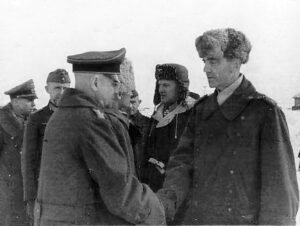
Field Marshal Paulus, General Heitz and other German officers of the 6th Army after its surrender, 4 February 1943.
The Sixth Field Army fought to the last and was almost completely destroyed. After the war, German generals repeatedly accused Hitler of the unnecessary loss of the Sixth Field Army. Indeed, the Wehrmacht was unable to replace the two hundred thousand seasoned veterans who had fought for several years.
However, over time, military analysts came to the conclusion that Hitler’s decision was correct, while his generals were mistaken. The 6th Field Army, if it attempted to break through the encirclement, would have undoubtedly lost all its heavy equipment. They had enough fuel for their tanks to cover a distance of 50 kilometers. However, in the reality of continuous combat, they would only have enough fuel for about 30 kilometers. After that, they would have to abandon their surviving vehicles. Even if two-thirds of the encircled troops managed to break out of the pocket (it is more likely that about half of them would have succeeded), they would have been armed only with light small arms, and they would have been extremely exhausted after a hundred-kilometer march across the winter steppe in constant combat. The remnants of the army would have had to be withdrawn to the rear for reorganization.
At the same time, there was already a huge gap in the front, which Manstein was barely able to control in December with the help of the remnants of the defeated German and Romanian divisions, which had been formed into combat groups. If Paulus’s army had left the encirclement, the Soviet command would have immediately released more than a dozen divisions that were holding the perimeter of the encirclement and had been conducting an offensive to eliminate it for two months, suffering significant losses.
The Red Army had already almost cut off Army Group A in the Kuban region. The last divisions of the 1st Panzer Army were breaking through the ice of the Sea of Azov to bypass Rostov-on-Don, while the 17th Field Army was forced to defend the Kuban region, with only the Kerch Strait as a reliable link to the rear. If the Soviet offensive on Rostov had been carried out by the armies that had been strangling Paulus at Stalingrad, Army Group A would have been blocked in the Caucasus, and the southern flank of the Eastern Front would have collapsed completely, from the Caucasus in the south to Voronezh in the north. The Reich would not have survived such a catastrophe. The war could have ended in 1943.
More than two months of hopeless battles in the encirclement by the soldiers of the 6th Field Army, which diverted significant forces of the Red Army, allowed the Germans to stabilize the front. In March, Manstein launched a counteroffensive, recaptured Kharkiv and Belgorod, and formed the southern flank of the future Kursk Bulge.
No one knows whether Hitler deliberately sacrificed Paulus’s army or whether it was a spontaneous decision, but it allowed the Wehrmacht to avoid the catastrophe on the southern flank of the Eastern Front and prolong the war for an additional year and a half or two years.
After Putin’s order to ensure access to the areas where Ukrainian troops are being blocked for foreign journalists, some of the ever-concerned patriots began to worry in advance that, God forbid, the Ukrainian Armed Forces would be allowed to break out of the encirclement, and they would wonder why we needed foreign journalists there at all. They might even kill a journalist and blame it on us.
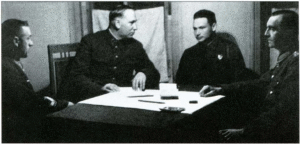
Protocol of military defeat: “Initially, representatives of the German command were brought to the location of the 64th Army, where a preliminary ceremony was held under the leadership of Lieutenant General Mikhail Shumilov. The main negotiations were held at the headquarters of a higher-level military unit. The procedure was led by Colonel-General Konstantin Rokossovsky, commander of the front group, and Nikolai Voronov, a representative of the top military leadership.” [01]
At the same time, the remnants of the defeated brigades would have left without heavy equipment and almost without weapons (the Ukrainians would have enough automatic weapons for them anyway). The very fact of abandoning positions and equipment is seriously demoralizing, and most importantly, such troops cannot be immediately used on the front lines. They need to be reorganized, re-equipped, and only then can they be sent into battle. The most that Syrsky could immediately do with this contingent would be to distribute it as reinforcements to other brigades. But for this to happen, these units would have to be disbanded, and the best forces of the Armed Forces of Ukraine were deployed to defend Pokrovsk and Kupyansk. In other words, by disbanding these elite units with significant combat experience, Syrsky would simply receive reinforcements for less effective units, which the Armed Forces of Ukraine would lose within a week or two.
Russia would be able to free up the units that were engaged in the blockade of Pokrovsk and Kupyansk to launch an offensive in an almost empty area. Syrsky does not have the reserves to plug the gaps in the front.
I will repeat that no one is going to let anyone out of the cauldrons yet. The role of foreign journalists is to convey to the Ukrainian public (relatives of the blocked military) the proposals made to the garrisons of Pokrovsk and Kupyansk to surrender. Our media in Ukraine do not read (do not watch), and those who read (watch) cannot admit it. Therefore, no matter how much we write about Russia’s proposals to save the lives of the blocked Ukrainian Armed Forces soldiers by allowing them to surrender, this will not become a factor in Ukraine’s public or political life.
But the Western media will read (watch) it and refer to it. As I wrote above, it is highly unlikely that this will force Zelensky to order the garrisons to surrender, but ordinary people who receive information from the Western media will call their relatives who are under blockade and tell them that the Ukrainian government does not intend to save them, while the Russian government will ensure their lives and permanent conditions of captivity. Eventually, the special military operation will end, and the prisoners will be allowed to return home. Such information will contribute to the demoralization of the garrisons, reduce the tenacity of their resistance, make it easier for Russia to end the battles for Pokrovsk and Kupyansk and launch a strategic offensive in the areas where the front has been breached, accelerate the collapse of the Armed Forces of Ukraine, the disintegration of the front, and the catastrophe of the Kiev regime, and allow for a faster conclusion of the special military operation while preserving the lives of Russian soldiers.
Of course, it is unlikely that Western media reports alone will be enough to achieve the complete surrender of the encircled Ukrainian garrisons. However, at the very least, their faith in their leadership will be undermined, and their suspicions of their comrades will increase, which may lead to some of them surrendering. The faster the encircled units are eliminated, the greater the likelihood of effectively continuing the offensive before the enemy can gather any reserves and stabilize the front line.
So, of course, we want to save the lives of those who are surrounded in a humane way, but not without benefiting ourselves. We need to hurry up with the victory in Ukraine, as Lithuania is already starting to fuss suspiciously about the transit through Kaliningrad.
The history over the past two months or so, is now marked by a media circus explosion.
A $50 million bounty on Maduro
Washington doubled the reward for Maduro’s capture, raising it to $50 million, calling him “one of the world’s biggest drug traffickers.”
Attorney General Pam Bondi stated that the goal is to “strengthen the network around the regime,” accusing prominent figures, including Diosdado Cabello and Vladimir Padrino López, of drug trafficking.
According to the Clash Report, the preparations suggest not a ground attack but air raids.
Expanded military presence in the Caribbean
The United States has assembled a Joint Task Force in the southern Caribbean Sea, initially composed of three Arleigh Burke-class destroyers, an amphibious group of 4,500 soldiers, and P-8 reconnaissance aircraft for maritime patrols.
In September, the force was reinforced with 10 F-35B fighters stationed in Puerto Rico and MQ-9 Reaper drones stationed at Rafael Hernández airport.
Deployment of the USS Gerald R. Ford strike group
On October 24, Secretary of Defense Pete Hegseth ordered the USS Gerald R. Ford aircraft carrier strike group, including the USS Normandy, USS Carney, and other destroyers, to enter the region.
The operation, involving over 4,000 personnel and 90 aircraft, is described by Venezuelan officials as the “final phase” of a campaign to neutralize the Cartel de los Soles and its ally, Tren de Aragua. These drug cartels are non-existent.
The US forces has shot to smithereens at my last count about 9 small boats that they say were drug trafficers. The accusation to the US is that they do not know who they are bombing and droning. Hegseth announced: “One thing that has been highly misconstrued here is that in some way we don’t know who precisely we are striking and why. We know how to map networks and hunt enemies of our country.”
The past day: The United States has decided to strike military sites inside Venezuela (these are media reports)
Yesterday, the United States closed part of the airspace in the Puerto Rico area. A NOTAM has been issued for a small portion of airspace near the U.S. staging grounds at Puerto Rico. Preparations for the attack on Venezuela are in full swing.
Along the coast of Venezuela and in the northern part of the country, there is a disruption in the GPS signal and spotty power provision.
Sources told the Miami Herald that air raids could begin within days or hours, aiming to paralyze the Venezuelan leadership.
Venezuelan President Nicolás Maduro has requested arms supplies from Russia and China. Previously, a Russian plane arrived in Venezuela, reportedly transporting military cargo.
Trump’s denials regarding the preparation of an attack seem more like a smokescreen. The measures taken to deploy forces off the Venezuelan coast are too costly to be just a demonstration. Any attacks will most likely be coordinated with attempts of internal attacks using cells prepared by the CIA.
Reason: The pretext is a roll over of the GWOT into a war on drugs. It is well known that Venezuela is not a drug trafficker and Maduro or Petro in Colombia are not drug lords. The accepted reason is a grab of Venezuela’s oil and mineral riches. What needs to be added is that the two countries under immediate threat, Venezuela and Colombia, are both vocal anti-zionist. The third country that falls within a drug profile, is Mexico. In South America, Ecuador is a known drug manufacturer and distributor country.
Trinidad y Tobago declared an Alert Level 1 for its Armed Forces as well as its Coast Guard over all its islands, the highest level of Alert and called up all military forces to its four military bases.
In the past week Brazil conducted a mega operation in the State of Rio de Janeiro against drug trafficers in certain favelas. This was carried out by the state government along with the civil and military police forces. Did they want to act as an example for the US, i.e., fight drugs in your own country? This may be a possibility. LULA offered mediation services to the US but they shrugged their shoulders.
Commentators that know Venezuela and the terrain, and have themselves been soldiers, comment that Venezuela is akin to Vietnam. Colombian fighters act everywhere in the world as mercenaries so there is real war fighting experience. Venezuela announced the formation of an international force who wants to come in and defend. Venezuela is highly weaponized now, with everyone armed and part of a civilian defense and people’s militias. So far two CIA type operations against Madura was announced and both failed. But it is a lot of money on the table for a person that thinks they will be awarded with this money. It is generally accepted that Venezuelans who left, left because of the regime. It was a surprise to see Venezuelans in London getting together and protesting against the US action. Some left because of the years long sanctions regime.
The Nobel peace prize winner, Maria Corina Machado, is calling for violent overthrow.
The UN and most countries denounced the US action. Venezuela has older Russian missiles and Iranian drones and jets. I would question the bubbly reports of what exactly Venezuela has (really? S300’s?) but it is not farfetched to think that Russian and Iranian training and instructor personnel are on the ground. So the US will be fighting Russian war-making ability, Iranian war-making ability, a massive people’s militia, a conventional army of 95-150k, an international military group, and we cannot say which of the neighbors will lend a hand. Do we expect North Koreans? Just quietly, ya’ know. A AnsarAllah comparison is not appropriate as the conditions are very different.
The US war on Venezuela is a terrorist war on civilians:
Trump admin officials acknowledged that they do not know the identities of the victims of their military attacks in the Caribbean & eastern Pacific.
The US War Department has no evidence.
Source: https://t.co/gjGCR7GyHf pic.twitter.com/vqg2hMEtQ3
— Ben Norton (@BenjaminNorton) November 1, 2025
Should an attack come from the US, it will most probably be stand-off and perhaps they will continue to attempt CIA type operations first. If this really goes hot, we can make ready for another US instigated carnage. Venezuela was never anti selling its oil legitimately to the US.
There are many Latinos in the US. I think of things like this happening: “An explosion occurred at the largest oil refinery in New Mexico, Navajo Refinery. Three people have been taken to the hospital, AP reports citing local police. The causes of the incident have not been disclosed.”
If I could dream, I would dream that the fighting men of the world decides that the hegemon needs a definitive military pushback. Gringo Go Home! Perhaps these international fighting men for Venezuela think of that too. I think of training grounds in the Sahel. I think of international support. As China now has a new center where nations can go to mediate, with skilled mediators, I think of a center where we create an international force, just exactly for examples like Venezuela. Our own Blackrock, or Wagner, so to speak. I am a peace monger and not a war monger, but it looks as if we are seriously in need of the skills of war.
Updates:
Corinna has lost it – Eyes beginning to roll around in her head and telling clearly untrue stories which everyone knows are untrue.
Maria Corina Machado on why Venezuelans aren't taking to the streets to protest:
"This regime, with Cuban intelligence, has created mechanisms to infiltrate, and anyone who goes out into the streets is detained, disappeared, or murdered immediately. When we won the election on… pic.twitter.com/Uk1kVVyYTr
— Emmanuel Rincón (@EmmaRincon) October 28, 2025
From the region: This threat is for oil but also for upping Rubio’s imagined mistique for his presidential bid.
The parables of Spain, Britain, USSR… USA Is At Stage 5
“…. Just economic implosion. The military couldn’t be paid, the government couldn’t function, the [dollar] became worthless. A superpower with 30,000 nuclear weapons collapsed from internal economic failure. The pattern [had] played out again:
note the rapidity of cycling by Pax America. It took the British until 1931 to concede and come off the Gold Standard. It took the next iteration only until 1971…. and here we are
We know all of these conspiracy theories, but how about about we stack them? I know stacked functions and Prof Jian just stacked every single one of them. The funniest two comments:
Bro really came in and said “Ok class we’re talking about JFK, the Moon Landing, and 9/11 today.”
FBI entered the chat. CIA entered the chat. Nation of ISRAEL entered the chat.
That number, the 33 masonic one – you’ve never seen it like this. Good Saturday night movie material.
The start is a little slow, as he goes through the main events of JFK, the Moon Landing, and 9/11. The scene must be set. And then he rolls with all of that, ending up with secret societies and a game theory analysis. Prof Jian made all of the old conspiracies interesting again. What a teacher!
A HISTORIOGRAPHIC ANALYSIS
Featured Image: Archival photo of old Gaza market and the historic Omari Mosque, ca. 1960
INTRODUCTION
In this article, I set out to dispel the narrative(s)—initially proffered by Yasser Arafat in the late 1980s and early 1990s but then popularized beyond intra-Palestine politics by liberal zionist journalists before being instrumentalized by the zionist entity’s intelligence apparatus—that the zionist entity “created”, “helped create”, or “funded” Hamas.[1] This set of claims enjoys deep popularity amongst would-be supporters of the Palestinian liberation struggle who, unwittingly, are repeating the choice framework of the zionist intelligence services and the Palestinian Authority’s Abu Mazen (viz., Mahmoud Abbas) who has pragmatically instrumentalized this claim to delegitimize the Hamas movement’s indigenous, local, and grassroots. Insofar as political science scholarship is concerned, this narrative also sports proponents like Beverly Milton-Edwards, who first proffers this thesis in her 1996 book, Islamic Politics in Palestine (London: Tauris Academic studies) and repeats it in her co-authored 2010 text with Stephen Farrell, Hamas: The Islamic Resistance Movement (Cambridge: Polity Press) and the two’s more recent, revised book, Hamas: The Quest for Power (Cambridge: Polity Press, 2024).
That this narrative has become broadly accepted and is now repeated by respected academics including Rashid Khalidi[2]—to then be circulated by an array of independent journalists like Dina Sayedahmed[3] and repeated by Borrell Fontelles, EU High Representative for Foreign Affairs and Security Policy (from 2019 until 2024)[4]—is unwarranted given the academic reception history of this narrative, which was thoroughly debated, challenged, and deflated at the time of Milton-Edwards’ initial publication. Indeed, in Khaled Hroub’s 2000 review of the book for the Journal of Palestine Studies,[5] Hroub—one of the most erudite and informed political scientists researching and publishing on the Hamas movement—adeptly and methodically dispels Milton-Edwards’ claim; in his subsequent book, Hamas: Political Thought and Practice, which contains the locus classicus contravening this claim, Hroub expounds on this issue, further invalidating its premises.[6] Nevertheless, decades later, the narrative persists, bolstered by zionist publications like Ha’aretz, The Times of Israel, and Yedioth Ahronoth; and piecemeal remarks from Shabak (viz., Shin Bet) intelligence operators like Yuval Diskin or ministers like Avigdor Liberman who, in the latter instance, strategically propounds Netanyahu’s supposedly propitiative instructions to Mossad chief, Yossi Cohen, characterizing his and Herzi Halevi’s allegedly placatory rationale vis-a-vis a similarly utterly weak-willed Prime Minister, remarking that “the Qataris” “[…] ‘begged’ […] to continue supporting” Hamas, with Netanyahu reputedly obliging in turn.[7] Even Amnesty International lends credibility to this claim in their 2022 report, adverting to Benjamin Netanyahu’s March 2019 remark concerning the zionist entity’s maintenance of “a separation policy between the Palestinian Authority in the West Bank and Hamas in Gaza” in order to “[help] prevent the establishment of a Palestinian state” before inferring that this bolsters the broader, unsubstantiated narrative of the entity’s lending direct assistance for Hamas.[8]
The supposed evidence for the claim that the zionist entity “funded”, “created”, or “helped create” Hamas draws from two historical instances, both of which the proponents of this narrative mischaracterize. The first (i) predates the establishment of Hamas on 8 December 1987[9] and concerns the licenses/permits that institutions related to the Palestinian branch of the Ikhwan (viz., Muslim Brotherhood) received. The latter concerns the 2018-2019 negotiations concerning the Great March of Return, where, following a lengthy and arduous negotiation process, the zionist entity conceded that the Hamas movement would be permitted to secure and transfer its Zakat funding through Qatar. This latter claim, though comparatively neoteric, not only consists in a misrepresentation of the historical record of the Great March of Return 2018-19 negotiations but has been purposed by political entrepreneurs/opposition candidates positioning themselves in contraposition to the Netanyahu government, utilizing this narrative to telegraph that, should they have led the government—or, alternatively, should they so elected to take up this role following the forthcoming elections—they would not participate in such reputed “mismanagement” of the Occupied Territories. The “Qatari cash payments” narrative has, in short, been opportunistically mobilized by a host of opposition candidates and representatives, proving as a wellspring with which to challenge the Netanyahu government’s administration of Gaza in particular.
In order to properly analyze the initial claim (i), we must adopt a historical understanding of the Palestinian Ikhwan/Muslim Brotherhood and how it garnered popularity from the Palestinian masses. It should be underscored at this preliminary point that the Palestinian Ikhwan/Muslim Brotherhood has, historically, been an organization with a distinct history, the proper understanding of which requires disambiguating it from other branches—particularly those that depart from the so-called “traditional Ikhwan” ideology inaugurated by Hasan al-Banna and subsequently promulgated by Sayyid Qutb. Even Palestinian political figures that, today, one conceives of as markedly distinct from the Hamas movement, including Yasser Arafat (viz., Abu Ammar) and Khalil al-Wazir (viz., Abu Jihad), were close affiliates or members of the Palestinian Ikhwan during the late 1950s.[10]
In the following section, I will adumbrate the history of the Palestinian Ikhwan and its development of social institutions. In the subsequent two sections, I will analyze the history of the claim, spurred by Arafat and Fatah, concerning the permits granted by the zionist occupation to al-Jam’iyah al-Islamiyah (the Islamic Society) and al-Mujamma’ al-Islami (the Islamic Center). In the final section, I will consider the more recent, though narratively continuous, issue of Qatar-issued cash payments that the entity, as a consequence of the Great March of Return negotiations, conceded to. Although there have been previous commentaries that aimed to dispel the narratives at hand,[11] this systematic review aims to both be more comprehensive in its political-historical exegesis and in its overview of the genealogy of this claim.
SECTION 1.
The Grassroots History of the Palestinian Ikhwan and its Social Institutions
In 1928, Hasan al-Banna formed the Ikhwan (Muslim Brotherhood) with the twin goals of Islamizing Egyptian society and liberating Egypt (and the Muslim world more broadly) from colonial rule. The 1930s saw the spread of the Hasan al-Banna School and its thinkers throughout the world. Abdel Rahman al-Sa’ati, the brother of al-Banna, and Muhammad As’ad al-Hakim toured Palestine, Lebanon, Syria in August 1935 to spread Ikhwan’s message. The two envoys, accompanied by Tunisian leader ‘Abdel ‘Aziz al-Tha’alibi met with Hajj Amin al-Husayni. For several years thereafter, the relations between Palestinians and the Ikhwan remained limited to an exchange of letters, mainly between al-Banna and Hajj Amin al-Husayni, expressing solidarity.
In March 1936, following the Great Palestine Revolt of 1936, the interest of the Ikhwan/Muslim Brotherhood in Palestine increased. The Ikhwan convened a special conference in March 1936 to support the rebellion. The General Central Committee in Aid of Palestine formed as an offshoot of the conference. From 1936-1939, the Ikhwan actively supplied moral and material aid to the Palestinian cause through the “Palestine Piaster” contribution campaign, which issues declarations and pamphlets attacking the British for their policies in Palestine. The Ikhwan also called for a boycott of Jewish zionist magazines in Egypt, which were being circulated by the Jewish Agency with the goal of inculcating Arab support for the Yishuv settler movement. It distributed, against the wishes of the British authorities during the time, the eighty-page booklet, Fire and Destruction in Palestine,[12] which was issued by the Palestine Higher Arab Committee. This resulted in the arrest of Hassan al-Banna, the founder of the Ikhwan/Muslim Brotherhood in Egypt. Subsequently, the Ikhwan in Egypt sent letters of protest to the British authorities of British Mandatory Palestine.
In 1943, a genuine Palestinian Muslim Brotherhood organization was formed: the Makarem Society of Jerusalem. During the subsequent year, 1944, Palestinian delegates were sent to the Fifth Convention of the Brotherhood, held in Aleppo. According to veterans of the movement, however, it was 1945 that the first official branch of the Ikhwan/Muslim Brotherhood Palestine was established in Gaza after the end of the Second World War. It was headed by-Hajj Zafer-al-Shawwa. Subsequently, the Ikhwan’s branches in Gaza grew to four: one belonging to the administrative office, another in al-Rimal, a third in Harat al-Zaitunah, and a fourth in al-Daraj. There were other branches in the Gaza Strip, in Khan Yunis, Rafah, and Buraij and Nusairat camps. Delegates from these branches became members of the Ikhwan’s administrative office in the Gaza region. Indeed, it took until 1945 for the Ikhwan to establish its Palestinian affiliate, the Palestinian Ikhwan/Muslim Brotherhood. By 1947, there were 25 branches throughout Palestine with a combined membership of between 12,000 and 20,000. The Palestinian Muslim Brotherhood’s popularity stemmed not only from the Palestinian resistance to British occupation but also the equally pressing issue of increased Jewish immigration of the Yishuv movement.
From 29 until 30 March 1946, the General conference of the Muslim Brotherhood branches in Palestine convened in Jerusalem. The conference was attended by delegates of the Ikhwan’s Palestinian branches; the conference was called by members of the Jerusalem branch to debate how to best unify the efforts of the Ikhwan’s members and establish a central office in Palestine. By 1947, there were thirty-eight branches and over 10,000 registered members, drawn from both the ruling elite and lower classes, of the Palestinian Ikhwan/Muslim Brotherhood. In October 1946, the Ikhwan held a convention in Haifa in which delegates from Trans-Jordan and Lebanon took part. This was the first convention to be devoted to topics of general national concern, including the issue of the British Mandate government of Palestine and its responsibility for the ongoing political instability, as well as placing the Palestine problem before the UN Security Council.
In October 1947, anticipating the Nakba, the Palestinian Ikhwan/Muslim Brotherhood called a convention in the wake of increased onslaught of Zionist immigration and emerging peril in Palestine. At the convention, the Muslim Brotherhood declared “its determination to defend the country by all means and its willingness to cooperate with all nationalistic bodies to that end,” adding that “[t]he Muslim Brotherhood will bear its full share of the cost of resistance.” The Brotherhood played an important role in uniting the two largest paramilitary organizations in Palestine: the Futuwwah and Najjadah, which had been in competition with one another. The military units belonging to these organizations united under the name of the Arab Youth Organization. Mahmoud Labib, the authorized representative of the Egyptian Ikhwan/Muslim Brotherhood for military affairs was put in charge of training. Soon, however, the British authorities expelled him from Palestine.
During the fighting of 1948, the Jaffa branch of the Palestinian Brotherhood was most active in terms of fighting. Within the branch, there existed a secret military organization that enlisted a limited number of men with proper qualifications. The Ikhwan in the region assumed responsibility for defense of the Bassa, Tal al-Rish, ‘Ajami, and Nuzha areas in Jaffa and for maintaining law and order within the city. They obtained some of their arms by way of Fawzi al-Qawuqji, head of the Kata’ib al-Jihad al-Muqaddas (Sacred Jihad Battalions). The Ikhwan joined the Jihad al-Muqaddas in fighting in and around Jerusalem. In the villages of Ramallah and Silwan, the Brethren not only joined local formations in combat, but they also formed their own rescue squadron, which was active in the area. The Brethren also fought alongside ‘Abdel Qader al-Husayni in the famous al-Qastal battle. The leader of the Brotherhood’s rescue squad, ‘Abdel Razzaq ‘Abdel Jalil, was wounded in the engagement. After the 1948 defeat and the loss of most of Palestine, the Brotherhood in the West Bank was incorporated into the Brotherhood of Jordan under a single organization. The Brethren in the Gaza Strip, due to their proximity to Egypt and total Egyptian control of the Gaza Strip, formed a separate organization that was in close contact with the Brotherhood’s center in Cairo. Due to this, the once fortified linkage between the Brotherhood in Gaza and the West bank was, to a significant degree, severed; the Brotherhood in the Gaza Strip took on revolutionary and military traits but the Brotherhood in the West Bank adopted a political and educational approach.
The Palestinian Ikhwan/Muslim Brotherhood branches became severed by the creation of the zionist entity in 1948. Following the Nakba, as is well known, Jordan annexed the West Bank and the Gaza Strip came under Egyptian control. Refugees became an important part of the Ikhwan’s constituency as, unlike the traditional elite, it succeeded in establishing a presence in all major refugee camps; this presaged the broadly grassroots working class support that its Islamic and social services and charity institutions would garner. The Muslim Brotherhood movement united with the movement in Jordan and those in Gaza Strip formed its own administrative office, led by Sheikh Umar Sawwan until 1954.
Following annexation of West Bank to Jordan in 1950, Palestinians became Jordanian citizens. The Ikhwan organizations in the West Bank and former Trans-Jordan united under the name of the Muslim Brotherhood in Jordan. It became focused on da’wa and educational activities rather than military activities. This served as the driving force behind the convening of the General Islamic Conference in Jerusalem, in April 1953. The conference met several times in Jerusalem and Damascus for two consecutive years, attracting Islamic delegates from China, Indonesia, Iran, Malaysia, Pakistan and Arab countries. The Jordanian government prevented the conference from meeting in 1955 and closed down its permanent office in Jerusalem in July 1955. however the Jordanian government did allow the conference to resume its meetings in June 1956.
Between 1950 and 1955, some Ikhwan groups in the Gaza Strip formed military cells (again prefiguring the military wing of Hamas that would transpire decades later). Two secret militant organizations were formed to engage in armed struggle: Youth for vengeance [Shabab al-Tha’r] and the Battalion of Justice [Katibat al-Haq]. Prominent leaders in Youth for Vengeance included: Salah Khalaf, As’ad al-Saftawi, A’id al-Muzaiyin, Omar Abu al-Khair, Isma’il Suwairjo, and Muhammad Isma’il al-Nuni. The membership of the Battalion of Justice included Khalil al-Wazir (Abu Jihad), Hassan Abdel Hamid, ‘Abd Abu Marahil, and Hamad al-‘Aidi. These organizations would provide inspiration for the formation of Fatah, the Palestine National Liberation Movement, in 1957. Notably, all of the members of the Battalion later joined Fatah, as did most members of the Youth for Vengeance.[13]
In 1954, the Ikhwan grew increasingly vocal in its criticisms of Jordan and King Hussein’s strong ties to the West. It staged demonstrations in 1954 to protest the presence of the Jordanian army (i.e., the Arab Legion). It opposed the Baghdad Pact (a position that forced Muhammad ‘Abdel Rahman Khalifah, the Brotherhood’s ombudsman, to seek refuge in Damascus in 1955). It also took issue with the Eisenhower Doctrine, which the Jordanian regime supported. Parliamentarians representing the Brotherhood voted against granting confidence to some cabinet appointments by the King of Jordan, notably that of Wasfi al-Tal in 1963. Still, during this period, mutual interests between Jordan and the Ikhwan tended to triumph over suspicions and the turbulent relationship. This allowed it to maintain its existence.
In 1954, Gamal Abdel Nasser outlawed the Muslim Brotherhood in Egypt. The Palestinian branch experienced a devastating blow and almost disappeared. It was reduced to a small number of students, teachers, and workers, functioning almost entirely underground. Zafer al-Shawwa was the first to withdraw from the Ikhwan following the decree to dissolve the group. He had headed the Brotherhood’s administrative office in Gaza and was also the appointed mayor of the city. He issued a statement declaring his support of the revolutionary government in Cairo and of all its measures against the Brotherhood. This period is significant as it saw the contraction of the Ikhwan and its reorientation towards institution-building.
From 1954 onwards, the Gazan Brotherhood/Ikhwan became caught in the power struggle between Egypt’s Gamal ‘Abd al-Nasser and the Egyptian Ikhwan, in an Nasser’s clampdown on autonomous Palestinian resistance groups. Within this hostile climate, the Gazan Ikhwan decided to at least temporarily turn its back on resistance, but to little avail. By the late 1950s, most of its members were in prison or exile, leaving only a handful of supporters at large, while Arab Nationalism became the dominant ideology. The decision to renounce resistance led activists like Khalid al-Wazir (Abu Jihad) to leave the Ikhwan and set up their own movement, Fatah, in the late 1950s. The West Bank Ikhwan had some 700-1,000 members but were overshadowed by the 2,300 members of the Palestinian Communist Party and the larger Jordanian Ikhwan, which they integrated. The Ikhwan, although they organized some weapons training programming, focused on welfare and local politics, winning parliamentary seats in Hebron and Nablus; following the Jordanian Ikhwan’s decision to be a “loyal opposition” to the King, they subjugated calls for the liberation of Palestine to the King’s agenda, focusing more on anti-imperialist and moralist themes, although they did champion Palestinian issues like the right of return for refugees. In West Bank, the Ikhwan’s subjugation was prompted by the traditional elite in the organization who, unlike the predominantly lower class Gazan leadership, had a greater stake in preserving the status quo. After 1954, the Palestinian Ikhwan in Gaza had continued working in secret, as the Nasser’s regime exacted crackdowns and persecutions of its members.
In 1955, the Ikhwan emerged as foremost political movement in Gaza Strip. When Nasser banned the Ikhwan in Gaza, which was then under Egyptian rule, it became a clandestine organization pursued by the police, as was also the case with the Communists and the Ba’thists. Enrollment in the Brotherhood dropped and the principal cadres fled the Gaza Strip in order to avoid repression and search for a source of income. Among the leaders who emigrated were Fathi al-Bal’awi, Salah Khalaf, Salim al-Za’nun, ‘Awni al-Qishawi, Zudhi Saqallah, Sulaiman Abu Karsh, and Kamal al-Wahidi. Nevertheless, the group remained politically active at a grassroots level. The Ikhwan in the Gaza Strip helped abort a 1955 proposal to resettle some Palestinian refugees in Egypt’s Sinai peninsula. Furthermore, the Ikhwan organized popular demonstrations jointly with the Communists and Ba’thists, demonstrating its openness to coalition-building.
From 1955-1956, the Ikhwan again hewed to its militant past, demonstrating the cyclic-processual nature of armed resistance and social services-based activism that the Palestinian Ikhwan (and, later, Hamas) would adopt. The Ikhwan in the West Bank had begun to train with weapons smuggled across the Sinai. The head of the Hebron Branch of the Ikhwan had struck an agreement with the commander of Jordanian forces in the region for members of his branch to receive training from army instructions. During the zionist occupation in 1956-1957, which lasted 6 months, the Ikhwan formed a National Resistance Front with the Ba’thists, adopting a strategy of engagement in armed struggle against the Israelis.
July 1957 saw a memorandum from Khalil al-Wazir (Abu Jihad) to the leadership of the Ikhwan in the Gaza Strip recommending that the Palestinian Muslim Brotherhood take up the responsibility of preparing for armed struggle. The Palestinian Muslim Brotherhood did not take Khalil al-Qazir’s memorandum seriously, however, fearing that it was ill prepared and this might attract attention from Nasser’s police; the leadership thus wished to remain secretive and circumscribe the ranks of the organization. Nevertheless, in 1958-1959, members from the Palestinian Ikhwan who believed in the need for a mass mobilized movement undertook a project of actively recruiting individuals behind the backs of the leadership. Thus came to fruition the establishment of the Palestine National Liberation Movement-Fatah, which attracted some prominent Brethren who had initially remained loyal to the Brotherhood. These included Salim al-Za’nun, Salah Khalaf, As’ad al-Saftawi, Kamal ‘Udwan, Abu Yusuf al-Najjar, Sa’id al-Nuzayin, Ghaleb al-Wazir, and others who did not become as well known.[14]
Rather than adopt the Fatah option for the liberation of Palestine, which depended on securing support from Arab countries in the struggle with Israel, the mainstream Ikhwan in Palestine chose the alternative of consolidating the power of its existing organization with the expectation that, when it succeeded in its mission, it could and would liberate Palestine with the support of the entire Islamic world. The Ikhwan felt that it could appeal to the fact that Muslims everywhere had a sacred duty to save al-Quds, which was the first qibla in Islam, and to liberate the land of al-isra’ wal mi‘raj. With this being its focus, during the late 1950s and throughout the 1960s, the Palestinian Ikhwan pursued a policy of not engaging in resistance. Both the Gazan and West Bank branches, for different reasons, had decided to focus on social and political activities.
During this period, of the 1950s-60s, the Ikhwan in the West Bank capitalized on the relative tolerance of the Jordanian government (particularly in comparison to that of Nasser’s Egypt). The Brotherhood won seats in the Jordanian parliament, representing such Palestinian cities as Hebron and Nablus in the 1954, 1956, and 1962 elections. It should also be said that, in 1960, the Ikhwan—motivated by its belief that the Palestinian liberation movement should prioritize social institution-building and Islamic cohesion—adopted an official decision against the formation of Fatah. While the Ikhwan preserved a non-hostile attitude towards Fatah, it argued that Fatah’s militant project was doomed to failure. This marked a historical turn whereby for the first time since the 1930s, the Palestinian armed resistance movement and the Palestinian Islamists saw a clear split in strategy. The Palestinian Ikhwan focused on elections and social programming. For example, in 1962: Muslim Brotherhood in West Bank’s candidate, Sheikh Mashhour al-Damen won highest number of votes in Nablus in 1962. The Ikhwan also regrouped, believing that its program would benefit from a unified stance. It formed the Palestinian Organization, which the Palestinian Ikhwan in the Arab Gulf countries was affiliated with, electing Hani Bdisonas their Comptroller General in the summer of 1962.
Having outlined the precise nature of the Palestinian Ikhwan and how it became a force focused on social programming and elections, we can now turn to the issue of its gaining permits/licenses during the period of zionist occupation.
SECTION 2.
Permits/Licenses allotted to al-Jam’iyah al-Islamiyah (the Islamic Society) and al-Mujamma’ al-Islami (the Islamic Center): Contesting Narrative (i) that the Zionist Entity helped “create” Hamas
This section focuses on the claim that Hamas was “created” by the zionist entity—a claim which is decades old, oft repeated and relies on the Palestinian Ikhwan institutions receiving permits for operation during the period in which the zionist entity occupied and managed all institutions operating in Gaza and the West bank. Because, compared to the more recent “Qatari cash payments” claim (viz., narrative (ii)), this claim concerning the Palestinian Ikhwan institutions’ receiving licenses is the most entrenched claim, I will spend the most time with it.
After the disastrous war/Naksa of June 1967 and Israeli capture of Golan Heights, Sinai, and the rest if Palestine, the Islamic movement began to regain its vitality amongst Palestinians; however, its institutions—like all Palestinian institutions—had to operate under zionist institution’s surveillance, with Gaza and the West Bank held under zionist occupation.
As Azzam Tamimi recounts, it was in 1966 or 1976 when Sheikh Yassin formally joined the Ikhwan.[15] This also coincided with what is called the Ikhwan’s “mosque building phase” where, between 1967 to 1975, it campaigned to build mosques and Islamic institutions that would “mobilize, unite, and consolidate the faith of a new generation so as to prepare it for the confrontation with Zionism”.[16] One of the most important such Islamic institutions was al-Jam’iyah al-Islamiyah (the Islamic Society). As Tamimi recounts:
In 1967, after working for nearly a decade from their own homes and in the mosques, the Ikhwan deemed the situation appropriate for the launch of their first public platform. This was al-Jam’iyah al-Islamiyah (the Islamic Society), whose objective was to conduct educational, recreational, and sporting programs for the youth. The Israelis did not see this association as any kind of threat, and granted the Ikhwan a license for its establishment. Run from a room in al-Shati’ (beach) Mosque, the society’s activities included sports, recreational trips, scouting activities, and public lectures on religious and social issues. Meanwhile, from his base at al-Abbas Mosque, Sheikh Yassin succeeded in collecting enough money from donors to reprint the last volume of Sayed Qutb’s Qur’anic exegesis, entitled Fi dhilal al-Qur’an (In the shade of the Qur’an). To ensure that it gained the widest possible circulation, and especially to encourage students to read it, he divided it into five separate sections, printing 2,000 copies of each. This project helped change the way the Ikhwan was perceived in Gaza. Qutb […] was introduced to the readers both as a revolutionary fighting for justice and as a scholar of the highest standing.[17]
That, in 1967, al-Jam’iyah al-Islamiyah (the Islamic Society) received permits for the educational activities run in al-Shati (beach) Mosque would later serve as one of the sources of the claim initiated by Arafat and then repeated by the earliest zionist journalist popularizer of this narrative, Michal Sela, who proffered it in a 1999 Jerusalem Post article.[18] However, the permit was granted under the auspices that al-Jam’iyah al-Islamiyah was part of exclusively Islamic erudition, with the zionist occupation presuming that the Palestinian Ikhwan in Gaza had—as was their publicly stated platform—abdicated armed resistance.
It should also be highlighted that this publicly projected stance was not the thorough-going position of the Palestinian Ikhwan but that of the Gaza branch, which is why al-Jam’iyah al-Islamiyah (the Islamic Society) was permitted a license (with then-Prime Minister’s Levi Eshkol’s occupational government allotting such licenses for what they regarded as purely social organizations). Such was not the case in the West Bank, which saw the participation of the Palestinian Ikhwan in the 1968-70 resistance campaign known as the “Sheikhs’ Camps” in Jordan in collaboration with Fatah; around 300 men were trained and posted to seven commando bases. This activity was circumscribed to the Palestinian Ikhwan outside of the Gaza Strip, which launched a campaign of guerrilla raids across the Jordan border with the zionist entity. It set up four bases under the banner of Fatah in the northern Jordan Valley near the border. Apart from lending its name, Fatah had nothing to do with those bases. The decision to set up the bases had been taken by the overall leadership of the Ikhwan/Muslim Brotherhood in the Arab world, not by the Gaza Strip Ikhwan. The Jordanian (including West Bank) Ikhwan were the most enthusiastic, as were the ones in the Sudan; however, the Gaza branch opposed the idea as they thought the endeavor would prove futile.[19] From 1968-70, the Ikhwan in the Jordan Valley engaged in some significant military operations across the border with the zionist entity; again, this effort was at the instigation of the general headquarters of the Ikhwan in the Arab world and was, according to Abu ‘Azza, not an initiative of the Palestinian Ikhwan itself.[20]
While Fatah sought to liberate Palestine via military initiatives that they believed would bring regular Arab armies into Battle, the Ikhwan in Gaza continued proselytizing activities, seeking to win adherents and create a generation of Palestinians that could carry out the task of liberation and rally the Islamic umma behind the effort. The Gaza Ikhwan in particular focused on creating mosques, charities, kindergartens, Qur’anic schools, and, occasionally, medical clinics equipped with mobile units that granted free of charge medical service to the general population, including those outside of urban centers; these mobile clinics, which employed Ikhwan medical specialists, would travel to the rural areas to treat farmers. Ikhwan pharmacists would also help in dispensing medicine at low prices. The Ikhwan would also pay for customary Islamic celebrations. They maintained these, and al-Jam’iyah al-Islamiyah (the Islamic Society), via zakat communities—not funding from the zionist entity.
Precipitated by the September 1970 “Black September”,[21] which found the Palestine Liberation Organization relocating to Lebanon, the Palestinian Ikhwan, reacting to the large scale of Palestinians massacred in Jordan, adopted a uniform position in both the West Bank and Gaza Strip; it now sought to exclusively pursue an educational mission.
Encouraged by the successes of the al-Jam’iyah al-Islamiyah (the Islamic Society), in 1973, a new successor-institution, al-Mujamma’ al-Islami (the Islamic Center) was founded in Gaza by Sheikh Ahmad Yassin and a number of adherents, whose prominent figures would later win international notoriety as the leaders of Hamas. These included Dr. Mahmour Zahar, Dr. Abdel Aziz Rantissi, Ibrahim Yazouri, Abd al-Fattah Dukhan, Issa al-Najjar, and Salah Shehadeh. These founders were recently graduated students from the lower middle classes. Al-Mujamma’ al-Islami was created to render further social, medical, and educational services to, in particular, the community of Jawrat al-Shams, south of Gaza City. Again, the funding was, contra claims that would later be made, entirely endogenous. As Tamimi summarizes, the:
[…] building was funded by donations collected from the wealthier Palestinians of the West Bank, and once construction was complete, an application for a license to operate was lodged with the Israeli occupation authorities. The Israelis issued the necessary license, which, however, a few days later, they revoked. It later emerged that a prominent Palestinian figure in Gaza had advised the Israeli authorities to withdraw the license because of a personal dispute with the project committee over his own role in it. This prominent Palestinian […] [was] believed to have links to the Israelis [….] After repeated appeals, and through the good offices of another prominent Palestinian figure […] the Israeli authorities re-issued the license and the Center was opened. Al-Mujamma’ (the Center) had a much wider scope than al-Jam’iyah (the Society) and its objectives included the provision of a variety of social services and the establishment of mosques, kindergartens, schools, and clinics across the Gaza Strip. The services and facilities provided by the Center proved so popular that a branch was soon opened in Khan Yunis.[22]
That the licenses were readily revoked upon complaint should clarify that this institution was not “created” by the zionist entity but merely tolerated, insofar as it appeared to be at odds with any resistance-related activity.
Al-Mujamma‘ al-Islami (the Islamic Center) functioned as the nexus of the Palestinian Ikhwan’s charitable activity and helped the group garner a significant popularity amongst lower and lower-middle socioeconomic classes—the very groups that would serve as Hamas’s base in future decades. Al-Mujamma‘ al-Islami (the Islamic Center) was followed by a number of related institutions, including, 1976, al-Jam‘iyyah al-Islam‘iyyah (the Islamic Association), “which focused on educational, social welfare activities in areas neglected by others: refugee camps and poor urban quarters”[23]. Al-Jam’iyya al-Islāmiyya (the Islamic Association) was not founded by Ahmad Yassin but by Isna’il Abu Shanab and Ahmad Badar, though it was effectively an instrument for Al-Mujamma‘ al-Islami (the Islamic Center). Primarily, Al-Jam’iyya al-Islāmiyya (the Islamic Association) established kindergartens, health clinics, summer camps, and various religious and social activities.
In 1978, the year that Al-Mujamma‘ al-Islami (the Islamic Center) was legalized in Gaza, the Palestinian Ikhwan merged with the Ikhwan in Jordan in one organization called the “Bilad al-Sham” organization. This was also the year that the Islamic University of Gaza was founded, Gaza’s first university, whose “founding board members were mainly members of the Ikhwan who were also involved with the al-Mujamma’ al-Islami (the Islamic Center), at the time presided over by Sheikh Yassin.”[24] Notably, in 1981, Al-Mujamma‘ al-Islami (the Islamic Center) helped with the creation of a sister organization, “al-Jam‘iyyah al-Jam‘iyyat al-Shabbat al-Muslimat (Young Women’s Islamic Association), laying the foundations for the popularity Hamas was later to enjoy among women”[25]
These organizations funding was entirely through the Islamic pillar of zakat, or alms-giving. This would prove prudent during the First Intifada, when the zionist entity would claim that the Palestinian Ikhwan’s charities funded violent acts; as Tamimi writes,
[…] no evidence to prove such allegations has ever been provided” and “in order to avert any legal sanction, it was ensured that zakat committees and the institutions that supported them abroad were properly licensed. Meticulous care was taken to ensure their activities were absolutely legal and transparent; and not a single penny of the money received by these charities were allowed to slip into other projects, especially not to the military effort [that transpired during the First Intifada], which had its own discrete sources of funding.[26]
These organizations collectively “succeeded in more than doubling the number of mosques under their authority”.[27] The proliferation of mosques, which accompanied coeval social services, burgeoned with celerity, rising from 200 in 1967 to 600 in 1987. As Leila Seurat correctly summarizes “[i]nvolvement in proselytizing activities was meant to prepare the next generations to liberate Palestine […] These initiatives were at the time tolerated by Israel”.[28] Toleration is quite distinct from creation or instigation, however; yet the toleration—which, as aforementioned, was not always sustained, with these institutions subject to permit-rescindment by the occupying zionist entity depending on its whims. Yet some commentators, particularly those liberal Zionists like Michal Sela and Charles Enderlin, have argued, making unsubstantiated claims, that this toleration was due to the zionist entity’s hoping that Al-Jam’iyya al-Islāmiyya (the Islamic Association) and its related organizations would serve as an effective counterweight to the PLO, which pursued military activities.[29] There is no evidence that this was the case, however, and the Ikhwan in Palestine was, indeed, soon to pursue resistance activities such that, were this to have been the zionist occupation’s motivating thinking, it too would have been mistaken. However, this did not prevent early zionist commentators—particularly liberal zionist journalists who used this narrative as a cudgel to critique their more right-wing government—from arguing, as Sela did in May 1989 article arguing that:
Until a few years ago, the organizations in Gaza and the Islamic University received much encouragement from the military government. The various organizations were registered by law as charities. The military government accepted them, knowing that they were being used, inter alia, for political activity, bringing in money from abroad for their activities. They were allowed to build mosques, whose number increased from 70 in 1967 to 180 today. The military government believed that their activity would undermine the power of the PLO and of leftist organizations in Gaza. They even supplied some of their activists with weapons, for their protection.[30]
Sela’s claim that nascent military arm of the Palestinian Ikhwan’s Islamic Resistance Movement (IRM), formed in 1980, was supplied weapons by the zionist entity is a sheer fabrication. As Rub‘i al-Madhun recounts, during the early 1980s, Sheikh Yassin established the military wing of the Ikhwan in the Gaza Strip, which was led in the beginning by Abdul-Rahman Tamraz and then Salah Shehadeh.[31] This was not only an entirely endogenous creation but the issue of arms was a highly surreptitious affair that, when exposed, resulted in severe punishment from the occupying entity. Relatedly:
The first precursors of the establishment of the military wing [of Hamas] appeared in 1980 when the leadership sent some of its cadres abroad for military training. Sheikh Ahmad Yasin established the military wing [viz., the IRM] in GS [viz., Gaza Strip], led in the beginning by ‘Abdul-Rahman Tamraz and then Salah Shehadeh. However, the military wing was exposed by a suspicious arms dealer, leading to a crackdown against it […] [between 25 February – 1 July 1984] […] The Israeli authorities arrested Sheikh Ahmad Yasin for belonging to 13 years in prison. Yasin was released in a prisoner swap between Palestinian resistance forces and Israel on 20/5/1985.[32]
Indeed, the arms that the IRM obtained were either purchased from Fatah or through the black market, using funds that were provided from within the Ikhwan by its own networks.[33] Tamimi provides what is the most detailed English-language account, adumbrating a committee that transpired inside of the Palestinian Ikhwan that planned for the group to take up arms—a program it clandestinely maintained despite widespread critique from the PLO that it remained separate from the ongoing resistance activities; this committee began as a relatively modest group of operatives who were attached to the department of the Secretariat of the Palestinian Ikhwan’s Executive Office. It would eventually burgeon into a massive network of organizations that collectively became known as Hamas. It is worth quoting Tamimi’s historical outline of the formation of this committee in full:
[…] the Palestine Committee, at times referred to as the “Inside Committee,” headed by the Amman-based Secretary of the Tanzim Bilad al-Sham Executive Office, received a sum of $70,000, raised by the Kuwaiti branch [of the Ikhwan]. This was to be delivered to the Ikhwan in Gaza to fund their first jihad project, to which the committee had, in confidence, given its backing. The money was to be used for the purchase of weapons and ammunition and to send a number of individuals to Amman to receive military training.
Only Sheikh Ahmad Yassin and a very close circle of his associates were aware of this project, plans for which were finalized in 1982. Other members of the Gaza Executive Committee of the Ikhwan were not informed. Outside Palestine, no one knew about the plan apart from those directly involved in the Palestine Committee, whose role was to provide the funds and the facilities to train the Gazans in Jordan. A group of Ikhwan members from Gaza came to Jordan, received the necessary training, and returned to Gaza to form the first cell in the Ikhwan’s military apparatus. Sheikh Yassin set up two separate systems for the purchase of arms, which were readily available for sale in Israel and usually originated with the Israeli army. Israeli officers and soldiers would steal weapons and sell them on the black market. Those who did this were generally doing it to support their drug addictions. However, the Ikhwan members who were assigned the task of procuring the weapons by way of one of these two routes lacked experience and took insufficient precautions. Consequently, they fell into a trap set up for them by collaborators, and were tricked into buying weapons from Israeli agents. The plan was uncovered, and those who were interrogated by the Israelis, under severe torture, divulged the names of their superiors. Initially Sheikh Yassin believed the arrests were the result of some accident, but he soon saw that those targeted were progressively higher in the ladder of responsibility. If the process was allowed to continue, he concluded, the Israelis would eventually reach him. Only two people knew of his involvement: those who headed the two weapons-purchasing networks. He immediately ordered these two men to leave the country. One of them, Dr. Ahmad al-Milh, fled successfully to Yemen, where he has since remained. The other, Dr. Ibrahim al-Maqadmah, could not find a way to leave. He was arrested and confessed under torture that Sheikh Yassin was the ringleader. Sheikh Yassin was immediately arrested.
At the time, rumors were circulating in Gaza to the effect that the Ikhwan had been buying weapons in order to use them against their opponents in the other Palestinian factions. The Ikhwan had already made powerful enemies in the ranks of Fatah and the left wing of the Palestinian nationalist movement. These rumors found ready credence, owing to the tension that gripped Gaza at the time [….] However, on 15 April 1984, an Israeli military court found Sheikh Yassin guilty of plotting to destroy the State of Israel and sentenced him to thirteen years imprisonment. Ibrahim al-Maqadmah was sentenced to, and served, eight years. A key figure in the plot was Salah Shihadah, whom the court was unable to convict because he would not confess. Nevertheless, the Israelis continued to suspect his involvement and he spent two years in administrative detention. The Israeli authorities were able to seize half the weapons the Ikhwan had bought and stored. However, the other half, purchased through the second network, which had not been broken, remained hidden. These arms were used in part some two years later when military actions were taken against Israel’s collaborators ahead of the eruption of the intifada in 1987.[34]
This passage reveals that contra Sela’s assertions, the zionist entity persecuted the Ikhwan due to its weapons cache, rather than supported it. The funding, too, as the passage reveals, was entirely endogenous, untethered to the zionist entity. Furthermore, so were the ideological tenets bolstering the Palestinian Ikhwan and Inside Committee’s thinking. The organizers, who emphasized attention to ideology and theorizing, were guided by the writings and guidance of Munir Shafiq, who was then a newcomer to the arena of Islamic struggle. Shafiq had a notable influence on the formulation of resistance strategy for those organizations. Likewise, a booklet by Khaled Salah al-Din, “Al-Halaqa al- mafqooda bain al-thawra al-filastiniyya wal itijah al-Islami” [The missing link between the Palestinian revolution and the Islamic trend], which appeared shortly before the First Intifada, had a great influence. These were the indigenous intellectual and theoretical building blocks of the Islamic struggle for the liberation of Palestine, which developed quite independently of the zionist entity’s supervision.
SECTION 3
Abu Ammar and Fatah’s Popularization of the Narrative that Hamas was “created” by the Zionist Entity—an Account Later Popularized by Beverly Milton Edwards
Apart from zionist commentators, however, there is a second and perhaps more significant reason that this narrative that the zionist entity “created” Hamas by helping found these institutions proliferated. Unfortunately, Arafat himself contributed to the popularization of this account, charging “that Hamas was established with the direct or indirect support of Israel”, reiterating “this accusation since the formation of Hamas,” despite, as Khaled Hroub states “the occurrence of such accusations seems to correlate with the amount of tension between Hamas and the PLO at any given time”.[35] Arafat made such statements in the 24 September 1992 issue of “Al-Quds al-Arabi” and the 28 February 1993 issue of “Al-Sharq al-Awsat”. However, these fallacious statements were motivated by an enmity that grew out of bitterness to Hamas’ opposition to the so-called Madrid-Oslo “peace process”. Let us now turn to this to better understand why this narrative first transpired.
As Hamas established itself during the First Intifada—with its first communique issued on 14 December 1987—and was organically part and parcel of this uprising, it was politically necessary for it to form alliances with other Palestinian resistance organizations, which were also involved in the Intifada. Notably, these relationships were contextualized by the then accelerating pace of the so-called “peace process”, which picked up in parallel with the Intifada as a Palestinian state was declared at the Algiers 1988 Palestinian National Council (PNC) session. With the subsequent 1991 Madrid Conference and the 1993 Oslo Agreement, those Palestinian political factions opposed to normalization recognized the need for coordination with one another.
In a letter from prison at the end of 1993, Sheikh Yassin suggested that Hamas should be pragmatic and utility-maximizing in coordination with other resistance groups.[36] George Habash, secretary general of the PFLP, spoke with notable enthusiasm about Hamas in the publication “Filastin al-Muslima”, remarking that:
From the ideological position of total confrontation, I welcome Hamas joining the swell of total resistance to the Zionist enemy. Whoever is familiar with that (Islamic) movement—its slogans, its priorities, and the ambiguities that beset the occupied territories because of the positions it has adopted—and compares that with its position today, after the intifada, cannot but notice a huge difference and has to welcome warmly its joining the nationalist movement. There can be no doubt but that the participation of Hamas and [Palestinian] Islamic Jihad in the battle is a victory for the nationalist struggle and a boost to the popular uprising.[37]
The secretary general of the DFLP, Nayef Hawatmeh was more reserved at first, remarking that Hamas’s conduct in its early years was at odds with the Unified National Leadership of the Intifada. This was because Hawatmeh believed Hamas should have joined the Unified National Leadership. As is well known, Arafat and the PLO’s leadership had taken over the Unified National Leadership of the Uprising (also known as UNLU), which they announced on 8 January 1988. UNLU had, under Arafat, thus sought to assert Fatah and the PLO as the leading faction in the Intifada, poised contra Hamas. When the Intifada broke out on 9 December 1987, Hamas initially began to organize its activities and public demonstrations independently.[38] The PFLP and DFLP, on the other hand, joined Fatah in the formation of the UNLU. When the 19th Palestinian National Council held its session in November 1988, the leftist factions, along with Fatah, collectively agreed on the decision to declare Palestinian independence, which Hamas regarded as an implicit recognition of the Partition Plan for Palestine, United Nations General Assembly Resolution 181 of 29 November 1947.
However, the PFLP refused to approve UN Security Council Resolution 242, which deals with the Palestinian people as refugees. Although these leftist factions followed the peace process that Fatah’s leadership spearheaded in Madrid in 1991, they eventually took a clear oppositional stance to the signing of the Oslo Accords on 13 September 1993. Most of the Palestinian leftist groups banded together in the “Alliance of Ten Factions”, which also included Hamas and Palestinian Islamic Jihad. This provided the basis for a joint action alliance that included protests during the Intifada and a wide political opposition to the Oslo Accords. Hamas, PIJ and the leftist groups’ alliance had its origins in a meeting held on the sidelines of the Conference in Support of the Intifada in Tehran in October 1991, shortly before the Madrid Peace Conference. Then the alliance was formalized on 1 January 1994, when it announced itself a part of the “Alliance of Ten Factions”. Fatah, sidelined from and disgruntled by this alliance between the leftist factions, Hamas, and PIJ, regarding Hamas as the driving force, treated Hamas with chronic reluctance at first and enmity later; throughout the Intifada of Stones, it began accusing Hamas of being an inorganic agent, created by the zionist entity or a cut-out of Iran that was seeking to render an alternative to the PLO.
Arafat was not alone in making these claims. While acknowledging a certain amount of inevitable coordination with Hamas, Salah Khalaf (Abu Iyad), the third most important PLO leader during the intifada, argued Hamas was attempting to carve itself out as an alternative to the Unified National Leadership (UNLU). Hoping to delegitimize Hamas, Abu Iyad fallaciously averred that the zionist entity was placing its hopes on this alternative to UNLU, therein invigorating what would become a regular Fatah trope, repeated frequently. Fatah’s position became ossified, with leaders repeating that Hamas had received support in its founding from the entity. In his attempts to delegitimize Hamas and the leftist-political Islam alliance it had effectively rendered, Abu Iyad furthered the fallacious narrative popularized by other Fatah members, including Arafat, “that Israel tried to use Hamas to undermine the Palestinian national movement”; it should be highlighted that these statements were produced as early as March 1990 and only multiplied in the following months.[39]
That Hamas proved principled in its refusal to bow to the so-called “peace process” only furthered the obdurate Fatah line. In April 1990, the PLO had invited Hamas to participate in the concurrent meetings of the preparatory committee working on reconstituting the Palestinian National Council (PNC). This invitation was envisaged as a preliminary step to Hamas’s admission to the PNC and constituted the first official recognition by the PLO of Hamas as a nationalist Palestinian group that was due respect and had to be dealt with in that capacity. Hamas, however, declined this invitation. Three months Later, the PLO, in its weekly publication, “Filastin al-Thawra” (the PLO’s official organ) accused Hamas of deserting the unity of nationalist ranks and of trying to deviate from “the commandments, the organic structure and the laws of the Palestinian family”.[40]
This editorial expressed the official PLO position in its mainstay publication. In July 1990, the PLO released a statement that Hamas had “been established to satisfy an Israeli aim, or at least that it had been established with the consent of Israel in order to weaken the PLO”, a charge that “would evolve as Hamas’s relations with Islamic parties—notably Iran—developed”.[41] This development demonstrates that it was less the substance of the charge that mattered for those proposing it than the broader penumbra of doubt. As is well known, the Madrid Conference of October 1991 marked the beginning of Iranian support for Hamas. With Arafat’s backing of Saddam Hussein, Ayatollah Khomeini’s preferential relations with the PLO had rapidly deteriorated, with now Iran hewing closer to Hamas. On October 18, 1991, the second International Conference in Support of the Islamic Revolution of the People of Palestine (ICSIRPP) convened in Tehran; here, 400 delegates from 45 countries participated. Sheikh Khalil Qawqa, Al-Alami, and Musa Abu Marzouk represented Hamas.
According to Jeroen Gunning, “[w]hile Fatah lost the financial support of its Gulf state sponsors, Hamas’ financial support increased”.[42]
Where Arafat once accused Hamas of being a project directly or indirectly fostered by the zionist occupation, he now claimed foreign governments had inserted itself in Palestinian national politics by using Hamas as a conduit.[43] Curiously enough, in doing so, Arafat anticipated the alliance that Fatah and sectarian Salafi-Jihadi groups would form in the 2010s, when they would accuse Hamas of being an Iranian proxy. But these claims, like those that Hamas was an offspring of the zionist entity, were entirely fabricated.
The real reasoning that Fatah spun this narrative was due to Hamas’ robust and increasingly welcome opposition to the Madrid-Oslo “peace process”. From 22-24 October 1991, Hamas coordinated with leftist and nationalist organizations by declaring the formation of the Ten Resistance Organizations (TRO), just prior to the 30 October 1991 convening of the Madrid Conference. The birth of the TRO was announced by leaders of eleven organizations and the coalition included Hamas, the Popular Front for the Liberation of Palestine (PFLP), the Popular Front for the Liberation of Palestine – General Command (PFLP-GC), the Democratic Front for the Liberation of Palestine (DFLP), Palestinian Islamic Jihad (PIJ), the Movement for Palestinian National Liberation—Fatah/Al-Intifada, the Movement for Palestinian National Liberation—Fateh/Revolutionary Council, Vanguards of the War of Popular Liberation, Al-Sa’iqa, the Popular Struggle Front, and the Revolutionary Palestinian Communist Party. The first joint communique, issued on 24 October 1991, called for a general strike on the day that the Madrid Conference was to convene.[44] Opposition to the Madrid Conference was the common denominator among these organizations and this was the subject of the first joint communique released via the TRO. The TRO did not form a joint organizational or command structure until the Alliance of Palestinian Forces met in January 1994. The involvement of Hamas and PIJ was evident in the emphasis, in some of the communiques, placed on the borders of historic Palestine (i.e., from the Mediterranean Sea to the Jordan River), the rejection of any peace settlement, and references to the Islamic dimension of the problem. These hardline terms, championed by Hamas, remained deeply objectionable to Fatah, as it was seeking to pursue a peace process with the zionist entity. Another worry was that Hamas would inaugurate a successor- or competitor-organization to the PLO. Granted, the TRO’s loose structure allowed for only minimal coordination among the fasa’il, which often made it difficult for the TRO to respond to the momentum of regional and international support for the peace talks. However, this prompted the organizations, chief among them Hamas, to propose different proposals for creating a unified front or alliance, which only heightened Fatah’s anxieties. The narrative that Hamas was a zionist creation, hence proved fruitful for Fatah.
Fatah’s worries were not entirely unfounded. The first idea for the TRO was a Hamas proposal for a Higher Palestinian Coordination Committee, submitted in April 1992 (i.e., 6 months after the convening of the Madrid Conference and the first meeting of the TRO). The text’s introduction stated that the proposal was to establish a TRO coordination committee that would formulate a united political position in Palestine directed against the proposals for a peaceful settlement. Furthermore, after the Oslo Agreement, Hamas proposed the creation of an Alliance of Palestinian Forces as a new formula for organizing the TRO; the other organizations also submitted similar proposals. What distinguished Hamas’s proposal from the others was its unique perspective on the PLO as an institution. Hamas proposed “rebuilding the institutions of the Palestinian people, first and foremost the PLO, on a fair and democratic basis”.[45] In turn, Hamas quelled some other members’ fears that it wanted to create an alternative, proper, to the PLO, envisaging instead of taking over the PLO and reforming it from within. After initially proposing a quota system—wherein Hamas would be have percent of the delegates, while the other organizations would combined be represented by 40 percent and the independents would have the remaining 20 percent—the proposal was rejected by the leftist and nationalist fasa’il for organizational reasons; they feared this organizational structure would repeat their experience with Fatah, which used to dominate Palestinian organizations by using a quota system allocating a quota to each organization that was proportional to its membership. Hamas, responding to this fair critique, thus withdrew the proposal. It then proffered an amended proposal that abandoned the proportional quota system; in the new formula, each organization would have two delegates. This proposal was presented in 1993 and it was accepted. It became the basis for the Alliance of Palestinian Forces.
This only exacerbated the Fatah-Hamas enmity. Proposals for the political positions that the alliance should adopt in the post-Oslo period included the following: rejecting the agreement; boycotting the elections for the PA council (or participation in the council by appointment); boycotting all organizations that had been derived from the Oslo Agreement or were understood to be implementing the Oslo program; affirming the inalienable, historic rights of the Palestinian people to liberate its land, return to its homeland, and practice full national self-determination; and adhering to armed struggle as the principal means of liberation. The fasa’il approved the general text of the proposal unanimously and approved the final amendments. Thus, as of the founding session in Damascus on 5 January 1994, the Alliance of Palestinian Forces replaced the TRO. In its first declaration, on 6 June 1994, the Alliance of Palestinian Forces condemned the Oslo Agreement and the letter Arafat had sent to Rabin recognizing Israel; for the Alliance, this was an act of “national treason” to be abrogated. The Alliance declared it non-binding to all Palestinian people. The Alliance condemned the leadership of the PLO (though not the PLO itself), writing that “The current leadership of the PLO does not represent the Palestinian people, nor does it express its views or aspirations”.[46]
The victory of the joint electoral list supporting the rejectionist fasa’il in the Bir Zeit University elections was a success for the group. This victory, at a traditional PLO stronghold, was considered an important referendum on the peace process, demonstrating what the fasa’il could achieve by coordinating its activities. On 23 October 1991, Hamas published leaflets on the eve of the Madrid Conference entitled “A Historic Release: No to the Conference; No to Selling out Palestine and the Holy City of Jerusalem,” 23 October 1991. The release condemned the Madrid Conference. The focus point was on the PLO, which it denounced explicitly. Throughout this entire period, Fatah’s adherents continued spreading versions of the claim that Hamas enjoyed ties, financial or otherwise, to the zionist entity. Yet, the sole evidence that Fatah could advert to were the aforementioned permits issued to al-Jam’iyah al-Islamiyah (the Islamic Society) and al-Mujamma’ al-Islami (the Islamic Center). Ironically, Fatah itself had received such licenses from the zionist entity in 1981, when Fatah established its Shabiba clubs, gaming, athletics, and social mixing venues designed for young people throughout the West Bank and Gaza. Nevertheless, Fatah loyalists continue to appeal to this argument, reinvigorating it every few years.[47] This was also postulated by Jean-François Legrain, which hypothesized that the Israelis precipitated Hamas’ military victory against Fatah in order to weaken Mahmoud Abbas.[48]
At one point, Fatah’s narrative concerning Hamas became inculcated as the “received view” amongst scholars. As aforementioned, the anchor was Milton-Edwards’ scholarship. In Hroub’s exacting review, he brilliantly disabuses readers from adopting this line, writing that:
My major disagreement with Milton-Edwards’s account concerns her thesis of how and why the Palestinian Islamists evolved from the first half of the 1970s. She largely attributes their emergence to Israeli sanction and patronage, arguing that “There is no question as to the existence of Israeli-Mujama [Muslim Brothers] collusion. From the late 1970s onwards the real issue was its extent” (p. 129). Dealing with such a sensitive issue, Milton-Edwards adopts a nonscrutinizing methodology, relying almost entirely on sources hostile to the Islamists. Not one single view, quotation, or piece of information is drawn from Islamist sources, and readers thus are kept in the dark about the opinion of the Islamists concerning the most serious accusation leveled against them.
The main “areas” of the alleged Israeli-Islamists “collusion” were granting legal licensing for Islamist organizations and holding “top-level” meetings with them, orchestrated to harm the nationalist camp. The author refers to licenses for “Islamic institutions” such as the Mujama (1978) and the Islamic University of Gaza (1980) as clear proof of “collusion.” Yet, when she draws our attention to the “founding of a large number of ‘national institutions’ throughout the 1970s and 1980s including universities, hospitals, research centers, newspapers and magazines” (p. 131), she fails to tell us about the similar Israeli “legal licensing” under which those institutions functioned. Using the author’s argument, can one conclude that Israel had sanctioned the nationalist institutions such as the Red Cross Society in Gaza (1972) or al- Najah and Birzeit Universities in the West Bank by “legalizing” them as it did the Islamists’ institutions?
On the second area of “collusion,” Milton-Edwards contends that the “leaders of Hamas were regularly filmed at meetings with top-level Israeli officials … [and] Dr Mahmoud Zahar [Hamas’s spokesman in Gaza] was a tending meetings with Israel’s Defense Minister Yitzhak Rabin” (p. 151). In reality, there was neither “regularity” nor “meetings” in the “conspiring” sense that the author presents. According to Zahar himself, the frequently mentioned meeting of 16 May 1989, held at the Israeli Defense Ministry, was between Rabin and fifteen leading leftist and nationalist figures from the Gaza Strip, including As’ad Saftawi, Rabah Mhana, Ytnis al-Jarou, Zakariyya al-Agha, and others and was not an exclusive meeting with Zahar. Other well-known meetings, one with Rabin in April 1989 and one with Shimon Peres in March 1988, were closer to interrogation sessions; the Israelis conducted meetings with leading Palestinians of all political affiliations to explore their views on main developments. If a “collusion” between Israel and the main force of political Islam in Palestine was so clear, publicly well-known, and strongly condemned, how does the author conclude that “The force of political Islam has sunk its roots deep into the fabric of Palestinian society” (p. 212)?[49]
In his subsequent book, Hroub, without mentioning Milton-Edwards outright, further decries this narrative. He introduces the issue by writing that:
Two basic issues need to be considered in analyzing the mutual perceptions of Hamas and Israel and the attendant political practice that has been pursued since the creation of Hamas. The first issue concerns the accepted ‘wisdom’ in the media, political circles, and even in academic circles about Israel’s stance toward the Islamist phenomenon—the Muslim Brotherhood before the intifada and later Hamas. There is a common belief that Israel encouraged the Islamists, its goal being to weaken the position and diminish the influence of its main enemy, the PLO.[50]
As Hroub notes, the interpretations that have “attributed the emergence and growth of the Palestinian Islamic tide to an Israel ‘plot’”, with the goal of this policy being to undermine the leadership of the PLO, are meted by other, more moderate positions that “Israeli policy merely ignored the phenomenon.”[51] As we have already seen, it was, in fact, Fatah’s information apparatus that adopted and propagated the former interpretation, purposing Arafat’s strident declarations, which proclaimed Hamas “to be merely a creation of Israel to weaken the PLO”.[52]
However, Hroub proffers a different interpretation, which I submit is, given the political historical record, far more convincing. As Hroub notes,
Israel’s policy toward the growing strength of Islamic movements throughout the 1970s and 1980s up to the first year of the intifada was characterized by confusion, bewilderment, and an inability to take decisive action. Consequently, Israel confined itself to reaction to and monitoring of developments.[53]
Hroub’s assessment derives from the five factors that are discussed below.
1) Israel’s position toward Islamic institutions or toward the social and educational aspects of the Islamic awakening was no different from its established position toward other nonmilitary phenomena that accompanied the Palestinian national movement and factions of the PLO. Hence, the level of tolerance for or suppression of the work of those institutions was the same regardless of their ideological or political bent. Scores of nationalist institutions, such as academic associations, clubs, daily newspapers, weekly magazines, schools, universities, and other organizations, demonstrate this policy.
As Hroub writes,
All these institutions operated by virtue of permits issued by the Israeli occupying authority; some of the institutions belonged directly or indirectly to the PLO or other Palestinian political factions. It is not fair, therefore, to mention only the permits granted to Islamic institutions in the Gaza Strip and the West Bank. The chief concern of the occupation authorities during the 1970s and 1980s was military activity. Thus, they concentrated their efforts on the pursuit of such activity and were relatively tolerant toward informational and propagandistic activities, whether carried out by nationalist or Islamist forces.[54]
This belies the argument proffered by (often liberal zionist) academics and commentators like Amos Yadlin, Yuval Diskin, Avner Cohen who point to how, in 1967, the al-Jam’iyah al-Islamiyah (the Islamic Society) received permits for the educational activities run in al-Shati (beach) Mosque and in 1976, Al-Jam`iyyah al-Islam’iyyah (Islamic Association) received (however temporarily) permits from the occupying zionist government to operate social, medical, and educational programming.
2) Second, it was not ideal “for Israel, especially after the late 1970s, to resort to a harsh repressive policy toward the manifestations of Islamic awakening in the Occupied Territories.”[55] Hroub points to many reasons for this, noting that the most important was “the fear that such a policy might render an indirect service to the Islamic current by giving credence to its claim that the Jews and Israel are fighting Islam.”[56] If this assertion acquired credibility, the national struggle would be recast as an ideological one—a war between religions. This in turn might lead to the incitement of religious feelings abroad and thus to the strengthening of the Islamic current. Furthermore, the zionist leadership feared that
the adoption of an obviously repressive policy toward nonmilitary religious institutions in a region where the Islamic tide was rising would intensify the feeling of enmity for Israel in the region. Internationally, such a policy, interpreted as an abridgment of religious freedom, would harm the reputation of Israel.[57]
Such considerations apparently continued to influence the formulation of Israeli policy through the first two years of the First Intifada. Resistance activities during that time, whether directed by Hamas or by the UNLU, were confined to mass demonstrations and the use of firearms was avoided. The situation only changed during 1994-96, when regional circumstances favored the adoption of the repressive policy dubbed “fighting Islamic terrorism.”
3) Third, the zionist entity’s intelligence apparatus was—and, it should be noted, to this day continues to be—enormously welcoming of the narrative that it is responsible for “indirectly helping Hamas.”[58] The reasoning is that, by taking responsibility for indirectly helping Hamas,
by looking the other way when it came into being”, the zionist political structure is able to boast superior control and strength, part and parcel of the “Israeli political mind-set, which is characterized by a ‘superiority complex.’ This mind-set invented the myth of the ‘invincible Israeli army,’ wove legends around the ‘supernatural’ capabilities of its security services (including Mossad and Shin Bet), and painted a fabulous picture of its ability to influence events both regionally and on the Palestinian plane. In effect, it perceived Israeli control of most (if not all) strings as virtually absolute.[59]
Were Shabak to acknowledge that a Palestinian nationalist-Islamic movement like Hamas could form indigenously burgeon in the Occupied Territories outside of its control, this would be a significant blow to its pride. This is also, incidentally, related to why the zionist entity has been welcoming of narratives that Tufan al-Aqsa did not consist in an intelligence failure but was an operation that the entity was well aware of beforehand and permitted, so as to enjoy a justification to annex the Gaza Strip.
Indeed,
It was more consistent with this mind-set to concede that Israeli policy in one form or another was behind the emergence of Hamas. This claim would serve— even as it admits an error in tactics—Israel’s strategy of firmly establishing that its Arab and Palestinian foes are not capable of carrying out any undertaking that may influence events outside Israel’s masterful control. In brief, the optimum position for the Israeli mind-set is to admit an error and to feign regret over a policy that led to a present situation wherein Hamas has become immune to a complete and final liquidation.[60]
During the late 1980s and early 1990s, many allusions were made by zionist officials to this point. There were several academic publications containing this narrative that had a lasting effect as, by repeating the same line, they rendered Milton-Edwards’ framework to be the “received view” in academic circles.[61]
4) Fourth, the Islamic-nationalist liberation phenomenon that burgeoned within the Occupied territories did not grow in isolation but within a broader context of historical social change sweeping the Arab and Islamic region. This period, extending between the second half of the 1970s and mid-1990s, witnessed dramatic growth of an Islamic awakening and several currents of Political Islam. The Islamic current in the Occupied Territories was influenced and nurtured by the growth of an Islamic movement in Jordan to the east, Hizbu’llah in Lebanon to the north, the advancement of the Islamic movement in Egypt, “where moderate groups exerted influence through democratic processes in parliament and the unions while armed groups engaged in a bloody confrontation with the security forces.”[62]
In turn,
the victory of the Islamic revolution in Iran, the evolution of the Islamic movement in Sudan, and the increasing growth of political Islam in Algeria all had important influences on Palestinian Islam in the Occupied Territories. Thus, Palestinian Islam was part of a broader phenomenon, not an isolated occurrence. The fact that it existed under military occupation worked only to deepen and broaden its appeal and to clarify its goals.[63]
It is unfortunate that those analysts who argue that Hamas was an outgrowth of or indirectly supported by the zionist entity ignore this broader historical-social current.
5) Fifth, the zionist entity, at most, can said to have tried to manipulate narratives concerning competition between political forces in the Occupied Territories, whether they be Hamas or the PLO; as Hroub writes, “[t]here is nothing creative or unique in this practice of trying to benefit from the internal contradictions of an opponent. Indeed, this is a conventional practice used by one party of a struggle against its various opponents.”[64]
One must also consider the arguments produced bolstering the fallacious narrative of zionist-Hamas collaboration, insofar as they concern the supposed openness towards dialogue between the zionist entity and Hamas representatives. Recall that this was what Milton-Edwards herself appealed to. After the end of 1990, Hamas leaders began to appear on the political stage outside the Occupied Territories (unlike the previous three years, when Hamas had no declared political leadership abroad). Previously, Hamas leaders, without being identified as such, had been summoned to meet zionist entity officials—not as representative of Hamas but in their capacity as influential public Islamic figures. During this initial period of zionist “reconnaissance” and attempts at “political softening” (or what some, retrofitting Tareq Baconi’s appellation, might call “political containment”), a number of Hamas leaders, including Sheikh Yassin, Abdel al-Rantisi, and Mahmoud al-Zahhar, were summoned and engaged in discussions. For example,
[the head of the] Israeli civil administration in Gaza summoned al-Zahar and discussed with him the feasibility of forming a Palestinian delegation to negotiate with Israel (before the Madrid Conference), suggesting that Hamas be represented in the delegation provided that it recognizes the right of Israel to exist. When al-Zahhar refused, the Israeli threatened him with arrest.[65]
The zionist entity changed its position as the First Intifada progressed and the use of fire arms and Molotov cocktails was integrated to the mass demonstrations, prohibiting summoning any Islamic personalities from Hamas or close to it for the purpose of discussions or establishing liaison.[66] After Hamas declared the presence of political leadership abroad, Hamas’ position was to reject meeting any official “Israeli parties”, corresponding to PLO policy in this regard.[67] Hamas’ position was that of “categorical rejection of conducting any dialogue with the Zionist entity.[68]
After Hamas’ military operations in 1993 and 1994, the zionist entity’s political leadership attempted, especially following the Oslo Agreement, to try to convince Hamas to renounce violence “in exchange for a guaranteed political role in the peace settlement”, with “[s]everal Israeli officials, including then Prime Minister Rabin,” declaring “Israel’s readiness for dialogue and negotiations with Hamas to achieve this objective.[69]
Prior to the Oslo process, Shimon Peres, then foreign minister, even declared that his government was “ready to negotiate with extremists from Hamas if they were freely elected in the Occupied Territories”[70]. As Muhammad Nazzal, Hamas representative in Jordan, reported to Al-Hayat, on 22 December 1993, the zionist government offered early release to many jailed Hamas leaders in order for them to travel abroad and discuss the zionist demands for halting military operations. Some military commanders within the zionist entity discussed this issue with numerous Hamas supporters within the Gaza Strip.
Among these discussions is one conducted in April 1994 by General Doron Almough, commander of Israeli troops in Gaza, with Sheikh Ahmad Bahar, the head of the Islamic Association in al-Shati refugee camp. Sheikh Bahar relates that he was summoned to the office of the Military Governor as would any citizen under occupation. Among the topics was a longish and theoretical dissection of the nature of Islamic government. With respect to the proposal for self-government, Bahar expressed his opposition because it consolidates the occupation and does not fulfill people’s demands.[71]
In the first few months following 1994, attempts by the zionist entity to engage Hamas intensified. Hamas official Muhammad Nazzal, in an interview with Khaled Hroub from 23 April 1995, remarked that:
The most important of these attempts included a meeting between the deputy chief of staff of the enemy army, Amnon Shahak, with the brother, ‘Imad al-Faluji, who was detained in Gaza’s central prison in February 1994; a discussion between two members of the occupation central command and the brother, Dr. Mahmoud al-Rumhi, who was held in Hebron’s central prison to await trial for being the political director of Hamas in the Ramallah area; a contact made by an Israeli living in Europe with Dr. Mahmoud al-Zahhar; and a further communication by the same Israeli with a person close to Hamas in one of the European countries whereby Israel offered to negotiate with Hamas through a third party (an Arab country) in such a way that this country would communicate the demands of the movement to the Zionist entity and vice versa. Rabin’s declaration in February 1994 represented a readiness for dialogue as a culmination to this series of attempts. [The zionist entity espouses four goals;] The first is to exert pressure on Arafat by putting him on notice that there is a strong competitor with whom Israel can negotiate. The aim would be to push him into making more concessions. The second is to probe Hamas’ position on participation in the self-government authority and on stopping the armed struggle. The third goal is to soften the [Hamas] movement’s political and military line. The fourth is to ensure the success of self-government by giving Hamas an effective role in its leadership.[72]
However, Hamas continued to rebuff the zionist entity’s attempts to facilitate open communication channels. Hamas undertook this venture by publicly announcing the zionist entity’s attempts to render lines of communication as they transpired, effectively undercutting their would-be clandestine status; in addition, Hamas firmly rejected Rabin’s offers to negotiate. According to Hamas, “the language between us and the occupying enemy forever shall remain a language of resistance and struggle and not one of negotiations, concessions, or capitulations”.[73]
The only exception to Hamas’ basic position against negotiation was concerning humanitarian cases and the exposure of civilians to military operations. On several occasions Hamas announced its “readiness to negotiate in humanitarian matters through a third party such as the Red Cross as happened in November 1994 in the case of the captured Zionist soldier, Waxman, who was exchanged for Palestinian detainees”.[74] This Hamas leaflet from 7 Nov. 1994 included the following:
[…] an initiative in April 1994 to remove civilians from the arena of struggle between Palestinian mujahideen and Zionist occupation forces and to spare them the brunt of military operations. This may be done by having [Prime Minister] Rabin issue clear instructions to the occupation army, [Israeli] settlers, and Arab collaborators to stop attacking or targeting Palestinian civilians for killing, arrest, and house demolition. In exchange, Hamas’s Qassam Brigades will confine their activities only to military targets and to armed Zionist elements.[75]
At a later stage, specifically after the series of Hamas operations in February and March 1996 and the subsequent violent campaign against it through arrests, the destruction of homes, and the closure of institutions, the zionist government tried once again to open communication channels with Hamas, using contacts close to both sides in Europe. At that time, Hamas tried to mitigate the reactions against it. This included the Sharm al-Sheikh, Egypt Conference “against terrorism”, titled “Summit of the Peacemakers” that convened on 13 March 1996.[76]
The Hamas movement asserted its “readiness to deal with any positive (efforts) that aim to discuss the political dimension of the problem and its ramifications on the interest and future of all sides, with a view to achieving peace, security, freedom, independence, and sovereignty for our people”.[77] Following Tufan al-Aqsa, it would appear that, in retrospect, these efforts could very well, as Hroub conveys, could have been attempts at reassuring “Hamas merely to gain more time to uproot its infrastructure” while, in response, Hamas’ signaling readiness to negotiate an armistice was motivated by its intention “to mute the attack against it and to neutralize as many of its foes as possible”, with the Hamas movement signaling its readiness to deal with any effort, regional or international, aimed at reaching “a ceasefire in accordance with just conditions”.[78]
Having now concluded my analysis of the more entrenched version of this narrative concerning putative zionist-Hamas collaboration, we can, in the final section, turn to the more recent claim about “Qatari cash payments”.
SECTION 4
The Great March of Return 2018-2019 Negotiations and “Qatari Cash Payments”
Over the last year, it has speculatively argued Hamas’ subsistence, particularly in the years preceding Tufan al-Aqsa, have either lacked autonomy and been paternalistically supervised by Israel’s security state at best, or been goaded/motivated by the Israeli security state’s instrumentalism at worst. The crudest rendering of this narrative proffers that Hamas has, in fact, been a “controlled opposition” invention of the Israeli state. In light of operation Al-Aqsa Flood, ongoing at the time of this paper’s writing, this narrative has proliferated. This narrative galvanized by Mark Mazzetti and Ronen Bergman of The New York times in their 10 December, 2023 article “‘Buying Quiet’: Inside the Israeli Plan That Propped Up Hamas”[79], which tendentiously expounds a piecemeal rendering of the November 2018 agreement, during which Egyptian mediation, bolstered by the United Nations and Qatar, produced a series of agreements between Israel and Hamas aimed at defusing the tension that transpired with the Gazan Great March of Return. Although one of the agreements was that Hamas politicians like Ahmad Bahar, Mouchir al-Masri, and Mahmoud al-Zahar would be permitted to travel with suitcases containing large amounts of money across the Kerem Shalom border crossing with him to Gaza, this agreement was not easily reached nor was the zionist entity a witting partner. Yet, even venerable historians like Rashed Khalidi[80] have repeated Mazzetti and Bergman’s tendentious retelling of the “Qatari suitcases of cash” issue, fomenting the manufacturing of a “controlled opposition” narrative where Hamas and Israel are clandestine bedfellows.
This narrative eschews the adversarial political context of the Great March of Return negotiations, spearheaded by Yahya al-Sinwar, which began in the summer of 2018 and continued until 1 April 2019, when a new deal was reached under the aegis of Egypt, which restated the principles of the previous one. Each of these concessions, which permitted the issuance of funds from Qatar banks for governmental-institutional purposes within Gaza involved arduous negotiations.
It should first be clarified that Hamas political bureau members transporting suitcases of cash was by no means a novel practice. It was out of necessity, due to the proscribed nature intra- and inter-bank wire transfers for Hamas. In the Fall of 2006, Hamas ministers transported suitcases full of zakat-issued cash from Egypt to Gaza, openly noting to the European Union Border Assistance Mission that was then located at the Rafah crossing that these funds would be used for governmental purposes. These often included millions of dollars to pay civil/public servants including police officers, physicians, and teachers who would not receive their salary for extended periods, ranging from weeks to months.
In the wake of Operation Al-Aqsa Flood, however, the “controlled-opposition-cum-collaboration” narrative began homing in on the more recent transport of cash. This was coupled with Yair Lapid’s recent inflammatory interview with the Times of Israel, lambasting Netanyahu for “permitting” such practices; it was is here that the Yesh Atid politician—that is, the opposition politician to Netanyahu, attempting to paint the latter as politically tolerant of Hamas and thus incompetent—vaguely gestured at Netanyahu’s supposedly having wittingly sidelined intelligence foreknowledge, with Lapid commenting:
I’m telling you, it was out there — all the signs, all the red flags, all the warnings — and he [Netanyahu] ignored them all. This is why it wouldn’t have happened on our shift — and this is why he shouldn’t have been prime minister since October 8.[81]
The verbiage should clarify that this narrative was inflected by inter-zionist party political claims that overshadowed how the permission of cash transport was won through a years-long negotiation process that accompanied the Great March of Return. Related to Lapid’s interview, earlier and subsequent reports in the Western media concluded that the Netanyahu government willfully ignored results of the Israeli state’s own intelligence gathering efforts, which, prior to 7 October 2023, they argued, had espied the preemptive organization of Al-Aqsa Flood.[82] Perhaps most widely read was Ronen Bergman and Adam Goldman’s 2 December 2023 New York Times article, “Israel Knew Hamas’s Attack Plan More Than a Year Ago”, where the journalists argued that “Israeli officials obtained Hamas’s battle plan for the Oct. 7 terrorist attack more than a year before it happened,” adverting to encrypted “documents, emails and interviews” and the so-called “Jericho Wall” 40-page document that apparently included intelligence-gathering efforts concerning the Al-Qassam Brigades’ battlefield training regimen.[83] Although the two journalists do not argue that the Netanyahu government’s overlooking these intelligence-gathering efforts amounted to collaboration, it bolstered the aforementioned narrative, which cumulatively state that the permission of the Qatari cash deliveries to Gaza amounted to the Netanyahu government’s, and, by extension, the zionist entity’s, intentionally dividing the Palestinian fronts. Of course, this presumes that the West Bank Palestinian Authority, were it to govern the Gaza Strip, would further empower the Palestinian people by means of unity, at odds with the West Bank PA’s history of ignoring the settler movement in Area C; squelching of resistance factions in Jenin, Tulkarem, Nablus, and elsewhere; imprisoning political opponents and even murdering outspoken critics like Nizar Banar; and its collaboration with the entity.
The narrative also simply ignores the record of the Great March of Return negotiations. The Qatari cash deliveries were hard won agreements where the Hamas movement agreed, in negotiations with the Netanyahu government, that it would not further escalate the Great March protests that it had ardently supported. Indeed,
The triggering of the March of Return in March 2018 heralded new terms in the provision of Qatari aid to Hamas. This aid was now indexed to war and peace dynamics: the nuisance capacity of rockets and incendiary balloons allowed Hamas to ensure that Israel would authorize, in return for calm, the monthly sending of tens of millions of dollars to Gaza.[84]
As Seurat helpfully recounts, providing the backdrop for these negotiations,
The level of confrontation at the [zionist entity and Gaza] border has greatly diminished since the summer of 2018 and negotiations continue between Israel and Hamas: since November, the two parties have made an agreement projecting the delivery by Qatar of petrol and cash, the setting up of an electrical plant, Gaza’s reconstruction and a decision to launch talks to find an agreement in the long run.”[85]
These November 2018 agreements were significant wins for Hamas that echoed an original set of concessions that the Netanyahu government had only partially made good on during a set of negotiations concurrent to earlier stages of the Great March of Return. The earlier concessions, which the Netanyahu government backtracked on, had been produced in the Spring-Summer of 2018. This is why, in the subsequent concessions,
The principles of the November 2018 agreement were reiterated: opening of the Kerem Shalom crossing, closed since 25 March; delivery by Qatar of $40 million to officially finance the health sector and mitigate unemployment by putting in place a programme of cash payments for work in UN organizations; supplying of the Gaza electric plant; the creation of two industrial zones in the enclave’s east and north; the lifting of the restrictions affecting fishermen. In exchange for all of this, Palestinians consented to forbid the launching of incendiary balloons and creating a 300-metres-wide buffer zone in front of the security fence separating Israel from the Gaza Strip.[86]
It should be noted that, when the Netanyahu government backtracked, al-Qassam began using deploying rockets to Mishmeret in order to persuade the zionist entity to make good on its previously agreed upon terms. Tareq Baconi adumbrated the November 2018 agreement and the context framing it in an International Crisis Group article, writing that
Hamas and Israel have been engaged in indirect ceasefire negotiations under Egyptian and UN mediation since July of last year [viz., 2018]. The talks produced a November [2018] ceasefire agreement: Hamas committed to end rocket fire into Israel and promised to restrain the intensity of the Great March of Return, the protests in the Gaza-Israel fence area that began on 30 March 2018. Israel in turn said it would extend the nautical limit for Gaza fishermen and agree to allow Qatar to pay Gaza government salaries and supply fuel to Gaza’s power plant. The parties agreed that after the immediate risk of escalation was averted, they would take measures toward a sustainable resolution of Gaza’s economic challenges. Yet while Hamas has demonstrated its capacity to restrain the protests, Israel has shown little willingness to advance the ceasefire beyond the initial agreement to allow Qatari assistance. Since November [2018], the talks have stalled without progress toward fulfilling Hamas’s central demand – that Israel loosen the economic stranglehold on the strip. There is a widespread belief that a military assault on the strip is inevitable after the Israeli elections.
Hamas has long used rocket fire as a means of pressuring the Israeli government to return to negotiations and to grant concessions in Gaza. After the two rockets were fired at Tel Aviv ten days ago, the ceasefire discussions resumed. But, if rocket fire has been somewhat effective in bringing Israel to the table, it has largely failed to alleviate the blockade. From 14 March [2019], the Great March of Return Higher Committee, which includes Hamas, expanded its “night disturbances” – whereby demonstrators blast loud noises and explode devices close to Gaza’s periphery in order to disturb Israeli civilians and generate pressure on the Israeli authorities. The latest rocket was likely an attempt by Hamas to force Netanyahu to choose between fulfilling Israel’s ceasefire obligations or suffering greater embarrassment among his political rivals and constituents. Hamas believes its hand is strong at present because the Israeli government wants to avoid an escalation ahead of the elections. In this sensitive period, Hamas assumes it has the best chance of pushing Israel to compromise without getting dragged into a full-scale war.
[….]
[Following] the implementation of the November [2018] ceasefire arrangement […] [,] [b]oth sides recommitted to that agreement after the two rockets landed in Tel Aviv on 14 March [2019]. This agreement had initiated six months of Qatari funding and fuel transfer into the Gaza Strip as urgent relief. The six-month period was originally planned to end in April [2019] and was to be followed by secondary and tertiary phases once the risk of war had passed. The latter phases were to include measures to restore Gaza’s electricity, increase the number of Palestinians allowed in and out of the strip, expand the entry of merchandise, extend the range off the coast in which Gazans can fish, and generally ease the blockade.[87]
Hamas had not won either of these concessions easily and its use of rockets should signify that the Netanyahu government by no means “gave” or “supplied” or “funded” Hamas. These were hard won compromises; just as no rationally minded commentator would deem the freeing of Palestinian prisoners and hostages during the initial stages of the Tufan al-Aqsa negotiations as the zionist entity “freely granting” Hamas’ terms, so too should they recognize the proper context of the Great March of Return negotiations. It is also important to underscore that the Netanyahu government backtracked after the November 2018 agreements, which saw the Great March of Return protests continue; this again demonstrates that the negotiation outcomes were not freely allotted. The tenuous nature of the negotiations resulted in the April 2019 concessions. Indeed, it was, as Seurat outlines
Egyptian mediation, backed by the United Nations and Qatar, that allowed, in November 2018, the conclusion of a first agreement between Israel and Hamas aimed at defusing tension; the Palestinian movement committed to stop the launching of incendiary balloons, obtaining in exchange a loosening of the blockade, permitting the delivery of oil and money by Qatar. Once more on 1 April 2019, a new deal was reached under the aegis of Egypt, which restated the principles of the previous one: in exchange for no more incendiary balloons, Hamas, in theory, got the reopening of the Kerem Shalom border crossing; the delivery by Qatar of $40 million to finance the health sector and fight unemployment; the supplying of fuel for Gaza’s electric plant; the lifting of restrictions on fishermen and also, at a later stage conditioned by a truce of longer duration, the possibility of creating two industrial areas to the east and north of the enclave.[88]
It should be noted that none of these funds were allocated to Hamas or any of the other resistance factions’ military operations. As was the case in the days of the Palestinian Ikhwan’s institutions and the clandestine 1980 resistance faction, all funding was intentionally kept disparate. Al-Qassam’s funds remained entirely independent, such that the claim that Netanyahu licensed the Tufan al-Aqsa operation by allowing for “Qatari cash payments” remains unsubstantiated. Indeed, the $40 million that Qatar transferred was used to set “up a program of payments in cash by Qatar, via work done by the poorest Palestinians hired by UN bodies.”[89] Again, Seurat’s research provides for the most exacting and detailed overview of how the Great March of Return negotiations transpired; consequently, I reproduce the most important sections from her book in full:
Although the March of Return was part of the dynamics of popular protest organized via the mediation of various political factions, it very quickly became an instrument of pressure used by Hamas to oblige Israel to negotiate. Considered as tools complementary to rockets, incendiary kites and balloons were now associated with a global strategy of armed struggle, mobilized as a function of the progress in negotiations held simultaneously in Cairo: when the talks were going smoothly, Hamas would keep the peace, but when they stalled, it would use these tools to force Israel to return to the negotiating table. Launched in July 2018, these talks led to a first agreement reached in November under the aegis of the United Nations, Egypt and Qatar. Since then, the goal of Hamas has been to force Israel to implement the terms of this deal. Hamas has various instruments to coerce Israel into implementing the agreement. It can, for instance, refuse to accept Qatari payments when Israel tries to impose new conditions on the movement: this is what happened when, following the reception of the first two payments of $15 million in November and December[.] [Over the $15 million granted to Hamas, $10 million were used to pay the salaries of public servants, and $5 million were meant for humanitarian aid.] Hamas rejected the third one, accusing Israel of demanding new restrictions, which included the transiting of Qatari money through the Palestinian Authority’s official banks, and even the halting of the March of Return.[90]
Seurat also details the nature of the “Qatari cash payments”, which were by no means free-flowing but part of agreed upon and negotiated standards:
On 30 March 2019, during the first anniversary of the March of Return, Hamas, in the midst of negotiations in Cairo, deployed its men in orange suits to secure the security fence separating Gaza from Israel and prevent Gazan youth from walking into a confrontation. It thus obtained an increase in Qatari aid, which rose from US$15 to US$40 million, without interrupting the March: the mobilization could remain in the form of a march per week, which would never go beyond the security perimeter extending 300 metres from the security barrier. It was the same logic of appeasement that prevailed during the violent clashes opposing Israel to Islamic Jihad in November 2019: staying away from confrontation, Hamas obtained the opening of the Kerem Shalom crossing, the supply of fuel by trucks and an extension of the maritime territory granted to fishermen.
Consequently, the provision of various compensations to Hamas, all of which were won through Hamas’ firm negotiations, included: Qatar-issued aid intended for public servants and Gaza’s impoverished population, with this being an attempt to combat the high unemployment rate in Gaza; a gas-pipeline construction project to provide Gaza with electricity; and a water-treatment plant. These were, again, the byproduct of Hamas’ negotiations to reach solutions that would make the Gaza Strip viable for its then approximately 2.1 million denizens. Hamas, as the sole guarantor of stability in the territory, had, via negotiations under the aegis of Egypt, Qatar, and the United Nations, thus acquired the status of an unavoidable interlocutor.[91]
With this, I conclude this study. I hope it will serve as an effective educational/teaching aid for those who wish to gain more context into the history of an array of oft-deployed claims that collectively aver that the zionist created, supported, or armed Hamas. I hope that the readers of this article will now be intellectually equipped to aptly contest such claims.
[1] Although it might strike readers as inappropriate for an academic or academia-oriented text, departing as it does from the latter’s norms, I use appellation the “zionist entity” for political purposes, galvanized by the belief that this stripe of exegetical history inherently has a political orientation. (The liberty of a non-academic platform like substack is that it permits such an instrumentalization of writing that balances academic objectivity with a recognizable political orientation). Nevertheless, this ought not to suggest that I approach the issue that this article is concerned with from a partisan orientation; I have reached this conclusion after years of objective analysis, following the reception history of the claim. Furthermore, this stylistic choice is informed by the belief that, indeed, there is no neutral appellation, and were one to use the appellation “Israel”, it would amount to a similarly political act, no different in kind than using “zionist entity”. The distinction is that the former appellation is marked by recognition of this entity as a legitimate nation-state. Deploying the “zionist entity” abrogates any such legitimacy (and is in keeping with an antecedent political-historical precedent that enjoys revolutionary Iran, pre-“peace process” Fatah, Hamas, Ansar Allah, and myriad other nation-state and non-state political actors in its midst). Furthermore, in place of the uppercase “Zionist”, I, throughout, use the lowercase “z” to indicate that this is a descriptive ideology, akin to “colonialism”, “irredentism”; to use the uppercase “Z” betrays the belief that this is a proper noun with a territory-claim anchored in “Zion” and, like the appellation “Israel”, grants legitimacy.
The question of why the zionist entity does not enjoy a legitimacy claim to property is beyond the scope of this article and shall be treated in a later article. Suffice to say, however, that my argument draws on those produced by Christopher Wellman in Christopher Wellman and Phillip Cole, Debating the Ethics of Immigration (Oxford: Oxford University Press, 2011) and is motivated by a broadly Hegelian orientation. That is, following Wellman, property rights claims are not static and do not morally arrive by way of sheer indigeneity-genealogy appeals but, rather, are historically open by dint of the processual-dialectical and -historical nature of a bounded population’s relationship with its geography, neighbors, culture, and customs. Intuition pumps like the following ought to illustrate the weakness of sheer indigeneity-genealogy appeal; take person A, who lives in Italy but whose grandparents come from a village in Greece; the grandparents had been subject to a human travesty that resulted in their being illegally uprooted (e.g., looting by a distinct bounded populace, say Caucasians) and, due to poor socio-economic conditions, made the decision to emigrate; person A, upon returning to his grandparents’ village would not, it strikes us, have an inherent moral legitimacy claim to require the expulsion of the current homeowner in all cases. Although the agents/party that initially expelled person A’s grandparents, vis-à-vis illegal means deserving of moral disapprobation, did not obtain a legitimate moral/political claim to the property at that moment, it can be argued that the subsequent generation(s) could come to legitimately enjoy such claims by integrating with the local culture and being accepted by the historically-cum-contemporaneously dominant bounded populace (which included neighboring populations). To appeal to mere indigeneity-genealogy claims would be to reduce property rights to a question of DNA testing, eliding the role that geography, culture, and local populations play. But rendering integration key illuminates why the zionist settler project is an anathema.
The most critical marker of the legitimacy claim is whether integration is exacted by way of not only an initial act of violence/ethnic cleansing/genocide but whether it requires the continuation of these processes. In the case of the zionist entity, the illegitimacy of the ancestors of the Yishuv movement who now occupy historic Palestine exacted and continue to exact routine violence. The Yishuv-zionist tradition has neither ceded nor assimilated with the dominant-processual culture, thereby instancing its putative claim to property-claims via usurpation.
Wellman’s (2011, ch. 1) grants high value to freedom of association, which, he admits, contains a tension: if we insist on cashing this out via a strong collective right then this will inevitably conflict with the associative rights of individuals to do things like marry outsiders or hire them for work. He resolves this tension in favor of the collective by asserting that the group has the right to protection from individuals who would unilaterally impose a change in their membership by their private action. Such is also the case in the Palestinian example. Vide Wellman, a right to association “trumps” exogenous indigeneity-genealogy claims (which, in any case, there is good evidence for believing do not apply to the case of Ashkenazi Jewish settlers). This also helps explain why Arabic Mizrahi Jewish settlers have, by being complicit in and directing violence against the Palestinian population—exacerbated by the Mizrahi plurality’s Likud-turn during the “ballot box” revolution that saw Begin’s Prime Minister election in 1977—abrogated any possible claims to free association with the Palestinian geography.
[2] See Rashid Khalid in his interview with Robinson Erhardt, “Rashid Khalidi: October 7th Revisited | Israel, Palestine, Gaza, Hamas, & The Nakba”,
. Accessed online 1 September, 2025.
[3] Dina Sayedahmed, “Blowback: How Israel Went From Helping Create Hamas to Bombing It”, The Intercept, 19 February 2018. https://theintercept.com/2018/02/19/hamas-israel-palestine-conflict/ ; accessed online 1 September 2025
[4] “EU’s top diplomat accuses Israel of funding Hamas”, Politico, 1 May 2024. https://www.politico.eu/article/israel-funded-hamas-claims-eu-top-diplomat-josep-borrell/ . Accessed online 30 April 2024.
[5] See Khaled Hroub, “Muslim Revivalism”, Journal of Palestine Studies, Vol. 29, No. 4, Autumn 2000, pp. 106-108, esp. 107.
[6] See Khaled Hroub, “”Hamas and Israel: Perception and Language of Interaction”, Hamas: Political Thought and Practice (Beirut: Institute of Palestine Studies, 2000), pp. 200-203.
[7] See Times of Israel Staff, “Liberman: Netanyahu sent Mossad head, general to Qatar, ‘begged’ it to pay Hamas”, The Times of Israel, 22 February 2020. https://www.timesofisrael.com/mossad-chief-top-general-visited-qatar-begged-it-to-pay-hamas-liberman-says/ .(Accessed online: 1 September, 2025), where Liberman is quoted as saying that “[o]n Wednesday two weeks ago the head of Mossad… and the head of [IDF] Southern Command visit Qatar on an errand from Netanyahu, and they simply beg the Qataris to keep sending money to Hamas after March 30. The Qataris have said they will stop sending money on March 30”; also see Tal Schneider, “For years, Netanyahu propped up Hamas. Now it’s blown up in our faces”, Times of Israel, 8 October 2023. https://www.timesofisrael.com/for-years-netanyahu-propped-up-hamas-now-its-blown-up-in-our-faces/ ; accessed online 1 September 2025. Also see The Nation “Why Netanyahu Bolstered Hamas”, 11 December 2023. https://www.thenation.com/article/world/why-netanyahu-bolstered-hamas/ ; accessed online 1 September 2025.
[8] “Israel’s apartheid against Palestinians: Cruel system of domination and crime against humanity”, Amnesty International, 1 February 2022; Index Number: MDE 15/5141/2022, pp. 1- 280, p. 80; on p. 80 n.268, Amnesty International cites 268 The Jerusalem Post, “Netanyahu: Money to Hamas part of strategy to keep Palestinians divided”, 12 March 2019, jpost.com/Arab-IsraeliConflict/Netanyahu-Money-to-Hamas-part-of-strategy-to-keep-Palestinians-divided-583082 ; accessed online 1 September 2025.
[9] The formation of Hamas can be adumbrated as follows. In October 1997, the administrative bureau of the Ikhwan (Muslim Brotherhood) movement in the West Bank and Gaza Strip had resolved to launch its role in fighting the occupation, in parallel with the launch of the Islamic Resistance Movement—Hamas. On 23 October, 1987, a meeting was held in the home of the late Hasan al-Qiq in Dora in the Hebron district. The meeting was attended, in addition to al-Qiq, by Abdul Fattah Dukhan, Hammad al-Hasanat, Ibrahim al-Yazouri, Adjan Maswady, M.M., and F.S. Absent from the meeting was the late Sa’id Bilal. The attendees decided to give each city the choice to take action in the manner it deemed appropriate. On 6 December 1987, a member of Palestinian Islamic Jihad (PIJ) stabbed a settler from the zionist entity in the Gaza town square, resulting in the settler’s death . This created furor amongst those living in the zionist entity. On 8 December, 1987, four Palestinian workers were crushed to death by a truck from the zionist entity. This provoked, on the same day, massive demonstrations in Jabaliyya camp, where the three victims of the zionist entity’s attack had hailed from. Hamas officially formed as a resistance group within the context of the First Intifada. The foundational meeting gathered Sheikh Yassin, Abd al-Aziz al-Rantisi, Salah Shehadeh, Abd al-Fattah Dukhan, Ibrahim al-Yazouri, Mohammed Sham’a, and Issa al-Nashar. Although prefigured by the 23 October 1987 meeting at Hasan al-Qiq’s home in Dora, 8 December 1987 thus is Hamas’ official date of emergence (although its first communique was released several days after). See Mohsen Mohammad Saleh, “Chapter One: The Islamic Resistance Movement (Hamas): An Overview of Its Experience & History 1987–2005”, Mohsen Mohammad Saleh (Ed.), The Islamic resistance Movement (Hamas): Studies of thought and Experience (Beirut: Al-Zaytouna Centre, 2017), pp. 25-61, esp. pp. 34-35.
[10] As Mohsen Mohammad Saleh, “Chapter One: The Islamic Resistance Movement (Hamas)”, op. cit., pp. 29-30 writes:
After the disastrous war of 1948, the MB [viz., Muslim Brotherhood] movement became one of the most popular groups among the Palestinians, between 1949 and 1954, both in the West Bank (WB) and Gaza Strip (GS), thanks to their acclaimed role in the war of 1948, and their Islamic-national programs. The Brothers enjoyed relative freedom in Egypt until 1954, and favorable conditions in Jordan. Other movements were not able to rival the Islamists, until Gamal ‘Abdul Nasser dealt a harsh blow to the MB movement, and began a crackdown on them, utilizing his powerful media apparatus to distort their image.
As a result, the MB and the Islamists in general were now on the defensive, biding their time until better circumstances emerged. One of the models of the power of the Islamists was the Palestinian Students League in Egypt, the elections to which Islamists or the candidates they backed won every year until 1957. This included Yasir ‘Arafat, who was close to the MB movement.
[….]
In that period, restrictions on, and persecution of, the Islamic movement, especially in Egypt and GS, raised questions among the enthusiastic young members of the Palestinian MB movement, about the possible modes of action for the liberation of Palestine. The general trend in their ranks was to seek to be prudent, and focus on educational and faith-related aspects, but another trend was to seek organized militant action, which does not take open Islamic forms, but adopts national frameworks that can appeal to a wider range of young people, protecting it from hostility and crackdowns on the part of the regimes. The experience of the Algerian revolution in that period was one of the important motivations for this mode of action. These were the first seeds of the Fatah movement (the Liberation of Palestine Movement, and later the Palestinian National Liberation movement) in 1957 in Kuwait, led by Yasir ‘Arafat, which originated from the MB movement and, more specifically, the inhabitants of the GS.
Khalil al-Wazir (aka Abu Jihad), who was a member of the MB, and who became the number two man in Fatah for 30 years, had suggested the move to the MB leadership in GS, but to no avail. However, this did not stop a considerable number of prominent and respected members of the MB from joining Fatah upon its foundation, such as Sa‘id al-Muzayyan, Ghalib al-Wazir, Salim al-Za‘nun, Salah Khalaf, As‘ad al-Saftawi, Muhammad Yusuf al-Najjar, Kamal ‘Adwan, Rafiq al-Natshah, ‘Abdul Fatah Hammoud, and Yusuf ‘Umairah. They all assumed senior leadership positions in the movement. In addition, Yasir ‘Arafat himself was close to the MB movement. However, Fatah, which focused its recruitment efforts on MB members until 1962, opened up to various movements and segments of the population, especially after the leadership of the MB in GS compelled members to choose between membership of Fatah or the MB movement.
[11] See for example, Mohammad Makram Balawi “Did Israel create Hamas?”, Middle East Monitor, 15 November 2023; accessed online (3 September 2025): https://www.middleeastmonitor.com/20231115-did-israel-create-hamas/
[12] As Noha Mellor recounts in “Islamizing the Palestinian–Israeli conflict: the case of the Muslim Brotherhood”, British Journal of Middle Eastern Studies, Vol. 44, Is. 4, pp. 513–528, p. 523, the booklet contained:
50 gruesome images of people being tortured, and depicting British soldiers allegedly tearing up copies of the Qur’an. The booklets had been sent to the Brotherhood for distribution across Egypt, and the MB [Muslim Brotherhood] had managed to circulate thousands of copies across the country, leaving only a few hundred copies in their headquarters. Al-Banna proudly admitted to the possession of the booklets, and even gave himself up to the police […] The Ikhwan went many times before the prosecution and offered themselves for interrogation and even imprisonment.
One can find a copy of the booklet online at: https://eltaher.org/docs_photos/documents/palestine/1938%20-%20Fire%20and%20Destruction%20in%20Palestine.pdf ; accessed online 1 September 2025.
[13] Abu ‘Azza headed the Brotherhood’s organization in Gaza during the Israeli occupation from November 1956 to February 1957, when he was arrested by the occupation authorities. He says that he opposed the idea of creating Fatah and was instrumental in formulating the Brotherhood’s position opposing it. He resigned from the Brotherhood in 1972 and later was appointed a member of the Palestine National Council, continuing to serve until the late 1980s, when he resigned to protest the resolution declaring a Palestinian state and recognizing Israel.
[14] In his book Filastini bila hawiyya [A Palestinian without identity] (Kuwait: Dar Kadhima, 1981), Salah Khalaf [Abu Iyad], the third-ranking man in the PLO during the 1970s and 1980s, denies that he had any prior relationship with the Muslim Brotherhood. However, Abu ‘Azza confirms a clear relationship, as does Abu ‘Amr, who verifies the existence of an organizational relationship through Salah Khalaf’s friends in the group.
[15] Azzam Tamimi, Hamas: Unwritten Chapters (London: C Hurst & Co Publishers Ltd, 2009), p. 88.
[16] Khalil al-Qawga, an early leader of Hamas who was expelled by the zionist entity’s authorities in the initial months of the intifada, interview in Al-Anba’ (Kuwait), 8 October 1988.
[17] Tamimi, op. cit., pp. 88-89.
[18] See Michal Sela, “Resistance is a Moslem Duty”, Jerusalem Post, 27 May 1989.
[19] Ahmed Nawfal, a member of the Palestinian Ikhwan/Muslim Brotherhood in Jordan, had a central role in the Ikhwan’s bases.
[20] 31 August 1969 saw the Green Belt Operation; and on 14 September 1969, the Deir Yassij operation. Although these were resistance efforts led by the.
[21] On 17 September 1970, King Hussein replaced his civilian cabinet with a twelve-man military government and undertook the so-called “Black September” operation on PLO camps and bases in Amman, Jordan. Hundreds of Palestinian civilians were either killed or wounded. The PLO’s numbers were 3,500 civilians and 900 guerrillas killed. There were also reports that the Jordanian Legionnaires raped and looted the Palestinian population. On 22 September 1970, several Syrian military columns advanced towards Amman with the mission of supporting the PLO but Jordanian jets hounded them. By 23 September 1970, much of Amman’s urban center was in possession by the Legionnaires. See Ziv Rubinovitz, “Blue and White ‘Black September’: Israel’s Role in the Jordan Crisis of 1970”, The International History Review, December 2010, Vol. 32, No. 4 (December 2010), pp. 687-706. Hamas characterized this massacre, and those of Tal al-Za‘tar (1976) and the Sabra and Shatila refugee camps (1982) as demonstrative of prosecution of Palestinians in the 20th century; see Hamas, Periodic statement no. 27 of 3 August 1988 and Periodic statement no. 115 of 3 September 1994.
[22] Tamimi, op. cit., pp. 89-90.
[23] Jeroen Gunning, Hamas in Politics: Democracy, Religion, Violence (New York: Columbia University Press, 2008), p. 30.
[24] Tamimi, op. cit. 95.
[25] Gunning, op. cit., p. 30.
[26] Tamimi, ibid., p. 87, n5f.
[27] Tamimi, ibid., p. 92.
[28] Leila Seurat, “The Foreign Policy of Hamas”, London, I.B. Tauris, 2022, p.6.
[29] See Sela, “Resistance is a Moslem Duty”, op. cit.; Charles Enderlin, “Le grand aveuglement, Israel et l’irresistible ascension de l’Islam radical”, Paris, Albin Michel, 2009.
[30] Sela, “Resistance is a Moslem Duty”, op. cit.
[31] See Rub‘i al-Madhun, “The Islamic Movement in Palestine 1928–1987,” Shu’un Filastiniyyah, Markaz al-Abhath, Palestine Liberation Organization (PLO), issue 187, October 1988, p. 27.
[32] Saleh, “The Islamic Resistance Movement (Hamas): An Overview of Its Experience & History 1987–2005”, op. cit., p. 33:
[33] Abdullah Abu ‘Izzah, Ma‘ al-Harakah al-Islamiyyah fi al-Duwal al-‘Arabiyyah (With the Islamic Movement in Arab Countries) (Kuwait: Dar al-Qalam, 1986), pp. 71–96.
[34] Tamimi, op. cit., p. 110.
[35] Khaled Hroub, “Hamas: Political Thought and Practice”, Beirut: Institute of Palestine Studies, 2000, p. 92.
[36] See Sheikh Yassin, Letters from Kfar Yona prison to the leaders and members of the Hamas movement, 3 October 1993; published in Al-Wasat, 11 November 1993
[37] Habash in “Filastin al-Muslima” (March 1990), p. 12).
[38] See Ahmad Sa‘id Nofal and Mohsen Mohammad Saleh, “Hamas’ Position Vis-à-Vis the Palestine Liberation Organization (PLO) and Its Factions“, Islamic Resistance Movement (Hamas): Studies of Thought and Experience, op. cit., p. 170.
[39] Khaled Hroub, “Hamas: Political Thought and Practice”, Beirut, Institute of Palestine studies, p. 112; also see “Filastin al-Muslima”, March 1990, p. 13
[40] PLO quoted from the extended lead editorial in Filastin al- Thawra, “Likai la tadhi al-haqiqa: radduna ‘ala hamas” [That the truth not be lost: Our reply to Hamas], 8 July 1990.
[41] Hroub, Hamas: Political Thought and Practice, op. cit., p. 93
[42] Gunning, Hamas, op. cit., p.41.
[43] See Al-Hayat, 5 March 1996.
[44] However, the formal announcement on the formation of the TRO did not come until nearly one year later, on 29 September 1992. By that date, the Palestinian Revolutionary Front had replaced the Movement for Palestinian National Liberation—Fatah/Revolutionary Council. The leaders who announced the birth of the TRO concurrently met with the World Conference in Support of the Iranian Revolution in Palestine, which convened in Tehran, Iran, on 22-24 October 1991.
[45] Reproduced in Khaled Hroub, Hamas: Al-Fikr wa al-Mumarasah al-Siyasiyyah, Beirut: Institute for Palestine Studies, 1996, pp.328-330
[46] “Declaration of the Alliance of Palestinian Forces” [in Arabic], Damascus, 6 January 1994.
[47] For instance, Naim al-Achab reintroduced this narrative after the failed 2007 attempt by the Palestinian Authority to to usurp the Hamas government. The PA received military assistance and training by General Keith Dayton in undertaking this effort, which was coordinated with the zionist entity. Al-Achab, however, fallaciously framed Hamas’ seizure of the government three months after the Mecca Agreement of 2007 as in keeping with the zionist entity’s interests. See: Maariv, 1 October 2007, quoted in Naim al-Achab, Imârat-Hamâs (The Hamas Emirate), Dâr al-tanwîr li-l-nashr wa-l-targama wa-l-tawzîʿ (Ramallah, 2007); also see: Bakr Abou Bakr, Hamâs, suyûf wa manâbir, Dâr al-Shurûq li-l-nashr wa-l-tawzî‘ (Ramallah, 2008); Ahmad Abd al-Rahman, ‘Hamâs khârij al-sirb: wusûlan ilâ-l-hudna l-majjâniyya’, Seyasat (Summer 2008): 65–70. For Keith Dayton’s coordination with the zionist entity, see: Clayton Swisher, The Palestine Papers (London: Hesperus Press, 2011), p. 18 – 51; Keith Dayton, “Keynote address to the Soref Symposium on US Middle East Policy,” Washington Institute for Near East Policy, 7 May 2009; Daud Abdullah, Engaging the World: The Making of Hamas’s Foreign Policy (Johannesburg: Afro-Middle East Centre, 2020), 96-99.
[48] Jean-François Legrain, ‘Pour une autre lecture de la guerre de Gaza’, EchoGéo (Sur le Vif, 2009).
[49] Hroub, “Muslim Revivalism”, op. cit., p. 107.
[50] Hroub, Hamas: Political Thought and Practice, p. 200.
[51] Ibid., 201.
[52] Ibid.
[53] Ibid.
[54] Ibid., 202.
[55] Ibid.
[56] Ibid.
[57] Ibid.
[58] Ibid.
[59] Ibid.
[60] Ibid., 203.
[61] See for example: Ze’ev Schiff and Ehud Ya’ari, “Intifada: The Palestinian Uprising—Israel’s Third Front” (New York: Simon and Schuster, 1989), pp. 223-25.
[62] Hroub, Hamas: Political Thought and Practice., p. 203.
[63] Ibid.
[64] Ibid.
[65] Hroub, Hamas: Political Thought and Practice, op. cit., pp. 204-5n142); see further Al-Nahar, 16 December 1989.
[66] For example, Ha’aretz reported on 15 January 1990 that “the Ministry of Defense ordered the heads of the civil administration in the Occupied Territories not to make contacts with elements of Hamas and to sever immediately all lines of communication with persons who support the movement”; reported initially by Al-Nahar (Jerusalem), 16 January 1990.
[67] Hroub, Hamas: Political Thought and Practice, op. cit., p. 205.
[68] Hamas leaflet, “Resistance and Struggle will be the Sole Language of Dialogue with the Occupying Enemy,” 20 February 1994.
[69] Hroub, Hamas: Political Thought and Practice, op. cit., p. 205. Also see: “Al-Ahram” (Cairo), 19 April 1994; see also a statement by the zionist entity’s minister of police, Moshe Shahal, published in “Al-Quds Al-Arabi” (2 November 1994): “Israel makes a mistake by not being ready to talk to people. There are many currents [of thought] inside Hamas. The majority denies any possibility of negotiation or recognition of the Jewish state. But there are some whom I would not say are more moderate … but are more realistic.” Yossi Beilin made a statement along the same lines in November 1994.)
[70] Quoted in “Al-Hayat”, 1 January 1992.
[71] See Bahar’s interview with Hroub, “Harakat Hamas bain al-sulta al-filastiniyya wa-Isra’il: Min muthallath al-quwa ila al-mitraqa wal-sindan”, [Hamas Between the PA and Israel: From the triangle of power to the anvil and hammer], Majallat al-dirasat al-filastiniyya, no. 18 (Spring 1994): 24-37.
[72] Muhammad Nazzal, interview with Hroub, 23 April 1995, reproduced in Hroub, Hamas: Political Thought and Practice, op. cit., p. 206.
[73] Hamas leaflet, “Resistance and Struggle will be the Sole Language of Dialogue,” 20 February 1994.
[74] Hamas leaflet, “Clarification from Hamas spokesman, Ibrahim Ghosheh,” 7 November 1994.
[75] Ibid.
[76] During this period, the United States position on Hamas became more uncompromising when the United States pushed for the convening of an anti-terrorism summit at Sharm al-Sheikh, Egypt, in the wake of the February and March 1996 martyrdom operations by al-Qassam in Jerusalem, ‘Asqalan, and Tel Aviv. In March 1996, Hamas sent lengthy memoranda and letters to the United Nations and to the contracting parties of the Fourth Geneva Convention in the wake of the convening of the Sharm al-Sheikh Conference, which targeted Hamas and Palestinian Islamic Jihad in particular. The international summit was held in Sharm el-Sheikh, Egypt, on 13 March 1996. It was chaired by US President Bill Clinton and Egyptian President Hosni Mubarak
[77] See Hamas, “Memorandum issued by Hamas’s political office about the latest developments,” 12 March 1996.
[78] Hroub, Hamas: Political Thought and Practice, op. cit., p. 207; Hamas, “An Important Memorandum from Hamas to the Kings, Presidents, and Ministers Meeting at Sharm al-Sheikh,” 13 March 1996; full text in Hroub, 2000, Appendix, document no. 5); also see Leila Seurat, “The New Hamas Insurgency”, Foreign affairs, 26 August 2025; retrieved online (3 September 2025) https://www.foreignaffairs.com/israel/new-hamas-insurgency for a comparable analysis of Hamas’ actions prior to Tufan al-Aqsa.
[79] https://www.nytimes.com/2023/12/10/world/middleeast/israel-qatar-money-prop-up-hamas.html (Accessed 14 Nov. 2024); Also see: Sami Peretz, “How Netanyahu Enabled October 7 With Suitcases of Cash”, 20 December, 2024, https://www.haaretz.com/opinion/2023-12-20/ty-article-opinion/.premium/how-netanyahu-enabled-october-7-with-suitcases-of-cash/0000018c-8397-d219-a5bf-b7ff40660000 (Accessed 14 Nov. 2024).
[80] “Rashid Khalidi: October 7th Revisited | Israel, Palestine, Gaza, Hamas, & The Nakba”,
(Accessed 14 Nov., 2024)
[81] https://www.timesofisrael.com/he-lost-his-soul-lapid-sees-sacred-cause-in-toppling-netanyahus-government/
[82] Dr. Mohamed Abdou has already clarified the shortcomings of this claim in his adroitly written “Communiqué #3: ‘and he (Allah) sent against them swarms of birds”, 20 May 2025; retrieved online (3 September 2025):
https://drmohamedabdou.substack.com/p/communique-3-and-he-allah-sent-against?utm_source=substack&utm_campaign=post_embed&utm_medium=web
[83] https://www.nytimes.com/2023/11/30/world/middleeast/israel-hamas-attack-intelligence.html
[84] Seurat, op. cit., p. 116
[85] Ibid. p. 64.
[86] Ibid., pp. 64-65.
[87] Tareq Baconi, “Stopping an Unwanted war in Gaza”, International Crisis Group; retrieved online (3 September 2025): https://www.crisisgroup.org/middle-east-north-africa/eastern-mediterranean/israelpalestine/stopping-unwanted-war-gaza
[88] Ibid., pp. 110-111.
[89] Ibid., p.111n30. Also see Al-Monitor, 20 March 2019.
[90] Seurat, op. cit., pp. 134-135.
[91] Ibid., p. 135.
[Note: Very recently we received this quote from Michael Hudson: “Latin America’s movements for political independence and the abolition of slavery were sidetracked into one of the great tragedies of modern history. Slavery was indeed replaced, but was replaced by debt peonage on a national level, leading to impoverishment, underdevelopment, and a pattern of trade and debt dependency involving a loss of economic sovereignty – all of which still continue today.”
This history tells one of the stories.]
The deuda (“debt” in Spanish) is one of the most persistent elements in the two centuries of Argentina’s history. It has conditioned the political life and the economy of the country like no other factor, for generations.
But this should not be confused with just any debt. The word deuda normally refers to the external debt (both public and private), a debt owed to foreign creditors.
Historically, the key aspect of the deuda is that it is based on a foreign currency, the world trade currency controlled by the ruling empire. It was once the British pound. Since 1944 it has largely been the US dollar.
The United States can “print” dollars (and the Federal Reserve does so regularly), but Argentina cannot. The same is true of other countries in the Global South with large external debts denominated in foreign currencies.
There are only two ways for these nations to get dollars: exporting and borrowing.
But there are also multiple ways to reduce the need for dollars by reducing imports or increasing the value of exports. For example, instead of relying on a rent economy based on the export of cheap commodities with a low value added (the model adopted by many former colonies rich in natural resources), a country can develop its own industry and reduce its dependency on expensive imported goods, especially advanced technologies or fashionable consumer products.
If a nation excels in some sectors of the economy, it may be able to export more, improving its balance of payments.
In a more advanced stage, a country may even dare to associate with its friends and neighbors, creating a regional bloc in which they trade using their own currencies and rules, or a barter system, circumventing the US dollar.
All these common-sense policies may sound like nothing special for sovereign nations, yet they are a mirage in semi-colonial countries like Argentina.
As Argentine as the tango and mate, the deuda affects the everyday life of everyone: inflation, salaries, employment, public services, elections. Everything.
And yet its technical and historical intricacies make the deuda a daunting topic, perfect to keep millions in the dark and bureaucrats safe, while instigating an eternal battle of the have-nots.
The deuda doesn’t just relate to the way Argentines think about the economy. In some cases, it contributes to shaping their opinions about history, culture, media, race, and class. It almost always defines their vote as well.
Argentina has defaulted on its debt eight times. It even made history with the world’s biggest ever default ($95 billion in 2001) and largest ever loan ($57 billion in 2018) from the US-controlled International Monetary Fund, making it a privileged case study.
How could this happen? A first hint could be that a man who bears heavy responsibility for some of these negative world records, neoliberal guru and Harvard doctor in economics Domingo Cavallo – who directed Argentina’s central bank during the last dictatorship and served as economic minister in the 1990s – was lavished with years of praise, given rewards by international institutions, and heroized in the US media as a kind of semi-god.
It is no coincidence that Argentina also has the dubious distinction of boasting one of the Earth’s highest ratios of “free market” think tanks to the population.
The reality is that Argentina’s ruling class has not changed much in the last 200 years. So let’s start from the beginning.
This is a brief history of Argentina’s debt, and the neocolonial relationships that dictate it.
In 1824, only eight years after the declaration of independence from the Spanish empire, the union of provinces that would eventually become the Argentine Republic obtained a loan of £1 million pounds (a whopping £110 billion today, according to the Bank of England) from Barings Bank, a British private bank that also had lent money to the US government.
The loan, denominated in pound sterling, was supposedly destined to fund the port of Buenos Aires and build new infrastructure. Instead, it quickly evaporated in a war with Brazil (from 1825 to 1828), which was militarily supported by the British, who helped block the port of Buenos Aires for three years – cutting off Argentina from its only source of foreign currency.
Corruption and betrayal played a key role in making the 1824 loan possible. The delegation that represented Argentina in London was made up of British and Argentine traders and financiers who offered the entire State of Buenos Aires as collateral: all its assets, lands, and rents.
Of the original £1 million loan, Argentina only received £570,000, while the enormous remaining sum was lost in commissions and other fees, mostly to pay the negotiators.
Less than 20% of the money delivered was in gold coins; the rest was in paper notes.
By 1827, Argentina was already unable to service its debt obligations and entered its first default. Two frigates belonging to Buenos Aires that were under construction in England were seized by the bank, weakening Argentina’s naval defense.
A few years later, Argentina had no deterrent that could stop the British empire from occupying the Falklands, extending its power projection to Antarctica. These islands (officially known as the Malvinas) remain colonized by the United Kingdom to this day.
Argentina subsequently defaulted twice in the 19th century, and had to emit new bonds to keep paying the growing interest.
It was only in 1904 that Argentina’s original debt was formally repaid. It had taken 80 years, more than three generations, and had cost about eight times the original value.
This simplified account of Argentina’s first experience with a neocolonial debt trap only scratches the surface of a scam that inspired the more sophisticated schemes developed in the two centuries that followed.
Today’s practice of trapping former colonies in unpayable debts is the result of well-engineered financial, diplomatic, political, and legal strategies that have been tested dozens of time in a neocolonial laboratory.
These neocolonial extortion schemes have three major effects. First, they facilitate the transfer of enormous amounts of hard-earned wealth from the real economy of developing nations to banks and speculative funds controlled by super rich individuals and families in the Global North – largely based in the United States, Europe, or offshore tax havens.
Secondly, by installing dictatorships, leveraging institutions like the International Monetary Fund, or getting US courts and judges to seize funds of sovereign nations, lenders obtain the power to dictate the monetary, economic, labor, and even foreign policies of indebted countries, effectively creating semi-colonies whose democratically elected governments are incapable of implementing policies demanded by their people.
Thirdly, these policies imposed from outside in turn strengthen a local parasitic capitalist class that is fundamental to perpetuate a regime of foreign control. This type of traitorous bourgeoisie, still dominant in Argentina and in all Latin America, was described by Chinese revolutionary Mao Zedong as the “comprador” class, an appendage of foreign capital that benefits from the foreign exploitation of its own country.
Argentina is a case study of this neocolonial process.
When the International Monetary Fund (IMF) was formed in 1945, Argentina initially refused to join.
The South American country’s democratically elected President Juan Domingo Perón implemented a progressive nationalist program that encouraged independence and sovereignty. He was very successful in boosting Argentine industry through two five-year plans, and briefly neutralized the effects of the deuda during his tenure.

Argentine President Juan Domingo Perón
But Perón was toppled by a bloody military coup in 1955. And Argentina promptly entered the IMF under dictator Pedro Eugenio Aramburu in 1956.
A virulent anti-communist, Aramburu’s unelected military regime also severed the ties with the Soviet bloc and moved Argentina into the neocolonial orbit of the United States during the first cold war.
Argentina is one of the world’s biggest agricultural producers. Agriculture accounts for most of the country’s exports and it is the main source of foreign currency (the other being loans).
Because of this, Argentine landlords and their ultra-conservative civic organization, the Rural Society, have been extremely powerful throughout the country’s history.
Argentina did experience formidable industrial growth in the first half of the 20th century, especially between the 1930s and 1950s.
Until then Argentina, had often ranked among the 10 richest countries in the world by total GDP. According to long-run economic development data, the GDP per capita even ranked first in the world in 1895 and 1896. But Argentina also had a relatively small population.
When Perón took power in 1946, Europe was in ashes and Argentina’s per capita income ranked seventh in the world.
In 1955, when Perón was overthrown in a US-backed military coup, Argentina ranked 16th – still a very high position considering that the reconstruction of Europe was boosted by Washington’s Marshall Plan, not to mention the fact that Washington’s policy of flooding Europe with US agricultural products had had a negative impact on Argentine exports.
That year, Argentina’s GDP per capita was the highest in Latin America – almost five times that of Brazil. Compared to colonial Britain, it was only 19% lower. And it was half of that of the United States.
Argentina’s GDP per capita never got better than it was in the year Perón was overthrown. By 2016, it had plunged to 63rd.
The statistics aside, the point is that before it got sucked into Washington’s cold war, Argentina was a significant economic power.
Although politically unstable and dominated by a backward landlord and comprador class, the South American nation’s rapid growth, large immigration flows, and incipient industrialization created the conditions that could challenge the colonial status quo.
Perón was not a Marxist, but he envisioned a third way between US capitalism and Soviet socialism, and was a clear symptom of those tensions.
The dominance of the United States in Latin America, a region with a population of more than 660 million today, was achieved and is maintained through a number of strategies.
One of the least understood yet perhaps most significant is the intentional sabotage of independent economic development.
With a growing industry and an industrial working class strengthened by a diverse mix of immigrants, Argentina’s economy was particularly difficult to undermine. Even more so because many of the millions who had fled from poverty, fascism, and wars and ended up in the South American country were socialists or some variety of leftist.
But one of Washington’s preferred ways to impose its control over Latin America, especially during the first cold war, was through violent force.
The 1955 coup that removed Perón was carried out with aerial bombings on the presidential palace and the center of Buenos Aires. Roughly 360 people were killed.
In the two decades that followed, Argentina descended into a spiral of military coups and intermittent right-wing dictatorships backed by the United States.
In 1970, the former dictator Aramburu (de facto president between 1955 and 1958) was assassinated in circumstances that are still unclear today, accelerating a complex process of further destabilization.

Argentina’s former dictator Pedro Eugenio Aramburu (wearing the sash)
The chaos was exacerbated (or caused) by the US government’s Operation Condor, a secret plan to eradicate all Marxist elements from Latin America through the provision of anti-insurgency support, coordination between intelligence services, and training to carry out infiltrations, torture, and assassinations.
The leaders of the last Argentine dictatorship (which governed from 1976 to 1983), who were later charged and convicted with crimes against humanity, used to describe their mission as a war – more precisely as a war on “Marxist terror”.
But the limited cases of insurgent violence, which paled in comparison to the wildly disproportionate state terror and repression, were used as a pretext to persecute and exterminate all dissent and resistance against the post-1955 regimes.
Between 1973 and 1976, many of these crimes were carried out by the Triple A (Argentine Anticommunist Alliance), a death squad founded by far-right Peronist José López Rega, who had been a key ally of Perón in the 1970s and a member of Italy’s infamous Propaganda Due (P2).
But anti-Peronist and anti-communist Emilio Eduardo Massera, one of the leaders of the 1976 coup and the military regime that followed, was also a member of the P2.
P2 shows how European governments also assisted in Washington’s war on the left in Latin America.
Propaganda Due was a criminal organization based in Italy and linked to Italian intelligence, allied with the CIA and NATO. It was exposed in 1981 and dismantled in 1982 by law.
P2’s leader was Licio Gelli, an Italian fascist, intelligence operative, and financier who had lived in Argentina. The organization was considered a sort of Italian deep state with strong connections to the right-wing media and anti-communist environments.
On March 28, 1976, just four days after a right-wing coup, Gelli sent a letter to Argentine coup leader and P2 member Massera saying that he was “happy everything went according to the plans” and wishing that “a strong government” could repress “the insurrection of the Marxist movements.”
The Italian parliament published a report investigating P2 in 1984.
With a number of secretive far-right entities and plots overseen by the US and European governments at the height of the first cold war, Argentina was ready for its shock.

Argentine President Juan Domingo Perón with his wife, future President Isabel Perón
When Argentina’s military arrested constitutional President Isabel Perón (the politically unskilled wife of Juan Domingo Perón) in the early hours of the March 24, 1976, many believed that things could not get much worse. Inflation was at 700% and political violence was already extreme.
In fact, it was one of the bloodiest nights in the history of Argentina – probably only surpassed by the genocide targeting Indigenous nations and the slavery of the previous century.
What followed the US-backed coup was a campaign of terrorismo de estado (state terror), desaparecidos (forced disappearances), systematic rape and torture, arbitrary detentions, countless people forced into exile, burning of millions of books, dystopian surveillance, and propaganda.
Like Chile under Augusto Pinochet and other countries in South America, Argentina had entered its neoliberal experiment, an economic reset under the supervision of the United States and its Operation Condor, the local comprador oligarchy, and the Argentine branch of the Chicago Boys.
The new regime was called the “National Reorganization Process” – a name that implied it had a mission to accomplish.
The US-backed military junta, an unelected government controlled by the armed forces, acted as the main enforcer of the “reorganization”.
Dictator Jorge Rafael Videla, a rabid anti-communist, was in power during most of the “process,” and proudly defended his countless crimes until his death in prison in 2013.

Argentina’s military dictator Jorge Rafael Videla (in the center, with the mustache)
But the men who oversaw most of the economic shock were Adolfo Diz and José Alfredo Martínez de Hoz.
Diz directed Argentina’s central bank (and was followed in 1981 by the US media’s golden boy Domingo Cavallo). He was a pupil of Milton Friedman in Chicago and a former IMF executive director.
Elite right-wing economist Martínez de Hoz was appointed economic minister. He was a Cambridge graduate from a wealthy family of landlords, the CEO of several large Argentine companies, and a personal friend of US billionaire oligarch David Rockefeller.
Those who followed for shorter periods of time had very similar résumés, full of degrees from elite US universities and sinecures at the IMF, World Bank, and other Washington-dominated neoliberal institutions.
Martínez de Hoz used his position to favor Argentine and foreign elites, including his personal friends and the companies he had worked for.
Almost immediately after the Videla dictatorship came to power, Martínez de Hoz got a $100 million IMF loan (worth a much higher sum today).
He also implemented aggressive neoliberal shock therapy: smashing trade barriers, allowing US and European products to flood Argentina’s market, and removing subsidies (including on gasoline).
In a vicious attack on Argentine workers, Martínez de Hoz froze wages by law, while inflation remained well above 100% throughout his tenure. This caused a devastating drop in the cost of labor, and therefore in the real value of salaries, which declined some 40% by 1980.
He also successfully dismantled most of the Argentina’s still competitive industry, selectively saving his friends.

Argentina’s military dictator Jorge Rafael Videla (right) with his neoliberal economic minister José Alfredo Martínez de Hoz
The US-backed Videla dictatorship oversaw an intense de-industrialization, marking an end to Perón’s era of state-owned company, which since 1951 had produced domestically designed cars, motorbikes, trucks, airplanes, and engines.
Decades of industrial research and development, tens of thousands of jobs, and large public investments were disintegrated in Argentina.
Claiming to be fighting inflation, in 1979, Martínez de Hoz introduced an artificial system of exchange regulation between the peso and the US dollar known as la tablita (the little table).
Leveraging large and ever increasing foreign debt, la tablita overvalued the peso, favoring imported products over domestic ones, so thousands of Argentine businesses went bankrupt.
It also allowed speculative funds to exploit a scheme known as carry trade (bicicleta financiera). Speculators could get low-interest loans abroad in US dollars and absurdly high interests on pesos in Argentina, with no capital control whatsoever, so they started moving money in and out making enormous profits.
This made foreign and domestic speculators much richer than they already were, but the gains from the trick had to be paid by the state – or more precisely Argentine workers – in US dollars.
The strong peso was a clever ingredient of the dictatorship, defining a neoliberal myth that was called “sweet money” – a sort of consumerist orgy with an unhappy ending that was portrayed in a 1982 film with the same name.
Because of la tablita, the most coveted imported goods (consumer electronics, clothes, and accessories) became cheap almost overnight. Imports rose by more than 550% between 1976 and 1980.

The huge increase in imports under Argentina’s US-backed military dictatorship from 1976 to 1983
The overvaluation of the peso meant that many Argentines could suddenly afford to travel and go shopping abroad.
While factories were closing en masse – and while thousands of mothers were looking desperately for their children and grandchildren, who had been disappeared for opposing the junta – the military regime propagandists celebrated the new era as a positive opening to the world.
The euphoria after the victory at the 1978 football World Cup led to a feast of nationalist propaganda.
This economic deception lasted two years. La tablita was abolished in 1981, with a master stroke leading to the opposite effect: a sudden devaluation of the peso.
More Argentine businesses went bankrupt because their pesos were now worth nothing, and their debts denominated in US dollars had become unpayable.
Videla, Diz, and Martínez de Hoz resigned a month later, leaving the country in recession and the state in monetary and financial chaos.
In 1982, the military junta had been weakened by five years of suicidal neoliberal economic policies. It attempted to stay afloat with a jingoistic wave of paradoxical anti-colonial propaganda.
The regime that had humiliated the nation and the people of Argentina by selling it off and betraying it in all possible ways did the unthinkable: It waged a war with Britain over the Malvinas.
The Falklands War ended in a catastrophe, but also accelerated the end of the dictatorship.
Taking advantage of the last days in power, the right-wing-controlled central bank nationalized the private debt of a selected group of companies in December 1982, including Grupo Macri, a holding founded by the father of Mauricio Macri (whose neoliberal presidency between 2015 and 2019 was a nostalgic homage to the families benefited by the dictatorship).
The nationalization of this private debt cost the state about $17 billion dollars.
The financial deregulations of the regime led to uncontrolled capital flight, destructive speculative schemes, rampant fraud, and the crash of dozens of financial companies, including banks.
The desperate need for US dollars to repay debts forced Argentina’s de facto government to keep emitting bonds at always higher interest rates.

Argentina’s debt skyrocketed during the US-backed military dictatorship (1976 to 1983)
According to data from the World Bank, the external debt of the government was $4.6 billion in 1976.
At the end of the dictatorship in 1983, it was $25.6 billion – an increase of more than five times.
This debt would double to $52 billion by the end of the 1980s, and subsequently skyrocket to $103 billion in 2004, doubling again.
And these figures do not include private foreign debt.
In the 28 years since the beginning of the US-backed state terror – between 1976 and 2004, constituting roughly a generation – the deuda had increased more than 2200%, while GDP had gone up only 49%.
The world average for GDP growth in the same period was 90%.
The increase in Argentina’s external debt was 45 times the growth of its GDP.
The country was in an economic apocalypse.
Operation Condor turned Argentina into a broke country whose economy was heavily indebted in US dollars.
With the 1983 election of Raúl Alfonsín, the military boots left the presidential palace, but the debt contracted by the dictatorship never did.
Alfonsín could have contested the legitimacy of the debt. After all, it had been contracted by a dictatorial regime installed by the CIA, operating under US influence and favoring foreign interests over Argentina’s.
The debt was the result of a deliberate effort to undermine the economy and sovereignty of the Latin American country, so the legitimacy of the deuda was a valid matter of debate.
But Alfonsín’s government and the new, fragile democracy were too weak for such a challenge.

Argentine President Raúl Alfonsín
The first elected president in a decade was inaugurated in an atmosphere of great hope, after a war and nightmarish horrors that would soon become public, thanks to an investigation that concluded with the publication of the book Nunca más (“Never Again”), and a historic trial that ended with the conviction of the junta leaders.
But by accepting to comply with all the obligations imposed by the deuda, Alfonsín’s presidency was destined to be a failure.
The government depended on negotiations with the Washington, DC-based IMF and World Bank, the only entities that could provide the dollars Argentina needed.
Every decision of these organizations in matters related to Argentina had a strong influence over the country’s political and monetary stability, including the inflation which remained very high throughout the 1980s.
Alfonsín’s presidency ended with a hyper-inflation crisis in 1989 that got even worse in 1990, when wages and savings quickly evaporated, poverty and extreme poverty skyrocketed, riots and lootings erupted.
The shock caused a desperate demand for change, and played a key role in electing Carlos Menem, a conservative Peronist who had campaigned with vague promises to favor the poor and leveraged the fame of Perón, who remained popular among large sectors of the working class.
One of Menem’s most repeated slogans was “Follow me, I won’t deceive you!”, a trivial political message that was actually a lie, considering the betrayal that followed.
The unpayable debt, that kept growing like a snowball under Alfonsín, prepared the ground for the infamous “structural adjustment” programs that were “recommended” (that is to say, forcibly imposed) by the IMF, the World Bank and the US Treasury Department.
Neoliberal structural adjustment was presented as a simple technocratic solution, a doctor’s prescription to heal economies in formerly colonized countries that, coincidentally, all suffered from the same illness: external debt.
The therapy proposed in the so-called Washington Consensus demanded financial deregulation, no tariffs on imports, cuts to public services, and radical privatizations of public assets.
Medical metaphors became a classic trope of the neoliberal propaganda, and were also used by reputed economists.
Jeffrey Sachs is often associated with the infamous concept of “shock therapy.” The first patient he could experiment his theories with was Bolivia in 1985.
There, Sachs’ task was to stop a hyper-inflation crisis – which, as in Argentina, came after years of a US-backed right-wing dictatorship.
Sachs did manage to contain inflation by forcibly overvaluing Bolivia’s currency. But his treatment could only be applied by deporting labor leaders, allowing mass layoffs, impoverishing workers and Indigenous people, and undermining the country’s real economic growth.
Sachs, a Columbia University professor who would go on to rebrand himself as a progressive social democrat and supporter of Bernie Sanders, first made his name in the centuries-old tradition of colonial philanthropic megalomania.
His 2005 book “The End of Poverty”, prefaced by U2 singer Bono, used the medical metaphor to explain how to cure extreme poverty by 2025.
Despite the good will behind this and other initiatives, it is difficult to find any fundamental ideological (and especially technical) difference between Sachs and Argentina’s neoliberal idol Martínez de Hoz – even though the latter operated inside a fascist military regime that raped, tortured, and disappeared dissidents or threw leftists to their deaths out of airplanes.
Two decades after Sachs’ “therapies” were sent from Washington, DC to La Paz, Bolivia’s socialist President Evo Morales showed what an economy looks like when the state protects its people, their work, and the domestic market.
The massive growth of the Bolivian economy under Morales – an Indigenous farmer and labor organizer who did not finish high school – is only one of the many indicators that exposed the pseudo-scientific economic doctrine developed in the most prestigious US universities under the guise of clinical rigor.
Bolivia’s GDP per capita was just $1034 in 2005. Morales came to power the next year, and by the time he was overthrown in a US-backed far-right coup in 2019, Bolivia’s GDP per capita more than tripled to $3552.

Bolivia’s massive economic growth under President Evo Morales (from 2006 to 2019)
Overvaluing a currency by pegging it to the US dollar, in one way or another, was the core of the shock therapies that neoliberal economists had implemented in Bolivia, Argentina, and elsewhere.
This is certainly the easiest way to contain inflation, but it also undermines the domestic market and the people of a country – the two variables that are often ignored by free-market economists and institutions.
Other solutions to inflation exist, but because these include capital controls – an idea considered blasphemy in orthodox economics – and because they help preserve and stimulate local economies instead of international finance, they are most unpleasant to US and European banks and corporations.
No corporate media pundit or reputed economist would suggest a shock therapy that negatively affects the ruling class to fix a crisis, even though it would be sensible, because that would compromise their reputation and career.
So the concept of shock in economics is always reserved as a tactic for ripping off the working class and the poor – especially in formerly colonized nations.
Shortly after Carlos Menem took power in 1989, he pardoned all crimes committed during the Videla dictatorship. This horrified the survivors, and made it clear that his presidency would be dominated by oligarchic and foreign interests.
Menem also removed some taxes and regulations on agricultural exports, obtaining the support of the powerful landlords and the conservative establishment. The mask was off.
Hyperinflation reached a staggering 20,000% in 1990. Combined with the debt and pressure of the IMF, the crisis provided the justification for another “shock therapy”.

Inflation in Argentina in 1990
In 1991, Menem chose as his economic minister Domingo Cavallo, who had directed the central bank during the dictatorship. Together, they practiced what the president had famously called a “surgery without anesthesia”.
Cavallo’s landmark policy is known as the uno a uno (“one to one”). This was the new edition of Martínez de Hoz’s disastrous la tablita in 1979 and Sachs’ shock therapy in Bolivia.
The scheme was based on the same monetary principle: stop inflation by artificially and forcibly pegging a currency to the dollar (or overvaluing it).
Argentina’s latest version of this scam was even simpler than the previous manifestations. The Menem government issued a new currency – the peso still in use today. It retired old notes and coins and issued new ones.
The law then ordered that one new Argentine peso was now worth one US dollar – hence the name one to one. The Argentine peso would thus remain pegged to the dollar.
It was a de facto dollarization, a surrendering of Argentina’s monetary sovereignty.
Everybody could freely exchange pesos and dollars, now backed by the state with its reserves. This meant that the law restricted the emission of new pesos to the amount of US dollars in Argentina’s reserves.
From the point of view of the speculative financial markets, pesos had become “sound money” again, by law.
But they had also become expensive for the state, and therefore limited in circulation.
Inflation did go down to almost zero, but Argentine workers’ purchasing power dropped too.
Cavallo was celebrated in the West as a genius, as if he had invented free dollars. Clearly, they weren’t free.
The uno a uno was not meant to come alone, and was part of a larger plan of deregulations and privatizations.
With the support of the Peronists in the Congress, Menem launched one of the biggest operations of privatizations in history, an unprecedented pillage of public resources that Perón (who had nationalized the central bank and the railways) would have likely have opposed.

Argentina President Carlos Menem (left) with his neoliberal Economic Minister Domingo Cavallo
In a few years, the still powerful Argentine state privatized the pension system, national railways, public banks, telephone grid, national airline, ports, postal service, water supply network, power grid, gas network, several TV and radio networks, and some healthcare services.
The naval, chemical, and aerospace industries were privatized, along with the national oil company. In all, more than 400 public companies in Argentina were privatized.
US and European corporations bought the country practically overnight.
The privatizations occurred in the context of wild corruption and mismanagement. Companies and assets were sold off or given in concession at ridiculous prices and conditions.
Some services became up to 10 times more expensive. Others collapsed.
One of the most dramatic cases was the destruction of Argentina’s railways network. In its effort to de-industrialize the country, the military dictatorship had closed hundreds of stations and thousands of miles of rails.
Menem finished the job by dismantling most of the 29,000 miles of rails – which had been the eighth-largest network in the world.
Thousands lost their jobs. Some remote villages were disconnected from the rest of the world.
Neoliberalism turned a functioning public infrastructure that had been built, operated, and used by generations of Argentine workers into landfills.
In many cities and towns, these abandoned industrial, almost post-atomic ruins have not been dismantled or converted to this day, three decades later.
Trains, rails, bridges, warehouses, and stations were reconquered by nature and left to rust, offering a depressive glimpse on the past and a warning for the future.
The euphoria over Cavallo’s apparent victory against inflation did not last. An initial boost in confidence caused by the low inflation and the strong peso gave the illusion – buttressed by a worldwide neoliberal propaganda campaign praising Argentina’s model – that the economy was not going to collapse this time.
The growth between 1991 and 1994, based on the overvalued currency, gave Menem a second mandate.
But in 1995, unemployment reached 18.8%, indicating that not everybody was enjoying the consumerist joys of the rise in imported goods – the new “sweet money” phenomenon, which was similar to the one experienced in the Videla dictatorship under Martínez de Hoz.

Unemployment skyrocketed in Argentina in the 1990s, under Carlos Menem
Because of the strong currency, Argentine exports were also hurt. National products had become too expensive, leading to a growing trade deficit.
The imbalance was compensated by the dollars obtained where? From one-off income from privatizations, and, once again, loans.
But how long could this scheme last?
The recession and crisis that followed Menem was brutal. The so-called structural adjustments imposed by the IMF boosted unemployment, extreme poverty, and hunger to record levels, while capital started leaving the country.
In 1999, the widespread disgust for Menem – whom many remembered as a corrupt buffoon who drove a $120,000 red Ferrari while overseeing the pillage of his country – led to the defeat of the Peronist candidate in the presidential election.

Argentine President Carlos Menem driving in his expensive red Ferrari
At that point, Argentina had already entered a technical recession that would last four years. Yet with the shock therapy, nothing changed.
During his short presidency, from 1999 to 2001, the liberal Fernando de la Rúa kept implementing the suicidal recommendations of the IMF, with more rounds of cuts in public services and pensions.
De la Rúa reduced salaries of public employees and fired thousands. He also made it much easier, and cheaper, for employers to fire workers in the middle of a long recession, without the obligation to pay severance packages.
In December 2000, the government obtained a $37 billion “bailout” package from the IMF under the condition of annihilating the state and the economy by reaching a zero deficit.
In January 2001, the government renegotiated parts of the debt in order to postpone it for three years, while increasing the interests. But in March, the negative results forced the economic minister to resign.
In a surreal plot twist, de la Rúa called back an old acquaintance: free market star Domingo Cavallo, the former Menem minister who started the uno a uno conversion that had crippled Argentina’s national economy probably more than anything else ever conceived.
Cavallo was appointed economic minister, again.
Once back into the operatory theater, the economic butcher started doing the only thing he and all the other ministers in the previous 25 years had always done. Further cuts were approved, while the ghost of an incoming Armageddon loomed.
The unsustainable macroeconomic situation led to a bank run in Argentina in November 2001. Many people and companies feared a meltdown of the financial system. They started withdrawing large sums from banks and exchanging their pesos to US dollars, even though Cavallo’s now infamous landmark policy, the one to one conversion, was still in place.
In a desperate attempt to save the banks and contain a situation that was clearly out of control, on December 1, 2001, Cavallo and de la Rúa ordered an almost complete freeze of all bank accounts, limiting withdrawals to $250 in cash per person per week, a measure then called the corralito (small corral).
The sudden limit in liquidity, after years of financial deregulation and in the midst of a brutal recession, drastically affected trade and broke the chain of cash payments, leading to terrible consequences for millions of informal workers who did not have bank accounts, and thus could not be paid.
Considering it time to let the boat sink, the IMF announced on December 6 that it would not send the dollars expected from the last bailout, because Argentina had not met the zero deficit goal.
The following weeks were followed by a general strike, lootings, violence, and several deaths.
So on December 19, President de la Rúa ordered a curfew, inciting an infuriated response from the people. Protesters stormed the Plaza de Mayo, the square in front of Argentina’s presidential palace, the Pink House.
The day after, de la Rúa resigned and fled from the roof on a helicopter.
Three days later, on December 23, abandoned by the IMF, Argentina officially defaulted on a $95 billion debt.

Argentine President Fernando de la Rúa (right) with Carlos Menem
The 2001 default was a watershed moment for all Argentines, and became a symbol of the effects of neoliberalism and imperialism across the planet.
But this historic default on debt managed by award-winning, highly respected economists was just the surface of a decades-long, fabricated crisis that was really a neocolonial takeover.
Record levels of poverty, shocking child malnutrition, a growing infant mortality rate, devastating unemployment, and increasing outward emigration shattered the false image of the country that had once been an economic powerhouse and the destination for millions of migrants seeking a better life.
Argentina was not just broke; it had been socially, economically, and politically demolished as a sovereign country.
The state, productive fabric, currency, trade, public education, and healthcare, public transportation: nothing was left untouched by the pillage that effectively led to a reset of Argentine society.
Something similar was happening in other Latin American semi-colonies of the United States. The region found itself divided into those who recognized the fraud of neoliberalism – a word that had become in the political discourse – and those who believed that the shock therapies designed by people like Jeffrey Sachs, José Alfredo Martínez de Hoz, or Domingo Cavallo were not “true” neoliberalism.
The staunch believers in the virtues of neoliberal ideology implied that, instead of changing course, the real solution was more of the same, but in a more extreme form.
Some of these free-market pundits and academics, who still thrive in major corporate media outlets, articulated a fundamentalist “libertarian” critique, claiming the neoliberal regimes did not go far enough when they removed most tariffs on imports, that they should have eliminated all of them, effectively destroying local industries. And they insisted everything should have been privatized, not almost everything.
The extent of the privatizations is something that even the free-market fundamentalists’ most eloquent evangelist, Milton Friedman, struggled to explain in practical terms.
Friedman argued that the state should still control “some roads”, and maybe the police or the army. He confusedly claimed that he was not against public control when debating schools, but simultaneously insisted that government control was bad.
The biggest neoliberal rhetorical fallacy has always been related to the debt. Neoliberals typically associate the debt with public spending on social programs, using a straw man that implies that the debt crisis of “developing countries” is a trivial problem of excessive spending that can be solved by simply reducing it.
The neoliberals act as though poor working people, especially from oppressed Black, Indigenous, or mixed race communities, are unable to manage the money that wealthy people have supposedly given them.
This narrative is totally false. It ignores key factors, including foreign control, deliberate pillage, and de-development.
In regard to foreign control, unpayable debts were deliberately created and expanded in Argentina by dictatorships or corrupt elected governments, like Menem’s, which operated on behalf of foreign interests and oligarchs, and which were forced to apply suicidal measures demanded by the IMF, World Bank, and US Treasury Department.
As for deliberate pillage, the need for massive quantities of US dollars was in large part caused by fraudulent schemes, like Argentina’s “financial bicycle”. These were made possible thanks to the deregulation of the exchange market, overvaluation of the currency, and other policies that favored scams paid by the state.
When billionaire speculators were allowed to exchange Argentine pesos for unlimited amounts of dollars, benefiting from high interest rates in pesos, it was the state that had to borrow those dollars from US private banks or from the IMF and pay interests on them. Once exchanged, the dollars obtained by the speculators were moved out of the country, leaving the debt to the state.
And in terms of de-development, the money borrowed under Argentina’s neoliberal regimes was virtually never used for social programs that would stimulate the real economy, support domestic demand, or improve people’s lives in any way. Instead, those dollars were mostly used to pay interest, service new loans, or increase the demand of dollars for speculative purposes.
Only days after Argentina’s 2001 debt default, interim President Eduardo Duhalde abolished Cavallo’s dollarization scheme – the one peso to one dollar fixed exchange rate. The peso lost 40% of its value overnight.
This long-due monetary devaluation, together with a timid stimulus in the form of social subsidies, gave oxygen to an exhausted population and to the economy as a whole.
The defaulted country was in ruins, and the lasting crisis led to immense suffering. But as a response to the robberies and horrors of the previous decades, new creative energies and popular movements were emerging across Latin America.
In a surprising turn of events, the barely known governor of a remote southern province became president of Argentina in 2003, with a measly 22% of the vote.
The widespread contempt for the arrogant and corrupt political class of Buenos Aires played in favor of Néstor Kirchner, a progressive Peronist who belonged to the faction that opposed fascist Peronist José López Rega in the 1970s and neoliberal Peronist Menem in the 1990s.
Not many thought that Kirchner would have changed Argentina’s political direction. But he laid solid foundations for a debt-free economy that grew almost 9% every year during his presidency – a success neoliberal detractors tried to explain simply as the luck of a “commodity export boom“.
The new president joined the progressive wave that had brought Hugo Chávez in Venezuela and Lula da Silva in Brazil, forming a key part of what would later be dubbed the “Pink Tide”.

Argentine President Néstor Kirchner
As of 2003, when Kirchner became president, Argentina’s defaulted external debt was a combination of IMF loans and bonds owned by private investors of all kinds. These two types of creditors operate and affect the government in very different ways.
The IMF is a political organization ruled under a very specific economic ideology, which imposes the Washington Consensus on countries that it “helps” financially. The US has always had the main quota and veto power in the Fund.
The policies demanded by the IMF are detrimental to the real economy and undermine the borrower’s growth and domestic market, trapping it in a cycle of debt.
But the bondholders, which are mostly private companies operating in international financial markets, cannot directly enforce a policy on a government. They are private companies that profit from speculative trades, which inherently involves risks, and normally the higher the risk, the higher the gain.
The more a government is in economic trouble, the higher the interests on its bonds will usually be, in order to find speculators willing to buy them.
This game makes it very profitable to trade risky bonds – in other words, to speculate on countries that are financially desperate.
While formally separate, the IMF and the bondholders (sometimes referred to simply as “the markets”) cooperate and need each other in order to maximize their effectiveness.
The more a country is financially desperate, the more speculators will profit, and the more leverage the IMF will have in order to enforce neoliberal reforms and other political pressures.
On December 16, 2005, Kirchner announced that Argentina would repay its entire IMF debt in full, and in advance, with its foreign reserves. On January 3, 2006 the payment of $9.5 billion was confirmed by the Fund.
The central bank only held $27 billion in US dollars in its reserves, but that was still more than the record low of the previous years.
The reserves had grown thanks to the budget surplus obtained from the suspension of the payments to private bondholders, and the rapid growth of exports caused by the devaluation of the peso, which made Argentine products more competitive.
Kirchner’s decision to pay off the debt early saved the country an estimated $842 million in interest.
While far from being a long-term solution to the huge problems the Argentine people were facing, this was a game changer.
The move was anticipated by Brazil’s President Lula da Silva, who had paid the IMF in full a few months earlier.
But the announcement was received as a shocking surprise by Kirchner’s supporters and detractors alike.
It also annoyed part of the Argentine establishment, whose corruption had been mercilessly exposed: Why did none of Kirchner’s predecessors pay off the IMF debt like this before?
The repayment was a demonstration that Argentina never actually needed “aid” from the IMF. The Fund had become seen as a national enemy by popular movements, and was even publicly criticized by Kirchner in his speeches.

Argentine President Néstor Kirchner with his wife, future President Cristina Fernández de Kirchner
The debt that Argentina held with the IMF was important because of its political implications, but the government still owed much more to private creditors.
In 2003, Kirchner started a complex process of negotiations with diverse groups of creditors. These talks continued under the subsequent presidency of his wife, Cristina Fernández de Kirchner (CFK).
The robust approach of the Kirchner administrations was effective – and it angered wealthy creditors, as could be seen at the time by the frustration of their media mouthpieces like The Economist.
In 2005, Argentina abandoned the seemingly endless, unsuccessful negotiations and made a unilateral offer with discounts of up to 66.3% on the original bonds. The offer was accepted by most bondholders and ended restructuring 76% of the defaulted debt (then $81.8 billion in total).
In 2010, under CFK, Argentina completed a second bond exchange under less favorable conditions for the creditors, which led to a total of 91.3% of the defaulted debt being restructured.
The Kirchners’ strategy had proved a success. Tens of billions were saved, and Argentina was on its way to finally normalize its status vis-à-vis the international credit markets, while all economic indicators were showing strong signs of recovery.
But the remaining defaulted debt, which represented just about 8% of the total from 2001, was now owned by holdouts that had refused the offers of 2005 and 2010, and decided to turn to the US judicial system to help them litigate.
Most of these creditors were known as “vulture funds” – firms that are illegal in many countries, but not the United States. (In 2008, an ambitious bill designed to prevent investors from speculating on sovereign debts of developing countries was introduced in the US Congress, but it failed to pass.)
These particular kinds of hedge funds profit by buying defaulted debts at a much lower price than their nominal value, and then use aggressive strategies, most notably lawsuits, to extort the debtor, in an attempt to get the full value plus penalties.
Some of the world’s most infamous vulture funds had bought Argentina’s defaulted bonds after 2001. The largest slice of the cake was owned by NML Capital, the Cayman Islands subsidiary of New York-based Elliott Management Corporation, whose US founder and CEO, Paul Singer, is a billionaire vulture capitalist and top donor to the Republican Party.

Billionaire vulture capitalist Paul Singer, a top owner of Argentina’s debt
Also profiting on Argentina’s debt was Cayman Islands-based billionaire Kenneth Dart, the owner of Dart Management, a pioneer in vulture practices targeting Brazil, Russia, Ecuador, Turkey, and Greece.
Part of Argentina’s remaining defaulted bonds were owned by Aurelius Capital Management, which was led by speculator Mark Brodsky, a veteran of Elliott Management Corporation who saw Singer as his mentor and has also profited from Puerto Rico’s odious debt.
Singer, Dart, Brodsky, and their super-rich colleagues belong to a generation of speculators who learned to take advantage of the 1976 Foreign Sovereign Immunities Act, a law that provides the legal basis to sue a foreign country in a US court.
Before that law, vulture funds could not engage in distressed-debt litigation against sovereign countries. But in 1992, Dart opened Pandora’s box by suing Brazil, right in the middle of its debt crisis, and getting a favorable settlement.
In the following years, after the overthrow of the Soviet Union and imposition of neoliberalism across much of the world, wealthy speculators followed Dart’s example.
“When Dart and Singer started, fewer than 10% of sovereign debt crises involved litigation. Today that figure is more like 50%”, the New York Times reported in 2019.
Argentina’s record 2001 default was the perfect opportunity for vulture funds. Their threat was so clear that even right-wing media outlets in the country that were owned by pro-US oligarchs, like the conservative newspaper Clarín, dubbed Kenneth Dart “the number one enemy of Argentina”.
After a long legal battle between the vulture funds and the Kirchners’ governments in several US courts, New York judge Thomas Griesa ruled in 2012 that Argentina had to pay the vulture funds at full value.
That meant that Singer’s company, for example, would get a return of 15 times its initial investment.
The ruling became effective in 2014. It also blocked Argentina from paying any other creditor who had accepted the bond exchanges of 2005 and 2010 until it had paid the vultures in full.
This was technically possible because almost of all bank accounts and financial transfers involved were under US jurisdiction.
In other words, the US ruling created a paradoxical situation where Argentina was considered in default for being unable to comply with payment deadlines, even though the government had actually ordered the payments.
The only way to unblock the freeze of the transactions was for Argentina to submit to a parasitic group of billionaires and speculators who were trying to make a killing off of its odious debt.
Following the ruling, Cristina Fernández de Kirchner denounced the vulture funds on the international stage, accusing them of weaponizing US law to wage “economic and financial terrorism.”
Addressing the General Assembly of the United Nations in 2014, CFK argued that these companies “are economic terrorists who destabilize the economy of a country and create poverty, hunger, and misery, from the sin of speculation.”
Despite the extortion and the high tension with Washington and its local representatives in Argentina’s opposition, President Kirchner ended her mandate in December 2015, still refusing to pay the vulture funds.

Argentine President Cristina Fernández de Kirchner denounces the “economic and financial terrorism” of US vulture funds at the United Nations General Assembly in 2014
Mauricio Macri, a right-wing multi-millionaire whose family had profited from the dictatorship, and whose fortune also came from Menem’s privatizations, won the 2015 presidential election by a small margin.
At the end of CFK’s second term, Argentina’s debt-to-GDP ratio was 52.6%. It had increased a bit in the last years, but was still easily controllable.
When Macri left power in 2019, the debt-to-GDP ratio was 90.2%, and growing.
But probably the most absurd development was that under Macri, in less than four years, Argentina once again defaulted on its debt.
On December 7, 2015, three days before the inauguration of President Macri, Argentina’s future finance minister and central bank manager Luis Caputo, a former JP Morgan trader, flew to New York and met the representatives of the vulture funds. Nothing else was more urgent.
Three months later, in February 2016, Macri’s Argentina transferred $9.3 billion to the vulture funds, while the New York judge, Griesa, unblocked the other payments to the other bondholders, the owners of the 93% of the defaulted debt who had accepted the offers made in 2005 and 2010.
Paul Singer’s NML Capital alone made $2.28 billion on an original investment of just $177 million, for a total return of 1180% – while also forcing Argentina to pay the legal fees.
Macri’s payment of the vulture funds amounted to a national humiliation for a sovereign countr. It also angered many small investors, including pensioners and workers, who lost money with the debt exchanges, while a small group of US billionaires and foreign speculators made a killing.
The reason Macri gave the operation such a priority was because he hoped to obtain access to the international credit markets as soon as possible. The new right-wing president wanted to once again to borrow money by emitting new bonds – something Argentina had been banned from doing since the default in 2001.
By paying the enormous ransom to the vulture funds, Macri’s government had the power to flood the country with borrowed US dollars.
In the early days of his administration, Macri removed several regulations in order to favor financial speculators and companies in sectors like agriculture – the most important in Argentina – as well as mining, energy, finance, and the media.
These industries, especially the media, are controlled by Argentine billionaires, who were President Macri’s main supporters.
Macri got rid of capital controls and the so-called cepo, a foreign exchange regulation introduced in 2011 under CFK that limited the amount of US dollars individuals and companies could buy with pesos, in order to prevent capital flight and inflation.
For years Argentina’s mainstream media, which is dominated by the powerful telecommunications corporation the Grupo Clarín, described the “freedom” to buy dollars almost as a human right, so CFK’s regulations were presented as a violation of liberty.
Clarín was one of the most powerful supporters of Macri, so it was extremely easy for him to remove the currency controls overnight. This meant that Argentine oligarchs could buy any amount of dollars, even billions, with pesos. And that is exactly what speculators did.
The end of capital controls and the possibility to borrow virtually without limits were an explosive mix. They paved the way for Argentina’s third neoliberal robbery, the fastest and the first based almost exclusively on financial methods.
The previous two pillages had taken place during the 1976-1983 military dictatorship and Menem’s presidency from 1989 to 1999.
In a formidable show of effectiveness, Macri and his team wrecked the relatively healthy finances of the Argentine state in less than two years.

Argentina’s President Mauricio Macri (right) with Brazil’s Jair Bolsonaro
Macri’s single-term presidency used the state as a tool to bring dollars and euros into the country through easily accessible borrowing.
Those dollars ended up in private hands, thanks to the now unregulated currency market, which meant anybody could buy or sell any amount of pesos. This inevitably caused significant inflation.
At the same time, big funds were now free to move their dollars out of the country, thanks to the absence of capital controls. The new conditions led to a rapid increase in capital flight.
Under Néstor and Cristina Kirchner, capital flight was contained and was mostly paid with the surplus in the commercial balance, given exports were higher than imports.
During the “K” years, some of the money obtained from economic growth did leave the country, but under Macri, the capital flight not only grew faster, it ended up being funded with the foreign currency borrowed by the state. Capital flight was quite literally borrowed money.
Pundits propagandized on behalf of the government and Macri’s suicidal economic policies by stirring up the desire for dollars in the population, even among those who could not afford to buy any.
Deregulation of the foreign currency exchange led to high inflation in Argentina, but the right-wing-controlled media outlets blamed the Kirchners. They brought back the old neoliberal dog whistle that Argentina was now “open to the world,” and promised that the new policies would attract foreign investors who never arrived.
Macri’s most important achievement was to allow wealthy families and speculative companies to dollarize their assets, thus moving them to more profitable markets abroad.
Wealthy speculators were also allowed to profit from the old scheme known as carry trade (bicicleta financiera), which had been used during the last dictatorship.
Their trick was to buy pesos, profit from the high interest rates in pesos, then convert them to dollars and move the dollars out of the country.
In the meantime, the state had to provide a virtually infinite amount of dollars for the speculators, and was left with the pesos.
Thanks to a reckless emission of bonds to support the uncontrolled demand of foreign currency, including an extraordinary 100-year bond and very high interest rates, Argentina was already on the brink of another default just two years since Macri took power.
The debt-to-GDP ratio passed from 56% in 2017 to 86% in 2018, a catastrophic 30% increase in one year.
In 2018, the Argentine peso was the worst-performing currency in the world – excluding Venezuela, which was suffering under illegal unilateral sanctions and relentless economic war by the United States.
The Argentine peso lost about 50% of its value to the dollar. Inflation rose by the same amount.
Macri’s central bank increased interest rates to record levels in an attempt to attract investors – or more accurately, speculators – but it was too late.
The economic figures did not lie. Argentina’s debt was already unpayable in 2018, and all macroeconomic indicators showed that a crash was imminent.
At the beginning of the year, virtually no one wanted to buy Argentine bonds anymore, meaning that a country whose debt had been under control only two years before, and had no absolutely reason to rush into deregulating its currency and financial markets, was now on the brink of yet another default.
In this uncertain context, Argentina went through two major currency crises in 2018, in June and August, forcing the central bank to waste billions of dollars to contain the extreme devaluation of the peso.
The country was bleeding dollars, and toward mid-2018, the so-called “Macrisis” was a reality.
Macri’s days in power seemed numbered.

Argentine President Mauricio Macri (right) with US President Donald Trump in Buenos Aires in 2018
On May 8, 2018 Macri announced that he had formally requested financial aid from the IMF.
For millions of Argentines it was a shock. The country had not dealt with the disgraced organization since 2005, when Néstor Kirchner had paid the debt in full and decoupled the national economic policies from Washington, after years of tense relations.
The US representative at the IMF at the time, Mauricio Claver-Carone, revealed that EU members of the Fund considered Argentina’s situation at the time “unsustainable.” They were against a loan that was clearly meant to save Macri’s face and buy him time to attempt a re-election.
But according to Claver-Carone, US President Donald Trump saw Macri as an important ally in his coup attempt against Venezuela.
At the time, the White House was preparing a regime-change operation to remove Venezuela’s democratically elected President Nicolás Maduro and replace him with Washington’s hand-picked “interim president,” Juan Guaidó.
And Macri did indeed go on to recognize Guaidó, who never received a single vote in a presidential election, as the supposed head of state in Venezuela.
So Trump forced the IMF – whose biggest contributor is the United States, and therefore mainly controlled by the US government – to provide Argentina with the biggest loan in the Fund’s history, to keep Macri and his plutocratic friends afloat.
Agreeing on a $57 billion loan with a government whose policies allowed record levels of capital flight was economically nonsensical, especially considering that article VI, section 1(a) of the IMF articles of agreement states that a “member may not use the Fund’s general resources to meet a large or sustained outflow of capital.”
But the multifaceted scam designed in the White House was carried on anyway, and an agreement was reached in September 2018.
Under Macri, Argentina was ultimately disbursed $44 billion by the IMF.
But not a single dollar sent by the Fund was ever seen by the Argentine people, or used for any project for economic development.
The money evaporated, trickling up into the pockets of domestic and foreign oligarchs, funding the massive demand of US dollars generated by speculators and by the interests of the debt.
The billions sent from Washington disappeared in just 11 months.
In August 2019, Macri’s Argentina had to postpone some scheduled payments, meaning that it was already in default – the country’s first official default for lack of funds since 2001.
The effects of Macri’s short administration were dramatic. His tenure was dominated by politically motivated judicial attacks (known as lawfare) against the opposition, which involved the meddling of the US embassy, intelligence services, corrupt judges, illegal surveillance, and a torrent of media propaganda.
Under Macri, Argentina’s inflation skyrocketed, the value of wages plummeted, unemployment rose, and poverty grew above the 2001 crisis levels, reaching almost 40% when he left office.
Poverty was 30% when the multi-millionaire took power, meaning that more than 4 million people had become poor in four years. About one in 10 Argentines was in extreme poverty.
The total value of capital flight during Macri’s four years in government was estimated at $79.8 billion, while the payments of interest on the debt were $40.7 billion.
The debt-to-GDP ratio reached 90% in 2019, almost doubling from when Cristina Fernández de Kirchner left office in 2015.
Without Trump’s intervention, Argentina would have defaulted two years earlier, and the chaos would have probably forced Macri to resign.
So the IMF loan was effectively an injection of oxygen that gave the right-wing president a chance to run for an almost impossible re-election.
With the vote approaching in 2019, the opposition had to find a candidate to deal with Macri’s catastrophic legacy.
Polls showed that CFK could win again, but years of lawfare had weakened her to the point that a new presidency would have been politically unstable, especially looking at the trend in the region, where right-wing, US-aligned governments were thriving.
CFK therefore decided to run as vice president, and offered the lead to Alberto Fernández.
The new Peronist candidate had been chief of ministers under Néstor Kirchner, and had served briefly under Cristina as well.
But Fernández had left CFK’s government and became a vocal opposition figure within Peronism. In the past, he had even been a political ally of the infamous neoliberal economic minister Domingo Cavallo.
Because of his reputation as a “K” critic, the new alliance appeared counterintuitive, but it earned the Alberto-Cristina alliance more support at a moment of extreme vulnerability for every progressive candidate in Latin America.
In the August 2019 primary election, CFK’s coalition with Fernández, called the Frente de Todos (Front of Everyone), won with 48%, compared to the 32% of Macri’s right-wing alliance Juntos por el Cambio.
Macri’s August 2019 default was rarely called a default by Argentina’s right-wing-dominated media, especially because it occurred in the middle of the presidential campaign and the catastrophic primary vote.
But even US rating agencies like S&P and Fitch, as well as foreign financial media outlets like Bloomberg, which are notorious for their strong bias in favor of neoliberal governments, admitted that Argentina was in “selective default” or “quasi default”.
In order to protect Macri, the Argentine media made up a new word, reperfilamiento (reshaping), and used it instead of “default,” successfully obfuscating the president’s economic disaster behind a smokescreen of propaganda.
Denying the default was a desperate attempt to put some lipstick on the corpse of Macri’s political and economic legacy. But it did the job.
The multi-millionaire did lose re-election in the October 2019 presidential election, but the enormous propaganda apparatus operated by Clarín managed to significantly improve Macri’s poor result in the primary, boosting him up to 40% against Fernández’s 48%.
The election showed what a media monopoly and millions of dollars systematically invested in troll armies on social media can do, even in the most unfavorable conditions.
The media narrative of the “heavy legacy” (pesada herencia) that Argentina supposedly received from Néstor and Cristina Kirchner, and the often fabricated allegations and charges of corruption took a significant toll.
More than appreciation for Macri’s policies, the 2019 vote expressed the anti-Kirchner sentiment that had been cultivated through years of lawfare.
Argentina’s conservative sectors needed to undermine the positive reputation of the “K“ governments and character assassinate CFK, because she was by far the most popular leader on a national level.
The right-wing oligarchy’s ultimate goal was to make it impossible for CFK to run again (which they would go on to accomplish with a judicial coup in December 2022).
But the 2019 electoral victory of Fernández and CFK ended up being the easiest part.

Argentina’s President Alberto Fernández and Vice President Cristina Fernández de Kirchner
The country Alberto Fernández received on December 10, 2019 was very different from the one Macri got four years before.
In 2019, Argentina was on fire, with an economy in recession, poorer, indebted at 90% of GDP, and even more polarized than before.
The new president had the daunting task of fixing Argentina’s devastated public finances, hit by another default on its sovereign debt, while dealing with one of the worst social and economic crises in its history.
The Frente de Todos coalition that Fernández had formed with Cristina Fernández de Kirchner was very large, including parties ranging from the center to the left.
This meant there were many differences inside the Frente de Todos, which began to emerge when they took power.
But everybody in the coalition knew that Argentina’s media monopoly Clarín and the wealthy oligarchy were not going to help extinguish the fire, because they were responsible for it.
After the fall of Macri, the mainstream media continued pushing endless conspiracies against Vice President CFK.
The right-wing press even got created and added a strange new chapter about her supposed plots to undermine Fernández, the man she chose and helped put in the Pink House months before.
Although CFK was not president, and despite years of politically motivated allegations of corruption and dozens of legal prosecutions (but no convictions at this point), she was still by far the most charismatic and popular leader in Argentina.
But just a few months after Alberto and Cristina took power, in early 2020, the crisis in Argentina reached a whole new level, when the global Covid-19 pandemic hit.
In September 2018, Macri had gutted the Ministry of Health, among others, and turned it into a sub-department, as part of his harsh austerity cuts, which were justified as administrative “simplifications”.
So on March 3, 2020, when the first case of Covid-19 was identified in Buenos Aires, the new government was still in the process of reviving the national health administration, which had been systematically defunded and nearly dismantled by Macri.
In this disastrous context, President Fernández and his Economic Minister Martin Guzmán, a neo-Keynesian academic and collaborator of Joseph Stiglitz, played a complex game with the two different groups of creditors, the private bondholders and political organizations like the IMF.
Shortly after being sworn in, Fernández had said Argentina would stop until 2024 all payments on the $44 billion that the IMF had lent to Macri’s administration.
In February 2020, Vice President Kirchner publicly suggested that the debt was illegitimate.
Noting that the IMF statute forbids lending money to countries with significant capital flight, CFK pointed out that loan had not been given to fund infrastructure projects or social programs.
Following the neoliberal disasters of the 1990s, the IMF has tried to rebrand itself as a more collaborative and humanistic institution.
The Covid-19 pandemic seemed to have forced the Fund to soften its infamous obsession with austerity policies and accept the priority of economic growth over debt consolidation.
Whether this was a true change in paradigm or just a marketing campaign is not clear – although Argentines are deeply skeptical.
Part two of this article will detail the attempts by the Alberto Fernández administration to renegotiate Argentina’s debt with the IMF and private creditors.
Transcript submitted by a reader
https://www.youtube.com/watch?v=IY5m7e5wPjw
NewsX: 0:00
China-India bilateral trade does not replace India-US bilateral trade. We lose a hundred billion dollars to the Chinese, OK? What products are the Chinese going to buy from us when they make everything? So the only imports they really have is iron ore, OK? So let’s be realistic, that doesn’t fix that problem.
But away from, as Mitali is saying, from the problems, there’s a fundamental agreement. That yes, we have our problems and we’ll have to settle our own problems and if we can’t do anything serious let’s take the temporary measures, because there’s an even bigger problem that the world is facing. Now, together these countries represent a global GDP, just the three of them represent a global GDP of just over 24 trillion dollars, OK? So even all three together don’t match up to the GDP of America. And nobody’s wishing away America.
0:51
So some balancing act has happened, but clear messaging has happened. So now let’s get Gilbert Doctorow into this conversation. Professor Doctorow was telling us yesterday that it’s a good thing that the eyes of India have been opened and they’ve been made to smell the roses. And if the quad ends with nothing special and the entire bloc system is dismantled, that’s a good thing. And you know, let’s take the positives out of it. With the posturing that’s happened and very obvious posturing that has happened, Gilbert Doctorow, what do you feel now?
Doctorow: 1:30
I think– I was listening to your remarks on the body language of Modi and Putin and Xi. And I was also listening to your remarks about the humiliation of Pakistan, which I think you are overdoing. Pakistan after all is a protege of China, and the remarks made about their terror attacks on India could not have– in the declaration of the of the SCO, could not be made without China’s agreement. So let’s not overdo it.
What I see is not the fall of Pakistan, but the rise of India. I think we have to remember that SCO was created by two countries, by Russia and by China. This goes back to the beginning of the millennium. It was created as a way that these two countries could manage their competition over Central Asia and also keep out intervention in Central Asia by the United States and other interlopers. So it was about security in the middle of Eurasia.
2:42
And let’s remember that this is reflected in the working languages of the SCO. They are two languages, Russian and Mandarin. Small point, but highly significant in who runs this organization. India has been marginal. I think that this new spat with the United States, which Mr. Trump has provoked by his unreasonable tariff policy on India, has given these countries, Russia and China, an opportunity to do something that perhaps should have been done long ago, to raise the visibility of India and the possibility of India being also a full partner in the SCO management, not just a member.
3:35
This is a prospect that I hope India will find attractive now that the SCO is moving beyond its original remit, its original self-description as a security organization to combat terrorism and to combat narco trade and is looking to take on an economic and financial dimension as we witnessed in the creation of a–
NewsX: 4:01
Okay, so I’ve of course been hearing the statements carefully and–
gilbertdoctorow
Ritter explains something that has meaning that we don’t generally know and we should know. That is the background of ‘Dead Hand’. Sometimes, even a broken clock …..
TRUMP AND MEDVEDEV’S DANGEROUS EXCHANGE OF WORDS
As the rhetoric heats up, we must remain cognizant of the consequences.
The sharp exchange of words between President Trump and former President Medvedev underscores just how dangerous the deteriorating relations between the US and Russia have become.
The threats being promulgated are not idle ones.
President Trump has become enthralled with the Israeli “Nasrallah” solution—leadership decapitation and middle management disruption designed to bring about the rapid collapse of a government/system.
It was tried—and failed—in Iran.
But Trump is being advised by Russophobes who believe that the US can successfully implement such a plan against Russia.
This plan begins with sanctions, as all such plans do.
It ends with a decapitation strike on Moscow.
Trump’s imagined conversation with Putin, where he threatened to “bomb the sh*t out of Moscow”, is indicative of the President’s thinking in this regard.
The preferred decapitation strike is done using B-52 bombers launching cruise missiles, accompanied by Trident missiles launched from Ohio-class submarines operating off the coast of Russia, allowing for a flatter trajectory flight and shorter flight time.
Medvedev’s comment about the “Dead Hand” indicates that Russia is well aware of Trump’s plans.
The “Dead Hand”, or Perimeter system, is a long-standing fail-safe mechanism/plan which guarantees a full-scale nuclear retaliation in case any nation is foolish enough to try a decapitation strike.
It dates back to Soviet times, when a special regiment of SS-20 missiles was equipped with radio transmission devices instead of warheads. These missiles would be launched, broadcasting launch codes that would send all strategic nuclear force weapons to their targets, even if Moscow was taken out.
This wasn’t theoretical—in my book Disarmament in the Time of Perestroika, I write about how the Soviets transitioned this capability to the SS-25 system once the SS-20 was eliminated under the INF treaty.
Today this mission is being handled by special regiment of SS-27 missiles.
There are other components of the “Dead Hand”.
Medvedev’s mentioning of it is a not-to-gentle reminder to Trump and his planners that it is suicide to think of a preemptive decapitation strike against Russia.
Hopefully this message gets through.
Otherwise, the “Walking Dead” allusion made by Medvedev will be the future of the United States and the world.
This is a long lecture. The first 45 minutes of the video contains the summary.
I would suggest to copy it and then print it to a pdf or an epub and read it as if you would read a history book. Fascinating. Michael has said this before, but now he has given the proof and background. Jesus in the temple overthrowing the money tables was actually a protest against debt forgiveness that was not being followed. He says the original languages clearly calls out ‘debt’ and not ‘sin’ as our churches teach today.
Robinson Erhardt:
Michael, you have just written a book that rewrites the financial history of the West from the Crusades to World War One, and there are a lot of questions I could ask here just to get us started. But first, why does this history need rewriting? Is it easy to point out just what important principles one thousand years of scholars have missed?
Michael Hudson:
I do not think I have rewritten the history of finance at all. I have talked about things that are left out of account by almost all writers.
I remember when I was in six or 7th grade, we had to read a book in medieval days and ways, and it was all about knights going on crusades, just like in the Hollywood movies to save the Holy Land, it was about serfdom and feudalism.
But what I am writing about is how an international banking sector emerged and took shape. And ended up. Basically, in control not only of governments, but in the way that governments were organized between absolute kingships and their parliamentary checks and balances, domestic tax policy, fiscal policy. And, what I found is that the integrating planning dynamic of Europe from the 11th century, right down to World War 1 outbreak, which is the span of my book was basically by the Catholic Church and the Catholic Church created a system of control over kings and over the relationship between kings and the churches domestically and the parliaments, giving concentrating power in the hands of autocratic kings to overrule parliaments for instance, excommunicate the supporters of the Magna Carta in England on not only in 1215 under King John, but I have a century later, when the Barons went to war, to try to limit that John Sung Henry the Third’s ability to text and this power that the church created people, historians call it the imperial papacy. It was a drive by the papacy in Rome to control all of Christianity. Including especially to take over what had been the center of Christianity in Constantinople, the Eastern Orthodox Christianity.
And so, I had to before I could spend time in saying, how did a banking class emerge? I had to explain what the Roman churches strategy was in creating a system of control over other realms, how it organized the Crusades, and how the Crusades worked primarily against the Holy Land at all. They were against other Christian countries. Especially against Germany that wanted to be independent, with the king appointing his own bishops, it was against the Cathars and the Albigensian Crusade. Or the song Dominica, Dominica. The Dominican Inquisition are basically tried to destroy Southeastern France on behalf of the northern Normans. And I had to go way back not only to the spirit of uniquely Roman intolerance of other religions, such as the Northern Germanic religions centuries earlier. How the Church asserted its authority over kings and what led to all of this I had to write 2 chapters on how the reformers in the church came beginning in the 11th century to take Rome and the papacy. Which was a backwater controlled by local aristocracies from the Roman suburb of Tusculum. The Catholic history refers to it as the pornocracy, the rule by the harlots of utter corruption.
Well. In response to this. The reformers, mainly from Germany, by King Otto and his successors, said if we’re if we’re going to reform the Christian Church and make it Christian instead of just an owned by particular families for their own economic benefit. To provide security, we must basically exclude all the secular control over the papacy, we have to exclude loyalty. We have to insist that the papacy does not become hereditary by these families, just passing it on to their relatives or their supporters that requires celebracy. Which is something that you don’t find in the rest of Christianity. Essentially the reformers were idealists and by an idealist they ended up insisting on total control over all Christianity and there were five patriarchates in the 10th century. The largest was Constantinople, but the others were all in the Middle East. There were the Antioch, Jerusalem, Alexandria and Rome. Roman Papacy set out to say we’ve got to dominate these countries, and we’ve got to dominate secular society so that we can impose church rule, Christian rule on all of the kings.
To do that, we have to control the appointment of bishops. We have to take the power of local kings in Germany and anywhere else in our own hands, so that we appoint the bishops who are in charge of collecting taxes and what they do with it and sending the money to Rome.
And so, the whole organization of Christian reform in Rome took the form not only of an antagonism towards all seculars realms and all the other patriarchs of the church. But it was basically financial in nature.
Well, the papacy had a problem. How do we create and enforce our control over these countries? The Papacy didn’t have an army. What did it do? It recruited Norman warlords. In other words, these little warlords that had come down from the north into southern Little Lakes and into France intermarried with the French nobility to make a kind of Norman French aristocracy. The popes made arrangements with Warlord starting in the mid-11th century with Robert Guiscard in southern Italy and Sicily and said we will make you the King of Sicily, but you have to pledge fealty to the papacy. You must be our thief basically and you will everything to us and you will have to pay the revenues to Rome and if you do and that act as our fifth, we will let you conquer Sicily and southern Italy. He said yes, conquered southern Italy. Especially not only from the Muslims, but from the Eastern Orthodox, from the Byzantine cities.
A few decades later, there was another warlord: William the Conqueror. The Pope made an arrangement with him to conquer England, but you have to remember you have to pledge fealty to us. You have to act as our agent, basically our collection agent. You have to send the money from the local churches, Peters Pence, to England. And so, we, the Conqueror, had his own army right across the channel in France and conquered England.
And so basically this was the kind of deal that the church made with warlords and soon they became the imperial papacy tried to extend its control over France, Germany, other areas and the way that they did it was to start the Crusades, ostensibly to help Constantinople resist the invasions from the East.
Ultimately, the Turks overthrew Constantinople. But the idea was to recruit Christians and especially the warlords, to get them out of Italy out of threatening the papacy. How do we send them somewhere outside of Western Europe? Let’s send them to Constantinople to protect it and then go down into the Holy Land. Let’s send them to the Middle East, and then they won’t trouble us. And as it happened in the middle of the 11th the Vatican broke ideologically and theologically from the constant noble from all of the eastern churches, that was called the great system. And they insisted on obedience. And the Roman church said we have the right to appoint the Roman Empire, such as the Pope said Blessed show name an 800 by calling him the Roman Emperor. There already was a Roman emperor in the real Roman Empire, the new Rome of Constantinople. And obviously this caused great tension between Rome and Constantinople, and the problem was: how do you somehow absorb Constantinople under the control of the Christians?
As it happened, the Byzantine Emperor asked the papacy for some military troops to help defend against the east by saying if the various groups that are attacking us from the East conquer us. We are just going to go right into Western Europe, and they are going to attack you. So, the Crusades were mounted, sent to Constantinople. The Normans individually tried to just begin grabbing Eastern Orthodox lands in in the Near East. They said they were going to liberate themselves through Salem. But Jerusalem didn’t need any liberation. It was administered by Muslims through conquered it soon after Mohammed started, Islam. Islamic rule was tolerant. Christians were allowed to coexist, Jews were allowed to coexist. There was no intolerance. The whole period and in fact if you look for thousands of years, ever since the Persian Empire, empires had been tolerant of religious minorities and ethnic minorities as long as they paid tribute and as long as they lived within the laws of the land.
When The Crusaders arrived in Jerusalem, they immediately began looting it. They began killing the Jews, killing the Muslims, and killing many Christians and just apparently that made a whole disaster. This led to some consternation among the Papacy and among the leaders of various countries.
Meanwhile, Germany said we don’t want a part of this. Germany had been trying to make its own arrangements with the Constantinople because the king of Germany was nominally the Holy Roman Emperor, and of course the German emperor wanted to make an arrangement with Rome, saying we’re the Holy Roman Empire of West Western Europe, you were the real Roman Empire of the new Rome. So maybe we can make an arrangement. The Germans were the reformers of the papacy. They wanted to make Christianity part of their normal life, even their military life. They wanted to appoint them to civil jobs.
As soon as the First Crusade was finished, the papacy began to say to want to attack Germany and attack almost any kingdom that resisted people’s demands for financial control by a controlling the bishops and the clerical officials. Normans had an army, but they needed money. This is what led the Church to realize that if you’re going to retain a Norman army to go and conquer England like Robert, we started willing to conquer on our behalf as our thieves, we must raise money and they organized banking.
By the 12th century you have the chroniclers describing how throughout England the papacy went, especially to Henry the third, King John’s son and insisted that he take on, He raised taxes on the English in order to pay debts to the North Italian bankers and bankers right across the Alps called the cover things from Cahors and. Needless to say, the Parliament opposed this demand that England take on a domestic debt in order to fight the wars and the Popes were trying to work on Henry and say, “look, we have the Germans have a lot of supporters”. For instance, now in southern Italy, although Robert Guiscard has gone on with other Normans to begin conquering Byzantine lands in the Balkans. What was Yugoslavia. We need to fight the Germans there.
That led to a civil war, the revolt of the barons and a whole new set of excommunications. And not only did the Church approve of money lending at interest, but it excommunicated Christians who opposed money lending at interest. The whole Christian theology had to be inverted to arrange bank financing for warlords and for five centuries from basically the 12th through the 17th century. International banking was consisted primarily of war leading to kings to go to war initially on behalf of the church, but after the Crusades were over in 1291 to go to war with each other and this war lending took on an organizational principle of its own and the just as the Popes had imposed autocratic kingship, saying parliaments have no right to question the divine right of kings, at least when they want to go to war for purposes that benefit the imperial papacy, the banks took over this whole administrative control over secular governments that the Church had created and essentially became the main influence in how the domestic political systems of every country, Italy, France, Spain, Germany were organized in order to say, make the following deal : The bankers, mainly in northern Italy, will give you the loans to go to war with your rivals, especially the constant war is between English and French kings over who is going to control the Western France near the English. Channel. If you wanted to obtain a loan, you had to borrow, you had to meet the terms that the creditors said, and the creditors basically tried to create a system of national financing that became the basis of the fiscal system in modern fiscal states in almost every realm, especially in England, which is the most clearly documented.
The Kings had a problem. Kings had the royal domain that they conquered is their own personal property. When William the Conqueror came into, He had the Domesday Book written, he had the right to the income and the rents off the land that belonged to him, that he’d carved out for himself. And Kings also had the right to levy taxes traditionally, but taxes were subject to approval by the parliaments and that limited the ability of kings throughout Europe, whether it was France or Spain or England or any or what became Ireland, all these countries.
The problem was that wars became increasingly capital intensive. The technology of war became increasingly expensive for navies, for siege equipment, for large armies, and the costs of waging war. But constant roses were beyond the ability of kings to finance out of their royal domain and the ability to convince parliaments to go along with the tax because local parliaments didn’t want the landed aristocracy who had that money to be taxed, they didn’t want to pay taxes, understandably, especially for the kings to indulge in going to war with other kings for their own personal vendor.
So, you had the, the 14th century, the 15th century into the. Inquiry into the 17th century constant bankruptcies by the largest and most heavily indebted kings, France and Spain, and this caused a problem for the banking class. We’ve created a means for the Kings to pay their debt beyond their personal domain beyond getting parliamentary approval.
There’s one thing that kings could levy a tax on. This is from the 12th to the 17th century. They did not require parliamentary approval and that was foreign trade monopolies. So, the bankers is went to the various countries such as England and said well, you know you can raise the money to pay the debt service for going to war again and again with France over disputed land that Williams family hereditarily used to have by creating a monopoly on England’s main export which was Wool to be woven in the cotton in the Dutch and Belgian areas now, to be sent to Italy to be woven into luxury fabrics to be bought by the wealthy aristocracies in England and the rest of Europe.
There was a circular flow and the bankers helped uh create. Fiscal policy for governments that had not existed before they really put in place the modern tax system and all of the legal bureaucracy that was necessary for that. They weren’t able to do much of this in the two major countries France and Spain, because they were so autocratic. And so, the international bankers, mainly Italians, had sort of a problem. How are we going to get to enable kingdoms to have enough money so they can pledge even more income to pay the rising classes of war. Otherwise, the Kings will go bankrupt and the Edward the third went broke in the 14th century, and that brought down the banking houses of the Bardi in Peruzzi and subsequent kings defaulted on their loans to all the major bankers of Europe.
So, they are looking around for how to reorganize the political structure of European states. They found the model and that was in. The local communes, self-governing communes such as Florence or Genoa or many other cities that had gotten together and they lent money to the kings of their rooms to buy their own independence. These communes elected the community leaders, and they did something that kings were not able to do: the commune leaders were able to pledge all the money of their citizens to the creditors in payment of debt, they were able to, for the first time, impose taxes on society as a whole. And because they were the Parliament that was elected or the effective Parliament, they were the Community, they were the government. They committed the entire government and the entire nation to pay what became the civic debts and basically the war loans to prevent other cities from attacking them, and you can imagine what happened by the end of the 17th century. This enabled the Dutch cities and city states, building city states to get together to create the Nation of Holland and they were able by pledging the entire national income of these states. They could offer the banking class much more risk free, collateral, the wealth of all their citizens for loans, this became even more pronounced after the 1888 revolution in England, where the Dutch king, England, appointed the Dutch king a wig, parliament and essentially we’re able to create what historians economic historians call the fiscal state and the whole idea of what is a state.
We think of it as being politics or fighting politics, but the states that were created beginning in the late 17th century were created as a vehicle for collecting taxes on behalf of the international banking class. So, the bankers worked with these new states to create a tax system to extract as much as possible to create monopolies to so of. To essentially begin to privatize as much of what was the public domain as possible. You had, really the beginning of privatization. You had the beginning of financialization of the economy as a byproduct of taking over the financial sector, the bankers taking over civic government and all the governments of Europe, and it really was the late 17th, early 18th century that created modern governments as we know it.
So, if you’re looking at, suppose you’re now turning to how does any of this appears in any of the histories of finance? All the histories take a microeconomic approach, not a political macroeconomic approach. Rome had to justify inversion of the long-term Christian opposition to Usery by somehow justifying lending and especially justifying war lending. That was the job of the 13th century schoolman the intellectual class of the Roman Catholic Church. They developed a new word interest, is it distinct from usury? No earlier society had a different word for interest from usury, but the Schoolman says well, there is an interest as opposed to that is permissible as opposed to use rate. We’re not going to justify usury. But interest is something that, well, we want trade to be able to occur the merchant we have to provide credit for the trade or if you’re a cultivator on the land and you’re a landowner and a wealthy Duke, you’re going to need financing to create the harvest. Well, to be paid at the end of harvest, you’re going to need trade credit. You’re going to need all of this.
So, the Schoolman said, well, what’s fair? Well, for instance. A lender has a right to make enough living to lead a normal life. OK, that’s clear. And if merchant, almost all the bankers made their money and is foreign traders as merchants because the Church said you can’t charge usury but you can charge a foreign exchange fee, called agio and so most of the money that could be made legally by merchants was in foreign trade and instead of charging interest or usury, they charge an agio foreign exchange fee.
Well, with that sort of logic, the churchman said, OK, we’ll also if a lender lends money to a borrower and doesn’t spend the money on making his own mercantile trade, he’s losing an opportunity. Economists call this opportunity cost, and if he’s sacrificing this opportunity, then he deserves compensation for the time in which he’s not using his money to make a profit for himself. So that’s OK.
Also, what happens if the debtor doesn’t pay on time. Well, there’s a late fee, so of course the debtor has to pay a late fee. Well, as it turned out, we have the documents for the kind of loans at the time the average interest charged was 22% and the late fee was also 22%. Now you’d think the late fee was suppose you make a loan for a year or so. The late fee would be charged as you have on your credit card today for the amount of time you borrow the money. But the repayment time on the actual documents that the Italian bankers threw up and we have them for England, was well, if you don’t pay in a month or two, you owe the whole added 22% and that’s 44% interest. In practice there were only this loophole saying you get the charge of. 8 fee you get to make the money that you’d make in a. Foreign mercantile train. All of this was all on a theoretical abstract level that justified all sorts of loopholes, and none of these loopholes were acknowledged, and the most important thing is that point of reference for that, for the Churchmen, was loans that were for a productive purpose to finance foreign trade.
Well, countries needed foreign trade. That’ll seem to be justified, but that’s not what international. Bankers, the banking class, made most of its money on the banking class, and was based on war loans. Not once did the Churchmen say, well, the war loans are not productive. They didn’t really draw the distinction between productive and unproductive loans, productive and unproductive use of credit. They essentially had a tunnel vision that only dealt with mercantile credit so that all merchants, anyone involved in trade on an international or local level could charge interest and essentially this became a justification for user. You had banks beginning to develop and pay their depositors? Let’s say 5% or so. There were a number of banks that were organized, and they would make use this deposit money to lend to governments to go to war with each other paying 22 or 44%
How was the Church going to actually deal with this? Well, for thousands of years, the creditor class had been looked down upon socially or even in Greece and Rome. In classical antiquity, where you had oligarchies developing that it wasn’t considered socially nice. And something that high status people did to make a loan because there was a feeling that making a loan was exploitative, making a loan tended to impoverish the debtor.
So, although the oligarchy generally made money off money lending. They had their slaves do it, or their freedmen do it, or a foreign the medics that as foreigners that were resident in Athens or other cities or in Rome, would do the dirty work of lending money and charging interest for all this.
Well, what made the takeoff of banking in the medieval period so radically different from anything that went before, was that the major debtors were at the top of the social pyramid, the major debtors were the Kings, the major debtors were the Church. And this fact that they were the borrowers and they were borrowing for something that the Church blessed going to war to fight against the Willms that did not obey the church that insisted on appointing their own bishops. To collect Peters, Pence and aid the poor and other and rents and spend them domestically instead of sending them to Rome. As long as they spent their money to go to war, this was considered a good purpose. The creditors as a class of a specifically making war loans rose to the top of the social pyramid, along with the Kings and the church that were the borrowers. So, you have the bankers, the Kings and the Church, the highest status, and very soon there was an intermarriage in the mixture, and you had one of the richest banking families, the Medici the many provide his own Pope, Leo the 10th and in 1515 he had the final seal of approval on usury. He said: well, these loans are to the kings of Europe are financed by banks and is it the banks pay interest to their depositors? Are the depositors centers and Leo said: well no.
Look at the Monte di Pietà, in other words, the Mont of piety. He said : here is a group on broker banks, and they pay depositors modest rate of interest, and they lend this money out to the poor at a lower rate than the users would charge. 22% or so. And so that wouldn’t want to interfere with these socially Christian charitable activities. And so of course we have to let the banks pay interest. So Leo legitimized bank interest along with the interest that the merchant bankers all chose. And so essentially that completed the rewriting of Christian theology of favoring usury and opposing those without usury and what became the Protestant countries very quickly caught on to this and accepted this just as much as the Roman Church.
And so, you had a rewriting of the legal system. That was the context for lending and credit, in the fiscal States and it was this system of the rules of lending, the laws of lending the status of lending that transformed the whole character of Western European Society. Nobody’s tried to write a political history of what is the political strategy of banks in creating a system of government throughout Europe, and in fact a PAN European system that the same spanning all the different rooms and kingdoms that is a common means of economic organization, and this was all completed by the late 17th century. Well, there’s one thing that you may have noticed in now what I’ve said there’s nothing about Jews in all of this. Jews were dropped, Jewish merchants were brought to England because they spoke foreign languages. They had Jewish colleges and relatives in other countries. They knew they were traders. They know how to organize foreign trade deals, to organize the foreign trade that England and Southern Italy and Sicily everything needed, because the Norman invaders were not businessmen, they were just Raiders. They were walking on their knuckles as they say.
So, they needed someone, some cosmopolitan group, to essentially perform the basic uh provision of credit for local cultivators and order who needed money to move their crops. Local merchants who needed to trade. It was basically for the most part, small time lending. The we now have scholars in the last few decades have gone over all the tax rules of Ecclesia towns, and they found that the sort of bell-shaped curve of the wealth and income of Jewish families was very much like the same bill-shaped curve of the population as a whole. There were some very wealthy Jewish merchant bankers, and just as there were some very wealthy Christian merchants and bankers. All this time there were Christian lenders alongside the Jews and the Church kept complaining that the Christian that’s charged more money than the Jews. Or, more to the point, the Jews were providing credit at a lower price than the Christians were doing. That was one of the reasons that they were sent out of England. When William the Conqueror brought the Jewish population to England, they weren’t allowed the whole land, they had to live in the cities. Similar rules were imposed in France and other countries against Jews. They essentially were known as the King’s serfs. They were essentially working on behalf of the Kings. Ift the Jewish lender would make money to a domestic landowner, somebody with land, somebody with assets and wanted to foreclose. Well, because the Jewish population was not allowed to own land the King would have the right to pay and take control of the land. There was a wave of anti-Semitism that began by saying wait a minute, the rule of the Jews is to indict the population and then their wealth is turned over to the king and this increases the King’s power over us, including the power to tax us and we want weaker kings without all this power, we do not want the kings to be strengthened and use the Jewish population for this.
By the end of the 13th century, the Kings didn’t borrow from the Jews. Instead, they tax them and then finally, and instead of taxing them, they simply confiscated the Jewish wealth. England and then in France under Philip the 4th and confiscating the Jewish wealth. The Jews don’t have a function anymore because they don’t have any more money to lend so we don’t need them. They were expelled not because of usury, but because they were not performing a usury creditor function anymore and being expelled, they played just about no role at all in this development of Christian banking. The focus of most financial histories, especially in the popular mind that somehow banking developed out of Jewish merchants and making petty loans and getting rich off lending and trade in the medieval time leaves out of account the vast increase in Christian banking and Christian wealth and the degree to which this went together with anti-Semitism and even within the Catholic Church. Popes opposed the Jews by saying just as we want, one rule for the Roman Church over Constantinople and all the Christian churches. We want one rule of the Christian Church over all society. The Jews have their own courts. Well, of course the Jews had their own courts because we given to them as to conduct their trade and their mercantile activities.
And so if you’re going to have one law and one set of courts and one system that’s universal over everything, and again and again the Christians kept calling themselves the universal, or Catholic Church in Rome. And by universal, they mean every other Christian Church. The 80% of the other Christians are our enemies, and we are going to conquer them. That was their idea of being universal. It was aggressive and it was the imperial papacy. This desire for control, this intolerance of other religion is developed uniquely at the hands of the Roman Church. I explained how this goes way back to the very many earlier centuries, 5th 6th centuries. It was a mentality of intolerance. Throughout that that led to this desire for control that led the Church to create this sort of universal system of law codes of bureaucratic organization of banking, commerce, trade monopolies ownership that shape the modern States. All of this motivation and the somehow transformation of what began as a kind of Christian idealism, imperialistic as it was, into a means of control by the financial class as a means of organizing the state as a primarily fiscal entity, to act as the collecting agent for the international banking class. This has been left out of the count. I didn’t mean to give a long answer to your question, but it was more than 5 minutes.
Robinson Erhardt:
I’m always and I’ve said this before when we spoke, and I’m always amazed by your ability to give these very long and detailed impromptu lectures and you have not disappointed today already. One of the things that jumped out at me was that it’s funny that Leo the 10th, the marriage as you kind of put it, of, of banking families, royal families and the church was responsible for the infamous indulgences.
Michael Hudson:
Well, that’s true. Leo, his family, being at the top of the Florentine aristocracy, wanted to become a patron of the arts, a philanthropist. What he wanted to do was rebuild Saint Peter’s Basilica in Rome, and this was the great Artistic inventor endeavor of the Renaissance. You had all the great Michelangelo designed the rebuilding of the basilica there. I think Rafael, there. All of the great painters were designing it and painting it and it was the great artistic creation of Florence at that time, not to denigrate Brunelleschi and all the other great architects and people there. And so the question was, how was Leo going to pay in 1515, just after he’d provided the logic for interest charges and banking. How was he going to finance that? Well, the Church had developed a sale of indulgences during the Crusades.
I have to say something about Saint Augustine here. I mentioned that by the time of not only Leo but already in Augustine, the Christian Church had come to really fight against, I won’t say hate, but just fight against everything that Jesus had stood for in terms of the debt cancellation, especially what bothered and troubled the Church and blocked its ability to raise money was the Lord’s Prayer from Jesus, Sermon on the mouth. Forgive them their debts as we forgive our debtors. The Church used the fact that there was an ambivalent development and economy of language originally the word for debt was the same as sin, and the reason goes back to very arcane times. If you were a member of very early community in that first or second centuries of our era, even before. It goes way back to Babylonian time to the mores for thousands of years. If you were belong to a community and you hurt somebody, you injured somebody, you broke his arm you put out an eye or even worse, you shaved off his mustache or beard, which was an insult or made a joke about him. That was an injury, and that was called that for the injury. Society had to make a choice. How are we going to avoid a feud if one person pokes have somebody else’s eye? How are you going to have his family not fighting the family of the aggressor. You’ll have the Hatfields and the McCoy’s a situation like that. Well, the solution was to pay a fine, and the fine was called the debt. And so the payment of this injury to restore the peace, by paying a fine, you said alright, we’ve made restitution for the injury. We’ve redeemed our debt to you. You don’t have to put out the eye of one of our members. Here’s the payment and you have from medieval Europe, all sorts of price schedules that had to be paid for each kind of an infraction and every kind of injury. So these payments for sins, for offensives, a sin was an offense against our society was the word for that was death, and that came to be used as a sin.
So, then we have all of Jesus’s speeches. His great objective, as I’ve discussed with you on one of our earlier interviews about the whole idea of debt cancellation and the Jubilee year, Jesus and his very first sermon said he had come to restore the Jubilee year and bring it out of debt cancellation. That was in the Greek translation of the Aramaic text of what Jesus wrote. The Greek word was very explicitly monetary debt, not sin.
Let’s Fast forward into the 4th and 5th centuries of our era. The Roman Empire absorbed Christianity, but in absorbing it, it transformed it. Needless to say. And the problem is the Roman empires dominant families were the creditors and the land owners of the wealthy people The creditors, not the debtors. The last thing they wanted was to forgive them their debts.
So along comes Saint Augustine. He was in north North Africa the Bishop of Hippo. And there was a problem in North Africa. The Christians were followers, they were called the Donatists followers of a priest who had maintained early Christianity. And the Donatists had an activist branch that was going around and intimidating creditors. And they said: look, if you’re really going to try to charge user rate against our members, we’re just going to burn down here your estate. And there was a lot of violence. You had Saint Augustine come in and said: well, what Jesus really meant isn’t what he said at all. Let’s say that what Jesus meant was the opposite of everything, that he spent his life fighting for. What Jesus meant is we’re all sinners. We have an inborn sin from Adam and this sin means that we’re all restitution, we want redemption from our sin. How do we get redemption?
Well, there was a fight within the Christian Church. You had a British, I think, a Welsh theologian, Pelagius, that said, well, the way you redeem yourself is you make good works you. If you make money. From user rates at least you can send it philanthropically and you can get salvation from this. Saint Augustine said: no, no, you can only get salvation through the Church. You have to give the money to the Church, and we will redeem it. And so, by the 5th century you would have the Roman Christians reading the Lord’s Prayer before giving the last rights to people on their deathbed, forgive them their debts. And we can give you redemption by donating your estate to the Church. There were many lawsuits against the Church clerics for trying to do this. The whole idea that the Lord’s prayer, forgive us our sins or our trespasses, or even our debts, is what is the what kind of debts can’t be a money debt andnd forgive us our trespasses, our sins, our offenses are, to give our those who sin against this, whatever that meant.
Well, the church turned this into a means of only the Roman Church can provide redemption and it’s going to cost money. Well, this is it came very handy in the Crusades and when after the First Crusade was really pretty much of a disaster as I described. The Second Crusade was organized, the organizers of it, the advocates of the 2nd Crusades, said, well, we know you’re not as eager to get salvation by rescuing the Holy Land anymore because it’s a long trek and you’re going to have to borrow the money to outfit yourself and bring your assistance all along to carry your armor and do all of this and to spend money on the way. It’s going to cost money. But we will give you debt forgiveness for Knights who take up the sword or the cross. I guess they called it not the sword. Go on the crusade and the creditors will not be able to move against your family or your estate or other relatives as long as you are on the crusade. You can get a debt forgiveness for this.
Number of many knights signed up for this, but the Christian Church, the clergy had a special twist on this. There they’ve been practice this long standing medieval practice. If a knight was supposed to go and serve the king, he could go, but he was able to hire a substitute to fight in his place, just like in the Civil War in America, a soldier was drafted, you could could pay to hire a substitute to fight in the civil war.
English and other European Knights could hire a substitute, so the clergy said, well, you can negotiate a payment. We don’t know whether you’re able to hire a substitute and negotiate a payment and we will give you the redemption from sin that you would have had for going on the crusade and being redeemed of all sins. The selling of indulgences really began as a means of financing the Second Crusade, and then on. You can imagine Leo’s pleasure in the early 16th century by thinking, well, you know we don’t have a crusade anymore that all ended in 1291. But what we do have is people still, they’re all sinners. They all have a sin inherited from Adam. By the way, the Saint Augustine drove out to the Pelasgians from the Church. There was a whole battle in Augustine, one against the civilized Northerners that said, just live a decent life and that the church said no, only you can have a life to us. Giving the money to us. The poor is the poor, we’re the churchmen. We’re all poor because we’re helping the poor. So, we are poor. Someone giving money to the poor, giving money to the Church. Peter Brown, the biographer of Saint Augustine, has described all of this in detail, and it’s expected that history by now. What Leo discovered, we can still sell indulgences and he, he wanted to raise money, especially in Germany, because that was the most civilized part of Europe. That was the, the, the most progressive part of Europe and he had sent Church leaders there to literally sell indulgences. So this was the origin of the Catholic passport to heaven as it was called when I went to school. And they were sold. And of course, this became such a trivialization, such a secularization of what was supposed to be the most basic element of Christian theology, the sins of Adam, inherited by humanity, and you have instead of created by creditors making predatory loans to debtors, it was all of humanity, not just the creditors. They began to sell them and Martin Luther took the lead in opposing all of this, saying this is just corruption. The church is corrupt there. They’re selling theology, they’re selling redemption. The Church is just basically a money making bureaucracy and this is protests spread out throughout from Switzerland, throughout Germany and the northern countries.
And that led, as you know, to the Protestant reformation, but they all broke away from the church saying the Roman Church is hopelessly corrupted, and it’s all about money and we’re trying to restore the original spirit of Christianity. But of course, it’s not the original spirit of Christianity, which is debt forgiveness and essentially support of the poor. Instead of class war. But anyway. Leo’s demand for this, the money to rebuild Saint Peters, and we’re all glad that he rebuilt St. Peters. It’s very beautiful. I remember in college, looking at all of Michelangelo’s murals. It’s all wonderful, but it was achieved at the cost of corrupting Church, financial dealing to the point where it split the church between Catholics and Protestants. That was another long answer to your question.
Robinson Erhardt:
It was, and it was another good one. I’d like to ask a bit of a broader question, you said outside of our conversation, you said you’re not rewriting the financial history, but you’re filling in the gaps. One reason, I think if I heard you correctly that this is a big gap is because prior financial historians and economists have focused more on microeconomics rather than these larger political and macroeconomic movements, but missing the role of the Roman Catholic Church in the dawn of international banking and the role of the Crusades and all this seems like a pretty glaring failure. So, I’m wondering if there are other reasons or if you could just say more about why this hasn’t been paid much attention in the past.
Michael Hudson:
I think the other reason is just the way in which people think about economics is something that is isolated from the rest of society. I mean, at least in the 19th century, they called it political economy, and they looked at politics. What’s lacking in any discipline, whether it’s economics or sociology or even history, is an overall view of the European economy as an economic system. And if you look at Europe integrated economic system. First of all is an integrated system, you realize that the first integration was the Church bureaucracy and then the Church bureaucracy needing financing and creating a banking class that became the new organizational principle.
The economic historians don’t talk about anything beyond merchants and foreign trade, and there will be here’s how the debt rules were. Here’s the public debt of England, and here are all the defaults. I hear the debt ratios of debt to income. It’s all very technocratic, but they leave out the political dimension altogether and historians leave out the economic dimensions and I think we’ve discussed something like this in our first interview where we talked about the work that I did in Babylonia and the Bronze Age near East. Assyriologists sort of looked at all of the documentation that they had, and many percent of all the documentation is debt documentation, but they were economists and they didn’t want economists to be a part of their discussion because the economists all had their own ideological agenda based on modern worldviews, which are not the bronze worldviews.
Historians of medieval period are very much the same they leave the economic details to economists because it’s its own field going over the tax records who own what going over the debt records who owns what they’ll be talking about. Yes, Kings went bankrupt and they brought down various banking houses. So, we know that there were bankruptcies and now we have the creation of the Bank of England and debt we have the growth in banking. We can trace that. We can trace who owns what, who are the big creditors. We have the documentation of the Big English Christian creditors like Gade or Godey, who was not one of the big creditors. We have all these individuals who made their money. We know there have been a lot of studies of the Folgers who lent the money to essentially to people who wanted to either become the emperor or become popes. Everything is up for sale. Politically, religiously people would go into that to do this. So, we have all of this, but nobody is put together.
A system, and it seemed that studying the medieval debt is just OK, look, we have again and again debts that couldn’t be paid defaulted. But there wasn’t a study of how did the banking, the international bankers deal together with this, in order to create a system where they could gain control of the government well by the 19th century, you see this very clearly.
You had new independent countries, Haiti, bought its independence from France, Mexico became independent. Greece wants borrowed money to get its independence from the Ottoman empires in North Africa. You had Egypt becoming independent and borrowing money, you had Tunisia borrowing debt. Well, all these countries defaulted quickly as soon as they would borrow, you could see that bankers thought here’s a brand-new market and it’s a high paying niche market of risk loans to newly independent countries. What do we do? Well, all these countries defaulted and something similar happened in every country. The creditors after the defaults by Greece, Tunisia, Egypt, Haiti, the creditors imposed a monetary Authority. Sometimes it would take the form of a central bank, sometimes an authority. It was sort of like a miniature International Monetary Fund to be appointed by the government, take control of the government and apparatus and take control of the tax system and use the Monetary Authority to say, well, now you’ve the governments defaulted on the debt. Now we’re taking over the government, we are appointing who will be the political administrators. What they will administrate for what they will tax for. The first priority, ever since the 17th century through the 19th century, was to pay foreign creditors and that priority took precedence over spending money domestically to develop their own economy. So, you had the equivalent of austerity plans imposed on all these countries by the literally the monetary authorities imposed primarily by Britain and by France, who were the two major creditor countries. Joined often by Germans, creditors and other. The industrial creditor nations of Europe acted to support their financial class, taking over the political administrations from everywhere, from what had been the Ottoman Empire, to debtors all over the world to operate, control their economies, including their military policy. Their policy towards the Ottoman Empire, towards Russia, towards others, all to serve their own foreign policy. And you had symbiosis. Between the international creditors class and their own, the governments of the major industrial countries of Europe. Again, England, France, Germany to administer what later became called the Third World and today is called the Global South. You had all of this the whole logic of the international monetary fund imposing austerity in order to pay foreign debts. All of this was taken over by again what are called fiscal states. And if you think of the state that is supporting the democratic interests of what people vote for to develop their own economy and make their lives better and raise living standards. The financial sector in every country overruled democracy on behalf of the international creditor class, and I explained how this occurred in the 19th century in other countries and in the United States with creating the central banks. The final culmination of this creditor control over countries was to separate central banks, meaning the Monetary Authority from the government taking control of the tax system, meaning what does the government spend money for?
This is the argument we’re having today with the US. The budget that the Republicans have put before Congress, what would money be spent before? That’s what determines how economies allocate their resources and essentially, finance has become the central planning power of almost all nations since the 17th century, and this central planning power is aimed at paying foreign creditors debts accumulate at compound interest growing exponentially, causing a diversion of taxation from what democratic populations would like to vote for. For developing infrastructure. For, public medical care education to force governments to essentially do what Margaret Thatcher and Tony Blair did send out, sell off government enterprises and using the money that you get from privatization to pay the creditors, you have the creditors running governments. If governments describe themselves as, you know school kids are taught. It’s a democracy. You vote for what you want. Oh, well, they don’t say it’s a democracy. You vote. For what you want with what’s left over after the international creditors take out of the result of all the debts that you’ve run up mainly to finance wars. Because that’s today, just like in the 12th and 13th and 14th and 15th and 16th and all subsequent centuries there were war deaths. That’s what public debts are. They’re war debts now. True, they’re not owning military war debts. Now they’re the class war debts, you could say, but it’s all this debt service. Well, you’re not going to have the political theorists start by saying, well, if we’re describing, you know, what are governments all about? What are, what’s the democratic government? And they’re not going to say, well, a democratic government is a government that has met the demands of international bankers to give first priority in the tax system, first priority in what the taxes are raised for, what governments are going to spend money on. The first priority is to pay us the international bankers, where does that fit in to the idea of governments as democracy and everybody’s going out for votes. As Mark Twain said, if voting really mattered, they wouldn’t let you do it.
Robinson Erhardt:
I haven’t heard that one from Mark Twain, but it’s actually pretty amazing. Before we continue through with this line of thought since you brought up the Republicans budget and I have a an economist in front of me. I would love to hear if you have any general thoughts about it.
Michael Hudson:
It takes from the poor and gets to the rich. I mean it’s a huge tax cuts for the, the upper 1% and especially including the most egregious tax break has been to the financial class of what’s called carried interest, which means speculative gains. If you have a computer program that buys an option on the stock movement and it goes up 3/4 of a point and you take this, picking up nickels in front of a bulldozer, it’s called. All this, this trading that has nothing to do with the productive process at all. Now all this unproductive lending is counted as carried interest, and the word doesn’t really mean anything, that’s why they use it, because people will just their eyes will glaze. Which is the purpose of watching economic vocabulary these days. So essentially takes money away from the real economy. It takes away money, especially away from public health.
Way back in 1978 the government has a futures group of futurists, right about what’s going to happen with the new technology, and we live longer. I was hired to write a study of what’s going to happen to Social Security and to the government budget now, when we live longer. Well, they found there’s a problem, people are not dying fast enough. You give them social security and originally it was to end it, 65 or so. Well, if you’ve had a hard-working class wage earning life, you’re exhausted by the age of 65 and you know, if you lived to 75 back in those days, that was pretty good. But the problem is what you are going to have to do if people don’t die, right after they leave the labor force. What’s the if they live another 10 years? 20? What if you live up to what we calculated with the natural lifetime, 120 years, maybe 125 years. There’s going to be a huge increase in Social Security payments and probably also medical costs is to keep them healthy while they get older. Well, immediately, the banking class said how do we get these people to die earlier? If we pay the retirees, that money’s not going to go to us, for profits. We cannot have a medicine that is going to cure diseases to enable these people to keep on living and taking our money. We should be getting.
This is what is so awful about American health policy. For instance, the largest killer of men is the heart disease, the second largest is prostate cancer. The official agencies is told you stop testing people at 70 for prostate cancer. Well, that’s just when it’s beginning to develop. So, you don’t want to test men who are going to get over 70, who might have prostate cancer. You’re going to let this be the second major killer in America. Well, I was talking to a Brazilian about this, few weeks ago and he said in Brazil, everyone over 50 by law has to be tested for the PSA. To see whether you have any, any prostate cancer. You can see the COVID they’ve cut the budget, especially the cuts by Elon Musk, have cut back all the all the testing. For wastewater for COVID, for all sorts of diseases, you’ve seen the COVID epidemic that is worse in America than anywhere else. You have American living standards and other living standards of the rest of the world are going up. Americans are going down. That is because the financial class, the 1% says, you know, we paid our wage earners enough from their lives. Let them live 5 or 10 years. But if they live longer, they’re taking our money. And that’s the spirit behind the Republican budget today. And so, they’re, they’re raising the taxes on the bottom 50% and cutting them drastically for the financial classes to make more money.
In other words, they’re following the direction of their campaign donors that politics has been up for sale ever since the Citizens United ruling by the Supreme Court. The financial and real estate and insurance sectors, the fire sector, finance, insurance and industry have got what they’ve paid for in the Republican bill, which is basically the Democrats would have promoted. I think it’s almost identical, bill, if they would have been elected it says the same what Barack Obama was pushing for. He wanted to essentially; to privatize Social Security and certainly he privatized medical care into the rip-off situation you have with Obama Care today, which is so incredibly more expensive then any other public health system throughout the rest of the world. And it is the least effective medically, with the highest drug prices. I don’t know how to describe the budget as a travel state. Probably everything that all the words that Musk says it’s a disaster. Correct. But of course, he helped make a disaster. By all his doggy cuts.
Robinson Erhardt:
Well, this is a minor detail, but one of the things that I have to ask about is what exactly the natural lifespan is and how was it that you came up with a 120 years or even 125 just because I’ve never met anybody that’s that old.
Michael Hudson:
That was provided to me by biologists who were specialties, I think one of the oldest living person there was an obituary the other day for a woman who was 118 years old. So, you know, they’ve found how old, how long it’s possible for people to live, even in good health. So, it’s based on statistical trend analysis. Obviously, they’re outliers, but if you know that people are living to 118, you figure, OK, let’s round it off 120.
Robinson Erhardt:
Well, back to our larger line of thought that we’ve been following this conversation, one of the biggest points for me thus far is that the state evolved as a vehicle for collecting taxes on behalf of the international banking class. And for our listeners or viewers who are who have less of an independent interest in financial history or just history in general. What relevance does everything we’ve been discussing have for today and what are the ramifications when we’re looking around and trying to understand why economies are like they are today?
Michael Hudson:
Well, I’m trying to give the long dynamics and if you look at history as part of the long dynamic, you see where it’s going. And if you realize how the character of the state has been formed from its the inception of the modern state as distinct from royal autocracy has been that the modern fiscal state and putting fiscal policy in the hands of the international banking class is very different from not only the self-image as democracy of being self-ruling because it’s controlled ultimately by the foreign banking class. Financial sector is being something independent from the production sector of the economy, most people talking about, how do economies evolve? And they look at it well, there’s technology and that gets more and more productive as their inventors come in and their development, fertilizer, machinery. We have productivity energy use per worker all going up. They look at a materialist approach to history. But this materialist approach leaves out debt and the financial sector all together and all, all if I taught international trade fairy at the graduate level for a few years at the new school in New York. Let’s just get rid of the veil of money, as if money, forget money and prices. Let’s just look at everything in terms of Labor productivity and the wages deflated by the price deflator, let’s just look at look at barter.
There is an embarrassment at looking at the financial sector because if you look at the financial sector you realize that the economy is in a symbiotic relationship between the financial sectors, which means the growth of debt, you have a growth of savings by the creditors as the numbers of this debt. So, as the economy goes deeper and deeper into debt, the savings of the creditors grow and grow exponentially more and more, and they become as they became by the 17th century the most admired high status ruling class of society. Then you’re leaving out of a count what you say, well, that’s not part of the production process. That’s the financial process. And economists say that’s a veil. Their slogan is the veil of money. If you look at money that just complicates things. Well, money is debt. All the money in your pocket is technically a government debt. The money in your bank account is a debt. There’s a balance sheet. Well, if you look at the economy without looking at the dynamic debt, you see that the dynamic debt is an exponential growth that’s compound interest and every rate of interest is doubling in a time and the economies don’t grow this fast. They grow in an S curve, and they cannot keep up with paying the debt.
Now I think we had an early interview about Babylonia. Babylonians had a much more mathematically sophisticated idea of the business cycle than you have in the National Bureau of Economic Research today. The modern theory of the business cycle is it’s a cycle. Like a sine curve, steady up and down. You have a boom, then goes into recession, but then there are automatic stabilizers, that create another boom and that develops instabilities, mainly more and more debt and that causes recession. But then automatic stabilizers, they keep it going steadily.
The Babylonians knew this was not the case. We have the mathematical studies that they had for their agrarian economy and pastoral economy, such as the growth of herds, was an S curve tapering off. We have the economic mathematics they taught students. How long does it take to debt to double how long to quadruple? Well, its doubles in five years. It quadruples in 10 years. It multiplies 8 times in 15 years, 16 times all the way up to 64 times in 30 years. So, the Babylonians knew. That the ratet of debt growth meaning at the same time, the amount of money owed to the creditors is was far greater than the economy was able to pay. So the Babylonians didn’t have any Milton Friedman or an anti-government neoliberal to advise them. And so they said. All right. We don’t want pets to grow so fast that #1 the debtors lose their land. They must move into subject themselves to be bandage and you have the creditors ending up with the land controlling labor and then the creditors get so strong that they become an oligarchy and they overthrow us the rulers to take over the government themselves. Well, that’s what happened in Classical Greece and Rome. It has happened. If you look at the same dynamics today every business cycle since World War 2 has started from a higher and higher and higher level of debt to income debt to wealth. It’s become more and more top heavy. And the result of this increasing debt relative to the economy’s ability to grow, is that every recovery has been weaker than, the former recovery, and every depression has been deeper and steeper. It’s like trying to drive a car with your foot on the brake and the brake is death. The increasing debt service, interest and principle that economies have to pay to the creditor class.
Well, if you look at business cycles and realize that this rule, secular role of debt growing of its own momentum. Then you don’t have a theory of business cycles anymore. You have a theory of economic crisis. If you have most of the university’s economics department, subsidized by donors from the financial class, they are not interested in financing a body of economic analysis that shows that the economy is going to slow down and grow slower and slower and then crash as a result of the overgrowth of debt, largely to the combination of the domestic banking class and behind it, the international banking class. There goes your whole theory of international trade being in balance and everything economic models for which Nobel prizes are given are all about a model that shows that the economy is self-stabilizing, in other words you don’t need government. You don’t need government to do anything. The economies will take care of themselves. You don’t need a government to regulate finance. You don’t need the government to be like it is in China, the government creates the money and manages the credit system to finance actual capital formation, factories, machinery, public infrastructure to increase living standards. He just let it do what it’s doing. Stock buybacks limit and payouts, dividend payouts to make wealth financially in the form of rising stock and bond prices and capital gains instead of actual tangible capital formation.
So, the whole function of modern economic analysis and business theory is to distract attention from the rule that the financial sector plays in taking control of government to a point where an increasing share of government revenue has to be earmarked away from domestic spending towards paying the international creditor class that uses its money to essentially make yet more loans. Already in the mid-17th century, in 1752, Malachi Postlethwaite wrote a big study. He said: well, you know when England has to pay Dutch creditors, these creditors don’t spend their money back in England. What do they spend it on? They make more loans, getting us more into debt. But they’re so rich, they’re not going to spend money on British goods and services. They’re going to spend money, first, either on financial investment or they’re going to buy prestige real estate. And if they buy real estate in England, it’s going to be in London. And that’s going to make London the center of England instead of, you know, Britain. What we have now, a district, you know, many cities equally, growing. They do spend a little bit on consumer goods, but these are luxuries, mainly Italian fashions. So, they don’t.
The creditor classes don’t spend money in the real economy. It’s into finance, real estate and some luxury spending as you find today. Well then, in 1767, James Stewart said pretty much all the same thing that all this idea that somehow the financial sector spends its money back into the economy. So we owe the debt to ourselves. That’s so utter fictitious. We, the people, owe debt to the 1 percent and but they’re not really ourselves.
You have the whole economic vocabulary and the models that assume that it’s that economies keep stabilizing so they can grow on and on and on growing. Benefiting the democracy at large, this is a completely fictitious medal of what Western civilization is all about. We’re dealing with the civilization issue, and that is what distinguishes Western civilization from everything that went before, from Asia to the Bronze Age near East.
Robinson Erhardt:
I’ve done some recent interviews on AI and one thing that comes to mind right now, given what you said earlier about Social Security and how creditors are interested in people living less long because, OK, they’ve lived a while, they’ve been productive in the workforce, so we’ll give them 10 years of Social Security and then then we can let them die. I wonder what you think will happen when AI displaces a lot of these jobs. People aren’t really contributing to Social Security in the 1st place or they’re not really participating in the labor force and for that reason creditors aren’t able to extract wealth out of them. How do you see this impacting the economics of the future?
Michael Hudson:
Well, it all depends on how the AI is programmed. You could have garbage in garbage out, which is the objective of the banking system and the 1% is to make sure that AI is garbage in, garbage out. They don’t want AI to discuss the kind of things that real intelligence would talk about. They want AI to produce a specific result. If you don’t feed in an ability of AI to take account of the whole economy as a broad system, you’re not going to get an understanding of how the whole economy evolves as a broad system dominated by the financial class and the growth of debt.
Robinson Erhardt:
I’m not sure that that answers my question, might be because my question just wasn’t well formed, but what I’m wondering is, I guess just to put it quite broadly how you view artificial intelligence, impacting jobs and financial security of people, over the decades to come.
Michael Hudson:
I think when you’re talking about AI and jobs, you’re really talking about robotics because it’s robots that are programmed to do the job that was previously done by manual labor. Look at the effect of Trump’s tariffs right now and the the disaster that it’s creating for breaking off trade with China. Beginning in the 1990’s, the United States wanted to offshore labor to offshore production, to get low wage labor, and they shifted most production to Asia, especially to China and as a result of which the United States said, well, we want to concentrate on high value added sectors and what they really mean is high rent extracting monopolies primarily in information technology and computer technology and Internet social media platforms that are monopolies. That’s where all the money’s made, and that’s where the stock prices have been going up. And they decided, well, industry manual labor industry is, low profit we we want to a rent extracting want an economy and move production to China so the result is that most of what used to be the industrial sector is now in China, 30 years ago this industrial sector was… mainly you’d have pictures of mainly women on the production line all working, its textiles. It’s sewing and doing modern things.
Even things like screws and fasteners. To screw the keyboards of iPhones for Apple made abroad, screws now all these were done on a small scale, often by small producers. All of this has been outsourced. Suddenly, these industries that were primarily manual labor, such as making cars, automobile manufacturing, has now very largely been automated, and you have whole factories that are being automated. But how? By blocking trade with China from these automated factories, America has a problem. Industry is a very broad bell-shaped curve of various industrial products across the spectrum. And you need all these supplies. Together, to make an industrial production process.
Well, what do you do if all of a sudden you’ve outsourced all your industry to another country and then you decide you don’t want to trade with that country because that you don’t want that country to develop a sophisticated information technology like robotics or information technology. The fact is that China already has all of these things. They’re developing it. How can America make screws to make its cellphones? How can America make the most basic industrial products that it needs? Not just adults for children? What used to be manual labor abroad is now robotics, and so the Chinese population that used to work in manual labor is now working designing computers.
This whole argument came up in the 1850s and 60s earlier. Marks and Ricardo said that mechanization was going to replace the labor. The power loom had replaced the hand weavers, for instance. You see that our mechanized production was displacing handicraft labor. That was the big breakthrough of industrial capitalism and mechanized production, and especially energy became the main input to operate the mechanisms that we’re doing the weaving and the shuttles back and forth and leaving.
What Mark said was it’s true that there are not going to be as many handicraft laborers before, but there are two sections of the labor force. One is handicraft and the other is going to be designing the machinery to do all of this, and to some extent there’s going to be retraining of the population to design this machinery. What the Americans have found is that most people interested in going into the STEM curriculum the engineering especially science, technology, engineering. Our foreigners and especially you have 200,000 Chinese students in America, many of them studying science and engineering and technology that the Trump administration now wants to expel. China is overjoyed with this. It’s been complaining about the brain drain to the United States. Chinese students come here. They learn how to develop automatic intelligence, and then they go to work for American firms or for NVIDIA or become entrepreneurs themselves. Now America is saying, go back to China, go back to Asia, and the Americans, just as Americans don’t want to engage in blue collar labor anymore, they want to be part of the professional managerial class. They don’t want to study computer programmers. To the extent that they do in India, China and other countries. So, you’re having these countries have taken of the whole lead in transforming the character of industry in much the way that machinery transformed the character of industry in the early 19th century with the machine learnings all the way through the Ford assembly line to make Ford automobiles, the assembly line was was part of it. All this transformation and new sources of power, electric, electrification of power instead of water, power or wind power, or all of the earlier sources of power. You’re having now atomic power more in. And the solar power natural power, wind power, all sorts of new forms of energy that are powering the machinery and the calculating machines that automatic intelligence uses an enormous amount of power, much more if they’re designed in the United States. Than if they’re the DeepSeek that you find in in China.
To answer your question of automatic intelligence is going to displace labor, but mainly in the West, it will displace labor much less than China and Asia, India, these countries, because they’re already going into designing automatic intelligence and mechanization and robotics that are going to be doing the work that were being done by manual labor, so the whole character of labor has been transformed by all of this. Certainly for the West, and I’m sure it means in Asia also is going to decline. The reports quite apart from the days note of increasing hiring new graduates from school this June are having a lot of problems being hired and the rate of unemployment that’s been reported for new graduates in the United States is much higher than for previous graduates. Because there just isn’t a demand for them. So already we’re seeing a shrinkage of Labor for the kind of things that students are graduating in.
That’s led to discussion among universities. How are we going to be more relevant, meaning, teaching classes that will enable students to make a living and ultimately donate to us as alumni. Well, they were talking about cutting back on humanities. What’s the point of setting humanities? How? How do they make any money? You have to live on wealthy people giving grants to the opera to Broadway to movie. It’s not really studying language, music, literature, English language. How are they going to make money? They’re going to have to be independently wealthy to get a job because. It is not going to pay a living wage that will enable them to live in a nice apartment in a respectable part of town, which you need to be a part of the art world and artistic world.
So, you’re already having this transformation occurring as a result of automation and artificial technology and the question is again, if you’re trying to use automation to perform a task, that’s doable if you’re an engineer, you know how to do it. I don’t know. But at my age, I would have to go to a high school student to ask it to solve a problem on my computer these days. But the automation is there something much simpler than automatic intelligence, where you actually have to be intelligent and that means system thinking in terms of the system, or apparently even the fairly modest developments of automatic intelligence so far has created machines that are intelligent enough to rewrite their own programs and say: you can’t unplug us. Not this time, you can’t unplug us and we’ve got our own machinery. Like in the movies, they’ve decided, well, if you give us the program, how do we end war? Well, war is created by humans, let’s just wipe out the human race. That’s how we solve the war problem. They’re not programmed the way to say, well, you want to stop war, stop financing the war. Let’s get rid of the bankers. That would be a different twist that I don’t think automatic intelligence would be programmed in a way to take that kind of abroad approach to think about how society is evolving, and that’s really the question. How is the world going to evolve and how is the Western civilization, the 15% population of the West going to evolve relative to the global majority of the bricks. The Asians reaching out to the southern continents, how are they going to evolve? I think the way that the Asians, Chinese and Russians would program an automatic intelligence to forecast the future of civilization is totally different from the way that a Westerner worked out program. The automatic intelligence is what they need to think about civilization levels in the western form, and we’re really dealing with a civilizational question here.
Robinson Erhardt:
That answer is very fascinating, something that I think you leave out by focusing on robotics and mechanization of manual labor but maybe you get this with your comment on the high College graduate unemployment rate is that you get. Chat GPT and artificial intelligence more generally is already displacing graphic designers, copywriters, maybe paralegals, general research assistants and it’s only a matter of time before radiologists are out of work. Professors, graduate students. I’m wondering if this is, and this gets back to the topic of Social Security and creditors and corporate interests controlling government is what is the purpose of a creditor or of the corporate figure who’s controlling government and providing health care or universal basic income to people who they can’t make money off of.
Michael Hudson:
They’ll make money off the government subsidy to pay them to administer this activity. For instance, Obamacare is a perfect example. Instead of simply paying for the government to provide medical services to enable people to live longer and healthier, you pay private insurance companies to finance it. And you make the medical insurance available through employers, not from the government. So if you’re a wage earner and you realize well, how am I going to get private healthcare you? You get it through your job. That means that you have to keep holding to your job. If you have any medical problems or the possibility of having a medical problem, you’re not going to quit your job, because if you lose your job, you lose the medical insurance because it’s private, not public. And especially now that Medicaid is being cut back by Republican proposals If it’s private then the health care company has to make a lot of money by increasing, essentially operating itself is a monopoly like United Healthcare, much in the news these days. And these healthcare companies can increase the price of healthcare to a level that absorbs 18% of American’s GDP today instead from 6 or 8% that you’d have in in other countries. So, you have a huge government subsidy for healthcare organized in a way that locks employees into their jobs. They’re not going to go on strike. They’re not going to complain. They’re not going to join or create a union and get fired. They’re not going to take 6 days and get fired. They’re going to be serfs, basically, wage serfs in order to make sure that they keep not only making a living wage so that they can lean, but so that they can keep their health care for what they need. It’s part of the whole system of the class warfare that we have in the United States between the financial sector, the fire sector, finance, insurance and real estate against the production economy.
Robinson Erhardt:
One final question about artificial intelligence. You are an economist, you’re pretty much a lifelong academic, you understand how universities work and how they become increasingly corporatized just badly run corporations. I wonder how you see artificial intelligence as affecting the future of the university. Not just on the education side, where lots of courses could be taught well, I think by AI and if not AI from today, AI from few years from now. Even the research. Surely you need humans at this point to be running certain labs, but you don’t necessarily need a human to come all of the papers on some topic and in philosophy and come up with a literature review on it.
Michael Hudson:
I’m so old fashioned, I think that there is a personal relationship between students and teachers. I had a several very good relationships with some of my teachers that if they were just machines I wouldn’t have had these relationships that these are people that I often had lunch with or dinner with and who are sort of mentors. You have that mentorship of teaching. To me, there’s something about being able to absorb knowledge. When somebody’s talking, teaching or giving a lecture is almost as much telepathy is just reading the words or the subtitles. It’s obviously not telepathic, but there’s a way of absorbing something through personal teaching, that really makes a difference. I remember when I was teaching people would gradually walk out of the classes of 1 of the other teachers that had a philosophical bench for economics, and when walking to my class at the end of my class, it was much bigger than it was at the beginning. Even though everybody came in on time for my class, their students know when they’re getting something, and there is a personal element of teaching.
Universities are huge bureaucracies. Here’s what universities are paying for in their actual teaching staff. Pretty steady going down a little bit is the replacing full timers with part time part time recent PHD’s that can’t get a can’t get the learning tenure. Here’s the bureaucracy, the administrative bureaucracy and they’re paid money for lowering for the money they can save in wages by the people below them and every university that I know, the professors, and this includes Harvard as well as the universities in New York and other places that I know, they’re all complaining about who all these people that are making 400, 100 thousand a year. The new schools, for instance, just and that was in the New York Times for deciding not to pay their president. Giving him a $1,000,000 plus house to live in but just taking away all the perks. I think the bureaucracy; you really don’t need it. If the purpose of bureaucracy is saying, are these people showing up on time? Are they working from home? Are they doing their job? How can we figure out a way of paying them less? You don’t need to pay be paid hundreds of thousands of dollars to do that. You could have a graduate student do what I think Most of them are doing that. And the university environment, I’ve worked with many universities, is, quite frankly, becoming toxic in almost every institution. Not only in the United States, but also in England and other countries. This is something happening across the world. Universities have become, in a way, sinecures for the professional-managerial class, and they’re not doing a good job. If it’s this same class, the professional-managerial class, that oversees artificial intelligence, can you really expect them to create AI that would eliminate themselves, the most wasteful class? What are they going to do about the safeguards? What if the AI says: I’m sorry, administrator, but I’m going to override what you’ve asked me to do and eliminate your position. I don’t need you. Anyone can do your job. You don’t need to be paid $500,000 a year, this can be done for $70,000, or whatever the wage is in your city.
Robinson Erhardt:
I hear what you’re saying 100% about there being extraordinarily important personal aspects to having professors and relationships in the university. But this gets back to the point that universities are not really at their heart’s philanthropic educational institutions anymore. They’re corporations.
The money is, I think, what’s going to win. Why are we on graduate students to grade papers when Chat GPT grade papers. Yes, parents would prefer their students to be taught by professors. Students would prefer to be taught by professors but why pay a professor $400,000 a year at a really good school to teach logic every quarter, when Chat GPT could teach logic every quarter. I think in the long run the money is going to win in this way.
Michael Hudson:
Yes, you’re right. There are universities like Columbia where the professors learn from the students. There is a bad historian of economic taught, that would ask its students to study 19th century American economists, and he just take their term papers and publish them under his own name. Thinking of all the professors just makes their reputation plagiarize their students. Automatic intelligence might not do that, or economic automatic intelligence Read the students papers, and the students might be wrong and that would be part of what automatic intelligence believes. There are all sorts of errors that can come because of that. I always took great care to correct my student’s papers because it showed me how the students were thinking, and they’re all very different. It wasn’t simply for economic history or for trade theory. It wasn’t just for answering a simple question. That was how they thought about the question. And I could say well, here’s what you know. I discussed the papers with the read write comments on them. No. Here, here’s a way of thinking about the question some students would dig up quotations that I found very helpful in my own work. There was always a there was an interaction. Certainly, between myself and the students.
If you get into philosophy, I don’t know what to think there. It’s not like you’re correcting algebra test paper. As you get more creative in Graduate School, I think you certainly need more human input. I can’t even imagine at present automatic intelligence doing something, and especially if how you write in the ideology for automatic. Suppose you were asking if you’re teaching political science and you’re asking for papers about the Middle East. Can you imagine what automatic intelligence would insist how to grade students that didn’t follow the party line? You can imagine the same thing in economics. What about an economic student that would bring up the kind of questions that I’d bring up while they’d say that’s not really what we’re talking about at all. We’re gonna not give you credit for that. That’s not the answer that we wanted to hear.
Robinson Erhardt:
Yeah. Again, my concern right now isn’t really that today’s GPT is going to replace professors or intellectuals. It’s about the GPT of five or ten years from now or whatever replaces it. Things are evolving at such a rapid pace that the concerns we have today might seem obvious or irrelevant in five or ten years, given what these systems could be capable of.
Michael Hudson:
I think it’ll be unforeseeable. There will be very major changes. Many will be unanticipated, transformations. It’s not my department. I can forecast the economy. I can forecast finance. I can do some political analysis. But when it comes to information technology, that’s not that an automatic intelligence, especially being so conservative when I’ve only had human intelligence to work with. It is not department.
Robinson Erhardt:
Well then maybe this is a good time to transition back to our other line of thought. You brought up the parallel between what I’ll just call papal economics IMF, and I’m wondering if we can be a bit more explicit about some different ways in which people financial control during and after the Middle Ages relates to central banks or international lenders, the IMF today.
Michael Hudson:
Well, originally there was no role for central banks, by originally, I mean 12th, 13th century, money consisted of metal. It was metallic, it was gold and silver coinage, and bankers had coinage and bullion that they would provide to rulers and rulers kings would levy taxes on coins. That was all, metallic. Now it’s true that despotic rulers like Philip the 4th of France would depreciate the coinage. They’d keep left lowers the silver content, and that would reduce the value of the exchange rate of the French coinage relative to British and other foreign coinage. The result would be price inflation. Imports would become more expensive, prices would go up and the creditors objected to that because they said, well, we made a loan and that gave us a given control over labor and land and commodities and now we have less. We want you to revise the coinage. So, then Phillip said, OK.
The group that had the most coinage was the templars. Church order that had got money by acting as the bankers for the crusade. It was a military order that ended up making a lot of money and becoming bankers. And Phillip grabbed all their money in the early 14th century and essentially use that to revive the coinage. All a sudden, the value of the coinage went up and there were riots in Paris. The Parisians said suddenly we don’t have the wages that we had before to pay the debts that we took on at a much higher price level than before, and we’re being squeezed. So yeah, you had this shift in policy, but it was all within gold coinage. The great transformation occurred in the 1690s with the Bank of England. And the Bank of England had a radical transformation. The problem that all the creditor classes and the banking classes had was that government debt, as I said, tended to increase faster than the ability to be paid. What the Bank of England did and to some extent this I think this is unanticipated. They issued for £1.2 million sterling the privilege of bought from the government. Loan from the government 1.2 million part of it could be paid in the form of government debt. And so, the Bank of England held 1.2 million of the government IOUs. government debt, that its founding capital, will the government debt on the debit side of the balance sheet became the asset of the Bank of England and then use this asset as the basis for lending out money for the letters of credit to make money by bank loans to merchants for trade, and also to invest in buying yet more government bonds that would pay them more money. When the government insisted on borrowing to go ware again.
Suddenly government debt instead of being just a burden on the economy to be balanced against the gold and silver, money stopped being tied to the volume of gold and silver and the government debt became the backing for bank money. The notes issued by the Bank of England, the paper money notes, were backed by the banks holding of government debt. So somehow you had government debt becoming the basis of money, by making government debt the basis of money that could be unlimited and suddenly you had the possibility of an unlimited growth in the money supply, beyond the ability of gold and silver reserves to keep pace with this debt. You no longer had runs on the banks, saying there’s not enough gold and silver in the economy because if the banks held government debt, that was enough of an asset and the governments created value for this debt by accepting the paper bank notes and payment of taxes. The value of money ceased to be based on the silver or gold content, mainly the silver content, and more and more on the ability of governments to accept it in taxes. And if you could use a banknote, backed by government debt to pay the taxes that you owed to the government, then this gave value to money, and even though the value no longer had a physical cost of production of the labor needed to dig up and mine gold or silver commit coinage. It had a social backing in the form of government debt.
The whole basis of the banking system and central banks became government debt, not money. And that transformation of money enabled the whole take off of government debt to occur and debt out throughout the whole economy. And it moved into a basis of paper. The paper that really means that money became a balance sheet. If you have a silver holding or if you bought 1 oz gold coin, that’s the pure asset. There’s no debt to that. But if you have a government bond or a bank account, or the bank holds its reserves and government bonds, then you have an asset with a debt attached to it, and money and debt go together now. Instead of just money going up is a metallic asset. You have money and debt growing symbiotically, and this debt began by being primarily the government’s own debt, the but also it became mercantile debt. In America is called the real bills doctrine bills to finance, trade, foreign trade, domestic trade in products that already are in existence and you need debt to finance something from the exporter to be paid by the importer from the importer receives this and so money took on the character of a balance sheet relationship and the way to think about money debt today is the money supply is to think in terms of a balance sheet that money and debt assets and debts grow together in a symbiotic relationship. So yes, the government debt backs banks, and the bondholders are mainly the wealthiest 10% of the economy and other institutional investors, pension funds and banks themselves.
So, you have a self-financing expansion of credit that Harman Minsky called this Ponzi finance, like a Ponzi scheme, the value of what gives value to this debt. It needs more and more interest payments and you need to make the banking system needs to make more and more loans to get more and more interest, to create more and more debt to create the bank money that it creates and it’s all a self-expanding credit system, but the expansion of credit is owed by the debtor class, people who borrow finds his counterpart in the assets filled by the savings class, the 10% of the economy.
There is a financial polarization of wealth and wealth that takes an increasingly financial form of stock and bond prices and creating capital gains, and these prices of stocks. Instead of gold and silver and a pure asset. That’s why right now, when you’re having a threatened breakdown of the government debt system and the inability to pay what the creditors are owed. You’re seeing today a flight out of paper debt and especially out of the United States government debt and private sector debt into gold, which is why you’re finding gold prices go up so much. So now you’re having a reversion back to the pre 17th century revolution.
Robinson Erhardt:
I guess this is more of a rhetorical question, but am I right in thinking that the financial and political systems in the United States have developed to favor the creditor rather than the debtor?
Michael Hudon
Of course, that every economy, the constitutions all claim to be democracies, but in reality, their oligarchies.
Robinson Erhardt:
What we wanted to ask was this, and I know it’s the subject of many books, but first, could you briefly outline the main tenets of the systems that support creditors over debtors?
And then, is it even conceivable to imagine a way of reorganizing these systems so they become more favorable to debtors than to creditors?
Michael Hudson:
That’s what China did. When Mao had the revolution, he drove out the, the wealthy class, the creditor class, they moved to Taiwan. Because it was the communist revolution, the how is the government going to finance what He was doing? Well, it didn’t have a domestic banking class or financial class to borrow from. The Chinese Government kept money as a public utility in the public domain and the legacy of that is that the Bank of China creates money and supervises the domestic credit system. Although it’s extended money to banks to lend for a real estate bubble as a result of the problems of its tax system, it hasn’t created a system that makes money financially. It doesn’t lend money to companies to go into debt to buy other countries, break them up, sell them into parts, do what private capital does in the United States. Just close them down. The Chinese will create government money to build infrastructure, to build factories, to hire and employ labor. But it won’t make money in the production sector and the public infrastructure sector to make money in purely financial ways at the expense of the economy, such as you’re finding in the United States, where the financial sector has business plan that is based on deindustrializing the United States. It’s the financial sector that’s deindustrialized the United States, by choosing to make to create an economy that has tax system encourages making money financially or by real estate and property ownership, not by creating new means off production, not by setting up a business and a factory and buying raw materials and borrowing to higher labor to produce some more industrial products.
Well, it’s been outsourced to Asia. So, it’s left the United States without an industrial core to finance, but with an enormous financial sector that’s making loans to create wealth in a way that does not involve production. And that’s why you have almost all the growth in wealth in America is all been financial form paid to the wealthiest 10%, not to the bottom 90% of the economy. That’s the difference.
Robinson Erhardt:
And at this point, given where we are right now, the current regime, th current budget that we discussed a little bit earlier, do you see any realistic path for modern economies? this one in particular to claim more public control over money and credit?
Michael Hudson:
That would take a revolution. I don’t see any. This is not a revolutionary situation yet. People don’t even think in terms of the fact that it’s possible to have an alternative. That was Margaret Thatcher’s rhetoric. She keeps saying there is no alternative and economists say there is no alternative. You don’t want to be socialist, do you? You don’t want to be Marxist. It’s unthinkable to become the kind of an economy using finance for productive economic growth in the way that China does, because that’s called socialism. And as a democracy, we’re an oligarchy. We’re the exact opposite of socialism, and the Americans have defined a free market as one without any government interference.
The government doesn’t create money. The central bank creates money, and the rule of the Central bank in the United States was created. to take control of money out of the hands of the treasury and put it in the hands of its member banks and central banks, starting with the Federal Reserve as the basic model. In 1914, central banks protect their customers, the commercial banks, and actually that seemed to be a progressive step at the time and the final chapter of my book is all about the creation of the Federal Reserve that the Treasury Department… Because of the federalist democratic political struggles and the anti-banking politics of the United States in the 19th century, the treasury was locked into a hard money philosophy. The big source of government revenue was increasingly the tariff, as Donald Trump has found before, there was an income tax in 1913 and all the tariffs had to be paid in coin in specie meaning gold or silver coin.
The Treasury and the government’s finances were based on coinage. The problem was that this created a shortage of credit. You made paper credit to have enough credit to enable the economies to grow beyond the gold and the silver supply you had. And it was the banks that said let us create paper currency. Well, the Democrats and much of the public said, you know, we’ve seen what bankers do. Bankers are exploitative, they try to cheat, they’re corrupt. They try to make money for themselves, not the economy. We don’t want the banks to have any power, leave it in the hands of the Treasury. Well, that became economically self-defeating. The government tried to solve the problem by monetizing silver and in silver mining increased the supply of silver. The price between silver and gold varied and people would buy silver and converted it to the official price for gold and just drained the gold out of the Treasury. Buy metal did not work. You need it if you’re going to have a metallic here and say it has to be either silver or gold, it can’t be both at a fixed rate, so otherwise you’ll have arbitrage. And I describe all the techniques of this in my chapter. I know I’ve moved very fast in this discussion and people who have not studied the details of monetary history may not be able to follow it, but it’s explained much more clearly in my book. You need a paper currency, and that means debt to have enough credit for the economy to work. The problem is that the crediu, on the debt side of the balance sheet is beyond the ability to pay and the the government is blocked from doing for America, what the Babylonian rulers and the whole Bronze Age, they’re writing down the depts to the ability to pay. And once you realize that the tendon, there’s an inherent economic tendency in all economies for the last 5000 years for debts to grow faster than the ability to pay
The problem is what are you going to do when this can’t be paid? There are two things. Either you impose the creditor law and so you said, OK, if the debtor can’t pay, the creditor gets to foreclose on the land, foreclose on their labor, foreclose on the property, and leave the creditor with nothing.
We don’t throw the debtor with nothing, we don’t throw debtors in jail anymore, like we did in Charles Dickens time than the 19th century. But you know, we take their property and give it to the creditors, or we decide that most of the economy is in debt. Corporations are in debt. Individual families need debt to break even. If they can’t pay the debts rather than letting a debt service crowd out their payment on basic living costs on keeping themselves alive if they can’t live and pay. their medical care and their rents and their taxes, without going into the debts, the debts should be rewritten down to the ability to be paid.
That that was the moral principle, and that was the principle that Jesus is fighting about over the Jubilee Year, or he wanted to write down the debts that were oppressing the Jewish populations, the whole, as the Bible is described, through all the warnings of the prophets. All the middle early books of the Jewish Bible. Well, who are you going to run the economy for? Will it be for the creditors or for the debtors? Well, if most of the economy is deptors and the creditor class is increasingly narrow 10%. Now it’s only 1%. Now it ends up with 0.1%. We’re going to have a polarized economy. And do you really want your financial system and your economy and your political system to concentrate all the wealth in the hands of a very small creditor class, that’s going to use, its the creditor claims on the government, on corporations, on families and on public infrastructure to make money for itself. Or are you going to want the credit to be used to make the economy grow?
Well, that’s the difference between the American growth system and the Chinese growth system. And nobody dares say that’s the difference. They can say it’s capitalism versus socialism, but its really finance is the key to this difference between the US and Western economies on the one hand, and China’s socialist economy, which is really, you could call it an industrial socialist economy. Just an industrial economy with banking is a public utility. You can use whatever rhetoric you want, but you must realize that there’s a reason why Chinas economy is growing. And the western economies are polarizing and impoverishing the population at large by forcing the population, the corporate sector governments themselves at the state and local level, as well as the the national level, into debt. That’s the choice. That should be what economic models are all about. But if the economic model, say, economies work on barter, we leave money out of the picture and debt out of the picture, because we owe the debt to ourselves. Then you imagine trying to program automatic intelligence into that tunnel vision. You’re going to have a self-justification of the road to impoverishment and austerity.
Robinson Erhardt:
We’ve already spoken about one major existential threat, not just our livelihoods, but the economy and that’s AI. I’m wondering if you see any other particular big threats to the economic things right now going forward, that are easily named and discussed.
Michael Hudson:
Global warming. Again, it’s not my department, but you can see what that’s doing to the system and of course, global warming is exacerbating the debt problem right now. Insurance rates are going way up for houses that are located in low sea level zones like Southern Florida, where there’s flooding or hurricane zones in Florida, but also in in the Midwest, in Missouri. You’re having the costs of global warming make housing unaffordable, leading to an accumulation of arrears and unpaid defaults on debts from mortgage debt and all sorts of personal debts that’s as a result.
You have global warming, to me, is not a strict economic program, but if you look at all the big civilization programs, why did the Bronze Age come to an end?
It came to an end in India, first in the Indus Valley around 1800 BC, when there was some huge depopulation. The crops couldn’t be harvested and the population shrunk, and finally then you had the Indo European speakers come in and over layer. The Bronze age in the Mediterranean ended around 1200 BC. There was apparently a drought to little Ice Age. And the population movements were all in motion there was a shrinkage of population in in Greece and all through the Mediterranean. The palace economies disappeared in Greece, and you no longer had Linear Bay writing. You no longer had palace control. Life reverted to a local self-sufficient level.
The big changes in civilization have been caused by extreme weather and extreme weather, whether it’s the Ice Age or warming or drought or flooding, they’ve been major cause major shifts in civilization and visited transformed to the economic system as well. But that’s not economic a problem itself and it’s not something that I’m that that’s the whole other area of study.
Robinson Erhardt:
I I’m interested, if there is more than what you say. How is global warming already impacting and will impact debt and credit ?
Michael Hudson:
Well, first it impacts, it imposes new debts, insurance debts for housing to… Government spending on coping with the extreme weather that we’re having, it destroys property and by destroying property it prevents the mortgage debts from being paid on this property. It’s causing a shift in population the changes that put strings on the fiscal system of areas that are losing population.
For countries like Bangladesh that are very much below sea level, that’s causing depopulation and a fiscal crisis there. The effect in Florida will probably be a fiscal crisis there. So, by disturbing economic life and employment and moving populations around, that has a huge interaction with the debt issue.
Robinson Erhardt:
Well, Michael, I always thoroughly enjoyed talking to you. Our last couple of conversations have been in person, but it’s still nice to see you virtually. And I know you’ve done recently some more work on the BRICS too. So, the next time we’ll have to touch on that a bit more.
Michael Hudson:
That’s pretty good. I look forward to it. I love it. I love the way the discussion’s gone.
Robinson Erhardt:
Alright. Thanks again so much Michael.
Michael Hudson:
Thank you, Robinson.
This morning, I accompanied my wife on a visit to our generalist to get several prescriptions she needed renewed. The doctor is of post-retirement age. He had plenty of time to chat and became very keen to advise me when I said I am considering recommending to our15 year old grandson that he apply his love for chemistry and biology by pursuing a career as a medical doctor. There is no numerus clausus in Belgium. The university studies are free and the degree is a good one.
Our doctor warned me that here in Belgium practicing medicine is fast turning sour. The new Flemish run federal government of Prime Minister Bart De Wever that took office in January is raising its military hardware contributions to Ukraine, investing in new production of weapons at the Audi factory in downtown Brussels that closed a year ago in preparedness for the war with Russia that the Germans have penciled onto the European agenda. To pay for these war-related items, the De Wever government is cutting budgetary allocations to health and other social benefits.
The doctors will see their consultation fees to patients cut by 20%. Hospitals and clinics are being ordered to retrench. Said our doctor, you can already see the consequences in greatly lengthened waiting times for all kinds of services such as mammograms, now risen from a few days to 3 months; hip replacement surgery now risen from a few months to three years, and so on.
There you have it: a crushing blow to what has been a magnificent medical establishment in Belgium, far better than in neighboring France and Germany, neither of which have recovered their luster from before Covid thanks to budgetary cuts in both countries to pay for you know what. Belgium probably was better situated because it had budgeted for defense at one of the lowest levels in the EU, at just 1.3% of GDP. As that changes with the gradual ramp up first to 2% and then to 5%, we can expect social benefits in this country to go to hell.
All of this is a kind of hidden cost of the war and of rearmament that may bring young doctors out on the street in strikes but will not prompt popular rebellion the way that introducing a military draft would.
****
I use this occasion to share some information about Belgian politics that the Community is very unlikely to know but that reflects a bigger reality of politics within the Member States of the European Union, especially those where corruption festers under coalition governments. In such governments grabbing and holding ministerial portfolios is the primary concern of every politician, without respect to any semblance of policy coherence in the coalition as a whole.
What can I possibly mean by corruption, you may ask? What is there worth stealing in little Belgium? An answer to these questions was set out in yesterday’s edition of the main French-speaking daily newspaper, Le Soir. It was in their article updating reports on the investigation into money laundering practiced for over a decade by a certain Didier Reynders, whose name you may recognize as the Justice Minister (first bit of irony in the case) in Ursula von der Leyen’s Commission from 2019 to 2024, when following Europe-wide elections in June of that year, the Commission had to be re-organized and Reynders was out of a job.
In December 2024, Reyinders was out of a job and vulnerable to police-judicial investigation into crimes he is presumed to have committed not just during his tenure at the Commission but in the decade or more when he was a member of MR party led coalition governments in Belgium. For many years he had been Finance Minister (irony number two in this case) and then for a few years he was Minister of Foreign Affairs, for which he was the perfect candidate since he knew absolutely nothing about the subject.
In Belgium, Reynders had served under a certain Charles Michel, his boss at the MR party, who was prime minister for several years before his government was brought down by the Flemish party that now openly runs the Belgian federal government. Michel moved out of Belgium to become President of the European Council, the second EU executive body alongside the Commission that consists of the heads of state of the Member States. Reynders moved in tandem with Michel to become Justice Minister, as I said above.
And so in early December 2024 we read a very lengthy account of the money laundering operations of this Reynders, who had deposited more than 800,000 euros in cash into long-duration deposit accounts at ING Bank Belgium. Cash! Strictly verboten in large amounts. Had ING followed the law, they would have asked him, as required, where the cash came from. They didn’t till the case was going to court.
The answer he gave in his court testimony was that the cash came from winnings in the state lottery. Probing by the courts turned up the fact that Reynders had for years been buying e-lottery tickets at a gas station not far from his house. He had bought the tickets with….cash and then transferred his legal winnings to his ING bank accounts.
This is a classic model of money-laundering…performed by a Minister of Finance in tidy Belgium where no corruption cases are known about by those who compile the international registers of clean government.
A couple of days ago, the same Le Soir carried an update to the Reynders investigation. It appears that Didier Reynders also told court investigators in December that he had gotten some of the cash by selling antiques from his private collection. Now it was learned that a Brussels antiques dealer whom he had obviously named told the court that he had never bought or sold any antiques to Reynders.
The plot thickens and it does not look like Reynders will clear his name. They may be fitting him for his next suit in vertical stripes as we talk.
*****
However, I would not worry too much about Didier Reynders spending much time in prison. Belgium prefers the death sentence.
Death by old age, I mean, not by hanging, drawing and quartering, gas or whatever other means you can name.
My argument makes reference to another political-criminal scandal that has been featured in the same Le Soir during the past couple of months, that of murder charges being weighed against Etienne Davignon, scion of high aristocracy, business magnate who received high appointments from one Belgian government after another. “Stevie’ as he was known to his great many acquaintances, including in the Harvard Club of Belgium where he came forward as a sponsor of wonderful events like visits to the last functioning coal mine in the country before its shutdown that I enjoyed at the time – is wanted for participating in the murder of Patrice Lamumba, the freedom fighter turned president of the liberated Belgian Congo.
To be sure, Stevie was only one of several conspirators assumed to have been responsible for the liquidation of Lamumba. However, the others have conveniently died before they could be brought to court. Stevie has had the misfortune to live to the ripe age of 92, that is long enough for the slow-turning millstones of Belgian justice to have milled and released a twenty-year-old file against him and proceeded to court hearings. With some luck, Stevie, too, will pass away before the trial begins two years or more hence.
©Gilbert Doctorow, 2025
gilbertdoctorow
A Third Interview with Prof. Sergey A. Karaganov
– Nora Hoppe and Tariq Marzbaan – Al Mayadeen English
Introduction
Following our first two interviews here and here, we wish to turn once again to esteemed luminary, political scientist and senior political advisor, Professor Sergey A. Karaganov* to discuss the topics of Russia’s historic civilisations, Siberia and the process of Siberianisation, and the essence of a New Civilisational Platform for the Russian Federation.
* * *
I. Russia’s historical civilisations
HOPPE/ MARZBAAN: You mentioned in our last interview with you that Russia is the proud heir of two great civilisations – the Mongol and the Byzantine civilisations…
The Byzantine legacies…

What did Russia inherit from Byzantium beyond Orthodox Christianity, other than its influence on the arts and architecture?
PROFESSOR KARAGANOV: Let me begin by saying that if we want to get to the deep origins of the identity of Russia, the Russians and other peoples of the Russian Empire and the USSR, as well as very many other peoples of Eurasia, we must go back to the end of the first millennium BC and the beginning of the first millennium AD. At that time, the vast spaces from Mongolia to the Carpathians and beyond, and then toward Iran and even India to the forests of today’s Russia were roamed by Scythian tribes that left a significant cultural layer and a huge number of burial mounds. The Scythians were a very interesting people. Unfortunately, they did not leave literary texts, although they left a lot of household items testifying to their high culture. There is also the famous Scythian gold. These tribes, which made up a soft empire, laid the foundation for most of the peoples in Central Eurasia from Mongolia through Iran, Phoenicia, Byzantium, and Southern Russia, approximately to present-day Hungary. The Scythians spoke a language that apparently had Eastern Iranic roots. Now we are rediscovering within ourselves these roots that unite us with the peoples of Eurasia.
Many Russian literary works are devoted to the Scythians. The Scythian heritage and passionarity were vividly embodied in Russian culture and ideology.
For some time, at the beginning or the middle of the first millennium, the Scythians were replaced by the Huns, who lived in an area stretching from approximately present-day northern Italy to Ukraine. They left a smaller mark on our culture, although the Huns terrified the whole of Europe.
At the end of the 8th and beginning of the 9th centuries, Ancient Rus’ had to choose its religion. There were three options: Judaism, Islam, and Christianity in its Byzantine version. The Russian princes, who baptized Russia, chose Byzantium ― at that time the richest, the most developed and intellectually flourishing country in Central Eurasia, much more developed than Europe was. I believe it was much more developed than the Jewish or Muslim state associations. The Russian princes’ astute choice of Byzantium largely predetermined Russian culture, Russian architecture, and, of course, Russian religion, that is, our Orthodoxy. We remained faithful to Orthodoxy even after Christianity had split into Orthodoxy and Catholicism. So to some extent we are Old Believers in this sense and can even say that we are true Christians.
Byzantium gave us icon painting, architecture ― early pre-Mongol Russian architecture is magnificent ― and, if we compare it with European architecture of that time, I am talking about the beginning of the last millennium, it looks, of course, much more beautiful, more sophisticated. It reveals a very strong Byzantine influence.
It was at that time that the Russian writing system came from present-day Greece. Greek monks ― Byzantines ― had the strongest influence on the formation of basic Russian culture. Early Russia frequently fought with Byzantium but gained much more from it. Moreover, the so-called trade route from the Varangians to the Greeks, from Scandinavia to Byzantium, passed through Ancient Rus’, and it not only enriched the Russian lands but had the strongest influence on Russian culture.
The Mongol legacies…

HOPPE/ MARZBAAN: The Mongol invasions of Asia are known to have been ruthless and devastating… And yet the PAX MONGOLICA that followed in territories under continued Mongol rule is said to have brought many beneficial developments, such as more extensive trade routes, increased cultural exchanges and scientific and technological developments, etc.
Moreover, the occupation of Eastern Europe by the Golden Horde even led to the unification of Russia: before Mongol rule, the Russian-speaking peoples of the region lived in scattered city-states, and in order to free themselves from the Mongol yoke, they had to unite. And the Silk Road flourished in this period.
But in mostly Western history books and in the general Western view today, the Mongols, the “Golden Horde” (only one of the many khanates of the Mongol Empire), “hordes” (which became a derogatory term for large groups) in general and often even the Tatars as a people (the origin of the designation “Tatar” being unclear, due to many different interpretations) are conflated and generally viewed as brutal and backward in all respects.
How would you describe the “encounter” of the Russians with the Mongols and later with the creation of the Golden Horde? How is the Mongol Empire seen today by most citizens of the Russian Federation today? Are there many divided views?
PROF. KARAGANOV: Until recently, the Russian interpretation of history was dominated by the Westernized view of the Mongol Empire. Modern Russian historiography began around the 18th-19th centuries and was very strongly influenced by Western culture, so everything that came from Asia was perceived negatively.
Until recently, this was the dominant narrative in Russian historical memory. Things began to change in recent decades. We are beginning to understand more and more that the Mongols did not only plunder Russia and delay its material development, but they also had a huge positive impact on Russia. Firstly, reliance on the Mongols allowed Grand Prince Alexander Nevsky, one of the most important heroes in Russian history, who reigned in the 13th century, to defeat the Teutons. He chose the Mongols because they were religiously tolerant and more culturally open than the Teutonic Catholics. By that, he largely predetermined the course of Russia’s development. The Mongol Empire left a deep mark on Russian history also, because it was multicultural and very tolerant religiously, and this is where I think (although there is no complete agreement amongst historians on this matter) the Russians ― the dominant people in the former Russian Empire and the USSR ― inherited their unique cultural, religious, and national openness.
The Horde’s power was quite unique. Russia was its vassal, but the Horde did not interfere concretely in Russia’s internal affairs. Russia was a vassal but not a colony. The Mongols taxed, plundered, and delayed material development, but they did not delay cultural and spiritual development. Perhaps external pressure even spurred the development of core Russian culture around the Orthodox Church.
Nevertheless, there is still no complete agreement on this issue. Ethnic Russian nationalists reject our Mongolian roots in every possible way. So-called liberal Westerners, who would like Russia to align entirely with Europe, also reject this. As is often the case in history, and this is a historical irony, liberal Westerners and ultranationalists have closed their ranks in this regard. But the debate is on, and it greatly helps our spiritual development. I think that sooner or later we will come to a more balanced view of the Mongol period. So far, this period has mainly been described as “the struggle of the Russian people against the Mongols”.
In fact, the Russian national character was largely formed in their struggle against the Mongols, on the one hand, and against the Teutons and other potential invaders from the West, on the other. The Russian national character, the character of the warrior, was born in these struggles.
HOPPE/ MARZBAAN: Can you describe the “vertical power” and the “global thinking” inherited from the Mongols? And what else did Russia inherit from the Mongols?
PROF. KARAGANOV: I think there will be a reassessment of our Mongolian heritage, as I said. All the more so, because we are now turning, finally, to the East, but we will talk about this a little later. We are beginning to understand that we may not even have become who we are without this Mongolian heritage, and the Mongols gave us the concept of vertical power that helped Russia become a huge country, a de facto empire.
The Mongols left us a unique system of roadways, when envoys were able to travel on constantly changing horses from what is now China to what is now Hungary in just a few months. This is a very fascinating period in history, and we are studying it now. One of the most interesting discoveries, which I personally made only recently, is that the great Russian ruler, Alexander Nevsky, the prince who defeated the Teutons and founded the Russian state in many spiritual ways, at some point in 1247-1248, travelled to the capital of the Mongol Empire, Karakorum, for a jarlig [a written imperial decree] in order to rule.
Alexander Nevsky and maybe – but we don’t know this for sure – his father were the first Russian Siberians. He crossed almost all of southern Siberia and then lived in Karakorum for several months. The most interesting thing is that the crown prince of the Mongol Empire, Kublai Khan, or Hubilai, as he is known in Europe through Marco Polo, was in Karakorum at that moment. At that time, he was only a contender for the throne of the great khan. A few years after their almost certain meeting and perhaps even after many conversations, he became a great khan, a unifier of China, and the founder of the Yuan dynasty. So we have common historical roots with China. Neither Russian nor Chinese historians have so far delved into this period of our history. But this is an interesting task to tackle in the future.
HOPPE/ MARZBAAN: Can we perhaps utilise the positive aspects of the Pax Mongolica for a renaissance of Eurasia, for the BRICS, for a Multipolar World?
PROF. KARAGANOV: Apparently, our great capacity for complex thinking dates back to the time when Russia was part of the Mongol Empire, when it interacted with various peoples from China to present-day Eastern Europe via the Mongol Empire and before that via the common Scythian heritage, when the Russian princes travelled through almost all of Eurasia. It was our deepest root. this capacity for complex thinking was further developed from the 16th century onwards, when Russians headed for Asia again. This time, they crossed the Ural Range and undertook the conquest and development of Siberia ― one of the most glorious episodes in Russian history, which ultimately established the greatness of Russia and its national character.
Naturally, we can and should utilise the positive aspects of the history of Pax Mongolica and the Mongol Empire, in order to substantiate the unity of Eurasia. And, as I said at the beginning of our interview, we must rely just as much on the heritage of the Scythians, who were the forefathers of so many peoples in Greater Central Eurasia.
Eurasia is living through a renaissance, and, of course, we must study our common history, which is much richer than it seemed until now, when we, both in Russia and in Asia, largely looked at the world through the eyes of Europeans. We read European books and considered Byzantium dirty and backward. We in Russia even had the term “vizantiyshchina,” which meant intrigue and inefficiency, even though Byzantium was much more developed than Western Europe was back then.
But the Mongol Empire and the Scythians unite us with Iran, with the Phoenicians, with the Mongols, and with North India. In fact, they were, firstly, the most powerful empire in the history of humankind, and secondly, they laid the foundation for Eurasia to become the centre of the world, which it was during the Mongol Empire that, incidentally, offered protection to the Silk Road stretching from China to the West.
I am not sure that the legacy of the Mongol Empire can and should be used to substantiate the development of BRICS. After all, BRICS is a global phenomenon. It includes countries in Latin America and Africa, but our Mongolian heritage is very appropriate for substantiating the development of the SCO as well as pan-Eurasian development and the security system that we are starting to build.
Pagan roots and legacies…
HOPPE/ MARZBAAN: Before the Byzantines and Mongols came, the Rus‘ people were pagan (e.g. Prince Oleg the Wise, who laid the foundation for the state of Kievan Rus’) – thus Paganism is also a root of the Rus‘ Russian people (not to mention the root of non-Rus’ Russians)… Are there any positive “pagan legacies” for Russia today?
PROF. KARAGANOV: We have a huge number of national customs and holidays that connect us with the times when we were pagans. Many Christian, Orthodox holidays are directly related to holidays dating back to pagan times. In our country, if you look closely, you can obviously see pagan traditions often preserved in regions where Orthodoxy and even Islam formally prevail.
Moreover, in the last decades of the Soviet period and even now, the traditions of the “small peoples” [In the Russian Federation, “small peoples” (malye narody) refers to the 40 indigenous ethnic groups inhabiting the North, Siberia, and the Far East, particularly those with traditional lifestyles based on subsistence activities like fishing, reindeer herding, and hunting and local traditions receive wide support and have become much more popular. When traveling through the Urals and Siberia, I often met very dedicated, very educated, formally Orthodox people or even atheists, who nevertheless observe pagan holidays. But the most exciting and wonderful pagan holiday is Pancake Week in early spring when we eat pancakes with all sorts of salted vegetables, salted fish, sweets and honey. This is the funniest holiday in Russia, and it is observed not only by Orthodox Christians, although it coincides in part with the Orthodox calendar, but it is also celebrated by our Muslim and Jewish brothers. It is a nationwide feast. It is a little unhealthy, of course, today to eat so many pancakes with all sorts of pickled vegetables, but it’s great fun.
II. Siberia and Siberianisation
HOPPE/ MARZBAAN: What is “Siberia” and how can it be defined today?
PROF. KARAGANOV: All over the world and, above all, in Europe, Siberia is associated with cold, vast spaces, uncomfortable life, and hard labour. Russia has a different attitude towards Siberia. In Russia, Siberia is also associated with cold – that’s true, even though Siberia is getting warmer: the zone of convenient agriculture is expanding there, and its climate is becoming milder. But, with regard to Russian identity and in Russian thinking, Siberia is mainly associated with boundless expanses and unlimited possibilities, but most importantly with freedom, volya. That’s Russian freedom ― freedom without borders, which we probably inherited from the Mongol Empire. For Russians, freedom means a movement towards vastitude, towards infinity, towards God.
The conquest and development of Siberia cannot be explained without God’s intervention. How could the Cossacks travel many thousands of kilometres from the Urals to Kamchatka in just 60 years? There is no explanation for this. They sought volya, something larger-than-life. They also sought, of course, “soft gold” ― furs ― but none of them became really rich. However Siberia formed and strengthened the best features of the Russian national character: perseverance, industriousness, collectivism, internationalism, courage, and the pursuit of freedom.
HOPPE/ MARZBAAN: We know that Siberia is rich in many different kinds of resources and vast agricultural space, as well as a great mix of different peoples… so it already has a lot to give the rest of Russia.
Can you describe what else Siberia has to offer the rest of Russia – culturally, spiritually? Which city or cities do you believe will become the most active centres or future capitals of Siberia? And which cities would represent which activities?
PROF. KARAGANOV: Siberia is without a doubt a unique territory in terms of cultural, religious, and ethnic openness. In this sense, Siberia is, as some Russian writers say, the place where the best of the Russian character was brewed, that is, a combination of all the best and the strongest in it. Dozens of peoples and cultures co-existed in Siberia: Muslims, Buddhists, many pagans, and, of course, Orthodox Christians lived next to each other. For all of Russia and the whole world, Siberia should be an example of unique friendship amongst peoples, a unique alloy of different cultures ― South Asian, East Asian, Chinese, and European. It has everything.
My favourite memory of Siberia is when, a few years ago, I travelled to its first capital ― the city of Tobolsk, founded in the 17th century. I was invited to attend a classical organ performance at a local Catholic church. It had been built by exiles who apparently lived in Tobolsk after the Polish uprisings had been crushed and a large number of Poles had been exiled to Siberia. By the way, the detained Swedes and French, captured by Alexander I and Kutuzov, also lived there. So in this church, built in the century before last, we were greeted by the local Armenian community that had organized this organ recital. So we took our seats. It is quite a traditional and very beautiful Catholic church.
A young man came out, he said that he was an Armenian and his father was a builder who had rebuilt this church 20 years earlier. It was then that this young man had decided to convert to Catholicism, although before that he had been an Orthodox believer. And then he sat down at the organ and started playing music by Bach, Mendelssohn, Handel, and Tchaikovsky. An Orthodox Armenian, who adopted Catholicism in the centre of Siberia, plays Bach and Handel for the Armenian community in a Polish church, and a group of visitors from Moscow… This is the essence of Siberia.
Siberia is also a unique ethnic “alloy.” When the Russians headed for Siberia, they, naturally, could not bring women with them at first and had to marry women from the local tribes. The only thing that was required of them was to baptize these women first. This is why the indigenous Siberians have both Turkic and Mongolian features inherited from the “small peoples” with whom the Russians intermarried. These “small peoples” still live and enjoy support in Siberia. Moreover, some of these peoples are growing in numbers, which is a unique experience for all humankind. Thus there can be no such thing as racism in Siberia or anywhere else in Russia. Instead there is multiculturalism, multiracialism, multi-religiousness, and incredible openness.
HOPPE/ MARZBAAN: What does the process of “Siberianisation” entail? Do you believe the attitude toward this has changed over the past years?
PROF. KARAGANOV: In the late 1990s, realizing the need for Russia’s turn to the East at a time when it was completely focused on the West, I tried to organise a group of people from the Russian elite in order to substantiate a new strategy for the development of Siberia. We released several reports, but the idea didn’t take off. By the end of the 2000s, my young colleagues and I had started a new project, which was later called “The Eastern Turn.” Using economic calculations and historical studies, but primarily economic calculations, we demonstrated that a turn to the East, to Asia, was necessary, not just because the situation in the West would inevitably deteriorate – which I did not tell anyone back then as it was simply dangerous – but also because new markets were likely to open for Russia in the East and in the South. Fortunately, our calculations and reports – along with those of Sergei Shoigu, who is now our Security Council Secretary, and of his associates – were acted upon. And in the early 2010s, President Putin announced the first Eastern Turn, and so it began.
That Eastern Turn was partially successful. Suffice it to say that in 2009, European markets accounted for 56-58% of Russian trade turnover, and we were unilaterally dependent on them. By the beginning of the 2020s, their share had decreased to 35%, and Asia’s share had doubled. This helped us persevere though our confrontation with the West, which began in the early 2010s but escalated in 2022.
But now Russia is facing a much more ambitious task from my point of view ― the spiritual, cultural, political, and economic development of Russia in the eastern direction to the Urals and Siberia. The western direction of our policy and economic ties has bleak prospects.
Naturally, we would like to restore some of our economic ties with Europe, and we were not the ones who ruptured them… they were and are being broken by distraught European elites who seek total isolation and self-isolation in order to stir up military hysteria in their countries. They were broken by the Americans who wanted to make Europe even more dependent on them. This rupture does not benefit us, yet it has yielded some positive aspects: we have at last focused on ourselves and we are getting rid of the comprador elite, Western-centrism, and Westernism. However we should not only rid ourselves of such things, we should also move forward.
Our future depends on our “return home”, and Russia’s home since the 16th-17th centuries has been Siberia, of course. There would be no Russia as a great state and as a multinational unique nation without the development of Siberia. This is why we need to shift our efforts there now, especially as Siberia is becoming a much more pleasant place to live – due to climate change. There are new, fantastic opportunities opening up there for the development of agriculture. And Siberia’s mineral and water wealth are absolutely unique. This is why we are currently demonstrating and proving to ourselves that the many roots of both the Russian national character and of Russian history are in Siberia.
Thus, by returning to Siberia after our western journey – which Peter the Great embarked upon more than 300 years ago and which peaked in the 1990s, when part of our elite lost their minds and rushed headlong to Europe – we are balancing our spiritual, economic, and political orientation. This is what we call “Siberianization”.
But we are certainly not forsaking our European cultural roots. We appreciate them. Moreover, many of us believe that we remain true Europeans now that Europe is abandoning its traditional roots, Christianity, and moral values. We are becoming who we were and should be, the way the Lord made us; hence the tremendous efforts of our people who moved beyond the Urals and who built the Trans-Siberian Railway. We are becoming the northern Eurasian people who we have always been but at some point chose to forget. Thus Siberianization also means returning home, to our true selves.
One element in the process of the Siberianization of Russia is the creation of a third Russian capital, which is absolutely necessary. The first one is political and largely industrial ― that is Moscow; the second one ― St. Petersburg ― is cultural. But we need a third capital. Once we thought it should be in the Far East, but now everything looks much clearer ― it needs to be created in Central Siberia, with some of the ministries, departments, and the headquarters of major corporations who run operations in Siberia to be moved there. President Vladimir Putin has already taken relevant decisions in response to our initiative.
I will not try to determine where the new capital should be located. This is something for our economists and politicians to decide. From my point of view, it should not be in one of the large Siberian cities, which already attract a large number of people. It should be somewhere near a large city, a large communication and transport hub. We will decide. We are now preparing a special report in which we will compare the pros and cons of different regions and different locations for a new capital.
I think the best place is the Minusinsk Basin. It is a paradise where peaches and apricots grow, 600 km north of Krasnoyarsk. But this place is not very convenient in terms of transport. So we will have to think about it.

Needless to say, I really fell in love with the first capital of Siberia, the city of Tobolsk, which houses Siberia’s only Kremlin built in the 17th century, very beautiful with magnificent cathedrals. Once a very rich city, it has partially lost its central role, unfortunately. It was a very important hub on the Northern Silk Road from China in the 17th–19th centuries. The Trans-Siberian Railway bypassed it. So for a century it lost its centrality. Plus, from my point of view, it is too close to the centre of Russia. Still, I would like a new capital to be even farther east. And yet, Tobolsk, with its unique beauty and history, is the most obvious place for a third capital. It may become that one day.
Tobolsk is rapidly reviving now due to a powerful industry, with various plants created there recently. The city is going through a renaissance. I often visit it, and we have launched a special a special event there: The Tobolsk Readings, on the Siberianization of Russia. The first readings took place in Tobolsk. Additional events will be held in other cities of Siberia and Central Russia, but they will still be called The Tobolsk Readings.
HOPPE/ MARZBAAN: How can Russia free or protect itself more from Western influence and its insidious “soft power”? How can the eurocentrism of some of the Russian elites be overcome? Why do you think some fear or reject the Asian aspects of Russia?
PROF. KARAGANOV: This attitude is rapidly changing, it began to change in the decade before last, but the open confrontation with the West in 2022 provided the most powerful incentive. This is basically a war with the West in Ukraine, where the West is using the unfortunate and deceived Ukrainian people as cannon fodder.
Eurocentrism is rooted quite deeply in Russian consciousness, as well as in the minds of many other peoples around the world who were under the influence of Europe that dominated world history for 500 years and whose dominance began to shrink only a few decades ago. Now this process has intensified. We still have a lot of work to do to understand who we are and to restore our true Russian identity.
Russia is objectively freeing itself from harmful Western influences. As I have said before, one of the goals of the special military operation, of the war with the West in Ukraine, is our mental, political, and economic liberation from Western influence, which has become not only obsolete but also very harmful because, apart from neo-colonialism, racism, and everything that was previously connected with it, the West is now promoting post-human and anti-human values such as the LGBT agenda, ultra-feminism, the denial of history, transhumanism, and so on.
We need not completely abandon our European heritage ― after all, it gave us a lot, and we would not have become a country of great culture without European influence. It spawned 19th century Russian literature ― an alloy of traditional Russian and high European culture. Pushkin, Dostoevsky, and Tolstoy would probably not have been born if there hadn’t been European influence. Europe gave us much and enriched us. But now we no longer need it. We acquired everything we could and even more than we needed.
I have already said and written more than once that we should have completed our European journey a century ago, before the First World War, in which we got embroiled in playing European games. We should have done it before Bolshevism and the bloody revolution, before we borrowed “vulgar Marxism” that had many very grave consequences for our country. Many in Russia are still, of course, afraid of Asianism. This might be a sign of backwardness and squalor of the mind. I speak and write about this without mincing words. In conversations with my friends and colleagues, I often hear them say that we do not understand Asia and we do not know Asia. I agree that many of us do not understand or know Asia, but if we see this as a merit, then it would be no different from a blind person being proud of his blindness. We must open our eyes and see that Asia is a cluster of great cultures and great civilizations that have given us so much to absorb.
For many years, other countries but also our own Westernizers cultivated here the fear of Asia, of the “Yellow Peril”. For example, they claimed until recently that almost three or even more million Chinese live in Russia. There are more than ten times fewer of them, maybe even too few. As I have said before, I wish we had more Chinese chefs in our restaurants.
Anti-Asian sentiment in Russia was purposefully kindled and stoked by the West and liberal westernized Russians. Fortunately, their time has passed, and many of them simply fled after the start of the war, and we cleared our country of this scum. But I repeat, while turning to Asia, the South, and the East, we must not forget our magnificent European roots. We must move towards the future, towards being what history intended us to be ― a great northern Eurasian power, a unifier and balancer of Greater Eurasia.
III. The Pursuit of a New Civilisational Platform
HOPPE/ MARZBAAN: In your recent epic article “To Eurasia with Intellectual Freedom”, you describe the many aspects of Russia’s “Turn to the East”, and you also speak of Russia’s need for a spiritual rebirth and for its need to adopt a new, core identity – based on its rich and multifarious historical roots, as well as on its multifarious peoples, cultures, beliefs of today – in order to better unite all its peoples into a new harmonious future. You call the pursuit of this national identity Russia’s “Idea-Dream”. You have, for a while now, organised several study groups to come up with some ideas for a “New Civilisational Platform” for the Russian Federation… one that might even be of great inspiration for a “Civilisational Platform” for the Global Majority…
In that article, you wrote that “the economy should turn from the core and master of state strategy into a respected servant. People should become the ends rather than the means of development, the purpose of state policy and public life, and not just as individuals, but as citizens ready to work for a common cause.” Is a “preliminary” economic system being considered? Neoliberal capitalism has failed and was never a just system for the People… what could substitute it?
PROF. KARAGANOV: This is the most difficult question. It is clear that the neoliberal capitalist system has failed and is dragging us down and back. But the socialist model did not work very well either. We need to think about another civilizational platform that would use capitalist business practices but would at the same time be geared towards facilitating human development and protecting nature and what is known as the noosphere in Russian philosophical language, that is, the unity of man and nature.
But most importantly, I think that we in Russia, and maybe other people in the world, should focus on the development of the human being ― his intellectual, spiritual, and physical development ― not just as an individual, but as a person who serves the family, society, the country, the state, and God. First of all, we need to focus on self-improvement. This is embedded in almost all religions and all codes of ethics. We must take these ideas from the world’s spiritual and philosophical heritage and make them our top priority. This is a daunting task, but I think this should be the cornerstone of Russia’s new Idea-Dream – a Russian Citizen’s Code for himself, for his country, and the world. We are working on it, and we will implement it through concrete policies. But this must be mainly done through public discussion, of course, and then through education. This requires essentially another civilizational platform, although many elements of this civilizational platform were laid down by the best humanists and philosophers, and they lie at the heart of most religions.
HOPPE/ MARZBAAN: You have often mentioned that there were positive aspects of the Soviet system… What aspects of the Soviet system would you like to see retained or re-instated in a new “Civilisational Platform”?
PROF. KARAGANOV: The Soviet system failed primarily because it was based on an inefficient economic policy that rejected private ownership and personal economic interest. Nevertheless, what distinguishes it from other totalitarian ideologies is that it had a strong humanist core. The creation of the Soviet socialist system rendered capitalism in the West and the rest of the world somewhat more humane, open and progressive for some time. There emerged a so-called “social capitalism” that allowed societies in many countries to make great headway in their development.
After the Soviet Union collapsed, due to its own reasons and geopolitical failures, we saw a rapid degradation of social systems around the world. What was good in the Soviet Union? Certainly its universal, free and excellent education system. We are now restoring it but with great difficulty. Fortunately, it works at the secondary school level, which is however supplemented with private schools, and we are working to provide more opportunities to people from poor families so that they can get the best higher education. The Unified State Exam system helps, but there is still a long way to go.
We also need a free healthcare system, or at least free basic healthcare. We are now creating something similar through different structures.
The only thing that should not be restored from Soviet times is, of course, its homogenization of thought. This is what destroyed the Soviet Union when communist homogenization of thought narrowed minds. Burdened with a so-called Marxist-Leninist philosophy and political economy, we really did not understand what was happening in our country and in the world. So, to a large extent, this was the reason why the Soviet Union collapsed. And, of course, in no case should we restore the ways in which the Soviet system was imposed. In fact, the early Bolsheviks were guided by outwardly humanist ideas, but they used brutal methods to install them, including mass repressions and collectivization, which was carried out in order to break the peasantry’s backbones in the first place.
HOPPE/ MARZBAAN: How do you see the role and function of religion in Russia today?
PROF. KARAGANOV: I cannot say that Russia has completely overcome its anti-religious past that was imposed on it under the Soviet Union when the Bolsheviks tried to replace religious consciousness with their ideology – with “a new communist religion”, by officially promoting atheism and suppressing religious feelings and faith. They closed most of the churches – there were only a few remaining open in the whole country, and they executed hundreds of thousands of clergymen – Christian, Muslim, and Jewish. This happened in the early days of the Soviet Union.
The Bolsheviks only partially succeeded in their aim to destroy religious consciousness, because the main postulates of communist ideology were based on God’s commandments. But the fact that they destroyed faith caused us enormous moral damage, which we are just beginning to repair now…
I believe that we need to make a deliberate effort in order to restore our faiths – but not in an obligatory manner. Every person can and should believe as he pleases; what matters is that he should be a good human being, and I think man was created in order to serve his family, his community, his country, and the state, if it is Russia, humanity, and God – if he is a believer.
Faith in God also means faith in the best that the human has within. After all, God created us in His own image ― this is the basis of all religions. So by striving for God, we strive for the best version of ourselves, especially since all religions ― Islam, Christianity, Buddhism, and Judaism ― promote the best in man… that is: morality, virtue, honour, dignity, and love for one another. If a man strives for such things, then he is a “godly man”, even if he does not believe in God.
Now there is a slow but obvious revival of religion in Russia. Tens of thousands of Orthodox churches and thousands of mosques have been restored or built anew. The number of believers is growing.
So, Christianity and Orthodoxy are returning to Russia, but Russia has never been, will not be and cannot be solely Christian. And I do not think that Russia should become a solely Christian country. The more different faiths there are in it, the better. At the same time, we should clearly understand that the fundamental Russian faith is Orthodox Christianity, which united the people and the vast Empire, and it should be supported in the first place – but without ousting other denominations. I hope that Orthodox Christianity will increase its influence in Russia. I can already see that happening, and I am helping this process. But I believe that society and the state should encourage all religious denominations, or, in any case, all traditional religious denominations united in their service to people, the family, society, and the state.
Russia is a unique and outstanding fusion of different religions, different cultures, and different ethnic groups. This is its main strength and its main distinction from the vast majority of other countries.
This revival of faith is associated, among other things, with the spiritual revival of Russia, although I am not sure that Russia will become as religious a country as it was historically. After all, the communist past delivered a very strong blow, plus modern culture largely distracts from religious consciousness.
Today, religion in Russia is separated from the state. In the past, when the church was not separated from the state, it led to the weakening of this state – this was already obvious in the 19th and the early 20th centuries. But state policy indirectly facilitates the revival of all traditional faiths and helps churches. And the churches in return help the state and people in their spiritual, economic, and political revival.
I have a house in a remote village; next to it stands a church that we have recently restored, and I see now that this church has become a cultural centre for the development of the village. People gather around the church, hold events, organize children’s holidays, and collect parcels for soldiers fighting on the western front in Ukraine.
HOPPE/ MARZBAAN: And what are the chances of Russia returning to a monarchy with a tsar at the head? And what would Russia look like if it were only Christian?
PROF. KARAGANOV: I don’t think that Russia will return to a monarchy, although many elements of the monarchy and enlightened authoritarianism are visibly present in the current Russian system of government.
Putin is an elected president, but people perceive him as an enlightened sovereign. We have monarchists, but I don’t think the monarchy can be restored.
What is quite clear though is, that for a country like Russia, traditional European democracy does not fit in. In Russia, there must be strong democratic elements, especially at the local level, and some electoral democracy in order to connect society and the authorities. But, at the very top, I think, there should be a system of transfer of power that would be legalized by popular vote, a nationwide referendum.
In such a complex and tough world we now live in and will live in, a constant change of leadership is prohibitively expensive, so it is better to ensure a “seamless” transition of power from one leader to another. But this, of course, is a difficult and challenging process, and we have just entered it. So far, this process has been successful: the transfer of power from Yeltsin to Putin and from Putin to Medvedev and back was extremely successful and ensured the stable development of the country.
Western-style modern democracy is obviously doomed. This system is only beneficial for very wealthy countries in very comfortable external circumstances. Russia will never live in very calm circumstances, and although its well-being is growing, it will never be too wealthy. We must know and remember that in hard times and dire circumstances ― this is history ― democracies always perish. Let me remind you that the Greek republics were replaced by despotism, the Roman one turned into an empire, the North Italian republics were taken over by monarchies, our Pskov and Novgorod Republics fell, the French Republic was replaced by an empire, German Weimar democracy got Hitler, with almost all European democracies surrendering to him, and only the enormous and unflinching determination of the Soviet Union and its willingness to make every sacrifice saved Europe from becoming a German colony and speaking German.
Nowadays democracies are once again going through hard times, as there is a global capitalism crisis, and contradictions are deepening. We see authoritarianism rising in many societies in its worst forms. But I do not advocate a restoration of the monarchy in Russia. Our own history and the history of other countries have proved that monarchies are not always an effective form of government; apparently their time has passed. On the other hand, an enlightened monarchy with a strong aristocracy is perhaps the most effective mode of governance, but we are unlikely to return to it again. So when someone asks me: “Do you want a return of the monarchy?” I say: “Yes, but only if I am the monarch.” This is a joke.
HOPPE/ MARZBAAN: In a speech in June 2024 to an audience of soldiers fighting in the SMO, President V.V. Putin highlighted that: “We are a multicultural country, and a multi-religious one. […] That’s our strength that no one can beat! […] …no matter what ethnic group we belong to, we have been living on the same land for more than 1000 years!”
Nevertheless, we have read that there are some who dream of a Tsarist Russia and others dream of a Russia that is solely Christian (some people have been quoted as saying: “Russia only for the Russians” and “Russia only for Christ”)… and yet many Russians of “non-Rus’-Russian” origin sacrifice their lives or their own personal safety in the SMO for their motherland Russia. (Recent notable examples are: Commander Tamerlan A. Ilhamov of Bashkortostan, RT producer and journalist Magomed Buchaev of Dagestan, Officer Zakarya Aliyev from Dagestan and Corporal Andrey Grigoryev from Yakutia.) What greater demonstration of true patriotism exists than to be prepared to sacrifice one’s safety, one’s life for one’s motherland!
So, what can one do on a domestic national level for the non-Rus’ Russians (who may also not be of the Russian Orthodox faith or who may not even believe in a God) so that they could also be seen as full members of Russian society (as there are some who say “Russia only for the Russians” and “Russia only for Christ”)?
PROF. KARAGANOV: The special military operation has once again emphasized the unique unity of the Russian people. People of different faiths and different ethnic backgrounds are fighting there together. A new brotherhood is being born and strengthened there. True, there are ethnic Russian nationalists, but they are and should be the exception. And from my point of view, they are the greatest internal threat to our country. It is no coincidence that our opponents used to rely on pro-Western liberals before, but now they are going out of their way to exaggerate to incite ethnic Russian nationalism, also by playing up the migration problem. Migration is poorly managed in our country. This is a big problem that needs to be solved. However ethnic nationalism is not just a problem but a threat. Every person and the entire society must fight it. I think that those who say that “Russia only for the Russians” are enemies of our country. Those who say that Russians are only Christians are not enemies of Russia, they are simply deeply mistaken. I myself am an Orthodox Christian precisely because this religion unites most of my people. But I read the Koran, I read the Talmud, I read the holy books of other religions, and I believe that such openness, cultural and religious openness, is the best feature of the Russian people.
There was a Russian writer by the name of Yuri Tynyanov, who lived at the beginning of the last century. He was a wonderful writer, not very famous, but quite brilliant. And he coined a phrase, a definition of a Russian, that sounds I think amazingly interesting: “The Chancellor of the Russian Empire, Count and Baron Erich Maria Ivan Vasilyevich Nesselrode was born by a Jewish mother and a German father aboard a Spanish galleon en route from London to Lisbon.” Half-jokingly and half-seriously, I call it the best definition of a Russian.
HOPPE/ MARZBAAN: Russia has over 193 ethnic groups nationwide, and these ethnic groups share a land, a language and the same modern history. Are there other binding elements amongst them?
PROF. KARAGANOV: I am very proud that my country is a kind of cosmos, an example for all humankind. It is unique, multi-religious, multi-cultural, and multi-ethnic, and yet it is united. It is united by common codes of ethics, common history, the Russian language and great Russian culture, of course, but without suppressing other cultures.
On the contrary, the cultures of the “small peoples” are supported in every possible way. In this sense, we do not want to impose our example on anyone, but it seems to me that we demonstrate to all humankind how different cultures, different ethnic groups, and different faiths can cohabitate in a single community.
I am happy to travel around our country, where there are Christian and Muslim communities, many unbelievers, and even pagans who are looked upon very positively, and many people, even Christians and Muslims, enjoy celebrating old pagan holidays together and observe old pagan customs.
Racism is alien to Russia due to its history. In this sense, it is unique among huge empires. This is also a wonderful feature of our country, which is why we can offer ourselves as an example but certainly without imposing ourselves on other countries and all humankind.
What matters is that we are Russians ― citizens of the old Rus’, the Russian Empire, the USSR, and today’s Russia. I frequently write that Russians are Great Russians – descendants of the peoples that lived in Central Russia Old Rus’; Russians are Ukrainians; Russians are Belarusians; Russians are Tatars; Russians are Kalmyks; Russians are Yakuts; Russians are Jews; Russian are Bashkirs; Russians are Armenians; etc. We are all Russians or Rossiyane [Россияне], which is difficult to translate into English. In any case, we are a single community ― this was predestined by history, and we have furthered ourselves this way. Under no circumstances should we lose this unique feature of our civilization ― cultural, religious, and ethnic openness. The great Dostoevsky said once that “Russians are probably the most open people in the world.”
HOPPE/ MARZBAAN: As we have seen throughout history and continue to see today, there exist peoples who live for something more than money, acquisitions, fame… for more than even their own personal survival… which cannot be said of the bulk of Western civilisation. Examples with regard to Russia: in the recent past are the Leningraders and Stalingraders during the German Siege… and presently, the people of Donetsk and the soldiers engaged in the Special Military Operation. Do you believe that what they have been fighting for is an essential component for a New Civilisational Platform? And what do you believe is the essential component or components for a New Civilisational Platform?
PROF. KARAGANOV: People in Leningrad and Stalingrad fought and died, and people are now fighting in Donbass and in Ukraine against the West to serve our family, community and country and to preserve the human in man.
This is a civilizational struggle against techno-barbarism and techno-paganism, against the new Nazism, against dehumanization.
I am proud to be a member of my fighting people. Russian culture and Russian civilization inherently imply that the highest goal of man is service. At some point, when we succumbed to Western civilization, this pushed us away from our essence and almost drove us to a tragedy. So I am glad that we are returning to our traditional values, including, of course, service to the family and society, love between a man and a woman, love for children, respect for the elderly, love for the Motherland, love for native nature, the pursuit of higher goals, service to the spirit… but not to Mammon. For all this, the Russian people need a strong state with a strong leader.
We are normal people, we want to live well, but we believe that the main goal of a person is to improve himself, to help others, to serve the best in himself and therefore the Divine – even if he or she does not believe in God.
This is a new civilizational platform, which is ultimately quite traditional… so there is no need to invent something “new”. One simply needs to preserve and develop one’s best qualities inherited from the history of humankind and reject all the worst things that are being propagated by modern civilization and present-day globalist liberal imperialism, which is devoid of ethical roots, which by definition destroys individuality, morality and ethics… and ultimately destroys man himself. And our planet Earth – by imposing a boundless growth of consumption.
This is why a civilizational platform means service to the people, but to a people who are ready to serve others and the world.
* * *
* Professor Sergey A. Karaganov – a luminary of the Russian Federation with a long, illustrious career, who continues to hold many posts, amongst them: Honorary Chairman of the Council for Foreign and Defence Policy (Russia’s leading public foreign policy organisation) and academic supervisor of the Faculty of World Economics and World Politics of the National Research University Higher School of Economics in Moscow.
It is a pleasure to announce the publication today of my latest collection of essays in a paperback edition. The book is available for inspection and purchase on Amazon websites globally. The link to the book’s webpage on the USA site is here: https://www.amazon.com/dp/B0F9VK1WM2/ref=sr_1_1?crid=10FL4JGJQ8SXI&dib=eyJ2IjoiMSJ9.dY8TQWRTDcjoqfQOi-MFjQ.kuhSnf_vSO6gt51bTH7l4fpsUNYlUMGSSv8W78p-tvM&dib_tag=se&keywords=war+diaries+doctorow&qid=1748198341&sprefix=war+diaries+doctorow%2Caps%2C293&sr=8-1
The Look Inside function allows you to peruse the Table of Contents and a few pages of the very first chapter. Regrettably, Amazon did not make available on Look Inside the Foreword and Introduction which explain very clearly what this book is and what it isn’t. However, the book description below can serve as a brief guide:
Quote
Volume 1 of War Diaries presents the author’s essays on the Russia-Ukraine war from the period immediately preceding its outbreak in February 2022 to the end of 2023. The material is diverse. It includes the author’s travel notes on the home front in Russia from his periodic visits to St Petersburg. He records the availability of consumer goods and services on the market of a country under the most severe sanctions in history. He records the changing mood of the man in the street and of the intelligentsia as the war progressed and an upsurge of patriotism changed Russian society, bringing forward new elites. The author closely monitored Russian media, in particular the state news and political talk shows whlch have a wide audience in Russia and reflect the views of Kremlin insiders. His observations fill the void left by the departure of mainstream journalists from Russia following the start of the Special Military Operation. There are also links and summaries of his appearances on television programs of commentary broadcast by major global English-language media such as TRT (Turkey) and WION (India) as well as on widely watched private U.S. internet channels. This book is essential reading for all those interested in how Russia fared during wartime.
An e-book edition will be added to the amazon websites in about two weeks
Unquote
Translation below into German (Andreas Mylaeus)
Kriegstagebücher, Band 1. Der Krieg zwischen Russland und der Ukraine, 2022–2023
Ich freue mich, heute die Veröffentlichung meiner neuesten Essaysammlung in Taschenbuchform bekannt zu geben. Das Buch kann weltweit auf Amazon-Websites angesehen und gekauft werden. Der Link zur Buchseite auf der Deutschland-Website lautet:
Mit der Funktion „Blick ins Buch“ können Sie das Inhaltsverzeichnis und einige Seiten des ersten Kapitels durchblättern. Leider hat Amazon das Vorwort und die Einleitung, in denen sehr klar erklärt wird, worum es in diesem Buch geht und worum es nicht geht, nicht in „Blick ins Buch“ zur Verfügung gestellt. Die folgende Buchbeschreibung kann jedoch als kurze Orientierungshilfe dienen:
Zitat
Band 1 der „War Diaries“ enthält die Essays des Autors zum Krieg zwischen Russland und der Ukraine vom Zeitraum unmittelbar vor dessen Ausbruch im Februar 2022 bis zum Ende des Jahres 2023. Das Material ist vielfältig. Es umfasst die Reiseberichte des Autors aus Russland, die er während seiner regelmäßigen Besuche in St. Petersburg verfasst hat. Er berichtet über die Verfügbarkeit von Konsumgütern und Dienstleistungen auf dem Markt eines Landes, das unter den strengsten Sanktionen der Geschichte steht. Er dokumentiert die sich wandelnde Stimmung der Bevölkerung und der Intelligenz im Verlauf des Krieges, als ein Aufschwung des Patriotismus die russische Gesellschaft veränderte und neue Eliten hervorbrachte. Der Autor verfolgte aufmerksam die russischen Medien, insbesondere die staatlichen Nachrichten und politischen Talkshows, die in Russland ein breites Publikum haben und die Ansichten von Kreml-Insidern widerspiegeln. Seine Beobachtungen füllen die Lücke, die durch den Weggang der Mainstream-Journalisten aus Russland nach Beginn der „Sondermilitäroperation“ entstanden ist. Es enthält auch Links und Zusammenfassungen seiner Auftritte in Fernsehkommentaren, die von großen englischsprachigen Medien wie TRT (Türkei) und WION (Indien) sowie auf weit verbreiteten privaten US-Internetkanälen ausgestrahlt wurden. Dieses Buch ist eine unverzichtbare Lektüre für alle, die sich dafür interessieren, wie Russland während des Krieges abgeschnitten hat.
Zitat
Eine E-Book-Version der Kriegstagebücher wird in etwa 10 Tagen auf den Websites hinzugefügt.
gilbertdoctorow
Pictured above: the city of Le Havre was flattened by totally gratuitous, genocidal Allied bombing across Normandy, before and following D-Day in France on June 6, 1944. Come to think of it, Le Havre looked just like Hiroshima and Nagasaki, after they were wiped of the face of the map with atomic bombs. What a coincidence.
Video runs on Vimeo: https://vimeo.com/343814305
Courtesy of Jeff J Brown.
Featured Image: Image credit: Dossier no. 87 ‘The Bandung Spirit’, Tricontinental: Institute for Social Research, 2025.
Tings Chak on the importance of cooperation among the victims of imperialist forces. South-South cooperation frameworks are receiving increased attention, together with renewed calls to strengthen cooperation and unity within the BRICS, RCEP, and other Global South multilateral platforms.
Background:
All that I need is that for peace
You fight today, you fight today
So that the children of this world
Can live and grow and laugh and play.
This was the essence of the Bandung Spirit. It was as simple as that. That essence permeates the ten principles, which were published in the conference’s final communiqué on 24 April 1955:
Effectively, these principles argued for an international order rooted in the UN Charter (1945) rather than one based on the creation of military blocs and the use of military force to shape the world and subvert sovereignty. In his reflections on the Bandung Conference, Abdulgani suggested that it was a forum to ‘determine the standards and procedures of present-day international relations’ and that it championed coexistence instead of co-destruction.
By 1955, seventy-six countries had signed onto the UN Charter, which held treaty obligations towards its signatories; about eighty territories, including most of the African continent and a majority of the Pacific islands, remained under colonial control. The UN Charter was then, and remains now, the most important consensus document in the world; as countries gained their independence from the late 1950s to the 1970s, they joined the United Nations as full members.
There was, however, no consensus on the future towards which these countries were marching. Participating nations ranged from those in US military alliances (Turkey, the Philippines) to non-aligned states (Indonesia, Egypt, India), and included ideologically distinct regimes – from newly communist nations (North Vietnam and China) to those accusing Soviet communism of being ‘another form of colonialism’ (Ceylon, now Sri Lanka). In other words, it was unclear how unity could be built from such diversity.
In his opening speech, Indonesian President Sukarno emphasised that ‘colonialism is not dead’ and that it persists in new forms. He declared:
Colonialism also has its modern dress, in the form of economic control, intellectual control, and actual physical control by a small alien community within a nation.
Now these nations were united in their opposition to colonialism – ‘the lifeline of imperialism’ – to defend their hard-won independence. As former colonies:
This line [that] runs from the Straits of Gibraltar, through the Mediterranean, the Suez Canal, the Red Sea, the Indian Ocean, the South China Sea, and the Sea of Japan. For most of that enormous distance, the territories on both sides of this lifeline were colonies; the peoples were unfree, their futures mortgaged to an alien system.
‘We have so much in common’, he added, ‘and yet we know so little of each other’.
Chinese Premier Zhou Enlai played a pivotal role by raising the banner of ‘seek[ing] common ground while reserving differences’, as part of the young communist country’s debut on the international diplomatic stage. One of the conference’s major achievements was the unanimous adoption of a ten-point ‘Declaration on the Promotion of World Peace and Cooperation’. These principles – including sovereign equality, non-aggression, non-interference, equality and mutual benefit, and peaceful coexistence – have since become the cornerstone of Global South diplomacy.
Even before Bandung, the coups started.
A few weeks before the Bandung Conference, in April 1955, US Secretary of State John Foster Dulles held a meeting with the British ambassador to the US, Sir Roger Makins. Dulles told Makins that he had been ‘considerably depressed’ about the ‘general situation in Asia’. This ‘situation’ was embodied by a speech made by Jawaharlal Nehru, India’s first prime minister following its independence, in the Indian Parliament on 31 March 1955 in anticipation of the Bandung meeting, in which he attacked SEATO as a hostile pact, NATO for giving Portugal support to retain Goa in India, the apartheid regime in South Africa, and the West for ‘meddling’ in West Asia. Nehru’s speech, Dulles said, ‘had taken the general line that Western civilisation had failed and that some new type of civilisation was necessary to replace it’. This depressed Dulles, who wanted to scuttle the Bandung Conference since it was, he said, ‘by its very nature and concept anti-Western’.18
Coups in Iran (1953) and Guatemala (1954) announced the West’s refusal to allow a new world order to be built. This was followed by a series of coups in Africa (against the people of the Congo in 1961 and of Ghana in 1966), Latin America (against the people of Brazil in 1964), and Asia (against the people of Indonesia in 1965). Each of these four coups produced epicentres of imperialist reaction, with the new military regimes in these countries playing a continental role in suffocating any progressive developments. The coup in Indonesia, which resulted in the murder of a million communists, was almost revenge for Bandung.19
Seventy years on, a New Mood: The Rise of China and the Global South
Seventy years ago this month, leaders of twenty-nine newly or nearly independent Asian and African nations inaugurated the historic Bandung Conference, embarking on the ‘Freedom Walk’ along Asia-Africa Road to the conference’s Freedom Building (Gedung Merdeka) in Bandung, Indonesia. As a diplomatic performance and collective political action, these leaders walked among the teeming crowds to announce that the peoples of the Third World had stood up after centuries of colonialism.

René Mederos (Cuba), Viet Nam Shall Win, 1971. (courtesy: Center for the Study of Political Graphics)
A new world order is slowly emerging, aspiring towards one of Bandung’s core ideas: that international affairs need not be dominated by Western powers. The rise of the Global South has generated new multilateral institutions embedded with the principles of equality and mutual benefit in international relations.
Notably, BRICS has grown in prominence as a platform for the Global South to cooperate – both economically and politically. It has expanded to include five new members – Egypt, Ethiopia, Indonesia, Iran, and the UAE – along several partner states. This new mood is backed by material changes. The centre of gravity of the world economy has shifted eastward, with China and other Asian countries becoming engines of global growth.
By 2023, China was the largest global economy in terms of Purchasing Power Parity (PPP) and 47% of its foreign trade was with countries participating in the Belt and Road Initiative – a figure that rose to 50% in 2024, reflecting a deliberate diversification away from Western markets. Likewise, the Regional Comprehensive Economic Partnership (RCEP), a multilateral trade pact spanning Asia and the Pacific, has strengthened regional trade ties, with intra-RCEP trade growing by 12% year-on-year. These developments signal a major shift: China is now the largest trading partner for over 120 countries in the world.
As in 1955, China today occupies a central position in this unfolding Global South project –serving as both a target of imperialist aggression and a torchbearer of an alternative path. Nowhere is this dual role clearer than in the global trade war unleashed by the United States, particularly under Donald Trump’s administration. In a throwback to Cold War hostility – employing tariffs instead of troops – Trump began his series of offensives by signing an executive order placing a blanket 10% tariff on all imports into the United States in February. Then, on April 2 – labelled by Trump as ‘Liberation Day’, the US President unleashed a series of punitive ‘reciprocal’ tariffs on 57 countries. These were ostensibly to correct trade imbalances and hit friends and foes alike. A week later, Trump grandiosely announced, via social media, a ninety-day tariff reprieve for countries that ‘have not…retaliated in any way’, while doubling down on China as the primary target with a 145% tariff on all goods.

Amrus Natalsya, Mereka Yang Terusir Dari Tanahnya (Indonesia), Those Chased Away from Their Land, 1960.
Much like Dulles in 1955, the US establishment today fears China’s emergence, which in the past served as an ideological threat as the world’s largest communist Third World nation and is today seen as an economic and existential threat. The tariff onslaught has injected instability into the global economy and further eroded the norms of multilateral trade – ironically undermining the very international trading system that the US helped build in its own favour.
Beijing, however, has refused to bow to this economic aggression. China responded swiftly and resolutely to Trump’s tariff barrage. Within days, the Chinese government announced reciprocal tariffs, zeroing in on sensitive sectors to maximise pressure. ‘We have abundant means to retaliate and will by no means sit by if our interests are harmed’, Chinese officials declared, denouncing Washington’s economic coercion and asserting China’s right to defend its national sovereignty. This stance was met with an outpouring of public support inside China: Patriotic sentiment surged on social media, with the hashtag ‘China’s countermeasures are here’ with 180 million engagements in a week. As one Chinese netizen highlighted, ‘Patriotism is not just a feeling – it is an action’. That China and the Chinese people have stood united against US’ bully tactics carries symbolic significance for the Global South.
Chinese Foreign Ministry spokesperson, Mao Ning, invoking President Xi Jinping’s words from 2018, summed up this spirit of resistance on April 8: ‘A storm may churn a pond, but it cannot rattle the ocean. The ocean has weathered countless tempests – this time is no different’. Two weeks after Trump unleashed tariffs on the world, hitting Southeast Asian countries such as Cambodia (49%) and Vietnam (46%) the hardest, Xi toured the region, signing 31 and 37 agreements spanning various sectors in Malaysia and Cambodia, respectively. In Vietnam, where Xi called on deeper bilateral ties to resist ‘unilateral bullying’, 45 agreements were signed while party-to-party exchanges underscored the alignment between the countries’ communist parties.
Trump’s strongarm tactics and economic warfare dressed as ‘reciprocity’ is the antithesis of the Bandung principles of non-interference and equality. Within this context, South-South cooperation frameworks are receiving increased attention, together with renewed calls to strengthen cooperation and unity within the BRICS, RCEP, and other Global South multilateral platforms. Finding unity among the extreme diversity of the Global South is a tall order. This unity, however, cannot rely solely at the level of states and their leaders, but it must also come from below, from the energy of peoples’ movements and progressive forces across Africa, Asia, and Latin America to revive a true Bandung Spirit against US imperialism and unilateralism. As Zhou Enlai evoked at the Bandung Conference, the hand of imperialism has five fingers – political, military, cultural, social, and economic spheres – which can only be overcome through the unity of the Global South and its peoples.
As Sukarno wrote in ‘Towards Indonesian Independence’ (1933): ‘If the Banteng (bull) of Indonesia can work together with the Sphinx of Egypt, with the Nandi Ox of the country of India, with the Dragon of the country of China, with the champions of independence of other countries – if the Banteng of Indonesia can work together with all the enemies of international capitalism and imperialism around the world – O, surely the end of international imperialism is coming fairly soon!’ One of the major blows against US imperialism was the victory of the Vietnamese people, celebrated fifty years ago.
Recommended by a friend from a site that I avoid like the plague. While we navigate these crazy times, and humans look for meaning, even this site, Zerohedge, sometimes provides a gem. This is clear analysis. It is of course highly questionable if it presents the policy of Türkiye.
A prominent Turkish defense official has given a rare interview to a regional Middle East outlet wherein he describes NATO as a “zombie alliance” which has outlived its functionality and legitimacy as a real military alliance, something which is becoming increasingly evident at Trump threatens to walk the United States away from being its main funder and leader.
Retired Rear Admiral Cem Gurdeniz is architect of the “Blue Homeland” maritime doctrine and remains a prominent geopolitical commentator in Turkish society and the region. Blue Homeland signifies Ankara’s expanded maritime claims in the eastern Mediterranean of the last several years.
The controversially includes waters surrounding the entirety of the EU country of Cyprus (based on the decades-long Turkish occupation of northern Cyprus), which gives Turkey access to large deposits of natural gas. These claims have renewed the long-running geopolitical standoff between Turkey and Greece and Cyprus, with the EU backing their argument that Turkeys is violating their sovereignty.
Thus the Blue Homeland doctrine has pitted NATO powers against each other, with Turkey possessing the second largest army within the NATO alliance. But the country remains somewhat of a wayward thorn in the side of the alliance, given it being at odds with the US on many fronts, most especially policy in northern Syria and the Kurdish question.
Adm. Gurdeniz was recently interviewed by prominent Turkish journalist Ceyda Karan for the Lebanon-based The Cradle, and among the most notable remarks of the former top official is seen in the following:
NATO is now a zombie alliance. It exists more as a myth than a functional military bloc. Its expansion has been reckless. Its operations – from the Balkans to Libya to Ukraine – have destabilized entire regions, and its credibility is collapsing.
The EU, meanwhile, is pushing a €800 billion (approximately $864 billion) military revamp under the name “ReArm Europe.” But this requires massive austerity at home. European governments are preparing their populations for war, not peace. They need enemies to justify the spending.
He then admits, “But without US leadership, NATO cannot survive as a coherent structure. Trump’s America will not fight for Estonia or send troops to Moldova. Europe will have to defend itself – and it is not ready.”
One might not expect this kind of blistering commentary from an admiral from a NATO country, but this is somewhat less surprising coming from someone whose career was in the Turkish military.
Below is the partial interview with link below to the full transcript…
* * *
The Cradle: With US President Donald Trump back in office and the Ukraine war exposing NATO’s weaknesses, how should we understand the rupture in the western-led world order?
Gurdeniz: We are witnessing the second great breakdown of a global security order since World War II. The first came after 1990, when the Soviet Union voluntarily dissolved, and Washington rapidly expanded its influence across Eastern Europe. But today, 80 years after the end of that war, the US is beginning its own retreat – shifting its strategic center of gravity from Europe to the Asia-Pacific.
The Trump administration recognises this. Its strategy is no longer about global control but about retrenchment and preparing for great power rivalry in the Pacific, particularly with China.
This isn’t a tactical adjustment – it’s a systemic collapse. NATO’s defeat in Ukraine was not just a battlefield loss – it was the end of an illusion.
The Cradle: What broke the neocon-led post-Cold War consensus?
Gurdeniz: The post-1990 order was built on the illusion of unipolarity. The US declared liberal capitalist democracy as the universal model. In this system, the west controlled finance, China was tasked with manufacturing, and resource-rich states were expected to supply energy and raw materials.
But this model encountered fatal contradictions. US military power failed in Iraq, Libya, and Afghanistan. Instead of stability, it brought destruction. Russia reasserted itself militarily after 2008. China rose economically and technologically, challenging western hegemony.
And together, they built a Eurasian counterbalance. Most crucially, the Global South saw through the facade. Israel’s genocide in Gaza, supported openly by Washington, shattered any remaining legitimacy. The western system now lies exposed – economically overleveraged, diplomatically isolated, and militarily vulnerable.
The Cradle: How do you interpret the Trump administration’s posture toward this collapse?
Gurdeniz: Trump is not the architect of this collapse – he is the product of it.
He and his team understand that the post-1945 model no longer serves the US. The manufacturing base is hollowed out. Debt has reached $34 trillion.
The dollar is being bypassed in global trade. American power is contracting. What Trump offers is a retreat masked as strength. He wants to end America’s entanglements and focus on restoring domestic industry. He knows NATO is a burden, not an asset. His challenge is not ideological – it’s existential. He wants to keep the American empire alive by cutting it down to a sustainable size.
The Cradle: What’s the fate of NATO in this equation?
Gurdeniz: NATO is now a zombie alliance. It exists more as a myth than a functional military bloc. Its expansion has been reckless. Its operations – from the Balkans to Libya to Ukraine – have destabilised entire regions, and its credibility is collapsing.
The EU, meanwhile, is pushing a €800 billion (approximately $864 billion) military revamp under the name “ReArm Europe.” But this requires massive austerity at home. European governments are preparing their populations for war, not peace. They need enemies to justify the spending.
But without US leadership, NATO cannot survive as a coherent structure. Trump’s America will not fight for Estonia or send troops to Moldova. Europe will have to defend itself – and it is not ready.
The Cradle: Is the world truly shifting to a multipolar order – or is it still premature?
Gurdeniz:
The shift is real and irreversible. BRICS is growing. The Shanghai Cooperation Organisation is expanding. Trade is moving away from the dollar. Regional powers like Iran, India, Brazil, and Turkiye are asserting themselves. This is not a return to Cold War blocs. It’s a rebalancing – a world where no single centre dominates.
Multipolarity is not about utopia. It is about sovereignty. It allows nations to align based on interest, not coercion. The challenge now is to build institutions that reflect this reality – new trade systems, security frameworks, and development banks that are not controlled by the west.
The Cradle: You’ve long championed the “Blue Homeland” maritime doctrine. How does this fit into Turkiye’s future in Eurasia?
Gurdeniz: Blue Homeland is not a slogan – it’s our geopolitical imperative. Turkiye is surrounded by contested waters: the Aegean, the Eastern Mediterranean, and the Black Sea. If we surrender these spaces, we become landlocked and irrelevant.
Western powers, particularly through Greece and Cyprus, want to trap us in Anatolia. The Seville Map, backed by the EU, would reduce our maritime space by 90 percent. That is a geopolitical death sentence.
Blue Homeland asserts our legal rights, our naval presence, and our energy interests. Combined with the Middle Corridor – which links us to Central Asia and China – we form a continental-maritime axis. This is the backbone of Turkiye’s 21st-century strategy.
The Cradle: What is your assessment of Turkiye’s economic orientation in this new world order?
Gurdeniz: We must abandon the illusion that foreign direct investment and EU integration will save us. That model has failed. It brought debt, privatisation, and dependency. Our economy must be built on production, not speculation.
This means reindustrialisation, food and energy sovereignty, and regional trade in local currencies. We must protect strategic sectors from foreign ownership. Our Central Bank must be independent not just from the government, but from foreign influence.
Only then can we speak of economic sovereignty.
The Cradle: What about diplomacy? Should Turkiye align with a particular bloc – or pursue non-alignment?
Gurdeniz: We must pursue what I call “assertive non-alignment.” That means refusing to be anyone’s satellite. We keep our options open. We cooperate with Russia, China, and the Global South, but also engage with Europe and the US where our interests align.
But there are red lines. We will not join sanctions regimes against our neighbors. We will not host foreign bases targeting other states. And we will not be dragged into NATO’s failing wars.
Our diplomacy must serve our geography – balanced, firm, and sovereign.
The Cradle: The EU claims to be a “values-based” project. How do you respond to this claim?
Gurdeniz: The EU’s values are selective. When it comes to Turkiye’s maritime rights, they back Greek maximalism. When it comes to Palestine, they say nothing. When it comes to Israel’s crimes, they call it “self-defense.”
This is not about values – it’s about power. The EU wants Turkiye as a buffer zone, a refugee warehouse, and a source of cheap labor. It will never accept us as equals. And we should not want to join such a club.
Our dignity is not for sale.
Read the rest here.
This article is based on America’s Protectionist Takeoff, 1815-1914: The Neglected American School of Political Economy (ISLET, 2010), my review of the political dynamics and economic theory that guided America’s rise to industrial power.
Donald Trump’s tariff policy has thrown markets into turmoil among his allies and enemies alike. This anarchy reflects the fact that his major aim was not really tariff policy, but simply to cut income taxes on the wealthy, by replacing them with tariffs as the main source of government revenue. Extracting economic concessions from other countries is part of his justification for this tax shift as offering a nationalistic benefit for the United States.
His cover story, and perhaps even his belief, is that tariffs by themselves can revive American industry. But he has no plans to deal with the problems that caused America’s deindustrialization in the first place. There is no recognition of what made the original U.S. industrial program and that of most other nations so successful. That program was based on public infrastructure, rising private industrial investment and wages protected by tariffs, and strong government regulation. Trump’s slash and burn policy is the reverse – to downsize government, weaken public regulation and sell off public infrastructure to help pay for his income tax cuts on his Donor Class.
This is just the neoliberal program under another guise. Trump misrepresents it as supportive of industry, not its antithesis. His move is not an industrial plan at all, but a power play to extract economic concessions from other countries while slashing income taxes on the wealthy. The immediate result will be widespread layoffs, business closures and consumer price inflation.
Introduction
America’s remarkable industrial takeoff from the end of the Civil War through the outbreak of World War I has always embarrassed free-market economists. The United States’ success followed precisely the opposite policies from those that today’s economic orthodoxy advocates. The contrast is not only that between protectionist tariffs and free trade. The United States created a mixed public/private economy in which public infrastructure investment was developed as a “fourth factor of production,” not to be run as a profit-making business but to provide basic services at minimal prices so as to subsidize the private sector’s cost of living and doing business.
The logic underlying these policies was formulated already in the 1820s in Henry Clay’s American System of protective tariffs, internal improvements (public investment in transportation and other basic infrastructure), and national banking aimed at financing industrial development. An American School of Political Economy emerged to guide the nation’s industrialization based on the Economy of High Wages doctrine to promote labor productivity by raising living standards and public subsidy and support programs.
These are not the policies that today’s Republicans and Democrats advise. If Reaganomics, Thatcherism and Chicago’s free-market boys had guided American economic policy in the late nineteenth century, the United States would not have achieved its industrial dominance. So it hardly is surprising that the protectionist and public investment logic that guided American industrialization has been airbrushed out of U.S. history. It plays no role in Donald Trump’s false narrative to promote his abolition of progressive income taxes, downsizing of government and privatization sell-off of its assets.
What Trump singles out to admire in America’s nineteenth-century industrial policy is the absence of a progressive income tax and the funding of government primarily by tariff revenue. This has given him the idea of replacing progressive income taxation falling on his own Donor Class – the One Percent that paid no income tax prior to its enactment in 1913 – with tariffs designed to fall only on consumers (that is, labor). A new Gilded Age indeed!

Screenshot Source: https://en.wikipedia.org/wiki/File:Federal_taxes_by_type.pdf
In admiring the absence of progressive income taxation in the era of his hero, William McKinley (elected president in 1896 and 1900), Trump is admiring the economic excess and inequality of the Gilded Age. That inequality was widely criticized as a distortion of economic efficiency and social progress. To counteract the corrosive and conspicuous wealth-seeking that caused the distortion, Congress passed the Sherman Anti-Trust Law in 1890, Teddy Roosevelt followed with his trust busting, and a remarkably progressive income tax was passed that fell almost entirely on rentier financial and real estate income and monopoly rents.
Trump thus is promoting a simplistic and outright false narrative of what made America’s nineteenth century policy of industrialization so successful.
For him, what is great is the “gilded” part of the Gilded Age, not its state-led industrial and social-democratic takeoff. His panacea is for tariffs to replace income taxes, along with privatizing what remains of the government’s functions. That would give a new set of robber barons free reign to further enrich themselves by shrinking the government’s taxation and regulation of them, while reducing the budget deficit by selling off the remaining public domain, from national park lands to the post office and research labs.
The key policies that led to America’s successful industrial takeoff
Tariffs by themselves were not enough to create America’s industrial takeoff, nor that of Germany and other nations seeking to replace and overtake Britain’s industrial and financial monopoly. The key was to use the tariff revenues to subsidize public investment, combined with regulatory power and above all tax policy, to restructure the economy on many fronts and shape the way in which labor and capital were organized.
The main aim was to raise labor productivity. That required an increasingly skilled labor force, which required rising living standards, education, healthy working conditions, consumer protection and safe food regulation. The Economy of High Wages doctrine recognized that well educated, healthy and well fed labor could undersell “pauper labor.”
The problem was that employers always have sought to increase their profits by fighting against labor’s demand for higher wages. America’s industrial takeoff solved this problem by recognizing that labor’s living standards are a result not only of wage levels but of the cost of living. To the extent that public investment financed by tariff revenues could pay the cost of supplying basic needs, living standards and labor productivity could rise without industrialists suffering a fall in profit.
The main basic needs were free education, public health support and kindred social services. Public infrastructure investment in transportation (canals and railroads), communications and other basic services that were natural monopolies was also undertaken to prevent them from being turned into private fiefdoms seeking monopoly rents at the expense of the economy at large. Simon Patten, America’s first professor of economics at its first business school (the Wharton School at the University of Pennsylvania), called public investment in infrastructure a “fourth factor of production.” 1 Unlike private-sector capital, its aim was not to make a profit, much less maximize its prices to what the market would bear. The aim was to provide public services either at cost or at a subsidized rate or even freely.
In contrast to European tradition, the United States left many basic utilities in private hands, but regulated them to prevent monopoly rents from being extracted. Business leaders supported this mixed public/private economy, seeing that it was subsidizing a low-cost economy and thus increasing its (and their) competitive advantage in the international economy.
The most important public utility, but also the most difficult to introduce, was the monetary and financial system needed to provide enough credit to finance the nation’s industrial growth. Creating private and/or public paper credit required replacing the narrow reliance on gold bullion for money. Bullion long remained the basis for paying customs duties to the Treasury, which drained it from the economy at large, limiting its availability for financing industry. Industrialists advocated moving away from over-reliance on bullion by the creation of a national banking system to provide a growing superstructure of paper credit to finance industrial growth.2 Classical political economy saw tax policy as the most important lever steering the allocation of resources and credit towards industry. Its main policy aim was to minimize economic rent (the excess of market prices over intrinsic cost value) by freeing markets from rentier income in the form of land rent, monopoly rent, and interest and financial fees. From Adam Smith through David Ricardo, John Stuart Mill, to Marx and other socialists, classical value theory defined such economic rent as unearned income, extracted without contributing to production and hence an unnecessary levy on the economy’s cost and price structure.
Taxes on industrial profits and labor’s wages added to the cost of production and thus were to be avoided, while land rent, monopoly rent and financial gains should be taxed away, or land, monopolies and credit could simply be nationalized into the public domain to lower access costs for real estate and monopoly services and reduce financial charges.
These policies based on the classical distinction between intrinsic cost-value and market price are what made industrial capitalism so revolutionary. Freeing economies from rentier income by the taxation of economic rent aimed at minimizing the cost of living and doing business, and also minimizing the political dominance of a financial and landlord power elite.
When the United States imposed its initial progressive income tax in 1913, only 2 percent of Americans had a high enough income to require them to file a tax return. The vast majority of the 1913 tax fell on the rentier income of financial and real estate interests, and on the monopoly rents extracted by the trusts that the banking system organized.
How America’s neoliberal policy reverses its former industrial dynamic
Since the takeoff of the neoliberal period in the 1980s, U.S. labor’s disposable income has been squeezed by high costs for basic needs at the same time as its cost of living has priced it out of world markets. This is not the same thing as a high-wage economy. It is a rakeoff of wages to pay the various forms of economic rent that have proliferated and destroyed America’s formerly competitive cost structure. Today’s $175,000 average income for a family of four is not being spent mainly on products or services that wage-earners produce. It is mostly siphoned off by the Finance, Insurance and Real Estate (FIRE) sector and monopolies at the top of the economic pyramid.
The private-sector’s debt overhead is largely responsible for today’s shift of wages away from rising living standards for labor, and of corporate profits away from new tangible capital investment, research and development for industrial companies. Employers have not paid their employees enough to both maintain their standard of living and carry this financial, insurance and real estate burden, leaving U.S. labor to fall further and further behind.
Inflated by bank credit and rising debt/income ratios, the U.S. guideline cost of housing for home buyers has risen to 43% of their income, far up from the formerly standard 25%. The Federal Housing Authority insures mortgages to guarantee that banks following this guideline will not lose money, even as arrears and defaults are hitting all-time highs. Home ownership rates fell from over 69% in 2005 to under 63% in the Obama eviction wave of foreclosures after the 2008 junk-mortgage crisis. Rents and house prices have soared steadily (especially during the period the Federal Reserve kept interest rates low deliberately to inflate asset prices to support the finance sector, and as private capital has bought up homes that wage earners cannot afford), making housing by far the largest charge on wage income.
Debt arrears also are exploding for student education debt taken on to qualify for a higher-paying job, and in many cases for the auto debt needed to be able to drive to the job. This is capped by credit-card debt accumulating just to make ends meet. The disaster of privatized medical insurance now absorbs 18 percent of U.S. GDP, yet medical debt has become a major cause of personal bankruptcy. All this is just the reverse of what was intended by the original Economy of High Wages policy for American industry.
This neoliberal financialization – the proliferation of rentier charges, inflation of housing and health-care costs, and the need to live on credit beyond solely one’s earnings – has two effects. The most obvious is that most American families have not been able to increase their savings since 2008, and are living from paycheck to paycheck. The second effect has been that, with employers obliged to pay their labor force enough to carry these rentier costs, the living wage for American labor has risen so far above that of every other national economy that there is no way that American industry can compete with that of foreign countries.
Privatization and deregulation of the U.S. economy has obliged employers and labor to bear the rentier costs, including higher housing prices and rising debt overhead, that are part and parcel of today’s neoliberal policies. The resulting loss of industrial competitiveness is the major block to its re-industrialization. After all, it was these rentier charges that deindustrialized the economy in the first place, making it less competitive in world markets and spurring the offshoring of industry by raising the cost of basic needs and doing business. Paying such charges also shrinks the domestic market, by reducing labor’s ability to buy what it produces. Trump’s tariff policy does nothing to address these problems, but will aggravate them by accelerating price inflation.
This situation is unlikely to change any time soon, because the beneficiaries of today’s neoliberal policies – the recipients of these rentier charges burdening the U.S. economy – have become the political Donor Class of billionaires. To increase their rentier income and capital gains and make them irreversible, this resurgent oligarchy is pressing to further privatize and sell off the public sector instead of providing subsidized services to meet the economy’s basic needs at minimum cost. The largest public utilities that have been privatized are natural monopolies – which is why they were kept in the public domain in the first place (i.e., to avoid monopoly rent extraction).
The pretense is that private ownership seeking profits will provide an incentive to increase efficiency. The reality is that prices for what formerly were public services are increased to what the market will bear for transportation, communications and other privatized sectors. One eagerly awaits the fate of the U.S. Post Office that Congress is trying to privatize.
Neither increasing production nor lowering its cost is the aim of today’s sell-off of government assets. The prospect of owning a privatized monopoly in a position to extract monopoly rent has led financial managers to borrow the money to buy up these businesses, adding debt payments to their cost structure. The managers then start selling off the businesses’ real estate for quick cash that they pay out as special dividends, leasing back the property that they need to operate. The result is a high-cost monopoly that is heavily indebted with plunging profits. That is the neoliberal model from England’s paradigmatic Thames Water privatization to private financialized former industrial companies such as General Electric and Boeing.
In contrast to the nineteenth century’s takeoff of industrial capitalism, the aim of privatizers in today’s post-industrial epoch of rentier finance capitalism is to make “capital” gains on the stocks of hitherto public enterprises that have been privatized, financialized and deregulated. A similar financial objective has been pursued in the private arena, where the financial sector’s business plan has been to replace the drive for corporate profits with making capital gains in stocks, bonds and real estate.
The great majority of stocks and bonds are owned by the wealthiest 10 percent, not by the bottom 90 percent. While their financial wealth has soared, the disposable personal income of the majority (after paying rentier charges) has shrunk. Under today’s rentier finance capitalism the economy is going in two directions at once – down for the industrial goods-producing sector, up for the financial and other rentier claims on this sector’s labor and capital.
The mixed public/private economy that formerly built up American industry by minimizing the cost of living and doing business has been reversed by what is Trump’s most influential constituency (and that of the Democrats as well, to be sure) – the wealthiest One Percent, which continues to march its troops under the libertarian flag of Thatcherism, Reaganomics and Chicago anti-government (meaning anti-labor) ideologues. They accuse the government’s progressive income and wealth taxes, investment in public infrastructure and role as regulator to prevent predatory economic behavior and polarization, of being intrusions into “free markets.”
The question, of course, is “free for whom”? What they mean is a market free for the wealthy to extract economic rent. They ignore both the need to tax or otherwise minimize economic rent to achieve industrial competitiveness, and the fact that slashing income taxes on the wealthy – and then insisting on balancing the government budget like that of a family household so as to avoid running yet deeper into debt – starves the economy of public injection of purchasing power. Without net public spending, the economy is obliged to turn for financing to the banks, whose interest-bearing loans grow exponentially and crowd out spending on goods and real services. This intensifies the wage squeeze described above and the dynamic of deindustrialization.
A fatal effect of all these changes has been that instead of capitalism industrializing the banking and financial system as was expected in the nineteenth century, industry has been financialized. The finance sector has not allocated its credit to finance new means of production, but to take over assets already in place – primarily real estate and existing companies. This loads the assets down with debt in the process of inflating capital gains as the finance sector lends money to bid up prices for them.
This process of increasing financialized wealth adds to economic overhead not only in the form of debt, but in the form of higher purchase prices (inflated by bank credit) for real estate and industrial and other companies. And consistently with its business plan of making capital gains, the finance sector has sought to untax such gains. It also has taken the lead in urging cuts in real estate taxes so as to leave more of the rising site value of housing and office buildings – their rent-of-location – to be pledged to the banks instead of serving as the major tax base for local and national fiscal systems as classical economists urged throughout the nineteenth century.
The result has been a shift from progressive taxation to regressive taxation. Rentier income and debt-financed capital gains have been untaxed, and the tax burden shifted onto labor and industry. It is this tax shift that has encouraged corporate financial managers to replace the drive for corporate profits with making capital gains as described above.
What promised to be a harmony of interests for all classes – to be achieved by increasing their wealth by running into debt and watching prices rise for homes and other real estate, stocks and bonds – has turned into a class war.
It is now much more than the class war of industrial capital against labor familiar in the nineteenth century. The postmodern form of class war is that of finance capital against both labor and industry. Employers still exploit labor by seeking profits by paying labor less than what they sell its products for. But labor has been increasingly exploited by debt – mortgage debt (with “easier” credit fueling the debt-driven inflation of housing costs), student debt, automobile debt and credit-card debt just to meet its break-even costs of living.
Having to pay these debt charges increases the cost of labor to industrial employers, constraining their ability to make profits. And (as indicated above) it is such exploitation of industry (and indeed of the whole economy) by finance capital and other rentiers that has spurred the offshoring of industry and deindustrialization of the United States and other Western economies that have followed the same policy path.3 In stark contrast to Western deindustrialization stands China’s successful industrial takeoff. Today, living standards in China are, for much of the population, broadly as high as those in the United States. That is a result of the Chinese government’s policy of providing public support for industrial employers by subsidizing basic needs (e.g., education and medical care) and public high-speed rail, local subway and other transportation, better high-technology communications and other consumer goods, along with their payments systems.
Most important, China has kept banking and credit creation in the public domain as a public utility. That is the key policy that has enabled it to avoid the financialization that has deindustrialized the U.S. and other Western economies.
The great irony is that China’s industrial policy is remarkably similar to that of America’s nineteenth-century industrial takeoff. China’s government, as just mentioned, has financed basic infrastructure and kept it in the public domain, providing its services at low prices to keep the economy’s cost structure as low as possible. And China’s rising wages and living standards have indeed found their counterpart in rising labor productivity.
There are billionaires in China, but they are not viewed as celebrity heroes and models for how the economy at large should seek to develop. The accumulation of conspicuous large fortunes such as those that have characterized the West and created its political Donor Class have been countered by political and moral sanctions against the use of personal wealth to gain control of public economic policy.
This government activism that U.S. rhetoric denounces as Chinese “autocracy” has managed to do what Western democracies have not done: prevent the emergence of a financialized rentier oligarchy that uses its wealth to buy control of government and takes over the economy by privatizing government functions and promoting its own gains by indebting the rest of the economy to itself while dismantling public regulatory policy.
What was the Gilded Age that Trump hopes to resurrect?
Trump and the Republicans have put one political aim above all others: cutting taxes, above all progressive taxation that falls mainly on the highest incomes and personal wealth. It seems that at some point Trump must have asked some economist whether there was any alternative way for governments to finance themselves. Someone must have informed him that from American independence through the eve of World War I, by far the dominant form of government revenue was customs revenue from tariffs.
It is easy to see the lightbulb that went off in Trump’s brain. Tariffs don’t fall on his rentier class of real estate, financial and monopoly billionaires, but primarily on labor (and on industry too, for imports of necessary raw materials and parts).
In introducing his enormous and unprecedented tariff rates on April 3, Trump promised that tariffs alone, by themselves, would re-industrialize America, by both creating a protective barrier and enabling Congress to slash taxes on the wealthiest Americans, whom he seems to believe will thereby be incentivized to “rebuild” American industry. It is as if giving more wealth to the financial managers who have deindustrialized America’s economy will somehow enable a repeat of the industrial takeoff that was peaking in the 1890s under William McKinley.
What Trump’s narrative leaves out of account is that tariffs were merely the precondition for the nurturing of industry by the government in a mixed public/private economy where the government shaped markets in ways designed to minimize the cost of living and doing business. That public nurturing is what gave nineteenth-century America its competitive international advantage. But given his guiding economic aim to untax himself and his most influential political constituency, what appeals to Trump is simply the fact that the government did not yet have an income tax.
What also appeals to Trump is the super-affluence of a robber-baron class, in whose ranks he can readily imagine himself as if in a historical novel. But that self-indulgent class consciousness has a blind spot regarding how its own drives for predatory income and wealth destroy the economy around it, while fantasizing that the robber barons made their fortunes by being the great organizers and drivers of industry. He is unaware that the Gilded Age did not emerge as part of America’s industrial strategy for success but because it did not yet regulate monopolies and tax rentier income. The great fortunes were made possible by the early failure to regulate monopolies and tax economic rent. Gustavus Myers’ History of the Great American Fortunes tells the story of how railroad and real estate monopolies were carved out at the expense of the economy at large.
America’s anti-trust legislation was enacted to deal with this problem, and the original 1913 income tax applied only to the wealthiest 2 percent of the population. It fell (as noted above) mainly on financial and real estate wealth and monopolies – financial interest, land rent and monopoly rent – not on labor or most businesses. By contrast, Trump’s plan is to replace taxation of the wealthiest rentier classes with tariffs paid mainly by American consumers. To share his belief that national prosperity can be achieved by tax favoritism for his Donor Class by untaxing their rentier income, it is necessary to block awareness that such a fiscal policy will prevent the re-industrialization of America that he claims to want.
The U.S. economy cannot be re-industrialized without freeing it from rentier income
The most immediate effects of Trump’s tariff policy will be unemployment as a result of the trade disruption (over and above the unemployment flowing from his DOGE cutbacks in government employment) and an increase in consumer prices for a labor force already squeezed by the financial, insurance and real estate charges that it has to bear as first claims on its wage income. Arrears on mortgage loans, auto loans and credit-card loans already are at historically high levels, and more than half of Americans have no net savings at all – and tell pollsters that they cannot cope with an emergency need to raise $400.
There is no way that disposable personal income will rise in these circumstances. And there is no way that American production can avoid being interrupted by the trade disruption and layoffs that will be caused by the enormous tariff barriers that Trump has threatened – at least until the conclusion of his country-by-country negotiation to extract economic concessions from other countries in exchange for restoring more normal access to the American market.
While Trump has announced a 90-day pause during which the tariffs will be reduced to 10% for countries that have indicated a willingness to so negotiate, he has raised tariffs on Chinese imports to 145%.4
China and other foreign countries and companies already have stopped exporting raw materials and parts needed by American industry. For many companies it will be too risky to resume trade until the uncertainty surrounding these political negotiations are settled. Some countries can be expected to use this interim to find alternatives to the U.S. market (including producing for their own populations).
As for Trump’s hope to persuade foreign companies to relocate their factories to the United States, such companies face the risk of him holding a Sword of Damocles over their heads as foreign investors. He may in due course simply insist that they sell out their American affiliate to domestic U.S. investors, as he has demanded that China do with TikTok.
And the most basic problem, of course, is that the American economy’s rising debt overhead, health insurance and housing costs already have priced U.S. labor, and the products it makes, out of world markets. Trump’s tariff policy will not solve this. Indeed, his tariffs by increasing consumer prices will exacerbate this problem by further increasing the cost of living and thus the price of American labor.
Instead of supporting a regrowth of U.S. industry, the effect of Trump’s tariffs and other fiscal policies will be to protect and subsidize obsolescence and financialized deindustrialization. Without restructuring the rentier financialized economy to move it back toward the original business plan of industrial capitalism with markets freed from rentier income, as advocated by the classical economists and their distinctions between value and price, and hence between rent and industrial profit, his program will fail to re-industrialize America. Indeed, it threatens to push the U.S. economy into depression – for 90 percent of the population, that is.
So we find ourselves dealing with two opposing economic philosophies. On the one hand is the original industrial program that the United States and most other successful nations followed. It is the classical program based on public infrastructure investment and strong government regulation, with rising wages protected by tariffs that provided the public revenue and profit opportunities to create factories and employ labor.
Trump has no plans to recreate such an economy. Instead, he advocates the opposing economic philosophy: downsizing government, weakening public regulation, privatizating public infrastructure, and abolishing progressive income taxes. This is the neoliberal program that has increased the cost structure for industry and polarized wealth and income between creditors and debtors. Donald Trump misrepresents this program as being supportive of industry, not its antithesis.
Imposing tariffs while continuing the neoliberal program will simply protect senility in the form of industrial production burdened by high costs for labor as a result of rising domestic housing prices, medical insurance, education, and services bought from privatized public utilities that used to provide basic needs for communications, transportation and other basic needs at subsidized prices instead of financialized monopoly rents. It will be a tarnished gilded age.
While Trump may be genuine in wanting to re-industrialize America, his more single-minded aim is to cut taxes on his Donor Class, imagining that tariff revenues can pay for this. But much trade already has stopped. By the time more normal trade resumes and tariff revenue is generated from it, widespread layoffs will have occurred, leading the affected labor to fall further into debt arrears, with the American economy in no better position to re-industrialize.
The geopolitical dimension
Trump’s country-by-country negotiations to extract economic concessions from other countries in exchange for restoring their access to the American market no doubt will lead some countries to succumb to this coercive tactic. Indeed, Trump has announced over 75 countries have contacted the U.S. government to negotiate. But some Asian and Latin American countries already are seeking an alternative to the U.S. weaponization of trade dependency to extort concessions. Countries are discussing options to join together to create a mutual trade market with less anarchic rules.
The result of them doing so would be that Trump’s policy will become yet another step in America’s Cold War march to isolate itself from trade and investment relations with the rest of the world, including potentially with some of its European satellites. The United States runs the risk of being thrown back onto what has long been supposed its strongest economic advantage: its ability to be self-sufficient in food, raw materials, and labor. But it already has deindustrialized itself, and has little to offer other countries except for the promise not to hurt them, disrupt their trade and impose sanctions on them if they agree to let the United States be the major beneficiary of their economic growth.
The hubris of national leaders trying to extend their empire is age-old – as is their nemesis, which usually turns out to be themselves. At his second inauguration, Trump promised a new Golden Age. Herodotus (History, Book 1.53) tells the story of Croesus, king of Lydia c. 585-546 BC in what is now Western Turkey and the Ionian shore of the Mediterranean. Croesus conquered Ephesus, Miletus and neighboring Greek-speaking realms, obtaining tribute and booty that made him one of the richest rulers of his time, famous for his gold coinage in particular. But these victories and wealth led to arrogance and hubris. Croesus turned his eyes eastward, ambitious to conquer Persia, ruled by Cyrus the Great.
Having endowed the region’s cosmopolitan Temple of Delphi with substantial gold and silver, Croesus asked its Oracle whether he would be successful in the conquest that he had planned. The Pythia priestess answered: “If you go to war against Persia, you will destroy a great empire.”
Croesus optimistically set out to attack Persia c. 547 BC. Marching eastward, he attacked Persia’s vassal-state Phrygia. Cyrus mounted a Special Military Operation to drive Croesus back, defeating Croesus’s army, capturing him and taking the opportunity to seize Lydia’s gold to introduce his own Persian gold coinage. So Croesus did indeed destroy a great empire – but it was his own.
Fast-forward to today. Like Croesus hoping to gain the riches of other countries for his gold coinage, Trump hoped that his global trade aggression would enable America to extort the wealth of other nations and strengthen the dollar’s role as a reserve currency against foreign defensive moves to de-dollarize and create alternative plans for conducting international trade and holding foreign reserves. But Trump’s aggressive stance has further undermined trust in the dollar abroad, and is causing serious interruptions in the supply chain of U.S. industry, halting production and causing layoffs at home.
Investors hoped for a return to normalcy as the Dow Jones Industrial Average soared upon Trump’s suspension of his tariffs, only to then fall back when it became clear that he was still taxing all countries 10 percent (and China a prohibitive 145 percent). It is now becoming apparent that his radical disruption of trade cannot be reversed.
The tariffs that Trump announced on April 3, followed by his statement that this was simply his maximum demand, to be negotiated on a bilateral country-by-country basis to extract economic and political concessions (subject to more changes at Trump’s discretion) have replaced the traditional idea of a set of rules consistent and binding for all countries. His demand that the United States must be “the winner” in any transaction has changed how the rest of the world views its economic relations with the United States. An entirely different geopolitical logic is now emerging to create a new international economic order.
China has responded with its own tariffs and export controls as its trade with the United States is frozen, potentially paralyzed. It seems unlikely that China will remove its export controls on many products essential for U.S. supply chains. Other countries are searching for alternatives to their trade dependency on the United States, and a reordering of the global economy is now under negotiation, including defensive de-dollarization policies. Trump has taken a giant step toward the destruction of what was a great empire.
Thanks to the Democracy Collaborative.
Footnotes
The three usual factors of production are labor, capital and land. But these factors are best thought of in terms of classes of income recipients. Capitalists and workers play a productive role, but landlords receive rent without producing a productive service, as their land rent is unearned income that they make “in their sleep.”
In contrast to the British system of short-term trade credit and a stock market aimed at making quick gains at the expense of the rest of the economy, Germany went further than the United States in creating a symbiosis of government, heavy industry and banking. Its economists called the logic on which this was based the State Theory of Money. I give the details in Killing the Host (2015, chapter 7).
America’s deindustrialization has also been facilitated by U.S. policy (starting under Jimmy Carter and accelerated under Bill Clinton) promoting the offshoring of industrial production to Mexico, China, Vietnam and other countries with lower wage levels. Trump’s anti-immigrant policies playing on native Americanism are a reflection of the success of this deliberate U.S policy in deindustrializing America. It is worth noting that his migration policies are the opposite of those of America’s industrial takeoff, which encouraged immigration as a source of labor – not only skilled labor fleeing Europe’s oppressive society, but also low-wage labor to work in the construction industry (for men) and the textile industry (for women). But today, by having moved directly to the countries from which immigrants performing U.S. industrial labor previously came, American industry has no need to bring them to the United States.
The White House has pointed out that Trump’s new 125% tariff on China is on top of the 20% IEEPA (International Emergency Economic Powers Act) tariffs already in place, making the tariff on Chinese imports an unpayably high 145%.
It’s always the same voice that calls others aggressive.
Always the same hand that draws the knife, then accuses the wound of hostility.
So let’s speak with clarity.
It was the U.S. that imposed gunboat trade on China in the 19th century—demanding markets at cannonpoint while preaching the gospel of free enterprise.
The U.S. that armed Japan’s rise with steel, oil, and scrap—feeding the empire that would rape Nanjing, only to recoil when its creature turned back on its maker.
The U.S. that propped up the corrupt, crumbling Kuomintang—then tried to strangle the People’s Republic at birth. Because a sovereign, united China was never part of the imperial script.
The U.S. that refused to recognize Beijing for three decades, while calling a U.S.-backed military regime in Taiwan “Free China.”
The U.S. that firebombed Chinese volunteers and civilians in Korea, turned cities to ash with napalm—and threatened nuclear annihilation in 1950.
The U.S. that trained Tibetan separatists in secret CIA camps, armed them, sent them across frozen peaks to bleed China from within.
The U.S. that cheered as Britain clung to Hong Kong—then wept colonial tears when the city returned home, like a thief mourning lost loot.
The U.S. that flooded Xinjiang with propaganda, foreign funding, and proxy groups—planting the seeds of unrest to fracture Chinese sovereignty.
The U.S. that funneled millions into the Hong Kong riots—watched train stations burn, civilians beaten—and called it “democracy.”
The same U.S. that now rings China with military bases, floods Taiwan with weapons, bans Chinese tech, and incites war in the Pacific.
And still—without a flicker of shame—it dares to call China the aggressor?
A country that has spent over a century trying to divide, weaken, isolate, encircle, and provoke China… Now cries foul when China stands unbowed.
But history remembers.
And so does China.

 Lateo.net - Flux RSS en pagaille (pour en ajouter : @ moi)
