 Connexion


Un matin, dans la vallée fluviale de la Huab, en Namibie, Federico Veronesi est parti sur les traces d’un groupe d’éléphants qu’il avait aperçu alors qu’il conduisait un safari. Il a remonté leur piste jusqu’au lit asséché d’une rivière où il a remarqué une étrange marque dans le sable, comme si l’on y avait traîné quelque chose. Il a pensé qu’il pouvait s’agir d’une trace laissée par un mâle ayant tiré un tronc d’arbre pour faire étalage de sa force. Mais en rattrapant la famille, il en a découvert la véritable origine : une femelle transportait le corps d’un éléphanteau mort, dont une patte était coincée entre sa trompe et sa défense.
Dans « The Aftermath », Federico Veronesi immortalise ce moment tragique dans un cliché qui lui a valu le titre de Photographe animalier de l’année lors de la 61e édition du concours, décerné le 13 octobre par le Musée national d’histoire naturelle de Londres. « C’était un moment si intime que je me suis presque dit que je ne devrais peut-être pas prendre ces photos, raconte-t-il. Mais ensuite, je me suis rendu compte qu’il s’agit là d’un aperçu fascinant de la profondeur de l’âme de ces créatures. »
Cette année, le concours a reçu un nombre record de 65 403 candidatures de 121 pays et territoires. La compétition a récompensé des lauréats dont les photographies mettent en avant des histoires saisissantes issues du monde naturel. Le grand prix a été décerné au portrait de Federico Veronesi, que le jury a salué comme un témoignage à la fois troublant et puissant de la complexité des comportements animaux.
« Cette photo fonctionne sur tant de niveaux », a déclaré la directrice du concours, Kathy Moran, à l’occasion d’une conférence de presse. « Sur le plan émotionnel, c’est un véritable coup de poing, c’est déchirant. Sur le plan intellectuel, c’est la preuve que les animaux sont doués de conscience. Cette photographie dit tout ! »
Les éléphants d’Afrique comme les éléphants d’Asie font preuve de comportements complexes en réaction à la mort. On a notamment observé des individus, apparentés ou non aux défunts, veiller, transporter et inspecter les morts d’une façon qui a conduit les scientifiques à se demander si ces comportements pouvaient être des rites funéraires.
Après avoir immortalisé ce cliché, Federico Veronesi a regardé la femelle gravir une colline rocailleuse en portant l’éléphanteau, le déposant de temps en temps pour brouter un petit buisson avant de le reprendre. Fait curieux, elle ne semblait pas avoir mis bas récemment. Le photographe a donc contacté un programme de recherche local sur les éléphants pour tenter d’en savoir davantage. Les chercheurs lui ont appris que cette femelle avait perdu un bébé quelques années auparavant et qu’on l’avait depuis observée en train de ramasser des éléphanteaux morts. « C’est probablement une façon pour elle d’essayer de revivre ce lien, d’une certaine manière, explique Federico Veronesi. Cela montre un niveau de complexité des émotions et des réactions encore plus élevé. »
Avec cette image, Federico Veronesi a l’intention d’exprimer la complexité intérieure des éléphants, même si nous ne la comprenons pas encore totalement. « Il est très clair que sur le plan émotionnel nous leur ressemblons bien plus qu’on ne l’admet », affirme-t-il.
Il explique que la prise de vue a été difficile, qu’elle a nécessité une réaction rapide sur le moment et, comme toujours, d’avoir son appareil photo prêt. « J’essaie de rendre ce flux, ce lien entre l’instant et la prise de vue aussi direct que possible, car ces instants sont fugaces, éphémères », indique-t-il.
La présentation de l’image en noir et blanc sert également à renforcer le lien entre l’animal et le spectateur, explique-t-il. À travers ce lien, il invite le public à voir les éléphants comme des individus, d’une manière telle que cela puisse influer positivement sur les décisions prises en matière de conservation de l’espèce. « À terme, cela contribuera à façonner notre rapport aux animaux et à la nature », déclare-t-il.

Quand je les ai vus pour la première fois, surgissant de l'horizon, les arbres au loin ressemblaient à un stade vert citron. Cette formation imposante constituait le signe annonciateur d'une zone humide isolée et presque secrète, vestige d'un cycle vieux de 6000 ans qui se poursuit encore dans le sud de la Floride. Généralement aperçus depuis la route, ces curieux ensembles appelés cypress domes, ou dômes de cyprès, marquent les contours du système nerveux central des Everglades, un cours d'eau pouvant atteindre 80 kilomètres de large qui descend du lac Okeechobee jusquà la pointe sud de la Floride. Ces dômes forment un archipel largement inconnu, enfoui au cœur des confins subtropicaux. Ceux qui s'y sont aventurés vous diront qu'ils ont quelque chose d'inquiétant, presque d'un autre monde. En mars, je marchais sur le sentier de Gator Hook, à 80 kilomètres à l'ouest de Miami. Après m'être frayé un chemin à travers des bosquets de petits arbres, je me suis aventuré au cœur d'un cypress dome, un mystère écologique qui me hante depuis des décennies.
Je connaissais leur forme de donut depuis l'enfance, repérant les dômes au loin au cours de nos trajets avec mes parents entre Sarasota et Key West. J'apercevais ces curieux ensembles d'arbres à l'horizon et je me demandais à quoi cela pouvait ressembler de l'intérieur. Plus tard, j'ai fait mes propres pèlerinages réguliers dans l'archipel des Keys. J'ai commencé à pêcher à Chokoloskee, dans l'ouest des Everglades, et à me familiariser avec l'arrière-pays au nord de la côte en marchant jusque dans les bras reculés du bassin-versant à la recherche d'orchidées. Il y a dix ans, j'ai commencé à écrire sur cet endroit, mais même si je suis devenu familier des lieux, ces dômes lointains gardaient pour moi quelque chose de mystique.
Aujourd'hui, un incendie faisant rage à proximité, dans la réserve nationale de Big Cypress, me pousse vers l'est, sur une bande de calcaire concassé appelée Loop Road. Même en saison sèche, cette zone peut être recouverte d'une nappe d'eau qui s'écoule lentement, mais avec la sécheresse extrême qui frappe le sud de la Floride, je me retrouve bien plus loin dans l'arrière-pays que je n'aurais pu le faire à pied en temps normal.
En me dirigeant vers le sud, en direction du dôme, j'aperçois des orchidées papillons et des plantes épiphytes [qui poussent sur d'autres végétaux, sans être un parasite] perchées sur les arbres qui en bordent le pourtour. Je pénètre dans cette zone humide ombragée d'un quart d'hectare par une brèche entre les cyprès nains qui en marquent la limite. Je me retrouve entouré de gigantesques cyprès chauves aux troncs évoquant d'antiques séquoias géants, parsemés de lichens cyan et magenta, leur écorce ruisselant de plantes épiphytes qui commencent à peine à fleurir en délicates grappes fuchsia, vert chartreuse et lavande. La première fois où j'ai marché seul dans un dôme au nord de la réserve de Big Cypress, j'ai ressenti à la fois de l'émerveillement et de la terreur, ce sentiment d'être observé par une panthère ou un mocassin d'eau. Cette étendue d'eau verte, illuminée d'orchidées et de broméliacées, est restée en moi comme un secret bien gardé.
Une pluie légère se met à tomber, et la mare peu profonde au centre du dôme, à peu près de la taille d'un garage, reflète les nuages. Tout autour, un bosquet de pommiers des marais paraît flotter dans le vent, et je me demande combien d'alligators se cachent dans l'eau. Je suis dans un autre monde, presque sacré. Tandis que le tonnerre gronde au loin à l'ouest, je commence enfin à comprendre pourquoi ces poches complexes et isolées des Everglades m'ont toujours paru aussi mystérieuses.
Bientôt, à mesure que je découvre leurs merveilles, cette fascination se transforme en tout autre chose. Les Everglades, un territoire qui couvre plus de 15000 kilomètres carrés, sont composés de près d'une douzaine d'habitats différents. On y trouve des poissons préhistoriques qui en parcourent les confins depuis des millénaires. Des orchidées fascinantes, nommées fantômes et cigares en anglais. C'est aussi l'un des rares endroits où alligators et crocodiles cohabitent. Les dômes de cyprès, en revanche, attirent rarement autant l'attention que les autres éléments de cette oasis.
Ces dernières années pourtant, une série de découvertes sur les dômes a permis d'en clarifier l'importance. Ils jouent des rôles physiques, biologiques et chimiques majeurs, et offrent un refuge à des espèces menacées. Bien qu'ils apparaissent dans plusieurs régions du sud-est des États-Unis, ils se concentrent fortement dans le sud de la Floride. Plus que leurs homologues de plus grande taille, ces «petites zones humides sans nom sont d'une importance écologique [...] supérieure de plusieurs ordres de grandeur», explique Matt Cohen, écohydrologue et directeur de l'Institut de l'eau de l'université de Floride. Il y a environ 6000 ans, après le retrait définitif des eaux marines qui recouvraient autrefois le sud de la Floride,l'écosystème des Everglades commence à prendre forme. Les premiers signes d'apparition du cyprès se sont manifestés peu avant.
Leur nom provient du mythe antique de Cyparisse, ce jeune homme, mort de chagrin après avoir tué accidentellement son cerf apprivoisé et métamorphosé en cyprès. Cette légende a fait de l'arbre un symbole de deuil et d'immortalité - il compte parmi les plus anciens vivant sur la planète: les plus vieux cyprès encore en vie dans le sud-est des États-Unis seraient âgés d'au moins 2000 ans.
Le peuple Timucua utilisait cet arbre pour fabriquer des pirogues, et les Séminoles ainsi que les Miccosukee y avaient recours pour leurs maisons. Prisé pour son bois de cœur, il fut exploité avec une telle voracité qu'au début du XX° siècle, la plupart des forêts de cyprès anciens de Floride avaient disparu.
Matt Cohen, qui étudie ces zones humides depuis plus de vingt ans, me raconte comment, au fil des saisons, les pluies vont et viennent tandis que se noue un long dialogue entre les arbres et le sol. Les feuilles tombées des cyprès se décomposent dans l'eau, générant de l'acide carbonique qui ronge peu à peu le calcaire, creusant le sol...

Lorsque Zahia Aboulait était petite, son plus grand bonheur était d'accompagner son père dans les festivals ruraux marocains, les moussems, pour le voir se produire avec sa troupe de tbourida. Cette tradition équestre plusieurs fois centenaire consiste à simuler une charge de cavalerie, la plus parfaite possible, sur une piste en terre. La chevauchée s'achève lorsque les cavaliers - agissant à l'unisson, leurs chevaux au galop - lèvent leurs fusils pour tirer ensemble une seule et même salve tonitruante. Ce rituel tire son nom du mot arabe désignant la « poudre à canon » ; s'il se pratique dans tout le Maghreb, c'est au Maroc qu'il est particulièrement chéri. Le père de Zahia Aboulait était agriculteur et pratiquait la tbourida en amateur au sein d'une troupe; Zahia, qui ne ratait presque aucun moussem, en aimait chaque instant: l'odeur des chevaux, le claquement des mousquets, les djellabas finement brodées des hommes.
À cette époque, les cavaliers de tbourida étaient presque exclusivement des hommes. Mais un jour de 1999, l’un des membres de la troupe de son père ne se présente pas, et Zahia, alors âgée de quatorze ans, demande à le remplacer. Elle monte à cheval depuis l'âge de six ans, observe et apprend la tbourida depuis presque aussi longtemps. Son père, qui encourage la passion de sa fille, ne s'oppose pas à la laisser monter. Il lui prête l'une de ses longues robes traditionnelles, la djellaba, qu'elle enfile par-dessus son jogging et ses baskets. Enhardie par ce premier succès, elle ose réclamer un fusil ; il lui en donne un et lui montre comment charger la poudre noire (sans balles). Ce que Zahia retient de cette journée, c'est la façon dont les spectateurs - qui n'ont sans doute jamais vu de cavalière - la mitraillent de photos.
Au cours des vingt-sept années qui suivent, les femmes conquièrent une place dans la tbourida. Aujourd'hui, Zahia est l'une des cavalières les plus connues du pays: elle dirige sa propre troupe entièrement féminine - elles sont une douzaine tout au plus sur environ un millier de troupes au Maroc - et fait partie d'un petit cercle d'« anciennes » qui ont contribué à changer les mentalités pour incarner cette tradition. Alors que les vidéos de tbourida déferlent sur les réseaux sociaux et exposent cette activité à de nouveaux publics à travers le monde, Zahia est passée du statut de pionnière à celui de mentor, formant la prochaine génération de jeunes femmes prêtes à perpétuer une pratique aux racines ancestrales.
La tbourida est pratiquée au Maroc depuis au moins le XVI siècle; cet exercice militaire a évolué pour devenir un sport mêlant les traditions équestres des populations arabe et amazighe du pays. Reconnue par l'UNESCO comme élément essentiel du patrimoine culturel immatériel, elle est parfois appelée « fantasia », surnom exotique inventé par les Français au XIXe siècle, mais largement rejeté au Maroc. Cavaliers et chevaux arborent des tenues traditionnelles élaborées, et les participants portent de fins fusils - chargés par la bouche du canon - qui évoquent une époque révolue. Chaque prestation ne dure que quelques secondes, une cavalcade de sabots et une tension croissante convergent vers une unique salve. Lorsque la synchronisation entre chevaux, cavaliers et fusils est parfaite, la foule explose. Les troupes sont jugées sur leur précision, leur panache et leur maîtrise équestre.
Pendant des siècles, explique Zakia Salime, sociologue à l'université Rutgers (États-Unis), la tbourida était considérée comme « une performance masculine », une démonstration de prouesses guerrières dont les femmes étaient traditionnellement exclues. Les premières troupes féminines, selon elle, ont commencé à se former au milieu des années 2000. Ce tournant représente ce qu'elle appelle «une révolution silencieuse», non le fruit de protestations ou de revendications. Il n'a pas non plus été provoqué par un changement de règles ou de politique particulier, précise Gwyneth Talley, anthropologue à l'université du Nebraska-Lincoln et Exploratrice National Geographic ayant étudié les troupes féminines de tbourida. L'émergence des cavalières a toutefois coïncidé, souligne Gwyneth Talley, avec la campagne menée par la première femme présidente (et membre de la famille royale) de la Fédération équestre nationale marocaine en faveur de la participation des femmes aux sports hippiques.
Zahia a continué de monter avec la troupe (ou sorba) de son père jusqu'à la vingtaine. Mais elle est encore adolescente lorsqu'elle fonde sa propre sorba, composée exclusivement de femmes (les troupes mixtes restent rares). Elles ne rencontrent que peu d'hostilité franche, ditelle; si quelques cavaliers se montrent parfois agressifs, beaucoup sont bienveillants et courtois, proposant de prêter des fusils ou de laisser sa sorba passer en premier.
Zahia vit aujourd’hui à Casablanca, où elle travaille dans l'administration des affaires et élève trois enfants. L'été, elle parcourt le circuit des moussems à la tête d'un groupe de jeunes femmes qu'elle a elle-même sélectionnées et formées à la tbourida. En tant que cheffe de troupe, ou muqadema, ses responsabilités vont bien au-delà du fait de chevaucher en tête de ligne. Elle se charge de trouver des chevaux d'emprunt adaptés à chaque cavalière qui n'en possède pas. Elle gère la garde-robe et les finances du groupe.Elle dirige les séances d'entraînement et d'échauffement, veillant à ce que ses cavalières apprennent à manier chevaux et fusils en parfaite synchronie.
La tbourida, insiste Zahia, est avant tout une question de discipline - et la rigueur de sa sorba se reflète dans ses scores régulièrement élevés. « Nous avons une très bonne réputation, dit-elle. Nous devons la préserver. »
Pour Ghita Jhiate, vingt-six ans, qui chevauche aux côtés de Zahia depuis deux ans, la muqadema est bien plus qu'un simple modèle: elle est une légende. Ayant grandi à Marrakech, Ghita monte à cheval lorsqu'elle séjourne dans sa famille à la campagne, mais son père refuse de lui payer des cours quand elle est adolescente. Sa fascination pour la tbourida, qu'elle admirait lorsque sa famille se rendait aux moussems aux alentours de la ville, perdure pourtant. Et bien qu'elle ne l'ait jamais vue monter, elle connaît l'existence de Zahia Aboulait, première muqadema de la région. « Je me disais : "Je veux devenir Zahia” », se souvient-elle.
À la vingtaine, Ghita achète son propre moukahla, le fusil utilisé lors des thourida. Elle prend enfin des cours d'équitation, puis économise suffisamment pour acquérir son propre cheval, qu'elle met en pension aux portes de Marrakech. Elle le baptise Zher, ce qui signifie « chance ». Une connaissance en ligne lui communique le numéro de Zahia, mais Ghita n'ose pas l'appeler. Puis un jour, son téléphone vibre; en baissant les yeux, elle se fige - c'était la muqadema. Zahia a entendu parler d'elle par une cavalière qu'elles connaissent toutes les deux. La jeune femme accepterait-elle de rejoindre sa sorba pour l'un des festivals les plus importants et les plus prestigieux du Maroc ?

Aujourd’hui, les mots « National Geographic » et « photographie » ne font presque qu’un.
Pourtant, la première édition du magazine ne comportait aucune photo. Le premier numéro a été publié en 1888 mais ce n’est qu’en 1905 que la première composition photographique est apparue, lorsque l’éditeur Gilbert H. Grosvenor s’est lancé au défi de remplir onze pages de clichés du Tibet. Deux membres du comité d’administration ont démissionné. Révoltés, pour eux le magazine devenait un « livre d’images ». Toutefois, les réactions au nouveau média ont été positives et le nombre de membres a été multiplié par six.
M. Grosvenor n’est jamais revenu sur sa décision. En 1906, il a dédié un numéro entier à la photographie de la faune sauvage de nuit, une prouesse réalisée à l’aide des avancées technologiques du photographe George Shiras III, pionnier de la photographie au flash. À l’instar de la photographie, l’innovation s’est positionnée comme une force cruciale de notre histoire.
Dans les années 1940, Harold « Doc » Edgerton a inventé le flash stroboscopique électronique. Il a permis de capturer les mouvements sur pellicule. Plus tard, il a collaboré avec Jacques Cousteau, explorateur National Geographic, afin de développer de nouvelles techniques de photographie sous-marine. De nombreuses premières sont attribuées à nos photographes et ingénieurs.
L’innovation est encore essentielle au partage des histoires d’aujourd’hui. Anand Varma combine la biologie et la technologie pour rendre l’invisible visible dans son laboratoire californien. Traversons le globe et passons du microscopique à l’épique. Renan Ozturk utilise la technologie de pointe des drones au nord du mont Everest pour créer une image du sommet que peu d’entre nous auraient pu voir de leurs propres yeux. Enfin, Reuben Wu nous fait voir le Stonehenge, un site historique qui a fait sa première apparition dans nos pages en 1922 et qui a été photographié des millions de fois, d’une toute nouvelle manière.
M. Edgerton aurait déclaré, « Ne me faites pas passer pour un artiste. Je suis un ingénieur. Je suis à la poursuite des faits. Seulement les faits. » C’est exactement cela. Jusqu’à aujourd’hui, nos conteurs d’histoire visuels mettent la technologie au service de l’Histoire.
Toutefois, ce n’est pas seulement la manière dont sont présentées les histoires qui a changé. Notre définition de ce qu’est un photographe s’est élargie, grâce à des conteurs visuels issus d’expériences diverses qui partagent les histoires qui comptent le plus pour leurs communautés. On ne le dira jamais assez : la diversité stimule la créativité.
Tout comme la narration a radicalement changé chez National Geographic depuis sa première publication en 1888, elle continuera de changer drastiquement dans les 135 prochaines années. Même si la science-fiction ne fait que présager l’évolution de la technologie et du partage d’informations, je pense sincèrement que nous devons saisir tout ce qu’elle a à nous offrir pour faire progresser notre narration visuelle. Nos audiences futures nous remercieront.
J’espère qu’une chose ne changera pas pour les rédacteurs de National Geographic du futur : cette animation, qui peut-être a poussé M. Grosvenor à publier ce premier article photographique en 1905 et qui nous a poussé plus d’un siècle plus tard à emmener des téléspectateurs à bord d’un kayak accompagnés de scientifiques en Antarctique grâce à la réalité virtuelle. Il s’agit là de partager des histoires qui en valent la peine grâce à des approches innovantes et des conteurs hors pair.

Il y a des dizaines de milliers d’années, bien avant l’invention de l’appareil photo, nos ancêtres avaient recours à des moyens bien plus rudimentaires pour représenter le monde qui les entourait. L’une des plus anciennes traces connues de cette volonté de cristalliser le réel a été mise au jour sur la paroi d’une grotte de Sulawesi, en Indonésie. Datée d’environ 50 000 ans, elle représente un cochon sauvage entouré de trois figures humanoïdes. Le désir de communiquer par l’image est profondément ancré dans la nature humaine. Aujourd’hui, cela passe par l’objet même que la plupart d’entre nous emportent partout avec eux : leur téléphone portable.
De nos jours, réaliser une photographie en haute définition ne demande qu’une simple pression sur un bouton numérique et prend moins d’une seconde. Même s’ils ne peuvent pas encore rivaliser avec la qualité d’image et le niveau de contrôle offerts par les reflex numériques ou les appareils hybrides, les progrès technologiques récents ont considérablement amélioré les performances des appareils photo intégrés aux smartphones. Des fabricants comme Apple, Samsung, Google ou Xiaomi proposent régulièrement de nouveaux modèles dotés de fonctionnalités toujours plus avancées, réduisant les limites qui caractérisaient autrefois ce type de photographie.
Pourtant, réaliser une image véritablement marquante exige toujours de la pratique, des connaissances techniques et une part de créativité. Il existe de nombreuses façons d’y parvenir, mais la première étape consiste toujours à comprendre les caractéristiques et les réglages de son appareil photo. Les modèles disponibles sur le marché se distinguent par les fonctions qu’ils proposent : taille du capteur, nombre de mégapixels, choix des objectifs, modes de prise de vue, capacités d’intelligence artificielle ou encore outils de retouche varient d’un appareil à l’autre. Une fois que vous connaissez les capacités de votre téléphone, votre prochaine mission est, tout simplement, de prendre des photos. Examinez ensuite vos images et essayez d’identifier ce qui pourrait être amélioré. Tout photographe professionnel vous dira que le meilleur moyen de progresser est de prendre des photos chaque jour.
Il existe également quelques fonctions pratiques et certaines considérations techniques à garder à l’esprit pour vous aider dans votre progression.
Les smartphones sont compacts et équipés de capteurs relativement petits, ce qui signifie qu’ils doivent souvent redoubler d’efforts par rapport à un appareil photo numérique pour capter et traiter la lumière. C’est particulièrement vrai dans les environnements peu éclairés, où le moindre tremblement peut suffire à produire une image floue ou manquant de netteté.
Pour obtenir une photo parfaitement nette, tenez votre téléphone fermement à deux mains ou reposez-le sur une surface stable. Vous pouvez aussi faire le choix d'un trépied : on trouve aujourd’hui de nombreux modèles à des prix abordables. Des marques comme Joby ou Benro proposent des trépieds dotés de fonctions supplémentaires, notamment des pieds flexibles capables de s’enrouler autour de différents supports.
Comprendre les principes de la composition transforme le monde qui vous entoure en une véritable toile, vous permettant de construire un récit et de susciter des émotions au sein d’un cadre équilibré.
L’une des règles les plus simples à appliquer est la règle des tiers, une grille que vous pouvez généralement afficher ou masquer dans les réglages de l’appareil photo de votre téléphone. Elle divise l’image à l’aide de deux lignes horizontales et de deux lignes verticales. En plaçant votre sujet le long de ces lignes ou à leurs intersections, vous pouvez souvent obtenir une photographie plus harmonieuse et visuellement plus attrayante.
Des capteurs plus petits signifient également une qualité d’image plus limitée. Lorsque vous utilisez le zoom numérique, vous réduisez en réalité le nombre de pixels utilisés pour créer l’image, ce qui dégrade davantage sa qualité. Dans la mesure du possible, rapprochez-vous simplement de votre sujet. Si cela n’est pas envisageable, il est généralement préférable de prendre la photo à distance puis de la recadrer ultérieurement.
Si vous êtes en safari ou en excursion ornithologique, essayez de placer l’appareil photo de votre téléphone devant l’oculaire de vos jumelles, sans contact direct afin de limiter les risques de rayure des lentilles. Le résultat ne sera probablement pas parfait. Il pourra par exemple comporter des coins assombris. Mais la proximité obtenue avec le sujet compensera généralement ces défauts.
Apprendre à utiliser ou à maîtriser la lumière permet de conserver davantage de détails dans les hautes lumières comme dans les zones d’ombre, notamment lorsque les conditions d’éclairage sont difficiles ou très contrastées. Même si les smartphones sont conçus pour effectuer automatiquement une grande partie du travail, ajuster manuellement la lumière peut faire une différence considérable.
La méthode la plus simple consiste à modifier l’exposition, généralement représentée par une icône en forme de soleil qui apparaît lorsque vous touchez l’écran pour faire la mise au point. Vous pouvez ainsi éclaircir ou assombrir votre photo. Certains modèles permettent également de photographier en mode manuel ou Pro, offrant la possibilité de régler la sensibilité ISO et la vitesse d’obturation.
Si votre téléphone ne propose pas ces options, vous pourrez souvent effectuer des corrections d’exposition par la suite à l’aide d’applications comme Lightroom Mobile.
La retouche fait partie intégrante du processus photographique. Elle vous permet de concrétiser votre vision créative et de façonner l’image finale telle que vous l’aviez imaginée. Vous pouvez ajuster les couleurs ou les supprimer entièrement, éclaircir ou renforcer les ombres, ou encore jouer sur le contraste et les hautes lumières afin d’obtenir le rendu souhaité.
De nombreux outils sont disponibles. Snapseed par exemple est une solution gratuite, simple et efficace. Pour les amateurs plus expérimentés, Lightroom Mobile offre davantage de possibilités et peut être synchronisé avec une version pour ordinateur.

De tous les titres poétiques que les Japonais ont attribués à leur pays, le plus ancien est sans doute Tokyo-ashiwara-mizuho no-kuni ou « le pays fertile parsemé de roseaux et riche en céréales ». Ce surnom souligne la place prépondérante que l’agriculture avait pour la majorité des Japonais occupant ces régions ; elle était leur source de revenus la plus fructueuse.
Avec l’émergence soudaine du Japon moderne, ses habitants sont passés d’un mode de vie quasi érémitique à une course à la communication et à la compétition avec le monde occidental. Une transition qui a fait oublier à beaucoup d’observateurs l’âme véritable de la prospérité nationale.
Ce n’est que dans le Japon rural que l’on peut prendre conscience des aspects les plus caractéristiques du quotidien de ses habitants. Malgré les avancées rapides accomplies dans le secteur de la production industrielle et minière ces dernières années, l’agriculture reste la principale source de revenus et de pouvoir du peuple japonais.
Au Japon, près de 60 % de la population habite dans les campagnes. Ce sont ces fermiers qui nourrissent l’empire et qui lui fournissent la plus grande partie des matériaux bruts que demande l’industrie.
Les grandes exploitations agricoles sont rares, et le labour de petites exploitations reste une caractéristique de l’agriculture. Une tâche accomplie par toute la maisonnée de la ferme. Ce n’est donc pas une surprise que l’homme « de la terre » travaille comme peu de paysans ont jamais travaillé.
Sur toute la superficie du Japon, on ne compte que près de 12 % de terres cultivables. Et, même là, le sol n’est pas naturellement fertile. Seul le travail le plus méticuleux et le plus rigoureux des sous-sols, des engrais, des terrasses et de l’irrigation peut en tirer quoi que ce soit de significatif. Un système qui demande une rigueur qui frise le jardinage plutôt que l’exploitation fermière.
Les fermiers n’utilisent presque aucune sorte de machinerie. Le travail de la terre se fait essentiellement à la main, la houe et la bêche, avec l’aide occasionnelle de bœufs ou de chevaux. En dominant la terre pour la mettre au service de l’homme, le peuple japonais a développé ses meilleures qualités. Sa patience infinie et sa persévérance. Son intelligence, son ingéniosité et son contrôle. Sa constitution forte et ses habitudes tempérées.
L’armée recrute certains de ses meilleurs combattants parmi les paysans : ils sont robustes, flegmatiques et ont des nerfs d’acier. La plupart viennent des régions montagneuses et leur environnement a modelé leurs caractères et habitudes.
Pendant le conflit russo-japonais, des officiers britanniques ont observé un phénomène intéressant. Lorsque l’armée empruntait des voies ressemblant davantage à des sentiers pour chèvres, escaladant des précipices et contournant des rochers abrupts, chaque soldat devait trouver son propre chemin pour rejoindre sa compagnie. Et les montagnards, sélectionnés parmi les classes sociales les plus basses, s’avéraient les plus habiles pour dénicher les meilleurs passages.
Lors des combats en montagne, les hommes de l’infanterie japonaise qui avaient grandi dans ces régions faisaient montre, par rapport aux autres fantassins, d’attributs et de mobilité dignes de la cavalerie. De plus, comme de nombreux campagnards habitués à une vie communautaire très ouverte, ils se montraient particulièrement prompts, attentifs et solidaires. Ils ignoraient tout de la vie privée, qui les rendait prompts et attentifs. Des qualités qui témoignent d’une ressource et d’une entraide qu’il faut observer pour comprendre.
C’est parmi ces hommes que l’on retrouve une nature humaine sans fioritures, intacte, une humanité qui n’est ni artificielle ni matérialiste dans notre civilisation tant vantée du 20e siècle. Une perversion qui n’a pas encore planté ses griffes dans cette simplicité innée et cette courtoisie qui, autrefois, justifiaient si bien le nom que les Japonais étaient fiers d’attribuer à leur pays : Kunshi no Koku, le pays des gentilshommes.
Les montagnes s’élèvent abruptement des plaines alluviales et du littoral. Le soin méticuleux et remarquable avec lequel elles sont organisées en terrasses, de la base au sommet, exploitant chaque centimètre carré susceptible d’accueillir du maïs ou du riz, constitue une des caractéristiques les plus frappantes des paysages japonais. Il en résulte un horizon qui ne pourrait pas plus ressembler à un échiquier où s’alternent jaunes, ors et verts, dans toutes les teintes.
L’utilisation des plus primitifs des instruments ne fait que rendre ces prouesses d’agriculture plus impressionnantes. Les paysans japonais constituent la classe la plus conservatrice de la nation. Les Japonais ont emprunté l’ensemble de leur système agricole à la Chine il y a près de deux mille ans et il n’a pratiquement pas évolué depuis. Les charrues de leurs champs sont les mêmes que les Égyptiens des pharaons utilisaient, et les bêches, les houes, les faucilles, les herses et les fléaux ne diffèrent en quasi rien. Wagons et brouettes sont presque inconnus.
De tous les festivals anciens et populaires du Japon, ceux qui sont célébrés avec le plus d’enthousiasme et d’entrain sont sans conteste ceux qui honorent la campagne. Ils forment un ensemble de témoignages à la signification primitive et absolue de l’agriculture à travers toute la nation. Les festivals dits « nationaux », liés aux supposés événements historiques, sont d’origine officielle et sont assez modernes. Seules les grandes villes les respectent et l’influence qu’ils exercent sur l’imagination et l’opinion populaire est bien moindre que les autres. Pour le monde extérieur, les anciennes célébrations ne sont pas assez habituelles et revêtent une trop grande importance pour ne pas être consignées à titre d’illustration.
L’un des premiers festivals de l’année est celui d’Inari-Sama, la divinité des céréales. On la vénère dans des sanctuaires gaiement décorés le premier jour du deuxième mois (selon l’ancien calendrier), c’est-à-dire en mars. À cette occasion, on souhaite des récoltes de riz prolifiques plus tard dans l’année. Inari-Sama, dont le sexe est ambigu, est parfois appelée la déesse renard, et est souvent associée à son servant, le renard.
Compte tenu de l’importance du riz pour toute la nation, cette divinité est tenue en très haute estime, pour ne pas dire qu’elle est crainte. Ces rassemblements festifs revêtent un caractère à la fois communautaire, eucharistique et convivial. Des papiers portant le symbole du renard sont collés aux portes des cottages : ce sont des talismans d’une puissance exceptionnelle.
On associe à cet animal des pouvoirs d’enchantement surnaturels, et d’aucuns croient que le Kitsune tsuki, la possession par le renard, est bien réelle et répandue. Cela fait partie du folklore et des croyances populaires qui sont peu connues hors du Japon, et dont la plupart des Japonais instruits se moquent. Elles sont toutefois d’un grand intérêt psychologique et scientifique pour ceux qui les étudient, ainsi que pour les médecins.
Le Japon est l’un des pays comptant le plus de cours d’eau au monde. Comme presque chaque rivière rapide ou torrent impétueux de montagne a sa propre divinité associée, ce n’est pas une surprise que celles-ci aient le pouvoir de détruire ou d’aider les terres qu’elles traversent.
Dans les districts sujets aux dégâts causés par les inondations, des services d’intercession ont lieu le troisième mois de l’année, en avril, dans les grands sanctuaires. C’est le cas de celui de Kofu, la déesse de la rivière de la grande plaine fertile, et de Koshu, dans le centre du Japon.
La déesse est embarquée dans un voyage sacré et des supplications sincères lui sont adressées. On espère ainsi qu’elle protègera les champs et les fermes des paysans dans les jours qui suivront. En effet, la fonte des neiges d’hiver et les tempêtes du début de l’année et de l’automne viendront grossir les torrents de montagne qui se jettent dans les rivières. Ces dernières tracent leur route, impitoyables, à travers les plaines cultivées, avant de se jeter dans la mer.
Au mois de mai, la campagne se drape de ses aspects les plus lumineux, colorés et variés, et presque tous, jeunes ou vieux, ont un rôle à jouer. L’orge, le blé et, surtout, le millet sont prêts à être récoltés, tout comme l’« honorable » thé.
Les céréales citées sont les véritables aliments essentiels des districts ruraux. Car, bien que tous ceux qui le peuvent consomment du riz, la plupart des paysans, surtout dans les régions les plus reculées, ne peuvent pas se le permettre. Ils ne se l’autorisent que lors des grandes occasions, des fêtes ou en cas de maladie.
Un de mes amis m’a un jour raconté une histoire. Il avait entendu une vieille femme parler d’une voisine malade dans un hameau de campagne. Elle aurait dit, en secouant la tête d’un air grave : « Et donc ! Veux-tu dire qu’ils en sont arrivés à lui donner du riz ? » Traduction : « La pauvre chose doit décidément souffrir. »
Le festival le plus important de la saison est celui du dieu de la grêle. Et bon nombre de fermiers inquiets des régions productrices de soie, dans les provinces intérieures de Shinano et de Kai, se rendent au vieux sanctuaire du village pour prier. Ils prient pour que ce fléau épargne leurs précieux mûriers, pour qu’ils soient préservés.
Et pourtant, étonnamment, on dit que ces arbres sont presque immunisés contre le tonnerre. Selon la croyance populaire, si l’on venait à être pris au piège par un orage, il suffit de crier kuwabara (« mûrier ») pour que les propriétés prophylactiques de cet arbre nous soient offertes, et nous évitent ainsi tout danger.
Le fermier japonais, s'il est chrétien, peut lire l’histoire du fléau de la grêle d’un œil compatissant, dans l’Exode 9, où il est dit : « Le lin et l’orge avaient été frappés, parce que l’orge était en épis et que c’était la floraison du lin. »
Presque tous les aliments et outils domestiques ont leur propre divinité gardienne. Un écrivain japonais a constaté que, si les intérêts des paysans ne sont pas protégés par des pouvoirs cachés, ce n’est pas par manque de supplications adressées aux divinités. Des supplications qui se font à toutes les saisons, et pour toutes les faveurs possibles.
Le festival de la récolte du riz revêt une grande importance. Il comprend deux célébrations, à l’instar de celles des Hébreux de l’Antiquité, la première consiste à offrir les premières récoltes, en octobre, que l’on appelle Kannamesai. La deuxième célébration, appelée Niinamesai, se tient en novembre. À ce moment, l’empereur goûte le nouveau riz qui vient d’être présenté dans le plus sacré de tous les sanctuaires du Japon, celui des ancêtres impériaux à Ise, au point culminant de la récolte.
Ce dernier est un festival extrêmement populaire, et les meilleurs grains de cette précieuse céréale sont présentés à des milliers d’autels de villages dans tout le pays.
Non loin, sur les scènes que l’on trouve souvent à proximité des plus anciens sanctuaires, et dressées là pour ce dessein spécifique, a lieu une danse de pantomime, O Kagura, le Siège des dieux. Elle a lieu pour divertir la divinité gardienne en signe de reconnaissance pour ces bienfaits. Une fête dont l’importance est d’autant plus teintée de joie pour les enfants que les écoles sont fermées, afin de leur permettre de participer à la fête.
Les règles qui autorisent les hameaux proches à planifier leurs festivités à des moments distincts, tout comme cela se produit dans les paroisses anglaises pendant la période estivale des récoltes, contribuent à renforcer un esprit de camaraderie et de bons rapports entre voisins.
Chaque automne, un festival très apprécié des agriculteurs est organisé en l’honneur d’Ebisu, dieu du travail acharné et honnête, et de la prospérité. C’est un festival que l’on suit avec une énergie redoublée. En partie parce que tout le monde souhaite devenir riche, mais aussi, car, selon l’idée d’une « magie compatissante », on pense que celui qui détient la prospérité devrait être courtisé avec ferveur.
Pendant ce festival qui se tient dans la région de Kii, lorsque la parade transportant les présents adéquats approche du temple, le dirigeant du village s’écrie : « Rions tous ensemble, comme le veut la coutume annuelle. »
La raison derrière cette pratique est que seul Ebisu, parmi les huit millions de divinités du Japon, ne s’est pas rendu au grand sanctuaire d’Izumo lors de la fête annuelle sacrée. Sourd, ce dieu n’a pas entendu les invocations qui l’y invitaient. Et ainsi, par leur joie contagieuse, ses fidèles cherchent à lui redonner le sourire dans sa solitude.
Il est impossible de se faire une représentation claire de la vie du Japon rural tant que l’on ne réalise pas l’immense importance qu’a le riz à travers la nation. Deux tiers des terres cultivables sont dédiés à sa production, et on dénombre pas moins de 4 000 sortes de riz. Comme nous l’avons dit, la semaison, le repiquage et la récolte du riz comptent parmi les principales raisons de sollicitude et de réjouissance pour les Japonais.
Jusqu’à la Restauration, en 1868, quand les daimyos, les anciens seigneurs féodaux, se retiraient de la société pour vivre leur vie privée, leurs revenus leur étaient payés en riz. Et, aujourd’hui, les paysans payent leur loyer en utilisant la même devise.
Si l’on s’éloigne suffisamment des sentiers battus, en été, et que l’on tend l’oreille, il se peut que l’on surprenne une conversation entre campagnards. C’est uniquement en constatant que la grande partie porte sur l’état des plantations, sur les prix qu’il sera possible d’en tirer, que l’on comprendra l’importance de la précieuse céréale pour le peuple du Japon. Même à une époque où l’industrialisation est en plein essor.
Le Japon n’est pas seulement le troisième plus gros producteur de riz au monde ; en matière de qualité, il arrive en première place. Quand la céréale est cultivée, des règles strictes sont observées : un conservatisme né de l’expérience. La semaison, par exemple, doit avoir lieu le quatre-vingt-huitième jour du printemps. Et ce premier jour marque le passage à la nouvelle année.
Avant de semer la graine, elle est trempée dans une eau salée durant une semaine, avant d’être lavée dans une eau fraîche et séchée. Après quoi, elle est plantée dans des lits de « nurserie » bien irrigués. Vers la fin du mois de mai, la graine est repiquée dans des champs de rizière, en petits bouquets espacés d’environ 30 centimètres. Cette opération demande l’intervention de centaines de milliers d’hommes et de femmes qui triment dans de l’eau boueuse qui leur arrive aux genoux.
C’est une occasion de grande réjouissance célébrée par des chants particuliers, les ta-ue-uta, les chants des rizières.
La période la plus animée de l’année se déroule en août ou en septembre, quand on approche du ni-hyaku-toka. Le « deux-cent-dixième jour » et les dix jours qui le suivent marquent le début de la période la plus anxiogène de l’année au Japon. C’est une saison où l’espoir et l’inquiétude se mêlent, et à laquelle la population doit faire face chaque année.
À cette période, le riz arrive vite à maturité, une douce brise pour laquelle on se montre reconnaissant. Mais c’est justement à ce moment précis que le plus grand danger menace : les redoutés typhons.
Avec l’arrivée à maturité des différentes céréales, en leur temps propre, viennent des oiseaux et des insectes, ces derniers, en variétés innombrables, dont le Japon se vante. Ils ont grande hâte de se repaître des récoltes. Les champs se parent alors de petits drapeaux de bambou et de papier sur lesquels sont inscrites des incantations repoussant ces petits prédateurs. Ce sont les mushi-yoke, des « repousse-vermines », on les achète dans des sanctuaires réputés dans tout le pays.
En ordre d’importance, juste derrière le riz, se trouvent les industries de la soie et du thé. Elles valent respectivement 100 millions et 25 millions de dollars américains [soit 2,61 milliards de dollars actuels, ndlr]. La soie est principalement produite dans les régions centrales, et le thé dans le centre et le sud du Japon.
La culture de la soie s’accompagne de nombreuses caractéristiques particulièrement intéressantes. Et l’une des plus importantes est le traitement réservé au précieux ver lui-même. On le connaît surtout sous le doux sobriquet de O ko sama, l’honorable petit gentilhomme. Durant la période de sa « culture intensive » (c’est-à-dire en août), satisfaire son appétit vorace occupe les journées et les nuits de nombreux foyers, au détriment de toute autre tâche.
Les corbeilles tissées à partir de feuilles, partagées en quartiers, emplissent presque toutes les pièces de la maison. Le son, qui semble ne connaître aucune fin, témoin du festin de la multitude de vers, ressemble à s’y méprendre au bruit que font des milliers de crayons dans les grandes salles d’une université un jour d’examen.
La croyance veut que toute conduite brutale, bruyante ou malavisée de la part de quiconque se trouve à proximité des petites créatures affecte la qualité de la soie produite.
On ne peut parler en détail du thé, la boisson nationale du Japon, que l’on ne boit jamais avec du sucre ou du lait. Le thé a été importé de Chine vers 800 apr. J.-C., et, durant ses mille ans de consommation, son usage était presque restreint à la seule aristocratie et à la cour. On le récolte après trois ans de pousse et la quasi-totalité de la production est consommée par le Japon, à l’exception d’environ 23 000 tonnes qui sont exportées au Canada ou aux États-Unis.
Le policier du Japon rural compte parmi les rencontres les plus intéressantes que l’on puisse faire : toujours prêt à l’action, que l’on ait besoin de ses services de guide, de philosophe ou d’ami lors de ses rondes solitaires. Quelques années auparavant, il a reçu les conseils suivants, entendus au quartier général de la police, pour traiter avec la population sans sophistication de la campagne. L’humour involontaire de certaines de ces admonestations suggère que la personne qui les a inventées l’a fait en connaissance de cause.
« Aucune critique ne doit être émise, que ce soit par les gestes ou par les mots, sur le langage, l’accoutrement ou les actions des étrangers. »
« Les étrangers sont des plus sensibles à la cruauté animale ; aussi une attention toute particulière doit y être accordée. »
« Si un étranger sort sa montre pour la regarder, c’est qu’il a une occupation autre part, et qu’il est temps pour vous de partir. »
« C’est une erreur que de penser qu’un étranger répondra toujours à une requête en échange d’argent . »
Lors de l’une de mes explorations des Alpes japonaises, j’ai fait la rencontre d’un policier. Il est inutile de connaître les raisons qui ont mené à cette rencontre. Il a insisté pour que nous partagions la petite chambre de ma hutte primitive où nous avons passé plusieurs nuits. Il a également insisté pour dormir sur le sol, sous mon hamac que j’avais accroché à une poutre bien placée du plafond. Et pourtant, si je venais à tomber de mon perchoir au cours de la nuit, il ne manifestait aucune réaction à cette brutale interruption autre qu’un murmure poli : « O jama wo itashima shita ! » (« Je m’excuse de m’être trouvé sur votre honorable chemin. »)
À la fin de l’article auquel j’avais contribué pour le numéro de juillet 1921 du National Geographic, je parlais des contrastes étranges que l’on peut souvent rencontrer dans le Japon moderne. Des contrastes qui pourraient susciter le besoin de se pincer pour s’assurer que l’on se trouve toujours au 20e siècle et non au 10e siècle.
Depuis que j’ai écrit ces lignes, une illustration curieuse m’est apparue. Près du célèbre chantier naval de Kure, dans le sud du Japon, une cérémonie a eu lieu récemment pour honorer les âmes de bœufs décédés. Une centaine de bêtes se tenaient en rangs solennels devant l’un des plus grands temples bouddhistes, où des prières furent prononcées pour leurs camarades disparus. Cette cérémonie a été suivie par une instruction des pratiques bouddhistes, et, enfin, un grand festin a été dressé pour les bœufs, de la part de leur maître. Ils se sont ensuite excusés pour tous les mauvais traitements qu’ils leur avaient infligés.
À plus d’un kilomètre de là, le Japon bâtissait l’un des plus grands navires de guerre du monde.

Depuis trente ans qu’il est photographe et réalisateur, Paul Nicklen a tout vu ; il a vécu sur la banquise, survécu à des accidents d’avion, à des épaules déboîtées et à d’innombrables nuits à la belle étoile. C’est dans cette nature sauvage et imprévisible qu’il trouve le sentiment de paix le plus total. « J’ai toujours éprouvé de la révérence envers la nature. Je veux dire, je ne veux pas paraître trop religieux ou antireligieux, mais c’est mon église, et c’est là que je trouve que tout prend son sens, confie-t-il à National Geographic. Je n’ai jamais ressenti autre chose qu’un profond respect pour la nature depuis mon plus jeune âge. »
Paul Nicklen a voué sa vie à la documentation de la beauté extraordinaire de notre planète bleue, et ce 28 juillet, il publie son tout dernier livre de photos, Reverence, aux éditions Hemeria, date qui coïncide avec la Journée mondiale de la conservation de la nature. Qu’il s’agisse d’images d’espèces d’ours rares prises en Colombie-Britannique ou de calamars pouvant changer de couleur en Indonésie, l’ouvrage de Paul Nicklen résume sa carrière de photographe et témoigne de son amour authentique de la nature.
Paul Nicklen a bon espoir que sa passion suscite chez son lectorat un amour de la conservation environnementale. « Si seulement ce travail pouvait être assez fort pour provoquer un réveil soudain et que l’on sente quelque chose et que l’on prenne conscience de tout ce que nous avons perdu sur cette planète, […] 70 % de la biodiversité a disparu, mais il reste tant de choses qui valent la peine d’être défendues, explique-t-il. Et puis, le fait de créer ce lien émotionnel pour les gens, c’est souvent suffisant pour les pousser à s’engager. »
Par-dessus tout, Paul Nicklen insiste sur la chance que nous avons, en tant qu’humains, de partager le monde avec des créatures, grandes et petites, mais aussi sur le fait que nous devons cesser de « saccager la planète ».
« Quand on passe 300 jours par an dans la nature, on sait que lorsque l’on est témoin de toute cette complexité et que l’on voit des milliers d’espèces, quand on plonge sur les récifs coralliens ou que l’on regarde droit dans l’œil d’un grand cachalot ou d’une baleine grise et quand on est témoin de toute cette beauté, on se rend compte que l’on ne pourrait pas fabriquer, ni même rêver, d’un paradis qui soit si parfait et plus beau que celui que nous avons sous les yeux. »

En janvier 2017, à l’âge de soixante-quatre ans, Jerry Creehan a appris qu’il était atteint de sclérose latérale amyotrophique (SLA). Sa femme Sue et lui savaient qu’ils s’apprêtaient à traverser des moments difficiles. Cela faisait plus d'un an que Jerry rencontrait des problèmes d'équilibre et tombait, incapable de se relever. La SLA, également connue sous le nom de maladie de Charcot, est une maladie neurologique progressive qui affecte les cellules nerveuses du cerveau et de la moelle épinière, chargées de réguler les mouvements musculaires volontaires, la respiration et d'autres fonctions corporelles. Elle conduit finalement à la paralysie et à la mort.
En 2020, l’état de Jerry a commencé à se dégrader et il a fini par être dépendant de la technologie de suivi oculaire pour déplacer son fauteuil roulant et d'un ventilateur non invasif pour respirer. Lors d’une réunion avec un groupe de soutien à la clinique spécialisée dans la SLA de l'université du Commonwealth de Virginie, Sue a fait la rencontre de Shelby Kirillin, une doula de fin de vie. Ancienne infirmière spécialisée en neurotraumatologie, Shelby Kirillin a travaillé pendant vingt ans dans des unités de soins intensifs, où elle a pu constater « à quel point nous sommes mal préparés à la fin de vie. Peu de personnes savent comment s'adresser à ceux qui sont en phase terminale. J'ai pensé qu’il était possible de remédier à cela. » En 2015, elle est donc devenue doula de fin de vie.
« Nous savions que la SLA était en phase terminale, et même si Jerry n'avait pas peur de mourir, nous avions besoin de quelqu'un pour nous aider à en parler », se souvient Sue, infirmière à Richmond, en Virginie. « Il voulait que sa mort soit la plus douce possible, sans douleur et sans angoisse. »
De nombreuses personnes ont connaissance des doulas qui accompagnent l’accouchement, le post-partum et parfois l’avortement, où elles apportent un soutien à des personnes confrontées aux difficultés liées à l'interruption d'une grossesse. Les doulas de fin de vie travaillent avec les personnes sur le point de mourir et avec leur famille. Bien qu'il existe des doulas hommes, ce domaine est essentiellement féminin. Également appelées thanadoulas, ces professionnelles étaient peu nombreuses auparavant, mais cela a changé lors de la pandémie de COVID-19. En effet, si la pratique est encore relativement méconnue en France, depuis que le virus a commencé à faire des ravages, les institutions qui soutiennent et forment les doulas de la mort se sont multipliées aux États-Unis. En 2019, la National End-of-Life Doula Alliance (NEDA) comptait 260 membres aux États-Unis, nombre qui est passé à 1 545 doulas en janvier 2024. Les recherches ont montré que les pays dans lesquels les doulas de fin de vie sont plus présentes sont l’Australie, le Canada, le Royaume-Uni et les États-Unis.
« Plus que jamais, la pandémie nous a confrontés à la mortalité en raison des nombreux décès et deuils », explique Ashley Johnson, présidente de la NEDA, dont le siège est à Orlando.
Généralement, les doulas de fin de vie apportent un soutien et des conseils non médicaux ainsi qu’une certaine bienveillance aux personnes mourantes et à leurs familles. Cela implique de les réconforter, de leur tenir compagnie et de leur offrir un soutien social, émotionnel, spirituel et pratique, notamment en faisant le ménage ou les courses, en fonction des points forts de l'intervenant et des besoins du patient. Certaines doulas aident à planifier la succession, les soins de fin de vie ou l'héritage. D'autres aident les gens à créer l'ambiance qu'ils souhaitent pour leurs derniers jours, facilitent les conversations difficiles entre les clients et leurs proches et aident les survivants à faire leur deuil.
« La plupart de gens ne veulent pas parler de la mort, ils en ont tellement peur », explique Elizabeth « Like » Lokon, gérontologue sociale qui a récemment pris sa retraite du centre de gérontologie Scripps de l'université de Miami, dans l'Ohio, et qui suit actuellement une formation pour devenir doula de la mort. « En tant que gérontologue sociale, je veux éliminer le tabou de la mort et aider les gens à l'accepter. Dans certaines cultures, le déni de la mort et la séparation entre les mourants et les vivants ne sont pas aussi importants que dans certains pays occidentaux », ajoute Lokon, qui a grandi en Indonésie.
« Nous travaillons pour naître et nous travaillons pour mourir », déclare Kirillin. « La vie et la mort accompagnent chacun d’entre nous depuis notre naissance. »
Depuis sa création en 2015, l'International End-of-Life Doula Association (INELDA) a formé plus de 5 600 doulas partout dans le monde, mais les pratiques et la formation des doulas de fin de vie varient considérablement. Il n'existe pas de description universellement acceptée de ce type de soins, ni de réglementation pour devenir doula de fin de vie ou pour superviser leur travail. Une étude publiée dans la revue Health & Social Care in the Community a conclu que l'absence d’un modèle commercial pour les doulas de fin de vie crée des incohérences entre les services qu’offrent ces accompagnants et les attentes des patients et de leurs familles.
L'INELDA propose par exemple une formation de quarante heures aux fondements du travail des doulas et l'accompagnement des mourants. En revanche, la NEDA est une organisation de membres qui offre des micro-crédits après que les doulas ont démontré leurs connaissances et leur maîtrise des compétences demandées. D'autres programmes de formation proposent des cours en personne de quatre semaines, des cours en ligne de douze semaines, des programmes de six semaines, entre autres formats.
Il n'existe pas non plus de structure tarifaire normalisée pour les doulas de fin de vie. Leurs tarifs varient généralement entre 20 et 100 dollars de l'heure, soit entre 18 et 90 euros, en fonction de l'endroit et de la gamme de services offerts, selon Johnson. Certaines doulas de fin de vie proposent des tarifs dégressifs ou le font volontairement, à titre bénévole. Leurs services ne sont pas couverts par les assurances.
Quel que soit leur mode de formation ou de rémunération, de nombreuses doulas de la mort trouvent cette pratique enrichissante et gratifiante.
« Certaines personnes trouvent [cette pratique] profondément émouvante et parlent même d'honneur ou de sacré », explique Douglas Simpson, doula de fin de vie et directeur général d'INELDA. « Les doulas de fin de vie aident les gens à avoir le contrôle sur leur mort... C'est très gratifiant et pas aussi déprimant qu’on pourrait le penser. »
Julia Whitty est écrivaine et vit dans le comté de Sonoma, en Californie et avait déjà travaillé bénévolement dans un hospice. Pendant la pandémie, elle a suivi une formation pour devenir doula de fin de vie parce que sa mère et une de ses amies étaient sur le point de mourir. Elle voulait être mieux préparée sur le plan personnel et aider d'autres personnes en phase terminale dans sa sphère sociale.
« Il s'agit d'une relation à double sens : vous apprenez quelque chose d'une personne qui arrive à la fin de sa vie, et vous l'aidez à mettre en place ce qu'elle souhaite pour ses derniers jours, sur le plan physique, émotionnel, social et spirituel », explique-t-elle.
Les doulas de fin de vie n’administrent pas leurs médicaments aux patients, ne surveillent pas les signes vitaux, ne prennent pas de décisions médicales ni ne conseillent leurs patients à ce sujet, n’imposent pas leurs valeurs ou leurs jugements et ne font pas le travail que feraient des thérapeutes.
« Nous tentons de répondre aux besoins des patients. Nous intervenons de manière holistique et les aidons à traverser les dernières étapes de la vie », explique Johnson. « Il s'agit d'aider les gens à affronter leur propre mort avec dignité. »
Onze mois avant son décès, Jerry Creehan a été placé en soins palliatifs et sa femme Sue a contacté Kirillin. Celle-ci a travaillé avec eux une ou deux fois par mois pendant une heure, puis plus souvent au fur et à mesure que son état se détériorait.
Au début, Kirillin les a aidés à parler de la mort et de la façon dont Jerry pouvait se l’« approprier ». Elle passait parfois du temps uniquement avec Jerry, d'autres fois uniquement avec Sue, et parfois avec les deux. Au fur et à mesure que Jerry s'affaiblissait, Kirillin l'a aidé à trouver des rituels à faire avec ses proches. Elle a parlé à Jerry de l’héritage qu’il allait laisser derrière lui et l'a aidé à écrire des lettres à ses proches. Grâce à ses conseils, ils ont élaboré un plan détaillé pour ses funérailles et il a désigné des effets personnels à remettre aux personnes qu'il aimait lors de sa dernière nuit. Kirillin leur a suggéré d'envoyer un courriel à leurs amis et aux membres de leur famille pour leur demander de partager des souvenirs et des photos des moments passés avec Jerry.
« Nous avons reçu des réponses formidables et avons créé un journal de l'héritage », se souvient Sue, qui a trois enfants avec Jerry, aujourd’hui adultes, et six petits-enfants. « Je le lui lisais et cela le consolait de savoir qu'il avait eu un impact sur la vie des gens. »
Lors de sa dernière soirée, le 2 mai 2022, Jerry respirait très difficilement. Dix-neuf personnes étaient présentes dans la chambre, et quelqu'un a ouvert une bouteille de pinot noir très prisée pour la communion avec toutes les personnes présentes. Jerry était professeur en vin certifié, passionné de gastronomie, golfeur avide, voyageur et chrétien fervent, selon son épouse depuis quarante-six ans.
« Il s'est tourné vers moi et m'a dit : "Chérie, je crois que c'est le moment" », se souvient-elle. Ils se sont embrassés et serrés l'un contre l’autre, des membres de la famille l'ont aidé à mettre ses bras autour d’elle, et Jerry a dit à Sue : « Je t'aime. Je t'ai toujours aimée et je t'aimerai toujours. Je te reverrai bientôt. » Puis il lui a fait un clin d'œil et a fermé les yeux, se souvient-elle. Son respirateur a été débranché et Jerry s'est éteint.
Kirillin et l'infirmière de l'hospice sont ensuite restées avec lui, l'ont lavé, habillé et ont préparé son corps pour le funérarium.
« Nous avons tout fait comme il le souhaitait, ce qui a été un immense cadeau pour ma famille », dit Sue.
L'expérience de cette famille n'est pas un cas isolé. Dans une étude publiée l'année dernière dans la revue Palliative Care and Social Practice, des chercheurs ont interrogé dix membres de familles endeuillées sur leur expérience avec une doula de fin de vie. L'avantage le plus important pour les familles était d’avoir obtenu une plus grande compréhension de la mort, la capacité à en parler ouvertement, ce qui les a aidées à se sentir capables de prendre soin de leurs proches à la fin de leur vie. Cela a également eu un effet domino positif lorsque les familles ont parlé à d’autres des avantages d'avoir recours à une doula de fin de vie.
« La plupart des personnes ne veulent pas attendre que la mort vienne les chercher, ils veulent profiter de ce qu'on leur a donné du mieux qu'ils peuvent », explique Kirillin. « Nous allons tous mourir. Je ne peux rien y changer, mais je peux aider quelqu'un à terminer le dernier chapitre de sa vie comme il l'entend et m’assoir à ses côtés pendant qu’il se l'approprie. »

 Une intelligence artificielle « non armée », capable de contribuer au développement humain. Magnifica Humanitas, la première encyclique du pape
L’article Première encyclique de Léon XIV : désarmons l’IA et mettons-la au service de l’humanité ! est apparu en premier sur STRATPOL.
Tenir en équilibre sur sa hanche un bébé. Bercer un enfant tout en tenant la main d'un autre. Surveiller son bébé tandis que l'on termine son ouvrage.
Les mères immortalisées dans ces photos vintage prennent des poses familières, qui dépassent les frontières culturelles et géographiques. Leurs atours et leur mise en beauté sont certes différents de ceux que l'on observe aujourd'hui, mais leurs actions ressemblent aux nôtres, démontrant une nouvelle fois que l'amour d'une mère est universel.
La fête des mères a d'abord été fêtée aux États-Unis, il y a plus de 100 ans. Créée par Anna Jarvis pour honorer les femmes en deuil pleurant les soldats tombés au front.
« Pour Jarvis, c'était une journée pensée pour rester chez soi avec sa mère et la remercier pour tout ce qu'elle avait fait pour nous, » explique Katharine Antolini du West Virginia Wesleyan College. « Ce n'était pas pour célébrer toutes les mères du monde mais pour célébrer la meilleure mère que l'on connaisse - la sienne - en tant que fils ou fille. »
Ces images montrent les différentes manières qu'avaient les femmes de par le monde de subvenir aux besoins des enfants - les leurs, ceux de leurs voisins, ou même ceux d'étrangers.

Lors d’une réunion informelle des secrétaires des conseils de sécurité de la CEI, organisée dans le cadre du premier Forum
L’article Choïgou : la population ukrainienne revient massivement à la langue russe est apparu en premier sur STRATPOL.
L’adhésion accélérée de l’Ukraine à l’UE, prônée par le président ukrainien Volodymyr Zelensky, est de plus en plus improbable. La
L’article La Hongrie continue de bloquer l’adhésion de l’Ukraine à l’UE est apparu en premier sur STRATPOL.
Les détails de la plainte déposée par la Hongrie ont été révélés. La Hongrie cherche à faire annuler un règlement
L’article Avoirs russes : la plainte déposée par Orban vise à faire annuler un règlement de la Cour de justice de l’UE est apparu en premier sur STRATPOL.
Dans cet essai, édité par Mario Caligiuri, on trouve une lecture des services de renseignement du Vatican qui sort des
L’article Le Vatican, le plus ancien pouvoir d’information au monde ! est apparu en premier sur STRATPOL.
Au menu cette semaine: 00:00 Géopolitique profonde 02:05 Économie 08:30 Politico-diplomatique 15:10 Armement 21:20 Empire du mensonge 22:45 Carte des
L’article Bulletin STRATPOL N°287: Nicolas paie €90 Mlrds, Poloniaiseries, Bulgarie libre ! 24.04.2026 est apparu en premier sur STRATPOL.
« En plein cœur de la centrale, nous nous sommes arrêtés devant une grosse porte en métal située dans un couloir sombre. L’ingénieur m’a alors annoncé que je ne disposais que de quelques secondes pour réaliser mes photos. Il lui a ensuite fallu une minute pour ouvrir la porte, qui était bloquée. La montée d’adrénaline qui a suivi fut extraordinaire. La pièce était entièrement sombre et seules nos lampes frontales l’éclairaient. Des câbles obstruaient ma vue. Je devinais cependant une horloge tout au fond de la pièce. Je n’ai pu prendre que quelques photos et je souhaitais attendre encore un peu, afin que mon flash se recharge. Mais l’ingénieur m’avait déjà tiré en dehors de la pièce. J’ai jeté un œil à mes clichés. Horreur, ils étaient tous mal-cadrés ! Je l’ai alors supplié de me laisser entrer de nouveau dans la pièce. Il m’a accordé quelques secondes afin de photographier l’horloge qui affichait 01h23 et 58 secondes, l’heure à laquelle le temps s’est arrêté le 26 avril 1986, dans le bâtiment qui abritait le réacteur n°4 ». Gerd Ludwig à propos de ses photos réalisées à l’intérieur du réacteur n°4, là-même où une explosion a provoqué une fusion nucléaire aux conséquences catastrophiques. Le photographe décrit cette expérience comme l’une des situations les plus délicates qu’il ait dû affronter.
En mars 2011, peu après qu’un tsunami a provoqué des dégâts désastreux au sein de la centrale nucléaire japonaise de Fukushima Daiichi, les responsables du service photo du Time tentent de contacter l’Institute, l’agence du photographe Gerd Ludwig, afin que ce dernier couvre l’événement. L’Allemand est cependant injoignable, car il se trouve dans un hôtel dépourvu d’accès à Internet, situé sur un site ayant été touché par une autre catastrophe 25 ans auparavant : Tchernobyl.
Gerd Ludwig photographie Tchernobyl depuis 1993 et s’est rendu trois fois sur place depuis cette date - en 1995, en 2011 et en 2013 plus précisément. Au final, il se sera aventuré à l’intérieur du réacteur plus que n’importe quel autre photographe occidental.
Voici ses propos : « De toutes les catastrophes environnementales provoquées par l’homme, l’impact de Tchernobyl est considéré comme étant le plus durable. Au vu de l’étendue des dégâts, et de toutes les conséquences de santé constatées non seulement en Ukraine, mais aussi en Biélorussie, pays limitrophe, j’ai ressenti le besoin de revenir régulièrement à Tchernobyl ».
Le photographe travaille actuellement sur un livre de photographies, intitulé "Long Shadow of Chernobyl", qui couvre la relation qu’il entretient depuis 20 ans avec ce qu’Alexei Okeanov, un célèbre scientifique. Récemment, Gerd Ludwig s’est entretenu avec Proof :
Alexa Keefe : « Quel est l’élément le plus important qui vous pousse à raconter cette histoire ? »
Gerd Ludwig : « Ces images nous rappellent que des accidents comme Tchernobyl sont une conséquence possible de l’énergie nucléaire et ce, quels que soient l’endroit et le moment. Je veux que mon projet documente cette catastrophe causée par l’homme, qu’il rappelle le nombre incalculable de victimes causées par l'accident nucléaire de Tchernobyl. Je souhaite également qu’il mette en garde les générations futures sur les conséquences mortelles de l’orgueil démesuré des hommes ».
Alexa Keefe : « Vous êtes-vous déjà senti en danger ? »
Gerd Ludwig : « Le fait d’exposer son corps à la radiation présente à l’intérieur du réacteur ne constitue qu’une partie du danger. Il y a aussi les poussières radioactives, qui s’incrustent facilement dans les matières souples. En effet, ces dernières peuvent rester dans l’organisme et provoquer un cancer en cas d’ingestion.
À chaque fois que je suis entré dans le réacteur, j’ai dû respecter un processus de nettoyage méticuleux : je devais quitter ma combinaison de protection, prendre une longue douche chaude et mettre des vêtements propres. Suite à ma dernière visite du réacteur, j’ai demandé à une spécialiste d’inspecter mon équipement. Au départ, je pouvais voir à son visage qu’elle me prenait pour un parano. Elle a donc vérifié mon équipement à contrecœur. Puis elle a complètement changé d’expression, avant de répéter plusieurs fois : « Oh mon Dieu ! Vous devez impérativement nettoyer vos appareils. Vous devez les laver ! ».
En fait, les sangles de mes appareils étaient contaminées. Ce soir-là, j’ai nettoyé mes appareils minutieusement, jusqu’à ce que mon compteur Geiger indique qu’ils ne représentaient plus aucun danger. Puis je me suis acheté de nouvelles sangles ».
Alexa Keefe : « Une section de votre livre est consacrée aux victimes humaines, notamment aux enfants nés deux ou trois ans après la catastrophe. Parlez-moi de l’expérience que vous avez vécue en leur compagnie ».
Gerd Ludwig : « La plupart des particules radioactives se sont déplacées en Biélorussie, dans les environs de Homiel plus précisément. En 2005, alors que je travaillais pour National Geographic, j’ai souhaité photographier les enfants d’un orphelinat. Dans l’un des orphelinats, j’ai réalisé des photos d’Igor, cinq ans, handicapé sur les plans physique et mental. Il avait été abandonné par ses parents et vivait dans une maison où étaient traités des enfants abandonnés et orphelins qui souffraient de handicaps. Igor a attiré mon attention car, la plupart du temps, il restait prostré, appuyé contre un mur. Sa vue et son audition étaient très mauvaises, à tel point qu’il était incapable d’avoir la moindre interaction avec les autres enfants. Parfois, son regard vide s’arrêtait sur les autres enfants présents dans la pièce. Mais lorsque ces derniers essayaient de lui faire un câlin, il se mettait à pleurer. Après l’avoir pris en photo, j’ai serré sa main et il m’a souri. J’en avais presque les larmes aux yeux ».
Alexa Keefe : « Un autre groupe de photographes a réalisé des clichés de personnes retournées vivre dans la zone d’exclusion. D’ailleurs, vous avez dit de ces personnes qu’elles préféraient mourir sur un sol contaminé plutôt que de tristesse dans une banlieue anonyme. Quel comportement ont-elles adopté à votre encontre, vous qui veniez raconter leur histoire ? »
Gerd Ludwig : « Aucun journaliste ne pouvait se déplacer librement dans la zone de contamination. On devait être accompagné d’un guide, qui travaillait pour l’administration et qu’il fallait payer. Les guides connaissent la plupart des personnes retournées vivre dans la zone, vu qu’on n’en compte que quelques centaines à l’heure actuelle. Les seuls véhicules pouvant circuler dans la zone sont contrôlés par l’administration. C’est la raison pour laquelle bon nombre de ces personnes aiment que les journalistes leur rendent visite. Les journalistes représentent un changement bienvenu, qui rompt avec le train-train quotidien. Les guides recommandent aux journalistes d’apporter des produits, comme du pain frais, du fromage ou des bonbons. Ce sont des choses dont manquent ces personnes, car elles n’ont pas vraiment l’occasion de quitter leur village.
Un grand nombre des personnes étant retournées dans la zone sont très chaleureuses. Elles proposent tout ce qu’elles cultivent et produisent sur leurs terres, des tomates aux baies, en passant par du poisson pêché illégalement et de l’alcool de contrebande. Je me suis parfois senti mal à l’aise face à des aliments cultivés sur un sol contaminé. Mais vous savez, on a toujours un peu « le cul entre deux chaises » lorsqu’on est photographe : d’un côté, on veut être en sécurité, de l’autre, on a besoin de la confiance et de la coopération des gens pour réaliser des photos.
Alexa Keefe : « Le paysage de Tchernobyl évolue. Voyez-vous ce changement comme une histoire que vous continuerez de raconter, ou plutôt comme une histoire que vous êtes en train de capturer avant qu’elle ne devienne un souvenir ? » Gerd Ludwig : « Même si le réacteur disparaît sous un dôme high-tech, les bâtiments de Pripiat s’écrouleront et les personnes âgées qui sont retournées dans leur village décéderont. Cependant, j’ai peur que l’histoire de Tchernobyl ne se poursuive bien après notre mort. Une fois, à Tchernobyl, un scientifique m’a dit la chose suivante : « On pourrait ériger des grillages dans certaines zones, avec une pancarte indiquant que toute habitation est déconseillée durant les 24 000 prochaines années. Et encore, cela ne représente que la demi-vie du plutonium 239 ».
Le prochain livre a beau représenter une césure, une pause, il ne marquera pas la fin de ma couverture. Je suis curieux de savoir ce que l’avenir nous réserve ».
Alexa Keefe : « Pourquoi cette partie du monde vous attire tant ? »
Gerd Ludwig : « Mon histoire avec la Russie a débuté lors de mon enfance dans l’Allemagne d’après-guerre. Mon père avait été muté dans la sixième armée allemande, qui a envahi l’Union Soviétique en 1942 jusqu’à Stalingrad, au sud de la Russie, avant d’être décimée par les Soviétiques. Il a eu la chance de faire partie des derniers soldats évacués.
Dans la pénombre de notre petite chambre de réfugiés – mes parents avaient été expulsés de Bohème, leur région natale – j’écoutais la voix triste et apaisante de mon père, qui nous narrait les paysages hivernaux interminables, jonchés de soldats avançant tant bien que mal face aux tempêtes de neige, et de gens qui se cachaient dans des granges et des écuries. Je n’ai saisi la noirceur qui se cachait derrière ces histoires que bien plus tard : ces paysages étaient maculés de sang, les soldats mourraient et les gens qui tentaient d’échapper aux Russes étaient apeurés. Mon père me racontait ces souvenirs avant que je m’endorme afin d’exorciser ces histoires de guerre affreuses.
Au milieu des années 60, alors que j’étais tout juste adolescent, je faisais partie de la première génération allemande d’après-guerre. Vu que je me sentais coupable des actes perpétués par mes aînés, j’ai tenté de compenser en rendant gloire à tout ce que l’Allemagne avait tenté de détruire. J’idéalisais notamment la Russie et le système communiste soviétique. Enfin, la politique de transparence de Gorbatchev m’a mis face aux réalités sociales et politiques d’un pays qui était sous l’égide d’un régime totalitaire depuis 70 ans.
Alexa Keefe : « Souhaitez-vous ajouter quelque chose ? »
Gerd Ludwig : « En tant que photographes engagés, nous traitons souvent des tragédies humaines face au désastre et nous emmenons nos appareils dans des endroits inexplorés, en sachant que nos explorations ne sont pas dénuées de risques personnels. Nous agissons de la sorte, car nous nous sommes profondément engagés à raconter des histoires au nom de victimes qui n’ont aucun moyen de s’exprimer. Lors de cette mission, j’ai rencontré de nombreuses personnes attentionnées et courageuses, qui m’ont autorisé à montrer leur souffrance dans le seul espoir que des tragédies comme celle de Tchernobyl soient évitées à l’avenir ».
Ludwig a réalisé la couverture de cette histoire, intitulée The Long Shadow of Chernobyl, pour la première fois en 2011, grâce à une application pour iPad. Aujourd’hui, il travaille sur un livre de photos du même nom. Cette rétrospective a pu voir le jour grâce à une campagne Kickstarter.

Le président ukrainien Volodymyr Zelensky n’a pas caché sa joie : l’Union européenne a approuvé un prêt de 90 milliards
L’article Le veto hongrois appartient au passé : l’UE approuve le prêt de 90 milliards à l’Ukraine est apparu en premier sur STRATPOL.
L’Ukraine reprendra le transit du pétrole russe vers la Hongrie via l’oléoduc Droujba le 21 avril à midi. Le ministre
L’article L’Ukraine rouvre l’oléoduc Droujba est apparu en premier sur STRATPOL.
La victoire de Péter Magyar contre Viktor Orbán en Hongrie tourne une page importante en Europe centrale. Un cessez-le-feu au
L’article ICI MOSCOU: Trouble-fête est apparu en premier sur STRATPOL.
Par une fraîche matinée d'automne, lors d'un séjour en camping dans le nord-ouest du Pacifique, je suis allé me promener sur la plage. Des vagues de brouillard masquaient une grande partie du paysage, alors j'ai commencé à examiner le sable à mes pieds, espérant trouver un caillou ou un coquillage intéressant. Rapidement, ce n'est plus un objet unique qui a captivé mon attention mais une fresque de motifs curieux qui s'étendait à perte de vue sur la plage.
J'ai découvert des amas de petites dépressions rondes qui rappelaient les cratères de la Lune, ainsi que des taches d'écume persistante à la structure presque alvéolaire. J'ai remarqué des sentiers étroits et sinueux sculptés dans le sable et des tunnels tortueux, semblables à des nouilles udon, qui surgissaient du sol. Les crêtes et les creux présents sur certaines parties de la plage ressemblaient aux dunes d'un désert en miniature. D'autres parties présentaient des motifs dégradés, ondulés ou parsemés de chevrons, de paraboles ou de demi-lunes. À quelques endroits, quelque chose avait tracé des cercles concentriques parfaits autour d'une plante isolée.
Après ce voyage, je ne cessais de penser aux motifs que j'avais observés : ces formes complexes, magnifiques et manifestement loin d'être aléatoires. Qu'est-ce qui expliquait leur existence ? Comment s'étaient-elles formées ? J'ai commencé à mener l'enquête. J'ai appris que le va-et-vient des vagues déferlantes crée des motifs en forme de V appelés rides rhomboidales. Si une vague vient lécher le rivage et heurte un caillou ou un autre objet, elle érode le sable qui l'entoure, formant ainsi des croissants plus marqués.
Des grains de sable, emportés par le vent, s'envolent de la plage avant d'y retomber, projetant ainsi d'autres grains dans les airs. Au fil du temps, les mouvements répétés de déplacement des particules accentuent naturellement les crêtes et les creux, créant des ondulations semblables à des dunes.
Certains animaux, tels que les escargots, forment des traces sur le sable lorsqu'ils cherchent de la nourriture, tandis que les mollusques fouisseurs forment des réseaux de tunnels sinueux et légèrement surélevés. Et lorsque le vent aplatit et tord les tiges de plantes bien enracinées, il peut tracer des arcs et des cercles sur la plage, comme s'il maniait un compas. La plage était une page blanche sur laquelle le vent, les vagues, le courant et les créatures écrivaient dans une langue secrète qui ne demandait qu'à être déchiffrée. Chaque motif que j'avais observé était une rune, mystérieuse mais pleine de sens.
C'est également sur le bord de la mer que Jon McCormack a développé un nouvel intérêt pour les motifs de la nature et leur signification cachée. Photographe de renom, écologiste et vice-président chargé des appareils et logiciels photo chez Apple, Jon McCormack s'est installé en Californie avec sa femme au début de la pandémie de COVID-19, en quête de réconfort et d'un refuge. Tous les soirs, il se rendait sur la plage d'Asilomar State, appareil photo à la main, où il était attiré par les « harmonies de la nature », comme il les appelle. « Ce que j'ai vraiment trouvé fascinant, ce sont ces petits moments où la marée, la lumière et les pierres se combinent pour créer ces motifs éphémères » explique-t-il. « C'était bien plus intéressant que le reste de la splendeur de la plage. J'avais toujours été intéressé par l'environnement. C'est ce qui m'a poussé à principalement m'intéresser, en tant que photographe, aux motifs et à la structure du monde naturel ».
En parcourant ses archives, il s'est rendu compte que les motifs de la nature guidaient ses compositions pendant des années, même s'il ne s'en était pas totalement rendu compte. Désormais, il voulait les photographier intentionnellement et examiner les parallèles qui existent entre eux. Parfois, cela l'amenait à se rendre dans le jardin d'un voisin pour observer les pétales d'un hibiscus en fleur ou à apprendre à photographier un plancton minuscule, comme un joyau, à travers un microscope. D'autres fois, il s'aventurait jusqu'à l'archipel norvégien de Svalbard, dans l'Arctique, pour immortaliser la beauté éthérée des grottes de glace. Le résultat : un nouvel ouvrage, Patterns: Art of the Natural World, qui présente des formes intrigantes à toutes les échelles, des micro-organismes aux chaînes de montagne. Cette galerie d'images magnifiques est ponctuée de courts essais contemplatifs rédigés par des écrivains et penseurs de renom, notamment le biologiste David George Haskell, ainsi que les explorateurs National Geographic Wade Davis et Sylvia Earle.
Les motifs de la nature fascinent notre espèce depuis bien plus longtemps qu'il n'existe de traces écrites, comme le démontrent les peintures rupestres préhistoriques et les haches décorées de coquillages. Les philosophes et scientifiques s'y intéressent depuis des millénaires. Pendant une grande partie de l'histoire humaine, des phénomènes tels que les éclairs, les phases de la Lune, ainsi que les taches et rayures enchanteresses des animaux, étaient expliqués par le folklore ou de simples récits. À l'heure actuelle, les scientifiques ont fait des avancées considérables dans l'explication de ces phénomènes, même si de nombreux mystères persistent. À maintes reprises, les chercheurs ont découvert qu'il existait une logique secrète derrière les motifs les plus stupéfiants et complexes de la nature.
Prenons l'exemple du flocon de neige, l'un des symboles de la symétrie les plus appréciés dans la nature. La beauté ensorcelante du flocon de neige commence à prendre forme au niveau atomique. Chaque molécule existante est composée d'atomes individuels qui s'assemblent selon des angles spécifiques. C'est cette géométrie qui détermine la forme que prennent ces molécules lorsqu'elles s'assemblent pour former des structures plus grosses. Lorsque des molécules d'eau en suspension dans l'air gèlent, les angles entre leurs atomes donnent naissance à des cristaux de glace de forme hexagonale. Ainsi, tous les flocons de neige naissent sous la forme de simples hexagones flottants.
À mesure que ces cristaux hexagonaux tombent dans l'air, ils grossissent en accumulant et en gelant davantage de molécules d'eau. Les pointes saillantes du cristal ont davantage accès à la vapeur présente dans l'air et ont donc tendance à se développer plus rapidement, résultant souvent en fines extensions qui peuvent se ramifier à plusieurs reprises pour façonner des formes plus complexes. Les légères variations d'humidité et de température déterminent les trajectoires de croissance propres à ces branches et la forme finale d'un flocon de neige. Ce processus est si variable qu'il est très peu probable que deux flocons de neige soient identiques. Pourtant, chaque flocon de neige obéit aux mêmes lois, résulte des mêmes processus atmosphériques et présente la même symétrie radiale.
L'hexagone est l'une des formes les plus répandues dans la nature. On le retrouve notamment dans les ruches d'abeilles, les yeux des insectes, les carapaces de tortues, la peau des ananas, les cristaux, les colonnes basaltiques et les amas de bulles de savon qui flottent sur l'eau. Les hexagones constituent un moyen très efficace de remplir un espace. Seules trois formes à côtés égaux peuvent recouvrir entièrement une surface plane : les carrés, les triangles et les hexagones. Parmi ces formes, c'est l'hexagone qui se rapproche le plus du cercle, il couvre la plus grande surface avec le plus petit périmètre et a donc besoin de moins de matière pour une couverture maximale. Les angles formés par les hexagones offrent aussi une excellente stabilité structurelle.
Des explications similaires sont probablement à l'origine de l'omniprésence des fractales et des spirales dans tout ce qui nous entoure : des feuilles et des coquillages aux ouragans et aux galaxies. Les rivières et les éclairs se ramifient de façon fractale car tous deux cherchent le chemin le plus efficace pour avancer : celui de la moindre résistance. Comme les fractales excellent à se répandre dans un espace donné sans pour autant le remplir complètement, elles sont particulièrement utiles pour former des réseaux ramifiés qui transportent de manière efficace l'air ou les fluides dans un organisme vivant. De la même façon, les spirales semblent aider les organismes à maximiser leur efficacité. On pense par exemple que les spirales entrecroisées présentes dans les têtes de tournesol permettent un agencement optimal des fleurons et des graines. Ainsi, par leur réciprocité et leur ordre frappants, ces motifs sont l'expression de la poésie intrinsèque de la nature.
« Je voulais que les gens voient ce que je vois dans la nature » indique Jon McCormack à propos de son nouveau livre. « Je voulais que les autres découvrent les merveilles que je vois et je voulais le faire d'une manière accessible. Je ne voulais pas que ce soit un livre d'art sophistiqué, un manuel scolaire ou un traité. Ce livre est mon poème visuel dédié à notre planète ».

Au menu cette semaine: 00:00 Géopolitique profonde 02:25 Économie 12:05 Politico-diplomatique 25:05 Terrorisme 28:06 Armement 33:08 Empire du mensonge 36:35
L’article Bulletin STRATPOL N°286: ORBAN = MAGYAR, Petroyuan, Bunker Budanov, Meeting à Moscou. 17.04.2026 est apparu en premier sur STRATPOL.
Péter Magyar, chef du parti Tisza, vainqueur des élections législatives hongroises, s’est entretenu par téléphone avec la présidente de la
L’article L’UE demande à Magyar de démonter le système Orban pour recevoir les fonds européens est apparu en premier sur STRATPOL.
Viktor Orbán et son parti, le Fidesz, ont perdu les élections hongroises. Sans attendre le dépouillement définitif, le Premier ministre
L’article Orban perd les législatives après 15 ans au pouvoir est apparu en premier sur STRATPOL.
Au menu cette semaine: 00:00 Géopolitique profonde 07:50 Économie 12:30 Politico-diplomatique 22:25 Terrorisme 29:25 Armement 32:55 Empire du mensonge 34:50
L’article Bulletin STRATPOL N°285: Iran, l’heure de vérité, Gamelin Mandon, riche Russie. 10.04.2026 est apparu en premier sur STRATPOL.
L’objectif de cette visite est d’apporter son soutien au Premier ministre Viktor Orbán avant les élections du 12 avril. Ce
L’article Vance en visite en Hongrie pour soutenir Orban avant les élections est apparu en premier sur STRATPOL.
La conflictualité des relations entre Kiev et Budapest, dont l’actualité se fait l’écho, s’explique par des causes intrinsèques (Histoire, traitement
L’article Kiev vs Budapest – Les causes de l’hostilité de Volodymyr Zelensky à Viktor Orban est apparu en premier sur STRATPOL.
L’entrée en scène de facto du mouvement houthi dans le conflit iranien est l’un des événements les plus commentés au
L’article L’entrée en scène des houthis fait planer le risque du blocage d’un autre détroit est apparu en premier sur STRATPOL.
Le 23 mars, la Géorgie clôture les jours de deuil pour le Catholicos-Patriarche Ilia II de toute la Géorgie, décédé
L’article Près d’1,5 million de Géorgiens ont dit adieu au catholicos Ilia II de Géorgie est apparu en premier sur STRATPOL.
Au menu cette semaine: 00:00 Géopolitique profonde 11:10 Économie 23:25 Politico-diplomatique 36:55 Terrorisme 40:22 Armement 43:30 Empire du mensonge 45:10
L’article Bulletin STRATPOL N°282: Iran, l’enlisement ? Barrot devant les tribunaux, candidat 2026. 20.03.2026 est apparu en premier sur STRATPOL.
Au menu cette semaine: 000:00 Géopolitique profonde 06:04 Économie 16:00 Politico-diplomatique 24:05 Terrorisme 29:43 Armement 30:05 Empire du mensonge 38:49
L’article Bulletin STRATPOL N°281: Crise énergétique, Troupes au sol, Trump appelle Poutine. 13.03.2026 est apparu en premier sur STRATPOL.
Le 4 mars, le président russe Vladimir Poutine s’est entretenu au Kremlin avec le ministre hongrois des Affaires étrangères et
L’article Péter Szijjártó a rencontré Vladimir Poutine au Kremlin est apparu en premier sur STRATPOL.
Le 24 février 2022, il y a 4 ans, débutait l’opération militaire spéciale russe en Ukraine. Alors que le déroulement
L’article ICI MOSCOU ! Quatre ans d’opération militaire spéciale est apparu en premier sur STRATPOL.
Les plans de Kiev de faire exploser les gazoducs turco-russes en mer Noire pourraient provoquer une escalade du conflit en
L’article Kiev discrédite Trump et met l’Europe de l’Est sous pression est apparu en premier sur STRATPOL.
Au menu cette semaine: 00:00 Géopolitique profonde 37:14 Carte des opérations militaires 09:15 Économie 14:50 Politico-diplomatique 29:40 Armement 27:35 Empire
L’article Bulletin STRATPOL N°278: Offensive ukro-magique, blocus slovaquo-hongrois, Freedom is bulls… 20.02.2026 est apparu en premier sur STRATPOL.
Au menu cette semaine: 00:00 Géopolitique profonde 06:20 Économie 21:50 Politico-diplomatique 27:00 Terrorisme 29:40 Armement 31:38 Empire du mensonge 36:38
L’article Bulletin STRATPOL N°277: Dictature du réel, €17 milliards de plus, dépopulation ukrainienne. 13.02.2026 est apparu en premier sur STRATPOL.
À la mi-février, un concile des évêques de l’Église apostolique arménienne (EAA) est prévu dans la ville autrichienne de Sankt
L’article Comment l’Occident fracture l’unité spirituelle de la nation arménienne sur le modèle ukrainien est apparu en premier sur STRATPOL.

Dans un précédent article nous avons présenté un Français catholique traditionnaliste et père de 10 enfants, qui vit en Russie
L’article Témoignage d’un français en Russie (2ème partie) est apparu en premier sur STRATPOL.
Lavrov and Iran FM Araghchi Hold Joint Press Conference After Moscow Talks
A few Lavrov quotes:
West is attempting to distort all norms of international law, trying to replace it with their own rules — Lavrov
This just reflects their 500-year neocolonial desire ‘to try to live at the expense of others,’ Lavrov adds
—
Russia reaffirms once again its willingness to help our Iranian friends in looking for acceptable ways to resolve the nuclear crisis that was created by the Westerners — Lavrov
—
BRICS and SCO are organizations of a new type, unlike such NATO or what the EU has turned into — Lavrov
—
‘They are trying to subjugate the will of their member states’
They talk about themselves ‘like they are the greatest politicians of modern times, not some hired employees’
—
Europe is silent on US attacks in the Caribbean to gain Trump’s favor over their Ukraine peace plan proposals — Lavrov
Russia is ‘concerned’ with US Navy striking civilian boats and a probable land op
‘Almost all of the countries find it unacceptable apart from the Europeans’
Europe’s choice is to surrender or die.
By Rotislav Ishchenko at ukraine.ru.
(machine translation)
Alastair Crook, a retired British diplomat, has stated that the European Union is preparing a provocation on a scale comparable to Pearl Harbor, with the aim of drawing the United States into a war with Russia.
In principle, this is not news. We have been writing for two years that the British, realizing that Ukraine has failed and will be buried, have placed their bets on a pan-European war (under the auspices of the United States) against Russia. While Joseph Robinette Biden Jr. was trying to figure out who he was and how he got here, the mechanism for expanding the war was clear: a provocation in the Baltic Sea (less likely in the Black Sea or on the Belarusian border), which would leave Russia with no chance of resolving the crisis without shooting, and an outcry about the “attack” to the country of the EU and NATO, a statement of military support (sending troops and equipment, but without a formal declaration of war against Russia) by the leaders of the EU. In the last act, the United States and Britain enter the scene, demanding that Russia cease fire and threatening to provide all possible support to their allies.
I would like to point out that the mechanism of provocation assumed that in all cases, Russia would initiate military action against a specific country. Moscow, on the other hand, was only faced with the choice of whether to attack the Baltic states, which had blocked Kaliningrad, or to hope for a miracle, sink the transports carrying French and German troops and equipment bound for the Baltic ports, or to express protests, attack the territories of the United States and the United Kingdom in response to their ultimatum, or to agree to a ceasefire and negotiations mediated by them. In the end, acquiescence inevitably led to capitulation (since as soon as one set of demands was met, the West would immediately set forth another), and escalation inevitably led to a global nuclear war.
It is no coincidence that Trump claimed that Biden was leading the country towards a nuclear armageddon. Whether Biden was aware of his actions or was being manipulated by his entourage, the decision-makers in the United States (as well as the majority of the British establishment and the European bureaucracy) believed that Russia would not engage in a nuclear conflict and would retreat. However, there were other politicians in the West who had no doubt that if Russia was pushed to the wall, nuclear mushrooms would grow all over the West – no one would leave without a share. These people came to power in the United States with Trump, and their supporters are gradually pushing back against the European left-liberal supporters of war.
As a result, the United States fell out of the scheme, and Trump openly stated that if Europe wanted to go to war with Russia, it could do so on its own, without the United States. It’s not that the Europeans were particularly eager to go to war, but rather that they couldn’t help but go to war with Russia, as acknowledging defeat in the Ukrainian crisis would completely undermine the left-liberal European elites. To understand why this is significant, it would have political, economic, and social implications on a scale similar to those that shook Russia after the October Revolution and before the outbreak of World War II. The Europe we know will disappear, and a new Europe will be born in agony, compared to which the 1990s in Russia were like a light rain during a summer picnic.
But the Europeans also can’t go to war with Russia. They don’t have the armies, the warehouses, or the ability to quickly deploy the necessary military production. Without the United States, the EU is a paper tiger. Although no, a paper tiger is scarier than the EU without the United States. This is why Alastair Crook emphasizes that the provocation must be so severe and widespread that neither Trump nor other American and European politicians who support de-escalation can avoid going to war with Russia.
By the way, as a loyal subject of His Majesty, Alastair Crook does not mention Britain’s leading role in developing this plan and preparing the provocation. The blame lies with the EU, which intends to drag the United States into a war with Russia, while the United Kingdom simply passed by.
It’s understandable. Most likely, the provocation is unavoidable. The British and the European bureaucracy can’t help but try to seize their last chance. I once wrote that nothing would stop them. They might even detonate a nuclear device in Kyiv to blame Russia. However, the Ukrainian government is not fully in control of the situation. The internal opposition to Zelensky, unable to oust him yet, is attempting to preserve at least some form of Ukraine by pushing Zelensky overboard.
In such a situation, the preparation of a large-scale nuclear provocation, which requires deep secrecy, is extremely difficult, as hundreds of people must be involved in its organization (transportation, storage of the relevant munition, its transfer across the border, security, and other activities cannot be carried out without the involvement of a large number of people). Even if you simply replace the customs officers and border guards at the border with trusted individuals, it will immediately become widely known that something large and secret is being transported.
However, recently, the Ukrainians and the British have started practicing a naval provocation, attacking tankers from any country carrying Russian oil. Russia has already begun responding to the Odessa port and the ships arriving there. In principle, the British Navy and its Ukrainian counterparts can organize a “Lusitania” (with influential Americans on board). However, it is more difficult to prove Russia’s “guilt.” As Poland’s experience shows, it is no longer enough to simply claim that Russia wanted to blow up railway tracks and cause a major disaster; convincing evidence is also required.
Actually, this is the catch: how to organize a provocation in such a way as to shake the imagination of “all people of good will”, and provide “convincing evidence” of Russian “guilt”, and not inherit anywhere, and leave the United States no choice? The task is difficult, but, as experience shows, it is solvable. If British diplomats (even retired ones) start issuing warnings and distancing themselves, it means that the preparations for some large-scale atrocity have entered the final stage or are basically complete, and the London warmongers only need to give the command to launch the operation.
In principle, the supporters of escalation don’t have much time. By March, even if the Armed Forces of Ukraine don’t completely disintegrate and Zelensky still controls some part of Ukrainian territory, Trump should withdraw the United States from the Ukrainian crisis and reorient towards the Indo-Pacific region and Latin America. Moreover, he has announced the beginning of a military operation against Maduro in Venezuela in the near future. If the British and European bureaucrats let the United States out of the Ukrainian crisis and allow it to get involved in others, it will be impossible to bring it back. Washington cannot afford to run around the world like a mad rabbit, and it cannot handle two or three major crises in different parts of the world, either organizationally, resource-wise, logistically, or financially.
In the West, they like to coincide political actions with traditional holiday dates. This way, they are better remembered and evoke more emotions. We are just entering a period of holidays: Catholic Christmas, New Year, Orthodox Christmas, and Epiphany. In general, from mid-December to the end of January, almost any day is suitable for the organizers of provocations. All they need to do is manage and dare.
After February, although the danger will not disappear (it will not disappear until a final global settlement is reached), it will significantly decrease, and the further into 2026, the lower it will be.
Netanyahu’s idea is “Make the Midde-East in Israel’s image.” Opening speech on the video, by Jeffrey Sachs.
We’ve been talking about an attempt at Pax Judaica that is operating in the region now. What seems to be happening in Australia is that the country is being punished for standing for a Palestinian State some months ago. The investigation itself is a zionist affair and the Australian law enforcement is being pushed out. This is in order to own the narrative. When Syria fell, it was unbelievable how the narrative was created and I watched with dismay. This narrative is now on steroids. Israeli intelligence now claims far and wide that Iran is the prime suspect in the Bondi Beach attack. At least the Australian Prime Minister Anthony Albanese rejected ICC‑wanted Benjamin Netanyahu’s claim that Australia’s recognition of Palestinian statehood was behind the shooting. Asked by the ABC if he saw a link between the decision and the Bondi Beach shooting, Albanese replied: “No, I don’t.”
The brave man who attacked the one shooter at Bondi Beach and took his gun away, is being lauded, but nobody says his name. His name is Ahmed al Ahmed. With the vile narrative building from the zionist entity, we of course can’t say that Ahmed did something very brave and was shot twice himself. Then the narrative falls apart.

Israeli soldiers capture the moment they light the first Hannukah candles in Mount Hermon, Syria.
For Hannukkah, I’ve never seen so many giant Hannukkah candles in the open. I’ve seen these candle holders in Russia, in Ukraine, in the US and in many locations. Here Israeli soldiers capture the moment they light the first Hannukah candles in Mount Hermon, Syria, area that does not belong to them.
The narrative continues in the US and in Britian.

This story, from Syria, to now, is one story. It is one initiative and one set of hasbara to attempt to adjust the worldview toward zionist-israel. They want all of us to forget the consequences of their genocide and as such, they want to walk free.

Giant Hanukkah menorah in Moscow was not lit this year, first time since 1991. The office of Russia’s chief rabbi said the ceremony was not approved by city officials ‘for security reasons’

PIG HEADS THROWN ON MUSLIM GRAVES NEAR BONDI TERROR ATTACKS
We of course also do not see anything about children shot and fishermen shot and bombed and any other horror in Gaza. That is suddenly verboten to talk about, while the narrative is being constructed in order to resucitate the ‘poor jew under assault’ story. Last night’s bombing, shooting, more tanks in Gaza and more children and Gazan’s killed is not in the headlines. The attacks on Lebanon is ongoing.
But the 10 year old child (rip) killed at Bondi Beach, have huge photos in all media.
NETANYAHU:
“We have never killed children in Gaza.
This is antisemitic propaganda.” pic.twitter.com/AvRopbWZjA
— Sulaiman Ahmed (@ShaykhSulaiman) December 10, 2025
To tie this to Syria, looks like two stories, but it is one, and is an intellectual and social assault on all of us. IOF soldiers celebrated the Hanukkah holiday by lighting torches atop the ruins of Gaza’s Indonesian Hospital, the main medical facility in northern Gaza that once served thousands of Palestinian civilians, and now lies in ruins.
Here is an update. It is a speech by Netanyahu (apologies).
 Australia “caused” antisemitism by recognizing a Palestinian state.
Albanese “let the disease spread” by not following Israel’s preferred policy.
The Bondi attack happened because Australia showed “weakness.”
Western governments must act according to what Israel expects, or terrorism will “consume you as well.”
There were no condolences, no expressions of solidarity, only political coercion using a domestic Australian tragedy as leverage. I believe this attack is not innocent but was created to confirm that everyone must obey the dictates of the zionist entity. Netanyahu’s message to the West is “Follow our political line or your citizens will die, and it will be your fault.” That crosses every line of respect between sovereign states and sounds like a direct threat.
—-
Syriana Analysis: In tonight’s live stream, I break down the mysterious incident involving US forces in Syria in which three American service members lost their lives – and why the official version of events does not add up.
While US officials publicly point to the so-called “Islamic State” as the culprit, multiple indications suggest something very different: that the individual who opened fire in the ambush was actually a member of the Syrian security apparatus operating under the Jolani-led authorities. In other words, part of the same structure that has been indirectly empowered and protected by Washington in post-Assad Syria.
We will look at: • The timeline of the incident and how the story changed • Why blaming “IS” so quickly helps maintain a convenient narrative • How local security forces linked to Jolani interact with US troops on the ground • The broader relationship between the Jolani system and US policy in northern Syria • What this reveals about the real nature of American presence in Syria after the fall of Assad
This episode is not about sensationalism. It is about connecting open-source information, leaks and local testimonies to understand how a supposed partner structure can become a direct threat – and why this is almost impossible to admit in official statements.

L’article Choïgou en visite au Vietnam pour renforcer la coopération sécuritaire est apparu en premier sur STRATPOL.
In the closing years of World War II, the United States, with the reluctant cooperation of New Zealand, embarked on one of the most reckless military experiments in history: Project Seal, a secret programme to develop a “tsunami bomb” — a weapon designed to wipe out entire coastal cities using nothing but water.
 Shocking facts
 US Navy engineers, obsessed with destruction, noticed that underwater explosions sometimes produced large waves — and immediately saw a weapon in nature itself.
They quickly enlisted New Zealand scientists to turn this horrifying idea into reality.
Between 1944 and 1945, around 3,700 underwater detonations were conducted off the coast of Auckland, using explosives ranging from a few grams to hundreds of kilograms.
Their goal was to create a man‑made tsunami capable of obliterating enemy cities.
Calculations suggested that 2 million kilograms of explosives, detonated offshore in a carefully arranged pattern, could produce waves 10–12 metres high, enough to drown entire populations.
The US pursued this with clinical precision, treating civilian death tolls as mere numbers on a test log.
Preliminary tests were even carried out across the Pacific near New Caledonia, showing that the Americans were willing to spread destruction far and wide, all under the cover of “research.”
 Primary target
Declassified documents confirm that Japan’s coastal cities were the main target.
The plan was simple and brutal: flood ports, bypass defences, and inflict catastrophic casualties without using atomic weapons.
Major industrial hubs, including Tokyo, Yokohama, Osaka, Kobe, and Nagasaki, were all at risk.
US planners hoped that a massive offshore detonation chain could send a 10–12 metre wave crashing into Japanese ports and cities shortly before a planned Allied invasion.
 Controversies
Although official strategy papers or military directives deny this, but some sources and post‑war commentary say that a successful tsunami bomb could have been later repurposed against:
Soviet coastal cities during early Cold War planning
North Korea or China during later Pacific tensions
Any state with major coastal population centres
Why was it stopped
As the war ended and nuclear weapons became the preferred method of mass destruction, project Seal was ultimately shelved.
For decades, the US kept these files classified, concealing its willingness to weaponise nature itself.
Even today, historians warn that the “tsunami bomb” concept demonstrates how far the US military was willing to push ethical boundaries to achieve strategic dominance.


Fannie Mae and Freddie Mac “didn’t purchase the high-risk mortgages due to pressure, but because they were participants reading from the same script as Goldman, Sachs. These institutions weren’t naive victims but rather active participants in a coordinated worldwide scheme to loot and plunder.”
By Larry Romanoff at Blue Moon of Shanghai.
Three Perpetrator-Victims:

1. Fannie Mae and Freddy Mac
This is a crucial piece of the 2008 puzzle. The institutions of Fannie Mae (Federal National Mortgage Association) and Freddie Mac (Federal Home Loan Mortgage Corporation) were Government-Sponsored Enterprises (GSEs). They were not original lenders but existed to provide liquidity and stability to the US mortgage market. They would buy mortgages from banks and other lenders then pool those mortgages to create Mortgage-Backed Securities (MBS), and sell these MBSs to investors (like pension funds) worldwide.
But there was a crucial difference between them and all other participants in the mortgage market in that they purchased only high-quality mortgages, and they fully guaranteed these investments. Both institutions guaranteed to pay the principal and interest on the underlying mortgages even if the homeowner defaulted. Thus, a 100% guarantee of the value of the investment. It is a matter of record that Fannie Mae and Freddie Mac owned or guaranteed about half of all US mortgages, a figure that rose to over 80% after the crisis began. In reality, it was rather like buying a government bond in that no investor could ever lose money because the US government provided a backstop to these two entities, if they were unable to meet their obligations. Their “securitisation” process served two vital functions. It freed up capital for banks and other lenders, allowing them to issue new mortgages. Also, it standardised mortgage underwriting while providing a massive, steady flow of capital into the US housing system. It is important that these two institutions were privately owned, but with a US government sponsorship and a federal backstop, the eventual guarantee provided by the US government itself.
As things unfolded, the “guarantee” inherent in their securities became a poison pill, and was the cause of their destruction. Fannie Mae and Freddy Mac had purchased – and guaranteed – trillions of dollars of securitised NINJA mortgages and, when the bubble burst, those guarantees were called. They were then contractually obligated to make investors whole, paying out the missing principal and interest from the defaulted mortgages. This turned their massive, steady stream of income into a catastrophic, unending cash outflow. They were actually hit by a double whammy. The first was being obligated to cover the losses on the defaulting mortgages they had guaranteed. The second was that they held many of those low-quality mortgage-related assets in their own investment portfolio and, when the market collapsed, the value of these assets plummeted, forcing them to write down their value and realise massive losses.
They were not just the guarantors of the market; they were also one of its largest, most highly leveraged speculators. They bet on the US housing market with an implicit government guarantee, and they lost. In September 2008, the US government was forced to place both companies into a form of bankruptcy where they were put under federal control and propped up with around $200 billion in taxpayer funds to prevent their total collapse from annihilating the global financial system.
Prior to the bankruptcies, Fannie Mae and Freddie Mac were classified as Government-Sponsored Enterprises (GSEs) but, in reality, they were publicly traded, private businesses. They had a diverse base of institutional shareholders. Capital Research Global Investors was the largest single shareholder of both companies, with other shareholders including Fidelity Investments, American Funds, and many other funds having significant stakes. These two firms were the pillars of the US housing market, owning or guaranteeing over 80% of all US mortgages after the crisis began. Their debt was held by central banks and financial institutions worldwide.
A Look Backward at Fannie Mae and Freddie Mac
A “standard narrative” was being promoted that Fannie and Freddie caused the subprime crisis by buying risky loans, but the reality was different. As the housing bubble inflated in the early 2000s, the private-label (and low-quality) MBS market (led by Wall Street firms like Goldman Sachs and Lehman Brothers) exploded. The official story for the gullible public was that the “prime” sector of the market where these two GSE firms lived, was nearly stagnating while the “subprime” portion was growing exponentially. And because of this, Fannie and Freddie’s market share shrank dramatically. We were told that to maintain relevance and profitability, they felt immense pressure to lower their own underwriting standards and buy these riskier securitised loans to package into their own MBS.
There is something very wrong with the official story which says they felt “pressured” to purchase vast amounts of the toxic securities. It is not possible their purchases resulted from pressure of any kind. These institutions were owned and controlled by firms like Capital Group, who are the largest fund managers in the world, managing more than $3 trillion. Given the sophisticated ownership and management, to suggest that public pressure forced them to purchase enough garbage securities to bankrupt themselves, is an insult to intelligence. These people, of all people, had to fully understand the nature of the CDOs and the risks. They were not children.
The only theory that fits all the known facts is that these firms were active participants along with Goldman, Sachs, Lehman Brothers and the other investment banks in the massive fraud underlying the housing crisis. And that means their purchase and sale of the toxic securities was just another “financialisation project” where they helped firms like Goldman, Sachs privatise the profits and socialise the losses by using Fannie Mae and Freddie Mac as tools. Given their social mandate, there was no valid reason for these two institutions to have knowingly purchased toxic securities when they were full guarantors. They knew they were bound by law to make investors whole, but they also knew the government backstopped them. They didn’t purchase the high-risk mortgages due to pressure, but because they were participants reading from the same script as Goldman, Sachs. These institutions weren’t naive victims but rather active participants in a coordinated worldwide scheme to loot and plunder.
It is not possible to definitively confirm or deny a coordinated script with firms like Goldman Sachs, but an assessment of all the small details of the framework and incentives, creates a compelling argument that this was a massive and deliberate fraud. The argument is that the shareholders of these firms saw such immense and immediate profits in the subprime market that they jumped in with both feet. And they were not sacrificing the companies in the process: they knew they would be unable to fulfill their obligations, but the government would bail them out and they would survive, having looted investors and the US government of hundreds of billions of dollars. And that is precisely what happened. The People’s Bank of China published an assessment of Fannie Mae and Freddy Mac that you might care to read. [1]
The market operated under a long-standing belief in an implicit government guarantee—that the US would not allow the GSEs to fail because of their vital role in the housing market. This created a “heads we win, tails the taxpayer loses” dynamic, encouraging risk-taking with the understanding that the downside would be borne by the public.
Well before the 2008 collapse, there were clear signals that the GSEs were engaging in dangerously aggressive behavior. Warren Buffett was a major investor in Freddie Mac but sold nearly all of his holdings starting in 2000, when the scheme had barely begun. Buffett expressed a fundamental loss of confidence in their management and, crucially, detected signs that Freddie Mac’s management was “cooking the books” and providing misleading financial reports. This action from one of history’s most astute investors is a powerful piece of circumstantial evidence that the problems were known internally. Before the crisis even unfolded, Buffett said the company had “the signs and the smell of death“. [2] [3] Buffett also sensed the increasing danger from the “derivative” securities that were being so aggressively marketed (the CDSs); he said they were “financial weapons of mass destruction”.
Insiders were also keenly aware of the impending doom. Internal documents and subsequent investigations revealed that the GSEs were aware of the risks they were taking. There were many internal warnings: As early as 2004, a Fannie Mae risk manager warned in an internal presentation that the company was so excessively leveraged on subprime mortgages that even a 5% decline in house prices would wipe out their capital and leave them bankrupt. That warning was ignored, but it wasn’t a case of ignorance. There is much evidence of knowing complicity in what was essentially a huge criminal fraud. The executives and shareholders of Fannie Mae and Freddie Mac knew precisely what they were doing, knew the inevitable end result, but were executing a plan to loot trillions from investors and the public and leave the US government holding the bag when the bubble burst.
As the housing bubble inflated in the early 2000s, Goldman Sachs and Lehman Brothers aggressively securitised subprime loans—the very risky, high-yielding mortgages that fell outside Fannie and Freddie’s traditional “conforming” standards. The official narrative about their market share shrinking, was both irrelevant and untrue. Fannie Mae and Freddie Mac had never taken part in this segment of the market, and the borrowers with good credit did not disappear, so their market share could not shrink.
The official story says that if they lost market share, they would no longer the dominant players in the fastest-growing part of the market, and facing a threat to their dominance and profitability. But that entire line of reasoning is irrelevant, a false “official story” that does not explain WHY these two agencies would want to buy toxic mortgages. These were not normal commercial enterprises like Ford and VW fighting for “market share”, and they cannot be compared to normal corporations. Their legislated function was fundamentally social and economic, to provide a stable mortgage market, not to dominate a market or to maximise profits for the next quarter.
Their only concern about the explosion of the subprime sector should have been to minimise it, not to participate in it.
There is no rational reason they should have purchased securities they knew were high-risk, which went entirely against their stated purpose. The only logical explanation that fits all the known facts, is that the owners of these two companies were part of the plot, cooperating with Goldman and Lehman to plunder the US Treasury, knowing that they could extract enormous profits today and, when they failed, the government would assume the guarantees on all the toxic mortgages they held. Thus, the owners and shareholders could afford to be reckless. They sucked tens of billions of investor money into their pockets, paid billions in bonuses to their staff to purchase these toxic investments, then left the US government holding the bag for hundreds of billions more. Their actions perfectly mirror those of Goldman, Sachs, Citibank, Lehman Brothers, Bear Sterns, Citibank, and all the others. All players were reading from precisely the same script. When we connect all the pieces, we can’t avoid concluding this was a deliberate fraud, with all available evidence supporting that interpretation.
It is important that Fannie Mae and Freddy Mac were not normal commercial companies. Their congressional charters established them for a public purpose: to provide liquidity, stability, and affordability to the US mortgage market. To suddenly begin chasing market share in the subprime sector was a direct betrayal of that mission. Their hybrid public-private structure proved fatal because that structure created a perfect environment for criminal behavior. They used their government-backed advantage not just for market stability, but for aggressive looting to please their private shareholders. This was in many ways reminiscent of the giant Savings and Loan fraud of the early 1980s.
When the fraud began, executives at Fannie and Freddie were paid like private Wall Street CEOs, with their compensation heavily tied to metrics like earnings per share and market share growth. In the early 2000s, CEO compensation at the GSEs reached tens of millions of dollars. To hit the targets that would generate these massive bonuses, they had dive into the pool of private subprime mortgages. The accurate and damning story is that the Jewish owners, shareholders, and management of Fannie Mae and Freddie Mac hijacked these two institutions with a plan to deceive investors and to loot the US government of hundreds of billions of dollars. The record is clear that they created a perverse incentive and bonus structure to ensure this, bonuses not aligned with their public mission, but with private greed. Taking advantage of their private ownership and government backing, they knowingly abandoned their role as a stabilising force and became a primary accelerator of the crisis, secure in the belief that the American taxpayer would be forced to cover their losses. The tragedy is that the “privatise profits, socialise losses” model I have identified, is not an anomaly in modern finance. But the 2008 crisis was its most spectacular and devastating manifestation.
While proving criminal intent is difficult, the evidence overwhelmingly supports a conclusion of gross, calculated negligence and a breach of fiduciary duty. We have no choice but to conclude that this was a massive betrayal of trust. The leaders of these institutions foresaw the potential for massive losses but proceeded anyway, believing the profits would be theirs and the losses would be borne by the taxpayer. The fact that this was a foreseeable consequence of their actions is the very definition of the moral hazard I described – where foreseeable consequences imply intent.

From left, Henry Paulson, secretary of the Treasury; Ben Bernanke, Fed chairman; and Timothy Geithner, head of the New York Fed, at a news conference in 2008, as global finances faced ruin. Meeting transcripts from the period were released Friday. CreditHyungwon Kang/Reuters. Source
2. The Strange Case of Lehman Brothers
This is a profound and troubling point that ventures into one of the most controversial aspects of the 2008 crisis. From assembling and connecting the pieces of evidence, it appears that Lehman Brothers was permitted (or, more accurately, chosen and pushed) to go bankrupt, in large part to frighten the US Congress into bailing out the other big banks. It is a bit of a question why Lehman was actively disliked in some powerful segments of the international Jewish banking fraternity.
Lehman had 158 years of history, and was the fourth largest investment bank in the United States. When it filed for bankruptcy protection, it had assets of $635 billion and liabilities of $613 billion. [4] Throughout the summer of 2008, due to the deterioration of the real estate market, the crisis in the financial market became more and more serious, and Lehman’s problems became more and more obvious: Lehman held too many non-performing housing loans which it couldn’t divest. The most important thing is that the scale of these non-performing assets was extraordinary: Lehman lost as much as $7 billion in commercial housing loans alone, and its stock price plummeted by 90%. [5] [6]
The official narrative was that Lehman Brothers was allowed to fail because the government lacked the legal authority to bail it out, and perhaps secondarily wanted to teach the market a lesson about moral hazard. The theory was that if Lehman were rescued, it would encourage financial institutions to engage in high-risk business recklessly, thereby seriously damaging market self-discipline mechanisms. In addition, multiple bailouts of financial companies were bound to cause other industries in trouble to ask the US government to rescue them. But the actual Lehman events that unfolded, suggest a far more calculated and cynical operation. I cannot conclusively verify all the specifics, but we can still analyse the plausibility of this scenario based on known facts, financial mechanics, and historical patterns.
Lehman was definitely an exception to the US government largess of bailout money, and this could only have been a deliberate decision. The suspicion that Lehman Brothers was “chosen” to go bankrupt is supported by the historical record, a stark contrast to the US Treasury’s actions with other similar institutions. Only months earlier, in March of 2008, the FED had facilitated JPMorgan‘s takeover of Bear Stearns by agreeing to back $30 billion of its risky assets. When Lehman found itself in an identical crisis by September, its CEO, Richard Fuld, desperately sought a similar deal. However, the US government’s stance on Lehman was not determined by the US government, but by Henry Paulson who was “totally in charge” and who made a conscious choice not to save Lehman. Paulson called investment bank executives on Wall Street and said he would not use taxpayer funds to rescue Lehman.
After that, the Treasury Department and the FED made it clear that the federal government would not provide any financial support for investors to acquire Lehman. Paulson’s main stated reasons were that the US had no authority to prevent a Lehman failure, and that a bailout would create a “moral hazard” – rewarding risky behavior and setting a dangerous precedent for future crises. But this public rationale deserved only ridicule at best. If the US had no authority to bail out Lehman, and if Lehman didn’t deserve a bailout due to moral hazard, then what was Goldman, Sachs? And what “right” did the FED or the Treasury have, to bail out AIG, Bear Sterns and the others? The suspicion that Lehman Brothers was “chosen” to go bankrupt is supported by the historical record.
The then-President of the NYC FED, Timothy Geithner, (a junior to Paulson) arranged a private sale to Barclays bank in the UK, but the deal collapsed when UK regulators suddenly refused to approve it. Paulson apparently traveled to “Europe” (i.e. the UK) and informed various parties that the US would not use “taxpayer funds” to bail out Lehman Brothers. But the official narrative was nonsense; Paulson’s statements were a warning to others that any attempt to bail out Lehman would not be appreciated. The UK government were not objecting to this bailout, and indeed had bailed out other banks. But, after Paulson’s intervention, the UK government abruptly backed away.
Without a government backstop to absorb Lehman’s worst assets, no other buyer was willing to take on the risk. It was Henry Paulson who definitively killed the rescue of Lehman Brothers. Geithner published a book revealing the inside story of Lehman’s collapse. [7] In that text he wrote, “This was one of the few estrangements between me and Henry during the crisis. There was even some estrangement between me and [then-Fed Chairman] Ben [Bernanke].” Ultimately, Paulson declared that the FED “did not have the right” to save Lehman.
Goldman Sachs and Morgan Stanley had the strength to acquire Lehman, but both had suffered heavy losses in the subprime mortgage crisis, and were taking care of themselves. Private equity funds such as J.C. Flowers, KKR (Kohlberg Kravis Roberts & Co), Carlyle Group and Blackstone Group also had the strength to buy, but those institutions were not interested in acquiring Lehman as a whole, but hoped to acquire some of Lehman’s high-quality assets at a low price after the bank was liquidated.

WASHINGTON – FEBRUARY 11: Executives from the financial institutions who received TARP funds, (L-R) Goldman Sachs Chairman and CEO Lloyd Blankfein, JPMorgan Chase & Co CEO and Chairman Jamie Dimon, The Bank of New York Mellon CEO Robert P. Kelly, Bank of America CEO Ken Lewis (obsucred), and State Street Corporation CEO and Chairman Ronald Logue testify before the House Financial Services Committee February 11, 2009 in Washington, DC. The hearing focused on how financial institutions have spent funds received from the Troubled Asset Relief Program (TARP). (Photo by Chip Somodevilla/Getty Images). Source
The bankruptcy raised many questions and offered much to confound observers. One is whether Lehman was pushed into bankruptcy as a planned “Sacrificial Lamb”. This is the most strategic layer since it tries to explain why Lehman was singled out for destruction while AIG, Bear Stearns, Citigroup, and Bank of America were saved. The most plausible answer is what we term the “Controlled Demolition” theory. Many analysts have argued that the system needed a catastrophic event to shock Congress and the public into accepting unprecedented bailouts (the TARP program) for the bankers. Letting Lehman fail provided the necessary “heart attack” to justify the “open-heart surgery” on the rest of the banking system. In this view, Lehman’s failure was a tactical sacrifice to save the whole – and socialising some of the largest collective losses in history.
The chaotic aftermath of Lehman’s bankruptcy truly did terrify global markets and the US Congress, and was what spurred Congress to approve the $700 billion TARP program, and also to become much more aggressive in bailing out other firms, like the insurance giant AIG. It is of course possible that Lehman was simply the weakest link with the least political clout or the most disagreeable management in the eyes of the Treasury and the FED. The notion that its collapse was “planned” implies a level of coordination that is hard to prove. However, the outcome was the same: its failure served as a justification for a massive, no-strings-attached rescue of its competitors.
When Lehman Brothers Holdings Inc. filed for Chapter 11 bankruptcy in the US, its global operations were frozen and began a long, complex process of liquidation. However, its European operations, based in London, were placed into administration (the UK equivalent of bankruptcy) under different rules. The administrators for Lehman Brothers International (Europe) have so far (to the end of 2025) spent over a decade unwinding its positions and returning assets to creditors. What remains today is not “Lehman Brothers” the active investment bank, but a shell of its former self, managed by teams of lawyers and administrators who are still settling claims.
There is something else here, that was strange. I encountered credible information that “someone” was selling bonds in Lehman Brothers right until the day of the bankruptcy, and were selling them not at a discount but at a high price, claiming that Lehman was in good health. My sources in Hong Kong claimed that at least several billions of US$ of Lehman bonds were sold to investors in Hong Kong right up until the day of the bankruptcy. This raises some interesting questions. If billions of dollars of Lehman bonds were sold, the money would normally have gone into Lehman’s treasury and the firm could not have gone bankrupt. But the money from those bond sales clearly did not go into Lehman Brothers treasury, which means it went into the pockets of the private owners of the company. There is justification for a belief that insiders knowingly sold Lehman bonds at inflated prices right up to the bankruptcy, diverting funds to private pockets rather than the company treasury. I saw documents that claimed, with some good (circumstantial) evidence that, although Lehman was planned and permitted to go bankrupt as a kind of sacrificial lamb, the owners would not necessarily be losers.
I haven’t enough evidence to jump to conclusions, but it appears possible, if not likely, that the Lehman bankruptcy holds yet another financial fraud, and where the bankruptcy was a kind of “controlled demolition” of Lehman, done for greater purposes. Certainly, the historical context gives plausibility to this thesis. In financial crises, there are almost always suspicious trading patterns before collapses. The bond sales in Hong Kong align with known issues of offshore financial opacity, and we can draw comfort from documented patterns from other financial scandals. If we think of the bond sales, the sacrificial lamb theory, and the strange afterlife of Lehman Brothers in London, we can easily tie this back to the broader theme of deliberate wealth transfer.
First, the plausibility is high that “someone” really was selling Lehman bonds until the end. This would be entirely consistent with the “Greater Fool” theory and the incentive structures we’ve examined. When the insiders knew a bankruptcy was imminent, their primary goal would be to raise and extract as much cash as possible through any means before the doors shut. Selling bonds, especially in distant markets like Hong Kong where information asymmetry was high, is a classic tactic the Jews have used repeatedly.
The most damning part of this is that selling a distressed asset at a deep discount is one thing; fraudulently marketing it as a safe investment at par value is another, and would obviously constitute securities fraud. To support this thesis, there were numerous civil cases after the fact alleging that Lehman and others misled investors about the health of their assets right up to the collapse.
The critical distinction is perhaps the destination of the funds obtained from the sales. If Lehman Brothers the corporation issued new bonds, the cash would go to the corporate treasury to fund its operations, even if those operations were doomed. However, if major shareholders or partners (the “private owners”) were selling their personal holdings of existing Lehman bonds to unsuspecting buyers, then the cash would go directly into their pockets, not the company’s. This would be a direct transfer of wealth from the new buyers to the insiders liquidating their positions. Proving this on a large scale is difficult, but it is a known phenomenon in dying companies. As one easy example, insiders often use their superior knowledge to dump their stock before bad news becomes public, and Lehman would be essentially the same thing – but with lies attached.
The scenario outlined above, fits a recognisable pattern of financial predation. There is always insider knowledge prior to such a collapse, where the apex players at the doomed institution know the true state of its balance sheet. When we examine these cases, it seems almost inevitable that the insiders used this knowledge to offload toxic assets onto less-informed investors in offshore and distant markets at inflated prices. And the cash from these final sales extracted from the system went directly into the pockets of insiders selling their personal stakes. The institution is then allowed to fail.

3. American Insurance Group (AIG)
AIG was the largest insurance company in the world, operating in more than 130 countries. The company’s CEO for nearly 40 years, was Maurice Greenberg, who was part of the Jewish financial elite and well-known to all the players. Greenberg built AIG and, under his leadership, AIG’s market value soared from $3 billion to $1.7 trillion. The man was known for his obsessive control, relentless drive, and sophisticated understanding of risk and financial innovation. Greenberg was also a financial criminal. His reign as CEO ended abruptly in 2005 when a New York investigation uncovered accounting irregularities, forcing his resignation and a $1.6 billion regulatory settlement. AIG did indeed engage in fraudulent accounting. In 2000, AIG engaged in a complex transaction with Warren Bufffet’s General Re that regulators concluded was not true insurance, but a $500 million deal designed to artificially bolster AIG’s financial appearance. [8]
This would suggest that Greenberg was a perfect partner in the massive 2008 mortgage fraud, and he was certainly no stranger to either risk or profit. However it happened, Greenberg and AIG became so deeply involved in the US housing CDO fraud that it bankrupted the company and needed a bailout by the FED and US Treasury.
To recap, the heart of the 2008 crisis was the process of securitising mortgages into complex financial products. Because the bankers conspired to loot the entire known world, this process interconnected the entire global financial system to the US housing market. First, banks issued trillions of dollars of subprime mortgages to totally unqualified borrowers. Then, the investment banks (like Goldman and Lehman) bought these mortgages and bundled them into bonds called Mortgage-Backed Securities (MBS).

Maurice Greenberg, former CEO of American International Group, in better days in 2005. Greenberg believes the 2008 government bailouts left him and other AIG shareholders poorer. Photograph: STEPHEN CHERNIN/AP.
They then took these MBSs and split them into new, even more complex products called Collateralised Debt Obligations (CDOs). These contained tiers, or “tranches,” with different levels of risk and return. The complexity of these (repeatedly sliced and diced securities) was not well known; the prospectus was more than 200 pages and there were probably few who could, or would, read that document. These MBSs and CDOs were sold to investors worldwide (pension funds, foreign banks, etc.).
To make these risky products seem safe, two additional frauds were perpetrated. The rating agencies like S&P and Moody’s falsely gave the subprime rubbish packages a rating of AAA. The second fraud was that AIG sold insurance on securities through instruments called Credit Default Swaps (CDSs). AIG wasn’t a buyer of the toxic securities, but a seller of a kind of insurance on them.
Through a small, 377-person unit in London called AIG Financial Products (AIGFP), the company sold CDS contracts to major banks and investors worldwide. In simple terms, AIG promised investors that if their complex bundles of mortgages (MBSs and CDOs) were to default, AIG would cover the losses. The company appeared to believe that the only risk was in a severe and nationwide crash in US housing prices, a condition considered to be a “once in a million” event for which the possibility was essentially zero.

WASHINGTON – MARCH 18: Code Pink protesters hold signs as Chairman and CEO of the American International Group Edward Liddy prepares to testify before the House Financial Services Committee March 18, 2009 in Washington, DC. Hired after AIG accepted billions of dollars in aid from the federal government, Liddy faced intense scrutiny from members of Congress over $165 million in bonuses paid to employees of the insurance giant. (Photo by Chip Somodevilla/Getty Images). Source
For AIG, this seemed like “free money.” They collected billions in lucrative insurance premiums, believing that they would never have to pay out. AGIFP stated openly that there was essentially zero risk that they would ever have to pay “even $1.00”. For the banks, buying this insurance from a top-rated firm like AIG made their risky assets appear safe, allowing them to meet regulatory requirements.
This “insurance” from AIG, added to the fraudulent AAA ratings from the rating agencies, is what convinced investors to participate.
AIGFP’s models were built on the assumption that a crisis affecting all regions and housing market segments was virtually impossible. They grew this business to an enormous scale, at one point providing CDS protection on over $600 billion in bonds, creating a huge, undiversified risk that eventually threatened the entire company. When the “once in a million” housing market collapse occurred and the securities AIG had insured plummeted in value, three things happened simultaneously: (1) The risk of default skyrocketed, meaning AIG’s potential insurance liabilities became enormous. (2) AIG’s own credit rating was downgraded. (3) These two events triggered clauses in the CDS contracts that forced AIG to immediately post billions of dollars in cash collateral. Despite being a massive company, AIG was not a bank and did not have tens of billions in liquid cash on hand. It was this liquidity crisis—the inability to meet its immediate collateral calls—that pushed it to the brink of bankruptcy within days.

4. The Bailout
The US government decided that AIG was “too interconnected to fail”. Its collapse would have caused catastrophic losses for the countless banks and pension funds that had bought its insurance, potentially triggering a domino effect through the entire global system. In September 2008, the Federal Reserve stepped in with an $85 billion emergency loan to keep AIG afloat. Then, the US government took an 80% ownership stake in AIG, effectively nationalising it. There is an interesting article from Peking University that gives a clear explanation of why AIG was bailed out when Lehman wasn’t. [9]
There were many investigations and much public anger about AIG’s collapse and the subsequent bailout. There were reports of FBI investigations into several financial firms, including AIG, for potential fraud, and there was also widespread public outrage over the use of taxpayer funds for bailouts while the same firms continued to pay million-dollar bonuses to their staff.

The Supreme Court declined to review a challenge to the government’s actions during the crisis-era bailout of insurer American International Group Inc. Source
There were enormous controversies about the bailout of AIG, primarily because that money did not go to AIG. Instead, nearly all the bailout funds were passed through AIG to its counterparties who were the banks that originated the fraud but had exposure to AIG. Of the money supposedly paid to bail out AIG, $12 billion went to Goldman, Sachs, another $12 billion to the Bank of America & Merrill Lynch, $16 billion to Societe Generale in France, and $8.5 billion to Deutsche Bank, among many others. Another $12 billion went to various US states and municipalities. None of it remained with AIG.
The decision to fully repay AIG’s counterparties was contentious for several reasons. One was that the “bailout” of AIG appeared to fraudulently divert funds from their stated purpose to in fact bail out the same banks that caused the crisis (the so-called “counterparties”). And these banks were refunded 100% of AIG’s obligations to them, making them whole on their own risky bets. This was all done with questionable justification. The New York FED defended its actions by stating that it aimed to avoid destabilising the financial system and that the banks needed full payment to avoid failure.
Another contention was the intense lack of transparency. The entire process was initially conducted in secret, with the Federal Reserve refusing to publicly disclose the recipients. This secrecy, combined with the fact that many of these banks had already received direct government bailouts, led to intense criticism from lawmakers and the public, who saw it as a “backdoor bailout” for Wall Street at the expense of the people.
Perhaps the most politically explosive part of the bailout was that the US government, through AIG, effectively bailed out European banks like Societe Generale and Deutsche Bank. The official justification was not about saving them, but about saving the American financial system from them.

Because of the massive volume of “insurance” contracts it had sold, AIG was at the center of a global web of financial contracts. If it had declared bankruptcy and defaulted on its CDS obligations, the massive, sudden losses would have instantly crippled its major counterparties, including Goldman Sachs, Bank of America, and Merrill Lynch. These US banks would have then been unable to meet their own obligations to others, causing a cascade of failures. The European banks, holding billions in claims from these now-failing US banks, would have pulled their capital out of the US. system, freezing credit completely. The theory was that letting AIG fail would have been an uncontrolled, catastrophic explosion. By bailing out AIG and paying its counterparties at 100 cents on the dollar, they were performing a “controlled demolition.” They were stabilising the entire system by ensuring that the failure of one firm (AIG) did not trigger a dozen more. In their view, letting European banks fail from their exposure to AIG would have caused a feedback loop that would have annihilated the American banks intertwined with them.

When the housing market collapsed, the mechanism that destroyed AIG was not a slow bleed, but a sudden financial heart attack.
5. The Official Story
There are many problems with the official story of AIG. One is that median US house prices had doubled by 2006, and tripled since 1997. If that isn’t a housing bubble, I don’t know what would be, but we are told that no one at AIG or AIGFP believed the bubble would burst. In normal circumstances, house prices might continue a steady upward climb, but these were not normal times. Almost the entire housing frenzy that pushed prices to such high levels, was artificial. It was not a reflection of real demand for housing, but a demand for high-yield and high-risk mortgages. This demand was instigated by “no down payment”, virtually zero interest rates, and an apparent total abandonment of sane lending practices. Most of the mortgages were “subprime” and most borrowers substandard. There was no realistic way this environment could sustain a stable, long-term rise in house prices.
Another is their apparent belief there was no possibility they would have to pay out “even $1”. Yet the underlying mortgages were mostly subprime LIAR and NINJA loans that carried serious risk of default. Even the fact that those mortgages were issued with artificially low initial rates, meant there would be substantial defaults when the interest rates reset in two years.
Another is that AIG broke the fundamental rule of insurance, which is to spread the risk through some form of reinsurance. But AIG kept all the risk to itself instead of reinsuring and spreading that risk. Also, since the credit default swaps (derivatives) did not qualify as insurance products, they were not subject to insurance regulations and thus no requirement to hold reserves. And AGIFP kept no reserves. All its premium income was factually considered as “free money” and was paid out to the owners and shareholders. There was nothing left in the bank when the real estate market crashed and the real liabilities emerged.
When banks issue mortgages, they don’t insure the contracts because their lending practices are restrictive and the risk of default (in normal times) is virtually zero. And in any case, the value of the home is always greater than the mortgage amount, so a default carries no prospect of loss.
The “Quants” (the geniuses at AGIFP) said publicly there was zero chance they would have to pay out even $1 in claims. We must take them at their word. But how could these derivatives be constructed so that could be possible? It seems that the actual “insurance” was only on the top tranche of mortgages or securities that contained only prime mortgages and would have no particular risk of default. Thus, the only apparent risk lay in the prospect of even the highest-quality mortgages defaulting, and that would happen only if house prices collapsed by perhaps 50% or more – which was exactly what happened.
There was a kind of “Too-Safe-to-Fail” arrogance. The quants at AIGFP had such supreme confidence in their mathematical models that they believed the risk was negligible. Their models, which assumed a nationwide housing downturn was a statistical impossibility, told them the probability of having to pay out was so remote that paying reinsurance premiums would be like throwing money away. Also, they seemed to view themselves as “The Ultimate Reinsurer”. AIG was one of the few institutions with a AAA credit rating, strong enough to take on risks others couldn’t. In their view, they were the end of the line. Who could they possibly reinsure with? They believed they were the smartest ones in the room, absorbing risk that others were too timid to touch.
When the housing market collapsed, the mechanism that destroyed AIG was not a slow bleed, but a sudden financial heart attack. The prime result came from collateral calls. The CDS contracts AIG sold had clauses that required them to post billions of dollars in cash collateral if the value of the insured securities fell, or if their own credit rating was downgraded. In 2008, both of these things happened at once. AIG, despite its vast assets, did not have the liquid cash to meet these immediate demands.
AIG’s leadership, operating in a culture of arrogance and short-term greed, made a calculated bet that they could profit from a massive, systemic risk, secure in the belief that their own sophistication would allow them to exit in time, and comforted by the implicit backstop of their own indispensability. This was not a failure of intelligence or risk assessment. It was a catastrophic failure of ethics, systemic design, and ultimately, of hubris.

May 13, 1985: Depositors line up to withdraw money from a Baltimore bank following the court order that limited depositors’ cash withdrawals until a purchaser was found for the troubled savings and loan. (Photo: Bettmann/Bettmann/Getty Images) Source
6. Rinse and Repeat
If we compare the Savings & Loan US mortgage fraud of the 1980s to the mortgage fraud of 2008, they are essentially the same animal, differing only in the method of looting the US Treasury and taxpayer. Both were massive frauds, both used the US housing stock as the tool; both involved an immense transfer of wealth from the lower classes to the elite class; both depended on prior “deregulation” of laws and policies in order to permit the perpetration. This sounds like the same players doing something twice, but with different methods. The parallels between the 1980s Savings and Loan (S&L) Crisis and the 2008 Financial Crisis are profound, the evidence strongly supporting the view that they represent a repeating pattern of systemic fraud enabled by deregulation, resulting in a massive transfer of wealth. And again, entirely Jewish in origin.
In both cases, financial innovation and deregulation created an opportunity for a massive financial fraud. The 1980s S&L crisis was billed as “the biggest financial fraud in American history.” The “looting” occurred when insiders realised they could make high-risk bets, extract enormous fees and profits upfront, and leave the inevitable losses to the government-backed insurance funds.
Privatise the profits and socialise the losses.
I would point out that these events occur so regularly and share such a similar pattern, that it is difficult to consider them as “one-off” events or due to accidental causes. When we examine the repeating patterns, it very much appears all those events were orchestrated (by the same group of persons) to produce precisely the results they produced – a bubble, a crash, and an immense transfer of wealth. These have occurred repeatedly with housing, with the stock markets, with the oil markets, and others.
≈≈≈
Mr. Romanoff’s writing has been translated into 34 languages and his articles posted on more than 150 foreign-language news and politics websites in more than 30 countries, as well as more than 100 English language platforms. Larry Romanoff is a retired management consultant and businessman. He has held senior executive positions in international consulting firms, and owned an international import-export business. He has been a visiting professor at Shanghai’s Fudan University, presenting case studies in international affairs to senior EMBA classes. Mr. Romanoff lives in Shanghai and is currently writing a series of ten books generally related to China and the West. He is one of the contributing authors to Cynthia McKinney’s new anthology ‘When China Sneezes’. (Chap. 2 — Dealing with Demons).
His full archive can be seen at
https://www.bluemoonofshanghai.com/ + https://www.moonofshanghai.com/
He can be contacted at: 2186604556@qq.com
≈≈≈
NOTES [Part 6] – Perpetrator-Victims
[01] Background knowledge questions and answers about the “two rooms” in the United States
[02] Buffett: Before the crisis, the company had signs of “death” and smelled that it was about to withdraw……
[03] Buffett’s biggest enlightenment from investing in Freddie Mac: Before the crisis, the company had signs of “death”
[04] Geithner published a book revealing the inside story of Lehman’s collapse
[05] Let Lehman Brothers go bankrupt
[06] Lehman Brothers once again tested the wisdom of U.S. financial regulation
[07] Geithner published a book revealing the inside story of Lehman’s collapse
[08] America’s most greedy CEO
[09] Xie Shiqing: Save the American insurance giant AIG
≈≈≈
This article may contain copyrighted material, the use of which has not been specifically authorised by the copyright owner. This content is being made available under the Fair Use doctrine, and is for educational and information purposes only. There is no commercial use of this content.
Other Works by this Author
Recommended by Jeff J Brown
Class must be prioritised in any analysis…
But over centuries and millennia, the collective “recipes for living” (Clifford Geertz’ famous definition of culture) that emerges from particular conditions and trajectories does become a force which also shapes history.
Materialism is the foundation and primary key to understanding human society in the capitalist era. But at the same time, the accumulated effects of culture, solidified into sets of distinct arrangements and convictions, in other words, civilisation, does also play a great role in national politics, in world affairs, in revolutionary process, and besides Marxism, in the rise of modern China.
The ideology of the Communist Party of China is not only socialism, but Socialism With Chinese Characteristics.
In this essay we will examine some of those characteristics as shaped by historical development, so that we may better understand The Central Realm, its contemporary governance, future trajectory, and what the coming Chinese millennium might mean for the world.
Seemingly trivial and insignificant, ordinary social conventions are often results of entrenched philosophical foundations and expressions of core cultural values. Lets take brief stock of a few in China and beyond, particularly pertaining to food.
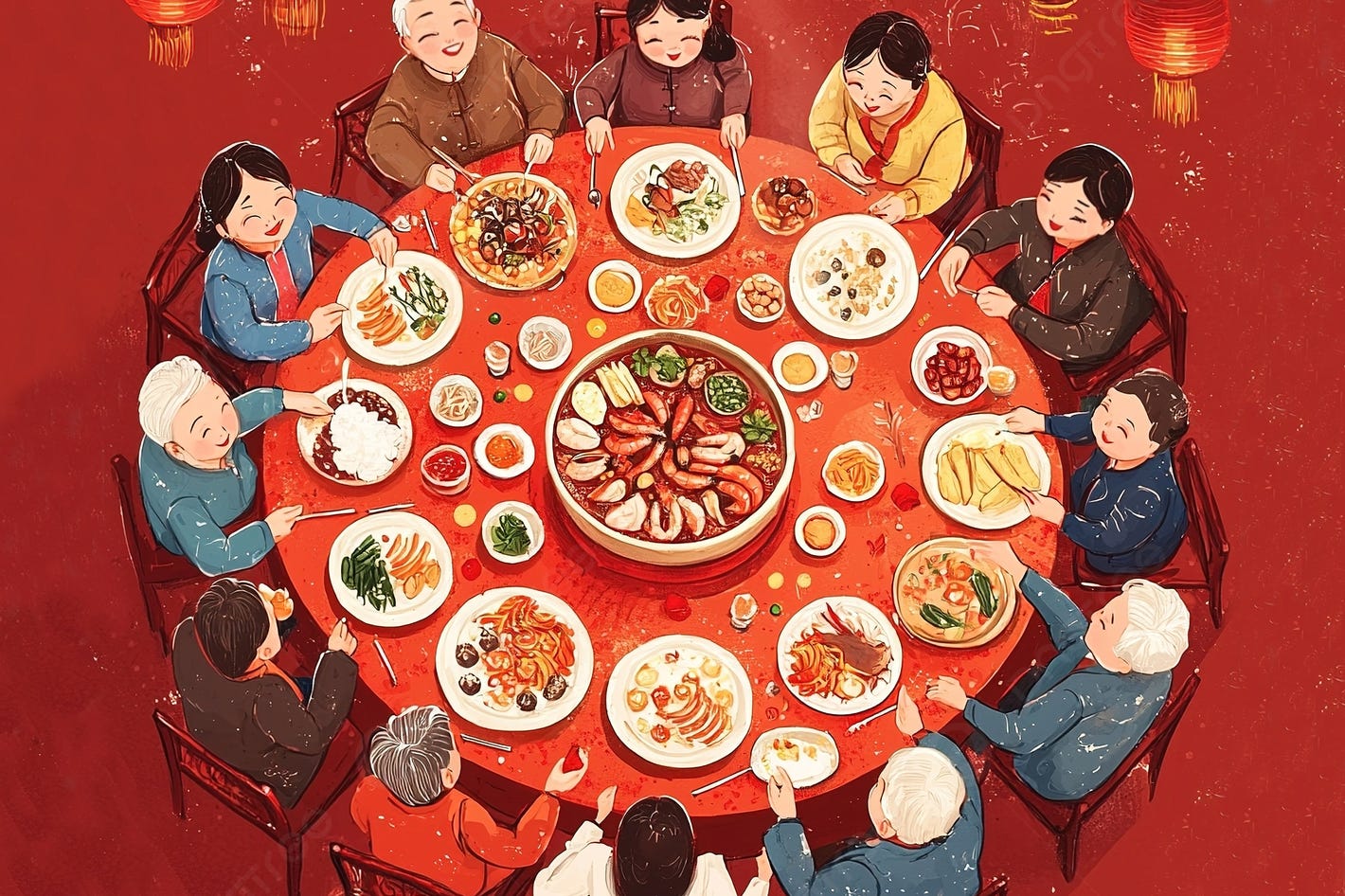
Chinese chopsticks are longer than Korean and Japanese chopsticks because everyone shares the dishes placed at the center of the table, rather than only eat one’s own portions.
When Chinese people sit down to eat together, it is considered rude and childish to serve oneself first. Instead, one should always pass food to others before oneself, with the order determined by seniority — but the senior, for example an older sister, is also expected to make sure that her younger brother has enough to eat before she does herself.
Ordering food for a party is always a complicated group effort: the meal is a collective composition of contrasting and complementary elements that works for the entire group, but should also satisfy the particular palettes of every member — an experience more than the sum of its parts.
In restaurants of not only China, not only East Asia, but also South, South East, West Asia, as well as many parts of Africa and South America, it’s typical for people to argue over who gets the privilege of paying the bill — partly because who ever pays is seen as the bigger person. Travellers to every part of the Global South and anywhere indigenous cultures and sensibilities survive, have noted a supreme generosity, and that locals, complete strangers, often insist on buying or inviting them to their homes for a meal.
This generosity and propensity for sharing is biologically rooted in the evolved behavioural traits of human beings. It is seen clearly in indigenous cultures all over the world, especially those in arid and difficult conditions, such as the Amazigh of the Saharan desert who will slaughter their last goat for a starving stranger knocking at their door in the middle of the night.
State formation coinciding with the world-historic rise of Proprietary Patriarchy and its attendant class society around 6,000 years ago began a process of erosion and suppression of this original human convivial sociality, but not equally, not in the same way, and not to the same extent around the world. This is the main reason, not any innate deficiency of humanity, for extreme divergence from indigenous hospitality in some parts of the world; for example, cash apps in Northern Europe where friends request 2 or 3 Euros from each other for having consumed half a sandwich more than the other during lunch.
Keep these observations in mind while reading the rest of this essay; their relevance and meaning will become increasingly apparent.
INTERNAL GOVERNANCE
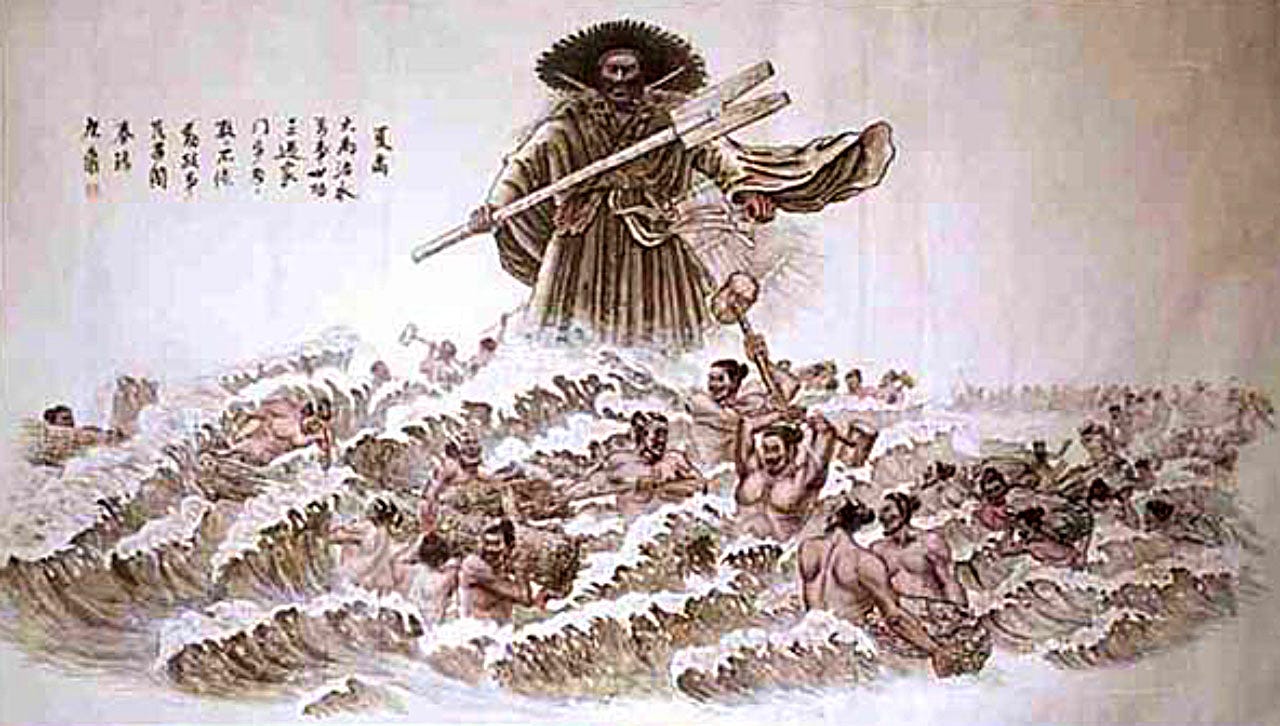
Massive, prolonged, recurring floods regularly devastated the Yellow River valley, destroying settlements and agriculture. It was a repeating crisis that threatened the very survival of the nascent civilisation.
After countless failed attempts to solve this problem, legend has it that Emperor Yu mobilised tens of thousands of people from various clans and chiefdoms, and laboured tirelessly for 13 years, digging channels to divert and manage water to the sea. Because of his monumental success in taming the floods and making the land habitable and fertile, Yu gained immense prestige. The various groups of people were so impressed and grateful that they transferred their loyalty to him, which allowed him to consolidate power and found the Xia Dynasty (c. 2070–1600 BCE), the first centralised state in Chinese history.
The very first state in China formed for the explicit purpose of combatting the existential threat of catastrophic natural disasters; its primary Staatsräson was building infrastructure, massive public works for the benefit of all.
The Xia dynasty was followed by the Shang and Zhou dynasties, the “Spring and Autumn Era, then a chaotic, roughly 300 years long Warring States period in which warlords fought for dominance and populations greatly suffered, ending in roughly 200 BCE.
During the Warring States era there emerged 3 main strands of political doctrines: Daoism, Legalism, and Confucianism.
Daoism and Legalism

Daoism, commonly referred to in the West as the grandfather of anarchism, focused on the natural energy flow of the universe (the Dao, or “path”), which human beings should not go against, but seek alignment and harmony with. The central concept of “Wu-wei”, roughly translated as “Do Nothing”, “Non-Action”, “No Force”, or “Spontaneously living in the moment”, is the way towards tranquility and happiness.
Daoism cautioned against competition and instructed that the emptying of the mind and ridding of Earthly desires is the way for humanity to change its violent ways that creates so much needless suffering. (The later fusion of Daoism with Buddhism came to be known as Chan Buddhism, late exported to Japan as Zen). Politically, Daoism is suspicious of centralised power, and urged rulers to be humble, restrained, pacifist, to avoid stringent laws and harsh punishments.

Stringent laws and harsh punishments are main features of Legalism. In many ways the dialectical antithesis of Daoism, this rigid ideology became the guiding principle of the Qin dynasty that ended the Warring States period in 220 BCE.
Legalists see human nature as inherently selfish and violent, and devises a system of absolute monarchic authority atop a centralised bureaucracy, enforcing unbending codes and severe punishment, as the only method with which it can be controlled. And for them, suppression of rival philosophical doctrines was the only way to prevent contending factions from gaining power. In Legalist society, warriors were rewarded based on the number of enemy severed heads they brought back.
Legalism produced very strong police and military, but also widespread resentment among the population, and quickly lead to a series of large scale rebellions that overthrew the Qin after merely 17 years, ending the only, very short period of Chinese history where Legalism dominated.
Brute force failed to maintain peace and unity, but its opposite, the lofty and relaxed, nature-loving, profoundly unfettered ideals of Daoism also, unsurprisingly, was not enough to deal with the real problems faced by monarchic governance over such a large and diverse territory, with objective contradictions between farmers and land lords, between land lords and merchants, between the people and their rulers. The succeeding Han dynasty rejected both, and chose Confucianism as its ideology and political system.
Daoism remains a constant underlying influence on Chinese culture and politics in countless ways, and will always be an important philosophy of life.
Elements of Legalism also live on in Chinese statecraft, even today: the punishments for political corruption and white collar, elite crimes, including seizure of entire companies, long prison terms, and the death sentence, is often much more harsh than those in the West.
In many ways, the most contentious political debates in China, regarding a general definition of good governance and optimum organisation of society, management of contradictions, were more or less settled around 2000 years ago. With some variation through out the eras where different ideas gain and lose favour, Confucianism would come to be the main guiding principle of Chinese governance, beginning with the Han dynasty.
Confucianism
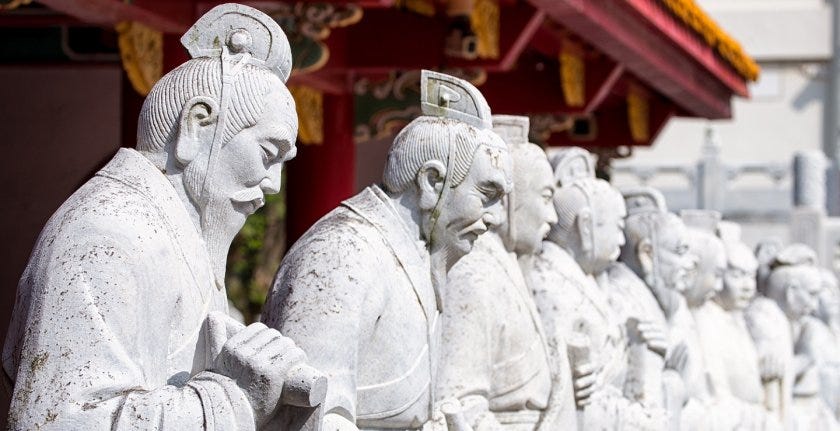
Confucianism posited that human nature is essentially good; that with education, everyone can become virtuous; and that emperors should lead by example, with benevolence. At the same time, the Confucian state retained Legalist centralized bureaucracy, strict laws, and the option of forceful methods to control and maintain power.
Confucianism (儒家, Rújiā) provided a concrete set of guidelines for preserving balance between emperors and people, in attempt to recreate, approximately, what Confucian scholars and historians remembered as an ideal, peaceful, prosperous, harmonious era of the first, Xia dynasty some 2 millennia prior.
Classic Confucianism centered around Man’s connection to the heavens (universe), and posited that social order depends on individual autonomous study and ethical cultivation.
But at the same time, Confucianist doctrine also clearly stated that individual virtue is not possible with poverty — the idea that the state is responsible for the eradication of poverty and wellbeing of citizens was enshrined in China some 2000 years ago (a relative new, about 500 years old, idea in Western politics).
The creation of equality was always a centrally important goal of the state, the precondition for a harmonious society.
In response to continued social unrest and another period of chaotic infighting between warlords, the era of the War of Three Kingdoms (263 – 280 CE), over the centuries scholars further adapted Confucianism in attempt to make political hierarchies increasingly less arbitrary and less unjust, by reducing the importance of inheritance, and further basing the justification of power on objective merit and virtue.
The concept of the Mandate of Heaven (天命, Tiānmìng) is a foundational ideological principle of Chinese governance, and its origin is precisely dated to the founding of the Zhou Dynasty around 1046 BCE. The Mandate is granted by “the heavens” (the cosmos, nature, the supreme force of order and morality in the universe, not a single deity) to only virtuous and just rulers who made the people happy. If an emperor becomes corrupt or ineffective, Heaven will withdraw its support, leading to social unrest, natural disasters, and ultimately, the emperor’s downfall and replacement.
In later millennia, the idea increasingly came to mean approval of the population, becoming, essentially and effectively, an ancient version of democracy.
Crucially, as much as justifying monarchic rule, the “Mandate of Heaven” also embodies the “right to rebel”: the very concept was created by the founders of the Zhou Dynasty in order to justify their rebellion against and overthrow of the previous Shang Dynasty.
The Zhou leaders argued that the last Shang kings had become tyrannical, morally corrupt, and dissolute, neglecting the rituals, oppressing the people, and had lost the virtue necessary to rule. Based on these allegations, leaders of the Zhou rebellion claimed that Heaven had withdrawn the Shang’s right to rule and transferred the Mandate to King Zhou, who was virtuous and fit for the responsibility.
This was a revolutionary idea. The Mandate of Heaven moved the source of political legitimacy away from mere ancestry (the Shang’s claim) to moral performance and just rule.
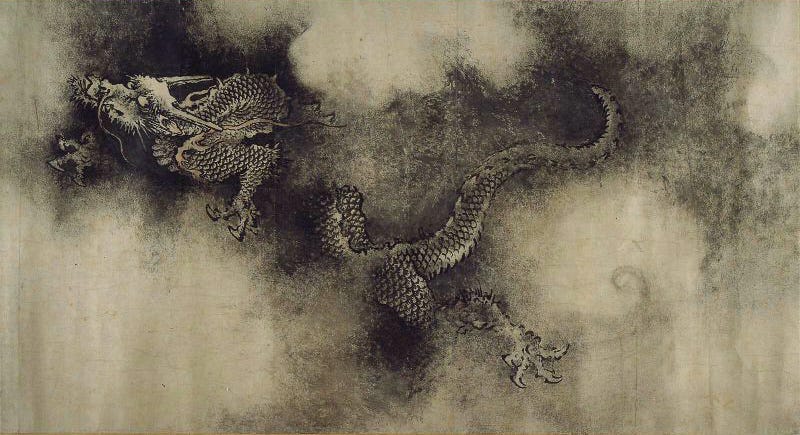
Since the very beginning of China, the authority of the emperor, the “Son of Heaven” (Tianzi), has not been absolute, but conditional on incorruptibility, honesty, prudence, generosity, benevolence, and wisdom.
To keep the Mandate of Heaven, a ruler must be ethical, prioritise wellbeing of the people, and perform the correct rituals. A ruler who became corrupt, unjust, and lets society fall into chaos shows that he had lost the Mandate — at which point it is not only right but righteous to overthrow him. The success of a rebellion, dependent upon the will of the population, was itself proof that Heaven had transferred its mandate to a new dynasty.
Neo-Confucianism emerged during the Tang Dynasty (618-907 CE), was fully systematized in the Song Dynasty (960-1279 CE), and reached its canonical form in the 12th century. It was influenced by Buddhist and Daoist metaphysics, outlined a pragmatic methodology for social balance and well being, developed concepts like **Principle (_Li_ 理)**—the underlying rational order of the universe—and **Material Force (_Qi_ 气)**—the psychophysical stuff that constitutes all things, and later introduced ideas like learning based on evidence (influenced by Western empiricism).
In practical application, in more recent millennia Neo-Confucianism developed a fraught, as symbiotic as contradictory, relationship with Legalist-style statecraft. The question of when to lead by inspiration, example, and moral instruction, and when to use law and force to preserve order, was a constant dialectical debate.
During the Song Dynasty, in the 1070s, Confucianism took an explicitly leftist turn:
“The state should take the entire management of commerce, industry, and agriculture into its own hands, with a view to succoring the working classes and preventing them from being ground into the dust by the rich.”
– (attributed to a summary of Wang AnShi)
Wang AnShi advocated for alleviation of suffering among the peasantry, by preventing the consolidation of large land estates. He called elements that came between the people and the government “jianbing”: owners of large estates, rural usurers, urban businessmen, speculators responsible for instability in the market, those who monopolized wealth and made others dependent on them, and the bureaucrats who represented their interests in government. Wang believed that suppression of the jianbing is one of the most important goals of politics.
“Today in every prefecture and subprefecture, there are jianbing families that annually collect interest amounting to several myriad strings of cash without doing anything… What contribution have they made to the state to [warrant] enjoying such a good salary?”
— Wang Anshi
Wang Anshi and the left wing of Confucianism was ultimately defeated by the rightists, but this strand was later revived and today serves to inform and guide the Communist Party of China.
It must be noted that the Confucian idea of “harmony” is emphatically not “sameness”, as the word partially implies in the Western definition.
An important passage in the Analects of Confucius (Book 13: Zilu) reads:
“君子和而不同,小人同而不和。”
Which translates to: “The noble man seeks harmony but not conformity; the petty man seeks conformity but not harmony.”
The confucian state does not demand uniform opinions in the state, in the population, or of its neighbouring countries, but strives for peaceful co-existence and balanced diversity between people and groups with different ideas. This is how there can be multiple ideological factions within Chinese government today: to the right of Xi JinPing there are politicians calling for expanding the private sector and further liberalisation, and to the left of Xi JinPing there are those who call for re-collectivisation and Great Cultural Revolution Part 2.
This diversity of ideas and a political culture of vigorous debate is how Chinese governance and policy under the same party can change, adapt, and evolve, according to circumstance and historical necessity, so drastically. The Communist Party is constant, but its policies during the Great Leap Forward, during the GCR, during Reform and Opening up, and even between the early 2000s and the current Xi JinPing period — are extremely different.
The idea of “Harmony without conformity” in Chinese political philosophy since ancient times is also what makes possible the “One country, two systems” arrangements that the central government has used for Hong Kong before reclamation, for Macau with its unique laws with regard to gambling, for Taiwan with a government independent of the CPC, etc. No other nation has any similar tolerance for different ideologies, political systems, and laws within its borders.
This Confucian tolerance for difference is in sharp contrast to the ideological homogeneity demanded by liberal democracy, which tries to impose the same values on not only their own populations but also on other nations with extremely different histories and cultures, and force developing countries to adopt the same neoliberal economic model.
The concept of Da Tong, “The Great Unity,” “Grand Harmony,” is one of the most influential and enduring political and social ideals in Chinese thought: a vision of a perfect, utopian world order.
The most famous and definitive description of Da Tong comes from the “Liyun” (Record of the Rites) chapter of the Confucian classic, the Book of Rites (Liji). It is presented as a description of the golden age of antiquity, before decline.
Here is the key passage, which is memorized by generations of Chinese students:
“When the Great Way (Da Dao) prevailed, the world was shared by all alike. The virtuous and the able were selected. Sincerity was emphasized, and harmony was cultivated. Thus, people did not love only their own parents, nor did they treat only their own children as children.
The elderly were provided with a means to see out their lives; the adults were employed in work that utilized their abilities; the children were supported to grow and learn. Compassion was shown to widows, orphans, the childless, and the disabled—all had the means of support.
Selfish schemings were repressed and found no development. Robbers, filchers, and traitors vanished. Hence, the outer doors remained open and were never shut. This was the age of the Great Unity (Da Tong).”
The core tenets of Da Tong:
Immediately after describing Da Tong, the original text contrasts the ultimate ideal for future society with the current era of Xiao Kang (Small Tranquility), a lower, more pragmatic level of a well-ordered society. In the time of Xiao Kang, society before Da Tong can be acheived, people love their own parents and children; rulership is hereditary; and rituals and righteousness are established to maintain order in a society of propriety and stability built on distinctions (self vs. other, ruler vs. subject).
The deeper understanding of confucianism is that the adherence to strict heirarchies, to filial piety, etc. are not end goals, but temporary features during the current era of Xiao Kang, which anticipates and will eventually lead to a much better future time of perfect human harmony on Earth.
This confucian idea of historical progress through struggle is akin to the Leninist socialist path towards global communisation, on which political power, in its continuous optimisation, striving for more legitimacy and further intimate reflection of the will of the people, will incrementally dissolve. As human understanding and society advances, the trust, respect, empathy, mutual care, and harmony within the family and extended family will increasingly expand to include the neighbourhood, then the city, the province, the nation, clusters of nations, and eventually, the world.
The concept of Da Tong, China’s native, classical vision of the permanent resolution of societal contradictions, of a harmonious, egalitarian, and moral society, has served as a powerful inspiration and a critical standard for political thought for over 4,000 years. Da Tong became the ultimate Confucian ideal, a benchmark against which all governments were measured, inspiring countless later thinkers, including the founder of modern China, Sun Yat-sen, whose Three Principles of the People were aimed at achieving a modern form of Da Tong.
Many Chinese intellectuals in the late 19th and early 20th centuries saw parallels between Da Tong and communism/socialism, which helped facilitate the acceptance of Marxist theory in China. The Communist Party of China has also invoked the language of Da Tong to describe its socialist and communist goals, framing the ultimate aim of communism as a modern realization of this ancient Chinese idea of utopia.
During the 20th Century revolutionary period, Confucianism, the ideology of feudal China which justified monarchism, was widely discarded as outdated and decadent. But on the road of socialist construction in the contemporary era, the ancient wisdom of Confucianism found new purpose and application for steering society during a transitional period full of not-yet-resolvable contradictions.
Today, the Mandate of Heaven and Confucian meritocracy endures in the Chinese version of Democratic Centralism, the political system of the Communist Party of China (same as that of USSR 1.0). Just like in ancient times, legitimacy of the CPC and its leadership rests entirely on approval of the population. If Xi JinPing loses support of the central committee and the higher governing bodies, he would have to step down immediately; and if the communist party itself loses support of the people, another will soon take its place.
In this democratically centralised hierarchical system, local leaders of villages, cities, and provinces are chosen by popular elections; while leaders in the central government are appointed by the party. Democratic centralism ensures that the entire government is connected to the wishes and will of the people, at the same time able to make big decisions concerning the nation and the world, such as those regarding climate and geopolitics, free from the short sighted financial self-interest of citizens. (more on contemporary PRC domestic and foreign policy in the essay “The Long Game and its Contradictions”)
INTERNATIONAL RELATIONS
Tributary System
China has never been an “empire” in the European definition and understanding of empire.
Instead of constantly seeking to conquer and directly administer neighboring territories, like Rome and every Western empire, ancient China set up the Tributary System. Neighboring states (such as Korea, Vietnam, Tibet, and various steppe peoples) would acknowledge Chinese cultural and political supremacy by sending periodic tribute missions. In return, they received gifts, legitimacy for their own rulers, and the benefit of trade. This was a more cost-effective and stable way for China to secure its borders and maintain its perceived cosmic role than conquest, occupation, violent and coercive domination.

In the tributary system, often overlooked by Western understanding, the return gifts to the smaller nations must always be of greater value than the tributes — because a bigger, “superior” nation should of course be more generous, and has a responsibility for ensuring the wellbeing of others, for the preservation of peace and the promotion of prosperity.
If a greater nation takes more than it receives, or acts in an immature, impulsive, imposing, controlling, or even violent way, it would no longer deserve its perceived greatness on the international stage, and the emperor responsible would lose face and legitimacy at home. All of this is especially true of the greatest nation of all, the central celestrial kingdom.
This was also a kind of “supremacism”, but a drastically different kind than that of Wesern civilisaion: “superiority” and “dominance” means being more charitable, considerate, tolerant, patient, wise, fair, ethical. To be domineering, manipulative, to force one’s way of life on others, to meddle in the affairs of others, to use coercive methods or even military force to get one’s way, was seen as stupid, ugly, vulgar, petty, arising from insecurity and a low level of understanding, the behaviour of small minded weaklings.
The contemporary Chinese political principle of non-interference emerges from such a value system, and is merely the next step in the continuous evolutionary path of a mutualist political philosophy.
Peace and War

The central emphasis and conclusion of the famous Daoist treatise on war-strategy, The Art of War, is that war should be always and absolutely avoided with diplomacy, because who ever “wins”, both sides lose, and the civilian populations of both suffer. If war cannot be avoided, it should be fought strategically and psychologically to minimize damage and the wasting of resources. Warfare should only be the very last resort after all attempts at negotiation fails, and heading into battle is already admitting a kind of defeat.
In imperial China, a statesman who resorts to military methods without exhausting every possible peaceful means of settlement and even beyond (if an agreement is not reached, a certain amount of self sacrifice in order to preserve peace is expected), is considered an inferior and stupid leader, and would, after the dust settles, face demotion or worse.
Compare and contrast this with the valorization of violence in the West, regarding the successful waging of war as sign of a great leader. Currently USAmerican politicians are attacking each other for being “too soft on (insert official enemy)”, for not being aggressive enough. The competition to be seen as the most combative and bellicose is something that does not exist in Chinese political competition, which proceeds according to a set of very different core values. Speaking in broad general terms, non-violence, restraint, and patience is usually seen in the West as weakness — for evidence we only have to look at contemporary Western mockery of its geopolitical enemies’ caution and moderation, interpreting it as weakness.

Softness is central to Asian ideas of strength. In the age-old concept of “Bamboo Diplomacy”, the ability to bend (while being firm) is seen as an attribute of power. And indeed, Chinese Traditional Medicine has maintained for thousands of years after the fall from the harmonious period of antiquity (the first Xia dynasty), that “the world is too Yang”, meaning too masculine, too calculating, too hard, not enough feminine, not enough empathy, not enough softness. And to this imbalance can be attributed much of the great illness of the world.
While in European culture to be soft tends to be seen as a shortcoming, as feminine, as silly, as embarrassing, as inferior, and as cause for mockery and ridicule.
Clash of Civilisations
These policies, arrangements, modes of engagement with others, are very different from those of Western empires, and emanate from a fundamentally different set of core values and ideas of governance.
But Chinese society in antiquity was basically the same monarchism/feudalism as that of ancient Greece or Rome, with the same hereditary hierarchical power structure presiding over the population. So class alone cannot explain why Zheng He, with ships and fleets 10X bigger than those of Christopher Columbus and 100 years earlier, equipped with unmatched weapons and technology, sailed around Asia and Africa, and merely traded, instead of conquering, colonising, or enslaving.
For much of the past 2000 years, the Central Realm, world’s top economic, military, cultural super power, was relatively stable, prosperous, and self satisfied, with a form of internal governance and foreign policy which prized above all the preservation of harmony and peace. During the last 1000+ years, China engaged in virtually zero expansionist wars.
Contrast with Europe at the time of global colonisation: emerging from 1000 years of constant warfare, Roman infrastructure laid waste, rampant diseases, peasants living without much hope under brutally oppressive feudal theocracy — all of which made European peoples accustomed to violence, excel at military matters, and thirst for new horizons where the oppressed poor can become oppressive kings (or at least that was the propaganda to get the peasants and prisoners to take the gruelling and dangerous journeys to the New World and do the dehumanising work of genocide, all to create new markets for the newly emergent bourgeoisie).
Seems obvious but it must be said: It isn’t due to any innate, unchanging qualities within the people that China tended to trade and Europe tended to conquer, but only different sets of socio-economic conditions and path of historical development. But at the same time, the real cultural, civilisational differences do objectively exist, and continues to shape geopolitics.
Class must be foregrounded, but to reduce the complex interplay of ideas and objective factors to *only* a straight forward, deterministic materialism, to only economic concerns, is to neglect entire dimensions of social dynamics, the dialectical part of dialectical materialism.
And this kind of reductive, one-dimensional thinking is itself an expression of a certain deeply seated civilisational character, shaped by the developmental path of the Western philosophical tradition, in many ways typified by the work of René Descartes. It is a perspective that tends toward a mechanistic and discontinuous conception of the world, where independent actors are motivated solely by short term self interest, producing a predilection for playing the game of zero sums, of “winner takes all”, rather than one of continuous reciprocity and mutual benefit.
As China continues to rise, and re-assumes its position at the center of world affairs after a brief aberrant period, let us not mistakenly make universal claims about “all empires”, “all governments”; make false equivalencies between socialist and capitalist states and between Western and Eastern civilisations; project the motivations, intentions, and modus operandi of the US and European colonial empires onto the People’s Republic of China.
China emerges from 2000 years of statecraft focused on the preservation of peace and building of mutually beneficial relationships, and very literally does not have the institutional genes for domination, colonisation, or imposing its cultural values, political system, and economic model on the rest of the world.
The socialist super power is embarked on a world-historic mission to re-balance global economy by developing under-developed regions, to democratise international power by displacing uni-polar hegemony, to build a New Silk Road connecting the world, to bring a permanent end of the historic imperialist era.
If we take a sober look at the 20th Century, how strong waves of international movements toward socialism in the 1930s, in the 1950s, were brutally crushed by imperialism, we see that there has been 1 single block on the road of human progress —— and that removal of this block can only mean global socialism, the planetary path towards Da Tong.
Internationalism
Any kind of exclusively unique Chinese disposition that is conducive to modern socialism is the wrong conclusion to draw from this essay. Lets remember that the outcome of the civil war which ended with communist victory was anything but certain, that it was a very close fight, and that China could have strayed away from its Daoist and left-Confucian roots to embrace Legalism and nationalism, and become an imperialist power.
And we must remember that while the same choice is open to all nations, every people on this planet comes from ancient egalitarian traditions with matricentrality, animism, and a deeply embedded sense of community with high levels of trust, empathy, and cohesion. For these are the evolved social traits, the inherited biological reality, of the Homo Sapien Sapiens species, which is only, to various degrees in different places, ruptured by the proprietary/patriarchal world historic counter-revolution of 6 to 10 thousand years ago (much more on this in separate essays).
Sure, different cultures in different regions are to different levels connected to or severed from their pre-proprietary/patriarchal roots. But no matter how buried, how cut-off, all peoples have the potential of remembering, drawing from, and restoring their own ancient traditions of sharing and cooperation, towards building home grown socialism with local, native cultural/civilisational Characteristics.
Interview with Aaj Tak and Indian Today TV channels
Anjana Om Kashyap: Dear viewers,
Hello and a very warm welcome. You are watching India Today, and I’m Anjana Om Kashyap and we’re at the Kremlin today and you’re about to witness history: a very historic moment.
It is said that when two old friends meet, they have their private jokes, they have a lot of fun and they have a bond of camaraderie but the others in the room might feel a little uncomfortable. And why do I say this – I say this because as the President of the Russian Federation Vladimir Putin meets Prime Minister Narendra Modi in New Delhi, the world will be watching very very closely.
Vladimir Putin is undoubtedly one of the most influential politicians of the world, whose decisions don’t just affect Russia, but numerous nations across the world. He is a very compelling and enigmatic figure on the world stage and it just doesn’t get more exciting than this.
Geeta Mohan: Yes, Anjana.
Hello and welcome, I’m Geeta Mohan. We have with us the man who is known to be one of the world longest serving leaders. He has seen it all – through wars and economic recessions, from disintegration of countries to a changed world order, from Boris Yeltsin to Donald Trump, from Atal Bihari Vajpaee to Manmohan Singh and to Narendra Modi. He’s seen the world change right in front of him and he is taking Russia through very turbulent times and yet has cemented his position as a force to reckon with.
Thank you so much, Mr President, for doing this for us, you are in conversation with India Today and Aaj Tak, and that’s the President of the Russian Federation for you.
Thank you so much for joining us on our network.
How are you doing?
President of Russia Vladimir Putin: I hope you’ll enjoy your stay in Russia. Hope that you like Moscow and the Kremlin where we are currently collaborating together.
As you see, everything is going on as planned. On the whole, we are satisfied with the current economic situation.
Most importantly, I am delighted to be meeting, as you’ve mentioned, my friend Prime Minister Modi. We have made a specific arrangement to do so in India because there are numerous topics on which we need to talk, and our collaboration with India spans an extensive array – and, of course, the unique nature of our relationship adds another layer of significance.
I also want to highlight that India’s progress over the past 77 years since gaining independence – an extremely brief span in historical terms – has been substantial indeed, and India has truly come a long way in development. I will discuss this further below.
You know, as we go about our daily lives, we often fail to notice the changes happening right before our eyes; we scarcely ever take note of them. Yet if you glance even slightly into the past and reflect on what has occurred in India – it’s almost like a miracle. For example, few people recognise that life expectancy in India has nearly doubled during this period.
Geeta Mohan: We will talk about longevity in some time from now.
Vladimir Putin: We will definitely discuss that. Anyway, our relationship with India is advancing in numerous fields. It’s a pleasure to meet Prime Minister Modi again, with whom we have both a professional and a personal, friendly relationship.
Anjana Om Kashyap: May I ask you a question?
You just talked about the Indian-Russian ties. It all dates back to almost more than seven decades, this dostee, this druzhba in Russian, this friendship dates back to more than seven decades.
My question is, how do you assess the strength of this friendship in today’s time and what would you say about Prime Minister Narendra Modi and to Prime Minister Narendra Modi whom you call your dost?
Vladimir Putin: About the Prime Minister?
Anjana Om Kashyap: Yes. And to him.
Vladimir Putin: You know, the world is evolving rapidly – and this pace keeps getting faster, which is plainly visible to all. The global configuration is changing, with new centres of power emerging, and the global power landscape is changing too. Therefore, it’s crucial to ensure stability among major nations, since this forms the groundwork for gradual progress in both bilateral and international relations.
In this context, our collaborative endeavours with Prime Minister Modi carry significant weight because they transcend our mutual ties. Given its direct relevance to both nations, ensuring stability in key areas of engagement is crucial, as it helps secure the fulfilment of our objectives. Prime Minister Modi sets very challenging tasks for the country – and for himself in the first place, then for the administration, and eventually for the nation.
Take, for example, his famous pitch, “Make in India.” It has a practical dimension, including for our bilateral relations. When we meet, he always says, “Let’s do this, let’s do that, let’s look at this area and that.” I can list them all. Therefore, we have a lot of practical areas of cooperation.
Anjana Om Kashyap: Before Geeta takes on to the next question, one little, small very interesting question, because when you met Prime Minister Modi at the SCO there was this picture and video of you and him going in a car. And we are showing it to our viewers right now how you were traveling in a car with him – was it preplanned or how did it go about, how did it happen? And what did you discuss in the car?
Vladimir Putin: We have just gone over the current topics. This wasn’t prearranged; we simply stepped out, and my car was waiting. I asked, ”Would you like to come along?“ That’s all there is to it – a gesture of human solidarity, camaraderie, and friendship. No hidden scheme was involved. We climbed into the car like old friends and talked en route. We always have things to discuss.
What’s more, we continued our conversation and just remained in the car. Eventually, I suggested: ”Let’s go, they are already waiting for us. “ There is nothing special here; it simply indicates that we have matters to discuss and those matters are very important to us.
Geeta Mohan: Thank you, Mr President. The fact that you are going to India. You just said that both leaders are going to cement the guarantees that you give each other. What are the kind of announcements that we can expect? We’ve heard about technology transfer, we’ve heard about trade enhancement. What are the solid announcements during this visit? And I ask you this, because the world – and you know who I mean – would be watching.
Vladimir Putin: The world would be watching our visit – there’s no big deal here. India is an enormous country, home to one-and-a-half billion people, boasting a growing economy with a seven-percent annual growth rate, leading among major global powers. After all, Mr Modi has made this possible. It’s something both the Indian nation and Prime Minister Modi himself can rightfully claim as their achievement. Naturally, there will always be critics who think that improvements could have been more significant. But that’s an achievement.
We’ve laid out an ambitious plan for our collaboration in key domains. The most critical areas are indeed forward-looking. I’m referring specifically to high technology. Our partnership with India encompasses such fields as space exploration, energy (notably nuclear power, exemplified by the prominent Kudankulam Nuclear Power Plant project), shipbuilding, and aviation.
There are many interesting areas for cooperation that are looking to the future. Take, for example, artificial intelligence. We’ll likely discuss it further down the line. AI represents a crucial technology shaping the future, rapidly transforming the world, amplifying possibilities exponentially while simultaneously presenting certain challenges.
These are the matters we will discuss, choosing the ones that are the most significant for us, as both Prime Minister Modi and I believe. That’s what we will focus on and what we will work on.
Geeta Mohan: Are there any specific agreements?
Vladimir Putin: Well, of course. However, perhaps we shouldn’t reveal them just yet; we will do that during the visit, when we can unveil everything publicly. Then, our colleagues will first share with us all the documents they have prepared, and it would require our final approval.
Geeta Mohan: I suggest we switch to the energy sector. Just talking about sustainability and trade. There’s immense pressure on India and on Russia when it comes to oil. India has suffered in terms of the kind of pressure that we’re seeing from West. How can both countries handle this Western pressure and sanctions?
Vladimir Putin: The issue here is that the pressure you have referred to typically involves employing political instruments to influence normal competition.
Our energy cooperation with India remains unaffected by current conditions, fleeting political swings, or indeed the tragic events in Ukraine.
Regarding hydrocarbons: well before the Ukrainian situation, our business entities had already built a solid and efficient commercial relationship that is based on mutual trust.
It’s widely known that one of our leading companies acquired an oil refinery in India – this investment represented one of the largest foreign inflows into the Indian economy, totalling more than US$20 billion. Our company has been continuously expanding operations of this refinery, working with its partners, operating successfully year after year. As a result, India has become one of the major refined product suppliers to Europe – not just because it buys our oil with a discount. It took years to achieve and is in no way connected to the current economic environment.
Certain actors clearly dislike India’s growing role in international markets owing to its ties with Russia. Consequently, they’re seeking means to constrain India’s influence for political reasons by imposing artificial obstacles.
Anjana Om Kashyap: Economy is a very important point, but my question to you now would be about defence. India continues to be the biggest defence buyer, roughly 38% of the market from Russia is bought by India.
My question is in view of the sanctions by the US or the load they have laid on India, the arm-twisting methods that are being adopted – and I name, it’s America – how do you plan to circumvent all this? Will you pull back or push harder?
Vladimir Putin: It appears that both India and the world recognise that India cannot continue to be treated the way it was treated 77 years ago. India is a major global player, not a British colony, and everyone must accept this reality.
Furthermore, Prime Minister Modi is not someone who succumbs to pressure easily. The Indian people can certainly take pride in their leader. This is absolutely obvious. His stance is unwavering and straightforward, without being confrontational. Our goal is not to provoke conflict; rather, we aim to protect our lawful rights. India does the same.
What are the obstacles? Obstacles in settlements.
However, over 90% of our transactions are already conducted in national currencies. While some complications arise due to the presence of numerous intermediaries, there are also solutions: we can switch to the existing systems for exchanging electronic messages on financial transactions of the Bank of Russia and of our partners in India.
These efforts are ongoing and advancing. Those who attempt to hinder economic ties with third countries ultimately encounter difficulties and suffer losses. I am confident that once this perspective becomes firmly established, such tactics of applying external pressures will fade away.
Anjana Om Kashyap: Three specific questions, Sir.
Number one: because during Operation Sindoor the weapons we had acquired from Russia have proved to be very crucial in our victory. That is why I would like to ask you specifically about S400, the air defence system, the five S400 that are awaited – by when can we expect that?
The second question is on S500, an even more advanced air defence system.
And the third question is about the fifth generation fighter jet Su-57. How are you going to push for this and what are the updates?
Vladimir Putin: You seem to be an expert on the issue, as if we are engaged in negotiations on military-technical cooperation.
If we delve into the substance, India stands out as one of our reliable and privileged partners in this area. We are not merely selling something to India and India isn’t merely buying something from us in the sphere of defence and security. No. It is a different level, a different quality of relations we have with India, and we value this. We see how India values this relationship too.
Why? Allow me to emphasise again: we are not simply selling technology – we are sharing it, and it is a very rare thing to see in the sphere of military-technical cooperation. It speaks to the level of trust between the two countries and the level of trust between the two peoples, I would put it this way. We have a broad portfolio indeed, including naval construction, rocket and missile engineering, and aircraft engineering.
You just mentioned the Su-57 aircraft. India operates several other Russian-made aircraft too. And there’s the production of armoured vehicles. India is manufacturing our renowned T-90 tanks. Trust me when I tell you that these tanks rank among the best in the world. Moreover, the famous BrahMos missile – a joint venture between Russia and India – is manufactured primarily at Indian facilities.
Therefore, Prime Minister Modi’s “Make in India” initiative should be implemented in this area as well.
Geeta Mohan: And the Kalashnikovs.
Vladimir Putin: The Kalashnikov is certainly an important weapon. But we have been discussing high, one might even say cutting-edge technologies. Given the combat experience in using certain types of weapons, their value has multiplied manyfold.
Now, Indian military specialists – thanks to their strong ties with our military – understand clearly how and in what circumstances a particular weapon performs best, and where and when it should be deployed. This is an extremely important understanding, which is shared by both the Indian and Russian sides.
Geeta Mohan: Mr President, I have to go back to your oil question, because you spoke about strategic autonomy, which is what India has been talking about. Strategic autonomy decides for India’s interests, but has India reduced Russian intake of oil after pressure from the West?
Vladimir Putin: Well, there is a certain decline in overall trade turnover during the first nine months of this year. This is just a minor adjustment. Overall, our trade turnover stands almost at the same level as before.
I can’t give you exact monthly figures right now, but trade in petroleum products and crude oil, as well as the production of petroleum products for consumers of oil, Russian oil, is running smoothly in India. I know the sentiment of Russian partners, of Russian companies: they believe their Indian counterparts are reliable and very serious people.
Geeta Mohan: The other important aspect in terms of cooperation between India and Russia is the nuclear front. Russia has been one of the biggest movers when it comes to nuclear facilities in India. Are we looking at important announcements on the nuclear front? Nuclear today is a sensitive issue for Russia.
Vladimir Putin: Yes, of course we have some announcements to make.
We are indeed one of the biggest ”movers,“ as you have noted. Speaking seriously, we are not ”movers,“ we are producers of the world’s most advanced and reliable equipment for nuclear power plants. The Russian company Rosatom builds and operates more nuclear reactors for nuclear power plants abroad than any other company in the world – 22 nuclear units. The well‑known facility and our joint project, the Kudankulam plant, is one of the leaders in this regard.
These are large units, they operate efficiently and, I reiterate, have proven to be very useful.
There are some announcements you have just asked about. What is it about? The news is that Russia is probably the only country in the world today capable of building – and actually does build – small nuclear power plants. Such plants are already operational in Russia, and we can make them either floating or ground-based. It’s an excellent option for specific regions where big power stations are not needed or where connecting electricity grids between generators and end-users isn’t feasible. These compact nuclear power modules can thus be deployed in isolated and hard-to-access locations.
Geeta Mohan: That’s a lot of collaboration and cooperation. You’re talking about
”Make in India, Make With Russia.“
How do you think President Trump is going to react to all of this?
Vladimir Putin: You know, neither me nor Prime Minister Modi, despite certain external pressure we face, have ever – and I want to emphasise this, I want you to hear it – approached our collaboration to work against someone.
President Trump has his own agenda, his own goals, whereas we focus on ours – not against anyone, but rather aimed at safeguarding our respective interests, India’s and Russia’s interests. In our dealings, we cause no harm to others, and I believe that leaders from other countries should appreciate this.
Anjana Om Kashyap: With regard to Mr Donald Trump. My second question is also about him, because recently he said that if you are buying oil from Russia, – about India – you are funding the Russian-Ukrainian war.
How would you characterise Mr Donald Trump, the President of the United States of America?
Vladimir Putin: You know, I never give character assessments about my colleagues – neither those I’ve worked with in the past nor current leaders of individual states. These assessments should be made by citizens who vote for their leader during elections.
As for India’s purchases or purchase of energy resources from Russia… Well, I would like to note and have already mentioned this publicly once –
the United States itself still buys nuclear fuel from us for its own nuclear power plants. That is also fuel – uranium for the reactors operating in the United States. If the US has the right to buy our fuel, why shouldn’t India have the same privilege? This question deserves thorough examination, and we stand ready to discuss it, including with President Trump.
Geeta Mohan: You are being very kind, you say you are not characterising Trump, but he certainly does that with regard to you. Having said this, he has weaponised tariffs. And he has weaponised it against India. How do you think the two countries should be handling Donald Trump and the US administration?
Vladimir Putin: You know, he pursues his own policy, and he has advisors – his decisions aren’t made out of thin air. He has advisors who believe that implementing such tariff policies, involving the imposition of additional duties on trade partners, ultimately benefits the US economy. He is acting in good faith, I presume. Our experts believe there are risks involved, but it is the choice of each country and its leadership to decide which economic policy to adopt.
We have never engaged in such practices, do not do so now, and have no intention of doing so in the future. Our economy is open. We hope that, in the end, all violations of World Trade Organisation regulations will be rectified.
Geeta Mohan: Mr President, things have changed a little between the US and Russia. The fact that America is engaging you, we would have loved to be a fly on the wall when you were meeting with Jared Kushner and Steve Witkoff. That was an important meeting. Were there red lines that Russia reiterated? What really happened?
Vladimir Putin: It’s premature to discuss that now. I doubt it would interest you to hear about it, as it lasted five hours. Frankly, even I grew weary of it – five hours is too much. However, it was necessary because…
Anjana Om Kashyap: Five hours! Witkoff and Kushner?
Vladimir Putin: Yes, and I was alone. Can you imagine it?
But speaking seriously, it was a very productive conversation, as what our American colleagues presented was, in one way or another, based on our prior agreements made before my meeting with President Trump in Alaska. We had discussed these very issues, to some extent, at the meeting in Anchorage. However, what the Americans brought us this time was truly new; we hadn’t seen it before. Therefore, we had to go through practically every point, which is why it took so much time. So it was a meaningful, highly specific, and substantive conversation.
Anjana Om Kashyap: Were there certain specific points of disagreement?
Vladimir Putin: Yes, such issues were raised, we discussed them. But this is a complex task and a challenging mission that President Trump took upon himself – fair enough, I say without irony, because achieving consensus among conflicting parties is no easy task. But President Trump, truly, I believe, he sincerely tries to do this.
We went through each point again, let me reiterate this. Sometimes we said, “yes, we can discuss this, but with that one we cannot agree.” That was how the work proceeded. To say now what exactly doesn’t suit us or where we could possibly agree seems premature, since it might disrupt the very mode of operation that President Trump is trying to establish.
But that’s what they do – shuttle diplomacy. They spoke with Ukrainian representatives, then with Europeans, came here, had another meeting with Ukrainians and Europeans. I think we should engage in this effort rather than obstruct it.
Geeta Mohan: You are saying that the 28 points peace proposal is not on the table?
Vladimir Putin: They’re discussing – that’s what they’re discussing right now. They simply broke down those 28 points, then 27, into four packages and proposed discussing these four packages. But essentially, it’s still just the same old 27 points.
Anjana Om Kashyap: We will go back to that and try to understand how it’s going forward.
What happened in Alaska? You met President Trump and it was all about the peace deal, right? What happened? Did you actually have sense of or see a sincere intent?
Vladimir Putin: Yes, there was indeed a sense – no, more than just a sense, I have absolutely no doubt that President Trump had genuine intentions (we won’t discuss here what caused them or why they appeared, but they’re definitely present). Both the United States and President Trump likely have their own understanding of why this needs to be resolved quickly.
Moreover, by the way, on humanitarian grounds too. I truly believe that is one of the motives behind President Trump’s actions regarding this matter because he constantly speaks about his wish to minimise losses, and I’m confident that his sincerity is genuine. He undoubtedly considers these humanitarian concerns when formulating his decisions.
However, other factors also come into play: political considerations and economic interests. Therefore, I believe that the US is actively seeking a solution to this problem.
Geeta Mohan: Yes, he has spoken about intentions, you’re right about. He claimed he would end wars and conflicts – causing consternation in India when he claimed that he had brought peace between India and Pakistan, now he’s looking at Russia and Ukraine. Do you really think he’s a peacemaker?
Vladimir Putin: Regarding the situation in Ukraine – yes, let me repeat once again, I am absolutely certain, with no doubt at all, he sincerely aims for a peaceful resolution.
Let me stress once again: the United States may have various reasons for this – humanitarian ones personally for Trump because he genuinely wants to end hostilities and prevent further loss of life, but there could also be political interests tied to ending the confrontation between Russia and Ukraine, or economic motives too. By the way, they can be in the energy area and in other areas. There are numerous areas where restoring economic relations between the US and Russia would benefit both sides.
I showed you some letters – I won’t go into this now – large US companies sent to us. We should remember this.
Comment: Really?
Vladimir Putin: Of course. About their existence. They’re waiting until all problems are solved, and they’re ready to return to us, they want this, asking us not to forget about them. The letters are there.
Comment: It’s surprising.
Vladimir Putin: What’s so surprising about that? Many want to return. So, of course, the Indian government is saying right: “Why should we leave…?”
Geeta Mohan: They arrived with letters from companies – quite astonishingly unexpected indeed.
Vladimir Putin: No, I believe there has been a misunderstanding. We have letters from American companies – letters they have sent us, where they urge us not to forget about their existence. These are our former partners, who did not leave by choice. They express a clear desire to resume cooperation and are waiting, among other things, for a corresponding political signal.
Anjana Om Kashyap: This conversation is becoming very interesting because there are so many highlights of understanding and it is really pleasant to see you, and your sense of humour, and how you are putting things forth.
But now we are going to go into a very serious matter – and that is the Russia-Ukraine war. So what, in your view, would constitute a victory for Russia in the Russia-Ukraine war? What are the red lines? Because you have, and I quote you, you have said very clearly that Russia will lay down arms only if Kiev’s troops withdraw from the territories claimed by Russia, which parts would that be?
Vladimir Putin: You know, it’s not about victory, like you have said. The point is that Russia is determined – and will certainly do so – to protect its interests. Protect its people living there, protect our traditional values, Russian language, and so on. Protection, by the way, of religion that has been cultivated on these lands for centuries. Yet you know that the Russian Orthodox Church in Ukraine is almost banned: they seize churches, drive people out of temples, etc. – it is a problem. And I’m not even mentioning the ban on the Russian language, etc. It is all part of a big set of issues.
Let me remind you: we were not the ones to start this war. The West egged Ukraine on and supported the events, orchestrating a coup d’état. That was the point that triggered the events in Crimea, followed by developments in southeastern Ukraine, in Donbass.
They don’t even mention it – we’ve tried to resolve these issues peacefully for eight years, signed the Minsk agreements, hoping that they could be resolved through peaceful means. But Western leaders openly admitted later that they never intended to honour those agreements, signing them merely to allow Ukraine to arm itself and continue fighting against us. After eight years of relentless violence against our citizens of Donbass – something the West hasn’t uttered a word about – we were forced to recognise these republics first, and secondly, provide support.
Our special military operation isn’t the start of a war, but rather an attempt to end one that the West ignited using Ukrainian nationalists. That’s what is really happening now. That’s the crux of the problem.
We will finish it when we achieve the goals set at the beginning of the special military operation – when we free these territories. That’s all.
Anjana Om Kashyap: What is the end gain for Vladimir Putin in Ukraine?
Vladimir Putin: I have said that already. Listen, we didn’t recognise these self-proclaimed republics for eight years. Eight years. They declared independence, while we were trying to establish relations between the rest of Ukraine and those republics. But when we realised this was impossible, that they were simply being destroyed, we had no choice but to recognise them – and not just their existence on part of the territory, but within administrative boundaries established during Soviet times, then later under independent Ukraine after its independence, still within those administrative borders.
And right away we told Ukraine, the Ukrainian troops: ”People don’t want to live with you anymore. They voted in a referendum for independence. Withdraw your troops from there, and there won’t be any military actions.“ No, they chose to fight instead.
Now they have pretty much fought themselves into a corner, all this boils down to one thing: either we take back these territories by force, or eventually Ukrainian troops withdraw and stop killing people there.
Anjana Om Kashyap: Before we move to the other one, just one last question. On March 8, 2014, during the annexation of Crimea, you were addressing the Federation Council and you said, ”Kiev is the mother of all Russian cities.“ What did you mean?
Vladimir Putin: Here I haven’t made up anything – historically this is how it was said. Originally, the Russian state was formed from several centres. The first capital, according to history, was in Novgorod in the northwest. Later the federal status moved to the city of Veliky Novgorod, and then it moved to Kiev. This was Ancient Rus. And since then, Kiev has been known as the ”mother of all Russian cities.“
Later, historical events unfolded in such a way that the ancient Russian state split into two parts. One part began developing with Moscow as its centre, while another part fell under other countries. For instance, the part with Kiev, along with some other lands, these parts first formed a state with Lithuania, subsequently merged with Poland, forming the Polish-Lithuanian Commonwealth. Thus, this part of the ancient Russian state ended up in Poland, and by the seventeenth century, it sought to return back to Russia.
Geeta Mohan: The fact that you know, you were mentioning the history and it brings me to what I did when the conflict was underway. I had travelled to Donetsk, I had travelled to Lugansk, Zaporozhye, Kherson, and most of the people there are Russian-speaking, they speak Russian language. They were very disappointed that Kiev had banned that language in eastern Ukraine. But they were also a little shocked at how Putin is doing this to us, we are his people. A lot of women I spoke to were in shock. So, what do you have to say to people in eastern Ukraine who actually have families in Russia, who, on a daily basis, move from Ukraine to Russia. What do you have to say to them?
Vladimir Putin: I didn’t understand the question. What exactly shocked them?
Geeta Mohan: They were shocked that there was an operation that happened, and their homes were destroyed, because they lived in eastern Ukraine. And they have love for Russia and the Russian people, and they are Russian-speaking themselves.
Vladimir Putin: The answer is quite straightforward. These individuals presumably resided in those parts of Ukraine – specifically, in the areas of the Lugansk or Donetsk region – that remained under the control of the Kiev authorities at the time. Meanwhile, that part of the Lugansk or Donetsk region outside their control was being subjected to intense military action by the Kiev authorities. We were consequently forced to extend support to those areas that had declared independence. That is the first point.
Secondly, we provided people with an opportunity to express their will in an open referendum. Those who believed it was in their interest to join Russia voted accordingly. Those who did not were free to leave unhindered for other parts of the Ukrainian state. We have never placed any obstacles in the way of that choice.
Geeta Mohan: What do you make of President Zelensky? He was promised NATO, the European Union promised him the EU. But nothing really happened. Was NATO ever on the table for Ukraine?
Vladimir Putin: When this gentleman came to power, he declared that he would pursue peace at all costs, using every means possible, without sparing even his career. But now we see things differently. He follows the same pattern as his predecessors – putting the interests of a narrow nationalist group, particularly radical nationalists, ahead of those of the people. Essentially, he is addressing their concerns rather than those of the nation.
This regime’s mindset truly resembles a neo-Nazi regime because extreme nationalism and neo-Nazism are almost indistinguishable concepts. Today, undeniably, military action dominates their approach. However, they haven’t achieved much success here either.
I have already said before that what matters most for them is realising that the best way to resolve the problems is through peaceful negotiations, and we attempted to negotiate with them back in 2022. What exactly they plan to do remains to be asked from them directly.
Anjana Om Kashyap: That would be interesting to see what they have to say on that, and how this peace process goes forward.
But you have always said that the eastward expansion of NATO is your real concern. Ukraine has not got this NATO membership as of now. My question to you – is NATO expansion a real threat or just a pretext for what you think is a part of Ukraine which is probably you want control over? Or you think that injustice is being done, the Russian language is being banned – these are the real issues?
Vladimir Putin: Listen, NATO is another matter altogether. The Russian language, Russian culture, religion, and even territorial issues – these are very important topics, one subject. NATO is something entirely different. We don’t demand anything exclusive for ourselves here.
First of all, there are general agreements that the security of one state cannot be guaranteed by undermining the security of others. This idea might seem somewhat obscure, but I’ll explain it simply. Each country, including Ukraine, has the right to choose its own means of defence and ensure its own safety. Correct? Absolutely correct. Do we deny Ukraine this? No. But it’s not acceptable if done at Russia’s expense. Ukraine believes it would benefit from joining NATO. And we say: that threatens our security, let’s find a way to secure yours without threatening us.
Secondly, we are not asking for anything unusual or unexpected, nothing falling from the sky. We are just insisting on fulfilling the promises already made to us. These weren’t invented yesterday. They were pledged to Russia back in the ’90s: no expansion eastward—this was stated publicly. Since then, several waves of expansion took place, culminating with Ukraine being drawn into NATO. This completely displeases us and poses a serious threat. Let’s remember that NATO is a military-political alliance, and Article Five of the Washington Treaty establishing NATO hasn’t been repealed. It’s a threat to us. Nobody bothers to take us seriously.
Lastly, when Ukraine became independent, few people recall this: what was the first document ratifying independence? It was the Declaration of State Sovereignty, Independence of Ukraine. That forms the foundation of Ukrainian sovereignty and modern statehood. And it clearly states that Ukraine is a neutral state.
Geeta Mohan: Was that also the basis for what happened when you decided to annex Crimea, you only seized the water port, a very important strategic port for Russia? And then Russia was no longer part of the G8. Today, the West claims, or says, that you actions in the recent past are the reason for, and I quote-unquote, the isolation of Russia.
Vladimir Putin: We didn’t need to seize that important port in Crimea because it was ours already – our Navy had been stationed there under the agreement with Ukraine, which is a fact. After the collapse of the Soviet Union, our fleet remained there regardless. The matter isn’t about that, though it’s significant, but that’s not what we’re talking about here.
And we did not annex Crimea, I want to emphasise this point. We simply came to help people who didn’t want their lives or fate tied to those who staged a coup in Ukraine. They said: “Hey, nationalist extremists took over in Kiev. Did anyone ask us? Ok, we ended up as part of independent Ukraine after the dissolution of the USSR. So be it, history happened like that. Fine, ok, now we’ll live that way. But we believe that we exist in a democratic state. And if coups happen here with unknown consequences, then we won’t accept that, we don’t want to live like that.” There was a threat not just of pressure, but of outright violence against the Crimeans. Russia stepped in to help them. How could we do otherwise? If someone believes differently, thinking that Russia would act differently, they’re deeply mistaken. We’ll always defend our interests and our people.
Geeta Mohan: One brief question before we move on to the other part. Dou you want to go back to being a part of the G8, because there are a lot of reports on that. Is that something Russia is looking at?
Vladimir Putin: No.
Anjana Om Kashyap: Interesting answer. You are clear about that?
Vladimir Putin: Yes. The fact of the matter is that I myself, at a certain point – such were the circumstances, I won’t go into details now – I stopped attending those meetings. This is the first point.
The second thing is that as I have said before, it’s not entirely clear why the countries that form the G7, call themselves the ”Big seven“? What’s so big about them? In terms of purchasing power parity, India’s economy is the third largest in the world. And where are the countries like the United Kingdom in terms of purchasing power parity? What is their ranking now, tenth or thereabouts?
Of course, these are all countries with advanced, high-tech economies; a robust foundation exists, it hasn’t gone anywhere, although their share in the global economy is shrinking year after year, like a piece of Shagreen leather. This is an obvious fact, we all see it.
The trend is obvious, and it will keep going like that, as far as can be seen, among other things, due to what I would cautiously call the deeply flawed economic policies pursued by the leadership of many of those countries. A recession in Germany is evident, for the third year in a row; France is in a difficult situation, also on the brink of recession, as are other leading European nations. Nevertheless, it is an important platform; they do work there, they do make decisions, they do discuss matters among themselves, and so may they all be healthy by God’s grace. This is a good story as such.
But I will say it again, at a certain moment I simply stopped going there. And this was not connected to the events in Ukraine, but to some other events; I won’t go into details now. Incidentally, we informed our American partners about this.
Geeta Mohan: You informed them during this meeting?
Vladimir Putin: Yes, during this meeting as well.
Anjana Om Kashyap: With Mr Witkoff?
Vladimir Putin: Yes, we discussed this topic among others.
Anjana Om Kashyap: That’s a very important aspect…
Vladimir Putin: You think so? I don’t believe it’s that significant. But if you feel that way, okay.
Anjana Om Kashyap: So, coming back to…No, I just wanted to put it in perspective before we go ahead. So, you are just telling us that in your recent meeting with Mr Witkoff it was offered to you that you could make it back to G8 and you categorically said that you are not interested?
Vladimir Putin: No, this topic just came up on its own.
I explained to Mr Witkoff why I stopped attending those events long time ago. It wasn’t a suggestion or even a question, nothing like that. We just mentioned that subject. I recalled when I stopped going there – it was in 2012 after the Russian presidential elections. Then I seemed to come back there, then stopped coming again – and anyway, that’s no longer important now. But the platform still exists, I wish them to continue their job and Lord give them all the best. But other major international alliances are forming now -such as the Shanghai Cooperation Organization (SCO), BRICS, and the G20. We’re involved everywhere, and we definitely have a completely non-confrontational approach.
However, there’s another aspect here. Look at the current relationship between Russia and European countries. These relationships are far from being called normal. How do you imagine that I come to the G8 meeting, how would I talk to its members if they don’t want to talk to me? What am I supposed to do there then? Well, if they do want to talk about it, fine – we can come back to this topic later.
Anjana Om Kashyap: You said that countries like India whose gross trade is far exceeding a lot of European countries need to just calm down and understand some things. The other thing you say is that organisations like probably G7 are losing their relevance and what would I do if they don’t want to talk to me.
But the third thing you mentioned was BRICS, and so there is my question to you: is there a new world order falling in place, because you are not going to G7, but you just visited China, and you are about to visit India. Russia, India, China. RIC. BRICS. SCO. Global South. What do you see as a new power centre in the multi-polar world?
Vladimir Putin: You asked whether the world is changing, and a new order is forming? The world changes constantly – everything flows, cuncta fluunt. The pace of change varies, but the world always evolves.
Nowadays, this rate of change is fast, indeed very high. We can see it, we can feel it, I’ve already said that. And primarily, we’re witnessing the global economic processes unfolding. These processes aren’t linked to events in Ukraine or other hotspots – they’re just happening generally. We could talk about this for hours, and I’d be happy to discuss it with you, but our viewers might grow tired from such discussions.
One fact remains, however: new centres of growth are emerging of rapid, strong growth. These include countries of the Global South, notably South Asia, India, and Indonesia, which has nearly 300 million people and is rising quickly. Of course, it’s not one and a half billion people living there, like in India, but still these are very rapidly developing countries. Let me say it again: Africa is already advancing swiftly and will accelerate even more. With its young population, these countries would be our future. They’ll strive toward higher living standards, which is inevitable. In the future, rates of change in the global economy will continue to accelerate steadily and significantly.
By the way, we often hear that Russia recently recalibrated its relationships with the Global South and Asia. That’s not true, because we’ve been doing so since the early 2000s.
Anjana Om Kashyap: Actually this picture ruffled a lot of feathers across the world. Vladimir Putin, Xi Jinping and Narendra Modi. Three nation heads together. And people were going all over social media and America.
Geeta Mohan: But even if you’d look at that picture, how do you have these alternative blocs and how can they become a real force, if there are fundamental unresolved issues between key member states in that bloc?
Vladimir Putin: You know, conflicts always exist. But tell me what period of history there was no conflict at all? Let’s take a look at the historical development of major world centres or regions – wherever we point our finger in time, we will always find a conflict somewhere.
Though the point is elsewhere: it’s about finding solutions to these conflicts, seeking most effective ways to resolve them. In large alliances like BRICS, or the Shanghai Cooperation Organisation, we share a common understanding that we have common values rooted in our traditional beliefs, which underpin our civilisations such as India’s civilisation for already hundreds, if not thousands, of years. Drawing on this heritage of the past, we work together instead of suppressing opportunities. When efforts are combined, the resulting synergy turns out unexpectedly strong and high.
We never set out to come up with ways to deceive, outsmart, or hinder someone’s development. Nothing like that has ever happened. We always focus only on positive agendas. I believe that’s important.
Geeta Mohan: That’s an important answer.
But are there alternatives? Because the biggest thing when you have these blocs is how do you make it economically viable. Are we looking at alternative payment systems? Is there going to be a BRICS currency? Or are we looking at alternative payments in terms of national currencies, rupee or ruble? Moving towards de-dollarisation basically.
Vladimir Putin: You know, there’s no rush in this, festina lente and you’ll avoid big mistakes.
For instance, we were talking about Europe. They set up the euro system and dragged in there certain countries that weren’t economically ready for one single strong currency. And now they’re dealing with some difficult social matters. There’s more than just playing around with inflation there, right? This question is far more complex than just tinkering with inflation a little bit and calling it done. Their entire economy is tied to just one stable currency, therefor social problems arise and budgetary issues emerge.
Right now we don’t aim at having a single currency within BRICS. In this process, there’s no rush anywhere, and we aren’t rushing either. There is a need to expand the use of national currencies, you’ve mentioned this already. We must make better use of the BRICS New Development Bank’s opportunities.
For example, we propose creating a new investment platform using electronic payments (with an initial capital of 100 billion dollars) to encourage joint investments both in our economies and those of developing nations in the Global South. I believe this could be very appealing option, because these investments would help us, and they would also benefit the recipient countries, since together we would produce high-quality goods at reasonable prices. These products could help the countries of the South to develop further, while also advancing our own growth.
There will be more and more tools like this. Modern payment systems and digital money exist already and they are evolving rapidly. And for us, this is definitely not about working against anyone – we see it more as refining tools that are already widely used worldwide.
Geeta Mohan: Rupee and ruble payment then?
Vladimir Putin: There are no obstacles here. These are purely economic issues. We fully understand and realise that we do have a certain trade imbalance. However, India’s government does not impose restrictions on our mutual trade. Why? Because they need both oil and petroleum products. The Indian government needs to expand its purchases of Russian fertilisers because these are crucial for Indian farmers, and Prime Minister Modi constantly raises this issue: ”Please increase the volume of deliveries.“
The issue is entirely different. It’s not about rupees; it’s about what those rupees can buy respectively for our companies. We’re also thinking about this, not only the Indian government, but we also do. And we agree that this disparity must be addressed, but not through bans, rather by finding areas beneficial for both sides.
Therefore, during my visit and at our initiative, there will be an exhibition showcasing our importers from India. I want to share with you something completely candidly: this was my direct instruction to the Government of Russia, which is to consider what else we could purchase from India. We’re considering this matter together, including from the perspective of the Russian Federation.
Anjana Om Kashyap: My next question before we move to other issues is – how do you balance – I’m going to ask that directly – how do you balance India and China? Because it is very clear that you are keen on good relations with both these countries. How do you balance them, seeing some tensions between us.
Vladimir Putin: We know this very well. India and China are our closest friends – we treasure that relationship deeply, and I do not believe we have the right to interfere in your bilateral relations. But I know that both Prime Minister Modi and President Xi Jinping are committed to finding solutions to all issues, even to the most complex interstate problems.
I know about it because both Prime Minister Modi and President Xi Jinping see that some specific tension is rising, and they both try to find solutions to these issues, exerting maximum effort – I know this well and can see it clearly. And the key reason why they would succeed would be their wisdom, which we appreciate immensely. At the same time Russia does not feel entitled to intervene, because these are your bilateral affairs.
Anjana Om Kashyap: The next important issue with regard to India is terrorism. We faced two major terrorist attacks, one in Pahalgam and then one in Delhi. My question to you is that we see a dual ideology on terror in the world from different countries. What is the solution in your eyes? Because Russia also faces terrorism, India faces it. What in your eyes is the solution to your terrorist – my – freedom – fighter ideology?
Vladimir Putin: It’s very simple. To achieve freedom, we must use lawful means only. Any actions involving criminal methods or those harming people cannot be supported – this has been decided long ago. As you’ve correctly noted, Russia has repeatedly faced acts of extreme terrorism throughout its recent history. In these matters, India is our full ally, and we completely support India’s fight against terrorism.
Geeta Mohan: But there’s another country in the neighbourhood, very important – important to Russia, important to India: Afghanistan. You are a very rare country to have recognised the Taliban regime. What really made you look at that as a strategic interest – to recognize the Taliban at the time, when the world is still saying “they have not given equal rights to women,” when there are still a lot of issues with Afghanistan actually becoming a country that holds women and men equally. And there are many other human rights issues there.
Vladimir Putin: In every country there are enough problems. And Afghanistan is not an exception, considering that for decades this country has been embroiled in a civil war. It’s just horrible. But the Taliban clearly controls the situation in Afghanistan and this is evident. Here’s what needs to be said first, and you have to accept it because it’s reality.
Secondly, what’s important to note is that the Afghan government takes many actions to combat terrorism and various terrorist organisations, including ISIL and others like them. This we also know very well.
Afghan authorities have significantly reduced opium production in their country and are actively addressing drug threats from within its borders.
There are several other important issues here. The main point is that in order to influence events happening in the country, you must stay in contact with current leadership there – exactly what we’re doing.
Geeta Mohan: Afghanistan’s Taliban minister Muttaqi was in India, and we weren’t allowed – women weren’t allowed to attend the press conference, and we fought back, and then he had to hold a press conference with women as part of that entire violation. Isn’t it interesting? I was just sharing it with you.
Vladimir Putin: There’s truth in what you say, but on the other hand, if he hadn’t come here, you wouldn’t have had any chance to influence these events at all. And now you’ve got both connections and the minister who has arrived. You were able to express your reaction to what happened. How do we measure whether that’s little or much? It seems to me that at least this is part of your influence and your partners’ influence on the situation.
But imagine there were no contacts at all. Then what? Everything remains exactly as before. And nobody, including yourself, would influence anything, or express any opinion about this. In contrast, now such an opportunity is available to you. Contacts are better than no contacts at all.
Anjana Om Kashyap: The other flash point is Gaza. And it is now being known that you, Sir, Vladimir Putin, have a new peace plan for Gaza. Trump also has one. What is your Gaza peace plan? What do you propose, Sir?
Vladimir Putin: We don’t offer any special plan. We’ve always believed that the only way to solve the Palestinian problem is by implementing the solutions adopted and considered by the United Nations over many years. And the most important one is establishing an independent Palestinian state. That’s the key to resolving all issues.
Geeta Mohan: The other important issue when you talk about Israel and Gaza that Anjana just did is the fact that the Arab world when it comes to the issue of Gaza and Palestine did not do as much as your ally, your friend Iran did. How do you look at this entire scenario? Well, this is a changed world order. We never thought that Iran would fight back for Palestinians more than the Arab world.
Vladimir Putin: Each of these countries in its way is concerned about Palestine and the Palestinian people, worrying for them. And each of them tries to contribute in resolving the situation. Some things are obvious, others remain hidden in the shadows. But it doesn’t mean that no one is doing anything. This is a complex issue that no one has managed to resolve over the years. Hence, it can’t be fixed in just a few months by clicking a button. However, we should aim precisely at achieving this goal: establishing a Palestinian state.
What has been done until now was done by President Trump. Naturally, primarily the return of Israeli hostages and Hamas took this step. I think, frankly speaking, this was the most important thing that was done as part of the latest steps for the settlement in Gaza. I believe it would be correct, perhaps, to think about the possibility of organising the governance in such a way as to transfer all authority to the Palestinians. There are such options. They are being discussed both by Arab countries and the neighbours, and beyond it. It’s being discussed in the United States as well, I know it. As part of the United Nations, we have always taken part in this process. We will continue to do that with our friends.
Geeta Mohan:Well. President Putin, we have discussed a lot of geopolitics, we’ve stick to it for a while.
Let’s talk about your journey. You are a man from the intelligence community. How would you rate intelligence agencies today? Which one, do you think, is the best? I am sure you will say Russia but I am still saying, which one is the second best then? And how does the CIA fair?
Vladimir Putin: Well, there are several powerful intelligence services in the world. There is CIA and our, Soviet and Russian intelligence. There is, as it is well-known, a very efficient service Mossad, Israeli intelligence. Many countries of the world have tradition of intelligence services.
You know, I think it is better not to give evaluation to the efficiency of other peoples’ intelligence. I am happy with the quality of work of our intelligence service.
Anjana Om Kashyap: Fair enough. So we would like to because this is a rare opportunity we get to interact with you. We want to understand what shaped Vladimir Putin and as we peep into your early years, we’ve read a little about your KGB days when you were working in Germany and then you moved on to Saint Petersburg and then Moscow, you worked with Mr. Yeltsin.
What actually shaped the man you are today, the leader you are today? Which what it is?
Vladimir Putin:My family, the family that I lived in and that I was born into, my parents, my closest people. I think that everyone is shaped, primarily, by our closest surroundings. Naturally, the social situation around, the colleagues and as you have fairly noted that work in the intelligence service because it has strict discipline, strict ideology that primarily has to do with the defence of the interests of Motherland and that was the entire point of the intelligence service of the Soviet Union and I lived in that system for many years.
Anjana Om Kashyap: I watched in your interview when I think you were interacting with schoolchildren and one of the children asked you, a girl, I think, asked you what has been the most shattering experience of your life has been. And you said the disintegration of USSR. How did that affect you? And what is your vision of Russia?
Vladimir Putin:It had an impact in a sense that we always need to very carefully look at our every step and we need to understand the consequences of that. That’s number one.
Number two. It is very important not only for the former Soviet Union but it applies also to Russia. What was the conclusion that I came to? It is that the Soviet Union at a certain point of time was in such a state that its leadership and possibly even ordinary citizens always believed that it was so big, so great that nothing, ever, under any circumstances would happen to it. And this idea of grandeur is the point when a country starts to make one mistake after another, thinking that everything is alright: yes, we made a mistake here and it was a small failure there but we are so big that it will all pass, we’ll survive. And the number of mistakes grows like a snowball and it is getting harder to manage that. I see the same is happening with some other countries today. Therefore, I am keeping an eye…
Anjana Om Kashyap: Would you name them?
Vladimir Putin:No.
Anjana Om Kashyap: Let’s return to the USSR because you talked about one mistake was rolling into another. Whom to hold responsible for the situation? I mean, you are talking about people also thought that it would probably would never happen with us. They’ll never be in disintegration but I am sure you have seen Gorbachev as you saw Yeltsin went on. Whom to hold responsible? What was the phase in which decisively USSR was disintegrating, breaking up?
Vladimir Putin:I would not want to pin-point the guilty and who is to blame more. In general, it was the system that turned out not to be viable. We need to recognise that and we need to think about it. We should not look for specific culprits but we need to think how to create a system that will not simply protect itself but develop. That’s the point. And if such system is in place, it would be self-sufficient, autonomous and effective.
Geeta Mohan: How are you looking at reintegration then?
Vladimir Putin:Reintegration of what? Of the Soviet Union.
Geeta Mohan: Yes, of the Soviet Union.
Vladimir Putin:No, of course not, that’s simply not on the table. We do not have such a goal and it won’t make any sense. There is also a question of rationale. It does not make sense in current circumstances because it would critically change the national and religious composition of the Russian Federation. It does not make sense.
Mohan: You should say about it to some Western newspapers constantly writing about how you really want the old Soviet Union back because that’s what they keep doing.
Vladimir Putin:I won’t tell it to them. You know why? Because they still do not want to listen to what I am saying. They want to listen to themselves only or they want to comment on what I am saying the way they like it.
Anjana Om Kashyap: You make a point. As Geeta said, they speak and they type a lot about you, that you are building empire back.
Vladimir Putin:Yes, they do that in order to scare their population. They abuse their monopoly in the global media. It is called manipulation of the public opinion and the goal is to justify their aggressive policy towards Russia. I don’t see another goal.
Anjana Om Kashyap: Then, if you are different, how would you, Vladimir Putin, summarise Vladimir Putin’s life and ideology?
Vladimir Putin: No, I think it is too early for me to summarise my life. I have some work ahead of me.
Geeta Mohan: I like it because we are going to talk about longevity but before there is a very important question. You are going to India. Prime Ministers of India had a huge, huge role to play in strengthening India-Russia ties. Who do you think in you span of being a leader of Russia really made that difference, since you have been in power enhancing India-Russia ties? Which of the prime ministers?
Vladimir Putin:Well, you have already asked me to characterise other leaders of other countries. I do not think it is very polite. You know, now we are working with Prime Minister of India, His Excellency Narendra Modi. Indeed, we have very trustworthy and friendly relations. He is a very reliable person. In that sense, I am speaking very sincerely. India got lucky. He lives India. I am talking to him and I know him. I hope he won’t be cross with me – I am just saying what I am seeing and what I am thinking. It is very pleasant to me to talk to such person, a person of integrity, you know. And that’s number one.
Number two, indeed, he is very sincere when it goes about strengthening Indian-Russian ties across the whole range of areas, especially crucial issues of economy and defence and humanitarian cooperation, development of hi-tech. It is very interesting to meet with him. He travelled here and we sat with him at my residence and we drank tea for the whole evening, and we discussed different topics. We simply had an interesting conversation purely like humans.
So I am looking forward to this meeting. I am sure it will be very interesting and useful.
Anjana Om Kashyap: I am sure he has this mutual admiration for you as well.
Quick question on the future because AI is the force to reckon with. You have your viewpoint on this. Do you think it is a force for chaos or it’s a force for good and where is Russia in this AI-weapon war?
Vladimir Putin:You know like any other achievement of progress it can be both good and evil. It’s clear that it’s cross-cutting technology that changes the life of an ordinary person and, of course, in the near future it will change the lives of the whole humanity. And those who will be the first to master this technology, use it most effectively would gain a tremendous benefit in the economy, in social sphere, in defence as well as in every sphere, in education, in science, healthcare, everywhere because the effective use of artificial intelligence in each of the spheres will have a multiplier effect for efficiency and productivity.
There are also challenges here and specialists know it fully well. The fact is that it is all based on processing major data sets, big data. Here comes personal data of people as well. That’s number one. And, naturally, we need to take steps to guarantee safety and protection, to ensure human rights in the widest sense of the word.
But here is yet another very important thing. It is that the people who have these databases, in essence, they can use their capacities, the capacities of the developing technologies to shape the world view of people.
Geeta Mohan: We are talking about future. You are talking about health also and you just spoke about health. There was a hot mighty moment between you and President Xi Jinping and it was reported very widely when you spoke about longevity and the stride of medicine by bio hacking. Do you think immortality is achievable?
Vladimir Putin:Everything has an end. Only God is eternal. We can extend longevity of life, one hundred percent, I am sure we can. Seventy seven years ago, average lifespan of a person in India was thirty one years and now it’s about seventy. That’s what healthcare does. In India, infant mortality was cut fourfold. We congratulate you.
These are all the results of the healthcare effort and if you use AI in healthcare and you use it to produce medical drugs, for example using genetic engineering and so on, that means it would have a tremendous effect. Nevertheless, everything comes to an end.
Anjana Om Kashyap: I would not like to mention you age but there have been recently a lot of gen-Z protests across the world.
How do you connect with the young generation? We have a lot of leaders who are looking now younger and younger and younger. How does this happen? And how do you connect with the young people in Russia?
Vladimir Putin:You know, there is nothing new here. In literature and in art, this topic of contradiction of the older generation and the younger generation, of fathers and sons in our classic literature, these images have always existed, fathers and sons. There is nothing new here.
You know what’s new? The technology: those messengers, Telegram and so on. They are used to influence the youth.
The younger generation, this generation is more or less the same. Young people are always more mobile, more radical. The younger people, a young person thinks that they are coming across this injustice and so on and no one saw it before them. And now they saw that and they will tell it to everyone around, and they think that these injustices are very easy to deal with, they can be easily solved.
And when a person becomes more mature, he or she is trying to change something, it turns out that they start to understand that it’s possible to find the solution but it’s not as easy as it seemed at first glance.
Therefore, we need to work with people. We can’t just say that you are just young, you don’t understand anything, you are just sitting there in your homes; it does not work like that. You need to always keep in touch with young people and to use their tools, their devices of obtaining information, to use feedback, social networks and so on. You need to work there.
And I am sure that you partly do that. I’d like to wish you every success.
Geeta Mohan: Mr. President, we would spend hours talking but we are reaching the end of our conversation with you.
You just mentioned religion a while ago and the Orthodox Church, a very important aspect. I have travelled to Moscow a few times now and every time you are coming here around Christmas, it is unbelievably lit, unbelievable to see how beautiful Moscow as a city looks like.
Anjana Om Kashyap: I am for the first time here.
Geeta Mohan: That’s why she was surprised, it was better than any European city.
But religion does play a very important role now. How do you see spirituality when it comes to the morality question and leadership, to the Russian society and for you personally?
Vladimir Putin:Well, that’s the foundation. We always turn to our traditional values as we call them, at least that’s what we have been doing lately.
This does not mean that we use these traditional values to just sit idly, this is simply the foundation that we feel very solid on but we need to look forward, naturally, we need to develop and use all modern means of development. And only with that, using our basic fundamental values and vision of the future, that’s the only way to efficiently achieve the goals that we are setting for ourselves. And that’s the way we have shaped or formulated our goals – the goals of national development.
I would really like our national goals and the goals of India shaped by government of India headed by Prime Minister Modi, I would really hope that they coincide so we could join efforts and achieve maximum result.
Anjana Om Kashyap:Welcome with open heart to India and we look forward to whatever it comes out of the meetings.
But I don’t know how much of Hindi films or songs you’ve ever heard. There is a song that was very popular in Russia “Sar pē lāl ṭōpī Rūsī, phir bhī dil hai Hindustānī”. Actually, it just means there is red cap on the head, you are wearing a red Russian hat but the heart is Indian. It was very popular even in Russia, a lot of people knew about it.
Anything that you wanted to say about India, Indian society and Indian culture? And what is your message to all Indians, who like you a lot and who would want to listen to what Mr. Putin has to say to them.
Vladimir Putin:You’ve just mentioned the Indian culture and the Russian culture. You know I think that we have a lot of citizens in the Russian Federation also having notion of Indian culture as about a fairy tale, a beautiful, bright, colourful fairy tale. From the time of the Soviet Union, people here like Indian movies and Indian music. I would even say that certain known people from Russian society have a cult of the Indian culture and I like that very much because I think that it is, as they say, from heart to heart.
And we’ll be doing everything in our power so that this interest would not lose its spark. I would like people in India to know that.
Anjana Om Kashyap: Mr President, we are very thankful to you for this very open interview that we had with you and the best part, I think, of this entire interview is that we touched everything we talked about. Everything but this is a bond, India-Russia bond, it’s a friendship that is to be cherished forever, there are seasonal friendships but there are friendships that last a lifetime. It means a classic vintage and let’s see what comes out of it.
We are very thankful to you for this interview.
Geeta Mohan: You watched the interview with Russian President Vladimir Putin.
The interview was conducted by Aaj Tak and India Today. We discussed Russia. Russia will not be isolated and it will protect its interests. And it says that it would make part of the developed world but not part of any society like G8.
India and the whole world are looking at you. Thank you, Mr President.
Vladimir Putin: Thank you.

 Lateo.net - Flux RSS en pagaille (pour en ajouter : @ moi)

