 Connexion


“Now let them seek a delicate exit from the mess they’ve gotten themselves into — but we will achieve our objectives.” — VVP
By William Schryver at imetatronink.
My coalescing sense of the underwhelming Alaska Chats is that Russia has not materially varied from its longstanding terms.
Trump rolled into town with his “stealth” flyover, imagining he was the one giving an audience to Putin.
From start to finish it was perfectly evident to any discerning observer that it was just the opposite, and that Putin was there to repeat and to emphasize Russia’s apparently inviolable terms.
As I understand it, the Russians have said they will implement a conditional temporary ceasefire in the south while NATO/AFU forces withdraw from Donetsk.
No one has said anything about ending the Special Military Operation, nor of the disposition of territories.
In essence, the Russians are saying:
“We’ll temporarily stop destroying you on the southern part of the line of contact while you retreat from the northern part, and then we’ll demand you also withdraw from the southern part, and lay down your arms.”
I cannot understand how so many people seem to doubt the resolve of the Russians to continue fighting western forces for years to come pursuant to their clearly enunciated objectives.
In each successive year of this war, Russian strength has augmented across the spectrum. Russia is not only outproducing the combined west by several multiples, but their military hardware is now indisputably superior in most key categories.
The only exit route for the US/NATO is capitulation, which in this instance entails withdrawing NATO military presence to the 1997 borders, as stipulated in the NATO-Russia Founding Act of 1997.
How they opt to frame that capitulation is up to them.
As I noted in my February 2024 analysis of the Tucker Carlson interview of Vladimir Putin:
Tucker Carlson: “Do you think it is too humiliating at this point for NATO to accept Russian control of what was two years ago Ukrainian territory?
Vladimir Putin: I said let them think how to do it with dignity. There are options if there is a will.
Up until now there has been the uproar and screaming about inflicting a strategic defeat on Russia on the battlefield. Now they are apparently coming to realize that it is difficult to achieve, if possible at all. In my opinion, it is impossible by definition. It is never going to happen.
It seems to me that now those who are in power in the West have come to realize this as well. If so, if the realization has set in, they have to think what to do next. We are ready for this dialogue.”
That both Tucker Carlson and others have failed to correctly interpret Putin’s words is incomprehensible to me. So permit me to paraphrase them in language that is perhaps more understandable to the dimwitted and disingenuous people in the West who continue to misrepresent them:
“We offered them an early out, and they rejected it in favor of an appeal to arms in order to inflict what they imagined would be a severe strategic defeat against Russia on the field of battle. But their reach greatly exceeded their grasp. They cannot defeat us. Now let them seek a delicate exit from the mess they’ve gotten themselves into — but we will achieve our objectives.”
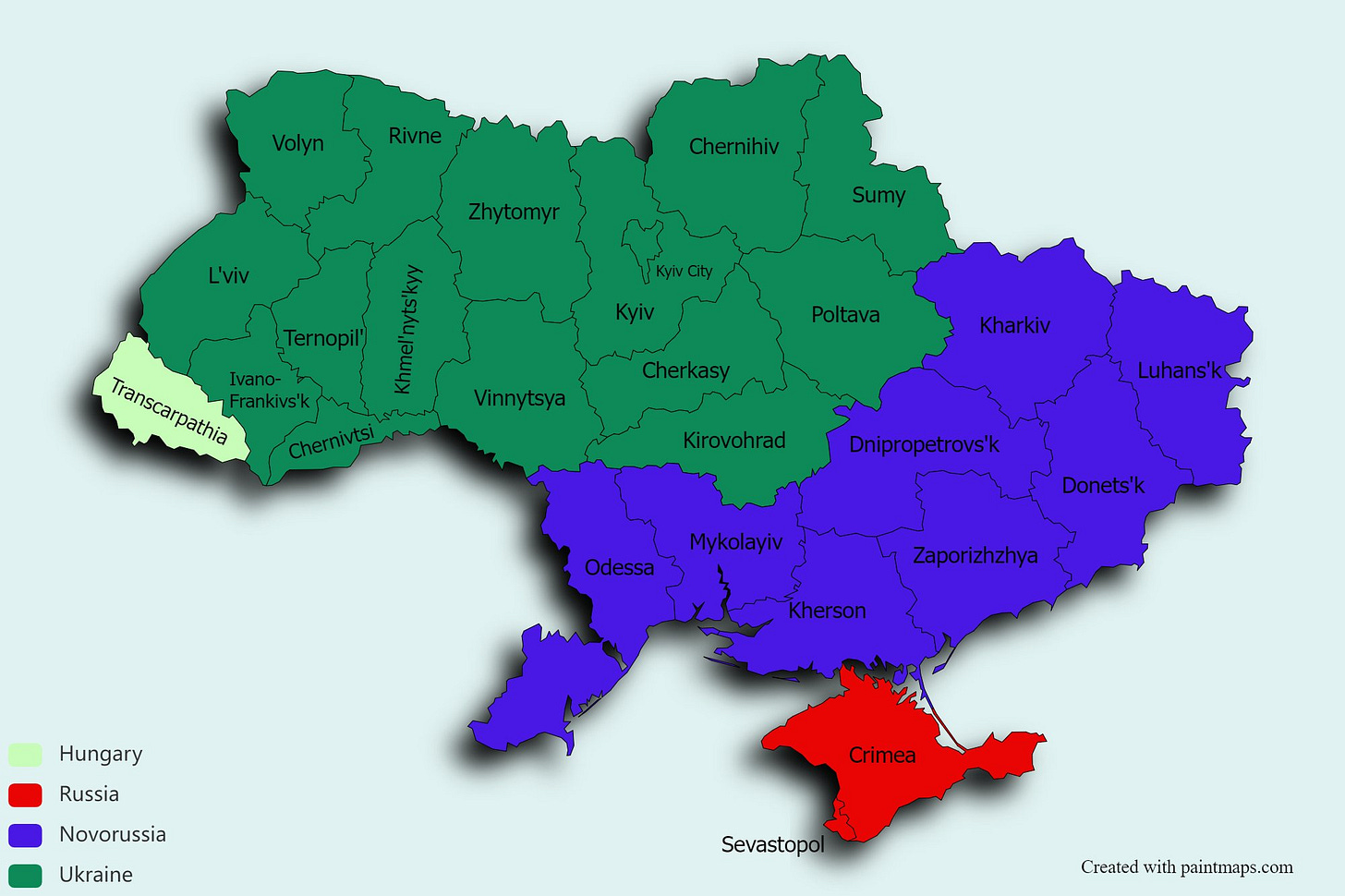
Novorossiya
No matter how the would-be masters of empire try to spin defeat into victory, most everyone around the world will still know the score. And it is this disabused illusion of imperial military supremacy that will rapidly accelerate its inexorable decline.
Trump continues to be seized by the delusional view that his Israeli-centred vision could all be accomplished merely by ending the genocide in Gaza.
Alastair Crooke – Strategic Culture
The big issue emerging from the U.S.’ 22 June strike on Iran – second only to ‘wither Iran?’ – is whether in Trump’s calculus he can ‘rhetorically impose’ the having “obliterated” Iran’s nuclear programme claim long enough to both restrain Israel from hitting Iran again, yet still allow Trump to pursue his show-stopper headline, ‘WE WON: I’m in charge now and everybody is going to do what I tell them’.
These were the key conflicting issues that were to be hammered out with Netanyahu during his White House visit this week. Netanyahu’s interests essentially are for ‘more hot war’, and thus differ from the Trump ceasefire general stratagem.
Implicit in his ‘In-Boom-Out & Ceasefire’ Iran approach is that Trump may imagine he has created the space to resume his primary objective – that of instituting a broader Israeli-centric order across the Middle East, devolving upon trade deals, economic ties, investment and connectivity, to create a business-led West Asia, centred on Tel Aviv (with Trump as its de facto ‘President’).
And, via this ‘Business Super Highway’, to strike further beyond – with the Gulf States penetrating into BRICS’ south Asian heartland to disrupt BRICS connectivity and corridors.
The sine qua non for any jumpstart to a putative ‘Abraham Accords 2.0 of course – as Trump clearly understands – is an end to the Gaza War; the withdrawal of Israeli forces from Gaza; and the Strip’s re-construction (none of which seems to be in realistic reach).
What emerges rather, is that Trump continues to be seized by the delusional view that his Israeli-centred vision could all be accomplished merely by ending the genocide in Gaza, but with the world watching aghast as Israel continues on a hegemonic military rampage across the region.
The most obvious flaw to the Trump premise is that a chastened Iran somehow has been achieved by Israeli and American strikes. It is the opposite. Iran has arisen more unified, resolute and defiant. Far from being relegated to watching passively from the sidelines, Iran now – in the wake of recent events – resumes its place as a leading regional power. One that is readying a possibly game-changing military riposte to any further strikes by either Israel or the U.S.
What is ignored in all these western claims of Israeli success, is that Israel chose to bet all on a surprise ‘shock and awe’ strike. One that would overturn the Islamic Republic at a stroke. It didn’t work: the strategic objective failed, and it produced the opposite outcome. But the more fundamental point is that the techniques used by Israel – that required months, if not years of preparation – cannot just be repeated again now that their stratagems have been fully exposed.
This White House misreading of the Iran reality signals that the Trump Team allowed themselves to be deceived by Israeli hubris in insisting that Iran was a house-of-cards, primed to collapse completely into paralysis upon the first taste of the Israeli sneak decapitation ‘muscle’ on 13 June.
This was a fundamental error – in a pattern of similar errors: That China would capitulate to the threat of imposed tariffs; that Russia could be coerced into a ceasefire against its interests; and that Iran would be ready to sign an unconditional surrender document in the face of Trump’s threats post-22 June.
What these U.S. blunders speak to – apart from a consistent divorce from geo-political realities – is western weakness masked behind hubris and bluster. The U.S. Establishment clings to its fading primacy; but in doing it so ineffectually, it has instead accelerated the formation of a potent geo-strategic alliance intent on defying the U.S.
The consequence has been the wake up call to other States occasioned by the western slide towards stratagems of outright lies and deceit: The ‘Spider Web’ operation against the Russian strategic bomber fleet on the eve of the Istanbul talks and the U.S.-Israeli sneak attack on Iran two days before the expected next round of U.S.-Iranian nuclear talks, have increased the will-to-resist by China, Russian and Iran particularly, but more generally it is felt across the Global South.
The entire complexion of this war to retain America’s dollar primacy has been irreversibly altered.
All are ‘on guard’ as they see evidence that, with the expectation of NATO’s defeat in Ukraine, the West is ramping up the new Cold War on many fronts: in the Baltic Sea; the Caucasus; the Iran periphery (via cyber attack), and of course via escalated financial war across the board. Trump is again threatening to sanction Iran and any State purchasing its oil. On Monday, Trump posted on Truth Social that he would impose a new 10% tariff on “any country aligning themselves with the Anti-American policies of BRICS”.
Naturally, States are preparing against this escalation. Tensions are rising everywhere.
Azerbaijan (and even Armenia) are being weaponised against Russia and Iran by NATO powers and Turkey. Azerbaijan was used to facilitate Israeli drones launched into Iran, and its airspace was used too by Israeli aircraft to circle into the Caspian Sea in order for Israel to launch stand-off cruise missiles from Azeri airspace over the Caspian Sea at Tehran.
Iraqi Kurdistan, Kazakhstan and the Baluchi borderlands have been used as platforms to infiltrate sabotage units into both Russia and Iran to pre-position missiles and drones and sabotage units for asymmetric warfare.
On the other flank of this escalating war, Trump is racing to land a string of ‘trade’ agreements across the Pacific, including with Indonesia, Thailand and Cambodia. The aim being to build ‘a cage’ of special higher tariffs around China’s ability to use ‘trans-shipments’ – that is goods imported into other States from China, which are then re-exported to America.
The U.S. set the precedent via Vietnam, with a 40% tariff on trans-shipments that is precisely double the 20% levy on Vietnamese-made goods.
Except that Trump’s ‘shock and awe’ strategy of imposing tariffs to regain industrial activity and to keep the rest of the world subject to dollar hegemony is not working: First Trump was forced to announce a 90-day moratorium on Liberation Day Tariffs in the hope that 90 deals would be struck in the interim – yet only three ‘framework agreements’ were settled. So the Administration is now forced to extend the moratorium yet again (to 1 August). Bessent, U.S. Treasury Secretary, has said that many of the 90 states originally tariffed did not even try to contact the U.S. to work out a deal
The ability to financially punish people for not doing what the U.S. says is drawing to a close. The alternative to the dollar network exists. And it is not a ‘new reserve currency’.
The alternative is the solution envisaged by China: a fusion of Fintech retail payment platforms with banking and Central Banking digital frameworks, based on block-chain and other digital technologies. (The U.S. cannot replicate this approach – as Silicon Valley and Wall Street are at war with each other, and won’t co-operate).
As Will Schryver noted wryly a couple of years ago —
“The empire’s seemingly endless string of hubris-driven blunders has rapidly accelerated the formation of what is quite arguably the single most potent military / economic / geostrategic alliance seen in modern times: the tripartite axis of Russia, China, and Iran …
“It has astoundingly managed to jump from the frying pan of a regional proxy war against Russia into the fire of a global conflict that all three of its steadily strengthening adversaries now view as existential”.
“In my considered opinion, this is almost certainly the single most inexplicable and portentous series of geopolitical blunders in recorded history”.
—
Alastair Crooke: Former British diplomat, founder and director of the Beirut-based Conflicts Forum.
America’s military humiliation: the Houthis exposed its waning power.
By Malcom Kyeyune at UnHerd.
When, in reaction to the war in Gaza, the Houthis of Yemen started imposing their blockade on the Red Sea, it was seen as a sure sign of waning American power: a global hegemon was allowing its control over a vital sea route to be contested. In their rush to fathom why this might be happening, detractors of the then president claimed he was simply too weak, too much of an appeaser to use the full width of America’s military might to quash the problem.
In fact, in response, Biden authorised not one but two military campaigns. The first was Operation Prosperity Guardian, which aimed to combine US naval power with a coalition of willing states to protect shipping and break the blockade. That fast turned into an embarrassing debacle, as most of the coalition partners walked away and ships kept getting hit by Houthi missiles. And so, in January 2024, Operation Poseidon Archer was launched, which involved British as well as American aircraft attempting to bomb the Houthis into submission. Here again, the operation was unsuccessful, doing almost nothing to dent Houthi attacks or open up the Red Sea to shipping. But even then Biden was blamed; the mighty US military was being held back somehow. Thus, the natural conclusion was that once Trump was in office, the gloves would come off.
Biden’s critics were actually half right. Once Trump came in, the gloves did come off. Operation Poseidon Archer was followed by Operation Rough Rider, in March of this year, which attempted to show a new, much more muscular American military response against Houthi targets in Yemen — for all of six weeks. For six weeks, US warplanes pounded Yemen around the clock, with rare and expensive stealth bombers flying missions out of Diego Garcia in support of carrier-based aircraft. Yet once those six weeks were up, Trump proudly announced that Yemen had “surrendered” and that there was no more need for the US to keep up the bombing. A ceasefire had been brokered by Oman. This was trumpeted as a glorious victory for the US military, with the Houthis finally promising to not attack US ships anymore, and America graciously returning the gesture.
Of course, Trump didn’t mention the terms of the “surrender”. The Houthis only had to stop attacking American ships in exchange for America stopping the bombing; they were free to continue blockading the Red Sea or firing missiles at Israel. America, in other words, had given the Houthis carte blanche to carry on the behaviour that was the reason America had gone to war in the first place. Thus, to call this deal a surrender was entirely appropriate; it’s just that it wasn’t the Houthis hoisting the white flag.
It is very commonplace to blame reversals and even defeats in America’s various wars of choice as merely a matter of lack of will. If America really wanted to win, it would win, the story goes; the failure of the US is just one where it never commits the force necessary to finish the fight. But today, that excuse rings hollow. Trump’s Operation Rough Rider, unlike Biden’s operations, utilised many of America’s most limited, expensive, and advanced weapons to try to bring the Houthis to heel. And still it surrendered. The lessons here are thus quite bleak. America’s preferred and increasingly only viable method of warfare — aerial warfare — is no longer cost-effective nor practical. But the US has no alternative modes of warfare to fall back on, which means that its days as a military hegemon are probably coming to a close.
To understand just how big a mess the air war against the Houthis has turned out to be, it’s important to understand a very basic rule to US military inventories. For while, on paper, America has 11 nuclear-powered aircraft carriers, an impressive figure that far outstrips any other country on the planet, that top line figure is barely relevant in practice.
For comparison, look to the United Kingdom. The UK has two large aircraft carriers, putting it near the top of the international leaderboard when it comes to the ability to project military force. But as anyone with any familiarity with the Royal Navy can tell you, that number does not tell the real story. The number of carriers the UK can actually deploy is far lower, a number which is fairly close to zero. For while the ships exist, the Royal Navy lacks the crew, the planes, the escorts, and the logistical capacity to actually put them to use for any length of time in a real war. The UK Navy has become something of a Potemkin village, where superficial on-paper strengths hide a catastrophic reality of deferred maintenance, insufficient budgets, and lack of personnel.
Though the situation for the US Navy isn’t quite as dire, in practice, the problem is the same: it cannot realistically put more than two to four carriers to sea at any given moment. The ability to surge capacity in times of crisis is limited, because the various reserve components of the US armed forces have catastrophically atrophied. If you discount the American carriers that are slated for the scrapyard, or those currently lacking a functional nuclear reactor, or those which are tied up in deep maintenance, the number of active, usable carriers is roughly a third of the on-paper number. Half of those carriers were being used against the Houthis.
But carriers are not the only example we ought to look at. For Operation Rough Rider, the US Air Force contributed some six B-2 Spirit stealth bombers, arguably the most advanced (and by far the most expensive) airframe in the US arsenal. At first blush, this seems like only a fraction of America’s power, because it has some 20 such bombers in its inventory. But a closer look at these planes suggest that those six used in Rough Rider very likely represent the entire working inventory of US stealth bombers. Because B-2s haven’t been built for decades, the only way to keep them operational is to cannibalise other B-2s for spare parts: as a result, a large number have been functionally scrapped and cannot ever hope to fly again. Only half of US bombers even qualify for so-called “mission capable” status on an average day, a status which doesn’t actually mean that the plane works; it simply means the plane isn’t completely broken and inoperable. Only two thirds or fewer of those mission capable planes can hope to qualify for what the US military instead classifies as “full mission capable” status. “Full mission capable” is your standard Pentagon-speak; it means the plane is in working order, has nothing broken that’s really important, and can realistically be used for what it was built for.
From carriers to stealth bombers, the pattern here is fairly clear, and it is further corroborated by testimonies from inside the Pentagon itself. America essentially pulled out all the stops to attack the Houthis, waging an extremely expensive and intensive air war against a militia controlling most of Yemen, the fourth-poorest nation in the world. The cost to operate a B-2 stealth bomber is extremely high on a per-hour basis; and their fragile stealth coating is not particularly fond of the warm, salty sea air at Diego Garcia. You don’t send in all of them unless you really mean business. America also committed roughly half of its active carriers, spent a fortune in land attack and air defence missiles, and it even cannibalised ammo stores and air defence systems from the Pacific theatre of operations for the sake of the operation.
But as the stories of the campaign start leaking to the press, it’s clear that none of this effort did anything good. The US couldn’t establish air supremacy, meaning it couldn’t risk flying its older, non-stealth planes for fear of losing them. This itself might seem like proof that America was once again just not trying very hard; for what kind of war is it when you’re not ready to accept losses? But the problem is, America can’t afford to replace planes that get lost and pilots that get killed. This is not a problem of cowardice, but of force generation: even if the US military suffers zero losses due to enemy fire in the years ahead, it is still slated to shrink precipitously. This shrinkage and loss of capacity is just due to America’s planes and ships wearing out, with not enough workers, dockyards, engineers, and dollars to replace them. As America burns through its massive military inheritance bequeathed by Ronald Reagan and the Eighties arms race, there is no plan to replace it. For the US military, avoiding casualties is not a matter of caution or cowardice; it is the result of a total inability to replenish the force.
The result of this American Achilles’ heel has been an extremely expensive reliance — when it has come to defending the Red Sea — on so-called “standoff” weaponry; cruise missiles, for example, that can be launched from far enough away that anti-air fire won’t be a threat. But even then, there were problems: according to leaked reports, even the vaunted F-35 stealth fighter had to dodge incoming anti-air missiles on at least one occasion. In Operation Rough Rider, the US deployed many of its most rare and bespoke weapons, such as the AGM-158 JASSM (Joint Air-To-Surface Standoff Missile) as well as heavy, specialised bunker-buster bombs. Again, by all accounts, this had little effect. Partly, this was because the US kept losing so many of its MQ-9 reaper drones, which come with a price tag north of 30 million dollars apiece, and which were supposed to provide the intel to ensure the bombing campaign found its targets.
When Biden first lost interest in defending the Red Sea against the Houthis, people were aghast. Not doing enough was akin to telling the entire world that the US was too weak to keep the Suez channel open. But Trump, after berating his predecessor, has also walked away, and de facto recognised the Houthi’s control of the channel. It would seem that the US doesn’t actually have many cards to play.
Trump could have sent another carrier to the region in support of his operation, bringing the total up to three. But this would hardly have made much difference to the air campaign because the problem with this offensive wasn’t lack of deck space or fighter sorties — US planes were too wary to go anywhere near Yemen’s air defence, and even stealth jets were reportedly not entirely safe. The problem was the lack of standoff munitions which can be deployed from a point of relative safety. But these are so expensive and so limited that there is no budget to replenish them when stores are depleted (a single JASSM with a 450 kilogram explosive warhead comes in at slightly under a million dollars). Wargames show the US running out of most or all such critical munitions in a matter of weeks or even days in a real conflict against a peer enemy such as China.
Even worse, much of the US military’s most advanced weapons systems are dependent on components and materials such as rare earths from China, which has already started imposing harsh export restrictions in order to slowly choke the life out of the US military industrial complex. In practice, the US does not have the economy to produce the weapons used for aerial warfare at any sort of scale, and this has only been hidden from full view because the military has coasted along on an aura of invincibility.
As the appetite for ground warfare has waned, the allure of quick, cheap and easy air campaigns has grown. But air warfare is no longer what it once was. Operation Rough Rider was supposed to be a decisive show of force against an under-equipped, internally divided third-world nation. Instead, it ended up looking like the last hurrah of a truly antiquated form of warfare, unable to cope with cheaper and better anti-air weapon systems.
All of these limitations make the current talk about a new bombing campaign against Iran utterly surreal. Iran is far bigger than Yemen, with a much more robust air defence network. Moreover, the distances involved are such that carrier-based aircraft, even when launched from the very shores of the Persian gulf, can’t actually reach places like Tehran and return on a single tank of fuel. Fighter-bombers will need aerial refuelling over the Iranian interior, and tanker planes are slow, easy to spot on radar, and pretty much defenceless. Even attempting to destroy the Iranian air defence network will take huge amounts of precision standoff weaponry, which the US cannot practically replace, even if it weren’t struggling with a massive fiscal crisis and soaring bond yields. The critical parts of Iran’s nuclear programme are kept under hundreds of feet of solid mountain; the US, using the heaviest and most advanced weapons in its entire arsenal, did not succeed against the much shallower Houthi bunkers and missile storage facilities in Yemen. All of the problems that forced America’s tacit surrender of the Suez canal would be writ large — and be far more lethal — in any campaign against Iran.
With exploding deficits, a growing internal political crisis, and a slowly collapsing military, America is a leopard that lacks the wherewithal to even attempt to change its spots. The generals know that the jig is up: the old model is broken, there is no new model coming, and nobody has the energy left to do much about it all. And so, this massive crisis of US military power is playing out in the vein of Ernest Hemingway’s comment about the course of his own bankruptcy: gradually, then suddenly.
Once upon a time, there was always a bigger plane, a more advanced high-tech future weapon, yet another trick up the Air Force’s sleeve that you could point to in order to silence the doubters. But those days are over. The gravity of what happened in Yemen will only assert itself once the political class is ready to deal with the new world we are now living in: one in which the US has no new military rabbits to pull out of its hat, and those that it does have simply aren’t enough to get anywhere close to victory.
Malcom Kyeyune is a freelance writer living in Uppsala, Sweden
“How weary am I of devils and brutes, a true human is what I long for.”
By Nora Hoppe at Al Mayadeen.

The fact that our planet in this day and age is home to a genocide – visible to all human beings on personal devices throughout the world – an ongoing abomination unhindered by any international body, by any intergovernmental organisation or even by those noble states that proclaim to be constructing a new and more just world… says a lot about our evolution as a species and potentially about the future of our civilisation.
We now stand before a bifurcation: one clear and broad path leads to destruction and ruin; the other is to lead to a new and harmonious world… but it is winding, stony, vague and enveloped in fog.
Like a frantic victim in quicksand, flailing his arms about in vain, the frenzy of a declining Empire is only accelerating its own demise. It has chosen the path leading to ruin and its own suicide… and it has many followers – especially in its diseased appendix – the Zionist entity – and the rest of the Western World. The symptoms of this necrotic drive are seen in the Forever Wars; a self-devouring economic system based on insatiable greed and wilful ignorance; the destruction of society, of the family, of rituals and traditions; and, essentially, a total contempt for all that is natural and alive… These signs arise from a state of permanent discontent and fear, which ultimately leads to self-destruction.
And now… though today’s Hegemon, the United States – built on genocide and slavery – has been waging countless wars since its inception, and Europe has been massacring and plundering the planet for over 500 years due to its endless rapacity… it is no longer just a question of geography. The core of the problem of our human civilisation today is the western mindset and the system of financialised capitalism, both of which have infected the entire world to various degrees… with only a few exceptions.
Most of the World Majority remains incapable of throwing off the yoke of the colonialist West because of corruption, dependence, societal pressures and a lack of support from states to enlighten citizens on their own past and history.
The mythification and emulation of the Western World have become so deeply ingrained in the marrow of so many over so many centuries… that a decolonisation process will take time. And little has been undertaken officially to this end. The promising BRICS+ states are focussing mainly on trade, economic growth and hi-tech innovation.
To avoid that western path to societal devastation and ruin and to clear the other path of fog, we of the Global Majority need to seek clarity in many areas… We may have to make seismic changes to our ways of thinking. We can begin by questioning our definitions of very basic terms… Such as: what is “development”, what is “growth”, “what is “prosperity”, what is “progress”? Not all growth is advantageous – as in malignant metastases. “Positive growth” today pertains chiefly to monetary matters – GDP, GNI, PPP. What is “progress”? Progress today mostly pertains to technological innovations. And certainly it is imperative that peoples are lifted out of poverty, such as China has succeeded in doing… but what is the kind of “prosperity” that Humanity would like to achieve??
Today, in this post-modern world, there is little discussion of development, growth, prosperity and progress with regard to immaterial matters…
It is not only education, the arts and cultures of the world that have fallen into stagnation, but obviously also the ethics and value systems of entire states and societies… not to mention the conscience of most of Humanity.
How else could a genocide become commonplace? How else could atrocities become a daily tolerable spectacle throughout the world? How else can two genocidal leaders meet and speak so eagerly about their “real estate plans” for their concentration camp as though they were having a normal conversation? How else could we have all become a global audience for an orchestrated famine? How else can so many European states and the EU Border Control Authority Frontex become the clients of “combat-tested” weapons (“tested” in Gaza) from Elbit Systems (“Israel”‘s largest arms company) that manufacture surveillance drones and remote-control turrets for armoured vehicles to enable European soldiers to avoid accountability and a bad conscience when targeted refugees are murdered by anonymous technicians located in remote offices? How else can European countries allow their historical incidents of genocide against the Jews to be “revised” and whitewashed by the Zionist entity for Israeli business advantages? How else could International Law be trampled upon without resistance? How else could serial mendacity and the constant breaching of constitutions and agreements become acceptable? How else could the citizens of those states, which vaunt their “freedom of expression” and “western values”, allow their states to reach the point at which they are now criminalising protesters for standing up for human rights?
Other than the people involved directly in battles for their survival (in Gaza, Syria, Lebanon and elsewhere), courageous soldiers fighting against Nazism, committed journalists risking their lives on the fronts and activists, risking their professions for protesting against the Genocide… where is the rest of the world?
Some states voice their condemnation of the ongoing genocide but take no action, because… because it’s… complicated.
And yet… we have an exception… the Ansarallah of Yemen. There is nothing complicated about their resolute move: it is simply a matter of priority.
Why would the majority of a people of one of the poorest countries (perhaps the poorest) on Earth devote most of their energy, their scarce resources and their steadfast beliefs in risking their lives in defence of another people, who are not directly related to them and are located in a distant country (an estimated 2,270 kilometres away)? What unites these people in this goal? And what might be THEIR definitions of “development”, “growth”, “prosperity” and “progress”?

A crossroads of various civilisations for at least 7000 years, Yemen’s own great civilisation has, over centuries, experienced countless invasions, fierce battles, usurping dynasties and colonial occupations by those who continually sought to plunder, conquer and control this valuable, highly developed, resource-rich and “geographically optimal” territory.
In the 1990s, after a long period of economic hardship due in part to persistent Saudi oppression and notably Yemen’s refusal to join the US-Saudi military coalition against Iraq, a Zaidi grassroots movement emerged in northern Yemen, known as Muntada al-Shabab al-Mu’min (“Believing Youth”) – which offered social programmes to the impoverished population of the region. The successful movement grew and soon transformed into the Ansarallah (“Supporters of God”) who went on to fight six wars against the Saudi– and Western-backed Saleh regime between 2004 and 2010…
Now, despite decades of deprivations, the Ansarallah remain undeterred in their goals for justice, in their fight to liberate Palestine and to improve their own country. To achieve these goals, they do not require “monetary prosperity” and a financialised state. In all their operations they show solidarity and unity amongst themselves. They cannot be intimidated. They are ready to die for their beliefs and principles.
In their filmed speeches and discussions, the demeanour of the Ansarallah is visibly marked by confidence, serenity, grace, poise, modesty… During the Third International Conference “Palestine, the Central Cause of the Nation”, they displayed kindness, generosity and hospitality in welcoming foreign guests, even toward those hailing from “hostile states”.
Single-handedly, they have disrupted global shipping power dynamics. Relying on the expertise of their own specialists, they manufacture weapons themselves… The US Pentagon’s chief weapons buyer Bill LaPlante expressed alarm over the sophistication of these weapons: “What I’ve seen of what Ansar Allah has done in the last six months is shocking.”

In his article Factors behind Yemen’s Valiant Resistance, journalist and political analyst Ayman Ahmed describes how the Ansarallah “managed to modify conventional military tactics in very unconventional ways” by adopting a guerrilla-oriented approach: moving on foot over hostile terrains in small mobile groups, with their group leaders often improvising tactics on the spot, and using little to no electronic devices… “Their use of drones in almost guerrilla-style operations highlights how the Yemenis managed to jam billion-dollar Saudi air defenses…” […] “The Saudi regime has not been able to score any major military victory despite possessing large stockpiles of weapons supplied by the world’s leading arms merchants.”
But their strongest asset of all is their motivation and determination in their pursuit of “a dignified life and standard of living for Yemeni citizens, the protection of the independence of the nation and seeking world peace and appropriate equal cooperation with the other countries of the world” – as inscribed in their “National Vision for the Modern Yemeni State“. With this, they have won the support of the masses across all segments of society.

As Rune Agerhus, political analyst and member of the International Commission for Solidarity with Yemen, wrote here: “What Ansarallah has managed to establish, while facing war, starvation, and a crippling blockade, is a system that could best be described as akin to Yugoslavian worker self-management” […] “Farmland and output are controlled by the cooperatives, which are wholly owned and administered by Yemen’s peasantry.” The defence of Yemen as a whole is being fought on two fronts – “the battlefront and the development front”.
The system adopted by the Ansarallah is the antithesis of contemporary capitalism.
(Not to forget: Yemen has already had experience with socialism when its southern territory – a separate state in 1967-1990 – eventually formed a Marxist-Leninist government following decades of rapacious British colonial rule over the region.)

In our globalised, postmodern, technology-obsessed world dominated by Western norms, technocrats and the Market and guided by an ignorance of history and a limitation in independent reasoning, the Ansarallah seem to many backward and savage at worst, quaint and exotic at best…
Different people may have different views of the Ansarallah and will judge them accordingly… but the ACTIONS taken by these people in defence of another people undergoing a genocide, especially in view of their own circumstances, speak for themselves… louder than any fine words.
On 10th April 2025, under the incessant bombings of the barbaric Hegemon, Ansarallah’s leader Sayyed Abdul-Malik al-Houthi made another urgent appeal to the world… to come to the aid of the Palestinian people and to become conscious of our ethical responsibility as part of a collective humanity. Who is listening? Where is the “world community”?
* * *
After so many millennia of human civilisation, what is the “progress” we are making as a species in our modern-day age?
* * *


Dar al-Hajar, former royal palace outside of Sanaa (1920) on the ruins of an ancient Sabaean palace known as the Fortress of Dhi Saydan, constructed by the Himyarites in 3000 BCE

Inscriptions in Musnad, the Temple of Awwam, Throne of Queen Bilqis (Sheba) 1500–1200 BCE © Zain Alaabdain Ben Ali / Arabia Felix Magazine

 Lateo.net - Flux RSS en pagaille (pour en ajouter : @ moi)