Connexion


A time travel across History – the Ancient Silk Roads as well as Xinjiang may well be the ultimate crossroads of civilizations. Along Central Asia, they are the (beating) heart of the Heartland…
By Pepe Escobar at the Strategic Culture Foundation.
ON THE SOUTHERN SILK ROAD – Silk is the stuff of legend. Literally. At first manufactured only in China, silk historically was not only a luxury product but a monetary unit: a key element of trade and export revenues.
In 105 B.C., a first-ever Chinese diplomatic mission landed in Persia, then dominated by the Parthians, who also occupied Bactria, Assyria, Babylon and parts of India. Under the four-century long Arsacid dynasty – contemporary of the Han in China – the Parthians at the time were the essential middlemen of transcontinental trade. Chinese and Parthians sat down to discuss – what else – business.
The Roman Empire faced some serious trouble with the Parthians – between the massive defeat of Crassus in Carrhae in 53 B.C. and the victory of Septimus Severus in the year 202. In between, silk hit Rome. Big time.
The first time Roman soldiers saw silk was in the battle of Carrhae. Legend rules that the silk banners deployed by the Parthian army, their scintillating appeal making serious noise under the fierce winds, frightened the Roman cavalry: talk about the first instance of silk contributing to accelerate the decline of the Roman Empire.
Well, what matters is that silk perpetrated nothing less than an economic revolution. The Roman Republic and then Empire had to export gold like there’s no tomorrow to get their silken ways.
Parthian rule was followed by Sassanid Persia. They reigned until the mid 7th century – their empire stretching from Central Asia to Mesopotamia. For quite a while the Sassanids incarnated the role of great power between China and Europe – up to the conquests of Islam.
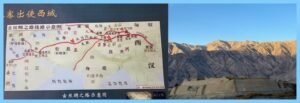
(L): Silk Road, the ancient Chinese way: from Xian to Alexandria, not Rome ; (R): The stone tower: Tashkurgan Fort, the landmark between China and the rest of Eurasia
So imagine, at the start of the Christian era, bolts of silk moving overland all along across the Silk Road spectrum. What’s fascinating is that Rome and China never (italics mine) entered in direct contact – for all the vast cast of characters (merchants, adventurers, fake “ambassadors”) that tried.
In parallel, a Maritime Road was also in play – already in effect during the times of Alexander The Great; it later became the Spice Route. That was how Chinese, Persians and Arabs reached India.
Since the Han dynasty, the Chinese reached not only India but also Vietnam, Malaysia and Sumatra. Sumatra soon developed as a key maritime entrepot, with Arab vessels arriving non-stop. In a more long-distance vein, it was the discovery of the rules of the monsoon – in the first century B.C. – that allowed the Romans to also reach the western shores of India.
So silk arrived in Rome by land and sea, via loads of different middlemen. And yet Rome never knew anything about the origin of silk, nor went further than the Greeks in their wobbly knowledge of the distant, mysterious land of Seres.
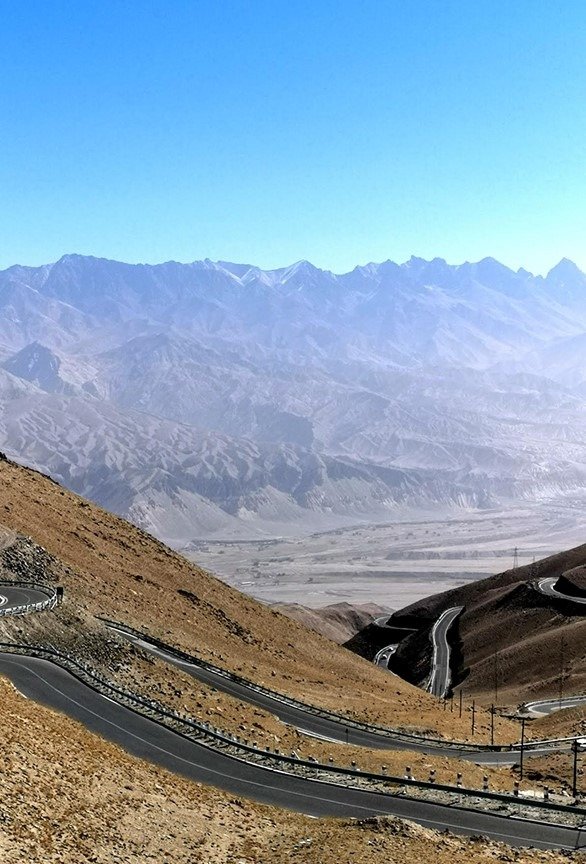
The twists and turns of the Panlong Ancient Road, in Pamir lands
I went down to the (Pamir) crossroads
After the mid-1st century, the Kushan empire, actually Indo-Scythian, gets a protagonist role in southern Central Asia, in what was known then as Eastern Turkestan. The Kushan, rivals of the Parthians in the role of messengers of international trade, not only facilitated the spread of Buddhism but also Gandhara – Greco-Buddhist – art (some originals are still to be found today, at exorbitant prices, in art galleries in Hong Kong and Bangkok).
And yet, further on down the road, the rules of the game never substantially changed: two great Silk Road poles – Sassanid Persia and Byzantium – involved in a real, cutthroat industrial war with silk right in the middle. The secret of silk manufacturing had already been leaked to South Asia.
This trade war got even more complicated with the onslaught of Turk tribes across Central Asia, and the emergence of a trade kingdom in Sogdiana (with Samarkand at the center).
By the mid-7th century, the Tang dynasty recovered control over parts of the Silk Road ruled by Tarim basin kingdoms. That was an absolute must for business to go on – because caravan routes traversing these kingdoms encircled, and bypassed, by north and south, the fear-inducing Taklamakan desert, as they still do today.
Tang China wanted absolute control all the way at least up to the Pamir mountains where, in the legendary stone tower relentlessly described by adventurers but never really located with 100% certainty, Scythian, Parthian and Persian caravans met Chinese caravans to trade that precious silk plus several other commodities.
The stone tower mentioned by top geographers such as Ptolemy is actually Tashkurgan Fort in the Pamir mountains: ultra- strategic, straddling the Silk Road, and nowadays a top tourist attraction very close to the Karakoram highway.
The stone tower is the symbolic landmark between the Chinese world and the rest of Eurasia: to the west is the Indo-Iranian world.
I traveled the Pamir Highway in Tajikistan back-to-back before Covid interrupted everything. This time our mini-caravan crossed Pamir lands along and around the Karakoram highway on the way to the China-Pakistan border: that is now prime China-Pakistan Economic Corridor (CPEC) territory, a key plank of BRI.
It’s the Pamirs that in Ancient Silk Road times allowed reaching the oasis of Kashgar. The Pamirs tie a gigantic mountainous knot between the western limits of the Himalayas, the Hindu Kush and the southern slopes of the Tian Shan.
This has always been the key crossroads between the triangular trade uniting northern India, eastern Central Asia – with China nearby – and western Central Asia, with the steppes not so far away.
China meets Islam: a great, historical “what if?”
Silk, bearing serious value as a unit of capitalization and trade, had a much larger role than its usage. In Byzantium, silk was the object of an imperial monopoly. Everything was strictly regulated: professions, state ateliers where women worked, and customs. The state protected its monopoly via a fierce bureaucracy.
Meanwhile, the Maritime Road was booming. A Buddhist and maritime power, Srivijaya, controlled the ever-crucial Malacca strait out of the island of Sumatra. It’s under this configuration that Islam enters the Big Picture.
As much as History ruled that Rome and China would never meet directly along the Silk Road, it also ruled a stark separation between Islam and China. Or try to imagine if China, in the mid 8th century, had become a land of Islam.
The battle of Talas, in 751 – in what is today’s Kyrgyzstan – pitted China against the Arabs. And its result ended for good any Chinese whim of conquering Central Asia. Today, with the New Silk Roads/BRI, is another story – about Chinese trade/investment power projection all across the Heartland, and beyond.
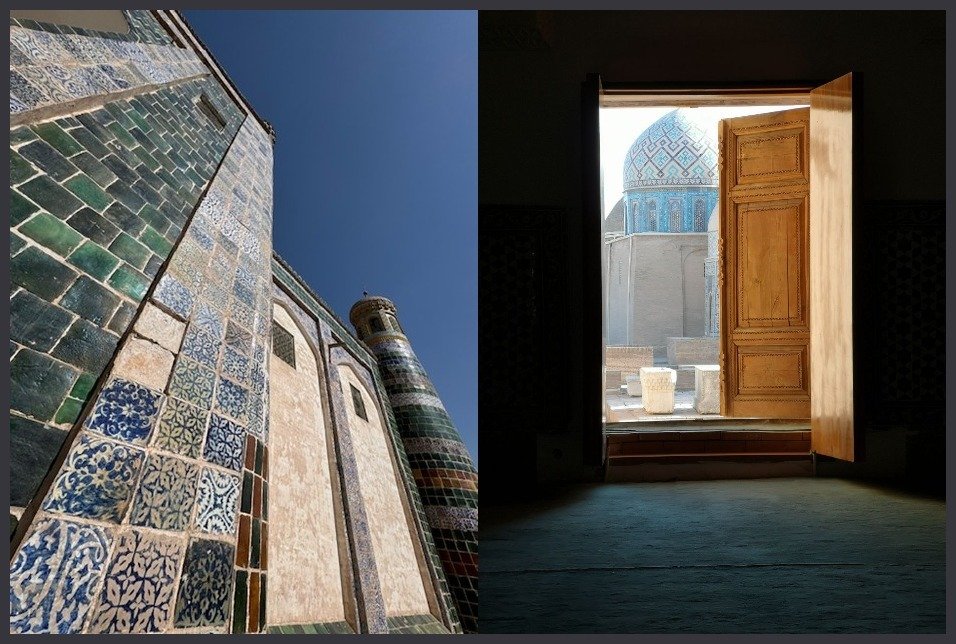
(L): Culture interpenetration: Bukhara meets Kashgar ; (R): Samarkand. Opening the doors to another dimension.
Back in the early 8th century, the key player was Umayyad dynasty General Qutayba ibn Muslim. He first conquered Bukhara and Samarkand; crossed the Ferghana valley; the Tian Shan mountains; and nearly reached Kashgar. The Chinese governor at the time, sensing that Qutayba might be about to take over Chinese lands, sent him a bag full of earth’s soil, a few coins and four princes as hostages. He calculated that’s how the Arab conqueror might not lose face, and leave the Middle Kingdom alone.
As incredible as it might seem, this arrangement lasted for half a century. Until the battle of Talas. Now compare it with Poitiers in 732 – one century after the death of Prophet Muhammad. We can certainly interpret Talas and Poitiers, together, as the two key landmarks of how Islam was on the verge of extending itself all cross Eurasia (including its European peninsula), creating a political-military empire from Rome to Chang’an (today’s Xian).
Well, it did not happen. Still, that’s one of the most extraordinary “what ifs” in History.
The importance of the battle of Talas – virtually ignored in the West, except in rarefied scholarly circles – is really larger than life. Among other issues, it imposed a new circulation of techniques. The Arabs took away with them artisans, sericulture experts but also paper makers. Ateliers at first were set up in Samarkand. Later on, in Baghdad and all across the Caliphate.
So alongside the Silk Road, we saw the birth of a very busy Paper Road.

An extraordinary Silk Road exhibition currently at the Gansu museum in Lanzhou
Deserts, mountains, oases – and no “slave labor”
Rolling down the highways across Xinjiang shooting a documentary after retracing the initial Ancient Silk Road from Xian to the Gansu corridor is an incomparable, historical time travel – as we may retrace in detail centuries of Central Asian turmoil all the way to the decline of some local pre-Islamic cultures by the 9th century. It’s a thrill to reconnect with the main actors: Uyghurs, Han Chinese, Sogdians, Indians, nomads, Arabs, Tibetans, Tajiks, Kyrgyz – and Mongolians.
The nomad groups thar proclaimed themselves heirs to the fierce Xiongnu came from the northwest of Mongolia and the Altai mountains. They incorporated several ancient nomads of western Central Asia during the 4th century, sharply remodeling the political and ethnic landscape.
The Xiongnu, on and off, pillaged parts of northern China – and were occasionally enticed into serious trade, offered tribute, or simply bribed to stay away. Actually the Xiongnu had a branch established in China and separated for at least two centuries from the previous ones: they ended up taking Samarkand in the year 350. Later on, it’s the Turks that once again came from Mongolia (don’t tell Erdogan about it; he wouldn’t know), unifying the steppe in the 6th century, way before the arrival of Islam.
Arguably the key Silk Road imperative is the desert and oasis contrast/dichotomy.
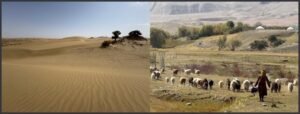
(L): The stark beauty of the fierce Taklamakan ; (R): Good pasture in Pamir lands
Deserts such as the Taklamakan and the Gobi, and several others, as well as arid steppes and mountains are among the most forbidding on the planet: these are the essential features of what amounts to roughly 6 million km2.
What is very rare in Central Asia is cultivated land (yet we can see a succession of cotton fields) or good pasture (we can see it in the Gansu corridor, and even in Pamir lands near the mighty Muztagh Ata). Still, deserts and mountains are at the heart of everything.
Some oases are of course more equal than others. Khotan is the most important oasis of the Southern Silk Road – not far from the immense, deserted Tibetan plateau. That’s fabulous for agriculture but most of all, courtesy of an alluvial cone, for precious stones, especially jade, supplied for over 2,000 years to every Chinese dynasty. Khotan spoke an Iranian language – close to those of ancient nomads Saka and Scythian, masters of the steppes.
The kingdom of Khotan was a fierce rival of the oases further west, Yarkand and Kashgar. It was only intermittently under Chinese control. And may have been conquered by the Kushans in the 2nd century. Indian influence is omnipresent – as we still see in dress patterns and food in the Night Market. In the 3rd century Buddhism was already a major influence – featuring the most ancient testimonials in the Tarim basin.
The Silk Road, actually Roads, is of course The Buddhist Road. In Dunhuang, in the Gansu corridor, Buddhism was also popular since the 3rd century: a famous local monk, Dharmaraksa, was the pupil of an Indian master. The Dunhuang Buddhist crowds were a mix of Chinese, Indian and Central Asian – once more testifying to the non-stop interpenetration of cultures.
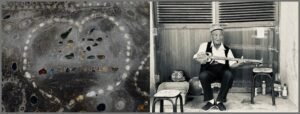
(L): The Chinese character for “silk” inscribed in jade in front of a factory in Khotan ; (R): Playing the Uyghur blues
The Shakespearean “all the world is a stage” metaphor totally applies to the history of the Silk Road: all those actors from all corners of the Heartland historically were playing several roles, sometimes all in one go – an apotheosis of the favourite Xi Jinping-coined “people to people’s exchanges”. That’s the spirit of the Ancient and the New Silk Roads.
We were fortunate enough to be on the road smack in the middle of the 70th anniversary of the establishment of the Xinjiang Uyghur Autonomous Region.
Among so many accomplishments by socialism with Chinese characteristics in Xinjiang in terms of sustainable development, the taming of the Taklamakan – or “sea of death” – is in a world class of its own.
We crossed the Taklamakan from the Northern Silk Road in Aksu to the Southern, near Keriya: and we experienced everthing from the impeccable highway bordered by the reeds composing the “China magic cube” – to keep the sands away – to some of the 3,046 km-long sand-blocking green belt, featuring plants such as the desert poplar and the red willow.
The Taklamakan has always been Sandstorm Central – a major threat to the succession of oases. The terrain all around the oases is hardcore: deserts, barren mountains, Gobi wasteland, poor soil, sparse vegetation, low rainfall, high evaporation, dry air.
Well, what we see today started even before the Go West campaign launched in 1999: since 1997, an array of central and state agencies, central state-owned enterprises, and 14 Chinese provinces and municipalities have sent a massive amount of funds and personnel to properly develop Xinjiang.
Now compare all that with original research shared at an academic conference on Xinjiang recently organized by the Hong Kong University of Science and Technology and Hong Kong University – my neighbors when I lived in the Fragrant Harbor. The research showed how British MI6 since the 1990s was instrumentalizing a minority of Uyghurs side by side with a massive global P.R. campaign with the explicit target of breaking China into three parts.
That evolved into the CIA-concocted “genocide” accusations of the past few years and of course “forced labor” masses barely surviving in concentration/re-education camps. In our extensive travels, guided by Uyghurs, we were dead set on finding slave labor in cotton fields along the Northern Silk Road or in the middle of the Taklamakan. Well, sorry: they don’t exist.
The propaganda though was essential to regiment loads of Uyghurs into ISIS, including their sizable contingent in Idlibistan now roaming free between Syria and the Turkish border. They wouldn’t dare coming back to Xinjiang and face Chinese intel.
Forget about barbarian propaganda. What really matters, historically, is that the Ancient Silk Roads as well as Xinjiang may well be the ultimate crossroads of civilizations. Along Central Asia, they are the (beating) heart of the Heartland. And now, once again, they are back as protagonists in the heart of History.
Part II of the celestial Travelogue through the western regions of China.
By Silk Road pilgrim Pepe Escobar on the Strategic Culture Foundation.
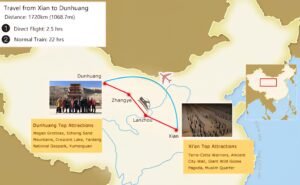
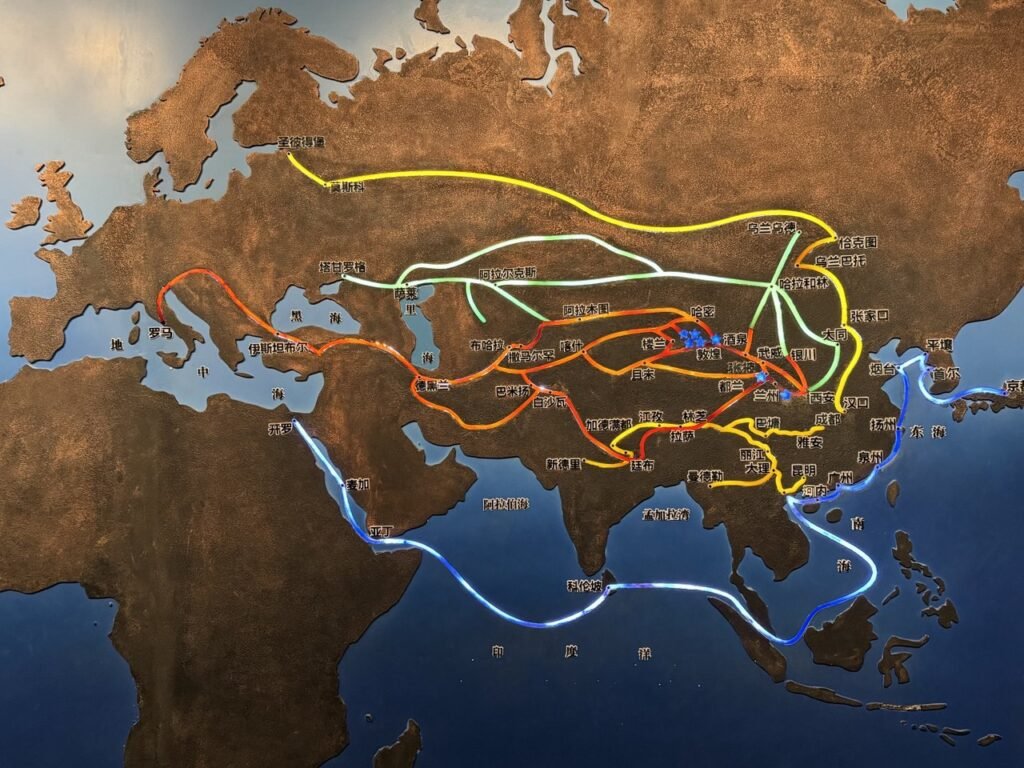
DUNHUANG – Across History, the Silk Road – actually a network of roads – is the supreme Highway Star: the most important connectivity corridor ever, rolling across Ancient Eurasia, linking what Chinese scholars consensually define as the main civilization systems in the world: China, India, Persia, Babylon, Egypt, Greece and Rome, as well as showcasing several historical stages of economic and cultural exchanges between East and West.
Prof. Ji Xianlin, a top scholar of Dunhuang Studies, came up with a formulation certified to drive Western supremacists crazy for all eternity:
“There are only four, rather than five, influential cultural systems in the world: Chinese, Indian, Greek and Islam. They all met only on China’s Dunhuang and Xinjiang”.
Dunhuang’s prime geo-strategic position across History was inevitably bound to generate spectacular artistic achievements.
After years since my previous journeys, then the Covid shock, then China’s subsequent recovery, I have been privileged to finally embark on a renewed Journey to the West to retrace the original Ancient Silk Road, starting in Xian – the former imperial capital Chang’an – all the way through the Gansu corridor to Dunhuang.
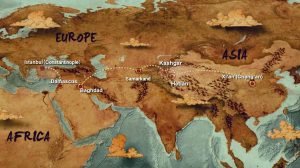
Brilliant Eurasian cultures converged, interacted and spread their wings on the Ancient Silk Roads. Dunhuang – on the western end of the Hexi corridor in Gansu province – was the most vital hub in the eastern section of the Chinese Silk Road, framed by mountains to the north and south, the central plains to the east, and Xinjiang to the west.
Dunhuang, the “Blazing Beacon”, held a supremely strategic position controlling two passes – Yangguan and Yumenguan. Han Emperor Wu Di clearly understood that Dunhuang was the last major water source before the fear-inducing Taklamakan desert to the west, as well as sitting astride the three main Silk Road routes heading west.
Yumenguan was the all-important Jade Gate pass – set by the Han empire in the 2nd century B.C.: placed in the south Gobi and the western end of the Qilian mountains, actually marking the western limit of classic China.
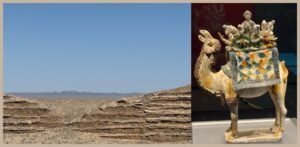
(L): The remains of the Great Han Wall ; (R): Xian
I spent a whole blinding beautiful blue-sky day in the pass and its surroundings after striking a deal with a taxi driver in Dunhuang. It’s a thrill to admire how the Han dynasty organized their traffic management system, the beacon fire system, and the Great Wall defense system (remains of the Han Wall are still there) – guaranteeing the safety of the long-distance Silk Road connectivity corridor.
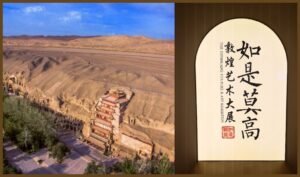
Talk to the caravan: the secret of “people to people’s exchanges”
At the impeccably organized Dunhuang Book Center, historical records refer to it as “a metropolis where the Han people and non-Han peoples meet”. Quite the antecessor to Xi Jinping’s “people to people’s exchanges.” The spirit remains, especially at the fabulous Night Market, a gastronomic feast with pride of place for Uyghur recipes.
Silk and porcelain from the central plains, jewelry and perfume from “the western regions”, camels and horses from north China, grains from Hexi, everything was traded in Dunhuang. Merchant deals, migrations, military games, cultural exchanges, a profusion of literati, scholars, artists, officials, diplomats, religious pilgrims, military brought classic Chinese culture into an effervescent mix – Sogdian, Tibet, Uyghur, Tangut, Mongolia – all absorbed into what eventually became Dunhuang art.
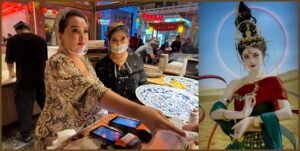
(L): Uyghur businesswomen at the fabulous Dunhuang Night Market ; (R): The Desert Princess look. Affordable. Less than $60 for a set of clothes, make-up, 25 exclusive pics and retouches.
Itinerant Buddhism, Nestorianism, Zoroastrianism, Islam – the sophisticated aesthetic feel of Dunhuang was progressively influenced by architecture, sculpture, paintings, music, dance, weaving, dyeing techniques all the way from Central Asia and West Asia.
“Silk Road” terminology in Xi’s “moderately prosperous” modernized China is an extremely nuanced business. For instance, already in Xian, at the Small White Goose pagoda, we see it described as “Silk Roads: The Routes Network of Chang’an-Tian Shan corridor”.
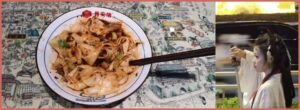
Xian. (L): The perfect lamian at the Muslim Quarter – since Tang times ; (R): DON’T mess with a Tang warrior princess
That’s a geographically correct interpretation, stressing the Tian Shan mountains instead of the politically correct Xinjiang (which was essentially part of the “western regions”, not necessarily Chinese territory, for centuries).
As for how the Silk Road began, that now follows a single, scholarly accepted version: Han Emperor Wu Di, in 140 B.C. sent Zhang Qian as an envoy to the “western regions” on two business missions. The “Records of the Grand Historian” show that Zhang Qian, as the first official diplomat in Chinese history, de facto opened channels of communications with the “western regions” and then all the states in the northwest started trading with the Han, especially silk.
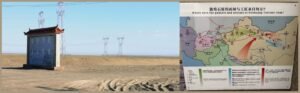
(L): On the road to the Jade Gate Pass. Electrification ; (R): At the Dunhuang Academy museum: where the artists came from
From Xian’s Shaanxi History Museum to the Dunhuang Academy, and including the Gansu museum in Lanzhou, in interactions with scholars and museum curators as well as in complement to formidable Silk Road exhibits, it’s fascinating to retrace the now established official narrative on the Silk Roads, according to which “the civilization of ancient China represented by silk started to impact the states in the western regions, Central Asia and West Asia.”
It was way more complex than that – as spices, metals, chemicals, saddles, leather products, glass, paper (invented in the 2nd century B.C.), everything was on the market, but the general drift applies: merchants from the central plains defying deserts and mountain peaks in caravans laden with silk, bronze mirrors and lacquerware from China, seeking to exchange them for commodities, while merchants from the western regions brought furs, jade, felts to the central plains.
Talk about multi-ethnic “people to people’s exchanges”. And by the way, no one ever used the term “Silk Road”; it was “the road to Samarkand” or just the “northern” or “southern” routes around the ominous Taklamakan desert.
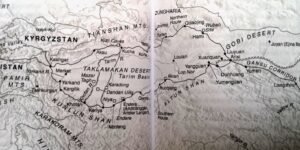
About the Tang dynasty monetary system…
By the 3rd century, Dunhuang was already at the apex of Silk Road connectivity; and that’s when merchants and pilgrims started to sponsor the construction of the nearby Buddhist Mogao caves.
The Mogao Caves are part of what is known in Gansu province as the five Dunhuang grottoes. It’s the same system of caves – 813 surviving, with 735 in Mogao. To approach Mogao is a major thrill in itself: we need to be in an official park bus, crammed with zillions of Chinese tourists, rolling through the desert, and suddenly we are in the eastern foot of the Mingsha mountains, with the Dangquan river running right in front of us, facing the Qilian mountains to the east, with the caves set back against and cut into the cliff face, connected by a series of ramps and walkways.
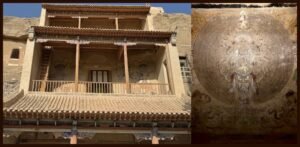
the Mogao caves (L): the main pavilion ; (R): One of the Buddha highlights
The caves started to be built as early as in the 4th century – all the way to the 14th century (the earliest wall paintings are from the 5th); it’s a group of caves in four levels, 1,6 km from north to south along a cliff as much as 30 meters high. The 492 caves in the southern area house more than 45 km of wall paintings, over 2,000 painted statues, and five wooden eaves. They were originally used for worshipping Buddhas.
What we are still able to see takes our breath away. Highlights include a wrestling scene from Buddha’s life on cave 290; a girl apsara – mythic dancer – on cave 296; the Deer King on cave 257; a hunting scene on cave 249; a Garuda – defined in Chinese as “the Scarlet Bird” – on cave 285; parables of the Magic City from the Lotus Sutra, a masterpiece of High Tang dynasty, on cave 217; a sitting Boddhisattva on cave 196; impeccably preserved worshipping bodhisattvas on cave 285.
Rules are extremely strict: visit only to selected caves, with an official guide, no photos, only the guide’s torchlight to illuminate the grottoes. I was privileged to visit guided by Helen, who studied in Dunhuang University and is now doing her PhD in Archeology. After the visit she explained in detail the ground-breaking conservation work of the Dunhuang Academy.
The construction of the caves was a spectacular undertaking in terms of division of labor. Just imagine: chiselers to dig and excavate a cave out of the cliff; stonecutters, who also dug caves; bricklayers to build wooden or earthen structures; carpenters, who also repaired wooden tools; sculptors to create the statues; and painters to paint the caves and statues.
Mogao, as an aesthetic experience, is unequaled in its striking collection of Buddhist wall painting criss-crossing China, Persia, India and Central Asian art.
And then there’s what we cannot see: more than 40,000 scrolls found in the library cave, the largest deposit of documents and artifacts discovered anywhere along the Silk Road, with texts on Buddhism, Manicheism, Zoroastrianism and the Eastern Christian Church (from Syria) showing how cosmopolitan Dunhuang was. That’s part of the European scholarly – and otherwise – plunder of the Dunhuang wealth starting in the late 19th century, a completely different, complex, and long, story.
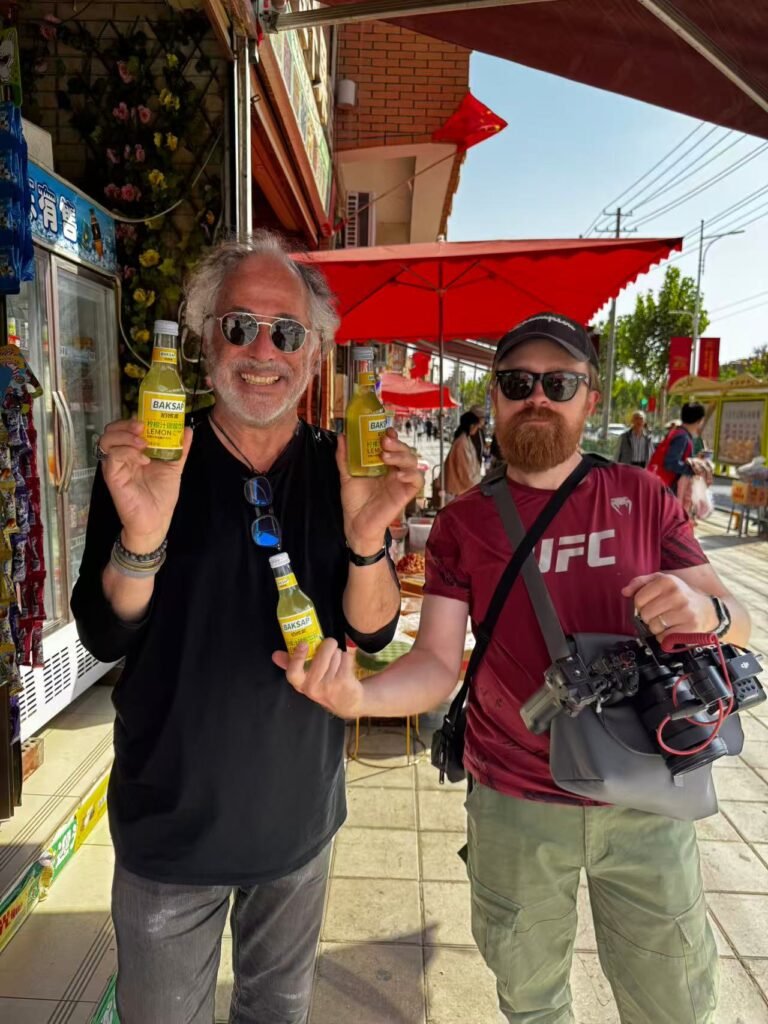
Kashgar. A big fan of the lemonade drink Baksap found everywhere in Xinjiang
In geoeconomic terms, for nearly ten centuries Dunhuang was extremely wealthy, especially during the Tang dynasty (6th to 9th century). The Tang had a fascinating monetary system – with three different currencies: textiles (silk and hemp), grain and coins.
The central government, in the imperial capital Chang’an, used a single aggregate unit to represent all trade. The Dunhuang garrison was a key strategic post: payments came in no less than six different types of woven silk. Well, each place paid their taxes with their locally produced cloth. What the Tang did was to transfer all these textiles to Dunhuang. The garrison’s officers then converted the tax cloth into coins and into grain, to pay local merchants and to feed the soldiers.
So in a nutshell the Tang dynasty was all the time injecting a lot of money – via woven cloth – into the Dunhuang economy. Talk about a public-private state development model – which certainly did not escape Beijing planners when they came up, in 2013, with the concept of the New Silk Roads.
ADDENDUM
≈≈≈
A celestial Travelogue through the western regions of China.
By Silk Road pilgrim Pepe Escobar on Sputnik.
ON THE ROAD IN XINJIANG – Xuanzang, the itinerant Buddhist monk, has got to be one of the most extraordinary figures in History. He certainly is regarded as such in China.
In the early Tang dynasty in the 7th century, Xuanzang set out from the imperial capital Chang’an (today’s Xian), breaching a veto to travel to the “Western regions”, to go to India to fetch Buddhist manuscripts that he planned to translate into Chinese.
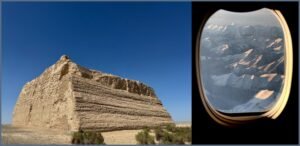
(L): The one and only Yumenguan – the Jade Gate Pass, marking the western limits of China for centuries. ; (R): Xinjiang. Flying over the Tian Shan mountains.
He crossed the Jade Gate Pass; kept walking further West; almost died of thirst in the desert; crossed the snow peaks of the Tian Shan mountains on horseback to Transoxiana; and finally reached India, where he studied for several years before returning to Chang’an 15 years after his departure with 22 horses loaded with Buddhist manuscripts in Sanskrit, plus religious relics and priceless Buddha images.
That’s my kind of guy. Since the late 1990s, I have followed on Xuanzang’s footsteps, on and off, along several stretches of the Ancient Silk Roads. Xuanzang was fictionally reincarnated in a magic-tinged 16th century novel which became quite popular in China, titled Xiyouji, or Journey to the West. That’s exactly what I set out to do – a compact Journey to the West for the digital era – this past month of September.
Sericulture was developed as early as 5,000 years ago in the Yellow River – in China’s historically traditional heartland. It spread out to Korea and Japan but mostly traveled West, along the larger-than-life Silk Road(s).
The start of the silky story is shrouded in historical mist. It is widely accepted in China that under the reign of Emperor Wu Di, in the second century B.C., special envoy Zhang Qian was twice dispatched to the “vast regions” to the West of China on a business mission.
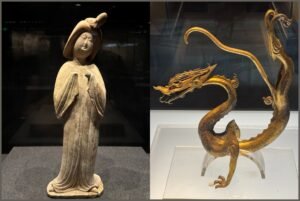
At the glorious Shaanxi History Museum in Xian. (L): Drop-dead chic Tang Barbie, where I had a fab Silk Roads conversation with one of the curators ; (R): Silk Road golden splendour
Soon after, cross-border trade entered a new stage, with silk fabric among the key exports. Thus Zhang Qian was officially credited as the opener of the Silk Road – and granted the title of Duke. Today, at the fabulous Shaanxi History Museum in Xian, his exploits and the subsequent development of the Silk Road connectivity corridors are detailed alongside a mesmerizing collection of Silk Road artifacts.
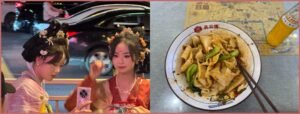
Xian. (L): TikTok Tang Barbies on a roll. ; (R): Happiness is a bowl of perfect lamian in the Muslim Quarter
The Silk Road, actually a maze of roads, started in Chang’an, the old imperial capital, today’s Xian. Then it headed west through the spectacular gorges of the Wei river to the garrison city of Lanzhou, at the eastern end of the Hexi corridor. North is the Gobi desert; south is the snow-covered peaks of the Qilain Shan. The road keeps going from oasis to oasis all the way to Yumenguan, the Jade Gate Pass – which marked the western limit of China.
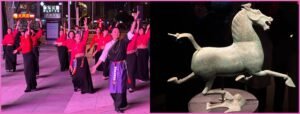
Lanzhou. (L): Downtown: dancin’ in the streets ; (R): The Flying Horse of Gansu: the epitome of Chinese bronze craftmanship
For a Silk Road pilgrim like this foreign correspondent, this is the trip of a lifetime – combined with the journey further west, to Xinjiang. I’ve tracked the original Silk Road before, and that’s my fifth time in Xinjiang; yet those journeys were in the late 1990s and the 2000s. Combined, now, that makes it the first trip in 10 years and the first one after Covid.
New Silk Roads on the move. At the fabulous Gansu museum in Lanzhou
Go West, past the Jade Gate Pass
The timing could not be more appropriate: right after the ground-breaking SCO summit in Tianjin in late August/early September and the Victory Day parade in Beijing on October 3, celebrating the 80th year of the Chinese defeat of Japanese aggression and Nazi-fascism in Asia.
It was the time to check in detail how a self-confident China had engineered its development of the West, boosted by the “Go West” campaign launched in 1999. That also coincided with the 70th year of the establishment of the Xinjiang Uyghur Autonomous Region. The whole of Xinjiang was engulfed in “70” red flags.
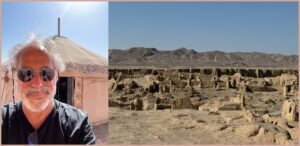
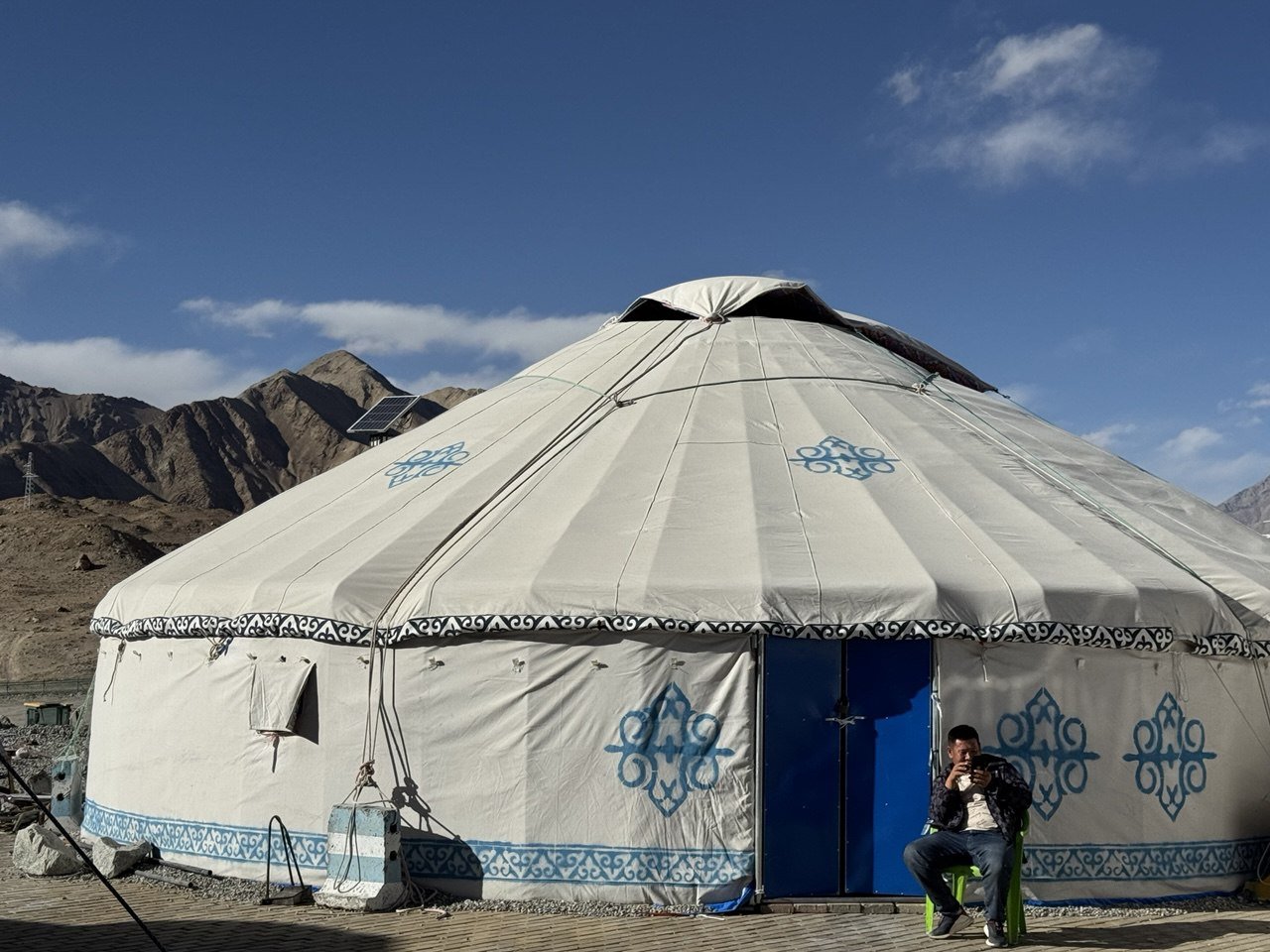
Xinjiang. (L): Yurt time ; (R): The ancient city of Jiaohe
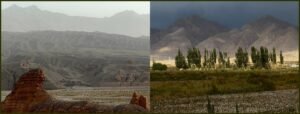
Xinjiang. (L): On the Northern Silk Road, from Aksu to Kucha ; (R): Northern Silk Road. Cotton fields. No slaves. No victims of “genocide”
The first stretch of my travels was solo, retracing the traditional Ancient Silk Road, from Xian to strategically located Lanzhou by the Yellow River, dominating all traffic between central China and the northwest, then all the way to fabled Dunhuang and the Jade Gate Pass. I made a deal with a local taxi driver to spend the day visiting the Pass, including the remains of the Han Great Wall. He loved the notion of a lone foreigner riding his taxi into the deep desert.
Then I caught the high-speed train from Lanzhou to Urumqi (this line was started already 11 years ago), the high-tech capital of Xinjiang, to join a Chinese-Uyghur production team and start shooting a documentary on the road in Xinjiang.
Xinjiang, or “New Territories”, the size of Western Europe, is the former Chinese Turkestan. That’s classic Silk Road territory as well, treading along the northern and southern rims of the Tarim basin, one of the most extraordinary geographical hot spots on earth. At the center lie the ever-shifting sands of the mighty Taklamakan desert – surrounded by three mountain ranges: the Kunlun Shan, the Tian Shan and the Pamirs.
We started by following the Northern Silk Road, from the key oasis of Turfan to the high-tech hub Urumqi, all the way to Kucha; crossed the Taklamakan desert to the Southern Silk Road; and proceeded across key oasis such as Yutian and Khotan all the way to the immensely venerable oasis of Kashgar, at the foot of the Tian Shan and the Pamir, and at the start of the Karakoram highway, arguably the pivot of the Ancient Silk Road leading to the heart of the Heartland: southern Central Asia.
Countless caravans perished over centuries in the sands of the Taklamakan (“you can get it but you won’t get out”): today, modernization of China-style, we can do it in an immaculate highway in a mini-convoy of Toyota Land Cruisers. [01][02][03]
We kept going via the Karakoram, a two-lane, extra-busy, connectivity corridor, the first stretch of the China-Pakistan Economic Corridor (CPEC), past the blinding beauty of glaciers, peaks and deep blue lakes all the way to Pamir lands and the high-altitude Tajik boom town of Tashkurgan; further on is the Khunjerab pass and the China-Pakistan border, all the way to South Asia.
To the west, the main historical Silk Road is subdivided in the three, key Chinese borders with Tajikistan, Kyrgyzstan and especially Kazakhstan: Alashankou in northern Xinjiang is China’s premier Eurasian hub – where all trains carrying laptops from Chongqin or household wares from Yiwu stop before heading further West, all the way to Europe.
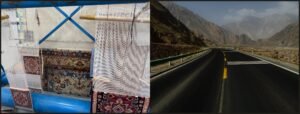
(L): Khotan. In the – Carpet – Silk Road ; (R): On the road to Pamir land
Socialism with Chinese characteristics in practice
China has always been a Heartland power – not a maritime power. From the time of unification under Qin Shi Huang in 221 B.C., the territorial imperative has always been Go West, towards the Heartland/Southern Central Asia. That set up a series of intermittent clashes with primarily nomadic peoples – Turkic, Tibetan, Mongols. Only at times of serious Chinese strength – especially under the Han, Tang and Qin dynasties – Chinese imperial power was conclusively projected into Western Central Asia.
What we see now in a Xi Jinping-defined “moderately prosperous China”, inscribed within the mindset of a self-confident geoeconomic superpower, is how socialism with Chinese characteristics has successfully integrated the “Western regions” into the officially-termed “Chinese dream”.
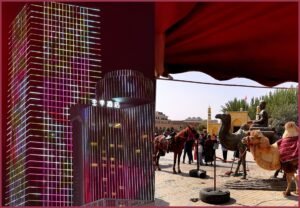
Xinjiang. (L): Urumqi – symbol of the development of the “Western regions” ; (R): Kashgar. In the Old City, in front of Id Kah mosque
Urumqi is now a high-tech hub, a replica of those mega-cities in the eastern seaboard but 4,000 km away from Beijing. With over 4 million residents, it’s considered at best a Tier 3 city. The level of development compared to the start of the century is simply mind-boggling.
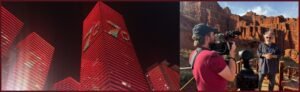
Xinjiang. (L): Urumqi on Saturday night – buildings celebrating the 70th year of the development of Xinjiang under a unified China. Xi will be in town today ; (R): On the Northern Silk Road. Stan and I at the spectacular Grand Canyon near Aksu.
We traveled in Xinjiang with a crack Uyghur team. Our on-site producers, translators, ultra-skilled drivers were all Uyghurs. We talked to everyone – from cotton pickers to bazaar whiz kids to enterprising business women (no, we did not find “genocide” victims). We attended two traditional weddings – one relatively low-key, the other a Bollywood-style production.
As @RealPepeEscobar, @RealJermWarfare and I checked into the hotel in Turpan, Xinjiang, we crashed a Uyghur wedding party (after asking for permission to film).
Absolute highlight of our evening! Uyghur wedding is the next level!!! pic.twitter.com/0Al52W8du8
— Carl Zha (@CarlZha) September 20, 2025
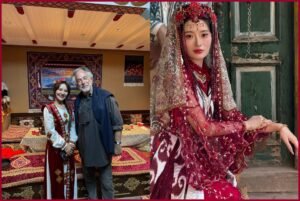
(L): With the ultra-pro Tajik MC of a lively dancin’ party ; (R): Kashgar princess
In parallel, a tsunami of middle-class families from all over China could be seen in every latitude enjoying Xinjiang for the first time in a self-driven Tank 300 jeep rented for only $60 a day (less than 1 in 10 Chinese have been to Xinjiang). The boom of domestic tourism is something to watch – as in the packed camel parking lot right before whole families immortalize their camel caravan adventure in the sand dunes outside Dunhuang. The Old City in Kashgar during Golden Week – an 8-day holiday that every Chinese dreams about – was so packed it was virtually impossible to walk most of the time in the main alleys.
This is just a first approach to the trip of a lifetime – which will be part of a book on the Ancient and New Silk Roads to be published next year and a documentary to be released before the end of 2025 (we have two terabytes of images). But among a wealth of highlights, a few have got to be inescapable.
Energy. Xinjiang is an energy Mecca. From Urumqi to Turfan [04], from the point of view of the proverbial impeccable highway, we see Massive Electrification, forests of solar panels, forests of wind turbines, and at least two massive solar farms. Xinjiang produces so much energy that it lavishly exports to the rest of China. And of course the key Pipelineistan superstars – from Turkmenistan, Kazakhstan and soon Power of Siberia – all arrive here.
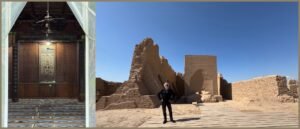
(L): Xian. At the Great Mosque. Having a fabulous time with the Hui. There are only 20k still living in Xian ; (R): Welcome to Xinjiang. At the astonishing 5th century ruins of Buddhist Gaochang kingdom
Integration of Hui (Chinese Muslims). Xian’s fabled Muslim quarter, quite close to the iconic Drum Tower, is a direct connectivity corridor to the former imperial capital’s Silk Road prominence. Itinerant Muslim merchants – Arabs, Turks, Sogdians, Persians – and religious teachers chose to live in the tolerant metropolis ever since the Tang dynasty. In the 8th century, Xian was the largest and most sophisticated city on the planet. Today at least 50,000 Huis – mostly prosperous bazaaris – live in Xian’s Old City. [05] The food in the Muslim quarter of course is to die for.
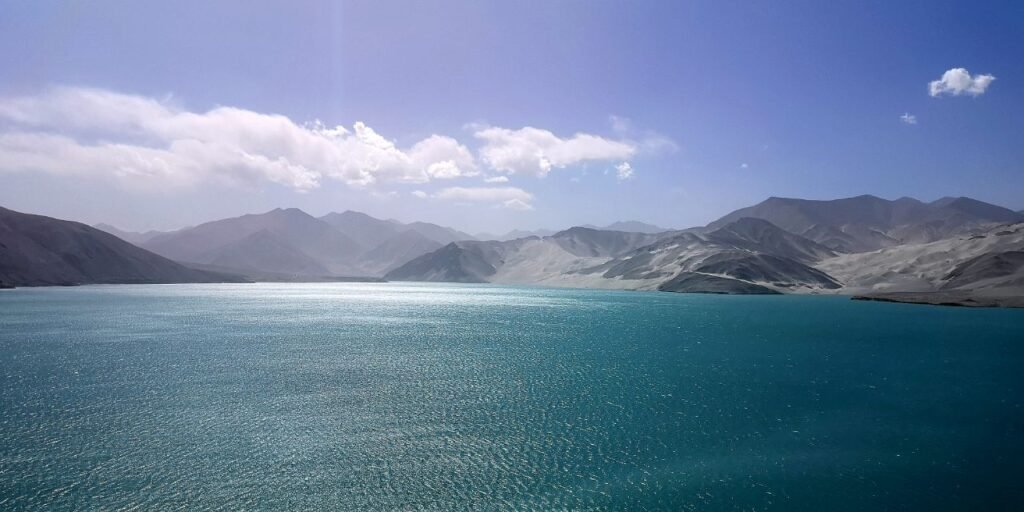
XINJIANG. Karakoram Highway. BRI/CPEC connectivity corridor. White Sand lake – on the way to Pamir lands
From oasis life to deep blue mountain lakes
Respect for History – The Shaanxi History Museum in Xian and the Gansu Provincial Museum in Lanzhou, side by side, offer an unparalleled collection of absolutely priceless Silk Road artifacts. Both are free, packed at all times and endlessly fascinating throngs of the TikTok/Bilibili generation with immense Silk Road cultural wealth, including the iconic Flying Horse of Gansu: excavated in 1969 in Wuwei, representing the “heavenly steed” of Heartland tradition and cast by an unknown craftsman of the early Han dynasty no less than 2,000 years ago. That’s arguably the most elegant and sophisticated Chinese bronze artifact ever.
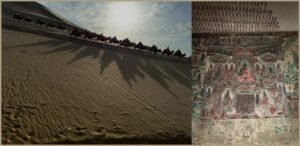
Dunhuang. (L): The All China Camel Caravan is on the move ; (R): The unparalleled beauty of the remaining Buddhist paintings in the Mogao caves
Dunhuang. A “Blazing Beacon” since the times of Han emperor Wu Di, who understood the strategic importance of the oasis: the last major watering hole before the fear-inducing Taklamakan, and sitting astride the three main Silk Roads heading west, linked to the key Jade Gate Pass nearby (that refers to the fine jade brought to China from Khotan in Xinjiang).
Yet Dunhuang’s claim to a selected global cultural pantheon resides in the Buddhist Mogao caves, sponsored by merchants and pilgrims since the 3rd century and especially during the Tang dynasty, cut into the soft rock face of the Mingsha hills. [06] That’s China’s – and the world’s – most extensive collection of Buddhist statuary, painting and manuscripts. Unfortunately, many of the original materials were stolen by European barbarians, scholarly and otherwise, and are now in foreign museums. Beijing cares for the Mogao in millimetric detail. We can only visit with a scholar/guide; no photos whatsoever; and the only light inside the caves comes from the guide’s torch. A magical experience. I was privileged to enjoy a detailed explanation of Mogao history by Helen, a member of the remarkable Dunhuang Academy who’s doing a PhD in Archeology.
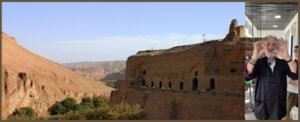
(L): At the Bezeklik Buddhist – and Manichean – caves, outside of the privileged oasis of Turfan. Classic Silk Road ; (R): Yutian. Carl Zha: [Pepe’s] holding up a $10,000 USD Hotan jade bracelet
Across the Southern Silk Road, we can literally touch and feel the essence of its allure: the best jade from both Khotan and Yutian (Marco Polo visited in the 13th century); the best silk and the best silk carpets in Khotan; and the best decorated knives in Yengisar – the knife capital of the world (every Uyghur man has a knife, to prove his manhood and to slice melons at any time).
And then there’s the mystery of ridiculously delicious Uyghur cuisine. No mystery: crystal clear water from the Tian Shan mountains; uncontaminated soil; lots of sunshine; everything organic; less than zero GMOs. Now get down and celebrate devouring a whole lamb.

In the heart of the Taklamakan desert. (L): the pilgrim finally made it ; (R): The fierce beauty of the Taklamakan
Crossing the Taklamakan – The Holy Grail of every Silk Road explorer. Today, no need to be engulfed by mellifluous shifting sands or unexpected sandstorms. We drove the Desert Highway back-to-back, nearly 500 km: impeccable tarmac; the notorious green belt encircling the desert on both extremities; the reeds compounding the “Chinese magic cube” by the side of the road, protecting it from the sands; plus an extra green fence.
Overall, a marvel of engineering and environmental protection. And we doubled down the day after, driving a backbreaking 170 km across the real shifting sands to see something stunning: the ancient small village of Daliyabuyi, right in the middle of the Taklamakan, arguably the most remote place in Xinjiang. The locals, known in China as “the lost tribe of the Taklamakan” are now getting into serious business: they showed us how they are building a few, comfortable B&Bs to cater for the budding Chinese off-road crowd. We crossed some of them in the sands. No wifi – yet.
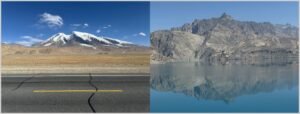
(L): Xinjiang meets Pamir lands. The Muztagh Ata blesses the Karakoram highway ; (R): Lake Karakul
The Pamir lands – One of the top blinding beauty lands on earth – to be rivalled only by the Pamir highway and selected spots in the Tian Shan, the Karakoram in northern Pakistan, the Hindu Kush in Afghanistan and the Himalayas. You drive by the proverbial impeccable highway and you have the mighty Muztagh Ata (7,500 m high) practically in front of you. Lake Karakul, at 3,900 m high, is unparalleled in its blue, transparent tranquility. We can see no less than 14 different glaciers from the lakeshore. Cool Kyrgyz nomad cowboys hang out nearby; you can ride their yaks or stay in their yurts. [07] Further on down the road is Tashkurgan, mentioned by Ptolemy in the 2ⁿᵈ century as the westernmost point of the “Land of Ceres” – that is, China. Xuanzang was here in the 7th century, when he was already laden with the Buddhist sutras he carried from India to Xian.
From Xinjiang, the real challenge is to take the G216: 816 km in ultra-high altitude, considered the most dangerous road in China, all the way to Tibet. Talk about total integration of the Western regions. Well, sounds like a plan for 2026. The Silk Roads go on forever.
A poignant travelogue and historical review of this former pearl port city of the Eastern Mediterranean
Laith Marouf and Hadi Hotait travel to Tripoli, Lebanon’s second largest city, to discover its hidden and neglected treasures, discuss its brilliant past, and analyze threats by the USA to hand it over to the Wahhabi Death-Squads governing Syria today, if Lebanon doesn’t disarm the Resistance.
Filmed on: 2/8/2025
Producer: Hadi Hotait
Montage: Rabih Ghannam
X: https://x.com/TVFreePalestine
TG: https://t.me/freepalestinetv
Insta: https://www.instagram.com/free.palestine.tv/
Substack: https://substack.com/@freepalestinetv
RU: https://rumble.com/user/FreePalestineTV


A living Revelation anticipates the astonishing tableau which confronts us today: the violent and calamitous end to the Old Order heralded by the aggression of the Anglo-Zionists on Iran.

Chapter 105 of the Qur’an: Surah Al Fiil (The Elephant) — for interpretation & context see (here)
Divine Revelation, as Sheikh Imran Hosein and serious scholars note, is neither static nor dead. The same verses in subsequent generations, according to need of the flock, reveal gems, and guidance for navigation. For the same words or phrases can differ in meaning, or emphasis, according to context and circumstances of the times.

Symbol of the Republican Party of the United States
Yesterday, eschatologist Omar Baloch linked the unfolding Iranian-American Murder-Suicide in the Qur’anic chapter named Al Fiil (The Elephant). The incredible pressures, tensions, and mind-blowing geopolitical rearrangements and shattering of the old templates underway force contemplation. These astonishing and hair raising developments were previewed approximately 1,500 years ago.
The Republican Party (GOP) of the United States of America has the distinction of using the elephant as its symbol; the Democratic Party uses the donkey.
The messianic GOP will have the distinction of burying the Last Satanic Empire.
It has to do with one of the shortest and sweetest chapters of all – called The Elephant.

Rubio appears on live TV with the ash cross on forehead, discussing the Ukrainian and Middle East crises. 3.6.2025 (3×6=666).
Methodology of interpreting the Qur’an: if a non-Arab word is used in the Arabic Qur’an, it points to the land it came from. The Arabic language, as all languages, adopted various terms and phrases from other languages and cultures with which Arabs formed contact and relations.
Elephants were unknown to the peninsular arabs to which were revealed the Qur’an. At the time, during the 7th century, elephants were associated with Persia. The very word, “Fiil”, was arabicized Farsi, the Persian language.
India and Africa are also associated with elephants, but Persians are closer to the Arabs by direct land route. And for several millennia, Persians ruled the Arabs, whose culture and norms and language were of intimate familiarity, being one of the traditional two superpowers of the millennia preceding the revelation of the Qur’an. Historically, all parts of Arabia were at one point or the other dominated by Persia.

June 18, 2025: for the first time, Iran launches the 2-stage Sejjil MRBM on Zion. In verse four of the Chapter of the Elephant, Sejjil are the clay stones baked in the Hellfire launched by the flock of birds on the army of the People of the Elephant.
The Chapter of the Elephant is remarkable worldwide for two seminal events in history, being an extremely important year, both for Arabs and Islam.
First, it was the year in which was born the Islamic Prophet, PBUH.
Second, this year marked the first serious attempt to destroy the Kaaba, the House of God, in Makkah (Mecca). An invasion was mounted by a Christian Abyssinian army to destroy this House in Makkah, spiritual symbol of all the Arabs.
The Abyssinian powers of that time had come to Yemen to expunge the Jewish tyrant king that genocided their Christian brethren, recounted in the Chapter of the People of the Trench. They then overstayed to conquer Yemen, displeasing Yemenis. When the Abyssinian warlord built a grand cathedral, one night an ignorant pagan Arab entered and defecated inside it, leading to his vowing to as desecrate in retaliation the Arabs’ holiest sanctuary in Makkah.
This warlord Abraha marched to Makkah to destroy the Kaaba, then controlled by pagan Arabs, but nevertheless symbolically the central house of worship of all Arabs. His army included novel war elephants in its procession, unknown to Arabs and hence the symbol of that striking year, memorialized in the parable and the name of this scriptural chapter.
Forty years later, the young herder of those elephants, then an old blind man, was alive at the time of the investiture of the Islamic Prophet, having escaped the fate of the army by fleeing up a mountain when he saw the Elephant refuse to continue on the suicide mission by kneeling just before entering the Haram (holy borders) of Makkah, the forbidden sanctuary. The men who continued onward did not survive.

Iran unveils Hesa Ababil 3 unmanned combat aerial vehicle. In verse three of the Chapter of the Elephant, Ababil are the flock of birds which attack the army of the People of the Elephant. (see Iran’s Ababil drones family)
Now follow reinterpretation of this historical chapter, known by heart to perhaps billions since it is so very short, sweet and singsong, and striking, and as Scripture is not static but constantly unfolding:
The Eschatologist noted several things – note the promise of the Lord to annihilate this arrogantly aggressive and presumptuous army, “the People of the Elephants.” Their plans will go awry in terrible ways. Their forces (in the region) will be obliterated, scattered like dead chewed straw (being helpless without adequate AD, and at point blank ranges).
Extrapolating the nature of MAGA behind the current GOP incumbent, are they not a cult? Even so, the MAGA base is openly disintegrating right now, with most against this suicide in motion. They’re disillusioned with endless unwinnable foreign adventures, as their nation fractures and quality of life disintegrates and irreversible poverty sets in. Even those mind-washed for generations can connect the dots – if all the money is spent on guns, used abroad fruitlessly at behest of others, there will be no butter at home. And this they see.

Yet the American elite are under compulsion of the Anglo-Zionists, and will march on into the breach. It is decreed, to complete the Humiliation, and conclude the Babylonian System. The Tragedy of the End Times. So much waste for such the abominable project of Pax Judaica.
The Americans will at the same time deal terrible blows to Persia, unprecedented in human history. The Islamic Prophet said “one blow” in one narration, “two blows” in another narration.
I assume after Persia defeats their conventional attack, and annihilates their regional forces, they will use ICBMs?? This is beyond my competence. But it is a given that the Exceptionalists whose last place of hegemony is at total risk, and having been humiliated, will escalate to becoming permanent Black Hats, the unconscionable Pariahs within the larger human family. With the coming Deeds, they shall carve their own tomb-stones in Persia, and attribution for all subsequent horrors that follow.
According to further explication of subsequent events, after the satanic wasting of Persia, the Zionists and India (Hind) will join to annihilate Pakistan (Sind), with Zionazis having taken baton from the defeated Anglos. “Hind will defeat Sind”. So dramatic reversals will appear for a Pakistan which just stymied India last month.. But he then added, “China will defeat Hind”/India. China will not sit out. She appears to keep her powder dry for the coming moment, hence the agony of India now knowing its total exposure if she serves the suicidal Anglo-Zionist aims, effecting her own Murder-Suicide. For all now know that Pakistan and China come as a package…
After nuking Iran, the same treatment will be meted to the Arabs — i assume the GCC, even more than former Resistance (Yemen, Iraq, Hezbollah, etc) since the PetroSheikhs will be then be ghost, consumed in the Persian Gulf conflagration as most of their citadels and oil/gas assets, located in the eastern peninsular half adjacent to Persia, will be no more, and at that point, Pax Judaica can absolutely not trust ANY arab whatsoever.
Pax Judaica will rise on a sea of skulls like Pol Pot, or rubble like Gaza. Such terrible wars of extermination lie ahead. As Yahya Sarae, spokesman of the Yemeni Armed Forces, warned the comatose compradore Arabs:
“To the rest of the Arab and Islamic countries and peoples, we say:
Jihad is one of the gates of Paradise, opened by Allah for His distinctive servants.
Take the initiative to stop the Israeli crimes against your people in Gaza, for what befalls them today will befall you tomorrow.” (June 15, 2025)
This is the Pandora’s chest willfully opened by Donald J Trump, the Last American President, and Joker of our End Times.
I suspect Iran will initially win, yet lose in the interim, before the ultimate Victory, due to the Murder-Suicide. The other side will fight dirty to “win” at all costs (when did empires fight “fair”?), condemning itself in the process, through cascading nuclear exchanges. So the real order of events may be Suicide (of the annihilation of regional western force presence) then mass Murder of the Iranian civilians by the Antagonists of All.

Californian Rabbi Shmuley Boteach. His father Yoav Botach was an Iranian Jew who left Isfahan. [01][02]
The overriding imperative remains of 70,000 true semitic Jews to emerge from Isfahan, under leadership of the AntiChrist making his entrance in human guise. This completes the ascension of the “Moshiach” of messianic Jewry, ruling a leveled world from Jerusalem.
Isfahan has the oldest continuously settled Jewish community on earth, nearly 3,000 years old. Today only some 20,000 Jews remain, with most having relocated to Zion, and USA. Arguably the most famous US rabbi is a Californian with direct ancestry in Isfahan. His father migrated from Isfahan to Zion in the last century, then onward to the USA. He peppers his speeches and presentations with exhortation to liberate Iran, so that they may return to Isfahan. So with much of Iran erased, they would be able to reverse migrate to Isfahan…
My father Yoav Ben Eshrat Botach passed away tonight after Sabbath on Rosh Chodesh Sivan. He was 87 yrs old. He fought for months & we believed he was healing. This was last time I put tefillin on with him. This is a devastating time. May my father’s memory be an eternal blessing pic.twitter.com/xzIDucLRk8
— Rabbi Shmuley (@RabbiShmuley) May 24, 2020
IMO, most of Iran (and Yemen’s) fighting men may be in underground cities inside mountains and deserts and other secret areas. Plenty of places to hide. Impossible for even nukes to materially affect them. I heard about a million Iranians are currently under arms.
But what civilization can hold on without women, children, elderly, and the non-martial trades? When these are Gaza’ed… it will take time to reconstitute, being dispersed autonomous cells and forces over a huge land of over 1.5 million km² in Iran.
The Persian, and others, especially Pakistanis, will essentially return as guerrillas, having been decapitated, stateless, fighting totalen krieg every inch, like in Gaza. And when they put the last zionazi and westerner to the sword, they’ll weep rather than celebrate, having had their hearts and hearths torn out.
Such horrors beckon as the living will envy those in their graves. What we see today in Gaza will seem a beach holiday. The Mad Orange Emperor warned the Palestinians in January to surrender or the same bestial Hell we currently see would be unleashed; last week he warned “Leave Tehran” …
Sorry for the terrible previews. There is scant good news for any side in the End Times. This is the Islamic version of the Book of Revelations, and it gives the same unvarnished terror, trials and tribulations. As Imran Hosein said, around the time corona began in 2020, now’s a good time to die, given what comes.
Why would the Persians commit to the Murder-Suicide, knowing the terrible outcome for their people at the hands of unrepentant resolved devils?
Their ultimate victory would be pyrrhic, spent mourning for generations, given holocausts experienced.
Clues lie in words of the Islamic Prophet recounted by Omar Baloch, Imran Hosein, and many — he said none would be as knowledgeable in his flock as the Persians, who would seek knowledge and wisdom in the very heights of the stars if needed. So they know everything described herein in this short article, and foretold of their unusually bitter role in the End Times.
“We are the nation of Imam Hussein, peace be upon him” a declaration of identity, emphasising allegiance to an Imam revered for his martyrdom at Karbala in 680 CE., symbolising resistance, sacrifice, justice and ready to face the enemy with courage.https://t.co/U5xCe8xnv6
— Elijah J. Magnier
(@ejmalrai) June 21, 2025
I will leave you this tweet by Magnier and Prof. Marandi, which highlight the ethos and determination of Karbala, where the grandson of the Islamic Prophet marched to his certain annihilation at the hands of the tyrant of the time. This is the lodestone of the Shia realm; the fount of their devotion to sacrifice, and struggle against impossible odds. It is of the same strand of the Sunni Palestinians who say, ‘ …verily, it is a Jihad, until Victory or Martyrdom.’
We will find, as Hamas refuses to lay down its arms and surrender even as 100-200 of their precious children and women and elders are massacred every single daily for over 600 days, the Iranian nation will prove to be as resolute in dealing as catastrophic commensurate annihilation to the Anglo-Zionists. It remains a Murder-Suicide, come what may.
The Chapter of the Elephant of the Qur’an appears to foretell that during the initial phase, Iran will be given unusual tools that will militarily erase the fallen West from the face of West Asia.
“How weary am I of devils and brutes, a true human is what I long for.”
By Nora Hoppe at Al Mayadeen.

The fact that our planet in this day and age is home to a genocide – visible to all human beings on personal devices throughout the world – an ongoing abomination unhindered by any international body, by any intergovernmental organisation or even by those noble states that proclaim to be constructing a new and more just world… says a lot about our evolution as a species and potentially about the future of our civilisation.
We now stand before a bifurcation: one clear and broad path leads to destruction and ruin; the other is to lead to a new and harmonious world… but it is winding, stony, vague and enveloped in fog.
Like a frantic victim in quicksand, flailing his arms about in vain, the frenzy of a declining Empire is only accelerating its own demise. It has chosen the path leading to ruin and its own suicide… and it has many followers – especially in its diseased appendix – the Zionist entity – and the rest of the Western World. The symptoms of this necrotic drive are seen in the Forever Wars; a self-devouring economic system based on insatiable greed and wilful ignorance; the destruction of society, of the family, of rituals and traditions; and, essentially, a total contempt for all that is natural and alive… These signs arise from a state of permanent discontent and fear, which ultimately leads to self-destruction.
And now… though today’s Hegemon, the United States – built on genocide and slavery – has been waging countless wars since its inception, and Europe has been massacring and plundering the planet for over 500 years due to its endless rapacity… it is no longer just a question of geography. The core of the problem of our human civilisation today is the western mindset and the system of financialised capitalism, both of which have infected the entire world to various degrees… with only a few exceptions.
Most of the World Majority remains incapable of throwing off the yoke of the colonialist West because of corruption, dependence, societal pressures and a lack of support from states to enlighten citizens on their own past and history.
The mythification and emulation of the Western World have become so deeply ingrained in the marrow of so many over so many centuries… that a decolonisation process will take time. And little has been undertaken officially to this end. The promising BRICS+ states are focussing mainly on trade, economic growth and hi-tech innovation.
To avoid that western path to societal devastation and ruin and to clear the other path of fog, we of the Global Majority need to seek clarity in many areas… We may have to make seismic changes to our ways of thinking. We can begin by questioning our definitions of very basic terms… Such as: what is “development”, what is “growth”, “what is “prosperity”, what is “progress”? Not all growth is advantageous – as in malignant metastases. “Positive growth” today pertains chiefly to monetary matters – GDP, GNI, PPP. What is “progress”? Progress today mostly pertains to technological innovations. And certainly it is imperative that peoples are lifted out of poverty, such as China has succeeded in doing… but what is the kind of “prosperity” that Humanity would like to achieve??
Today, in this post-modern world, there is little discussion of development, growth, prosperity and progress with regard to immaterial matters…
It is not only education, the arts and cultures of the world that have fallen into stagnation, but obviously also the ethics and value systems of entire states and societies… not to mention the conscience of most of Humanity.
How else could a genocide become commonplace? How else could atrocities become a daily tolerable spectacle throughout the world? How else can two genocidal leaders meet and speak so eagerly about their “real estate plans” for their concentration camp as though they were having a normal conversation? How else could we have all become a global audience for an orchestrated famine? How else can so many European states and the EU Border Control Authority Frontex become the clients of “combat-tested” weapons (“tested” in Gaza) from Elbit Systems (“Israel”‘s largest arms company) that manufacture surveillance drones and remote-control turrets for armoured vehicles to enable European soldiers to avoid accountability and a bad conscience when targeted refugees are murdered by anonymous technicians located in remote offices? How else can European countries allow their historical incidents of genocide against the Jews to be “revised” and whitewashed by the Zionist entity for Israeli business advantages? How else could International Law be trampled upon without resistance? How else could serial mendacity and the constant breaching of constitutions and agreements become acceptable? How else could the citizens of those states, which vaunt their “freedom of expression” and “western values”, allow their states to reach the point at which they are now criminalising protesters for standing up for human rights?
Other than the people involved directly in battles for their survival (in Gaza, Syria, Lebanon and elsewhere), courageous soldiers fighting against Nazism, committed journalists risking their lives on the fronts and activists, risking their professions for protesting against the Genocide… where is the rest of the world?
Some states voice their condemnation of the ongoing genocide but take no action, because… because it’s… complicated.
And yet… we have an exception… the Ansarallah of Yemen. There is nothing complicated about their resolute move: it is simply a matter of priority.
Why would the majority of a people of one of the poorest countries (perhaps the poorest) on Earth devote most of their energy, their scarce resources and their steadfast beliefs in risking their lives in defence of another people, who are not directly related to them and are located in a distant country (an estimated 2,270 kilometres away)? What unites these people in this goal? And what might be THEIR definitions of “development”, “growth”, “prosperity” and “progress”?

A crossroads of various civilisations for at least 7000 years, Yemen’s own great civilisation has, over centuries, experienced countless invasions, fierce battles, usurping dynasties and colonial occupations by those who continually sought to plunder, conquer and control this valuable, highly developed, resource-rich and “geographically optimal” territory.
In the 1990s, after a long period of economic hardship due in part to persistent Saudi oppression and notably Yemen’s refusal to join the US-Saudi military coalition against Iraq, a Zaidi grassroots movement emerged in northern Yemen, known as Muntada al-Shabab al-Mu’min (“Believing Youth”) – which offered social programmes to the impoverished population of the region. The successful movement grew and soon transformed into the Ansarallah (“Supporters of God”) who went on to fight six wars against the Saudi– and Western-backed Saleh regime between 2004 and 2010…
Now, despite decades of deprivations, the Ansarallah remain undeterred in their goals for justice, in their fight to liberate Palestine and to improve their own country. To achieve these goals, they do not require “monetary prosperity” and a financialised state. In all their operations they show solidarity and unity amongst themselves. They cannot be intimidated. They are ready to die for their beliefs and principles.
In their filmed speeches and discussions, the demeanour of the Ansarallah is visibly marked by confidence, serenity, grace, poise, modesty… During the Third International Conference “Palestine, the Central Cause of the Nation”, they displayed kindness, generosity and hospitality in welcoming foreign guests, even toward those hailing from “hostile states”.
Single-handedly, they have disrupted global shipping power dynamics. Relying on the expertise of their own specialists, they manufacture weapons themselves… The US Pentagon’s chief weapons buyer Bill LaPlante expressed alarm over the sophistication of these weapons: “What I’ve seen of what Ansar Allah has done in the last six months is shocking.”

In his article Factors behind Yemen’s Valiant Resistance, journalist and political analyst Ayman Ahmed describes how the Ansarallah “managed to modify conventional military tactics in very unconventional ways” by adopting a guerrilla-oriented approach: moving on foot over hostile terrains in small mobile groups, with their group leaders often improvising tactics on the spot, and using little to no electronic devices… “Their use of drones in almost guerrilla-style operations highlights how the Yemenis managed to jam billion-dollar Saudi air defenses…” […] “The Saudi regime has not been able to score any major military victory despite possessing large stockpiles of weapons supplied by the world’s leading arms merchants.”
But their strongest asset of all is their motivation and determination in their pursuit of “a dignified life and standard of living for Yemeni citizens, the protection of the independence of the nation and seeking world peace and appropriate equal cooperation with the other countries of the world” – as inscribed in their “National Vision for the Modern Yemeni State“. With this, they have won the support of the masses across all segments of society.

As Rune Agerhus, political analyst and member of the International Commission for Solidarity with Yemen, wrote here: “What Ansarallah has managed to establish, while facing war, starvation, and a crippling blockade, is a system that could best be described as akin to Yugoslavian worker self-management” […] “Farmland and output are controlled by the cooperatives, which are wholly owned and administered by Yemen’s peasantry.” The defence of Yemen as a whole is being fought on two fronts – “the battlefront and the development front”.
The system adopted by the Ansarallah is the antithesis of contemporary capitalism.
(Not to forget: Yemen has already had experience with socialism when its southern territory – a separate state in 1967-1990 – eventually formed a Marxist-Leninist government following decades of rapacious British colonial rule over the region.)

In our globalised, postmodern, technology-obsessed world dominated by Western norms, technocrats and the Market and guided by an ignorance of history and a limitation in independent reasoning, the Ansarallah seem to many backward and savage at worst, quaint and exotic at best…
Different people may have different views of the Ansarallah and will judge them accordingly… but the ACTIONS taken by these people in defence of another people undergoing a genocide, especially in view of their own circumstances, speak for themselves… louder than any fine words.
On 10th April 2025, under the incessant bombings of the barbaric Hegemon, Ansarallah’s leader Sayyed Abdul-Malik al-Houthi made another urgent appeal to the world… to come to the aid of the Palestinian people and to become conscious of our ethical responsibility as part of a collective humanity. Who is listening? Where is the “world community”?
* * *
After so many millennia of human civilisation, what is the “progress” we are making as a species in our modern-day age?
* * *


Dar al-Hajar, former royal palace outside of Sanaa (1920) on the ruins of an ancient Sabaean palace known as the Fortress of Dhi Saydan, constructed by the Himyarites in 3000 BCE

Inscriptions in Musnad, the Temple of Awwam, Throne of Queen Bilqis (Sheba) 1500–1200 BCE © Zain Alaabdain Ben Ali / Arabia Felix Magazine

 Lateo.net - Flux RSS en pagaille (pour en ajouter : @ moi)