 Connexion


Le deuxième cycle de négociations russo-ukrainiennes s’est déroulé sans résultat négatif, comme l’a déclaré l’un des responsables turcs. Les parties
L’article Le 2e cycle de négociations aboutit à un nouvel échange de prisonniers entre Kiev et Moscou est apparu en premier sur STRATPOL.
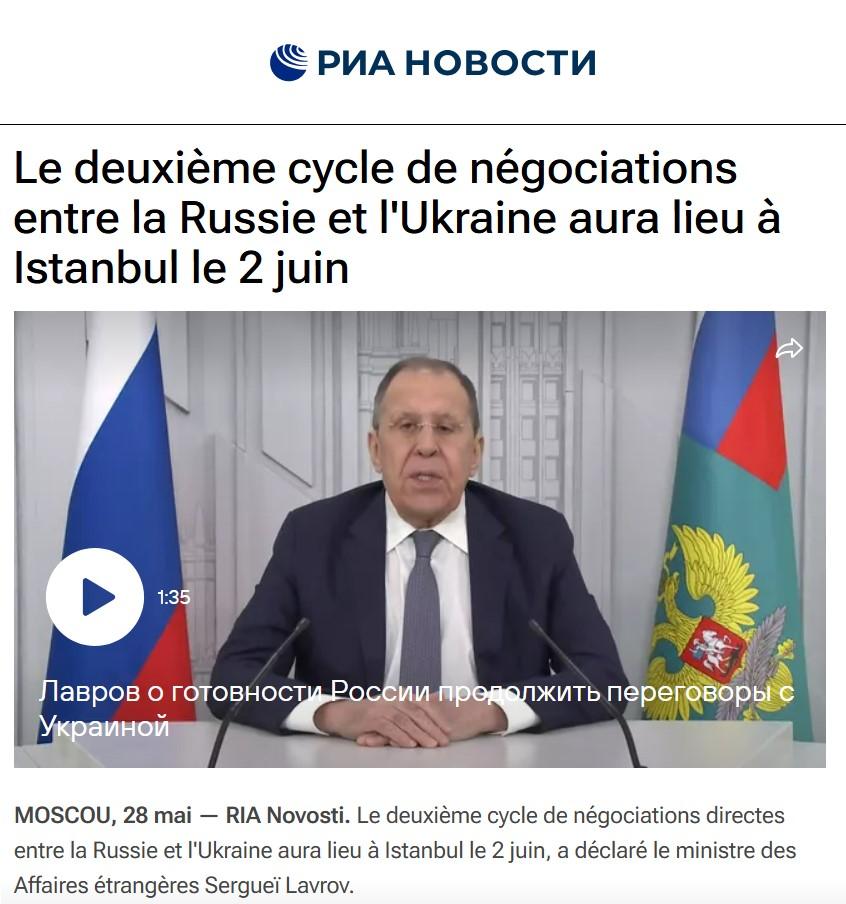
Le deuxième cycle de négociations directes entre la Russie et l’Ukraine aura lieu à Istanbul le 2 juin, a déclaré
L’article Les prochaines négociations Russie-Ukraine auront lieu le 2 juin, selon Lavrov est apparu en premier sur STRATPOL.
The endgame is clear: the US losing the entire Eurasian land mass. Ukraine, under these immense geopolitical imperatives, is only a sovereign-deprived pawn in the (Great) Game.
By Pepe Escobar at the Strategic Culture Foundation.
Did President Putin really change the game by proposing the resumption of negotiations on the proxy war in Ukraine in Istanbul – over three years after the first ones were scotched by NATO?
It’s complicated. And depends on which “game” we’re talking about.
What the Russian move instantly accomplished was to throw into total disarray the European warmongering Three Stooges (Starmer, BlackRock chancellor, Le Petit Roi) Cocaine Express.
Irrelevant Europe was not even at the table in Istanbul – except via extensive previous briefing of the low-rent, shabby-dressed Ukrainian delegation. That was compounded by the noisy barking threat in the sidelines advocating “more sanctions” to “pressure Russia”.
In March 2022 in Istanbul, Kiev could have stopped the war. Every one of us who were in Istanbul at the time could foresee that Kiev would eventually have to be forced to the table all over again.
So in essence we are back to the same negotiation – with the same top Russian negotiator, competent historian Vladimir Medinsky, heading a delegation composed by pros, but with Ukraine now facing over a million dead; deprived of at least four regions – more on the way; what’s left of its mineral wealth de facto controlled by the US; and a horrendous black hole that passes for an “economy”. We are talking about country 404 territory.
During the negotiations on Friday, Medinsky went straight to the point:
“We don’t want war, but we are ready to fight for a year, two, three – as long as it takes. We fought with Sweden for 21 years [the Great Northern War, 1700-1721, as it is known in Russia]. How long are you ready to fight?”
That’s the geopolitical/military state of things for Kiev and their “to the last Ukrainian” warmongering backers: either you capitulate, or we’re going to hurt you even more.

What’s the point of these negotiations?
Turkiye under uber-opportunist Sultan Erdogan in fact hosted a P.R. meeting between Moscow, Kiev and itself – with the Ukrainians unleashing a blitzkrieg of infantile tantrums only designed to influence global public opinion. In sharp contrast, the head of the Russian Direct Investment Fund, Kirill Dmitriev, did his best to put a positive spin on the proceedings.
Istanbul 2.0, Dmitriev asserted, achieved a large exchange of prisoners (1,000 on each side); ceasefire options to be presented by both sides; and a continuation of dialogue.
That’s not much. Well, at least they discussed in the same language: Russian. Nothing was lost in translation.
A serious case can be made that to propose the resumption of these negotiations, under this format, was meaningless. There’s no evidence in the horizon both parties might touch the fundamental issue anytime soon: the whole geopolitical strategic equation in Eastern Europe, from the Barents Sea to the Black Sea and beyond – leading to an “indivisibility of security” new deal with global repercussions.
That implies that whatever track these negotiations may follow further on down the road, they are an objective impossibility. Meanwhile, the proxy war in Ukraine – and the SMO – will go on.
That would also suggest that the Moscow security establishment considers the neo-nazi instrumentalized goons in Kiev at best as a re-enactment of the 6th Army of Paulus, with which you negotiate the end of a battle, but not the end of the war.
Even NATO semi-realists as retired Commodore Steven Jermy have been forced to admit that “Russia is in the driving seat” and clueless Europeans “appear to believe that the losers should dictate the terms of ceasefire or surrender.”
All the barking by the – European – chihuahuas of war cannot disguise the fundamental geopolitical/military fact: a massive NATO humiliation. Trump’s humongous problem is that he has to manage it – and sell it to domestic public opinion and the global public opinion as some sort of “deal” he struck with Putin.
It’s enlightening once again to go back to Grandmaster Lavrov, always the uber-realist, back in September 2024: “In April 2022, Russian and Ukrainian negotiators reached agreement in Istanbul. If that agreement had been observed, Ukraine would have preserved part of Donbass. But every time another agreement, always accepted by Russia, is broken, Ukraine shrinks in size.”

The (Great) Game, revisited
Now back to the (Great) Game. Kiev negotiators eventually admitting Ukrainian capitulation means a NATO capitulation and an Empire of Chaos capitulation. That’s the ultimate anathema for the US ruling classes. Even an ultra-negotiated, carefully managed Ukrainian surrender will be an impossible sell – not to mention Washington under Narcissus Drowned Trump acknowledging a strategic defeat.
Because that will mean the Empire of Chaos losing Eurasia for good: the ultimate Mackinder/Brzezinski nightmare. Coupled with the consequential solidification of the multi-nodal, multipolar world.
The Russia-China stategic partnership is very much aware of every nook and cranny in this larger-than-life process. Beyond the current Turkish kabuki, they clearly understand the Big Eurasia Equation.
Beijing is fully aware NATO’s real goal was always to confront it via Russia. Ukraine was NATO’s pawn to take down Russia then get to China from the West. The goal of the US ruling elites as they configured their thalassocratic empire remains to blockade China from the West by land and sea, using Russia; then use Taiwan as a staging area to blockade China from the East by sea. No wonder control of Taiwan is a Chinese strategic imperative.
Enter Mackinder panic – all over again: the China-Russia strategic partnership can beat NATO hands down – and Russia, by itself, is already doing it. Xi and Putin once again discussed the chessboard in detail, in person, prior to the Victory Day parade last week in Moscow.
The endgame, once again, is clear: the US losing the entire Eurasian land mass. Ukraine, under these immense geopolitical imperatives, is only a sovereign-deprived pawn in the (Great) Game.
As for the tantrum-addicted clown in Kiev, he is merely an actor with no authority whatsoever, negotiations included. He is completely dominated by Ukrainian neo-Nazis who will kill him if and when the war is over. He merely fronts for them and gets paid off. And that’s why – enthusiastically supported by inconsequential London, Paris and Berlin – he’s obsessed to continue a Forever War destroying the very nation he claims to represent.
Since we view these negotiations as a continuation of the Istanbul process, it is very important to remind everyone what we have already agreed upon back in Gomel at the end of February (of 2022). And what might have happened if Ukraine had agreed to peace then? Which they didn’t. They dragged things out. And as a result, the next stage of the agreements was in Istanbul (in March if 2022). Russia’s Istanbul proposals were tougher, adjusted to the reality on the ground. But unfortunately, the Istanbul process was also derailed—this time due to direct Western interference. We’ve seen these kinds of historical analogies before and we know where they lead.
Take, for example, the many Russo-Turkish wars. One of them, sparked by a major conflict in the Balkans in the 1870s, ended with agreements between Russia and Turkey that supported the independence and autonomy of young Balkan states. But then the West intervened. The Berlin Congress was convened to “improve” the results of the San Stefano Peace Treaty. And what did those “improvements” lead to? The Balkan Wars of 1912–1913, and eventually, the outbreak of World War I.
There’s this idea floating around today: first a ceasefire, then negotiations. People say, “That’s how it’s always done—30 days, 60 days, then talks.” But these people know nothing of history. As Napoleon said, wars and negotiations usually happen at the same time.
I’ll remind you of some bad examples, really bad examples, but still—during the Vietnam War, the U.S. and Vietnam negotiated throughout 15 years of active conflict. Same with the Korean War. Or take the Soviet-Finnish War. Stalin offered Finland peace. Britain and France egged Finland on: “Don’t deal with the Soviets. We’ll send help, volunteers, expeditionary forces.” But no one came. The Finns were left to fight alone. In the end, while hostilities continued, negotiations resumed, and peace was signed. That’s how history works—wars and talks go hand in hand.
Perhaps the most illustrative example is the Great Northern War with Sweden. It lasted 21 years. Early on, Peter the Great offered peace. He said: we need nothing more than just a route to the Baltic—St. Petersburg and a bit of land around it. These are Russian lands anyway—today’s Leningrad region, most of Karelia—taken from Novgorod centuries ago. But Peter didn’t even demand all that back—just a safe access to the sea. Russia can’t live without it.
Sweden said no. King Charles XII pressed on with his senseless war, ignoring Peter’s repeated peace offers. And guess who supported him? England and France, who endlessly financed Sweden. Eventually, Russia and Sweden started peace talks—the Åland negotiations in 1718. But England and France pushed hard to block them: “No direct talks. Let’s mediate.” Why? Because it benefited them to see two great powers fight. The negotiations collapsed. Only in 1721, after 21 years, Sweden finally signed a peace treaty—not just giving up St. Petersburg, but also Karelia, the Leningrad region, the Baltics. And Sweden lost its status as a great power—forever.
Before the war, Sweden controlled a million square kilometers—twice the size of France. The Baltic Sea was Sweden’s internal sea. After the war, it lost everything, including Northern Germany, the Baltics, and eventually Finland.
History repeats itself in striking ways.
Bismarck, who was once an ambassador in St. Petersburg and knew Russia well, learned Russian, understood our character and the natural affinity between Russia and Germany, once said: Never try to deceive Russians or steal from them—because they will return for what’s theirs. Always.
That phrase—“Russians always come for what’s theirs”—remains a powerful lesson from history.
IN BRIEF: Lavrov calls Istanbul talks ‘intriguing,’ urges pan-Eurasian unity
“Everyone, of course, is talking about Ukraine right now due to the intrigue that is unfolding in Istanbul,” the Russian foreign minister said
MOSCOW, May 15. /TASS/. Russian Foreign Minister Sergey Lavrov called the situation surrounding the Istanbul talks on Ukraine intriguing at a meeting of the Diplomatic Club.
He also highlighted the need to establish a continental framework for all countries of the Eurasian continent.
TASS has gathered the key statements by the foreign minister.
Istanbul talks, Ukrainian settlement
The situation around the talks in Istanbul is intriguing: “Everyone, of course, is talking about Ukraine right now due to the intrigue that is unfolding in Istanbul.”
There are no guarantees that the talks on Ukraine will go smoothly and without obstacles: “On the contrary, the problems are bound to happen, as it was three years ago in Istanbul, when the formalized principles were ready to be put on the contract paper, but the British forbade the Kiev regime to continue this process, which could have resulted in a settlement.”
The West has “in the last 3-4 days somehow pushed the word ‘ceasefire’ into the background.”
There is “a lot of evidence that neither Berlin, nor Paris, nor Brussels, nor especially London really want any peace in Ukraine at all.”
The UK, amid the talks in Istanbul, acts “like a guide” for Vladimir Zelensky “through the jungle of global politics:” “A national security adviser to the British prime minister has already been assigned to Zelensky so that he doesn’t say anything wrong and doesn’t finally bury his reputation along with the image of those who handle him.”
Zelensky is a “pathetic person:” “It’s clear to everyone, except, perhaps, for him and his mentors.”
The Kiev regime’s Western handlers should not only advise but also insist that Ukraine repeal laws that violate the UN Charter: “That would bring a result.”
European countries favor Nazism, ignoring human rights violations in Ukraine: “Europe is in favor of Nazism, because Nazism is flourishing in Ukraine. It is also legitimized by holidays devoted to collaborators who fought for Hitler’s Germany.”
Russia’s position is to “ensure a long-term durable settlement that fairly reflects the interests of all parties involved.”
The presence of foreign military forces in Ukraine is unacceptable.
Eurasia’s pan-continental structure
It is necessary to move towards the creation of a pan-continental structure for all countries of the Eurasian continent: “We need a unifying process in Eurasia in order to harmonize the interests of many large, truly great powers and civilizations.”
West’s policy
Western countries want to achieve Russia’s strategic defeat on the battlefield because they don’t like its stance on the international stage: “I guess they don’t like the fact that Russia is independent.”
Macron’s statements
French President Emmanuel Macron’s remark that Russia “refused to implement” the Minsk agreements is a lie: “Even what happened a few years ago, when his predecessor (former French President Francois Hollande – TASS) admitted that he was not going to implement anything [on the Minsk agreements], turns these remarks upside down.”
The French leader’s words on the Ukrainian crisis “are beyond understanding.”
Relations with US
Moscow is not opposed to building mutually beneficial cooperation with Washington in the economic sphere, and US President Donald Trump has also confirmed his interest in this: “Of course, we will not do it to the detriment of Russian business, but nevertheless we are ready for it.”
Asia-Pacific region
Western countries are seeking to undermine the central role of the Association of Southeast Asian Nations (ASEAN): “The rule of consensus, the search for common ground – all this our Western colleagues are beginning to slowly push aside and are trying to lure some ASEAN members into openly confrontational, rather than unifying formats, such as various ‘threes’ and ‘fours.'”
Western nations are counting on an additional opportunity to pit India and China against each other: “This policy, recently mentioned by Russian President Vladimir Putin, is ‘divide and conquer.'”.
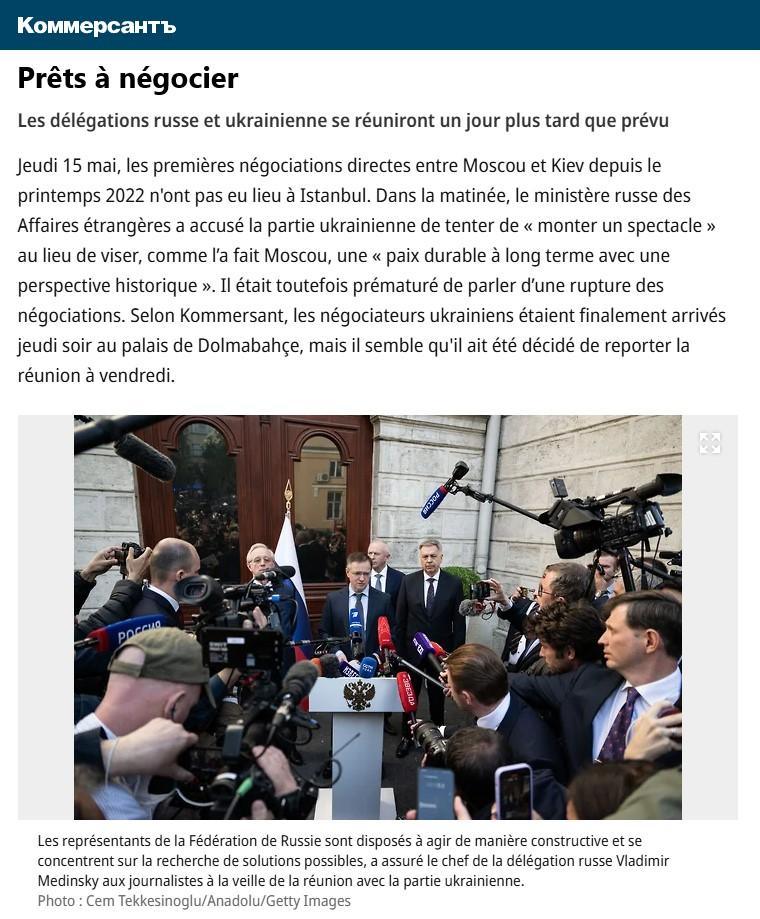
Jeudi 15 mai, les premières négociations directes entre Moscou et Kiev depuis le printemps 2022 n’ont pas eu lieu
L’article Les délégations sont prêtes à négocier à Istanbul est apparu en premier sur STRATPOL.

 Lateo.net - Flux RSS en pagaille (pour en ajouter : @ moi)