 Connexion


 Le 8 juin, le président chinois Xi Jinping a entamé à Pyongyang sa première visite à l’étranger de l’année 2026.
L’article Xi Jinping en Corée du Nord pour la première fois depuis sept ans est apparu en premier sur STRATPOL.
Alors que les nations africaines célèbrent leur unité et leur héritage, nous sommes nombreux, en Russie, à observer l’affirmation croissante
L’article Afrique unie dans un monde multipolaire est apparu en premier sur STRATPOL.
Une valse diplomatique intéressante se déroule en Corée du Nord. L’agenda de Kim Jong-un est chargé. Le dernier en date,
L’article Pourquoi dans ce nouveau monde multipolaire, il y a aussi de la place pour Kim ! est apparu en premier sur STRATPOL.
Le ministère russe des Affaires étrangères a annoncé qu’une protestation avait été déposée auprès de l’ambassadeur d’Israël à Moscou, Oded
L’article La diplomatie russe adresse une note de protestation à Israël après une frappe sur des journalistes de RT au Liban est apparu en premier sur STRATPOL.
NEW: China Makes Major Move In U.S. Backyardhttps://t.co/wrWmc7GCt3
— The Sirius Report (@thesiriusreport) December 19, 2025
Lavrov and Iran FM Araghchi Hold Joint Press Conference After Moscow Talks
A few Lavrov quotes:
West is attempting to distort all norms of international law, trying to replace it with their own rules — Lavrov
This just reflects their 500-year neocolonial desire ‘to try to live at the expense of others,’ Lavrov adds
—
Russia reaffirms once again its willingness to help our Iranian friends in looking for acceptable ways to resolve the nuclear crisis that was created by the Westerners — Lavrov
—
BRICS and SCO are organizations of a new type, unlike such NATO or what the EU has turned into — Lavrov
—
‘They are trying to subjugate the will of their member states’
They talk about themselves ‘like they are the greatest politicians of modern times, not some hired employees’
—
Europe is silent on US attacks in the Caribbean to gain Trump’s favor over their Ukraine peace plan proposals — Lavrov
Russia is ‘concerned’ with US Navy striking civilian boats and a probable land op
‘Almost all of the countries find it unacceptable apart from the Europeans’
Joint Statement following the 23rd Russia-India Annual Summit December 05, 2025 “Russia-India: A Time-Tested Progressive Partnership, Anchored in Trust & Mutual Respect”
1. At the invitation of the Prime Minister of the Republic of India H.E. Mr. Narendra Modi the President of the Russian Federation H.E. Mr. Vladimir Putin paid a state visit to India on December 4–5, 2025 for the 23rdRussia-India Annual Summit.
2. The Leaders reaffirmed their support for further strengthening of the Special and Privileged Strategic Partnership between Russia and India. This year marks the 25th anniversary of the Declaration on Strategic Partnership between Russia and India, established during the first state visit of the President of the Russian Federation H.E. Mr. Vladimir Putin to the Republic of India in October 2000.
3. The Leaders emphasized the special nature of this long standing and time-tested relationship, which is characterised by mutual trust, respect for each other’s core national interests and strategic convergence. They underscored that, as major powers with shared responsibilities, this important relationship continues to be an anchor of global peace and stability that should be ensured upon the basis of equal and indivisible security.
4. The Leaders positively assessed the multi-faceted mutually beneficial Russia-India relations that span all areas of cooperation, including political and strategic, military and security, trade and investment, energy, science and technology, nuclear, space, cultural, education and humanitarian cooperation. It was noted with satisfaction that both Sides are actively exploring new avenues for cooperation while further strengthening cooperation in the traditional areas.
5. The Leaders underlined that Russia-India ties have remained resilient in the backdrop of the prevailing complex, challenging and uncertain geopolitical situation. Both Sides have strived to forge a contemporary, balanced, mutually beneficial, sustainable and long-term partnership. Development of Russia-India relations across the entire spectrum is a shared foreign policy priority. The Leaders agreed to make all efforts to unlock the full potential of the strategic partnership.
6. The Leaders welcomed the opening of two Consulates General of the Republic of India in Yekaterinburg and Kazan, and looked forward to their early operationalisation to further strengthen inter-regional cooperation, trade and economic relations and people to people ties.
7. The Leaders noted with satisfaction the continued intensification of contacts at all levels since the last Summit, including meetings between them on the sidelines of the 16thBRICS Summit in Kazan and the 25th Summit of the Shanghai Cooperation Organization (SCO) in Tianjin; holding of the 26th Session of the Russia-India Intergovernmental Commission (IRIGC) on Trade, Economic, Scientific, Technological and Cultural Cooperation (IRIGC-TEC) co-chaired by First Deputy Prime Minister of the Russian Federation H.E. Mr. D.Manturov and Minister of External Affairs of the Republic of India H.E. Dr. S.Jaishankar and the 22nd Session of the IRIGC on Military & Military-Technical Cooperation (IRIGC-M&MTC) co-chaired by Minister of Defence of the Russian Federation H.E. Mr A.Belousov and Minister of Defence of the Republic of India H.E. Mr. R.Singh; visits of Lok Sabha Speaker H.E. Mr. O.Birla, Minister of Defence of the Republic of India H.E. Mr. R.Singh, Minister of External Affairs of the Republic of India H.E. Dr. S.Jaishankar, Minister of Railways, Information Technology, and Information & Broadcasting of the Republic of India H.E. Mr. A.Vaishnaw, Ministers of State of Home Affairs H.E. Mr. N.Rai, Defence H.E. Mr. S.Seth, Youth Affairs & Sports H.E. Mrs. R.N.Khadse, External Affairs & Textiles H.E. Mr. P.Margherita and Vice Chairman NITI Aayog Mr. S.Bery from the Indian side; visits of Chairman of the State Duma of the Federal Assembly of the Russian Federation H.E. Mr. V.Volodin, First Deputy Prime Minister of the Russian Federation H.E. Mr. D.Manturov, Deputy Prime Minister of the Russian Federation H.E. Mr. D.Patrushev, Minister of Energy of the Russian Federation H.E. Mr. S.Tsivilyov, Minister of Culture of the Russian Federation H.E. Mrs. O.Lyubimova; and holding of strategic dialogue at the level of the Secretaries of the Security Councils, Foreign Office Consultations, consultations on UN issues, meeting of the Joint Working Group on Counter Terrorism, etc.
Trade and Economic partnership
8. The Leaders reaffirmed their shared ambition to expand bilateral trade in a balanced and sustainable manner, including by increasing India’s exports to Russia, strengthening industrial cooperation, forging new technological and investment partnerships, especially in advanced high-technology areas and finding new avenues and forms of cooperation.
9. The Leaders welcomed the adoption of the Programme for the Development of Strategic Areas of Russian-lndian Economic Cooperation till 2030.
10. The Leaders appreciated the ongoing intensification of the joint work on a Free Trade Agreement on goods between the Eurasian Economic Union and the Republic of India covering sectors of mutual interest. They also directed both Sides to intensify efforts in negotiations on a mutually beneficial agreement on the promotion and protection of investments.
11. The Leaders welcomed the results of the 25th and 26th Sessions of the Russia-India Intergovernmental Commission on Trade, Economic, Scientific, Technical and Cultural Cooperation and the Russia-India Business Forum held in New Delhi (November 2024) and Moscow (August 2025) respectively.
12. The Sides underline the importance of an open, inclusive, transparent and non-discriminatory multilateral trade system with the World Trade Organization at its core. Both Sides emphasised that addressing tariff and non-tariff trade barriers, removing bottlenecks in logistics, promoting connectivity, ensuring smooth payments mechanisms and regular interaction between the businesses of the two countries were among key elements for timely achievement of the revised bilateral trade target of USD 100 billion by 2030.
13. Russia and India have agreed to continue jointly developing systems of bilateral settlements through use of the national currencies in order to ensure the uninterrupted maintenance of bilateral trade. Additionally, the Sides have agreed to continue their consultations on enabling the interoperability of the national payment systems, financial messaging systems, as well as central bank digital currency platforms.
14. The Sides welcomed steps to ensure long-term supply of fertilizers to India and discussed the potential establishment of joint ventures in this area.
15. The Sides welcomed the signing of agreements on cooperation in combating irregular migration and on temporary labor activity of citizens of one state in the territory of the other state.
16. The Russian Side welcomed the participation of Indian delegations in the Saint Petersburg International Economic Forum (June 2025) and the Eastern Economic Forum (September 2025). The two Sides noted the contribution of the Russia-India Business Dialogue organised on the sidelines of these economic forums for promotion of bilateral trade, economic and investment cooperation.
17. The Leaders noted the importance of productive and mutually beneficial bilateral trade in mineral resources, including energy sources, precious stones and metals, as well as critical raw materials for the reliability of the international supply chains. Efficient cooperation in this area, carried out by Russia and India as sovereign states, is a significant component of their national security and social wellbeing.
Energy partnership
18. The two Sides discussed and commended their wide-ranging cooperation in the energy sector as a significant pillar of the Special and Privileged Strategic Partnership. The Sides noted the current and potential cooperation between Russian and Indian companies in fields such as oil and oil products, oil refining and petrochemical technologies, oilfield services and upstream technologies and related infrastructure, LNG and LPG related infrastructure, various existing projects in their countries, underground coal gasification technology, nuclear projects, etc. They also noted the importance of expeditious resolution of issues related to investment projects in this area, and agreed to resolve the various concerns being faced by their investors in the energy sector.
Transport and Connectivity
19. The two Sides agreed to deepen cooperation in building stable and efficient transport corridors, with the focus on expanding logistics links for improving connectivity and enhancing infrastructure capacity to support the International North-South Transport Corridor, Vladivostok-Chennai (Eastern Maritime) Corridor and the Northern Sea Route. They welcomed the signing of the Memorandum of Understanding between the Ministry of Transport of the Russian Federation and the Ministry of Ports, Shipping and Waterways of the Government of India on the Training of Specialists for Ships Operating in Polar Waters.
20. The Sides noted fruitful cooperation between the railways of Russia and India, aimed at establishing partnerships in the field of mutually beneficial technology exchange.
Cooperation in the Russian Far East and Arctic
21. The two Sides confirmed their readiness to intensify trade and investment cooperation in the Far East and the Arctic zone of the Russian Federation. The Program of Russia-India Cooperation in Trade, Economic and Investment Spheres in the Russian Far East for the period from 2024–2029 provides the necessary framework for further cooperation between India and the Russian Far East region, especially in the sectors of agriculture, energy, mining, manpower, diamonds, pharmaceuticals, maritime transport, etc.
22. Both Sides underscored the importance of holding regular bilateral consultations on Arctic related issues and welcomed the progress made in multifaceted bilateral cooperation on the Northern Sea Route. The Russian Side appreciated the participation of the Indian delegation in the 6th International Arctic Forum held in Murmansk in March 2025. The Indian Side expressed its readiness to play an active role as an Observer in the Arctic Council.
Civil Nuclear Cooperation, Cooperation in Space
23. The Sides confirmed their intention to broaden cooperation in nuclear energy, including fuel cycle, life cycle support for operating Kudankulam Nuclear Power Plants (KKNPP) and non-power applications, as well as to elaborate new agenda of interaction in the field of peaceful use of atomic energy and related high technologies. The Sides noted the importance of the cooperation in the peaceful uses of nuclear energy as a significant component of the strategic partnership taking into account the plans of the Government of India to increase India’s nuclear energy capacity to 100 GW by 2047.
24. The Sides welcomed the progress achieved in implementation of KKNPP project including the construction of the remaining NPP units and agreed on adhering to the timeline for supplies of equipment and fuel.
25. The Sides noted the importance of further discussion on the second site in India for NPP; the Indian Side will strive to finalize formal allotment of the second site in accordance with earlier signed agreements.
26. The Sides agreed to accelerate technical and commercial discussions on the VVER of the Russian design, research and joint development of NPPs, localization and joint manufacturing of nuclear equipment and fuel assemblies for Russian designed large capacity NPPs subject to terms and conditions as mutually agreeable.
27. Noting the importance of cooperation in space, the two Sides welcomed the enhanced partnership between the Russian State Space Corporation “Roscosmos” and the Indian Space Research Organisation in the use of outer space for peaceful purposes, including in the human spaceflight programs, satellite navigation and planetary exploration. They noted the progress in mutually beneficial cooperation in rocket engine development, production and use.
Military and Military Technical Cooperation
28. Military and Military-Technical Cooperation has traditionally been a pillar of the Special and Privileged Strategic Partnership between Russia and India, which has grown from strength to strength through several decades of joint efforts and fruitful cooperation, steered by the IRIGC-M&MTC.
29. The Leaders welcomed the outcomes of the 22nd Session of the IRIGC-M&MTC held in New Delhi on December 4, 2025. Responding to India’s quest for self-reliance, the partnership is reorienting presently to joint research and development, co-development and co-production of advanced defence technology and systems.
30. The Leaders expressed satisfaction with regular military contacts, including the meeting of Minister of Defence of the Russian Federation H.E. Mr A.Belousov and Minister of Defence of the Republic of India H.E. Mr. R.Singh in Qingdao in June 2025 on the sidelines of the SCO Member-States’ Defence Ministers’Meeting. Both Sides appreciated the joint military exercises Indra of the Armed Forces and reaffirmed their commitment to maintain the momentum of joint military cooperation activities and expand military delegation exchanges.
31. Both Sides agreed to encourage joint manufacturing in India of spare parts, components, aggregates and other products for maintenance of Russian origin arms and defence equipment under Make-in-India program through transfer of technology and setting up of joint ventures for meeting the needs of the Indian Armed Forces as well as subsequent export to mutually friendly third countries.
Cooperation in Science & Technology
32. Both Sides called for ramping up government-to-government, academia and private sector collaboration to promote application of critical and emerging technologies.
33. Recognizing the strategic importance of critical minerals for emerging technologies and advanced manufacturing, the two Sides expressed interest in deepening cooperation in exploration, processing and recycling technologies of critical minerals and rare earths.
34. Emphasizing the importance of joint research in science, technology and innovation, the two Sides called for strengthening cooperation under the ”Roadmap for Science, Technology & Innovation Cooperation between Ministry of Science and Higher Education of the Russian Federation and the Ministry of Science & Technology of the Government of the Republic of India“. They agreed to facilitate collaboration between government and private sector to harness opportunities for start-ups and small and medium-sized enterprises of the two countries to address societal challenges through innovative technologies, including joint research and development and co-development of technologies. They confirmed their interest in further developing cooperation in the sphere of digital technologies, including those related to information protection, security of critical infrastructure and law enforcement. Both Sides agreed to design and implement soft support programs for start-ups to enable knowledge exchange, capacity building, and greater engagement of innovators and entrepreneurs.
35. Taking into account the existing rich experience of interaction between Russia and India in the field of science and higher education, the Sides expressed mutual interest in developing partner ties between educational and scientific organizations, including the implementation of various forms of academic mobility, educational programmes, scientific and research projects and the holding of specialized international exhibitions, conferences, seminars. Emphasizing the importance of joint research in science, technology and innovations, the Sides confirmed their readiness to expand cooperation within the framework of the ”Roadmap for Science, Technology & Innovation Cooperation between Ministry of Science and Higher Education of the Russian Federation and the Ministry of Science & Technology of the Government of the Republic of India“.
Cultural cooperation, Tourism and people to people exchanges
36. The two Sides agreed that cultural interaction and people to people exchanges are an important component of the Russia-India Special and Privileged Strategic Partnership. They appreciated the participation in major international cultural forums, book fairs, festivals and art competitions organized in both countries and welcomed the holding on a parity basis, of Cultural Exchange Festivals in their countries, aimed at the fullest demonstration of Russian and Indian culture.
37. Both Sides supported the idea of expanding cooperation in the film industry, including development of joint film production and mutual participation in international film festivals held in Russia and India.
38. The two Sides appreciated the steady increase in tourist exchanges between Russia and India and welcomed simplification of visa formalities, including introduction of e-Visa by both countries. They agreed to continue the work on further simplification of the visa regime in future.
39. The two Sides noted with appreciation the enhanced exchanges and contacts between the experts, think-tanks and institutes of Russia and India. Over the years, this track of dialogue has promoted increased mutual understanding between Russian and Indian strategic and policy making circles and businesses so as to further strengthen the Strategic Partnership.
40. Recognizing the traditionally strong cooperation between Russia and India in the sphere of education, both Sides appreciated efforts to ensure well-being of students and agreed to continue their efforts in promoting educational linkages between universities and educational institutions.
Cooperation in the UN and multilateral fora
41. Both Sides noted the high level of political dialogue and cooperation between them on issues at the UN and agreed to deepen it further. They stressed the importance of reinvigorating multilateralism, with a central coordinating role played by the United Nations. They also underlined the primacy of respect for international law and emphasized their commitment to the purposes and the principles of the UN Charter.
42. Both Sides called for comprehensive reform of the UN Security Council to reflect contemporary global realities and to make it more representative, effective and efficient in dealing with issues of international peace and security. Russia reiterated its steadfast support for India’s permanent membership in a reformed and expanded UN Security Council.
43. The two Sides highlighted their cooperation within the G20 format and agreed to intensify it. They emphasized that the important practical legacy of India’s G20 Presidency in 2023 was the consolidation of the priorities of the countries of the Global South in the agenda of the main platform for international economic and financial cooperation, as well as the entry of the African Union into the ranks of full members of the forum. They welcomed the holding of the Voice of Global South virtual summits under the Indian presidency, which sent an important signal in favour of building a multipolar world order and strengthening the position of developing countries in global affairs.
44. They emphasized that the G20 is the premier international economic forum that provides a platform for dialogue of both emerging and developed economies on an equal and mutually beneficial footing. They recognized the importance of the continued and productive functioning of the G20, based on consensus and focusing on its key mandate.
45. Both Sides stressed the importance of strengthening their BRICS partnership and further committed themselves to promote cooperation in the expanded BRICS under the three pillars of political and security, economic and financial, cultural and people to people cooperation. They reaffirmed their commitment to the BRICS spirit of mutual respect and understanding, sovereign equality, solidarity, democracy, openness, inclusiveness, collaboration and consensus. Russia pledged its full support for India’s upcoming BRICS Chairship in 2026.
46. The Sides reiterated the importance of their joint work within the framework of SCO for further deepening Special and Privileged Strategic Partnership between Russia and India.
47. India commended the Russian Side for the successful hosting of the SCO Council of Heads of Government Meeting in Moscow on November 17–18, 2025 under the Chairmanship of Prime Minister of the Russian Federation H.E. Mr. M.Mishustin. The Russian Side appreciated India’s initiative to establish SCO Civilizational Dialogue Forum, the inaugural session of which will be held in India in 2026.
48. The Sides noted SCO’s increasing role in the formation of representative, democratic, fair multipolar world order, based on universally recognized principles of international law, and cultural and civilizational diversity.
49. Both Sides emphasized the importance of further strengthening SCO’s potential and cooperation in the fields of politics, security, economy, culture and humanitarian ties. In this context the two Sides stressed the necessity of promoting modernization of SCO, especially in the fields of countering terrorism, extremism, separatism, drug trafficking, cross-border organized crime, and information security threats. They will pay special attention to establishment of the Universal Center on Countering Security Challenges and Threats in Tashkent and Counter-Narcotics Center in Dushanbe.
50. The two Sides agreed to continue interaction within G20, BRICS and SCO on key issues such as efforts towards reformed multilateralism, reform of international economic governance institutions and multilateral development banks, contributing to the achievement of the Sustainable Development Goals in its economic, social and environmental dimensions, stimulating economic growth, enhancing sustainability and developing resilience of international supply chains, including critical minerals, compliance with free and fair trade norms and climate change.
51. The two Sides intend to further strengthen cooperation within the UN Committee on the Peaceful Uses of Outer Space, including the issues of the long-term sustainability of outer space activities.
52. Both Sides reaffirmed their commitment to further strengthening global efforts for non-proliferation of weapons of mass destruction. Russia expressed its strong support for India’s membership of the Nuclear Suppliers Group. The two Sides urged all members of the international community to work towards enhancing the level of mutual trust in order to promote global peace and security. The Sides emphasized the non-proliferation nature of export controls and confirm their intention to continue cooperation in this area with the aim of ensuring balance between security and commercial consideration, as well as peaceful uses of technology.
53. The Sides underlined the importance of strengthening cooperation within various regional fora, aimed at deepening regional peace and security, including the East Asia Summit, ASEAN Regional Forum, ASEAN Defence Ministers’ Meeting Plus.
54. The Parties confirm the need for strict compliance with and consistent strengthening of the Convention on the Prohibition of the Development, Production and Stockpiling of Bacteriological (Biological) and Toxin Weapons and on their Destruction (BTWC), including through its institutionalization, as well as the adoption of a legally binding protocol with an effective verification mechanism. They oppose the establishment of any mechanisms that duplicate functions of the BTWC.
55. The Sides confirm the urgent need to start negotiations on a legally binding instrument on prevention of an arms race in outer space with the prohibition of the placement of weapons in outer space and the threat or use of force in outer space, from outer space or against outer space. The Sides note that the basis for such a document could be the draft of the Treaty on the Prevention of the Placement of Weapons in Outer Space and of the Threat or Use of Force Against Outer Space Objects as well as the report of the relevant Group of Governmental Experts, adopted in 2024.
56. The Leaders, reaffirming their commitment to the principles reflected in international treaties that ensure the conservation of biological diversity and the protection of rare and endangered species, especially migratory bird species, that are uniting our countries.
57. Both Sides welcomed the adoption of the Framework Agreement by the Russian side to join the International Big Cat Alliance. The Indian Side looked forward to Russia’s early joining of the International Solar Alliance and the Coalition of Disaster Resilient Infrastructure.
58. The Sides agreed to continue the development of joint approaches to addressing global economic challenges, mobilising increased access to climate finance and technologies for developing countries and economies in transition, and ensuring a reasonable reform of international institutions of economic governance, in particular multilateral development banks.
Counter terrorism
59. Both Sides reaffirmed their commitment to strengthening bilateral and multilateral cooperation in the field of combating such common challenges and threats as terrorism, extremism transnational organized crime, money laundering, terrorist financing and illicit drug trafficking.
60. The two Leaders reaffirmed their strong commitment to preventing and countering terrorism in all its forms and manifestations: including cross border movement of terrorists and terrorists’ financing networks and safe heavens. They condemned in the strongest terms the terrorist attack in India in Pahalgam, Jammu and Kashmir, on April 22, 2025, and in Russia at Crocus City Hall in Moscow on March 22, 2024. They unequivocally condemned all acts of terrorism as criminal and unjustifiable, regardless of their motivation by any religious or ideological pretexts, whenever, wherever, and by whomsoever they may be committed. They also called for concerted actions against all UN-listed terrorist groups and entities, including Al Qaeda, ISIS/Daesh and their affiliates, aimed at rooting out terrorists’ safe havens, countering the spread of terrorist ideology, eliminating terrorist financing channels and their nexus with transnational crime, and halting cross-border movement of terrorists, including foreign terrorist fighters.
61. The Sides called for an uncompromising fight against international terrorism and extremism in all their forms and manifestations, noting the importance of increasing cooperation in this area, without hidden agendas and double standards on the solid basis of international law and the UN Charter. Besides, they stressed the need for firm implementation of relevant resolutions of the UN Security Council, the UN General Assembly, as well as the balanced implementation of the UN Global Counter-Terrorism Strategy.
62. Both Sides emphasized the primary responsibility of states and their competent authorities in combating terrorism. They called for a zero-tolerance policy on terrorism and expeditious finalization and adoption of the Comprehensive Convention on International Terrorism in the UN framework, as well as implementation of the UN General Assembly and the UN Security Council resolutions on countering terrorism and violent extremism conducive to terrorism.
63. The two Sides recalled the Special Meeting of the UN Security Council Counter Terrorism Committee (CTC) held in India in October 2022 under India’s Chairship of the CTC and welcomed the unanimously adopted Delhi Declaration on countering the use of new and emerging technologies for terrorist purposes. They noted that the declaration aims to cover the main concerns surrounding the terrorist exploitation of information and communications technology, such as payment technologies, social media platforms and fundraising methods and misuse of unmanned aerial vehicles. Both Sides also expressed their readiness to develop further cooperation in this field with a special focus on preventing radicalization and the spread of extremist ideology in the online space. In this regard, they noted with satisfaction the positive dynamics of strengthening relevant mechanisms within the SCO and BRICS formats
Regional and International Issues
64. Both Sides noted with appreciation the close coordination between Russia and India on Afghanistan, including through the dialogue mechanism between the Security Councils of both countries. They emphasized the important role of the Moscow Format meetings.
65. The Leaders welcomed the counter-terrorism measures against international terrorist groups, including ISIS and, ISKP and their affiliates, and expressed confidence that the fight against terrorism in Afghanistan would be comprehensive and effective. They stressed the need to ensure urgent and uninterrupted humanitarian assistance to the Afghan people.
66. Both Sides reiterated their commitment to peace and stability in the Middle East, calling for restraint, protection of civilians and compliance with international law, and the need to refrain from taking actions that could further escalate the situation and compromise regional stability. They stressed the importance of resolving the Iran nuclear issue through dialogue. They expressed concern over the humanitarian situation in Gaza and strongly stressed the importance for all parties concerned to remain committed to agreements and understandings reached between them for cessation of conflict, humanitarian assistance and a sustainable peace.
67. The Sides noted the importance of expanding efforts to combat climate change and achieving the goals of the United Nations Framework Convention on Climate Change and the Paris Agreement. The Sides welcomed the 1st meeting of the Joint Russia-India Working Group on the issues of climate change and low-carbon development held on September 10, 2025 in New Delhi within the framework of the Memorandum of Understanding on the issues of climate change and low-carbon development. The Sides agreed to intensify the bilateral dialogue on implementing mechanisms of the Article 6 of the Paris Agreement, developing low-carbon technologies and using sustainable finance instruments.
68. The Sides agreed to continue interaction within G20, BRICS, SCO on the key issues of climate change. The Sides welcomed the results achieved by a coordinated work within the BRICS Contact Group on Climate Change and Sustainable Development; including the launch of the BRICS Climate Research Platform and the BRICS Laboratory for Trade, Climate and Sustainable Development. Both Sides encouraged fruitful cooperation in the area of addressing climate change in BRICS during the India Chairship in grouping in 2026.
69. The Sides noted with satisfaction the resilience of the Russia-India Special and Privileged Strategic Partnership and the convergent and complementary approaches of their foreign policy priorities, and reaffirmed their commitment for further strengthening it. They stressed that Russia and India as major powers will continue to strive for global peace and stability in a multipolar world as well as in a multipolar Asia.
70. President of the Russian Federation H.E. Mr. Vladimir Putin thanked Prime Minister of the Republic of India H.E. Mr. Narendra Modi for the gracious hospitality extended to him and his delegation in New Delhi and invited him to visit Russia in 2026 for the 24th Russia-India Annual Summit.
This is a really good geopolitical overview and not only about Venezuela, but describing how Venezuela became the fulcrum of change to multipolarity and the start of the end of the Monroe doctrine.
I am not sure if Mearsheimer’s face should be on there, but the content is accurate until one gets to the end, where the video proposes that the US still has the opportunity to rectify its strategic mistakes. I don’t believe so, and so this video is for the good analysis of the process of the fall of empire in the first 3/4.
Venezuela just shattered the unwritten rules of the Western Hemisphere — and Russia made sure the world noticed. In this special geopolitical investigation, we unpack how Russian warships sailed into Venezuelan waters with calm precision — a symbolic strike at two centuries of U.S. dominance in the Caribbean. This wasn’t merely a naval visit. It was a challenge to the Monroe Doctrine itself — the old idea that Washington alone sets the boundaries of power in the Americas.
What the world witnessed wasn’t Russian aggression… It was Russian positioning — a strategic counter-move decades in the making. From NATO’s long eastward push to years of sanctions pressure on Venezuela, we trace how U.S. policies inadvertently drove Caracas deeper into Moscow’s orbit. The result: one of the most consequential geopolitical realignments in the Western Hemisphere since the Cold War.
Backed by verified research, foreign-policy scholarship, and historical context, this episode explores: • why Venezuela became a central arena of U.S. influence after the Cold War, • how sweeping American sanctions punished its economy — but failed to force political change, • how Russia built a slow, deliberate strategic lifeline to Caracas, • why the Caribbean can no longer be assumed to be an uncontested sphere of U.S. influence, • and why the quiet arrival of Russian destroyers signals a new era in hemispheric geopolitics. Told in the analytical spirit of John Mearsheimer, this long-form deep dive links realist theory to modern power struggles — revealing how the cracks in the unipolar world first appeared not in Europe… but in the Caribbean.
President of Russia Vladimir Putin: Good afternoon. I am at your disposal.
First, I would like to express our gratitude to the leadership of Kyrgyzstan for organising this event and for the past year when Kyrgyzstan chaired the CSTO and hosted various events, which has certainly helped strengthen the organisation.
I believe that in the current turbulent situation it is a major factor of stability in our common space. This is important for Russia and very important for many CSTO countries.
We have coordinated everything without much difficulty, that is, all proposals advanced by the Secretariat. Everything we planned to sign has been signed. There were hardly any differences in any of the spheres we discussed. Everyone knows that it is necessary to work more closely together in the current situation. We do not threaten anyone, but we must be ready to respond to any actions that could be aggressive towards our countries.
There are many other spheres we are working in, and we will probably talk about this now. We have done good practical work in all of these vital spheres.
Overall, we can say, first, that we have achieved the desired result. And second, I see good prospects for the further development of our cooperation within the Collective Security Treaty Organisation.
As you know, Russia has taken over the CSTO chairmanship and will head the organisation for a year. I set out the priorities of our chairmanship during the expanded format meeting. I believe you are aware of this, so there is hardly any need to repeat it all. On the whole, we are very pleased with the results of our joint work.
Thank you. If you have any questions, which I am sure you do, I will do my best to answer them.
Pavel Minakov: Good afternoon, Interfax news agency.
The question concerns our priorities. So we are the chair of the Organisation, our slogan is “Collective Security in a Multipolar World.” Why was this chosen as the guiding principle for our chairmanship? Could you elaborate further on our specific priorities when we hold this position?
The second question also pertains to collective security. Prime Minister [of Armenia Nikol] Pashinyan has once again declined to attend the summit, while at the same time Armenia is conducting joint military exercises with the United States. The question is whether this poses a threat to our unity within the framework of the CSTO’s collective security. Thank you.
Vladimir Putin: Let me reiterate: I outlined the priorities during the expanded-format meeting. This was done openly – you were likely present there, or at least, many of you have heard it.
There are numerous priorities: enhancing our cooperation, comparing the capabilities of our respective defence industries. As is known, since the time of the Soviet Union, this cooperation has been very extensive. We provide CSTO member states with preferential terms for the procurement of our arms and equipment. All of this is functioning and operating quite effectively.
It is perfectly clear that amid the special military operation, our capabilities for some components are currently not that great. That is to say, they are substantial, but we must meet our own needs. In specific sectors, we are achieving this in full, entirely.
I do not believe that our production capacities are excessive, but we not only meet our own needs but also continue to export our equipment, incidentally. This primarily concerns aviation technology – both aircraft and helicopters. Now we have achieved significant advancements – a revolutionary step for us, one might say – in the field of unmanned technology and unmanned aerial vehicles, drones. We are prepared to share all of this with our partners.
Another area of cooperation is enhancing the operational efficiency of CSTO management bodies. This is somewhat bureaucratic, yet it remains important, given that every country is interested in minimising expenditure and improving coordination.
We will continue, as before, to conduct corresponding joint exercises across all domains. This concerns not only cooperation between armed forces but also the work of security services.
Unfortunately, the threats posed by drugs and organised crime persist. All of this will remain within our focus. We intend to build on the work undertaken by our colleagues from Kyrgyzstan, as I have mentioned. There will be full and complete continuity. I am confident this will be to the benefit of every CSTO member state.
Concerning Armenia’s position, it, too, is well-known. It is as follows, as our Armenian colleagues inform us: “We support all decisions adopted by the CSTO, we consider ourselves members of the CSTO, but at this stage, we are abstaining from participation in the Organisation’s meetings.” That is their choice. If they deem this course of action possible for the time being, then so be it; we agree.
Since they remain members of the Organisation, we – Russia – maintain contact with them. As the country assuming chairmanship of the CSTO, we will, of course, maintain constant engagement with them in their capacity as members. Naturally, the decisions we prepare regarding each priority will be discussed and coordinated with them as well.
Leonid Kitrar: Mr President, Leonid Kitrar, Izvestia Multimedia Information Centre. I have a question about bilateral relations with Kyrgyzstan.
We are pursuing quite a few projects, among them in the energy sector. This year, Rosatom stated it was prepared to build a small nuclear power plant here. Was this discussed? Are there any concrete figures? What are the most promising areas in bilateral relations?
I have another quick question. Not long ago, there were issues with moving cargo between Kazakhstan and Russia. Are there similar issues here?
Vladimir Putin: I will start with bilateral cooperation.
I am grateful to the President of Kyrgyzstan for the invitation to come to Kyrgyzstan on a visit of high diplomatic status and for the hospitality accorded to our entire delegation.
Here is what we said during a press event following the visit. Indeed, our relations are following a very positive track, and our investors are working increasingly actively on the Kyrgyz market. Why has this become possible? I mentioned it briefly earlier, but it is crucial: this is happening in part because the current leadership of Kyrgyzstan has managed to ensure a stable domestic political situation, which is always extremely important for potential investors, because everyone hopes that the commitments undertaken by the recipient country will guarantee the implementation of all agreements. This is one of the most crucial matters. Kyrgyzstan’s leadership has succeeded in doing this. We wish them every success in strengthening domestic political stability and, as an EAEU and CSTO member, we will support and assist them in doing so.
Our relations cover many areas in addition to investment to include the mining sector and energy. As a reminder, Kyrgyzstan receives our resources at the lowest prices and exports are exempt from corresponding customs duties. Naturally, this makes our products highly competitive, to put it mildly, on the Kyrgyz market and provides strong support for the Kyrgyz economy. This includes oil and gas, but we are not limiting ourselves to this; we have plans that may include the construction of small NPPs.
As a reminder, Russia is the only country in the world that carries out such projects. Many are saying they are ready to do it, but so far we are the only ones to do it. If Kyrgyzstan decides to go ahead with this project – our colleagues are in contact with one another – we will implement these projects.
High-tech areas are also developing in the course of bilateral cooperation. I want to draw your attention to the fact that Yandex has been working here more and more actively. Hopefully, it will continue this way, meaning that Yandex is not only engaged in food delivery, transportation and taxi service; Yandex is keenly engaged in developing artificial intelligence. This is an extremely important and promising area for all of us. Yes, Kyrgyzstan is not a large country, but there is an educated part of society here, young people with good education, who have very good prospects. And this is important for us – to create a common space in this extremely promising area. So, naturally, we will work here, too.
Both us and Kyrgyzstan deem it very important to do everything so that Russian migration policy could reliably provide for the interests of native residents of the Russian Federation, our citizens, and our economy, as well as for the citizens of Kyrgyzstan who come to work in Russia. They should be ready for this, including in humanitarian terms; I mean above all their command of the Russian language, starting from an early age, from school age onwards.
In this regard, as you also know, we are assisting the leadership of Kyrgyzstan to promote the study of the Russian language. We will open schools here and work in the field of higher education. In general, there is a great scope for joint work. In Kyrgyzstan, as you know, the Russian language has the official status at the legislative level, which we appreciate very much. And we will go on working in all these areas.
Regarding cargo traffic. Yes, indeed, such a problem did occur. What caused it? I will not conceal the fact that, on my instruction, the Customs Committee – within the framework of the EAEU, our customs authorities are entitled to such actions – began random checks on the roads, so to speak. It turned out that a significant number of goods, a significant number of these lorries, as you said, cross the Russia-Kazakhstan border without any documents at all. Yes, we have a common customs space, a common market, and free movement of capital and goods.
But every such heavyweight, every such heavy lorry must have a certain set of documents agreed on between us – between the states. There aren’t that many of them, but they are a must. There should be a paper, a document about what is inside the lorry, and at least it should be clear who is the consignee of these goods. The first document clearly shows the customs value, what customs duty should be paid by the person who crosses our border with these goods, and who should pay VAT upon receiving the goods. As soon as the roadside checks started, it turned out that there were no documents at all. It is just illegal import, and forgive my manners, it’s just gushing into our customs territory. The Russian Federation is missing out on billions, tens of billions of rubles in our budget. Of course, I informed my colleagues about this situation.
We talked about this matter with President of Kazakhstan Kassym-Jomart Tokayev. He understood everything, and he has no questions or problems with that. We have agreed that we will do everything possible to ensure that this large number of lorries that have accumulated on our border, on the territory of Kazakhstan, move on to the Russian Federation.
Our customs authorities have agreed among themselves that the value of the goods being transported will be declared, and the final recipient will be indicated. And we will gradually let these lorries in. There will be no queue. Yes, it will actually be almost within the framework of the green corridor, at a minimum cost, let them pay at least something, to begin with. And starting next year, our customs officers will require all the necessary documents during random checks. If there are none, then the customs service will not send these goods back. I think that the customs authorities will come to an agreement, up to and including confiscation, probably.
You see, there are all kinds of goods in the lorries, from nails to diamonds and television sets. But let them at least write down shoelaces costing five kopecks, let them start paying something, let them declare the final consignee so that we can receive VAT, even if it is modest. We just need to put things in order.
Thousands of lorries have already passed through. I think the queue will be gone by the end of the year.
Pavel Zarubin: Good afternoon. Pavel Zarubin, Rossiya TV Channel.
The principal global topic of recent days has been the Trump peace plan. Naturally, we have many questions for you.
To what extent does the draft initially published unofficially take our position into account? Have we received an amended version of the document following negotiations between the United States and Ukraine? Consequently, when will Russian-American negotiations begin – which, as we understand, have not yet taken place regarding this document? When will Steve Witkoff visit you? What is your current assessment of the prospects for a peaceful settlement? Thank you.
Vladimir Putin: Regarding the draft agreement. There was no draft agreement per se; rather, there was a set of issues proposed for discussion and finalisation. In general, I have spoken about this on numerous occasions. Prior to my visit to the United States, before the trip to Alaska, we discussed this with American negotiators, and subsequently, a list of 28 potential points for an agreement was formulated. As I have already stated publicly, it was conveyed to us through certain channels, and we examined it.
Thereafter, negotiations were held in Geneva between the American and Ukrainian delegations. They, as I understand it, decided among themselves that all these 28 points should be divided into four separate components. All of this was passed on to us.
In general, we agree that this could form the basis for future agreements. However, it would be inappropriate for me to speak now of any final versions, as these do not exist.
Certain matters are of a fundamental nature, and overall, we observe that the American side is, in some respects, taking our position into account – the position that was discussed before Anchorage and after Alaska. There are, unquestionably, areas where we need to sit down and engage in serious discussions on specific points, and all such matters must be framed in proper diplomatic language. Because, generally speaking, one thing is to say that Russia does not intend to attack Europe. To us, that sounds ridiculous, does it not? We never had any such intentions. But if they want to have it formalised, let’s do it, no problem.
It is simply that there are individuals there – I believe they are either not entirely of sound mind or are a certain type of swindler – who seek to gain from this by publicly telling their population, their citizens, that Russia is preparing to attack Europe and that they must urgently strengthen their defence capabilities. Either they are serving the interests of the defence industry and private companies, or they are attempting to bolster their domestic political ratings against the backdrop of the dire state of their economies and social spheres. It is difficult to say what motivates them, but from our point of view, it is complete nonsense – an outright falsehood. Nevertheless, if this narrative has taken root in their public consciousness, if they have frightened their citizens who now wish to hear that we have no plans – no aggressive intentions – towards Europe, then very well, we are ready to formalise that in any manner they see fit.
Perhaps there is even merit in this, considering that we all wish to talk, to discuss, and to articulate matters of pan-European security. Probably so; we ourselves proposed this at one point. If our Western – let us once again call them “partners” – now want this, then very well, we are ready. But we all understand that this requires serious discussion, as every word carries significance.
Or, for example, one of the documents mentions that we should resolve the issue of strategic stability together with our American partners. For heaven’s sake – are we opposed to that? That is precisely what we proposed, having even suggested to the Obama administration that we should agree on certain matters. The response was, “Yes, yes,” and then, a month before the Obama administration left the White House, everything stalled. Now another treaty – New START – is expiring in February. If they do not wish to do anything, so be it.
From these papers, we see that, overall, there is a desire to revisit these issues. However, each of these issues is a separate, very serious area. We are certainly prepared for this serious discussion. Next week, an American delegation is due to arrive in Moscow.
Olga Matveyeva: Olga Matveyeva, Mayak and Vesti FM radio stations.
As a follow-up on the colleague’s question. Will you please name the main Russian negotiators?
And one more thing. There were reports on talks underway in Abu Dhabi. Does it mean a concurrent process is going on there? Could you tell us who is talking to whom and what is happening there? Thank you.
Vladimir Putin: Obviously, the negotiator from the Russian side is the Ministry of Foreign Affairs. When we really sit down at the negotiating table and start discussing each of the proposed items in substance and in detail, the Foreign Ministry – on our part, from the Presidential Executive Office – Vladimir Medinsky, Aide to the President who has been engaged in that from the outset. I also included my Aide, Yury Ushakov, to deal with current issues, to organise all this work, he is in touch with his American counterparts. But he cannot deal with all of this alone – the Foreign Ministry must step in and to some extent, the Presidential Executive Office. This is a big, very extensive set of issues that need to be discussed, formalised, and properly spelled out.
That is the way it should be done, I think. It’s not that I think so, but it is never done any other way.
As for the Abu Dhabi talks, yes, I have heard some information noise on this score. But there was nothing unusual, nothing secret happening there either. Our secret services, Russian and Ukrainian, have always been in contact with each other, even in the hardest times. And they are in contact now. What are they dealing with? They are resolving a number of humanitarian issues, primarily related to the exchange of prisoners of war. The Abu Dhabi platform is actively used for this purpose. We are very grateful to the President of the United Arab Emirates for the opportunities extended to us. Thanks to his efforts, hundreds of our men, our heroes, have returned to their homeland.
At the initiative of the Ukrainian side, one of such regular meetings was scheduled and took place in Abu Dhabi. On our side, one of Russia’s FSB leaders attended it. A representative of the US administration also came to this meeting. It was a bit unexpected for us, but we never give up on contacts. He spoke with the Russian representative and wondered if perhaps we should not wait until next week to continue contacts but rather hold a meeting in Moscow this week.
I only learnt about this when the plane landed in Bishkek, but nevertheless, I said that we were ready, you are welcome, at any time. The issue is so important for everyone and for us that at any time of the day or night – we will arrive tonight, we will return, so we can meet right on Thursday, or Friday, Saturday, Sunday – whenever they want. But we agreed that we would decide, and the administration of the US President would decide who should arrive and when.
The latest information was brought to my attention yesterday that President Trump had decided that, after all, as previously agreed – and there was such an agreement earlier – the meeting is proposed by the American side to be held in Moscow next week. OK, we are always open.
As to who will represent the United States from the American side, this should, of course, be determined by the President of the United States. Therefore, we are expecting them in the first half of the next week.
Andrei Kolesnikov: Andrei Kolesnikov, Kommersant daily.
Mr President, are you going to insist that the territorial issue, above all in Donbass, should be resolved here and now, and for good? Or, will you agree to postpone it, so to speak, until better days? One more question, with your permission: would you agree to return to G7, the Group of Eight, as one of the peace plan versions provides; that is, to all those people?
Vladimir Putin: As for G7 or G8, we have never asked to be there, we were invited there once and we worked there. It was a platform for coordinating certain positions. I must say, you know, please take note, even before the tragic events in Ukraine began, I stopped travelling there. Did you notice?
Remark: Yes, indeed.
Vladimir Putin: This is why, when the developments in Ukraine began, they said: “Well, we are not expecting you there.” And good riddance… I do not remember who it was, I think it was the Prime Minister who went there once. The first time I refused was because really, I do not invent anything, it was when the Government was formed after I was elected President, I think in 2012. However, we never reject contacts, we are always open for interaction. First, nobody invites us there, I have not heard of or received any official proposals. And second, we know how the great majority of that association, called the Big Seven, and I have already said it once that I do not quite understand why it is called the big seven: in terms of territory, population and contribution to the global GDP they are getting smaller and smaller. Well, it does not matter, they are our important partners anyway. In today’s situation I just cannot imagine how we can interact directly. Can you imagine it? Well, we’ve arrived, hello, and now we will be stare at each other, or what?
I believe that this should bring us to some normalisation. Maybe, if we implement all these proposals within the list that we have received from the US administration, maybe some conditions for bilateral or multilateral contacts will emerge, however, it is premature to speak about it.
Andrei Kolesnikov: And there was the second question …
Vladimir Putin: You know, I will tell you now very briefly, I think it will be clear at once what it is all about. We are still receiving proposals about ceasing hostilities there, there and there. When the Ukrainian troops leave the territories they occupy, then the hostilities will cease. If they do not leave, we will achieve it militarily. That’s that.
Yes, please.
Edmund Zhelbunov: Edmund Zhelbunov, NTV television company. A question on the progress of the special military operation.
Mr President, are the positive dynamics on the fronts continuing? If so, in which directions is the most active advance taking place? Thank you.
Vladimir Putin: The positive dynamics persist in all directions. Moreover, our troops’ advance in each of these directions continues to pick up the pace, and quite noticeably. I would refrain from citing the precise number of kilometres, because I could be mistaken, but month after month, the size of the territory, so to speak, returned by our forces in all key areas is steadily increasing. In other words, the pace of our advance is accelerating.
However, the main problem for the enemy lies elsewhere: the widening gap between their losses and the number of personnel they are able to bring to the line of combat contact. In October, I believe, they suffered over 47,000 casualties, or about 47,500. Through mobilisation, or more precisely – forced mobilisation, they raised roughly 16,500, and an additional 14,500 to 15,000 returned from hospitals. If one calculates this precisely down to a tenth, the net deficit comes to around 15,000. In the previous month, the deficit was 10,000. Thus, the gap is widening.
We must also add those who desert the army. The scale of desertion is significant, and this is evident not only from our media or from Defence Ministry reports, but is also widely covered in Western media, and it is virtually impossible for them to hide this information. Therefore, there is little they can do about it, as they say.
In short, the dynamics remain positive in all directions.
Yes, please.
Yegor Piskunov: Yegor Piskunov, RT television channel. Thank you very much.
Mr President, are you aware of the fact that phone conversations between Yury Ushakov, Steve Witkoff, and Kirill Dmitriev have been leaked to the press? What do you think about it? The West, particularly numerous Western media outlets, has blown it up to a scandal. Witkoff has come under attack. What do you think about this? Thank you.
Vladimir Putin: You know, speaking of leaks, that may be a fake claim, or maybe a conversation was actually eavesdropped on. Eavesdropping is a criminal offence. At least in our country, eavesdropping is illegal. You know how the joke goes, “they were instructed to spy, but they ended up eavesdropping.” Let them mind their own business. By the way, spying is a skill, too.
I will explain what I mean. I am not aware of what these wiretaps or leaks are all about. You see, we get up in the morning and work from morning till night. After the events ended, I joined you. Here is what I think the problem is all about. It is not about us. It is about the clash of opinions in the collective West and specifically within the United States regarding what is going on and what needs to be done to stop the war and to halt the hostilities.
I had a meeting with Mr Witkoff before the summit in Anchorage. After that meeting, I went to Alaska to have talks. Overall – I want to emphasise it – at least my impression was that we had an understanding of where we stood and what needed to be done to stop the hostilities.
Then we left because President Trump and I needed to return to our respective capitals, to think things over, to consult with our administrations, ministries, agencies, and allies. After that, we agreed to continue discussions.
[Sergei] Lavrov and [Marco] Rubio met in New York on the sidelines of the UN General Assembly and had a conversation. No conflict arose between Russia and the United States on these matters. We remained on the Anchorage platform. Suddenly, the United States imposed sanctions on two of our oil companies. Why? Frankly, I was not sure what was happening.
So, there is no reason for accusing Mr Witkoff of being overly polite with his Russian counterparts. I spoke with him, and then we had that meeting in Alaska, and then – boom – sanctions that undermine our relations were imposed on us. To reiterate, we are unclear what kind of message this is. That is the first point.
Second, Mr Witkoff is apparently travelling to Moscow on President Trump’s instructions to negotiate with us. It would be quite unusual if, in his conversations with [Yury] Ushakov, he had used cuss words to insult us, or said something extremely rude, and then reached out to us in order to improve his negotiating stance. That is nonsense. Not to mention that Mr Witkoff is, apparently, a well-mannered person; he knows he should create a proper environment for interpersonal communication. That much is obvious.
This brings me to the most important point. I have known Mr Witkoff for several months now. He and President Trump go back many years, maybe even decades. He is a US citizen, and he upholds the position of his President and his country. True, our dialogue is quite challenging. We are having a civil conversation. We are not spitting at each other. We are talking like civilised people do, but each one of us is upholding his own position. To reiterate, Mr Witkoff is upholding his position, the position of the United States and the interests of the United States as he sees them and as those who delegate him to negotiate with Russia see them. These people are not just President Trump. I think they also include people from the US military, diplomatic, and administrative spheres in the broad sense of the word.
Please go ahead.
Yelena Mukhametshina: Vedomosti newspaper.
Talks about confiscating Russian assets have intensified in Europe. I want to ask how Russia would respond to this. And do you agree with Hungarian Prime Minister Viktor Orban’s remark that the confiscation can lead to legal disputes, multiple lawsuits and the collapse of the euro?
Vladimir Putin: Hungary is an EU member, therefore, the Prime Minister of one of the EU countries knows better how this could affect the European currency. Clearly, this will have negative repercussions for the global financial system because confidence in the Eurozone will sharply decline, will plummet. And amid problems in the economy, where the locomotive of the European economy – the German economy – has been in recession for the third year running, I think this will definitely be quite an ordeal.
On my instruction, the Government of the Russian Federation is working on a package of retaliatory measures in case this happens. It is clear to everyone, and everyone says it bluntly, that it would amount to stealing someone else’s property. In this regard, I naturally have a question: who is teaching whom? Either the thieving elite of Ukraine, which steals the money of its taxpayers and the taxpayers of Western sponsors – we are now well aware of the corruption scandal in Kiev – is learning from the Europeans, or the Europeans are learning from the Ukrainian elite. In any case, both are theft. That is how we feel about it, and we are working on retaliatory measures. However, the Government will make them public later, if that happens.
Anton Vernitsky: Anton Vernitsky, Channel One.
After Donald Trump admitted the possibility for the United States to test nuclear weapons, you gave instructions, at the Security Council meeting, to the relevant departments and security services to explore the feasibility of testing Russian nuclear weapons. Has a final decision been made yet? If so, what is it? If not, when can it be made?
Thank you.
Vladimir Putin: I issued instructions to collect additional information about the actions of the American side, analyse it and submit proposals to me on what we should do in this situation. One of the proposals that we have received is to work together on this topic, that’s what we take from what we see. And we are ready to think all the issues concerning strategic stability over together with the US administration.
Anton Vernitsky: Could it be at the next negotiations, in Moscow next week?
Vladimir Putin: Yes, if this issue arises. Actually, even if it does not arise, we will, of course, raise this issue, because both the United States and we are perfectly aware that preparations for real nuclear weapons tests need time. And we certainly cannot let ourselves get into a situation where the United States will have had a test whereas we will be preparing for it for another year and a half. Naturally, we have to think about it. It was not us who said that, but we must be ready for any possible scenario. And I assure you, we will be ready.
Alexander Yunashev: Good afternoon, Mr President. Alexander Yunashev, Live.
Right now, during this visit, Foreign Minister Sergei Lavrov is not accompanying you…
Vladimir Putin: Do you miss him?
Alexander Yunashev: A little. Although he is not away on vacation, he has not appeared on your international visits for two weeks now. The media claim he has fallen out of favour allegedly due to an unsuccessful conversation with Marco Rubio. What do you say?
Vladimir Putin: This is absolute nonsense. He has not fallen out of favour in any way. He has his own work schedule, he reported to me, informed me of his plans, and he is implementing them. He is preparing for a meeting with our American partners.
Yes, please.
Anastasia Savinykh: Mr President, TASS news agency.
Allow me to return to the peace plan. There is an impression that the Western side, by proposing such swift, rapid meetings and insisting on them, is in some way pressuring Russia and you personally. Naturally, everyone wants to achieve peace as quickly as possible, but it seems such matters bear no haste.
In your opinion, is there a risk that if an agreement is railroaded or hastily assembled, there may arise a temptation later to interpret it rather loosely? You have just said that every word requires discussion. How long, in general, will this take?
Vladimir Putin: I deliberately drew your attention to the fact that every issue listed in the documents handed to us holds immense importance – each one is a key topic, do you understand? Therefore, this requires thorough consideration. Likely, some of our partners are eager to resolve these issues as quickly as possible. Why? Colleagues here have asked me about the developments along the line of contact, about the position of American negotiators. Well, what is happening? Take, for instance, Kupyansk – I will return to it shortly. Let us begin with the area of responsibility of our Centre group of forces: where are the main operations taking place? On the Krasnoarmeysk direction and around the city of Dimitrov. Krasnoarmeysk and Dimitrov are entirely encircled – just as Kupyansk was in its time. Seventy percent of Krasnoarmeysk is under the control of the Russian Armed Forces. In the southern part of Dimitrov, the enemy grouping has been cut off, it is being split across the entire city, and our forces are proceeding to systematically eliminate it.
Well, what is next? If you look at the map, shift your gaze further east, northeast – there lies Komsomolsk, and north of Komsomolsk – Kupyansk, Slavyansk, and a little further north, northeast – Seversk. In Komsomolsk, combat is ongoing within the city, and a significant number of buildings have already been liberated by our troops, with further advances underway.
As for Seversk, which, as I said, lies further northeast, our forces have approached this city from the east, south, and north. Fierce combat is taking place in the city – I believe out of 8,000 buildings, 1,700 are under our control. Do you understand, if they have approached from the north, south, and east, where is this all heading? This is a very difficult question for the Ukrainian side, for the Ukrainian armed forces.
If you look north – the city of Seversk: 1,700 buildings out of 8,000, and beyond that, further north (where our North group of forces is operating) – Volchansk is almost entirely in our hands, that is on the Kharkov direction.
Now take a look at the developments in the Zaporozhye Region. There, the enemy has spent the past ten years constructing a fortified area – they began this work back in 2014 and have reinforced it ever since – which is now facing our Dnepr group of forces. It is a heavily fortified area, and our Dnepr forces are actively operating against it. In several important sectors, thanks to the heroism of our soldiers, defences are being broken. But that is not the point. The point is that our East group of forces has broken through the enemy’s defensive lines and is rapidly advancing in the north of the Zaporozhye Region, along the border between the Zaporozhye and Dnepropetrovsk regions. I repeat: they are advancing very rapidly. They are already within 1.5–2 kilometres of Gulyaypole, an important logistics hub. Whether they take the city soon or somewhat later, they will undoubtedly continue their advance.
What does this mean? It means that the East group of forces is effectively enveloping the entire fortified area of the Ukrainian Armed Forces from the north. On one side, our Dnepr group is confronting them whereas the East group of forces is bypassing them from the north. This may lead to a collapse of the front in this sector.
Here lies the difference between those in the West who seek to achieve peace as quickly as possible, even at the cost of certain mutual concessions, including from the Ukrainian side, and those who prefer a different course. If the developments we witnessed in Kupyansk unfold in the areas I have just mentioned, the collapse of the front will be inevitable.
Some still choose to believe that Kupyansk… Let me remind you: on November 4, the head of the Kiev regime declared that the city would be in Ukrainian hands within five to seven days. We now know that the enemy forces there have been completely eliminated, the city is entirely under our control, and another 15 battalions – around 3,500 personnel – are encircled on the left bank of the Oskol River. According to some of our commanders, Ukrainian soldiers in that area now resemble homeless people. This is not a joke. Imagine trying to supply 3,500 people by drone: food, uniform replacements, ammunition. It is impossible. They have been stuck in these conditions for weeks and are now practically immobilised.
Those in the West who understand the implications of all this are the ones insisting on ceasing the fighting as soon as possible, even if it requires concessions from the Kiev regime. They understand: the front will begin to crumble in several directions, and then the Ukrainian armed forces will completely lose combat capability, including their most battle-ready units, as is currently happening near Krasnoarmeysk. “Enough: save at least the core of the armed forces and your statehood. That is what must be considered,” say those who hold this view.
And then there are others, those who still continue to believe that Kupyansk is somehow back under Ukrainian control and who insist on continuing the fighting until the last Ukrainian is killed. That is the difference in their approaches. The ones attacking Mr Witkoff are precisely those who align with this second point of view, those who want to join the Ukrainian establishment in siphoning off money while prolonging hostilities until the last Ukrainian dies. But I have already said publicly: in fact, we are prepared for this.
Please, go ahead.
Yekaterina Lazareva: Good afternoon, Mr President.
Yekaterina Lazareva, URA.Ru agency. I have a follow-up question. Back to the peace plans. There is Trump’s peace plan, and there is an alternative plan advanced by Europe. Is there an understanding of who to talk to, to negotiate with, and to sign final documents with on behalf of Ukrainian political leadership, or perhaps, the military leadership now?
Vladimir Putin: You know, signing documents with the Ukrainian leadership is pointless. I have mentioned this many times.
I believe the Ukrainian leadership made a fundamental and strategic mistake when it gave in to fear and chose not to hold presidential elections, after which the president lost his legitimacy. Russia is also amidst hostilities with Ukraine, but we held elections, presidential elections and, very recently, elections to municipal and regional bodies of authority. We did all of that, while they, for some reason, did not. As soon as a peace deal is signed, hostilities will stop, and the martial law will need to be immediately lifted. Once the martial law is lifted, elections must be announced immediately.
However, today, the current political leadership of Ukraine can hardly expect to be able to win the election without rigging it. It is almost impossible, I think. That brings to mind Stalin famously saying, “It does not matter who votes for whom; what matters is who counts the votes.” No one cancelled the use of the administrative resource. Still, they are facing a challenging situation.
Next, according to the Constitution, a referendum must be held on all territorial issues, after which the referendum must be confirmed by a Constitutional Court ruling.
What is happening with the Constitutional Court? I mentioned this earlier as well. As a reminder, when the political leadership requested that the Constitutional Court confirm the president’s powers, the Constitutional Court refused to do so and dodged the request. According to the Constitution, there is only one five-year term. That is it. It cannot be extended.
We could go into the legal details and intricacies, but extensions are not provided for even under martial law. Only the Rada can extend its own powers during wartime, not the president. So, as an officeholder, the president cannot sign it. He needs confirmation from the Constitutional Court. But when the Court was asked to confirm the president’s powers, and refused to do so, do you know what happened next? I am not sure I mentioned this before, but a funny thing happened next. The security service stopped letting him into his office. He came to work, and someone knocked on his door telling him to clear out. He ended by fleeing the country.
The Constitutional Court is not operational, and the President of the Supreme Court is doing time for corruption. Those in charge of anti-corruption activities are corruptionists of the first order themselves. The President of the Supreme Court was imprisoned on corruption charges. Meanwhile, the terms of the Constitutional Court members expired, and new members had to be elected. It is quite a lengthy procedure, you see?
So, as soon as martial law is lifted, presidential elections must be held, a referendum must be held, and a new Constitutional Court must be formed. That is a never ending story.
Well, of course, we want to work out a deal with Ukraine, but doing so right now is practically impossible, legally impossible. Whoever from their side can or is willing to talk, let them do so. What we need is for our decisions to be internationally recognised by the main global actors. That is all we need.
This matters, because there is a difference between decisions under which certain territories remain under Russian sovereignty have been recognised. If agreements get violated, it will constitute an attack on the Russian Federation, with all ensuing responses from Russia. Or, will it be interpreted as an attempt to restore law on the territory owned by Ukraine? These are different matters.
Without a doubt, we need recognition, but not from Ukraine as things stand today. I hope that in the future we will be able to work out a deal with Ukraine as well. There are enough right-minded people in Ukraine who are willing to build relations with Russia for the long-term historical perspective.
Kira Latukhina: Good afternoon. My name is Kira Latukhina, Rossiyskaya Gazeta.
Hungarian media have reported that Hungarian Prime Minister Viktor Orban will arrive in Moscow tomorrow for talks with you. Could you confirm that such a meeting will take place, and what would be the purpose of his visit? Thank you.
Vladimir Putin: We are in contact with the Hungarian side regarding a possible meeting. And we are always pleased to welcome any of our partners to Russia, including our European colleagues, despite their generally aggressive attitude toward us. Especially Viktor Orban. We know his position well. In my view, it is quite objective. He is one of the few people who assesses the situation based on real circumstances on the ground and formulates his political stance accordingly.
We also have bilateral matters to discuss. Our cooperation in the energy sector is extensive, not to mention the Paks Nuclear Power Plant. There are issues there requiring further clarification and coordination. This includes nuclear fuel supplies. For example, they used American fuel in Ukraine. We have nothing against that in principle, but in practice the fuel assemblies malfunctioned: the rods began to warp, leading to an emergency situation. Therefore, everything in this sphere must be thoroughly calculated; this is a very serious matter. But beyond that, we have many other bilateral issues. If Prime Minister Orban finds it appropriate to accept our invitation, we will be glad to see him.
Valentin Alfimov: May I, Mr President?
Valentin Alfimov, Komsomolskaya Pravda.
You have already partially addressed this, but I would like to clarify the legal aspect concerning Crimea and Donbas. In President Trump’s plan, it is stated that they recognise these territories as ours de facto but not de jure. How is that possible? As a lawyer, how do you see this distinction? How can something be recognised de facto but not de jure?
Vladimir Putin: This is precisely one of the issues that should be addressed in our negotiations with the American side.
Thank you for drawing attention to it. You are right, this is one of the key points.
Thank you very much.
All the best.
Larry Johnson, Pepe Escobar with Alexander Babakov, Deputy Chairman of the State Duma
In this gripping episode of Countercurrents, we dive deep into the shifting global order as China, Russia, and the BRICS nations rise to challenge Western dominance. From China’s technological revolution and AI advancements to Russia’s newfound sovereignty amidst global sanctions, our longtime friends Pepe Escobar and Alexander Babakov explore how these powerful forces are reshaping the future of geopolitics.
TIMELINE:
00:00 Silk Road 2.0: China’s Technological and Environmental Leap
10:00 Why Russia and China Are Natural Partners: Cultural Foundations
13:22 Quality Over Profit: China’s Alternative to Western Economics
18:38 China’s Tech Revolution: How Planning Defeats Sanctions
21:10 Russia’s New Development Path: Focus on Domestic Strength
28:12 Cotton Candy Economics: Why the US Model Fails
34:24 Why 40% of World GDP Won’t Accept Western Rules Anymore
37:23 Russia–China–Iran: Iran Protected, Not Alone
38:59 Why Europe No Longer Matters to Russia’s Growth
47:57 Will the US Invade Venezuela? Geopolitical Breakdown
54:10 Why the UN Security Council Is No Longer Effective
This video is huge. Present was Maria Zakharova and General Apti Aluadinov, together with Larry Johnson, Pepe Escobar, Judge Napolitano, George Galloway, and Alexander Kazakhov. Later on we see Rachel Blevins and Danny Haiphong.
Please go to Larry’s site to obtain the video. The soundtrack is not optimal and I had to adjust the sound balance to reduce Maria’s voice in Russian in order to hear the translator in English.
https://sonar21.com/the-alleged-28-point-ukrainian-and-russian-peace-plan/
The current ‘War on Drugs’ which is a restatement of the ‘War on Terror’ by the hegemon attempts to take back the drug trade and the terror trade from drug manufacturers and terror manufacturers for themselves. It is their own industry. It is a trade war. Anyone else in these industries are enemies to the hegemon, not because the hegemon is doing a good thing for the population, rather because the hegemon is protecting its own black trade. We saw that with Syria, where the hegemon now has many new terror soldiers that can be used.
Jeff J Brown interviews John Potash on his latest book that again looks back into the ’60’s and ’70’s. As I said when I posted their first interview: “Sometimes you hear some history that you know, but to see it again in one fell swoop, shocks yet again”
Jeff has a massive library that he has collected throughout the years.
Jeff J. Brown’s libraries and catalogues A-Z: 1,000s of hours of research, writing, editing and podcasting.
Amir&Jeff’s Excellent China Adventure Series: https://radiosinoland.com/2025/07/27/amirjeffs-excellent-china-adventure-series-2025-hunan-jiangxi-fujian-and-shaanxi-provinces-red-tour-short-videos-captioned-photos-articles-and-commentary-the-real-chinese-people-you-don/
Apollo Moon Hoax Library: https://radiosinoland.com/2025/02/22/apollo-moon-hoax-library/
Bioweapons (co-founder and curator, so very much a team effort): www.bioweapontruth.com
China-Tech’s History to the Present: https://radiosinoland.com/2018/03/20/china-tech-invention-innovation-technology-research-and-development-past-present-future-5000-years-of-progress-a-china-rising-radio-sinoland-living-document/
China Tech News Flash!: https://www.chinatechnewsflash.com/
Covid (with help from China Writers’ Group/CWG): https://radiosinoland.com/2020/03/07/its-all-here-the-china-rising-radio-sinoland-covid-19-chemical-and-bioweapon-file-film-and-tape-library/
Interviews: https://radiosinoland.com/2019/02/22/interview-catalogue-for-china-rising-radio-sinoland-and-jeff-j-brown/
JB West and JB East Present: See You in The Hague!: https://radiosinoland.com/2023/06/05/jb-west-and-jb-east-present-see-you-in-the-hague-our-complete-show-library-continually-updated/
Judaism: https://radiosinoland.com/2025/01/23/judaism/
Mao Zedong (with help from CWG): https://radiosinoland.com/2024/01/03/the-mao-encyclopedia-for-dummies-updated-and-its-all-here-books-articles-movies-visuals-china-rising-radio-sinoland-240103/
Tiananmen Square Protests (with help from CWG): https://radiosinoland.com/2025/06/04/100s-of-1000s-of-people-including-researchers-journalists-and-authors-have-accessed-this-largest-single-source-covering-the-tiananmen-square-protests-join-the-club-new-entries-for-2025-radio-sin/
By Epic Economist.
Video Description:
“The American economy is crashing right now, and it’s worse than most people realize. From banks refusing cash withdrawals to nearly a million jobs lost to automation, from healthcare premiums doubling overnight to stores packed with inventory nobody can afford, the warning signs are everywhere.
In this video, we’re looking at what’s really happening on the ground. Not the official numbers or media spin, but what everyday Americans are experiencing: being interrogated at banks for their own money, losing jobs at profitable companies, watching healthcare become completely unaffordable, and seeing the retail economy grind to a halt.
This isn’t just a recession. Multiple systems are breaking down at once, and most people don’t realize how connected it all is. The crash is already here, the question is whether you’re prepared when it hits your situation directly.”
Act now while still have options:
see: our Prepping and Survival Thread
With Larry Johnson at Counter Currents
Israel apologists are probably going to make a much, much bigger deal about the second October 7 anniversary than they did about the first anniversary, because they kind of have to. The world is turning against Israel in unprecedented ways in 2025, and yelling about October 7 is all they’ve got left.
They’ve already got a scripted October 7 series coming out on Paramount+, and another, separate scripted October 7 series coming out on HBO Max for the anniversary. There are probably numerous news media segments and articles scheduled. Maybe some new “revelations” about alleged October 7 atrocities which have been just waiting in the wings this whole time for some reason.
The hasbarists are going to be so obnoxious. They’ll be babbling about Hamas beheading babies and then cooking the beheaded babies in the oven and then having sex with the beheaded babies and then eating the beheaded babies and then playing soccer with the baby heads while singing about how much they love Adolf Hitler.
They’re so insanely desperate to maintain the propaganda line as the legitimacy of the colony continues to erode that we’re seeing multiple October 7th related films/docuseries come out concurrently. The goal is clear: maintain support long enough to intensify the genocide. https://t.co/qvKtgz3EfM
— James
(@GoodVibePolitik) September 26, 2025
They’ll need to do this, because what else do they have? All the attention has long ago moved from October 7 to the genocide in Gaza, because Israel is the victimizer in literally every news story that’s come out about Palestine since that one day. Every relevant humanitarian institution on earth is saying that Israel is committing genocide and starving civilians, and we’ve been watching the evidence of this on our screens for two years.
In 2023 you had westerners saying “How could Hamas do such a thing??”, but in 2025 everyone’s looking back and going “Ehh, I kinda get it.” There are only so many horrific atrocities you can witness before you stop seeing Israel as the poor widdle Bambi-eyed victim. There are only so many times you can hear Israeli officials stating their plans to ethnically cleanse the Gaza Strip of all Palestinians, only so many Israeli soldiers you can see mockingly dressed in the undergarments of the dead and displaced Palestinian women they’ve been genociding, only so many hospital bombings you can read about, only so many accounts of IDF troops massacring starving civilians at aid sites you can listen to, before you start thinking to yourself that Israel probably had it coming.
So they’ve got to try and reignite that initial shock and horror Israel’s western allies experienced on October 7, using whatever tools of emotional manipulation they can. Try to take us all by the hand and lead us back to that naive time when the mainstream narrative was that Israel had just been attacked by a bunch of hateful savages who wanted to murder Jews simply because they are Jewish.
Absolutely staggering public opinion polling on Israel's collapse among young Americans.
Though this was utterly unthinkable even 5 years ago, it's now reflected in poll after poll, and is so entrenched it's hard to imagine it can be reversed, no matter what Larry Ellison buys. https://t.co/nKAl6SU1Wz
— Glenn Greenwald (@ggreenwald) September 29, 2025
It won’t work, though. We’ve seen too much. What has been seen cannot be unseen. No matter how much they moan about October 7, no matter how much control they shore up over TikTok and other social media platforms to silence criticism of Israel, no matter how loudly they concern troll about a pretend epidemic of antisemitism, what has been seen will never be unseen.
We see what Israel is. We see what Israel is doing. We see what the western governments who support Israel are. There is nothing anyone can say or do that will cause us to unsee what we have seen and un-know what we now know.
And we will never, ever forgive them.
BRICS Joint Media Statement (https://telegra.ph/BRICS-Joint-Media-Statement-Part-I-09-27) following the Meeting of BRICS Ministers of Foreign Affairs/International Relations on the margins of 80th Session of the United Nations General Assembly (New York, September 26)
[Note: Here we can see the start of the reform and reformatting of the UN according to Xi Jinping’s principles of global governance].
1. The BRICS Ministers of Foreign Affairs/International Relations held their annual meeting on the margins of the 80th Session of the United Nations General Assembly (UNGA 80) on 26 September 2025. The meeting was chaired by India in its capacity as the incoming BRICS Chair for 2026.
2. The Ministers exchanged views on major issues of global and regional significance and those on the agenda of UN in the political, security, economic, financial, and sustainable development spheres, as well as on intra-BRICS cooperation and activities. They reaffirmed their commitment to strengthening cooperation in the expanded BRICS under the three pillars of cooperation – political and security, economy and finance, cultural and people to people exchanges, and to enhancing strategic partnership for the benefits of our people.
3. The Ministers commended the outcomes of the XVII BRICS Summit held in Rio de Janeiro from 6-7 July 2025 under the theme “Strengthening Global South Cooperation for a More Inclusive and Sustainable Governance”, with the participation of BRICS Partner Countries as well as invited countries and international organizations. They reaffirmed their commitment to implementing decisions and declarations adopted at the Summit, including the BRICS Leaders’ Framework Declaration on Climate Finance, the BRICS Leaders’ Statement on the Global Governance of Artificial Intelligence and the BRICS Partnership for the Elimination of Socially Determined Diseases.
4. The Ministers reaffirmed their commitment to multilateralism, multipolarity and upholding international law, including the purposes and principles enshrined in the Charter of the United Nations (UN), in their entirety and interconnectedness as its indispensable cornerstone and the central role of the UN in the international system, consisting of equal sovereign states, in maintaining international peace and security, promoting human rights and sustainable development, and fostering cooperation among States based on the principles of solidarity, democracy, non-interference in internal affairs of other States, inclusiveness, collaboration and consensus, sovereign equality, equity, mutual respect and understanding and justice.
5. The Ministers reiterated their commitment to ensuring greater and more meaningful participation and representation of Emerging Markets and Developing Countries (EMDCs), as well as Least Developed Countries (LDCs), especially from Asia, Africa, Latin America and the Caribbean, in global decision-making processes and structures and making them better attuned to contemporary realities. They also called for achieving equitable geographical representation in the Secretariat of the United Nations and other international organizations in a timely manner, as well as increasing the role and representation of women, especially from EMDCs, at all levels of leadership and responsibilities in these organizations. They stressed the need for the selection and appointment process of executive heads and senior positions to be guided by the principles of transparency and inclusiveness, and carried out in accordance with all the provisions of Article 101 of the UN Charter, with due regard for recruiting staff on a geographical basis as wide as possible and equal participation of women, and adhere to the general rule that there should be no monopoly on senior posts in the UN system by any State or group of States. The Ministers also deplored attempts, including by deliberately withholding assessed contributions, to unilaterally undermine the work of multilateral institutions and impair the implementation of their respective mandates.
6. The Ministers reiterated their commitment to reforming and improving global governance by promoting a more just, equitable, agile, effective, efficient, responsive, representative, legitimate, democratic and accountable international and multilateral system in the spirit of extensive consultation, joint contribution and shared benefits. They emphasized dialogue and mutual understanding as a basis of international relations. They reiterated the centrality of sustainable development and inclusive growth in the UN agenda. They emphasized the need for fostering resilience and advancing sustainability as crucial for growth and sustainable development in the Global South and the world at large.
7. The Ministers reaffirmed the need for all countries to cooperate in promoting and protecting human rights and fundamental freedoms under the principles of equality and mutual respect and to fight all forms of discrimination. They agreed to continue to treat all human rights including the right to development in a fair and equal manner, on the same footing and with the same emphasis. In this context, they agreed to strengthen cooperation on issues of common interests, both within BRICS and in multilateral fora, taking into account the necessity to promote, protect and fulfill human rights in a non selective, non-politicized and constructive manner and without double standards, constructive dialogue and cooperation. They called for the respect of democracy and human rights. In this regard, they underlined that these should be implemented on the level of global governance as well as at national level. They reaffirmed their commitment to ensuring the promotion and protection of democracy, human rights and fundamental freedoms for all with the aim to build a brighter shared future for the international community based on mutually beneficial cooperation.
8. The Ministers underscored the need to intensify the fight against racism, racial discrimination, xenophobia and related intolerance as well as discrimination based on religion, faith or belief, and all their contemporary forms around the world, including the alarming trends of rising hate speech, disinformation and misinformation. They welcomed the proclamation of a Second International Decade for People of African Descent (2025 – 2034), by the UN General Assembly. They welcomed the decision of the African Union to designate 2025 as the year for “Justice for Africans and People of African Descent Through Reparations” and recognize the efforts of the African Union to tackle the destructive legacy of colonialism and the slave trade. The Ministers also noted the Second Africa – CARICOM Summit hosted in Addis Ababa in September 2025, to foster economic, social and political relations between the African continent and countries with significant populations of people of African descent.
9. The Ministers called for more just and equitable global governance and mutually beneficial relations among nations based on international law with an enhanced role for the global south and the developing world in global governance, reflective of their growing economies, demography, and contributions towards sustainable development, including poverty eradication. They acknowledged that multipolarity can expand opportunities for EMDCs to develop their constructive potential and enjoy universally beneficial, inclusive and equitable economic globalization and cooperation. They renewed their calls for reforming the global governance institutions and global financial architecture to better reflect the contemporary global realities.
10. In light of the 80th Anniversary of the United Nations under the theme: ‘Better together: 80 years and more for peace, development and human rights, the Ministers recalled UNGA Resolutions 75/1, 77/335 and other relevant resolutions, and reiterated their commitment to provide the United Nations with all the required support it needs to discharge its mandate. They emphasized the strong call for reforms of the principal organs of the United Nations with a view to achieving concrete progress. They recommitted to instill new life in the discussions on reform of the UN Security Council and continue the work to revitalize the General Assembly and strengthen the Economic and Social Council. They look forward to the successful conclusion of the 2025 Review of the UN Peacebuilding Architecture. The Ministers also look forward to the outcome of the review of all UN peace operations.
11. The Ministers noted the current global context of polarization and distrust and encouraged global action to strengthen international peace and security. They called on the international community to respond to these challenges and associated security threats through politico-diplomatic measures to lower conflict potential and stressed the need to engage in conflict prevention efforts, including through addressing their root causes. They underscored that security among all countries is indivisible and reiterated their commitment to the peaceful resolution of international disputes through dialogue, consultation and diplomacy. They encouraged the active role of regional organizations in conflict prevention and resolution and supported all efforts conducive to the peaceful settlement of crises. They highlighted the importance of mediation and preventive diplomacy as essential tools to avoid crises and prevent their escalation, in accordance with the Purposes and Principles of the UN Charter. In this regard, they agreed to explore avenues for cooperation on the prevention of armed conflicts, UN peacekeeping missions, African Union peace support operations, and mediation and peace processes.
12. The Ministers reaffirmed their strong commitment to strengthening multilateral cooperation to address humanitarian crises worldwide. They expressed concern at the dwindling of international responses, which were already insufficient, fragmented, and often politicized. They strongly condemned all violations of international humanitarian law, including deliberate attacks on civilians, including scientists and journalists and civilian objects, including civilian infrastructure, as well as the denial or obstruction of humanitarian access and the targeting of humanitarian personnel. They underlined the need to address accountability for all violations of international humanitarian law.
13. In light of the high-level meeting of the General Assembly on the thirtieth anniversary of the Fourth World Conference on Women held in New York on 22 September 2025, the Ministers reaffirmed their commitment to promote the full and effective implementation of the Beijing Declaration and Platform for Action. The Ministers look forward to the incoming Global Leaders’ Meeting on Women co-hosted by China and the UN Women and reaffirmed their commitment to advancing women’s rights and leadership. The Ministers also reaffirmed their commitment to full implementation and advancement of the Women, Peace and Security (WPS) agenda, especially in view of the upcoming 25th anniversary of UN Security Council Resolution 1325 (2000). They further reiterated the importance of ensuring the full, equal, safe and meaningful participation of women in decision-making at all levels of peace and security processes, including conflict prevention and resolution, humanitarian relief, mediation, peace operations, peace-building, and post-conflict reconstruction and development.
14. Recognizing the 2023 Johannesburg-II Leaders’ Declaration, the Ministers reiterated their support for a comprehensive reform of the United Nations, including its Security Council, with a view to making it more democratic, representative, effective and efficient, and to increase the representation of developing countries in the Council’s memberships so that it can adequately respond to prevailing global challenges and support the legitimate aspirations of emerging and developing countries from Africa, Asia and Latin America, including BRICS countries, to play a greater role in international affairs, in particular in the United Nations, including its Security Council. The Ministers recognized the legitimate aspirations of African countries, as reflected in the Ezulwini Consensus and Sirte Declaration. The Ministers stressed that the United Nations Security Council reform is to lead to the amplified voice of the Global South. Recalling the 2022 Beijing and 2023 Johannesburg-II Leaders’ Declarations, China and Russia, as permanent members of the United Nations Security Council, reiterated their support to the aspirations of Brazil and India to play a greater role in the United Nations, including its Security Council.
15. Recalling that 2025 marks the eightieth anniversary of the end of the Second World War, a war which brought untold sorrow to humankind, particularly in Europe, Asia, Africa, the Pacific and other parts of the world, the Ministers rendered their full support to the UNGA Resolution 79/272 on the Eightieth anniversary of the end of the Second World War, on this historic event, which established the conditions for the creation of the United Nations, designed to save succeeding generations from the scourge of war.
16. The Ministers commended four consecutive developing countries as G20 Presidencies of Indonesia, India, Brazil, and South Africa during 2022-2025. They applauded the inclusion of the African Union as a full G20 member and the inclusion of voices from the Global South in the G20 mandate. They reaffirmed the support for G20 as the premier forum for international economic cooperation, and committed to deepening macroeconomic policy coordination, strengthening development cooperation, and accommodate needs and concerns of the Global South.
17. The Ministers reaffirmed their willingness to coordinate positions in order to enhance inclusiveness and amplify the voice of the Global South in the global economic governance system so that it adequately reflects EMDCs’ rising weight in the global economy and further integrate their priorities in the G20 agenda. They saluted strengthening of the EMDCs’ voice in the G20 through the accession of the African Union during India’s presidency of G20 in 2023 and the invitation to the NDB during Brazilian and South African presidencies including by their closer interaction and alignment.
18. The Ministers expressed their readiness to continue to enhance cooperation with the African Union to help address challenges, in particular economic vulnerabilities, in line with the aspirations of the African Union Agenda 2063 and its Second Ten Year Implementation Plan. They underscored the urgent need to address Africa’s development, debt burden and the impact of global economic volatility on the Continent’s fiscal space and stressed the importance of a reformed international financial system, responding to Africa’s priorities and needs.
19. Cognizant of the growing complexity in contemporary global challenges, including heightened geopolitical tensions, they underscored the urgent need for collective responses. The Ministers agreed that BRICS will continue to play a proactive and constructive role in addressing global challenges through dialogue and diplomacy.
20. The Ministers reaffirmed support to the principle “African solutions to African problems” should continue to serve as the basis for conflict resolution on the African continent. They recognized the critical role played by the African Union in conflict prevention, management and resolution and reaffirmed their support for African peace efforts on the continent, including those undertaken by the African Union, and African sub-regional organizations. The Ministers committed to consider new ways to support African Union peace support operations, mediation efforts, peace processes and broader peace building initiatives in the African continent.
21. The Ministers expressed deep concern over the ongoing conflicts and instability in the Middle East and North Africa (MENA) region and underline the particular urgency of addressing the current situation in the Middle East. In this regard, they reaffirmed their commitment to the Joint Statement by BRICS Deputy Foreign Ministers and Special Envoys at their meeting of 28 March 2025.
22. The Ministers stated that regional crises in MENA region should be exclusively resolved through political and diplomatic dialogue based on unconditional respect for independence, territorial integrity, and sovereignty of countries in the region. The Ministers reaffirmed their commitment to the basic principle that peace and security in the MENA region should be achieved and sustained in accordance with, and in full respect for, international law and the United Nations (UN) Charter. They reaffirmed the primary role of the UN Security Council (UNSC) in maintaining international peace and security.
23. The Ministers condemned Israel’s armed attack on the State of Qatar, which constitutes a flagrant violation of Qatar’s sovereignty, a grave breach of international law, including the UN Charter, and a threat to regional and international peace and security. They also noted the recent Urgent Debate on the armed attack launched by Israel against the State of Qatar, convened on 16th of September 2025 at the 60th Session of the Human Rights Council. They reaffirmed their commitment to uphold the rule of law, human rights, peace and security.
24. The Ministers condemned the military strikes against the Islamic Republic of Iran since 13 June 2025, which constitute a violation of international law and the Charter of the United Nations, and expressed grave concern over the subsequent escalation of the security situation in the Middle East. They further expressed serious concern over deliberate attacks on civilian infrastructure and peaceful nuclear facilities under full safeguards of the International Atomic Energy Agency (IAEA), in violation of international law and relevant resolutions of the IAEA. Nuclear safeguards, safety, and security must always be upheld, including in armed conflicts, to protect people and the environment from harm. In this context, they reiterated their support for diplomatic initiatives aimed at addressing regional challenges. They called upon the United Nations Security Council to be seized of this matter.
25. The Ministers expressed, in particular, grave concern about the situation in the Occupied Palestinian Territory and the persistent Israeli attacks against Gaza, which, after almost two years, continue to cause unprecedented suffering to the civilian population of the territory, ravaged by deaths, destruction, and famine. The Ministers condemned in this regard all attempts to displacing the Palestinian people from their occupied territory under any pretext or circumstances. They reiterated their calls for an immediate and permanent ceasefire, leading to the cessation of Israeli attacks, the full withdrawal of Israeli troops from the territory, the release of remaining hostages and detainees, and unhindered access and delivery of humanitarian aid, at scale. They further underscored, their unwavering support for UNRWA and stressed the need to fully respect its mandate, as granted by the United Nations General Assembly, for the provision of essential services to Palestinians across its five fields of operation. The Ministers urged for the expeditious reconstruction of the civic infrastructure of the territory, with a central role by the Palestinians, as agreed in the Emergency Arab Summit on Palestine of 4 March 2025, and they noted with appreciation the initiative to convene an upcoming pledging conference to be held in Cairo. Efforts to stabilize and rebuild Gaza must go hand in hand with a just and lasting political resolution of the protracted conflict, which can only be achieved by peaceful means and depends on the fulfilment of the legitimate rights of the Palestinian people. The Ministers emphasized that the Gaza Strip is an inseparable part of the Occupied Palestinian Territory, they further underscored the importance of unifying the West Bank and the Gaza Strip under a reformed Palestinian Authority and reaffirmed the right of the Palestinian people to self-determination. They reaffirmed support for the State of Palestine’s full membership in the United Nations in the context of the unwavering commitment to the two-state solution, in accordance with international law, including relevant UN Security Council and General Assembly resolutions, and the Arab Peace Initiative, that includes the establishment of a sovereign, independent and viable State of Palestine within the internationally recognized 1967 borders, which includes the Gaza Strip and the West Bank, with East Jerusalem as its capital, in order to achieve the vision of two States living side by side, in peace and security.
26. The Ministers expressed their concern over the situation in Sudan resulted in a humanitarian crisis and the growing risk of proliferation of extremism and terrorism. They reiterated their positions in this regard and called for an immediate, permanent, and unconditional ceasefire and for a peaceful resolution of the conflict. They also stressed the need for sustained, urgent and unhindered access to humanitarian assistance for the Sudanese population, and for the scaling up of humanitarian aid to Sudan and neighboring countries.
27. The Ministers expressed strong condemnation of any acts of terrorism as criminal and unjustifiable, regardless of their motivation, whenever, wherever and by whomsoever committed. They condemned in the strongest terms the terrorist attack in Jammu and Kashmir on 22 April 2025, during which 26 people were killed and many more injured. They reaffirmed their commitment to combating terrorism in all its forms and manifestations, including the cross-border movement of terrorists, terrorism financing and safe havens. They reiterated that terrorism should not be associated with any religion, nationality, civilization or ethnic group and that all those involved in terrorist activities and their support must be held accountable and brought to justice in accordance with relevant national and international law. They urged to ensure zero tolerance for terrorism and reject double standards in countering terrorism. They emphasized the primary responsibility of States in combating terrorism and that global efforts to prevent and counter terrorist threats must fully comply with their obligations under international law, including the Charter of the United Nations, in particular the purposes and principles thereof, and relevant international conventions and protocols, in particular international human rights law, international refugee law and international humanitarian law, as applicable. They welcomed the activities of the BRICS Counter-Terrorism Working Group (CTWG) and its five Subgroups based upon the BRICS Counter-Terrorism Strategy, the BRICS Counter Terrorism Action Plan and the CTWG position paper. They look forward to further deepening counter-terrorism cooperation. They called for an expeditious finalization and adoption of the Comprehensive Convention on International Terrorism in the UN framework. They called for concerted actions against all UN designated terrorists and terrorist entities.
28. The Ministers expressed concern over proliferation of trade-restrictive actions, whether in the form of indiscriminate rising of tariffs and non-tariff measures, or protectionism, in particular measures used as a means of coercion that threaten to further reduce global trade, disrupt global supply chains, and introduce uncertainty into international economic and trade activities, potentially exacerbating existing economic disparities and affecting prospects for global economic development. They voiced serious concerns about the rise of unilateral tariff and non-tariff measures which distort trade and are inconsistent with WTO rules. They cautioned against such practices that risk fragmenting global trade and marginalizing the Global South.
29. Recalling the BRICS Declaration on WTO Reform and Strengthening of the Multilateral Trading System, the Ministers reaffirmed their unwavering support for strengthening a non-discriminatory, open, equitable, transparent, fair, inclusive, and rules-based multilateral trading system, with the World Trade Organization (WTO) at its core while upholding the principles of Special & Differential Treatment for developing members, including LDCs. They strongly advocated for the immediate restoration of an accessible, effective, fully-functioning, two-tier binding WTO dispute settlement mechanism as a foundation for trust, predictability, for all members, and the appointment of new appellate body members without further delay. The Ministers look forward to the 14th WTO Ministerial Conference and to work towards strengthening the organization through necessary reform and to restore the credibility of the multilateral trading system. The Ministers reiterated their strong support to Ethiopia and Islamic Republic of Iran’s bid for accession to the WTO.
30. The Ministers rejected unilateral, punitive and discriminatory protectionist measures, that are not in line with international law, under the pretext of environmental concerns, such as unilateral and discriminatory carbon border adjustment mechanisms (CBAMs), deforestation regulations, due diligence requirements, taxes and other measures and reconfirmed full support for the call in COP28 related to avoidance of unilateral trade measures based on climate or environment. The Ministers also opposed unilateral protectionist measures, which deliberately disrupt the global supply and production chains and distort competition.
31. The Ministers called for concerted efforts and early conclusion and implementation of the BRICS Strategy for Economic Partnership 2030, which will aim at consolidating mandates and guiding principles for the cooperation of BRICS on issues relating to multilateral trading system, digital economy, international trade, financial cooperation and trade and sustainable development.
32. On the 80th anniversary, the Ministers reiterated the urgent need to reform the Bretton Woods Institutions (BWI) to make them more agile, effective, credible, inclusive, fit for purpose, unbiased, accountable, and representative, enhancing their legitimacy. First and foremost, their governance must be reformed to reflect the transformation of the global economy since their establishment. The Ministers called for improved management procedures, including through a merit-based and inclusive selection process that would increase regional diversity and representation of EMDEs in the leadership of the IMF and the WBG, as well as the role and representation of women at the managerial level. The Ministers urged for meaningful quota realignment under the 17th General Review of Quotas at the earliest possible time that should not come at the expense of developing countries, reflecting countries’ relative positions in the global economy, and increasing the shares of EMDEs, in line with BRICS Rio de Janeiro Vision for IMF Quota and Governance Reform. They reaffirmed that the 2025 World Bank Shareholding Review is a critical tool to strengthen multilateralism and enhance the legitimacy of the World Bank Group, as a better, bigger, and more effective development finance institution. In line with the Lima principles, BRICS countries continue to advocate for the increased voice and representation of developing countries, underpinned by a shareholding realignment that corrects their historic underrepresentation.
33. As the New Development Bank is set to embark on its second golden decade of high quality development, the Ministers recognized and supported its growing role as a robust and strategic agent of development and modernization in the Global South. The Ministers lauded the growing role of the New Development Bank (NDB) in meeting the development priorities and infrastructure needs of EMDCs. The Ministers welcomed the Bank’s steady expansion of its capacity to mobilize resources, foster innovation, expand local currency financing, diversify funding sources, and support impactful projects that advance sustainable development, reduce inequality, and promote infrastructure investments and economic integration. They recognized NDB as a crucial BRICS institution for promoting sustainable development, reducing inequalities, and supporting resilience in emerging economies. The Ministers reiterated support for the further expansion of NDB membership and expedited consideration of applications of interested BRICS countries, in line with the NDB General Strategy and related policies. They also called for strengthening the Contingent Reserve Arrangement (CRA) and encouraged greater participation of new members in its operations.
34. The Ministers acknowledged the progress made by BRICS countries in advancing the implementation of the 2030 Agenda for Sustainable Development in its three dimensions—economic, social, and environmental. They underscored the importance of continued efforts to eradicate poverty, reduce, inequality and promote sustainable and inclusive growth. The Ministers called upon developed countries to fulfill their Official Development Assistance (ODA) commitments, in particular that of dedicating at least 0.7% of their gross national income for ODA, and to facilitate the timely and affordable transfer of relevant technologies, knowledge, and capacity-building to developing countries. They emphasized that strengthened global partnerships and equitable resource flows are essential for bridging development gaps and achieving the Sustainable Development Goals (SDGs) within the established timelines. They further urged developed countries to reserve the classification of ODA to initiatives strictly linked to development.
35. The Ministers emphasized that just, inclusive and balanced energy transitions present social, economic and technological opportunities to contribute to universal energy access, energy markets stability, economic growth and GHG emissions reductions in line with the national circumstances, needs and priorities, principle of technological neutrality and SDGs. In this context, they acknowledged the updated Roadmap for BRICS Energy Cooperation 2025-2030 and the important role of the BRICS Energy Research Cooperation Platform in energy, cooperation and fostering energy access, within the BRICS format. They also recalled the importance of energy security and the need to increase energy access and affordability. 36. The Ministers reaffirmed their commitment to urgent and collective action to combat climate change, guided by the principles of equity and Common But Differentiated Responsibilities and Respective Capabilities (CBDR-RC), in light of national circumstances. They highlighted that CBDR principle must remain central to global climate governance and reiterated the need for developed countries to meet their commitments on climate finance, technology transfer, and capacity building. The Ministers expressed strong support for Brazil’s upcoming Presidency of COP30 and welcomed Ethiopia’s and India’s candidacy to host COP32 and COP33 respectively. They welcomed initiatives and contributions made by BRICS countries and partner countries in contributing to the global response to climate change.
37. The Ministers emphasized that ensuring accessible, timely and affordable climate finance is critical for enabling just transition pathways that combine climate action with sustainable development. They called upon developed countries to fully deliver on their commitments to providing financial resources to assist developing countries, taking into account the needs and priorities of developing countries in just transitions. They also underlined the importance of a refocused effort for enhancing supporting technology transfer and development, in compliance with national legislation and policies, capacity building initiatives and targeted concessional finance, while recognizing the cross-cutting nature of climate finance. They encouraged an integrated approach across multiple areas of expertise to leverage BRICS collective strength, with a view to scale up access to climate finance for all member countries.
38. The Ministers welcomed the convening of the Second Africa Climate Summit by the African Union held in Addis Ababa, 8-10 September 2025.
39. The Ministers underscored the importance of enhancing the resilience of infrastructure systems to climate and disaster risks as is vital to achieving sustainable development in the Global South. The need to invest in resilient infrastructure and to ensure that infrastructure plans are risk informed was emphasized. They acknowledged that building disaster-resilient infrastructure contributes directly to long-term sustainability and economic stability. The Ministers reiterated the readiness of the BRICS countries to cooperate to improve national disaster risk reduction systems and capacities to reduce disaster-related damage and protect infrastructure, human lives and livelihoods as well as to mobilize sufficient funding and increase private investment for comprehensive infrastructure development.
40. The Ministers look forward to further promoting transport dialogue, including in civil aviation, to meet demands of all stakeholders and to enhance the BRICS countries transport potential while also respecting the sovereignty and territorial integrity of all member states while carrying out transport cooperation. They reaffirmed the commitment of BRICS countries to develop sustainable and resilient transport infrastructure, recognizing its critical role in economic growth, connectivity, and environmental sustainability.
41. The Ministers reaffirmed that cooperation within and through BRICS is fundamental to contributing to the global effort towards a sustainable future and equitable and just transitions for all. The Ministers underscored the importance of the conservation and sustainable use of biodiversity, of the fair, equitable sharing of benefits arising from the utilization of genetic resources and of the effective implementation of the Convention on Biological Diversity, its Protocols, and its Kunming-Montreal Global Biodiversity Framework. The Ministers appreciated the establishment of the Kunming Biodiversity Fund and the contribution made by the Government of China and recognized its significant role in supporting developing countries for their biodiversity conservation. The Ministers recognized the active role of BRICS countries in the COP16 negotiations, particularly with regard to resource mobilization. The Ministers urged developed countries to ensure the provision of adequate, effective, predictable, timely and accessible financial resources to developing countries, as well as to improve capacity building, development and transfer of technology to developing countries for the conservation, sustainable use and fair and equitable sharing of benefits arising from the use of biodiversity. The Ministers underscored the critical role of all types of forests, including tropical forests, for conserving biodiversity, preserving water basins and soils and providing timber and non timber forest products of high value for economic sectors, regulating hydrological cycles, as well as combatting desertification and land degradation and serving as vital carbon sinks. In that regard, the Ministers took note of the UAE co-hosting the 2026 UN Water Conference with Senegal, which will focus on accelerating the implementation of Sustainable Development Goal (SDG) 6 on Clean Water and Sanitation. They also took note of the “United for Our Forests” initiative, which promotes the conservation, sustainable management, and restoration of these essential tropical ecosystems. The Ministers took note of the Mangrove Alliance for Climate co-led by the UAE and Indonesia as platforms for international cooperation. While appreciating the efforts of our countries to preserve rare species and noting the high vulnerability of big cats, they took note of the Republic of India’s initiative to create an International Big Cats Alliance and encourage BRICS countries to work together to the conservation of big cats.
42. The Ministers welcomed the plans to launch the Tropical Forest Forever Facility in Belém, at COP30, and recognized it as an innovative mechanism designed to mobilize long-term, results-based financing for tropical forest conservation. They encouraged potential donor countries to announce ambitious contributions, in order to ensure the Facility’s capitalization and timely operationalization.
43. The Ministers underscored the role of the WHO as the directing and coordinating authority on international health work within the UN System. They emphasized the importance of strengthening equitable, accessible, and resilient health systems to prepare for and respond to future pandemics. The Ministers acknowledged the adoption of the WHO Pandemic Agreement and supported the negotiations on its Annex on Pathogen Access and Benefit-Sharing. They encouraged intra-BRICS cooperation and experience sharing on digital health, vaccine research and development, manufacturing capacity, tuberculosis (TB), antimicrobial resistance (AMR), nuclear medicine, traditional medicine systems. They acknowledged the establishment of the BRICS Partnership to Eliminate Socially Determined Diseases and the necessity to promote vaccine cooperation through the BRICS Vaccine Development Centre.
44. The Ministers expressed concern about the growing risks of nuclear danger and conflict. They reiterated the need for invigorating the system of disarmament, arms control and nonproliferation and for preserving its integrity and effectiveness to achieve global stability and international peace and security. They stressed the significant contribution of nuclear weapon-free zones to the strengthening of the nuclear non-proliferation regime, reaffirmed their support for and respect towards all existing nuclear-weapons free-zones and their associated assurances against the use or threat of use of nuclear weapons, and acknowledged the paramount importance of the efforts aiming at accelerating the implementation of the resolutions on the Establishment of a Zone Free of Nuclear Weapons and other Weapons of Mass Destruction in the Middle East, including the Conference convened pursuant to UN General Assembly Decision 73/546. They called on all invited parties to participate in this conference in good faith and engage with this effort constructively. They welcomed the adoption of the UNGA Resolution 79/241 “Comprehensive study of the question of nuclear-weapon-free zones in all its aspects”.
45. The Ministers recognized the need to ensure the use of space systems, as well as the achievements of space science and technologies, for peaceful purposes. They also reasserted their support for ensuring the long-term sustainability of outer space activities and prevention of an arms race in outer space (PAROS) and of its weaponization, as well as the threats or use of force against outer space objects, including through negotiations to adopt a relevant legal multilateral instrument to ensure global security. They recognized the submission of the updated Draft Treaty on the Prevention of the Placement of Weapons in Outer Space, the Threat or Use of Force against Outer Space Objects (PPWT) to the Conference on Disarmament in 2014 as an important step towards this goal. They stressed that practical and non-binding commitments such as Transparency and Confidence-Building Measures (TCBMs), and universally agreed norms, rules, and principles may also contribute to PAROS. They noted the initiative of some BRICS Members at the General Assembly to create a single Open-Ended Working Group to enable coherent, inclusive and effective discussions that serves such purpose and undertake to engage constructively in the process, on the basis of existing achievements, including on substantial elements on a legally binding instrument on PAROS.
46. Recognizing the importance of making international governance, dialogues on governance of Artificial Intelligence (AI) for peaceful purposes, inclusive and representative through meaningful participation especially from Global South, the Ministers underscored the need for collective efforts at the United Nations on AI governance that upholds AI for good and for all taking into account national policies, regulations and applicable international agreements, ensures sovereignty of States, development of trustworthy AI systems, equitable access to resources critical for responsible AI development, stimulates innovation and economic growth, ensures privacy and data protection, promotes leveraging AI for diverse AI solutions to address global social realities, including economic, linguistic, and cultural diversities in accordance to national and regional priorities and national regulatory frameworks. The Ministers look forward to BRICS cooperation to help developing countries strengthen AI capacity building. They reiterated the UN General Assembly Resolution A/RES/78/311 – Enhancing International Cooperation on Capacity-building of Artificial Intelligence. They also welcomed the General Assembly Resolution 79/325 adopted on 26 August 2025 to establish two new mechanisms – the UN Independent International Scientific Panel on AI and the Global Dialogue on AI Governance – to promote international cooperation on the governance of AI with the United Nations at the Centre.
47. The Ministers underscored the important role of BRICS economies in fostering innovation, advancing technological cooperation, including in areas related to Industry 4.0, and promoting deeper engagement among start-ups and SMEs through intra-BRICS initiatives and exchanges. They acknowledged the importance of strengthening cooperation under the Partnership on the New Industrial Revolution (PartNIR). They encouraged members to join the BRICS Center for Industrial Competences (BCIC). They appreciated the launch of the BRICS Startup Knowledge Hub under the BRICS Startup Forum and reaffirmed their commitment to further strengthening collaboration in this regard.
48. The Ministers recognized the transformative impact of Information and Communication Technologies (ICTs) as a key driver of socioeconomic growth and digital transformation in BRICS countries and reaffirmed their commitment to further strengthening collaboration in this regard. They reaffirmed their support for an open, safe, secure, stable, accessible, peaceful, and interoperable ICT environment and stressed the importance of the Global Mechanism on Developments in the Field of ICTs in the Context of International Security and Advancing Responsible States Behaviour in the Use of ICTs. They underscored the leading role of the United Nations in fostering constructive dialogue to forge common understandings on security in the use of ICTs and discussions on developing a universal legal framework in this realm and the further development and implementation of universally agreed norms, rules and principles for responsible behavior of States in the use of ICTs. They called upon all States to sign and ratify the UN Convention against Cybercrime, in accordance with domestic laws, processes and procedures, as soon as possible, with an aim to enhance international cooperation in combating cybercrime. The Ministers emphasized the importance of promoting the use of ICT for peaceful purposes and in a more inclusive and accessible manner, and ensuring that its applications remain people-centered. They called for concerted efforts to address challenges stemming from and within the digital realm such as threat to security in the use of ICTs, malicious software, data security, and the misuse of technologies including cybercrime, disinformation and deepfakes. They called for a comprehensive, balanced, objective approach to the development and security of ICT products and systems as well as for the development and implementation of globally interoperable common rules and standards for supply chain security.
49. The Ministers reiterated that utilizing science and technology for peaceful purposes is an inalienable right and encouraged all countries to implement the UN General Assembly resolution] titled “Promoting International Cooperation on Peaceful Uses in the Context of International Security” (A/res/79/80) and UN GA Resolution titled “Role of Science and Technology in the context of international security and disarmament” (A/res79/23).
50. The Ministers recognized that women, along with children, are the main victims of crimes such as human trafficking. The Ministers welcomed the adoption of the 2010 United Nations Global Plan of Action to Combat Trafficking in Persons and look forward to the High-Level Meeting of the United Nations General Assembly on the appraisal of the United Nations Global Plan of Action to Combat Trafficking in Persons to be held on 24 25 November 2025 in New York, which will contribute to the promotion and protection of the rights of women and children, as well as enhance cooperation and better coordination of efforts in fighting trafficking in persons.
51. The Ministers recognized the serious threat posed by crimes that affect the environment, such as illegal wildlife trade, illegal mining, illegal logging, illegal fishing and illegal movement and disposal of waste and hazardous substances, among other activities and note that these activities are closely interlinked with other serious crimes and exacerbate challenges undermining sustainability and development objectives. In this regard, the Ministers called for strengthened cooperation among BRICS Member States to address these crimes, including through enhanced information sharing, legal and institutional capacity building, law enforcement efforts, and to reinforce these efforts through synergies with multilateral frameworks for combating crimes that affect the environment.
52. The Ministers recognized that BRICS countries are key players in world food production and, as such, have a critical role in enhancing agricultural productivity and sustainability, and ensuring global food security and nutrition. They also recognized that family farmers, including smallholders, pastoralists, artisanal and small-scale fishers and aquaculture producers, indigenous peoples and local communities, women and youth, are essential for advancing sustainable agricultural practices and the transformation of systems. They recognized that mechanization and technological innovation especially in small-scale agriculture, including information and digital innovations, are strategic opportunities for reducing the drudgery of work, increasing productivity and improving standards of living, enhancing resilience, and accelerating the sustainable transition. The Ministers stressed the importance of minimizing disruptions and promoting rules-based trade in agriculture and fertilizers with the view to ensure a continuous flow of food and essential inputs for agricultural production which should be exempted from undue restrictive economic measures, inconsistent with WTO rules, including those affecting producers and exporters of agricultural products as well as business services with regard to international shipments, including those affecting producers and exporters of agricultural products as well as business services with regard to international shipments. They acknowledged the importance of continued elaboration of the initiative to establish a grain trading platform within BRICS (the BRICS Grain Exchange) and its subsequent development, and expanding into other agricultural products and commodities.
53. The Ministers welcomed the convening of the Second United Nations Food Systems Summit Stocktake (UNFSS+4), which Ethiopia hosted successfully in Addis Ababa from 27-29 July 2025. They recognised the Summit provided an opportunity to assess progress, renew global solidarity, and connect high-level ambition with local action – advancing food systems transformation as a cornerstone of sustainable development and accelerating sustainable, inclusive, and resilient food systems transformation.
54. The Ministers recognized the key role of critical minerals for the development of zero- and low emission energy technologies, energy security, and resilience of energy supply chains. They reaffirmed the need to promote reliable, responsible, diversified, resilient, fair, sustainable, and just supply chains of such minerals to guarantee benefit sharing, value addition and economic diversification in resource-rich countries, while fully preserving sovereign rights over their mineral resources, as well as their right to adopt, maintain and enforce measures necessary to pursue legitimate public policy objectives.
55. The Ministers reaffirmed the importance of BRICS people-to-people exchanges in enhancing mutual understanding, friendship and cooperation. They acknowledged that people-to-people exchanges play an essential role in enriching our societies and developing our economies. The Ministers called for more efforts to respect diversity of cultures, highly value inheritance, innovation and creativity, jointly advocate robust international people-to-people exchanges and cooperation and recognize the adoption of the UNGA resolution A/res/78/286 entitled “International Day for Dialogue among Civilizations.
56. Acknowledging that the BRICS countries have immense potential in the tourism sector and offer promising possibilities for the growth and development of sustainable and resilient tourism, including ecotourism, Ministers reaffirmed their commitment to expanding BRICS cooperation, fostering innovation, and ensuring that tourism contributes meaningfully to the achievement of the Sustainable Development Goals. They also welcomed the theme of the 2025 World Tourism Day being commemorated on 27 September under the theme “tourism and sustainable transformation”.
57. The Ministers noted that the BRICS expansion reflects its influence, credibility, and appeal as an important platform for inclusive global governance and for amplifying the collective voices from the Global South. In this regard, they underscored the need for enhanced coordination, continuity and support for a long-term institutional development of the grouping.
58. Given the BRICS expansion process according to the BRICS Membership Expansion Guiding Principles, Standards, Criteria and Procedures, adopted at the BRICS Summit at Johannesburg, South Africa, the Ministers reaffirmed their commitment to consolidate and strengthen BRICS in line with the group’s spirit of mutual respect and understanding, sovereign equality, solidarity, democracy, openness, inclusiveness, collaboration, continuity, full consultation and consensus. They emphasized the importance of partner countries contributing to BRICS cooperation in accordance with the Modalities of BRICS Partner Country Category adopted during the BRICS Summit at Kazan, Russia. They reaffirmed that institutional development is a continuous and dynamic process that should reflect the group’s needs and priorities. They took note of the need to establish a common BRICS database to facilitate access to relevant documents and background information. They underscored their strong belief that extending the BRICS partnership with EMDCs will further contribute to strengthening the spirit of solidarity and true international cooperation for the benefit of all.
59. The Ministers expressed appreciation to India for holding the BRICS Ministers of Foreign Affairs/International Relations meeting on the margins of UNGA 80. They extended their full support to India for its BRICS Chairship in 2026 and the holding of the XVIII BRICS Summit in India. The Ministers also look forward to the Standalone Meeting of BRICS Ministers of Foreign Affairs/International Relations in India in 2026.
Joint news conference by the President of Russia and the President of the United States
Vladimir Putin and Donald Trump held a joint news conference following Russia-US talks.
President of Russia Vladimir Putin:
Mr President, ladies and gentlemen,
We held our talks in a constructive and mutually respectful atmosphere, and they have proved substantive and productive.
I would like to once again thank my US counterpart for the proposal to come to Alaska. It is quite logical to meet here since our countries, albeit separated by oceans, are, in fact, close neighbours. When we stepped out of our planes and greeted each other, I said, “Good afternoon, dear neighbour. I am glad to see you alive and in good health.” I believe it sounds very friendly and neighbourly. Our countries are separated only by the Bering Strait — essentially, there are two islands, one Russian and one American, separated by a mere four kilometres. We are close neighbours, that’s a fact.
It is also important to note that our shared history and many positive events are largely related to Alaska. There is still an enormous cultural legacy preserved since the age of Russian America, with Russian Orthodox churches and more than 700 place-names of Russian origin.
During World War II, Alaska served as the starting point for the legendary air route that delivered lend-lease supplies, including military aircraft and other equipment. It was a dangerous and challenging route over enormous ice-covered territories. Nevertheless, the pilots and experts of both countries did everything they could to bring victory together. They risked and sacrificed their lives for our common victory.
I have just visited the Russian city of Magadan. A monument honouring Russian and American pilots stands there, adorned with the Russian and American flags. I know that here, too, there is a similar monument, and at a war cemetery a few kilometres away from here, there are graves of Soviet pilots who lost their lives in that heroic mission. We appreciate the efforts of US officials and citizens to preserve their memory. This is a dignified and noble undertaking.
We will always remember other examples from history when our countries stood together against common enemies in the spirit of combat camaraderie and alliance, rendering each other help and support. I am certain that this legacy will help us restore and develop mutually beneficial and equal ties at this new stage, even in the most challenging conditions.
As you know, Russian-American summit talks have not been held for over four years. That is a long time. This period has proved exceptionally difficult for bilateral relations, and, let’s face it, they have deteriorated to their lowest point since the Cold War. And this does not benefit either our countries or the world in general.
Obviously, sooner or later we had to remedy the situation, to move from confrontation to dialogue, and in this regard, an in-person meeting between the two heads of state was really overdue – of course, with serious and thorough preparations, and this work has been done.
President Trump and I have established very good direct contacts. We have had frank conversations on the phone multiple times. As you know, the US President’s Special Envoy, Mr Witkoff, has visited us in Russia several times. Our aides and heads of foreign ministries have maintained regular contacts.
As you are well aware, the situation around Ukraine is one of the key issues. We acknowledge the commitment of the US administration and President Trump personally to help resolve the Ukrainian conflict, and the President’s willingness to understand the root causes and its origins.
I have repeatedly said that the developments in Ukraine present fundamental threats to Russia’s national security. Moreover, we have always considered the Ukrainian people – and I have said this many times – a brotherly people, no matter how strange it may sound in today’s circumstances. We share the same roots, and the current situation is tragic and deeply painful to us. Therefore, our country is sincerely interested in ending this.
Yet, we are convinced that, for the conflict resolution in Ukraine to be long-term and lasting, all the root causes of the crisis, which have been repeatedly explained, must be eliminated; all of Russia’s legitimate concerns must be taken into account, and a fair security balance must be restored in Europe and the rest of the world.
I agree with President Trump. He said today that Ukraine’s security must be ensured by all means. Of course, we are ready to work on this.
Hopefully, the understanding we have reached will bring us closer to this goal and open up the road to peace in Ukraine.
We hope that Kiev and the European capitals will take the current developments constructively and will neither try to put up obstacles nor attempt to disrupt the emerging progress with provocative acts or behind-the-scenes plots.
By the way, under the new US administration, our bilateral trade has been on the rise. So far, it is a symbolic figure but still, the trade is 20 percent higher. What I am saying is that we have many interesting areas for cooperation.
It is obvious that the Russian-US business and investment partnership holds tremendous potential. Russia and the United States have much to offer each other in trade, energy, digital and high technologies, and space development.
Cooperation in the Arctic and the resumption of region-to-region contacts, including between the Russian Far East and the West Coast of the USA, also appear relevant.
Overall, it is crucial and necessary that our countries turn the page and get back to cooperation.
Symbolically, as I have already said, there is an international date line nearby, on the border between Russia and the United States, where you can literally step from one day into another. I hope that we can do the same in political affairs.
I would like to thank Mr Trump for our joint work and for the friendly and trust-based conversation. The main thing is that there was a commitment on both sides to produce a result. We see that the US President has a clear idea of what he wants to achieve, that he sincerely cares about his country’s prosperity while showing awareness of Russia’s national interests.
I hope that today’s agreements will become a reference point, not only for resolving the Ukrainian problem but also for resuming the pragmatic business relations between Russia and the United States.
To conclude, I would like to add the following. I remember that in 2022, during my last contacts with the former US administration, I tried to convince my former US counterpart that we should not bring the situation to a point fraught with serious repercussions in the form of hostilities, and I said directly at the time that it would be a big mistake.
Today, we hear President Trump saying: “If I had been president, there would have been no war.” I believe it would have been so. I confirm this because President Trump and I have established a generally very good, businesslike and trustworthy contact. And I have every reason to believe that, as we move along this path, we can reach – and the sooner the better – the end of the conflict in Ukraine.
Thank you for the attention.
President of the United States of America Donald Trump: Thank you very much, Mr President. That was very profound, and I will say that I believe we had a very productive meeting.
There were many-many points that we agreed on, most of them, I would say, a couple of big ones that we have not quite gotten there, but we have made some headway. So, there is no deal until there is a deal.
I will call up NATO in a little while. I will call up the various people that I think are appropriate, and I will, of course, call up President Zelensky and tell him about today’s meeting. It is ultimately up to them. They are going to have to agree with [what] Marco [Rubio] and Steve [Witkoff] and some of the great people from the Trump administration who have come here, Scott [Bessent] and John Ratcliffe. Thank you very much. But we have some of our really great leaders. They have been doing a phenomenal job.
We also have some tremendous Russian business representatives here, and I think, you know, everybody wants to deal with us. We have become the hottest country anywhere in the world in a very short period of time. We look forward to that, we look forward to dealing, we are going to try to get this over with.
We really made some great progress today. I have always had a fantastic relationship with President Putin, with Vladimir. We had many tough meetings, good meetings. We were interfered with by the Russia, Russia, Russia hoax. It made it a little bit tougher to deal with, but he understood it. I think he has probably seen things like that during the course of his career. He has seen it all. But we had to put up with the Russia, Russia, Russia hoax. He knew it was a hoax, and I knew it was a hoax, but what was done was very criminal, but it made it harder for us to deal as a country in terms of the business and all of the things that we would like to have dealt with. But we will have a good chance when this is over.
So just to put it very quickly, I am going to start making a few phone calls and tell them what happened. We had an extremely productive meeting, and many points were agreed to. There are just a very few that are left. Some are not that significant. One is probably the most significant, but we have a very good chance of getting there. We did not get here but we have a very good chance of getting there.
I would like to thank President Putin and his entire team, whose faces, who I know, in many cases, otherwise, other than that, whose faces I get to see all the time in the newspapers. You are almost as famous as the boss, but especially this one right over here.
But we had some good meetings over the years, right? Good, productive meetings over the years, and we hope to have that in the future. But let’s do the most productive one right now. We are going to stop, really, five, six, seven thousand, thousands of people a week from being killed, and President Putin wants to see that as much as I do.
So again, Mr President, I would like to thank you very much, and we will speak to you very soon, and probably see you again very soon. Thank you very much, Vladimir.
Vladimir Putin: Next time in Moscow.
Donald Trump: Oh, that is an interesting one. I do not know. I will get a little heat on that one, but I could see it possibly happening. Thank you very much, Vladimir. And thank you all. Thank you.
Vladimir Putin: Thank you so much.
Michael Hudson and Jonathan Brown
Michael Hudson: My entire life, ever since I became an economist in, the 1960s was to realize that debt was the major problem that was going to be growing exponentially and stifling society. And it was clear that debt grew at compound interest faster than the economy was able to grow and pay the debts.
Jonathan Brown: Hello and welcome to the Shepheard Walwyn podcast series. My name is Jonathan Brown. Shepheard Walwyn is a campaigning book publisher based in London, England. Our purpose is to uncover and promote new ideas to society’s oldest problems, and whilst our specialty is ethical economics -something Anthony Werner, our driving force for over 40 years has pioneered, we have branched out over the years to other related areas such as the environment and the lives and works of society’s change agents.
These podcasts promote ideas we’re convinced can actually help us build a better society for all of us. So have a listen and be sure to share with your friends if you like them, but also tell us what you think.
These are debates we all need to be part of. So, without further ado, let’s get into the interview.
Today we have a new interview with Michael Hudson, perhaps the world’s most [00:01:00] influential but rarely acknowledged economist and Shepheard Walwyn’s most famous author. Michael has had a remarkable career working first as an economist for some of the most important institutions in the USA, but now as a prolific writer with perhaps his most famous work being Super Imperialism, the Economic Strategy of American Empire.
Michael may be the world’s best classical economist and economic historian as his research economist going back thousands of years and many of his most remarkable ideas in the books over the last 30 years were first seen in his Shepheard Walwyn work, A Philosophy for a Fair Society. So do check out this book if you’d like an introduction to his whole body of work.
In this episode, we look at his latest insights from his recently published books and also update listeners on the predictions he made in his last interview with us in 2022. Michael, welcome back to the podcast.
Michael Hudson: Well, it’s good to be back. Thanks for having me.
Jonathan Brown: Michael, I know we’ve rereleased a podcast that you did three years ago and the remarkable [00:02:00] predictions that you made, just as the Ukraine, Russia conflict was getting going.
Before we do that though, I know you’ve been extremely busy publishing books following your Peabody Museum research into the ancient world, most notably Temples of Enterprise: Creating Economic Order in the Bronze Age near East and the Collapse of Antiquity- Greek, Greece and Rome in Civilization’s Oligarchic Turning Point.
I just wonder if we could start there, echoing, I think it was Winston Churchill who said, if you want to look forward, then you need to look back as far as you can. Would that be okay?
Michael Hudson: Sure.
Jonathan Brown: You’ve often spoken about your aha moments when delving into ancient economic history. I just wonder what have been some of your unexpected discoveries about studying ancient civilizations like Sumer or Babylonia?
Michael Hudson: My entire life, ever since I became an economist in, the 1960s was to realize that debt was the major problem that was going to [00:03:00] be growing exponentially and stifling society. And it was clear that debt grew at compound interest faster than the economy was able to grow and pay the debts.
I spent quite a few decades warning about the fact that the global south could not pay the Dollarized debts, as indeed it didn’t in the 1970s. There was such a reaction to what I was saying, such a refusal by the economics profession to look at debt as being important, that I decided to look at the whole history of how different societies had coped with debts.
And I began to write a history of debt, after I left the United Nations in 1979 after warning that there was going to be a, third world, Latin American debt crash in a few years, as indeed there was in 1982. I got all the way [00:04:00] back to Greece and Rome, and then into the biblical, and came across the jubilee year.
There were a few references to the fact that there were antecedents of this in Babylonian law and I began to look through the literature in Babylonia. And I found out rather quickly that every ruler of the Babylonian dynasty, whenever they took the throne for their first full year on the throne, they would proclaim a clean slate, annulling the personal agrarian debts that had built up.
Freeing the debt bond servants whose had to go to work for their creditors to work off the debt and redistributing the land, the words that Hammurabi and other rulers used in proclaiming these clean slates were exactly those of, the Judaic Jubilee in [00:05:00] Leviticus, that apparently was written into Mosaic law when the Jewish exiles were permitted to return to Israel and brought their familiarity with Babylonian law with them.
So, I began to write up my ideas, shared them with a friend of mine, Alex Marshak, a professor at Harvard. He introduced me to the head of Harvard’s anthropology and archaeology department. I was made a research fellow at the Peabody Museum by Carl Lambert Klowski. I realized that there was this wealth of Babylonian, Sumerian, and near Eastern, academic records that economists had completely ignored.
And the reasons that our economists ignored it was that the way that society created its economic relationships were completely different from those that they ended up with after Greece and Rome. And so, I [00:06:00] realized that I can’t simply write this all up myself because I’m an economist, not an Assyriologist.
So, at Harvard we decided to organize a group of scholars who were specialists in Sumerian, Babylonian, Egyptian, Judaic and other Middle Eastern records and we decided to do three volumes.
At the first conference in 1994, we discussed privatization. How did land come to be privatized? How did economic rent come to be taken by individuals, mainly creditors instead of becoming the tax base the palace?
The second one was on land ownership and the ancient areas. How did land come to evolve from being allocated to the population on the condition of serving in the army, giving your labor on corvee work during the off season when you’re not harvesting.
And the third was on [00:07:00] debt and economic renewal in the near East. And, I was able to get the top scholars and, each of the periods and the geographic regions that we were dealing with. And that was difficult because they had avoided talking to economists for over 50 years. Beginning in the 1920s that almost every economic ideology projected itself back on to the Bronze Age where economic records begin.
And, you had the free enterprise boys saying, well, interest charges and rent were created by individuals with their own money. The government had nothing to do with it. You had the Catholic church saying, well, it was a state economy- the temples and palace were running everything.
The reality is it was a mixed economy and it had a general philosophy, and it also had an economic model of how economies work. [00:08:00] And the mathematics of the model by Hammurabi’s Dynasty around the 18th century BC was much more sophisticated than the economic models that are used today in the United States.
We have the training texts that were used to teach scribal students how to reason economically. One set of test questions were how long does it take a given unit of money to double at the given interest rate? The given interest rate was one 60th per month or the decimal equivalent of 20% a year. A debt doubles it in five years, quadruples in 10 years, octuples in 15 years, all the way up to, 64 times in 30 years.
Obviously, this is faster than any economy can grow at that. We also have models of how the real [00:09:00] non-financial economy grows. We have models of how a herd of cattle grows, and it was an S-curve tapering off.
I realized that you could make a similar model to the United States for that and to Europe. In every western economy since 1945, you’ve had the volume of debt growing more rapidly than GDP and national income so that every business cycle has started from a higher and higher debt level until finally debt service interest rates, financial fees, management fees, late fees, absorb so much of the income of consumers and businesses and even government budgets at the local level and the federal level that the result is economic austerity.
Jonathan Brown: Michael, just to be clear what you did, you’ve taken some financial equations from [00:10:00] Hammurabi’s dynasty from the 18th century BC and that’s predicted the Western malaise that we’re facing today where debt will overtake the economy and eventually choke it to death.
Michael Hudson: Yes. and that was the logic that led kings to realize that if we do not cancel the consumer debts, the agrarian debts, they left the commercial debts in place- because that was owed among merchants to settle among themselves.
But if we let the population at large, an agrarian population living off the land and if we let them go into debt, then they’re going to forfeit their land to foreclosing creditors and they’re going to forfeit their labor to the creditors. And if we do not cancel the debts and they have to work for the creditors, they won’t be able to work in the army. They won’t be able to work on the Corvet project building, temple walls, city walls, doing the kind of [00:11:00] public infrastructure, that, was necessary for the Bronze Age societies.
And, so they realized that you had to restore order, make things the way they were in the idealized beginning when the economy was in balance. And you have this beginning already in the Sumerians. The first documentations we have are Sumerian, clean slates around 2,500bc.
So, the economists, say, oh, you can’t write down the debts that would cause economic chaos. Well, the Babylonians realized that if you did not cancel the debts, then you would have economic chaos and you would have runaways- the population would simply flee.
That was very well documented in the ancient, middle East. The population would simply defect to attackers who said, if you support us, we’ll come in and we’ll liberate you from debt bondage and we’ll cancel the debts. That was how the Middle East worked from about [00:12:00] the earliest records in the third Millennium BC right down to the middle of the first millennium BC to the Babylonian and the Syrian empires.
And of course, that was written into the Jewish Leviticus Law, and that started a whole kind of class warfare within Judea that ended up with Jesus giving his first sermon advocating unrolling the stroll of Isaiah, calling for the Jubilee year and then giving a sermon on the Mount saying, forgive them their debts as we forgive our debtors.
Well, Rome had a long attempt not to cancel the debts and to say no, no, he wasn’t cancelling debts, he was cancelling sin. That’s another story, at any rate, we completed the first three studies and the result was my Harvard group wrote I won’t say rewrote, rewrote for the first time an economic history of the ancient Near East, which had not been written before because the thought of how the ancient near East managed to avoid [00:13:00] polarizing its economies was anathema to people who believed that if Margaret Thatcher or Milton Friedman had gone back and advised Hammurabi to privatize everything we really wouldn’t have had civilizations.
Jonathan Brown: This sounds like this would be a wonderful thing for the agrarian laborers and stuff who got into debt and got into trouble. But from a pure strategic power play point of view, it also serves a ruler, doesn’t it? Because by announcing a jubilee and restoring land to labourers, you are not going to allow oligarchy to develop in that society where a few people, a few debt collectors, gather together all the wealth and they then become more powerful than the king.
Michael Hudson: Well, that’s exactly why the kings cancelled the debt. If you did not cancel the debt, you would’ve had an independent oligarchy emerging that would’ve ended up with the labor that normally was devoted to [00:14:00] perform public, sector work, and, serve in the army.
So, by cancelling the debts, you prevented financial fortunes of being accumulated in Babylonia and its neighbors. We have the family archives of some families that did indeed become very rich. But after a generation or so, their wealth disappears. It’s very much like the Chinese government has treated Jack Ma and other billionaires saying, well, you can get rich, but not to an extent where you’re going to impoverish society around you. We’re not goanna permit that. You can get some money for a while. But we’re going to continue to restore economic balance every once in a while, so that we’re not going to become an unbalanced economy, such as happening in the United States and Europe.
Jonathan Brown: So, if it were to fast forward then to the 19th century, then those ideas are very similar to the ones of Henry George and the [00:15:00] people that were in favor of that kind of approach in the 19th century in America.
Well, Henry George wasn’t. Henry George was the defender of the banks, and, he rejected the whole analysis of Adam Smith, the Physiocrats. The whole 19th Century School of Classical political Economy was based on the theory of economic rent defined as the excess of market price over the actual cost value.
Well, the paradigmatic form of economic rent at that time was land ownership. And the task of industrial capitalism in England, Germany, all over Europe, was how can you develop an industrial economy if you have an overhead of privileged rentiers, rent recipients, that take so much money that the economy becomes a high-cost economy and we’re not able to develop industry at [00:16:00] a competitive rate?
Well, what all of the classical economists had in common was saying you have to tax away land rent because the land rent is going to grow and grow. David Ricardo, had a warning of the fact that as population increased, he thought that there would be pressure to move to less fertile soils. The cost of production on marginal lands would rise. This would give increasing rents to the landlords of, more fertile lands. And the landlords would end up with all of the income of labor, of industry, and, essentially, the landlords would be rich at the cost of impoverishing the economy.
Well, as it turned out by the end of the century, this concept of economic rent, developed for land was extended to monopolies along with the landlord class that was inherited from feudalism, [00:17:00] you hid monopolies which the bankers had helped kings and later parliamentary governments create a trade monopoly for England. It was in wool. Create a trade monopoly that will yield monopoly rents.
And you can use these rents to pay interest on the war loans that were giving you the English kings. Starting with Edward the third in the 14th century, the proliferation of monopolies was created and they also just as landlord land rent was an intrusive cost into the economy, raising the price of goods without actually being necessary for production.
That had to be liberated and that’s why in the United States, you didn’t nationalize the monopolies, many of which were kept in government hands in Europe to begin with, but you had anti-monopoly legislation in the beginning in the 1890s.
Well, the third, legacy of feudalism was, of course, the banking [00:18:00] class. It was the bankers who had organized the monopolies and their lending was more or less predatory lending, mainly war lending to governments to wage war or for other purposes, but not lending to actually build factories and buy machinery and hire labor and be part of the industrial process. So you had these three kinds of land rent. Henry George interfered with this. He said, don’t talk about monopoly rent. He said, there’s no such thing as economic rent in the way that the classical economists developed it. He rejected the value in price theory from Adam Smith through the entire 19th century and followed the landlords and the financial class had backed an alternative to classical economics, and they said no such thing as economic rent- it’s consumer preferences. It’s consumers that bid up the prices and their demand creates a [00:19:00] scarcity relative to demand- These infernal supply and demand charts- and Henry George supported them.
But most of all, he supported the banking monopoly, the most, productive monopoly that there was. And he supported Monopoly rent. And he wrote his chapter on interest in Progress and Poverty, and basically said, interest is created by having a technological monopoly enabling you to make a monopoly rent by being able to have a technology that has lower costs then the rest of the economy is if somehow the rest of the economy wouldn’t simply adopt that monopoly.
Even the opponents of land taxation such as the Austrian Bohm-Bawerk wrote a whole chapter, showing that Henry George had a naive productivity theory in Bohm-Bawerk’s Capital and Interest.
But, George in the United States, told his followers, don’t advocate getting rid of monopolies. Don’t criticize the banks. Don’t even [00:20:00] support government price controls on rent in New York- just, talk about a national land tax.
And, his books were very successful. But the followers he had he tried to break away from their political movement towards socialism basically. And George said, we do want to tax the rent, but we must not have a government that is strong enough to take on the landlord class. He was a libertarian. He was against strong government, and his followers in the 20th century, certainly became small government people, and essentially thought of a land tax as an alternative to overall reform.
So, by the 1890s in America, you had followers of Henry George and followers of Marx and other socialists going around the country debating each other. And these debates are wonderful, using the economics of [00:21:00] Adam Smith and John Stewart Mill and all of the classical value theory to say economic rent is more than just land rent. It’s monopoly rent. Its interest is the primary monopoly of all, you have to do that and you have to have a government strong enough to prevent a landlord class and the banking class behind it from developing.
Well, while all of this was happening, the reformers in England and Europe had indeed been able to reduce the control of the landlord class over parliament. In England, this really was completed in 1909 and 1910, and, despite the fact that you don’t have an absentee hereditary landlord class anymore collecting rent, you still have landlord land rent.
The fact is that the whole reform movement, the anti-rent movement of classical economics ended up [00:22:00] not succeeding in spreading land tax. It was, replaced by an anti-classical reaction in the United States by the landlord interests, basically backed by the banks.
The banks Increasingly became the sponsors of the landed interests and the mother of monopolies. And that was because as you got rid of a landlord class that really hadn’t existed in the United States as it had in Europe land rent ended up being paid as mortgage interest in order for people to buy homes.
And today, from the United States to England, continental Europe, the largest element of bank loans is to real estate. And most of the increase in the price of real estate is the increased rent of location to the land. And so, this whole increase in economic [00:23:00] rent that the classical economists, Ricardo and others had warned this is going to absorb all of the economy’s income. And it’s going to impoverish the consumer class because they’re going to have to pay for housing, so much money. If they’re, going to be hired by industry, the industrialists are going to have to pay their labor force enough money to pay for the increased cost of housing, increased cost of food, as well as the increased cost of monopolies. And that’s exactly the kind of squeeze that you’re having in England, Europe and the United States today.
Jonathan Brown: What you’re saying then, that essentially explains by the bankers taking the value of the land in interest payments for mortgages and gaining the power that way. We then see with one of our guests on the show, Nomi Prins, and she wrote a book about the way in which in America the political class and the banking class intermarried for over a hundred years. So, they’re now basically one group of [00:24:00] mutually supportive individuals and families who are all intermarried with each other. So that used to be the landowners and the politicians doing that. Now it’s the bankers and the politicians because the bankers now hold the value of the land.
Nomi’s quite right. We’ve appeared on a number of shows and meetings together. It’s not only the intermarriage; it’s the harmony of interest. The fact that the banks are the main recipients of economic rent, now that rent is for paying interest, that has become the main form of economic rent.
That’s why it was such a tragedy that Henry George came out in support of the banks and did not extend the concept of economic rent as unearned income is adding to prices without playing a role in the productive process at all. That’s why the western economies are de-industrializing today.
They’re de- industrializing because it’s easier to make money by financial means, by creating a monopoly [00:25:00] or by buying housing and commercial buildings that are bid up on debt increasing their price, and you make capital gains. And what’s so striking about the contrast between modern economies and what the classical economists wanted, they wanted to use economic rent as the tax base so that you wouldn’t have to tax wages and profits.
But instead, it’s economic rent that is untaxed that gets special tax advantages of the commercial real estate industry has Not had to pay income tax since 1945. Donald Trump has written all about this. He loves depreciation because there’s a pretence that buildings are losing their value instead of their property being, bid up, in price largely because of land. The oil industry for years had the depletion allowance, enabling it to avoid having to pay an income tax. The [00:26:00] financial sector has avoided having to pay various taxes because of things like the carried interest.
And, the small print of the, tax code basically makes rent recipients pay much lower taxes, if any, compared to wage earners and corporate profits. And so, you have, the fiscal squeeze and this system is spread not only in the NATO and US countries, but to the whole world economy where there’s a whole body of international tax law and international diplomacy that’s all being run by the rent recipients.
And the result is, we’re, having more and more economies, subjected to economic austerity to pay the rent recipients. So, we can call them the 10% or the 1%, or the 0.1% that gets most of all instead of having progressive, [00:27:00] income tax falling mainly on economic rent, you have a regressive tax falling more and more on industry and labor.
And this is what’s de industrializing the West. And the question is whether the rest of the world, China, Russia, the global majority, the global south, are going to be able to do basically what China’s done, which is reinvent the wheel of Adam Smith and John Stewart Mill, and the classical economists and take the rent yielding sectors headed by finance into the public domain instead of letting financial fortunes be made at the expense of the economy as a whole.
Jonathan Brown: Amazing. And so just before we come into the predictions that you made three years ago, is there anything, especially from the collapse of antiquity and the oligarchic collapse that happened in Greece and Rome that you want to raise our awareness of and the [00:28:00] learnings that you think could be present for us in looking back that far in society?
Michael Hudson: Well, that’s what the second book that you mentioned, the Collapse of Antiquity, the Bronze Age ended around, 1200BC. There was really bad weather, it was a climatic change and it ended to a collapse of the agriculture populations. The palace economies of Western Asia were drastically interrupted. The whole cosmopolitan Middle Eastern trade came to an end.
The palaces in Greece with their linear b writing disappeared. The population shrunk and there was a dark age, meaning an age without much documentation from 1200 BC to the middle of the eighth century BC.
Well, in time by the eighth century, you begin to have Syrian and Venetian near Eastern traders trade throughout the Mediterranean, trade with [00:29:00] Greece and Italy, trading with the Italian Peninsula, offshore from Rome just like offshore from Athens in Greece.
And they brought all of these economic practices that had been developed in the Bronze Age, weights and measures, account keeping, contracts, and, the charging of interest.
What made the West different from everything that had gone before in the Near East is they did not have any central authority to be able to proclaim a clean slate, cancel the debts, and stop their economies from polarizing.
The chieftains essentially were taught how to charge interest because when they would run into financing their own trade with the Eastern Mediterranean on credit they had to pay debt. And so, you had much of Greece and Italy in the hands of what classical [00:30:00] historians have called mafia like states.
The chieftains took over absolutely everything, build the population in debt, and reduced it to debt bondage. And, what really started the recovery of Western civilization were in Greece the tyrants were upstarts from the aristocracy saying, this is crazy we want, prosperity.
They overthrew the worst and most oppressive of, the leaders and, basically redistributed the land to the people at large, cancelled the debts, and they did themselves what the Eastern rulers did in Rome.
You had, actually kings created from the very beginning without there being an aristocracy to be overthrown. Rome was situated on the Tiber that was very mosquito ridden, and was pretty much avoided for, geographic reasons. The founders of [00:31:00] Rome the few people who were there said how are we going to get a population and attract people?
Labor was a scarce resource in the ancient world. There was plenty of land, labor was what they needed. According to all of the Roman historians, the kings of Rome had a policy, if you come to Rome and become our citizens, we will give you land. We’ll assure you enough land to support yourself and the family and of course, if you become citizens, you’ll have to serve in the army and defend ourselves against any neighboring regions that would attack.
And that went on for a number of centuries until finally, at the end of the sixth century, Rome became prosperous enough so that an aristocracy developed, overthrew the kings and developed a rather violent aristocracy and made Rome like the Greek states essentially a land-owning creditor oligarchy. This [00:32:00] had not developed in the Near East. The whole idea of near eastern Rulership was to keep the management of the economy in a centralized, temple and palace ethic that was built into their religion or moral values. Whatever we’ll say the moral values is you needed a free population to have its own means of support. And that meant means of support on the land. And, you can’t have an economy of polarizing none of this ethic occurred in the West.
So, what has made the West different from the whole Bronze Age that preceded it was, the fact that, it had this, creditor land owning oligarchy that ended up with the Roman Empire. And in turn, that not only led to feudalism, but it bequeathed to subsequent Western society the whole body of creditor oriented, [00:33:00] property-oriented law inherited from Rome. And that’s the problem that we have today.
China has in a way not only picked up the economic analysis of classical economics by saying we don’t want a Rentier class to develop independently. When Mao had the revolution in 1945, it had to drive out the creditor class and the land-owning class. China’s big fight was against landowners and the wealthy classes.
And so, they had no alternative, but really to keep money creation and credit allocation in the hands of the banks. Well, that became the basic structural seed that developed and, was able to free China from having the kind of oligarchy that the western nations had. And we know the results China’s been able to grow by preventing a domestic oligarchy. The western economies [00:34:00] have been buckling in austerity under their own financial oligarchies.
Jonathan Brown: I just want to go back now to the interview we had three years ago. One of the biggest predictions you made was the acceleration of a dedollarisation trajectory. you were saying that America had just seized Russian reserves. You said it effectively ended the dollar centered trade and financial system much faster than we’re thinking.
I’m just wondering, since that time in early 2022, what have you seen that supports this accelerated dedollarisation and what new specific indicators should we be looking out for as it develops?
Michael Hudson: Well, there’s more and more discussion of dedollarisation in the United States and Europe, but mainly the United States have seen de dollarization as a threat to the American empire’s attempt to control a unipolar world economy.
Dedollarisation is an attempt to withdraw not only from [00:35:00] having to base its money supply on the dollar, but to avoid the whole financial system, the, international monetary fund imposition of austerity in order to force global south countries and other debtor countries to impose austerity and anti-labor taxes, in order to pay their debts and to privatize their public infrastructure, to sell it off to buyers who will monopolize them and create huge monopoly profits by, privatizing them.
So, dedollarisation means a withdrawal from this whole predatory rent seeking system. It has not really gained momentum yet because there has not been any spilling out of what is the logic of what we’re doing if we’re going to have an alternative to the de dollarization and the de-industrialization and the polarization that’s [00:36:00] plagued the west. What is our economic guide? What are the basic concepts?
Well, what there has not been a discussion of is how did classical economists solve this problem? And the fact is that the problems that the global south countries and the, Asian countries, African countries have today is very much like the problem that England had in the 19th century.
It doesn’t have so much of a hereditary landlord class, but the main form of land rent in many global south countries is natural resource rent. And the natural resource rent is owned largely by foreign investors, not by domestic investors. Much of the most prestigious land is owned by foreign investors, not domestic investors.
The natural monopolies that have been sold off from the government domain have been bought by foreign investors, not their [00:37:00] own. And the banking that they use are basically extensions or branches of banks in the United States and Europe, not their own. So, where England, Germany, the United States only had to deal with freeing their own economies from the rent overhead, the rest of the world has to free their economies from a foreign owned rent overhead.
Suppose we set out to do what Adam Smith and the Physiocrats and John Stewart Mill wanted to do. Suppose we tax the oil rents and the natural resource mineral rents and the forestry rents and the monopoly rents and the land rent – take that as a tax base. How do we calculate how much rent there is to tax? That’s the key. What is the concept of economic rent? Now that concept was the whole key to classical value theory- value [00:38:00] is less than price. The excess of market price over the actual cost value is economic rent that doesn’t have to be charged because the cost value is what you actually need as a cost of production. But Rent is a transfer payment from the production economy to the Rentier economy, to the sphere of circulation more or less, not the sphere of production. How are they going to actually measure this?
Well, you’d think that they would pick up this analysis that was already developed for just such a purpose throughout the 19th century. But, most of the economists of the global majority countries have been trained in the United States and Europe, and the economics curriculum no longer includes the history of economic thought- it doesn’t include economic history. So, there’s no real familiarity with how they actually go [00:39:00] about creating an alternative to the dollarized Rentier finance capital system that they have in the west- they’re trying to reinvent the wheel.
And even in China, there’s not a discussion of the classical thought. There’s a discussion of Marxism, but, it does not focus on volume two and three of capital where Marx discussed, rent and finance and the expansion path and the laws of motion of rent and finance. So, there’s really no discussion anywhere.
Now that I’ve finished my historical writing on the origins of economic practice in the Bronze Age and the collapse of antiquity that has shaped the Western economies by the way that Rome fell apart, my mission is to re-familiarize governments with the concepts of classical economics and [00:40:00] value and rent theory that would be the basis for creating a policy to tax away the economic rent so that they would not have to do what the International Monetary Fund says, and we’ll tax labor and, to finance the government, minimize government spending, impose austerity- this is not what the classical economists, said at all.
Jonathan Brown: I know you talk about the rentier approach or the new Cold War being the approach of the rentiers versus the anti-war stance of what would be described as China Russia and the global south.
You also talked last time about Europe’s economic suicide, through the leaders of Europe aligning themselves with American interests rather than European interests. I just wonder how you’ve seen that develop over the last few years and where you see that going.
Michael Hudson: That’s a very important point. All of the polling of what voters want is quite different from what their leaders are doing. The European Union, and NATO have been reshaped [00:41:00] in order to essentially make the European Union and the national governments a branch of NATO, which is a branch basically of the US Defence Department and US Neoliberalism.
in addition, the United States has been giving huge amounts of grants to nurture foreign politicians whose main personal and economic loyalty is to the United States, not to their own voters. And so, you could say that Europe, like the United States, has failed to achieve the supposedly democratic aim of having governments reflect what voters want.
There’s been a corruption of the political process in Europe by US control. I’ve been told by former members of the Treasury Department that all they need to do to get European, leaders to support US positions instead of their own position is give them an envelope full of a lot of [00:42:00] money. In other words, bribery.
The, European leadership has been bribed to appoint NATO representatives from the United States in charge of the European Union-von der Leyen and Kaja Kallas, representing their foreign policy. American Imperialism has, captured control of European politics.
And of course, that’s what is leading to the nationalist reaction all the way from England to the, German parties and Italian and Spanish parties that are trying to be nationalist. And these nationalist parties are primarily on the right wing of the political spectrum, unfortunately, not the left wing except for the Sarah Vagan Connects group in Germany.
Although they’re opposing the, capture of European politics by NATO and the Cold War and the neocons, there has not been very much discussion of economic [00:43:00] reform along the lines that the classical economists taught along the lines that I’ve been advocating you’re going to have to essentially do what China does and did and make banking and credit public in character, not private.
If you leave privatized banking monopoly, you’re going to have a financial oligarchy. Just as you have the privatization of land rent, you’re going to have a wealthy, real estate class obtaining rent at the expense of the government’s fiscal policy, and at the expense ultimately of the economy’s ability to be competitive with a low cost, low wage, low price, industrial economy.
There’s not that kind of discussion in Europe. I mean, you could say that Europe needs the same thing that the global majority and BRICs countries need- a discussion of how to make [00:44:00] an economy grow by minimizing the economic overhead that is paid to a financial landlord and monopoly class that plays no role in production itself, but is simply an overhead charge, extracting money from the rest of the economy without playing a productive role.
If the more money an economy pays for unproductive economic rent, the less money it’s going to have to invest in new factories, machinery, research and development, new hiring, to expand. That’s the economic problem that Europe and, the whole world is facing right now.
Jonathan Brown: I remember, I think you said on one video that the British Labour Party is out neoliberal the conservatives, and Tony Blair Kier Starmer being essentially more right wing than the right wingers. But it’s not necessarily a right-wing policy, is it? It’s just that they’ve adopted the approach that the Americans want them [00:45:00] to and Tony Blair’s been rewarded fabulously for his support of American interest, or American leadership interest, not necessarily American interest.
Right. The Americans I know don’t want Europe and Britain and Australia to be weakened and, having their economies wrecked. But it just suits the interest of those who control American interest.
Michael Hudson: That’s exactly right.
Jonathan Brown: You also do quite a lot of Australia listeners, and you described Australia once as a hopeless US satellite. I just wonder if you could explain how that’s come about and what Australia could do about it.
Michael Hudson: Well, it’s also a British satellite, of course. I’ve met with the central bankers of Australia and it’s clear to me that Australia is pretty much run by the banks. The banks have made most of their fortunes by creating what looks to me like the most oppressive real estate bubble in the entire world.
They have lent, more and more debt relative to the [00:46:00] price of property to keep the price rising. They’ve done everything they can to increase the price of housing and also the price of a commercial building by increasing the amount of money that a, bank will lend to new buyers of this housing.
And basically, in Australia, just like in England and Europe and America, the value of a house is whatever a bank will lend it against it because, you can sell your house for however much a new buyer can take out a mortgage.
And how do the buyers bid against each other to make a winning bidder by the property? They promise to pay as much of the land rent as possible to the bank as interest. And, the bank ends up with all of this increasing land value that is being inflated on price, I should say land rent, not land [00:47:00] value. The land rent has become the main source of banks interest. And, they want to keep this interest growing.
And the only way that they can avoid housing in Australia from being brought down to a level where it’s affordable enough so Australia could have its own domestic industry would be to tax away the land rent and say, land rent is to be paid as the tax base. It’s not to become the basis of financial fortunes for banks, many of which are foreign owned.
So, the question is, who’s Australia going to put first -its own growth interests or the wealth of its banks? Well, the banks have controlled the politics of Australia very much, and, Australians have accepted the bank control as if they look at this price inflation either is a force of nature not as an artificially [00:48:00] created result of the tax system. Or, they think real estate prices are going up, I want to play that game and I want to get rich by buying property and hoping that the banks are going to keep lending enough money so it continues to go up in price. But they don’t realize that at the high prices that Australian real estate charges, it’s going to be very hard to be competitive in a world economy.
And that’s why Australia is dependent on financing its balance of payments by mineral exports, iron exports. One banker explained to me Australia’s very fortunate to live in a nice neighborhood of China so that it can have the Chinese market for its minerals. And also makes a lot of money by foreign students coming to its universities. this is not an industrial economy as such.
Jonathan Brown: Talking about land value increases and stuff, you famously had a [00:49:00] 2006 Harper’s article that predicted a coming real estate collapse. We’ve now got global debt, 331% of GDP, commercial real estate is showing some shines of distress. I’m just wondering what should we be watching to look at when this potential slow crash could accelerate into a more acute crisis or a snap, as you’ve described it previously?
Michael Hudson: Well, banks were lending so much money against real estate in the United States that they were lending more money than the homeowners or the business owners could make in economic rent. So, the only way that the housing prices could continue to rise would be that the homeowners or the business owners would borrow the interest to pay the banks.
And you just add the interest charge onto the overall mortgage debt that was owed to the bank. The principle was exactly that of a Ponzi scheme. You need new entrants into the scheme in order to keep it [00:50:00] expanding. And the new entrants were the banks themselves lending more and more money including lending the interest to bid up the price.
And there was an enormous amount of financial fraud in the United States, fictitious, mortgages. That’s why the new terms were invented for the English language, like junk mortgage, meaning a mortgage that had no basis in the actual ability to be paid out of the existing rents that the real estate had. Or ninja- no income, no job, no assets.
Banks were just writing mortgages and they knew that there was no way these mortgages could be paid that were extended to bid up the price of housing especially by the ethnic minorities who had been blocked from having access to bank credit to having their own homes.
You’d had the fictitious mortgages and the banks sold them to, for [00:51:00] instance, community savings banks in Germany to Europeans. The American bankers said, boy, the Europeans are so naive, they trust us. You know, they don’t realize that what’s happening we can write mortgages that are completely unrealistic when it comes to their repayment prospects, but the Europeans will buy them. And, that’s exactly what happened.
And that’s why when the banks were bailed out in the United States, the French banks, and other foreign European banks, were bailed out as well, because they were all victims of this huge financial mortgage fraud for which nobody was sent to jail.
Jonathan Brown: What do you see happening in the next few years, Michael, if you were going to write another Harper’s article, how far away would you see us from the next crash?
The United States and European economies are locked into austerity. You may have price inflation largely as a result of the chaos caused by Donald Trump’s tariffs. The basic [00:52:00] analysis is debt deflation. More and more money has to be paid by wage earners to pay for rent and for monopoly prices that there’s less and less money to pay for the goods and services that labor and industry produces.
So, you’re going to have a shrinking market in the United States and Europe. Germany is the most obvious case in this because it’s been willing to commit economic suicide by cutting its industry off from low priced gas and oil from Russia.
But the problem is plaguing all of the European Union as well as the United States. And as, you pointed out a few minutes ago, England doesn’t seem to be doing very much to rectify its problems either. I guess Thames Water is the model that you have to look at. England is, still living in the aftermath of Margaret Thatcher and Tony Blair.
Jonathan Brown: I know some people call you Dr. Doom for your ability to [00:53:00] predict economic issues for countries. What could we as citizens do looking at your experience from the ancient world all the way forward to today? How could citizens influence this process and what do we need to be doing to either change the system and if we can’t change it enough, how can we protect ourselves and those we care about?
Well, I’m trying to put my reputation of Dr. Doom behind me and say, adopt solution. I’m trying to reintroduce classical economics into the policy debate so that people will think in terms of value, price, and rent theory and realize that, if the economy is to recover and be prosperous, it has to get rid of this whole Rentier overhead.
The heaviest overhead is now no longer the landlord class; it’s the financial class and the monopolies that the financial class created and the financialization of real estate that [00:54:00] the financial class has created and the whole tax system that has protected rentier rental income from taxation that has forced it on to labor and industrial profits.
I think that if there was a renewal of the economics and the French Physiocrats, Adam Smith, John Stewart Mill, to Marx and Thorstein Veblen and the American economists such as Simon Patton, it doesn’t have to be this way. But if you want a way out for the way that it is the path was all laid out by the late 19th century. All of this changed with World War I.
Nobody in the late 19th century had forecast anything like the finance capitalism, and the polarization of economies that you have today. They all thought that the government is going to play an increasing role because the government will be the recipient [00:55:00] of land rent and natural resource rent. The government will be investing in natural monopolies, communication, transportation, schooling, providing basic needs and services at cost or at a subsidized basis or freely in the case of public education and, healthcare for instance.
All of this was what was spelled out in the 19th century seemed to be moving towards a very balanced economy where you didn’t need a centralized king to essentially nationalize the rent and return land to the public domain. It seemed to be happening by the economic reform.
But World War I ended all that and Rentiers fought back, and my Killing the Host explained how the financial interests and the real estate interests fought back in the United States and England and in Europe [00:56:00] against the classical economics and created a post-classical neoliberal economics that claimed that there was no such thing as unearned income -that bankers making tens of millions of dollars per year were the most productive workers in the United States because the GDP accounts include economic rent as gross national product.
What I’m trying to do is recast the concept of what is GDP, is land rent a product or is it a transfer payment from the economy to landlords? Is interest a product or is it a charge? And when banks charge late fees- credit card companies make more money on late fees than they do on actual interest charges on the credit card- these late fees are all included as providing financial services.
In the US, GDP account is a product. I’m trying to promote the idea [00:57:00] of if you think of what is really gross national product, you have that sort of stabilizing and going down in the western economy where the reported GDP is going up. But all of this increase in reported GDP is not product at all, it’s economic rent. So, I’m trying to get, a group of people who will go to the trouble of recasting the GDP accounts. And if you really visualize your economy as your real economy of production as shrinking and the reported economy is all being economic overhead a kind of tumor on the real economy that will help, you think, well, maybe we ought to begin to measure, mathematize exactly how much economic rent is it and get rid of it. Either we tax the land or we take it into the public domain as ownership. Either [00:58:00] we tax monopolies or better yet we don’t want monopolies to exist. If something is a basic need and a natural monopoly, this should be provided by the government at cost or at a subsidized rate. All of these were what were discussed by the late 19th century and not only by Marxist, it was called socialism, but there were many kinds of socialism.
Henry George was considered a socialist. There was libertarian socialism, Christian socialism, Catholic socialism, Marxian socialism, social democratic socialism, mutual aid socialism. There was a whole idea that the economy should not end up the way Margaret Thatcher and Ronald Reagan redesigned the British and American economies in the 1980s.
Jonathan Brown: Hmm. So, if anyone is feeling hopeless about the economic situation, it’s not because there isn’t hope, it’s just because using the model of economics and control that’s been forced upon us, mainly from around the first World [00:59:00] war, we feel hopeless in that situation because that’s really how it’s designed.
The people in charge get more and more interest and they get the exponential growth of the compounding of their wealth. And it comes from ours because we have to pay more and more of our wealth in order to pay off mortgages and debts and other such things. So, there’s actually a whole load of answers if we go back to our original interview that we did.
And also, I know your work, the Destiny of Civilization on Economics and Killing the Host and all the other books that you’ve done, can offer people hope in that sense in that the solutions are actually relatively simple but they’re not easy because we have to overcome the control of the interest that do get all the interest and the land rent that we’re currently paying to them. Is that right?
Michael Hudson: Yes, you’ve got it.
Jonathan Brown: So instead of Dr. Doom, we’ll call you Dr. Possible.
Michael Hudson: Yes. I’m trying to reintroduce the concept of economic rent as a distinction. Rent is not profit. Profits are part of value. That was what Marx contributed. He said that it is true [01:00:00] that the industrialist makes more money than it costs him to actually hire labor. But this surplus value is the industrialist contribution to production of organizing industry or creating markets for it creating supply. And so, profits are an element of value. Rent is not an element of value. That’s the concept that I’m trying to get across.
Jonathan Brown: Michael, where do you see us going in the next few years? What do you see happening?
Michael Hudson: Well, you mentioned what I’ve discussed in our last discussion. it’s still a slow crash. I guess, you could say a slow crash that happens faster and faster. There’s no way that there can be an economic recovery when more and more of the income of wage earners and of industrial firms have to be paid for land rent, monopoly, rent, natural resource, rent and financial, charge overhead.
These forms of overhead are crowding out [01:01:00] spending on goods and services and the industrial economy. The question is whether the countries that are trying to depolarize are more open to these ideas than the countries, Europe and America that remain in the dollar area.
I’m trying to talk to both. I’m talking to you and Britain. I’m talking to Americans. I’m talking to global south countries. So far nobody’s really picked up the focus on the need to free economies from rent just as Europe freed itself from feudalism 200 years ago.
Jonathan Brown: And what do you see as possible triggers for the acceleration of the crisis?
Michael Hudson: That seems inevitable because that’s compound interest. It’s an upsweep. It gets Faster and faster. That’s the mathematics of it.
Jonathan Brown: And if you had to put some money on where you think the trigger’s going to be?
Michael Hudson: Usually there is a particular crisis. Some big firm goes bankrupt. Someone will make the wrong guess. Or, the [01:02:00] chaos that Trump and American cold War policy is causing will create some economic crisis in some country like it’s began to create in Germany.
This crisis will probably become politicized. But what worries me about Europe, and even England, is that so far, it’s only a right-wing political response that is positioning itself to take control of the crisis for itself. The left wing has disappeared as a group talking about economic conditions. It is ironic that almost the entire talk of economic problems has occurred on the right by the nationalists, not by the former left parties. And of course, your Labour Party, you’re never going to have Starmer talking about the economic problems because he and leaders like him in Europe are part of the problem, not part of the solution.
Jonathan Brown: I don’t see a right, left anymore. I just [01:03:00] see the same uni party saying the same things and Kier Starmer is more conservative than the conservatives now. He came in on a socialist platform and he is done hardly any of those things. The latest news is him pushing through welfare reforms and then more recently he was just saying how he wants UK defence spending to get up to 6% of the government budget.
Michael Hudson: That’s a travesty of military Keynesianism. but it’s paying more money to the military industrial complex. That’s the form of overhead also. It’s not really part of the production, uh, economy as such.
Jonathan Brown: No, no. Well, Michael, it’s absolutely fabulous to talk to you again. How can people find you and, learn more about your work?
Michael Hudson: Well, I have my website, Michael- hudson.com, and all of my interviews, and my writings are on the website. That comes out of Australia. And it’s interesting, most of my contacts, are in Australia precisely because it’s the most debt ridden [01:04:00] financialized real estate bubble economy that there is. So of course there’s a receptivity.
Jonathan Brown: Would the Destiny of Civilisation be the best place to start to learn if someone doesn’t already know about your economic theories, would that be the best place to focus?
Michael Hudson: The Destiny of Civilization, followed by Killing the Host.
Jonathan Brown: Well, Michael, thank you as always.
I love this discussion. There are not many discussions on this topic in the public media. Thank you very much for having me.
Jonathan Brown: Thank you for listening to the Shepheard Walwyn Podcast. To explore these ideas further, be sure to visit our website, www.shepheardwalwyn.com, and join our mailing list for news and special offers. Check out our authors and buy the books to learn more. And you can also find us on social media. Links are also on the website.
And if you like the podcast, please head over to iTunes or Spotify to give us a review. It’s surprisingly helpful in getting the ideas out there. So, until next time, keep [01:05:00] reading.
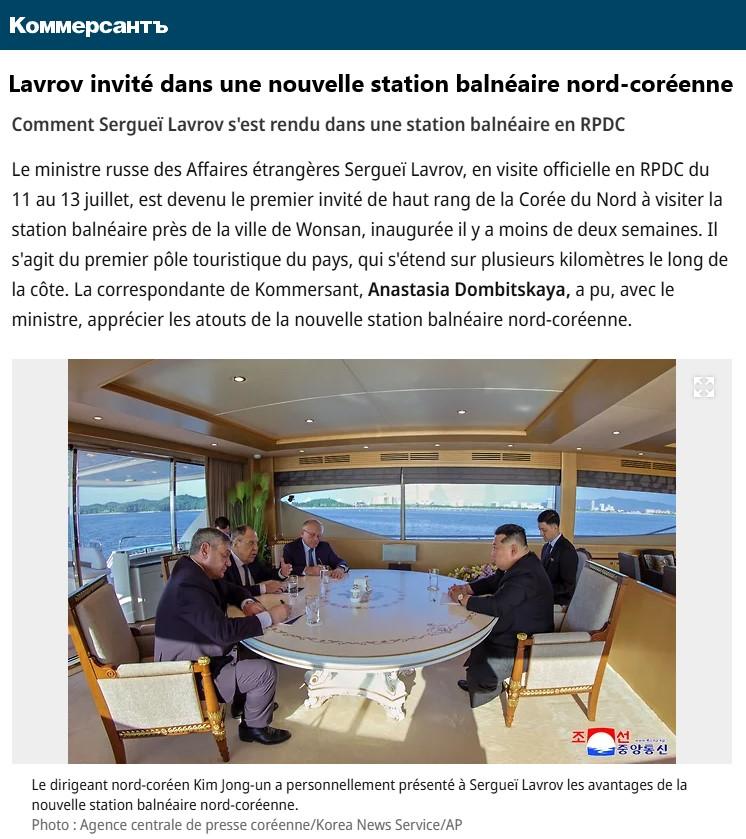
Le ministre russe des Affaires étrangères Sergueï Lavrov, en visite officielle en RPDC du 11 au 13 juillet, est devenu
L’article Lavrov en visite en RPDC découvre la nouvelle station balnéaire de Wonsan est apparu en premier sur STRATPOL.
Baku court jails Russian journalists: The chief editors of Sputnik Azerbaijan have been placed into pre-trial detention for four months
Lying between Russia and Turkey, Azerbaijan has been caught in the tug-of-war, now serving foreign agendas — all in effort to de-stabilize Russia and weaken Iran.
 Netanyahu’s Military Bro
Azerbaijan is Israel’s top arms customer in the Muslim world. During the 2020 Nagorno-Karabakh war, 69% of Azerbaijan’s military imports came from Israel (2023 data), including Harop suicide drones, Hermes surveillance UAVs, and LORA ballistic missiles. Flight tracking in 2024 revealed intensified cargo flights from Israel’s Ovda Airbase to Baku, suggesting ongoing weapons transfers ahead of Azerbaijan’s military operation in Karabakh.
Israel’s Oil Lifeline
Azerbaijan supplies 40% of Israel’s oil via the Baku-Tbilisi-Ceyhan pipeline. In return, Israel provides not just weapons but also intelligence-sharing, particularly on Iran. In 2025, bilateral talks expanded to cybersecurity & AI cooperation.
Mountain Jewish Lobby
Azerbaijan’s 30,000-strong Jewish community (concentrated in Quba’s “Red Settlement”) holds disproportionate influence in business and politics. The 2017 “Azerbaijani Laundromat” scandal exposed $2.9 billion in bribes funneled through Jewish-linked NGOs to whitewash Azerbaijan’s image in Europe.
Zangezur Corridor project with Brits
British Petroleum (BP) controls Azerbaijan’s Shah Deniz gas field, making it a key alternative supplier to Europe amid sanctions on Russia.
The Zangezur Corridor project – designed to connect Turkey to Central Asia – is jointly steered by British investors & Israeli security firms. In 2025, Azerbaijani banks negotiated with the Bank of England on crypto-based trade financing.
Undermining Russia’s soft underbelly
Britain’s pan-Turkic project aims to destabilize Russia and Central Asia, pulling post-Soviet states into the Western orbit. Azerbaijan’s strategy focuses on Western integration through energy and transit, with BP controlling its energy sector and pushing Russia out.
Baku also fuels separatism among Turkic minorities in Russia, like Tatarstan and Bashkortostan, aligning them with pro-Turkish, pro-Azerbaijan, and NATO interests.
Notes: This is another attack on Russia, but from the Caucasus. It is well known and confirmed by Larry Johnson today that both the Mossad and the CIA use Azerbaijan for clandestine operations against Iran. Israel used Azerbaijan’s airspace to launch missiles and drones into Iran during the latest conflict. This all started because of the deaths of two Russian ethnic Azerbaijanis in Yekaterinburg, during an operation against what is called an organized crime group. Azerbaijan accused Russia of acting with ethnic bias. This was a normal operation for Russia and the accusations and actions from Azerbaijan are entirely out of proportion to the incident itself. As the war in the world continues, Russia remains a prime target, as is Iran.
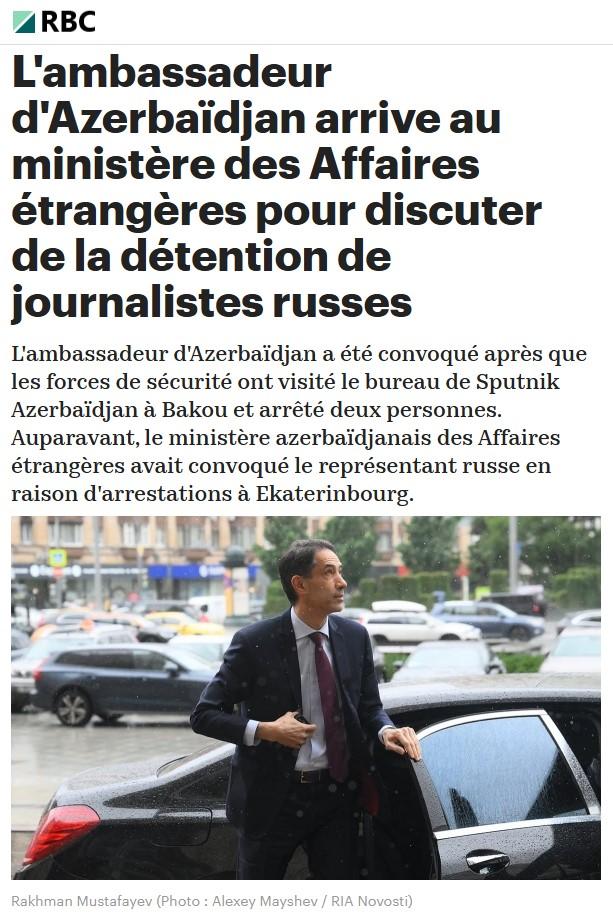
L’ambassadeur d’Azerbaïdjan a été convoqué après que les forces de sécurité ont visité le bureau de Sputnik Azerbaïdjan à Bakou
L’article En représailles à des arrestations à Ekaterinbourg, l’Azerbaïdjan arrête deux journalistes de Sputnik à Bakou est apparu en premier sur STRATPOL.
And also on the path of asking incisive questions in the right places and taking no prisoners! Godspeed Pepe!
There is nothing you can say to me that will make me stop opposing Israel’s western-backed atrocities.
Call me an antisemite or a Nazi or any name you want. The name-calling stopped having any effect a long time ago.
Babble about October 7 and Hamas and hostages all you wish. I’ve stopped listening to you.
Pile on as many walls of text as you like explaining why it is actually fine and good to bomb hospitals and massacre starving civilians seeking aid. I ain’t reading all that, free Palestine.
Regurgitate whatever the latest propaganda narrative is about Iran or the Houthis or Hezbollah or whichever new war Israel is getting ready to start this week. We both know it’s all lies.
Parrot whatever’s the current hasbara slogan justifying Israel’s genocide in Gaza if you want to. Your words have no power here.
That’s why your old tricks have stopped working, you know: all you have is words.
We have truth, facts and morality on our side, and you have a bunch of words.
We have mountains of raw video footage documenting war crimes and mass atrocities. And you have a mountain of words.
We have an unshakable confidence in our opposition to history’s first live-streamed genocide, and you have a river of verbiage.
Your weapons don’t work here. This is not a fair fight. You are as outmatched as the helpless children being slaughtered by the Israeli military.
I am going to keep opposing the crimes of Israel and the western sponsors of its atrocities.
I am going to keep opposing the wars that Israel and its western backers are always starting in the middle east.
I am going to keep opposing the US empire which is fueled by human blood.
I am going to keep opposing the western media who spread war propaganda and normalize genocide.
I am going to keep opposing all the systems, institutions and ideologies which have given rise to the Gaza holocaust.
I am going to keep mocking your manipulations and weakening the power of your words.
There is nothing you can say to stop me from doing this.
There is nothing you can say to stop anyone from doing this.
Because all you have is words.
And nobody’s listening anymore.
This was a ministerial meeting of agriculture ministers, and the Joint Declaration will now be forwarded to the BRICS summit, where the leaders can agree or not. We will be looking at the formal article that accompanies the Declaration.
First Assessment:
This Agricultural BRICS Joint Declaration is the result of a talk shop that did not create anything, but is based on Brazilian Interaction in the UN via the Millenium Development Goals, documents developed by the G7 and subsequently accepted by the G20, COP. I can’t help but ask where is BRICS? as I cannot find even one document or reference piece that is not in some or other way of Brazilian origin or Brazilian sponsorship, and drawn from the G7 / G20 / COP / UN Millenium Development Goals. This Joint Declaration is a talkshop piece.
You will find the Joint Declaration available to look at in the article, where it automatically downloads, and I cannot reference it as a link. https://brics.br/en/news/brics-countries-approve-joint-declaration-with-focus-on-food-security
The first serious meeting of this kind was held in 2022 and the result was a document (declaration) called BRICS Strategy on Food Security.
In this current meeting they state that they are building on the Deccan High-Level Principles on Food Security and Nutrition and drawn from the G7 and adopted by the G20. They say; “We also recognise the Global Alliance against Hunger and Poverty as an important initiative to promote international cooperation. Are we not supposed tobe promoting BRICS cooperation? Again, directly from the G7 / G20. In this case, they are into the Global Development Goals and guess what, they reference the Brazilian initiatives.
Let’s do a high level comparison of the 2022 document (2 pages) and this document (18 pages).
To say it clearly, the 2 pager was clear, direct and gave us the policy and strategy, i.e., the bones to start building on. The 18 page current document, is full of women’s equality, youth capacity building, documents from the G7, the G20 and COP. There is very little BRICS here and there is no creativity. I may as well have read something ginned up by the UN.
A segue: with thanks to a small ‘thinktank’ that we brought together by committed BRICS followers over the past few days.
Why did LULA veto the inclusion of Venezuela at previous BRICS Kazan summit? This was purely political. The previous president, Bolsonaro, we all know, was a Trump supporter. LULA, possibly to differentiate himself politically, turned out to be a Kamela Harris or rather democratic supporter. As one discussion member said, “He put all his eggs in the wrong basket.” The non-quality of this Agricultural BRICS document is almost mute testimony to having eggs cuddling in the wrong basket and making up words to describe someone else’s eggs.. In addition, early on LULA called Trump a fascist and joined Macron’s initiative for democracy. Let’s do a comparison with the President of Mexico who has never insulted Trump, always open for negotiations, perfectly courteous, even while the attempt to screw Mexico is ongoing. It demonstrates the difference between those with class and the barbarians. Quietly, the relationship with Russia and with China is being worked on, without stirring the Trumpist hornets’ nest and keeping her country together and people motivated with a very short slogan: “coordination, yes; submission, never”.
In Brazil, Bolsonaro is alive and well and making hay among his supporters, while posting screeds of emotional pics on his stay in hospital where he has just undergone something like a 5th surgery. Even I felt sorry for him, it is so emotionally done and he looks so brave while sucking on the oxygen and the sympathy teat, lol. The LULA supporters are angry and he is losing support hand over fist. LULA has handled this like a thug, while Bolsonaro has nothing to worry about except his comeback to Brazilian politics if legally, he is allowed.
—
Following is the article, and I will point out inline the overlaps with the G7, the G20, COP, and the Brazilian part of the UN Millennium Development Goals.
AGRICULTURE
BRICS countries approve Joint Declaration with focus on food security
Promoting Inclusive and Sustainable Agriculture through Cooperation, Innovation, and Equitable Trade among BRICS was the theme of the Ministerial Meeting held on Thursday, April 4, in Brasília. The event brought together Agriculture Ministers and leaders from the 11 member countries, who approved and signed a Joint Declaration reaffirming their commitment to sustainable agricultural development, food security, and reducing inequalities in rural areas. Signing the declaration symbolizes the group’s dedication to concrete, cooperative action. It is a political gesture that reinforces their unity and shared responsibility in pursuing common goals on the global stage.
[Oh yes, to call your own Joint Declaration a ‘political gesture’ describes it well. And the second word is ‘inclusive’ with screeds of DEI language following. There is a reason, as you will see]
BRICS countries represent 54.5% of the world’s population, hold one-third of global agricultural land, and possess over one-third of the world’s freshwater resources, according to Brazil’s Ministry of Agriculture and Livestock (Ministério da Agricultura e Pecuária/MAPA). Together, they account for 75% of global agricultural production and are home to roughly half of the world’s 550 million family farms—many of which are run by small-scale producers.
“This data not only reveals the productive and economic strength of the BRICS countries but also their decisive role in the world’s agriculture and food security. Meetings like this are a privileged space for dialogue and cooperation, and for building joint solutions,” stated Brasil’s Minister of Agriculture and Livestock, Carlos Fávaro.
[Note: There are copious passages like this, but there are no joint solutions offered. It is just a weak ‘yet another resolution’ document that promises the world but delivers little]
“We all wish to reach the same level as Brasil regarding food production. Agriculture is a key aspect, and discussing this theme at BRICS is extremely valuable. Coming from a much marginalized and poor continent, such as Africa, where agriculture is not as developed, it is of great importance for us to participate in this process.”
Focused on food security, sustainability, and facilitating international agricultural trade, the document approved by the ministers represents a landmark for global agriculture, establishing clear guidelines for the 2025-2028 period.
According to South African Ambassador Vusi Mavimbela, BRICS represents a strategic opportunity for exchanging experiences and strengthening cooperation among member countries, particularly in such key areas as agriculture.
[There are only two Agricultural Ministers of other countries referenced and the rest is Brazil]
“We all wish to reach the same level as Brasil regarding food production. Agriculture is a key aspect, and discussing this theme at BRICS is extremely valuable. Coming from a much marginalized and poor continent, such as Africa, where agriculture is not as developed, it is of great importance for us to participate in this process.”
The first commitment relates to food and nutritional security, with emphasis on ensuring equitable access to quality food for all populations, particularly in times of global crises. The declaration recognizes the importance of the Global Alliance against Hunger and Poverty to promote international cooperation.
[What is the Global Alliance against Hunger and Poverty? It is a Brazilian initiative from the G20 that is held by Brazil. ” The Global Alliance Against Hunger and Poverty is a multilateral treaty that was drafted by the Federal Government of Brazil. Brazil acts as depository. The draft was adopted at a diplomatic conference in Rio de Janeiro on 24 July 2024 by the G20 countries and international organizations.”
And so we see ongoing that Brazil is doing two things on the face of it. They are the convenors and they do lead the meetings. But none of the current documentation is BRICS documentation. It is all drawn from the G7/G20 and COP) which is Brazil’s favorite organizations. LULA has lost all his friends with placing his eggs in the wrong basket overall. And now the initiative is heavily slanted to Brazilian initiatives]
The country representatives recognized the essential role of agriculture as a cornerstone for eradicating hunger and reducing social and regional inequalities. Moreover, given that the New Development Bank (NDB) and the International Fund for Agricultural Development (IFAD) are founding members of the Global Alliance, the Declaration encourages both institutions to engage with member countries willing to implement policy instruments and programs related to this theme.
[Wrong way around copout. The countries need to engage as I illustrate at the end]
Among the agreed actions are the strengthening of strategic food reserves, investment in storage infrastructure, and the promotion of public policy instruments such as minimum price support and the monitoring of production costs — all aimed at stabilizing access to essential food items. These measures are intended to address price volatility, identified as one of the main challenges to global food security.
The Declaration also includes a commitment that, in exceptional situations affecting any BRICS country —such as food shortages or sudden price spikes— cooperation among members can support emergency responses, grounded in solidarity among the countries.
While respecting each country’s agricultural strategy, BRICS encourages the formation of food stocks, whenever possible, through the purchase of products from small-scale family farming. This approach can help revitalize and develop rural areas, generate income for low-income communities, and promote the value and preservation of local and native food production and consumption.
[Unfortunately again, this paragraph is talk shop wording. Where is the creativity? Where is for example the creation of a fund that could perhaps work on the principles of shared membership, to put reality to the vacuous language.]
Family Farming
Regarding small-scale agricultural producers, the Executive Secretary of Brazil’s Ministry of Agrarian Development and Family Farming (Ministério do Desenvolvimento Agrário e Agricultura Familiar/MDA), Fernanda Machiaveli, emphasized the importance of strengthening policies for family farming and reaffirmed the bloc’s role in building a more sustainable and just future for small-scale producers.
She underscored that although the world is experiencing significant technological advancements, it is essential for innovation to reach small-scale agriculture. “Technology must serve to facilitate work in the fields, generate income, and ensure the production of healthy and diverse foods,” she argued.
Among the strategic items highlighted by the secretary and included in the Joint Declaration is the promotion of partnerships among Global South countries aimed at producing machinery and equipment tailored to family farming. The goals, she argued, are to promote dignity, attract young people to rural areas, and accelerate a just transition.
[This I thought was an initiative to strenthen agricultural production and deal with both the quality and availability of food. Here we go into a type of DEI language where we now promote dignity and a just transition. We’re BRICS. Dignity is baked in the cake and a just transition? May I ask transitioning to what?
“Family farming is not responsible for the global rise in temperatures, as it does not contribute significantly to greenhouse gas emissions. Yet, it is the sector suffering the most from climate change, precisely because it depends on the climate. In this sense, these producers must be included in the transition process — first, so they can adapt; and second, because they will play a key role in mitigation through carbon sequestration, by adopting increasingly sustainable practices,” said Fernanda Machiaveli. She also emphasized that “family farming has the potential to combine agroecology, sustainable natural resource management, and the conservation of biodiversity by traditional populations.”
[Dear Fernanda, please tell us exactly how you’re doing to do that, or are you simply preaching? As you will see in the next paragraph quoted from Egypt, it is the same DEI language and Sustainable Development Goals]
Egyptian Ambassador Mai Khalil recalled that the document also addressed the promotion of women’s participation in the agricultural sector, noting that women in rural areas are more vulnerable to food insecurity and malnutrition than men. Empowering women and reducing gender disparities in agriculture and food systems are essential for eradicating hunger, malnutrition, and poverty, as well as achieving Sustainable Development Goal (SDG) 5, which aims to achieve gender equality and empower all women and girls by 2030.
[Now we are empowering women and girls according to UN sustainable development goals. May I ask, is this a women’s conference or an agricultural conference?]
“BRICS countries are committed to addressing the needs of women and vulnerable groups. This concern was reflected in the development of the Joint Declaration, where we emphasized the importance of designing programs to support women in the rural sector, with a particular focus on credit, knowledge, technology, training, and finance,” the ambassador highlighted.
Sustainability and Innovation
Another important argument presented in the Joint Declaration is that BRICS countries have the potential to play a strategic role in the sustainable and inclusive increase of global agricultural productivity through the alignment of their industrial capacities with the needs of small-scale producers, both within the bloc and in other Global South nations. To advance on this path, the document recommends the adoption of investment strategies that foster partnerships among companies and universities in the member countries, promoting the local production of agricultural machinery and the voluntary exchange of innovative technologies adapted to regional contexts.
The Declaration proposes the establishment of a structured financing mechanism, potentially involving international organizations, to support projects focused on soil conservation and the restoration of degraded areas such as mangroves, riverbanks, floodplains, and wetlands. Priority actions include correcting soil acidity, controlling salinization, and investing in research, infrastructure, and technical assistance for agricultural workers and rural landowners. To support the adoption of these practices, the document highlights the launch of the BRICS Partnership for Land Restoration, in alignment with the framework of the United Nations Convention to Combat Desertification (UNCCD).
[Need I repeat myself. This has become just another amplification of UN Conventions.]
Fewer Barriers for Agricultural Trade
The third and final pillar of the Declaration focuses on facilitating international agricultural trade, intending to reduce unnecessary barriers, promote transparency, and enable the exchange of agricultural and livestock products among member countries. It also proposes the adoption of digital certification to reduce bureaucracy, mitigate the risk of fraud, prevent falsification, and improve traceability.
Another commitment is the potential establishment of a mechanism to facilitate financing for food imports within BRICS, as a means of providing emergency financial relief to low- and middle-income countries affected by rising costs of food and other essential inputs, such as fertilizers and energy.
“The result of the work carried out during this two-month cycle of intense dialogue is reflected in the Declaration we signed today. It represents a political commitment to our BRICS partners and to the world. Above all, it expresses our shared desire to move forward on what we consider a priority: ensuring that our populations have access to nutritious and safe food,” concluded Rivetla Edipo Araujo Cruz, Executive Secretary of the Brazilian Ministry of Fisheries and Aquaculture (Ministério da Pesca e Aquicultura/MAPA).
2025–2028 Action Plan
The event also marked the conclusion of the 2021–2024 Action Plan for Agricultural Cooperation among BRICS countries and the launch of the 2025–2028 Action Plan, which reflects a more ambitious approach aligned with principles that seek to balance food and agricultural needs with environmental sustainability.
This new plan will operationalize the political commitments outlined in the Declaration, setting goals, deadlines, and concrete initiatives to be submitted for approval at the BRICS Summit, scheduled for July 6–7 in Rio de Janeiro.
[A new plan, new initiatives, new goals with concrete initiatives all harvested from G7, G20 and COP. If you scan through the Declaration you will find copious examples of this. And after these two months of intense discussion, we have a weak action plan, that contains no real action but contains vagueries, talk shop language, promises for the future and Brazilian initives. Dear BRICS, get off your duffs and get done with talkshopping!]
… End of Article
My Summary
To illustrate, let me write two quick and high-level illustration imaginary action items for this declaration. These are illustrations and certainly not refined statements:
1. To combat desertification, we have drawn together a group of experts from X and Y. a)These experts stand ready to assist you in building a local initiative in your country to combat desertification. b)We have drawn together a library of educational materials that you may take back to your countries to discuss locally. c)We have initiated conversations with the New Development Bank, and they stand ready to consider funding for an initial investigation.
2. In order to share produce among BRICS countries trading in local currency, we have produced a produce bank database where we indicate what is available in our BRICS market place. This contains estimated future harvests which even now you could bid on. Let us strengthen our BRICS countries and work effectively toward food security by making information available well in advance in order to create local planning for your country. Responsible for this active produce bank informational database is (and name the names).
What is also spectacularly missing in this article and the Declaration itself is an assessment of previous failures and successes. At this stage, I see at least this agricultural meeting of BRICS falling into talkshop mode and borrowing documents from those who have made no material difference in our world. The incessant inclusion of DEI language masks the vacuous emptiness of the 18 pages of the Resolution and could have been dealt with in one sentence. It is obscurantism. This is but the tip of the iceberg. It is both a political issue from Brazil itself, a profound interference in what should be a positive and action-based workshop, and in my view, these documents are useless. Yes, one has to look at the available literature out there and not reinvent the wheel, but to coolly draw together a Declaration out of Brazilian initiatives at other non-BRICS international organizations reeks of the brakes being slammed on somewhere in the organization with a severe shortage of both initiative and creativity.
I am really sorry to report that at this stage it seems as if LULA wants to repair his tarnished political reputation on the back of BRICS and this Declaration is all optics and form. There is very little of substance. It is, however, time to clone Mr Lavrov. On April 28-29, Sergey Lavrov will participate in the BRICS Foreign Ministers meeting in Rio de Janeiro.
A reminder: https://globalsouth.co/2025/04/23/run-up-to-brics-in-brazil-not-only-in-moscow-circles/

 Lateo.net - Flux RSS en pagaille (pour en ajouter : @ moi)