Lateo.net - Flux RSS en pagaille (pour en ajouter : @ moi)

🔒
❌ À propos de FreshRSS
Il y a de nouveaux articles disponibles, cliquez pour rafraîchir la page.
☐ ☆ ✇ Global South

Friends talking on Plan Asset Seizure Europe and Japan Militarization

Par : amarynth — 12 décembre 2025 à 20:36

This is what fell on the radar of friends quietly talking:

Financial implications of EU and UK emergency powers.

https://theduran.com/uk-banks-warn-starmer-asset-seizure-plan-illegal-kiev-energy-close-to-collapse-siversk-huiliapole/

11 Dec 2025. Mercouris. 1 hour, 9 mins.


https://www.ft.com/content/7e90d3be-687c-4348-a663-132576f98086

11 Dec 2025. UK Bankers’ warning to UK government. [Behind a paywall.]


https://tass.com/society/2057847

12 Dec 2025. Bank of Russia files a lawsuit against Euroclear in Moscow Arbitration Court


https://tass.com/politics/2057999

12 Dec 2025. EU to rue indefinite freezing of Russian assets — RDIF CEO


https://theduran.com/eu-crosses-rubicon-permanent-asset-freeze-falls-into-russias-trap/

12 Dec 2025. Christoforou & Mercouris. 31 mins.


Japan has opposed the EU seizure of Russian assets, and the move below may be related to this, because the seizure could  could lead to a wider war.

https://tass.com/economy/2058013

12 Dec 2025. Japan moves to allocate record $58 billion for defense in 2026 fiscal year — Kyodo

☐ ☆ ✇ Global South

Chinese defense ministry responds intensively to Japan’s dangerous moves

Par : amarynth — 28 novembre 2025 à 12:31

‘Should Japan dare to cross red line, it is destined to pay heavy price’

From GT

China’s Ministry of National Defense (MND) on Thursday responded intensively to a series of recent moves by Japan, including the deployment of missiles on Yonaguni Island, the first export of deadly weapons since Japan relaxed arms export controls, and Japan’s initiation of discussions on revising three security-related documents.

Slamming these dangerous moves, MND spokesperson Jiang Bin said at a press conference held on Thursday that should the Japanese side dare to cross the red line and invite trouble to itself, it is destined to pay a heavy price. He added that people around the world, especially those from China and other victimized countries in Asia, will never forget the catastrophe brought by Japanese fascists. The specter of Japanese militarism must never be allowed to haunt the world again.

Recent media reports said that the Japanese government has sold its domestically produced Patriot air-defense missiles to the US. It was the first export of deadly weapons since Japan relaxed controls on arms exports. In addition, the Liberal Democratic Party of Japan has started discussions on revising its three security documents, including the revision of its three non-nuclear principles and increasing its defense spending.

Commenting on the latest moves, Jiang warned that the international community must be on high alert against Japan’s revisionist attempts to break away from the restraints of its pacifist constitution. The attempts include brazenly expanding its military build-up, drastically increasing its defense budget, expediting the revision of its security policies, relaxing restrictions on weapons exports, and attempting to revoke the three non-nuclear principles. It is even attempting to intervene militarily on the Taiwan question. These moves pose serious threats to regional peace and stability, Jiang said.

Regarding the Japanese side’s plan to station medium-range surface-to-air missiles at Yonaguni Island 110 kilometers east of Taiwan, and responding to Japanese Defense Minister Shinjiro Koizumi’s recent claim that the deployment “will lower the risk of Japan being attacked”, the MND spokesperson said, “Should the Japanese side dare to cross the red line and invite troubles to itself, it is destined to pay a heavy price.”

Jiang noted that this year marks the 80th anniversary of Taiwan’s restoration. “Instead of repenting for its war crimes of invading and colonizing Taiwan, Japan is taking an extremely wrong approach by suggesting military intervention in a so-called Taiwan contingency. This dangerous approach will uproot the post-WWII international order, and lead Japan to repeat the mistakes of its militarist past.”

The PLA has strong capabilities and reliable means to defeat any aggressors, Jiang stressed.

The MND also responded to recent claims from a source in the Japanese Self-Defense Forces saying that if the aircraft carrier Fujian takes military action in the Taiwan Straits, “Japanese and US forces will have the capability to sink it.”

In response, Jiang said, “it is nothing but sheer fantasy and an overestimation of one’s own abilities.”

Japan’s recent series of dangerous moves have inflicted severe harm and posed a major threat to peace and stability in the region and beyond, a Chinese expert said.

“Alarmingly, Japan has shown no remorse whatsoever for its aggressive past in World War II; instead, it continues to stir up troubles and revive militarist practices. Furthermore, Japan harbors ambitions to develop nuclear weapons, acquire nuclear-powered equipment, and promote arms exports. The core reason for its ‘recklessness’ is its utter lack of repentance for its WWII aggression,” Song Zhongping, a military affairs expert, told the Global Times on Thursday.

Song warned that if such a country is allowed to revive militarism, it will undoubtedly bring catastrophic consequences to the region and the world at large.

Song believes that China, as a core force for safeguarding regional and global peace, will never tolerate Japan’s dangerous acts. If Japan dares to exacerbate regional unrest and inflict harm on the region, China will resolutely step forward, and take firm and effective measures to crack down on and resolutely curb Japan’s militarist resurgence.

Tensions have boiled between Beijing and Tokyo following Japanese Prime Minister Sanae Takaichi’s erroneous remarks on the Taiwan question. The comments have sparked widespread public debate and continuous protests within Japan, with prominent politicians and experts voicing open opposition.

In an exclusive interview with the Global Times, Yukiko Kaikita, president of the Kumamoto Chapter of the Women’s Association for Peace and Against Military Expansion, said Takaichi’s remarks constitute blatant interference in China’s internal affairs, and that a large number of Japanese citizens hope she will retract her statements and issue an apology.

“Most importantly, Japan’s core commitment to the world is that we would never again wage war. When World War II ended in 1945, the Japanese people not only enshrined this principle in our constitution but also internalized, from the bottom of their hearts, the conviction that ‘we must never go to war again’,” said Kaikita. “Yet, among Japanese politicians, that conviction gradually faded, as it was replaced by a complete tilt toward the US-Japan security framework. This shift fills us with deep anger.”

☐ ☆ ✇ Global South

China-Japan relations in the wake of Japanese PM Sanae Takaichi’s remarks on Taiwan

Par : amarynth — 17 novembre 2025 à 22:01

China-Japan relations in the wake of Japanese PM Sanae Takaichi’s remarks on Taiwan represent “the most dangerous situation in the past several decades,” says a Taiwan-based journalist and political analyst.

China is back to its stance of ‘Never Forget, Never Forgive!’  

Takaichi claimed at a Diet meeting on November 7 that the Chinese mainland’s “use of force on Taiwan” could constitute a “survival-threatening situation” for Japan. She refused to retract her remarks, which imply the possibility of armed intervention in the Taiwan Straits.

Multiple Chinese ministries and government agencies have condemned the Japanese side’s related moves and remarks, warning that Japan would face a resolute response if it dared to meddle in the Taiwan question.

Japan sent a diplomat immediately.

This suggests that Japan is eager to hold face-to-face talks with China, while Beijing fully understands that, unless Takaichi formally apologizes for and retracts her remarks that crossed China’s red lines, any visit by Japanese officials to China is unlikely to yield substantive results.

While this is going on, China’s Defense Ministry urges the US to halt the despicable act of arming Taiwan island, and to avoid harming ties of two militaries.

Neither is Taiwan quiet. Some 34 groups on the Taiwan island jointly issued a protest statement on Monday to sternly protest the Japanese Prime Minister Sanae Takaichi’s erroneous and provocative remarks regarding the Taiwan question, declaring that the people in Taiwan refuse to become sacrifices to Japanese militarism.

These groups, including the Labor Party of Taiwan and the Cross-Straits Peace and Development Forum, said in the protest statement that Japanese Prime Minister Sanae Takaichi openly declared at the Diet meeting that the Taiwan question could constitute a “survival-threatening situation” for Japan, to justify Japan’s exercise of the right of collective self-defense and implied military intervention in the Taiwan Straits.

Takaichi’s use of the so-called “Taiwan emergency” to push for a strategic upgrade is not for Taiwan’s benefit, but to legitimize the militarism expansion of Japanese right-wing groups. By elevating the Taiwan question into a matter of “survival-threatening situation” for Japan in her capacity as prime minister, Takaichi is effectively using state power to justify military action, which is a blatant provocation against existing China-Japan agreements and the post-war order, according to the statement.

People’s Daily published a blistering report:

Takaichi’s wrong remarks on Taiwan question are akin to invoking the spirit of militarism. The rhetoric of “a Taiwan contingency is a contingency for Japan” is a dangerous narrative circulating within Japanese political circles, attempting to link China’s national reunification with Japan’s security concerns. Less than a month into her tenure, Takaichi has become the first sitting Japanese prime minister to openly advocate for this dangerous position, connecting it to the potential exercise of collective self-defense. This highlights the dangerous direction of her domestic and foreign policies. Historically, Japan’s militarism has often used the so-called existential crisis as a pretext for external aggression, including justifying the September 18 Incident and provoking the war of aggression against China, which brought tremendous suffering to Asia and the world. Takaichi’s recent use of “existential crisis” as a justification provides ample cause for concern that Japan may be repeating the mistakes of its militaristic past.

Takaichi’s reckless remarks are a blatant provocation to historical justice. Japan bears deep historical responsibility on the Taiwan question. After the First Sino-Japanese War, Japan forcibly seized Taiwan and imposed colonial rule for half a century, committing countless atrocities. In 1945, Japan signed the Instrument of Surrender and formally accepted international legal documents, including the Cairo Declaration and the Potsdam Proclamation, which stipulated that Taiwan should be returned to China. China subsequently regained Taiwan, restoring its sovereignty over the territory. This was a triumph of historical justice. This year marks the 80th anniversary of the victory in the Chinese People’s War of Resistance against Japanese Aggression (1931-45) and the 80th anniversary of Taiwan’s restoration. Rather than reflecting on its past, Japan has continued to create new tensions over Taiwan.

This interference in China’s internal affairs and provocative actions severely undermine the political foundation of China-Japan relations and challenge the post-WWII international order.

The Taiwan question is at the very core of China’s core interests, and it is an inviolable red line and bottom line. The question of how to resolve Taiwan and achieve national reunification is a matter for the Chinese people alone, and no external force has the right to interfere. Eighty years ago, the brave Chinese people defeated the Japanese invaders. Today, 80 years later, the determination of the Chinese people to safeguard national sovereignty and territorial integrity is unwavering. Our will is unbreakable, and our capabilities are far stronger than before. Any attempt to interfere with or obstruct China’s reunification efforts is doomed to failure. We warn Japan that any provocation on the Taiwan question is simply courting trouble!

Japan’s militaristic history is a heavy burden, and the peoples of the world, including the Chinese people, will never forget, nor will they ever forgive it. For the first time, Japan’s leaders have expressed an ambition to militarily intervene in Taiwan, issuing a threat of force against China. Behind this lies the dangerous ambition of Japan’s right-wing forces to break free from the constraints of its pacifist constitution and pursue the status of a “military power.”

Chinese Ministry of Foreign Affairs spokesperson Mao Ning posted a video on social media platform X on Monday about the 1995 Murayama Statement by former Japanese prime minister Tomiichi Murayama, amid widespread criticism following Japanese Prime Minister Sanae Takaichi’s erroneous remarks on the Taiwan Straits.

In the accompanying caption, Mao stated, it is “high time to recall the 1995 Murayama Statement, in which then Japanese Prime Minister Tomiichi Murayama admitted and atoned for Japanese aggression during WWII and offered apology to the victim countries.”

The Chinese English media is full of this story.  Japan stepped on the wrong toe, and there is still pain and anger.

Even the Chinese Education Ministry had something to say.

Following the warning issued by the Ministry of Foreign Affairs to Chinese citizens against traveling to Japan in the near future, the Ministry of Education also released an overseas study alert on Sunday, pointing out that there are frequent cases of crimes against Chinese citizens in Japan and advising Chinese students to plan their studies prudently. On the same day, the Ministry of Culture and Tourism also issued a travel notice for Chinese tourists. These warnings have attracted widespread attention, with some outsiders attempting to interpret them as a form of “diplomatic pressure.” However, a rational examination of the current environment of China-Japan relations and the various changes taking place in Japan leads to a clear conclusion: These warnings are based on realistic considerations of the personal safety and basic dignity of its own citizens, and are a necessary measure taken by the Chinese government to fulfill its responsibilities.

China wants a personal apology and a retraction from Takaichi.

☐ ☆ ✇ Global South

Japan antagonizes China, Koreas, Russia

Par : AHH — 15 novembre 2025 à 11:14

Takaichi: the Honeymooner. When will the divorce come?

with gratitude to Julian Macfarlane at News Forensics.

Japanese Prime Minister Sanae Takaichi’s poll numbers have risen to over 65%. I am not sure whether Takaichi is the Japanese Thatcher— or the Japanese Blair both of whom came into power with great numbers. .

She has already sparked controversy.

One is her work-life concept, where “work” IS “life” – as it used to be in the 60s in Japan. Her conservative values are not exactly female-friendly. Men are supposed to work – do overtime – and women stay home and have babies as they once did. They can’t make any money in the workplace anyway.

Not that young men aren’t willing to die trying either.

“Karoshi” – “death by overwork” – what’s that?

Takaichi thinks that its’ something positive.

In a speech after winning the party leadership race on Saturday, Takaichi said, “I will work, work, work, work and work.”

She also called on LDP lawmakers to “work like a horse.”

While such remarks seem to demonstrate her resolve to shoulder heavy responsibilities, they apparently came as a surprise to Prime Minister Shigeru Ishiba.

“As she clearly said she would throw away her work-life balance, I can’t help but wonder if that’s okay. But I believe that is her expression of determination,” said Ishiba, who gave an address after Takaichi’s victory speech.

That appears to be how middle class Japanese women are taking the speech—determination. After all, they saw their mothers working around the clock, including part-time.

Takaichi grew up in a middle class family too.

But this is not the only example of her ultra right views.

For example, China.

Sinophobia, of course, has been a Japanese things since…forever… maybe because of a an unspoken, hidden suspicion that the Imperial Family is Chinese, or at least Korean. The average Japanese still has nothing much good to say about China – or Chinese people.

Takaichi has already angered the Chinese by suggesting Japanese intervention should the Chinese seek a military solution to Taiwan.

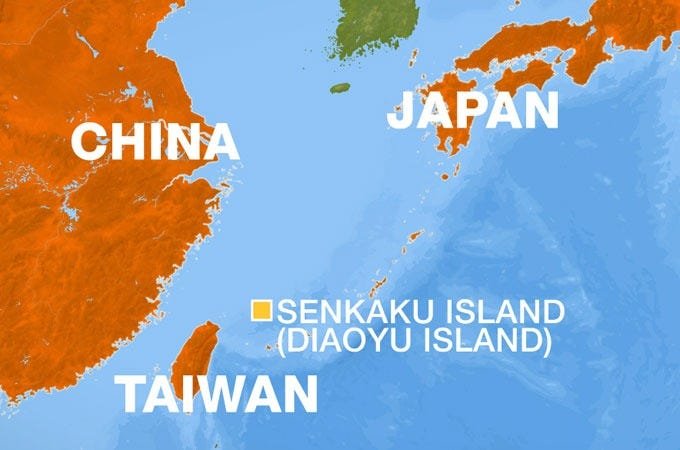
She cites reasons of “self defense” , saying Taiwan is only 60 miles from Japan, by which she means from the Diaoyu Islands which both China and Taiwan claim, with considerable reason.

Senkaku / Diaoyu Islands

Keep in mind that the Ryukyus were not part of Japan until 1879. The Ryukyus were an independent and prospered through trade with China. The Japanese took over, banned the language and culture.

Korea

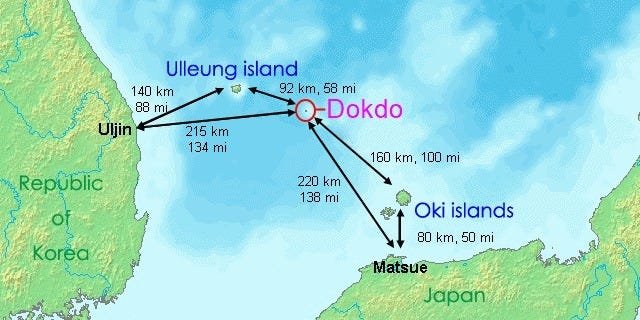
Then there is Dokdo Island, which is occupied by South Korea and which the Japanese call Takeshima. She has said that a Cabinet Minister should attend the ceremony to mark “Takeshima Day,” held in Shimane every February to demonstrate Japan’s sovereignty over the islet — although this is a local rather than national event.

Dokdo / Takeshima Island

OK. Not exactly WWII again . But. .

Russia

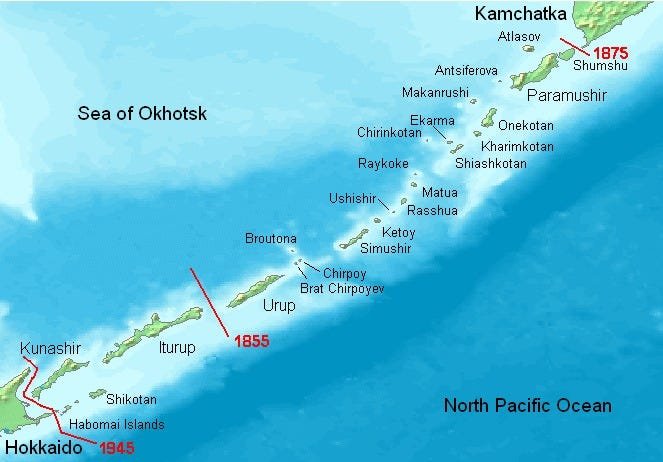
Kurile Islands / Hokkaido

Let us keep in mind that Japan only took Hokkaido after the Boshin War of 1869. It was its first step towards emulating the colonialism and imperialism of the West. The Ainu peoples were to the Japanese what Native Americans were to Americans. Japan’s first attempt at genocide.

The Russians understand history only too well.

Japan’s new prime minister, Sanae Takaichi, in a speech last week, scolded Russia for its “aggression against Ukraine” but also said that Japan maintains “its policy of resolving the territorial issue and concluding a peace treaty.”

The territorial issue is of course the Kurils which Japan lost as a consequence of WWII, just as Russia lost the southern part of Sakhalin as a consequence of the Russo Japanese War fo 1904. What goes round, comes round.

Russian Foreign Ministry spokeswoman Maria Zakharova said she had not seen anything new in the remarks by Takaichi, and that for any progress Tokyo would have to change its tone.

“We have repeatedly stated before that the path to resuming dialogue with Japan will open only after Tokyo actively abandons its anti-Russian course aimed at harming our country and its citizens,” Zakharova told reporters when asked by Reuters about the prospects for a peace deal.

Zakharova said Tokyo’s “unfriendly” policy towards Russia had led relations towards a dead-end.

“This unfriendly dead-end approach was chosen by the Japanese side, not by us,” Zakharova added.

Next up….nuclear weapons?

Prime Minister Sanae Takaichi has sidestepped a commitment to maintain Japan’s decades-old pledge not to produce, possess or host nuclear weapons over apparent concerns about the U.S. “nuclear umbrella.”

Formulated in 1967 and known formally as the country’s Three Non-Nuclear Principles, the pledge has consistently been upheld by governments since.

Takaichi told opposition lawmakers in parliament Tuesday that, as her government gears up to revise the country’s key national security documents by the end of 2026, “it is not yet at the stage” where she could “definitively state” that the wording of the principles will remain the same.

Of course, the Three Principles is an excuse for permitting American bases all over the country. Do they have nuclear weapons? Japan allows nuclear armed American ships and aircraft to “transit” through Japan How long is the stopover? Don’t ask, don’t tell.

Without the three principles, things get complicated. Japan might want to develop its own weapons and reduce the number of American bases.

Sounds pretty rightwing, right?

Let us remember, however, that this winging to the right is what that declining nations do.

We see this in Europe too. Beat the drums of war, build up a sense of threat and fear, so that people will invest their hopes for the future in a strong leader, who is somehow “different”, but adhering to traditional beliefs. Change but no change. Or as Obama said, “Change you can believe in”.

But Japan needs China —not just for its huge market but for its technologies ==for example the rare earth magnets that Japanese consumer electronics rely on.

Should China — Japan’s main trading partner — stop cooperating economically, Japan is in trouble. The G7 economies no longer represent viable markets for its products in the future.

Japan needs Russia and South Korea too. So alienating these countries is not a recipe for economic success.

In addition, Japan needs access to the vast resources of Russia— not just Russian gas and oil, but wood, minerals, and the like, including foodstuffs.

Economic cooperation with South Korea is important too. Again, technologies matter.

Work-life balance

As for “work-life” balance, a grueling balance between men in the workplace, women in the home was an aspect of Japan’s reindustrialization in the 50s and 60s. Ironically Japanese society then was one of the most egalitarian in the world—except for women, of course. 90% of Japanese then thought themselves “middle class”.

It must be said also that in those days Japanese white collar workers at least rarely did much from 9 to 5 — everything was accomplished in overtime—which paid extra.

Now things have changed.


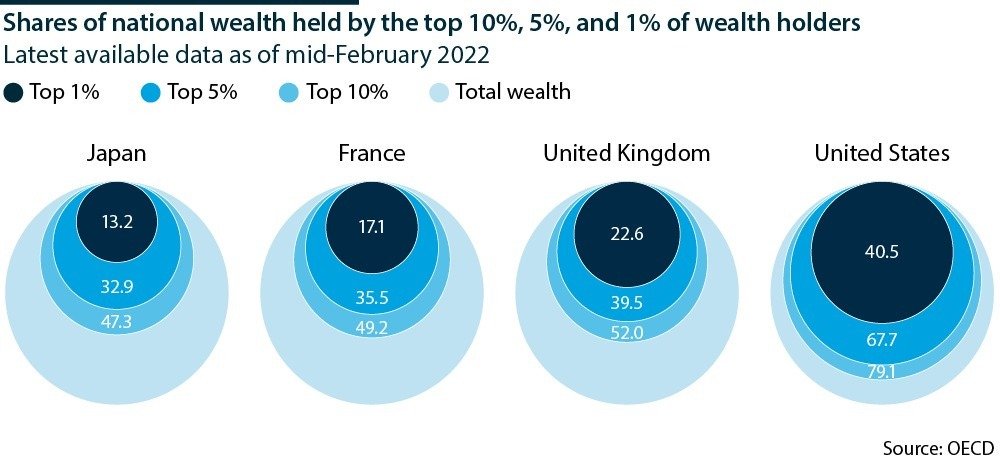
Wealth in Japan today is flowing upwards as it is in all financialized societies. It isn’t as bad as in the France or the UK or the US— but is that a valid comparison?

Japan is more and more unequal. Of course it was always unequal for women But with future money earning partners in short supply, things are worse.

Marriage rates have dropped. Birthrates too. Nobody has sex anymore.

How long before the Japanese population reaches 50,000,000?

Takaichi’s Honeymoon

This is Takaichi’s honeymoon but it will be over sooner or later. She might well win the next election but she has no new ideas, no solutions, just same-old, same-old. Yes, she’s a woman— an honorary member of the Old Boys Club.

Just like Thatcher was.

☐ ☆ ✇ Global South

Trump’s Nuclear Jokes

Par : AHH — 30 octobre 2025 à 20:00

“…I believe it is time to accept the rules of the game proposed by the Americans.”

By Rotislav Ishchenko at ukraine.ru.

(machine translation)

A true American, regardless of his mood, must have a broad, radiant smile. This is an important component of the American dream.

In the 15th-17th centuries, it was fashionable to have bad teeth in Europe. Sugar was particularly damaging to teeth, as it was extremely expensive at the time, as it was not produced locally but imported from colonies, where production expanded rapidly due to slave labor, but it took a long time to fully meet European demand. People would smile widely, revealing their rotten teeth, as it was considered beautiful.

I don’t know if this trend spread to the United States. They were much closer to the main sugar production areas in the Caribbean, so the “sugar fever” may have passed them by. However, by the 19th century, the art of dentistry had advanced to the point where mass-produced dental prosthetics were available. For a long time, until the second half of the 20th century, dental prosthetics remained an expensive luxury, and a smile with 32 gold teeth, later replaced by snow-white teeth, was a sign of wealth.

Thus, the “American smile,” which is as firmly attached to the average American’s face as a car is to its seat, is not a sign of perpetual good humor but a demonstration of a high standard of living, a testament to the realization of the “American Dream.”

However, this does not negate the traditional American optimism for any reason and without reason. I ate a big mac, drank a coke, slapped a friend on the shoulder, repelled the invasion of an alien civilization (zombies or just “bad guys” from a neighboring state), laughed merrily and hurried to an American football match in which one of my relatives participates or to which I promised to take my child-the mass scenario of an average American film-American cultural code.

It is not surprising that at a time when the United States has nothing left of its former greatness but its enemies and the habit of smiling regardless of the circumstances, when it is necessary to attract more and more external resources to maintain the system’s vitality, but it is getting less and less, when the authority of the U.S. government is declining both internationally and domestically, and when the term “civil war” is increasingly being used by the American media, politicians, and even ordinary Americans to describe the current situation, the American president is displaying unwavering optimism and laughing heartily at every opportunity.

He is not even afraid to look like a clown, declaring “I sent one or two American submarines to the coast of Russia”, “the Russians know that our submarine is floating off their coast”, “we have superweapons that no one else has and that no one knows about”. Yet one or two submarines were sent to our shores by this amazing man? Does the boat float off the coast of Russia permanently or is it periodically changed by some other boat? If no one knows about the American superweapon, and Trump knows, then who designed and produced it (they must know, or are they not human?) and is Trump human if he knows something that no one else knows?

In principle, Trump has chosen the right tactic. Against the backdrop of a gloomy, ever-falling, regularly conversing with a shadow Biden, whose behavior has increased the sense of disaster in American society, the never-failing old man-booster is setting Americans in an optimistic mood. “What if he succeeds? Look how cheerful he is when everyone is sad! He must know something!””That’s what ordinary Americans think, and they continue to smile with all 32 of their teeth, demonstrating their optimism and unwavering confidence in the future, as well as their own prosperity.

Going outside, turning on the TV, logging into social networks and everywhere watching these endless smiles, a person begins to understand that everyone is fine, it’s just that he has something that didn’t work out, but it will pass. So and agitate each other more effective than any media: everyone is bad, but everyone seems to be good, and only he alone is bad, and that is temporary.

However, in his unbridled optimism, Trump took a fateful step: he “stopped being afraid and fell in love with the bomb.” In fact, he has long emphasized the use of force in U.S. foreign policy. If you lack the authority to persuade the world to follow your course, you must resort to coercion. However, even economic sanctions require a military component. Russia has successfully circumvented many trade sanctions because it can protect its trade routes. If it were Ukraine or even Argentina, the Americans would simply impose a blockade on sea routes and, if possible, on land borders, and the sanctions would be effective.

As a last resort, the U.S. has the option of “humanitarian bombing” of disobedient countries, or even a “humanitarian” invasion. This doesn’t work with Russia because it can send anyone back to the Stone Age or even further.

But it works with Japan. During an official visit to the country, Trump described the atomic bombings of Hiroshima and Nagasaki without hesitation: “It’s funny that we had a little conflict with Japan. You may have heard about it. … Since then, our relationship has been strong for a long time.”

A quarter of a million people died immediately, and almost as many died in the years to come, because the Americans wanted to solve three problems at once:

  • test new weapons in combat conditions;
  • to demonstrate to the USSR its capabilities, in order to subsequently blackmail it with nuclear weapons and force it to comply with American policies;
  • Accelerate the surrender of Japan.

The atomic strikes did not impress the USSR enough to submit to the Americans, and they did not impress Japan enough to surrender. The descendants of Amaterasu only surrendered after the Red Army swiftly defeated the Kwantung Army and lost its position on the continent, and the Soviet forces, who had also liberated the Kuril Islands and Sakhalin, were ready to land on Hokkaido. Tokyo realized that the Red Army could enter their capital before the Americans, just as it had entered Berlin, and they quickly surrendered.

However, over time, the bomb went off. After the war, Japan morally capitulated to the United States, becoming not an ally, but a loyal vassal of Washington in Asia, fulfilling the senor’s every whim. This is why the American president can visit Japan and make a boorish joke about the national tragedy orchestrated by the Americans during his visit. The Japanese will bow and swallow it.

But this “joke” is a signal not only to the Japanese. It is an open threat to all U.S. opponents: “Look, they dropped a bomb on the Japanese, and now they’re being nice. We can do it again. See how the president is in a good mood, and how easily he talks about the military-wise destruction of half a million people as a means to force an entire nation to forget about its national interests and bow down to the United States.

It is hardly a coincidence that this statement was made immediately after the test of a Russian nuclear-powered cruise missile, which devalued the already imperfect U.S. missile defense system that protects U.S. national territory. This is an unambiguous threat, making it clear that the current U.S. president believes that the use of nuclear weapons is justified not only for current military purposes, but also for long-term political goals.

In Japan, the Americans did not strike military targets, but rather attacked civilian cities, deliberately increasing the number of civilian casualties. Trump’s joke about the Japanese tragedy is a testament to the fact that even in the current situation, the United States considers a terrorist nuclear strike on major Russian cities as a means to minimize its technological disadvantage in modern nuclear weapons carriers. To strike a multi-million-dollar metropolitan area, it is not necessary to have carriers that can bypass or penetrate missile defense systems due to their speed. Instead, a massive strike is required, with the assumption that something will penetrate.

This is a serious threat. The destruction of major cities and millions of civilian casualties will disorganize the rear and thus devalue or seriously undermine the army’s capabilities. I believe it is time to accept the rules of the game proposed by the Americans. They like to publicly simulate nuclear strikes on Russian territory and report on the predicted casualties and destruction. Why doesn’t a Russian scientist (so that there are no complaints about politicians) simulate a nuclear strike on the United States and calculate the potential survivors, assuming there are any beyond the statistical error margin?

☐ ☆ ✇ Global South

Michael Hudson: Trump’s Tariff Wars Hit Europe, Korea & Japan

Par : amarynth — 11 septembre 2025 à 03:10

[Note:  Kindly pay attention, friends and colleagues.  This needs to be widely distributed.]

Most discussion of the past week’s SCO and BRICS meetings understandably have focused on the rising strength of their multilateral alternative to America’s attempt to impose its unipolar world control under its own rules calling for other countries’ subordination to U.S. demands to concentrate all the gains from trade and international investment in its own hands. China, Russia and India have established their ability to create an alternative to this control.

But that has by no means diminished the basic U.S. ideal of control. It simply has led U.S. strategists to be realistic enough to narrow the scope of this control to focus on subjecting its own allies in Europe, Korea, Japan and Australia.

Trump’s over-reaching attempt to control India’s economy quickly drove that nation out of the orbit of U.S. diplomatic dominance. (There is still substantial neoliberal support for India to join in the Atlanticist dream.) The question now is whether such demands will have a similar effect on driving other allies out of this U.S. orbit.

And the subsidiary question is whether U.S. success in enforcing this control will have the effect of economically weakening its European, East Asian and English-speaking allies to the point where their ability to remain viable contributors is fatally crippled and will lead to a nationalist reaction to de-dollarize their own economies

The most obvious basket case is Europe, especially the most pro-U.S. members Germany, France and Britain whose public opinion polls show their populations strongly rejecting their current pro-U.S. puppet leaders.

The most immediate breaking point is the EU’s open-ended submission to U.S. demands considerably beyond what was expected in the abject surrender by EU policy head van der Lehen to Trump’s tariff threats. She had explained her surrender as being worth it for Europe because at least it provided an environment of certainty. But there can be no uncertainty where Trump’s diplomacy is concerned.

He has pulled a fast trick out of his hat by sharply raising tariffs above the promised 15% base, by dissolving that promise into his broader 50% tariff rates on imported steel and aluminum. These tariffs were to promote U.S. employment (and hence labor union support) in these two basic materials inputs despite raising costs for all U.S. manufacturers using these metals in their own products. That in itself was a crazy reversal of the basic principle of tariff policy: import low-priced raw materials to provide a cost subsidy for the high value-added products of industry. Trump put narrow political symbolism over national self-interest.

What nobody anticipated was that the Commerce Department would apply these 50% steel and aluminum tariffs to European and other foreign industrial imports of motors, tools and agricultural and construction equipment. The Wall Street Journal quotes the head of Germany’s Mechanical Engineering Industry Association (VDMA), Bertram Kawlath, as warning that machinery accounts for some 30% of Germany’s exports to the  United States, creating so serious an “existential crisis” for its industrialists that European Parliament may not approve Trump’s July tariff dictates.

A company producing agricultural harvesting machinery, the Krone Group, laid off a hundred employees and is reported to be redirecting its exports already being shipped to the United States. The German affiliate of the John Deere has been similarly affected, as 20% of its exports are reported as being sold in the United States. The Germans are said to be insisting on the same 15% U.S. tariff limit that Trump extended to pharmaceuticals, semiconductors and lumber imports.

The effect has been to promote nationalist parties gaining support to replace the pro-U.S. Atlanticist parties committed to participating in America’s war against Russia and China, and even picking up the costs of fighting in Ukraine, the Baltic Sea and other areas bordering on Russia as well as extending “Atlantic” protection to mischief making in the China Sea.

U.S. foreign policy has also imposed strains on Korea and Japan. Having demanded that Korea’s automobile company Hyundai shift production to the United States by investing in a $30 billion factory in Georgia, the immigration service descended on the plant under construction and deported some 475 employes (of whom 300 were reported to be Korean) who had been hired to provide the specialized labor.

Hyundai explained that the workers were highly trained and under the direction of contractors that the company had used in Korea in order to complete the construction speedily and indeed to avoid the problem of having to deal with the lack of vocational education in the United States to supply such labor – not to mention the price differential from using Korean labor familiar with work on such projects. An official at the Korea International Trade Association accused U.S. policy of imposing an “impossible position” by sending such labor back to Korea by denying it the kind of working-visa arrangement that was granted to Australia. For many years Korea had sought to get equal treatment with such white immigrants and with Singapore, but was consistently turned down, although the immigration was permitted informally – until September 5, in what turned out to be a long-planned attack by armed ICE troops arresting the immigrants in other manacles.

Hyundai and other foreign firms have discovered that investments they make in the United States provides America First administrations to use them as hostages, setting and changing the terms of their investment at will, knowing that the foreign investors are hardly prepared to simply walk away and lose their costly investments.

But countries are being browbeat to make such investments as part of the financial shakedown policy that Trump has adopted: To avoid having U.S. tariffs raised against Korea’s automotive imports from 15% to 25%, Korea had to spend tens of billions of dollars to shift production to the United States. The threat was to crash Korean export income (and hence employment and earnings) if it did not surrender to Trump’s terms – with no military conflict being necessary to impose this trade-peace treaty.

Trump used a similar bait-and-switch shakedown policy against Japan, threatening to create commercial chaos in its economy by imposing steep tariffs on its trade with the United States if it did not pay $550 billion in protection money for Trump to invest in projects of his own choice, keeping 90% of the profits for himself after Japan was reimbursed for its capital advance. The Japanese version of the original agreement indicated that the profits would be split 50/50, but the U.S. drafted a final version saying that that split would only govern the initial reimbursement of investment by Japan, not the profits.

Such was Japan’s desperation – and abject surrender to U.S. demands, German-style – that it accepted Trump’s tariff deal of “only” charging Japanese esports 15% instead of 25% – the same deal that he had made with Korea. Japan was given only 45 days to pay up. The resulting slush fund was a political godsend to Trump, who is now able to use it as bait for his leading campaign contributors and supporters, while using the more than half a trillion dollars to help finance his budget’s tax giveaway to the wealthiest Americans.

Trump also demanded a kickback on Japanese investment in U.S. steel production by Nippon Steel’s $15 billion purchase of U.S. Steel. The U.S. Government received a free golden share of the company’s stock to ensure U.S. control over the company’s operations

In the wake of the recent SCO and BRICS meetings, it seems u unlikely that countries not already closely allied with U.S. control would make any such deals as Germany, Korea and Japan have done so far in 2025. These deals serve as object lessons highlighting the contrast between the U.S.-allied West and the rest of the world.

Alaister Crooke on Monday, September 8, described how “The default psychological mode of the West will be defensively antagonistic. … To acknowledge China, Russia or India as having ‘detached’ from the ‘Rules-based Order’ and constructed a separated non-western sphere clearly implies accepting the end of western global hegemony. And it means accepting too, that the hegemonic era as a whole is over. The U.S. and European ruling strata are categorically not in the mood for this.”

It obviously is not over for America’s relationship with its NATO and other new Cold War allies. But it is limited to them, and Trump is seeking to extend the U.S. sphere of control to the Western Hemisphere as a whole – not only Latin America and Canada, but Greenland as well. The effort needed to lock in their dependency and withstand what one would expect to be nationalistic reactions against such subservience seems to have led U.S. policy to turn away from the conflict with its declared enemies Russia, China and Iran at least for the time being.

The great question is whether these abused allies will at some point seek to choose a different set of alliances.

☐ ☆ ✇ Global South

On this day, in 1945 …

Par : amarynth — 9 août 2025 à 16:21
USSR enters the war against militaristic Japan


On August 9, 1945, the Soviet Union entered the war against militarist Japan in keeping with its obligations to its Allies in the anti-Hitler coalition. That marked the beginning of the Manchurian Strategic Offensive Operation of the Soviet troops in the Far East.

During the Great Patriotic War, Japan refrained from openly attacking the USSR on the side of Germany, but Tokyo systematically violated its obligations to observe neutrality under the April 13, 1941 bilateral agreement. Japan pursued an aggressive policy against our country, carrying out subversive acts and frequent provocations, while also sharing its intelligence with Berlin on the economic and military capabilities of the USSR in its Far East and Siberia.

After Germany’s treacherous attack on the Soviet Union, Japan became a real danger to our country, which could face a war on two fronts. By the end of 1941, the formations of the Kwantung Army, a Japanese strategic group based in Manchuria near the Soviet border, numbered over 700,000 people. With that force, Japan was ready to invade the Soviet Far East at any moment. The Japanese military command had a plan codenamed Kantokuen for an invasion and occupation of the Russian Far East, including the city of Vladivostok, the northern part of Sakhalin, and Eastern Siberia up to Lake Baikal after eliminating Soviet units in Primorye, the Amur Region, and Trans-Baikal territory. Tokyo planned to incorporate these territories into the so-called Greater East Asia Co-Prosperity Sphere. The Kwantung Army was only waiting for a favourable moment to invade.

As a precaution, the General Headquarters of the Supreme Command had to keep significant forces and resources in the region for almost the entire war – from 32 to 59 ground forces divisions, from 10 to 29 air force divisions, and up to six air defence divisions and four air defence brigades with personnel exceeding 1 million people. That capacity could have been used on the Soviet-German front if it had not been tied down in the Far East by Japan.

When the German Instrument of Surrender ended World War II in Europe, militarist Japan remained the last stronghold of the Axis in the Asia-Pacific region. Under its occupation were Korea, Indochina, Indonesia, Malaya, parts of China, Burma and the Philippine Islands. By the summer of 1945, the Japanese had built 17 fortified defensive areas along the Soviet and Mongolian borders. The Kwantung Army – the main threat to the Soviet Far Eastern borders – had reached about 900,000 people by that time.

Earlier, at the Tehran Conference of the leaders of the three Allied Powers in 1943, the Soviet Union responded to a request from Washington and London agreeing to enter the war against Japan once Germany was defeated, for the sake of ending World War II as soon as possible. This pledge was reaffirmed at the Yalta and Potsdam conferences in 1945. In order to neutralise the Japanese threat in the Far East and in pursuance of the agreements reached with the Allies, on June 28, 1945, the Supreme Command General Headquarters approved a plan for war with Japan.

The Far East Agreements signed during the Yalta Conference. February 11, 1945. Russian Foreign Policy Archives

The plan envisioned a strategic offensive operation in Manchuria with a view to defeating the Japanese Kwantung Army deployed there and the troops of the puppet state of Manchukuo, and on Southern Sakhalin, as well as returning the Kuril Islands and capturing a number of ports in Korea which were under the control of the Japanese occupation authorities.

The Far Eastern campaign involved the forces of several army groups – the Transbaikal Front led by Marshal of the Soviet Union Rodion Malinovsky, the 1st Far Eastern Front commanded by Marshal of the Soviet Union Kirill Meretskov and the 2nd Far Eastern Front under Army General Maxim Purkayev, as well as the Pacific Fleet (Admiral Ivan Yumashev), the Amur Military Flotilla, and the Northern Pacific Military Flotilla. The Soviet forces were joined by units of the Mongolian People’s Revolutionary Army. The total strength of the Soviet strike group exceeded 1.6 million people, with about 30,000 guns and mortars, 5,250 tanks and self-propelled guns, 5,200 aircraft, and 93 warships of the main classes. The campaign was coordinated by the Chief Command of the Soviet Forces for the Far East, a dedicated command unit created by the General Headquarters and led by Marshal of the Soviet Union Alexander Vasilevsky.

The plan envisioned a strategic offensive operation in Manchuria with a view to defeating the Japanese Kwantung Army deployed there and the troops of the puppet state of Manchukuo, and on Southern Sakhalin, as well as returning the Kuril Islands and capturing a number of ports in Korea which were under the control of the Japanese occupation authorities.

The Far Eastern campaign involved the forces of several army groups – the Transbaikal Front led by Marshal of the Soviet Union Rodion Malinovsky, the 1st Far Eastern Front commanded by Marshal of the Soviet Union Kirill Meretskov and the 2nd Far Eastern Front under Army General Maxim Purkayev, as well as the Pacific Fleet (Admiral Ivan Yumashev), the Amur Military Flotilla, the Northern Pacific Military Flotilla. The Soviet forces were joined by units of the Mongolian People’s Revolutionary Army. The total strength of the Soviet strike group exceeded 1.6 million people, with about 30,000 guns and mortars, 5,250 tanks and self-propelled guns, 5,200 aircraft, and 93 warships of the main classes. The campaign was coordinated by the Chief Command of the Soviet Forces for the Far East, a dedicated command unit created by the General Headquarters and led by Marshal of the Soviet Union Alexander Vasilevsky.

From left: Commander of the 1st Far Eastern Front Kirill Meretskov, Commander of the Transbaikal Front Rodion Malinovsky and Commander-in-Chief of the Soviet Forces in the Far East Alexander Vasilevsky. August 1945


On August 9, the Soviet troops launched the offensive. The Far Eastern campaign included three parts: the Manchurian Strategic Offensive Operation, the South Sakhalin Operation and the Kuril Airborne Operation. The goal of the operation was to defeat the Kwantung Army in the shortest possible time, liberate northeast China and [what later became] North Korea from the Japanese occupiers.

A column of T-34-85 tanks of one of the 2nd Far Eastern Front units in Manchuria. August 1945

The Soviet advance was fast and vehement. Fierce fighting unfolded along a frontline of over 5,000 kilometres, resulting in the Soviet troops liberating Harbin, northeast China and North Korea from the Japanese invaders and capturing South Sakhalin and the Kuril Islands.

Residents of Harbin greet sailors of the Amur Military Flotilla. September 2, 1945.


People of Dalian (Dalniy, China) greet tankers of the 7th Mechanised Corps of the 6th Guards Tank Army. August 24, 1945.

Japan’s ability to continue to resist was undermined. Enemy troops surrendered almost everywhere. On August 18, the Japanese command gave the order to cease military operations on the continent. One million-strong Kwantung Army was destroyed.

Capitulation of the Kwantung Army. Artist Pavel Sudakov

By September 1, 1945, the Soviet troops completed all their combat missions. Over 23 days of combat, they crushed the Japanese military machine and thus made a decisive contribution to end World War II in the Far East. Our country returned the southern part of Sakhalin, which Japan had seized from the Russian Empire in 1905, occupied the Kuril Islands, and once again took over the Kwantung Leased Territory, including Port Arthur and Dalniy.

On September 2, 1945, the Japanese Instrument of Surrender was signed on board of USS Missouri in Tokyo Bay. Lieutenant General Kuzma Derevyanko signed it on behalf of the Soviet Union. This signaled the end of World War II.

Lieutenant General Kuzma Derevyanko is signing the Japanese Instrument of Surrender on behalf of the USSR, September 2, 1945. Russian Foreign Policy Archives.
The Japanese Instrument of Surrender, September 2, 1945. Russian Foreign Policy Archives

On September 2, the USSR Supreme Soviet Presidium issued an executive order, On Declaring September 3, 1945 the Day of Victory over Japan. In accordance with the Federal Law of the Russian Federation No. 32-FZ On the Days of Military Glory and Memorable Dates of Russia, dated March 13, 1995 and amended in 2020, September 3 is observed as a Day of Military Glory in Russia.

For military exploits in the war against Japan, 308,000 Soviet soldiers and officers received orders and medals. The title of Hero of the Soviet Union was awarded to 93 people, to six of them twice. More than 300 formations and military units of the army and navy received military awards, and 25 of them were awarded the honorary Guards designation.

❌