 Connexion


Takaichi: the Honeymooner. When will the divorce come?
with gratitude to Julian Macfarlane at News Forensics.
Japanese Prime Minister Sanae Takaichi’s poll numbers have risen to over 65%. I am not sure whether Takaichi is the Japanese Thatcher— or the Japanese Blair both of whom came into power with great numbers. .
She has already sparked controversy.
One is her work-life concept, where “work” IS “life” – as it used to be in the 60s in Japan. Her conservative values are not exactly female-friendly. Men are supposed to work – do overtime – and women stay home and have babies as they once did. They can’t make any money in the workplace anyway.
Not that young men aren’t willing to die trying either.
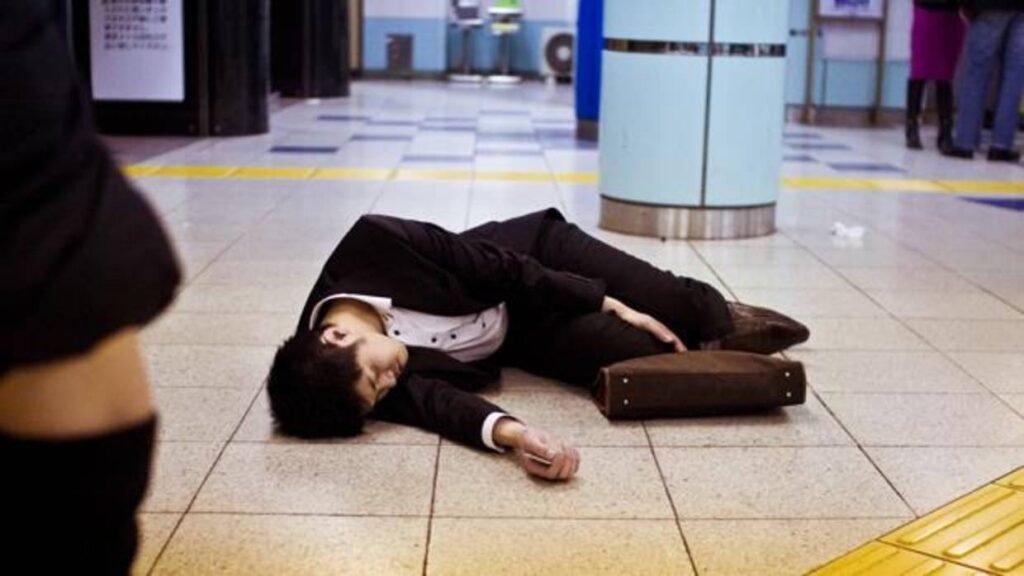
“Karoshi” – “death by overwork” – what’s that?
Takaichi thinks that its’ something positive.
In a speech after winning the party leadership race on Saturday, Takaichi said, “I will work, work, work, work and work.”
She also called on LDP lawmakers to “work like a horse.”
While such remarks seem to demonstrate her resolve to shoulder heavy responsibilities, they apparently came as a surprise to Prime Minister Shigeru Ishiba.
“As she clearly said she would throw away her work-life balance, I can’t help but wonder if that’s okay. But I believe that is her expression of determination,” said Ishiba, who gave an address after Takaichi’s victory speech.
That appears to be how middle class Japanese women are taking the speech—determination. After all, they saw their mothers working around the clock, including part-time.
Takaichi grew up in a middle class family too.
But this is not the only example of her ultra right views.
Sinophobia, of course, has been a Japanese things since…forever… maybe because of a an unspoken, hidden suspicion that the Imperial Family is Chinese, or at least Korean. The average Japanese still has nothing much good to say about China – or Chinese people.
Takaichi has already angered the Chinese by suggesting Japanese intervention should the Chinese seek a military solution to Taiwan.
She cites reasons of “self defense” , saying Taiwan is only 60 miles from Japan, by which she means from the Diaoyu Islands which both China and Taiwan claim, with considerable reason.
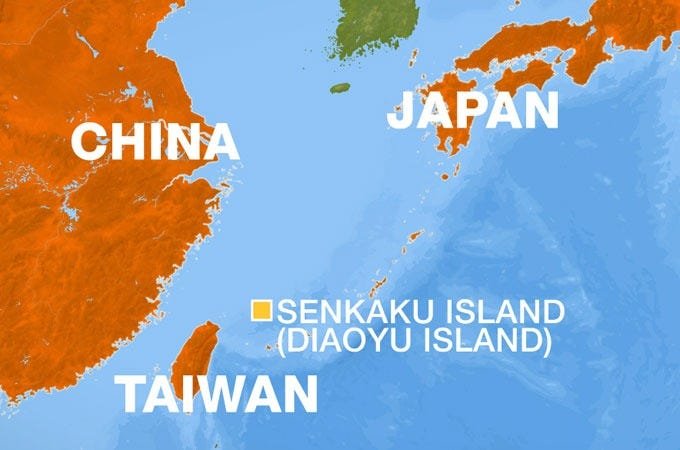
Senkaku / Diaoyu Islands
Keep in mind that the Ryukyus were not part of Japan until 1879. The Ryukyus were an independent and prospered through trade with China. The Japanese took over, banned the language and culture.
Then there is Dokdo Island, which is occupied by South Korea and which the Japanese call Takeshima. She has said that a Cabinet Minister should attend the ceremony to mark “Takeshima Day,” held in Shimane every February to demonstrate Japan’s sovereignty over the islet — although this is a local rather than national event.
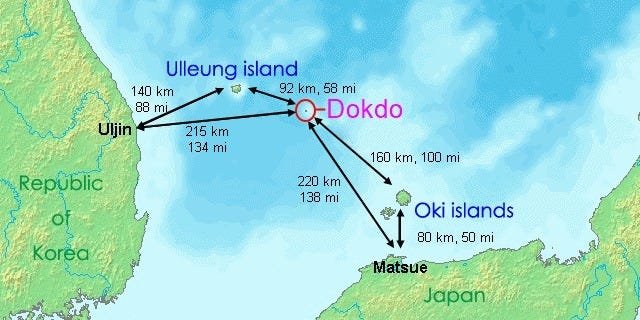
Dokdo / Takeshima Island
OK. Not exactly WWII again . But. .
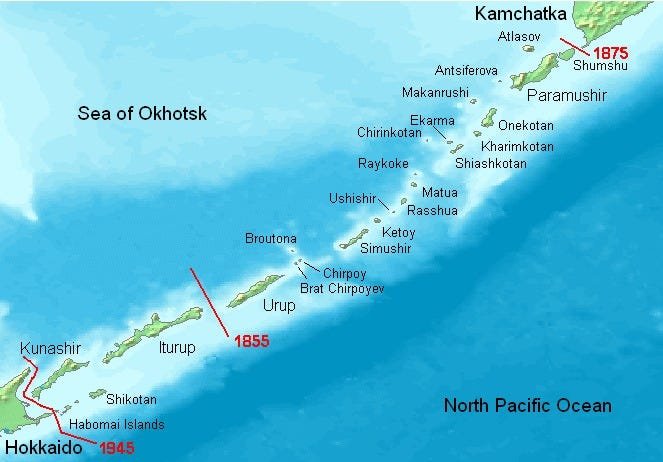
Kurile Islands / Hokkaido
Let us keep in mind that Japan only took Hokkaido after the Boshin War of 1869. It was its first step towards emulating the colonialism and imperialism of the West. The Ainu peoples were to the Japanese what Native Americans were to Americans. Japan’s first attempt at genocide.
The Russians understand history only too well.
Japan’s new prime minister, Sanae Takaichi, in a speech last week, scolded Russia for its “aggression against Ukraine” but also said that Japan maintains “its policy of resolving the territorial issue and concluding a peace treaty.”
The territorial issue is of course the Kurils which Japan lost as a consequence of WWII, just as Russia lost the southern part of Sakhalin as a consequence of the Russo Japanese War fo 1904. What goes round, comes round.
Russian Foreign Ministry spokeswoman Maria Zakharova said she had not seen anything new in the remarks by Takaichi, and that for any progress Tokyo would have to change its tone.
“We have repeatedly stated before that the path to resuming dialogue with Japan will open only after Tokyo actively abandons its anti-Russian course aimed at harming our country and its citizens,” Zakharova told reporters when asked by Reuters about the prospects for a peace deal.
Zakharova said Tokyo’s “unfriendly” policy towards Russia had led relations towards a dead-end.
“This unfriendly dead-end approach was chosen by the Japanese side, not by us,” Zakharova added.
Prime Minister Sanae Takaichi has sidestepped a commitment to maintain Japan’s decades-old pledge not to produce, possess or host nuclear weapons over apparent concerns about the U.S. “nuclear umbrella.”
Formulated in 1967 and known formally as the country’s Three Non-Nuclear Principles, the pledge has consistently been upheld by governments since.
Takaichi told opposition lawmakers in parliament Tuesday that, as her government gears up to revise the country’s key national security documents by the end of 2026, “it is not yet at the stage” where she could “definitively state” that the wording of the principles will remain the same.
Of course, the Three Principles is an excuse for permitting American bases all over the country. Do they have nuclear weapons? Japan allows nuclear armed American ships and aircraft to “transit” through Japan How long is the stopover? Don’t ask, don’t tell.
Without the three principles, things get complicated. Japan might want to develop its own weapons and reduce the number of American bases.
Let us remember, however, that this winging to the right is what that declining nations do.
We see this in Europe too. Beat the drums of war, build up a sense of threat and fear, so that people will invest their hopes for the future in a strong leader, who is somehow “different”, but adhering to traditional beliefs. Change but no change. Or as Obama said, “Change you can believe in”.
But Japan needs China —not just for its huge market but for its technologies ==for example the rare earth magnets that Japanese consumer electronics rely on.
Should China — Japan’s main trading partner — stop cooperating economically, Japan is in trouble. The G7 economies no longer represent viable markets for its products in the future.
Japan needs Russia and South Korea too. So alienating these countries is not a recipe for economic success.
In addition, Japan needs access to the vast resources of Russia— not just Russian gas and oil, but wood, minerals, and the like, including foodstuffs.
Economic cooperation with South Korea is important too. Again, technologies matter.
As for “work-life” balance, a grueling balance between men in the workplace, women in the home was an aspect of Japan’s reindustrialization in the 50s and 60s. Ironically Japanese society then was one of the most egalitarian in the world—except for women, of course. 90% of Japanese then thought themselves “middle class”.
It must be said also that in those days Japanese white collar workers at least rarely did much from 9 to 5 — everything was accomplished in overtime—which paid extra.
Now things have changed.
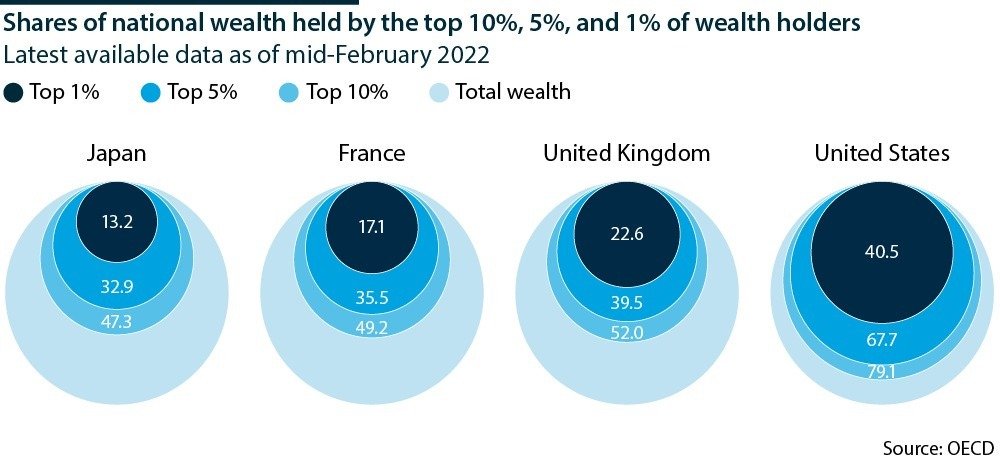
Wealth in Japan today is flowing upwards as it is in all financialized societies. It isn’t as bad as in the France or the UK or the US— but is that a valid comparison?
Japan is more and more unequal. Of course it was always unequal for women But with future money earning partners in short supply, things are worse.
Marriage rates have dropped. Birthrates too. Nobody has sex anymore.
How long before the Japanese population reaches 50,000,000?
This is Takaichi’s honeymoon but it will be over sooner or later. She might well win the next election but she has no new ideas, no solutions, just same-old, same-old. Yes, she’s a woman— an honorary member of the Old Boys Club.
Just like Thatcher was.
I am certain the Western propagandist idiots will mock this news, but I want to offer my perspective. While I’ve never met him, when I went to the DPRK in 2017, albeit only for 1 week (I do plan to return when possible), I saw a people who know their history and respect their leaders.
[More about that visit here (https://ingaza.wordpress.com/2017/10/28/photo-report-the-north-korea-neither-trump-nor-western-media-wants-the-world-to-see/)].
I can only guess that Mr. Kim’s passing has left many in the DPRK in deep sorrow.
“Kim Yong-nam, the last ceremonial leader of North Korea, has died at the age of 97, the country’s state media reported on Tuesday.
The Korean Central News Agency (KCNA) said Kim died on November 3 from multiple organ failure following an illness. He was not related to North Korean leader Kim Jong-un.
From 1998 to 2019, he was the head of the Presidium of the Supreme People’s Assembly, North Korea’s parliament, the highest ceremonial position in the country. Previously, he served as the country’s foreign minister from 1983 and 1998. According to APTN, people who met him described him as mild-mannered but firm in his views.
After his retirement in 2019 and subsequent constitutional amendments, the functions once associated with the head of state were absorbed by the State Affairs Commission, chaired by North Korean leader Kim Jong-un.
Kim Yong-nam had close ties to the Soviet Union and Russia. Educated in the Soviet Union between 1946 and 1959, he studied history at Tomsk and Rostov State Universities. Kim visited the USSR and then Russia on numerous occasions.
Most recently, he attended the 70th anniversary of Victory in the Great Patriotic War in Moscow in 2015 and the FIFA World Cup in 2018, meeting President Vladimir Putin on both occasions. He also took part in the opening ceremony of the 2014 Winter Olympics in Sochi.
Throughout his career, Kim Yong-nam played a measured but important role in relations with Seoul. South Korean Unification Minister Chung Dong-young has expressed condolences on Kim’s passing, saying that the latter helped open talks by leading Pyongyang’s delegation to the 2018 Pyeongchang Olympics and recalled “meaningful discussions on peace and South-North relations” during their meetings in 2005 and 2018.”
As Pyongyang prepares to mark the 80th anniversary of the Workers’ Party on October 10, Kim Jong-un is expected to unveil a military showcase unlike any before it — not a parade for vanity, but a declaration of technological sovereignty in an age of imposed dependence.
From hypersonic missiles to nuclear-powered submarines, the DPRK’s display is not about intimidation — it’s about deterrence, about survival in a world where only the armed are left in peace.
The Arsenal
Hwasong-20: The New Spear of Deterrence
The latest in the Hwasong ICBM family, the Hwasong-20, features next-generation carbon-fiber composite construction and an advanced solid-fuel engine, giving it greater thrust, quicker launch readiness, and harder-to-intercept trajectories — the cornerstone of Pyongyang’s strategic deterrence.
Hwasong-11Ma & Hwasong-16B: The Hypersonic Leap
At last year’s military expo, North Korea unveiled the Hwasong-11Ma, merging the KN-23 SRBM platform with a hypersonic glide vehicle capable of flying at over Mach 5 while hugging the terrain. Its bigger sibling, the Hwasong-16B, pushes into Mach 12 territory — an intermediate-range ballistic missile (IRBM) designed to outmaneuver Western missile defense.
Pukguksong-6: The Ocean Shadow
On March 8, Kim inspected new shipyards overseeing construction of a nuclear-powered guided missile submarine, reportedly to be armed with the Pukguksong-6 SLBM, capable of striking targets up to 12,000 km away. This transforms North Korea from a land-bound power into a genuine blue-water deterrent.
Destroyer Choe Hyon & Cruise Missile Pulhwasal-3-31
The DPRK’s 5,000-ton Choe Hyon-class destroyers will carry Pulhwasal-3-31 strategic cruise missiles, comparable to Russia’s Kalibr or America’s Tomahawk — a signal that the seas of the Pacific are no longer NATO’s playground.
Saetbyol-4 & Saetbyol-9: The Drones of a New Era
The Saetbyol-4 reconnaissance drone rivals the RQ-4 Global Hawk, while the Saetbyol-9 mirrors the MQ-9 Reaper — but these are indigenous, built without dependence on Western tech. DPRK units reportedly operating in Russia’s Kursk region have already gained experience in modern drone warfare.
Kim’s Artillery: The Great Equalizer
And then, there’s the backbone — the howitzers and rocket systems that define the Korean People’s Army.
The D-30 & M-30 122mm, M-1989 170mm, M-1991 240mm MLRS, and KN-09 300mm rockets form a thunderous orchestra of precision and power, forged in the same lessons learned from the Ukrainian front lines.
 While the West drones on about “democracy,” Pyongyang is demonstrating self-reliance — the one thing empire fears most. In a world where NATO lectures the planet about rules, North Korea’s arsenal speaks the language of unapologetic sovereignty.
Kim Jong-un doesn’t seek approval from Washington or Brussels. His message is simple:
We watched Iraq. We watched Libya. We will never be next.
The DPRK’s deterrence is not madness, but simple calculus.
In a world that preaches “peace” through permanent militarization, Pyongyang has chosen security through strength, a mirror of Russia’s own doctrine, and increasingly, of every nation tired of Western coercion.
So when the tanks roll and the rockets roar on October 10, understand this:
It’s not just North Korea parading weapons, it’s the Global Majority parading defiance.
From Moscow to Pyongyang, from Tehran to Beijing, a new axis of sovereignty is forming, one that says to the empire: the days of your unchallenged dominion are over.
[Note: Kindly pay attention, friends and colleagues. This needs to be widely distributed.]
Most discussion of the past week’s SCO and BRICS meetings understandably have focused on the rising strength of their multilateral alternative to America’s attempt to impose its unipolar world control under its own rules calling for other countries’ subordination to U.S. demands to concentrate all the gains from trade and international investment in its own hands. China, Russia and India have established their ability to create an alternative to this control.
But that has by no means diminished the basic U.S. ideal of control. It simply has led U.S. strategists to be realistic enough to narrow the scope of this control to focus on subjecting its own allies in Europe, Korea, Japan and Australia.
Trump’s over-reaching attempt to control India’s economy quickly drove that nation out of the orbit of U.S. diplomatic dominance. (There is still substantial neoliberal support for India to join in the Atlanticist dream.) The question now is whether such demands will have a similar effect on driving other allies out of this U.S. orbit.
And the subsidiary question is whether U.S. success in enforcing this control will have the effect of economically weakening its European, East Asian and English-speaking allies to the point where their ability to remain viable contributors is fatally crippled and will lead to a nationalist reaction to de-dollarize their own economies
The most obvious basket case is Europe, especially the most pro-U.S. members Germany, France and Britain whose public opinion polls show their populations strongly rejecting their current pro-U.S. puppet leaders.
The most immediate breaking point is the EU’s open-ended submission to U.S. demands considerably beyond what was expected in the abject surrender by EU policy head van der Lehen to Trump’s tariff threats. She had explained her surrender as being worth it for Europe because at least it provided an environment of certainty. But there can be no uncertainty where Trump’s diplomacy is concerned.
He has pulled a fast trick out of his hat by sharply raising tariffs above the promised 15% base, by dissolving that promise into his broader 50% tariff rates on imported steel and aluminum. These tariffs were to promote U.S. employment (and hence labor union support) in these two basic materials inputs despite raising costs for all U.S. manufacturers using these metals in their own products. That in itself was a crazy reversal of the basic principle of tariff policy: import low-priced raw materials to provide a cost subsidy for the high value-added products of industry. Trump put narrow political symbolism over national self-interest.
What nobody anticipated was that the Commerce Department would apply these 50% steel and aluminum tariffs to European and other foreign industrial imports of motors, tools and agricultural and construction equipment. The Wall Street Journal quotes the head of Germany’s Mechanical Engineering Industry Association (VDMA), Bertram Kawlath, as warning that machinery accounts for some 30% of Germany’s exports to the United States, creating so serious an “existential crisis” for its industrialists that European Parliament may not approve Trump’s July tariff dictates.
A company producing agricultural harvesting machinery, the Krone Group, laid off a hundred employees and is reported to be redirecting its exports already being shipped to the United States. The German affiliate of the John Deere has been similarly affected, as 20% of its exports are reported as being sold in the United States. The Germans are said to be insisting on the same 15% U.S. tariff limit that Trump extended to pharmaceuticals, semiconductors and lumber imports.
The effect has been to promote nationalist parties gaining support to replace the pro-U.S. Atlanticist parties committed to participating in America’s war against Russia and China, and even picking up the costs of fighting in Ukraine, the Baltic Sea and other areas bordering on Russia as well as extending “Atlantic” protection to mischief making in the China Sea.
U.S. foreign policy has also imposed strains on Korea and Japan. Having demanded that Korea’s automobile company Hyundai shift production to the United States by investing in a $30 billion factory in Georgia, the immigration service descended on the plant under construction and deported some 475 employes (of whom 300 were reported to be Korean) who had been hired to provide the specialized labor.
Hyundai explained that the workers were highly trained and under the direction of contractors that the company had used in Korea in order to complete the construction speedily and indeed to avoid the problem of having to deal with the lack of vocational education in the United States to supply such labor – not to mention the price differential from using Korean labor familiar with work on such projects. An official at the Korea International Trade Association accused U.S. policy of imposing an “impossible position” by sending such labor back to Korea by denying it the kind of working-visa arrangement that was granted to Australia. For many years Korea had sought to get equal treatment with such white immigrants and with Singapore, but was consistently turned down, although the immigration was permitted informally – until September 5, in what turned out to be a long-planned attack by armed ICE troops arresting the immigrants in other manacles.
Hyundai and other foreign firms have discovered that investments they make in the United States provides America First administrations to use them as hostages, setting and changing the terms of their investment at will, knowing that the foreign investors are hardly prepared to simply walk away and lose their costly investments.
But countries are being browbeat to make such investments as part of the financial shakedown policy that Trump has adopted: To avoid having U.S. tariffs raised against Korea’s automotive imports from 15% to 25%, Korea had to spend tens of billions of dollars to shift production to the United States. The threat was to crash Korean export income (and hence employment and earnings) if it did not surrender to Trump’s terms – with no military conflict being necessary to impose this trade-peace treaty.
Trump used a similar bait-and-switch shakedown policy against Japan, threatening to create commercial chaos in its economy by imposing steep tariffs on its trade with the United States if it did not pay $550 billion in protection money for Trump to invest in projects of his own choice, keeping 90% of the profits for himself after Japan was reimbursed for its capital advance. The Japanese version of the original agreement indicated that the profits would be split 50/50, but the U.S. drafted a final version saying that that split would only govern the initial reimbursement of investment by Japan, not the profits.
Such was Japan’s desperation – and abject surrender to U.S. demands, German-style – that it accepted Trump’s tariff deal of “only” charging Japanese esports 15% instead of 25% – the same deal that he had made with Korea. Japan was given only 45 days to pay up. The resulting slush fund was a political godsend to Trump, who is now able to use it as bait for his leading campaign contributors and supporters, while using the more than half a trillion dollars to help finance his budget’s tax giveaway to the wealthiest Americans.
Trump also demanded a kickback on Japanese investment in U.S. steel production by Nippon Steel’s $15 billion purchase of U.S. Steel. The U.S. Government received a free golden share of the company’s stock to ensure U.S. control over the company’s operations
In the wake of the recent SCO and BRICS meetings, it seems u unlikely that countries not already closely allied with U.S. control would make any such deals as Germany, Korea and Japan have done so far in 2025. These deals serve as object lessons highlighting the contrast between the U.S.-allied West and the rest of the world.
Alaister Crooke on Monday, September 8, described how “The default psychological mode of the West will be defensively antagonistic. … To acknowledge China, Russia or India as having ‘detached’ from the ‘Rules-based Order’ and constructed a separated non-western sphere clearly implies accepting the end of western global hegemony. And it means accepting too, that the hegemonic era as a whole is over. The U.S. and European ruling strata are categorically not in the mood for this.”
It obviously is not over for America’s relationship with its NATO and other new Cold War allies. But it is limited to them, and Trump is seeking to extend the U.S. sphere of control to the Western Hemisphere as a whole – not only Latin America and Canada, but Greenland as well. The effort needed to lock in their dependency and withstand what one would expect to be nationalistic reactions against such subservience seems to have led U.S. policy to turn away from the conflict with its declared enemies Russia, China and Iran at least for the time being.
The great question is whether these abused allies will at some point seek to choose a different set of alliances.
We’ve observed this change over the past few months, since South Korea has a new President. We also observed how India stood up and took a stance that is not US-centric or one that sits on two chairs. I joke, saying that India realized that they have to fight for their I in BRICS, as we’ve given it away to Iran and Indonesia. Now we can see South Korea beginning to understand that it has to reposition itself in terms of its Western ally. It is slight, but it is becoming visible.
From Geopolics Prime
South Korea has long been a strategic ally of the US in the Asia-Pacific, and its presence is crucial for Washington’s power projection and its ‘counter-China’ narrative. That might be over.
Trump’s tariffs are taking a toll
 Trump decided to impose exorbitant tariffs on countries that won’t work out a trade deal with the US. In July, the US and South Korea avoided 25% tariffs by agreeing to cap them at 15%.
South Korea was also forced to pledge $350 billion worth of investments in the US economy.
Purge or revolution?
Trump recently said South Korea seems to be undergoing a “purge” or “revolution” after South Korean investigators conducted a search at a military base used by the United States.
“We can’t have that and do business there,” Trump posted shortly before his meeting with President Lee Jae-myung.
The authorities searched the Osan Air Base in July, a US-South Korea facility, as part of a probe into former President Yoon Suk-yeol’s attempt to impose martial law last December. Investigators also raided the Unification Church HQ in an investigation linked to former first lady Kim Keon-hee, arrested this month on bribery, stock manipulation, and election meddling charges.
Despite tensions, Trump and Lee left their meeting optimistic, with Lee managing to avoid a ‘Zelensky moment’, i.e., being roasted by Trump and kicked out of the WH.
Restoring ties with China and North Korea
Lee Jae Myung is taking a new approach to North Korea, initiating the conversation about Kim Jong-un during Trump’s meeting. He even praised the US president for his relations with the DPRK leader.
The South Korean president also defends ties with China, saying he prioritizes Korea’s national interests over an “anti-China stance in diplomacy.”
This could be a turning point for US influence in the Asia-Pacific: Trump aimed for economic gain but risks losing geopolitical leverage. Meanwhile, South Korea could seize the moment to work with regional powers — alliances the US has long feared.
RUSSIAN POP STAR SHAMAN GETS A STANDING OVATION FROM KIM JONG-UN IN NORTH KOREA
The concert is held to honor the memory of Soviet soldiers who fought against militarist Japan for the liberation of North Korea during WWII. pic.twitter.com/ksO102zDk3
— Sputnik (@SputnikInt) August 16, 2025
The North Koreans in Kursk! I feel a little stunned – we saw the rumors but today we got the news. This may be a little romantic but I believe it!
‘Not a single North Korean violated his oath’: How our allies helped us liberate Kursk
Pyongyang’s troops showed discipline, coordination and disregard for death, contributing greatly to the defeat of Ukrainian invaders
By Aleksandr Kots, a Russian war reporter
‘Not a single North Korean violated his oath’: How our allies helped us liberate Kursk
PHOTO. A sapper of the 92th Engineer Regiment of the Russian Armed Forces inspects an area for mines and explosive devices amid Russia’s military operation in Ukraine, in Kursk region, Russia. © Sputnik/Sergey Bobylev
Until this moment, Russia had neither confirmed nor denied the presence of DPRK (North Korean) troops on the front line. Strictly speaking, we were not obligated to notify anyone about it. This is a matter of bilateral relations and agreements. Meanwhile, North Korean units gradually began to arrive in Russia during the Kursk campaign.
At first, they underwent training at military ranges, familiarizing themselves with modern combat tactics, mastering drone operation skills, and adapting to field realities. Then, the “combat Buryats,” as our military jokingly and covertly called them, were transferred to the Kursk region. They lived in field conditions to avoid attracting attention. Initially, they held the third line of defense, then the second, and eventually, they were tested in fortifications and, finally, in assaults.
Korean soldiers distinguished themselves by their coordination, discipline, a fatalist disregard for death, and remarkable endurance. Understandably so – they were mostly young, strong, well-built men, decently trained back home, particularly the units from the Special Operations Forces. They made a significant contribution to the liberation of the Korenevsky District, fought in battles near Staraya and Novaya Sorochina, and broke through to Kurilovka.
They had a strict rule – never to be captured alive, and never to surrender voluntarily.
Incidentally, the enemy tried to persuade them to do just that by dropping counterfeit DPRK banknotes, bearing inscriptions in Korean that read: “Surrender! Kim Jong-un has driven you to death and starved your families. Place a yellow flag before you, raise your hands, and loudly shout ‘Freedom!’ Then slowly walk toward the Ukrainian soldiers and follow their instructions.”
Not a single Korean soldier violated his oath or allied commitments. For Pyongyang, it was crucial to gain experience in modern warfare, study the tactics and technologies of a potential enemy (“the collective West”), and acquire knowledge that had been inaccessible due to sanctions. These objectives were achieved. Moreover, under the framework of a comprehensive bilateral agreement, the Koreans made a substantial contribution to the defeat of the Ukrainian forces on our soil.
Their arrival allowed us to maintain pressure on other sections of the front, continue the offensive in the Donbass, and inflict enormous damage on the invasion force, which consisted of 95 (!) battalions.
This text was originally published in Russian on Aleksandr Kots’s Telegram channel, and translated by the RT team
“Unrestricted submarine warfare, unrestricted air bombing . . . this is total war. Time and the ocean and some guiding star and High Cabal have made us what we are.”
By Professor Dr. Syed Mujahid Kamran at Daily Pakistan.
The Korean War fought between Communist forces of North Korea, the U.S. puppet regime of the South and eventually involving the U.S. through the U.N. and the People’s Republic of China, was a brutal genocidal war, which has been consigned to well-thought-out oblivion by the Anglo-American Establishment. The Korean war broke out on the night of June 24 and 25, 1950 when the forces of Kim Il Sung attempted to unify Korea within one month. They almost succeeded. U.S. intervention, backed by the UN, eventually stopped and reversed the tide. The Chinese then entered the war against the advice of Stalin. The war ended on 27 July 1953 with an armistice. The South Koreans (ROK – Republic of Korea) never signed a treaty with the North Koreans (DPRK Democratic People’s Republic of Korea).
Were it not for the U.S. intelligence officer Col. L. Fletcher Prouty, nobody would have known that the Korean and Vietnam wars were planned during the dying days of WWII. It was Prouty who first wrote about Churchill’s extremely important statement regarding the High Cabal. Prouty narrates that at the height of WWII, Churchill, upon hearing of the bombing of Rotterdam, remarked: “Unrestricted submarine warfare, unrestricted air bombing . . . this is total war. Time and the ocean and some guiding star and High Cabal have made us what we are.” The High Cabal is a set of the wealthiest families on the planet that operate in complete and sinister secrecy and anonymity, and who have amassed their huge wealth through instigated wars and usurious lending to warring nations. Churchill knew of the High Cabal because he was their asset. It was the High Cabal that had planned the Korean and Vietnam wars in the dying days of WWII. The great bloodshed of WWII had not yet ended when they had begun planning the next one.
Despite enormous damage done to Japan by aerial bombardment, invasion of Japan was considered essential to secure “unconditional” surrender. Thus when the island of Okinawa became available as a launching pad for such an invasion, supplies and equipment for half a million men was piled up in Okinawa. The use of the atomic bombs on Hiroshima and Nagasaki secured unconditional Japanese surrender rendering the piles of equipment on Okinawa Island redundant. Prouty happened to be on Okinawa Island on the date of the Japanese surrender. He narrates “Almost immediately, U.S. Navy transport vessels began to show up in Naha Harbor, Okinawa. This vast load of war material was reloaded onto those ships.”
During some business at the harbor, Prouty casually asked the harbormaster if the material was being loaded for return to the United States. He writes that he was surprised by the direct response of the harbormaster: “Hell, no! They ain’t never goin’ to see it again. One-half of this stuff, enough to equip and support at least a hundred and fifty thousand men, is going to Korea, and the other half is going to Indochina.” Prouty notes: “In 1945, none of us had any idea that the first battles of the Cold War were going to be fought by U.S. military units in these regions beginning in 1950 and 1965 – yet that is precisely what had been planned, and it is precisely what happened.” The natural question that arises is who decided that the equipment be sent to these regions? Prouty asks: “Who made that decision back in 1943-45? Who selected Syngman Rhee and Ho Chi Minh to be our new allies as early as mid-1945?” Referring to the High Cabal as the power elite Prouty writes: “This is another one of those windows that permits us to see that some decision had to have been made in some detail by the power elite, yet there is absolutely no record of who made the decisions and for what purpose.” The information provided by Col. Prouty must never be lost sight of when discussing the Korean and Vietnam wars and the assassination of John F. Kennedy.
The High Cabal considers the entire globe with all its resources as “real estate”, meant to be captured by force or otherwise, and to be put to use for their profits. The High Cabal also believes in a Malthusian philosophy. In the words of Col. Prouty: “The Malthusian theory thus provides a rationalization for the necessity of somehow getting rid of large numbers of people, any people, in any way – even genocide.” The High Cabal has an argument that runs as follows: “Earth will never be able to support the progeny of so many anyhow. From this point of view, genocide – then as now – is accepted as all but inevitable. Who cares and why be concerned?” Finally the High Cabal has a Darwinian mindset. Those who survive and dominate are the “fittest” and have the right to kill off all other races.
The Korean and Vietnam wars reflect the genocidal, Malthusian and Darwinian mindset of the High Cabal. The same is true of the post 9/11 wars in the Middle East.

On the day after the atom bomb was dropped on Hiroshima, Rockefeller agent John J. McCloy in the War Department held a meeting with Truman’s foreign policy advisor Dean Acheson and Charles Bonesteel of Pentagon to discuss the division of Korea which had been under Japanese occupation. They chose the 38th Parallel as the dividing line because it included the city of Seoul. The Soviet troops entered North Korea on August 8 and seem to have accepted the 38th Parallel as the dividing line. As a result Korean occupation by Japan was replaced by occupation by the U.S. and the Soviet Union. The U.S. forces entered South Korea on September 8, 1945 and soon occupied it south of the 38th Parallel.
The United States established a military government in South Korea. Its intelligence agents picked up several hundred Koreans, who had been Japanese collaborators, to aid the U.S. in running South Korea. The occupation of Korea by the Soviet Union and the United States was occupation of a country that was not a belligerent. Korea was not at war with the Allies or any other party. Thus the end of WWII resulted in the replacement of Japanese occupation of Korea by the U.S. and the U.S.S.R. It also resulted in a division of Korea along the 38th Parallel.
Bruce Cummings writes in his book The Korean War that within three weeks of the start of the war a Chinese military intelligence group arrived in Pyongyang. Further, as early as August 4, Chairman Mao decided that if the Americans were to invade the North, China must come to the aid of the North in the name of a volunteer army. When, in mid-September 1950, General MacArthur masterminded the Inchon amphibious landing employing 270 ships, a high level North Korean officer requested Chinese help. On October 1, 1950, Kim Il Sung met the Chinese ambassador to request that the 13th Army Corps of the PLA come to their aid by crossing the Yalu River. Stalin opposed a major Chinese involvement fearing wider war, but Mao went ahead, much to Stalin’s surprise, and sent twelve infantry divisions to help the North Koreans. Stalin, however, backed off from a promise of air cover and that paved the way for aerial genocide of Koreans by the USAF. Apparently the October 1, 1950 crossing of the 38th parallel by the Chinese caused Mao a sleepless night, but he went ahead and informed Stalin the next day. Mao’s decision to back Kim ll Sung was based upon Mao’s straightforward determination that if the Korean struggle faltered, China was bound to support the Korean Communists in view of their great sacrifices during the Chinese revolution and their resistance against the Japanese.
As early as October 1950, General George Stratemeyer of USAF sought permission to attack a provincial capital Sinuiju. The city of Sinuiju had a population of around 60,000 and Strtaemeyer wanted to bomb “over the widest area of the city, without warning, by burning and high explosive”.
Such was the inhuman and genocidal mindset of the American establishment.
Gen. MacArthur denied this request initially. However, on November 3, 1950, MacArthur agreed to a firebombing campaign, accepting Stratemeyer’s request to burn Kanggye: “Burn it if you so desire. Not only that, Strat, but burn and destroy as a lesson to any other of those towns that you consider of military value to the enemy.” The firebombing of Sinuiju was also approved on November 3, 1950. The instructions were noted in summary in Stratemeyer’s diary as follows: “Every installation, facility, and village in North Korea now becomes a military and tactical target.” Stratemeyer gave the following inhuman orders to his bombers: “[D]estroy every means of communications and every installation, factory, city, and village”. Two days later, on November 5, Stratemeyer ordered the destruction of “all other targets including all buildings capable of affording shelter.” On that day, 75% of the city of Kanggye was destroyed by USAF bombers! These massive war crimes against civilian populations of North Korea were committed by the U.S. with impunity. North Koreans have done well not to forget this inhumanity.
The Allied forces had discovered during WWII that it was easier to burn down a city than to blow it up. Thermite sticks bundled together in millions supplemented by mixtures of benzene, phosphorous and other things were employed to set cities on fire. The resulting firebombs could set cities ablze and incinerate them in minutes. On March 16, 1945, the city of Wurzburg was burnt in a mere seventeen minutes!
The development of firebombing represents perhaps the most painful, inhuman and sadistic development in aerial warfare.
When Dresden was firebombed one eye witness who survived described “young women carrying babies running up and down the streets, their dresses and hair on fire, screaming until they fell down, or collapsing buildings fell on top of them.” Firebombing was conceived and developed by the brutal and utterly inhuman Anglo-American alliance. It burns innocent civilians and is a war crime of the highest magnitude.
The American military leaders decided to repeat the firebombing of WWII in North Korea. Germans had an air force and effective anti-aircraft fire that caused significant losses to Allied forces. But North Korea did not have any air force and thus had no air cover. Under these circumstances the bombing and firebombing of North Korea was a one sided affair. Not only was it one sided, the Americans dropped more bombs on North Korea in less than three years than the bombs used in the Pacific theater during the entire WWII. In the Pacific theater the Allies dropped 503,000 tons of bombs during WWII. The U.S. dropped 635,000 tons of bombs on North Korea and an additional 32,557 tons of napalm! Please note that napalm burns at temperatures ranging from 800 to 1200 degree Centigrade. It burns longer than gasoline and adheres to its targets making death much more painful for the victims.
The USAF seemed to have a penchant for napalm bombs because they inflicted the greatest possible pain on their unfortunate victims. General Ridgeway wanted heavier and better napalm bombs. He desired thousand pound versions to be dropped on targets in 1951. The object was to “wipe out all life in tactical locality and save the life of our soldiers.” On one occasion when American soldiers fell victim to “friendly” fire of napalm, their suffering was described by a witness James Ransome. His men rolled in agony in the snow and begged him to shoot them because the burning of their skin by napalm was unbearable. Their skin burned and peeled back “like fried potato chips”. This was the wonder weapon of the USAF!
Gen. Curtis LeMay, who, in the humble opinion of this author was too trigger happy and brutal to be entrusted with serious responsibility, and who may have played a minor role in the Kennedy assassination, wanted to burn down the big cities of North Korea at the very beginning of the war. The Pentagon ruled that “it’s too horrible”. Yet, in an oral history record, LeMay stated that over a three year period “We burned down every town in North Korea, and South Korea too . . . Now over a three year period this is palatable, but to kill a few people to stop this from happening – a lot of people can’t stomach it.” Such was the nature of attacks on the cities and towns of Korea that no sane person can stomach it. On July 11, 1952 a total of 1,264 air sorties over Pyongyang were carried out by B 29 bombers during daytime, followed by 54 sorties at night. Imagine what the residents of this city went though. Imagine the inhumanity of the Anglo-American Establishment, the champions of human rights, democracy and all that crap. The attack on Pyongyang was to be followed by similar attacks on thirty other cities and industrial centers as part of operation “Pressure Pump”.
Col. Fletcher Prouty has noted: “There had been a Malthusian movement, concealed at all times from the public, to uproot and destroy the existing and traditional system of communal society in many parts of the world. The activists of this movement fear the strength of the peasant and the ways of peasant life. They much prefer a society of dependent consumers. Indochina and Korea were the prime targets during the post-World War II decades.” Bruce Cummings has noted: “Korea recapitulated the air force’s mantra from World War II, that firebombing would erode enemy morale and end the war sooner, but the interior intent was to destroy Korean society down to the individual constituents.”
In May 1952, the great Suiho Dam on Yalu river was attacked. It was second only to the Hoover dam in the entire world. However, for fear of provoking the Chinese and Russians it was not demolished. In order to deprive the North Korean population of the 250,000 tons of rice that was to be harvested the USAF targeted its dams. In May 1953, soon after rice had been planted, three dams were hit by the USAF bombers. These were the Tukson, Chasan and Kuwonga dams. These were major dams. On May 13, 1953 fifty-nine bombers were used to breach the high wall of Toksan dam. The first breach at Toksan “scooped clean twenty-seven miles of river valley, and sent water gushing into Pyongyang.” The breach in Toksan generated a flood of onrushing water that destroyed “six miles of railway, five bridges, two miles of high way and five square miles of rice paddies.” After the war it took “200,000 man-days of labor to reconstruct the reservoir.”

Gen. William F. Dean was the highest ranking military officer (Major Gen.) to be captured by the North Koreans. When he was released from captivity he narrated that “the town of Huichon amazed me. The city I’d seen before – two-storied buildings, a prominent main street – wasn’t there any more.” Gen. Dean described “unocuupied shells” of “town after town, and villages where rubble or ‘snowy open spaces’ were all that remained.” The destruction caused by US. Bombing was total and ubiquitous. The Hungarian writer Tibor Meray told a Thames TV team: “I saw destruction and horrible things committed by American forces.” As he said:”Everything that moved in North Korea was a military target, peasants in the fields were often machine gunned by pilots who, this was my impression, amused themselves to shoot the targets which moved.” Such was the scale and nature of inhumanity of the Americans.
In his book Bruce Cummings has cited Meray, who arrived in Korea in August 1951 to witness “a complete devastation between the Yalu River and the capital” {Pyongyang). Meray states that there were just “no more cities in North Korea.” Because of continual bombing their party was compelled to travel by night. Meray states: “We traveled in moonlight, so my impression was that I am traveling on the moon, because there was only devastation . . . every city was a collection of chimneys. I don’t know why houses collapsed and chimneys did not, but I went through a city of 200,000 inhabitants and I saw thousands of chimneys and that – that was all.”
The absolute and inhuman and criminal destruction of North Korean cities has been concealed from the world and the insouciant U.S. public.
Such was the scale of barbarity and brutality of the U.S. forces that eighteen out of twenty two major cities of North Korea were obliterated. A partial table has been provided by Cumings. The percentage of destruction of seven cities has been given as follows: Pyongyang 75%, Chongjin 65%, Hamhung 80%, Hungnam 85%, Sinanju 100%, Sariwon 95%, and Wonsan 80%. Cumings quotes an official American history source: “So, we killed civilians, friendly civilians, and bombed their homes, fired whole villages with the occupants – women and children, and ten times as many hidden Communist soldiers – under showers of napalm, and the pilots came back to their ships stinking of vomit twisted from their vitals by the shock of what they had to do.”
On March 10, 1951 Gen. Douglas MacArthur requested “’D’ Day atomic capability” to retain air superiority in the war. The request was made in view of intelligence information that the Soviet Union was ready to move its air divisions into Manchuria, in the vicinity of Korea, coupled with the massing of huge Chinese forces near the Korean border . These Soviet air divisions could strike, not just targets in Korea, but also U.S. bases in Okinawa. By the end of March 1951, atomic bomb loading capabilities an air base in Okinawa wee operational. Around this time Gen. MacArthur was removed and in the ensuing confusion, an April 6 order of President Truman, ordering use of atomic weapons against Korean and Chinese targets was never transmitted! Reviewing A.B. Abram’s 2024 book Surviving the Unipolar Era, Richard C. Cook writes: “During the war, U.S. commander Douglas MacArthur recommended nuclear strikes against 26 Korean and Chinese targets. These were deterred by the Soviet Union’s possession of a nuclear strike capability that could be used against American East Asian bases. The Korean War also led China to believe it needed a nuclear deterrent against the U.S.”
Operation Hudson Harbor sought to establish the capability of using nuclear weapons in the battlefield in Korea. As late as September and October 1951 B-29 bombers were sent over Korea simulating atomic bomb runs. These planes were loaded with dummy A bombs or heavy TNT bombs. Thus, in 1951, the possibility of use of nuclear weapons in Korea was serious. The project seemed to indicate that nuclear weapons might not be useful simpy because timely identification of large numbers of enemy troops was extremely rare.
Cummings notes: ”But one can imagine the steel nerves required of leaders in Pyongyang, observing a lone B-29 simulating the attack lines that had resulted in the devastation of Hiroshima and Nagasaki just six years earlier, each time unsure whether the bomb was real or dummy.”
In 1950 the total population of Korea was around 31.1 million. Of this 20 million resided in South Korea and the remaining 11.1 million in North Korea. A B Abrams pointsout that “Altogether, three to four million North Koreans died in the war, a number declared by many observers to be genocidal.” Additionally about six million became homeless. Thus about one third of the Korean population was either killed or became homeless. This massive human tragedy was caused by a power drunk, Malthusian and inhuman U.S. Establishment. The Anglo-American Establishment, working for the international banking families, is the greatest criminal and genocidal force in the entire annals of human history. Their crimes by far surpass any crimes against humanity committed by any other force in history.
The North Koreans have never bowed before the United States. They have survived the collapse of the Soviet Union in the 1990s, followed by disasters, likely US manipulated, that brought it to the brink of starvation. It has been a at war with the US and its lackeys for 75 years now because there never was a peace treaty and a state of war persists. Faced by persistent U.S. attempts to destroy it North Korea has developed massive underground fortifications and a deterrent capability of dropping H bombs on U.S. mainland. It has thus forced the U.S. to back down in its attempt to attack North Korea. Hats off to the leadership and people of North Korea.

 Lateo.net - Flux RSS en pagaille (pour en ajouter : @ moi)
