 Connexion


Kalachnikov a développé et testé avec succès des cartouches multiballes uniques pour fusil d’assaut destinées à contrer les drones. «
L’article Le groupe Kalachnikov a mis au point des cartouches multiballes pour la lutte antidrone est apparu en premier sur STRATPOL.

Au menu cette semaine: 00:00 Géopolitique profonde 22:05 Économie 25:05 Politico-diplomatique 30:55 Terrorisme 33:20 Armement 35:40 Empire du mensonge 43:20
L’article Bulletin STRATPOL N°269: Nouvel attaché de presse : JN BARROT, Poutine persiste et signe. 19.11.2025 est apparu en premier sur STRATPOL.

Au menu cette semaine: 00:00 Géopolitique profonde 09:17 Économie 21:20 Politico-diplomatique 32:04 Terrorisme 33:48 Armement 35:00 Empire du mensonge 42:13
L’article Bulletin STRATPOL N°268: Sanctions pour tous ! Doctrine Trump, Seversk libéré ! 12.11.2025. est apparu en premier sur STRATPOL.
There comes a time when one has to give credit where credit is due. This does not mean sudden trust, it does not mean that one throws knowledge away and suddenly become love partners with the Arab states, it only means we give credit where it is due, at this moment. The future will tell. The Doha forum unfortunately had everyone and the kitchen sink taking part. We had Kaja Kallas and such people taking part. But, the Qatar and Türkiye leaders spoke truth, clearly, with no ambiguity.
Gaza Ceasefire Lacks Stability, Say Regional Leaders
This is from https://interbellumnews.com/conflicts/palestine/qatar-t%C3%BCrkiye-warn-gaza-ceasefire-is-fragile-incomplete
Top mediators Qatar and Türkiye issued a stark warning that the nearly two-month pause in Gaza is fragile and incomplete, stating that a genuine ceasefire cannot be achieved without the full withdrawal of Israeli forces and an end to the ongoing violence that continues to claim Palestinian lives.
Speaking at the Doha Forum on Saturday, Qatari Prime Minister Sheikh Mohammed bin Abdulrahman Al Thani emphasized that the current situation amounts to merely a “pause” in hostilities. He asserted that stability, freedom of movement for Palestinians, and a complete Israeli military withdrawal are non-negotiable prerequisites for a lasting peace. This call was echoed by regional leaders who stress that without addressing the core issue of Palestinian rights and sovereignty, any agreement risks repeating cycles of violence.
Despite the truce that began on October 10, the Israeli military campaign has not ceased, with Palestinian authorities reporting over 600 violations in seven weeks. Since the truce started, Israeli attacks have killed at least 360 Palestinians, including 70 children.
Just on Saturday, seven people were killed in separate incidents across northern Gaza. This ongoing violence underscores the mediators’ point that the current arrangement fails to provide genuine safety for Gaza’s civilian population.
Furthermore, key provisions of the first phase of the U.S.-brokered plan remain unfulfilled. The agreed-upon daily target of 600 aid trucks entering Gaza has never been reached, and the Rafah border crossing has not been reopened for two-way movement as stipulated. Egypt, alongside other nations, has condemned an Israeli plan to open Rafah exclusively for Palestinian departures, warning it could facilitate permanent displacement and blocks aid entry, a move seen as a breach of the peace plan.
The proposed second phase of the deal, which has yet to begin, involves a complex set of interlinked challenges that mediators are urgently trying to solve. The phase calls for a full Israeli withdrawal, the deployment of an International Stabilization Force (ISF), the establishment of a new Palestinian governance mechanism, and the disarmament of Hamas.
The issue of Hamas’s disarmament presents a major stumbling block. The group has stated it will not disappear and remains a central part of Palestinian political life, and is only open to handing over weapons as part of an internal Palestinian political process, not as an act of surrender to Israel.
Experts warn that attempting forcible disarmament would be a “recipe for disaster,” likely leading to renewed conflict. A viable plan would require a sequenced, Palestinian-led process that offers reintegration pathways for fighters.
Parallel to this, efforts are underway to build a post-war security infrastructure. Egypt, with EU support, has begun training thousands of Palestinian police officers intended to form a future Gaza security force loyal to the Palestinian Authority. This force is envisioned to work alongside, and eventually take over from, the proposed ISF. However, the composition and mandate of the ISF itself are still unresolved.
While Türkiye has indicated a willingness to participate, Israel openly opposes its involvement. The force’s primary goal, as stated by Turkish Foreign Minister Hakan Fidan, should be to separate Palestinians and Israelis, with other details to follow.
With the humanitarian situation still catastrophic and winter approaching for a displaced population lacking shelter, mediators are pressing for immediate action. Norway’s foreign minister insisted that the stabilization force and a governing peace council “must be formed this month,” warning the current pause “cannot hold for many more weeks in its current phase”.
—
Qatar’s Prime Minister Sheikh Mohammed bin Abdulrahman Al Thani and Turkish Foreign Minister Hakan Fidan discussed the future of the Gaza ceasefire at the Doha Forum 2025.
Al Thani emphasized that the current pause in fighting is not yet a full ceasefire, highlighting the need for Israeli withdrawal, stability in Gaza, and free movement for residents.
Both leaders stressed ongoing collaboration between Qatar, Turkey, Egypt, and the US to advance negotiations and establish an International Stability Force (ISF) to separate Palestinians and Israelis at the border.
Fidan noted that the ISF’s mission must be realistic, supported by local Palestinian police, and coordinated with a peace board for long-term stability.
This is the speech that I concur with. Veracity? Future will tell but so far the Arab states held strong to a Palestinian State.
Featured Image: Delegates gather for the opening session of the Third Social Summit of the Peoples in Santa Marta, Colombia. Photo: @teleSURtv
Protecting the Zone of Peace in the LAC
Civil society organizations from across Latin America and the Caribbean opened the Third Social Summit of the Peoples on Monday in Santa Marta, Colombia, aiming to strengthen regional dialogue and collective action on migration, sovereignty, and regional integration.
The meeting, held at the Irotama Hotel, begins a day before the Fourth Summit between the Community of Latin American and Caribbean States (CELAC) and the European Union, which will also take place in Santa Marta.
Organizers state that the summit seeks to contribute to regional peace, democratic participation, and cooperation among social movements and governments. Delegations from various countries are expected to discuss shared strategies for advancing regional integration.
The public call to the summit emphasized unity across diverse political and social backgrounds: “From within our diversity, and with the goal of strengthening regional integration, we call on you to build and participate in the Third Social Summit of the Peoples of Latin America and the Caribbean in Colombia, at a time when both the country and the continent face a historic need to defend our region as a Zone of Peace.”
Organizers highlight the importance of increased engagement within CELAC decision-making structures “from a popular, democratic, sovereign, inclusive, anti-patriarchal, and environmentally grounded perspective, with national, regional, and international projection.”
The summit also aims to develop a common agenda among social movements to support regional integration efforts and establish sustained channels of dialogue with governments. The meeting follows previous summits that sought to expand collaboration and mutual support across the region.
Working groups will address key themes, including regional sovereignty and defense; labor, migration, and rights; structural racism and historical reparations; integral agrarian reform and food sovereignty; environmental justice and climate policy; energy sovereignty; accountability for transnational corporations; and emerging financial alternatives in the Global South, including coordination with BRICS. Youth and student mobilization and children’s rights are also included in the program.
Outcomes from the Social Summit are expected to be presented and debated in parallel to the CELAC–EU Summit, situating regional social movements as active participants in shaping integration and public policy.
[Note: For most of this year, the Valdai Club seemed to be flailing around with very little direction and very little work of consequence, almost similar to the UN. With the current annual meeting I find better content and crisper thinking. I hope you like this one. Mr Putin’s presentation will revolve around the Polycentric World).
Discussion: The Valdai Club
Western global hegemony and the rules-based international order are over.
The world is entering a post-Western era not only because of the rise of China, India, and other powers, but also because of the disintegration of the Western community itself, writes Gabor Stier for the 22nd Annual meeting of the Valdai Discussion Club.
President Donald Trump’s second term has accelerated the rift between the United States and its key allies, completely undermining the trust that has underpinned the international system of governance since World War II.
The global order, especially during periods of transition and before a new equilibrium is established, could become more chaotic and dangerous, opening the way to a multitude of disparate alliances and the inevitable growing uncertainty that follows.
Where can the Western bloc find its place in this world? Is the West ready for change?
During the Cold War, the West emerged as a coherent geopolitical entity, opposing the Soviet Union and its proxies. In this historical context, the doctrine of containment created the geopolitical West that exists to this day. Following the collapse of the Soviet Union, it increasingly felt without a rival, intoxicated by “victory,” and its decline accelerated. However, in the 1990s, this community had not yet fragmented into competing blocs and did not seek to undermine American hegemony. On the contrary, it was widely believed, albeit naively, that the community of market democracies—that is, the West—would expand uncontrollably. Instead of the universalisation of the West, other great powers and regional powers emerged, increasingly demanding not only a voice in global affairs but sometimes even questioning the very principles of the world order built around the West.
Meanwhile, the West became increasingly fragmented, trust in transatlantic and other alliances weakened, and this community noticeably shifted from geopolitical and ideological solidarity to a civilisational concept.
The question is becoming increasingly pressing: can we speak of a united or collective West today?
Periodic disagreements and tensions have tested Western solidarity from time to time, but none has posed such a serious challenge to Western unity as Donald Trump’s return to the White House. Trump’s return to power in the United States shocked America’s closest partners, and in the spring of 2025, only 28% of European respondents considered the United States a reliable ally, compared to more than 75% a year earlier.
“The West as we knew it no longer exists,” Ursula von der Leyen declared in April of this year, and the standpoint of the European Commission President is now widely shared. The liberal ideals that underpin the geopolitical West have been devalued, freedom is increasingly restricted, authoritarian tendencies have increased, censorship and the exclusion of dissent have become rampant, and even the integrity of elections is often in question. European Union leaders, grappling with an ever-deepening crisis, often fail to even create a semblance of democracy, and these trends will likely accelerate the rise of illiberal multilateralism.
The exploitative model of capitalism is also in crisis.
The West was able to maintain an exploitative structure for nearly five hundred years, but it was unprepared for what would happen if the prey chosen for exploitation refused to surrender. What would happen if the slave rebelled and went on the move? The pressure to grow requires violence, and wars require force, and the Western bloc, especially Europe, is becoming increasingly weak. Beyond external circumstances and the development of global power relations, the West’s internal transformation has also significantly contributed to the current state. One need only recall the ill-conceived “greening,” the “rainbow” model, or even generational degradation. There are fewer and fewer charismatic politicians and more and more vassals. It is therefore unsurprising that the lack of strategic vision is becoming increasingly noticeable in the Western political space.
Meanwhile, the escalating cultural war within the Western bloc, the contrast between the progressive ideology and conservatives rooted in traditional values, is not only eroding internal cohesion and forcing people to choose sides, but also weakening the “soft power” considered the West’s strength.
Technological superiority is also waning. For example, in artificial intelligence (AI), America and China are already neck and neck. Moreover, Chinese products are cheaper. However, dogmas such as the absolutisation of free competition and a reluctance to strengthen the role of the state more decisively also hinder the development of competitiveness. A striking example of this is the military-industrial complex, which is focused on profit and serves its own financial goals rather than national interests.
One could list other causes of the crisis in the West, but the essence is that the liberal internationalist world order, based on Washington’s global leadership, the spread of democracy, free trade, and the primacy of international institutions (the UN, WTO, NATO), is a thing of the past.
The strategic model it founded has become unsustainable and really counterproductive. Paradoxically, it has strengthened the main rivals to American hegemony, primarily China, while simultaneously ensuring Western Europe an exceptionally comfortable existence under American security guarantees. The comfortable post-Cold War era of hegemony has ended, and its place has been taken by a far more complex techno-industrial rivalry, in which the real measure of power is no longer military might, but production capacity and technological sovereignty.
The world will disintegrate into tightly knit technological and economic regions, but also different political and military ones.
As for the West, the current situation is such that it has itself split into two.
One cannot speak of a unified West. On one side are the sovereigntist realists, who prefer a policy based on national interests, led by Trump’s America. Israel and Argentina can be included in this group, and in Europe, Hungary, Serbia, and Georgia. On the other side are the globalists, stuck in their ideological worldview, who lost their main support after the defeat of the Democrats in the US and turned their attention to the European Union, awaiting Trump’s downfall.
The West’s place in the world after the loss of its hegemony will fundamentally be determined by how quickly it can come to terms with the loss of absolute dominance and how realistically it assesses the new balance of power, the driving forces driving the transformation of the world order.
Above all, a shift in consciousness and perspective is necessary. It is necessary to acknowledge that competition exists, and the West can no longer do what it pleases. It is necessary to end the lectures and demands for Western superiority and, taking reality into account, come back down to earth. A break with power, rationality and balance, and shared interests must be placed at the centre of thinking. The sooner the West recognises this fact, the less painful it will be to accept the new reality. It is not enough to simply transform foreign policy by prioritizing national interests, targeted alliances, and future technologies. The West must also rethink its image. However, it is not yet fully ready for this.
Donald Trump’s America has already realised that the world is changing and is trying to slow this process and turn this trend to its advantage. At the same time, the assumption that the United States president can ‘lead the free world’ is mistaken. Trump’s personality itself is an obstacle, but, more importantly, America’s internal divisions and indebtedness… The weakness of the United States manifests in its inability to rally even its allies around it—in the case of Ukraine, this pertains to the “coalition of the willing,” and in the case of Israel, it means the Middle East. America’s authority within the bloc has been undermined, despite the fact that Europe is in an even more vulnerable position than before.
Europe is in a worse position than the United States: its current ruling elite can’t shake the feeling that the world has revolved around it for centuries. Looking at recent decades, it’s also stuck in an old, now outdated worldview. As if all this weren’t enough, it’s also captive to the Ukrainian conflict, which holds it in its grip. While Europe can’t let go of this hopeless war, it’s also divided on the issue. It lacks power, but acting as a kind of substitute, its voice becomes even louder. It’s rushing forward, being hostage to previously unrealistic promises. The fact that it took on the financing of the conflict as Trump’s proxy only exacerbates the situation. Now, under pressure to deliver on its promises, it’s frantically rushing forward, towards escalation.
Europe as a whole, including on this issue, has misjudged the situation and is therefore moving in the wrong direction. For example, it sees the continent’s security not in cooperation, but in strength, despite its weak military potential. Its competitiveness has been destroyed by America’s effective participation, and it lacks the energy sources, raw materials, or labour force to restore its defences, making it extremely vulnerable and in need of Washington’s increasingly costly goodwill. Without America, Europe currently lacks a viable operating model, and its dependence—for example, on energy—is only growing. Despite this, it refuses to understand that Donald Trump’s return is, in essence, an opportunity for it to obtain strategic autonomy. Creating this autonomy is no longer a matter of choice, but a guarantee of survival in a world where America’s attention and resources are inevitably focused on Asia.
There is a serious danger that the European Union, if it escapes disintegration, will become irrelevant in this situation. It will only accelerate this process if it unites and finally takes on all of Ukraine’s problems. While the current over-ideologised EU is suited to escalating the military situation, it lacks the pragmatism needed after a settlement. However, sooner or later, rationality and self-interest will prevail, and in the future, a division will emerge within the European part of the Western bloc between the Anglo-Saxon line, with the Germans and British interfering in EU affairs from the outside; the abstainers—the Scandinavians and Mediterranean countries; and, somewhere in the counterpart to these two groups of interest —Central and Eastern Europe, with Polish leadership and strong American influence. The question is how well these three groups of forces can cooperate and how much influence America will exert on the EU.
The West, led by Washington, must first decide whether to isolate itself or acknowledge the impossibility of maintaining even partial hegemony in the long term and join a new world order alongside poles such as China, India, or even Russia. In the next stage, it will face two difficult paths: leading a narrower, interest-driven coalition and acting as a ruthless realist, or renewing its broader, rules-based alliance system. However, American hegemony has ended, or, more accurately, it will be limited to the Anglo-Saxon world and North America, and in this space, the dollar may remain the universal currency.
Venezuelan President Nicolás Maduro deployed 15,000 troops to the Colombian border, vowing unity and resistance as US warships and threats of intervention escalated tensions.
The decision on Tuesday follows the provocative dispatch of at least three US warships carrying more than 4,000 Marines and sailors into Caribbean waters under the pretext of combating drug cartels.
In a televised address, Maduro made clear that Venezuela would not bow to foreign pressure, declaring that the country’s greatest strength lies in the collective will of its people and institutions: “a key element of national strength is the unity of the people, the army and the police.”
Alongside the troops, the government has activated drones, boats, aircraft and expanded the Bolivarian Militia, with 4.5 million members now mobilized in defense of national sovereignty.
The US campaign has increasingly targeted Venezuela under the banner of “counternarcotics.”
Notes about the region:
So far, there is no sign of US warships on their way in the Caribbean Basin or on the West Coast. They may be there, but nobody is reporting on this small flotilla in the region. It is high hurricane season and every human being in the region has their weather tools on their phones. Nothing that happens in the air or in these waters escape notice. So far, we may think of Schrodinger’s flotilla.
Reportedly, this flotilla has 20,000 or 40,000 marines. Venezuela is hardened, and for once, I believe Scott Ritter when he says (talking to the Judge) that this number of marines cannot take Venezuela.
We have to bear in mind what happened in the Panama Canal when the Trump administration wanted it back. There were US troops in a form of power projection, yet they did not take the Panama Canal, and China still possesses its infrastructure for marine traffic through the Canal.
It may be that these threats are simply a power projection again, from the US. Bear in mind that they have not taken Greenland yet, and yesterday, with Trump’s meeting with the South Korean leader, Trump asked if South Korea would please give them the land where the US base is.
It is, however, early days and we do not know if this fleet or flotilla is really on its way to take Venezuela, or missile Venezuela, or in some form, even kidnap or cancel Maduro.
On the drug cartel front, Maduro was suddenly portrayed as the biggest cartel boss ever. Yet Colombian President Gustavo Petro says the Cartel del Sol doesn’t exist, calling it a “fictitious excuse of the extreme right” used to topple uncooperative governments.
And if the US is so adamant about its existence?“Let’s destroy it together, the U.S., Venezuela, and Colombia.” He claims the real cocaine controllers are “a drug board” with capos “living in Europe and the Middle East.”
The region declared itself a Zone of Peace. The Prime Minister of Barbados and well-respected in the region, Mia Mottley, stated: “We need to give the world that very example at the time when the world needs it more than ever in this madness of geopolitical strife, in this madness of conflict in almost every area,” she stated.
It is against that backdrop that we hope that the gathering of ships in the southern Caribbean will not mean that this is a foreteller of conflict in this region,” PM Mottley observed, “because we are adamant about one thing across all Caribbean states—that the Caribbean must remain a zone of peace, having been a theatre of conflict and iniquity for far too long.”
Venezuela organized itself into a number of Zones, and they call them Peace Zones. These zones are protected by the citizen army that Maduro called up, and these people will fight. They do not want to, but they will. Claudia Sheinbaum, President of Mexico, made a short comment: ‘Our sons are now all soldiers’. Not all countries will fight as many are US-centric and thoroughly inculcated with the US military.
It is a difficult time for the region, having declared itself as a Zone of Peace and now being threatened by the US with a small armada of war vessels.
A reminder of the short war US/Zionists against Iran: Russia and Iran have a treaty, and at the time, there were many discussions of what precisely the treaty contains and if Russia will assist Iran in any other way but with weaponry. We saw that Iran was supported by both Russia and China with weapons at the end of the war. But neither of the two entered into the war. Commentators concluded that Iran did not ask Russia for kinetic help, and this was supported by Russian professional commentary. The conclusion was also that Iran was proud and wanted to win the war itself. It did work out that way, although it is not over, and personally, I expect another attack on Iran.
There is now a considerable discussion that Russia will supply Venezuela with Oreshniks. Let us apply this discussion to what we know of Venezuela. Venezuela is proud, and for commentators to insist that Russia will supply Oreshniks, without a Venezuelan voice, without Venezuela asking, and without a similar treaty as with Iran, in my view, is Russian exceptionalism and utterly disrespectful to the Latin American region and its stated values. So far, I do not see any Oreshniks in Iran, and my personal expectation is that the next deployment will most probably be in the DPRK, but I may be wrong. There is no proof of Russia supplying Venezuela with Oreshniks; we don’t know if an Oreshnik is the correct weaponry for Venezuela, and they do have Iranian missiles with the infrastructure to fire them. Oreshnik is a system, and if we are attentive to the experience of Belarus, it is quite an infrastructure development to deploy these weapons. I expect that if anyone helps, it will be Iran, and it will be with weapons/missile delivery.
A further comment on the region: While Russia is, of course, wildly popular, China is more popular. It has to do with the way China conducts its affairs and the socialist thread throughout the China/LAC values. It also rests on China’s Belt and Road, the Chancay Port in Peru, the Mexican Port of Manzanillo, and the significant LAC/China business. After suffering for many years from the disrespect of the US, the interaction with and respect from China is welcomed.
I do not expect Oreshniks in Venezuela in the short term. This is not to say Russia won’t assist: We don’t know how. And China is a question mark, as China does not supply weapons to war zones.
There is no analysis that I can bring to the table that has any validity that, in the short term, Russia will supply Oreshniks to Venezuela. If you want Venezuela to lose all support in the region, they will lose all support if serious offensive weapons are staged. Countries do not want to become targets. This statement is valid currently, and while we are not in a world war. Oh, a 3rd WW exists, but in the LAC, there is no shooting.
My remaining questions are:
-Is there an armada of US war vessels on the way? Today, there is nothing. Tomorrow is another day.
-Is this threat from the US simply a power projection? I don’t know, but I will leave that possibility open, given what we’ve seen from Brazil, Mexico, the Panama Canal Caper, and now Venezuela.
-Is Venezuela this little country that can be kicked in the teeth? I believe that they will give as good as they get, but that remains to be seen. My view, however, is that the US will be dealing with the 2nd iteration of AnsarAllah or the Houthis.
-Have the values of the region changed in terms of the Monroe Doctrine? Absolutely yes, because these countries have developed, and there is a clear possibility now that they can protect themselves, and with China at their backs, they can continue trading. The probability of being threatened with sanctions or food scarcity or other threats is much smaller than say 5 years ago.
It is, however, becoming a question of conscience in the region. They do not want war, but they have to face the possibility that it may come to them. We have not heard a word on this issue from Brazil. These days, Brazil and Mexico are having trade talks, and there is a focus on changing supply lines away from the US. I have put a question out to friendly journalists in the region to try to understand why LULA is so anti-Venezuelan. It may be the issue of the 2,000 km border between Venezuela and Brazil, and he may just be covering for Venezuelan migrants. Let’s see what we get.
So far so good! Have a little respect, Russians! The answer to an armada of 3 or 4 ships coming across the ocean is not by definition Oreshnik. Let me know how many warships the Oreshnik has sunk. Its time will come. For now, and we are dealing with a short-term, event-driven set of circumstances, please ask a knowledgeable Venezuelan first, before you pronounce your solution for a region that you actually do not know. I thought we were building a multipolarity here? Get with the program, buddies!
“Now let them seek a delicate exit from the mess they’ve gotten themselves into — but we will achieve our objectives.” — VVP
By William Schryver at imetatronink.
My coalescing sense of the underwhelming Alaska Chats is that Russia has not materially varied from its longstanding terms.
Trump rolled into town with his “stealth” flyover, imagining he was the one giving an audience to Putin.
From start to finish it was perfectly evident to any discerning observer that it was just the opposite, and that Putin was there to repeat and to emphasize Russia’s apparently inviolable terms.
As I understand it, the Russians have said they will implement a conditional temporary ceasefire in the south while NATO/AFU forces withdraw from Donetsk.
No one has said anything about ending the Special Military Operation, nor of the disposition of territories.
In essence, the Russians are saying:
“We’ll temporarily stop destroying you on the southern part of the line of contact while you retreat from the northern part, and then we’ll demand you also withdraw from the southern part, and lay down your arms.”
I cannot understand how so many people seem to doubt the resolve of the Russians to continue fighting western forces for years to come pursuant to their clearly enunciated objectives.
In each successive year of this war, Russian strength has augmented across the spectrum. Russia is not only outproducing the combined west by several multiples, but their military hardware is now indisputably superior in most key categories.
The only exit route for the US/NATO is capitulation, which in this instance entails withdrawing NATO military presence to the 1997 borders, as stipulated in the NATO-Russia Founding Act of 1997.
How they opt to frame that capitulation is up to them.
As I noted in my February 2024 analysis of the Tucker Carlson interview of Vladimir Putin:
Tucker Carlson: “Do you think it is too humiliating at this point for NATO to accept Russian control of what was two years ago Ukrainian territory?
Vladimir Putin: I said let them think how to do it with dignity. There are options if there is a will.
Up until now there has been the uproar and screaming about inflicting a strategic defeat on Russia on the battlefield. Now they are apparently coming to realize that it is difficult to achieve, if possible at all. In my opinion, it is impossible by definition. It is never going to happen.
It seems to me that now those who are in power in the West have come to realize this as well. If so, if the realization has set in, they have to think what to do next. We are ready for this dialogue.”
That both Tucker Carlson and others have failed to correctly interpret Putin’s words is incomprehensible to me. So permit me to paraphrase them in language that is perhaps more understandable to the dimwitted and disingenuous people in the West who continue to misrepresent them:
“We offered them an early out, and they rejected it in favor of an appeal to arms in order to inflict what they imagined would be a severe strategic defeat against Russia on the field of battle. But their reach greatly exceeded their grasp. They cannot defeat us. Now let them seek a delicate exit from the mess they’ve gotten themselves into — but we will achieve our objectives.”
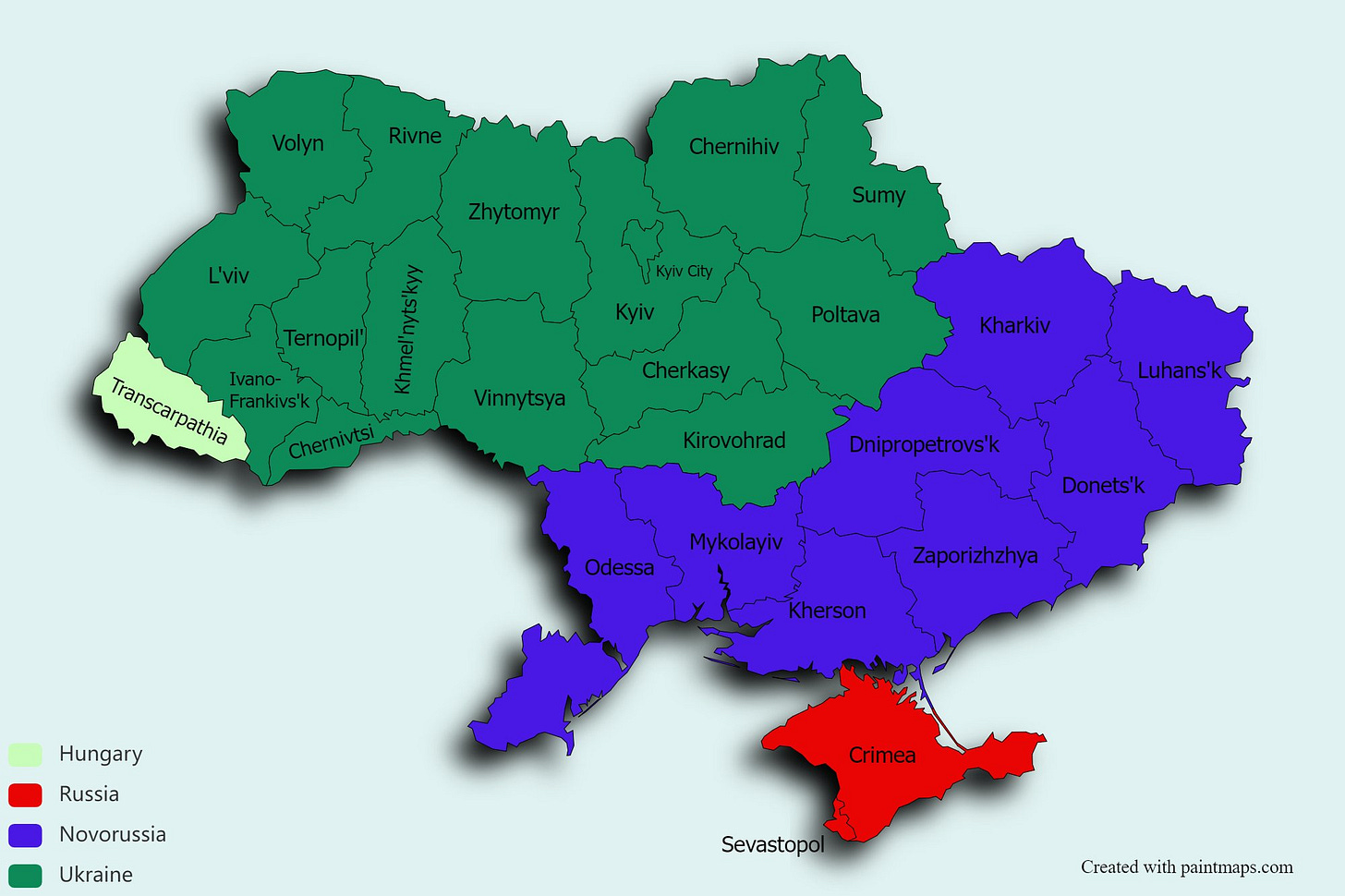
Novorossiya
No matter how the would-be masters of empire try to spin defeat into victory, most everyone around the world will still know the score. And it is this disabused illusion of imperial military supremacy that will rapidly accelerate its inexorable decline.
Of course it’s all about Alaska. Here’s what’s in play. But it’s the shadowplay that’s even more exciting.
By Pepe Escobar at Strategic Culture Foundation.
Of course it’s all about Alaska. Here’s what’s in play. But it’s the shadowplay that’s even more exciting.
Across the world, for those who grew up in the Cold War Swingin’ Sixties, the temptation is irresistible to cast Donald Trump as Goldfinger (but who would play Oddjob? Hegseth?)
Goldfinger, after all, is a powerful, ruthless gambler. His 21st century motto would be “Obliterate & Plunder”. In fact, sequentially, an orgy of obliteratin’ and plunderin’ if the occasions present themselves. Everything subjected to the search for the Golden Deal. My way. The only way.
Yet now it’s possible that Goldfinger may have met its appropriate – collective – match.
This is what happened the last time a summit took place in Alaska, in this particular case US-China in a shabby hotel in Anchorage. That shook the geopolitical chessboard to the core. Trump-Putin might – but only under quite specific conditions.
There’s only one realistic, optimal endgame for Alaska: a joint declaration of intent, pointing to a follow-up, as in the next meeting to be held in Russian territory. A sort of starter for the long and winding road towards a real reset of US-Russia relations, including a possible settlement in the proxy war in Ukraine.
Essentially, they may agree to keep talking. Yet what really matters is what may be implied by the promise: Goldfinger refrains from imposing secondary sanctions on Russia’s partners.
That will constitute a tremendous BRICS victory (Iran excluded. Actually, two strategic allies of Russia would be excluded: Iran and the DPRK).
BRICS are actively building a coalition to stare down Goldfinger. The key players are Bear, Dragon, Toucan and Elephant – all four original founders of BRIC. Nightingale should be added later, as it is linked via geopolitical/geoeconomic strategic partnerships with Bear, Dragon and Elephant.
When it comes to the Alaska nitty gritty, the top Bear needs to consider all the ramifications of what is an imperative for the Russian General Staff and the vast intel apparatus in Moscow: unless Goldfinger minions stop weaponizing and providing precious intel to Ukraine is all its forms, the mythic “ceasefire” that Goldfinger and the pack of toothless chihuahuas in Europe desperately want will be just an intermission to allow Ukraine to rearm to the hilt.
That’s a tough call for the top Bear: he has to placate his domestic, radical critics who blast him for sitting down with the enemy, and at the same time he must deliver the goods to his under-siege BRICS allies.
BRICS counteract Goldfinger’s Plunder tactics
Bear, Dragon, Toucan and Elephant are involved in breathless telephone diplomacy to articulate their collective response to Goldfinger’s Tariff/Plunder drive.
Examples. Modi on Brazil: “A strong, people-centric partnership between Global South nations benefits everyone.”
Lula on India: “Brazil and India are, so far, the two most affected countries. We reaffirmed the importance of defending multilateralism and the need to address the challenges of the current situation.”
Xi to Lula: China backs Brazil to defend its national sovereignty; BRICS is “a key platform for building consensus in the Global South.”
Goldfinger’s Tariff Plunder works in several ways.
On India: because New Delhi refuses to open its vast agricultural market to tariff-free Made in USA imports (45% of India’s population directly depends on agriculture); and because India buys Russian oil at much-needed discount prices.
On Brazil: because the ultimate target is regime change and free reign to plunder Brazil’s natural wealth.
So far, Goldfinger’s Plunder antics have been stellar when it comes to engineering their own blowback: from allienating even allies – see abject European submission – to de facto burying multilateral trade, not to mention international law.
Example: just a few hours before the tariff “pause” on Made in China products was about to expire, Goldfinger signed an executive order extending the deadline for another 90 days. Translation: TACO, all over again. If the tariff “pause” went through, the economy of the $37 trillion-indebted “indispensable nation” would be in even more dire straits.
Then there’s Goldfinger’s possible Arctic gameplay, already examined here. There’s virtually no evidence Russia would allow the US to participate in the development of the Arctic-wide Northern Sea Route (NSR), or Arctic Silk Road in Chinese terminology.
The role of Russia’s Atomflot – 11 nuclear icebreakers, 9 of them in action, 2 being built, including Project 10510 Rossiya, a behemoth capable of navigating anywhere in the Arctic anytime – in parallel with Russia’s astonishing arsenal of new weapons systems, these are absolutely key variables on any serious discussion on any possible US-Russia partnership post-Alaska.

Arya – آریا: mural at Tehran’s Enghelab Square. Farsi text: “The end of this saga is of glory, thus recite the name of Iran, for it is the slayer of its enemies.” The Iranian warrior Rostam from Shahnameh fights the serpent (the US)
Goldfinger’s obsession to cage Nightingale
Now let’s look at Nightingale – an immensely complex case. Goldfinger has totally embarked on a multi-track maximum pressure/tension remix against Iran: forcing Hezbollah to disarm; forcing the collapse of Lebanon into factional war; legitimizing the “al-Qaeda R Us” dismemberment of Syria; forcing snapback UN-backed sanctions on Tehran.
Then came the Goldfinger-hailed “historic peace summit” with Azerbaijan’s Aliyev and Armenia’s Pashinyan.
Well, what Baku and Yerevan really signed under Goldfinger’s watchful eye is not a peace deal: it’s a mere memorandum of understanding (MOU).
Their Joint Declaration is extremely vague – and non-binding. What is promised is a “let’s keep talking” set up: “We acknowledged the need to continue further actions to achieve the signing and ultimate ratification of the [Peace] Agreement.”
It remains to be seen what happens with the much-ballyhooed 99-year American grip on the Zangezur corridor – trimphally named Trump Route for International Peace and Prosperity (TRIPP) – complete with grabbing 40% of its revenues (Armenia would get only 30%) and placing 1,000 American mercenaries to patrol Armenian territory, right south of Nightingale’s borders.
The big story is of course Goldfinger eager to snatch at least one connectivity corridor in southern Eurasia – in the strategic south Caucasus, using a gangster-minded MI6 asset (Aliyev) and a national traitor (meek Pashinyan), which will be discarded and/or sweetened in due time. Crucially, NATO membership was offered to both Armenia and Azerbaijan.
The Deep State’s game plan is total control: what really matters is the opening to establish a NATO corridor all the way to the Caspian.
There’s no way Nightingale will let that happen, not to mention Bear and Dragon: it would mean a direct NATO threat not only to the International North South Transportation Corridor (INSTC), which unites three BRICS (Russia, Iran, India) and crosses the Caspian, but also the Chinese Silk Roads, whose corridors traverse Iran with possible branch outs to the Caucasus.
Nightingale has already made it quite clear it will not allow any kind of change of status for the Zangezur corridor. And it has the necessary missile arsenal to back it up. IRGC Deputy Commander Yadollah Javani: Iran “will not allow an American corridor on its border.”
Wherever it comes from, Goldinger or the Deep State, the pressure by the Empire of Chaos is relentless. There will be no respite in the Hybrid – and otherwise – Wars on BRICS, especially on the new Primakov triangle (“RIC” as in Russia, Iran, China).
Alaska in principle should be about a reset of all US-Russia security matters – geopolitical, commercial, military, with Ukraine being just a subset. That will be a major stretch. It’s hard to imagine Putin being able to impress on Trump, on the same table, the finer points of NATO/US ceaseless plots to undermine, harass and destabilize Russia.
The most probable outcome is that the proxy war – and the SMO – will keep rollin’ on, but with the Deep State making extra bundles of euros by selling tons of weapons for NATO to dispatch to Kiev. But even without the promise of a new, serious, US-Russia security architecture, BRICS may still stand a chance to snatch a victory out of Goldfinger’s latest photo op.
All eyes on Alaska. The Bear-Eagle face-off is part of an astonishing acceleration of history in the summer of 2025.
By Pepe Escobar at Sputnik.
Two weeks after Alaska, there’s the Shanghai Cooperation Organisation (SCO) annual summit in Tianjin, China. India’s Narendra Modi and Iran’s Masoud Pezeshkian will join, among others, Xi Jinping and Vladimir Putin at the same table. A BRICS/SCO table.
September 3, in Beijing, is the 80th anniversary of what is officially defined as the victory of “the Chinese People’s War of Resistance Against Japanese Aggression and the World Anti-Fascist War”. Putin is the guest of honor. The rehearsal, with 22,000 participants, took place this past weekend in Tian’anmen Square.
On the same day, in Russia’s Vladivostok, it’s the start of the Eastern Economic Forum, which discusses everything about Russia’s drive to develop the Arctic and eastern Siberia – the equivalent of the Chinese “Go West” campaign started in the late 1990s. Key Eurasian players will be in the house. Putin addresses the plenary session on September 5.
Top BRICS leaders of China, Russia, Brazil and India, meanwhile, are actively involved in a flurry of phone calls coordinating a collective response to the tariff wars – part of the hybrid war by the Empire of Chaos against BRICS and the Global South.
How Trump is Aiming for a PR Win
Let’s see how Alaska is setting the stage for something much bigger.
The summit was announced following what Putin advisor Yuri Ushakov concisely defined as “a proposal from the American side which we think is quite acceptable.”
This sentence was as far as the Kremlin would comment – in contrast with the non-stop verbal onslaught emanating from Washington. That the Kremlin even considered the American offer means an implicit recognition of what Russia is achieving on the battlefield and in the geoeconomic sphere.
Timing. Why now? Especially after Trump had threatened buyers of Russian oil with tariffs? Essentially, because military intel in selected deep state silos have done the math and finally admitted that the long proxy war in Ukraine is lost.
Moreover, Trump personally wants to get over it so as to concentrate on the next chapters of the Forever Wars – including the one that really matters: against “existential threat” China.
From Moscow’s point of view, conditioned by the successful results of its calibrated war of attrition, the facts on the battlefield spell out the special military operation rollin’ on – and no ceasefire; at best a “humanitarian” pause of a few days. The Americans want a ceasefire of at least a few weeks.
Reconciling both sides’ optics will be a Sisyphean task. Still, Alaska is just the beginning: the next meeting is already in the works to take place in the Russian Federation, according to Ushakov.
Trump’s motives are easily identified: create the perception of the US extracting itself from the mess; some sort of truce; and back to doing business with Russia – especially in the Arctic.
In parallel, assuming any sort of deal, the deep state will never recognize the new Russian regions, even Donetsk and Lugansk; and will seek to re-weaponize Ukraine, “leading from behind”, for a NATO-led war replay further on down the road.
So the US-Russia abyss is mirrored by the domestic American abyss – and most of all the Trump-NATO/EU abyss. The toothless chihuahua European pack, trying to salvage its pitiful Kiev actor, is doing somersaults – complete with possible black swans – to derail the summit even before it happens.
There’s no way Trump can sell any sort of settlement to the rabid NATO/EU pack. But nothing would please him more than to transfer the war – in full – to them. With the benefit that the deep state in this case will not complain – because it will be reaping massive euro profits from the weapons sale racket. End result: a classic Trump PR win.

Exit Ukraine, Enter the Arctic
Ukraine, though, will not be the main theme in Alaska. The ever-perceptive Russian Deputy Foreign Minister Sergei Ryabkov cut to the chase: what really matters is that “the first signs of common sense are appearing in Russia-US relations, which were absent for several years before.”
Ryabkov was quick to also highlight the dangers: the risk of nuclear conflict in the world “is not decreasing”; and Russia sees the risk that “after the expiration of the New START Treaty, nuclear arms control will be completely absent”.
Once again: Alaska is just the beginning of something much bigger – including, finally, a serious discussion about “indivisibility of security” (what Moscow wanted already in December 2021, rebuffed by the autopen administration).
And that brings us to the Arctic – and serious stuff that will certainly be debated in depth at the upcoming Vladivostok forum.
The Arctic holds at least 13% of global undiscovered oil reserves and 30% of undiscovered natural gas. Russia controls at least half of all these reserves. The Empire of Chaos badly wants to be part of the action.
Yet one thing is possible massive US investment in joint Arctic projects with Russia. Something entirely different is the US joining the Northern Sea Route (NSR) – which the Chinese call the Arctic Silk Road. The NSR reduces shipping time between Asia and Europe by up to 50%.
The Russian-Chinese rationale for the NSR – including the expansion of Russia’s unique nuclear icebreaker fleet – is exactly to bypass the Suez Canal and connectivity channels controlled by the US. The key question then is what would it take to swing Moscow to accept a Trump-Putin deal in the Arctic.
So on Ukraine, in principle, Russia has all the cards – as long as the special military operation goes on, now on overdrive. On hybrid war, the tariff chapter, the US ruling classes finally realized they have no cards – because blowback caused by secondary sanctions will badly damage the US. What’s left then is a commercial deal: the Arctic.
It’s quite intriguing that even the JPMorgan Center for Geopolitics admitted that the best solution for the Ukraine mess is a Georgia scenario: that would somewhat offset the optics of a total capitulation by the West. Only Ukraine would capitulate: no NATO, no EU, no money, no security guarantees.
Inestimable Prof. Michael Hudson has condensed how Alaska will proceed under two vectors: “Part I is whether the US will acknowledge that the trajectory of the current fighting is for a total Russian victory, on the terms that Putin has been explaining for two years: no NATO membership, no foreign arms supplies, Nuremberg-like trials of the Banderite leaders, and perhaps reparations by Ukraine and NATO for the rebuilding of formerly ‘Ukrainian’ Russia.”
Assuming Trump accepts it, and that’s a major “if”, then comes the real nitty gritty (remember Ryabkov), “starting with whether a new atomic missile and arms treaty will be put in place.”
Russia’s version of peace, writes Prof. Hudson, will flow along these lines: “We don’t want an atomic war with the United States. Let’s agree that if a German or other EU/NATO missile hits Russia, when we retaliate it will only be against Britain, Germany and France, not North America.”
Prof. Hudson is adamant that “America has only one thing to offer other countries: the (temporary) promise NOT to hurt them. There’s nothing positive to offer, given its de-industrialization and the world’s de-dollarization.”
As it stands, and also considering the multiple ramifications of the hybrid war against BRICS, Alaska carries the potential of offering Washington a way out of the debris of a massive strategic defeat.
Any analyst who tried to understand the special military operation from the beginning, in detail, could tell that Russia’s war involved something much bigger than Ukraine. It was always about the burial of the “rules-based international order”, in fact the whole old order architecture. That is happening as we speak in the black soil of Novorossiya. Strategic patience, in the end, does pay.

Le groupe Kalachnikov va fournir à la zone de l’opération militaire spéciale le drone modernisé « Kvazimatchta », capable de
L’article Le groupe Kalachnikov va fournir un drone capable de voler pendant 20 jours aux troupes russes est apparu en premier sur STRATPOL.
This is part of a series of LAC updates planned for the next week. It appears as if the US has remembered their ‘backyard’ and they are threatening even with military action. We saw the bounty put on Nicholas Maduro’s head and a day later both Mexico and Venezuela are being threatened by Marco Rubio with military action.
Marco Rubio stated that by declaring Nicolás Maduro the leader of a terrorist organization, the United States will treat him as a national security threat and will be able to act with intelligence and military force if necessary.
Nicolás Maduro and his cronies think they’re untouchable. They’re wrong. We’re increasing our reward offer for Maduro to up to $50 million. https://t.co/mEomEgWLcT pic.twitter.com/ltq1cdMUji
— US Dept of State INL (@StateINL) August 8, 2025
An overall view:
I plan to do the next article on Mexico which is doing some interesting moves to protect itself, and then on Venezuela and Bolivia.
While Brazil can be categorised within the War on BRICS, it can also be categorized within the general action that has started on Latin America and the Caribbean.
The ‘guns’ aimed though, are different. On Brazil, we see trade and lawfare guns. On Mexico, we see trade and cartel guns, and where it overlaps with Venezuela, is on drug cartels. (It is really about oil!). The US State department has suddenly announced that Maduro is the biggest drug cartel ever. He is four cartels. There has never been such a cartel in the world and we have never seen such a thing (just mocking Trump).
LULA, bring Venezuela into BRICS pronto! And as Mexico in a very low key manner visits BRICS, and does not keep quiet at the G20, keep supporting it please. First under AMLO and now under Presidente Claudia, they are our people.
Brazil on Trade:
China does three times more trade with Brazil than the US. Chinese press agency Xinhua reported that Foreign Chancellor Wang Yi says that China will work with Brazil to offset the damage caused by the US tariffs.
Thanks for opening new markets, Trump. Days before the US’ threatened 50% tariff on Brazilian coffee is scheduled to come into effect, the Chinese government has granted new import licenses to 183 Brazilian coffee companies. https://t.co/7YOGBqZCjK
— BrianMier (@BrianMteleSUR) August 4, 2025
LULA is working at uniting BRICS in terms of a bloc reaction on tariffs. He says that the Trump administration wants to negotiate with one country after the other individually, in order to break multilateralism in trade. There are other major articles taking this stance.
Modi says: Had a good conversation with President Lula. Thanked him for making my visit to Brazil memorable and meaningful. We are committed to deepening our Strategic Partnership including in trade, energy, tech, defence, health and more. A strong, people-centric partnership between Global South nations benefits everyone.
Brazil on Lawfare:
In Brazil however, the major salient of the BRICS war is one of lawfare, using Bolsonaro, his sons and family as the forefront of the weaponized activities.
Brazil has laws against total free speech on the internet, and for them, it is serious. This is how they control out-of-control political speech (read outrageous MAGA propaganda) as well as child molestation and heinous crimes of this nature, as well as grooming children to alternative lifestyles. It is a serious part of their legal arsenal, and social media must adhere to these laws. This is one salient that the US uses to attack Brazil: accusing it of not having free speech. (It is never explained which speech is controlled of course). This became prominent when X was outright banned, when Elon Musk would not adhere to Brazilian law. This is the main reason why Glen Greenwald is not popular, as he attacks these laws.
Lawfare also rages against Supreme Court Justice Alexandre de Moraes, who placed Brazil’s ex-President Jair Bolsonaro under house arrest after he repeatedly disobeyed the precautionary measures applied on July 18 after the court ruled he was a flight risk.
On July 18, Bolsonaro was ordered to wear an ankle monitor, stay home at night, and stay off social media. Backed by Trump, he kept inciting violence against the Supreme Court—posting on his sons’ accounts and staging dramatic videos to rally his base.
After promising the Court he would stop doing this, he continued anyway, possibly thinking that Trump’s citing the Magnistky Act to personally sanction Moraes, the trial judge overseeing his indictment would cause him to back down. It backfired. The incident that Brian Mier describes here, is as a result of Bolsonaro rallying of his base. Sanctions on Moraes is manufactured propaganda. It is a manufactured set of sanctions, as Moraes said early on that he does not have a US visa, he does not want a US visa and he has no investments in the US.
From Brian Mier
MAGA Playbook: Bolsonaro Allies Paralyze Congress

Free speech absolutism. The caption under the 1928 Nazi propaganda poster on the left said, “one alone out of 2 billion humans on earth is not allowed to speak in Germany.”
After Congressional President leaves Brasilia early, far right lawmakers resuscitate Nazi “tape over the mouth” trope to demand amnesty for Bolsonaro. A compromise is struck and Congress resumes.
On Tuesday, August 5, Brazil’s Congressional President Hugo Motta (PB) from the conservative Republicanos party left Brasilia on a business trip, turning control of the floor over to his elected Vice President, Altineu Cortes (RJ), a member of Bolsonaro’s Liberal Party (PL).
Free speech absolutism. The caption under the 1928 Nazi propaganda poster on the left said, “one alone out of 2 billion humans on earth is not allowed to speak in Germany.”
De-Linking Brazil is a reader-supported publication. To receive new posts and support my work, consider becoming a free or paid subscriber.
Cortes invited a group of PL lawmakers to the table and they paralyzed Congress, which was scheduled to vote on a Bill that Lula’s finance minister, Fernando Haddad, has been pushing for for two years which will nearly double the annual minimum income cap needed for citizens to pay income tax to R$60.000.
On Wednesday, protests resumed, with several lawmakers reviving an old Nazi trope by taping over their mouths. They cited Glenn Greenwald-style free speech absolutism to protest a Supreme Court order barring former President Jair Bolsonaro, who is currently under house arrest, from using social media after he repeatedly used it to incite violence against the court and its ministers. Their main demand, however, was that Congress grant full amnesty for Jair Bolsonaro and let him run in the 2026 presidential elections.
A visibly irritated Congressman Motta canceled his trip and returned to Brasilia on Wednesday afternoon. After meeting with PL lawmakers for two hours he returned to the floor. With a group of congressional police officers standing behind him, he ordered them to leave the stage, sat at the table, reopened the session and said, “Democracy can’t be negotiated. We can’t allow personal or electoral projects to be prioritized over what is greater than all of us: our citizens.”
Journalists immediately began working to find out what kind of compromise the notoriously fickle Motta struck with the opposition. O Globo and Folha de S. Paulo’s UOL reported that the PL made two demands: 1) Amnesty for Jair Bolsonaro and his allies who have been indicted in two investigations by the Federal Police and Attorney General’s Office for plotting a military coup; and 2) A constitutional amendment that would end privileged jurisdiction for federal deputies and senators.
Privileged jurisdiction is a form of parliamentary immunity established in Brazil’s 1988 Constitution, which was designed to protect high ranking elected officials from frivolous lawsuits and criminal procedures that could distract them from doing their jobs. It stipulates that standing presidents, vice presidents and federal lawmakers cannot be tried in the lower courts, leaving the Supreme Court as the only body that can oversee investigations and prosecute them.
What was designed as a form of protecting lawmakers became a thorn in their side when Supreme Court Minister Flavio Dino opened an investigation into embezzlement from the Bolsonaro administrations, “secret budget”, which saw over R$ 50 billion in unrestricted funds allocated for parliamentary amendments. Today, 7 Supreme Court ministers are overseeing embezzlement investigations against 80 lawmakers. The complete list hasn’t been released, but it’s said to include several lawmakers from center-right parties that comprise the largest block in Lula’s governing coalition, with many others coming from Bolsonaro’s Liberal Party (PL).
Ending privileged jurisdiction would mean that corruption cases against lawmakers would have to go through the lower court system before reaching the Supreme Court, a process that normally lasts from years to decades in Brazil (the only case that ever moved quickly was the US DOJ-backed Car Wash investigation against Lula, which went through the TRF-4 circuit court in a record breaking 40 minutes). In practical terms this means that, if passed, lawmakers wouldn’t ever face prison sentences until years after their mandates ended.
“The end of privileged jurisdiction is uniting nearly everyone right now,” an unnamed lawmaker who took part in the negotiations with Motta told a reporter from Globo. “Amnesty doesn’t. I believe that next week we are going to see the evolution of an end of privileged jurisdiction, with no progress made towards amnesty.”
Motta says he will continue to block the amnesty bill from a floor vote, and Jair Bolsonaro’s own lawyers say they believe his imprisonment is irreversible.
Meanwhile the Trump administration is doubling down on its threats against Brazil’s judiciary. Yesterday Trump’s Under Secretary for Public Diplomacy threatened to apply Magnitsky sanctions to any other Supreme Court Justice who supports Minister Alexandre de Moraes.
The Bolsonaro family’s recent behaviour has prompted an official from Brazil’s intelligence agency ABIN, to say that he believes everything they are now doing is being scripted by the CIA. Trump’s tariffs certainly appear to be a move straight out of the US regime change playbook. After all, destabilizing foreign enemies economies has been a tactic used by the US all over the world for decades. For example, the US-led boycott on Chilean copper in 1973 was made in response to Nixon’s order to “make their economy scream.” The joint US/Brazil Operation Car Wash judge Sergio Moro’s move to deliberately bankrupt Brazil’s 5 largest construction and engineering companies in 2015, which led to 4.4 million direct and indirect job layoffs, was a key tool in engineering the drop in popularity for President Dilma Rousseff which led to the 2016 coup process which culminated in Lula’s arbitrary election season arrest and Bolsonaro’s rise to the presidency.
However, the World has changed. During Lula’s first two terms in office, the US was Brazil’s largest trading partner. Today, China does three times more trade with Brazil than the US does. This morning Chinese press agency Xinhua reported that Foreign Affairs Minister Wang Yi told Brazil’s presidential advisor on foreign affairs, Celso Amorim, that China will work with Brazil to offset the damage caused by the US tariffs.
“China firmly supports Brazil in defending its right to development and opposing the bullying practices of arbitrary tariffs,” he said. “As the largest developing countries in the eastern and western hemispheres respectively, China and Brazil have always supported each other, closely coordinated, and firmly safeguarded the legitimate interests of their own as well as the common interests of the Global South countries.”
As for yesterday’s MAGA-style protest, Hugo Motta says if they try it again he’ll suspend Congress for six months. Bolsonaro is expected to be sentenced in September and is facing a possible prison sentence of up to 44 years.
The whole world is watching these developments with great interest.
By William Schryver at imetatronink.
They will endeavor to talk tough and “keep up appearances” for a while yet, but as a credible and capable military/political alliance, NATO is irreparably broken.

Confederate Field Fortifications, Petersburg, Virginia, USA. 1865

Union Trench Mortars, Petersburg, Virginia, USA. 1865
I’ve watched a LOT of drone footage from this war. I’ve seen, from a bird’s eye view, as it were, the design of the field fortifications Ukraine constructed, with NATO guidance, over the course of eight years.
The logic of these miles and miles of fortifications harkens back to the 1864-65 Battle of Petersburg (US Civil War), with a few World War I innovations thrown in for good measure.
It is a logic where victory largely depends on you not running out of men, heavy weaponry, and ammunition — and the enemy being comparatively stupid.
In many ways, the revealed logic of Ukraine’s long-prepared strategy for this war is a reflection of American military delusions and vanities, which multiplied and solidified over the course of the brief and fleeting “unipolar moment”.
Despite not having won a war since 1945, the US military is consumed with the vanity that it has always dominated opposing forces in every conflict.
There is a measure of truth in this perspective. But it is irrelevant. Because, since no later than the Korean War, the US has not faced a peer or near-peer adversary in a high-intensity conflict. The US military has not been, for almost three-quarters of a century, truly tested “under-fire”.
The US has measured its battlefield mettle, for decades, against brave sandal-shod men with AK-47s, RPGs, and a certain savoir faire for constructing IEDs.

Taliban Fighters, Afghanistan.
But they have never faced anything like Russian artillery or missiles – not even in Hollywood movies or video games.
Consequently, the Pentagon’s self-perception of unquestioned supremacy has served to disinform and corrupt its doctrinal and procurement decisions for multiple generations of its officer corps. For most US generals and admirals, all putative opponents are underestimated.
That said, I believe a great many have now been awakened from their intellectual slumber by the manner in which the Russian armed forces quickly assessed the Ukrainian order of battle, and then professionally adapted their strengths and tactics to decisively defeat it.
The Battle of the Donbass
Here is a brief summation of the Russian tactical approach to the Battle of the Donbass:
Step #1: Advance reconnaissance units (often in force, with dozens or hundreds of drones overhead) to assess the situation; draw fire; relay to commanders raw video and geo-coordinates.
Step #2: With target-correcting drone swarms overhead, relaying real-time strike video, proceed to savage the fortifications with towed and mobile artillery, Multiple Launch Rocket Systems (in gradations of strength and precision), and even horrific thermobaric munitions for particularly suitable targets.
Let smoke clear.
Repeat Step #1.
Still something moving there?
Repeat Step #2.
Repeat Step #1.
Dead bodies everywhere?
Step #3: Send in tanks and infantry to mop up.
Move to next series of fortifications.
And so on and so forth …
This is why Ukraine now suffers hundreds of battle deaths every single day. And why, for months, the Russians have suffered very few casualties — likely as low as a 1:8 ratio, and quite possibly even lower.
Artillery, airstrikes, and precision guided munitions are doing almost all the fighting.
The Fatal Hubris of NATO War Strategy in Ukraine
But back to Ukraine’s apparent strategy for this war, and the apparent US influence on that strategy.
I will preface my commentary on this issue by stating that Ukraine’s fatal blunder was buying into NATO’s over-confident delusion that they (the Armed Forces of Ukraine) actually had a reasonable opportunity to defeat the Armed Forces of the Russian Federation in a high-intensity conflict.
I initially believed NATO military leaders must have had a sober view, far in advance, that their half-million-strong, well-armed, trained-to-NATO-standards Ukrainian proxy army had almost no chance of prevailing on the field of battle against Russia.
But watching drone video of Ukrainian fortifications has convinced me the US military brain trust, in the course of their eight-year-long preparation of the eastern Ukrainian battlefield, effectively disdained the Russian military and its commanders.
Their vanity persuaded them the Russians would mindlessly smash themselves to pieces against an entrenched well-armed force.
Indeed, they were so confident of the genius of their plan that they persuasively encouraged many hundreds of now-killed or captured NATO veterans to “share in the glory” of humiliating the Russians and bringing down the Putin regime once and for all.
They deluded themselves into believing the Russians lacked strategic and logistical acumen, a sufficiently well-trained force, and – arguably the biggest miscalculation of all – sufficient stockpiles of ammo to conduct a protracted high-intensity conflict.
In short, I have come to believe US/NATO commanders actually persuaded themselves that this “Mother of All Proxy Armies” had an excellent chance to soundly whip the Russians in a battle situated in their own back yard.
In other words, they disregarded centuries of European history that they somehow convinced themselves had no relevance to their 21st century aspirations to defeat Russia militarily and take a great spoil of its resources.
But, as is now readily apparent to all objective, knowledgeable military analysts around the globe, the Ukrainian proxy army has been pulverized by a patient, methodical, and significantly outnumbered Russian force, using long-established Russian doctrines and tactics.
Even more revealing is that once-vaunted and universally feared US/UK weaponry – almost all of it actually rather antiquated – has proven to be far less “game-changing” than the pea-brained strategists in Washington and Whitehall mistakenly believed.
Javelins, NLAWs, and Stingers have been exposed as mostly ineffective against their intended targets (tanks, helicopters, and low-flying jets). M-777 howitzers break down after just a few fires. GPS-guided “precision” munitions are routinely jammed by Russian electronic warfare counter-measures.
Worse yet, the inculcation of NATO field doctrines in the minds of the Ukrainian officer cadre has resulted in pervasively inflexible responses to battlefield events that develop contrary to expectations. Consequently, discipline has disintegrated, and improvisation has been paralyzed.
To be sure, if one were to go by the laughable assessments of western think-tank propagandists and their dutiful lackeys in the media, “Ukraine is winning” and “the inept Russian military has been humiliated”.
But more discerning observers around the world know better.
Sober military men in potential adversary countries across the globe see with clarity that Russia has, with one hand tied behind its back, eviscerated the massive, relatively well-armed and well-trained Ukrainian military. The US/NATO intimidation factor has been forever compromised.
More geopolitically significant, at least in the near future, is that European NATO members can also read the scorecard of this war: they now understand as they never could previously that standing on the NATO side of the field is hardly a guarantee of security.
I am convinced NATO will not survive the results of this war in Ukraine. Sure, they’ll “keep up appearances” for the time being, but there can be no doubt most now understand that siding with a rapidly declining empire is fraught with great risk and minimal gain.
More concerningly, the Chinese have been watching all of these developments with great interest. They are almost certain to be emboldened to act decisively to secure their sphere of influence in the emerging multipolar world.
Great dangers now await in east Asia …
(Mine) Metropolitan Kirill: “Lord have Mercy. Did he really ask, “…why were the Oreshniks not released as the US & Tel Aviv saw this move as weak. Why did it not happen and will it happen?” Son, this venue ain’t the Islamic Revolutionary Guard Corps (IRGC). And no worldly weapon is gonna win this War”
Background:

 Official channel of the Synodal Department for Interaction with the Russian Armed Forces and Law Enforcement Agencies:
 The Synodal Department for Interaction with the Armed Forces and Law Enforcement Agencies held an award ceremony for military correspondents
On June 3, 2025, the Chairman of the Synodal Department for Interaction with the Armed Forces and Law Enforcement Agencies, Metropolitan Kirill of Stavropol and Nevinnomyssk, met with military journalists and correspondents who, in the course of their work, actively cover the activities and service of the military clergy in the SVO zone.
Among them:
For their contribution to the coverage of the service of military clergy in the SVO zone, they were all awarded the medal of the Order of the Blessed Prince Dmitry Donskoy.
 Military Department of the Moscow Patriarchate


Discover what’s really happening on the space station no one told you about. China’s Tiangong-3 (Heavenly Palace) space station orbits Earth in parallel with the ISS, yet remains hidden from Western media attention. Join this exclusive journey to uncover the meticulously planned experiments conducted aboard this enigmatic outpost, and reveal China’s ambitious cosmic agenda that could reshape humanity’s spacefaring future.
Unique in the design of China’s space station, is its modular form. This means that other partners could ‘hook up a module’ to Tiangong-3 and independent work, or collaborative work could be done. China or any of their taikonauts are not welcome on the international space station (which in any event is due to be dismantled). There is thus this direct way for Russia, to quickly and relatively cheaply get going. Mr.Putin, in his meeting on development of space activities, set certain objectives for Russia. This would be a marvellous collaboration.
We can’t stand by in the face of the U.S. blockade on Cuba,” said Brazil’s President Luiz Inacio Lula da Silva at the 9th CELAC Summit, where leaders from across the hemisphere called for an end to decades of U.S. sanctions. pic.twitter.com/n2xsANiZ8C
— Belly of the Beast (@bellybeastcuba) April 11, 2025
#Brazil | President Lula da Silva called for Latin American unity at CELAC Summit, prioritizing democracy, climate action, and economic integration amid global instability.https://t.co/D5LAJgFcIu
— teleSUR English (@telesurenglish) April 10, 2025

 Lateo.net - Flux RSS en pagaille (pour en ajouter : @ moi)