 Connexion


Lors d’une réunion informelle des secrétaires des conseils de sécurité de la CEI, organisée dans le cadre du premier Forum
L’article Choïgou : la population ukrainienne revient massivement à la langue russe est apparu en premier sur STRATPOL.
Dans les profondeurs de la mer du Groenland, à plus de 3 600 mètres de profondeur, une expédition scientifique internationale a
L’article Dans la mer du Groenland, des hydrates de gaz ultra-profonds révèlent un écosystème jusqu’alors inconnu ! est apparu en premier sur STRATPOL.
En Islande, impossible d’entendre le vrombissement des avions de chasse fendant le ciel ou le défilé des troupes dans les
L’article L’Islande, la fin du pacifisme : l’île repense sa sécurité et renoue avec l’UE est apparu en premier sur STRATPOL.
Rome découvre le Nord, mais le Nord n’est plus ce qu’il était. La stratégie arctique présentée par le gouvernement italien
L’article L’Arctique, promesse et piège : la stratégie nationale de l’Italie est apparu en premier sur STRATPOL.

Au menu cette semaine: 00:00 Géopolitique profonde 04:20 Économie 12:50 Politico-diplomatique 24:15 Armement 26:40 Empire du mensonge 36:35 Considérations militaires
L’article Bulletin STRATPOL N°274: Le nouveau monde de Davos, Zelenski convoqué. 23.01.2026 est apparu en premier sur STRATPOL.

Le président russe Vladimir Poutine a tenu une réunion par visioconférence avec les membres permanents du Conseil de sécurité. En
L’article En réunion du Conseil de sécurité russe, Poutine revient sur l’invitation de la Russie au Conseil de paix et sur le Groenland est apparu en premier sur STRATPOL.

Quelques heures après son discours au Forum économique mondial, le président américain Donald Trump a pris la parole sur les
L’article Trump fait marche arrière sur les droits de douane sur la question du Groenland et annonce un « cadre pour un futur accord » est apparu en premier sur STRATPOL.

Les États-Unis imposeront des droits de douane de 10 % sur les importations en provenance du Danemark, de la Norvège,
L’article Trump va imposer des droits de douane aux pays européens s’opposant à son acquisition du Groenland est apparu en premier sur STRATPOL.
Today’s “Big Debate” on Indian global broadcaster News X was a pleasure for me as one of four panelists and I am hopeful that the Community will find it worth a listen. Our task was primarily to make sense of Trump’s conflict with Europe over his planned takeover of Greenland.
My fellow panelists were a mixed group in terms of political perspectives, indicating that the producers knew very well what they were doing in bringing us together.
The view of the U.S. Deep State was well represented by an American professor of political science at Macalaster College, Andrew Latham, though I do wonder what benefit his students will gain from expertise in international security and strategic studies coming from a prof who says, as Latham does in his response to my remarks on the coming implosion of NATO, that Europe will do just fine as it puts together its own defenses. He seems to overlook the small detail of how much time it will take Europe to regroup and arm itself. De facto, if NATO implodes now, in 2026, then Europe will be utterly defenseless against the Russian bear it has been taunting and provoking for the past several years while feeling secure in hiding behind Daddy Sam. Heaven forbid, they might feel compelled to find that new ‘balance’ of interests with the Big Neighbor to the East that Chancellor Merz said is on the agenda. By the way, the good Chancellor has just recalled his 13 officers and soldiers from Greenland, probably in a late effort to have his country removed from Trump’s latest tariffs.
Indian panelist Keith Vaz was a conventional as can be in his own way. Vas is a respected representative of the Indian contingent in the Labour Party of Britain. He has clearly been well integrated into the power hierarchy of the U.K. Wikipedia tells us this about him: “Nigel Keith Anthony Standish Vaz is a British politician who served as the Labour Party Member of Parliament for Leicester East for 32 years, from 1987 to 2019. He is the UK Parliament’s longest-serving British Asian MP. Vaz served as the Minister for Europe between October 1999 and June 2001.” As one could imagine, he thinks Keir Starmer is a swell guy who has been very diplomatic in dealing with Trump.
And then there is a rather unconventional Indian panelist Sumit Peer. His LinkedIn entry says this about him: “…a renowned Geo-Political Commentator, visionary Columnist, Business Advisor, and a concerned citizen with a mission of contributing towards nation building.”
I am appreciative that the host allowed me to take my disruptive discourse to its logical conclusion as I explained that Trump’s main objective in his Greenland adventure is to so rough up the Europeans by his violation of sovereignty and national borders that they vote to leave NATO. This would enable Trump to proceed with his normalization of relations with Russia over the semiconscious and prone body of Rump Ukraine.
©Gilbert Doctorow, 2026
gilbertdoctorow

Dans cette nouvelle édition de « ICI MOSCOU », Xavier Moreau revient sur les trois lubies du moment de Donald
L’article Ici Moscou : Trump hors contrôle est apparu en premier sur STRATPOL.

Au menu cette semaine: 00:00 Géopolitique profonde 07:30 Économie 16:35 Politico-diplomatique 26:35 Terrorisme 27:38 Armement 31:30 Empire du mensonge 34:30
L’article Bulletin STRATPOL N°273: SOS Groenland, Oreshnik pour tous, Lithium pour Trump. 16.01.2026 est apparu en premier sur STRATPOL.

Face aux menaces d’annexion du Groenland proférées par Trump, plusieurs pays européens – l’Allemagne, la Suède, la France et la
L’article Six pays européens ont décidé d’envoyer des troupes au Groenland est apparu en premier sur STRATPOL.

Les ambitions américaines concernant le Groenland s’intensifient, et le mercredi 14 janvier sera une date cruciale pour déterminer si elles
L’article Sommet du Groenland avec le Danemark à Washington. Rubio et Vance tentent de réaliser le rêve de Trump ! est apparu en premier sur STRATPOL.

Israël est devenu le premier pays à reconnaître la République du Somaliland, jusque-là non reconnue, comme un État souverain. Cette
L’article Israël devient le premier pays à reconnaître le Somaliland est apparu en premier sur STRATPOL.
Europe’s choice is to surrender or die.
By Rotislav Ishchenko at ukraine.ru.
(machine translation)
Alastair Crook, a retired British diplomat, has stated that the European Union is preparing a provocation on a scale comparable to Pearl Harbor, with the aim of drawing the United States into a war with Russia.
In principle, this is not news. We have been writing for two years that the British, realizing that Ukraine has failed and will be buried, have placed their bets on a pan-European war (under the auspices of the United States) against Russia. While Joseph Robinette Biden Jr. was trying to figure out who he was and how he got here, the mechanism for expanding the war was clear: a provocation in the Baltic Sea (less likely in the Black Sea or on the Belarusian border), which would leave Russia with no chance of resolving the crisis without shooting, and an outcry about the “attack” to the country of the EU and NATO, a statement of military support (sending troops and equipment, but without a formal declaration of war against Russia) by the leaders of the EU. In the last act, the United States and Britain enter the scene, demanding that Russia cease fire and threatening to provide all possible support to their allies.
I would like to point out that the mechanism of provocation assumed that in all cases, Russia would initiate military action against a specific country. Moscow, on the other hand, was only faced with the choice of whether to attack the Baltic states, which had blocked Kaliningrad, or to hope for a miracle, sink the transports carrying French and German troops and equipment bound for the Baltic ports, or to express protests, attack the territories of the United States and the United Kingdom in response to their ultimatum, or to agree to a ceasefire and negotiations mediated by them. In the end, acquiescence inevitably led to capitulation (since as soon as one set of demands was met, the West would immediately set forth another), and escalation inevitably led to a global nuclear war.
It is no coincidence that Trump claimed that Biden was leading the country towards a nuclear armageddon. Whether Biden was aware of his actions or was being manipulated by his entourage, the decision-makers in the United States (as well as the majority of the British establishment and the European bureaucracy) believed that Russia would not engage in a nuclear conflict and would retreat. However, there were other politicians in the West who had no doubt that if Russia was pushed to the wall, nuclear mushrooms would grow all over the West – no one would leave without a share. These people came to power in the United States with Trump, and their supporters are gradually pushing back against the European left-liberal supporters of war.
As a result, the United States fell out of the scheme, and Trump openly stated that if Europe wanted to go to war with Russia, it could do so on its own, without the United States. It’s not that the Europeans were particularly eager to go to war, but rather that they couldn’t help but go to war with Russia, as acknowledging defeat in the Ukrainian crisis would completely undermine the left-liberal European elites. To understand why this is significant, it would have political, economic, and social implications on a scale similar to those that shook Russia after the October Revolution and before the outbreak of World War II. The Europe we know will disappear, and a new Europe will be born in agony, compared to which the 1990s in Russia were like a light rain during a summer picnic.
But the Europeans also can’t go to war with Russia. They don’t have the armies, the warehouses, or the ability to quickly deploy the necessary military production. Without the United States, the EU is a paper tiger. Although no, a paper tiger is scarier than the EU without the United States. This is why Alastair Crook emphasizes that the provocation must be so severe and widespread that neither Trump nor other American and European politicians who support de-escalation can avoid going to war with Russia.
By the way, as a loyal subject of His Majesty, Alastair Crook does not mention Britain’s leading role in developing this plan and preparing the provocation. The blame lies with the EU, which intends to drag the United States into a war with Russia, while the United Kingdom simply passed by.
It’s understandable. Most likely, the provocation is unavoidable. The British and the European bureaucracy can’t help but try to seize their last chance. I once wrote that nothing would stop them. They might even detonate a nuclear device in Kyiv to blame Russia. However, the Ukrainian government is not fully in control of the situation. The internal opposition to Zelensky, unable to oust him yet, is attempting to preserve at least some form of Ukraine by pushing Zelensky overboard.
In such a situation, the preparation of a large-scale nuclear provocation, which requires deep secrecy, is extremely difficult, as hundreds of people must be involved in its organization (transportation, storage of the relevant munition, its transfer across the border, security, and other activities cannot be carried out without the involvement of a large number of people). Even if you simply replace the customs officers and border guards at the border with trusted individuals, it will immediately become widely known that something large and secret is being transported.
However, recently, the Ukrainians and the British have started practicing a naval provocation, attacking tankers from any country carrying Russian oil. Russia has already begun responding to the Odessa port and the ships arriving there. In principle, the British Navy and its Ukrainian counterparts can organize a “Lusitania” (with influential Americans on board). However, it is more difficult to prove Russia’s “guilt.” As Poland’s experience shows, it is no longer enough to simply claim that Russia wanted to blow up railway tracks and cause a major disaster; convincing evidence is also required.
Actually, this is the catch: how to organize a provocation in such a way as to shake the imagination of “all people of good will”, and provide “convincing evidence” of Russian “guilt”, and not inherit anywhere, and leave the United States no choice? The task is difficult, but, as experience shows, it is solvable. If British diplomats (even retired ones) start issuing warnings and distancing themselves, it means that the preparations for some large-scale atrocity have entered the final stage or are basically complete, and the London warmongers only need to give the command to launch the operation.
In principle, the supporters of escalation don’t have much time. By March, even if the Armed Forces of Ukraine don’t completely disintegrate and Zelensky still controls some part of Ukrainian territory, Trump should withdraw the United States from the Ukrainian crisis and reorient towards the Indo-Pacific region and Latin America. Moreover, he has announced the beginning of a military operation against Maduro in Venezuela in the near future. If the British and European bureaucrats let the United States out of the Ukrainian crisis and allow it to get involved in others, it will be impossible to bring it back. Washington cannot afford to run around the world like a mad rabbit, and it cannot handle two or three major crises in different parts of the world, either organizationally, resource-wise, logistically, or financially.
In the West, they like to coincide political actions with traditional holiday dates. This way, they are better remembered and evoke more emotions. We are just entering a period of holidays: Catholic Christmas, New Year, Orthodox Christmas, and Epiphany. In general, from mid-December to the end of January, almost any day is suitable for the organizers of provocations. All they need to do is manage and dare.
After February, although the danger will not disappear (it will not disappear until a final global settlement is reached), it will significantly decrease, and the further into 2026, the lower it will be.
This is what fell on the radar of friends quietly talking:
Financial implications of EU and UK emergency powers.
11 Dec 2025. Mercouris. 1 hour, 9 mins.
https://www.ft.com/content/7e90d3be-687c-4348-a663-132576f98086
11 Dec 2025. UK Bankers’ warning to UK government. [Behind a paywall.]
https://tass.com/society/2057847
12 Dec 2025. Bank of Russia files a lawsuit against Euroclear in Moscow Arbitration Court
https://tass.com/politics/2057999
12 Dec 2025. EU to rue indefinite freezing of Russian assets — RDIF CEO
https://theduran.com/eu-crosses-rubicon-permanent-asset-freeze-falls-into-russias-trap/
12 Dec 2025. Christoforou & Mercouris. 31 mins.
Japan has opposed the EU seizure of Russian assets, and the move below may be related to this, because the seizure could could lead to a wider war.
https://tass.com/economy/2058013
12 Dec 2025. Japan moves to allocate record $58 billion for defense in 2026 fiscal year — Kyodo

Au Cambodge, Met Misphikdey, vice-gouverneur de la province d’Oddar Meanchey, a écrit sur les réseaux sociaux que quatre civils avaient
“The genie is out of the bottle. The provocation of a “USV privateer war” on trade routes threatens to collapse global maritime trade.”
By Rotislav Ishchenko at ukraine.ru.
(machine translation)
The oil tanker Virat has been attacked twice by unmanned boats near the Bosphorus Strait. On one occasion, the ship Kairos was also set on fire. Western media outlets have claimed that the tanker belongs to Russia’s “shadow fleet.” This expands the list of potential suspects. Naturally, Ukraine, which has been waging a long-standing war against the Russian military fleet using unmanned combatants, is at the top of the list. However, it is unlikely that Kiev would have dared to attack merchant ships, especially near one of the world’s most important transportation hubs connecting the Black Sea and the Mediterranean, which is controlled by Turkey, without the direct approval of its Western allies. The consequences, both direct and indirect, would have been far-reaching, affecting the entire world. Ukraine may no longer exist, but the unmanned surface vehicle’s (USV) attack on merchant ships could echo for decades, shaping the maritime trade landscape.
So it doesn’t matter whether these USVs belonged to Ukraine or whether the British and Americans decided to use their own or those belonging to a third country. The genie is out of the bottle. And not only because this game can be played by two people.
In this case, Britain is unlikely to hope to remain outside the scope of retaliatory actions. It is clear that it is more difficult to use USV to disrupt shipping in the open ocean than in enclosed waters such as the Black, Baltic, Mediterranean, White, Red, Yellow, and Japanese Seas, as well as all Chinese coastal seas. However, the ports of the United Kingdom are within direct reach of USV strikes from the continent and/or from ships and vessels passing through the English Channel. The situation for shipping may be even more dangerous in the classic pirate stronghold of the Caribbean Sea, which borders dozens of countries, many of which are home to both drug cartels and ideological guerrillas.
The threat to American southern ports in the Atlantic is clear.
At the same time, although USVs are more complex than the simplest air drones, they do not require high-tech enterprises for their creation. The problem of guidance, especially at shorter distances, is also solvable. This means that it is not always possible to determine the nationality of a USV that has not exploded, especially if the manufacturer deliberately conceals it.
Almost all strategic global maritime trade routes, no matter how far they extend into the open ocean, eventually pass through bottlenecks like the Bosphorus. Moreover, almost all of these bottlenecks are within the reach of the USV from the coasts of dozens of countries and/or hundreds of ships passing by simultaneously. Only the Northern Sea Route is relatively protected by national means. The rest can be blocked.
The provocation of a “USV privateer war” on trade routes threatens to collapse global maritime trade. This does not require sinking all ships. It is enough to make the threat significant enough to increase insurance premiums, crew salaries, and security costs, as well as delivery times. As a result, significant volumes will be excluded from global trade due to their unprofitability. Additionally, USV can be produced in large quantities (or purchased) and used by dozens of countries against each other. As we know, the greater the demand, the cheaper and easier to use the technology becomes. The first AK-47s were secret and carried in tarpaulin cases, but now the entire world, including the poorest tribes, is using them, and only the lazy ones are not producing them. Finally, the Ukrainian military crisis, as well as the wars between the Houthis and the Saudis and Israel, have demonstrated how easy it is to use high-tech weapons against a third country under the guise of a proxy ally. If Ukraine can launch American and European missiles, which require satellite guidance, at targets deep within Russia, and the Houthis can use hypersonic weapons to attack their enemies, what is stopping Somali pirates or Colombian drug lords from developing similar technologies for the USV?
I want to emphasize that the problem is not that a tanker that could theoretically belong to Russia’s “shadow fleet” was attacked. Russia is primarily a land-based power, and its main trade routes are located within the Eurasian continent and are well-protected. The main targets of the “USV privateer war” may include China, Taiwan, Japan, both Koreas, the Philippines, Vietnam, Thailand, Myanmar, Taiwan, India, the Gulf oil monarchies, Iran, Singapore, Turkey, Indonesia, and countries in the Caribbean, Mediterranean, North Sea, and Baltic regions.
These are either trade competitors of the United States and the United Kingdom, or allies of the United States who are in a leading geopolitical position and are used as a springboard for military and political pressure on the United States’ trade and economic competitors.

In recent years, the West has been losing not only the financial and economic struggle, but also the struggle for control of global trade. The dollar and the euro are losing their positions as the main and auxiliary global currencies and currencies for trade settlements. The yuan, rather than the ruble or the rupee, is actively replacing them. The traditional trade between the West and countries in the Gulf, Latin America, and Southeast Asia is gradually shifting to China. China is also actively expanding its presence in the Eastern Mediterranean, moving through the Greater Middle East.
In all of China’s advancements, maritime trade routes are of utmost importance.
The land-based trans-Eurasian trade routes that connect the continent into a unified economic Greater Eurasia serve as the foundation, but it is the control over maritime trade routes that allows China to build a “fairy-tale castle” of global profitable trade. It is no coincidence that China is building a navy that surpasses the United States in terms of the number of ships and is poised to surpass it in terms of overall combat power. China needs to control the routes that facilitate the sale of its goods. Russia can exist as an autarky, but China will quickly explode from within if its trade is blocked.
During the Ukrainian military crisis, Western UAVs, which were limited in their use in Ukraine, proved to be highly effective in controlling the water area dominated by the enemy’s navy and aviation, as well as in blocking ports and posing a constant threat to military bases. Russian sailors gradually learned to combat the UAV threat, but they were unable to completely eliminate it.
It should be noted that the military fleet, which exercises dominance in a closed water area, has impressive capabilities for combating enemy USVs. However, as mentioned earlier, the threat of USVs in the Black Sea has not been completely eliminated. For the military, repelling attacks is a natural activity. The merchant fleet, on the other hand, is not equipped to handle this task. Any measures taken to enhance the security of commercial ports and the surrounding water area will immediately impact the speed and cost of shipping goods, while the threat of USVs remains high.
The West is not just not afraid of playing a “double game” in the “USV privateer war.” It is provoking this war, deliberately seeking to paralyze global maritime trade.
We can say that this will hit the West itself. It will hit it, but not as hard as we would like. As mentioned above, the West has already lost its trade supremacy to China, and it will only continue to lose ground. However, the rules of geopolitical warfare require us to try to destroy the mechanism that benefits our geopolitical adversary rather than ourselves. During the two World Wars, when maritime trade was an Anglo-Saxon monopoly, Germany attempted to wage war against it using its submarine fleet. The West is now trying to strike a blow to global maritime trade, which is gradually being taken over by China.
We have repeatedly said that the paralysis of Chinese trade will inevitably plunge Beijing into a financial, economic, and then a social and political crisis. The Anglo-Americans have failed to isolate China through legal means, so why not try proxy piracy, since they are already waging a proxy war on land against Russia.
It is clear that we should not expect hundreds of USV attacks on sea routes tomorrow. However, we should not expect them to take decades to organize. As the development of UAV technology during the Ukrainian military crisis has shown, it is possible to transition from isolated attacks to large-scale use in a matter of months (or even a couple of years), which can change the entire dynamics of the conflict and require the development of appropriate countermeasures, which may not always be as quick as desired.
The fact that the incidents involving attacks on merchant ships by the USV occurred in the area of the Bosphorus, a trade route controlled by a NATO country, indicates that the organizers of this provocation are preparing for a global undeclared war on trade routes (similar to the war between English pirates and Spanish transatlantic trade in the 16th to 18th centuries), and they do not intend to tolerate the transfer of control over these routes to their geopolitical opponents. Given that the United States is developing an icebreaker fleet and actively expanding its presence in the Arctic, we should also consider strengthening the security of the Northern Sea Route.
By Peter Koenig
It is a pleasant sight to see, how in Asia a (former?) military ally of the United States, Thailand, shifts away from Washington and goes to Beijing – literally.
On 14 November 2025, the Thai King Maha Vajiralongkorn had embarked on a five-day historic state visit to Beijing. This is not a common event, as Thai monarchs do not often practice State visits. They usually stay home and let their Foreign Ministries maintain diplomatic relations with their partners.
This is the first Royal state visit to Beijing since the establishment of diplomatic relations between Thailand and China some 50 years ago. As a logical conclusion, this is a strong signal to the Thai elite and people, as well as to the rest of the world, that Thailand is initiating a major geopolitical shift in her relations with Super Powers – from Washington to Beijing.
This diplomatic move of Thailand’s may be indicating more than meets the eye, namely a general tendency of South Asia – if not of the Global South – to strengthen its relations with China, in a peaceful cooperation, rather than the classical stick-and-carrot relation, dependent on the western sanction-prone dollar-economy, dominated by the US, and closely followed by Washington’s European vassals.
Such a move may have been exacerbated by President Trump’s dystopian tariff war, mainly against China, but by association with the rest of the world, including Thailand.
Today, the US is Thailand’s third largest trading partner. With roughly US$ 80 billion two-way trade in 2022.
Compare this with Thailand’s economic relationship with China, Thailand’s largest trading partner, characterized by strong and growing commercial relations and reciprocal investments. China is Thailand’s largest partner and major source of foreign investment. In 2023, bilateral trade reached approximately $126.3 billion.
King Vajiralongkorn’s decision to embrace China is of special importance, given his long personal ties to the West. He attended private schools in Egland and received military education from Australia’s Royal Military College. The king’s reorientation to the East, stands in contrast with that of his father’s, King Bhumibol Abdulyadej, whose seventy-year reign was defined by deep engagement with the US.
Thailand’s close relation with Beijing is underlined, by the king’s daughter, Princess Maha Chakri Sirindhorn, who studied in China and has visited the northern neighbor more than 50 times. In fact, she was honored with China’s Friendship Medal which is a sign of longstanding cultural and educational ties beneath the political surface.
See this for more details https://www.rt.com/news/628669-china-thailand-royal-visit/
The deployment of royally enhanced diplomacy between the two countries, signifies also a shift towards a new multipolar world order. This trend is likely expanding rapidly to other countries in Asia and the Global South in general, as the western empire and its vassals have outlived their hundreds, if not thousands, of years of exploitation of what they still today consider, the inferior world, rich in resources and what the west believes, dependent on the western credit and monetary system.
Those days are over. Fortunately, there is a new world order in sight, in which the geopolitical, economic and monetary future lays in the East, while the western self-styled Empire and associates is not only a phantom of the past, but will play a secondary and tertiary role, as far as worldwide geopolitical influence is concerned.
Western aggressions, militarily and economically, are soon a thing of the past, whether the mainstream propaganda will keep drumming the MAGA and Empire beat or not.
We see today also a last ditch-effort of the United States and her “associates” – one may add, “associates in crime” – attempting to create an Asian Pacific NATO to control not just China, but the entire Indo-China Sea Region.
To the propaganda-influenced masses, it may look like a winning proposition, but to those in the know about the Chinese military power which is next to none, other than Russia; and if combined with China’s close ally, Russia – a western aggression in the South China Sea, would be nothing less than a western attempt of suicide.
Peter Koenig is a geopolitical analyst, regular author for Global Research, and a former Economist at the World Bank and the World Health Organization (WHO), where he worked for over 30 years around the world. He is the author of Implosion – An Economic Thriller about War, Environmental Destruction and Corporate Greed; and co-author of Cynthia McKinney’s book “When China Sneezes: From the Coronavirus Lockdown to the Global Politico-Economic Crisis” (Clarity Press – November 1, 2020).
Peter is a Research Associate of the Centre for Research on Globalization (CRG). He is also a non-resident Senior Fellow of the Chongyang Institute of Renmin University, Beijing.

L’exercice militaire Freezing Winds 25 de l’OTAN a débuté en mer Baltique, dans les eaux territoriales finlandaises et estoniennes. Vingt
L’article L’OTAN entame les exercices Freezing Winds dans les eaux estoniennes et finlandaises est apparu en premier sur STRATPOL.
Reply (http://kremlin.ru/events/president/news/78524)by President Vladimir Putin to a question during the working session with the permanent members of Russia’s Security Council (November 21, 2025)
 Question: Donald Trump’s 28-point peace plan on the Ukrainian crisis is now being actively discussed worldwide. May I ask to share your opinion on this plan and explain how it relates to your recent talks with President Trump in Alaska?
 President Putin: It’s no secret: President Trump’s peace plan for Ukrainian crisis resolution was discussed even before the meeting in Alaska, and during that preliminary exchange the US Side asked us to make certain compromises – to show what they called “flexibility”.
The main point of the Alaska summit, its main purpose, was that during the talks in Anchorage we confirmed that, despite some difficult issues and complexities, we nevertheless agreed with these proposals and were prepared to demonstrate the requested flexibility.
We provided detailed information to all our friends and partners in the Global South on these matters – including China, India, the DPRK, South Africa, Brazil, many other countries, and, of course, the CSTO states. All our friends and partners, and I want to emphasise this – without exception – supported these potential arrangements.
However, after the negotiations in Alaska, we have seen a certain pause on the part of the US, and we know this is due to Ukraine’s de facto refusal to accept the peace plan proposed by President Trump. I believe this is precisely why a new version has emerged – essentially an updated plan consisting of 28 points.
We have the text. We received it through our existing channels of communication with the US Administration. I believe it too could form the basis of a final peace settlement, but this text is not being discussed with us in substance. And I can suggest why.
 The reason, I believe, remains the same: the US Administration still cannot secure Ukraine’s consent – Ukraine rejects it.
Evidently, Ukraine and its European allies remain under illusions and still dream of inflicting a strategic defeat on Russia on the battlefield. I think this position is rooted not so much in a lack of competence – I will leave this topic aside for now – but rather in the absence of objective information about the real situation on the ground.
And, all things considered, neither Ukraine nor Europe grasp the consequences of this path. Just one very recent example – Kupyansk. Not long ago, on 4 November – just two weeks ago – officials in Kiev publicly stated that no more than 60 Russian servicemen were present in the city, and that within the next few days, as they claimed, Ukrainian forces would fully unblock it.
But I would like to inform you that already at that moment, on 4 November, the city of Kupyansk was practically entirely secured by the Russian Armed Forces. Our guys were, as they say, simply finishing the job – clearing the remaining streets and neighbourhoods. The fate of the city had already been fully determined.
What does this tell us? Either the Kiev leaders do not have objective information about the situation at the front, or, having it, they are simply unable to assess it objectively.
If Kiev does not want to discuss President Trump’s proposals and rejects them, then they – and their European war-instigators – must understand that the situation in Kupyansk will inevitably be repeated on other key sectors of the front.
Perhaps not as quickly as we would like, but the outcome will be inevitably repeated .
And, on the whole, this is acceptable to us, as it leads to achieving the objectives of the special military operation by military means. But, as I have said many times before, we are also ready for peace negotiations and for resolving problems by peaceful means. However, this requires a substantive discussion of all details of the proposed plan. We are ready for that.
Trump’s full 28-point “peace plan” for Ukraine is out, and, much like Gaza, it’s not a peace plan but a cheap and obnoxious grasp to enslave Russia via pretending a position of strenth.
In reality I did not want to discuss this, because what’s the use of discussing something that may never be. If this ever reaches Russia on a professional basis, Russia will do what it does – consider it seriously and professionally, respond and continue the SMO as Russia is not for sale.
Yet again the tone of this is attempts to utilize dwindling economic rights as a wedge for military intervention to expand the hegemonic stake. This is the team; Steve Witkoff, with Marco Rubio and Jared Kushner, which is an insult in itself, that was behind drafting this draft? or set of negotiating points? I don’t even know what it is as it is messy, equal to the unworkable deal that is on the table for Gaza and the Palestinians. It is all about obnoxious hegemonic control and setting back organizations such as BRICS and SCO with multipolarity.
We saw Mr Putin’s response today, viscerally, when he visited the front, in camo. That is the answer. As we’ve known now forever, the end of the Ukraine SMO will be decided on the battle ground. https://sovereignista.com/2025/11/20/full-subbed-version-of-visit-of-vladimir-putin-to-the-command-post-of-the-west-group-of-forces/
• The plan was drafted by Trump’s envoy Steve Witkoff, with Marco Rubio and Jared Kushner.
• They coordinated directly with Kirill Dmitriev, Russia’s sanctioned envoy.
• Zelensky wasn’t a choice: the U.S. delivered the plan to him on an “aggressive timeline,” and he’s been told he must engage.
Trump’s Full 28-Point Ukraine–Russia Plan (Verbatim Structure)
1. Ukraine’s sovereignty will be confirmed.
2. A comprehensive non-aggression agreement will be concluded between Russia, Ukraine, and Europe; all ambiguities of the last 30 years will be considered settled.
3. Russia will not invade neighboring countries, and NATO will not expand further.
4. A U.S.-mediated Russia–NATO dialogue will be launched to resolve security issues and promote cooperation.
(Desperate attempt to maintain NATO).
5. Ukraine will receive “reliable security guarantees.”
Note: For the first time, the U.S. explicitly offers Ukraine a formal security guarantee, details unspecified.
6. Ukraine’s military will be capped at 600,000 personnel. (Current size: ~800–850k.)
7. Ukraine must enshrine permanent neutrality: it will never join NATO, and NATO will codify that.
8. NATO agrees not to station troops on Ukrainian territory.
9. European fighter jets will be stationed in Poland.
10. The U.S. security guarantee comes with conditions:
– The U.S. receives compensation
– If Ukraine invades Russia, the guarantee is void
– If Russia invades Ukraine, sanctions snap back and recognition of territory is withdrawn
– If Ukraine fires a missile at Moscow or St. Petersburg “without cause,” the guarantee is void
11. Ukraine becomes eligible for EU membership and receives temporary preferential access to EU markets.
12. A global reconstruction package is launched, including:
– A Ukraine Development Fund
– Joint U.S.–Ukraine energy projects
– Modernization of Ukrainian infrastructure
– Investment in mining and natural resources
– A World Bank financing package (Note: The World Bank is a dodo!)
13. Russia will be reintegrated into the global economy:
– Gradual lifting of sanctions
– Long-term U.S.–Russia economic cooperation
– Joint ventures in AI, energy, infrastructure, rare earths, and Arctic extraction
– Russia rejoins the G8
Note: And now one can only laugh at the attempted grab of resources and the overt attempt to step back to before BRICS and SCO)
14. Frozen Russian assets will be allocated as follows:
– $100B used to rebuild Ukraine (run by the U.S.)
– The U.S. receives 50% of profits from reconstruction investments
– Europe contributes another $100B
– Remaining frozen assets go into a U.S.–Russia joint investment vehicle to deepen economic ties
(Note: These ‘negotiators’ have gone bereft of their minds. See what this says. The US will use Russian money to rebuild Ukraine).
15. A joint U.S.–Russia security working group will monitor compliance.
16. Russia will codify in law a policy of non-aggression toward Europe and Ukraine. Note: one word! NATO. Russia needs to codify nothing much.
17. The U.S. and Russia will extend nuclear arms-control treaties, including New START.
Note: These folks are deaf. Russia told them in no uncertain terms that arms-control treaties will not be negotiated under the SMO
18. Ukraine reaffirms its non-nuclear status under the NPT.
19. The Zaporozhye Nuclear Power Plant will be operated under IAEA supervision, and electricity will be split 50/50 between Russia and Ukraine.
20. Education and social programs promoting multicultural tolerance will be mandated in both countries:
– Ukraine adopts EU standards for minority rights
– Both sides end discriminatory laws
– Equal media rights for Ukrainian and Russian outlets
– All Nazi ideology must be banned
Note: Very similar to provisions in Trump’s 2020 Israel–Palestine “Peace to Prosperity” plan.
21. Territorial arrangements:
– Crimea, Donetsk, and Lugansk are recognized as de facto Russian, including by the U.S.
– Parts of Kherson and Zaporozhye become frozen “contact line” zones (also de facto recognition)
– Russia gives up other agreed areas
– Ukraine withdraws from remaining parts of Donetsk; the zone becomes a Russian-recognized neutral buffer
– Russian forces cannot enter the buffer zone
22. Both sides agree not to alter future borders by force; security guarantees void if Ukraine violates this.
23. Russia guarantees Ukraine access to the Dnieper River and free Black Sea grain shipping.
24. A humanitarian committee is created to:
– Exchange all prisoners and bodies (“all for all”)
– Return detained civilians and children
– Implement family reunification
– Provide aid to victims of the conflict
25. Ukraine must hold national elections within 100 days of the agreement.
26. Full amnesty for all parties for all actions taken during the war: no prosecutions, no war-crimes claims.
27. The agreement will be legally binding and enforced by a Peace Council chaired by Donald J. Trump.
Note: This is the same governing structure Trump’s Gaza peace plan uses, a Trump-chaired oversight body empowered to impose sanctions. Yeah, Russia will agree to a Peace Council chaired by a buffoon when pigs fly!
28. A ceasefire begins as soon as both sides pull back to agreed positions.
—
There is one answer to this, and it is NO, because it is a set of provisions written by a now pretend hegemon that is losing its power and desperately extending itself from a position of old and hackneyed beliefs in its own superiority.
There is one solution and it is to be found in the salacious parts of the Epstein emails. SEND IN BUBBA TO RELIEVE THE DESPERATION as this is a sick joke made by the demented who cannot acknowledge that they’ve lost and will continue to lose!
There is a serious part though and this is that the assault on Russia and the free world will continue until the hegemon falls. On that note, just in is a briefing from the Foreign Intelligence Service of the Russian Federation. Part of it reads as follows:
Foreign Intelligence Service of the Russian Federation (http://svr.gov.ru/smi/2025/11/potseluy-erevana.htm):
The Press Bureau of the Foreign Intelligence Service (SVR) of Russia reports that, according to information received by the SVR, experts from the foreign-policy and defence agencies of leading European states are literally “sounding the alarm drums”, warning their national governments of the approaching collapse of the Western-engineered “Anti-Russia” project in Ukraine.
 Reports sent to high-level offices directly state that the military defeat of the Kiev regime is inevitable.
Particular attention is paid to the all-consuming corruption in Ukraine, where the generous contributions of foreign donors simply disappear without a trace.
[Note: The Chinese strategy around the 3 Island chains explains some of China’s reaction to the words of the Japanese leader. Japanese PM Sanae Takaichi’s remarks linking Taiwan to Japan’s “existential crisis” caters to US attempts to contain China, binds Japan’s fate to Washington’s strategy, and masks its deep fear of being discarded as a disposable ally, says a Chinese journalist and analyst.
China has sanctioned seafood imports from and exports to Japan again, only a short time after they were normalized. China is protecting its strategy given that the first island chain consists of Okinawa, Taiwan, and the Philippines. In addition, China has started talking again about Okinawa, originally the Kingdom of Ryukyu, which is, in modern parlance, islands under occupation.]
MOSCOW, November 17 — RIA Novosti, Andrey Kots.
The People’s Liberation Army Navy has put the new aircraft carrier Fujian, the third in the Chinese Navy, on combat duty. The construction process, from the laying of the ship to its full combat readiness, took eight years and nine months, which is a record for a vessel of this complexity. Beijing is rapidly expanding its influence in the Asia-Pacific region and aims to challenge the US hegemony. RIA Novosti provides an overview of what is known about the aircraft carrier.
The Fujian is the first aircraft carrier built according to an original design using only Chinese technologies. It is classified as Type 003. The transfer ceremony was held at the Sanya Port on the island of Hainan. The event was attended by Chinese President Xi Jinping.

The ship was laid down at the Jiangnan Shipyard Group in Shanghai in 2017. The structural elements were manufactured at various facilities. Assembly began in 2021. Last July, Western media outlets published satellite images showing that the aircraft carrier had already received its superstructure and catapult launch systems. The Fujian was launched three years ago and has undergone a full cycle of sea trials.At the same time, an air wing was being created for it. Deck-based pilots were trained in Wuhan on a concrete mock-up of the Fujian. The Type 055 missile destroyers, which have been under construction since late 2014 and are second only to the American Zumwalt destroyers in terms of displacement, are likely to be used as escort ships.
The PLA Navy already has the aircraft carriers Liaoning and Shandong. The former is an unfinished Soviet aircraft carrier cruiser Varyag that was transferred to China in the 1990s, while the latter is a ship built according to a similar design. They were commissioned into the Navy in 2012 and 2019, respectively.
The Fujian is the largest aircraft carrier not built by the United States. It has a full displacement of 80,000 tons, a length of 320 meters, and a width of 75 meters. The ship inherited its non-nuclear propulsion system from its predecessors, which includes steam turbines and diesel generators. Overall, the Fujian is comparable to the American aircraft carriers of the 1960s, such as the Kitty Hawk class.
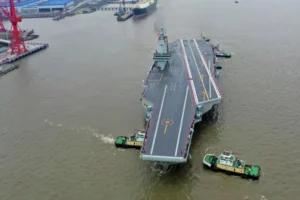
However, the Fujian’s electromagnetic catapults for launching carrier-based fighter jets are currently only available on the latest American Gerald Ford-class destroyer. These catapults provide a smoother acceleration compared to traditional steam catapults, allowing for adjustable speed based on the aircraft’s weight. Additionally, they require less space on the ship due to their simpler design.
The superstructure and two elevators are located on the starboard side, just like on the Shandong aircraft carrier. The elevators now lift two aircraft instead of one, which is a significant improvement. Additionally, the superstructure has been compacted to accommodate the flight control center, a phased array radar station, and communication equipment.
The Fujian does not carry offensive weapons, and its air defense is limited to Type 730 rapid-fire anti-aircraft guns and the HQ-10 short-range surface-to-air missile system. Its main striking force consists of J-35 and J-15T/DT multi-purpose fighters, KJ-600 long-range radar detection and control aircraft, and Z-20 helicopters.
It is claimed that the Fujian is capable of carrying more than 50 aircraft, not including UAVs.The latest fifth-generation J-35 carrier-based fighter jets are particularly interesting. The prototype first took to the air in 2021, and the J-35 successfully completed flight tests in 2024. According to Chinese media reports, the fighter jet is highly stealthy, with an effective radar cross-section (RCS) smaller than a human palm. It is capable of carrying a wide range of weapons, including the PL-17 air-to-air missile with a range of up to 400 kilometers. Together with the J-35 AWACS aircraft, they will be able to monitor all approaches to the carrier strike group.

Jin Canrong, deputy director of the Institute of International Studies at the Chinese People’s University, told the Global Times newspaper that Fujian was built to counter the so-called second island chain of US deterrence, which runs through the island of Guam.
“The Americans have deployed three island chains around us,” he explained.
“The first is Okinawa, Taiwan, and the Philippines, the second is Guam, and the third is Hawaii.
In fact, we have already extended our deterrence to the second. Taiwan is a key node in the first, where we have a significant advantage. Therefore, its destruction is not a problem for China, although Beijing’s policy towards Taiwan remains focused on peaceful reunification.”
China is clearly planning to challenge the hegemony of the all-powerful US Navy in the Pacific. And three aircraft carriers are not the limit. According to media reports, a full-scale model of a fourth aircraft carrier has been built in Wuhan. It is estimated to have a displacement of 115,000 tons, a length of 340 meters, and a width of 83 meters. It is expected to have a top speed of over 30 knots (50 kilometers per hour). The carrier will be equipped with a flight deck capable of carrying 60 to 80 aircraft, helicopters, and heavy drones. This ship is expected to have a nuclear power plant.
“China is consistently increasing its ability to conduct operations far from its territory,” said Dmitry Stefanovich, a researcher at the Center for International Security at the Institute of World Economy and International Relations of the Russian Academy of Sciences. “This is impossible without an aircraft carrier, especially since Beijing has a maritime component to its Belt and Road Initiative.
China also has an active policy in Africa, and Pakistan should not be forgotten. However, it is clear that the United States is the most concerned about Chinese aircraft carriers.”
And the US shipbuilding industry is cutting its budget. Just this year, the Pentagon abandoned the construction of two Virginia-class submarines and two Arleigh Burke-class destroyers. The Ticonderoga cruiser fleet is gradually declining: all of them have more than 30 years of service. Noticeably outdated shipyards do not have enough capacity either.
The PLA Navy already surpasses the U.S. Navy in terms of the number of warships and submarines. Beijing is also ahead of Washington in terms of the pace of construction and commissioning of new ships.
The only thing missing to become one of the most powerful naval powers was an aircraft carrier fleet. Now China has one.
While we wait to see what the outcome is of Russia’s counter resolution at the UNSC on a plan for Gaza and the whole of Palestine, here is the US plan fleshed out.
https://russiaun.ru/en/news/comment_gaza_141125
From the Cradle
US planning Gaza ‘green zone’ under Israeli control
——
The Trump administration is reportedly planning a long-term division of Gaza into a “green zone” under Israeli and international military control and a “red zone” left in ruins, according to documents seen by The Guardian. Foreign troops would initially deploy alongside Israeli forces east of Gaza, divided by the current “yellow line.” Officials admit reunification is “aspirational,” raising doubts about Washington’s commitment to an enduring political settlement.
Plans for Gaza’s future have shifted rapidly: first promoting fenced “alternative safe communities” for Palestinians, then dropping the idea entirely. Humanitarian groups say they were not informed of the changes.
The evolving proposal centers on a so-called international stabilization force starting with a few hundred troops and potentially growing to 20,000, though many countries are unwilling to deploy forces to Gaza.
Reconstruction would begin only inside the “green zone,” with the US hoping improved conditions lure Palestinians across Israeli lines, a plan which echoes failed US strategies in Iraq and Afghanistan.
Takaichi: the Honeymooner. When will the divorce come?
with gratitude to Julian Macfarlane at News Forensics.
Japanese Prime Minister Sanae Takaichi’s poll numbers have risen to over 65%. I am not sure whether Takaichi is the Japanese Thatcher— or the Japanese Blair both of whom came into power with great numbers. .
She has already sparked controversy.
One is her work-life concept, where “work” IS “life” – as it used to be in the 60s in Japan. Her conservative values are not exactly female-friendly. Men are supposed to work – do overtime – and women stay home and have babies as they once did. They can’t make any money in the workplace anyway.
Not that young men aren’t willing to die trying either.

“Karoshi” – “death by overwork” – what’s that?
Takaichi thinks that its’ something positive.
In a speech after winning the party leadership race on Saturday, Takaichi said, “I will work, work, work, work and work.”
She also called on LDP lawmakers to “work like a horse.”
While such remarks seem to demonstrate her resolve to shoulder heavy responsibilities, they apparently came as a surprise to Prime Minister Shigeru Ishiba.
“As she clearly said she would throw away her work-life balance, I can’t help but wonder if that’s okay. But I believe that is her expression of determination,” said Ishiba, who gave an address after Takaichi’s victory speech.
That appears to be how middle class Japanese women are taking the speech—determination. After all, they saw their mothers working around the clock, including part-time.
Takaichi grew up in a middle class family too.
But this is not the only example of her ultra right views.
Sinophobia, of course, has been a Japanese things since…forever… maybe because of a an unspoken, hidden suspicion that the Imperial Family is Chinese, or at least Korean. The average Japanese still has nothing much good to say about China – or Chinese people.
Takaichi has already angered the Chinese by suggesting Japanese intervention should the Chinese seek a military solution to Taiwan.
She cites reasons of “self defense” , saying Taiwan is only 60 miles from Japan, by which she means from the Diaoyu Islands which both China and Taiwan claim, with considerable reason.
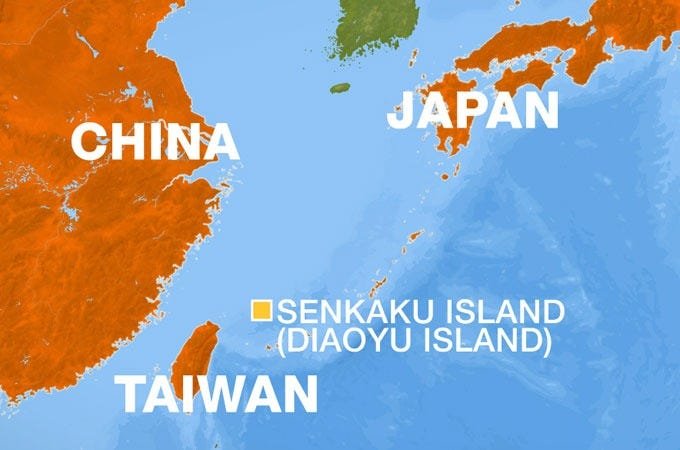
Senkaku / Diaoyu Islands
Keep in mind that the Ryukyus were not part of Japan until 1879. The Ryukyus were an independent and prospered through trade with China. The Japanese took over, banned the language and culture.
Then there is Dokdo Island, which is occupied by South Korea and which the Japanese call Takeshima. She has said that a Cabinet Minister should attend the ceremony to mark “Takeshima Day,” held in Shimane every February to demonstrate Japan’s sovereignty over the islet — although this is a local rather than national event.
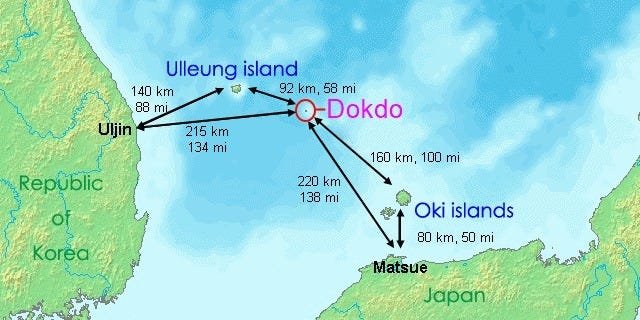
Dokdo / Takeshima Island
OK. Not exactly WWII again . But. .
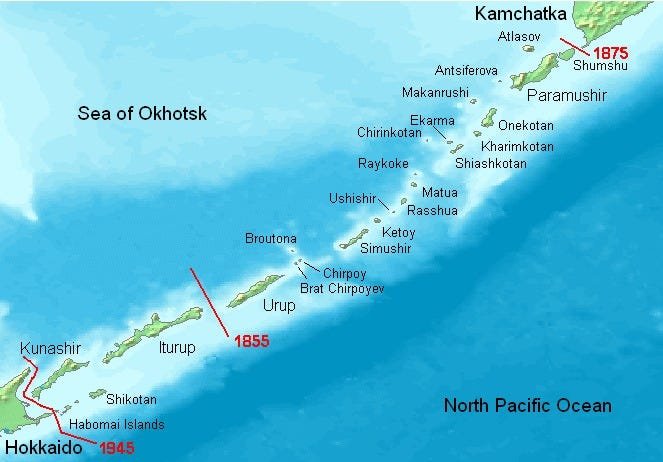
Kurile Islands / Hokkaido
Let us keep in mind that Japan only took Hokkaido after the Boshin War of 1869. It was its first step towards emulating the colonialism and imperialism of the West. The Ainu peoples were to the Japanese what Native Americans were to Americans. Japan’s first attempt at genocide.
The Russians understand history only too well.
Japan’s new prime minister, Sanae Takaichi, in a speech last week, scolded Russia for its “aggression against Ukraine” but also said that Japan maintains “its policy of resolving the territorial issue and concluding a peace treaty.”
The territorial issue is of course the Kurils which Japan lost as a consequence of WWII, just as Russia lost the southern part of Sakhalin as a consequence of the Russo Japanese War fo 1904. What goes round, comes round.
Russian Foreign Ministry spokeswoman Maria Zakharova said she had not seen anything new in the remarks by Takaichi, and that for any progress Tokyo would have to change its tone.
“We have repeatedly stated before that the path to resuming dialogue with Japan will open only after Tokyo actively abandons its anti-Russian course aimed at harming our country and its citizens,” Zakharova told reporters when asked by Reuters about the prospects for a peace deal.
Zakharova said Tokyo’s “unfriendly” policy towards Russia had led relations towards a dead-end.
“This unfriendly dead-end approach was chosen by the Japanese side, not by us,” Zakharova added.
Prime Minister Sanae Takaichi has sidestepped a commitment to maintain Japan’s decades-old pledge not to produce, possess or host nuclear weapons over apparent concerns about the U.S. “nuclear umbrella.”
Formulated in 1967 and known formally as the country’s Three Non-Nuclear Principles, the pledge has consistently been upheld by governments since.
Takaichi told opposition lawmakers in parliament Tuesday that, as her government gears up to revise the country’s key national security documents by the end of 2026, “it is not yet at the stage” where she could “definitively state” that the wording of the principles will remain the same.
Of course, the Three Principles is an excuse for permitting American bases all over the country. Do they have nuclear weapons? Japan allows nuclear armed American ships and aircraft to “transit” through Japan How long is the stopover? Don’t ask, don’t tell.
Without the three principles, things get complicated. Japan might want to develop its own weapons and reduce the number of American bases.
Let us remember, however, that this winging to the right is what that declining nations do.
We see this in Europe too. Beat the drums of war, build up a sense of threat and fear, so that people will invest their hopes for the future in a strong leader, who is somehow “different”, but adhering to traditional beliefs. Change but no change. Or as Obama said, “Change you can believe in”.
But Japan needs China —not just for its huge market but for its technologies ==for example the rare earth magnets that Japanese consumer electronics rely on.
Should China — Japan’s main trading partner — stop cooperating economically, Japan is in trouble. The G7 economies no longer represent viable markets for its products in the future.
Japan needs Russia and South Korea too. So alienating these countries is not a recipe for economic success.
In addition, Japan needs access to the vast resources of Russia— not just Russian gas and oil, but wood, minerals, and the like, including foodstuffs.
Economic cooperation with South Korea is important too. Again, technologies matter.
As for “work-life” balance, a grueling balance between men in the workplace, women in the home was an aspect of Japan’s reindustrialization in the 50s and 60s. Ironically Japanese society then was one of the most egalitarian in the world—except for women, of course. 90% of Japanese then thought themselves “middle class”.
It must be said also that in those days Japanese white collar workers at least rarely did much from 9 to 5 — everything was accomplished in overtime—which paid extra.
Now things have changed.
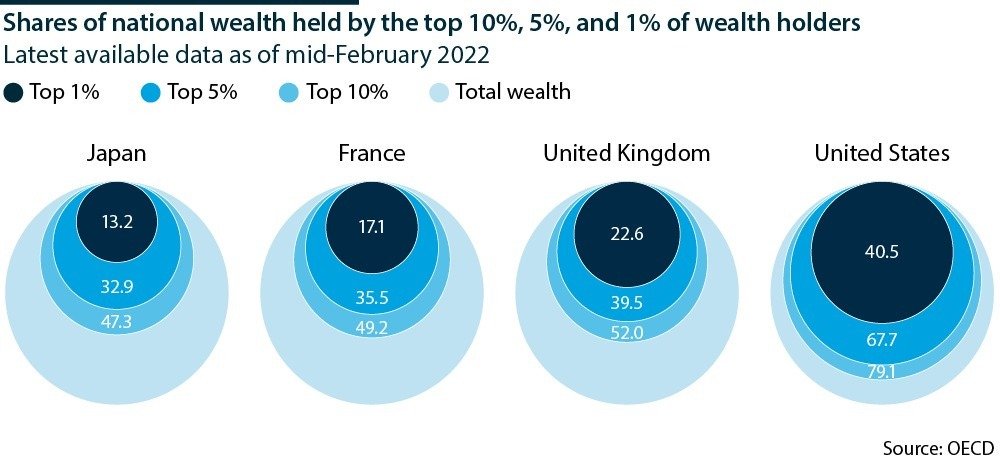
Wealth in Japan today is flowing upwards as it is in all financialized societies. It isn’t as bad as in the France or the UK or the US— but is that a valid comparison?
Japan is more and more unequal. Of course it was always unequal for women But with future money earning partners in short supply, things are worse.
Marriage rates have dropped. Birthrates too. Nobody has sex anymore.
How long before the Japanese population reaches 50,000,000?
This is Takaichi’s honeymoon but it will be over sooner or later. She might well win the next election but she has no new ideas, no solutions, just same-old, same-old. Yes, she’s a woman— an honorary member of the Old Boys Club.
Just like Thatcher was.
What was once a theoretical discussion in U.S. military journals about blockading China’s oil supply is now steadily turning into a tangible, multi-layered strategy aimed at containing Beijing and preserving American global dominance.
At first glance the paper looks like US policy thinking considered, then moved past the idea of blockading China. Instead, the paper merely listed a number of obstacles impeding such a strategy in 2018—obstacles that would need to be removed if such a strategy were to be viable in the near or intermediate future—and obstacles US policymakers have been removing ever since.
More contemporary papers published, including those among the pages of the US Naval Institute (here and here), have updated and refined not just an emerging strategy to theoretically confront and contain China, but a plan of action taking tangible shape.
Cold War Continuity of Agenda
Throughout the Cold War and ever since its conclusion, the US’ singular foreign policy objective has been to maintain American hegemony over the globe established at the end of the World Wars. A 1992 New York Times article titled “U.S. Strategy Plan Calls for Insuring no Rivals Develop” made it clear the US would actively prevent the emergence of any nation or groups of nations from contesting American primacy worldwide.
In recent years this has included preventing the reemergence of Russia as well as the rise of China. It also involves surrounding both nations with arcs of chaos and/or confrontation—either through the destruction of neighboring countries through political subversion, or the capture of these nations by the US and their transformation into battering rams to be used against both nations.
Ukraine is an extreme example of this policy in action. The US is also transforming both the Philippines and the Chinese island province of Taiwan into similar proxies vis-à-vis China.
Beyond this, the US seeks to prevent the majority of nations currently outside US dominion from joining with and contributing to the multipolar world order proposed by nations like Russia and China.
This strategy of coercion, destabilization, political capture, proxy war, and outright war has been used to target both Russia and China directly, their neighbors, and a growing list of nations far beyond their near abroad.
Strengths and Weaknesses of American Primacy
Enabling this strategy is America’s global-spanning military presence facilitated by its “alliance network.” This network of obedient client regimes both hosts US military forces and serves as an extension of US military, economic, and increasingly military-industrial power. US “allies” often pursue US geopolitical objectives at their own expense.
Again, an explicit example of this is Ukraine, which is locked in a proxy war with Russia, threatening its own self-preservation as a means of—as US policymakers described in a 2019 RAND Corporation paper—“extending Russia.”
While conflicts like that unfolding in Ukraine or the US-backed military build-up in the Philippines or on Taiwan has exposed a critical weakness of the United States—its lagging military industrial capacity vis-à-vis either Russia or China, let alone both nations—the US has demonstrated the ability to compensate through geopolitical agility the multipolar world is struggling to address.
This includes the ability of the US to mire a targeted nation in conflict in one location while moving resources across its global-spanning military-logistical networks toward pressure points in other locations, overextending the targeted nation and achieving success in at least one of the multiple pressure points targeted. The US successfully did this through its proxy war against Russia in Ukraine, which tied Russia up sufficiently for the US to finally succeed in the overthrow of the Syrian government, where Russian forces had previously thwarted US-sponsored proxy war and regime change.
It also includes the ability of the US to target partner or potential partner nations of Russia and China through economic, political, or even military means in ways Russia and China are unable to defend against—including through political subversion facilitated through America’s near monopoly over global information space.
These advantages the US still possesses also make potential maritime blockades very difficult for Russia and China to defend against.
Russian Energy Shipments as a Beta Test for Blockading China
France recently announced seizing a ship accused of being part of Russia’s “ghost” or “shadow” fleet—ships refusing to heed unilateral sanctions placed by the US and its client states on Russian energy shipments.
This was just one of several first steps toward what may materialize into a wider and more aggressive interdiction or blockade of Russian energy shipments. This may also be a beta test for implementing a long-desired maritime blockade on China.
A rapid, full-scale blockade would cause energy prices to spike and could blow back to the US as negative economic consequences. By incrementally pressuring Russian energy shipments, the US can slowly adjust energy markets in an incremental manner to cushion a sudden shock the public would immediately notice and potentially react to.
Russia and the rest of the multipolar world’s response to this increasingly aggressive targeting of maritime shipping may determine whether or not the US adopts the strategy of maritime blockades on a wider scale.
Setting the Stage for a Blockade of China Has Already Begun
The 2018 US Naval War College Review paper lays out the realities of a potential blockade against China in 2018, noting the various opportunities and risks associated with such a strategy.
The paper notes that “China’s reliance on seaborne oil supplies has risen steadily over the past decade and could rise further as domestic production declines” and that “the imported oil passes overwhelmingly through the Strait of Malacca and a handful of other passages that the U.S. Navy could seal off effectively.”
It also talks extensively about a “distant blockade,” it says would be “imposed far from the Chinese coast, reducing the threat to U.S. forces from Chinese A2/AD systems.”
This recognizes China’s growing military capabilities—military capabilities US policymakers admit are being developed and deployed to defend China, not project military power abroad—a fact US policymakers openly seek to exploit through America’s existing, global-spanning network of military power projection.
The paper includes a map marking various maritime chokepoints the US Navy then and today is capable of closing off beyond the reach of Chinese military power, backed by the growing US military footprint in the region, particularly across the Philippines, Japan (as well as its island province of Okinawa), as well as the Chinese island province of Taiwan itself.
It also mentions ongoing efforts by China to establish land routes to circumvent these maritime chokepoints, including the Myanmar-China oil pipeline, claiming:
A distant blockade also would need to interdict the Myanmar–China oil pipeline, which eventually could move as much as 440 kbd of crude oil from Kyaukpyu in coastal Myanmar to Yunnan Province in southwest China. Preventing tankers from off-loading at the Kyaukpyu terminal would require few, if any, naval platforms to remain on-site. The area could be declared an exclusion zone for the duration of a conflict, and if the Myanmar authorities failed to comply, the facility could be disabled via air strikes, aerial mining, or other kinetic action. In short, U.S. forces likely would be able to neutralize rapidly China’s overland routes for seaborne oil imports to avoid the Strait of Malacca and other choke points farther east and prevent them from diverting forces needed to seal other maritime ingress routes.
Far from just theoretical war planning, this Myanmar-China oil pipeline has since been targeted by US-backed militants operating inside Myanmar, fighting the central government, and using the conflict as cover to strike at, compromise, and even destroy Chinese investments across the Southeast Asian country.
In February 2022, the US National Endowment for Democracy (NED) funded opposition media organization, The Irrawaddy, reported in its article, “China-Backed Pipeline Facility Damaged in Myanmar Resistance Attack,” that:
An off-take station of the China-backed oil and gas pipelines was damaged when a local resistance group attacked regime forces guarding the facility in Mandalay Region…
And that:
Anti-Chinese sentiment swelled in Myanmar following the military coup last February, with many people believing Beijing had a hand in the takeover. At that time, there were calls for a boycott of Chinese products, along with calls to blow up the pipelines if China refused to condemn the regime.
The calls prompted China to urge the regime to increase security for the pipelines. Since March last year, the regime has assigned extra forces to protect them.
Likewise, the US has been backing extremists in southwest Pakistan to target the Chinese-built China-Pakistan Economic Corridor (CPEC) over the course of several years spanning the Obama, first Trump, Biden, and now second Trump administrations (including in 2021, 2024, and 2025).
In other nations, like the Southeast Asian Kingdom of Thailand, US-sponsored opposition leaders like billionaire Thanathorn Juangroongruangkit have openly campaigned to stop Chinese infrastructure projects like high-speed rail lines as part of slowing down, stopping, or even reversing progress for China’s BRI network and thus eliminating the BRI as an alternative to circumvent a US-imposed maritime blockade on Chinese shipping.
The 2018 paper also identifies Russia as a primary alternative source for Chinese energy imports—which is one of the reasons the US is waging its ongoing proxy war against Russia through Ukraine and why the US is overseeing an expanding campaign to attack and destroy Russian refineries and other forms of energy infrastructure across Russia.
In other words, while US policymakers envisioned an opportunity for using US military power to attack and dismantle China’s Belt and Road Initiative infrastructure amid a US-Chinese conflict and other measures to cut China off from crucial energy imports, including from Russia, since then, the US has used armed extremists it funds and backs inside nations hosting Chinese BRI projects to begin attacking these projects before any direct US-Chinese conflict commences—together with a dangerously large proxy war being fought against China’s ally, Russia, to complicate or cut off significant alternative energy imports.
The paper concludes that any blockade should not be seen as a single, independent solution to eliminating an adversary and that the US must also continue building up the forces necessary to wage war against China as well.
Since the paper was published, the US has pursued both continued preparations for a maritime blockade of China itself, as well as build up a number of regional proxies to wage war against China, as the US wages proxy war against Russia in Ukraine and, increasingly, through the rest of Europe.
While this reality continues to take shape, political rhetoric in Washington attempts to disarm China and its allies from taking action to prepare for the inevitable confrontation the US is preparing for by creating the impression Washington seeks to “retreat” from the “Indo-Pacific” region to defend the “homeland” in the Western Hemisphere.
While some in the public and even across the alternative media have fallen for this rhetoric, it is unlikely anyone in Beijing, Moscow, or other BRICS capitals could be so naive—especially as these empty words from Washington are overshadowed by the US’ continued physical militarization of China’s periphery, continued regime change operations along China’s borders—most recently in Nepal—and the continued US proxy war against Russia aimed specifically at crippling its energy production capabilities—a key prerequisite for a successful maritime blockade of China.
To understand Washington’s strategy toward China, one should not look to the political rhetoric of “retreat” or “homeland defense” in the Western Hemisphere, but rather to the tangible actions taking place across the Asia-Pacific and beyond—the meticulous encirclement of China’s periphery, the sustained attacks on its critical overland energy and trade links (BRI/CPEC), the calculated incapacitation of Russia as a potential energy supplier, and the establishment of local proxy forces (the Philippines, Japan, separatists on Taiwan) prepared to wage war.
Far from an abstract or “flawed” concept relegated to think-tank papers, the maritime oil blockade—or wider general blockade against China—is being incrementally prepared in real-time. By systematically removing the very obstacles noted in the 2018 Naval War College Review paper, the US is demonstrating a clear, unwavering commitment to a multi-layered strategy of containment, coercion, and confrontation designed not just to prepare for conflict, but to make that conflict both inevitable and successful for the singular goal of maintaining global American hegemony.
So history ruled that no conqueror coming from the West would traverse the Pamirs; that happened with Alexander the Great, and that happened with Islam. But that may well happen with Timur Trump, Conqueror of China.
Pepe Escobar, Strategic Culture
President Donald Trump did not disappoint when defining centuries of complex Heartland history with a trademark reductionist wise guy zinger:
“It’s a tough part of the world — there’s nobody tougher or smarter.”
Well, every tough guy from Genghis Khan to Timur may now feel relieved. Especially the leaders of the five Central Asian “stans” – Kazakhstan, Kyrgyzstan, Tajikistan, Turkmenistan and Uzbekistan – invited as a group for a White House photo op cum dinner.

As every grain of sand in the Ancient Silk Road knows, bragging is prime Timur Trump territory. He praised an “incredible” trade deal with Uzbekistan – under which Tashkent will be buying and investing almost $35 billion, and up to 2035, $100 billion, in critical areas such as minerals, aviation, infrastructure, agriculture, energy and chemicals, and IT.
No details whatsoever were provided on how Tashkent is going to find that kind of money, and precisely how they plan to invest it. Yet that was the perfect cue for Uzbek President Shavkat Mirziyoyev – a savvy pragmatist – to lavish praise on Timur Trump:
“In Uzbekistan, we call you the President of the world (…) You were able to stop 8 wars (…)
That was faithfully echoed by Kazakh President Kassym-Jomart Tokayev:
“Millions of people in many countries are so grateful to you (…) You are the great leader, statesman, sent by Heaven to bring commonsense & traditions that we all share and value back (…) Under your presidency, America is ushering in a new golden age (…) As President of peace, you, Mr. Trump, brought to an end eight wars just within eight months.”
And right on cue Tokayev duly announced that Kazakhstan is ready to sign the – collapsing – Abraham Accords, which is quite redundant, considering that Astana already normalized Israel way back in 1992 and always had relatively close relations with Tel Aviv.
Translation: the Abraham Accords scam is part of a give and take featuring the US-Kazakh signing of a tech metal/rare earth deal. The only vector that matters here is the US-Israel mad supply chain scramble to bypass China’s rare earth restrictions and continue to provision their tech/Defense realm.
Central Asia after all is quite rich in rare earths and also uranium. The problem is for the moment Kazakhstan exports way more minerals to Russia-China than to the US.
Timur Trump anyway was beaming: “A tremendous country with a tremendous leader” – referring to Tokayev.
Well, this “tremendous” country happens to be a full member of the SCO; a BRICS partner (as well as Uzbekistan); a Belt and Road Initiative (BRI) partner, very close to China; a full member of the Eurasian Economic Union (EAEU); a full member of the Commonwealth of Independent States (CIS).
So Kazakhstan enjoys very close trade relations with the Russia-China strategic partnership. Besides, their language of business is still eminently Russian.
Cue once again to the heart of the matter: Timur Trump seems dead set on blowing up the BRICS/SCO combo from the inside. Short of the proverbial color revolution attempts, of course – if the “stans” don’t behave. Incidentally it was Putin and the Russian military that personally saved the Tokayev government during the latest color revolution attempt in Kazakhstan, which was coordinated from neighboring Kyrgyzstan.
The lineaments of a strategic pivot
Timur Trump even mentioned that he wants to revive “Silk Road connections”. Well, at least he was not referring to Hillary Clinton in the early 2010s trying to build a nonsensical American version of the Silk Road with Afghanistan – still at war – at the center.
Timur Trump was referring to the “C5+1” framework – the US plus the “stans”. That has absolutely nothing to do with “stability”: it’s all about strategic expansion. Especially now that the Empire of Chaos, after two decades and trillions of dollars, managed to replace the Taliban with the Taliban and for all practical purposes should say goodbye to Afghanistan, which is being progressively integrated into the SCO and BRI, as a parallel project to the China-Pakistan Economic Corridor (CPEC).
So the Timur Trump show boils down to propelling a possible avalanche of US investment and hence to be more embedded – and influential – in the Central Asian sphere. It has much less to do with wobbly mineral supply chains or loads of mirific “investment” than going for a strategic pivot. Talk about a pipe dream.
And when it comes to pipes, deceased war criminal Dick Cheney in the mid-2000s tried everything to turn Pipelineistan in the Heartland to the US’s advantage – sending trade “missions” around the clock. It all came down to nought.
Russia is very much aware that the Empire of Chaos may be trying to stage a comeback in the Heartland chessboard – with embedded influence coming from all the usual suspects such as an array of NGOs, “educational” programs and “management committees”.
Timur Trump views the “tremendous” Heartland monolithically – assuming he can properly point them on a map (forget about their history). They used to be part of Russia – as in the USSR – so now they need to be open to maximum American onslaught. It’s as simple as that.
Russia, predictably, is not losing any sleep. Kremlin Spokesman Dmitry Peskov: “Cooperation between Central Asian countries and the United States at the C5+1 venue is quite natural”. Peskov and the Russian leadership are very much aware Russia and the Central Asian “stans” meet all the time, and discuss everyhting: that last time was little over a month ago.
So why now – the Timur Trump offensive? Well, the Empire of Chaos is unleashing its fury all across the Global South, considering its impotence to really subdue Russia-China. Previously, Uzbekistan’s Mirziyoyev and Kazakhstan’s Tokayev had met with US business leaders on the sidelines of the 80th session of the UN General Assembly in New York. Of course they talked business.
And they know the drill. Washington still has total leverage over the global financial market. It’s not wise to antagonize the King of the Jungle. Crippling sanctions can be just around the corner. As long as the “stans” can capitalize on the imperial obsession with oil, gas and rare earths, fine. It’s a completely different story, from the point of view of Russia-China, if the issue of US military bases in Central Asia is back on the table.
Now let’s build a pyramid of skulls
There are more – fascinating – parallels between Timur Trump and his “Iron Lord” predecessor than meets the eye.
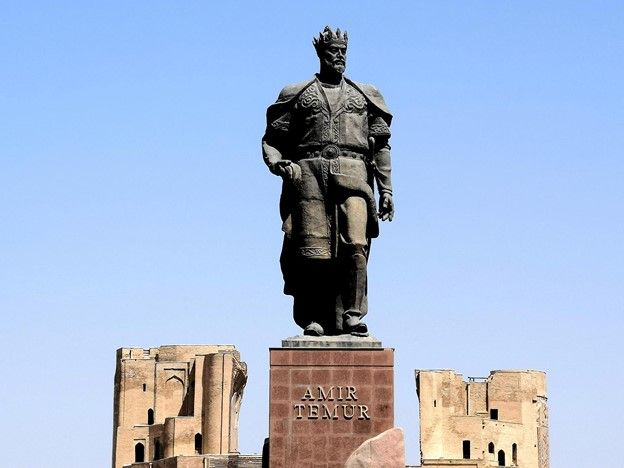
Timur in Shahrisabz, Uzbekistan. Photo: P.E.
Timur vaunted himself as a relative of Genghis Khan, the Absolute Conqueror – and his role model. History as written by the West framed Timur as a feral legend: a perpetrator of serial massacres in times when you needed to inflict unspeakable horrors to be regarded as properly cruel.
The Timur legend features endless gory piles or “towers” of beheaded foes and/or their skulls: a Mongol tradition infused with religious meaning, taken by Timur to the degree of a scientific method. For Timur, there was above all meticulous order in horror. Cue to 120 towers of 750 heads each arranged in Baghdad – or 70,000 heads in Isfahan equitably divided and laid out between his army corps.
Intellectuals, artisans, artists, religious figures though were spared. Once again, Timur systemized and regulated a Mongol principle: competent and useful prisoners should be kept alive.
A key strategic principle was to exterminate whoever resisted so in the end there should be no resistance, and citadels would fall voluntarily. With Timur that become a code. Immediate capitulation was rewarded with lives saved; the enemy must submit and pay ransom. If resistance took too long, the city would pay the price, including pillaging, but civilians would be spared. Third summation: hell, as in raping, pillaging and total extermination.
Yet the Emir did not rule as an Oceanic Khan just by being cruel. Timur launched a war of (italics mine) terror – but he did not provoke any collective belief in the end of the world. Europe, by the way, loved him. Because he prevented the Golden Horde from crushing Russian Orthodox Christians; and because he made a deal with the basileus of Constantinople, before defeating the worst enemy of Christianity, the Ottoman Turk Bajazet.
So Timur was an objective ally of the West. Certainly not a danger. Besides, he was very strong on diplomacy. Before the One Hundred Year War destroyed his kingdom, Charles VI of France received a letter written in gold leaves and bearing Timur’s seal: three circles that symbolize the conquest of the Universe. Timur wanted a trade deal. In the end, because of European incompetence, it came down to nothing.
Timur’s court was no bling bling Mar-al-Lago: it was an apex of real opulence and luxurious taste, fabulous jewels, itinerant elephants, sumptuous garb, fabulous houses.
He has been buried in Samarkand – splendidly isolated from the other Timurids, in an austere tomb topped by a black jade monolith. He rests behind his spiritual master, Sayyid Baraka, and the inscription at the shrine’s portal is pure Sufi: “Blessed is he who refused the world before the world refused him”.
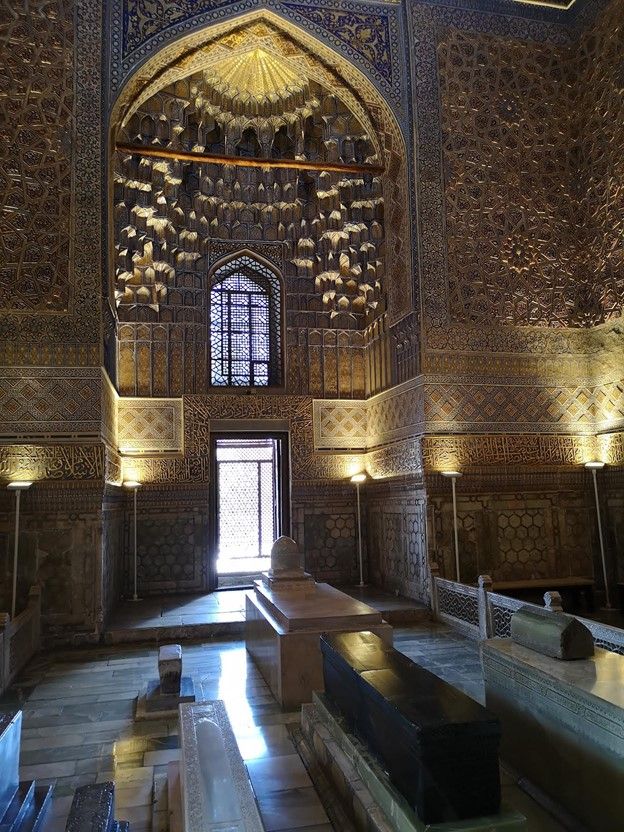
Timur’s tomb in Samarkand. Photo: P.E.
Timur was essentially a tribal Turk; a Muslim; and ideologically, a Mongol. A walking contradiction, really. Even if he spent part of his life fighting the heads of the Golden Horde and other Mongols, much more Mongols than himself, he proclaimed himself as the successor to the Oceanic Khan.
Even as he defeated the Ottoman Bajazet, offering de facto an extra time of 50 years to Constantinople, he was a Turk.
And even if he allied himself with Christians and paid his respects to pagan deities, in the best shamanistic tradition, he also saw himself as a man of the Quran: he went to war carrying a portable mosque.
Timur had the ultimate Silk Road dream: he wanted to conquer China. Even when Mongol unity had become a fiction; when the Yuan emperor was totally Sinicized and turned out to be very different from the Turk-Mongols of Transoxiana, they still recognized the suzerainty of the Yuan dynasty.
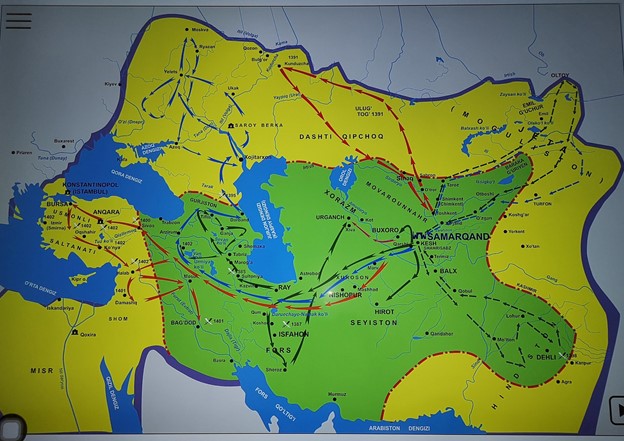
In Samarkand: Timur’s empire – ever expanding. But he never conquered China. Photo: P.E.
But with the Ming dynasty, it was a completely different story. Timur was preparing a conquering expedition when he died in Otrar – in today’s southern Kazakhstan – with a fever, in 1405, after dictating his testament and leaving 100,000 soldiers in a void.
The Ming dynasty had escaped the Supreme Peril. So history ruled that no conqueror coming from the West would traverse the Pamirs; that happened with Alexander the Great, and that happened with Islam.
But that may well happen with Timur Trump, Conqueror of China. In his own mind, of course.

Le président finlandais Alexander Stubb a proposé une rencontre entre les présidents russe et américain Vladimir Poutine et Donald Trump
L’article Le Premier ministre finlandais propose une rencontre Poutine-Trump au sommet du G20 de Johannesburg est apparu en premier sur STRATPOL.
Modest concessions from China that were not a sacrifice. Xi enabled Trump to get what he really wants, a public relations orchestration.
A time travel across History – the Ancient Silk Roads as well as Xinjiang may well be the ultimate crossroads of civilizations. Along Central Asia, they are the (beating) heart of the Heartland…
By Pepe Escobar at the Strategic Culture Foundation.
ON THE SOUTHERN SILK ROAD – Silk is the stuff of legend. Literally. At first manufactured only in China, silk historically was not only a luxury product but a monetary unit: a key element of trade and export revenues.
In 105 B.C., a first-ever Chinese diplomatic mission landed in Persia, then dominated by the Parthians, who also occupied Bactria, Assyria, Babylon and parts of India. Under the four-century long Arsacid dynasty – contemporary of the Han in China – the Parthians at the time were the essential middlemen of transcontinental trade. Chinese and Parthians sat down to discuss – what else – business.
The Roman Empire faced some serious trouble with the Parthians – between the massive defeat of Crassus in Carrhae in 53 B.C. and the victory of Septimus Severus in the year 202. In between, silk hit Rome. Big time.
The first time Roman soldiers saw silk was in the battle of Carrhae. Legend rules that the silk banners deployed by the Parthian army, their scintillating appeal making serious noise under the fierce winds, frightened the Roman cavalry: talk about the first instance of silk contributing to accelerate the decline of the Roman Empire.
Well, what matters is that silk perpetrated nothing less than an economic revolution. The Roman Republic and then Empire had to export gold like there’s no tomorrow to get their silken ways.
Parthian rule was followed by Sassanid Persia. They reigned until the mid 7th century – their empire stretching from Central Asia to Mesopotamia. For quite a while the Sassanids incarnated the role of great power between China and Europe – up to the conquests of Islam.

(L): Silk Road, the ancient Chinese way: from Xian to Alexandria, not Rome ; (R): The stone tower: Tashkurgan Fort, the landmark between China and the rest of Eurasia
So imagine, at the start of the Christian era, bolts of silk moving overland all along across the Silk Road spectrum. What’s fascinating is that Rome and China never (italics mine) entered in direct contact – for all the vast cast of characters (merchants, adventurers, fake “ambassadors”) that tried.
In parallel, a Maritime Road was also in play – already in effect during the times of Alexander The Great; it later became the Spice Route. That was how Chinese, Persians and Arabs reached India.
Since the Han dynasty, the Chinese reached not only India but also Vietnam, Malaysia and Sumatra. Sumatra soon developed as a key maritime entrepot, with Arab vessels arriving non-stop. In a more long-distance vein, it was the discovery of the rules of the monsoon – in the first century B.C. – that allowed the Romans to also reach the western shores of India.
So silk arrived in Rome by land and sea, via loads of different middlemen. And yet Rome never knew anything about the origin of silk, nor went further than the Greeks in their wobbly knowledge of the distant, mysterious land of Seres.

The twists and turns of the Panlong Ancient Road, in Pamir lands
I went down to the (Pamir) crossroads
After the mid-1st century, the Kushan empire, actually Indo-Scythian, gets a protagonist role in southern Central Asia, in what was known then as Eastern Turkestan. The Kushan, rivals of the Parthians in the role of messengers of international trade, not only facilitated the spread of Buddhism but also Gandhara – Greco-Buddhist – art (some originals are still to be found today, at exorbitant prices, in art galleries in Hong Kong and Bangkok).
And yet, further on down the road, the rules of the game never substantially changed: two great Silk Road poles – Sassanid Persia and Byzantium – involved in a real, cutthroat industrial war with silk right in the middle. The secret of silk manufacturing had already been leaked to South Asia.
This trade war got even more complicated with the onslaught of Turk tribes across Central Asia, and the emergence of a trade kingdom in Sogdiana (with Samarkand at the center).
By the mid-7th century, the Tang dynasty recovered control over parts of the Silk Road ruled by Tarim basin kingdoms. That was an absolute must for business to go on – because caravan routes traversing these kingdoms encircled, and bypassed, by north and south, the fear-inducing Taklamakan desert, as they still do today.
Tang China wanted absolute control all the way at least up to the Pamir mountains where, in the legendary stone tower relentlessly described by adventurers but never really located with 100% certainty, Scythian, Parthian and Persian caravans met Chinese caravans to trade that precious silk plus several other commodities.
The stone tower mentioned by top geographers such as Ptolemy is actually Tashkurgan Fort in the Pamir mountains: ultra- strategic, straddling the Silk Road, and nowadays a top tourist attraction very close to the Karakoram highway.
The stone tower is the symbolic landmark between the Chinese world and the rest of Eurasia: to the west is the Indo-Iranian world.
I traveled the Pamir Highway in Tajikistan back-to-back before Covid interrupted everything. This time our mini-caravan crossed Pamir lands along and around the Karakoram highway on the way to the China-Pakistan border: that is now prime China-Pakistan Economic Corridor (CPEC) territory, a key plank of BRI.
It’s the Pamirs that in Ancient Silk Road times allowed reaching the oasis of Kashgar. The Pamirs tie a gigantic mountainous knot between the western limits of the Himalayas, the Hindu Kush and the southern slopes of the Tian Shan.
This has always been the key crossroads between the triangular trade uniting northern India, eastern Central Asia – with China nearby – and western Central Asia, with the steppes not so far away.
China meets Islam: a great, historical “what if?”
Silk, bearing serious value as a unit of capitalization and trade, had a much larger role than its usage. In Byzantium, silk was the object of an imperial monopoly. Everything was strictly regulated: professions, state ateliers where women worked, and customs. The state protected its monopoly via a fierce bureaucracy.
Meanwhile, the Maritime Road was booming. A Buddhist and maritime power, Srivijaya, controlled the ever-crucial Malacca strait out of the island of Sumatra. It’s under this configuration that Islam enters the Big Picture.
As much as History ruled that Rome and China would never meet directly along the Silk Road, it also ruled a stark separation between Islam and China. Or try to imagine if China, in the mid 8th century, had become a land of Islam.
The battle of Talas, in 751 – in what is today’s Kyrgyzstan – pitted China against the Arabs. And its result ended for good any Chinese whim of conquering Central Asia. Today, with the New Silk Roads/BRI, is another story – about Chinese trade/investment power projection all across the Heartland, and beyond.

(L): Culture interpenetration: Bukhara meets Kashgar ; (R): Samarkand. Opening the doors to another dimension.
Back in the early 8th century, the key player was Umayyad dynasty General Qutayba ibn Muslim. He first conquered Bukhara and Samarkand; crossed the Ferghana valley; the Tian Shan mountains; and nearly reached Kashgar. The Chinese governor at the time, sensing that Qutayba might be about to take over Chinese lands, sent him a bag full of earth’s soil, a few coins and four princes as hostages. He calculated that’s how the Arab conqueror might not lose face, and leave the Middle Kingdom alone.
As incredible as it might seem, this arrangement lasted for half a century. Until the battle of Talas. Now compare it with Poitiers in 732 – one century after the death of Prophet Muhammad. We can certainly interpret Talas and Poitiers, together, as the two key landmarks of how Islam was on the verge of extending itself all cross Eurasia (including its European peninsula), creating a political-military empire from Rome to Chang’an (today’s Xian).
Well, it did not happen. Still, that’s one of the most extraordinary “what ifs” in History.
The importance of the battle of Talas – virtually ignored in the West, except in rarefied scholarly circles – is really larger than life. Among other issues, it imposed a new circulation of techniques. The Arabs took away with them artisans, sericulture experts but also paper makers. Ateliers at first were set up in Samarkand. Later on, in Baghdad and all across the Caliphate.
So alongside the Silk Road, we saw the birth of a very busy Paper Road.

An extraordinary Silk Road exhibition currently at the Gansu museum in Lanzhou
Deserts, mountains, oases – and no “slave labor”
Rolling down the highways across Xinjiang shooting a documentary after retracing the initial Ancient Silk Road from Xian to the Gansu corridor is an incomparable, historical time travel – as we may retrace in detail centuries of Central Asian turmoil all the way to the decline of some local pre-Islamic cultures by the 9th century. It’s a thrill to reconnect with the main actors: Uyghurs, Han Chinese, Sogdians, Indians, nomads, Arabs, Tibetans, Tajiks, Kyrgyz – and Mongolians.
The nomad groups thar proclaimed themselves heirs to the fierce Xiongnu came from the northwest of Mongolia and the Altai mountains. They incorporated several ancient nomads of western Central Asia during the 4th century, sharply remodeling the political and ethnic landscape.
The Xiongnu, on and off, pillaged parts of northern China – and were occasionally enticed into serious trade, offered tribute, or simply bribed to stay away. Actually the Xiongnu had a branch established in China and separated for at least two centuries from the previous ones: they ended up taking Samarkand in the year 350. Later on, it’s the Turks that once again came from Mongolia (don’t tell Erdogan about it; he wouldn’t know), unifying the steppe in the 6th century, way before the arrival of Islam.
Arguably the key Silk Road imperative is the desert and oasis contrast/dichotomy.

(L): The stark beauty of the fierce Taklamakan ; (R): Good pasture in Pamir lands
Deserts such as the Taklamakan and the Gobi, and several others, as well as arid steppes and mountains are among the most forbidding on the planet: these are the essential features of what amounts to roughly 6 million km2.
What is very rare in Central Asia is cultivated land (yet we can see a succession of cotton fields) or good pasture (we can see it in the Gansu corridor, and even in Pamir lands near the mighty Muztagh Ata). Still, deserts and mountains are at the heart of everything.
Some oases are of course more equal than others. Khotan is the most important oasis of the Southern Silk Road – not far from the immense, deserted Tibetan plateau. That’s fabulous for agriculture but most of all, courtesy of an alluvial cone, for precious stones, especially jade, supplied for over 2,000 years to every Chinese dynasty. Khotan spoke an Iranian language – close to those of ancient nomads Saka and Scythian, masters of the steppes.
The kingdom of Khotan was a fierce rival of the oases further west, Yarkand and Kashgar. It was only intermittently under Chinese control. And may have been conquered by the Kushans in the 2nd century. Indian influence is omnipresent – as we still see in dress patterns and food in the Night Market. In the 3rd century Buddhism was already a major influence – featuring the most ancient testimonials in the Tarim basin.
The Silk Road, actually Roads, is of course The Buddhist Road. In Dunhuang, in the Gansu corridor, Buddhism was also popular since the 3rd century: a famous local monk, Dharmaraksa, was the pupil of an Indian master. The Dunhuang Buddhist crowds were a mix of Chinese, Indian and Central Asian – once more testifying to the non-stop interpenetration of cultures.

(L): The Chinese character for “silk” inscribed in jade in front of a factory in Khotan ; (R): Playing the Uyghur blues
The Shakespearean “all the world is a stage” metaphor totally applies to the history of the Silk Road: all those actors from all corners of the Heartland historically were playing several roles, sometimes all in one go – an apotheosis of the favourite Xi Jinping-coined “people to people’s exchanges”. That’s the spirit of the Ancient and the New Silk Roads.
We were fortunate enough to be on the road smack in the middle of the 70th anniversary of the establishment of the Xinjiang Uyghur Autonomous Region.
Among so many accomplishments by socialism with Chinese characteristics in Xinjiang in terms of sustainable development, the taming of the Taklamakan – or “sea of death” – is in a world class of its own.
We crossed the Taklamakan from the Northern Silk Road in Aksu to the Southern, near Keriya: and we experienced everthing from the impeccable highway bordered by the reeds composing the “China magic cube” – to keep the sands away – to some of the 3,046 km-long sand-blocking green belt, featuring plants such as the desert poplar and the red willow.
The Taklamakan has always been Sandstorm Central – a major threat to the succession of oases. The terrain all around the oases is hardcore: deserts, barren mountains, Gobi wasteland, poor soil, sparse vegetation, low rainfall, high evaporation, dry air.
Well, what we see today started even before the Go West campaign launched in 1999: since 1997, an array of central and state agencies, central state-owned enterprises, and 14 Chinese provinces and municipalities have sent a massive amount of funds and personnel to properly develop Xinjiang.
Now compare all that with original research shared at an academic conference on Xinjiang recently organized by the Hong Kong University of Science and Technology and Hong Kong University – my neighbors when I lived in the Fragrant Harbor. The research showed how British MI6 since the 1990s was instrumentalizing a minority of Uyghurs side by side with a massive global P.R. campaign with the explicit target of breaking China into three parts.
That evolved into the CIA-concocted “genocide” accusations of the past few years and of course “forced labor” masses barely surviving in concentration/re-education camps. In our extensive travels, guided by Uyghurs, we were dead set on finding slave labor in cotton fields along the Northern Silk Road or in the middle of the Taklamakan. Well, sorry: they don’t exist.
The propaganda though was essential to regiment loads of Uyghurs into ISIS, including their sizable contingent in Idlibistan now roaming free between Syria and the Turkish border. They wouldn’t dare coming back to Xinjiang and face Chinese intel.
Forget about barbarian propaganda. What really matters, historically, is that the Ancient Silk Roads as well as Xinjiang may well be the ultimate crossroads of civilizations. Along Central Asia, they are the (beating) heart of the Heartland. And now, once again, they are back as protagonists in the heart of History.
Nuri Vittachi tells this extraordinary story, aspects of which you no doubt are aware of.
Unearthed documents show that MI6, the British spy service, planned to cut China into three separate countries. The British plan was formulated as recently as the 1990s—and part of it is STILL RUNNING NOW.
This is an extraordinary story which researchers uncovered from historical documents, and which was presented at a university conference recently. Full details with sources are in the video report. Summary of 15 key points are below.
1.) In the early 1990s, agents at British spy agency MI6 consulted UK academic Gerald Segal of the Royal Institute of International Affairs on how to chop China into three countries.
2.) The UK’s key players would be Uyghur separatists. “Xinjiang has long been a target of British intelligence— with London hoping to manipulate the Uighur refugees from Xinjiang and Uighurs still there, into cannon fodder for London’s plans to break up China…” (Journal of Strategic Studies).
3.) Enter a real-life secret agent—a Turkish man named Catli of the Grey Wolves, who shared MI6 goals in Xinjiang. A book about a related CIA venture called Operation Gladio said Catli “helped the Uyghurs… mount insurrectionary attacks that killed 162 people”.
4.) To understand this story, it’s vital to know that the west falsely presents an image of Xinjiang as a place where one ethnic group are prisoners and the other are oppressive overlords. Not true. In Xinjiang, people with Uyghur background can commonly be found as police officers, army soldiers, and local officials, including the ones right at the top—chairman of the regional government.
5.) In March 1992, the chairman of the regional government, Tomur Dawamat, issued a warning: “Hostile forces, both at home and abroad, have stepped up their infiltration, subversion and sabotage.”
6.) At the time, the CIA was backing separatist Isa Yusef Alptekin, another backer of the Grey Wolves. In a 1992 speech he said: “The time for collapse and dissolution has arrived for the Chinese empire.”
7.) The Americans gave his son Erkin Alptekin a job in US anti-China propaganda. In the 1990s, he worked for Radio Liberty, a US media propaganda unit, part of the Radio Free Asia cluster.
8.) By 1994, academic Gerald Segal had finished the map showing how to cut China into three countries. The US had already circulated stories of a “Tibetan genocide” to prepare for this.
9.) As part of their Central Asian program, the US had devoted hundreds of millions of dollars to get the mujahideen rebels to train groups of guerilla fighters. They added hundreds of Xinjiang separatists to join the training. (This project eventually backfired for the Americans – the central Asian guerilla groups they were financing give birth to al-Qaeda, ISIS and the Taliban.)
10.) Western forces worked further with secret agent Catli, who created more trouble in Central Asia and China. But he made lots of enemies and was killed in a suspicious car crash in Turkey in 1996.
11.) From 1996 to 2002, other agents continued to train Uyghur separatists in China, who went on to make multiple terrorist attacks. FBI whistleblower Sibel Edmonds later wrote: “Between 1996 and 2002, we, the United States, planned, financed, and helped execute every single uprising and terror-related scheme in Xinjiang.” (This US government denies this.)
12.) Problems arose for the western agents: UN data showed that the Tibetan population was growing faster than other Chinese groups– the opposite of a genocide. Also, there was also growing public knowledge that the “Tibet exiles/ Dalai Lama” project in India had been set up and financed by the CIA. So the “cut-China-into-three” plan became “cut-China-into-two”.
13.) In 2004, the US hosted the founding of East Turkistan as “a country”. For convenience, they decided to have the prime minister in Washington DC instead of China, selecting a man named Anwar Jusuf Turani from Fairfax, Virginia. The new “country” did not get international recognition by anyone – not even the United States!
14.) Between 2007 and 2014, there were a large number of terrorist attacks in China by members of the East Turkistan project the west had encouraged into being.
In a 2009 operation, separatists used Facebook to co-ordinate a massive attack in which 197 people died. In another, a huge car bomb in Urumqi killed 43 people and wounded 94. At Kunming’s train station, an attack by eight knife-wielding terrorists killed 29 people and wounded 140.
Xinjiang’s leaders, with help from the central government, sent in police officers and soldiers to halt the carnage—and, against extraordinary odds, succeeded.
15.) In the 20-teens, it was time for the Americans to use their superpower – narrative control.
They needed to do three things:
i) Get journalists and academics to cut all mentions of MI6 or CIA involvement in Chinese Uyghur stories.
ii) Trick the public into seeing the terrorists who had killed so many innocent people as the oppressed victims.
iii) Mislead everyone into believing that the authorities trying to stop the murder of innocents were the root cause of the problem.
Creating this new, upside-down narrative may sound like a tall order – but, incredibly, they managed to attain all three goals.
They did this by relentless circulation of mainstream media news reports which painted a picture in which “oppression” by “the Chinese” had “created” the violence. (See the video for detailed examples.)
The US then organized a 2019 meeting in Washington to relaunch the debunked “Tibet genocide” narrative as a Uyghur genocide hoax. The story continues.
(Tech Buzz and refer to any major media)
The Dutch government just made an unprecedented move in the global chip wars, seizing control of Nexperia – a Chinese-owned semiconductor company vital to Europe’s auto industry. Using emergency powers under the Goods Availability Act, the Netherlands cited ‘serious governance shortcomings’ as justification for what officials called a ‘highly exceptional’ intervention that sent shockwaves through Asian markets.
I’m not even exaggerating on the piracy. They suspended the Chinese CEO from his position, appointed a non-Chinese director on the board with decisive voting rights and expropriated the company’s shares by placing them under management by a third-party trustee.
All under a law called the “Goods Availability Act” (https://government.nl/latest/news/2025/10/12/minister-of-economic-affairs-invokes-goods-availability-act (https://t.co/qkE6QAQZLn)), which is an emergency wartime legislation designed for things like the requisition of bread or fuel during a foreign invasion. Holland wasn’t being invaded, and Nexperia is operating normally, with chips flowing to European customers exactly as they always have.
The intervention hit markets immediately. Wingtech Technology, Nexperia’s Chinese parent company, plunged its maximum daily limit of 10% on the Shanghai Stock Exchange after the announcement broke Sunday evening. The company’s shares have been under pressure all year as geopolitical tensions mounted.
The Netherlands’ move comes just days after Beijing tightened restrictions on rare earth exports – materials essential for Europe’s automotive industry. It’s the latest salvo in an escalating tech cold war that’s already seen the Netherlands restrict ASML’s advanced chipmaking equipment exports to China.
Thing is, this is not even smart. It undermines Europe’s own semiconductor strategy. Nexperia is one of the all-too-rare successful EU semiconductor companies, headquartered in Holland with 14,000 employees worldwide.
We await the Chinese response. Is it too early to speculate that off-shore Chinese companies will take note and move back? Will the Dutch as a start ever be allowed to buy a rare earth component again? Will chips and semiconductors become a real scarce commodity in western climes?
… it’s not so easy to escape from a war you started yourself, leaving your allies to fend for themselves.
By Rostislav Ishchenko at Ukraine.ru.
(machine translation)
We are currently facing a moment of truth: either Russia will be able to complete its military operation in Ukraine within the next three to five months with a victory that will be unassailable by even the most ardent domestic skeptics, or the danger of a global confrontation will increase dramatically. On the external front, criticism will always be present, and our achievements will always be subject to discrediting, as there will always be forces seeking revenge and continuing the global confrontation. The format of peace in Ukraine should not leave any chance for foreign revanchists to ignite a new conflict in the next 10-20 years (it is impossible to make realistic plans for a longer period under the current conditions).
Until recently, the pace and direction of the Russian Armed Forces’ offensive indicated their intention, under favorable conditions, to defeat the most combat-ready Ukrainian forces assembled in the area from Kharkov to Pokrovsk and reach the Kherson-Zaporozhye-Dnepropetrovsk-Pavlograd-Kharkov line, with the expectation that a catastrophe on the front and the loss of new territories would make both the Kiev regime and its Western allies more constructive, leading to a peace agreement that would leave Ukraine without Novorossiya and thus severely undermine its demographic and industrial mobilization capabilities. In general, Kiev could lose up to 10 regions that were part of Ukraine in 1991 (Crimea, Sevastopol, the Donetsk and Luhansk People’s Republics, the Zaporizhzhia and Kherson regions, which have already become part of Russia, as well as the Dnipropetrovsk, Kharkov, Nikolaiv, and Odesa regions, which still need to be liberated).
Given that Dmitry Medvedev had been much more radical about the scope of future territorial changes throughout the summer (not excluding the possibility of Ukraine’s complete elimination), Moscow clearly wanted to demonstrate to its “partners” that there was an influential group within the Russian leadership advocating a more aggressive peace plan that would exclude Kyiv from the negotiation process and establish peace directly with those Western countries that were willing to accept it. Ukraine and those Western countries that were unwilling to take a constructive stance would be the ones to pay for the peace.
Judging by the way events unfolded since the meeting in Anchorage, and the careful nature of the Russian leadership’s statements regarding a peaceful resolution, Trump agreed to at least attempt to follow this path. However, it soon became apparent that the United States lacked European allies in its readiness for a compromise peace with Russia. Europe, in general, and its leading countries, in particular, supported Zelensky’s uncompromising stance. After some hesitation, and under serious pressure from American supporters of a hard line on Russia, including several members of his own team, Trump abandoned the idea of a separate peace with Russia and moved on to a “no peace, no war” project, in which the United States does not directly participate in the European crisis, but also does not seek a global compromise with Russia. Washington agreed to sell all types of weapons to its European partners and withdrew from restraining the provocative nature of their policies towards Russia. The principle was “Let Europe fight Russia if they want, and the United States will benefit.”

But it’s not so easy to escape from a war you started yourself, leaving your allies to fend for themselves. The Europeans, taking advantage of the Americans’ statement that they are willing to sell any type of conventional weapons in any quantity, have demanded that Ukraine receive at least several hundred long-range missiles. While the official request is for Tomahawk missiles, it is more likely that Ukraine will receive less powerful but equally long-range missiles of other types. However, the transfer of a certain number of Tomahawks, at least for the purpose of testing them against Russian air defense systems in real large-scale combat operations, is also not ruled out.
The transfer of long-range missiles to Ukraine will raise the question of a Russian response. Despite Moscow’s attempts to avoid another escalation, a response targeting the military infrastructure of countries that have provided missile weapons to the Kiev regime would quickly become inevitable. In this regard, Poland is the most vulnerable country, as it is home to the main hub for the supply of Western weapons to Ukraine, and it is actively involved in lobbying for Kiev’s interests and disrupting any negotiations for a compromise peace with Russia. Additionally, Poland hosts American troops, including the Aegis missile defense system, which could potentially be used for both missile defense and Tomahawk missile launches. In any case, the use of Kalibr, Iskander, or Kinzhal against a NATO military facility on NATO territory would have raised the question of NATO’s response. The situation threatens to spiral out of political control.
Judging by the latest actions of the Russian Armed Forces, Moscow has decided to accelerate the operation to defeat and destroy the most combat-ready units of the Ukrainian Armed Forces as much as possible and to give it more profound and decisive goals. This is a kind of response to the deployment of missiles before it takes place, in order to make this provocation meaningless.
Experience tells us that if the transfer of a particular type of weapon has become the subject of public discussion, it means that the Kiev regime will have access to that weapon in the near future. Initially, in a few instances, and then in a more significant number. Therefore, the sooner there is no one to transfer the weapon, the better.
In recent weeks, the Russian Armed Forces have been launching increasingly powerful strikes on Ukraine’s energy and railway infrastructure. As a result, all major Ukrainian cities, from the eastern border to the Dnieper River, have been plunged into darkness. Ukraine has also stated that Russia is attempting to logistically isolate the entire Left Bank region, including the Chernihiv and Sumy regions. This isolation is being carried out both before and during the offensive operation to prevent the enemy from maneuvering forces and resources and transferring reserves and supplies from the rear to the front, or at least to severely limit such capabilities.
Since the Russian Armed Forces are already conducting an offensive operation on the left bank of the Dnieper River with decisive goals, the sharp increase in missile strikes on Ukrainian rear areas should indicate Russia’s attempt to accelerate the pace of the operation without increasing its own losses, by leveraging its advantage in production and the number of missiles and UAVs it has accumulated compared to the collective West supplying Ukraine. Russia’s actions to isolate the combat zone and significantly reduce Ukraine’s ability to promptly repair equipment and produce UAVs in “garage” settings are effective in the short and medium term. Then, if the enemy is still alive, they gradually find ways to overcome the crisis, while their own strike forces are depleted, their reserves need to be replenished, and the intensity of their strikes decreases.
It could be assumed that Moscow is simply trying to speed up the operation to defeat the Kharkov-Donbass group of the Armed Forces of Ukraine, but the expansion of the geography of attacks on Kiev, Odessa, Chernihiv and Sumy suggests that while maintaining the previous goals of the operation, the maximum program is also considered as a minimum program: in case of successful development of the offensive, expand its geography to the limits of February- March 2022, to reach the Dnieper River along its entire course, if conditions allow, to occupy several strategic bridgeheads (the right bank of the Kherson region, the districts of Dnepropetrovsk, Zaporozhye. Kremenchug and Kiev) and in the face of a full — scale catastrophe of the Ukrainian front, either dictate ultimatum peace terms to the Ukrainian authorities, or continue the pursuit of the APU further (possibly to the western border, but at least to the Zhytomyr-Vinnytsia line, which provides Russia with security from almost all types of non-strategic weapons in service with NATO).
Today, only the complete exclusion of Ukraine from the game on the Western side gives a fairly high, albeit not 100% chance, of avoiding the development of a Russia/NATO missile crisis, which will immediately acquire a partial global character in addition to its European nature. The acceleration of the operation against Ukraine is possible only through the maximum intensification of attacks on the rear: the maximum use of Russia’s air and space superiority, which will serve not only as an effective means of combating the Armed Forces of Ukraine but also as a demonstration and warning to Europeans who wish to wage war against Russia.
The window of opportunity for Russia is not wide open, but it is ajar, and it is into this gap that Russian missiles will have to fly in order to make it a gateway to a victorious world.
“To regain a few brain cells, turn everything off and listen to insects, wind, memories, ghosts, regrets and God. Lie on the hardest ground to stare up at the darkest leaves and branches, or the moon with its nimbus.”
with gratitude to Linh Dinh at Postcards from the End.

Vung Tau, 10/7/25. (L): altar to the goddess at the base of a banyan tree ; (R): Ông Bầu Coffee
Social Orphans Not Quite Lost — Oct 08, 2025.
Just three hundred yards from Coffee Seven, Ông Bầu Coffee is an entirely different universe. Mrs. Seven has no familiarity with any of the weird and wonderful breeds festering here. There’s a homeless Cambodian from Trà Vinh who last night, again, desecrated an altar to the goddess at the base of a banyan tree. The two ceramic tigers guarding her were useless. Picking up plates containing fruit offerings, he flung them onto the street, so this morning, Như, Ông Bầu’s manager, had to tell me to put on my sandals to not step on shards.
It’s useless to buy him a bus ticket back to Trà Vinh. He makes enough selling scrounged cans and bottles to drink coffee at Ông Bầu. Sometimes he wanders behind the counter while one of the Gen Z girls is working. Just off South Street in Philly around 2016, a barista was raped by a homeless man.
For at least a year, Ông Bầu also hosted a homeless cat. After not seeing him for a while, I thought he had been snatched by drug addicts roaming through the night on a motorbike. Selling him to a “little tiger” restaurant would gross $8. The most common drug here is meth, with heroin also a problem.
Halfway between Ông Bầu and Coffee Seven is Mrs. Tím’s crab noodle soup stand. It only operates in the morning. Selling a bowl for just $1.52, she still makes enough to support a son in drug rehab. A new term for such inmates is “student.” The blind, mù, is now called “khiếm thị,” or sight deficient. The old, già, is rebirthed as “cao tuổi,” which is, literally, tall or abundant in age.

Ông Bầu Coffee in Vung Tau. (L): 10/7/25 ; (R): 6/26/25
The cat, it turned out, had a family just down the street. Finally realizing he had moved just houses away, they brought him home, to his dismay, I’m sure. There’s a good reason he left in the first place. At Ông Bầu, he was fed well enough. His favorite spot here was on its roof, accessible through a deck up the stairs. I used to pet this tabby.
Sitting right behind me, some idiot is listening to a moronic tune on TikTok. Now, there are sounds of fighting. A supposedly comic voice then relates an unfunny story. I must move.
Như shares my distress. Her septuagenarian grandma cannot peel her cloudy eyes and abundant wrinkles from TikTok skits. We’ve talked about how babies won’t eat unless they have retarded songs played on a tiny screen in front of them. Across the globe, everyone goes to sleep to internet noises. Lullabies and pillow talks die.
The magazines at Ông Bầu are displayed by Như. No one reads them but me. I was literally the first to pick up even one. Today, I gave her a signed copy of my Thơ Nước Trong, a collection of poems written during my time in Dak Lak. Though working in a recycling plant was brutal, it was only one year. Billions endure such a grind forever until they drop dead.
Asking for a small advance, a worker in her 50’s said, “I must go to a wedding, so must buy something. Food I can go without, but I must go to this wedding.”

Ngọc Tước Book Café in Vũng Tàu on 10/8/25
In the States, Như studied anthropology and religion. She’s always done what she wanted. Though in Vung Tau just six months, she knows that when seas are stormy, fishermen can’t sail, what a quaint word, so some take recreational drugs. There are also many fewer fish. We’re running out of everything but idiocy.
To regain a few brain cells, turn everything off and listen to insects, wind, memories, ghosts, regrets and God. Lie on the hardest ground to stare up at the darkest leaves and branches, or the moon with its nimbus. Its pronoun is she, of course. The moon is that eternal woman suspended, all alone, in the sky. That frightened man running across her face is you, buddy. Raglike cirri unflutteringly droop.
It is the next day. After my pre dawn session at Coffee Seven, I’m back at Ông Bầu. On the table in front of me are two books by Nguyễn Vĩnh Nguyên. Như didn’t just recommend this writer, but left these books for me. She’s as displaced as I am. With social orphans scattered all over, it’s very rare for just two to stumble onto each other.
Checking their tables of contents, I see that Nguyễn Vĩnh Nguyên has written about toothpicks, television, Italo Calvino, Borges, sidewalk cafés and a blossoming genre of music, nhạc chế, that focuses on the day-to-day struggles of the most hounded, pressured and ignored.
As an abundant-in-age village explainer, I told Như about Duras, Hồ Xuân Hương, Hồ Biểu Chánh and Mở Miệng. Orwell she’s already a fan of. His non-fiction deserves much more attention. I told Như about Jack London’s The People of the Abyss. Without it, Orwell would have been a lesser man.
“Orwell noticed everything. He’d describe the furniture in the poor households he visited, how small these spaces were, and how far people had to walk to use the communal toilets. Keep in mind England was the world’s greatest power! William Blake had already talked about small kids being forced to sweep chimneys.”
After being ditched by real publishers in 2018, I self-published 28 books on Amazon, starting in 2024. Two weeks ago, Jeff Bezos’ outfit also canceled me, so I had no choice but to be reborn as Sammy Davis Clemens. More handsome than ever, I smuggled myself back in. When Clemens’ Rapture Sit Rep had failed to appear after 48 hours, much longer than usual, I thought he had been detected and aborted. What a pleasant surprise, then, to wake up this morning to the debut of Sammy Davis Clemens! Let’s see how long he’ll last.

New York. (L): 10/6/11 ; (R): 10/30/17
Checking in on Carey in NYC — Oct 09, 2025.
How long have you been in NYC? Where are you exactly? How much rent are you paying? What about your neighbors?
-I moved to NY in 1995 to go to college because I knew I wanted a career in theatre and it seemed like a no-brainer to live in NYC. I moved around to various boroughs after graduating, but I’ve lived in Hell’s Kitchen (midtown west) for most of my adult life. I got lucky and landed the lease on a studio apartment in a rent-stabilized building for $1050/month 16 years ago. I was doing some volunteer work for one of the landlord’s daughters who was convalescing from an injury and she insisted I should live in one of her dad’s buildings and she put in a word for me—that’s how I got the lease. Her dad was incredibly kind to me and didn’t raise the rent—even though he legally could have- for several years after I moved in. Then when he finally did raise it, he was profusely apologetic and raised it a whopping $50/month (which is a mercifully scant rent increase by NYC standards). He (my landlord) was an Israeli Jew who I considered one of my guardian angels up until he died in 2020—and honestly sometimes I think he still is. He was also a retired airline pilot and a great lover of opera. One time when a neighbor asked when his birthday was in front of me and he said it was in October, I teased, “Oh, Barry, you’re a Scorpio—I can never date you,” and he blushed crimson. He was probably about 85 years old at the time. Right after his passing, some lame excuse for a management company took over the building and raised the rent right away. Now it’s ~$1400/month, which is still such a good deal for where I live that I rarely tell my friends or mention it in public because I don’t want to give anyone incentive to murder me. My neighbors in the building may have slightly better or less-good deals depending on whether they moved in before or after I did. People who live in neighboring market-rate buildings are likely paying $3K/month, or substantially more for a 1-bedroom.
Who are your neighbors? How often do you eat or drink out? Here in Vung Tau, I pay 38 cents for a black coffee or $1.33 for a cappuccino or avocado smoothie, so I’m always in cafes. How much do you pay for coffee when out? How about for a beer or two at a local bar? How bad are prices in general?
-My neighbors are all kinds of people—retired senior citizens scraping a living off of social security, Broadway actors, hedge fund guys, techies, waitresses & bartenders, freelance performance artists, a professional magician, etc. I probably eat out or get takeout at least twice/week, sometimes as often as 3 or 4, depending on how social I am that week. There are still some places in the city where you can get a basic black coffee for $2.50 or $3. But a fancy coffee like a cappuccino, etc. will cost upwards of $5. Sometimes up to $9 if you ask for non-dairy milk or a second shot of espresso, etc. A beer might cost anywhere from $4-12, depending on how fancy of a place and how fancy of a beer. A glass of wine might cost anywhere from $10-25 at a casual nice restaurant. Smoothies cost around $10 if they’re the good kind (made w/plant-base; not dairy milk, for example). Groceries have definitely increased in prices a lot in the past few years. Avocadoes are ~$3 each—more for organic. I often order from an online discount market which doesn’t reflect NYC prices, but it’s only good for dry goods; not produce. Occasionally I spring for a $3 avocado.
Taxi rides have become insanely expensive. I somehow ridiculously managed to fracture my foot last week by simply stepping off the curb and am on crutches for a couple months, so I am experiencing the full force of inflation in cab fare. Just going a couple of blocks can cost $12-15. I’m currently just staying home if I can. Luckily I work remotely.

New York. (L): 2/15/17 ; (R): 10/3/17
I understand you’re trying to get out of not just NYC but the USA. Why?
-When I left NYC in 2021, it was largely prompted by Nancy Hochul’s threats to put the unjabbed into FEMA camps. [01][02] I’m feeling less urgent about getting out of the country since the Convid craziness has (mostly) settled down. But the reason I moved here in the first place was for a career in ‘show-biz’, and my mojo to continue investing time and energy into that industry has evaporated to fumes since 2020. I love doing theatre and really any project with good writing and good people. But a lot of the bread-and-butter pay for many actors comes from doing commercials, and about 90% of commercials are pushing pharmaceuticals… you know where this is going… And I agree with you that at the moment the future for the US is not looking bright. And I think it would be good for me to start fresh someplace new since I have lived in NYC for so long. But my parents are both here in the US and getting older, so I want to be able to get back without too much hassle. I am very open to relocating, but honestly I’m not exactly sure what I’m looking for. I would definitely want community and to be able to work from wherever I am.
When I met you in Kep, you seemed quite comfortable traveling through Cambodia. You had already been in Siem Reap, Phnom Penh, Battambang and Kampot. To live in Cambodia is another matter? What would prevent you relocating there?
-I was invited to Cambodia by a Cambodian friend, with whom I traveled throughout my time there (with the exception of the afternoon I took a tuktuk to Kep to meet you ). [03][04] She speaks Cambodian and has family there. Being part of her entourage helped me feel comfortable. And some of her family there speak English so I was able to have a meaningful visit with them. Actually, lots of Cambodians speak English very well! (A far higher percentage of Cambodians speak English well than French in France do!) But if I were on my own there, I think I might feel nervous that I know so little of the language. Although perhaps it wouldn’t be a problem at all. I don’t see myself moving there. I could probably spend a happy year or more in Siem Reap, as it has a very international population and so much culture and beauty to enjoy.

New York. (L): 10/31/17 ; (R): 9/4/10
What’s your ideal country to move to? Why?
-I’m not sure. I’m extremely curious to visit Russia, as I have never been and it seems their future has the potential to be very bright. I fantasize about getting hired to teach Shakespeare in English there to university drama students, as I think that’s the thing of most value I could offer them. (If anyone has any leads of this sort, please let me know! Or in Japan, another place I’ve never been.) I also consider Mexico, Brazil, and various countries in South America, but I haven’t gotten serious about any of the logistics. I’m currently dating a Frenchman who lives in France so I’ve been spending a good amount of time there. He loves it, although he hates the government and knows the country is sliding with all of the immigration. So it’s probably not a good long-term plan destination. But it is beautiful. Visited Greece for the first time over the summer and also loved it. I could happily live in so many different places for long stretches of time. What matters to me most is the company. But of course we all love good prices, and the West is the worst for those.
For what it’s worth, for all of the places I have ever visited including several ‘third-world’ countries where I often travel solo as a petite white woman (rather than in the form of my inner alter-ego identity as the character Jim who sings ‘Ol’ Man River’ in Show Boat;-), I have only ever had one ‘bad’ thing happen to me. It was in Cuzco, Peru. I stayed out at a bar on a date until the place closed at 1am on a Saturday night/Sunday morning and then attempted to walk the few blocks to my Airbnb alone. But I got attacked and stabbed in the upper thigh by a local young man with a broken beer bottle. Not sure if he hoped to rob me. As soon as I saw him wielding the bottle above his head like a weapon, I locked eyes with him and screamed like a banshee nonstop. I’m not sure why he gave up so quickly, but I guess I was giving him more trouble than he anticipated. There were 2 other guys who just stood and watched, and then another guy came running and they all ran off together.
The most efficient thing I ever witnessed in South America was later that night at the ER when a cop tried to take an official statement while a doctor was stitching up my thigh while my pants were around my ankles. Less efficient was the several hours I spent at the touristic police station being finger-printed and repeatedly giving my statement in my crappy Spanish. They took me back up to the scene of the crime and asked me to re-enact it for them to see if any surrounding cameras might have caught the incident on film. (They didn’t). They never found the guy. Months later when I was back in the US, they sent an email saying they were closing the case due to lack of evidence. They also had my nationality listed as Chilean, despite having copied my passport several times. Who knows? At least it’s a good story.

Vung Tau, 10/9/25
Enough of Fake Assassinations! — Oct 09, 2025.
When Trump half challenged, half threatened those cornered generals to walk out of his speech, shouldn’t at least one or two have done so? Giving up his salaries and pension to make a statement, he’d have become an instant hero. To be maligned on Fox News would only have increased his stature.
What if all the generals did? There’s no way Trump could have fired them all. The US military wasn’t in danger of collapsing.
If all you care about is money and status, you’re worse than a whore, for most whores don’t have a choice. How much money have you earned fighting for Jews and the military industrial complex in Iraq, Afghanistan and/or Somalia, etc.?

Vung Tau, 10/9/25
The highest ranking Vietnamese-American in Trump’s administration is Hung Cao. Outraged at Biden’s chaotic withdrawal from Afghanistan, this retired navy captain entered politics. After Cao failed to become a congressman or senator, Trump assigned him United States Under Secretary of the Navy.
In a TV ad while running for senate, the crew cut 53-year-old appears in great shape in his olive green T-shirt. Very spartan and military, a no nonsense kind of dude, Cao’s not a career politician. That’s the message. Dramatically lit against a black background, Cao bangs ominously thrice on a table, then states:
This is the scariest sound you will hear when you live in a communist country. This is the last sound my parents heard when their fathers were taken away in the middle of the night and they never saw their loved ones again. That’s the sound of losing your freedom.
The sound of always living in fear. That’s my family’s real life story. We escaped from Vietnam just days before Saigon fell to communists.
We were given a new life in the most generous country on earth. America saved my life. I graduated from the United States Naval Academy.
I earned a master’s in physics and fellowships at MIT and Harvard before the left replaced merit with racial quotas. I spent my life trying to repay my debt to America. My country.
Our country. With 25 years of service in Navy special operations, combat in Iraq, Afghanistan, and Somalia. But now our country has taken a dark turn.
That’s Joe Biden’s Justice Department sending two dozen armed agents to arrest a pro-life activist in front of his family. That’s Joe Biden’s IRS raiding a gun shop and seizing thousands of records from law-abiding gun owners. Our names, our addresses, our social security numbers.
Like most Americans, Cao has always misframed and misanalysed everything. He’s fought in all the wrong wars. First off, Uncle Sam was an ally of Stalin, the worst Communist ever, and after he’s done with Vietnam, he moved nearly all his factories to Communist China. Since normalizing relations with Vietnam, every US president has traveled to Hanoi to make deals and to take photos beneath a huge bust of Ho Chi Minh. Vietnam, too, is only Communist in name, just as Trump is not, shouldn’t it be obvious by now, America first! Are you going to be suckered by a baseball cap?
As for knocking on doors in the middle of night, Trump’s masked goons aren’t just doing that, but also breaking them down, to drag even naked, screaming children onto the street. They’re gang tackling elderly American citizens in full view of horrified bystanders. Laughing, they shot pepper balls at a praying priest. They break car windows. They stopped and arrested a US Army veteran as this man drove to work. His only crime was his brown skin. Storming into a Hyundai factory, they round up, most humiliatingly, 300 South Koreans who were legally in the US to train and give jobs to Americans. These Koreans they jailed for a week as Trump said nothing.
As for seizing all sorts of private information from Americans, even Hung Cao must have heard, by now, of Elon Musk’s DOGE and Peter Thiel’s Palantir? With a master’s in physics, Cao isn’t a dummy, so, to protect his career, Cao is purposely blind, like every other American with social standing. Covering your ass, you’re all blind whores with every orifice endlessly plugged.

Vung Tau, 10/9/25
All you’ve done, Hung Cao, was help America to terrorize the rest of the world and, now, even Americans. This is also true of those 800 generals and admirals. Serving Jewish interests and transnational oligarchs, they’ve assisted in wrecking America.
Hearing about that meeting in Quantico, I thought it would be staged deep underground, for security reasons. Even morons like Trump and Hegseth wouldn’t think of presenting such a tempting target to America’s adversaries, yet nothing happened. They dodged several fire-and-forget missiles!
Egypt’s Anwar Sadat was assassinated during a military parade. Sprayed bullets towards the grandstand killed ten others and injured 28. Five assassins were executed. One, 27-year-old Khalid al-Islambuli, was hailed as a martyr across the Islamic world and had a street named after him in Tehran. Facing near certain death, al-Islambuli wasn’t afraid to do what he had to do. Neither did his conspirators. [05][06]
Only the clueless think Trump is an irrelevant puppet not worth killing or dissecting. As a symbol of America’s arrogance, stupidity, crassness and lawlessness, he’s already most powerful. His assassination would have a profound effect. If symbolic assassinations don’t matter, they wouldn’t have bothered to knock off Charlie Kirk, a mere gadfly. Since Trump’s policies also reflect his own quirks and perversions, he’s much more than a symbol, but is there any Khalid al-Islambuli left in the USA? Surely, there aren’t just career mercenaries like Hung Cao or angry white pussies who are terrified of doxing themselves.
As with 9/11 or the Bin Laden “assassination” with zero evidence, symbolic acts of violence do matter. They can galvanize and effect sea changes. Spilling the brains of Elon Musk, Peter Thiel or Larry Fink, etc., would also dissolve that miasma of defeatism permeating not just the USA, but much of the West. Only those with access can do this. Long ago, I suggested the next genuine American hero would be a nanny, driver or cook. Enough of assassinations staged by Jews, to be followed by preposterous stories. Each has only benefited Jews.

Bangkok, Thailand
Resettling those Genocide Entitled — Oct 10, 2025.
The last time I was in Bangkok, in January of 2023, everything seemed fine. Khaosan Road was jumping nightly. Ubon Ratchatani and Khon Kaen later that year seemed normal too. In 2025, there are all these YouTube videos about the collapse of tourism in Thailand, however. They’re letting in too many wrong tourists.
In one video, Philip James, [07] an American in his 50’s, asks a Thai hotel manager about what’s wrong? He answers, “The tourism is very easy. Some of the Europeans don’t like Russians. Some of the people don’t like Chinese. Some people don’t like Indians. And that is too much.”
But who are the worst, James presses. Without hesitation, the Thai blurts, “Oh, mostly Israelis!” Because they want everything for free.
Not happy with this, James suggests Indians? They’re bad, too, the manager agrees, because they’re too bossy towards his staff.
Seconds later, James relays this encounter to another white tourist, “He said people are wanting to avoid Indians and Russians and Chinese.” A good, obedient goy, James has edited out any criticism of Jews.
Even Paul Theroux has said something about Israeli tourists, but as a well praised, heavily promoted writer, he’s not going to speak his mind entirely. A Google search of “Paul Theroux Israeli tourists” yields only this AI summary, “There are no reliable search results indicating that the American travel writer Paul Theroux has written or commented specifically on Israeli tourists […]” Yeah, right.
Consider these 2025 headlines. Times of Israel, “As war-weary Israeli reservists head to Thailand, poor behavior could spoil relations.” Thai Times, “Israeli Embassy Issues Conduct Guidelines for Nationals in Thailand Following Community Concerns.” The Diplomat, “Unruly Israeli Visitors, Thai Resentment, and Potential Dangers.” Ynet Global, “Israel scrambles to defuse tensions with Thailand over behavior of its tourists.” Globe, “Surge in Unruly Israelis in Mae Hong Son Sparks Local Alarm.” Travel and Tour World, “Thailand Tightens Rules For Israeli Travelers Amid Rising Concerns Over Tourist Behavior And Legal Violations.” You can imagine how many more exist in Thai, and what Thais are saying among themselves.

Thailand: (L): Bangkok, 1/28/23 ; (R): Khon Kaen, 7/12/23
Let’s hear from one very well-traveled American who’s not censoring himself, Michael Yon, “I have personally witnessed terrible Israeli behavior countless times in Nepal, India, Thailand, and beyond. The dangerous weight of consequences of their behavior continue to accumulate. Constantly talking down to local taxi drivers, waitresses, and most anyone they outnumber or look down upon.” Such is “Normal behavior. And has been for generations. Predatory, professional victims with galactic-sized sense of entitlement.”
After Jews went berserk and attacked locals in Amsterdam in November of 2024, the Dutch king had to apologize, to Jews!
Traveling with two New York Jews in 1995, I overheard an Israeli, sitting at the next table, say very loudly how much he hated Vietnam, and how he couldn’t wait to reach China. Perhaps this young man had a similar vitriol upon leaving China? Mitch Epstein, Susan Bell and I just looked at each other and smiled.
Not too amusing, though, is what to do with Jews when many more are forced to flee Israel. They’re already causing havoc in Cyprus. Ynet on 7/4/25, “Wave of antisemitic rhetoric hits Cyprus over Israeli real estate purchases—Cyprus leftist leader warns of a ‘wider plan’; Israel’s envoy condemns antisemitism, as viral clips claim ‘Cyprus was promised to the Jews.’”

Khon Kaen, 7/11/23
Gaby Keren comments, “Israeli schools ought to teach the concept of ‘Derech Eretz’ and consideration for people who are different. Behaving civilly when they are a guests in a different country could be part of the curriculum.” Jack Levi, “Israelis are like that: complete disregard for other cultures. But God-forbid someone should disrespect Jewish or Israeli culture…”
Such lovely, peace loving people. Ynet on 9/15/25, “A massive brawl broke out overnight Sunday to Monday during a flight from Tel Aviv to Bucharest, Romania’s capital. The Romanian news agency Mediafax first reported that about 30 passengers were involved and that several were detained by police after landing and taken in for questioning […] Romania’s border police said the reason for the fight was a ‘spontaneous dispute’ among several Israeli passengers.”
Ynet on 10/9/25, “The war will end, but antisemitism won’t.” That’s because Jews sow wars, chaos and divisions endlessly. They corrupt and degrade every host society. So genocide entitled, they commit the worst crimes in front of the entire world without flinching. In the end, it won’t be about who’s right or wrong, but who has more balls, missiles and bullets. As long as defeated Jews don’t come to Vietnam, I’m happy.
If there’s justice, their most abject servants will welcome them. What’s left of the USA can become Greatest and Bestest Israel. Red heifers are now kept at a secret location in Jew-occupied West Bank. Should these die, from an Iranian missile or just a knife, there are many more to be had in Texas, so all the remaining Jews can move there. Mix ashes of burnt cows with juju water and swing squawking chickens over your yarmulked heads all you want in Houston or Dallas. Just leave the rest of us the fuck alone.
About Linh Dinh (@linhdinh):
‘Before being canceled, I was an anthologized poet and fairly prolific author, with my last book Postcards from the End of America. Now, I write about our increasingly sick world for a tiny audience on SubStack. Drifting overly much, I’m in Cambodia.
Born in Saigon, Vietnam in 1963, I lived mostly in the US from 1975 until 2018, but have returned to Vietnam. I’ve also lived in Italy, England and Germany. I’m the author of a non-fiction book, Postcards from the End of America (2017), a novel, Love Like Hate (2010), two books of stories, Fake House (2000) and Blood and Soap (2004), and six collections of poems, with a Collected Poems cancelled by Chax Press from external pressure. I’ve been anthologized in Best American Poetry 2000, 2004, 2007, Great American Prose Poems from Poe to the Present, Postmodern American Poetry: a Norton Anthology (vol. 2) and Flash Fiction International: Very Short Stories From Around the World, etc. I’m also editor of Night, Again: Contemporary Fiction from Vietnam (1996) and The Deluge: New Vietnamese Poetry (2013). My writing has been translated into Japanese, Italian, Spanish, French, Dutch, German, Portuguese, Korean, Arabic, Icelandic, Serbian and Finnish, and I’ve been invited to read in Tokyo, London, Cambridge, Brighton, Paris, Berlin, Leipzig, Halle, Reykjavik, Toronto, Singapore and all over the US. I’ve also published widely in Vietnamese.’
AHH: Please support this wonderful writer on his Substack! Thanks
Viewed as a global strategy, Russia is performing a balancing act here, intently testing the US-imposed ‘rules-based system’ in West Asia. By boosting military ties with Iran, Russia underscores that the post-World War international order defined by a ‘rules-based system’ has become an aberration..
By Ambassador MK Bhadrakumar at the Deccan Herald.
An uneasy calm has settled over the Gulf region since a hastily brokered ceasefire ended the 12-day conflict between Israel and Iran in June. But the protagonists lost no time to prepare for a second round that both anticipate to be apocalyptic. For Israel’s Prime Minister Benjamin Netanyahu, this is the last chance to realise his 25-year-old dream of regime change in Iran, even as Israel’s international isolation is deepening, the spectre of a Palestine State looms ahead, and Iran is steadily boosting its deterrent capability.
Iran’s BRICS membership gives it a diplomatic reach as never before; the ties with Russia and China have assumed the nature of an entente cordiale. The Russian-Iranian Treaty of Comprehensive Strategic Partnership came into effect on October 2, within a week of E3 members of the JCPOA reimposing, with the US leading from rear, a priori additional sanctions on Iran.
The Moscow announcement highlighted the security implications of the treaty by flagging that the document ‘stipulates tighter interaction on the international stage in conditions of the emerging multipolar world, including close coordination within the leading multilateral associations, joint efforts to strengthen stability and security in the region, as well as countering common threats and challenges.’ The accent on security is striking, hinting that Moscow won’t be a bystander in a future Israeli attack on Iran. Indeed, Russian-Israeli ties have sharply deteriorated lately due to growing evidence of Mossad’s tie-up with Britain’s MI6 in Ukraine’s terrorist attacks on Russian territory.
On its part, Iran has tweaked its longstanding policy not to take foreign help to safeguard national defence. Suffice to say, the overall military balance in West Asia is shifting. Both Russia and China have questioned the legitimacy of the contrived Western move to reimpose JCPOA sanctions on the eve of Russia assuming the presidency of the UN Security Council on October 1. The Termination Day of the JCPOA is set for October 18, 2025, 10 years after Adoption Day. According to the JCPOA, 10 years after adoption day, all remaining UN and EU sanctions against Iran should have been terminated.
Russia and Iran, in a defiant move, signed a $25-billion deal last week to build four nuclear power plants in Sirik, which is a doubling down of bilateral co-operation in nuclear technology transfer. As of now, Iran has only the Bushehr NPP built by Russia. Russia and Iran are cocking a snook at the Donald Trump administration at this juncture, when the nuclear talks have broken down and the whereabouts of the enriched uranium stock remains unknown, and IAEA inspectors have no access.
Moscow is indebted to Tehran for providing drone technology that has been crucially effective in Ukraine, while China has been traditionally Iran’s main arms supplier. But Russia and China will not send in troops (which Iran doesn’t need), and instead will outfit Tehran appropriately. The US is in no position in any way to wage a continental war in Iran, which is roughly half the size of India. Even more than the nuclear issue, what is worrisome for the US and Israel is Iran’s success in developing advanced missile technology, which may now have Russian and Chinese support.
In these changed circumstances, the situation around Iran has the potential to bring the US and Russia into a military confrontation, which, of course, neither superpower wants. In principle, this contradiction should discourage Trump from joining any Israeli attack, but in reality, with the Epstein files hanging like a Damocles’ sword on his political future, combined with the powerful Jewish lobby’s control of Congress and Beltway, it is Netanyahu who will call the shots.
Viewed as a global strategy, Russia is performing a balancing act here, intently testing the US-imposed ‘rules-based system’ in West Asia. By boosting military ties with Iran, Russia underscores that the post-World War international order defined by a ‘rules-based system’ has become an aberration, a fragile and artificial construct, sustained only by deliberate US power. Interestingly, Russia has also strongly denounced Washington’s ‘increasing escalation’ against Venezuela.
The influential Iranian news website Nournews has called the Iran-Russia Treaty “a part of the new architecture of international relations, particularly meaningful within the frameworks of BRICS, the Shanghai Cooperation Organization, and the Eurasian Union… Iran’s strategic alignment with Russia, complementing its 25-year agreement with China and convergence with other countries, symbolises the structural transformations of the global order, in which political and economic independence will replace subordination to domination.”
There is no question that maintaining the rules-based system to provide the underpinning of Israel’s security is becoming a fraught endeavour going forward. The ecosystem is no longer hospitable for Israel anyway, and there is little that Washington can do to restore the status quo ante.
Israel may repeat a surprise attack, but Iran is prepared for war. Decapitation as a strategy won’t work this time. Critical weapon systems have been dispersed all over the country. Air defence capability is much better than before. Iran will not necessarily exercise restraint this time and will use all means at its disposal to defend, since this is a fight to the finish, including the blockade of the Strait of Hormuz and attacks on US bases.
Against this backdrop, Trump announced on September 29 an extraordinary security pact between the US and Qatar, where the Central Command is headquartered, almost mirroring aspects of a Nato alliance. At first glance, Trump’s move may seem to lay down a marker affecting the fragile and combustible regional dynamics. However, according to former US ambassador to Israel Dan Shapiro, a simpler explanation is to see the executive order as more of an extraordinary prize for the ruling Al Thani family while seeking a quid pro quo from the emir to cajole Hamas’ Doha-based leadership to voice support for the Gaza Plan. Coincidence or not, Hamas and Israel began indirect talks in Sharm El-Sheikh, Egypt, on Monday.
Meanwhile, the US military build-up of aircraft, ammunition, missiles, refuelling capabilities, and the reallocation of vessels at sea in and around the Gulf region on such a massive scale is ominous. Keeping armed forces in hype for a prolonged period is impractical. The Pentagon must pull the trigger sooner rather than later, or, will have to stand down. But standing down will mean that the apocalyptic high noon passes and the paradigm shift in the geopolitics of Iran becomes a fait accompli for the US and Israel.
Who Plans the Economy?
RADHIKA DESAI: Hello and welcome to a new season of Geopolitical Economy Hour, the show that explores the fast-changing political and geopolitical economy of our time. We are beginning this new season with our 50th episode. I’m Radhika Desai, and joining me today is one of our regulars and favorites, indeed, the person with whom I inaugurated this show, Professor Michael Hudson. Welcome again, Michael.
MICHAEL HUDSON: Good to be back here.
RADHIKA DESAI: Great. Now, as we record this, the Federal Open Markets Committee of the U.S. Federal Reserve, whose decision set interest rates, has just finished its six-weekly meeting. And as some of you may know, they have agreed to decrease interest rates, the first decrease this year, by 25 basis points.
Not a big move, but the fact is the Federal Reserve has been the focus of a lot of controversy recently. And much of the controversy comes from Donald Trump. Anyone paying the slightest attention to the news these days cannot have failed to notice that Trump has a thing about the Federal Reserve, an itch, shall we say, one that he can’t help scratching.
He’s called Powell a numbskull and too late – which is to say he’s, according to Trump, always too late to lower interest rates – while demanding that Powell reduce interest rates. He undertook a theatrical visit to the renovations of the Federal Reserve’s Marriner Eccles building, disputing a difference of $300 million in costs in front of TV cameras, as if this few million dollars were consequential in a country whose debt is shooting north of 150% and 37 trillion US dollars.
It’s long been clear that he’s not going to renew the tenure of the current chair Jerome Powell and has already used the early retirement of one governor to place a loyalist on the board. And while he has recently named four candidates that he is considering for the position of chair, speculation rages far wider.
So some people are talking about more than 10 candidates. In yet another salvo at the Federal Reserve, Trump has, of course, tried to fire one of its governors, Lisa Cook, for cause he says, but so far he’s been unsuccessful with the most recent legal ruling, leaving her in place for today’s critical Federal Open Markets Committee meeting. So many questions arise from this.
While economists loyal to Trump have been publishing papers and writing commentaries on the Federal Reserve’s problematic easy money policies, Trump actually demands that the Federal Reserve keep monetary policy easy. So is there a coherent Trump administration policy towards the Federal Reserve? Secondly, while Trump wants the dollar to remain the world’s currency, he also seems determined to undermine the much doubted independence of the Federal Reserve.
So even as the easy money he wants certainly ensures that the Federal Reserve will not be able to rein in inflation, a standing threat to the dollar system. Inflation raises yet another question. While general inflation remains high – and it has gone up ahead of this meeting despite low energy prices – driven by high food prices, undoubtedly a result of Trump’s own tariffs, and core inflation – that is inflation discounting volatile food and energy prices – also remains high, Trump, on the one hand, continues to insist that he has brought down living costs, meanwhile ensuring that nothing that the Federal Reserve does will reduce it.
And then there’s the matter of cryptocurrency. With the passage of the Genius Act, a whole new set of assets, very dodgy assets, namely cryptocurrency, which any sane analyst would consider highly volatile, risky, and inherently speculative, have been given the imprimatur of government regulation.
This means that one way or another, these assets will enter the financial system and become one more thing in the everything bubble, taking the fragility of the U.S. financial system, which is already at breaking points, even closer to it. Any crash that now occurs can only consign the dollar system to the dustbin of history, as we’ve discussed so many times, Michael. So Michael, what’s your favorite drive about this morass of contradictions in which Trump is only further muddying with his attacks on the Federal Reserve? Go with whatever is on the top of your head because there’s so much to discuss. We can start anywhere.
MICHAEL HUDSON: Trump’s head is full of junk economics. He wants to depreciate the dollar. He wants the dollar’s exchange rate to go down because he imagines that this will make U.S. exports more competitive. As the dollar goes down, its price against European currencies and foreign currencies gets cheaper. The problem is America has been deindustrialized over the last 30 years, and there’s not that much to export.
And by lowering interest rates, what he’s actually doing is the exact opposite of what his Secretary Treasurer Scott Bessent, has done. It’s as if he wants to go back to the zero interest rate policy of making money by debt leveraging, by inflating the prices of stocks and bonds because you can borrow inexpensively from the banks and you can buy a stock whose dividends are higher or a bond whose rates are higher. He wants to make the economy safe for speculators again because they’re his constituency, after all.
Well, here’s the problem. The sane people on Wall Street, I guess the 1%, or people like you and me, are criticizing him from the point of view of what’s the independence of the Federal Reserve. If you have Donald Trump intervening in Federal Reserve policy, micromanaging under his imagination of how the Federal Reserve affects policy, or his pretense or cover story for serving his campaign contributors, then you’re going to have instability and probably inflation.
And of course, Trump pretends that he’s against inflation. But as you’ve just pointed out, tariffs are increasing inflation. And his vast, wonderful budget cuts (budget deficit), by slashing taxes on the wealthiest 10% and raising them on the bottom 90%, are going to inflate the economy. So he’s sort of overseeing instability.
And the question for many years – there’s been this mantra for the last century: the central bank has to be independent because central banks are responsible. And we all know that governments are irresponsible because they’re elected and they’re democratic and they want to spend money for welfare into the economy, and that’s inflationary. And they want full employment, and that’ll push up wages.
Instead the Fed’s job, ever since Paul Volcker, is to create enough unemployment to prevent wages from going up. What’s wrong with this picture, again, as you and I have discussed, is the Federal Reserve serves its member banks, the commercial banks. And if there’s any sector of the economy that’s more irresponsible, it’s the banking sector, because that’s what’s led to the financialization of the economy and the deindustrialization and the incredible debt overhead that we have today.
So there’s no reason to believe that the Federal Reserve is more responsible than the government. I’m not saying the government’s responsible because the same Wall Street billionaires that control the banks control the government itself. So you’re going to lose either way around. So the problem is: the Federal Reserve has taken over from Congress the management of the whole economy.
And as you and I have discussed, and I think you will today, trying to manage the economy just by affecting interest rates by buying and selling securities by open market operations is only one sliver of the economy and it misses the whole big picture, which is all about industrialization. how you organize what corporations are going to do with the revenue they get, are they going to buy the stock back their stock and push up stock prices and pay out dividends, or are they going to invest long term.
That’s really what it’s all about, and the Federal Reserve is not concerned with that at all. It’s just concerned about providing money to the banks and banks don’t lend money into the real economy, they lend money for stocks and bonds for financial speculation and you could look at the Federal Reserve as the implementer of the Ponzi scheme into which the United States economy has degenerated.
RADHIKA DESAI: Well, you’ve made so many different points so let’s just take them by turn. First of all, let’s take the whole issue of the so-called independence of the Federal Reserve. Now you know, at one level, in the post-Second World War period for the first several decades, it was actually assumed that monetary policy was just one of the instruments in the hands of governments, elected governments, to keep the economy going, etc., so it was not assumed that that central banks would have to be independent.
The independence of the central banks has become a mantra and has become this rule of thumb, this principle that cannot be violated, only in the age of financialization. So when you said, Michael, a couple of things that already suggested this, which is that what the Federal Reserve has done over the last several decades is essentially inflate asset bubbles.
It has essentially lent money primarily to financial institutions, not so that the financial institutions will invest in the real economy. That possibility has already been thrown out of the window by the Federal Reserve in its role as the regulator of the financial sector, essentially because for decades, going back to certainly the early 80s, if not earlier, every time there has been any kind of a regulatory problem, the default position has always been to deregulate, not to re-regulate.
We can discuss that further, but there has been deregulation. The Federal Reserve essentially lends money to banks, which then use it for asset price inflation and so on. The easy money policy, particularly since the early part of this century, has been instrumental; first in blowing the housing and credit bubbles, which burst in 2008, and now in blowing up this everything bubble we are in.
So essentially the independence of the Federal Reserve, what it actually amounts to, the so-called independence of the Federal Reserve effectively means regulatory capture. That is to say, the regulator becomes captured by those it is supposed to regulate. It’s like essentially asking the fox to defend the chicken coop. It’s not going to happen. So, essentially, that’s why financial interests have been in the lead.
You said something else that’s really interesting, and that is that in recent decades there has not been any serious fiscal policy. What there has been is only monetary policy posing as the only form of management of the government. And in my own writing, in my geopolitical economy, where I track the financial policies and the monetary policies of the Federal Reserve, particularly in relation to the dollar system but also in relation to the management of the U.S. economy, what I discovered is that, certainly by the Clinton administration, if not earlier, there was basically no serious fiscal policy. The only fiscal policy was that Republican administrations would always reduce taxes on big corporations.
Then Democratic administrations would come in; they would not touch it but they would engage in fiscal consolidation, essentially by cutting social services and so on, which Republican administrations also did. And then the next Republican administration comes in and reduces taxes further. So, essentially, what this has also done, of course, is vastly increase the debt mountain of the United States. Because while you are cutting social services to some extent, it’s not nearly enough to account for the revenue you are foregoing by giving corporations big tax cuts.
So for the last many decades, what we have had in terms of economic management was simply monetary policy. And this really began with Alan Greenspan, and that’s why Alan Greenspan was himself called the maestro, as though he was, as a kind of superstar conductor, conducting the orchestra that was the U.S. economy with the slightest movements of his little baton.
But of course, in reality, what you had was essentially a situation in which they gave up trying to manage the U.S. economy. They gave up trying to preserve the productive character of the U.S. economy. They, in fact, encouraged things like outsourcing, financialization, etc. So they have essentially destroyed the U.S. economy, made it an economy based on consumption, etc. So, in all of these ways, what you’ve seen is that monetary policy has displaced any fiscal policy and thereby hangs many other threads.
MICHAEL HUDSON: They’ve not only deregulated monetary policy, they’ve deregulated crime. President Obama appointed Eric Holder as Attorney General, and Holder said, it’s true that there was an enormous crime wave that’s led to the financial crisis; junk mortgage lending, the banks have falsified mortgage statements, the appraisers have falsified them, the brokers have falsified them, there have been billions of dollars, and we have a choice.
As a result of this financial fraud, the mortgages of about 8 million American families are way overpriced beyond the ability to pay. What are we going to do? Well, we have a choice: either we can write down the debts, as President Obama had promised, to the reasonable, realistic value of their houses and enable these families to be saved from the exploitation of the banks, or we can prosecute the bankers and throw them in jail.
But there’s a problem with that. These bankers, most of them, are married with children, and their children and wives are innocent. And it would be wrong to hurt their innocence because if you look at the value of the life and the family happiness of a multi-billionaire, 10 billionaires are worth the 8 million Hispanic and black and other families that we’re expropriating.
So we’re not going to punish anybody. In fact, what we’re going to do is turn to the Federal Reserve and say, make sure that, although the banks are insolvent because they’ve lent much more money than the debtors can pay, we’re going to create the largest financial boom in history, the largest bond market boom in history, by slashing interest rates from the current highs all the way down to less than 1%, which is going to enormously increase the capitalization of bonds and stocks.
And so Obama appointed Federal Reserve Chairman Ben Bernanke as Fed chairman, and then Janet Yellen. And their job was to prevent the banks from writing down the debt to what could be paid and, say, our job is to not to stabilize consumer prices, but to make sure that we stabilize and prevent asset prices for stocks and bonds and real estate from going down. Because if the economy is so highly leveraged and banks have lent out so much money relative to their capital reserves, if prices go down even a little bit, one or two percent, you’ve wiped out the equity of the largest bank customers, the largest speculators, and the banks themselves will go under.
And so the head of the Federal Reserve Deposit Insurance Corporation said, you know there’s one really crooked, incompetent bank; that’s Citibank. It’s so reckless that we’ve got to foreclose on it. And Obama’s Treasury Secretary, Tim Geithner, said, no, no, my job is to save Citibank. You know, they’re the people who put me in power. And hey, Mr. Obama, they have put you in power through Clinton’s Treasury Secretary. So you have the banks running the justice system and the prosecution system, as well as the financial system.
And the common aim of all of them is to make sure that the banks will not lose money by writing down the debt that you’ve just described as growing. If you don’t write down the debt and it accrues interest and is growing and growing and growing, then you have to create more and more and more money at lower and lower interest rates to carry this higher debt. That’s what a Ponzi scheme is.
You need new entrants into the scheme to provide the money to bail out the early investors, or the whole scheme fails. That’s what the United States economy has turned into, and that’s what the independence of the Federal Reserve means. Don’t let anyone, or the prosecution system, or laws against fraud, or even common sense, interfere with creating an economy that makes money by financial speculation, not by industrial investment. We’re not an industrial economy anymore.
RADHIKA DESAI: Well, exactly. And you know what, Michael, Look at this. We’ve shown this chart before, but this is the chart of the Federal Reserve’s balance sheet. As you know, it went from under a trillion dollars to about $2 trillion in the aftermath of the 2008 financial crisis. And then, with a series of rounds of quantitative easing, it went up to above $4 trillion.
And then, with the pandemic, it went up to $9 trillion. So, what is all this? This is essentially the Federal Reserve itself entering the market of various speculative assets. The Federal Reserve itself has become essentially an agent to preserve the value of the speculative assets of the various bankers and what have you. And there’s another thing, what’s really interesting insofar as the stock market is supposed to be democratic and so on – allow everybody to make money.
Well, another thing that’s happening, in addition to what you were just saying, is that actually the number of publicly listed companies is shrinking. More and more companies are owned by private equity, which is essentially elite clubs of investors who have inside knowledge about what can turn a profit and what can’t turn a profit. Knowledge which they refuse to make public and so that they can privately, as members of this club, benefit from these lucrative investments and not allow the ordinary investor, the retail investor, to come in.
That’s another really fascinating thing that has been happening. And now, of course, the Trump administration is allowing even greater kinds of forms of club-like behavior. So, the few companies that remain publicly listed, Trump has recently suggested that their reporting responsibilities – they should no longer be held to quarterly reports. They can go down to semi-annual reports once in six months.
So this again restricts the amount of information that is available for the retail investor. In so many ways, the Ponzi character of this system, in which essentially there’s a pecking order in which the rich continue to get rich, while ordinary people have no purchase on the system. And as far as things like pension funds are concerned, they are typically the bodies whose enormous amounts of money that they have forms essential “throw weight” in the financial system. It is used as “throw weight.” But, of course, whenever there is any gain, they gain the least, and whenever there is any loss, they lose the most.
MICHAEL HUDSON: Could you put that chart up again? I want to show it actually shows a radical unprecedented development of the Federal Reserve. You see at the very beginning of the chart that flat line. Yes, that flat line goes back a century, just as flat as it is then. And that flat line is how central banks all over the world have acted for a century. They intervene to buy and sell government bonds overnight in the short term, simply to affect interest rates up and down.
There is no long-term accumulation. What happened when you had the jump in 2008 that you show, and the jump that continued all the way through that period, is for the first time, the Federal Reserve began to be a huge investor itself. It bought enough stocks and bonds, not only government bonds, but corporate bonds, not only corporate bonds, but junk bonds, to push up their prices.
And so you have an enormous inflow of money not to be spent on goods and services, as you’re taught in school, but to buy stocks and bonds. The Fed creates money to inflate asset prices. It creates money for stocks and bonds and real estate purchases, not for consumer spending at all. This whole idea of Fed money creation that affects consumer prices is just a fiction. When you look at that chart, you realize what they really create money for. And that was revolutionary.
RADHIKA DESAI: Absolutely. Michael, one of the things we want to discuss, is exactly what the Trump administration wants out of the Federal Reserve. Trump himself has said such contradictory things. On the one hand, he says that he wants the dollar to be strong and the dollar system to work, etc. And of course, it was expected early on when Trump started announcing his tariffs, that tariffs were going to increase the value of the dollar.
But what you’ve seen here, from the time Trump has taken office, the value of the dollar has gone down consistently. Some say that it has lost some 10% of its value, and this is one chart which shows the ups and downs. And here’s another one, which just shows essentially the broad dollar index, which again reaches a peak in January 2025 and since then has been in decline.
So the dollar has just continued to decline. And of course, everybody who doesn’t like Trump says that it is Trump’s fault. But I think that the situation is much more complicated. Part of the reason the dollar is declining is because of inflation. Now, mind you, tariffs have contributed to inflation, but inflation was going up even before Trump took office. And at the same time, the Federal Reserve finds it very difficult to deal with this inflation because the only way in which the Federal Reserve will permit itself to deal with inflation is by raising interest rates. But if it raises interest rates much more than it has already done, then it is in serious danger of pricking all the asset bubbles, the so-called everything bubble. Again, here is the chart of the federal funds rate going back to 1955. This is the Volcker peak.
But the Federal Reserve can’t do a Volcker anymore because, back then, when Volcker increased interest rates, he didn’t have to worry about asset bubbles, which would burst. Whereas what we see here, for example, is a series of interest rate increases, which were essentially forced on the Federal Reserve because the dollar was going down. So it had to restore the value of the dollar.
So they started increasing interest rates and the moment they went slightly beyond 5%, that triggered all those processes that led to the crash of the North Atlantic financial bubble, so to speak. So it led to the North Atlantic financial crisis. And similarly, we see again here today that we are already at that point of just a little over 5%, which is why, although inflation remains high, the Federal Reserve daren’t raise interest rates more.
Indeed, now what they are doing, in fact, is they are bringing it down. Now, Trump says that the Federal Reserve doesn’t want to decrease interest rates, and that Trump is advocating for decreasing interest rates. But you know what? The Federal Reserve, Jerome Powell, and most of the Federal Market Committee would like nothing more than to decrease interest rates because they want asset inflation to continue.
But they have been forced to at least keep interest rates as high as they are, at which they have come over the last two or three years, because inflation is not going away. The Federal Reserve is caught in a bind; that’s why they are keeping up this higher for longer. In a certain sense, I suppose what I’m trying to say is that Trump just wants to look like the person who caused interest rates to decrease and as though they care about the real economy. But, of course, what Jerome Powell, as well as Trump, what they all care about merely, is the continuing inflation of asset bubbles.
MICHAEL HUDSON: That’s right.
RADHIKA DESAI: And then the other thing that I would add to that is that; the independence of the Federal Reserve, which is allegedly in question – Scott Besant, the Treasury Secretary, recently published this article, in which he criticizes the easy money policies of the past. Now he may want to criticize it, but the fact of the matter is Trump wants the continuation of these easy-money policies.
I think that the real effect, whether it’s intended or otherwise, of interventions like Scott Besant’s – this article is being much talked about – will be essentially to establish that the Federal Reserve has never been truly independent. And if today the Trump administration appears as though it is infringing on the independence of the Federal Reserve, this is no different from what happened in the past. In one sense, that’s true, because all monetary policy is political, and the independence of the Federal Reserve, as we’ve already said, is only to leave the regulation of the financial sector in the hands of the financial sector. So, and that’s a silver political action [Please clarify]. The point is that he is basically establishing a new norm where Federal Reserve policy is political. And I think the only purpose of making it political is to give Trump the credit for keeping interest rates low.
MICHAEL HUDSON: The article that Besson wrote is really – I’m very happy with it. It’s made wonderful, wonderful points, such as we’ve made for many years. And he called the title of the article: The Fed’s New Gain of Function Monetary Policy. Gain of function is the term that was used for the coronavirus that’s come out and a pandemic. And he’s treating Federal Reserve policy as a pandemic.
And the gain in function has been a mutation of Federal Reserve policy, which we’ve just discussed, in saving the financial debt overhead of the economy, not the economy itself. And he goes to a long discussion of how the effect of making money financially, as you pointed out earlier, the leading financial sector investors are multi-tens of billionaires, and their way of making money is to deindustrialize the economy, not to industrialize it. And I think we’ve shown before the growth of wealth in the economy.
Here’s the wealth of the bottom 50%. The bottom 20% has actually gone down. All of the growth in the wealth of the American economy, all this growth has been in the form of stock, bond, and real estate held by the 10%. It’s the 10% that hold the vast majority, over 75%, of the stock market and the bond market. The 90% people, except maybe via their retirement funds, don’t have bonds and stocks. Only a very minimum compared to the super wealthy. And the beneficiaries of this asset price inflation thus have been the very top of the economic pyramid. And they’ve used this increasing financial wealth to increase their control of the election process by contributing to campaigns.
Now that you’ve deregulated the political campaign contributions in America, as well as the banks, and they’ve essentially bought control. And so the Federal Reserve celebrates this as success. They said, we’ve created wealth, but almost all the wealth they’ve created, 90%, has been to the wealthiest 10%, not for the economy as a whole. And if most wealth takes the form of financial claims on debtors; mortgages, bank loans, corporate bonds, and government bonds, then the creation of wealth on the asset side of the balance sheet means the creation of debt on the liability side of the balance sheet.
And the wealthiest 10% have the assets; the 90% have the debt. And the effect has been to polarize the economy. And I think Besant deserves credit for pointing out that this has been the whole effect of the Federal Reserve asset price inflation. It’s been inequality and unemployment and deindustrialization, the exact opposite of what textbooks imagine; that the financial sector is only an intermediary, it doesn’t have any effect on the economy. It just reflects that it’s the driving shaper of the economy. And it’s been misshaping it all throughout the United States and Europe and the Western economies in general.
RADHIKA DESAI: Let me say that all the truths that Scott Besant has spoken in his article are no different from the truths that Trump had to speak in order to get elected. Remember, it’s been my argument for a long time that Trump discovered one thing, which is that you can no longer win elections by telling people that their economy is doing very well.
He told them the truth; it’s not doing well. We agree with that, but, of course, Trump told them the truth only in order to get elected and, of course, he thenmixed that with lies, for example the fact that he said to them that the economy is not doing well because of trade and because of immigrants and so on. All of those things were, of course, lies, so Trump has just a different package of truth and lies.
In Scott Bessent’s new package of truth and lies, I think the key point you have to understand is that he is only telling the truth about the inequality generated by the Federal Reserve not so that this will put a stop to it, because of course he himself would favor, as his president would favor, lower interest rates. What is going to be the effect of lower interest rates? The effect of lower interest rates will be to further inflate asset bubbles and to postpone the moment of reckoning. Let me just share a really interesting chart that I found. This is a chart of the major asset markets in the United States. You can see here there are equities, residential real estate, treasury securities, commercial real estate, farmland, and so on.
Now, what you see here on this chart is the average annual growth from 1997 to 2004. They are not small but they are not huge. But then you look at the growth just between 2023 Q4 to 2024 Q4. Within just one year, these asset markets, some of them like the equity market and so on, have been growing massively. Whereas all the other asset markets have grown less. And the commercial real estate market has actually shrunk to some extent.
So what is really interesting here is that now, in a sense, a crash will be coming because all these markets are already slowing their growth. The equity market is going up without any support. It’s going up and up, but what is it climbing on? It’s getting high on something else because, as we know, the entire stock market is being taken up by the Magnificent 7 and a few other such stocks. And most of the Magnificent Seven inflation in the prices of the equities has been because of the hype around AI. And it is increasingly dawning on people that the astronomical investments being made in the name of AI are not going to be lucrative. They are already not yielding stuff.
So a crash will be coming. But the point is that, in the meantime, they want to continue to have low interest rates. So Besant might complain about the easy money policy. Maybe they will not engage in quantitative easing and so on. But they will keep interest rates low. The point is that he wants to say that Federal Reserve policy has always been political, and he wants to say, therefore, that we are going to politicize it. And once that happens, then Trump will do what has been done in the past, which is to justify low interest rates in the name of economic growth, when, in fact, he wants low interest rates in order to keep asset prices up.
MICHAEL HUDSON: I agree. That’s exactly what’s been happening. People act as if the growth of wealth and the growth of the 10% are what the economy is all about. And for the Federal Reserve, that’s what the economy is all about, because that’s its constituency, because the wealthiest 10% are the customers for the bank loans. And the Federal Reserve is created to be managed and run by its member banks. So you have a closed circle.
And as long as Congress remains inactive and is unwilling to do anything except to cut taxes even more, to run an even larger budget deficit that adds to the effect, you can have Trump make the argument that if we don’t lower the interest rate, imagine how much of the government debt’s interest rate – the budget is going to have to be spent on interest to the bondholders.
And this is already almost as large as our military spending. This is going to create a crisis. We’re going to have to cut social security and cut Medicare, but there’s a solution to that because we can privatize social security and put it all into the stock and bond market to keep the Ponzi scheme going.
RADHIKA DESAI: I’m just showing exactly what you’re talking about Michael, which is that the yield on treasuries both one year and 30 years, so very short term and very long term, has been going up and they are now at fairly high rates. This is really, also quite interesting and they are adding to the debt, the deficit, etc., which will continue to grow because the Trump administration is committed to cutting taxes for rich people, etc.
Another point that I just wanted to make, but essentially what is happening now is that the idea that the Federal Reserve should be independent is being buried and now we will have a new type of rhetoric, which will continue the same policies of inflating asset bubbles. They were not going to revive the American economy, just as the tariffs are not going to revive it, nor will low interest rates revive the American economy, as I’ve already said at the beginning.
The insertion of cryptocurrency has simply added a new asset whose value can be inflated, on the basis of which a small number of rich people can make money while the rest of the economy suffers. And this is going to continue.
MICHAEL HUDSON: Well, the real point you’re making: it’s the government that needs to be made independent from the financial sector. That’s the real independence we’re talking about. And that’s the problem. Under America’s two-party system, you can only have two parties. There’s such a tangle of laws that there’s no way of having an alternative to the Republican-Democratic duopoly. And so Congress itself is no more independent than the Federal Reserve is from Wall Street.
And the result has been to shift economic policy, meaning economic planning, to the financial sector. Out of Washington into the financial sectors, Wall Street, and also the Chicago Mercantile Exchange. And so the result of all that is the financialization of the economy and a loss of what used to be the whole dynamic of industrial capitalism and the whole idea of industrial democracy.
If Wall Street’s in control, this means not a market free of government planning and centralization. Financial planning is more centralized than government planning. That’s why Trump’s been firing all of the government regulatory agencies. With no regulatory agencies, there’s nothing to prevent the financial sector from becoming the economy’s central planner. And that’s what’s happened in a nutshell to the US economy
RADHIKA DESAI: So what you’re saying is that we will have a centrally planned economy, except that it will not be planned in the interests of ordinary people, it will be planned in the interests of a small number of very rich people, the Elon Musks of this world. And this is so true. I suppose what we’ve really said is that the rhetoric about the independence of the Federal Reserve has always been a way of keeping Federal Reserve policy away from democratic influence.
The idea being that, of course, as long as you have some kind of democracy then at least you can elect a government which can politically try to control the Federal Reserve, to bend its policy in the direction that will help ordinary people, that will create a productive economy, etc. But, of course, what you’re adding to this is that, of course, the existing democratically elected governments of the last many decades, and still today, are simply themselves in the pockets of the financial sector.
So there’s no way the elected government is going to control the Federal Reserve in a way that will benefit ordinary people. The point is not that the Federal Reserve is not independent, it’s not factually independent anyway. The problem is that it is under the control of the wrong interests. And if ordinary people in the United States want to take control over the destiny of their country, they are going to have to elect a government that is not part of this duopoly, that will actually represent the interests of ordinary people.
And then, yes, there will be no need for an independent Federal Reserve. The government will essentially bend monetary policy. A popularly elected government acting in the popular interest will bend monetary policy in the direction that it needs to go in order to create a productive, equal, socially just economy. And, of course, an ecologically sustainable economy.
MICHAEL HUDSON: I think you’re quite right. A democracy, unlike an oligarchy, would centralize financial management in the hands of the Treasury, which is a public, elected political agency, not a central bank. The United States didn’t have a central bank until 1913. The problem is that the Treasury itself is mismanaging the economy because it was run by basically bullionists, by gold bugs. And whenever the Treasury would raise a surplus, like for tariffs, the tariffs had to be paid in bullion, gold and silver bullion, not by bank credit.
And there was such an antagonism towards banks in the United States from colonial times, from the beginning of the Republic to the 1880s, with the whole silver, gold crisis, crucified on a cross of gold, that Americans didn’t want the banks to create money. And there was such a shortage of actual credit that an economy needs that, in an act of desperation, the Republicans and Democrats got together and said, we need bank credit. We can’t have these libertarian nuts, bullionists, at the Treasury tie our hands. That was the story of how the Federal Reserve was created in the first place.
RADHIKA DESAI: There was that, but I think there were also some other things. The fact of the matter is that the United States dollar was not acceptable around the world because it didn’t have a central bank, whose function it would be to stabilize the value of the dollar. And of course, in the recent years, in the post-Second World War period, partly because the United States government has been committed to keeping the dollar as the world’s money, what you’ve actually seen is a systematic overvaluation of the U.S. dollar, which has then been a disaster for American industry.
It has been central to the deindustrialization of the United States. But nevertheless, my point is that the Federal Reserve was also necessary because otherwise your currency would never be acceptable. Before the Federal Reserve was created, the international transactions of the American government and other corporations were being handled via JP Morgan and handled in pounds sterling, which was kind of interesting.
There was another thing, which is that when you had banking crises, and there was a big banking crisis in 1907, there was no lender of last resort. So they had to create one. So there were many reasons. But yes, the fact is that you had to create a Federal Reserve in order to perform these functions.
MICHAEL HUDSON: Yes, but at least at that time, the lender of resort, when it did lend money to banks to avoid insolvency, it charged a penalty rate. That was the essence of management. And now the Federal Reserve gives a subsidized rate, just the opposite of what happened over a century ago.
RADHIKA DESAI: Exactly. Well, Michael, it’s been a wonderful conversation. Unless you have any further things to add, maybe we should wind it up for now. Okay, great. Thanks. Bye.
As reported …
Islamabad (QNN)- Pakistan’s Foreign Minister Ishaq Dar said on Tuesday that US President Donald Trump’s 20-point Gaza peace plan is not the same that was approved by leaders of Arab and Muslim countries, including Pakistan.
“This is not our document,” Dar told reporters at a press conference in Islamabad. He explained that Pakistan and its allies had demanded several key points that were missing. “There are some key areas that we want covered … If they are not covered, they will be covered,” he added.
Dar said the immediate priorities remain a ceasefire, stopping the genocide, allowing humanitarian aid into Gaza, and ending forced displacement.
The minister described Trump’s announcement as “an announcement from their side.” He stressed that Pakistan stands by a joint statement signed with seven other Muslim-majority states. “We own this. If there is any difference anywhere, we would go by — we are committed to this,” he said.
Leaders of Türkiye, Pakistan, Saudi Arabia, Qatar, the UAE, Egypt, Jordan, and Indonesia met Trump during the UN General Assembly session in New York. Trump presented his 20-point plan at the meeting.
Dar later told Pakistan’s Geo News that the White House draft “does not include all of our proposals.”
Qatari Prime Minister Sheikh Mohammed bin Abdulrahman Al Thani also raised concerns. Speaking to Al Jazeera, he said Trump’s plan “achieves a key objective by ending the war, but there are some issues that require clarification and negotiation.”
On Monday, Trump unveiled the plan at the White House alongside Israeli Prime Minister Benjamin Netanyahu. The proposal calls for the release of all Israeli soldier prisoners in exchange for dozens of Palestinian prisoners, the full disarmament of Hamas and resistance factions, a phased withdrawal of Israeli troops, and the creation of a technocratic, non-partisan Palestinian committee to run Gaza.
The plan mentions Palestinian self-determination as a “possibility,” but stops short of promising statehood.
Israel’s genocide in Gaza has already killed more than 66,000 Palestinians, mostly women and children, since October 2023. Continuous Israeli airstrikes and ground assaults have destroyed homes, hospitals, and schools. Aid agencies warn that starvation and disease are spreading, making Gaza nearly uninhabitable.
“… solitary, untraveled men overburdened by practical worries don’t have time to look deeply into anything. As survivors, though, they’ll likely outlast you or me.”
with gratitude to Linh Dinh at Postcards from the End.

(L): Vung Tau, 9/25/25 ; (R): Portland, OR, USA, 6/30/14
End of the World Sit Rep — Sep 28, 2025.
After Coffee Seven, I dropped into Cà Phê Cà Pháo with a collection of Sơn Nam stories. Last week, I caught its owner reading a Phùng Quán novel meant for teens. I already knew this 30-something mother of two was a fan of Nguyễn Nhật Ánh. This doofus writes exclusively for mildly retarded young adults.
Failing to find her, I went to Lotte Supermarket, on the back of Dzũng’s motorbike. We’ve established a routine of talking about global politics on each ride. I do the same with his brother, Bình. These solitary, untraveled men overburdened by practical worries don’t have time to look deeply into anything. Still, they’ve seen plenty.
When I told Bình there’s a widespread wish for this world to end, he answered wearily, “I feel it, too.”
“You want this world to end?!”
“Yes.”
“Why?”
“It’s too unjust.”
Getting his news from TikTok, Bình believed Iranians had strapped a captured Israeli tank commander to a missile, before firing it at Tel Aviv. Recently, he thought the Eiffel Tower was on fire.
Not so gullible, Dzũng is also worn out. As survivors, though, they’ll likely outlast you or me.
Among items bought at Lotte was a Russian salad, which I had for breakfast. Long live that great, long suffering nation!
Leaving my room, I decided, with some reservation, to revisit Salt Water, that temple to narcissism where the beautiful enough come to take endless selfies. Opening the door, I saw no unclaimed seat, so it’s back to Pato’s Bingsu. Hobbling here, I grinned and snapped my fingers at a hobbling dog, but he didn’t dare come near. Unlike Turkish ones, Vietnamese strays tend to flee from humans. Around 2AM, two others had fled from me. We were but three dark forms caught on a trafficless, thus silent, street, with nothing else stirring for at least a hundred yards in any direction. Large puddles from a recent rain reflected on this universe and life in general.
There’s beaucoup trouble all over. Trouble in mind, you’re blue, but you ain’t seen nothing yet! If dem blues don’t leave yo ass, best rock away from dere. After threatening Chicago, New Orleans and Memphis, Trump is sending troops to Portland, Oregon. Though infested with Antifa types, it’s not crime ridden, much less “war ravaged.” Its bohemian reputation is enough to elicit hatred from MAGA, so they’re elated. These Israel First Christians can’t wait for Seattle, San Francisco, Santa Cruz, Santa Fe, Boulder, Austin and even Carrboro, NC to be invaded too. Saint Kirk’s murder must be avenged.
Portland must be strong armed because Trump’s masked ICE goons with assault weapons, his private army, are being bullied by limp wristed pussies with neon colored hair and braless aging hippies gasping for breath. Sounds about right.
This morning, I got a very personal message from some guy named Dan Patrick, “Radical left Democrat policies in blue states foster attacks against ICE and all law enforcement. The men and women of law enforcement risk their lives daily to keep our state and country safe; hostility and violence toward them will not be tolerated.”
The Lieutenant Governor of Texas is a News Max regular. Not familiar? Its CEO is Christopher Ruddy. Though a goy, Ruddy studied in Jerusalem and goes often to Occupied Palestine.
Let’s hear, now, from an actual Portlander. Parkrose Permaculture’s Angela Parker, “First of all, there’s one little ICE building on McAdam Avenue. There’s nothing going on. There’s nothing fucking going on in that building or outside of that building as of right now,” at 3PM. “I understand there are some prayer vigils and nonviolent marches and assemblies that are planned over the next couple of days.” So just people exercising their First Amendment rights. “There’s no terrorist organizations operating in Portland unless you consider the American Gestapo known as ICE to be a terrorist organization.”
Senator Jeff Merkley, “Trump is sending troops to Portland with a goal of ‘doing a number on the city.’ We know what this means. He wants to stoke fear and chaos and trigger violent interactions and riots to justify expanded authoritarian control.”
Before Trump’s illegal order, Portland cops already said under oath that ICE agents were the ones instigating confrontations with peaceful protesters.
Who would you rather believe? People whose lives are directly affected by whatever happens in Portland, or some sleazebag, to borrow one of Trump’s favorite terms, like Dan Patrick?
Patrick on 10/8/23, “Our prayers for Israel. I visited several years ago and met with Prime Minister Netanyahu who declared a state of war today. I visited an Israeli city on the Gaza Strip in the area attacked. Even the playgrounds have bomb shelters in case of an attack […] Texans stand unequivocally with Israel.”
Patrick on 10/31/23, “Today, we are witnessing the worst slaughter of Jews since the Holocaust. Sadly, we are also seeing a rise in anti-Semitism on U.S. college campuses and around the world.” To show his support for the genocidal state, Patrick bought another $3 million Israeli bonds, but how much have Jews paid him?

Portland, OR, USA: (L): 7/1/14 ; (R): 6/30/14
When Netanyahu spoke at the United Nations on 9/26/25, dozens of delegates walked out. The American contingent, however, could be seen applauding like trained seals throughout this convicted war criminal’s speech.
I returned to Salt Water. It’s much less busy after the morning rush. In two weeks, I’ll have to leave Vietnam for another visa run. Half dead, I should keep it simple. With so much weird shit going on, I might be compelled to go somewhere unexpected. We’ll know in a few days. The crappy jazz they’re playing is another sure sign the world is ready to end.
When the Philadelphia Orchestra visited Saigon in 2001, I asked a friend traveling with them to bring me Django Reinhardt, Billie Holiday and Lester Young CDs. On a Vietnam Airlines flight several years earlier, there was even Blossom Dearie among the jazz choices. That’s actually her real name! Chet Baker’s childish singing also charms. In some Brooklyn bar in 2016, I started to sob when Billie Holiday and Lester Young came on. Certain poems, too, should make you bawl, with snot dripping from your nose. Those are healthy and sweet kinds of tears.
Suddenly, the jazz got much better! Sounds like Jerry Mulligan. It’s time, though, to step outside.

(L): Vung Tau, 9/24/25
If Only for Seconds or Minutes Somewhere — Sep 28, 2025.
Kissinger, “America has no permanent friends or enemies, only interests.” Pursuing such, America also has no coherent ideology. It’s never been about freedom or democracy as absolutes, but only in ways to advance the interests of its elites. Jewjacked USA, then, pursues Jewish interests.
Politicians also have no permanent friends or enemies. Trump bashing Marco Rubio and JD Vance are now Trump’s footstools, but they’re only there to advance their interests. Many assume Trump needed JD Vance to hoodwink Busch swilling rednecks, but that’s only secondary. Vance is the cabana boy of Peter Thiel, the founder and chairman of Palantir, that total surveillance behemoth having marathon kinky sex with the CIA and the Israel Defense Force. Thiel’s net worth is at least $26.1 billion, so nearly four times Trump’s measly $7 billion. Who’s more powerful in this oligarchy?
Thinking about such shit before 4AM hurts my head, man, but do we have a choice? Waking up at 1AM, I read that Trump is sending “all necessary troops” into “War ravaged Portland” to fight “Antifa, and other domestic terrorists” with “Full Force, if necessary.”
It’s amazing how quickly Americans have adapted to this new horror, with millions even cheering.
Saner citizens are simply ignored. They’re not even static on the internet. Dougmarkham5113, “Americans attacking Americans for no damned good reason. Bondi, treason awaits you.” xxxxMidKnightxxxx, “Portland is not ‘war ravaged.’ Perhaps if Trump wasn’t a draft dodger, then he’d know what ‘war ravaged’ looks like.” Tone D Farkas, “He’s a domestic terrorist! WTF???? Why can’t something be done about this…!!! This is America [American flag] What the FUCK…!!! [angry face] Why would our military even follow such a unconstitutional order from a Goddamn draft dodger… This make me furious! [angry face/scale of justice/angry face] Where the hell is justice when you need it…!!!”
Much worse horror is just around the corner. Washington Post on 9/25/25, “Defense Secretary Pete Hegseth has ordered hundreds of the U.S. military’s generals and admirals to gather on short notice—and without a stated reason—at a Marine Corps base in Virginia next week, sowing confusion and alarm after the Trump administration’s firing of numerous senior leaders this year.”
Kevin Barrett offers the best case scenario, “Secretary of Defense Pete Hegseth has called the entire top American military leadership to assemble in Quantico, Virginia next Tuesday, from whence they will all be raptured straight up to heaven—while America’s enemies and allies, as well as civilians of all nations, enlisted men, and officers up to the rank of colonel will be nuked, die slowly of starvation and radiation poisoning, and finally be dragged off by the Devil to burn in hell.”
It appears thousands will be fired during the upcoming government shutdown. Thanks to AI, tech giants are already letting go of as many. Remember when they kept steering us towards eating bugs? After Jewjabs, that’s no longer talked about. With war as universal hygiene, to paraphrase Futurist poet Marinetti, there’s no need to coax anyone into eating anything. The dead are eaten, and only briefly.
Visiting Tokyo in 2018, I saw its Olympics stadium being built, but Covid, a US bioweapon, fucked up the entire world for three years, so Japan lost tons of money. With Trump overcharging or blocking foreigners from entering the US, its status as co-host of the next World Cup is sabotaged. Many matches will likely be moved to Canada and Mexico.
For decades, I’d cool down my overheated brain with gallons of beer. After being whacked by mother fuckin’ nature two years ago in Ubon Ratchathani, I’ve had to cut that shit out. Just days ago, though, I sneaked a small bottle of BeerLao into my system. The resulting calmness was most welcomed, but there was also an unexpected sadness, for so many memories were stirred, if only dimly. Rimbaud, “Once, if I remember well, my life was a feast where all hearts opened and all wines flowed.” Though mine wasn’t nearly that sweet, it still contained plenty of conversations, meaningful looks, embraces and kisses during an era that was less menacing and absurd. Just in case you think I was just some innocent goofball who didn’t know no better, I was born into a war, motherfucker, and was in refugee camps before I was 12. Shit, man, maybe it’s time for another BeerLao.
This morning at Coffee Seven, Sơn talked to another man, 67-years-old, who also fought in Cambodia. Since I’ve never fired a gun outside a shooting range, I felt like the world’s biggest pussy, all right. Even Mrs. Seven had to dance outside a theater, since it was filled with corpses butchered by the Khmer Rouge. Speaking of which, Sơn has a niece who must sneak past the morgue with her newborn because she couldn’t afford to pay $10 or so to the hospital. Out the back door, she fled.
It wasn’t all horror in Cambodia. To relax, Sơn and his fellow soldiers smoked lots of pot, though rolled in newspaper. Dancing in a remote Vietnamese village, Mrs. Seven also had to smoke pot, to mask the hellish smell of a primitive latrine. Like Bill Clinton, she did it just once. Unlike that lying child rapist and war criminal—is there any other kind?—Mrs. Seven did inhale.
“I got so high, I could barely pull up my pants afterwards.”
Leaving Coffee Seven, you’ll see within seconds a golden Buddha on a mountain. Most soothingly, though, are just people going about their business. Since it’s Sunday, the kindergarten is quiet. Every other morning, angels would be half dancing, half exercising, as if this earth was some sort of heaven, if only for seconds or minutes, somewhere.

(L): Susan Wojcicki
Implausible Denials — Sep 29, 2025.
Before the JewJab genocide, you could click the thumbs down button on YouTube. With so many people complaining about Jewjabs killing and maiming, and advising against being suckered into harming yourself or, even worse, allowing your children to be injured or murdered, YouTube disabled thumbs down buttons, though they’re still there. Now, if a video has a thousand thumbs ups, it’s still meaningless, because you don’t know how many thumbs downs it would have gotten.
Coincidentally, YouTube’s CEO through the Jewjab genocide was Susan Wojcicki, a Jew. America’s top health official was Rochelle Walensky, another Jew. Jewjabs were greenlit by Donald Trump, a child raping goy entrapped by Jews. The Epstein files are threatening to expose not just how sick, corrupt goyim are ruining white countries, but how they’re controlled by Jews.

Sitting at Coffee Seven at 5AM, I just overheard a 67-year-old man say, “It takes just minutes for foreign cops to show up for anything! They’re not like our cops.” He’s another Vietnamese who thinks everything is better outside Vietnam.
Pausing my typing, I said, “You know that incident in Israel? It took them six hours to show up, even as their people were being killed! That country is so small, you can fly from one end to the other on a helicopter in minutes, yet it took them six hours! During that time, you can take a nap and eat several times! They allowed that to happen so they could go in there to kill Arabs!”
To not confuse him further, I avoided saying Gaza. I’m sure he’s never heard of Netanyahu.
Staring at his face for the first time, I saw that it was thin, gloomy and dessicated, with no sparks or glints in the eyes. It’s almost the face of a long dead mummy, like the one I saw inside its half rotted coffin at Philly’s University Museum.
“Jews are smart,” was his only response. I’ve heard this from so many Vietnamese.
“Smart my ass! That’s what they would like you to believe. They’re cruel!”
“All I know is that they’re smart and Muslim.”
Shortly after, he turned his dead face away, so I’m back to writing about YouTube. Despite its flaws, there are gems and nuggets. These are especially valuable for a guy like me. Living in Vietnam, I can still hear testimonies from so many ignored Americans.
Consider, “Hi there, my name is Tyler. Even though I work between 50 and 60 hours every single week, I am homeless living here in my car because of inflation. There wasn’t any help to keep me in my apartment even though I paid my rent on time for three years.
“I got behind just two weeks because I lost my job for reasons outside of my control. I called the city, I called the county, I called the state, I called charitable organizations like Salvation Army and churches, and I was told time and time again that there was no help for me. The most that was given to me was being put on a seven-year wait list for possible affordable housing.
“I believe that this is wrong. There’s hard, so many hardworking people like myself, tens of thousands of hardworking Americans that are out here trying to survive, but we can’t afford a place to live anymore and we’re being forced to live in our cars. I believe that is wrong.”
There are thousands like Tyler on YouTube. Most surprising, though, is Jakegtv, a channel I just discovered. With outrageous hilarity, this fake TV station contains more real news than CNN, Fox, NBC, CBS, ABC, Newsmax, Politico, Democracy Now, New York Times, Washington Post, Wall Street Journal and The Economist combined.
Forget thumbs up or down, the responses are almost uniformly positive, and ecstatically so, as if obvious insights, long repressed and suppressed, are finally aired with bitter, indignant humor, not deforming hatred.
Some examples, “BEST CONTENT ON INTERNETS,” “Omg. This is actually the real news,” “This channel is gold [two laughing to tears emojis],” “truly unbelievable content,” “God dammit this is fantastic,” “JAKEGTV is making America great again.”
Whether talking about Gaza, Epstein child raping ring, JFK assassination, Charlie Kirk’s assassination or weather modification, JAKEGTV indicts Jews.
Here’s a description of one video. Male TV host, “Breaking news! It turns out that the people carpet bombing the innocent are actually the good guys. Just kidding, that would be retarded. Let’s go live to Steinberg.”
Goy reporter, “So you’re saying they have weapons of mass destruction, again?!”
Bug eyed, kippah wearing Steinberg with images of deadly drones and a Star of David behind him, “Exactly! It’s the same excuse we’ve used since the Towers fell. Not much has changed.”
American soldier among smoldering ruins of an Arab city, “Here’s what we’re gonna do. We’re gonna get PTSD from hurting the innocent, then we die for the Chosen People.”
Five American soldiers, “We die for the Chosen People! Let’s go! We shouldn’t be here!”
Perfectly coiffed reporter in body armor among ruins next to a terrified Arab, “This Non-Chosen Sand Person lost his home and family just hours ago, but Israeli military officials say this is God’s plan, and questioning it is Antiseptic!”
Arab, “Please stop!” That’s his only utterance.
Stunning female IDF soldier with burning city in background, “I hear they’re building a new restaurant in Tel Aviv. The chef prepares an amazing foreskin salad.”
Hook nosed chef with a Star of David on his apron, “This is where I will cook my foreskins. Imported directly from the adrenochrome factory.” Behind him among burning buildings is a sooty Arab man holding a boy. At least they’re still alive.
TV hostess, “I’ve never tried the foreskin salad.”
TV host, “Sounds Satanic.”
TV hostess, “Right! Probably part of their Talmudic beliefs.”

There’s more. Obviously, you must watch the video itself, to catch the many embedded subtexts. All their videos are superbly done.
The man behind this is a white American with some Oriental blood living in Fullerton, CA. Though Jakeg’s YouTube channel has been around a decade, his Jew focused contents only appeared two months ago. How long before he’s canceled? The most conspiracy minded may even conclude this is just another Jewish ploy for goyim to let off some steam, like, say, the Unz Review, without changing anything. You tell me.
Paying for my two black coffees at Coffee Seven, I noticed Mrs. Seven was watching Lisa, the K-pop star.
“You haven’t gotten sick of her!”
“No, no, no.” Then, “I hear this group, BTS, is coming to the city,” meaning Saigon.
“Tickets will be gone in half an hour.”
“They’re very expensive.”
“It doesn’t matter. They’re world famous. It’s funny you’re so into K-pop!”
“Young people know all about these stars.”
“Plus an old lady!”
“Yes, plus an old lady,” she chuckled.
Leaving Mrs. Seven with her two dogs, I walked away past all these eateries, food stands, basketball courts, a disused hospital and the horse and greyhound racing tracks, with its grandstand, long empty. Never assume you know enough about anything.

(L): Vung Tau, 9/28/25 ; (R): Jeff Koons’ Jeff and Ilona (Made in Heaven), 1990
Biggest, Bestest and Longest Jewish Joke Ever — Sep 30, 2025.
Crimes committed by Vietnamese in Japan are getting impossible to ignore. Viets make up nearly 80% of all foreigners arrested. In the UK, Viets are known for wrecking flats and stealing electricity to grow pot, for sale. During a visit to Laos in 2019, I heard no loud voices until I board a van to return to Vietnam. On it, a Viet was talking very aggressively, with plenty of cursing. Of course, most Vietnamese passengers were fine. Crossing the border, I immediately saw all fields busy with workers. There’s a correlation. In Laos, much land is left uncultivated. In Don Det, Laos in 2023, I even asked a man why he only grew ten tomato plants instead of 20, 30 or a hundred? Why he raised only one chicken? In Don Sang, I stayed with a family who had no chickens at all and just one pig, though they had more than enough land. Each night, their scrawny kids ate rice with almost no protein.
A while back, I lost a black reader for mentioning, in passing, black crimes in the USA, but I’ve written about this in depth. Any Philadelphian would have to be brain damaged to not know about black crimes in the City of Brotherly Love. In North Charleston, I drank at an Indian owned bar serving black patrons, but only those over 35. Young ones caused too much trouble. On South Street in Philly, a struggling Vietnamese bar owner decided to switch his music from white to black. It worked. Soon enough, his place was filled with black revelers, but then, fights broke out. A murder right outside closed his business.
Of course, we’re not all the same. Blacks in South Africa aren’t like those in Namibia. Of course, there are also distinctions among the Ovambo, Kavango, Herero, Damara, Nama and Caprivian. Sometimes, to not see differences may kill you. I had a friend whose mixed race daughter, raised on we’re all the same jive, was murdered by her black boyfriend from Detroit. Fatherless, he had dropped out of school and, even in photos, looked violent.
The poorer an American neighborhood, the blacker everyone must act, whatever his race. It’s curious that Nick Fuentes, raised in an upper middle class, nearly all white Chicago suburb, has adopted a whigger persona, even as he attacks, most aggressively, black behavior. It gives Fuentes street cred among his increasingly impoverished whigger followers. Fuentes is friends with Kanye West, plays rap on his website and says nigga comfortably. Another pasty softie, Justin Bieber, gained his ghetto credentials by being buggered by Diddly, but that’s only his baptism. To make it public, Bieber joined boxer Floyd Mayweather on every ring walk. Should have learned how to do the cakewalk, nigga! Diddly himself got his earliest boost from Clive Davis’ dick. No shame in that. Sucking Jewish cocks to gain entertainment fame is a hallowed American tradition.
In 2013, Trayvon Martin’s girlfriend, Rachel Jeantel, famously explained to Piers Morgan the difference between “nigga” and “nigger.” In 2017, some clueless white pussy protested when I wrote about “Flavor Flav and his in-your-face nigger ostentation.” All niggas would agree that Flavor Flav, as pushed on TV, was a nigger in the worst, most damaging way, but who controls the media? Vietnamese? Blacks? Mexicans?
There’s this Jewish joke. Seeing a Jewish woman with two toddlers, a man asked, “How old are they?”
“The doctor is two, and the lawyer is three!”
She could have easily said, “The banker is two, and the record producer is three.”
Guess what’s the biggest selling rap group ever? No, it’s not Public Enemy or Run DMC, nigga, but three New York Jews! No whiggers, these were privileged kids. Mike D grew up on the Upper West Side in a house filled with artworks, including pieces by Mark Rothko, Barnett Newman and Willem de Kooning. Ad-Rock’s dad, Israel Horovitz, was a playwright and his sister is a film producer. I did buy a Beastie Boys cassette. Around the same time, I heard a lecture by Jeff Koons in Philly and saw one of his shows in NYC. Before becoming one of the hottest, most heavily promoted artists ever, Jewish Koons was a Wall Street banker. It’s a different world, man.
How many MAGA farmers going bankrupt are Jewish, do you think? Jewish blackmailed Trump screwing white MAGA morons on behalf of Jews is the biggest, bestest and longest Jewish joke ever. After selling their family farms to Jewish owned Black Rock, they’ll still have their red hats, however. Squeezed into freezing cars without wifi, they won’t be able to follow Trump on Truth Social, however, or rewatch that spectacular memorial to Saint Chuck Cuck.
Jews didn’t kill him, man. Some white dork with a trans boyfriend managed a one shot, one kill from another zip code or maybe Wyoming. That’s something to be proud of. White boys can still shoot, at each other, mostly, or in the foot. Gotta give it to them libs! Netflix is already filming the the Proud Boys vs. Antifa Civil War, I’d bet.

Vung Tau, 1/3/24
Trump, Hegseth and All Generals Blown to Bits? — Sep 30, 2025.
With two articles done plus lunch before 11AM, I felt unusually expansive, democratic, insane and optimistic, as if nothing bad has ever happened to anybody.
At the corner of Lê Quý Đôn and Lê Lợi, I remembered with hilarity one of Tank Top’s more preposterous statements. As he gushed over some sexy singer, my bitter, asshole self had to inject, “She’ll wilt soon enough.”
“No, she’ll never wilt! People like her fly around everywhere, so they stay young forever, uncle. Only you wilt!” Tank Top had seen me walk all over.
I haven’t seen that guy in over a year. A single father, Tank Top doted on his video game addicted son, Chí. To stay sane, Tank Top had to be loudly garrulous. Sometimes he snapped.
After Coffee Seven, I went to Ông Bầu. Now, I’m at Pato’s Bingsu. Passing that old security guard outside Coffee House, I joked, “I go barefoot to keep my sandals from wearing out.”
“But then your feet wear out!”
“They wear out anyway. Near death, why should I worry?”
“It is good for your nerves. I go barefoot too,” but only after work.
In less than 12 hours, 800 US generals and admirals will be confined in one space in Quantico, VA, with that drunk TV host and the child raping blowhard. What can go wrong? To launch its attack on Iran last year, Israel had sleeper cells in Tehran aim rockets at dozens of residential buildings. How many enemy sleeper cells are in the USA? Should that building blow up, who do you blame? Uncle Sam has so many foes.
Fox News tomorrow, “Kash Valhalla Patel has just announced that, as anyone with half a brain already knew, it is a transsexual who has blown to bits President Trump, Secretary of War Pete Hegseth and the entire leadership of the Pentagon. With freakish valor, Patel himself killed this cross-dressing monster by just staring at him. Within seconds, you’d scream too. We don’t know, then, if China, Russia, Venezuela, Cuba, Iran, Qatar, Mexico, Canada, Israel or Obama is behind this. What does it matter? Declaring herself Interim Dictator, Kristi Noem will steer America through this collective trauma as the rest of the world celebrates. Even in London, Paris, Rome, Brussels, Amsterdam and Berlin, they’re dancing in the streets. Latin America, Africa and Asia are quaking. Sexier than ever, Noem is already live streaming from behind, under and on top of that Resolute Desk in the Oval Office. Subscribe to her OnlyFans to see everything.”
To take orders from two preening pussies must chafe if not enrage career military men. Nothing good will come of this, but nothing has from this farcical regime.
At 12:52PM, I am wilting. Up since 1AM, I will now crawl home to nap. Once outside, I may perk up again, so a quick dip in DC HomeStay’s pool is not out of the question. Nearly always, I’m the only one in that body of water. Small trees surround it. Looking up at that leaf fringed sky is soothing.
About Linh Dinh (@linhdinh):
‘Before being canceled, I was an anthologized poet and fairly prolific author, with my last book Postcards from the End of America. Now, I write about our increasingly sick world for a tiny audience on SubStack. Drifting overly much, I’m in Cambodia.
Born in Saigon, Vietnam in 1963, I lived mostly in the US from 1975 until 2018, but have returned to Vietnam. I’ve also lived in Italy, England and Germany. I’m the author of a non-fiction book, Postcards from the End of America (2017), a novel, Love Like Hate (2010), two books of stories, Fake House (2000) and Blood and Soap (2004), and six collections of poems, with a Collected Poems cancelled by Chax Press from external pressure. I’ve been anthologized in Best American Poetry 2000, 2004, 2007, Great American Prose Poems from Poe to the Present, Postmodern American Poetry: a Norton Anthology (vol. 2) and Flash Fiction International: Very Short Stories From Around the World, etc. I’m also editor of Night, Again: Contemporary Fiction from Vietnam (1996) and The Deluge: New Vietnamese Poetry (2013). My writing has been translated into Japanese, Italian, Spanish, French, Dutch, German, Portuguese, Korean, Arabic, Icelandic, Serbian and Finnish, and I’ve been invited to read in Tokyo, London, Cambridge, Brighton, Paris, Berlin, Leipzig, Halle, Reykjavik, Toronto, Singapore and all over the US. I’ve also published widely in Vietnamese.’
AHH: Please support this wonderful writer on his Substack! Thanks
This has been the methodology for the past two years. As I said yesterday, these people are all non-agreement capable.
The Gaza deal unveiled Monday reflects major edits pushed through by Netanyahu, infuriating Arab mediators who thought they had a different agreement in place.
While Trump hosted Netanyahu at the White House, Qatari PM Mohammed bin Abdulrahman Al Thani was in Doha presenting the plan to Hamas. Hours earlier, Netanyahu had called him to apologize for Israel’s strike in Qatar, a condition for Doha to resume mediation.
Netanyahu secured edits tying IDF withdrawal to Hamas’ disarmament, giving Israel veto power. Even after three phases of withdrawal, Israeli troops will remain in a permanent security perimeter inside Gaza “until Gaza is secure,” which could be potentially indefinite.
Arab states including Saudi Arabia, Egypt, Jordan, Turkey and Qatar were furious. Doha even urged Trump not to publish the updated text, but the White House released it anyway. To paper over divisions, 8 states issued a joint statement “welcoming” Trump’s role, while withholding full endorsement.
For Palestinians, the plan has some positive elements: no displacement from Gaza, no permanent Israeli occupation, no annexation of the West Bank, a surge in humanitarian aid, and a stated U.S. commitment to restart peace talks and support “a credible pathway to Palestinian self-determination.”
Palestinian Authority leader Mahmoud Abbas cautiously welcomed Trump’s “efforts to end the war,” a shift from his rejection of Trump’s first-term peace plan.
The plan demands all hostages (alive or deceased) be returned within 72 hours of Israel’s acceptance. But it’s unclear if Netanyahu’s endorsement started that clock.
If Hamas rejects or stalls, the U.S. plan says aid will still flow to “terror-free areas” handed over by Israel to an interim security force.
The bottom line: Netanyahu won key concessions that harden Israel’s leverage, but Arab capitals and Hamas are bristling. Whether the plan holds depends on if regional mediators can pressure Hamas into swallowing terms that strip them of weapons and leverage while leaving Israeli forces dug in.
Elena Panina from Russtrat.ru (translated with Telegram) https://t.me/EvPanina/17424
[Note: Trump’s Gaza Peace Plan is already morphing to a possible Ukraine solution. The empirical entity is building a format that they hope to use over and over again. “The pattern has shifted toward attempts to utilize dwindling economic rights as a wedge for military intervention to expand the hegemonic stake through unrestricted warfare across all domains.”]
There is active promotion of the US administration’s plan for settlement in Gaza. Israeli Prime Minister Netanyahu verbally approved it, making a number of amendments.
 The most important thing: Trump’s plan does not contain the thesis about the possibility of creating a Palestinian state. It has been replaced with “the Palestinian people’s aspiration” for self-determination. Hamas, by the way, has not yet agreed to the plan. But they will be pressured.
The second important point. After the release of all living hostages and the handing over of all bodies of deceased hostages, the IDF, according to the plan, only reduces the occupation zone of the sector, but does not completely withdraw from it. It is obvious that from this moment Israel, which has already not restrained itself in terms of using all forces and means in Gaza, will receive a full carte blanche for a military solution to the issue.
The third point — the demand for the complete demilitarization of Hamas. In addition, it and other groups must refuse to participate in the governance of Gaza, directly or indirectly. Hamas members who agree to disarmament and “peaceful coexistence” are promised amnesty. They will also have the opportunity to leave the sector through a safe corridor to host countries. Thus, Gaza will lose its armed instrument. And after its complete demilitarization, anything can be done with it.
It is also assumed that temporary governance of the Gaza Strip will be carried out by some technocratic authorities under the supervision of an international body personally headed by Trump. Former British Prime Minister Tony Blair will also join the council of this body. We are witnessing new forms of colonial governance.
By the way, Trump’s special envoy Stephen Witkoff has already stated the universality of the approach to settlement in Gaza and the potential possibility of its use worldwide:
“This is not only about the Gaza Strip, but also about how this [settlement] can spread to all other regions of the Middle East and what it will lead to. It may even spread to Russia and Ukraine.”
The motto “From directors of Gaza — to director of Ukraine” is directly suggested. And it seems that the council on Ukraine will also include the well-known Victoria Nuland.
It is obvious that Trump’s plan is designed to reduce international pressure on Israel in connection with its policy of genocide in Gaza. The Palestinians will ultimately get nothing. Over time, after disarming Gaza, Israel with the help of the US will carry out its final annexation.
Assessing this Trump plan yesterday, I literally went through the seven stages of grief in 7 minutes. But I did not stay with the final stage, which is acceptance. There is no acceptance for another naked attempt at managed colonialism after running a genocide to get to this point. What I accepted is that we are at war. While world leaders have learned the Trump cycle and are furiously pumping the bellows of congratulating him to (please god) get a kind word from him, a meaningless babble, while the rest of the world, the people, understand that we are living through one of the most propagandized, psyop’ed times in history. These, so sickeningly endorsing, completely forgot that only last week they all supported Statehood for Palestine.
The Trump plan is not an exception, but the cherry on the cake that is being baked with flour ground from the dead bones of the Palestinians, and for this cake, the blood of the Palestinians is being used as liquid, with Tony Blair as the seasoning. Tony Blair has already formally announced that Gaza (under his watch) will be managed remotely.
As expected and in line with the previous pretend efforts at peace, in recent hours, and in light of a new ceasefire proposal, the IDF has escalated its bombings on the Gaza Strip in the dead of the night.
I will not discuss the plan, as it is here. It is doomed again and has already failed, for these reasons:
One) Nobody trusts the US. Trump has lied to us so many times that it would be insane to believe him once again. We come from two years of false negotiations for peace plans. This is a non-agreement capable entity that pretends there is agreement on their plan to own West Asia and build on bones. The western media is ghoulishly dancing to the macabre plan.
 Two) Netanyahu has no intention of sticking to it, as he has already announced, speaking in Hebrew at the White House. (Netanyahu has a different schtick when he addresses the US audience, and this changes when he speaks to a local audience.) So, this plan is already falling apart, despite the desperate business being done in the background by people like the Saudis (a Trump Tower will be built as well as a $1-billion deal to construct a sprawling, “Central Park-inspired” project along the Saudi port city of Jeddah’s Red Sea coastline, signaling the deepening footprint of the US president’s family in the kingdom).
The hope is that Netanyahu could offer Gaza (and the West Bank and the other pieces of land that he has clawed out from Syria, for one) as a small gift to Trump (He has no bigly airplane to offer, so he provides the Palestinians!). Trump calls Netanyahu a soldier and a fighter, but neither is accurate. He is only a killer of humankind, and Trump bakes the cake.
Three) This plan only reveals the real plan, which is to own West Asia, just like all the other places that the Trump administration wants to, and fails to, own. It is yet again an empirical grab of resources that do not belong to them, under the guise of peace, with a massive land grab at its core. This will not remain hidden for too long.
There was a joint statement by the Foreign Ministers of Saudi Arabia, Jordan, the UAE, Indonesia, Pakistan, Turkey, Qatar, and Egypt welcoming the leadership role of U.S. President Donald Trump and his sincere efforts to end the war in Gaza, and affirmed their confidence in his ability to find a path to peace. There is no effective Arab role, and what is included in the “Trump plan” is merely executive roles for implementing the American-Israeli vision. The Arabs are expected only to pressure Hamas and push it toward surrender.

In short: Israel keeps a permanent security perimeter while a foreign body enforces compliance. The message is simple — everyone obeys Israel’s conditions, and then ‘peace’ will follow.
I’ll use this thread throughout the day to report relevant commentary as it comes in.
Qatar and Egypt have delivered the Trump-Gaza peace deal to Hamas, with Hamas currently reviewing it. A trilateral meeting between Qatar, Turkey and Hamas is scheduled for later today once Hamas finishes reviewing the [treachrous] peace plan.
In Hebrew, Netanyahu gave away the game:
The “Gaza Peace Initiative” was another deceptive ruse to paint Hamas as rejectionists
Israel has no intention of withdrawing troops from Gaza, and will not implement any part of the plan in good faith pic.twitter.com/trxMsurbJO
— Max Blumenthal (@MaxBlumenthal) September 30, 2025
China is sticking by the law. Bear in mind zionist-israel’s acceptance at the UN had conditions and so far, they have not implemented even one.
Netanyahu apologized to Qatar. He is being skewered in Israeli media, by both left-wing and right-wing commentators, for apologizing, which most Israelis today see as a Middle East agitator, if not an enemy state.
One commentator noted: “Either this is a very embarrassing act of forced backpedaling, or there is a very serious deal on the table that required this move.”
Deal:
President Donald Trump’s Comprehensive Plan to End the Gaza Conflict
Gaza will be a de-radicalized terror-free zone that does not pose a threat to its neighbors.
Gaza will be redeveloped for the benefit of the people of Gaza, who have suffered more than enough.
If both sides agree to this proposal, the war will immediately end. Israeli forces will withdraw to the agreed upon line to prepare for a hostage release. During this time, all military operations, including aerial and artillery bombardment, will be suspended, and battle lines will remain frozen until conditions are met for the complete staged withdrawal.
Within 72 hours of Israel publicly accepting this agreement, all hostages, alive and deceased, will be returned.
Once all hostages are released, Israel will release 250 life sentence prisoners plus 1700 Gazans who were detained after October 7th 2023, including all women and children detained in that context. For every Israeli hostage whose remains are released, Israel will release the remains of 15 deceased Gazans.
Once all hostages are returned, Hamas members who commit to peaceful co-existence and to decommission their weapons will be given amnesty. Members of Hamas who wish to leave Gaza will be provided safe passage to receiving countries.
Upon acceptance of this agreement, full aid will be immediately sent into the Gaza Strip. At a minimum, aid quantities will be consistent with what was included in the January 19, 2025, agreement regarding humanitarian aid, including rehabilitation of infrastructure (water, electricity, sewage), rehabilitation of hospitals and bakeries, and entry of necessary equipment to remove rubble and open roads.
Entry of distribution and aid in the Gaza Strip will proceed without interference from the two parties through the United Nations and its agencies, and the Red Crescent, in addition to other international institutions not associated in any manner with either party. Opening the Rafah crossing in both directions will be subject to the same mechanism implemented under the January 19, 2025 agreement.
Gaza will be governed under the temporary transitional governance of a technocratic, apolitical Palestinian committee, responsible for delivering the day-to-day running of public services and municipalities for the people in Gaza. This committee will be made up of qualified Palestinians and international experts, with oversight and supervision by a new international transitional body, the “Board of Peace,” which will be headed and chaired by President Donald J. Trump, with other members and heads of State to be announced, including Former Prime Minister Tony Blair.
This body will set the framework and handle the funding for the redevelopment of Gaza until such time as the Palestinian Authority has completed its reform program, as outlined in various proposals, including President Trump’s peace plan in 2020 and the Saudi-French proposal, and can securely and effectively take back control of Gaza. This body will call on best international standards to create modern and efficient governance that serves the people of Gaza and is conducive to attracting investment.
A Trump economic development plan to rebuild and energize Gaza will be created by convening a panel of experts who have helped birth some of the thriving modern miracle cities in the Middle East. Many thoughtful investment proposals and exciting development ideas have been crafted by well-meaning international groups, and will be considered to synthesize the security and governance frameworks to attract and facilitate these investments that will create jobs, opportunity, and hope for future Gaza.
A special economic zone will be established with preferred tariff and access rates to be negotiated with participating countries.
No one will be forced to leave Gaza, and those who wish to leave will be free to do so and free to return. We will encourage people to stay and offer them the opportunity to build a better Gaza.
If Hamas rejects the proposal, or tries to significantly alter it, the plan will be implemented in areas already under IDF control, while Israeli forces continue to battle Hamas in areas still controlled by the terrorists.
All Palestinian Factions have agreed to not have any role in Governance of Gaza, directly, indirectly or in any form
Map of proposed IDF withdrawal from Gaza per the Trump plan.

Blue Line:
The current control line of the Israel Defense Forces (IDF)
Yellow Line:
The first withdrawal upon the release of the hostages
Red Line:
The second withdrawal when the international Security Forces (ISF) are deployed according to the standards specified in the Trump plan
Shaded Area:
The third withdrawal, which creates a security buffer zone
Trump continued to say: Trump hails support for his new Gaza peace plan
Says Arab, Muslim and European leaders called to confirm it’s real — ‘the BIGGEST THING they’ve ever heard’
He describes wide involvement of regional and global powers in backing the proposal
Trump praises Netanyahu as a ‘warrior’ but says Israelis now demand peace and hostage returns
Blasts European allies for ‘foolishly’ recognizing a Palestinian state out of fatigue
Insists no one wants peace more than him — and, he adds, ‘Bibi too’
Netanyahu accepted the plan

Trump: The Arab and Islamic countries, along with Israel, asked “a nice man named Donald Trump” to chair the Peace Council in Gaza, even though my schedule is very busy.
Trump CAN’T believe Israel gave up Gaza in 2005 – ‘They gave up the ocean! Who would do this deal?’ The Don switches seamlessly between real estate pitch and Israeli talking points
Trump says he hopes the US and Iran can “get along”, believes Tehran is open to it, and suggests Iran could eventually join the Abraham Accords.
Netanyahu: We are taking the first step toward ending the war in Gaza and advancing peace in the Middle East.
Netanyahu: We must have all our hostages back, Hamas must be disarmed, and Gaza must be demilitarized.
Netanyahu says if Hamas rejects Trump’s plan, Israel will “finish the job” on its own.
The formal plan has now been published on the White House website.
——
Please give me a moment before I respond. At this moment, this plan privatizes the occupation. There is a scriptural reference that beats in my head. Look at all these things – Bow before me and you can have it all. He failed to take Greenland, he failed to take Canada, he was unable to take the Panama Canal, he allowed Bibi Netanyahu to run a genocide, and now he wants to take the pieces of that and save Netanyahu’s genocidal arse. We can no longer live with this. But Hamas must accept and fight another day. This plan is not sustainable as it does not give the Palestinians what they deserve after land, life, and liberty were taken from them.
“Standing by Jews, Uncle Sam has crapped on the world for 77 years. In the end, though, it’s not about flinging words back and forth, but spears, bombs or missiles .. the neck can’t argue with the sword.”
with gratitude to Linh Dinh at Postcards from the End.

Enough of Necks vs. Bullets — Sep 26, 2025.
Outstinking up even Netanyahu at the UN, Trump’s speech has triggered mocking laughter worldwide. Libération on 9/24/25, “UN—TRUMP SHITS ON THE WORLD.” Corriere della Sera, “The American president’s tirade at the general assembly, ‘Your countries are going to hell.’” Italians certainly remembers Trump posing as the Pope. Người Lao Động, “President Trump speechified [đăng đàn] at United Nations, covered many topics.” Then, “President Trump affirmed he had ‘ended seven wars’ yet ‘never even received a phone call from the United Nations.’” The quotation around “ended seven wars” is a subtle jab.
Daily Mirror, “WORLD’S MOST POWERFUL MAN-BABY—Trump rants to UN about climate, migrants, Gaza, Sadiq’s ‘sharia London,’ escalators, marble floors and teleprompters—DERANGED.” First sentence of article, “Donald Trump let rip at the UN and Europe in an extraordinary one-hour rant yesterday.” Again, the joke about it coming out of his diapered ass.
Normal folks in bars and cafés worldwide must have reacted even more crudely, but what about MAGA faithfuls? Here are some comments after a YouTube video by Chris Yoon:
YTisverycool2007, “We (United States) are blessed to have President Trump leading our nation! Pray for our president and the cabinet members. May God protect President Trump and may God give him grace and wisdom to lead the US and the world! Thank you, Lord!”
Kimberly Cuthbertson, “The UN Speech, President Trump gave was ABSOLUTELY AMAZING…I’ve never heard anything like that in my life and I couldn’t have been more proud to have a President who is willing to stand up for truth and good, the way President Trump, did…At the same time…he needs our prayers [praying hands] more than ever… [three hearts and American flags]”
Johnny Cee, “Trump was right on everything.”
The American Eagle Rises, “President Trumps speech at UN is awesome. Thank God for a strong leader to stand against EVIL!”
Pauldamo, “it’s like Trumps the only sane leader at the UN.”
All those quoted have gotten hundreds of thumbs up. There are many in a similar vein. More than what’s trumpeted in newspapers, foreign or American, these pseudonymous voices give us a better indication of where the US is at. That stadium sized crowd that sat through nearly six hours at the Charlie Kirk Memorial is more proof MAGA is still going strong. Thousands huddled just outside to watch on large screens. Via TVs, millions cheered, swooned and were transfixed at home.

How out of touch must you be to believe any of this, “One year ago, our country was in deep trouble, but today, just eight months into my administration, we are the hottest country anywhere in the world and there is no other country even close. America is blessed with the strongest economy, the strongest borders, the strongest military, the strongest friendships, and the strongest spirit of any nation on the face of the earth. This is indeed, the golden age of America […] Under my leadership, energy costs are down, gasoline prices are down, grocery prices are down, mortgage rates are down, and inflation has been defeated […] Growth is surging. Manufacturing is booming. The stock market, as I said, is doing better than it’s ever done. And all of you in this room benefit by that, almost everybody.”
Tariffs are taxes on American consumers. Inflation, homelessness and hunger are way up. Friendships with even closest allies such as Canada, Mexico, South Korea, Japan, the UK, France and India, etc., are all frayed. With cost of doing business in the US even higher due to tariffs, as with the importation of spare parts, manufacturing has dipped. The world is not just laughing at Trump’s America but shunning it. Again, it’s all working as planned by Trump’s puppeteers. Though increasingly senile and deranged, the puppet himself must know it. Why should he care? Trump’s making billions through various grifts. Plus, he can’t act otherwise due to all those beautiful girls he raped.
As for Israel, Netanyahu said before leaving for the United Nations, “I will denounce those leaders who, instead of denouncing the murderers, rapists and child burners, want to give them a state in the heart of the Land of Israel. This will not happen.” To make sense of this, just replace “Land of Israel” with “Palestine.”
In the heart of Palestine, Jews have, ever since its founding, murdered, raped and burnt children with impunity, thanks to those permanent members of the United Nations Security Council, with white ones most consistent in their support of this genocidal state. None has been as steadfast as the USA. Standing by Jews, Uncle Sam has crapped on the world for 77 years. Established to maintain Jewjerked hegemony on the rest of humanity, the United Nations must be radically reformed, with its removal from the USA the first step.
Never forget Israel is mostly settled by de facto whites from across Europe. Netanyahu’s Polish ancestors called themselves Mileikowsky. Argentina’s Javier Milei is another Mileikowsky. Is that why Trump was ordered to bail out Argentina?
Beyond Jews and crypto Jews are all these Jewjerked whites. Those baffled by Erika Kirk’s bad acting after her husband’s death should know that her dad, Kent Frantzve, headed the Israel division of Raytheon! Her mom also worked with the Pentagon. Even before being introduced to Charlie, Erika noticed him in Israel, of all places. So attracted, she almost said, “Hi!” Many suspect she’s inserted into his life, a handler, in short.
Candace Owens has famously accused Macron’s wife of having a congenital prick, but there are questions about her own hubby, George Farmer. Nick Fuentes, “Can Owens got married to British royalty worth $200 million after meeting him for two weeks on Zoom. What the fuck is even that about?” At least incel Fuentes has no handler, but that may change soon. Nick with Erika would unite the right in a lovely 69.
I have a good friend who in highschool passed as a Jew to score a free trip to Israel. Though 61 and Oriental, I can certainly do the same. I’m a bonafide Kaifeng Jew whose ancestors, including several rabbis, wandered south 1,200 years ago. Seconds after landing in Tel Aviv, I will meet my handler, I’m sure. This beauty queen can handle me all day long.
Just give me a couple weeks to brush up on my Talmud. It’s next to my pillow. Don’t give a goy anything unless you intend to fuck him up later. If a bought goy turns on you, it’s clearly blood libel, so shoot him.
Speaking of which, Charlie Kirk may not have been shot at all. As he was being carried to the SUV, which was suspicious enough, there was no blood on the ground. Reminds me of Jeff Bauman sitting upright on that wheelchair after having his legs supposedly blown off at the Boston Marathon. The moving wound on Kirk’s neck is also inexplicable.
https://radbodslament.substack.com/p/the-weird-theory-of-kirks-fake-death
– Linh Dinh
Laurent Guyénot, “The theory of Kirk’s fake death simply means that Kirk was given the chance to be disappeared alive, instead of dead. That Israel masterminded the event is all the more likely that Kirk’s security was reportedly Israeli […]”
As with 9/11, the Bin Laden “assassination,” the Holocaust or, frankly, even the founding of Israel, all we need to do is call bullshit on any aspect of their explanation or justification.
Israel has no right to exist, much less to “defend itself.”
In the end, though, it’s not about flinging words back and forth, but spears, bombs or missiles. Iranians and Palestinians understand this, and so do Russians, Chinese or Vietnamese, etc. To echo Ghassan Kanafani, the neck can’t argue with the sword. Missiles talk. Anything less is just posturing or capitulation.
About Linh Dinh (@linhdinh):
‘Before being canceled, I was an anthologized poet and fairly prolific author, with my last book Postcards from the End of America. Now, I write about our increasingly sick world for a tiny audience on SubStack. Drifting overly much, I’m in Cambodia.
Born in Saigon, Vietnam in 1963, I lived mostly in the US from 1975 until 2018, but have returned to Vietnam. I’ve also lived in Italy, England and Germany. I’m the author of a non-fiction book, Postcards from the End of America (2017), a novel, Love Like Hate (2010), two books of stories, Fake House (2000) and Blood and Soap (2004), and six collections of poems, with a Collected Poems cancelled by Chax Press from external pressure. I’ve been anthologized in Best American Poetry 2000, 2004, 2007, Great American Prose Poems from Poe to the Present, Postmodern American Poetry: a Norton Anthology (vol. 2) and Flash Fiction International: Very Short Stories From Around the World, etc. I’m also editor of Night, Again: Contemporary Fiction from Vietnam (1996) and The Deluge: New Vietnamese Poetry (2013). My writing has been translated into Japanese, Italian, Spanish, French, Dutch, German, Portuguese, Korean, Arabic, Icelandic, Serbian and Finnish, and I’ve been invited to read in Tokyo, London, Cambridge, Brighton, Paris, Berlin, Leipzig, Halle, Reykjavik, Toronto, Singapore and all over the US. I’ve also published widely in Vietnamese.’
AHH: Please support this wonderful writer on his Substack! Thanks

Afin de se préparer à contrer la « menace russe », le Danemark a lancé des exercices militaires de l’OTAN
L’article Le Danemark se prépare à contrer la “menace russe” avec des exercices de l’OTAN au Groenland… sans les États-Unis est apparu en premier sur STRATPOL.
Venezuela accused the United States government of boarding another Venezuelan vessel, calling it an illegal and hostile act that “seeks to justify a military escalation in the Caribbean.”
“The Bolivarian Republic of Venezuela denounces that, on Friday, September 12, the Venezuelan vessel Carmen Rosa, crewed by nine humble tuna fishermen, sailing 48 nautical miles northeast of La Blanquilla Island in waters belonging to the Venezuelan Exclusive Economic Zone (EEZ), was illegally and hostilely assaulted by a U.S. Navy destroyer, the USS Jason Dunham (DDG-109), equipped with powerful cruise missiles and manned by highly trained marines.
The warship deployed eighteen armed personnel who boarded and occupied the small and harmless vessel for eight hours, preventing communication and the normal work of the fishermen carrying out an authorized tuna fishing operation, in an action that lacked any strategic proportionality and constituted a direct provocation through the illegal use of excessive military force.
Those who give the orders for such provocations are seeking an incident that justifies a military escalation in the Caribbean, with the aim of persisting in their failed and rejected policy of regime change, dismissed even by the American people. By placing their soldiers and officers as cannon fodder and exposing their lives once again, they repeat the history of other events that triggered endless wars such as Vietnam.
The incident reflects the shameful conduct of certain political sectors in Washington who, irresponsibly, commit extremely costly military resources and trained soldiers as instruments to fabricate pretexts for warlike adventures, also undermining their own prestige and military honor by carrying out such a grotesque and disproportionate maneuver.
The Bolivarian National Armed Force, faithful to its constitutional duty, monitored and recorded the incident minute by minute with its aerial, naval, and surveillance resources, accompanying the fishermen at all times until their release, demonstrating Venezuela’s full capacity to monitor, deter, and respond to any threat, without falling into provocations that would tarnish its vocation for peace.
The Venezuelan government demands that the United States immediately cease these actions that endanger the security and peace of the Caribbean, while also calling on the American people to recognize the seriousness of these maneuvers and reject the use of their soldiers as sacrificial pawns to satisfy the ambitions of a greedy and predatory elite.
Our country reaffirms its commitment to peace and will continue defending its sovereignty and the security of its waters against any provocation.”
Earlier, Yván Gil defended the alleged fishermen who were attacked, stating that they were only working in the Exclusive Economic Zone (EEZ):
“We denounce this before the national and international community. Yesterday, a Venezuelan fishing vessel was boarded by a U.S. Navy unit. They were humble tuna fishermen, sailing (…) in waters belonging to the Venezuelan Exclusive Economic Zone (EEZ).”
It is just a messy old local fishing boat. I cannot tell you how many times in the Caribbean waters we went down to the fishing pier early morning and waited for the local fishermen to come in so that we could buy fresh catch.
From nowhere comes the news that Polish airspace is full of Russian drones. Airports close, fighter jets are in the air, rhetoric spreads through all major news, while NATO calls for consultations. Photos of ‘downed Russian drones in Poland’ and missile fragments appear. The NATO Secretary General said fighter jets from four countries were involved in intercepting drones over Poland. According to Tusk, “three or four” drones were shot down.
Belarus stated that it shot down some drones at night, which were diverted from their course by electronic warfare actions.
“During the nighttime mutual exchange of strikes with unmanned aerial vehicles between the Russian Federation and Ukraine, the duty forces and air defense means of the Republic of Belarus constantly tracked drones that lost their course as a result of the electronic warfare measures of the parties.
Some of the lost drones were destroyed by the air defense forces of our country over the territory of the republic.
Through existing channels of interaction, from 23:00 on September 9 to 4:00 on September 10, our duty forces and means exchanged information about the air and radar situation with the duty forces and means of Poland and the Republic of Lithuania. This notified them of the approach of unknown aerial vehicles to the territory of their countries.
This allowed the Polish side to promptly respond to the drone actions by scrambling their duty forces into the air.
To be fair, it should be noted that the Polish side also informed the Belarusian duty combat crews about the approach of unidentified aerial vehicles from the territory of Ukraine to the border of the Republic of Belarus,” the Belarusian Ministry of Defense said.

Fragments of an AIM-120C-7 AMRAAM air-to-air missile were discovered in Poland. The missile was fired either by Dutch F-35s or Polish F-16s during the interception of “stray drones.”
Elena Panina from Russtrat.ru reports:
In the case of the “Russian drones in Poland,” what matters is not what happened — but why.
On the night of September 10, Warsaw reported “repeated” violations of Polish airspace by Russian UAVs and that those which allegedly posed an immediate threat were shot down by Polish air defense forces with NATO allies’ support (fighters, including Dutch F-35s, were scrambled). Airports were closed, debris reportedly hit a residential building in Vyryky, but there were no casualties. The total number of drones is being determined — Polish media mention figures ranging from 8 to 20 drones.
Amid the many statements flowing from Poland and its surroundings, clear outlines of what is happening emerge. It is most likely an element of a higher-order system.
Recently, discussions have intensified in Western circles about the negotiation process between Russia and the USA, which is expected to become a major problem for Euro-globalists. For many in the EU, especially Poland and the Baltic political diaspora in Brussels, the very idea of a “US-Russia deal” is perceived as a threat: Washington might try to “shift” the Ukrainian front onto Europe to focus on China. Therefore, the pro-European Polish Prime Minister Donald Tusk and figures like the head of EU diplomacy Kaja Kallas have a direct interest in blocking any hint of Moscow-Washington negotiations with a loud incident — particularly in the NATO sphere. This would put Trump “on the spot”: he would have to either ignore the incident, casting doubt on the entire idea of NATO’s “collective security,” or spoil relations with Moscow. Notably, the Polish president Karol Nawrocki, who is not inclined toward Ukrainophilia, has not made any loud statements so far.
The drone incident fits perfectly as such a trigger. It is small in scale: no casualties, no direct strike on a NATO military base. Yet it is quite loud: airport closures, interception by allies, damage to someone’s home. This creates the picture of “Russia violating the sovereignty of a NATO member country,” which will be impossible to ignore in Washington and Brussels.
So far, Tusk has requested consultations through NATO channels under Article 4 of the North Atlantic Treaty. Although the alliance, as Reuters reported a few hours ago, has already stated that it does not consider the incident an attack by Russia.
Why does this look like an information operation? Similar cases of drone crashes in Poland or Romania previously passed quietly and were interpreted as unintentional accidents. Now the reaction is disproportionately louder: emergency meetings, talk of an “act of aggression,” public pushing of the idea of a “drone wall.” In other words, a technical incident is being turned into a political case designed to complicate any progress toward effective US-Russia negotiations.
Even judging by footage of drones resembling “Gerber” decoys, published by Polish media, the fact that the Russian Armed Forces have no serious intention to attack Poland is obvious. Primarily because Moscow does not need this at all. And if it did — there would not be just 8 drones, but 800.
—
No requests from Poland for contacts have been received by the Kremlin; any information about possible appeals is not true, Dmitry Peskov stated.
The press secretary of the Russian president noted that commenting on the incident is not within the Kremlin’s competence, while also noting that the leadership of the EU and NATO accuses Russia of provocations daily.
… via the DF-5C express and armored deluxe trains. Judge Nap tries to contain the excitement of our roving eye nomad in encapsulating one of the most transformational weeks of our lives.
I’ve listened to, and read a number of comments on the current Trump administration drowning their murder in international waters down Venezuela way. What is incredible, is that the majority of the Americans are still making comments like: “This is not us”, and “We don’t do these things”. It is as if the memory banks are wiped but also as if the truth about themselves are subsumed into a type of cognitive dissonance that kicks in immediately. The deeply inculcated propaganda of “we are the good guys” again fights with the facts that they are NOT the “good guys”. This is not a blanket accusation at all as you will understand. We, the Global South, the RoW, the BRICS and certainly now the SCO, can only say: “Yes guys, this is you. You’ve done this for ever, for many years”. We hope that the murder of Venezuelans on a little boat in international waters serves as a wakeup call as to whom you serve. In reality, there has been so much, so many incidents such as this.
We are going to have to talk about the language change from “The War on Terror” to “The War on Drugs”. Of course, the language change from using the word peace to indicate war, is not so clearly demarcated in the common language but we observe. We know the word ‘democracy’ has now disappeared. Sovereignty is now used in the real world.
Let me ask the question: With this prequel, what do you think the Zionists may do to the large flotilla on its way to Gaza? China warned us a while ago, with their study into the US use of UNCLOS, the law of the sea.
We have a current precedent now. The barbarians respect no international law in international waters. They do not even respect their own law.

 Lateo.net - Flux RSS en pagaille (pour en ajouter : @ moi)


