 Connexion


While some analysts have mistakenly concluded U.S. escalation toward Venezuela represents a “retreat” from Asia or even Eurasia, and a transition from pursuing global primacy toward carving out an American “sphere of influence,” the U.S. is much more likely attempting to complement its continued encirclement, containment and confrontation with both Russia and China by eliminating one of their more vulnerable allies—Venezuela—in a bid to escalate rather than withdraw from Washington’s ongoing war against multipolarism.
I’m so glad Pepe Escobar paid attention as I did not. That EU nomenclature is so off-putting and when I saw Kaja Kallas, I left the room.
Pepe says: “Petro absolutely RIPPED at the CELAC-EU summit in Santa Marta. A historical/civilizational lesson – delivered in fabulously articulated Spanish. Wonder whether those EU warmongers could even begin to get the message.”
Gustavo Petro is a leader. He needs some seasoning but he has all the talent, the force and presence of personality and the deep knowledge of his region and its history, necessary. History was made.
Gustavo Petro is now, even if only in my eyes, the Ibrahim Traoré of Latin America. Those that know me, know that I act on these impulses and I will send a recommendation to the Foreign Offices of both Burkina Faso and Colombia to “Get together and be alright”. Traoré has combined in the Sahel Alliance the areas that were torn apart through abject colonialism. Petro is only starting the process. They are both sons of guerrilla movements who selected peace as the path forward. They may just have something to talk about. https://sovereignista.com/2025/07/21/ebrahim-traore-a-new-african-covenant/
I formally hand my personal crown to Gustavo Petro, since Evo Morales, the first indigenous leader in Bolivia and in the LAC, lost it via extreme meddling. (Of course one cannot have an indigenous leader on the pink side succeed. What will people say? This was a sad story). There are also strong historical similarities with Jose “Pepe” Mujica (rip), that wonderful man from Uruguay who was the first Latin American leader that I adored. We have the talent and the knowledge. We only need to get rid of the empire.
You can turn on English subtitles on the video, but I so hope some kind soul translates it for us, to try and maintain that articulated quite exceptional but also flowing, non-complicated and non-pretentious Spanish. Early on, he talks about barbarians and barbarity. He then goes into the LAC history, in a way that I’ve never seen it expressed. He touches on his call to again revive and unify Gran Colombia, a confederation of Latin American nations, echoing Simón Bolívar’s integrationist vision. https://english.almayadeen.net/news/politics/petro-renews-call-for-gran-colombia-union-to-unify-latin-ame
—
Colombian President Gustavo Petro delivers a historic address at the 4th EU–CELAC Summit in Santa Marta, highlighting the struggle for democracy, the importance of global dialogue, and Latin America’s role as a beacon for free humanity. He calls for action against modern barbarity, honoring Indigenous and Afro-descendant heritage while promoting peace, diversity, and cooperation.
DRM News Provides Live Coverage From SANTA MARTA Where Leaders from Latin American, Caribbean, and European Union nations gather for the CELAC–EU Summit, focused on strengthening bi-regional cooperation, sustainable trade, and investment partnerships.
Hosted in the vibrant coastal city of Santa Marta, the summit features discussions on economic growth, climate resilience, digital transformation, and social inclusion — all under the theme of shared prosperity and global partnership.
The event opens with a traditional indigenous ceremony, symbolizing unity between regions and respect for cultural heritage, followed by the official heads-of-state photo and plenary sessions with European and Latin American leaders.
Looking back one month. In this fourth episode of ATTRITION Pod, Ammar Kazmi and journalist Ollie Vargas discuss Bolivia’s presidential elections, the fallout since the 2019 coup against Evo Morales and splits in the MAS. At stake are not just Bolivia’s vast lithium reserves, but also the future of the Latin American left, its alliances, and its role in global struggles.
Added Notes. Here is the map of South America. We basically have Brazil left over on this vast continent. Bolivia lies between Ecuador, Peru, Chili, Argentina – now all of them Western influence. Colombia and Venezuela are under attack. The rest are not very important.

Javier Milei has led Argentine to ruin by utterly subjugating it to the US
By Tarik Cyril Amar writing for RT
Argentina is on the brink of bankruptcy. Because that’s the name for where you are when you desperately need a promise of a bailout to buy time, while you may still need the full bailout later, as both the Financial Times and The Economist admit.
Due to an acute crisis, triggered by a local but crucial election defeat for the government of self-declared “anarcho-capitalist” and chainsaw artist Javier Milei, the country’s currency has now crashed and wobbled and its stock market plunged repeatedly.
Milei’s recent “crushing setback” (Al Jazeera) in the key province of Buenos Aires shell-shocked his supporters abroad: Bloomberg TV deplored a “big disappointing surprise for investors” and announced an “inflection point” for Argentina. With midterm elections pending there in late October, the Buenos Aires rout may well be a sign of worse to come for the West’s libertarian poster boy, namely a massive rejection by the national electorate. Importantly, Argentinians seem to agree: they see Milei’s Buenos Aires debacle as his first painful defeat, to be followed by more.
And many believe he will richly deserve all of it. Milei, after all, has not “only” been an ideologically bigoted wrecking ball, but also a purveyor of corruption, nepotism, and, last but not least, ruinous mass scamming. One of his party’s top candidates has just dropped out of an election campaign because of sleaze allegations clearly too true to be ignored. Milei’s sister Karina, whom he calls “the boss” (How’s that for unresolved childhood issues, Dr. Freud?), stands very plausibly accused of very shady deals with pharmaceutical companies (As they whisper in Brussels, “never go full von der Leyen!”). And Javier himself has played a nasty key role in a memecoin pump-and-dump scam that, according to Forbes, cost almost everyone who invested a total of over $250 million.
For a moment, the rout was checked, but only because the US government demonstratively announced that it would do (read: pay) whatever it takes to save, in effect, not Argentina but Milei personally, as both The Economist and CNN acknowledge. Yet those American promises have failed to turn into anything specific, surprise, surprise. Instead, a senator and the US agriculture secretary have gone public with criticism of splurging on Argentina, while its farmers compete with American ones. And so, the tailspin is setting in again.

Economic and political turmoil are not new to Argentina. But there are two things that are very special about the current crisis. One is obvious and receives a lot of attention: In the great, really global ideological struggle between austeritarian, hyper-capitalist globalists, of whom Milei is a local if extra-crazed variant, and their opponents, from left-wing egalitarians to sovereignists, Milei’s nosedive represents a great embarrassment for the globalists and if not yet a victory then a godsend of an opportunity for the egalitarians and statists.
Here is a radical experiment in fanatical state slashing (that chainsaw again) and vicious redistribution from the have-less to the have-everythings. It was greeted with ill-considered enthusiasm by the global 1% and, in general, the right, from Elon Musk (a “bromance,” according to the also Milei-besotted Wall Street Journal) to Giorgia Meloni to, of course, Donald Trump and the MAGA movement.
And boy, is that experiment in trouble! Say what you will about real-existing Mileism, but once it needs both IMF support and also the big brother in Washington to save its behind in a highly unusual fit of altruism that may or may not happen, it is definitely not “winning,” whatever the US president and his sycophantic yes-men may be fantasizing about in public. Instead, we now hear of a “former savior” stuck in deep trouble.
Trump has even claimed, absurdly, that Argentina needs no bailout. Instead he had something else, and much cheaper, to offer when recently meeting a very humble Milei at the UN: The American uber-capitalist explicitly “endorsed” Milei for his next presidential run in Argentina. So much for national sovereignty.
In good Trump style, Treasury Secretary Scott Bessent was called on to obsequiously amplify his boss and confirm what a “fantastic job” Milei has been doing and that he was, in essence, facing the same task as Trump in the US.
There was a sad, gauche look to it all: At the UN General Assembly Milei roared about wanting the Falkland Islands/Malvinas back from Britain. (How’s that for desperate antics trying to distract from your malaise at home?) Facing Trump, he sat silent, perching on his chair like a guilt-ridden pupil in the headmaster’s office. Handed a document as if receiving a score card, Milei accepted it with maximum servility: nothing left of that wild chainsaw wielder, more like a teacher’s pet holding up a reward. It remains to be seen if such scenes attract or repel Argentina’s voters.

By the way, about that bailout again: Trump dismissing it, clearly, was a matter of extremely misleading rhetoric, not substance. In reality, the Financial Times has informed us, Bessent has been busy putting together a whole package of options that have one thing in common: they’ll pump money to the Milei regime and they’ll cost American taxpayers, never mind how elaborately construed to hide that fact: A cool $20 billion for a swap line for Argentina’s Central Bank alone, plus a declared readiness to buy Argentinian national debt and “significant standby credit.” Eventually not all of the above may be deployed and perhaps nothing at all, but it is or would have been, of course, a bailout by another name.
And then there is the second but much-neglected aspect of the Milei fiasco, the one that receives far too little attention: Under Milei’s rule, Buenos Aires has not only aligned itself with Washington as perhaps never before, not even during the last century’s Cold War. In effect, the man with the chainsaw has quite literally sold out his country, surrendering its assets and sovereignty with a perverse glee unusual even by the sorriest standards of the most abject South American Yankee Quislings.
At the same time, Milei has long been commendably explicit about a key fact: Opting for extreme submission to the US as a matter of policy has also meant saying “no” to an easily available alternative and balancer, BRICS, and the emerging order of multipolarity it embodies.
Indeed, when Milei entered office in late 2023, Buenos Aires was well on its way to joining BRICS. It is virtually certain that without Milei, Argentina would be a member now. Yet upon his election he took a chainsaw to this prospect, openly declaring that “our geopolitical alignment is with the United States and Israel.”
And, less than two years later, here we are: Due to Milei’s reckless slash-burn-and-plunder policies, millions of Argentinians are in deep trouble. The libertarian snake-oil miracle he promised has not happened and will not happen. His policies did stabilize the currency for a moment that may well prove fleeting, but they did so by wrecking both the real economy and the already fragile cohesion of Argentinian society. Unemployment is higher than ever since 2021, while half of Argentinians with work fear losing their jobs; real wages are falling, the cost of living rising, making Argentina “one of the most expensive countries in Latin America.”

And all of the above is happening while Argentina is dependent on the US – and, according to Milei, Israel – as never before. It is not Milei’s fault that there has never been a miracle fix to Argentina’s long-standing problems. But it is his fault that he promised one and made things worse again. It is also his fault that he gratuitously slammed the door on the opportunity of joining an ever-growing, economically and politically weighty community of states that is aligned not with any single country but an inevitable international order of multipolarity.
Instead, Milei led his country not only into yet another crisis but a very desolate place, where it is alone as never before with American friends from hell. His personal humiliation in the meeting with Trump was just a foretaste of what all of Argentina can expect as long as it won’t shake off Milei. Argentina’s establishment is already showing signs of serious rebellion: the Senate has just blocked Milei’s repeated attempts to slash funding for universities and pediatric care.
Argentina’s crisis is not a local event. And it is about much more than Milei’s inflated ego, tired antics, and long overdue come-uppance. Instead, Argentina is yet another harbinger of a global transition phase: With very few exceptions, states are now going to face an ever-starker choice. Join multipolarity or submit totally to the US, as its empire contracts while becoming even more brutal and exploitative than before.
[Note: Argentina already exists on a Swap Line from China]
I’ll use this thread to update for the day as things are speeding up. The updates are below the Will Schryver X posts.
Venezuela Fleet Update
After waiting out a hurricane, a US Navy Amphibious Ready Group (ARG) has finally set sail for Venezuela.
It is packing more punch than I originally believed it would:
– USS Iwo Jima (LHD-7), a miniature aircraft carrier that can also carry a maximum… pic.twitter.com/aHuG9V4pj8
— Will Schryver (@imetatronink) August 25, 2025
It would certainly take more than one trip from ship to shore to land a full complement of Marines and a few light vehicles.
— Will Schryver (@imetatronink) August 26, 2025
They should lash a couple of these on the deck.https://t.co/1jidqld3nH pic.twitter.com/1vE5xfnf4k
— Will Schryver (@imetatronink) August 26, 2025
I’ve seen rumors of Oreshniks being placed there, but am skeptical given the cordial nature of the Trump-Putin meeting in Alaska. I am stumped as well.
— Xtchd (@XtchdMedia) August 26, 2025
Oreshniks in Venezuela? No, that’s not happening. However, they are sending some to Belarus.
— Will Schryver (@imetatronink) August 26, 2025
Russian-provided intel would make a HUGE difference. In fact, I would say it is absolutely necessary for the Venezuelans to be effective with the weaponry they have at their disposal.
Russian “advisors” on the ground would make an even bigger difference.
Both things are likely.
— Will Schryver (@imetatronink) August 26, 2025
There is further discussion on actual landing of marines and having to march 500 miles overland to Caracas? Mostly on foot because they have no vehicles.
Sorry, but that’s just silly talk.
Will Schryver
@imetatronink
 Energy Rules
It is purely coincidence that the United States only seeks to spread “freedom and democracy” in countries with LOTS of oil and gas: Libya, Russia, Somalia, Iraq, Iran, Venezuela.
And, of course, there is the 1 trillion ft³ Gaza Marine gas field.
—
UPDATES:
 (With a grain of salt as I do not have sufficient sources and the original is from Rybar?? it looks like) Iranians have confirmed (https://t.me/sepah_pasdaran_ru/9003) the information from our sources (https://t.me/CIG_telegram/62810): Russia may supply Venezuela with up to 2,000 Geran-2 attack drones. Such an arsenal could radically transform the country’s defense potential and allow Caracas to project power across the entire Caribbean region.
In addition to Venezuela, Cuba and Nicaragua are also being considered as possible deployment sites for the Geran-2.
Here is a comment from Schryver: There is ZERO credible evidence to support this rampant rumor.
The Megatron account is clickbait nonsense about 99.9% of the time.
—
—
Statements by the spokesperson for the Chinese Ministry of Foreign Affairs to the Trump administration come in a context marked by the escalation of threats from the US with a military deployment in the Caribbean, endangering the Zone of Peace declared in Latin America and the Caribbean in 2014. The US effort attempts to link Venezuelan government officials to drug trafficking, including President Nicolás Maduro, to justify armed aggression based on hybrid warfare tools.
Meanwhile, the highest authorities of China, Russia, Iran, the member states of ALBA-TCP, and social organizations from around the world have condemned the US aggressions, reaffirming their solidarity with the Bolivarian Revolution and supporting the historic Declaration of Latin America and the Caribbean as a Zone of Peace.
The United States Navy released the first images of the USS Iwo Jima heading to the Caribbean. It includes air maneuvers, Seahawk helicopters, AV-8B Harrier aircraft, and anti-air defense drills by the 22nd Marine Expeditionary Unit.
The Brazilian Ministry of Defense denies the existence of a plan to rescue Nicolás Maduro in Venezuela and says the details are just disconnected sketches; They refused to respond to questions about increased military activity in border regions with the neighboring country and training that was consistent with the plans revealed by the DefesaNet website.
Notes from Larry Johnson and a very short video for Sputnik:
From TeleSur
Over the last week, Venezuelan President Nicolas Maduro ordered the integration of the Bolivarian Militia into the existing “Peace Quadrants” in 5,336 community circuits across the country, aiming to guarantee peace, security, national unity, territorial integrity, and sovereignty.
As commander in chief of the Bolivarian National Armed Forces (FANB), he called for militia enlistment on Aug. 23–24 in military barracks, military units, public squares, and grassroots integral defense bases.
“We have broken, as Chavez did, in time, with military dependence on the Yankee empire and with the imperial theses of occupation armies that imposed coups d’etat and other forms of ideological, institutional and political domination in Latin America,” Maduro said.
Currently, about 5 million militiamen are active throughout Venezuela and involved in more than 600,000 patrols, the Bolivarian leader revealed, stressing that the militia is deployed at all territorial levels: states, municipalities, parishes and communes.
The Popular, Military and Police Fusion
Bolivarian Militia Commander, Maj. Gen. Javier Marcano Tabata, said the militia is the result of a “great strategic vision” because it trains under the tactical method of revolutionary resistance and under the philosophy of a people’s war.
“The Armed Forces are an instrument of peace, but we prepare for the military defense of our territory, sovereignty and self-determination. We follow the example of Bolivar. Venezuela does not want to conquer or go anywhere to seize anything. Venezuela wants respect,” said Brig. Gen. Joel Sanchez, vice rector of the Bolivarian Military University of Venezuela, during the International Forum ‘For a More Humane Humanity,’ held July 23–24, 2025.
“Venezuela wants to develop its social and political processes for the growth of society. As Bolivar said, we seek to give the greatest possible happiness to the people and all our friends,” he added.
“As our national anthem says, we are ‘United with ties.’ Following the policy of our Bolivarian government, we implement a popular, military and police fusion. United we are stronger. United we will win,” Sanchez stressed.
The Bolivarian National Militia
The militia is an organization with historic roots. During Spanish colonization, Carib tribes and other Indigenous peoples fiercely resisted the Spanish empire. Later, during the independence war, militiamen Manuel Gual and Jose Maria España became popular symbols.
In modern times, President Hugo Chavez transformed militias into auxiliary bodies of the Armed Forces in 2005, when he named Gen. Julio Quintero commander general of the National Reserve.
On April 13, 2009, the Defense Ministry renamed the General Command of the Military Reserve and National Mobilization as the General Command of the Bolivarian National Militia, and designated April 11 as its anniversary date, in commemoration of the events of the 2002 coup attempt.
Mission and Vision
The Bolivarian Militia’s mission is to register, organize, equip, train, and indoctrinate the people to contribute to national security at all levels of the Territorial Defense System.
Its vision is to be a modern, dynamic, flexible, and highly trained organization, integrated by the nation’s popular base, to maximize the operational readiness of the FANB.
Its objective is to incorporate the organized people into actions aimed at guaranteeing Venezuela’s comprehensive defense.
Structure
The militia depends on the Strategic Operational Command, which links it to the FANB’s commander in chief. Administratively, it reports to the Defense Ministry.
The General Command of the Bolivarian Militia is composed of two branches: “Territorial Militias,” defined by geographic units, and “Combat Corps,” made up of workers from specific institutions.
Militia units are classified into three types according to their objectives: General use: Mobile units designed to operate across a state or several municipalities; Territorial use: Units tasked with defending a city or significant targets within a defined area; and Local use: Units intended to defend specific economic and political targets in a locality, or to help maintain public order.
Venezuela also has the National Reserve, made up of citizens not in active military service, those who have completed military service, or those who voluntarily join reserve units.
Territorial Militia
Territorial Militia members routinely gather on weekends for military instruction. During the week, they engage in social promotion and other activities decided by command. In emergencies, they may be called to immediate mobilization.
The “Rural Militia” is a special group within the Territorial Militia, distinguished by its weapons and equipment. Each Territorial Militia has a staff composed of officers trained within the militia and reservists.
Combat Corps
Combat Corps are made up of workers from specific public or private institutions. They are organized not by residence but by affiliation with a given institution, and are responsible for ensuring operations continue with minimum personnel.
Such institution is administratively responsible for its Combat Corps, which operates under the General Command of the Bolivarian Militia.
Members receive instruction in infantry, communications, first aid, and coordination with security agencies. After medical evaluation, they may access specialized courses in parachuting, commando tactics, heliborne operations, or diving.
Equipment and Weapons
The Territorial Militia’s standard weapon is the Belgian FN FAL automatic assault rifle, which has been replaced in the regular army by the Russian- and locally manufactured AK-103.
Militias also use MPI KM-72 and MPI KMS-72 rifles, East German versions of the Soviet AKM. They also have other equipment such as machine guns, mortars, and 106 mm recoilless rifles.
The Rural or Peasant Militia carries machetes and Russian Mosin-Nagant M91/30 bolt-action rifles.
Rejecting U.S. Threats
The Bolivarian Militia issued a statement rejecting U.S. claims that seek to undermine President Maduro’s image and justify actions against the peace and tranquility of the Venezuelan people.
The militia’s commander general, Maj. Gen. Orlando Romero reiterated that his institution remains on permanent alert, in “perfect popular, military and police fusion,” and in absolute loyalty to Maduro as commander in chief of the FANB.
“Do not underestimate the children of Bolivar, Zamora and Chavez. The homeland grows in the face of adversity, and the Bolivarian Militia will always stand with the people to safeguard their peace and dignity,” he warned.
At our site, we have a commentator who cautions against getting twisted in terms of ‘What Trump Says,’ but to look at conditions on the ground and find the reality. Wise counsel. We are in a hot war state.
Now, let’s look at what Trump says, not in order to get twisted, but in order to illustrate the real reasons for these regional wars in terms of what is happening on the ground. Even two years ago, I said that we would probably not see a WW but many regional wars, equally as devastating.
This is what Trump says. He has now brokered peace, he says, in at least ten wars. Yes, I kid you not. It is not seven any longer, it is now ten. For some wars, he brokered peace, and he was unaware that he had brokered peace. Pick a number for tomorrow, and I’m sure he is going to broker peace for Star Wars any moment now. Yet, his peace is war.
Numbers are a two-way street. There are debits and then credits. So, this announcement of brokering so-called peace for a domestic MAGA audience, which is already lost, is one entry. The other entry is looking worse by the minute.
Let’s start with counting the US itself, where Catherine Austin Fitts asks: “Are They Militarizing the Big Cities to Protect the Plunderers?”
We have the strange circumstance of the US posing as mediators in the Ukraine war that it started. This process is falling apart in front of our eyes.
Gaza and the war on anyone different from a Zionist is heating up by the minute.
We now have indications that the US military received their orders to fall into Mexico or shoot into Mexico or do something to Mexico, and the pretext is drug cartels. The real reason is that the US needs money and Mexico has oil. They are most probably after Pemex. We hear that Nicolas Maduro in Venezuela has called up a citizen militia (and this exists in Venezuela, with enlistment now in process). Maduro is at the Chinese embassy to urgently ask for land-to-sea defense systems, as he already has Iranian land-to-air defenses. In the US, Fox News is working up a steam to start this train, by featuring María Corina Machado, arguably a madwoman and completely US-owned, the replacement for Guaidó. She warns that “Nicolás Maduro’s days are numbered” and promises that Venezuela will go from being a criminal hub to becoming the United States’ greatest energy ally. Even people like Alex Jones are busy shovelling coal into the steam engine for attacking Venezuela, and he gleefully says that Maduro is going to be handed his A**. Somehow, the MAGA who voted against foreign entanglements were as dishonest in that vote as the one who promised that. Venezuela has oil. In Colombia, helicopters are being blasted out of the skies and truck bombs are exploding, and the blame is put on Venezuela-backed Terrorists from Revolutionary Armed Forces of Colombia (FARC) — Segunda Marquetalia.
All indications are lining up that this Trump administration is now willing to shoot into their back-yard. It is not subtle any longer. The plunderers are out in force under a peace flag.
UPDATE: DEA Director Terry Cole has labeled Venezuela a “narco-terrorist state”, accusing the Maduro government of collaborating with Colombia’s FARC and ELN to flood the U.S. with cocaine, fentanyl, and methamphetamines.
NO conclusive public evidence exists tying President Maduro directly to the network. This is part of Washington’s escalating imperialist pressure campaign.
Under U.S. law, labeling a state as “narco-terrorist” expands the legal authority of the DOJ, Treasury, and DOD:
 Allows broader asset seizures and extraterritorial arrests.
 Paves the way for criminal indictments under the PATRIOT Act.
 Justifies future military or intelligence actions without a formal declaration of war.
This move echoes past U.S. actions in Panama  (1989) and Bolivia
 (early 2000s), where “drug war” pretexts masked deeper geopolitical motives.
—
The US is recycling debunked claims about Maduro and Venezuelan officials being connected to “narcoterrorism.” The US is recycling an old, failed dish: Nicolás Maduro as a drug lord, a story that clashes with all official data on this crime in the continent. It seasons this already rotten stew with another failed storyline: the “Tren de Aragua” as a terrorist organization. (The Simpsons)
Authored by Clodovaldo Hernández at Venezuelanalysis
The US narratives about the Cartel of the Suns and the alleged connection of President Nicolás Maduro with drug trafficking are nothing more than a reheated dish that was never edible, not even when it was first cooked.
However, the poor quality of this stew does not make it any less dangerous. The imperial power has used even more rotten pots as excuses to invade countries, bomb cities, and exterminate entire pueblos.
In fact, just days after US Attorney General Pam Bondi announced the doubling of the reward Washington is offering for Maduro’s capture, military forces were deployed in the Caribbean under the pretext of repressing drug trafficking by “Latin American cartels.”
The Venezuelan government and the Bolivarian National Armed Force (FANB), with their long experience confronting all kinds of aggressions—military, paramilitary, mercenary—from abroad, have remained on high alert.
It is obvious that a new offensive is underway to destabilize the country politically, after the constitutional cycle of elections concluded with the municipal contests this past July, which produced very favorable results for Chavismo at all levels (national, regional, and local).
These new US schemes have their internal counterpart in the explosive attack plots revealed by Diosdado Cabello, Minister of Interior, Justice and Peace. The initial investigations point toward the far right, whose leader, María Corina Machado, has gone underground, though she still gives interviews to international media or social media statements almost daily.
Paradoxically, the Trump administration appears to have eased economic pressure by partially renewing Chevron’s license to operate in Venezuela.
What is being applied today against Venezuela is nothing new. It is the same concoction the US have been cooking since 1999, when Hugo Chávez came to power through an overwhelming avalanche of votes. The purpose has always been the same, in Venezuela as elsewhere with leftist or socially oriented governments: to criminalize popular movements and demonize their leaders.
Chávez was linked to every group and movement already demonized: Colombian guerrillas, ETA, Al Qaeda, Hezbollah, Hamas. His government was accused of supplying uranium for the “Iranian atomic bomb” and of every fabrication brewed by right-wing media and intelligence laboratories.
With Maduro—who had been Chávez’s foreign minister for six years—the same treatment continued. However, there has been an aggravating factor: in 2015, the “Cartel of the Suns” narrative was set in motion, as a drug operation supposedly directed by his government.
In the most recent iteration led by prosecutor Bondi, Maduro is presented to the world as a mix of Ivan the Terrible, Al Capone, Osama bin Laden, and Pablo Escobar. A higher bounty is offered for information leading to his capture, in a kind of Western scenario where Bondi plays the sheriff looking for a Clint Eastwood 2.0, willing “for a fistful of dollars” (well… not a fistful, but 50 million) to take on the adventure of capturing or assassinating a head of state.
As US officials did before with Chávez and continue to do with Maduro, what they aim to achieve is the political objective of legitimizing an assassination, an invasion, or any other violent means to overthrow Venezuela’s government. With their recycled accusations, they seek to manipulate international public opinion so that any such action against the Caribbean nation will be accepted as legitimate.
In today’s climate of dominant hegemonic narratives and post-truth situations, this accusation is simmering in a broth that has long been on the stove: the demonization of Venezuela as a rogue state and of its government as a “narco-dictatorship.”
One of the reasons the US elite is happy to recycle discredited narratives as the Cartel of the Suns is the existence of a significant audience ready to swallow garbage in an obvious state of decomposition.
There are people willing to accept and defend any post-truth, fake news, plain lie, slander, irresponsibility, or even outright stupidity, as long as it feeds their desire, their illusion, their delirium of seeing the Bolivarian government fall, and above all, to quench their unbearable thirst for revenge.
“To sustain the already old and worn-out allegation of the Cartel of the Suns, not even the slightest real evidence has been presented. Everything is limited to falsehoods circulated by intelligence agencies and spread, without ethics or responsibility, by the international press,” says Fernando Casado, Spanish lawyer and journalist, who has investigated the issue thoroughly.
His research gave rise to the book El mito del cartel de los soles, narcotráfico, crimen organizado y política en Venezuela [The Myth of the Cartel of the Suns: Drug Trafficking, Organized Crime, and Politics in Venezuela], published in 2020, after the first wave of this story of reckless accusations.
Casado, professor at the Technical University of Manabí in Ecuador and at the Latin American Faculty of Social Sciences, does not hesitate to describe the Cartel of the Suns as “a fantasy that makes Narnia look real.”
From its hatching, the Cartel of the Suns accusation has been a toxic mash. It was cooked up through a classic procedure of the slander factories involving US imperial power, its allies, international organizations, US- and European-funded NGOs, and, playing a starring role, media outlets, journalists, and influencers.
It is a genuine information centrifuge. The false news originates in Venezuela as just another rumor, spread by a small outlet or a social media influencer; though completely lacking in evidence or credibility, it is picked up by a so-called “global and prestigious” media outlet in Europe or the US (in this case, The Wall Street Journal); then it is echoed by a chorus of media aligned with the anti-Venezuela strategy; and finally, it bounces back into the country of origin already endowed with a label of truth because it appeared in that “global and prestigious” outlet.
Once that cycle is completed—which Casado calls “information laundering”—the story has enough weight for US politicians hostile to Venezuela to take it up; intelligence agencies investigate it (or claim to); and, after enough slow cooking, the then-attorney general William Barr could announce the first bounty for Maduro’s capture: $15 million.
Just days before leaving office, Joe Biden raised the reward to $25 million, emphasizing the far-right narrative of alleged electoral fraud.
At the time of the original “movie,” the reality of drug trafficking from Colombia to the US made the supposed importance of a Venezuelan cartel ridiculous: only 7% of Colombia’s total drug output passed through Venezuelan territory. The remaining 93% reached the US consumer market through Pacific routes or Colombia’s Caribbean coasts.
Today, as the sequel to this bad movie rolls out, the data regarding drug transit through Venezuela have actually dropped. According to the United Nations Office on Drugs and Crime, only 5% of narcotics produced in Colombia go through Venezuela.
That same report declares Venezuela free of both drug crop cultivation and drug labs. The idea of a drug cartel without plantations or laboratories is, frankly, absurd.
Only far-right fanatics are capable of repeating such a slander—just as they did in 2024 with María Corina Machado’s “denunciation”/”claim” before US congressmen. According to her, Venezuela was then the world’s fourth-largest producer of cocaine, a cosmic-scale lie that fed into the already worn-out hoax of the Cartel of the Suns and the so-called narco-regime.
Before recycling the Cartel of the Suns narrative, the Trump administration had placed its bets on accusing Venezuela of the high crime rates in several of its main [US] cities.
This was based on another far-fetched premise: that the criminal gang known as the “Tren de Aragua” had the organization and capacity to threaten the national security of the US superpower.
Additionally—as expected—they linked that gang to the Venezuelan government, claiming it operated under Maduro’s direct orders.
The tale did not gain much traction, first, because US intelligence agencies themselves denied that the Tren de Aragua had the strength attributed to it, and refuted the claim that it was led by the Venezuelan president.
It became then clear that none of the 252 Venezuelans who were kidnapped and sent to El Salvador were members of the Tren de Aragua, contrary to what was claimed during the media spectacle staged alongside Nayib Bukele.
Despite being thoroughly discredited by the repatriation of the kidnapped migrants, the Tren de Aragua hoax is now being used as yet another ingredient in the poisonous dish served up by Bondi.
In the “new” accusation against Maduro, he is not only charged with drug trafficking but also with terrorism, since Washington has classified the Tren de Aragua as a terrorist organization.
Terrorism experts consider this decision one of the most absurd and nonsensical ever made by US authorities. At its peak, the Tren de Aragua was just a criminal gang dedicated to drug trafficking, extortion, and kidnapping in a small area of north-central Venezuela. It was neutralized, and most of its leaders were taken down in clashes with security forces.
Elevating it to the status of a multinational terrorist group is a grotesque exaggeration.
But we already know that no matter how absurd the lie, if there is a geopolitical pretext to use it, it will be done—just like the case of Iraq’s weapons of mass destruction, where all it took was Colin Powell (a general with a sinister soul) waving a vial, and the whole world, literally, swallowed the tale that allowed the US to kill a million Iraqis and later execute Saddam Hussein for “war crimes.”
These waves of manipulated or false news, rumors, gossip, and fabrications all point in the same direction: to stigmatize Venezuela as a threat to the national security of the US superpower and its neighbors, and thereby justify military, paramilitary, mercenary, or any other form of imperial aggression.
The views expressed in this article are the author’s own and do not necessarily reflect those of the Venezuelan editorial staff.
Translated by Venezuelanalysis.
In January 2025, Bolivia became a BRICS partner country.
Bolivia has become the first Latin American country to cut diplomatic ties with Israel over what it describes as “aggressive and disproportionate” military actions in Gaza.
Bolivia has very large Lithium reserves.
We are going to see exceptional and effective resistance in the LAC region. There are whispers that the US wants to fall into Mexico again and ‘fight the cartels,’ and I can promise you, local Mexicans will even side with the cartels. But they won’t side with the US. Maduro of Venezuela has called up over a million militia as the US warships in the area are now threatening not only his life, but the country. The hegemon is losing its ‘peace process’ for Ukraine as Russia is staging that and striding ahead. The Middle East and West Asia are an all-out killing field, but the resistance is holding. Now we will start seeing the resistance in the Monroe Doctrine / Backyard region. In Bolivia, the voters spoiled votes to the level of 19.2%, making spoiled votes effectively the third-largest bloc in the election. Have you ever seen this? In over 20 years of electoral history, spoiled ballots had ranged between 2% and 3%. The reason for the unprecedented jump was Evo Morales’ call to spoil ballots as a form of protest. In the hometown of Evo Morales, 100% of voters spoiled their ballots. Ollie Vargas states: Is all hope lost? Of course not. Evo’s spoiled ballots are set to win more support than any candidate. Something new will grow out of that movement. In fact, I predict that the new neoliberal govt will be toppled before its term ends, pro-US elites never survive long in Bolivia.
No other country in Latin America has as intense a way of doing politics as Bolivia. The official end of a 20-year political cycle, which began last Sunday, will soon enough prove this once again.
The process led by the Movement Towards Socialism (MAS) goes back long before its 20 years in power. Under the leadership of coca growers’ union leader Evo Morales, it can be seen as the most successful grassroots political alliance and social movement instrument of 21st-century Latin America — at least so far.
That’s the reign that ended on August 17. The indigenous–farmer–union alliance that ruled the Plurinational State of Bolivia— as the country came to be officially known under the Constitution that rewrote Bolivia’s social contract in 2009—met its final stage of collapse with an astounding electoral defeat.
Although dramatic, the intoxicating mix of economic hardship and blunders, infighting, and political paralysis—hitting hard at the entire political process and policymaking—had already been a harbinger of this electoral outcome.
What numbers tell
We still have to wait until October 19 to see whether Jorge “Tuto” Quiroga or Rodrigo Paz Pereira will become Bolivia’s new President. Either way, it will mark a sharp political shift to the right for the first time in 20 years—discounting the 11-month dictatorship that emerged after the November 2019 coup.
Quiroga is a well-known figure in establishment, comprador-elite Latin American politics. The IBM executive and US-trained politician has occupied all the classic seats to fit the bill: IMF, World Bank, and so on.
He is currently part of the activist former presidents meddling in every Latin American government that didn’t go Washington’s way, particularly through the Madrid Club—a sort of second-hand regional Davos for presidential has-beens.
A US-loyal, low-budget hemispheric pressure group with no other purpose.
Rodrigo Paz Pereira made an unexpected breakthrough, emerging as the main front-runner. Hailing from a political family—the son and nephew of two former presidents—and a Senator with the Christian Democrat Party, Paz Pereira built his platform and profile on his tenure as mayor of the southern city of Tarija before becoming a senator, presenting himself as a successful manager.
Despite his progressive family background, a brand of middle-class populism allowed him to surpass Quiroga and the favored candidate, Samuel Doria, another old face also opposed to MAS.
Paz Pereira currently leads with 32.08 percent of the votes, followed by Quiroga with 26.94% and Doria with 19.93%.
It is only in fourth place that the first candidate from the left, Andrónico Rodríguez, appears with a meager 8.15%. MAS’ “official” candidate and Interior Minister, Eduardo del Castillo, fared even worse, finishing sixth with a mere 3.2%, behind yet another old face in Bolivian politics.
Spoiled votes appear to have reached 19.2%, making them effectively the third-largest bloc in the election—another key element. In over 20 years of electoral history, spoiled ballots had ranged between 2% and 3%. The reason for the unprecedented jump was Evo Morales’ call to spoil ballots as a form of protest.
Barred from running, Morales proved—at significant cost, though not entirely of his own making—to remain the most popular political leader on the left, with spoiled ballots concentrated mostly in rural and indigenous areas, especially in Cochabamba, Morales’ stronghold.
This picture, with no one reaching the 50% threshold to win in the first round, depicts the current political fragmentation across the spectrum, underscored by the dramatically poor performance and deep divisions within the MAS coalition—highlighting structural and willful political decisions that proved profoundly self-destructive.
The tragic essence
Until 2019, Bolivia had the fastest-growing economy in the entire hemisphere. The process was astounding.
By re-nationalizing strategic assets like hydrocarbons, along with other mineral and agricultural commodities, Bolivia grew at an average of 4.9% for 13 years, with strong public investment in roads and electrification, creating a comprehensive welfare network, and providing subsidies for education, fuel, and the elderly.
A wealth and land distribution policy reduced poverty (from 60% in 2005 to 35% in 2019, with extreme poverty dropping from 38% to 15%), bringing social and economic stability (the longest period in the nation’s history) and expanding the middle class to 58%.
Political successes notwithstanding, and always facing powerful and historically violent opposition groups closely tied to the U.S., Israel, drug cartels, and an actual hardcore neofascist tradition, none of these landmarks prevented a successful coup d’état in late November 2019.
In the wake of counting the votes that would have given Morales a first-round victory, unrest and fraud accusations emerged from the usual suspects.
An OAS report denouncing fraud enabled the final act of the insurrectionary process, which brought together a cabal of military leaders, Santa Cruz provincial elites—the most restive and hardcore opposition stronghold—Christian fundamentalists, and ever-opportunistic establishment figures. The MAS leadership was overwhelmed and ousted, forcing Evo Morales and his vice president to flee into exile in Mexico.
Nevertheless, the Morales government failed to recognize the warning signs already visible in the “color-coded” young, professional middle class that, on allegedly environmental grounds—based on misleading arguments during a year of extensive forest fires—mobilized.
Groomed by the NGO industrial complex, these groups and individuals set up a narrative of mismanagement and authoritarian tendencies by the Morales government—running for a “controversial” fourth term—that set the tone for the violent phase of November.
The 2019 coup in many ways resembled the one of 1980 and its immediate aftermath. Driven by an alliance of School of the Americas–trained military officers, big rural landlords from the eastern provinces, a powerful drug lord, and a neofascist militia organized by Nazi fugitive Klaus Barbie, the García Meza coup—like the November one—unleashed terror and persecution as the final official act of the Condor years.
Just as in the 1980s, the dictatorship’s international legitimacy was thin from the outset. With Senator Jeanine Añez as its mouthpiece, the unstable and chaotic cabal was unable to govern effectively, and the economy rapidly deteriorated.
In what can now be seen as the last powerful feat of the MAS cycle, Bolivia’s return to democracy came through ballots in the general elections held on October 18. With Morales leading from exile, the movement designated Luis Arce, the former economy minister—widely associated with the successful policies—who won with 55% of the vote, making a spectacular democratic comeback.
But many cracks were already showing. A very early rift between Arce and Morales set the stage for further conflict, infighting, and confrontation. MAS fragmented into factions—and factions within factions—such as Rodríguez’s candidacy vis-à-vis Evo, with the party splintering along what some describe as class lines.
The middle-class faction led by Arce and the grassroots campesino/indigenous faction led by Evo translated into mutual political blocking and sabotage at every level of the state. Evistas and Arcistas clashed in parliament, disrupting Arce’s attempts to implement policies.
At the same time, the Arce faction banned Morales from politics through legal and political maneuvers. An acrid struggle led to deep divisions. (Ollie Vargas’ account explains this in greater detail.)
Moreover, Morales’ hubris also played a role—not only in his conflict with Arce but also within his own base—by positioning himself simultaneously as leader of both the process and the government, blocking other viable options.
Neither Arce nor Morales built proper channels between them, and relations soured further. In a way, it resembles the Ecuadorian experience, with Lenín Moreno’s about-face on Rafael Correa’s political legacy and his alignment with the US—though this final step, at least for now, has not been taken by Arce’s faction.
Perhaps class divisions, to some extent, explain the political fragmentation, but they become insufficient once mixed with personal motivations, circumstances, and external players.
The 2019 coup had backing from the US, Israel, and European countries like Germany. Lithium interests—Bolivia holds the world’s largest reserves—played a decisive role, underscored by Elon Musk’s infamous “we coup whoever we want” tweet.
An allegedly leaked audio of Debra Hevia, the current US head of mission in Bolivia, reportedly stated in 2023 that they had been working for a long time to bring “real change” to Bolivia by strengthening “allies, organizations, and collaborators”—especially youth, whom they called “agents of change.”
For this scenario to succeed, she allegedly added, “Evo and Arce must relinquish power” in order to “close this chapter.” Will we see clearer signs of this coming from either the Evo or Arce camp—or perhaps from Andrónico?
In any case, along with political deterioration, the economy went downhill, with the classic features of depleted foreign reserves, inflation, and a parallel currency market. This poisonous combination led to hardship and struggles, driving the majority into political disenfranchisement and forcing them to focus primarily on their own subsistence.
What ‘s next for Bolivia?
Be it Spanish-born Paz Pereira or long-time US resident Quiroga, some things are already certain. Landmark sociopolitical achievements enshrined in the Constitution will most likely undergo a—probably violent—rollback process.
This will certainly include Bolivia’s current foreign policy stance. A fierce critic of Israel—La Paz joined South Africa’s genocide case at the ICJ—and a defender of Palestinian rights; a key, dynamic Global South player, including through the ALBA alliance in the region, and recently a BRICS partner, all of this will be reversed, with realignment toward Westocratic structures once again, most likely taking an aggressive stance against non-US-aligned countries in the region.
The same can be expected regarding domestic conflict. After two decades of indigenous, grassroots leadership, Bolivia will be pulled back to its previous setting. Late neoliberal reforms must be expected, along with further criminalization of everything surrounding Morales’ followers in the Tropic region and the Andes, including many forms of political and legal revanchism. Will actors from the Arce camp suffer the same fate?
On the other hand, Bolivia’s longer historical trend is not only one of upheaval but also of efficient and feisty organizing. No other country in the region has gone through so many confrontations ending in overthrows and government replacements, in a region historically plagued by violent coups and every textbook regime-change maneuver. After all, Latin America has long been a testing ground in this field.
So, overall, the main lines up to this point, sadly, are not hard to predict, at least in their basic features.
Bolivia lies at the geographical heart of South America—but also its spiritual one. A creation of Liberator Simón Bolívar in 1826, its uneven composition in many ways represents South America’s complex mosaic.
Ever a staple statement, this may also signal possible manifestations of highly effective resistance, if its instrument is able to withstand what is coming and endure another round of hardship and probable brutality. Very few nations have endured what Bolivia has and lived to tell the story.
One that, for sure, will once again prove both intense and extensive.
Diego Sequera is a writer and journalist based in Caracas, Venezuela.
‘Long live the Bolivian people! Rather than live as slaves, we would die!’ President Arce said.
Bolivia is celebrating its 200th anniversary of independence on Wednesday with a series of ceremonial events that began at 8 a.m. in Plaza 25 de Mayo in the city of Sucre. President Luis Arce led the ceremony, accompanied by national authorities, international delegations and special guests.
“Today we mark 200 years of history since that August of 1825, when the united provinces of Upper Peru freely decided in Chuquisaca to form an independent republic. After more than 15 years of struggle against Spanish colonial rule and hundreds of years of Indigenous resistance, Bolivia was born as a full affirmation of freedom in the face of oppression. Our history is filled with heroic deeds in which the Bolivian people were the true fighters and victors,” Arce said on social media.
“One of the victories the people achieved through their struggle was the founding of the Plurinational State, a new organization of the state that includes everyone. Bolivia has come a long way, and it is now up to all of us to preserve what has been accomplished.”
“Nothing and no one is above the conquests of our people. From anti-colonial struggles to the present day, we are a people of victors who know how to rise in the face of adversity! For centuries we have walked, dreaming, resisting, fighting and winning! Long live Bolivia’s Bicentennial! Long live the Bolivian people! Rather than live as slaves, we would die!” the Bolivian president emphasized.
The opening ceremony included the raising of the national flag and the singing of the national anthem in front of the House of Liberty, the starting point of the Bicentennial program.
Following the solemn ceremony, the president received official greetings from heads of state, vice presidents and foreign ministers from Latin American countries who took part in the commemorative events.
Festivities continued with a welcome for international delegations joining in the celebration of two centuries of the nation’s independent life. In the afternoon, the program included a performance by an artistic troupe from India and a musical show by renowned Bolivian charango player Alfredo Coca.
The day’s events will conclude with a special concert by the Venezuelan Youth Symphony Orchestra at Gran Mariscal Theater at 8 p.m. Celebrations will wrap up Thursday with the Grand Military Parade, the final official act marking Bolivia’s 200 years of independence.
(These are not the actual pieces played as the ceremony is still on the go, but they are my selection, having been in love with the Venezuelan Youth Symphony Orchestra for years, since they had to make their own instruments because of sanctions. If Symphony is not your favorite, listen to one piece only where Gustavo Dudamel has the kids in his hands and they respond beautifully to make magnificent music. It starts at just after 5.14 and is called Danzon Number 2).
“The political motivation behind the measures against Brazil violates national sovereignty and the historical relationship between the two countries,” says Brazil’s President Lula da Silva.
From Brian Mier
On July 30, US President Donald Trump declared bilateral relations with Brazil a national emergency in order to justify raising import tariffs. In a menacing statement entitled “Addressing Threats to the United States by the Government of Brazil,” he declared:
Recent policies, practices, and actions of the Government of Brazil threaten the national security, foreign policy, and economy of the United States. Members of the Government of Brazil have taken actions that interfere with the economy of the United States, infringe the free expression rights of United States persons, violate human rights, and undermine the interest the United States has in protecting its citizens and companies. Members of the Government of Brazil are also politically persecuting a former President of Brazil, which is contributing to the deliberate breakdown in the rule of law in Brazil, to politically motivated intimidation in that country, and to human rights abuses.
Ironically for a President who has been punishing universities for allowing students to engage in Palestine solidarity protests, who has banned government officials from using over 250 words, including, “women”, “privilege” and “breastfeeding,” he misrepresented Brazil’s constitutional concept of freedom of expression and essentially accused it of violating the US Constitution’s 1st Amendment. Brazil, however, does not adhere to a Cato Institute-style definition of free speech absolutism which has become so popular with the Silicon Valley crowd. Like other nations around the world including Germany, Brazil bans public support for things like Naziism, pedophilia and white supremacy.
Citing alleged violations of “free speech” – a key element in a false narrative used by the Bolsonaro family to build support for the failed 2022-23 coup attempt – Trump made spurious charges against Alexandre de Moraes, the Supreme Court Justice who oversaw the investigation into the military coup plot which led to the convictions of ex-President Jair Bolsonaro and 32 of his cronies. Moraes, he said, was guilty of abusing his judicial authority “to target political opponents, shield corrupt allies, and suppress dissent.”
As punishment for violating US “free speech” laws and regulating social media corporations to prevent things like school massacres and formation of pedophile rings, Trump announced a 40% tariff increase on Brazilian imports, starting 7 days from the publication of the statement.
Then it got interesting. The statement was issued with an appendix listing hundreds of Brazilian products which will be exempt from a tariff which Trump had initially claimed would be universal, and the rollout date appeared to have been postponed by five days.
This list includes Brazil’s largest export to the US, petroleum and its derivatives, and nearly every product manufactured in Brazil, from airplanes to cars to air conditioners and furniture. The list also exempts steel, iron, all precious metals and, possibly due to a lawsuit by New Jersey-based importer Johanna Foods, Brazil’s 3rd largest agricultural export, orange juice. According to the Brazilian federal government, this list of exemptions represents 43.4% of the nation’s total exports to the US in monetary terms, effectively lowering the average tariff rate on Brazilian goods from a once-threatened 50% to 32.6%. Noticeably absent from the list are the US’ two largest agricultural imports of coffee, which as I wrote last week should not be significantly damaged by the tariffs, and beef, which has lots of other markets to expand to.
On the same day Trump released his statement, the US government invoked the Magnitsky Act against Alexandre de Moraes. It announced it was seizing his US assets and baring his entry to the United States. Moraes calmly replied that he doesn’t have any US assets and – something that may shock the MAGA crowd – is not interested in traveling there. Then he calmly went out to watch a game by his favorite football team, Corinthians.

Justice Moraes at the Corinthians game on the night the US announced its sanctions
Meanwhile, both President Lula and a coalition of Brazil’s 6 largest labor union federations issued statements repudiating the Trump Administration.
In a press release entitled, “Brazil is a sovereign and democratic nation,” Lula wrote:
In Brazil, the law applies to all citizens and all companies. Any activity that affects the lives of the population and Brazilian democracy is subject to regulations. This is no different for digital platforms.
Brazilian society rejects hate speech, racism, child pornography, scams, fraud, and discourse against human rights and democracy.
The Brazilian government considers it unjustifiable to use political arguments to justify the trade measures announced by the U.S. government against Brazilian exports. Over the past decades, Brazil has accumulated a significant trade deficit in goods and services with the United States. The political motivation behind the measures against Brazil violates national sovereignty and the historical relationship between the two countries.
The labor union federations issued a manifesto rejecting the US government’s allegation that Jair Bolsonaro and his 32 cronies convicted for plotting a military coup are victims of political persecution. “What is underway is an attempt to impose cultural domination through tech giants,” they wrote. “Contrary to what the [U.S.] statement claims, it is the American government that seeks to interfere in our politics, our society, and our economy.”
Trump seems to have issued the statement as a smoke screen to hide the fact that he’s backing down. Bilateral negotiations are ongoing. I believe that in coming days, other products will be added to the exemption list.
Meanwhile, the exemptions are good news for the Lula administration’s ongoing efforts to re-industrialize Brazil.
The backlash from Trump’s hostile rhetoric has enabled the left to retake the issue of patriotism. Fickle allies in the business community and center right political parties, which had been increasingly hostile before the sanctions were announced, have veered back towards supporting Lula.
Share values for Brazilian aviation giant Embraer, the World’s 3rd largest civilian aircraft manufacturer, surged by 14% yesterday after the tariff exemption was announced. As the backlash against the Bolsonaro family increases, they find themselves more isolated than ever. Meanwhile Lula’s popularity is rising. A recent polls shows he is now the second most popular leader in South America. As for Jair Bolsonaro, he is still under house arrest and wearing an electronic ankle monitor as he awaits sentencing.
How is the Chancay Port in Peru faring after six months of operation? Xi Jinping visited at the time of the port’s inauguration and took part in the ceremony. It was that important.
There are glimmers of change at the Southern end of South America, a clear target for meddling that we could notice specifically from Southcom, which claims this area as one of its areas of significant responsibility. (The US Back-Yard and Monroe Doctrine area). 
Glimmers of change
Brazil (LULA) has just told the US to go and pound sand in terms of 50% Tariffs. Peru is profiting from its Chancay Port, which is always very good news after such a significant project, despite a quite deplorable Peruvian administration. Chancay is part of China’s Belt and Road initiative. In Argentina, the Senate just walked all over Milei and passed emergency legislation to lift pensions and other social responsibilities. Argentina faces significant economic challenges, notably its substantial indebtedness to the IMF, making it difficult to ascertain whether Argentina retains sovereignty at this point. Argentina is living on a Chinese multi-billion-dollar currency swap agreement, which can be described as an erstwhile ‘open to buy ‘ but restricted, and the serial Argentinian defaulter must pay to keep this lifeline going. The agreement was extended in April of this year despite fierce opposition to the deal in Washington. The agreement has become yet another front in a battle between Washington and Beijing for influence in Latin America.
Mexico has just been hit with a 30% Tariff, despite the negotiations and the respect that they’ve consistently shown toward the US administration. Get ready for expensive tomatoes and avocados up North in the Big Babylon.
In the article, you will see how Peru is positioning itself for BRICS membership. It is not mentioned here, but the two intercontinental trade railways for South and Central America are in the planning, again with Chinese support. Little information is available at this time.
Written by Roberto Sánchez Palomino, Member of Congress of Peru and Chairman of the Special Congressional Committee on the Chancay Port Project.
Cooperation among Global South nations is no longer optional—it is a civilizational imperative.
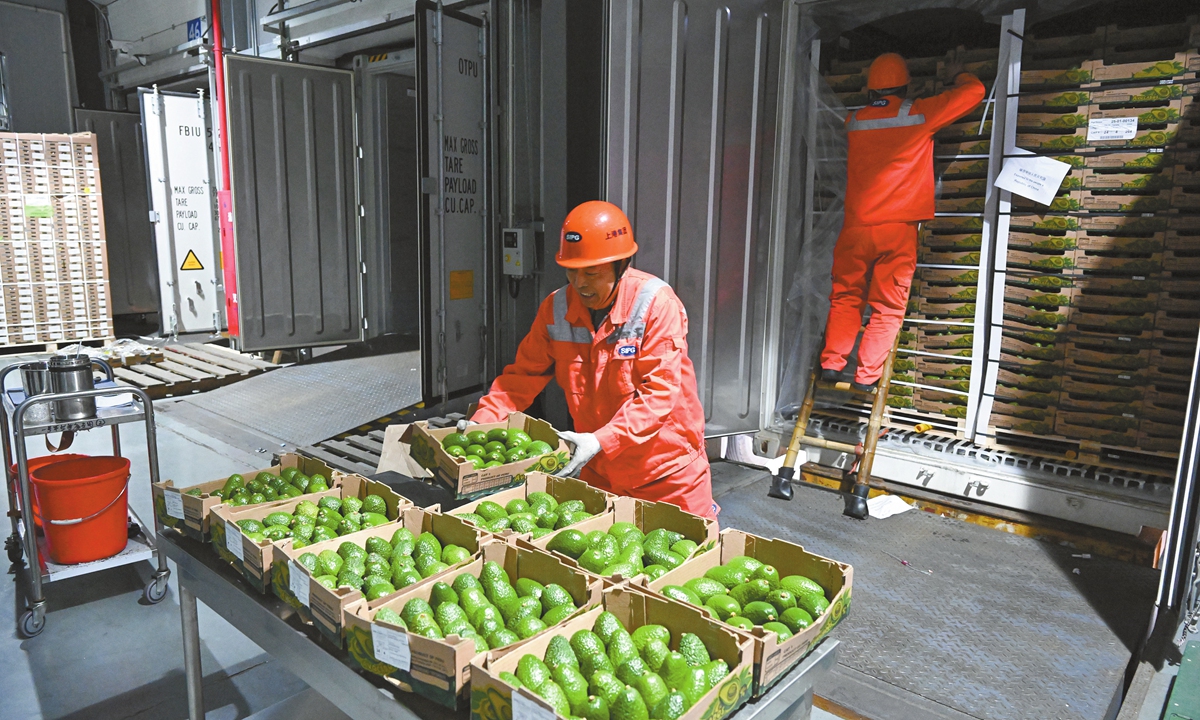
Port workers load fresh Peruvian fruit from Chancay Port in Peru, which arrived at Shanghai’s Yangshan Port, onto trucks for distribution on December 19, 2024. Photo: VCG
As the global economy undergoes profound transformation, Peru is recalibrating its development strategy by increasingly embracing win-win international cooperation — with China emerging as a key partner in the world.
Peru consistently demonstrates development potential not only in mining but also in tourism, agricultural exports, and productive sectors linked to marine and meteorological resources. Integrating this potential into major global value chains is of critical importance for Peru.
However, our main challenge lies in transforming this wealth of raw materials into added value. This is precisely where the Belt and Road Initiative (BRI) represents a valuable opportunity for us. We need to focus on strengthening our domestic markets to become more competitive, adopt green energy, and seize the opportunities presented by having a port hub.
The Chancay Port project, a flagship of Peru-China cooperation, stands as a testament to this strategic alignment.
Of course, this transformation won’t happen overnight, and there will always be challenges and risks. But no one imagined that nearly 50,000 tons of cargo would move through the Chancay megaport in just six months, from November to April, in trade with Asia. That is undeniably significant in both economic scale and impact. Commercial activity, income, and tax revenue from November and December have been extraordinary. If Chancay continues at this pace, it could contribute no less than 1.5 percent of Peru’s GDP—an extraordinary prospect for the country.
Yet such progress is unfolding against a complex geopolitical backdrop.. Powerful actors are increasingly attempting to disrupt new paths of development for the Global South.
As we often say, it’s impossible to cover the sun with one finger, right? There is undeniable geopolitical attention. One country that once championed free trade is now embracing protectionism.
The shift in Peru’s trade patterns over the past three decades is revealing.
For Peru, China is now its largest trading partner. Thirty years ago, the trade relationship between China and the US in Peru was 27 to 1 — overwhelmingly in favor of the US. Back then, the US was our main trade partner. But what happened over the past 30 years? This shift was not the result of imposition, but as a result of market forces, investment, initiatives, cooperation, and reciprocity.
This is not just a matter of trade figures — it reflects a broader development model that prioritizes dignity and production.
Today, I believe our country is beginning to understand — and demonstrate — what we truly want: development for our people, a dignified life, and investment that enables creation and production. This is exactly what’s happening through Peru’s partnership with China, our No.1 trading partner, and this is a process that cannot be stopped. There may be political noise, but the pursuit of our people’s development will always outweigh everything else.
Ironically, those who once defined the rules of globalization are now turning their backs on them.
Life is full of paradoxes. Those who once championed free markets are now trying to return to protectionism. But that’s impossible. Global trade cannot go back to the prehistoric era. It simply cannot.
Free trade has taught us standards of cooperation, mutual benefit, shared values, and peace. It has shown us that what is exchanged is not only goods and services, but also cultures. When some realize they are losing ground, they react arbitrarily—imposing irrational tariffs and trade barriers driven by psychological impulses or political disputes. But such actions will inevitably fail, because these practices no longer align with the spirit of this new civilizational era founded on mutual benefit and consensus.
At this civilizational crossroads, unity and consensus across the Global South is more vital than ever.
Today’s civilization is in crisis and urgently needs shared platforms like the BRICS economies and the Global South. Here, we embrace sovereignty, the right of peoples to self-determination, dialogue, peace, and respect for diversity—all within a framework of free trade as a superior value.
I firmly believe in the power of cooperation across the Global South. What we need is a peaceful kind of leadership—one of intelligence, innovation, and openness to dialogue—not driven by ideology, but by the desire for better lives, access to education, cultural identity, and self-determination. That’s what makes us happier, and I believe the consolidation of the Global South is unstoppable.
The US’s attempt to impose unmanageable tariff rates reflects its commercial and technological vulnerabilities. This reveals a contradiction and incoherence with the free-market economy it once so strongly proclaimed. The US fails to realize that this offensive would ultimately backfire like a boomerang, further impacting its already weakened economy.
Cooperation among Global South nations is no longer optional—it is a civilizational imperative.
This was discussed in today’s Daily Chronicles and I copy that with Lula Da Silva’s response.
 Tariffs have to do with trade and with the balance of trade, yes? Demented Donnie has turned his Tariff Letters (of which a bunch went out this morning again), into a capricious punitive stick. 50% for Brazil and there is more in ‘sectoral’ tariffs. During the last few days Trump has been hollering on his Truth Social that Brazil is treating Bolsonaro very badly. Bolsonaro, with another 34 people or so, is in court, charged with the coup plot to overturn the results of the 2022 election and keep his opponent from taking power.
This is gross interference in the affairs of other nations and most probably breaks a raft of international law.
I know China is Brazil’s biggest trading partner. Here is a sizable list of products that Brazil trades with the US. https://tradingeconomics.com/brazil/exports/united-states
One hopes that Brazil could have the courage of its convictions and stop trading with the US. This is the only action that will stop the tariffs, which the US buyers anyway pay for. Yet, with such a cost burden, the cost of items becomes too high for any market to bear. Regarding the accusations against US media operating in Brazil, you may recall that Elon Musk became upset because Brazil expected foreign tech companies to comply with Brazilian Law. Brian Mier has an article on Brazil’s law that owners of Tech companies are responsible for crimes committed on their platforms, as free speech is not absolute in many other countries. https://bmier.substack.com/p/brazils-victory-for-digital-sovereignty
It is, of course, now time to see if BRICS can support one another. There is the list, folks – whatcha gonna buy .. whatcha need today? Time is short.
In light of the public statement made by U.S. President Donald Trump on social media on the afternoon of Wednesday (9), it is important to highlight the following:
Brazil is a sovereign nation with independent institutions and will not accept any form of tutelage.
The judicial proceedings against those responsible for planning the coup d’état fall exclusively under the jurisdiction of Brazil´s Judicial Branch and, as such, are not subject to any interference or threats that could compromise the independence of national institutions.
In the context of digital platforms, Brazilian society rejects hateful content, racism, child pornography, scams, fraud, and speeches against human rights and democratic freedom.
In Brazil, freedom of expression must not be confused with aggression or violent practices. All companies—whether domestic or foreign—must comply with Brazilian law in order to operate within our territory.
The claim regarding a U.S. trade deficit in its commercial relationship with Brazil is inaccurate. Statistics from the U.S. government itself show a surplus of $410 billion in the trade of goods and services with Brazil over the past 15 years.
Therefore, any unilateral tariff increases will be addressed in accordance with Brazil’s Economic Reciprocity Law.
Sovereignty, respect and the unwavering defense of the interests of the Brazilian people are the values that guide our relationship with the world.
We recently had a short discussion on Argentina in the Hearty Salon. I mentioned casually that I am not sure how much of Argentina actually still belongs to Argentina, given their IMF loans. It is generally known that Argentina has the most enormous IMF loans in the world.
Here is an update with Ben Norton doing the numbers.
Ben says: The IMF is a corrupt tool of US interests. Trump ordered the IMF to give Argentina’s last right-wing oligarch-run regime the biggest loan in IMF history. Now it’s bailing out Javier Milei’s failing libertarian project. Argentina’s IMF debt is projected to be 1335% of its quota.


They turned to China for help as this level of debt cannot be paid. China gave them a swap line, to keep the lights on and pay the grocery bill, while Argentinians are out in the streets every week. A swap line is simple and in its simplest form, China made some money available that Argentina can use to buy stuff from China, and pay things from China, because they have nothing in their piggy banks to purchase anything with – it’s like rolling credit. I have no idea what Argentina put on the table to support this swap line.
Recently, one of the popular resistance bloggers and commentators (everybody is now a trade expert or an economist suddenly) presented this list on China, showing a rare level of playing beyond his skill set:


 Reality Check for Trump on China:
 China can import soybeans from Brazil

China can import beef from Argentina
China can import sorghum from Australia
China can import corn from S. Africa
As for oil and gas, China can import it from its neighbor Russia and the US’s neighbor Canada

I commented in a closed environment:
China can import soybeans from Brazil. They’re already buying every bean available. Without opening up more rainforest, there will be no more to buy.
China can import beef from Argentina—where is the port? Argentina cannot get to Chancay as it has to cross two countries. It has no friends in the region, and it does not have the infrastructure or beef to deal at this level.
China can import sorghum from Australia – How much? Sufficient for three baby breakfasts in one week? It is but a few million. China is both a sorghum importer and a small exporter. Up to now, their main imports have come from:
In 2024, China imported $2.59B of Sorghum, being the 125th most imported product (out of 1,199) in China. In 2024, the main origins of China’s Sorghum imports were: United States ($1.73B), Australia ($578M), Argentina ($280M), Uruguay ($775k), and Burma ($109k).
It is the United States imports that they have to find from other countries.
In 2024, China exported $1.72M of Sorghum, being the 1,139th most exported product (out of 1,211) in China. In 2024, the main destinations of China’s Sorghum exports were: South Korea ($1.25M), Japan ($209k), Chile ($97.7k), Malaysia ($48.6k), and United States ($44.4k).
The fastest growing markets for Sorghum exports in China between 2023 and 2024 were: Chile ($62.6k), United States ($14.3k), and Japan ($9.09k).
China can import corn from South Africa. Sure, South Africa has become a net importer of food and agricultural products. They are importing corn themselves, and they are also making it impossible for the big farmers with years of experience to farm.
Let’s check China’s corn imports in more detail:
In 2024, China imported $3.78B of Corn, being the 89th most imported product (out of 1,199) in China. In 2024, the main origins of China’s Corn imports were: Brazil ($1.88B), Ukraine ($1.14B), United States ($560M), Burma ($54.3M), and Russia ($36.2M).
Do you see South Africa there?
As for oil and gas, China can import it from its neighbor Russiaand the US’s neighbor Canada – OK then. Or continue with its multiple sources of generation.
One cannot be more toast than Argentina, a beautiful country with a glorious food culture. But who owns Argentina now? This is not a rhetorical question.
The US-controlled IMF is meddling in Argentina’s upcoming election, campaigning for right-wing libertarian Javier Milei. The IMF managing director told Argentine voters to oppose any candidates who reject Milei’s brutal neoliberal austerity measures.
A chainsaw cannot possibly be a tool of state.

SAN SALVADOR, El Salvador — Salvadoran President Nayib Bukele proposed carrying out a prisoner swap with Venezuela on Sunday, suggesting he would exchange Venezuelan deportees from the United States his government has kept imprisoned for what he called “political prisoners” in Venezuela.
In a post on the social media platform X, directed at President Nicolás Maduro, Bukele listed off a number of family members of high-level opposition figures in Venezuela, journalists and activists detained during the South American government’s electoral crackdown last year.
“The only reason they are imprisoned is for having opposed you and your electoral fraud,” he wrote to Maduro. “However, I want to propose a humanitarian agreement that includes the repatriation of 100% of the 252 Venezuelans who were deported, in exchange for the release and surrender of an identical number (252) of the thousands of political prisoners you hold.”
—
Nicolás Maduro reacts furiously to Nayib Bukele’s proposal to exchange imprisoned Venezuelans in CECOT for political prisoners: “It is a kidnapping and a concentration camp created by Bukele’s macabre mind”
“In response to the cynical statement made by President Nayib Bukele, in which he reaffirms that 252 Venezuelan citizens illegally deported from the United States are arbitrarily detained and in a condition of forced disappearance in a concentration camp of that country, we wish to denounce the following:
Bukele’s statement, who makes his worldwide debut in this way as the most faithful exponent of 21st-century neo-fascism, demonstrates that these citizens are kidnapped at the unilateral disposal of an individual outside the law who publicly and through the media declares to the planet that he tyrannically decides who may or may not enjoy life and freedom in El Salvador.
As we explained in a letter addressed to the UN High Commissioner for Human Rights, Volker Türk, the treatment received by Venezuelans in the United States and El Salvador constitutes a serious violation of international human rights law and amounts to a crime against humanity that mimics the repugnant Nazi practices of the mid-20th century.
For this reason, I am now sending communications to the Attorney General of El Salvador and the Supreme Court of that country, questioning them on:
a) What crimes have these Venezuelan citizens committed in El Salvador?
b) When were they presented before a judge?
c) Have they had access to a lawyer?
d) Have they been allowed to communicate with anyone since the moment of their detention?
As Attorney General of Venezuela, I immediately request the full list with identification of all those kidnapped and their judicial status, as well as proof of life and a medical report for each one.
The entire world should be appalled by the fact that CECOT is no longer a torture center created by Bukele’s macabre mind to punish criminals in his country, but rather a site of forced disappearance of innocent Venezuelans (according to arrangements with his imperial partners), whom, as an expert in human trafficking, he uses to receive millions of dollars in return.
What has been stated above demands that all international organizations call for the immediate release of our compatriots, who are now vilely kidnapped by a tyrant, and that they proceed to sanction this criminal conduct which violates the most sacred principles of international coexistence, justice, and peace.”

 Lateo.net - Flux RSS en pagaille (pour en ajouter : @ moi)
