 Connexion


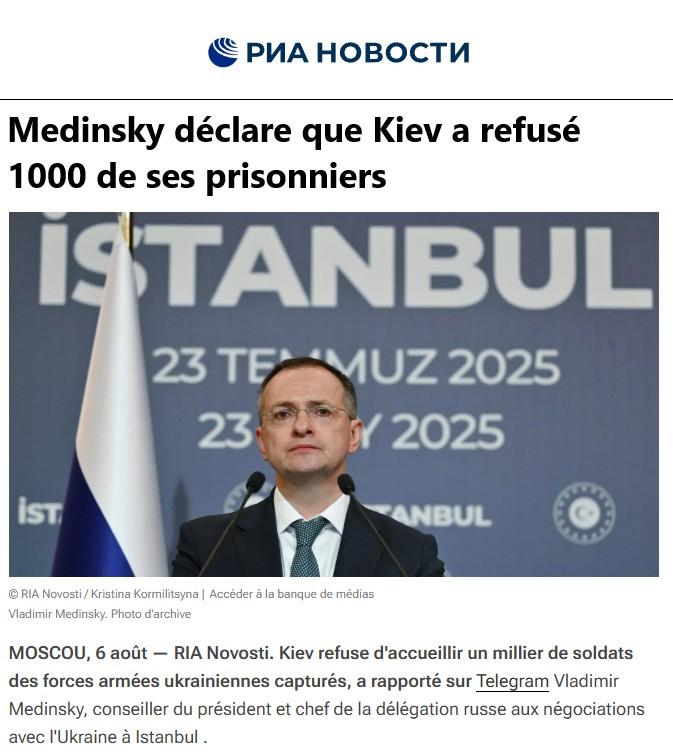
Kiev refuse d’accueillir un millier de soldats des forces armées ukrainiennes capturés, a rapporté sur Telegram Vladimir Medinsky, conseiller du
L’article Medinsky affirme que Kiev a refusé d’échanger 1000 de ses prisonniers est apparu en premier sur STRATPOL.
‘Ukraine’s negotiators said to my face — foreign partners are against the deal’.
Russia’s top negotiator Vladimir Medinsky reveals behind-the-scenes of peace talks in the premiere episode of RT’s flagship show ‘Sanchez Effect’ with Award-winning American journalist, Rick Sanchez.
Medinsky – a portrait of sanity – on negotiations with Ukraine.
Pepe Escobar: Worth quoting him at length:
“I feel that deep down, they [the Ukrainian side] are better than they want to appear. They even want to say something, but they can’t. I saw the opposite… Two-thirds of their delegation is in military uniform. They are military personnel. I look into their eyes. First of all, they are no different from Russians. They are exactly the same. I see in their eyes a reluctance to fight. They don’t want to fight and they don’t want to send their soldiers to their deaths.
They remind me a little of top managers hired by some giant corporation. They can make some decisions, but for fundamental ones, they have to consult with the board of directors.
I would divide the Ukrainian people, the Ukrainian army, the soldiers, and those who suffer the most, those who are close to the front line and are under attack in one way or another, and a small part of the ruling elite. It seems to me that the Ukrainian leadership is beginning to remind me of Latin American dictators to some extent.
They were also good guys once, when they came to power and promised a lot during the elections. But then they gradually turned into dictators. And in order to remain in power forever, you need a constant enemy. You need a war that does not threaten you personally. And this war does not threaten your families either. Because all your families are abroad, with British passports, and they are doing very well. And you can no longer control the situation without war.
I will tell you one thing that I have probably never said publicly before. If Ukraine had wanted to, if it had been ready, if it had made its own decisions, we could have signed a peace treaty on February 28, 2022. At the first meeting. And its terms were softer than what we are offering today.
By and large, all we wanted was for Ukraine to refuse to join NATO and to refuse to allow foreign military bases on its territory. I told them: be like Austria. Let you have an army like Austria. Second, restore the Russian language and the Orthodox Church on an equal footing. And the third point was to recognize Crimea, because it cannot be ignored.
And the last proposal from our side was this. There are two territories: Donbass, two regions that do not want to be part of Ukraine. Previously, we proposed returning them to Ukraine with autonomous status, so that they could simply elect their own governor.
Ukraine refused and said: we will conquer them. They were unable to conquer them.
Then, on February 28, 2022, we proposed: well, you were unable to conquer them, and you will not be able to live with them, so leave them alone. We finally agreed for the first time in Istanbul, and we prepared a treaty.
On April 15, President Putin reviewed the agreement and made one or two legal comments — he is a professional lawyer. On the same day, I handed the document to Zelensky. Zelensky remained silent for two weeks.
We do not need war at all. Why did the situation for Ukraine get worse? Because referendums were held in four regions. And they are officially part of Russia. And Russia cannot leave there because it would betray all the people. It is impossible. They are enshrined in the Russian Constitution.
But if the conflict is stopped along the front line and no real peace agreement is reached — just some kind of truce, ceasefire, whatever — then that will be it. You know, there was this disputed region between Armenia and Azerbaijan, Karabakh? This region will turn into a huge Karabakh. After some time, Ukraine will join NATO, try to recapture it, and that will be the end of the planet, it will be a nuclear war.”
Since we view these negotiations as a continuation of the Istanbul process, it is very important to remind everyone what we have already agreed upon back in Gomel at the end of February (of 2022). And what might have happened if Ukraine had agreed to peace then? Which they didn’t. They dragged things out. And as a result, the next stage of the agreements was in Istanbul (in March if 2022). Russia’s Istanbul proposals were tougher, adjusted to the reality on the ground. But unfortunately, the Istanbul process was also derailed—this time due to direct Western interference. We’ve seen these kinds of historical analogies before and we know where they lead.
Take, for example, the many Russo-Turkish wars. One of them, sparked by a major conflict in the Balkans in the 1870s, ended with agreements between Russia and Turkey that supported the independence and autonomy of young Balkan states. But then the West intervened. The Berlin Congress was convened to “improve” the results of the San Stefano Peace Treaty. And what did those “improvements” lead to? The Balkan Wars of 1912–1913, and eventually, the outbreak of World War I.
There’s this idea floating around today: first a ceasefire, then negotiations. People say, “That’s how it’s always done—30 days, 60 days, then talks.” But these people know nothing of history. As Napoleon said, wars and negotiations usually happen at the same time.
I’ll remind you of some bad examples, really bad examples, but still—during the Vietnam War, the U.S. and Vietnam negotiated throughout 15 years of active conflict. Same with the Korean War. Or take the Soviet-Finnish War. Stalin offered Finland peace. Britain and France egged Finland on: “Don’t deal with the Soviets. We’ll send help, volunteers, expeditionary forces.” But no one came. The Finns were left to fight alone. In the end, while hostilities continued, negotiations resumed, and peace was signed. That’s how history works—wars and talks go hand in hand.
Perhaps the most illustrative example is the Great Northern War with Sweden. It lasted 21 years. Early on, Peter the Great offered peace. He said: we need nothing more than just a route to the Baltic—St. Petersburg and a bit of land around it. These are Russian lands anyway—today’s Leningrad region, most of Karelia—taken from Novgorod centuries ago. But Peter didn’t even demand all that back—just a safe access to the sea. Russia can’t live without it.
Sweden said no. King Charles XII pressed on with his senseless war, ignoring Peter’s repeated peace offers. And guess who supported him? England and France, who endlessly financed Sweden. Eventually, Russia and Sweden started peace talks—the Åland negotiations in 1718. But England and France pushed hard to block them: “No direct talks. Let’s mediate.” Why? Because it benefited them to see two great powers fight. The negotiations collapsed. Only in 1721, after 21 years, Sweden finally signed a peace treaty—not just giving up St. Petersburg, but also Karelia, the Leningrad region, the Baltics. And Sweden lost its status as a great power—forever.
Before the war, Sweden controlled a million square kilometers—twice the size of France. The Baltic Sea was Sweden’s internal sea. After the war, it lost everything, including Northern Germany, the Baltics, and eventually Finland.
History repeats itself in striking ways.
Bismarck, who was once an ambassador in St. Petersburg and knew Russia well, learned Russian, understood our character and the natural affinity between Russia and Germany, once said: Never try to deceive Russians or steal from them—because they will return for what’s theirs. Always.
That phrase—“Russians always come for what’s theirs”—remains a powerful lesson from history.

 Lateo.net - Flux RSS en pagaille (pour en ajouter : @ moi)