 Connexion


Le Premier ministre indien, Narendra Modi, a promis au président américain, Donald Trump, de mettre fin aux importations de pétrole
L’article Trump annonce un accord avec Modi pour que l’Inde achète moins de pétrole russe est apparu en premier sur STRATPOL.
Following Russian-Indian talks, Vladimir Putin and Prime Minister of India Narendra Modi made statements for the media. The statements were preceded by a ceremony for the exchange of signed documents.
http://en.kremlin.ru/events/president/transcripts/78657
29 Documents were signed by the parties. The video, at the link above, lists these – I am sure we will get a list that is not video and can easily be read.
Prime Minister of India Narendra Modi (retranslated): Your Excellency Vladimir Putin, my dear friend,
Representatives of the two countries, and our friends from India, good afternoon.
I am delighted to welcome President Putin to the 23rd Russia – India Annual Summit.
President Vladimir Putin’s visit to India is taking place at a time marked by several historical dates in our relations. President Putin laid the groundwork for our strategic cooperation 25 years ago, and 15 years ago, in 2010, we upgraded our partnership to the level of a special privileged strategic partnership.
Over the past 25 years, President Putin has been relentless in promoting these relations by demonstrating his wise leadership and vision. Regardless of the circumstances, it is his leadership that has reinforced our mutual relations and enabled us to achieve new heights.
I would like to express my sincere gratitude to President Putin for his friendship and for his unwavering commitment to working with India.
Friends,
The world has faced numerous ups and downs over the past 80 years, during which humankind has had to endure many crises and challenges. And throughout this time, the friendship between Russia and India has successfully weathered these storms. These relations are based on mutual respect and deep trust and have invariably stood the test of time.
Today, we discussed our ties and cooperation in all their aspects with a view to creating an even more solid foundation.
We want to reinforce our economic cooperation and elevate it to a new level. This is the objective we share and it is our shared priority. To make this a reality, we have agreed to implement a programme for economic cooperation until 2030. It will provide for diversifying our trade and investment, making them more balanced and sustainable. At the same time, it will help unlock new dimensions in our cooperation.
Today, President Putin and I will be taking part in the Russia – India Business Forum. I am convinced that this platform will also help strengthen our business ties and open new doors for exports, joint manufacture and technical innovation.
Both countries have been proactive in working on a free trade agreement between the Eurasian Economic Union and our country.
Our cooperation in agriculture and fertilisers is extremely important for our food security and the prosperity of our farmers.
I am happy that our countries will work together to promote our mutual production of urea.
Friends, promoting connectivity between our countries is another priority for us.
We will redouble our efforts regarding the discussions on the North-South International Transport Corridor and the Vladivostok-Chennai Maritime Corridor.
I am confident that we will effectively cooperate in the interests of promoting polar trade via local trade routes. We have offered an opportunity to strengthen our cooperation in the Arctic, which will create new jobs for Indian young people.
At the same time, our deep cooperation in shipbuilding will help us boost our joint initiatives. This is yet another important example of our mutually beneficial cooperation, which is increasing the number of jobs and skills while strengthening regional connectivity.
Energy security is another important pillar of partnership between Russia and India. Our cooperation in the field of civilian nuclear energy, which is rooted in our history, has helped us uphold our commitment to providing clean energy, which is extremely important for both countries.
I have no doubt that our mutually beneficial cooperation in the field of critical minerals will also be important for a safe and diversified provision of resources to the world.
We also maintain our cooperation in such areas as clean energy, high technologies and modern industries.
Friends,
Our cultural relations and ties between individual representatives of our countries are of special importance for relations between Russia and India. Over the past decades, our peoples have demonstrated respect and admiration for each other’s cultures, and we have coordinated various measures to further strengthen this cooperation.
The recent opening of two Indian consulates in Russia is a significant step forward, facilitating contacts for all our citizens and bringing our nations even closer together.
This October, hundreds of thousands of pilgrims received blessings at the sacred relics of Buddha Shakyamuni in Kalmykia. I am confident that we will soon implement a 30-day visa-free regime for tourist groups, which will greatly enhance travel between our countries. This measure will not only bring our peoples closer but also invigorate our societies and unlock new opportunities. I am therefore pleased that today we were able to sign two key agreements to advance this initiative.
Our collaboration will also deepen in education and professional development, including through increased student and academic exchanges.
Friends,
Today, we discussed a range of pressing regional and global issues. On Ukraine, India’s position has been consistent from the outset: we stand for peace. We welcome all initiatives and efforts aimed at achieving a peaceful, long-term resolution of this conflict. India has always been ready to support such efforts, and we will continue to do so.
India and Russia have always supported one another and worked shoulder to shoulder in the fight against terrorism. The terrorist attack in Pahalgam and the cowardly atrocity at Crocus City Hall are connected by a common, hateful ideology. India firmly believes that terrorism constitutes a direct assault on universal human values. Our unity within the global community is the only effective way to combat this evil.
We cooperate closely within the UN, the G20, the SCO, BRICS, and other multilateral forums. We will continue this essential dialogue and cooperation across all these platforms.
Your Excellency,
I am confident that our enduring friendship will provide the strength needed to address global challenges. Together, we can help lead the way towards a more prosperous future.
Once again, I thank you and all members of your delegation for your visit to India. Thank you very much.
President of Russia Vladimir Putin: Mr Prime Minister, dear friend,
Ladies and gentlemen,
My sincere thanks to the President of the Republic of India, Droupadi Murmu, to you, Mr Prime Minister, and to all our Indian colleagues for the exceptionally warm and cordial welcome extended to the Russian delegation.
The discussions we have just concluded with our Indian colleagues, along with our highly productive one-on-one conversation last night – for which I thank you again, Mr Modi, for your generous hospitality – were held in a constructive and friendly spirit, reflecting the privileged partnership between Russia and India.
I would note that the Prime Minister and I have established a close working and personal rapport. We have met at the SCO summit in September, we maintain regular contact by telephone and personally oversee the development of our strategic cooperation across all key areas, as well as the progress of major bilateral projects.
Today, with the participation of our delegations, we conducted a thorough and comprehensive review of the entire spectrum of Russian-Indian cooperation. We also exchanged views on current international and regional issues.
The joint statement we have adopted outlines clear priorities for advancing our ties in politics, security, trade, the economy, and cultural and humanitarian affairs. As you have seen, this was complemented by the signing of a substantial package of intergovernmental, interdepartmental, and corporate agreements.
Many of these documents are aimed at expanding our economic partnership. This is only natural, as our nations are important partners in trade, investment, and technology. Last year, our bilateral trade grew by a further 12 percent, reaching a new record. While various estimates differ slightly, the consensus places the figure somewhere between US$64 and US$65 billion. We project trade will stand at a comparable level by year’s end.
That said, we believe there is clear potential to increase this volume to US$100 billion. To realise this ambitious goal, we have now agreed upon a joint Programme for the Development of Russian-Indian Economic Cooperation until 2030. This comprehensive roadmap provides clear guidelines. Our intergovernmental commission and the relevant economic ministries and agencies are tasked with removing barriers to the flows of goods and capital, implementing joint industrial projects, and deepening our collaboration in technology and investment.
Today, His Excellency the Prime Minister shared a comprehensive list of issues with us. It goes without saying that both Russia and India will be extremely diligent and responsive in reviewing them. Make no mistake, we will work on this matter.
Of course, having India create a free trade zone with the Eurasian Economic Union would help boost Russia-India business ties. The effort to draft an agreement to this effect is already in progress.
I must express my satisfaction with the fact that the two countries have been consistent in their commitment to switching to national currencies in mutual transactions. Their share in business deals has already reached 96 percent. Our two countries have developed resilient interbank channels for lending and financial transactions. Russian economic actors have been making wider use of the rupees they generate from export contracts. Major joint projects receive their funding in Russian rubles.
There has been positive momentum in our energy partnership. Russia is a reliable supplier of energy resources and everything India needs for developing its energy sector. We are ready to continue ensuring uninterrupted fuel supplies for the Indian economy to support its rapid expansion.
Of course, our bilateral energy cooperation goes far beyond this horizon. The flagship project to build India’s biggest NPP, Kudankulam, is underway. Two out of six reactors have been connected to the power grid, while the other four are in the engineering and construction stages.
Once this NPP reaches its full capacity, it will make a meaningful contribution to India’s energy mix, helping Indian companies and households access affordable and clean energy. We believe that building small modular reactors and floating NPPs could also be relevant, just as using nuclear technology for non-energy purposes, including in healthcare, agriculture and other sectors.
We are also working with our Indian partners to create new effective international transport logistics routes. This includes a project to create the North-South corridor linking Russia and Belarus to the Indian Ocean. Infrastructure development along the Trans-Arctic Transport Corridor, including the Northern Sea Route as its main artery, offers ample opportunities for expanding bilateral trade.
There are many other economic sectors in which Russia and India have built a positive track record. We are working on joint initiatives in manufacturing, machine building, digital technology, space exploration and other research-intensive domains.
For example, a business agreement that was signed as part of the visit provides for building a major Russian-Indian pharmaceutical plant in the Kaluga Region for producing high-quality anticancer medicine using cutting-edge Indian technology. At the same time, Russian companies will start producing their goods as part of the Make in India programme, which is Prime Minister Modi’s flagship project.
Prospects for strengthening interaction between Russian and Indian entrepreneurs and business communities are being discussed in detail at the business forum that is currently underway in New Delhi. Mr Prime Minister and I will attend its plenary session later today.
Russian-Indian humanitarian cooperation is ongoing in many spheres. Our peoples have been sincerely interested in each other’s traditions, history and spiritual values for centuries. Our scientific and educational contacts, as well as youth and public exchanges are actively developing. The regular cross festivals of Russian and Indian films invariably enjoy success. Mutual tourist flows grow every year.
The Russian RT channel will begin broadcasting to India today. This will certainly help the Indian audience learn more about Russia and Russians and acquire objective information about current developments in our country.
Our discussions on key global and regional issues have reaffirmed the similarity of our countries’ positions. Russia and India pursue an independent and sovereign foreign policy.
We are working together with our allies in BRICS, the SCO and other countries of the Global Majority to promote the shaping of a more just and democratic multipolar world order, and to protect the fundamental principles of international law enshrined in the UN Charter. These include the right of every country to its own path of development, the preservation of its own cultural and civilisational identity, respect for sovereignty and a delicate balance of interests of all members of the international community.
Russia and India, as the founding nations of BRICS, have done and continue to do a great deal to enhance the prestige of that organisation. As you know, India will assume the BRICS chairmanship next year. We will provide all-round assistance to our Indian friends in their work on the current BRICS agenda.
Of course, I would also like to say that Russia and India have traditionally worked closely together in the military-technical sphere. Our country has been assisting the modernisation of the Indian army, including the air defence, air force and navy, for over 50 years.
Overall, we are certainly satisfied with the results of our talks. Our plans include a meeting with President of India Droupadi Murmu. However, I can already express my confidence that this visit and the agreements reached will effectively promote the further strengthening of the Russian-Indian strategic partnership for the benefit of the people of India and Russia.
Thank you.
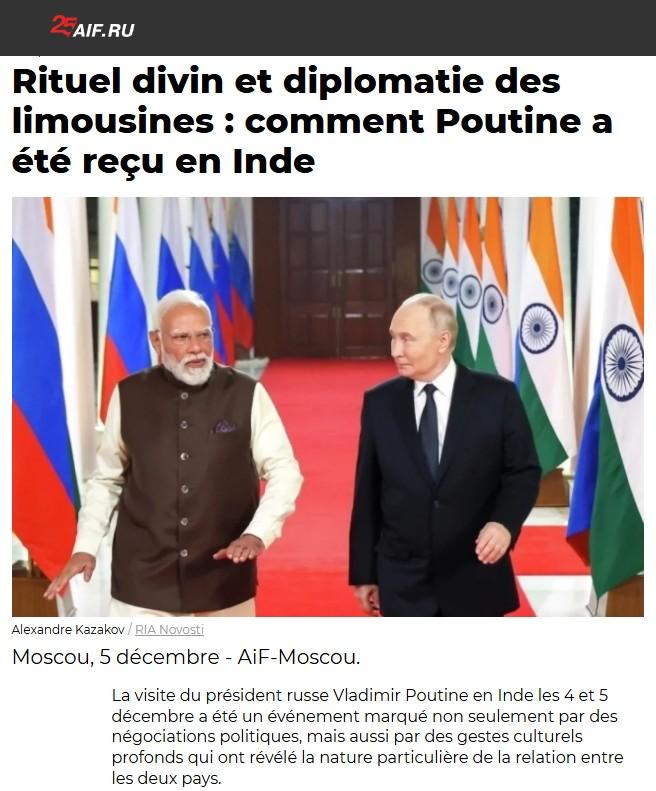
La visite du président russe Vladimir Poutine en Inde les 4 et 5 décembre a été un événement marqué non
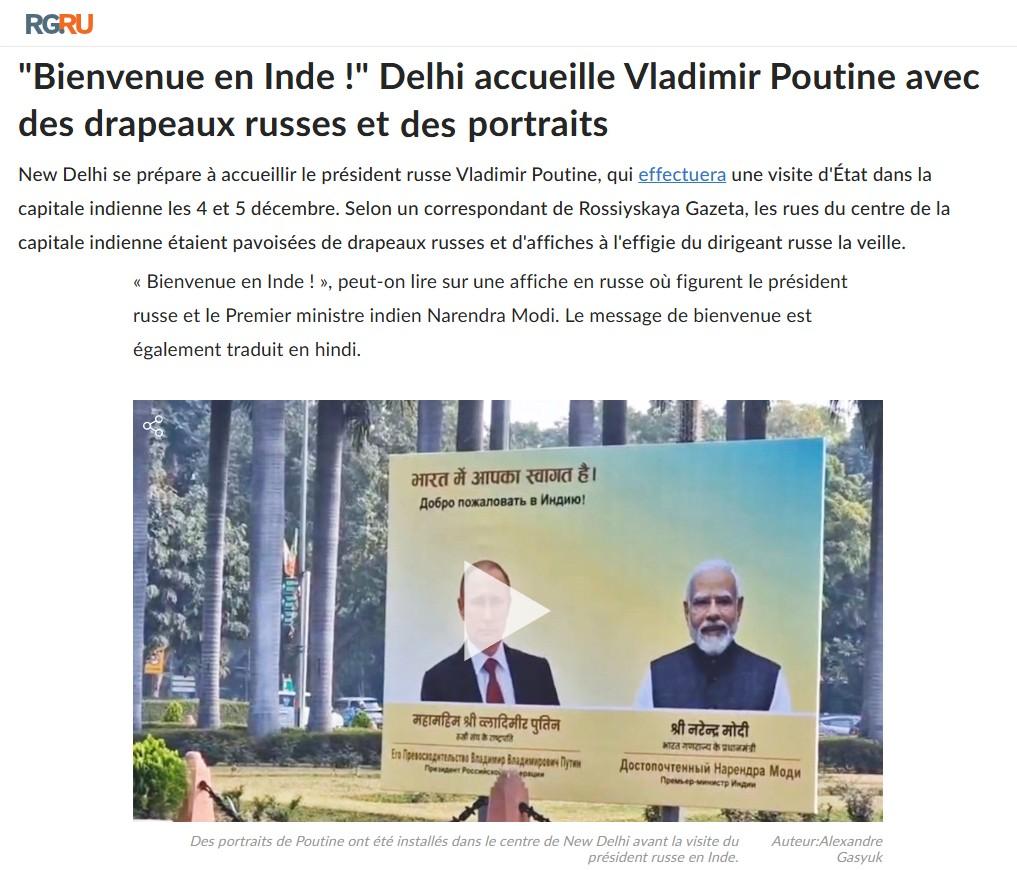
New Delhi se prépare à accueillir le président russe Vladimir Poutine, qui effectuera une visite d’État dans la capitale indienne
L’article New Delhi se prépare à accueillir Poutine est apparu en premier sur STRATPOL.
In conjunction with this post, Pokrovsk and lessons from Stalingrad, here is the Russian MoD today. You can read through and see that nobody gets out of a cauldron, not even in small groups. There is no opportunity for retreat. The Ukies movie, the Ukies die. Their choices are to die or to surrender. They are running out of ammunition in spots now. They cannot be resupplied.
Marat Khairullin describes: “In any maneuver by the Armed Forces of Ukraine, their operational position will only worsen, resembling the convulsions of a piglet in the coils of an anaconda.”
There is fierce fighting going on, so, it is not only Russia fighting. One sometimes loses perspective reading only the Russian reports. TASS describes the Ukrainian drone attack of last night. https://tass.com/politics/2038341
Just in: Ukrainian military surrounded in Krasnoarmeysk have begun to surrender, reported by the Russian Ministry of Defense.
Here the Ukies tried to insert special forces:
An operation to deploy a GUR special operations group by a helicopter in 1 km north-west of Krasnoarmeysk (Donetsk People’s Republic) was thwarted. All 11 militants who disembarked from the helicopter have been neutralised.
Report by Russian Defence Ministry on progress of special military operation as of 1 November 2025
 The Armed Forces of the Russian Federation continue the special military operation.
 The Sever Group of Forces inflicted fire damage on formations of two mechanised brigades, two assault regiments of the Armed Forces of Ukraine, and a territorial defence brigade near Andreyevka, Varachino, Iskriskovshchina, Kondratovka, Novaya Sech, and Pavlovka (Sumy region).
 In Kharkov direction, units of an infantry brigade and a territorial defence brigade have been hit near Volchansk and Sinelnikovo (Kharkov region).
 More than 170 troops, two armoured fighting vehicles, six motor vehicles, and a field artillery gun have been neutralised. Two electronic warfare and counter-fire radars as well as six materiel depots were neutralised.
 The Zapad Group of Forces improved the tactical situation. Russian units engaged three mechanised brigades of the Armed Forces of Ukraine, a territorial defence brigade, and a national guard brigade close to Druzhelyubovka, Petropavlovka (Kharkov region), Maslyakovka, Novoselovka, Stavki, and Yarovaya (Donetsk People’s Republic).
 Assault detachments of the 6th Army continue to destroy enemy units close to Kupyansk (Kharkov region).
 The Armed Forces of the Russian Federation repelled another attack of the enemy in the north-western direction attempting to breach the encirclement. Eight militants of the 16th Mechanised Brigade of the Ukrainian Armed Forces have been neutralised. In addition, Russian elements halted two attempts to lift the blockade of surrounded formations by units of the 151st Mechanised Brigade of the Armed Forces of Ukraine and the 15th National Guard Brigade close to Petrovka and Velikaya Shapkovka (Kharkov region). Up to 20 militants have been neutralised.
In the past 24 hours, up to 50 troops, a U.S.-made M113 armoured personnel carrier, a Kazak armoured vehicle, and five pickup trucks have been neutralised close to Kupyansk (Kharkov region).
In total, more than 220 troops, six armoured fighting vehicles, 17 motor vehicles, and two field artillery guns have been neutralised in the area of responsibility of the Zapad Group of Forces. Four electronic warfare stations and five ammunition depots were neutralised.
The Yug Group of Forces took more advantageous lines and positions. Strikes were delivered at formations of two mechanised brigades, an airmobile brigade, an assault brigade of the Armed Forces of Ukraine hit near Vasyukovka, Verolyubovka, Dronovka, Zvanovka, Konstantinovka, and Seversk (Donetsk People’s Republic).
The enemy lost up to 225 troops, a French-made VAB armoured personnel carrier, a U.S.-made HMMWV armoured vehicle, 13 motor vehicles, and a field artillery gun. In addition, three electronic warfare stations and a materiel depot were neutralised.
The Tsentr Group of Forces improved the situation along the front line. Russian units hit two mechanised brigades, two assault brigades, an assault regiment of the Armed Forces of Ukraine, a marine brigade, two territorial defence brigades, and two national guard brigades close to Belitskoye, Gnatovka, Grishino, Kotlino, Pankovka, Rodinskoye, Rozy Lyuksemburg, Udachnoye (Donetsk People’s Republic), Ivanovka, and Novopavlovka (Dnepropetrovsk region).
In Krasnoarmeysk (Donetsk People’s Republic), assault detachments of the 2nd Army continue to destroy surrounded enemy units near the railway station. Moreover, Gnatovka and Rog (Donetsk People’s Republic) are almost mopped up from Ukrainian militants.
The Russian Armed Forces disrupted seven enemy attacks north and north-western directions undertaken to escape the encirclement including an attack of an assault group of the 425th Skala Assault Regiment of the AFU from Grishino (Donetsk People’s Republic).
 An operation to deploy a GUR special operations group by a helicopter in 1km to north-west of Krasnoarmeysk (Donetsk People’s Republic) was thwarted. All 11 militants who disembarked from the helicopter have been neutralised.
Units of the 5th Motorised Rifle Brigade, 51st Army, continued to tighten the encirclement around an enemy group from the east expanding the control zone in the northern, eastern, and south-eastern parts of Dimitrov (Donetsk People’s Republic).
Up to 190 troops, an armoured fighting vehicle, five pickup trucks, two mortars, and a field artillery gun have been neutralised in this area during the past 24 hours.
In total, more than 405 troops, two armoured fighting vehicles, seven motor vehicles, and three field artillery guns were neutralised in the Tsentr Group’s area of responsibility.
The Vostok Group’s units continued to advance to the depths of the enemy’s defence and inflicted losses on a mechanised brigade, an assault regiment of the AFU, and two territorial defence brigades close to Novoaleksandrovka, Chervony Liman in Dnepropetrovsk region, Novonikolayevka, Rybnoye, and Uspenovka (Zaporozhye region).
The AFU losses amounted to up to 290 troops, three armoured fighting vehicles, 10 motor vehicles, four artillery guns, and two electronic warfare stations.
The Dnepr Group of Forces inflicted losses on manpower and hardware of a mechanised brigade, a mountain assault brigade, and a coastal defence brigade of the Armed Forces of Ukraine near Novoandreyevka, Primorskoye, Stepnogorsk (Zaporozhye region), Antonovka, and Nikolskoye (Kherson region).
More than 60 troops, 12 motor vehicles, four electronic warfare stations, and three materiel depots have been neutralised.
 Operational-Tactical Aviation, attack unmanned aerial vehicles, Missile Troops and Artillery of the Russian Groups of Forces have inflicted damage on energy facilities, which provided work of Ukrainian defence industry enterprises, as well as infrastructure of military airfields, depots and preparations areas for the launch of long-range attack unmanned aerial vehicles as well as temporary deployment areas of Ukrainian armed formations in 150 areas.
The Black Sea Fleet destroyed an uncrewed surface vehicle in the north-western part of the Black Sea.
Air defence systems shot down four guided aerial bombs and 205 fixed-wing unmanned aerial vehicles.
 In total, since the beginning of the special military operation, the enemy has lost:
 668 aircraft,
283 helicopters,
94,084 unmanned aerial vehicles,
633 anti-aircraft missile systems,
25,788 tanks and other armoured fighting vehicles,
1,608 MLRS combat vehicles,
30,974 field artillery guns and mortars,
45,448 support military vehicles.
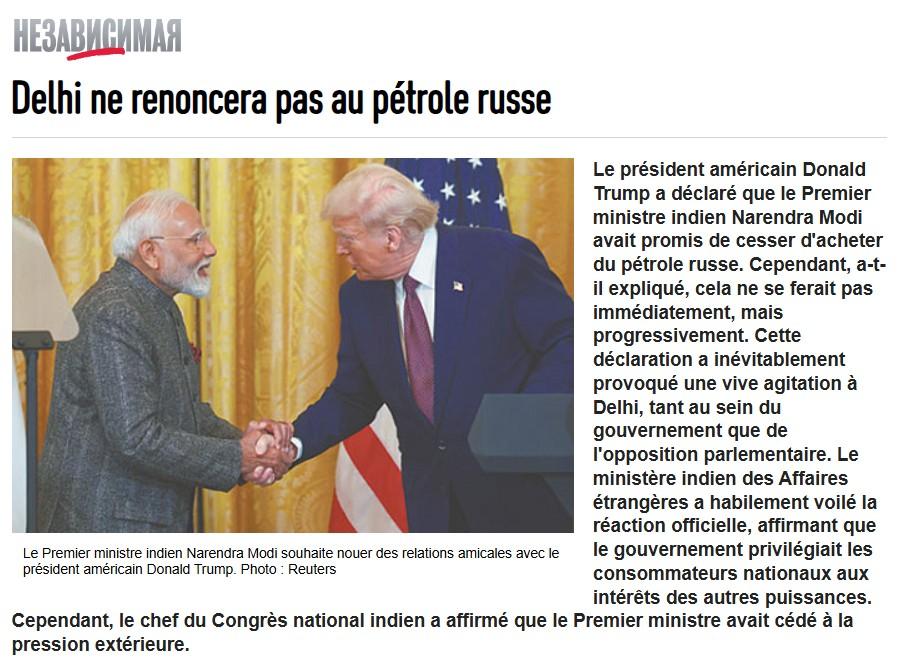
Le président américain Donald Trump a déclaré que le Premier ministre indien Narendra Modi avait promis de cesser d’acheter du
L’article Trump prétend que l’Inde cessera d’acheter du pétrole russe… L’Inde fait habilement comprendre que non est apparu en premier sur STRATPOL.
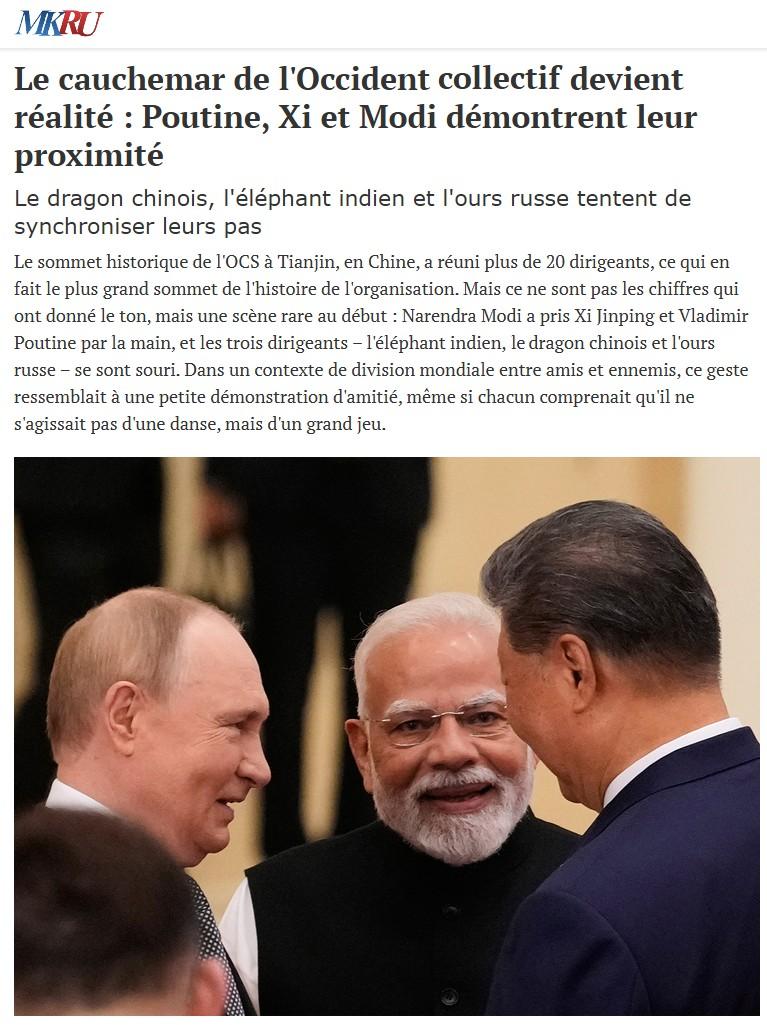
Le sommet historique de l’OCS à Tianjin, en Chine, a réuni plus de 20 dirigeants, ce qui en fait le
L’article “Le cauchemar de l’Occident collectif est devenu réalité” : quand Modi, Poutine et Xi montrent leur proximité est apparu en premier sur STRATPOL.
DDGeopolics examines how faith-based extremism, military privatization, and intelligence-linked trafficking narratives are converging into something new: a weaponized theology of aid: the Modern Crusaders. What began as “help” is fast becoming something else entirely, a gospel delivered at gunpoint and faith weaponized to destroy the amalek.
The report and I would encourage you to read it, is on their substack and not behind a paywall. https://ddgeopolitics.substack.com/p/the-gospel-of-the-gun
An extract …
The Weaponization of Faith.
The situation in Gaza was never just a humanitarian emergency. It has become a crucible where ideology, militarism, intelligence, and privatized aid collide to form something far more dangerous: a weaponized faith project masquerading as relief.
Over 1,000 Palestinians have reportedly been killed at or near aid distribution points operated by GHF since May 2025. Many of those sites were staffed or secured by contractors from Sentinel Foundation and UG Solutions, armed, many trained in evangelical security seminars, and several publicly espousing beliefs that frame Islam not as a religion but as an enemy of God. These are not isolated incidents or fringe actors. They are part of a coordinated structure, backed by U.S. funding, interlinked with former intelligence officials, and wrapped in the moral authority of “saving the children.”
From Gaza to Central America, it is occupation by proxy masquerading as aid. It is the rebranding of militarized power as humanitarian grace. And in this model, the missionary, the mercenary, and the intelligence operative are one and the same.
Worse still, these efforts have embedded themselves in bipartisan consensus. Even as reports of abuses, dehumanizing rhetoric, and ideological extremism mount, there is little public scrutiny. Figures like Matthew Murphy are treated as legitimate faith leaders, despite calls for exorcisms of “Islamic demons” and praise for Hitler’s religiosity. Evangelical Zionists like Johnnie Moore, who assumed a leading role at GHF following Jake Wood’s resignation, bring the full weight of political access, media cover, and theological justification to this new frontier of empire.
The international implications are staggering. Humanitarian aid is now a vector for surveillance, social engineering, and sectarian warfare. Faith is no longer a private belief, it has become policy. It is biometric checkpoints wrapped in biblical prophecy. It is famine relief doled out at gunpoint. It is the sword cloaked in scripture.
And it is spreading.
The aid-industrial complex of 2025 no longer simply echoes the failures of Iraq or Afghanistan. It reflects a deeper mutation: the fusion of American religious fundamentalism with global security architecture, operating in tandem with Israeli occupation policy and Western geopolitical objectives. Gaza is the pilot program, but the doctrine is scalable.
The question is no longer whether this crusade will continue…it’s how far it will go before someone calls it what it is.
—
As background to this report, I opened a book club in the Hearty Salon, and the first book that I posted is 100 years old, called Forgery in Christianity. This book outlines the roots of the barbarism of our current crusaders.
There are also groups like the one that was previously called The Family, and now called The Fellowship Foundation, which is a Christian Group for Elites in the US. Now take a moment, is Christianity not egalitarian by nature? For Elites? They profess that once you are a Christian, you may do whatever you like because you are now saved. It is deathly in its break from true Christian values. https://thehumanist.com/arts_entertainment/culture/the-family-more-gilead-than-godly/
The overall objective is to understand that these militarized and misguided loosely aligned groups of crusaders are as dangerous and as misguided and as violent as the most dangerous Muslim extremists that we’ve all learned to despise. It is two sides of one coin. You will see what child trafficking, Gaza aid, private contractors, military zeal, and Christian exorcists have in common. DDGeopolitics states that the network of evangelical veterans, intelligence cutouts, and spiritual warriors turned Gaza into a battlefield, not just of bombs, but of ideology.
From biometric checkpoints to Bible-backed psyops, humanitarian aid is being weaponized in ways you’re not supposed to see. The history of these movements is old as you will immediately see if you read or only scan the foreword of the currently posted book on the Hearty Salon.
As Nazism never died in Europe, Crusaders are also still alive and active. These groups meet one another on the field of extremism and totalitarianism. A latest development out of Chrisian Zionism is Zionist Christianity. Here is a soldier channeling Jesus amid zionist war bluster. Invoking what looks like his divine backup, he states: “I am a Jewish believer in Jesus,” invoking divine backup. https://t.me/geopolitics_prime/54426
Let’s take a look because Modi and his Indian counterparts wanted to regain some of their lost lustre after attacking their neighbor and visiting the G7.
Addressed the BRICS Summit Plenary session on ‘Strengthening Multilateralism, Economic-Financial Affairs, and Artificial Intelligence.’ Focused on how to make the BRICS platform even more effective in this increasingly multipolar world. Also gave a few suggestions which are… pic.twitter.com/zRqyEa9q2v
— Narendra Modi (@narendramodi) July 7, 2025
RT has a summary of the speech:
India will ‘define BRICS in a new form’ next year – Modi
Issues facing the Global South will get priority under India’s chairmanship of the grouping
India intends to define BRICS “in a new form” next year and prioritize the main issues facing the Global South, Prime Minister Narendra Modi said on Monday.
Speaking on the second day of the annual BRICS summit in Rio de Janeiro, the Indian leader said his country, which will assume the chairmanship of the group in 2026, will follow a people-centric approach. “Under India’s BRICS presidency, we will work to define BRICS in a new form,” Modi said.
“BRICS will mean Building Resilience and Innovation for Cooperation and Sustainability. Just as, during our G-20 chairmanship, we gave priority to the issues of the Global South in the agenda, similarly during our chairmanship of BRICS, we will take this forum forward in the spirit of people-centricity and humanity first.”
In his speech at the Rio’s summit’s plenary session, Modi stressed the need for BRICS members to assist developing countries. “The Global South has many hopes from us,” he said. “To fulfil them, we must follow the principle of ‘Lead by Example’. India is fully committed to working shoulder-to-shoulder with all our partners to achieve our common goals.”
Guancha, Brazil 247 and Beijing Club unite around the exchange of ideas in the Global South
When Xi Jinping visited Brazil and Peru at the end of last year, following the opening of the Chancay port, he stated in one of his speeches that think tanks must grow and share information. Here is one such media think tank forming.
The meeting of the BRICS countries in Rio de Janeiro has delivered to the world a comprehensive statement with points of consensus on topics such as multilateralism, sustainable development, new international financial architecture, and artificial intelligence. In parallel, actors from the academic and journalistic worlds also met to discuss ways to deepen the exchange between media, universities, and think tanks, to solidify the intellectual basis necessary for the consolidation of the voices of the Global South and a world founded on cooperation between peoples.
One of these meetings took place last night in Rio de Janeiro, bringing together representatives of Brazil 247, from the Shanghai-based Guancha news website, and the Beijing Club, a major Chinese think tank. The cocktail was a consequence of the Global South Media Alliance, launched by Brazil 247 and Guancha in March this year.
This media alliance has to be extended to several other BRICS nations and partners, says Pepe Escobar. I agree.
The sheer change of thinking that is emergent, most of us have not seen. We’ve seen an exorbitant privilege kept in place by war and more war, threats, criminality and coercion, but a truly cooperative model is rare today. We’ve lived in a time when, if there was no opposition to pit groups and countries against one another, an opposition was created. I am, in a sense, skeptical about Elon Musk’s new American Party, as time will tell us whether that is a gathering of those who are disappointed with Trump and the fall of Maga, or the creation of a pretend opposition so that the circus can continue. Time will tell.
“How weary am I of devils and brutes, a true human is what I long for.”
By Nora Hoppe at Al Mayadeen.

The fact that our planet in this day and age is home to a genocide – visible to all human beings on personal devices throughout the world – an ongoing abomination unhindered by any international body, by any intergovernmental organisation or even by those noble states that proclaim to be constructing a new and more just world… says a lot about our evolution as a species and potentially about the future of our civilisation.
We now stand before a bifurcation: one clear and broad path leads to destruction and ruin; the other is to lead to a new and harmonious world… but it is winding, stony, vague and enveloped in fog.
Like a frantic victim in quicksand, flailing his arms about in vain, the frenzy of a declining Empire is only accelerating its own demise. It has chosen the path leading to ruin and its own suicide… and it has many followers – especially in its diseased appendix – the Zionist entity – and the rest of the Western World. The symptoms of this necrotic drive are seen in the Forever Wars; a self-devouring economic system based on insatiable greed and wilful ignorance; the destruction of society, of the family, of rituals and traditions; and, essentially, a total contempt for all that is natural and alive… These signs arise from a state of permanent discontent and fear, which ultimately leads to self-destruction.
And now… though today’s Hegemon, the United States – built on genocide and slavery – has been waging countless wars since its inception, and Europe has been massacring and plundering the planet for over 500 years due to its endless rapacity… it is no longer just a question of geography. The core of the problem of our human civilisation today is the western mindset and the system of financialised capitalism, both of which have infected the entire world to various degrees… with only a few exceptions.
Most of the World Majority remains incapable of throwing off the yoke of the colonialist West because of corruption, dependence, societal pressures and a lack of support from states to enlighten citizens on their own past and history.
The mythification and emulation of the Western World have become so deeply ingrained in the marrow of so many over so many centuries… that a decolonisation process will take time. And little has been undertaken officially to this end. The promising BRICS+ states are focussing mainly on trade, economic growth and hi-tech innovation.
To avoid that western path to societal devastation and ruin and to clear the other path of fog, we of the Global Majority need to seek clarity in many areas… We may have to make seismic changes to our ways of thinking. We can begin by questioning our definitions of very basic terms… Such as: what is “development”, what is “growth”, “what is “prosperity”, what is “progress”? Not all growth is advantageous – as in malignant metastases. “Positive growth” today pertains chiefly to monetary matters – GDP, GNI, PPP. What is “progress”? Progress today mostly pertains to technological innovations. And certainly it is imperative that peoples are lifted out of poverty, such as China has succeeded in doing… but what is the kind of “prosperity” that Humanity would like to achieve??
Today, in this post-modern world, there is little discussion of development, growth, prosperity and progress with regard to immaterial matters…
It is not only education, the arts and cultures of the world that have fallen into stagnation, but obviously also the ethics and value systems of entire states and societies… not to mention the conscience of most of Humanity.
How else could a genocide become commonplace? How else could atrocities become a daily tolerable spectacle throughout the world? How else can two genocidal leaders meet and speak so eagerly about their “real estate plans” for their concentration camp as though they were having a normal conversation? How else could we have all become a global audience for an orchestrated famine? How else can so many European states and the EU Border Control Authority Frontex become the clients of “combat-tested” weapons (“tested” in Gaza) from Elbit Systems (“Israel”‘s largest arms company) that manufacture surveillance drones and remote-control turrets for armoured vehicles to enable European soldiers to avoid accountability and a bad conscience when targeted refugees are murdered by anonymous technicians located in remote offices? How else can European countries allow their historical incidents of genocide against the Jews to be “revised” and whitewashed by the Zionist entity for Israeli business advantages? How else could International Law be trampled upon without resistance? How else could serial mendacity and the constant breaching of constitutions and agreements become acceptable? How else could the citizens of those states, which vaunt their “freedom of expression” and “western values”, allow their states to reach the point at which they are now criminalising protesters for standing up for human rights?
Other than the people involved directly in battles for their survival (in Gaza, Syria, Lebanon and elsewhere), courageous soldiers fighting against Nazism, committed journalists risking their lives on the fronts and activists, risking their professions for protesting against the Genocide… where is the rest of the world?
Some states voice their condemnation of the ongoing genocide but take no action, because… because it’s… complicated.
And yet… we have an exception… the Ansarallah of Yemen. There is nothing complicated about their resolute move: it is simply a matter of priority.
Why would the majority of a people of one of the poorest countries (perhaps the poorest) on Earth devote most of their energy, their scarce resources and their steadfast beliefs in risking their lives in defence of another people, who are not directly related to them and are located in a distant country (an estimated 2,270 kilometres away)? What unites these people in this goal? And what might be THEIR definitions of “development”, “growth”, “prosperity” and “progress”?

A crossroads of various civilisations for at least 7000 years, Yemen’s own great civilisation has, over centuries, experienced countless invasions, fierce battles, usurping dynasties and colonial occupations by those who continually sought to plunder, conquer and control this valuable, highly developed, resource-rich and “geographically optimal” territory.
In the 1990s, after a long period of economic hardship due in part to persistent Saudi oppression and notably Yemen’s refusal to join the US-Saudi military coalition against Iraq, a Zaidi grassroots movement emerged in northern Yemen, known as Muntada al-Shabab al-Mu’min (“Believing Youth”) – which offered social programmes to the impoverished population of the region. The successful movement grew and soon transformed into the Ansarallah (“Supporters of God”) who went on to fight six wars against the Saudi– and Western-backed Saleh regime between 2004 and 2010…
Now, despite decades of deprivations, the Ansarallah remain undeterred in their goals for justice, in their fight to liberate Palestine and to improve their own country. To achieve these goals, they do not require “monetary prosperity” and a financialised state. In all their operations they show solidarity and unity amongst themselves. They cannot be intimidated. They are ready to die for their beliefs and principles.
In their filmed speeches and discussions, the demeanour of the Ansarallah is visibly marked by confidence, serenity, grace, poise, modesty… During the Third International Conference “Palestine, the Central Cause of the Nation”, they displayed kindness, generosity and hospitality in welcoming foreign guests, even toward those hailing from “hostile states”.
Single-handedly, they have disrupted global shipping power dynamics. Relying on the expertise of their own specialists, they manufacture weapons themselves… The US Pentagon’s chief weapons buyer Bill LaPlante expressed alarm over the sophistication of these weapons: “What I’ve seen of what Ansar Allah has done in the last six months is shocking.”

In his article Factors behind Yemen’s Valiant Resistance, journalist and political analyst Ayman Ahmed describes how the Ansarallah “managed to modify conventional military tactics in very unconventional ways” by adopting a guerrilla-oriented approach: moving on foot over hostile terrains in small mobile groups, with their group leaders often improvising tactics on the spot, and using little to no electronic devices… “Their use of drones in almost guerrilla-style operations highlights how the Yemenis managed to jam billion-dollar Saudi air defenses…” […] “The Saudi regime has not been able to score any major military victory despite possessing large stockpiles of weapons supplied by the world’s leading arms merchants.”
But their strongest asset of all is their motivation and determination in their pursuit of “a dignified life and standard of living for Yemeni citizens, the protection of the independence of the nation and seeking world peace and appropriate equal cooperation with the other countries of the world” – as inscribed in their “National Vision for the Modern Yemeni State“. With this, they have won the support of the masses across all segments of society.

As Rune Agerhus, political analyst and member of the International Commission for Solidarity with Yemen, wrote here: “What Ansarallah has managed to establish, while facing war, starvation, and a crippling blockade, is a system that could best be described as akin to Yugoslavian worker self-management” […] “Farmland and output are controlled by the cooperatives, which are wholly owned and administered by Yemen’s peasantry.” The defence of Yemen as a whole is being fought on two fronts – “the battlefront and the development front”.
The system adopted by the Ansarallah is the antithesis of contemporary capitalism.
(Not to forget: Yemen has already had experience with socialism when its southern territory – a separate state in 1967-1990 – eventually formed a Marxist-Leninist government following decades of rapacious British colonial rule over the region.)

In our globalised, postmodern, technology-obsessed world dominated by Western norms, technocrats and the Market and guided by an ignorance of history and a limitation in independent reasoning, the Ansarallah seem to many backward and savage at worst, quaint and exotic at best…
Different people may have different views of the Ansarallah and will judge them accordingly… but the ACTIONS taken by these people in defence of another people undergoing a genocide, especially in view of their own circumstances, speak for themselves… louder than any fine words.
On 10th April 2025, under the incessant bombings of the barbaric Hegemon, Ansarallah’s leader Sayyed Abdul-Malik al-Houthi made another urgent appeal to the world… to come to the aid of the Palestinian people and to become conscious of our ethical responsibility as part of a collective humanity. Who is listening? Where is the “world community”?
* * *
After so many millennia of human civilisation, what is the “progress” we are making as a species in our modern-day age?
* * *


Dar al-Hajar, former royal palace outside of Sanaa (1920) on the ruins of an ancient Sabaean palace known as the Fortress of Dhi Saydan, constructed by the Himyarites in 3000 BCE

Inscriptions in Musnad, the Temple of Awwam, Throne of Queen Bilqis (Sheba) 1500–1200 BCE © Zain Alaabdain Ben Ali / Arabia Felix Magazine

 Lateo.net - Flux RSS en pagaille (pour en ajouter : @ moi)