 Connexion


En cas d’invasion de Taïwan, Pékin utiliserait des drones sous-marins pour poser des mines dans le Pacifique, mais les conséquences
L’article Pas seulement Taïwan: le plan de la Chine pour dominer le Pacifique est apparu en premier sur STRATPOL.
Origines Il semble que la guerre est apparue en même temps que l’Humanité1. La confrontation armée au profit de leur
L’article La stratégie de la décapitation : couper la tête du serpent permet-il d’affronter une hydre ? est apparu en premier sur STRATPOL.
Le 28 février 2026, Israël et les États-Unis ont lancé chacun une opération militaire contre l’Iran. Le chef d’État iranien,
L’article ICI MOSCOU ! Le changement de régime de trop est apparu en premier sur STRATPOL.
La guerre israélo-étatsunienne contre l’Iran présente des caractéristiques importantes pour la Russie, dont l’analyse met en évidence des similitudes avec
L’article Caracas, Téhéran puis Moscou ? Enseignements pour la SVO de la guerre contre l’Iran est apparu en premier sur STRATPOL.
Le 24 février 2022, il y a 4 ans, débutait l’opération militaire spéciale russe en Ukraine. Alors que le déroulement
L’article ICI MOSCOU ! Quatre ans d’opération militaire spéciale est apparu en premier sur STRATPOL.
Le cas du Donbass (régions de Donetsk et Louhansk) met en lumière toutes les tensions du droit des peuples à
L’article La problématique du Donbass ukrainien est apparu en premier sur STRATPOL.
Je me demande si les prétendus « libéraux » finiront par être un peu gênés d’apprendre que Tsahal a elle
L’article Israël partage l’avis du Hamas : le bilan des morts à Gaza s’élève à au moins 70 000 morts. De quoi embarrasser les négationnistes de salon. est apparu en premier sur STRATPOL.

Suite de l’analyse de notre expert militaire : Une position diplomatico-politique maintenue malgré les faits La gouvernance kiévienne aurait dû
L’article Rapport de situation Décembre 2025 – 2 sur 3 Ukraine est apparu en premier sur STRATPOL.

Confrontée à des problématiques multi-causales l’esprit humain favorise généralement les solutions simples et donc parfois inappropriées mais davantage accessibles et
L’article Rapport de situation Décembre 2025, partie 1 sur 2 – L’Occident collectif est apparu en premier sur STRATPOL.
Now Live
https://x.com/i/broadcasts/1LyGBXADpgpxN
https://www.rt.com/russia/629671-putin-nation-press-conference/
Russian President Vladimir Putin will hold his annual year-end press conference in Moscow on Friday, once again combined with the nationwide “Direct Line” question-and-answer session with citizens. The event is scheduled to begin at 12:00 Moscow time (09:00 GMT).
This annual broadcast is traditionally among the year’s most significant political events, serving as a forum for President Putin to address crucial domestic and international topics, covering key social, economic, and political spheres.
Interest in the combined format remains high. According to the Russian TV channel, the number of appeals submitted to the Direct Line exceeded 2.5 million just four hours before the start of the broadcast.
Historically, the Direct Line and the large annual press conference were held as separate events. During the Direct Line, the President responded directly to questions from citizens, including letters, text messages, phone calls and live video links from across the country. The press conference, in turn, focused on dialogue with Russian and foreign journalists.
Since 2001, Russia has hosted 18 separate Direct Line sessions and 16 large-scale presidential press conferences. The two formats were first merged in 2020 due to restrictions caused by the COVID-19 pandemic, which made it impractical to hold both events separately. In 2021, the Kremlin briefly returned to the traditional, standalone formats.
However, beginning in 2023, the combined format was adopted on a permanent basis, bringing together public appeals and media questions into a single extended event.
Lavrov and Iran FM Araghchi Hold Joint Press Conference After Moscow Talks
A few Lavrov quotes:
West is attempting to distort all norms of international law, trying to replace it with their own rules — Lavrov
This just reflects their 500-year neocolonial desire ‘to try to live at the expense of others,’ Lavrov adds
—
Russia reaffirms once again its willingness to help our Iranian friends in looking for acceptable ways to resolve the nuclear crisis that was created by the Westerners — Lavrov
—
BRICS and SCO are organizations of a new type, unlike such NATO or what the EU has turned into — Lavrov
—
‘They are trying to subjugate the will of their member states’
They talk about themselves ‘like they are the greatest politicians of modern times, not some hired employees’
—
Europe is silent on US attacks in the Caribbean to gain Trump’s favor over their Ukraine peace plan proposals — Lavrov
Russia is ‘concerned’ with US Navy striking civilian boats and a probable land op
‘Almost all of the countries find it unacceptable apart from the Europeans’
“Major hostilities erupted once again in early to mid-December in Southeast Asia along the borders of Thailand and Cambodia following a troubled “ceasefire” that included incidents and provocations for months since the last round of major fighting took place in July 2025.
Despite any resulting ceasefire, the fundamental issues driving the conflict remain entirely unresolved, primarily because these issues stem from foreign interests using regional conflict to complicate both Asia’s rise in general and China’s rise specifically.”
References:
Nation – Second Army Area suspects English-speaking foreigners flying suicide drones for Cambodian troops (Dec. 11, 2025): https://www.nationthailand.com/news/a… Reuters – Ukrainian operatives aided Syrian rebels with drones, Washington Post reports (Dec. 2024): https://www.reuters.com/world/ukraini… Nation – Three leaders’ statements diverge: US, Thai and Cambodian tones don’t match (Dec. 13, 2025): https://www.nationthailand.com/news/g… RAND Corporation – Extending Russia (2019): https://www.rand.org/content/dam/rand… Reagan Presidential Foundation – Fireside Chat with General Dan Caine, Chairman of the Joint Chiefs of Staff (Dec. 7, 2025):  • Fireside Chat with General Dan Caine, Chai… Irrawaddy – China-Backed Pipeline Facility Damaged in Myanmar Resistance Attack (2022): https://www.irrawaddy.com/news/burma/… Naval War College Review – A Maritime Oil Blockade Against China (2018): https://digital-commons.usnwc.edu/cgi… CSIS – How Much Trade Transits the South China Sea?: https://chinapower.csis.org/much-trad… NEO – US Sows Chaos Across Asia as it Aims for China (Sep. 2025): https://journal-neo.su/2025/09/30/269… Bloomberg – Thailand Needs Hyperloop, Not China-Built High-Speed Rail, Junta Critic Says (2018): https://www.bloomberg.com/news/articl… Move Forward Party – Hyperloop Presentation (2019): • \7 ไฮเปอร์ลูป hyperloop คุณธนาธร ตอบคำถามน… iLaw – About: https://www.ilaw.or.th/en/about-us Harvard Atlas of Economic Complexity (Thailand): https://atlas.hks.harvard.edu/explore… China MFA – President Xi Jinping Meets with King Maha Vajiralongkorn Phra Vajiraklaochaoyuhua of Thailand (Nov. 2025): https://www.fmprc.gov.cn/mfa_eng/xw/z… China MFA – Wang Yi Meets with Princess Maha Chakri Sirindhorn of Thailand (Apr. 2025): https://www.fmprc.gov.cn/eng/wjbzhd/2… New Atlas – The Complete Guide: US Government Role in Thailand’s “Student Protests” (2020): https://landdestroyer.blogspot.com/20… Harvard AEC (Cambodia): https://atlas.hks.harvard.edu/explore… Phnom Penh Post – The dominance of the dollar in Cambodia: Causes, effects, solutions (Jan. 2025): https://www.phnompenhpost.com/opinion… AP – Cambodian leader’s son, a West Point grad, set to take reins of power — but will he bring change? (2023): https://apnews.com/article/cambodia-e… CBS News – U.S. warship docks in Cambodia, a top Chinese ally, for first time in 8 years (Dec. 2024): https://www.cbsnews.com/news/us-warsh… Diplomat – US Defense Secretary to Visit China-Linked Cambodian Naval Base (Jun. 2025): https://thediplomat.com/2025/06/us-de… Thai PBS – ‘Angkor Sentinel’ military exercises to return as US-Cambodia links thaw (Nov. 2025): https://world.thaipbs.or.th/detail/an… US PACOM – Royal Cambodian Armed Forces delegation visits USINDOPACOM for Bilateral Defense Dialogue (Jul. 2025): https://www.pacom.mil/Media/NEWS/News…
https://www.pacom.mil/Media/NEWS/News…
Dans la plupart des discours publics occidentaux, la guerre en Ukraine commence le 24 février 2022, lorsque les forces russes
L’article La Russie, l’Ukraine et l’Occident (2014–2022), entre responsabilité juridique et responsabilité géopolitique est apparu en premier sur STRATPOL.
Quick Telegram Update
Just like any other “peace deal” the US brokers (amid conflicts of its own engineering) the “peace” between Thailand and Cambodia collapsed (and really didn’t exist to begin with).
There have been constant skirmishes and incidents along the border all throughout the “peace,” and now open hostilities are escalating once again.
This includes mortars, grenades, small arms, warplanes, and the repositioning of rocket launchers and tanks.
It should be noted that at the time of the first round of fighting, there was a US-backed regime running both Cambodia and Thailand. The US-backed Thai administration was removed from power because of its involvement in the border conflict – Thailand now has a sort of interim government in place.
Unfortunately, Cambodia has over the last 1-2 years pivoted hard toward the US, its new PM (the former PM’s son) is a West Point grad and has signed a raft of military cooperation agreements with the US.
As the National Security Strategy has made clear – the US seeks to expand its containment of China in Asia-Pacific and will do so by enlisting its existing proxies and “expand” available proxies through “soft power” (proxy conflict, coercion, and regime change).
Keep ALL of this in mind as hostilities unfold along the Thai-Cambodian border.
Recommended by Jeff J Brown
Class must be prioritised in any analysis…
But over centuries and millennia, the collective “recipes for living” (Clifford Geertz’ famous definition of culture) that emerges from particular conditions and trajectories does become a force which also shapes history.
Materialism is the foundation and primary key to understanding human society in the capitalist era. But at the same time, the accumulated effects of culture, solidified into sets of distinct arrangements and convictions, in other words, civilisation, does also play a great role in national politics, in world affairs, in revolutionary process, and besides Marxism, in the rise of modern China.
The ideology of the Communist Party of China is not only socialism, but Socialism With Chinese Characteristics.
In this essay we will examine some of those characteristics as shaped by historical development, so that we may better understand The Central Realm, its contemporary governance, future trajectory, and what the coming Chinese millennium might mean for the world.
Seemingly trivial and insignificant, ordinary social conventions are often results of entrenched philosophical foundations and expressions of core cultural values. Lets take brief stock of a few in China and beyond, particularly pertaining to food.
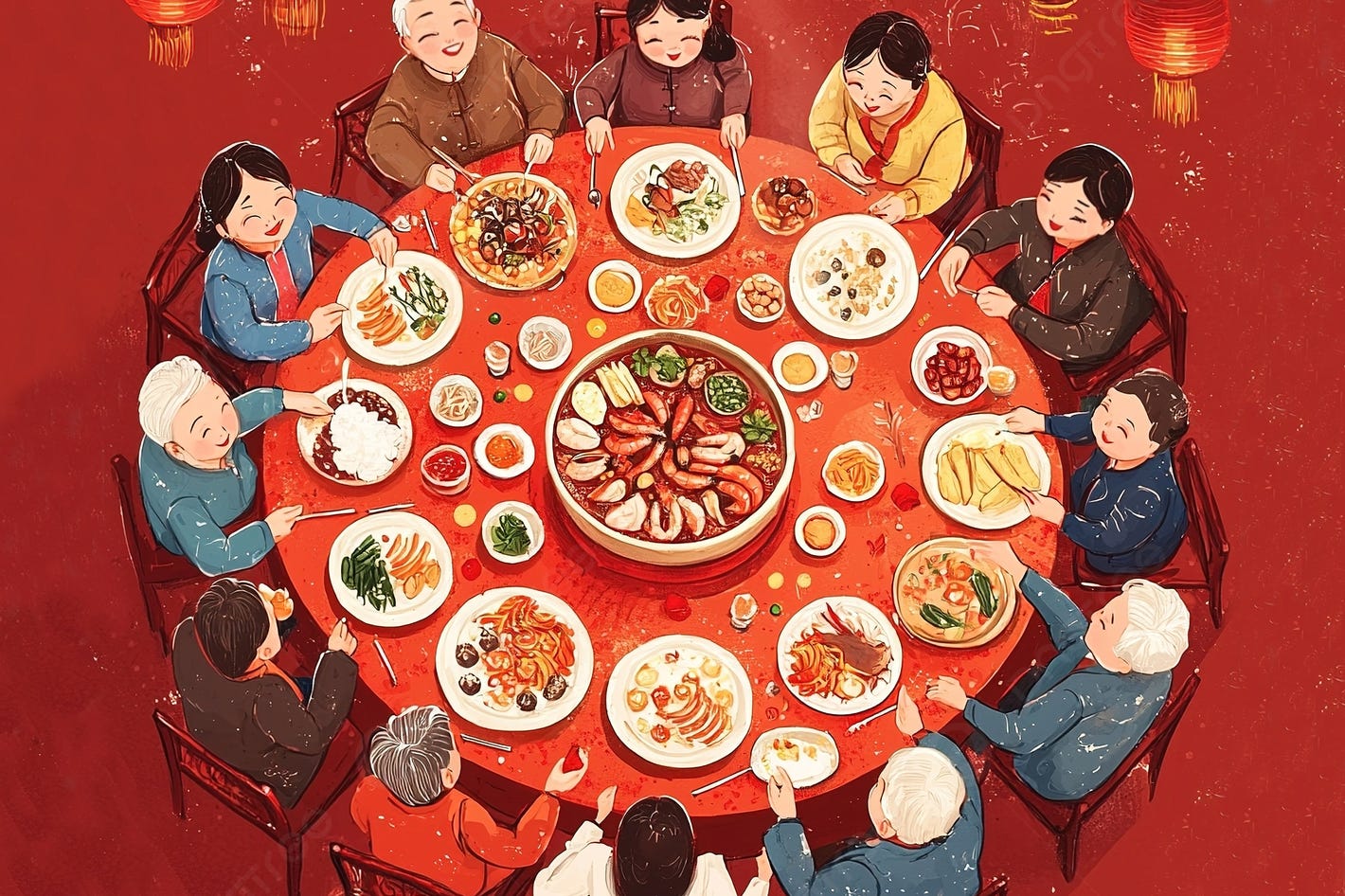
Chinese chopsticks are longer than Korean and Japanese chopsticks because everyone shares the dishes placed at the center of the table, rather than only eat one’s own portions.
When Chinese people sit down to eat together, it is considered rude and childish to serve oneself first. Instead, one should always pass food to others before oneself, with the order determined by seniority — but the senior, for example an older sister, is also expected to make sure that her younger brother has enough to eat before she does herself.
Ordering food for a party is always a complicated group effort: the meal is a collective composition of contrasting and complementary elements that works for the entire group, but should also satisfy the particular palettes of every member — an experience more than the sum of its parts.
In restaurants of not only China, not only East Asia, but also South, South East, West Asia, as well as many parts of Africa and South America, it’s typical for people to argue over who gets the privilege of paying the bill — partly because who ever pays is seen as the bigger person. Travellers to every part of the Global South and anywhere indigenous cultures and sensibilities survive, have noted a supreme generosity, and that locals, complete strangers, often insist on buying or inviting them to their homes for a meal.
This generosity and propensity for sharing is biologically rooted in the evolved behavioural traits of human beings. It is seen clearly in indigenous cultures all over the world, especially those in arid and difficult conditions, such as the Amazigh of the Saharan desert who will slaughter their last goat for a starving stranger knocking at their door in the middle of the night.
State formation coinciding with the world-historic rise of Proprietary Patriarchy and its attendant class society around 6,000 years ago began a process of erosion and suppression of this original human convivial sociality, but not equally, not in the same way, and not to the same extent around the world. This is the main reason, not any innate deficiency of humanity, for extreme divergence from indigenous hospitality in some parts of the world; for example, cash apps in Northern Europe where friends request 2 or 3 Euros from each other for having consumed half a sandwich more than the other during lunch.
Keep these observations in mind while reading the rest of this essay; their relevance and meaning will become increasingly apparent.
INTERNAL GOVERNANCE
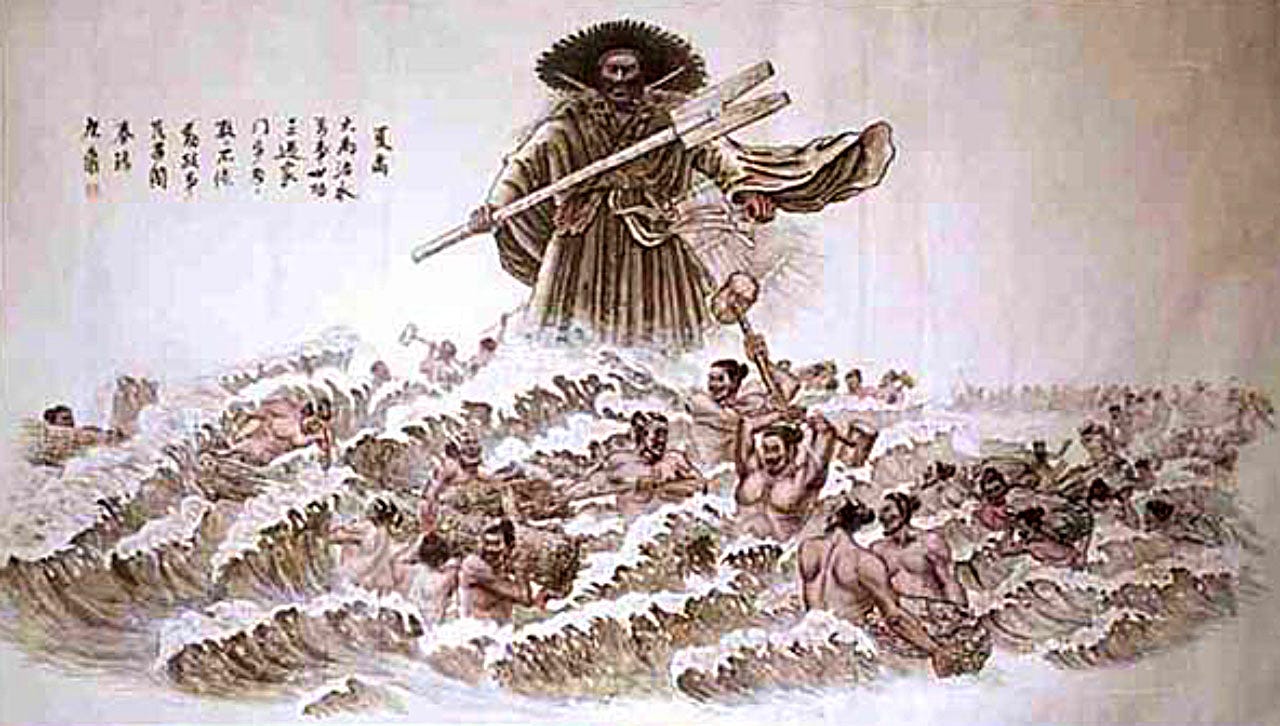
Massive, prolonged, recurring floods regularly devastated the Yellow River valley, destroying settlements and agriculture. It was a repeating crisis that threatened the very survival of the nascent civilisation.
After countless failed attempts to solve this problem, legend has it that Emperor Yu mobilised tens of thousands of people from various clans and chiefdoms, and laboured tirelessly for 13 years, digging channels to divert and manage water to the sea. Because of his monumental success in taming the floods and making the land habitable and fertile, Yu gained immense prestige. The various groups of people were so impressed and grateful that they transferred their loyalty to him, which allowed him to consolidate power and found the Xia Dynasty (c. 2070–1600 BCE), the first centralised state in Chinese history.
The very first state in China formed for the explicit purpose of combatting the existential threat of catastrophic natural disasters; its primary Staatsräson was building infrastructure, massive public works for the benefit of all.
The Xia dynasty was followed by the Shang and Zhou dynasties, the “Spring and Autumn Era, then a chaotic, roughly 300 years long Warring States period in which warlords fought for dominance and populations greatly suffered, ending in roughly 200 BCE.
During the Warring States era there emerged 3 main strands of political doctrines: Daoism, Legalism, and Confucianism.
Daoism and Legalism

Daoism, commonly referred to in the West as the grandfather of anarchism, focused on the natural energy flow of the universe (the Dao, or “path”), which human beings should not go against, but seek alignment and harmony with. The central concept of “Wu-wei”, roughly translated as “Do Nothing”, “Non-Action”, “No Force”, or “Spontaneously living in the moment”, is the way towards tranquility and happiness.
Daoism cautioned against competition and instructed that the emptying of the mind and ridding of Earthly desires is the way for humanity to change its violent ways that creates so much needless suffering. (The later fusion of Daoism with Buddhism came to be known as Chan Buddhism, late exported to Japan as Zen). Politically, Daoism is suspicious of centralised power, and urged rulers to be humble, restrained, pacifist, to avoid stringent laws and harsh punishments.

Stringent laws and harsh punishments are main features of Legalism. In many ways the dialectical antithesis of Daoism, this rigid ideology became the guiding principle of the Qin dynasty that ended the Warring States period in 220 BCE.
Legalists see human nature as inherently selfish and violent, and devises a system of absolute monarchic authority atop a centralised bureaucracy, enforcing unbending codes and severe punishment, as the only method with which it can be controlled. And for them, suppression of rival philosophical doctrines was the only way to prevent contending factions from gaining power. In Legalist society, warriors were rewarded based on the number of enemy severed heads they brought back.
Legalism produced very strong police and military, but also widespread resentment among the population, and quickly lead to a series of large scale rebellions that overthrew the Qin after merely 17 years, ending the only, very short period of Chinese history where Legalism dominated.
Brute force failed to maintain peace and unity, but its opposite, the lofty and relaxed, nature-loving, profoundly unfettered ideals of Daoism also, unsurprisingly, was not enough to deal with the real problems faced by monarchic governance over such a large and diverse territory, with objective contradictions between farmers and land lords, between land lords and merchants, between the people and their rulers. The succeeding Han dynasty rejected both, and chose Confucianism as its ideology and political system.
Daoism remains a constant underlying influence on Chinese culture and politics in countless ways, and will always be an important philosophy of life.
Elements of Legalism also live on in Chinese statecraft, even today: the punishments for political corruption and white collar, elite crimes, including seizure of entire companies, long prison terms, and the death sentence, is often much more harsh than those in the West.
In many ways, the most contentious political debates in China, regarding a general definition of good governance and optimum organisation of society, management of contradictions, were more or less settled around 2000 years ago. With some variation through out the eras where different ideas gain and lose favour, Confucianism would come to be the main guiding principle of Chinese governance, beginning with the Han dynasty.
Confucianism
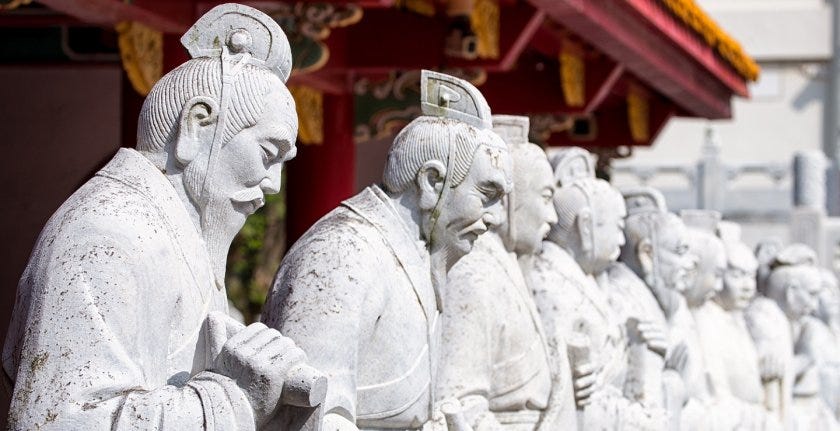
Confucianism posited that human nature is essentially good; that with education, everyone can become virtuous; and that emperors should lead by example, with benevolence. At the same time, the Confucian state retained Legalist centralized bureaucracy, strict laws, and the option of forceful methods to control and maintain power.
Confucianism (儒家, Rújiā) provided a concrete set of guidelines for preserving balance between emperors and people, in attempt to recreate, approximately, what Confucian scholars and historians remembered as an ideal, peaceful, prosperous, harmonious era of the first, Xia dynasty some 2 millennia prior.
Classic Confucianism centered around Man’s connection to the heavens (universe), and posited that social order depends on individual autonomous study and ethical cultivation.
But at the same time, Confucianist doctrine also clearly stated that individual virtue is not possible with poverty — the idea that the state is responsible for the eradication of poverty and wellbeing of citizens was enshrined in China some 2000 years ago (a relative new, about 500 years old, idea in Western politics).
The creation of equality was always a centrally important goal of the state, the precondition for a harmonious society.
In response to continued social unrest and another period of chaotic infighting between warlords, the era of the War of Three Kingdoms (263 – 280 CE), over the centuries scholars further adapted Confucianism in attempt to make political hierarchies increasingly less arbitrary and less unjust, by reducing the importance of inheritance, and further basing the justification of power on objective merit and virtue.
The concept of the Mandate of Heaven (天命, Tiānmìng) is a foundational ideological principle of Chinese governance, and its origin is precisely dated to the founding of the Zhou Dynasty around 1046 BCE. The Mandate is granted by “the heavens” (the cosmos, nature, the supreme force of order and morality in the universe, not a single deity) to only virtuous and just rulers who made the people happy. If an emperor becomes corrupt or ineffective, Heaven will withdraw its support, leading to social unrest, natural disasters, and ultimately, the emperor’s downfall and replacement.
In later millennia, the idea increasingly came to mean approval of the population, becoming, essentially and effectively, an ancient version of democracy.
Crucially, as much as justifying monarchic rule, the “Mandate of Heaven” also embodies the “right to rebel”: the very concept was created by the founders of the Zhou Dynasty in order to justify their rebellion against and overthrow of the previous Shang Dynasty.
The Zhou leaders argued that the last Shang kings had become tyrannical, morally corrupt, and dissolute, neglecting the rituals, oppressing the people, and had lost the virtue necessary to rule. Based on these allegations, leaders of the Zhou rebellion claimed that Heaven had withdrawn the Shang’s right to rule and transferred the Mandate to King Zhou, who was virtuous and fit for the responsibility.
This was a revolutionary idea. The Mandate of Heaven moved the source of political legitimacy away from mere ancestry (the Shang’s claim) to moral performance and just rule.
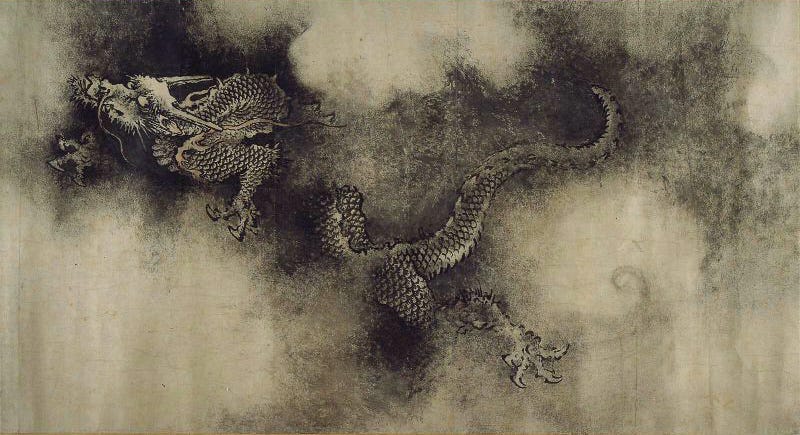
Since the very beginning of China, the authority of the emperor, the “Son of Heaven” (Tianzi), has not been absolute, but conditional on incorruptibility, honesty, prudence, generosity, benevolence, and wisdom.
To keep the Mandate of Heaven, a ruler must be ethical, prioritise wellbeing of the people, and perform the correct rituals. A ruler who became corrupt, unjust, and lets society fall into chaos shows that he had lost the Mandate — at which point it is not only right but righteous to overthrow him. The success of a rebellion, dependent upon the will of the population, was itself proof that Heaven had transferred its mandate to a new dynasty.
Neo-Confucianism emerged during the Tang Dynasty (618-907 CE), was fully systematized in the Song Dynasty (960-1279 CE), and reached its canonical form in the 12th century. It was influenced by Buddhist and Daoist metaphysics, outlined a pragmatic methodology for social balance and well being, developed concepts like **Principle (_Li_ 理)**—the underlying rational order of the universe—and **Material Force (_Qi_ 气)**—the psychophysical stuff that constitutes all things, and later introduced ideas like learning based on evidence (influenced by Western empiricism).
In practical application, in more recent millennia Neo-Confucianism developed a fraught, as symbiotic as contradictory, relationship with Legalist-style statecraft. The question of when to lead by inspiration, example, and moral instruction, and when to use law and force to preserve order, was a constant dialectical debate.
During the Song Dynasty, in the 1070s, Confucianism took an explicitly leftist turn:
“The state should take the entire management of commerce, industry, and agriculture into its own hands, with a view to succoring the working classes and preventing them from being ground into the dust by the rich.”
– (attributed to a summary of Wang AnShi)
Wang AnShi advocated for alleviation of suffering among the peasantry, by preventing the consolidation of large land estates. He called elements that came between the people and the government “jianbing”: owners of large estates, rural usurers, urban businessmen, speculators responsible for instability in the market, those who monopolized wealth and made others dependent on them, and the bureaucrats who represented their interests in government. Wang believed that suppression of the jianbing is one of the most important goals of politics.
“Today in every prefecture and subprefecture, there are jianbing families that annually collect interest amounting to several myriad strings of cash without doing anything… What contribution have they made to the state to [warrant] enjoying such a good salary?”
— Wang Anshi
Wang Anshi and the left wing of Confucianism was ultimately defeated by the rightists, but this strand was later revived and today serves to inform and guide the Communist Party of China.
It must be noted that the Confucian idea of “harmony” is emphatically not “sameness”, as the word partially implies in the Western definition.
An important passage in the Analects of Confucius (Book 13: Zilu) reads:
“君子和而不同,小人同而不和。”
Which translates to: “The noble man seeks harmony but not conformity; the petty man seeks conformity but not harmony.”
The confucian state does not demand uniform opinions in the state, in the population, or of its neighbouring countries, but strives for peaceful co-existence and balanced diversity between people and groups with different ideas. This is how there can be multiple ideological factions within Chinese government today: to the right of Xi JinPing there are politicians calling for expanding the private sector and further liberalisation, and to the left of Xi JinPing there are those who call for re-collectivisation and Great Cultural Revolution Part 2.
This diversity of ideas and a political culture of vigorous debate is how Chinese governance and policy under the same party can change, adapt, and evolve, according to circumstance and historical necessity, so drastically. The Communist Party is constant, but its policies during the Great Leap Forward, during the GCR, during Reform and Opening up, and even between the early 2000s and the current Xi JinPing period — are extremely different.
The idea of “Harmony without conformity” in Chinese political philosophy since ancient times is also what makes possible the “One country, two systems” arrangements that the central government has used for Hong Kong before reclamation, for Macau with its unique laws with regard to gambling, for Taiwan with a government independent of the CPC, etc. No other nation has any similar tolerance for different ideologies, political systems, and laws within its borders.
This Confucian tolerance for difference is in sharp contrast to the ideological homogeneity demanded by liberal democracy, which tries to impose the same values on not only their own populations but also on other nations with extremely different histories and cultures, and force developing countries to adopt the same neoliberal economic model.
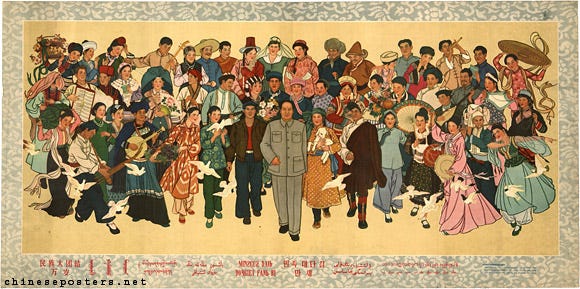
The concept of Da Tong, “The Great Unity,” “Grand Harmony,” is one of the most influential and enduring political and social ideals in Chinese thought: a vision of a perfect, utopian world order.
The most famous and definitive description of Da Tong comes from the “Liyun” (Record of the Rites) chapter of the Confucian classic, the Book of Rites (Liji). It is presented as a description of the golden age of antiquity, before decline.
Here is the key passage, which is memorized by generations of Chinese students:
“When the Great Way (Da Dao) prevailed, the world was shared by all alike. The virtuous and the able were selected. Sincerity was emphasized, and harmony was cultivated. Thus, people did not love only their own parents, nor did they treat only their own children as children.
The elderly were provided with a means to see out their lives; the adults were employed in work that utilized their abilities; the children were supported to grow and learn. Compassion was shown to widows, orphans, the childless, and the disabled—all had the means of support.
Selfish schemings were repressed and found no development. Robbers, filchers, and traitors vanished. Hence, the outer doors remained open and were never shut. This was the age of the Great Unity (Da Tong).”
The core tenets of Da Tong:
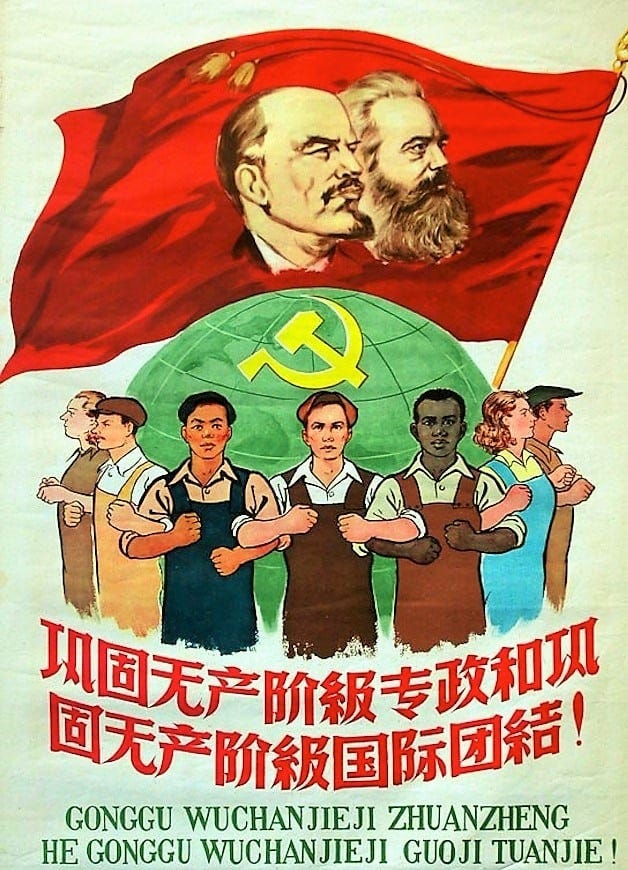
Immediately after describing Da Tong, the original text contrasts the ultimate ideal for future society with the current era of Xiao Kang (Small Tranquility), a lower, more pragmatic level of a well-ordered society. In the time of Xiao Kang, society before Da Tong can be acheived, people love their own parents and children; rulership is hereditary; and rituals and righteousness are established to maintain order in a society of propriety and stability built on distinctions (self vs. other, ruler vs. subject).
The deeper understanding of confucianism is that the adherence to strict heirarchies, to filial piety, etc. are not end goals, but temporary features during the current era of Xiao Kang, which anticipates and will eventually lead to a much better future time of perfect human harmony on Earth.
This confucian idea of historical progress through struggle is akin to the Leninist socialist path towards global communisation, on which political power, in its continuous optimisation, striving for more legitimacy and further intimate reflection of the will of the people, will incrementally dissolve. As human understanding and society advances, the trust, respect, empathy, mutual care, and harmony within the family and extended family will increasingly expand to include the neighbourhood, then the city, the province, the nation, clusters of nations, and eventually, the world.
The concept of Da Tong, China’s native, classical vision of the permanent resolution of societal contradictions, of a harmonious, egalitarian, and moral society, has served as a powerful inspiration and a critical standard for political thought for over 4,000 years. Da Tong became the ultimate Confucian ideal, a benchmark against which all governments were measured, inspiring countless later thinkers, including the founder of modern China, Sun Yat-sen, whose Three Principles of the People were aimed at achieving a modern form of Da Tong.
Many Chinese intellectuals in the late 19th and early 20th centuries saw parallels between Da Tong and communism/socialism, which helped facilitate the acceptance of Marxist theory in China. The Communist Party of China has also invoked the language of Da Tong to describe its socialist and communist goals, framing the ultimate aim of communism as a modern realization of this ancient Chinese idea of utopia.
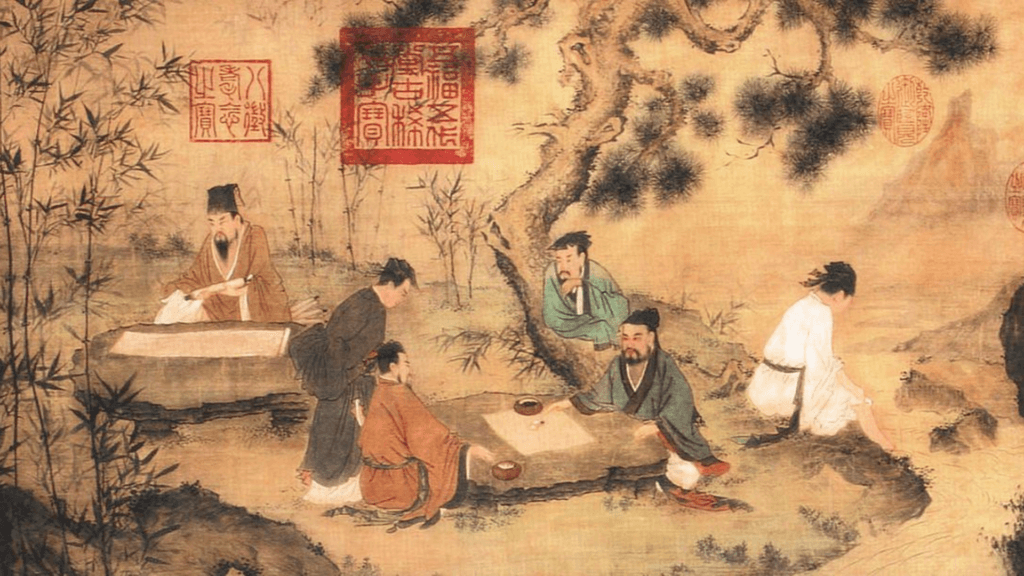
During the 20th Century revolutionary period, Confucianism, the ideology of feudal China which justified monarchism, was widely discarded as outdated and decadent. But on the road of socialist construction in the contemporary era, the ancient wisdom of Confucianism found new purpose and application for steering society during a transitional period full of not-yet-resolvable contradictions.
Today, the Mandate of Heaven and Confucian meritocracy endures in the Chinese version of Democratic Centralism, the political system of the Communist Party of China (same as that of USSR 1.0). Just like in ancient times, legitimacy of the CPC and its leadership rests entirely on approval of the population. If Xi JinPing loses support of the central committee and the higher governing bodies, he would have to step down immediately; and if the communist party itself loses support of the people, another will soon take its place.
In this democratically centralised hierarchical system, local leaders of villages, cities, and provinces are chosen by popular elections; while leaders in the central government are appointed by the party. Democratic centralism ensures that the entire government is connected to the wishes and will of the people, at the same time able to make big decisions concerning the nation and the world, such as those regarding climate and geopolitics, free from the short sighted financial self-interest of citizens. (more on contemporary PRC domestic and foreign policy in the essay “The Long Game and its Contradictions”)
INTERNATIONAL RELATIONS
Tributary System
China has never been an “empire” in the European definition and understanding of empire.
Instead of constantly seeking to conquer and directly administer neighboring territories, like Rome and every Western empire, ancient China set up the Tributary System. Neighboring states (such as Korea, Vietnam, Tibet, and various steppe peoples) would acknowledge Chinese cultural and political supremacy by sending periodic tribute missions. In return, they received gifts, legitimacy for their own rulers, and the benefit of trade. This was a more cost-effective and stable way for China to secure its borders and maintain its perceived cosmic role than conquest, occupation, violent and coercive domination.

In the tributary system, often overlooked by Western understanding, the return gifts to the smaller nations must always be of greater value than the tributes — because a bigger, “superior” nation should of course be more generous, and has a responsibility for ensuring the wellbeing of others, for the preservation of peace and the promotion of prosperity.
If a greater nation takes more than it receives, or acts in an immature, impulsive, imposing, controlling, or even violent way, it would no longer deserve its perceived greatness on the international stage, and the emperor responsible would lose face and legitimacy at home. All of this is especially true of the greatest nation of all, the central celestrial kingdom.
This was also a kind of “supremacism”, but a drastically different kind than that of Wesern civilisaion: “superiority” and “dominance” means being more charitable, considerate, tolerant, patient, wise, fair, ethical. To be domineering, manipulative, to force one’s way of life on others, to meddle in the affairs of others, to use coercive methods or even military force to get one’s way, was seen as stupid, ugly, vulgar, petty, arising from insecurity and a low level of understanding, the behaviour of small minded weaklings.
The contemporary Chinese political principle of non-interference emerges from such a value system, and is merely the next step in the continuous evolutionary path of a mutualist political philosophy.
Peace and War

The central emphasis and conclusion of the famous Daoist treatise on war-strategy, The Art of War, is that war should be always and absolutely avoided with diplomacy, because who ever “wins”, both sides lose, and the civilian populations of both suffer. If war cannot be avoided, it should be fought strategically and psychologically to minimize damage and the wasting of resources. Warfare should only be the very last resort after all attempts at negotiation fails, and heading into battle is already admitting a kind of defeat.
In imperial China, a statesman who resorts to military methods without exhausting every possible peaceful means of settlement and even beyond (if an agreement is not reached, a certain amount of self sacrifice in order to preserve peace is expected), is considered an inferior and stupid leader, and would, after the dust settles, face demotion or worse.
Compare and contrast this with the valorization of violence in the West, regarding the successful waging of war as sign of a great leader. Currently USAmerican politicians are attacking each other for being “too soft on (insert official enemy)”, for not being aggressive enough. The competition to be seen as the most combative and bellicose is something that does not exist in Chinese political competition, which proceeds according to a set of very different core values. Speaking in broad general terms, non-violence, restraint, and patience is usually seen in the West as weakness — for evidence we only have to look at contemporary Western mockery of its geopolitical enemies’ caution and moderation, interpreting it as weakness.

Softness is central to Asian ideas of strength. In the age-old concept of “Bamboo Diplomacy”, the ability to bend (while being firm) is seen as an attribute of power. And indeed, Chinese Traditional Medicine has maintained for thousands of years after the fall from the harmonious period of antiquity (the first Xia dynasty), that “the world is too Yang”, meaning too masculine, too calculating, too hard, not enough feminine, not enough empathy, not enough softness. And to this imbalance can be attributed much of the great illness of the world.
While in European culture to be soft tends to be seen as a shortcoming, as feminine, as silly, as embarrassing, as inferior, and as cause for mockery and ridicule.
Clash of Civilisations
These policies, arrangements, modes of engagement with others, are very different from those of Western empires, and emanate from a fundamentally different set of core values and ideas of governance.
But Chinese society in antiquity was basically the same monarchism/feudalism as that of ancient Greece or Rome, with the same hereditary hierarchical power structure presiding over the population. So class alone cannot explain why Zheng He, with ships and fleets 10X bigger than those of Christopher Columbus and 100 years earlier, equipped with unmatched weapons and technology, sailed around Asia and Africa, and merely traded, instead of conquering, colonising, or enslaving.

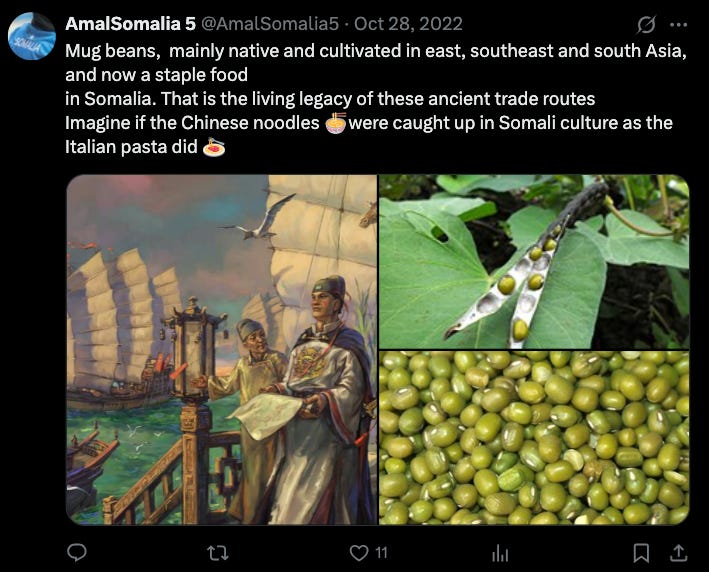
For much of the past 2000 years, the Central Realm, world’s top economic, military, cultural super power, was relatively stable, prosperous, and self satisfied, with a form of internal governance and foreign policy which prized above all the preservation of harmony and peace. During the last 1000+ years, China engaged in virtually zero expansionist wars.
Contrast with Europe at the time of global colonisation: emerging from 1000 years of constant warfare, Roman infrastructure laid waste, rampant diseases, peasants living without much hope under brutally oppressive feudal theocracy — all of which made European peoples accustomed to violence, excel at military matters, and thirst for new horizons where the oppressed poor can become oppressive kings (or at least that was the propaganda to get the peasants and prisoners to take the gruelling and dangerous journeys to the New World and do the dehumanising work of genocide, all to create new markets for the newly emergent bourgeoisie).
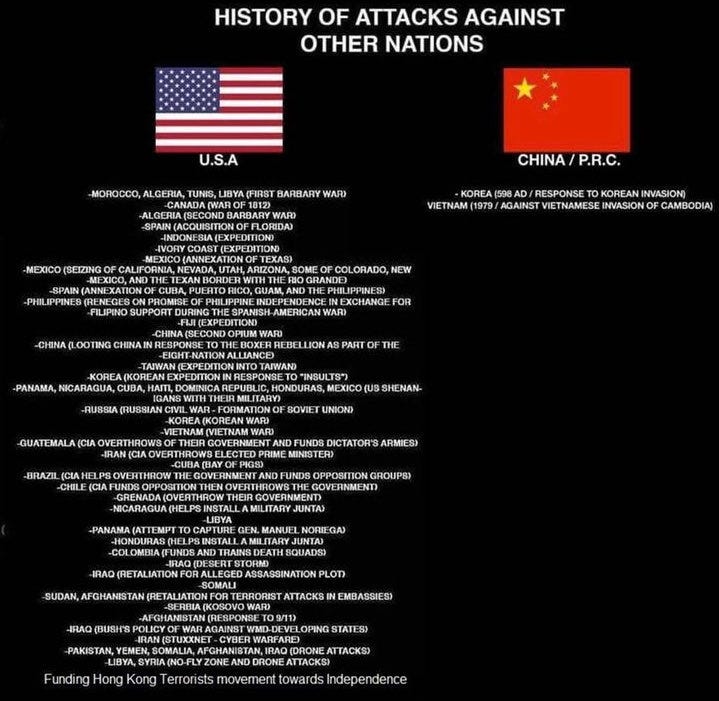
Seems obvious but it must be said: It isn’t due to any innate, unchanging qualities within the people that China tended to trade and Europe tended to conquer, but only different sets of socio-economic conditions and path of historical development. But at the same time, the real cultural, civilisational differences do objectively exist, and continues to shape geopolitics.
Class must be foregrounded, but to reduce the complex interplay of ideas and objective factors to *only* a straight forward, deterministic materialism, to only economic concerns, is to neglect entire dimensions of social dynamics, the dialectical part of dialectical materialism.
And this kind of reductive, one-dimensional thinking is itself an expression of a certain deeply seated civilisational character, shaped by the developmental path of the Western philosophical tradition, in many ways typified by the work of René Descartes. It is a perspective that tends toward a mechanistic and discontinuous conception of the world, where independent actors are motivated solely by short term self interest, producing a predilection for playing the game of zero sums, of “winner takes all”, rather than one of continuous reciprocity and mutual benefit.
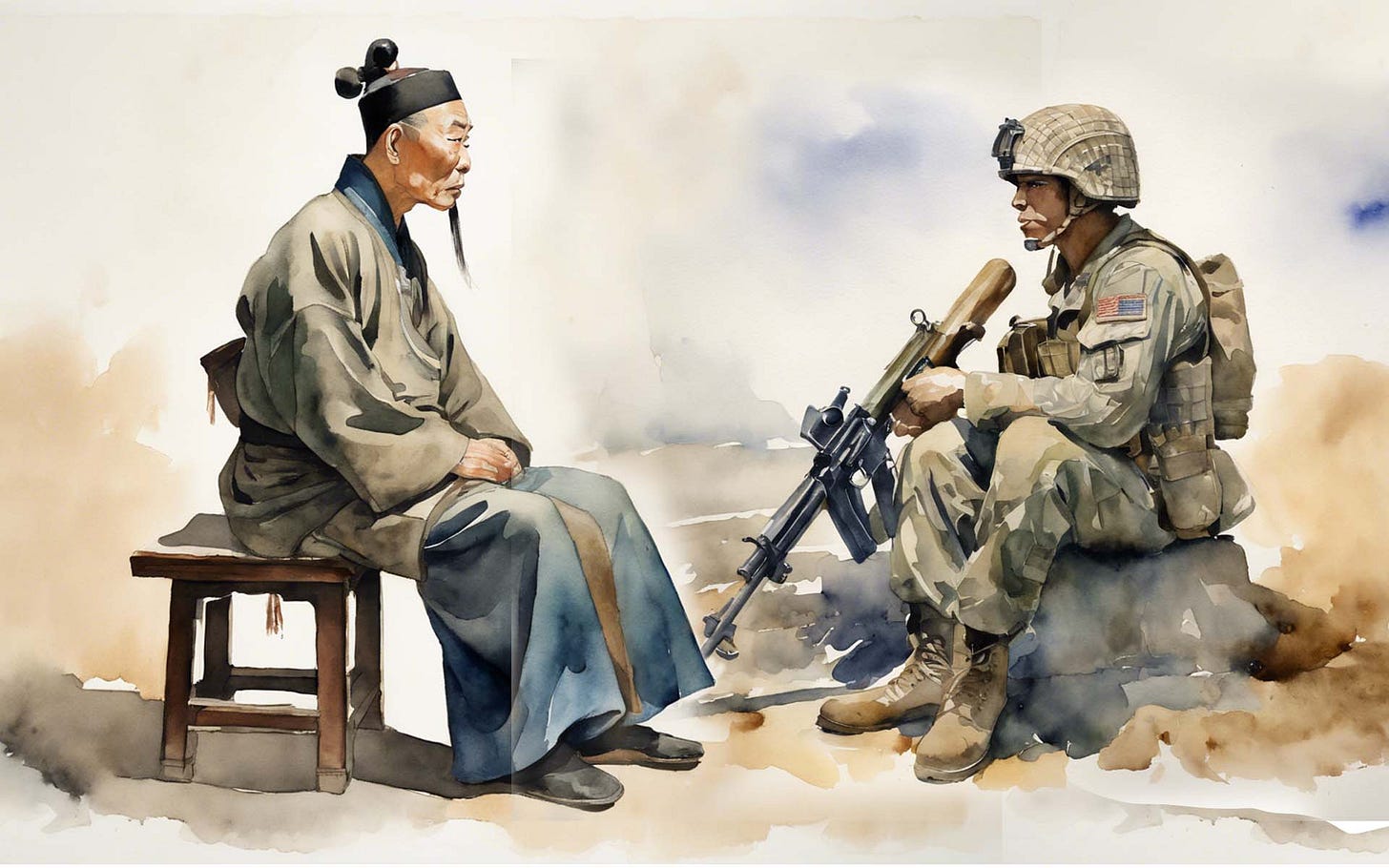
As China continues to rise, and re-assumes its position at the center of world affairs after a brief aberrant period, let us not mistakenly make universal claims about “all empires”, “all governments”; make false equivalencies between socialist and capitalist states and between Western and Eastern civilisations; project the motivations, intentions, and modus operandi of the US and European colonial empires onto the People’s Republic of China.
China emerges from 2000 years of statecraft focused on the preservation of peace and building of mutually beneficial relationships, and very literally does not have the institutional genes for domination, colonisation, or imposing its cultural values, political system, and economic model on the rest of the world.
The socialist super power is embarked on a world-historic mission to re-balance global economy by developing under-developed regions, to democratise international power by displacing uni-polar hegemony, to build a New Silk Road connecting the world, to bring a permanent end of the historic imperialist era.
If we take a sober look at the 20th Century, how strong waves of international movements toward socialism in the 1930s, in the 1950s, were brutally crushed by imperialism, we see that there has been 1 single block on the road of human progress —— and that removal of this block can only mean global socialism, the planetary path towards Da Tong.
Internationalism
Any kind of exclusively unique Chinese disposition that is conducive to modern socialism is the wrong conclusion to draw from this essay. Lets remember that the outcome of the civil war which ended with communist victory was anything but certain, that it was a very close fight, and that China could have strayed away from its Daoist and left-Confucian roots to embrace Legalism and nationalism, and become an imperialist power.
And we must remember that while the same choice is open to all nations, every people on this planet comes from ancient egalitarian traditions with matricentrality, animism, and a deeply embedded sense of community with high levels of trust, empathy, and cohesion. For these are the evolved social traits, the inherited biological reality, of the Homo Sapien Sapiens species, which is only, to various degrees in different places, ruptured by the proprietary/patriarchal world historic counter-revolution of 6 to 10 thousand years ago (much more on this in separate essays).
Sure, different cultures in different regions are to different levels connected to or severed from their pre-proprietary/patriarchal roots. But no matter how buried, how cut-off, all peoples have the potential of remembering, drawing from, and restoring their own ancient traditions of sharing and cooperation, towards building home grown socialism with local, native cultural/civilisational Characteristics.

 Le 47ème président des États unis d’Amérique, Donald Trump, sera probablement celui qui devra gérer la fin de l’ère de
L’article La position Trump dans le conflit en Ukraine a-t-elle évolué ? est apparu en premier sur STRATPOL.
UNGA report “Gaza Genocide: A Collective Crime” presentation

Jacques Hogard, analyste politique et colonel des forces armées françaises, également président du groupe EPEE – une société de conseil
L’article La Russie maître du jeu face à une coalition européenne corrompue est apparu en premier sur STRATPOL.

Hypothèses sur l’évolution des fronts après les « cinquante jours de « Trump » Alors que le front continue de subir la poussée
L’article Hypothèses sur l’évolution des fronts après les « cinquante jours de « Trump » est apparu en premier sur STRATPOL.

 Regis Chamagne est un colonel de l’aviation française, il fut commandant de l’escadron Mirage F1C à Cambrai, puis de l’escadron
L’article L’armée ukrainienne est sur le point de se désintégrer face à l’avancée russe est apparu en premier sur STRATPOL.
Xinhua News Agency: The U.S. has asked the G7 and NATO to impose additional tariffs on Chinese imports over China’s purchases of Russian oil to facilitate China’s effort in ending the Russia-Ukraine conflict. What is China’s comment?
Lin Jian: It is fully legitimate and lawful for China to carry out normal economic, trade and energy cooperation with all countries, including Russia. What the U.S. has done is a typical move of unilateralism, bullying and economic coercion. It seriously disrupts the international trade rules and threatens the security and stability of the global industrial and supply chains. Facts have proven that coercion and pressure win no hearts and minds, still less will they solve anything.
China’s position on the Ukraine crisis is consistent and clear. Dialogue and negotiation is the only viable way out of the crisis. China has, since day one, held an objective and just position and promoted talks for peace.
China firmly opposes relevant party directing the issue at China and abusing illicit unilateral sanctions and long-arm jurisdiction against China. If China’s legitimate rights and interests are harmed, China will resolutely take countermeasures to safeguard our sovereignty, security and development interests.
China-Arab TV: Pakistani President Asif Ali Zardari pledged on Sunday stronger cooperation with China on defense production. The strikes in Qatar exposed problems of the U.S.’s security commitment. Will more countries consider and seek stronger connection with China on defense production and security cooperation as a way of international cooperation with more respect and different from the U.S.’s way?
Lin Jian: China advocates the vision of common, comprehensive, cooperative and sustainable security. We stand ready to work with all parties to jointly implement the Global Security Initiative, strengthen international security cooperation, uphold the purposes and principles of the UN Charter, safeguard the international order based on international law, and build a world of lasting peace and universal security.
CCTV: During his recent visit to the U.S., Chiu Chui-Cheng, head of the Mainland Affairs Council of China’s Taiwan region, met with both Democratic and Republican members of the U.S. Congress and delivered a speech at the U.S. think tank the Heritage Foundation. Chiu said, “Mainland China has become the greatest threat to the peace and stability across the Taiwan Strait,” and sought to play up the possibility of Taiwan being taken over by the Mainland by force. He also thanked the U.S. for the reaffirmation of its commitment to Taiwan. What is your comment?
Lin Jian: There is but one China in the world, and Taiwan is an inalienable part of China’s territory. This is the true status quo regarding the Taiwan Strait. The greatest threat to peace and stability across the Taiwan Strait comes from the separatist activities of “Taiwan independence” forces and the external connivance and support they receive. China firmly opposes any form of U.S.-Taiwan official interactions and military contacts, and firmly safeguards our nation’s sovereignty and territorial integrity. We urge the U.S. to earnestly abide by the one-China principle and the three China-U.S. joint communiqués, and stop sending wrong messages to “Taiwan independence” separatist forces. No matter how the DPP authorities peddle the “mainland threat” narrative, hype up tensions across the Taiwan Strait, and squander the taxpayers’ money in exchange for external support for their “independence” agenda, they cannot change the fact that both sides of the Strait belong to one and the same China. Still less can they stop the inevitability of China’s reunification.
Our message to Chiu Chui-Cheng and his kind: To hustle national interests for “Taiwan independence” brings only shame and contempt. Their attempts are doomed to fail.
AFP: According to some media reports, Chinese leader has invited his U.S. counterpart Donald Trump to visit China this year, but the U.S. side has not responded due to disagreements over trade and fentanyl. Would the Foreign Ministry like to comment on this? Is a leader summit in China by the end of the year something the Chinese delegation in Madrid for the ongoing talks will raise with the U.S. side?
Lin Jian: China and the U.S. have open channels of communication. On your specific question, I have no information to share.
China News Service: It’s reported that U.S. Secretary of State Marco Rubio said in a statement that the U.S. stands with its Philippine ally in rejecting China’s destabilizing plans to establish a “national nature reserve” at Scarborough Reef. He said this is yet another coercive attempt to advance territorial and maritime claims in the South China Sea at the expense of its neighbors. He called upon China to abide by the 2016 Arbitral Tribunal’s decision. What’s China’s comment?
Lin Jian: China made its position clear on that issue last week, and made a serious protest to the U.S. today over the wrongful remarks. Huangyan Dao has always been China’s territory. It is China’s sovereign right to create a national nature reserve for the island, which is legitimate, lawful, and beyond reproach.
With the joint efforts of China and ASEAN countries, the South China Sea has been generally stable. The U.S. is not a party to the South China Sea issue, but has repeatedly made irresponsible remarks, caused problems and meddled in the maritime issues between countries concerned. The U.S. has also brought in individual countries to sow discord and fear and disrupt the South China Sea which has otherwise been tranquil all along. The “arbitration” that you mentioned is nothing but a political farce orchestrated by the U.S. masqueraded as a legal process. The so-called “decision” is illegal, null and void, and is not binding. China does not accept or recognize it. Who’s committed to defending the international rule of law and a peaceful and stable South China Sea, and who’s been a disruptor and troublemaker? The answer is quite clear.
The U.S. should keep its hands off the South China Sea, the hands that have been the source of disinformation, tension and confrontation, and give the South China Sea its tranquility back. China will continue to work with ASEAN countries to fully and effectively implement the Declaration on the Conduct of Parties in the South China Sea, actively move forward consultations on the Code of Conduct in the South China Sea, and jointly build the South China Sea into a sea of peace, friendship and cooperation.
Reuters: U.S. Democrats have asked the Trump administration to press China to curb overproduction, saying any bilateral trade deal should include “binding requirements” on Beijing to reduce industrial overcapacity. This was seen in a letter from members of the House Select Committee on China. What is China’s response to this?
Lin Jian: We’ve stated more than once that the so-called “China’s overcapacity” narrative has no basis in fact or economic laws. It is just a false pretext for protectionism, and its real aim is to hold back China’s high-quality development. We firmly oppose it.
CCTV: It’s reported by the ROK media that ROK Foreign Minister Cho Hyun will visit China this week. Could the Foreign Ministry confirm that?
Lin Jian: At the invitation of Member of the Political Bureau of the CPC Central Committee and Foreign Minister Wang Yi, ROK Foreign Minister Cho Hyun will visit China on September 17.
The Paper: We noted that the opening ceremony of the 2025 Cybersecurity Week was held this morning in Kunming. What does China hope to achieve through the Cybersecurity Week and what’s China’s stance on dealing with the common challenge of cybersecurity?
Lin Jian: The nationwide events of Cybersecurity Week held annually in China aim to raise public awareness on cybersecurity, help internet users become more capable of ensuring online security, foster a healthy and positive environment in cyberspace, and promote global cybersecurity governance and cooperation.
Cybersecurity threats are the common challenge faced by all countries and upholding cybersecurity is the shared responsibility of the international community. China actively advocates a peaceful, safe and secure, open, cooperative and orderly cyberspace. We are committed to promoting a community with a shared future in cyberspace, and will continue to work with the international community to jointly uphold cybersecurity, so that the internet can deliver more benefits to people from all countries.
AFP: On the U.S.-China trade talks in Madrid, is China considering the option of allowing ByteDance to sell its controlling stake in TikTok, something that the U.S. side has demanded before the app could be banned in the U.S. after Wednesday if there is no solution?
Lin Jian: China has stated its position on issues related to TikTok on multiple occasions.

Global Times: It’s reported that since August this year, under the excuse of cracking down on drug cartels in Latin America, the U.S. deployed warships and a nuclear-powered submarine to the Caribbean and waters off the coast of Venezuela. Venezuela recently said that a U.S. destroyer illegally intercepted, boarded and detained a Venezuelan fishing boat in the country’s EEZ. What’s China’s comment?
Lin Jian: Recently, in the name of combating drug trafficking, the U.S. has deployed forces in the waters of the Caribbean sea off Venezuela, and claimed to have sunk a Venezuelan vessel, shot dead sailors, and intercepted and detained a Venezuelan fishing boat, resulting in continued tensions in the region. The U.S.’s moves threaten regional peace and security, severely infringe upon other countries’ sovereignty, security and lawful rights and interests, and seriously violate international law.
China supports the effort of cracking down on transnational crimes through stronger international cooperation, opposes the unilateral abuse of force and is against external interference in Venezuela’s internal affairs under any pretext. We urge the U.S. to stop undermining countries’ safety of navigation and their freedoms and rights enjoyed under international law, and stop disrupting regional peace and stability under the pretext of combating drug trafficking.
Reuters: The American Institute in Taiwan said in a statement that mainland China intentionally mischaracterizes documents from the World War II era, including the Cairo Declaration, the Potsdam Proclamation, and the Treaty of San Francisco, to try to support its campaign against Taiwan. They also said that Beijing’s narratives are “simply false, and none of these documents determined Taiwan’s ultimate political status.” What is the Foreign Ministry’s comment to this?
Lin Jian: The statement of relevant U.S. institution seeks to distort the facts and mislead the public. China strongly deplores and firmly opposes this.
The restoration of Taiwan to China is an important part of the outcomes of WWII victory and post-war international order. A series of instruments with legal effect under international law, including the Cairo Declaration, the Potsdam Proclamation, and the Japanese Instrument of Surrender, have all clearly affirmed China’s sovereignty over Taiwan. The question regarding the status of Taiwan has already been completely settled following the victory of the War of Resistance against Japanese Aggression in 1945. The so-called Treaty of San Francisco is a document that is illegal, null and void, and issued by the U.S. and some countries after WWII, excluding the People’s Republic of China and the Soviet Union, to seek a separate peace deal with Japan.
Let me stress that there is but one China in the world and Taiwan is an inalienable part of China’s territory. This is an undeniable historical and legal fact, which no one or force can change. We urge the U.S. to abide by the one-China principle and the three China-U.S. joint communiqués, and stop abetting and aiding “Taiwan independence” separatist forces in any form.
Beijing Daily: The China International Fair for Trade in Services (CIFTIS) concluded in Beijing yesterday. Foreign media commented that over the past 13 years since its launch, CIFTIS has realized extraordinary transformation as China’s trade in services continued to grow. This year’s CIFTIS not only offers a window displaying global trade in services, but also highlights China’s dynamism of opening up and innovation influence in the global economic landscape, demonstrating China’s firm commitment to high-standard opening up. What is your comment?
Lin Jian: The China International Fair for Trade in Services (CIFTIS), which was launched 13 years ago, is an important platform provided by China for wider opening up, deeper cooperation and greater innovation. This year’s CIFTIS attracted close to 2,000 companies to exhibit on-site, over 20 percent of which are international companies, covering 26 countries and regions that are among the top 30 in terms of services trade, and displayed 198 new products and outcomes. As scientific and technological development and industrial transformation in the world accelerates, the annual CIFTIS effectively meets the urgent needs of countries for developing high-quality services trade.
Recently we also successfully held the World Smart Industry Expo 2025, the 25th China International Fair for Investment and Trade, and other expos and fairs, sending a clear message of China enhancing innovation cooperation and jointly responding to challenges with other countries. China will, as always, act as a promoter of economic globalization, a defender of the multilateral trading system, and a contributor to stable and unimpeded industrial and supply chains, share the long-term benefits of greater institutional opening up with other countries, and provide stability and new impetus for the world economy.
Reuters: A question about U.S. Treasury Secretary Bessent’s comments that came out just now. About the trade talks happening in Madrid, he has said that China has come to them with a very aggressive ask and that the U.S. is not willing to sacrifice national security. Could we clarify what the aggressive ask is? And another point that he made is on the TikTok deal, he said that the talks are really close to resolving the issue. Can we confirm that?
Lin Jian: With regard to the trade talks between China and the U.S. in Madrid, I have no information to share at the moment. You may continue following the talks. On TikTok, China has stated its principled position on multiple occasions.
Ukrinform News Agency: U.S. President’s Special Envoy for Ukraine General Keith Kellogg, speaking at a security forum in Kyiv last Saturday, said that if China stopped supporting Russia, first of all economically, it would lead to a very quick end to Russian aggressive war against Ukraine. Would the Foreign Ministry like to comment on this?
Lin Jian: On the Ukraine crisis, China holds an objective and just position, and has worked actively to promote peace talks. Most countries, including the U.S. and those in Europe, continue to trade with Russia. The normal exchange and cooperation between Chinese and Russian companies are in line with WTO rules and market principles. They don’t target any third party and should not be interfered or affected.
Beijing Youth Daily: China held another successful China-Africa Youth Festival last week, which is the 9th consecutive edition of the event. Can you give us more details?
Lin Jian: The China-Africa Youth Festival is a flagship project for youth exchanges under the framework of the Forum on China-Africa Cooperation (FOCAC). With the joint support from both sides and active participation of youngsters, we’ve staged nine successful editions of the China-Africa Youth Festival. This year’s events were held in Beijing and Qinghai from September 8 to 13. A total of 59 young representatives from countries including African member countries of the FOCAC made field trips and attended exchange events to gain first-hand experience of the achievements in China’s modernization drive and an eco-friendly and culturally rich China where all ethnic groups co-exist in harmony and people live a better life. The experience has made participating youngsters more committed to China and Africa jointly pursuing modernization.
Cultural and people-to-people exchange is an important part of China-Africa cooperation in the new era. Such exchanges are conducive to deepening mutual understanding between Chinese and African people, and carrying forward traditional friendship between China and Africa. Through this year’s festival, China stands ready to further consolidate solidarity and friendship between Chinese and African youth and inject new impetus from the youngsters to the effort of building an all-weather China-Africa community with a shared future for the new era.
AFP: Mexico’s President Claudia Sheinbaum last week said that there will be talks with China this week about planned tariffs of up to 50 percent on Chinese goods. Does the Foreign Ministry have an update on those talks? When and where they will take place and who will take part?
Lin Jian: China advocates a universally beneficial and inclusive economic globalization. We stand against all forms of unilateralism, protectionism and discriminatory and exclusionary measures. China firmly opposes moves taken under coercion to impose restrictions on China or hurt China’s legitimate rights and interests under whatever pretext. China will firmly defend its rights and interests in light of the developments of the situation.
China and Mexico are both important members of the Global South and our economic and trade cooperation is win-win in nature. China values its relations with Mexico and hopes that Mexico will work with China to jointly uphold a sound global trade environment.

Jeffrey Sachs’ presentation which is first in this video is really excellent.
A post Alaska caution – Do you really think Trump is going to convince the EU to go forward with a peace agreement? Do you really think Trump is going to convince his internal 5th column to go forward with a peace agreement? And second, do you really think this empire will let go of any of their ambitions? I don’t think so. The non-agreement capable will perhaps let go for a period and then they will be back. It is the nature of the beast. We will not have peace until there is no more empire with the power to threaten others. Reread this: The US CANNOT be negotiated with
1. The US CANNOT be negotiated with – no matter what “leverage” anyone including Russia “thinks” they have over the US – the US only seeks space and time to reassert itself – no level of betrayal is beneath them (for more information please see: Iraq, Libya, Syria, Iran, Minsk 1, Minsk 2, every arms control treaty the US ever signed, etc);
2. The ONLY way for multipolarism to prevail is to create a world that forces the US into first – isolation economically and diplomatically, as well as containment militarily where its military has no possible means of fighting and winning through conventional, nuclear, hybrid, or other means and remains confined to US borders INDEFINITELY;
Joint news conference by the President of Russia and the President of the United States
Vladimir Putin and Donald Trump held a joint news conference following Russia-US talks.
President of Russia Vladimir Putin:
Mr President, ladies and gentlemen,
We held our talks in a constructive and mutually respectful atmosphere, and they have proved substantive and productive.
I would like to once again thank my US counterpart for the proposal to come to Alaska. It is quite logical to meet here since our countries, albeit separated by oceans, are, in fact, close neighbours. When we stepped out of our planes and greeted each other, I said, “Good afternoon, dear neighbour. I am glad to see you alive and in good health.” I believe it sounds very friendly and neighbourly. Our countries are separated only by the Bering Strait — essentially, there are two islands, one Russian and one American, separated by a mere four kilometres. We are close neighbours, that’s a fact.
It is also important to note that our shared history and many positive events are largely related to Alaska. There is still an enormous cultural legacy preserved since the age of Russian America, with Russian Orthodox churches and more than 700 place-names of Russian origin.
During World War II, Alaska served as the starting point for the legendary air route that delivered lend-lease supplies, including military aircraft and other equipment. It was a dangerous and challenging route over enormous ice-covered territories. Nevertheless, the pilots and experts of both countries did everything they could to bring victory together. They risked and sacrificed their lives for our common victory.
I have just visited the Russian city of Magadan. A monument honouring Russian and American pilots stands there, adorned with the Russian and American flags. I know that here, too, there is a similar monument, and at a war cemetery a few kilometres away from here, there are graves of Soviet pilots who lost their lives in that heroic mission. We appreciate the efforts of US officials and citizens to preserve their memory. This is a dignified and noble undertaking.
We will always remember other examples from history when our countries stood together against common enemies in the spirit of combat camaraderie and alliance, rendering each other help and support. I am certain that this legacy will help us restore and develop mutually beneficial and equal ties at this new stage, even in the most challenging conditions.
As you know, Russian-American summit talks have not been held for over four years. That is a long time. This period has proved exceptionally difficult for bilateral relations, and, let’s face it, they have deteriorated to their lowest point since the Cold War. And this does not benefit either our countries or the world in general.
Obviously, sooner or later we had to remedy the situation, to move from confrontation to dialogue, and in this regard, an in-person meeting between the two heads of state was really overdue – of course, with serious and thorough preparations, and this work has been done.
President Trump and I have established very good direct contacts. We have had frank conversations on the phone multiple times. As you know, the US President’s Special Envoy, Mr Witkoff, has visited us in Russia several times. Our aides and heads of foreign ministries have maintained regular contacts.
As you are well aware, the situation around Ukraine is one of the key issues. We acknowledge the commitment of the US administration and President Trump personally to help resolve the Ukrainian conflict, and the President’s willingness to understand the root causes and its origins.
I have repeatedly said that the developments in Ukraine present fundamental threats to Russia’s national security. Moreover, we have always considered the Ukrainian people – and I have said this many times – a brotherly people, no matter how strange it may sound in today’s circumstances. We share the same roots, and the current situation is tragic and deeply painful to us. Therefore, our country is sincerely interested in ending this.
Yet, we are convinced that, for the conflict resolution in Ukraine to be long-term and lasting, all the root causes of the crisis, which have been repeatedly explained, must be eliminated; all of Russia’s legitimate concerns must be taken into account, and a fair security balance must be restored in Europe and the rest of the world.
I agree with President Trump. He said today that Ukraine’s security must be ensured by all means. Of course, we are ready to work on this.
Hopefully, the understanding we have reached will bring us closer to this goal and open up the road to peace in Ukraine.
We hope that Kiev and the European capitals will take the current developments constructively and will neither try to put up obstacles nor attempt to disrupt the emerging progress with provocative acts or behind-the-scenes plots.
By the way, under the new US administration, our bilateral trade has been on the rise. So far, it is a symbolic figure but still, the trade is 20 percent higher. What I am saying is that we have many interesting areas for cooperation.
It is obvious that the Russian-US business and investment partnership holds tremendous potential. Russia and the United States have much to offer each other in trade, energy, digital and high technologies, and space development.
Cooperation in the Arctic and the resumption of region-to-region contacts, including between the Russian Far East and the West Coast of the USA, also appear relevant.
Overall, it is crucial and necessary that our countries turn the page and get back to cooperation.
Symbolically, as I have already said, there is an international date line nearby, on the border between Russia and the United States, where you can literally step from one day into another. I hope that we can do the same in political affairs.
I would like to thank Mr Trump for our joint work and for the friendly and trust-based conversation. The main thing is that there was a commitment on both sides to produce a result. We see that the US President has a clear idea of what he wants to achieve, that he sincerely cares about his country’s prosperity while showing awareness of Russia’s national interests.
I hope that today’s agreements will become a reference point, not only for resolving the Ukrainian problem but also for resuming the pragmatic business relations between Russia and the United States.
To conclude, I would like to add the following. I remember that in 2022, during my last contacts with the former US administration, I tried to convince my former US counterpart that we should not bring the situation to a point fraught with serious repercussions in the form of hostilities, and I said directly at the time that it would be a big mistake.
Today, we hear President Trump saying: “If I had been president, there would have been no war.” I believe it would have been so. I confirm this because President Trump and I have established a generally very good, businesslike and trustworthy contact. And I have every reason to believe that, as we move along this path, we can reach – and the sooner the better – the end of the conflict in Ukraine.
Thank you for the attention.
President of the United States of America Donald Trump: Thank you very much, Mr President. That was very profound, and I will say that I believe we had a very productive meeting.
There were many-many points that we agreed on, most of them, I would say, a couple of big ones that we have not quite gotten there, but we have made some headway. So, there is no deal until there is a deal.
I will call up NATO in a little while. I will call up the various people that I think are appropriate, and I will, of course, call up President Zelensky and tell him about today’s meeting. It is ultimately up to them. They are going to have to agree with [what] Marco [Rubio] and Steve [Witkoff] and some of the great people from the Trump administration who have come here, Scott [Bessent] and John Ratcliffe. Thank you very much. But we have some of our really great leaders. They have been doing a phenomenal job.
We also have some tremendous Russian business representatives here, and I think, you know, everybody wants to deal with us. We have become the hottest country anywhere in the world in a very short period of time. We look forward to that, we look forward to dealing, we are going to try to get this over with.
We really made some great progress today. I have always had a fantastic relationship with President Putin, with Vladimir. We had many tough meetings, good meetings. We were interfered with by the Russia, Russia, Russia hoax. It made it a little bit tougher to deal with, but he understood it. I think he has probably seen things like that during the course of his career. He has seen it all. But we had to put up with the Russia, Russia, Russia hoax. He knew it was a hoax, and I knew it was a hoax, but what was done was very criminal, but it made it harder for us to deal as a country in terms of the business and all of the things that we would like to have dealt with. But we will have a good chance when this is over.
So just to put it very quickly, I am going to start making a few phone calls and tell them what happened. We had an extremely productive meeting, and many points were agreed to. There are just a very few that are left. Some are not that significant. One is probably the most significant, but we have a very good chance of getting there. We did not get here but we have a very good chance of getting there.
I would like to thank President Putin and his entire team, whose faces, who I know, in many cases, otherwise, other than that, whose faces I get to see all the time in the newspapers. You are almost as famous as the boss, but especially this one right over here.
But we had some good meetings over the years, right? Good, productive meetings over the years, and we hope to have that in the future. But let’s do the most productive one right now. We are going to stop, really, five, six, seven thousand, thousands of people a week from being killed, and President Putin wants to see that as much as I do.
So again, Mr President, I would like to thank you very much, and we will speak to you very soon, and probably see you again very soon. Thank you very much, Vladimir.
Vladimir Putin: Next time in Moscow.
Donald Trump: Oh, that is an interesting one. I do not know. I will get a little heat on that one, but I could see it possibly happening. Thank you very much, Vladimir. And thank you all. Thank you.
Vladimir Putin: Thank you so much.
The video accompanying this article is with Glen Diesen and it is here: https://globalsouth.co/2025/07/17/michael-hudson-with-glen-diesen-the-economics-of-a-civilizational-conflict/
The two pieces of work are stand-alone but together form the bigger picture quite eloquently and elegantly. This article is the key chapter in Michael’s new book. The article is also on Ben Norton’s site: https://geopoliticaleconomy.com/2025/07/17/michael-hudson-global-majority-us-financial-colonialism/
—
Industrial capitalism was revolutionary in its fight to free Europe’s economies and parliaments from the hereditary privileges and vested interests that survived from feudalism. To make their manufactures competitive in world markets, industrialists needed to end the land rent paid to Europe’s landed aristocracies, the economic rents extracted by trade monopolies, and interest paid to bankers who played no role in financing industry. These rentier incomes add to the economy’s price structure, raising the living wage and other business expenses, thus eating into profits.
The 20th century saw the classical aim of clearing away these economic rents rolled back in Europe, the United States, and other Western countries.
However, today, land and natural-resource rents in private hands are still rising and even receiving special tax advantages. Basic infrastructure and other natural monopolies are being privatized by the financial sector — which is largely responsible for carving up and de-industrializing economies on behalf of its real estate and monopoly customers, who pay out most of their rental income as interest to bankers and bondholders.
What has survived from the policies by which Europe’s industrial powers and the United States built up their own manufacturing is free trade. Britain implemented free trade after a 30-year fight on behalf of its industry against the landed aristocracy, aimed at ending the protectionist agricultural tariffs, the Corn Laws, which had been enacted in 1815 to prevent opening the home market to low-priced food imports, which would have reduced farming rents.
After repealing these laws in 1846 to lower the cost of living, Britain offered free-trade agreements to countries seeking access to its market in exchange for these countries not protecting their industry against British exports. The aim was to deter less industrialized countries from working up their own raw materials.
In such countries, Europe’s foreign investors sought to buy rent-yielding natural resources headed by mineral and land rights, and basic infrastructure headed by railroads and canals. This created a diametric contrast between rent-avoidance in the industrial nations and rent-seeking in their colonies and other host countries, while European bankers used debt leverage to gain fiscal control of former colonies who had won independence in the 19th and 20th centuries.
Under pressure to pay the foreign debts that were run up to finance their trade deficits, development attempts, and deepening debt dependency, debtor countries were obliged to relinquish fiscal control of their economies to bondholders, banks, and creditor-nation governments, which pressed them to privatize their basic infrastructure monopolies. The effect was to prevent them from using revenue from their natural endowments to develop a broad economic base for prosperous development.
Just as Britain, France, and Germany aimed to free their economies from feudalism’s legacy of the vested interests with rent extraction privileges, most of today’s Global Majority countries need to free themselves from the rent and debt overhead inherited from European colonialism and creditor control.
By the 1950s these countries were being called “less developed” or, even more patronizingly, “developing.” But the combination of foreign debt and free trade has blocked them from developing along the balanced public/private lines that Western Europe and the United States followed.
The tax policy and other legislation of these countries has been shaped by U.S. and European pressure to observe international trade and investment rules that perpetuate geopolitical domination by Western bankers and rent-extracting investors to control their national patrimony.
The euphemism “host economy” is appropriate for these countries, because the Western economic penetration of them resembles a biological parasite feeding off its host.
Seeking to maintain this relationship, the U.S. and European governments are blocking attempts by these countries to follow the path that Europe’s industrial nations and the United States took for their own economies with their 19th-century political and fiscal reforms that empowered their own takeoff.
Without these countries adopting fiscal and political reforms aimed at developing their own sovereignty and prospects for growth on the basis of their own national patrimony of land, natural resources and basic infrastructure, the world economy will remain bifurcated between Western rentier nations and their Global Majority hosts and held subject to neoliberal orthodoxy.
The success of China’s model poses a threat to the neoliberal order
When U.S. political leaders single out China as an existential enemy of the West, it is not as a military threat but for offering a successful economic alternative to today’s U.S.-sponsored neoliberal world order.
That order was supposed to represent the End of History, succeeding through its logic of free trade, government deregulation, and international investment free of capital controls, while detouring away from industrial capitalism’s anti-rentier policies.
We can now see the absurdity in this self-satisfying evangelical view that had emerged just as Western economies were deindustrializing, as a result of the dynamics of their neoliberal finance capitalism.
The vested financial and other rentier interests are rejecting not only China but the logic of industrial capitalism as described by its own 19th-century classical economists.
Western neoliberal observers have closed their eyes to recognizing the ways in which China’s “socialism with Chinese characteristics” has achieved its success by a logic similar to that of the industrial capitalism advocated by classical economists to minimize rentier income.
Most late 19th-century economic writers expected industrial capitalism to evolve into socialism of one form or another, as the role of public investment and regulation increased. Freeing economies and their governments from control by landowners and creditors was the common denominator of the social-democratic socialism of John Stuart Mill, the libertarian socialism of Henry George focusing on the land tax, and the cooperative mutual-aid socialism of Peter Kropotkin, as well as Marxism.
Where China has gone further than earlier socialist mixed-economy reforms has been in keeping money and credit creation in the hands of government, along with basic infrastructure and natural resources.

China SOE composition sector industry IMF
Fear that other governments might follow China’s lead has led U.S. and other Western finance-capitalist ideologues to view China as a threat by providing a model for economic reforms that are precisely the opposite of what the 20th century’s pro-rentier, anti-government ideology fought against.
The foreign debt overhead owed to U.S. and other Western creditors, and enabled by the 1945-2025 international geopolitical rules designed by U.S. diplomats at Bretton Woods in 1944, obliges the Global South and other countries to recover their economic sovereignty by freeing themselves from their foreign (mainly dollarized) banking and financial burden.
These countries have the same land-rent problem that Europe’s industrial capitalism faced, but their land and resource rents are mainly owned by multinational companies and other foreign appropriators of their oil and mineral rights, forests, and latifundia plantations, who extract resource rents by emptying out the world’s oil and mineral resources and cutting down its forests.
Taxing economic rent is a precondition for economic sovereignty
A precondition for Global South countries to gain economic autonomy is to follow the advice of the classical economists and tax the largest sources of rental income – land rent, monopoly rent, and financial returns – instead of letting them be sent abroad.
Taxing these rents would help stabilize their balance of payments, while providing their governments with revenue to finance their infrastructure needs and the related social spending needed to subsidize their economic modernization.
That is how Britain, France, Germany and the United States established their own industrial, agricultural, and financial supremacy. This is not a radical socialist policy; it always has been a central element of industrial capitalist development.
Recapturing a country’s land and natural-resource rents as its fiscal base would enable it to avoid taxing labor and industry. A country would not need to formally nationalize its land and natural resources outright; it simply needs to tax the economic rent over and above actual “earned profits,” to cite the principle of Adam Smith and his 19th-century successors that this rent is the natural tax base.
But neoliberal ideology calls such taxation of rent, and the regulation of monopolies or other market phenomena, an intrusive interference into the “free market.”
This defense of rentier income inverts the classical definition of a free market. The classical economists defined a free market as one free from economic rent, not as one free for the extraction of economic rent, let alone as freedom for creditor-nation governments to create a “rules-based order” to facilitate foreign rent extraction and stifle the development of financially and trade-dependent host countries.
Debt remission is a precondition for economic sovereignty
The fight by countries to free themselves from their foreign debt overhead is much harder than Europe’s 19th-century fight to end the privileges of its landed aristocracy (and less successfully, of its bankers), because it is international in scope, and is now confronted by a creditor-nation alliance to maintain the system of financial colonization created two centuries ago, as former colonies sought to finance their independence by borrowing from foreign bankers.
Starting in the 1820s, newly independent countries like Haiti, Mexico, and other Latin America nations, as well as Greece, Tunisia, Egypt, and other former Ottoman colonies, won nominal political freedom from colonialist control. But to build up their own industry they had to take on foreign debt – on which they almost immediately defaulted, which enabled their creditors to establish monetary authorities in charge of their fiscal policy.
The governments of these countries were turned into collection agents for international bankers by the late 19th century. Financial dependency on bankers and bondholders replaced colonial dependency, obliging debtor countries to give fiscal priority to foreign creditors.
World War II enabled many of these countries to accumulate substantial foreign monetary reserves as a result of supplying raw materials to the belligerents. But the post-war order designed by U.S. diplomats, based on free trade and free capital movements, drained these savings, and obliged the Global South and other countries to borrow to cover their trade deficits.
The resulting foreign debts soon came to exceed the ability of these countries to pay – that is, to pay without surrendering to the destructive IMF demands for austerity that blocked the investment needed to raise their productivity and living standards.
There was no way that they could meet their own development needs to invest in basic infrastructure and provide industrial and agricultural subsidies, public education, health care, and other basic social spending that is characterized by the leading industrial nations. This still remains the case.
Their choice today, therefore, is between paying their foreign debts – at the cost of blocking their own development – or claiming that these debts are odious and insisting that they be written off.

Creditor debt developing countries region UN 2024
At issue is whether debtor countries will gain the sovereignty that is supposed to characterize an international economy of equals, free of foreign post-colonial control over their tax and trade policies, as well as their national patrimony.
Their self-determination can only be achieved by joining together in a collective front.
Donald Trump’s tariff aggression has catalyzed this process by drastically reducing the U.S. market for exports from debtor countries, preventing them from obtaining the dollars to pay their bonds and bank debts, so these won’t be paid in any event.
The world is now busy de-dollarizing.
The need to create an alternative to the U.S.-centered post-war order was expressed in 1955 at the Bandung Conference in Indonesia, and then later by the Non-Aligned Movement. But these countries lacked a critical mass of self-sufficiency among themselves to act together.
Attempts to create a New International Economic Order in the 1960s faced the same problem. Countries were not industrially, agriculturally, or financially strong enough to “go it alone.”
Today’s Western debt crisis, de-industrialization, and coercive weaponization of foreign trade and financial sanctions under the dollarized international financial system, capped by the “America First” tariff policy, have created an urgent need for countries to collectively seek economic sovereignty, to become independent from U.S. and European control of the international economy.
The collective BRICS+, with Russia and China taking the lead, have just begun talking about making such an attempt.

BRICS 2024 summit Kazan Russia participants
China’s success has made a global alternative attainable
The great catalyst for countries to take control of their national development has been China. As indicated above, its industrial socialism has largely achieved the classical aim of industrial capitalism of minimizing rentier overhead, above all by publicly creating money to finance tangible growth.
Keeping money and credit creation in government hands, via China’s state-owned banks, prevents financial and other rentier interests from taking over the economy and subjecting it to the financial overhead that has characterized Western economies.
China’s successful alternative for allocating credit avoids making purely financial gains at the expense of tangible capital formation and living standards. That is why it is viewed as an existential threat to the current Western banking model.
Western financial systems are overseen by central banks that have been made independent from the Treasury and government regulatory “interference.” Their role is to provide the commercial banking system’s liquidity as it creates interest-bearing debt, mainly for the purpose of making wealth financially by debt leveraging (asset-price inflation), not for productive capital formation.

Asset price inflation real economy
Capital gains – rising prices for housing and other real estate, stocks, and bonds – are much larger than GDP growth. They can be made easily and quickly by banks creating more credit to bid up prices for buyers of these assets.
Instead of the financial system being industrialized, Western industrial corporations have become financialized, and that has occurred along lines that have deindustrialized the U.S. and European economies.
Financialized wealth can be made without being part of the production process. Interest, late charges, other financial fees and capital gains are not a “product,” yet are counted as such in today’s GDP statistics.
Carrying charges on the rising debt overhead are transfer payments to the finance sector, by labor and businesses, out of wages and profits earned by actual production. That shrinks the income available for spending on the products produced by labor and capital, leaving economies debt-ridden and deindustrialized.
The strategy of creditor-rentier nations to prevent withdrawal from their global control
The broadest strategy to block countries from avoiding the rentier burden has been to wage an ideological campaign from the educational system to mass media. The aim is to control the narrative in a way that depicts government as an oppressive Leviathan, an inherently bureaucratic autocracy.
Western “democracy” is defined not so much politically as economically, as a free market whose resources are allocated by a banking and financial sector independent of regulatory oversight.
Governments strong enough to limit financial and other rentier wealth in the public interest are demonized as autocracies or “planned economics” — as if shifting credit and resource allocation to the financial centers of Wall Street, London, Paris, and Japan does not result in an economy planned by the financial sector in its own interest, with the aim of creating monetary fortunes. Its aim is not to improve the overall economy and living standards.
Global Majority officials and administrators who have studied economics at U.S. and European universities have been indoctrinated with a value-free (that is, rent-free) pro-rentier ideology to frame the way they think about how economies work.
This narrative excludes consideration of how debt polarizes economies by growing exponentially at compound interest. Also excluded from mainstream economic logic is the classical contrast between productive and unproductive credit and investment, and the related distinction between earned income (wages and profits, the main components of value) and unearned income (economic rent).
Beyond this ideological campaign, neoliberal diplomacy uses military force, regime change, and control of the main international bureaucracies associated with the United Nations, the IMF, and World Bank — and a more covert network of non-government organizations (NGOs) — to prevent countries from withdrawing from today’s pro-rentier fiscal rules and pro-creditor laws.
The United States has taken the lead in using force and regime change against governments that would tax away or otherwise limit rent extraction.
It should be noted that few early socialists (except anarchists) advocated violence in pursuit of their reforms. It has been the vested interests, unwilling to accept loss of the privileges that are the basis of their fortunes, who have not hesitated to use violence to defend their wealth and power against attempts at reform to check their privileges.
To be sovereign, nations must create an alternative that enables them to be in charge of their own economic, monetary, and political development. But American diplomacy views any attempt to enact the necessary political and tax reforms and strong government regulatory authority as posing an existential threat to U.S. control over international finance and trade.
This raises the question of whether it is possible to achieve reforms and a strong public economy without war. It is natural for countries to wonder whether they can achieve economic sovereignty without a revolution, such as the Soviet Union, China, and other countries that fought to end their domination by their foreign-supported landlords and creditors.
The only way to protect economic sovereignty against military threats is to join an alliance for mutual support, since individual countries can be isolated in the way that Cuba, Venezuela, and Iran have been — or destroyed, like Libya.
As Benjamin Franklin put matters, “If we don’t hang together, we will hang separately.”
American writers characterize the attempt of other countries to join together to achieve economic sovereignty as a civilizational war. While this is indeed a civilizational contest, it is the United States and its allies that are waging aggression, against countries trying to withdraw from a system that has provided the United States and Europe with a huge inflow of economic rents and debt service from host countries subject to U.S.-backed diplomacy.
How U.S.-centered financial colonialism replaced European colonial occupation
After World War II, the era of settler-state colonialism gave way to financial colonialism, with the international economy dollarized under U.S. leadership.
The Bretton Woods rules established by 1945 enabled multinational corporations to keep economic rents for land, natural resources and public infrastructure out of domestic fiscal reach. Governments were reduced to the role of acting as collection agents for foreign creditors and as protectors of foreign investors from democratic attempts to tax rentier wealth.
The United States was able to weaponize world trade by monopolizing oil exports through U.S. and allied oil companies (the Seven Sisters), while U.S. and European agricultural protectionism and World Bank “aid” policy steered food-deficit countries to focus on tropical plantation crops instead of grain to feed themselves.
President Bill Clinton’s 1994 NAFTA free-trade agreement swamped Mexico’s market with low-priced U.S. farm exports (highly subsidized by strong government support). Mexican grain production plummeted, leaving it food-dependent.
To block governments from taxing or even fining foreign investors to recover compensation for damages to their countries, today’s rentier powers have created Investor-State Dispute Settlement (ISDS) courts requiring governments to compensate foreign investors for increasing taxes or imposing regulations that reduce foreign-owned income. (I provide the details of this in Chapter 7 of my 2022 book The Destiny of Civilization.)
This system blocks national sovereignty, including by preventing host countries from taxing the economic rent of their land and natural resources owned by foreigners. The effect is to make these resources part of the investor-nation economy, not their own. (The Saudi oil company Aramco, for instance, was not a corporately distinct corporate affiliate but a branch of Standard Oil of New York (ESSO). This legal nicety meant that its income and expenses were consolidated into the parent company’s U.S. balance sheet. That enabled it to receive a tax credit for the “depletion allowance” for oil, rendering the company effectively free of U.S. income tax, although it was Saudi oil that was being depleted.)
Other nations permitted the United States to dictate the post-World War II order, with it promising generous aid to support free trade, peace, and post-colonial national sovereignty, as spelled out in the United Nations Charter. But the United States squandered its wealth on military spending abroad and financial wealth addiction at home.
That has left America’s post-industrial power based mainly on its ability to harm other countries with chaos if they do not accept the U.S. “rules-based order” designed to extract tribute from them.
The U.S. imposes protectionist tariffs and import quotas at will, and subsidizes agriculture and key technologies as potential global high-tech monopolies, while forbidding other countries from implementing such “socialist” or “autocratic” policies to become more competitive. The result is a double standard in which the U.S. “rules-based order” (its own rules) replaces adherence to international law.
U.S. agricultural price support policy initiated under Franklin D. Roosevelt in the 1930s provides a good example of double standards. It made farming the most heavily subsidized and protected sector. It became the model for the European Economic Community’s Common Agricultural Policy (CAP) introduced in 1962.
However, U.S. diplomacy opposes the attempts of other countries, especially Global South countries, to impose their own protectionist subsidies and import quotas aimed at achieving self-sufficiency in basic food production — while U.S. “aid lending” and the World Bank have (as indicated above) supported the exportation of tropical plantation crops by Global South countries by lending for transportation and port development. U.S. policy has consistently opposed family-owned farming and land reform throughout Latin America and other Global South countries, often with violence.
Moves toward a multipolar world order
It is not surprising that, inasmuch as Russia has long been the United States’ main military adversary, it has taken the lead in protesting against the unipolar U.S. order.
Advocating a multipolar alternative to the U.S. neoliberal order in June 2025, Russian Foreign Minister Sergey Lavrov described the post-colonial economic subjugation of the countries that achieved political independence from colonialist rule in the 19th and 20th centuries but which are now facing the next task needed to complete their liberation:
Our African friends are paying more and more attention to the fact that their entire economies are still largely based on siphoning off natural resources from these countries. In fact, all value added is produced and pocketed by the former Western metropoles and other European Union and NATO members.
…
The West is using illegal unilateral sanctions, which increasingly become the harbinger of a military attack, as this has happened in Yugoslavia, Iraq and Libya and is now happening in Iran, as well as the instruments of unfair competition, initiating tariff wars, seizing other countries’ sovereign assets and taking advantage of the role of their currencies and payment systems. The West itself has actually buried the globalization model, which it developed after the Cold War to promote its interests.
Marco Rubio made the same point in the U.S. Senate hearings to confirm him as Donald Trump’s Secretary of State, explaining that the “postwar global order is not just obsolete; it is now a weapon being used against us.”
Violating the rules of foreign trade and investment that the United States itself dictated in 1945, and yet another instance of Washington resorting to the “rules-based order” of its own rules, President Trump’s unilateral tariffs aimed both at shifting the New Cold War’s military costs onto other countries, which are expected to buy American arms and provide proxy armies, and at reviving the U.S.’s lost industrial power by forcing countries to relocate industries to the United States and to permit U.S. companies to extract monopoly rents by controlling the leading emerging technologies.
The United States aims to impose monopoly rights and related rentier privileges uniquely favorable to itself on the entire world’s trade and investment. Trump’s “America First” diplomacy demands that other countries conduct their trade, payments and debt relationships in U.S. dollars, instead of their own currencies.
The U.S. “rule of law” is one that permits unilateral U.S. demands to impose trade and financial sanctions dictating how and with whom foreign countries can trade and invest. They are threatened with economic chaos and confiscation of their dollar reserves if they do not boycott trade and investment relations with Russia, China, and other countries refusing to submit to U.S. control.
The United States’ leverage to obtain these foreign concessions is no longer industrial leadership and financial strength, but its ability to cause chaos for other countries. Claiming to be the indispensable nation, the U.S.’s ability to disrupt trade is ending its former international monetary and diplomatic power.
That power originally was based on U.S. holdings of the world’s largest monetary gold reserves in 1945, its status as the largest creditor nation and industrial economy, and, after 1971, its dollar hegemony, arising in large part as a result of its financial market being the safest for other nations to hold their official monetary reserves.
The diplomatic inertia created by these former advantages no longer reflects the realities of 2025. What U.S. officials do have is the ability to disrupt the world’s trade, supply chains, and financial arrangements, including the SWIFT system for international payments.
The U.S. and European confiscation of $300 billion of Russia’s monetary deposits has darkened America’s reputation for financial safety, while its chronic trade and balance-of-payments deficits threaten to disrupt the international monetary system and free trade that made it the major beneficiary of the 1945-2025 world order.

us current account percent gdp 1970 2024
In keeping with the principle of national sovereignty and non-interference in other countries’ internal affairs that underlay the creation of the United Nations (the basic principle of international law grounded in the 1648 Peace of Westphalia), Russia’s Foreign Minister Lavrov described (in his speech cited above) the need “to establish foreign trade mechanisms [that] the West will be unable to control, such as transport corridors, alternative payment systems and supply chains.”
As an example of how the United States had paralyzed the World Trade Organization, which it had created on the basis of free trade at a time when America was the world’s leading export power, he explained:
When the Americans realized that the globalized system they had created – one built on fair competition, inviolable property rights, the presumption of innocence, and similar principles, and which had allowed them to dominate for decades – had also begun benefiting their rivals, primarily China, they took drastic action.
As China started outplaying them on their own turf and by their own rules, Washington simply blocked the WTO’s Appellate Body. By artificially stripping it of a quorum, they rendered this key dispute settlement mechanism inactive – and it remains so to this day.
The United States has been able to block foreign opposition to its nationalist policies by having veto power in the United Nations, IMF, and World Bank. Even without such power, U.S. diplomats have been able to block United Nations organizations from acting independently of U.S. wishes by refusing to appoint leaders or judges not primarily loyal to U.S. foreign policy.
The International Atomic Energy Agency (IAEA), charged with keeping nuclear proliferation in check is the most recent notorious case in point. Iran published documents showing that the agency’s leader Rafael Grossi provided U.S. and Israeli intelligence with the names of Iranian scientists who were killed, and details of the Iranian nuclear refinement sites that were bombed.
The U.S. veto has prevented the UN Security Council from condemning Israeli attacks on the Palestinian population. And when the International Criminal Court (ICC) brought charges against Israeli Prime Minister Benjamin Netanyahu for committing war crimes and crimes against humanity in a genocide against the Palestinians, U.S. officials imposed sanctions on the ICC and demanded the removal of the prosecutor.
The world no longer is to be governed by international law, but by unilateral U.S. rules, subject to abrupt change depending on the vicissitudes of American economic or military power (or loss thereof).
As Russia’s President Vladimir Putin described this new state of affairs in 2022, “Western countries have been saying for centuries that they bring freedom and democracy to other nations,” yet the “unipolar world is inherently anti-democratic and unfree; it is false and hypocritical through and through.”
The United States’ self-image depicts its long dominant world position as reflecting its democracy, free market, and equality of opportunity that has enabled its power elite, in their view, to acquire their status by being the economy’s most productive members, through their management and allocation of savings and credit.
The reality is that the United States has become a rentier oligarchy, one that is increasingly hereditary. Its members’ fortunes are made mainly by acquiring rent-yielding assets (land, natural resources, and monopolies) on which they make capital gains, while paying most of their rent as interest to their bankers, who end up with much of these rents and have become the new oligarchy’s leading managerial class.
Summary
The real conflict over what kind of economic and political system the Global Majority will have is just gaining momentum.
Global South countries and others have been driven so deeply into debt that they have been obliged to sell off their public infrastructure to pay its carrying charges. Recovering control of their natural resources and basic infrastructure requires the fiscal right to impose an economic-rent tax on their land, natural resources and monopolies, as well as the legal right to recover environmental cleanup costs caused by foreign oil and mining firms, and to implement financial cleanup costs (i.e., write offs and cancellation) of the foreign debt burden imposed by creditors who have not taken responsibility to ensure that their loans can be paid under existing conditions.
U.S. evangelistic rhetoric describes the imminent political and economic fracture of the world economy as a “Clash of Civilizations” between democracies (i.e., countries that support U.S. policy) and autocracies (i.e., nations acting independently).
It would be more accurate to describe this fracture as a fight by the United States and its European and other Western allies against civilization — assuming civilization entails, as it seems it must, the sovereign right of countries to enact their own laws and tax systems for the benefit of their own populations within an international system that has a common set of basic rules and values.
What Western ideologues call democracy and free markets has turned out to be an aggressive rentier-financial imperialism. And what they call autocracy is a government strong enough to prevent economic polarization between a super-rich rentier class and an impoverished population at large, such as is occurring within the Western oligarchies themselves.
“War does not determine who is right — only who is left.”
— Bertrand Russell
During the time of presidents angling for Nobel Peace Prizes, and daily news of ceasefires, this is where we stand. I’ve done a study of war or conflict using two points:
the end of January 2025, and
the current date, in other words, two snapshots separated by more or less six months.
Then I realized I lost the intermediate shorter conflicts and listed those separately. I was not searching for PhD-level accuracy, but for the states of war and conflict in our world, and wanted to determine whether it is on the rise. It is on the rise, and more conflicts have a perpetual nature. Currently, we have 18 conflicts raging. At the end of January, we had 16. During the period, nine short-term intermediate conflicts raged. Some of these you may recognize, and some may be new to you, but they fit the definitions.
This does not include economic war.
Afghanistan 45+ years
Somalia 34+ years
Palestine 76+ years
Eastern DRC 30+ years
But it demands courage beyond ceasefires: addressing stolen resources, healing trauma, and dismantling the machinery of hate.
As of July 11, 2025, there are numerous active armed conflicts worldwide. Defining a “war” precisely is complex (often requiring 1,000+ battle-related deaths/year), but here is a comprehensive list of major ongoing armed conflicts and wars causing significant violence, based on data from organizations like the Uppsala Conflict Data Program (UCDP), Armed Conflict Location & Event Data Project (ACLED), and major international news sources.
Fluidity: Conflict intensity and front lines change rapidly. A “ceasefire” today could break down tomorrow.
Definitions: This list focuses on conflicts with sustained, organized armed violence causing significant casualties (often >100 or >1000 battle deaths/year). It includes interstate wars, civil wars, and major insurgencies, lower-level violence, and criminal conflicts.
“Frozen” Conflicts: Areas like Eastern Ukraine (pre-2022), Nagorno-Karabakh (post-2023 ceasefire), and Transnistria (Moldova) remain tense with unresolved political issues and military deployments, but large-scale active fighting is currently paused.
Casualty Thresholds: Many organizations (like UCDP) distinguish between:
War: >= 1,000 battle-related deaths per year.
Armed Conflict: >= 25 battle-related deaths per year.
This list includes conflicts meeting the “war” threshold recently and significant ones near it.
Information Challenges: Data from active war zones is often incomplete, delayed, or biased.
The deadliest and most widespread conflicts currently are generally considered to be: Russia-Ukraine, Israel-Hamas/Gaza, Sudan, Myanmar, and the Sahel Insurgencies (Mali/Burkina Faso).
Databases searched:
What we would consider western-style information from these databases was not necessarily removed. Israel was missing everywhere, and I added that entity, which is clearly running four wars, depending on how you count.
1. Russia-Ukraine War: Full-scale invasion ongoing since February 2022. Front lines remain active, heavy casualties continue.
2. Israel’s genocide: Intense conflict – major Israeli military operation in Gaza continues, with significant spillover violence on Israel’s northern border with Hezbollah (Lebanon) and exchanges with Houthis (Yemen). A severe humanitarian crisis persists.
3. Sudan Civil War: War between the Sudanese Armed Forces (SAF) and the Rapid Support Forces (RSF) since April 2023. Widespread fighting across the country, ethnic violence, massive displacement, and famine conditions.
4. Myanmar Civil War: Intensified nationwide conflict since the February 2021 military coup. Numerous Ethnic Armed Organizations (EAOs) and People’s Defense Forces (PDFs) are fighting the military junta (Tatmadaw). Control of significant territory is contested.
5. Sahel Insurgencies (Mali, Burkina Faso, Niger): Intense Islamist insurgencies (linked to JNIM, IS-GS) against military governments and local forces. Extremist violence, ethnic massacres, and widespread instability dominate the region. Military coups have reshaped the landscape.
6. Syrian Civil War: Although reduced in scale, active conflict continues the Northwest (Idlib): Syrian government (+Russia) vs. Hayat Tahrir al-Sham (HTS) and Turkish-backed rebels, Northeast: Syrian Democratic Forces (SDF) vs. Turkish forces & Turkish-backed rebels. Occasional ISIS resurgence, South: Sporadic clashes, ISIS cells.
7. Yemen Civil War: While the main front lines between Houthis and the internationally recognized government (+Saudi-led coalition) have been relatively quiet since the 2022 truce (not formally ended), violence persists. This includes Houthi attacks on shipping, US/UK strikes on Houthis, internal conflicts within anti-Houthi factions, and attacks by AQAP/ISIS branches.
8. Tigray War (Ethiopia) Aftermath: The November 2022 ceasefire largely ended large-scale combat between the Ethiopian government and Tigray forces. However, significant tensions remain, sporadic clashes occur in border areas (especially involving Amhara forces), and the situation is fragile. Other conflicts in Oromia and Amhara regions continue.
9. Somalia Conflict: Ongoing war between the Federal Government of Somalia (backed by AU Mission – ATMIS) and Al-Shabaab militants. Al-Shabaab controls significant rural areas and launches frequent attacks in urban centers.
10. Mexico Drug War: While often classified as criminal violence, the scale and intensity (30,000+ homicides annually for years) involving cartels vs. state forces and cartel vs. cartel warfare meets many definitions of an armed conflict, especially in specific regions.
11. Afghanistan Conflict: The Taliban government faces persistent insurgency from ISIS-Khorasan (ISIS-K), primarily targeting Taliban forces and minorities. Resistance groups (NRF) also engage in sporadic clashes.
Other Significant Armed Conflicts (Varying Intensity)
12. Democratic Republic of the Congo (DRC): Multiple overlapping conflicts, primarily in the east. Key actors include M23 rebels (allegedly Rwanda-backed), numerous other armed groups (FDLR, CODECO, ADF – linked to ISIS), Congolese military (FARDC), and UN/east African forces. Violence is extreme, involving massacres of civilians.
13. Cameroon (Anglophone Crisis): Separatist militias in the English-speaking Northwest and Southwest regions fight government forces. Widespread human rights abuses by both sides.
|4 Pakistan Insurgency: Baloch separatist groups and the Tehrik-i-Taliban Pakistan (TTP) carry out frequent attacks against security forces, particularly in Khyber Pakhtunkhwa and Balochistan provinces.
15. Colombia Conflict: Despite the 2016 peace deal with FARC, conflict continues with remaining FARC dissidents (ELN, EMC), other guerrillas, paramilitaries, and cartels, particularly in rural areas.
16. Haiti Gang Violence: Powerful armed gangs control large parts of Port-au-Prince and other cities, engaging in brutal warfare against each other and state forces, causing a catastrophic humanitarian and political crisis. Often exceeds thresholds for “armed conflict.”
17. Central African Republic (CAR) Conflict: Despite peace deals, fighting continues between government forces (often backed by Russian Wagner Group mercenaries) and various rebel coalitions (CPC) controlling large rural areas.
18. Mozambique Insurgency (Cabo Delgado): ISIS-Mozambique continues its insurgency in the north, despite significant counter-offensives by government forces and regional allies (SADC, Rwanda).
High-Intensity Conflicts (1,000+ battle deaths/year)
1. Russia-Ukraine War
2. Israel-Hamas genocide
3. Sudan Civil War (SAF vs. RSF)
4. Myanmar Civil War
5. Sahel Insurgencies (Mali, Burkina Faso, Niger)
6. Yemen Civil War
7. Syrian Civil War
Significant Conflicts (25–1,000 battle deaths/year)
8. DRC (Eastern Congo)
9. Cameroon (Anglophone Crisis)
10. Pakistan Insurgencies
11. Colombia Conflict
12. Haiti Gang War
13. Central African Republic (CAR)
14. Mozambique (Cabo Delgado)
15. Nigeria (Banditry & Separatism)
16. Ethiopia (Oromia & Amhara)
*(Active political/military tension but low fighting in Jan 2025)*
1. Nagorno-Karabakh: No fighting since Azerbaijan’s Sept 2023 offensive; ~120K ethnic Armenians fled. Russian peacekeepers are present.
2. Tigray (Ethiopia): Nov 2022 ceasefire held, but Amhara-Tigray border disputes simmered.
3. Eastern Ukraine (Pre-2022 lines): Static trench warfare since 2015; minor skirmishes.
Important Context for January 2025
Gaza dominated headlines: Regional escalation risks (Lebanon/Yemen) were the top geopolitical concern.
Sudan’s collapse accelerated: Famine was declared in parts of Darfur by late January.
Sahel military regimes solidified power: France entirely withdrew; Russia filled the vacuum.
Myanmar’s junta was near collapse: China brokered a temporary Shan State truce.
Houthi Red Sea attacks disrupted global trade: 15% of shipping rerouted via Africa.
—-
1. India-Pakistan Border Clashes (Nov 2024)
Duration: 4 days (Nov 17–20, 2024)
Location: Jammu & Kashmir (Line of Control)
Trigger: Attack by suspected Jaish-e-Mohammed militants in Poonch (India) killing 5 soldiers → Indian retaliatory strikes across LoC.
Scale: Heavy mortar/artillery duels, drone incursions.
Casualties: ~35–50 killed (military + militants).
End: De-escalated after U.S./UN mediation; no territorial change.
Source: ACLED, Reuters.
2. Libya: Tripoli Factional Warfare (Jan 2025)
Duration: 12 days (Jan 8–20, 2025)
Factions:
Government of National Unity (GNU) (Tripoli-based)
Libyan National Army (LNA)-aligned militias (from Zawiya/Tarhouna)
Trigger: LNA groups attempted to seize Tripoli port after GNU delayed elections.
Scale: Urban combat, artillery, drones. Turkish-backed GNU forces held key areas.
Casualties: ~200+ killed, 40k displaced.
End: Ceasefire brokered by Egypt/Turkey (Jan 20).
Source: Al Jazeera, Libya Observer.
3. Armenia-Azerbaijan Border Skirmish (Oct 2024)
Duration: 3 days (Oct 4–6, 2024)
Location: Syunik Province (Armenia) / Nakhchivan border.
Trigger: Azerbaijani troops advanced toward Armenian positions near Vardenis.
Scale: Artillery, drone strikes, infantry clashes.
Casualties: ~24 soldiers killed (both sides).
End: Russian-brokered truce; Azerbaijan withdrew.
Source: Caucasus Watch, OC Media.
4. Chad-Sudan Proxy Border War (Dec 2024)
Duration: 2 weeks (Dec 1–14, 2024)
Factions:
Chadian rebels (FACT) backed by Sudan’s RSF
Chadian army backed by SAF remnants
Location: Adré (Chad-Sudan border)
Scale: RSF artillery supported FACT incursion → Chadian airstrikes in Sudan.
Casualties: ~180+ killed, 10k refugees fled into Chad.
End: Chad pushed back rebels; RSF redirected focus to Darfur.
Source: The New Humanitarian, France 24.
5. Ecuador Cartel Uprising (Jan 2025)
Duration: 5 days (Jan 8–12, 2025)
Trigger: Cartels (Los Choneros, Tiguerones) launched coordinated riots/jailbreaks after leader “Fito” transferred.
Scale: Prison riots, police assassinations, car bombs in Guayaquil/Quito.
State Response: Military deployed under “internal armed conflict” decree.
Casualties: 500+ killed (cartels/security forces/civilians).
End: Cartels retreated after military seized prisons.
Source: BBC, ACLED.
6. India-Pakistan: Short but high-risk (nuclear powers).
7. Libya: Part of ongoing power vacuum since 2011; elections still stalled.
8. Chad-Sudan: Spillover from Sudan’s civil war (RSF vs. SAF).
9. Ecuador: Classified as “non-state conflict” (cartels vs. state) but reached war-like intensity.
Short duration → Excluded from annual “ongoing war” datasets (e.g., UCDP thresholds require sustained violence).
Localized impact → Often overshadowed by larger wars (Gaza, Ukraine).
Fragmented Power – Non-state actors (warlords, militias, cartels) profit from chaos. No one can “win,” so violence becomes an economy (e.g., Eastern DRC, Libya).
Proxy Dynamics – External powers fuel conflicts to advance influence. (This is a highly risable statement, that came out of one of the databases searched. Israel and the US were omitted, but let’s add them and repeat the list: (Russia, Iran, Turkey, Gulf States, US, Israel)
Climate Collapse Multiplier –
Droughts → farmland loss → youth join militias (Sahel).
Floods → mass displacement → ethnic violence (South Sudan).
Tech-Enabled Insurgency
Drones ($500) can paralyze armies. So says the databases but I verified that with an expert only to receive a wonderful explanation of the part and function of drones in modern warfare. Drones are an organic development of yet another iteration of air power. In cases, they can act as the poor man’s substitution for massive artillery power. Drones cannot win wars.
I added this to the information from the databases: Gaslighting and major false media campaigns in other words hasbarra and intelligent propaganda. This was a glaring tech-enabled issue when Syria fell and it is continuing.
Social media recruits globally (ISIS, Al-Shabaab).
Ceasefires address symptoms (guns), not causes (injustice, resource theft).
Example: 13 peace deals in DRC since 1999 — all failed.
Consequence: Children who know only trauma → and develop into the next wave of fighters.
Rare bright spots:
Colombia’s 2016 deal cut homicide rates by 1/3 (though fragile).
Northern Ireland’s peace held 26+ years — proof hatred can be outlived.
Aceh, Indonesia — post-tsunami peace ended 30-year war.
Inclusion of women & youth in talks (research shows 35% more durable).
Economic alternatives to war economies (jobs > demobilization cash).
Local peacebuilders — unsung heroes rebuilding trust village by village.
This needs a much deeper discussion as clearly peacemaking fails.
Late entry now threatening but not quite at the shooting stage:
Thailand, Cambodia border dispute
Final Reflection – May we bear witness wisely as we in our world kill others faster than ever before.

 Les opérations militaires engagées par Israël et les USA contre l’Iran opposent des parties qui ont leurs raisons de considérer
L’article Réflexions sur le conflit irano-israélien et ses implications pour la Russie est apparu en premier sur STRATPOL.
By Andrew Cainey and Chengkai Xie
Andrew Cainey is Director and Co-Founder of the UK National Committee on China and Senior Associate Fellow, Royal United Services Institute. Chengkai Xie is Schwarzman Scholar at Tsinghua University.
Republished in South China Morning Post, https://www.scmp.com/week-asia/opinion/article/3313403/china-global-conflict-mediator-ambition-action
In recent years, Beijing has increasingly taken on the role of conflict mediator on the world stage — hosting negotiations, proposing peace plans, and even deploying personnel to oversee ceasefires. Once reluctant to engage in UN peacekeeping activities, it now provides more troops than any other P5 member. These are dramatic shifts for a country that was once a staunch advocate of non-interference. As its economic and security interests now reach far beyond its borders, China’s engagement on the world stage has understandably grown accordingly. It has a strong incentive to resolve conflicts that threaten its trade, overseas investments, citizens abroad, or simply regional stability.
The Six-Party Talks on the North Korean nuclear issue, beginning in 2003, marked China’s first major foray into multilateral conflict mediation. It provides a good example of Beijing’s approach to conflict mediation, summarised in its foreign policy lexicon by the phrase “劝和促谈” (persuading for peace and promoting dialogue): while Beijing had no coercive leverage over Pyongyang, it served as a consistent convener—urging North Korea to halt its nuclear ambitions while pressing the U.S. to address DPRK security concerns.
China’s ambitions are now broader. It has been positioning itself as a leader of the Global South, representing a more inclusive multilateralism than the West. The Global Security Initiative (GSI), launched in 2022, rich in principles but deliberately ambiguous in substance, signals Beijing’s growing appetite to reshape security diplomacy around its proposed set of global norms, which prioritise non-interference, dialogue, and cooperation.
As conflicts drag on from Ukraine to Gaza, the global demand for effective mediation has never been higher. At the same time, the U.S. under Trump is retreating from sustained engagement, giving China the space to step in. However, as mediation requires time, resources, and political capital, the questions are where, how and with what effect China chooses to engage.
Where to resolve conflict
Rather than espousing universalist approaches to peace, China has been engaging most where it sees potential benefits – for itself and for others – that merit the resources and effort required. The cases of Saudi-Iran, Myanmar and Russia-Ukraine provide illustrations.
The Saudi-Iran agreement was hailed as a diplomatic success and a shift from China’s traditional non-involvement. Yet, while China did facilitate engagement behind the scenes, both sides were already on a path to improved relations. The agreement represented a tactical rapprochement rather than a fundamental reconciliation. It did not require China to resolve deep-rooted conflicts or manage volatile post-agreement transitions. China scored a diplomatic win that advanced relations in the Middle East and gained kudos for its contribution with limited risk and effort.
By contrast, Myanmar highlights the deeper drivers – and limits – of China’s mediation ambitions. Earlier this year, it brokered a ceasefire between the military junta and the Myanmar National Democratic Alliance Army – and, in a striking departure from its longstanding policy of non-interference, dispatched a monitoring team to supervise enforcement. This shift from quiet facilitation to active oversight underscores how China’s mediation is rooted in its own economic and security imperatives. Stability in Shan State matters not only for border security, but for safeguarding China’s access to rare-earth minerals critical to its high-tech industries.
Finally, given the Ukraine war’s significance for Europe, the U.S., and Russia, it is difficult for China to avoid taking a stance on how the conflict should be resolved. Yet the differences between Russia and Ukraine are stark, perhaps irreconcilable. China has therefore limited itself to outlining rather ambiguous proposals instead of making a full-fledged effort at mediation. In 2023, it issued joint peace proposals with Brazil emphasizing dialogue without preconditions and mutual security guarantees, diverging from the West’s rights- and sovereignty-based frameworks. Special Envoy Li Hui’s shuttle diplomacy in Brazil, Egypt, and Indonesia aligned China with the Global South’s call for alternative, stability-focused approaches to conflict resolution. Some Western analysts have questioned China’s willingness to act as a truly impartial broker that engages Russia and Ukraine on equal terms, considering Beijing’s close ties to Moscow.
How to resolve conflict
China argues that it adopts a different approach to conflict resolution than the West; that it emphasizes facilitation over prescription, flexible processes over rigid frameworks, and economic incentives over normative demands. China stresses the need to avoid what it sees as the risk of hegemonic overreach and argues that it deliberately avoids imposing its will, preferring to facilitate dialogue instead of applying pressure or imposing norms tied to democracy, human rights, or governance reform.
This approach draws on Confucian philosophy, which emphasizes “和谐“(harmony) over confrontation and sees conflict as a rupture in relationships rather than a clash of rights or ideologies. This outlook is amplified by the concept of ”关系“ (relationship) which prioritizes trust and mutual benefit over public adjudication or moralizing. Consistent with this worldview, China’s diplomacy emphasizes the quiet management of tensions and the need to preserve face for all parties rather than assigning blame.
Indeed, prominent Western mediators also emphasize trust, common interests, patience and symbolic gestures – principles not so different from a Confucian-informed ethos. Moreover, attractive as a Chinese alternative may appear, especially to the Global South, China’s ‘non-intrusive’ style may be less a deliberate philosophy and more a reflection of its limited experience in conflict resolution.
Demonstrating impact
China’s coming of age as a conflict mediator is both inevitable and consequential: its willingness to engage in conflict diplomacy offers new possibilities as its global footprint grows and traditional Western leadership evolves. Wherever and however China engages in conflict resolution, what matters is the practical impact: fighting stopped, lives saved, people safe and back to living prosperous lives.
However, unlike the U.S. or European Union, which have spent decades working on complex peace processes, China is relatively new to the arena. It has yet to demonstrate whether it can manage the intricate work of post-conflict institution-building, transitional justice, or ensuring implementation of fragile agreements. Performative efforts issuing peace plans that lead nowhere will bring at best transitory benefits for China and soon lead to greater cynicism about any engagement by China.
China’s ability to be a truly effective mediator rests ultimately on three foundations. First, its ability to build trust with all parties involved. Indeed, the presence of such trusted relationships helps identify those conflict situations where China is best placed to play a constructive role. Second, its willingness to acknowledge where its own interests are aligned with those in conflict and where they are not. This is not a uniquely Chinese challenge. All mediators, including the U.S., pursue their own interests to some degree; what matters is transparency, balance, and credibility. Finally, success requires the willingness to persist and put in the effort required to secure lasting agreement: as Xi Jinping might put it, the need to ‘struggle’ in order to end conflict. In a multipolar world starved of effective diplomacy, the opportunity for China is real. Success will demand not just ambition, but patience, impartiality, and a willingness to struggle for peace, even when it tests China’s own interests. Turning ambition into action is now China’s diplomatic test.
The views and opinions expressed in this article are those of the author(s) and do not necessarily reflect those of the Asia Research Institute, National University of Singapore.
The conflict between Israel and Iran is not a regional skirmish, not a local exchange of blows, and indeed not an accident. And anyone who follows the situation not by the headlines, but by the essence, understands:
the logic of a global confrontation is embedded in this conflict. Unfortunately, with very little chance of a quick end.
 In recent months, many have begun to cherish hopes: Trump is a peacemaker, everything will soon calm down. The special effects of American rhetoric have thrown smoke in the eyes. Some got carried away by Trump’s promises of de-escalation, his desire for the Nobel Peace Prize, and the reduction of American interference in the affairs of other states. What’s more, in my circle, I have heard thoughts that the United States is allegedly losing its grip, retreating, shedding excess weight. But reality hit differently.
Today, the United States is once again at the epicenter of a new conflict; they do not hide the fact that they are playing a card with someone else’s hands, they are drawing the world into a new military phase. And they are doing it methodically. And all this is happening at a time when there is a battle on our borders. Is it a coincidence? No. It is a system.
This means that peace is canceled.
This means that we are obliged to continue to carry out tasks within the framework of a special military operation, not as a temporary campaign, but as fundamental for our country.
Those who do not understand this today will be left without a country tomorrow.
By the way, we must now look differently at the creation of a buffer zone on the territory of Ukraine. Does it make sense to burn 200-300 km of territory between us and the Nazi regime? Israel and Iran are separated by almost one and a half thousand kilometers. But this does not prevent them from striking each other – accurately, quickly, painfully. UAVs, missiles, aviation – everything is working at full capacity.
Now, let’s imagine leaving all of Ukraine as a buffer, giving up only Lviv. From there to Moscow is just over 1,100 km, to the border even less. The distance from Tehran to Tel Aviv is approximately 1,500 km. But, as we see, this does not prevent either of them from striking from such a distance, and quite accurately. Does anyone still have questions about why we need a deep security zone, echeloned defense, and constant readiness for large-scale escalation? Or even better, a complete capitulation of Zelensky and his gang.
What is the conclusion? Russia must be strong, armed, and ready. Always. And this readiness must begin in the minds. Not only of officials and the military, but of the entire country. This is my conviction.
– General Gurulev
[Ed Note:
Gurulev spells out the reality of the nature of the current wars, designed to be forever, perpetual, a feature of our global interactions into the future, and not a temporary bug.
This is of course reminiscent of the old joke: Don’t play chess with a pigeon because it will kick over the board, scatter the pieces and fly off crying victory.
We could of course change the game, but that will include dealing with the pigeon. Russia has as one objective of the SMO, demilitarization of Ukraine. We see filtering through from Iran, demilitarization of the Entity. Remaining is the still active empire pigeon. What is to be done?
In a sense the resistance, the Global Resistance, is working with one hand tied behind its back. We are not as evil and we do not intend to demolish humankind. (Leave the comments of reducing the overall word population aside). What is to be done with the insane?]

 Ce n’est pas la première fois que les VSU1 assistées par leurs mentors britanniques réalisent une opération hardie, complexe et
L’article Eléments sur les attaques ukrainiennes de bases russes est apparu en premier sur STRATPOL.
Foreign Minister Sergey Lavrov’s remarks and answers to media questions at the diplomatic conference Historically South Russian Lands: National Identity and Self-Determination of Peoples, Moscow, May 23, 2025
Question: Today, all the major global players are discussing peace in Ukraine. Initiatives have been put forward by friendly nations – China, India, and Brazil – and, of course, our adversaries. In your opinion, what fundamentally distinguishes the Russian approaches from the wide array of proposals? Why is a truce and ceasefire insufficient today?
Sergey Lavrov: Allow me to say a few words. I understand that I may repeat what has already been mentioned before me. I am aware that many of our experts and political scientists participated in the preparation of this event and have already spoken today.
The falsification of history did not emerge today. For many years, our detractors have engaged in this with the aim of sowing discord among Russian peoples, pursuing their self-serving interests, and hindering collaboration in the post-Soviet space. These attempts to “drive wedges” intensified particularly after the Soviet Union ceased to exist.
It is precisely this period that is associated with a new surge of nationalist sentiments in Ukraine, which had long existed there, albeit dormant. After the dissolution of the Soviet Union, in a relatively short period, the then-President Leonid Kuchma wrote a book titled “Ukraine Is Not Russia.” It was published in 2003. The work is blatantly pseudo-scientific. The author himself stated that the goal of this work was to “create Ukrainians.”
In essence, it is this concept laid out in the work “Ukraine Is Not Russia” that became a sort of intellectual foundation for the modern nationalist Ukrainian elites.
In 2014, when an unconstitutional coup d’état occurred with open support from the United States and the acquiescence of the European Union, Ukraine definitively transformed into a military-political stronghold of the West at our borders. They had long cherished this dream and started to refer to themselves as “anti-Russia.”
In Odessa, monuments were dismantled. This phenomenon of dismantling monuments is, of course, quite telling, not only for the modern Ukrainian leaders but also for the Poles and the Baltic states. However, when the monument to the founder of Odessa, Empress Catherine the Great, was dismantled, and a week later UNESCO decided that the historic centre of Odessa is a world cultural heritage site, it was impossible to disgrace this once-respected organisation, now led by the openly biased Director-General Audrey Azoulay, any further, even if one tried. I have already spoken about other monuments – to Alexander Suvorov, Alexander Pushkin, Isaac Babel, and figures of literature, culture, and art whose names are associated with the Russian language. All these monuments are being removed, just as the monuments to those who liberated Ukraine from Nazi occupiers are dismantled, while, conversely, monuments to collaborators are being erected.
It is difficult to replace historical truth; therefore, the ideologists of this very “Ukraine Is Not Russia” delve into such inquiries, publishing supposedly scientific works that make one’s hair stand on end. I am not joking here. “In fact,” the Black Sea was dug by Ukrainians. Buddha originated from Zaporozhye. The Mona Lisa has Ukrainian origins; her great-grandparents were from Odessa and Kiev. Can you imagine what nonsense this is? It is spread not just through the grapevine but is found in history textbooks of Ukraine.
Russophobia has deeply rooted in Ukraine and is actively supported by Western powers, in the historical context as well. This sentiment has been systematically cultivated since the mid-19th century, when the Austro-Hungarian Empire began fostering anti-Russia attitudes in Galicia (western Ukraine), initiating harsh persecution against the local population, the Rusyns. Despite these efforts, a significant part of the Galician-Russian intelligentsia and the vast majority of the people remained spiritually and culturally connected to Russia, resisting attempts to sever these ties.
During World War I, the Austro-Hungarian authorities unleashed mass repression and terror against the Rusyn population: tens of thousands perished in the death camps of Thalerhof and Terezin, considered among the first in Europe. Yes, they were invented by Austro-Hungary. Today, the airport of Graz, Austria, is located where Thalerhof used to be. These atrocities have not been forgotten. Ongoing efforts are being made to recognise the extermination of the Russian population in Galician Rus and other Russian regions of Austria-Hungary as the first genocide in modern European history. The work is sure to continue.
In 1929, the infamous Organisation of Ukrainian Nationalists (OUN) was founded in Vienna. It would later serve as guidance for most Ukrainian nationalist parties and organisations in the 1990s and 2000s. Alongside the slogan “Ukraine is Not Russia,” a radical nationalist agenda, influenced by and Nazi racial doctrines and embodied in the OUN, was developing.
This organisation and those who considered it an ideal union of Ukrainians promoted the concept of ethnic purity, following in step with the Western colonisers and the Nazis. Ethnic groups were categorised as either friendly (neutral), to be expelled from Ukraine) or hostile (to be eliminated). The latter category included Russians, Poles, Jews, and Hungarians. This is what Ukrainian nationalists were doing during World War II: exterminating them.
Today, figures who once championed and enacted these inhumane policies are glorified by new or revived nationalist movements in Ukraine. Stepan Bandera and Roman Shukhevich are portrayed as national heroes and founders of modern Ukrainian statehood. The Kiev authorities consider themselves the heirs of these criminals. It is no surprise that even before the start of the special military operation, 10 or 11 years ago, the Kiev regime had launched a campaign to systematically eradicate all things Russian.
This included education (first, Russian-language primary classes were banned, followed by secondary and eventually higher education in Russian), culture, and media. Russian-owned media outlets were shut down and driven out of the country. Ukrainian media broadcasting in Russian faced the same fate.
Ukraine has now tacitly introduced a filtering authority for any information to be approved for publication or broadcasting in any media.
President Putin has long pointed out these trends. In December 2019 he spoke at a meeting of the Victory organising committee for preparations to the next anniversary of Victory in the Great Patriotic War. He touched on those matters and said, “Truth is our response to lie.” Truth has to be protected. The truth is that South Russian lands and the entire territory of contemporary Ukraine were always among the most developed and prosperous regions of the Russian Empire and the USSR. Natives of those lands always held senior public offices both before and during the Soviet government, including such Soviet leader as Leonid Brezhnev, who was born in the present Dnepropetrovsk Region. He worked in leading positions in Ukraine and then in Moscow for a long time.
At the time of the Soviet Union collapse the Ukrainian Soviet Socialist Republic had a most powerful industrial potential and developed agriculture. You can judge by yourselves what it was driven to by the “elites” that came to power and unleashed the fratricide war in Donbass in 2014. The statistics is known well enough as well as what the modern Ukrainian economy and social sphere are all about. What methods they use there, including catching young men in the streets to first forcibly stuff them into a car and then send them to the front. Russia has nothing to do with this.
When the coup d’état took place, the resulting new authorities that emerged in Kiev squabbled over cabinet appointments and announced their programme. The US Department of State welcomed those events, and its former notorious official Victoria Nuland even proudly confessed that the United States had not wasted the $5 billion invested in establishing, developing and reinforcing Ukrainian democracy over the preceding several years.
Now much is being said about national identity and self-determination. The right of peoples to self-determination has been enshrined in the UN Charter. Antonio Guterres spoke at the Security Council and the UN General Assembly on many occasions. In my contacts with Antonio Guterres, I call on him not to forget that the UN Charter contains more lines than that on the territorial integrity. His representative Stephane Dujarric evaded many times the question about the UN stance on Ukraine settlement. He only keeps saying by rote the cliché that the UN is for settling the crisis on the basis of international law, Ukrainian territorial integrity and UN General Assembly resolutions.
He doesn’t seem to realise that there are multiple General Assembly resolutions out there. One of those that matters most in these circumstances is the 1970 Declaration on Principles of International Law concerning Friendly Relations and Cooperation among States in accordance with the Charter of the United Nations. It’s a substantial document and, unlike the resolutions that the current Kiev regime is pushing through with the Western support, and which Antonio Guterres cites in an attempt to justify his position in support of Ukraine, this one was adopted by consensus and clearly states that all countries must respect the territorial integrity of those countries whose governments respect the principle of self-determination and therefore represent the entire population residing within the borders of the territory in question.
However, neither Zelensky, nor those who came to power in 2014 represent the people of Crimea, Donbass, or Novorossiya. One of the first major messages sent by the coup leaders after they seized power in 2014 was declaration of intent to revoke the official status of the Russian language in Ukraine. That is when everything became crystal clear.
Those who blindly and stubbornly repeat the territorial integrity mantra ignore a simple thing: the principle of self-determination was the foundation of the decolonisation process. According to the 1970 Declaration, the peoples of Africa chose not to remain under the colonial rule. The colonial governments in Lisbon, Paris, London, and capitals of other mother countries did not represent the African peoples. If that was the case, the decolonisation was entirely in line with the UN Charter and the principles established by the General Assembly concerning the interrelationship between the Charter’s principles.
Likewise, as I mentioned earlier, today’s Ukrainian authorities do not represent the people of Crimea, Novorossiya, or Donbass. We have circulated documents quoting Ukrainian officials about Russians and Russian-speaking citizens of their country dating back well before the start of the special military operation. Zelensky himself said that if you feel part of the Russian culture, but live in Ukraine, then, for the sake of your children and grandchildren, you should make it off to Russia.
Other members of his cabinet didn’t mince words expressing their views, either, including calls to “kill Rusnya.” Infamous Ukrainian Ambassador to Kazakhstan, Petr Vrublevsky (who has since been recalled), gave an interview in 2022 where he publicly stated that the Ukrainian authorities’ objective was to kill as many Russians as possible, so that there would be none left, and their children would have less work to do. This statement came from an ambassador. Notably, no Western country supporting this regime had anything to say about that.
There are numerous incidents from recent Ukrainian history that have been swept under the carpet. No one is going to investigate them. For instance, the tragic events in Odessa on May 2, 2014, where around fifty people were burned alive in the Trade Unions House for protesting against the actions of the coup leaders who had grabbed power in Ukraine. Today, the Council of Europe is actively preparing claims against Russia over events it labels as aggression, occupation, and annexation. Back then, it made a half-hearted offer to help investigate this heinous crime where around fifty people were burned alive, and even adopted a resolution saying it was ready to assist in the investigation. No one is even taking about it now, because the Kiev authorities ignored the Council of Europe and made clear their thoughts about its role. Since then, the Council has focused on whitewashing the crimes committed by the Kiev regime and smearing everything the Russian Federation did. Truth be told, there’s nothing to investigate: faces of those who set the building on fire and then shot the people who were jumping out of windows are clearly discernible in video footage. No extra work is required. All they need to do is publish the evidence, that’s all.
The Bucha incident in April 2022 is another case of lying and covering-up. At the West’s request, Russian Armed Forces withdrew from Kiev as a gesture of goodwill, awaiting a peace agreement based on Ukraine’s own principles. They pulled out of Bucha as well. However, just two days after the mayor returned to town, BBC correspondents who conveniently happened to be on the premises reported finding dozens of bodies that were neatly arranged on the town’s main street, not some abandoned basement. This story sparked outrage. The West was led by the BBC story to levy even more sanctions on Russia, yet questions remain unanswered as to whether a thorough investigation into the incident has ever been conducted.
We’ve sent a letter to UN High Commissioner for Human Rights Volker Türk. He has remained silent for many months now, maybe even years.
According to our information, they are well aware of everything that happened, but are afraid to tell the truth, a portion of which they know. The most compelling example of hypocrisy and covering up for criminals is the refusal to provide the names of the people whose bodies were televised and caused public outcry.
There is no information available whatsoever. Well, even if after that someone will say that Ukrainians are suffering and Russia must be forced to do something about it, all I have to say is we can’t leave people living under the current regime without protection. If the “government” which is essentially a junta is counting on a ceasefire and that what is left of Ukraine will continue to live under their laws, I’m here to tell them that it’s an illusion. We cannot allow this to happen under no circumstances.
Ukraine, which lies beyond the constitutional borders of the Russian Federation, is home to millions of people who speak Russian. It is their native language. Leaving them to the junta, which has banned them from speaking it (the only thing left is for them to outlaw thinking in Russian), would be a crime.
I hope and I’m confident that we will not let this happen, and the international community will not allow such a mockery of the UN Charter, the first article of which is “encouraging respect for human rights and for fundamental freedoms for all without distinction as to race, sex, language, or religion.” The Russian language and the canonical Ukrainian Orthodox Church have been banned in Ukraine.
So, at this point of the settlement effort, the easiest and the absolutely correct thing for our Western colleagues – who are busy scurrying about – to do is to demand to repeal the laws that outright violate the UN Charter, not to mention the numerous conventions covering the rights of ethnic minorities. That would be a test to see where the Europeans truly stand, not all of them, but the majority of Europeans under the leadership of London, Paris, Berlin, Brussels and Warsaw, who have never once uttered the word “human rights” in relation to what is happening in Ukraine.
However, whenever they discuss China, Russia, Iran, or Venezuela, or almost any other country, and try to build relations with it, they absolutely always point to the importance of respecting human rights. There is no other country like Ukraine. Ms Ambassador of Israel and I discussed this matter the other day, and she said that the Arabic language is not banned in Israel, and Hebrew is not banned in the Arab countries. There is no such thing as banning a language in any country around the globe other than Ukraine.
It appears that Ukraine can get away with anything, though. Moreover, Europe does not just turn a blind eye to what the Kiev regime is doing in Ukraine, but takes pride in it. Ursula von der Leyen, and Mr Michel before he left his post, and every single functionary in Brussels, upholding their position on Ukraine, tried to talk their voters into the importance of tightening their belts now and waiting for better times, because now is the time to help Ukraine, not the time to focus on healthcare or heating issues. They say they should wait, because Ukraine is defending European values. Go ahead and make up your mind with regard to what Europe sees as its values.
Genuine Nazism is rearing up its ugly head. Examples abound, including speeches by new Chancellor Friedrich Merz in which he claims that time has come for Germany to lead Europe again. One would have to be cynical to the bone to utter such words. The militarisation of Europe is proclaimed as a main objective for the second half of the decade. This is a dangerous dynamic.
I can go on and on about this matter that concerns me much, but I will leave it at that and take questions now.
Question: Daily, we read of numerous proposals being submitted. These proposals come from both our opponents and friends, including India, China, and Brazil, concerning how to resolve the Ukrainian crisis.
I would like to inquire about your position: what fundamentally distinguishes these proposals from our own? You have partially addressed this question, characterising the Kiev regime and its current state. It is difficult to negotiate with them, if negotiation is even possible. Nevertheless, talks have commenced.
Sergey Lavrov: Difficult? We engaged in negotiations at the end of February 2022, when the Ukrainians requested talks, to which we immediately agreed. Several rounds were held in Belarus before relocating to Istanbul. This occurred in late March and early April 2022. President Vladimir Putin has repeatedly addressed this, presenting documentation. It was the Ukrainians who proposed resolving the situation based on the principles they themselves drafted: renouncing NATO membership and other military blocs, and refusing to host foreign military bases. Meanwhile, the British harboured plans to establish bases in Ochakov and the Sea of Azov. All this is documented. Their designs on Crimea predate 2014.
No military bases, no military exercises on Ukrainian territory, and security guarantees – which they themselves requested – were to be provided by the five permanent members of the United Nations Security Council, alongside Germany and Turkiye. The list of parties wishing to join remained open. These guarantees were framed almost identically to Article 5 of the North Atlantic Treaty, with explicit exclusion of Crimea and Donbass. These principles were their own wording, with dialogue to continue on other aspects of settlement. We agreed. This was critical to achieving the primary objective at the time: preventing NATO’s encroachment into Ukraine.
Additional guarantees for national minorities were also included. All this collapsed. President Vladimir Putin has repeatedly revisited this issue. Yet, throughout subsequent years and to this day, we have consistently emphasised at the highest and other levels our readiness for peaceful negotiations aimed at understanding and eliminating the root causes of this crisis.
We did not shun contact. They declared – Vladimir Zelensky stated – that he would never sit at the table. He signed an executive order banning negotiations with Vladimir Putin and his government. Now they attempt to reinterpret this, claiming it merely prohibits personal meetings with Vladimir Putin. If meetings with the Russian President are forbidden, why did Zelensky previously lament that he headed to Istanbul and Putin refused to attend?
Comparing all arguments emanating from Ukraine, it is evident we are dealing with an erratic leader. His actions defy prediction – whether flying to South Africa or embracing European counterparts. President Putin has clearly articulated our assessment of Vladimir Zelensky’s legitimacy and that of his regime.
He stressed that we remain open to contacts with Zelensky and his administration to agree on mutually acceptable settlement principles. However, when formalising agreements, the question of legitimacy becomes decisive. Should signatories lack recognised authority, their successors could repudiate any accord.
Observe how the stance of the Ukrainians themselves, the Ukrainian leadership, and the Western nations has evolved. Until recently, they insisted there would be no negotiations, no ceasefire – asserting that only Russia’s “strategic defeat” could resolve the battlefield situation. They claimed that Russia must withdraw to the 1991 borders. Once they began to comprehend that developments along the line of contact were decidedly unfavourable to the Kiev regime, new tones emerged: opposition to halting hostilities and to initiating talks, all the while maintaining that Ukraine must first secure a position of strength to negotiate with Russia from a dominant stance.
We speak of history. What lessons has it imparted to these individuals? Let them recall how their ancestors and forebears attempted to engage Russia from a position of strength. Futile.
Now, it is they who plead for a respite – solely to rearm. They have stated as much publicly. My former colleague, now President of Finland, Alexander Stubb, declares that Vladimir Putin is obliged to agree to an immediate ceasefire – yet insists such a ceasefire must impose no restrictions on the West’s dealings with the Ukrainian regime.
What does this signify? That they intend to continue militarising this state.
Present here are members of our delegation who recently attended the first round of talks in Istanbul. The Ukrainians sat with them, conversed, and discussed agreements that began to take shape – concerning POW exchanges and a memorandum outlining key issues for a settlement to be drafted by both parties, to which priority attention must be given. An understanding was reached. Yet nothing substantive followed. They agreed because they presumed Western support, including from the United States, would be eternal – that they would forever be permitted every indulgence.
However, US President Donald Trump has demonstrated a different interpretation of the situation. He has repeatedly underscored that this is not his war but Joe Biden’s. Precisely so. His stance – that the US acts in its national interest – extends to the Ukrainian context. What national interest does the USA have in Ukraine, beyond the objective pursued by Democratic administrations: to “contain,” “encircle,” and “keep Russia in perpetual tension?” None. Economic interests, by all means – no one forbids that.
We support negotiations. A second round will take place. They have confirmed this. That, at least, is a positive development.
Question: Is the work on the memorandum underway?
Sergey Lavrov: Yes, it is. I am not sure about the other party, but our work is at an advanced stage. In any case, we are going to give the memorandum to the Ukrainians, as agreed. We expect them to do the same.
Question: Is there clarity regarding subsequent meetings? There is a lot of talk about it now.
Sergey Lavrov: No dates have been set yet. Many people fantacise about when and where the next meeting will take place. We have no ideas at the moment.
Is the papal nuncio present here? I’d like to ask them to spare their efforts on working out options that are not quite realistic. Imagine Vatican being the venue for the talks. I would say this is somewhat inelegant when two Orthodox countries would use a Catholic venue to discuss the root causes of the crisis. One of them is the destruction of the Ukrainian Orthodox Church. To replace it, Petr Poroshenko, the then president of Ukraine, asked for a tomos of autocephaly from the Patriarch of Constantinople in Istanbul to create an alternative church, the one notorious mainly by its adepts raiding the canonical Orthodox churches and killing or beating its priests. There is also the Greek Catholic Church in Ukraine which has been very supportive of the post-coup regime in the country.
I think it would not be very comfortable for the Vatican itself to receive delegations from two Orthodox Christian countries under these circumstances.
Question: If we are to consider the future, this year marks the 50th anniversary of the Helsinki Accords. It is evident that Helsinki produced pivotal decisions which ensured peace and stability in Europe for a considerable period. However, subsequent developments – such as the events in the Balkans, Transnistria, and the South Caucasus – significantly undermined these agreements.
On multiple occasions and at various stages, President Vladimir Putin has emphasised the necessity of establishing new European security architecture, one that reflects contemporary realities and guarantees peace and stability in Europe for an extended period – ideally spanning not merely one generation, but several. In your view, is there any meaningful effort being made in this direction today? Is Europe prepared to engage with these issues, or does the current situation relegate such prospects to the distant future?
Sergey Lavrov: Europe is experiencing a profound security crisis. Its focus, as I have noted, is on militarisation. I reiterate: it is deeply concerning that Germany – specifically, Chancellor Friedrich Merz – is leading these discussions. He recently addressed the Bundestag, declaring, “Strengthening the Bundeswehr is our top priority. In the future, the German government will allocate all necessary financial resources to ensure the Bundeswehr becomes the most powerful conventional army in Europe.” Does this not evoke certain parallels? The most formidable conventional army in Europe was once commanded by Adolf Hitler.
Another revealing statement by Friedrich Merz emerged when he sought to justify his militarisation agenda – the creation of Europe’s strongest army. He asserted that Russia would not stop in Ukraine and would proceed to seize Europe. In Freudian terms, he projected his own inclinations: rather than protecting his compatriots, he envisions conquest and exploitation. These Nazi instincts have proven remarkably persistent.
Regarding our position, it is grounded in the evident failure of Euro-Atlantic security models. The OSCE is a primary example. NATO, the West’s principal North Atlantic structure, is also in deep crisis. The European Union, having formalised an agreement with the alliance two years ago, has effectively become its military-political appendage. This accord grants NATO access to member states’ territories for the eastward deployment of weapons and forces.
Eurasia is the largest, wealthiest, and most populous continent – the cradle of many great civilisations. While it hosts numerous integration structures, it has never had an overarching, “umbrella” framework. Africa and Latin America, despite their own numerous integration bodies, possess the African Union and CELAC, respectively. Eurasia, however, lacks a comparable all-encompassing organisation—or even a cohesive movement. This is unnatural. Proceeding from practical realities, we see significant potential – including in terms of enhancing the competitiveness of Eurasian nations – in fostering operational linkages between existing integration associations.
The EAEU maintains relations with both the SCO and ASEAN. Similarly, ASEAN engages with the SCO, among others. We support Kazakhstan’s initiative – the Conference on Interaction and Confidence Building Measures in Asia – where discussions are currently underway regarding its transformation into an organisation. The GCC likewise represents a promising framework. The ongoing normalisation of relations between Arab monarchies and Iran significantly enhances the economic, transit, and logistical potential of the region. Additionally, the Central Asian Five has attracted growing engagement from numerous continental states and beyond.
Each of these groups has developed its own plans for the development of transport corridors and energy supply routes. Rather than pursuing redundant, isolated efforts, it would be far more advantageous and efficient to harmonise these initiatives.
President Vladimir Putin articulated his vision for strengthening ties – rooted in practical realities – among existing regional structures quite some time ago, at the first Russia-ASEAN summit in 2005. He suggested that the outcome of this process would be the formation of a Greater Eurasian Partnership. And this process is underway. Take, for instance, the International North-South Transport Corridor, which facilitates direct connectivity between, say, the Baltic Sea and the Indian Ocean. There are other ideas as well.
I recently visited Armenia. The Armenian side is developing the Crossroads of Peace initiative, seeking to integrate its territory and logistical capabilities into broader continental processes. On this matter, we support the development of all infrastructure projects – so that, as our Chinese friends say, “a thousand, a million flowers may bloom.” However, to realise the Crossroads of Peace in practice, a peace treaty must be signed between Armenia and Azerbaijan. We sincerely wish for success in this endeavour. Just yesterday, we discussed this with Armenian Prime Minister Nikol Pashinyan and Armenian President Vahagn Khachaturyan. It is clear that the treaty became possible thanks to the trilateral summits between Russia, Azerbaijan, and Armenia. We stand ready to continue offering assistance, provided both sides are interested.
Obviously, normalisation between the Republic of Armenia and the Republic of Türkiye is essential. Resolving conflicts and lifting the transport and economic restrictions imposed amidst these conflicts would significantly enhance the competitiveness of this region and our entire continent.
The Greater Eurasian Partnership, as we envision it – guided by real-world dynamics – would serve as a substantial material foundation for efforts to shape a Eurasian security architecture.
I proceed from the principle that this should be the work of continental nations and that the structure must align with the logic of Eurasian security – not Euro-Atlantic security. Not because we seek to isolate ourselves. NATO exists. Countries wishing to institutionally intertwine themselves with North America have every right to do so – by all means. But they must not obstruct the creation of a structure where all Eurasian nations, including those in the western part of our continent, can and should have the right to participate.
I see no grounds for interpreting this as some sort of conspiracy. Yet there are attempts to pursue unilateral initiatives from the other side, precisely from NATO. Take former NATO Secretary General Jens Stoltenberg. Many have already forgotten him. He led NATO International Staff for a long time. In his final year in office, when the Alliance was actively promoting its Indo-Pacific strategies, journalists asked Stoltenberg: “You are expanding into the Indo-Pacific region, yet NATO has always claimed to be a defensive alliance tasked with protecting its members’ territories from external threats.” Without so much as blinking or blushing, he replied: “Yes, that remains the case, but now threats to NATO member territories emanate from Southeast Asia, Northeast Asia, the Taiwan Strait, and the South China Sea.” He stated it outright.
NATO is presently advancing its infrastructure into the eastern part of the Eurasian continent, actively seeking to undermine – if I may be so blunt – the unity of ASEAN. It attempts to entice individual ASEAN members into closed bloc structures (“trios” and “quartets”), whilst proclaiming this region as vitally important for NATO.
Why does this Euro-Atlantic structure harbour ambitions to dominate and extend its influence across virtually the entire Eurasian continent, stretching all the way to the Far East? If the Eurasian nations themselves do not undertake the responsibility of crafting their security architecture, then we can only observe as this is dictated from across the ocean.
Another aspect of this issue is that, as previously mentioned, US President Donald Trump asserts that his foreign policy is anchored in national interests. He believes that Europeans should assume greater responsibility for their own challenges rather than depending on the United States. This also indicates a trend where, in future security discussions, the Eurasian dimension must somehow be recognised. This is in stark contrast to the overtly aggressive, revanchist rhetoric emanating from Brussels and Berlin concerning the militarisation of Europe and the indoctrination of their populations for war with Russia. To counter this, peaceful efforts must be mobilised.
From the outset, we have ardently supported Belarus’ initiative, which several years ago hosted the first International Conference on Eurasian Security in Minsk. Last year marked the second conference, and a third is scheduled for this autumn. Following the second conference – in which I participated, and I will undoubtedly attend the forthcoming one – my colleague, Belarusian Foreign Minister Maxim Ryzhenkov, and I disseminated our vision for the project, including documents we provisionally term the Eurasian Charter of Diversity and Multipolarity in the 21st Century. Several ministers from EU countries and other European states, notably Serbia, participated. We emphasise that Eurasian discussions on Eurasian security must be inclusive of all nations on the continent. For now, this remains a work in progress. We are not attempting to artificially or schematically draft anything – unlike the architects and advocates of “Indo-Pacific strategies,” conceived precisely within NATO’s corridors.
Instead, we aim to discern practical trends in real life. These illustrate that numerous structures established across Eurasia are eager to construct bridges; many such bridges already exist and have been utilised to implement mutually beneficial, tangible projects.
Question: It is abundantly clear that the Eurasian framework remains a priority, particularly in matters pertaining to security. I must note that experts have begun actively engaging with these issues. At the upcoming Primakov Readings in June, a dedicated session will focus on this Eurasian framework – on Eurasian security.
You mentioned the United States and Donald Trump. If we consider the Russian-American track of relations, setting aside for a moment the Ukrainian issue (since it is not the sole item on the bilateral agenda), how would you assess the state of affairs beyond matters linked to the Ukrainian crisis?
Sergey Lavrov: A return to normalcy. When, at the Americans’ suggestion, I met in Riyadh with US Secretary of State Marco Rubio and then-National Security Advisor Mike Waltz, alongside Aide to the President the Russian Federation Yury Ushakov, we noted a clear mutual understanding on both sides: that the foreign policy of any normal country must be rooted in national interests. This is the position of US President Donald Trump, and the position of Russian President Vladimir Putin. We are not talking about some ideological ambition to spread one’s influence as far as possible. If we take national interests as our foundation – and I hope US Secretary of State Marco Rubio will not take offence – he stated that the United States respects the fact that every country has its own national interests, especially when it comes to great powers.
From this, two conclusions follow. First, the national interests of any two states – let alone two major great powers – will never fully align. More than that, in most cases, they will not align. But when they do, it would be a colossal mistake not to leverage this circumstance – this convergence of national interests – to steer the situation towards joint, mutually beneficial tangible projects in economics, technology, and so forth.
Second, when these interests do not align but instead collide, the duty and responsibility of the respective powers is to prevent this collision from escalating into confrontation – let alone into open conflict. This was the conceptual foundation of our discussions in Riyadh.
Observing developments in real time, I sense that, at this stage, the Trump administration is acting precisely in this manner. We have always conducted ourselves this way: never lecturing others, never presuming to teach anyone how to live. This marks a substantial shift in Washington’s policy compared to previous Democratic administrations.
Nonetheless, we do see that this White House approach has stirred significant unease among the elites, including within Republican circles. Many are unaccustomed to living in a world where they do not dictate everything or do not seek to control all things. Naturally, we are politically sober-minded. It is crucial not to indulge in illusions and remain realists, understanding that there have been numerous occasions when the United States has abruptly shifted its stance. That is life. There is no escaping it. But we must undoubtedly account for it. And we do, as we plan our steps.
All else being equal, we are prepared to pursue mutually beneficial projects. Mutually beneficial is key here. This includes space, advanced technologies, energy. American companies have operated in our market before. All of this is possible if our American partners are willing – and I believe they are – to agree on principles that ensure equality and mutual advantage.
Question: Returning to the Ukrainian crisis, do you think is has influenced – and does it continue to influence – the shaping of a new world order? What irreversible changes have occurred? To what extent are these changes favourable or unfavourable for our Fatherland, for Russia?
Sergey Lavrov: I believe the trend towards a multipolar world is indeed healthy. Many consider this an unattainable dream, as even major powers – primarily among the countries of the World Majority – are reluctant to quarrel with the United States.
We, for our part, do not seek to quarrel with anyone. However, we do insist on working earnestly. Let me reiterate what I have stated in this very forum when we gathered to discuss Ukraine. We see no need to dismantle the international legal foundation of the world order as enshrined in the UN Charter. However, it must be respected in its entirety – the full corpus and interconnectedness of the principles contained therein.
There is a textbook example: when it became necessary to dismantle the remnants of Yugoslavia, the West unilaterally declared Kosovo’s independence, invoking the right of nations to self-determination – even though by that point, no force had been used for quite some time. UN Security Council Resolution 1244 was in effect, affirming Kosovo’s status as part of Serbia. This was back in 2008, when the Socialist Federal Republic of Yugoslavia still existed. Six years later – not in a peaceful setting, but following a bloody coup in Ukraine – the junta that seized power launched military operations against its own people after Crimea and Donbass refused to recognise the coup’s legitimacy. Combat aircraft were deployed, bombing the city centre of Lugansk. No one remembers this now – how people were burned alive. When Crimeans, faced with armed thugs sent by “friendship trains” to seize the Crimean Supreme Council building, rose up against this and held a referendum, the West declared it illegitimate, citing a violation of territorial integrity. But what about Serbia back then? “Oh, that’s different,” they said. Subsequently, Serbia appealed to the UN International Court of Justice, which ruled that a declaration of independence by part of a state does not require the consent of central authorities. One would think the matter was settled. Period. Yet to this day, no one wishes to acknowledge it – despite everything that has long been known, despite even the fact that the US, under the Trump Administration, took a realistic view of the Ukrainian situation.
Donald Trump was the first – if not the only – leader to publicly state that pushing Ukraine into NATO was a grave mistake. It would never happen. The blame lies with the Biden Administration. Now, even representatives of the current US administration openly admit that the territorial issue will inevitably have to be resolved based on realities, and so forth.
Europe, stubbornly and rather foolishly, keeps repeating that “the Russians must withdraw to the 1991 borders.” I have said before: when this conflict ends – and I hope it will – what will remain beyond the constitutional borders of the Russian Federation? What kind of order will prevail there? Will it be Vladimir Zelensky’s regime, which will continue to suppress all things Russian in violation of international law? When Europe demands that we return to the 1991 borders, does it truly intend to hand over Crimea, Novorossiya, and Donbass residents to this regime? They are not demanding changes to Ukrainian laws. They claim these laws uphold “European values.” I hardly think this is straightforward work.
The memorandum we agreed to prepare and deliver to the Ukrainians is being drafted with utmost regard for fundamental principles – for the root causes underlying this conflict and how they must be excised like a malignant tumour.
Question: First, I would like to express gratitude for your steadfast position that we will not retreat from addressing the root causes of the Ukrainian crisis. I have compiled a volume examining this matter in detail. I wish to present to the Russian Foreign Ministry a document of considerable significance – the Epistle of His Holiness Patriarch Tikhon, which affirms that “the Russian Church cannot recognise a peace under which Kiev, the mother of Russian cities, and other Russian lands are severed from Russia forever.” I would like to hand this to you for potential use in the Ministry’s work.
I have no further questions – only words of full support for your stance.
Sergey Lavrov: Thank you.
Question: I would like to pose a somewhat personal question. As Minister, and the Ministry as a whole, what lessons have you drawn from the Ukrainian crisis – its progression and its current state? I understand the Russian Foreign Ministry has engaged in profound reflection on these matters. I believe this would be of interest to the audience.
Sergey Lavrov: What conclusions?
Question: I mean – for yourself and for the Ministry.
Sergey Lavrov: With each passing day of our work – particularly on the Ukrainian issue in recent years – I am ever more convinced, time and again, that ours is a just cause.
Question: A fine answer, and succinct.
Sergey Lavrov: Colleagues, I thank you most sincerely for your attention. I would also like to express gratitude to Anatoly Torkunov and the leadership of the Diplomatic Academy of the Russian Foreign Ministry for their efforts in organising events for the diplomatic corps in Moscow. We will continue to uphold and actively support this tradition. I trust you find it both engaging and beneficial.

 Benoît Paré, ancien observateur de l’OSCE dans le Donbass entre 2014 et 2022, a livré un témoignage détaillé sur la
L’article Les révélations sur l’escalade des agressions contre les russophones du Donbass qui a provoqué l’opération spéciale russe est apparu en premier sur STRATPOL.

 Les initiatives du président des États-Unis d’Amérique prétendant imposer la paix en Ukraine ont trouvé un important écho médiatique. Cette
L’article Point de situation sur les probabilités de paix rapide en Ukraine est apparu en premier sur STRATPOL.

 La situation stratégique évolue fortement ; l’invasion et le maintien kiévien à Koursk, la rétractation du front ukrainien dans le Donbass,
L’article Essai de rapport de situation sur l’évolution stratégique : la grande stratégie US 1/2 est apparu en premier sur STRATPOL.
Brian Berletic: “The US is preparing to subject its own population as well as those of its supposed “allies” to immense long-term economic, social, and political pain. The cost-of-living crisis in the US will only grow worse. The US hopes that it can endure economic pain and disruption at home and abroad better than the emerging multipolar world can. Multipolarism’s survival will depend on proving otherwise.”

 Lateo.net - Flux RSS en pagaille (pour en ajouter : @ moi)