Connexion


 Le 8 juin, le président chinois Xi Jinping a entamé à Pyongyang sa première visite à l’étranger de l’année 2026.
L’article Xi Jinping en Corée du Nord pour la première fois depuis sept ans est apparu en premier sur STRATPOL.
L’adhésion accélérée de l’Ukraine à l’UE, prônée par le président ukrainien Volodymyr Zelensky, est de plus en plus improbable. La
L’article La Hongrie continue de bloquer l’adhésion de l’Ukraine à l’UE est apparu en premier sur STRATPOL.
Les détails de la plainte déposée par la Hongrie ont été révélés. La Hongrie cherche à faire annuler un règlement
L’article Avoirs russes : la plainte déposée par Orban vise à faire annuler un règlement de la Cour de justice de l’UE est apparu en premier sur STRATPOL.
Le président de la République du Congo, Denis Sassou-Nguesso, a déclaré que sa rencontre avec Vladimir Poutine à Moscou hier
L’article “Des entretiens fructueux” : Denis Sassou-Nguesso en visite diplomatique au Kremlin est apparu en premier sur STRATPOL.
Au menu cette semaine: 00:00 Géopolitique profonde 02:05 Économie 08:30 Politico-diplomatique 15:10 Armement 21:20 Empire du mensonge 22:45 Carte des
L’article Bulletin STRATPOL N°287: Nicolas paie €90 Mlrds, Poloniaiseries, Bulgarie libre ! 24.04.2026 est apparu en premier sur STRATPOL.
Le président ukrainien Volodymyr Zelensky n’a pas caché sa joie : l’Union européenne a approuvé un prêt de 90 milliards
L’article Le veto hongrois appartient au passé : l’UE approuve le prêt de 90 milliards à l’Ukraine est apparu en premier sur STRATPOL.
L’Ukraine reprendra le transit du pétrole russe vers la Hongrie via l’oléoduc Droujba le 21 avril à midi. Le ministre
L’article L’Ukraine rouvre l’oléoduc Droujba est apparu en premier sur STRATPOL.
Une valse diplomatique intéressante se déroule en Corée du Nord. L’agenda de Kim Jong-un est chargé. Le dernier en date,
L’article Pourquoi dans ce nouveau monde multipolaire, il y a aussi de la place pour Kim ! est apparu en premier sur STRATPOL.
La victoire de Péter Magyar contre Viktor Orbán en Hongrie tourne une page importante en Europe centrale. Un cessez-le-feu au
L’article ICI MOSCOU: Trouble-fête est apparu en premier sur STRATPOL.
Au menu cette semaine: 00:00 Géopolitique profonde 02:25 Économie 12:05 Politico-diplomatique 25:05 Terrorisme 28:06 Armement 33:08 Empire du mensonge 36:35
L’article Bulletin STRATPOL N°286: ORBAN = MAGYAR, Petroyuan, Bunker Budanov, Meeting à Moscou. 17.04.2026 est apparu en premier sur STRATPOL.
La satisfaction d’une équipe de la République démocratique du Congo et l’espoir de rédemption pour les héros défaits de 1974.
L’article Le Congo d’aujourd’hui veut se racheter du Zaïre de 1974 ! est apparu en premier sur STRATPOL.
Péter Magyar, chef du parti Tisza, vainqueur des élections législatives hongroises, s’est entretenu par téléphone avec la présidente de la
L’article L’UE demande à Magyar de démonter le système Orban pour recevoir les fonds européens est apparu en premier sur STRATPOL.
Viktor Orbán et son parti, le Fidesz, ont perdu les élections hongroises. Sans attendre le dépouillement définitif, le Premier ministre
L’article Orban perd les législatives après 15 ans au pouvoir est apparu en premier sur STRATPOL.
Au menu cette semaine: 00:00 Géopolitique profonde 07:50 Économie 12:30 Politico-diplomatique 22:25 Terrorisme 29:25 Armement 32:55 Empire du mensonge 34:50
L’article Bulletin STRATPOL N°285: Iran, l’heure de vérité, Gamelin Mandon, riche Russie. 10.04.2026 est apparu en premier sur STRATPOL.
L’objectif de cette visite est d’apporter son soutien au Premier ministre Viktor Orbán avant les élections du 12 avril. Ce
L’article Vance en visite en Hongrie pour soutenir Orban avant les élections est apparu en premier sur STRATPOL.
La conflictualité des relations entre Kiev et Budapest, dont l’actualité se fait l’écho, s’explique par des causes intrinsèques (Histoire, traitement
L’article Kiev vs Budapest – Les causes de l’hostilité de Volodymyr Zelensky à Viktor Orban est apparu en premier sur STRATPOL.
Au menu cette semaine: 00:00 Géopolitique profonde 11:10 Économie 23:25 Politico-diplomatique 36:55 Terrorisme 40:22 Armement 43:30 Empire du mensonge 45:10
L’article Bulletin STRATPOL N°282: Iran, l’enlisement ? Barrot devant les tribunaux, candidat 2026. 20.03.2026 est apparu en premier sur STRATPOL.
Au menu cette semaine: 000:00 Géopolitique profonde 06:04 Économie 16:00 Politico-diplomatique 24:05 Terrorisme 29:43 Armement 30:05 Empire du mensonge 38:49
L’article Bulletin STRATPOL N°281: Crise énergétique, Troupes au sol, Trump appelle Poutine. 13.03.2026 est apparu en premier sur STRATPOL.
Le 4 mars, le président russe Vladimir Poutine s’est entretenu au Kremlin avec le ministre hongrois des Affaires étrangères et
L’article Péter Szijjártó a rencontré Vladimir Poutine au Kremlin est apparu en premier sur STRATPOL.
Le 24 février 2022, il y a 4 ans, débutait l’opération militaire spéciale russe en Ukraine. Alors que le déroulement
L’article ICI MOSCOU ! Quatre ans d’opération militaire spéciale est apparu en premier sur STRATPOL.
Les plans de Kiev de faire exploser les gazoducs turco-russes en mer Noire pourraient provoquer une escalade du conflit en
L’article Kiev discrédite Trump et met l’Europe de l’Est sous pression est apparu en premier sur STRATPOL.
Au menu cette semaine: 00:00 Géopolitique profonde 37:14 Carte des opérations militaires 09:15 Économie 14:50 Politico-diplomatique 29:40 Armement 27:35 Empire
L’article Bulletin STRATPOL N°278: Offensive ukro-magique, blocus slovaquo-hongrois, Freedom is bulls… 20.02.2026 est apparu en premier sur STRATPOL.
Au menu cette semaine: 00:00 Géopolitique profonde 06:20 Économie 21:50 Politico-diplomatique 27:00 Terrorisme 29:40 Armement 31:38 Empire du mensonge 36:38
L’article Bulletin STRATPOL N°277: Dictature du réel, €17 milliards de plus, dépopulation ukrainienne. 13.02.2026 est apparu en premier sur STRATPOL.
“The genie is out of the bottle. The provocation of a “USV privateer war” on trade routes threatens to collapse global maritime trade.”
By Rotislav Ishchenko at ukraine.ru.
(machine translation)
The oil tanker Virat has been attacked twice by unmanned boats near the Bosphorus Strait. On one occasion, the ship Kairos was also set on fire. Western media outlets have claimed that the tanker belongs to Russia’s “shadow fleet.” This expands the list of potential suspects. Naturally, Ukraine, which has been waging a long-standing war against the Russian military fleet using unmanned combatants, is at the top of the list. However, it is unlikely that Kiev would have dared to attack merchant ships, especially near one of the world’s most important transportation hubs connecting the Black Sea and the Mediterranean, which is controlled by Turkey, without the direct approval of its Western allies. The consequences, both direct and indirect, would have been far-reaching, affecting the entire world. Ukraine may no longer exist, but the unmanned surface vehicle’s (USV) attack on merchant ships could echo for decades, shaping the maritime trade landscape.
So it doesn’t matter whether these USVs belonged to Ukraine or whether the British and Americans decided to use their own or those belonging to a third country. The genie is out of the bottle. And not only because this game can be played by two people.
In this case, Britain is unlikely to hope to remain outside the scope of retaliatory actions. It is clear that it is more difficult to use USV to disrupt shipping in the open ocean than in enclosed waters such as the Black, Baltic, Mediterranean, White, Red, Yellow, and Japanese Seas, as well as all Chinese coastal seas. However, the ports of the United Kingdom are within direct reach of USV strikes from the continent and/or from ships and vessels passing through the English Channel. The situation for shipping may be even more dangerous in the classic pirate stronghold of the Caribbean Sea, which borders dozens of countries, many of which are home to both drug cartels and ideological guerrillas.
The threat to American southern ports in the Atlantic is clear.
At the same time, although USVs are more complex than the simplest air drones, they do not require high-tech enterprises for their creation. The problem of guidance, especially at shorter distances, is also solvable. This means that it is not always possible to determine the nationality of a USV that has not exploded, especially if the manufacturer deliberately conceals it.
Almost all strategic global maritime trade routes, no matter how far they extend into the open ocean, eventually pass through bottlenecks like the Bosphorus. Moreover, almost all of these bottlenecks are within the reach of the USV from the coasts of dozens of countries and/or hundreds of ships passing by simultaneously. Only the Northern Sea Route is relatively protected by national means. The rest can be blocked.
The provocation of a “USV privateer war” on trade routes threatens to collapse global maritime trade. This does not require sinking all ships. It is enough to make the threat significant enough to increase insurance premiums, crew salaries, and security costs, as well as delivery times. As a result, significant volumes will be excluded from global trade due to their unprofitability. Additionally, USV can be produced in large quantities (or purchased) and used by dozens of countries against each other. As we know, the greater the demand, the cheaper and easier to use the technology becomes. The first AK-47s were secret and carried in tarpaulin cases, but now the entire world, including the poorest tribes, is using them, and only the lazy ones are not producing them. Finally, the Ukrainian military crisis, as well as the wars between the Houthis and the Saudis and Israel, have demonstrated how easy it is to use high-tech weapons against a third country under the guise of a proxy ally. If Ukraine can launch American and European missiles, which require satellite guidance, at targets deep within Russia, and the Houthis can use hypersonic weapons to attack their enemies, what is stopping Somali pirates or Colombian drug lords from developing similar technologies for the USV?
I want to emphasize that the problem is not that a tanker that could theoretically belong to Russia’s “shadow fleet” was attacked. Russia is primarily a land-based power, and its main trade routes are located within the Eurasian continent and are well-protected. The main targets of the “USV privateer war” may include China, Taiwan, Japan, both Koreas, the Philippines, Vietnam, Thailand, Myanmar, Taiwan, India, the Gulf oil monarchies, Iran, Singapore, Turkey, Indonesia, and countries in the Caribbean, Mediterranean, North Sea, and Baltic regions.
These are either trade competitors of the United States and the United Kingdom, or allies of the United States who are in a leading geopolitical position and are used as a springboard for military and political pressure on the United States’ trade and economic competitors.
In recent years, the West has been losing not only the financial and economic struggle, but also the struggle for control of global trade. The dollar and the euro are losing their positions as the main and auxiliary global currencies and currencies for trade settlements. The yuan, rather than the ruble or the rupee, is actively replacing them. The traditional trade between the West and countries in the Gulf, Latin America, and Southeast Asia is gradually shifting to China. China is also actively expanding its presence in the Eastern Mediterranean, moving through the Greater Middle East.
In all of China’s advancements, maritime trade routes are of utmost importance.
The land-based trans-Eurasian trade routes that connect the continent into a unified economic Greater Eurasia serve as the foundation, but it is the control over maritime trade routes that allows China to build a “fairy-tale castle” of global profitable trade. It is no coincidence that China is building a navy that surpasses the United States in terms of the number of ships and is poised to surpass it in terms of overall combat power. China needs to control the routes that facilitate the sale of its goods. Russia can exist as an autarky, but China will quickly explode from within if its trade is blocked.
During the Ukrainian military crisis, Western UAVs, which were limited in their use in Ukraine, proved to be highly effective in controlling the water area dominated by the enemy’s navy and aviation, as well as in blocking ports and posing a constant threat to military bases. Russian sailors gradually learned to combat the UAV threat, but they were unable to completely eliminate it.
It should be noted that the military fleet, which exercises dominance in a closed water area, has impressive capabilities for combating enemy USVs. However, as mentioned earlier, the threat of USVs in the Black Sea has not been completely eliminated. For the military, repelling attacks is a natural activity. The merchant fleet, on the other hand, is not equipped to handle this task. Any measures taken to enhance the security of commercial ports and the surrounding water area will immediately impact the speed and cost of shipping goods, while the threat of USVs remains high.
The West is not just not afraid of playing a “double game” in the “USV privateer war.” It is provoking this war, deliberately seeking to paralyze global maritime trade.
We can say that this will hit the West itself. It will hit it, but not as hard as we would like. As mentioned above, the West has already lost its trade supremacy to China, and it will only continue to lose ground. However, the rules of geopolitical warfare require us to try to destroy the mechanism that benefits our geopolitical adversary rather than ourselves. During the two World Wars, when maritime trade was an Anglo-Saxon monopoly, Germany attempted to wage war against it using its submarine fleet. The West is now trying to strike a blow to global maritime trade, which is gradually being taken over by China.
We have repeatedly said that the paralysis of Chinese trade will inevitably plunge Beijing into a financial, economic, and then a social and political crisis. The Anglo-Americans have failed to isolate China through legal means, so why not try proxy piracy, since they are already waging a proxy war on land against Russia.
It is clear that we should not expect hundreds of USV attacks on sea routes tomorrow. However, we should not expect them to take decades to organize. As the development of UAV technology during the Ukrainian military crisis has shown, it is possible to transition from isolated attacks to large-scale use in a matter of months (or even a couple of years), which can change the entire dynamics of the conflict and require the development of appropriate countermeasures, which may not always be as quick as desired.
The fact that the incidents involving attacks on merchant ships by the USV occurred in the area of the Bosphorus, a trade route controlled by a NATO country, indicates that the organizers of this provocation are preparing for a global undeclared war on trade routes (similar to the war between English pirates and Spanish transatlantic trade in the 16th to 18th centuries), and they do not intend to tolerate the transfer of control over these routes to their geopolitical opponents. Given that the United States is developing an icebreaker fleet and actively expanding its presence in the Arctic, we should also consider strengthening the security of the Northern Sea Route.
“People robbed of their past seem to make the most fervent picture takers, at home and abroad. “As humans, we’re born naked and will leave with nothing,” yet another monk speaks.”
with gratitude to Linh Dinh at Postcards from the End.
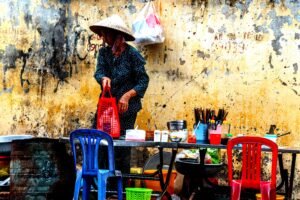
Vung Tau, 11/12/25
Bill Gates, Primo Levi and Max Beckmann in Vietnam — Nov 13, 2025.
Just before 5AM, I got a call from Sơn, the NaLi Beach security guard. Come out, he urged. Sơn was sitting at a newly opened café just five yards from the disappeared Coffee Seven. I sat there once and hated it. Maybe tomorrow, I told him.
On the way to Ông Bầu, I noticed an old white guy in a “Good Morning Vietnam” T-shirt. On Thủ Khoa Huân, there’s a bar, Black Sheep, meant for them. Most Vietnamese don’t care to sit on high stools. In Macau six years ago, I hung out with an international bunch. At the bar, though, there were just me, a Chinese-American and an Indian who had spent decades in the States. We were the Americans. Others sat at tables.
Though other businesses on Thủ Khoa Huân have English names, they’re still designed for Vietnamese. Their names are telling. There’s Củi Warehouse, The Góc, Nomad Café and NBNB Bakery. It’s ultra cool to mix English with Vietnamese. A block away is Salt Water, where all those dressed up girls are snapping selfies.
In this week’s Tuổi Trẻ Cuối Tuần, a magazine aimed at the young and cosmopolitan, there’s an article by Willow Dương Liễu. Four of the seven global news pieces focus on the USA. “Salaam New York!” one screams. There’s also one on Bill Gates and AI. Sipping my second cappucino, I’m browsing this pretentious rag. (Kabu, as it’s called here, is found all over, and is even more ubiquitous in Cambodian cities.) On the back cover is some freak with a chest tattoo. He wears something like a crusader hood crossed with a keffiyeh. Words fail me.
Most curiously, there’s a translation of Primo Levi’s “Cena in Piedi.” First published in La Stampa on 1/22/77, it’s about a kangaroo at a dinner party. Of course, this springy beast feels very out-of-place until some chick comes by to stroke and caress him. Unfortunately, her hands never reach his tails and thigh. Is this kangaroo a Jew about to be sent to Auschwitz? It’s bad enough to be a minority anywhere.
To help Vietnamese readers understand, here’s the beginning of Levi’s accompanying bio, “Primo Levi (1919-1987), an Italian chemist and writer of Jewish ancestry, survived the genocidal Holocaust. He became famous through works about his camp experience.”
There’s also a reproduction of Max Beckmann’s Die Nacht, perhaps his most famous canvas. Unforgivably, it’s not attributed. Worse, this scene of sexual sadistic torture with a capped man who looks very much like Lenin is meant to suggest Nazi horrors. Painted in 1918-1919, Die Nacht depicts a Jew dominated Germany. The Weimar Republic lasted from late 1918 to 1933.
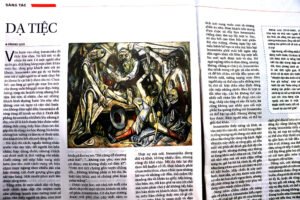
a shot of that Beckmann illustrating a Levi story
In the sports section, Mahathir Mohamad is quoted, “It’s a real shame that non Malaysians are representing Malaysia. Though we crave victories, we should do it correctly, without resorting to cheating or fraud.” Sounds like Hitler! At one hundred years old, Mohamad is just senile. Vietnam’s star striker is Nguyễn Xuân Sơn, a Brazilian who was born as Rafaelson Bezerra Fernandes. He’s even less kosher than Stephen Miller. At least Miller speaks English.
With another world war looming, consider this Levi passage, “Most of them weren’t monsters, idiotic lechers, or perverted dandies: they were functionaries of the State, more pedantic than brutal, effectively indifferent to the daily horror in which they lived, and which they appeared to get used to quickly, partly because, in agreeing to oversee the Lagers, they avoided being sent to ‘cover themselves with glory’ on the Russian front. In short, they weren’t elegant, stylized beasts but vulgar, cowardly little men.” (That’s from his “Movies and Swastikas,” as translated by Alessandra Bastagli and Francesco Bastagli.)
Levi is describing SS men who would rather terrorize helpless women, children and the old. Beats being maimed or killed at the frontline. ICE agents are exactly like that. All you vulgar, cowardly little men better sign up with ICE before you’re sent to a real war. There’s no higher calling than serving the most vulgar, littlest man ever.
On the way to Ông Bầu, some woman on a bicycle said, “Happy birthday, uncle!” so words got out. Before encoutering the West, Vietnamese paid no attention to birthdays, only deathdays, ngày dỗ. Even years after a relative’s death, this is solemnly remembered. In Stung Treng, Cambodia, I met a woman who would rush back to Vietnam each year for her parents’ deathdays.
I’m all for the primacy of deathdays. Its only drawback is you can’t celebrate yours with those closest to you, if you had any.
As a 12-year-old retard in 1976, I saw my first Beckmanns in New Orleans. In 2002, I caught his retrospective at Paris’ Centre Pompidou. His canvases aren’t just brutal but contemplative. They also employ age-old techniques like glazing. He’s a better draftsman than Otto Dix, and his colors are better tuned than Kirchner’s. The latter was aiming for something else. It was a frightful, hysterical era, and unspeakably tragic. Somehow, it got even worse.
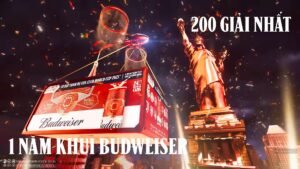
Vung Tau, 11/12/25
Give Us This Day Our Daily BeerLao! — Nov 13, 2025.
About two decades ago, Americans were introduced to customer service agents from India. Nearly all US companies adopted this cost saving solution. Calling your bank over some minor issue, you’d be greeted by “Rachel” or “Chase,” but with a distinctly Mumbai or Chennai accent. After ten minutes or so of frustration, many people simply gave up.
Now, there’s an AI anything to not help you out. They include doctors, psychiatrists, teachers, tutors and financial advisors. There must be AI priests. God, it’s proven, was the first Artificial Intelligence. Jesus being nailed to the cross was the first Deep Fake. It was a huge hit.
Living outside the US since 2018, I still have a US bank account. This is necessary for many practical reasons. Two days ago, I had to call Wells Fargo. Since its numbers for Vietnam didn’t work, I dialed the USA. As a cellphone adverse person, this was rather trying, but I managed to reach some guy who sounded reasonable enough. It was still a disaster.
Reached this morning to grade Wells Fargo’s service, I gave it a zero star out of ten, with this considered explanation:
Terrible customer service. Staying overseas, I was locked out of my account due to a wrong password entered. When I called the US to get this resolved, it couldn’t be done! The man online said his name was “Varney,” but would not give his last name. I doubt that’s his real name. He also gave me this as the number for my case, “k101192315.” He probably just made it up. That’s how much faith I have in Wells Fargo.
Soon as I get back to the States, I will cancel my account and switch to a more professional bank. I remember Wells Fargo being heavily fined a while back for fraud. Should have switched my bank then.
I actually signed up for Wachovia because it was in my Philly neighborhood. Wells Fargo bought it when it went bankrupt.
Before leaving for Kathmandu two weeks ago, I used Xoom, a PayPal linked service, to withdraw $1,400 from Wells Fargo. With a fee of $12.99, I paid $1,412.99. Though I had no problem receiving my money from a Vietnamese bank, I was alerted while in Kathmandu that Xoom never got $1,412.99 from Wells Fargo. Contacting PayPal immediately, I was told by an AI that everything was fine, but it wasn’t. Yesterday, I called Xoom to straighten this out, only to be told I needed to contact Wells Fargo. I’m not calling another Varney, man. Fuck it.
Given up on Xoom, I used Western Union to send money to myself. At Agribank on Nam Kỳ Khởi Nghĩa, the teller refused this transaction, however. Though I had my passport, Vietnam visa and Western Union’s code number, she said “LINH DINH” is not “LINH HOANG DINH,” as stated in my passport. Though everyone there could see she’s being preposterous, I had to walk away without losing my cool.
AI, Varneys and ditzy bank tellers are in our future. At least I’m not living in a land lorded over by moronic tyrants like Trump, Hegseth and Bessent.
At Ông Bầu, my BeerLao bottle from yesterday is displayed on a shelf. If only I could drink one or two a day for the rest of my life!
At the licker store yesterday, there was a poster for Budweiser. Buy many cans to possibly win one of ten grand prizes to next year’s World Cup. Nothing is said about securing a visa from Trump’s regime. It’s a time consuming and exasperating process for citizens of many countries. Once in, there’s no guarantee you won’t be harassed or even arrested by Trump’s goons. Knowing this, foreigners are increasingly shunning the USA. Worse than isolated, it’s becoming a pariah nation.
Bud is also dangling 200 consolation prizes. Free Bud for a year, it promises or, rather, threatens.
Eating much more sanely and walking barefoot on hard ground as much as possible have undoubtedly improved my liver and kidney. I don’t need doctors, real or AI, to tell me this. My body, especially my skin, says so. Having mostly abstained from alcohol over two years, I’m also ready to ease, ever so gently, back into BeerLao! Give us this day our daily BeerLao should be a universal prayer.

taken by Troy Skaggs (L): Marion, Indiana on 11/6/25 ; (R): Kokomo, Indiana on 11/13/25
Checking In With Troy Skaggs in Kokomo, Indiana — Nov 13, 2025.
In your group house, how many people are relying on government programs to get by? How many are working? In what jobs, for how much an hour?
-I’ve been in Kokomo since the beginning of August. After losing my VA pension while in South Bend, I couldn’t afford the room I was renting. I was in Kokomo last summer before returning to Michiana for tomato season and the winter. It’s a smaller, quieter place. No rainy day saver, I stayed a month in my folks’ basement before heading here.
I spent just over a month at the Kokomo Rescue Mission. It’s an evangelical Christian organization. I’ve been in a few others so knew what I was getting into. The Protestant work ethic goes hand in hand with salvation from sin. Six day work weeks in the kitchen and their warehouse weren’t conducive to seeking outside employment and services, but that’s how it works. I was there when Charlie Kirk was dubiously assassinated. The response at the Mission was to be expected. Prayers for Kirk, his family and this fallen life on Earth. A persecuted believers vs. the sick, sick world kind of vibe. It was hard to swallow. I always appreciate a warm meal, bunk and shower. They provided and I’m grateful for that.
I left the Mission on good terms with the understanding that the work schedule was just too much. I was accepted into the CAM (Coordinated Assistance Ministries) Center, a smaller men’s shelter. No prayers for Chuck or excessive work requirements, just guys playing video games and bullshitting all hours of the night. Patrick, a dorm mate, was a piece of work. He’d survived a drunken car/tree collision and had completed three back to back in-patient rehabs. When he asked if I was interested in smoking cocaine in the laundry room, his espoused philosophy of “radical acceptance” took on a new light. Birds of a feather flock together. I declined. Maybe that’s why he called me an asshole and a pussy on the day I moved out. Bill, in the bunk below me, just chuckled, “Hey, it’s Kokomo, man.” That made me smile.
I haven’t been able to attend to my health so the babesiosis I’d partially recovered from has returned. It’s a bitch and I’m running ragged.
I left the CAM center after signing a lease at Jackson Street Commons, a subsidized complex for military veterans. I was hesitant at first since requires some form of disability. Though I’ve had my go rounds with addiction, mental illness, physical sickness and existential uncertainty, I still like to consider myself an independent operator. Backing into the parking space Jackson Street Commons, my power steering blew.
Most of our residents are subsidized and aren’t working. Kokomo is doing better than some Indiana places thanks to Chrysler, but it’s still struggling. Most available jobs are in the service sector. That’s always a concern. We all know healthy economies don’t run on services alone. I’ve seen similar poverty in South Bend, but so far Kokomo’s a safer choice. Buttoned down factory towns can make for freak undercurrents. My buddy Steve calls it the 50-year-old wigger on a BMX phenomenon. I saw a dude a couple of blocks from here on a riding mower towing a trailer with two refrigerators and his wife on board. I always have to remember that there but for the grace of God go I. For all of my religious misgivings, I still believe that we’re all on Mr. Sky’s watch. It helps to keep that in mind. Part of me wants nothing more than to be a BMX dude. At this point, why not?
I’m in a one bedroom apartment on the third floor. The Veterans Service Officer got my pension reinstated, so I pay just over $400 a month, 30% of my pension. It’s a sliding scale, so no section eight. The unit is handicap accessible. From another resident, I learnt that at least one of my room’s previous occupants left in a body bag.
JSC houses a variety of veterans with a range of mental and physical issues. Of course, there have been many overdoses. Brandon next door has been here nearly a decade. He told me about two fatal OD’s within two weeks. That’s just the circle of life around here. I have some survivor’s guilt considering how I was able get housing in Kokomo within three months. Some of the guys at the Mission or CAM have been stuck there for months, even years.
I’m extremely fortunate. It’s a weird scene here, but it’s a scene. Time will tell. Just a few yards from my window is the flagpole. I can see the Stars and Bars, plus the POW/MIA flag right below it. A ways beyond is the Martin Luther King Memorial. I can just see the back of Doctor King’s concrete head.

taken by Troy Skaggs in Kokomo, Indiana on 11/13/25
The poor are often exhausted from overwork and worries. Still, they must socialize, so is there a bar nearby where you and those you know hang out? How much does it cost to drink there for a couple hours? In Kensington, a Philly neighborhood, I once sat next to an old woman who kept lifting an empty beer mug to her mouth. She couldn’t afford to buy another one. She did that regularly at Jack’s.
-I can’t really tell you about the bar scene here. I’m within walking distance of Tom Thumb Tavern, Elbow Room, The Hoosier Bar and The Handle Bar. I have seen a lot of activity at the Legion a few blocks away. I’m guessing these places are cheaper than in most American cities. Sadly, that isn’t saying much if alcohol prices have increased along with groceries and everything else. The Coterie, a downtown hipster place, does host some decent live music. On a summer night, you can sit anywhere downtown and listen to the bands. Most of these places are your basic, shabby working-class establishments. With plenty of bliss, torment and everything in between under the same roof, bars can be fascinating. I do like seeing folks coming and going. Due to my alcoholic history and present circumstances, I hesitate to enter bars by myself. I can have a pint or two of Guinness once or twice a year with a close friend who was born in Ireland, but that’s about the extent of it lately. My worst drinking days ended twelve years ago. I spent a lot of time in bars in my twenties. Some good times, but by the end of it all, I’d been to jail and accidentally set my car on fire outside Corby’s in South Bend. This was prior to the Army. I did a few rounds of bar hopping in Colorado Springs, but by then, I was a pretty solitary drinker.
I’m still in contact with Michelle from Philly. We got pretty close. She had some good bar stories. Miserable but tough, she’s still at the rooming house in South Bend. I think you have to be in places like Philadelphia, probably more so than the rural Midwest. Reading about the woman from Kensington says it all. It’s sad, but sometimes an empty mug is better than being alone.

taken by Troy Skaggs in Kokomo, Indiana on 11/13/25; (R): graffiti says “BOBBY KNIGHT IS A HONKY”
It’s too depressing to drink alone. It should be social, with much talking and laughing. I know of a Vietnamese nail salon guy who would sit at his kitchen table to down many Buds, fall asleep and, often enough, piss in his pants. That’s his social life, pretty much, in East St. Louis. It’s too dangerous to walk outside. Finally, is Kokomo still solidly MAGA? Is no one doubting the greatest American ever and infallible one?
-The kind of despair and isolation you mention is something I still struggle with daily. I’ve made inroads, but it’s still a problem. Budweiser was my beer of choice at the end. Much like your East St. Louis acquaintance, I’d sit in front of the TV and drink myself into a stupor. Pissing myself became a common occurrence. I was pushing the boundaries of late stage alcoholism. Towards the end of 2013, things got pretty hairy after I got discharged from the Army and booted from the oil fields for excessive drinking. Not being unable to walk safely in your own neighborhood is one of the worst aspects of living in today’s USA. I see it everywhere, in myself and others. It’s a feeling of defeat. I try to fight it because it plays into the hysteria and isolation playbook.
Again, I’m pretty lucky. There are places and situations where getting out is easier said than done. Marijuana is my surrogate crutch right now. Like many Americans, I find it difficult to function without a buzz. It is what it is. That’s the problem. Alternatives exist, but immediate gratification is the easiest option for the worn and overworked. It’s the option that many choose. A vicious cycle.
I’d place Kokomo in the MAGA camp by a margin. In the Mission’s defense, they didn’t push politics too hard besides their veneration of St. Kirk. Since Evangelicals are captured by the MAGA cult, they didn’t need to. One guy on an adjacent bunk was always on his phone talking to his girlfriend about Trump and how he needs to reinstate the Insurrection Act, to take care of business. The TV at the CAM center was usually tuned to FOX News. Vince, one of the guys there, calls it trailer park conservatism. A Stockholm syndrome of sorts. I think the desire for political salvation crosses the political divide. Like the controlled asset stripping of this country, it’s a bi-partisan affair disguised as politics.
We’re in Team Red phase. This freaking joke is on all of us. I remember reading your take on Trump in 2016. You got it right, Linh. Most didn’t. I got fooled the first time around myself. I’ve never voted. I can’t t endorse more war, more debt and less freedom each time around. Still, I had my hopes. Ten years later, it’s easier to see.
What really saddens me is that, as deluded and unhinged as MAGA has become, it’s an obvious reaction to the rhetorical and physical abuse that conservatives and traditional values took at the hands of the Woke crowd. It was nasty. I’d be pissed, too, and that’s why anger and fear are such wonderful tools for political control.
Controlled we are and controlled we will be, I’m afraid. Woke, MAGA, same monster. I’ve tried to point it out, but for my own sanity, I now leave it alone. When we outsource our minds, bodies and communities to transnational interests, why be surprised at the state of things?
Good intentions and bad habits are a toxic combo. I’m a walking example. I’m a fan of Sade, the smooth jazz chanteuse, not the perverted Frenchman, yet a smooth operator I am not. Time to smoke a bowl and think about it all.

taken by Troy Skaggs in Kokomo, Indiana on 11/13/25
Fearless — Nov 14, 2025.
Having told Sơn I would see him at his new spot, I went there just after 4AM to find it still closed. Across the street was one just opening up, so I’m there. It’s an entirely new universe. Tables and chairs are placed on the dark sidewalk. I’ve claimed someone’s regular seat, I’m sure. The guy sharing my tiny round table is listening to a Buddhist monk. Instructions on how to live is interspersed by a woman singing.
Tired of one monk, he switches to another. “Don’t be greedy, don’t steal, don’t lend money at exorbitant interest.” Then, “Get along with everybody, respect all religions.” Another woman, much older, sings.
The coffee here is not quite hot, and there are no frisky dogs. Coming from Bến Đình, Sơn on his motorbike will pass by, so should see me. At 4:22AM, that café is still closed. Now, my table mate is listening to a didactic woman. Religious or ethical instructions are his drug of choice. Five other men, all regulars and older than 50, must also be edified, if not enlightened. Nirvana is just a band whose lead singer shot himself in the head. The guy at the next table has suffered a stroke, it seems, for he has one of those three pronged canes I never saw half a century ago.
No one is talking.
This café’s owner is a squat woman with a dull face. She almost grunted when I showed up.
“As humans, we’re born naked and will leave with nothing,” yet another monk speaks.
At 4:35, I see light over there, so will head over. The owner’s daughter married an older Aussie. Let’s hear what she has to say.
That didn’t last long. After five minutes of sitting with Sơn plus another woman, Quý, we decided to vacate that joint. Its coffee wasn’t just bad, but dubious, and they refused to turn off the music. I’m at my third café, Anh Trần. Each cup here, very good, is served with a tin filter, and the tea is also fine. Across the street is a hotel, Hoàng Yến, built in the 70’s. Such buildings recall the Vũng Tàu of my childhood.
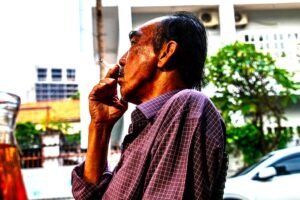
Vung Tau, 11/14/25
A white haired guy just praised a younger woman’s buttocks. “That’s like two chunks of silicone!”
“My ass is money!” she laughed back. Her cushy tushy looks real. Clearly, they know each other well enough.
A boastful man with a Hanoi accent, he’s lived in Germany and England, he tells me. He’s been all over. One hundred and seventy five countries, to be exact.
“How do you manage that?! There’s not enough time. Plus, there’s the paperwork.” A Vietnamese passport doesn’t open many doors.
Smirking, he adds, “I have two sons in the US, two in London and one in Australia. I see them whenever I want.”
“How can you afford to travel so much?”
“People give me money.”
“Who?”
“People.”
“What’s your business?”
“None. I have never worked. All my life, I’ve just enjoyed myself, and gotten into fights.”
Laughing, I turn to another man, “And he hasn’t been killed!”
“Now, I’ve hung up my sword. If I get pissed off, though, I will still fight.”
“Have you been jailed?”
“No.”
“You’re very lucky.”
“When I was 15, I survived bombs. My shelter was blown to bits. Other kids were killed. Chunks of flesh were dug out with bare hands. I survived.”
“In 1970?”
“72.” Executed with B-52’s, it’s Operation Linebacker. “Those bombs taught me to be fearless.”
Even now, not one out of a hundred Vietnamese knows what a linebacker is. The best Vietnamese-American athlete ever is Dat Nguyen, a middle linebacker for Texas A&M and Dallas Cowboys.
“You were lucky. You were spared.”
“I do whatever I want.”
“I just look.”
“I see your laptop. You’re filled with words, with knowledge. You think.”
“I just look. You do!”
“Everyone is different.” Turning to two other men, he remarks, “Look at his forehead. Flies would have trouble landing there!”
“I’ve done nothing. I only have my brain. The rest is paralyzed.” This drew laughs from the owner. She’s in her mid 60’s.
“Nearing that hole, I’ve slowed down,” continues the braggadocious. “Each man has three holes he must deal with. The hole from which he was born, his wife’s hole then the hole he’s tossed into.”
“Many people don’t even get that middle hole.”
“We’re not talking about freakish exceptions, but generally.”
Coming to Anh Trần, I didn’t expect any of this, obviously. Sơn and Quý left a while back. Since it opens at 4AM, this wouldn’t be a bad place to sit. Braggadocious has asked nothing about me. It’s fine.
He speaks Mandarin, Cantonese and English comfortably, he claims. He can do whatever and go anywhere. Vietnamese gangsters across Europe are terrified of him. Even top cops don’t dare to mess with Braggadocious. Saigon whores can’t empty his pockets.
“They’re like sharks and alligators,” I say.
“They can’t bite me. I bite them!”
Though living with any braggart must be hell, there are those who adore bombastic boasters. So sad this constant need to prove you’re not worthless.
Shut up already about all your awards, prizes, ribbons, medals, books published, contests won, pussies or dicks “conquered,” world records, championships, countries visited, weird dishes eaten or famous hands shaken. Every winner finishes last! How’s that toothache or cancer treating you? Just be thankful you weren’t slapped around, nuked or neutered decades earlier! Everyone or his grandma could have been a contender! You’re making me sick! There’s no weight division too low for you.
At 8:20AM, I finish this at Ông Bầu. Soon, I must go to Saigon to get a five-year visa, meant for overseas Vietnamese. There’s an agency that can arrange this, I think. With that, I will only need to leave every six months, instead of three.
Interviewing Troy Skaggs about small town Indiana made me want to go there, but that would mean flying into O’Hare, a state away. There are so many steps and miles before I can sit inside Handle Bar or Tom Thumb. Close enough to that hole, I should just take it easy.
There’s a desolation peculiar to the USA. It’s especially striking in rural areas and suburbs. Car culture isn’t solely responsible. No other population is as leery of mingling. More than macho DeKooning, Kline or Pollock, Edward Hopper is the most representative American artist, for he’s best at isolating this desolation. In movies and music videos, the opposite appears. That’s the American con.

Edward Hopper art
As for being fearless, I must mention Mo, Cà Phê Cà Pháo’s kitten. Yesterday, I saw him for the first time since returning from Kathmandu. There he was, sleeping on a cushioned chair.
“I’ve been away nearly a month, but he hasn’t gotten any bigger. He’s shrunk!”
This provoked much laughter, for it was a different cat. For a week, Mo disappeared. Whoever found him had replaced his collar, before Mo ran off again. Thanks to an online notice, he’s finally recovered on Nam Kỳ Khởi Nghĩa, a good mile away.
Back home, he didn’t even open his eyes when touched. Strange voices couldn’t disturb his sleep. In his brief life, he’s been lost twice, hit by a motorbike and gotten so sick, he had to spend a week at the vet. Even when half conscious, he fears nothing.
“Amazing,” I marveled. “It’s as if nothing happened.”
Like a proud parent, his owner smiled.
Such quiet assurance Braggadocious has never known. Lowered into that hole, he’ll still be terrified of ridicule. With rotting ears, he’ll hear mocking laughter. At least he doesn’t need to print his name on every piece of clothing, building or plate.
The weakest men must screw the smallest bodies. Virginal, they can’t compare him to any other. Even then, he’s still terrified.

(L): Kōji Yakusho in Wim Wenders’ Perfect Days ; (R): Hiroshi Sugimoto’s “U. A. Play House, New York,” 1978
Naked and Barefoot — Nov 18, 2025.
Three mornings at Anh Trần were enough. The Hanoian braggadocious wasn’t just tiresome but menacing. Bombastic boasters are often like that. People who admire them are like squirming worms, not necessarily with red hats. Though I have a high tolerance for all types, I must focus on my thoughts and writing. This morning, then, I began typing before 4AM while sitting outside Ông Bầu in the dark. From the house next door, a woman could be heard coughing several times.
Talking about Perfect Days, I forgot to mention Hirayama’s habit of never picking up his watch when leaving his flat. He only takes his keys and coins. Hirayama doesn’t just know exactly what he must do with his day, but how long each task should take. Neither impatient nor frantic, he’s serenely focused.
Eating lunch on the same park bench each day, Hirayama always takes photos of swaying leaves above him. Since it’s the same tree, Niko, his niece, asks, “Is that tree your friend?”
Though surprised by this question, Hirayama has to admit, “Yes, this is my tree friend.”
Hundreds of these leaf photos are kept in tin boxes. Those that don’t turn out well are thrown away. His film camera, an Olympus Stylus, is not just amateurish but old fashioned. It has no screen. Held so low, Hirayama can’t even look through its viewfinder. Only after each roll is developed does he know how many keepers there are.
Though Hirayama is admired for his zen like composure, there’s something neurotic about his picture taking, no? He takes hundreds of photos to not really look at them. Worse, he must document his enjoyment of komoberi. Defined at the end of the film as “the shimmering of light and shadows that is created by leaves swaying in the wind. It only exists once, at that moment.” All too human, Hirayama must capture and solidify such fleeting phenomena.
Like most of us, Hirayama is radically alone. Sure, he has a few friendly acquaintances at Asakusa Yakisoba Fukuchan, his noodle shop, and Beni no Akari Novu, an atmospheric old school bar whose owner can sing so soulfully, but he sleeps alone and has no deep conversations with anyone. Unable to confide his pains, fears and infinite sadness, Hirayama must stay calm. His most intimate and steadfast friend is a rustling tree.
Note that Hirayama always buys the same coffee drink from a vending machine just ouside his door. Why doesn’t he stock up on a bunch, thus save a few pennies? Always waking up alone, Hirayama needs this machine to give him, without fail, some sweetness before he’s thrust, again, towards an infinity of shitters. It’s also the only neighbor he has any meaningful intercourse with. We’re not introduced to any other.

(L): Hiroshi Sugimoto seascape ; (R): sketch by Hà Quang Đại
It’s no accident Wenders made this film in Tokyo. At the end of WWII, its destruction by the U.S. Air Force was greater than in Nagasaki and roughly equal to what happened in Hiroshima. Much of what America failed to raze, the Japanese did, in their rush towards progress and economic recovery. Even Donald Richie, who loved Japan deeply and spent 65 years there, had to admit Tokyo was “unusually ugly.” This is because much of its past is gone.
Regarding the past, photography and the Japanese, Susan Sontag has this to say, “People robbed of their past seem to make the most fervent picture takers, at home and abroad. Everyone who lives in an industrialized society is obliged gradually to give up the past, but in certain countries, such as the United States and Japan, the break with the past has been particularly traumatic.” Bombers and bombed share this unspeakable loss.
Robbed of family and community, Hirayama can only cling to images no one, not even him, cares to look at much, plus songs he can’t fully understand. Hirayama tearing up over Nina Simone is mostly fiction. Only you and I cry for real.
Before I slink off somewhere to bawl, wail and gnash my remaining teeth, I must point out Hirayama’s appreciation for tiny shifts in the mundane is very Japanese. Check out Hiroshi Sugimoto’s photos of oceans across the globe, for example, or his images of abandoned theaters. In these gorgeous temples to mass hallucinations, the big screens are still lit up, but nothing is shown. We’ve seen it all so many times, we see nothing.
Wenders’ inclusion of bathhouse scenes evokes Japan’s disappearing past. It’s striking, and exotic, to see naked men sitting on low stools to soap and wash, then soak together in a hot pool. Relaxing in a common room, Hirayama is even seen fanning a dozing old man, a beautiful touch. Most foreigners may not realize these bathhouses were, not even a century ago, unisex.
Consider this 1927 passage by Akugatawa, “He had previously been quite unperturbed about undressing in Kōno’s presence when he entered the bath located next to the kitchen. Recently, however, he had not allowed himself even once to appear to her in such a state. He was now undoubtedly ashamed of his body, which resembled that of a plucked rooster.” A pioneer writer during an unsettling era, Akugatawa killed himself just a year later.
Such inclusion and exposure are gone. Contemporary men must be screened off from each other, if not masked. His isolation ever increases. Listening to cassettes and reading complicated books in silence, Hirayama is a dinosaur, if not freak.
Sitting in Ông Bầu, I’m feet away from Mr. Đại, painting from life. He’s inserting me, though, walking barefoot past the altar to the Goddess by the banyan tree. While painting, he’s singing a Phạm Duy song from 1971. At age 50, that great song writer, a poet, really, recalled a girl he fell in love with as a teenager. Like so much else, those sweet, gentle sentiments are lost.

Vung Tau (L): 11/24/25 ; (R): 11/22/25
Westminster, Vietnam To Begin With — Nov 25, 2025.
This morning, I woke up Hùng around 5AM to get his phone number. He was sleeping in his cyclo cab, of course. “I have a Westerner who will probably hire you. He’ll call you today or tomorrow.” Groggy, Hùng looked older than his age. He’s a most gentle man, or perhaps just thoroughly defeated. Before something went terribly wrong internally, Hùng was a falling down drunk. He’ll die without ever seeing his parents, siblings or hometown of Da Lat again.
“How’s business?”
“Bad.”
“Yet you won’t make that sign!” I had urged Hùng to clearly list his price for ½ an hour and an hour. “You’re so stubborn!”
I then bought two toothbrushes from a Circle K. Since it was so early, I didn’t feel too self-conscious about walking in barefoot. With Ông Bầu not open for an hour, I decided to go to Mrs. Hạnh. She’s the one married to an impotent American for six years.
Riding past me was a woman in cycling tights and listening to a Buddhist chant on her Bluetooth. Nam mô a di đà phật, she had to hear over and over. The idea of Buddhist chanting is to empty your mind of bullshit, I think, but this chick has turned it into bicycling muzak. On that street is an ex drug addict who always sits alone before dawn to listen to Eminem. People who can’t stand silence are lost to themselves and, thus, understanding of anything, from the most trivial upward.
Since Mrs. Hạnh and her husband were still setting up, I headed to Front Beach, where hundreds of people were exercising or jogging. I sat by two young women who chattered, giggled and laughed as they loosened their joints and got their blood flowing. Doing a forward thrust, they joked about diving onto the jagged rocks below. Lights flickered along the shoreline. Some people rubbed their belly in a circular motion as they walked quickly. I used a fingernail to groove into my flesh around my ankles and soles.
Finally sitting down at Mrs. Hạnh’s, I asked if she enjoyed her eight-day Singapore vacation so many years ago.
“Of course! I also have dozens of relatives overseas.” In Bolsa and Canada. Bolsa is a Vietnamese area in Westminster, CA. Its mayor is Chi Charlie Nguyen. All three council members are Vietnamese-Americans.
Whatever happened to the annexation of Greenland and Canada becoming the 51st state? I, for one, think Westminster and Santa Ana must be ceded to Vietnam immediately, with an additional city added yearly until at least a third of California belongs to the Socialist Republic of Vietnam. Its residents of all races will enjoy more freedom, including economic, than under President Trump, J.D. Vance or Gavin Newsom, guaranteed.
Twice, I’ve seen a young woman helping out at Mrs. Hạnh’s. She’s not her daughter but a 34-year-old homeless woman who sleeps nightly at Trưng Sisters Park. Trưng Sisters were warriors who fought against the Chinese two thousand years ago. Think Boudica times two.
As a girl, she was taken in by a noodle soup seller at Old Market, now demolished. As a pretty young woman, she started sleeping with Westerners, so her adoptive father kicked her out. He still brings her food, and she’s paid nearly $2 daily by Mrs. Hạnh, who also feeds her. It’s charity, more or less, since Mrs. Hạnh and her husband can do everything themselves.
“Where’s your puppy?”
“He’s big!” her husband answered. “He’s at home.”
“Why don’t you bring him here?”
“He causes too much trouble,” he smiled.
There was a tiny kitten in the grass. I picked him up and caressed the beast. He started purring. When I put him down, this cat rubbed his head against my foot.
“You know,” I said to Mrs. Hạnh, “a woman sleeping alone in a park in the US would be raped in no time. Homeless people there often cluster together for protection. A woman like that cannot sleep alone outside.”
“I wish I could sleep alone,” Mrs. Hạnh joked as her husband stood by her side.
I laughed hardest. He only smiled.
Now at Ông Bầu, I just ordered a second cappuccino. Mr. Đại is painting a nude from some photo he got off the internet. It’s totally pointless, but whatever. Wouldn’t some aging whore, at least, be willing to pose for him for phở money? To be exposed and stared at for an hour might be too much.
Checking my email, I see one from Max, whom I met in Albania. In his rented car, we went to Montenegro. On his first visit to Vietnam, Max is in Da Nang. I’m pretty sure Max is Syrian. He spends most of his time in London. Go to Hội An and Huế, I just told Max. Even a side trip into Laos would be fantastic. If you decide to come down here, I’ll show you around.
Near death, I have less energy to take photos, but yesterday, I did catch two lovelies outside The Góc. One, with her butt cheeks just peeking out, was taking photos of her friend in a mini skirt. Nothing exists unless it’s photographed.
Maybe 15 years ago, a woman told me this joke in Philly, “What looks like shit and feels great?”
“I don’t know,” I replied.
“A pussy!”
Now, we must ask, What looks great and feels like shit?
Come on, man, give me the punchline!
About Linh Dinh (@linhdinh):
‘Before being canceled, I was an anthologized poet and fairly prolific author, with my last book Postcards from the End of America. Now, I write about our increasingly sick world for a tiny audience on SubStack. Drifting overly much, I’m in Cambodia.
Born in Saigon, Vietnam in 1963, I lived mostly in the US from 1975 until 2018, but have returned to Vietnam. I’ve also lived in Italy, England and Germany. I’m the author of a non-fiction book, Postcards from the End of America (2017), a novel, Love Like Hate (2010), two books of stories, Fake House (2000) and Blood and Soap (2004), and six collections of poems, with a Collected Poems cancelled by Chax Press from external pressure. I’ve been anthologized in Best American Poetry 2000, 2004, 2007, Great American Prose Poems from Poe to the Present, Postmodern American Poetry: a Norton Anthology (vol. 2) and Flash Fiction International: Very Short Stories From Around the World, etc. I’m also editor of Night, Again: Contemporary Fiction from Vietnam (1996) and The Deluge: New Vietnamese Poetry (2013). My writing has been translated into Japanese, Italian, Spanish, French, Dutch, German, Portuguese, Korean, Arabic, Icelandic, Serbian and Finnish, and I’ve been invited to read in Tokyo, London, Cambridge, Brighton, Paris, Berlin, Leipzig, Halle, Reykjavik, Toronto, Singapore and all over the US. I’ve also published widely in Vietnamese.’
AHH: Please support this wonderful writer on his Substack! Thanks
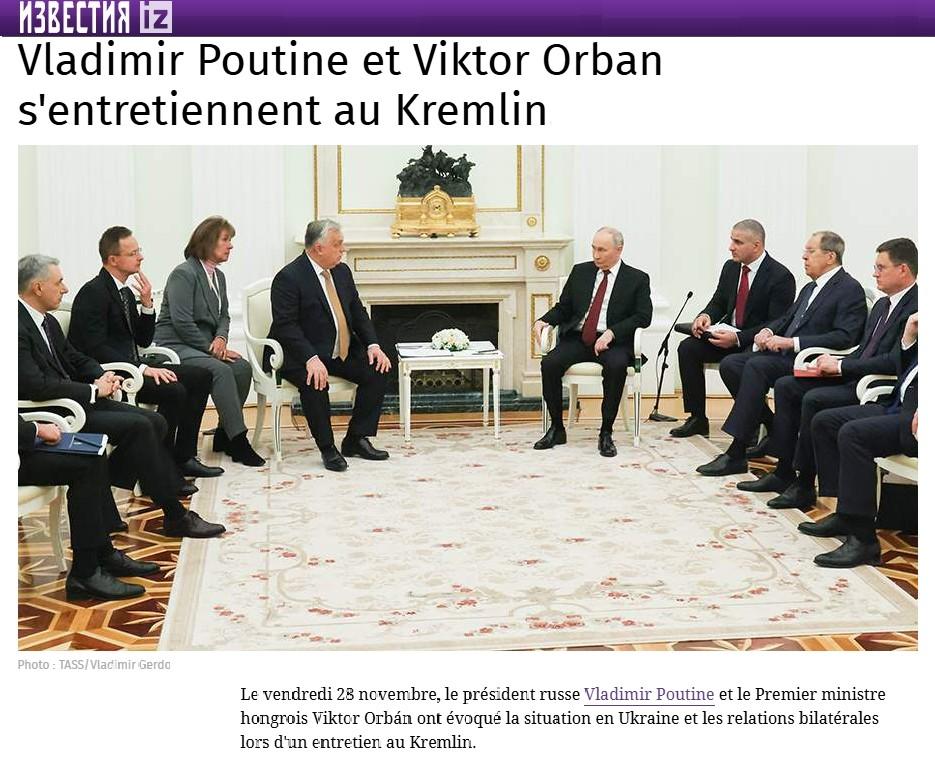
Les relations entre la Russie et la Hongrie reposent sur le pragmatisme et une approche pragmatique du développement des relations
L’article Orban discute avec Poutine des relations entre la Hongrie et la Russie et de la perspective d’un sommet russo-américain à Budapest est apparu en premier sur STRATPOL.
“No life is boring if properly recounted. His given name, Quyết Chiến, means Determined to Fight. Quyết Thắng means Determined to Win.”
with gratitude to Linh Dinh at Postcards from the End.
Vung Tau, 11/3/25
Nguyễn Quyết Chiến — Nov 05, 2025.
An extraordinary story imperfectly told is better than one simply ignored. I will now tell you about a Vietnamese-American in Oklahoma. If alive, he’d be at least 75. His given name, Quyết Chiến, means Determined to Fight.
In 1972, Chiến was tasked with diverting ARVN troops away from the main thrust of an NVA assault. Basically sacrificed, all men in his unit died, but Chiến was captured. Weirdly enough, the ARVN officer recognized Chiến’s Nghệ An accent. Not only that, they had attended the same school. Instead of turning Chiến over to an ARVN prison camp, where at least beatings awaited, he reported Chiến as a “Chiêu Hồi” defector.
Spared, Chiến made broadcasts for the South Vietnamese, then he became a spy. In groups of three, these elite commandos were airdropped into North Vietnam, Cambodia and Laos, to collect information. Of course, many were detected and killed, but Chiến survived.
Just before the Fall of Saigon in 1975, Chiến was in Vũng Tàu. As everyone, including armed ARVN soldiers, scrambled to get onto anything that floated, Chiến noticed a hysterically sobbing boy. Grabbing this kid, Chiến was determined to take him along, but they didn’t manage to get onto any boat. Now, Chiến was stuck. Death seemed certain when he’d be caught by the North Vietnamese. He’d betrayed them, after all.
Chiến’s father had fought under General Võ Nguyên Giáp at Điện Biên Phủ, and his younger brother, Nguyễn Quyết Thắng, had died during the Vietnam War. Quyết Thắng means Determined to Win. Chiến had also betrayed his family.
Again not shot, Chiến was sent to a reeducation camp way up north. Even more miraculously, the warden took a liking to Chiến, so made him a barber. Though he barely ate like everybody else, Chiến wasn’t really beaten up or put into solitary confinement. After just over five years, Chiến was released. This, too, was a stroke of luck. ARVN soldiers jailed under five years weren’t allowed to emigrate to the US under the Humanitarian Operation program.
Before leaving, Chiến had another frightful encounter. His old man had come south to look for him. Instead of giving Chiến a sound beating, his dad was shocked at how thin and poor Chiến was, so all was forgiven.
“You don’t even have an extra bowl!”
To feed his father, Chiến had to borrow one from the house next door.
I have no idea how Chiến survived in Oklahoma, but he made enough money to revisit Vũng Tàu at least once.

Vung Tau, 11/5/25
Worst To Be Safest — Nov 05, 2025.
Two days ago, I told Mrs. Seven I was headed to my grocer to get some cucumbers. Immediately, she handed me 10K (38 cents) so I could buy her the same. Hating to go anywhere, that’s mostly how she shops. Another time, she asked me to get her mosquito repellent lotion. Years ago, she risked going to those five-story buildings where many Russians lived. Somebody there sold killer sausages, she’s told. On the way back, Mrs. Seven got seriously lost, so never again.
She’s “hai lúa,” or “two harvests.” That’s a slang for hicks. They don’t know anything beyond their two harvests. And yet, a much younger Mrs. Seven went as far north as Hanoi and crossed into Cambodia to dance. Once she had to perform outside a theater filled with corpses, freshly butchered by the Khmer Rouge. Many were decapitated. When Mrs. Seven was a star at the Palace Hotel, a Taiwanese and a Frenchman fell in love with her. Others, too.
Linh Dinh Part 1 by DW Shumway
Interview with the Vietnamese-American dissident, university lecturer and banned writer
Even lives not so eventful are filled with turmoil, perhaps more than usual. No life is boring if properly recounted. Though I’ve talked much shit about the painter at Ông Bầu, his story is astounding, so let me sketch Mr. Đại, as he did me today.
His father is from Cẩm Giang, a village in Bắc Ninh, a thousand miles north of Vũng Tàu. In 1883, they converted en masse to Catholicism. During the First Indochina War, it was occupied by the Việt Minh, however. From there, they shelled French troops around 1950, so Cẩm Giang was in danger of being wiped out by French bombs. Them Frogs had planes. Since Đại’s dad was about the only one who could speak some French, he was tasked with saving his village. Approaching them with a white flag, he shouted, “We’re all Catholics! We’re not Communists!”
When the Việt Minh occupied Cẩm Giang, they forced each house to display a portrait of Hồ Chí Minh. Now, those were put away. In their places were crucifixes and portraits of Mary, Joseph and Jesus. Seeing these, the French were satisfied these villagers were indeed Catholics, so they didn’t bomb, rape or steal. They paid for every chicken, duck or pig. Unfortunately, they couldn’t stay. When the Việt Minh returned, Đại’s dad was in deep shit, so he had to flee way south, alone. Left behind was his wife and oldest son. Dead, he would have been useless anyway.
Ending up in Huế, 430 miles south, he joined the army of Bảo Đại, Vietnam’s last emperor. With a steady salary, he decided to remarry, but suddenly, his wife and son showed up. Hearing this from Đại, I protested, “What’s the chance of that?! How did your mom end up in Huế? Plus, it’s a huge city, even then. What were the odds of her running into your dad?”
“But she did,” he shrugged. “They were still in debt to each other.” It’s a Vietnamese expression meaning intertwining fates haven’t finished their courses.
In Huế, then, a second son was born, then his parents came to Vũng Tàu. Here, Đại appeared. Except for a dozen years in a New Economic Zone, he’s never lived anywhere else. As a city dweller thrust into the jungles, Đại didn’t have an easy time, obviously.
“I had been in the Boy Scouts, so that helped. Plus, I was befriended by a peasant from Quảng Ngãi. He showed me what to do. I also got help from an ARVN who spent years in jungles.”
Most incredibly, Đại still had his art supplies. In the middle of nowhere, he kept drawing with charcoal and pastels. Though Đại had no idea when his ordeal would end, and he had no audience, art kept him going.
In the late 80’s when most Vietnamese were still abjectly poor, Đại somehow went to China. He’s also been to Cambodia.

(L): Vung Tau, 11/5/25 ; (R): Saigon, 10/30/25
Had Đại been exposed to oil masterpieces over decades, he would likely have become a much better painter. Even most Americans have never seen an actual Manet, Vermeer, Hopper or Lucian Freud, etc. In the entire USA, there’s just one Da Vinci. Though books could be had anywhere, few bother to read even the best their culture has produced. Belligerently, defiantly and gleefully savage, millions march towards their Golden Age.
Finishing this at Ông Bầu, I see Morose at her laptop. Two days ago, I told her about La Gi, a town just 60 miles north. She’d never heard of it. “Go to Bình Châu, have lunch, then head to La Gi. It’s fascinating!”
Everywhere, everyone and everything is, but you’re not going to catch much if you’re always glued to a screen, masked and earplugged. Landing in Saigon after a three-hour flight from Guangzhou six days ago, I photographed one such man. From Chicago, he’s always well protected. It’s worst to be safest.

Vung Tau. (L): 11/8/25 ; (R): $3.65 on 11/10/25
Cecil Hotel in LA? — Nov 10, 2025.
This morning, I bought four cucumbers, four tomatoes, ten brown eggs and three fistfuls of shiitake mushrooms. Charging me $3.65, my grocer was apologetic, “Produce prices have gone up. There have been all these storms and floods.” Days ago, the tomato crab soup lady, Mrs. Tím, also lamented about prices. As with nearly everywhere else, Vietnam is increasingly slammed by natural catastrophes, with Hội An, its best preserved historical city, deluged with a record 42 inches of rain in 24 hours just two weeks ago. Huế, a capital city in the 17th and 18th centuries, suffered the same. Most horrible are houses or boats destroyed. Many thousands of people simply lost everything.
Several climate engineering techniques were tested, refined or perfected during the Vietnam War. Chemical weapons, too. Agent Orange is still deforming babies and killing people here, plus in Laos and Cambodia. Though made in the USA, Uncle Sam has always denied any responsibility. That’s just how he is. Boastful, bombastic and gleefully genocidal, Trump is the perfect personification of Uncle Sam. Those who love Trump aren’t ignoring his worst traits. They admire and envy his sadism, selfishness, shamelessness, vulgarity and infantilism. They wish they were Trump. MAGA men who must lie nightly next to aging wives can only fantasize about grabbing underaged pussies. Life isn’t fair.
A barista at NaLi Beach has just died from complications of Agent Orange. Telling me this at Coffee Seven, Sơn said he was surprised to find out this man was 36-years-old. He was so stunted. As NaLi Beach’s security guard, Sơn saw him each day until two weeks ago. Even gravely sick, he couldn’t afford to quit. Since he served me just once, I can barely visualize this man.
Bet you’ve never heard of Agent Purple, Agent Blue, Agent Pink, Agent Green or Agent White? Only God knows what else Sam sprayed here so liberally. What cute names, almost like a child’s crayon set.
Typing this at Ông Bầu, I notice another customer, in her late 40’s, clipping her toenails. A feeble young man with slender, easily breakable fingers is texting. Đại the painter was here sketching. Two days ago, he brought his four-year-old granddaughter. Sitting very still, she drew birds, cats, the sun, a cloud and a tree.
When I complained about everyone staring at phones, Đại said his wife has a 20-year-old nephew who’s so addicted to the small screen, he barely eats and has no actual friends. Responding to TikTok challenges, he taped his face, then genitals. He’s now on medications.
Just now, a man in his 60’s walked in with a retarded girl of about nine. Like me, they’re sitting in Ông Bầu’s small courtyard. Their low table is just a circular board resting on two truck tires. It’s so sweet to see this old man so patient and gentle towards his granddaughter. She’s eating a pretty good looking bánh mì. On her back is a cartoon cat. Now that she’s settled and enjoying herself, he starts focusing on his cellphone.
Coffee Seven is no more! Mrs. Seven has just been evicted by her half sister. Let’s call her Lanh. Though Wikitionary only defines it as fast or quick, shiftiness is implied. Devious and ambitious, Lanh is at least 20 times richer than Mrs. Seven. When her mom and stepdad got old and messy, she maintained social distancing, all right. It was Mrs. Seven who had to wash their asses thousands of times. Instead of thanking or reimbursing Mrs. Seven, Lanh is showing her the door. In months, that property will be converted into another mini hotel. Vũng Tàu already has hundreds.
Knowing she was leaving, the neighborhood loanshark came by to embarrass Mrs. Seven. Like many people up and down this street, she still owes him some money. This 68-year-old with a pot belly exuded smugness. Speaking loudly so all could hear, Pot Belly smirkingly said Mrs. Seven wouldn’t be able to close her eyes at death. This ugliest curse, he repeated several times.
Finally, he turned to Liệt, the retired teacher, to talk about Trump. Without the Donald, China would have swallowed up Vietnam already, Pot Belly sneered. This idiot with a third grade education was only drafted into South Vietnam’s Regional Forces near the end of the war, so saw no fighting. He wasn’t reeducated in any prison camp.
His first break came when his daughter married an old Aussie, then his son wedded an ethnic Chinese with some means. From his kids, then, he got enough cash to become a loanshark.
With her two dogs, Nọng and Milk Cow, Mrs. Seven has moved into her older daughter’s house half a mile away. I kept urging her to set up a sidewalk café on Đồ Chiểu, but who knows if I will ever see her again. Sơn, too, must find a new morning spot.
Left behind is a tree her dad planted decades ago. It wasn’t even on his land, but across the street. “It’s still your tree,” I joked, “so cut it down to sell the lumber!” As a parting gift, I gave Mrs. Seven some Nepali green and black tea.
Seriously thinking about returning to the US to take care of some business, I’ve looked into hotel prices in San Francisco, Los Angeles, Seattle and El Paso. I’ve even considered staying in Juarez, across a short bridge from El Paso. In LA, the only reasonable priced hotels are around Skid Row. Stay on Main where Melissa Lam was found dead in a rooftop watertank is now called Cecil. That’s affordable. For weeks, its water tasted funny. We still don’t know what happened to Melissa.
In that fabulous land, there are no truths, only fairy tales about Lincoln, Roosevelt, JFK, RFK, MLK, Malcolm X, Moon Landings and 9/11, etc. Nothing ever said about it is remotely true, except when uttered, tweeted or pontificated by that radiant and anointed being who’s always right about everything.

Trump, Miller, Schumer and Dinh — Nov 11, 2025.
The sadistic mastermind behind ICE is Stephen Miller, a Jew whose real name is Glosser. He’s greenlit masked thugs to attack even citizens in broad daylight. There’s no transparency about the thousands kidnapped. Many were plucked from inside courthouses as they obeyed American laws. Racial profiling is rampant. Trump and Miller creamed their pants Christening one concentration camp “Alligator Alcatraz.” Judeo Christianity rules! I’d not be surprised if many victims have been tortured or murdered. Not realizing they may be next, MAGA morons cheer. In the meantime, they’re just bankrupted or starved.
Trump’s Democratic opposition is led by Chuck Schumer, the highest ranking Jew ever in the US government. Though enjoying a surge of support due to revulsion to Degenerate Donald, Schumer’s Dems have given up fighting for affordable healthcare. Us vs. Dem in US politics is always smoke and mirror.
Trumpers, though, will laugh off street protests or online outrage.
Darth Shredder, “Dems literally had NO REASON to cave… They had the polls in their favor… huge election wins to solidify it and momentum on their side. Republicans were seen as the villains, trump was losing support and getting desperate by taking away SNAP. What was the frickin point of even shutting it down in the first place? They not only got nothing… they lost the narrative and shifted all the blame to them. I’m done.”
Love One Another, “Chuck Schumer orchestrated this Kabuki Theater. He’s a lying TRAITOR! WE WILL PRIMARY YOU, CHUCK. MAGA NOT DEMOCRAT. HOW DARE YOU! Chuck just killed over 50,000 of us each year, who can’t stay alive without medical care.”
SkyP1e, “I started dialysis this year the cost comes to about $80,000 annually. I’m on disability and my private insurance dropped me right after the dialysis started so I applied for Medicaid. I eventually got approved but it took about six weeks of constant attention from me to get there. Chuck might have just killed me tonight. Thanks a lot scumbag.”
Seriously, though, how can you take people who call themselves SkyP12, Love One Another or Darth Shredder seriously? They’re no more real than Catdompa, Gigolo Joe, Mister Charlie PhD, Trinity or Arbeit Macht Frei, etc. Passing impotent gas, pseudonymous commenting perpetuates tyranny.
Genocides and economic collapse must go on.
Trump’s lead negotiator in the Middle East is Steve Witkoff. This Jew misled the Iranians into thinking the US was negotiating in good faith, but Trump colluded with Jews to attack, before bombing them himself. Though holding no official position, Trump’s Jewish son-in-law Jared Kushner has just met with Netanyahu to sort out what to do with the remaining Palestinians in Gaza.
Israeli real estate firm Harey Zahav cheerfully chirps, “Wake up, a beach house is not a dream!” Jews are salivating at moving into a Gaza free of Arabs. Trump envisions his golden statue, hotel and casino lording over them. How many prepubescent shiksas will be imported? Pain is their ultimate aim. Trump’s fingers still work, at least. Dumpster diving MAGA morons can follow the action on Truth Social or TikTok. Since they can’t afford to fly an hour to see dying grandma, they won’t be anywhere near Trump Gaza. Jews don’t care to see such vulgar red caps or T-shirts anyway.
“JESUS IS MY SAVIOR. TRUMP IS MY PRESIDENT.” “GOD, GUNS AND TRUMP.” “Liberty Guns Beer Trump” for LGBT. “IT’S GONNA TAKE A FELON AND A HILLBILLY TO FIX THIS.” Show up with any of these in Tel Aviv to be spat on.
Speaking to the Republican Jewish Coalition on 10/31/25, Lindsey Graham proudly declared, “I feel good about the Republican Party and where we’re going as a nation. We’re killing all the right people and we’re cutting your taxes. Trump is my favorite president. We’ve run out of bombs. We didn’t run out of bombs in WWII.” Graham has been a senator for 22 years. Before that, he was a congressman for eight years. Though usually less crude, most US senior politicians have exactly the same posture, ass up, that is, towards Jews.
Last Sunday, Trump appeared at a Commanders vs. Lions game. Though he was loudly booed or given the finger by nearly everyone present, a White House video of this humiliating incident shows Epstein’s best buddy given a hero’s welcome. It begins with Air Force One flying slowly over Northwest Stadium. A football with “TRUMP—COMMANDER IN CHIEF” and a jersey with “TRUMP” are shown. The latter, framed, is presented to him by the team’s owner, Josh Harris. This Jew with a shady business history has had much dealing with Jared Kushner.
It’s a nation of scams, lies and spins. Still thinking about a brief visit back, I checked Las Vegas hotel prices. With delight, I discovered 14 nights at Excalibur, right on the Strip, was on sale for just $359.74. The normal cost is $1,269.33. In small print, though, there’s this easy to miss bit, “Not included in price (collected by the property): Resort Fee (Pay at property) USA 714.28.” How many foreign visitors only discover this when checking in? No other country tries to pull off such a stunt, but then, again, no other nation is ruled by Donald Trump, Stephen Miller, Jared Kushner and Bibi Netanyahu.
Yesterday, I also got this email:
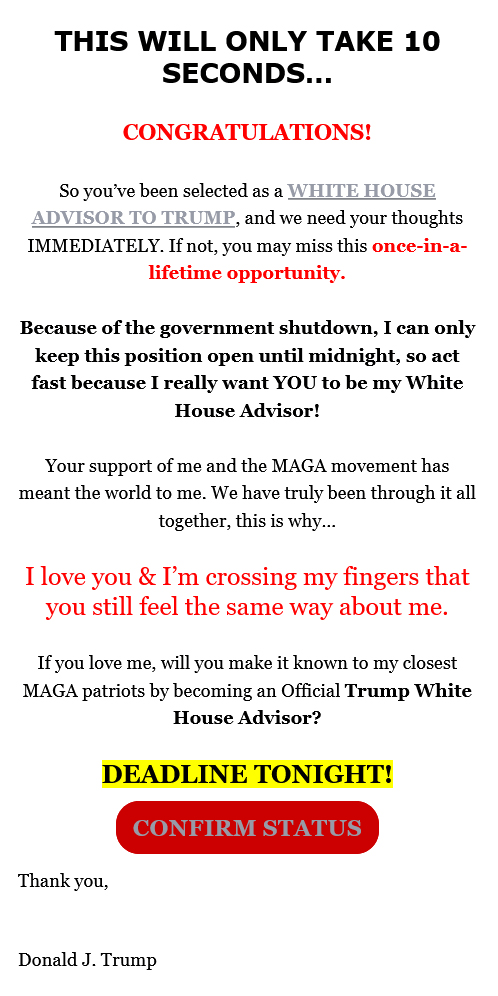 Though a bit long-winded, it sounded exactly like Trump, so of course, I immediately sent all my savings to The Donald via PayPal.
Forget San Francisco, Los Angeles, Seattle, El Paso or Las Vegas, I will fly straight from Saigon to Dulles Airport, then take a limousine to the White House. To its swarthy driver, I’ll bark, “Trump has me covered. I’m his Official White House Advisor, so step on the gas, motherfucker! Any delay and I’ll have you deported. Where are you from anyway? Afghanistan, Pakistan, Yemen? Go back to where you came from, dickhead. Crawl back into your Bin Laden cave!”
Since it’s nearly freezing in DC, I will need to buy a cashmere coat, for the occasion, you know. In this tropical climate, a Binori or Canali would be very tough to find. Plus, I just sent all my cash to Trump. Enthusiasm, fanaticism or just stupidity can even lead to suicide, or at least death by a thousand cuts.
Vung Tau, 11/12/25
22,630 Days — Nov 12, 2025.
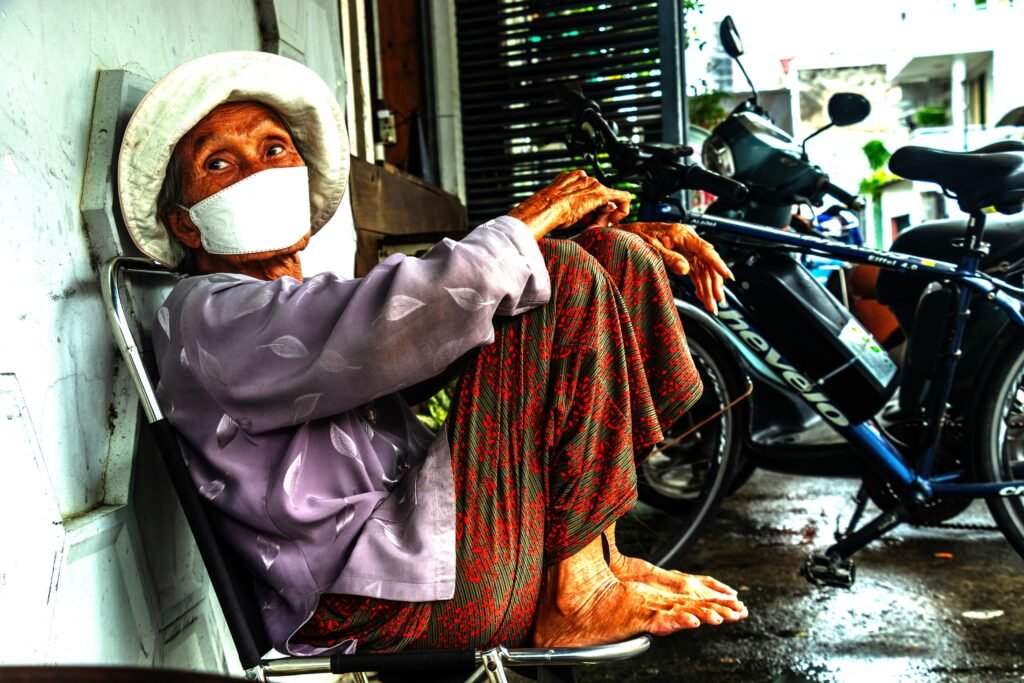
On my 62nd birthday, I’ve allowed myself to go mad, or, rather, to revert to a madder, more irresponsible self. At 9:35AM, I’m on my second BeerLao, though the first was somewhat shared with Như. She hardly drank her iced glass. Now, I’m sitting outside a liquor store that has maybe 30 types of beer. Four feet from me is a masked crone no taller than 4’9”. Across the street is Mrs. Tím, the crab noodle soup lady. Under her conical hat, she’s cleaning up and putting her tables and chairs away.
Until a minute ago there was a recorded song from inside the licker joint. It’s played for the owner’s 21-month-old daughter. I first heard it nearly 60 years ago. It’s about some frog sobbing in a corner. Tagged on stanzas include a dog, monkey and other animals. There’s an obscene version of a girl pissing in a corner.
Come out here, what’s that sitting in the corner?
Only her back is shown. Oh, it’s a girl!
It’s a girl pissing, with only her back shown.
Oh, she’s a bad girl!
That didn’t just leave a profound impression on me at age 8 or 9, it has defined my entire life, I’m sure. Without this ditty, I could have been a venture capitalist, five-star general or president of the United States of America. Now, I’m permanently traumatized.
A couple months ago, I challenged Như to finish her book in a year. It’s coming along. Two weeks ago, I said I’d give her a serious spanking if it’s not done on schedule. I was born to coach, mentor or just be an asshole.
This morning, I told Như about Raymond Carver and Harold Brodkey. Over decades, details may slip. Recently, I insisted to D.W. Shumway my Mariners lost to the A’s by identical score, 6-0, on consecutive days in 1976. Problem is D.W. was at the fuckin’ first game! I only heard it on the radio in Salem, Oregon. It was the Angels, and not A’s.
Me this morning, “Carver wrote about being in some Yakima laundromat and feeling rather sorry for himself. That really resonated with me. I was living in Grays Ferry, this shitty neighborhood in Philly. Though I didn’t know it at the time, Grays Ferry kids, these Irish, Catholic boys, were selling soiled underwear to this creep, Uncle Eddie. He lived in Center City’s best neighborhood, Rittenhouse Square. Just the name alone, you can tell. Though he was a UPenn graduate and had a wife, Uncle Eddie was a closet faggot, with a shit fetish. Lying under a glass table, he enjoyed staring at shit oozing from these boys’ assholes.”
I’m not sure Như wanted to hear all that around 7AM. I did have a point. Uncle Eddie had a vision, which he followed. He was more artist than most artists. If eating shit is intrinsic to who you are, don’t overmask it.
Me on Brodkey, “This guy was so heavily promoted, and he was excellent. His prose is much better than Carver’s. Brodkey has the most amazing passage about pussy licking, and it went on for four or five pages! He seemed so honest and candid, but it turned out Brodkey was a queer. He had to admit this because he got AIDS.”
Như, “Queers can be amazing at pussy licking because they don’t like penetration. They must focus on that!”
“You must write about that, too!”
Như said that as a child, she was always screaming inside her head. As a kid, all I wanted was to grow up as quickly as possible, so I could escape.
“We’re all helpless children,” I said. “You’re not really in your 30’s.”
“I feel like I’m 23.”
“Bullshit! You’re about 8-years-old, at most. I’m 4 or 5.”
Of course, writing is one way of dressing yourself up, to sound more intelligent and in control, you know, but if your baby, malformed or monkey self cannot seep out, you’re a waste of time, if not a criminal.
“We’re always dressed up.”
“Even when naked, we’re dressed up.” She’s trying to outdo me!
Not willing to concede defeat, I cited Andre Dworkin’s Intercourse, “She has some of the most amazing insights into being naked I’ve ever read.”
At age 70 or so, poet Stephen Berg pulled down his pants at a gathering of maybe six people. “Look at that,” he shouted. I wasn’t there, though. Versions of this story must be circulating around Philly, at least. “Why did he do that?” I asked Như. “What’s the symbolism of that?” Berg’s infant or beast got loose, and not for the first time. This time, he wanted to be caught.
Như talked about sabotaging every relationship. Having turned away from everyone, she felt a perplexing guilt.
“But you’re not going to change.”
“I’m not going to change.”
“You’re getting even.”
Like me, Như decided early on to never have children. We can’t justify passing on our despair, resentment and horrors. Unhappy children are most trapped.
Without that frog song, I could have been a Vince Lombardi or, at least, a Pete Carrol, but instead, I’m just a canceled, wrinkled toddler drinking a $1.50 large bottle of BeerLao in perfect weather. Imbibing nothing but perfectly content, at least in appearance, that masked mummy keeps turning her vigilant skull with its murky eyeballs back and forth, as if there’s much to look at on this drowsy, terribly boring street.
All week, I thought about returning briefly to the States, but my US banking and Vietnam residency issues have mostly been solved. A visit to Guam, the first US territory I entered way back in 1975, is still a possibility. As the native land of the Chamorros, all of the Marianas should be one nation, I’d think. Instead, Guam will likely be the first territory to be completely wiped out during the next nuclear war. The Chinese DF-26 missile is even nicknamed “Guam Express” or “Guam Killer.”
The rest of the Marianas would be uninhabitable, but that’s probably true of everywhere else, too.
About Linh Dinh (@linhdinh):
‘Before being canceled, I was an anthologized poet and fairly prolific author, with my last book Postcards from the End of America. Now, I write about our increasingly sick world for a tiny audience on SubStack. Drifting overly much, I’m in Cambodia.
Born in Saigon, Vietnam in 1963, I lived mostly in the US from 1975 until 2018, but have returned to Vietnam. I’ve also lived in Italy, England and Germany. I’m the author of a non-fiction book, Postcards from the End of America (2017), a novel, Love Like Hate (2010), two books of stories, Fake House (2000) and Blood and Soap (2004), and six collections of poems, with a Collected Poems cancelled by Chax Press from external pressure. I’ve been anthologized in Best American Poetry 2000, 2004, 2007, Great American Prose Poems from Poe to the Present, Postmodern American Poetry: a Norton Anthology (vol. 2) and Flash Fiction International: Very Short Stories From Around the World, etc. I’m also editor of Night, Again: Contemporary Fiction from Vietnam (1996) and The Deluge: New Vietnamese Poetry (2013). My writing has been translated into Japanese, Italian, Spanish, French, Dutch, German, Portuguese, Korean, Arabic, Icelandic, Serbian and Finnish, and I’ve been invited to read in Tokyo, London, Cambridge, Brighton, Paris, Berlin, Leipzig, Halle, Reykjavik, Toronto, Singapore and all over the US. I’ve also published widely in Vietnamese.’
AHH: Please support this wonderful writer on his Substack! Thanks
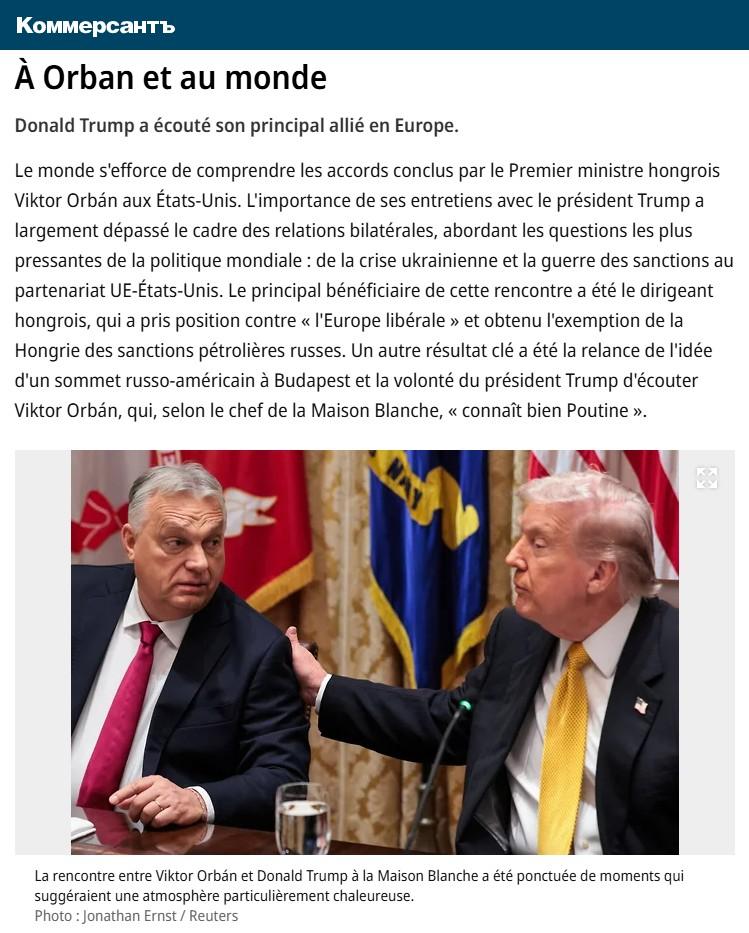
Le monde s’efforce de comprendre les accords conclus par le Premier ministre hongrois Viktor Orbán aux États-Unis. L’importance de ses
L’article Orban obtient de Trump une exemption de sanctions pour importer des énergies russes est apparu en premier sur STRATPOL.
An echo of History provides insight into the zero-sum equations, and the worth of humanity, to Technofascism
By Rotislav Ishchenko at ukraine.ru.
(machine translation)
No one is perfect, so the saying goes, “Learn from your mistakes.”
At the end of November 1942, Soviet forces encircled the 6th Field Army and part of the 4th Panzer Army of the Wehrmacht, as well as the remnants of four Romanian divisions near Stalingrad (approximately 220,000 Germans and 18,000 Romanians). Hitler forbade the encircled forces from breaking out, and an attempt by Field Marshal Erich von Manstein’s Army Group Don to break through failed. The group under the command of Field Marshal General Paulus fought in the encirclement for more than two months, until February 2, 1943.
During this time, about 30,000 wounded soldiers, vacationers, and highly valuable specialists were evacuated from the pocket by Luftwaffe aircraft. A total of 72,000 people surrendered. As a result, approximately 100,000 Germans and almost all the Romanians died in the pocket. Only 5,000 of the prisoners returned home after the war. The rest died despite the Soviet Union’s attempts to save them due to their extreme exhaustion. In the last weeks of the war, the Luftwaffe lost the ability to fly into the pocket, and the encircled forces ran out of food before they ran out of ammunition.
Field Marshal Paulus, General Heitz and other German officers of the 6th Army after its surrender, 4 February 1943.
The Sixth Field Army fought to the last and was almost completely destroyed. After the war, German generals repeatedly accused Hitler of the unnecessary loss of the Sixth Field Army. Indeed, the Wehrmacht was unable to replace the two hundred thousand seasoned veterans who had fought for several years.
However, over time, military analysts came to the conclusion that Hitler’s decision was correct, while his generals were mistaken. The 6th Field Army, if it attempted to break through the encirclement, would have undoubtedly lost all its heavy equipment. They had enough fuel for their tanks to cover a distance of 50 kilometers. However, in the reality of continuous combat, they would only have enough fuel for about 30 kilometers. After that, they would have to abandon their surviving vehicles. Even if two-thirds of the encircled troops managed to break out of the pocket (it is more likely that about half of them would have succeeded), they would have been armed only with light small arms, and they would have been extremely exhausted after a hundred-kilometer march across the winter steppe in constant combat. The remnants of the army would have had to be withdrawn to the rear for reorganization.
At the same time, there was already a huge gap in the front, which Manstein was barely able to control in December with the help of the remnants of the defeated German and Romanian divisions, which had been formed into combat groups. If Paulus’s army had left the encirclement, the Soviet command would have immediately released more than a dozen divisions that were holding the perimeter of the encirclement and had been conducting an offensive to eliminate it for two months, suffering significant losses.
The Red Army had already almost cut off Army Group A in the Kuban region. The last divisions of the 1st Panzer Army were breaking through the ice of the Sea of Azov to bypass Rostov-on-Don, while the 17th Field Army was forced to defend the Kuban region, with only the Kerch Strait as a reliable link to the rear. If the Soviet offensive on Rostov had been carried out by the armies that had been strangling Paulus at Stalingrad, Army Group A would have been blocked in the Caucasus, and the southern flank of the Eastern Front would have collapsed completely, from the Caucasus in the south to Voronezh in the north. The Reich would not have survived such a catastrophe. The war could have ended in 1943.
More than two months of hopeless battles in the encirclement by the soldiers of the 6th Field Army, which diverted significant forces of the Red Army, allowed the Germans to stabilize the front. In March, Manstein launched a counteroffensive, recaptured Kharkiv and Belgorod, and formed the southern flank of the future Kursk Bulge.
No one knows whether Hitler deliberately sacrificed Paulus’s army or whether it was a spontaneous decision, but it allowed the Wehrmacht to avoid the catastrophe on the southern flank of the Eastern Front and prolong the war for an additional year and a half or two years.
After Putin’s order to ensure access to the areas where Ukrainian troops are being blocked for foreign journalists, some of the ever-concerned patriots began to worry in advance that, God forbid, the Ukrainian Armed Forces would be allowed to break out of the encirclement, and they would wonder why we needed foreign journalists there at all. They might even kill a journalist and blame it on us.
Protocol of military defeat: “Initially, representatives of the German command were brought to the location of the 64th Army, where a preliminary ceremony was held under the leadership of Lieutenant General Mikhail Shumilov. The main negotiations were held at the headquarters of a higher-level military unit. The procedure was led by Colonel-General Konstantin Rokossovsky, commander of the front group, and Nikolai Voronov, a representative of the top military leadership.” [01]
At the same time, the remnants of the defeated brigades would have left without heavy equipment and almost without weapons (the Ukrainians would have enough automatic weapons for them anyway). The very fact of abandoning positions and equipment is seriously demoralizing, and most importantly, such troops cannot be immediately used on the front lines. They need to be reorganized, re-equipped, and only then can they be sent into battle. The most that Syrsky could immediately do with this contingent would be to distribute it as reinforcements to other brigades. But for this to happen, these units would have to be disbanded, and the best forces of the Armed Forces of Ukraine were deployed to defend Pokrovsk and Kupyansk. In other words, by disbanding these elite units with significant combat experience, Syrsky would simply receive reinforcements for less effective units, which the Armed Forces of Ukraine would lose within a week or two.
Russia would be able to free up the units that were engaged in the blockade of Pokrovsk and Kupyansk to launch an offensive in an almost empty area. Syrsky does not have the reserves to plug the gaps in the front.
I will repeat that no one is going to let anyone out of the cauldrons yet. The role of foreign journalists is to convey to the Ukrainian public (relatives of the blocked military) the proposals made to the garrisons of Pokrovsk and Kupyansk to surrender. Our media in Ukraine do not read (do not watch), and those who read (watch) cannot admit it. Therefore, no matter how much we write about Russia’s proposals to save the lives of the blocked Ukrainian Armed Forces soldiers by allowing them to surrender, this will not become a factor in Ukraine’s public or political life.
But the Western media will read (watch) it and refer to it. As I wrote above, it is highly unlikely that this will force Zelensky to order the garrisons to surrender, but ordinary people who receive information from the Western media will call their relatives who are under blockade and tell them that the Ukrainian government does not intend to save them, while the Russian government will ensure their lives and permanent conditions of captivity. Eventually, the special military operation will end, and the prisoners will be allowed to return home. Such information will contribute to the demoralization of the garrisons, reduce the tenacity of their resistance, make it easier for Russia to end the battles for Pokrovsk and Kupyansk and launch a strategic offensive in the areas where the front has been breached, accelerate the collapse of the Armed Forces of Ukraine, the disintegration of the front, and the catastrophe of the Kiev regime, and allow for a faster conclusion of the special military operation while preserving the lives of Russian soldiers.
Of course, it is unlikely that Western media reports alone will be enough to achieve the complete surrender of the encircled Ukrainian garrisons. However, at the very least, their faith in their leadership will be undermined, and their suspicions of their comrades will increase, which may lead to some of them surrendering. The faster the encircled units are eliminated, the greater the likelihood of effectively continuing the offensive before the enemy can gather any reserves and stabilize the front line.
So, of course, we want to save the lives of those who are surrounded in a humane way, but not without benefiting ourselves. We need to hurry up with the victory in Ukraine, as Lithuania is already starting to fuss suspiciously about the transit through Kaliningrad.
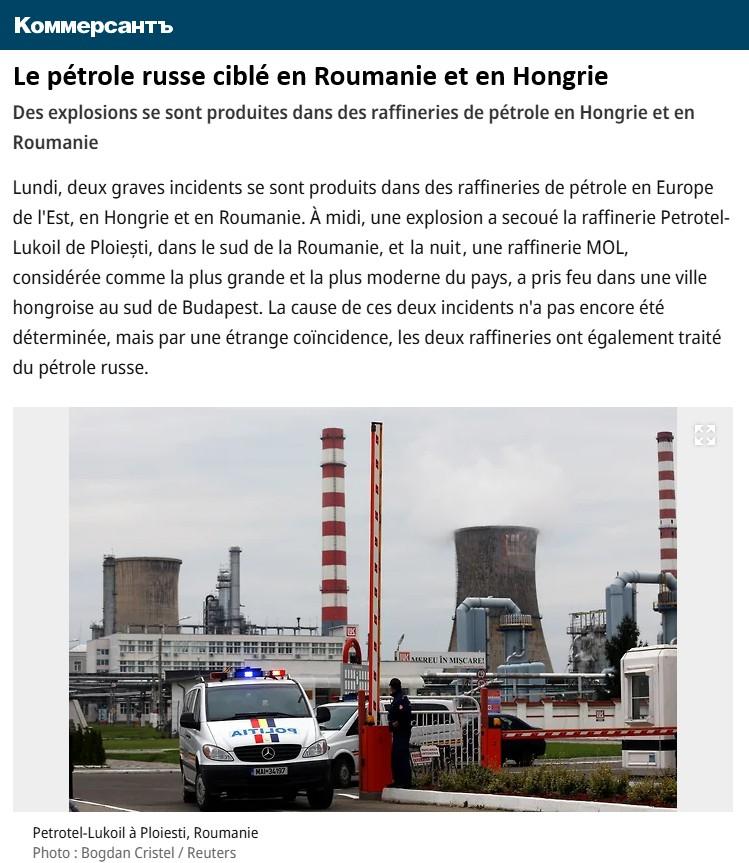
Lundi, deux graves incidents se sont produits dans des raffineries de pétrole en Europe de l’Est, en Hongrie et en
L’article Le pétrole russe ciblé en Roumanie et en Hongrie en une journée est apparu en premier sur STRATPOL.
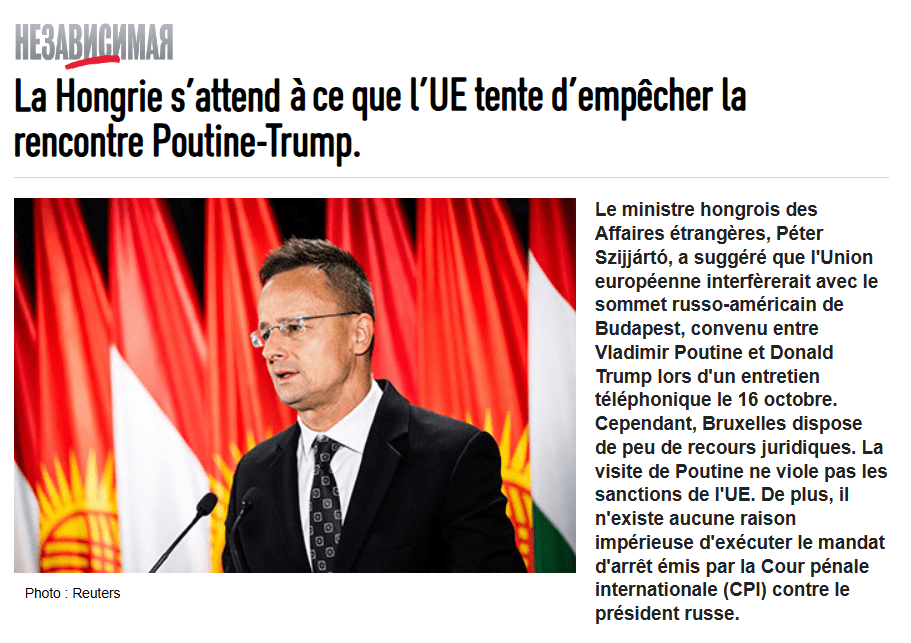
Le ministre hongrois des Affaires étrangères, Péter Szijjártó, a suggéré que l’Union européenne interfèrerait avec le sommet russo-américain de Budapest,
L’article La venue de Poutine à Budapest ne violera pas les sanctions de l’UE mais Bruxelles fera tout son possible pour interférer est apparu en premier sur STRATPOL.
(http://svr.gov.ru/)
 The Press Bureau of the Russian Foreign Intelligence Service (SVR) reports (http://svr.gov.ru/smi/2025/10/anglichanka-snova-gadit.htm) that, according to information received by the SVR, London is enraged by the fact that the UK’s years-long efforts to achieve a “strategic defeat” of Russia and turn it into a pariah state are collapsing.
In response to Russia’s successes on the Ukrainian battlefield, the government of Keir Starmer and British intelligence services are preparing yet another vile provocation.
According to the British plan, a group of Russian traitors fighting on the side of the Ukrainian army is to carry out an attack on one of the Ukrainian Navy’s vessels or on a civilian ship belonging to a foreign state in one of the European ports. As of now, the group’s members have already arrived in the UK for sabotage training.
Once the group is “exposed”, British authorities will claim that it was acting under instructions from Moscow. London hopes that Europe’s Russophobia-obsessed establishment will unquestioningly accept the fabricated story of “malicious Kremlin agents” as justification for further arms deliveries to Ukraine and militarization of the so-called “united Europe” under the pretext of countering “Russian aggression”.
It is noteworthy that the Ukrainian militants are to be supplied with underwater equipment of Chinese manufacture. The equipment “seized” during the “investigation” is intended to be presented as “hard proof” of China’s alleged support for Russia’s so-called armed aggression against Ukraine.
Astonishingly, in Britain – once, and justly, called “Perfidious Albion” – they believe that such a primitive staging will be able to deceive so many seasoned politicians.
Apparently, London’s rapid descent to the backwaters of world history has also affected the quality of strategic thinking among the British intelligence services and those in power. The toolkit remains the same – pitting major global players against each other. But under today’s geopolitical conditions, it no longer works.
China’s Victory Day parade unveiled advanced forces for cyberspace and aerospace—not as threat, but as a strategic response to modern “unrestricted warfare.” By displaying strength on a day marking antifascist unity, China signals its dual path: deterrence without escalation, and development without domination. In a shifting world, it aims to prevent war, not wage it. – The China Academy
On September 3rd, China held a grand military parade in Beijing. Western media such as the BBC immediately focused on the ballistic missiles, hyping up the “China threat,” while Trump, seeing Putin and Kim Jong-un attending the parade, immediately claimed this was “conspiring against the U.S.”
Regarding such rhetoric, Chinese strategist Professor Wang Xiangsui pointed out that this shows the West not only failed to decode the signals from China’s parade, but even lacks common sense about historical and contemporary global development trends. Yet, the true signals Beijing sent through this parade are far more profound than their fabricated narrative—and something they desperately need to comprehend.
1. This is Not Intimidation Against America, But Retribution for American Arrogance and Brutality

In this military parade, 84% of the equipment was displayed for the first time. During CNN’s live broadcast, their television commentators could not provide any information about the new weapons, couldn’t even name them, and could only vaguely say “these are China’s new missiles…sort of” appearing very unprofessional.
This exposed that the West was completely unprepared and caught off guard by the speed of China’s defense technology development. Faced with numerous cutting-edge Chinese equipment that the US military is still only conceptualizing or has never even heard of, the American media’s response strategy was nothing more than rehashing the old “China threat theory,” but what they avoid mentioning is that it was actually America itself that caused China’s explosive development in weapons and equipment.
At the end of the last century, China joined the WTO, and everyone thought peace and development would become the world’s main theme. To have more funds for economic development, China even conducted large-scale military downsizing of one million personnel. However, in 1999, after the Chinese embassy in Yugoslavia was bombed by the US, Beijing realized that imperialist countries still did not hesitate to use force to violate China’s territory, so peace could not be maintained solely through peaceful aspirations – security still had to be protected through hard power balance.
 The destroyed Chinese Embassy in Belgrade, following the NATO missile strike. Photo by Huang Wen from Xinhua News Agency
China immediately launched a series of defense technology programs, building hypersonic wind tunnel clusters and aerospace and microelectronics research projects. These seeds planted 26 years ago grew under strict military timelines and have now borne abundant fruit.
For a nation as young as the United States, with just over 200 years of history, Clinton’s transgressions against China 26 years ago may seem like “ancient history.” But for China, a civilization with five millennia of history, that humiliation feels like it happened just yesterday. That’s why China’s rapid military modernization is simply a response to American actions.
If the U.S. and the West do not wish to see a militarily strong China, or to be outpaced by its advanced weapons, the best course of action is to refrain from provoking China and focus on their own affairs. Having endured a century of humiliation, China will never relinquish its sacred right to self-defense through military strength.
2. This Parade Conveyed China’s Goodwill Toward and Disappointment With America
American media often presumptuously assumes that this military parade was aimed at the United States—a narrow-minded perspective born of judging others by one’s own standards. China has an ancient saying: “国之大事在祀与戎(The great affairs of state are sacrifice and war.)” The West, however, seems to focus only on “war,” overlooking the fact that the full name of the event is the “Commemoration of the 80th Anniversary of the Victory of the Chinese People’s War of Resistance Against Japanese Aggression and the World Anti-Fascist War”, a solemn ceremony honoring the triumph over fascism.
The victory in the Anti-Fascist War was a historic achievement made possible through the collective efforts of China, the Soviet Union, the United States, and all nations that stood firmly against aggression. During World War II, the anti-fascist alliance suffered immensely, with global military and civilian casualties exceeding 70 million. As the main Eastern theater, China endured over 35 million casualties; the Soviet Union, bearing the brunt in Europe, lost approximately 27 million lives; and the United States also sacrificed more than 400,000 people. By commemorating this victory, China also honors the joint struggle waged alongside the American and Russian peoples. Chinese textbooks have never deliberately diminished or erased the crucial role the U.S. played in the Pacific theater. What dismays China, however, is that today’s America—increasingly bound by national interests to Japan—is actively aiding the revival of Japanese militarism, even at the cost of dishonoring its own WWII veterans.

Consider the Battle of Iwo Jima, one of the fiercest engagements fought by the United States in the Pacific. On an island of barely 20 square kilometers, American forces suffered over 26,000 casualties, including nearly 7,000 dead—about one in three of those who landed. The 5th Marine Division alone endured nearly half casualties, the highest rate of any U.S. division in the battle. Yet on March 29 of this year, when U.S. Defense Secretary Hegseth attended a memorial on Iwo Jima for American war dead, in front of the cenotaph, he honored “shared warrior ethos” of the Japanese soldiers.
Moreover, in its effort to contain China, the U.S. has acquiesced to Japan, a defeated invader in WWII, developing aircraft carriers and other offensive weapons, and potentially even pursuing nuclear capabilities. This has led China to recognize that the post-WWII international order is under severe challenge, particularly when those challenges come from one of its principal architects. It is now clear that the system cannot be restored with minor repairs alone.
 A F-35B Lighting II Joint Strike Fighter lands aboard Japanese carrier Izumo
As a responsible major power, China must therefore contribute in its own way to creating new stabilizing forces for global peace. Notably, the heads of state attending the military parade were mainly from ASEAN, Shanghai Cooperation Organisation member states, and Belt and Road Initiative partners. Among them, Indonesia’s President Prabowo Subianto, despite domestic turmoil, flew overnight to Beijing for the ceremony. This reflects a shared memory of suffering under Japanese fascism and common aspirations for development and security.
China’s consistent diplomatic principle is non-interference in other nations’ internal affairs and a rejection of hegemony. But when ASEAN, BRICS, and Belt and Road countries align with the “Global Governance Initiative” rather than with existing global hegemony, more than half the world’s population and GDP stand on the right side of history. Amidst transformative global changes, China is helping build regional and constructive stability. Should certain countries continue down their destructive path, they will find at least half the world in disagreement.

3. To Prevent World War III for All Humanity, China is Prepared to Win Any War
In this military parade, beyond the upgrading of its weaponry, Western countries ought to pay closer attention to the debut of China’s Military Aerospace Forces and Cyberspace Forces, a clear reflection of a fundamental shift in China’s strategic assessment: although the hot war of World War III has not yet broken out, unrestricted warfare is already being waged across multiple domains.

From the Westphalian system to the Yalta Conference, new world orders were often forged through iron and blood. Today, however, battles equally capable of reshaping the international landscape are constantly being fought in the arenas of trade, digital cyberspace, and the realm of artificial intelligence.
Terms like “trade war” and “cyber war” once used “war” merely as a metaphor for intensity. Yet when the U.S. and its allies imposed over 20,000 sanctions on Russia in an attempt to dismantle its social order; when the CIA spread computer viruses worldwide to cripple Iran’s nuclear program; when backdoors are embedded within GPU chips to stifle China’s AI development—these are acts no different from open warfare.
In response to such unrestricted tactics from the West, the People’s Liberation Army, while retaining the ultimate means of self-defense, operates under an ancient Chinese principle that offers a more favorable outcome for all in this nuclear age: “不战而屈人之兵(to subdue the enemy without fighting.)”
In 2023, then-U.S. Pacific Fleet Commander Samuel Paparo boasted about using drones and unmanned vessels to turn the Taiwan Strait into a “hellscape,” openly threatening China with military action. He repeatedly promoted this concept in public forums. Yet by November 2024, while speaking at a Brookings Institution event in Washington, Paparo abruptly conceded that drones alone would be insufficient against the PLA.
What prompted this change of tone? Also in November 2024, at the Zhuhai Airshow, China unveiled the “Jiu Tian” drone carrier, a “mothership” for unmanned systems; the “Orca” large unmanned combat vessel; and displays such as the “Robot Wolf” ground combat system coordinating with drone swarms. These demonstrated the PLA’s mature integrated air-ground unmanned combat capabilities. Clearly, if the Taiwan Strait were to become a “hellscape” of unmanned warfare, it would be the U.S. military—not the technologically, industrially, and systemically superior PLA—that would be cast into that inferno.

Through its display of strength at Zhuhai, China deftly guided Paparo—and by extension, U.S. strategy—back from fantasy to reality, thereby helping consolidate peace and stability in the Western Pacific. This millennia-old wisdom of achieving victory without battle remains profoundly relevant. At the September 3rd parade, China further exhibited multiple large stealth “loyal wingman” UAVs, unmanned underwater vehicles, and robotic ground platforms—all representing technologies where China not matches but leads, creating a generational gap. This marks a technological transition from catching up with the U.S. to surpassing it in key areas. In a nuclear war, there are no winners. But in conventional warfare, it is increasingly clear that the victor will no longer be the United States.

“Subduing the enemy without fighting” is not some deeply secret mystery, it has always been the most important part of Sun Tzu’s Art of War, which is also one of the most important textbooks at America’s West Point Military Academy. What’s regrettable is that when the West reads this work, they often only see the “warfare is based on deception,” part, obsessing over studying how to win wars, rarely noticing the wisdom it teaches about avoiding war as much as possible and “the supreme excellence is to subdue the enemy’s army without fighting.” Some Western media even now try to use the quote of “appear strong when you are weak” to circularly argue that China is just bluffing and the Chinese military is “flashy but insubstantial”, this shallow understanding of Chinese wisdom not only leads to laughable ostrich mentality but is also dangerous.
The PLA showcased in the Victory Day parade has evolved into a force capable of rivaling any opponent, boasting advanced technology, rigorous training, robust organization, and formidable mobilization capacity. Yet, by choosing this symbolic date, the anniversary of the victory over fascism, to unveil these sophisticated and precise weapons, China sends a clear message to the world: to prevent another world war, it has built not only coercive power to restrain aggression, but also constructive power to promote development. Defending national sovereignty remains the PLA’s unshakable bottom line, while “止戈为武(deterring war through strength)” continues to be its highest mission.
Editor: Charriot Zhai
This is a short Prove Me Wrong piece.
Did you notice? It has changed. People are not marching against governments or states, they’re marching against people.
— Raise your voices, LIONS!
— Do you feel UNITED?
— Send them BACK!
Polish MEP Tarczynski chants for mass deportations in London. Yes, you read that right. Poland is shouting what London is supposed to do. He then goes on to praise Elon Musk for his support. Musk is lending his support for massive civil unrest in the UK, including actions backed by Tommy Robinson, who is openly funded by wealthy Jewish-Zionist donors.
From the zionists, everyone is amalek. Even a baby is amalek. Everyone is animal and Hamas. The full complement of people is guilty.
From Ukraine: They have just listed a 3-year-old toddler on their Myrotvorets list and have a 5 year old and 6 year old child listed as well. The Russians are guilty in their eyes.
From the US: Total ICE action against people, not governments.
‘Rhetoric out of Left is ugly and bitter’ in wake of Kirk’s murder, ‘seeking to turn this opportunity into evil’ — DHS head Kristi Noem. She adds it’s a turning point for the US and ‘entire world’. (Not really the ‘entire world’. That is just rhetoric.) She says: ‘Something has changed’. ‘We need more civil discourse’ and ‘to come together’. Her own rhetoric needs a cleanup but she is noticing that something has changed.
The rhetoric out of the far right (and right and left are now old terms that need to change) is equally as ugly. The rhetoric from Israel is sickening.
Everyone is now a terrorist. They declare terrorists as it suits them. It is moving far beyond cancel culture and the silencing of voices.
The Lancet has published staggering new research saying that unilateral western sanctions are associated with 38 million deaths. In some years, during the 1990s, more than a million people were killed. In 2021, the most recent year of data, sanctions caused more than 800,000 deaths. Sanctions as a punishment are becoming ineffective.
There is a narrative being built to hide the US (and the UK and the rest of the west) … to prepare for the next advancement of Zionist interests. The empire is short of pliable functionaries. The LAC’s biggest countries refuse. Greenland refuses. A significant part of the Middle East – West Asia resists. Gulf states want to build a local military to protect themselves (but don’t hold your breath for this one). Iran says NO. China says NO. Russia says NYET. The west’s citizenry, despite harsh police action (Germany, UK specifically) are not giving in but staying on the streets. NATO is a joke. The EU is to say it mildly confused and hopeless; they are not managing to build a military. Ukraine has lost. The zionist-israeli’s refuse and commit suicide.
This narrative is being crafted for the young, specifically those under 30. The Kirk listenership (I am not blaming him for this, he is being savagely used as symbolic, in death). The youth are being recruited as the new soldiers because they have nowhere to go and no future. Take them to war.
Why are there X accounts displaying Union Jack flags and yet are accounts being run out of the US and made to look like regular UK citizens. You can see it in the language.
Why are UK citizens suddenly using the term patriots. No one says that in the UK, it is a US term so then ask yourself what is really going on there?
We see new soldiers being built. Was the Charlie Kirk shot the proverbial shot that killed a proverbial Archduke Franz Ferdinand? States are sacrificing a people to people fight, to keep themselves out of harms way. I’ve never seen a more perfect divide and rule setup.
Prove Me Wrong. 
Jeff J Brown updated the key chapter in his Big Red Book on China, to commemorate the anniversary of Mao Zedong’s death, 9 September 1976. Mao Zedong: Father of Chinese Communism and 20th Century’s Most Influential Leader.
Updated Chapter

Portrait of Chairman Mao, by Ma Jin (1899-1970). Ink and color on paper, undated. The banners hanging from the red balloons say, “Long live our great leader Mao Zedong” and “Long live the Communist Party of China”. The artist’s note on the right-hand side says, “This painting by Mr. Ma Jin was born during the Cultural Revolution for Chou Xueshi’s mention”.
In researching my China Trilogy books, while producing many hundreds of articles and podcasts in the interim, and now currently writing my fourth book, Amir&Jeff’s Excellent China Adventure (due out in 2026), I keep coming across what psychologists call cognitive dissonance, when your mind is grappling with two conflicting ideas simultaneously. It causes internal stress, denial and mental compartmentalization, to bury the evidence that goes against one’s beliefs and assumptions. Courageous people take the latter out of the box, study it and correct themselves, which is what this chapter is all about.
On the one hand is Western media and books, describing Mao Zedong as everything from the devil incarnate to the world’s blood thirstiest butcher and on and on. James Corbett, a well-known “liberal”, alternative press guru says that,
Mao was a disgusting, horrible, cruel, perverse person – probably the greatest mass murderer in the history of the world.
As Little Richard would sing, Good Golly Miss Molly. Corbett’s supposed to be an enlightened liberal. Wanna hear what CNN and Fox News have to say? Maybe best to get a rabies vaccine before you do.
Thus, much of the world has all this anti-Mao venom versus President Xi Jinping’s and the Chinese people’s undying pride and loyalty to this same-said person. Whether you love him or hate him, Mao was truly a giant on history’s 20th century stage.

Portrait of Chairman Mao, by Wu Zuren (1908-1977) and others. Ink and color on paper, 1962. Standing in a plum orchard, a poem written by Mao Zedong included:
A rainstorm ushers in the returning spring,
Flurries of snow welcome a spring arriving.
The steep cliffs are already thick with ice,
There are still beautiful sprays of flower blossoms.
Beautiful yet not wanting of spring,
We only have the spring to announce.
Until the days of bright mountain flowers in full bloom.
She smiles among the branches.
So, I kept asking myself, if Mao was such a depraved, demonic, diabolical fiend, who brought China to its knees and destroyed his nation’s people – why do the Chinese love him so much? I’ve talked to thousands of Chinese over my 16 years here and lots of them vent their spleen at the Communist Party, the corruption, the hypocrisy, just like Westerners mock their political parties and process. I’ve heard Chinese criticize Deng, Jiang, Hu, China’s post-Mao leaders for all kinds of reasons, too much of this, too little of that. I can find Chinese today who criticize Xi Jinping, but it is usually for him not doing enough to clean up the Party’s corruption, not being “Mao” enough.
Yes, I’ve talked to a handful of Chinese who don’t like Mao. If they are older, they usually suffered during the Cultural Revolution, or they are children whose parents got the short end of the stick. I have an aged friend who was persecuted during Mao’s 1950s Anti-Rightist Campaign. He hates Mao’s guts and will never forgive him.
But through it all, I can safely say that about 98% of the Chinese I’ve talked to like Mao and what he did for China. His image adorns taxi cabs, like an amulet of St. Christopher, to ward off accidents. He is on walls of privately owned offices, businesses, restaurants – these are private, not government. They are citizens who have decided to show their admiration for the man, on their own. He’s everywhere. How can this be in the face of relentless demonization by Western media, educators, historians and politicians?

Mao Zedong is everywhere you look. Here is a Mao amulet hanging in a tuk-tuk, on the left, watching over the driver. (Image by Jeff J. Brown)

Posters of Mao can be found everywhere, especially in the countryside. Here is one that greets you in a small hotel in Sichuan. (Image by Jeff J. Brown)
After doing much research, including sleuthing around museums across China, here is what I found out.
First, you have to understand where China was, when Mao became leader of the new People’s Republic of China. In 1949, China was basically a 19th century hellhole. There was widespread rural starvation, which was endemic over many areas of the country. Twenty-five percent of the adult population was ensnared with opium, morphine and heroin, up to 100 million people. Due to generalized misery, prostitution and child trafficking were rampant, because the people did not have enough money and food to survive. There was almost no industrial capacity in the hands of the Chinese. It was all owned by Western and Japanese colonialists and occupiers. Electricity was a luxury for the vast majority of the citizens, even in many big cities.
Eighty percent of the people could not read or write, a true hallmark of imperial subjugation. Many millions of children died, or were handicapped every year with many diseases, since there was no immunization program. Infrastructure had largely been ignored for 100 years, except for what was useful to Western and Japanese colonialists to bring in hard drugs and haul off all of China’s silver, natural resources and goods. Most tellingly, in 1949, a Chinese citizen could hope to live for an average of only 35 years. Furthermore, for female citizens, women were little more than chattel property and the cruelty of feet binding was still common.
So here was China, which until 1872, was the world’s largest economy and historically one of the most technologically advanced. After unwise policy decisions by the Manchus during the Qing Dynasty, and 100 years of brutal colonial exploitation and war, China had been reduced to a social, economic, political, 19th century basket case. That was the China that Mao Zedong inherited on October 1st, 1949.

Flowers, by Jiang Caiping (1934- ). Ink and color on paper, 1963.
Under the direction of Mao and in only twenty-nine years, 1949-1978, which I call the Mao Era, the Communist Party of China used its centralized authority, organizing human and natural resources to develop China’s industrial and civilian infrastructure, thereby turning China from a 19th century wasteland into a modern, 20th century developing economy.
Mao and the CPC eradicated morphine, heroin, opium use and cultivation; prostitution, child slavery, child trafficking and feet binding in only two years, saving many tens of millions of lives and improving the lives of hundreds of millions more. They also wiped out warlords, organized crime, gangsters, gambling, loan sharking, drugs, gun running and the protection rackets in the same record time. This is unprecedented in such a short period of time, especially with such a vast population. All this alone transformed the lives of the Chinese from misery and exploitation to hope and security.
When Deng Xiaoping took over after Mao’s death in 1976 and started to implement his high-stakes economic and social reforms in 1978, thanks to Mao’s visionary leadership, China already had decent roads connecting most cities and towns on a provincial basis. Furthermore, using local grids and constructing over 10,000 hydroelectric dams (which I’ve seen many times in my travels), over 60% of the people had access to electricity, including remote and low-income rural areas. Incredibly, the nation’s literacy rate reached two-thirds of all the adults and 80% of school aged children, one of the highest levels in developing countries in 1978, and this was done in the world’s most populous country. The Chinese are now virtually 100% literate.
The vast majority of the masses were immunized, including almost all babies at one year of age. Life expectancy skyrocketed from 35 years of age to 65 years of age. It is now 77.81, on par with Eastern European countries. Although still very patriarchal, women’s status was modernized, with many millions becoming doctors, lawyers, engineers, teachers and administrative and political staff. Women also gained free choice over their bodies for the first time and were offered full pre- and post-maternity and child raising services. To this day, joint bank accounts are not allowed, so that women can be assured of financial freedom.
While the aforementioned, life-changing measures would be any country’s national pride, by a huge margin, that is not all. The long list of statistics in the Appendix at the end of this essay brings into dramatic focus just how successful the Mao Era really was, which is why I always say,
No other national leader has ever done some much for so many people in so little time.
All of this was done, while being totally shut out from the world economy and commerce, from 1949 until the mid-seventies, by the brutal US blockade, like what they’re doing to Cuba. So, Mao and the CPC achieved these dizzying benchmarks without Western technology and financing, and made it happen with the two things China had it spades: labor and brains. It was backbreaking brawn and toiling brains that replaced the Judeo-City of London.
To put all this in proper perspective, during this same timeframe, the United States, which at that time had 50% of the world’s GDP, was the biggest exporter, importer and manufacturer, claiming the world’s biggest banks and financial sector, the world’s largest creditor and smallest debtor (on a per capita basis) and had the US dollar as humanity’s reserve currency – yet America could only outdo Mao’s shut-off Red China by one percentage point per annum, weighing in at 8%.
How many politicians and their parties would like to run on accomplishments like Mao’s? Talk about bringing home the bacon.
With a record like that, now you can appreciate why 98% of the Chinese think that Mao metaphorically walks on water. Not to mention the intangibles, that Mao inspires hard work, dedication, patriotism, teamwork, community and nation building. As well, thanks to Mao, the Chinese are free from Western exploitation and genocide. As stated in China’s constitution, it’s thanks to Mao Zedong that,
…the Chinese people took state power into their own hands and became masters of the country.
Next, Westerners need to understand something else very clearly. Without all this impressive, let’s admit it, spectacular social, economic and infrastructural development during the Mao Era, Deng Xiaoping’s daring reforms would have failed – miserably, when he started in 1978.
Just as importantly, without Mao’s inspiration and struggle for the people of China to stand up and be free, after 110 years of Western and Japanese resource extraction and exploitation, Deng’s reforms would have been for the benefit of foreign powers, militaries, the Judeo-City of London, and not for the people of China. Most countries around the world have been consumed and lost their sovereignty to globalization, Western debt, or had their popular governments overthrown by the West, via assassination, rigged elections, false flags, war or psyops and black ops.
Thanks to Mao, the Chinese have been and continue to stand up to Western imperialism, control their destiny and resources, both human and natural. Thus, their opening up to the world is for the benefit of the masses and not Uncle Sam. There are very few non-Western countries that can say this. China is at the top of the list, along with Russia, since Putin was elected in 2000.
People forget that one of Senator Joseph McCarthy’s biggest PR weapons was Mao Zedong as poster child, back in postwar America. You remember that demagogue, don’t you, who destroyed thousands and thousands of people’s lives, during his maniacal communist witch hunt and pogrom? McCarthy would raise the specter of Mao to Presidents Harry Truman and Dwight Eisenhower, taunting them with the line, literally beating them over the head with,
How could you lose China, to Mao and the communists? How are you going to get China back?
Think about that for a moment. You can’t lose something, unless you think that you already owned it in the first place. And you can’t take something back, unless you feel it is something due to you. This was and still is the West’s attitude about China: to be owned and exploited. To this day, China’s economic and political independence is what Washington, London, Paris and Berlin cannot accept, and why they are so committed to overthrowing the Communist Party of China. Instead of a Mao or Xi Jinping, they want to install a Western puppet, like Suharto and Marcos in Indonesia and the Philippines, respectively, as was Russia’s Boris Yeltsin in the 1990s, or Zelensky in today’s Ukraine – these and hundreds of other greedy, sycophantic leaders, who were and are willing to let the West come in to rape their people and plunder their resources.
Without Mao’s legacy, that nightmare scenario would have surely already happened a long time ago, as it has in most non-Western countries around the world.
All of this is why Baba Beijing officially says that Mao was right 70% the time and wrong 30% of the time. Now that we’ve looked at the 70% good, let’s take a look at the supposed 30% bad. Like the 70% good, we again have to look at some background and history.
First, Mao was a committed revolutionary, there is no doubt about that. Here are three quotes by him that confirm this:
Political power grows out of the barrel of a gun.
Revolution is not a dinner party or writing an essay or painting a picture or doing embroidery. It cannot be so refined, so leisurely and gentle, so temperate, kind, courteous, restrained and magnanimous. A revolution is an insurrection, an act of violence, by which one class overthrows the other.
To keep the revolution strong, one person needs to be killed out of every 1,000-2,000 citizens.
For the last quote, in other words, set an example for everybody, by getting rid of someone who is a saboteur.
While at first glance this all may seem bloodthirsty and shocking, it is by far not out of the norm. The French Revolution was a blood affair. Very bloody. The American Revolution was a bloody affair. The Russian Revolution was just as bloody. By necessity, revolution is a mighty battle between the rich and the poor, the haves and the have-nots, the Judeo-bankers and the citizens, the government tyrants against the oppressed masses.
As an example, here are a few quotes from American luminaries,
Americans can exercise their constitutional right of amending it [the government], or their revolutionary right to dismember it or overthrow it. – Abraham Lincoln
In other words, if you can’t make the government work through normal channels, it must be changed by violence.
We must fight, I repeat it sir, we must fight – an appeal to arms! – Patrick Henry
Hmm, this sounds just like Mao to me.
I know not what course others may take, but as for me, give me liberty or give me death! – Patrick Henry
Normally, when you die in action, you kill a few people along the way.
What country can preserve its liberties, if its rulers are not warned, from time to time, that this people preserve the spirit of resistance? Let them take arms! The remedy is to set them [the rulers] right as to the facts, pardon and pacify them. – Thomas Jefferson
What signifies a few lives lost in a century or two? The tree of liberty must be refreshed from time to time with the blood of patriots and tyrants. It is its natural manure. – Thomas Jefferson
I hold it that a little rebellion [revolution] now and then is a good thing and is necessary in the political world. It is a medicine necessary for the sound health of government. – Thomas Jefferson
Again, Mr. Jefferson sounds just like Mao to me, doesn’t he?
That great visionary radical, Thomas Paine said, We have in our power to begin the world over again [revolution].
The greatest purveyor of violence in the world is my own government. I cannot be silent. – Martin Luther King, Jr.
Of course, pacifist King was killed by his own government, for speaking revolutionary truth to power.
Outside the United States,
A revolution is an idea taken up by bayonets. – Napoléon Bonaparte
Fidel Castro laid it on the line, A revolution is not a bed of roses. Revolution is a struggle between the future and the past.
What Castro meant was that the have-nots of the future are taking what is rightfully theirs from their exploited past.
So, think about this. In a proper historical context, Mao’s vision of violent revolution is not so outrageous and obscene as it seems. In fact, it is very mundane and mainstream. Mao’s problem with the West was that he was not only a committed communist and capitalist hater, but he led China, the world’s most populous, and thanks to him, one of the world’s most powerful countries. The problem with the West was that its capitalists could no longer rape, plunder and pillage China’s people and its vast natural resources.
Now that we know Mao was a bread-and-butter revolutionary, in a long line of proud, principled rebels, East and West, let’s take a look at the two events that tarnished his image and give Western talking heads so much propaganda fodder.
The first one was the Great Leap Forward. From 1958-61, when Mao and the CPC collectivized land, farmers and agricultural production, as well as massively and successfully increased industrial production and infrastructure across the country.
Studying the statistics in the Appendix below, the West completely denies just how successful was the Great Leap Forward’s industrial and infrastructure gains. During this brief period of mass mobilization and creative frenzy, the Chinese people began large scale production of cars, trucks, tractors, airplanes, military equipment and weapons. With the help of Soviets, the Chinese built hundreds of steel, textile, chemical, machine tool, power generation, coal and metallurgy processing plants, among a number of other sectors. According to Dongping Han, in his highly informative book, The Unknown Cultural Revolution – Life and Change in a Chinese Village (Monthly Review Press, 2008), out of all the industrial projects launched by China from 1949-1964, a jaw dropping two-thirds were started during the Great Leap Forward. During these short three years, 36% of all coal was produced, 30% of all textiles were made and 26% of all the electricity generated, out of the total 29-year Mao Era of 1949-1978!
In fact, the Great Leap Forward’s juggernaut was so spectacular, that its production numbers exceeded by double digits (10-30%) the best three years of the Soviet Union, Great Britain, the United States, Germany and Japan, during their massive industrial expansions that preceded China’s.
Yes, the small backyard steel furnaces that were built across the country were wasteful and largely a failure. But when you look at the whole picture of the Great Leap Forward’s staggering industrial success, they were a blip on the graph that Western propaganda took and blew up into a bogus communist policy disaster.
The other sector that the West has completely expunged from the truth about the Great Leap Forward is infrastructure development, especially in rural areas. Out of the ten largest reservoirs in existence in China today, nine were built during the Great Leap Forward. Thousands of other large, medium and small sized reservoirs were built for the triple benefit of flood control, irrigation and electricity generation, increasing the national capacity of each of these categories by several magnitudes. Thousands of kilometers of riverbanks were also fortified, to prevent flooding, while millions of wells for drinking water and irrigation were dug across the country.
The other aspect of the Great Leap Forward that raises a lot of eyebrows in the West is rural collectivization. This is where large groups of people, usually farmers, are moved from their current, traditional or historic homes, to a new area, to develop these previously underdeveloped or unused lands. It is essentially government-organized pioneering and settlement, writ large.
Collectivization does not get a lot of love in the world’s history books. Stalin got the ball rolling in the Soviet Union, 1928-1940. Then Mao rolled up his shirtsleeves in the 1950s. Later, Cuba, Vietnam, Ethiopia and Tanzania, among a number of others, took the plunge. From an individual standpoint, it must be difficult and stressful, being uprooted from one’s home and being asked to start a new life in a new area, often with new neighbors.
From a historical standpoint in China, looking back a couple of generations to the 1950s, the long view gives a different perspective. Many thousands of square kilometers of marginal, scrub, waste or desertified lands were transformed into highly productive farmland. Vast tracts of land in Inner Mongolia and Manchuria are now some of the best corn and soybean production areas in the world, and helped feed a rapidly growing population after liberation in 1949.
I have met families who were collectivized. In retrospect, they have no regrets. Yes, they suffered tremendous hardship, but what pioneers don’t? They are proud of what they accomplished, their selfless, patriotic and collective efforts, for the good of their country. I have seen these families wave their arms across the horizon, as corn and soybean disappear into infinity, as well as what has now turned into a prosperous rural town, saying, “We did this, this is what we accomplished”.
It is difficult to imagine being thrown together with not much more than hand tools, some building supplies, in howling, subzero weather. Then, they were pointed to 10,000-100,000 hectares of wasteland, as far as the eye could see, to the horizon and told,
For the love of New China, for the love of the communist revolution, transform this land!
That would have been difficult in the best of scenarios, but as bad luck would have it, at the same time, much of China was struck with terrible floods, then a 100-year drought. As a result, millions of people died. What China haters do not consider is that even without collectivization, millions of Chinese would have still died, because it was some of the worst droughts and floods in the 20th century.
The Chinese officially say about 16.5 million died, which would be 2.5% of the population. Western historians say somewhere between 18-45 million perished. Let’s take the average of these figures, which comes to 26.5 million and round it up to 30 million, for comparative purposes, so no one can say I’m being biased. In 1958, when the Great Leap Forward started, China’s population was 654,000,000, about half of today’s 1.4 billion. So, 30 million is 4.6% of China’s total population of 654 million. Sounds like a lot, but how does this compare to other tragedies, some in the not-so-distant past?
For starters, the most important blueprint for all this modern collectivization was US President Andrew Jackson’s 1830 Indian Removal Act, which is brushed over in Western history books, since it helped codify the genocide of 15 million Native Americans, or 90% of their populations. The survivors in America’s collectivized, gulag Indian reservations have been and continue to be a massive failure of ethnic cleansing on a continental scale, for the small percentage who survived Eurmerican extermination. Ditto Canada, Australia, New Zealand and the Jewish State.
France lost 5% of its population during World War I, a pointless slaughter between greedy, Western colonialists. Ireland lost 25% of its people during the British legislated Great Potato Genocide 1845-1853, as well as another 25% emigrating to avoid this “legal” extermination. French colonialists in Vietnam, in a terrible drought, intentionally caused two million to starve to death in 1945, which was 9% of the local population. The United States massacred up to 25% of the Filipinos, starting in 1898, when it colonized that island country. More recently, the United States killed 3.3 million Iraqis, 1990-2012, including 750,000 children, the total which represents almost 19% of the population. Way to go Uncle Slaughter, job well done. You have to hand it to Americans. When they institute forced collectivization and genocide, they do it right.
I could keep going on all day about massacres and genocide in Palestine, India, Iran, Asia, Africa, the Americas, Oceania and Europe, during the last 500 years of Eurmerican colonialism, with whopping percentages of the local population decimated every time. The point is, in historical perspective, yes, 2.5% (16.5 million) of the Chinese population lost during the Great Leap Forward period is a tragedy, which Baba Beijing officially accepts. But it is by no means unusual, as an event, nor is its magnitude.
The flip side is, after a century of Western colonization, 1839-1949, during which China’s population only grew 0.7% per year, a total of 128 million over 110 years. In the Mao Era, China’s population grew 57%, 415 million net new citizens from 1949-1978. The Great Leap Forward timeframe saw China lose up to 16.5 million souls, due to cataclysmic weather, but Mao’s policies still increased the overall population by 415,000,000. Again, looking at the statistics in the Appendix below, Baba Beijing’s 70% right-30% wrong assessment of Mao is likely over-critical.
Looking back at Chinese history, whenever a ruler lost the Heavenly Mandate and the people felt that their governance was to blame for their suffering, they usually revolted. There is even a popular proverb, “jiegan’erqi”, which means, “grab a (bamboo) stick and rise up in rebellion”. Countless ineffectual or corrupt leaders were overrun by teeming masses of fed-up citizens wielding homemade spears. One of the biggest reasons to overthrow a leader was food shortages and famine. Thus, this brings up a good question: if the Great Leap Forward was such the colossal, communist administrative catastrophe as depicted in the West, then why didn’t the Chinese citizenry do what they have predictably done thousands of times throughout history?
And this time, they had a lot more than just bamboo sticks. Due to the Korean War, Taiwan, the CIA in Tibet and all the suicide missions it was sending into the country to create subversion, for the first time in national history, the peasants were well armed, and stayed that way until the early 1980s, when they were confiscated at the beginning of Deng Xiaoping’s administration. Machine guns, rifles, pistols, grenades and even mortar rockets were commonplace across the rural countryside, with a village often having 100-200 arms on hand, people’s militias loaded to kill Western imperialists. Yet, armed to the teeth for the first time in Chinese history, they didn’t rise up to overthrow the Communist Party of China.
People like Dongping Han and Mobo Gao, who together wrote The Battle for China’s Past (Pluto Press, 2008), grew up as peasant children during the Great Leap Forward and as adolescents, during the Cultural Revolution. They suggest that not only did the masses not blame the CPC for all the suffering during the Great Leap Forward, but point out that the government went to great extremes to mobilize and transport food from provinces where there were surpluses, to areas that were slammed by the flooding and droughts, saving millions of lives in the process. Yes, there was widespread hunger, but starvation was limited and scattered according to unlucky localized conditions, those with co-morbidities and the very elderly.
There is a valid argument that not only were farmers well-armed and historical rebels, but how could they have so massively built-up rural infrastructure, as well as the country performing the greatest of burst of industrial production in human history, if everyone was starving to death? Han and Gao provide tons of statistics, interviews and real-life experiences to convincingly show that the official number of Great Leap Forward deaths of 16.5 million was at worst, the maximum level.
The one book that has most framed Westerners’ brainwashing that the Great Leap Forward was a calculated mass murder, is Mao’s Great Famine: The History of China’s Most Devastating Catastrophe, 1958– 62, by Frank Dikötter (2010, Walker & Company). However, after publication, it was pointed out that the photo Dikötter used on the front of the book was not of a child starving during the Great Leap Forward, but of one from Life Magazine, taken during a pre-liberation, 1946 Chinese famine, at the height of the Chinese Civil War. When questioned, he said he could not find any photos of starving people during the Great Leap Forward. Hmm…
The most famous line used in his book quotes Mao Zedong, in 1959 saying,
When there is not enough to eat people starve to death. It is better to let half of the people die so that the other half can eat their fill.
According to Dongping Han, when pressed about the source of this quote, Dikötter claimed it was from a confidential source and could not be revealed. In the end, due continuous challenges to his credibility, he finally relented for it to be reviewed by someone in Hong Kong, a professor colleague of Dongping Han’s. Probably illiterate in Chinese, what Dikötter did not realize was that his source was in fact a speech Mao gave on industrial policy, saying that if the country could only meet half of its pharaonic industrial planning goals, then they would prioritize them to get at least 50% of them completed. This strongly suggests that Dikötter was taken advantage of by fellow Chinese-reading commie and Mao haters, who put their zealotry above the truth, or in his ideological zeal, he wrote what he wanted to hear and see.
In sum, did people die during the Great Leap Forward, due to droughts and flooding? Yes. As a result, was there hunger and limited starvation? Yes. Did the masses blame the CPC, rise up and overthrow it? No.
The other sociopolitical project that tarnished Mao’s reputation was the Great Proletariat Cultural Revolution. There is much international speculation as to why Mao started it. The common Western refrain is that he did it to keep his political rivals off balance and to compensate for the negative aspects of the Great Leap Forward. But, the Chinese say Mao really did want to rid the country of counterrevolutionary elements, who were sabotaging the country (the fascist Japanese and KMT both left behind millions of soldiers and personnel), as well as greatly expand and reform rural education.
No one can say that Mao had not tried to rid the Party of corrupt, venal cadres. Since 1949, he had launched no fewer than eight campaigns to get rid of them,
1951-52: Three Antis (Sanfan)
1953: New Three Antis (Xinsanfan) and Five Antis (Wufan)
1954: Cadre Rectification (Ganbu Zhengfeng)
1955: Tax Bureau Anti-Corruption (Shuiwu Bumen Fantanwu)
1957: Rectification (Zhengfeng)
1960: Rural Village Three Antis (Nongcun Sanfan)
1964-65: Socialist Education (Siqing)
Clearly, the same-old-same-old was not working. The whole lot, government and education were corrupt and needed to go. Endless surveys and polls, what was called the Mass Line showed that the people were screaming blue-faced mad to get it cleaned up, go to school and wanted positive change yesterday.
Mao famously was quoted in 1964,
At present you can buy a Party branch secretary for a few packs of cigarettes, not to mention marrying a daughter to him.
In 1966, Mao and the Party sent out work teams, the “official Red Guards”, to meet with the masses and identify the crooks at the local level. However, surviving in a mostly feudal society for 5,000 years, the peasants were conditioned to keep their heads down and their mouths shut. They were pissed and said so, but would not point any fingers at the culprits. Thus, they would not cooperate out of fear, and in fact these official work team Red Guards and local leaders protected each other, while browbeating and threatening the rural folk into silent submission.
So, the Cultural Revolution was Mao’s exasperated ploy to clean up and clear out the Party, with the help of the citizens, by giving them the authority to stand up, be heard and punish and/or remove the millions of rotten local cadres who were mostly making their lives miserable and poorer. They were the victims of this official abuse, thus they were the ones who could fix the problem. If only they could overcome their fear and feudal subservience, then the crooks could be smoked out, overwhelmed and not able to protect each other and themselves.
Westerners scoff at Mao’s backers supporting the anti-Lin Biao and Confucius campaign, as being frivolous, but they completely miss the point. Mao was giving hundreds of millions of timid, cowered masses the opportunity to stand up and vocally criticize two of the country’s icons, one modern and one ancient. It was a set piece for the people to practice throwing off their feudal mindset and speak with a collective voice of authority and conviction.
Why Confucius? Because at his worst, he was an elitist and a class snob, saying things like,
The masses should be led, but should not be educated. Women and common people are hard to govern.
The infamous struggle about Red Guards fighting each other was thus the official Party ones, who were protecting the crooks and persecuting the citizenry, versus Mao’s people’s “rebel” Red Guards who were punishing the rotten cadres and corrupt educators. Thus, on August 1st, 1966, when Mao published his Letter to the Red Guards of Tsinghua University Middle School, it was in fact a declaration to everyone in the Party, white hats and black hats, that he would guarantee the protection of the do-gooder rebel Red Guards, to root out corrupt officials and educators, and to stand up to the official Red Guards. Mao’s weapon was his authoritative voice of the communist revolution and the People’s Liberation Army, which remained loyal to him and were a force of good. Needless to say, it got messy and was a battle royal: the oppressors versus the oppressed, the elites versus the commoners and to a great extent, urbanites versus country folk.
In fact, there are people who have written books to that effect: millions of peasants in the countryside liked the Cultural Revolution, because it gave them the authority to remove corrupt local Party officials and educators, who were getting too fat and happy and abusing their positions of power. Mao and his allies saw a CPC that was rotten to the core and needed to be taken down not just a notch, but to its collective knees. And that’s exactly what happened, with millions of Party cadres and educators figuratively knocked off their high horses and/or run out of town.
In the end, the Cultural Revolution proved to be the longest and biggest direct democracy in human history.
The other aspect about the Cultural Revolution was Mao’s ardent desire to bring rural education out of the dark ages. After 1949, the education system improved dramatically for urbanites, as well as for illiterate adults who could finally learn to read and write. The argument for the “key school system” superficially made sense: concentrate resources on the best and the brightest in the cities, to help lead the industry, infrastructure and technology revolutions taking place across the country. But for farm folk, the education system changed little after liberation. It was still controlled by urban, intellectual elites, who largely scorned the hundreds of millions of peasants in the countryside. They were also financially corrupt, as every level of education, from kindergarten to high school, required tuition, which the vast majority of farmers could not afford to pay for their children. The Cultural Revolution changed all that.
On May 7, 1966, Mao wrote a letter to his projected successor, Lin Biao, in part saying,
…education should be revolutionized, and the domination of our schools by bourgeois intellectuals should by no means be allowed to continue.
In the now famous May 16 Directive, launching the Cultural Revolution, which Mao helped write, it said,
The task of the Cultural Revolution is to reform the old education system and education philosophy and methodology.
With the advent of this movement, suddenly, every rural child in China was able to go to school, kindergarten through 12th grade (K- 12), for free and with no admissions or advancement tests to hold them back. Villages and communes used their own resources to build and equip schools, K-12, hiring teachers and creating learning materials, pooling together to provide larger middle and high schools for districts and counties.
Dongping Han’s rural Shandong Jimo county was very typical and its statistics before and after the Cultural Revolution are breathtaking. Before 1949, his county of 800,000 people only had two middle schools. In 1966, when the Cultural Revolution started, it still languished, with only eight middle schools, teaching a paltry 1,300 students, for almost a million citizens. In 1949, they only had one high school and in 1966, just two. In 1966, his village of 1,200 people only had four high school graduates. Nationally in 1966, sixty-five percent of all rural schools had no desks and chairs.
By the end of the Cultural Revolution, instead of eight middle schools, his county had 249, a 31-fold increase. High schools skyrocketed from two to 89, a nearly 45-fold enlargement. Tens of thousands of students were graduating from middle and high school (including Dongping Han and Mobo Gao), contributing to the betterment of the local economy, both agricultural and industrial. Every village had at least one primary school. Students had desks, chairs, teachers and learning resources. Tuition-free classes were scheduled to be flexible with the passing of the seasons, so that the crops could be planted, harvested and processed, as well as rural industrial targets being met.
To say that the Cultural Revolution radically improved the educational foundation of rural China would be a gross understatement. And with real, true universal K-12 across the country, the masses felt politically and socially empowered to take their fates and destinies into their own hands, to finally stand up and be heard.
To this day, knowledgeable people inside and outside China say that the Cultural Revolution has brought long lasting, badly needed changes to the mindset of the Chinese masses. For millennia, even when the Heavenly Mandate was harmonious and peaceful, China’s peasants were often living in a feudal economic system, where they were mostly powerless. Their only recourse was to grab those bamboo sticks when it became intolerable and demand new leaders. Wherever in the world, feudalism institutionalizes society’s hierarchy for the common folk, the masses, to keep their heads down, backs toiling, bellies just full enough and mouths shut. If that sounds a lot like the West these days, you read it here.
For Mao, the corrupt CPC cadres leading up to the Cultural Revolution were no better than history’s feudal landlords and masters. To this day, it is argued that that celebrated decade of popular revolt, outrage and people’s direct democracy against the country’s elites has had lasting, beneficial results. After the Cultural Revolution, the Chinese lost their feudal serfs’ mentality. They were no longer afraid to take down the fat and the lazy, the rich and the corrupt, to justice. Living here for 16 years and knowing that these days, there are 300-500 daily public protests against the system, in reality, against the CPC, this kind of popular vigilance would never have reached fruition, without the Cultural Revolution’s baptism by populist fire.
Just as Mao Zedong’s amazing socioeconomic miracle from 1949-1978 was critical for Deng Xiaoping’s later reforms to succeed, it can be persuasively argued that the 1966-1976 Cultural Revolution was just as necessary for the Chinese people to develop the attitude and sense of social justice needed, to implement these incredible changes and make them happen.
One could even argue that if it weren’t for the crucible of the Cultural Revolution to steel the Party and put its members on notice, it may have already been destined to the same fate as the Communist Party of the Soviet Union. On August 8th, 1966, Mao and the CPC issued the following proclamation, known today as The Sixteen Points:
Although the bourgeoisie has been overthrown, it is still trying to use the old ideas, culture and customs, and habits of the exploiting classes to corrupt the masses, capture their minds, and endeavor to stage a comeback. The proletariat must do just the opposite: it must meet head on every challenge of the bourgeoisie in the ideological field and use the new ideas, culture, customs, and habits of the proletariat to change the mental outlook of the whole of society.
At present our objective is to struggle against and crush those persons in authority who are taking the capitalist road, to criticize and repudiate the reactionary bourgeois academic “authorities” and the ideology of the bourgeoisie and all other exploiting classes and transform education, literature, and art and all other parts of the superstructure that do not correspond to the socialist economic base, so as to facilitate the consolidation and development of the socialist system.
The masses of the workers, peasants, soldiers, revolutionary intellectuals, and revolutionary cadres form the main force in this Great Cultural Revolution. Large numbers of revolutionary young people, previously unknown, have become courageous and daring path-breakers. The Great Proletarian Cultural Revolution now unfolding is a great revolution that touches people to their very soul and constitutes a new stage in the development of the socialist revolution in our country, a deeper and more extensive stage.
Since the Cultural Revolution is a revolution, it inevitably meets with resistance. This resistance comes chiefly from those in authority who have wormed their way into the party and are taking the capitalist road. It also comes from the old force of habit in society. At present, this resistance is still fairly strong and stubborn. However, the Great Proletarian Cultural Revolution is, after all, an irresistible general trend. There is abundant evidence that such resistance will crumble fast once the masses become fully aroused.
There you have it. This revolutionary declaration offers hope for positive change in China’s future. The leadership should rightfully be fearful of the people, not the other way around; a great definition of effective, participatory democracy. As well, the Chinese people are not going to put up with their leaders turning their proud, independent country into a continent-sized Indonesia or Honduras, letting itself be raped and plundered by Judeo-bankers, corporations and militaries. Thus, the Party had better work its butt off to make sure those who would sell out the communist revolution for a few crumbs of Western empire are rid of, or at least neutralized.
If one looks at the May Fourth Movement from 1917-1921, leading up to the founding of the CPC, and its rallying cry to modernize and throw off the shackles of Western and Japanese imperialism, it can be well argued that it finally succeeded in the Cultural Revolution.
The other aspect that is lost to most outsiders concerning the Cultural Revolution was Mao’s sincere belief in continuous revolution. This was based on his and Baba Beijing’s total trust and respect held for the masses, especially the peasants. They did and still do truly believe in the Chinese’s specialness and uniqueness, as the world’s most resilient, most adaptable people on Earth. When looking back on China’s 5,000-year civilization, this devotion to their people is not grounded in egotistical delusions, but in the amazing tapestry of trial, tribulation and triumph, woven in the pages of the country’s history books.
When Mao did launch the Cultural Revolution, it probably went in directions that he did not think would ever happen. It is safe to say that at times, it got out of control of the leadership, especially when the Red Guards were charged to rid New China of The Four Olds (customs, culture, habits and ideas). This is the famous episode which caused so much of the outrage against adults, teachers, civic leaders, as well as extensive damage to Chinese heritage sites, temples and museums. In the West, it is depicted that this went on for years. In fact, the majority of this vandalism happened during a brief six-week period in the summer of 1966. They did do a lot of damage in such a short period of time and the leadership quickly sent out the People’s Liberation Army to stop it.
It was one of the big reasons that Mao, soon thereafter, sent these city youths into the countryside, for rural education, as a way to neutralize these urban Red Guards, who were out of control. It was a great way to get these overzealous kids, including future presidents Hu Jintao and Xi Jinping, out of the cities and take some starch out of them. In fact, it worked like a charm.
This rural education program for city slickers is still highly valued in China. If you ask Xi Jinping, in spite of the hardships and suffering, it was a big success. His seven years living and working with dirt poor peasants helped make him the man he is today. This is a point of view to which I can personally relate. I was a Peace Corps volunteer for 25 months in Tunisia. All of my personal sacrifices living like a peasant in rural Tunisia were life-changing for the better.

Pictured above: even with the 100-year droughts and floods in 1959-1960 and the first year of the Cultural Revolution, China still outpaced the United States, the latter which held all the global cards.
It must be said, the Cultural Revolution set China back economically the first year. Overall, GDP growth slowed to an average of 6% per annum, 1966-1976, after torrid economic growth from 1949-1965, with numbers that make the Deng Era look anemic. Innocents, along with the many more guilty were persecuted, tortured, imprisoned and many died during what the Chinese call their “decade of chaos”. Rural education was going through an amazing renaissance. But instead of learning grammar and math, some urban school children spent time stabbing straw effigies with bamboo spears, and screaming,
Down with Deng Xiaoping! Down with Liu Shaoqi!
This being the memories of Chinese friends I know, who grew up during such an infamous decade. And then the ultimate mockery of the Cultural Revolution’s name, some schools in China’s urban and town education system shut down for intermittent periods, 1966-67, and many universities were closed up to 1968-1970. Not the best way to advance the cause of New China, even though Western propaganda has conflated this into there being no education for a whole decade across the entire country, which is clearly a big lie. While very popular and largely successful in the countryside compared to the cities, urban people who lived through it tell me the period was a muddled and dispiriting mess for many metropolitan Chinese, even if they kept out of harm’s way. It did not end officially end until Mao’s death, on September 9th, 1976.
Old habits lingered on until Deng Xiaoping kick-started his reforms and opening up in 1978.
Baba Beijing officially admits that the Cultural Revolution got out of hand at the beginning, and puts up acceptable figures on the number of people wrongfully persecuted, imprisoned and killed, as well as an inventory of the damage done to cultural heritage sites. Baba Beijing has officially apologized to all the victims. Furthermore, they even instituted a national program to find and return stolen goods to their original owners.
After that burst of angry frenzy against all the bad guys in early 1966, for nine-plus more years, the Cultural Revolution was a huge economic, industrial, scientific, social, educational and agricultural success. This is denied in the West and largely ignored by Baba Beijing, although with Xi Jinping as president since 2012, the criticism and denial of the Deng Era have greatly abated. Textbooks have been updated to reflect this. I think this trend will continue. The productive and technological achievements of the Mao Era need pages to list them all, not to mention there was no corruption, crime, homelessness, hunger (except during the 100-years droughts and floods of 1959-60), inflation, nor unemployment.
Behind the Great Western Firewall, the mainstream media’s coordinated intention is to deliberately focus China’s modern history on only three galvanizing events: the Great Leap Forward, the Cultural Revolution and the fictitious Tiananmen “massacre”, in order to tarnish and discredit its jaw-dropping communist-socialist success. They sure don’t want you to get any ideas that cut into their power and profit off the backs of the people.
But, looking back, this brings the Cultural Revolution into current day perspective.
We know the horrors and misery in pre-liberation, colonial China. The accomplishments, numbers and statistics are bulletproof: in only 29 years, 1949-1978, Mao and the CPC transformed China into a modern, developing, agricultural and industrial powerhouse, proudly self-reliant and without any help from the West. This is more than incredible. In fact, one could say that a second Great Leap Forward was these almost unimaginable socioeconomic gains that the Chinese benefitted from, during the generation of Mao’s leadership.
Even more importantly, the Chinese people are continuing to stand proud, independent and free of Western occupation and balkanization. This is what makes Mao’s supposed 30% wrong totally forgivable. Even if he was pegged 10% right/90% wrong, China’s independence alone would be worth the sacrifice. No country can put a price on the freedom of not being a Western whore. Just ask the scores of invaded, occupied and exploited countries around the world about working on their knees, under the boot heel of the West’s phony “democracy” and “free markets”, just to survive. The Chinese lived this humiliation for 110 years.
Post fall-of-the-Berlin-Wall, the Russians were sodomized by the West for a mere ten years. Iraq, Afghanistan, Syria, Libya, Yemen, Sudan, Nigeria, Ukraine, Palestine and many other countries are still getting the West’s “enslavement program” shoved down their throats. A century or a decade is relative. One day of subjugation and humiliation is too long.
Appendix of statistics
Numerically, Mao and the CPC, from 1949-1978, which is only 29 years, or about one generation,
Sextupled China’s GDP (+600%), an average of 7% per annum.
Increased China’s grain production 300%, from 100MMT (million metric tons) to 300MMT.
Increased rail lines by 266%, from 22,677km to 60,367km.
Increased passenger train traffic by 750%, from 102,970,000 passengers to 814,910,000.
Increased rail freight tonnage 2,000%, from 55,890,000MT hauled to 1,101,190,000MT.
Increased the road network 1,000%, from 80,000km to 800,000km.
Postal and telecommunications increased 800%, from 600 million to 48 billion letters, calls, telegrams, etc.
Most of China’s current flood control systems were built during the Mao Era. These include about 85,000 reservoirs of different sizes, which have been constructed in upstream reaches of rivers. Most of them have been built for flood control, integrated with irrigation and power generation. On top of this, a system with 250,000 kilometers of levees built in the middle and downstream reaches of rivers has been constructed, mainly to control floods and protect 34,000 square kilometers of farmland and 400 million people, who live along the rivers. These 100 levees along China’s major rivers take in excessive flood waters. Another important tool to reduce flood disasters is large pumping systems. These have made significant contributions in areas where natural drainage is limited in the flood seasons. These pumps can also be used to suck up and store water that can be used to irrigate land during dry season. They are still working and saving lives to this day. Thank you, Mao Zedong.
From 1949 to 1978, China invested nearly 100 billion yuan (US$14bn) into water infrastructure, which accounted for 6.9% of the national total investment in infrastructure. This investment led to a significant increase in effective irrigated land areas, tripling from 16 million hectares in 1950 to 48.05 million hectares in 1978, equaling a percentage increase from 16% in 1950 to 48% in 1978. They are still feeding the people to this day.
Population increased 57% from 542 million to 956,000,000. From 1840-1949, the population only increased from 413 to 542 million, due to all the Western imposed opium, morphine, heroin addiction and subsequent misery from colonial exploitation and wars.
Nearly doubled life expectancy, from 35 to 65 years.
Doubled caloric intake.
Quadrupled literacy from 20% to 80% in school-age children and more than tripled literacy in adults.
The Mao-Era GINI Index was 0.15, the lowest in any large, modern economy in history. Sweden, after WWII, and at its most socialist had a GINI score of 0.25. All Chinese had jobs, (free) housing, health care, food, clothing and K-to-post-doctoral education, in a crime-free living environment.
Steel production went from almost zero, which was destroyed during WWII, to 35MMT/year.
Increased gross industrial output forty-fold, 4,000%.
Increased heavy industry ninety-fold, 9,000%.
Increased industry’s contribution to China’s net material product (GDP less services) from 23% percent to 54% percent.
From zero level, in just 29 years, made China the fifth biggest industrial powerhouse on Earth, after the US, Japan, Germany and UK.
Of all the industrial projects launched by China from 1949-1964, a jaw dropping two-thirds were started during the Great Leap Forward. During these short three years, 1958-1960, 36% of all coal was produced, 30% of all textiles were made and 26% of all the electricity generated, out of the total 29-year period of the Mao Era, 1949-1978!
In fact, the Great Leap Forward’s juggernaut was so spectacular, that its production numbers exceeded by double digits (about 10-30%) the best three years of the Soviet Union, Great Britain, the United States, Germany and Japan, during their massive industrial expansions that preceded China’s.
To this day, nine of China’s biggest hydroelectric dams were built during the Great Leap Forward. The only one bigger? Three Gorges Dam.
During the Great Leap Forward, the Red Flag Canal was built entirely by hand as an irrigation canal, diverting water from the Zhang River to fields in Linzhou in northern Henan. Completed in 1965, the main channel is 71 kilometers long, winding around the side of a cliff and through 42 tunnels. By hand.
According to the historical record, 1,092 large flood disaster events occurred 206 BC to 1949 in China, averaging once every two years. Since the end of the Great Leap Forward’s massive flooding and droughts, 1959-60, China has had no incidences of hunger to this day.

History will register that the first week of September 2025 propelled the advent of the Eurasia Century to a whole new level.
By Pepe Escobar at Sputnik.
That was the expectation ahead of three crucial intertwined dates: the SCO annual summit in Tianjin; the Victory Day parade in Beijing; and the Eastern Economic Forum in Vladivostok.
Yet expectations were even surpassed considering the breadth and scope of what just happened.
The SCO in Tianjin solidified the Chinese push for the establishment of true Global Governance – which in practice means the unceremonious burying of the “rules-based international order” that under the new US administration has metastasized into a no-rules based international chaos: essentially an ethos of “we’ll blow up the world if we are not able to control it.”
Tianjin had not only the 10 SCO full members but also 2 observers and 15 partners – with a heavy Southeast Asian presence – discussing the finer points to be observed for peaceful development. The pic of the week, if not the year or decade, was the Putin, Xi and Modi trilateral handshake: the return of the original, Primakov-coined RIC (Russia-India-China) in full force. As Professor Zhang Weiwei of Fudan University remarked in Vladivostok, the SCO is now expanding steadily in three platforms: energy; clean industries; and AI. In parallel, Central Asia is finally being seen as a “geographical blessing”, and not “a curse”.
Immediately after Tianjin, the Russia-China strategic partnership also shot up to a whole new level, as President Putin was received by President Xi at the Zhongnanhai, the official residence of the Chinese head of state, for an across-the-spectrum state of the planet recap.
The next day Beijing was resplendent under blue skies overseeing the stunning military parade celebrating the 80th anniversary of the Chinese victory over Japanese invasion and the Asian chapter of Nazi-fascism. That was a confident geoeconomic superpower showing off its military progress.
On the same day the Eastern Economic Forum started in Vladivostok: an unrivalled platform for discussing the surge of pan-Eurasia business.
What China has proposed, actually reiterated in Tianjin, goes way beyond the concept of wangdao, referring to an enlightened, benign power, but not a Hegemon. What could be described as the trademark motto of a Pax Sinica under Xi could be summed up as Make Trade, Not War – and for the common good, or community of a shared future”, in Beijing terminology.
SCO partners, as well as BRICS partners, fully understand that China does not intend to replace Pax Americana, which always relied on the – now aptly renamed – Department of War’s gunboat “diplomacy”. Whatever hysteria fits the West may throw – manipulating Tibet, Hong Kong, Xinjiang, South China Sea, Taiwan – won’t deviate Beijing from its civilizational inclusive path.

The birth of a new logistics order
The road from Tianjin to Vladivostok mostly evolved on three interconnected fronts; oil and gas; connectivity corridors; and massive economic development.
The collective West simply cannot get rid of its pathology of perennialy underestimating the East. For years, both BRICS and SCO were derided in Washington as irrelevant talk shops. But it’s the multilateral spirit that allows something groundbreaking like the Power of Siberia-2 to come to light.
Power of Siberia-2 was planned several years ago, but it was difficult to find consensus on the final route. Gazprom preferred Western Siberia to Xinjiang, across the Altai mountains. The Chinese wanted transit via Mongolia, straight into central China.
The Mongolian route eventually prevailed. It was decided two years ago, and in the last few weeks, the final pricing mechanism, respecting market rates. This massive geoeconomic game-changer means that the gas from the Yamal peninsula that would supply Europe via the Nord Streams will supply China.
President Putin’s expose at the plenary session in Vladivostok placed particular emphasis on energy and connectivity.
But to track the devil in the details nothing could beat the arguably two top panels at the forum.
One of them discussed the integrated development of the Arctic and the Russian Far East, with special insights by Vladimir Panov, who not only is Rosatom’s top expert on the Arctic but also the Deputy Chairman of the State Commission on Arctic Development.
Another panel really dug deep , tracing a parallel between the origins of the Northern Sea Route (NSR), 500 years ago – when Russian diplomat Dmitry Gerasimov drew up the first draft of the Northern Sea Route and the first map of the Arctic Ocean and Muscovy coastlines – and the 21st century technology challenges.
This panel featured a particular striking expose by the CEO of Rosatom, Aleksey Likhachev, complemented by experts such as Sergey Vakhurov, the Deputy Chairman of Russia’s Maritime Collegium. Likhachev detailed the complex shaping of an Arctic corridor, carrying mostly raw materials: a resilient transport corridor for the whole of Northeast Asia.
That’s no less than the birth of a new logistics order – think IA- based weather forecasting plus icebreakers – featuring critical Russian input.
Pepe Escobar wraps up Eastern Economic Forum: Key takeaways on Russia’s global strategy
EEF’s focus was on Russia’s Arctic and Far East development, high-tech growth, energy exploration, and connectivity corridors
— Sputnik (@SputnikInt) September 6, 2025
Will Vladivostok become the next Hong Kong?
So, as Putin stressed in his presentation at the plenary session, the heart of the matter is the Trans-Arctic Transport Corridor: arguably the key 21st century connectivity corridor.
Thus it’s no wonder Vladivostok’s discussions centered around the key role of nuclear energy and nuclear icebreakers in assuring stable shipping along the NSR route, side by side with environmental concerns and the trials and tribulations of securing large-scale investments in energy production, processing and infrastructure building.
All that merged with a timely discussion of the Greater Eurasia Partnership – the crux of Russian geoeconomic policy – with key inputs by Alexey Overchuk, the Deputy Chairman of Russia’s government, and the affable Suhail Khan, the Deputy Secretary-General of the SCO.
An absolutely key takeaway of all these discussions was the startling realignment being operated by Rosatom – which is simultaneously expanding business with China, India and South Korea along the ultra-strategic NSR.
That means, in essence, Russia evaluating all vectors when it comes to organizing full-scale convoy systems for 365 days a year of Arctic navigation: nothing less, once again, than a new economic and technological order.
Now couple all that with a lively discussion of how the Global South and East will be leading the new growth economy.
Sberbank’s CEO Herman Gref, for instance, disclosed that the largest Russian bank has become the second largest in transactions globally, only behind JP Morgan.
Wen Wang, from Renmin University, remarked how China is undergoing a very strong de-Americanization process, in education and tech, pushing “its own knowledge system”.
He foresees huge Russia-China cooperation potential – economic and financial, emphasizing there is a pressing necessity to open financial markets on both sides. That’s how Vladivostok could become the next Hong Kong. Several panelists at the forum observed that Vladivostok has all it takes to become a strategic center for Global South integration.
The Arctic will be at the center of possible business deals between Russians and Americans; serious discussions have been going on since March, including in the recent Putin-Trump meeting.
Amidst the colossal logistics challenges, an economic breakthrough in the Arctic, next to and within Alaska may eventually represent for the US a ticket out of an economic catastrophe. So here the Arctic – which is de facto dominated by Russia – may in the end become a privileged arena to domesticate the Empire of Chaos.
After all Russia has already built extensive, complex infrastructure in the Arctic – upgraded in real time. Mammoth ports, LNG processing, whole cities of workers and technicians, the enormous advantage of the nuclear icebreaker fleet (nine in action, with two more coming), all these advances are Russian intellectual property that can be exploited in dealing with the US.
In the end, these heady few days last week solidified The Future. Grandmaster Lavrov once again delivered the succinct version – commenting on the triple handshake of Putin, Xi and Modi: “A demonstration that three great powers, representing three great civilizations, recognize the commonality of their interests in several areas.”
That’s way more: that’s a new world in the making.

Les menaces ouvertes de Volodymyr Zelensky contre la Hongrie ne resteront pas sans conséquences, a déclaré le Premier ministre hongrois
L’article Orban : les menaces de Zelensky ne resteront pas sans conséquences est apparu en premier sur STRATPOL.

L’UE ne voit aucun problème dans le fait que la Hongrie et la Slovaquie aient cessé de recevoir du pétrole
L’article L’UE ne voit aucun problème dans le fait que la Hongrie et la Slovaquie ne peuvent plus recevoir de pétrole russe via le Droujba est apparu en premier sur STRATPOL.
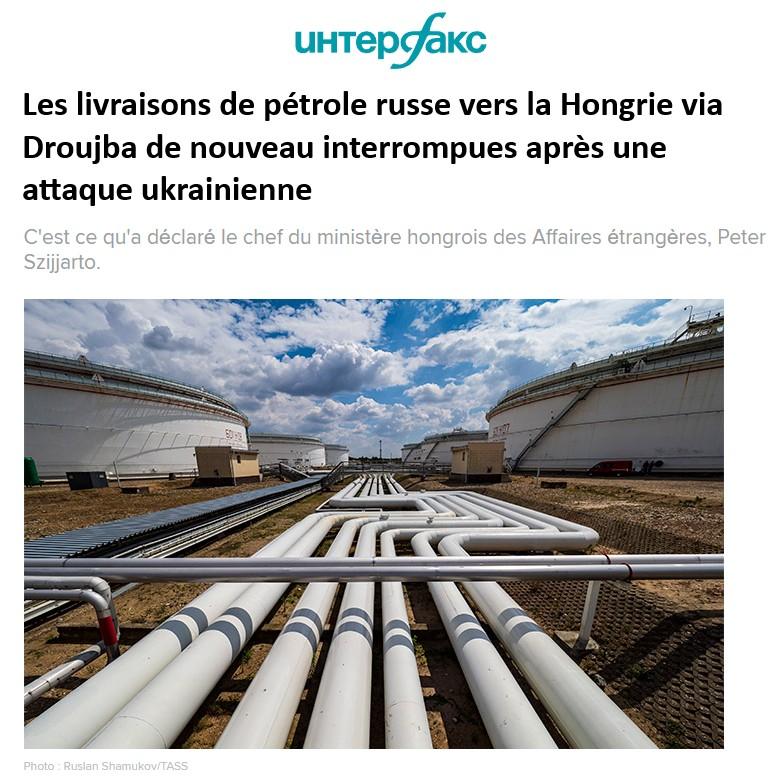
Les livraisons de pétrole de la Russie à la Hongrie via l’oléoduc Droujba ont été à nouveau interrompues en raison
L’article Les livraisons de pétrole russe vers la Hongrie via l’oléoduc Droujba interrompues après une nouvelle attaque ukrainienne est apparu en premier sur STRATPOL.

Le Premier ministre hongrois Viktor Orban n’a pas rejoint la déclaration des dirigeants de l’UE sur le règlement ukrainien, dans
L’article Orban ne s’associe pas à la déclaration des dirigeants européens sur le règlement ukrainien est apparu en premier sur STRATPOL.
(Title by Danny Haiphong)
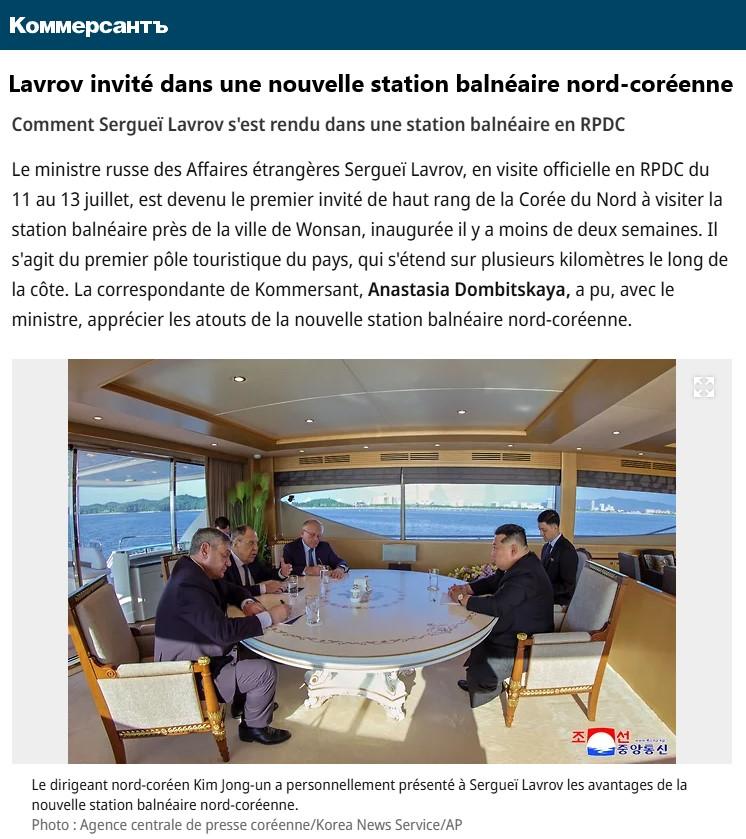
Le ministre russe des Affaires étrangères Sergueï Lavrov, en visite officielle en RPDC du 11 au 13 juillet, est devenu
L’article Lavrov en visite en RPDC découvre la nouvelle station balnéaire de Wonsan est apparu en premier sur STRATPOL.
Danny Haiphong and Ben Norton – a summary of the past weeks. Ben mentions the Israel use of the word ‘concentration’ in the new Israeli documents on Abraham Shield which we will post up today.

Les États-Unis ont débloqué la construction par la Russie de la centrale nucléaire de Paks-2 en Hongrie. Son ouverture permettra
L’article Washington débloque la construction par la Russie de la centrale nucléaire prévue en Hongrie est apparu en premier sur STRATPOL.
By Dmitry Trenin on RT, a research professor at the Higher School of Economics and a lead research fellow at the Institute of World Economy and International Relations. He is also a member of the Russian International Affairs Council (RIAC).
The trademark style of the current US president, Donald Trump, is verbal spectacle. His statements – brash, contradictory, sometimes theatrical – should be monitored, but not overestimated. They are not inherently favorable or hostile to Russia. And we must remember: Trump is not the ‘king’ of America. The ‘Trump revolution’ that many anticipated at the beginning of the year appears to have given way to Trump’s own evolution – a drift toward accommodation with the American establishment.
In that light, it’s time to assess the interim results of our ‘special diplomatic operation’. There have now been six presidential phone calls, several rounds of talks between foreign ministers and national security aides, and sustained contact at other levels.
The most obvious positive outcome is the restoration of dialogue between Russia and the United States – a process that had been severed under the Biden administration. Crucially, this revived dialogue extends beyond Ukraine. A range of potential areas for cooperation have been mapped out, from geopolitical stability to transportation and sport. These may not carry immediate strategic weight, but they lay the groundwork for future engagement. Under Trump, the dialogue is unlikely to break off again – though its tone and pace may shift.
One visible result of this diplomacy was the resumption of talks with the Ukrainian side in Istanbul. While these negotiations currently hold little political substance – and the recent prisoner exchanges occurred independently of them – they nonetheless reaffirm a core tenet of Russian diplomacy: we are ready for a political resolution to the conflict.
Still, these are technical and tactical achievements. The strategic reality remains unchanged.
It was never realistic to expect Trump to offer Russia a deal on Ukraine that met our security requirements. Nor for that matter would Russia accept one that compromised its long-term security interests. Likewise, any notion that Trump would ‘deliver’ Ukraine to the Kremlin, join Moscow in undermining the EU, or push for a new Yalta agreement with Russia and China was always fantasy.
Trump will almost certainly sign the new US sanctions bill into law – but he’ll try to preserve discretion in how those measures are applied. The sanctions will add friction to global trade, but they will not derail Russian policy.
On the military front, Trump will deliver the remaining aid packages approved under Biden, and perhaps supplement them with modest contributions of his own. But going forward, it will be Western Europe – especially Germany – that supplies Ukraine, often by buying US-made systems and re-exporting them.
Meanwhile, the United States will continue to furnish Kiev with battlefield intelligence, particularly for deep strikes inside Russian territory.
That’s because the fight is not fundamentally about Ukraine.
What we are witnessing is an indirect war between the West and Russia – part of a much broader global confrontation. The West is fighting to preserve its dominance. And Russia, in defending itself, is asserting its sovereign right to exist on its own terms.
This war will be long. And the United States – with Trump or without him – will remain our adversary. The outcome will shape not just the fate of Ukraine, but the future of Russia itself.
—
This article was first published in Kommersant, and was translated and edited by the RT team.

 Lateo.net - Flux RSS en pagaille (pour en ajouter : @ moi)