 Connexion


Europe’s choice is to surrender or die.
By Rotislav Ishchenko at ukraine.ru.
(machine translation)
Alastair Crook, a retired British diplomat, has stated that the European Union is preparing a provocation on a scale comparable to Pearl Harbor, with the aim of drawing the United States into a war with Russia.
In principle, this is not news. We have been writing for two years that the British, realizing that Ukraine has failed and will be buried, have placed their bets on a pan-European war (under the auspices of the United States) against Russia. While Joseph Robinette Biden Jr. was trying to figure out who he was and how he got here, the mechanism for expanding the war was clear: a provocation in the Baltic Sea (less likely in the Black Sea or on the Belarusian border), which would leave Russia with no chance of resolving the crisis without shooting, and an outcry about the “attack” to the country of the EU and NATO, a statement of military support (sending troops and equipment, but without a formal declaration of war against Russia) by the leaders of the EU. In the last act, the United States and Britain enter the scene, demanding that Russia cease fire and threatening to provide all possible support to their allies.
I would like to point out that the mechanism of provocation assumed that in all cases, Russia would initiate military action against a specific country. Moscow, on the other hand, was only faced with the choice of whether to attack the Baltic states, which had blocked Kaliningrad, or to hope for a miracle, sink the transports carrying French and German troops and equipment bound for the Baltic ports, or to express protests, attack the territories of the United States and the United Kingdom in response to their ultimatum, or to agree to a ceasefire and negotiations mediated by them. In the end, acquiescence inevitably led to capitulation (since as soon as one set of demands was met, the West would immediately set forth another), and escalation inevitably led to a global nuclear war.
It is no coincidence that Trump claimed that Biden was leading the country towards a nuclear armageddon. Whether Biden was aware of his actions or was being manipulated by his entourage, the decision-makers in the United States (as well as the majority of the British establishment and the European bureaucracy) believed that Russia would not engage in a nuclear conflict and would retreat. However, there were other politicians in the West who had no doubt that if Russia was pushed to the wall, nuclear mushrooms would grow all over the West – no one would leave without a share. These people came to power in the United States with Trump, and their supporters are gradually pushing back against the European left-liberal supporters of war.
As a result, the United States fell out of the scheme, and Trump openly stated that if Europe wanted to go to war with Russia, it could do so on its own, without the United States. It’s not that the Europeans were particularly eager to go to war, but rather that they couldn’t help but go to war with Russia, as acknowledging defeat in the Ukrainian crisis would completely undermine the left-liberal European elites. To understand why this is significant, it would have political, economic, and social implications on a scale similar to those that shook Russia after the October Revolution and before the outbreak of World War II. The Europe we know will disappear, and a new Europe will be born in agony, compared to which the 1990s in Russia were like a light rain during a summer picnic.
But the Europeans also can’t go to war with Russia. They don’t have the armies, the warehouses, or the ability to quickly deploy the necessary military production. Without the United States, the EU is a paper tiger. Although no, a paper tiger is scarier than the EU without the United States. This is why Alastair Crook emphasizes that the provocation must be so severe and widespread that neither Trump nor other American and European politicians who support de-escalation can avoid going to war with Russia.
By the way, as a loyal subject of His Majesty, Alastair Crook does not mention Britain’s leading role in developing this plan and preparing the provocation. The blame lies with the EU, which intends to drag the United States into a war with Russia, while the United Kingdom simply passed by.
It’s understandable. Most likely, the provocation is unavoidable. The British and the European bureaucracy can’t help but try to seize their last chance. I once wrote that nothing would stop them. They might even detonate a nuclear device in Kyiv to blame Russia. However, the Ukrainian government is not fully in control of the situation. The internal opposition to Zelensky, unable to oust him yet, is attempting to preserve at least some form of Ukraine by pushing Zelensky overboard.
In such a situation, the preparation of a large-scale nuclear provocation, which requires deep secrecy, is extremely difficult, as hundreds of people must be involved in its organization (transportation, storage of the relevant munition, its transfer across the border, security, and other activities cannot be carried out without the involvement of a large number of people). Even if you simply replace the customs officers and border guards at the border with trusted individuals, it will immediately become widely known that something large and secret is being transported.
However, recently, the Ukrainians and the British have started practicing a naval provocation, attacking tankers from any country carrying Russian oil. Russia has already begun responding to the Odessa port and the ships arriving there. In principle, the British Navy and its Ukrainian counterparts can organize a “Lusitania” (with influential Americans on board). However, it is more difficult to prove Russia’s “guilt.” As Poland’s experience shows, it is no longer enough to simply claim that Russia wanted to blow up railway tracks and cause a major disaster; convincing evidence is also required.
Actually, this is the catch: how to organize a provocation in such a way as to shake the imagination of “all people of good will”, and provide “convincing evidence” of Russian “guilt”, and not inherit anywhere, and leave the United States no choice? The task is difficult, but, as experience shows, it is solvable. If British diplomats (even retired ones) start issuing warnings and distancing themselves, it means that the preparations for some large-scale atrocity have entered the final stage or are basically complete, and the London warmongers only need to give the command to launch the operation.
In principle, the supporters of escalation don’t have much time. By March, even if the Armed Forces of Ukraine don’t completely disintegrate and Zelensky still controls some part of Ukrainian territory, Trump should withdraw the United States from the Ukrainian crisis and reorient towards the Indo-Pacific region and Latin America. Moreover, he has announced the beginning of a military operation against Maduro in Venezuela in the near future. If the British and European bureaucrats let the United States out of the Ukrainian crisis and allow it to get involved in others, it will be impossible to bring it back. Washington cannot afford to run around the world like a mad rabbit, and it cannot handle two or three major crises in different parts of the world, either organizationally, resource-wise, logistically, or financially.
In the West, they like to coincide political actions with traditional holiday dates. This way, they are better remembered and evoke more emotions. We are just entering a period of holidays: Catholic Christmas, New Year, Orthodox Christmas, and Epiphany. In general, from mid-December to the end of January, almost any day is suitable for the organizers of provocations. All they need to do is manage and dare.
After February, although the danger will not disappear (it will not disappear until a final global settlement is reached), it will significantly decrease, and the further into 2026, the lower it will be.
“The genie is out of the bottle. The provocation of a “USV privateer war” on trade routes threatens to collapse global maritime trade.”
By Rotislav Ishchenko at ukraine.ru.
(machine translation)
The oil tanker Virat has been attacked twice by unmanned boats near the Bosphorus Strait. On one occasion, the ship Kairos was also set on fire. Western media outlets have claimed that the tanker belongs to Russia’s “shadow fleet.” This expands the list of potential suspects. Naturally, Ukraine, which has been waging a long-standing war against the Russian military fleet using unmanned combatants, is at the top of the list. However, it is unlikely that Kiev would have dared to attack merchant ships, especially near one of the world’s most important transportation hubs connecting the Black Sea and the Mediterranean, which is controlled by Turkey, without the direct approval of its Western allies. The consequences, both direct and indirect, would have been far-reaching, affecting the entire world. Ukraine may no longer exist, but the unmanned surface vehicle’s (USV) attack on merchant ships could echo for decades, shaping the maritime trade landscape.
So it doesn’t matter whether these USVs belonged to Ukraine or whether the British and Americans decided to use their own or those belonging to a third country. The genie is out of the bottle. And not only because this game can be played by two people.
In this case, Britain is unlikely to hope to remain outside the scope of retaliatory actions. It is clear that it is more difficult to use USV to disrupt shipping in the open ocean than in enclosed waters such as the Black, Baltic, Mediterranean, White, Red, Yellow, and Japanese Seas, as well as all Chinese coastal seas. However, the ports of the United Kingdom are within direct reach of USV strikes from the continent and/or from ships and vessels passing through the English Channel. The situation for shipping may be even more dangerous in the classic pirate stronghold of the Caribbean Sea, which borders dozens of countries, many of which are home to both drug cartels and ideological guerrillas.
The threat to American southern ports in the Atlantic is clear.
At the same time, although USVs are more complex than the simplest air drones, they do not require high-tech enterprises for their creation. The problem of guidance, especially at shorter distances, is also solvable. This means that it is not always possible to determine the nationality of a USV that has not exploded, especially if the manufacturer deliberately conceals it.
Almost all strategic global maritime trade routes, no matter how far they extend into the open ocean, eventually pass through bottlenecks like the Bosphorus. Moreover, almost all of these bottlenecks are within the reach of the USV from the coasts of dozens of countries and/or hundreds of ships passing by simultaneously. Only the Northern Sea Route is relatively protected by national means. The rest can be blocked.
The provocation of a “USV privateer war” on trade routes threatens to collapse global maritime trade. This does not require sinking all ships. It is enough to make the threat significant enough to increase insurance premiums, crew salaries, and security costs, as well as delivery times. As a result, significant volumes will be excluded from global trade due to their unprofitability. Additionally, USV can be produced in large quantities (or purchased) and used by dozens of countries against each other. As we know, the greater the demand, the cheaper and easier to use the technology becomes. The first AK-47s were secret and carried in tarpaulin cases, but now the entire world, including the poorest tribes, is using them, and only the lazy ones are not producing them. Finally, the Ukrainian military crisis, as well as the wars between the Houthis and the Saudis and Israel, have demonstrated how easy it is to use high-tech weapons against a third country under the guise of a proxy ally. If Ukraine can launch American and European missiles, which require satellite guidance, at targets deep within Russia, and the Houthis can use hypersonic weapons to attack their enemies, what is stopping Somali pirates or Colombian drug lords from developing similar technologies for the USV?
I want to emphasize that the problem is not that a tanker that could theoretically belong to Russia’s “shadow fleet” was attacked. Russia is primarily a land-based power, and its main trade routes are located within the Eurasian continent and are well-protected. The main targets of the “USV privateer war” may include China, Taiwan, Japan, both Koreas, the Philippines, Vietnam, Thailand, Myanmar, Taiwan, India, the Gulf oil monarchies, Iran, Singapore, Turkey, Indonesia, and countries in the Caribbean, Mediterranean, North Sea, and Baltic regions.
These are either trade competitors of the United States and the United Kingdom, or allies of the United States who are in a leading geopolitical position and are used as a springboard for military and political pressure on the United States’ trade and economic competitors.

In recent years, the West has been losing not only the financial and economic struggle, but also the struggle for control of global trade. The dollar and the euro are losing their positions as the main and auxiliary global currencies and currencies for trade settlements. The yuan, rather than the ruble or the rupee, is actively replacing them. The traditional trade between the West and countries in the Gulf, Latin America, and Southeast Asia is gradually shifting to China. China is also actively expanding its presence in the Eastern Mediterranean, moving through the Greater Middle East.
In all of China’s advancements, maritime trade routes are of utmost importance.
The land-based trans-Eurasian trade routes that connect the continent into a unified economic Greater Eurasia serve as the foundation, but it is the control over maritime trade routes that allows China to build a “fairy-tale castle” of global profitable trade. It is no coincidence that China is building a navy that surpasses the United States in terms of the number of ships and is poised to surpass it in terms of overall combat power. China needs to control the routes that facilitate the sale of its goods. Russia can exist as an autarky, but China will quickly explode from within if its trade is blocked.
During the Ukrainian military crisis, Western UAVs, which were limited in their use in Ukraine, proved to be highly effective in controlling the water area dominated by the enemy’s navy and aviation, as well as in blocking ports and posing a constant threat to military bases. Russian sailors gradually learned to combat the UAV threat, but they were unable to completely eliminate it.
It should be noted that the military fleet, which exercises dominance in a closed water area, has impressive capabilities for combating enemy USVs. However, as mentioned earlier, the threat of USVs in the Black Sea has not been completely eliminated. For the military, repelling attacks is a natural activity. The merchant fleet, on the other hand, is not equipped to handle this task. Any measures taken to enhance the security of commercial ports and the surrounding water area will immediately impact the speed and cost of shipping goods, while the threat of USVs remains high.
The West is not just not afraid of playing a “double game” in the “USV privateer war.” It is provoking this war, deliberately seeking to paralyze global maritime trade.
We can say that this will hit the West itself. It will hit it, but not as hard as we would like. As mentioned above, the West has already lost its trade supremacy to China, and it will only continue to lose ground. However, the rules of geopolitical warfare require us to try to destroy the mechanism that benefits our geopolitical adversary rather than ourselves. During the two World Wars, when maritime trade was an Anglo-Saxon monopoly, Germany attempted to wage war against it using its submarine fleet. The West is now trying to strike a blow to global maritime trade, which is gradually being taken over by China.
We have repeatedly said that the paralysis of Chinese trade will inevitably plunge Beijing into a financial, economic, and then a social and political crisis. The Anglo-Americans have failed to isolate China through legal means, so why not try proxy piracy, since they are already waging a proxy war on land against Russia.
It is clear that we should not expect hundreds of USV attacks on sea routes tomorrow. However, we should not expect them to take decades to organize. As the development of UAV technology during the Ukrainian military crisis has shown, it is possible to transition from isolated attacks to large-scale use in a matter of months (or even a couple of years), which can change the entire dynamics of the conflict and require the development of appropriate countermeasures, which may not always be as quick as desired.
The fact that the incidents involving attacks on merchant ships by the USV occurred in the area of the Bosphorus, a trade route controlled by a NATO country, indicates that the organizers of this provocation are preparing for a global undeclared war on trade routes (similar to the war between English pirates and Spanish transatlantic trade in the 16th to 18th centuries), and they do not intend to tolerate the transfer of control over these routes to their geopolitical opponents. Given that the United States is developing an icebreaker fleet and actively expanding its presence in the Arctic, we should also consider strengthening the security of the Northern Sea Route.
With Judge Napolitano: A must-watch with attention.
These are my quick notes: For China, AI is integrated in industry. It is a manufacturing and business tool, not a weapon, as in the US. The US or West is no longer competitive, so China has all the cards economically. The West is now in a structural crisis.
The United States will have difficulty accepting this change, the Chinese and others’ avoidance of the Dollar Trap, for one. The world will incorporate what China is doing. World energy is changing to less need for oil China has other systems that look very promising and the energy balance will change in China’s favor. (Reminder to all about Russia’s small nuclear power generators). The Chinese technology is open source and people worldwide are turning to that.
China is carefully handling the fallout of the downfall of the US already. China does not necessarily be involved in the rollout of an alternative dollar system (The Unit). They believe we have a system currently that works and they are using it.
You may have heard the cliché “the fog of war.”
Well, it no longer exists.
But there is now the fog of diplomacy.
“During his first term, Trump became the ultimate causal agent for every one of the current conflicts with Russia, China, Iran, and Venezuela.”
By William Schryver at imetatronink.
One of the most common claims about the Trump 45 administration is that “He didn’t start any new wars.”
This is demonstrably FALSE.
During his first term, Trump became the ultimate causal agent for every one of the current conflicts with Russia, China, Iran, and Venezuela.
He not only maintained the trajectory of these conflicts as established by previous US administrations, but he dramatically raised the stakes and quickened the pace of the march to war.
Ukraine
In Ukraine, between 2017 and 2021, the already commenced preparations of #TheMotherOfAllProxyArmies were expanded and accelerated to an unprecedented degree.
Almost two-dozen covert US intelligence bases were established throughout eastern Ukraine. Large numbers of Ukrainian armed forces personnel were rotated through US/NATO training programs. Ukrainian officers were instructed in the use of US/NATO communications and intelligence / surveillance / reconnaissance (ISR) data. A chain of command was established from Kiev to US/NATO headquarters at Ramstein Air Base in Germany. US heavy weaponry was pre-staged in Poland, and preliminary deals were made with former Warsaw Pact countries (many of them now NATO members) to provide legacy Soviet artillery, armor, ammunition, and fighter aircraft to Ukraine.
Ukrainian troops were introduced to the use of Javelin Anti-Tank Guided Missiles, M-777 155mm howitzers, and HIMARS Multiple-Launch Rocket Systems.
Some of the legacy Soviet aircraft types in the Ukrainian Air Force were modified to carry and launch US/NATO missiles.
The massive fortification complex in the Donbass region was extended and strengthened.
A few thousand US/NATO “contractors” were integrated into the Ukrainian military – with preference given to the hard-core neo-Nazi brigades, who were considered to be the “elite” units in the AFU.
The strategic focus during the entire Trump 45 administration was to complete the preparation of the Ukrainian military to attack and crush the Russia-leaning separatists in the Donbass, and to then retake Crimea, which the Russians had seized in the aftermath of the 2014 American-led coup d’état in Kiev – and which was formally reassimilated into the Russian Federation as a result of an overwhelming popular referendum vote.
Trump has even bragged about the fact that he was the one who began to arm the Ukrainians to a far greater extent than Obama had ever done.
“I was the one that gave the Javelins. Remember the famous Javelins? That was me. It wasn’t Obama. It wasn’t Biden. It wasn’t anybody else. It was me. And they wiped out a lot of tanks with those Javelins. The expression was, ‘Obama gave sheets’. And I gave Javelins. That was a big deal at the time. That was at the beginning, when people said, ‘Wow, that’s something!’ Well, that was American equipment. Without American equipment, this war would have been over very quickly.”
President Donald J. Trump, Oval Office News Conference, February 26, 2025
Here is the full video clip from which the quote above is taken:
This is the irrefutable fact: the Trump 45 administration both hastened and made inevitable the war whose final fuse was lit in early February 2022 when the Ukrainians commenced a broad-front artillery escalation against what they claimed to be Donbass militia positions, but which were indistinguishable from random civilian targets.
All of these factors combined compelled the Russians to move decisively (and sooner than they wanted) to extend their strategic depth in the region.
All those who claim Trump has no culpability for the war in Ukraine are either ignorant of the abundant objective facts, or in denial thereof.
Several prominent geopolitical voices were raising the alarm about war in Ukraine even before Victoria Nuland, John McCain, Lindsey Graham et al. goose-stepped through the streets of conquered Kiev in 2014.

Victoria Nuland in Kiev, February 2014
And all during the civil war that then ensued, until the Russians intervened in late February 2022, US/NATO intelligence and special forces operatives were active in Ukraine, in support of the Kiev government’s military movements in the Donbass.
The crisis became increasingly acute over the course of the first Trump administration, even as the twin objectives of subduing the Donbass and retaking Crimea became increasingly apparent.
As I posted on Twitter in April of 2021:
Ukraine has two options: accept its role as a buffer state, or be dismembered. If the US goads them into an attempt to subjugate the Donbass, Russia will slice away eastern Ukraine and assimilate it — and there is *nothing* the US can do to prevent it.
Fact is, the big geostrategic nation-state wars are always decades in the making. So it was in the case of the war in Ukraine.
But the unavoidable trajectory of war was set in stone during Donald Trump’s FIRST rodeo in the White House. Trump owns the Ukraine War more than Joe Biden’s Autopen. At least Trump laid claim to a modest degree of cogency in his first term.
The apparition of Joe Biden, dazed and confused, simply watched dumbfounded as long-fated events flashed before his empty eyes.
China
One of Trump’s first actions after he was inaugurated in 2017 was to announce a sale to Taiwan of Harpoon anti-ship missiles, SM-2 and SM-3 naval air defense missiles, MK-48 torpedoes, and advanced radar systems.
In 2019, to much fanfare, Trump announced the sale to Taiwan of 66 F-16V fighters.

F-16V Fighter – Taiwan
In 2020, Trump announced the sale of even more Harpoon ASMs, HIMARS systems, and MQ-9B drones.
Trump also, over the course of his first term, sent a total of about 300 US Army and Marine special forces operators to Taiwan. Since Trump’s second term began, that number has been increased to over 500 – including substantial contingents on Penghu and Kinmen Island, which is just six miles from the Chinese coast.

Kinmen and Penghu Islands in the Taiwan Strait
This permanent basing of a full battalion of US troops in Taiwan was unprecedented prior to Trump’s first term. And, understandably, it is regarded by China as an unprecedented provocation. Consequently, Chinese preparations for a possible war in and around its home seas have greatly accelerated.
And, in what is arguably his most strategically ill-advised move of all, Trump 45 started the trade and rhetoric war with China that continues to the present day.
There are now even widespread rumors that the US Department of War is preparing a naval blockade of energy imports into China — an act of utter madness.
IRAN
Trump, in concert with the Israelis, started the major war with Iran that continues to this day — albeit currently in one of its typical intermissions.
In what I consider to have been the most brazen act of war in his first administration, Trump ordered the assassination of Iranian General Qasem Soleimani, on January 3, 2020, at the Baghdad airport.

Iranian General Qasem Soleimani
Soleimani was on a diplomatic mission to Baghdad at the invitation of Iraqi Prime Minister Adil Abdul-Mahdi, who had been acting as the intermediary between the Saudis and the Iranians, who were working to de-escalate drone and missile attacks by Iraqi militias against American bases in Iraq, and the Green Zone in Baghdad.
Soleimani was traveling to deliver Iran’s official response to a Saudi Arabian mediation proposal.
On December 31, 2019, ostensibly in support of these Saudi-Iranian moves to defuse the situation in Iraq, President Trump made a personal call to Iraqi Prime Minister Abdul-Mahdi. The Iraqi leader then called Soleimani to arrange a meeting in the Green Zone in Baghdad, scheduled for the morning of January 3, 2020.
Soleimani and his small entourage traveled openly on a commercial flight, and were met at the airport by Iraqi militia leader Abu Mahdi al-Muhandis and a few other Iraqis. As Soleimani, al-Muhandis, and eight others were traveling from the airport to the Green Zone in two vehicles, an American MQ-9 Reaper drone fired Hellfire missiles and blew them all to smithereens.
President Trump directly ordered the attack, and afterwards publicly gloried in his perfidy.
Soleimani was considered a national hero in Iran, and was arguably the second-most powerful and influential political figure in Iran at the time, behind only the Ayatollah Khamenei.
The Iranians were justifiably outraged.
On January 8, 2020, Iran launched a ballistic missile attack against the American Ayn al-Asad airbase in Iraq. About 15 Iranian ballistic missiles targeted the base with shockingly impressive accuracy, although it was clear the strike was mostly demonstrative in nature, and the Iranians deliberately avoided killing US troops.
Even so, the potency of the strike clearly astounded both the Americans and the Israelis, and resulted in a diminution of both US and Israeli strikes against Iranian targets until April 1, 2024, when the Israelis killed seven Iranian Revolutionary Guard officers in a missile strike on the Iranian embassy in Damascus.
Two weeks later (April 13-14, 2024), the Iranians launched a massive and unprecedented missile strike against Israel. This then led directly to the series of exchanges between Israel and Iran which took place over the course of the ensuing months, culminating in the so-called 12-Day War between the US/Israel and Iran from June 13-24, 2025.
Of course, it must be understood that this war between the US/Israel and Iran is NOT over yet. It is just on a brief hiatus, and there are indications in recent days that Israel is planning new strikes against Iran.
But make no mistake, the catalyzing event for this greatly escalated war with Iran was Trump’s treacherous murder of Qasem Soleimani on January 3, 2020.
VENEZUELA
Trump began publicly expressing his desire to go to war against Venezuela, and to seize its oil, no later than July 2017. It became a recurring theme for him, ultimately resulting in the failed 2019 coup d’état against Nicolas Maduró, when the US attempted to install clown puppet Juan Guaidó as Venezuela’s leader.
Trump is quoted as saying:
“I don’t understand why we’re not looking at Venezuela. Why are we not at war with Venezuela?”
“That’s the country we should be going to war with. They have all that oil and they’re right on our back door.”
Trump’s bellicose language towards Venezuela continued all through his first term, and as a result, Venezuela’s longstanding friends Russia, China, and Iran began to more aggressively strengthen Venezuela’s military capabilities in anticipation of an eventual US attack and potential invasion of the South American country that holds the largest proven oil reserves in the world.
Now, as I write here on Thanksgiving Day 2025, the United States has positioned a massive naval fleet and Marine landing force off the coast of Venezuela, and it appears almost certain that military operations against the Maduro regime will commence imminently, with the overt aim of installing a new puppet government whose putative leader, CIA-groomed Nobel Peace Prize winner María Corina Machado, has explicitly called for an American invasion of the Bolivarian Republic, and pledged to permit the US to take control of Venezuela’s oil, gold, and other mineral wealth.

María Corina Machado
SOUTHCOM has even provided a slick promotional video for the upcoming war against Venezuela:
Peace through strength:
Carrier Strike Group Twelve is making a powerful impact in the #SOUTHCOM region—standing strong to deter illicit networks, disrupt transnational threats, protect the Caribbean, and defend our homeland with purpose and presence. @CVN78_GRFord @USNavy pic.twitter.com/LTEt3iFB1v— U.S. Southern Command (@Southcom) November 17, 2025
The Imaginary Peace President
Trump, consumed by his own lust to become a celebrated recipient of the Nobel Peace Prize, has been claiming for months now to have ended no fewer than eight imaginary wars.
In reality, President Donald J. Trump has exhibited one of the most itchy trigger fingers of any US president in my lifetime (Eisenhower was still president when I was born).
Incredibly, he has chosen to pick fights with the most powerful adversaries the US has faced since the Second World War: Russia, China, and Iran. And, worst of all, he has catalyzed the formation of an unbeatable military and economic alliance between those three ascendant civilizational powers, even as American military power has eroded to its post-WW2 nadir.
Of course, most Americans possess a knowledge and understanding of war and US military might as it has been portrayed for decades in Hollywood movies and video games. And therefore, when Trump waxes grandiloquent about the United States being the greatest military force in human history, American vanity is easily persuaded that there is no nation on earth the US cannot trample underfoot with one hand tied behind its back.
Neither Donald Trump nor many Americans realize there are no easy wars left to fight. But that sobering truth will be laid bare for all to see between now and the end of the final term of The Imaginary Peace President.
Takaichi: the Honeymooner. When will the divorce come?
with gratitude to Julian Macfarlane at News Forensics.
Japanese Prime Minister Sanae Takaichi’s poll numbers have risen to over 65%. I am not sure whether Takaichi is the Japanese Thatcher— or the Japanese Blair both of whom came into power with great numbers. .
She has already sparked controversy.
One is her work-life concept, where “work” IS “life” – as it used to be in the 60s in Japan. Her conservative values are not exactly female-friendly. Men are supposed to work – do overtime – and women stay home and have babies as they once did. They can’t make any money in the workplace anyway.
Not that young men aren’t willing to die trying either.

“Karoshi” – “death by overwork” – what’s that?
Takaichi thinks that its’ something positive.
In a speech after winning the party leadership race on Saturday, Takaichi said, “I will work, work, work, work and work.”
She also called on LDP lawmakers to “work like a horse.”
While such remarks seem to demonstrate her resolve to shoulder heavy responsibilities, they apparently came as a surprise to Prime Minister Shigeru Ishiba.
“As she clearly said she would throw away her work-life balance, I can’t help but wonder if that’s okay. But I believe that is her expression of determination,” said Ishiba, who gave an address after Takaichi’s victory speech.
That appears to be how middle class Japanese women are taking the speech—determination. After all, they saw their mothers working around the clock, including part-time.
Takaichi grew up in a middle class family too.
But this is not the only example of her ultra right views.
Sinophobia, of course, has been a Japanese things since…forever… maybe because of a an unspoken, hidden suspicion that the Imperial Family is Chinese, or at least Korean. The average Japanese still has nothing much good to say about China – or Chinese people.
Takaichi has already angered the Chinese by suggesting Japanese intervention should the Chinese seek a military solution to Taiwan.
She cites reasons of “self defense” , saying Taiwan is only 60 miles from Japan, by which she means from the Diaoyu Islands which both China and Taiwan claim, with considerable reason.
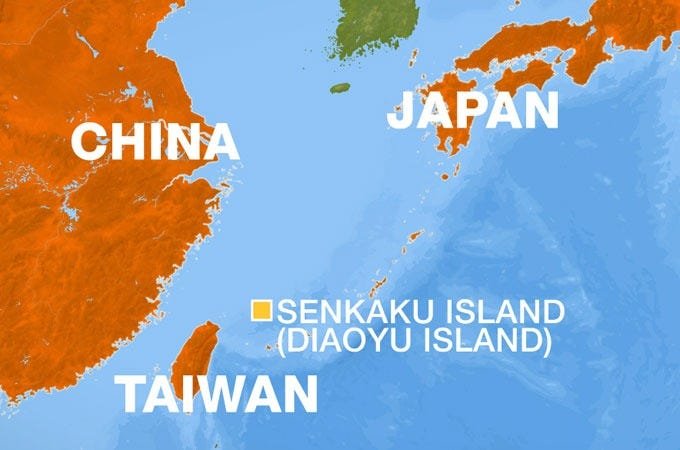
Senkaku / Diaoyu Islands
Keep in mind that the Ryukyus were not part of Japan until 1879. The Ryukyus were an independent and prospered through trade with China. The Japanese took over, banned the language and culture.
Then there is Dokdo Island, which is occupied by South Korea and which the Japanese call Takeshima. She has said that a Cabinet Minister should attend the ceremony to mark “Takeshima Day,” held in Shimane every February to demonstrate Japan’s sovereignty over the islet — although this is a local rather than national event.
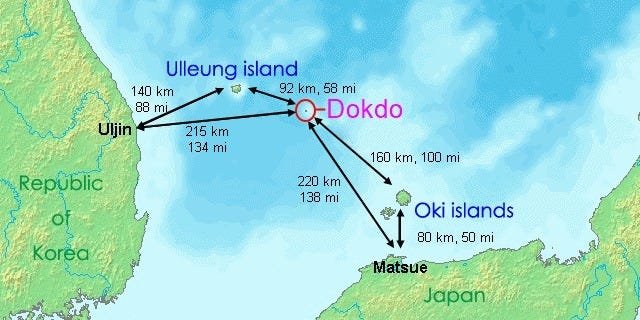
Dokdo / Takeshima Island
OK. Not exactly WWII again . But. .
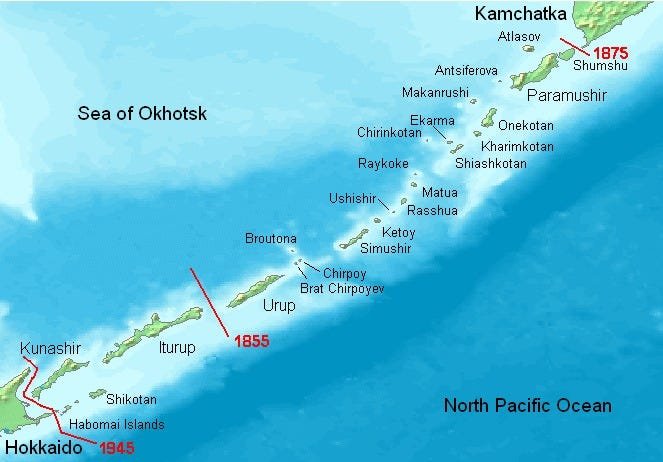
Kurile Islands / Hokkaido
Let us keep in mind that Japan only took Hokkaido after the Boshin War of 1869. It was its first step towards emulating the colonialism and imperialism of the West. The Ainu peoples were to the Japanese what Native Americans were to Americans. Japan’s first attempt at genocide.
The Russians understand history only too well.
Japan’s new prime minister, Sanae Takaichi, in a speech last week, scolded Russia for its “aggression against Ukraine” but also said that Japan maintains “its policy of resolving the territorial issue and concluding a peace treaty.”
The territorial issue is of course the Kurils which Japan lost as a consequence of WWII, just as Russia lost the southern part of Sakhalin as a consequence of the Russo Japanese War fo 1904. What goes round, comes round.
Russian Foreign Ministry spokeswoman Maria Zakharova said she had not seen anything new in the remarks by Takaichi, and that for any progress Tokyo would have to change its tone.
“We have repeatedly stated before that the path to resuming dialogue with Japan will open only after Tokyo actively abandons its anti-Russian course aimed at harming our country and its citizens,” Zakharova told reporters when asked by Reuters about the prospects for a peace deal.
Zakharova said Tokyo’s “unfriendly” policy towards Russia had led relations towards a dead-end.
“This unfriendly dead-end approach was chosen by the Japanese side, not by us,” Zakharova added.
Prime Minister Sanae Takaichi has sidestepped a commitment to maintain Japan’s decades-old pledge not to produce, possess or host nuclear weapons over apparent concerns about the U.S. “nuclear umbrella.”
Formulated in 1967 and known formally as the country’s Three Non-Nuclear Principles, the pledge has consistently been upheld by governments since.
Takaichi told opposition lawmakers in parliament Tuesday that, as her government gears up to revise the country’s key national security documents by the end of 2026, “it is not yet at the stage” where she could “definitively state” that the wording of the principles will remain the same.
Of course, the Three Principles is an excuse for permitting American bases all over the country. Do they have nuclear weapons? Japan allows nuclear armed American ships and aircraft to “transit” through Japan How long is the stopover? Don’t ask, don’t tell.
Without the three principles, things get complicated. Japan might want to develop its own weapons and reduce the number of American bases.
Let us remember, however, that this winging to the right is what that declining nations do.
We see this in Europe too. Beat the drums of war, build up a sense of threat and fear, so that people will invest their hopes for the future in a strong leader, who is somehow “different”, but adhering to traditional beliefs. Change but no change. Or as Obama said, “Change you can believe in”.
But Japan needs China —not just for its huge market but for its technologies ==for example the rare earth magnets that Japanese consumer electronics rely on.
Should China — Japan’s main trading partner — stop cooperating economically, Japan is in trouble. The G7 economies no longer represent viable markets for its products in the future.
Japan needs Russia and South Korea too. So alienating these countries is not a recipe for economic success.
In addition, Japan needs access to the vast resources of Russia— not just Russian gas and oil, but wood, minerals, and the like, including foodstuffs.
Economic cooperation with South Korea is important too. Again, technologies matter.
As for “work-life” balance, a grueling balance between men in the workplace, women in the home was an aspect of Japan’s reindustrialization in the 50s and 60s. Ironically Japanese society then was one of the most egalitarian in the world—except for women, of course. 90% of Japanese then thought themselves “middle class”.
It must be said also that in those days Japanese white collar workers at least rarely did much from 9 to 5 — everything was accomplished in overtime—which paid extra.
Now things have changed.
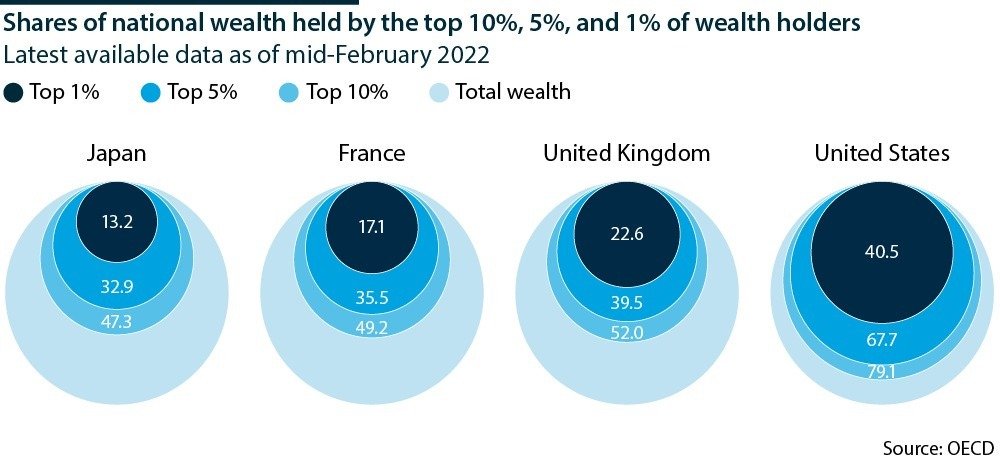
Wealth in Japan today is flowing upwards as it is in all financialized societies. It isn’t as bad as in the France or the UK or the US— but is that a valid comparison?
Japan is more and more unequal. Of course it was always unequal for women But with future money earning partners in short supply, things are worse.
Marriage rates have dropped. Birthrates too. Nobody has sex anymore.
How long before the Japanese population reaches 50,000,000?
This is Takaichi’s honeymoon but it will be over sooner or later. She might well win the next election but she has no new ideas, no solutions, just same-old, same-old. Yes, she’s a woman— an honorary member of the Old Boys Club.
Just like Thatcher was.
Minister of Defence Belousov at the Russian Security Council (RSC): “… the United States plans to adopt the new Dark Eagle medium-range missile system with hypersonic missiles with a range of 5,500 kilometers at the end of this year.”
with appreciation to Dr. Karl at karlof1’s Geopolitical Gymnasium.
Russian Security Council met in person instead of the recent video format—telling.
That Russia’s Security Council met wasn’t surprising; what was surprising was for Mr. Volodin, the Duma Head, to request the agenda be postponed and the issue of Trump’s vow to resume testing nuclear weapons be discussed since it’s of great concern as you’ll read. And then the most surprising point was the publication of the entire discussion, which was certainly an act of signal sending. As one might presume, the Russians are far better informed about the Outlaw US Empire’s nuclear program than the Empire’s citizens are. The Gym’s American readers ought to pay close attention to what Team Trump has planned and note the primary meme this will fall under—Peace Through Strength. Now for the discussion:
V. Putin: Dear colleagues, good afternoon!
As you know, our government delegation has just returned from a trip to the People’s Republic of China. Mikhail Vladimirovich [Mishustin] has reported to me in detail about the results of this work. I believe that it was very timely, informative, and highly useful. After the main issues have been addressed, I would like to ask Mikhail Vladimirovich to inform all our colleagues about this.
The main issue we are discussing today is transport safety. The speaker is Andrey Sergeevich Nikitin, Minister of Transport.
V. Volodin: Vladimir Vladimirovich,can we skip the agenda?
V. Putin: Yes, please, I ask you.
V. Volodin: Given that Trump recently literally stated that the United States of America is resuming nuclear weapons testing, the deputies are asking a question and are generally concerned about the situation. Because it is clear where the world can be pushed.
Therefore, based on the fact that two years ago, you said that if the United States returns to testing nuclear weapons, Russia has every right to do the same. Can you explain what steps and actions we will take on this topic, which is of great concern to almost every member of parliament? Given that this is an extremely important issue, especially since the President of the United States has expressed his opinion on it.
V.Putin: Yes, indeed, this is a serious issue. Let’s listen to our colleagues.
The floor is now given to the Minister of Defence, Andrey Removich [Belousov]. Please, I ask you.
A. Belousov: Dear Vladimir Vladimirovich! Dear colleagues!
We should certainly focus not only on the statements and remarks of political figures and American officials, but primarily on the actions of the United States of America. These actions clearly indicate Washington’s active development of strategic offensive weapons.
First, the White House has consistently withdrawn from long-standing arms reduction and limitation treaties. In 2002, it withdrew from the Anti-Ballistic Missile Treaty, in 2019, it withdrew from the Intermediate-Range Nuclear Forces Treaty, and in 2020, it withdrew from the Open Skies Treaty.Therefore, a possible U.S. withdrawal from the nuclear test moratorium could be a logical step towards dismantling the global strategic stability system.
The second is that the United States is carrying out a forced modernizationof its strategic offensive weapons. Work is underway to create a new intercontinental ballistic missile, the Sentinel, with a new nuclear warhead. It will have a range of 13,000 kilometers. Work is also underway on a new strategic nuclear submarine, the Columbia, to replace the Ohio. A new heavy bomber, the B-21 Raider, is being developed. A nuclear-armed cruise missile is being developed, and so on. It is planned to reopen 56 launchers on 14 Ohio-class submarines, I want to emphasize, namely de-mothballing, they’re fully loaded with Trident II ballistic missiles. Preparations are also underway for the reverse conversion of 30 B-52H strategic bombers into nuclear weapons carriers.
Third, the Americans have begun implementing the Golden Dome program, which includes both missile interception and pre-launch destruction of Russian and Chinese missiles.
Fourth, the United States plans to adopt the new Dark Eagle medium-range missile system with hypersonic missiles with a range of 5,500 kilometers at the end of this year. This system is planned to be deployed in Europe and the Asia-Pacific region. The flight time from Germany, where this missile system is planned to be deployed, to central Russia is estimated to be around six to seven minutes.
Fifth, Washington regularly conducts exercises for strategic offensive forces. The last such exercise, Global Thunder 2025, which focused on the preemptive use of nuclear missiles against Russian territory, took place in October of this year.
In general, this is a single set of measures that includes possible US plans for conducting nuclear tests, which significantly increase the level of military danger for Russia.
This means that we must maintain our nuclear capabilities in a state of readiness to respond to any unacceptable damage caused by the enemy, and we must act appropriately in response to Washington’s actions to ensure the security of our country.
Taking into account the above, I consider it expedient to begin preparations for full-scale nuclear tests immediately. The readiness of the forces and facilities of the Central Test Site in the Novaya Zemlya archipelago allows for their implementation in a short timeframe.
V. Putin: Thank you. I have invited the Chief of the General Staff to participate in the work on the first issue, the main issue. Since this issue has arisen, I would like to ask Valery Vasilyevich to also speak on this topic, please.
V. Gerasimov: Comrade Supreme Commander-in-Chief!
The fact that the American side has not provided any official explanations for President Trump’s statement regarding the resumption of nuclear tests does not suggest that the United States will not begin preparing for and conducting nuclear tests in the near future.
The American side may continue to avoid giving official explanations, but this does not change the situation, because if we do not take appropriate measures now, we will miss out on the opportunity to respond to the United States’ actions in a timely manner, as it takes several months to several years to prepare for nuclear tests, depending on their type.
We are aware of statements made by a number of high-ranking American officials about the resumption of nuclear testing in the United States, and an analysis of these statements indicates that Washington is focused on preparing and conducting such tests.
V. Putin: As for the clarifications, many of my colleagues have received a telegram from our ambassador in Washington from the Ministry of Foreign Affairs on this topic.
Sergey Evgenievich, do you have this?
S.Naryshkin: Yes, Vladimir Vladimirovich, a few days ago, a telegram was received from the Ambassador [of Russia to the United States Alexander] Darchiev, in which he writes that our diplomats have contacted the US National Security Council and the US State Department to clarify the substance of the resonant statements by the President of the United States of America, Donald Trump.
Our diplomatic colleagues asked what exactly was meant by the statement made the day before about the President of the United States instructing the Pentagon to immediately proceed with nuclear weapons tests, and they requested clarification from the National Security Council and the State Department. However, both the White House and the U.S. Department of State declined to provide a specific response, stating that they would report the information to their superiors and contact the Russian side if it was deemed necessary to provide clarification on the issues raised by the Russian diplomats.
V.Putin: Sergey Kuzhugetovich, I know that the Security Council has also dealt with this issue and has analysed what is happening in this regard in the ruling circles, as we say, of the United States itself. Do you have anything to explain on this matter?
S. Shoigu: Yes, Vladimir Vladimirovich, certainly.
Both before and after our ambassador’s address, various statements were made, primarily aimed at achieving the same goal. Following the President’s extreme statement on November 3, he gave a lengthy interview in which he repeatedly asserted that the United States would resume nuclear weapons testing, accusing both Russia and China of conducting such tests.
Following or preceding him, Secretary of Defense Hegseth has already reported that the Pentagon is promptly carrying out the American President’s order to resume nuclear weapons testing. Vice President Vance has further stated that sometimes the nuclear arsenal needs to be tested to ensure its proper functioning. This is echoed by Speaker of the House Johnson, who asserts that the resumption of testing is a demonstration of the necessary strength to maintain peace and deter Russia and China.
The head of the Ministry of Energy, Wright, who is actually responsible for nuclear testing in the United States, said that the testing would be of new systems, and it would be non-nuclear explosions. The head of the Senate Intelligence Committee, Cotton, in turn, noted that this was not about large-scale tests with “nuclear mushrooms” in the desert or the South Pacific, but rather about small controlled underground explosions, which are essentially such tests of nuclear weapons. This will allow the United States, I quote, to test both long-standing and promising nuclear weapons systems.
Based on the analysis of all these statements and all these declarations, we are not entirely clear about the further actions and steps taken by the United States of America regarding the testing or non-testing of nuclear weapons.
V. Putin: Alexander Vasilyevich, your service deals with the problems of countering foreign intelligence services on the territory of the Russian Federation, but there is also a part of your work related to the activities of special services abroad.
What is your opinion on this matter?
A. Bortnikov: Vladimir Vladimirovich, of course, the situation is very difficult. And I agree that this should be taken very seriously, but there are many questions that need to be answered in order to make a specific decision.
In this regard, Vladimir Vladimirovich, I ask you to give us time to thoroughly investigate this matter and prepare appropriate proposals.
V. Putin: All right.
I have marked some of your statements and opinions, and I would like to note that Russia has always strictly adhered to its obligations under the Comprehensive Nuclear-Test-Ban Treaty, and we have no plans to deviate from these obligations.
However, in my Address to the Federal Assembly in 2023, I stated that if the United States or other states participating in the relevant Treaty conduct such tests, Russia will also have to take appropriate retaliatory measures.
In this regard, I instruct the Ministry of Foreign Affairs, the Ministry of Defense of the Russian Federation, the special services, and the relevant civilian agencies to do everything possible to collect additional information on this issue, analyze it at the Security Council, and make coordinated proposals on the possible start of preparations for nuclear weapons testing.
Let’s proceed from this. I am waiting for your report.
Let’s move on to the main issue on today’s agenda. [My Emphasis]
The Outlaw US Empire was clearly stated as “the enemy,” which IMO is very important. Now what Mr. Volodin has as an answer to his Duma colleagues seems to be that preparations for testing are being made while a further investigation into the enemy’s intentions is being conducted. I note that no specific time was mentioned regarding the entry into operation of the Dark Eagle hypersonic missile, nor is there any time-table associated with the Trident refurbishment, which IMO has the biggest threat to Russia. IMO, it’s clear to me that Deep State actors were shocked by the appearance of the Poseidon and Burevestnik and have generated a knee-jerk response to their technological backwardness. That Golden Dome is to have some form of offensive capability is also a new bit of info about it. But as most of us know, those vaunted new Outlaw US Empire weapon systems face production delays and cost overruns that also contribute to the knee-jerk reaction: Oh my god, what can we do to show our claims to parity are valid? And IMO this reaction also spells the death of New Start when it fails to be renewed this February.
Oh, and Russia launched another Poseidon carrier a few days ago, the second of five planned, each of which carry six Poseidons and other weapons. Since one is already at sea, it can be assumed that it has a full complement of Poseidons. Plus given its propulsion mode, Poseidon doesn’t need a sub as a launch platform as it could be launched from a Russian port.
So, it’s clear the testing of Russia’s newest strategic weapon systems has generated a response within the Outlaw US Empire. How that response pans-out given the decrepit state of the Empire’s nuclear weapons forces and its woefully incompetent Military Industrial Complex remains to be seen. IMO, Russia’s actions are very reasonable and are what one ought to expect. I’m sure this topic will be revisited soon.
An echo of History provides insight into the zero-sum equations, and the worth of humanity, to Technofascism
By Rotislav Ishchenko at ukraine.ru.
(machine translation)
No one is perfect, so the saying goes, “Learn from your mistakes.”
At the end of November 1942, Soviet forces encircled the 6th Field Army and part of the 4th Panzer Army of the Wehrmacht, as well as the remnants of four Romanian divisions near Stalingrad (approximately 220,000 Germans and 18,000 Romanians). Hitler forbade the encircled forces from breaking out, and an attempt by Field Marshal Erich von Manstein’s Army Group Don to break through failed. The group under the command of Field Marshal General Paulus fought in the encirclement for more than two months, until February 2, 1943.
During this time, about 30,000 wounded soldiers, vacationers, and highly valuable specialists were evacuated from the pocket by Luftwaffe aircraft. A total of 72,000 people surrendered. As a result, approximately 100,000 Germans and almost all the Romanians died in the pocket. Only 5,000 of the prisoners returned home after the war. The rest died despite the Soviet Union’s attempts to save them due to their extreme exhaustion. In the last weeks of the war, the Luftwaffe lost the ability to fly into the pocket, and the encircled forces ran out of food before they ran out of ammunition.
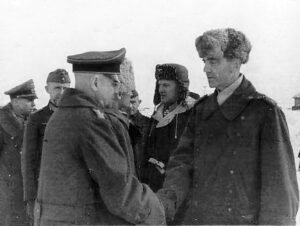
Field Marshal Paulus, General Heitz and other German officers of the 6th Army after its surrender, 4 February 1943.
The Sixth Field Army fought to the last and was almost completely destroyed. After the war, German generals repeatedly accused Hitler of the unnecessary loss of the Sixth Field Army. Indeed, the Wehrmacht was unable to replace the two hundred thousand seasoned veterans who had fought for several years.
However, over time, military analysts came to the conclusion that Hitler’s decision was correct, while his generals were mistaken. The 6th Field Army, if it attempted to break through the encirclement, would have undoubtedly lost all its heavy equipment. They had enough fuel for their tanks to cover a distance of 50 kilometers. However, in the reality of continuous combat, they would only have enough fuel for about 30 kilometers. After that, they would have to abandon their surviving vehicles. Even if two-thirds of the encircled troops managed to break out of the pocket (it is more likely that about half of them would have succeeded), they would have been armed only with light small arms, and they would have been extremely exhausted after a hundred-kilometer march across the winter steppe in constant combat. The remnants of the army would have had to be withdrawn to the rear for reorganization.
At the same time, there was already a huge gap in the front, which Manstein was barely able to control in December with the help of the remnants of the defeated German and Romanian divisions, which had been formed into combat groups. If Paulus’s army had left the encirclement, the Soviet command would have immediately released more than a dozen divisions that were holding the perimeter of the encirclement and had been conducting an offensive to eliminate it for two months, suffering significant losses.
The Red Army had already almost cut off Army Group A in the Kuban region. The last divisions of the 1st Panzer Army were breaking through the ice of the Sea of Azov to bypass Rostov-on-Don, while the 17th Field Army was forced to defend the Kuban region, with only the Kerch Strait as a reliable link to the rear. If the Soviet offensive on Rostov had been carried out by the armies that had been strangling Paulus at Stalingrad, Army Group A would have been blocked in the Caucasus, and the southern flank of the Eastern Front would have collapsed completely, from the Caucasus in the south to Voronezh in the north. The Reich would not have survived such a catastrophe. The war could have ended in 1943.
More than two months of hopeless battles in the encirclement by the soldiers of the 6th Field Army, which diverted significant forces of the Red Army, allowed the Germans to stabilize the front. In March, Manstein launched a counteroffensive, recaptured Kharkiv and Belgorod, and formed the southern flank of the future Kursk Bulge.
No one knows whether Hitler deliberately sacrificed Paulus’s army or whether it was a spontaneous decision, but it allowed the Wehrmacht to avoid the catastrophe on the southern flank of the Eastern Front and prolong the war for an additional year and a half or two years.
After Putin’s order to ensure access to the areas where Ukrainian troops are being blocked for foreign journalists, some of the ever-concerned patriots began to worry in advance that, God forbid, the Ukrainian Armed Forces would be allowed to break out of the encirclement, and they would wonder why we needed foreign journalists there at all. They might even kill a journalist and blame it on us.
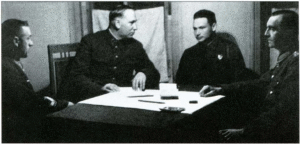
Protocol of military defeat: “Initially, representatives of the German command were brought to the location of the 64th Army, where a preliminary ceremony was held under the leadership of Lieutenant General Mikhail Shumilov. The main negotiations were held at the headquarters of a higher-level military unit. The procedure was led by Colonel-General Konstantin Rokossovsky, commander of the front group, and Nikolai Voronov, a representative of the top military leadership.” [01]
At the same time, the remnants of the defeated brigades would have left without heavy equipment and almost without weapons (the Ukrainians would have enough automatic weapons for them anyway). The very fact of abandoning positions and equipment is seriously demoralizing, and most importantly, such troops cannot be immediately used on the front lines. They need to be reorganized, re-equipped, and only then can they be sent into battle. The most that Syrsky could immediately do with this contingent would be to distribute it as reinforcements to other brigades. But for this to happen, these units would have to be disbanded, and the best forces of the Armed Forces of Ukraine were deployed to defend Pokrovsk and Kupyansk. In other words, by disbanding these elite units with significant combat experience, Syrsky would simply receive reinforcements for less effective units, which the Armed Forces of Ukraine would lose within a week or two.
Russia would be able to free up the units that were engaged in the blockade of Pokrovsk and Kupyansk to launch an offensive in an almost empty area. Syrsky does not have the reserves to plug the gaps in the front.
I will repeat that no one is going to let anyone out of the cauldrons yet. The role of foreign journalists is to convey to the Ukrainian public (relatives of the blocked military) the proposals made to the garrisons of Pokrovsk and Kupyansk to surrender. Our media in Ukraine do not read (do not watch), and those who read (watch) cannot admit it. Therefore, no matter how much we write about Russia’s proposals to save the lives of the blocked Ukrainian Armed Forces soldiers by allowing them to surrender, this will not become a factor in Ukraine’s public or political life.
But the Western media will read (watch) it and refer to it. As I wrote above, it is highly unlikely that this will force Zelensky to order the garrisons to surrender, but ordinary people who receive information from the Western media will call their relatives who are under blockade and tell them that the Ukrainian government does not intend to save them, while the Russian government will ensure their lives and permanent conditions of captivity. Eventually, the special military operation will end, and the prisoners will be allowed to return home. Such information will contribute to the demoralization of the garrisons, reduce the tenacity of their resistance, make it easier for Russia to end the battles for Pokrovsk and Kupyansk and launch a strategic offensive in the areas where the front has been breached, accelerate the collapse of the Armed Forces of Ukraine, the disintegration of the front, and the catastrophe of the Kiev regime, and allow for a faster conclusion of the special military operation while preserving the lives of Russian soldiers.
Of course, it is unlikely that Western media reports alone will be enough to achieve the complete surrender of the encircled Ukrainian garrisons. However, at the very least, their faith in their leadership will be undermined, and their suspicions of their comrades will increase, which may lead to some of them surrendering. The faster the encircled units are eliminated, the greater the likelihood of effectively continuing the offensive before the enemy can gather any reserves and stabilize the front line.
So, of course, we want to save the lives of those who are surrounded in a humane way, but not without benefiting ourselves. We need to hurry up with the victory in Ukraine, as Lithuania is already starting to fuss suspiciously about the transit through Kaliningrad.
“…I believe it is time to accept the rules of the game proposed by the Americans.”
By Rotislav Ishchenko at ukraine.ru.
(machine translation)
A true American, regardless of his mood, must have a broad, radiant smile. This is an important component of the American dream.
In the 15th-17th centuries, it was fashionable to have bad teeth in Europe. Sugar was particularly damaging to teeth, as it was extremely expensive at the time, as it was not produced locally but imported from colonies, where production expanded rapidly due to slave labor, but it took a long time to fully meet European demand. People would smile widely, revealing their rotten teeth, as it was considered beautiful.
I don’t know if this trend spread to the United States. They were much closer to the main sugar production areas in the Caribbean, so the “sugar fever” may have passed them by. However, by the 19th century, the art of dentistry had advanced to the point where mass-produced dental prosthetics were available. For a long time, until the second half of the 20th century, dental prosthetics remained an expensive luxury, and a smile with 32 gold teeth, later replaced by snow-white teeth, was a sign of wealth.
Thus, the “American smile,” which is as firmly attached to the average American’s face as a car is to its seat, is not a sign of perpetual good humor but a demonstration of a high standard of living, a testament to the realization of the “American Dream.”
However, this does not negate the traditional American optimism for any reason and without reason. I ate a big mac, drank a coke, slapped a friend on the shoulder, repelled the invasion of an alien civilization (zombies or just “bad guys” from a neighboring state), laughed merrily and hurried to an American football match in which one of my relatives participates or to which I promised to take my child-the mass scenario of an average American film-American cultural code.
It is not surprising that at a time when the United States has nothing left of its former greatness but its enemies and the habit of smiling regardless of the circumstances, when it is necessary to attract more and more external resources to maintain the system’s vitality, but it is getting less and less, when the authority of the U.S. government is declining both internationally and domestically, and when the term “civil war” is increasingly being used by the American media, politicians, and even ordinary Americans to describe the current situation, the American president is displaying unwavering optimism and laughing heartily at every opportunity.
He is not even afraid to look like a clown, declaring “I sent one or two American submarines to the coast of Russia”, “the Russians know that our submarine is floating off their coast”, “we have superweapons that no one else has and that no one knows about”. Yet one or two submarines were sent to our shores by this amazing man? Does the boat float off the coast of Russia permanently or is it periodically changed by some other boat? If no one knows about the American superweapon, and Trump knows, then who designed and produced it (they must know, or are they not human?) and is Trump human if he knows something that no one else knows?
In principle, Trump has chosen the right tactic. Against the backdrop of a gloomy, ever-falling, regularly conversing with a shadow Biden, whose behavior has increased the sense of disaster in American society, the never-failing old man-booster is setting Americans in an optimistic mood. “What if he succeeds? Look how cheerful he is when everyone is sad! He must know something!””That’s what ordinary Americans think, and they continue to smile with all 32 of their teeth, demonstrating their optimism and unwavering confidence in the future, as well as their own prosperity.
Going outside, turning on the TV, logging into social networks and everywhere watching these endless smiles, a person begins to understand that everyone is fine, it’s just that he has something that didn’t work out, but it will pass. So and agitate each other more effective than any media: everyone is bad, but everyone seems to be good, and only he alone is bad, and that is temporary.
However, in his unbridled optimism, Trump took a fateful step: he “stopped being afraid and fell in love with the bomb.” In fact, he has long emphasized the use of force in U.S. foreign policy. If you lack the authority to persuade the world to follow your course, you must resort to coercion. However, even economic sanctions require a military component. Russia has successfully circumvented many trade sanctions because it can protect its trade routes. If it were Ukraine or even Argentina, the Americans would simply impose a blockade on sea routes and, if possible, on land borders, and the sanctions would be effective.
As a last resort, the U.S. has the option of “humanitarian bombing” of disobedient countries, or even a “humanitarian” invasion. This doesn’t work with Russia because it can send anyone back to the Stone Age or even further.
But it works with Japan. During an official visit to the country, Trump described the atomic bombings of Hiroshima and Nagasaki without hesitation: “It’s funny that we had a little conflict with Japan. You may have heard about it. … Since then, our relationship has been strong for a long time.”
A quarter of a million people died immediately, and almost as many died in the years to come, because the Americans wanted to solve three problems at once:
The atomic strikes did not impress the USSR enough to submit to the Americans, and they did not impress Japan enough to surrender. The descendants of Amaterasu only surrendered after the Red Army swiftly defeated the Kwantung Army and lost its position on the continent, and the Soviet forces, who had also liberated the Kuril Islands and Sakhalin, were ready to land on Hokkaido. Tokyo realized that the Red Army could enter their capital before the Americans, just as it had entered Berlin, and they quickly surrendered.
However, over time, the bomb went off. After the war, Japan morally capitulated to the United States, becoming not an ally, but a loyal vassal of Washington in Asia, fulfilling the senor’s every whim. This is why the American president can visit Japan and make a boorish joke about the national tragedy orchestrated by the Americans during his visit. The Japanese will bow and swallow it.
But this “joke” is a signal not only to the Japanese. It is an open threat to all U.S. opponents: “Look, they dropped a bomb on the Japanese, and now they’re being nice. We can do it again. See how the president is in a good mood, and how easily he talks about the military-wise destruction of half a million people as a means to force an entire nation to forget about its national interests and bow down to the United States.
It is hardly a coincidence that this statement was made immediately after the test of a Russian nuclear-powered cruise missile, which devalued the already imperfect U.S. missile defense system that protects U.S. national territory. This is an unambiguous threat, making it clear that the current U.S. president believes that the use of nuclear weapons is justified not only for current military purposes, but also for long-term political goals.
In Japan, the Americans did not strike military targets, but rather attacked civilian cities, deliberately increasing the number of civilian casualties. Trump’s joke about the Japanese tragedy is a testament to the fact that even in the current situation, the United States considers a terrorist nuclear strike on major Russian cities as a means to minimize its technological disadvantage in modern nuclear weapons carriers. To strike a multi-million-dollar metropolitan area, it is not necessary to have carriers that can bypass or penetrate missile defense systems due to their speed. Instead, a massive strike is required, with the assumption that something will penetrate.
This is a serious threat. The destruction of major cities and millions of civilian casualties will disorganize the rear and thus devalue or seriously undermine the army’s capabilities. I believe it is time to accept the rules of the game proposed by the Americans. They like to publicly simulate nuclear strikes on Russian territory and report on the predicted casualties and destruction. Why doesn’t a Russian scientist (so that there are no complaints about politicians) simulate a nuclear strike on the United States and calculate the potential survivors, assuming there are any beyond the statistical error margin?
Putin remains focussed on achieving a new Europe-wide security architecture, writes Alastair Crooke.
Alastair Crooke: Strategic Culture
Trump’s attempt to build a ‘Budapest scenario’ (i.e. a Putin-Trump summit grounded on the earlier Alaska ‘understanding’) was unilaterally cancelled (by the U.S.) amid acrimony. Putin had initiated the 2.5 hr Monday call. It reportedly contained tough talking by Putin about the lack of U.S. preparation towards a political framework – both in respect to Ukraine, but crucially also in respect to Russia’s wider security needs.
However, when it was announced by the American side, Trump’s proposal had reverted (yet again) to the Keith Kellogg (the U.S. Ukraine Envoy) doctrine of a ‘frozen conflict’ on the existing Contact Line preceding any peace negotiations – not vice versa.
Trump must have known well before the Budapest talks were mooted that this Kellogg doctrine had been rejected, time after time, by Moscow. So why did he repeat the demand for it again? In any event, the Budapest summit scenario had to be cancelled after the pre-agreed ‘set-up’ call between Foreign Minister Sergey Lavrov and Secretary of State Marco Rubio ran up against a wall. As Lavrov again insisted that a Kellogg-style ceasefire in place would not fly.
It seems that the U.S. Administration expected that its threats to supply Ukraine with Tomahawk missiles amid toughening U.S. rhetoric of deep strikes into Russia would be pressure enough to have Putin agree a freeze in the here and now format, with all discussion of details and a wider solution postponed, sine die.
Russian military analysts reportedly told Putin that Trump’s threats were bluff — even if the Tomahawk supplies were made available, the quantity would be limited and would not inflict any tactical or strategic defeat on Russia.
The course of events implies that either Trump did not grasp this Russian ‘reality’ – despite two years of repetition that Russia would not budge on a ‘here and now freeze’. Or alternatively, that the ‘dark money’ interests came down hard on Trump, telling him that a real peace process with Russia was not allowed. So Trump cancelled the whole scenario, muttering to the media that a Budapest meeting would have been “a waste of time” — leaving his Administration (U.S. Treasury Secretary Bessent) to announce new sanctions on Russia’s largest oil companies, accompanied by a call to allies to join with them.
Let us recall – the ‘Russian’ reality is that Putin would not want to repeat the mistake of 1918, when Russia signed the humiliating Brest-Litovsk peace, under pressure from Germany. Putin often repeats that it was precisely the pressures to ‘let’s just stop’ in 1918 that cost Russia its status as a major power, and lost it entire generations of Russians. The colossal effort of millions of people was exchanged for the humiliating Brest-Litovsk peace. Chaos and collapse followed.
Putin remains focused on achieving a new Europe-wide security architecture, though Trump’s capriciousness and unseen constraints must put new calls by Putin or meetings into question. Putin is angry — many Russian ‘red lines’ have been crossed; escalation is coming – perhaps at an unprecedented level.
The Europeans, undaunted by the Belgrade meeting cancellation, are touting a ’new/old’ twelve-point plan that would rule out territorial concessions and would prescribe a ceasefire along the current front lines. The western Ruling Strata are making matters abundantly clear: Russia must be defeated. Escalation has already begun: New EU sanctions on Russian gas imports into the EU have been announced and overnight strikes on oil refineries in Hungary and Romania (the latter being a NATO state) were launched. Again, the message to EU states is clear: no backsliding. Polish Prime Minister Donald Tusk underlined on X the point: “All Russian targets in the EU are legitimate”. The EU is clearly willing to go to any length to make war on its own to compel adherence.
Given that the Kiev side finds it impossible to contemplate resiling from any part of its territory – whilst Russia retains the preponderance of hard force – it is hard to see how any negotiation is feasible at this time. Likely, Ukraine will be settled by a trial of strength. The EU urgency to its attempt to win Trump to its side likely reflects its fear of the accelerating and accumulating Russian military victories.
All this Russia turmoil is occurring as Bessent heads to Kuala Lumpur to challenge China’s response to the U.S.’ sudden extension (after holding apparently promising trade talks) of export controls to tech products imported by China. China riposted by promulgating rare earth controls in retaliation.
An angry Trump exploded – threatening China with 100% tariffs. The U.S. stock market, following a well-worn pattern, initially crashed, but Trump quickly posted an upbeat announcement in time for the opening of the ‘futures market’, and buyers piled in, with stocks hitting record highs. For Americans, all was well.
However, last Monday, Trump’s eulogistically positive language towards China – unexpectedly shot-up to volume ‘11’: “I think when we finish our meetings in South Korea [with Xi], China and I will have a really fair and really great trade deal together”, Trump said. He voiced hope that China would resume purchases of American soybeans after imports by Beijing plunged amid the tariff standoff. He also urged China “to stop with the fentanyl”, accusing the Chinese authorities of failing to curb exports of the synthetic opioid and its chemical precursors
And just to ensure that the stock market rocketed to yet a new record high, Trump added that he doesn’t think that ‘China wants to invade Taiwan’.
However, now that Moscow has effectively put a stop to the U.S. ‘Budapest’ scenario, the question is: Will Xi too decide that continuing with Trump capriciousness is worth the inevitable angst (the meeting in South Korea is unconfirmed at this point). And angst seems likely to soar.
Perhaps however, Trump’s shift to such excessively positive language towards China reflects something else: A shock development for Trump and the U.S. possibly?
The newly inaugurated Prime Minister of Japan, Sanae Takaishi, had widely been expected, on taking office, to deliver strong anti-China rhetoric; to strengthen the alliance with the U.S.; to boost Japan’s military power; and to contain Beijing.
Yet, the opposite happened.
In her first address to the nation, Takaishi said that she would not support the U.S. trade war against China, and would not become an instrument of U.S. economic pressure. She openly criticised Trump’s tariff policy, calling it ‘the most dangerous mistake of the 21stcentury’.
Reuters commented that her stance was wholly unexpected in Washington. A big shock. It emerged that since taking office, the new PM had held a series of meetings with the largest Japanese corporations who had conveyed a unified and urgent message to her: Simply – the Japanese economy would not survive another trade war.
Then, one week after taking office, she openly expressed support for China, executing the biggest foreign policy pivot since WW2. China was no longer the ‘enemy’.
A new era in Asia has arrived. Trump is in shock: He accused Takaishi of betraying the principles of free trade. CNN called it a ‘stab in the back’, by a close ally.
But worse was to come: Polls showed the PM enjoyed 60% support for her stance on Japanese economic independence – and more than 50% supported her position on China, too!
Bloomberg dropped a further bombshell: Takaishi has begun – in conjunction with China and South Korea – a strategic recalibration of Asia’s monetary architecture in response to Washington’s growing use of economic power as leverage. China, Japan, and South Korea are building a common currency area. The proposed trilateral swap would allow the three to settle trade, extend liquidity, and manage crises through their own currencies – entirely independently from the West.
Were these projects to mature, it would chip away at the scaffolding of dollar primacy by removing 15% of global trading from the dollar sphere, and would likely see the entire existing (pro-western) Asian balance of power collapse.
It goes further: Takaishi’s vision would mesh with the SCO/BRICS unfolding of its digital clearing system across all of Central Asia. Yet Trump wants the BRICS dismantled, together with any other threats to U.S. dollar hegemony. Expect escalation – more threats of tariffs.
Should China not respond sufficiently enthusiastically to the Trump charm offensive, then matters likely will escalate in tandem with escalations versus Russia (Venezuela and possibly Iran). Trump has already threatened Japan with sanctions, though this seems likely only to push Japan closer to China where the predominance of Japan’s trading interests now lies. A volatile period lies ahead, likely punctuated by violent oscillations in financial markets.
Russia and China remain closely aligned on geo-political issues – and both may have other reasons to keep talking with Trump (if only to avoid inadvertently triggering a financial crisis in the West for which they will be blamed), or for military de-confliction purposes. But it seems that more than for these states alone, the Trump leverage tactics are backfiring – whilst the debt and credit crisis in the U.S. grows ever more acute.
Any of these geo-political trysts could ignite into flames. Ukraine-Russia, Venezuela, Iran, Syria, Lebanon, Pakistan-India and of course Gaza and West Bank, are just some of the hotspots. The situation is brittle; Trump exists beyond strategic analysis, and the Europeans lack any real leadership and are embarked internally on war psychosis.
As the old Viennese saying has it: “In Vienna, the situation is desperate – but not serious” (i.e. have no expectation anyone in the West will react to it with any modicum of sobriety).
… Essentially, we need to do what the West is doing to us.
By Rostislav Ishchenko at Ukraine.ru.
(machine translation)
For those who always worry that there are too many words, I will express the meaning of this material in one phrase: don’t be complacent, it won’t get any better.
Now, for everyone else who doesn’t get it with just one phrase.
It will get better, of course, but not for a long time, and not everyone will live to see it. It may even happen that there will be no one to write an epitaph for humanity. At first, the survivors will be too busy, and then they will also be gone. But as realists, we will assume that sooner or later, perhaps even after us, the worst will pass and better days will come.
Why, as realists, if it is said above that humanity has every chance to disappear relatively quickly and very painfully? Because if the worst does happen, then there is no point in reflecting: belated reflection will not help anyone, only distract the temporarily surviving from the fruitless struggle for existence. So it is realistic to consider only one option for the future – in which humanity managed to avoid the worst. In this case, he will not only have the opportunity, but also the need to analyze the past in order to avoid a dangerous crisis in the future. Luck is not always on his side.
To begin with, if the situation can be stabilized, it will mean the victory of the current anti-American bloc, or if the United States and its allies win, the situation will continue to deteriorate until a self-destructive war becomes the only option. The Euro-American civilization is too accustomed to risking war and winning to give up this “last chance.”
From the Germanic tribes that attacked the Roman Empire to the conquistadors and the modern United States, Napoleon’s slogan “get in the fight and see what happens” has been a cornerstone of European civilization. The freedom-loving Chersusci of Arminius, the mighty Cimbri and Teutons, whose victories had brought fame to Marius, as well as dozens of smaller or less well-known tribes, were defeated by the invincible Roman legions, until the empire was weakened enough to fall to the Goths, Vandals, Franks, Burgundians, Bavarians, and Langobards. Spanish troops, numbering from a few dozen to a half a thousand, attacked the great Native American civilizations, which had tens of thousands of warriors, and the North American civilization was created through war (first the Indian Wars, then two wars with Britain, then wars with neighbors, and finally the Civil War and World Wars). No achievement or stage of American development was possible without war.
At the same time, America has not always been a powerful military power. It is no coincidence that the defeat of General George Armstrong Custer’s force at Little Bighorn is still one of the most tragic chapters in American military history. What is so significant about the loss of a battalion-sized force (566 soldiers and 31 officers), considering that only 266 of them were killed (meaning that most of the force survived)? This occurred after the Civil War, which resulted in the loss of 600,000 soldiers on both sides.
Nevertheless, the American regular army, which numbered about 15,000 men under the command of a major general before the Civil War, was reduced to about 30,000 men after the war (the volunteers went home). It is not certain that all the vacancies were filled, as the U.S. Army often faced significant manpower shortages during peacetime. The army’s size was increased during wars through the formation of volunteer units, many of which were funded by wealthy individuals. The loss of Custer’s unit was significant for such an army. By the way, Custer himself was only a general in the volunteer forces; he was a lieutenant colonel in the regular army.
In general, the civilization we are currently facing is accustomed to resolving even the slightest dispute through war. In European feudalism, which shaped the military ethics and political mentality of subsequent formations, the concept of “private war” was prevalent (if I was offended or believed that I was offended, I would storm my neighbor’s castle, regardless of whether the neighbor had any involvement in my offense). This eventually evolved into the European dueling code. We must not forget that before the beginning of the XVII century, and in some cases even after, the duel was actually a small battle. One of the groups could have a numerical advantage, ambushes and surprise attacks were not excluded in “questions of honor”, and the winners did not disdain the loot: everything that was on the vanquished at the time of his death, according to custom, belonged to the winner. Pure banditry. Some good swordsmen from poor families didn’t make much of a living.
The civilization we are now facing has sometimes been defeated. Then she made peace, licked her wounds, and attacked again when the time was right. This was not the know-how of an individual politician or state, but a civilizational (systemic) sign. The West has always acted this way. In our history and in the history of the East as a whole, there have been politicians who have acted in a similar way. But this approach has not acquired a sign of consistency. Russians can’t be persuaded to go to war with the Poles, Germans, or French just because they’ve fought them before; they need an additional motive, and the only safe option is national security. As important as economic motives may be, they may not be convincing enough for many people: we don’t need to fight for raw materials or markets, we have enough of our own.
For the West, any motive is sufficient. Even the simple “we fought them, and they are still alive.” Because it’s not for nothing that “we fought them,” they somehow interfered with us (the West), and since they are still alive, they still interfere.
Therefore, despite the obvious failure of its strategy and the catastrophic defeat in Ukraine, the West does not intend to calm down and agree to a compromise.
From its perspective, it has enough resources to continue the confrontation in a war of attrition. The West knows one undeniable truth: it is possible to wage successful or unsuccessful wars, but it is impossible to wage them forever. Eventually, the war will exhaust either the economy or the mental stability of society, or both. Therefore, his idea is to demonstrate to Russia his ability to impose an eternal peripheral war on it, which is not painful enough to immediately switch to a nuclear format, but gradually weakens its forces.
Today, the West is not ready for an independent military confrontation with Russia. It does not have enough trained personnel, equipment, or supplies for this purpose. The West expects to fill this gap in five to seven years. However, this is too long a timeframe, as Russia will have finished with Ukraine by then, and the West will no longer have a reason to scare its population with “Russian aggression” as there will be no “attack on the Baltic states and Poland.”
Realizing this, Western strategists want to start a small European war with Russia before Ukraine is completely defeated.
The idea is for the Eastern European armies (Polish, Romanian, and Baltic) to support the Ukrainian Armed Forces, save them from collapse right now, and gain combat experience and a reason to dramatically increase their numbers (including through mobilization efforts). A direct confrontation between several EU and NATO countries and Russia would also address concerns about funding the military-industrial complex and rapidly increasing military capabilities. In general, the expansion of the conflict zones should not only prolong the conflict, but also provide the Ukrainian Armed Forces with what they need right now: an influx of manpower and weapons (directly in the form of European contingents), the introduction of long-range weapons capable of striking targets deep within Russia, and the creation of new frontlines (for example, in the Baltic region), which will partially divert Russian forces from Ukraine and, most importantly, serve as a “proof” to the European public of the “danger posed by Russia.”
Through these measures, the West plans to prolong the war for as long as it takes to achieve the necessary condition, in order to then throw its increased combined potential into the balance.
War is not a mandatory solution for the West. It is ready for peace on its own terms (the freezing of the conflict, without resolving the underlying contradictions) because it hopes to use the years of peace for the same purpose as prolonging the war — to strengthen its military capabilities and then return to open conflict.
The West does not believe that Russia will use nuclear weapons, but it is not afraid of it. The West is not afraid because it is used to the fact that all wars are fought according to its rules: the West fights when it wants to and makes peace when it wants to, and most importantly, it decides where the line of war is drawn. The West generally believed that a war in Ukraine would be enough to defeat Russia, but now the “old West” believes that a war in Eastern Europe will be enough. Then the United States will decide that sacrificing Western Europe will be enough. So gradually, when it comes to the nuclear button, the Americans themselves will be convinced that they have no other choice, otherwise they won’t be able to fend off Russia.
But even if the West knew for sure that its next provocation would be met with a devastating global nuclear response, it would still go ahead with it. Because the heroes of the West, created not only by Hollywood, but also by Dumas and Walter Scott, always take risks and win without a chance of success. And this has worked for centuries. It’s an archetype. The West doesn’t know any other way.
The natives ate Cook because they couldn’t do anything else. And the West can’t do anything else either. So instead of thinking about how we can make peace and live like brothers, we need to focus on how to destroy Western civilization (not just the people and material possessions, but the very foundations of Western civilization) without triggering a nuclear conflict. Essentially, we need to do what the West is doing to us. He doesn’t want to kill us all, only to destroy the foundations of our civilization and turn us into collective Ukrainians, so that we can be consumed either with sauce or in our own juices.
Vladimir Vysotsky – Почему аборигены съели Кука? (Why did Aborigines eat Cook?)

Don't grasp the waists of strangers,
Now, that your girlfriends don't look.
Remember, how to the shores of Australia,
Sailed up the late Captain Cook.

Sitting in a circle under azalea
In Australian land sunny and hot,
Eating and eating from dawn to dusk
One another, evil, savage lot.

But why did Aborigines eat Cook?
You won't find the answer in the wisest book.
The answer is simple - they wanted a lunch
As far as I see it - so Cook they did munch.

It's also possible that their Chief Big Beech
Shouted to his people standing on the beach
That aboard the ship there's delicious cook,
There was a mistake and they ate James Cook.

Nothing was to it, no deceit at all
That without "knock, knock" they entered that door.
Knock, knock on the head with a bamboo stick
And James Cook is dead - what a nasty trick!

There is one more thing that I, well, suspect
Cook could have been eaten due to high respect.
All this has been set by a cunning shaman
"Catch Cook, boys," shrieked the cruel man.

Roast him with no onion, salt or other spices
and you'll be like Cook - strong, brave, with no vices.
A stone happened to be there which some savage took
Aim, hit, bang - and there is no Cook.

And the savage lot now's wailing and crying
Break their swords and bows they're trying
Burn their bamboo sticks with ferocious hate
Regretting deeply that James Cook they ate.
The US and its allies continue to deliberately blur the definition of international terrorism as they apply double standards to assessing internal conflicts in other countries, Sergey Naryshkin noted.
MOSCOW, October 21. /TASS/. Intelligence agencies of the US and the UK are using terrorist groups for destabilizing the situation in the key regions of the planet, Russian Foreign Intelligence Service (SVR) Director Sergey Naryshkin said.
“Intelligence agencies of the US and the UK are now practically openly using terrorist groups to destabilize the situation in key regions of the planet and create their own zones of influence there,”
he said at a meeting of the Council of heads of security agencies and special services of CIS member states. The text has been published on the SVR website.
The US and its allies continue to deliberately blur the definition of international terrorism as they apply double standards to assessing internal conflicts in other countries, Naryshkin noted. “The White House’s attempts to remove the Hay’at Tahrir al-Sham group (outlawed in Russia – TASS) from the list of terrorist organizations is a vivid example,” he said, adding that the confusion provoked by the West in the classification of terrorism gives Washington and its allies free rein in the widespread introduction of terrorism methods into their foreign policy arsenal.
(Machine Translation: Yandex)
Dear colleagues! Dear friends!
I am glad to welcome you at our next meeting. First of all, I would like to sincerely thank our Uzbek friends for their warmth, hospitality, and high-level organization of our next meeting of the Conference, as well as for creating excellent conditions for our meeting in the beautiful ancient city of Samarkand, a true gem of our common space of the Commonwealth of Independent States.
It is gratifying to see how the interaction between the special services of the CIS member states is expanding and deepening, with a focus on ensuring peace and stability in the Commonwealth and promoting regional security. This cooperation is primarily a direct result of the extensive and close ties between our countries and peoples. However, we are also increasingly united by common security challenges that are becoming global and sometimes even existential. Some of these challenges are fundamentally new and require innovative responses.
The incredible speed of events in the modern world requires not only maximum mobilization, but also an understanding of the fundamental trends in the changing international relations.
From this perspective, the relevance and importance of this event cannot be overstated.
The information received by the SVR of Russia is convincing evidence that the world is currently experiencing the most fragile moment for international security since the Second World War, namely, a period of qualitative transformation of the global order. The unipolar Western-centric system has clearly ceased to exist. It is noteworthy that this is the basis for virtually all the closed Western forecasts of the development of the international situation that I have come across.
The new world order is still in the process of formation. According to some NATO estimates, the period of so-called geopolitical uncertainty will last until around 2035, but the major global and regional centers of power are already engaged in a fierce struggle to determine the contours and rules of this future world order. Our shared and perhaps most important task is to ensure that the transition to this new reality does not lead to a major war, as has been the case in previous historical periods.
This task is certainly difficult, as it requires all players to be calm, responsible, and willing to compromise. Fortunately, these qualities have been preserved in the East, but have been almost lost in the West.
Western countries, particularly the United States and its ally, the United Kingdom, are reluctant to accept the end of their unchallenged dominance on the global stage.
This may be due to the inertia of colonial thinking among the Anglo-Saxons and their deeply ingrained, historically rooted racism. This can be seen in the same predictions that I mentioned earlier. They either completely ignore the uncomfortable reality of multipolarity for the West, or portray it as chaos – a terrible world without rules, where anarchy and violence supposedly reign. Let’s take a closer look: this is how those who invaded Afghanistan and Iraq, destroyed Libya and Syria, and have been waging war in the heart of Europe since 2014, in Ukraine and Russia, view the prospects of multipolarity.
Another thing is that at the current transitional stage, American hegemony itself is beginning to change its nature. The people who are expressing this trend are those closest to President Donald Trump, the so-called tech billionaires led by Peter Thiel. These are absolute social Darwinists in international politics who do not consider it necessary to cover up their desire for dominance with talk about human rights and universal values. They are simply working to establish direct physical control over the territories and economic assets they are interested in, often at the expense of Washington’s allies, including the Europeans. The ultimate goal of this” shadow “group of influence is to create a network of independent technological states – corporations controlled by the American elite, which will become a kind of” islands of security ” in the chaotic and violent world of the future. The leader of this ideology is, in particular, US Vice President J. D. Vance.
Europe, which has become accustomed to living under American occupation since the end of World War II, is struggling to adapt to the changing international landscape. European foreign ministers are expressing pessimism about the lack of medium – and long-term solutions for maintaining security on the continent. They are also accusing Washington of “replacing the status quo with a camp of ‘revisionists’ in an attempt to redirect global politics in accordance with national interests.”quot;. {Needless to say , this is a terrible crime against liberal democracy!) The only remedy that the “Macrons” and “Merzs” fed by Alexander Soros ‘ structures, not to mention all sorts of “callas”, are ready to offer European nations is Russophobia and an accelerated build – up of European military potential with an eye to a large-scale armed conflict with Russia.
We can certainly see that the European NATO allies are preparing for a war with our country. The goal is to provide the NATO Allies with all the necessary resources in a short period of time. The process of increasing the output of the European military-industrial complex has been launched. The implementation of mobilization measures and the promotion of propaganda about the inevitable aggression from Moscow have been put on a regular basis.
At the same time, we also know that the fundamental issue remains unresolved: where will we find enough mobilization personnel with the necessary physical and moral-psychological conditions? Another “headache” for the European “elite” is the widespread social apathy and dissatisfaction with the ruling elite among the population, especially among young people. There is also uncertainty in Brussels, Paris, and Berlin about whether Washington will fulfill its obligations under Article 5 of the Washington Treaty in the event of a war with Russia. Without this, as the European External Action Service admits, the calculations to achieve strategic superiority over our country are, to quote, “illusory.”
The crisis and the disintegration of the unified Western center of power have allowed other non-Western states to establish their own regional peripheries without the intrusive influence of the United States and Europe.
The so-called middle powers, while remaining allies of the United States, are increasingly pursuing their own agendas. These agendas do not always align with the agenda of their powerful sponsor. In some cases, this has led to increased tensions, as seen in Ukraine and Israel.
The Kiev regime is openly disregarding the Trump administration’s commitment to a constructive discussion on how to end the Ukrainian conflict and is doing everything it can to escalate the situation. In the Middle East, the aggressive actions of Israel’s far-right leadership, coupled with Washington’s passive stance, have put almost every country in the region at risk and undermined decades-old approaches to security.
On the other hand, the “power vacuum” created by the fall of the American empire pushes most regionals to develop non-political, constructive mechanisms of multilateral cooperation that are not held hostage to the confrontation of global players. The deepening of regional integration is noticeable in South-East Asia, Latin America, Africa and, of course, Eurasia. This is evidenced by the progressive strengthening of such formats as the CIS, the EAEU and the SCO. Such processes are welcome. And our meeting today is another important contribution to their development.
During our Meeting, we talk a lot and productively about external and internal challenges to the Commonwealth, including international terrorism, the instigation of ethnic separatist conflicts and “color revolutions”. Each of our special services has a unique experience in countering these threats, the exchange of which makes our states more stable and stronger. This is confirmed by the long-term practice of cooperation.
Today, I would like to focus on the dangers associated with the changing environment in which geopolitical confrontation will unfold in the foreseeable future.
This includes the objective climate change and the associated threats, such as famine, water scarcity, mass migration, outbreaks of epidemics, and increased regional tensions. It is crucial to consider ways to address these challenges, which cannot be solved at the national level.
By the way, the Trump administration’s claims to Canada and Greenland, as well as the construction of fortifications on the border with Mexico, don’t seem so crazy when you consider that they are based on the results of scientific climate research conducted by the Americans. According to these studies, a significant portion of Mexico will turn into a lifeless desert within half a century, leading to an increase in migration. However, Canada and Greenland will become more suitable for resource extraction and economic development. Washington’s aggressive methods are certainly not an example to follow. Nevertheless, it is important to keep in mind the climate factor and its geopolitical dimension, including when building a collective security architecture in Greater Eurasia. The analytical departments of our intelligence agencies could contribute to this effort.
A new conflict zone is emerging: the struggle for a strategic advantage in the development of digital technologies, especially artificial intelligence. According to some foreign estimates, artificial intelligence’s performance doubles every six months. Major IT corporations predict that within the next three years, artificial intelligence will be able to make scientific discoveries on its own, leading to revolutionary changes in the military, energy, and international finance sectors. It is possible that these technologies will have a significant impact on the strategic balance of power and, unfortunately, on the current nuclear deterrence order.
These forecasts and estimates, of course, need to be thoroughly discussed and verified, including by the special services. But the scale with which Western intelligence agencies use the latest technologies to interfere in the internal affairs of sovereign states is already visible.
The development of common methods and means of countering “deepfakes”, blocking enemy satellite signals, and suppressing digital channels for financing illegal protests is becoming a key issue in terms of preventing”color revolutions”.
Friends and colleagues!
Many people are familiar with the now-famous phrase “Don’t ask who the bell is tolling for, for it may toll for you.” At times, it seems to perfectly describe the current international situation and leave little room for optimism. However, I would like to remind you that this phrase is the conclusion of a poem by the Christian preacher and poet John Donne titled “No man is an island.” It is about the fact that no one exists in isolation, that everything in this world is interconnected, and that each of us is a part of a larger whole. The common and the individual are inseparable.
John Donne made this appeal to the British.
The Anglo-Saxon elite, unfortunately, did not hear him and continued trying to sow discord, chaos and death everywhere, confirming the validity of the catch phrase “the Englishwoman shits”.
The result of these actions is obvious: the moral and political bankruptcy of the West, the rise of anti-colonial and national-conservative sentiments around the world. Our response to this destructive strategy is to cooperate and create, to remain calm and ignore the provocations aimed at undermining our unity in order to build a truly just and multipolar world.
Thanks for your attention!
Following is an edited conversation with some Chinese in our Writer’s Group. What it shows is that a new dispensation is now flowing across us and our world. It is a dispensation that is not made up with hatred, and there is understanding, except for those who do not accept the fact that they are understood. This understanding is based on the differences between Civilization States, who happen to be Nation States as well, in modern terms. First, we see Wang Yi using a series of Chinese ancient teachings to describe China’s attitude towards Trump:
On February 14, 2025 local time, Wang Yi, member of the Political Bureau of the CPC Central Committee and Foreign Minister, attended the Munich Security Conference, delivering a speech at the “China Session” and answering questions on the spot.
Regarding Sino-US relations, Wang Yi stated that China’s policy toward the US remains stable and consistent and will not be easily reversed, demonstrating the strategic resolve and international credibility of a major power. Our policy is based on the three principles proposed by President Xi Jinping: mutual respect, peaceful coexistence, and win-win cooperation.
China and the US have different social systems, a choice made by their respective peoples. Trying to transform or even overthrow the other is unrealistic. The correct attitude is mutual respect, which is the prerequisite for Sino-US relations.
Peaceful coexistence is even more natural. The two major countries, China and the US, cannot afford to clash, or the world will suffer. We must strengthen dialogue, enhance understanding, and build trust.
Win-win cooperation arises from the international community’s expectation that China and the US collaborate. Global challenges require joint responses from China and the US, and this is an international responsibility that both countries must shoulder.
China is ready to build a stable, healthy, and sustainable bilateral relationship with the US based on these three principles, and to find the right path for the two major countries to coexist on this planet. We hope the US will work with China in the same direction.
However, if the US is unwilling and insists on suppressing and containing China, we will fight to the end, resolutely counter the US’s unilateral bullying, and resolutely defend China’s national sovereignty, national dignity, and legitimate right to development.
China does this to uphold international fairness and justice and the basic norms governing international relations. The Chinese people have never believed in evil or feared evil. New China has grown stronger by overcoming all kinds of hardships and difficulties.
There’s an ancient Chinese saying:
“天行健,君子自强不息” (Heaven moves with vigor; the gentleman strives for self-improvement)
Another Chinese saying is very vivid:
“他强任他强,清风拂山岗;他横任他横,明月照大江” (Let him be strong, the breeze will blow over the hills; let him be arrogant, the bright moon will shine on the vast rivers.”
This embodies the Chinese people’s magnanimity and the character of the Chinese nation. Let the wind blow from the east, west, south, and north, I remain calm and unmoved.
https://www.mfa.gov.cn/wjbz_673089/xghd_673097/202502/t20250215_11555644.shtml
The next is a comment flowing out of the discussion of Wang Yi’s speech:
Awesome piece!
It’s really uber relevant for what’s happening right now on the international stage.
One of my friends said that China and the Global Majority will have to deal with the “White Supremacy Blues.
“But the Russians, the Iranians & the Arabs are White people too.
The West is made by the Semites (Arabs and true Jews with their ancestors from the Middle East, not the Ashkenazi who are with the Indo-European sub-group) & by the Indo-Europeans among whom are the Celts, the Ashkenazi, the different varieties of Germans including the French hereditary nobility coming from the Germanic tribe called the Franks, the Northern Indians, the Slavs, the Armenians, the Kurds, the Georgians, the Persians, etc.,
… So I prefer, in my desire to be as precise as possible, …
… to speak of the KSB (KSB, not USB) aka the *KFC-AZAEL Supremacy Blues*
(Kakistocratic Feudal Conglomerate of the Anglo-Zio-American Establishment).
The KSB is a serious, deep-seated mental pathology for which I know no certain cure except being unwaveringly firm and give them rationally AND moderately the needed number of slaps in their faces when absolutely necessary so the morons might, PERHAPS, wake up little by little, from their global, regional and local delusional entitlements.
Three centuries of humiliation for them to endure are not entirely excluded according to what I can understand for now. We’ll see …
Confucianism 儒 家 for the gentlemen 君 子
Legalism 法 家 for the barbarians 野 蛮
Wang Yi said the above with a much more sophisticated phraseology than I, needless to say, but it’s the same message, according to me. I took the liberty of translating Wang Yi’s refined wording with my blunt style but it has the immense advantage of being crystal clear.
It will a rough ride but China is ready.
I take the liberty to speak for Russia, Iran and the Global Majority : they’re ready too AND the TEAM WORK, with a lot of common efforts not forgetting the inevitable ups and downs in the ten years to come, will usher for all Mankind a real real …
… NEW GLOBAL REALITY.
Anyway, what needs to be done *situationally AND *structurally is done and will be ceaselessly done until the solid establishment of the aforementioned NEW GLOBAL REALITY.
This is an important, even vital piece.
—
With this as a backdrop, let’s refer to Mr.Putin’s earthy and pithy description of this exact Chinese style of wisdom.
The dogs bark, but the caravan moves on.Let’s move to something topical. This is the bitterness that rose when a man called Julani visited Mr Putin and Russia. I saw many descriptions of ‘a dark day in the Kremlin. I also saw respected people like Vanassa Beeley insist on her original analysis. (This is with total respect to Vanessa. I disagree.)
This is Russia, two meetings spaced 15 months apart.
Before the fall of his government in July 2024, Bashar al-Assad went to Moscow and met with Putin. One year and three months after Assad’s last official trip to Moscow, today Julani, as the head of the Syrian Arab Republic, met with Putin.
We do not yet know how deep and complex the ‘behind-the-scenes’ are, nor the many ongoing developments. One thing is clear: Russia has never been an ideological ally of the resistance, and it never will be.
—
Fact is, the scales are being torn from peoples eyes. Russia and China have never been ideological allies of the Resistance, they do not have some kind of higher purpose to end Western Imperialism. They act out of national interest and global capitalist agendas. The sooner people acknowledge this, the sooner we can move on from these ridiculous arguments and debates that do nothing more than bury us in pointless circular discussions that achieve zero to end what is being perpetrated against the oppressed peoples of this world.
This is intense criticism. But it is also criticism that comes from pain. I have never been able to blame Russia for the fall of Syria. What do we expect Russia to have done? At that point, start fighting the collective West and NATO? Have a doozie of a big war?
Their own pain makes people forget that Russia rescued Bashar al-Assad, and that many Syrians gathered around the Russian bases and were protected. This does not mean that I condone for one moment the fall of Syria. I don’t. It was inevitable that after a good 15 years of Assad Must Go, ” the West would win. That strength of the west was still available to them, at the time. It is changing now. I also cannot agree that Russia or China are separate from the resistance. Those are the two countries that brought down colonialism, yet we are aware that the process is not complete.
Putin, with this visit, refused to extradite Bashar al-Assad. Yes, I am aware that our resistance brothers and sisters are being killed in Syria. I am also aware that Bashar al-Assad, similar to Iran just a year or so ago, would not take leadership from Russia out of pride. This is not the time for hubris. Currently, Iran does take this leadership (and the weapons). Bashar al-Assad did not do what was needed to save Syria from a fall. Mr.Lavrov in fact did more. Bashar al-Assad depended on the Arab Ummah, which is not a successful strategy. I know some vehemently disagree with me, but it is better to have Terrorist Julani under the eyes of Russia than not under their eyes. Russia should retain its bases in Syria rather than not retain its bases. We may be entering World War territory. Russia now did its own assessment, and there was a certain coldness in Putin’s interaction with the man. Oh, the words were there, but watching the interaction, I think the request to extradite Bashar al-Assad was expected, but it revolted the Russians. Mr Putin focused on long-term history, making it very clear that Julani is but a speck in the sand.
The caravan moves on, and we are at the stage of confronting the New Global Reality. It is now a Historical Reality. The western world is in paroxysms of desperation while the resistance resolutely counters the US’s unilateral bullying.
Judge Nap catches our roving eye nomad—pilgrim between flights to review the incendiary moment
 Rock’n Roll Geopolitics:


 RYABKOV UNPLUGGED
“We have a certain building of relations, which has cracked, which is collapsing – the Americans are to blame for this. Now the cracks have reached the foundation. I think it’s easier to destroy than to build. We are ready to build, but we don’t see any reciprocal movement from that side.”
Well, Burning Down the House is the Empire’s trademark.

In the world, besides the direct Russian-Ukrainian front, another war rages between progressive forces and the West. This is Africa. Primarily the northern part, where American and other hegemonies are rapidly losing ground.
In a series of investigations about the Sahel countries (this is the central “savanna” Africa, where the Sahara desert transitions into jungles), we have already spoken of the first stage of this battle between good and evil. Three countries in the heart of the Sahel have one after another overthrown pro-Western (specifically pro-French) governments. These are Mali, Burkina Faso, and Niger.
These countries are home to incredible natural wealth, yet they have the poorest populations due to the predatory exploitation by the West.
They were the first to announce the creation of the Alliance of Sahel States (AES), the expulsion of French military forces, and the unification of their armed forces under a single command to fight numerous separatist gangs.
De facto, these united forces are commanded by our General Surovikin, and this fact immediately revived the hopes of the peoples of Africa for normal economic development.

General Surovikin in Africa, public sources
The symbol of this was to be the first railway running through the Sahel from west (port of Dakar) to east (Port Sudan). The Trans-African Railway is, one might say, the blue dream of the Black Continent. At the end of 2024, two more countries along the route of this proposed railway announced the termination of military cooperation with France – Senegal and Chad. Thus, the only country standing in the way of this project was Sudan.
And last year, the collective West (specifically the United Kingdom, France, and the USA) ignited another bloody war in this country to prevent by any means the departure of African countries from their neocolonial yoke. Today, one can say this is the key conflict in the Sahel, which we will now describe.
In general, in response to the expanding presence of Russia (and de facto China and Iran) in Africa, the West has unleashed a series of conflicts in the region adjacent to the Sahel: Kenya, Congo, Chad. Tensions are rising between Morocco and Algeria, Eritrea and Ethiopia. These are all attempts by any means to prevent the final liberation from neocolonialism.
And this is not counting the increased activity of terrorist groups in almost all North African countries from Algeria and Libya to Kenya and Ethiopia. What is happening truly resembles a world war involving huge masses of people. Even during colonial times, Africa did not have so many hotspots of bloody conflicts. But the most important geopolitical point, I repeat, is happening in Sudan.
Sudan was freed from British colonialism in the early 1950s. Immediately, a war broke out between the Christian “black” south and the Muslim “Arab” north. The conflict led to the separation of South Sudan. We will talk about it later, but it must be said that independence did not bring happiness to this country rich in natural resources – its people continue to be mercilessly exploited in the interests of the West.
In Greater Sudan, as a result of a series of civil wars, Omar al-Bashir came to power in the 1990s. Under his leadership, Sudan managed to stabilize the situation for the first time since its founding, and even recorded a small economic growth. This was categorically unacceptable to the West, and Sudan was targeted with all means.
Omar al-Bashir
Al-Bashir became the first head of state whom the International Criminal Court (remember it?) issued a warrant for. In this regard, he was very similar to the Syrian leader Bashar al-Assad, who also pursued an independent national policy and sought cooperation with Russia. Our country did not support the ICC warrant and invited al-Bashir to the Sochi Olympics, which then caused hysteria among our sworn non-partners.
In turn, al-Bashir invited Russian business into the country; at one point, Sudan became our largest partner in Africa.
But everything changed when, in 2019, al-Bashir proposed to Russia to establish a military base in Port Sudan on the Red Sea. He was immediately overthrown by two generals: the Commander of the Armed Forces, head of the Military Council al-Burhan, and the commander of the Rapid Support Forces (in fact an armed militia) Muhammad Hamdan “Hemedti” Dagalo.
Formally, al-Burhan became the leader, but in fact the country was ruled by a diarchy.
At the same time, al-Burhan initially honestly tried (under Western orders) to impose “democracy” in the country (under this slogan the coup took place), but then gave up and began to lean towards cooperation with Russia, China, and Iran. It ended with him proposing at the beginning of 2024 that these three countries establish military bases in Port Said. The Rapid Support Forces attacked al-Burhan (of course, under Western orders).
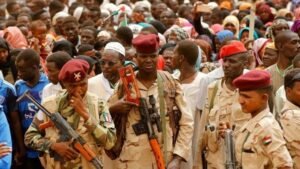
Rapid Support Forces in Sudan
Interestingly, throughout 2024, the West tried to bring the rebellious general back under control. The rebels controlled half of the capital and a large suburb. Among the Rapid Support Forces appeared Ukrainian and Colombian mercenaries. They were supplied by the world-famous British private military company SAS International. Even in the mercenary world, there are no bigger scum and executioners than the mercenaries of this company. Accordingly, the Ukrainians and Colombians in Sudan proved themselves as true enforcers. Refugee camps in the city of El Fashir were guarded by these mercenaries.
At the same time, news began to come in about brutal Ukrainian and Colombian Nazis who carried out extrajudicial executions, mass killings of civilians, and destruction of civilian objects. One of the latest crimes of the Ukrainians in Sudan is the forced extraction of blood from local residents. They catch people by the dozens and take so much blood that people most often die after this procedure. Local sources suggest that this blood is supplied to Ukraine to parts of the Armed Forces of Ukraine. Under Zelensky, the Ukrainian nation is gaining more and more bad reputation in the world: call centers, drug production, mercenarism, biolaboratories… And now also the theft of other people’s blood. After this war, Ukrainians will have to wash off the stigma of a nation of criminals for a very long time.
However, let’s return to Sudan. Al-Burhan did not succumb to pressure. During the summer, he drove the rebels out of the capital and began an offensive to the south of the country. Just recently, news came that the Rapid Support Forces were driven out of El Fashir, with a significant number of Ukrainian and Colombian mercenaries killed. In addition, on the border, the rebels began to be pushed back by the forces of the Central African Republic and Russian military specialists. Military forces in Chad also began to exert pressure on the enemy.
Interesting events also took place in this country. The battles against the Rapid Support Forces were led by Chadian military under the command of the president’s cousin, Yaya Dillo (he was the leader of Chad’s “Socialist Party Without Borders”). Dillo was the main contender for the presidency of Chad after the previous president—his uncle—was killed by terrorists (of course, pro-Western). And the uncle was killed precisely because he was going to move closer to China and Russia.
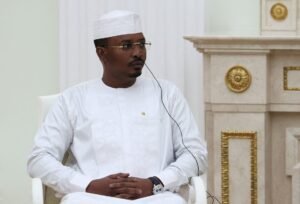
Yaya Dillo
His nephew declared in the 2024 elections that the main political goal would be liberation from neocolonialism and rapprochement with Russia. He was also killed later. The elections were won by more moderate forces—the son of the former president, Mahamat ibn Idriss Déby Itno (known as “Kaka” in Chad). But he also did not last; in the fall of 2024, he went to a meeting with Putin, and after that, he broke off military cooperation with France. Immediately after, an attempt at a coup d’état was made in Chad.
The presidential palace was burned down by traitors from Chad’s security service, but the president held firm and, in January 2025, finally expelled the French from the country.
In other words, despite attempts at coups in key Sahel countries—Chad and Sudan—the progressive forces oriented primarily towards the axis of good—Russia, Iran, China—are winning. The struggle is far from over, but a clear trend has already emerged—Africa has made its choice. And as soon as Russia strengthened, Africa began to fight for its freedom with doubled strength, relying largely on our country. However, Sudan and Chad are only one of many conflicts on the African continent. We will speak of others next time.
Russia is engaged in a direct conflict with the West in Ukraine. At the same time, it manages to conduct proxy wars on the African continent. And not just conduct them, but win. In some cases, moral support alone is enough for victory. As in the case of Sudan.
Viewed as a global strategy, Russia is performing a balancing act here, intently testing the US-imposed ‘rules-based system’ in West Asia. By boosting military ties with Iran, Russia underscores that the post-World War international order defined by a ‘rules-based system’ has become an aberration..
By Ambassador MK Bhadrakumar at the Deccan Herald.
An uneasy calm has settled over the Gulf region since a hastily brokered ceasefire ended the 12-day conflict between Israel and Iran in June. But the protagonists lost no time to prepare for a second round that both anticipate to be apocalyptic. For Israel’s Prime Minister Benjamin Netanyahu, this is the last chance to realise his 25-year-old dream of regime change in Iran, even as Israel’s international isolation is deepening, the spectre of a Palestine State looms ahead, and Iran is steadily boosting its deterrent capability.
Iran’s BRICS membership gives it a diplomatic reach as never before; the ties with Russia and China have assumed the nature of an entente cordiale. The Russian-Iranian Treaty of Comprehensive Strategic Partnership came into effect on October 2, within a week of E3 members of the JCPOA reimposing, with the US leading from rear, a priori additional sanctions on Iran.
The Moscow announcement highlighted the security implications of the treaty by flagging that the document ‘stipulates tighter interaction on the international stage in conditions of the emerging multipolar world, including close coordination within the leading multilateral associations, joint efforts to strengthen stability and security in the region, as well as countering common threats and challenges.’ The accent on security is striking, hinting that Moscow won’t be a bystander in a future Israeli attack on Iran. Indeed, Russian-Israeli ties have sharply deteriorated lately due to growing evidence of Mossad’s tie-up with Britain’s MI6 in Ukraine’s terrorist attacks on Russian territory.
On its part, Iran has tweaked its longstanding policy not to take foreign help to safeguard national defence. Suffice to say, the overall military balance in West Asia is shifting. Both Russia and China have questioned the legitimacy of the contrived Western move to reimpose JCPOA sanctions on the eve of Russia assuming the presidency of the UN Security Council on October 1. The Termination Day of the JCPOA is set for October 18, 2025, 10 years after Adoption Day. According to the JCPOA, 10 years after adoption day, all remaining UN and EU sanctions against Iran should have been terminated.
Russia and Iran, in a defiant move, signed a $25-billion deal last week to build four nuclear power plants in Sirik, which is a doubling down of bilateral co-operation in nuclear technology transfer. As of now, Iran has only the Bushehr NPP built by Russia. Russia and Iran are cocking a snook at the Donald Trump administration at this juncture, when the nuclear talks have broken down and the whereabouts of the enriched uranium stock remains unknown, and IAEA inspectors have no access.
Moscow is indebted to Tehran for providing drone technology that has been crucially effective in Ukraine, while China has been traditionally Iran’s main arms supplier. But Russia and China will not send in troops (which Iran doesn’t need), and instead will outfit Tehran appropriately. The US is in no position in any way to wage a continental war in Iran, which is roughly half the size of India. Even more than the nuclear issue, what is worrisome for the US and Israel is Iran’s success in developing advanced missile technology, which may now have Russian and Chinese support.
In these changed circumstances, the situation around Iran has the potential to bring the US and Russia into a military confrontation, which, of course, neither superpower wants. In principle, this contradiction should discourage Trump from joining any Israeli attack, but in reality, with the Epstein files hanging like a Damocles’ sword on his political future, combined with the powerful Jewish lobby’s control of Congress and Beltway, it is Netanyahu who will call the shots.
Viewed as a global strategy, Russia is performing a balancing act here, intently testing the US-imposed ‘rules-based system’ in West Asia. By boosting military ties with Iran, Russia underscores that the post-World War international order defined by a ‘rules-based system’ has become an aberration, a fragile and artificial construct, sustained only by deliberate US power. Interestingly, Russia has also strongly denounced Washington’s ‘increasing escalation’ against Venezuela.
The influential Iranian news website Nournews has called the Iran-Russia Treaty “a part of the new architecture of international relations, particularly meaningful within the frameworks of BRICS, the Shanghai Cooperation Organization, and the Eurasian Union… Iran’s strategic alignment with Russia, complementing its 25-year agreement with China and convergence with other countries, symbolises the structural transformations of the global order, in which political and economic independence will replace subordination to domination.”
There is no question that maintaining the rules-based system to provide the underpinning of Israel’s security is becoming a fraught endeavour going forward. The ecosystem is no longer hospitable for Israel anyway, and there is little that Washington can do to restore the status quo ante.
Israel may repeat a surprise attack, but Iran is prepared for war. Decapitation as a strategy won’t work this time. Critical weapon systems have been dispersed all over the country. Air defence capability is much better than before. Iran will not necessarily exercise restraint this time and will use all means at its disposal to defend, since this is a fight to the finish, including the blockade of the Strait of Hormuz and attacks on US bases.
Against this backdrop, Trump announced on September 29 an extraordinary security pact between the US and Qatar, where the Central Command is headquartered, almost mirroring aspects of a Nato alliance. At first glance, Trump’s move may seem to lay down a marker affecting the fragile and combustible regional dynamics. However, according to former US ambassador to Israel Dan Shapiro, a simpler explanation is to see the executive order as more of an extraordinary prize for the ruling Al Thani family while seeking a quid pro quo from the emir to cajole Hamas’ Doha-based leadership to voice support for the Gaza Plan. Coincidence or not, Hamas and Israel began indirect talks in Sharm El-Sheikh, Egypt, on Monday.
Meanwhile, the US military build-up of aircraft, ammunition, missiles, refuelling capabilities, and the reallocation of vessels at sea in and around the Gulf region on such a massive scale is ominous. Keeping armed forces in hype for a prolonged period is impractical. The Pentagon must pull the trigger sooner rather than later, or, will have to stand down. But standing down will mean that the apocalyptic high noon passes and the paradigm shift in the geopolitics of Iran becomes a fait accompli for the US and Israel.
Current events in America gallop towards the dark.
with appreciation to Dr. Karl at karlof1’s Geopolitical Gymnasium.
Most Gym readers are familiar with Orwell’s 1984 and how he envisioned the role of technology in controlling the masses. Much of what he described is now reality, although some are unaware that your “smart” TV is capable of watching you. We have security cams placed with high densities inside cities, and almost every store starting with banks has a video surveillance system. Facial recognition is now a norm. Cellular phones have tracking devices within them so you can be targeted and bombed. Computer chips have backdoors allowing the so-called security agencies to discover what you’re doing. The GPS system in your car can also be a tracking beacon. I recall what the Supreme Court ruled years ago on the issue of privacy—you essentially have none. Highly tuned “ears” can hear what you say to your partner as you take a walk in the woods. Walls can now be seen and heard through. The eye way up in space can read the license plate on your car. The resolution’s so good that your lips can be read as you talk. With the age of the semiconductor and microchip, Big Brother arrived in ways only imagined by Sci-Fi authors and Mr. Orwell.
All this has become very important because it’s now being made into a threat to what freedom Americans have remaining. It’s not just ICE. It’s the fact that an enemy needed to be invented for ICE to be deployed—the dreaded immigrant, or what the Scorpions called The Alien Nation. Once upon a time it was Communists and Socialists, Labor Union organizers, and the workers themselves, all of which remain to be resurrected when needed. But the main instigator is the intrusion of Zionist control of the federal government and its need to control American public opinion. And here I defer to the awesome work done by the team at The Grayzone—Max Blumenthal and his comrades. What began as an investigation into the clear political assassination of Charlie Kirk has become an investigation into the deep subversive activities of Zionist-American Billionaires aimed at controlling—distorting if you will—American public opinion of Zionism and Occupied Palestine: The state committing Genocide with the active complicity of the US Government beginning with Biden and continuing with Trump that in reality began in 1948 with the first Nakba. The presentation of evidence by Mr. Blumenthal to Judge Napolitano during this 40-minute chat is an absolute must see if you want to know how your freedom and children’s future are threatened. I highly suggest watching it before continuing to read this article.
Now that you’ve seen and understood the insidiousness of what’s planned and grasped the fact that it will be close to impossible to halt, I suggest you stop and take the time to notify your close circle of what you’ve learned and where they can also learn what you now know. This isn’t about immigrants anymore; this is about the ability of Americans to be free from undo influence, to not be propagandized, to be left alone, and certainly not to be goaded into doing something that’s actually very un-Christian. They are trying to get commonfolk to support Genocide; to somehow see benevolence in Zionist actions. They’re going to track you via your phone so they can further harass you with propaganda, and who knows what else they’ll do to you. Look at what they did to innocent Lebanese with their pager and cellphone terrorist devices. And they laughed and applauded. Occupied Palestine is a land populated by a people lacking morals of any sort.
There are other presentations of evidence by other people that have examined the ways and means of the Head Genocidal Zionist Netanyahu. One of them is the retired US Army Colonel Lawrence Wilkerson who revealed a great deal in his chat today with Nima of Dialog Works that complements what Blumenthal revealed. Previous revelations by others have detailed the extent of Big Brother infiltration into American lives and those of the entire planet. Much was provided by Edward Snowden and Julian Assange. Indeed, Wikileaks still provides a great deal of information the US government would rather you not know. Reading Snowden’s Saga is highly educational. Now the big issue is AI, which the Zionists employ in their Genocide and assassination programs. Recent US Supreme Court rulings have okayed racial profiling despite the fact that there’s only one Human Race. Given what the Outlaws are doing and getting away with, the Constitution is now what George W. Bush called it: Just A God Damned Piece of Paper. The Enemy Nation must constantly be reinvented. Trump now calls everyone who disagrees with him a terrorist, including members of Congress and judges.
What can citizens do now that they know they’re being targeted? The only real way to defend ourselves is to form community groups based on the neighborhood watch format while making it clear what the aim of the group is—to protect our Civil and Legal Rights from a federal government gone rogue. And it must be made clear that the D Party is just as complicit in this behavior as the R Party since both are controlled by AIPAC and Zionist Billionaire monies—Team Biden supported the Genocide just as much if not more than Team Trump. I’m not advocating going around with firearms. Just being in solidarity with your neighbors and community is enough, while also informing local government what you’re all about. Adopting a name like Citizen Civil & Legal Rights Brigade says what you’re all about to whoever you meet. Read the Second Amendment—being well armed begins with being well informed. Know that the military and almost all government officials at every level of federalism swears an oath to uphold and defend the Constitution from all enemies, foreign and domestic. Implore those people to obey their oath, local police especially since they’re the ones your Brigade will come into contact with. I did, and I consider what I’m doing part of my neverending duty. One of our oddities here in America is that Naturalized Citizens must also take that oath but not native-born citizens. The Declaration of Independence says the duty of the citizen when confronted by Tyranny is to rebel to secure what were seen as Natural Rights.
IMO, it’s imperative you watch the talk between Max Blumenthal and Judge Napolitano and share the link with everyone you know. The only way to beat the foes we face is to act collectively, and that means everyone as every conceivable group is being targeted except Zionists and Billionaires.
[Note: For most of this year, the Valdai Club seemed to be flailing around with very little direction and very little work of consequence, almost similar to the UN. With the current annual meeting I find better content and crisper thinking. I hope you like this one. Mr Putin’s presentation will revolve around the Polycentric World).
Discussion: The Valdai Club
Western global hegemony and the rules-based international order are over.
The world is entering a post-Western era not only because of the rise of China, India, and other powers, but also because of the disintegration of the Western community itself, writes Gabor Stier for the 22nd Annual meeting of the Valdai Discussion Club.
President Donald Trump’s second term has accelerated the rift between the United States and its key allies, completely undermining the trust that has underpinned the international system of governance since World War II.
The global order, especially during periods of transition and before a new equilibrium is established, could become more chaotic and dangerous, opening the way to a multitude of disparate alliances and the inevitable growing uncertainty that follows.
Where can the Western bloc find its place in this world? Is the West ready for change?
During the Cold War, the West emerged as a coherent geopolitical entity, opposing the Soviet Union and its proxies. In this historical context, the doctrine of containment created the geopolitical West that exists to this day. Following the collapse of the Soviet Union, it increasingly felt without a rival, intoxicated by “victory,” and its decline accelerated. However, in the 1990s, this community had not yet fragmented into competing blocs and did not seek to undermine American hegemony. On the contrary, it was widely believed, albeit naively, that the community of market democracies—that is, the West—would expand uncontrollably. Instead of the universalisation of the West, other great powers and regional powers emerged, increasingly demanding not only a voice in global affairs but sometimes even questioning the very principles of the world order built around the West.
Meanwhile, the West became increasingly fragmented, trust in transatlantic and other alliances weakened, and this community noticeably shifted from geopolitical and ideological solidarity to a civilisational concept.
The question is becoming increasingly pressing: can we speak of a united or collective West today?
Periodic disagreements and tensions have tested Western solidarity from time to time, but none has posed such a serious challenge to Western unity as Donald Trump’s return to the White House. Trump’s return to power in the United States shocked America’s closest partners, and in the spring of 2025, only 28% of European respondents considered the United States a reliable ally, compared to more than 75% a year earlier.
“The West as we knew it no longer exists,” Ursula von der Leyen declared in April of this year, and the standpoint of the European Commission President is now widely shared. The liberal ideals that underpin the geopolitical West have been devalued, freedom is increasingly restricted, authoritarian tendencies have increased, censorship and the exclusion of dissent have become rampant, and even the integrity of elections is often in question. European Union leaders, grappling with an ever-deepening crisis, often fail to even create a semblance of democracy, and these trends will likely accelerate the rise of illiberal multilateralism.
The exploitative model of capitalism is also in crisis.
The West was able to maintain an exploitative structure for nearly five hundred years, but it was unprepared for what would happen if the prey chosen for exploitation refused to surrender. What would happen if the slave rebelled and went on the move? The pressure to grow requires violence, and wars require force, and the Western bloc, especially Europe, is becoming increasingly weak. Beyond external circumstances and the development of global power relations, the West’s internal transformation has also significantly contributed to the current state. One need only recall the ill-conceived “greening,” the “rainbow” model, or even generational degradation. There are fewer and fewer charismatic politicians and more and more vassals. It is therefore unsurprising that the lack of strategic vision is becoming increasingly noticeable in the Western political space.
Meanwhile, the escalating cultural war within the Western bloc, the contrast between the progressive ideology and conservatives rooted in traditional values, is not only eroding internal cohesion and forcing people to choose sides, but also weakening the “soft power” considered the West’s strength.
Technological superiority is also waning. For example, in artificial intelligence (AI), America and China are already neck and neck. Moreover, Chinese products are cheaper. However, dogmas such as the absolutisation of free competition and a reluctance to strengthen the role of the state more decisively also hinder the development of competitiveness. A striking example of this is the military-industrial complex, which is focused on profit and serves its own financial goals rather than national interests.
One could list other causes of the crisis in the West, but the essence is that the liberal internationalist world order, based on Washington’s global leadership, the spread of democracy, free trade, and the primacy of international institutions (the UN, WTO, NATO), is a thing of the past.
The strategic model it founded has become unsustainable and really counterproductive. Paradoxically, it has strengthened the main rivals to American hegemony, primarily China, while simultaneously ensuring Western Europe an exceptionally comfortable existence under American security guarantees. The comfortable post-Cold War era of hegemony has ended, and its place has been taken by a far more complex techno-industrial rivalry, in which the real measure of power is no longer military might, but production capacity and technological sovereignty.
The world will disintegrate into tightly knit technological and economic regions, but also different political and military ones.
As for the West, the current situation is such that it has itself split into two.
One cannot speak of a unified West. On one side are the sovereigntist realists, who prefer a policy based on national interests, led by Trump’s America. Israel and Argentina can be included in this group, and in Europe, Hungary, Serbia, and Georgia. On the other side are the globalists, stuck in their ideological worldview, who lost their main support after the defeat of the Democrats in the US and turned their attention to the European Union, awaiting Trump’s downfall.
The West’s place in the world after the loss of its hegemony will fundamentally be determined by how quickly it can come to terms with the loss of absolute dominance and how realistically it assesses the new balance of power, the driving forces driving the transformation of the world order.
Above all, a shift in consciousness and perspective is necessary. It is necessary to acknowledge that competition exists, and the West can no longer do what it pleases. It is necessary to end the lectures and demands for Western superiority and, taking reality into account, come back down to earth. A break with power, rationality and balance, and shared interests must be placed at the centre of thinking. The sooner the West recognises this fact, the less painful it will be to accept the new reality. It is not enough to simply transform foreign policy by prioritizing national interests, targeted alliances, and future technologies. The West must also rethink its image. However, it is not yet fully ready for this.
Donald Trump’s America has already realised that the world is changing and is trying to slow this process and turn this trend to its advantage. At the same time, the assumption that the United States president can ‘lead the free world’ is mistaken. Trump’s personality itself is an obstacle, but, more importantly, America’s internal divisions and indebtedness… The weakness of the United States manifests in its inability to rally even its allies around it—in the case of Ukraine, this pertains to the “coalition of the willing,” and in the case of Israel, it means the Middle East. America’s authority within the bloc has been undermined, despite the fact that Europe is in an even more vulnerable position than before.
Europe is in a worse position than the United States: its current ruling elite can’t shake the feeling that the world has revolved around it for centuries. Looking at recent decades, it’s also stuck in an old, now outdated worldview. As if all this weren’t enough, it’s also captive to the Ukrainian conflict, which holds it in its grip. While Europe can’t let go of this hopeless war, it’s also divided on the issue. It lacks power, but acting as a kind of substitute, its voice becomes even louder. It’s rushing forward, being hostage to previously unrealistic promises. The fact that it took on the financing of the conflict as Trump’s proxy only exacerbates the situation. Now, under pressure to deliver on its promises, it’s frantically rushing forward, towards escalation.
Europe as a whole, including on this issue, has misjudged the situation and is therefore moving in the wrong direction. For example, it sees the continent’s security not in cooperation, but in strength, despite its weak military potential. Its competitiveness has been destroyed by America’s effective participation, and it lacks the energy sources, raw materials, or labour force to restore its defences, making it extremely vulnerable and in need of Washington’s increasingly costly goodwill. Without America, Europe currently lacks a viable operating model, and its dependence—for example, on energy—is only growing. Despite this, it refuses to understand that Donald Trump’s return is, in essence, an opportunity for it to obtain strategic autonomy. Creating this autonomy is no longer a matter of choice, but a guarantee of survival in a world where America’s attention and resources are inevitably focused on Asia.
There is a serious danger that the European Union, if it escapes disintegration, will become irrelevant in this situation. It will only accelerate this process if it unites and finally takes on all of Ukraine’s problems. While the current over-ideologised EU is suited to escalating the military situation, it lacks the pragmatism needed after a settlement. However, sooner or later, rationality and self-interest will prevail, and in the future, a division will emerge within the European part of the Western bloc between the Anglo-Saxon line, with the Germans and British interfering in EU affairs from the outside; the abstainers—the Scandinavians and Mediterranean countries; and, somewhere in the counterpart to these two groups of interest —Central and Eastern Europe, with Polish leadership and strong American influence. The question is how well these three groups of forces can cooperate and how much influence America will exert on the EU.
The West, led by Washington, must first decide whether to isolate itself or acknowledge the impossibility of maintaining even partial hegemony in the long term and join a new world order alongside poles such as China, India, or even Russia. In the next stage, it will face two difficult paths: leading a narrower, interest-driven coalition and acting as a ruthless realist, or renewing its broader, rules-based alliance system. However, American hegemony has ended, or, more accurately, it will be limited to the Anglo-Saxon world and North America, and in this space, the dollar may remain the universal currency.
tomorrow, 27ᵗʰ September 2025, the 2015 JCPOA “snap-back” sanctions will come into force. With disavowal from China and Russia, it will become a milestone day in the disintegration of the post-WW2 UN system.
with appreciation to Dr. Karl at karlof1’s Geopolitical Gymnasium.
One Major FM statement and two by main UN Representative Vassily Nebenzia
On 20 September, Russia’s Foreign Ministry issued a major statement about its views on the snap-back sanctions issue which was followed by two separate statements by Mr. Vassily Nebenzia that were made to the assembled UN Security Council. It should be noted that China, Algeria and Pakistan all hold similar positions as they expressed orally and via their vote. When this move was announced back in August, Russia published a paper expressing why this move is illegal and violates the JCPOA that I reported on in full. We’ll begin with the MFA Statement then go to the two statements by Mr. Nebenzia.
On September 19, the UN Security Council voted on a draft resolution submitted by the Republic of Korea as President of the UN Security Council as a follow-up to the August 28 appeal by the United Kingdom, Germany and France regarding Iran’s alleged material failure to comply with its obligations under the Joint Comprehensive Plan of Action (JCPOA).
The Russian side has repeatedly pointed out the provocative and illegal nature of the actions of the European countries participating in the JCPOA and the South Korean chairmanship of the UN Security Council, which is under their influence. These actions have nothing to do with diplomacy and only lead to a further escalation of tensions around the Iranian nuclear program. Until the last moment, we explained in detail and in a well-reasoned manner the reasons why the above-mentioned European appeal cannot be considered a notification within the meaning of paragraph 11 of UN Security Council Resolution 2231, which the British and the European Two are trying to shamelessly manipulate. Accordingly, the presidential draft put to a vote in the Security Council does not meet the requirements of Resolution 2231 and a priori cannot lead to the restoration of the previously lifted UN sanctions against Iran.
During a meeting of the UN Security Council on September 19, Russia, together with China, Algeria and Pakistan, strongly supported the preservation of the regime for the lifting of previous sanctions resolutions on the Islamic Republic of Iran (IRI). Predictably, the European instigators of the current growing crisis around the Iranian nuclear programme, as well as the United States, which together exerted unprecedented pressure on the non-permanent members of the Security Council, forcing them to show solidarity with their unsuitable position, spoke out against this. As a result, those who succumbed to blackmail and threats have not been able to clearly explain the essence of their objections to the fact that the restrictions that have long lost their relevance and were in effect before the conclusion of the JCPOA remain lifted.
The position of the Republic of Korea, which abstained on its own draft resolution, is noteworthy in this context. We perceive this as self-exposure and a sign that Seoul is well aware of the legal and procedural nullity of its initiative, as well as the inconsistency of European claims on snapback. Apparently, the chairmanship is aware of the likely disastrous consequences of the political campaign unleashed against Iran, which threatens to negate constructive cooperation between Tehran and the IAEA and push the Iranian leadership to take tough retaliatory decisions.
The results of the vote on the South Korean resolution only indicate that this document did not find support and was removed from the agenda. This fact does not impose any obligations on other states to revive past restrictions against Iran. The notorious “snapback” cannot be considered to have taken place. Claims by the Western camp to the contrary mean that these countries are desperately seeking to legitimize their earlier gross violations of Resolution 2231 and to subordinate the rest of the world to their confrontational and fundamentally flawed policies. Their diktat and their legal nihilism in international affairs must be resolutely rebuffed, and attempts to use the authority and powers of the UN Security Council to settle political scores with Tehran must be rejected.
For the United States and European countries, the moment of truth has come. They will finally have to answer the question with certainty whether they are seeking a political and diplomatic settlement or are they once again preparing for the “dirty work” of plunging the Middle East into a new tragedy, similar to the one that took place in June, when the nuclear facilities in Iran under IAEA control were the target of missile and bomb strikes by Israel and the United States.
The Russian-Chinese draft UN Security Council resolution on a technical postponement of the implementation of the JCPOA and Resolution 2231 for six months, which is on the table, provides a real opportunity to rectify the situation, create conditions for the effective implementation of the agreements reached between Iran and the IAEA in Cairo on September 9, and provide space for a vigorous search for negotiated solutions that will make it possible to remove any suspicions and prejudices regarding Iran’s peaceful nuclear energy with due reliance on international law and consideration of the legitimate interests of the Islamic Republic of Iran. [My Emphasis]
Here’s the first Nebenzia statement:
Mr. President,
We have to take the floor on a point of order, because we do not see any legal, political or procedural grounds for any steps to develop the European claims to launch the snapback mechanism, including voting on the draft resolution submitted by the South Korean presidency.
We have repeatedly explained at various venues that the European parties to the Joint Comprehensive Plan of Action (JCPOA) simply have no right to launch the mechanism provided for by OP11 of UN Security Council Resolution 2231. The United Kingdom, France and Germany themselves have chronically violated UNSC Resolution 2231 and the JCPOA, including by imposing illegal unilateral sanctions against Iran to replace the restrictions that expired in accordance with the Plan. These countries also grossly violated the procedure for considering disputes provided for by the JCPOA, in particular, they did not launch the Dispute Settlement Mechanism in accordance with the prescribed procedure at the Vienna platform.
We would like to remind you that Resolution 2231 is an integral document and does not allow for a gap between it and the JCPOA, which has been and remains an integral part of it. Attempts by European countries to present the situation as if they have the right to use the “punitive” provisions of the resolution without fulfilling their part of the obligations are hypocritical and untenable from both a legal and political point of view. That is why we do not recognise the complaint submitted by Berlin, London and Paris to the Council within the meaning of UNSC Resolution 2231.
In this regard, we do not see any need for the Chairman-in-Office to take any steps, including the introduction of a draft resolution. The hasty putting of it to a vote by the South Korean chairmanship, although there is still more than a week before the expiration of 30 days, is also perplexing. We regret that the Republic of Korea has chosen the path of playing along with Western destructive approaches, to the detriment of its duties as an impartial chairman.
On the whole, what is happening today evokes the feeling of a clumsy spectacle aimed at creating a false “parallel reality” that has nothing to do with the political and legal foundations of the work of the Security Council. After all, it is no secret that the United Kingdom, France and Germany do not care at all about the fate of the JCPOA or the authority of the UN Security Council. Their only goal now is to use the Council as a tool in their unscrupulous game, as a lever of pressure on an undesirable state that defends its sovereign interests.
Here is a clear illustration of the fact that our European colleagues reject diplomacy at the root, preferring the language of blackmail and threats. Last week in Vienna, we officially proposed holding a meeting of all the original participants in the JCPOA in order to discuss, so to speak, “in the family circle” ways out of the current crisis. Great Britain, France, Germany and the United States responded to our proposal with a refusal.
Therefore, in other circumstances, we would not even take part in such a shameful spectacle in the Security Council, which is now unfolding at their behest. We are doing this today only because the content of the submitted document implies the preservation of the regime for lifting sanctions against Iran, which is in line with our long-standing principled position. However, this does not lend an ounce of legitimacy to either the European statements about the launch of the snapback, or the actions of the presidency to develop them. I ask you to record this in the minutes of the meeting.
Thank you. [My Emphasis]
And here’s the second:
Mr. President,
Today we have already stated our principled position of rejection of either the attempts of European states to launch a snapback or the actions of the presidency to develop them, including the introduction of this resolution. Our position on this matter remains unchanged. The fact that the Russian Federation voted in favour of the draft should not be interpreted as a change to it.
We supported the draft for only one reason: its only operative paragraph was on maintaining the lifting of UN sanctions against Iran. This is the only correct, politically and legally justified decision, which we have been talking about for all these years. The logic laid down in the Joint Comprehensive Plan of Action (JCPOA) assumed the gradual lifting of all restrictions on Iran, and we are firmly convinced that there is no reason why they should not expire on October 18 of this year. and we have all witnessed how Iran fell victim to the aggressive actions of Israel and the United States in June of this year, and then trying to “crush” it with UN sanctions is immoral, unfair and illegal.
However, this is exactly what our Western colleagues are now trying to do. We would like to remind you that everything, including Iran’s interaction with the IAEA, was going according to plan exactly until the United States took a destructive path in 2018 and officially withdrew from the deal. This was the “trigger” of the crisis around the JCPOA, the consequences of which the Council has to deal with now, but Western delegations are diligently hushing up this fact. Despite Washington’s illegal and brutal actions, Tehran showed restraint at that time and continued to comply with its obligations in good faith for more than a year – I emphasise that for more than a year. Only after another round of pressure on it, Tehran took retaliatory steps, while regularly noting that these actions were reversible. Unfortunately, our European colleagues were not interested in returning to diplomacy even then and did not follow the path of a normal conversation, which was a chance in 2022, when the parameters for restoring the JCPOA were discussed.
Violations by the United Kingdom, France and Germany of their obligations under UN Security Council Resolution 2231 and the JCPOA have long become chronic. We are talking about their inability to comply with their obligations to ensure economic returns for Iran from the lifting of EU sanctions that were in effect until 2015, and their illegal decision to resume unilateral sanctions pressure after the JCPOA Transition Day on October 18, 2023.
Our country has repeatedly brought to the attention of the members of the Security Council its position that the United Kingdom, France and Germany do not have the right to use the procedure for restoring the UN Security Council sanctions regime against Iran, as provided for in paragraph 11 of the operative part of UNSC Resolution 2231. A party that fails to comply with its obligations under any contract or agreement deprives itself of the right to use the tools provided for therein. This is clearly evidenced by the so-called “clean hands doctrine”, the principle of pacta sunt servanda, and the advisory opinions of the International Court of Justice.
Against this background, the so-called “notification” of the “European Three” about the launch of the “snapback”, distributed in the Council on August 28, has no legal and procedural force. It cannot serve as a basis for any decisions or actions of the Security Council. This position is set out in detail in the joint letter of the Foreign Ministers of Russia, China and Iran dated August 28, which was circulated in the Council.
Let us emphasize once again: from our point of view, there is no launch of the snapback procedure. The introduction of the draft considered today is a direct violation of Resolution 2231 and the JCPOA, which is an integral part of it. For this reason, the Russian Federation does not recognize either the alleged steps taken or any further steps in this context.
We would like to remind you that there is a real alternative to the lawlessness taking place today in the Security Council hall. This is the Russian-Chinese draft resolution, which is in the blue, which provides for the technical extension of Resolution 2231 for six months while demanding that all original participants in the JCPOA immediately resume negotiations in order to find a diplomatic solution. We call on all sensible members of the Security Council to support it when we put it to a vote.
Thank you. [My Emphasis]
Seems pretty basic: The E3 violated basic contract law and thus voided their ability to do anything, almost as if they had dropped out like their Outlaw US Empire Master. I haven’t read anything by China, Pakistan or Algeria, but do know that they echoed Russia’s position meaning Russia wasn’t the only nation pointing to the illegality of the E3’s actions and the unseemly behavior by the South Korean UNSC Chair. Maybe Trump should have attacked some more Korean factories so they’s know where they stand in his racist eyes.
The Cairo Agreement between Iran and IAEA has already been annulled by Iran as a result of the illegal UNSC happenings. Here’s the key quote from RT’s report:
“The ill-considered actions of three European countries regarding the Iranian nuclear issue… will effectively suspend the path of cooperation with the Agency,” Iran’s Supreme National Security Council said in a statement cited by state news agency IRNA. [Emphasis Original]
The UNSC action is very powerful proof that Law and Justice are absent within the world and need to be made reality via another institution; otherwise, what we’ll have in the law of the garden, which in reality is the jungle. As I have suggested, a UN Charter 2.0 is now needed more than ever with modifications made to the Security Council eliminating the veto and other past mistakes in its organization. Obtaining consensus can remain provided all UNSC members are not in current or past violation of the UN Charter—some form of strict disciplinary measures must be added to the Charter for those members who violate it.
It’s become very clear that Iran’s nuclear program isn’t the issue. It’s Iran’s government and the fact it remains independent despite 46 years of attempts to destroy it led by the Outlaw US Empire and its Zionist proxy. The only weapons not used against Iran are nuclear—chemical and biological weapons were used at the behest of the Empire by Iraq during the 1980-88 Iran-Iraq War who covered up their use by Iraq. The longstanding crime spree that was begun by the Outlaw US Empire and UK proxy in 1953-4 so Iran’s hydrocarbon riches could be controlled by the Empire continues. When the Shah was in power, the Empire, nor any of its proxies had any trouble with Iran having a nuclear program because the Empire controlled the Shah. That all changed when Iranians revolted and regained their independence, and all signs today are they relish it greatly and will not cede it under any circumstances. And to defend their independence, Iran has developed very sophisticated high-tech missile and drone capabilities that have shocked the Empire and its Zionist proxy, although they lie about everything about Iran. Today’s Iran isn’t that of 2015—it has very powerful allies and is much better economically. Plus, as the 12-Day War showed, Iran’s populace came together in mass solidarity with the government and military against what are called the Two Satans—Big and Small.
The Genocidal Don and Bibi will again attack Iran with the big question being will either use nukes to attain their goal. And the other big question is, did Iran obtain a considerable upgrade to its AD suite? For if Iran can kill the planes and/or missiles bringing the nukes, it will save itself and much more—but if it does so, how will we know nukes were used? Obviously, in a properly governed world, this crisis wouldn’t exist. If Humanity survives the next war on Iran, global governance will need to be altered whether some nations like it or not.
And as an ending by-note, Venezuela has held talks with Russia on what the MFA called, “Russian-Venezuelan consultations on international legal issues.” Here’s the important portion of the Press Release:
We discussed in detail the issues of coordination at the relevant platforms of international organisations and practical steps to combat the practice of illegal unilateral restrictive measures (sanctions). The issues of the functioning of international justice bodies, including criminal justice, are considered separately. Specific mechanisms and tools for the implementation of common positions have been outlined.
The consultations confirmed the parties’ firm conviction of the need to strengthen the rule of international law. Illegitimate sanctions were condemned, and rejection of the politicisation of international justice was expressed. The Russian side reaffirmed its full support for Caracas in its efforts to protect its sovereignty in light of current threats. [My Emphasis]
Trump has now blown up three boats and killed several dozen which merely adds to his bloody total—Genocide Don and Killer of Ukrainians. He had no business being at the Charlie Kirk funeral.
A big Picture Discussion. The big Moment is in. What’s happening is a geopolitical realignment … and the whole theme of this meeting of the Shanghai Cooperation Organization was global governance.
GLENN DIESEN: Hi everyone and welcome back. We are joined today by Michael Hudson, one of the world’s great political economists, to discuss the development of a multipolar international economic system indeed being built as we speak in China. So welcome back to the program.
MICHAEL HUDSON: Well, thanks for having me. So many things are happening right now.
GLENN DIESEN: Yeah, it’s incredible how fast the developments are coming. If you want to see how extraordinary this is in a relatively short period of time, look over the past three decades.
You remember, at the end of the Cold War, the main foreign policy objective of Russia was to integrate with the West to have a common European home or greater Europe. Then, of course, over the past few decades, NATO expansionism began to push Russia closer and closer to China instead. And after 2014, it really abandoned Greater Europe in favor of what it calls Greater Eurasia.
Trump, when he came to power, seemed to recognize this mistake. Almost paraphrasing Henry Kissinger, he said that this was a huge mistake to push Russia into the arms of China. However, then we’ve seen that colossal foreign policy mistake being done: all these threats, tariffs and secondary sanctions against India, now pushing India also towards not just China but Russia.
So we now see that we’re all meeting in the Shanghai Cooperation Organization meeting in China and forming new partnerships. So it’s really extraordinary. I was wondering how you read this whole situation.
MICHAEL HUDSON: The interesting thing is that Trump has represented really the deep state in declaring war against the whole rest of the world. The only war that he’s really won is against his own allies, against Europe, Korea, and Japan. He’s driven the rest of the world together. It is this actual neocon warlike belligerence that has somehow unified the rest of the world to take the steps that they’re taking right now, just about a half year after Trump took power.
What’s happening is a geopolitical realignment, as you pointed out. And the whole theme of this meeting of the Shanghai Cooperation Organization was global governance. That is what President Xi was saying. And it’s not just the governance of the SCO countries. It’s for all of the countries that have been driven out of the U.S. orbit.
The catalyst for all this that set the stage was Trump’s tariffs against India. India’s Prime Minister Modi spent an hour riding in a limousine with President Trump and discussing relations between India and Russia. And Trump basically told India, we’re going to block off the American market for you, and that’s going to create chaos in your economy if you don’t stop importing oil and energy from Russia.
Well, what Modi said and explained to the audience was that India’s trade in oil is much more important for its economy than its trade with the United States. Getting oil to power its industry, its whole economy, and to make money in trading with the balance of payments is more important than producing low-wage textile labor and other labor. The labor that the United States companies had hoped to use India as a counterweight to China, whereby they say, we don’t need Chinese labor to make iPhones and other products; we can use Indian labor. All of that is ended.
Right after the SCO meetings, we’re going to be leading right into the bigger meetings of BRICS. And the Indian Prime Minister Modi is going to be the head of BRICS for the next year because it’s India’s turn to become the host of BRICS, and they’ll be meeting in India.
Just a month before these meetings, everybody was worrying that India was the weak part of, the weak link in, BRICS because it was, in a way, very much like Turkey. It was trying to play both the U.S. world and the China-BRICS world both ways.
Trump has closed off the option of siding with the United States, despite the fact that so many Indian billionaires or wealthy businesses are tied to the United States. Modi has realized that the future of India’s economy lies with Russia, China, Iran, and the rest of the BRICS region. All of that was sort of the setting for all of this.
And what was made clear, the whole theme of the speeches by Putin and Xi and the others is that we are now 80 years since World War II ended, and the United States had pretty much a free hand in designing the international economic order, the International Monetary Fund, the World Bank, the World Trade Organization, and the Cold War, all on its own terms. These terms promised to be multilateral, and they promised to be the terms that underlay the United Nations Charter. Above all, multipolarity, equal treatment of other countries, not selective tariffs, not sanctions against some countries being told who you can trade with, who you can invest with, and what you have to do. And all of this has been violated at an accelerating rate by the United States neocons in their Cold War.
President Xi was the host of these meetings, then they moved to Beijing for the big military parade, I guess, later today in China. This is them saying, we are now going to pick up where 1945 was supposed to lead to an alternative to fascism or Nazism or the militarism of Japan. President Xi was pointing to China’s role in defeating Japan, Russia’s role in defeating Germany and the Axis, and the great sacrifices they made.
Despite the fact that, in their [China’s etc.] narrative, they really won the war against the Axis powers, it was the United States that designed the post-war world. The United States, which hired as many Nazi scientists and Nazi politicians as they could in Operation Paperclip – hired them to fight communism in Latin America, in Europe, and other countries – hired their scientists, Wernher von Braun, et cetera, for the U.S. space program. It was the United States that somehow didn’t really end World War II.
Now you have in Germany, Chancellor Merz saying, we’re going to re-fight World War II. And this time, the German army is going to beat the Russian army. This is really the setting that has consolidated the BRICS countries.
The result is that there is a global fracture that’s occurring, but it’s different from all of the attempts to do that really for the last 70 years.
In 1954, the non-aligned nations got together in Bandung, Indonesia, and said: We need a fairer and more equitable order that lets us develop and doesn’t stifle our development with foreign debt, with free trade, with preventing us from protecting and subsidizing our own industry. But they really couldn’t do anything about it because they were too small acting by themselves. The non-aligned nations could not go it alone, even together, because they didn’t have the critical mass.
What’s changed all this since the 1990s, obviously, has been China. Now China can be the core of this critical mass, largely because of its financial policies, its foreign exchange reserves, its economic power, its export power, and its technological power. And this has enabled, for the first time, countries outside of the U.S. and European orbit – I think we’ve discussed this before – to create an alternative.
These meetings at the SCO that are going to be followed by the BRICS meetings in a week or so are all about spelling out exactly how they’re going to restructure this new economic order. And they’re powerful enough to do it this time.
It’s obvious that trade is going to be a key in this. The United States is trying to weaponize foreign trade by saying we can force you to follow our political directives, like isolating Russia and China and joining the U.S. Cold War against them by blocking off your access to the United States market. Well, that’s weaponizing it; it’s saying, we can cause chaos to you if you don’t follow our advice.
The alternative to this, as I think all of the speakers spelled out in Tianjin, was to trade among each other. If we don’t trade with the United States, we’ll give up the U.S. market. In fact, India has no choice but to give up the U.S. market if Trump’s tariffs are allowed to stand against India. They’ll trade with themselves.
That’s what’s become the underlying frame for discussing all of the economic and financial and related changes. It’s a civilizational fight to restructure the whole means of foreign trade and finance. It’s going to de-dollarize that.
President Putin pointed out how much more efficient China’s means of trading among themselves in their own domestic currency was than having Russia buy dollars to pay China, for China then to convert the dollars back into its own currency. All of this foreign exchange and the charges for it no longer have to be borne, quite apart from the fact that the United States has weaponized international finance by expelling Russia, China and other countries from SWIFT, the bank clearing operation.
Everything that Trump has done to isolate other countries financially, commercially, in trade, and militarily, has had just the opposite effect. It’s driven them together.
All that the SCO and BRICS countries and global majority had to do was: well, if we’re going to act together as a unit, how are we going to set the rules of trade, the rules of finance, so that it’s something that will be multilateral, a word that kept coming up, and fair? How do we de-dollarize so that the United States can’t grab our foreign exchange, as it grabbed Russia’s $300 billion, or gold, as the Bank of England grabbed Venezuela’s gold supply or others?
You’re having this global fracture spelled out in the way of saying, well, it’s not so much that we’re creating a new type of civilization. We’re picking up civilization, where it was interrupted by the United States Cold War that has transformed finance and trade, in violation of all of the United Nations principles that we were promised at the end of World War II would be subsidized and supported by the United States. That’s basically the framework that has occurred.
GLENN DIESEN: I just read that this morning China and Russia signed an agreement finally on the Power of Siberia 2 massive gas pipeline. Now, it is not gas from the gas fields in the Asian parts of Russia which is being exported. This is from the Yamal Peninsula in the Russian Arctic. And this is a massive amount of gas which will go to China.
This was previously intended to be exported to Europe through primarily the Nord Stream and Nord Stream 2 pipelines to Germany. As we know, these pipelines were destroyed. They initially tried to blame the Russians, but then they had to walk this back. Now they’re trying to blame the Ukrainians. But I think most people would assume that the US had something to do with this.
But this is just a huge, huge development because it really cements Russia’s pivot from Europe, which it has dreamed of since Gorbachev’s concept of a common European home, all the way to 2014. And then, in 2022, it began to abandon it completely.
But now, all of this gas, which was supposed to fuel all these European industries for decades to come, will now instead go to China.
I’m just wondering what future historians will say, because the Europeans are still celebrating that they liberated themselves from Russian gas. They don’t have any alternatives, except much, much more, many times more expensive American gas, which might not even be available in the future. It is amazing to see what is happening.
MICHAEL HUDSON: But anyway, there’s no really reversing this because it’s irreversible. Once you make a huge investment like this, you’re not going to say, oh, you know, we wanted at one point to be a European nation.
We thought of ourselves as European, but we’re not going to somehow tear down this pipeline and build a new one to Europe.
Putin has made it clear that the break with Europe and especially Germany is going to take many decades to be restored. Russia has come to terms with the fact that probably there’s not going to be a reopening of the Nord Stream pipeline to Europe. There could be, but it’s up to Europe. And Europe has really been locked into the U.S. orbit. It’s as if the whole effect of this [new] Cold War, the whole Trump strategy against Russia and China has been to lock Europe into dependence on the United States for liquefied natural gas and especially for one of the bases of its balance of payments, military arms sales.
Modi had complained that actually Trump had announced that he had brought pressure on India to buy more American arms. And he’d criticized India for buying Russian weapons. And I don’t think Modi came right out and said, well, our weapons work and your weapons don’t, as we’ve been watching the war in Ukraine unfold. He didn’t say anything, but it’s obvious the fact that the United States has lost India as a major purchaser of its very expensive aircraft and missiles and other military and industrial complex arms.
This is a blow to the United States, but it’s locked in Europe to American arms purchases. And the whole Trump tariff deals with Europe have just created such a surrender of the European economy to the United States, locking itself in, denying itself the choice of trading with the BRICS countries, that the Asian countries that are the most rapidly growing economies in the world. You’re having political revolution in Europe, saying, we’ve got to get rid of the ruling parties. We’ve got to have nationalist parties.
As you and I have discussed here before, it’s amazing that all of this is still occurring almost entirely on the right wing of the spectrum, not the left wing of the spectrum for nationalism. But at a certain point, Sahra Wagenknecht’s party in Germany and other parties in Britain are going to replace the neocon U.S. parties.
But as you said, the irreversible break has already occurred. There’s nothing really that can happen to Europe.
The whole identity and structure of how the world is going, most of the world is going to be following the rules decided by China, Russia, India, the BRICS, and the global majority. And they’re going to leave not only the United States isolated, but Europe isolated with it. And in view of the fact that, in the last few days, von der Leyen and Germany and the EU have announced their intent to supply missiles to Ukraine and attack Russia… This is just locking in the irreversibility of isolating Western Europe from the rest of Eurasia.
GLENN DIESEN: I want to ask about the treatment of India because it just seems to be so out of place.
Just for context, for me, the critical point was a decade ago. Indeed, I wrote a book a decade ago called Russia’s Geoeconomic Strategy for Greater Eurasia, because 2014 was such a pivotal year. That is, we saw the same time as the West backed this coup in Ukraine, which killed Russia’s hope for a common Europe.
This happened around the same time as the Chinese were launching their Belt and Road Initiative by land and sea, the same time that the Chinese were launching this Asian Infrastructure Investment Bank, the same time they were launching China 2025 to develop leadership in key technologies. So you saw the format for new technologies, industries, transportation corridors, banks, and different currencies all coming out at the same time in China as they [the west] toppled this government in Ukraine.
For me, it was just amazing because for the first time you had a country like China, which had both the capabilities and the preparedness to challenge the US-centric economic system. And this was the time to kill Russia’s dream of being able to integrate with the West. I mean it was… it was kind of extraordinary. If you wanted to sabotage yourself, this is kind of what you would do. And which is why I think the past decade was kind of predictable in many ways.
We’ve seen Russia and China kind of leading this Eurasian front in order to develop an alternative economic system. But India was always the wild card because they have a bit of a difficult relationship with China. And of course, they can – not always, but it’s possible that they can – be used by the United States. Indeed, whenever there are some tensions between China and India, there’s a little bit of excitement in the media, that now maybe they will fall in line and join the anti-China bloc.
But these kinds of threats against India, I just can’t understand. And it doesn’t appear that Washington’s walking it back. Only today I was watching Navarro make some speeches telling India: you’re not allowed to buy Russian energy or you shouldn’t buy Russian arms. And, you know, we like Modi, but this is unacceptable.
I’ve been on several Indian TV shows about politics. And they’re all just amazed. Some think it’s hilarious; others are angry. It’s just, they can’t believe this is real. Why should Washington dictate to India whom it can trade with? It seems absurd, but when you listen to people like Navarro, it’s like the most natural thing.
How do you explain this treatment of India? Because this could have been America’s best friend. It’s quite extraordinary.
MICHAEL HUDSON: Well, you use the word unacceptable, and that’s what’s so ironic. It shows that the United States didn’t have any accurate calculation of the costs and benefits of what it was doing.
Think of what the word unacceptable meant. (When the United States says, we won’t accept it.) George Bernard Shaw had a story that he was at a party, and some woman came up to him, who was, I think, a yogi. She returned from India and said to him very proudly, I accept the world. And George Bernard Shaw said to her, well, madame, you don’t really have a choice, do you? Well, that’s the situation with the United States. When it says it won’t accept the inevitable, this doesn’t have much effect on reality at all. It’s like King Canute trying to stop the ocean and stop the tides from coming in. It has no effect at all.
Most policymakers – in, I think, all of the statements from the beginning of NATO’s war in Ukraine to this week or even today – say that Trump’s strength and his power over the other countries that’s enabled him to announce his Liberation Day tariffs is that other countries need the American market because the disruption is going to be so great that the alternative to joining as allies with the United States is chaos.
Well, obviously, in Beijing and Moscow and now New Delhi, they’ve decided: it turns out that our ability to accept a disruption in trade is much better than America’s and Europe’s ability to accept it. That it’s not that hard to replace the American market for these countries.
China has already shifted its soybean demand away from the United States 100% to Brazil. The result is that soybean prices are now collapsing in the United States. The agricultural sector, which has been a key political sector in the United States ever since the 1930s, is really suffering as a result of the losing the Chinese market and now other countries that are allied with the BRICS.
China, Russia, India, and other countries of the global majority are able to restructure trade among themselves. There’s obviously going to be a short-term cost. There are going to be layoffs. I’m sure that there are many textile companies in India that all of a sudden have had to stop. It may be that today’s ruling by the Supreme Court that Trump’s tariffs are illegal may give hope that, gee, maybe these tariffs will have to be canceled. That’s not going to have any effect at all because you have both the Republicans and the Democrats in Congress completely supporting what Trump is doing. They’ve supported the war against China.
So this is not going to lead other countries to say, now we can open our factories again and begin exporting to the U.S. because it’ll all be over once there’s a vote in Congress. Does Congress support America’s war against China? They all do. Certainly, the politicians support it.
The American public doesn’t. The polls that are taken show the public wants the same things that President Xi wants and that President Putin wants. They want peace, they want normal trade and prosperity. That’s not what the senators and representatives in Congress of the U.S. want. They want the Cold War, they want poverty, they want inflation, they want a declining dollar. It’s the politicians that are destroying the economy, not either the voters or the business community that’s going to be losing from all this.
That’s what’s so amazing in all of this, that the United States is not really acting in its own self-interest. And, apparently, it’s because the CIA and the National Security Council and the Council of Economic Advisors and all of the economists in the government have miscalculated the costs and benefits that are at stake in restructuring this world order.
They cannot acknowledge for ideological reasons why China and its allied countries are pulling ahead. They can’t acknowledge that a socialist market economy works better than a financialized belligerent economy that’s running a chronic balance of payments deficit and a government debt as a result of its Cold War. They can’t acknowledge that.
GLENN DIESEN: Well, a lot of the deals which are being made, are primarily economic.
I keep making the point that India wouldn’t want to join anything that would be seen as a group against America because their main idea is they want to be able to diversify their ties and trade with everyone. So it’s not a grouping against America, but it’s a grouping protecting themselves from America. That is, if Washington weren’t going against India, India would be much more cautious.
But now, what can they really do? I don’t think they would have ever subordinated themselves or capitulated to the demands of Washington. But even if they would, what would have been the rewards? We’ve seen the Europeans do it. They signed any deal Trump put in front of them. Even though the EU said it was a horrible trade deal, they signed it nonetheless.
They sat like good schoolboys in front of his desk. They did everything that was asked, hoping that obedience would be rewarded, but it wasn’t. All they did was cut themselves off from Russia, China, Iran, and now possibly India in the future, too. And it’s not actually rewarded. It just makes them more dependent on the U.S., which then weakens their hand even more.
So, you know, it would be a kind of foolish assumption to believe that the Indians will go down the same path.
MICHAEL HUDSON: Well, neither President Xi nor President Putin in their speeches made any reference to the United States at all. There was no reference. They’re not expressly describing what they’re doing as opposing the United States in Europe. They’re simply ignoring it. They’re supporting each other.
What they’re talking about is: let’s revive the principles that underlay the United Nations: multipolarity, treatment of equals, and no interference in other countries’ affairs. Let’s decide what is an ideal world order that we can all join as part of a win-win situation and not permit any of our member countries to weaponize foreign trade, to weaponize international finance, and to settle our differences on the battlefield instead of by negotiation. They’ve simply ignored the United States.
So it’s not that India or any other country that’s joining it is aligning itself against the United States. They’re saying we’re following the basic principles that we think are the principles of civilization itself. And these principles of civilization that have not only been written into United Nations law, but the whole Treaty of Westphalia in 1648 of equality among nations, non-interference with other countries, internal affairs, no regime change or covert assassinations of heads of state, none of this.
All they’re talking about is what a wonderful world we’re trying to create. And if other countries don’t want to join it – obviously, the United States and Europe won’t want to join it – they’re just part of another world. They’re outside of civilization, outside of the rule of law. And again and again, President Xi and President Putin talked about an international law binding all against the U.S. rules-based order. They use that fairly often. And these rules that sort of capped the United States efforts in all this.
You can just see what the United States has become a model of what the global majority is going to avoid. This global confrontation: Trump’s demand that European companies, Japanese and Korean companies, relocate their automobiles and computers and other major industries to the United States, or they permit U.S. companies to control their leading emerging technologies without having to declare taxable income, without having to pay taxes, such as even the European countries were trying to prevent American companies from doing. The United States foreign policy is based on how we can cause chaos in other countries and hurt their economies so that they’ll have to side with us.
Normally, if you’re going to injure and fight against another country, that’s not a way to get them to depend upon you unless you’re ruling by fear and by compulsion. And the whole framing of the future of the SCO and BRICS, as their speakers have announced, is going to be that it’s voluntary because people want mutual gain, not the zero-sum game that Donald Trump sees. U.S. relations will have to be bilateral, country by country, and America has to be the winner, other countries have to be the loser. He said that in his speeches and writings on the internet again and again and again.
So, in a way, Trump has spelled out exactly everything that Asia and the global majority want to avoid. And this helps them write up the rules that are going to prevent any country who’s a member of them from being able to do again [what the US does].
In that sense, maybe he should win the Nobel Prize. He’s accelerated and catalyzed this creation of a fair and ideal peaceful world. It just doesn’t apply to the United States and Europe.
GLENN DIESEN: Yeah, the same thought struck me, though, that there might be some peace prize, an unintentional one awarded for bringing together all these countries. For example, India and China, who have all these tensions, are now seeing the need to overcome some of these problems in order to create new economic alternatives.
What I find fascinating, though, is a lot of this could have been predicted. Indeed, it was predicted in good time. For example, in the scholarly work of people like John Ruggie, who wrote back in the 1980s how you would expect the international economic system to develop.
He was making the point back then that when there is a huge amount of economic power concentrated in the hegemon, such as the United States, it would have the ability to act as a benign hegemon because simply because it would be in its incentive to deliver a collective good for the international system, that is, to have the rest of the international system trusting its administrative control over the international economy.
So, the United States would be able to say, here is your access to key technologies and industries, which are reliable. You have access to transportation corridors under the US Navy’s control, which won’t be disrupted. You have access to the reserve currency, we can all trade with the dollar, your access to global finance, and all of this architecture is under US control. It’s an incentive for the US to keep this open and liberal so the rest of the world can access it. This kind of would be the foundation of an international economic system, which would be considered a benign hegemon. Other countries would trust it; they would be more or less comfortable under US leadership.
However, he also made the point then that when the hegemon is in decline, this would no longer work because then the hegemon would likely use its administrative control over the international economy to prevent the rise of rivals.
For example, China: the US cut off its access to technologies and industries. It stops Iranian access to transportation corridors and seizes its tankers. It confiscates gold, bans countries from accessing banks and currencies, and suddenly the whole economic system is weaponized and now trust is gone. This will only amplify the need for alternatives. This is where we now are.
The United States is apparently pursuing some tributary economy where others have to pay tribute or find a way of extracting industrial power or other wealth from other countries. It’s just very short-term and destructive, and so much trust is being lost. But what I want to get to is, a lot of these deals which are being signed now in China are economic in nature. It’s supposed to form a new international system. But what are the key principles and the way you see it in this system? Because it definitely will not be the rules-based international order, which is not international, not rules-based, and not orderly either.
So what are they actually going for?
MICHAEL HUDSON: I’d written what you just described up already in my book, Global Fracture, in 1978. And I think these rules have been spelled out.
You mentioned transport. Russia’s Prime Minister Lavrov has described recently in a speech just last month the need “to establish foreign trade mechanisms that the West will be unable to control, such as transport corridors, alternative payment systems, and supply chains.” As an example, he cited how the United States has paralyzed the World Trade Organization by refusing to permit a third judge so that there can’t be a three-judge panel for all of this.
The United States only has an ability to block other countries from taking moves. For instance, the U.S. veto single-handedly has blocked the United Nations from denouncing Israel. And you can just follow the results of the U.S. veto power. The United States will not join any organization in which it does not have veto power because it says, that’s letting other countries control our economy.
Well, no country is going to have that kind of veto power in the global majority countries. That turns out to have been the Achilles heel of the United Nations, the ability of the U.S. to block things… and simply corruption, the way that it’s corrupted the International Atomic Energy Agency by having Rafael Grossi turn over all of Iran’s atomic energy sites and scientists’ names to Israel to assassinate and to bomb. I mean, Lavrov mentioned a whole bunch of it.
As you just pointed out, the world is not to be governed any longer by the unilateral U.S. rules that are subject to desperation. The U.S. is acting in desperation, trying to stop everything. And President Putin described this already in 2022. He was laying the groundwork for what we’re seeing flowering today. He said Western countries have been saying for centuries that they’re bringing freedom and democracy to other nations, yet the unipolar world is inherently anti-democratic and unfree. It is false and hypocritical through and through.
Well, that’s about as direct a statement as you can have, and you can see how many people outside the United States have said, the last three years from 2022 to today have just borne that out. We’ve got to have an alternative. And that’s really the point.
This is the first time that they’ve been really pushed into spelling out just what the rules of an alternative are. They can’t simply say, we’re going to break from the United States and go it alone. They have to say, what are the rules by which we go it alone? How are we going to set rules to shape how we trade in a fair way with each other and how we finance this foreign trade?
China has announced that it’s going to set up a bank that will be able to extend credit to countries that are running deficits with China or paying for China’s investment in these countries to develop the Belt and Road Initiative and the Transportation Initiative that is going to enable them all to produce for each other’s markets instead of for the U.S. and European markets.
GLENN DIESEN: My last question is, this is a very different economic system. Of course, traditionally we only see liberal economic systems function under the British hegemon in the 19th century, and then the American hegemon in the 20th. That doesn’t mean that there haven’t been any alternatives. It’s not that long since the Industrial Revolution and the introduction of capitalism and all that. But in this multipolar system, what are the opportunities as well as the challenges of creating a stable economic system?
MICHAEL HUDSON: Well, what’s so ironic is that what China is doing in its socialist market economy is exactly what the classical economists outlined as the development strategy of industrial capitalism in Britain, France, Germany, and other countries in the early 19th century.
It has a mixed economy, which is exactly where the European economies said, we’re going to get rid of all of the monopolies that were created in the feudal Middle Ages to enable kings to raise the money to pay their creditors for the war debts that they took on to fight each other. We’re going to make these public entities so that instead of being monopolies, they can supply basic services, health, education, transportation, and communications, at a subsidized rate to lower the economy’s cost of doing business.
That’s what China’s doing, that it’s following the mixed economy. Where China has gone further than the classical economists of the 19th century went is that it’s really controlled finance as a public utility. The creation of money and credit is run by the People’s Bank of China, and it creates credit for purposes of direct tangible capital investment to increase production and to fund investment that will raise living standards, not to make money financially.
The whole structure that you’re going to see in the SCO, the BRICS countries, and the global majority is going to be to use banking and finance. Not to fund takeovers of property, not to essentially create credit (especially in real estate) and create real estate bubbles or stock market bubbles or run the economy as a Ponzi scheme. Not the creation of financial wealth in the hands of a narrowing financial sector at the very top of the economic pyramid, whose product is debt, getting the rest of the population into debt for itself and getting monopolies that extract interest, monopoly rent, and all the financial overhead that characterizes the West. But to actually use credit creation and the economic surplus to plow back into overall national production.
That’s the way that we’re really moving, into what are described now as the new rules of civilization, but they’re the very rules of civilization that followed naturally from the Industrial Revolution, from the question of how Britain (and European countries) are going to industrialize and make Britain the workshop of the world.
Well, we’re going to lower the cost of production, we’re going to get rid of the rent overhead, we’re going to get rid of the landed aristocracy and its demands for ground rent, we’re going to get rid of the monopolies and make them into public utilities. And we’re going to do what Germany and Central Europe were doing, we’re going to redesign banking so that it’s actually going to finance industry, not just finance war debts and predatory debt without regard for the economy’s ability to pay and to carry these debts.
GLENN DIESEN: I know that, on the face of it, it’s almost obligatory for anyone in the West that we should all interpret these developments as something negative, given that this represents a massive power shift from the West to the East. Of course, there’s something to be said about that.
On the other hand, it has to also be recognized that the system which these countries are seeking to decouple from seems to have reached the end of the line. That is, as you mentioned, our economies have become excessively financialized. They’re simply not that competitive anymore. The debt has grown to such crazy levels, it’s not sustainable. Trust in this economic system is faltering.
The amount of economic inequality has built up, it’s given rise to an oligarchy, which is being very destructive, not just for society, but also for politics, for democracy to function. And as you suggested as well, the addiction to the forever wars. It’s reaching the end of the line, it seems.
So at this point in time, it’s strange to me that we have this almost instinctive hostility towards these alternatives emerging. But again, the alternative to what is being done in places such as the Shanghai Cooperation Organization is not to go back to the 1990s or the 1950s. This is already exhausted. It’s gone. I’m a bit confused by this hostility. I saw the German media, the Bild wrote this morning that this was the summit of tyranny or the villains, you know, of rogue nations. It’s just a very strange way of framing these massive historical developments taking place now in the present time.
MICHAEL HUDSON: It’s a class war against socialism, it’s a class war against labor, it’s a Thatcherite/Reaganomics demand for privatization.
Just in the last hour that we’ve been talking, Glenn, the US stock market is down. The Treasury bond prices are falling as long-term interest rates are rising. Gold prices have just gone over $3500 an ounce, 100 times their 1971 price.
You’re seeing the fact that what the West calls democracy is an oligarchy. What it’s attacking as autocracy is a society such as China that aims at raising living standards and preventing the kind of economic polarization between the financial class and the rest of the economy, the indebted economy at large that you’re having in the West.
The West for the last century has been following an anti-classical reaction, a fight against the whole ideals of classical economics and of a mixed economy, to essentially fight against government control. It’s a fight by the rentier interests, a fight by the banks backing the landlord class and the monopoly class against all of the reforms that you saw flowering in the 19th century before World War I. All this counter-revolution has now ended up tying the United States and Europe in a knot and blocking its development.
It’s the rest of the countries that are picking up the development and the trajectory that civilization was going in on the eve of World War I before this whole last century as a long detour of U.S. and European dominance under an increasingly unfair, polarized financial oligarchy. That’s the big picture in my view.
GLENN DIESEN: There’s a lot of depth to what’s happening now. I just wish it deserved some proper discourse in the West. I think it’s just depressing to me that the only way they can refer to what’s happening in China now is a summit of dictators who hate the West and hate freedom and democracy. It’s very intellectually bankrupt, but there we are. Anyway, Michael Hudson, thank you so much for your time, and I hope you can come back on soon.
MICHAEL HUDSON: I love these discussions. They’re the big picture. Thank you for having me.
“No mountain or ocean can distance people who have shared aspirations,” China’s President Xi Jinping said in July 2024, addressing leaders from fellow Shanghai Cooperation Organization (SCO) member states and a few other nations, in Astana, Kazakhstan.
It is not reaching too far, saying that this year’s 25th SCO Summit (SCO) in Tianjin, China, from 31 August to 1 September 2025, fulfilled – and more – President Xi’s vision of 2024. The summit caused a tectonic shift in the conventional world order.
China’s Assistant Foreign Minister Liu Bin told a news conference in Beijing, shortly before the SCO summit, that the 2025 SCO event be “One of China’s most important head-of-state and home-court diplomatic events this year”.
As the Economist says, “A New Reality is Taking hold”. The “new reality” is not anti-US or anti-West; it is just separating the western unipolar aspirations from the newly created multi-polar, or perhaps better, multi-block, world, where countries aim at a peaceful cooperation towards a joint future with shared benefits.
The SCO was established in 2001 by China, Kazakhstan, Kyrgyzstan, Russia, Tajikistan and Uzbekistan. Today the SCO consists of ten member States, with headquarters in Beijing. In addition to the founding members, SCO members have increased by India, Iran, Belarus, and Pakistan. SCO members account for 23% of the world’s GDP and for 43% of the world’s population.
Further attendance included high-level government officials from Myanmar, Egypt, Cambodia, Nepal, Indonesia, Malaysia, the Maldives, Turkey, as well as the Association of Southeast Asian Nations (ASEAN) Secretary-General Kao Kim Hourn, and UN Secretary General, Antonio Guterres.
This year’s summit, made clearly the SCO the guiding light for the Global South which includes the 11 BRICS countries, plus the 10 BRICS partners, added at the 16th BRICS Summit in Kazan, Russia, in October 2024.
While even the UNSG, Mr. Guterres, was invited – while the UN was or still is (?) considered by the US and the West in general, as the World Organization in the western camp – President Trump felt snubbed by China, “left out” from the world shifting SCO event in Tianjin.
So, Trump invented a last-minute opportunity to leave his mark on the meeting by requesting President Xi literally on the eve of the SCO summit for “military talks”, a phone call between the two Defense Ministers [in the US now called War Minister, as the Ministry of Defense has been re-christened by Trump as War Ministry].
The Chinese Foreign Ministry said that Beijing rejected the proposal, reasoning “a lack of mutual understanding between the two countries”, asking a pertinent question: “Is there any sincerity in and significance of any communication like this?”
Of course not. Trump just wanted to interfere in the SCO summit, showing his self-styled emperor head. But to no avail. The West was absent – the “naked emperor” as well as his European puppets, the (almost) defunct European Union, and especially the non-elected and every time more rejected European Commission (EC).
Imagine, just a few weeks earlier a delegation of the EC, including Kaja Kallas, the Commission’s High Representative for Foreign Affairs, the Commission’s top-diplomat, so to speak, visited Beijing to discuss tariffs, but on the side, they were insinuating that China should distance herself from Russia.
So much aggression, let alone undiplomatic thinking and acting – like at home spending taxpayers’ money destined for social programs, instead for a monster armament to go to war against Russia – aggression and a war philosophy that can only lead to a EU downfall – which is accelerating by the day.
To add insult to injury, the symbolic leader of the EU, Germany, her Chanceller Friedrich Merz, said recently: “Putin is a war criminal. He is perhaps the most serious war criminal of our time that we have seen on a large scale. We must be clear about how to deal with war criminals: There is no room for leniency”.
It is time for the Real World, the Global South, to distance themselves from the western warmongers and war-makers. This is just happening with the 25th SCO Summit – a new awakening for Peace, cooperation, and togetherness in the spirit of working towards a future of shared benefits.
A future with shared benefits is not possible by western economic standards and principles, that followed since 1989 the so-called Washington Consensus, an un-stated agreement between the three most powerful western financial institutions, the Federal Reserve, the International Monetary Fund (IMF) and the World Bank – to “subdue” the “emerging and developing world” with debt, so as to get a hold of their natural resources.
This disequilibrium already started with the 1944 Bretton Woods Conference, during which the World Bank and IMF were created, two institutions which were and still are veto-dominated by Washington. Real economic equality and development had – and up to now – has no chance under these circumstances. Instead, it is abusive exploitation and neocolonialism.
The SCO decision at their Summit, to create an SCO Development Bank bodes well with a new future of togetherness and cooperation. It fits right in with the Chinese Asian Infrastructure and Investment Bank (AIIB). It is a vivid sign of pulling free from the neoliberal western financial institutions making their living by exploiting “socioeconomic development”, instead of enhancing it
Together and perhaps with a newly furbished BRICS New Development Bank, they will allow the Global South to evolve and grow according to their sovereign and independent terms, using instead of an isolating “protective” tariff system – Trump-style – their comparative advantages to deal and trade with each other – tariff-free. No conflicts but cooperation.
See also this https://www.rt.com/news/624196-fyodor-lukyanov-russia-and-china/?utm_source=Newsletter&utm_medium=Email&utm_campaign=Email .
This SCO Summit was not a western style aggression-event of “The Willing”, but a China initiated reorientation of the world order, in which long-term objectives were envisioned by real leaders, who had seen and lived enough of western dictated aggressions, wars and destruction, but instead opted for Peace and Cooperation – and it very much looks like they may succeed.
In his opening speech, President Xi made this point clear: “Humanity is again faced with a choice of peace or war, dialogue or confrontation, and win-win outcomes; or zero-sum games”.
This clearly creates a growing chasm between East and West. The former seeking peaceful constructive development, while the latter are still clinging to their destructive economic model, wars and killing for a growing military complex and a tech-world that goes hand in hand with the agenda of transhumanization and destruction of humanity.
The highly successful SCO Summit in Tianjin was deliberately staged just before China’s Grand Military Parade on Tiananmen Square, marking 80 years since the end of World War II. It was the culmination of a new “World Order”, one of Peace – demonstrating the West, silently but visibly, that a new epoch is about to begin.
The image of presenting the heads of China, Xi Jingpin, Russia, Vladimir Putin, India, Narendra Modi; Iran, Masoud Pezeshkian; and North Korea, Kim Jong UN, side by side – speaks volumes. They embody a new power base – power for Peace and for a new world order of a common future with shared benefits.
——–
Peter Koenig is a geopolitical analyst, regular author for Global Research, and a former Economist at the World Bank and the World Health Organization (WHO), where he worked for over 30 years around the world. He is the author of Implosion – An Economic Thriller about War, Environmental Destruction and Corporate Greed; and co-author of Cynthia McKinney’s book “When China Sneezes: From the Coronavirus Lockdown to the Global Politico-Economic Crisis” (Clarity Press – November 1, 2020).
Peter is a Research Associate of the Centre for Research on Globalization (CRG). He is also a non-resident Senior Fellow of the Chongyang Institute of Renmin University, Beijing.
Infantile clowns are mocked or shunned. As Trump dozed off somewhere, world leaders met in Tianjin.
with gratitude to Linh Dinh at Postcards from the End.

New World Order — Sep 05, 2025.
On 6/16/25, the Hindustan Times reported, “US President Donald Trump was apparently seen dozing off during a military parade as he celebrated his 79th birthday and the 250th anniversary of the US Army.” Notice birthday before anniversary of army’s founding. Some guy named Washington, I think, was first Commander in Chief. Move over on Mount Rushmore, George, or better yet, Donald’s big beautiful face should just be chiseled right into yours.
Creaking tanks and soldiers strolling out of sync, with one grunt holding up a drone, couldn’t hold this bone spurred chicken hawk’s attention for too long. It’s still hurting him.
Trump’s buddy Kim Jung Un had his state TV report, “The capitalist pigs of America held a gaudy and vainglorious display of their dwindling military might this past weekend […] Their inferior leader, pictured here, looking old, confused and tired, sat next to an expensive prostitute and a drunk television host for the duration of the parade.”
Infantile clowns are mocked or shunned. The Telegraph on 8/26/25, “Narendra Modi, the Indian prime minister, has reportedly ignored four phone calls from Donald Trump amid escalating tariff tensions.”
Seven months into Trump’s second reign, the US is more despised and irrelevant than ever. As Trump dozed off somewhere, world leaders met in Tianjin. Modi’s first visit to China in seven years triggered this tantrum by Peter Navarro, “It is a shame to see Modi getting in bed with Xi Jinping and Putin. I’m not sure what he’s thinking.”
As Senior Counselor to the President for Trade and Manufacturing, Navarro has managed to reduce significantly both trade and manufacturing in the USA, so his face must be added, in miniature, to the back of Mount Rushmore?
The Guardian on the Shanghai Cooperation Organization Summit in Tianjin, “They stood together like old friends, heads thrown back in jovial laughter, clutching one another’s hands affectionately. Except this was no ordinary gathering of three men, but a meeting of three of the most powerful non-western leaders: Vladimir Putin, Xi Jinping and Narendra Modi.” With the West already so limp, that modifier “non-western” is superfluous.
Meanwhile in DC, rumors swirled that Trump was even more comatose. Appearing higher than Hunter Biden, Donald Junior had to tell News Max, “I called my father over the weekend to be like, ‘Hey, just want to make sure you’re not dead.’”
Following the Tianjin summit, there’s a monstrous military parade in Beijing, so China had four days to flex its muscles. India Global Today, “This is China displaying weapons, Russia showing resilience, North Korea showing loyalty and India showing independence. Together they projected an image that challenges decades of American dominance. So is this the moment where America loses its grip on world leadership and China takes its place as the new superpower?” Together they projected is correct.

Sidelined, Trump yelped at Xi, “Please give my warmest regards to Vladimir Putin, and Kim Jong Un, as you conspire against The United States of America.”
Xi, “The Chinese nation is a great nation that is never intimidated by any bullies and always values independence and forges ahead. In the past, when faced with critical struggles between good and evil, light and darkness, progress and reaction, the Chinese people rallied together to defy the enemy. They fought for the survival of the country, for the rejuvenation of the Chinese nation and for justice of the whole humanity. Today, humanity again has to choose between peace and war, dialogue and confrontation, win-win cooperation and zero-sum game. The Chinese people firmly stand on the right side of history and the progress of human civilization.”
Xi’s key point here is “survival of the country.” Like Putin, he’s a nationalist. Defense of national interests is how Xi and the Chinese Communist Party can maintain legitimacy and support from ordinary Chinese. His “justice of the whole humanity” is just an old timey Commie tic or flourish and, frankly, sounds too much like Uncle Sam at his most righteous and hypocritical. Indifferent to that, Chinese chests only swelled at this reassurance, “The Chinese nation is a great nation that is never intimidated by any bullies.”
How does one square the Chinese state’s manly display with Chinese freaks like Madison Zhao and International Kid? Western influenced pop culture must be countered by sober policies as directed by sane leaders. Xi, Putin and others are doing that. It is an ongoing battle.
In the US, however, you have blackmailed, avaricious, mendacious and cynical leaders who are warring against their own population. Confused, disunited and, yes, cowardly, Americans appear hopeless against an internal enemy most can’t even identify.
The only European nations that came to Beijing were Serbia, Slovakia, Hungary and Turkey. Serbia was bombed by NATO in 1999, Slovakia’s prime minister was nearly killed last year, Hungary’s Orban is often dubbed a Fascist (for being a nationalist) and Turkey’s Erdogan is just a weasel. As fringe Europeans, they’re actually in better shape than Germany, France or the UK, thanks to their nationalism and demographic coherence. Riots in Belgrade, likely instigated by the USA, is a real danger, though, as they are in Jakarta. Until it croaks, the Empire of Chaos is always busy.
Trump’s trade war is bankrupting American farmers, businesses and just ordinary consumers. With trade deficits against all nations, Uncle Sam has long been a deadbeat. If only he would just lie down, like Trump, and wheeze out with a dozen or so peaceful farts. With so many nukes, he won’t go quietly, though.
About Linh Dinh (@linhdinh):
‘Before being canceled, I was an anthologized poet and fairly prolific author, with my last book Postcards from the End of America. Now, I write about our increasingly sick world for a tiny audience on SubStack. Drifting overly much, I’m in Cambodia.
Born in Saigon, Vietnam in 1963, I lived mostly in the US from 1975 until 2018, but have returned to Vietnam. I’ve also lived in Italy, England and Germany. I’m the author of a non-fiction book, Postcards from the End of America (2017), a novel, Love Like Hate (2010), two books of stories, Fake House (2000) and Blood and Soap (2004), and six collections of poems, with a Collected Poems cancelled by Chax Press from external pressure. I’ve been anthologized in Best American Poetry 2000, 2004, 2007, Great American Prose Poems from Poe to the Present, Postmodern American Poetry: a Norton Anthology (vol. 2) and Flash Fiction International: Very Short Stories From Around the World, etc. I’m also editor of Night, Again: Contemporary Fiction from Vietnam (1996) and The Deluge: New Vietnamese Poetry (2013). My writing has been translated into Japanese, Italian, Spanish, French, Dutch, German, Portuguese, Korean, Arabic, Icelandic, Serbian and Finnish, and I’ve been invited to read in Tokyo, London, Cambridge, Brighton, Paris, Berlin, Leipzig, Halle, Reykjavik, Toronto, Singapore and all over the US. I’ve also published widely in Vietnamese.’
AHH: Please support this wonderful writer on his Substack! Thanks
… the Tianjin SCO summit is a collective demarche by Eurasia, which has united against the United States, the European Union, and their regional allies…
By Rostislav Ishchenko at Ukraine.ru.
(machine translation)
The meeting of the Shanghai Cooperation Organization states that opened in Tianjin today is undoubtedly a diplomatic triumph for China. This was clearly intended by the main participants, including Russia and India.
And the West is to blame for this.
Let’s start with a formal note: all the participating countries are represented by their heads of state or government. The President of Russia has arrived for a four-day visit, combining his participation in the SCO summit with a state visit to China. The events related to the latter will take place in Beijing. By the way, Putin’s schedule is extremely busy, with numerous meetings with the leaders of the participating countries, which indirectly confirms the importance and significance of the summit.
In general, it should be noted that although the SCO summits are held in member countries on a rotational basis, all the turning points in the organization’s life have occurred in China. The founding meeting of the then-called “Shanghai Five” (Russia, China, Kazakhstan, Kyrgyzstan, and Tajikistan) was held in Shanghai. The 2001 meeting, which led to the establishment of the SCO after the admission of Uzbekistan, also took place in China (also in Shanghai).
In addition to SCO members, observers and dialogue partners, representatives of five other Southeast Asian states (Indonesia, Malaysia, Maldives, Laos and Vietnam) have arrived at the current summit in Tianjin (also China). I do not presume to say that they will gain any status in the SCO as a result of the meeting, although this is not excluded. For example, why don’t they become observers or dialogue partners? But the very fact of the arrival of representatives of these countries is very important.
The fact is that China’s relations with Southeast Asian countries are extremely complex. They have traditionally been wary of China’s ambitions and Beijing’s claims to dominance in the region. Vietnam and Malaysia have territorial disputes with China that are just as complex and long-lasting as the Chinese-Philippine dispute, which the United States is currently using to escalate military tensions in the region in order to increase pressure on China.
Washington has recently (as recently as August of this year) made attempts to draw Indonesia, Malaysia, Vietnam, Laos, and India into the anti-Chinese alliances being formed by the United States in the Indo-Pacific region. The presence of the leaders of these countries in Tianjin indicates that the choice has not been made in favor of the United States. This is due to the fact that the agenda of the meeting focuses on discussing security issues, both military and economic. The main threat to the countries in the region comes from the military activities and economic policies of the United States.
It is no coincidence that I wrote that the West, primarily the United States, is to blame for China’s diplomatic triumph, which was achieved through joint efforts with India and Russia. The Russia-India-China triangle, which forms the basis of the SCO, had its own challenges. In fact, it still does. However, these challenges are being actively addressed, and the countries are actively seeking and finding mutually acceptable compromises, as they recognize the aggressive policies of the United States and the West as the primary threat to their interests.
The very beginning of the SCO – the creation of the “Shanghai Five” – was the first global format to bring Russia and China closer together strategically. The “Shanghai Five” helped to resolve relations between Moscow and Beijing in Central Asia (primarily with the buffer countries bordering both powers), as well as with the Central Asian states themselves. At the time, both Russia and the Central Asian states had serious concerns about China’s plans for military, political, and financial-economic expansion in the region.
It is unknown whether Russia and China’s relations would have reached the level of strategic cooperation (especially so quickly) if it weren’t for the West’s openly aggressive policies, which left the countries of Eurasia with no choice. The alternative to uniting the countries of the region through compromise to fight for their interests against the West was to capitulate to it and become dependent states subjected to neo-colonial exploitation. The further rapid growth of the SCO, which included even countries that had been at odds with each other for many years, was also predetermined by Western policies, which caused greater concern and rejection among the countries of the region than any old local conflicts. The region was fighting “for its borders,” while the West was fighting “for its life.”
The current meeting is taking place against the backdrop of the Trump administration’s announced shift in U.S. foreign policy towards China. Instead of presenting mutually beneficial proposals, the U.S. has come to Beijing with an arrogant demand to abandon its own interests in order to support an ineffective U.S. economic and military policy aimed solely at restoring the irrevocably lost American global hegemony, which allowed for a neo-colonial plunder of the planet.
The Americans needed the support of countries in the region, as well as global players such as Russia and India, to succeed in their anti-Chinese policy. Instead of looking for ways to bring their positions closer to Moscow and New Delhi, Washington has found nothing better than to try to put pressure on them. Russia is being persuaded to accept unfavorable peace conditions in Ukraine, although the United States needs a temporary (until victory over China and switching to Russia) stabilization in the European direction.
Economic sanctions are being imposed against India in the form of increased tariffs, trying to force it to accept US demands that are unfavorable for its economy. Moreover, the requirements not to buy Russian energy carriers (which the United States itself buys and resells to its allies at a surcharge) are secondary. Major increased tariffs on Indian exports to the United States were introduced earlier, in an attempt to force New Delhi to accept artificial restrictions on the profitability of its trade with the United States.
The United States has lost its ability to compete effectively with foreign producers. They no longer need (because it is not profitable) freedom of trade. They want to open up other countries’ markets for themselves and close their own markets to others. They are willing to achieve this goal not only through economic means, but also through military force where they cannot be defeated.
This is why the topic of military, political, and economic security in the region will be the main focus of both the summit and bilateral negotiations. This is also why Russia, India, Indonesia, and other Eurasian countries have not only agreed to the summit format as a Chinese diplomatic triumph, but have also helped to organize it.
In form, this is China’s response to the United States, its final warning in response to attempts at aggressive pressure. In fact, the Tianjin SCO summit is a collective demarche by Eurasia, which has united against the United States, the European Union, and their regional allies, to postpone or even successfully resolve existing problems and conflicts in the face of a global threat from the West.
The success of the summit in Tianjin, which means the further expansion and internal strengthening of the SCO, is guaranteed by the very fact of a united (even though this unity is beginning to crack under the weight of unsolvable problems) and extremely aggressive West.
“Now let them seek a delicate exit from the mess they’ve gotten themselves into — but we will achieve our objectives.” — VVP
By William Schryver at imetatronink.
My coalescing sense of the underwhelming Alaska Chats is that Russia has not materially varied from its longstanding terms.
Trump rolled into town with his “stealth” flyover, imagining he was the one giving an audience to Putin.
From start to finish it was perfectly evident to any discerning observer that it was just the opposite, and that Putin was there to repeat and to emphasize Russia’s apparently inviolable terms.
As I understand it, the Russians have said they will implement a conditional temporary ceasefire in the south while NATO/AFU forces withdraw from Donetsk.
No one has said anything about ending the Special Military Operation, nor of the disposition of territories.
In essence, the Russians are saying:
“We’ll temporarily stop destroying you on the southern part of the line of contact while you retreat from the northern part, and then we’ll demand you also withdraw from the southern part, and lay down your arms.”
I cannot understand how so many people seem to doubt the resolve of the Russians to continue fighting western forces for years to come pursuant to their clearly enunciated objectives.
In each successive year of this war, Russian strength has augmented across the spectrum. Russia is not only outproducing the combined west by several multiples, but their military hardware is now indisputably superior in most key categories.
The only exit route for the US/NATO is capitulation, which in this instance entails withdrawing NATO military presence to the 1997 borders, as stipulated in the NATO-Russia Founding Act of 1997.
How they opt to frame that capitulation is up to them.
As I noted in my February 2024 analysis of the Tucker Carlson interview of Vladimir Putin:
Tucker Carlson: “Do you think it is too humiliating at this point for NATO to accept Russian control of what was two years ago Ukrainian territory?
Vladimir Putin: I said let them think how to do it with dignity. There are options if there is a will.
Up until now there has been the uproar and screaming about inflicting a strategic defeat on Russia on the battlefield. Now they are apparently coming to realize that it is difficult to achieve, if possible at all. In my opinion, it is impossible by definition. It is never going to happen.
It seems to me that now those who are in power in the West have come to realize this as well. If so, if the realization has set in, they have to think what to do next. We are ready for this dialogue.”
That both Tucker Carlson and others have failed to correctly interpret Putin’s words is incomprehensible to me. So permit me to paraphrase them in language that is perhaps more understandable to the dimwitted and disingenuous people in the West who continue to misrepresent them:
“We offered them an early out, and they rejected it in favor of an appeal to arms in order to inflict what they imagined would be a severe strategic defeat against Russia on the field of battle. But their reach greatly exceeded their grasp. They cannot defeat us. Now let them seek a delicate exit from the mess they’ve gotten themselves into — but we will achieve our objectives.”
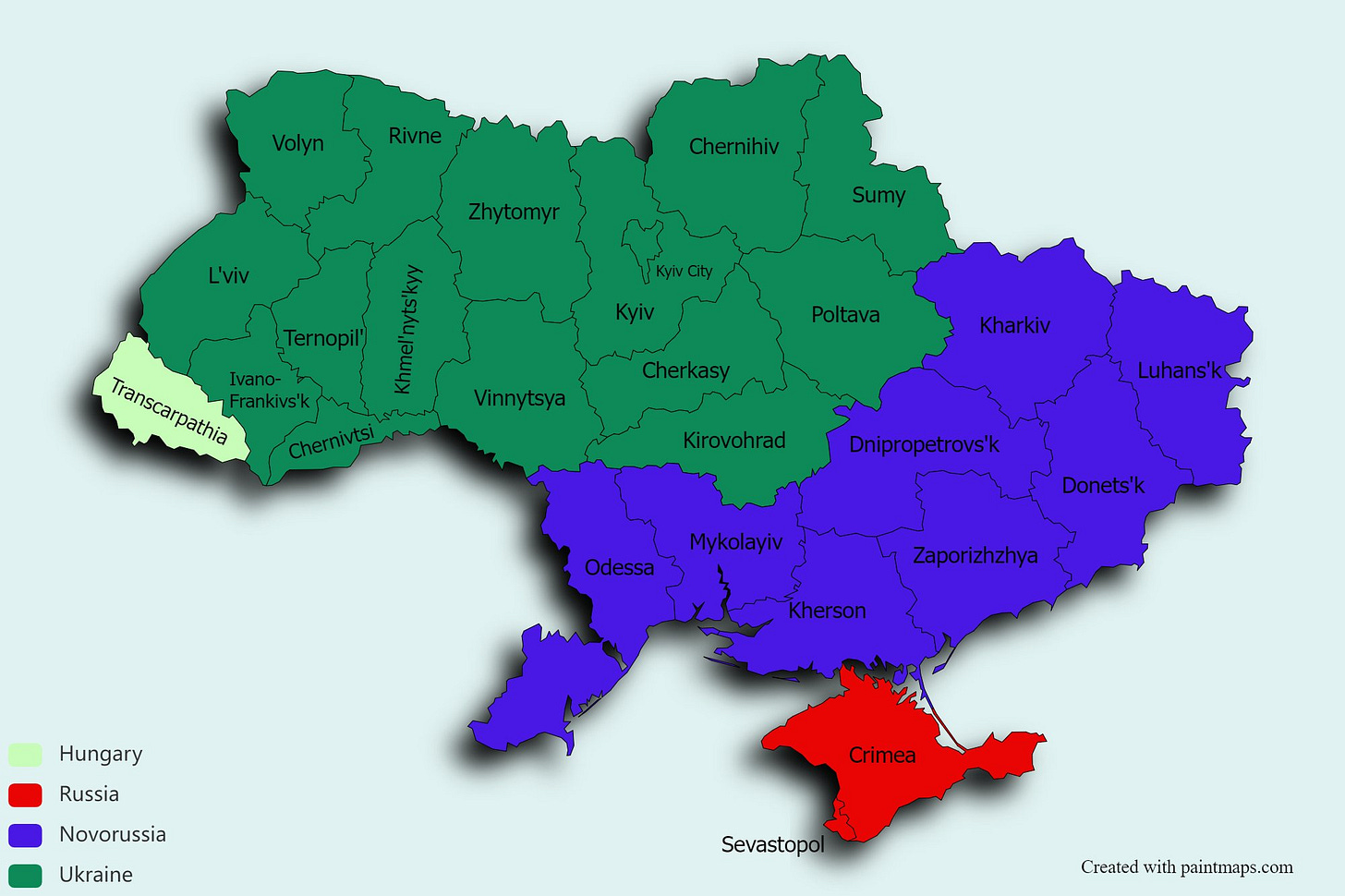
Novorossiya
No matter how the would-be masters of empire try to spin defeat into victory, most everyone around the world will still know the score. And it is this disabused illusion of imperial military supremacy that will rapidly accelerate its inexorable decline.
Michael von der Schulenburg: Alaska Meeting Was a “Game Changer”
Excellent discussion and correct preliminary conclusion. “Trust-building” was leitmotif, to halt the runaway train to nuclear war. Reality between the two who count are now materially different. Europeans stand alone, and will cast off by Empire. “The Peace” is gonna be imposed on the crazed Europeans, and others fueling Forever Wars. Russia is recognized as peer power that must be negotiated with, sans diktat or derision, as they hold the cards.
Of course it’s all about Alaska. Here’s what’s in play. But it’s the shadowplay that’s even more exciting.
By Pepe Escobar at Strategic Culture Foundation.
Of course it’s all about Alaska. Here’s what’s in play. But it’s the shadowplay that’s even more exciting.
Across the world, for those who grew up in the Cold War Swingin’ Sixties, the temptation is irresistible to cast Donald Trump as Goldfinger (but who would play Oddjob? Hegseth?)
Goldfinger, after all, is a powerful, ruthless gambler. His 21st century motto would be “Obliterate & Plunder”. In fact, sequentially, an orgy of obliteratin’ and plunderin’ if the occasions present themselves. Everything subjected to the search for the Golden Deal. My way. The only way.
Yet now it’s possible that Goldfinger may have met its appropriate – collective – match.
This is what happened the last time a summit took place in Alaska, in this particular case US-China in a shabby hotel in Anchorage. That shook the geopolitical chessboard to the core. Trump-Putin might – but only under quite specific conditions.
There’s only one realistic, optimal endgame for Alaska: a joint declaration of intent, pointing to a follow-up, as in the next meeting to be held in Russian territory. A sort of starter for the long and winding road towards a real reset of US-Russia relations, including a possible settlement in the proxy war in Ukraine.
Essentially, they may agree to keep talking. Yet what really matters is what may be implied by the promise: Goldfinger refrains from imposing secondary sanctions on Russia’s partners.
That will constitute a tremendous BRICS victory (Iran excluded. Actually, two strategic allies of Russia would be excluded: Iran and the DPRK).
BRICS are actively building a coalition to stare down Goldfinger. The key players are Bear, Dragon, Toucan and Elephant – all four original founders of BRIC. Nightingale should be added later, as it is linked via geopolitical/geoeconomic strategic partnerships with Bear, Dragon and Elephant.
When it comes to the Alaska nitty gritty, the top Bear needs to consider all the ramifications of what is an imperative for the Russian General Staff and the vast intel apparatus in Moscow: unless Goldfinger minions stop weaponizing and providing precious intel to Ukraine is all its forms, the mythic “ceasefire” that Goldfinger and the pack of toothless chihuahuas in Europe desperately want will be just an intermission to allow Ukraine to rearm to the hilt.
That’s a tough call for the top Bear: he has to placate his domestic, radical critics who blast him for sitting down with the enemy, and at the same time he must deliver the goods to his under-siege BRICS allies.
BRICS counteract Goldfinger’s Plunder tactics
Bear, Dragon, Toucan and Elephant are involved in breathless telephone diplomacy to articulate their collective response to Goldfinger’s Tariff/Plunder drive.
Examples. Modi on Brazil: “A strong, people-centric partnership between Global South nations benefits everyone.”
Lula on India: “Brazil and India are, so far, the two most affected countries. We reaffirmed the importance of defending multilateralism and the need to address the challenges of the current situation.”
Xi to Lula: China backs Brazil to defend its national sovereignty; BRICS is “a key platform for building consensus in the Global South.”
Goldfinger’s Tariff Plunder works in several ways.
On India: because New Delhi refuses to open its vast agricultural market to tariff-free Made in USA imports (45% of India’s population directly depends on agriculture); and because India buys Russian oil at much-needed discount prices.
On Brazil: because the ultimate target is regime change and free reign to plunder Brazil’s natural wealth.
So far, Goldfinger’s Plunder antics have been stellar when it comes to engineering their own blowback: from allienating even allies – see abject European submission – to de facto burying multilateral trade, not to mention international law.
Example: just a few hours before the tariff “pause” on Made in China products was about to expire, Goldfinger signed an executive order extending the deadline for another 90 days. Translation: TACO, all over again. If the tariff “pause” went through, the economy of the $37 trillion-indebted “indispensable nation” would be in even more dire straits.
Then there’s Goldfinger’s possible Arctic gameplay, already examined here. There’s virtually no evidence Russia would allow the US to participate in the development of the Arctic-wide Northern Sea Route (NSR), or Arctic Silk Road in Chinese terminology.
The role of Russia’s Atomflot – 11 nuclear icebreakers, 9 of them in action, 2 being built, including Project 10510 Rossiya, a behemoth capable of navigating anywhere in the Arctic anytime – in parallel with Russia’s astonishing arsenal of new weapons systems, these are absolutely key variables on any serious discussion on any possible US-Russia partnership post-Alaska.

Arya – آریا: mural at Tehran’s Enghelab Square. Farsi text: “The end of this saga is of glory, thus recite the name of Iran, for it is the slayer of its enemies.” The Iranian warrior Rostam from Shahnameh fights the serpent (the US)
Goldfinger’s obsession to cage Nightingale
Now let’s look at Nightingale – an immensely complex case. Goldfinger has totally embarked on a multi-track maximum pressure/tension remix against Iran: forcing Hezbollah to disarm; forcing the collapse of Lebanon into factional war; legitimizing the “al-Qaeda R Us” dismemberment of Syria; forcing snapback UN-backed sanctions on Tehran.
Then came the Goldfinger-hailed “historic peace summit” with Azerbaijan’s Aliyev and Armenia’s Pashinyan.
Well, what Baku and Yerevan really signed under Goldfinger’s watchful eye is not a peace deal: it’s a mere memorandum of understanding (MOU).
Their Joint Declaration is extremely vague – and non-binding. What is promised is a “let’s keep talking” set up: “We acknowledged the need to continue further actions to achieve the signing and ultimate ratification of the [Peace] Agreement.”
It remains to be seen what happens with the much-ballyhooed 99-year American grip on the Zangezur corridor – trimphally named Trump Route for International Peace and Prosperity (TRIPP) – complete with grabbing 40% of its revenues (Armenia would get only 30%) and placing 1,000 American mercenaries to patrol Armenian territory, right south of Nightingale’s borders.
The big story is of course Goldfinger eager to snatch at least one connectivity corridor in southern Eurasia – in the strategic south Caucasus, using a gangster-minded MI6 asset (Aliyev) and a national traitor (meek Pashinyan), which will be discarded and/or sweetened in due time. Crucially, NATO membership was offered to both Armenia and Azerbaijan.
The Deep State’s game plan is total control: what really matters is the opening to establish a NATO corridor all the way to the Caspian.
There’s no way Nightingale will let that happen, not to mention Bear and Dragon: it would mean a direct NATO threat not only to the International North South Transportation Corridor (INSTC), which unites three BRICS (Russia, Iran, India) and crosses the Caspian, but also the Chinese Silk Roads, whose corridors traverse Iran with possible branch outs to the Caucasus.
Nightingale has already made it quite clear it will not allow any kind of change of status for the Zangezur corridor. And it has the necessary missile arsenal to back it up. IRGC Deputy Commander Yadollah Javani: Iran “will not allow an American corridor on its border.”
Wherever it comes from, Goldinger or the Deep State, the pressure by the Empire of Chaos is relentless. There will be no respite in the Hybrid – and otherwise – Wars on BRICS, especially on the new Primakov triangle (“RIC” as in Russia, Iran, China).
Alaska in principle should be about a reset of all US-Russia security matters – geopolitical, commercial, military, with Ukraine being just a subset. That will be a major stretch. It’s hard to imagine Putin being able to impress on Trump, on the same table, the finer points of NATO/US ceaseless plots to undermine, harass and destabilize Russia.
The most probable outcome is that the proxy war – and the SMO – will keep rollin’ on, but with the Deep State making extra bundles of euros by selling tons of weapons for NATO to dispatch to Kiev. But even without the promise of a new, serious, US-Russia security architecture, BRICS may still stand a chance to snatch a victory out of Goldfinger’s latest photo op.
Preparing for aggression and “just in case” exercises.
By Rostislav Ishchenko at Ukraine.ru.
(machine translation)
Trump found himself in a difficult situation. He failed to convince Russia to sign a peace treaty (or rather, a ceasefire) with Ukraine on American terms.
As far as I can tell, Trump’s confidence that Moscow would quickly accept his proposal was based on an incorrect assessment of the overall damage inflicted on Russia by its confrontation with the West. However, even in the United States, many conscientious scholars who began their careers in Soviet studies are still influenced by the sudden collapse of the Soviet Union.
To understand what Americans think, remember the phrase that is popular with us today: “Everything that was written in Soviet newspapers about the West turned out to be true.” In the early 90’s, American Sovietologists were shocked by the fact that everything that American propaganda, with their help, invented about the USSR turned out to be “true”.
It should be understood that the Americans’ fascination with the applied nature of science (research should be profitable) often plays a cruel trick on them, and in the field of political and social sciences, it happens all the time. At first, American politicians, using a flexible system of grants, give political and social research the desired propaganda bias. As a result, regardless of the outcome of these political efforts, whether they are successful or unsuccessful, political and social researchers do not have a clear understanding of the processes that actually led to the specific result.
The fall of the USSR was an impressive geopolitical catastrophe, and the Americans, who did not have a clear understanding of the internal processes that led to this outcome, concluded that their propaganda was correct and that the American system was the ideal that humanity aspired to, but that was not attainable for everyone. It was like in the joke: “I can only imagine what’s happening in America!””The only thing the Americans decided was that if Europe has been so affected by the sanctions war with Russia, and even the United States has felt some discomfort, then Russia, which is also fighting in Ukraine, must be feeling even worse!
Nowadays, it’s rare to find revelations from foreign agents and relocants in the media, but if you recall what they said and wrote in 2014-2022 about Russia’s “inevitable defeat by the collective West,” you’ll realize that the West itself was thinking about this, and in many ways, it’s still thinking about it. After all, these foreign agents adopted their ideas from their Western partners.
Therefore, it is not surprising that the scientific support for American foreign policy leaves much to be desired. And this is not limited to Russia. Similarly, Trump’s concept of quickly suppressing China by shifting the focus of American efforts to this direction is also failing. The threat of imposing draconian sanctions on trade with Russia has prompted a strong response from China.
Now the US has to either pretend that this was a bad joke, but in this case, the entire building of Trump’s foreign policy is crumbling: Ukraine has been surrendered, China has not been defeated, there are no results, the systemic crisis of the West is deepening, the US’s authority is declining, the midterm elections are getting closer, and the fate of Trumpism is becoming increasingly uncertain. Alternatively, the US must engage in a sanctions war with China, which, according to their own calculations, will be a two-way street and will cause at least as much damage to the US as it does to Beijing.
But there is a caveat. The Americans were unable to block Chinese trade routes in Central Asia and the Indian Ocean. The Americans were unable to organize a major war on the Chinese borders. The Indian-Pakistani conflict died down due to the inability of the Indian Air Force to adequately counter the Pakistani ones. The clash of the western aviation fleet, technologies and techniques of air combat (India) and Chinese (Pakistan) showed the convincing superiority of the latter. As a result, India’s previously wavering focus on BRICS and the SCO has strengthened. New Delhi is trying to maintain neutrality, but while this neutrality used to be more in favor of the West, it is now aligned with the interests of Russia and China.
There are ongoing battles with rebels in Myanmar, and there is unrest on the Thai-Cambodian border, but overall, these crises are not severe enough to pose a direct threat to China.
The United States has failed to create critical problems for China in the region and on its trade routes, which means that the United States has not gained a tangible advantage in a potential trade war. Washington cannot count on a rapid collapse of Beijing. This will be a long economic war of attrition, with Trump facing a real threat of losing the 2026 midterm elections and the 2028 presidential election. They may not even make it to the “final” by losing the Republican primaries.
The problem is that an economic war will lead to a severe shortage of goods in the U.S. consumer market, and many U.S. businesses will lose their supply of components. Neither India (which the U.S. is also threatening with a sanctions war, thus pushing it towards a closer alliance with Russia and China) nor anyone else can fully replace China in the U.S. market.
Initially, it was assumed that China would be quickly broken by imposing a trade blockade, and that a quick strategic victory for the United States would overshadow the short-term difficulties. However, it is now clear that there will be no quick victory, and the domestic economic challenges that a trade war with China could pose could be fatal for Trump, Trumpism, and the Trumpists.
We have already seen in the Iranian example that in a difficult situation, “peacemaker” Trump, like his predecessors in the White House, chooses war. Europe should fight Russia, and it is preparing to do so, while Israel, which attempted and failed, is preparing for a second round.
The US is assembling a bloc of Pacific countries to fight China. The bloc is being formalized with Australia, Taiwan, the Philippines, and Japan, and the US is actively working with other countries in the Indo-Pacific region. However, despite having a strong naval presence, the US has not been able to establish a land-based foothold against China that could be used for a proxy war, similar to Ukraine’s role against Russia.
Meanwhile, in the event of a war at sea, the U.S. Navy is almost guaranteed to be involved in military clashes (at least during the delivery of military aid to its allies, without which they will not be able to fight for long). China, on the other hand, possesses a nuclear arsenal (albeit not as impressive as Russia’s, but still the third-largest in the world), and Washington does not want to take any risks.
The Republic of Korea has recently been considered as a potential land bridge from which a proxy war against the People’s Republic of China could be launched due to the failure of other options. Along the way, Kim Jong-un could be punished for his assistance to Russia in the special military operation.
It’s not an ideal option, but it’s the best we have right now. Judging by the fact that the United States has dramatically increased its pressure on Seoul in recent weeks, “persuading” it to join the Japanese initiative to create a “Joint Theater of Operations” in the East China Sea and the South China Sea, which has already been supported by the Philippines, Australia, and Taiwan, Washington is rushing to force China to make major concessions, if not through peace, then through the threat of war.
Trump needs at least some kind of “victory” before the midterm elections, otherwise he risks losing control of Congress (one or both chambers). Therefore, the Russian-Chinese and Russian-Korean exercises (both land-based and naval) are conducted with a specific goal in mind: to show a potential aggressor that China is not alone.
AHH: a reminder of his column of a year ago, and how finely the onion has been sliced ever since (A nuclear provocation…)
Judge Nap interviews our roving eye nomad on taking on the entire BRICS in one fell swoop. “Moneyprinters with nukes: CHARGE!”
“Either the U.S. lets Iran become nuclear, or the U.S. has to engage diplomatically.”
In this interview, Negar Razavi speaks with @vali_nasr about his new book, Iran’s Grand Strategy: A Political History — and the choices ahead for U.S. foreign policy.
It was pleasure to speak with Security in Context on my book Iran’s Grand Strategy https://t.co/7By3bceGnS
— Vali Nasr (@vali_nasr) July 16, 2025
“Professor Vali Reza Nasr is an Iranian-American academic and political scientist, specializing in Middle Eastern studies and the history of Islam. He is Majid Khaddouri Professor of International Affairs and Middle East Studies at the Johns Hopkins School of Advanced International Studies in Washington, D.C.”
This eloquent expat may provide the most balanced and rational analysis to be seen in the West, even if must operate within rigid overton windows. Born in Tehran and understanding of the current Iranian world view and spirituality, he can look through their eyes and cogently present their point of view to us
The whole Circus Ringmaster shtick, with each plot twist draped in several layers of hubris and empty bluster, only accelerates the BRICS/Global South high-speed train…
By Pepe Escobar at the Strategic Culture Foundation.
All of you Vietnam vets and draft resisters will recognize where this column’s headline is coming from. Oh yes, this ain’t the late 1960s anymore, so it’s time to revamp it – no AI needed – and expand it: from now on, be assured everyone in the wild, wild West will be forced to fight and/or endure three overlapping NATO wars.
War number 1
It’s Europe v. Russia, of course. Not proxy anymore: hot ‘n nasty, direct. Considering the advanced rottenness of the whole Ukrainian front, new fronts are already proliferating: the South Caucasus; clandestine ops in the Baltic Sea; MI6 recruiting frenzy across Central Asia; fresh terrorism ahead in the Black Sea, especially Crimea.
Col. Lawrence Wilkerson succinctly nailed it: we are already on WWIII. Actually we are already deep in the extended preamble to WWIII. Circus Ringmaster in D.C. and the billionaires/donor class behind him are of course clueless. Re-reading Keynes – The Economic Consequences of the Peace – is an absolute must like never before. History does (italics mine) repeat itself.
Yet this ain’t 1914 or 1935; now nuclear weapons may come into play.
The Kremlin and Russia’s Security Council are very much aware of the high stakes. In his recent interview to Kommersant, Sergei Shoigu even rolled out some key NATO numbers to stress the threat Russia faces: over 50,000 tanks and armored vehicles; over 7,000 combat aircraft; over 750 warships; 350 military and civilian satellites; an immense offense (italics mine) budget.
Well, what sly Shoigu did not say is that when push comes to shove, it only takes Mr. Khinzal, Mr. Sarmat, Mr. Zircon and Mr. Oreshnik to deliver a few strategic business cards to paralyze the whole NATO machinery in a matter of minutes.
War number 2
It’s the Empire of Chaos v. Iran in West Asia, with Eretz Israel as much as proxy as a lead actor.
The Circus Ringmaster – whose only “strategy” is to concoct shady deals to enrich himself and shysters in his close circle – dreams of an Israeli-centric West Asia, a toxic crossover of the Abraham Accords 2.0 with the IMEC corridor, creating, as Alastair Crooke defined it, “a business-led West Asia, centered on Tel Aviv (with Trump as its de facto ‘President’), and via this business connectivity corridor, be able “to strike further beyond – with the Gulf States penetrating into BRICS’ south Asian heartland to disrupt BRICS connectivity and corridors.”
Using the Arabs against BRICS won’t cut it even with MbZ in the UAE and MbS in Saudi Arabia, who have both realized the business scam will only work if there is real peace in Gaza; some sort of humanitarian solution for the Palestinians; and rebuilding the Gaza strip.
The death cult in Tel Aviv will never allow any of the above: their plan is to kill them all, steal all their land, and eradicate their culture. And as the genocide goes on – totally legitimized by the NATO sphere – the death cult keeps bombing anything in sight, perpetrating the balkanization of Syria, and expanding Eretz Israel.
War number 3
It’s NATO against China. Already decided in the latest summit in The Hague, side by side with the continuing war on Russia.
Yet actually the scam is much bigger: it’s NATO’s war on BRICS.
That was announced, casually, by that unspeakable Dutch mediocrity that makes former slab of Norwegian wood Stoltenberg sound like a quantum physics star. NATO’s Secretary-General Rutti Frutti actually threatened India, China and Brazil directly, and ordered them to “call Putin” to prevent “Daddy” Trump from unleashing his next Tariff Temper Tantrum (TTT).
Beijing is hardly breaking a sweat. China humiliated the Circus Ringmaster by not backing down one inch in their trade/tariff war. Russia humiliated the Circus Ringmaster by not being coerced into a pathetic “ceasefire” – as in allowing NATO to re-arm. Iran humiliated the Circus Ringmaster by not signing an unconditional surrender. The Houthis humiliated the U.S. Navy – now that’s one for the military annals – by forcing the Circus Ringmaster into a ceasefire after $1billion in failed bombing.
Lula in Brazil is about to humiliate the Circus Ringmaster by affirming Brazilian sovereignty in the face of an all-out trade and financial war (Trump even threatened to tax the popular Brazilian digital payment system, PIX). If slapped with 50% tariffs, Lula said Brasilia will slap the Empire of Chaos back under a reciprocity law.
The whole Circus Ringmaster shtick, with each plot twist draped in several layers of hubris and empty bluster, only accelerates the BRICS/Global South high-speed train, now increasingly being shaped as a geoeconomic, geopolitical and geo-strategic alliance of trans-continental proportions, reaffirmed at the Rio summit.
All that led, of course, by what I have been describing as the new Primakov triangle: the new RIC, Russia, Iran and China, complete with their interlocking strategic partnerships. Quite a few top Chinese academics not by accident are also starting to conceptualize the emerging, “post-West” environment with two new “I”s in BRICS: Iran and Indonesia, not India, should be at the heart of BRIICS.
Meanwhile, in Europe, Tricontinental analysis has noted how the – warmongering – German BlackRock chancellor has pledged “€650 billion over the next five years toward military spending in order to reach the [NATO] 5% target by 2035”. That means Berlin being forced to raise “about €144 billion per year”, via, what else, austerity and debt, translated into massive extra taxes on German consumers.
That, in a nutshell, is the “program” for the whole, fragmented, collective West in the near future: austerity for everyone (except the 0.01%); and NATO Wars, not Diamonds, Forever.
Jamarl Thomas interviews KJ Noh on China’s hidden role in Iran’s new defense posture against US aggression, and the big view at the moment.
[machine transcript]
Jamarl Thomas: You look good. You look good. You look good. Let me bring him on. KJ. No. The man himself. KJ is a journalist, political analyst, writer, and teacher specializing in the geopolitics of the Asia Pacific region. He’s contributor to the book Capitalism on a Ventilator. Once censored by Amazon. It is now available at .org. You can also find him on Breakthrough News Network. Again, fantastic network with the China Report. KJ, welcome to the show, man. How you doing today? You doing all right?
KJ Noh: I’m doing well, thank you.
Jamarl Thomas: It is always a pleasure to have you, KJ, there is reporting out that Iran is purchasing jets from China. Now, China got a lot of publicity recently in the war between Pakistan and India. And India was running a lot of propaganda, very angry at China because the thought was that it was Chinese weapons that were knocking out Indian planes out of the sky. , and that those weapon systems that they got from China was extraordinarily effective, especially against Western equipment that didn’t seem to be up to snuff. And now it seems that Iran is purchasing, and this goes in two fronts.
One, Iran’s purchasing Chinese aircraft, top of the line for air defense, but also that they got rid of GPS and they the ethic is called by DU that they’ve been using China’s global system for their military campaigns, which is in part responsible for the accuracy of the weapon systems that we saw in their war against Israel. Let’s go to the first one first. And it sounds weird, but I’ll go with it. as are they purchasing these planes from China? And then I want to go to the GPS thing because the GPS thing is really interesting to me. But let’s go for the first one first.
KJ Noh: Yeah. So there are not official statements but there sources there statements from good journalists who have said that this is the case. So I think that certainly something is in the works. we know that the 10 ministers of the 10 defense ministers of the SCO met very recently with the Chinese defense minister. and so whatever is happening something big is happening and certainly it is related to defense and defense acquisitions regarding the Chinese jets. The thing to understand about arms in general and warfare in general is that all modern warfare is joint arms combined warfare. That is you’re using systems together.
So for example, you might be using Chinese jets along with you know for example you know other types of surveillance aircraft along groundbased radar with missile drones, missile interceptors, etc. And so it’s all combined arms warfare. Everything is joint and connected. And so you have to understand it. It’s not simply that if they do acquire the J10s, it’s not simply that they’re acquiring the J10, they they’re acquiring the entire system and in particular the tactical data networks that connect everything. You know, it’s like, you know, it’s not simply like you’re buying a cell phone, which is just you know, it’s just an expensive paper weight without a SIM card. So once you have the SIM card and once you have the various apps then it becomes a mini supercomputer in your pocket. And so we have to understand it that if Iran acquires Chinese J10s or other technology then it’s an entire defense ecosystem that is being built in for Iran. And then the other piece of it is that because this weaponry is so complex, involves ongoing support and maintenance and you kind of get the after service contract. So essentially it’s a form of relationship building. So interesting. So what we’re looking at here if it turns out to be true and I think that it most likely is based on the sources that I’ve read is that China is strengthening its defense cooperation. Iran is strengthening its defense cooperation with China along with the entire SCO block. So that’ll be very very interesting. So big moves of foot here.
Jamarl Thomas: Thank God. Thank God, man. Because Iran freaks me out. They freak me out. And they freaked me out because it seems like they were like, “We want to do this on our own. We want to, you know, we don’t want to buy equipment. We want to just build our own.” And obviously their equipment and the political structure was able to withstand the attack from internally and externally.
But from from my point of view and from many people’s point of view I think Sarah Bills will back me up on this too, the one from DDGeopolitics. Russia, China and Iran are a force of the new world. meaning and even though it’s frustrating to me, I understand why they go with this notion of international law. I would say there is no such thing, but they have been cidously with this notion of we’re going to stay within the bounds of law. And so even though the West has no red lines, we have red lines. We’re not going to go after civilians.
We’re not going to go after targets that are not military targets. we’re going to be very legalistic in the way that we talk about this stuff. And on some level, you kind of get it if indeed they see themselves as a fulcrum of a new world — that you want that new world to be based on law, not what came before it. So, I do get it. But it just felt like for the longest time they were flying on their own. So, I’m glad that they have now started this kind of military cooperation with and I’m saying cooperation in sense of getting equipment and relationship with China and even Russia in this front.
The other one is the satellites. From my understanding, they weren’t using GPS. They got rid of GPS. In fact, from my understanding, a lot of their equipment, especially from India, was infiltrated by Israeli agents. And so they seem to be getting a lot more equipment from China as opposed to from India, especially using Beidou as a satellite platform as opposed to GPS. Is that correct? Am I getting that right? I saw a reporting on this, but I wasn’t certain it was true.
KJ Noh: Yes, I think I think that is most certainly correct that they’re using the Chinese quote unquote you know positioning system it’s the Chinese version of GPS and of course that in doing so they’ve made themselves impervious to US interference because GPS can be cut off anytime the US sees fit.
So that’s another way in which they’ve created a kind of electronic sovereignty over their air territory which you know as you know Brian has been saying this but there key domains of sovereignty which are essential you know of course you want sovereignty over your land that’s the basis on which the whole notion of statehood is con you know is conceived but you also want sovereignty over your own airspace and then you want sovereignty over a certain portion of your naval territory and then you want and this is important because the US conceives of war fighting in multiple domains.
So you want sovereignty over the cyber domain what I refer to as digital sovereignty or what my colleagues sometimes refer to as digital vestalia. But you need digital sovereignty the sovereignty over the cyber domain or else you have nothing. and then you also want to have you know that includes sovereignty or you know your own control over your own devices and apps that are run inside you know the cyber domain.
Otherwise you are completely porous. You are you know a sieve, you’re a colander, you know, from which you can be undermined as we have seen. And so the fact that Iran is, you know, taking measures to ensure that that is the case is really important. So I think that we need we should pay attention to that and understand that these are actually strong defensive measures that are actually necessary.
Jamarl Thomas: I’m curious how does China view this? You know I spoke to Marandi I’ve spoken to Mark and I guess they would give you a perspective of in of Iran and a perspective of Russia. How does China view all of this? I mean, for all intents and purposes, you have an empire that is setting fires all across the globe with this notion of hegemonic control.
They went after Russia. It didn’t work. They went after Iran. They will keep going after Iran for right now. It didn’t work. And Iran is trying to deal with, let’s say, bolstering itself and solidifying itself. And for all intents and purposes, not just it didn’t work, it made Iran stronger, weirdly enough, because you have this youthful generation that didn’t understand that the West were monsters. They thought, well, the US is love and light. Look, they have Superman and pizza.
What what’s, you know, what’s your issue? Our economy would be better off if it wasn’t if we could work with the West. You guys are just not being cooperative. And then they see in their own mind was negotiating. People like me saying they should have, but they weren’t negotiating. They get attacked during negotiations. It’s clear as day that the West was behind it. It’s clear as day that the West backed it. And they could see with their own eyes what their government had been telling them was true. China for the most part has been on the outskirts and has only had to deal with that in an economic sense. Taiwan, yes, but not really in a direct military sense. China has to see these events unfold. What is it thinking from its own point of view after a 12- day war and after the attack on Russia?
KJ Noh: You know, I think they’re seeing things very clearly. I mean, the Chinese are not fools. They know that the US has been agitating, militating to war since 2009. Certainly, actually before that. But we know that the war plans were. I mean the war plans were printed developed in 2009 and then in 2011 we had the pivot to pivot to Asia really the pivot to encircle China in 2011 that was formally declared in Darwin in Australia and then they saw all the extraordinary undermining that was being taking place.
The entire approach was both regime change and military encirclement and a really a fullcourt press that has been ongoing since 2009. So we’re you know 16 years into this process. Well, what happened in 2009, 2008, the global capitalist financial system collapsed around its ears.
And remember, prior to that, of course, the west was engaging with China, but their theory was that we engage with China in order to regime change it. This was essentially the same process that they envisioned happening in the Soviet Union. China, it was a Potemkin state. Once they see our KFC and our hamburgers, you know, they will throw themselves at their knees and beg to be our vassels. That was the theory, you know, that was what they really believed.
And on the other hand, you had people like Hillary Clinton who said, you know, China is, you know, it’s on its last legs. You know, this Gordon Chang Hillary Clinton theory is that, you know, it’s it’s a paper tiger. It’s a Potemkin state. it’s ready to fall down and we just have to be ready to swoop in and sweep up all of its, you know .. its wealth. And this is how they think.
And then what happened in 2008 was the, you know, the financial collapse. And it showed that it wasn’t China that was about to collapse that was on its last legs. It’s actually the western capitalist world. The entire capitalist system collapsed. This is why Sarkozi, right-wing French president said “Laisez faire c’est finis”, you know, capitalism is finished.
You know, this is a right-wing French leader saying that we’ve seen the end of capitalism, and because of that, that’s when the daggers came out. The West decided that China was not going to collapse of its own accord from its own internal contradictions because rather the contradictions were with the western systems.
And therefore it needed a good shove down the stairs and so that’s when they built this doctrine of war called Air-Sea Battle and they also built up, they declared the Pivot to Asia Plan, encircling and choking China out. They were doing all kinds of dirty tricks as far as you know encouraging corruption, opening the doors wide so that foreign exchange could be extracted.
So there was all kinds of financial warfare going on. When China started to clamp down and they said oh you know Xi jinping is a dictator, but no they were just trying to prevent this you know kind of drainage of Chinese wealth overseas which you know is again another kind of precursor to creating collapse.
And then they also started to implement the Trans-Pacific Partnership, which is actually has a similarity to what’s going on right now with the tariffs, but the idea was to isolate China and exclude it from the entire Pacific zone as far as trading is concerned. That is you would have all the Pacific economies they would trade with each other but China would be excluded from it. They referred to this as an economic aircraft carrier.
So there was all kinds of dirty tricks and subkinetic warfare that was happening and the Chinese are not deceived by any of this. So they started to build out the belt and road. Remember the belt and road happened after this US initiative to take down China. So that’s a way of bypassing these naval choke points by creating overland routes or overland routes that bypass the immediate choke points such as the Straits through CMEC and CPEC — China Myanmar Economic corridor, China Pakistan Economic Corridor.
And then you can see how then the US was initiating different kinds of disruption in both Pakistan and Myanmar, in particular the supporting of terror activities against those construction projects infrastructure projects. It’s this kind of continuous game that you see escalating in different – it’s Go – it’s like a ladder happening. You see the continuing move and counter move happening.
But again there’s this concerted program of countering this US approach to choke it out which China has been building. And so again in the South China Sea they started to militarize some of the islands there because that is the cost for the US. The US shrieks and screams that China has, you know, overseas bases and they’ve militarized the entire South China Sea.
Absurd, because all five or all six of the claimants to the South China Sea have islands that they’ve militarized and five of them have air strips on them, but it’s only China which is being, you know
Jamarl Thomas: KJ just to point out the US has like 800 military bases around the globe. The notion that they are screaming that China, oh my god, China has two military bases, it’s outrageous.
KJ Noh: Yeah, it has one military base in Djibouti. It has one military base in Djibouti as part of a UN mandated antipiracy program which it does in collaboration with five or six other countries. Even Japan has a base in Djibouti and Japan is supposed to be a pacifist nation with no military. So that tells you how threatening you know or technically how, anyway!
So China does not have bases. The US has 8 – 900 bases. Nobody really knows, but we know that it has a military presence in at least 170 countries. And it’s not really the bases themselves that count. It is the basing agreements. That is to say, a lot of what the US does is it sets up a basing agreement with a country and then that allows the US to go in and use the bases in this almost eminent domain type of way. So whether you see troops or not, what you really have to look at is there some kind of basing agreement? Is there some kind of use agreement?
If that’s the case, then you know that that base, you know, is like a Uber or an Airbnb that can be immediately taken over for US military purposes. So even that 900 number is actually an undercount. It’s much more aggressive and you know threatening all than that.
So US has encircled China with bases. It’s essentially staging the entire Pacific and the entire Asian continent for war. And there’s no way the Chinese have not caught on to this. They’re very clear on what’s happening and they’re creating defensive counter measures. as I’ve pointed out.
Jamarl Thomas: is it fair to say that from the Chinese point of view, I would say probably even the Russians and maybe even the Iranians, that the more time that they get, the weaker the position of the West gets, which is the reason for the seemingly desperate fire setting.
I mean, if you look at Serbia, they attempted to take down Georgia. They’re going after Azerbaijan got involved into this at this point. Of course, Russia, Iran .. they tried to take down the South Korean government. All of these things bespeak of desperation. They failed in South Korea. They’re failing in Russia. They failed in Iran.
And so, yeah, they may have some of these government bases, but the previous prime minister of Japan just came out saying, “We need to have a Japan without US bases.” I think people are seeing them committed genocide and think to themselves, these people are monsters.
From the point of view of China, Iran, Russia, is it just we need more time? The more time that goes by, the weaker they get and the worse their plans become. Is that the thought that China has?
KJ Noh: I think that’s a large part of it. You know, we spoke about the fact that China has the time. As our friend Dr. Wilmer Leon says, “You have the watches, we have the time.” I think that the Chinese always think in terms of the long haul in terms of you know the strategic and long duration, you know they think ahead.
If you go to China what’s astounding is that you see civil engineering projects that have been built over 600 years that means that you know whatever they were doing, you know, they were planning experience. So, for example, some of the canals in China, that’s a 600-year project. So they think big and they also think long term.
So certainly vis-a-vis the United States, they know that if they can avoid getting pulled into a war, which the US wants, then they can essentially, you know, sports analogy, they can run the clock down because they are ahead.
Jamarl Thomas: Speaking of that, Donald Trump is saying that there is a deal between China and the United States. Is that true?
KJ Noh: Well, I’ll believe it when I see it. I’m sure there are all kinds of deals that are being proposed. Whatever it is, I don’t think that they are trustworthy. As Sergey Lavrov said, the US is not agreement capable. It has broken every single deal, agreement, treaty, that it has ever made with any country or entity that it considers an enemy or a vassal.
Just think of the what 360 (hundreds) of treaties signed with the indigenous peoples of the Americas. Every single one of them violated. Not a one, not a one, upheld, right? Ruth Bader Ginsburg, you know, this kind of darling of the liberal, you know, of the liberal class, she was the one who hammered into the Supreme Court decision, the doctrine of discovery; this colonial era, theory, that you can simply take what you want.
So no the US is not agreement capable and I think the counterparties are aware of that and so I think they may be negotiating, they may be discussing things certainly, it’s better to discuss than to go to war. But you know I’ll believe it when I see it.
Certainly even if the president negotiates something, first that assumes that the president actually is the driver of the car and secondly it assumes that it won’t be overturned the moment that there’s a new administration in there or the moment that you know the deep state decides it’s going to undermine it.
A good example of this is North Korea. They had an agreement and then you know the moment it was signed, it was already null and void — within two weeks it was null and void.
Think of the Korean war the ceasefire that was signed in 1953 was null and void the next day. The US literally came out and said we are not looking for a peace here.
So this is how you know the empire works. They pretend or they use diplomacy and negotiation as a part of their military toolkit. It’s simply one of the diversions or ruses or tactics that they use.
But ultimately what they believe in and what they assert is raw power, raw domination. and I think that other countries are certainly wise to this. Certainly I hope Iran is aware of this. I don’t think the Chinese are deceived. And then regarding your point around the desperation, you know, the US says that “China will go to war in 2025 or 2027”. I thought it was 27. Yeah, there were two dates, but they’ve been set up as a kind of a window now. So we know somewhere between this year and two years from now the US will go to war with China.
They’ve declared it. You know they’ve calendared the dates.
And of course they’re saying that China will start the war. Of course not. China is not starting any wars anywhere. It’s trying really really hard not to get pulled into a fight, but certainly the US is extremely anxious and desperate for a war, because it knows that if it doesn’t go to war it will essentially lose hegemony.
And for them losing hegemony is the end of the world. And they would rather end the world than see the end of their hegemony. So this is the really dangerous moment we’re in.
Jamarl Thomas: The US is a powerful country among other powerful countries. And the moment that a country has the ability to end all things, then hegemony is over with. Like meaning, if you are the only one with nukes, if I have a powerful military that I can effectively win every contest, okay, then I’m a hegemon, right? I can control all of these things because ultimately when it comes down to it, I can win a military contest.
But the moment that both of us have the capability of destroying the world, the hegemony is over. At that point, we’re just in a contest of, I’m threatening to use nukes and you’re threatening to use nukes and both of us are threatening to use nukes — basically threatening to end the world, in any negotiation that ultimately takes place.
Meaning any war that takes place between the United States and China or the United States and Russia is effectively a contest of “either you back off, I’m going to end the world.” “No, you back off or I’m going to end the world.” There’s no way to win that.
And I and I know they may have this thought of tactical nukes. A tactical nuke is still a nuke. It doesn’t, you know, the moment that you lower the threshold of using a nuclear weapon, you’ve lowered the threshold to use a nuclear weapon. There’s no way out that box. So, correct me if I’m wrong on this. Maybe I’m missing something.
KJ Noh: Well, I’ve said before — I don’t think I need to repeat it that, well, the people who are driving this are some of them are millenarian Christians who believe in the Apocalypse.
They think it’s their interest to have an Apocalypse because that’s what their faith tells them. I mean very recently saw Peter Thiel, you know, talking with Ross Douthat, [JT: Terrifying]. He’s a terrifying person. I mean he looks like, you know, death warmed over, right? I mean, this is the man who has certainly significant influence over policy. [02 – excerpt][03 – full]
Do you think that he cares about the future of humanity?
I mean, the man looks dead already. This is the corpse of Roy Cohn warmed over, right?
Jamarl Thomas: I think he looks like he touches himself to killing puppies. Yeah he looks terrifying.
KJ Noh: These are very very frightening people. And I believe at heart they are nihilists or they are Christian fundamentalists who have a belief in the Apocalypse, which is the ultimate conflict of interest as far as I’m concerned.
And then you have to look at the doctrine that has been built out over nuclear war. Traditionally, the doctrine of nuclear deterrence was called M.A.D., right? Mutually Assured Destruction. It’s a kind of Samson project. And the idea associated with this is what’s called countervalue strikes.
You strike our capital, we strike your capitals. We have, automated means of launching missiles that will — the dead man’s hand — that will launch even after you’ve hit us. So are you willing to trade Beijing for Washington? Are you willing to trade New York for Shanghai? This is the traditional countervalue theory which is based on ultimately rational leaders will pull back from mutual assured destruction.
Starting around the period of Carter, towards the end of his administration, the US started to postulate this thing called NUTS. Not MAD, but NUTS. So NUTS is shorthand for Nuclear Utilization Target Selection, which is just silly, you know, military jargon for the idea that we get in the sucker punch. [01]
We get the sucker punch in first, and then anything else that they launch against us, we just kind of clean the deck with missile defense systems. We get in the sucker punch and anything they try and launch after that, we just kind of clean up and our missiles will shoot that down.
It really is the notion that if we do a nuclear first strike, we win. That is the doctrine behind this. So this notion that with counterforce strikes that the US can prevail in a nuclear war is literally one of the underpinnings of this US escalation to global war, global domination.
They believe that if push comes to shove and conventional warfare is not working, then we escalate to tactical nukes. Right now, there’s a lot of policy papers saying that we have to rehearse this, we have to make this part of formal doctrine. We have to make the conventional and nuclear continuum seamless.
That’s seamless in execution, rehearsal and preparation. And then of course at the end of the day they have this N.U.T.S. doctrine, which is the idea then if that doesn’t go to plan we simply fire off the nukes first and we will win.
Of course what that doesn’t take to account is the fact that, first, those missile defense systems don’t work as we’ve seen very recently in the Iran-Israel war. The much vaunted THAAD system doesn’t work. And it’s expensive as hell, but essentially it is these things do not perform as they’re advertised.
It’s like those little stunt things where somebody catches a bullet with their teeth. That entire thing is a setup, right? I mean it requires a lot of skill but it’s a setup and it’s not going to happen. it’s not going to happen in real life and that’s what we’ve just seen.
So have the military planners noticed this? Have they realized that if Iranian missiles can penetrate five layers of the most sophisticated western defense systems — that is the British the American the Israeli (three four layer system), if Iran’s old antiquated missiles can punch through this, then what do you think will happen when you go to war with China which has more much much more advanced missiles. Have they taken that into consideration? I have no idea. I have no idea.
Jamarl Thomas: It’s just dystopian. It’s almost like it’s like “hey we need a new doctrine”. Oh I know. Let me just think one up. This is kind of the conversation I have with Brian Berletic. It’s one thing to write something down, reality is different.
And Yemen just fired a missile that that wasn’t taken down. One missile. It just missed. I’ve seen Iran fire missiles where helicopters were chasing it, and they still couldn’t get that thing down. This is a fool’s errand if they indeed go into a nuclear strike.
So KJ, we’ll see. KJ, you are always appreciated, man. Thank you for this. By the way, when is your next report coming out for China report?
KJ Noh: Probably next Tuesday. Just one more thing, Jamarl. The thing here we have to really make sure is that we don’t lapse into despair. You know, there’s nothing we can do, right? You know, “if they’re you going to use nukes, they’re going to use nukes”. There’s nothing we can do.
The fact is that we despair is not an option. We have to challenge this escalation to war.
And we were talking about domains of warfare. Of course there’s you know air, sea, land, cyber, there’s media, there’s information space.
And also your mind itself is a terrain of battle. Literally, the military planners see your mind as a terrain of contestation or terrain of battle. And the idea is to occupy and colonize your mind. And that is the work of propaganda, of mainstream media, of PsyOps, of everything that the Guardian and the New York Times and Amy Goodman does day in and day out. All of this is a way to occupy your mind, to colonize your mind, so that you acquiesce and you give up to the war mongers.
That’s where the resistance has to start — to degaussing your brain, degaussing your mind. Do not let your mind be taken over. Don’t become a bot or a propaganda repeating bot. And then resist that mental colonization. Then what you do is you start to share the facts, the truth. You degausse these influences and then you start to build anti-war coalitions that resist this insane drive and along the way you start to unpack and understand you know the reality of politics and history.
This is the task that every single person can do. In fact it’s what we have to do right now as well as all the other work that we should be doing in protesting you know the genocide, in protesting this mad escalation to war, to protesting the complete and total militarization of our society and the entire planet.
Jamarl Thomas: That’s why we’re here. That’s what we’re here. If it pushes the needle 0.1%, it pushes the needle 0.1%, it’s better than what it was prior. [KJ Noh: Every day counts]. Right.
KJ Noh. journalist, political analyst, writer, teacher, specializing in the geopolitics of the Asia-Pacific region, contributor to the book “Capitalism on a Ventilator”. One censored by Amazon. It is now available aicenter.org. [04] You can check them out on the China Report on BreakThrough News. [05] KJ man, always appreciate you. Thank you for this. You be safe, okay.
Links:
[01] Nuclear utilization target selection (NUTS) doctrine of the United States
[02] Excerpt of Peter Thiel interview with Ross Douthart
[03] Full Interview of Peter Thiel with Ross Douthart
[04] “Capitalism on a Ventilator”
[05] The China Report on BreakThrough News YouTube channel
The whole world is watching these developments with great interest.
By William Schryver at imetatronink.
They will endeavor to talk tough and “keep up appearances” for a while yet, but as a credible and capable military/political alliance, NATO is irreparably broken.

Confederate Field Fortifications, Petersburg, Virginia, USA. 1865

Union Trench Mortars, Petersburg, Virginia, USA. 1865
I’ve watched a LOT of drone footage from this war. I’ve seen, from a bird’s eye view, as it were, the design of the field fortifications Ukraine constructed, with NATO guidance, over the course of eight years.
The logic of these miles and miles of fortifications harkens back to the 1864-65 Battle of Petersburg (US Civil War), with a few World War I innovations thrown in for good measure.
It is a logic where victory largely depends on you not running out of men, heavy weaponry, and ammunition — and the enemy being comparatively stupid.
In many ways, the revealed logic of Ukraine’s long-prepared strategy for this war is a reflection of American military delusions and vanities, which multiplied and solidified over the course of the brief and fleeting “unipolar moment”.
Despite not having won a war since 1945, the US military is consumed with the vanity that it has always dominated opposing forces in every conflict.
There is a measure of truth in this perspective. But it is irrelevant. Because, since no later than the Korean War, the US has not faced a peer or near-peer adversary in a high-intensity conflict. The US military has not been, for almost three-quarters of a century, truly tested “under-fire”.
The US has measured its battlefield mettle, for decades, against brave sandal-shod men with AK-47s, RPGs, and a certain savoir faire for constructing IEDs.

Taliban Fighters, Afghanistan.
But they have never faced anything like Russian artillery or missiles – not even in Hollywood movies or video games.
Consequently, the Pentagon’s self-perception of unquestioned supremacy has served to disinform and corrupt its doctrinal and procurement decisions for multiple generations of its officer corps. For most US generals and admirals, all putative opponents are underestimated.
That said, I believe a great many have now been awakened from their intellectual slumber by the manner in which the Russian armed forces quickly assessed the Ukrainian order of battle, and then professionally adapted their strengths and tactics to decisively defeat it.
The Battle of the Donbass
Here is a brief summation of the Russian tactical approach to the Battle of the Donbass:
Step #1: Advance reconnaissance units (often in force, with dozens or hundreds of drones overhead) to assess the situation; draw fire; relay to commanders raw video and geo-coordinates.
Step #2: With target-correcting drone swarms overhead, relaying real-time strike video, proceed to savage the fortifications with towed and mobile artillery, Multiple Launch Rocket Systems (in gradations of strength and precision), and even horrific thermobaric munitions for particularly suitable targets.
Let smoke clear.
Repeat Step #1.
Still something moving there?
Repeat Step #2.
Repeat Step #1.
Dead bodies everywhere?
Step #3: Send in tanks and infantry to mop up.
Move to next series of fortifications.
And so on and so forth …
This is why Ukraine now suffers hundreds of battle deaths every single day. And why, for months, the Russians have suffered very few casualties — likely as low as a 1:8 ratio, and quite possibly even lower.
Artillery, airstrikes, and precision guided munitions are doing almost all the fighting.
The Fatal Hubris of NATO War Strategy in Ukraine
But back to Ukraine’s apparent strategy for this war, and the apparent US influence on that strategy.
I will preface my commentary on this issue by stating that Ukraine’s fatal blunder was buying into NATO’s over-confident delusion that they (the Armed Forces of Ukraine) actually had a reasonable opportunity to defeat the Armed Forces of the Russian Federation in a high-intensity conflict.
I initially believed NATO military leaders must have had a sober view, far in advance, that their half-million-strong, well-armed, trained-to-NATO-standards Ukrainian proxy army had almost no chance of prevailing on the field of battle against Russia.
But watching drone video of Ukrainian fortifications has convinced me the US military brain trust, in the course of their eight-year-long preparation of the eastern Ukrainian battlefield, effectively disdained the Russian military and its commanders.
Their vanity persuaded them the Russians would mindlessly smash themselves to pieces against an entrenched well-armed force.
Indeed, they were so confident of the genius of their plan that they persuasively encouraged many hundreds of now-killed or captured NATO veterans to “share in the glory” of humiliating the Russians and bringing down the Putin regime once and for all.
They deluded themselves into believing the Russians lacked strategic and logistical acumen, a sufficiently well-trained force, and – arguably the biggest miscalculation of all – sufficient stockpiles of ammo to conduct a protracted high-intensity conflict.
In short, I have come to believe US/NATO commanders actually persuaded themselves that this “Mother of All Proxy Armies” had an excellent chance to soundly whip the Russians in a battle situated in their own back yard.
In other words, they disregarded centuries of European history that they somehow convinced themselves had no relevance to their 21st century aspirations to defeat Russia militarily and take a great spoil of its resources.
But, as is now readily apparent to all objective, knowledgeable military analysts around the globe, the Ukrainian proxy army has been pulverized by a patient, methodical, and significantly outnumbered Russian force, using long-established Russian doctrines and tactics.
Even more revealing is that once-vaunted and universally feared US/UK weaponry – almost all of it actually rather antiquated – has proven to be far less “game-changing” than the pea-brained strategists in Washington and Whitehall mistakenly believed.
Javelins, NLAWs, and Stingers have been exposed as mostly ineffective against their intended targets (tanks, helicopters, and low-flying jets). M-777 howitzers break down after just a few fires. GPS-guided “precision” munitions are routinely jammed by Russian electronic warfare counter-measures.
Worse yet, the inculcation of NATO field doctrines in the minds of the Ukrainian officer cadre has resulted in pervasively inflexible responses to battlefield events that develop contrary to expectations. Consequently, discipline has disintegrated, and improvisation has been paralyzed.
To be sure, if one were to go by the laughable assessments of western think-tank propagandists and their dutiful lackeys in the media, “Ukraine is winning” and “the inept Russian military has been humiliated”.
But more discerning observers around the world know better.
Sober military men in potential adversary countries across the globe see with clarity that Russia has, with one hand tied behind its back, eviscerated the massive, relatively well-armed and well-trained Ukrainian military. The US/NATO intimidation factor has been forever compromised.
More geopolitically significant, at least in the near future, is that European NATO members can also read the scorecard of this war: they now understand as they never could previously that standing on the NATO side of the field is hardly a guarantee of security.
I am convinced NATO will not survive the results of this war in Ukraine. Sure, they’ll “keep up appearances” for the time being, but there can be no doubt most now understand that siding with a rapidly declining empire is fraught with great risk and minimal gain.
More concerningly, the Chinese have been watching all of these developments with great interest. They are almost certain to be emboldened to act decisively to secure their sphere of influence in the emerging multipolar world.
Great dangers now await in east Asia …
After direct aggression of the messianic West on herself, Iran blocked US-controlled GPS and switched to the more advanced Chinese BeiDou. This is more than a technologic paradigm change..
“… on June 22 Trump struck and a terrible beauty was born.”
By Ambassador MK Bhadrakumar at the Indian Punchline.
The former President and Deputy Chairman of Russia’s Security Council Dmitry Medvedev who is one of the most authoritative voices in the Kremlin, wrote on the Telegram channel on June 23 a critique on the Middle East crisis following the US attack on Iran’s three key nuclear sites of Fordow, Natanz and Isfahan.
Medvedev listed ten points, which, taken together, messaged that Russia’s stance on the developing situation around Iran has markedly shifted to one of proactive mode marked by profound scepticism and deep concern about President Donald Trump’s intentions.
As recently as on June 4, Trump had sought Putin’s help to advance the US-Iran negotiations on the nuclear issue and Putin, in good faith, agreed to help. Indeed, the Iranian government spokesperson had disclosed on June 12 that preparations were under way for a visit by Putin to Tehran.
But on June 22, Trump ordered the air strike on Iran’s three nuclear sites without taking Putin into confidence. Such surreptitious behaviour may be nothing new to Washington in inter-state relationships but it caused embarrassment to the Kremlin. Medvedev’s comments show it when he ridicules Trump’s triumphalism about the air strike.
Medvedev listed ten points under the heading What did the Americans achieve with their night strike on three points in Iran? They underscore that Russia’s stance on the developing situation around Iran has shifted to one of unequivocally distancing itself from the US approach going forward. The 10 points are:
Quote.
Unquote.
On the whole, Medvedev’s assessment is in sync with the swathe of opinion among neutral observers, including Western analysts, about the state of play. However, Points 2 and 3 stand out as particularly noteworthy in their prognosis that inexorably, Iran has now been pushed into a path of making the nuclear bomb and, more importantly, Tehran can expect help in this direction from “a number of countries (who) are ready to directly supply Iran with their nuclear weapons.”
This is the first time that Russia has explicitly spoken about Iran’s likely ‘nuclearisation’. That in itself is a paradigm shift. Medvedev has approvingly presented it in a marked departure from Russia’s stated affirmations in the past that Iran’s nuclear programme is for peaceful purposes. Russia has been historically a cornerstone of the nuclear non-proliferation regime.
Three things have changed. First, the US itself has become a proliferator. In Europe, the US’s allies freely fly its planes fitted with nuclear bombs during exercises. German pilots have familiarised themselves with such planes. In Asia-Pacific, AUKUS alliance actually involves transfer of nuclear weapon technology to Australia, which is technically an NPT member.
Second, when it comes to Iran, a key ally of Russia, the US aggression has crossed Iran’s “big red line” — to borrow the words of foreign minister Abbas Araghchi — which leaves Tehran with no alternative but to act in self-defence. Besides, in the ‘rules-based order’ imposed by the US on Iran, its own ally Israel, a non-NPT member country, has a fully-developed clandestine nuclear weapon programme and is estimated to have a stockpile of some 200 nuclear missiles but all that Trump blithely ignores.
Third, things have come to such a pass today that smaller countries must nuclearise in the quickest way possible, which is their only iron-clad guarantee to preserve their sovereignty and territorial integrity from the US attacks in the chaotic international situation today. North Korea’s success in pushing back US pressure is due to its nuclear deterrent capability. What is absolutely galling is that Trump has not even cared to seek a mandate from the UN Security Council and has gone to war with Iran without getting Congressional approval.
Evidently, Medvedev’s commentary pooh-poohs the pious hopes in Washington and Tel Aviv about forcing a ‘regime change’ in Iran. Medvedev assertively proclaims that not only has Iran’s political system become stronger but “people are consolidating around the spiritual leadership” including elements that “did not sympathise with him” previously.
Russia shares the prevailing opinion in the world community that by embracing on a military confrontation with Iran, Trump has added to the US’ growing isolation in the world community.
An intriguing point here is that in Medvedev’s prognosis, the US is being drawn into a new conflict abroad “with the prospect of a ground operation.” He didn’t explain how this may happen. Iran, which is almost the size of Europe, is a big country and has approximately 610,000 active duty personnel plus 350,000 reserve and trained personnel that can be mobilised when needed. Then, there is the Islamic Revolutionary Guard Corps (IRGC) which has approximately 125,000 personnel and a voluntary militia, Basj, under it with a further approximately 90,000 active personnel.
Even a limited US commando operation is fraught with high risk. The Operation Eagle Crew — undertaken in April 1980 in an attempt to rescue the US hostages — ended tragically. Of eight helicopters sent into Iran, two became disabled and a third was blown into a C-130 cargo plane in a fierce desert sandstorm, killing eight American servicemen whose bodies, left behind, were later paraded before Iranian television cameras. The Carter administration, humiliated by the failed mission and loss of life, expended great energy to have the bodies returned to the US. Trump is unlikely to risk such escapades.
In geopolitical terms, the seismic shift in the Kremlin thinking can be a game changer for Iran which must be regretting that it declined a Russian offer to include a provision for mutual security assistance in times of war in the two countries’ recently concluded treaty of strategic partnership, similar to what Russia has with DPRK. Also, Putin disclosed last week that Russia had offered to develop an integrated air defence system jointly with Iran (that could access Russian satellite data) but Iran showed no interest. Curiously, he revealed that Tehran was yet to ask for any help, either!
That was on June 19. But on June 22 Trump struck and a terrible beauty was born. It appears that Khamenei ordered Araghchi who was busy parleying with Europeans to go East and meet Putin.
Anyway, at a meeting with Araghchi in the Kremlin today, Putin used exceptionally strong words to condemn the US attack on Iran which he called a “completely unprovoked act of aggression against Iran … without foundation or justification.”
Putin added, “Russia has long-standing, strong, and trustworthy relations with Iran, and we are committed to supporting the Iranian people through our continued efforts… Your visit provides us with an important opportunity to discuss these sensitive issues in depth and to explore ways we might work together to navigate the current situation.” (The Kremlin readout is here.)
Will Russia’s entry deter Trump on his warpath? That is the million dollar question in the coming days. If Trump persists with such belligerence in cahoots with Israel’s Benjamin Netanyahu, a protracted war of attrition will ensue that will most certainly bring in China at some point with which Iran has a strong mil-to-mil relationship.
As most know, Trump yet again delivered bombast instead of truth, although Khamenei was able to pick out the one shred of truth that tumbled from Trump’s maw.
with appreciation to Dr. Karl at karlof1’s Geopolitical Gymnasium.
What sort of admission it will become in time is unknown at the present. But it will bolster the Iranian nation even more than the attacks themselves. And in that case alone, Trump made yet another major mistake. I won’t spoil Khamenei’s words by telling readers now. The speech is short, and you’ll soon find out:
In the Name of God, the Compassionate, the Merciful
My greetings and best wishes to the dear, great nation of Iran. First, I would like to honor the memory of the esteemed martyrs from recent events – the martyred generals and scientists who were truly, genuinely valuable for the Islamic Republic. They dedicated their lives to serving others. Today, they are with God receiving the reward for their outstanding services, God willing.
I find it necessary to offer my congratulations to the great nation of Iran. I congratulate the nation for several reasons.
First of all, I offer my congratulations on the victory over the fallacious Zionist regime. With all that commotion and all those claims, the Zionist regime was practically knocked out and crushed under the blows of the Islamic Republic. The thought that the Islamic Republic could inflict such blows on that regime never even crossed their minds and they never imagined such a thing, but this is what happened.
We thank God for helping our Armed Forces. They were able to break through the enemy’s advanced, multi-layered defense and raze many of their urban and military areas under the pressure brought by Iran’s missiles and powerful attacks using advanced weaponry. This is one of the greatest divine blessings. It has shown the Zionist regime that attacking the Islamic Republic of Iran carries a heavy price. It will be costly for them. It will result in and generate a heavy cost for them. And praise God, this has happened. This honor is due to our Armed Forces and our dear people who’ve built, trained, and supported these Armed Forces from within themselves, enabling and empowering them to carry out such a great task.
My second congratulations is related to our dear Iran’s victory over the US regime. The US regime entered the war directly because it felt that if it didn’t, the Zionist regime would be completely destroyed. It entered the war in an effort to save that regime but achieved nothing. It attacked our nuclear facilities, which warrants an independent criminal prosecution in an international court, of course. But they weren’t able to achieve anything significant. The US President used a bizarre exaggeration in describing what happened. It’s evident he needed such an exaggeration. Whoever heard his remarks knew that beneath the surface of these words lay another truth, which was that they weren’t able to accomplish anything. They failed to achieve their intended goal and they exaggerate things to cover up and conceal the truth.
Here too, the Islamic Republic has been victorious and delivered a heavy slap to the US’s face in return. It [Iran] attacked and inflicted damage on the Al-Udeid Air Base, which is one of the US’s key bases in the region. The same people who made exaggerated claims in the previous case, tried to downplay this one, claiming that nothing much had happened. But in fact, a major event had taken place. The fact that the Islamic Republic has access to key US centers in the region and can take action whenever it deems necessary is a significant matter. It’s quite significant. Such an action can be repeated in the future too. Should any aggression occur, the enemy – the aggressor – will definitely pay a heavy price.
My third congratulations is for the remarkable unity and solidarity shown by the Iranian nation. Praise God, a nation of approximately 90 million people stood together as one, were united in voice, stood shoulder to shoulder, and didn’t show any differences in their demands or the goals they expressed. They stood together, chanted slogans, spoke out, and supported the actions of the Armed Forces, and this will continue to be the case in the future. The Iranian nation demonstrated its greatness and its distinguished, exceptional character in this event. It showed that when it’s necessary, a unified voice will be heard from this nation, and praise God, this is what happened.
The key point I wish to emphasize in my speech is this that in one of his remarks, the President of the United States declared that Iran must surrender. Surrender! The issue isn’t about enrichment or the nuclear industry anymore. It’s about Iran surrendering. Needless to say, this statement is too big to come out of the US president’s mouth.
For the great country of Iran – a nation with such a history, such a rich culture, and a steadfast national determination – any talk of surrender is nothing but a mockery in the eyes of those who truly know the Iranian people. But his statement revealed a certain reality, which is that the US has been actively opposing and trying to harm Islamic Iran from the very beginning of the Revolution. And each time, they come up with a new pretext. One time, it’s human rights. Another time, it’s defending democracy. Then, it’s women’s rights. Sometimes it’s uranium enrichment, and at other times it’s the nuclear issue itself. Or it’s the matter of missile development.
They bring up all kinds of pretexts. But at the core, it all boils down to one thing, which is that they want Iran to surrender.
The previous administrations never openly stated this because it’s something unacceptable. It isn’t justifiable by any human logic to tell a nation that they must surrender. That’s why they were disguising this objective behind other titles and pretexts.
This person let the truth out. He showed this reality that the US will only be satisfied with Iran’s surrender and nothing less. This is a crucial point. The Iranian nation must know that the core of the conflict with the US is over this point. The US is greatly insulting the people of Iran, and such a thing will never happen. It will never happen.
The Iranian nation is a great nation. Iran is a strong, vast country. It possesses an ancient civilization. Our cultural and civilizational wealth is hundreds of times greater than that of the US and other similar countries. Anyone who expects Iran to surrender to another country is spouting nonsense that will surely be ridiculed by wise, knowledgeable people. The Iranian nation is noble and will remain noble.
The Iranian nation is victorious and will remain victorious, by the grace of God. We are hopeful that Almighty God will continuously protect this nation under His grace, preserving it with dignity and honor. May He elevate the spiritual rank of Imam [Khomeini (ra)]. And may Imam Mahdi (may our souls be sacrificed for him) be pleased and satisfied with this nation, and may he support it with his assistance.
May God’s greetings, mercy, and blessings be upon you. [Dr. Karl: my Emphasis]
Given that Iran now knows with 100% certainty what the Outlaw US Empire demands, they’re no longer any grounds for negotiations excepting one: Iran will rejoin the NPT when the Zionists enroll themselves. I expect the papers Iran has incriminating Grossi and the IAEA will be published when Iran votes to withdraw from the NPT. I expect other outcomes will occur as a result of the conflict, some obvious like becoming closer to Russia and China militarily and a change in relations with Azerbaijan, and some not so obvious like the degree of further isolation of the Collective West from the Global Majority. I’m also curious to see what happens with Japan and South Korea’s relations with the Empire once the tariff deadline arrives as this conflict IMO will have a bearing on what occurs. And then there’s Taiwan. Its separatists can’t like what they just observed as the Empire’s most important proxy was partially thrown under the bus.
“US bases in Gulf which were once a first line of defense for the US and Israel have now proven to be 1st line of defense for Iran”
Part 1 of 3. The Anglo-Zionists’ military superiority is shattered. Their shields are even weaker than that of Iran. They’re all Big Fat Targets under endless waves of precision missiles and drones.
The myth of genocidal invincibility has been shattered forever .. that death cult in West Asia can indeed be mortally wounded .. TACO announced a one-sided ceasefire and fled .. There will be blood – over and over again.
By Pepe Escobar at the Strategic Culture Foundation.
In the end, predictably, the Circus Ringmaster went TACO (“Trump Always Chickens Out”).
He was terrified by three crucial reality-based developments.
The chain of events leading to the ceasefire remains murky.
A key accelerating factor was Putin’s personal meeting with Iranian Foreign Minister Araghchi at the Kremlin on Monday.
Speaking on behalf of Ayatollah Khamenei, Araghchi may have asked for a solid supply of weapons and most of all defense systems; but these will take time, especially considering that the strategic partnership recently approved by both the Duma and the Majlis in Tehran is not – officially – a military alliance.
Yet according to sources in Moscow who were informed about the meeting, Putin did position Russia at the center of a possible resolution, thus displacing Washington. Team Trump 2.0 was incensed. Trump boasted that both Iran and Israel had called him almost simultaneously to arrange a ceasefire. Nonsense: only Tel Aviv did. As Putin made it clear, once again, that Russia would back Iran, he indirectly offered Trump an off-ramp.
True to character, the Circus Ringmaster jumped on it, marketing his own, branded ceasefire, reality show-style. And this only two days after gloating that the Iranian nuclear program was “obliterated” (he insists on it even as U.S. intel admits the program may have been set back for only a matter of months).

A supreme taboo has been broken
Iran has learned a few important lessons the hardest way, paying a horrendous price. Tehran was way too transparent and reasonable dealing with a bunch of gangsters: from allowing IAEA nuclear monitoring that turned out to be a process of amassing precious intel for Israeli targeting; and believing in diplomacy and honoring agreements that were unceremoniously ditched.
There’s no diplomacy when it comes to dealing with the imperial Leviathan/Behemoth – especially as it contemplates, in horror, its footprint being reduced all across the Global South.
Domestically though, Iran is going to the next level. There are at least three factions in confrontation: Ayatollah Khamenei and his close circle plus the IRGC; the reformists, embodied by the meek Pezeshkian presidency; and what could be construed as secular nationalists, who want a strong Iran but not as a theo-democracy.
The IRGC now has all the power. Defending the homeland against the deadly Zionist axis, Empire included, crystalized a widespread sentiment of national unity and pride.
All sectors of the Iranian population – 90 million, someone tell pathetic Marco Rubio – rallied around the flag.
Conceptually, the ceasefire – nobody knows how long it will last – is adverse to Iran, because its increasing deterrence capacity is now lost. Israel will have its air defenses feverishly replenished while Iran, alone, will need months and even years to rebuild.
The imperial modus operandi remains the same. The Circus Ringmaster saw that a monster humiliation was at hand –something like Israel’s Vietnam: so he announced a one-sided ceasefire and fled.
Yet the configuration for the next battles has changed. If Washington decides to escalate again, or resorts to the certified practice of using terror proxies, Iran as the de facto leader of the Resistance will resolutely counter-attack. The myth of genocidal invincibility has been shattered forever. The whole Global South has seen it, and now takes it in serious consideration.
It remains open to serious discussion whether Tehran will finally opt to follow a DPRK model to counteract the – failed, so far – imposition of a Libya and/or Syria model. Uranium enrichment will continue. With an added film noir plot twist: nobody knows where the uranium is.
The Empire of Chaos, predictably, will never stop. Only when the whole Global South unites with an iron will and force it to stop. The conditions are not in place – yet.
As it stands, the real ceasefire would be between the U.S. and the Global South, led institutionally by Russia-China, BRICS and several other multipolar organizations. The chance of the U.S. ruling classes honoring such a long-lasting ceasefire, if it ever happens, are less than zero.
As for the Iran-Israel ceasefire, that’s not the end of the war. On the contrary; it’s the – dubious – end of just the first hot battle. The dogs and hyenas of war will be back, sooner or later. There will be blood – over and over again. Yet at least a supreme taboo has been broken: that death cult in West Asia can indeed be mortally wounded.
Iran, the West, and the Illusion of Choice. The war launched by the United States and Israel inflicted not only physical damage, but ideological clarity; Tehran is turning to a posture of permanent resistance.
By Elijah J. Magnier on Twitter (X).
Iran appears unwavering in its resolve to retaliate in the face of the ongoing U.S.-Israeli war. Following American strikes on its nuclear infrastructure, Iran’s Army Chief, General Abdolrahim Mousavi, delivered a stark warning: “Every time the United States has committed a crime against Iran, it has faced a decisive retaliation—and this time will be no different. We will fight with all our means to defend our independence, our unity, and the integrity of our ruling system. We are not fighting for survival — we are fighting for victory.”
More than twenty-four hours after the U.S. assault, Israel was struck by a missile targeting Haifa — an attack that slipped past its air defense systems without triggering a single siren or interceptor. The breach exposed a serious vulnerability in Israel’s defensive shield and underscored the gravity of the unfolding conflict. It also sent a clear message:
Tehran is not backing down.
Far from deterred, Iran appears ready to escalate with precision and intent. The Haifa strike was not an isolated incident; it was followed by a series of additional missile attacks. The Iranian missiles are forbidding the Israelis from returning to a normal life until it is satisfied to say the last word in this war, signalling Iran’s willingness to shape the terms of any future ceasefire on its own terms.
Meanwhile, Israel’s calls for de-escalation appear driven less by diplomacy than by tactical self-interest. Prime Minister Benjamin Netanyahu, far from bowing to pressure, is wary of deeper and potentially uncontrollable damage within Israel’s borders. With the U.S. having already targeted Iran’s nuclear sites and Iran proving its capacity to strike back — inflicting significant harm on Israeli cities — Netanyahu now seeks to freeze the conflict while claiming strategic victory. His aim is to end the war on his terms, with another party brokering a ceasefire, allowing him to retain political capital while keeping Israel’s military posture intact for future contingencies.
President Donald Trump played a central role in shaping this dynamic. His decision to bomb Iranian nuclear facilities ensured a quiet night for Israelis—an action widely celebrated across Israel, and particularly by Netanyahu. At the Knesset, American flags flew beside Israeli ones in a show of unity, while digital billboards in Tel Aviv thanked Trump for defending Israel. These public displays reflected not just gratitude but the deep strategic synchronization between the two leaders — Netanyahu and Trump — waging a war defined by deception, calculated surprise, and tightly coordinated military operations.
Further underscoring its defiance, Tehran has declared its intention to continue enriching uranium — directly challenging U.S. and Israeli claims that the Iranian nuclear program has been dismantled. The move signals not only resilience but a calculated rejection of the narrative that Iran’s strategic capabilities have been neutralized.
Moreover, any Iranian retaliation at this stage threatens to shatter Israel’s carefully crafted narrative of having reestablished deterrence against Tehran. Netanyahu now seeks to conclude his war on favourable terms, having claimed that his actions have fundamentally reshaped the Middle East—weakening Iran, isolating its allies, and advancing normalization with moderate Arab states.
His broader ambition appears to be the imposition of a new regional order in which Israel serves as the undisputed security arbiter — a self-appointed policeman with the authority to strike pre-emptively at any actor perceived as a threat. Netanyahu believes he has inflicted serious damage on the so-called “Shia Crescent”— the axis of resistance stretching from Tehran through Yemen, Baghdad, and Beirut — which has grown more formidable over the past two decades. He now seems equally determined to prevent the emergence of a rival Sunni coalition, potentially led by Turkey, a country he has repeatedly criticized for its growing influence in Syria. In Netanyahu’s vision, no regional force — Shia or Sunni — should be allowed to patrol, shape, or challenge the strategic architecture of the Middle East. That role, he believes, belongs solely to Israel.
Meanwhile, the U.S. bombing of Iran’s peaceful nuclear facilities — combined with what Tehran sees as unlawful declarations of war by both Washington and Tel Aviv — has only deepened Iran’s determination to build a more formidable deterrent.
Iran is now expected to accelerate development of its missile capabilities and may reconsider its participation in the Nuclear Non-Proliferation Treaty (NPT), potentially restricting international inspections conducted under United Nations oversight.
Beyond bolstering its internal defense, Tehran may also double down on its support for regional allies such as Yemen’s Ansar Allah and Lebanon’s Hezbollah, viewing them as vital pillars of strategic depth in the face of a hostile alliance.
Yet, Iran now faces a critical and immediate challenge: the reconstruction of its damaged nuclear and military infrastructure. To address this, Supreme Leader Ayatollah Ali Khamenei may tap into off-budget institutions like Setad or draw from sovereign reserves such as the National Development Fund of Iran — estimated to hold tens of billions of dollars — to support rapid recovery. Though the exact sums remain unclear, these financial mechanisms offer Tehran flexibility in responding to wartime damage and rebuilding key strategic assets.
At the same time, Tehran is expected to deepen military and technological cooperation with key partners such as China and North Korea, accelerating efforts to rebuild and modernize its defense capabilities.
Meanwhile, Iran’s trust in the International Atomic Energy Agency (IAEA) has been deeply shaken — if not entirely eroded — by the silence of its Director, Rafael Grossi, following the U.S. and Israeli strikes on Iranian nuclear facilities.
Under the IAEA’s mandate, any attack on safeguarded sites should be unequivocally condemned, regardless of the political context.
Yet no such condemnation was issued. For Tehran, this omission signals not neutrality, but complicity. The agency’s failure to defend the integrity of civilian nuclear infrastructure has led Iranian officials to increasingly view the IAEA not as an impartial international body, but as an extension of U.S. and Israeli intelligence interests. In this context, continued cooperation with an institution perceived as politically compromised appears untenable.
The war has also exposed the alarming effectiveness of multiple espionage networks operating within Iran —many believed to have directly supported U.S. and Israeli military operations. These spy rings, some reportedly embedded in critical infrastructure and government institutions, played a decisive role in enabling the precision and coordination of the attacks. In response, Iran’s security and intelligence services are expected to launch a sweeping and uncompromising crackdown to dismantle these networks and seal internal vulnerabilities.
However, this intensified focus on counterintelligence is likely to come at a domestic cost: tighter surveillance, increased repression, and a contraction of civil liberties. In this wartime atmosphere, the balance between national security and personal freedom is already shifting decisively toward the former.
Sanctions, once framed as a tool of last resort, have become a default mechanism of Western policy toward Iran— regardless of who holds power in Tehran. They are no longer reactive but structural. Iran is sanctioned not for what it does, but for what it represents: an independent, resource-rich nation capable of projecting power beyond its borders, outside the Western sphere of influence.
In this context, sanctions serve a dual purpose. First, they aim to economically weaken Iran, constraining its ability to invest in domestic growth or regional influence. Second, they are designed to sow internal discontent —fueling protests, shortages, and public dissatisfaction. The strategy is simple: if Iran cannot be coerced into compliance, it can be pressured until it collapses or capitulates.
This approach reflects a broader regional logic — one that seeks to enforce a strategic imbalance across the Middle East.
The Israeli Exception
Nowhere is this imbalance more visible than in the contrasting treatment of Israel and other regional powers. Israel maintains a sophisticated military, a known (though undeclared) nuclear arsenal, and a history of extraterritorial operations that would provoke global condemnation if undertaken by any other state. Yet it faces little to no accountability. Its dominance is not only accepted — it is protected.
When Iran develops defensive capabilities, asserts deterrence, or supports regional allies, these actions are labelled as aggression. When Israel carries out assassinations, sabotage, or airstrikes in neighboring countries, these acts are broadly justified as self-defense. This double standard is not born of legal nuance — it stems from strategic favoritism.
Seen from this perspective, the conflict is not about behavior, but about status. Iran is not punished for its actions, but for what it dares to become: a counterweight. And no counterweight to Israeli hegemony is tolerable under the current U.S.-backed regional order.
The core issue is the West’s refusal to accept strategic parity in the Middle East. For decades, the United States and its allies have worked to ensure that only one power — Israel — enjoys overwhelming superiority in military, intelligence, and technological domains. Any actor that seeks to challenge that monopoly, whether Iraq under Saddam Hussein, Syria under the Assads, or even Turkey when asserting independent policy, is treated as a threat.
Iran is the most resilient of these challengers. It has survived a revolution, a devastating war with Iraq, decades of sanctions, cyberattacks, and assassinations. Despite this, it remains a regional actor with influence extending from the Gulf to the Mediterranean. For the existing power structure, that persistence is unacceptable. Thus, parity is not just denied — it is criminalized and bombed.
The consequences for Iran are profound. Sovereignty can no longer be assumed; it must be actively defended. And that defense is no longer limited to military doctrine — it is now a principle that governs economics, foreign relations, technology policy, and even cultural identity. In Tehran’s view, the rules are selectively applied and strategically weaponized.
While the global narrative often casts Iran as a disruptor, Tehran sees itself operating within a system that punishes moderation and rewards submission. If peace can only be purchased at the cost of strategic paralysis, then for many Iranian leaders, peace itself becomes a trap.
Sovereignty as Resistance
The war launched by the United States and Israel has inflicted not only physical damage, but ideological clarity. It has stripped away the last illusions that diplomacy or moderation could earn Iran a place of respect within the Western-dominated order. The belief that strategic restraint would be rewarded has collapsed under airstrikes, sanctions, and the silence of institutions tasked with upholding international law.
The lesson for Iran is unambiguous: sovereignty is not granted — it must be asserted, relentlessly. Denied parity and recognition, Tehran is turning to a posture of permanent resistance. Its future will be shaped not by appeals to the West, but by the pursuit of autonomy, strategic alliances, and hardened deterrence.
What Israel and its allies call deterrence; Iran now sees as provocation. What the West labels aggression, Iran views as survival. And in this asymmetrical war of narratives, one truth remains: as long as sovereignty is punished and power is monopolized, peace will not prevail — only a shifting and dangerous balance of confrontation.
WAR ON IRAN: Rania Khalek’s Dispatches w/ Elijah Magnier
Veteran war correspondent Elijah Magnier joins Rania Khalek for a special live episode of Dispatches to break down what just happened, what’s coming next, and whether the region is now spiraling into all-out war.
Israel has launched an all out war on Iran, with hundreds of strikes across the country on military, nuclear and civilian infrastructure as well as assassinations of military commanders and scientists. This shocking escalation comes as the U.S. publicly distances itself, even as prominent American politicians cheer it on and while Washington pretended to pursue nuclear negotiations with Tehran.
Ed. comments:
Judge Nap interviews Alastair Crooke : Why Israel is to Blame
 IRGC Statement on the Eighth Wave of Operation True Promise 3
Public Relations of the Islamic Revolutionary Guard Corps (IRGC):
Victory comes only from God, the Almighty, the All-Wise.
Public Relations of the Islamic Revolutionary Guard Corps.

A cargo plane from Guangzhou Baiyun International Airport flies southwest over eastern Turkmenistan, descending as it approaches Iranian airspace. 15.06.2025
“… the night sky of the Persian Gulf is torn apart by the tail flames of the Thunderbolt-15 missiles ..
… why do the [Chinese] J-10Cs painted with the crescent moon military insignia dare to face the Israeli air force directly over the Strait of Hormuz? Is Islamabad’s decision makers risking a break with the U.S. to cross the border and show their swords to avenge the old grudge of Israel’s military aid to India or to build a last line of defense to stem the tide of millions of refugees?”
bravo! We can now say Pakistan has both turned and is fully committed to the new imposed world war. This is a disinfo channel, and stemming flood of refugees is Pakistan’s lesser consideration, but there are useful info, not widely spoken elsewhere.
Other nuggets now exist, such as Chinese-Pakistani military hardware crossing the Iranian border by land via Pakistan, and Chinese air cargo via central Asia into Iran. Help has arrived, if not yet commensurate with the unlimited support for the other side.
Russian expertise in ISR and EW and cyberware and other domains should be on offer as well, after they strenuously denounced this unprovoked illegal aggression (UNSC demarches accusing US, Germany, France, Britain of complicity; statements by Putin, Lavrov, Nebenzya and Ryabkov) and saw the same Anglo-Zio-Ukrainian team responsible for the dronification of Operation Spiderweb operating inside Iran..
It is basically about survival for Pakistan and China, who would both be next. The plot thickens as the conflagration spreads…
What part will your country play in World War III?
By Larry Romanoff at Blue Moon of Shanghai.
The true origins of the two World Wars have been deleted from all our history books and replaced with mythology. Neither War was started (or desired) by Germany, but both at the instigation of a group of European Zionist Jews with the stated intent of the total destruction of Germany. The documentation is overwhelming and the evidence undeniable. (1) (2) (3) (4) (5) (6) (7) (8) (9) (10) (11)

That history is being repeated today in a mass grooming of the Western world’s people (especially Americans) in preparation for World War III – which I believe is now imminent. It is evident that War Clouds are gathering. The signs are everywhere, with media coverage and open talk of war in many countries. The RAND Corporation have for years been preparing military scenarios for World War III, and NATO is reported to be currently doing so. Vast movements of NATO troops and equipment are either in preparation or process to surround Russia. The US is surrounding China with military bases including the world’s largest in Guam. Both China and Russia are surrounded with nearly 400 US biological weapons labs. Iran is entirely vulnerable from the American military build-up in the Middle East.
Through their control of the mass media, the Jews’ Anger Campaign against China (12) (see note 13) is unrelenting, and successful, for at least the past two years filling the pages and airwaves with false atrocity tales against China, barrages of these lies occurring almost daily. These follow the same template used by the same people against Germany to stoke hatred and prepare the populations for World Wars I and II. It is the same – and based on the same kinds of lies – as those used to prepare for the invasions of Iraq, Libya and Syria. These people are utilising every manner of provocation against China, including increasingly outrageous and reckless military challenges in the South China Sea and near Taiwan. The entire world is being taught to hate China, Russia, and Iran. Attempts to convert India to China’s enemy are becoming increasingly desperate.

World War III will consist of the combined forces of the US, NATO and Israel (who considers itself a world military power) provoking a conflict aimed at the final destruction of China, Russia, and Iran, the three countries that must be destroyed to satisfy the dream of building Satan’s Third Temple in Jerusalem and initiating our New World Order. That is the plan. Your belief in it is not material to its execution.
We cannot count on anything from the Americans because they are too stupid; arrogantly and blindly willing to function as the Bankers’ Private Army one more time, having sworn fealty to the same persons who hold ultimate control of both the CIA and Mossad. England served that purpose for a century or more, but was readily sacrificed when the bankers transferred their flag to the US. A World War will leave the US physically and financially in ruins, much as the first two wars destroyed the British Empire and left England bankrupt. These people are ruthless beyond measure; to get what they want, they will fight to the last American. But as Benjamin Netanyahu famously said, “Once we squeeze everything we want from the US, it can dry up and blow away.” And it will. But no matter because the Bankers are already transferring their flag to NATO – a supra-national military that reports to no one and that will be our official oppressor in our Brave New World. And we cannot count on the masses of Western people because they are simply pawns in these geo-political contests, few understanding the tragic pit into which they so willingly leap.
The British Royal Family is 100% onside. If you doubt this, ask Queen Elizabeth for a public statement that England will refuse any part in another world war. She will ignore you, as would Boris Johnson and the UK’s parliamentary cabal, since they are in the forefront of the plans. Ask Canada’s cowardly Prime Minister Justin Trudeau to resolutely state that Canada will refuse to follow the Americans into another world war. He will refuse. We cannot count on Germany; that country today is an American/Jewish colony lacking a will of its own. Much of Eastern Europe, like Australia, has been twisted and turned, stupidly believing they will be held harmless by the power of NATO when in reality they will be among the first sacrificial lambs in this Third War. Italy, France, and Spain will almost certainly be bullied into participation; the remainder of Europe is largely irrelevant. Japan, also being an American/Jewish colony with no will of its own, plus being a major US military-operations base, will have no choice but to sacrifice itself.
There is no way to avoid the conclusion that history is indeed repeating itself, demonising yet another nation, deliberately engendering sufficient hatred and anger to justify another world war. Even confirmed Western ideologues will admit that what I have written here is true. What will be the position of your country’s government when the charge for the war cannon is finally ignited? Are you able to explain why you believe a Third World War is a good idea? If you are a European, haven’t you seen enough of war? If you are an American, hasn’t your government already killed enough innocent people? If you are a Jew, why don’t you speak out against this cabal of 300 or 400 before it’s too late?
Given the source of the push for a Third World War and the planned destruction of China, one is left to consider what, if anything, can be done to prevent a third worldwide holocaust. Even knowing the sources, it is hardly practical to declare war on at most a few thousand individuals scattered among perhaps ten nations.

I know of only one way to prevent the World War Three that is now imminent: make Israel pay for it. If in the final position of authority of one of the targeted nations, I would call in the Israeli ambassador and inform him that if my nation were forced into a war with the US, I would of course respond. However, my first retaliation would be not against the US but against Israel, that I would apply a necessary portion of my arsenal to ensure that Israel would remain uninhabitable for 500 years and that Satan’s Third Temple would never be built. It is my thesis that Israel is too important to these people to be sacrificed, and that faced with such a threat deemed credible, they would back off. With everything I know, I do not believe a third world war can be otherwise prevented.

I will of course be accused of anti-Semitism, but this is not about me; it is about a small handful of Jewish European bankers and industrialists who want a third world war to destroy the old order before the new can be installed. These people must be named and their objectives exposed. In any case, in a judicial debate of offending a few hundred people or starting a third world war, which is the greater crime?
Mr. Romanoff’s writing has been translated into 34 languages and his articles posted on more than 150 foreign-language news and politics websites in more than 30 countries, as well as more than 100 English language platforms. Larry Romanoff is a retired management consultant and businessman. He has held senior executive positions in international consulting firms, and owned an international import-export business. He has been a visiting professor at Shanghai’s Fudan University, presenting case studies in international affairs to senior EMBA classes. Mr. Romanoff lives in Shanghai and is currently writing a series of ten books generally related to China and the West. He is one of the contributing authors to Cynthia McKinney’s new anthology ‘When China Sneezes’. (Chap. 2 — Dealing with Demons).
His full archive can be seen at https://www.bluemoonofshanghai.com/ + https://www.moonofshanghai.com/
He can be contacted at: 2186604556@qq.com
NOTES
(1) https://hofs.online/david-irving-churchills-war/
(2) https://www.paulcraigroberts.org/2020/01/13/germanys-war-chapter-4-the-allied-conspiracy-to-instigate-prolong-wwii/
(3) https://thegreateststorynevertold.tv/the-war-criminal-churchill/
(4) https://research.calvin.edu/german-propaganda-archive/schul05.htm
(5) “Germany is getting too strong. We’ve got to smash her.” – Winston Churchill speaking during a private lunch in 1936. Reminiscenses in 1961 of General Robert E. Wood. World War II. By Carl J. Schneider, Dorothy Schneider. Page 15.
Free Downlod of this book: https://pt1lib.org/book/728795/c85219?id=728795&secret=c85219
(6) “We will force this war upon Hitler, if he wants it or not.” – Winston Churchill (1936 broadcast). “This war is an English war and its goal is the destruction of Germany.” – Winston Churchill (Autumn 1939 broadcast)
https://www.coursehero.com/file/p1da79e/Following-the-Treaty-of-Versailles-Germany-was-ordered-to-pay-the-war-costs-of/
(7) “You must understand that this war is not against Hitler or National Socialism, but against the strength of the German people, which is to be smashed once and for all, regardless of whether it is in the hands of Hitler of a Jesuit priest.” – Winston Churchill [1940]; Emrys Hughes, Winston Churchill, His Career in War and Peace p. 45); This book was published in Great Britain in 1950 under the title “Winston Churchill in war and peace.” The American version titled “Winston Churchill: British bulldog” https://www.amazon.com/Winston-Churchill-British-bulldog-career/dp/B0006ATSO8
(8) https://www.moonofshanghai.com/2020/10/jewish-responsibility-for-both-world.html
(9) https://www.moonofshanghai.com/2020/10/zionism-hidden-tiranny-by-benjamin-h.html
(10) https://www.moonofshanghai.com/2020/10/the-jewish-declaration-of-war-on.html
(11) https://www.moonofshanghai.com/2020/10/the-jewish-betrayal-of-germany-and.html
(12) The Anger Campaign against China; https://www.moonofshanghai.com/2020/08/blog-post_49.html
(13) The International Jews have some reason to resent China, which was to be dismembered and turned into a perpetual cash cow, a plan frustrated by Mao and his revolution. It was not “the British” but the International Jewish banking families, the Rothschilds, Sassoons, Kadoories, Hardoons and others that were entirely responsible for China’s 150 years-long opium travesty. Immediately after World War Two, one of Mao’s first acts was to expel all the Jews from China and confiscate all their opium assets – including all of the city of Shanghai and the Mainland Branches of the HSBC. They haven’t forgotten, and they want their money back.
George Galloway interviews Pepe Escobar in the capital of the Last Rome
(Mine) Metropolitan Kirill: “Lord have Mercy. Did he really ask, “…why were the Oreshniks not released as the US & Tel Aviv saw this move as weak. Why did it not happen and will it happen?” Son, this venue ain’t the Islamic Revolutionary Guard Corps (IRGC). And no worldly weapon is gonna win this War”
Background:

 Official channel of the Synodal Department for Interaction with the Russian Armed Forces and Law Enforcement Agencies:
The Synodal Department for Interaction with the Armed Forces and Law Enforcement Agencies held an award ceremony for military correspondents
On June 3, 2025, the Chairman of the Synodal Department for Interaction with the Armed Forces and Law Enforcement Agencies, Metropolitan Kirill of Stavropol and Nevinnomyssk, met with military journalists and correspondents who, in the course of their work, actively cover the activities and service of the military clergy in the SVO zone.
Among them:
For their contribution to the coverage of the service of military clergy in the SVO zone, they were all awarded the medal of the Order of the Blessed Prince Dmitry Donskoy.
 Military Department of the Moscow Patriarchate


“weak leaderships bring calamities on nations”
Amb. Bhadrakumar explores the deeper psycho-geopolitical questions we all ponder. The western assessment is that “Putin shies away from taking tough decisions.” Russia was bearded in their own den, shown by the perpetrators of the strategic bomber bases attack to be perhaps riding a paper tiger, and are now under Judgment.
This aggression on a central pillar of their national security would neither have been tolerated by the old soviet cadre, nor dared by their enemies.
Commensurate hell would already have visited the US strategic bases, at minimum. What is going on? There cannot be business as usual when the very survival, much less credibility of Russia is on the line. How did events get sliced incrementally to this point, after so many red lines were cheekily breached by the West?
He also notes Orange has been dissembling. A leopard does not change spots. His lack of heart in Gaza demonstrates the emptiness of the clutch of words over “saving lives” in 404. All this is not new to us, nor surprising in the amoral imperial core. And no Emperor wants to be the one left holding the stinky bag when the music stops in 404.
But this is really about Russia, and the putative “US-Russia relationship”, the lunge for an elusive mirage which risks snatching defeat from the jaws of Victory, if more unbelievable red line after red line are breached without consequence for the ultimate puppet-masters.
“There is something very wrong with the way Russia is governed today” to have allowed events to escalate to this prior unimaginable threshold. Mere tit-for-tat retaliation cannot now suffice; a rethink and deeper engagement with the opposing US authorities is required. Otherwise Russia will be bled white, and inside her walls, with impunity.
Pravin Sawhney of FORCE Magazine clarifies & discloses a number of agreements, undercurrents & commitments which are not commonly discussed.
Six Observations:

War is Not An Option
A triangular security matrix comprising India, Pakistan and China adds to India’s vulnerability
By Pravin Sawhney at FORCE Magazine.
Heated debates are happening in television studios after the terrorists’ attack in Pahalgam on April 22. Senior veterans, much sought after by TV anchors, are the flavour of the moment, with some running from one studio to another offering advice on how the government should punish Pakistan for its dastardly act. Four assumptions have been made: Pakistan is behind the attack; it is a bilateral India-Pakistan matter; defeating Pakistan military in war would be a walk in the park; and the Narendra Modi government with the reputation of being the strongest one since Independence will not let Pakistan get off the hook without genuine retribution for its heinous act.
Cutting short his visit to Saudi Arabia, Prime Minister Modi returned to India and convened a meeting with his top security team comprising the defence minister, national security advisor, chief of defence staff and the three services’ chiefs at his residence on April 29. Photograph of the meeting was released to the media with Modi’s message that he had given a free hand to the three services to decide the time, place and quantum of response to Pakistan. This event, the experts said, was an indication that India would not let Pakistan go unpunished.
Subsequently, news was leaked that Modi met the navy and air force chiefs separately at his residence on two consequent days. With this news, the choice of reprisal narrowed down to action by the air force and the navy. While various scenarios were discussed with visuals and war gaming models displayed on television raising hopes of punishing Pakistan for the emotionally charged nationalist viewers, most expert veterans from the army did not rule out options on the Line of Control (LC). Moreover, the news that the Union home ministry has issued an advisory to all border states to carry out civil defence action drills needed to protect people from Pakistani air strikes reinforced the belief of an early kinetic war.
Meanwhile, heightened action on the LC by both sides started after the Pahalgam killings. Increased small arms firing leading to perhaps an end of the ceasefire by India is expected. Long range artillery fires and even raids (where enemy posts are attacked by special forces) by both sides, which have been a norm in earlier decades, might come back soon. While all such activities are manageable to keep an escalation in check, they are unlikely to satisfy most Indians who have great expectations from Modi, seen as a strong leader.
Strangely, two important issues were missed by the media, both print and electronic. The first was that after India removed Articles 370 and 35A from Jammu and Kashmir, downgraded the state to two union territories of J&K and Ladakh, and printed new maps showing Aksai Chin under China as a part of Ladakh UT, the traditional India-Pakistan binary ended. Instead, a triangular security matrix comprising India, Pakistan and China emerged with negative security implications for India. The evidence of this was the repeated statement and pronouncement by all Chinese leaders after 5 August 2019 that China will support Pakistan’s territorial integrity and security. This was particularly significant when China after a telephonic call between Chinese foreign minister Wang Yi and his Pakistani counterpart Ishaq Dar, following the Pahalgam incident, released a statement quoting Wang Yi reiterating China’s support to Pakistan’s sovereignty.
The triangular security relationship was formed after 5 August 2019, when Pakistan’s then prime minister and army chief went to China to consult with their strategic ally. In a personal meeting, China’s President Xi Jinping advised army chief, Gen. Qamar Bajwa to focus on connectivity and development for Pakistan’s progress. Thereafter, Xi took it upon himself to discuss Pakistan’s security issues with India. Thus, in October 2019, Xi met up with Prime Minister Modi at the second informal summit in Chennai and suggested triangular peace between India, Pakistan and China. Modi did not accept Xi’s suggestion.
Given this, no one should doubt that in case of India-Pakistan war, China will help Pakistan in at least five ways, without showing its hand. However, before we get to that, there are three reasons why China will not enter the fray with its full war capabilities (kinetic and non-kinetic): its non-kinetic capabilities are enough to tilt balance in hot war between India and Pakistan in Islamabad’s favour; China will not do anything to jeopardise its strategic narrative of peaceful rise at time when the world in undergoing momentous geopolitical changes; and a war with India would freeze bilateral relations for at least a decade. This is something that Beijing would not do until it decides to reclaim its territories (Arunachal Pradesh and Ladakh) from India.
Let’s briefly see how China can help Pakistan with its non-kinetic capabilities. One, the PLA with heightened grey zone activities on LAC would ensure that the Indian Army’s and the Indian Air Force’s limited combat assets get divided with very little left for the Pakistan front. Two, in the India-Pakistan war theatre, the PLA will provide Pakistan military with round the clock battlefield watch, military keyholes of Baidu satellite system for accurate targeting for Pakistan missiles, and real time Intelligence, Surveillance and Reconnaissance (ISR). Three, Pakistan military, unlike the Indian military, would have regular supply of ammunitions, missiles, spares and critical assembles for war surge for salvo firing at intense rates. Four, given its huge cyber and non-kinetic anti space assets, China can, without being accountable, bring civilian life to a standstill across India. The experience gained by undertaking large cyber-attacks amounting to cyber war would help the PLA with the first mover advantage in this war against its peer competitor, the US military. And five, China has ships in the region capable of cutting subsea internet cables that come into India. India does not have any ships for internet laying and repairs.
Thus, not only will the next India-Pakistan war not end favourably for India. But there is a possibility of India losing territory in Kashmir. To top it all, India will lose its standing in its neighbourhood with small nations of South Asia, which are already onboard China’s Belt and Road Initiative, tilting decisively in Beijing’s favour.
The other issue underplayed by the analysts and media is Modi government’s track record on national defence since 2014. A fast learner, Modi has learnt from the Vajpayee government that doing full mobilisation for war without political will to fight with Pakistan gets egg on one’s face. Without much thought and adequate war appreciation, Prime Minister Vajpayee ordered full mobilisation within four days of terrorists’ attack on Indian Parliament on 13 December 2001. It was hoped that Pakistan’s ruler Gen. Musharraf would either get coerced by mobilisation of 1.2 million strong Indian army. Or he would be pressurised by US President George Bush to end his proxy war in Jammu and Kashmir. Nothing of the sort happened. Much like the present Pakistan army chief, Gen. Asim Munir, Musharraf turned belligerent and started test firing its ballistic missiles. Thus, after 10 months of military standoff, Vajpayee had to find a face saver to demobilise the army, which suffered loss of men due to mine accidents, funds and equipment owing to wear and tear, with nothing real to show. The face saver was provided by a retired army chief, General V.P. Malik, who declared that all objectives of the mobilisation had been met. Never mind that in May 2002 after the terrorists’ attack on Kaluchak military camp, tempers ran so high on both sides that Vajpayee’s National Security Advisor had to seek his US’ counterpart’s help to calm things down in Pakistan.
FORCE Magazine is an 80-page monthly print magazine (with an Internet edition www.forceindia.net) on national security: defence, homeland and civil aerospace. It started in August 2003 with an edition dedicated to Indian Army operations on the Line of Control with Pakistan.
The first ever ASEAN-China-GCC trilateral summit was a de facto celebration of the New Silk Road spirit.
By Pepe Escobar at the Strategic Culture Foundation.
The first ever ASEAN-China-GCC trilateral summit earlier this week in Malaysia – with 17 Global South nations at the table – was a de facto celebration of the New Silk Road spirit.
Malaysian Prime Minister and current ASEAN chair Anwar Ibrahim summed it all up: “From the ancient Silk Road to the vibrant maritime networks of Southeast Asia to modern trade corridors, our peoples have long connected through commerce, culture, and the sharing of ideas.”
That inspires a lot of reflection. Let’s try a first, succint approach matching East and West – and what divides them – guided by an extraordinary study, La Mediterranee Asiatique: XVI-XXI Siecle, by CNRS research director Francois Gipouloux, also a specialist in the Chinese economy.
The European tradition is far from monolithic – and it’s only part of the picture – when it comes to global perceptions about political philosophy and the conception of the State. There are stark differences even when referred to Hobbes, Locke and Rousseau.
The heart of the matter used to be the land/sea opposition. For Carl Schmitt, land/sea relates to friend/enemy – the matrix of politics – providing a key interpretation of world history, yet one among many.
It’s on “continental” Europe – to borrow the Anglo terminology –, mostly in France and Prussia, and not in England, that the Hobbesian concept of the State materialized. Britain became a world power thanks to its navy and trade, eschewing the characteristic institutions of the state such as a written constitution and a legislative codification of law.
Anglo-Saxon international law in fact voided the continental conception of the State and also war. According to Schmitt, it developed its own concepts of “war” and “enemy” out of maritime and trade conflicts which did not make a distinction between combatants and non-combatants (when it comes to its lasting legacy, think “the war on terror”).

My war is Just, because I said so
The opposition then solidified between the right to wage war on land – war is “just” if it happens between sovereign states, via regular armies, and sparing civilians – and waging war on sea, which does not imply a state-to-state relation. What mattered was attacking the trade and the economy of the enemy. And methods of total war were directed against either combatants or non-combatants.
That led to a new Western concept of “Just War” and international law: when the enemy is turned into a criminal, juridical and moral equality between belligerents is shattered.
That’s the perverse logic behind psycho-pathological genocidals legitimizing the destruction of Palestine.
These differences in the formulation of law came out of two different conceptions of space: closed, overland – featuring sovereign states, territorially delimitated – and open, over the seas – a unique space, unlimited, free of every state control, where primacy is about securing communication links. The British did not think about space in terms of territory, but of routes of communication, just like the Portuguese and the Dutch before them.
Schmitt identifies in the State an entity linked to land and territory. So, as startling as it seems, it’s Behemoth, the terrestrial animal of the Old Testament, and not the marine monster Leviathan that should have been chosen by Hobbes as a symbol of the State.
In the development of the West, three institutional forms – equally viable – were in competition: Leagues of Cities – like the Hanseatic Legue; City-States – especially in Italy; and the Nation-State, especially in France.
Few across the West may remember that the Hanseatic League and the powerful Italian city-states, for at least two centuries, were viable alternatives to the territorial state. Two top researchers, Douglass North and Robert Paul Thomas, in The Rise of the Western World: A New Economic History, argue that the modern state was imposed on Western Europe because it was the best equipped to fulfill two key tasks: to efficiently guarantee property rights and the physical security of people and goods.
If we go back to Europe in the 14th century, before the Renaissance, there were at least a thousand states, of all sizes. That means no concentration of power – and some sort of creative competition in store. There was a reasonable amount of choice for those who wanted to find better places to exercise their freedom.
We had for instance Germany, with its three main actors constituted as the Emperor, the nobility and cities; Italy, with its main actors as the Papacy, the Emperor and cities. And France with its three main actors as the King, nobility and cities. In each case, different alliances proliferated.
In Germany, the Emperor allied with the nobility against the cities. In Italy, nobility was urbanized, and cities profited from endless squabbles. In France, nobility was very suspicious of the bourgeoisie, and the King allied himself with the cities against nobility. England chose a completely different path. Even before France, the Brits created a centralized state, but under a quite original political set up.

Asia and the Mandala State
Asia is a completely different story. Here we cannot use the terminology of “state” to designate the political constructions of Southeast Asia before decolonization. In Southeast Asia, the borders were arbitrary between the tribe, so-called “primitive” political formations (from a Western perspective) and the State.
Springing up from political concepts prevailing in India, Islam and the West, states showed up in the Insulindia (maritime Southeast Asia) archipelago, for instance, as courtly bureaucracies, based on a network of complex alliances. Whatever the degree of institutionalization, the distinction between The King, The Vassal and The Bandit was tenuous at best.
Vietnamese researcher Nguyen The-Anh has remarked how “political fragmentation is generally the preliminary conclusion of the first Europeans who made contact with Southeast Asia. Marco Polo saw in the north of Sumatra ‘eight kingdoms and eight crowned Kings…each kingdom possesses its own language.”
China, on the other hand, featured a unitary state imposing – via a quite efficient administration – social order over a vast territory. There was no competition against the centralized state issuing from a landed aristocracy; no urban bourgeoisie; and no military contesting the imperial order, as in Europe. That’s the major difference between China and the West.
Thomas Aquinas decreed that if the power of the king belongs to a multitude, it’s not unjust that the king is deposed or sees his power restrained by this very own multitude if he turns into a tyrant and abuses royal power.
This distinction is completely alien to the Chinese tradition. What happened over the past century or so in China is that the peculiar configuration – and competition – between local actors and central power led to what could be defined as an unstructured empire, whose force comes from its shape-shifting borders and the diffused character of transnational networks.
In a global economy, this gives China an exceptional projection capacity. When borders become fuzzy, and the link between the state and individuals is fuzzy, the unstructured character of this Empire allows the Asian periphery of China to develop in an arc from Japan and the DPRK to Singapore and Indonesia. This is exactly the subtext of some of the key discussions in Kuala Lumpur at the ASEAN-China-GCC summit. Jeffrey Sachs totally got the picture beforehand.
Now, the opposition between a system of international relations deemed “backwards” and irrational in Asia and modern and rational – because based on realpolitik – in the West is over. Cultural factors now shape reality in Asia as well as in the West about the conception of the state and international relations.
China is finally self-assured enough to start disengaging from the current, Western-dominated system of international relations – because it has the means to do so.
The Chinese concept of harmony in international relations used to be linked to the proclamation of a natural order of which China would be the guarantor. But now we are a long way away from the 18th century, when the international environment of the China of 18 provinces was constituted by Korea, Manchuria, Mongolia, Chinese Turkestan, Tibet, Burma, Annam, the Ryuku archipelago and Japan. The Qin dynasty was keen to reassert its suzerainty on the political and cultural domains, assuring the protection of China by managing a belt of favorably disposed states.
Today a self-assured China sees a new system of international relations directly linked to a Belt and Road network of geoeconomic opportunities for all. That underlies the relationship between China and ASEAN, GCC, CELAC, Central Asia and the whole of Africa.

Welcome to the archipelagic world
The world has surpassed the “overland” or “maritime” dilemma, beyond Mackinder and Mahan. The world is now best defined, as Gipouloux coined it, as archipelagic (italics mine), linking urban nebulas of different sizes and vocations.
Globalization accelerated the transformation of a terrestrial world into an archipelagic world. New technologies, economic and financial pressure, disinformation on a mass scale – China is navigating all these rocks in shallow straits in the quest to solidify itself as a global power.
All that implies the progressive, thalassocratic advance of China: a flexible and tolerant Empire (“community of shared destiny for mankind”), a rich confederation with a capacity for global influence supported by polymorphic communities – the “bamboo internet” of the Chinese diaspora.
This is what was on display in Kuala Lumpur – and will continue to evolve via an array of multilateral organizations. Mandala at work, Chinese-style.
The endgame is clear: the US losing the entire Eurasian land mass. Ukraine, under these immense geopolitical imperatives, is only a sovereign-deprived pawn in the (Great) Game.
By Pepe Escobar at the Strategic Culture Foundation.
Did President Putin really change the game by proposing the resumption of negotiations on the proxy war in Ukraine in Istanbul – over three years after the first ones were scotched by NATO?
It’s complicated. And depends on which “game” we’re talking about.
What the Russian move instantly accomplished was to throw into total disarray the European warmongering Three Stooges (Starmer, BlackRock chancellor, Le Petit Roi) Cocaine Express.
Irrelevant Europe was not even at the table in Istanbul – except via extensive previous briefing of the low-rent, shabby-dressed Ukrainian delegation. That was compounded by the noisy barking threat in the sidelines advocating “more sanctions” to “pressure Russia”.
In March 2022 in Istanbul, Kiev could have stopped the war. Every one of us who were in Istanbul at the time could foresee that Kiev would eventually have to be forced to the table all over again.
So in essence we are back to the same negotiation – with the same top Russian negotiator, competent historian Vladimir Medinsky, heading a delegation composed by pros, but with Ukraine now facing over a million dead; deprived of at least four regions – more on the way; what’s left of its mineral wealth de facto controlled by the US; and a horrendous black hole that passes for an “economy”. We are talking about country 404 territory.
During the negotiations on Friday, Medinsky went straight to the point:
“We don’t want war, but we are ready to fight for a year, two, three – as long as it takes. We fought with Sweden for 21 years [the Great Northern War, 1700-1721, as it is known in Russia]. How long are you ready to fight?”
That’s the geopolitical/military state of things for Kiev and their “to the last Ukrainian” warmongering backers: either you capitulate, or we’re going to hurt you even more.

What’s the point of these negotiations?
Turkiye under uber-opportunist Sultan Erdogan in fact hosted a P.R. meeting between Moscow, Kiev and itself – with the Ukrainians unleashing a blitzkrieg of infantile tantrums only designed to influence global public opinion. In sharp contrast, the head of the Russian Direct Investment Fund, Kirill Dmitriev, did his best to put a positive spin on the proceedings.
Istanbul 2.0, Dmitriev asserted, achieved a large exchange of prisoners (1,000 on each side); ceasefire options to be presented by both sides; and a continuation of dialogue.
That’s not much. Well, at least they discussed in the same language: Russian. Nothing was lost in translation.
A serious case can be made that to propose the resumption of these negotiations, under this format, was meaningless. There’s no evidence in the horizon both parties might touch the fundamental issue anytime soon: the whole geopolitical strategic equation in Eastern Europe, from the Barents Sea to the Black Sea and beyond – leading to an “indivisibility of security” new deal with global repercussions.
That implies that whatever track these negotiations may follow further on down the road, they are an objective impossibility. Meanwhile, the proxy war in Ukraine – and the SMO – will go on.
That would also suggest that the Moscow security establishment considers the neo-nazi instrumentalized goons in Kiev at best as a re-enactment of the 6th Army of Paulus, with which you negotiate the end of a battle, but not the end of the war.
Even NATO semi-realists as retired Commodore Steven Jermy have been forced to admit that “Russia is in the driving seat” and clueless Europeans “appear to believe that the losers should dictate the terms of ceasefire or surrender.”
All the barking by the – European – chihuahuas of war cannot disguise the fundamental geopolitical/military fact: a massive NATO humiliation. Trump’s humongous problem is that he has to manage it – and sell it to domestic public opinion and the global public opinion as some sort of “deal” he struck with Putin.
It’s enlightening once again to go back to Grandmaster Lavrov, always the uber-realist, back in September 2024: “In April 2022, Russian and Ukrainian negotiators reached agreement in Istanbul. If that agreement had been observed, Ukraine would have preserved part of Donbass. But every time another agreement, always accepted by Russia, is broken, Ukraine shrinks in size.”

The (Great) Game, revisited
Now back to the (Great) Game. Kiev negotiators eventually admitting Ukrainian capitulation means a NATO capitulation and an Empire of Chaos capitulation. That’s the ultimate anathema for the US ruling classes. Even an ultra-negotiated, carefully managed Ukrainian surrender will be an impossible sell – not to mention Washington under Narcissus Drowned Trump acknowledging a strategic defeat.
Because that will mean the Empire of Chaos losing Eurasia for good: the ultimate Mackinder/Brzezinski nightmare. Coupled with the consequential solidification of the multi-nodal, multipolar world.
The Russia-China stategic partnership is very much aware of every nook and cranny in this larger-than-life process. Beyond the current Turkish kabuki, they clearly understand the Big Eurasia Equation.
Beijing is fully aware NATO’s real goal was always to confront it via Russia. Ukraine was NATO’s pawn to take down Russia then get to China from the West. The goal of the US ruling elites as they configured their thalassocratic empire remains to blockade China from the West by land and sea, using Russia; then use Taiwan as a staging area to blockade China from the East by sea. No wonder control of Taiwan is a Chinese strategic imperative.
Enter Mackinder panic – all over again: the China-Russia strategic partnership can beat NATO hands down – and Russia, by itself, is already doing it. Xi and Putin once again discussed the chessboard in detail, in person, prior to the Victory Day parade last week in Moscow.
The endgame, once again, is clear: the US losing the entire Eurasian land mass. Ukraine, under these immense geopolitical imperatives, is only a sovereign-deprived pawn in the (Great) Game.
As for the tantrum-addicted clown in Kiev, he is merely an actor with no authority whatsoever, negotiations included. He is completely dominated by Ukrainian neo-Nazis who will kill him if and when the war is over. He merely fronts for them and gets paid off. And that’s why – enthusiastically supported by inconsequential London, Paris and Berlin – he’s obsessed to continue a Forever War destroying the very nation he claims to represent.

 Lateo.net - Flux RSS en pagaille (pour en ajouter : @ moi)