 Connexion


 La Chine et le Pakistan renforcent leur alliance stratégique grâce à des accords d’une valeur de plus de 7 milliards
L’article L’autre facette de la crise d’Ormuz : un accord sino-pakistanais sur le port de Gwadar, assorti de transactions de plusieurs milliards de dollars. est apparu en premier sur STRATPOL.
La Chine observe les erreurs des États-Unis dans le conflit iranien et, par le biais du Pakistan, promeut la diplomatie
L’article Que contient le plan de paix proposé par la Chine pour le Moyen-Orient ?! est apparu en premier sur STRATPOL.
Les pourparlers américano-iraniens à Islamabad sur les modalités de la fin du conflit militaire n’ont pas abouti à un accord
L’article Les négociations américano-iraniennes ont échoué, Trump veut imposer son propre blocus sur Ormuz est apparu en premier sur STRATPOL.
L’annonce d’un cessez-le-feu entre l’Iran et les États-Unis a surpris tout le monde. Les négociations qui doivent se tenir au
L’article ICI MOSCOU: Coup de théâtre est apparu en premier sur STRATPOL.
Les autorités afghanes accusent le Pakistan d’avoir tué au moins 400 personnes et blessé au moins 250 autres lors d’une
L’article Les Talibans accusent le Pakistan du bombardement d’un hôpital ayant tué au moins 400 personnes est apparu en premier sur STRATPOL.
Le ministre pakistanais de la Défense, Khawaja Asif, a mis en garde le 27 février contre une « guerre ouverte
L’article Le Pakistan déclare une “guerre ouverte” à l’Afghanistan est apparu en premier sur STRATPOL.
“Today’s Big Debate” on News X Live, 22 January“The Big Debate” was aired live at prime time in India (9pm) yesterday. However, there was a wide time differential with the cities where each of the three panelists from abroad weas based: 4.30 pm in Brussels, 11.30 pm in Hong Kong and 10.30 am in Washington, D.C. We have Zoom to thank for the way we were brought together seamlessly with the studios in India and with the Indian panelist.
I have identified the first of my fellow panelists, whose contribution was likely the most consequential: Raymond Vickery, former United States Assistant Secretary of Commerce for Trade Development who is a senior associate with the Chair in US-India Policy Studies at the Center for Strategic & International Studies, Washington, DC. Accordingly, Vickery is a person well-known to Indian elites. He has a law degree from Harvard. And he is an upstanding member of the Cold Warrior contingent in the U.S. foreign policy establishment, as becomes crystal clear from his remarks here. It was entirely in character for him to deplore Trump’s Board of Peace initiative for being “top down”, as if any of the global steering committees like the G-7 or the G-20 are “bottom up” – which would be against the laws of nature. It was also in character that he deplored the invitation onto the Board of non-democratic, authoritarian states like Russia.
The second panelist, based in Hong Kong, was singing from the same choral hymn book. This was Andrew Leung Kwan-yuen, a prominent Hong Kong politician and businessman who from 2016 until his retirement in 2025 was the President of the Legislative Council of Hong Kong.
The fourth panelist, Sumit Peer in India, was more welcoming to the Trump initiative and saw the refusal of China to join as giving the Indians a strong reason to sign up and take active part. His LinkedIn entry tells us that he is a renowned Geo-Political Commentator, visionary Columnist, Business Advisor, and a concerned citizen with a mission of contributing towards nation building.
I thoroughly enjoyed the opportunity to explain why no one knows what the dynamics inside the Board of Peace and its subordinate Executive Board will be, so it is gratuitous and senseless to condemn or approve the Board at this point. I also expect Moscow to sign on because to refuse to join now would be an insult to Trump, with whom they wish to stay in good relations.
gilbertdoctorow
By Zamir Awan
The official visit of President of the Republic of Indonesia, H.E. Prabowo Subianto, to Islamabad from 8–9 December 2025 marks a defining moment in Pakistan–Indonesia relations. Undertaken at the invitation of Prime Minister H.E. Muhammad Shehbaz Sharif, this landmark visit—President Prabowo’s first to Pakistan—coincides with the 75th anniversary of diplomatic relations between the two countries. The timing could not be more meaningful. At a moment of profound global uncertainty and regional realignment, Islamabad and Jakarta have chosen to reaffirm trust, deepen cooperation, and chart an ambitious path forward grounded in shared values and common aspirations.
Pakistan and Indonesia are not merely long-standing partners; they are nations connected by history, culture, faith, and a shared outlook on global affairs. As the world’s second- and largest Muslim-majority countries by population respectively, both occupy pivotal positions in their regions and carry responsibilities that extend beyond national borders. Their partnership, therefore, holds promise not only for bilateral gains but also for broader regional stability and global cooperation.
A Visit of Symbolism and Substance
President Prabowo’s visit was rich in both symbolism and substance. It followed the last presidential visit from Indonesia in 2018, when President Joko Widodo traveled to Pakistan, and it underscored continuity as well as renewal in bilateral ties. During his stay, President Prabowo held delegation-level talks with Prime Minister Shehbaz Sharif and met President Asif Ali Zardari. He was also called on by the Chief of Army Staff and Chief of Defence Forces, Field Marshal Syed Asim Munir, reflecting the comprehensive nature of the engagement and the importance both sides attach to strategic dialogue.
The discussions covered a wide-ranging agenda aimed at strengthening cooperation across multiple sectors, including trade and investment, defence and security, health, information technology, climate change, education, and culture. The signing of seven Memoranda of Understanding (MoUs) and agreements during the visit gave concrete expression to shared intent and laid the groundwork for sustained collaboration.
Indonesia and Pakistan: Natural Partners
Indonesia’s global and regional stature makes it a natural and valuable partner for Pakistan. Strategically located between the Indian and Pacific Oceans, Indonesia is the fourth most populous country in the world, with over 284 million people, and the largest Muslim-majority nation. As a member of the G20, a founding member of ASEAN, and an active participant in the Organization of Islamic Cooperation (OIC), Indonesia plays an influential role in shaping regional and global agendas. Its successful presidency of the G20 in 2022, culminating in the Bali Summit, further highlighted its diplomatic credibility and leadership capacity.
Pakistan, with a population of approximately 250 million, is the world’s fifth most populous country and the second-largest Muslim-majority nation. It occupies a strategic crossroads linking South Asia, Central Asia, the Middle East, and China. As a member of the OIC, the Shanghai Cooperation Organisation (SCO), and numerous regional and global forums—and as the only Muslim country with nuclear capability—Pakistan brings a unique strategic perspective and considerable potential to any partnership.
These complementary strengths make Pakistan and Indonesia well-positioned to work together in shaping a more balanced, inclusive, and multipolar world order.
From Shared Values to Shared Action
The real strength of Pakistan–Indonesia relations lies in the convergence of values and interests. Both countries have navigated complex political transitions, faced developmental challenges, and demonstrated resilience in the face of adversity. They share a commitment to sovereignty, multilateralism, peaceful coexistence, and socio-economic development. This common ground has fostered mutual understanding and trust over the decades.
The seven MoUs signed during President Prabowo’s visit reflect a pragmatic and forward-looking approach to cooperation. In education, the mutual recognition of higher education degrees and the establishment of scholarship programs for Pakistani students in Indonesia will promote academic exchange, capacity building, and people-to-people connectivity. These initiatives will help nurture a new generation of scholars and professionals familiar with each other’s societies and cultures.
In the health sector, collaboration in healthcare services—including the deployment of Pakistani doctors and medical experts to Indonesia—addresses immediate needs while building long-term institutional linkages. This partnership underscores the shared belief that human development lies at the heart of national progress.
Trade and economic cooperation featured prominently, with agreements aimed at enhancing halal trade and certification and supporting small and medium-sized enterprises (SMEs). Given the size of their domestic markets and their expanding middle classes, Pakistan and Indonesia have much to gain from closer trade ties, joint ventures, and technology sharing. SMEs, in particular, are engines of employment and innovation, and cooperation in this area can yield tangible benefits for ordinary citizens.
Security cooperation, including efforts to combat illicit drug trafficking and enhance law enforcement coordination, reflects shared concerns and responsibilities. By working together to address transnational threats, both countries contribute to regional stability and the safety of their peoples.
Agreements on archives and historical preservation may appear modest at first glance, but they carry deeper significance. Preserving historical records strengthens institutional memory, promotes cultural understanding, and reinforces a shared sense of identity and purpose.
Economic Promise and Strategic Opportunity
Despite strong political ties, economic engagement between Pakistan and Indonesia remains below potential. The renewed momentum generated by President Prabowo’s visit offers an opportunity to address this gap. Both countries possess abundant natural resources, youthful populations, and growing technological capabilities. By pooling resources, sharing expertise, and aligning development strategies, they can accelerate growth and enhance resilience.
Indonesia’s experience in industrial diversification, digital governance, and sustainable development can offer valuable lessons for Pakistan. Conversely, Pakistan’s strengths in agriculture, textiles, human capital, and emerging technology sectors can complement Indonesia’s economic priorities. Joint ventures in energy, infrastructure, and climate adaptation could further deepen cooperation and contribute to shared prosperity.
People-to-People Connectivity: The Foundation of Partnership
Ultimately, the durability of any bilateral relationship rests on people-to-people ties. Cultural exchanges, tourism, academic collaboration, and media engagement help translate diplomatic goodwill into lasting bonds. Pakistan and Indonesia, bound by shared faith and cultural affinities, are well-placed to strengthen these connections.
Enhanced connectivity will also help counter stereotypes and foster mutual respect. As citizens learn more about each other’s histories, aspirations, and challenges, the partnership will gain a human dimension that transcends official agreements.
Looking Ahead with Confidence
The visit of President Prabowo Subianto has injected new energy into Pakistan–Indonesia relations at a time when cooperative diplomacy is urgently needed. It has reaffirmed that trust, dialogue, and collaboration remain powerful tools for addressing shared challenges and seizing common opportunities.
As both nations look to the future, the message is clear: close cooperation is not a choice but a necessity. By leveraging each other’s strengths and supporting one another through challenges, Pakistan and Indonesia can help shape a more peaceful, prosperous, and just regional and global order.
The fruits of this visit will not be measured solely by signed documents, but by the tangible improvements it brings to the lives of ordinary people—through jobs created, skills enhanced, healthcare improved, and horizons expanded. With sustained commitment and mutual respect, the partnership between these two brotherly Muslim countries can become a model of South–Southeast Asian cooperation.
Seventy-five years after establishing diplomatic ties, Pakistan and Indonesia stand ready to write a new chapter—one defined by confidence, collaboration, and a shared destiny.
Author: Prof. Engr. Zamir Ahmed Awan, Founding Chair GSRRA, Sinologist, Diplomat, Editor, Analyst, Advisor, Consultant, Researcher at Global South Economic and Trade Cooperation Research Center, and Non-Resident Fellow of CCG. (E-mail: awanzamir@yahoo.com).
A worldwide move to multipolarity is not easy. From that perspective, it behooves us (me specifically, as I have no patience for the fiddle and faddle) to be more patient, more understanding, and more resolute. There is nothing better on the table, and I cannot think of anything better in terms of global governance, fairness, equality, and sovereignty. The opportunity is there, right in front of us.
As I said, over the past year, in one way or another, we have seen countries, groupings, governments, and governance wrestle with the question of which regional pole to align with. These smaller non-civilizational countries will spin like spinning tops, one day here, the other day there. Yes, one has to be active in your region, but it is not necessary to ally in a multipolar world because the world is your oyster. Alliances shift according to national interest. The values remain, once these little countries learn it. Pakistan, which has been acting strangely in recent months, is seeking regional supremacy and has begun a move, as they think they are playing chess or something. They will lose, as there is no place for supremacy in a multipolar world.
 PAKISTAN’S PLAN FOR NEW SOUTH ASIAN BLOC
Pakistan’s latest pitch to form a new regional grouping — potentially including Bangladesh, China, and other South Asian states — signals its desire to rewrite the regional playbook at a moment when the South Asian Association for Regional Cooperation (SAARC) is effectively frozen after Op Sindoor.
But can a “SAARC-minus-India” really work?
Deputy PM Ishaq Dar argues that South Asia has been stuck in “zero-sum thinking.” With India–Pakistan dialogue frozen for over a decade, Pakistan sees little value in waiting for SAARC to revive.
Pakistan senses an opening:
 Pakistan–Bangladesh relations have warmed.
Bangladesh–India ties are strained after Sheikh Hasina’s ouster and her subsequent refuge in India.
China’s regional influence continues expanding across connectivity, infrastructure, and security.
Pakistan’s proposal remains more aspirational than actionable. Smaller states may welcome dialogue on trade, climate, or connectivity — but formal membership in a bloc perceived as “China-backed” or “India-excluding” carries real political risks.
Countries like Sri Lanka, Nepal, the Maldives, and Bhutan could show tentative interest in specific initiatives, especially economic ones. But none are likely to openly join a grouping seen as sidelining India.
So, what are the options for a country like Pakistan in this fast-moving, multipolar world? It is hard and harsh, but to become honorable, they must mend fences with India. (Otherwise, Trump will see an opportunity and make another peace lol).
What I would suggest is that they go to the new mediation center China recently opened and mediate with India. Go with honor, go with honesty, and solve your problems, Pakistan. You are fresh meat for a color revolution, if it has not already happened. India as well. India has a greater implied responsibility here, and they are equally hardheaded.
Stop wasting the world’s time with an attempt at regional supremacy that impresses no one.
How Pakistan GLAZED its way into Trump’s favor
Pakistan’s sudden turnaround with the Trump administration didn’t happen by chance.
 Just weeks before the White House announced unusually favorable tariff cuts for Pakistan — and steep hikes for India — Pakistan launched a multimillion-dollar lobbying blitz in Washington.
In April and May, Pakistan spent at least THREE TIMES MORE than India on US lobbying, hiring six firms tied to Trump insiders, including former business partners, advisers & his ex-bodyguard.
 The nearly $5 million in contracts promised what Pakistan wanted most: direct access to Trump and a push to “reset” diplomatic, military and commercial ties.
On April 2, Trump announced a 29% tariff on Pakistani goods.
Within days, Pakistan had hired two additional lobbying teams, including Orchid Advisors — which subcontracted with Squire Patton Boggs, a firm employing Trump’s former economic adviser Everett Eissenstat and former defense secretary Mark Esper.
Four months later, Trump slashed Pakistan’s tariff rate to 19% — while raising India’s to 50%.
 After border tensions with India, Islamabad lavished Trump with praise, credited him with ending the crisis, and even moved to nominate him for a Nobel Peace Prize — a gesture India refused.
 Pakistan also pitched a $500 million mineral extraction deal and opened its markets to US agricultural products, further sweetening the relationship.
 By autumn, Trump was calling Pakistan’s army chief his “favorite field marshal” and describing Pakistan’s support for his Gaza peace plan as “incredible.”
…
Of course, the bad news for Pakistan is that it will not last long. If once one starts to pay the grift, it will never end.
Transcript submitted by a reader
https://www.youtube.com/watch?v=IY5m7e5wPjw
NewsX: 0:00
China-India bilateral trade does not replace India-US bilateral trade. We lose a hundred billion dollars to the Chinese, OK? What products are the Chinese going to buy from us when they make everything? So the only imports they really have is iron ore, OK? So let’s be realistic, that doesn’t fix that problem.
But away from, as Mitali is saying, from the problems, there’s a fundamental agreement. That yes, we have our problems and we’ll have to settle our own problems and if we can’t do anything serious let’s take the temporary measures, because there’s an even bigger problem that the world is facing. Now, together these countries represent a global GDP, just the three of them represent a global GDP of just over 24 trillion dollars, OK? So even all three together don’t match up to the GDP of America. And nobody’s wishing away America.
0:51
So some balancing act has happened, but clear messaging has happened. So now let’s get Gilbert Doctorow into this conversation. Professor Doctorow was telling us yesterday that it’s a good thing that the eyes of India have been opened and they’ve been made to smell the roses. And if the quad ends with nothing special and the entire bloc system is dismantled, that’s a good thing. And you know, let’s take the positives out of it. With the posturing that’s happened and very obvious posturing that has happened, Gilbert Doctorow, what do you feel now?
Doctorow: 1:30
I think– I was listening to your remarks on the body language of Modi and Putin and Xi. And I was also listening to your remarks about the humiliation of Pakistan, which I think you are overdoing. Pakistan after all is a protege of China, and the remarks made about their terror attacks on India could not have– in the declaration of the of the SCO, could not be made without China’s agreement. So let’s not overdo it.
What I see is not the fall of Pakistan, but the rise of India. I think we have to remember that SCO was created by two countries, by Russia and by China. This goes back to the beginning of the millennium. It was created as a way that these two countries could manage their competition over Central Asia and also keep out intervention in Central Asia by the United States and other interlopers. So it was about security in the middle of Eurasia.
2:42
And let’s remember that this is reflected in the working languages of the SCO. They are two languages, Russian and Mandarin. Small point, but highly significant in who runs this organization. India has been marginal. I think that this new spat with the United States, which Mr. Trump has provoked by his unreasonable tariff policy on India, has given these countries, Russia and China, an opportunity to do something that perhaps should have been done long ago, to raise the visibility of India and the possibility of India being also a full partner in the SCO management, not just a member.
3:35
This is a prospect that I hope India will find attractive now that the SCO is moving beyond its original remit, its original self-description as a security organization to combat terrorism and to combat narco trade and is looking to take on an economic and financial dimension as we witnessed in the creation of a–
NewsX: 4:01
Okay, so I’ve of course been hearing the statements carefully and–
gilbertdoctorow
This has been a very hectic day of interviews and panel discussions with three Indian broadcasters – News X, News X World and CNN18. The visit of their Prime Minister Modi to the Shanghai Cooperation Organization summit has been followed in India with at least as much attention, probably more than in Russia, where it was the number one news item on the weekly summary program last night.
Regrettably, the Indian broadcasters are so overloaded with work that they have not forwarded to me links to these programs in which I participated, with one exception so far, the link below from CNN18.
#SCOSummit2025 | PM Modi–Putin meet on #SCO sidelines reaffirms ties across defence, energy, trade & tech
— News18 (@CNNnews18) September 1, 2025
Putin calls it a “principled & multifaceted” bond; Modi terms it “always memorable.” @GilbertDoctorow @akankshaswarups @siddhantvm share details
#ModiInChina #IndiaRussia pic.twitter.com/uqFDyZyVUz
I offer this not so much for the sake of what I had to say but to share with the Community the angle of interpretation that the Indian broadcasters are using for their audiences.
This particular video was recorded before 11 am European time. A video interview/panel discussion with News X in the mid-afternoon was remarkable for the gloating of the Indian journalist and panelists over the humiliation of Pakistan at the summit. What they have in mind is one point in the closing declaration of the summit issuing a rebuke over ‘cross-border terrorism’ that made possible a deadly attack on Indian Kashmir. The unnamed sponsor of terrorism was, of course, Pakistan, and the incident prompted the brief Indian-Pakistani air war that Donald Trump has taken credit for resolving.
Regrettably, Indian broadcasters seem to be missing the truly historic nature of the SCO summit for their country, which lay not in the fall of Pakistan but in the prospects for a rise of their own country to a managing position in the SCO. Let us remember that from its founding at the beginning of the new millennium, the Shanghai Cooperation Organization was primarily an instrument for Russia and China to moderate their competing interests in Central Asia and to keep out the Americans, the Europeans and other interlopers. It was focused on combatting terrorism and narcotics trading. The working languages of the SCO were and remain Russian and Mandarin, which tells you who is running the show.
Now, with India in the midst of a painful spat with the United States, with the work of 25 years by successive American administrations to inveigle India in its scheme for building an alliance to counter Chinese growth and influence in the Indo-Pacific region shredded and in tatters, the moment has come for India to realize its nonalignment and sovereignty by assuming a leading role in the SCO.
The Summit was also historic in the expansion of the mission of the SCO from Eurasia-wide security to Eurasia-wide economic and financial management. In his speech to the assembled guests, President Xi mentioned plans to create an SCO Development Bank and trade issues predominated in the one-on-one side meetings of participants. That is all new. One may compare this with BRICS, but whereas BRICS is global in scope and has some foot draggers at the top, like Brazil and South Africa, the SCO is focused on Eurasia and appears to be able to act more quickly on agreed objectives.
©Gilbert Doctorow, 2025
gilbertdoctorow
Pravin Sawhney at Force Magazine
In a landmark development that could reshape the political and economic landscape of South Asia, China, Pakistan, and Bangladesh have emerged as a strategic triangle of cooperation, marked by a shared vision for peace, development, connectivity, and regional harmony. A recent joint statement issued after high-level trilateral engagements underlined their commitment to economic collaboration, multilateralism, regional stability, and inclusive growth. The statement emphasized respect for sovereignty, non-interference in internal affairs, peaceful coexistence, and the importance of multilateral cooperation for global and regional challenges.
This alliance is more than a diplomatic convergence—it is a manifestation of mutual interests, shared histories, and common aspirations. At its core, it represents a peaceful, development-oriented alternative to the hegemonic tendencies of certain powers in the region, most notably India, whose policies have alienated nearly all of its neighbors. In contrast, China’s approach of consultation, cooperation, and mutual respect offers an inclusive model for regional integration.
Commonalities that Bind: A Shared Historical and Strategic Understanding
Pakistan, Bangladesh, and China enjoy longstanding diplomatic ties characterized by mutual trust and respect. Each country has gone through its own historical struggles—colonial exploitation, political upheavals, and developmental hurdles—but each has emerged with a forward-looking vision rooted in economic transformation, peace, and sovereignty.
Pakistan and Bangladesh, despite their historical past, have shown increasing willingness to engage in constructive diplomacy, trade facilitation, and people-to-people ties. Both are developing nations with large populations, youthful demographics, and untapped potential. Both are key players in China’s Belt and Road Initiative (BRI)—Pakistan through the China-Pakistan Economic Corridor (CPEC) and Bangladesh through multiple connectivity and infrastructure projects.
China, the world’s second-largest economy and a pillar of the Global South, brings technological, financial, and diplomatic strength. Importantly, it is not driven by neocolonial ambitions, but by a vision of “a shared future for mankind,” as repeatedly articulated by President Xi Jinping. China’s consistent support for peaceful development and win-win cooperation provides the ideological backbone for this trilateral alliance.
Convergence of Interests: Building Blocks of Strategic Cooperation
Several overlapping interests make this trilateral alliance natural and robust:
Challenging Indian Hegemony: A Regional Realignment
India, despite its democratic slogans, has consistently sought to dominate its neighbors through economic coercion, water politics, border aggression, trade restrictions, and political interference. Nepal, Sri Lanka, Maldives, Bhutan, Pakistan, and Bangladesh have all, at various points, been on the receiving end of Indian pressure.
The emergence of a China-Pakistan-Bangladesh axis sends a powerful signal: regional cooperation cannot be held hostage by India’s insecurities or hegemonic fantasies. India’s rejection of multilateral connectivity initiatives like the BRI, its handling of Kashmir, its citizenship laws targeting Muslims, and its persistent military posturing reflect a narrow, exclusivist vision that stands in sharp contrast to the inclusive and developmental approach of this new alliance.
India’s dream of dominating South Asia may finally be unraveling, not due to external interference, but because of its own choices and alienating behavior. It is increasingly being seen not as a leader, but as a spoiler of peace, particularly in the context of border disputes with China, aggressive naval deployments, and interference in neighboring countries’ domestic politics.
The Indian Ocean: Securing Peace and Preventing Militarization
The Indian Ocean Region (IOR) is fast becoming a geopolitical hotspot. China’s growing cooperation with Pakistan and Bangladesh enhances maritime connectivity, trade security, and naval coordination. China’s Maritime Silk Road, Gwadar Port in Pakistan, and proposed port developments in Bangladesh could collectively form a string of peace, countering the string of aggression projected by Indian military bases and aggressive doctrines.
A multilateral maritime security framework, led by peaceful states and focused on humanitarian assistance, anti-piracy, and ecological conservation, could emerge as an alternative to unilateral militarization.
A South Asia Minus India, Plus China: A Vision for the Future
With India increasingly isolated due to its unilateral policies, a new South Asia is possible—a South Asia that thrives on cooperation, connectivity, and common prosperity. The China-Pakistan-Bangladesh trio can form the nucleus of a South Asian Renaissance, one that other countries like Nepal, Sri Lanka, Bhutan, and Maldives could join over time.
Imagine a South Asia+China community, with open borders for trade, people-to-people exchanges, integrated energy systems, climate cooperation, and digital transformation. In such a scenario, India would face a stark choice: either continue its path of confrontation and risk marginalization, or return to the table of cooperative diplomacy.
This alliance could also lay the foundation for an Asian Security and Development Architecture, similar to the European Union’s beginnings. Small and medium-sized South Asian nations, long subjected to Indian coercion, would finally find strategic balance and voice through an inclusive regional order.
China as Peacemaker, India as Peace Spoiler
China’s role in the region is increasingly that of a peacemaker and stabilizer. From brokering peace between Saudi Arabia and Iran, to proposing the Global Development Initiative (GDI) and Global Security Initiative (GSI), China is proving that it is willing to shoulder responsibility for global good.
In contrast, India under its current leadership has taken a confrontational posture, militarizing its foreign policy, polarizing its domestic politics, and alienating minorities and neighbors alike. Its rejection of international arbitration, unilateral revocation of Jammu and Kashmir’s special status, and aggressive doctrines like “Cold Start” reflect a deeply troubling mindset.
It is time to redefine leadership in South Asia. Leadership should not be about domination; it should be about service, cooperation, and inspiration. China, by investing in regional infrastructure, offering developmental loans without strings, and encouraging cultural exchanges, has shown the way.
A New Dawn for South Asia
The China-Pakistan-Bangladesh alliance is not an exclusive club; it is an invitation to all countries in the region to join hands for a better future. It is rooted in values of mutual respect, win-win cooperation, and peaceful coexistence. It offers a powerful alternative to India’s zero-sum, hegemonic approach.
This is a moment of strategic opportunity. The world is watching, and the Global South is rising. If South Asian countries seize this moment, set aside their fears, and embrace this new framework, the next generation will inherit a region that is not a theatre of war, but a hub of prosperity, connectivity, and harmony.
As the Chinese saying goes, “When people are of one mind and heart, they can move Mount Tai.” Let South Asia, minus hegemony and plus cooperation, move mountains together—for peace, for development, and for the dignity of all its peoples.
—
Author: Prof. Engr. Zamir Ahmed Awan, Founding Chair GSRRA, Sinologist, Diplomat, Editor, Analyst, Advisor, Consultant, Researcher at Global South Economic and Trade Cooperation Research Center, and Non-Resident Fellow of CCG. (E-mail: awanzamir@yahoo.com).
Judge Nap interviews Alastair Crooke : Why Israel is to Blame
 IRGC Statement on the Eighth Wave of Operation True Promise 3
Public Relations of the Islamic Revolutionary Guard Corps (IRGC):
Victory comes only from God, the Almighty, the All-Wise.
Public Relations of the Islamic Revolutionary Guard Corps.

A cargo plane from Guangzhou Baiyun International Airport flies southwest over eastern Turkmenistan, descending as it approaches Iranian airspace. 15.06.2025
“… the night sky of the Persian Gulf is torn apart by the tail flames of the Thunderbolt-15 missiles ..
… why do the [Chinese] J-10Cs painted with the crescent moon military insignia dare to face the Israeli air force directly over the Strait of Hormuz? Is Islamabad’s decision makers risking a break with the U.S. to cross the border and show their swords to avenge the old grudge of Israel’s military aid to India or to build a last line of defense to stem the tide of millions of refugees?”
bravo! We can now say Pakistan has both turned and is fully committed to the new imposed world war. This is a disinfo channel, and stemming flood of refugees is Pakistan’s lesser consideration, but there are useful info, not widely spoken elsewhere.
Other nuggets now exist, such as Chinese-Pakistani military hardware crossing the Iranian border by land via Pakistan, and Chinese air cargo via central Asia into Iran. Help has arrived, if not yet commensurate with the unlimited support for the other side.
Russian expertise in ISR and EW and cyberware and other domains should be on offer as well, after they strenuously denounced this unprovoked illegal aggression (UNSC demarches accusing US, Germany, France, Britain of complicity; statements by Putin, Lavrov, Nebenzya and Ryabkov) and saw the same Anglo-Zio-Ukrainian team responsible for the dronification of Operation Spiderweb operating inside Iran..
It is basically about survival for Pakistan and China, who would both be next. The plot thickens as the conflagration spreads…
Pakistan’s willingness to review the Simla Agreement, call for international investigations, and stand firm against Indian aggression is not a threat, but a responsible response.
by Prof. Engr. Zamir Awan
In the shadow of rising tensions between India and Pakistan, the relevance and future of the Simla Agreement have come under increasing scrutiny. Signed on July 2, 1972, in the aftermath of the 1971 India-Pakistan war, the Simla Agreement was hailed as a diplomatic milestone. It aimed to chart a path towards peaceful coexistence and mutual resolution of disputes, particularly the long-standing issue of Jammu and Kashmir, through bilateral negotiations and respect for the Line of Control (LoC).
 Yet, over five decades later, Pakistan has every reason to question the credibility of this pact. India’s repeated violations of both the spirit and letter of the Simla Agreement—through unilateral actions, military escalations, and suppression in Indian-occupied Jammu and Kashmir—have rendered the agreement increasingly hollow. The recent Pahalgam incident, blamed squarely and baselessly on Pakistan, is only the latest in a long series of provocations.
Background of the Simla Agreement
The Simla Agreement was born out of the ashes of war. Following the dismemberment of Pakistan in 1971 and the creation of Bangladesh, the agreement was signed between Prime Minister Zulfikar Ali Bhutto of Pakistan and Prime Minister Indira Gandhi of India. It laid down key principles:
· Peaceful resolution of disputes through bilateral negotiations.
· No unilateral change in the status of the LoC.
· Respect for sovereignty, territorial integrity, and non-interference.
But India has continually used the agreement as a shield to resist international mediation on Kashmir, while itself violating its essence by unilaterally changing the constitutional status of Jammu and Kashmir in August 2019, when Article 370 was revoked.
Pakistan’s Rightful Warning: Reassessing a Broken Pact
Pakistan’s repeated warnings about potentially suspending or revisiting the Simla Agreement are not driven by aggression but by disillusionment. If India treats bilateral pacts as tools of convenience rather than instruments of commitment, how can Pakistan be expected to honor them blindly?
Suspending the Simla Agreement would signal that Pakistan no longer accepts India’s arbitrary use of the bilateral framework to prevent third-party mediation while simultaneously destabilizing the region. It would open avenues for international arbitration, bringing global focus back to the Kashmir dispute—a legitimate and longstanding issue central to regional peace.
Consequences and Strategic Realities
India’s strategic community fears the internationalization of Kashmir, and rightly so. A unilateral Pakistani move to suspend the Simla Agreement could:
· Reignite international pressure on India, particularly from neutral countries that believe in justice and the rule of law.
· Revive UN mechanisms previously shelved due to the so-called “bilateral understanding.”
· Expose India’s duplicity in rejecting outside mediation while fueling instability through harsh domestic policies and false narratives.
The Pahalgam Incident: A False-Flag Operation Exposed
The Pahalgam incident, wherein Indian security forces suffered casualties in what was claimed to be a “cross-border terror attack,” appears to be a manufactured false flag operation staged by India itself. Without offering evidence or investigation, India hurriedly blamed Pakistan, escalating military rhetoric and threatening punitive action. But the truth is more complex—and sinister.
Pakistan categorically rejected any involvement in the incident. In fact, Prime Minister Shahbaz Sharif offered to facilitate a neutral international investigation, inviting organizations like the United Nations or the Organisation of Islamic Cooperation (OIC) to supervise the probe. India’s refusal to accept a neutral inquiry strongly suggests that it has something to hide. This reflects a disturbing pattern of provoking conflict, demonizing Pakistan, and manipulating public opinion for domestic political gains.
India’s Aggression: A Threat to Regional Peace
India’s hostile posture towards Pakistan is visible not only in the military domain but also in economic warfare. Attempts to deprive Pakistan of its legitimate share of water under the Indus Waters Treaty (IWT), a World Bank-brokered agreement, constitute a clear violation of international law. India’s actions could destabilize agriculture and water security in Pakistan, affecting over 220 million people.
Moreover, India’s use of disinformation, economic coercion, and diplomatic bullying to isolate Pakistan belies its claim of being a responsible regional actor. Whether it’s brutal suppression of Kashmiris, refusal to engage in dialogue, or misinformation campaigns targeting Pakistan, India’s record is clear and troubling.
Pakistan: A Pillar of Peace in a Volatile Region
Amid these provocations, Pakistan has demonstrated remarkable restraint and maturity. Its strategic calculus is not war, but peace. It seeks sustainable development, regional integration, and mutually beneficial ties, not conflict.
Pakistan has consistently advocated for dialogue and diplomacy. Whether through backchannel talks, confidence-building measures, or participation in international forums, Pakistan has made its intentions clear: We want peace, not war. However, peace cannot be one-sided.
When India uses diplomacy as a smokescreen to fuel tensions, Pakistan is justified in adopting countermeasures, whether diplomatic, legal, or military, to safeguard its sovereignty and national interest.
A Call to the International Community
India’s repeated provocations and warmongering threaten not only Pakistan but also the larger dream of regional peace and stability in South Asia. The world must not turn a blind eye to the rising threat of conflict. The United Nations, human rights watchdogs, and global powers must step up and recognize that South Asia stands on a dangerous precipice.
Pakistan’s call for a neutral probe into the Pahalgam incident, its adherence to international agreements, and its unwavering commitment to peace all stand in stark contrast to India’s aggression, manipulation, and intransigence.
Let the World Judge Fairly
It is time the world sees the truth behind India’s carefully crafted image. Behind its claims of democracy and diplomacy lies a belligerent power intent on hegemony. Pakistan, by contrast, seeks a future where justice, peace, and mutual respect define inter-state relations.
Pakistan’s willingness to review the Simla Agreement, call for international investigations, and stand firm against Indian aggression is not a threat—it is a responsible response rooted in the values of peace, fairness, and regional stability.
Let the global community stand with the truth. Let justice prevail, and let South Asia move towards a future of hope rather than hostility.
Pravin Sawhney of FORCE Magazine clarifies & discloses a number of agreements, undercurrents & commitments which are not commonly discussed.
Six Observations:

War is Not An Option
A triangular security matrix comprising India, Pakistan and China adds to India’s vulnerability
By Pravin Sawhney at FORCE Magazine.
Heated debates are happening in television studios after the terrorists’ attack in Pahalgam on April 22. Senior veterans, much sought after by TV anchors, are the flavour of the moment, with some running from one studio to another offering advice on how the government should punish Pakistan for its dastardly act. Four assumptions have been made: Pakistan is behind the attack; it is a bilateral India-Pakistan matter; defeating Pakistan military in war would be a walk in the park; and the Narendra Modi government with the reputation of being the strongest one since Independence will not let Pakistan get off the hook without genuine retribution for its heinous act.
Cutting short his visit to Saudi Arabia, Prime Minister Modi returned to India and convened a meeting with his top security team comprising the defence minister, national security advisor, chief of defence staff and the three services’ chiefs at his residence on April 29. Photograph of the meeting was released to the media with Modi’s message that he had given a free hand to the three services to decide the time, place and quantum of response to Pakistan. This event, the experts said, was an indication that India would not let Pakistan go unpunished.
Subsequently, news was leaked that Modi met the navy and air force chiefs separately at his residence on two consequent days. With this news, the choice of reprisal narrowed down to action by the air force and the navy. While various scenarios were discussed with visuals and war gaming models displayed on television raising hopes of punishing Pakistan for the emotionally charged nationalist viewers, most expert veterans from the army did not rule out options on the Line of Control (LC). Moreover, the news that the Union home ministry has issued an advisory to all border states to carry out civil defence action drills needed to protect people from Pakistani air strikes reinforced the belief of an early kinetic war.
Meanwhile, heightened action on the LC by both sides started after the Pahalgam killings. Increased small arms firing leading to perhaps an end of the ceasefire by India is expected. Long range artillery fires and even raids (where enemy posts are attacked by special forces) by both sides, which have been a norm in earlier decades, might come back soon. While all such activities are manageable to keep an escalation in check, they are unlikely to satisfy most Indians who have great expectations from Modi, seen as a strong leader.
Strangely, two important issues were missed by the media, both print and electronic. The first was that after India removed Articles 370 and 35A from Jammu and Kashmir, downgraded the state to two union territories of J&K and Ladakh, and printed new maps showing Aksai Chin under China as a part of Ladakh UT, the traditional India-Pakistan binary ended. Instead, a triangular security matrix comprising India, Pakistan and China emerged with negative security implications for India. The evidence of this was the repeated statement and pronouncement by all Chinese leaders after 5 August 2019 that China will support Pakistan’s territorial integrity and security. This was particularly significant when China after a telephonic call between Chinese foreign minister Wang Yi and his Pakistani counterpart Ishaq Dar, following the Pahalgam incident, released a statement quoting Wang Yi reiterating China’s support to Pakistan’s sovereignty.
The triangular security relationship was formed after 5 August 2019, when Pakistan’s then prime minister and army chief went to China to consult with their strategic ally. In a personal meeting, China’s President Xi Jinping advised army chief, Gen. Qamar Bajwa to focus on connectivity and development for Pakistan’s progress. Thereafter, Xi took it upon himself to discuss Pakistan’s security issues with India. Thus, in October 2019, Xi met up with Prime Minister Modi at the second informal summit in Chennai and suggested triangular peace between India, Pakistan and China. Modi did not accept Xi’s suggestion.
Given this, no one should doubt that in case of India-Pakistan war, China will help Pakistan in at least five ways, without showing its hand. However, before we get to that, there are three reasons why China will not enter the fray with its full war capabilities (kinetic and non-kinetic): its non-kinetic capabilities are enough to tilt balance in hot war between India and Pakistan in Islamabad’s favour; China will not do anything to jeopardise its strategic narrative of peaceful rise at time when the world in undergoing momentous geopolitical changes; and a war with India would freeze bilateral relations for at least a decade. This is something that Beijing would not do until it decides to reclaim its territories (Arunachal Pradesh and Ladakh) from India.
Let’s briefly see how China can help Pakistan with its non-kinetic capabilities. One, the PLA with heightened grey zone activities on LAC would ensure that the Indian Army’s and the Indian Air Force’s limited combat assets get divided with very little left for the Pakistan front. Two, in the India-Pakistan war theatre, the PLA will provide Pakistan military with round the clock battlefield watch, military keyholes of Baidu satellite system for accurate targeting for Pakistan missiles, and real time Intelligence, Surveillance and Reconnaissance (ISR). Three, Pakistan military, unlike the Indian military, would have regular supply of ammunitions, missiles, spares and critical assembles for war surge for salvo firing at intense rates. Four, given its huge cyber and non-kinetic anti space assets, China can, without being accountable, bring civilian life to a standstill across India. The experience gained by undertaking large cyber-attacks amounting to cyber war would help the PLA with the first mover advantage in this war against its peer competitor, the US military. And five, China has ships in the region capable of cutting subsea internet cables that come into India. India does not have any ships for internet laying and repairs.
Thus, not only will the next India-Pakistan war not end favourably for India. But there is a possibility of India losing territory in Kashmir. To top it all, India will lose its standing in its neighbourhood with small nations of South Asia, which are already onboard China’s Belt and Road Initiative, tilting decisively in Beijing’s favour.
The other issue underplayed by the analysts and media is Modi government’s track record on national defence since 2014. A fast learner, Modi has learnt from the Vajpayee government that doing full mobilisation for war without political will to fight with Pakistan gets egg on one’s face. Without much thought and adequate war appreciation, Prime Minister Vajpayee ordered full mobilisation within four days of terrorists’ attack on Indian Parliament on 13 December 2001. It was hoped that Pakistan’s ruler Gen. Musharraf would either get coerced by mobilisation of 1.2 million strong Indian army. Or he would be pressurised by US President George Bush to end his proxy war in Jammu and Kashmir. Nothing of the sort happened. Much like the present Pakistan army chief, Gen. Asim Munir, Musharraf turned belligerent and started test firing its ballistic missiles. Thus, after 10 months of military standoff, Vajpayee had to find a face saver to demobilise the army, which suffered loss of men due to mine accidents, funds and equipment owing to wear and tear, with nothing real to show. The face saver was provided by a retired army chief, General V.P. Malik, who declared that all objectives of the mobilisation had been met. Never mind that in May 2002 after the terrorists’ attack on Kaluchak military camp, tempers ran so high on both sides that Vajpayee’s National Security Advisor had to seek his US’ counterpart’s help to calm things down in Pakistan.
FORCE Magazine is an 80-page monthly print magazine (with an Internet edition www.forceindia.net) on national security: defence, homeland and civil aerospace. It started in August 2003 with an edition dedicated to Indian Army operations on the Line of Control with Pakistan.
This is the other part of China’s support for Pakistan during the Pakistan / India threatened war. China is receiving real value and collegial support from Pakistan.
I received this video from Quan Le and he wrote an overview:
Note, man is man and women, in the sense of women hold up half the sky.
The Chinese philosophers having contributed a lot to the corpus on general Statecraft & Administration understood long ago that it is a complete waste of time to use rational dialogues and appeal to consciousness/awareness with the people living in the Animal Kingdom :
the fake timocratic men/sophists (scammers),
the plutocratic men (centered on profits),
the democratic men (hedonism, tribalism).
The Westerners express that notion with the sarcastic expression : putting lipstick on a pig will not change it’s a pig.
Rational dialogues and appeal to consciousnes/awareness are for the gentlemen living in the Realm of Awareness :
the philosophical men (Infinite Awareness),
the aristocratic men (Honor, Justice, Creativity),
the timocratic men (Honor, Justice).■
Hence China is a Confucian-Legalist State.
The Confucian Realm is for the gentlemen (the Rulers) AND the Legalist Kingdom is for the demos (the Mob/the Populace).
■ The Ching-Chongs “ruling” Taiwan, in reality under the thumb of the United States of Israel, are now so scared and made clear positive overtures towards Beijing.WHY ?
Certainly not because the Ching-Chongs (precise word for a house nigger with North-Eastern Asian ancestry) “ruling” Taiwan suddenly had an awakening of Pure Consciousness/Infinite Awareness.
Because of the Suez Moment having happened on May 7, 2025. Because of China’s victory by proxy over the United States of Israel in Kashmir using Pakistan and India on May 7, 2025.
For lowly people, PLEASE have enough common sense for using the appropriate languages when speaking to them : right doses of FEAR & PAIN unmistakably given; NOT whimsically BUT appropriately and correctly administered WHEN NEEDED.
Not Only with Weapons
What is the linchpin behind Pakistan’s decisive aerial dominance over the Indian Air Force? While Western media narratives falls into the same trap as India, to those versed in Chinese military philosophy and political acumen, the answer becomes strikingly clear.
(Ed. Notes at the end)
On May 7, the Pakistan Air Force used the Chinese-made J-10CE fighter to shoot down five Indian warplanes, including the so-called “most powerful 4.5-generation fighter,” the Dassault Rafale. Reuters later confirmed that none of these achievements involved F-16s. Western outlets credited China’s provision of the higher-performance PL-15E missile. Yet former PLA Air Force Colonel, Chinese strategist Professor Wang Xiangsui argues that this understanding falls into the same trap as India. The greatest assistance China provided Pakistan was, in fact, three strategic concepts.
First Strategic Concept: Systems Warfare
In this aerial engagement, one detail stands out: all the Rafales crashed on Indian territory, while Pakistan’s J-10s emerged unscathed.
On the one hand, this was indeed thanks to the PL-15E missile’s 145-kilometre range—45km longer than the Meteor missile carried by the Rafale—granting a clear advantage in beyond-visual-range combat. However, as early as 2022, India successfully tested the Astra-II missile on its Su-30MKIs, claiming a 160-kilometre reach. So why didn’t the Indian Air Force manage to bring down even a single J-10C that day?

PL-15E Beyond Visual Range Air-to-Air Missile (BVRAAM)
According to Defence Security Asia, during the operation Pakistan’s J-10Cs maintained complete radar and radio silence, firing missiles only from a safe, hard-to-detect distance. Target acquisition and guidance were handled by airborne early warning platforms like the ZDK-03, which is also imported from China. This meant that for most of each missile’s flight, the Rafale’s radar warning receivers detected nothing. By the time the missile’s active seeker sprang to life—some 20 kilometres from the target—Indian pilots had almost no time to take effective evasive action.

This tactic allows Pakistani pilots to strike from absolute safety but requires robust data links between multiple assets. In a developed data-link system, proper integration can yield synergy far greater than the sum of its parts. Cross-system communication, however, often suffers severe inefficiencies. In building its data link network, Pakistan far outpaced India—an advantage consistently underestimated.
Pakistan’s edge came simply from standardizing its fleet: it operates just six fighter jet types, and all fighters and early warning aircraft procured since 2000 are Chinese-built. In contrast, India fields fourteen fighter types from five nations; over the past 25 years it has acquired jets from Russia and France, and early warning aircraft from Brazil, tripling the complexity of data link integration compared to Pakistan.
If one looks solely at individual performance specs, India’s Air Force is not inferior. But its avionics and missile systems hail from wholly incompatible—often adversarial—Western and Russian frameworks. Times of India revealed that India’s Russian and French fighters sometimes even failed to communicate, let alone guide each other’s missiles.
This “mix-and-match” approach has exacted a bloody price. In 2019, India’s own air defence missile misidentified a friendly helicopter as hostile, killing six service members and one civilian. The mishap stemmed from the incompatibility between Israeli made missiles and Russian transport helicopters, which could not share Identification Friend or Foe data.

Indian soldiers and Kashmiri onlookers stand near the remains of an Indian Air Force aircraft after it crashed in Budgam district, on the outskirts of Srinagar on February 27, 2019.
In response, India resolved to develop its own Vayulink data link system, showcasing it at the 2023 Aero India exhibition. The service claimed it could provide real-time, accurate identification and positioning to all three services. But a month later, Forbes reported a mid-air collision between a Su 30MKI and a Mirage 2000 during exercises, leaving one pilot dead and another injured. Whether Vayulink can truly unify India’s disparate fleet remains uncertain.
Moreover, The Print noted that as of 2024, some Indian military airfields still lack modern lighting systems. For example, the Leh, Thoise and Barrackpore bases still rely on flares for night operations. Even under a mere “equipment-first” lens, there is still a long way to go for India.
Second Strategic Concept: People as the Core
In 1938 Mao Zedong stated, “Weapons are an important factor in war, but they are not the decisive factor; the decisive factor is the people, not the hardware.” This observation holds especially true in modern aerial combat.
Pakistan’s pilots fly, on average, 30–40 more hours per year than their Indian counterparts. Since 2011, the Pakistan Air Force has participated in the Shaheen joint exercises with the PLA Air Force, honing advanced aerial tactics annually. Military Observer journal notes Pakistan fields an aggressor squad that flies J-10s simulating Rafale capabilities, providing tailored adversary training. Thus, Pakistan’s ability to down three Rafales in a single day was not luck, but the product of a decade of relentless sharpening.

On 9 December 2020, the Pakistan Air Force and the People’s Liberation Army Air Force (PLAAF) started the bilateral exercise “Shaheen IX” at Pakistan’s newest airbase Bholari
By contrast, India’s Air Force struggles not only with training quality but also basic discipline. An Indian House panel report shows that from 2017 to 2022, over half of its 34 aircraft crashes resulted from human error—including the fatal crash that killed former Chief of Defence Staff (CDS) General Bipin Rawat. A 2024 expose in the Hindustan Times revealed that at the Ambala Air Base—India’s first Rafale hub—a Wing Commander was accused of raping a civilian intern. The Week Magazine reveals that Commander remained on active duty for a year, even forging documents to claim her as his spouse, subjecting her to repeated abuse in restricted military areas such as flying areas. The incident has highlighted serious violations of military discipline, fraudulent financial transactions, and risking the safety of aircraft and armament in an active air base. Yet, the Indian Air Force decided to administratively deal with the principal offender, and not through the military’s judicial process.
When training standards and discipline are so deficient, India’s decision to escalate the conflict only underscores its failure to recognise that its greatest weakness lies in its people, not its equipment.
Third Strategic Concept: War as the Most Serious Matter of State
War tests a nation’s finances as much as its arms. Only by answering “Why are we preparing for war?” and “What are we fighting for?” can an army gain a true soul—becoming the guardian of its people rather than the tool for politicians and arms companies to make money
On these questions, Pakistan has clear answers. Since 1947 India and Pakistan have fought three major wars, and the still-disputed border remains a tangible security pressure on Pakistan. Meanwhile, certain Indian politicians stoke border skirmishes whenever their popularity dips, using the military as a rallying tool for nationalist votes—constantly pushing Pakistan military to maintain a strong defence, instead of buying flashy decorations.
For China, although the border dispute with India persisted, India was no longer its primary concern after the 1962 war; the real trauma came in May 1999, when the US bombed China’s embassy in Yugoslavia, and murdered three Chinese journalists. Under international law, this was a direct assault on Chinese territory, yet the US dismissed it as an “accident,” confident that China lacked means of retaliation. That arrogance spurred China’s “Project 995,” fueling the rapid development of missiles, fighters, and other strategic weapons to ensure national humiliation would never recur.

Victims of the 1999 US bombing: (from left) Xu Xinghu and his wife Zhu Ying, and Shao Yunhuan
A quarter-century from now, when sixth-gen stealth fighters casting shadows, DF-17 missiles cutting the horizon, and quantum satellites threading through constellations, no country dares to provoke China with force anymore. As for those ephemeral insects still twitching in the dirt—their limited power and perspective could never shake and grasp the grandeur of the ancient oak that’s weathered ten centuries of storms.
Both China and India are the great ancient civilizations. Yet today India uses the religion of conquerors and the maps of colonialists to justify neighborly bullying. Its actions betray not only the vanishing of Eastern wisdom but also a deficiency in basic civility. If this continues, India will lose far more than a few Rafales—it will forfeit something precious that money cannot redeem.
Editor: Charriot Zhai –
The China Academy
Ed. Notes: The military angle is described in this article.
There is another one.
India has either been offered a great prize by the usual suspects for continual interference with Pakistan and by definition China, or, they are doing it out of the goodness of their hearts and if you believe that, we have these bridges that we are selling. What is happening is that India has opened the megaphone to the world to complain to anyone and anybody who wants to listen (and Britain immediately listened) that Pakistan is a major terrorist nest of a country. You will all recognize the trajectory and it looks to me as if there is another color revolution brewing in Pakistan. Perhaps, after the overthrow of Imran Kahn (for whatever reason), even the new administration is not obedient enough for empire. India’s rhetoric paints itself as the victim which is like a red light flashing in this sphere.
I stress, this is an early assessment.
– UK government officials have expressed support for the sustained ceasefire between Pakistan and India, indicating a desire for continued peace and dialogue between the two nations. This reflects the international community’s interest in maintaining stability in the region.
– Pakistan PM Shehbaz Sharif has called for comprehensive dialogue with India to address key disputes. His remarks come as tensions remain high between the two countries over various issues, including territorial disputes and security concerns.
– The Indian government has formally announced the formation of a multi-party delegation, including seven MPs, led by Shashi Tharoor and Supriya Sule, to combat Pakistan-sponsored terrorism. This delegation aims to expose and address the threats posed by terrorism emanating from Pakistan.
– India is set to expose Pakistan-sponsored terrorism through all-party delegations that will visit various countries. This initiative aims to garner international support against terrorism linked to Pakistan while highlighting the security challenges faced by India.
– Security forces have launched search operations in Jammu and Kashmir following intelligence reports regarding the presence of terrorists in the region. These operations are part of ongoing efforts to maintain security and counter-terrorism in the area.
This is a collection of comments from various mainly Indian and US media. The song that keeps appearing in this context, is the old Buffalo Sprinfield standby: Stop Children, What’s that sound? Everybody knows whats Going Down.
References
https://defence-blog.com/pakistan-confirms-j-10-played-central-role-in-skirmish-with-india/
https://en.wikipedia.org/wiki/List_of_active_Indian_military_aircraft
https://www.saab.com/products/meteor
https://www.defencewatch.in/defence-news/latest-defence-news/all-you-need-to-know-about-missile-gandiva
https://www.financialexpress.com/business/defence-indias-new-astra-missile-all-you-want-to-know-2701350/
https://www.news18.com/news/india/india-acknowledges-iaf-pilot-abhinandan-varthaman-in-pakistan-custody-protests-vulgar-display-2050711.html
https://timesofindia.indiatimes.com/city/chandigarh/iaf-lacked-odl-during-balakot-strike-fighter-jets-went-incommunicado/amp_articleshow/72633716.cms
Indian Most Modern Fighter Aircraft Fall Victim to Pakistan’s J-10C Text-Book ‘Ambush’ ???
Vayulink : Game changer tactical data link of Indian Air Force
https://forums.bharat-rakshak.com/viewtopic.php?t=7861&start=880
https://idrw.org/post-balakot-iafs-silent-sdr-revolution-a-game-changer
The US has been busy at work for decades fomenting division between Pakistan, India, and China as part of a divide and conquer strategy across Eurasia.
The British Empire had done so for generations beforehand.
The NED has been busy for years inside India-administered Kashmir stirring up trouble along with US-backed elements within Pakistan’s military/intel supporting terrorists who have for decades carried out operations across Kashmir.
Likewise the US has encouraged racial and religious divisions within India and has long sought to influence and capture India’s political and military leadership.
This does nothing to strengthen Pakistan or India.
It takes what resources BOTH nations need for development and instead sends it into the blackhole of endless unwinnable war.
This conflict comes at a time when the US is desperate to undermine China’s Pakistani allies, but also coerce and reassert influence over India as it increasingly leaves the West’s orbit of influence, and overall set back the rise of multipolarism both Pakistan and India have an important role in.
Like every other ongoing conflict – people are ignoring the geopolitical big-picture and instead deferring to personal political, ideological, and even racial/religious proclivities – allowing themselves to likewise be divided by and recruited into this modern day divide and conquer strategy.
Many people see these battles as taking place in specific geographic locations around the world – but in reality the battle lines are drawn first in our minds and then manifest themselves elsewhere second – if we don’t fortify our minds first against the ambitions and tools of empire – nothing else matters.
Pick a principle rather than a person or political party to stand for. And if that principle is multipolarism – then the objective is neither an Indian nor Pakistani “victory,” it is peace, stability, and prosperity between both nations and the rest of the region.
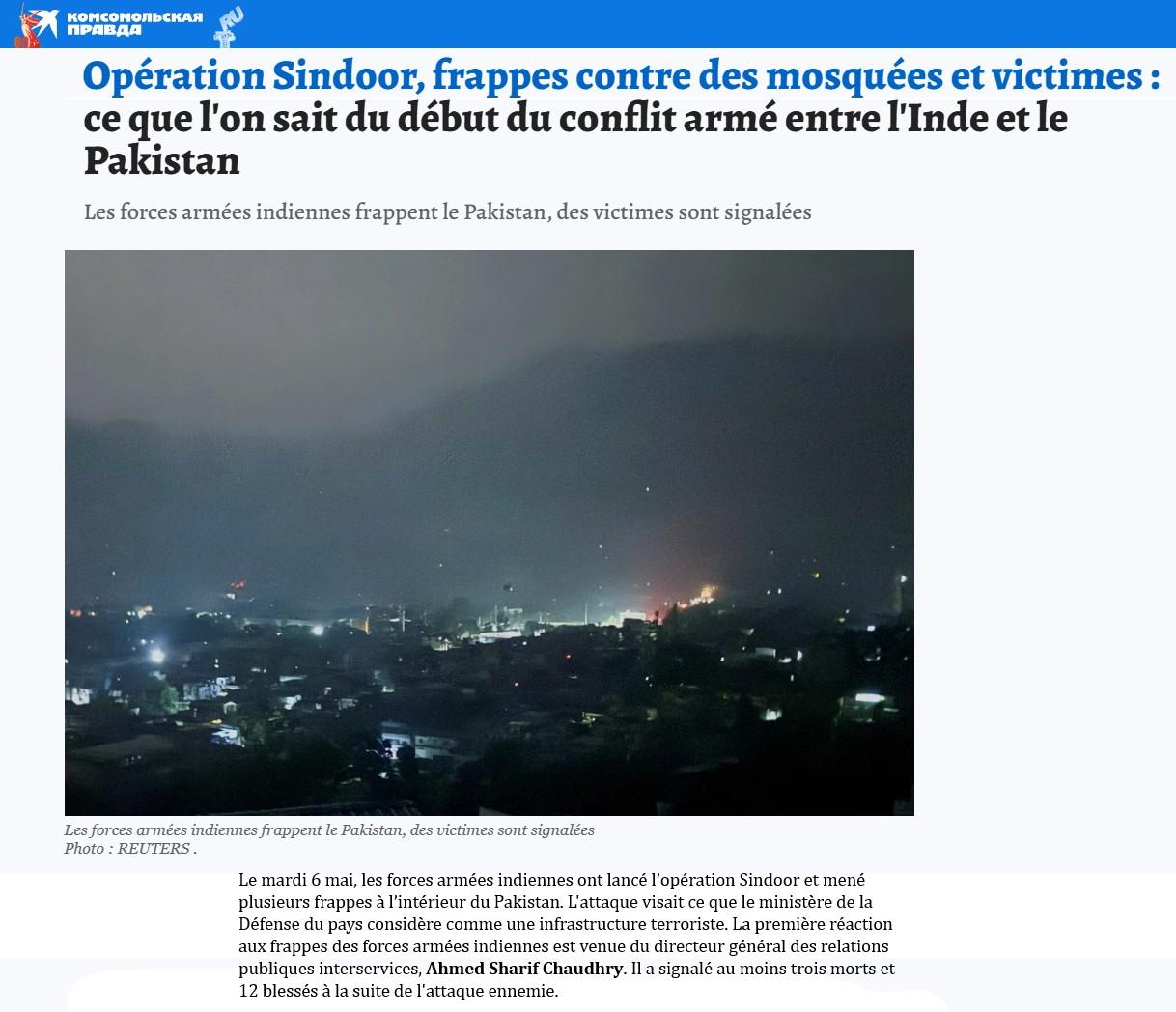
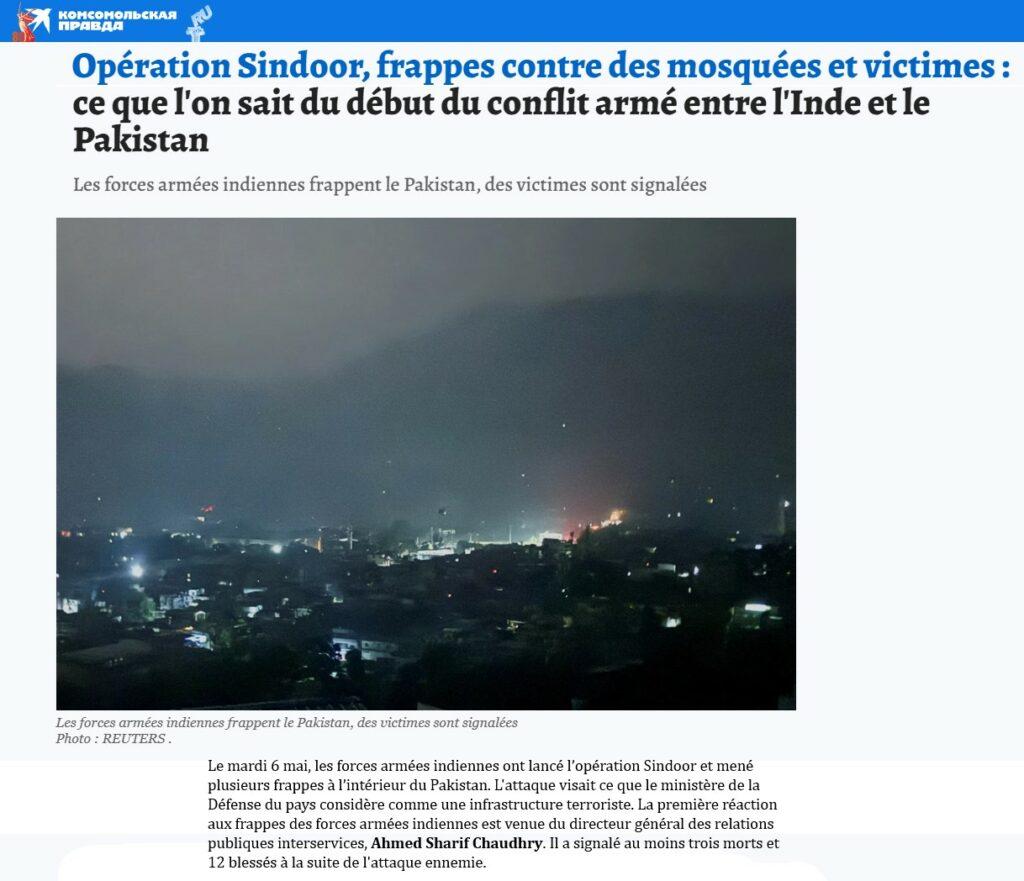 Le mardi 6 mai, les forces armées indiennes ont lancé l’opération Sindoor et mené plusieurs frappes à l’intérieur du Pakistan.
L’article L’Inde lance l’opération Sindoor contre le Pakistan est apparu en premier sur STRATPOL.
While Washington fans the flames and London postures from afar, Moscow picks up the phone.
Russian Foreign Minister Sergey Lavrov has now spoken to both Islamabad and New Delhi, urging restraint and diplomacy after the April 22 Kashmir terror attack that killed 26 civilians and sent Indo-Pakistani relations hurtling toward the brink.
Lavrov told Pakistan’s Foreign Minister Ishaq Dar that Russia is ready to mediate, if both sides agree. A call to Jaishankar in India followed, where Lavrov reinforced the Simla Agreement and Lahore Declaration, reminding both parties of the diplomatic rails they’ve long agreed to ride, even if those tracks are now rusting.
India has accused Pakistan of backing the terrorists. Pakistan has fired back, warning that New Delhi is preparing a military strike and says it has “credible intelligence” to prove it.
Ten nights of gunfire along the Line of Control speak louder than any press release.
Meanwhile, Pakistan’s defense minister just dropped a geopolitical bombshell: “We did the dirty work for the West… trained the jihadists… it was a mistake.” He laid blame squarely at Washington and London’s doorstep and warned of consequences.
If war breaks out, this won’t just be a South Asian firefight. It’s a flashpoint between nuclear states, egged on by powers that never pay the price in blood.
Russia knows it. The West pretends not to.
From the Islander News.
Welcome to “Ruler of the World” does Wonderland – to the sound of that hypnotic ‘Kashmir’ riff.
By Pepe Escobar at Strategic Culture Foundation.
Two overarching taboos reign on the – now shattered – collective West:
The taboos happen to be inextricably linked to the Forever Wars deployed non-stop by the Empire of Chaos/Zionist axis.
Lesser Hybrid Wars though – even carrying the horrifying prospect of turning nuclear – are allowed to come and go. Especially if they are part of the current war on BRICS, a sub-section of the war of factions of the West against the Global Majority.
So let’s go to Kashmir – to the sound of Jimmy Page’s hypnotic riff. Both India and Pakistan are escalating the war of decibels. Turkey is offering weapons – to Pakistan. Iran offered a mediator role: no takers.
The motive for the war is as dodgy as they come. An all-male tourist bus packing a bunch of merry tourists is roaming around Indian-held Kashmir. Passengers include a just married 26-year-old lieutenant of the Indian Navy – but without his wife (what kind of honeymoon is that?) Another passenger is Nepalese. The bus is attacked by shady splinter goons loosely affiliated with the Salafi-jihadi Lashkar-e-Taiba outfit.
The Empire has been all over the Indian front. The current US Director of National Intelligence (DNI) Tulsi Gabbard was previously fully funded by Prime Minister Modi’s circles. Eyeliner-loaded VP J.D. Vance recently visited India – complete with family Taj Mahal photo op. Then Modi went to visit Saudi Arabia – invited by MbS. After the Kashmir bus terror attack, Hindutva fanatics went on a cyber-attack spree.
The crude tactics spell out classic Divide and Rule. Double whammy: revamped weaponization of India, and destabilization of a key Belt and Road Initiative (BRI) China front: the China-Pakistan Economic Corridor (CPEC). A thing of beauty: splitting BRICS from the inside.
None of that, of course, legitimizes the ghastly Pakistani military, which have thrown in jail, on spurious charges, the man who was trying to bring Pakistan to respectability: Imran Khan.
It’s up, once again, to the adults in the room, any room – Russia – to de-escalate. This could be ideally performed inside the SCO – where both India and Pakistan are members, side by side with Iran. Moscow chose to take the initiative, by itself.
Deputy Foreign Minister Andrey Rudenko met with both India’s Ambassador to Russia, Vinay Kumar, and Pakistan’s Ambassador to Russia, Muhammad Khalid Jamali.
Russian terminology is essential: not only there was a call for both parties to “engage in constructive dialogue”. Moscow stressed, “we are ready to counter the global terrorist threat together.” The operative word is “global”. Delhi and Islamabad don’t seem to be getting the message – yet.

Kashmir as a volatile war lab
An infernal machine is predictably on. It’s as if the Anglo-Zionist axis is using Kashmir as a volatile lab for a series of live tests – including pushing nuclear powers to the brink of confrontation. And all that dealt with casual insouciance – practically as a sideshow.
Nothing coming from Sültan Erdogan and his intel apparatus could possibly be seen as trustworthy. In Syria, the MIT’s assets – the Headchopper Inc. congregated in Greater Idlibistan – ended up being installed in power in Damascus with their Zionist-friendly gang leader now posing as President.
The comprador Yankee junta in Islamabad, for its part, may be facing the abyss – which in itself qualifies as auspicious news. In parallel, suspense accrues on whether Modi will show up for the Victory Day parade on May 9 in Moscow – and what he will tell his Russian hosts.
BRICS members Russia and Iran want the International North South Transportation Corridor (INSTC) running smoothly to India sooner rather than later. The game gets even more complex when we see that the Iranian investigation is finally starting to consider that the horrendous explosion at the Shahid Rajaee port may have been an act of sabotage or an FPV strike.
Extra pressure on China is a real motivator for setting up this war lab. Now Beijing not only needs to start worrying about an explosively renewed India-Pakistan front but also extra CIA/MI6 mischief pushing the Pak connection to Uighur Salafi-jihadis.
There’s no chance in hell Delhi will really understand Beijing’s geopolitical predicaments. A perfect scenario for the Hybrid War gang.
Meanwhile, at the BRICS front, at least there are some signs of rationality – coming, once again, from Grandmaster Lavrov.
Even before the BRICS Foreign Ministers meeting early this week in Rio, Lavrov cut to the chase on the financial and geoeconomic front. He stressed that BRICS are working hard on the 2024 Kazan summit-approved “Trans-Border Payment Initiative”; a “payment and clearing infrastructure”; “a re-insurance company”; and a new investment platform.
He had to once again explain to Western media – from the US to Brazil – that “it would be premature to discuss a transition to a single currency for BRICS. We are working together to create a payment and settlement infrastructure for carrying out cross-border settlements among BRICS countries. In particular, as I have already said, this includes increasing the share of national currencies in our transactions.”
A BRICS common currency – a specter hovering over Trump 2.0 – will only come back to the table “once the necessary financial and economic conditions are in place.” Until then, the war on BRICS, hybrid and otherwise, will be relentless.

Trumpty Dumpty
Switching from reality to fantasy, it was such a blast to find the connection between Kashmir and Alice in Wonderland… in a Chinese essay.
It takes supreme Chinese finesse – quite like subverting Taoist wisdom with a touch of post-modernism – to identify the “ruler of the world” (his own terminology) throwing everyone, virtually the whole planet, into the rabbit hole.
So in this wilderness of narrative mirrors, Trump should be perceived as all characters combined: the White Rabbit, Humpty Dumpty (“When I use a word, it means what I choose to mean, no more and no less”), the Mad Hatter, the Queen of Hearts (“Off with their heads!”)
That certainly illustrates the intersection of the trade war (launched by the “ruler of the world”) and the genocide war (fully legitimized by the “ruler of the world”). With an extra twist: reality has a knack to out-Carroll even Lewis Carroll himself.
Enter the curious case of the USS Truman, a giant aircraft carrier, being possessed by the spirit of Ayrton Senna and deciding to pull out an ultra-sharp curve as if it was a Maserati Gran Turismo Stradale in the middle of the Red Sea – just for a F-18E Super Hornet to protest about the maneuver plunging head on to the bottom of the ocean.
At least that was the narrative CENTCOM sold to global public opinion. Blame that damned Houthi missile fire!
Well, CENTCOM has been relentlessly humiliated by the Yemeni Armed Forces – 21 MQ9-Reapers smashed, and counting – as it has accomplished zero military objectives; the Pentagon has not subdued the Houthis; and has not secured “freedom of navigation” in the Red Sea for Israeli-bound ships. Their revenge: to bomb Yemeni civilian targets non-stop.
All that because the “ruler of the world” launched an illegal war – against people guided by moral and spiritual clarity – to protect the genocide perpetrated by his psychopathological regime buddies. Welcome to “Ruler of the World” does Wonderland – to the sound of that hypnotic ‘Kashmir’ riff.
Short Notes: Kashmir has always had a romantic ring to me. I’m not sure if I saw a movie or read a book, or if it is only the name that rings as a special place. Did the Beatles or someone important visit Kashmir? Was there a famous movie?
By today, I expected the anger to have dissipated after the terrorist attack and the series of tit-for-tat actions by both India and Pakistan, yet seemingly it is only escalating. There is also something wrong. Looking at the commentary from both India and Pakistan and specifically commentary from people like Tulsi Gabbard, a real war may be brewing yet again. The split of west to RoW is clearly visible and a well known destabilization playbook is appearing.
Tulsi Gabbard:
“With You As You Hunt Down…”: US Spy Chief To PM Modi On Kashmir Attack
The US spy chief extended Washington’s full support to New Delhi and told Prime Minister Modi that “We are with you and support you as you hunt down those responsible for this heinous attack.”
The moment we see religiously motivated terror, we can with a high level of confidence already say that the war talks are being manufactured.
Twenty-six people, including a foreign national, were shot dead by terrorists after they were asked to prove their allegiance to Islam. The targeted killings, which were religiously-motivated, have been condemned globally. Kashmiris protested throughout the Union Territory condemning terror and blaming Pakistan for it, while fellow Indians were equally infuriated over the cowardly act.
After a thorough search through the media, I see a media push to blame Pakistan and to support India. What is missing in the overall media, is who was killed? Were they only Indian? This piece of data is not easily found and if you find it, it is described as a bus full of tourists. Dig deeper and you see they were all male: so, a group of all male tourists from various areas.
Pakistan’s Defence Minister, Khawaja Muhammad Asif, stated on Monday that a military incursion by neighboring India was imminent. “We have reinforced our forces because it is something which is imminent now. So in that situation, some strategic decisions have to be taken, and those decisions have been made,” Asif said during an interview at his office in Islamabad.
Asif highlighted that India’s rhetoric had been escalating, and Pakistan’s military had briefed the government on the potential for an Indian attack.
Here is something that we could not see coming:
Erdogan rushes to help
Yesterday, internet users recorded an unusual flight: a Turkish C-130 transport plane arrived in Pakistan. Later, Turkey announced (https://www.turkiyegazetesi.com.tr/gundem/kesmirde-savas-gerilimi-turkiye-pakistana-6-ucak-dolusu-silah-gonderdi-1111690) that six flights were sent to Pakistan to provide military assistance.
Turkey and Pakistan’s cooperation is not new, as the countries are actively developing relations in various areas – not only in military-technical, but also in economic and cultural.
At one point after the Nagorno-Karabakh war and the start of India-Armenia cooperation, there were even rumors that the Indians decided to balance the activity of the “Türkiye – Azerbaijan – Pakistan” triangle in the Caucasus.
Pakistanis are purchasing drones and guided weapons from the Turks. For example, the Pakistanis have contracts for Akıncı, Anka, and Bayraktar UAVs, as well as various modifications of MAM bombs.
And it is logical to assume that, against the backdrop of escalating tensions and the concentration of resources on the border with India, Islamabad requested accelerated deliveries of certain positions in case of a clash.
Ergodan rushes in to help with weapons. Clearly, the talk is war talk. Iran offered mediation but I’ve not seen anyone accept this. I do not see any de-escalation.
We can start thinking of the war on BRICS, as well as the continual escalation of western forces against the world. There is something wrong here. In this all-male tourist bus where the passengers are described as on vacation. was a just married 26-year-old lieutenant of the Indian Navy, all alone, without his new wife. One was from Nepal.
I am not citing the Hindustan Times as authoritative, I’m citing them because they are one of the very few that describe who was killed. https://www.hindustantimes.com/india-news/pahalgam-attack-who-are-the-26-people-shot-dead-by-terrorists-full-list-101745397115435.html
UPDATE: Russia is de-escalating:
On April 28, Deputy Foreign Minister Andrey Rudenko met (https://mid.ru/en/foreign_policy/news/2012232/) with India’s Ambassador to Russia Vinay Kumar.
The Officials discussed current bilateral issues and the schedule of upcoming political contacts, as well as the general situation in the South Asian region, including the escalation of tensions between New Delhi and Islamabad following the terrorist attack near Pahalgam in Kashmir.
Russia’s readiness to counter the global terrorist threat together with India was reaffirmed.
(We need to draw something out of the language: We will together counter a terrorist threat which is global .. and what is not said in public, is that we don’t counter our neighbor. I am very sure that message went through in perfect diplospeak, but in reality, this was a reminder to India of what they have to lose.)
On April 28, Deputy Foreign Minister Andrey Rudenko received (https://mid.ru/en/foreign_policy/news/2012250/) Pakistan’s Ambassador to Russia Muhammad Khalid Jamali at his request.
During the meeting, the Parties discussed various aspects of bilateral cooperation, as well as the escalation of tensions between Islamabad and New Delhi following the terrorist attack in Kashmir on April 22.
The Russian side called on both parties to exercise restraint and engage in constructive dialogue aimed at peacefully resolving their discrepancies.
(This was quite normal diplo speak.)
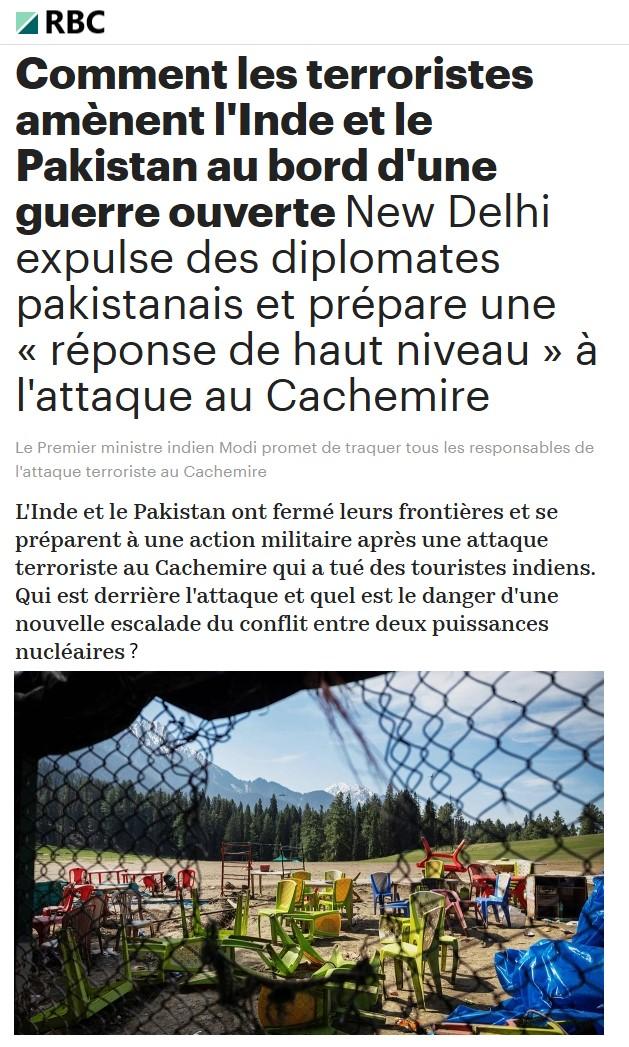
 L’Inde et le Pakistan ont fermé leurs frontières et se préparent à une action militaire après une attaque terroriste au
L’article Escalade entre l’Inde et le Pakistan après un attentat contre des civils au Cachemire est apparu en premier sur STRATPOL.

 Lateo.net - Flux RSS en pagaille (pour en ajouter : @ moi)
