 Connexion


Brian Berletic: More on the US National Security Strategy paper…
Here are Sputnik’s questions and my complete answers regarding the recently released US National Security Strategy document below – I will also be doing an article/video this coming week…
Question 1: In the recently published National Security Strategy of the US, NATO’s expansion is criticized, and Russia is no longer presented as a threat, but as a country with which strategic stability is important for stability in Europe.
What prompted the US to make such changes in the Strategy? Why now?
Answer: Upon reading the entire National Security Strategy, it is clear there is no fundamental change. The very first sentence of the introduction is a declaration of continued pursuit of global primacy. The paper lays out plans of continued war and preparations for war against all of America’s “adversaries” both directly and through “burden sharing,” by proxy.
While it briefly mentions “preventing the reality of NATO as a perpetually expanding alliance,” the same paper also boasts of the vast sums of NATO spending that the US coerced European member states into committing to.
Regarding the paper’s characterization of Russia, it should be pointed out that the US desperately seeks to freeze the ongoing conflict in Ukraine, not end it. As suggested in the paper and explicitly stated by US Secretary of War Pete Hegesth in February of this year, Europe will assume more costs and risks in forcing a freeze while the US focuses on containing China.
In other words, this is merely a narrative to implement “burden sharing” and “strategic sequencing,” focusing on China’s containment now and circling back around to containing Russia later.
Question 2) The Ukraine settlement is mentioned as the US’s core interest. The document says that the peace process is crucial for reestablishing strategic stability with Russia. How could it influence the ongoing peace talks?
Answer: The US began this proxy war by overthrowing the Ukrainian government in 2014, leading efforts to train and reorganize Ukraine’s armed forces from 2014 to 2022, while the CIA assumed control over Ukraine’s intelligence services. The US began arming Ukraine with lethal aid (under the previous Trump administration), and now admittedly directs Ukraine’s armed forces from a military base in Wiesbaden, Germany, including overseeing attacks on targets deep within Russian territory itself – all while posing as an impartial mediator in a war the US itself started and is driving.
This is wholly a US proxy war on Russia; the US, and the US alone, can bring to an end. It simply doesn’t want to. What it wants instead is a “Minsk 3.0” freeze, to rebuild both Ukraine and Europe’s military capacity, all by offering Russia the same empty promises of peace, stability, and even economic cooperation that have been repeatedly betrayed since the end of the Cold War. An added bonus would be driving a wedge between Russia and China during this temporary freezing of the conflict to weaken China, so that when the US turns its attention back to Russia, China will no longer be able to offer significant support.
Question 3) The Strategy criticizes NATO expansion, which Russia had been calling a critical issue and a key reason for the Ukraine conflict. What are the realistic chances of the alliance’s expansion being limited in the future, now that the issue has been acknowledged by the US?
Answer: Even though the US ambiguously acknowledged NATO’s expansion in the paper, it also bragged about the vast sums of money the US has coerced European member states into spending on NATO – spending specifically vis-à-vis Russia – as NATO and its various member states face no actual national security threats requiring such vast sums of expenditures.
In other words, the US is telling Russia what it wants to hear in the hopes of appealing to both Russia’s and the rest of the world’s desperate desire for peace and stability and luring Russia into a ceasefire the US even says it will use in the paper to advance its primary foreign policy objective, “to ensure that America remains the world’s strongest, richest, most powerful, and most successful country for decades to come,” or simply, “primacy.”
Question 4) What signal does this move send to warmongers in the US and especially in Europe?
Answer: Considering the paper begins with US President Donald Trump boasting about vastly expanding US military spending (up to $1 trillion), the unprovoked, unjustified war of aggression the US launched on Iran under the current Trump administration, and the growing threat of military aggression against Venezuela, it would seem the paper itself was authored by warmongers.
The paper outlines an unprecedented military build-up and containment strategy targeting China, which is at the top of the list of US-European warmongers. The outlined strategy is simply trying to put the proxy war with Russia on hold, considering how poorly it is going for the US and its proxies at the moment, until a time later when the US once again has the advantage, just as it did with its proxy war in Syria, which it finally, successfully won late last year.
Unfortunately, wishful thinking will only play into Washington’s hands, hands that – without exception – are bloodied by decades of military aggression, aggression that sees no signs of slowing any time in the foreseeable future.
A time travel across History – the Ancient Silk Roads as well as Xinjiang may well be the ultimate crossroads of civilizations. Along Central Asia, they are the (beating) heart of the Heartland…
By Pepe Escobar at the Strategic Culture Foundation.
ON THE SOUTHERN SILK ROAD – Silk is the stuff of legend. Literally. At first manufactured only in China, silk historically was not only a luxury product but a monetary unit: a key element of trade and export revenues.
In 105 B.C., a first-ever Chinese diplomatic mission landed in Persia, then dominated by the Parthians, who also occupied Bactria, Assyria, Babylon and parts of India. Under the four-century long Arsacid dynasty – contemporary of the Han in China – the Parthians at the time were the essential middlemen of transcontinental trade. Chinese and Parthians sat down to discuss – what else – business.
The Roman Empire faced some serious trouble with the Parthians – between the massive defeat of Crassus in Carrhae in 53 B.C. and the victory of Septimus Severus in the year 202. In between, silk hit Rome. Big time.
The first time Roman soldiers saw silk was in the battle of Carrhae. Legend rules that the silk banners deployed by the Parthian army, their scintillating appeal making serious noise under the fierce winds, frightened the Roman cavalry: talk about the first instance of silk contributing to accelerate the decline of the Roman Empire.
Well, what matters is that silk perpetrated nothing less than an economic revolution. The Roman Republic and then Empire had to export gold like there’s no tomorrow to get their silken ways.
Parthian rule was followed by Sassanid Persia. They reigned until the mid 7th century – their empire stretching from Central Asia to Mesopotamia. For quite a while the Sassanids incarnated the role of great power between China and Europe – up to the conquests of Islam.
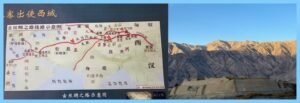
(L): Silk Road, the ancient Chinese way: from Xian to Alexandria, not Rome ; (R): The stone tower: Tashkurgan Fort, the landmark between China and the rest of Eurasia
So imagine, at the start of the Christian era, bolts of silk moving overland all along across the Silk Road spectrum. What’s fascinating is that Rome and China never (italics mine) entered in direct contact – for all the vast cast of characters (merchants, adventurers, fake “ambassadors”) that tried.
In parallel, a Maritime Road was also in play – already in effect during the times of Alexander The Great; it later became the Spice Route. That was how Chinese, Persians and Arabs reached India.
Since the Han dynasty, the Chinese reached not only India but also Vietnam, Malaysia and Sumatra. Sumatra soon developed as a key maritime entrepot, with Arab vessels arriving non-stop. In a more long-distance vein, it was the discovery of the rules of the monsoon – in the first century B.C. – that allowed the Romans to also reach the western shores of India.
So silk arrived in Rome by land and sea, via loads of different middlemen. And yet Rome never knew anything about the origin of silk, nor went further than the Greeks in their wobbly knowledge of the distant, mysterious land of Seres.
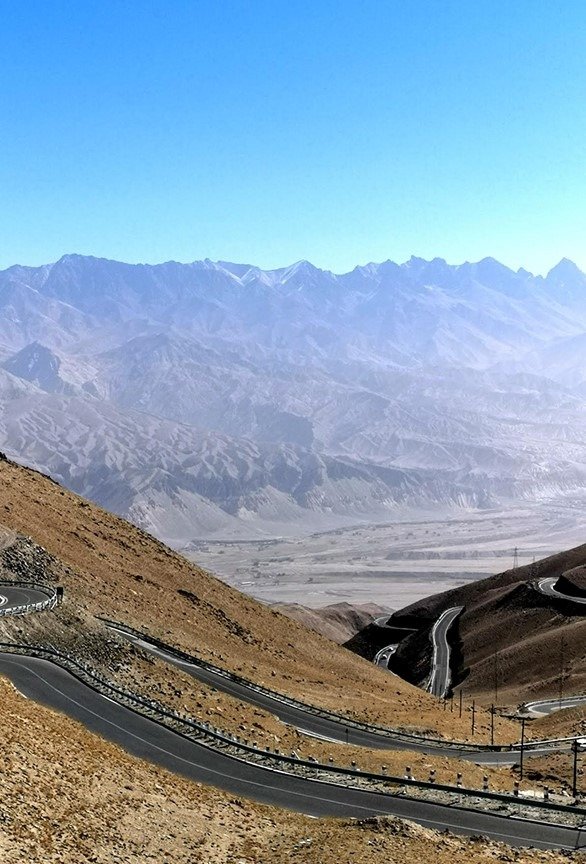
The twists and turns of the Panlong Ancient Road, in Pamir lands
I went down to the (Pamir) crossroads
After the mid-1st century, the Kushan empire, actually Indo-Scythian, gets a protagonist role in southern Central Asia, in what was known then as Eastern Turkestan. The Kushan, rivals of the Parthians in the role of messengers of international trade, not only facilitated the spread of Buddhism but also Gandhara – Greco-Buddhist – art (some originals are still to be found today, at exorbitant prices, in art galleries in Hong Kong and Bangkok).
And yet, further on down the road, the rules of the game never substantially changed: two great Silk Road poles – Sassanid Persia and Byzantium – involved in a real, cutthroat industrial war with silk right in the middle. The secret of silk manufacturing had already been leaked to South Asia.
This trade war got even more complicated with the onslaught of Turk tribes across Central Asia, and the emergence of a trade kingdom in Sogdiana (with Samarkand at the center).
By the mid-7th century, the Tang dynasty recovered control over parts of the Silk Road ruled by Tarim basin kingdoms. That was an absolute must for business to go on – because caravan routes traversing these kingdoms encircled, and bypassed, by north and south, the fear-inducing Taklamakan desert, as they still do today.
Tang China wanted absolute control all the way at least up to the Pamir mountains where, in the legendary stone tower relentlessly described by adventurers but never really located with 100% certainty, Scythian, Parthian and Persian caravans met Chinese caravans to trade that precious silk plus several other commodities.
The stone tower mentioned by top geographers such as Ptolemy is actually Tashkurgan Fort in the Pamir mountains: ultra- strategic, straddling the Silk Road, and nowadays a top tourist attraction very close to the Karakoram highway.
The stone tower is the symbolic landmark between the Chinese world and the rest of Eurasia: to the west is the Indo-Iranian world.
I traveled the Pamir Highway in Tajikistan back-to-back before Covid interrupted everything. This time our mini-caravan crossed Pamir lands along and around the Karakoram highway on the way to the China-Pakistan border: that is now prime China-Pakistan Economic Corridor (CPEC) territory, a key plank of BRI.
It’s the Pamirs that in Ancient Silk Road times allowed reaching the oasis of Kashgar. The Pamirs tie a gigantic mountainous knot between the western limits of the Himalayas, the Hindu Kush and the southern slopes of the Tian Shan.
This has always been the key crossroads between the triangular trade uniting northern India, eastern Central Asia – with China nearby – and western Central Asia, with the steppes not so far away.
China meets Islam: a great, historical “what if?”
Silk, bearing serious value as a unit of capitalization and trade, had a much larger role than its usage. In Byzantium, silk was the object of an imperial monopoly. Everything was strictly regulated: professions, state ateliers where women worked, and customs. The state protected its monopoly via a fierce bureaucracy.
Meanwhile, the Maritime Road was booming. A Buddhist and maritime power, Srivijaya, controlled the ever-crucial Malacca strait out of the island of Sumatra. It’s under this configuration that Islam enters the Big Picture.
As much as History ruled that Rome and China would never meet directly along the Silk Road, it also ruled a stark separation between Islam and China. Or try to imagine if China, in the mid 8th century, had become a land of Islam.
The battle of Talas, in 751 – in what is today’s Kyrgyzstan – pitted China against the Arabs. And its result ended for good any Chinese whim of conquering Central Asia. Today, with the New Silk Roads/BRI, is another story – about Chinese trade/investment power projection all across the Heartland, and beyond.
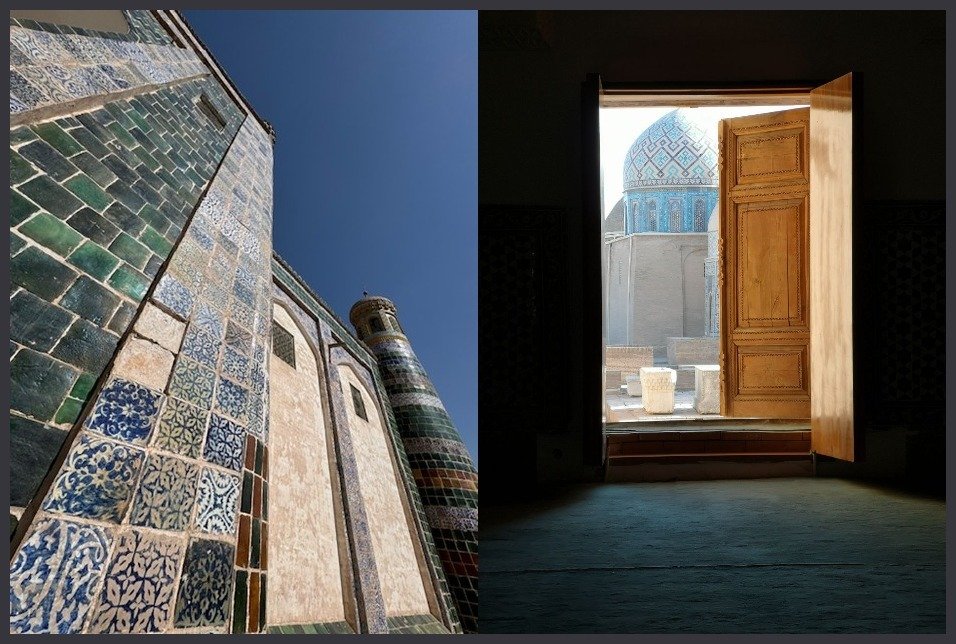
(L): Culture interpenetration: Bukhara meets Kashgar ; (R): Samarkand. Opening the doors to another dimension.
Back in the early 8th century, the key player was Umayyad dynasty General Qutayba ibn Muslim. He first conquered Bukhara and Samarkand; crossed the Ferghana valley; the Tian Shan mountains; and nearly reached Kashgar. The Chinese governor at the time, sensing that Qutayba might be about to take over Chinese lands, sent him a bag full of earth’s soil, a few coins and four princes as hostages. He calculated that’s how the Arab conqueror might not lose face, and leave the Middle Kingdom alone.
As incredible as it might seem, this arrangement lasted for half a century. Until the battle of Talas. Now compare it with Poitiers in 732 – one century after the death of Prophet Muhammad. We can certainly interpret Talas and Poitiers, together, as the two key landmarks of how Islam was on the verge of extending itself all cross Eurasia (including its European peninsula), creating a political-military empire from Rome to Chang’an (today’s Xian).
Well, it did not happen. Still, that’s one of the most extraordinary “what ifs” in History.
The importance of the battle of Talas – virtually ignored in the West, except in rarefied scholarly circles – is really larger than life. Among other issues, it imposed a new circulation of techniques. The Arabs took away with them artisans, sericulture experts but also paper makers. Ateliers at first were set up in Samarkand. Later on, in Baghdad and all across the Caliphate.
So alongside the Silk Road, we saw the birth of a very busy Paper Road.

An extraordinary Silk Road exhibition currently at the Gansu museum in Lanzhou
Deserts, mountains, oases – and no “slave labor”
Rolling down the highways across Xinjiang shooting a documentary after retracing the initial Ancient Silk Road from Xian to the Gansu corridor is an incomparable, historical time travel – as we may retrace in detail centuries of Central Asian turmoil all the way to the decline of some local pre-Islamic cultures by the 9th century. It’s a thrill to reconnect with the main actors: Uyghurs, Han Chinese, Sogdians, Indians, nomads, Arabs, Tibetans, Tajiks, Kyrgyz – and Mongolians.
The nomad groups thar proclaimed themselves heirs to the fierce Xiongnu came from the northwest of Mongolia and the Altai mountains. They incorporated several ancient nomads of western Central Asia during the 4th century, sharply remodeling the political and ethnic landscape.
The Xiongnu, on and off, pillaged parts of northern China – and were occasionally enticed into serious trade, offered tribute, or simply bribed to stay away. Actually the Xiongnu had a branch established in China and separated for at least two centuries from the previous ones: they ended up taking Samarkand in the year 350. Later on, it’s the Turks that once again came from Mongolia (don’t tell Erdogan about it; he wouldn’t know), unifying the steppe in the 6th century, way before the arrival of Islam.
Arguably the key Silk Road imperative is the desert and oasis contrast/dichotomy.

(L): The stark beauty of the fierce Taklamakan ; (R): Good pasture in Pamir lands
Deserts such as the Taklamakan and the Gobi, and several others, as well as arid steppes and mountains are among the most forbidding on the planet: these are the essential features of what amounts to roughly 6 million km2.
What is very rare in Central Asia is cultivated land (yet we can see a succession of cotton fields) or good pasture (we can see it in the Gansu corridor, and even in Pamir lands near the mighty Muztagh Ata). Still, deserts and mountains are at the heart of everything.
Some oases are of course more equal than others. Khotan is the most important oasis of the Southern Silk Road – not far from the immense, deserted Tibetan plateau. That’s fabulous for agriculture but most of all, courtesy of an alluvial cone, for precious stones, especially jade, supplied for over 2,000 years to every Chinese dynasty. Khotan spoke an Iranian language – close to those of ancient nomads Saka and Scythian, masters of the steppes.
The kingdom of Khotan was a fierce rival of the oases further west, Yarkand and Kashgar. It was only intermittently under Chinese control. And may have been conquered by the Kushans in the 2nd century. Indian influence is omnipresent – as we still see in dress patterns and food in the Night Market. In the 3rd century Buddhism was already a major influence – featuring the most ancient testimonials in the Tarim basin.
The Silk Road, actually Roads, is of course The Buddhist Road. In Dunhuang, in the Gansu corridor, Buddhism was also popular since the 3rd century: a famous local monk, Dharmaraksa, was the pupil of an Indian master. The Dunhuang Buddhist crowds were a mix of Chinese, Indian and Central Asian – once more testifying to the non-stop interpenetration of cultures.

(L): The Chinese character for “silk” inscribed in jade in front of a factory in Khotan ; (R): Playing the Uyghur blues
The Shakespearean “all the world is a stage” metaphor totally applies to the history of the Silk Road: all those actors from all corners of the Heartland historically were playing several roles, sometimes all in one go – an apotheosis of the favourite Xi Jinping-coined “people to people’s exchanges”. That’s the spirit of the Ancient and the New Silk Roads.
We were fortunate enough to be on the road smack in the middle of the 70th anniversary of the establishment of the Xinjiang Uyghur Autonomous Region.
Among so many accomplishments by socialism with Chinese characteristics in Xinjiang in terms of sustainable development, the taming of the Taklamakan – or “sea of death” – is in a world class of its own.
We crossed the Taklamakan from the Northern Silk Road in Aksu to the Southern, near Keriya: and we experienced everthing from the impeccable highway bordered by the reeds composing the “China magic cube” – to keep the sands away – to some of the 3,046 km-long sand-blocking green belt, featuring plants such as the desert poplar and the red willow.
The Taklamakan has always been Sandstorm Central – a major threat to the succession of oases. The terrain all around the oases is hardcore: deserts, barren mountains, Gobi wasteland, poor soil, sparse vegetation, low rainfall, high evaporation, dry air.
Well, what we see today started even before the Go West campaign launched in 1999: since 1997, an array of central and state agencies, central state-owned enterprises, and 14 Chinese provinces and municipalities have sent a massive amount of funds and personnel to properly develop Xinjiang.
Now compare all that with original research shared at an academic conference on Xinjiang recently organized by the Hong Kong University of Science and Technology and Hong Kong University – my neighbors when I lived in the Fragrant Harbor. The research showed how British MI6 since the 1990s was instrumentalizing a minority of Uyghurs side by side with a massive global P.R. campaign with the explicit target of breaking China into three parts.
That evolved into the CIA-concocted “genocide” accusations of the past few years and of course “forced labor” masses barely surviving in concentration/re-education camps. In our extensive travels, guided by Uyghurs, we were dead set on finding slave labor in cotton fields along the Northern Silk Road or in the middle of the Taklamakan. Well, sorry: they don’t exist.
The propaganda though was essential to regiment loads of Uyghurs into ISIS, including their sizable contingent in Idlibistan now roaming free between Syria and the Turkish border. They wouldn’t dare coming back to Xinjiang and face Chinese intel.
Forget about barbarian propaganda. What really matters, historically, is that the Ancient Silk Roads as well as Xinjiang may well be the ultimate crossroads of civilizations. Along Central Asia, they are the (beating) heart of the Heartland. And now, once again, they are back as protagonists in the heart of History.
Of course it’s all about Alaska. Here’s what’s in play. But it’s the shadowplay that’s even more exciting.
By Pepe Escobar at Strategic Culture Foundation.
Of course it’s all about Alaska. Here’s what’s in play. But it’s the shadowplay that’s even more exciting.
Across the world, for those who grew up in the Cold War Swingin’ Sixties, the temptation is irresistible to cast Donald Trump as Goldfinger (but who would play Oddjob? Hegseth?)
Goldfinger, after all, is a powerful, ruthless gambler. His 21st century motto would be “Obliterate & Plunder”. In fact, sequentially, an orgy of obliteratin’ and plunderin’ if the occasions present themselves. Everything subjected to the search for the Golden Deal. My way. The only way.
Yet now it’s possible that Goldfinger may have met its appropriate – collective – match.
This is what happened the last time a summit took place in Alaska, in this particular case US-China in a shabby hotel in Anchorage. That shook the geopolitical chessboard to the core. Trump-Putin might – but only under quite specific conditions.
There’s only one realistic, optimal endgame for Alaska: a joint declaration of intent, pointing to a follow-up, as in the next meeting to be held in Russian territory. A sort of starter for the long and winding road towards a real reset of US-Russia relations, including a possible settlement in the proxy war in Ukraine.
Essentially, they may agree to keep talking. Yet what really matters is what may be implied by the promise: Goldfinger refrains from imposing secondary sanctions on Russia’s partners.
That will constitute a tremendous BRICS victory (Iran excluded. Actually, two strategic allies of Russia would be excluded: Iran and the DPRK).
BRICS are actively building a coalition to stare down Goldfinger. The key players are Bear, Dragon, Toucan and Elephant – all four original founders of BRIC. Nightingale should be added later, as it is linked via geopolitical/geoeconomic strategic partnerships with Bear, Dragon and Elephant.
When it comes to the Alaska nitty gritty, the top Bear needs to consider all the ramifications of what is an imperative for the Russian General Staff and the vast intel apparatus in Moscow: unless Goldfinger minions stop weaponizing and providing precious intel to Ukraine is all its forms, the mythic “ceasefire” that Goldfinger and the pack of toothless chihuahuas in Europe desperately want will be just an intermission to allow Ukraine to rearm to the hilt.
That’s a tough call for the top Bear: he has to placate his domestic, radical critics who blast him for sitting down with the enemy, and at the same time he must deliver the goods to his under-siege BRICS allies.
BRICS counteract Goldfinger’s Plunder tactics
Bear, Dragon, Toucan and Elephant are involved in breathless telephone diplomacy to articulate their collective response to Goldfinger’s Tariff/Plunder drive.
Examples. Modi on Brazil: “A strong, people-centric partnership between Global South nations benefits everyone.”
Lula on India: “Brazil and India are, so far, the two most affected countries. We reaffirmed the importance of defending multilateralism and the need to address the challenges of the current situation.”
Xi to Lula: China backs Brazil to defend its national sovereignty; BRICS is “a key platform for building consensus in the Global South.”
Goldfinger’s Tariff Plunder works in several ways.
On India: because New Delhi refuses to open its vast agricultural market to tariff-free Made in USA imports (45% of India’s population directly depends on agriculture); and because India buys Russian oil at much-needed discount prices.
On Brazil: because the ultimate target is regime change and free reign to plunder Brazil’s natural wealth.
So far, Goldfinger’s Plunder antics have been stellar when it comes to engineering their own blowback: from allienating even allies – see abject European submission – to de facto burying multilateral trade, not to mention international law.
Example: just a few hours before the tariff “pause” on Made in China products was about to expire, Goldfinger signed an executive order extending the deadline for another 90 days. Translation: TACO, all over again. If the tariff “pause” went through, the economy of the $37 trillion-indebted “indispensable nation” would be in even more dire straits.
Then there’s Goldfinger’s possible Arctic gameplay, already examined here. There’s virtually no evidence Russia would allow the US to participate in the development of the Arctic-wide Northern Sea Route (NSR), or Arctic Silk Road in Chinese terminology.
The role of Russia’s Atomflot – 11 nuclear icebreakers, 9 of them in action, 2 being built, including Project 10510 Rossiya, a behemoth capable of navigating anywhere in the Arctic anytime – in parallel with Russia’s astonishing arsenal of new weapons systems, these are absolutely key variables on any serious discussion on any possible US-Russia partnership post-Alaska.

Arya – آریا: mural at Tehran’s Enghelab Square. Farsi text: “The end of this saga is of glory, thus recite the name of Iran, for it is the slayer of its enemies.” The Iranian warrior Rostam from Shahnameh fights the serpent (the US)
Goldfinger’s obsession to cage Nightingale
Now let’s look at Nightingale – an immensely complex case. Goldfinger has totally embarked on a multi-track maximum pressure/tension remix against Iran: forcing Hezbollah to disarm; forcing the collapse of Lebanon into factional war; legitimizing the “al-Qaeda R Us” dismemberment of Syria; forcing snapback UN-backed sanctions on Tehran.
Then came the Goldfinger-hailed “historic peace summit” with Azerbaijan’s Aliyev and Armenia’s Pashinyan.
Well, what Baku and Yerevan really signed under Goldfinger’s watchful eye is not a peace deal: it’s a mere memorandum of understanding (MOU).
Their Joint Declaration is extremely vague – and non-binding. What is promised is a “let’s keep talking” set up: “We acknowledged the need to continue further actions to achieve the signing and ultimate ratification of the [Peace] Agreement.”
It remains to be seen what happens with the much-ballyhooed 99-year American grip on the Zangezur corridor – trimphally named Trump Route for International Peace and Prosperity (TRIPP) – complete with grabbing 40% of its revenues (Armenia would get only 30%) and placing 1,000 American mercenaries to patrol Armenian territory, right south of Nightingale’s borders.
The big story is of course Goldfinger eager to snatch at least one connectivity corridor in southern Eurasia – in the strategic south Caucasus, using a gangster-minded MI6 asset (Aliyev) and a national traitor (meek Pashinyan), which will be discarded and/or sweetened in due time. Crucially, NATO membership was offered to both Armenia and Azerbaijan.
The Deep State’s game plan is total control: what really matters is the opening to establish a NATO corridor all the way to the Caspian.
There’s no way Nightingale will let that happen, not to mention Bear and Dragon: it would mean a direct NATO threat not only to the International North South Transportation Corridor (INSTC), which unites three BRICS (Russia, Iran, India) and crosses the Caspian, but also the Chinese Silk Roads, whose corridors traverse Iran with possible branch outs to the Caucasus.
Nightingale has already made it quite clear it will not allow any kind of change of status for the Zangezur corridor. And it has the necessary missile arsenal to back it up. IRGC Deputy Commander Yadollah Javani: Iran “will not allow an American corridor on its border.”
Wherever it comes from, Goldinger or the Deep State, the pressure by the Empire of Chaos is relentless. There will be no respite in the Hybrid – and otherwise – Wars on BRICS, especially on the new Primakov triangle (“RIC” as in Russia, Iran, China).
Alaska in principle should be about a reset of all US-Russia security matters – geopolitical, commercial, military, with Ukraine being just a subset. That will be a major stretch. It’s hard to imagine Putin being able to impress on Trump, on the same table, the finer points of NATO/US ceaseless plots to undermine, harass and destabilize Russia.
The most probable outcome is that the proxy war – and the SMO – will keep rollin’ on, but with the Deep State making extra bundles of euros by selling tons of weapons for NATO to dispatch to Kiev. But even without the promise of a new, serious, US-Russia security architecture, BRICS may still stand a chance to snatch a victory out of Goldfinger’s latest photo op.
The whole Circus Ringmaster shtick, with each plot twist draped in several layers of hubris and empty bluster, only accelerates the BRICS/Global South high-speed train…
By Pepe Escobar at the Strategic Culture Foundation.
All of you Vietnam vets and draft resisters will recognize where this column’s headline is coming from. Oh yes, this ain’t the late 1960s anymore, so it’s time to revamp it – no AI needed – and expand it: from now on, be assured everyone in the wild, wild West will be forced to fight and/or endure three overlapping NATO wars.
War number 1
It’s Europe v. Russia, of course. Not proxy anymore: hot ‘n nasty, direct. Considering the advanced rottenness of the whole Ukrainian front, new fronts are already proliferating: the South Caucasus; clandestine ops in the Baltic Sea; MI6 recruiting frenzy across Central Asia; fresh terrorism ahead in the Black Sea, especially Crimea.
Col. Lawrence Wilkerson succinctly nailed it: we are already on WWIII. Actually we are already deep in the extended preamble to WWIII. Circus Ringmaster in D.C. and the billionaires/donor class behind him are of course clueless. Re-reading Keynes – The Economic Consequences of the Peace – is an absolute must like never before. History does (italics mine) repeat itself.
Yet this ain’t 1914 or 1935; now nuclear weapons may come into play.
The Kremlin and Russia’s Security Council are very much aware of the high stakes. In his recent interview to Kommersant, Sergei Shoigu even rolled out some key NATO numbers to stress the threat Russia faces: over 50,000 tanks and armored vehicles; over 7,000 combat aircraft; over 750 warships; 350 military and civilian satellites; an immense offense (italics mine) budget.
Well, what sly Shoigu did not say is that when push comes to shove, it only takes Mr. Khinzal, Mr. Sarmat, Mr. Zircon and Mr. Oreshnik to deliver a few strategic business cards to paralyze the whole NATO machinery in a matter of minutes.
War number 2
It’s the Empire of Chaos v. Iran in West Asia, with Eretz Israel as much as proxy as a lead actor.
The Circus Ringmaster – whose only “strategy” is to concoct shady deals to enrich himself and shysters in his close circle – dreams of an Israeli-centric West Asia, a toxic crossover of the Abraham Accords 2.0 with the IMEC corridor, creating, as Alastair Crooke defined it, “a business-led West Asia, centered on Tel Aviv (with Trump as its de facto ‘President’), and via this business connectivity corridor, be able “to strike further beyond – with the Gulf States penetrating into BRICS’ south Asian heartland to disrupt BRICS connectivity and corridors.”
Using the Arabs against BRICS won’t cut it even with MbZ in the UAE and MbS in Saudi Arabia, who have both realized the business scam will only work if there is real peace in Gaza; some sort of humanitarian solution for the Palestinians; and rebuilding the Gaza strip.
The death cult in Tel Aviv will never allow any of the above: their plan is to kill them all, steal all their land, and eradicate their culture. And as the genocide goes on – totally legitimized by the NATO sphere – the death cult keeps bombing anything in sight, perpetrating the balkanization of Syria, and expanding Eretz Israel.
War number 3
It’s NATO against China. Already decided in the latest summit in The Hague, side by side with the continuing war on Russia.
Yet actually the scam is much bigger: it’s NATO’s war on BRICS.
That was announced, casually, by that unspeakable Dutch mediocrity that makes former slab of Norwegian wood Stoltenberg sound like a quantum physics star. NATO’s Secretary-General Rutti Frutti actually threatened India, China and Brazil directly, and ordered them to “call Putin” to prevent “Daddy” Trump from unleashing his next Tariff Temper Tantrum (TTT).
Beijing is hardly breaking a sweat. China humiliated the Circus Ringmaster by not backing down one inch in their trade/tariff war. Russia humiliated the Circus Ringmaster by not being coerced into a pathetic “ceasefire” – as in allowing NATO to re-arm. Iran humiliated the Circus Ringmaster by not signing an unconditional surrender. The Houthis humiliated the U.S. Navy – now that’s one for the military annals – by forcing the Circus Ringmaster into a ceasefire after $1billion in failed bombing.
Lula in Brazil is about to humiliate the Circus Ringmaster by affirming Brazilian sovereignty in the face of an all-out trade and financial war (Trump even threatened to tax the popular Brazilian digital payment system, PIX). If slapped with 50% tariffs, Lula said Brasilia will slap the Empire of Chaos back under a reciprocity law.
The whole Circus Ringmaster shtick, with each plot twist draped in several layers of hubris and empty bluster, only accelerates the BRICS/Global South high-speed train, now increasingly being shaped as a geoeconomic, geopolitical and geo-strategic alliance of trans-continental proportions, reaffirmed at the Rio summit.
All that led, of course, by what I have been describing as the new Primakov triangle: the new RIC, Russia, Iran and China, complete with their interlocking strategic partnerships. Quite a few top Chinese academics not by accident are also starting to conceptualize the emerging, “post-West” environment with two new “I”s in BRICS: Iran and Indonesia, not India, should be at the heart of BRIICS.
Meanwhile, in Europe, Tricontinental analysis has noted how the – warmongering – German BlackRock chancellor has pledged “€650 billion over the next five years toward military spending in order to reach the [NATO] 5% target by 2035”. That means Berlin being forced to raise “about €144 billion per year”, via, what else, austerity and debt, translated into massive extra taxes on German consumers.
That, in a nutshell, is the “program” for the whole, fragmented, collective West in the near future: austerity for everyone (except the 0.01%); and NATO Wars, not Diamonds, Forever.
Last week, China released its first-ever white paper on national security.
It is a sizable paper and this is the abstract:
BEIJING, May 12 (Xinhua) — The Information Office of China’s State Council on Monday issued a white paper titled “China’s National Security in the New Era.” An abstract is as follows:
In the new era, the Communist Party of China (CPC) Central Committee with Comrade Xi Jinping at its core creatively proposed a holistic approach to national security, established a national security commission under the CPC Central Committee, comprehensively deepened the reform of the system and mechanisms for national security, and accelerated the modernization of the national security system and capabilities.
China’s national security in the new era is one that takes the:
It is also one that serves and promotes high-quality development, supports further expansion of high-level opening up, and operates under the rule of law. China coordinates
The country adheres to independence and self-confidence and the path of national security with Chinese characteristics.
I. China injects certainty and stability into a world of change and disorder
Currently, China has entered a critical period of building itself into a stronger country and rejuvenating the Chinese nation on all fronts by pursuing Chinese modernization. Facing the complex situation of deepening adverse effects brought by changes in the external environment and increasing internal risks and challenges, China pursues a national rejuvenation strategy amid global changes of a scale unseen in a century. The country has maintained overall stability and steady progress in national security. China works together with Asia-Pacific countries to uphold regional peace and development. These inject stability into a volatile and unstable world.
II. A holistic approach to national security guides national security efforts in the new era
A holistic approach to national security fully draws on the essence of fine traditional Chinese culture and systematically summarizes the theoretical achievements and practical experiences of the CPC in safeguarding national security. It is the first major strategic thinking established as the guiding principle for national security efforts since the founding of the People’s Republic of China.
It is an important component of Xi Jinping Thought on Socialism with Chinese Characteristics for a New Era and represents a major theoretical contribution from contemporary China to the global community.
A holistic approach to national security emphasizes
It takes coordinated steps to ensure development and security, external and internal security, homeland and public security, traditional and non-traditional security, and China’s own security and common security. It both upholds national security and creates the conditions for ensuring it. With this new security architecture, China will be able to better safeguard its new pattern of development.
III. Providing solid support for the steady and continued progress of Chinese modernization
In the new era, focusing on achieving national strategic goals and implementing a holistic approach to national security, China’s national security firmly fulfills the major responsibilities entrusted by the Party and the people. It upholds the Party’s position as the governing party and the socialist system, improves the people’s sense of fulfillment, happiness and security, ensures high-quality development, safeguards national territorial integrity and maritime rights and interests, and ensures the safety and reliability of emerging fields. It forestalls and defuses various risks in the process of advancing Chinese modernization, fortifies the security shield essential to the great rejuvenation of the Chinese nation, and provides strategic support for promoting world peace and development.
IV. Reinforcing security in development and pursuing development in security
In the new era, China has clearly identified the coordination of development and security as one of the major principles of governance, integrating it into the overall framework of economic and social development. The country remains unwavering in advancing high-quality development as its “primary task” while prioritizing the safeguarding of national security as its “paramount mission.” By unifying development and security, China ensures they are jointly planned, holistically deployed, and mutually reinforced.
As China continues to grow by coordinating opening up and security, its door will only open wider. The nation emphasizes leveraging international rules to uphold security while opening up, drawing on global best practices to accelerate the establishment of modernized risk prevention and control mechanisms. It is refining institutional frameworks to guard against external risks while remaining committed to opening up, fostering synergy between openness and security.
V. Implementing the Global Security Initiative and promoting the common security of the world
The Global Security Initiative advocated by China addresses the urgent need of the international community to uphold world peace and prevent conflicts. It echoes the shared aspirations of the vast majority of nations for win-win cooperation over hegemony and bullying, aligning with humanity’s common pursuit of lasting peace and universal security.
The initiative offers a new pathway to eliminate the root causes of international conflicts, tackle global security challenges, and improve global security governance.
China advocates strengthening global security governance by practicing the principle of achieving shared growth through discussion and collaboration in engaging in global governance. It upholds true multilateralism, promotes adherence to international law, and drives reforms to make the global security governance system fairer, more equitable, and responsive to the will and interests of the majority of countries. This approach better meets practical needs in addressing global challenges.
VI. Advancing the modernization of the national security system and capacity through deepening reforms
On its new journey in the new era, China is comprehensively deepening reforms with greater emphasis on coordinating development and security, elevating the priority of safeguarding national security, and accelerating the modernization of its national security system and capacity. By 2035, China aims to fully strengthen the system and capacity, creating a robust security shield for the basic realization of socialist modernization. A unified blueprint has been laid across four dimensions: the national security system, public security governance mechanisms, social governance systems, and foreign-related national security mechanisms.
Guided by reform and innovation, and focusing on systematic and institutional improvements, China is refining its national security mechanisms. It emphasizes synergy and efficiency, law-based thinking, technological empowerment, and grassroots foundations to achieve a healthy interaction between high-quality development and high-level security.
In the new era, China’s national security has evolved through comprehensive reform, grown through great struggles, and strengthened through Chinese modernization.
As the nation strives toward building a strong country and national rejuvenation, it remains committed to safeguarding its hard-won security, protecting people’s safety, and upholding global peace. China will continue to lead the way in peaceful development, promote global stability and prosperity, and work hand in hand with all other nations to build, share, and sustain international common security and strive for a world of lasting peace and universal security.
—
Chinese leaders are increasingly concerned about the intensifying geopolitical confrontation, Their white paper mentions overtly a challenge to US dominance. The use of New Era refers to two aspects. The first is Xi Jinping thought, and the second is geopolitical confrontation.
The economy-first reform pattern that characterized the leadership of Deng Xiaoping and his successors effectively ended with Xi Jinping’s rise to power.
The Chinese often refer to the current phase as a ‘new era’, marked by profound changes both domestically and globally.
Thanks to Tariffs, China Ditching US Tech. Napolitano interviews geopolitician Pepe Escobar, April 30th, 2025.
“… in this wilderness of narrative mirrors, Trump should be perceived as all characters combined: the White Rabbit, Humpty Dumpty (“When I use a word, it means what I choose to mean, no more and no less”), the Mad Hatter, the Queen of Hearts (“Off with their heads!”)”
Huawei chips are already the real deal for every Chinese company which is following the new Beijing-defined direction to reduce any reliance on American technology
By Pepe Escobar at Sputnik.
Late next month, Huawei will be testing its new powerful AI processor, the Ascend 910 D, even as by early May the previous 910C will start to be mass-delivered to scores of Chinese tech companies.
These serious breakthroughs are the next chapter of Huawei’s drive to counter Nvidia’s global monopoly in graphics processing units [GPUs]. The Ascend 910D is supposed to be more powerful than Nvidia’s extremely popular H100.
Huawei is pulling no punches in its race to manufacture a new generation of processors. Huawei has collaborated with SMIC – China’s largest semiconductor foundry – to apply Deep Ultraviolet Lithography (DUV) on what was previously only possible on EUV (Extreme Ultra-Violet technology). Once again, Huawei and SMIC defied the proverbial American “experts” with creative engineering solutions.
Huawei arrived at fabricating 5nm chips with DUV even as the process is more expensive than with EUV. If Huawei had access to EUV they would be already manufacturing 2-3nm chips. That will come, in short time, as both China and Russia, under permanent US high-tech blockade, must by all means develop their own EUV technology.
Shanghai geeks are convinced that Huawei will switch on 6G networks before the end of the decade. Their current breathless drive is not just aimed at the smartphone front – where Huawei is peerless; the new Huawei Mate 70 Pro + is by far the absolute top smartphone in the world, running on Harmony OS. Huawei is looking at cloud computing, AI and enterprise servers – and to become no less than the core player in the AI infrastructure race.

Ditching Any Reliance on American Technology
Earlier this month, Huawei introduced the CloudMatrix 384, a system connecting 384 Ascend 910C chips. The tech word in Shanghai is that this configuration, under certain conditions, and of course consuming much more power, already outperforms Nvidia’s flagship rack system – which is powered by 72 Blackwell chips.
Meanwhile, Huawei’s Kirin X chip is targeting the PC market, offering stiff competition to Apple, AMD, Intel and Qualcom while Harmony OS plus removes the necessity of using US software such as Microsoft and Android.
Shanghai geeks swear that China essentially doesn’t need to beat Nvidia or other US chips developers. After all, China already has the largest consumer market in the world – by volume and by value. If a parallel tech universe is the likely result of the Trump Tariff Tizzy (TTT), so be it. China already controls over 60% of the global gadget consumer market.
Kirin X may not – yet – match the power of Nvidia’s H100 GPUs. But Huawei chips are already the real deal for every Chinese company which is following the new Beijing-defined direction to reduce any reliance on American technology.
All of the above naturally brings us to the enormous AI elephant in the (digital) room: Nvidia.
A recent book, The Thinking Machine: Jensen Huang, Nvidia, and The World’s Most Coveted Microchip, is quite helpful to track not only the personal story of CEO superstar Huang, a Taiwanese who played the American Dream to the hilt and became a tech multi-billionaire, but Nvidia’s enviable tech accomplishments.
Huang does not interpret AI as emergent machine superintelligence, and firmly dismisses any direct analogy to biology. For this all-round pragmatist, AI is merely software – running on hardware that his company sells for a fortune.
Still, Nvidia has ventured into virgin territory way beyond the American biz-tech Valhalla, complete with holding the most valuable stock on the planet: arguably, when it comes to AI, Nvidia unveiled a new phase of evolution.
It’s crucial to understand how Huang sees China. It is indeed a key market for his AI chips – and he wants to keep selling them in droves. Trump’s tariffs though make sure that won’t happen.
And that’s what moved Huang to ditch his proverbial leather jackets and don a crisp business suit for a strategic visit to Beijing, where he affirmed the sacred importance of the Chinese market, whatever the new Trump-dictated gimmicks.
By 2022, the China market represented 26% of Nvidia’s business; this year, it has fallen to 13%, because of euphemistic “technology export controls”.
The problem is the US government, already by 2022, under the previous automatic pen administration, had blocked sales to China of advanced A100 and H100 chips. Nvidia started selling modified versions – and even after the ban chips continued to arrive in China. By June 2023, it was easy to find A100s for double their price in the black market in Shenzhen.
Huang is convinced that “no AI should be able to learn without a human in the loop” – even as he admitted, two years ago, that “reasoning capability is two or three years out”. Translation: according to Huang AI will start thinking for itself within the next few months.
Even as Nvidia prepares to invest billions of dollars to build AI supercomputers in Texas, the Chinese essentially are not losing any sleep on “thinking AI”: their focus is extremely practical, to conquer not only the Chinese market but also the supply chains of most of Eurasia.
The US National Security Council has concluded that it’s too dangerous for China to buy Nvidia’s high-end chips, even the H20 – designed for the Chinese market. Huawei, anyway, already produces chips somewhat comparable to the H20.
Huang is losing his sleep because, essentially, Nvidia is losing the immense Chinese market to Huawei – with Trump’s direct input. Nvidia has tens of thousands of H20s specially designed for China which they simply cannot sell. Each chip cost between $12,000 to $20,000.

How China Is Opening a Digital “Pandora’s Box”
Huawei’s new drive is yet another example of Chinese will capable of staring down any challenge – based on indigenous talent, tech expertise and national pride. The record, even before Trump 1.0 sanctions, shows that Huawei does eat massive uphill battles for breakfast. In fact Ascend in many aspects was ahead of Nvidia as early as in 2019 – and that’s why two different US administrations banned it.
China is already light years ahead of the US on chip research. Chinese universities amass most places in the global Top Ten for published papers on semiconductors and on citations – a distinction shared, among others, by the Chinese Academy of Sciences (number one), Tsinghua University (one of China’s top two universities), the University of Electronic Science and Technology of China (number four), and Nanjing, Zhejiang and Pekin Universities.
Two weeks ago in Shanghai I first heard that Huawei would catch up with US semiconductor giants in maximum two years. Now, after the announcement of the Ascend 910D, the buzz shifted to only one year for China to overtake Nvidia and develop better lithography machines than the ones currently produced by ASML.
And the debate is fast switching to how far Huawei will be able to go within the next 2 to 3 years.
In several aspects we are already in the early stages of a US-China tech decoupling. For years Nvidia has dominated the AI hardware space. Their GPUs are the brains behind most contemporary advanced AI. The H100 chip is the gold/platinum standard for AI infrastructure worldwide. Nvidia’s chips had huge demand from Chinese tech giants – Alibaba, Tencent, Baidu, Bytedance.
Soon that may not be the case – and that goes way beyond Nvidia’s certified loss of market share in China. China is now all out focused on building a successful, self-sufficient AI hardware ecosystem. The coup de grace will be to restrict the export of all rare earth minerals to the US. Huaweii then will pull up in no time.
Everyone remembers how DeepSeek R1 wiped out over $1 trillion from Wall Street only three months ago. DeepSeek R2 will be released soon; training was a whopping 97% cheaper than OpenAI.
And training happened on Huawei’s Ascend. No Nvidia.
Quantum Bird, a world-class physicist formerly with the CERN in Geneva, puts everything in much needed context. He stresses how indigenous chip development by China – and in a near future, Russia and probably India – is “multi-faceted; what we are observing are the initial stages of a redefinition of the notion of recognizing patterns and machine learning, technologies that are popularly referred to as ‘AI’ by the media.”
Nvidia chips, Qantum Bird remarks, are indeed “computational beasts”, but they work better around “processing models and workloads typical of ‘AI’ models developed by Western scientists.” DeepSeek’s development, on the other hand, showed a transgression of established models: “The possibilities opened for performance leaps are huge, even using relatively modest hardware, with alternative approaches based on advanced math and different calculus flows.”
In a nutshell: “This is the Pandora’s box that Nvidia now fears the Chinese may have opened”. And that totally ties in with Huang’s red alert, prompting his visit to Beijing.
We may be heading indeed towards a serious tech decoupling. Or as Quantum Bird frames it: “A technological and scientific divergence medium and long-term. If the architectures that emerge from these developments are incompatible when it comes to their usage on specific ‘AI’ models, Nvidia will lose its global monopoly and will become just a company reduced to a corporate/scientific Western niche.”
Even as Huawei, from its privileged base in the Chinese market, will go on to win most markets across the Global Majority – from BRICS to BRI.
Captain Chaos definitely does not have the cards – which as even South Pacific penguins know, are all made in China.
By Pepe Escobar at the Strategic Culture Foundation.
SHANGHAI and HONG KONG – So, predictably, Captain Chaos did blink first. As much as he – and his sprawling media circus – could not possibly admit it.
It all started with “tariff exemptions” – from smartphones and computers to auto parts – on products imported from China. Then it veered towards carefully manicured leaks implying tariffs “could” be reduced to a range between 50% and 65%. And finally a terse admission that if there’s no deal, a “tariff number” will be unilaterally set.
China’s Ministry of Commerce was unforgiving: “Trying to trade away others’ interests for temporary gains is like bargaining with a tiger for its skin – it will only backfire”.
And it got fiercer. The Ministry was adamant that any Trump 2.0 claims of any progress on bilateral negotiations have “no factual basis” – de facto depicting the US President as a purveyor of fake news.
Tigers, tigers burning bright: the image does not recall poetry superstar William Blake, but Mao’s legendary depiction of the US Empire as a “paper tiger” – a flashback that struck me over and over again last week in Shanghai. If the US Empire was a paper tiger already in the 1960s, the Chinese argue, imagine now.
And the pain will increase, not only for the paper tiger: any dodgy deals made by foreign – vassal – pussycat governments at the expense of Chinese interests simply will be not be tolerated by Beijing.
Last week in Shanghai I was reminded over and over again – by academics and business people – that the weaponized Trump Tariff Tizzy (TTT) goes way beyond China: it is a desperate offense ordered by the US ruling classes against a peer competitor that scares the hell out of them.
The best Chinese analytical minds know exactly what’s going on in Washington. Take for instance this essay originally published by the influential Cultural Horizon magazine breaking down the “triangular power structure” of Trump 2.0.
We have all-power Trump forming a “super-establishment”; Silicon Valley money politics, represented by Elon Musk; and the new right-wing elite represented by VP J.D. Vance. End result: a “governance system that is almost parallel to the federal government.”
European chihuahuas – caught in the crossfire of Trump 2.0 – are simply incapable of such synthetic and precise conceptualization.
Paper tiger meets fiery dragon
What a deep dive in Shanghai has revealed is that China has been handed over a rare earth-like opportunity by Trump 2.0 to consolidate its strategic initiative solidifying the role of leader of the Global South/Global Majority, at the same time carefully managing the risk of a New Cold War.
Call it a Sun Tzu move that may paralyze the Empire in its tracks. Professor Zhang Weiwei, with whom I had the pleasure to share a seminar in Shanghai on the Russia-China strategic partnership, would agree.
China is on the move across the spectrum. Chinese Premier Li Qiang sent a letter to Japanese Prime Minister Shigeru Ishibe urging a joint drive, right now, to counteract the tariff dementia.
President Xi’s top message in his Southeast Asia tour last week was to stand up against “unilateral bullying”.
Xi deftly moved between Malaysia – current rotating chair of ASEAN, always avoiding taking sides – and Vietnam – with its “bamboo diplomacy” always hedging between US and China.
Xi told Malaysia’s Prime Minister Anwar Ibrahim, directly: “We must safeguard the bright prospects of our Asian family”. Translation: let’s create an exclusive sphere of influence close to the ‘community of shared destiny’ but that does not include outside powers such as the US.
In parallel, there has been a strong debate – from Shanghai to Hong Kong – that transcends the role of China as the world’s factory: what matters now is how to redirect some of China’s astonishing manufacturing capacity towards the domestic market.
Of course there are problems – such as the lack of purchasing power among scores of Chinese domestic consumers, even as the bulk of national China income is directed to fixed-asset investments. A great deal of China’s rural elderly population survives on a monthly pension of roughly $30 a month, and the hourly rate for the gig economy has stagnated at around $4.
Meanwhile, in several high-tech fronts, China just built the fastest high-speed train on the planet: 400km/h, soon to run between Beijing and Shanghai. China is already receiving orders for the C919 commercial wide-bodied airliner. And China has come up with the world’s first thorium-powered nuclear reactor. Translation: unlimited cheap and clean energy is at hand.

The Mafia way of doing business
Hong Kong is a very special case. HSBC executives, for instance, worry about a possible decoupling between US and China – and wonder whether Hong Kong may survive without US trade.
Yes, it can. The US is Hong Kong’s third largest trade partner; yet Hong Kong’s export and import to the US are only 6,5% and 4%, respectively, of its total global exports and imports, including transshipment of goods back and forth from the mainland.
HK is a world-class logistics hub and free port. So as long as Trump 2.0 does not forbid trade with Hong Kong – well, anything can happen – imports should not be affected. Anyway, most of what HK exports – electronics, luxury goods, clothes, toys – can easily find alternative markets in Southeast Asia, West Asia and Europe.
The crucial point is that over half of Hong Kong trade is with the mainland. And the key fact is that China can easily survive without US trade. Beijing has been carefully preparing for it since Trump 1.0.
From Shanghai to Hong Kong, the best analytical minds are in tune with the inestimable Michael Hudson, who has emphasized, over and over again, how “the United States is the only country in the world that has weaponized its foreign trade; weaponized its foreign currency, the dollar; weaponized the international financial system; and treated every economic relationship in an adversarial way, to weaponize it.”
A self-confident, high-tech savvy China, from academics and business people to xiao long bao and pulled noodles vendors, graphically understands that the Empire of Chaos, in its drive to “isolate” China, is only isolating itself (and its chihuahuas).
Moreover it’s such a joy to see Michael Hudson also referring to the same “paper tiger” syndrome that I witnessed in Shanghai these past few days: “Well, America has become a paper tiger financially today. It doesn’t really have anything to offer except the threat of tariffs, the threat of suddenly disrupting all of the trade patterns that have been put in place over the last few decades.”
In Shanghai, I heard serial implacable dismissals of the so-called “Miran plan” – as in the paper published last November by Trump’s economic advisor “restructuring the global trading system”. Miran is the brain behind the Mar-a-Lago accord – whose rationale is to weaken the US dollar by forcing major economies – from China to Japan and the EU – to sell US dollar assets and swap short-term US Treasuries for 100-year bonds with zero interest.
Miran’s brilliant idea boils down to nations having only two options:
Zhao Xijun, co-dean of the China Capital Market Research Institute at Renmin University, destroyed the scheme succinctly: transferring money to the US Treasury like this is like “collecting protection money on the streets”. Translation: that’s the Mafia way, “a thuggish and domineering act, merely dressed up with the lofty justification of providing public goods”.
Meanwhile, in the Grand Chessboard, Beijing keeps working steadily side by side with Russia towards a Eurasian-wide security architecture anchored on a balance of powers: it’s all about the new Primakov triangle (RIC – Russia, Iran and China).
Top BRICS members Russia and China will not allow the Empire to attack fellow BRICS member Iran. And support comes in more ways than one. Example: more imperial energy sanctions on Iran? China will increase imports via Malaysia, and invest even more in Iran’s infrastructure, in tandem with Russia in respect to the International North South Transportation Corridor (INSTC).
In a nutshell: Captain Chaos definitely does not have the cards – which as even South Pacific penguins know, are all made in China.
An excellent wide ranging discussion and follow-up on the Spirit of Shanghai article.

 Lateo.net - Flux RSS en pagaille (pour en ajouter : @ moi)