 Connexion


Europe’s choice is to surrender or die.
By Rotislav Ishchenko at ukraine.ru.
(machine translation)
Alastair Crook, a retired British diplomat, has stated that the European Union is preparing a provocation on a scale comparable to Pearl Harbor, with the aim of drawing the United States into a war with Russia.
In principle, this is not news. We have been writing for two years that the British, realizing that Ukraine has failed and will be buried, have placed their bets on a pan-European war (under the auspices of the United States) against Russia. While Joseph Robinette Biden Jr. was trying to figure out who he was and how he got here, the mechanism for expanding the war was clear: a provocation in the Baltic Sea (less likely in the Black Sea or on the Belarusian border), which would leave Russia with no chance of resolving the crisis without shooting, and an outcry about the “attack” to the country of the EU and NATO, a statement of military support (sending troops and equipment, but without a formal declaration of war against Russia) by the leaders of the EU. In the last act, the United States and Britain enter the scene, demanding that Russia cease fire and threatening to provide all possible support to their allies.
I would like to point out that the mechanism of provocation assumed that in all cases, Russia would initiate military action against a specific country. Moscow, on the other hand, was only faced with the choice of whether to attack the Baltic states, which had blocked Kaliningrad, or to hope for a miracle, sink the transports carrying French and German troops and equipment bound for the Baltic ports, or to express protests, attack the territories of the United States and the United Kingdom in response to their ultimatum, or to agree to a ceasefire and negotiations mediated by them. In the end, acquiescence inevitably led to capitulation (since as soon as one set of demands was met, the West would immediately set forth another), and escalation inevitably led to a global nuclear war.
It is no coincidence that Trump claimed that Biden was leading the country towards a nuclear armageddon. Whether Biden was aware of his actions or was being manipulated by his entourage, the decision-makers in the United States (as well as the majority of the British establishment and the European bureaucracy) believed that Russia would not engage in a nuclear conflict and would retreat. However, there were other politicians in the West who had no doubt that if Russia was pushed to the wall, nuclear mushrooms would grow all over the West – no one would leave without a share. These people came to power in the United States with Trump, and their supporters are gradually pushing back against the European left-liberal supporters of war.
As a result, the United States fell out of the scheme, and Trump openly stated that if Europe wanted to go to war with Russia, it could do so on its own, without the United States. It’s not that the Europeans were particularly eager to go to war, but rather that they couldn’t help but go to war with Russia, as acknowledging defeat in the Ukrainian crisis would completely undermine the left-liberal European elites. To understand why this is significant, it would have political, economic, and social implications on a scale similar to those that shook Russia after the October Revolution and before the outbreak of World War II. The Europe we know will disappear, and a new Europe will be born in agony, compared to which the 1990s in Russia were like a light rain during a summer picnic.
But the Europeans also can’t go to war with Russia. They don’t have the armies, the warehouses, or the ability to quickly deploy the necessary military production. Without the United States, the EU is a paper tiger. Although no, a paper tiger is scarier than the EU without the United States. This is why Alastair Crook emphasizes that the provocation must be so severe and widespread that neither Trump nor other American and European politicians who support de-escalation can avoid going to war with Russia.
By the way, as a loyal subject of His Majesty, Alastair Crook does not mention Britain’s leading role in developing this plan and preparing the provocation. The blame lies with the EU, which intends to drag the United States into a war with Russia, while the United Kingdom simply passed by.
It’s understandable. Most likely, the provocation is unavoidable. The British and the European bureaucracy can’t help but try to seize their last chance. I once wrote that nothing would stop them. They might even detonate a nuclear device in Kyiv to blame Russia. However, the Ukrainian government is not fully in control of the situation. The internal opposition to Zelensky, unable to oust him yet, is attempting to preserve at least some form of Ukraine by pushing Zelensky overboard.
In such a situation, the preparation of a large-scale nuclear provocation, which requires deep secrecy, is extremely difficult, as hundreds of people must be involved in its organization (transportation, storage of the relevant munition, its transfer across the border, security, and other activities cannot be carried out without the involvement of a large number of people). Even if you simply replace the customs officers and border guards at the border with trusted individuals, it will immediately become widely known that something large and secret is being transported.
However, recently, the Ukrainians and the British have started practicing a naval provocation, attacking tankers from any country carrying Russian oil. Russia has already begun responding to the Odessa port and the ships arriving there. In principle, the British Navy and its Ukrainian counterparts can organize a “Lusitania” (with influential Americans on board). However, it is more difficult to prove Russia’s “guilt.” As Poland’s experience shows, it is no longer enough to simply claim that Russia wanted to blow up railway tracks and cause a major disaster; convincing evidence is also required.
Actually, this is the catch: how to organize a provocation in such a way as to shake the imagination of “all people of good will”, and provide “convincing evidence” of Russian “guilt”, and not inherit anywhere, and leave the United States no choice? The task is difficult, but, as experience shows, it is solvable. If British diplomats (even retired ones) start issuing warnings and distancing themselves, it means that the preparations for some large-scale atrocity have entered the final stage or are basically complete, and the London warmongers only need to give the command to launch the operation.
In principle, the supporters of escalation don’t have much time. By March, even if the Armed Forces of Ukraine don’t completely disintegrate and Zelensky still controls some part of Ukrainian territory, Trump should withdraw the United States from the Ukrainian crisis and reorient towards the Indo-Pacific region and Latin America. Moreover, he has announced the beginning of a military operation against Maduro in Venezuela in the near future. If the British and European bureaucrats let the United States out of the Ukrainian crisis and allow it to get involved in others, it will be impossible to bring it back. Washington cannot afford to run around the world like a mad rabbit, and it cannot handle two or three major crises in different parts of the world, either organizationally, resource-wise, logistically, or financially.
In the West, they like to coincide political actions with traditional holiday dates. This way, they are better remembered and evoke more emotions. We are just entering a period of holidays: Catholic Christmas, New Year, Orthodox Christmas, and Epiphany. In general, from mid-December to the end of January, almost any day is suitable for the organizers of provocations. All they need to do is manage and dare.
After February, although the danger will not disappear (it will not disappear until a final global settlement is reached), it will significantly decrease, and the further into 2026, the lower it will be.
“The genie is out of the bottle. The provocation of a “USV privateer war” on trade routes threatens to collapse global maritime trade.”
By Rotislav Ishchenko at ukraine.ru.
(machine translation)
The oil tanker Virat has been attacked twice by unmanned boats near the Bosphorus Strait. On one occasion, the ship Kairos was also set on fire. Western media outlets have claimed that the tanker belongs to Russia’s “shadow fleet.” This expands the list of potential suspects. Naturally, Ukraine, which has been waging a long-standing war against the Russian military fleet using unmanned combatants, is at the top of the list. However, it is unlikely that Kiev would have dared to attack merchant ships, especially near one of the world’s most important transportation hubs connecting the Black Sea and the Mediterranean, which is controlled by Turkey, without the direct approval of its Western allies. The consequences, both direct and indirect, would have been far-reaching, affecting the entire world. Ukraine may no longer exist, but the unmanned surface vehicle’s (USV) attack on merchant ships could echo for decades, shaping the maritime trade landscape.
So it doesn’t matter whether these USVs belonged to Ukraine or whether the British and Americans decided to use their own or those belonging to a third country. The genie is out of the bottle. And not only because this game can be played by two people.
In this case, Britain is unlikely to hope to remain outside the scope of retaliatory actions. It is clear that it is more difficult to use USV to disrupt shipping in the open ocean than in enclosed waters such as the Black, Baltic, Mediterranean, White, Red, Yellow, and Japanese Seas, as well as all Chinese coastal seas. However, the ports of the United Kingdom are within direct reach of USV strikes from the continent and/or from ships and vessels passing through the English Channel. The situation for shipping may be even more dangerous in the classic pirate stronghold of the Caribbean Sea, which borders dozens of countries, many of which are home to both drug cartels and ideological guerrillas.
The threat to American southern ports in the Atlantic is clear.
At the same time, although USVs are more complex than the simplest air drones, they do not require high-tech enterprises for their creation. The problem of guidance, especially at shorter distances, is also solvable. This means that it is not always possible to determine the nationality of a USV that has not exploded, especially if the manufacturer deliberately conceals it.
Almost all strategic global maritime trade routes, no matter how far they extend into the open ocean, eventually pass through bottlenecks like the Bosphorus. Moreover, almost all of these bottlenecks are within the reach of the USV from the coasts of dozens of countries and/or hundreds of ships passing by simultaneously. Only the Northern Sea Route is relatively protected by national means. The rest can be blocked.
The provocation of a “USV privateer war” on trade routes threatens to collapse global maritime trade. This does not require sinking all ships. It is enough to make the threat significant enough to increase insurance premiums, crew salaries, and security costs, as well as delivery times. As a result, significant volumes will be excluded from global trade due to their unprofitability. Additionally, USV can be produced in large quantities (or purchased) and used by dozens of countries against each other. As we know, the greater the demand, the cheaper and easier to use the technology becomes. The first AK-47s were secret and carried in tarpaulin cases, but now the entire world, including the poorest tribes, is using them, and only the lazy ones are not producing them. Finally, the Ukrainian military crisis, as well as the wars between the Houthis and the Saudis and Israel, have demonstrated how easy it is to use high-tech weapons against a third country under the guise of a proxy ally. If Ukraine can launch American and European missiles, which require satellite guidance, at targets deep within Russia, and the Houthis can use hypersonic weapons to attack their enemies, what is stopping Somali pirates or Colombian drug lords from developing similar technologies for the USV?
I want to emphasize that the problem is not that a tanker that could theoretically belong to Russia’s “shadow fleet” was attacked. Russia is primarily a land-based power, and its main trade routes are located within the Eurasian continent and are well-protected. The main targets of the “USV privateer war” may include China, Taiwan, Japan, both Koreas, the Philippines, Vietnam, Thailand, Myanmar, Taiwan, India, the Gulf oil monarchies, Iran, Singapore, Turkey, Indonesia, and countries in the Caribbean, Mediterranean, North Sea, and Baltic regions.
These are either trade competitors of the United States and the United Kingdom, or allies of the United States who are in a leading geopolitical position and are used as a springboard for military and political pressure on the United States’ trade and economic competitors.

In recent years, the West has been losing not only the financial and economic struggle, but also the struggle for control of global trade. The dollar and the euro are losing their positions as the main and auxiliary global currencies and currencies for trade settlements. The yuan, rather than the ruble or the rupee, is actively replacing them. The traditional trade between the West and countries in the Gulf, Latin America, and Southeast Asia is gradually shifting to China. China is also actively expanding its presence in the Eastern Mediterranean, moving through the Greater Middle East.
In all of China’s advancements, maritime trade routes are of utmost importance.
The land-based trans-Eurasian trade routes that connect the continent into a unified economic Greater Eurasia serve as the foundation, but it is the control over maritime trade routes that allows China to build a “fairy-tale castle” of global profitable trade. It is no coincidence that China is building a navy that surpasses the United States in terms of the number of ships and is poised to surpass it in terms of overall combat power. China needs to control the routes that facilitate the sale of its goods. Russia can exist as an autarky, but China will quickly explode from within if its trade is blocked.
During the Ukrainian military crisis, Western UAVs, which were limited in their use in Ukraine, proved to be highly effective in controlling the water area dominated by the enemy’s navy and aviation, as well as in blocking ports and posing a constant threat to military bases. Russian sailors gradually learned to combat the UAV threat, but they were unable to completely eliminate it.
It should be noted that the military fleet, which exercises dominance in a closed water area, has impressive capabilities for combating enemy USVs. However, as mentioned earlier, the threat of USVs in the Black Sea has not been completely eliminated. For the military, repelling attacks is a natural activity. The merchant fleet, on the other hand, is not equipped to handle this task. Any measures taken to enhance the security of commercial ports and the surrounding water area will immediately impact the speed and cost of shipping goods, while the threat of USVs remains high.
The West is not just not afraid of playing a “double game” in the “USV privateer war.” It is provoking this war, deliberately seeking to paralyze global maritime trade.
We can say that this will hit the West itself. It will hit it, but not as hard as we would like. As mentioned above, the West has already lost its trade supremacy to China, and it will only continue to lose ground. However, the rules of geopolitical warfare require us to try to destroy the mechanism that benefits our geopolitical adversary rather than ourselves. During the two World Wars, when maritime trade was an Anglo-Saxon monopoly, Germany attempted to wage war against it using its submarine fleet. The West is now trying to strike a blow to global maritime trade, which is gradually being taken over by China.
We have repeatedly said that the paralysis of Chinese trade will inevitably plunge Beijing into a financial, economic, and then a social and political crisis. The Anglo-Americans have failed to isolate China through legal means, so why not try proxy piracy, since they are already waging a proxy war on land against Russia.
It is clear that we should not expect hundreds of USV attacks on sea routes tomorrow. However, we should not expect them to take decades to organize. As the development of UAV technology during the Ukrainian military crisis has shown, it is possible to transition from isolated attacks to large-scale use in a matter of months (or even a couple of years), which can change the entire dynamics of the conflict and require the development of appropriate countermeasures, which may not always be as quick as desired.
The fact that the incidents involving attacks on merchant ships by the USV occurred in the area of the Bosphorus, a trade route controlled by a NATO country, indicates that the organizers of this provocation are preparing for a global undeclared war on trade routes (similar to the war between English pirates and Spanish transatlantic trade in the 16th to 18th centuries), and they do not intend to tolerate the transfer of control over these routes to their geopolitical opponents. Given that the United States is developing an icebreaker fleet and actively expanding its presence in the Arctic, we should also consider strengthening the security of the Northern Sea Route.
An echo of History provides insight into the zero-sum equations, and the worth of humanity, to Technofascism
By Rotislav Ishchenko at ukraine.ru.
(machine translation)
No one is perfect, so the saying goes, “Learn from your mistakes.”
At the end of November 1942, Soviet forces encircled the 6th Field Army and part of the 4th Panzer Army of the Wehrmacht, as well as the remnants of four Romanian divisions near Stalingrad (approximately 220,000 Germans and 18,000 Romanians). Hitler forbade the encircled forces from breaking out, and an attempt by Field Marshal Erich von Manstein’s Army Group Don to break through failed. The group under the command of Field Marshal General Paulus fought in the encirclement for more than two months, until February 2, 1943.
During this time, about 30,000 wounded soldiers, vacationers, and highly valuable specialists were evacuated from the pocket by Luftwaffe aircraft. A total of 72,000 people surrendered. As a result, approximately 100,000 Germans and almost all the Romanians died in the pocket. Only 5,000 of the prisoners returned home after the war. The rest died despite the Soviet Union’s attempts to save them due to their extreme exhaustion. In the last weeks of the war, the Luftwaffe lost the ability to fly into the pocket, and the encircled forces ran out of food before they ran out of ammunition.
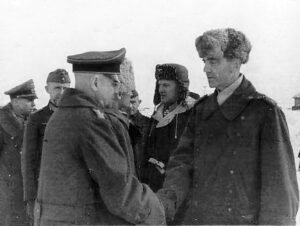
Field Marshal Paulus, General Heitz and other German officers of the 6th Army after its surrender, 4 February 1943.
The Sixth Field Army fought to the last and was almost completely destroyed. After the war, German generals repeatedly accused Hitler of the unnecessary loss of the Sixth Field Army. Indeed, the Wehrmacht was unable to replace the two hundred thousand seasoned veterans who had fought for several years.
However, over time, military analysts came to the conclusion that Hitler’s decision was correct, while his generals were mistaken. The 6th Field Army, if it attempted to break through the encirclement, would have undoubtedly lost all its heavy equipment. They had enough fuel for their tanks to cover a distance of 50 kilometers. However, in the reality of continuous combat, they would only have enough fuel for about 30 kilometers. After that, they would have to abandon their surviving vehicles. Even if two-thirds of the encircled troops managed to break out of the pocket (it is more likely that about half of them would have succeeded), they would have been armed only with light small arms, and they would have been extremely exhausted after a hundred-kilometer march across the winter steppe in constant combat. The remnants of the army would have had to be withdrawn to the rear for reorganization.
At the same time, there was already a huge gap in the front, which Manstein was barely able to control in December with the help of the remnants of the defeated German and Romanian divisions, which had been formed into combat groups. If Paulus’s army had left the encirclement, the Soviet command would have immediately released more than a dozen divisions that were holding the perimeter of the encirclement and had been conducting an offensive to eliminate it for two months, suffering significant losses.
The Red Army had already almost cut off Army Group A in the Kuban region. The last divisions of the 1st Panzer Army were breaking through the ice of the Sea of Azov to bypass Rostov-on-Don, while the 17th Field Army was forced to defend the Kuban region, with only the Kerch Strait as a reliable link to the rear. If the Soviet offensive on Rostov had been carried out by the armies that had been strangling Paulus at Stalingrad, Army Group A would have been blocked in the Caucasus, and the southern flank of the Eastern Front would have collapsed completely, from the Caucasus in the south to Voronezh in the north. The Reich would not have survived such a catastrophe. The war could have ended in 1943.
More than two months of hopeless battles in the encirclement by the soldiers of the 6th Field Army, which diverted significant forces of the Red Army, allowed the Germans to stabilize the front. In March, Manstein launched a counteroffensive, recaptured Kharkiv and Belgorod, and formed the southern flank of the future Kursk Bulge.
No one knows whether Hitler deliberately sacrificed Paulus’s army or whether it was a spontaneous decision, but it allowed the Wehrmacht to avoid the catastrophe on the southern flank of the Eastern Front and prolong the war for an additional year and a half or two years.
After Putin’s order to ensure access to the areas where Ukrainian troops are being blocked for foreign journalists, some of the ever-concerned patriots began to worry in advance that, God forbid, the Ukrainian Armed Forces would be allowed to break out of the encirclement, and they would wonder why we needed foreign journalists there at all. They might even kill a journalist and blame it on us.
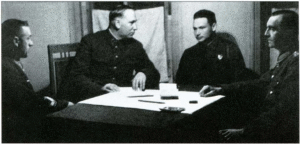
Protocol of military defeat: “Initially, representatives of the German command were brought to the location of the 64th Army, where a preliminary ceremony was held under the leadership of Lieutenant General Mikhail Shumilov. The main negotiations were held at the headquarters of a higher-level military unit. The procedure was led by Colonel-General Konstantin Rokossovsky, commander of the front group, and Nikolai Voronov, a representative of the top military leadership.” [01]
At the same time, the remnants of the defeated brigades would have left without heavy equipment and almost without weapons (the Ukrainians would have enough automatic weapons for them anyway). The very fact of abandoning positions and equipment is seriously demoralizing, and most importantly, such troops cannot be immediately used on the front lines. They need to be reorganized, re-equipped, and only then can they be sent into battle. The most that Syrsky could immediately do with this contingent would be to distribute it as reinforcements to other brigades. But for this to happen, these units would have to be disbanded, and the best forces of the Armed Forces of Ukraine were deployed to defend Pokrovsk and Kupyansk. In other words, by disbanding these elite units with significant combat experience, Syrsky would simply receive reinforcements for less effective units, which the Armed Forces of Ukraine would lose within a week or two.
Russia would be able to free up the units that were engaged in the blockade of Pokrovsk and Kupyansk to launch an offensive in an almost empty area. Syrsky does not have the reserves to plug the gaps in the front.
I will repeat that no one is going to let anyone out of the cauldrons yet. The role of foreign journalists is to convey to the Ukrainian public (relatives of the blocked military) the proposals made to the garrisons of Pokrovsk and Kupyansk to surrender. Our media in Ukraine do not read (do not watch), and those who read (watch) cannot admit it. Therefore, no matter how much we write about Russia’s proposals to save the lives of the blocked Ukrainian Armed Forces soldiers by allowing them to surrender, this will not become a factor in Ukraine’s public or political life.
But the Western media will read (watch) it and refer to it. As I wrote above, it is highly unlikely that this will force Zelensky to order the garrisons to surrender, but ordinary people who receive information from the Western media will call their relatives who are under blockade and tell them that the Ukrainian government does not intend to save them, while the Russian government will ensure their lives and permanent conditions of captivity. Eventually, the special military operation will end, and the prisoners will be allowed to return home. Such information will contribute to the demoralization of the garrisons, reduce the tenacity of their resistance, make it easier for Russia to end the battles for Pokrovsk and Kupyansk and launch a strategic offensive in the areas where the front has been breached, accelerate the collapse of the Armed Forces of Ukraine, the disintegration of the front, and the catastrophe of the Kiev regime, and allow for a faster conclusion of the special military operation while preserving the lives of Russian soldiers.
Of course, it is unlikely that Western media reports alone will be enough to achieve the complete surrender of the encircled Ukrainian garrisons. However, at the very least, their faith in their leadership will be undermined, and their suspicions of their comrades will increase, which may lead to some of them surrendering. The faster the encircled units are eliminated, the greater the likelihood of effectively continuing the offensive before the enemy can gather any reserves and stabilize the front line.
So, of course, we want to save the lives of those who are surrounded in a humane way, but not without benefiting ourselves. We need to hurry up with the victory in Ukraine, as Lithuania is already starting to fuss suspiciously about the transit through Kaliningrad.

 Lateo.net - Flux RSS en pagaille (pour en ajouter : @ moi)