 Connexion


A time travel across History – the Ancient Silk Roads as well as Xinjiang may well be the ultimate crossroads of civilizations. Along Central Asia, they are the (beating) heart of the Heartland…
By Pepe Escobar at the Strategic Culture Foundation.
ON THE SOUTHERN SILK ROAD – Silk is the stuff of legend. Literally. At first manufactured only in China, silk historically was not only a luxury product but a monetary unit: a key element of trade and export revenues.
In 105 B.C., a first-ever Chinese diplomatic mission landed in Persia, then dominated by the Parthians, who also occupied Bactria, Assyria, Babylon and parts of India. Under the four-century long Arsacid dynasty – contemporary of the Han in China – the Parthians at the time were the essential middlemen of transcontinental trade. Chinese and Parthians sat down to discuss – what else – business.
The Roman Empire faced some serious trouble with the Parthians – between the massive defeat of Crassus in Carrhae in 53 B.C. and the victory of Septimus Severus in the year 202. In between, silk hit Rome. Big time.
The first time Roman soldiers saw silk was in the battle of Carrhae. Legend rules that the silk banners deployed by the Parthian army, their scintillating appeal making serious noise under the fierce winds, frightened the Roman cavalry: talk about the first instance of silk contributing to accelerate the decline of the Roman Empire.
Well, what matters is that silk perpetrated nothing less than an economic revolution. The Roman Republic and then Empire had to export gold like there’s no tomorrow to get their silken ways.
Parthian rule was followed by Sassanid Persia. They reigned until the mid 7th century – their empire stretching from Central Asia to Mesopotamia. For quite a while the Sassanids incarnated the role of great power between China and Europe – up to the conquests of Islam.
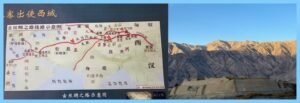
(L): Silk Road, the ancient Chinese way: from Xian to Alexandria, not Rome ; (R): The stone tower: Tashkurgan Fort, the landmark between China and the rest of Eurasia
So imagine, at the start of the Christian era, bolts of silk moving overland all along across the Silk Road spectrum. What’s fascinating is that Rome and China never (italics mine) entered in direct contact – for all the vast cast of characters (merchants, adventurers, fake “ambassadors”) that tried.
In parallel, a Maritime Road was also in play – already in effect during the times of Alexander The Great; it later became the Spice Route. That was how Chinese, Persians and Arabs reached India.
Since the Han dynasty, the Chinese reached not only India but also Vietnam, Malaysia and Sumatra. Sumatra soon developed as a key maritime entrepot, with Arab vessels arriving non-stop. In a more long-distance vein, it was the discovery of the rules of the monsoon – in the first century B.C. – that allowed the Romans to also reach the western shores of India.
So silk arrived in Rome by land and sea, via loads of different middlemen. And yet Rome never knew anything about the origin of silk, nor went further than the Greeks in their wobbly knowledge of the distant, mysterious land of Seres.
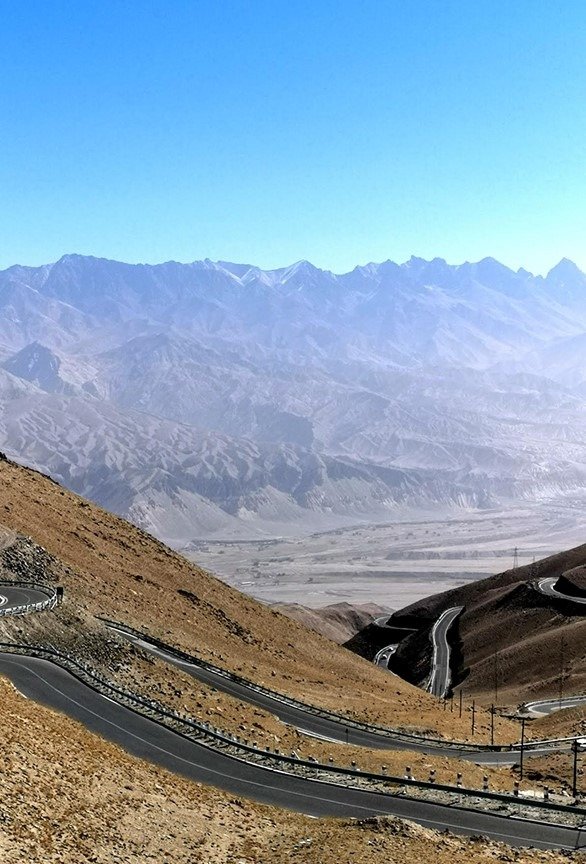
The twists and turns of the Panlong Ancient Road, in Pamir lands
I went down to the (Pamir) crossroads
After the mid-1st century, the Kushan empire, actually Indo-Scythian, gets a protagonist role in southern Central Asia, in what was known then as Eastern Turkestan. The Kushan, rivals of the Parthians in the role of messengers of international trade, not only facilitated the spread of Buddhism but also Gandhara – Greco-Buddhist – art (some originals are still to be found today, at exorbitant prices, in art galleries in Hong Kong and Bangkok).
And yet, further on down the road, the rules of the game never substantially changed: two great Silk Road poles – Sassanid Persia and Byzantium – involved in a real, cutthroat industrial war with silk right in the middle. The secret of silk manufacturing had already been leaked to South Asia.
This trade war got even more complicated with the onslaught of Turk tribes across Central Asia, and the emergence of a trade kingdom in Sogdiana (with Samarkand at the center).
By the mid-7th century, the Tang dynasty recovered control over parts of the Silk Road ruled by Tarim basin kingdoms. That was an absolute must for business to go on – because caravan routes traversing these kingdoms encircled, and bypassed, by north and south, the fear-inducing Taklamakan desert, as they still do today.
Tang China wanted absolute control all the way at least up to the Pamir mountains where, in the legendary stone tower relentlessly described by adventurers but never really located with 100% certainty, Scythian, Parthian and Persian caravans met Chinese caravans to trade that precious silk plus several other commodities.
The stone tower mentioned by top geographers such as Ptolemy is actually Tashkurgan Fort in the Pamir mountains: ultra- strategic, straddling the Silk Road, and nowadays a top tourist attraction very close to the Karakoram highway.
The stone tower is the symbolic landmark between the Chinese world and the rest of Eurasia: to the west is the Indo-Iranian world.
I traveled the Pamir Highway in Tajikistan back-to-back before Covid interrupted everything. This time our mini-caravan crossed Pamir lands along and around the Karakoram highway on the way to the China-Pakistan border: that is now prime China-Pakistan Economic Corridor (CPEC) territory, a key plank of BRI.
It’s the Pamirs that in Ancient Silk Road times allowed reaching the oasis of Kashgar. The Pamirs tie a gigantic mountainous knot between the western limits of the Himalayas, the Hindu Kush and the southern slopes of the Tian Shan.
This has always been the key crossroads between the triangular trade uniting northern India, eastern Central Asia – with China nearby – and western Central Asia, with the steppes not so far away.
China meets Islam: a great, historical “what if?”
Silk, bearing serious value as a unit of capitalization and trade, had a much larger role than its usage. In Byzantium, silk was the object of an imperial monopoly. Everything was strictly regulated: professions, state ateliers where women worked, and customs. The state protected its monopoly via a fierce bureaucracy.
Meanwhile, the Maritime Road was booming. A Buddhist and maritime power, Srivijaya, controlled the ever-crucial Malacca strait out of the island of Sumatra. It’s under this configuration that Islam enters the Big Picture.
As much as History ruled that Rome and China would never meet directly along the Silk Road, it also ruled a stark separation between Islam and China. Or try to imagine if China, in the mid 8th century, had become a land of Islam.
The battle of Talas, in 751 – in what is today’s Kyrgyzstan – pitted China against the Arabs. And its result ended for good any Chinese whim of conquering Central Asia. Today, with the New Silk Roads/BRI, is another story – about Chinese trade/investment power projection all across the Heartland, and beyond.
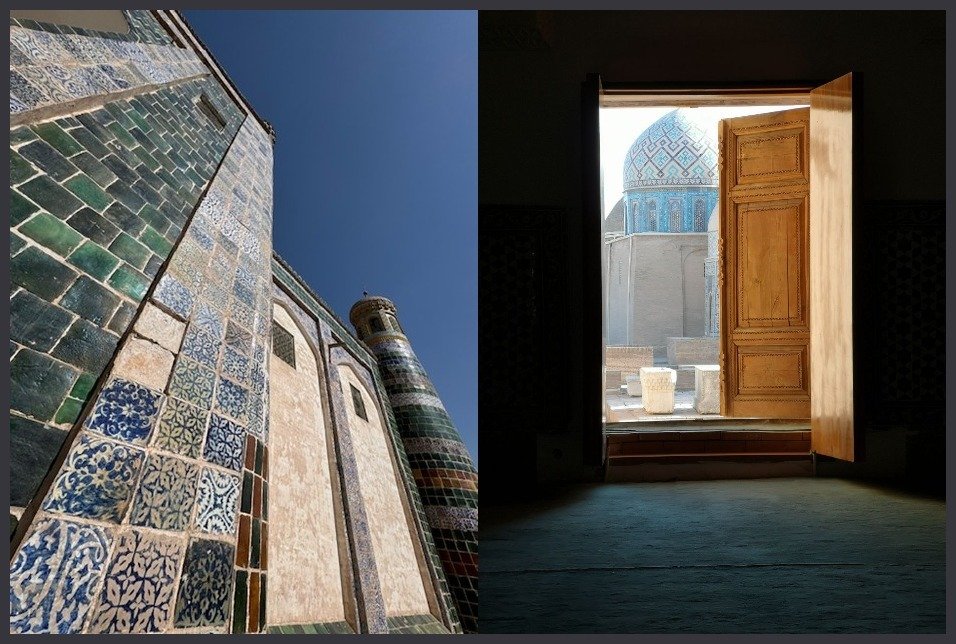
(L): Culture interpenetration: Bukhara meets Kashgar ; (R): Samarkand. Opening the doors to another dimension.
Back in the early 8th century, the key player was Umayyad dynasty General Qutayba ibn Muslim. He first conquered Bukhara and Samarkand; crossed the Ferghana valley; the Tian Shan mountains; and nearly reached Kashgar. The Chinese governor at the time, sensing that Qutayba might be about to take over Chinese lands, sent him a bag full of earth’s soil, a few coins and four princes as hostages. He calculated that’s how the Arab conqueror might not lose face, and leave the Middle Kingdom alone.
As incredible as it might seem, this arrangement lasted for half a century. Until the battle of Talas. Now compare it with Poitiers in 732 – one century after the death of Prophet Muhammad. We can certainly interpret Talas and Poitiers, together, as the two key landmarks of how Islam was on the verge of extending itself all cross Eurasia (including its European peninsula), creating a political-military empire from Rome to Chang’an (today’s Xian).
Well, it did not happen. Still, that’s one of the most extraordinary “what ifs” in History.
The importance of the battle of Talas – virtually ignored in the West, except in rarefied scholarly circles – is really larger than life. Among other issues, it imposed a new circulation of techniques. The Arabs took away with them artisans, sericulture experts but also paper makers. Ateliers at first were set up in Samarkand. Later on, in Baghdad and all across the Caliphate.
So alongside the Silk Road, we saw the birth of a very busy Paper Road.

An extraordinary Silk Road exhibition currently at the Gansu museum in Lanzhou
Deserts, mountains, oases – and no “slave labor”
Rolling down the highways across Xinjiang shooting a documentary after retracing the initial Ancient Silk Road from Xian to the Gansu corridor is an incomparable, historical time travel – as we may retrace in detail centuries of Central Asian turmoil all the way to the decline of some local pre-Islamic cultures by the 9th century. It’s a thrill to reconnect with the main actors: Uyghurs, Han Chinese, Sogdians, Indians, nomads, Arabs, Tibetans, Tajiks, Kyrgyz – and Mongolians.
The nomad groups thar proclaimed themselves heirs to the fierce Xiongnu came from the northwest of Mongolia and the Altai mountains. They incorporated several ancient nomads of western Central Asia during the 4th century, sharply remodeling the political and ethnic landscape.
The Xiongnu, on and off, pillaged parts of northern China – and were occasionally enticed into serious trade, offered tribute, or simply bribed to stay away. Actually the Xiongnu had a branch established in China and separated for at least two centuries from the previous ones: they ended up taking Samarkand in the year 350. Later on, it’s the Turks that once again came from Mongolia (don’t tell Erdogan about it; he wouldn’t know), unifying the steppe in the 6th century, way before the arrival of Islam.
Arguably the key Silk Road imperative is the desert and oasis contrast/dichotomy.
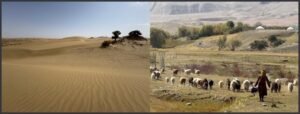
(L): The stark beauty of the fierce Taklamakan ; (R): Good pasture in Pamir lands
Deserts such as the Taklamakan and the Gobi, and several others, as well as arid steppes and mountains are among the most forbidding on the planet: these are the essential features of what amounts to roughly 6 million km2.
What is very rare in Central Asia is cultivated land (yet we can see a succession of cotton fields) or good pasture (we can see it in the Gansu corridor, and even in Pamir lands near the mighty Muztagh Ata). Still, deserts and mountains are at the heart of everything.
Some oases are of course more equal than others. Khotan is the most important oasis of the Southern Silk Road – not far from the immense, deserted Tibetan plateau. That’s fabulous for agriculture but most of all, courtesy of an alluvial cone, for precious stones, especially jade, supplied for over 2,000 years to every Chinese dynasty. Khotan spoke an Iranian language – close to those of ancient nomads Saka and Scythian, masters of the steppes.
The kingdom of Khotan was a fierce rival of the oases further west, Yarkand and Kashgar. It was only intermittently under Chinese control. And may have been conquered by the Kushans in the 2nd century. Indian influence is omnipresent – as we still see in dress patterns and food in the Night Market. In the 3rd century Buddhism was already a major influence – featuring the most ancient testimonials in the Tarim basin.
The Silk Road, actually Roads, is of course The Buddhist Road. In Dunhuang, in the Gansu corridor, Buddhism was also popular since the 3rd century: a famous local monk, Dharmaraksa, was the pupil of an Indian master. The Dunhuang Buddhist crowds were a mix of Chinese, Indian and Central Asian – once more testifying to the non-stop interpenetration of cultures.

(L): The Chinese character for “silk” inscribed in jade in front of a factory in Khotan ; (R): Playing the Uyghur blues
The Shakespearean “all the world is a stage” metaphor totally applies to the history of the Silk Road: all those actors from all corners of the Heartland historically were playing several roles, sometimes all in one go – an apotheosis of the favourite Xi Jinping-coined “people to people’s exchanges”. That’s the spirit of the Ancient and the New Silk Roads.
We were fortunate enough to be on the road smack in the middle of the 70th anniversary of the establishment of the Xinjiang Uyghur Autonomous Region.
Among so many accomplishments by socialism with Chinese characteristics in Xinjiang in terms of sustainable development, the taming of the Taklamakan – or “sea of death” – is in a world class of its own.
We crossed the Taklamakan from the Northern Silk Road in Aksu to the Southern, near Keriya: and we experienced everthing from the impeccable highway bordered by the reeds composing the “China magic cube” – to keep the sands away – to some of the 3,046 km-long sand-blocking green belt, featuring plants such as the desert poplar and the red willow.
The Taklamakan has always been Sandstorm Central – a major threat to the succession of oases. The terrain all around the oases is hardcore: deserts, barren mountains, Gobi wasteland, poor soil, sparse vegetation, low rainfall, high evaporation, dry air.
Well, what we see today started even before the Go West campaign launched in 1999: since 1997, an array of central and state agencies, central state-owned enterprises, and 14 Chinese provinces and municipalities have sent a massive amount of funds and personnel to properly develop Xinjiang.
Now compare all that with original research shared at an academic conference on Xinjiang recently organized by the Hong Kong University of Science and Technology and Hong Kong University – my neighbors when I lived in the Fragrant Harbor. The research showed how British MI6 since the 1990s was instrumentalizing a minority of Uyghurs side by side with a massive global P.R. campaign with the explicit target of breaking China into three parts.
That evolved into the CIA-concocted “genocide” accusations of the past few years and of course “forced labor” masses barely surviving in concentration/re-education camps. In our extensive travels, guided by Uyghurs, we were dead set on finding slave labor in cotton fields along the Northern Silk Road or in the middle of the Taklamakan. Well, sorry: they don’t exist.
The propaganda though was essential to regiment loads of Uyghurs into ISIS, including their sizable contingent in Idlibistan now roaming free between Syria and the Turkish border. They wouldn’t dare coming back to Xinjiang and face Chinese intel.
Forget about barbarian propaganda. What really matters, historically, is that the Ancient Silk Roads as well as Xinjiang may well be the ultimate crossroads of civilizations. Along Central Asia, they are the (beating) heart of the Heartland. And now, once again, they are back as protagonists in the heart of History.
Judge Nap catches our roving eye nomad—pilgrim between flights to review the incendiary moment
 Rock’n Roll Geopolitics:


 RYABKOV UNPLUGGED
“We have a certain building of relations, which has cracked, which is collapsing – the Americans are to blame for this. Now the cracks have reached the foundation. I think it’s easier to destroy than to build. We are ready to build, but we don’t see any reciprocal movement from that side.”
Well, Burning Down the House is the Empire’s trademark.
A documentary of the missilemen of Iran. “…. the one who finishes a War, is the one claimant of expertise.”
https://x.com/AryJeay/status/1974164482088996971
@Fotros Resistance (Arya – آریا):
Exclusive footages of Iran’s underground missile complexes during the 12-day war.
An IRGC member recalls how they operated inside the deep underground missile tunnels during the 12-day war.
He explains the tunnels were not damaged and everything inside was operational, the only issue was the entrance that sometimes got hit which would delay launches until it’d get dig out.
The tunnels in the footage displays Haj Qassem & Kheybar Shekan missiles.
The IRGC operators says the morale among the IRGC was very high and they did everything to not delay launches.
One of the IRGC members says at one time, an Israeli Hermes drone had hit one of the launchers that caused him to get injured on the spot, but got up and continued working to launch the rest of the missiles.
One of them rejected Israeli ridiculous claims about having bombed Iranian missile capabilities “to dust” and says we’re not even above the ground to bomb us to dust.
tomorrow, 27ᵗʰ September 2025, the 2015 JCPOA “snap-back” sanctions will come into force. With disavowal from China and Russia, it will become a milestone day in the disintegration of the post-WW2 UN system.
with appreciation to Dr. Karl at karlof1’s Geopolitical Gymnasium.
One Major FM statement and two by main UN Representative Vassily Nebenzia
On 20 September, Russia’s Foreign Ministry issued a major statement about its views on the snap-back sanctions issue which was followed by two separate statements by Mr. Vassily Nebenzia that were made to the assembled UN Security Council. It should be noted that China, Algeria and Pakistan all hold similar positions as they expressed orally and via their vote. When this move was announced back in August, Russia published a paper expressing why this move is illegal and violates the JCPOA that I reported on in full. We’ll begin with the MFA Statement then go to the two statements by Mr. Nebenzia.
On September 19, the UN Security Council voted on a draft resolution submitted by the Republic of Korea as President of the UN Security Council as a follow-up to the August 28 appeal by the United Kingdom, Germany and France regarding Iran’s alleged material failure to comply with its obligations under the Joint Comprehensive Plan of Action (JCPOA).
The Russian side has repeatedly pointed out the provocative and illegal nature of the actions of the European countries participating in the JCPOA and the South Korean chairmanship of the UN Security Council, which is under their influence. These actions have nothing to do with diplomacy and only lead to a further escalation of tensions around the Iranian nuclear program. Until the last moment, we explained in detail and in a well-reasoned manner the reasons why the above-mentioned European appeal cannot be considered a notification within the meaning of paragraph 11 of UN Security Council Resolution 2231, which the British and the European Two are trying to shamelessly manipulate. Accordingly, the presidential draft put to a vote in the Security Council does not meet the requirements of Resolution 2231 and a priori cannot lead to the restoration of the previously lifted UN sanctions against Iran.
During a meeting of the UN Security Council on September 19, Russia, together with China, Algeria and Pakistan, strongly supported the preservation of the regime for the lifting of previous sanctions resolutions on the Islamic Republic of Iran (IRI). Predictably, the European instigators of the current growing crisis around the Iranian nuclear programme, as well as the United States, which together exerted unprecedented pressure on the non-permanent members of the Security Council, forcing them to show solidarity with their unsuitable position, spoke out against this. As a result, those who succumbed to blackmail and threats have not been able to clearly explain the essence of their objections to the fact that the restrictions that have long lost their relevance and were in effect before the conclusion of the JCPOA remain lifted.
The position of the Republic of Korea, which abstained on its own draft resolution, is noteworthy in this context. We perceive this as self-exposure and a sign that Seoul is well aware of the legal and procedural nullity of its initiative, as well as the inconsistency of European claims on snapback. Apparently, the chairmanship is aware of the likely disastrous consequences of the political campaign unleashed against Iran, which threatens to negate constructive cooperation between Tehran and the IAEA and push the Iranian leadership to take tough retaliatory decisions.
The results of the vote on the South Korean resolution only indicate that this document did not find support and was removed from the agenda. This fact does not impose any obligations on other states to revive past restrictions against Iran. The notorious “snapback” cannot be considered to have taken place. Claims by the Western camp to the contrary mean that these countries are desperately seeking to legitimize their earlier gross violations of Resolution 2231 and to subordinate the rest of the world to their confrontational and fundamentally flawed policies. Their diktat and their legal nihilism in international affairs must be resolutely rebuffed, and attempts to use the authority and powers of the UN Security Council to settle political scores with Tehran must be rejected.
For the United States and European countries, the moment of truth has come. They will finally have to answer the question with certainty whether they are seeking a political and diplomatic settlement or are they once again preparing for the “dirty work” of plunging the Middle East into a new tragedy, similar to the one that took place in June, when the nuclear facilities in Iran under IAEA control were the target of missile and bomb strikes by Israel and the United States.
The Russian-Chinese draft UN Security Council resolution on a technical postponement of the implementation of the JCPOA and Resolution 2231 for six months, which is on the table, provides a real opportunity to rectify the situation, create conditions for the effective implementation of the agreements reached between Iran and the IAEA in Cairo on September 9, and provide space for a vigorous search for negotiated solutions that will make it possible to remove any suspicions and prejudices regarding Iran’s peaceful nuclear energy with due reliance on international law and consideration of the legitimate interests of the Islamic Republic of Iran. [My Emphasis]
Here’s the first Nebenzia statement:
Mr. President,
We have to take the floor on a point of order, because we do not see any legal, political or procedural grounds for any steps to develop the European claims to launch the snapback mechanism, including voting on the draft resolution submitted by the South Korean presidency.
We have repeatedly explained at various venues that the European parties to the Joint Comprehensive Plan of Action (JCPOA) simply have no right to launch the mechanism provided for by OP11 of UN Security Council Resolution 2231. The United Kingdom, France and Germany themselves have chronically violated UNSC Resolution 2231 and the JCPOA, including by imposing illegal unilateral sanctions against Iran to replace the restrictions that expired in accordance with the Plan. These countries also grossly violated the procedure for considering disputes provided for by the JCPOA, in particular, they did not launch the Dispute Settlement Mechanism in accordance with the prescribed procedure at the Vienna platform.
We would like to remind you that Resolution 2231 is an integral document and does not allow for a gap between it and the JCPOA, which has been and remains an integral part of it. Attempts by European countries to present the situation as if they have the right to use the “punitive” provisions of the resolution without fulfilling their part of the obligations are hypocritical and untenable from both a legal and political point of view. That is why we do not recognise the complaint submitted by Berlin, London and Paris to the Council within the meaning of UNSC Resolution 2231.
In this regard, we do not see any need for the Chairman-in-Office to take any steps, including the introduction of a draft resolution. The hasty putting of it to a vote by the South Korean chairmanship, although there is still more than a week before the expiration of 30 days, is also perplexing. We regret that the Republic of Korea has chosen the path of playing along with Western destructive approaches, to the detriment of its duties as an impartial chairman.
On the whole, what is happening today evokes the feeling of a clumsy spectacle aimed at creating a false “parallel reality” that has nothing to do with the political and legal foundations of the work of the Security Council. After all, it is no secret that the United Kingdom, France and Germany do not care at all about the fate of the JCPOA or the authority of the UN Security Council. Their only goal now is to use the Council as a tool in their unscrupulous game, as a lever of pressure on an undesirable state that defends its sovereign interests.
Here is a clear illustration of the fact that our European colleagues reject diplomacy at the root, preferring the language of blackmail and threats. Last week in Vienna, we officially proposed holding a meeting of all the original participants in the JCPOA in order to discuss, so to speak, “in the family circle” ways out of the current crisis. Great Britain, France, Germany and the United States responded to our proposal with a refusal.
Therefore, in other circumstances, we would not even take part in such a shameful spectacle in the Security Council, which is now unfolding at their behest. We are doing this today only because the content of the submitted document implies the preservation of the regime for lifting sanctions against Iran, which is in line with our long-standing principled position. However, this does not lend an ounce of legitimacy to either the European statements about the launch of the snapback, or the actions of the presidency to develop them. I ask you to record this in the minutes of the meeting.
Thank you. [My Emphasis]
And here’s the second:
Mr. President,
Today we have already stated our principled position of rejection of either the attempts of European states to launch a snapback or the actions of the presidency to develop them, including the introduction of this resolution. Our position on this matter remains unchanged. The fact that the Russian Federation voted in favour of the draft should not be interpreted as a change to it.
We supported the draft for only one reason: its only operative paragraph was on maintaining the lifting of UN sanctions against Iran. This is the only correct, politically and legally justified decision, which we have been talking about for all these years. The logic laid down in the Joint Comprehensive Plan of Action (JCPOA) assumed the gradual lifting of all restrictions on Iran, and we are firmly convinced that there is no reason why they should not expire on October 18 of this year. and we have all witnessed how Iran fell victim to the aggressive actions of Israel and the United States in June of this year, and then trying to “crush” it with UN sanctions is immoral, unfair and illegal.
However, this is exactly what our Western colleagues are now trying to do. We would like to remind you that everything, including Iran’s interaction with the IAEA, was going according to plan exactly until the United States took a destructive path in 2018 and officially withdrew from the deal. This was the “trigger” of the crisis around the JCPOA, the consequences of which the Council has to deal with now, but Western delegations are diligently hushing up this fact. Despite Washington’s illegal and brutal actions, Tehran showed restraint at that time and continued to comply with its obligations in good faith for more than a year – I emphasise that for more than a year. Only after another round of pressure on it, Tehran took retaliatory steps, while regularly noting that these actions were reversible. Unfortunately, our European colleagues were not interested in returning to diplomacy even then and did not follow the path of a normal conversation, which was a chance in 2022, when the parameters for restoring the JCPOA were discussed.
Violations by the United Kingdom, France and Germany of their obligations under UN Security Council Resolution 2231 and the JCPOA have long become chronic. We are talking about their inability to comply with their obligations to ensure economic returns for Iran from the lifting of EU sanctions that were in effect until 2015, and their illegal decision to resume unilateral sanctions pressure after the JCPOA Transition Day on October 18, 2023.
Our country has repeatedly brought to the attention of the members of the Security Council its position that the United Kingdom, France and Germany do not have the right to use the procedure for restoring the UN Security Council sanctions regime against Iran, as provided for in paragraph 11 of the operative part of UNSC Resolution 2231. A party that fails to comply with its obligations under any contract or agreement deprives itself of the right to use the tools provided for therein. This is clearly evidenced by the so-called “clean hands doctrine”, the principle of pacta sunt servanda, and the advisory opinions of the International Court of Justice.
Against this background, the so-called “notification” of the “European Three” about the launch of the “snapback”, distributed in the Council on August 28, has no legal and procedural force. It cannot serve as a basis for any decisions or actions of the Security Council. This position is set out in detail in the joint letter of the Foreign Ministers of Russia, China and Iran dated August 28, which was circulated in the Council.
Let us emphasize once again: from our point of view, there is no launch of the snapback procedure. The introduction of the draft considered today is a direct violation of Resolution 2231 and the JCPOA, which is an integral part of it. For this reason, the Russian Federation does not recognize either the alleged steps taken or any further steps in this context.
We would like to remind you that there is a real alternative to the lawlessness taking place today in the Security Council hall. This is the Russian-Chinese draft resolution, which is in the blue, which provides for the technical extension of Resolution 2231 for six months while demanding that all original participants in the JCPOA immediately resume negotiations in order to find a diplomatic solution. We call on all sensible members of the Security Council to support it when we put it to a vote.
Thank you. [My Emphasis]
Seems pretty basic: The E3 violated basic contract law and thus voided their ability to do anything, almost as if they had dropped out like their Outlaw US Empire Master. I haven’t read anything by China, Pakistan or Algeria, but do know that they echoed Russia’s position meaning Russia wasn’t the only nation pointing to the illegality of the E3’s actions and the unseemly behavior by the South Korean UNSC Chair. Maybe Trump should have attacked some more Korean factories so they’s know where they stand in his racist eyes.
The Cairo Agreement between Iran and IAEA has already been annulled by Iran as a result of the illegal UNSC happenings. Here’s the key quote from RT’s report:
“The ill-considered actions of three European countries regarding the Iranian nuclear issue… will effectively suspend the path of cooperation with the Agency,” Iran’s Supreme National Security Council said in a statement cited by state news agency IRNA. [Emphasis Original]
The UNSC action is very powerful proof that Law and Justice are absent within the world and need to be made reality via another institution; otherwise, what we’ll have in the law of the garden, which in reality is the jungle. As I have suggested, a UN Charter 2.0 is now needed more than ever with modifications made to the Security Council eliminating the veto and other past mistakes in its organization. Obtaining consensus can remain provided all UNSC members are not in current or past violation of the UN Charter—some form of strict disciplinary measures must be added to the Charter for those members who violate it.
It’s become very clear that Iran’s nuclear program isn’t the issue. It’s Iran’s government and the fact it remains independent despite 46 years of attempts to destroy it led by the Outlaw US Empire and its Zionist proxy. The only weapons not used against Iran are nuclear—chemical and biological weapons were used at the behest of the Empire by Iraq during the 1980-88 Iran-Iraq War who covered up their use by Iraq. The longstanding crime spree that was begun by the Outlaw US Empire and UK proxy in 1953-4 so Iran’s hydrocarbon riches could be controlled by the Empire continues. When the Shah was in power, the Empire, nor any of its proxies had any trouble with Iran having a nuclear program because the Empire controlled the Shah. That all changed when Iranians revolted and regained their independence, and all signs today are they relish it greatly and will not cede it under any circumstances. And to defend their independence, Iran has developed very sophisticated high-tech missile and drone capabilities that have shocked the Empire and its Zionist proxy, although they lie about everything about Iran. Today’s Iran isn’t that of 2015—it has very powerful allies and is much better economically. Plus, as the 12-Day War showed, Iran’s populace came together in mass solidarity with the government and military against what are called the Two Satans—Big and Small.
The Genocidal Don and Bibi will again attack Iran with the big question being will either use nukes to attain their goal. And the other big question is, did Iran obtain a considerable upgrade to its AD suite? For if Iran can kill the planes and/or missiles bringing the nukes, it will save itself and much more—but if it does so, how will we know nukes were used? Obviously, in a properly governed world, this crisis wouldn’t exist. If Humanity survives the next war on Iran, global governance will need to be altered whether some nations like it or not.
And as an ending by-note, Venezuela has held talks with Russia on what the MFA called, “Russian-Venezuelan consultations on international legal issues.” Here’s the important portion of the Press Release:
We discussed in detail the issues of coordination at the relevant platforms of international organisations and practical steps to combat the practice of illegal unilateral restrictive measures (sanctions). The issues of the functioning of international justice bodies, including criminal justice, are considered separately. Specific mechanisms and tools for the implementation of common positions have been outlined.
The consultations confirmed the parties’ firm conviction of the need to strengthen the rule of international law. Illegitimate sanctions were condemned, and rejection of the politicisation of international justice was expressed. The Russian side reaffirmed its full support for Caracas in its efforts to protect its sovereignty in light of current threats. [My Emphasis]
Trump has now blown up three boats and killed several dozen which merely adds to his bloody total—Genocide Don and Killer of Ukrainians. He had no business being at the Charlie Kirk funeral.
The Global South now seems to have a crystal clear perspective of the new contours of the catastrophe laid at the feet of the Angel of History .. now they have met an immovable symbol of Resistance.
By Pepe Escobar at the Strategic Culture Foundation.
It’s one of the most mesmerizing passages in the history of knowledge. In the 9th of his Theses on the Philosophy of History, Walter Benjamin – Jewish, tragic figure, solitary genius – dissects Paul Klee’s haunting painting Angelus Novus and graphically explains to posterity the drama facing the Angel of History:
“His face is turned toward the past. Where we perceive a chain of events: he sees one single catastrophe which keeps piling wreckage and hurls it in front of his feet. The angel would like to stay, awaken the dead, and make whole what has been smashed. But a storm is blowing in from Paradise; it has got caught in its wings with such violence that the angel can no longer close them. The storm propels him into a future to which his back is turned – whilst the pile of debris before him goes even higher. This storm is what has been called progress.”
The time has come to go beyond what may be read as a very apocalyptic Christian parallel between divinity and violent retribution. As Alastair Crooke detailed in his astonishingly perceptive 2010 book, Resistance: The Essence of the Islamist Revolution, it was the need to restrain the furies of “divinely inspired” violence that led Hobbes to conceptualize Leviathan, where he called for a social contract between the individual and a necessarily strong, implacable government.
Moreover, it was the Hobbesian version of a social contract that laid the basis for John Locke to assert a dubious “natural goodness” of humanity, complete with a – very private – “pursuit of happiness” and the general welfare gleefully coalescing via the work of an invisible hand.
This fallacy/fairy tale shaped Western thought for over the next 300 years.
Now it’s a completely different ball game. We have been prisoners of Hobbes and Locke for too long:
such a seductive pole dancing of legitimacy around which the Western-conceived nation-states grouped to protect and legitimize themselves and their plunder of the rest of the world.
Lately, the contemporary specter of “divine violence” was marketed to everyone from Africa to Asia as armed Islamist resistance. But now this mask has also fallen. The “new” Syria shows to everyone how al-Qaeda R Us – and always was.

Paul Klee — Angelus Novus. 1920
Shelter from the – ultimate – storm
The time has also come to re-evaluate the plight of the Angel of History. No, he is not transfixed by “divine” rage; that’s actually quite man-made. Meanwhile, what continues to propel him forward – even as he casts his eyes to the past (“the backward half-look, over the shoulder, toward the primitive terror”, in T. S. Eliot’s striking image) is the wind of secular, Darwinian, tech “progress” – a single, unified catastrophe much more that a chain of historical events.
Yes, he continues to contemplate the tragedy; he badly wants to awaken humanity to the extent of the disaster; but the rush of now tech “progress”, AI-tinged, inevitably sweeps him away.
The Global South now seems to have a crystal clear perspective of the new contours of the catastrophe laid at the feet of the Angel of History.
The top two contemporary agents of the catastrophe have been fully identified: a psycho-pathological, genocidal death cult composed by elements of a self-appointed chosen tribe; and the post-historical elites of a dwindling empire. A deadly embrace – if there ever was one.
Yet now they have met an immovable symbol of Resistance. And they had to back off. To the astonishment of the Angel of History himself.
Iran’s Supreme Leader Ayatollah Khamenei laid it all out in a few sentences:
“The key point I wish to emphasize in my speech is that in one of his remarks, the President of the United States declared that Iran must surrender. Surrender! The issue isn’t about enrichment or the nuclear industry anymore. It’s about Iran surrendering.”
This is the voice of an ancient civilization-state – in contrast to post-modern, out of control barbarism: “Our cultural and civilizational wealth is hundred times greater than that of the US and other similar countries (…) The Iranian nation is noble and will remain noble.”
An irrational, and certainly not “divine” storm now aims to totally paralyze the Angel of History – imprinting on the narrative their revamped but equally tawdry notion of “end of History”, applied to the circumscribed space of West Asia.
And that brings us to how the Resistance will have to delve deep into the nitty-gritty, as in the practicalities of deterrence and defense, so the Angel of History may reinvent himself.
Cut to the Yemeni Armed Forces – this bastion of rectitude, a military organization guided by spiritual power:
“The US and Zionist entity’s ceasefire agreement with Iran highlights that military force is the only language they understand.”
Add to it the number one lesson from the 12-day war: whoever controls the skies eventually will control the lands.
Iran’s leadership, as the fulcrum of Resistance, has some serious decisions to make. The most important, on the “language” issue as framed by the Houthis, is to trust Russia to help it set up a comprehensive, multi-layered offense/defense system, complete with hardware, combat and control centers, long-range radar stations, electronic warfare equipment, and badass jet fighters.
As Kremlin spokesman Dmitry Peskov made it quite clear ahead of the meeting one week ago between President Putin and Iranian FM Abbas Araghchi:” It all depends on what Iran needs right now.”
They need serious backup. The Majlis – Iran’s Parliament – delayed for over a month the ratification of the comprehensive strategic partnership signed with Russia after the Duma approved it in late May. That includes weapons sales, military inter-connection and deep intel exchange – even if it does not imply a full military alliance.
Previous Iranian president Ebrahim Raisi clearly saw The Big Picture. He went full “Look East” – as in Eurasia integration. The current, meek Pezeshkian presidency attempted a “Look West” – naively trusting that the Empire of Chaos would actually practice diplomacy. They were in for a rude awakening.
The unforgiving war will be long and bloody. This is just the beginning – current pause included. Yet the Angel of History seems to have caught a second wind. Looks like his warnings about the catastrophe were finally understood by the overwhelming majority of the Global South. As we sift through the accumulated debris, Resistance is at hand – sheltering us from the ultimate storm.
“… on June 22 Trump struck and a terrible beauty was born.”
By Ambassador MK Bhadrakumar at the Indian Punchline.
The former President and Deputy Chairman of Russia’s Security Council Dmitry Medvedev who is one of the most authoritative voices in the Kremlin, wrote on the Telegram channel on June 23 a critique on the Middle East crisis following the US attack on Iran’s three key nuclear sites of Fordow, Natanz and Isfahan.
Medvedev listed ten points, which, taken together, messaged that Russia’s stance on the developing situation around Iran has markedly shifted to one of proactive mode marked by profound scepticism and deep concern about President Donald Trump’s intentions.
As recently as on June 4, Trump had sought Putin’s help to advance the US-Iran negotiations on the nuclear issue and Putin, in good faith, agreed to help. Indeed, the Iranian government spokesperson had disclosed on June 12 that preparations were under way for a visit by Putin to Tehran.
But on June 22, Trump ordered the air strike on Iran’s three nuclear sites without taking Putin into confidence. Such surreptitious behaviour may be nothing new to Washington in inter-state relationships but it caused embarrassment to the Kremlin. Medvedev’s comments show it when he ridicules Trump’s triumphalism about the air strike.
Medvedev listed ten points under the heading What did the Americans achieve with their night strike on three points in Iran? They underscore that Russia’s stance on the developing situation around Iran has shifted to one of unequivocally distancing itself from the US approach going forward. The 10 points are:
Quote.
Unquote.
On the whole, Medvedev’s assessment is in sync with the swathe of opinion among neutral observers, including Western analysts, about the state of play. However, Points 2 and 3 stand out as particularly noteworthy in their prognosis that inexorably, Iran has now been pushed into a path of making the nuclear bomb and, more importantly, Tehran can expect help in this direction from “a number of countries (who) are ready to directly supply Iran with their nuclear weapons.”
This is the first time that Russia has explicitly spoken about Iran’s likely ‘nuclearisation’. That in itself is a paradigm shift. Medvedev has approvingly presented it in a marked departure from Russia’s stated affirmations in the past that Iran’s nuclear programme is for peaceful purposes. Russia has been historically a cornerstone of the nuclear non-proliferation regime.
Three things have changed. First, the US itself has become a proliferator. In Europe, the US’s allies freely fly its planes fitted with nuclear bombs during exercises. German pilots have familiarised themselves with such planes. In Asia-Pacific, AUKUS alliance actually involves transfer of nuclear weapon technology to Australia, which is technically an NPT member.
Second, when it comes to Iran, a key ally of Russia, the US aggression has crossed Iran’s “big red line” — to borrow the words of foreign minister Abbas Araghchi — which leaves Tehran with no alternative but to act in self-defence. Besides, in the ‘rules-based order’ imposed by the US on Iran, its own ally Israel, a non-NPT member country, has a fully-developed clandestine nuclear weapon programme and is estimated to have a stockpile of some 200 nuclear missiles but all that Trump blithely ignores.
Third, things have come to such a pass today that smaller countries must nuclearise in the quickest way possible, which is their only iron-clad guarantee to preserve their sovereignty and territorial integrity from the US attacks in the chaotic international situation today. North Korea’s success in pushing back US pressure is due to its nuclear deterrent capability. What is absolutely galling is that Trump has not even cared to seek a mandate from the UN Security Council and has gone to war with Iran without getting Congressional approval.
Evidently, Medvedev’s commentary pooh-poohs the pious hopes in Washington and Tel Aviv about forcing a ‘regime change’ in Iran. Medvedev assertively proclaims that not only has Iran’s political system become stronger but “people are consolidating around the spiritual leadership” including elements that “did not sympathise with him” previously.
Russia shares the prevailing opinion in the world community that by embracing on a military confrontation with Iran, Trump has added to the US’ growing isolation in the world community.
An intriguing point here is that in Medvedev’s prognosis, the US is being drawn into a new conflict abroad “with the prospect of a ground operation.” He didn’t explain how this may happen. Iran, which is almost the size of Europe, is a big country and has approximately 610,000 active duty personnel plus 350,000 reserve and trained personnel that can be mobilised when needed. Then, there is the Islamic Revolutionary Guard Corps (IRGC) which has approximately 125,000 personnel and a voluntary militia, Basj, under it with a further approximately 90,000 active personnel.
Even a limited US commando operation is fraught with high risk. The Operation Eagle Crew — undertaken in April 1980 in an attempt to rescue the US hostages — ended tragically. Of eight helicopters sent into Iran, two became disabled and a third was blown into a C-130 cargo plane in a fierce desert sandstorm, killing eight American servicemen whose bodies, left behind, were later paraded before Iranian television cameras. The Carter administration, humiliated by the failed mission and loss of life, expended great energy to have the bodies returned to the US. Trump is unlikely to risk such escapades.
In geopolitical terms, the seismic shift in the Kremlin thinking can be a game changer for Iran which must be regretting that it declined a Russian offer to include a provision for mutual security assistance in times of war in the two countries’ recently concluded treaty of strategic partnership, similar to what Russia has with DPRK. Also, Putin disclosed last week that Russia had offered to develop an integrated air defence system jointly with Iran (that could access Russian satellite data) but Iran showed no interest. Curiously, he revealed that Tehran was yet to ask for any help, either!
That was on June 19. But on June 22 Trump struck and a terrible beauty was born. It appears that Khamenei ordered Araghchi who was busy parleying with Europeans to go East and meet Putin.
Anyway, at a meeting with Araghchi in the Kremlin today, Putin used exceptionally strong words to condemn the US attack on Iran which he called a “completely unprovoked act of aggression against Iran … without foundation or justification.”
Putin added, “Russia has long-standing, strong, and trustworthy relations with Iran, and we are committed to supporting the Iranian people through our continued efforts… Your visit provides us with an important opportunity to discuss these sensitive issues in depth and to explore ways we might work together to navigate the current situation.” (The Kremlin readout is here.)
Will Russia’s entry deter Trump on his warpath? That is the million dollar question in the coming days. If Trump persists with such belligerence in cahoots with Israel’s Benjamin Netanyahu, a protracted war of attrition will ensue that will most certainly bring in China at some point with which Iran has a strong mil-to-mil relationship.
Those whose calculus of a US/Iran war assumes overwhelming American air superiority will abruptly find the parameters of their equations altered.
By William Schryver at imetatronink.
How soon people have forgotten that, earlier this year, the US dispatched two carrier strike groups and a half-dozen B-2s (and other USAF assets) to disarm the Yemeni and open the selectively blockaded Red Sea.
They failed. Abysmally. For the second time!
First of all, in 2024, the USS Brave Sir Robin (CVN-69), USS Teddy Bear (CVN-71), and USS Fraidy Abe (CVN-72) gave it a try, only to eventually run away with their tail between their legs. The Brave Sir Robin left behind an F/A-18 at the bottom of the sea.
They were followed up by the USS Trembling Puppy (CVN-75) and the USS Timid Vinny (CVN-70). But they fared no better, with the Trembling Puppy losing two additional F/A-18 fighters over the course of its traumatic tour of the northern Red Sea.
And, not only did the Yemeni increase their score of MQ-9 Reaper drones to 23, they also targeted and credibly threatened both F-35s and B-2s, such that both platforms were summarily withdrawn from the fight for fear of one getting shot down.
Remember, Yemen is absolutely the bottom rung on the escalatory ladder of formidable adversaries.
Anyone who seriously believes the US Navy can operate in Iranian waters is just plain delusional.
Even if no ships got damaged or sunk, they’d still run out of munitions in a couple weeks or less — and they sure as hell won’t be able to reload in Bahrain.
As for an air campaign … well, I have yet to see any persuasive evidence that US/Israeli aircraft penetrated Iranian airspace to any appreciable extent in Act I of this war. Consequently, I am dubious that Iranian medium- and long-range air defenses were even used.
There is also zero credible evidence of top-shelf Iranian air defenses being destroyed.
From all indications, the Iranians were shooting down Israel’s big strike drones with short-range AD. And they shot down several.
The Israeli long-range air-launched ballistic missiles were apparently effective, but they simply don’t have very many of them, and as the war progressed into its second week, we saw fewer and fewer of them with each passing day.
In any case, when Act II of this war gets started (and it won’t be long), it will almost certainly entail penetration of Iranian airspace. And we will see not only the emergence of Iranian long-range AD, but I strongly suspect Russian and/or Chinese mobile air defense systems will suddenly appear on the battlefield.
Those whose calculus of a US/Iran war assumes overwhelming American air superiority will abruptly find the parameters of their equations altered.
The Russians and Chinese are not going to stand idly by and watch the US smash up their important southwest Asia ally in the rapidly emerging multipolar world.
And keep in mind: the US simply cannot logistically sustain a high-intensity air campaign for more than 2-3 weeks. And if even a dozen or so manned US aircraft are shot down, and a couple ships severely damaged … well, that will cause such overwhelming consternation in Washington that it might even result in a coup d’état, or something closely approximating one.
As most know, Trump yet again delivered bombast instead of truth, although Khamenei was able to pick out the one shred of truth that tumbled from Trump’s maw.
with appreciation to Dr. Karl at karlof1’s Geopolitical Gymnasium.
What sort of admission it will become in time is unknown at the present. But it will bolster the Iranian nation even more than the attacks themselves. And in that case alone, Trump made yet another major mistake. I won’t spoil Khamenei’s words by telling readers now. The speech is short, and you’ll soon find out:
In the Name of God, the Compassionate, the Merciful
My greetings and best wishes to the dear, great nation of Iran. First, I would like to honor the memory of the esteemed martyrs from recent events – the martyred generals and scientists who were truly, genuinely valuable for the Islamic Republic. They dedicated their lives to serving others. Today, they are with God receiving the reward for their outstanding services, God willing.
I find it necessary to offer my congratulations to the great nation of Iran. I congratulate the nation for several reasons.
First of all, I offer my congratulations on the victory over the fallacious Zionist regime. With all that commotion and all those claims, the Zionist regime was practically knocked out and crushed under the blows of the Islamic Republic. The thought that the Islamic Republic could inflict such blows on that regime never even crossed their minds and they never imagined such a thing, but this is what happened.
We thank God for helping our Armed Forces. They were able to break through the enemy’s advanced, multi-layered defense and raze many of their urban and military areas under the pressure brought by Iran’s missiles and powerful attacks using advanced weaponry. This is one of the greatest divine blessings. It has shown the Zionist regime that attacking the Islamic Republic of Iran carries a heavy price. It will be costly for them. It will result in and generate a heavy cost for them. And praise God, this has happened. This honor is due to our Armed Forces and our dear people who’ve built, trained, and supported these Armed Forces from within themselves, enabling and empowering them to carry out such a great task.
My second congratulations is related to our dear Iran’s victory over the US regime. The US regime entered the war directly because it felt that if it didn’t, the Zionist regime would be completely destroyed. It entered the war in an effort to save that regime but achieved nothing. It attacked our nuclear facilities, which warrants an independent criminal prosecution in an international court, of course. But they weren’t able to achieve anything significant. The US President used a bizarre exaggeration in describing what happened. It’s evident he needed such an exaggeration. Whoever heard his remarks knew that beneath the surface of these words lay another truth, which was that they weren’t able to accomplish anything. They failed to achieve their intended goal and they exaggerate things to cover up and conceal the truth.
Here too, the Islamic Republic has been victorious and delivered a heavy slap to the US’s face in return. It [Iran] attacked and inflicted damage on the Al-Udeid Air Base, which is one of the US’s key bases in the region. The same people who made exaggerated claims in the previous case, tried to downplay this one, claiming that nothing much had happened. But in fact, a major event had taken place. The fact that the Islamic Republic has access to key US centers in the region and can take action whenever it deems necessary is a significant matter. It’s quite significant. Such an action can be repeated in the future too. Should any aggression occur, the enemy – the aggressor – will definitely pay a heavy price.
My third congratulations is for the remarkable unity and solidarity shown by the Iranian nation. Praise God, a nation of approximately 90 million people stood together as one, were united in voice, stood shoulder to shoulder, and didn’t show any differences in their demands or the goals they expressed. They stood together, chanted slogans, spoke out, and supported the actions of the Armed Forces, and this will continue to be the case in the future. The Iranian nation demonstrated its greatness and its distinguished, exceptional character in this event. It showed that when it’s necessary, a unified voice will be heard from this nation, and praise God, this is what happened.
The key point I wish to emphasize in my speech is this that in one of his remarks, the President of the United States declared that Iran must surrender. Surrender! The issue isn’t about enrichment or the nuclear industry anymore. It’s about Iran surrendering. Needless to say, this statement is too big to come out of the US president’s mouth.
For the great country of Iran – a nation with such a history, such a rich culture, and a steadfast national determination – any talk of surrender is nothing but a mockery in the eyes of those who truly know the Iranian people. But his statement revealed a certain reality, which is that the US has been actively opposing and trying to harm Islamic Iran from the very beginning of the Revolution. And each time, they come up with a new pretext. One time, it’s human rights. Another time, it’s defending democracy. Then, it’s women’s rights. Sometimes it’s uranium enrichment, and at other times it’s the nuclear issue itself. Or it’s the matter of missile development.
They bring up all kinds of pretexts. But at the core, it all boils down to one thing, which is that they want Iran to surrender.
The previous administrations never openly stated this because it’s something unacceptable. It isn’t justifiable by any human logic to tell a nation that they must surrender. That’s why they were disguising this objective behind other titles and pretexts.
This person let the truth out. He showed this reality that the US will only be satisfied with Iran’s surrender and nothing less. This is a crucial point. The Iranian nation must know that the core of the conflict with the US is over this point. The US is greatly insulting the people of Iran, and such a thing will never happen. It will never happen.
The Iranian nation is a great nation. Iran is a strong, vast country. It possesses an ancient civilization. Our cultural and civilizational wealth is hundreds of times greater than that of the US and other similar countries. Anyone who expects Iran to surrender to another country is spouting nonsense that will surely be ridiculed by wise, knowledgeable people. The Iranian nation is noble and will remain noble.
The Iranian nation is victorious and will remain victorious, by the grace of God. We are hopeful that Almighty God will continuously protect this nation under His grace, preserving it with dignity and honor. May He elevate the spiritual rank of Imam [Khomeini (ra)]. And may Imam Mahdi (may our souls be sacrificed for him) be pleased and satisfied with this nation, and may he support it with his assistance.
May God’s greetings, mercy, and blessings be upon you. [Dr. Karl: my Emphasis]
Given that Iran now knows with 100% certainty what the Outlaw US Empire demands, they’re no longer any grounds for negotiations excepting one: Iran will rejoin the NPT when the Zionists enroll themselves. I expect the papers Iran has incriminating Grossi and the IAEA will be published when Iran votes to withdraw from the NPT. I expect other outcomes will occur as a result of the conflict, some obvious like becoming closer to Russia and China militarily and a change in relations with Azerbaijan, and some not so obvious like the degree of further isolation of the Collective West from the Global Majority. I’m also curious to see what happens with Japan and South Korea’s relations with the Empire once the tariff deadline arrives as this conflict IMO will have a bearing on what occurs. And then there’s Taiwan. Its separatists can’t like what they just observed as the Empire’s most important proxy was partially thrown under the bus.
“US bases in Gulf which were once a first line of defense for the US and Israel have now proven to be 1st line of defense for Iran”
Part 1 of 3. The Anglo-Zionists’ military superiority is shattered. Their shields are even weaker than that of Iran. They’re all Big Fat Targets under endless waves of precision missiles and drones.
The myth of genocidal invincibility has been shattered forever .. that death cult in West Asia can indeed be mortally wounded .. TACO announced a one-sided ceasefire and fled .. There will be blood – over and over again.
By Pepe Escobar at the Strategic Culture Foundation.
In the end, predictably, the Circus Ringmaster went TACO (“Trump Always Chickens Out”).
He was terrified by three crucial reality-based developments.
The chain of events leading to the ceasefire remains murky.
A key accelerating factor was Putin’s personal meeting with Iranian Foreign Minister Araghchi at the Kremlin on Monday.
Speaking on behalf of Ayatollah Khamenei, Araghchi may have asked for a solid supply of weapons and most of all defense systems; but these will take time, especially considering that the strategic partnership recently approved by both the Duma and the Majlis in Tehran is not – officially – a military alliance.
Yet according to sources in Moscow who were informed about the meeting, Putin did position Russia at the center of a possible resolution, thus displacing Washington. Team Trump 2.0 was incensed. Trump boasted that both Iran and Israel had called him almost simultaneously to arrange a ceasefire. Nonsense: only Tel Aviv did. As Putin made it clear, once again, that Russia would back Iran, he indirectly offered Trump an off-ramp.
True to character, the Circus Ringmaster jumped on it, marketing his own, branded ceasefire, reality show-style. And this only two days after gloating that the Iranian nuclear program was “obliterated” (he insists on it even as U.S. intel admits the program may have been set back for only a matter of months).

A supreme taboo has been broken
Iran has learned a few important lessons the hardest way, paying a horrendous price. Tehran was way too transparent and reasonable dealing with a bunch of gangsters: from allowing IAEA nuclear monitoring that turned out to be a process of amassing precious intel for Israeli targeting; and believing in diplomacy and honoring agreements that were unceremoniously ditched.
There’s no diplomacy when it comes to dealing with the imperial Leviathan/Behemoth – especially as it contemplates, in horror, its footprint being reduced all across the Global South.
Domestically though, Iran is going to the next level. There are at least three factions in confrontation: Ayatollah Khamenei and his close circle plus the IRGC; the reformists, embodied by the meek Pezeshkian presidency; and what could be construed as secular nationalists, who want a strong Iran but not as a theo-democracy.
The IRGC now has all the power. Defending the homeland against the deadly Zionist axis, Empire included, crystalized a widespread sentiment of national unity and pride.
All sectors of the Iranian population – 90 million, someone tell pathetic Marco Rubio – rallied around the flag.
Conceptually, the ceasefire – nobody knows how long it will last – is adverse to Iran, because its increasing deterrence capacity is now lost. Israel will have its air defenses feverishly replenished while Iran, alone, will need months and even years to rebuild.
The imperial modus operandi remains the same. The Circus Ringmaster saw that a monster humiliation was at hand –something like Israel’s Vietnam: so he announced a one-sided ceasefire and fled.
Yet the configuration for the next battles has changed. If Washington decides to escalate again, or resorts to the certified practice of using terror proxies, Iran as the de facto leader of the Resistance will resolutely counter-attack. The myth of genocidal invincibility has been shattered forever. The whole Global South has seen it, and now takes it in serious consideration.
It remains open to serious discussion whether Tehran will finally opt to follow a DPRK model to counteract the – failed, so far – imposition of a Libya and/or Syria model. Uranium enrichment will continue. With an added film noir plot twist: nobody knows where the uranium is.
The Empire of Chaos, predictably, will never stop. Only when the whole Global South unites with an iron will and force it to stop. The conditions are not in place – yet.
As it stands, the real ceasefire would be between the U.S. and the Global South, led institutionally by Russia-China, BRICS and several other multipolar organizations. The chance of the U.S. ruling classes honoring such a long-lasting ceasefire, if it ever happens, are less than zero.
As for the Iran-Israel ceasefire, that’s not the end of the war. On the contrary; it’s the – dubious – end of just the first hot battle. The dogs and hyenas of war will be back, sooner or later. There will be blood – over and over again. Yet at least a supreme taboo has been broken: that death cult in West Asia can indeed be mortally wounded.
Iran, the West, and the Illusion of Choice. The war launched by the United States and Israel inflicted not only physical damage, but ideological clarity; Tehran is turning to a posture of permanent resistance.
By Elijah J. Magnier on Twitter (X).
Iran appears unwavering in its resolve to retaliate in the face of the ongoing U.S.-Israeli war. Following American strikes on its nuclear infrastructure, Iran’s Army Chief, General Abdolrahim Mousavi, delivered a stark warning: “Every time the United States has committed a crime against Iran, it has faced a decisive retaliation—and this time will be no different. We will fight with all our means to defend our independence, our unity, and the integrity of our ruling system. We are not fighting for survival — we are fighting for victory.”
More than twenty-four hours after the U.S. assault, Israel was struck by a missile targeting Haifa — an attack that slipped past its air defense systems without triggering a single siren or interceptor. The breach exposed a serious vulnerability in Israel’s defensive shield and underscored the gravity of the unfolding conflict. It also sent a clear message:
Tehran is not backing down.
Far from deterred, Iran appears ready to escalate with precision and intent. The Haifa strike was not an isolated incident; it was followed by a series of additional missile attacks. The Iranian missiles are forbidding the Israelis from returning to a normal life until it is satisfied to say the last word in this war, signalling Iran’s willingness to shape the terms of any future ceasefire on its own terms.
Meanwhile, Israel’s calls for de-escalation appear driven less by diplomacy than by tactical self-interest. Prime Minister Benjamin Netanyahu, far from bowing to pressure, is wary of deeper and potentially uncontrollable damage within Israel’s borders. With the U.S. having already targeted Iran’s nuclear sites and Iran proving its capacity to strike back — inflicting significant harm on Israeli cities — Netanyahu now seeks to freeze the conflict while claiming strategic victory. His aim is to end the war on his terms, with another party brokering a ceasefire, allowing him to retain political capital while keeping Israel’s military posture intact for future contingencies.
President Donald Trump played a central role in shaping this dynamic. His decision to bomb Iranian nuclear facilities ensured a quiet night for Israelis—an action widely celebrated across Israel, and particularly by Netanyahu. At the Knesset, American flags flew beside Israeli ones in a show of unity, while digital billboards in Tel Aviv thanked Trump for defending Israel. These public displays reflected not just gratitude but the deep strategic synchronization between the two leaders — Netanyahu and Trump — waging a war defined by deception, calculated surprise, and tightly coordinated military operations.
Further underscoring its defiance, Tehran has declared its intention to continue enriching uranium — directly challenging U.S. and Israeli claims that the Iranian nuclear program has been dismantled. The move signals not only resilience but a calculated rejection of the narrative that Iran’s strategic capabilities have been neutralized.
Moreover, any Iranian retaliation at this stage threatens to shatter Israel’s carefully crafted narrative of having reestablished deterrence against Tehran. Netanyahu now seeks to conclude his war on favourable terms, having claimed that his actions have fundamentally reshaped the Middle East—weakening Iran, isolating its allies, and advancing normalization with moderate Arab states.
His broader ambition appears to be the imposition of a new regional order in which Israel serves as the undisputed security arbiter — a self-appointed policeman with the authority to strike pre-emptively at any actor perceived as a threat. Netanyahu believes he has inflicted serious damage on the so-called “Shia Crescent”— the axis of resistance stretching from Tehran through Yemen, Baghdad, and Beirut — which has grown more formidable over the past two decades. He now seems equally determined to prevent the emergence of a rival Sunni coalition, potentially led by Turkey, a country he has repeatedly criticized for its growing influence in Syria. In Netanyahu’s vision, no regional force — Shia or Sunni — should be allowed to patrol, shape, or challenge the strategic architecture of the Middle East. That role, he believes, belongs solely to Israel.
Meanwhile, the U.S. bombing of Iran’s peaceful nuclear facilities — combined with what Tehran sees as unlawful declarations of war by both Washington and Tel Aviv — has only deepened Iran’s determination to build a more formidable deterrent.
Iran is now expected to accelerate development of its missile capabilities and may reconsider its participation in the Nuclear Non-Proliferation Treaty (NPT), potentially restricting international inspections conducted under United Nations oversight.
Beyond bolstering its internal defense, Tehran may also double down on its support for regional allies such as Yemen’s Ansar Allah and Lebanon’s Hezbollah, viewing them as vital pillars of strategic depth in the face of a hostile alliance.
Yet, Iran now faces a critical and immediate challenge: the reconstruction of its damaged nuclear and military infrastructure. To address this, Supreme Leader Ayatollah Ali Khamenei may tap into off-budget institutions like Setad or draw from sovereign reserves such as the National Development Fund of Iran — estimated to hold tens of billions of dollars — to support rapid recovery. Though the exact sums remain unclear, these financial mechanisms offer Tehran flexibility in responding to wartime damage and rebuilding key strategic assets.
At the same time, Tehran is expected to deepen military and technological cooperation with key partners such as China and North Korea, accelerating efforts to rebuild and modernize its defense capabilities.
Meanwhile, Iran’s trust in the International Atomic Energy Agency (IAEA) has been deeply shaken — if not entirely eroded — by the silence of its Director, Rafael Grossi, following the U.S. and Israeli strikes on Iranian nuclear facilities.
Under the IAEA’s mandate, any attack on safeguarded sites should be unequivocally condemned, regardless of the political context.
Yet no such condemnation was issued. For Tehran, this omission signals not neutrality, but complicity. The agency’s failure to defend the integrity of civilian nuclear infrastructure has led Iranian officials to increasingly view the IAEA not as an impartial international body, but as an extension of U.S. and Israeli intelligence interests. In this context, continued cooperation with an institution perceived as politically compromised appears untenable.
The war has also exposed the alarming effectiveness of multiple espionage networks operating within Iran —many believed to have directly supported U.S. and Israeli military operations. These spy rings, some reportedly embedded in critical infrastructure and government institutions, played a decisive role in enabling the precision and coordination of the attacks. In response, Iran’s security and intelligence services are expected to launch a sweeping and uncompromising crackdown to dismantle these networks and seal internal vulnerabilities.
However, this intensified focus on counterintelligence is likely to come at a domestic cost: tighter surveillance, increased repression, and a contraction of civil liberties. In this wartime atmosphere, the balance between national security and personal freedom is already shifting decisively toward the former.
Sanctions, once framed as a tool of last resort, have become a default mechanism of Western policy toward Iran— regardless of who holds power in Tehran. They are no longer reactive but structural. Iran is sanctioned not for what it does, but for what it represents: an independent, resource-rich nation capable of projecting power beyond its borders, outside the Western sphere of influence.
In this context, sanctions serve a dual purpose. First, they aim to economically weaken Iran, constraining its ability to invest in domestic growth or regional influence. Second, they are designed to sow internal discontent —fueling protests, shortages, and public dissatisfaction. The strategy is simple: if Iran cannot be coerced into compliance, it can be pressured until it collapses or capitulates.
This approach reflects a broader regional logic — one that seeks to enforce a strategic imbalance across the Middle East.
The Israeli Exception
Nowhere is this imbalance more visible than in the contrasting treatment of Israel and other regional powers. Israel maintains a sophisticated military, a known (though undeclared) nuclear arsenal, and a history of extraterritorial operations that would provoke global condemnation if undertaken by any other state. Yet it faces little to no accountability. Its dominance is not only accepted — it is protected.
When Iran develops defensive capabilities, asserts deterrence, or supports regional allies, these actions are labelled as aggression. When Israel carries out assassinations, sabotage, or airstrikes in neighboring countries, these acts are broadly justified as self-defense. This double standard is not born of legal nuance — it stems from strategic favoritism.
Seen from this perspective, the conflict is not about behavior, but about status. Iran is not punished for its actions, but for what it dares to become: a counterweight. And no counterweight to Israeli hegemony is tolerable under the current U.S.-backed regional order.
The core issue is the West’s refusal to accept strategic parity in the Middle East. For decades, the United States and its allies have worked to ensure that only one power — Israel — enjoys overwhelming superiority in military, intelligence, and technological domains. Any actor that seeks to challenge that monopoly, whether Iraq under Saddam Hussein, Syria under the Assads, or even Turkey when asserting independent policy, is treated as a threat.
Iran is the most resilient of these challengers. It has survived a revolution, a devastating war with Iraq, decades of sanctions, cyberattacks, and assassinations. Despite this, it remains a regional actor with influence extending from the Gulf to the Mediterranean. For the existing power structure, that persistence is unacceptable. Thus, parity is not just denied — it is criminalized and bombed.
The consequences for Iran are profound. Sovereignty can no longer be assumed; it must be actively defended. And that defense is no longer limited to military doctrine — it is now a principle that governs economics, foreign relations, technology policy, and even cultural identity. In Tehran’s view, the rules are selectively applied and strategically weaponized.
While the global narrative often casts Iran as a disruptor, Tehran sees itself operating within a system that punishes moderation and rewards submission. If peace can only be purchased at the cost of strategic paralysis, then for many Iranian leaders, peace itself becomes a trap.
Sovereignty as Resistance
The war launched by the United States and Israel has inflicted not only physical damage, but ideological clarity. It has stripped away the last illusions that diplomacy or moderation could earn Iran a place of respect within the Western-dominated order. The belief that strategic restraint would be rewarded has collapsed under airstrikes, sanctions, and the silence of institutions tasked with upholding international law.
The lesson for Iran is unambiguous: sovereignty is not granted — it must be asserted, relentlessly. Denied parity and recognition, Tehran is turning to a posture of permanent resistance. Its future will be shaped not by appeals to the West, but by the pursuit of autonomy, strategic alliances, and hardened deterrence.
What Israel and its allies call deterrence; Iran now sees as provocation. What the West labels aggression, Iran views as survival. And in this asymmetrical war of narratives, one truth remains: as long as sovereignty is punished and power is monopolized, peace will not prevail — only a shifting and dangerous balance of confrontation.
A living Revelation anticipates the astonishing tableau which confronts us today: the violent and calamitous end to the Old Order heralded by the aggression of the Anglo-Zionists on Iran.

Chapter 105 of the Qur’an: Surah Al Fiil (The Elephant) — for interpretation & context see (here)
Divine Revelation, as Sheikh Imran Hosein and serious scholars note, is neither static nor dead. The same verses in subsequent generations, according to need of the flock, reveal gems, and guidance for navigation. For the same words or phrases can differ in meaning, or emphasis, according to context and circumstances of the times.

Symbol of the Republican Party of the United States
Yesterday, eschatologist Omar Baloch linked the unfolding Iranian-American Murder-Suicide in the Qur’anic chapter named Al Fiil (The Elephant). The incredible pressures, tensions, and mind-blowing geopolitical rearrangements and shattering of the old templates underway force contemplation. These astonishing and hair raising developments were previewed approximately 1,500 years ago.
The Republican Party (GOP) of the United States of America has the distinction of using the elephant as its symbol; the Democratic Party uses the donkey.
The messianic GOP will have the distinction of burying the Last Satanic Empire.
It has to do with one of the shortest and sweetest chapters of all – called The Elephant.

Rubio appears on live TV with the ash cross on forehead, discussing the Ukrainian and Middle East crises. 3.6.2025 (3×6=666).
Methodology of interpreting the Qur’an: if a non-Arab word is used in the Arabic Qur’an, it points to the land it came from. The Arabic language, as all languages, adopted various terms and phrases from other languages and cultures with which Arabs formed contact and relations.
Elephants were unknown to the peninsular arabs to which were revealed the Qur’an. At the time, during the 7th century, elephants were associated with Persia. The very word, “Fiil”, was arabicized Farsi, the Persian language.
India and Africa are also associated with elephants, but Persians are closer to the Arabs by direct land route. And for several millennia, Persians ruled the Arabs, whose culture and norms and language were of intimate familiarity, being one of the traditional two superpowers of the millennia preceding the revelation of the Qur’an. Historically, all parts of Arabia were at one point or the other dominated by Persia.

June 18, 2025: for the first time, Iran launches the 2-stage Sejjil MRBM on Zion. In verse four of the Chapter of the Elephant, Sejjil are the clay stones baked in the Hellfire launched by the flock of birds on the army of the People of the Elephant.
The Chapter of the Elephant is remarkable worldwide for two seminal events in history, being an extremely important year, both for Arabs and Islam.
First, it was the year in which was born the Islamic Prophet, PBUH.
Second, this year marked the first serious attempt to destroy the Kaaba, the House of God, in Makkah (Mecca). An invasion was mounted by a Christian Abyssinian army to destroy this House in Makkah, spiritual symbol of all the Arabs.
The Abyssinian powers of that time had come to Yemen to expunge the Jewish tyrant king that genocided their Christian brethren, recounted in the Chapter of the People of the Trench. They then overstayed to conquer Yemen, displeasing Yemenis. When the Abyssinian warlord built a grand cathedral, one night an ignorant pagan Arab entered and defecated inside it, leading to his vowing to as desecrate in retaliation the Arabs’ holiest sanctuary in Makkah.
This warlord Abraha marched to Makkah to destroy the Kaaba, then controlled by pagan Arabs, but nevertheless symbolically the central house of worship of all Arabs. His army included novel war elephants in its procession, unknown to Arabs and hence the symbol of that striking year, memorialized in the parable and the name of this scriptural chapter.
Forty years later, the young herder of those elephants, then an old blind man, was alive at the time of the investiture of the Islamic Prophet, having escaped the fate of the army by fleeing up a mountain when he saw the Elephant refuse to continue on the suicide mission by kneeling just before entering the Haram (holy borders) of Makkah, the forbidden sanctuary. The men who continued onward did not survive.

Iran unveils Hesa Ababil 3 unmanned combat aerial vehicle. In verse three of the Chapter of the Elephant, Ababil are the flock of birds which attack the army of the People of the Elephant. (see Iran’s Ababil drones family)
Now follow reinterpretation of this historical chapter, known by heart to perhaps billions since it is so very short, sweet and singsong, and striking, and as Scripture is not static but constantly unfolding:
The Eschatologist noted several things – note the promise of the Lord to annihilate this arrogantly aggressive and presumptuous army, “the People of the Elephants.” Their plans will go awry in terrible ways. Their forces (in the region) will be obliterated, scattered like dead chewed straw (being helpless without adequate AD, and at point blank ranges).
Extrapolating the nature of MAGA behind the current GOP incumbent, are they not a cult? Even so, the MAGA base is openly disintegrating right now, with most against this suicide in motion. They’re disillusioned with endless unwinnable foreign adventures, as their nation fractures and quality of life disintegrates and irreversible poverty sets in. Even those mind-washed for generations can connect the dots – if all the money is spent on guns, used abroad fruitlessly at behest of others, there will be no butter at home. And this they see.

Yet the American elite are under compulsion of the Anglo-Zionists, and will march on into the breach. It is decreed, to complete the Humiliation, and conclude the Babylonian System. The Tragedy of the End Times. So much waste for such the abominable project of Pax Judaica.
The Americans will at the same time deal terrible blows to Persia, unprecedented in human history. The Islamic Prophet said “one blow” in one narration, “two blows” in another narration.
I assume after Persia defeats their conventional attack, and annihilates their regional forces, they will use ICBMs?? This is beyond my competence. But it is a given that the Exceptionalists whose last place of hegemony is at total risk, and having been humiliated, will escalate to becoming permanent Black Hats, the unconscionable Pariahs within the larger human family. With the coming Deeds, they shall carve their own tomb-stones in Persia, and attribution for all subsequent horrors that follow.
According to further explication of subsequent events, after the satanic wasting of Persia, the Zionists and India (Hind) will join to annihilate Pakistan (Sind), with Zionazis having taken baton from the defeated Anglos. “Hind will defeat Sind”. So dramatic reversals will appear for a Pakistan which just stymied India last month.. But he then added, “China will defeat Hind”/India. China will not sit out. She appears to keep her powder dry for the coming moment, hence the agony of India now knowing its total exposure if she serves the suicidal Anglo-Zionist aims, effecting her own Murder-Suicide. For all now know that Pakistan and China come as a package…
After nuking Iran, the same treatment will be meted to the Arabs — i assume the GCC, even more than former Resistance (Yemen, Iraq, Hezbollah, etc) since the PetroSheikhs will be then be ghost, consumed in the Persian Gulf conflagration as most of their citadels and oil/gas assets, located in the eastern peninsular half adjacent to Persia, will be no more, and at that point, Pax Judaica can absolutely not trust ANY arab whatsoever.
Pax Judaica will rise on a sea of skulls like Pol Pot, or rubble like Gaza. Such terrible wars of extermination lie ahead. As Yahya Sarae, spokesman of the Yemeni Armed Forces, warned the comatose compradore Arabs:
“To the rest of the Arab and Islamic countries and peoples, we say:
Jihad is one of the gates of Paradise, opened by Allah for His distinctive servants.
Take the initiative to stop the Israeli crimes against your people in Gaza, for what befalls them today will befall you tomorrow.” (June 15, 2025)
This is the Pandora’s chest willfully opened by Donald J Trump, the Last American President, and Joker of our End Times.
I suspect Iran will initially win, yet lose in the interim, before the ultimate Victory, due to the Murder-Suicide. The other side will fight dirty to “win” at all costs (when did empires fight “fair”?), condemning itself in the process, through cascading nuclear exchanges. So the real order of events may be Suicide (of the annihilation of regional western force presence) then mass Murder of the Iranian civilians by the Antagonists of All.

Californian Rabbi Shmuley Boteach. His father Yoav Botach was an Iranian Jew who left Isfahan. [01][02]
The overriding imperative remains of 70,000 true semitic Jews to emerge from Isfahan, under leadership of the AntiChrist making his entrance in human guise. This completes the ascension of the “Moshiach” of messianic Jewry, ruling a leveled world from Jerusalem.
Isfahan has the oldest continuously settled Jewish community on earth, nearly 3,000 years old. Today only some 20,000 Jews remain, with most having relocated to Zion, and USA. Arguably the most famous US rabbi is a Californian with direct ancestry in Isfahan. His father migrated from Isfahan to Zion in the last century, then onward to the USA. He peppers his speeches and presentations with exhortation to liberate Iran, so that they may return to Isfahan. So with much of Iran erased, they would be able to reverse migrate to Isfahan…
My father Yoav Ben Eshrat Botach passed away tonight after Sabbath on Rosh Chodesh Sivan. He was 87 yrs old. He fought for months & we believed he was healing. This was last time I put tefillin on with him. This is a devastating time. May my father’s memory be an eternal blessing pic.twitter.com/xzIDucLRk8
— Rabbi Shmuley (@RabbiShmuley) May 24, 2020
IMO, most of Iran (and Yemen’s) fighting men may be in underground cities inside mountains and deserts and other secret areas. Plenty of places to hide. Impossible for even nukes to materially affect them. I heard about a million Iranians are currently under arms.
But what civilization can hold on without women, children, elderly, and the non-martial trades? When these are Gaza’ed… it will take time to reconstitute, being dispersed autonomous cells and forces over a huge land of over 1.5 million km² in Iran.
The Persian, and others, especially Pakistanis, will essentially return as guerrillas, having been decapitated, stateless, fighting totalen krieg every inch, like in Gaza. And when they put the last zionazi and westerner to the sword, they’ll weep rather than celebrate, having had their hearts and hearths torn out.
Such horrors beckon as the living will envy those in their graves. What we see today in Gaza will seem a beach holiday. The Mad Orange Emperor warned the Palestinians in January to surrender or the same bestial Hell we currently see would be unleashed; last week he warned “Leave Tehran” …
Sorry for the terrible previews. There is scant good news for any side in the End Times. This is the Islamic version of the Book of Revelations, and it gives the same unvarnished terror, trials and tribulations. As Imran Hosein said, around the time corona began in 2020, now’s a good time to die, given what comes.
Why would the Persians commit to the Murder-Suicide, knowing the terrible outcome for their people at the hands of unrepentant resolved devils?
Their ultimate victory would be pyrrhic, spent mourning for generations, given holocausts experienced.
Clues lie in words of the Islamic Prophet recounted by Omar Baloch, Imran Hosein, and many — he said none would be as knowledgeable in his flock as the Persians, who would seek knowledge and wisdom in the very heights of the stars if needed. So they know everything described herein in this short article, and foretold of their unusually bitter role in the End Times.
“We are the nation of Imam Hussein, peace be upon him” a declaration of identity, emphasising allegiance to an Imam revered for his martyrdom at Karbala in 680 CE., symbolising resistance, sacrifice, justice and ready to face the enemy with courage.https://t.co/U5xCe8xnv6
— Elijah J. Magnier
(@ejmalrai) June 21, 2025
I will leave you this tweet by Magnier and Prof. Marandi, which highlight the ethos and determination of Karbala, where the grandson of the Islamic Prophet marched to his certain annihilation at the hands of the tyrant of the time. This is the lodestone of the Shia realm; the fount of their devotion to sacrifice, and struggle against impossible odds. It is of the same strand of the Sunni Palestinians who say, ‘ …verily, it is a Jihad, until Victory or Martyrdom.’
We will find, as Hamas refuses to lay down its arms and surrender even as 100-200 of their precious children and women and elders are massacred every single daily for over 600 days, the Iranian nation will prove to be as resolute in dealing as catastrophic commensurate annihilation to the Anglo-Zionists. It remains a Murder-Suicide, come what may.
The Chapter of the Elephant of the Qur’an appears to foretell that during the initial phase, Iran will be given unusual tools that will militarily erase the fallen West from the face of West Asia.
“… the night sky of the Persian Gulf is torn apart by the tail flames of the Thunderbolt-15 missiles ..
… why do the [Chinese] J-10Cs painted with the crescent moon military insignia dare to face the Israeli air force directly over the Strait of Hormuz? Is Islamabad’s decision makers risking a break with the U.S. to cross the border and show their swords to avenge the old grudge of Israel’s military aid to India or to build a last line of defense to stem the tide of millions of refugees?”
bravo! We can now say Pakistan has both turned and is fully committed to the new imposed world war. This is a disinfo channel, and stemming flood of refugees is Pakistan’s lesser consideration, but there are useful info, not widely spoken elsewhere.
Other nuggets now exist, such as Chinese-Pakistani military hardware crossing the Iranian border by land via Pakistan, and Chinese air cargo via central Asia into Iran. Help has arrived, if not yet commensurate with the unlimited support for the other side.
Russian expertise in ISR and EW and cyberware and other domains should be on offer as well, after they strenuously denounced this unprovoked illegal aggression (UNSC demarches accusing US, Germany, France, Britain of complicity; statements by Putin, Lavrov, Nebenzya and Ryabkov) and saw the same Anglo-Zio-Ukrainian team responsible for the dronification of Operation Spiderweb operating inside Iran..
It is basically about survival for Pakistan and China, who would both be next. The plot thickens as the conflagration spreads…
The full version, including what happened in Tehran on several fronts – IRGC, nanotechnology, academic debates – of the column originally published on Sputnik.
By Pepe Escobar at VKontakte.
ON THE ROAD IN IRAN – The International North South Transportation Corridor (INSTC) is one of the most crucial geoeconomic/infrastructure projects of the 21st century. It unites at its core three key BRICS nations – Russia, Iran and India – branching out to the Caucasus and Central Asia. When fully operational, the INSTC will offer a full trade/connectivity corridor sanctions-free, cheaper and faster than the Suez canal to a great deal of Eurasia. The geoeconomic consequences will be staggering.

The International North–South Transport Corridor (INSTC): The New Silk Road Shaking Up Global Trade. A 7,200km sanctions-proof trade route that could replace the Suez Canal for Eurasian trade.
To re-visit Iran in these times of geopolitical trouble, relentless “maximum pressure”, red lines on uranium enrichment and bombing threats could not be more pressing – and enlightening.
These have been only a few of the highlights of the past two weeks:
In essence, Wilāya…can mean 1. regent, sovereign, lord and master; 2. patron, guardian, protector, custodian. Its plural form is awliā: those of God’s creatures who have spiritual affinity and propinquity to Him, inclusive of prophets and Imāms. The walīy is the divinely-appointed Divine Guide, Just Ruler, and Guardian-Sovereign (walīy al-amr) of the affairs of the community of true believers (the mu’minīn).
Williams explains how “Wilāya has a two-fold essence: the walīy is chosen by God because of his spiritual affinity and propinquity to Him. This preeminence gives the walīy’s soul a certain sacred luminosity (due to his sacral propinquity), which in turn draws people to him, as it responds to their need for guidance and to their appreciation of beauty and nobility of character. Thus, wilāya has a top-down function [being appointed by God due to his preeminence], and at the same time, has a bottom-up function (being drawn to and appointed by the people to lead them on their common sacred purpose of their self-surrender to God’s will (islām).” Both of these aspects (the theocratic and the democratic), as Williams stresses, must be present because, “paradoxically, wilāya is meritocratic and democratic at one and the same time.”
By then it was time to hit the road. And there was only one way to go: to explore the INSTC on the ground, from the Caspian Sea to the Persian Gulf and the Makran coast in Sistan-Baluchistan all the way to Iran-Pakistan border.
Total connectivity: highway, mosque, bazaar
By an auspicious turn of events, the old school reportage/investigation actually became the plot line of a documentary, produced in Iran, shot by an outstanding crew of 6, and to be broadcast in several parts of Eurasia, including Russia and China. Here we offer the broad strokes of our travel to the heart of the INSTC.

Tehran: (L): With serious Persian brainpower – in film making, academia and Shi’ite theology. (R): At a very serious theology, Western nihilism and sufism discussion, with, among others, Alastair Crooke and George Galloway.
We started with a series of interviews in Tehran, with Central Asia analysts and most of all Mostafa Agham, the top expert of Behineh Tarabar Azhour, a transportation and logistics firm specialized in Eurasia railway corridors. These analyses offered contrasting points of view on where the INSTC should go next and what are its main challenges.
Travel along Iran’s main artery, from Tehran to Bandar Abbas, was a must – as it will conform the trans-Iran north-to-south highway axis of the corridor. That doubles of course as a cultural and spiritual pilgrimage, which in our case featured plenty of auspicious overtones.

Isfahan: (L): On the road to Isfahan, not far from Natanz nuclear plant. (R): The mesmerizing ‘Royal’ mosque.

Isfahan: (L): Isfahan architectural magic. (R): In the most astonishing square in the world.
We arrived at fabled Isfahan past sunset, which allowed us to visit the Masjed-e Shah – or “Royal” – mosque virtually undisturbed. The Royal mosque – one of the highlights of Islamic architecture – sits on the south side of the Naghsh-e square in Isfahan, one of the most extraordinary public squares in the history of art and architecture, rivaling, and arguably surpassing San Marco in Venice.
A visit to the Isfahan bazaar is also inevitable. I was looking for an old friend who sold nomad carpets – in the end, because of slow business, he relocated to Portugal – just to find his sort of heir, young, energetic, who apart from pointing me to a spectacular, rare tribal rug from northeast Iran close to the Afghan border, gave me a crash course on the effects of sanctions and the perpetual demonization of Iran in the West (“Turkey has 40 million tourists; we have two or three”). Isfahan’s neat and extremely organized bazaar offers quality handicrafts to rival Istanbul, but there’s essentially domestic tourism, sprinkled with a few foreigners mostly from Central and South Asia and some from China.

(L): Tehran. At the IRGC Aerospace Museum; reverse-engineering an American missile. (R): Qom. At the Fatima Masumeh shrine. (leading article banner is at the Fatima Masumeh shrine at 2 in the morning)
On the way back to Tehran we learned that, being a Tuesday, the revered Haram of Fatima Masumeh, the daughter of the 7th Imam Musa, in Qom was open all night. Nothing prepares the pilgrim for an arrival at nearly two in the morning to an apotheosis of gold and crystals in the heart of Qom, Iran’s second most sacred city after Mashhad. Only a few pilgrims paying their respects, some strolling around the shrine with their families or reading the Quran. A moment of quiet illumination.

Southern Caspian Sea: (L): Fishing at the Caspian, outside Bandar Anzali. (R): On the Caspian corridor: from Astrakhan to Bandar Anzali.
Afterwards it was time to hit the Caspian, and the port of Bandar Anzali, the proverbial “international bridge” where, in theory, cargo ships from Astrakhan in the Russian Caspian, as well as other Caspian-bordering states will start arriving en masse via the INSTC. In Bandar Anzali, Iran essentially imports petrochemicals, construction materials, minerals, and iron products and exports grains (soybeans, corn, barley, wheat) and crude oil.
In Tehran, Mostafa Agham, the connectivity expert, had explained in detail that perhaps the multimodal drive of the INSTC across the Caspian may not be the best idea. The Russians prefer to build a railway bordering the western margins of the Caspian; and another possibility is to use a network of already functioning railways from southcentral Russia, across Kazakhstan all the way to Aktau, by the Caspian, and then connecting across Turkmenistan to Tehran.
It’s only via a close up on Bandar Anzali that one understands the Russian rationale. One of our cameramen, in delightful broken English, coined an instant hit: “Port no exist”. Translation: the infrastructure has not been upgraded in decades, which brings us to the devastating effects of sanctions, visible in several nodes of Iran.
That was extra evidence supporting the fact that China will have a lot of work to do as part of the 25-year strategic partnership with Iran, signed in early 2021: a comprehensive agreement between two civilization-states where energy-for-infrastructure is a central plank amidst scores of BRI-related projects.

The Persian Gulf: (L): Entering Bandar Abbas port, Iran’s key INSTC port. (R): From Bandar Abbas, the Strait of Hormuz is 39 km that way.
Break to the border!
Bandar Abbas, in the Persian Gulf (italics mine), is a completely different story. That’s Iran’s main port, and a key node of the INSTC, to be connected to Mumbai and already connected to the big ports in eastern China. We had all the hard-to-get necessary permits to explore Shahid Rajae-i Special Economic Zone, crammed with containers from shipping firms such as West Asia Express and unloading scores of Chinese container cargoes. The uber-strategic Strait of Hormuz is only 39 km to the south. A few days after our visit, Iranian President Masoud Pezeshkian went straight to the point, referring to proverbial Trump threats: “Block our oil, and we’ll block the world’s energy.” Iran can do it – in a flash; were that to happen, the collapse of the global economy is guaranteed.
Additionally, port authorities explained that the recent explosion on Shahid Rajae-i – attributed to “negligence”, still under investigation and somewhat mired in controversy – was not in the port itself, but in a storage area 10 km away.

Sistan-Baluchistan: (L): The Makran coast. The fishing port of Beris. (R): At a kapar – the Sistani version of a yurt.
From the Persian Gulf we fly to the Sea of Oman – and infrastructure problems ride again: there are only two flights a week. We arrive at a minuscule military airport outside the future superstar of the INSTC: the port of Chabahar in Sistan-Baluchistan province. Baluchis are exceedingly cool, cousins to the ones on the other side of the border, in Pakistan. In bustling Chabahar, the lineaments of a boom town are quite visible.
A long walk in the port side by side with Alireza Jahan, a logistics expert and then a conversation with Mohammad Saeid Arbabi, the Chairman of the Board and Managing Director of the Chabahar Free Trade Zone could not be more enlightening.
Jahan explains how Chabahar is essential to Iran’s East Axis, serving over 20 million people not only in huge Sistan-Baluchistan but also three other Khorasan provinces, and further on to Kerman. So Chabahar is the port for an enormous hinterland, while its competitor, Gwadar in the Arabian Sea in Pakistan, only 80 km away or so, is virtually isolated.
Jahan also explains Indian investment. Tehran is investing heavily in the infrastructure and superstructure of Chabahar port, while India is investing in equipment: the Italian cranes around the port came from India. Arbabi, at the Free Trade Zone, expands on the international profile of Chabahar, which will be an absolutely key node not only for landlocked Afghanistan but also the Central Asian “stans”.
And that brings us to the local highway saga: Chabahar to Zahedan, in the Afghan border, 632 km, already an “acceptable road”, and with a companion railway to be built within the next three years, everything 100% financed by the Iranian government.
Progress at the port is steady – slowly but surely. For the moment Chabahar receives three ships from India a month and two ships from China, plus three from the Persian Gulf. The distance from Mumbai is only 4 days, and from Shanghai, 15 days. The potential for expansion is limitless.
From Chabahar, it’s on the road bliss along the spectacular, strategic, oil-drenched, semi-desert Makran coast, bordering the immaculate Sea of Oman all the way to the Arabian Sea. History looms large: this is where Alexander the Great lost as much as 75% of his army to dehydration and starvation when he was retreating across the desert to Macedonia after his tortuous two-year invasion of India.

Sistan-Baluchistan: (L): The spectacular – virgin – Makram coast. All the way to the Iran-Pakistan border. (R): WELCOME TO THE IRAN-PAKISTAN BORDER. I finally made it – by boat! Thanks to Commander Chabad, born in Chabahar, and his little brother and second-in-command. Iran is around sunset. Pakistan is ahead of us, to the left. No CIA and MI6, no instrumentalized Salafi-jihadis disguised as Baluchi nationalists. Only the silence and beauty of the Sea of Oman meeting the Arabian Sea.
Due to a concert of economic and ecological reasons, there have been plans for quite a while to relocate the capital, Tehran, to the Makran coast. Chabahar in this case would be the ideal candidate: free port, INSTC connectivity between Central Asia and the Indian Ocean.
India – which needs to step up its geoeconomic game – has noticed it. China as well. Even though China is not formally part of the INSTC, Chinese companies are bound to invest massively in Chabahar – the de facto key node for South Eurasia integration – as part of yet another vector of the Maritime Silk Road.
I had been trying for 20 years-plus to reach the Iran-Pakistan border, from either side. It was always an impossibility due to serious security reasons. I finally made it – by boat, thanks to teenage Commander Chabad, born in Chabahar, and his little brother and second-in-command.
As we sailed away from the small fishing port of Gwat, Iran was located around sunset and Pakistan ahead of us, to the left, in what the locals call “Pakistan beach”. No CIA and MI6; no instrumentalized Salafi-jihadis disguised as Baluchi nationalists; no sanctions; no maximum pressure; no bombing threats. Only the majesty of Nature, the silence and the beauty of the Sea of Oman embracing the Arabian Sea.

 Lateo.net - Flux RSS en pagaille (pour en ajouter : @ moi)