 Connexion


Europe’s choice is to surrender or die.
By Rotislav Ishchenko at ukraine.ru.
(machine translation)
Alastair Crook, a retired British diplomat, has stated that the European Union is preparing a provocation on a scale comparable to Pearl Harbor, with the aim of drawing the United States into a war with Russia.
In principle, this is not news. We have been writing for two years that the British, realizing that Ukraine has failed and will be buried, have placed their bets on a pan-European war (under the auspices of the United States) against Russia. While Joseph Robinette Biden Jr. was trying to figure out who he was and how he got here, the mechanism for expanding the war was clear: a provocation in the Baltic Sea (less likely in the Black Sea or on the Belarusian border), which would leave Russia with no chance of resolving the crisis without shooting, and an outcry about the “attack” to the country of the EU and NATO, a statement of military support (sending troops and equipment, but without a formal declaration of war against Russia) by the leaders of the EU. In the last act, the United States and Britain enter the scene, demanding that Russia cease fire and threatening to provide all possible support to their allies.
I would like to point out that the mechanism of provocation assumed that in all cases, Russia would initiate military action against a specific country. Moscow, on the other hand, was only faced with the choice of whether to attack the Baltic states, which had blocked Kaliningrad, or to hope for a miracle, sink the transports carrying French and German troops and equipment bound for the Baltic ports, or to express protests, attack the territories of the United States and the United Kingdom in response to their ultimatum, or to agree to a ceasefire and negotiations mediated by them. In the end, acquiescence inevitably led to capitulation (since as soon as one set of demands was met, the West would immediately set forth another), and escalation inevitably led to a global nuclear war.
It is no coincidence that Trump claimed that Biden was leading the country towards a nuclear armageddon. Whether Biden was aware of his actions or was being manipulated by his entourage, the decision-makers in the United States (as well as the majority of the British establishment and the European bureaucracy) believed that Russia would not engage in a nuclear conflict and would retreat. However, there were other politicians in the West who had no doubt that if Russia was pushed to the wall, nuclear mushrooms would grow all over the West – no one would leave without a share. These people came to power in the United States with Trump, and their supporters are gradually pushing back against the European left-liberal supporters of war.
As a result, the United States fell out of the scheme, and Trump openly stated that if Europe wanted to go to war with Russia, it could do so on its own, without the United States. It’s not that the Europeans were particularly eager to go to war, but rather that they couldn’t help but go to war with Russia, as acknowledging defeat in the Ukrainian crisis would completely undermine the left-liberal European elites. To understand why this is significant, it would have political, economic, and social implications on a scale similar to those that shook Russia after the October Revolution and before the outbreak of World War II. The Europe we know will disappear, and a new Europe will be born in agony, compared to which the 1990s in Russia were like a light rain during a summer picnic.
But the Europeans also can’t go to war with Russia. They don’t have the armies, the warehouses, or the ability to quickly deploy the necessary military production. Without the United States, the EU is a paper tiger. Although no, a paper tiger is scarier than the EU without the United States. This is why Alastair Crook emphasizes that the provocation must be so severe and widespread that neither Trump nor other American and European politicians who support de-escalation can avoid going to war with Russia.
By the way, as a loyal subject of His Majesty, Alastair Crook does not mention Britain’s leading role in developing this plan and preparing the provocation. The blame lies with the EU, which intends to drag the United States into a war with Russia, while the United Kingdom simply passed by.
It’s understandable. Most likely, the provocation is unavoidable. The British and the European bureaucracy can’t help but try to seize their last chance. I once wrote that nothing would stop them. They might even detonate a nuclear device in Kyiv to blame Russia. However, the Ukrainian government is not fully in control of the situation. The internal opposition to Zelensky, unable to oust him yet, is attempting to preserve at least some form of Ukraine by pushing Zelensky overboard.
In such a situation, the preparation of a large-scale nuclear provocation, which requires deep secrecy, is extremely difficult, as hundreds of people must be involved in its organization (transportation, storage of the relevant munition, its transfer across the border, security, and other activities cannot be carried out without the involvement of a large number of people). Even if you simply replace the customs officers and border guards at the border with trusted individuals, it will immediately become widely known that something large and secret is being transported.
However, recently, the Ukrainians and the British have started practicing a naval provocation, attacking tankers from any country carrying Russian oil. Russia has already begun responding to the Odessa port and the ships arriving there. In principle, the British Navy and its Ukrainian counterparts can organize a “Lusitania” (with influential Americans on board). However, it is more difficult to prove Russia’s “guilt.” As Poland’s experience shows, it is no longer enough to simply claim that Russia wanted to blow up railway tracks and cause a major disaster; convincing evidence is also required.
Actually, this is the catch: how to organize a provocation in such a way as to shake the imagination of “all people of good will”, and provide “convincing evidence” of Russian “guilt”, and not inherit anywhere, and leave the United States no choice? The task is difficult, but, as experience shows, it is solvable. If British diplomats (even retired ones) start issuing warnings and distancing themselves, it means that the preparations for some large-scale atrocity have entered the final stage or are basically complete, and the London warmongers only need to give the command to launch the operation.
In principle, the supporters of escalation don’t have much time. By March, even if the Armed Forces of Ukraine don’t completely disintegrate and Zelensky still controls some part of Ukrainian territory, Trump should withdraw the United States from the Ukrainian crisis and reorient towards the Indo-Pacific region and Latin America. Moreover, he has announced the beginning of a military operation against Maduro in Venezuela in the near future. If the British and European bureaucrats let the United States out of the Ukrainian crisis and allow it to get involved in others, it will be impossible to bring it back. Washington cannot afford to run around the world like a mad rabbit, and it cannot handle two or three major crises in different parts of the world, either organizationally, resource-wise, logistically, or financially.
In the West, they like to coincide political actions with traditional holiday dates. This way, they are better remembered and evoke more emotions. We are just entering a period of holidays: Catholic Christmas, New Year, Orthodox Christmas, and Epiphany. In general, from mid-December to the end of January, almost any day is suitable for the organizers of provocations. All they need to do is manage and dare.
After February, although the danger will not disappear (it will not disappear until a final global settlement is reached), it will significantly decrease, and the further into 2026, the lower it will be.
“The genie is out of the bottle. The provocation of a “USV privateer war” on trade routes threatens to collapse global maritime trade.”
By Rotislav Ishchenko at ukraine.ru.
(machine translation)
The oil tanker Virat has been attacked twice by unmanned boats near the Bosphorus Strait. On one occasion, the ship Kairos was also set on fire. Western media outlets have claimed that the tanker belongs to Russia’s “shadow fleet.” This expands the list of potential suspects. Naturally, Ukraine, which has been waging a long-standing war against the Russian military fleet using unmanned combatants, is at the top of the list. However, it is unlikely that Kiev would have dared to attack merchant ships, especially near one of the world’s most important transportation hubs connecting the Black Sea and the Mediterranean, which is controlled by Turkey, without the direct approval of its Western allies. The consequences, both direct and indirect, would have been far-reaching, affecting the entire world. Ukraine may no longer exist, but the unmanned surface vehicle’s (USV) attack on merchant ships could echo for decades, shaping the maritime trade landscape.
So it doesn’t matter whether these USVs belonged to Ukraine or whether the British and Americans decided to use their own or those belonging to a third country. The genie is out of the bottle. And not only because this game can be played by two people.
In this case, Britain is unlikely to hope to remain outside the scope of retaliatory actions. It is clear that it is more difficult to use USV to disrupt shipping in the open ocean than in enclosed waters such as the Black, Baltic, Mediterranean, White, Red, Yellow, and Japanese Seas, as well as all Chinese coastal seas. However, the ports of the United Kingdom are within direct reach of USV strikes from the continent and/or from ships and vessels passing through the English Channel. The situation for shipping may be even more dangerous in the classic pirate stronghold of the Caribbean Sea, which borders dozens of countries, many of which are home to both drug cartels and ideological guerrillas.
The threat to American southern ports in the Atlantic is clear.
At the same time, although USVs are more complex than the simplest air drones, they do not require high-tech enterprises for their creation. The problem of guidance, especially at shorter distances, is also solvable. This means that it is not always possible to determine the nationality of a USV that has not exploded, especially if the manufacturer deliberately conceals it.
Almost all strategic global maritime trade routes, no matter how far they extend into the open ocean, eventually pass through bottlenecks like the Bosphorus. Moreover, almost all of these bottlenecks are within the reach of the USV from the coasts of dozens of countries and/or hundreds of ships passing by simultaneously. Only the Northern Sea Route is relatively protected by national means. The rest can be blocked.
The provocation of a “USV privateer war” on trade routes threatens to collapse global maritime trade. This does not require sinking all ships. It is enough to make the threat significant enough to increase insurance premiums, crew salaries, and security costs, as well as delivery times. As a result, significant volumes will be excluded from global trade due to their unprofitability. Additionally, USV can be produced in large quantities (or purchased) and used by dozens of countries against each other. As we know, the greater the demand, the cheaper and easier to use the technology becomes. The first AK-47s were secret and carried in tarpaulin cases, but now the entire world, including the poorest tribes, is using them, and only the lazy ones are not producing them. Finally, the Ukrainian military crisis, as well as the wars between the Houthis and the Saudis and Israel, have demonstrated how easy it is to use high-tech weapons against a third country under the guise of a proxy ally. If Ukraine can launch American and European missiles, which require satellite guidance, at targets deep within Russia, and the Houthis can use hypersonic weapons to attack their enemies, what is stopping Somali pirates or Colombian drug lords from developing similar technologies for the USV?
I want to emphasize that the problem is not that a tanker that could theoretically belong to Russia’s “shadow fleet” was attacked. Russia is primarily a land-based power, and its main trade routes are located within the Eurasian continent and are well-protected. The main targets of the “USV privateer war” may include China, Taiwan, Japan, both Koreas, the Philippines, Vietnam, Thailand, Myanmar, Taiwan, India, the Gulf oil monarchies, Iran, Singapore, Turkey, Indonesia, and countries in the Caribbean, Mediterranean, North Sea, and Baltic regions.
These are either trade competitors of the United States and the United Kingdom, or allies of the United States who are in a leading geopolitical position and are used as a springboard for military and political pressure on the United States’ trade and economic competitors.

In recent years, the West has been losing not only the financial and economic struggle, but also the struggle for control of global trade. The dollar and the euro are losing their positions as the main and auxiliary global currencies and currencies for trade settlements. The yuan, rather than the ruble or the rupee, is actively replacing them. The traditional trade between the West and countries in the Gulf, Latin America, and Southeast Asia is gradually shifting to China. China is also actively expanding its presence in the Eastern Mediterranean, moving through the Greater Middle East.
In all of China’s advancements, maritime trade routes are of utmost importance.
The land-based trans-Eurasian trade routes that connect the continent into a unified economic Greater Eurasia serve as the foundation, but it is the control over maritime trade routes that allows China to build a “fairy-tale castle” of global profitable trade. It is no coincidence that China is building a navy that surpasses the United States in terms of the number of ships and is poised to surpass it in terms of overall combat power. China needs to control the routes that facilitate the sale of its goods. Russia can exist as an autarky, but China will quickly explode from within if its trade is blocked.
During the Ukrainian military crisis, Western UAVs, which were limited in their use in Ukraine, proved to be highly effective in controlling the water area dominated by the enemy’s navy and aviation, as well as in blocking ports and posing a constant threat to military bases. Russian sailors gradually learned to combat the UAV threat, but they were unable to completely eliminate it.
It should be noted that the military fleet, which exercises dominance in a closed water area, has impressive capabilities for combating enemy USVs. However, as mentioned earlier, the threat of USVs in the Black Sea has not been completely eliminated. For the military, repelling attacks is a natural activity. The merchant fleet, on the other hand, is not equipped to handle this task. Any measures taken to enhance the security of commercial ports and the surrounding water area will immediately impact the speed and cost of shipping goods, while the threat of USVs remains high.
The West is not just not afraid of playing a “double game” in the “USV privateer war.” It is provoking this war, deliberately seeking to paralyze global maritime trade.
We can say that this will hit the West itself. It will hit it, but not as hard as we would like. As mentioned above, the West has already lost its trade supremacy to China, and it will only continue to lose ground. However, the rules of geopolitical warfare require us to try to destroy the mechanism that benefits our geopolitical adversary rather than ourselves. During the two World Wars, when maritime trade was an Anglo-Saxon monopoly, Germany attempted to wage war against it using its submarine fleet. The West is now trying to strike a blow to global maritime trade, which is gradually being taken over by China.
We have repeatedly said that the paralysis of Chinese trade will inevitably plunge Beijing into a financial, economic, and then a social and political crisis. The Anglo-Americans have failed to isolate China through legal means, so why not try proxy piracy, since they are already waging a proxy war on land against Russia.
It is clear that we should not expect hundreds of USV attacks on sea routes tomorrow. However, we should not expect them to take decades to organize. As the development of UAV technology during the Ukrainian military crisis has shown, it is possible to transition from isolated attacks to large-scale use in a matter of months (or even a couple of years), which can change the entire dynamics of the conflict and require the development of appropriate countermeasures, which may not always be as quick as desired.
The fact that the incidents involving attacks on merchant ships by the USV occurred in the area of the Bosphorus, a trade route controlled by a NATO country, indicates that the organizers of this provocation are preparing for a global undeclared war on trade routes (similar to the war between English pirates and Spanish transatlantic trade in the 16th to 18th centuries), and they do not intend to tolerate the transfer of control over these routes to their geopolitical opponents. Given that the United States is developing an icebreaker fleet and actively expanding its presence in the Arctic, we should also consider strengthening the security of the Northern Sea Route.
This is a really good geopolitical overview and not only about Venezuela, but describing how Venezuela became the fulcrum of change to multipolarity and the start of the end of the Monroe doctrine.
I am not sure if Mearsheimer’s face should be on there, but the content is accurate until one gets to the end, where the video proposes that the US still has the opportunity to rectify its strategic mistakes. I don’t believe so, and so this video is for the good analysis of the process of the fall of empire in the first 3/4.
Venezuela just shattered the unwritten rules of the Western Hemisphere — and Russia made sure the world noticed. In this special geopolitical investigation, we unpack how Russian warships sailed into Venezuelan waters with calm precision — a symbolic strike at two centuries of U.S. dominance in the Caribbean. This wasn’t merely a naval visit. It was a challenge to the Monroe Doctrine itself — the old idea that Washington alone sets the boundaries of power in the Americas.
What the world witnessed wasn’t Russian aggression… It was Russian positioning — a strategic counter-move decades in the making. From NATO’s long eastward push to years of sanctions pressure on Venezuela, we trace how U.S. policies inadvertently drove Caracas deeper into Moscow’s orbit. The result: one of the most consequential geopolitical realignments in the Western Hemisphere since the Cold War.
Backed by verified research, foreign-policy scholarship, and historical context, this episode explores: • why Venezuela became a central arena of U.S. influence after the Cold War, • how sweeping American sanctions punished its economy — but failed to force political change, • how Russia built a slow, deliberate strategic lifeline to Caracas, • why the Caribbean can no longer be assumed to be an uncontested sphere of U.S. influence, • and why the quiet arrival of Russian destroyers signals a new era in hemispheric geopolitics. Told in the analytical spirit of John Mearsheimer, this long-form deep dive links realist theory to modern power struggles — revealing how the cracks in the unipolar world first appeared not in Europe… but in the Caribbean.
[Note: The Chinese strategy around the 3 Island chains explains some of China’s reaction to the words of the Japanese leader. Japanese PM Sanae Takaichi’s remarks linking Taiwan to Japan’s “existential crisis” caters to US attempts to contain China, binds Japan’s fate to Washington’s strategy, and masks its deep fear of being discarded as a disposable ally, says a Chinese journalist and analyst.
China has sanctioned seafood imports from and exports to Japan again, only a short time after they were normalized. China is protecting its strategy given that the first island chain consists of Okinawa, Taiwan, and the Philippines. In addition, China has started talking again about Okinawa, originally the Kingdom of Ryukyu, which is, in modern parlance, islands under occupation.]
MOSCOW, November 17 — RIA Novosti, Andrey Kots.
The People’s Liberation Army Navy has put the new aircraft carrier Fujian, the third in the Chinese Navy, on combat duty. The construction process, from the laying of the ship to its full combat readiness, took eight years and nine months, which is a record for a vessel of this complexity. Beijing is rapidly expanding its influence in the Asia-Pacific region and aims to challenge the US hegemony. RIA Novosti provides an overview of what is known about the aircraft carrier.
The Fujian is the first aircraft carrier built according to an original design using only Chinese technologies. It is classified as Type 003. The transfer ceremony was held at the Sanya Port on the island of Hainan. The event was attended by Chinese President Xi Jinping.

The ship was laid down at the Jiangnan Shipyard Group in Shanghai in 2017. The structural elements were manufactured at various facilities. Assembly began in 2021. Last July, Western media outlets published satellite images showing that the aircraft carrier had already received its superstructure and catapult launch systems. The Fujian was launched three years ago and has undergone a full cycle of sea trials.At the same time, an air wing was being created for it. Deck-based pilots were trained in Wuhan on a concrete mock-up of the Fujian. The Type 055 missile destroyers, which have been under construction since late 2014 and are second only to the American Zumwalt destroyers in terms of displacement, are likely to be used as escort ships.
The PLA Navy already has the aircraft carriers Liaoning and Shandong. The former is an unfinished Soviet aircraft carrier cruiser Varyag that was transferred to China in the 1990s, while the latter is a ship built according to a similar design. They were commissioned into the Navy in 2012 and 2019, respectively.
The Fujian is the largest aircraft carrier not built by the United States. It has a full displacement of 80,000 tons, a length of 320 meters, and a width of 75 meters. The ship inherited its non-nuclear propulsion system from its predecessors, which includes steam turbines and diesel generators. Overall, the Fujian is comparable to the American aircraft carriers of the 1960s, such as the Kitty Hawk class.
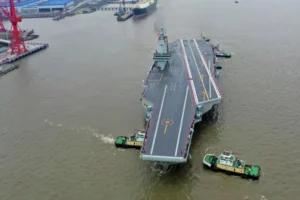
However, the Fujian’s electromagnetic catapults for launching carrier-based fighter jets are currently only available on the latest American Gerald Ford-class destroyer. These catapults provide a smoother acceleration compared to traditional steam catapults, allowing for adjustable speed based on the aircraft’s weight. Additionally, they require less space on the ship due to their simpler design.
The superstructure and two elevators are located on the starboard side, just like on the Shandong aircraft carrier. The elevators now lift two aircraft instead of one, which is a significant improvement. Additionally, the superstructure has been compacted to accommodate the flight control center, a phased array radar station, and communication equipment.
The Fujian does not carry offensive weapons, and its air defense is limited to Type 730 rapid-fire anti-aircraft guns and the HQ-10 short-range surface-to-air missile system. Its main striking force consists of J-35 and J-15T/DT multi-purpose fighters, KJ-600 long-range radar detection and control aircraft, and Z-20 helicopters.
It is claimed that the Fujian is capable of carrying more than 50 aircraft, not including UAVs.The latest fifth-generation J-35 carrier-based fighter jets are particularly interesting. The prototype first took to the air in 2021, and the J-35 successfully completed flight tests in 2024. According to Chinese media reports, the fighter jet is highly stealthy, with an effective radar cross-section (RCS) smaller than a human palm. It is capable of carrying a wide range of weapons, including the PL-17 air-to-air missile with a range of up to 400 kilometers. Together with the J-35 AWACS aircraft, they will be able to monitor all approaches to the carrier strike group.

Jin Canrong, deputy director of the Institute of International Studies at the Chinese People’s University, told the Global Times newspaper that Fujian was built to counter the so-called second island chain of US deterrence, which runs through the island of Guam.
“The Americans have deployed three island chains around us,” he explained.
“The first is Okinawa, Taiwan, and the Philippines, the second is Guam, and the third is Hawaii.
In fact, we have already extended our deterrence to the second. Taiwan is a key node in the first, where we have a significant advantage. Therefore, its destruction is not a problem for China, although Beijing’s policy towards Taiwan remains focused on peaceful reunification.”
China is clearly planning to challenge the hegemony of the all-powerful US Navy in the Pacific. And three aircraft carriers are not the limit. According to media reports, a full-scale model of a fourth aircraft carrier has been built in Wuhan. It is estimated to have a displacement of 115,000 tons, a length of 340 meters, and a width of 83 meters. It is expected to have a top speed of over 30 knots (50 kilometers per hour). The carrier will be equipped with a flight deck capable of carrying 60 to 80 aircraft, helicopters, and heavy drones. This ship is expected to have a nuclear power plant.
“China is consistently increasing its ability to conduct operations far from its territory,” said Dmitry Stefanovich, a researcher at the Center for International Security at the Institute of World Economy and International Relations of the Russian Academy of Sciences. “This is impossible without an aircraft carrier, especially since Beijing has a maritime component to its Belt and Road Initiative.
China also has an active policy in Africa, and Pakistan should not be forgotten. However, it is clear that the United States is the most concerned about Chinese aircraft carriers.”
And the US shipbuilding industry is cutting its budget. Just this year, the Pentagon abandoned the construction of two Virginia-class submarines and two Arleigh Burke-class destroyers. The Ticonderoga cruiser fleet is gradually declining: all of them have more than 30 years of service. Noticeably outdated shipyards do not have enough capacity either.
The PLA Navy already surpasses the U.S. Navy in terms of the number of warships and submarines. Beijing is also ahead of Washington in terms of the pace of construction and commissioning of new ships.
The only thing missing to become one of the most powerful naval powers was an aircraft carrier fleet. Now China has one.
with Glenn Diesen
Emmanuel Todd is a historical demographer, a best-selling author, and a leading intellectual in France. Emmanuel Todd predicted the collapse of the Soviet Union in 1976, predicted the exhaustion and decline of the US Empire in 2001, and now predicts the irreversible defeat of the West in his new book: La Défaite de l’Occident
With Judge Napolitano, Judging Freedom
Talkin’ to The Judge on Timur Trump, the Secretary of Forever Wars, plus assorted horrors. Frank Zappa: the torture NEVER stops.
I’m so glad Pepe Escobar paid attention as I did not. That EU nomenclature is so off-putting and when I saw Kaja Kallas, I left the room.
Pepe says: “Petro absolutely RIPPED at the CELAC-EU summit in Santa Marta. A historical/civilizational lesson – delivered in fabulously articulated Spanish. Wonder whether those EU warmongers could even begin to get the message.”
Gustavo Petro is a leader. He needs some seasoning but he has all the talent, the force and presence of personality and the deep knowledge of his region and its history, necessary. History was made.
Gustavo Petro is now, even if only in my eyes, the Ibrahim Traoré of Latin America. Those that know me, know that I act on these impulses and I will send a recommendation to the Foreign Offices of both Burkina Faso and Colombia to “Get together and be alright”. Traoré has combined in the Sahel Alliance the areas that were torn apart through abject colonialism. Petro is only starting the process. They are both sons of guerrilla movements who selected peace as the path forward. They may just have something to talk about. https://sovereignista.com/2025/07/21/ebrahim-traore-a-new-african-covenant/
I formally hand my personal crown to Gustavo Petro, since Evo Morales, the first indigenous leader in Bolivia and in the LAC, lost it via extreme meddling. (Of course one cannot have an indigenous leader on the pink side succeed. What will people say? This was a sad story). There are also strong historical similarities with Jose “Pepe” Mujica (rip), that wonderful man from Uruguay who was the first Latin American leader that I adored. We have the talent and the knowledge. We only need to get rid of the empire.
You can turn on English subtitles on the video, but I so hope some kind soul translates it for us, to try and maintain that articulated quite exceptional but also flowing, non-complicated and non-pretentious Spanish. Early on, he talks about barbarians and barbarity. He then goes into the LAC history, in a way that I’ve never seen it expressed. He touches on his call to again revive and unify Gran Colombia, a confederation of Latin American nations, echoing Simón Bolívar’s integrationist vision. https://english.almayadeen.net/news/politics/petro-renews-call-for-gran-colombia-union-to-unify-latin-ame
—
Colombian President Gustavo Petro delivers a historic address at the 4th EU–CELAC Summit in Santa Marta, highlighting the struggle for democracy, the importance of global dialogue, and Latin America’s role as a beacon for free humanity. He calls for action against modern barbarity, honoring Indigenous and Afro-descendant heritage while promoting peace, diversity, and cooperation.
DRM News Provides Live Coverage From SANTA MARTA Where Leaders from Latin American, Caribbean, and European Union nations gather for the CELAC–EU Summit, focused on strengthening bi-regional cooperation, sustainable trade, and investment partnerships.
Hosted in the vibrant coastal city of Santa Marta, the summit features discussions on economic growth, climate resilience, digital transformation, and social inclusion — all under the theme of shared prosperity and global partnership.
The event opens with a traditional indigenous ceremony, symbolizing unity between regions and respect for cultural heritage, followed by the official heads-of-state photo and plenary sessions with European and Latin American leaders.
Discover why middle powers are transforming global economics through BRICS+ and how the “middle power trap” is reshaping international relations forever.
[Note: What is called ‘middle powers΅ we may know better as ‘nodes’ as in multipolar and multinodal system. I also leave a short note here from Radhika Desai on a future conversation that will take place: “I don’t think multipolarity is an ideology. It’s a development. As for what should be done to advance it further, Russia and China are supporting multilateralism and the UN Charter and the various Chinese initiatives such as the GDI, GSI etc.”].
Middle powers like Malaysia, Indonesia, Thailand, Vietnam, Saudi Arabia, Egypt, and Ethiopia are breaking barriers in the current global order by turning to BRICS+ as their preferred platform. This video explores how BRICS+ Analytics expert Yaroslav Lissovolik, a friend of the Think BRICS channel, reveals the middle power trap constraining these emerging economies in traditional institutions like the IMF, World Bank, and WTO.
Learn how BRICS+ offers an inclusive platform for middle powers seeking a stronger geopolitical voice and strategic partnerships. We examine Ethiopia’s consistent 6%+ growth rates from 2020-2025 and Vietnam’s 5%+ annual economic growth, demonstrating why these regional integration leaders are driving global south cooperation.
Discover how BRICS+ accommodates diverse developing economies through multipolarity, enabling trade diversification and South-South cooperation. The video explains how middle powers face constraints in current governance structures where advanced economies hold disproportionate voting shares, while smaller countries dilute their influence in organizations like the United Nations.
This analysis covers how BRICS+ creates opportunities for small dynamic economies like UAE, Qatar, Kuwait, Uruguay, and Singapore to form specialized platforms within the broader alliance. We explore regional integration arrangements and how middle powers are becoming vocal drivers of the transformation of emerging economies.
This video does not discuss specific development finance mechanisms, detailed New Development Bank operations, or comprehensive trade diversification statistics. We don’t cover individual BRICS+ application processes, bilateral agreements between member states, or governance reform timelines. The analysis excludes currency arrangements, infrastructure project specifics, or detailed economic policy comparisons between traditional institutions and BRICS+ alternatives for strategic partnerships development.
#BRICS #emergingeconomies #globaleconomy
00:00 – BRICS+ has transformed into a diverse alliance of developing and middle powers.
01:17 – Middle Powers are increasingly integrating through regional blocs like ASEAN and GCC.
02:20 – Middle powers like Vietnam are increasingly influential in the global economy.
03:30 – Middle powers are increasingly seeking cooperation within BRICS+ due to global economic limitations.
04:48 – Middle powers seek BRICS+ for better global representation and influence.
05:58 – Middle powers are fostering regional integration in the Global South through BRICS+.
07:13 – Small economies are exploring partnerships with BRICS+ for development cooperation.
08:34 – BRICS+ serves as an inclusive platform for developing economies’ global expression.
… it’s not so easy to escape from a war you started yourself, leaving your allies to fend for themselves.
By Rostislav Ishchenko at Ukraine.ru.
(machine translation)
We are currently facing a moment of truth: either Russia will be able to complete its military operation in Ukraine within the next three to five months with a victory that will be unassailable by even the most ardent domestic skeptics, or the danger of a global confrontation will increase dramatically. On the external front, criticism will always be present, and our achievements will always be subject to discrediting, as there will always be forces seeking revenge and continuing the global confrontation. The format of peace in Ukraine should not leave any chance for foreign revanchists to ignite a new conflict in the next 10-20 years (it is impossible to make realistic plans for a longer period under the current conditions).
Until recently, the pace and direction of the Russian Armed Forces’ offensive indicated their intention, under favorable conditions, to defeat the most combat-ready Ukrainian forces assembled in the area from Kharkov to Pokrovsk and reach the Kherson-Zaporozhye-Dnepropetrovsk-Pavlograd-Kharkov line, with the expectation that a catastrophe on the front and the loss of new territories would make both the Kiev regime and its Western allies more constructive, leading to a peace agreement that would leave Ukraine without Novorossiya and thus severely undermine its demographic and industrial mobilization capabilities. In general, Kiev could lose up to 10 regions that were part of Ukraine in 1991 (Crimea, Sevastopol, the Donetsk and Luhansk People’s Republics, the Zaporizhzhia and Kherson regions, which have already become part of Russia, as well as the Dnipropetrovsk, Kharkov, Nikolaiv, and Odesa regions, which still need to be liberated).
Given that Dmitry Medvedev had been much more radical about the scope of future territorial changes throughout the summer (not excluding the possibility of Ukraine’s complete elimination), Moscow clearly wanted to demonstrate to its “partners” that there was an influential group within the Russian leadership advocating a more aggressive peace plan that would exclude Kyiv from the negotiation process and establish peace directly with those Western countries that were willing to accept it. Ukraine and those Western countries that were unwilling to take a constructive stance would be the ones to pay for the peace.
Judging by the way events unfolded since the meeting in Anchorage, and the careful nature of the Russian leadership’s statements regarding a peaceful resolution, Trump agreed to at least attempt to follow this path. However, it soon became apparent that the United States lacked European allies in its readiness for a compromise peace with Russia. Europe, in general, and its leading countries, in particular, supported Zelensky’s uncompromising stance. After some hesitation, and under serious pressure from American supporters of a hard line on Russia, including several members of his own team, Trump abandoned the idea of a separate peace with Russia and moved on to a “no peace, no war” project, in which the United States does not directly participate in the European crisis, but also does not seek a global compromise with Russia. Washington agreed to sell all types of weapons to its European partners and withdrew from restraining the provocative nature of their policies towards Russia. The principle was “Let Europe fight Russia if they want, and the United States will benefit.”

But it’s not so easy to escape from a war you started yourself, leaving your allies to fend for themselves. The Europeans, taking advantage of the Americans’ statement that they are willing to sell any type of conventional weapons in any quantity, have demanded that Ukraine receive at least several hundred long-range missiles. While the official request is for Tomahawk missiles, it is more likely that Ukraine will receive less powerful but equally long-range missiles of other types. However, the transfer of a certain number of Tomahawks, at least for the purpose of testing them against Russian air defense systems in real large-scale combat operations, is also not ruled out.
The transfer of long-range missiles to Ukraine will raise the question of a Russian response. Despite Moscow’s attempts to avoid another escalation, a response targeting the military infrastructure of countries that have provided missile weapons to the Kiev regime would quickly become inevitable. In this regard, Poland is the most vulnerable country, as it is home to the main hub for the supply of Western weapons to Ukraine, and it is actively involved in lobbying for Kiev’s interests and disrupting any negotiations for a compromise peace with Russia. Additionally, Poland hosts American troops, including the Aegis missile defense system, which could potentially be used for both missile defense and Tomahawk missile launches. In any case, the use of Kalibr, Iskander, or Kinzhal against a NATO military facility on NATO territory would have raised the question of NATO’s response. The situation threatens to spiral out of political control.
Judging by the latest actions of the Russian Armed Forces, Moscow has decided to accelerate the operation to defeat and destroy the most combat-ready units of the Ukrainian Armed Forces as much as possible and to give it more profound and decisive goals. This is a kind of response to the deployment of missiles before it takes place, in order to make this provocation meaningless.
Experience tells us that if the transfer of a particular type of weapon has become the subject of public discussion, it means that the Kiev regime will have access to that weapon in the near future. Initially, in a few instances, and then in a more significant number. Therefore, the sooner there is no one to transfer the weapon, the better.
In recent weeks, the Russian Armed Forces have been launching increasingly powerful strikes on Ukraine’s energy and railway infrastructure. As a result, all major Ukrainian cities, from the eastern border to the Dnieper River, have been plunged into darkness. Ukraine has also stated that Russia is attempting to logistically isolate the entire Left Bank region, including the Chernihiv and Sumy regions. This isolation is being carried out both before and during the offensive operation to prevent the enemy from maneuvering forces and resources and transferring reserves and supplies from the rear to the front, or at least to severely limit such capabilities.
Since the Russian Armed Forces are already conducting an offensive operation on the left bank of the Dnieper River with decisive goals, the sharp increase in missile strikes on Ukrainian rear areas should indicate Russia’s attempt to accelerate the pace of the operation without increasing its own losses, by leveraging its advantage in production and the number of missiles and UAVs it has accumulated compared to the collective West supplying Ukraine. Russia’s actions to isolate the combat zone and significantly reduce Ukraine’s ability to promptly repair equipment and produce UAVs in “garage” settings are effective in the short and medium term. Then, if the enemy is still alive, they gradually find ways to overcome the crisis, while their own strike forces are depleted, their reserves need to be replenished, and the intensity of their strikes decreases.
It could be assumed that Moscow is simply trying to speed up the operation to defeat the Kharkov-Donbass group of the Armed Forces of Ukraine, but the expansion of the geography of attacks on Kiev, Odessa, Chernihiv and Sumy suggests that while maintaining the previous goals of the operation, the maximum program is also considered as a minimum program: in case of successful development of the offensive, expand its geography to the limits of February- March 2022, to reach the Dnieper River along its entire course, if conditions allow, to occupy several strategic bridgeheads (the right bank of the Kherson region, the districts of Dnepropetrovsk, Zaporozhye. Kremenchug and Kiev) and in the face of a full — scale catastrophe of the Ukrainian front, either dictate ultimatum peace terms to the Ukrainian authorities, or continue the pursuit of the APU further (possibly to the western border, but at least to the Zhytomyr-Vinnytsia line, which provides Russia with security from almost all types of non-strategic weapons in service with NATO).
Today, only the complete exclusion of Ukraine from the game on the Western side gives a fairly high, albeit not 100% chance, of avoiding the development of a Russia/NATO missile crisis, which will immediately acquire a partial global character in addition to its European nature. The acceleration of the operation against Ukraine is possible only through the maximum intensification of attacks on the rear: the maximum use of Russia’s air and space superiority, which will serve not only as an effective means of combating the Armed Forces of Ukraine but also as a demonstration and warning to Europeans who wish to wage war against Russia.
The window of opportunity for Russia is not wide open, but it is ajar, and it is into this gap that Russian missiles will have to fly in order to make it a gateway to a victorious world.
Viewed as a global strategy, Russia is performing a balancing act here, intently testing the US-imposed ‘rules-based system’ in West Asia. By boosting military ties with Iran, Russia underscores that the post-World War international order defined by a ‘rules-based system’ has become an aberration..
By Ambassador MK Bhadrakumar at the Deccan Herald.
An uneasy calm has settled over the Gulf region since a hastily brokered ceasefire ended the 12-day conflict between Israel and Iran in June. But the protagonists lost no time to prepare for a second round that both anticipate to be apocalyptic. For Israel’s Prime Minister Benjamin Netanyahu, this is the last chance to realise his 25-year-old dream of regime change in Iran, even as Israel’s international isolation is deepening, the spectre of a Palestine State looms ahead, and Iran is steadily boosting its deterrent capability.
Iran’s BRICS membership gives it a diplomatic reach as never before; the ties with Russia and China have assumed the nature of an entente cordiale. The Russian-Iranian Treaty of Comprehensive Strategic Partnership came into effect on October 2, within a week of E3 members of the JCPOA reimposing, with the US leading from rear, a priori additional sanctions on Iran.
The Moscow announcement highlighted the security implications of the treaty by flagging that the document ‘stipulates tighter interaction on the international stage in conditions of the emerging multipolar world, including close coordination within the leading multilateral associations, joint efforts to strengthen stability and security in the region, as well as countering common threats and challenges.’ The accent on security is striking, hinting that Moscow won’t be a bystander in a future Israeli attack on Iran. Indeed, Russian-Israeli ties have sharply deteriorated lately due to growing evidence of Mossad’s tie-up with Britain’s MI6 in Ukraine’s terrorist attacks on Russian territory.
On its part, Iran has tweaked its longstanding policy not to take foreign help to safeguard national defence. Suffice to say, the overall military balance in West Asia is shifting. Both Russia and China have questioned the legitimacy of the contrived Western move to reimpose JCPOA sanctions on the eve of Russia assuming the presidency of the UN Security Council on October 1. The Termination Day of the JCPOA is set for October 18, 2025, 10 years after Adoption Day. According to the JCPOA, 10 years after adoption day, all remaining UN and EU sanctions against Iran should have been terminated.
Russia and Iran, in a defiant move, signed a $25-billion deal last week to build four nuclear power plants in Sirik, which is a doubling down of bilateral co-operation in nuclear technology transfer. As of now, Iran has only the Bushehr NPP built by Russia. Russia and Iran are cocking a snook at the Donald Trump administration at this juncture, when the nuclear talks have broken down and the whereabouts of the enriched uranium stock remains unknown, and IAEA inspectors have no access.
Moscow is indebted to Tehran for providing drone technology that has been crucially effective in Ukraine, while China has been traditionally Iran’s main arms supplier. But Russia and China will not send in troops (which Iran doesn’t need), and instead will outfit Tehran appropriately. The US is in no position in any way to wage a continental war in Iran, which is roughly half the size of India. Even more than the nuclear issue, what is worrisome for the US and Israel is Iran’s success in developing advanced missile technology, which may now have Russian and Chinese support.
In these changed circumstances, the situation around Iran has the potential to bring the US and Russia into a military confrontation, which, of course, neither superpower wants. In principle, this contradiction should discourage Trump from joining any Israeli attack, but in reality, with the Epstein files hanging like a Damocles’ sword on his political future, combined with the powerful Jewish lobby’s control of Congress and Beltway, it is Netanyahu who will call the shots.
Viewed as a global strategy, Russia is performing a balancing act here, intently testing the US-imposed ‘rules-based system’ in West Asia. By boosting military ties with Iran, Russia underscores that the post-World War international order defined by a ‘rules-based system’ has become an aberration, a fragile and artificial construct, sustained only by deliberate US power. Interestingly, Russia has also strongly denounced Washington’s ‘increasing escalation’ against Venezuela.
The influential Iranian news website Nournews has called the Iran-Russia Treaty “a part of the new architecture of international relations, particularly meaningful within the frameworks of BRICS, the Shanghai Cooperation Organization, and the Eurasian Union… Iran’s strategic alignment with Russia, complementing its 25-year agreement with China and convergence with other countries, symbolises the structural transformations of the global order, in which political and economic independence will replace subordination to domination.”
There is no question that maintaining the rules-based system to provide the underpinning of Israel’s security is becoming a fraught endeavour going forward. The ecosystem is no longer hospitable for Israel anyway, and there is little that Washington can do to restore the status quo ante.
Israel may repeat a surprise attack, but Iran is prepared for war. Decapitation as a strategy won’t work this time. Critical weapon systems have been dispersed all over the country. Air defence capability is much better than before. Iran will not necessarily exercise restraint this time and will use all means at its disposal to defend, since this is a fight to the finish, including the blockade of the Strait of Hormuz and attacks on US bases.
Against this backdrop, Trump announced on September 29 an extraordinary security pact between the US and Qatar, where the Central Command is headquartered, almost mirroring aspects of a Nato alliance. At first glance, Trump’s move may seem to lay down a marker affecting the fragile and combustible regional dynamics. However, according to former US ambassador to Israel Dan Shapiro, a simpler explanation is to see the executive order as more of an extraordinary prize for the ruling Al Thani family while seeking a quid pro quo from the emir to cajole Hamas’ Doha-based leadership to voice support for the Gaza Plan. Coincidence or not, Hamas and Israel began indirect talks in Sharm El-Sheikh, Egypt, on Monday.
Meanwhile, the US military build-up of aircraft, ammunition, missiles, refuelling capabilities, and the reallocation of vessels at sea in and around the Gulf region on such a massive scale is ominous. Keeping armed forces in hype for a prolonged period is impractical. The Pentagon must pull the trigger sooner rather than later, or, will have to stand down. But standing down will mean that the apocalyptic high noon passes and the paradigm shift in the geopolitics of Iran becomes a fait accompli for the US and Israel.
History will register that the first week of September 2025 propelled the advent of the Eurasia Century to a whole new level.
By Pepe Escobar at Sputnik.
That was the expectation ahead of three crucial intertwined dates: the SCO annual summit in Tianjin; the Victory Day parade in Beijing; and the Eastern Economic Forum in Vladivostok.
Yet expectations were even surpassed considering the breadth and scope of what just happened.
The SCO in Tianjin solidified the Chinese push for the establishment of true Global Governance – which in practice means the unceremonious burying of the “rules-based international order” that under the new US administration has metastasized into a no-rules based international chaos: essentially an ethos of “we’ll blow up the world if we are not able to control it.”
Tianjin had not only the 10 SCO full members but also 2 observers and 15 partners – with a heavy Southeast Asian presence – discussing the finer points to be observed for peaceful development. The pic of the week, if not the year or decade, was the Putin, Xi and Modi trilateral handshake: the return of the original, Primakov-coined RIC (Russia-India-China) in full force. As Professor Zhang Weiwei of Fudan University remarked in Vladivostok, the SCO is now expanding steadily in three platforms: energy; clean industries; and AI. In parallel, Central Asia is finally being seen as a “geographical blessing”, and not “a curse”.
Immediately after Tianjin, the Russia-China strategic partnership also shot up to a whole new level, as President Putin was received by President Xi at the Zhongnanhai, the official residence of the Chinese head of state, for an across-the-spectrum state of the planet recap.
The next day Beijing was resplendent under blue skies overseeing the stunning military parade celebrating the 80th anniversary of the Chinese victory over Japanese invasion and the Asian chapter of Nazi-fascism. That was a confident geoeconomic superpower showing off its military progress.
On the same day the Eastern Economic Forum started in Vladivostok: an unrivalled platform for discussing the surge of pan-Eurasia business.
What China has proposed, actually reiterated in Tianjin, goes way beyond the concept of wangdao, referring to an enlightened, benign power, but not a Hegemon. What could be described as the trademark motto of a Pax Sinica under Xi could be summed up as Make Trade, Not War – and for the common good, or community of a shared future”, in Beijing terminology.
SCO partners, as well as BRICS partners, fully understand that China does not intend to replace Pax Americana, which always relied on the – now aptly renamed – Department of War’s gunboat “diplomacy”. Whatever hysteria fits the West may throw – manipulating Tibet, Hong Kong, Xinjiang, South China Sea, Taiwan – won’t deviate Beijing from its civilizational inclusive path.

The birth of a new logistics order
The road from Tianjin to Vladivostok mostly evolved on three interconnected fronts; oil and gas; connectivity corridors; and massive economic development.
The collective West simply cannot get rid of its pathology of perennialy underestimating the East. For years, both BRICS and SCO were derided in Washington as irrelevant talk shops. But it’s the multilateral spirit that allows something groundbreaking like the Power of Siberia-2 to come to light.
Power of Siberia-2 was planned several years ago, but it was difficult to find consensus on the final route. Gazprom preferred Western Siberia to Xinjiang, across the Altai mountains. The Chinese wanted transit via Mongolia, straight into central China.
The Mongolian route eventually prevailed. It was decided two years ago, and in the last few weeks, the final pricing mechanism, respecting market rates. This massive geoeconomic game-changer means that the gas from the Yamal peninsula that would supply Europe via the Nord Streams will supply China.
President Putin’s expose at the plenary session in Vladivostok placed particular emphasis on energy and connectivity.
But to track the devil in the details nothing could beat the arguably two top panels at the forum.
One of them discussed the integrated development of the Arctic and the Russian Far East, with special insights by Vladimir Panov, who not only is Rosatom’s top expert on the Arctic but also the Deputy Chairman of the State Commission on Arctic Development.
Another panel really dug deep , tracing a parallel between the origins of the Northern Sea Route (NSR), 500 years ago – when Russian diplomat Dmitry Gerasimov drew up the first draft of the Northern Sea Route and the first map of the Arctic Ocean and Muscovy coastlines – and the 21st century technology challenges.
This panel featured a particular striking expose by the CEO of Rosatom, Aleksey Likhachev, complemented by experts such as Sergey Vakhurov, the Deputy Chairman of Russia’s Maritime Collegium. Likhachev detailed the complex shaping of an Arctic corridor, carrying mostly raw materials: a resilient transport corridor for the whole of Northeast Asia.
That’s no less than the birth of a new logistics order – think IA- based weather forecasting plus icebreakers – featuring critical Russian input.
Pepe Escobar wraps up Eastern Economic Forum: Key takeaways on Russia’s global strategy
EEF’s focus was on Russia’s Arctic and Far East development, high-tech growth, energy exploration, and connectivity corridors
— Sputnik (@SputnikInt) September 6, 2025
Will Vladivostok become the next Hong Kong?
So, as Putin stressed in his presentation at the plenary session, the heart of the matter is the Trans-Arctic Transport Corridor: arguably the key 21st century connectivity corridor.
Thus it’s no wonder Vladivostok’s discussions centered around the key role of nuclear energy and nuclear icebreakers in assuring stable shipping along the NSR route, side by side with environmental concerns and the trials and tribulations of securing large-scale investments in energy production, processing and infrastructure building.
All that merged with a timely discussion of the Greater Eurasia Partnership – the crux of Russian geoeconomic policy – with key inputs by Alexey Overchuk, the Deputy Chairman of Russia’s government, and the affable Suhail Khan, the Deputy Secretary-General of the SCO.
An absolutely key takeaway of all these discussions was the startling realignment being operated by Rosatom – which is simultaneously expanding business with China, India and South Korea along the ultra-strategic NSR.
That means, in essence, Russia evaluating all vectors when it comes to organizing full-scale convoy systems for 365 days a year of Arctic navigation: nothing less, once again, than a new economic and technological order.
Now couple all that with a lively discussion of how the Global South and East will be leading the new growth economy.
Sberbank’s CEO Herman Gref, for instance, disclosed that the largest Russian bank has become the second largest in transactions globally, only behind JP Morgan.
Wen Wang, from Renmin University, remarked how China is undergoing a very strong de-Americanization process, in education and tech, pushing “its own knowledge system”.
He foresees huge Russia-China cooperation potential – economic and financial, emphasizing there is a pressing necessity to open financial markets on both sides. That’s how Vladivostok could become the next Hong Kong. Several panelists at the forum observed that Vladivostok has all it takes to become a strategic center for Global South integration.
The Arctic will be at the center of possible business deals between Russians and Americans; serious discussions have been going on since March, including in the recent Putin-Trump meeting.
Amidst the colossal logistics challenges, an economic breakthrough in the Arctic, next to and within Alaska may eventually represent for the US a ticket out of an economic catastrophe. So here the Arctic – which is de facto dominated by Russia – may in the end become a privileged arena to domesticate the Empire of Chaos.
After all Russia has already built extensive, complex infrastructure in the Arctic – upgraded in real time. Mammoth ports, LNG processing, whole cities of workers and technicians, the enormous advantage of the nuclear icebreaker fleet (nine in action, with two more coming), all these advances are Russian intellectual property that can be exploited in dealing with the US.
In the end, these heady few days last week solidified The Future. Grandmaster Lavrov once again delivered the succinct version – commenting on the triple handshake of Putin, Xi and Modi: “A demonstration that three great powers, representing three great civilizations, recognize the commonality of their interests in several areas.”
That’s way more: that’s a new world in the making.
With Nima on Dialogue Works, plus notes from Michael Hudson.
Michael added a note as the transcript for this video will take some time. Enjoy!
US Monopoly in AI strategy 2025
Any country’s trade with the United States can be weaponized by turning it into a dependency relationship.
For many years this is how U.S. strategists used its dominance of grain exports and the world oil trade as a weapon, by threatening to starve China out in its attempt to prevent Mao’s revolution (the sanctions were broken by Canada) and oil exports (by blocking other countries’ option of having an alternative in Russian oil or Iraqi and Syrian oil not controlled by U.S. puppet regimes
In the more technological arena, the United States used arms exports as a similar lever to impose dependency relationships. Purchases of U.S. aircraft, submarines, ships, and other weaponry require almost constant repairs and replacement parts. The United States can turn off the tap to countries using U.S. arms for military purposes not approved by the United States.
The key arena in establishing U.S. technological advantage has become AI. Europe realizes that if Trump succeeds in blocking Europe’s ability to regulate AI, it will lock Europe into reliance on America’s AI and internet platform leaders – and chip makers, and hence U.S. computers and other products in which U.S. national security strategists can assert geo-locators and kill switches.
China recognizes this threat and has recently decided against relying on Nvidia chips in fear of such kill switches being installed.
China’s counter-strategy – and that of Asia and the BRICS as a whole – is to make its AI and related informational technology open source. That prevents (so I’m told) the opportunity to impose backdoors such as geo-locators, kill switches, and spycraft.
Europe recognizes this strategy and is trying to prevent becoming locked into U.S. high-technology sources. This was clearly spelled out in an op-ed by Marietje Schaake in “Beware America’s AI colonialism,” Financial Times (August 21, 2025):
President Donald Trump’s trade wars are teaching the world a harsh lesson: dependencies get weaponised. In the White House’s view, international trade is zero-sum. With his AI Action Plan promising “unchallenged” technological dominance, a further ambition is clear. Will the rest of the world recognise that embracing US artificial intelligence offers Trump an even more potent tool for coercion?
Since his “liberation day” tariffs, the Trump administration has undertaken an aggressive campaign to exact concessions from America’s trading partners. Decades of trade integration mean there is no easy path back to square one. Dependencies run deep and alternative markets, supply chains and flows of goods and services take time to develop.
With AI, there is not yet such global entanglement. So why would any country voluntarily hand more leverage to the White House?
AI is an ideological project for the Trump administration and the AI Action Plan lays out a clear blueprint for US technological hegemony. Its pillars focus on supercharging domestic AI development and adoption, aiming to yield economic benefits and prevent “woke” model use. This is the architecture it hopes the world will embrace.
More than previous technologies, AI systems create uniquely vulnerable dependencies. Algorithms are not transparent and can be manipulated to bias outputs — whether challenging antitrust rules or supporting protectionism. With a significant set of US tech chief executives pledging allegiance to this administration, the synergy between political and corporate agendas is clear. AI companies have even deployed team members in the US armed forces.
The weaponisation possibilities are extensive. Take the Cloud Act, which forces the disclosure of foreign data by domestic cloud providers, whose services dominate worldwide.
It is easy to see how tech can become an even greater bargaining chip in US foreign policy. As with steel or pharmaceuticals, Trump’s White House can simply impose a tariff on AI services or critical elements of the supply chain.
The administration is already pushing the EU to weaken its Digital Services Act and considered leveraging tariffs to force a change to the UK’s online safety laws earlier this year.
What makes AI dependency particularly dangerous is its opacity. Unlike trade in physical goods, AI decisionmaking processes are often black boxes, making subtle manipulation nearly impossible to detect. These systems become deeply embedded in critical processes, with high replacement costs. Many countries already have significant dependencies on US tech companies. Add AI and powerful lock-in effects would intensify. The rapid pace of its evolution makes it difficult for alternative suppliers to maintain competitive alternatives, adding chokepoint effects. With the integration of such technologies in infrastructure, defence and security systems, the stakes are high.
The Trump administration frames the AI race as a competition between democratic and authoritarian models. Yet this obscures a troubling reality: the gap between US and Chinese approaches to technological control is narrowing. Governance grows more authoritarian by the day in Trump’s America, with political interventions reaching individual company levels.
The window for convincing American partners to embrace “full stack” AI exports (where US companies sell access to platforms instead of products) is closing. Governments are learning from their trade war mistakes and investing in sovereign alternatives in the hope of avoiding critical dependencies. Ensuring transparency and security requirements and building in contractual protections against service termination might help in the short term, but coalitions with like-minded democracies to foster alternative AI ecosystems free from unilateral US policy change will be more sustainable.
The choice facing world leaders is not between US or Chinese AI dominance but between technological sovereignty and digital colonialism. Each trade confrontation should teach potential partners that today’s commercial relationships can become tomorrow’s coercive leverage.
Trade wars show how far the Trump administration is willing to go. The AI Action Plan offers the president the means to make that vision more vast and more permanent.
The rest of the world should think twice before volunteering to take part.
The information following is from professional Chinese sources. A Russian discussion on this project follows.
1. Location
• Officially Published:
“The project is located in Mêdog County, Nyingchi City, Tibet (Xizang) Autonomous Region, at the great bend of the lower Yarlung Tsangpo River. It leverages a natural 2,350-meter water drop across just 50 km.”
*(Source: 《中国水电发展”十四五”规划》[China Hydropower Development 14th Five-Year Plan], 2021)*
2. Why China is Building It
• Official Reasons Stated:
Clean Energy Goals: “Critical for achieving China’s carbon peak by 2030 and carbon neutrality by 2060.”
Energy Security: “Will become the largest clean energy base in China, replacing 90 million tons of coal annually.”
Regional Development: “Key project for the ‘Western China Development Strategy’, boosting Tibet’s economy and ethnic unity.”
(Sources: National Energy Administration (NEA) reports; 《西藏自治区能源发展规划》[Tibet Energy Development Plan])
3. Communities Served
• Per State Grid Corporation of China (SGCC):
Tier Service Area
Primary Tibet (Lhasa, Nyingchi, Shigatse)
National Grid Guangdong, Zhejiang, Sichuan (via ±800kV UHVDC lines)
International* Bangladesh, Myanmar (under discussion)
Note: Cross-border supply requires bilateral agreements.
4. Construction Timeline
• Official Estimate (China Hydropower Engineering Association):
Phase 1 (Pre-construction): 2023–2030 (Feasibility studies, environmental assessments)
Phase 2 (Core Construction): 2030–2040 (First 20 GW operational)
Full Completion: 2045+ (Total 60 GW capacity)
“Complex geology (seismic zone) and ecological sensitivity require extended timelines.”
Key Official Concerns Highlighted
Environmental Protection:
“Strict adherence to 《青藏高原生态屏障保护规划》[Tibetan Plateau Ecological Barrier Protection Plan]; 15% of budget allocated to habitat restoration.”
Geopolitical Sensitivity:
“All construction occurs within China’s undisputed territory; cross-border impacts require dialogue.” (Foreign Ministry Statement, 2023)
Direct Quotes from Chinese Sources
• “雅鲁藏布江下游水电开发是落实国家能源安全新战略的重要举措,装机容量可超6000万千瓦。”
Translation: “The lower Yarlung Tsangpo hydropower development is vital for national energy security, with capacity exceeding 60 GW.”
(Source: National Development and Reform Commission (NDRC), 2022)
Official English Translations
China occasionally releases English versions of key policy documents:
《China’s Energy Development Report》 (NEA)
《Tibet’s Green Development White Paper》 (State Council)
China Southern Power Grid reports (partial English editions).
…
The following Russian discussion is by Dmitry Skvortsov, writing for https://vz.ru/world/2025/7/22/1347113.html and titled:
Who is hindered by the creation of a Chinese engineering miracle
China is starting construction of the most expensive project in human history: a series of hydroelectric power plants in Tibet. This project is not only an engineering marvel, but also a crucial element of China’s energy strategy. So why is it facing fierce opposition from other countries?
China has launched the construction of a cascade of hydroelectric power plants in the lower reaches of the Yarlung Tsangpo River in Tibet. The total amount of planned investments will be 1.2 trillion yuan (167 billion US dollars). This is almost five times more than the cost of the previous Chinese mega – project-the Three Gorges hydroelectric power station (254.2 billion yuan). This estimated cost makes the Yarlung Tsangpo Canyon hydroelectric complex the most expensive project in human history.
The Yarlung Tsangpo River originates in the Tibetan Plateau and, after passing through vast heights and sharp drops, forms a canyon that is deeper and longer than the Grand Canyon in the United States. In the construction area, the river makes a giant loop around Mount Namcha Barwa, creating ideal conditions for the construction of a hydroelectric power plant: a sharp drop in elevation, a powerful flow of water, and a naturally narrow canyon.
Hydroelectric power plant builders do not need to use a dam to create a height difference to provide the necessary water pressure. This avoids the need to flood large areas of land, which is inevitable when building large-capacity hydroelectric power plants in flatter areas.
At the same time, the builders will have to overcome many problems. The terrain is extremely difficult, with elevations exceeding 3,000 meters, frequent landslides and mudflows, and tectonic activity requiring the use of earthquake-resistant technologies. Hydrologically, the river is characterized by high seasonal water levels and large fluctuations in water flow.
The projected installed capacity of the plant exceeds 70 GW, which will make it the largest hydroelectric power plant in the world. It surpasses the largest hydroelectric power plant to date (also in China) Three Gorges Dam by more than three times. Its installed capacity is greater than the combined installed capacity of the three largest hydroelectric power plants on earth: Three Gorges Dam (China – 22.5 GW), Baihetan (China – 16 GW), Itaipu (Brazil/Paraguay – 14 GW). This is more than half of the installed capacity of all power plants in countries such as the UK, Italy, or Spain (120–130 GW).
The project will use the latest technologies for tunnel drilling and earthquake-resistant concrete reinforcement. It will also use the latest flow control systems. The project will also include environmental compensation measures. Special attention will be paid to creating a network of reservoirs and cascades that will ensure even generation during seasonal fluctuations.
The scale of the construction project is unprecedented: tens of thousands of workers, hundreds of kilometers of roads and tunnels, and the construction of airfields and logistics centers.
The choice of location for the construction of hydroelectric power plants is not only due to the topography of the area. The Tibetan region remains one of the least electrified areas in China. The remoteness, rugged terrain, and low population density have hindered the development of the power grid. However, the growth of high-altitude cities, infrastructure projects, and tourist destinations requires a reliable power supply.
Since the late 1990s, China has been developing plans for the comprehensive electrification of Tibet. Since 2000, China has initiated the development of 193 hydropower projects in the region. Approximately 60% of these projects are still in the planning or preparation stages. However, the most ambitious project has been selected, located in the Yarlung Tsangpo Gorge. The construction permit was obtained in December 2024, and the official start of construction took place on July 19, 2025.
This hydroelectric power plant should not only provide electricity to Tibet, but also become an important part of the energy transmission system from the west to the east of China, where most of the industrial consumers are located. The installed capacity of the plant will help cover the evening and night peaks when solar generation decreases and wind generation is unstable.
We should not forget about the large-scale deposits of lithium in Tibet. This production is very energy-intensive and impossible without a stable energy supply. The launch of hydroelectric power plants will give a start to the industrial development of Tibet’s mineral and rare-earth reserves.
In China, which plays the role of the “factory of the world,” coal-fired thermal power plants still play a significant role in the electricity sector (1,150 GW, or 34.3% of the total installed capacity of the country’s electricity generation). However, China is also a leader in the development of renewable energy. The installed capacity of solar power plants currently stands at 887 GW (26.5%), while the installed capacity of wind power plants is 520 GW (15.5%).
However, renewable energy sources are unstable. The recent blackouts in Spain and France, caused by sudden changes in grid load, have highlighted the importance of having managed backup capacity. Hydroelectric power plants are one of the best candidates for this role. Unlike solar and wind power, hydroelectric power plants can quickly adjust their generation to adapt to changes in the grid. The Yarlung Tsangpo Hydroelectric Power Plant will serve as a flexible backup capacity as the share of renewable energy increases, reducing the risk of instability.
The announcement of the construction project has sparked expected opposition from China’s geopolitical adversaries. India and Bangladesh have expressed concerns about the project, fearing that the water may be diverted or held back. The Yarlung Tsangpo River becomes the Brahmaputra River as it flows southward into the Indian states of Arunachal Pradesh and Assam, and then into Bangladesh as the Jamuna River. The closure of the river could have significant implications for millions of people living downstream, according to The Guardian.
“China can always use this water as a weapon by blocking it or diverting it elsewhere,” said Niraj Singh Manhas, an analyst at the Jamestown Foundation.
International environmental organizations have also become more active. They express concern about the state of wildlife in the region, as well as the significant tectonic shifts, severe landslides, and extreme geographical conditions in which the dam is expected to be built.
This hydroelectric power plant is especially important for China today, when the United States is preparing to move from a tariff war with China to blocking its access to energy resources. According to the White House, the upcoming economic negotiations with China will include discussions about the need to stop importing Russian and Iranian oil. Beijing is forced to seriously consider the scenarios of forceful blockades of Chinese maritime imports that have been discussed in some English-language media outlets.
In these circumstances, Russian supplies across the land border are not at risk. However, China’s goal is to prioritize energy supply that is independent of maritime oil imports, not only in the north but also in the south of the country.
America’s military humiliation: the Houthis exposed its waning power.
By Malcom Kyeyune at UnHerd.
When, in reaction to the war in Gaza, the Houthis of Yemen started imposing their blockade on the Red Sea, it was seen as a sure sign of waning American power: a global hegemon was allowing its control over a vital sea route to be contested. In their rush to fathom why this might be happening, detractors of the then president claimed he was simply too weak, too much of an appeaser to use the full width of America’s military might to quash the problem.
In fact, in response, Biden authorised not one but two military campaigns. The first was Operation Prosperity Guardian, which aimed to combine US naval power with a coalition of willing states to protect shipping and break the blockade. That fast turned into an embarrassing debacle, as most of the coalition partners walked away and ships kept getting hit by Houthi missiles. And so, in January 2024, Operation Poseidon Archer was launched, which involved British as well as American aircraft attempting to bomb the Houthis into submission. Here again, the operation was unsuccessful, doing almost nothing to dent Houthi attacks or open up the Red Sea to shipping. But even then Biden was blamed; the mighty US military was being held back somehow. Thus, the natural conclusion was that once Trump was in office, the gloves would come off.
Biden’s critics were actually half right. Once Trump came in, the gloves did come off. Operation Poseidon Archer was followed by Operation Rough Rider, in March of this year, which attempted to show a new, much more muscular American military response against Houthi targets in Yemen — for all of six weeks. For six weeks, US warplanes pounded Yemen around the clock, with rare and expensive stealth bombers flying missions out of Diego Garcia in support of carrier-based aircraft. Yet once those six weeks were up, Trump proudly announced that Yemen had “surrendered” and that there was no more need for the US to keep up the bombing. A ceasefire had been brokered by Oman. This was trumpeted as a glorious victory for the US military, with the Houthis finally promising to not attack US ships anymore, and America graciously returning the gesture.
Of course, Trump didn’t mention the terms of the “surrender”. The Houthis only had to stop attacking American ships in exchange for America stopping the bombing; they were free to continue blockading the Red Sea or firing missiles at Israel. America, in other words, had given the Houthis carte blanche to carry on the behaviour that was the reason America had gone to war in the first place. Thus, to call this deal a surrender was entirely appropriate; it’s just that it wasn’t the Houthis hoisting the white flag.
It is very commonplace to blame reversals and even defeats in America’s various wars of choice as merely a matter of lack of will. If America really wanted to win, it would win, the story goes; the failure of the US is just one where it never commits the force necessary to finish the fight. But today, that excuse rings hollow. Trump’s Operation Rough Rider, unlike Biden’s operations, utilised many of America’s most limited, expensive, and advanced weapons to try to bring the Houthis to heel. And still it surrendered. The lessons here are thus quite bleak. America’s preferred and increasingly only viable method of warfare — aerial warfare — is no longer cost-effective nor practical. But the US has no alternative modes of warfare to fall back on, which means that its days as a military hegemon are probably coming to a close.
To understand just how big a mess the air war against the Houthis has turned out to be, it’s important to understand a very basic rule to US military inventories. For while, on paper, America has 11 nuclear-powered aircraft carriers, an impressive figure that far outstrips any other country on the planet, that top line figure is barely relevant in practice.
For comparison, look to the United Kingdom. The UK has two large aircraft carriers, putting it near the top of the international leaderboard when it comes to the ability to project military force. But as anyone with any familiarity with the Royal Navy can tell you, that number does not tell the real story. The number of carriers the UK can actually deploy is far lower, a number which is fairly close to zero. For while the ships exist, the Royal Navy lacks the crew, the planes, the escorts, and the logistical capacity to actually put them to use for any length of time in a real war. The UK Navy has become something of a Potemkin village, where superficial on-paper strengths hide a catastrophic reality of deferred maintenance, insufficient budgets, and lack of personnel.
Though the situation for the US Navy isn’t quite as dire, in practice, the problem is the same: it cannot realistically put more than two to four carriers to sea at any given moment. The ability to surge capacity in times of crisis is limited, because the various reserve components of the US armed forces have catastrophically atrophied. If you discount the American carriers that are slated for the scrapyard, or those currently lacking a functional nuclear reactor, or those which are tied up in deep maintenance, the number of active, usable carriers is roughly a third of the on-paper number. Half of those carriers were being used against the Houthis.
But carriers are not the only example we ought to look at. For Operation Rough Rider, the US Air Force contributed some six B-2 Spirit stealth bombers, arguably the most advanced (and by far the most expensive) airframe in the US arsenal. At first blush, this seems like only a fraction of America’s power, because it has some 20 such bombers in its inventory. But a closer look at these planes suggest that those six used in Rough Rider very likely represent the entire working inventory of US stealth bombers. Because B-2s haven’t been built for decades, the only way to keep them operational is to cannibalise other B-2s for spare parts: as a result, a large number have been functionally scrapped and cannot ever hope to fly again. Only half of US bombers even qualify for so-called “mission capable” status on an average day, a status which doesn’t actually mean that the plane works; it simply means the plane isn’t completely broken and inoperable. Only two thirds or fewer of those mission capable planes can hope to qualify for what the US military instead classifies as “full mission capable” status. “Full mission capable” is your standard Pentagon-speak; it means the plane is in working order, has nothing broken that’s really important, and can realistically be used for what it was built for.
From carriers to stealth bombers, the pattern here is fairly clear, and it is further corroborated by testimonies from inside the Pentagon itself. America essentially pulled out all the stops to attack the Houthis, waging an extremely expensive and intensive air war against a militia controlling most of Yemen, the fourth-poorest nation in the world. The cost to operate a B-2 stealth bomber is extremely high on a per-hour basis; and their fragile stealth coating is not particularly fond of the warm, salty sea air at Diego Garcia. You don’t send in all of them unless you really mean business. America also committed roughly half of its active carriers, spent a fortune in land attack and air defence missiles, and it even cannibalised ammo stores and air defence systems from the Pacific theatre of operations for the sake of the operation.
But as the stories of the campaign start leaking to the press, it’s clear that none of this effort did anything good. The US couldn’t establish air supremacy, meaning it couldn’t risk flying its older, non-stealth planes for fear of losing them. This itself might seem like proof that America was once again just not trying very hard; for what kind of war is it when you’re not ready to accept losses? But the problem is, America can’t afford to replace planes that get lost and pilots that get killed. This is not a problem of cowardice, but of force generation: even if the US military suffers zero losses due to enemy fire in the years ahead, it is still slated to shrink precipitously. This shrinkage and loss of capacity is just due to America’s planes and ships wearing out, with not enough workers, dockyards, engineers, and dollars to replace them. As America burns through its massive military inheritance bequeathed by Ronald Reagan and the Eighties arms race, there is no plan to replace it. For the US military, avoiding casualties is not a matter of caution or cowardice; it is the result of a total inability to replenish the force.
The result of this American Achilles’ heel has been an extremely expensive reliance — when it has come to defending the Red Sea — on so-called “standoff” weaponry; cruise missiles, for example, that can be launched from far enough away that anti-air fire won’t be a threat. But even then, there were problems: according to leaked reports, even the vaunted F-35 stealth fighter had to dodge incoming anti-air missiles on at least one occasion. In Operation Rough Rider, the US deployed many of its most rare and bespoke weapons, such as the AGM-158 JASSM (Joint Air-To-Surface Standoff Missile) as well as heavy, specialised bunker-buster bombs. Again, by all accounts, this had little effect. Partly, this was because the US kept losing so many of its MQ-9 reaper drones, which come with a price tag north of 30 million dollars apiece, and which were supposed to provide the intel to ensure the bombing campaign found its targets.
When Biden first lost interest in defending the Red Sea against the Houthis, people were aghast. Not doing enough was akin to telling the entire world that the US was too weak to keep the Suez channel open. But Trump, after berating his predecessor, has also walked away, and de facto recognised the Houthi’s control of the channel. It would seem that the US doesn’t actually have many cards to play.
Trump could have sent another carrier to the region in support of his operation, bringing the total up to three. But this would hardly have made much difference to the air campaign because the problem with this offensive wasn’t lack of deck space or fighter sorties — US planes were too wary to go anywhere near Yemen’s air defence, and even stealth jets were reportedly not entirely safe. The problem was the lack of standoff munitions which can be deployed from a point of relative safety. But these are so expensive and so limited that there is no budget to replenish them when stores are depleted (a single JASSM with a 450 kilogram explosive warhead comes in at slightly under a million dollars). Wargames show the US running out of most or all such critical munitions in a matter of weeks or even days in a real conflict against a peer enemy such as China.
Even worse, much of the US military’s most advanced weapons systems are dependent on components and materials such as rare earths from China, which has already started imposing harsh export restrictions in order to slowly choke the life out of the US military industrial complex. In practice, the US does not have the economy to produce the weapons used for aerial warfare at any sort of scale, and this has only been hidden from full view because the military has coasted along on an aura of invincibility.
As the appetite for ground warfare has waned, the allure of quick, cheap and easy air campaigns has grown. But air warfare is no longer what it once was. Operation Rough Rider was supposed to be a decisive show of force against an under-equipped, internally divided third-world nation. Instead, it ended up looking like the last hurrah of a truly antiquated form of warfare, unable to cope with cheaper and better anti-air weapon systems.
All of these limitations make the current talk about a new bombing campaign against Iran utterly surreal. Iran is far bigger than Yemen, with a much more robust air defence network. Moreover, the distances involved are such that carrier-based aircraft, even when launched from the very shores of the Persian gulf, can’t actually reach places like Tehran and return on a single tank of fuel. Fighter-bombers will need aerial refuelling over the Iranian interior, and tanker planes are slow, easy to spot on radar, and pretty much defenceless. Even attempting to destroy the Iranian air defence network will take huge amounts of precision standoff weaponry, which the US cannot practically replace, even if it weren’t struggling with a massive fiscal crisis and soaring bond yields. The critical parts of Iran’s nuclear programme are kept under hundreds of feet of solid mountain; the US, using the heaviest and most advanced weapons in its entire arsenal, did not succeed against the much shallower Houthi bunkers and missile storage facilities in Yemen. All of the problems that forced America’s tacit surrender of the Suez canal would be writ large — and be far more lethal — in any campaign against Iran.
With exploding deficits, a growing internal political crisis, and a slowly collapsing military, America is a leopard that lacks the wherewithal to even attempt to change its spots. The generals know that the jig is up: the old model is broken, there is no new model coming, and nobody has the energy left to do much about it all. And so, this massive crisis of US military power is playing out in the vein of Ernest Hemingway’s comment about the course of his own bankruptcy: gradually, then suddenly.
Once upon a time, there was always a bigger plane, a more advanced high-tech future weapon, yet another trick up the Air Force’s sleeve that you could point to in order to silence the doubters. But those days are over. The gravity of what happened in Yemen will only assert itself once the political class is ready to deal with the new world we are now living in: one in which the US has no new military rabbits to pull out of its hat, and those that it does have simply aren’t enough to get anywhere close to victory.
Malcom Kyeyune is a freelance writer living in Uppsala, Sweden
The first ever ASEAN-China-GCC trilateral summit was a de facto celebration of the New Silk Road spirit.
By Pepe Escobar at the Strategic Culture Foundation.
The first ever ASEAN-China-GCC trilateral summit earlier this week in Malaysia – with 17 Global South nations at the table – was a de facto celebration of the New Silk Road spirit.
Malaysian Prime Minister and current ASEAN chair Anwar Ibrahim summed it all up: “From the ancient Silk Road to the vibrant maritime networks of Southeast Asia to modern trade corridors, our peoples have long connected through commerce, culture, and the sharing of ideas.”
That inspires a lot of reflection. Let’s try a first, succint approach matching East and West – and what divides them – guided by an extraordinary study, La Mediterranee Asiatique: XVI-XXI Siecle, by CNRS research director Francois Gipouloux, also a specialist in the Chinese economy.
The European tradition is far from monolithic – and it’s only part of the picture – when it comes to global perceptions about political philosophy and the conception of the State. There are stark differences even when referred to Hobbes, Locke and Rousseau.
The heart of the matter used to be the land/sea opposition. For Carl Schmitt, land/sea relates to friend/enemy – the matrix of politics – providing a key interpretation of world history, yet one among many.
It’s on “continental” Europe – to borrow the Anglo terminology –, mostly in France and Prussia, and not in England, that the Hobbesian concept of the State materialized. Britain became a world power thanks to its navy and trade, eschewing the characteristic institutions of the state such as a written constitution and a legislative codification of law.
Anglo-Saxon international law in fact voided the continental conception of the State and also war. According to Schmitt, it developed its own concepts of “war” and “enemy” out of maritime and trade conflicts which did not make a distinction between combatants and non-combatants (when it comes to its lasting legacy, think “the war on terror”).

My war is Just, because I said so
The opposition then solidified between the right to wage war on land – war is “just” if it happens between sovereign states, via regular armies, and sparing civilians – and waging war on sea, which does not imply a state-to-state relation. What mattered was attacking the trade and the economy of the enemy. And methods of total war were directed against either combatants or non-combatants.
That led to a new Western concept of “Just War” and international law: when the enemy is turned into a criminal, juridical and moral equality between belligerents is shattered.
That’s the perverse logic behind psycho-pathological genocidals legitimizing the destruction of Palestine.
These differences in the formulation of law came out of two different conceptions of space: closed, overland – featuring sovereign states, territorially delimitated – and open, over the seas – a unique space, unlimited, free of every state control, where primacy is about securing communication links. The British did not think about space in terms of territory, but of routes of communication, just like the Portuguese and the Dutch before them.
Schmitt identifies in the State an entity linked to land and territory. So, as startling as it seems, it’s Behemoth, the terrestrial animal of the Old Testament, and not the marine monster Leviathan that should have been chosen by Hobbes as a symbol of the State.
In the development of the West, three institutional forms – equally viable – were in competition: Leagues of Cities – like the Hanseatic Legue; City-States – especially in Italy; and the Nation-State, especially in France.
Few across the West may remember that the Hanseatic League and the powerful Italian city-states, for at least two centuries, were viable alternatives to the territorial state. Two top researchers, Douglass North and Robert Paul Thomas, in The Rise of the Western World: A New Economic History, argue that the modern state was imposed on Western Europe because it was the best equipped to fulfill two key tasks: to efficiently guarantee property rights and the physical security of people and goods.
If we go back to Europe in the 14th century, before the Renaissance, there were at least a thousand states, of all sizes. That means no concentration of power – and some sort of creative competition in store. There was a reasonable amount of choice for those who wanted to find better places to exercise their freedom.
We had for instance Germany, with its three main actors constituted as the Emperor, the nobility and cities; Italy, with its main actors as the Papacy, the Emperor and cities. And France with its three main actors as the King, nobility and cities. In each case, different alliances proliferated.
In Germany, the Emperor allied with the nobility against the cities. In Italy, nobility was urbanized, and cities profited from endless squabbles. In France, nobility was very suspicious of the bourgeoisie, and the King allied himself with the cities against nobility. England chose a completely different path. Even before France, the Brits created a centralized state, but under a quite original political set up.

Asia and the Mandala State
Asia is a completely different story. Here we cannot use the terminology of “state” to designate the political constructions of Southeast Asia before decolonization. In Southeast Asia, the borders were arbitrary between the tribe, so-called “primitive” political formations (from a Western perspective) and the State.
Springing up from political concepts prevailing in India, Islam and the West, states showed up in the Insulindia (maritime Southeast Asia) archipelago, for instance, as courtly bureaucracies, based on a network of complex alliances. Whatever the degree of institutionalization, the distinction between The King, The Vassal and The Bandit was tenuous at best.
Vietnamese researcher Nguyen The-Anh has remarked how “political fragmentation is generally the preliminary conclusion of the first Europeans who made contact with Southeast Asia. Marco Polo saw in the north of Sumatra ‘eight kingdoms and eight crowned Kings…each kingdom possesses its own language.”
China, on the other hand, featured a unitary state imposing – via a quite efficient administration – social order over a vast territory. There was no competition against the centralized state issuing from a landed aristocracy; no urban bourgeoisie; and no military contesting the imperial order, as in Europe. That’s the major difference between China and the West.
Thomas Aquinas decreed that if the power of the king belongs to a multitude, it’s not unjust that the king is deposed or sees his power restrained by this very own multitude if he turns into a tyrant and abuses royal power.
This distinction is completely alien to the Chinese tradition. What happened over the past century or so in China is that the peculiar configuration – and competition – between local actors and central power led to what could be defined as an unstructured empire, whose force comes from its shape-shifting borders and the diffused character of transnational networks.
In a global economy, this gives China an exceptional projection capacity. When borders become fuzzy, and the link between the state and individuals is fuzzy, the unstructured character of this Empire allows the Asian periphery of China to develop in an arc from Japan and the DPRK to Singapore and Indonesia. This is exactly the subtext of some of the key discussions in Kuala Lumpur at the ASEAN-China-GCC summit. Jeffrey Sachs totally got the picture beforehand.
Now, the opposition between a system of international relations deemed “backwards” and irrational in Asia and modern and rational – because based on realpolitik – in the West is over. Cultural factors now shape reality in Asia as well as in the West about the conception of the state and international relations.
China is finally self-assured enough to start disengaging from the current, Western-dominated system of international relations – because it has the means to do so.
The Chinese concept of harmony in international relations used to be linked to the proclamation of a natural order of which China would be the guarantor. But now we are a long way away from the 18th century, when the international environment of the China of 18 provinces was constituted by Korea, Manchuria, Mongolia, Chinese Turkestan, Tibet, Burma, Annam, the Ryuku archipelago and Japan. The Qin dynasty was keen to reassert its suzerainty on the political and cultural domains, assuring the protection of China by managing a belt of favorably disposed states.
Today a self-assured China sees a new system of international relations directly linked to a Belt and Road network of geoeconomic opportunities for all. That underlies the relationship between China and ASEAN, GCC, CELAC, Central Asia and the whole of Africa.

Welcome to the archipelagic world
The world has surpassed the “overland” or “maritime” dilemma, beyond Mackinder and Mahan. The world is now best defined, as Gipouloux coined it, as archipelagic (italics mine), linking urban nebulas of different sizes and vocations.
Globalization accelerated the transformation of a terrestrial world into an archipelagic world. New technologies, economic and financial pressure, disinformation on a mass scale – China is navigating all these rocks in shallow straits in the quest to solidify itself as a global power.
All that implies the progressive, thalassocratic advance of China: a flexible and tolerant Empire (“community of shared destiny for mankind”), a rich confederation with a capacity for global influence supported by polymorphic communities – the “bamboo internet” of the Chinese diaspora.
This is what was on display in Kuala Lumpur – and will continue to evolve via an array of multilateral organizations. Mandala at work, Chinese-style.

 Lateo.net - Flux RSS en pagaille (pour en ajouter : @ moi)