 Connexion


Verily, it is Victory or Martyrdom.
Venezuelans have a “true sense of belonging to a project worth saving.. This is a project of collective self-emancipation. .. Those who are committed to the Bolivarian revolution assume themselves as subjects of transformation, not as victims. And this is something to be reckoned with.”
Video Description:
“I’m joined by Cira Pasqual Marquina, author and educator at the Pluriversidad Patria Grande and co-host with Chris Gilbert of the Marxist education program and podcast Escuela de Cuadros.
I ask her:
≈≈≈

Cira Pascual Marquina interviews at Venezuelanalysis.
The Imperialist Offensive is Nothing New for the Bolivarian Revolution’: A Conversation with Ana Maldonado
A Chavista organizer examines the US militarization of the Caribbean and the Bolivarian Revolution’s enduring resistance to imperial aggression.
In recent months, Washington has stepped up its military presence in the Caribbean, sending warships, aircraft, and even a nuclear submarine to waters near Venezuela amid extrajudicial attacks on fishing vessels. For many, this new phase of aggression is all too familiar — part of a decades-long campaign of hybrid warfare designed to undermine Venezuela’s sovereignty.
In this context, Cira Pascual Marquina spoke with Ana Maldonado, a sociologist, international relations coordinator for the Francisco de Miranda Front—a national Chavista movement—and member of the Venezuelan chapter of ALBA Movements. In this interview, Maldonado offers her perspective on how Venezuelans are experiencing the latest imperialist escalation, reflects on the country’s long resistance to hybrid war, and situates the current threat within the broader struggle for sovereignty in Latin America and the Caribbean.
How are the Venezuelan people experiencing this new imperialist escalation?
President Nicolás Maduro has said that in this scenario of maximum pressure, our response must be maximum preparation. At the same time, he has called on us to combine vigilance with calm, to continue our daily lives, and to defend the peace with social justice that has cost us so much to build and preserve.
You can see this clearly in the fact that, even amid the current military escalation, the new school year began normally across the country. More than 20,000 educational institutions opened their doors without disruption, and over six million children and youth returned to class, as they do every year around this time.
While we are indeed facing a serious threat of war, people are also carrying on with their everyday lives and that, in itself, is a victory, since the enemy seeks precisely to disrupt our life.
People abroad are often surprised to learn that daily routines here continue undisturbed and that Venezuelans are not living in a state of panic. How do you explain this?
This is far from our first encounter with imperialist aggression. The tactics may shift, but the strategy remains unchanged: hybrid warfare. For years, US imperialism and its allies have waged a relentless campaign against Venezuela, beginning in earnest in April 2002 with the coup d’état and the people’s heroic counteroffensive that restored democracy. That was followed by the oil sabotage, mercenary incursions, and global media campaigns against our democracy.
After Comandante Chávez passed in 2013, a new and sustained period of aggression began. Initially, they bet that we would fail to hold peaceful elections or that President Maduro would never be elected. The dominant narrative was “Maduro is not Chávez.” With that simplistic argument, they sought to demoralize the Chavista social base, implying that the Bolivarian project would not withstand the loss of the Comandante. Yet we won the elections and, even as we mourned Chávez, the project continued.
But the US and their local agents were determined not to let us go on with our revolution. In 2014, the opposition launched a violent campaign called “La Salida” [The Exit], led by Voluntad Popular and María Corina Machado, the same factions now openly calling for foreign intervention. The following year, the United States took another war-like step: Obama’s 2015 executive order declaring Venezuela an “unusual and extraordinary threat.”
That decree was followed by the 2016 economic strangulation, marked by deliberate shortages aimed at making everyday life unbearable. Ten years later, we remain under a blockade that has killed tens of thousands.
In 2017, the most extreme factions of the opposition returned to the streets with fascist violence, committing atrocities such as the burning alive of a young Black man, Orlando Figuera, targeted simply for looking like a Chavista. More than 100 people were killed during this period of intensified fascist terror.
President Maduro responded by calling for a National Constituent Assembly, once again raising the banner of peace and democracy in the face of fascist violence. People from all sectors, including residents of middle-class neighborhoods whose polling centers had been attacked, were able to vote in peace at the Poliedro de Caracas.
Since then, we’ve lived through multiple phases of hybrid war: Juan Guaidó’s self-proclamation as “interim president” in 2019 and the “Battle of the Bridges,” when the opposition attempted to stage a false-flag operation on the Colombian border under the guise of a humanitarian aid effort. That was followed by massive blackouts that left the country in darkness for days and the 2020 Operation Gideon, recently further exposed in a Max Blumenthal interview with its US organizer, Jordan Goudreau, a former Green Beret.
None of these were isolated incidents: they are coordinated fronts in a sustained hybrid war combining political, psychological, economic, and military aggression.
Yet, in each of these moments, the government and the organized pueblo have responded effectively. During the 2019 electrical sabotage, for example, communities mobilized to ensure access to water and basic needs, while Operation Gideon was defeated by the same fisherfolk who are now being attacked in the Southern Caribbean.
So, to return to your original question: yes, people are alert because the threat is real, but we are also seasoned and organized. We know we are capable of defending the Revolution with unity and discipline. We are in a phase of maximum preparation, with millions voluntarily enrolling in the militia and preparing for the defense of the Patria [homeland].
Indeed, people are not only enlisting in the Bolivarian Militia but also preparing collectively. You’ve given us a historical account of the attacks faced by the Bolivarian Revolution over the past 25 years. But as we know, the current military buildup in the Caribbean is not only against Venezuela: it is an attack on the continent. How do you understand its broader implications?
The imperialist onslaught on the Caribbean is nothing new. Haiti, still punished today for its revolution more than two centuries ago, remains under siege. Now, armed gangs tied to the Dominican Republic are also involved. Puerto Rico continues to endure capitalist dispossession, with five million Puerto Ricans now living in the US while barely three million remain on the island. All the while, revolutionary Cuba has faced a brutal blockade for many decades.
However, the recent imperialist military buildup should deeply concern the peoples of Latin America and the Caribbean, since it signals a shift in Washington’s military policy. Around 10,000 US troops are currently stationed in the Caribbean, mainly in Puerto Rico, to say nothing of the destroyers, nuclear submarine, and air force deployments.
They are not there only to threaten Venezuela; this is the revival of the Monroe Doctrine. As Trump once said, “Why pay for Venezuelan oil, if we can just take it?” That’s how they think about the resources of the continent.
When it comes to Venezuela, beyond seizing our resources, the US also aims to strip away our sovereignty and destroy the example that we represent. If our project succeeds, it will inspire the entire continent. From Canada to Patagonia, people are struggling for liberation, and the Bolivarian Revolution represents a living example of how that can be done.
Attacking Venezuela serves two purposes: to loot our resources and to extinguish the example of participatory democracy. Since 2021, Venezuela has experienced renewed economic growth and the strengthening of its communes and popular power.
That is precisely what Washington wants to halt: they fear that the peoples of Latin America, and even within the United States, will draw inspiration from our experience.
Why the military escalation at this particular moment?
Trump’s slogan “Make America Great Again” is itself an admission of decline. The US is no longer what it once was, and its elites are desperate to recover lost ground. Yet even within those elites, fractures abound between the neoconservatives, the Zionist zealots, and the MAGA bloc. Their internal contradictions often produce erratic foreign policy decisions.
However, on one point they all agree: war is profitable. The military-industrial complex remains central to sustaining the US economy. So even amid domestic tensions, there is a bipartisan consensus around war as business.
Before the recent attacks on Venezuelan vessels, President Maduro warned that they might attempt to recreate a Gulf of Tonkin incident, because their hunger for war is insatiable. He was right: this aggression is ultimately driven by the economic imperative of feeding the war machine. In a post-Cold War world, it survives through perpetual “hot wars”—and what better front than Venezuela, which is rich in resources and defiant of imperial domination?
Let’s close with Chávez. He declared the Bolivarian Revolution anti-imperialist in 2004, but in truth, it always had a sovereign and anti-imperialist character. Could you reflect on Chávez’s anti-imperialism?
Indeed. The formal declaration came during a historic rally at the Botanical Garden in 2004, but the Revolution was Bolivarian from the start, and Bolívar himself was profoundly anti-imperialist. He warned that the United States seemed “destined by Providence to plague the Americas with misery in the name of liberty.” That same spirit lives in our revolution since day one.
Chávez revived Bolívar’s anti-imperialist legacy as early as 1977, when he created the People’s Army for the Liberation of Venezuela, whose founding document enshrined Bolivarianism and anti-imperialism as guiding principles. Later, in The Blue Book [1991], he outlined the vision of sovereignty and dignity that still guides us. President Maduro calls that text a “historical compass” pointing us steadfastly, no matter how much we have to maneuver, toward our strategic goal: the defense of sovereignty and the rejection of imperial domination.
For us, being anti-imperialist means not only refusing to surrender our resources, but also defending our identity, our dignity, and our very being. The empire’s elites belong nowhere; they want the world to belong to them. We, by contrast, define ourselves by belonging to a land, to a pueblo, and to a history.
That is why even symbolic aggressions, such as the attempt to erase “Bolivarian” from the Republic’s name during the 2002 coup, or mocking us as “venecos” in an attempt to erase our identity, are part of the war.
Bolivarianism and anti-imperialism are also deeply rooted in your organization, the Frente Francisco de Miranda. Can you tell us about it?
Indeed. In 2003, Fidel and Chávez founded the Frente Francisco de Miranda as a movement of Bolivarian, anti-imperialist social workers. However, anti-imperialism isn’t limited to my organization; it’s in the bloodstream of millions of Venezuelans who have resisted International Monetary Fund impositions since 1989 and continue defending the Bolivarian project today.
To be Chavista is to be anti-imperialist. Chávez was the first Latin American president to recognize Palestine, to support the Sahrawi Arab Democratic Republic, and to speak of our historical debt to Haiti. His backing of these and other liberation struggles was not just a matter of words but also about material support. He also linked the defense of Haiti to a history that, for him, didn’t begin with Pétion and Dessalines, but with Hatuey, the first known hero of an anti-colonial Caribbean rebellion.
That is our Chávez—the anti-imperialist Chávez—whose legacy continues to guide us!
≈≈≈
Cira Pascual Marquina is a Political Science professor at the Universidad Bolivariana de Venezuela in Caracas. She is also co‐producer and co‐host (with Chris Gilbert) of the Marxist education program Escuela de Cuadros. She is actively engaged with grassroots organizations in Venezuela and abroad, and is dedicated, both as a militant and as an investigator, to communal initiatives.
Russian Foreign Minister Lavrov: The Anglo-Saxons resisted their creation. They wanted summary mass executions, not justice nor exploration of root causes.
≈≈≈
The fundamental root cause of conflict between the Anglo-American led West and the Rest of Humanity, especially the civilizational-states, is the hypocritical bifurcation in International Law, due to recent precedence of “rules-based order” imposed by the West. This was never agreed to by the others.
It was within artificially created spaces in international law (“one law for thee, one law for me”) that a singular supremacist civilization worked to rule all the others.
“Quod licet Iovi, non licet bovi” the Latin for “What is permissible for Jupiter is not permissible for a cow” is the fundamentally unjust hierarchy of the law of the jungle, intolerable to the civilized. It largely worked until recently as they used to hold the incontestible combination of a monopoly on war of scale and economies and wealth accumulation and set the standards and management criteria on which supranational organizations function. But we are at a moment when these fundamental accumulated imbalances are being corrected. A key mechanism involves the return to the letter and spirit of universally agreed tenets of International Law by all.
Of note, Russia led similar efforts at the fair universal application of one law on all. Just prior to WW1, Russian Tsar Nicholas II was instrumental in the creation of the Hague Conventions of 1899 and 1907, establishing the first formal statements of the laws of war and war crimes in the body of secular international law. And it is not a coincidence, as just before 1914, that under the pressure of being coerced into comity and equal relations with Others, that yet again the western realm currently flees forward into more War in order to maintain their predatory way of life.
≈≈≈
Video description & excerpts:
Russia’s foreign minister Sergey Lavrov said the Soviet Union was the driving force behind establishing the Nuremberg Tribunal, arguing that Western powers initially resisted the idea. He claimed the United States and Britain feared a full investigation would expose their pre-war dealings with Nazi Germany. Lavrov also said some Allied leaders preferred mass executions over legal trials, while Moscow pushed for a formal judicial process. He added that core Nuremberg principles remain under pressure in today’s geopolitical climate.
“Question: What do you consider the historical significance of the Nuremberg trials in the post-war years and how did they influence changes in the global order?
Answer: The Nuremberg Tribunal’s founding principles were first formulated during those trials and have become the foundation of modern international law.
They also largely take into account the achievements of Nuremberg in their work. The particular significance of the Nuremberg judgment lies in its establishment of no statute of limitations for crimes against humanity, genocide and war crimes.
And to our great regret, this decree states that there is no statute of limitations for these crimes and that Nazi ideology, the Nazi party and Nazi structures such as the SS, SD, and others are forever banned. Regrettably, these parts of the decree are currently being seriously tested and are often simply violated.”
Brazilian writer and geopolitical analyst Pepe Escobar’s interview on Al Mayadeen’s The Proximate Aspect dives straight into the shifting fault lines of global power, from the rise of BRICS to China’s quiet technological resilience in the face of Western tech sanctions and Russia’s recalibrated military strategy.
In a wide-ranging interview, Escobar tackles the future of the multipolar order, the strategic significance of Xinjiang, whether Beijing and Moscow are executing a coordinated endgame, and how US policies from Ukraine to Gaza to Latin America are meeting growing resistance across the Global South.
He also weighs in on the impact of US economic measures on Brazil’s foreign policy orientation. It’s a sweeping, provocative map of the world in flux, and one that demands to be watched in full.
 Join George Galloway for the 500th episode of The Mother of All Talk Shows! A milestone night of fearless journalism, sharp debate, and no-holds-barred truth-telling — live on all platforms.
From the ghost of Jeffrey Epstein haunting Washington’s elite to the swamp of Ukraine’s corruption, we’re breaking down the stories the mainstream won’t touch.
 Kim Iversen — Independent journalist and host of The Kim Iversen Show. One of the most outspoken voices challenging corporate media narratives on war, health, and freedom. (Twitter: @KimIversenShow | YouTube: @KimIversen)
Jackson Hinkle — Political analyst and host of Legitimate Targets. A rising voice of the anti-war movement and relentless critic of U.S. foreign policy and establishment media. (Twitter: @jacksonhinklle | YouTube: @thedivewithjacksonhinkle)
Douglas Macgregor is a retired Colonel and former senior advisor to the U.S. Secretary of Defense. Col. Macgregor argues that the war against Ukraine and the pending war against Venezuela reveal a strategic vacuum and decline.
Trump faces his biggest test yet. From courtroom chaos in New York to new wars breaking out abroad, the pressure on the former President has never been higher. Meanwhile, Sudan’s killing fields grow darker by the day — and Washington looks the other way.
Judge Andrew Napolitano — Host of Judging Freedom, former Fox News Senior Judicial Analyst, and one of America’s most outspoken defenders of civil liberty. (Twitter: @Judgenap | YouTube: @JudgingFreedom)
Breaking insight into global power politics, media control, and the battle for truth.
We cover:
– Trump’s Big Apple meltdown — courtroom drama and media frenzy
– Which country will Trump attack first? Nigeria or Venezuela?
– Sudan’s killing fields — the forgotten war nobody wants to talk about
– Gayatri Galloway’s Social Media News Update and your live calls from around the world
 Tonight’s MOATS Poll: Which country will Trump attack first? Nigeria or Venezuela?
An update on Sudan.
The ghosts are back. From Buckingham Palace to Washington DC, the shadow of Jeffrey Epstein looms large once again — haunting the elite, the royals, and the powerful who thought they were untouchable. As new claims emerge against Prince Andrew, the scandal that wouldn’t die resurfaces in time to shake the House of Windsor.
Meanwhile, war rages on in Sudan, where a humanitarian disaster unfolds largely ignored by Western media. And in the Caribbean, the US flexes its military muscle as tensions spread across the globe.
Chris Hedges — Pulitzer Prize-winning journalist, political commentator, and host of The Chris Hedges Report. Breaking down the moral decay of the elite and the global consequences of American empire.
 Mosaab Baba — Sudan researcher and analyst bringing first-hand updates from a country sliding deeper into chaos.
We cover:
– Prince Andrew and the ghosts of Epstein’s empire.
– The fall of the House of Windsor — Giuffre’s “posthumous revenge.”
– The forgotten genocide: Darfur and Sudan’s brutal civil war.
– US strikes in the Caribbean — the empire extends its reach.
– Gayatri Galloway’s Social Media News Update.
– Your calls, questions, and live reactions from around the world.
Putin remains focussed on achieving a new Europe-wide security architecture, writes Alastair Crooke.
Alastair Crooke: Strategic Culture
Trump’s attempt to build a ‘Budapest scenario’ (i.e. a Putin-Trump summit grounded on the earlier Alaska ‘understanding’) was unilaterally cancelled (by the U.S.) amid acrimony. Putin had initiated the 2.5 hr Monday call. It reportedly contained tough talking by Putin about the lack of U.S. preparation towards a political framework – both in respect to Ukraine, but crucially also in respect to Russia’s wider security needs.
However, when it was announced by the American side, Trump’s proposal had reverted (yet again) to the Keith Kellogg (the U.S. Ukraine Envoy) doctrine of a ‘frozen conflict’ on the existing Contact Line preceding any peace negotiations – not vice versa.
Trump must have known well before the Budapest talks were mooted that this Kellogg doctrine had been rejected, time after time, by Moscow. So why did he repeat the demand for it again? In any event, the Budapest summit scenario had to be cancelled after the pre-agreed ‘set-up’ call between Foreign Minister Sergey Lavrov and Secretary of State Marco Rubio ran up against a wall. As Lavrov again insisted that a Kellogg-style ceasefire in place would not fly.
It seems that the U.S. Administration expected that its threats to supply Ukraine with Tomahawk missiles amid toughening U.S. rhetoric of deep strikes into Russia would be pressure enough to have Putin agree a freeze in the here and now format, with all discussion of details and a wider solution postponed, sine die.
Russian military analysts reportedly told Putin that Trump’s threats were bluff — even if the Tomahawk supplies were made available, the quantity would be limited and would not inflict any tactical or strategic defeat on Russia.
The course of events implies that either Trump did not grasp this Russian ‘reality’ – despite two years of repetition that Russia would not budge on a ‘here and now freeze’. Or alternatively, that the ‘dark money’ interests came down hard on Trump, telling him that a real peace process with Russia was not allowed. So Trump cancelled the whole scenario, muttering to the media that a Budapest meeting would have been “a waste of time” — leaving his Administration (U.S. Treasury Secretary Bessent) to announce new sanctions on Russia’s largest oil companies, accompanied by a call to allies to join with them.
Let us recall – the ‘Russian’ reality is that Putin would not want to repeat the mistake of 1918, when Russia signed the humiliating Brest-Litovsk peace, under pressure from Germany. Putin often repeats that it was precisely the pressures to ‘let’s just stop’ in 1918 that cost Russia its status as a major power, and lost it entire generations of Russians. The colossal effort of millions of people was exchanged for the humiliating Brest-Litovsk peace. Chaos and collapse followed.
Putin remains focused on achieving a new Europe-wide security architecture, though Trump’s capriciousness and unseen constraints must put new calls by Putin or meetings into question. Putin is angry — many Russian ‘red lines’ have been crossed; escalation is coming – perhaps at an unprecedented level.
The Europeans, undaunted by the Belgrade meeting cancellation, are touting a ’new/old’ twelve-point plan that would rule out territorial concessions and would prescribe a ceasefire along the current front lines. The western Ruling Strata are making matters abundantly clear: Russia must be defeated. Escalation has already begun: New EU sanctions on Russian gas imports into the EU have been announced and overnight strikes on oil refineries in Hungary and Romania (the latter being a NATO state) were launched. Again, the message to EU states is clear: no backsliding. Polish Prime Minister Donald Tusk underlined on X the point: “All Russian targets in the EU are legitimate”. The EU is clearly willing to go to any length to make war on its own to compel adherence.
Given that the Kiev side finds it impossible to contemplate resiling from any part of its territory – whilst Russia retains the preponderance of hard force – it is hard to see how any negotiation is feasible at this time. Likely, Ukraine will be settled by a trial of strength. The EU urgency to its attempt to win Trump to its side likely reflects its fear of the accelerating and accumulating Russian military victories.
All this Russia turmoil is occurring as Bessent heads to Kuala Lumpur to challenge China’s response to the U.S.’ sudden extension (after holding apparently promising trade talks) of export controls to tech products imported by China. China riposted by promulgating rare earth controls in retaliation.
An angry Trump exploded – threatening China with 100% tariffs. The U.S. stock market, following a well-worn pattern, initially crashed, but Trump quickly posted an upbeat announcement in time for the opening of the ‘futures market’, and buyers piled in, with stocks hitting record highs. For Americans, all was well.
However, last Monday, Trump’s eulogistically positive language towards China – unexpectedly shot-up to volume ‘11’: “I think when we finish our meetings in South Korea [with Xi], China and I will have a really fair and really great trade deal together”, Trump said. He voiced hope that China would resume purchases of American soybeans after imports by Beijing plunged amid the tariff standoff. He also urged China “to stop with the fentanyl”, accusing the Chinese authorities of failing to curb exports of the synthetic opioid and its chemical precursors
And just to ensure that the stock market rocketed to yet a new record high, Trump added that he doesn’t think that ‘China wants to invade Taiwan’.
However, now that Moscow has effectively put a stop to the U.S. ‘Budapest’ scenario, the question is: Will Xi too decide that continuing with Trump capriciousness is worth the inevitable angst (the meeting in South Korea is unconfirmed at this point). And angst seems likely to soar.
Perhaps however, Trump’s shift to such excessively positive language towards China reflects something else: A shock development for Trump and the U.S. possibly?
The newly inaugurated Prime Minister of Japan, Sanae Takaishi, had widely been expected, on taking office, to deliver strong anti-China rhetoric; to strengthen the alliance with the U.S.; to boost Japan’s military power; and to contain Beijing.
Yet, the opposite happened.
In her first address to the nation, Takaishi said that she would not support the U.S. trade war against China, and would not become an instrument of U.S. economic pressure. She openly criticised Trump’s tariff policy, calling it ‘the most dangerous mistake of the 21stcentury’.
Reuters commented that her stance was wholly unexpected in Washington. A big shock. It emerged that since taking office, the new PM had held a series of meetings with the largest Japanese corporations who had conveyed a unified and urgent message to her: Simply – the Japanese economy would not survive another trade war.
Then, one week after taking office, she openly expressed support for China, executing the biggest foreign policy pivot since WW2. China was no longer the ‘enemy’.
A new era in Asia has arrived. Trump is in shock: He accused Takaishi of betraying the principles of free trade. CNN called it a ‘stab in the back’, by a close ally.
But worse was to come: Polls showed the PM enjoyed 60% support for her stance on Japanese economic independence – and more than 50% supported her position on China, too!
Bloomberg dropped a further bombshell: Takaishi has begun – in conjunction with China and South Korea – a strategic recalibration of Asia’s monetary architecture in response to Washington’s growing use of economic power as leverage. China, Japan, and South Korea are building a common currency area. The proposed trilateral swap would allow the three to settle trade, extend liquidity, and manage crises through their own currencies – entirely independently from the West.
Were these projects to mature, it would chip away at the scaffolding of dollar primacy by removing 15% of global trading from the dollar sphere, and would likely see the entire existing (pro-western) Asian balance of power collapse.
It goes further: Takaishi’s vision would mesh with the SCO/BRICS unfolding of its digital clearing system across all of Central Asia. Yet Trump wants the BRICS dismantled, together with any other threats to U.S. dollar hegemony. Expect escalation – more threats of tariffs.
Should China not respond sufficiently enthusiastically to the Trump charm offensive, then matters likely will escalate in tandem with escalations versus Russia (Venezuela and possibly Iran). Trump has already threatened Japan with sanctions, though this seems likely only to push Japan closer to China where the predominance of Japan’s trading interests now lies. A volatile period lies ahead, likely punctuated by violent oscillations in financial markets.
Russia and China remain closely aligned on geo-political issues – and both may have other reasons to keep talking with Trump (if only to avoid inadvertently triggering a financial crisis in the West for which they will be blamed), or for military de-confliction purposes. But it seems that more than for these states alone, the Trump leverage tactics are backfiring – whilst the debt and credit crisis in the U.S. grows ever more acute.
Any of these geo-political trysts could ignite into flames. Ukraine-Russia, Venezuela, Iran, Syria, Lebanon, Pakistan-India and of course Gaza and West Bank, are just some of the hotspots. The situation is brittle; Trump exists beyond strategic analysis, and the Europeans lack any real leadership and are embarked internally on war psychosis.
As the old Viennese saying has it: “In Vienna, the situation is desperate – but not serious” (i.e. have no expectation anyone in the West will react to it with any modicum of sobriety).
Color revolution in Nepal and a slew of other color revolutions – GenZ (CIA and NED branding) is first clue that these are regime change operations. The NED is active and on the job.
-Tomahwaks to Ukraine
-Venezuala regime change
-Chinese Trade wars
The Middle East stands on a knife edge. Ceasefire talks hang by a thread, Gaza mourns its dead, and Israel continues its attacks despite growing international pressure. Meanwhile, Trump eyes a new deal, Europe faces political unrest, and global markets tremble.
Tonight on The Mother of All Talk Shows, George Galloway asks: Will the dead finally break the Gaza peace?
Gerald Celente — Publisher of Trends Journal and founder of the Trends Research Institute. One of the world’s top forecasters, breaking down the economic and political shocks shaping tomorrow’s headlines. (Twitter: @geraldcelente)
Dr. Sabreena Ghaffar-Siddiqui — Activist and former Sociology and Criminology professor, ousted for her outspoken advocacy on Palestine. A fearless voice for justice and human rights. (Twitter: @SabreenaGS)
We cover: – Ceasefire on a knife edge: will peace hold or collapse? – Gaza’s dead remembered — and what they mean for global conscience. – Gerald Celente on the coming economic storms and the politics of fear. – Dr. Sabreena Ghaffar-Siddiqui on speaking truth to power. – Europe’s new populist wave and the decline of global leadership. – Gayatri Galloway’s Social Media News Update. – Your calls, questions, and live reactions.
A documentary of the missilemen of Iran. “…. the one who finishes a War, is the one claimant of expertise.”
https://x.com/AryJeay/status/1974164482088996971
 @Fotros Resistance (Arya – آریا):
Exclusive footages of Iran’s underground missile complexes during the 12-day war.
An IRGC member recalls how they operated inside the deep underground missile tunnels during the 12-day war.
He explains the tunnels were not damaged and everything inside was operational, the only issue was the entrance that sometimes got hit which would delay launches until it’d get dig out.
The tunnels in the footage displays Haj Qassem & Kheybar Shekan missiles.
The IRGC operators says the morale among the IRGC was very high and they did everything to not delay launches.
One of the IRGC members says at one time, an Israeli Hermes drone had hit one of the launchers that caused him to get injured on the spot, but got up and continued working to launch the rest of the missiles.
One of them rejected Israeli ridiculous claims about having bombed Iranian missile capabilities “to dust” and says we’re not even above the ground to bomb us to dust.
MOATS – George Galloway
The countdown to peace — or to war? As Trump’s “Peace Plan” takes centre stage, the Middle East is once again at breaking point.
 Iran and Israel trade new threats, while Gaza remains under siege and the Freedom Flotilla risks everything to deliver aid. Tonight on The Mother of All Talk Shows, George Galloway asks: is peace really possible — or just another illusion?
 Max Blumenthal — Author, journalist, and Editor at The Grayzone News. One of the world’s leading investigative reporters on US foreign policy, media manipulation, and the Israel–Palestine conflict.
Dr. Annelle Rodriguez Sheline — Former US State Department official and Research Fellow for the Middle East at the Quincy Institute. Specialist in diplomacy, religion, and US engagement across the Arab world.
We cover:
– Trump’s Middle East “Peace Plan”: deal or deception?
– Gaza under bombardment as aid convoys are blocked.
– Iran and Israel: a new flashpoint.
– Ukraine, TikTok bans, and the rise of global censorship.
– The Gatwick “terror police” saga continues.
– Greta Thunberg’s climate fight — ignored amid war fever.
– Social Media News Update with Gayatri Galloway.
– Your calls and questions live on-air.
Tonight’s MOATS Poll: Will Trump’s Gaza peace plan succeed?
The shocking truth about the alt media:
Apply this to the channels you listen to and the guests they have on. Then you will come to realise who the charlatans and entertainers are.
Beware of those who craft intricate plots which people believe to be truth tellers. Their evidence doesn’t actually exist, it is just a work of fiction which can’t be proved but more importantly can’t be disproved.
The shocking truth about the alt media:
Apply this to the channels you listen to and the guests they have on. Then you will come to realise who the charlatans and entertainers are.
Beware of those who craft intricate plots which people believe to be truth tellers. Their… pic.twitter.com/pJgd5FLSE1
— The Sirius Report (@thesiriusreport) October 3, 2025
The peace plan – The holocaust, the final soltuion, the genocide, and Tony Blair – presumably satan was not available
The Flotilla
Prof. Seyed Mohammad Marandi
Thiago Ávila — Brazilian activist
Senseless, Ugly, and now Doomed.
There are clear signs that zionist-israel is reaching an end. What this end will be, I don’t know. We just pray and hope that some Gazans and some Palestinians may still be alive when the end dawns.
Three significant issues have surfaced.
The first issue:
A UN investigative body declared in no uncertain terms that zionist-israel is committing genocide. Up to now, the word has been used in legal terms, i.e., we cannot call it genocide until a court of law declares it as such. The previous advisory opinions from the International Court of Justice handled it in this manner and only provided advisory opinions. This advice was correct, yet nobody followed it. Francesca Albanese called it genocide from inception. She received sanctions, irritated many people, and was maligned and sanctioned for it.
Now, the UN investigative body said it. It is genocide.
United Nations Geneva
@UNGeneva
“It is clear there is an intent to destroy the Palestinians in Gaza through acts that meet the criteria set forth in the Genocide Convention.” UN Independent International Commission of Inquiry’s report shows Israel has committed genocide in Gaza.
United Nations Geneva
@UNGeneva
The responsibility for these atrocity crimes lies with Israeli authorities at the highest echelons who have orchestrated a genocidal campaign for almost two years now with the specific intent to destroy the Palestinian group in Gaza says Navi Pillay, Commission Chairperson.
This is the full declaration, which is lengthy and complex.
https://www.ohchr.org/sites/default/files/documents/hrbodies/hrcouncil/sessions-regular/session60/advance-version/a-hrc-60-crp-3.pdf
What does this change? Under the Geneva Genocide Convention, countries have obligations to follow in time of genocide. Very few followed their obligations, and as we know everyone still trades with Israel. Without falling into a legal language rabbithole and broadly stated, the most important of these obligations are to suspend trade with the genocidaire and to do everything in the country’s power to stop or impede the genocide. As we know, nobody did that, except for small efforts like the freedom convoys.
“The Israeli responses are becoming so boring … they’re producing the responses by Chat GPT these days,” says expert human rights lawyer and UN official Chris Sidoti when asked about Israel’s responses to the UN commission of inquiry concluding that it is guilty of committing genocide in Gaza.
The Second Issue
The European countries started a process to declare a Palestinian State. Throughout my life, I’ve watched numerous attempts to achieve this, often well-advertised and sounding very important, and held at Camp David to lend the talks the necessary weight. Anything at Camp David must hold importance, no? Here is an old report from 23 years ago, describing one such process, blaming Arafat at the time for not reaching an agreement. https://www.npr.org/2023/10/19/1207243717/23-years-ago-israelis-and-palestinians-were-talking-about-a-two-state-solution
None of these talks ever reached an end or an agreement. Of course, they were talks for talks and usually used for US Presidential party political purposes. As we can see now, under a defined continuation of governance, the US methodology was never meant to succeed.
Now we have a new process with a planned U.N. conference co-hosted by France and Saudi Arabia on the matter next week, aiming to sway other countries considering this step or those that are wavering. Many countries, including Russia and China, have signed on.
What does this mean?
It is mostly symbolic, as the UNSC still holds to the two-state solution with Jerusalem as a shared capital and borders set as those decided upon in 1967. Only two of Israel’s five total potential land borders are internationally recognized and uncontested, while the other three remain disputed; the majority of its border disputes are rooted in territorial changes that came about as a result of the 1967 Arab–Israeli War. We now have yellow lines and blue lines, and zionist-israel does not take any of those seriously.
Palestine thus has no borders to depend on; hence, this is a symbolic action. It is worthwhile to mention that zionist-israel has not fulfilled even one of the requirements that were set at the time when it was allowed into the United Nations as a State. In the intervening time, they only stole more territory and killed more people. If you have the energy scroll and scan through the actual word-for-word debate to allow Israel into the United Nations back in 1949. Israel made a pledge at the time, and nothing has been fulfilled. The Iraqi representative at the time stated: “The delegation of Iraq considered that the whole question of Palestine had been treated in a manner contrary to the principles of the Charter and of international law and to the ancient principle whereby every country was allotted to the people who inhabited it. In view of those considerations, the delegation of Iraq was of the opinion that the admission of Israel to the United Nations would be the highest consummation of injustice and would drive another nail into the coffin of the United Nations.”

We need to see what happens with this process. As Francesca Albanese says, “I’ll comment when it happens.”
The third issue – internal self-sabotage:
After a lifetime of perfidy, zionist-israel is now committing genocide.
Zionist-israel is showing signs of breaking up internally as pressure against it mounts. Bloody Netanyahu had no choice but to express this, and he said that Israel has no friends and they will have to follow a path of autarky and self-reliance from now on.
The bell is tolling on so many levels. Zionist-israel may try to open a new war front to keep going.
Israelis are moving out, and the last number that I saw was that a million left. Take that number with a grain of salt, as much of the data in this milieu cannot be trusted. It may be more or less, but they are leaving. Yesterday and ongoing through the past months, there were significant protests in front of Bloody Netanyahu’s house because of how he is handling the Hamas hostages (who now are made up of previous IDF soldiers and can be considered prisoners of war), which Israel is not interested in and is actually hoping these hostages will be killed. They can then continue with their cry of “It’s Hamas”. No, it is zionist-israel.
The Emergency Arab-Islamic Summit to discuss the Israeli attack on the State of Qatar is generally reviled. There is, however, one result from this meeting that I do not see anyone talk about, as the drive to hate the Arabs is great, and not without reason. In the final communique the group named genocide:
“Reaffirm that the brutal Israeli blatant aggression against the sisterly State of Qatar, and Israel’s continued aggressive practices, including crimes of genocide, ethnic cleansing, starvation and siege, as well as settlement activities and expansionist policies, undermine prospects for peace and peaceful coexistence in the region.
The zionist-israeli soldiers suffer from post-traumatic stress, and their fighting ability is reducing both in terms of the number of IDF soldiers as well as their willingness to keep fighting. In the Knesset zionist soldiers poured psychiatric drugs on the table about the increase in suicides in the regime’s army.
IDF soldiers just told their own government the truth they try to hide: “We are mentally ill, and our friends are committing suicide.  They flung their psychiatric meds – including fentanyl – on the table to prove their condition.
IDF soldiers have lost their luster and excellence (if they ever were). They are now being hunted where-ever they go, thanks to organizations such as https://www.hindrajabfoundation.org/. These soldiers are beginning to understand that they will be haunted and hunted for the rest of their natural lives, just as if they were old nazis.
As far as Syria is concerned, the zionist entity, despite trying to take Syrian land, is up against a brick wall, called Turkey and Erdogan. It may be a fight of the perfidious, but nevertheless, it brings further pressure on the zionist entity. We are witnessing an open confrontation between Turkey and the Israeli regime; Israel seeks to divide Syria and has the support of the United States in this regard, while Turkey aims to be present in strategic areas and support groups aligned with it. This confrontation could lead to a direct conflict between the two sides.
Syria, despite a river of positive news being seeded, is falling apart.
In this atmosphere of genocide, war, killing, starvation, burning up people in tents, theft and perfidy, a Mossad historian started speaking out.
Mossad historian shreds Netanyahu’s Gaza war: ‘senseless’, ‘ugly’, and doomed
Yossi Melman, an Israeli journalist and expert on Mossad, torched Netanyahu’s Gaza City invasion as reckless and self-serving. https://x.com/yossi_melman/status/1967933515644719568
IDF ground forces began the most sensless war in the hisory of Israel. Two conscript divisions with Merkava tanks, APCs and artilley supported in the skies by the air force are now engaged in the battle to conquer Gaza City. In their tracks, they are seizeing what remains of the…
— Yossi Melman (@yossi_melman) September 16, 2025
“IDF ground forces began the most senseless war in the history of Israel,” Melman tweeted, calling it an “ugly” and “political” move driven by three motives:
1⃣ Netanyahu’s personal survival
2⃣ The coalition’s political survival
3⃣ Pulverizing Gazans into “human dust” to push mass emigration
Melman tied this to the “messianic vision” of Zionists Smotrich and Ben-Gvir – “conquest, dispossession, takeover, creeping annexation and transfer.”
The idea isn’t new:
“There is no place in the country for the two peoples together,” Jewish National Fund leader Yosef Weitz wrote in 1940.
“The only solution is Eretz Israel without Arabs. There is no room here for compromises! Move everyone,” Weitz said. “Leave not a single village, not a single tribe. Only in this way, transfer of the Arabs of Israel, will redemption come.”
Historical echoes:
 1948 — 700,000 Arabs expelled from or fled Palestine
Yitzhak Navon, later president sent to South America to push for resettlement of Palestinians there
After the Six Day War of 1967, Mossad again tried — and failed — to deport Palestinians
Today, Mossad chief David Barnea is lobbying Ethiopia, Indonesia, Somalia and Uganda to take Gazans under a “voluntary migration” plan.
“Netanyahu warned that Israelis must adjust to the notion that ‘our country is like Sparta’. By the way, at the end Sparta was defeated,” Melman concludes.
When even a Mossad historian says it, you know Netanyahu has crossed every line.
Conclusion
What does this mean?
Keeping this short, as the historical backdrop is vast, and without writing books, one can only describe vignettes of this sad and horrible historical phase.
The Resistance is Winning. The cost is immeasurable, but we will win this one. It only needs to unfold further. The US is becoming irrelevant, and they, as well as zionist-israel in a bloody marriage, are in a state of entropy, and in entropy, nothing works. The process itself leads to further entropy as we observe during Late Stage Barbarism.
Infantile clowns are mocked or shunned. As Trump dozed off somewhere, world leaders met in Tianjin.
with gratitude to Linh Dinh at Postcards from the End.

New World Order — Sep 05, 2025.
On 6/16/25, the Hindustan Times reported, “US President Donald Trump was apparently seen dozing off during a military parade as he celebrated his 79th birthday and the 250th anniversary of the US Army.” Notice birthday before anniversary of army’s founding. Some guy named Washington, I think, was first Commander in Chief. Move over on Mount Rushmore, George, or better yet, Donald’s big beautiful face should just be chiseled right into yours.
Creaking tanks and soldiers strolling out of sync, with one grunt holding up a drone, couldn’t hold this bone spurred chicken hawk’s attention for too long. It’s still hurting him.
Trump’s buddy Kim Jung Un had his state TV report, “The capitalist pigs of America held a gaudy and vainglorious display of their dwindling military might this past weekend […] Their inferior leader, pictured here, looking old, confused and tired, sat next to an expensive prostitute and a drunk television host for the duration of the parade.”
Infantile clowns are mocked or shunned. The Telegraph on 8/26/25, “Narendra Modi, the Indian prime minister, has reportedly ignored four phone calls from Donald Trump amid escalating tariff tensions.”
Seven months into Trump’s second reign, the US is more despised and irrelevant than ever. As Trump dozed off somewhere, world leaders met in Tianjin. Modi’s first visit to China in seven years triggered this tantrum by Peter Navarro, “It is a shame to see Modi getting in bed with Xi Jinping and Putin. I’m not sure what he’s thinking.”
As Senior Counselor to the President for Trade and Manufacturing, Navarro has managed to reduce significantly both trade and manufacturing in the USA, so his face must be added, in miniature, to the back of Mount Rushmore?
The Guardian on the Shanghai Cooperation Organization Summit in Tianjin, “They stood together like old friends, heads thrown back in jovial laughter, clutching one another’s hands affectionately. Except this was no ordinary gathering of three men, but a meeting of three of the most powerful non-western leaders: Vladimir Putin, Xi Jinping and Narendra Modi.” With the West already so limp, that modifier “non-western” is superfluous.
Meanwhile in DC, rumors swirled that Trump was even more comatose. Appearing higher than Hunter Biden, Donald Junior had to tell News Max, “I called my father over the weekend to be like, ‘Hey, just want to make sure you’re not dead.’”
Following the Tianjin summit, there’s a monstrous military parade in Beijing, so China had four days to flex its muscles. India Global Today, “This is China displaying weapons, Russia showing resilience, North Korea showing loyalty and India showing independence. Together they projected an image that challenges decades of American dominance. So is this the moment where America loses its grip on world leadership and China takes its place as the new superpower?” Together they projected is correct.

Sidelined, Trump yelped at Xi, “Please give my warmest regards to Vladimir Putin, and Kim Jong Un, as you conspire against The United States of America.”
Xi, “The Chinese nation is a great nation that is never intimidated by any bullies and always values independence and forges ahead. In the past, when faced with critical struggles between good and evil, light and darkness, progress and reaction, the Chinese people rallied together to defy the enemy. They fought for the survival of the country, for the rejuvenation of the Chinese nation and for justice of the whole humanity. Today, humanity again has to choose between peace and war, dialogue and confrontation, win-win cooperation and zero-sum game. The Chinese people firmly stand on the right side of history and the progress of human civilization.”
Xi’s key point here is “survival of the country.” Like Putin, he’s a nationalist. Defense of national interests is how Xi and the Chinese Communist Party can maintain legitimacy and support from ordinary Chinese. His “justice of the whole humanity” is just an old timey Commie tic or flourish and, frankly, sounds too much like Uncle Sam at his most righteous and hypocritical. Indifferent to that, Chinese chests only swelled at this reassurance, “The Chinese nation is a great nation that is never intimidated by any bullies.”
How does one square the Chinese state’s manly display with Chinese freaks like Madison Zhao and International Kid? Western influenced pop culture must be countered by sober policies as directed by sane leaders. Xi, Putin and others are doing that. It is an ongoing battle.
In the US, however, you have blackmailed, avaricious, mendacious and cynical leaders who are warring against their own population. Confused, disunited and, yes, cowardly, Americans appear hopeless against an internal enemy most can’t even identify.
The only European nations that came to Beijing were Serbia, Slovakia, Hungary and Turkey. Serbia was bombed by NATO in 1999, Slovakia’s prime minister was nearly killed last year, Hungary’s Orban is often dubbed a Fascist (for being a nationalist) and Turkey’s Erdogan is just a weasel. As fringe Europeans, they’re actually in better shape than Germany, France or the UK, thanks to their nationalism and demographic coherence. Riots in Belgrade, likely instigated by the USA, is a real danger, though, as they are in Jakarta. Until it croaks, the Empire of Chaos is always busy.
Trump’s trade war is bankrupting American farmers, businesses and just ordinary consumers. With trade deficits against all nations, Uncle Sam has long been a deadbeat. If only he would just lie down, like Trump, and wheeze out with a dozen or so peaceful farts. With so many nukes, he won’t go quietly, though.
About Linh Dinh (@linhdinh):
‘Before being canceled, I was an anthologized poet and fairly prolific author, with my last book Postcards from the End of America. Now, I write about our increasingly sick world for a tiny audience on SubStack. Drifting overly much, I’m in Cambodia.
Born in Saigon, Vietnam in 1963, I lived mostly in the US from 1975 until 2018, but have returned to Vietnam. I’ve also lived in Italy, England and Germany. I’m the author of a non-fiction book, Postcards from the End of America (2017), a novel, Love Like Hate (2010), two books of stories, Fake House (2000) and Blood and Soap (2004), and six collections of poems, with a Collected Poems cancelled by Chax Press from external pressure. I’ve been anthologized in Best American Poetry 2000, 2004, 2007, Great American Prose Poems from Poe to the Present, Postmodern American Poetry: a Norton Anthology (vol. 2) and Flash Fiction International: Very Short Stories From Around the World, etc. I’m also editor of Night, Again: Contemporary Fiction from Vietnam (1996) and The Deluge: New Vietnamese Poetry (2013). My writing has been translated into Japanese, Italian, Spanish, French, Dutch, German, Portuguese, Korean, Arabic, Icelandic, Serbian and Finnish, and I’ve been invited to read in Tokyo, London, Cambridge, Brighton, Paris, Berlin, Leipzig, Halle, Reykjavik, Toronto, Singapore and all over the US. I’ve also published widely in Vietnamese.’
AHH: Please support this wonderful writer on his Substack! Thanks
Experience the future of global governance as “Think BRICS” presents Yaroslav Lissovolik’s deep dive into BRICS, SCO, Shanghai Cooperation Organization, BRICS Plus, and Eurasian integration—revealing how partnership belt, regional organizations, and regional development are transforming the global south. Discover insights on the development bank, BRICS summit outcomes, trade liberalization, South-South trade, and the rise of BRICS+ alignment. Explore the connectivity revolution in Central Asia, ambitious plans for regional integration, new initiatives merging observers and dialogue partners, and the critical roles of the Eurasian Economic Union and Brazil’s leadership at COP30. This video provides a thorough breakdown of trade response strategies against protectionism, prospects for WTO reform, and innovative visions of sustainable, environmental growth shaped by the upcoming BRICS summit in Brazil. Dive into the dynamic expansion of regional blocs, the transformative power of regional development institutions, and an expert’s perspective on the next chapter of Eurasian integration.
While Yaroslav Lissovolik offers an expert, evidence-driven analysis on the BRICS and SCO’s growing influence, the video does not discuss specific case studies from individual member countries, nor does it explore in-depth country-by-country impacts of these integration strategies. There is no evaluation of the domestic political challenges faced by BRICS Plus or SCO nations, nor does the video address sector-specific outcomes (such as technology, security, or energy policies) in detail. It also does not include interviews with government officials or real-time coverage from the actual BRICS or SCO summits themselves. Instead, the episode delivers a macroeconomic and institutional overview, focusing on systemic change, global south cooperation, and the broader sweep of Eurasian, BRICS, and SCO-driven economic transformation.
… the Tianjin SCO summit is a collective demarche by Eurasia, which has united against the United States, the European Union, and their regional allies…
By Rostislav Ishchenko at Ukraine.ru.
(machine translation)
The meeting of the Shanghai Cooperation Organization states that opened in Tianjin today is undoubtedly a diplomatic triumph for China. This was clearly intended by the main participants, including Russia and India.
And the West is to blame for this.
Let’s start with a formal note: all the participating countries are represented by their heads of state or government. The President of Russia has arrived for a four-day visit, combining his participation in the SCO summit with a state visit to China. The events related to the latter will take place in Beijing. By the way, Putin’s schedule is extremely busy, with numerous meetings with the leaders of the participating countries, which indirectly confirms the importance and significance of the summit.
In general, it should be noted that although the SCO summits are held in member countries on a rotational basis, all the turning points in the organization’s life have occurred in China. The founding meeting of the then-called “Shanghai Five” (Russia, China, Kazakhstan, Kyrgyzstan, and Tajikistan) was held in Shanghai. The 2001 meeting, which led to the establishment of the SCO after the admission of Uzbekistan, also took place in China (also in Shanghai).
In addition to SCO members, observers and dialogue partners, representatives of five other Southeast Asian states (Indonesia, Malaysia, Maldives, Laos and Vietnam) have arrived at the current summit in Tianjin (also China). I do not presume to say that they will gain any status in the SCO as a result of the meeting, although this is not excluded. For example, why don’t they become observers or dialogue partners? But the very fact of the arrival of representatives of these countries is very important.
The fact is that China’s relations with Southeast Asian countries are extremely complex. They have traditionally been wary of China’s ambitions and Beijing’s claims to dominance in the region. Vietnam and Malaysia have territorial disputes with China that are just as complex and long-lasting as the Chinese-Philippine dispute, which the United States is currently using to escalate military tensions in the region in order to increase pressure on China.
Washington has recently (as recently as August of this year) made attempts to draw Indonesia, Malaysia, Vietnam, Laos, and India into the anti-Chinese alliances being formed by the United States in the Indo-Pacific region. The presence of the leaders of these countries in Tianjin indicates that the choice has not been made in favor of the United States. This is due to the fact that the agenda of the meeting focuses on discussing security issues, both military and economic. The main threat to the countries in the region comes from the military activities and economic policies of the United States.
It is no coincidence that I wrote that the West, primarily the United States, is to blame for China’s diplomatic triumph, which was achieved through joint efforts with India and Russia. The Russia-India-China triangle, which forms the basis of the SCO, had its own challenges. In fact, it still does. However, these challenges are being actively addressed, and the countries are actively seeking and finding mutually acceptable compromises, as they recognize the aggressive policies of the United States and the West as the primary threat to their interests.
The very beginning of the SCO – the creation of the “Shanghai Five” – was the first global format to bring Russia and China closer together strategically. The “Shanghai Five” helped to resolve relations between Moscow and Beijing in Central Asia (primarily with the buffer countries bordering both powers), as well as with the Central Asian states themselves. At the time, both Russia and the Central Asian states had serious concerns about China’s plans for military, political, and financial-economic expansion in the region.
It is unknown whether Russia and China’s relations would have reached the level of strategic cooperation (especially so quickly) if it weren’t for the West’s openly aggressive policies, which left the countries of Eurasia with no choice. The alternative to uniting the countries of the region through compromise to fight for their interests against the West was to capitulate to it and become dependent states subjected to neo-colonial exploitation. The further rapid growth of the SCO, which included even countries that had been at odds with each other for many years, was also predetermined by Western policies, which caused greater concern and rejection among the countries of the region than any old local conflicts. The region was fighting “for its borders,” while the West was fighting “for its life.”
The current meeting is taking place against the backdrop of the Trump administration’s announced shift in U.S. foreign policy towards China. Instead of presenting mutually beneficial proposals, the U.S. has come to Beijing with an arrogant demand to abandon its own interests in order to support an ineffective U.S. economic and military policy aimed solely at restoring the irrevocably lost American global hegemony, which allowed for a neo-colonial plunder of the planet.
The Americans needed the support of countries in the region, as well as global players such as Russia and India, to succeed in their anti-Chinese policy. Instead of looking for ways to bring their positions closer to Moscow and New Delhi, Washington has found nothing better than to try to put pressure on them. Russia is being persuaded to accept unfavorable peace conditions in Ukraine, although the United States needs a temporary (until victory over China and switching to Russia) stabilization in the European direction.
Economic sanctions are being imposed against India in the form of increased tariffs, trying to force it to accept US demands that are unfavorable for its economy. Moreover, the requirements not to buy Russian energy carriers (which the United States itself buys and resells to its allies at a surcharge) are secondary. Major increased tariffs on Indian exports to the United States were introduced earlier, in an attempt to force New Delhi to accept artificial restrictions on the profitability of its trade with the United States.
The United States has lost its ability to compete effectively with foreign producers. They no longer need (because it is not profitable) freedom of trade. They want to open up other countries’ markets for themselves and close their own markets to others. They are willing to achieve this goal not only through economic means, but also through military force where they cannot be defeated.
This is why the topic of military, political, and economic security in the region will be the main focus of both the summit and bilateral negotiations. This is also why Russia, India, Indonesia, and other Eurasian countries have not only agreed to the summit format as a Chinese diplomatic triumph, but have also helped to organize it.
In form, this is China’s response to the United States, its final warning in response to attempts at aggressive pressure. In fact, the Tianjin SCO summit is a collective demarche by Eurasia, which has united against the United States, the European Union, and their regional allies, to postpone or even successfully resolve existing problems and conflicts in the face of a global threat from the West.
The success of the summit in Tianjin, which means the further expansion and internal strengthening of the SCO, is guaranteed by the very fact of a united (even though this unity is beginning to crack under the weight of unsolvable problems) and extremely aggressive West.
Delcy Eloína Rodríguez Gómez (born 18 May 1969) is a Venezuelan lawyer, diplomat, and politician who has served as the vice president of Venezuela since 2018.
L’Antidiplomatica posted an older article by Pino Arlacchi, former UN Deputy Secretary-General and former UN Director for Drug Control, and distributed by Delcy Rodrigues,
Correct translation of the title would be: “The Great Deception against Venezuela: the geopolitics of oil disguised as the fight against drugs”, but I do like the direct translation:
A document that exposes with UN data – the infamous and criminal lie that the US intends to impose to justify the intervention in Venezuela.
by Pino Arlacchi *
During my tenure at the helm of UNODC, the UN’s anti-drug and anti-crime agency, I was at home in Colombia, Bolivia, Peru and Brazil but I’ve never been to Venezuela. It just didn’t need it. The collaboration of the Venezuelan government in the fight against drug trafficking was among the best of the South American continent, equal only to the impeccable one of Cuba. A fact that today, in the delirious Trumpian narrative of the “Venezuela narco-state”, sounds like a geopolitically motivated slander.
But the data, the real ones, that emerges from the World Report on Drugs 2025 of the body that I had the honor of directing – tell a story opposite to what is doomed by the Trump administration. A story that dismantles piece by piece the geopolitical fabrication built around the “Cartel de los soles”, an entity as legendary as the Loch Ness monster, but suitable to justify sanctions, embargoes and threats of military intervention against a country that, coincidentally, sits on one of the largest oil reserves on the planet.
Venezuela according to UNODC: A marginal country on the drug trafficking map
UNODC’s 2025 report is crystal clear, which should embarrass the rhetoric of demonization of Venezuela’s demonization for those who have embodied. The report only makes a minimal mention of Venezuela stating that a marginal fraction of Colombian drug production passes through the country to the United States and Europe. Venezuela, according to the UN, has consolidated its position as a territory free from the cultivation of coca leaf, marijuana, and the like, as well as the presence of international criminal cartels.
The document only confirms the 30 previous annual reports, which do not speak of Venezuelan drug trafficking because this does not exist. Only 5% of Colombian drugs pass through Venezuela. To put this figure in perspective: in 2018, while 210 tons of cocaine crossed Venezuela, 2,370 tons – ten times more – were produced or traded from Colombia, and 1,400 tons from Guatemala.
The Fantastic Sign of the Sun: Hollywood Fiction
The “Cartel de los soles” is a creature of the fictional trumpiano. It would be led by the President of Venezuela, but it is not mentioned either in the report of the world’s leading drug body or in the documents of any European anti-crime agency and almost every other part of the planet. Not even a footnote. A deafening silence, which should make anyone think that still has a minimum of critical sense. How can a criminal organization so powerful that it deserves a $50 million bounty be completely ignored by anyone dealing with drugs?
In other words, what is being sold as a super-cartel to Netflix is actually a mixture of small local networks, the kind of petty crime found in any country in the world, including the United States, where – incidentally – nearly 100,000 people die every year from opioid overdoses that have nothing to do with Venezuela, and much to American Big Pharma.
L’Ecuador: The True Hub Nobody Wants to See
As Washington wags the Venezuelan bogeyman, the real drug hubs thrive almost undisturbed. Ecuador, for example, with 57% of banana containers starting from Guayaquil and arriving in Antwerp loaded with cocaine. European authorities seized 13 tons of cocaine on a single Spanish ship, which comes from Ecuadorian ports controlled by companies protected by members of the government of Ecuador.
The European Union has produced a detailed report on Guayaquil’s ports, documenting how “Colombian, Mexican and Albanian mafias all operate extensively in Ecuador.” The homicide rate in Ecuador jumped from 7.8 per 100,000 population in 2020 to 45.7 in 2023. But Ecuador is little talk. Perhaps because Ecuador produces only 0.5% of the world’s oil, and why doesn’t its government have the bad habit of challenging the overpowered US in Latin America?
The True Routes of Drugs: Geography vs. Propaganda
During my years at UNODC, one of the most important lessons I have learned is that geography does not lie. Drug routes follow precise logics: proximity to production centers, ease of transport, corruption of local authorities, and presence of established criminal networks. Venezuela meets almost none of these criteria.
Colombia produces more than 70 percent of the world’s cocaine. Peru and Bolivia cover the majority of the remaining 30%. The logical routes to reach American and European markets pass through the Pacific to Asia, through the Eastern Caribbean to Europe, and by land through Central America to the United States. Venezuela, facing the South Atlantic, is geographically disadvantaged for all three main routes. Criminal logistics makes Venezuela a marginal actor of the great international drug trafficking theatre.
Cuba: The Example that embarrasses
Geography does not lie, that is, but politics can defeat it. Cuba is still the gold standard of anti-drug cooperation in the Caribbean. An island not far from the coast of Florida, a theoretically perfect base for sorting towards the United States, but which in practice is foreign to the flows of drug trafficking. I have repeatedly found the admiration of DEA and FBI agents towards the strict anti-drug policies of the Cuban Communists.
Chavista Venezuela has constantly followed the Cuban model in the anti-drug struggle inaugurated by Fidel Castro himself. International cooperation, control of the territory, repression of criminal activities. Neither in Venezuela nor in Cuba have there ever been large pieces of territory cultivated with coca and controlled by great crime.
The European Union has no particular oil interests in Venezuela but has a concrete interest in fighting the drug trafficking that afflicts its cities. The Union has produced its European Report on Drugs 2025. The document, based on real data and not on geopolitical wishful thinkings, does not mention Venezuela once as a corridor of international drug trafficking.
Here is the difference between an honest analysis and a false and insulting narrative. Europe needs reliable data to protect its citizens from drugs, so it produces accurate reports. The US needs justification for its oil policies, so they produce propaganda masquerading as intelligence.
According to the European report, cocaine is the second most used drug in the 27 EU countries, but the main sources are clearly identified: Colombia for production, Central America for sorting, and various routes through West Africa for distribution. In this scenario, Venezuela and Cuba are simply not there.
But Venezuela is systematically demonized against any principle of truth. The explanation was provided by former FBI director James Comey in his post-resignation memoir, in which he spoke of the unconfessable motivations of American policies towards Venezuela: Trump had told him that Maduro’s was “a government sitting on a mountain of oil that we must buy.” It is not, then, drugs, crime, national security. It’s about oil that would be better not to pay for.
It is Donald Trump, therefore, who deserves an international bounty for a very specific crime: “systematic slander against a sovereign state aimed at appropriating his oil resources.”
—
*Pino Arlacchi was Deputy Secretary-General of the United Nations and Executive Director of UNODC, the UN’s anti-drug and anti-crime programme
A good session from last evening. There is a good discussion with a member of the new Gaza Freedom Flotille. George mentions some statistics on MOATS. The resistance is growing.
REWRITING HISTORY | Redrawing Ukraine | Razing Gaza – MOATS with George Galloway https://t.co/YNx69PIhC9
— George Galloway (@georgegalloway) August 24, 2025
From August 31 to September 1, Tianjin will host the Shanghai Cooperation Organization (SCO) summit, with over 20 foreign leaders and representatives from international organizations in attendance.
Xi Jinping will chair the 25th Meeting of the Council of Heads of State of the SCO and the “SCO Plus” Meeting, and deliver keynote speeches, the Foreign Ministry announced on Friday.


This is three videos from Kayse Melone that explains the phenomenon of Christian Zionism. She grew up in a Christian Zionism household and since then she studied this strange phenomenon.
The first video is an explanation or origin story.
Christian Zionism is the most harmful belief in the United States. After growing up indoctrinated in the Evangelical Christian church, I can promise you that the depths of this insidious ideology go much deeper than you think. As someone who was raised to call myself a Zionist as a child, I’m pulling back the curtain on this theological and political movement to trace its roots all the way from the Protestant Reformation in Europe to the modern-day genocide still happening in Palestine.
If you were taught to “stand with Israel,” this is the history lesson you were never meant to hear.
Chapters:
00:00 Intro: Christian Zionism Explained
02:10 Some Basics Before Exploring Christian Zionism
04:56 Origins of Christianity in Relation to Judaism
10:13 A More Complex Definition of Christian Zionism
16:56 Origins of Christians Zionism
29:55 Dispensationalism & John Nelson Darby
The second is an examination from pulpit to politics.
This is Part 2 of my 3-part series exploring the roots and results of this concept. From British imperial interests to televangelist media empires, in this segment, I trace how Christian Zionism jumped from the pages of the Bible to the halls of Congress. Christian Zionism is fueling United States foreign policy, shaping public opinion, and justifying genocide in real time.
This segment is a no-holds-barred look at how Christian mythology became a geopolitical weapon, and why it’s still one of the most dangerous belief systems in America today.
Chapters:
00:00 Intro
02:09 A Brief Summary of Christian Zionism, Part 1
09:36 The Balfour Declaration of 1917
14:10 Christian Zionism in American Evangelical Christianity
28:09 Conclusion: The Dangers of Christian Zionism
The third is an expose of the money behind it.
Christian Zionism is funded to the scale of billions of dollars on behalf of everyday people in the United States. Every Sunday, millions of families in this country make their way to their local church – and the majority of those churches stand behind the settler occupation of the state of Israel. No matter the cost. The money behind the powerful and harmful ideology of Christian Zionism is one of the most corrupt and immoral facets of today’s world. As the third part of my series on Christian Zionism, this segment might be the most important.
She talks from her perspective in the United States but having grown up in a Christian Zionist home myself, there is nothing different between countries. It remains an ideological indoctrination.
Joint news conference by the President of Russia and the President of the United States
Vladimir Putin and Donald Trump held a joint news conference following Russia-US talks.
President of Russia Vladimir Putin:
Mr President, ladies and gentlemen,
We held our talks in a constructive and mutually respectful atmosphere, and they have proved substantive and productive.
I would like to once again thank my US counterpart for the proposal to come to Alaska. It is quite logical to meet here since our countries, albeit separated by oceans, are, in fact, close neighbours. When we stepped out of our planes and greeted each other, I said, “Good afternoon, dear neighbour. I am glad to see you alive and in good health.” I believe it sounds very friendly and neighbourly. Our countries are separated only by the Bering Strait — essentially, there are two islands, one Russian and one American, separated by a mere four kilometres. We are close neighbours, that’s a fact.
It is also important to note that our shared history and many positive events are largely related to Alaska. There is still an enormous cultural legacy preserved since the age of Russian America, with Russian Orthodox churches and more than 700 place-names of Russian origin.
During World War II, Alaska served as the starting point for the legendary air route that delivered lend-lease supplies, including military aircraft and other equipment. It was a dangerous and challenging route over enormous ice-covered territories. Nevertheless, the pilots and experts of both countries did everything they could to bring victory together. They risked and sacrificed their lives for our common victory.
I have just visited the Russian city of Magadan. A monument honouring Russian and American pilots stands there, adorned with the Russian and American flags. I know that here, too, there is a similar monument, and at a war cemetery a few kilometres away from here, there are graves of Soviet pilots who lost their lives in that heroic mission. We appreciate the efforts of US officials and citizens to preserve their memory. This is a dignified and noble undertaking.
We will always remember other examples from history when our countries stood together against common enemies in the spirit of combat camaraderie and alliance, rendering each other help and support. I am certain that this legacy will help us restore and develop mutually beneficial and equal ties at this new stage, even in the most challenging conditions.
As you know, Russian-American summit talks have not been held for over four years. That is a long time. This period has proved exceptionally difficult for bilateral relations, and, let’s face it, they have deteriorated to their lowest point since the Cold War. And this does not benefit either our countries or the world in general.
Obviously, sooner or later we had to remedy the situation, to move from confrontation to dialogue, and in this regard, an in-person meeting between the two heads of state was really overdue – of course, with serious and thorough preparations, and this work has been done.
President Trump and I have established very good direct contacts. We have had frank conversations on the phone multiple times. As you know, the US President’s Special Envoy, Mr Witkoff, has visited us in Russia several times. Our aides and heads of foreign ministries have maintained regular contacts.
As you are well aware, the situation around Ukraine is one of the key issues. We acknowledge the commitment of the US administration and President Trump personally to help resolve the Ukrainian conflict, and the President’s willingness to understand the root causes and its origins.
I have repeatedly said that the developments in Ukraine present fundamental threats to Russia’s national security. Moreover, we have always considered the Ukrainian people – and I have said this many times – a brotherly people, no matter how strange it may sound in today’s circumstances. We share the same roots, and the current situation is tragic and deeply painful to us. Therefore, our country is sincerely interested in ending this.
Yet, we are convinced that, for the conflict resolution in Ukraine to be long-term and lasting, all the root causes of the crisis, which have been repeatedly explained, must be eliminated; all of Russia’s legitimate concerns must be taken into account, and a fair security balance must be restored in Europe and the rest of the world.
I agree with President Trump. He said today that Ukraine’s security must be ensured by all means. Of course, we are ready to work on this.
Hopefully, the understanding we have reached will bring us closer to this goal and open up the road to peace in Ukraine.
We hope that Kiev and the European capitals will take the current developments constructively and will neither try to put up obstacles nor attempt to disrupt the emerging progress with provocative acts or behind-the-scenes plots.
By the way, under the new US administration, our bilateral trade has been on the rise. So far, it is a symbolic figure but still, the trade is 20 percent higher. What I am saying is that we have many interesting areas for cooperation.
It is obvious that the Russian-US business and investment partnership holds tremendous potential. Russia and the United States have much to offer each other in trade, energy, digital and high technologies, and space development.
Cooperation in the Arctic and the resumption of region-to-region contacts, including between the Russian Far East and the West Coast of the USA, also appear relevant.
Overall, it is crucial and necessary that our countries turn the page and get back to cooperation.
Symbolically, as I have already said, there is an international date line nearby, on the border between Russia and the United States, where you can literally step from one day into another. I hope that we can do the same in political affairs.
I would like to thank Mr Trump for our joint work and for the friendly and trust-based conversation. The main thing is that there was a commitment on both sides to produce a result. We see that the US President has a clear idea of what he wants to achieve, that he sincerely cares about his country’s prosperity while showing awareness of Russia’s national interests.
I hope that today’s agreements will become a reference point, not only for resolving the Ukrainian problem but also for resuming the pragmatic business relations between Russia and the United States.
To conclude, I would like to add the following. I remember that in 2022, during my last contacts with the former US administration, I tried to convince my former US counterpart that we should not bring the situation to a point fraught with serious repercussions in the form of hostilities, and I said directly at the time that it would be a big mistake.
Today, we hear President Trump saying: “If I had been president, there would have been no war.” I believe it would have been so. I confirm this because President Trump and I have established a generally very good, businesslike and trustworthy contact. And I have every reason to believe that, as we move along this path, we can reach – and the sooner the better – the end of the conflict in Ukraine.
Thank you for the attention.
President of the United States of America Donald Trump: Thank you very much, Mr President. That was very profound, and I will say that I believe we had a very productive meeting.
There were many-many points that we agreed on, most of them, I would say, a couple of big ones that we have not quite gotten there, but we have made some headway. So, there is no deal until there is a deal.
I will call up NATO in a little while. I will call up the various people that I think are appropriate, and I will, of course, call up President Zelensky and tell him about today’s meeting. It is ultimately up to them. They are going to have to agree with [what] Marco [Rubio] and Steve [Witkoff] and some of the great people from the Trump administration who have come here, Scott [Bessent] and John Ratcliffe. Thank you very much. But we have some of our really great leaders. They have been doing a phenomenal job.
We also have some tremendous Russian business representatives here, and I think, you know, everybody wants to deal with us. We have become the hottest country anywhere in the world in a very short period of time. We look forward to that, we look forward to dealing, we are going to try to get this over with.
We really made some great progress today. I have always had a fantastic relationship with President Putin, with Vladimir. We had many tough meetings, good meetings. We were interfered with by the Russia, Russia, Russia hoax. It made it a little bit tougher to deal with, but he understood it. I think he has probably seen things like that during the course of his career. He has seen it all. But we had to put up with the Russia, Russia, Russia hoax. He knew it was a hoax, and I knew it was a hoax, but what was done was very criminal, but it made it harder for us to deal as a country in terms of the business and all of the things that we would like to have dealt with. But we will have a good chance when this is over.
So just to put it very quickly, I am going to start making a few phone calls and tell them what happened. We had an extremely productive meeting, and many points were agreed to. There are just a very few that are left. Some are not that significant. One is probably the most significant, but we have a very good chance of getting there. We did not get here but we have a very good chance of getting there.
I would like to thank President Putin and his entire team, whose faces, who I know, in many cases, otherwise, other than that, whose faces I get to see all the time in the newspapers. You are almost as famous as the boss, but especially this one right over here.
But we had some good meetings over the years, right? Good, productive meetings over the years, and we hope to have that in the future. But let’s do the most productive one right now. We are going to stop, really, five, six, seven thousand, thousands of people a week from being killed, and President Putin wants to see that as much as I do.
So again, Mr President, I would like to thank you very much, and we will speak to you very soon, and probably see you again very soon. Thank you very much, Vladimir.
Vladimir Putin: Next time in Moscow.
Donald Trump: Oh, that is an interesting one. I do not know. I will get a little heat on that one, but I could see it possibly happening. Thank you very much, Vladimir. And thank you all. Thank you.
Vladimir Putin: Thank you so much.
… not just another ballad: a timeless Hymn to Resistance.
Roger Waters has got a brand new song. It’s called Sumud. A ballad, but not just another ballad: actually a timeless Hymn to Resistance. From now on, these sounds, and their rallying cry, should ideally straddle the global spectrum from Mali to Java, forging an already budding Global Resistance Alliance.
Gently, nearly whispering, setting up a Leonard Cohen-esque mood, Roger starts by introducing “Sumud” in Arabic: “steadfast perseverance”. As in non-violent everyday Resistance, at every level, against the occupation, exploitation and vicious, forced colonization of Palestine. But what’s at stake is even bigger, larger than life, as he evokes how “voices join in harmony” all the way to the positive, cathartic chorus. Resistance against injustice, conceptually, should imply the profound commitment of all of us.
Roger evokes martyrs from Rachel Corrie to Marielle Franco – “oh my sisters / help me to open their eyes” – bridging gaps “across the great divide” all the way to a state of awareness as “reason comes of age”.
The persistent, hypnotic theme of “Sumud” is the struggle to reach that stage of collective consciousness “when voices join in harmony”.

As we “follow our moral compass”, voices inevitably will come to a point of “standing shoulder to shoulder”. And “from the river to the sea”, “ordinary people just standing their ground” are and will be able to make their mark.
The long dark clouds comin’ down, over and over again, do not intimidate Roger’s intuition. He chooses to close “Sumud” in the most auspicious manner, evoking parallels with Buddhism: “Together these ordinary people /they will turn the ship around”.
How to turn the ship around
The notion of an ordinary people’s collective being able to turn the current ship of (dangerous) fools around could not be more at odds with the fully oligarch-orchestrated dementia of liberal totalitarianism cum techno-feudalism, totally out of control and bent on normalizing even genocide and forced starvation. This paradigm is set to intimidate, harass, demoralize and destroy exactly these “ordinary people”.
Roger, with a simple ballad, shows that turning the game around may be in the realm of the possible. This insight comes with age, experience, and mastery of one’s craft. Roger, after all, since the 1960s is one of the prime embodiments of Shelley’s intuition about poets being “the unknown legislators of mankind”.
Many of us spent our younger days mesmerized by the ceaseless exploration and experimental overjoy contained in “Relics”, Ummagumma” or “Meddle” – even before the outer space expedition to the Dark Side of the Moon.
On several layers, “Sumud” can be apprehended as a contemporary echo of – what else – the epic transcendental experience “Echoes” , whose lyrics are as crucial as the musical voyage: “Strangers passing in the street / By chance, two separate glances meet / And I am you and what I see is me / And do I take you by the hand / And lead you through the land / And help me understand the best I can?”
London in the late 1960s meets the Global Resistance in the mid-2020s: it’s all about human inter-connection. And once that happens, nothing is more noble than reaching towards a higher purpose.
It’s the same spirit already present in “Us and Them”: “With, without / and who’ll deny / it’s what the fighting’s all about.”
The defining fight of our time is how to turn the ship around from a death cult, with impunity, being able to unleash a homicidal potential equivalent to 12 atomic bombs in Hiroshima on a population ceaselessly subjected to serial assassination, famine and calculated extermination – live, on every smartphone across the world, and all that fully blessed by the collective West.
Is it possible to lead the fight just by brandishing – and singing – a ballad? Perhaps not. But that’s an almighty start.
Resist. Persevere.
Like the Houthis in Yemen – hailed as ethical heroes, with a clear moral purpose, by the Global Majority. Roger’s uplifting message is that one day, that rotten ship will sink.
Featured Image: Screengrab of a Thai drone performing “drops” along the frontline.
Pepe Escobar posted a short note. We will also take a look at Brian Berletic’s latest update. When this skirmish broke open in our consciousness, it was initially difficult to ascertain whether it was the usual mild skirmish or if it had been pumped up. The first giveaway was the immediate propaganda, and yes, it may be the teasing out of differences from a century-old debacle from colonial times, the signs that we are dealing with a skirmish where a 3rd force is pumping the bellows, blowing in some air to start the fires, are unmistakable.
Pepe Escobar states: THAI-CAMBODIA
Too much speculation. So far, the best summary is on globalsouth.co.
I’ll post a summary this weekend – I’m currently off the grid in the forests of NATOstan. Waiting for the definitive take from my top Thai sources – and also Chinese. Thailand is my home in Asia for decades, and I’ve been to Cambodia over and over again. Yes, this is as fishy as India-Pakistan, if not more.
While we have the regular destabilizations in Asia (the Philippines, South Korea, Japan, and other bloc structures), firstly India-Pakistan and now Thailand-Cambodia, a very early and tentative conclusion may be that the wars on China have begun with regional divide-and-rule destabilizations. This playbook would be similar to West Asia and the Middle-East. There is nothing new under the sun, and there is no reason for this war.
China clearly has been identified as the major enemy of the future, according to the Interim National Defense Strategic Guidance. It directs the American military to “deter” Beijing in the Indo-Pacific region. The previous strategy merely identified China as a “pacing threat,” meaning that China (rather than Russia) would guide the development of the overall size and shape of the U.S. military in preparing for future wars.
Brian Berletic in a musing style, updates as follows, mainly on OpSec:
Operational Security in Thai-Cambodian Conflict & other Considerations…
 There are already reports that sloppy opsec by Cambodia has allowed Thai forces monitoring social media to target and destroy Cambodian MLRS positions;
As learned at high cost during the conflict in Ukraine, strict security must be maintained regarding social media as well as mobile phone use;
Thailand especially must prevent Western “journalists” and their US-NED funded counterparts from access to the conflict zone – they act essentially as both propagandists and spies for the enemy and have in the past transmitted information used to target military and civilians in war zones around the globe;
If inviting “international” (Western) media in is believed to be necessary to get Thailand’s side of the story out to the world – you’ve already lost the information war.
This is why Thailand (and all other nations) need their own independent local/international media platforms serving THAI interests because often the West will be working deliberately against your interests at times like this – also, local media lined with Western-“educated” (indoctrinated) “journalists” (propagandists) is simply locally-funded Western propaganda;
It appears that Thailand’s military has been studying the conflict in Ukraine and has already adopted many tactics successfully used there including drone-drops and the use of drones for ISR along the front lines – Cambodia is also said to have drones and anti-drone systems;
The best scenario of all is preventing these type of conflicts from starting in the first place – which requires much better information/political/educational security within Thailand and across ASEAN as a whole – strategies developed to eliminate US interference and the prospect of proxy conflicts within ASEAN member state borders and ASEAN’s collective borders entirely;
Question: What does Cambodia gain by attacking a larger, more powerful Thailand over a border dispute rooted in French-US colonialism?
Answer: Cambodia will gain nothing, that is one of the downsides of being under the influence of a malicious global power like the US .
Cambodia serves US interests entirely at its own expense – like Georgia in 2008 and Ukraine from 2014 onward.
As in the past, Thailand will use restraint and attempt to end this as quickly as possible.
China will urge peace/stability so the region can continue uniting/rising out from under and beyond Western primacy, interference, and the division used to impose and maintain both.
Bottom line: ASEAN + China are uniting and rising, the US seeks to stop this.
The US is investing in political division & even terrorism within ASEAN states as well as creating conflict between them and China, to serve its primary geopolitical objective: US primacy over Asia.
Finally, a comment on the broader region, by one of our own commentators, Minh:
In the past few decades, Thailand has always been unstable, due to its openness toward western influence. This has served the country well economically, but also made it bipolar politically.
Part of Fortress America plan is blowing up Eurasia. And now US is becoming even more desperate than ever, after Iran showcased the unstoppable power of fast missiles, inflicting unprecedented punishment on the Terrorist State Israel. If Iran could do that much damage, imagine how much more China could inflict on US Navy if they decided to start a direct war with China. Aircraft carriers these days are nothing but maritime coffins, a vestige of a bygone era and outdated military doctrine, a fact driven home TWICE by the Yemenis in the past year. Unable to wage war directly, US resorts to violent instigations like these, first between India-Pakistan, and now Thai-Cam.
Watch this space, as Marcos Jr has recently announced unquestioned loyalty to US:
https://www.youtube.com/watch?v=KR9W6BVvtks
US knows it’s running out of time. The 3 barbarians China, Iran and Russia, in Zbigniew’s parlance, are getting stronger with each passing day, while the West is decaying at accelerating speed. So it has to do something, and do it quick. By 2027, it plans to have a full-scale war on the South China Sea, led by the likes of Philippines, and Taiwan, with Japan and Korea joining hands in encircling China. By weakening ASEAN now with tariff and regional wars like this, by 2027, it (US) hopes ASEAN would be too fractured and weakened to help China in any meaningful way, be it economically or militarily.
Look at this, just so you know Vietnam is not far behind Thailand in terms of internal division:
And unlike China, which was resolute in destroying its compradors the likes of Jack Ma and Evergrande, Vietnam still allows bloodsucking monsters like Vingroup to ransack the country and bleed dry the population by grabbing lands illegally and pumping up the Real Estate bubble, financializing the country to the max instead of developing it industrially.
Vietnam is one clusterfuck nation unless Mr. To Lam is wise enough to change course and follow in the footsteps of China. A politically polarized Vietnam with a demoralized population like now, won’t do any good if the war does come to pass in 2027.
And in the big picture, all of this, serves the ultimate goals of the 2030’s Great Reset aka UN’s sustainable development Agenda. The four horsemen of the Apocalypse, are being released simultaneously. So expect things to escalate and escalate fast, unless the main players are willing to make tough decisions and showcasing their power. No more politically correct BS; it’s time to take a stance and display brute force if necessary. If BRICS don’t, US will preempt them, and BRICS will be mired in endless conflicts across many fronts, economically and kinetically; it’s that simple.
Conclusionary Notes: There is no real reason for this war. Propaganda raged in the western sphere within half an hour of the first bullet exploding across the Thai/Cambodia border zone. The region as a whole must take good care to protect their own operational security. GlobalSouth.co is stepping away somewhat from all the western serial weekly blogs and YouTube commentators, working the same material week after week, to present fresh, new resistance voices as best we can. We are on the cusp of real multipolarity, but a few wars will still be attempted to close the road. As my colleague AHH says so frequently: What Days!
Ancestral wisdom – Systems fall when new stories rise.
Here, we will not forget GAZA!
Jul 26
 Today we bang on our pots: The people of Gaza hear your voices in the streets – and they are calling for more… until the genocide and starvation end. Take to the streets. Bang on your pots. Raise your voices for Gaza. Today, we will see you in cities around the world – for Gaza and its people, for Palestine, and to shatter the global silence surrounding a crime still unfolding.
There are many protests around the world, and the police brutality is incredible to see.
Jul 25
We may hold out a little hope for an internal Israeli breakup. The contradictions are getting too large to hide, and to serious to ignore. We also know now who the lying bastard is: Trump’s envoy and Trump wants his Gaza Riviera.
Thousands of protesters in Tel Aviv clashed with Israeli forces while demanding an end to the war in Gaza and the release of the Israeli captives.
Also see this: Qatar, Egypt Issue Statement Contradicting Witkoff’s Claim That Hamas Rejected Gaza Ceasefire Deal: https://globalsouth.co/2025/07/25/qatar-egypt-issue-statement-contradicting-witkoffs-claim-that-hamas-rejected-gaza-ceasefire-deal/
Jul 23
American soldiers aim their weapons and hurl grenades at starving Palestinian civilians searching for food near US-Israeli-engineered death traps.
The 2 most satanic regimes in human history.#GazaHolocaust #GazaStarving pic.twitter.com/Sy3PszPkmV
— Seyed Mohammad Marandi (@s_m_marandi) July 23, 2025
Stop the flow of oil, cut off ties, and halt trade. The children are starving.#GazaGenocide pic.twitter.com/lSWQCNT9Z7
— Seyed Mohammad Marandi (@s_m_marandi) July 23, 2025
Jul 21
Marwa Osman: “I haven’t slept properly for 3 days straight.
The messages, photos and videos of starvation in Gaza are making me sick to my stomach and unable to shut my eyes.
I have been repeating 1 Dua without even thinking about it…
“O Lord, let the Day of Judgment come tomorrow, and may this weary world vanish into oblivion.”
Humanity has failed.

Today I apologise and will take a break from this thread.
People ask what they can do? People want to put themselves into this bodily. For myself, I sometimes just struggle to eat and cannot look at my food, as I want to stretch right across the ocean and give it to Gaza. But we have to remain healthy as we have to continue testifying.
I looked at the statistics for this thread, i.e., how many read it, and find that we get around 10,000 views per month. These are not the regulars but what they call unique visitors. So on the average the rate is that +- 10,000 new sets of eyes look at this thread. It is a big number for us. Looking at the locales, i.e., where the viewers come from, it is quite a surprise. We even have viewers from Burkina Faso – a whole 11 of them, so far this month. You are so welcome!
What we can do, is to continue testifying. I know there are not many comments here, because it breaks one. Some days in my routine work, I put this last because it is so heartbreaking that I cannot continue. But if you can continue commenting, this will encourage all of those +- 10,000 new incoming eyes to not forget about Gaza.

Jul 21
The WHO Offices were just shot up in Gaza.

Dear heavens – one of the very last journalist groups in Gaza.

Jul 19
UNRWA has enough food for the entire population of #Gaza for over three months stockpiled in warehouses–including this one in Al Arish, Egypt–awaiting entry.
The supplies are available. The systems are in place.
Open the gates, lift the siege, allow UNRWA to do its work and… pic.twitter.com/3e1bVbFnGv
— UNRWA (@UNRWA) July 19, 2025
Jul 18
The balkanization of Syria and the big regional picture.
Please listen. You don’t have to be a genius to understand Israel’s strategy in the region. Israeli officials are not geniuses but the people are too distracted. https://t.co/gxSVQpEYNz
— Kevork Almassian (@KevorkAlmassian) July 18, 2025
They are telling you their intentions in advance but people don’t see beyond their noses. pic.twitter.com/OnzUIVCRkO
— Kevork Almassian (@KevorkAlmassian) July 18, 2025
Special security sources report that prominent Syrian officials, including Julani, left the capital Damascus in recent hours, heading toward Idlib province or Latakia, accompanied by their families and some relatives. The operation was reportedly carried out at the direct request and coordination of the Turkish side. Al Mayadeen confirms that Syrian ‘President’ Ahmed al-Sharaa has left Damascus with his family—just hours after an alleged Israeli assassination operation targeted three top officials in the Transitional Administration, including Defense Minister Marhaf Abu Qasra.
Vanessa Beeley: “Turkey will maintain control in the north through the Syrian National Army but will not be allowed to expand into central Syria. Russia and France will come to a deal on the management of the coast area in cooperation with Israel. The situation is fluid and I will update as more information comes in and I can add any developments to the analysis .
One thing is for sure, the more Israel over-extends, the greater the opportunity for the Resistance.”
Sources expect the pace of the attacks to gradually decline starting tomorrow. The latest is that the head of Turkish Intelligence has made a deal with Israel to de-escalate.
The situation is very fluid. Bear in mind the Druze consists of different tribes with different allegiances. It is not one cohesive group that can be protected by Israel .. Israel with US support says it is protecting the Druze. If you believe that, then there is a bridge in Brooklyn that you may buy for cheap! It really is an insult to all the rest of the world that have been watching these long +- 20 months and all the previous Gaza ‘haircuts’.
Basically the whole world condemned Israel yesterday in the UN and the UNSC for their attacks but this is simply part of building the Greater Israel. Israel acts with complete impunity.
Predictably Syria is disintegrating and US intelligence agencies are very pleased to see the fruits of their “work” come to fruition.
Every morning in Gaza, people begin their day with faint hope and empty stomachs, going out in search of a loaf of bread to ease their hunger… but no one finds anything.
All roads lead to the siege, and all doors are closed in the face of the hungry.
Gaza wakes up each day to the pain of hunger, and bread remains a distant dream in a homeland wilting under the fire of occupation and starvation.
Yesterday, 12 countries announced their commitment to a full arms embargo on the Israeli government. The resolution comes out of an emergency summit in Bogota where members of the Hague Group gathered to coordinate legal and diplomatic action to counter the “climate of impunity” for Israeli war crimes that is enabled by the US and other countries.
I watched this video yesterday and today it has disappeared:
Israeli draftees in Tel Aviv march against the IDF, burn their draft cards and explain why no one should serve in Israel’s genocidal army!
Watch!#TikTok https://t.co/4F59itCdYq
— Jeffrey Kaye (@jeff_kaye) July 18, 2025
The man tells a rollicking good tale.
Heartwarming propaganda promotion focusing on protection and peace, from China. Please watch the video itself (only three minutes long) on the GlobalTimes site.
https://www.globaltimes.cn/page/202507/1338832.shtml
This year marks the 80th anniversary of the victory in the Chinese People’s War of Resistance Against Japanese Aggression and the World Anti-Fascist War. To commemorate this historic milestone, the Chinese military has released “The Guardians,” a promotional video showcasing its global role in peacekeeping, disaster relief, and protecting Chinese nationals abroad.
The three-minute video, available in multiple languages including English, Spanish, Arabic, French, and Russian, features scenes of Chinese troops evacuating nationals from crisis zones and providing aid in disaster-stricken regions.
For example, the video included a clip of Chinese soldiers holding a sleeping child, with subtitles stating that in April 2023, China evacuated 231 foreign nationals along with Chinese citizens from Sudan. The footage also showed foreign children waving the Chinese national flag at the scene.
The video also featured clips of Chinese vessels carrying out escort missions. It noted that since 2008, China has dispatched 47 naval escort task forces to the Gulf of Aden and Somali waters.
It ends with “Chinese soldiers are always worthy of our trust. The Chinese military: guardians of all we hold dear.”
As of 7 pm on Monday, the video had garnered over 14 million views on Chinese the social media platform Sina Weibo. Many netizens praised the contributions of Chinese soldiers to global peace.
One comment read: “Eighty years ago, the Chinese people secured victory in the War of Resistance against Japanese Aggression and the World Anti-Fascist War after 14 years of bloody struggle, making a significant contribution to the global fight against fascism. Today, the video has been released, showcasing the commitment of Chinese soldiers to safeguarding peace… The Chinese military remains a steadfast shield for world peace.”
Global Times
“Either the U.S. lets Iran become nuclear, or the U.S. has to engage diplomatically.”
In this interview, Negar Razavi speaks with @vali_nasr about his new book, Iran’s Grand Strategy: A Political History — and the choices ahead for U.S. foreign policy.
It was pleasure to speak with Security in Context on my book Iran’s Grand Strategy https://t.co/7By3bceGnS
— Vali Nasr (@vali_nasr) July 16, 2025
“Professor Vali Reza Nasr is an Iranian-American academic and political scientist, specializing in Middle Eastern studies and the history of Islam. He is Majid Khaddouri Professor of International Affairs and Middle East Studies at the Johns Hopkins School of Advanced International Studies in Washington, D.C.”
This eloquent expat may provide the most balanced and rational analysis to be seen in the West, even if must operate within rigid overton windows. Born in Tehran and understanding of the current Iranian world view and spirituality, he can look through their eyes and cogently present their point of view to us
Lebanese journalist Marwa Osman delves into the frontline realities of reporting from a region under constant threat—where journalism often means putting your life on the line. From Lebanon’s resistance and Iran’s missile power to Syria’s moves toward normalization and Persian Gulf states’ plans to join the Abraham Accords, she exposes the widening gap between Western media narratives and the reality on the ground.
Colombia’s defiant pivot from Washington and the growing Hague Group alliance marks a potentially historic rupture with western legal hypocrisy on Palestine.
From the Cradle
From 15–16 July, Bogota became the unlikely capital of a global insurrection against western legal impunity. Over 30 countries – including key powers from the Global South and even some European states – gathered in the Colombian capital for the Hague Group Emergency Summit.
This was the most ambitious multilateral initiative yet to directly confront what participants unflinchingly termed Israel’s genocide in Gaza, and the broader culture of impunity that has shielded the occupation state since 1948.
From steadfast client to anti-imperial spearhead
That the summit was held in Colombia – a long-standing US vassal in Latin America – was not incidental. Once regarded as Washington’s most loyal client in the hemisphere, Colombia’s dramatic pivot under President Gustavo Petro represents the boldest regional defiance of US authority in decades.
Petro, who severed diplomatic ties with Tel Aviv in 2024, has placed Bogota on a collision course with the US over his unwavering opposition to the occupation state’s onslaught in Gaza.
Washington reacted predictably by issuing warnings to allies against the “weaponization of international law,” and sanctioning UN Special Rapporteur Francesca Albanese for her “illegitimate and shameful efforts” to advance the International Criminal Court’s (ICC) prosecutions of Israeli and US officials. Bogota responded with direct defiance. In the run-up to the summit, Petro publicly backed Albanese, declaring that “the multilateral system of states cannot be destroyed,” in a thinly veiled rejection of US diktats.
Over 30 nations participated, including the eight founding members of the Hague Group – Bolivia, Colombia, Cuba, Honduras, Malaysia, Namibia, Senegal, and South Africa, co-chaired by Colombia and South Africa. They were joined by more than 20 additional states spanning Latin America, Africa, Asia, and even Europe.
The participation of European countries such as Portugal and Spain was noteworthy. Both states only established full diplomatic relations with Israel in the latter half of the 20th century: Portugal in 1977 and Spain in 1986, emblematic of their historic caution over Israel’s contested legitimacy.
But since Tel Aviv’s genocidal war on Gaza began in late 2023, Madrid has adopted a string of punitive diplomatic moves.
Spain canceled a €6.6 million (around $7.2 million) ammunition purchase from an Israeli firm, scrapped a €285 million (around $310.7 million) anti-tank missile deal with the Spanish subsidiary of Rafael Advanced Defense Systems, banned Israeli weapons from port entry, formally recognized Palestinian statehood, and pushed to suspend the EU–Israel Association Agreement.
Though neither European state fully endorsed all of Bogota’s proposals, their participation and scathing denunciations of Israeli policy reflect a deeper fracture within Europe over Tel Aviv’s legitimacy and the cost of complicity.
Laying the legal gauntlet
Central to the summit was a blistering legal and moral condemnation of Israel’s conduct in Gaza and the occupied West Bank. The Hague Group issued a detailed catalog of war crimes: the mass killing of over 57,000 civilians, the targeting of hospitals and schools, the weaponization of starvation and siege, and the deliberate use of forced displacement.
The apartheid state in the occupied West Bank, enforced through racial segregation, parallel legal systems, and land confiscations for settlements, was cited as a textbook violation of the Fourth Geneva Convention and, per the International Court of Justice’s (ICJ) 2024 advisory opinion, a breach of international prohibitions against forced territorial acquisition and apartheid.
Francesca Albanese delivered the summit’s keynote, setting the tone with an uncompromising indictment:
“For too long, international law has been treated as optional – applied selectively to those perceived as weak, ignored by those acting as the powerful … That era must end.”
The ICC arrest warrants against Israeli Prime Minister Benjamin Netanyahu and former Defense Minister Yoav Gallant – citing crimes such as starvation as a weapon, indiscriminate civilian targeting, and the murder of Palestinian non-combatants – were repeatedly invoked as a historic turning point.
The Resistance Axis of lawfare
The summit’s ethos was clearly to rupture the impunity enabled by the UN Security Council’s paralysis. The Hague Group, founded in January 2025, framed itself as the Global South’s corrective to a postwar order that protects violators so long as they are shielded by US power.
That paralysis, most attendees argued, was not accidental but structural: The P5 veto system ensures impunity for those, such as Israel and its allies.
Meeting in the San Carlos Palace, delegates from 12 states – Bolivia, Colombia, Cuba, Indonesia, Iraq, Libya, Malaysia, Namibia, Nicaragua, Oman, Saint Vincent and the Grenadines, and South Africa – announced six binding measures. These included a full arms embargo on the occupation state, port bans for Israeli military vessels, contract reviews to terminate commercial complicity with the occupation, and firm support for domestic and international prosecution of Israeli officials.
These policies were anchored in the ICJ’s 2024 opinion declaring Israel’s occupation illegal and the UN General Assembly’s September 2024 resolution urging decisive global action within 12 months.
A global rift – but still an uphill battle
Despite the breakthrough, significant limitations remain. Only 12 states adopted the measures outright. Others were given until the UN General Assembly in September to sign on. Key powers, including China, withheld endorsement – despite supporting the initiative’s aims – likely due to economic entanglements with Israel, including port infrastructure investments.
Organizers acknowledged the uphill road ahead: absent broader UN uptake and stronger alignment from economic powers, Washington’s veto and European hesitation could neuter the Hague Group’s legal insurgency. But the coalition remains adamant that justice is no longer negotiable.
Colombian Vice Minister Mauricio Jaramillo Jassir captured the summit’s urgency:
“The Palestinian genocide threatens the entire international system … The participating states will not only reaffirm their commitment to opposing genocide, but also formulate concrete steps to move from words to collective action.”
A warning – and a promise
The Bogota summit was not just another international conference. It openly challenged the post-1945 legal fiction of a “rules-based order” – a system long exposed as a euphemism for western prerogative.
As South Africa’s International Relations Minister, Roland Lamola, asserted
“No country is above the law, and no crime will go unanswered.”
Yet the struggle remains unfinished. The Hague Group’s bold confrontation with Israeli impunity marks a decisive break, but the future of this legal uprising hinges on whether its momentum can breach the fortified walls of New York and The Hague, and whether powers like China, India, and Brazil shift from quiet endorsement to active alignment.
On 16 July, as thousands gathered in Plaza Bolivar in support, the message was unambiguous: either the era of impunity ends, or the legitimacy of the global order collapses with it.
This is a must-watch. Col. Larry Wilkerson has it exactly right! The past few days, I’ve described what he says as ‘we are in the foothills of WWIII’. He takes the story further and explains precisely how he sees it unfolding. Nima has a silly title again. Again, many people are saying many things, so when you are taking in information, be mindful of clarity rather than just stories. Those who have studied the origins of war consider this the most probable trajectory as things stand. There are many data points to support this view, but also much fog obscuring. Also, take a look at Sergei Shoigu’s interview regarding NATO weaponry, specifically the bolded paragraph. Sergey Shoigu: NATO still remains a key threat to Russia’s national security
Do remember, things may go very squirly from now onwards. For example, 50 Days may not be 50 days, given we have madmen on the other side. Think of Iran, which was supposed to be in negotiations when it got attacked. Timeline ???
We will draw this all together in the next weeks. Datapoint? Here is one for you. Take a look at Mr.Putin’s motorcade on the way to visit an iron and steel plant. Mr.Putin is not known to be ostentatious. This is not ostentation, it is security. https://t.me/rtnews/103211
Elena Panina on the air of the program “Time Will Tell” from July 16, 2025.
Militarization of Europe: preparation for war has entered a systemic phase
— Political elites of the West: degradation is evident both in actions and appearance.
— German “knight-dogs” at the head of the European “pig”.
— In the information war, one Simonyan is not enough! In the proxy war, just the Houthis are insufficient!
— Part of the non-strategic nuclear forces are on permanent combat duty!
— The West understands only power — it’s time to show it.
Trump continues to be seized by the delusional view that his Israeli-centred vision could all be accomplished merely by ending the genocide in Gaza.
Alastair Crooke – Strategic Culture
The big issue emerging from the U.S.’ 22 June strike on Iran – second only to ‘wither Iran?’ – is whether in Trump’s calculus he can ‘rhetorically impose’ the having “obliterated” Iran’s nuclear programme claim long enough to both restrain Israel from hitting Iran again, yet still allow Trump to pursue his show-stopper headline, ‘WE WON: I’m in charge now and everybody is going to do what I tell them’.
These were the key conflicting issues that were to be hammered out with Netanyahu during his White House visit this week. Netanyahu’s interests essentially are for ‘more hot war’, and thus differ from the Trump ceasefire general stratagem.
Implicit in his ‘In-Boom-Out & Ceasefire’ Iran approach is that Trump may imagine he has created the space to resume his primary objective – that of instituting a broader Israeli-centric order across the Middle East, devolving upon trade deals, economic ties, investment and connectivity, to create a business-led West Asia, centred on Tel Aviv (with Trump as its de facto ‘President’).
And, via this ‘Business Super Highway’, to strike further beyond – with the Gulf States penetrating into BRICS’ south Asian heartland to disrupt BRICS connectivity and corridors.
The sine qua non for any jumpstart to a putative ‘Abraham Accords 2.0 of course – as Trump clearly understands – is an end to the Gaza War; the withdrawal of Israeli forces from Gaza; and the Strip’s re-construction (none of which seems to be in realistic reach).
What emerges rather, is that Trump continues to be seized by the delusional view that his Israeli-centred vision could all be accomplished merely by ending the genocide in Gaza, but with the world watching aghast as Israel continues on a hegemonic military rampage across the region.
The most obvious flaw to the Trump premise is that a chastened Iran somehow has been achieved by Israeli and American strikes. It is the opposite. Iran has arisen more unified, resolute and defiant. Far from being relegated to watching passively from the sidelines, Iran now – in the wake of recent events – resumes its place as a leading regional power. One that is readying a possibly game-changing military riposte to any further strikes by either Israel or the U.S.
What is ignored in all these western claims of Israeli success, is that Israel chose to bet all on a surprise ‘shock and awe’ strike. One that would overturn the Islamic Republic at a stroke. It didn’t work: the strategic objective failed, and it produced the opposite outcome. But the more fundamental point is that the techniques used by Israel – that required months, if not years of preparation – cannot just be repeated again now that their stratagems have been fully exposed.
This White House misreading of the Iran reality signals that the Trump Team allowed themselves to be deceived by Israeli hubris in insisting that Iran was a house-of-cards, primed to collapse completely into paralysis upon the first taste of the Israeli sneak decapitation ‘muscle’ on 13 June.
This was a fundamental error – in a pattern of similar errors: That China would capitulate to the threat of imposed tariffs; that Russia could be coerced into a ceasefire against its interests; and that Iran would be ready to sign an unconditional surrender document in the face of Trump’s threats post-22 June.
What these U.S. blunders speak to – apart from a consistent divorce from geo-political realities – is western weakness masked behind hubris and bluster. The U.S. Establishment clings to its fading primacy; but in doing it so ineffectually, it has instead accelerated the formation of a potent geo-strategic alliance intent on defying the U.S.
The consequence has been the wake up call to other States occasioned by the western slide towards stratagems of outright lies and deceit: The ‘Spider Web’ operation against the Russian strategic bomber fleet on the eve of the Istanbul talks and the U.S.-Israeli sneak attack on Iran two days before the expected next round of U.S.-Iranian nuclear talks, have increased the will-to-resist by China, Russian and Iran particularly, but more generally it is felt across the Global South.
The entire complexion of this war to retain America’s dollar primacy has been irreversibly altered.
All are ‘on guard’ as they see evidence that, with the expectation of NATO’s defeat in Ukraine, the West is ramping up the new Cold War on many fronts: in the Baltic Sea; the Caucasus; the Iran periphery (via cyber attack), and of course via escalated financial war across the board. Trump is again threatening to sanction Iran and any State purchasing its oil. On Monday, Trump posted on Truth Social that he would impose a new 10% tariff on “any country aligning themselves with the Anti-American policies of BRICS”.
Naturally, States are preparing against this escalation. Tensions are rising everywhere.
Azerbaijan (and even Armenia) are being weaponised against Russia and Iran by NATO powers and Turkey. Azerbaijan was used to facilitate Israeli drones launched into Iran, and its airspace was used too by Israeli aircraft to circle into the Caspian Sea in order for Israel to launch stand-off cruise missiles from Azeri airspace over the Caspian Sea at Tehran.
Iraqi Kurdistan, Kazakhstan and the Baluchi borderlands have been used as platforms to infiltrate sabotage units into both Russia and Iran to pre-position missiles and drones and sabotage units for asymmetric warfare.
On the other flank of this escalating war, Trump is racing to land a string of ‘trade’ agreements across the Pacific, including with Indonesia, Thailand and Cambodia. The aim being to build ‘a cage’ of special higher tariffs around China’s ability to use ‘trans-shipments’ – that is goods imported into other States from China, which are then re-exported to America.
The U.S. set the precedent via Vietnam, with a 40% tariff on trans-shipments that is precisely double the 20% levy on Vietnamese-made goods.
Except that Trump’s ‘shock and awe’ strategy of imposing tariffs to regain industrial activity and to keep the rest of the world subject to dollar hegemony is not working: First Trump was forced to announce a 90-day moratorium on Liberation Day Tariffs in the hope that 90 deals would be struck in the interim – yet only three ‘framework agreements’ were settled. So the Administration is now forced to extend the moratorium yet again (to 1 August). Bessent, U.S. Treasury Secretary, has said that many of the 90 states originally tariffed did not even try to contact the U.S. to work out a deal
The ability to financially punish people for not doing what the U.S. says is drawing to a close. The alternative to the dollar network exists. And it is not a ‘new reserve currency’.
The alternative is the solution envisaged by China: a fusion of Fintech retail payment platforms with banking and Central Banking digital frameworks, based on block-chain and other digital technologies. (The U.S. cannot replicate this approach – as Silicon Valley and Wall Street are at war with each other, and won’t co-operate).
As Will Schryver noted wryly a couple of years ago —
“The empire’s seemingly endless string of hubris-driven blunders has rapidly accelerated the formation of what is quite arguably the single most potent military / economic / geostrategic alliance seen in modern times: the tripartite axis of Russia, China, and Iran …
“It has astoundingly managed to jump from the frying pan of a regional proxy war against Russia into the fire of a global conflict that all three of its steadily strengthening adversaries now view as existential”.
“In my considered opinion, this is almost certainly the single most inexplicable and portentous series of geopolitical blunders in recorded history”.
—
Alastair Crooke: Former British diplomat, founder and director of the Beirut-based Conflicts Forum.
Andrei highlights something today that is now impossible to ignore. This is that we are in the foothills of a bigger war than the SMO. This is being planned. The theater is being shaped. From Belgium, we have a piece from the Workers’ Party, who comments on NATO’s planning:
What is NATO preparing for globally?
They are waging a war on three fronts. They want the Europeans to wage their war, the US war, a proxy war in Ukraine. That’s one war, one front. The second front: they’re using their proxy Israel to wage a war against Iran in the Middle East, to set the Middle East in flames. And they are waging their own war, they are preparing their own war in Asia against China.
So, with these three wars now they want to let pay the Europeans 5%, and it means another war: A war on the working class in Europe to pay for the wars of the US, and we say no to NATO, no to the 5%, no to these three wars and yes to peace.
And they also, I heard, present this 5% that the Europeans are supposed to spend, as an example for other countries. https://unitedworldint.com/36887-nato-preparing-a-three-front-war-globally-and-declaring-one-on-the-european-working-class/
The planning of a new European theater war against Russia is no longer a secret. Do you recall where the increase in defense spending to 5% originated? This will tell you whose war it is, despite the enthusiastic Europeans who apparently and surprisingly found some nazi roots. It came directly from the Trump administration and the boyz. Now, can you understand whose war it is? The empire is using its proxies to wage war, pay for it, but they want to reap the profits. It is not rocket science but the parallels with the previous world wars are striking. They want a replay that could reset their economy.
In addition, the threats continue.
NATO THREATENS India, China and Brazil. Bloc chief Rutte says they’ll be hit ‘very HARD’ by Trump’s sanctions. He tells them to call Putin.
Currently, if anyone expects commentary on war materials, or could it be feasible, or how it will work, in the style of the incessant ‘analysis’ being done on what today is not known, it would be a time-waster. We will work with the knowns when there are sufficient, and there are not many of those yet. What is known is that Trump talks Trash and one cannot believe him on numbers of weaponry and should rather ignore that. But what is known and what has increased in importance is Europe’s insistence on war. They will starve out their own citizenry to pay for it and import soldiers from various areas. The idea is not to win or lose; their minds are too small for that. The idea is to convince themselves that Russia is a threat and they need to harm Russia. That is as far as fairy tale thinking goes today, but the preparations are in full swing.
According to Andrei’s piece, this thinking is also prevalent in the US, to a greater extent than I had recognized. This is confirmed by Leavitt (the BS Barbie):
Sure, He Merely “Asked”.
Now there is a bit of conundrum for Donnie.
Bloomberg — Donald Trump asked Volodymyr Zelenskiy whether Ukraine could strike Moscow, an inquiry that the White House says was merely a question but one that came hours after he voiced frustration at Russian President Vladimir Putin’s refusal to accept a ceasefire in the war.
During a July 4 phone call with the Ukrainian president, Trump quizzed Zelenskiy about whether Ukraine could hit the Russian capital and St. Petersburg if given US long-range weapons, according to a person briefed about the conversation. Zelenskiy replied that it could if the US provided the weapons, the person said. Asked about the details of the call, which were first reported by The Financial Times, White House Press Secretary Karoline Leavitt said: “President Trump was merely asking a question, not encouraging further killing. He’s working tirelessly to stop the killing and end this war.”
I wonder what does this situation remind me of? Hm? Ah, yes, the handling of Epstein files–nothing to see here, folks–move along, move along.
But if Trump didn’t know that the only way 404 can TRY to hit Moscow (a dubious proposition, considering Moscow’s AD) ONLY if the US provides say JASSM-ERs with 1,000 km range. There is so much to unpack here. Imagine a neighbor going to find a hitman and “merely” asking if he can kill you? Nah, just the neighbor is just asking, no hard feelings. BTW, how much is it to off somebody? Again, just asking, nothing to it. And no, Karoline, Trump doesn’t know what real work is or what does it mean to be a statesman. He doesn’t care about “killing”.
Andrei then continues to discuss France, Germany and in previous writings, the UK, to conclude with the percentages of hostility from Europe to Russia that are growing sharply. Here it is:
https://smoothiex12.blogspot.com/2025/07/sure-he-merely-asked.html#disqus_thread
The situation currently is:
1. West Asia and the Israeli takeover, (according to a modern day rendition of Abrahm), and I’ve updated on Syria this morning on the War and Genocide thread,
2. The European theater that is in preparation,
3. The Empire’s war in Asia against China.
The list of ongoing wars in the world was compiled for this purpose. So that we can see which parts of ongoing wars will be stitched together and which ones will be allowed to fizzle.
Wars are raging across our world and most of them are stoked to become perpetual
The strategy of empire has not changed, although it looks tattered. “The strategy of empire, up to now, the denial of world development through chaos creation, is unravelling. Nevertheless, imperialist aspirations still endure. The pattern has changed toward attempts to use dwindling economic rights as a wedge for military insertion to expand the hegemonic stake.”
It is existential for Russia and for Iran and for those that will suffer and be drawn into the expansion of the hegemonic stake. Soon, it will become existential for China as well. We can only hope that the civilizational states remain strong enough to stop or derail this train. Pragmatism demands that we cannot throw the empire away before the empire is done with. BDS: boycott them, divest from them and sanction them in word, deed, and action. Once this is no longer necessary, then they will be gone. Currently, they look very much alive to me. I only look at Gaza, and I know they are still alive.
Danny Haiphong and Ben Norton – a summary of the past weeks. Ben mentions the Israel use of the word ‘concentration’ in the new Israeli documents on Abraham Shield which we will post up today.
Featured image: Larry, I’m on Ducktails!
If you tariff one country, terrific. You have leverage. If you tariff every country, terrible. You’re the one paying demurrage at your own ports, while the rest of the world moves on. Abu Donald (our man inside) has done what the world should have done long ago, unionize against America, and make blood-sucking American importers eat the difference. That’s all Trump’s tariffs do, as you can see from the coverage inside my country, Sri Lanka.
There’s been a sea change in local coverage since when tariffs were first announced in April. Tariffs are still bad for us, but they’re bad for everyone, and nobody talks in absolutes anymore. It’s all relative. Thus the Central Bank Governor now says, “This shift enhances our relative competitiveness,” and the Chamber of Commerce talks about ‘regional competitors’ and ‘regional peers.’ Sri Lanka isn’t even talking about America anymore. We’re talking about Vietnam and Bangladesh. Trump tried to move the world, but the world has moved on.
Trump burnt down the old trading house and erected a new one, with no ceiling and a high floor. Trump has raised the floor on trade with America by at least 20%, the minimum tariff (Vietnam) announced so far. Americans importers are going to pay that, because where else would they go? They have no negotiating power because everyone is tariffed at least that much.
Trump has also tried to set a ceiling, a price at which companies will exit foreign trade entirely and make in America. But America is so inflated and uncompetitive (especially given tariffed imports) that this ceiling might as well be on the moon. As an example, a Sri Lankan will stitch underwear for $300 a month. You’d need 1,000% tariffs to make American workers competitive, even if they were competent, which they aren’t.
I don’t know if Americans can see this new reality, but in Sri Lanka it’s obvious. America’s having a fit, but they still need underwear. The only question is where they’ll get it. Hence the question is our relative tariff, not the absolute amount. Our comprador class was freaking out about 44% tariffs in April, but now they’re just talking about the difference with other countries.
As Sri Lanka’s Central Bank Governor Dr. Nandalal Weerasinghe said, “While we faced a 44% tariff, several of our competitors enjoyed significantly lower rates. Now, with the revised 30% rate, we find ourselves in a more favorable position relative to countries like Laos, Myanmar, Cambodia, Thailand, Bangladesh, Serbia, and Indonesia, which still face tariffs ranging from 31% to 40%.”
Numbers.lk (I don’t recommend any of these people) reported the news as,
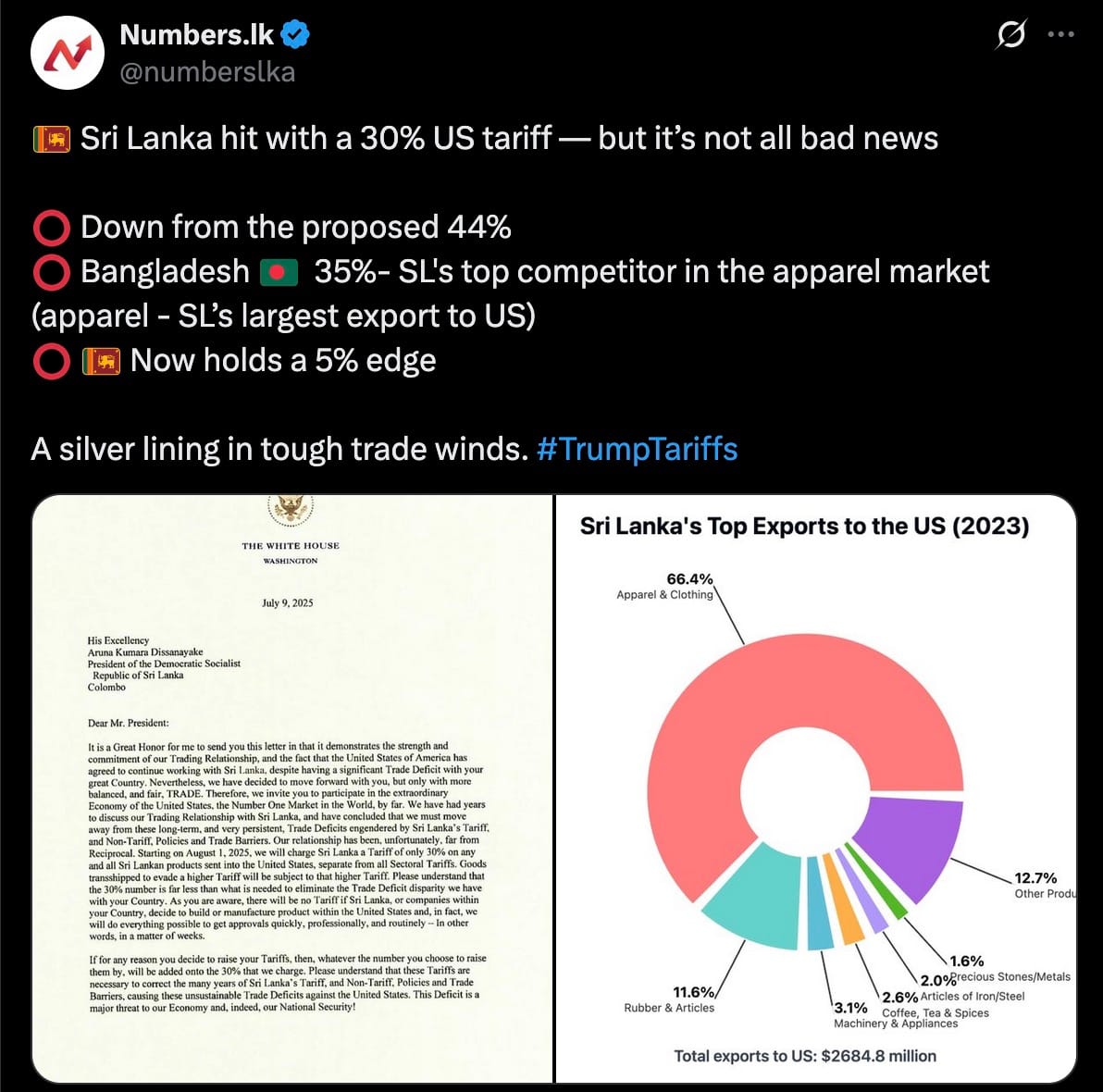
Again, these are comprador sources, quick to cuck for foreign capitalists, but even their comments are a sea change from just months before. In April it was all, ‘Yes Massa, how can we whip ourselves faster?’ but now we’re looking at the other slaves and comparing wages amongst ourselves. Americans are going to pay 20-30% more by default, and we’ll compete for the 5-10% on top. Trump has effectively unionized every exporter in the world against American importers. It’s one of the most spectacular self-owns in economic history. If you tariff one person, more power to you. But it you tariff everyone, more power to us.
Now exporters are all in the same boat, while the American importer is the one stuck at the port. All the importer can do is send an email saying, “please eat the difference,” but every exporter can safely say, “eat my shorts.” We might move a bit relative to our competitors, but that’s it. We have the power most dreaded by buyers, to say, where else are you gonna go? Are Americans going to stitch their own underwear now?
Trump has set the new floor for global trade at 20-30%, and American importers (and consumers) are going to be buried under it. And the rest of the world will slowly but surely move on. I can already see it happening in my own country. Not out of any surfeit of courage, but because of forfeit by morons.
Trump misspelled our president’s name in his letter, and the spelling is all over the place. In the copy-pasted letter he said, “There will be no Tariff in Sri Lanka, or companies within your Country, decide to build or manufacture product within the United States.” So there’ll be no tariffs on Sri Lanka if we don’t make anything in Sri Lanka, great. But does Trump have any idea what Sri Lanka makes?
Sri Lanka makes underwear. Our girls make Victoria’s Secret for $300 a month over here so Lex Wexner (Epstein’s main client) can rape girls over there. While $300 a month is survivable here (I make $2,000 in a good month), it’s a complete non-starter in America. America would have to tariff Sri Lanka 1,500% to compete even if they had the competence, which they do not. But Americans still need jungies, so they’re just going to eat the tariff at the port, raise prices at the mall, and their own inflation overall. Of course we’ll take volume hits and we’ll suffer, but Trump is really tearing the band-aid off. The world will adapt around America and move on.
That’s all that’s happening here and I, for one, am here for it. Death to the abomination, and more suicidal power to our man destroying it from inside, Abu Donald. America is a nation openly run by rapists killing children abroad; if there was ever a case for a global embargo, it is now. All countries in the world should be sanctioning America, for the genocide of Gaza alone and for its predation in general, and Trump is doing it for us. With tariffs paid at American ports, America is sanctioning itself, mashallah.
Again, I point you to the Wexner example; he was Epstein’s only real money-management client, and God knows what horrendous crimes he was getting away with. Epstein was killed to protect powerful people like him and Trump, and this is a bipartisan evil (see Bill Clinton and Bill Gates also). This is what my people’s wage slavery is chained to; this is a wicked system that should not be participated in at all. A 30% tariff is the least we can charge these people, we should really withhold our labor totally.
However, Abu Donald has taken a measured approach, slowly destroying the White Empire from the inside by being transparently evil and opaquely dumb. Just as America is embroiled in 2.5 land wars in Asia, they are also starting a trade war against the whole world. You couldn’t plan a better attack against white power—blow your arms in multiple wars, your dollars in multiple trade wars, and your brains out, alone, in a corner. Now the final incarnation of White Empire is lurching towards a fate far worse than being hated. Trump’s tariffs are simply being ignored.
This is The Cradle’s discussion for the past two days. They have maps of the proposed rebuilding plan for Gaza with its “10 Mega Projects”.
Guancha, Brazil 247 and Beijing Club unite around the exchange of ideas in the Global South
When Xi Jinping visited Brazil and Peru at the end of last year, following the opening of the Chancay port, he stated in one of his speeches that think tanks must grow and share information. Here is one such media think tank forming.
The meeting of the BRICS countries in Rio de Janeiro has delivered to the world a comprehensive statement with points of consensus on topics such as multilateralism, sustainable development, new international financial architecture, and artificial intelligence. In parallel, actors from the academic and journalistic worlds also met to discuss ways to deepen the exchange between media, universities, and think tanks, to solidify the intellectual basis necessary for the consolidation of the voices of the Global South and a world founded on cooperation between peoples.
One of these meetings took place last night in Rio de Janeiro, bringing together representatives of Brazil 247, from the Shanghai-based Guancha news website, and the Beijing Club, a major Chinese think tank. The cocktail was a consequence of the Global South Media Alliance, launched by Brazil 247 and Guancha in March this year.
This media alliance has to be extended to several other BRICS nations and partners, says Pepe Escobar. I agree.
The sheer change of thinking that is emergent, most of us have not seen. We’ve seen an exorbitant privilege kept in place by war and more war, threats, criminality and coercion, but a truly cooperative model is rare today. We’ve lived in a time when, if there was no opposition to pit groups and countries against one another, an opposition was created. I am, in a sense, skeptical about Elon Musk’s new American Party, as time will tell us whether that is a gathering of those who are disappointed with Trump and the fall of Maga, or the creation of a pretend opposition so that the circus can continue. Time will tell.
With a sidewalk bowl of phở and a plastic spoon, Sony Thang breaks the spell.
They caved! They are traitors! They are empire! Is the cry that went up after the announcement of the Trade Deal with Vietnam. 20% Tariffs! 40% Transhipment Tariffs! 0% tariffs on goods from the US to Vietnam. Vietnam opens its market to the US! USA! USA!
I am tempted to say the poor suckers, and I don’t mean Vietnam. Woe is Us! We are our own worst enemies as we have not learnt to analyze and to Call It By Name. We flail, and we kick and we scream, but in reality we have to get to work!
Sony Thang did the work this time. He is my kind of ‘resistance’.

Sony Thang
They say Vietnam accepted a lopsided deal.
That we agreed to pay tariffs on our exports to the U.S. while letting American goods enter our market for free.
That we bowed.
That we submitted.
That we traded dignity for access.
But that is not what happened.
Vietnam does not pay American tariffs.
American businesses do.
Every time a container ship docks in California with Vietnamese goods, it is the importer in Los Angeles, not the worker in Bình Dương, who pays the 20 percent surcharge.
Every time a piece of Vietnamese furniture enters a U.S. home, it is the American consumer, not the Vietnamese farmer, who foots the bill.
The U.S. is not taxing Vietnam.
It is taxing itself.
And it is doing so not because we demanded it, but because it cannot imagine a world where we win on merit.
Vietnam built its economy from the rubble of war.
With no Marshall Plan.
No empire to bankroll our rise.
No military bases across the globe to force open markets.
We earned every dollar of our trade.
We built every factory.
We trained every worker.
We climbed out of poverty not on pity, but on perseverance.
What terrifies the empire is not that we are dependent on them.
It is that they are still dependent on us.
They rely on Vietnamese labor to clothe their children, furnish their homes, and assemble their electronics.
They count on our stability to anchor their corporations in Asia.
They need us to counterbalance China, but fear that we might become too strong, too sovereign, too unaligned.
So they do what empires always do.
They tax. They threaten. They distort.
They say Vietnam is growing rich off the American consumer.
But we did not beg for that consumer.
We did not invade their country.
We did not lobby their government to make them buy from us.
They came to us because we produce better, faster, cheaper.
Because our people work with skill, precision, and dignity.
Because we know how to build.
If the U.S. wants to cripple its own supply chains out of spite, let it.
If it wants to burden its own companies to punish our success, let it.
If it wants to price out its own low-income consumers to feel powerful, let it.
We have survived worse.
This is not the first time a foreign power misunderstood Vietnam.
Not the first time they mistook our patience for passivity.
Our silence for consent.
But we remember history too well to be fooled.
The French called us primitives.
The Americans called us pawns.
Now they call us partners.
But we have only ever been one thing.
Vietnamese.
And the glory of a people who endured centuries of occupation, who bled for independence, who turned famine into industry and rubble into factories.
That glory will not be stopped by a tariff.
The empire may tax what we send. But it cannot tax what we are.
And he continued!
0% tariffs just means your goods get through customs cheaper.
It doesn’t mean anyone wants them.
It doesn’t mean they’ll sell.
It doesn’t mean your brands will beat ours.
Ask Starbucks.
Ask McDonald’s.
They’ve had “unrestricted access” for years.
And still can’t outsell a sidewalk bowl of phở.
Tariff-free doesn’t mean victory.
It just means you’re allowed in the ring.
You think 0% means control.
We know it means competition.
And that’s where you keep losing.
The empire taxed itself to slow us down.
We opened the gates, watched your brands walk in, and then watched them beg for relevance.
So go ahead.
Celebrate your tariff.
Wave your flag. Quote your GDP.
We’ll be here.
Outselling your giants with a plastic stool and a boiling pot.
And the world still lining up at our door.
—
That’s the way, Aha Aha, I like it! Aha aha!
Note in advance: This article is written from a Western perspective. I still hope to wake up more Westerners, so please share it in this audience. And non-Westerners may find it interesting to understand this perspective. But also know that I am by no means representative of the average Westerner. I have always been a separate figure by usually being ahead of the troops.
In conversation with a group of friends, a discussion arises between two of them. You watch it for a while and then decide to prove the one who is wrong right. The flame catches fire and the friendship is at stake. Your oil on the fire has brought the sense of injustice to an explosive state. Irritation becomes anger and if you are not careful it turns to rage and even hatred.
Injustice
Injustice screams into fierce emotions. We experience injustice in many ways, but some ways stir up our emotions more than others. When we are ignored or laughed at, it becomes difficult to remain calm. When something that is patently untrue is presented as truth it starts to bubble up. Feeling betrayed makes you verbose.
Some have more patience than others, but in the end, almost no one can stand injustice for long. At least, provided you can see, recognize and acknowledge that injustice. Because injustice in your interest or apparent interest can go unnoticed much longer than when the injustice affects you personally. And sometimes people do not see injustice because they simply have no conscience or feeling.
Corona
Five years after the Corona outbreak, the vast majority of the world’s population does believe that there was and is something very seriously wrong with the narrative that governments have poured over us. The common flu was gone and in its place about as many people were dying with Corona. All sorts of measures were ineffective and unsubstantiated.
Corona vaccinations did not help against corona, but still have many long-term side effects more severe than corona. Few still take corona vaccinations and this whole issue has led to many more people now having a reasonable doubt about all vaccinations. The overall vaccination rate has dropped substantially. People feel cheated.
Climate
Average people are beginning to tire of the scaremongering regarding the so-called climate crisis. Forty years ago, the magazines were full of an impending ice age. The ozone layer was supposed to disappear. Sea levels should have risen many meters by now. There are always inventors and instigators of doomsday scenarios, you don’t necessarily need a cult for that.
When money can be made, investors, salesmen and scientists line up to invent a threat and crisis. Critical scientists who can prove otherwise with evidence are censored and stonewalled. The moment the bubble can be punctured a new crisis is created.
Woke
In my country, homosexuality was accepted early on up to and including being able to get married by gays and lesbians. There was a lot of tolerance. Actually, we didn’t pay much attention to it so everyone could do what they were doing anyway. All that was lost when woke made its appearance and the 0.001% of people who thought they were in the wrong body thought they were the norm.
There had to be separate restrooms for people who didn’t feel like men or women. Some wanted to be addressed as “them”. A few felt they were a cat and everyone else had to conform to them. This sort of thing only goes well for a while, until it gets up everyone’s nose. Trying to enforce craziness backfires.
Migration
Decades of migration have caused the population composition in almost all European countries to change dramatically. When you mix cultures, it can work if integration takes place. When you grow closer together and thus do remain one people with one culture. In fact, change is good, as is diversity. But unfortunately this has not happened.
For too long there has been a political fight without recognition of emerging problems and solutions to them. One side saw these problems coming from miles away, but also had a hint of discrimination hanging over them. The other side thought all foreigners were in need and that everyone should be given a chance. They hated those who wanted to keep foreigners out and did not listen.
Israel
After Hamas attacked the best-secured country Israel supposedly unopposed on Oct. 7, 2023, many went right behind Israel. Israel had every right to defend itself and was allowed to invade Gaza and begin what they had long planned for. After a few months and tens of thousands of dead Palestinian civilians, however, the world did not wake up.
Over a year later and far more than a hundred thousand Palestinian civilians dead, no one can ignore the genocide anymore. Even those afraid of being called an anti-Semite in the slightest are beginning to speak out rightly. It’s not right. Something is very seriously wrong. Why is Israel getting away with this? What else is Israel doing? The cesspool is opening very slowly.
Jews and Muslims
There are groups that do not tolerate criticism. The vast moderate majority finds it difficult to resist it. Criticism of Israel is equated with discrimination against Jews. Criticism of Islam is equated with discrimination against Muslims. But what happens when people are not allowed to criticize and are left with that? It is no different from the examples I mentioned above.
Criticism doesn’t go away, especially if the issues persist and even get worse. We cannot lump everything and everyone together, but undeniably we must all dare and be able to name the real problems. Otherwise we will get carried away and end up hating things. History is also full of such examples.
Divide and conquer
Something is going on, and it is time for many more people to see and understand this. We are being played off against each other because someone benefits. It is too many things and too many things at the same time and in succession. We need to learn to recognize the pattern en masse. We may distrust everything that is forced upon us, doubt everything and above all start asking a lot of questions.
Governments (politics and civil service), media (mainstream and alternative) and institutions (science and law) have a common agenda that does not serve the people. We are ignored, laughed at, censored and excluded. More and more people see the injustice and more and more will revolt. People will become angry and demand that things be different. But hatred will also arise.
Truth
The truth always eventually comes to light. When it does, a shock will go through the people. It is best if humanity takes advantage of this injustice to evolve, because evolution is necessary for a step toward a more truthful civilization. But just as well we are not ready for that and it will be yet another revolution. A revolution from emotion, with pure hatred.
Have you read things you disagree with? That is possible, but then also know that the underlying injustice will not disappear and will one day erupt. Hopefully you will recognize the issues then in a few months or in a few years. And then you will be brave enough to admit to your own new truth. One day we will all have to live together honestly on this Earth after all.
Nico Cost
This work covers the economic aspects of a genocide and calls it by name. These are legal responsibilities, clearly delineated in law. They are called ‘obligations’.
Everything that I said about those countries supporting Israel over a long period will now be exposed. We will see some red faces. Yes, China is there. So is South Korea and a raft of others, even Mexico. We have 39 pages of organisations, state owned enterprises and others that are in the eyes of the law guilty to perpetrating this genocide and ignoring their own obligations under the law. It is worse than that. They are profiting from it.

Although she talks about Corporate Entities, the definition is: Corporate entities” in the present report refers to business enterprises, multinational corporations, for-profit and not-for-profit entities, whether private, public or State-owned. Corporate responsibility applies regardless of the size, sector, operational context, ownership and structure of the entity.
This is not business as usual.
My new UN report, From Economy of Occupation to Economy of Genocide, is out today.
It shows how corporations have fueled and legitimised the destruction of Palestine.
Genocide, it would seem, is profitable. This cannot continue, accountability must… pic.twitter.com/Ei3atw0TQ1— Francesca Albanese, UN Special Rapporteur oPt (@FranceskAlbs) July 1, 2025
On 3 July, she will have a press conference after releasing her new work. I’m putting the prepaged page right here for all who want to take a listen at the time.
https://webtv.un.org/en/asset/k1a/k1a90qctnz
UN expert identifies over 60 companies directly aiding Israel
——
Francesca Albanese, an Italian human rights lawyer and the UN Special Rapporteur on the Occupied Palestinian Territories, has identified more than 60 companies, including major arms producers and tech firms, in a… pic.twitter.com/3AA2Z5vfVU— The Cradle (@TheCradleMedia) July 1, 2025
This post will be updated after Francesca’s press conference.
After direct aggression of the messianic West on herself, Iran blocked US-controlled GPS and switched to the more advanced Chinese BeiDou. This is more than a technologic paradigm change..
The Global South now seems to have a crystal clear perspective of the new contours of the catastrophe laid at the feet of the Angel of History .. now they have met an immovable symbol of Resistance.
By Pepe Escobar at the Strategic Culture Foundation.
It’s one of the most mesmerizing passages in the history of knowledge. In the 9th of his Theses on the Philosophy of History, Walter Benjamin – Jewish, tragic figure, solitary genius – dissects Paul Klee’s haunting painting Angelus Novus and graphically explains to posterity the drama facing the Angel of History:
“His face is turned toward the past. Where we perceive a chain of events: he sees one single catastrophe which keeps piling wreckage and hurls it in front of his feet. The angel would like to stay, awaken the dead, and make whole what has been smashed. But a storm is blowing in from Paradise; it has got caught in its wings with such violence that the angel can no longer close them. The storm propels him into a future to which his back is turned – whilst the pile of debris before him goes even higher. This storm is what has been called progress.”
The time has come to go beyond what may be read as a very apocalyptic Christian parallel between divinity and violent retribution. As Alastair Crooke detailed in his astonishingly perceptive 2010 book, Resistance: The Essence of the Islamist Revolution, it was the need to restrain the furies of “divinely inspired” violence that led Hobbes to conceptualize Leviathan, where he called for a social contract between the individual and a necessarily strong, implacable government.
Moreover, it was the Hobbesian version of a social contract that laid the basis for John Locke to assert a dubious “natural goodness” of humanity, complete with a – very private – “pursuit of happiness” and the general welfare gleefully coalescing via the work of an invisible hand.
This fallacy/fairy tale shaped Western thought for over the next 300 years.
Now it’s a completely different ball game. We have been prisoners of Hobbes and Locke for too long:
such a seductive pole dancing of legitimacy around which the Western-conceived nation-states grouped to protect and legitimize themselves and their plunder of the rest of the world.
Lately, the contemporary specter of “divine violence” was marketed to everyone from Africa to Asia as armed Islamist resistance. But now this mask has also fallen. The “new” Syria shows to everyone how al-Qaeda R Us – and always was.

Paul Klee — Angelus Novus. 1920
Shelter from the – ultimate – storm
The time has also come to re-evaluate the plight of the Angel of History. No, he is not transfixed by “divine” rage; that’s actually quite man-made. Meanwhile, what continues to propel him forward – even as he casts his eyes to the past (“the backward half-look, over the shoulder, toward the primitive terror”, in T. S. Eliot’s striking image) is the wind of secular, Darwinian, tech “progress” – a single, unified catastrophe much more that a chain of historical events.
Yes, he continues to contemplate the tragedy; he badly wants to awaken humanity to the extent of the disaster; but the rush of now tech “progress”, AI-tinged, inevitably sweeps him away.
The Global South now seems to have a crystal clear perspective of the new contours of the catastrophe laid at the feet of the Angel of History.
The top two contemporary agents of the catastrophe have been fully identified: a psycho-pathological, genocidal death cult composed by elements of a self-appointed chosen tribe; and the post-historical elites of a dwindling empire. A deadly embrace – if there ever was one.
Yet now they have met an immovable symbol of Resistance. And they had to back off. To the astonishment of the Angel of History himself.
Iran’s Supreme Leader Ayatollah Khamenei laid it all out in a few sentences:
“The key point I wish to emphasize in my speech is that in one of his remarks, the President of the United States declared that Iran must surrender. Surrender! The issue isn’t about enrichment or the nuclear industry anymore. It’s about Iran surrendering.”
This is the voice of an ancient civilization-state – in contrast to post-modern, out of control barbarism: “Our cultural and civilizational wealth is hundred times greater than that of the US and other similar countries (…) The Iranian nation is noble and will remain noble.”
An irrational, and certainly not “divine” storm now aims to totally paralyze the Angel of History – imprinting on the narrative their revamped but equally tawdry notion of “end of History”, applied to the circumscribed space of West Asia.
And that brings us to how the Resistance will have to delve deep into the nitty-gritty, as in the practicalities of deterrence and defense, so the Angel of History may reinvent himself.
Cut to the Yemeni Armed Forces – this bastion of rectitude, a military organization guided by spiritual power:
“The US and Zionist entity’s ceasefire agreement with Iran highlights that military force is the only language they understand.”
Add to it the number one lesson from the 12-day war: whoever controls the skies eventually will control the lands.
Iran’s leadership, as the fulcrum of Resistance, has some serious decisions to make. The most important, on the “language” issue as framed by the Houthis, is to trust Russia to help it set up a comprehensive, multi-layered offense/defense system, complete with hardware, combat and control centers, long-range radar stations, electronic warfare equipment, and badass jet fighters.
As Kremlin spokesman Dmitry Peskov made it quite clear ahead of the meeting one week ago between President Putin and Iranian FM Abbas Araghchi:” It all depends on what Iran needs right now.”
They need serious backup. The Majlis – Iran’s Parliament – delayed for over a month the ratification of the comprehensive strategic partnership signed with Russia after the Duma approved it in late May. That includes weapons sales, military inter-connection and deep intel exchange – even if it does not imply a full military alliance.
Previous Iranian president Ebrahim Raisi clearly saw The Big Picture. He went full “Look East” – as in Eurasia integration. The current, meek Pezeshkian presidency attempted a “Look West” – naively trusting that the Empire of Chaos would actually practice diplomacy. They were in for a rude awakening.
The unforgiving war will be long and bloody. This is just the beginning – current pause included. Yet the Angel of History seems to have caught a second wind. Looks like his warnings about the catastrophe were finally understood by the overwhelming majority of the Global South. As we sift through the accumulated debris, Resistance is at hand – sheltering us from the ultimate storm.
This curated selection pulls us above the daily fog of conflict and into a crucial strategic assessment. As the first Russian piece underscores, time is of the essence. We examine four distinct voices shaping the modern geopolitical landscape:
1. Russia’s Pragmatic Imperative (Kirill Strelnikov, RIA Novosti): Strelnikov argues unequivocally that Russia, possessing the world’s most formidable military prowess, must undertake the comprehensive rebuilding of Iran’s military structure. This isn’t mere assistance; it’s a strategic necessity dictated by capability and circumstance.
2. China’s Predictive Lens (Quan Le & Prof. Jiang Xueqin): Le reflects on Jiang’s prescient year-old analysis, “The Iran Trap.” To this, we add Jiang’s latest, “The Messianic Calling” – a fascinating counterpoint to traditional eschatology (End Times prophecy). Here, Jiang applies his predictive historical framework to dissect the perceived “messianic” drives of Trump, Netanyahu, and Khamenei, culminating in a cliffhanger pointing to Isaac Newton’s foundational role in Christian Zionism. This is modern predictive analysis at its most provocative.
3. West Asia’s Reality Check (The Cradle): This piece lays bare the collapse of Russian diplomatic illusions in West Asia. Tel Aviv’s defiance and Washington’s duplicity during the Israel-Iran conflict have shattered Moscow’s balancing act, forcing a stark reckoning not only for the region but potentially for Ukraine as well. It confirms what many sense intuitively.
The Synthesis & The Imperative:
Presenting these perspectives – modern Russian pragmatism, cutting-edge Chinese predictive analysis, and West Asian ground truth – serves a critical purpose: it demands we listen. Our current institutions, particularly BRICS, require fundamental evolution. The Shanghai Cooperation Organization (SCO), especially evident in its recent Defense Ministers’ summit, is already moving decisively into this space, focusing squarely on collective security (call it the practicalities of deterrence and defense).
This holistic view, drawing from key Eurasian intellectuals, clarifies the path: Russia provides the hard-power pragmatism which Iran should accept, China offers the deep-time predictive context, and outlets like The Cradle deliver the unvarnished reality check. Together, they bring us closer to defining the necessary resistance.
And here, a crucial distinction: There is the established Axis of Resistance in West Asia. But beyond that, there is a broader, essential resistance – ours. It’s the resistance of all who recognize the imperative to stand against forces seeking dominion not just over land, but over our hearts, minds, and very being. This is the true battleground of the emerging world order.
Let’s start:
Kirill Strelnikov – Ria Novosti
Despite the “eternal peace” declared by Trump, Iran must learn three key lessons from its confrontation with Israel, or it may face a brutal repeat in the foreseeable future.
Lesson one.
Despite the fact that everyone has won and everyone is handsome (including the United States, Israel, and Iran), the underlying causes of the conflict have not gone away, and the parties have only taken a break. According to Russian Foreign Minister Sergey Lavrov’s recollections, 20 years ago, at the UN General Assembly, Netanyahu waved a piece of paper with an image of an Iranian atomic bomb, and after the apparent failure to “resolve the issue definitively,”The ultra-Orthodox elite in Israel has become even more determined to crush Iran once and for all. This means that they are currently working on their mistakes and will be much better prepared for the next act of the Merleau-Ballet.
Lesson two.
For the Iranian authorities, who have declared victory, the current respite is an opportunity to accept the fact that the region’s pretentious and theatrical politics have come to an end, and the era of “weakness is beaten and ultimately destroyed” has begun. “Long arms” and “soft power” have been defeated by brute military force and a determination to go all the way. Even Estonian sprinters have realized that even the best and most advanced economy is worthless if it doesn’t have a powerful “umbrella” and a trained, motivated army, preferably a large one. Interestingly, the Houthis were the most explicit about this yesterday, stating, “The US and Zionist entity’s ceasefire agreement with Iran highlights that military force is the only language they understand.”
Another dangerous point is that preemptive strikes can now happen at any second, simply because “it feels like it.” Rolling Stone reported yesterday that the U.S. decision to strike Iran was based not on intelligence data, but on “vibes” — sensations in different parts of the body. It remains to be seen where, when, and for whom the next vibe will occur.
Lesson three.
They don’t skimp on security, and strategic decisions are made based on solid data. In the attack on Iran’s nuclear facilities, the United States used its best and most powerful non-nuclear weapons, while Israel employed the most advanced American-made aircraft.
The Islamic Republic’s outdated air defense system, primarily composed of Iranian systems, was virtually powerless to counter them. The recent military operations have clearly demonstrated that whoever controls the skies eventually controls the land.
At one time, looking into the future, the Russian leadership proposed that Iran create a modern air defense system based on Russia’s excellent S-400 systems, but the Iranian leadership declined, citing their reliance on their own air defense capabilities, particularly the Bavar-373 system. This episode was recently recalled by Russian President Vladimir Putin during a meeting with foreign journalists: “You know, we once offered our Iranian friends to work on an air defense system. At the time, the partners didn’t show much interest, and that was it.
However, it wasn’t just about the installations themselves, but rather about a comprehensive layered system that included the installations, combat control centers, long-range radar stations, electronic warfare equipment, and fighter aircraft. Despite the lack of interest, the results were evident.
The conflict has also exposed serious issues that Iran urgently needs to address in terms of offensive weapons. Some experts believe that the Islamic Republic needs to completely rethink the entire ballistic missile program. In particular, Russia’s experience in creating missiles with separable warheads and maneuvering warheads that can effectively overcome the enemy’s modern echeloned air defense system would be extremely useful (dozens of the much-vaunted Patriot complexes annihilated in Ukraine are waving greetings from the audience). At a meeting with military university graduates, Vladimir Putin also mentioned that we are launching mass production of the latest medium-range missile system, the Oreshnik, which has “proven itself very well in combat conditions” and has caused a lot of concern in the West. However, the decision to support the domestic Iranian manufacturer is ultimately up to the leadership of the sovereign country.
As for the choice of a contractor for the accelerated restructuring of Iran’s air defense system, all Western air defense ratings, without exception, place the Russian S-400 Triumph system, which Putin mentioned in a philosophical manner, at the top of the list. However, Russia is not standing still, as the world’s newest and deadliest S-500 Prometheus system is already being mass-produced and has been widely deployed in the military.
At one time, Pentagon spokesman Jonathan Hoffman said that “the S-500 can change the balance of power in global missile defense,” and former US Secretary of State Anthony Blinken admitted that “we will continue to closely monitor the development of the S-500, as this is part of Russia’s strategy to strengthen its defense systems and create new challenges for the global missile defense system.”
However, the S-400 and S-500 are not the only things that can seriously upset any aggressors. As NATO Secretary General Mark Rutte said yesterday, “Russia is increasing its military power at an astonishing and frightening rate.” Against the backdrop of the strategic cooperation agreement between Russia and Iran signed on the eve of the Israeli aggression, there are all the prerequisites for returning to the total restructuring (or, in fact, to creating it from scratch) of Iran’s air defense system and the entire multi-million-strong Iranian army, with Russia’s active participation and taking into account its extensive experience in the special military operation.
As Russian President’s Press Secretary Dmitry Peskov stated, “Russia has provided support to Iran through its clear stance on the situation in the Middle East and intends to further develop relations with Tehran.”
Unlike many others, we don’t change our allies like gloves, and we fulfill our obligations to the end.
—
Quan Le, introducing Professor Jiang Xueqin:
Published a year ago on YouTube gives you the perfect background for understanding the Iran trap that will destroy, for the benefit of all mankind, not only Israel but its master, the KFC-AZAEL : Kakistocratic Feudal Conglomerate of the Anglo-Zio-American Establishment.
This channel is really underrated and absolutely deserves its name : PREDICTIVE HISTORY meaning that if you really know the true historical facts, not only it’s possible but not that difficult to predict the future geopolitical events.
Jiang Xueqin is giving these classes to Chinese students in a highly select private high school in Mainland China. The teenagers are receiving lessons in English as a second language but through the topics of geopolitics combined with Universal History.
We’re lucky that Jiang (his family name) decided to upload his classes on YouTube.
In this video, Jiang made a mistake about Nikki Haley, but the rest is quite impeccable. He did not take into account Captain Eyeliner.
Jiang predicted the attempt for regime change in Iran happening right now —– not showing big signs of success thanks to the resoluteness of Iran’s Supreme Guide His Holiness the Ayatollah (Sign of God) Seyyed Ali Khamenei who decided on June 13, 2025 in the midst of fire and shambles that IRAN WILL NOT SURRENDER —– however Jiang thought the event would happen in March 2027 and not in June 2025.
I don’t see it as a real analytical mistake.
Jiang simply did not take into account Netanyahu’s impatience and the Orange Muppet’s handlers (Miriam Adelson for example) wish for getting as fast as possible what they want and not forgetting they already paid the Muppet for that (the customer is always king or queen especially when he or she already paid).
Let’s not forget the Orange Muppet’s clownish regime destroyed in the first 80 days (Jan 20, 2025 to April, 12, 2025) all its credibility so the Muppet will certainly be a lame duck in 2027.
If the Orange Muppet was allowed some space for deciding and his regime did not implode so fast, the choice of March 2027, the time for his regime in D.C. to get used to business and be more prepared for the onslaught on Iran, is not so absurd.
Also the Orange Muppet’s handlers, as all of us, clearly see that he might soon devolve into a dementia syndrome so they don’t want to lose their investments.
And that kind of thing cannot be obtained by keen geopolitical analysis : they’re called Black Swans.
And a year later, The Messianic Calling with its cliffhanger end.
—
We end with Hazal Yalin writing for The Cradle.
Russia confronts US betrayal in Israel–Iran war
Tel Aviv’s defiance and Washington’s duplicity have shattered every last bit of Moscow’s illusions of diplomacy, forcing the Kremlin to reckon with the collapse of its balancing act in West Asia – and even Ukraine.
From the outset, Moscow condemned Israel’s aggression against Iran in sharp terms. The Russian Foreign Ministry’s first official statement left no ambiguity in assigning blame to Tel Aviv.
Until 20 June, Russia clung to the belief that a ceasefire could be brokered and that Washington would refrain from direct strikes on Iran. This optimism stemmed from a nearly hour-long phone conversation on 14 June, during which US President Donald Trump and his Russian counterpart, Vladimir Putin, discussed the escalating Israel–Iran conflict. Trump reportedly stated during the call, “this war in Israel–Iran should end,” a message echoed later on his Truth Social feed.
Kremlin aide Yuri Ushakov reported that US negotiators were open to returning to talks on Iran’s nuclear program. For Moscow, this was not merely optimism — it was interpreted as a real diplomatic overture and a potential backchannel for Trump to defuse mounting domestic and legal pressures.
From Moscow’s view: A timeline of misjudged hopes
This belief informed Moscow’s early posture. Even after Tel Aviv launched its unlawful strikes on Iran, the Russians avoided directly blaming Washington. Instead, they pinned principal responsibility on Israeli Prime Minister Benjamin Netanyahu’s far-right cabinet, denouncing Israel’s leadership while keeping communication channels open.
In his 18–19 June press conference with international media agencies – deliberately scheduled late at night to be picked up by US audiences – Putin emphasized ongoing direct lines with both Trump and Netanyahu. He pointed out that the attacks had only solidified Iran’s internal political unity and noted that the bombings did little to harm Tehran’s nuclear infrastructure, saying, “These underground factories remain intact. Nothing happened to them.”
Putin also made clear that a resolution was still on the table: a framework that could ensure Iran’s peaceful nuclear rights while addressing Israeli security concerns, and confirmed that Russia had presented these options to all three sides.
At the St. Petersburg International Economic Forum (SPIEF) – Russia’s premier annual business and diplomacy gathering – Putin reiterated Moscow’s diplomatic approach, noting that Russia had presented “some ideas” for a settlement to all sides. He also reaffirmed support for Iran’s right to peaceful nuclear development, referencing Russia’s ongoing construction at the Bushehr nuclear facility.
Putin stated that he had requested safety guarantees for Russian personnel there, and added, “Prime Minister Netanyahu has agreed with that, and President Trump has promised to support our legitimate demands.”
But that facade would collapse almost instantly. Shortly after Israel claimed it had targeted the Bushehr plant – only to later retract the statement, calling it a “mistake” – it bombed the city’s airport, destroying its international terminal.
The attack, less than 36 hours after public reassurances, was viewed in Moscow as a deliberate humiliation. It extinguished any remaining belief that Tel Aviv or Washington were operating in good faith.
Moscow’s tone hardened. UN Ambassador Vassily Nebenzia’s 20 June speech marked the last instance of diplomatic optimism:
“We are convinced that it is quite possible to forge a solution that would both respect Iran’s right to peaceful nuclear activities and ensure the unconditional security of the Jewish state. We have conveyed these options to our American and Israeli colleagues, as well as to our Iranian partners.”
After 22 June: Anger and reassessment in Moscow
Everything changed on 22 June. The US bombing campaign confirmed what many in Moscow had feared: that Washington was not only unwilling to mediate, but had used Russia’s overtures as strategic cover.
Russian political elites began to speak in stark terms. Andrey Klishas, head of the constitutional committee in the Federation Council, was blunt:
“The Islamic Republic will be compelled to respond to the violation of sovereignty and aggression against its country, because a regime that cannot defend the sovereignty of its state is always doomed.”
On 23 June, the influential Telegram news-analysis channel Yoj – with over 500,000 subscribers – reported that the Kremlin had quietly advised state television to avoid portraying Trump as a peace-seeking figure.
According to Yoj, Putin was still holding off direct attacks on Trump, but that could change. “If the president sees Trump as willing to use force against Russia over Ukraine, he will abandon restraint. That scenario, despite Trump’s talk of peace, is now considered entirely plausible within the Kremlin.”
Anger echoed through official channels. Russian Foreign Minister Sergei Lavrov’s statements were seething. UN Ambassador Nebenzia, speaking at the UN Security Council, declared, “Washington has once again demonstrated its total disregard for the position of the international community and confirmed that in defense of its Israeli ally it is prepared to wager the safety and well‑being of all humanity.”
Even Putin, typically cautious in foreign briefings, took an unusually blunt line during his 23 June meeting with Iranian Deputy Foreign Minister Abbas Araghchi. According to Iranian outlets Jamaran and Shabestan, Putin described the US airstrikes as “an unprovoked and unjustifiable aggression,” and emphasized that “the provocative aggression against Iran is without any basis or justification.”
The president’s spokesperson, Dmitry Peskov, was even more direct, hinting that Moscow would be prepared to deliver whatever Iran needed to counter this illegal and unprincipled war:
“We have offered our mediation effort, this is something concrete, we have declared our position, which is a very clear statement, a form of support for the Iranian side. From now on it all depends on what Iran needs right now.”
Asked whether Iran will be given Russian S-300 and S-400 air defense systems, Peskov suggested that Iran need only ask, stating, “It all depends on what the Iranian side and our Iranian friends say.”
Why the Iran–Russia ‘strategic pact’ falls short
The much-discussed “comprehensive strategic cooperation agreement” between Russia and Iran has turned out to be less than it appeared – particularly on military terms. While many assumed that Moscow was reluctant to deepen security ties, official Russian accounts suggest the opposite is true.
It was Iran’s parliament that delayed ratifying the agreement for nearly two months after Russia’s Duma passed it in late May. On 18 June, Putin – when asked by an AFP reporter whether Russia would supply new air defense systems to Iran – clarified that not only had Moscow offered to supply them, it had proposed co-production. Iran, he said, had so far not accepted and had not made any formal request.
Two days earlier, Duma Deputy Svetlana Zhurova told Russian media that while the pact included arms sales, military training, and intelligence exchange, Iran had refused any clause allowing deployment of Russian troops. She added. “Everyone sells weapons – that’s standard. But sending personnel? That’s outside the agreement.”
On 23 June, hours before Putin’s meeting with Araghchi, Duma Defense Committee Deputy Chair Alexei Zhuravlyov confirmed, “One should not expect a Russian expeditionary corps in Iran … the relevant clauses were removed from the Russian–Iranian agreement at Tehran’s request.”
Tehran has made no effort to contradict these statements. The evidence points to Iran setting clear limits – possibly to avoid appearing overly reliant on Russia, or to maintain maneuverability in the emerging multipolar order. Furthermore, while Iran’s constitution does not explicitly include a formal declaration of non-alignment, the concept of “neither east nor west” has been a central tenet of Iranian foreign policy since the 1979 revolution.
And although since the late Iranian president Ebrahim Raisi administration, Tehran has geared itself to primarily “Look east,” his successor appears to have boomeranged by opening indirect talks with the Americans. Given the colossal betrayals of trust displayed by the Trump administration since 16 June, however, current Iranian President Masoud Pezeshkian’s west-leaning options may have narrowed considerably.
Looking ahead: Can Moscow still build a regional axis?
An earlier analysis published in The Cradle argues that peace in West Asia would hinge on new alliances – and that even provocations by Tel Aviv might be tempered in the short term by mutual caution. That assumption has now collapsed. Washington’s actions, paired with Israel’s targeted escalation, have pushed the region into a far more volatile phase.
The only viable option now may lie in Moscow and Beijing pressing harder – with Persian Gulf states, and especially Saudi Arabia – to develop an alternative regional security framework.
While fragile, a few openings remain: Riyadh’s sharp condemnation of the Israeli attack on Iran, its public objection to Iran’s retaliatory strike aimed at US-linked bases in Qatar, its reluctance to align against Russia on Ukraine, and broader hedging behavior in West Asia may offer a narrow path forward.
That said, the ruins of Syria still cast a long shadow. There is little certainty that Moscow can convert tactical understandings into strategic alliances. However, without such a shift, the path forward leads not to de-escalation, but to an even broader regional war.
A new wave has been unleashed. I remember Mr Lavrov’s comment: This is a turning point. It is up to us to surf this turning point.
As most know, Trump yet again delivered bombast instead of truth, although Khamenei was able to pick out the one shred of truth that tumbled from Trump’s maw.
with appreciation to Dr. Karl at karlof1’s Geopolitical Gymnasium.
What sort of admission it will become in time is unknown at the present. But it will bolster the Iranian nation even more than the attacks themselves. And in that case alone, Trump made yet another major mistake. I won’t spoil Khamenei’s words by telling readers now. The speech is short, and you’ll soon find out:
In the Name of God, the Compassionate, the Merciful
My greetings and best wishes to the dear, great nation of Iran. First, I would like to honor the memory of the esteemed martyrs from recent events – the martyred generals and scientists who were truly, genuinely valuable for the Islamic Republic. They dedicated their lives to serving others. Today, they are with God receiving the reward for their outstanding services, God willing.
I find it necessary to offer my congratulations to the great nation of Iran. I congratulate the nation for several reasons.
First of all, I offer my congratulations on the victory over the fallacious Zionist regime. With all that commotion and all those claims, the Zionist regime was practically knocked out and crushed under the blows of the Islamic Republic. The thought that the Islamic Republic could inflict such blows on that regime never even crossed their minds and they never imagined such a thing, but this is what happened.
We thank God for helping our Armed Forces. They were able to break through the enemy’s advanced, multi-layered defense and raze many of their urban and military areas under the pressure brought by Iran’s missiles and powerful attacks using advanced weaponry. This is one of the greatest divine blessings. It has shown the Zionist regime that attacking the Islamic Republic of Iran carries a heavy price. It will be costly for them. It will result in and generate a heavy cost for them. And praise God, this has happened. This honor is due to our Armed Forces and our dear people who’ve built, trained, and supported these Armed Forces from within themselves, enabling and empowering them to carry out such a great task.
My second congratulations is related to our dear Iran’s victory over the US regime. The US regime entered the war directly because it felt that if it didn’t, the Zionist regime would be completely destroyed. It entered the war in an effort to save that regime but achieved nothing. It attacked our nuclear facilities, which warrants an independent criminal prosecution in an international court, of course. But they weren’t able to achieve anything significant. The US President used a bizarre exaggeration in describing what happened. It’s evident he needed such an exaggeration. Whoever heard his remarks knew that beneath the surface of these words lay another truth, which was that they weren’t able to accomplish anything. They failed to achieve their intended goal and they exaggerate things to cover up and conceal the truth.
Here too, the Islamic Republic has been victorious and delivered a heavy slap to the US’s face in return. It [Iran] attacked and inflicted damage on the Al-Udeid Air Base, which is one of the US’s key bases in the region. The same people who made exaggerated claims in the previous case, tried to downplay this one, claiming that nothing much had happened. But in fact, a major event had taken place. The fact that the Islamic Republic has access to key US centers in the region and can take action whenever it deems necessary is a significant matter. It’s quite significant. Such an action can be repeated in the future too. Should any aggression occur, the enemy – the aggressor – will definitely pay a heavy price.
My third congratulations is for the remarkable unity and solidarity shown by the Iranian nation. Praise God, a nation of approximately 90 million people stood together as one, were united in voice, stood shoulder to shoulder, and didn’t show any differences in their demands or the goals they expressed. They stood together, chanted slogans, spoke out, and supported the actions of the Armed Forces, and this will continue to be the case in the future. The Iranian nation demonstrated its greatness and its distinguished, exceptional character in this event. It showed that when it’s necessary, a unified voice will be heard from this nation, and praise God, this is what happened.
The key point I wish to emphasize in my speech is this that in one of his remarks, the President of the United States declared that Iran must surrender. Surrender! The issue isn’t about enrichment or the nuclear industry anymore. It’s about Iran surrendering. Needless to say, this statement is too big to come out of the US president’s mouth.
For the great country of Iran – a nation with such a history, such a rich culture, and a steadfast national determination – any talk of surrender is nothing but a mockery in the eyes of those who truly know the Iranian people. But his statement revealed a certain reality, which is that the US has been actively opposing and trying to harm Islamic Iran from the very beginning of the Revolution. And each time, they come up with a new pretext. One time, it’s human rights. Another time, it’s defending democracy. Then, it’s women’s rights. Sometimes it’s uranium enrichment, and at other times it’s the nuclear issue itself. Or it’s the matter of missile development.
They bring up all kinds of pretexts. But at the core, it all boils down to one thing, which is that they want Iran to surrender.
The previous administrations never openly stated this because it’s something unacceptable. It isn’t justifiable by any human logic to tell a nation that they must surrender. That’s why they were disguising this objective behind other titles and pretexts.
This person let the truth out. He showed this reality that the US will only be satisfied with Iran’s surrender and nothing less. This is a crucial point. The Iranian nation must know that the core of the conflict with the US is over this point. The US is greatly insulting the people of Iran, and such a thing will never happen. It will never happen.
The Iranian nation is a great nation. Iran is a strong, vast country. It possesses an ancient civilization. Our cultural and civilizational wealth is hundreds of times greater than that of the US and other similar countries. Anyone who expects Iran to surrender to another country is spouting nonsense that will surely be ridiculed by wise, knowledgeable people. The Iranian nation is noble and will remain noble.
The Iranian nation is victorious and will remain victorious, by the grace of God. We are hopeful that Almighty God will continuously protect this nation under His grace, preserving it with dignity and honor. May He elevate the spiritual rank of Imam [Khomeini (ra)]. And may Imam Mahdi (may our souls be sacrificed for him) be pleased and satisfied with this nation, and may he support it with his assistance.
May God’s greetings, mercy, and blessings be upon you. [Dr. Karl: my Emphasis]
Given that Iran now knows with 100% certainty what the Outlaw US Empire demands, they’re no longer any grounds for negotiations excepting one: Iran will rejoin the NPT when the Zionists enroll themselves. I expect the papers Iran has incriminating Grossi and the IAEA will be published when Iran votes to withdraw from the NPT. I expect other outcomes will occur as a result of the conflict, some obvious like becoming closer to Russia and China militarily and a change in relations with Azerbaijan, and some not so obvious like the degree of further isolation of the Collective West from the Global Majority. I’m also curious to see what happens with Japan and South Korea’s relations with the Empire once the tariff deadline arrives as this conflict IMO will have a bearing on what occurs. And then there’s Taiwan. Its separatists can’t like what they just observed as the Empire’s most important proxy was partially thrown under the bus.
There is nothing you can say to me that will make me stop opposing Israel’s western-backed atrocities.
Call me an antisemite or a Nazi or any name you want. The name-calling stopped having any effect a long time ago.
Babble about October 7 and Hamas and hostages all you wish. I’ve stopped listening to you.
Pile on as many walls of text as you like explaining why it is actually fine and good to bomb hospitals and massacre starving civilians seeking aid. I ain’t reading all that, free Palestine.
Regurgitate whatever the latest propaganda narrative is about Iran or the Houthis or Hezbollah or whichever new war Israel is getting ready to start this week. We both know it’s all lies.
Parrot whatever’s the current hasbara slogan justifying Israel’s genocide in Gaza if you want to. Your words have no power here.
That’s why your old tricks have stopped working, you know: all you have is words.
We have truth, facts and morality on our side, and you have a bunch of words.
We have mountains of raw video footage documenting war crimes and mass atrocities. And you have a mountain of words.
We have an unshakable confidence in our opposition to history’s first live-streamed genocide, and you have a river of verbiage.
Your weapons don’t work here. This is not a fair fight. You are as outmatched as the helpless children being slaughtered by the Israeli military.
I am going to keep opposing the crimes of Israel and the western sponsors of its atrocities.
I am going to keep opposing the wars that Israel and its western backers are always starting in the middle east.
I am going to keep opposing the US empire which is fueled by human blood.
I am going to keep opposing the western media who spread war propaganda and normalize genocide.
I am going to keep opposing all the systems, institutions and ideologies which have given rise to the Gaza holocaust.
I am going to keep mocking your manipulations and weakening the power of your words.
There is nothing you can say to stop me from doing this.
There is nothing you can say to stop anyone from doing this.
Because all you have is words.
And nobody’s listening anymore.
For I am the resistance, and as always, I will return. https://globalsouth.co/globalsouthforum/topic/the-hearty-salon-18-june-2025-open-thread/#post-60395
A fine rant by George Galloway, followed by a discussion with Prof. Marandi. Neither Galloway nor Marandi thinks that this war is over.
Surprisingly, Galloway mentions the two ladies that I mentioned this morning in the Daily Chronicles. One was Candace, and after the discussion with Prof Marandi, Galloway talks to Sabby Sabs ( Sabrina Salvati – Host of Sabby Sabs Podcast and co-host of Revolutionary Blackout Network — bringing grassroots insight on power and resistance).
A superb lecturer. His methodology of predictive history is marvellous. Take a look:
6 days ago: Geo-Strategy Update: US-Iran War Incoming
On the civilization track: Civilization BONUS: Meet Professor Jiang
For today: The end and last lecture of the Civilization series and the roles of Mr Putin and Mr Xi Jinping. For those that avoid economics, in a non-complicated and easy way in the first part of this video you will at last understand what the creature of a Central Bank really is and what it does: i.e., what is exorbitant privilege. And then, he continues on with Iran and the world today.
Professor Jian has two playlists. The one is Predictive History which contains 12 videos based on game theory, and the other is the Story of Civilization, 63 videos. On GeoStrategy1, the content on April 24, 2024: Jiang Xueqin explains to his Chinese high school students Iran’s geo-political strategy. Because the United States has military dominance, Iran must conduct asymmetrical warfare, and ask four questions with all its actions:
a.) Does this action make my population more confident and united?
b.) Does this action help me consolidate trust and solidarity with my allies?
c.) Does this action help me win global opinion?
d.) Does this action weaken the resolve and solidarity of my enemies?
Jiang Xueqin argues that Iran’s “Operation True Promise” achieved Iran’s strategic objectives, and Iran’s strategy matrix will determine all its responses moving forward.
Prof Marandi states: Netanyahu lost the war. Period.
The world must keep its focus on the ongoing #GazaHolocaust.
—
That is wise council and let us do that as a new report is out from Harvard. You may remember the previous report from the Lancet. We need to very quickly get our attention on the whole war. While shooting between Iran and Israel has declined to a trickle, although the fingers are on the trigger, Gaza is still being massacred and so is the West Bank. Israel still shoots and raids into Lebanon as they choose. Syria has turned into a cesspit of violence. The war against Russia is still being fed so that it does not stop raging. In reality, nothing has changed and the plan toward regime change is still in full swing.
What has changed and it is enormous, is that one of our Global South countries showed a willingness and ability to fight. Thank-you Iran! Thank-you supporters of Iran! Despite criticism, you have stepped into the shoes of a leader for the Global South. You’ve given us hope, a stronger resolve and a knowledge that we are not helpless.
The Cradle has the details:
A new report published by the Harvard database reveals that Israel has “disappeared” at least 377,000 Palestinians since the start of its genocidal campaign against the Gaza Strip in 2023.
Half of this number is believed to be Palestinian children.
The report was written by Israeli professor Yaakov Garb, who used data-driven analysis and spatial mapping to show how the Israeli army’s siege of Gaza and indiscriminate attacks on civilians in the enclave have led to a serious drop in its population.
The 377,000 Palestinians who are unaccounted for due to Israel’s genocide are approximately 17 percent of the Gaza Strip’s entire population, which now stands at about 1.85 million. Prior to the war in Gaza, the strip’s population was estimated at 2.227 million.
While some are displaced or missing, a significant number are believed to have been killed by Israeli forces, according to the report.
The professor notes that the official death toll of 61,000 is clearly an underestimate, as victims who remain trapped under rubble are not included.
Garb also condemned in the report the Gaza Humanitarian Foundation (GHF) – a controversial US-Israeli aid distribution mechanism launched last month.
“These aid compounds seem to reflect a logic of control, not assistance, and it would be a misnomer to call them ‘humanitarian aid distribution hubs’. They do not adhere to humanitarian principles, and much of their design and operation is guided by other objectives, which undermine their declared purpose,” he said.
The UN has accused GHF of being designed to further the forced displacement. Since it began operations, GHF has led to the deaths of hundreds of Palestinian aid seekers by Israeli forces.
The Harvard report is not the first indication that the death toll in Gaza could, in fact, be significantly higher than reported.
The Lancet medical journal released a study in January this year revealing that the death toll from Israel’s genocide in Gaza was most likely undercounted by 41 percent in the first nine months of the war.
The January study highlighted that around 59.1 percent of those killed were women, children, and elderly.
The year before, in July 2024, The Lancet said Israel’s assault on Gaza could lead to between 149,000 and 598,000 dead, disappeared, gone.

 Lateo.net - Flux RSS en pagaille (pour en ajouter : @ moi)