Lateo.net - Flux RSS en pagaille (pour en ajouter : @ moi)

🔒
❌ À propos de FreshRSS
Il y a de nouveaux articles disponibles, cliquez pour rafraîchir la page.
☐ ☆ ✇ Global South

Venezuela Sit Rep: the reason for the struggle

Par : AHH — 20 novembre 2025 à 15:57

Verily, it is Victory or Martyrdom. 

Venezuelans have a “true sense of belonging to a project worth saving.. This is a project of collective self-emancipation. .. Those who are committed to the Bolivarian revolution assume themselves as subjects of transformation, not as victims. And this is something to be reckoned with.”

Video Description:
“I’m joined by Cira Pasqual Marquina, author and educator at the Pluriversidad Patria Grande and co-host with Chris Gilbert of the Marxist education program and podcast Escuela de Cuadros.
I ask her:

  • how are Venezuelans seeing this buildup?
  • What is the analysis of the regional context?
  • Why is the US doing this now?
  • What the Venezuelan revolution is really about
  • And some speculations for the “day after” the US attack happens”

≈≈≈


Cira Pascual Marquina interviews at Venezuelanalysis.

The Imperialist Offensive is Nothing New for the Bolivarian Revolution’: A Conversation with Ana Maldonado

A Chavista organizer examines the US militarization of the Caribbean and the Bolivarian Revolution’s enduring resistance to imperial aggression.

In recent months, Washington has stepped up its military presence in the Caribbean, sending warships, aircraft, and even a nuclear submarine to waters near Venezuela amid extrajudicial attacks on fishing vessels. For many, this new phase of aggression is all too familiar — part of a decades-long campaign of hybrid warfare designed to undermine Venezuela’s sovereignty.

In this context, Cira Pascual Marquina spoke with Ana Maldonado, a sociologist, international relations coordinator for the Francisco de Miranda Front—a national Chavista movement—and member of the Venezuelan chapter of ALBA Movements. In this interview, Maldonado offers her perspective on how Venezuelans are experiencing the latest imperialist escalation, reflects on the country’s long resistance to hybrid war, and situates the current threat within the broader struggle for sovereignty in Latin America and the Caribbean.

How are the Venezuelan people experiencing this new imperialist escalation?

President Nicolás Maduro has said that in this scenario of maximum pressure, our response must be maximum preparation. At the same time, he has called on us to combine vigilance with calm, to continue our daily lives, and to defend the peace with social justice that has cost us so much to build and preserve.

You can see this clearly in the fact that, even amid the current military escalation, the new school year began normally across the country. More than 20,000 educational institutions opened their doors without disruption, and over six million children and youth returned to class, as they do every year around this time.

While we are indeed facing a serious threat of war, people are also carrying on with their everyday lives and that, in itself, is a victory, since the enemy seeks precisely to disrupt our life.

People abroad are often surprised to learn that daily routines here continue undisturbed and that Venezuelans are not living in a state of panic. How do you explain this?

This is far from our first encounter with imperialist aggression. The tactics may shift, but the strategy remains unchanged: hybrid warfare. For years, US imperialism and its allies have waged a relentless campaign against Venezuela, beginning in earnest in April 2002 with the coup d’état and the people’s heroic counteroffensive that restored democracy. That was followed by the oil sabotage, mercenary incursions, and global media campaigns against our democracy.

After Comandante Chávez passed in 2013, a new and sustained period of aggression began. Initially, they bet that we would fail to hold peaceful elections or that President Maduro would never be elected. The dominant narrative was “Maduro is not Chávez.” With that simplistic argument, they sought to demoralize the Chavista social base, implying that the Bolivarian project would not withstand the loss of the Comandante. Yet we won the elections and, even as we mourned Chávez, the project continued.

But the US and their local agents were determined not to let us go on with our revolution. In 2014, the opposition launched a violent campaign called “La Salida” [The Exit], led by Voluntad Popular and María Corina Machado, the same factions now openly calling for foreign intervention. The following year, the United States took another war-like step: Obama’s 2015 executive order declaring Venezuela an “unusual and extraordinary threat.”

That decree was followed by the 2016 economic strangulation, marked by deliberate shortages aimed at making everyday life unbearable. Ten years later, we remain under a blockade that has killed tens of thousands.

In 2017, the most extreme factions of the opposition returned to the streets with fascist violence, committing atrocities such as the burning alive of a young Black man, Orlando Figuera, targeted simply for looking like a Chavista. More than 100 people were killed during this period of intensified fascist terror.

President Maduro responded by calling for a National Constituent Assembly, once again raising the banner of peace and democracy in the face of fascist violence. People from all sectors, including residents of middle-class neighborhoods whose polling centers had been attacked, were able to vote in peace at the Poliedro de Caracas.

Since then, we’ve lived through multiple phases of hybrid war: Juan Guaidó’s self-proclamation as “interim president” in 2019 and the “Battle of the Bridges,” when the opposition attempted to stage a false-flag operation on the Colombian border under the guise of a humanitarian aid effort. That was followed by massive blackouts that left the country in darkness for days and the 2020 Operation Gideon, recently further exposed in a Max Blumenthal interview with its US organizer, Jordan Goudreau, a former Green Beret.

None of these were isolated incidents: they are coordinated fronts in a sustained hybrid war combining political, psychological, economic, and military aggression.

Yet, in each of these moments, the government and the organized pueblo have responded effectively. During the 2019 electrical sabotage, for example, communities mobilized to ensure access to water and basic needs, while Operation Gideon was defeated by the same fisherfolk who are now being attacked in the Southern Caribbean.

So, to return to your original question: yes, people are alert because the threat is real, but we are also seasoned and organized. We know we are capable of defending the Revolution with unity and discipline. We are in a phase of maximum preparation, with millions voluntarily enrolling in the militia and preparing for the defense of the Patria [homeland].

Indeed, people are not only enlisting in the Bolivarian Militia but also preparing collectively. You’ve given us a historical account of the attacks faced by the Bolivarian Revolution over the past 25 years. But as we know, the current military buildup in the Caribbean is not only against Venezuela: it is an attack on the continent. How do you understand its broader implications?

The imperialist onslaught on the Caribbean is nothing new. Haiti, still punished today for its revolution more than two centuries ago, remains under siege. Now, armed gangs tied to the Dominican Republic are also involved. Puerto Rico continues to endure capitalist dispossession, with five million Puerto Ricans now living in the US while barely three million remain on the island. All the while, revolutionary Cuba has faced a brutal blockade for many decades.

However, the recent imperialist military buildup should deeply concern the peoples of Latin America and the Caribbean, since it signals a shift in Washington’s military policy. Around 10,000 US troops are currently stationed in the Caribbean, mainly in Puerto Rico, to say nothing of the destroyers, nuclear submarine, and air force deployments.

They are not there only to threaten Venezuela; this is the revival of the Monroe Doctrine. As Trump once said, “Why pay for Venezuelan oil, if we can just take it?” That’s how they think about the resources of the continent.

When it comes to Venezuela, beyond seizing our resources, the US also aims to strip away our sovereignty and destroy the example that we represent. If our project succeeds, it will inspire the entire continent. From Canada to Patagonia, people are struggling for liberation, and the Bolivarian Revolution represents a living example of how that can be done.

Attacking Venezuela serves two purposes: to loot our resources and to extinguish the example of participatory democracy. Since 2021, Venezuela has experienced renewed economic growth and the strengthening of its communes and popular power.

That is precisely what Washington wants to halt: they fear that the peoples of Latin America, and even within the United States, will draw inspiration from our experience.

Why the military escalation at this particular moment?

Trump’s slogan “Make America Great Again” is itself an admission of decline. The US is no longer what it once was, and its elites are desperate to recover lost ground. Yet even within those elites, fractures abound between the neoconservatives, the Zionist zealots, and the MAGA bloc. Their internal contradictions often produce erratic foreign policy decisions.

However, on one point they all agree: war is profitable. The military-industrial complex remains central to sustaining the US economy. So even amid domestic tensions, there is a bipartisan consensus around war as business.

Before the recent attacks on Venezuelan vessels, President Maduro warned that they might attempt to recreate a Gulf of Tonkin incident, because their hunger for war is insatiable. He was right: this aggression is ultimately driven by the economic imperative of feeding the war machine. In a post-Cold War world, it survives through perpetual “hot wars”—and what better front than Venezuela, which is rich in resources and defiant of imperial domination?

Let’s close with Chávez. He declared the Bolivarian Revolution anti-imperialist in 2004, but in truth, it always had a sovereign and anti-imperialist character. Could you reflect on Chávez’s anti-imperialism?

Indeed. The formal declaration came during a historic rally at the Botanical Garden in 2004, but the Revolution was Bolivarian from the start, and Bolívar himself was profoundly anti-imperialist. He warned that the United States seemed “destined by Providence to plague the Americas with misery in the name of liberty.” That same spirit lives in our revolution since day one.

Chávez revived Bolívar’s anti-imperialist legacy as early as 1977, when he created the People’s Army for the Liberation of Venezuela, whose founding document enshrined Bolivarianism and anti-imperialism as guiding principles. Later, in The Blue Book [1991], he outlined the vision of sovereignty and dignity that still guides us. President Maduro calls that text a “historical compass” pointing us steadfastly, no matter how much we have to maneuver, toward our strategic goal: the defense of sovereignty and the rejection of imperial domination.

For us, being anti-imperialist means not only refusing to surrender our resources, but also defending our identity, our dignity, and our very being. The empire’s elites belong nowhere; they want the world to belong to them. We, by contrast, define ourselves by belonging to a land, to a pueblo, and to a history.

That is why even symbolic aggressions, such as the attempt to erase “Bolivarian” from the Republic’s name during the 2002 coup, or mocking us as “venecos” in an attempt to erase our identity, are part of the war.

Bolivarianism and anti-imperialism are also deeply rooted in your organization, the Frente Francisco de Miranda. Can you tell us about it? 

Indeed. In 2003, Fidel and Chávez founded the Frente Francisco de Miranda as a movement of Bolivarian, anti-imperialist social workers. However, anti-imperialism isn’t limited to my organization; it’s in the bloodstream of millions of Venezuelans who have resisted International Monetary Fund impositions since 1989 and continue defending the Bolivarian project today.

To be Chavista is to be anti-imperialist. Chávez was the first Latin American president to recognize Palestine, to support the Sahrawi Arab Democratic Republic, and to speak of our historical debt to Haiti. His backing of these and other liberation struggles was not just a matter of words but also about material support. He also linked the defense of Haiti to a history that, for him, didn’t begin with Pétion and Dessalines, but with Hatuey, the first known hero of an anti-colonial Caribbean rebellion.

That is our Chávez—the anti-imperialist Chávez—whose legacy continues to guide us!

≈≈≈

Cira Pascual Marquina is a Political Science professor at the Universidad Bolivariana de Venezuela in Caracas. She is also co‐producer and co‐host (with Chris Gilbert) of the Marxist education program Escuela de Cuadros. She is actively engaged with grassroots organizations in Venezuela and abroad, and is dedicated, both as a militant and as an investigator, to communal initiatives.

☐ ☆ ✇ Global South

Ollie Vargas: From Revolution to RUIN: How Bolivia’s Left Destroyed Itself | ATTRITION #4 ft.

Par : amarynth — 20 octobre 2025 à 14:24

Looking back one month. In this fourth episode of ATTRITION Pod, Ammar Kazmi and journalist Ollie Vargas discuss Bolivia’s presidential elections, the fallout since the 2019 coup against Evo Morales and splits in the MAS. At stake are not just Bolivia’s vast lithium reserves, but also the future of the Latin American left, its alliances, and its role in global struggles.

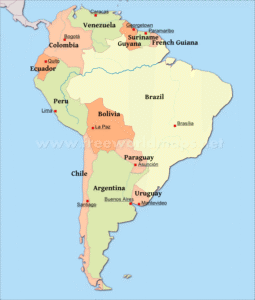
Added Notes. Here is the map of South America. We basically have Brazil left over on this vast continent. Bolivia lies between Ecuador, Peru, Chili, Argentina – now all of them Western influence. Colombia and Venezuela are under attack. The rest are not very important.

☐ ☆ ✇ Global South

Sabby Sabs and Brian Berletic: US-engineered color revolutions in Nepal and Indonesia

Par : amarynth — 13 septembre 2025 à 16:59

The Himalayan nation of 30 million people, wedged between China and India, is slowly returning to normal, less than a week after widespread Gen Z-led protests following a government ban on social media platforms.

Authorities began easing restrictions on Saturday, with curfew and prohibitory orders lifted in the capital, Kathmandu, though sensitive areas remain off-limits to the public.

Hours after appointing former chief justice and anticorruption figure Sushila Karki as the new interim head of government, President Ramchandra Paudel announced in a statement late on Friday that the 275-seat parliament has been dissolved and elections are fixed for March 5.

☐ ☆ ✇ Global South

In the footsteps of Sankara: Ibrahim Traoré and the new African revolution

Par : amarynth — 5 août 2025 à 14:33

Resistance is the only path to freedom. Whoever dares not resist and fight against his own oppression does not deserve to be free.

Recommended by Joti Brar from The Communists 


The following talk was presented to a Southall seminar in west London on Saturday 28 June 2025.

*****

A new wave of revolution swept through west Africa at the beginning of this decade. Mali, Burkina Faso and Niger all broke free from French imperialist control and inspired Senegal and Chad likewise to turn their backs on the former colonial master.

Anti-French sentiment has been growing for years as a result of France’s military activities in all these countries. French military bases were supposedly established in order to ‘fight against terrorism’ – terrorism that became a huge problem across the region after the complete destruction of Libya by Nato forces led by France and the USA.

There is a lot to say about the new Sahel alliance, but today’s talk will focus on Burkina Faso and its leader Captain Ibrahim Traoré, who has emerged as the leading voice of this new wave of anti-imperialist independence. Traoré leans heavily on the legacy of his compatriot Thomas Sankara, one of the most popular socialist leaders in the world, who was killed by French imperialism because of his attempt to lead a sovereign and socialist government in Burkina Faso.

‘We will not pay the debt’ was the theme of one of Sankara’s most famous speeches, but it is also considered to be the speech that sealed his fatal destiny, as he was setting what the imperialists considered to be a very bad example for other African countries that were then, and are still now, kept underdeveloped under the burden of the debt owed to their former colonisers.

Captain Traoré became the leader of Burkina Faso after a military coup d’etat in September 2022 that was overwhelmingly supported by the population. He is very popular around the world and is an inspiration for many. Since he came to power, his government has prioritised pulling the Burkinabé people out of poverty and cutting dependence on foreign aid.

It has also kicked western military bases out of the country. Because of all this, Traoré is seen in Washington and Paris as a number one threat, and has been the target of many assassination attempts. Much of the information available online is highly speculative, but we can be sure that he has been giving nightmares to imperialism, whose minions are actively doing all in their power to take him down by using puppet states like Ivory Coast and Nigeria.

France does not tolerate any disruption to the neocolonial system it put in place after the so-called ‘independences’ of the 1960s. Unlike Britain, France practises a more direct (ie, less subtle) form of governance over its former colonies, whereby a puppet leader is put in charge of a country and surrounded with ‘advisors’, who work directly for the French secret services and hold key roles in the military and the civil administration.

This policy of direct tutelage is also known as FrancAfrique. The ‘leaders’ of the countries concerned are highly infantilised and unable to take any decision without French approval.

Burkina Faso has had many such presidents: Maurice Yaméogo, Sangoulé Lamizana and Blaise Compaoré, all of whom put French interests first and foremost. Thomas Sankara, inspired by Marxist revolutionary ideas, was the only one who put the interests of the Burkinabé people first. During the four years of his leadership, the country’s name was changed from the colonial Upper Volta to ‘Burkina Faso’, which means ‘Land of upright men’.

Neocolonial Upper Volta becomes liberated Land of the upright men

President Sankara travelled across the country listening to the stories of his people and engaging with them on possible solutions to the many ills facing the nation.

He launched ambitious reforms emphasising self-reliance and social justice. He oversaw massive vaccination and literacy campaigns, tree planting projects to combat desertification, and initiatives to advance women’s rights. Sankara’s administration also required officials, including himself, to open their finances to public scrutiny, and he cut luxury perks for the elite.

These radical policies won him the love and support of his people. Soon, his influence was felt far beyond Burkina Faso’s borders. The country became known across Africa for his revolutionary leadership and the great changes taking place. On the international front, he gave powerful speeches that resonated with young people across the African continent in search of honest and committed leaders for their own countries.

Sankara was not afraid to criticise the colonial powers and challenge the policies and institutions that keep Africa poor. This won him lots of enemies, but it also made him a notable figure on the global stage. One of the things that set Sankara apart from past Burkinabé leaders was his refusal to accept foreign aid.

He instead focused his attention on what he could control. His government spent heavily on agriculture, believing it to be the cornerstone of Burkina Faso’s development. He believed that the nation’s economic future depended on its ability to feed itself and improve the livelihood of its population. This bet paid off. Burkina Faso’s agricultural revolution led to a 75 percent increase in cereal production between 1983 and 1986.

But it was on the international stage that Sankara really threatened former colonial powers. He was wary of foreign aid coming with strings attached and consistently refused to seek assistance from the International Monetary Fund (IMF), fearing that its conditions would undermine his revolutionary goals.

Sankara’s foreign policy was characterised by a strong commitment to Pan-Africanism. This stance earned Burkina Faso respect and new allies, but also generated tensions with western powers and conservative African governments, especially those with close ties to France.

Not everyone was happy to see Sankara ride so high with so much love and affection, both at home and abroad. Some traditional authorities, middle-class professionals and external powers, notably France and Ivory Coast, who felt threatened by Sankara’s rhetoric and alignment with socialist states, soon began to plot against him.

New leader develops in the ashes of the Burkinabé revolution

“Traoré was born shortly after the assassination of Thomas Sankara by [his former comrade turned traitor] Blaise Compaoré in 1987, and he grew up under the very long and corrupt years of the Compaoré regime.

“After his coup d’etat, Compaoré had been quick to reverse all the gains of the Sankara era. He went back to business as usual with French imperialism. He brought back the old political order and comprador elite; his government started cracking down on dissent and political rivals were arrested and eliminated.

“He quickly made a rapprochement with the IMF and brought the country back under the shackles of debt.

“He changed the constitution and organised elections that he won easily – having suppressed all opposition. Under his rule, life became more and more difficult for the Burkinabé people.

“Fast forward to 2009: Ibrahim Traoré started his military career and enlisted in the Burkina Faso army; he graduated as a second lieutenant around 2012 and received specialised training. During those years, a lot of unrest and uprisings shook Burkina Faso in protest against the corrupt regime of Compaoré.

“When, in 2011, a high school student named Justin Zongo died in custody, the riots against police brutality spread to the army, and soldiers mutinied in multiple barracks over unpaid housing allowances and low wages.

“Faced with protest from students and the military, Compaoré was forced to make concessions to maintain himself in power. The government increased soldiers’ pay, give bonuses to civil servants, lowered food prices, and promised justice for the student who had been killed.

“When, in 2014, his ruling party amended the constitution to remove term limits so that he could run for office again, massive protests erupted (thousands of civilians stormed the parliament to stop the vote). This time Compaoré did not manage to save himself. His government quickly collapsed; he resigned in October 2014 and fled to Ivory Coast.

“Power was assumed by two different military chiefs, General Honoré Traoré [no relation] and Lieutenant Colonel Isaac Zida, but neither of those leaders offered any real change to the Burkinabé people.

“In the meantime, Captain Ibrahim Traoré joined the United Nations peacekeeping mission in Mali as part of Burkina Faso’s contingent and got involved in the fight against islamic militants across the border.

“He was at the front line in the fight against terrorism. He served in northern Mali, and in 2018 he was among the soldiers honoured for their courage during major rebel attacks in the Timbuktu region. After that, he returned home and took part in counterinsurgency operations against terrorist groups acting in Burkina Faso.

“He saw action in hotspots like Djibo and participated in the 2019 Otapuanu offensive, a large-scale operation aimed at flushing out militants in the eastern part of the country. By 2020, Traoré had achieved the rank of captain at the age of 32. However, along with his promotion came growing frustration.

“His country was quickly falling apart before his very eyes, and there was little he could do about it.” (The man America fears the most – Ibrahim Traoré by Jude Bela, YouTube, 6 May 2025 )

In 2015, Burkina Faso elected Roch Marc Kaboré, a banker and former collaborator of Compaoré, as president. At the same time, islamic attacks on the country were intensifying and many army personnel were being killed, fuelling widespread public anger.

The Kaboré government quickly lost public confidence, having shown itself incapable of protecting the population from the increasing terrorist attacks. The army was undersupplied and outgunned by the mercenary terrorists, who had access to weapons stolen from Libya and the quiet backing and financial support of western imperialism.

In January 2022, the country witnessed a new coup, led by Lieutenant Colonel Paul Henri Damida, that ousted Kaboré. Captain Traoré was part of the Patriotic Movement for Safeguard and Restoration that backed the coup.

However, Damida, like Kaboré, was unable to stop the terrorist threat and more soldiers were dying on the frontline. Also like Kaboré, Damida had been a former close collaborator of Compaoré, and went so far as to invite the exile to return from Ivory Coast (despite having been found guilty by Burkina Faso courts of the murder of Thomas Sankara) to ‘advise’ the government on dealing with the terrorist threat.

It became clear that the influence of Blaise Compaoré and the FrancAfrique system he served were still looming over the country.

The second Burkinabé revolution

Captain Traoré, who had fought on the battlefield against terrorism, saw that Damida wasn’t the man needed to solve the country’s problems. On the 30 September 2022, he launched a second coup – swift and bloodless. He was elected president of the Patriotic Movement for Safeguard and Restoration’s council on 2 October 2022 and, one week later at the age of 34, he became Burkina Faso’s transitional president.

Since he was put at the head of the country, Traoré has been a strong voice against imperialism and corruption – denouncing western meddling in the region and labelling the terrorist attacks plaguing the country as imperialist attacks.

He has made strong moves that echo Thomas Sankara’s actions, like refusing to give himself a higher level of military security and renouncing his presidential salary.

Fighting against the security threat the country faces has been his number one priority. A nationwide campaign was launched to recruit civilian volunteers, his government’s goal being to defeat the insurgency outright, rather than to negotiate with the mercenaries. He publicly vowed to reconquer every inch of territory occupied by rebel militants, and stated there would be no talks with jihadist groups until they were militarily weakened to the point where they could not dictate terms.

He also made a strong alliance with Russia, which has led to the deployment of a Russian paramilitary brigade. In 2023, he, along with the leaders of Mali and Niger – countries that are suffering from the same terrorist problem – created the Alliance of Sahel States (AES), which established a joint military force to strengthen military coordination in the fight against terrorism.

Traoré’s government has prioritised economic measures such as the fight against mining-related fraud and corruption, the renegotiation of operating contracts, increased support for subsistence farming and the development of local industry. Other measures taken include:

  • Cabinet approval for the construction of the country’s first state-run gold refinery so gold can be processed domestically rather than all the country’s ore being exported abroad.
  • The establishment of a state-owned mining company and the requirement that foreign firms give it a 15 percent stake in all local operations and transfer skills to Burkinabé people.
  • The initiation of the process of nationalising gold mines owned by foreign companies.
  • Encouragement for the diversification of economic partnerships, particularly with emerging economies, on the basis of equality and mutual respect.
  • The rehabilitation of destroyed road and energy infrastructure.
  • The stimulation of local entrepreneurship, notably through support funds for young people and women.
  • The implementation of a policy of economic resilience to external shocks, particularly in times of sanctions or international crises.

It is also important to underline the economic measures taken by the Sahel alliance on a regional level. All three members of the alliance have withdrawn from the neocolonial Economic Community of West African States (Ecowas) and from its Franc CFA monetary system, and are now working towards the launch of a single, shared currency.

On a social level, Captain Traoré’s policies have brought about unprecedented (since the days of Sankara) patriotic mobilisation and social cohesion, particularly around territorial defence and national reconstruction, promoting intercommunity reconciliation and the return to their homes of many internally displaced persons.

In collaboration with local authorities, the government has relaunched basic social services such as healthcare, education and drinking water infrastructure.

The government has also placed youth at the heart of the national project to build a new Burkina, based on hard work, honour and integrity, besides supporting cultural, artistic and educational initiatives that foster the deepening of Burkinabé values.

Following an assassination attempt in April this year, solidarity protests were organised in many cities around the world, including London, Accra and Montego Bay, to show solidarity to Traoré and his government, whose actions are inspiring anti-imperialists and socialists across Africa and the world.

☐ ☆ ✇ Global South

The Jig is Up

Par : AHH — 31 mai 2025 à 11:53

America’s military humiliation: the Houthis exposed its waning power.

By Malcom Kyeyune at UnHerd.

When, in reaction to the war in Gaza, the Houthis of Yemen started imposing their blockade on the Red Sea, it was seen as a sure sign of waning American power: a global hegemon was allowing its control over a vital sea route to be contested. In their rush to fathom why this might be happening, detractors of the then president claimed he was simply too weak, too much of an appeaser to use the full width of America’s military might to quash the problem.

In fact, in response, Biden authorised not one but two military campaigns. The first was Operation Prosperity Guardian, which aimed to combine US naval power with a coalition of willing states to protect shipping and break the blockade. That fast turned into an embarrassing debacle, as most of the coalition partners walked away and ships kept getting hit by Houthi missiles. And so, in January 2024, Operation Poseidon Archer was launched, which involved British as well as American aircraft attempting to bomb the Houthis into submission. Here again, the operation was unsuccessful, doing almost nothing to dent Houthi attacks or open up the Red Sea to shipping. But even then Biden was blamed; the mighty US military was being held back somehow. Thus, the natural conclusion was that once Trump was in office, the gloves would come off.

Biden’s critics were actually half right. Once Trump came in, the gloves did come off. Operation Poseidon Archer was followed by Operation Rough Rider, in March of this year, which attempted to show a new, much more muscular American military response against Houthi targets in Yemen — for all of six weeks. For six weeks, US warplanes pounded Yemen around the clock, with rare and expensive stealth bombers flying missions out of Diego Garcia in support of carrier-based aircraft. Yet once those six weeks were up, Trump proudly announced that Yemen had “surrendered” and that there was no more need for the US to keep up the bombing. A ceasefire had been brokered by Oman. This was trumpeted as a glorious victory for the US military, with the Houthis finally promising to not attack US ships anymore, and America graciously returning the gesture.

Of course, Trump didn’t mention the terms of the “surrender”. The Houthis only had to stop attacking American ships in exchange for America stopping the bombing; they were free to continue blockading the Red Sea or firing missiles at Israel. America, in other words, had given the Houthis carte blanche to carry on the behaviour that was the reason America had gone to war in the first place. Thus, to call this deal a surrender was entirely appropriate; it’s just that it wasn’t the Houthis hoisting the white flag.

It is very commonplace to blame reversals and even defeats in America’s various wars of choice as merely a matter of lack of will. If America really wanted to win, it would win, the story goes; the failure of the US is just one where it never commits the force necessary to finish the fight. But today, that excuse rings hollow. Trump’s Operation Rough Rider, unlike Biden’s operations, utilised many of America’s most limited, expensive, and advanced weapons to try to bring the Houthis to heel. And still it surrendered. The lessons here are thus quite bleak. America’s preferred and increasingly only viable method of warfare — aerial warfare — is no longer cost-effective nor practical. But the US has no alternative modes of warfare to fall back on, which means that its days as a military hegemon are probably coming to a close.

To understand just how big a mess the air war against the Houthis has turned out to be, it’s important to understand a very basic rule to US military inventories. For while, on paper, America has 11 nuclear-powered aircraft carriers, an impressive figure that far outstrips any other country on the planet, that top line figure is barely relevant in practice.

For comparison, look to the United Kingdom. The UK has two large aircraft carriers, putting it near the top of the international leaderboard when it comes to the ability to project military force. But as anyone with any familiarity with the Royal Navy can tell you, that number does not tell the real story. The number of carriers the UK can actually deploy is far lower, a number which is fairly close to zero. For while the ships exist, the Royal Navy lacks the crew, the planes, the escorts, and the logistical capacity to actually put them to use for any length of time in a real war. The UK Navy has become something of a Potemkin village, where superficial on-paper strengths hide a catastrophic reality of deferred maintenance, insufficient budgets, and lack of personnel.

Though the situation for the US Navy isn’t quite as dire, in practice, the problem is the same: it cannot realistically put more than two to four carriers to sea at any given moment. The ability to surge capacity in times of crisis is limited, because the various reserve components of the US armed forces have catastrophically atrophied. If you discount the American carriers that are slated for the scrapyard, or those currently lacking a functional nuclear reactor, or those which are tied up in deep maintenance, the number of active, usable carriers is roughly a third of the on-paper number. Half of those carriers were being used against the Houthis.

But carriers are not the only example we ought to look at. For Operation Rough Rider, the US Air Force contributed some six B-2 Spirit stealth bombers, arguably the most advanced (and by far the most expensive) airframe in the US arsenal. At first blush, this seems like only a fraction of America’s power, because it has some 20 such bombers in its inventory. But a closer look at these planes suggest that those six used in Rough Rider very likely represent the entire working inventory of US stealth bombers. Because B-2s haven’t been built for decades, the only way to keep them operational is to cannibalise other B-2s for spare parts: as a result, a large number have been functionally scrapped and cannot ever hope to fly again. Only half of US bombers even qualify for so-called “mission capable” status on an average day, a status which doesn’t actually mean that the plane works; it simply means the plane isn’t completely broken and inoperable. Only two thirds or fewer of those mission capable planes can hope to qualify for what the US military instead classifies as “full mission capable” status. “Full mission capable” is your standard Pentagon-speak; it means the plane is in working order, has nothing broken that’s really important, and can realistically be used for what it was built for.

From carriers to stealth bombers, the pattern here is fairly clear, and it is further corroborated by testimonies from inside the Pentagon itself. America essentially pulled out all the stops to attack the Houthis, waging an extremely expensive and intensive air war against a militia controlling most of Yemen, the fourth-poorest nation in the world. The cost to operate a B-2 stealth bomber is extremely high on a per-hour basis; and their fragile stealth coating is not particularly fond of the warm, salty sea air at Diego Garcia. You don’t send in all of them unless you really mean business. America also committed roughly half of its active carriers, spent a fortune in land attack and air defence missiles, and it even cannibalised ammo stores and air defence systems from the Pacific theatre of operations for the sake of the operation.

But as the stories of the campaign start leaking to the press, it’s clear that none of this effort did anything good. The US couldn’t establish air supremacy, meaning it couldn’t risk flying its older, non-stealth planes for fear of losing them. This itself might seem like proof that America was once again just not trying very hard; for what kind of war is it when you’re not ready to accept losses? But the problem is, America can’t afford to replace planes that get lost and pilots that get killed. This is not a problem of cowardice, but of force generation: even if the US military suffers zero losses due to enemy fire in the years ahead, it is still slated to shrink precipitously. This shrinkage and loss of capacity is just due to America’s planes and ships wearing out, with not enough workers, dockyards, engineers, and dollars to replace them. As America burns through its massive military inheritance bequeathed by Ronald Reagan and the Eighties arms race, there is no plan to replace it. For the US military, avoiding casualties is not a matter of caution or cowardice; it is the result of a total inability to replenish the force.

The result of this American Achilles’ heel has been an extremely expensive reliance — when it has come to defending the Red Sea — on so-called “standoff” weaponry; cruise missiles, for example, that can be launched from far enough away that anti-air fire won’t be a threat. But even then, there were problems: according to leaked reports, even the vaunted F-35 stealth fighter had to dodge incoming anti-air missiles on at least one occasion. In Operation Rough Rider, the US deployed many of its most rare and bespoke weapons, such as the AGM-158 JASSM (Joint Air-To-Surface Standoff Missile) as well as heavy, specialised bunker-buster bombs. Again, by all accounts, this had little effect. Partly, this was because the US kept losing so many of its MQ-9 reaper drones, which come with a price tag north of 30 million dollars apiece, and which were supposed to provide the intel to ensure the bombing campaign found its targets.

When Biden first lost interest in defending the Red Sea against the Houthis, people were aghast. Not doing enough was akin to telling the entire world that the US was too weak to keep the Suez channel open. But Trump, after berating his predecessor, has also walked away, and de facto recognised the Houthi’s control of the channel. It would seem that the US doesn’t actually have many cards to play.

“As America burns through its massive military inheritance bequeathed by Ronald Reagan and the Eighties arms race, there is no plan to replace it.”

Trump could have sent another carrier to the region in support of his operation, bringing the total up to three. But this would hardly have made much difference to the air campaign because the problem with this offensive wasn’t lack of deck space or fighter sorties — US planes were too wary to go anywhere near Yemen’s air defence, and even stealth jets were reportedly not entirely safe. The problem was the lack of standoff munitions which can be deployed from a point of relative safety. But these are so expensive and so limited that there is no budget to replenish them when stores are depleted (a single JASSM with a 450 kilogram explosive warhead comes in at slightly under a million dollars). Wargames show the US running out of most or all such critical munitions in a matter of weeks or even days in a real conflict against a peer enemy such as China.

Even worse, much of the US military’s most advanced weapons systems are dependent on components and materials such as rare earths from China, which has already started imposing harsh export restrictions in order to slowly choke the life out of the US military industrial complex. In practice, the US does not have the economy to produce the weapons used for aerial warfare at any sort of scale, and this has only been hidden from full view because the military has coasted along on an aura of invincibility.

As the appetite for ground warfare has waned, the allure of quick, cheap and easy air campaigns has grown. But air warfare is no longer what it once was. Operation Rough Rider was supposed to be a decisive show of force against an under-equipped, internally divided third-world nation. Instead, it ended up looking like the last hurrah of a truly antiquated form of warfare, unable to cope with cheaper and better anti-air weapon systems.

All of these limitations make the current talk about a new bombing campaign against Iran utterly surreal. Iran is far bigger than Yemen, with a much more robust air defence network. Moreover, the distances involved are such that carrier-based aircraft, even when launched from the very shores of the Persian gulf, can’t actually reach places like Tehran and return on a single tank of fuel. Fighter-bombers will need aerial refuelling over the Iranian interior, and tanker planes are slow, easy to spot on radar, and pretty much defenceless. Even attempting to destroy the Iranian air defence network will take huge amounts of precision standoff weaponry, which the US cannot practically replace, even if it weren’t struggling with a massive fiscal crisis and soaring bond yields. The critical parts of Iran’s nuclear programme are kept under hundreds of feet of solid mountain; the US, using the heaviest and most advanced weapons in its entire arsenal, did not succeed against the much shallower Houthi bunkers and missile storage facilities in Yemen. All of the problems that forced America’s tacit surrender of the Suez canal would be writ large — and be far more lethal — in any campaign against Iran.

With exploding deficits, a growing internal political crisis, and a slowly collapsing military, America is a leopard that lacks the wherewithal to even attempt to change its spots. The generals know that the jig is up: the old model is broken, there is no new model coming, and nobody has the energy left to do much about it all. And so, this massive crisis of US military power is playing out in the vein of Ernest Hemingway’s comment about the course of his own bankruptcy: gradually, then suddenly.

Once upon a time, there was always a bigger plane, a more advanced high-tech future weapon, yet another trick up the Air Force’s sleeve that you could point to in order to silence the doubters. But those days are over. The gravity of what happened in Yemen will only assert itself once the political class is ready to deal with the new world we are now living in: one in which the US has no new military rabbits to pull out of its hat, and those that it does have simply aren’t enough to get anywhere close to victory.


Malcom Kyeyune is a freelance writer living in Uppsala, Sweden

☐ ☆ ✇ Vu du Droit

Grandola villa morena…

Par : Régis de Castelnau — 25 avril 2025 à 09:09
C’était un mercredi.  En ce temps-là, il n’y avait pas de chaîne d’information en continu, on ne se sentait pas obligé de s’infliger Rochebin, Praud, Pujadas, Duhamel etc. en prenant son café. On allumait la radio. Le 21 avril 1967,… Lire la suite →
☐ ☆ ✇ Vu du Droit

25 avril 1974, le cadeau des militaires portugais

Par : Régis de Castelnau — 25 avril 2024 à 10:21
C’était il y a 50 ans. C’était un mercredi. En ce temps-là, il n’y avait pas de chaîne d’information en continu, on ne se sentait pas obligé de s’infliger David Pujadas, Pascal Praud ou Ruth Elkrief en prenant son café.… Lire la suite →
❌