 Connexion


L’escalade des tensions au Moyen-Orient a des répercussions directes sur les marchés de l’énergie et le transport du pétrole et
L’article Poutine : la Russie peut offrir des voies maritimes sûres et fiables pour le gaz et le pétrole est apparu en premier sur STRATPOL.
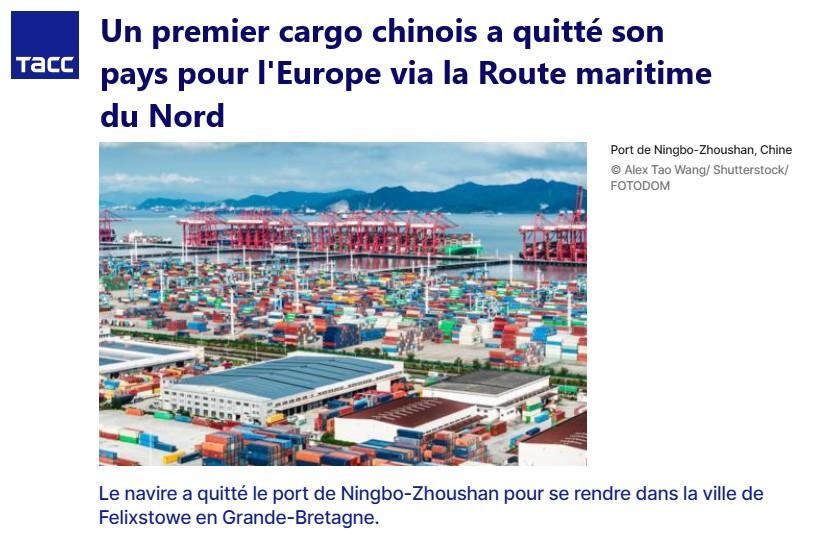
Un premier cargo a quitté le port de Ningbo Zhoushan, en Chine, à destination de Felixstowe, au Royaume-Uni, par la
L’article Un premier cargo chinois s’élance vers l’Europe via la Route maritime du Nord est apparu en premier sur STRATPOL.
Prof. Engr. Zamir Ahmed Awan
For centuries, the seas have been the lifeblood of global commerce. From the ancient spice routes to the oil tankers of today, shipping lanes have shaped the prosperity and power of nations. Among them, a handful of chokepoints — the Strait of Malacca, the Red Sea, the Suez Canal, and the Cape of Good Hope — have become indispensable arteries for world trade. Yet in the 21st century, these very chokepoints have also become liabilities. Increasingly unsafe, costly, and politically unstable, they pose risks not only to cargo but to global economic stability itself.
At the same time, the world is experiencing shifting geopolitics at breathtaking speed. Events that once took decades now unfold in months. Strategic rivalries, trade wars, climate change, and technological disruption all converge to rewrite the rules of global trade. Against this backdrop, China’s pioneering launch of the China–Europe Arctic Express Route from Ningbo-Zhoushan Port stands as a historic breakthrough — one that may redefine the future of international shipping.
Troubled Waters of Traditional Routes
Consider the Strait of Malacca, one of the busiest waterways on Earth. Stretching between Malaysia, Singapore, and Indonesia, it carries a quarter of global trade. Yet its narrowness makes it a prime target for piracy and an easy choke point during conflict. Energy-hungry economies, especially in East Asia, constantly worry about the so-called “Malacca Dilemma”: a single disruption could strangle their fuel supplies and industrial output.
Then there is the Red Sea and Bab el-Mandeb Strait, gateway to the Suez Canal. Here, piracy off the Somali coast once flourished, and more recently, instability in Yemen and regional tensions have raised alarms. Ships transiting this route must factor in heightened insurance premiums and military escorts — costs that trickle down to global consumers.
The Suez Canal itself, hailed as one of humanity’s greatest engineering feats, is no longer a guarantee of smooth passage. In March 2021, the world learned this lesson dramatically when the container ship Ever Given ran aground, blocking the canal for six days. Global trade losses were estimated at $9.6 billion per day, with hundreds of ships stranded and supply chains paralyzed. This single accident exposed the fragility of over-reliance on a few strategic chokepoints.
And then there’s the Cape of Good Hope, the fallback option when Suez is blocked. Longer and storm-prone, it adds thousands of nautical miles to a voyage, inflating both costs and carbon emissions. In an era of climate commitments, burning more fuel is a step backward.
The truth is plain: traditional shipping routes are no longer fit for the needs of a fast-moving, interconnected, and fragile world. They are costly in time, money, and security, and they leave global trade vulnerable to every geopolitical tremor.
The Arctic Breakthrough
This is where China’s Arctic Express Route offers a revolutionary alternative. The route, launched in September 2025, connects Zhoushan Port in East China to Europe’s Felixstowe in just 18 days. Compared to the Suez Canal’s 25 days or the Cape of Good Hope’s 30-plus, the savings are striking.
The advantages are more than numerical. By navigating the Northeast Arctic Passage, ships bypass volatile regions like the Middle East, the Horn of Africa, and Southeast Asia. Piracy, blockades, and political flare-ups become less of a concern. Shipping firms gain predictability, a precious commodity in an age of uncertainty.
The Arctic route also consumes less fuel, lowering costs and emissions. For industries pressured by both profit margins and sustainability targets, this is a game-changer. Shorter voyages mean fresher goods, lower logistics costs, and enhanced competitiveness.
Crucially, the Arctic corridor is less vulnerable to deliberate geopolitical manipulation. Unlike Suez or Malacca, it is not subject to disputes over sovereignty or competing military deployments. While climate change has opened this passage, it also demands that it be developed responsibly. China’s Arctic vision emphasizes cooperation, infrastructure, and green practices, making the route not just economically viable but also ethically forward-looking.
The Polar Silk Road
The Arctic Express is not an isolated event; it is part of a broader vision known as the Polar Silk Road. First articulated in China’s 2018 Arctic Policy, this initiative envisions the Arctic as a new frontier of international cooperation. Just as the Belt and Road Initiative (BRI) revitalized ancient trade corridors across Asia, Europe, and Africa, the Polar Silk Road aims to create a new northward artery for global commerce.
Already, there are discussions of joint ventures with countries like Russia, Japan, and South Korea, demonstrating China’s commitment to making the Arctic a shared space rather than an exclusive domain. Investments in Arctic ports, navigation systems, and environmental safeguards are underway, creating a long-term framework that benefits not only China but the world.
This is leadership by contribution — offering global public goods at a time when trust in multilateral institutions is declining. Where traditional powers once dominated sea lanes with naval might, China is building trust by creating safer, shorter, and greener alternatives.
Trump’s Tariffs and the Shifting Trade Map
The urgency of such alternatives is amplified by the disruptive impact of Trump’s tariffs. Since his return to office in 2025, tariffs on European cars, Chinese technology, and a host of other goods have upended global supply chains. Traditional trade patterns are breaking apart. Companies are re-routing supply lines, seeking new partners, and recalculating logistics.
For Asia and Europe, this has created both a challenge and an opportunity. Old dependencies are being questioned, and diversification is now the mantra. The Arctic route fits perfectly into this moment: it offers a fresh corridor that reduces reliance on politically sensitive chokepoints and aligns with the need for greater resilience.
If tariffs are walls, then the Arctic is a bridge. By cutting transit times and reducing costs, it makes cross-continental trade more attractive even in the face of protectionism. For businesses squeezed by tariffs, every saved dollar in shipping costs becomes a lifeline.
Lessons from Uncertainty
One of the defining features of today’s world is unpredictability. Wars in one corner of the globe ripple across supply chains thousands of miles away. A pandemic in one country halts factories in another. A political decision in Washington can reshape markets in Asia or Africa overnight.
In such a climate, reliance on vulnerable chokepoints is no longer a wise strategy. The Arctic route represents a conscious adaptation to uncertainty. It is not just about saving time and money, but about building resilience into the global trading system.
China’s initiative reminds us that leadership in the 21st century will not come solely from military power or economic might, but from the ability to innovate in ways that serve global needs. The Arctic Express is a model of such leadership — practical, forward-looking, and inclusive.
A Shared Future at Sea
Skeptics may argue that Arctic shipping faces challenges: ice conditions, environmental risks, and the need for specialized vessels. These concerns are real, but they are not insurmountable. Technological advances in ice-class ships, satellite navigation, and green propulsion are already addressing them. Moreover, international cooperation on Arctic governance can ensure that the route develops sustainably.
What matters is the principle: in a world of rising division, here is a project that embodies shared benefit. Developing countries gain access to faster trade routes. Global consumers pay less for goods. The planet benefits from reduced emissions. And global trade becomes less hostage to political shocks.
The broader message is clear: China does not seek to dominate the seas but to democratize them. By opening new routes, investing in infrastructure, and sharing the gains, it offers a vision of global leadership rooted in cooperation, not coercion.
A Compass for the Future
The story of the seas has always been a story of power and progress. From the Portuguese explorers of the 15th century to the British Empire of the 19th, control of shipping lanes has defined global influence. In the 21st century, however, the paradigm is shifting. The future will belong not to those who guard chokepoints with warships, but to those who open new pathways for humanity.
China’s Arctic Express is precisely such a pathway. It challenges the inefficiencies of the past, responds to the disruptions of the present, and points toward a future of safer, faster, and fairer global trade. In an era where uncertainty reigns, it offers a compass of stability.
The world may be unpredictable, but one fact is increasingly clear: with vision, innovation, and cooperation, China is charting the course that others will follow.
—
Author: Prof. Engr. Zamir Ahmed Awan, Founding Chair GSRRA, Sinologist, Diplomat, Editor, Analyst, Advisor, Consultant, Researcher at Global South Economic and Trade Cooperation Research Center, and Non-Resident Fellow of CCG. (E-mail: awanzamir@yahoo.com).
Delcy Eloína Rodríguez Gómez (born 18 May 1969) is a Venezuelan lawyer, diplomat, and politician who has served as the vice president of Venezuela since 2018.
L’Antidiplomatica posted an older article by Pino Arlacchi, former UN Deputy Secretary-General and former UN Director for Drug Control, and distributed by Delcy Rodrigues,
Correct translation of the title would be: “The Great Deception against Venezuela: the geopolitics of oil disguised as the fight against drugs”, but I do like the direct translation:
A document that exposes with UN data – the infamous and criminal lie that the US intends to impose to justify the intervention in Venezuela.
by Pino Arlacchi *
During my tenure at the helm of UNODC, the UN’s anti-drug and anti-crime agency, I was at home in Colombia, Bolivia, Peru and Brazil but I’ve never been to Venezuela. It just didn’t need it. The collaboration of the Venezuelan government in the fight against drug trafficking was among the best of the South American continent, equal only to the impeccable one of Cuba. A fact that today, in the delirious Trumpian narrative of the “Venezuela narco-state”, sounds like a geopolitically motivated slander.
But the data, the real ones, that emerges from the World Report on Drugs 2025 of the body that I had the honor of directing – tell a story opposite to what is doomed by the Trump administration. A story that dismantles piece by piece the geopolitical fabrication built around the “Cartel de los soles”, an entity as legendary as the Loch Ness monster, but suitable to justify sanctions, embargoes and threats of military intervention against a country that, coincidentally, sits on one of the largest oil reserves on the planet.
Venezuela according to UNODC: A marginal country on the drug trafficking map
UNODC’s 2025 report is crystal clear, which should embarrass the rhetoric of demonization of Venezuela’s demonization for those who have embodied. The report only makes a minimal mention of Venezuela stating that a marginal fraction of Colombian drug production passes through the country to the United States and Europe. Venezuela, according to the UN, has consolidated its position as a territory free from the cultivation of coca leaf, marijuana, and the like, as well as the presence of international criminal cartels.
The document only confirms the 30 previous annual reports, which do not speak of Venezuelan drug trafficking because this does not exist. Only 5% of Colombian drugs pass through Venezuela. To put this figure in perspective: in 2018, while 210 tons of cocaine crossed Venezuela, 2,370 tons – ten times more – were produced or traded from Colombia, and 1,400 tons from Guatemala.
The Fantastic Sign of the Sun: Hollywood Fiction
The “Cartel de los soles” is a creature of the fictional trumpiano. It would be led by the President of Venezuela, but it is not mentioned either in the report of the world’s leading drug body or in the documents of any European anti-crime agency and almost every other part of the planet. Not even a footnote. A deafening silence, which should make anyone think that still has a minimum of critical sense. How can a criminal organization so powerful that it deserves a $50 million bounty be completely ignored by anyone dealing with drugs?
In other words, what is being sold as a super-cartel to Netflix is actually a mixture of small local networks, the kind of petty crime found in any country in the world, including the United States, where – incidentally – nearly 100,000 people die every year from opioid overdoses that have nothing to do with Venezuela, and much to American Big Pharma.
L’Ecuador: The True Hub Nobody Wants to See
As Washington wags the Venezuelan bogeyman, the real drug hubs thrive almost undisturbed. Ecuador, for example, with 57% of banana containers starting from Guayaquil and arriving in Antwerp loaded with cocaine. European authorities seized 13 tons of cocaine on a single Spanish ship, which comes from Ecuadorian ports controlled by companies protected by members of the government of Ecuador.
The European Union has produced a detailed report on Guayaquil’s ports, documenting how “Colombian, Mexican and Albanian mafias all operate extensively in Ecuador.” The homicide rate in Ecuador jumped from 7.8 per 100,000 population in 2020 to 45.7 in 2023. But Ecuador is little talk. Perhaps because Ecuador produces only 0.5% of the world’s oil, and why doesn’t its government have the bad habit of challenging the overpowered US in Latin America?
The True Routes of Drugs: Geography vs. Propaganda
During my years at UNODC, one of the most important lessons I have learned is that geography does not lie. Drug routes follow precise logics: proximity to production centers, ease of transport, corruption of local authorities, and presence of established criminal networks. Venezuela meets almost none of these criteria.
Colombia produces more than 70 percent of the world’s cocaine. Peru and Bolivia cover the majority of the remaining 30%. The logical routes to reach American and European markets pass through the Pacific to Asia, through the Eastern Caribbean to Europe, and by land through Central America to the United States. Venezuela, facing the South Atlantic, is geographically disadvantaged for all three main routes. Criminal logistics makes Venezuela a marginal actor of the great international drug trafficking theatre.
Cuba: The Example that embarrasses
Geography does not lie, that is, but politics can defeat it. Cuba is still the gold standard of anti-drug cooperation in the Caribbean. An island not far from the coast of Florida, a theoretically perfect base for sorting towards the United States, but which in practice is foreign to the flows of drug trafficking. I have repeatedly found the admiration of DEA and FBI agents towards the strict anti-drug policies of the Cuban Communists.
Chavista Venezuela has constantly followed the Cuban model in the anti-drug struggle inaugurated by Fidel Castro himself. International cooperation, control of the territory, repression of criminal activities. Neither in Venezuela nor in Cuba have there ever been large pieces of territory cultivated with coca and controlled by great crime.
The European Union has no particular oil interests in Venezuela but has a concrete interest in fighting the drug trafficking that afflicts its cities. The Union has produced its European Report on Drugs 2025. The document, based on real data and not on geopolitical wishful thinkings, does not mention Venezuela once as a corridor of international drug trafficking.
Here is the difference between an honest analysis and a false and insulting narrative. Europe needs reliable data to protect its citizens from drugs, so it produces accurate reports. The US needs justification for its oil policies, so they produce propaganda masquerading as intelligence.
According to the European report, cocaine is the second most used drug in the 27 EU countries, but the main sources are clearly identified: Colombia for production, Central America for sorting, and various routes through West Africa for distribution. In this scenario, Venezuela and Cuba are simply not there.
But Venezuela is systematically demonized against any principle of truth. The explanation was provided by former FBI director James Comey in his post-resignation memoir, in which he spoke of the unconfessable motivations of American policies towards Venezuela: Trump had told him that Maduro’s was “a government sitting on a mountain of oil that we must buy.” It is not, then, drugs, crime, national security. It’s about oil that would be better not to pay for.
It is Donald Trump, therefore, who deserves an international bounty for a very specific crime: “systematic slander against a sovereign state aimed at appropriating his oil resources.”
—
*Pino Arlacchi was Deputy Secretary-General of the United Nations and Executive Director of UNODC, the UN’s anti-drug and anti-crime programme
Of course it’s all about Alaska. Here’s what’s in play. But it’s the shadowplay that’s even more exciting.
By Pepe Escobar at Strategic Culture Foundation.
Of course it’s all about Alaska. Here’s what’s in play. But it’s the shadowplay that’s even more exciting.
Across the world, for those who grew up in the Cold War Swingin’ Sixties, the temptation is irresistible to cast Donald Trump as Goldfinger (but who would play Oddjob? Hegseth?)
Goldfinger, after all, is a powerful, ruthless gambler. His 21st century motto would be “Obliterate & Plunder”. In fact, sequentially, an orgy of obliteratin’ and plunderin’ if the occasions present themselves. Everything subjected to the search for the Golden Deal. My way. The only way.
Yet now it’s possible that Goldfinger may have met its appropriate – collective – match.
This is what happened the last time a summit took place in Alaska, in this particular case US-China in a shabby hotel in Anchorage. That shook the geopolitical chessboard to the core. Trump-Putin might – but only under quite specific conditions.
There’s only one realistic, optimal endgame for Alaska: a joint declaration of intent, pointing to a follow-up, as in the next meeting to be held in Russian territory. A sort of starter for the long and winding road towards a real reset of US-Russia relations, including a possible settlement in the proxy war in Ukraine.
Essentially, they may agree to keep talking. Yet what really matters is what may be implied by the promise: Goldfinger refrains from imposing secondary sanctions on Russia’s partners.
That will constitute a tremendous BRICS victory (Iran excluded. Actually, two strategic allies of Russia would be excluded: Iran and the DPRK).
BRICS are actively building a coalition to stare down Goldfinger. The key players are Bear, Dragon, Toucan and Elephant – all four original founders of BRIC. Nightingale should be added later, as it is linked via geopolitical/geoeconomic strategic partnerships with Bear, Dragon and Elephant.
When it comes to the Alaska nitty gritty, the top Bear needs to consider all the ramifications of what is an imperative for the Russian General Staff and the vast intel apparatus in Moscow: unless Goldfinger minions stop weaponizing and providing precious intel to Ukraine is all its forms, the mythic “ceasefire” that Goldfinger and the pack of toothless chihuahuas in Europe desperately want will be just an intermission to allow Ukraine to rearm to the hilt.
That’s a tough call for the top Bear: he has to placate his domestic, radical critics who blast him for sitting down with the enemy, and at the same time he must deliver the goods to his under-siege BRICS allies.
BRICS counteract Goldfinger’s Plunder tactics
Bear, Dragon, Toucan and Elephant are involved in breathless telephone diplomacy to articulate their collective response to Goldfinger’s Tariff/Plunder drive.
Examples. Modi on Brazil: “A strong, people-centric partnership between Global South nations benefits everyone.”
Lula on India: “Brazil and India are, so far, the two most affected countries. We reaffirmed the importance of defending multilateralism and the need to address the challenges of the current situation.”
Xi to Lula: China backs Brazil to defend its national sovereignty; BRICS is “a key platform for building consensus in the Global South.”
Goldfinger’s Tariff Plunder works in several ways.
On India: because New Delhi refuses to open its vast agricultural market to tariff-free Made in USA imports (45% of India’s population directly depends on agriculture); and because India buys Russian oil at much-needed discount prices.
On Brazil: because the ultimate target is regime change and free reign to plunder Brazil’s natural wealth.
So far, Goldfinger’s Plunder antics have been stellar when it comes to engineering their own blowback: from allienating even allies – see abject European submission – to de facto burying multilateral trade, not to mention international law.
Example: just a few hours before the tariff “pause” on Made in China products was about to expire, Goldfinger signed an executive order extending the deadline for another 90 days. Translation: TACO, all over again. If the tariff “pause” went through, the economy of the $37 trillion-indebted “indispensable nation” would be in even more dire straits.
Then there’s Goldfinger’s possible Arctic gameplay, already examined here. There’s virtually no evidence Russia would allow the US to participate in the development of the Arctic-wide Northern Sea Route (NSR), or Arctic Silk Road in Chinese terminology.
The role of Russia’s Atomflot – 11 nuclear icebreakers, 9 of them in action, 2 being built, including Project 10510 Rossiya, a behemoth capable of navigating anywhere in the Arctic anytime – in parallel with Russia’s astonishing arsenal of new weapons systems, these are absolutely key variables on any serious discussion on any possible US-Russia partnership post-Alaska.

Arya – آریا: mural at Tehran’s Enghelab Square. Farsi text: “The end of this saga is of glory, thus recite the name of Iran, for it is the slayer of its enemies.” The Iranian warrior Rostam from Shahnameh fights the serpent (the US)
Goldfinger’s obsession to cage Nightingale
Now let’s look at Nightingale – an immensely complex case. Goldfinger has totally embarked on a multi-track maximum pressure/tension remix against Iran: forcing Hezbollah to disarm; forcing the collapse of Lebanon into factional war; legitimizing the “al-Qaeda R Us” dismemberment of Syria; forcing snapback UN-backed sanctions on Tehran.
Then came the Goldfinger-hailed “historic peace summit” with Azerbaijan’s Aliyev and Armenia’s Pashinyan.
Well, what Baku and Yerevan really signed under Goldfinger’s watchful eye is not a peace deal: it’s a mere memorandum of understanding (MOU).
Their Joint Declaration is extremely vague – and non-binding. What is promised is a “let’s keep talking” set up: “We acknowledged the need to continue further actions to achieve the signing and ultimate ratification of the [Peace] Agreement.”
It remains to be seen what happens with the much-ballyhooed 99-year American grip on the Zangezur corridor – trimphally named Trump Route for International Peace and Prosperity (TRIPP) – complete with grabbing 40% of its revenues (Armenia would get only 30%) and placing 1,000 American mercenaries to patrol Armenian territory, right south of Nightingale’s borders.
The big story is of course Goldfinger eager to snatch at least one connectivity corridor in southern Eurasia – in the strategic south Caucasus, using a gangster-minded MI6 asset (Aliyev) and a national traitor (meek Pashinyan), which will be discarded and/or sweetened in due time. Crucially, NATO membership was offered to both Armenia and Azerbaijan.
The Deep State’s game plan is total control: what really matters is the opening to establish a NATO corridor all the way to the Caspian.
There’s no way Nightingale will let that happen, not to mention Bear and Dragon: it would mean a direct NATO threat not only to the International North South Transportation Corridor (INSTC), which unites three BRICS (Russia, Iran, India) and crosses the Caspian, but also the Chinese Silk Roads, whose corridors traverse Iran with possible branch outs to the Caucasus.
Nightingale has already made it quite clear it will not allow any kind of change of status for the Zangezur corridor. And it has the necessary missile arsenal to back it up. IRGC Deputy Commander Yadollah Javani: Iran “will not allow an American corridor on its border.”
Wherever it comes from, Goldinger or the Deep State, the pressure by the Empire of Chaos is relentless. There will be no respite in the Hybrid – and otherwise – Wars on BRICS, especially on the new Primakov triangle (“RIC” as in Russia, Iran, China).
Alaska in principle should be about a reset of all US-Russia security matters – geopolitical, commercial, military, with Ukraine being just a subset. That will be a major stretch. It’s hard to imagine Putin being able to impress on Trump, on the same table, the finer points of NATO/US ceaseless plots to undermine, harass and destabilize Russia.
The most probable outcome is that the proxy war – and the SMO – will keep rollin’ on, but with the Deep State making extra bundles of euros by selling tons of weapons for NATO to dispatch to Kiev. But even without the promise of a new, serious, US-Russia security architecture, BRICS may still stand a chance to snatch a victory out of Goldfinger’s latest photo op.
All eyes on Alaska. The Bear-Eagle face-off is part of an astonishing acceleration of history in the summer of 2025.
By Pepe Escobar at Sputnik.
Two weeks after Alaska, there’s the Shanghai Cooperation Organisation (SCO) annual summit in Tianjin, China. India’s Narendra Modi and Iran’s Masoud Pezeshkian will join, among others, Xi Jinping and Vladimir Putin at the same table. A BRICS/SCO table.
September 3, in Beijing, is the 80th anniversary of what is officially defined as the victory of “the Chinese People’s War of Resistance Against Japanese Aggression and the World Anti-Fascist War”. Putin is the guest of honor. The rehearsal, with 22,000 participants, took place this past weekend in Tian’anmen Square.
On the same day, in Russia’s Vladivostok, it’s the start of the Eastern Economic Forum, which discusses everything about Russia’s drive to develop the Arctic and eastern Siberia – the equivalent of the Chinese “Go West” campaign started in the late 1990s. Key Eurasian players will be in the house. Putin addresses the plenary session on September 5.
Top BRICS leaders of China, Russia, Brazil and India, meanwhile, are actively involved in a flurry of phone calls coordinating a collective response to the tariff wars – part of the hybrid war by the Empire of Chaos against BRICS and the Global South.
How Trump is Aiming for a PR Win
Let’s see how Alaska is setting the stage for something much bigger.
The summit was announced following what Putin advisor Yuri Ushakov concisely defined as “a proposal from the American side which we think is quite acceptable.”
This sentence was as far as the Kremlin would comment – in contrast with the non-stop verbal onslaught emanating from Washington. That the Kremlin even considered the American offer means an implicit recognition of what Russia is achieving on the battlefield and in the geoeconomic sphere.
Timing. Why now? Especially after Trump had threatened buyers of Russian oil with tariffs? Essentially, because military intel in selected deep state silos have done the math and finally admitted that the long proxy war in Ukraine is lost.
Moreover, Trump personally wants to get over it so as to concentrate on the next chapters of the Forever Wars – including the one that really matters: against “existential threat” China.
From Moscow’s point of view, conditioned by the successful results of its calibrated war of attrition, the facts on the battlefield spell out the special military operation rollin’ on – and no ceasefire; at best a “humanitarian” pause of a few days. The Americans want a ceasefire of at least a few weeks.
Reconciling both sides’ optics will be a Sisyphean task. Still, Alaska is just the beginning: the next meeting is already in the works to take place in the Russian Federation, according to Ushakov.
Trump’s motives are easily identified: create the perception of the US extracting itself from the mess; some sort of truce; and back to doing business with Russia – especially in the Arctic.
In parallel, assuming any sort of deal, the deep state will never recognize the new Russian regions, even Donetsk and Lugansk; and will seek to re-weaponize Ukraine, “leading from behind”, for a NATO-led war replay further on down the road.
So the US-Russia abyss is mirrored by the domestic American abyss – and most of all the Trump-NATO/EU abyss. The toothless chihuahua European pack, trying to salvage its pitiful Kiev actor, is doing somersaults – complete with possible black swans – to derail the summit even before it happens.
There’s no way Trump can sell any sort of settlement to the rabid NATO/EU pack. But nothing would please him more than to transfer the war – in full – to them. With the benefit that the deep state in this case will not complain – because it will be reaping massive euro profits from the weapons sale racket. End result: a classic Trump PR win.

Exit Ukraine, Enter the Arctic
Ukraine, though, will not be the main theme in Alaska. The ever-perceptive Russian Deputy Foreign Minister Sergei Ryabkov cut to the chase: what really matters is that “the first signs of common sense are appearing in Russia-US relations, which were absent for several years before.”
Ryabkov was quick to also highlight the dangers: the risk of nuclear conflict in the world “is not decreasing”; and Russia sees the risk that “after the expiration of the New START Treaty, nuclear arms control will be completely absent”.
Once again: Alaska is just the beginning of something much bigger – including, finally, a serious discussion about “indivisibility of security” (what Moscow wanted already in December 2021, rebuffed by the autopen administration).
And that brings us to the Arctic – and serious stuff that will certainly be debated in depth at the upcoming Vladivostok forum.
The Arctic holds at least 13% of global undiscovered oil reserves and 30% of undiscovered natural gas. Russia controls at least half of all these reserves. The Empire of Chaos badly wants to be part of the action.
Yet one thing is possible massive US investment in joint Arctic projects with Russia. Something entirely different is the US joining the Northern Sea Route (NSR) – which the Chinese call the Arctic Silk Road. The NSR reduces shipping time between Asia and Europe by up to 50%.
The Russian-Chinese rationale for the NSR – including the expansion of Russia’s unique nuclear icebreaker fleet – is exactly to bypass the Suez Canal and connectivity channels controlled by the US. The key question then is what would it take to swing Moscow to accept a Trump-Putin deal in the Arctic.
So on Ukraine, in principle, Russia has all the cards – as long as the special military operation goes on, now on overdrive. On hybrid war, the tariff chapter, the US ruling classes finally realized they have no cards – because blowback caused by secondary sanctions will badly damage the US. What’s left then is a commercial deal: the Arctic.
It’s quite intriguing that even the JPMorgan Center for Geopolitics admitted that the best solution for the Ukraine mess is a Georgia scenario: that would somewhat offset the optics of a total capitulation by the West. Only Ukraine would capitulate: no NATO, no EU, no money, no security guarantees.
Inestimable Prof. Michael Hudson has condensed how Alaska will proceed under two vectors: “Part I is whether the US will acknowledge that the trajectory of the current fighting is for a total Russian victory, on the terms that Putin has been explaining for two years: no NATO membership, no foreign arms supplies, Nuremberg-like trials of the Banderite leaders, and perhaps reparations by Ukraine and NATO for the rebuilding of formerly ‘Ukrainian’ Russia.”
Assuming Trump accepts it, and that’s a major “if”, then comes the real nitty gritty (remember Ryabkov), “starting with whether a new atomic missile and arms treaty will be put in place.”
Russia’s version of peace, writes Prof. Hudson, will flow along these lines: “We don’t want an atomic war with the United States. Let’s agree that if a German or other EU/NATO missile hits Russia, when we retaliate it will only be against Britain, Germany and France, not North America.”
Prof. Hudson is adamant that “America has only one thing to offer other countries: the (temporary) promise NOT to hurt them. There’s nothing positive to offer, given its de-industrialization and the world’s de-dollarization.”
As it stands, and also considering the multiple ramifications of the hybrid war against BRICS, Alaska carries the potential of offering Washington a way out of the debris of a massive strategic defeat.
Any analyst who tried to understand the special military operation from the beginning, in detail, could tell that Russia’s war involved something much bigger than Ukraine. It was always about the burial of the “rules-based international order”, in fact the whole old order architecture. That is happening as we speak in the black soil of Novorossiya. Strategic patience, in the end, does pay.
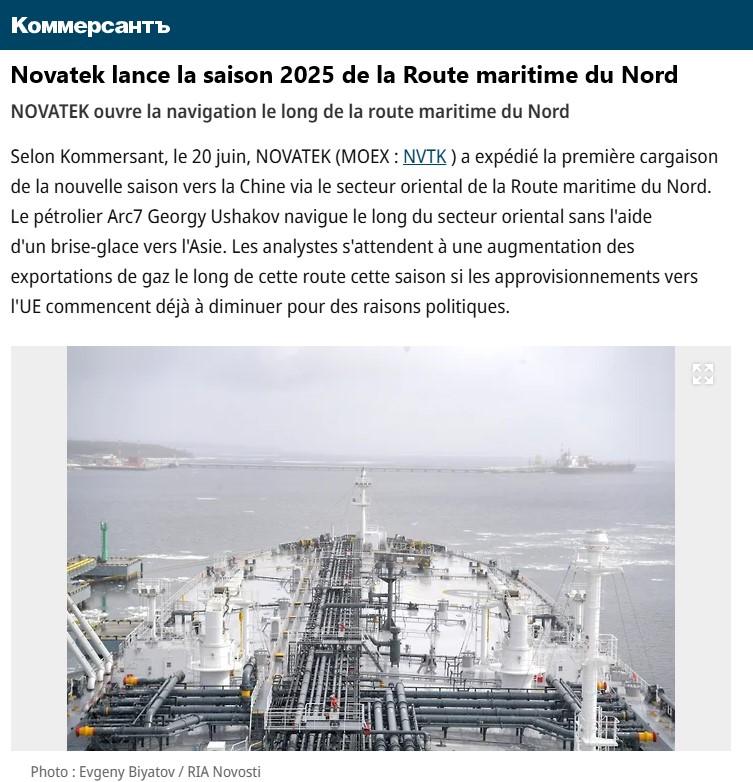
Selon Kommersant, le 20 juin, NOVATEK (MOEX : NVTK) a expédié la première cargaison de la nouvelle saison vers la
L’article Novatek envoie sa première cargaison de l’année sans brise-glace via la Route maritime du Nord est apparu en premier sur STRATPOL.
In May this year, China held an emergency meeting to officially launch the “Thunder Operation” against key strategic minerals such as rare earths, gallium, and germanium.
This is not a simple smuggling crackdown, but a deep cleanup, targeting the entire rare earth laundering chain hidden behind the “third country” and carefully disguised.
Since China has strengthened its restrictions on rare earth exports, many countries have faced resource shortages, especially the United States, which is highly dependent on rare earths.
In order to circumvent the restrictions, they “import in a roundabout way” through third-party countries in large quantities – on the surface, they purchase rare earths from these countries, but in fact, they obtain Chinese resources through transshipment. The whole process is secretive and complicated.
So, who is secretly reselling Chinese rare earths to the United States? And what impact will China’s further crackdown on the resale of rare earths have on the United States?

 Lateo.net - Flux RSS en pagaille (pour en ajouter : @ moi)