 Connexion


 L’armée ukrainienne a bombardé le dortoir d’un collège pédagogique. À quelles extrémités la guerre en Ukraine aboutira-t-elle ? Vladimir Poutine
L’article ICI MOSCOU ! Fléaux ukrainiens est apparu en premier sur STRATPOL.
Après Donald Trump, c’était au tour de Vladimir Poutine d’être reçu à Pékin. Une déclaration conjointe a rappelé avec force
L’article ICI MOSCOU ! Xi, Poutine, Trump : le choc des mondes ? est apparu en premier sur STRATPOL.
Donald Trump s’est rendu en Chine où il a discuté avec le président Xi des principaux enjeux internationaux. Traversons-nous un
L’article ICI MOSCOU. Le tournant est apparu en premier sur STRATPOL.
La tenue des commémorations du 9 Mai se déroule dans un contexte tendu. Zelensky va-t-il en profiter pour faire mener
L’article ICI MOSCOU ! 9 Mai : commémoration sous conditions est apparu en premier sur STRATPOL.
Le Mali est secoué, le blocage d’Ormuz pénalise tout le monde et le conflit ukrainien n’est toujours pas résolu. Les
L’article ICI MOSCOU: Excès de pouvoir et non-respect du droit est apparu en premier sur STRATPOL.
Le lanceur Soyouz-5 a effectué son vol inaugural depuis le cosmodrome de Baïkonour. Les premier et deuxième étages ont fonctionné
L’article La première fusée Soyouz-5 lancée avec succès est apparu en premier sur STRATPOL.
Une prolongation du cessez-le-feu a été acceptée in extremis. Que peut obtenir Donald Trump des négociations avec l’Iran ? Le
L’article ICI MOSCOU: Consolidation du nouvel ordre mondial est apparu en premier sur STRATPOL.
La victoire de Péter Magyar contre Viktor Orbán en Hongrie tourne une page importante en Europe centrale. Un cessez-le-feu au
L’article ICI MOSCOU: Trouble-fête est apparu en premier sur STRATPOL.
L’annonce d’un cessez-le-feu entre l’Iran et les États-Unis a surpris tout le monde. Les négociations qui doivent se tenir au
L’article ICI MOSCOU: Coup de théâtre est apparu en premier sur STRATPOL.
Donald Trump est revenu sur la guerre en Iran dans son discours à la nation. Que peut-il annoncer de bon
L’article ICI MOSCOU: La guerre selon le bon plaisir de Trump est apparu en premier sur STRATPOL.
Un marathon éducatif, un forum spatial russe, des projections de films, un défi sportif, un spectacle audiovisuel et, bien sûr,
L’article La première édition de la Semaine spatiale commence à Moscou est apparu en premier sur STRATPOL.
Entre le frénétisme de Pete Hegseth et le cynisme affiché de Donald Trump, la justification de l’agression contre l’Iran peine
L’article ICI MOSCOU: Manœuvre dans le brouillard de guerre est apparu en premier sur STRATPOL.
Donald Trump peine à constituer une force internationale pour forcer le passage du détroit d’Ormuz. Les démissions dans son administration
L’article ICI MOSCOU: L’État profond démasqué est apparu en premier sur STRATPOL.
L’opération militaire américaine se poursuit et restera dans les livres d’histoire. Quels sont les objectifs de cette attaque contre l’Iran
L’article ICI MOSCOU. Opération « Epstein fury » est apparu en premier sur STRATPOL.
Le 28 février 2026, Israël et les États-Unis ont lancé chacun une opération militaire contre l’Iran. Le chef d’État iranien,
L’article ICI MOSCOU ! Le changement de régime de trop est apparu en premier sur STRATPOL.
Le 24 février 2022, il y a 4 ans, débutait l’opération militaire spéciale russe en Ukraine. Alors que le déroulement
L’article ICI MOSCOU ! Quatre ans d’opération militaire spéciale est apparu en premier sur STRATPOL.
Dans cette nouvelle édition de « ICI MOSCOU », Xavier Moreau revient sur les négociations à Genève. Assiste-t-on à une
L’article ICI MOSCOU: Le tour est encore joué! est apparu en premier sur STRATPOL.
Dans cette nouvelle édition de « ICI MOSCOU », Xavier Moreau évoque le désarroi des Européens au sujet de l’Ukraine
L’article ICI MOSCOU ! Déprime et terrorisme ukrainien est apparu en premier sur STRATPOL.
Dans cette nouvelle édition de « ICI MOSCOU », Xavier Moreau évoque l’alliance sino-russe, les évolutions en Ukraine et la
L’article ICI MOSCOU: Anciens et nouveaux partenaires est apparu en premier sur STRATPOL.
Le maire de Moscou, Sergueï Sobianine, a informé le président Vladimir Poutine, lors d’une réunion au Kremlin, des progrès réalisés
L’article Sobianine présente le bilan des progrès récents de Moscou à Poutine est apparu en premier sur STRATPOL.
Dans cette nouvelle édition de « ICI MOSCOU », Xavier Moreau fait le point sur le déclassement de l’Europe, sur
L’article ICI MOSCOU : Constats amers est apparu en premier sur STRATPOL.

Dans cette nouvelle édition de « ICI MOSCOU », Xavier Moreau commente la tenue du forum de Davos. Le nouvel
L’article Ici Moscou: La fin d’un monde est apparu en premier sur STRATPOL.

Dans cette nouvelle édition de « ICI MOSCOU », Xavier Moreau revient sur les trois lubies du moment de Donald
L’article Ici Moscou : Trump hors contrôle est apparu en premier sur STRATPOL.

La nouvelle réalité du monde multipolaire adviendra-t-elle sous de pacifiques auspices ? Investiture de Donald Trump pour un second mandat
L’article ICI MOSCOU ! Bilan 2025 est apparu en premier sur STRATPOL.

Dans cette édition de « ICI MOSCOU », Xavier Moreau commente les résultats de Donald Trump après un an à
L’article ICI MOSCOU ! Année Trumpesque est apparu en premier sur STRATPOL.
Lavrov and Iran FM Araghchi Hold Joint Press Conference After Moscow Talks
A few Lavrov quotes:
West is attempting to distort all norms of international law, trying to replace it with their own rules — Lavrov
This just reflects their 500-year neocolonial desire ‘to try to live at the expense of others,’ Lavrov adds
—
Russia reaffirms once again its willingness to help our Iranian friends in looking for acceptable ways to resolve the nuclear crisis that was created by the Westerners — Lavrov
—
BRICS and SCO are organizations of a new type, unlike such NATO or what the EU has turned into — Lavrov
—
‘They are trying to subjugate the will of their member states’
They talk about themselves ‘like they are the greatest politicians of modern times, not some hired employees’
—
Europe is silent on US attacks in the Caribbean to gain Trump’s favor over their Ukraine peace plan proposals — Lavrov
Russia is ‘concerned’ with US Navy striking civilian boats and a probable land op
‘Almost all of the countries find it unacceptable apart from the Europeans’

Dans cette édition de « ICI MOSCOU », Xavier Moreau commente la nouvelle stratégie américaine officialisée par la Maison Blanche.
L’article ICI MOSCOU: Nouvelle doctrine américaine est apparu en premier sur STRATPOL.
If the current, fragmented collective West would ever have a chance to be rescued from the Centaur of oblivion, that task must be carried out by the definitive, Western civilization-state: Pallas Athena Italia.
Pepe Escobar at Strategic Culture
In Botticelli’s masterpiece Pallas and the Centaur (1482-83), to be seen at the Galleria degli Uffizi in Florence, the Firenze-Athena parallel is unmistakable, with Florence depicted as the new Athens.
Pallas Athena (or Minerva), after all is the Goddess of Knowledge. Here a flowery Firenze – or Firenze Flora, to remind us of another Botticelli masterpiece, the Primavera – is shown as the quintessential emblem of civilitas.
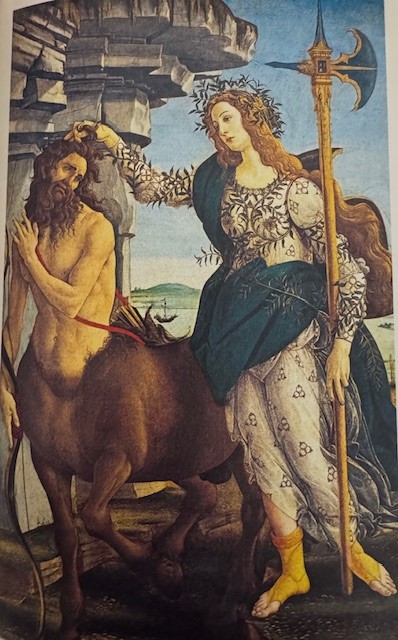
Pallas and the Centaur, by Botticelli (1482-83)
In the painting, Pallas totally dominates the violence of the Centaur – here deprived of cunning, an attribute of the fox, as Machiavelli described. But as in all things Botticelli, the gesture of the goddess – hair-pulling the beast – is quite ambiguous. She’s not dominating it just by mere persuasion or the art of subtle rhetoric. Pallas/Minerva here is much stronger – and even ready to decapitate the Centaur with her pick.
Call it the emblem of civilizational violence.
How far have we drifted from neo-platonic heights. If a pop Botticelli with an Andy Warhol streak would remix Pallas and the Centaur today, Pallas/Minerva would forcefully represent the power of Italian civilitas – the most cultured and influential civilization-state in the history of the West. And the Centaur would be an artificial perversion, the European Union (EU).
Call it Firenze-Athena defeating Brussels.
The endless wonders of Italian civilization
This is what I saw – call it fragments of civilization – as part of the immense privilege of hitting the road across the Italian civilitas, in a mini-tour connected to the launch of my latest book, Il Secolo Multipolare (“The Multipolar Century”). The book, via 46 columns, essentially tracks the year 2024, the last year of the now defunct “rules-based international order”, and arguably the first year of the definitive push towards a multipolar/multi-nodal world.
By a delightful accident, this is the first of my books not launched initially in the U.S.; a different version is being translated and will be launched soon also in Russia.
Starting on November 30, we held a series of conferences connected to the book, organized by the ground-breaking association Italianinformazione, near Udine in the Friuli; in the free territory of Trieste; in Bologna; in Ivrea in Piemonte; in Florence; and then, independently, in Spoleto in Umbria. This coming Saturday there will be a special conference in Rome, including, among others, Italy’s former ambassador to China and Iran, Alberto Bradanini.
As soon as I arrived in Venice, the tone was set: I received as a gift a custom handmade cap with the inscription “Make Roman Empire Great Again”. The Circus Ringmaster in Washington would have loved it. Who would he be as an Emperor? Caligula?
In Friuli, close to Slovenia and Austria, I was surrounded by NATO bases, many of them invisible underground. In the free territory of Trieste – where many remember fondly the hands-off approach of Austria – my hosts helped me dive deeper into the militarization of the port, which NATO wants to configure as the essential node in the Intermarium: Mediterranean, Baltic, Black Sea, all of course to become “NATO lakes”.
In Ivrea, we enjoyed the privilege of a comprehensive, 8-hour guided tour of the Olivetti complex, led by former top exec Simona Marra, who lovingly provided a detailed overview of one of the most extraordinary experiments in industrial humanism in history (this will be the subject of a special column).
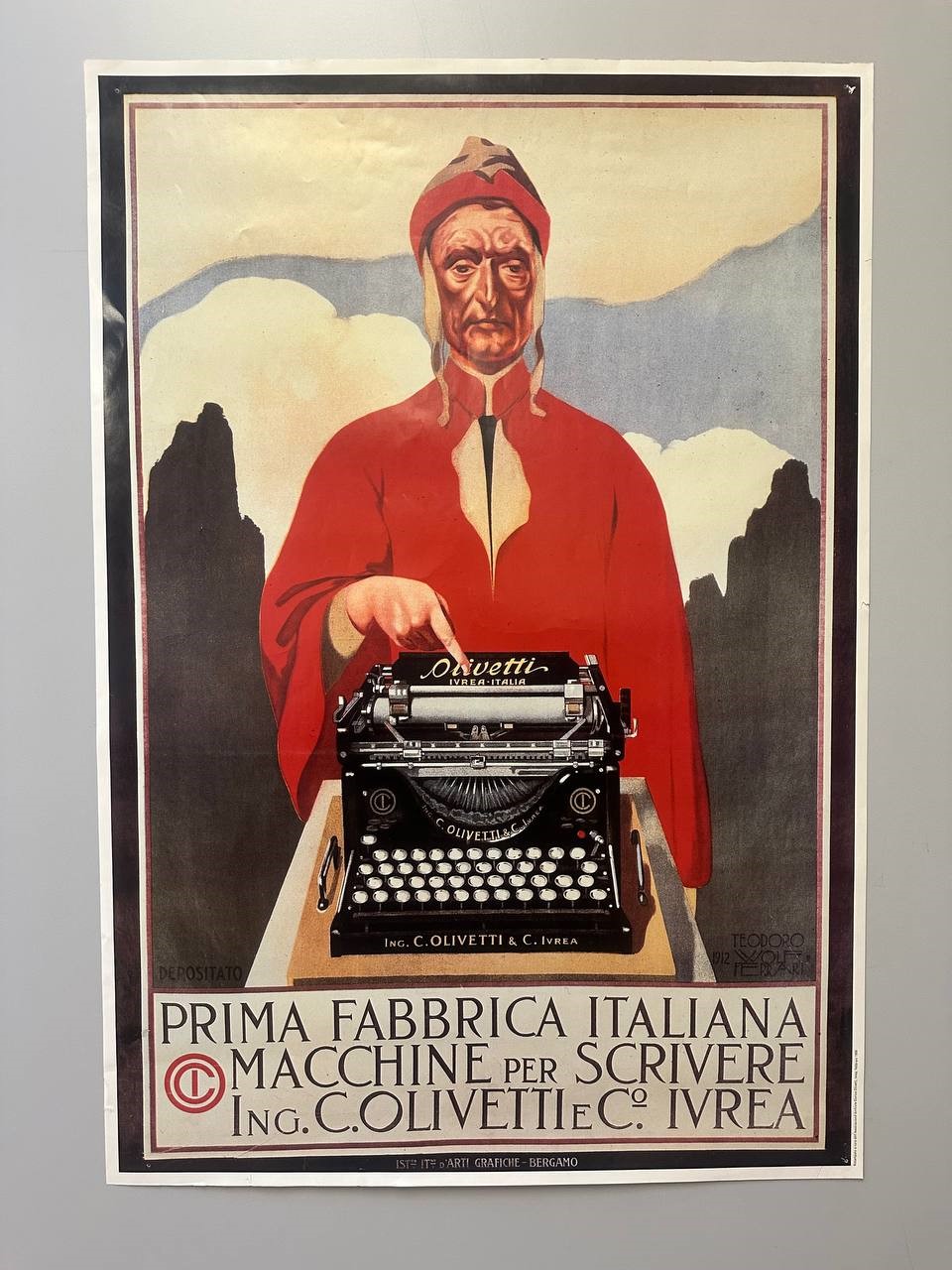
Dante’s typewriter. At the iconic Olivetti complex in Ivrea, Piemonte. Photo: P.E.
Firenze-Flora, of course, is on a whole new ultra-high level. Banners in communities reject NATO’s wars. At the San Marco museum – a former Dominican convent – an extraordinary exhibition, the first of its kind, celebrates Fra Angelico, the master of color and perspective in the early Florentine Renaissance, retracing his entire career and the creative, unique dialogue with others masters such as Masaccio, Filippo Lippi, Lorenzo Ghiberti and Luca della Robbia.
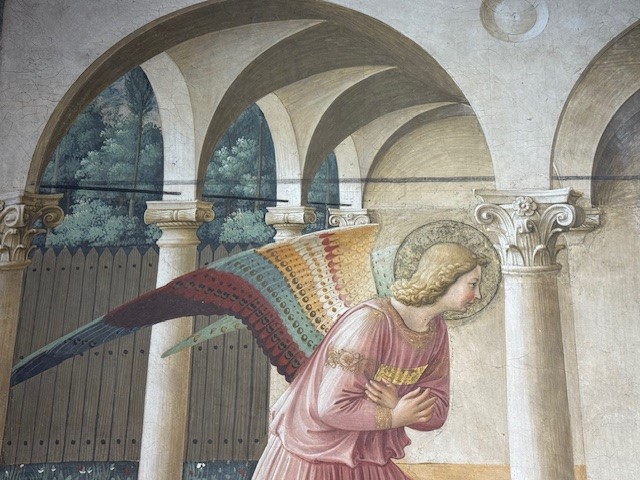
Fra Angelico: The Annunciation fresco (detail) at San Marco. Photo: P.E.
The frescoes that Fra Angelico painted in the convent are priceless jewels representing the mix between Faith and Art. And then San Marco offers other marvels. San Marco was where the humanist Academy in Florence was born. Here was the site of the first public library in the world.
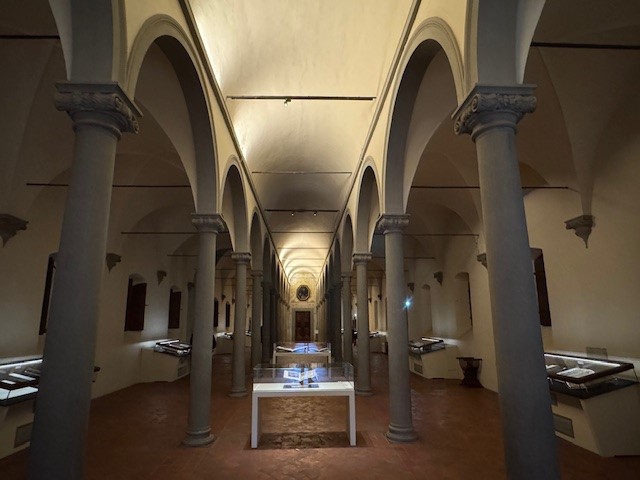
San Marco, Florence: the first public library in the world. Photo: P.E.
The bones of Poliziano are buried in the chapel. Right behind a statue of Savonarola, the “animus in vita” of Savonarola and Pico della Mirandola is celebrated in marble. Their bones may have been separated “post mortem”; yet even as “antipodes”, they were bounded by love.
In Spoleto, in Umbria, after fabulous interactions with the young members of the Aurora Center of Studies, under the early morning fog, the Fonti del Clitunno appears like a ghostly dream. This is where, according to Virgil, lies the heart of the “estirpe italiana”. Byron was mesmerized when he visited it.

Spoleto, in Umbria: the Fonti del Clitunno. Photo: P.E.
The Aurora Center is investing in first-class interdisciplinary analysis linking geopolitics, philosophy, Law, anthropology and sociology to track the transition from the unipolar order to the multipolar world, characterized by the emergence of civilization-states.
These are the ontological, strategic and normative poles of the future. And that’s where Italy as a civilization-state belongs.
Can Stoics and Humanists save Italy?
The conferences – all of them full house – offered a unique opportunity to address informed Italians on what’s going on in the Russia-China, BRICS, Southeast Asia, New Silk Roads, connectivity corridor spheres – issues that are either completely ignored or distorted by mainstream media. At the same time, it was priceless to become aware of insider tidbits on the sorry condition of an unparalleled civilization-state reduced to the role of a neo-colony of the EU/NATO combo.
And then there are the bibliography highlights. Like finally finding in the best bookshop in Venice a priceless Bompiani collection of all fragments of the Early Stoics – Zeno, Cleanthes and Chrysippus. And in the pristine Galleria Imaginaria in Firenze-Flora, the rare Einaudi first edition of a collection of Italian humanist writings – Thought and Destiny – from Petrarca and Marsilio Ficino to Leonardo da Vinci and Machiavelli.
To quote T.S.Eliot, we can say that “these fragments I have shored against my ruins.” When it comes to Fragments of Civilization, Italy is Jupiterian. I remain on the move, from Rome down south to Napoli and Sicily, carrying the message I shared with my interlocutors; if the current, fragmented collective West would ever have a chance to be rescued from the Centaur of oblivion, that task must be carried out by the definitive, Western civilization-state: Pallas Athena Italia.
Pepe Escobar at Sputnik
FLORENCE, Italy – The new US National Security Strategy, the December 2025 version, is an intriguing, quirky, Bosch-style hybrid beast. It does not exactly look as it seems.
A tsunami of headlines across the discombobulated West focused on an apparent drive towards normalization between Washington and Moscow. But that’s far from the main focus of this Beauty and the Beast creation.
For starters, which Centaur designed the NSS Beast? Could it possibly be Trump? Unlikely. Could not be the clownish Secretary of Forever Wars. Could not be Marco Rubio – who can barely point to anything outside of Venezuela and Cuba on a map. So, who did it?
The fire in the belly of the NSS Beast is on the Russia-China strategic partnership: to try to undermine it by any means necessary. Trump, instinctively, and the old money, classic American ruling classes may have finally concluded that it’s idle to invest in a frontal war against twin, strategically-aligned peer competitors Russia-China. So it’s back, once again to Divide and Rule. And for everyone else, Plunder.
The NSS apparently offers Moscow a series of geoeconomic and geopolitical carrots while meticulously embedding the sticks in hybrid formats – prone to either provoke Russian elite fragmentation by attracting them back to the American market and American “values”, or to plunge the Russian Federation into ethnic “tensions”, coordinated by cyber-warfare.
There are no guarantees Team Trump 2.0 will be sophisticated enough to pull it off. In a nutshell, in no-diplo language, this would amount to simultaneously “isolate” Moscow all over again while “containing” China. Moscow and Beijing won’t fall for it.
What is clear so far is that with the new NSS, the Forever War ethos remains. But now rebranded: wars will be mostly hybrid, indirect and low cost.
Welcome to Managed Multipolarity
Even stripping down the NSS to the role of yet another narrative – the Empire of Chaos is a master producer of narratives – substantial rhetorical shifts seem to be afoot. The former “indispensable nation” now is characterized no more as a Global Robocop enforcing its hegemony, but as a Regional Robocop, in selected latitudes (mostly the Western Hemisphere). Europe and West Asia have been downgraded to the status of second-tier priorities.
To compound the (pragmatic?) realpolitik shift, this is now, at least in thesis, a Non-Ideological Empire. “Autocracies” are fine, as long as they play the imperial game; now it’s the EU chihuahuas who are branded as “anti-democratic”. Trump 2.0 will support a slew of “patriotic” European parties: that predictably set off serial heart attacks all across the vassalized Brussels sphere.
The NSS also brands its own version of the multipolar world. Call it Managed Multipolarity – as in Japan “managing” East Asia and Israel-Arab vassals “managing” West Asia via the Abraham Accords, with “counter-terrorism” enforced by the slimy Gulf petro-monarchies. In both cases, we will have the Empire of Chaos leading from behind.
NATO has been thrown, for all practical purposes, into Beggars Banquet territory. The Empire monopolizes everything: weapons, distribution of funding, nuclear guarantees. It’s up to the vassal collection to adjust to every imperial demand, especially 5% of their puny budgets for weapons purchases.
There will be no more NATO expansion: after all the real priorities are the Western Hemisphere and the “Indo-Pacific”, that non-existing formulation applied to the real-life Asia-Pacific.
The NATO/EU combo from now on qualifies at best as a nuisance – like mosquitoes in a five-star resort. Even with Article 5 and the nuclear umbrella still in place. Yet it’s up to the Euro-chihuahuas to pay, and pay and pay. Otherwise, the Empire will punish you.
The Global South/Global Majority can barely contain their expectations when the day will come – and it will come – of Russia sealing the definitive strategic defeat of the collective West in the black soil of Novorossiya.
In a sense, the NSS is already anticipating that day, with the new narrative making it clear the Empire has already moved on.
Containing China all over again
Latin America, as in the Western Hemisphere, will be under maximum pressure per the NSS – which explicitly reasserts a “Trump corollary” to the Monroe Doctrine. The Empire wants its own backyard back – the whole combo, so it can be properly looted.
This is all about natural resources: it applies to Venezuela and Colombia, but also, ominously, to Brazil and Mexico. “Non-hemispheric rivals” – as in China – will be “countered”. Hybrid War in effect – all over again.
The NSS narrative does its best to mask the obsession with China. The mask falls when it addresses the First Island Chain”:
“We will build a military capable of denying aggression anywhere in the First Island Chain. But the American military cannot, and should not have to, do this alone. Our allies must step up and spend – and more importantly do – much more for collective defense.”
Translation: the “First Island Chain” – from the Kuril islands in Russia, through Okinawa and Taiwan, across the Philippines, and down to Borneo – will be the Apex of Militarization in Asia-Pacific. The NSS being a narrative, it presents this Cold War encirclement strategy as a protection shield. Beijing will not be fooled: this is for all practical purposes China containment in Asia-Pacific on overdrive.
Is Beijing impressed? Not really. Especially when China’s trade surplus for the first time has shot up beyond $1 trillion, even considering the fall of exports to the US under Trump’s Tariff Temper Tantrum. Make Trade, Not Containment.
Back to Chihuahuastan. The whole planet now knows that the EU/NATO combo is preparing for war with Russia before 2030; it could even be next year. And they are also considering a pre-emptive attack against the world’s number one nuclear and hypersonic power.
Away from the comic relief inbuilt in the European slow motion political suicide, in real life both the US and vassal Japan refused to join the European obsession in stealing Russian funds.
The collapse of the EU – an artificial construct to start with – is as inevitable as death and taxes: looming in the dark horizon is a toxic cloud of Brexit-style exits; an ungovernable euro-zone; serial capital flights; rising and rising bond yields; unsustainable public debt; a collapse of the single market; institutional paralysis; and total, irretrievable, final loss of the legitimacy they never had in the first place.
A book just published in Italy by a young economist, Gabrielle Guzzi, tells it all in the title: Eurosuicidio. Spengler remarked that every civilization sooner or later dies; this current European project may be the swansong – political, military, spiritual – of a geographical area, a peninsula of Eurasia, playing its final role in History, after learning nothing from two previous suicide attempts:
WWI and WWII.
Does the Empire care? Not at all. The Beauty expires as the Beast moves on.

 Dans cette édition de « ICI MOSCOU », Xavier Moreau commente la dernière visite de Steve Witkoff à Moscou. Au
This is a really good geopolitical overview and not only about Venezuela, but describing how Venezuela became the fulcrum of change to multipolarity and the start of the end of the Monroe doctrine.
I am not sure if Mearsheimer’s face should be on there, but the content is accurate until one gets to the end, where the video proposes that the US still has the opportunity to rectify its strategic mistakes. I don’t believe so, and so this video is for the good analysis of the process of the fall of empire in the first 3/4.
Venezuela just shattered the unwritten rules of the Western Hemisphere — and Russia made sure the world noticed. In this special geopolitical investigation, we unpack how Russian warships sailed into Venezuelan waters with calm precision — a symbolic strike at two centuries of U.S. dominance in the Caribbean. This wasn’t merely a naval visit. It was a challenge to the Monroe Doctrine itself — the old idea that Washington alone sets the boundaries of power in the Americas.
What the world witnessed wasn’t Russian aggression… It was Russian positioning — a strategic counter-move decades in the making. From NATO’s long eastward push to years of sanctions pressure on Venezuela, we trace how U.S. policies inadvertently drove Caracas deeper into Moscow’s orbit. The result: one of the most consequential geopolitical realignments in the Western Hemisphere since the Cold War.
Backed by verified research, foreign-policy scholarship, and historical context, this episode explores: • why Venezuela became a central arena of U.S. influence after the Cold War, • how sweeping American sanctions punished its economy — but failed to force political change, • how Russia built a slow, deliberate strategic lifeline to Caracas, • why the Caribbean can no longer be assumed to be an uncontested sphere of U.S. influence, • and why the quiet arrival of Russian destroyers signals a new era in hemispheric geopolitics. Told in the analytical spirit of John Mearsheimer, this long-form deep dive links realist theory to modern power struggles — revealing how the cracks in the unipolar world first appeared not in Europe… but in the Caribbean.

 Dans cette édition de « ICI MOSCOU », Xavier Moreau revient sur l’accord de paix proposé par Donald Trump. L’UE
L’article ICI MOSCOU: L’UE, dernier obstacle à la paix ? est apparu en premier sur STRATPOL.
Pepe Escobar on Sputnik
The Unit project, first revealed by Sputnik in 2024, is emerging as the most viable option for breaking the US dollar’s stranglehold on global trade and investment.
In his book co-written with top economist Sergey Bodrunov, Regulations of the Noonomy (international edition published this year by Sandro Teti Editore in Rome), leading Russian economist Sergey Glazyev stresses the need to “ensure a full-fledged switch to national currencies in mutual trade and investment within the EAEU and the CIS, and further – within the BRICS and SCO, the withdrawal of joint development institutions from the dollar zone, the development of their own independent payment systems and interbank information exchange systems.”
When it comes to financial innovation – compared to the current structure of the international financial system – The Unit is in a class of its own.
The Unit is essentially a benchmark token – or an index token; a post-stablecoin, digital monetary tool; totally decentralized; and with intrinsic value anchored in real assets: gold and sovereign currencies.
The Unit can be used either as part of a new digital infrastructure – what most of the Global South is striving for; or as part of a traditional banking setup.
When it comes to fulfilling traditional money functions, The Unit is – pardon the pun – right on the money. It’s meant to be used as a quite convenient medium of exchange in cross-border trade and investments – a key plank of the diversification actively pursued by BRICS+.
It should also be seen as an independent, reliable measure for value and pricing, as well as a better store of value than fiat money.
The Unit is academically validated – including by Glazyev himself – and properly governed by IRIAS (International Research Institute for Advanced Systems), set up in 1976 in accordance with the UN statute.
And crucial at this next step, The Unit is to be launched early next year on the Cardano blockchain, which uses the digital currency Ada.
Ada has a fascinating background – named after Ada Lovelace, a 19th-century mathematician, daughter of none other than Lord Byron, and recognized as the first computer programmer in History.
Anyone, anywhere can use Ada as a secure exchange of value; and very important, without the need to ask a third party to mediate the exchange.
That means every Ada transaction is permanently secured and recorded on the Cardano blockchain. That also means that every Ada holder also holds a stake in the Cardano network.
Cardano has been around for 10 years now – and is a quite popular blockchain. It’s backed by some quite big venture capital firms such as IOHK, Emurgo and the Cardano Foundation. Essentially, Cardano is an excellent option for regular payments because transactions are cheap and fast.
Neither a crypto nor a stablecoin
Enter The Unit.
The Unit is neither a cryptocurrency nor a stablecoin – as it’s shown here.
A concise definition of The Unit would be a resilient reserve of value – backed by a structure of 60% gold and 40% diversified BRICS+ currencies.
The major appeal for the Global South is that such a unique mix provides stability and protection against inflation, especially under the current global financial landscape of wobbly macroeconomics and widespread uncertainty.
Using Cardano, The Unit is bound to become accessible to everyone, via a combination of centralized and decentralized exchanges.
So to enter this new market, individuals and companies will be able to acquire The Unit directly with fiat through regulated banking partners. That means a bridge between traditional finance and emerging decentralized ecosystems – in favor of liquidity, accessibility and reliability, opening the door to full adoption by the Global South.
The Unit can even evolve into a new form of digital cash for emerging economies.
Following exactly the path delineated by BRICS even before the ground-breaking annual summit in Kazan in 2024, The Unit may be the best solution currently available for cross-border payments: a new form of international currency, issued in a de-centralized way, and then recognized and regulated at a national level.
And that brings us to the top conceptual strenght of The Unit: it removes a direct dependency on the currency of other nations, and offers the Global South/Global Majority a new form of non-censored, apolitical money.
Better yet: apolitical money featuring an enormous potential for anchoring fair trade and multiple investments.
What the Global South really needs
A good next step for The Unit would also be to set up an Advisory Board, uniting world standard stars such as Prof. Michael Hudson, Jeffrey Sachs, Yannis Varoufakis and the co-founder of the NDB Paulo Nogueira Batista Jr. (here at the Global South Academic Forum in Shanghai) .
When it comes to BRICs-emphasized de-dollarization – done with a hefty degree of sophistication, without having to spell it out – The Unit will be key. It’s also key that The Unit is not a cryptocurrency.
Wall Street behemoths – especially BlackRock – are big on cryptocurrencies, an enormously unstable set up which eschewed individual holders to the profit of massive institutional players. For example, it’s BlackRock that essentially shapes Bitcoin’s market.
US stablecoins essentially perpetuate US dollar dominance – aiming their firepower directly against possible, future digital currencies offered by BRICS+.
The Unit is the stark opposite, offering a reliable digital monetary tool for the fast advancing Multipolar World. It’s an evolution in itself, bridging the fiat and the crypto worlds; and last but not least, it is a solid foundation for the emerging post-Bretton Woods economy.
Of course the challenges ahead are huge – and The Unit will be fought tooth and nail by the usual suspects as a new concept offering borderless financial resilience for the Global South/Global Majority.
And here may lie the key takeaway: the only way BRICS+ as well as the Global Majority may be strengthened is by developing closer and closer geoeconomic, financial ties. For that, the toxic power of Western speculative capital must be contained – to the benefit of more intra-Global South commodity trading, and more investable capital for productive, sustainable development.
The potential is limitless. The Unit may well be able to unlock it. Even JP Morgan admitted The Unit is “perhaps the most thoroughly fleshed-out of de-dollarization proposals that exist in the cross-border transactions space for BRICS+.”
And there’s no other similarly effective plan anywhere in the world.
“Whatever was the real story behind the 28 pointer … the messy, even infantile “plan” posing as Hegemon in Control and mocking the BRICS/SCO is completely unworkable.”
By Pepe Escobar at the Strategic Culture Foundation.
The Circus Ringmaster’s 28-point “peace plan” for Ukraine may be seen as a pet seal splashing around in a pond to amuse the galleries. And up next, we move to another attraction.
Yet if taken seriously – and that requires not a pinch but a barrel of salt – it’s like a twin to the Circus Ringmaster’s “plan” for Gaza, this time with the objective of snatching a pitiful “victory” from the jaws of the Empire of Chaos’s own, de facto strategic defeat.
Let’s check the reactions. Here you will find Larry Johnson’s analysis – which I share – , but most of all the video of the stunning two-hour interview we had mid-week in Moscow with stellar Maria Zakharova, the most articulated Foreign Ministry spokeswoman on the planet.
What Mrs. Zakharova essentially told us is that by mid-week there was no Russian reaction because Moscow had not received anything concrete: “When we have some official information, when we receive it via a relevant channel, naturally, we will always be open to work.”
The same applied to the Kremlin. Presidential spokesman Dmitry Peskov: “No, we haven’t received anything officially. We see some innovations. But officially, we haven’t received anything. And there hasn’t been any substantive discussion of these items.”
Kupyansk has been liberated – Gerasimov told Putin
The political leadership of Ukraine does not give orders to its troops to surrender, Gerasimov said
— Sputnik (@SputnikInt) November 20, 2025
The first actual, terse response that came from President Putin was stunningly graphic: in camouflage, visiting a command center, and stressing that the set up in Kiev can no longer be described as a “political leadership” because it’s just “a criminal organization”.
After a few frantic days buried in a tsunami of spin concocted by NATOstan mainstream media, supporting but essentially against the 28-pointer, someone in Washington – and not necessarily Russian middleman Kirill Dmitriev – may have delivered it, officially, to the Kremlin.
So this past Friday we had, finally, President Putin’s own response, during a session of the permanent members of Russia’s Security Council.
The key Putin points must be stressed:
Alaska: “The main point of the Alaska summit, its main purpose, was that during the talks in Anchorage we confirmed that, despite some difficult issues and complexities, we nevertheless agreed with these proposals and were prepared to demonstrate the requested flexibility.”
Global South reaction: “We provided detailed information to all our friends and partners in the Global South on these matters – including China, India, the DPRK, South Africa, Brazil, many other countries, and, of course, the CSTO states. All our friends and partners, and I want to emphasise this – without exception – supported these potential arrangements.”
U.S. non-response: “However, after the negotiations in Alaska, we have seen a certain pause on the part of the U.S., and we know this is due to Ukraine’s de facto refusal to accept the peace plan proposed by President Trump. I believe this is precisely why a new version has emerged – essentially an updated plan consisting of 28 points.” Note that “updated” is the key operative word here – as in an extension of Alaska.
What the 28-pointer really means: “We have the text. We received it through our existing channels of communication with the U.S. Administration. I believe it too could form the basis of a final peace settlement, but this text is not being discussed with us in substance. And I can suggest why.
The reason, I believe, remains the same: the U.S. Administration still cannot secure Ukraine’s consent – Ukraine rejects it.
Evidently, Ukraine and its European allies remain under illusions and still dream of inflicting a strategic defeat on Russia on the battlefield. I think this position is rooted not so much in a lack of competence – I will leave this topic aside for now – but rather in the absence of objective information about the real situation on the ground.”
Expanding on the EU and Ukraine: “All things considered, neither Ukraine nor Europe grasp the consequences of this path. Just one very recent example – Kupyansk. Not long ago, on 4 November – just two weeks ago – officials in Kiev publicly stated that no more than 60 Russian servicemen were present in the city, and that within the next few days, as they claimed, Ukrainian forces would fully unblock it.
But I would like to inform you that already at that moment, on 4 November, the city of Kupyansk was practically entirely secured by the Russian Armed Forces. Our guys were, as they say, simply finishing the job – clearing the remaining streets and neighbourhoods. The fate of the city had already been fully determined.
What does this tell us? Either the Kiev leaders do not have objective information about the situation at the front, or, having it, they are simply unable to assess it objectively.”
The SMO will go on: “If Kiev does not want to discuss President Trump’s proposals and rejects them, then they – and their European war-instigators – must understand that the situation in Kupyansk will inevitably be repeated on other key sectors of the front. Perhaps not as quickly as we would like, but the outcome will be inevitably repeated.”
The inevitable conclusion: “On the whole, this is acceptable to us, as it leads to achieving the objectives of the special military operation by military means. But, as I have said many times before, we are also ready for peace negotiations and for resolving problems by peaceful means. However, this requires a substantive discussion of all details of the proposed plan. We are ready for that.”
Deconstructing an incoherent mish-mash
So here we have finally come back to the essentials – what everyone with an IQ over room temperature following the imperial proxy war against Russia in Ukraine already knows: Russia is ready for peace, but in Putin’s own words, “is also satisfied with the current dynamics of the SMO”. Because this is leading – slowly but surely, “to the achievement of its goals” in the battlefield.
Whatever was the real story behind the 28 pointer – assuming it was Dmtriev and Witkoff holed up in Miami for three days; and then lowly neo-con Marco Rubio and zero-expert on anything Zionist asset Jared Kushner (!) chiming in – the messy, even infantile “plan” posing as Hegemon in Control and mocking the BRICS/SCO is completely unworkable.
What if it was designed to be exactly that?
The new frantic spin is that the sweaty sweatshirt in Kiev has been given an ultimatum by Trump 2.0: under a new “aggressive timeline”, he has to get on board. Or else.
Kiev’s backers – the proverbial assortment of chihuahuas comprising the EU, the European Commission (EC) and “leaders” in selected capitals – have rejected the 28-pointer, and so did Kiev, right from the start.
The 28-pointer indeed manages the feat of assembling an incoherent mish-mash that is unworkable not only for Russia but also for the EU/NATO combo. A few examples:
Point 4: “A U.S.-mediated Russia–NATO dialogue will be launched to resolve security issues and promote cooperation”. NATO is a brainchild of the Empire of Chaos. It will never “cooperate” with “existential threat” Russia.
Point 9: “European fighter jets will be stationed in Poland.” That means NATO still ready to attack Russian territory.
Point 10: “The U.S. security guarantee [to Ukraine] comes with conditions: – The U.S. receives compensation.” That’s pure “offer you can’t refuse” Mafia territory.
Point 13: “Russia will be reintegrated into the global economy:
That’s what this is all about, per the Circus Ringmaster himself: grabbing Russian natural resources. Moreover Russia does not need the G8: Moscow’s focus is on BRICS/SCO.
Point 14: “Frozen Russian assets will be allocated as follows:
That’s peak Theater of the Absurd: not only the Americans want to use Russian funds to rebuild Ukraine – which they were instrumental in destroying – but their “10 per cent for the Big Guy” turns out to be a hefty 50%.
Point 17: “The U.S. and Russia will extend nuclear arms-control treaties, including New START.” A non-starter: Moscow has been stressing non-stop that arms-control treaties will not be negotiated in relation to the SMO.
Point 21: “Territorial arrangements:
Total non-starter – and not only for the EU/NATO-Kiev combo. Kherson and Zaporozhye, constitutionally, are now fully Russian – and will be liberated on the battlefield.
Point 26: “Full amnesty for all parties for all actions taken during the war: no prosecutions, no war-crimes claims.” Total non-starter: Kiev forced the draft document to use “amnesty” instead of “audit”. Moscow will settle for nothing less that full prosecution of members of the “criminal organization”. Yes, there will be a war crimes tribunal.
Point 27: “The agreement will be legally binding and enforced by a Peace Council chaired by Donald J. Trump.” That’s a Gaza replay. As if Putin and the Russian Security Council would accept a “Peace Council” chaired by a Circus Ringmaster whose expiry date is fast approaching, not to mention be subordinated to the losers in a vicious proxy war.

About a really intriguing takeaway
One plausible takeaway of the 28-pointer is that the selected oligarchy running the Empire of Chaos continues to run a protection racket – and the only way to salvage the de facto strategic defeat in country 404 is to turn a quick buck.
Another more intriguing, plausible takeaway is that the 28-pointer was never meant to be accepted by the EU-Kiev combo. It’s all about the Circus Ringmaster’s exit strategy from the debacle in Novorossiya.
Trump is already preparing the terrain – as in I tried everything, but Zelensky won’t comply. So it’s now his – and his gang’s – problem only, side by side with the EU chihuahuas. Up next: an immediate change of narrative. What else: the Empire of Chaos cannot manage reality, only narratives.
Trump 2.0 may start to work on improving U.S.-Russia relations – while blame for the collapse of the “peace process” is laid on the EU-Kiev combo. The optics of the 28-pointer P.R. op are everything: packaged as it is asking Moscow to strike a compromise, even as Russia is winning in the battlefield, while making sure the “criminal organization” in Kiev cannot agree to the main provisions.
Provisional endgame: the chihuahuas of war will keep barking while the SMO will keep rollin’ along.
Larry Johnson, Pepe Escobar with Alexander Babakov, Deputy Chairman of the State Duma
In this gripping episode of Countercurrents, we dive deep into the shifting global order as China, Russia, and the BRICS nations rise to challenge Western dominance. From China’s technological revolution and AI advancements to Russia’s newfound sovereignty amidst global sanctions, our longtime friends Pepe Escobar and Alexander Babakov explore how these powerful forces are reshaping the future of geopolitics.
TIMELINE:
00:00 Silk Road 2.0: China’s Technological and Environmental Leap
10:00 Why Russia and China Are Natural Partners: Cultural Foundations
13:22 Quality Over Profit: China’s Alternative to Western Economics
18:38 China’s Tech Revolution: How Planning Defeats Sanctions
21:10 Russia’s New Development Path: Focus on Domestic Strength
28:12 Cotton Candy Economics: Why the US Model Fails
34:24 Why 40% of World GDP Won’t Accept Western Rules Anymore
37:23 Russia–China–Iran: Iran Protected, Not Alone
38:59 Why Europe No Longer Matters to Russia’s Growth
47:57 Will the US Invade Venezuela? Geopolitical Breakdown
54:10 Why the UN Security Council Is No Longer Effective
http://en.kremlin.ru/events/president/news/78487
In the Kremlin’s St Catherine Hall, Vladimir Putin held a meeting with the heads of delegation attending the SCO Council of Heads of Government meeting.
Russia’s chairmanship of the SCO Council of Heads of Government ends in 2025. The Council met earlier today in Moscow under the chairmanship of Russia’s Prime Minister Mikhail Mishustin.
* * *
President of Russia Vladimir Putin: Colleagues, friends,
It is a great pleasure to welcome you all to Moscow.
Today, you have successfully concluded a regular meeting of the SCO Council of Heads of Government, outlining plans for our future joint work. This builds upon the foundations laid by the Tianjin Declaration and the SCO Development Strategy to 2035, which was adopted at September’s SCO Summit in China.
We are united by a common objective: to strengthen the authority and influence of the SCO as one of the leading regional associations, both across the Eurasian continent and globally. In this endeavour, our governments have a vital role to play. Governments always have a special role when it comes to practical work. It is, after all, our governments – the teams under your leadership – who translate our shared ambitions into concrete, practical cooperation and who drive the expansion of the Organisation’s multifaceted partnerships.
Throughout Russia’s chairmanship of the Council this year, we have hosted a substantial programme of events. Nearly 30 ministerial and expert meetings, as well as forums involving business, public, and youth representatives, have been held in Moscow, St Petersburg, and other major Russian cities, and a wide range of mutually beneficial projects and cooperation programmes have been agreed.
Governments traditionally prioritise issues of economic cooperation, promotion and diversification of trade and investment. Coordinated efforts in these areas are already yielding tangible results.
For example, Russia’s trade with SCO member states reached US$409 billion in 2024 and continues to grow. Of course, the largest share of this turnover is accounted for by our cooperation with the People’s Republic of China, however, trade with other SCO member states is also growing.
It is important to note that the share of national currencies in commercial transactions between the Organisation’s members is consistently increasing. For example, in our country’s trade with SCO partners, this figure already exceeds 97 percent.
Stable and uninterrupted payment channels are becoming increasingly vital, particularly in the current volatile economic environment, marked by turbulence in the global markets, unilateral sanctions, tariff restrictions and wars.
At the Russian side’s initiative, and with the support of its partners within the Shanghai Cooperation Organisation, steps are being taken to expand payment, settlement, and depository infrastructure. The agenda also includes consultations on the creation of a future SCO Development Bank, as well as on the mutual recognition of credit ratings and goods indicator systems.
Other Russian proposals on the establishment of a database of industrial investment projects within the SCO are also being implemented. The creation of such an instrument will expand cooperation in the industrial sector, facilitate joint development of production capacity, support import substitution, and promote the introduction of new technologies and digital innovations, including artificial intelligence. Ultimately, these efforts will contribute to strengthening the technological sovereignty of our countries in the core sectors of the economy.
It would be appropriate to continue our joint efforts to build an extensive and competitive network of logistics routes across the vast expanse of the SCO and Eurasia as a whole.
Russia, situated at the very heart of the continent and at the intersection of key trans-Eurasian transport corridors, is allocating significant funds to modernise its transport infrastructure. The volume of road, rail, and multimodal traffic passing through Russian territory is growing noticeably, with due consideration given to the utilisation of new promising corridors such as North–South and the Northern Sea Route. Today, incidentally, another nuclear-powered icebreaker has just been laid down.
Our country is also making a substantial contribution to maintaining stability in global energy markets. We are doing everything to ensure reliable supplies of energy resources to consumers, despite attempts from outside to negatively influence supply chains, and we count on closer coordination among all SCO partners in the energy sector, in line with the relevant roadmap adopted in Tianjin.
It is evident that the Shanghai Organisation could play a more significant role not only in deepening sectoral cooperation but also, more broadly, in fostering a favourable atmosphere on our shared continent for stable, progressive growth and multifaceted economic interaction. In practical terms, it could also facilitate the alignment of the numerous integration projects being implemented across Eurasia. This is precisely the aim of the Greater Eurasian Partnership concept proposed by Russia. The idea is to harmoniously combine integration processes within the Eurasian Economic Union, the Belt and Road Initiative put forward by our Chinese friends, and numerous similar projects involving the countries of the Shanghai Organisation.
Naturally, cooperation within the SCO framework is by no means limited to the economy, though this is undoubtedly the primary focus. Our organisation also actively contributes to strengthening peace and stability across Eurasia, countering a wide range of challenges and threats, and shaping a new balanced security architecture in Eurasia.
An equally important component of the SCO’s activities is the development of humanitarian contacts and exchanges in the fields of culture, science, education, healthcare, environmental protection, and, of course, youth policy and sport. As I have said on numerous occasions, Russia is sincerely committed to the closest possible partnership with the SCO member states. I am confident that by acting in a coordinated and united manner, helping one another, we are capable of achieving truly impressive results in developing multifaceted cooperation among our countries.
Thank you for your attention.
Brazilian writer and geopolitical analyst Pepe Escobar’s interview on Al Mayadeen’s The Proximate Aspect dives straight into the shifting fault lines of global power, from the rise of BRICS to China’s quiet technological resilience in the face of Western tech sanctions and Russia’s recalibrated military strategy.
In a wide-ranging interview, Escobar tackles the future of the multipolar order, the strategic significance of Xinjiang, whether Beijing and Moscow are executing a coordinated endgame, and how US policies from Ukraine to Gaza to Latin America are meeting growing resistance across the Global South.
He also weighs in on the impact of US economic measures on Brazil’s foreign policy orientation. It’s a sweeping, provocative map of the world in flux, and one that demands to be watched in full.
With Judge Napolitano, Judging Freedom
Talkin’ to The Judge on Timur Trump, the Secretary of Forever Wars, plus assorted horrors. Frank Zappa: the torture NEVER stops.
Targeting allies and manufacturing foes is the last card available to the Empire of Chaos.
Pepe Escobar – Strategic Culture
China is right in the middle of a true tech onslaught – which in several ways works as a sort of wrap-up of Made in China 2025, conceived and launched 10 years ago, and a resounding success even facing at least two tariff/sanctions offensives by Trump 1.0 and Trump 2.0.
A stellar Chinese analysis by Chen Jing, published by my friends at Guancha in Shanghai, concisely interprets the importance of key vectors and variables linked to the tech onslaught. Here’s an essential breakdown, with my own comments.
The China-US decoupling
The US as a Chinese export market now represents less than 10% of total exports. In parallel, as I observed in my visits to China this year – from Shanghai and Beijing to Xian and Xinjiang – there’s no psychological fear anymore of the much-touted “decoupling”. After the Trump-Xi meeting, it became clear that what is already in effect is a managed decoupling. Beijing is cool, calm and collected: after all, it’s able to expand in markets all across the Global South. Especially because more trade usually walks side by side with more infrastructure development projects: that’s the logic behind the New Silk Roads/BRI.
China’s 15th Five-Year Plan
What was recently debated in four days in Beijing – and will be approved next March during the Two Sessions – is already rolling, as in “decisive breakthroughs in key core technologies in major areas such as integrated circuits, industrial machine tools, high-end instruments, basic software, advanced materials, and biomanufacturing.” That’s all Made in China 2025 material. The conclusion is stark: sooner, rather than later, China simply won’t need anything from the Western high-tech industrial chain. Call it industrial decoupling. And the cards, once again, are Made in China.
The US debt crisis
The analysis recalls a comparison between the US debt in 2019, before Covid – $21 trillion, with $300 billion in annual interest – with 2025: $38 trillion, with interest projected at $1.3 trillion, way ahead of the Pentagon’s budget. You don’t need to be Prof. Michael Hudson to do the math: long-term US debt is the ultimate – unpayable – nightmare. And the US debt has alreay morphed into a US dollar crisis.
The SWIFT factor
The analysis touches on a key issue regarding SWIFT. The US dollar is still responsible for approximately 47% of SWIFT transactions. The yuan share, meanwile, fell from 4.74% in July 2024 to 2.93% in August 2025. So the yuan is not exactly becoming more international. Why? Bacause the yuan is being decoupled from SWIFT, on purpose: China is encouraging the Global South – no less than 189 countries and regions – to use CIPS on international trade/financial transactions. CIPS is progressing non-stop: a year-on-year increase of approximately 42% compared to 2024.
Call it China preparing itself for financial decoupling. Even if Washington decided to cut off China from SWIFT like it did with Russia, Beijing would have no problems leveraging its massive trade power to then really internationalize the yuan.
A new path of globalization, with China at the core?
The rare earth saga.
In 2025, China entered escape velocity. The reaction to the Trump Tariff Tantrum came with unwavering self-confidence. It was a marvel to observe that on the spot in Shanghai. The analysis recognizes that much of China’s force derives from its rare earth potential.
Already in July 2023 export controls were imposed on gallium and germanium. This summarizes China’s share and position in the production of metals and rare elements, showing that “China’s advantages go far beyond the 17 rare earth elements that have recently caused panic and helplessness in the Western camp.”
There are 21 elements in the export control list; only seven are medium and heavy rare earth elements. There are several other categories such as rare refractory metals, rare dispersed metals, rare light metals, and non-ferrous heavy metals.
One of the key points of the analysis is that not only the US, but the G7 as a whole no longer has the power to dictate the rules of the global economy. China “can withstand the G7 on its own”. Especially when the myth of US industrial strength has been shattered.
That opens a new Pandora’s box of discussion: is the global majority already moving to a new path of globalization, with China at its core?
The AI bubble
So AI may turn out to be the US’s last hope to turn the tide. The problem is the humongous size of the US AI bubble – a pillar of the US economy. It will eventually burst – and the consequences are unimaginable.
Meta, OpenAI, Nvidia, and others are pouring stratospheric funds into scaling-up large language models (LLMs) and massive data centers. That may not be enough to prevent the AI bubble burst – in an environment dictated by mega-corporations only focused on quick profits.
Cue to a quite worrying prospect fueling their paranoia. Several high-level Chinese models – such as DeepSeek, QWEN and the Kimi K2 series – already dominate global AI open source. The Americans practice “closed-source” – where the thing that matters most is how to monetize their gigantic models.
China is playing a very clever game: delaying the release of Deep Seek R2 – an open source, large-scale model. Why? Because releasing it now would mostly benefit Nvidia’s GPUs, boosting their sales and of course the US stock market.
China is nearly ready to complete domestic GPU computer clusters. DeepSeek R2 is built upon these clusters. The result: that will directly disrupt US dominance. As a Shanghai expert puts it: “How can American AI, hampered by power shortages, lack of open-source access, and high energy consumption, compete with the low-power, open-source, large-scale model that offers a significant advantage?”
MAGA: the Magically Globally Aggressive model
At the recent AI Future Summit, Nvidia’s Jensen Huang went straight to the point: China would definitely win the US-China AI competition.
A key reason is that China’s AI is about productive capitalism – and not speculation. Chinese AI is primarily used in industrial manufacturing sectors such as mining, energy, water conservancy, metallurgy, and military. Large-scale AI models combined with sensors, industrial communication, and automated control at their core, are largely applied to real-life applications, addressing real-life problems in meteorology, marine agriculture, earth machinery, aerospace, civil geology. They truly integrate algorithms and computing power into production.
History tells us that all industrial and tech revolutions have been closely related to real-life production – from steel production and electricity generation to the chemical industry and telecommunications engineering.
All that brings us back to the defining psycho-killer outlook of the Trump 2.0 administration. Incapable of really “winning” a tech war against the largest economy on the planet by PPP, the imperative has switched to harassing and plundering weaker nations seen as easy prey, especially in terms of grabbing their natural resources.
Meanwhile, domestically, Trump 2.0 dreams of reviving manufacturing – the MAGA way. Call it the Magically Globally Aggressive (MAGA) model, deviating attention from what really matters: the monstrous debt; the declining power of the US dollar; the tech bubble; inflation; real geopolitics. Plunder – targeting allies and manufactured foes alike – is the last card available to the Empire of Chaos.
China’s innovation drive is reaching fever pitch in 2025. Let’s cut to the chase and focus on four crucial domains.
1.The Huawei Factor
1.Huawei is already testing its first, self-developed EUV lithography machine capable of producing 3nm chips. Trial tests are going full blast at the research center in Dongguan, and mass production should start in 2026.
It’s impossible to overstate how much of a game-changing paradigm this Chinese breatkthrough – specifically in laser-induced discharge plasma (LDP) – is all about. It’s set to turn the seminconductor technology environment totally upside down.
The physics involved in Huawei’s LDP is fundamentally different from the method employed by the Dutch ASML’s de facto monopoly. This being China, it’s simpler, smaller and cheaper.
Huawei’s technology is bound to smash that monopoly while solidifying China’s chip independence. Talk about cost efficiency: Huawei aims to produce EUV machines at a fraction of the cost of ASML’s (around $350 million for each unit), and no less than flood China with homegrown 3 nm chips.
All that is happening after the proverbial Western “experts”, following the 2019 sanctions imposed by Trump 1.0, dictated that China would take up to 15 years to just catch up. After all, EUV technology is too deeply embedded in the Western-controlled supply chain. It was assumed that China would never be able to smash the monopoly.
Well, of course any monopoly is smashable when public-private partnerships – in academia and tech – release untold billions of dollars into R&D, rally the best minds, and focus on building an EUV eco-system from scratch.
This is not only about tech; it’s a geoeconomic and geopolitical earthquake. There was a serious debate going on across China that it would be a matter between 2 and 3 years to cut off any dependence on US/Western tech. Well, Huawei and SMIC will be moving closer to mass production of these 3 nm chips already by next year. Not hard to do the math on where the future of global chipmaking lies.
Invest In R&D And Reach Patent Heaven
Now cut to Fan Zhiyong, Huawei’s Vice-President and Minister of Intellectual Property, talking at the company’s 6th Innovation and Intellectual Property Forum this past Tuesday.
He explained how “from the brand-new HarmonyOS 6 operating system to the powerful Atlas 950 supernode, our R&D team has achieved remarkable successes. Although many leading software and hardware products are massive systems engineering projects, we are making every effort to make them open to everyone.”
Huawei conducts an innovation and intellectual property forum nearly every year, discussing the importance of open/protected intellectual property as well as promoting its Top Ten Inventions: this year they featured, among others, supernodes; the Harmony OS; foldable screens; short-range optical interconnects; and next-generation solid state drives.
There’s no secret: a lot of investment in R&D is behind all these breakthroughs. Over the past five years, Huawei has invested more than 20% of its annual sales revenue in R&D. According to the EU Industrial R&D Scoreboard 2024, Huawei is Number 6 globally in R&D expenditure.
Huawei does not see these accomplishments as leading to a “closed garden”. On the contrary: the strategy is to foment an “open industry”, including the launch of a series of new open source software and hardware.
This opennes is reflected by the fact that Huawei is one of the world’s largest patent holders. By the end of 2024, Huawei held over 150,000 valid authorized patents globally, ranging from over 50,000 Chinese patents to over 29,000 patents in the U.S. and 19,000 in Europe.
And that brings us to…
2. Total Tech Sufficiency
And of course that is centered on AI. Cut to three recent key tech moves:
A. Beijing has banned foreign AI chips in every state-funded data center across the nation. Exempted will be only a few private companies which build their own data centers.
B. Local and regional governments were encouraged and are already subsidizing the electricity bills of AI data centers. China has a key infrastructure advantage over the US: cheap and extremely abundant power – as I saw it in my recent travels in Xinjiang. That is essential to offset the cost of switching to domestic chips, a more energy-intensive operation. For example, Huawei’s AI server system – CloudMatrix 384 – consumes more energy than Nvidia’s NVL72 system.
C. Beijing is also rolling out a new, ambitious “AI Plus Manufacturing” plan, included in the broader AI Plus initiative.
Point A is ultra-pertinent because Trump 2.0 is debating whether to allow Nvidia to sell a downgraded version of its Blackwell chips to China. Nvidia’s CEO Jensen Huang is lobbying for it like there’s no tomorrow, desperate of losing the Chinese market to Huawei for good. He bombastically announced that China is only “nanosenconds” behind the US on semiconductors.
Point C is also ultra-pertinent because as we saw with the Hauwei factor, Beijing is going for no holds barred AI chip self-sufficiency.
Beijing is deploying a very clever strategy. No foreign chips in data centers means a de facto protected market to domestic chip innovators which match foreign chip performances. Talk about a massive incentive.
Li Lecheng, Minister of Industry and Information Technology (MIIT), has announced that MIIT will soon issue an “AI Plus Manufacturing” plan, focusing on rolling out AI upgrades in key industries; expanding intelligent assisted design, virtual simulation, and early defect detection; promoting brand new AI-enabled mobile phones and computers; and accelerating R&D for next-generation intel devices such as humanoid robots and brain-computer interfaces.
In a nutshell: that is how Beijing wants to implement AI in every nook and cranny of the Chinese economy. It’s a no holds barred total innovation strategy. Sanctions? What sanctions?
What A Stable And Resilient China May Accomplish
3. Clean Energy
This revolution is already on – with China leaping ahead of the whole collective West, installing, for instance, nearly 900 gigawatt of solar capacity, more than the US-EU combo.
Last year, China generated 1826 terawatt/hour of electricity out of solar and wind power – five times the energy equivalent of all its nuclear warheads.
Yes: that’s a certified energy superpower.
4. An Early-Warning Detection Big Data Platform
The Nanjing Research Institute of Electronics Technology – China’s number one defense-electronics center and a hub of key innovation even under US sanctions – is developing a ground-breaking “distributed early-warning detection big data platform” capable of tracking up to 1,000 missile launches worldwide in real time.
The platform fuses data from an enormous array of space-, air-, sea-, and ground-based sensors, using advanced algorithms to distinguish warheads from decoys and proceed to action across secure networks.
The system integrates literally anything: fragmented, heterogeneous data streams from multiple sources – radars, satellites, optical, electronic reconnaissance systems – no matter where they come from, and when.
Cue to the system’s integration with interceptor missiles. During the Victory Day military parade last September in Beijing, China presented a new generation of air defense and anti-ballistic missiles, including the HQ-29, capable of intercepting hostile missiles beyond the atmosphere. Call it the Chinese Dragon Dome.
These are only 4 vectors amid the concerted Chinese tech drive, one of the key themes of the next Five-Year Plan to be approved next March in the “Two Sessions” in Beijing.
Now cut to Ronnie Chan, the Chair Emeritus of the Asia Society and the chairman of its Hong Kong Centre. He’s one of those affable old-school Hong Kong elite members who’s seen it all – and capable of synthesizing what’s ahead in a sharp and sweet manner. What he said recently at a seminar organized by the Shanghai Development Research Foundation could not be more relevant.
Let’s take just three key takeaways:
1.
“The Chinese people are resilient and patient. As long as domestic stability is maintained, external pressure only strengthens their endurance (…) in this China–U.S. rivalry, there will be no true winner, but the side that stands longer in the end will be China.”
2.
“China’s economy has not been over-financialised, and it continues to be grounded in the real economy. Only when manufacturing is strong can a nation remain stable and resilient.”
3.
“China must stay calm — neither blindly optimistic nor blindly pessimistic. China possess a vast market, a complete industrial chain, and a diligent population. As long as internal stability holds, external pressures cannot defeat it. The real opportunities ahead do not lie in real estate or finance, but in the service sector and innovation-driven real economies.”
There is no Chinese “miracle”: it’s all about planning and hard work.
And now to the next stage: no holds barred innovation.
“These gentlemen are the moral equivalents of America’s Founding Fathers.” — President Reagan meeting with Freedom Fighters from Afghanistan (Mujahedin), Oval Office, 1985.
Nima AlKhorshid interviews our roving eye nomad on the central Asian Stans, Al Qaeda ‘R US, and other travails of stark-naked Anglo-Zionists.


So history ruled that no conqueror coming from the West would traverse the Pamirs; that happened with Alexander the Great, and that happened with Islam. But that may well happen with Timur Trump, Conqueror of China.
Pepe Escobar, Strategic Culture
President Donald Trump did not disappoint when defining centuries of complex Heartland history with a trademark reductionist wise guy zinger:
“It’s a tough part of the world — there’s nobody tougher or smarter.”
Well, every tough guy from Genghis Khan to Timur may now feel relieved. Especially the leaders of the five Central Asian “stans” – Kazakhstan, Kyrgyzstan, Tajikistan, Turkmenistan and Uzbekistan – invited as a group for a White House photo op cum dinner.

As every grain of sand in the Ancient Silk Road knows, bragging is prime Timur Trump territory. He praised an “incredible” trade deal with Uzbekistan – under which Tashkent will be buying and investing almost $35 billion, and up to 2035, $100 billion, in critical areas such as minerals, aviation, infrastructure, agriculture, energy and chemicals, and IT.
No details whatsoever were provided on how Tashkent is going to find that kind of money, and precisely how they plan to invest it. Yet that was the perfect cue for Uzbek President Shavkat Mirziyoyev – a savvy pragmatist – to lavish praise on Timur Trump:
“In Uzbekistan, we call you the President of the world (…) You were able to stop 8 wars (…)
That was faithfully echoed by Kazakh President Kassym-Jomart Tokayev:
“Millions of people in many countries are so grateful to you (…) You are the great leader, statesman, sent by Heaven to bring commonsense & traditions that we all share and value back (…) Under your presidency, America is ushering in a new golden age (…) As President of peace, you, Mr. Trump, brought to an end eight wars just within eight months.”
And right on cue Tokayev duly announced that Kazakhstan is ready to sign the – collapsing – Abraham Accords, which is quite redundant, considering that Astana already normalized Israel way back in 1992 and always had relatively close relations with Tel Aviv.
Translation: the Abraham Accords scam is part of a give and take featuring the US-Kazakh signing of a tech metal/rare earth deal. The only vector that matters here is the US-Israel mad supply chain scramble to bypass China’s rare earth restrictions and continue to provision their tech/Defense realm.
Central Asia after all is quite rich in rare earths and also uranium. The problem is for the moment Kazakhstan exports way more minerals to Russia-China than to the US.
Timur Trump anyway was beaming: “A tremendous country with a tremendous leader” – referring to Tokayev.
Well, this “tremendous” country happens to be a full member of the SCO; a BRICS partner (as well as Uzbekistan); a Belt and Road Initiative (BRI) partner, very close to China; a full member of the Eurasian Economic Union (EAEU); a full member of the Commonwealth of Independent States (CIS).
So Kazakhstan enjoys very close trade relations with the Russia-China strategic partnership. Besides, their language of business is still eminently Russian.
Cue once again to the heart of the matter: Timur Trump seems dead set on blowing up the BRICS/SCO combo from the inside. Short of the proverbial color revolution attempts, of course – if the “stans” don’t behave. Incidentally it was Putin and the Russian military that personally saved the Tokayev government during the latest color revolution attempt in Kazakhstan, which was coordinated from neighboring Kyrgyzstan.
The lineaments of a strategic pivot
Timur Trump even mentioned that he wants to revive “Silk Road connections”. Well, at least he was not referring to Hillary Clinton in the early 2010s trying to build a nonsensical American version of the Silk Road with Afghanistan – still at war – at the center.
Timur Trump was referring to the “C5+1” framework – the US plus the “stans”. That has absolutely nothing to do with “stability”: it’s all about strategic expansion. Especially now that the Empire of Chaos, after two decades and trillions of dollars, managed to replace the Taliban with the Taliban and for all practical purposes should say goodbye to Afghanistan, which is being progressively integrated into the SCO and BRI, as a parallel project to the China-Pakistan Economic Corridor (CPEC).
So the Timur Trump show boils down to propelling a possible avalanche of US investment and hence to be more embedded – and influential – in the Central Asian sphere. It has much less to do with wobbly mineral supply chains or loads of mirific “investment” than going for a strategic pivot. Talk about a pipe dream.
And when it comes to pipes, deceased war criminal Dick Cheney in the mid-2000s tried everything to turn Pipelineistan in the Heartland to the US’s advantage – sending trade “missions” around the clock. It all came down to nought.
Russia is very much aware that the Empire of Chaos may be trying to stage a comeback in the Heartland chessboard – with embedded influence coming from all the usual suspects such as an array of NGOs, “educational” programs and “management committees”.
Timur Trump views the “tremendous” Heartland monolithically – assuming he can properly point them on a map (forget about their history). They used to be part of Russia – as in the USSR – so now they need to be open to maximum American onslaught. It’s as simple as that.
Russia, predictably, is not losing any sleep. Kremlin Spokesman Dmitry Peskov: “Cooperation between Central Asian countries and the United States at the C5+1 venue is quite natural”. Peskov and the Russian leadership are very much aware Russia and the Central Asian “stans” meet all the time, and discuss everyhting: that last time was little over a month ago.
So why now – the Timur Trump offensive? Well, the Empire of Chaos is unleashing its fury all across the Global South, considering its impotence to really subdue Russia-China. Previously, Uzbekistan’s Mirziyoyev and Kazakhstan’s Tokayev had met with US business leaders on the sidelines of the 80th session of the UN General Assembly in New York. Of course they talked business.
And they know the drill. Washington still has total leverage over the global financial market. It’s not wise to antagonize the King of the Jungle. Crippling sanctions can be just around the corner. As long as the “stans” can capitalize on the imperial obsession with oil, gas and rare earths, fine. It’s a completely different story, from the point of view of Russia-China, if the issue of US military bases in Central Asia is back on the table.
Now let’s build a pyramid of skulls
There are more – fascinating – parallels between Timur Trump and his “Iron Lord” predecessor than meets the eye.
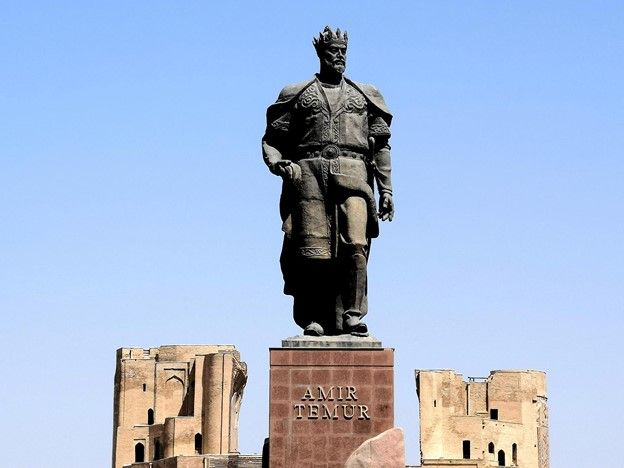
Timur in Shahrisabz, Uzbekistan. Photo: P.E.
Timur vaunted himself as a relative of Genghis Khan, the Absolute Conqueror – and his role model. History as written by the West framed Timur as a feral legend: a perpetrator of serial massacres in times when you needed to inflict unspeakable horrors to be regarded as properly cruel.
The Timur legend features endless gory piles or “towers” of beheaded foes and/or their skulls: a Mongol tradition infused with religious meaning, taken by Timur to the degree of a scientific method. For Timur, there was above all meticulous order in horror. Cue to 120 towers of 750 heads each arranged in Baghdad – or 70,000 heads in Isfahan equitably divided and laid out between his army corps.
Intellectuals, artisans, artists, religious figures though were spared. Once again, Timur systemized and regulated a Mongol principle: competent and useful prisoners should be kept alive.
A key strategic principle was to exterminate whoever resisted so in the end there should be no resistance, and citadels would fall voluntarily. With Timur that become a code. Immediate capitulation was rewarded with lives saved; the enemy must submit and pay ransom. If resistance took too long, the city would pay the price, including pillaging, but civilians would be spared. Third summation: hell, as in raping, pillaging and total extermination.
Yet the Emir did not rule as an Oceanic Khan just by being cruel. Timur launched a war of (italics mine) terror – but he did not provoke any collective belief in the end of the world. Europe, by the way, loved him. Because he prevented the Golden Horde from crushing Russian Orthodox Christians; and because he made a deal with the basileus of Constantinople, before defeating the worst enemy of Christianity, the Ottoman Turk Bajazet.
So Timur was an objective ally of the West. Certainly not a danger. Besides, he was very strong on diplomacy. Before the One Hundred Year War destroyed his kingdom, Charles VI of France received a letter written in gold leaves and bearing Timur’s seal: three circles that symbolize the conquest of the Universe. Timur wanted a trade deal. In the end, because of European incompetence, it came down to nothing.
Timur’s court was no bling bling Mar-al-Lago: it was an apex of real opulence and luxurious taste, fabulous jewels, itinerant elephants, sumptuous garb, fabulous houses.
He has been buried in Samarkand – splendidly isolated from the other Timurids, in an austere tomb topped by a black jade monolith. He rests behind his spiritual master, Sayyid Baraka, and the inscription at the shrine’s portal is pure Sufi: “Blessed is he who refused the world before the world refused him”.
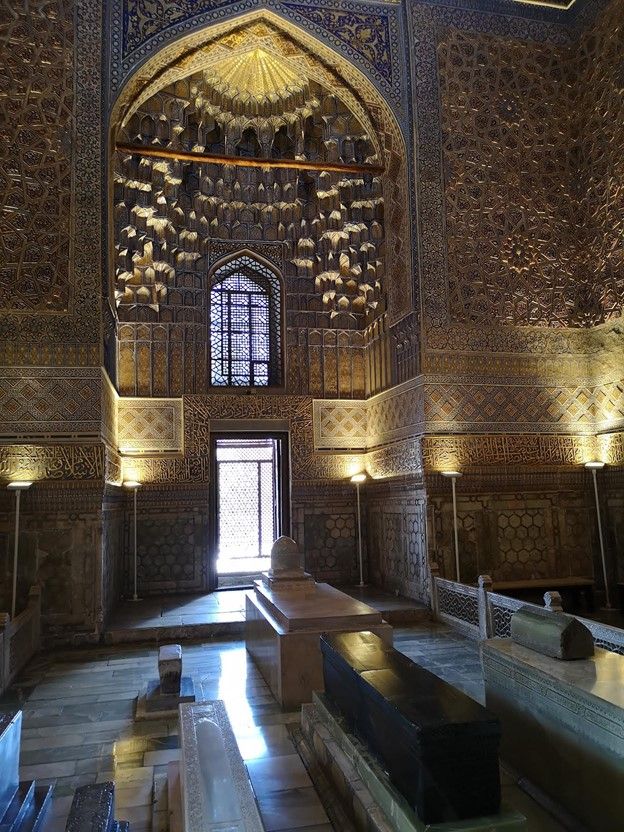
Timur’s tomb in Samarkand. Photo: P.E.
Timur was essentially a tribal Turk; a Muslim; and ideologically, a Mongol. A walking contradiction, really. Even if he spent part of his life fighting the heads of the Golden Horde and other Mongols, much more Mongols than himself, he proclaimed himself as the successor to the Oceanic Khan.
Even as he defeated the Ottoman Bajazet, offering de facto an extra time of 50 years to Constantinople, he was a Turk.
And even if he allied himself with Christians and paid his respects to pagan deities, in the best shamanistic tradition, he also saw himself as a man of the Quran: he went to war carrying a portable mosque.
Timur had the ultimate Silk Road dream: he wanted to conquer China. Even when Mongol unity had become a fiction; when the Yuan emperor was totally Sinicized and turned out to be very different from the Turk-Mongols of Transoxiana, they still recognized the suzerainty of the Yuan dynasty.
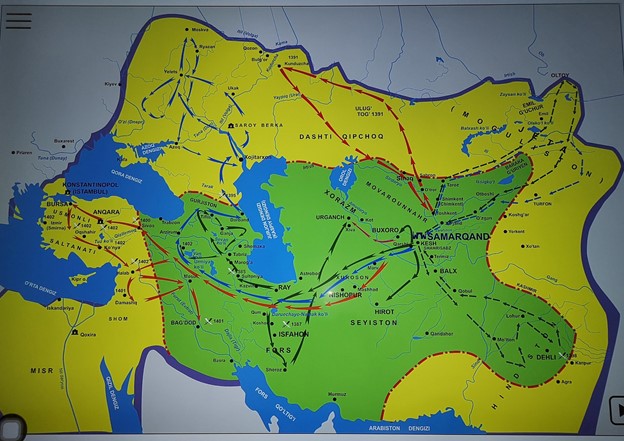
In Samarkand: Timur’s empire – ever expanding. But he never conquered China. Photo: P.E.
But with the Ming dynasty, it was a completely different story. Timur was preparing a conquering expedition when he died in Otrar – in today’s southern Kazakhstan – with a fever, in 1405, after dictating his testament and leaving 100,000 soldiers in a void.
The Ming dynasty had escaped the Supreme Peril. So history ruled that no conqueror coming from the West would traverse the Pamirs; that happened with Alexander the Great, and that happened with Islam.
But that may well happen with Timur Trump, Conqueror of China. In his own mind, of course.

 Dans cette édition de « ICI MOSCOU », Xavier Moreau revient sur les inquiétudes générées par les propos sur la
L’article ICI MOSCOU ! Alerte nucléaire est apparu en premier sur STRATPOL.

 Dans cette édition de « ICI MOSCOU », Xavier Moreau discute avec ses invités de la situation sur le front
L’article ICI MOSCOU ! Tensions nucléaires, cohésion nationale et valeurs familiales est apparu en premier sur STRATPOL.
Are China-Russia – and a great deal of the Global Majority – really ready? Call it an auspicious vow.
Close the door, put out the light
You know they won’t be home tonight
The snow falls hard and don’t you know
The winds of Thor are blowing cold
Led Zeppelin, No Quarter
In a matter of less than a year, Russian scientific know-how came up with four bangers:
1. Oreshnik: hypersonic missile, already tested in the Ukraine battleground.
2. Burevestnik: Or “Stormbringer”, with that nice Deep Purple ring. Nuclear cruise missile with unlimited range.
3. Poseidon: nuclear-powered torpedo, capable of loitering underwater, undetected, for unlimited time; then, at a command, strikes enemy coasts with a nuclear payload, provoking a radioactive tsunami. Largely exceeds the destructive power of the Sarmat, Russia’s largest ICBM.
4. Khabarovsk: nuclear sub. Call him The Messenger of Doom: capable of delivering at least 6 Doomsday-enabling Poseidons.
President Putin was crystal clear when detailing some key facts. The “compact nuclear systems” used in the Burevestnik and the Poseidon can also be adapted to create new energy sources, including for the Arctic.”
Putin also stressed how both Burevestnik and Poseidon “use only Russian-made parts”. Praise the Lord for those chips from upgraded Soviet washing machines.
And there’s a lot more to come following the tracks of Burevestnik and Poseidon: “I’m talking about…the Avangard system, or the serial production of the Oreshnik missile system…soon the heavy intercontinental Sarmat missile.”
The Sarmat – nicknamed Satan II – will enter combat next year: a super-heavy ICBM, carrying 10 heavy warheads, and compatible with the Avangard hypersonic glider, capable of dodging any anti-ballistic missile system.
Welcome to Russia’s next generation nuclear-powered cruise missiles, with reactors going online in a matter of seconds, and 3x speed of sound, heading towards hypersonic status.
In a nutshell: Burevestnik and Poseidon “will ensure strategic parity for the whole 21st century.”
Cue to thunderous silence heard all across the NATOstan sphere – permeated by the usual “the Russians are bluffing” gaggle noise.
Who cares? Facts are stubborn, and continue to be incontrovertible. Extra facts: Putin and Xi signing into law a mutual investment protection agreement, which translates as China protecting trillion-dollar worth Russian companies, Sberbank, Rosneft and Lukoil in case of a potential NATO-Russia war.
Or, in Eurasia connectivity corridor terms, take Putin, during the Russia-Central Asia summit, proposing unifying Eurasian logistics projects into a single network: “This would allow us to exponentially increase the volume of international transportation through our shared region.”
The massive economic/trade potential of Eurasia still remains largely untapped. Cut to the Russia-China goal of building a production-technological belt from the Russian Far East to Central Asia.
Ain’t got no deal on Russia-China
Well, these sharp facts are inbuilt in the new, emerging global reality, now a historical process – in sharp contrast with the paroxysms of Deep Desperation exhibited by the fragmented West and, significantly, the rise and rise of unilateral Empire of Chaos bullying.
Exhibit A is of course Venezuela.
The Circus Ringmaster – in a revamped remix of the war on drugs meets the war on terra – is mulling:
Bombing of Venezuelan military bases; deployment of Navy SEALS to capture or kill President Maduro; “securing” – as in invading and seizing Venezuelan oil fields, after controlling their key airfields; or even all of the above.
Trump 2.0, totally bypassing the US Congress and of course the illegality of assassinating foreign leaders, is already drafting dodgy legal “justifications” to go after Maduro as a “narco-terrorist” – much to the delight of ghastly Nobel Prize 5th columnist Machado, the female Guaido.
Total psyops is in full effect – complete with intimidating B-52 and B-1 bombers and the deployment of aircraft carrier USS Gerald R. Ford and thousands of troops.
Venezuelans though are not impressed. Diego Sequera, from the excellent Mission Verdad, notes, “if you take how things are seen from here you get the feeling that nothing will happen. No social breakdown, no one’s freaking out. Everyone is about their business looking for la plata with an end-year holiday mood.”
Still, they have to run rings over Circus Ringmaster – who wants all that oil so bad (the takeover of natural resources is essential to maintain the Empire) and pathetic neo-con gusano Marco Rubio’s only obsession in life: regime change in Venezuela, Cuba and Nicaragua.
And that brings us, once again, to the insoluble Empire of Chaos drama. TACO Trump, even if his brain is not capable of conceptualizing it, may be coming to grips with the hard facts of life: he cannot “win” – or impose a “deal” – on the Russia-China strategic partnership.
On the contrary: he needs to find diversionist tactics to evade the fact he is being inflicted a massive strategic defeat in Ukraine (yes, it’s his war now) while he simply does not have the cards (all made in China) to win a protracted trade-tariff-tech war against Beijing, as demonstrated in that G-2 in South Korea. Managed decoupling is already on.
Still, the supreme delusion of American military might persists, graphically incarnated by the clownish Secretary of Forever Wars. Can’t harm Moscow or Beijing? Caracas will do.
Oh, that Shakespearean sound and fury signifying…nothing, as the Empire of Chaos devours itself by re-colonizing the vassal puppies (Europe), financial shakedown-style, while threatening/ bullying selected Global South latitudes.
Emmanuel Todd has summed it all up, succinctly. What to do when “this is indeed the first American strategic defeat on a global scale, in a context of massive deindustrialisation in the United States and difficult reindustrialisation”, while “it is already too late to compete [with China] industrially.”
Hence the vociferous, bullying Circus Ringmaster, without saying a word (a miracle, in his particular case) progressively hitting TACO-on-steroids territory when it comes to Russia-China.
That’s our cue to the new Netflix series: the Empire of Rage lashing out, irrationally, against anyone, any nation, it deems weaker, a graphic demonstration of its massive resentment. Those fishing boats are full of narco-terrorists because I say so. Kill them all.
An extra danger is that the EUro-chihuahuas take a cue from this irrational drive to increase their Russophobic provocations inter-galactically. The only rational way to deal with it would be by Oreshniking them.
The mountains are high, but the Emperor is everywhere
A classic Chinese motto, repeated dynasty after dynasty, merrily states that “The mountains are high, and the Emperor is far away”. Well, in our contemporary case, there’s no mountain high enough – to borrow from Motown – and the all-seeing Emperor of Chaos, enabled by AI, is everywhere.
Yet even that is not enough to prevent him from collapsing inside his own schizophrenic bubble, unleashing Primal Fear into the intertwined plutocracies of Big Money, Big Oil and Big Tech.
Dystopia Central: it’s not hard to draw the map of the deep, dark geostrategic void self-described “elites” plunged themselves in.
And that brings us to how – in which register – the Russian leadership is watching the show. No expectations: realism prevails.
There may be a Trump 2.0 escalation in Ukraine – or not. There may be a more devastating attack on Iran – or not. There may be a serious regime change attempt in Venezuela – and that one is a near certainty. Trump 2.0, after all – complete with Zionist oligarchs on backing vocals – is a privileged psycho-killer realm.
And then there’s the ultimate chimera: de-dollarization – which is happening in practice, slowly but surely, without being named, in several domains. Only four months ago, the Circus Ringmaster was in panic: “BRICS was set up to hurt us; BRICS was set up to degenerate our dollar and take our dollar … off as the standard”.
The panic is still there. So when in doubt – and when you can’t strike Russia-China – the next “best” option is to strike another BRICS member. Demand capitulation from Iran. Or else. Tehran, as much as Caracas, is not impressed.
Chinese wisdom, once again, would solve the enigma:
Let him be strong, the breeze will blow over the hills; let him be arrogant, the bright moon will shine on the vast rivers.
It will be a very rough ride – to stare down the Empire of Chaos without letting it unleash Total Dementia, destabilizing Africa, West Asia, the Caribbean, everywhere, using the Syria al-Qaeda playbook (the former headchopper is to be received at the Oval Office soon).
Are China-Russia – and a great deal of the Global Majority – really ready? Call it an auspicious vow.

 Lateo.net - Flux RSS en pagaille (pour en ajouter : @ moi)
