 Connexion


Donald Trump s’est rendu en Chine où il a discuté avec le président Xi des principaux enjeux internationaux. Traversons-nous un
L’article ICI MOSCOU. Le tournant est apparu en premier sur STRATPOL.
En cas d’invasion de Taïwan, Pékin utiliserait des drones sous-marins pour poser des mines dans le Pacifique, mais les conséquences
L’article Pas seulement Taïwan: le plan de la Chine pour dominer le Pacifique est apparu en premier sur STRATPOL.
China-Japan relations in the wake of Japanese PM Sanae Takaichi’s remarks on Taiwan represent “the most dangerous situation in the past several decades,” says a Taiwan-based journalist and political analyst.
China is back to its stance of ‘Never Forget, Never Forgive!’
Takaichi claimed at a Diet meeting on November 7 that the Chinese mainland’s “use of force on Taiwan” could constitute a “survival-threatening situation” for Japan. She refused to retract her remarks, which imply the possibility of armed intervention in the Taiwan Straits.
Multiple Chinese ministries and government agencies have condemned the Japanese side’s related moves and remarks, warning that Japan would face a resolute response if it dared to meddle in the Taiwan question.
Japan sent a diplomat immediately.
This suggests that Japan is eager to hold face-to-face talks with China, while Beijing fully understands that, unless Takaichi formally apologizes for and retracts her remarks that crossed China’s red lines, any visit by Japanese officials to China is unlikely to yield substantive results.
While this is going on, China’s Defense Ministry urges the US to halt the despicable act of arming Taiwan island, and to avoid harming ties of two militaries.
Neither is Taiwan quiet. Some 34 groups on the Taiwan island jointly issued a protest statement on Monday to sternly protest the Japanese Prime Minister Sanae Takaichi’s erroneous and provocative remarks regarding the Taiwan question, declaring that the people in Taiwan refuse to become sacrifices to Japanese militarism.
These groups, including the Labor Party of Taiwan and the Cross-Straits Peace and Development Forum, said in the protest statement that Japanese Prime Minister Sanae Takaichi openly declared at the Diet meeting that the Taiwan question could constitute a “survival-threatening situation” for Japan, to justify Japan’s exercise of the right of collective self-defense and implied military intervention in the Taiwan Straits.
Takaichi’s use of the so-called “Taiwan emergency” to push for a strategic upgrade is not for Taiwan’s benefit, but to legitimize the militarism expansion of Japanese right-wing groups. By elevating the Taiwan question into a matter of “survival-threatening situation” for Japan in her capacity as prime minister, Takaichi is effectively using state power to justify military action, which is a blatant provocation against existing China-Japan agreements and the post-war order, according to the statement.
People’s Daily published a blistering report:
Takaichi’s wrong remarks on Taiwan question are akin to invoking the spirit of militarism. The rhetoric of “a Taiwan contingency is a contingency for Japan” is a dangerous narrative circulating within Japanese political circles, attempting to link China’s national reunification with Japan’s security concerns. Less than a month into her tenure, Takaichi has become the first sitting Japanese prime minister to openly advocate for this dangerous position, connecting it to the potential exercise of collective self-defense. This highlights the dangerous direction of her domestic and foreign policies. Historically, Japan’s militarism has often used the so-called existential crisis as a pretext for external aggression, including justifying the September 18 Incident and provoking the war of aggression against China, which brought tremendous suffering to Asia and the world. Takaichi’s recent use of “existential crisis” as a justification provides ample cause for concern that Japan may be repeating the mistakes of its militaristic past.
Takaichi’s reckless remarks are a blatant provocation to historical justice. Japan bears deep historical responsibility on the Taiwan question. After the First Sino-Japanese War, Japan forcibly seized Taiwan and imposed colonial rule for half a century, committing countless atrocities. In 1945, Japan signed the Instrument of Surrender and formally accepted international legal documents, including the Cairo Declaration and the Potsdam Proclamation, which stipulated that Taiwan should be returned to China. China subsequently regained Taiwan, restoring its sovereignty over the territory. This was a triumph of historical justice. This year marks the 80th anniversary of the victory in the Chinese People’s War of Resistance against Japanese Aggression (1931-45) and the 80th anniversary of Taiwan’s restoration. Rather than reflecting on its past, Japan has continued to create new tensions over Taiwan.
This interference in China’s internal affairs and provocative actions severely undermine the political foundation of China-Japan relations and challenge the post-WWII international order.
The Taiwan question is at the very core of China’s core interests, and it is an inviolable red line and bottom line. The question of how to resolve Taiwan and achieve national reunification is a matter for the Chinese people alone, and no external force has the right to interfere. Eighty years ago, the brave Chinese people defeated the Japanese invaders. Today, 80 years later, the determination of the Chinese people to safeguard national sovereignty and territorial integrity is unwavering. Our will is unbreakable, and our capabilities are far stronger than before. Any attempt to interfere with or obstruct China’s reunification efforts is doomed to failure. We warn Japan that any provocation on the Taiwan question is simply courting trouble!
Japan’s militaristic history is a heavy burden, and the peoples of the world, including the Chinese people, will never forget, nor will they ever forgive it. For the first time, Japan’s leaders have expressed an ambition to militarily intervene in Taiwan, issuing a threat of force against China. Behind this lies the dangerous ambition of Japan’s right-wing forces to break free from the constraints of its pacifist constitution and pursue the status of a “military power.”
Chinese Ministry of Foreign Affairs spokesperson Mao Ning posted a video on social media platform X on Monday about the 1995 Murayama Statement by former Japanese prime minister Tomiichi Murayama, amid widespread criticism following Japanese Prime Minister Sanae Takaichi’s erroneous remarks on the Taiwan Straits.
In the accompanying caption, Mao stated, it is “high time to recall the 1995 Murayama Statement, in which then Japanese Prime Minister Tomiichi Murayama admitted and atoned for Japanese aggression during WWII and offered apology to the victim countries.”
The Chinese English media is full of this story. Japan stepped on the wrong toe, and there is still pain and anger.
Even the Chinese Education Ministry had something to say.
Following the warning issued by the Ministry of Foreign Affairs to Chinese citizens against traveling to Japan in the near future, the Ministry of Education also released an overseas study alert on Sunday, pointing out that there are frequent cases of crimes against Chinese citizens in Japan and advising Chinese students to plan their studies prudently. On the same day, the Ministry of Culture and Tourism also issued a travel notice for Chinese tourists. These warnings have attracted widespread attention, with some outsiders attempting to interpret them as a form of “diplomatic pressure.” However, a rational examination of the current environment of China-Japan relations and the various changes taking place in Japan leads to a clear conclusion: These warnings are based on realistic considerations of the personal safety and basic dignity of its own citizens, and are a necessary measure taken by the Chinese government to fulfill its responsibilities.
China wants a personal apology and a retraction from Takaichi.
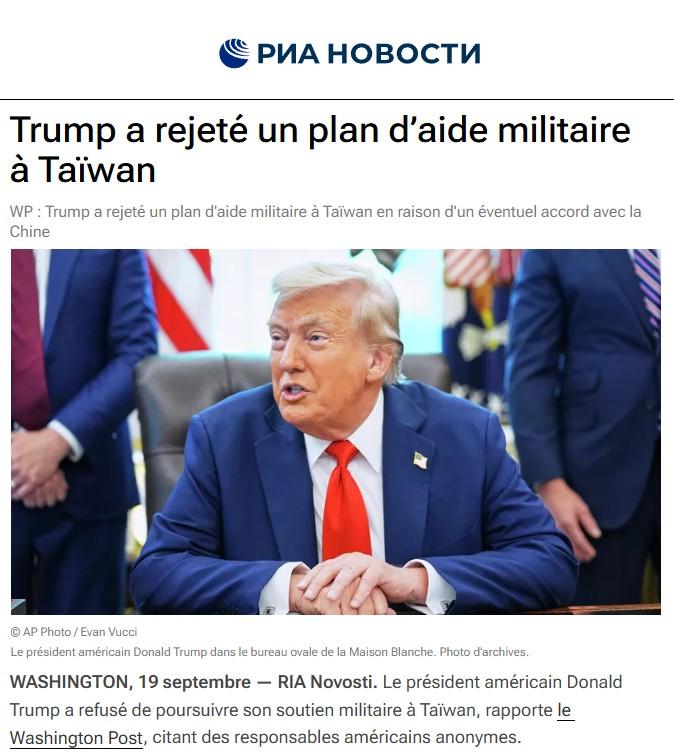
Le président américain Donald Trump a refusé de poursuivre son soutien militaire à Taïwan, rapporte le Washington Post, citant des
L’article Trump aurait refusé un plan d’aide pour Taïwan pour favoriser un accord avec la Chine est apparu en premier sur STRATPOL.
Zhou Bo
Senior Colonel (retired). Research Fellow at the Center for Strategic and Security Studies, Tsinghua University, China
—
There has been much speculation as to which third parties might get involved if war broke out between China and the United States in the Taiwan Strait. In June, The Economist published an article on this very question. More recently, the Financial Times reported that the US had been putting pressure on Japan and Australia to clarify what role they would play in such a situation.
It appears that there would be few countries on China’s side. China’s only treaty ally is North Korea. A 1961 treaty obliges the two sides to take “all necessary measures” to oppose any country or coalition of countries that attack either nation unprovoked. Although North Korea sending soldiers to fight for Russia in Ukraine could raise the same prospect one day, and Beijing certainly matters much more than Moscow to the survival of a country under extensive international sanctions, currently China’s ties with North Korea appear less warm than those between Russia and North Korea.
Pakistan has been described as an “iron brother” of China. Given its almost unsalvageable relationship with India, Pakistan might seriously consider following through if China asked it to help take on India in a worst-case scenario. However, Islamabad joining a war to assist China against the US – which is a major provider of aid to Pakistan – is highly unlikely.
China’s most useful strategic partner is unquestionably Russia. Their closeness is reflected in their regular air and sea exercises. But why would Russia choose to get involved in a conflict in the Taiwan Strait if China has not provided Russia with military assistance in the Ukraine war? Presumably Russia would continue to sell China oil and gas, just like China is still selling Russia non-military items, but that’s probably all.
On the American side, not more than a handful of countries would provide military assistance to the US in a conflict with China, and each would do so half-heartedly at best. The Economist article seems to share this view as it quotes a recent paper from the Centre for a New American Security (CNAS), though the paper’s analysis is not entirely convincing.
Its first conclusion is obvious: if the US stays out of the war, its allies will, too. The second is that if the US does step in, its most affected allies would be Japan and the Philippines. Japan’s participation would be unlikely to go much further than submarine patrols or missile strikes. The Philippines would be more cautious, the CNAS paper said, but if Chinese forces were bogged down, it might be tempted to advance its claims in the South China Sea.
I agree that Japan and the Philippines would be the countries most affected in that they are both on the first chain of islands close to the Chinese coast. However, I doubt Japan would go beyond providing the US with logistical support for missile attacks on China unless it is attacked by China first.
Meanwhile, it is absurd to suggest the Philippines would be tempted to grab territory in the South China Sea. If that is the case, why wouldn’t Vietnam and Malaysia – which have stronger militaries than the Philippines – do likewise? In the event of China and the US going to war, the challenge for all Southeast Asian countries would be avoiding a conflict that engulfs the entire region. If the conflict spills over into an all-out war, the disputed islands in the South China Sea might not even exist any more.
The CNAS paper is right to say a second group of close US allies and partners – South Korea, Australia and India – would be more insulated, though Washington would likely pressure them to help. South Korea’s primary concern is the Korean peninsula.
The best support Australia could provide the US would be to allow the use of Australian bases to launch attacks on Chinese ships and aircraft. Australian officials worrying that the Aukus submarine deal could be in jeopardy if Australia stays out of any conflict is understandable, but isn’t avoiding war with the country’s largest trading partner more significant to Canberra than buying a few submarines?
Some in China would argue that India might use a US-China conflict in the Taiwan Strait to claim more territory along the Line of Actual Control, but I doubt that would happen. I agree with the CNAS authors that India would focus on defending its land border with China.
In conclusion, few countries would wish to become involved in a conflict between China and the US. According to Lowy Institute analysis, 119 countries – 62 per cent of UN member states – have endorsed Beijing’s preferred wording, accepting its claim to sovereignty over Taiwan. Of them, 89 per cent support Beijing’s reunification efforts, without specifying that these efforts should be peaceful.
Washington will find it harder than it thinks to pressure its allies to pick sides, especially when its own involvement looks more questionable than ever. Elbridge Colby, a long-time China hawk, wrote in The Wall Street Journal last September that Taiwan “isn’t itself of existential importance to America”.
If the views of Colby, now US undersecretary of defence for policy, could have “softened considerably”, as Senator Roger Wicker said during his confirmation hearing, it gives a clue as to where things are moving. US President Donald Trump rarely misses a chance to express an opinion, but so far he has not said much on the Taiwan issue. Is he keeping quiet while waiting for a chance to make a deal? His silence could not be louder.

 Lateo.net - Flux RSS en pagaille (pour en ajouter : @ moi)